
Submitted:
18 September 2024
Posted:
20 September 2024
You are already at the latest version
Abstract
Afghanistan is located on the Eurasian tectonic plate's edge, a highly seismically active region. It is bordered by the northern boundary of the Indian plate and influenced by the collisional Arabian plate to the south. The Hindu Kush and Pamir Mountains in Afghanistan are part of the western extension of the Himalayan orogeny and have been uplifted and sheared by the convergence of the Indian and Eurasian plates. These tectonic activities have generated numerous active deep faults across the Hindu Kush-Himalayan region, many of which intersect Afghanistan, resulting in frequent high-magnitude earthquakes. This tectonic interaction produces ground shaking of varying intensity, from high to moderate and low, with the epicenters often located in the northeast and extending southwest across the country. The reoccurrence and severity of earthquakes have been increasing since 1900. This study maps Afghanistan's tectonic structures, identifying the most active geological faults and regions with heightened seismicity. The increasing trend in recurrence and intensity of the earthquakes are drawn. Historical earthquake data were reviewed, and recent destructive events were incorporated into the national earthquake dataset to improve disaster management strategies. Additionally, the study addresses earthquake hazards related to building and infrastructure design, offering potential solutions and directions to mitigate risks to life and property.
Keywords:
Afghanistan
; Seismic Regions
; Trend in Earthquake
; Vulnerability
; Earthquake-DRR
1. Introduction
Tectonic earthquakes in the Himalayan region result from the subduction of the Indian continental plate under the Eurasian plate [1,2]. The Hindu Kush Mountains, part of this active tectonic region, extend from the northeastern to southeastern parts of Afghanistan and into surrounding areas [2,3]. The region underwent intensive folding, thrusting, and faulting during the Mesozoic and Cenozoic eras. These deformations in the Himalayan region generally follow northwest-southeast and east-west trends [4]. The northward underthrusting of the Indian crust beneath Eurasia generates numerous earthquakes, making the region one of the most seismically hazardous areas on Earth [5,6]. This region frequently experiences destructive earthquakes, propagating seismic waves throughout Afghanistan and surrounding regions [7,8]. Consequently, northeastern Afghanistan is at the center of high earthquake hazards.
Afghanistan has been affected by destructive seismic activity for centuries, particularly in its northeastern region [8]. Annually, the country experiences moderate to strong earthquakes that cause damage, economic losses, and fatalities [9]. Since 1900, there has been an increasing trend in earthquake recurrence, with approximately 100 damaging earthquakes recorded [10]. Over the past 30 years, earthquakes have resulted in more than 10,000 fatalities [11]. Strong earthquakes occur every few years in and around Afghanistan. For instance, a Mw7.5 earthquake in the Hindu Kush Mountains in 2015 caused 117 fatalities and destroyed over 7,000 houses [12]. In 2019, an Mw6.1 earthquake struck Badakhshan province, while in 2021, an Mw5.1 earthquake hit Kabul, with no fatalities and minimal damage [13]. In June 2022, a Mw6.2 earthquake struck southeastern Afghanistan, resulting in over 1,163 fatalities, 3,600 injuries, and the destruction of about 1,000 houses [14]. More recently, on March 21, 2023, a Mw6.5 earthquake shook Jurm, Badakhshan, without causing any fatalities. Each of these earthquakes was followed by aftershocks and recurring activity near the main shock centers.
The impact and vulnerability to earthquake hazards in Afghanistan are exacerbated by several factors, including the distribution of active faults, settlements in disaster-prone areas, unreinforced buildings, and the lack of a comprehensive disaster management system. Additionally, poverty, conflict, and instability in the country contribute to its susceptibility [15]. Therefore, effective earthquake disaster management is essential for reducing risk and vulnerability, and it forms the foundation for the country’s long-term sustainability. Over the past two decades, Afghanistan’s disaster risk management efforts have focused on response and recovery [16]. However, the Government of the Islamic Republic of Afghanistan (GoIRA), working with development partners like the World Bank, United Nations agencies, and international NGOs, has also initiated efforts to develop Disaster Risk Management (DRM) systems and integrate Disaster Risk Reduction (DRR) into national development strategies [17]. GoIRA included DRM and DRR in its national development strategy [18,19]. Despite these efforts, many DRM and DRR policies and plans remained in draft form [20]. The prolonged war and conflict further exacerbate Afghanistan’s vulnerability to natural disasters [21]. Insecurity and conflict contribute to state fragility, increasing socioeconomic vulnerability, while natural disasters cause frequent loss of lives, livelihoods, and property, resulting in migration and displacement [22,23]. These interconnected issues intensify the impacts of disasters, even though Afghanistan has significant potential to mitigate disaster risks.
This study focuses on detecting the increasing trend in earthquake recurrence since 1900. It reviews the quality of construction concerning earthquake intensity and conducts a seismic risk analysis based on significant historical records around tectonic fault zones using ArcGIS Pro. The risk assessment combines hazard, exposure, and vulnerability in the analysis. The paper concludes with constructive recommendations for earthquake risk mitigation, addressing a critical gap that could significantly enhance disaster risk reduction efforts.
2. Materials and Methods
2.1. Tectonic Structure of Afghanistan
Afghanistan is situated on the edge of the Eurasian plate within the active tectonic region of the Alpine-Himalaya orogenic belt. This belt was formed during the ongoing collision between the Indian, Arabian, and Eurasian plates, a process that began in the Late Paleogene and continues to the present day [24,25] as illustrated in Figure 1. Afghanistan shares hundreds of kilometers of active plate boundaries along its western, southern, and eastern edges. To the west, the Arabian plate moves northward relative to the Eurasian plate at a rate of approximately 31 mm/year [26]. This active boundary extends northwestward through the Zagros region of southwestern Iran [27]. The plate motion in this region has significantly deformed Iran and the surrounding areas, creating major structural features, including north-south-trending and right-lateral strike-slip fault systems along Iran's eastern boundary with Afghanistan. East-west-trending reverse and strike-slip faults are intermittently distributed throughout Afghanistan [9].
Along Afghanistan's eastern margin, the Indian plate moves northward relative to the Eurasian plate at an average rate of about 34.4 mm/year [28]. The collision between the Indian and Eurasian plates occurs at various measured rates, averaging ~13 mm/year [29,30]. This ongoing collision has created a broad, transpressional plate boundary zone that trends southwestward from the Hindukush region in northeastern Afghanistan, through Kabul, and along the country's eastern side (Wheeler et al., 2005). This zone features major north-northeast-trending, left-lateral strike-slip faults and is characterized by historical and contemporary seismic activity.
The Makran subduction zone, a region of significant geological activity, lies between the overriding Eurasian and subducting Arabian plates (Figure 1). This zone results from the northward subduction of the oceanic portion of the Arabian plate beneath the Lut and Afghan blocks in the northwestern Indian Ocean [31,32]. The region's tectonic setting is complex due to its location at a triple junction with the Indian plate. Southwestern Pakistan, southeastern Iran, and southernmost Afghanistan comprise a broad transpressional fold and thrust belt characterized by south-southeast-verging, north-dipping thrust faults and associated east-northeast-trending folds [33,34]. This seismically active area frequently produces large-magnitude earthquakes, including a recent Mw7.7 earthquake in September 2013 in Balochistan Province [31].
Seismicity increases in northeastern Afghanistan, where a zone of deep earthquakes is associated with the northward subduction of the Indian plate beneath Eurasia. This zone, a promising area for future research, extends beneath the Hindukush and Pamir Mountains [9,35]. In the Pamir and Hindukush regions, the seismogenic zone starts at a depth of 50 km, extending to around 250 km, and displays several subduction-related features, such as crustal thrust faults and a local zone of high seismicity [36,37].
Some faults in Afghanistan are considered active based on historical records, recent significant earthquake activity, and surface ruptures. Earthquakes in Afghanistan and the surrounding region have caused, and will likely continue to cause, severe damage through solid ground shaking, surface fault ruptures, liquefaction, and landslides. This underscores the urgent need for continued monitoring. Notably, on June 22, 2022, a devastating Mw6.2 earthquake struck southeastern Afghanistan, causing widespread destruction [38,39].
2.2. Regional Tectonic Framework and Associated Fault Systems
The Hindu Kush and Pamir Mountains in Afghanistan are part of the Himalayan orogeny, uplifted by the collision between the Indian and Eurasian plates. This tectonic event and its associated movements have generated several active deep faults in the Hindu Kush-Himalayan region, extending across Afghanistan [25,40] as shown in Figure 2. The boundary of the Himalayan tectonic region extends to the foothills of the Sulaiman Mountains in the west, the Indo-Burmese Arc in the east, and the Himalayan Front in northern India [41]. Earthquakes in this region are the episodic release of accumulated tectonic strain and stress, resulting in motion or slip between crustal blocks and causing significant damaging shaking [42]. Additionally, the relative motion between the Indian and Eurasian plates in the west and south of the Himalayan front is oblique, leading to strike-slip, reverse-slip, and oblique-slip earthquakes, as well as associated displacement along faults and fault zones [28,43]. As illustrated in Figure 2, Afghanistan and neighboring countries share the same tectonic region and exhibit a similar tectonic structure. The fault systems that traverse Afghanistan also extend into the surrounding regions. Ruleman et al., (2007) identified any fault within 100 km of Afghanistan’s political borders as a potential threat to the country's population and infrastructure [44].
The primary active fault systems in Afghanistan include the Chaman, Hari Rud, Central Badakhshan, and Darvaz faults, along with numerous more minor subsidiary faults and fault zones that accommodate movement between these major faults [44,45,46]. These faults are associated with both shallow and deep high-magnitude earthquakes. Figure 2 highlights earthquakes that occurred in the region between 1964 and 2004, adapted from the USGS database [27]. High-magnitude earthquakes along these fault systems have recently impacted Afghanistan and surrounding areas [5,47]. In the western part of the country, earthquake activity originating from the Arabian Plate has caused deadly quakes in eastern Iran [32].
2.3. Tectonic Zones of Afghanistan
Afghanistan consists of a complex assemblage of crustal and oceanic blocks, forming several unique terranes that were welded onto the southern margin of the Eurasian plate during a series of accretionary events beginning in the Paleozoic and continuing to the present [44,48,49,50]. The geological structure of Afghanistan is dominated by the Mesozoic (Cimmeride) and Tertiary (Himalayan) orogenic episodes, which have shaped and continue to shape the country's mountainous regions and dramatic landscape [51,52]. Afghanistan has been classified into four distinct seismotectonic regions, each with different geological histories and structures [46,49,53], as outlined in Figure 3.
The Transpressional Plate Boundary region marks the boundary between the Eurasian and Indian plates, resulting from continental collision and moving northward at a rate of approximately 39 mm per year [44,45]. This boundary is located south and east of the Afghan Block. It includes the eastern portion of the Hindu Kush and Pamir mountain ranges and the Sulaiman fold-and-thrust belt in southern Afghanistan (Figure 3). The western and northern boundaries of this zone are defined by the left-lateral Chaman and Central Badakhshan fault systems, respectively. The Chaman fault, in particular, exhibits significant tectonic activity, including recent earthquakes, making it the most seismically active zone in Afghanistan, except for the eastern part of the North Afghan Platform.
The North Afghan Platform lies north of the Hari Rud fault zone and west of the Central Badakhshan fault system, encompassing the Tajik Basin [44,45] (Figure 3). The Darvaz fault is particularly active in this region. This zone represents the southern margin of the Eurasian continental plate and is relatively tectonically stable. It consists of a deformed basement of metamorphic and igneous rocks formed during the Carboniferous-Permian Hercynian Orogeny [39]. The eastern part of the North Afghan Platform, incorporating the Darvaz fault, is more seismically active than the rest of the platform.
Middle Afghanistan is a narrow zone located immediately south of the North Afghan Platform and forms part of the right-lateral Hari Rud fault zone [44,45]. It acts as the boundary between the North Afghan Platform, the Afghan Block, and other terranes to the south [54]. The Hari Rud River flows along a central downfaulted graben within the suture, south of the Paropamisus Mountains. The Accreted Terranes region lies south of Middle Afghanistan and includes numerous external folded, faulted, partially metamorphosed, and deformed blocks. These blocks form the mountains and plains of the Farah, Helmand, and Arghandab areas, created during the Mesozoic Cimmerian Orogeny, which involved the closing of the Paleo-Tethys Ocean [44,45,55] (Figure 3). This region is seismically quiescent.
Identifying these tectonic zones, as per Wheeler et al. (2005) and Ruleman et al. (2007), allows for the distribution of earthquake magnitudes across various faults and regions of Afghanistan. Generally, tectonic activities, earthquakes, and deformation in Afghanistan and the surrounding region are driven by the collision between the northward-moving Indian and Eurasian plates [44,56]. This movement has created active Quaternary faults across the country, producing moderate to high-magnitude, potentially damaging earthquakes. Afghanistan's crust is segmented by a complex fault network of various ages and directions of movement, as shown in Figure 2. Ancient earthquakes along these faults have caused varying degrees of slip over time. Due to the temporal and spatial migration of stress and strain within the region, some faults remain active, causing recent destructive earthquakes, while others have become dormant or quiescent [57,58,59].
2.4. Data
In this study, many papers, reports, and books were reviewed, and existing earthquakes and tectonic databases were used. The United States Geological Survey (USGS) recently investigated seismic activities in Afghanistan [60], focusing on geological faults, seismic zones, and the creation of earthquake hazard maps. This research also included a historical earthquake database [60,61]. Moreover, we utilized data from the Risklayer online database for historical and recent earthquakes [13]. The main geological faults crossing Afghanistan and connections to surrounding regions and plate boundaries were derived from the ArcGIS REST Services Directory [29,62]. This study reviewed USGS reports and various databases, incorporating recent earthquake data into the existing databases. Afghanistan's tectonic settings, active faults, and seismic regions were digitized and mapped using updated data in ArcGIS Pro [63]. In addition, newly available earthquake records enhanced earthquake hazard maps and historical earthquake databases. Based on this data, a simplified approach to Earthquake Disaster Risk Reduction (DRR) in Afghanistan was proposed.
Due to decades of protracted war and conflict in Afghanistan, much of the data recording infrastructure has been destroyed [64]. This has severely hindered research efforts, as the availability of accurate data is limited. National-level Disaster Risk Management (DRM) remains challenged by inconsistent hazard and vulnerability data. Data collection and field observations are further constrained by security issues, creating significant gaps in the seismic record, particularly between 1980 and 2002. Despite these challenges, the State Ministry for Disaster Management and Humanitarian Affairs (DMHA) and national and international partners established a national disaster information management system. However, this system became inoperable after the collapse of the government of the Islamic Republic of Afghanistan (GoIRA). Fortunately, advancements in remote sensing technology have made quantitative risk assessments feasible, even in data-scarce regions [65,66].
ArcGIS Pro was utilized to create tectonic and earthquake hazard maps, as well as to analyze the available data [63]. The topographical maps and satellite imagery data are from various sources, such as Esri, USGS, the Food and Agriculture Organization (FAO), and the National Oceanic and Atmospheric Administration (NOAA).
3. Results and Discussions
Afghanistan is in a seismically active region, with earthquakes primarily caused by tectonic activity resulting from the interaction between the Indian, Eurasian, and Arabian plates. The country is crisscrossed by numerous active faults, meaning they have shown movement within the Quaternary Period (the last 2.58 million years). Some of these active faults, such as those in northern Afghanistan, particularly in the Badakhshan province, are central to major earthquake activity. The tectonic boundaries in and around Afghanistan create concentrated zones where the Earth's crust is under stress, leading to episodic ruptures or movements manifesting as earthquakes.
Earthquakes have caused significant destruction in Afghanistan, particularly near fault zones and tectonic boundaries between Afghanistan and the surrounding area (Figure 2 and Figure 3). The historical records of seismic events show that the country has experienced recurrent and powerful earthquakes, some of which originated in surrounding countries but had severe impacts within Afghanistan. Notably, since 1900, earthquakes have increased in and around Afghanistan, raising concerns about the country's vulnerability.
A key challenge in Afghanistan is the widespread vulnerability of infrastructure and populations to seismic activity. Earthquake-resistant infrastructure is uncommon, and many areas, especially rural regions, are densely populated without proper disaster mitigation strategies. The lack of early warning systems, emergency preparedness, and infrastructure to withstand earthquakes exacerbates the risk. While earthquakes cannot be predicted, their hazards can be mitigated by reducing people's and infrastructure exposure, risk, and vulnerability through infrastructure improvements, education, and strategic urban planning. The following sections discuss historical earthquakes in Afghanistan, infrastructure vulnerability, and population risk and provide recommendations for earthquake risk management strategies for the country.
3.1. Historical Earthquakes in Afghanistan
The historical earthquake records offer crucial insights for hazard assessment and disaster risk management, particularly as population growth and vulnerable infrastructure have amplified the risk of earthquake-induced damage. Research on Afghanistan's seismic history has faced considerable challenges, mainly due to protracted conflict and the destruction of research institutions. Despite these setbacks, modern efforts have resumed to collect and analyze seismic data. The USGS, for instance, has developed a database to map the country's earthquake vulnerabilities. This work follows earlier contributions from researchers like Ambraseys and Bilham (2003) and Dewey (2006), who investigated Afghanistan's historical seismicity (Figure 4). These studies indicate that earthquakes have been documented for over a millennium, with records dating back to A.D. 734. One of the earliest notable earthquakes occurred in A.D. 819, with an estimated magnitude of Ms7.4 in northern Afghanistan, causing extensive destruction and numerous casualties. Compiling more than 1,300 historical earthquakes in the database, these records help create a foundational understanding of Afghanistan's seismic risks. The United Nations Environmental Program (UNEP) [67,68,69] has also contributed to this effort, emphasizing the intersection of environmental disasters and earthquake risk. Their work, alongside that of the World Bank [11], highlights the need for comprehensive disaster risk profiles to inform risk management strategies in the region. Given Afghanistan's history and current seismic vulnerability, robust earthquake disaster mitigation measures, strengthened data collection and research infrastructure are critical for its long-term resilience.
The increasing trend of recorded earthquakes greater than 5M in Afghanistan and its surrounding regions, as depicted in Figure 5(A) and Figure 5(B), suggests growing seismic activity over the centuries. In Figure 5(A), the graph illustrates earthquakes from 700 to the present, while Figure 5(B) focuses on those recorded since 1900. This rise in seismic activity may be attributed to several factors, such as improved monitoring techniques over time, population growth in earthquake-prone areas, or regional geological shifts. However, it is essential to analyze whether the actual frequency of earthquakes has increased or if this trend reflects better recording technologies and larger populations that report seismic events.
Figure 6 illustrates the locations, magnitudes, and focal depths of historic earthquakes within Afghanistan and its surrounding regions. Earthquakes are classified based on focal depth: shallow earthquakes occur between 0 and 70 km, intermediate-depth earthquakes range from 70 to 300 km, and deep-focus earthquakes occur between 300 and 700 km [70]. Intermediate-depth earthquakes result from deformation within the subducted lithosphere beneath the Eurasian Plate rather than the shallow interfaces between the subducting and overriding plates. These earthquakes generally cause less surface damage than shallow-focus earthquakes of similar magnitude. However, large intermediate-depth earthquakes can be felt over great distances. Occasionally, deep-focus earthquakes exceeding 300 km also occur beneath northeastern Afghanistan [71].
Afghanistan's most tectonically active area is the Transpressional Boundary region (Figure 3), which includes the Hindukush deep seismic zone, known for high-magnitude deep earthquakes. In contrast, the central and western parts of the country remain largely seismically inactive. Additionally, the southeastern region is marked by the left-lateral, strike-slip Chaman fault, Afghanistan's fastest-moving fault. For example, a segment of the Chaman fault near Kabul ruptured in 1505, causing widespread devastation. Another significant event was the M7.6 earthquake in Quetta on May 30, 1935, which occurred in the Sulaiman Range, killing 30,000 people and affecting 60,000 more beyond Afghanistan’s borders. In Afghanistan, even moderate earthquakes with magnitudes between 5.0 and 5.9 have caused considerable destruction and fatalities, which is why the earthquake catalog includes all events with magnitudes greater than M5.
3.2. Recent Seismicity and Earthquakes in Afghanistan
Figure 7 illustrates the seismotectonic map of Afghanistan and its surroundings, highlighting recent earthquakes from 1990 to 2004. This period saw a significant number of seismic events, with some notably destructive ones summarized below:
June 21, 2022: A magnitude M6 earthquake with a 40-km deep epicenter struck near Khost Province. This earthquake resulted in 1,150 casualties, 3,000 injuries, and damaged 10,000 homes across Khost and Paktika provinces [72]. The most affected areas in Khost were Sperah and Barmal, while Nikeh, Ster Giyan, and the Ziruk area in Paktika Province were also severely impacted. The earthquake caused a landslide in Khost, which killed ten people and injured 25. The event was characterized by predominantly strike-slip faulting, with either a left-lateral slip on a northeast-striking fault or a right-lateral slip on a northwest-striking fault [47,72].
October 26, 2015: An M7.5 magnitude earthquake occurred southwest of Jurm in Badakhshan Province, near the Hindukush region. This event was due to reverse faulting at an intermediate depth, approximately 210 km below the Hindukush Range in northeastern Afghanistan [73]. Focal mechanism solutions suggest rupture on either a steep, south-dipping reverse fault or a shallow, north-dipping thrust fault.
October 2005: The deadliest earthquake in recent history struck the Kashmir region of Pakistan, near the eastern border of Afghanistan, with significant regional impacts [74]. March 2002: An M7.4 magnitude earthquake struck just 20 km west of the October 26, 2015 event, with similar depth and thrust fault orientation. This earthquake caused over 150 fatalities and damaged or destroyed over 400 houses due to a seismogenic landslide. In December 1983, an M7.4 earthquake occurred at a similar depth, 8 km south of the October 26, 2015, event. This quake resulted in 26 fatalities, hundreds of injuries, and extensive infrastructural damage.
Afghanistan requires a comprehensive disaster database and a robust national disaster management system. This should include mapping tectonic structures and active faults and creating interactive earthquake hazard maps. By integrating available national data with global geospatial data, we can better understand earthquake-prone regions and areas at higher risk of seismic disasters. Historical earthquake databases provide valuable information on seismological data, building damage, social losses (deaths, injuries, homelessness, and affected populations), and economic impacts. This data is crucial for understanding global economic and social losses and their effects on Gross Domestic Product (GDP) and Human Development Index (HDI) [10].
3.3. Earthquake Hazard Map of Afghanistan
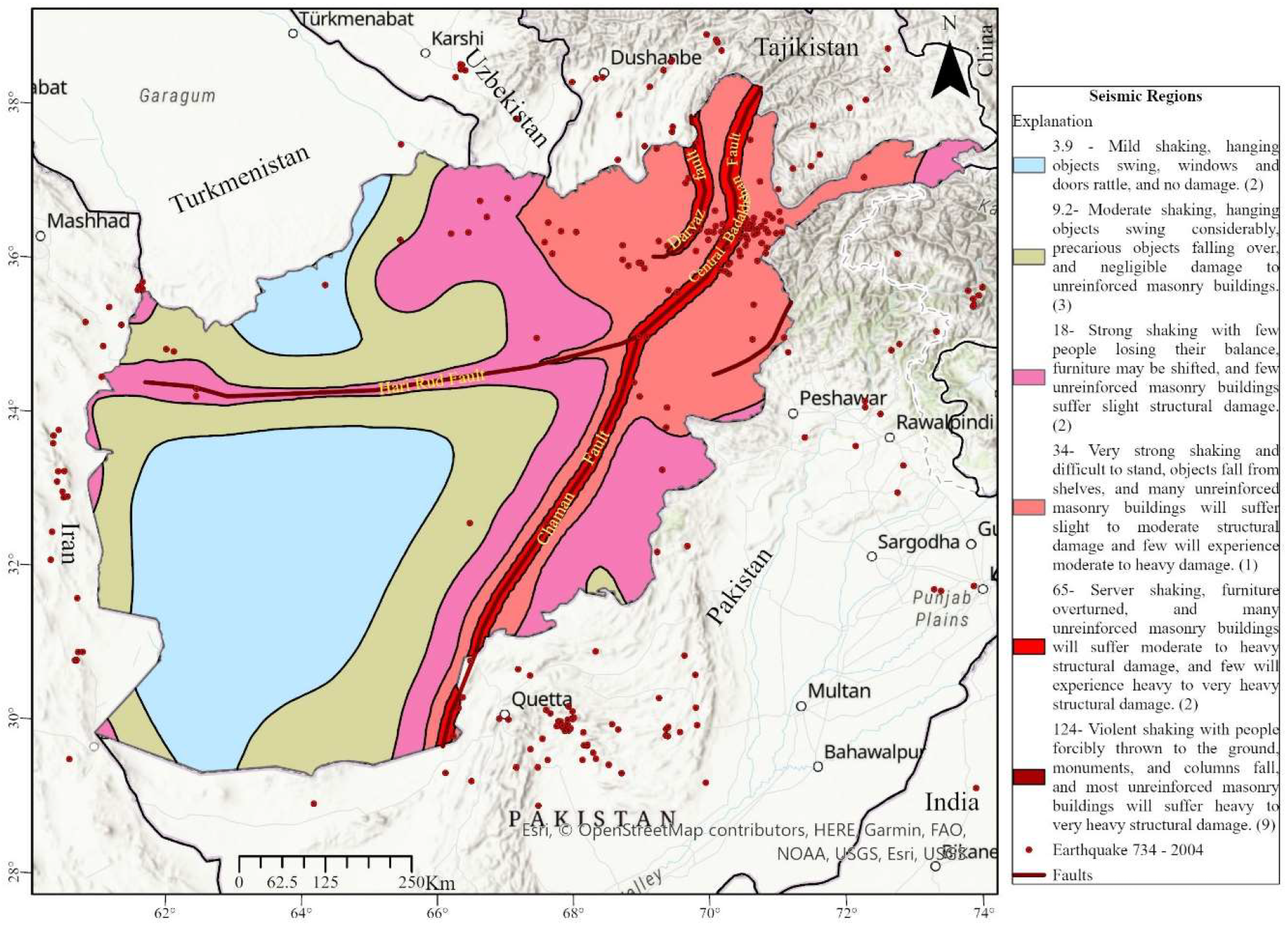
Figure 8 illustrates the earthquake hazard map of Afghanistan, segmented into six seismic regions categorized by shaking intensity, ranging from low (light blue) to high (red). USGS initially developed this hazard map [9]. The region near the Central Badakhshan, Darvaz, and Chaman faults has experienced the highest levels of shaking and destruction from historical earthquakes. It also exhibits the most significant geomorphic evidence of ongoing tectonism [43,44], thus indicating the highest seismic hazard. The second-highest seismic hazard is found in the dispersed areas associated with these major fault zones. Shaking and major events along the faults resonate and attenuate throughout these regions. The most seismically active areas extend from the Darvaz-Badakhshan fault system in the east to the North Afghan Platform in central-western Afghanistan, marking a significant transpressional plate boundary zone.
The region marked in pink represents the third highest seismic activity, notably around the Hari Rud fault. In the western part of the country, the Arabian fault and transtensional strike-slip faulting along the Iran-Afghanistan border contribute to seismic activity [75,76,77]. The remaining regions are relatively seismically calm, primarily covering the accreted terranes. Detailed descriptions of these seismic regions are provided in the legend on the right side of Figure 8.
3.4. Socioeconomic and Environmental Vulnerability to Earthquakes in Afghanistan
The socioeconomic and environmental vulnerability to earthquakes in Afghanistan is deeply intertwined with its history of conflict, natural disasters, and lack of infrastructure. Decades of war and instability have severely disrupted the country's socioeconomic development, leaving millions in poverty and rendering Afghanistan highly vulnerable to disasters, including earthquakes [21,78,79]. The war has damaged infrastructure, made proper disaster management nearly impossible, and weakened the institutions responsible for sustainable development and risk mitigation.
Earthquakes have been a constant threat to Afghanistan, and despite being historically prone to seismic activity, the country lacks adequate disaster preparedness measures. The high population density in vulnerable rural areas, insufficient technical knowledge for disaster management, and ongoing environmental degradation have heightened the risk. This has left communities exposed to catastrophic loss of life, livelihood, and infrastructure. Environmental factors like climate change have exacerbated the situation by affecting vital natural resources, particularly water and agriculture [80]. Extreme climate events like floods, droughts, and earthquakes continue to compound the existing vulnerabilities, leading to food insecurity, economic instability, and displacement.
Efforts to mitigate earthquake risk and improve socioeconomic conditions must prioritize comprehensive disaster risk management strategies. These include enforcing construction codes, utilizing land use management, and relocating populations from high-risk areas. Such measures, alongside fostering political stability and responsible leadership, are crucial for building resilience and reducing reliance on international aid. The path to socioeconomic and environmental sustainability in Afghanistan depends on integrating natural disaster preparedness into national policies, promoting peace and stability, and addressing the ongoing environmental challenges that have worsened due to man-made and natural factors.
3.5. Construction Vulnerability Against Earthquake
Afghanistan's construction landscape is highly vulnerable to earthquakes due to traditional construction methods, insufficient adherence to building codes, and limited awareness of seismic risks. Historically, Afghan people have built houses in disaster-prone areas, often overlooking modern safety standards. Cultural beliefs, such as the view that natural disasters are divine punishment, can also hinder efforts to mitigate disaster risk. Consequently, a significant portion of the housing stock, particularly in rural areas, consists of unreinforced mud, brick, and masonry structures highly susceptible to earthquake damage [81].
Most of the older buildings and many contemporary ones are built without modern seismic reinforcement. In rural Afghanistan, houses are often constructed using traditional materials such as stone and mud (adobe), while in urban centers, clay brick masonry, concrete block masonry, and Reinforced Concrete (RC) buildings are more common. Although RC buildings are more resistant to earthquakes, they are still vulnerable if not properly designed or constructed according to seismic codes. A lack of awareness about disaster vulnerability and the economic constraints many face mean that earthquake-resistant construction is often neglected.
Recent attempts to address this include introducing a building code by the GoIRA in 2012 [82], intended to ensure sustainable and resilient construction. While the public and private sectors have made some progress in adhering to these codes, many buildings still fail to meet them. Afghanistan's built environment remains at high risk without widespread adherence to seismic codes.
Scientific approaches developed by Boyd and colleagues (2007) for predicting ground shaking could inform better construction practices and retrofitting efforts [9]. Additionally, improved building standards, retrofitting vulnerable structures, and public awareness campaigns are critical to reducing Afghanistan's seismic risk, as Haziq and Kiyotaka noted [83].
3.6. Earthquake Disaster Risk Reduction Measures in Afghanistan
Earthquake Disaster Risk Reduction (DRR) in Afghanistan has faced significant challenges over the past two decades, mainly due to the focus on security, which consumed more than half of the national budget. Despite this, some progress has been made in disaster management with the support of international donors like the World Bank, UN organizations, and international NGOs. These efforts aimed to develop Disaster Risk Management (DRM) systems and incorporate DRR into Afghanistan’s development strategies [18,19].
The Government of the Islamic Republic of Afghanistan included DRM and DRR in its national development plans but primarily focused on response and recovery activities rather than preventive measures. Disaster management frameworks remained in the draft stages, and risk reduction was not fully implemented [20]. The disaster management process is cyclical, involving five interconnected stages: 1) Mitigation and Control, 2) Preparedness, 3) Disaster Inducing, 4) Response, and 5) Recovery [84,85]. However, significant gaps remain, particularly in implementing construction codes and conducting comprehensive seismic assessments. While still in the early stages, the hazard maps are crucial for identifying vulnerable areas and guiding the design of critical infrastructure such as power plants, dams, and major transportation routes.
For effective earthquake DRR in Afghanistan, the immediate focus should be improving hazard mapping, enhancing building safety, and reinforcing critical infrastructure. Public awareness and education, combined with engineering interventions, will form the backbone of future risk mitigation efforts in the country.
4. Conclusions and Recommendations
Afghanistan has a significant earthquake risk due to its tectonic activity, historical earthquake events, and socio-economic vulnerabilities such as poverty, lack of political stability, and inadequate disaster preparedness. High seismic activity in Afghanistan is caused by active geological faults, such as Chaman, Hari Rud, Central Badakhshan, and Darvaz, which make it highly vulnerable to devastating earthquakes. Socio-economic vulnerability is due to poverty, political instability, and poor disaster management systems, which leave communities exposed and unprotected during seismic events. Therefore, Afghanistan's weakened governance, stemming from decades of conflict, exacerbates the risk that natural hazards will result in large-scale disasters with significant humanitarian and economic costs. Based on the causes mentioned above and their effects, the following recommendations are proposed:
Comprehensive Earthquake Hazard Mapping: A scientific, detailed earthquake hazard map should be developed to identify fault lines, vulnerable areas, populations, and assets. This would help assess risk and identify safer relocation zones in highly exposed regions.
Establishing a National Disaster Management System (DMS): A DMS should encompass all phases of disaster management—mitigation, control, preparedness, response, and recovery. It must be supported by a trained, well-equipped team capable of analyzing risks, mobilizing resources, and responding effectively. Although Afghanistan may struggle with resource constraints, a community-based DMS with international support could be feasible and impactful.
Raising Public Awareness: Communities should be educated about earthquake-resistant building practices using locally sourced materials and methods. Voluntary relocation of people in high-risk zones should be encouraged, with adequate support for rebuilding in safer areas.
Earthquake Monitoring and Early Warning Systems (EWS): An up-to-date earthquake database and the installation of seismographs and an EWS are crucial for disaster preparedness. Although USGS has some historical data, local monitoring systems must be upgraded and expanded, offering real-time data to improve earthquake prediction and emergency response.
National Construction Codes: Afghanistan should adopt and enforce a national construction code for all buildings, including masonry and mud, to ensure they are resilient to seismic forces. Poorer communities should receive support and training in implementing these codes effectively.
Implementing these recommendations would reduce Afghanistan's vulnerability to seismic hazards and mitigate the catastrophic impacts of future earthquakes. They will strengthen the country's disaster response capacity, support resilient infrastructure development, and empower communities through awareness and preparedness, contributing to Afghanistan’s long-term sustainable development.
Funding
The author declares that this research has not received funds.
Data Availability Statement
Most of the data utilized in this study were derived from publicly available sources, which have been cited throughout the text. Additional datasets generated or analyzed during the current study are available from the corresponding author upon reasonable request.
Acknowledgments
I sincerely thank the Department of Natural Resources and the Environment (DNRE) and the South Asian Program at Cornell University for their academic and financial support in conducting this research. I extend special thanks to the International Institute of Education, Scholar Rescue Fund (IIE-SRF) for their invaluable support of my fellowship. I especially thank Professor Karim-Aly Kassam from the DNRE for his expert guidance and unwavering encouragement throughout this process. I am also profoundly grateful to Mr. Cal Ruleman of the Geosciences and Environmental Change Science Center, U.S. Geological Survey, for his thorough and insightful review of this paper.
Conflicts of Interest
The authors declare no conflicts of interest.
References
- Guo, X.; Li, W.; Gao, R.; Xu, X.; Li, H.; Huang, X.; Ye, Z.; Lu, Z.; Klemperer, S.L. Nonuniform Subduction of the Indian Crust beneath the Himalayas. Sci Rep 2017, 7. [Google Scholar] [CrossRef] [PubMed]
- Verma, R.K.; Mukhopadhyay, M.; Bhanja, A.K. Seismotectonics of the Hindukush and Baluchistan Arc. Tectonophysics 1980, 66, 301–322. [Google Scholar] [CrossRef]
- Chouhan, R.K.S. Seismotectonics of Hindukush. Pure Appl Geophys 1970, 82, 108–118. [Google Scholar] [CrossRef]
- Joshi, G.R.; Hayashi, D. Development of Extensional Stresses in the Compressional Setting of the Himalayan Thrust Wedge: Inference from Numerical Modeling. Nat Sci (Irvine) 2010, 02, 667–680. [Google Scholar] [CrossRef]
- Bilham, R. Himalayan Earthquakes: A Review of Historical Seismicity and Early 21st Century Slip Potential. In Geological Society Special Publication; Geological Society of London, 2019; Vol. 483, pp. 423–482.
- Hinsbergen, D.J.J.V. Indian Plate Paleogeography, Subduction and Horizontal Underthrusting below Tibet: Paradoxes, Controversies and Opportunities. Natl Sci Rev 2022, 9. [Google Scholar] [CrossRef]
- Kufner, S.K.; Kakar, N.; Bezada, M.; Bloch, W.; Metzger, S.; Yuan, X.; Mechie, J.; Ratschbacher, L.; Murodkulov, S.; Deng, Z.; et al. The Hindu Kush Slab Break-off as Revealed by Deep Structure and Crustal Deformation. Nat Commun 2021, 12. [Google Scholar] [CrossRef]
- Rehman, K.; Ali, W.; Ali, A.; Ali, A.; Barkat, A. Shallow and Intermediate Depth Earthquakes in the Hindu Kush Region across the Afghan-Pakistan Border. J Asian Earth Sci 2017, 148, 241–253. [Google Scholar] [CrossRef]
- Boyd, O.S.; Mueller, C.S.; Rukstales, K.S. Preliminary Earthquake Hazard Map of Afghanistan; Virginia , 2007;
- Daniell, J.E.; Khazai, B.; Wenzel, F.; Vervaeck, A. The CATDAT Damaging Earthquakes Database. Natural Hazards and Earth System Science 2011, 11, 2235–2251. [Google Scholar] [CrossRef]
- World Bank Afghanistan Disaster Risk Profile; Washington D.C. USA, 2017;
- IFRC Afghanistan: Earthquake; Kabul, 2015;
- Risklayer Earthquake Review: January 2023. Available online: https://www.risklayer-explorer.com/report/16 (accessed on 29 November 2023).
- Qiu, J.; Ji, L.; Zhu, L.; Liu, C.; Wang, J. The June 2022 Khost Earthquake in Southeastern Afghanistan: A Complicated Shallow Slip Event Revealed with InSAR. Geod Geodyn 2023. [Google Scholar] [CrossRef]
- SESRIC Managing Natural Disasters in Afghanistan Risks , Vulnerabilities and General Guidelines; Ankara, Türkiye, 2016;
- UNDRR Disaster Risk Reduction in Afghanistan: Status Report 2020; Bangkok, 2020;
- World Bank Afghanistan: Multi-Hazard Risk Assessment; Washington, DC, 2018;
- GoIRA Afghanistan National Development Strategy; Kabul, Afghanistan, 2013;
- GoIRA Afghanistan National Peace and Development Framework (ANPDF II) 2021 to 2025; Kabul, Afghanistan, 2021;
- ANDMA Afghanistan Strategic National Action Plan (SNAP) for Disaster Risk Reduction: Towards Peace and Stable Development; Kabul, Afghanistan, 2011;
- Peters, L.E.R. Beyond Disaster Vulnerabilities: An Empirical Investigation of the Causal Pathways Linking Conflict to Disaster Risks. International Journal of Disaster Risk Reduction 2021, 55. [Google Scholar] [CrossRef]
- Marsden, P.; Samman, E. Afghanistan: The Economic and Social Impact of Conflict. In War and Underdevelopment; Oxford University Press, 2000; Vol. Chapter 2, pp. 21–55.
- Mena, R.; Hilhorst, D. The (Im)Possibilities of Disaster Risk Reduction in the Context of High-Intensity Conflict: The Case of Afghanistan. Environmental Hazards 2021, 20, 188–208. [Google Scholar] [CrossRef]
- Abdullah, Sh.; Azimi, N.; Arsalang, A.; Girowal, M.; Dronov, V.I.; Kafarsky, A.Kh.; Salah, A.; Sobat, N.; Stazihilo-Alekseev, K.F.; Teleshev, G.I.; et al. Chapter 3: The Main Features of Afghanistan’s Geological Structure. In Geology and Mineral Resources of Afghanistan; 2008; pp. 19–31.
- Mahmood, S.A.; Gloaguen, R. Appraisal of Active Tectonics in Hindu Kush: Insights from DEM Derived Geomorphic Indices and Drainage Analysis. Geoscience Frontiers 2012, 3, 407–428. [Google Scholar] [CrossRef]
- Vernant, P.; Nilforoushan, F.; Hatzfeld, D.; Abbassi, M.R.; Vigny, C.; Masson, F.; Nankali, H.; Martinod, J.; Ashtiani, A.; Bayer, R.; et al. Present-Day Crustal Deformation and Plate Kinematics in the Middle East Constrained by GPS Measurements in Iran and Northern Oman. Geophys J Int 2004, 157, 381–398. [Google Scholar] [CrossRef]
- Ambraseys, N.; Bilham, R. Earthquakes in Afghanistan |. Seismological Research Letters 2003, 74, 107–123. [Google Scholar] [CrossRef]
- Valdiya, K.S.; Sanwal, J. Himalayan Mobile Belt: The Main Arc. In Developments in Earth Surface Processes; Elsevier B.V., 2017; Vol. 22, pp. 31–109.
- Bird, P. An Updated Digital Model of Plate Boundaries. Geochemistry, Geophysics, Geosystems 2003, 4. [Google Scholar] [CrossRef]
- Sella, G.F.; Dixon, T.H.; Mao, A. REVEL: A Model for Recent Plate Velocities from Space Geodesy. J Geophys Res Solid Earth 2002, 107, ETG 11-1–ETG 11-30. [Google Scholar] [CrossRef]
- Mokhtari, M.; Ala Amjadi, A.; Mahshadnia, L.; Rafizadeh, M. A Review of the Seismotectonics of the Makran Subduction Zone as a Baseline for Tsunami Hazard Assessments. Geosci Lett 2019, 6. [Google Scholar] [CrossRef]
- Nemati, M. Seismotectonic and Seismicity of Makran, a Bimodal Subduction Zone, SE Iran. J Asian Earth Sci 2019, 169, 139–161. [Google Scholar] [CrossRef]
- Shareq, A. Geological Observations and Geophysical Investigations Carried out in Afghanistan over the Period of 1972–1979. In Zagros Hindu Kush Himalaya Geodynamic Evolution; 1981; Vol. 3, pp. 75–86.
- Priestley, K.; Sobouti, F.; Mokhtarzadeh, R.; Irandoust, M.A.; Ghods, R.; Motaghi, K.; Ho, T. New Constraints for the On-Shore Makran Subduction Zone Crustal Structure. J Geophys Res Solid Earth 2022, 127. [Google Scholar] [CrossRef]
- Perry, M.; Kakar, N.; Ischuk, A.; Metzger, S.; Bendick, R.; Molnar, P.; Mohadjer, S. Little Geodetic Evidence for Localized Indian Subduction in the Pamir-Hindu Kush of Central Asia. Geophys Res Lett 2019, 46, 109–118. [Google Scholar] [CrossRef]
- Sippl, C.; Schurr, B.; Tympel, J.; Angiboust, S.; Mechie, J.; Yuan, X.; Schneider, F.M.; Sobolev, S. V.; Ratschbacher, L.; Haberland, C. Deep Burial of Asian Continental Crust beneath the Pamir Imaged with Local Earthquake Tomography. Earth Planet Sci Lett 2013, 384, 165–177. [Google Scholar] [CrossRef]
- Sippl, C.; Schurr, B.; Yuan, X.; Mechie, J.; Schneider, F.M.; Gadoev, M.; Orunbaev, S.; Oimahmadov, I.; Haberland, C.; Abdybachaev, U.; et al. Geometry of the Pamir-Hindu Kush Intermediate-Depth Earthquake Zone from Local Seismic Data. J Geophys Res Solid Earth 2013, 118, 1438–1457. [Google Scholar] [CrossRef]
- Qiu, J.; Ji, L.; Zhu, L.; Liu, C.; Wang, J. The June 2022 Khost Earthquake in Southeastern Afghanistan: A Complicated Shallow Slip Event Revealed with InSAR. Geod Geodyn 2023. [Google Scholar] [CrossRef]
- Shnizai, Z. Mapping of Active and Presumed Active Faults in Afghanistan by Interpretation of 1-Arcsecond SRTM Anaglyph Images. J Seismol 2020, 24, 1131–1157. [Google Scholar] [CrossRef]
- James, F.NI. Active Tectonics of the Himalaya. Indian Acad. Sci. (Earth Planet. Sci.) 1989, 98, 71–89. [Google Scholar]
- Tsapanos, T.M.; Yadav, R.B.S.; Olasoglou, E.M.; Singh, M. Assessment of the Relative Largest Earthquake Hazard Level in the NW Himalaya and Its Adjacent Region. Acta Geophysica 2016, 64, 362–378. [Google Scholar] [CrossRef]
- Kearse, J.; Kaneko, Y. On-Fault Geological Fingerprint of Earthquake Rupture Direction. J Geophys Res Solid Earth 2020, 1–19. [Google Scholar] [CrossRef]
- Ruleman, C. Neotectonic Inversion of the Hindu Kush-Pamir Mountain Region. Himalayan Geology 2011, 32, 95–111. [Google Scholar]
- Ruleman, C.; Crone, A.J.; Machette, M.N.; Haller, K.M.; Rukstales, K.S. Map and Database of Probable and Possible Quaternary Faults in Afghanistan; Virginia , 2007;
- Wheeler, R.L.; Bufe, C.G.; Johnson, M.L.; Dart, R.L. Seismotectonic Map of Afghanistan, with Annotated Bibliography; Virginia, 2005; Vol. 41;
- Wheeler, R.L.; Rukstales, K.S. Seismotectonic Map of Afghanistan and Adjacent Areas; 2007;
- Kufner, S.K.; Bie, L.; Gao, Y.; Lindner, M.; Waizy, H.; Kakar, N.; Rietbrock, A. The Devastating 2022 M6.2 Afghanistan Earthquake: Challenges, Processes, and Implications. Geophys Res Lett 2023, 50. [Google Scholar] [CrossRef]
- Doebrich, J.L.; Wahl, R.R., Geologic and Mineral Resources Map of Afghanistan; Denver, 2006;
- Bohannon, R.G. Geologic and Topographic Maps of the Kabul South 30’× 60’ Quadrangle, Afghanistan; Virginia , 2010;
- Sinfield, L.; Shroder, J. Groundwater Geology of Afghanistan. In Transboundary Water Resources in Afghanistan: Climate Change and Land-Use Implications; Elsevier, 2016; pp. 41–90 ISBN 9780128018866.
- Whitney, J.W. Geology, Water, and Wind in the Lower Helmand Basin, Southern Afghanistan; 2006;
- Tapponnier, P.; Mattauer, M.; Proust, F.; Cassaigneau, C. Mesozoic Ophiolites, Sutures, And Large-Scale Tectonic Movements in Afghanistan. Earth Planet Sci Lett 1981, 52, 355–371. [Google Scholar] [CrossRef]
- Shroder, J.F.; Eqrar, N.; Waizy, H.; Ahmadi, H.; Weihs, B.J. Review of the Geology of Afghanistan and Its Water Resources. Int Geol Rev 2022, 64, 1009–1031. [Google Scholar] [CrossRef]
- Sinfield, L.; Shroder, J. Ground-Water Geology of Afghanistan. In Transboundary Water Resources in Afghanistan: Climate Change and Land-Use Implications; Elsevier, 2016; pp. 41–90 ISBN 9780128018866.
- Banks, D. Hydrogeological Atlas of Faryab, Afghanistan; 1st ed.; Afghan Ministry of Rural Rehabilitation & Development (MRRD), and the project was funded by Norwegian NORAD.: Kabul, 2014;
- Prevot, R.; Hatzfeld, D.; Roecker, S.W.; Molnar, P. Shallow Earthquakes and Active Tectonics in Eastern Afghanistan. J Geophys Res 1980, 85, 1347–1357. [Google Scholar] [CrossRef]
- Mahmood, S.A.; Gloaguen, R. Fractal Measures of Drainage Network to Investigate Surface Deformation from Remote Sensing Data: A Paradigm from Hindukush (NE-Afghanistan). J Mt Sci 2011, 8, 641–654. [Google Scholar] [CrossRef]
- Quittmeyer, R.C.; Jacob, K.H. Historical and Modern Seismicity of Pakistan, Afghanistan, Northwestern India, And Southeastern Iran. The Seismological Society of America 1979, 69, 773–823. [Google Scholar]
- Lawrence, R.D.; Khan, S.H.; Dejong, K.A.; Farah, A.; Yeats, R.S. Thrust and Strike Slip Fault Interaction along the Chaman Transform Zone, Pakistan. The Geological Society of London 1981, 9, 363–370. [Google Scholar] [CrossRef]
- Dewey, J.W. Seismicity of Afghanistan and Vicinity; Virginia , 2006;
- USGS M 6.0 - 55 Km SW of Khost, Afghanistan . Available online: https://earthquake.usgs.gov/earthquakes/eventpage/us7000hj3u/executive (accessed on 10 May 2023).
- Esri Global Earthquake Archive . Available online: https://livingatlas-dcdev.opendata.arcgis.com/datasets/esri2::global-earthquake-archive/explore?location=29.606943%2C64.230218%2C5.00 (accessed on 29 November 2023).
- Esri ArcGIS Pro . Available online: https://www.esri.com/en-us/arcgis/products/arcgis-pro/overview (accessed on 10 July 2024).
- Rubin, B.R. Afghanistan: The Last Cold-War Conflict, the First Post-Cold-War Conflict. In War, Hunger, and Displacement; Oxford University Press, 2011; Vol. Volume 2, pp. 23–52.
- Cremen, G.; Galasso, C.; McCloskey, J. Modelling and Quantifying Tomorrow’s Risks from Natural Hazards. Science of the Total Environment 2022, 817. [Google Scholar] [CrossRef] [PubMed]
- Ward, P.J.; Jongman, B.; Salamon, P.; Simpson, A.; Bates, P.; De Groeve, T.; Muis, S.; De Perez, E.C.; Rudari, R.; Trigg, M.A.; et al. Usefulness and Limitations of Global Flood Risk Models. Nat Clim Chang 2015, 5. [Google Scholar] [CrossRef]
- Noori, M.M.N.; Sherzad, M.H. Current State of Early Warning System in Afghanistan: An Outlook of the Flood Early Warning System; Kabul, 2020;
- UNEP Mountain Partners Applying Ecosystem-Based Disaster Risk Reduction (Eco-DRR) for Sustainable and Resilient Development Planning In the Koh-E Baba Mountains, Afghanistan; Nairobi, 2016;
- UNEP Post-Conflict Environmental Assessment Afghanistan; 2003; ISBN 9211586178.
- Hammed, O.S.; Popoola, O.I.; Adetoyinbo, A.A.; Awoyemi, M.O.; Badmus, G.O.; Ohwo, O.B. Focal Depth, Magnitude, and Frequency Distribution of Earthquakes along Oceanic Trenches. Earthquake Science 2013, 26, 75–82. [Google Scholar] [CrossRef]
- USGS M 7.5 - Hindu Kush Region, Afghanistan.
- USGS M 6.0 Earthquake 55 Km SW of Khost, Afghanistan . Available online: https://earthquake.usgs.gov/earthquakes/eventpage/us7000hj3u/executive (accessed on 29 November 2023).
- Hayes, G.P.; Myers, E.K.; Dewey, J.W.; Briggs, R.W.; Earle, P.S.; Benz, H.M.; Smoczyk, G.M.; Flamme, H.E.; Barnhart, W.D.; Gold, R.D.; et al. Tectonic Summaries of Magnitude 7 and Greater Earthquakes from 2000 to 2015; Virginia, 2016;
- Mulvey, J.M.; Awan, S.U.; Qadri, A.A.; Maqsood, M.A. Profile of Injuries Arising from the 2005 Kashmir Earthquake: The First 72 h. Injury 2008, 39, 554–560. [Google Scholar] [CrossRef]
- Austermann, J.; Iaffaldano, G. The Role of the Zagros Orogeny in Slowing down Arabia-Eurasia Convergence since ∼5 Ma. Tectonics 2013, 32, 351–363. [Google Scholar] [CrossRef]
- Ezati, M.; Rashidi, A.; Gholami, E.; Mousavi, S.M.; Nemati, M.; Shafieibafti, S.; Derakhshani, R. Paleostress Analysis in the Northern Birjand, East of Iran: Insights from Inversion of Fault-Slip Data. Minerals 2022, 12. [Google Scholar] [CrossRef]
- Walker, R.; Jackson, J. Active Tectonics and Late Cenozoic Strain Distribution in Central and Eastern Iran. Tectonics 2004, 23. [Google Scholar] [CrossRef]
- Price, R. Climate Change as a Driver of Conflict in Afghanistan and Other Fragile and Conflict Affected States; Brighton, UK, 2019;
- Přívara, A.; Přívarová, M. Nexus between Climate Change, Displacement and Conflict: Afghanistan Case. Sustainability (Switzerland) 2019, 11. [Google Scholar] [CrossRef]
- Mihran, R. Rural Community Vulnerability to Food Security Impacts of Climate Change in Afghanistan Evidence from Balkh, Herat, and Nangarhar Provinces. Thesis, University of Waterloo: Ontario, 2011.
- Lang, D.H.; Kumar, A.; Sulaymanov, S.; Meslem, A. Building Typology Classification and Earthquake Vulnerability Scale of Central and South Asian Building Stock. Journal of Building Engineering 2018, 15, 261–277. [Google Scholar] [CrossRef]
- ANSA Afghan Structural Code (ASC); Kabul, 2012;
- Haziq, D.; Kiyotaka, M. Afghanistan Building Codes (ABC): Focused on Comparative Analysis and the Viability of Enforcement.; 2017.
- Yu, M.; Yang, C.; Li, Y. Big Data in Natural Disaster Management: A Review. Geosciences (Switzerland) 2018, 8. [Google Scholar] [CrossRef]
- Chaudhary, M.T.; Piracha, A. Natural Disasters—Origins, Impacts, Management. Encyclopedia 2021, 1, 1101–1131. [Google Scholar] [CrossRef]
Figure 1.
Tectonic setting of Afghanistan and the surrounding regions. The bold arrows show the relative direction and velocities of the Eurasian (EU), Arabian (AR), and Indian (IN) plates. The small arrows show EU and IN transform boundaries labeled in red.
Figure 1.
Tectonic setting of Afghanistan and the surrounding regions. The bold arrows show the relative direction and velocities of the Eurasian (EU), Arabian (AR), and Indian (IN) plates. The small arrows show EU and IN transform boundaries labeled in red.
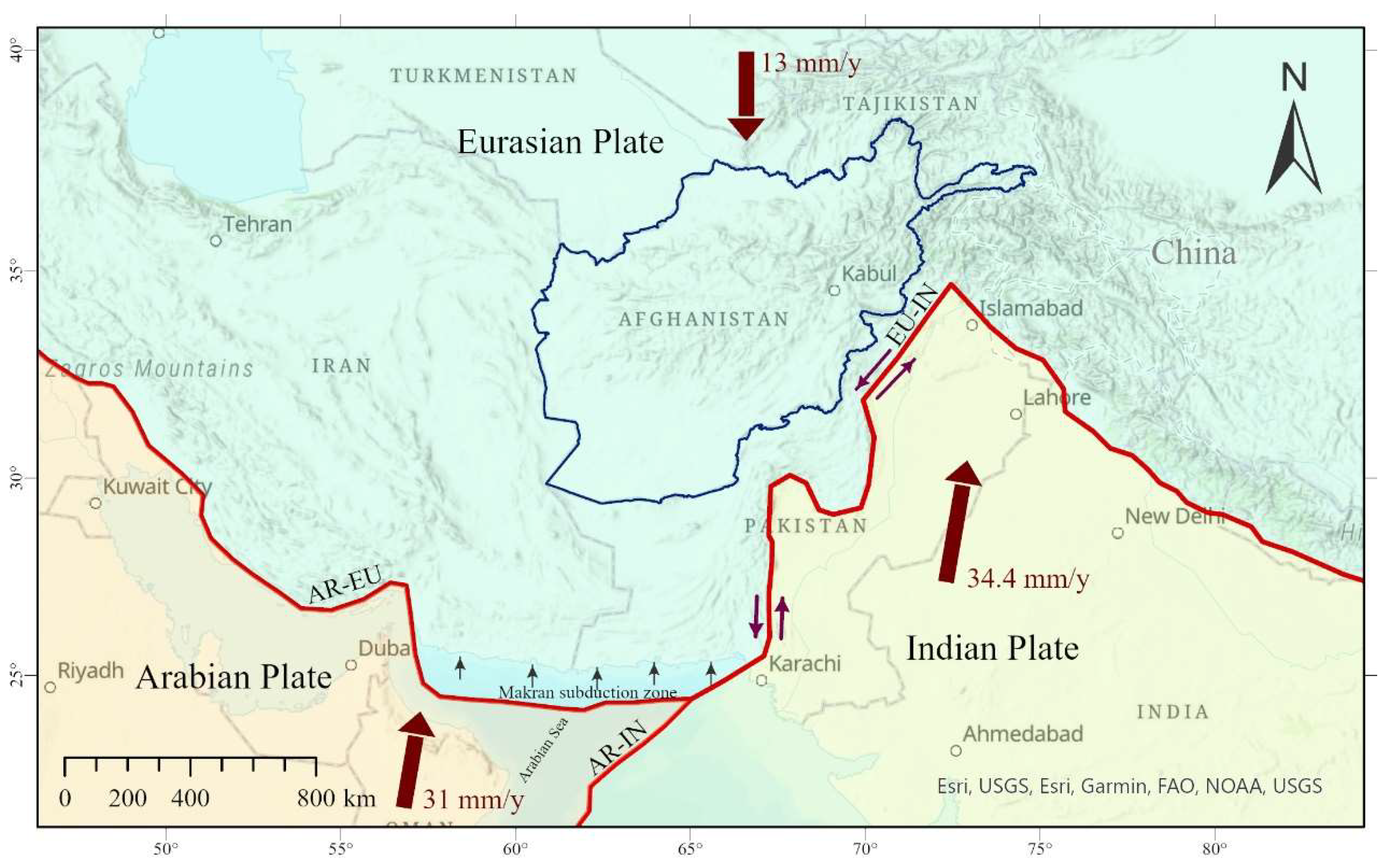
Figure 2.
Regional tectonic and geological faults network with historical earthquakes in Afghanistan and surrounding regions between 1964 and 2004.
Figure 2.
Regional tectonic and geological faults network with historical earthquakes in Afghanistan and surrounding regions between 1964 and 2004.
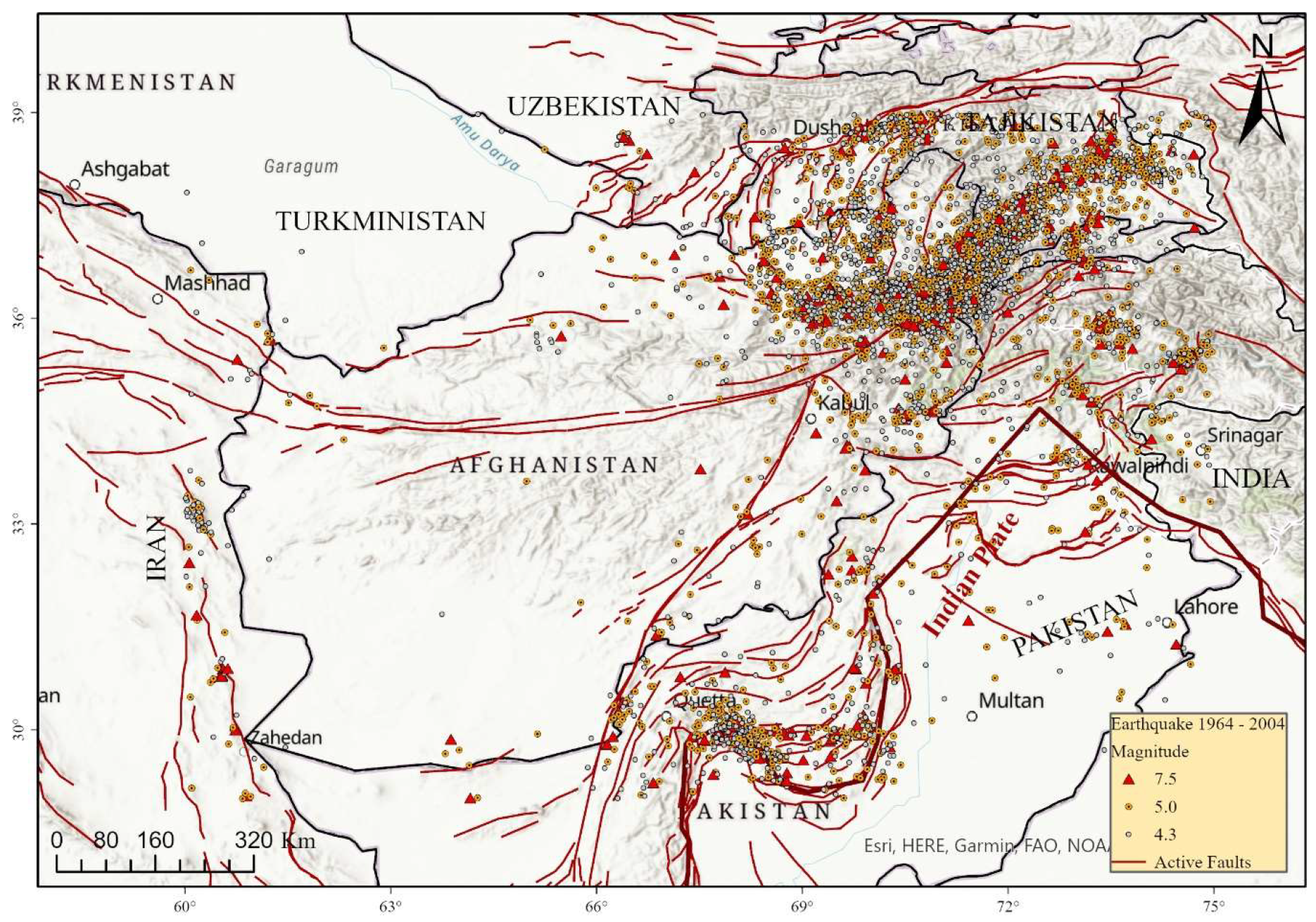
Figure 3.
Tectonic zones and major fault systems of Afghanistan (red lines) (adapted from Wheeler et al., 2005).
Figure 3.
Tectonic zones and major fault systems of Afghanistan (red lines) (adapted from Wheeler et al., 2005).
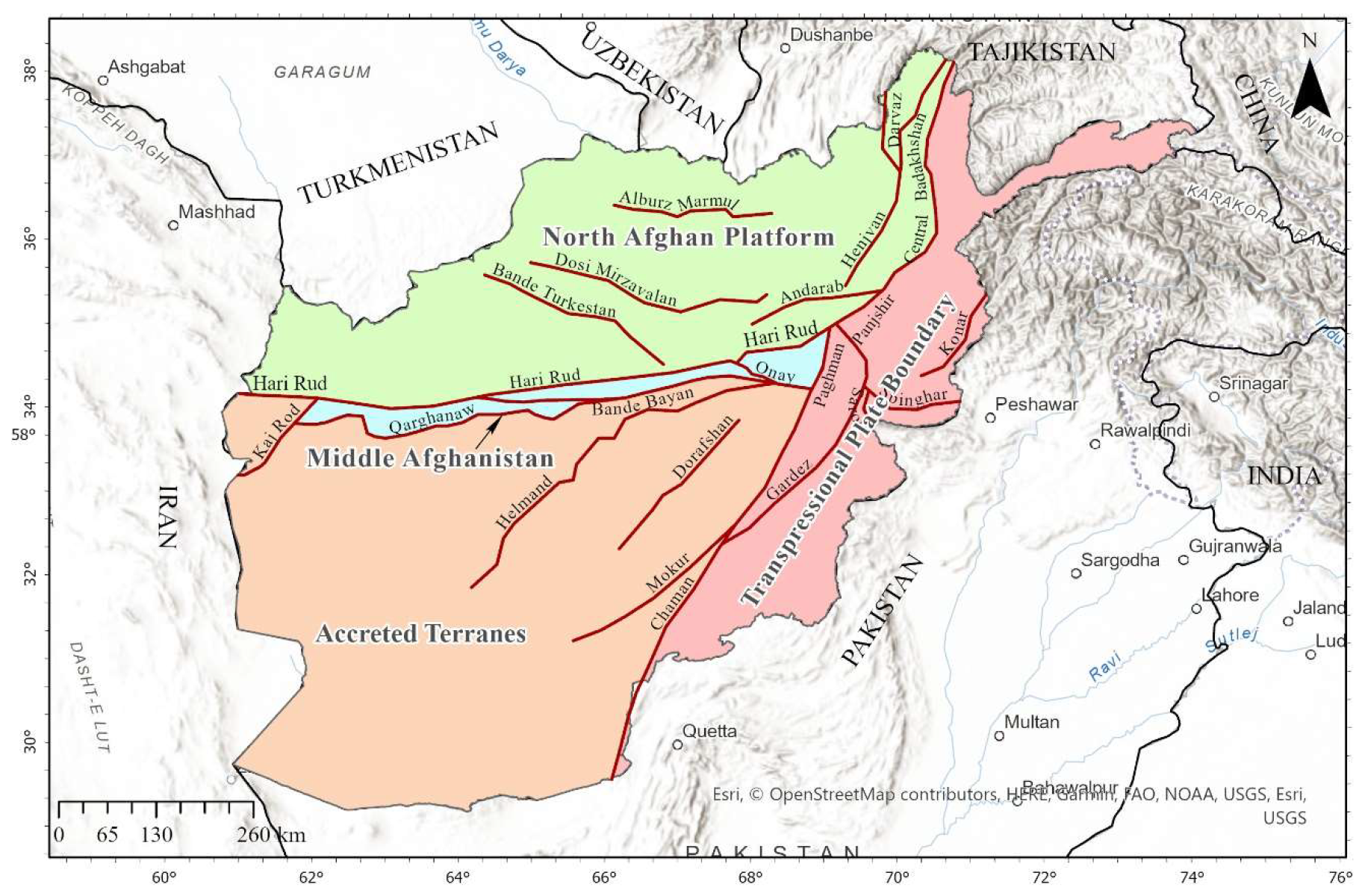
Figure 4.
Historical earthquakes and magnitudes in Afghanistan's main tectonic zones and fault systems. Modified from Wheeler et al. (2005) and Dewey et al. (2006).
Figure 4.
Historical earthquakes and magnitudes in Afghanistan's main tectonic zones and fault systems. Modified from Wheeler et al. (2005) and Dewey et al. (2006).
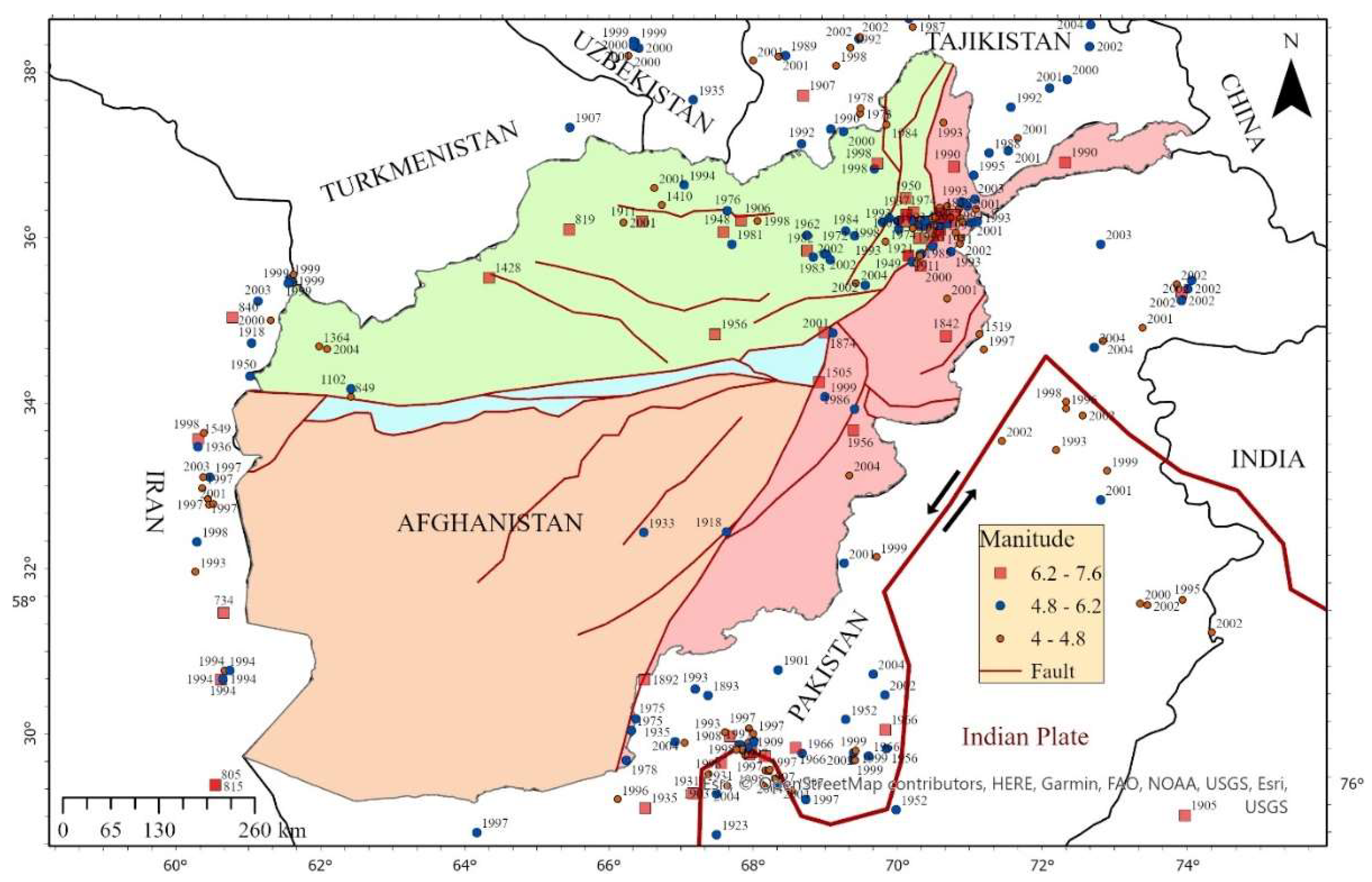
Figure 5.
Increasing trend in earthquake recurrence from 700 to the present.
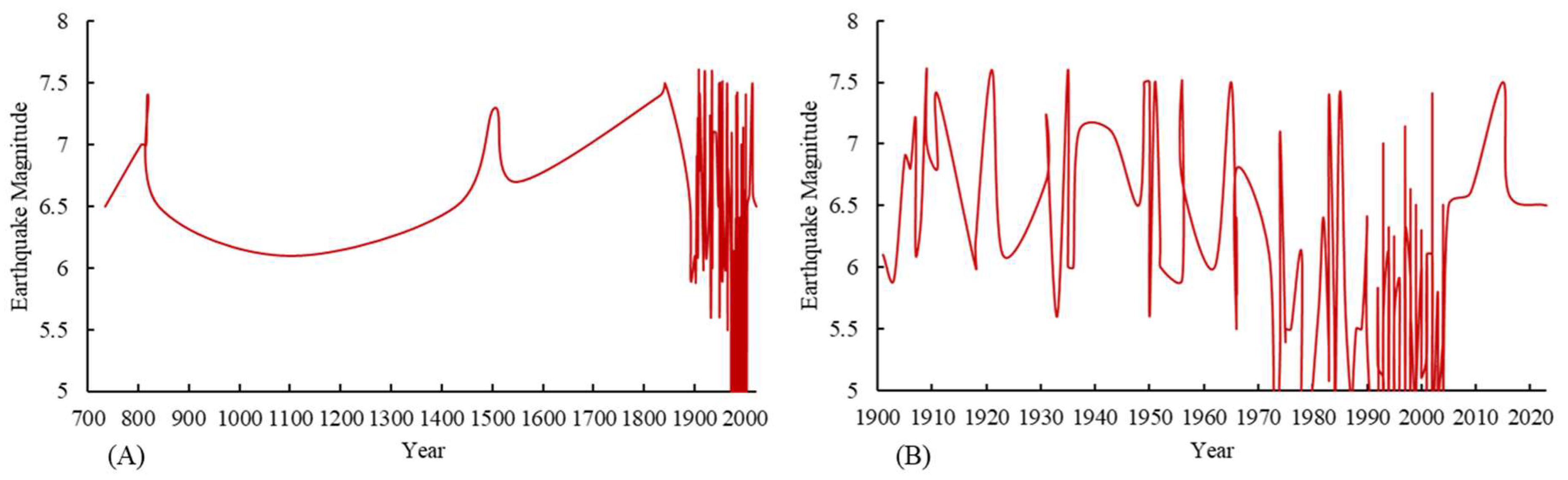
Figure 6.
Historical earthquakes with their magnitudes and focus depths in and around Afghanistan.
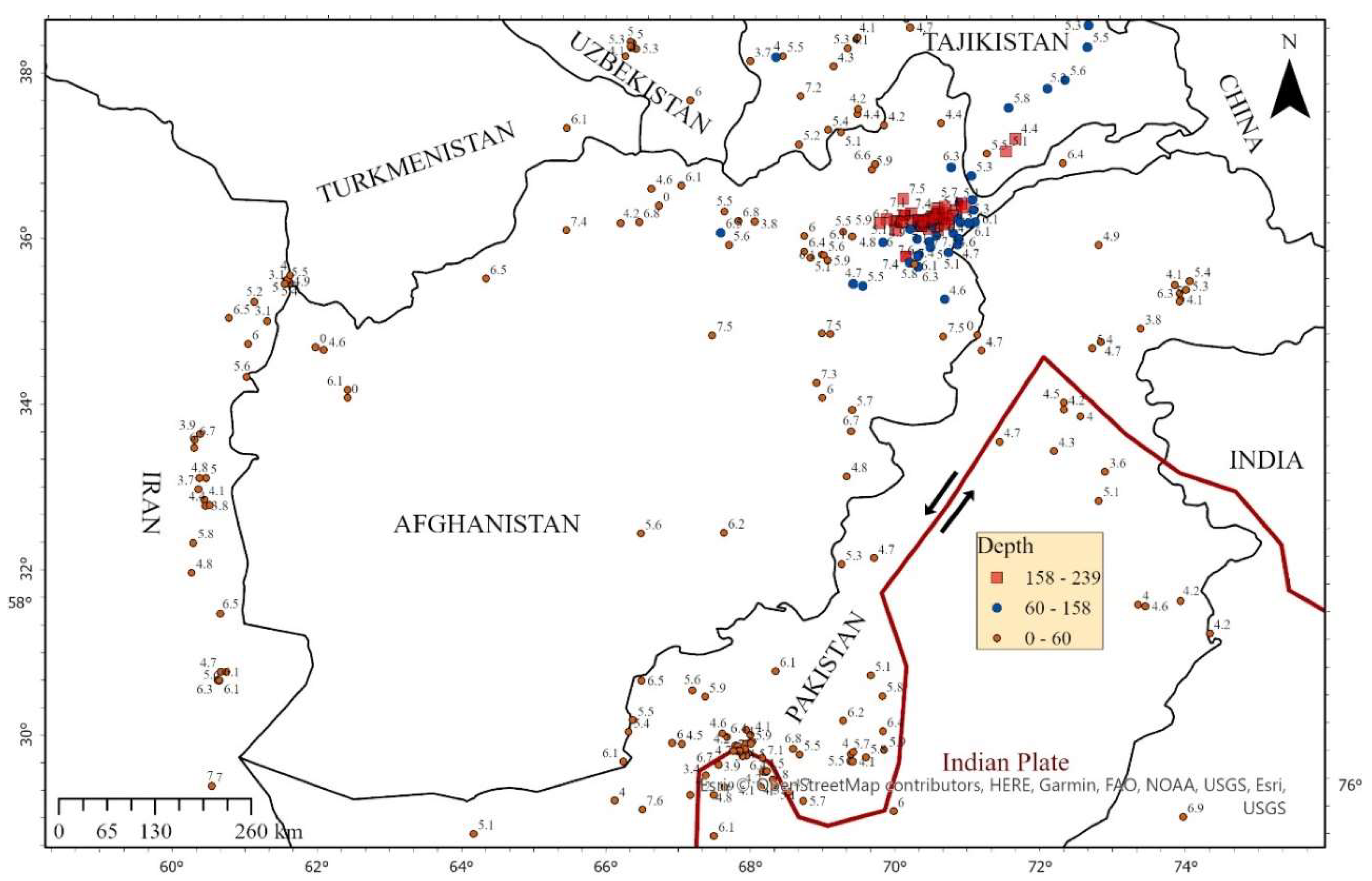
Figure 7.
Recent earthquakes in Afghanistan were recorded from 1990 – 2022.
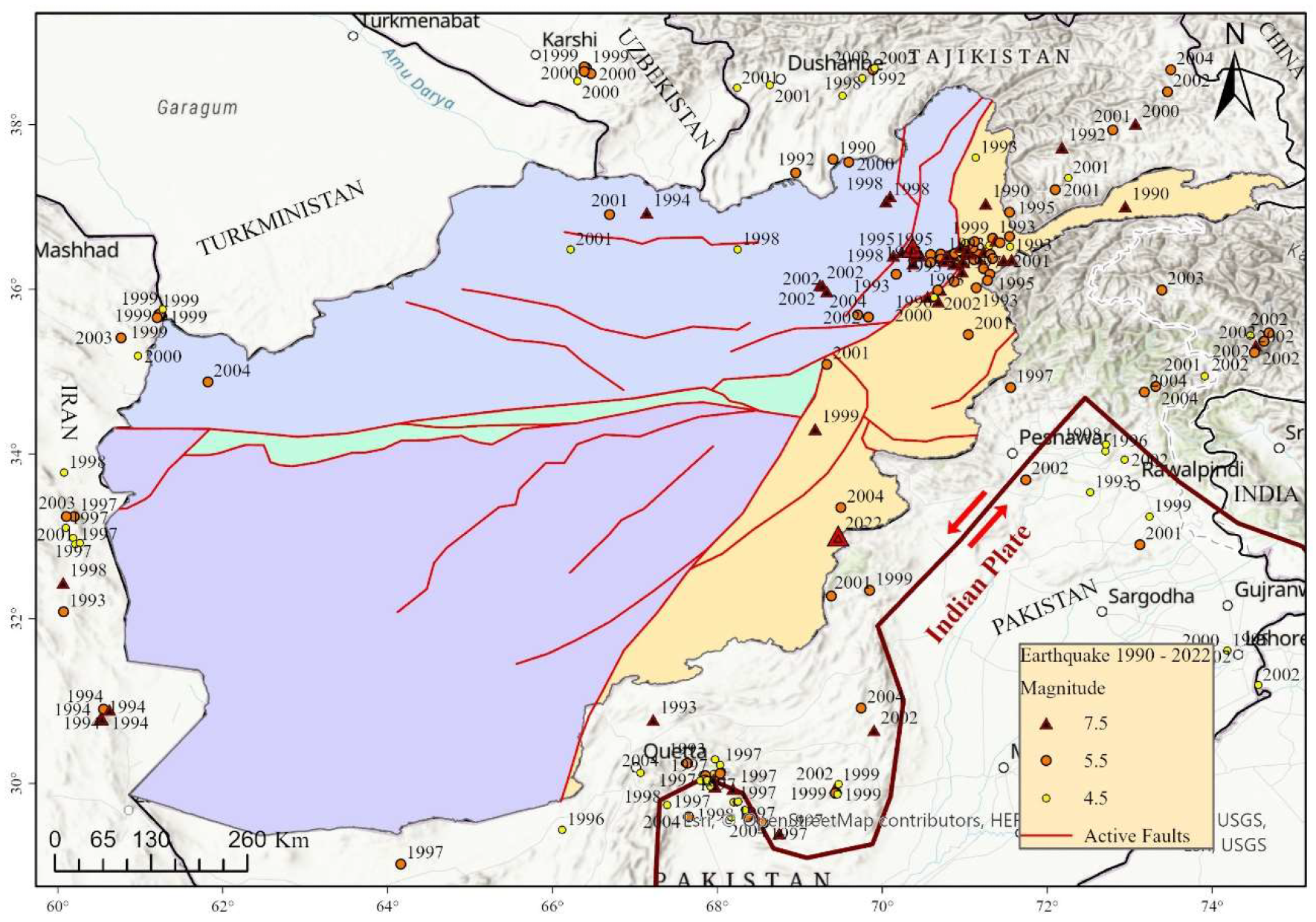
Figure 8.
Earthquake hazard map of Afghanistan with seismic regions defined on the right of the map (modified after Boyd et al., 2007).
Figure 8.
Earthquake hazard map of Afghanistan with seismic regions defined on the right of the map (modified after Boyd et al., 2007).
Disclaimer/Publisher’s Note: The statements, opinions and data contained in all publications are solely those of the individual author(s) and contributor(s) and not of MDPI and/or the editor(s). MDPI and/or the editor(s) disclaim responsibility for any injury to people or property resulting from any ideas, methods, instructions or products referred to in the content. |
© 2024 by the authors. Licensee MDPI, Basel, Switzerland. This article is an open access article distributed under the terms and conditions of the Creative Commons Attribution (CC BY) license (http://creativecommons.org/licenses/by/4.0/).
Copyright: This open access article is published under a Creative Commons CC BY 4.0 license, which permit the free download, distribution, and reuse, provided that the author and preprint are cited in any reuse.


