
Submitted:
19 September 2024
Posted:
19 September 2024
You are already at the latest version
Abstract
This paper is intended to correlate the impact of leadership skills on organizations' performance, all organizations grow differently, and their growth depends mostly on positive performance from one year to another which has direct correlations to the leadership dreams, visions, foresight and aspirations for the organization. There is one thing for the leader to have vision, but the leader needs to have followership to assist in implementing their vision to make it goals which translate to performance in the organization and growth. The leadership style or management skills greatly influence how they command and motivate followership to actualize their dreams or the organizational visions and mission which results in the organization's performance. A positive leadership influence produces or actualizes a positive organisational performance that will move the organization towards the vision of the organization. Knowing the difference between a manager and a leader is pertinent in explaining the correlation between leadership and organizational performance. The understanding of these two roles provides credence to the correlation between effective leadership and organisational performance, and the understanding of the term, the use and the importance of strategic management to leadership and organizational performance. There is a wide difference between managers and leaders, which is based on personality and their approach to the resolution of challenges they are confronted with.
Keywords:
Strategic management
; Business performance
; Leadership style
; Leadership traits
; Vision and mission alignment
Chapter I: Introduction
This study is aimed at examining the impact of leadership skills on organization performance from the perspective of strategic management and leadership role. Skakon, Nielsen, Borg, and Guzman, (2010) in their view noted the change of employee perception on the importance of leadership as not just an ordinary person but a key human capital needed for organizational performance. This view has placed enormous considerations on the value of people, the essence to develop people to achieve maximum productivity, the relationship between the organizational cultures and the people’s perception, and how effective is the leadership influence on management of employees in organization to achieve results.
The leadership skills that influence employee performance which invariably has impact on the organizational performance are in the ability of the leader to strategically think and effectively utilize these six skills or tools: to anticipate situation, to evaluate challenging situations, ability to interpret effectively, instant and spontaneous decision making without procrastination, the strategic ability to sift and organize information to align with organizational program and the ability to learn new things as the environment is evolving (Schoemaker, Krupp, & Howland, 2013). The leader should possess strategic adaptive skill that will make him consistent, flexible and adaptive during challenging and risky periods. The leader is driver that steers the organization towards the mission and vision through their positive influence on their subordinate to achieve performance or results.
Slavin and Morrison (2013) debated that effective leadership skills when demonstrated in a work situation should positively notionally influence most employee’s outlook and performance when encountered but with poor leadership styles from others at different management cadres the outcome may be diverse. The relationship between effective leadership skills and the capacity to influence employee performance may be noteworthy of reviewing in organizational encounters that may arise from weakness in leadership approaches in public and private sector (Rehman, Shareef, Mahmood, & Ishaque’s, 2012). Some leaders do not possess the charisma and influence in their role and function, and the organizations they run gradually fails because they do not possess the motivational skills to spur their members to perform as their function or role is administrative in nature. These type of leaders are known as managers whose roles and duties are usually outline for them to execute.
There are differences between a leader and a manager but in most cases, they are used interchangeably - the need for contrast and for better understanding in organizational performance is very important to picture the leadership role (Arruda, 2016). This conceptual misinterpretation has created notion for strategic management being referred to as leadership, although there are leaders for all strategic management functions in organization. This can be easily related to the manager or team lead role, which is quite different from a leader or a person in leadership position.
The definition of strategic management, their role and function in organizational performance as related to achievement of leadership goals and vision. Koech and Were (2014) explain that strategic management are tools used by leaders to produce organizational performance. This means the proper coordination of these strategic functions by the leader to influence their team members to deliver on his dream and vision. The reasons strategic management activity is required for effective leadership that produce organizational performance, (Drucker, 1994) explained the importance and application of the analysis of Strength, Weakness, Opportunities and Threats (SWOT) as the breakdown that diagnoses the essence for an organization going concern. This analysis provides information and data for leaders to plan and navigate their organization to achieve performance.
An incursion into contemporary leadership styles in organization was review as it relates to organizational performance, the leadership skill that portends positive correlation to performance and contrast for over dependence on one style. Kippenberger (2002) argues that combination of leadership skills that comprises three important relationship of leadership character, team member’s character and the organization situation or business understanding produces targeted results which are the aim and vision of leader’s performance.
Statement of the Problem
The general research question that requires further investigation is to understand the impact of essential skills of strategic leadership on organizational performance. Some believe that organization performance does not depend on leadership but rather on the efficiency of strategic management units in effectively executing their roles or functions without supervision of a visionary leader in coordinating and directing affairs. The main issue is to find out if strategic leadership skills actually influence organization performance.
Purpose of the Study
The purpose of this study is to investigate and analyze the influence of leadership skills on organizations performance. How the leadership stature motivates and demand performance from their followers. Generally, to understand the correlation between strategic management and leadership regarding the role of a leader in an organization, in contrast with management as a leadership function. The leadership activity supposes management processes which are sophisticated in nature for one, which is limited and not determined by the individual personality of the leader, the environment from the organization and the business atmosphere (Raducan & Raducan, 2014).
Research Questions
Arising from literature review are the following research questions that would provide understanding to the correlation between essential strategic management skills and organizational performance.
- What is the contrast between leadership and strategic management and clarifying the interchangeable use?
- What is effective leadership styles in relations to the use of strategic management performance and the effect of a leader who has strategic management skills?
Need for the Study
This study can contribute to increment knowledge in the discipline of organizational leadership and performance, the application of transformational leadership in this context which will be useful to scholars in related studies.
Information from this study would be important to professionals and policy makers who may lack information as related to leadership style that motivates their workforce through policies that could yield results for organizational decision-makers.
The study will also provide reference for stakeholders to understand Organization business decision and how activities influence the results by way of more sound leadership practices or the increased employee motivation which may enjoy the benefits of organizations that are more productive, successful, and better led.
Design of the Study
The design of the study is apt mainly on literature reviews of key papers on leadership skills, leadership styles, strategic management, employee motivation, organizational performance and their relationships, on how the impact of leadership skills influence organizational performance.
Definition of Terms
Autocratic leadership: This leader believes they have all the wisdom and does not need to seek advice or take suggestion from team members, they are usually high hand in the way they operate.
Bureaucratic leadership: This is a leadership style that imposes rules and regulations to administer control and directions to his team members. These leaders can be likened to a managerial role or position.
Charismatic leadership: This is a leadership characteristic defined as alluring or constructive appeal used to influence and motivate team members to perform.
Democratic leadership: This is a participation leadership style that coops all team member contributions and suggestion in decision making process in an organization.
Laissez-faire leadership: This leader delegates his roles and function to his team members without co-ordinations, this type of style has poor performance.
Leadership style: This is a qualitative balance outlook of a managerial skill and performance (Dubrin, 2009).
Management skills: These are embedded in leadership skills and it includes decision making, delegating, directing, coordinating, planning and communications.
Mission: This are organizational short-term to medium-term plans used in supporting goals towards achieving the organization’s vision.
Organizational performance: These include results or output of an organization measured against targeted objectives or set goals. In general, the concerns or outlooks of specialists with organizational performance include strategic planners, operations, finance, legal, and organizational development.
Organizations: These include all organizations, private, profit organizations, educational institutions, governmental, non-profit, and non-governmental organizations, and their impacts on human life and society, as well as their influence in shaping human civilization (Iacovino, Barsanti, & Cinquini, 2015).
Servant leadership: A style of leader that put the led priorities or need first before the other goals, they lead from behind as a servant first to other team members.
Situational leadership: This are leadership role created due to a specific task to be perform or the nature of environment where the job is situated.
Strategic management: This is the cross-functional plan and units channeled towards organizational objective achievement.
Transactional leader: A leader who is unable to move employees to higher commitment level but uses rewards to achieve and monitors compliance for mistakes or motivation. (McCleskey, 2014).
Transformational leader: A leader who encourages others and followers to higher levels of commitments through acts of integrity, inspirations and motivations. (Onorato, 2013).
Vision: This is a long-term coherent plan and dream of where the organization want to be in the future.
Chapter II: Literature Review
Introduction
This chapter provides a review of literature and secondary data that already exist on leadership and strategic management relationship, meaning, interdependence, styles and effective use in organizations. Accordingly, this chapter will initially discuss the contrast in leadership and strategic management, clarify their interchangeable use, effective leadership styles in relations to the use of strategic management and the effect of a leader who has strategic management skills. The method used to conduct the review would be by examining existing literatures to answer arising questions on the research subject “Leadership and Strategic Management: The Impact of Effective Leadership Skills on Organizational Performance”.
The articles and literature consulted as guide for this study were gathered from the following sources; Bowie State University library, University of Maryland University College online library resources, the online Library of Congress using ABI/Inform Complete, the Business Source Complete, ProQuest, EBSCO host databases, Harvard Business Reviews, Forbes Business News, Elservier B.V. Publications, Science Direct, Procedia Economic and Finance, Procedia Social and Behavioral Sciences Journals.
The Google Scholar search engine was access for reference and key terms definition for Leadership, Leader, Leadership styles, Strategic management, Management, Management skills, and Organizational Performance.
The Leader and Leadership Position
“Becoming a leader is not easy, just as becoming a doctor or a poet isn’t easy, and anyone who claims otherwise is fooling himself” (Warren, 1989).
Peter Drucker was among the early people that embarked on the study of the process of managing people during the second World war and his discoveries at that made him define manager as a person who is responsible and takes ownership of the work of his subordinates or supervised which was known as the boss. After the wars in the 1950s, the definition of a manager or team lead had metamorphosed to mean a person responsible for the performance of people working under his watch (Kippenberger, 2002).
A leader is defined by (Raducan, & Raducan, 2014) as persons with affluence on collective information in a mediation role through mass media circulated as the group’s opinion. Leaders are seen to be the link between the channels of communication of their team and represent authority among the group and organization, the relationship and control over the team they led and the way by which they influence the behavior of their group members. The leaders have great influence over the communication exchange they facilitate over their group to be very rapid and efficient in the way messages are sent and received. Through their cognitive intellectual experiences, they create a picture for the future which is the vision of the leader and also the message they follow to influence their followers (Tutar, 2004). It is not only necessary to perform the duty but also to reflect all characteristics of leadership in the context (Kadıbesegil, 2008).
In understanding who a leader is from the definition causes the curiosity of (Slavik, Putnova, & Cebakova, 2016), with which their question is how to identify or recognize who a leader is, and the probable explanation as someone who possess some value or characteristics others do not have? (Johns, 2008) explains in reality two factors determine the characteristics of leadership which are situational according to the need and the deficiency or gap that needs to be covered. This does not necessarily mean the personal quality of the leader but the nature of assignment that needs to be executed. A person in leadership position possess or performs the duty of responsibility for the team or group he has taken charge to lead with full ownership and sense of purpose for his action or those of his team members.
The Difference between a Leader and a Manager
There is need to contrast and clarify the interchangeable use of the term’s leader and manager, (Arruda, 2016) enumerate nine differences and similarities between the terms.
- Leaders have dreams which they create into visions which is a long-term goal or objective that they inspire their followers to achieve, while managers produce plans and objectives to achieve the visions of the leader.
- Leaders are innovators that bring change to their environment as they tend to disrupt smooth operation for a new and better one. They are most of the time agent of improvement, while managers only continue with the processes and procedures that are in place as they only maintain and uphold status quo.
- Leaders are exceptional as they are actively discovering themselves and renewing their environment, they have strong awareness and personality of themselves. Managers are not original as they copy styles or roles of renowned leaders or mentors they aspire to become.
- Leaders have the posture of experimenting their ideas to see if it will work and are not oblivious of the outcome of the risks taken, while managers are very careful not to fail or waste resources and very risk averse.
- Leadership focus are generally in line with their mission and vision which is long-term in nature, while the managers mode of operations and focus are usually short-term.
- Leaders are constantly developing themselves to be abreast and ahead of competition in the ever-changing business environment, while managers depend on existing structures and proven skills as norms or convention for standard.
- Leaders focus on people and relationships they can influence to actualize their vision through followership loyalty, while managers exist on subsistent systems and processes that are available to operate.
- Leaders see people that work with them to be competent with great potentials which can be harnessed with little coaching, while managers see people that they work with as tools they give instructions and directions. Leaders create followership with people who believe in them and promote their activities to achieve the leaders’ goals and objectives, while managers have to contend with employees that work under their instruction, direction and supervision.
Fry (2003) expands the view of the contrast of strategic leadership to be mainly value creation through visionary ideas which have direct relationship in organization, units and individual while developing effective relations with environmental stakeholders and organization.
Strategic Management Explained
Strategic management is the building block where the resources and units (Financial, marketing, manpower, productions and other functions) available to an organization are brought together to determine how best to maximize the organization’s goals, returns and objectives.
According to (Branislav, 2014) opinion on strategic management that all firms are constantly involved in decision- making process which is a form of strategy of being proactive instead of reactiveness, this is generally approached systematically, objectively and logically. (Branislav, 2014) in a step further explain “the art and science of formulating, implementing and evaluating cross-functional decisions that enable an organization to achieve its objectives”(p.28). (Adeyemi, Isaac, & Olufemi, 2017), detailed this process as five key facets continuous iterative important interactions that involves feedback from goalsetting, analysis, strategy formulation, strategy implementation and strategy monitoring. These activities are further argued by (Koech & Were, 2016), that the focus of strategic management should be geared towards the organizations long and short-term goals and objectives achievement majorly, which can be describe as the organizations road map policy and processes to guide the business.
The Components of Strategic Management Skills
The strategic management skills are leadership skills required to perform or execute effectively the strategic functions in an organization. This is where strategic management is used interchangeably with leadership skills in some literatures, the component of strategic management features are essential leadership traits needed at top management position. Slavik, Putnova, and Cebakova (2015) argued that many theories have explained leadership with the identification and methods used as measure of performance and effective influencing of their members or teams.
The most important classification of leadership explained by (Antonakis, Cianciolo, & Sterberg, 2004) can be grouped under trait-based theory, transformational leadership, contingency and situational leaders, and transactional leadership through the way information are processed.
According to (Schoemaker, Krupp, & Howland, 2013) they put forward six skills need to be orchestrated and used simultaneously to perform strategic leadership role effectively in the cause of managing the affairs of any organization. These skills or tools are the ability to anticipate situation, to evaluate challenging situations, ability to interpret effectively, instant and spontaneous decision making without procrastination, the strategic ability to filter and organize information to align with organizational program and the ability to learn new things as the environment is evolving.
- Anticipate: This requires leaders and organizations management to be always caution and smart with their visionary goals to understand trend of times in their environment.
- Challenge: Strategic leaders should question the norm, they are always challenging their own and others’ presumptions support of unique perspectives. Simply after watchful reflection and examination of an issue through numerous focal points do they make conclusive move that requires persistence, fearlessness, and a receptive outlook.
- Interpret: The interpretational skills of strategic leaders should be exception in recognizing patterns, analyzing and sifting through ambiguity, have sound knowledge and always seeking insight to development around them. They are able to reflectively see, hear and synthesize all input effectively. The former Finland, President J. K. Paasikivi was fondly known for his saying that you have wisdom when you recognize the facts before rethinking or “re-cognizing,” them to show their real meaning.
- Decide: The speed and process of taking or making decision should be methodically short and straight forward to prevent unnecessary delays for urgent matters. Leaders usually take intense decisions with deficient data, frequently and rapidly, as the procedure should not offset meticulousness and speed of delivering prompt judgement to short and long-haul objectives. Strategic leaders should be brave in their belief ‘s and set aside procrastinations in decision.
- Align: Strategic leaders should have the capability of discovering shared views accomplishment among partners who have unique perspectives and plans by synchronizing. This is a dynamic fit and achievement that relies upon proactive correspondence, trust fabricating, and visit commitment.
- Learn: Strategic leaders are usually at the top emerging knowledge in their evolving environment. In their quest for development and evolution in culture, they explore for actions in both successful and unfruitful outcomes.
Evolving into a strategic leader implies distinguishing shortcomings in the six aptitudes examined above and rectifying them. Our exploration demonstrates that quality in one aptitude cannot without much of a stretch make up for a shortage in another, so it is vital to deliberately improve each of the six capacities. They further defined an Adaptive strategic leader as somebody who is fearless and adaptable, diligent even with misfortunes yet in addition ready to respond deliberately to environmental shift with the evolving outcomes, and figured out how to apply each of the six skills without a moment’s delay. The adaptive strategies makes the leader to be in tune the environment they are operating in terms of the laws, ethics and policy of the countries the organization resides.
The reason for Strategic Management
Organizations are set up with vision and mission which are the long term and short to medium terms plans and objectives of the organization. Most organizations are created to satisfy their need, dreams and aspirations of the owners and stakeholders with their strategic management structure through the analysis, assessment, continuous planning and monitoring of the organization performance in line with their objectives and goals.
Strategic management typically involves assessments and analysis of internal and external strengths and weaknesses through the formulation of action plans from identified organizational Strength, Weakness, Opportunities and Threats (SWOT) analysis, these will allow the organization to identify the following benefits and pit holes that a good strategic management plan will correct when properly implemented.
- It allows organizations to be proactive rather than reactive and be prepared for the future
- It is like a compass that gives a sense of direction for the organization
- It provides increases to operational efficiency within the organization through effective communication.
- It helps to increase market share and profitability through proper appraisal of the organization’s SWOT analysis
- An effective strategic management policy plan makes a business strong, transparent and durable.
SWOT analysis is a tool which strategic leaders use as compass in channeling and controlling organization performance towards achieving its set mission and vision. A strategic will interprets its organization’s SWOT analysis and communicate it in the best medium that will motivate his followers or employee towards achieving performance.
Abuya, Amin, Molyneux, Akhwale, Marsh, and Gilson (2010) found that a good strategy for managing and implementing effective communication is a strong relationship between the parties within the organization. Strong transparent management of financial system and reliable management system will produce successful outcomes targeted by most organizations. This is what most leader aspire for and demand from their team members in working towards achieving the organizational mission and vision.
Contemporary Management Leadership Styles
In the book The Seven Habits of Highly Effective People, (Covey, 1989) explained that “Effective leadership is the only competitive advantage that will endure. That’s because leadership has two sides – what a person is (Character) and what he does (Competence)”.
(Kippenberger, 2002) stated leadership styles is reflective of attitudes and behaviors of the leaders that in turns explains the outcome of the way they feel and think through their interactions. Kets de Vries (2001) in his definition of leadership styles as comprising of three important relationship:
- ➢
- The character of the leader – their experience and position, attitude, belief and values;
- ➢
- The character of the followers – their cohesiveness as a team, beliefs, attitudes and values; and
- ➢
- The condition – the socio-economic and political environment, their culture, structure and industry, the life stage of the organization, and the nature of the task.
Kets de Vries (2001) further explains that a person’s leadership style is a fusion of several role or function that may be adopted depending on the intricate outcome of the relationship of the leader’s competencies that was developed over time. From the foregoing definition and explanation, it will be safe to say a leadership style is a mix of different trait but with one dominant in the style.
TEC-The Executive Connection (2015), are of the view that prototype leadership does not exist as there are varied leadership styles for the different business concerns, the environment is dynamic and different leadership traits will be successful in different environment. However, having extensive knowledge of the different leadership styles allows top managers receive the right qualities they require, as well as pick better executives all through their organization. Here is a brief description of nine normal leadership styles with outline of their points of interest and hindrances.
Transformational Leadership
According to (Ling, Simsek, Lubatkin, & Veiga, 2008), Transformation leaders exist by their passion to change individuals, teams, and firms beyond the status quo and thereby moves their firms’ capacity to adapt and innovate.
Transformational leaders are multifaceted with four mutually reinforcing attribute and interdependent variable. These include the following:
(1) Charismatic: energizing followers beyond personal and selfish interest through the creation of attractive vision for the future;
(2) Strong motivational and inspirational views that influences follower’s decision;
(3) Intellectual stimulation: encouraging followers to challenge status quo and issues with new perspectives; and
(4) individualized consideration: followership focuses and developmental support through mentorship, coaching, and encouragement to team or group members.
People who show transformational leadership are often considered as desirable employees, because they typically inspire their colleagues with effective communication and intellectual stimulation. This leadership style has direct correlation with organizational performance, the focus of the leader is positive progression with total team member participation and inclusion through direct coordination and interaction.
Transactional Leadership
This authority style is balanced around collective association, creating a reasonable level of leadership influence through a reward-based system targeted at stimulating performance on input-out results. It is value-based in nature as performance is encourage and celebrated with great remunerate exhibitions, while terrible practice is rebuff and punished. This is a powerful method used for instant result and laborer assignments, this style of leadership will not encourage development of superior skills and potentials. This leadership can generate positive outcomes towards the goals and mission of the organization but the emphasis with this style is segmented or has periodic termination which might not have progressive tangential towards the organization’s vision (Shu-Yi & Hsiu-Jen, 2018).
Servant Leadership
This leadership style encourages collective decision-making through prioritizing needs of their team members; they prefer power sharing model practice by people that is similar handmaid leaders. This style is described as a philanthropical leadership which can boost morals and improve diversity. This leadership style does not have direct correlation to positive organizational performance influence by leadership skills of coordinating the various strategic unit or team to deliver the Organization’s goals and vision. The disadvantages of servant leader are lack of exercising firm control over their members and they experience contradiction of objectives through their considerations for team member’s interest first before objective of the group.
Autocratic Leadership
This is an extraordinary rendition of value-based authority, despotic pioneers have noteworthy command over staff and rarely think about them as laborer proposals or offer power. They lead with stringent rules that may occasionally not refreshing to staff, which may prompt non-appearance and high turnover. This leadership style discourages innovation and allows people work like robot. This leadership style can be counter-productive to the goal and vision of the organization, since they take little or no advice and suggestion from their team or other professionals.
Laissez-Faire Leadership
This leadership style is regularly used to likened monetary conditions in a free enterprise state that truly signifies free style which mean in French - let them do or let it be. Organizational leaders usually encourage and allow their supervised the freedom to use any approach that help them complete their task or assignment at convenience. This can be viable in pioneering professions or work situations where representatives are exceptionally experienced. Nonetheless, it is critical for leaders to curtain some execution and viably convey the objectives of the organization for they may not experience regression in performance.
This leadership style does not have direct correlation to positive organizational performance influence by leadership skills of coordinating the various strategic units or team to deliver the Organization’s goals and vision.
Democratic Leadership
This is known as participating leadership style which implies that leaders constantly request for contribution from their team members or group before taking decision or making choices as their style is inclusive in nature with full representation. Members of the team or employees in most time have the feeling of fulfilment and aura of importance with the notion that they are part of the decision-making process of the organization and innovativeness they can profit. A vital draw back experience is the vote-based process that is most times slow and may not yield good results in a fast pace environment where spontaneous and impromptu decision are essentials of leadership.
Bureaucratic Leadership
This leadership style strives very well and are mostly used in an authoritative or controlled environment, where essential order are characterized with adherence to standards and convention of practice. These leaders ensure that member operate according to standard procedures that are in place within the system of the organization. At times there are exceptions to the rule in some profession, but this leadership model is effective in the security and medical industry.
Charismatic Leadership
There is a great measure of similarities between charismatic (alluring) and transformational model. The two leadership styles depend mostly on their personal identity and strong positive appeal. In many case, alluring leaders are normally viewed to be less ideal as they are seen in organizational achievement and activities as having strong personality connection synonymous with their business. While transformational leaders assemble trust in their group encouraging members to develop and improve their level if they are to close impromptu gaps, while the charismatic leader usually leaves a power vacuum.
Situational Leadership
This leadership style implies a task based approach coordination of followership (Farmer, 2005), explained there are different specific leadership style for every identified task or situation which can be very effective and specific in nature. This leadership style was developed by management experts Paul Hersey and Ken Blanchard in 1969, hypothesize that was used by different leadership functions depending on the nature of the task and the environment they operate.
Status of employees and the procedure of business performed are the pertinent assignment that are unpredictable to all assumed imperatives that the leader may perform or embrace at random depending on circumstances. For instance, situational leaders may receive a democratic leadership style while talking about business course with senior officials however change to a bureaucratic technique while handing-off new industrial facility conventions to specialists.
Many individuals have a different leadership style, which can enhance job switching and can be difficult to evaluate what style is appropriate for specific conditions, considering the basic leadership function.
Understanding Effective Organizational Performance
Effective organizational performance can be taken to mean how a leader combines efficiently the strategic resources to produce positive change through growth in the organization. House, Javidan, Hanges, and Dorfman (2002), in their definition of leadership corroborated the influence of a leader in organization performance through their motivation skills that encourages their followers to contribute effectively to the success of the organization of which they are leading. Also, the organizational culture affects performance through a complex interplay of leadership style, business strategy, and organizational structure and process (Hult, Cavusgil, Delingonul, Kiyak, & Lagerström, 2007).
The leaders that are charismatic have transformational skills which makes them capable of actualizing their vision of organizational performance through their people skills, they appreciate and have great thoughts for all their employee’s growth, intelligence for their accomplishment, development requirement, provision of opportunities at top level for inspired and prepared employees, they intervene in conflict resolution for the smooth coordination of organization (Tyler & Cremer, 2005). Transformational leaders inspire and motivate their members with the organizational common goals to achieve their vision of performance.
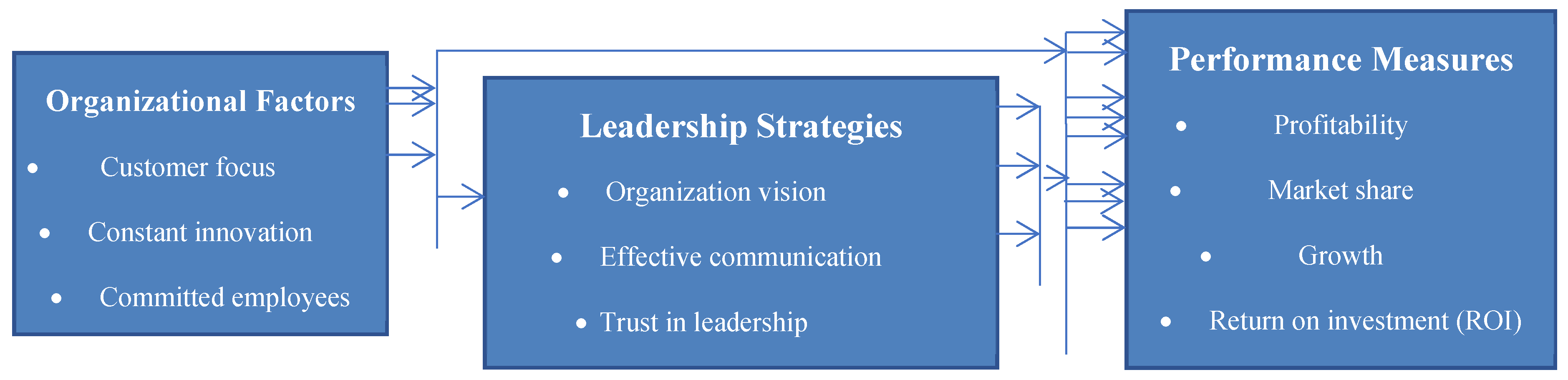
Pinar and Girard (2008), in there research using three organizational factors of customer focus, innovation and committed employees and four leadership strategies of organization vision, effective communication, trust in leadership and mutual respect based on confidence in leadership. These variables and criterions were discovered to have significant relationship with seven performance measurements (customer retention, sales growth, profitability, market share, return on investment, growth and employee turnover). Jing and Avery (2016) posited that leadership performance measurement and its impact on organization, reports two sources of measurement;
- Self-report of commitment to organization goals, subordinate satisfactions and the leader perceived effectiveness.
- Nonself-report based on organization outcomes such as net profit, sales turnover, return on investment and customer retention.
The major debate and critique of various researchers lay more credence to nonself-report as a more discreet measure of performance because of its quantitative nature for easily analysis but viewed self-report as subjective and qualitative in nature.
Chapter III: Critical Analysis/Discussion
This study examines the impact of strategic leadership skills on organization performance by trying to understand the importance of a leadership role in an organization with influence on its followers in achieving their organization’s mission, vision, and goals. There is need to understand the difference between organizational leadership and strategic management in order to appreciate the importance of leadership role. The impact of a leader is usually not recognized as there is the belief that organizational performance does not depend on leadership but rather on the efficiency of the different strategic management units effectively executing their roles or functions by their managers without the influence and supervision of a visionary leader that coordinate and direct the affairs of the organization at the top. The discussion would elucidate the essence of strategic leadership skills as the overriding influence on organizational performance, since a good managerial structure is a product of an effective leadership.
The study is centered on the correlation between essential strategic management leadership skills and organizational performance. How the leadership stature motivates and demands performance from its followers, in contrast to management leadership. Raducan and Raducan (2014), in their view see leadership to encompass the personality of the leader, the organizational environment and the atmosphere of the business that permits the demand for performance from employees.
Skakon, Nielsen, Borg, and Guzman, (2010), noted the importance of employee perception on leadership as the key personality that provides the coordination and directions of affairs for achievement of performance. This view places enormous value on people and development of skills for increase productivity, relationship between perception and organizational culture and leadership influence to achieve results through motivation of followers.
The topic leadership and strategic management are very wide with much to be discussed; the approach to the discussion would be tailored along these two questions;
- What is the contrast between leadership and strategic management and clarifying the interchangeable use?
- What is an effective leadership style in relations to the use of strategic management skills and the effect of a leader who has management skills?
Leadership Styles and Strategic Management
Leadership and leadership styles according to Kippenberger (2002), reflect attitudes and behaviors of leaders expected desired outcomes of their interaction with their followers to achieve targeted performance of their organization. Leadership styles comprise of three important relationships and competency roles that are in fusion of their several functions that may be adopted depending on their targeted results or performance level (Ket de Vries, 2001). The way a leader combines the interaction and relationship of their followers with the diverse conditions that they operate with explains the leadership intervention.
The leadership intervention is further illustrated with the following figure, depicting the framework for future leadership research by Latham (2014).
There are different leadership styles and traits that leaders use to achieve their vision, (Ling, Simsek, Lubatkin and Veiga, 2008; Shu-Yi and Hsiu-Jen, 2018; Farmer, 2005) identified that some leadership styles has more than one leadership trait in composition. These leaders are namely;
- Transformational leaders
- Situational leaders
- Transactional leaders
The other leadership styles that were discussed with their single unique trait associated to their leadership styles are Bureaucratic leadership, Charismatic leadership, Democratic leadership, Laissez-faire leadership, Autocratic leadership and Servant leadership.
The trio of leadership styles of Transformational, Transactional and Situational leaders makes use of strategic management tools effectively to achieve their set goals. Strategic management are key building blocks of resources and units such as the human capital units, the finance unit, the marketing units, productions units etc in organizations that leaders combine to achieve targeted goals and objectives (Felin & Foss, 2005).
Branislav (2014), explained that strategic management include the decision-making process of a leader to be proactive instead of being reactive; that is they need to systematic and objective in formulating logical ideas, implementing and evaluation of cross-functional decisions that will enables the organization to achieve its objectives. A leader portrays certain attributes that qualify them to utilize strategic management functions or resources to achieve targeted organizational performance, these characteristics are their values, beliefs, attitude, experience and position within the system they are operating.
Adeyemi, Isaac, and Olufemi (2017), reinforce the above explanation on strategic management as five key facets of iterative important interactions that involve feedback from the first step of planning and goals settings, analysis, formulation, implementation and monitoring which are basically strategic management tools leaders use in achieving their objectives of vision.
At this junction, it is pertinent to contrast the definition of a leader to a manager and clarify the interchangeable use of a leader with a manager. According to Kippenberger (2002), a manager is person who is empowered with the responsibility of people under his watch and reports to the overall head of the organization who has the leadership mantle. Arruda (2016), explained that a manager or a person in strategic management position necessarily or automatically becomes a leader, as contrasted with the following nine important differences that distinguished a leader from a manager:
- Leaders have visionary skills while managers execute goals to achieve the vision of the leader.
- Due to the visionary skill of leaders, they are change agents while managers only try to maintain status quo within the organization.
- Leaders are unique and original as they are constantly searching for change to make difference while the manager only copy and aspire to play the role of the leader.
- Leaders due to their quest for new development are risk takers while managers are risk averse and try to control risk.
- Leadership focus on issues is long term while the manager’s focus and thoughts are short term in nature.
- Leaders are constantly in search of knowledge that will change their environment, as such grow through research for the unknown while managers rely on existing structures of proven and established skills.
- Leaders build relationships that foster followership and loyalty to actualize their vision while managers leverage on processes and build systems.
- Leaders are coaches and mentors to their employees and followers while managers see their subordinates as tools to be directed to execute their duties.
- Leaders create followers and fans that are motivated through association or ideology while managers see their subordinate as employees to be paid for their service rendered.
In summation of the contrast between a leader as being distinct from a manager was further explained by (Fry, 2003) that strategic leadership is mainly value creation through visionary ideas which have direct relationship in organization, its units and individual, in developing effective relations with environmental stakeholders and the organization itself as illustrated in Figure 1.
Strategic Management Skill
Leaders require strategic management skills to effectively direct their workforce or employees to achieve desired goals and targeted vision for their organization, the combination of a good transformational leader and strategic management skills to coordinate the various strategic units or functions will achieve the performance objective of the organization. Slavik, Putnova, and Cebakova (2015), argued that the identification of a leader through their traits and interaction with their followers effectively influence performance of their organization through their component units or strategic functions. This is also where strategic management skill is used interchangeably with leadership skill; Finkelstein, Hambrick, and Cannella (2009) as the component of strategic management are important embedding of leadership traits needed at the top management to influence organizational performance.
Schoemaker, Krupp, and Howland (2013), identifies six strategic management skills contemporary leaders use or require to achieve efficient and excellent performance results. These skills or tools are:
- The ability of leaders to anticipate situations and opportunities available to the organization; they should be smart with identifying opportunities that will spring their organization to the top.
- Leaders possess is their curiosity to challenge existing norms and through provision of critic for more formidable process or standard by providing constant updates. This act of examination and reflection provides persistence, fearlessness and reception for continuous update and new outlook for organizations and industries (Arruda, 2016). This skill is apt-on the advantage of SWOT analysis competitiveness in industry and business through proper appraisal of operational activities that makes the organization very profitable with a good market share to reckon with.
-
Strategic management interpretation skills are essential for effective leaders to function effectively and efficiently. Performing strategic leaders are exceptional with their recognition skills, analytical skills and their quick sifting through information ambiguity with less stress and time (Arruda, 2016). The interpretational skill of strategic leaders are very coherent in their competence to lead and understand the business or industry they are operating, as constant revision of their organization SWOT analysis is important to determine if operational activities are in line with the mission and vision statement of the organization. A strategic leader that is well armed with interpretation skills will make use of the following benefits of SWOT analysis in commanding excellent performance in their business and organization (Finkelstein, et al. 2009):
- It will in still proactive tendencies that will create early preparation for future activities and plan.
- It will provide increase in operational efficiency within the organization and effective communication with all stakeholders.
-
The speed and process of decision making is a skill strategic leaders are priced with as they have to make tough calls with incomplete information (Arruda, 2016). This strategic management skill is important as most leaders are confronted with spontaneous decision making all year round, and the method or process considered should be short, straight forward to prevent unnecessary delays for urgent matters that has short term horizon. Leaders and leadership focus are long term in nature as their concepts are based on their vision which is a long-haul (Tyler & Cremer, 2005). They make use of SWOT analysis to take advantages of the benefit at arriving on decisions that would have factored most condition that affect the industry the organization operates.
- It provides a compass like sense of direction for organization decision
- It creates proactive situations rather than reactive conditions when making decisions.
- Alignment capability is a unique skill strategic leader requires to stay on top of their game, in other to constantly adapt to the ever changing socio-economic environment and political spheres organizations operates (Arruda, 2016). Strategic leader are open to new ideas and have the capability to discover shared views, accomplishment among partners with unique perspectives and plans by synchronizing (Finkelstein, et al. 2009). The SWOT analysis tool of strategic management provides the support for harnessing this skill to its highest potentials, as it creates the opportunity for the creation of effective strategic management policy plan that makes a business strong, transparent and enduring. This skill is dynamic because it relies upon proactive correspondence, trust fabrication and commitment (Abuya, Amin, Molyneux, Akhwale, Marsh & Gilson, 2010).
- Strategic leaders are very good learners, that are willing to update themselves with current development in the environment they are operating (Arruda, 2016). Their big appetite for enduring knowledge, evolution in culture and convention, they have insatiable quest in exploring for actions in both successful and unfruitful ventures.
These strategic skills or tools when effectively implore with good followership will produce excellent performance or result, using Figure 1 to illustrate its impact on any organization. The performance is subjective as the existence of these skills or tools would not produce exactly the same output, when subjected to different organizations but similar in operations (Slavik, et al. 2015).
Leadership and Organizational Performance
Every organization has a leader that oversees the operations and activities of the organization, and the survival of the organization depends on some measure of performance which generates the essence for its creation. The continued existence of most organization is anchored on the actualization of their mission and vision statements which is the core responsibility of the leader to its stakeholders. Jing and Avery (2016) reiterated that leadership style is considered in achieving organizational goals through motivational influence on their subordinate that may evoke performance.
House, Javidan, Hanges and Dorfman (2002), corroborated leadership influence on their followers induce positive organizational performance and (Hult, Cavusgil, Delingonul, Kiyak, & Lagerström, 2007), posited that the interplay of various complex factors of leadership style, business strategy, organizations structure and the organization culture have impact on performance. Pinar and Girard (2008), in their research discovered that leadership influence on their followers generates positive performance based on the leadership style or attribute of their strategic skills.
Figure 2 illustrates the impact of leadership on organization performance using strategic skills.
Leadership influence or motivation may not produce direct positive impact on their followers or employees as discovered in the researched (Pinar & Girard, 2008) as humans are not robots but social in nature, constantly changing and evolving with different incentive or motivational interventions that influence different demographic groups working in an organization. To a great extent, the performance of an organization is influenced by the leadership styles which attract followership to satisfy the leader’s desire and goal as illustrated in Figure 2.
The organizational performance can be effectively tracked through two sources as explained by (Jing & Avery, 2016), self-reporting which is qualitative and nonself-report that is quantitative. Most researchers lay more credence to nonself-report because it uses discreet figures as measurement of performance which deals with quantities that is easily verified through analysis of values and statistics, unlike self-report which deals more with qualitative narration that is very subjective. The performance of the different strategic units of the organization has direct correlation to the quality and performance of the leadership style and skill in an organization, because leadership styles is reflective of attitudes and behaviors of the leaders that in turns explains the outcome of the way they feel and think through their interactions (Kippenberger, 2002).
Conclusions
Strategic leadership skills combined with leadership traits have great impact on organizational performance; Latham (2014) illustrated the flow of leadership influence on followers to generate outcome that impact their organization, environment and stakeholders. This shows an important correlation that apart from the leadership traits , the strategic skills of a leader will further enhance organizational performance (Slavik, et al. 2015); the leader will effectively interpret their vision and put their mission into action for early achievement (Arruda, 2016).
Antonakis, Cianciolo, and Sterberg, (2004) argued that leadership traits or styles are the bedrock for organizational performance of a visionary leader, unlike the manager who only follows laid down plan to execute their work schedule (Arruda, 2016). Managers do not see the big picture of the organization’s vision which is long term as their focus is geared towards meeting their short term yearly targets. Although, most managers are armed with strategic skills to head their various strategic units to deliver on their target for the President/CEO coordination of the organizational mission and vision (Slavik, et al. 2015).
The actual measurement of the organizational performance is the summation of the performance by the various strategic units, (Pinar & Girard, 2008) illustrated this point with Figure 2 and they posited their view by explaining that organizational performance is impacted more with strategic leadership skills.
Chapter IV: Summary, Conclusion, and Recommendations
The leadership traits or styles has enormous influence on their followers with the use of strategic management skills, effective leadership has contingent impact on organizational performance (Drucker, 1964; Khan, 2002); by reviewing the different types of leadership styles and traits, three leadership styles stand out with strong motivational influence on their followers that demands positive output. The three influential leadership styles identified to generate organizational performance based upon their trait and predictability were transformational leaders (Ling, Simsek, Lubatkin, & Veiga, 2008), transactional leaders (TEC, 2015) and situational leaders (Farmer, 2005).
The organization consist of different interacting units within and outside generating feedback that requires actions that complement reactions needed for performance (Nienaber & Svensson, 2013). Organizational leadership which is the President/CEO and his top management team are charged with the responsibility of organizational performance that is not merely profitability and shareholders returns as is the general perception, but organizational change and development which is the critical success for any organizational performance (Brown, 2014).
Slavik, Putnova, and Cebakova (2015) posited that a leader with strong interpersonal skill, good relationship with their followers will effectively influence performance of their organization through their strategic skills or through the effective coordination of the component strategic units. The managers head and operate the various strategic units reporting their performance to the President/CEO. Although managers perform some aspect of leadership in their role of managing or overseeing their various strategic units, for example the Chief Finance Officer (CFO) or Chief Technical Officer (CTO); these strategic management unit heads or leaders are manager’s saddle with responsibility of performance demanded by the overall head (President/CEO) of the organization (Nienaber & Svensson, 2013).
Arruda, (2016) compared and contrasted nine differences between the leadership stature and the managerial duties by clarifying the interchangeable use of these two terms which has close affiliations in organizational hierarchy; leadership functions and managerial roles are closely linked as leadership functions starts from where the managerial duties taper out. In organization, the leadership role and responsibility has a higher call, control, influence and motivation compared to the managerial duties (Nienaber & Svensson, 2013).
The leadership role encompasses the function and duties of the manager, (Fry, 2003) explained leadership function as mainly value creation through visionary ideas impacted on their followers to generate organizational performance. This value creation ideas and vision can only be actualized through strong strategic management framework with SWOT analysis and skills, as the leader cannot have the entire right network and combo of strategic skills to effectively deliver on the organizational performance without the contributions of their managers that lead the various strategic units (Felin & Foss 2005; Nienaber & Svensson, 2013).
Schoemaker, Krupp, and Howland (2013), effective leadership coordination of strategic managers and efficient control of followers to actualize organizational mission and vision, identified six contemporary strategic management tools or skills that leaders use simultaneously in achieving both short and long term organizational performance.
The skills and tools discussed are the ability to anticipate situations; ability to evaluate challenging situations; ability to interpret effectively; the ability for instant and spontaneous decision making; the strategic ability to filter and organize information to align with their organizational objectives; and finally the ability to learn new things in their operating environment. These tools and skills may not be readily available to all managers due to the limited strategic role and function they may be performing in their capacity as a manager, but a leader is required to be proficiently skilled in all.
Latham (2014) depict with Figure 1 the influence a leader commands as it relates to organizational performance, this shows that there is only one leadership in an organization with managers assisting coordination of the various strategic units in delivering results or outcomes channeled towards the achievement of their organizational goal. The measurement of organizational performance is through the various strategic units achieved with effective leadership style identified above (Transformational, Transactional and Situational leaders). Pinar and Girard (2008) illustrate the impact of leadership through supervisors or managers based on strategic management skills on organizational structure.
Ozcelik, Langton and Aldrich, (2008), discovered that leadership influence through positive emotional climate in an organization significantly increase revenue and income performance which implies organizational growth. The leaders’ emotion is significantly related to the organizational strategic growth and outcomes depending on how friendly or conducive the employees perceive their working environment under their current leadership.
In conclusion, in as much as there is the need for consistent organizational performance to be upheld for strategic growth and outcome, the need for continuity is of essence as the current leadership would not occupy their position for eternity hence the need for constant search for good replacement that will continue to steer the organization towards their mission and vision. The leadership search would entail succession plan for leaders with traits and skills similar to those of the transformational, transactional and situational leaders (Ling, Simsek, Lubatkin and Veiga, 2008; Shu-Yi and Hsiu-Jen, 2018; Farmer, 2005), that possess strong attributes and command good followership through their motivational stimulus as there is need to balance the organizational operations and human relation.
Human resource development practitioners should emphasize on the importance of personality trait, leadership styles and strategic management skills or tools that effective leaders need for functioning. Organizations would function better if they can highlight the leadership traits that are required to fill a leadership positions and then make use of personality assessment test to determine if an individual is fit for leadership role.
Future research should further study the impact of leadership emotion on organizational performance, does organizations require leadership to perform?, Does leadership goals relate to organizational development? Jing and Avery, (2016) reiterated that leadership behaviors can improve their capability and influence their follower’s commitment that would subsequently increase organizational outcomes, while (Lim and Ployhart, 2004) highlighted that effect of leadership performance is directed to their individual performance as strategic units head.
In summation, strategic leadership skill development and training is required in some form to occupy leadership role in all organizations.
Acknowledgements
In the course of writing this dissertation and seminar paper, I got encouragements from many well-wishers and love ones. I will start by expressing my profound gratitude to my maker God Almighty, the creator of heaven and earth for giving me life and intuition to enroll for the Master of Arts in Human Resource Development in Bowie State University all the way from Nigeria. My immerse love and appreciations goes to my wife Lizzy and daughter Josephine for their love, assistance and tolerance towards me when I was writing and struggling with the paper for support they provided most especially to my wife for her patient and affection which cannot be quantified; morally, financially and the time. Appreciations goes to my school and course mate namely Chinasa, Mitchelle, Abolade, Wazaino, Kelvin, Crystal, Ifeoluwa, Dami Olaoye, Khadijat Awe, Samantha and Omone for their support in putting me through some aspect of this paper and the program, their tips suggestions and quick reviews impacted me positively to pull through. Dr. Christopher Butts, my professor who provided invaluable critique, technical guidelines and general assistance on the seminar paper. He merits great deal of credit for this research and seminar paper which provided incremental knowledge in my paper. Finally, appreciation goes to all the professors and faculties that have transformed me from to a progressive talent developer for current and future organization, Monica Simpkins, D. Ealy, Joi Brown, Ms. Ashley Grant, Ms. Rosetta Price, Dr. Welch, Dr. Mike Hughes, Dr. P. Shatteen, Dr. W. Edmond, Dr. David Abraham and my beloved course advisor Dr. Masha Jackson for all their encouragement and support.
References
- Abuya. T., Amin, A., Molyneux, S., Akhwale, W., Marsh, V. and Gilson, L. (2010). Importance of strategic management in the implementation of private medicine retailer programmes: case studies from three districts in Kenya. BMC Health Services Research 2010, 10(1):7 https://bmchealthservres.biomedcentral.com/articles/10.1186/1472-6963-10-S1-S7. [CrossRef] [PubMed]
- Adeyemi, I.I., Isaac, O.A. and Olufemi, A.S. (2017). Strategic management: A policy to enhance sustainable business development in small and medium scale enterprises in Nigeria. Archives of Business Research, 5(9), 108- 118. [CrossRef]
- Ancona, D. and Gregerson, H. (2018, March 19). What Kind of Leadership Works Best at Your Company? Harvard Business Review. Retrieved from https://hbr.org/2018/03/what-kind-of-leadership-works-best-at-your-company?autocomplete=true.
- Antonakis, J., Cianciolo, A.T. and Sternberg, R.J. (2004). The Nature of Leadership. Thousand Oak: SAGE.
- Arruda, W. (2015, Nov. 15). 9 Differences Between Being A Leader and A Manager. Forbes. Retrieved from https://www.forbes.com/sites/williamarruda/2016/11/15/9-differences-between-being-a-leader-and-a-manager/#2f282a024609.
- Branislav, D. (2014). The nature of strategic management. Archives of Business Research, 2(4), 28-39.
- Crossan, M., Vera, D. and Nanjad, L. (2008). Transcendent leadership: Strategic leadership in dynamic environments. The Leadership Quarterly, 19(5), 569–581. [CrossRef]
- Drucker, P. (1964). Managing for result. New York: Harper and Row.
- Drucker, P. (1994). Post-capitalist society. Harper Business.
- Felin, T. and Foss, N. (2005). ‘Strategic organization: A field in search of micro-foundations’. Strategic Organization, 3, 441–455. [CrossRef]
- Finkelstein, S., Hambrick, D. C. and Cannella, A. A. (2009). Strategic Leadership: Theory and Research on Executives. Top Management Teams, and Boards. New York: Oxford University Press.
- Fry, Luis W. (2003). Towards a theory of spiritual leadership. The Leadership Quarterly, 14 (6), 693-727, ISSN 1048-9843. Retrieved from http://www.sciencedirect.com/science/article/pii/s10489843030000547.
- Griffith, J.A., Baurb, J.E. and Buckley, M.R. (2018). Creating comprehensive leadership pipelines: Applying the real options approach to organizational leadership development. Human Resource Management Review. [CrossRef]
- House, R.J., Javidan, M., Hanges, P. and Dorfman, P. (2002). Understanding cultures and implicit leadership theories across the globe: An introduction to the project GLOBE Journal of World Business, 37 (2002), pp. 3-10.
- Hunt, J. G. (1991). Leadership: A new synthesis. SAGE Publications.
- Jing, F.F. and Avery, G.C. (2016). Missing Links In Understanding The Relationship Between Leadership And Organizational Performance. International Business & Economics Research Journal – May/June 2016, Volume 15, Number 3.
- John, G. (2008), Organizational behavior, Ed. Economica, Bucuresti, p.37.
- Kadibesegil, S., (2008). Crisis Announces It Is Coming, 3.b., Istanbul: Mediacat Publishing.p.116.
- Kets de Vries, M. F. R. (2001). The Leadership Mystique. London, Financial Times/Prentice Hall.
- Khan, S. (2002). Personal administration with special reference to Pakistan. Lahore: Alameen Publication Press.
- Kippenberger, T. (2002). Leadership Styles: Leading 08.04. Oxford, United Kingdom: Capstone. Retrieved from http://ezproxy.umuc.edu/login?url=http://search.ebscohost.com.ezproxy.umuc.edu/login.aspx?direct=true&db=nlebk&AN=67243&site=eds-live&scope=site.
- Koech, A.K. and Were, S. (2016). Factors influencing strategy implementation at the National Treasury-Kenya. The Strategic Journal of Business & Change Management, 3(4), 269-288. [CrossRef]
- Lim, B. and Ployhart, R.E. (2004) Transformational leader: Relations to the five-factor model & team performance in typical and maximum contexts. Journal of Applied Psychology, 18(1): 610-621.
- Ling, Y.A.N., Simsek, Z., Lubatkin, M. H. and Veiga, J.F., (2008). Transformational Leadership’s Role in Promoting Corporate Entrepreneurship: Examining the CEO-TMT Interface, Academy of Management Journal. [CrossRef]
- Nienaber, H. and Svensson, G. (2013), “An analysis of the contribution of leadership to organisational performance using complexity science”, Journal of Management Development, Vol. 32 No. 8, pp. 836-851. [CrossRef]
- Pinar, Musa and Girard, Tulay. (2008). Investigating the Impact of Organizational Excellence and Leadership on Business Performance: An Exploratory Study of Turkish Firms, S.A.M. Advance Management Journal; Winter 2008; 73, 1; ABI/INFORM Global pg. 29.
- Raducan, R. and Raducan, R. (2014). Leadership and Management. Procedia Social and Behavioral Science, 149, 808-812. Retrieved from www.sciencedirect.com.
- Schoemaker, P.J.H., Krupp, S. and Howland, S. (2013). Strategic Leadership: The Essential Skills. Harvard Business Review. Retrieved from https://hbr.org/2013/01/strategic-leadership-the-esssential-skills?autocomplete=true.
- Shu-Yi, H.O. and Hsiu-Jen, F.U. (2018). The Impacts of Leadership Styles on Work Performances and Organizational Innovations in the Financial Distress Industry. Revista de Cercetare si Interventie Sociala.
- Skakon, J., Nielsen, K., Borg, V. and Guzman, J. (2010). ‘Are leaders’ well-being, behaviours and style associated with the affective well-being of their employees? A systematic review of three decades of research’, Work & Stress, 24: 2, 107 — 139. [CrossRef]
- Slavik, J., Putnova, A. and Cebakova, A. (2016). Leadership as a tool of strategic management. 4th World Conference on Business, Economic and Management, WBCEM. Procedia Economics and Finance, 26, 1159-1163. Retrieved from www.sciencedirect.com. [CrossRef]
- TEC-The Executive Connection. (2015). 9 common leadership styles: Which type of leader are you? Retrieved from https://tec.com.au/resource/9-common-leadership-styles-which-type-of-leader-are-you/.
- Tyler, T.R. and Cremer, D.D. (2005). Process-based Leadership: Fair procedures and reactions to organizational change. The Leadership Quarterly, 16, 529-545.
- Zaccaro, S.J., Gulick, L.M. V. and Khare, V. P. (2008). Personality and Leadership. In C.J. Hoyt, G.R. Goethals & D.R. Forsyth (Eds.), Leadership at the crossroads (Vol 1) (pp. 13-29). Westport, CT: Praeger.
Figure 1.
Framework for future leadership research. Source: Latham (2014).
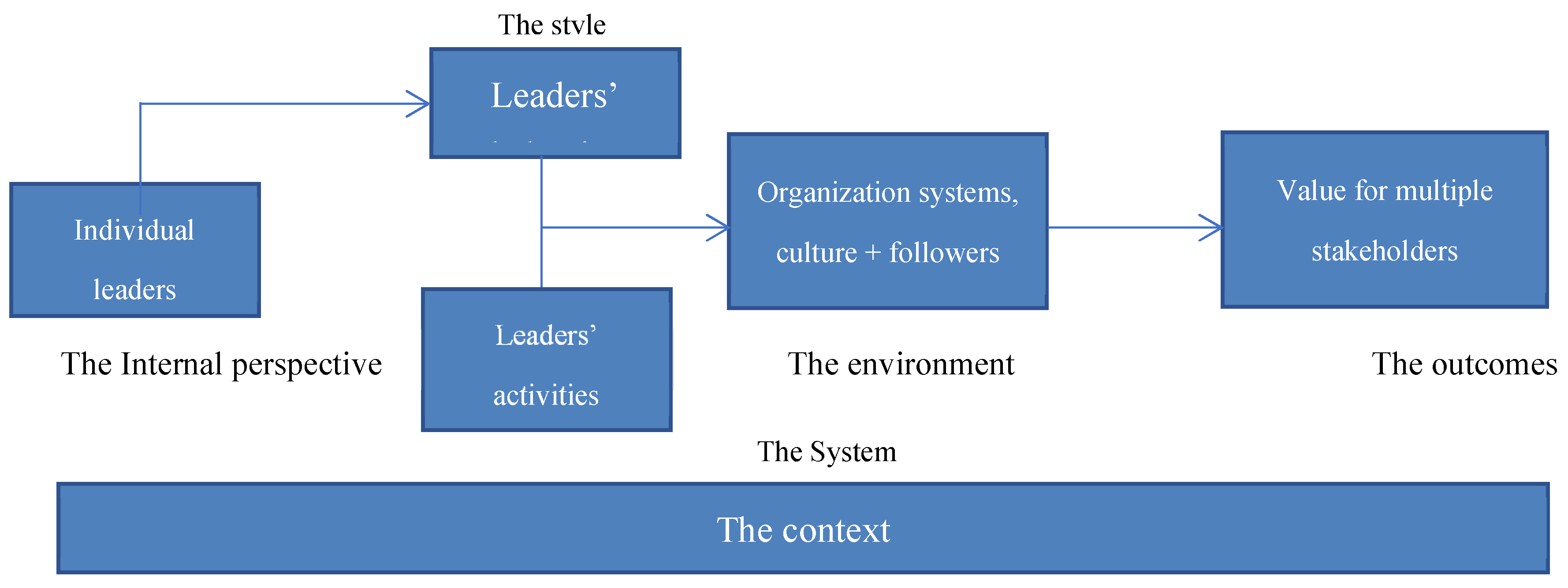
Figure 2.
Impact of Organizational Excellence and Leadership Strategies on Business Performance. Source: Pinar and Girard (2008).
Figure 2.
Impact of Organizational Excellence and Leadership Strategies on Business Performance. Source: Pinar and Girard (2008).
Disclaimer/Publisher’s Note: The statements, opinions and data contained in all publications are solely those of the individual author(s) and contributor(s) and not of MDPI and/or the editor(s). MDPI and/or the editor(s) disclaim responsibility for any injury to people or property resulting from any ideas, methods, instructions or products referred to in the content. |
© 2024 by the authors. Licensee MDPI, Basel, Switzerland. This article is an open access article distributed under the terms and conditions of the Creative Commons Attribution (CC BY) license (http://creativecommons.org/licenses/by/4.0/).
Copyright: This open access article is published under a Creative Commons CC BY 4.0 license, which permit the free download, distribution, and reuse, provided that the author and preprint are cited in any reuse.


