

Submitted:
12 September 2024
Posted:
14 September 2024
You are already at the latest version
Abstract
Although social sustainability plays a crucial role in the sustainable development agenda, there is a scarcity of research that clearly defines and fully operationalizes this concept. This study seeks to fill this gap in the literature by creating a comprehensive measurement scale to evaluate social sustainability in the context of urban parks. According to the literature review, social sustainability is identified as a multidimensional concept, encompassing eight key dimensions in urban parks: identity, place attachment, cohesion, safety, equity, facilities, comfort, and accessibility. The validity, reliability, and dimensions of the social sustainability scale for urban parks are examined using factor analysis. To explore the idea that user evaluations of urban parks can be employed as a method to ensure social sustainability, user feedback was collected for the study. The article evaluates data from 120 participants in Alaeddin Hill Park, located in Konya, Turkey—a site selected for its potential to best reflect the identified dimensions. This study reveals the relationships between different dimensions of social sustainability that influence the park's social sustainability performance at the urban park scale. Additionally, it provides insights aimed at improving park design quality. The findings of the study indicate that the park’s social sustainability is at a moderate level, with identity identified as the most influential dimension. On the other hand, the dimension that most negatively impacts sustainability performance is safety, primarily due to low perceptions of safety caused by inadequate lighting, the predominant use of the park by people from lower socioeconomic backgrounds, and a general lack of security.
Keywords:
social indicators
; social sustainability
; urban parks
; sustainability
1. Introduction
With the rapid increase in the world population and uncontrolled urbanization due to industrialization, the rise of environmental disasters, the realization of limited resources, and energy crises like the oil crisis, the environmental dimension of sustainable development gained prominence, while its social dimension was overshadowed. In the current century, however, the increasing issues related to social concerns such as equality, justice, improving quality of life, identity, and a sense of belonging have brought the social dimension of sustainable development to the forefront. Although there is no consensus on its definition and application, social sustainability has gained importance in recent years, when social issues have reached their peak, thanks to contributions from researchers from various disciplines, and has started to be accepted as one of the most important components of sustainable development. Sustainability involves meeting social and cultural needs while also providing environmentally sustainable and healthy living environments. Moreover, environmental and economic sustainability cannot be attained without addressing social needs and daily experiences.
Social sustainability aims to preserve the social networks, societal values, cultural elements, and the sense of belonging among individuals that constitute a society; it seeks to maintain diversity within the social structure in the face of current conditions. In this context, urban parks play a critical role in ensuring social sustainability. Parks are not only green spaces but also areas where social interactions are concentrated, social relationships are strengthened, and urban residents can escape the stress of daily life. These areas, which allow individuals from different age groups and socio-economic backgrounds to come together, support social equality and justice while contributing to the preservation of physical and mental health. By providing safe and accessible recreational spaces, they help individuals strengthen their social bonds and reinforce their sense of local belonging. Therefore, urban parks are indispensable for achieving social sustainability and are among the fundamental components of sustainable urban development [1,2,3].
Social interaction strengthens the bonds between individuals, facilitates social cohesion, and prevents social exclusion; these are the cornerstones of a socially sustainable society. Urban parks, in this context, are critical spaces that allow city dwellers to come together and engage in social interaction. These parks are not only meeting points for people but also play a significant role in meeting the psychological, physical, and sociological needs of individuals. Therefore, the spatial opportunities offered by urban parks and the quality of these areas are crucial for achieving social sustainability goals. A quality-built environment is a factor that directly affects people's quality of life and shapes the nature of social relationships [4].
The potential of urban parks to ensure social sustainability is closely related to the accessibility, comfort, and immersion in nature that these areas provide. These spaces encourage social equality by bringing together individuals from different socio-economic backgrounds. Particularly, the accessibility of these areas for every individual and their design as part of a human-centered built environment play a critical role in achieving social sustainability goals [5].
However, the dynamic nature of the concept of social sustainability and changing social conditions make it challenging to establish a clear framework for measuring these goals. In the literature, there are different approaches to assessing and measuring social sustainability. Some researchers evaluate social sustainability based on criteria such as community participation, social justice, and quality of life [6], while others consider the concept from more spatial and physical planning perspectives [7]. This diversity suggests that there is no single universal model for evaluating social sustainability; instead, context-specific approaches need to be developed.
Various researchers have approached the concept of social sustainability from different angles and have developed various approaches for researching and evaluating this concept. For instance, Ref. [8,9,10,11,12,13] focused on specific conditions in the context of social sustainability and analyzed these conditions. These researchers have discussed under what circumstances social sustainability can be achieved and how these conditions should be evaluated. Meanwhile, Ref. [4,6,14,15,16] have established fundamental criteria for measuring sustainability. These criteria have made significant contributions to understanding how social sustainability can be evaluated in different contexts.
In the study of social sustainability, it is evident that the subject is addressed at different scales and in different contexts. McKenzie (2004) [8] conducted studies at the national scale, Ref. [17,18,19,20] at the urban scale, and Ref. [6,21,22,23] at the neighborhood scale to ensure social sustainability. Focusing on social sustainability in urban areas, Landorf (2011) [2] examined the issue of social sustainability in historic environments. Similar diversity can be observed in studies on the relationship between the built environment and social sustainability [15,24,25,26,27]. These studies emphasize the importance of addressing social sustainability at different spatial scales and contexts.
The literature on social sustainability offers a comprehensive perspective on the different ways in which this concept is addressed in different contexts. In the process of researching and evaluating social sustainability, both spatial scales and socio-economic contexts play a significant role. In this framework, the various studies in the literature provide valuable contributions to research on social sustainability by deepening the understanding of this field.
The absence of a common language and universal measurement method for defining what social sustainability should aim for, and for defining and measuring social sustainability conditions, stems from the fact that social, socio-economic, and cultural data directly related to social sustainability naturally vary according to time and place. The existence of these differences and the broad spectrum represented by the concept of social sustainability as a comprehensive heading have led researchers like Colantonio (2010) [28], and Bramley and Power (2009) [29] to highlight ambiguities and conceptual confusions in defining and measuring the social dimension of sustainable development.
Researchers such as Bebbington and Dillard (2008) [30], and Littig and Griessler (2005) [16] have characterized social sustainability as the fulfillment of basic human needs, the renewal of human resources, and the preservation of cultural continuity. The preservation of cultural continuity can be achieved by enabling society to maintain its various traditions and customs and by safeguarding the values that form its social identity. In defining a socially sustainable society, Ghahramanpouri et al. (2013) [18] highlighted that socially sustainable communities are equitable, diverse, connected, and democratic, providing a high quality of life for all members of the community.
The development of a sense of place and belonging among individuals within a community, making them feel like an integral part of their surroundings, is a fundamental requirement for community cohesion. The cultivation of these feelings is facilitated by social interactions and the social networks that provide the necessary foundation for these interactions. Dempsey et al. (2011) [6] has further classified the factors contributing to social sustainability into "Non-Physical Factors" and "Physical Factors." Non-physical factors include criteria such as social cohesion, social interaction, and quality of life, which are shaped by relationships among people in the community and the social environment. Physical factors, on the other hand, encompass aspects related to the built environment, such as accessibility, environmental quality, and attractive public spaces, which influence urban social sustainability.
In studies on social sustainability, concepts such as social homogeneity, a sense of belonging and identity, solidarity, and gender equality, though less emphasized in the past, are increasingly recognized for their significant impact on individuals' relationships with each other and their satisfaction with their living environments. The concept of security is also considered a critical component of social sustainability, approached from two dimensions: "sense of safety" and "physical security." These two dimensions are regarded as crucial elements that directly affect societal well-being and individual happiness.
Chan and Lee (2008) [15] notes that the interaction between people in urban areas contributes to social sustainability, emphasizing that open spaces and green areas provide the necessary venues for these interactions to occur. In the social sustainability literature, non-physical criteria such as quality of life, health, happiness, and the fulfillment of physical and psychological needs are also prominent. These criteria are linked to experiences, which refer to the time individuals allocate for themselves and the activities they engage in and are considered among the criteria used to assess social sustainability.
It has been observed that the criteria for social sustainability have evolved over the years due to socio-economic conditions and societal dynamics. Glasson and Wood (2009) [31] points out that the concept of social sustainability has shifted to focus more on issues like social networks, community participation, sense of place, safety, and community stability over time. Ref. [28] also highlights that in addition to traditional topics such as equity, poverty alleviation, and livelihood, more abstract concepts like belonging, sense of place, and social networks have gained prominence in the assessment of social sustainability. This shift has expanded the scope of social sustainability studies and led to criteria moving towards more abstract and complex areas.
Bramley and Power (2009) [29] argues that in developed countries, where primary development issues such as access to basic needs and services have largely been addressed, there is a need to focus on more "advanced" topics such as social cohesion and social capital. Given that most social sustainability studies are conducted in developed countries, the reasons for this shift in criteria become more understandable. The socio-economic differences between developed and developing countries have led to varying criteria being used in the assessment of social sustainability. The traditional concepts mentioned by Ref. [28] involve largely resolved issues in developed countries, while newly emerging concepts involve more challenging criteria that these countries need to address.
The adoption of green spaces by users not only makes them essential components of social sustainability but also promotes individual happiness and ownership of these spaces. People living in cities inherently intervene in their surrounding environment; these interventions fall within the domains of architecture, engineering, and planning as part of the built environment. The built environment significantly impacts people's health, social relations, and overall quality of life. However, the effect of the built environment on social sustainability has not been sufficiently explored in sustainability literature [6].
Green spaces can contribute to neighborhood satisfaction, a sense of belonging to the community, and social relationships with neighbors, thereby strengthening social networks [32]. Public spaces in cities are areas where social and economic human activities occur. Therefore, as the number of activities conducted in urban spaces increases, the quality of these urban spaces also improves [32]. Green spaces, whether associated with public spaces or independent of them, have been regarded as elements of urban quality. They have always had a special role in ensuring the presence of residents and fostering social interactions [130]. Green spaces promote community participation, environmental action, and connections between people and their local environments, which are crucial for access to local amenities and resources [33].
Urban parks and public spaces are of critical importance for social sustainability. Accessible public and green spaces facilitate socialization, enable people to get to know their neighbors, and contribute to social cohesion. Wong and Chan (2000) [34] emphasizes that accessibility is an important component of social sustainability, noting that individuals prefer to avoid traveling extensively where they live, work, or engage in cultural activities. In this context, factors such as the proximity of housing to workplaces and leisure time opportunities are central to discussions of social sustainability [11]. Additionally, Ref. [15] notes that urban landscapes reinforce the uniqueness of places and the sense of belonging for users.
Moulay et al. (2017) [35] emphasizes that the legibility of neighborhood parks increases their potential for social interaction and promotes social sustainability. Green spaces provide the necessary setting for social cohesion and interpersonal interactions while also contributing to environmental sustainability.
Green spaces are vital for both human health and ecological balance and play a critical role in the development of sustainable and livable cities. In this context, exploring data related to the social dimension of sustainability and examining the relationship between urban parks and social sustainability can contribute to a better understanding and development of this field.
In the literature, the concept of social sustainability is generally addressed through criteria such as social equity, accessibility, participation, social integration, social security, cultural diversity, and quality of life. These criteria should be considered at every stage, from the design to the management of urban parks. Evaluating urban parks in terms of social sustainability can help identify strategies to enhance urban quality of life and strengthen social cohesion. Therefore, this study aims to evaluate the criteria for social sustainability in an urban park.
The primary aim of this study is to explore the relationship between urban parks and social sustainability by addressing data related to the social dimension of sustainability. In this context, the study aims to examine how social sustainability criteria are applied in urban parks and evaluate the impact of these criteria on park users. The study first conducts an in-depth review of the social sustainability literature and analyzes the reflections of these criteria on urban parks. Evaluating urban parks from a social sustainability perspective is crucial for identifying the current situation and developing recommendations to guide future urban planning processes. Furthermore, the proposed framework for measuring social sustainability in the context of urban parks aims to contribute to the literature and provide a foundation for subsequent studies. In this context, to understand and determine the potential for social sustainability in urban parks, criteria such as identity, equity, comfort, accessibility, safety, inclusivity, services, and sense of place have been examined. The core hypothesis of this study is that certain criteria have a significant influence on the social sustainability performance of urban parks. The research questions of the study are:
- What are the key criteria that influence the social sustainability of urban parks in Konya, Turkey?
- How do these criteria impact social sustainability in these spaces?
By addressing these research questions, this study aims to provide insights that will guide urban park design and contribute to the development of more livable and sustainable urban parks.
2. Methodology
2.1. Case Study
The research was conducted in Konya is the 6th largest city in Türkiye in terms of population. Aladdin Hill, the sampling area where the survey was conducted, is a hill and park located in the center of the city of Konya. Named after the Seljuk sultan Alaaddin Keykubat I, who ruled the region in the 13th century, it is an abode to several historical and cultural attractions, including the Alaaddin Mosque. The park also features many walking trails and picnic areas, along with some restaurants and cafes and has panoramic views of the city and surrounding countryside. Alaaddin Hill park is in Karatay, the central district of Konya province. It is an oval planned park covering an area of 157500 m2. (Figure 1)
Alaaddin Hill is one of the important historical and cultural heritages not only of Konya, but also of Turkey. The Alaaddin Mosque and the surrounding buildings located on the hill represent a history of thousands of years. In addition, this area is one of the icons of Konya and is an important attraction center for visitors as well as locals. From the point of view of social sustainability, the features of Aladdin Hill are very interesting. In addition to its historical and cultural texture, this area is also an actively used place today. People living in the surrounding neighborhoods organize social events here and maintain traditional ways of life. This means that Aladdin Hill contains important social sustainability elements such as strengthening social ties, increasing social interaction and protecting local identity. Therefore, researching the social sustainability of an area such as Aladdin Hill is of great importance not only at the local level, but also from the point of view of general urban planning and community development. Therefore, this case study has a great meaning as research conducted on Aladdin Hill, which is a concrete example of the concept of social sustainability.
2.2. Data and Sampling
The sample size was determined using Cochran's formula with a 95% confidence level, leading to a final sample of 120 participants. The full survey was accomplished in May 2023 through in situ face-to-face interviews. A survey study was conducted face-to-face with 120 individuals spending time at Alâeddin Hill Park, focusing on evaluating the social dimension of sustainability. The sample, selected using a random sampling method, is considered representative of the population.
The conceptual framework of the study is based on key components derived from the works of [6,9,14,15,16,36,37,38]. Data were gathered through a structured survey aimed at assessing participants' views on the social sustainability of urban parks. This survey was formulated based on an extensive literature review and was validated by conducting a pilot study with 20 participants. A five-point Likert scale was employed, which is an attitude scale structured to determine the extent to which respondents agree with the provided statements. The survey used to evaluate the research area consists of two sections. The first section gathers demographic information from the participants, including gender, age, education level, marital status, and income, which serve as the primary control variables. Many previous studies have utilized these variables as key control variables. In this first section, participants were asked six demographic questions. The second section contains 28 statements related to the study's main components: accessibility, facilities, sense of place, safety, identity, equity, and comfort. This section aims to capture users' perceptual data regarding the park. For statistical analysis, SPSS Statistics 27.0 software was used.
Table 1 presents the dimensions and sub-dimensions identified for this study, along with the statements included in the questionnaire.
2.3. Data Analysis
Descriptive statistical methods (such as frequency, percentage, mean, and standard deviation) were employed to analyze the data. Since outliers can increase the value of error variance and affect the validity of statistical tests, the presence of outliers in the datasets was examined before conducting any statistical tests. To test the reliability of the scales, a "Reliability Analysis" was conducted, and an "Exploratory Factor Analysis" was performed to test construct validity. A correlation analysis was conducted to determine if there was a relationship between two continuous variables. Parametric tests were used in the statistical evaluation of scales that had a normal distribution. For comparing quantitative data, an Independent T-test was applied to assess differences between two groups, while one-way analysis of variance (ANOVA) was used for comparisons of more than two group means.
3. Results
The demographic variables of the statistical population, such as age, gender, marital status, and education level, income and working status are described. In Table 2, each variable is presented in terms of frequency and percentage.
Factor analysis was used to determine whether the model used in the research has structural validity within the scope of the statistical attitude scale. At the same time, factor analysis was applied to the obtained data set to determine whether there is a hidden dimension within the main components determined within the scope of the conceptual framework. The Kaiser-Meyer-Olkin (KMO) test was utilized to assess the adequacy of the sample size for conducting factor analysis. Values between 0.5-1.0 are evaluated as acceptable as KMO value [39]. As a result of the analysis, the KMO value was determined as 0.769 and it was concluded that the sample was sufficient to conduct a factor analysis. In addition, when the Bartlett Sphericity test results were examined, it was found that the Chi-Square value obtained was acceptable (χ2(300 =1232.877; p=0.000; p<0.01) (Table 3).
The number of factors was determined based on Eigenvalues, where only those with Eigenvalues greater than 1 were retained. These 8 factors collectively account for 69.729% of the variance (Table 4).
When the value of this parameter is 0.4 or higher [40], it suggests that the variance shared between a construct and its indicators surpasses the measurement error variance for that construct, indicating a valid measurement model. If factor loadings between constructs and indicators fall below 0.4, they must be revised or excluded from the research model [41]. Moreover, if a variance loads onto multiple factors and the difference between these loadings exceeds 0.1, the factor with the highest loading is retained. The factor components identified through the analyses were redefined as follows: F1_Identity, F2_Place attachment, F3_Comfort, F4_Facilities, F5_Accessibility, F6_Equality, F7_Cohesion, and F8_Safety. As can be seen from Table 5, 1 variance loaded less than 0.4 and on more than one factor were excluded.
Descriptive statistics illustrate the overall evaluation of the variables and the level of variability among participants (standard deviation) (Table 6). The mean values reflect the general tendencies of the variables, while the standard deviation indicates the dispersion of the data. Variables such as comfort, safety, and place attachment received lower evaluations, whereas others, like identity and inclusivity, were rated more highly.
According to the results of ANOVA analysis, there is no significant difference between the groups in any of the analyzed social Deciency criteria (all p-values are greater than 0.05). The results indicate that these criteria are consistently perceived across different user groups of the park, and the studied variables are fairly distributed among these groups.
All dimensions have significant effects on social sustainability. Furthermore, the results of the regression analysis indicate a strong positive relationship between social sustainability and the dimensions (R=0.897) (Table 8).
The correlation analysis does not reveal significant positive correlations between the dimensions. Instead, generally weak to moderate negative relationships are observed among the dimensions. (Table 10). These interrelationships highlight critical dynamics that should be carefully considered when developing social sustainability strategies.
The data included in the table reveals the priority ranking of different dimensions of social sustainability and the level of importance perceived by the participants. ( Table 11).
4. Discussion
The primary objectives of this study were to evaluate and identify the key factors through which urban park’s influence social sustainability performance and to systematically assess and categorize these impacts using statistical analyses conducted with SPSS software. Significant dimensions of urban parks contributing to social sustainability were identified through an extensive literature review. The dimensions were assessed by evaluating the fit of the research model. During this evaluation, some indicators (survey questions) were removed due to insufficient factor loadings. The proposed model's reliability and validity were verified using Cronbach's alpha coefficient. Following this, the hypotheses were tested through regression and correlation analyses, and their significance was ranked using the Friedman test.
The dimensions identified in the study were categorized into eight general categories: identity, place attachment, comfort, facilities, accessibility, equity, cohesion, safety. it is divided into 17 sub-categories (Table 1).
From the obtained results, it can be concluded that all independent variables have significant effects on social sustainability. The strongest effects are observed in the variables "facilities," "safety," and "identity." These variables make substantial contributions to social sustainability, suggesting that improvements in these areas could effectively enhance social sustainability. However, the results also indicate that participants generally expressed a satisfaction level ranging from neutral to positive for most of the examined variables. Nonetheless, it was observed that satisfaction levels were lower in some areas, such as "Safety" and "Place Attachment" Among the proposed dimensions, "identity" emerged as the highest priority in the hierarchical ranking (Table 11). A strong sense of community, along with individual pride and identity, is believed to foster a desire to contribute to the community, potentially leading to greater social cohesion within the society [42]. Identity plays a crucial role in promoting social dynamism and preserving cultural infrastructure [43]. Social identity is formed within a social context and reflects the collective characteristics of groups or communities. In contrast, physical identity distinguishes the familiar from the unfamiliar and encompasses attributes such as distinctiveness, permanence, and stability [44]. This finding can encourage urban planners and designers to place more emphasis on cultural considerations.
The next most significant criteria were "facilities" and "cohesion," respectively. Cohesion refers to the harmony, integration, and participation of individuals within their living environment, as well as solidarity and tolerance within the community [45,46,47]. Therefore, cohesion is a critical factor in social sustainability. Facilities in urban parks, such as sports fields, playgrounds, walking paths, and rest areas, provide a variety of amenities that address the needs of different age groups and communities. Outdoor spaces designed for activities encourage community events and social interactions, thereby enhancing social cohesion and solidarity. These facilities are key components of social sustainability in urban parks. By improving the functionality of parks and fostering community engagement, these facilities contribute to social sustainability goals, including enhancing social cohesion, accessibility, safety, education, and health.
The concept of equality emphasizes the necessity of adopting a socially inclusive perspective that prevents social exclusion for all segments of society. Equality is one of the key pillars of social sustainability, wherein all individuals have equal rights. These principal mandates that all users of urban parks, regardless of age, gender, or mental or physical disabilities, should have equal access to park facilities. The perspective of this study on social sustainability is based on the premise that public spaces contribute to societal sustainability by providing both social and environmental equality, thereby positively impacting social sustainability overall. Accessibility is a significant theme in improving social sustainability and ensuring social equality [7,48]. Accessibility enables the full social, economic, and political participation of all individuals in society [49]. This approach establishes a close relationship between social equality and environmental equality by considering the built environment as a resource. In this context, the built environment corresponds to the quality and degree of access to services and facilities in a specific area, thereby contributing to social equity [50]. All individuals, regardless of age and physical condition, should have appropriate and easy access to certain places in their daily lives. Accessibility is viewed as freedom of movement and is considered a fundamental human right that must be protected [15].
The criterion of safety [3,51,52] is regarded as a fundamental component of social sustainability and supports social development [53]. It also functions as an incentive element for various activities [54]. [6] defines this phenomenon as the assurance that individuals seek during participation in activities within social networks; this aligns with a basic need in Maslow's hierarchy of needs and enhances social cohesion. Furthermore, the perception of safety is directly linked to the quality of public spaces [55,56,57]. If residents do not feel safe in an area, they may not utilize the services and facilities, regardless of how accessible they are [58].
The concept of "place" can exist only through the meaning humans ascribe to it. Lewicka [59] defines places as residential areas such as cities, neighborhoods, and homes, as well as environments structured for leisure and recreation, whether natural or constructed. Place is an indispensable part of place attachment [60]. The attachment of people to an area is strongly related to the emotional bonds they establish with that area. Maslow [61] considered the sense of belonging as one of the fundamental human needs and noted that its absence could result in feelings of loneliness and behavioral disorders within society.
One of the most closely related issues to the built environment among social sustainability criteria is the provision of both physical and psychological comfort for the people who make up the community. Ensuring the physical and psychological comfort of individuals in society is directly related to the characteristics of the built environment and environmental quality. Comfort is a concept that reveals the connection between the human body and the physical environment and is dependent on physiological and psychological conditions [62]. Our environmental interaction, which occurs through our senses, results in us feeling comfortable, depending on whether each sense operates independently or together [63]. Therefore, comfort is primarily concerned with determining tangible values necessary to ensure physical ease.
This study is confined to Konya, Turkey, and its results may not be applicable to other cultural or geographical settings. Future research should replicate this study in various cities and regions to confirm the findings. Furthermore, the use of self-reported data could lead to potential biases; thus, future studies should adopt a mixed-method approach, integrating both qualitative and quantitative techniques, to gain a more nuanced understanding of public perceptions. Additionally, certain indicators were excluded due to inadequate factor loadings, which could impact the overall comprehensiveness of the findings. In conclusion, this study highlights the complex nature of social sustainability perceptions and offers practical guidance for urban planners.
In summary, these findings emphasize that social sustainability studies should prioritize dimensions such as identity, facilities, and inclusiveness, while also acknowledging the importance of other dimensions like comfort, sense of place, and safety.
5. Conclusions
In recent years, social sustainability has been increasingly recognized as a critical component of sustainable development and overall sustainability. Social sustainability has been examined in numerous studies as a specific dimension of sustainability or sustainable development. However, a comprehensive review of the relevant literature reveals that definitions of social sustainability are often complex and multi-dimensional.
The components identified through a comprehensive literature analysis and the patterns of emotions and behaviors they influence vary according to cultural and local contexts. A research model has been proposed to test the hypotheses formulated within a conceptual framework developed with an awareness of these geographical and cultural differences in Turkey. The article proposes a model to determine the impact of urban parks on social sustainability, presenting results that shed light on the interaction between urban parks and social sustainability in its various dimensions.
To create effective urban parks, it is essential for designers to gather reliable user feedback, enhancing the chances of achieving user satisfaction while reducing the likelihood of design failures. Several research methods can be employed to collect public opinions. This study utilized a survey approach to obtain insights from urban park users based on their past experiences and perspectives. The survey questions, criteria, and sub-criteria were developed through an extensive literature review, and the collected data were analyzed using statistical methods with SPSS software.
The main objective of this study is to identify and categorize the key indicators of social sustainability in urban parks. Additionally, the relationships between the proposed criteria and social sustainability were assessed through statistical analyses, such as the Friedman test. The developed scale facilitates the measurement of social sustainability parameters within a defined context.
Furthermore, this study proposes a novel dataset created through a comprehensive investigation aimed at measuring social sustainability in urban parks. Identifying social factors believed to influence social sustainability in these contexts will serve as a valuable guide for future research.
The findings highlight the importance of several key criteria—such as identity, security, social equity, inclusion, facilities, comfort, place attachment, and accessibility—in shaping people's perceptions of the social sustainability of urban parks. The evaluation of the park based on these criteria showed that its social sustainability performance was at a moderate level. This critical finding serves as a guide for achieving social sustainability from both theoretical and practical perspectives. These insights can assist urban designers in prioritizing the most crucial elements when planning and developing urban parks.
References
- Jeannotte, M.S. Singing alone? The contribution of cultural capital to social cohesion and sustainable communities. The International Journal of Cultural Policy 2003, 9, 35–49. [Google Scholar]
- Landorf, C. Evaluating social sustainability in historic urban environments. International Journal of Heritage Studies 2011, 17, 463–477. [Google Scholar] [CrossRef]
- Talan, A.; Tyagi, R.; Surampalli, R.Y. Social dimensions of sustainability. Sustainability: Fundamentals and Applications, 2020: P. 183-206.
- Gehl, J. Cities for people. 2013: Island press.
- Talen, E. Measuring the public realm: A preliminary assessment of the link between public space and sense of community. Journal of architectural and planning research, 2000: P. 344-360.
- Dempsey, N.; et al. The social dimension of sustainable development: Defining urban social sustainability. Sustainable development 2011, 19, 289–300. [Google Scholar] [CrossRef]
- Burton, E. The compact city: Just or just compact? A preliminary analysis. Urban studies 2000, 37, 1969–2006. [Google Scholar] [CrossRef]
- McKenzie, S. Social sustainability: Towards some definitions. 2004.
- Barron, L.; Gauntlett, E. Stage 1 report-model of social sustainability. Housing and Sustainable Communities’ Indicators Project. Perth, Murdoch University, Western Australia, 2002.
- Polèse, M.; Stren, R.E.; Stren, R. The social sustainability of cities: Diversity and the management of change. 2000: University of Toronto press.
- Davidson, K.; Wilson, L. A critical assessment of urban social sustainability. In Proceedings of the 2009 4th State of Australian Cities National Conference, 24-27 November 2009. [Google Scholar]
- Partridge, E. Social sustainability’: A useful theoretical framework. in Australasian political science association annual conference. 2005.
- Holden, M. Urban policy engagement with social sustainability in metro Vancouver. Urban Studies 2012, 49, 527–542. [Google Scholar] [CrossRef] [PubMed]
- Murphy, K. The social pillar of sustainable development: A literature review and framework for policy analysis. Sustainability: Science, practice and policy 2012, 8, 15–29. [Google Scholar] [CrossRef]
- Chan, E.; Lee, G.K. Critical factors for improving social sustainability of urban renewal projects. Social indicators research 2008, 85, 243–256. [Google Scholar] [CrossRef]
- Littig, B.; Griessler, E. Social sustainability: A catchword between political pragmatism and social theory. International journal of sustainable development 2005, 8, 65–79. [Google Scholar] [CrossRef]
- Atalay, H.; Gülersoy, N.Z. Developing Social Sustainability Criteria and Indicators in Urban Planning: A Holistic and Integrated Perspective. ICONARP International Journal of Architecture and Planning, 2023.
- Ghahramanpouri, A.; Lamit, H.; Sedaghatnia, S. Urban social sustainability trends in research literature. Asian Social Science 2013, 9, 185. [Google Scholar] [CrossRef]
- Marvi, H.; et al. Cultivating Community: Addressing Social Sustainability in Rapidly Urbanizing Hyderabad City, Pakistan. Societies 2024, 14, 161. [Google Scholar] [CrossRef]
- Enyedi, G. Social sustainability of large cities. Ekistics, 2002: P. 142-144.
- Shrivastava, V.; Singh, J. Social sustainability of residential neighbourhood: A conceptual exploration. International Journal of Emerging Technologies 2019, 10, 427–434. [Google Scholar]
- Karuppannan, S.; Sivam, A. Social sustainability and neighbourhood design: An investigation of residents' satisfaction in Delhi. Local Environment 2011, 16, 849–870. [Google Scholar] [CrossRef]
- Rafieian, M. Evaluation of social sustainability in urban neighbourhoods of Karaj city. Iran University of Science & Technology 2014, 24, 122–130. [Google Scholar]
- Dave, S. Neighbourhood density and social sustainability in cities of developing countries. Sustainable development 2011, 19, 189–205. [Google Scholar] [CrossRef]
- Ho, D.C.W.; et al. Social sustainability in urban renewal: An assessment of community aspirations. Urbani izziv 2012, 23. [Google Scholar] [CrossRef]
- Chan, K.S.; Siu, Y.F.P. Urban governance and social sustainability: Effects of urban renewal policies in Hong Kong and Macao. Asian Education and Development Studies 2015, 4, 330–342. [Google Scholar] [CrossRef]
- Darchen, S.; Ladouceur, E. Social sustainability in urban regeneration practice: A case study of the Fortitude Valley Renewal Plan in Brisbane. Australian Planner 2013, 50, 340–350. [Google Scholar] [CrossRef]
- Colantonio, A. Urban social sustainability themes and assessment methods. Proceedings of the Institution of Civil Engineers-Urban Design and Planning 2010, 163, 79–88. [Google Scholar] [CrossRef]
- Bramley, G.; Power, S. Urban form and social sustainability: The role of density and housing type. Environment and Planning B: Planning and Design 2009, 36, 30–48. [Google Scholar] [CrossRef]
- Bebbington, J.; Dillard, J. Social sustainability: An organizational-level analysis, in Understanding the social dimension of sustainability. 2008, Routledge. p. 173-189.
- Glasson, J.; Wood, G. Urban regeneration and impact assessment for social sustainability. Impact Assessment and Project Appraisal 2009, 27, 283–290. [Google Scholar] [CrossRef]
- Clayton, S. Domesticated nature: Motivations for gardening and perceptions of environmental impact. Journal of environmental psychology 2007, 27, 215–224. [Google Scholar] [CrossRef]
- Ramkissoon, H.; Smith, L.D.G.; Weiler, B. Relationships between place attachment, place satisfaction and pro-environmental behaviour in an Australian national park. Journal of Sustainable tourism 2013, 21, 434–457. [Google Scholar] [CrossRef]
- Wong, W.S.; Chan, E.H. Building Hong Kong: Environmental Considerations. Vol. 1. 2000: Hong Kong University Press.
- Moulay, A.; Ujang, N.; Said, I. Legibility of neighborhood parks as a predicator for enhanced social interaction towards social sustainability. Cities 2017, 61, 58–64. [Google Scholar] [CrossRef]
- Vavik, T.; Keitsch, M.M. Exploring relationships between universal design and social sustainable development: Some methodological aspects to the debate on the sciences of sustainability. Sustainable development 2010, 18, 295–305. [Google Scholar] [CrossRef]
- Moradian, O.; Rakhshandehroo, M.; Abdolahzade Fard, A. The role of urban parks in the social sustainability of cities, case study Azadi park, Shiraz. 2019.
- Wang, C.; et al. The social equity of urban parks in high-density urban areas: A case study in the core area of Beijing. Sustainability 2023, 15, 13849. [Google Scholar] [CrossRef]
- Altunışık, R.; et al. Sosyal bilimlerde araştırma yöntemleri: SPSS uygulamalı. 2007: Sakarya yayıncılık.
- Shrestha, NFactor analysis as a tool for survey analysis. American journal of Applied Mathematics and statistics 2021, 9, 4–11.
- Sim, M.; Kim, S.-Y.; Suh, Y. Sample size requirements for simple and complex mediation models. Educational and Psychological Measurement 2022, 82, 76–106. [Google Scholar] [CrossRef]
- Evans, G.; Shaw, P. The contribution of culture to regeneration in the UK: A review of evidence: A report to the Department for Culture Media and Sport. 2004.
- Wagoner, J.A.; Belavadi, S.; Jung, J. Social identity uncertainty: Conceptualization, measurement, and construct validity. Self and Identity 2017, 16, 505–530. [Google Scholar] [CrossRef]
- Izadi, A.; et al. Structural functionalism, social sustainability and the historic environment: A role for theory in urban regeneration. The Historic Environment: Policy & Practice, 2020, 11, 158–180. [Google Scholar]
- Bacon, N.; et al. Creating strong communities: How to measure the social sustainability of new housing developments. The Berkeley Group: London, UK, 2012: P. 38.
- Friedkin, N.E. Social cohesion. Annu. Rev. Sociol. 2004, 30, 409–425. [Google Scholar] [CrossRef]
- Schiefer, D.; Van der Noll, J. The essentials of social cohesion: A literature review. Social Indicators Research 2017, 132, 579–603. [Google Scholar] [CrossRef]
- Barton, H. Urban form and locality, in Sustainable Communities. 2013, Routledge. p. 105-122.
- Pierson, J.H. Tackling social exclusion: Promoting social justice in social work. 2009: Routledge.
- Dempsey, N.; Brown, C.; Bramley, G. The key to sustainable urban development in UK cities? The influence of density on social sustainability. Progress in planning 2012, 77, 89–141. [Google Scholar]
- Eizenberg, E.; Jabareen, Y. Social sustainability: A new conceptual framework. Sustainability 2017, 9, 68. [Google Scholar] [CrossRef]
- Barton, H. Sustainable communities: The potential for eco-neighbourhoods. 2000: Earthscan.
- Crabtree, A.; Gasper, D. Conclusion: The sustainable development goals and capability and human security analysis. Sustainability, capabilities and human security, 2020: P. 169-182.
- Shaftoe, H. Community safety and actual neighbourhoods, in Sustainable Communities. 2013, Routledge. p. 252-267.
- Mehta, V. Evaluating public space. Journal of Urban design 2014, 19, 53–88. [Google Scholar] [CrossRef]
- Charkhchian, M.; Abdolhadi Daneshpour, S. Introduction to Multiple Dimensions of a Responsive Public Space; A case study in Iran. Prostor: Znanstveni časopis za arhitekturu i urbanizam 2010, 18, 218–227. [Google Scholar]
- Low, S.; Taplin, D.; Scheld, S. Rethinking urban parks: Public space and cultural diversity. 2005: University of Texas Press.
- Talen, E. Reconciling the link between new urbanism and community. in American Planning Association 2001 National Planning Conference, New Orleans. 2001.
- Lewicka, M. What makes neighborhood different from home and city? Effects of place scale on place attachment. Journal of environmental psychology 2010, 30, 35–51. [Google Scholar]
- Scannell, L.; Gifford, R. Defining place attachment: A tripartite organizing framework. Journal of environmental psychology 2010, 30, 1–10. [Google Scholar] [CrossRef]
- Maslow, A.H. The instinctoid nature of basic needs. Journal of personality 1954.
- Chappells, H. Comfort, well-being and the socio-technical dynamics of everyday life. Intelligent Buildings International 2010, 2, 286–298. [Google Scholar]
- Fincher, W.; Boduch, M. Standards of human comfort: Relative and absolute. 2009.
Figure 1.
Study area in Konya/Turkey.
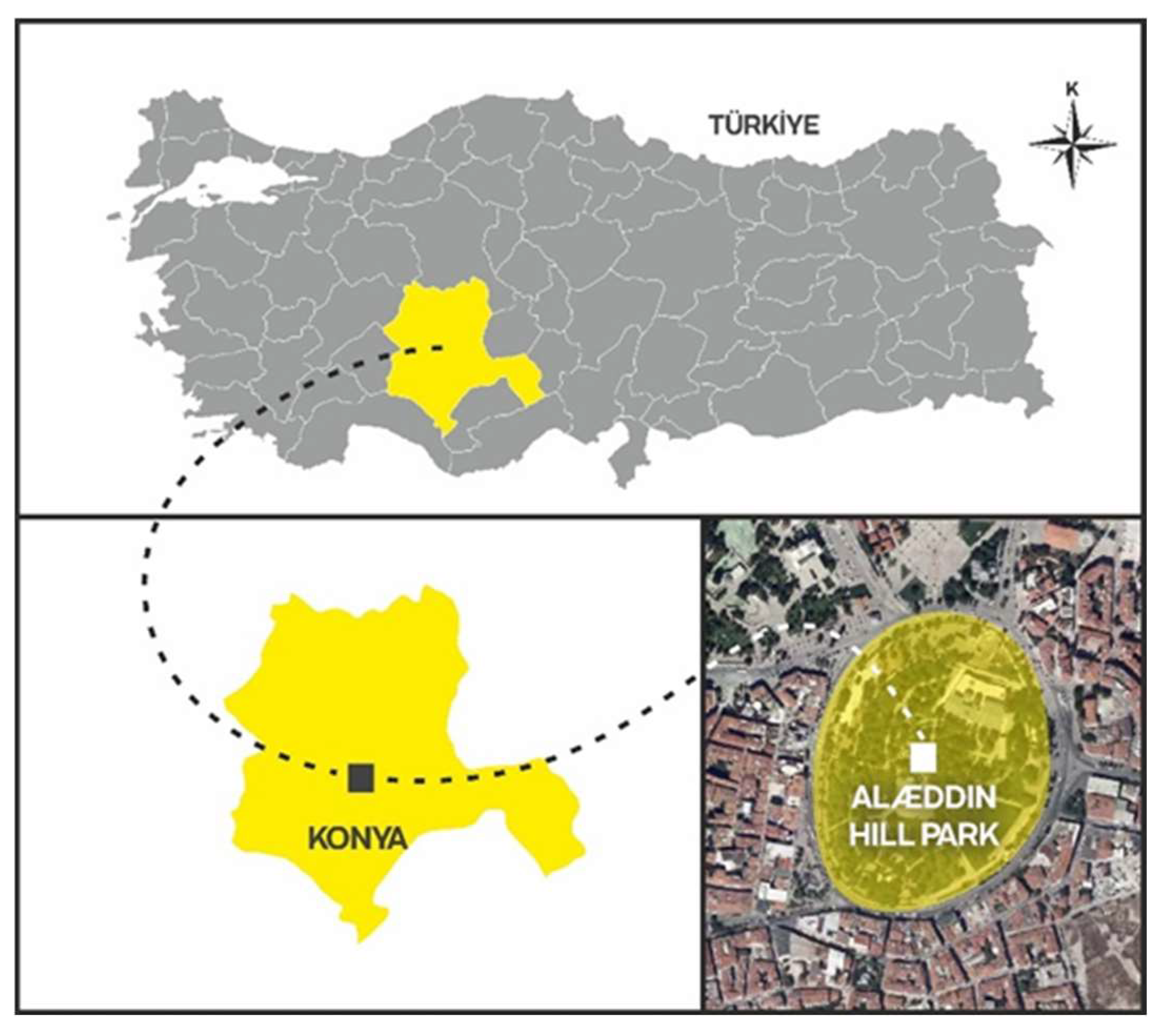

Table 1.
Dimensions, sub-dimensions and statements used in the research.
| Dimension | Variables | Sub-dimension |
|---|---|---|
| Identitity | It holds an important place in the city's history. | Historical identity Environmental identity |
| It has contributed to the preservation of the city's historical and cultural values. | ||
| It has unique spaces. | ||
| It is among the symbols of the city. | ||
| Place attachment | I feel comfortable in the park. | Belonging to the area Belonging to the community |
| I am happy to be here. | ||
| I feel like I can be myself here. | ||
| While spending time here, I feel a sense of belonging to this place. | ||
| Comfort | There are sufficient seating elements within the park area. | General needs The presence of facilities Maintenance and cleaning |
| There are dining facilities such as restaurants, cafes, and kiosks available. | ||
| There are adequate facilities (toilets, fountains, etc.) to meet general needs. | ||
| The maintenance and cleanliness are sufficient. | ||
| Security and Safety | The security (such as guards, private security, etc.) is adequate. | Individual perception of security Security of the area |
| Evening lighting is sufficient. | ||
| During the day, I feel safe in the park when I am alone. | ||
| It is safe to be alone in the park after dark. | ||
| It is safe for children. | ||
| Social Equity | There is gender equality. | Gender equality Equilaty of faith Appealing to all ages Social cohesion |
| Regardless of language, religion, or beliefs, everyone uses the park equally. | ||
| It is suitable for use by all age groups. | ||
| Everyone can participate in all recreational activities. | ||
| It contributes to the integration of different cultures. | ||
| It is open to all socio-economic groups. | ||
| Facilities | The lawns are sufficient for various activities such as exercise and relaxation. | Activity area suitability Activity facility and infrastructure adequacy |
| The facilities are diverse enough to meet the recreational needs of different groups. The walking paths are well-designed. | ||
| Accessibility | Access to the area is varied. | Accessibility to park Accessibility in park |
| The walking areas are sufficient. | ||
| It is possible to reach every part of the area on foot. |
Table 2.
Demographic characteristics of the sample population.
| Dimensions | Frequency | Frequency Percentage | |
|---|---|---|---|
| Gender | Female | 64 | 53.3 |
| Male | 56 | 46.7 | |
| Age | 18-24 | 39 | 32.5 |
| 25-35 | 38 | 31.7 | |
| 36-45 | 17 | 14.2 | |
| 46-55 | 18 | 15.0 | |
| Over 56 | 8 | 6.7 | |
| Marital Status | Married | 52 | 43.3 |
| Single | 68 | 56.7 | |
| Educational Status | Primary | 12 | 10.0 |
| High | 42 | 35.0 | |
| University | 50 | 41.7 | |
| Postgraduate | 16 | 13.3 | |
| Working Status | Public instution | 15 | 12.5 |
| Private sector | 40 | 33.3 | |
| Unemployed | 65 | 54.2 | |
| Income | Low | 99 | 82.5 |
| Middle | 18 | 15 | |
| High | 3 | 2.5 |
Table 3.
KMO and Bartlett's test of sphericity results.
| Kaiser-Meyer-Olkin Measure of Sampling Adequacy. | ,769 | |
| Bartlett's Test of Sphericity | Approx. Chi-Square | 1232,877 |
| df | 300 | |
| Sig. | ,000 | |
Table 4.
Eigenvalues indicating the explanatory power of each factor.
| Component | Initial Eigenvalues | Extraction Sums of Squared Loadings | Rotation Sums of Squared Loadingsa |
||||
|---|---|---|---|---|---|---|---|
| Total | % of Variance | Cumulative % | Total | % of Variance | Cumulative % | Total | |
| 1 | 5,834 | 23,337 | 23,337 | 5,834 | 23,337 | 23,337 | 4,506 |
| 2 | 3,176 | 12,704 | 36,041 | 3,176 | 12,704 | 36,041 | 3,179 |
| 3 | 2,329 | 9,318 | 45,359 | 2,329 | 9,318 | 45,359 | 3,631 |
| 4 | 1,460 | 5,840 | 51,200 | 1,460 | 5,840 | 51,200 | 2,092 |
| 5 | 1,356 | 5,422 | 56,622 | 1,356 | 5,422 | 56,622 | 2,821 |
| 6 | 1,148 | 4,592 | 61,214 | 1,148 | 4,592 | 61,214 | 1,939 |
| 7 | 1,114 | 4,455 | 65,669 | 1,114 | 4,455 | 65,669 | 1,248 |
| 8 | 1,015 | 4,059 | 69,729 | 1,015 | 4,059 | 69,729 | 1,757 |
| 9 | ,842 | 3,370 | 73,098 | ||||
| 10 | ,763 | 3,052 | 76,151 | ||||
| 11 | ,670 | 2,679 | 78,830 | ||||
Table 5.
Factor loadings of each variable.
| Maddeler | F1_Ide | F2_Pl.at | F3_Com | F4_Fa | F5_Acc | F6_Equ | F7_Co | F8_Sa |
|---|---|---|---|---|---|---|---|---|
| S24 | ,626 | ,307 | ||||||
| S25 | ,674 | |||||||
| S26 | ,899 | |||||||
| S27 | ,817 | |||||||
| S28 | ,829 | |||||||
| S14 | ,372 | ,473 | ||||||
| S15 | ,642 | |||||||
| S16 | ,894 | |||||||
| S17 | ,860 | |||||||
| S1 | -,666 | |||||||
| S2 | -,728 | |||||||
| S3 | -,844 | |||||||
| S4 | -,783 | |||||||
| S8 | ,754 | |||||||
| S9 | ,746 | |||||||
| S5 | ,761 | |||||||
| S6 | ,810 | |||||||
| S7 | ,360 | ,635 | ||||||
| S21 | ,686 | |||||||
| S22 | ,788 | |||||||
| S23 | ,699 | |||||||
| S18 | ,312 | ,651 | ||||||
| S19 | ,749 | |||||||
| S20 | ,690 | |||||||
| S10 | ,367 | ,715 | ||||||
| S11 | ,801 | |||||||
| S12 | ,679 | |||||||
| S13 | ,535 |
Table 6.
Descriptive statistics of dimensions.
| Mean | Median | Mode | Std. Deviation | Minimum | Maximum | |
|---|---|---|---|---|---|---|
| Comfort | 2,7583 | 3 | 3 | 1,02896 | 1 | 5 |
| Accessibility | 3,1417 | 3 | 3 | 0,98983 | 1 | 5 |
| Facilities | 3,4333 | 3 | 3 | 1,17204 | 1 | 5 |
| Safety | 2,4417 | 2 | 3 | 1,08307 | 1 | 5 |
| Place Attachment | 2,5417 | 2 | 2 | 1,15879 | 1 | 5 |
| Equity | 3,375 | 3 | 4 | 1,11568 | 1 | 5 |
| Cohesion | 3,4917 | 4 | 4 | 1,20221 | 1 | 5 |
| Identity | 3,775 | 4 | 5 | 1,08048 | 2 | 5 |
| Social Sustainability | 3,100 | 3 | 3 | 0,65337 | 1 | 5 |
Table 7.
ANOVA Analysis of Social Sustainability variables.
| Sum of Squares | df | Mean Square | F | Sig. | |
|---|---|---|---|---|---|
| Comfort | 2,594 | 4 | ,648 | ,604 | ,660 |
| Accessibility | ,942 | 4 | ,236 | ,234 | ,919 |
| Facilities | 3,857 | 4 | ,964 | ,653 | ,626 |
| Safety | 4,754 | 4 | 1,188 | 1,014 | ,403 |
| Place attachment | 4,287 | 4 | 1,072 | ,793 | ,532 |
| Equity | 9,339 | 4 | 2,335 | 1,935 | ,109 |
| Cohesion | ,959 | 4 | ,240 | ,161 | ,958 |
| Identity | 9,746 | 4 | 2,437 | 2,169 | ,077 |
| Social sustainability | 2,640 | 4 | ,660 | 1,576 | ,185 |
Table 8.
Regression analysis of research variables.
| Model | Unstandardized Coefficients | Standardized Coefficients | t | Sig. | Correlations | ||||
|---|---|---|---|---|---|---|---|---|---|
| B | Std. Error | Beta | Zero-order | Partial | Part | ||||
| 1 | (Constant) | -,004 | ,154 | -,028 | ,978 | ||||
| Comfort | ,128 | ,032 | ,202 | 4,003 | ,000 | ,561 | ,355 | ,168 | |
| Access. | ,082 | ,031 | ,124 | 2,665 | ,009 | ,394 | ,245 | ,112 | |
| Facilities | ,139 | ,024 | ,257 | 5,766 | ,000 | ,464 | ,480 | ,242 | |
| Safety | ,146 | ,029 | ,242 | 5,120 | ,000 | ,412 | ,437 | ,215 | |
| Place att. | ,126 | ,026 | ,223 | 4,778 | ,000 | ,383 | ,413 | ,200 | |
| Equity | ,127 | ,028 | ,216 | 4,506 | ,000 | ,501 | ,393 | ,189 | |
| Cohesion | ,101 | ,028 | ,187 | 3,630 | ,000 | ,536 | ,326 | ,152 | |
| Identity | ,147 | ,031 | ,243 | 4,720 | ,000 | ,532 | ,409 | ,198 | |
Table 9.
Summary of regression analysis results.
| Model | R | R Square | Adjusted R Square | Std. Error of the Estimate | Change Statistics | ||||
| R Square Change | F Change | df1 | df2 | Sig. F Change | |||||
| 1 | ,897a | ,805 | ,791 | ,29899 | ,805 | 57,158 | 8 | 111 | ,000 |
Table 10.
Results of corelation analysis.
| Model | Ide. | Pl_at. | Fac. | Acc. | Sa. | Equ. | Com. | Co. | ||
| Correlations | Ide. | 1,000 | ,004 | -,025 | ,055 | ,042 | -,341 | -,115 | -,327 | |
| Pl_at. | ,004 | 1,000 | ,071 | -,071 | -,383 | -,056 | -,106 | ,076 | ||
| Fac. | -,025 | ,071 | 1,000 | ,052 | -,123 | -,057 | -,227 | -,069 | ||
| Acc. | ,055 | -,071 | ,052 | 1,000 | -,196 | -,019 | -,309 | -,072 | ||
| Sa. | ,042 | -,383 | -,123 | -,196 | 1,000 | -,006 | ,047 | ,006 | ||
| Equ. | -,341 | -,056 | -,057 | -,019 | -,006 | 1,000 | ,008 | -,159 | ||
| Com. | -,115 | -,106 | -,227 | -,309 | ,047 | ,008 | 1,000 | -,252 | ||
| Co. | -,327 | ,076 | -,069 | -,072 | ,006 | -,159 | -,252 | 1,000 | ||
Table 11.
Results of the Friedman test.
| Rank | Mean | Sig | Priority | |
|---|---|---|---|---|
| Comfort | 3,71 | 2,7583 | 0.000 | 6 |
| Accessibility | 4,61 | 3,1417 | 5 | |
| Facilities | 5,18 | 3,4333 | 2 | |
| Safety | 3,31 | 2,4417 | 8 | |
| Place attachment | 3,37 | 2,5417 | 7 | |
| Equity | 4,95 | 3,3750 | 4 | |
| Cohesion | 5,16 | 3,4917 | 3 | |
| Identity | 5,72 | 3,7750 | 1 |
Disclaimer/Publisher’s Note: The statements, opinions and data contained in all publications are solely those of the individual author(s) and contributor(s) and not of MDPI and/or the editor(s). MDPI and/or the editor(s) disclaim responsibility for any injury to people or property resulting from any ideas, methods, instructions or products referred to in the content. |
© 2024 by the authors. Licensee MDPI, Basel, Switzerland. This article is an open access article distributed under the terms and conditions of the Creative Commons Attribution (CC BY) license (http://creativecommons.org/licenses/by/4.0/).
Copyright: This open access article is published under a Creative Commons CC BY 4.0 license, which permit the free download, distribution, and reuse, provided that the author and preprint are cited in any reuse.


