

Submitted:
08 September 2024
Posted:
11 September 2024
You are already at the latest version
Abstract
The optimization of ligand-receptor binding affinities is essential for enhancing therapeutic efficacy and specificity, particularly in the design of peptide-based drugs. ziconotide, a potent blocker of the N-type calcium channel CaV2.2, has demonstrated therapeutic potential in the treatment of moderate to severe chronic pain. However, there is limited structural and binding affinity data available for scaling the design of ziconotide analogues with improved efficacy and specificity. In this study, I present a structural biophysics-based approach to develop a scalable in silico framework for generating and analyzing ligand-receptor binding affinity landscapes, focusing on ziconotide and its receptor, CaV2.2. This framework integrates advanced computational structural tools and binding affinity calculations to produce high-accuracy structural and intermolecular binding data. The insights gained from this scalable approach will guide the design of ziconotide analogues with enhanced efficacy, offering a powerful computational workflow for high-throughput ligand optimization. Additionally, when combined with artificial intelligence (AI) algorithms, this computational workflow generates high-accuracy structural and biophysical data, towards an AI- and structural biophysics-driven paradigm shift in peptide discovery and design.
Keywords:
Ligand-Receptor Binding Affinity
; ziconotide
; CaV2.2
; Structural Biophysics
; Peptide Design
1. Introduction
The design of peptide-based drugs, particularly in the context of ion channel blockers such as ziconotide, has emerged as a promising therapeutic avenue for the treatment of chronic pain [1,2,3]. ziconotide, a selective blocker of the N-type CaV2.2 calcium channel, has been clinically validated for its potent analgesic effects, offering an alternative to traditional opioid therapies [4]. Nonetheless, limitations such as narrow therapeutic windows and specificity [1,5] have necessitated the development of next-generation analogues that retain efficacy while minimizing side effects. Central to these efforts is a deeper understanding of the molecular structural interactions that govern the binding affinity between ziconotide and CaV2.2 [6,7,8,9].
To date, drug discovery and design remains a complex multiparameter optimization challenge [10,11]. For instance, the optimization of ligand-receptor binding affinity has relied heavily on experimental approaches such as mutagenesis, crystallography, and biophysical assays [12]. However, these experimental methods are time-consuming, labor-intensive, and often limited in their ability to explore a wide range of analogues and binding conformations [13]. To address these limitations, computational approaches have become increasingly important, providing a high-throughput alternative to experimental workflows. In particular, the advent of in silico methods for generating binding affinity landscapes has opened new possibilities for the rational design of drugs, enabling the exploration of structural modifications with unprecedented efficiency and reasonable accuracy [14].
Here, this article presents a scalable in silico framework for generating and analyzing ligand-receptor binding affinity landscapes [15], with a specific focus on ziconotide and its receptor, CaV2.2. By systematically exploring the sequence space at the binding interface between ziconotide and CaV2.2, this article aims to build a scalable ziconotide-CaV2.2 binding affinity landscape for the design of ziconotide analogues with overall improved therapeutic efficacy and specificity.
2. Materials and Methods
Ziconotide is a synthetic version of a peptide found in the venom of a marine snail, Conus magus [4]. Specifically, it is a peptide consisting of 25 amino acids [5]. As of September 11, 2024, there is a total of three ziconotide-related structures in the Protein Data Bank (PDB) [16,17], as listed in Table 1.
Among the three, there are two ziconotide-CaV2.2 complex structures with PDB IDs 7MIX [6,7] and 7VFU [8,9]. Despite the differences in their resolutions, both ziconotide-CaV2.2 complex structures are determined experimentally with Cryo-EM [6,7,18] and deposited in Protein Data Bank with a standardized data format for biomolecular structures, making them both suitale to be used as starting structural templates for the scalable structural biophysical workflow [15,19,20,21]. Thus, this study here chooses PDB entry 7MIX (Figure 1) [6,7]) as a structural template to define and build a scalable ligand-receptor binding affinity (Kd) landscape [15] with ziconotide-CaV2.2 complex structure as an example.
With PDB entry 7MIX [6,7] (Table 1) as an initial input, subsequent structural modeling (Modeller) [19] and physics-based Kd calculations (Prodigy) [20,21] consists of an automated in silico generation of synthetic homology structural and Kd data, as illustrated in Figure 2 and described previously in detail [14]. Briefly, Modeller [19] was employed to build a total of 500 () homology structural models one site-specific missense mutation introduced to the amino acid sequence of ziconotide (PDB entry 7MIX [6,7]).
Afterwards, the binding affinities were calculated using Prodigy [20,21] for all structural models of ziconotide-CaV2.2 complex analogues. With PDB entry 7MIX [6,7] as template, all structural modeling [19] and physics-based Kd calculations [20,21] were repeated thirty times () on Wuxi Taihu Lake High Performance Computing platform.
3. Results
3.1. A Scalable Ziconotide-CaV2.2 Binding Affinity Landscape Based on Computational Structural Biophysics
With Modeller [19] and Prodigy [20,21], a set of structural physics-based calculations were performed for the native experimental ziconotide-CaV2.2 complex structure PDB entry 7MIX. As shown in Figure 3, the Kd between native ziconotide and CaV2.2 is 4.8 × 10⁻⁸ M (vertical red line in Figure 3), while the Kd values ziconotide analogues and CaV2.2 possess a much wider distribution, ranging from 4.6 × 10⁻⁶ M to 5.0 × 10⁻⁹ M, according to the structural biophysics-based Prodigy [20,21] calculations of the 30 × 500 homology structural models of CaV2.2 bound to ziconotide analogues.
In short, this study starts from an experimental ziconotide-CaV2.2 complex structure (PDB entry 7MIX) to build a scalable ziconotide-CaV2.2 binding affinity landscape based on computational structural biophysics (Figure 3). This ziconotide-CaV2.2 binding affinity landscape is scalable because:
- the ziconotide-CaV2.2 binding affinity landscape (Figure 3) includes only site-specific mutants of ziconotide, but not site-specific mutants of the receptor, i.e., CaV2.2, highlighting the use of this in silico workflow [14] in high-throughput generation of synthetic structural and biophysical data for other drug targets (GPCRs [26], ion channels [27], etc.) to train AI models for the discovery and design [28] of not just peptides, but also of small molecule compounds [29,30].
- method-wise, in addition to the structural modeling [19] and physics-based Kd calculations [20,21] employed here, this Modigy (Figure 1) workflow [14] is also able to integrate molecular dynamics simulations [19,31,32,33,34] to further enhance the accuracy of the structural biophysics-based Kd calculations [13,28,35] in drug discovery and design [10,11,12,36,37,38].
3.2. Designing Ziconotide Analogues with Over Two Orders of Magnitude Enhanced CaV2.2 Affinity
As described in the Materials and Methods section as above, the key feature of this Modigy workflow [14] lies in its scalability, allowing the generation of homology models for a wide array of site-specific point mutations. This capability is critical in scenarios where the computational design of therapeutic peptides demands extensive exploration of the mutation landscape to optimize therapeutic properties such as improved efficacy and specificity [39,40,41].
Here, in this article, with an automated in silico generation of synthetic structural and Kd data [14], a huge set of ziconotide analogues were designed with the scalable Modigy (Figure 1) workflow [14]. After a ranking of the ligand-receptor Kd values, five ziconotide analogues (Table 2) stood out, with binding affinity to CaV2.2 ranging from 1.4 × 10⁻¹⁰ M to 1.9 × 10⁻¹⁰ M, according to the structural biophysics-based Prodigy [20,21] calculations of homology structural models of CaV2.2 bound to ziconotide analogues with five site-specific mutations introduced to its amino acid sequence. Compared to the Kd between native ziconotide and CaV2.2 is 4.8 × 10⁻⁸ M (vertical red line in Figure 3), the binding affinities between the five ziconotide analogues (Table 2) and CaV2.2 are at least increased over two orders of magnitude of ligand-receptor binding affinity.
4. Conclusion and Discussion
To sum up, this study reports a scalable ziconotide-CaV2.2 binding affinity landscape based on computational structural biophysics, with a structural biophysical workflow [14] integrating structural modeling [19] and physics-based Kd calculations [20,21], tailored for computational drug design and discovery [15]. In addition, the scalable workflow [14] described here presents a technically feasible method for generating synthetic structural and biophysical data, which is of use for enhancing the specificity and efficacy of therapeutic peptides [28,42].
Overall, this scalable synthetic structural and biophysics data serve two purposes: (1), this scalable Modigy (Figure 1) workflow [14] creates a scalable antigen-antibody binding affinity landscape, which acts like a map to guide the design of peptides with improved efficacy and specificity [43,44]; (2), this scalable Modigy (Figure 1) workflow [14] generates useful training data [45,46] for AI-driven drug design (AIDD, Figure 1) models [10,11,28] towards the design of both biomolecule (e.g., peptide) [43,44] and small molecule compounds (Figure 1) with improved efficacy and specificity.
4.1. Implications for Peptide Design and Future Directions
The findings of this study underscore the importance of a precise understanding of ligand-receptor binding dynamics in the structural context of therapeutic peptide design [47]. As ziconotide and its analogues continue to be explored for pain management, the ability to fine-tune their binding affinity to CaV2.2 offers significant promise for improving their safety and efficacy profiles, based on the scalable ziconotide-CaV2.2 binding affinity landscape based on computational structural biophysics [14]. This scalable framework not only addresses current limitations in experimental throughput but also paves the way for more sophisticated computational peptide design and discovery pipelines.
Moreover, this work contributes also to the broader application of AI-driven drug discovery platforms. While the current framework relies on structural biophysics and binding affinity calculations [20,21], the integration of machine learning models trained on synthetic binding affinity data could accelerate the identification and discovery of optimal ligand-receptor pairs. Furthermore, expanding this approach to other receptor targets, particularly those in complex neural and pain-signaling pathways, could lead to breakthroughs in peptide and protein drug design and discovery in future.
Supplementary Materials
The following supporting information can be downloaded at the website of this paper posted on Preprints.org.
Author Contributions
Conceptualization, W.L.; methodology, W.L.; software, W.L.; validation, W.L.; formal analysis, W.L.; investigation, W.L.; resources, W.L.; data duration, W.L.; writing–original draft preparation, W.L.; writing–review and editing, W.L.; visualization, W.L.; supervision, W.L.; project administration, W.L.; funding acquisition, not applicable.
Funding
This research received no external funding.
Institutional Review Board Statement
No ethical approval is required.
Acknowledgments
I am grateful to the communities of structural biology, biophysics, medicinal and computational chemistry and algorithm design, for the continued accumulation of knowledge and data for drug discovery & design, and for the continued development of tools (hardware, software and algorithm) for drug discovery & design.
Declaration of Generative AI and AI-Assisted Technologies in the Writing Process
During the preparation of this work, the author used OpenAI’s ChatGPT in order to improve the readability of the manuscript, and to make it as concise and short as possible. After using this tool, the author reviewed and edited the content as needed and takes full responsibility for the content of the publication.
Conflicts of Interest
The author declares no conflict of interest.
References
- Deer, T.R.; Pope, J.E.; Hanes, M.C.; McDowell, G.C. Intrathecal Therapy for Chronic Pain: A Review of Morphine and Ziconotide as Firstline Options. Pain Medicine 2018, 20, 784–798. [Google Scholar] [CrossRef] [PubMed]
- Rubiu, E.; Restelli, F.; Nazzi, V.; Mazzapicchi, E.; Bonomo, G.; Veiceschi, P.; Alfiero, T.; Agresta, G.; Locatelli, D.; Dario, A. A Benefit/Risk Assessment of Intrathecal Ziconotide in Chronic Pain: A Narrative Review. Journal of Clinical Medicine 2024, 13, 1644. [Google Scholar] [CrossRef] [PubMed]
- Gomez, K.; Santiago, U.; Nelson, T.S.; Allen, H.N.; Calderon-Rivera, A.; Hestehave, S.; Rodríguez Palma, E.J.; Zhou, Y.; Duran, P.; Loya-Lopez, S.; Zhu, E.; Kumar, U.; Shields, R.; Koseli, E.; McKiver, B.; Giuvelis, D.; Zuo, W.; Inyang, K.E.; Dorame, A.; Chefdeville, A.; Ran, D.; Perez-Miller, S.; Lu, Y.; Liu, X.; Handoko; Arora, P.S.; Patek, M.; Moutal, A.; Khanna, M.; Hu, H.; Laumet, G.; King, T.; Wang, J.; Damaj, M.I.; Korczeniewska, O.A.; Camacho, C.J.; Khanna, R. A peptidomimetic modulator of the CaV2.2 N-type calcium channel for chronic pain. Proceedings of the National Academy of Sciences 2023, 120. [Google Scholar] [CrossRef] [PubMed]
- Lin, J.; Chen, S.; Butt, U.D.; Yan, M.; Wu, B. A comprehensive review on ziconotide. Heliyon 2024, 10, e31105. [Google Scholar] [CrossRef] [PubMed]
- Wermeling, D.P. Ziconotide, an Intrathecally Administered N-Type Calcium Channel Antagonist for the Treatment of Chronic Pain. Pharmacotherapy 2005, 25, 1084–1094. [Google Scholar] [CrossRef]
- Gao, S.; Yao, X.; Yan, N. Structure of human Cav2.2 channel blocked by the painkiller ziconotide. Nature 2021, 596, 143–147. [Google Scholar] [CrossRef]
- Yan, N.; Gao, S.; Yao, X. Human N-type voltage-gated calcium channel Cav2.2 in the presence of ziconotide at 3.0 Angstrom resolution, 2021. [CrossRef]
- Dong, Y.; Gao, Y.; Wang, Y.; Zhao, Y. Human N-type voltage gated calcium channel CaV2.2-alpha2/delta1-beta1 complex, bound to ziconotide, 2021. [CrossRef]
- Dong, Y.; Gao, Y.; Xu, S.; Wang, Y.; Yu, Z.; Li, Y.; Li, B.; Yuan, T.; Yang, B.; Zhang, X.C.; Jiang, D.; Huang, Z.; Zhao, Y. Closed-state inactivation and pore-blocker modulation mechanisms of human CaV2.2. Cell Reports 2021, 37, 109931. [Google Scholar] [CrossRef]
- van de Waterbeemd, H.; Smith, D.A.; Beaumont, K.; Walker, D.K. Property-Based Design: Optimization of Drug Absorption and Pharmacokinetics. Journal of Medicinal Chemistry 2001, 44, 1313–1333. [Google Scholar] [CrossRef]
- Pennington, L.D.; Hesse, M.J.; Koester, D.C.; McAtee, R.C.; Qunies, A.M.; Hu, D.X. Property-Based Drug Design Merits a Nobel Prize. Journal of Medicinal Chemistry 2024. [Google Scholar] [CrossRef]
- Li, W. Inter-molecular Binding Affinity Synthetic Data Augmentation Transforms the Landscape of Computational Biomolecule Design and Discovery 2024. [CrossRef]
- Towards a purely physics-based computational binding affinity estimation. Nature Computational Science 2023, 3, 10–11. [CrossRef]
- Li, W. In Silico Generation of Structural and Intermolecular Binding Affinity Data with Reasonable Accuracy: Expanding Horizons in Drug Discovery and Design 2024. [CrossRef]
- Li, W. Scalable Antigen-Antibody Binding Affinity Landscape: A Case Study with ENHERTU 2024. [CrossRef]
- Berman, H.; Henrick, K.; Nakamura, H. Announcing the worldwide Protein Data Bank. Nature Structural & Molecular Biology 2003, 10, 980–980. [Google Scholar]
- Subramaniam, S.; Kleywegt, G.J. A paradigm shift in structural biology. Nature Methods 2022, 19, 20–23. [Google Scholar] [CrossRef] [PubMed]
- Ruedas, R.; Vuillemot, R.; Tubiana, T.; Winter, J.M.; Pieri, L.; Arteni, A.A.; Samson, C.; Jonic, S.; Mathieu, M.; Bressanelli, S. Structure and conformational variability of the HER2-trastuzumab-pertuzumab complex. Journal of Structural Biology 2024, 216, 108095. [Google Scholar] [CrossRef] [PubMed]
- Webb, B.; Sali, A. Protein Structure Modeling with MODELLER. In Methods in Molecular Biology; Springer US, 2020; pp. 239–255.
- Vangone, A.; Bonvin, A.M. Contacts-based prediction of binding affinity in protein-protein complexes. eLife 2015, 4. [Google Scholar] [CrossRef]
- Xue, L.C.; Rodrigues, J.P.; Kastritis, P.L.; Bonvin, A.M.; Vangone, A. PRODIGY: a web server for predicting the binding affinity of protein-protein complexes. Bioinformatics 2016, btw514. [Google Scholar] [CrossRef]
- Jumper, J.; Evans, R.; Pritzel, A.; Green, T.; Figurnov, M.; Ronneberger, O.; Tunyasuvunakool, K.; Bates, R.; Žídek, A.; Potapenko, A.; Bridgland, A.; Meyer, C.; Kohl, S.A.A.; Ballard, A.J.; Cowie, A.; Romera-Paredes, B.; Nikolov, S.; Jain, R.; Adler, J.; Back, T.; Petersen, S.; Reiman, D.; Clancy, E.; Zielinski, M.; Steinegger, M.; Pacholska, M.; Berghammer, T.; Bodenstein, S.; Silver, D.; Vinyals, O.; Senior, A.W.; Kavukcuoglu, K.; Kohli, P.; Hassabis, D. Highly accurate protein structure prediction with AlphaFold. Nature 2021, 596, 583–589. [Google Scholar] [CrossRef]
- Tong, A.B.; Burch, J.D.; McKay, D.; Bustamante, C.; Crackower, M.A.; Wu, H. Could AlphaFold revolutionize chemical therapeutics? Nature Structural & Molecular Biology 2021, 28, 771–772. [Google Scholar]
- Ruff, K.M.; Pappu, R.V. AlphaFold and Implications for Intrinsically Disordered Proteins. Journal of Molecular Biology 2021, 167208. [Google Scholar] [CrossRef]
- Higgins, M.K. Can We AlphaFold Our Way Out of the Next Pandemic? Journal of Molecular Biology 2021, 7093. [Google Scholar] [CrossRef]
- Zhang, M.; Chen, T.; Lu, X.; Lan, X.; Chen, Z.; Lu, S. G protein-coupled receptors (GPCRs): advances in structures, mechanisms, and drug discovery. Signal Transduction and Targeted Therapy 2024, 9. [Google Scholar] [CrossRef]
- Tsien, R.W.; Hess, P.; McCleskey, E.W.; Rosenberg, R.L. Calcium channels: Mechanisms of Selectivity, Permeation, and Block. Annual Review of Biophysics and Biophysical Chemistry 1987, 16, 265–290. [Google Scholar] [CrossRef] [PubMed]
- Li, W.; Vottevor, G. Towards a Truly General Intermolecular Binding Affinity Calculator for Drug Discovery & Design 2023.
- Li, W.; Shi, G. How CaV1.2-bound verapamil blocks Ca2+ influx into cardiomyocyte: Atomic level views. Pharmacological Research 2019, 139, 153–157. [Google Scholar] [CrossRef]
- Li, W. Calcium Channel Trafficking Blocker Gabapentin Bound to the α-2-δ-1 Subunit of Voltage-Gated Calcium Channel: A Computational Structural Investigation 2020.
- Li, W. Characterising the interaction between caenopore-5 and model membranes by NMR spectroscopy and molecular dynamics simulations. PhD thesis, University of Auckland, 2016.
- Du, X.; Li, Y.; Xia, Y.; Ai, J.; Wu, Y. Molecular dynamics simulations and free energy calculations of protein–ligand interactions: recent advances and future perspectives. Current pharmaceutical design 2017, 23, 4436–4450. [Google Scholar]
- Jalily Hasani, H.; Barakat, K. Homology Modeling: an Overview of Fundamentals and Tools. International Review on Modelling and Simulations (IREMOS) 2017, 10, 129. [Google Scholar] [CrossRef]
- Muhammed, M.T.; Aki-Yalcin, E. Homology modeling in drug discovery: Overview, current applications, and future perspectives. Chemical Biology & Drug Design 2018, 93, 12–20. [Google Scholar] [CrossRef]
- Wan, S.; Bhati, A.P.; Zasada, S.J.; Coveney, P.V. Rapid, accurate, precise and reproducible ligand–protein binding free energy prediction. Interface Focus 2020, 10, 20200007. [Google Scholar] [CrossRef]
- Gupta, R.; Srivastava, D.; Sahu, M.; Tiwari, S.; Ambasta, R.K.; Kumar, P. Artificial intelligence to deep learning: machine intelligence approach for drug discovery. Molecular Diversity 2021, 25, 1315–1360. [Google Scholar] [CrossRef]
- Trosset, J.Y.; Cavé, C. In Silico Drug-Target Profiling. In Target Identification and Validation in Drug Discovery; Springer New York, 2019; pp. 89–103.
- Tinberg, C.E.; Khare, S.D.; Dou, J.; Doyle, L.; Nelson, J.W.; Schena, A.; Jankowski, W.; Kalodimos, C.G.; Johnsson, K.; Stoddard, B.L.; Baker, D. Computational design of ligand-binding proteins with high affinity and selectivity. Nature 2013, 501, 212–216. [Google Scholar] [CrossRef]
- Pierce, B.G.; Hellman, L.M.; Hossain, M.; Singh, N.K.; Vander Kooi, C.W.; Weng, Z.; Baker, B.M. Computational Design of the Affinity and Specificity of a Therapeutic T Cell Receptor. PLoS Computational Biology 2014, 10, e1003478. [Google Scholar] [CrossRef]
- Kilar, C.R.; Sekharan, S.; Sautina, L.; Diao, Y.; Keinan, S.; Shen, Y.; Bungert, J.; Mohandas, R.; Segal, M.S. Computational design and experimental characterization of a novel β-common receptor inhibitory peptide. Peptides 2018, 104, 1–6. [Google Scholar] [CrossRef]
- Bolon, D.N.; Grant, R.A.; Baker, T.A.; Sauer, R.T. Specificity versus stability in computational protein design. Proceedings of the National Academy of Sciences 2005, 102, 12724–12729. [Google Scholar] [CrossRef] [PubMed]
- Xu, D.; Zhang, Y. Improving the physical realism and structural accuracy of protein models by a two-step atomic-level energy minimization. Biophys. J. 2011, 101, 2525–2534. [Google Scholar] [CrossRef] [PubMed]
- Jin, Y.; Schladetsch, M.A.; Huang, X.; Balunas, M.J.; Wiemer, A.J. Stepping forward in antibody-drug conjugate development. Pharmacology & Therapeutics 2022, 229, 107917. [Google Scholar]
- Kang, J.C.; Sun, W.; Khare, P.; Karimi, M.; Wang, X.; Shen, Y.; Ober, R.J.; Ward, E.S. Engineering a HER2-specific antibody–drug conjugate to increase lysosomal delivery and therapeutic efficacy. Nature Biotechnology 2019, 37, 523–526. [Google Scholar] [CrossRef] [PubMed]
- Liu, T.; Lin, Y.; Wen, X.; Jorissen, R.N.; Gilson, M.K. BindingDB: a web-accessible database of experimentally determined protein-ligand binding affinities. Nucleic Acids Research 2007, 35, D198–D201. [Google Scholar] [CrossRef] [PubMed]
- Wang, R.; Fang, X.; Lu, Y.; Yang, C.Y.; Wang, S. The PDBbind Database: Methodologies and Updates. Journal of Medicinal Chemistry 2005, 48, 4111–4119. [Google Scholar] [CrossRef]
- Vanhee, P.; van der Sloot, A.M.; Verschueren, E.; Serrano, L.; Rousseau, F.; Schymkowitz, J. Computational design of peptide ligands. Trends in Biotechnology 2011, 29, 231–239. [Google Scholar] [CrossRef]
Figure 1.
An overall structure of the ziconotide-CaV2.2 complex structure with PDB ID 7MIX. In this figure, Exterior and Interior represent the extracellular and intracellular region with respect to the ziconotide-CaV2.2 complex structure, while Transmembrane represents the transmembrane region of the ziconotide-CaV2.2 complex structure.
Figure 1.
An overall structure of the ziconotide-CaV2.2 complex structure with PDB ID 7MIX. In this figure, Exterior and Interior represent the extracellular and intracellular region with respect to the ziconotide-CaV2.2 complex structure, while Transmembrane represents the transmembrane region of the ziconotide-CaV2.2 complex structure.
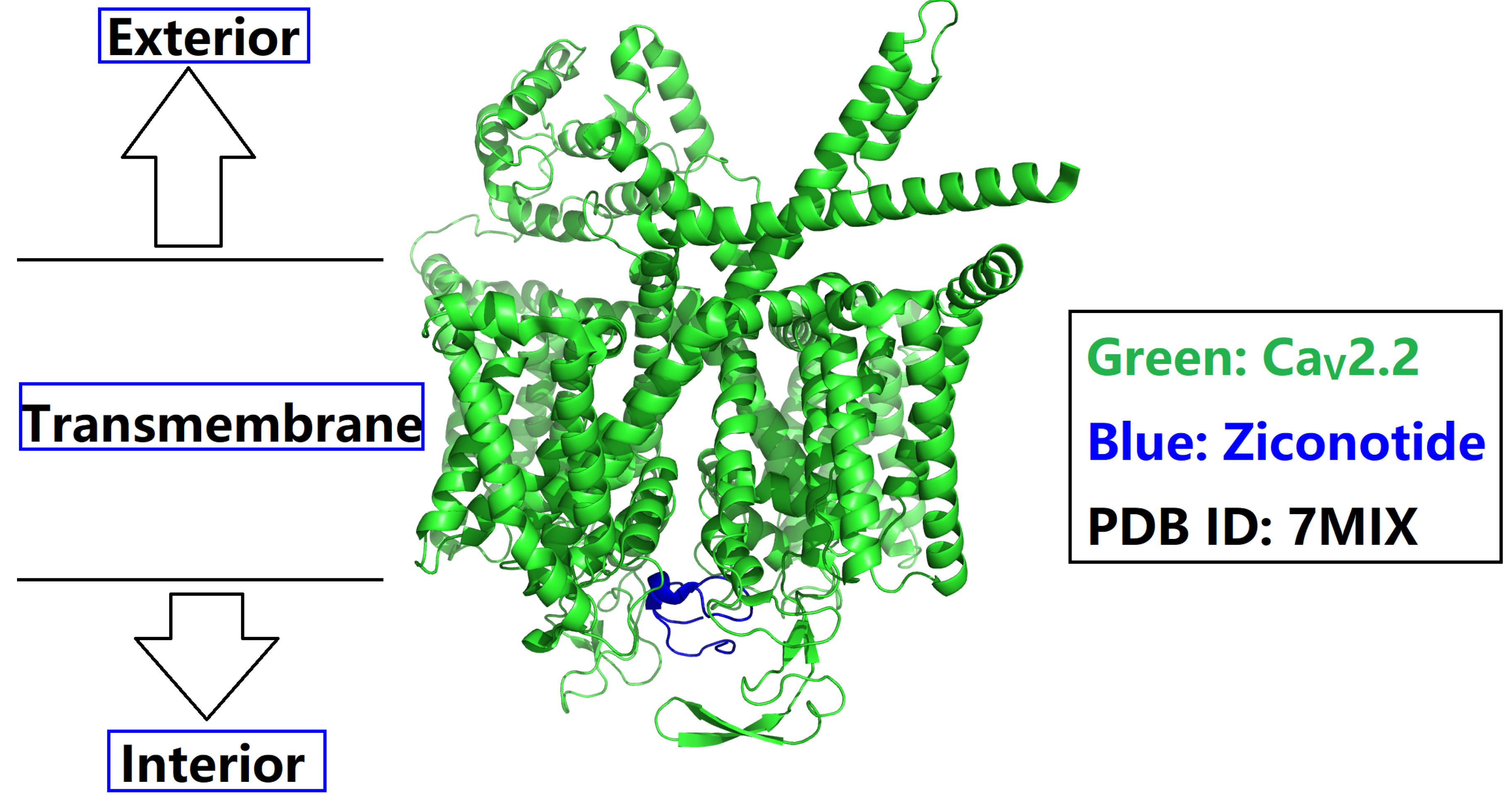
Figure 2.
A scalable Modigy (Modeller + Prodigy) workflow for automated in silico generation [14] of synthetic structural (Modeller [19]) and Kd (Prodigy [20,21]) data with reasonable accuracy [15].
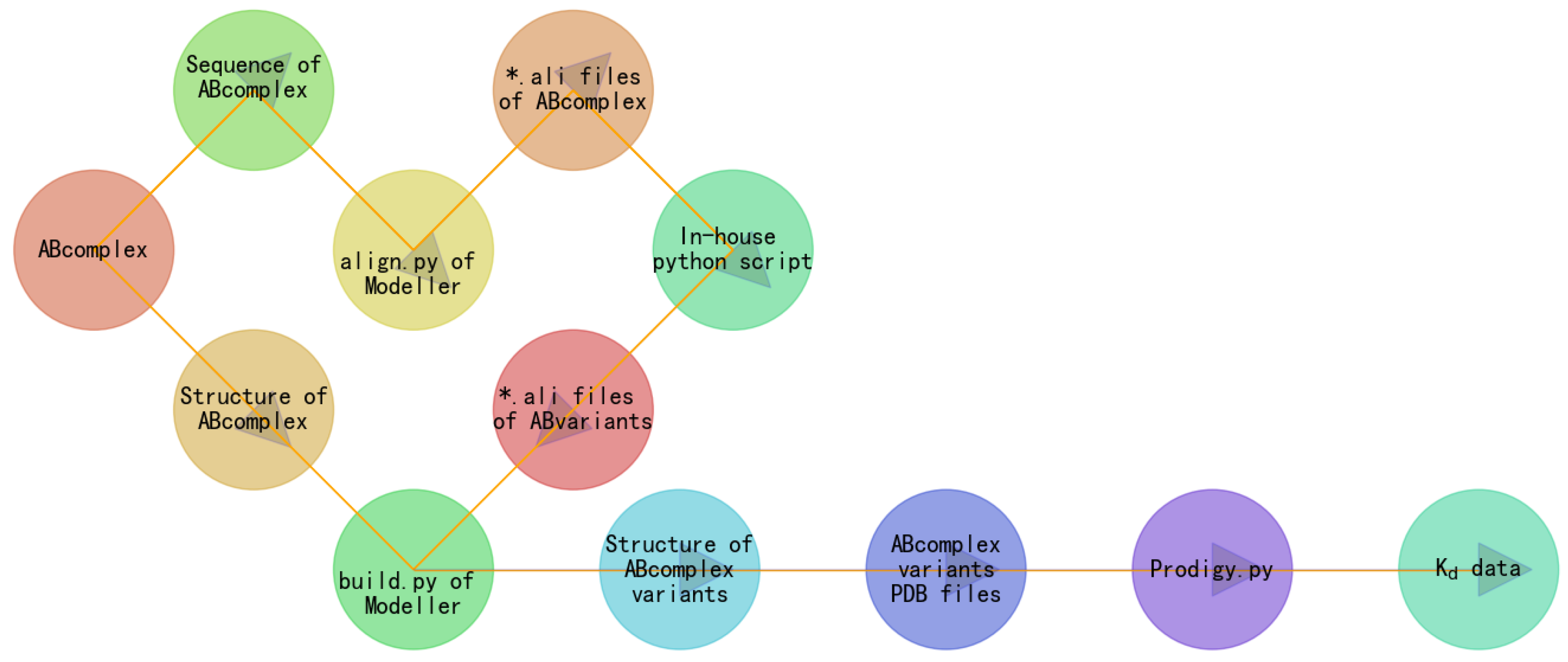
Figure 3.
A histogram of the distribution pattern of the ziconotide-CaV2.2 binding affinities of PDB entry 7MIX with one site-specific missense mutation introduced to the sequence of ziconotide. The vertical red line marks the Kd of the native ziconotide-CaV2.2 complex structure of PDB entry 7MIX.
Figure 3.
A histogram of the distribution pattern of the ziconotide-CaV2.2 binding affinities of PDB entry 7MIX with one site-specific missense mutation introduced to the sequence of ziconotide. The vertical red line marks the Kd of the native ziconotide-CaV2.2 complex structure of PDB entry 7MIX.
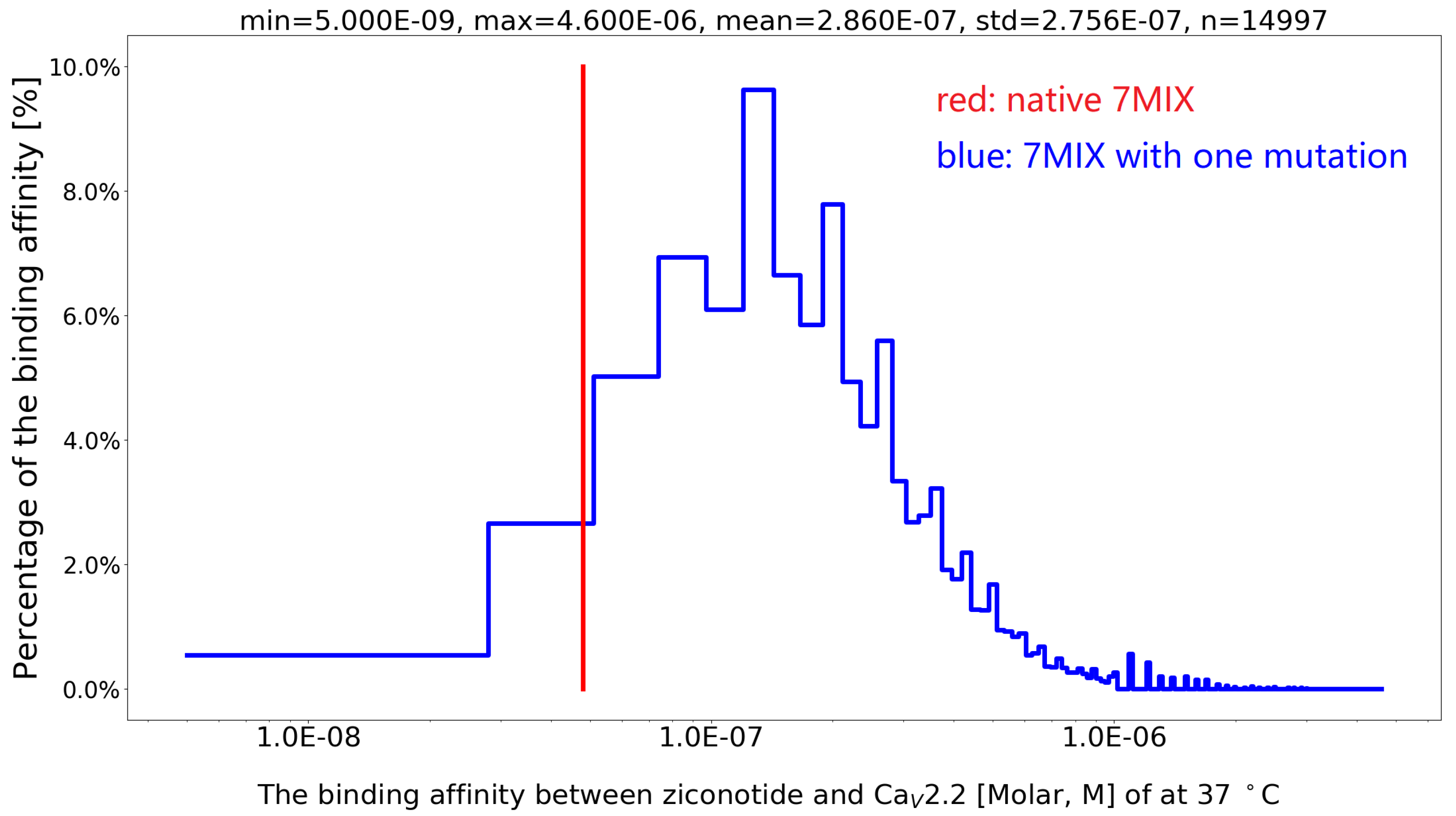

Table 1.
Experimentally determined ziconotide-related structures in PDB as of September 11, 2024, QUERY code: QUERY: Full Text = "ziconotide".
Table 1.
Experimentally determined ziconotide-related structures in PDB as of September 11, 2024, QUERY code: QUERY: Full Text = "ziconotide".
| PDB ID | Structure Title (release date from newest to oldest) |
|---|---|
| 7MIX [6,7] | Human N-type voltage-gated calcium channel CaV2.2 in the presence of ziconotide at 3.0 Angstrom resolution |
| 7MIY [6,7] | Human N-type voltage-gated calcium channel CaV2.2 at 3.1 Angstrom resolution |
| 7VFU [8,9] | Human N-type voltage gated calcium channel CaV2.2-α2/δ1-β1 complex, bound to ziconotide |
Table 2.
Inter-chain binding affinities calculated by the Prodigy server [20,21] for the ziconotide-CaV2.2 complex structural models, including native ziconotide and ziconotide analogues with five site-specific mutations introduced to its amino acid sequence.
| Design of ziconotide analogues | Inter-chain Kd (M) at 37 °C | Supplementary file |
|---|---|---|
| Native (PDB entry 7MIX) | 4,8 × 10⁻⁸ | PDB entry 7MIX |
| G18B_Y, G3B_Y, C1B_R, S9B_R, S19B_K | 1.4 × 10⁻¹⁰ | zic1.pdb |
| G3B_W, S22B_W, G18B_W, C1B_H, S19B_K | 1.4 × 10⁻¹⁰ | zic2.pdb |
| G3B_W, G18B_W, S19B_R, C1B_W, S9B_H | 1.5 × 10⁻¹⁰ | zic3.pdb |
| G18B_Y, G3B_W, C1B_H, S9B_K, S22B_E | 1.9 × 10⁻¹⁰ | zic4.pdb |
| G18B_Y, S22B_W, S19B_R, G3B_Y, C1B_H | 1.9 × 10⁻¹⁰ | zic5.pdb |
Disclaimer/Publisher’s Note: The statements, opinions and data contained in all publications are solely those of the individual author(s) and contributor(s) and not of MDPI and/or the editor(s). MDPI and/or the editor(s) disclaim responsibility for any injury to people or property resulting from any ideas, methods, instructions or products referred to in the content. |
© 2024 by the authors. Licensee MDPI, Basel, Switzerland. This article is an open access article distributed under the terms and conditions of the Creative Commons Attribution (CC BY) license (http://creativecommons.org/licenses/by/4.0/).
Copyright: This open access article is published under a Creative Commons CC BY 4.0 license, which permit the free download, distribution, and reuse, provided that the author and preprint are cited in any reuse.