

Submitted:
09 September 2024
Posted:
11 September 2024
You are already at the latest version
Abstract
This narrative review synthesizes findings from empirical studies to explore the factors influencing the adoption of ChatGPT in higher education. The review highlights several critical determinants, both confirmed and debatable, of ChatGPT acceptance among students and educators. Previous studies have predominantly utilized theories such as the Technology Acceptance Model (TAM), the Unified Theory of Acceptance and Use of Technology (UTAUT), and the Diffusion of Innovations (DoI) theory. Confirmed factors include performance expectancy, effort expectancy, social influence, facilitating conditions, and trust, which significantly predict user attitudes and intentions toward adopting ChatGPT. Perceived usefulness and ease of use are core components influencing adoption positively. However, some factors have shown inconsistent impacts. While generally critical, effort expectancy and facilitating conditions vary based on context. Social influence, demographic characteristics (age, gender), extrinsic motivation, and technology readiness exhibit inconsistent effects, suggesting that intrinsic motivations may be more critical. Data collection primarily used online surveys with structured questionnaires, varying widely in sample sizes from small pilot studies to large-scale surveys and covering diverse academic disciplines. Practical implications suggest enhancing perceived usefulness and ease of use through training and technical support, building trust by addressing privacy concerns, and leveraging social influence to drive adoption. The review underscores the need to refine technology acceptance models to incorporate broader psychological and contextual factors, integrate intrinsic motivation theories, and adopt a systems thinking approach. Addressing limitations such as potential selection bias and the quality and scope of existing studies, future research can develop robust models and provide deeper insights into ChatGPT adoption dynamics in higher education, supporting its effective integration to enhance learning outcomes and foster educational innovation.
Keywords:
ChatGPT in education
; intention to use
; acceptance
; narrative review
; Information Systems theoriess
1. Introduction
The advancement of artificial intelligence (AI) has significantly influenced numerous sectors, including education. Among the various AI technologies, ChatGPT, created by OpenAI, has attracted considerable attention for its sophisticated conversational abilities and its potential to enrich educational experiences. As an AI-driven chatbot, ChatGPT provides personalized, interactive support to students, offering solutions to complex questions, feedback on assignments, and enabling open-ended discussions [1]. Its versatility and usefulness make it a transformative tool in higher education, with the capability to redefine traditional learning models.
However, the adoption of ChatGPT in higher education is shaped by numerous factors that affect its acceptance and practical use among students and educators [2,3,4]. Understanding these factors is essential for fully realizing the potential of ChatGPT and ensuring its smooth integration into educational environments. Empirical studies have investigated various aspects of ChatGPT adoption, including technological attributes, user perceptions, institutional policies, and broader educational contexts.
This narrative review seeks to compile findings from empirical studies regarding factors affecting the adoption of ChatGPT in education. By concentrating on evidence-based research, the review aims to pinpoint the main factors that either encourage or impede the acceptance and use of ChatGPT among students and educators. The insights from this review will provide crucial guidance for educational institutions, policymakers, and technology developers in enhancing the deployment and utilization of ChatGPT to improve learning outcomes and foster educational innovation.
The review is structured to initially present the theoretical frameworks frequently used in studies on ChatGPT adoption, such as the Technology Acceptance Model (TAM), Unified Theory of Acceptance and Use of Technology (UTAUT), and Diffusion of Innovation (DoI) theory and their extensions. It will then categorize and discuss the empirical findings under several themes: technological factors (e.g., perceived usefulness, ease of use), personal factors (e.g., attitudes, trust, and self-efficacy), social factors (e.g., social influence, peer usage), and organizational factors (e.g., institutional support, policy frameworks).
This narrative review tries to answer the following questions:
- Which theoretical frameworks have been utilized in empirical studies examining user acceptance and adoption of ChatGPT in educational settings?
- What technological and personal factors influence the adoption of ChatGPT in higher education?
This narrative review provides a comprehensive overview of these studies, aiming at the nature of ChatGPT adoption and offering actionable insights for fostering its effective integration in higher education.
The central aim of this systematic review is to delineate the variables influencing users’ propensity to employ and accept the ChatGPT in the educational sphere. Through the assimilation and analysis of extant studies, we aspire to present a holistic synopsis of the current knowledge in this domain.
To achieve this goal, the following sections will be presented: first, an introduction to the narrative review methodology; next, the review results; followed by a discussion of theoretical and practical implications, and future research directions. The final section provides the conclusion.
2. Review Methodology
This narrative review aims to synthesize and analyze empirical studies on adopting and accepting ChatGPT in educational settings. The review follows a systematic approach to ensure the comprehensive inclusion of relevant studies, rigorous data extraction, and insightful synthesis of findings.
2.1. Research Design
2.1.1. Narrative Review Approach:
A narrative review approach offers a qualitative synthesis of empirical studies. This method enables an in-depth examination of the existing literature, helping to identify key themes, patterns, and gaps in research related to ChatGPT adoption and acceptance in educational settings.
2.1.2. Data Sources and Search Strategy:
A comprehensive literature search was conducted using several electronic databases, including Google Scholar, PubMed, Scopus, Web of Science, and IEEE Xplore. These databases were chosen for their extensive coverage of academic publications in technology, education, and social sciences.
2.1.3. Search Strategy:
The search terms used included combinations of the following keywords: “ChatGPT,” “higher education,” “adoption,” “acceptance,” “empirical study,” “technology acceptance model,” “UTAUT,” “anthropomorphism,” “trust,” “design novelty,” and “institutional policy.” The search was limited to peer-reviewed articles published in English from January 2018 to June 2024 to capture the most recent and relevant studies.
2.1.4. Inclusion Criteria:
- Empirical studies investigating the factors influencing the adoption and acceptance of ChatGPT in educational settings.
- Studies utilizing established theoretical frameworks, such as TAM, UTAUT, or their extensions.
- Studies providing quantitative or qualitative data on the determinants of ChatGPT adoption.
- Studies published in peer-reviewed journals or conference proceedings.
2.1.5. Exclusion Criteria:
- Studies not focused on educational settings.
- Studies not empirically investigating the factors influencing ChatGPT adoption.
- Non-peer-reviewed articles, opinion pieces, editorials, and book chapters.
- Studies published in languages other than English.
The initial search yielded a total of 147 articles. After removing duplicates, 76 articles remained. The titles and abstracts of these articles were screened for relevance, resulting in 48 articles selected for full-text review. Following a thorough examination of the full texts, 40 articles met the inclusion criteria and were included in the final analysis.
2.1.6. Data Extraction Process:
Data were extracted from the selected studies using a standardized extraction form. The form captured the following information:
- Study Details: Author(s), year of publication, country of study.
- Research Design: Type of study (e.g., survey, interview, mixed-methods), sample size, data collection methods.
- Theoretical Framework: Theoretical model used (e.g., TAM, UTAUT, DoI, ToE), additional constructs examined (e.g., anthropomorphism, trust).
- Key Findings: The factors influencing ChatGPT adoption were identified and analyzed for statistical significance using various models (e.g., TAM, UTAUT, ToE, DoI). Additionally, the study incorporated and assessed several other relevant constructs.
- Contextual Information: Discipline/course evaluated, specific characteristics of the study population, institutional policies considered.
2.1.7. Thematic Analysis:
The extracted data were synthesized using a thematic analysis approach. This process involved the following steps:
- Familiarization: Reading and re-reading the extracted data to become familiar with the content.
- Coding: Generating initial codes for significant aspects related to the adoption of ChatGPT.
- Generating Themes: Collating codes into potential themes and sub-themes based on patterns identified in the data.
- Reviewing Themes: Refining themes by checking them against the extracted data and ensuring they accurately represent it.
- Defining and Naming Themes: Clearly define each theme and sub-theme and name them to reflect the key findings.
3. Review Results
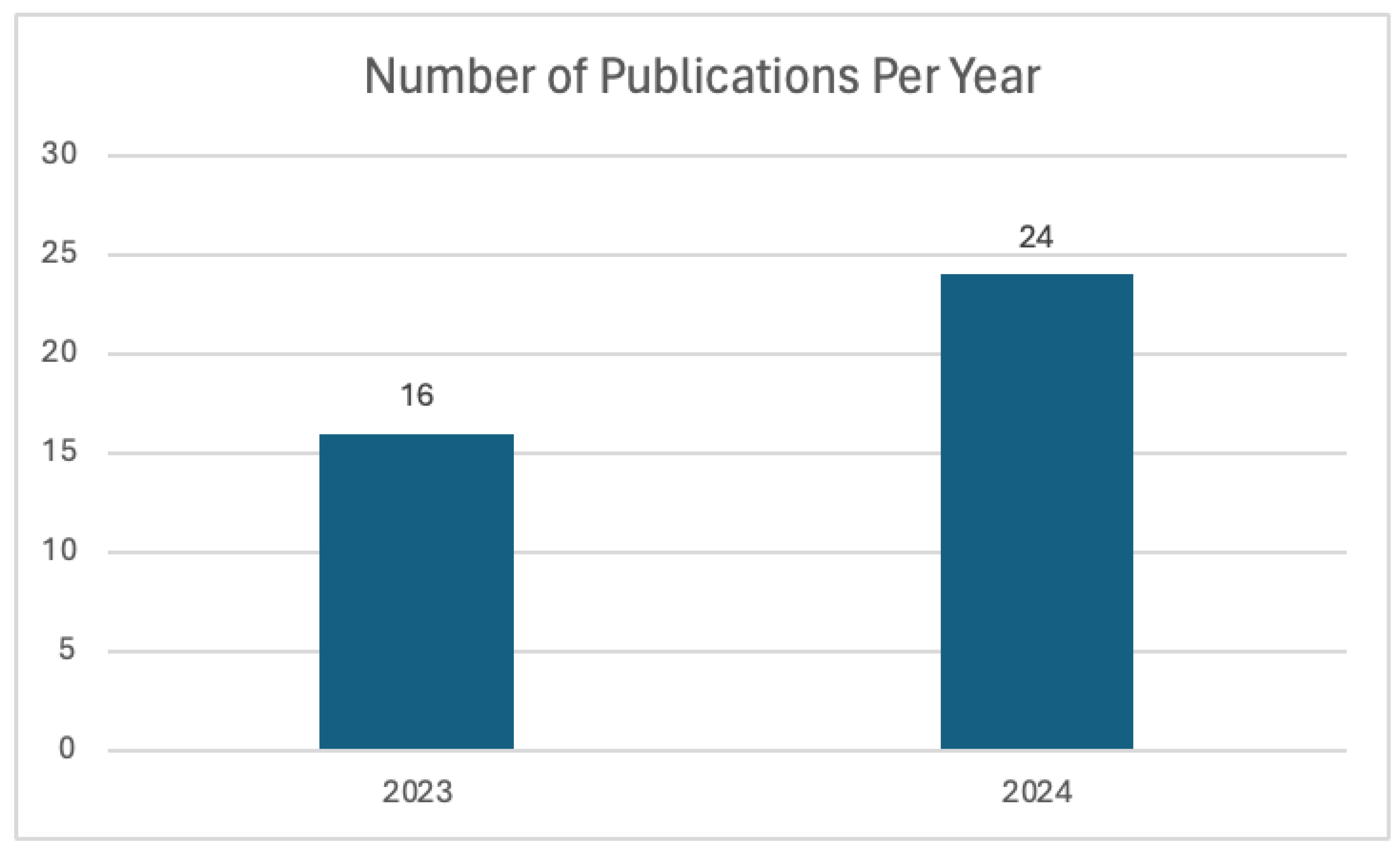
Figure 1 shows the reviewed papers per year, highlighting that 16 empirical papers were reviewed from 2023 and 24 from 2024. This indicates a significant increase in publications discussing ChatGPT adoption and acceptance in educational settings. The growing body of literature reflects the rising interest and recognition of ChatGPT’s potential impact on education. Researchers are increasingly focusing on understanding how ChatGPT can be integrated into educational practices to enhance learning outcomes and streamline educational processes.
The increase in publications from 2023 to 2024 underscores the urgency and importance placed on exploring the various factors influencing ChatGPT adoption. This trend suggests that educational institutions and researchers are keen to address the challenges and opportunities presented by this advanced AI technology. The reviewed studies span various educational contexts, offering insights into the diverse applications and implications of ChatGPT in higher education. As the technology evolves, the expanding research base will be crucial for developing effective strategies to leverage ChatGPT’s capabilities, ensuring its successful integration into educational systems worldwide. This surge in research highlights the academic community’s proactive approach to harnessing AI-driven tools for future educational advancements.
Figure 1.
Number of Publications Analysed Per Year
Moreover, table 1 shows the list of confirmed, unconfirmed, and debatable factors influencing the adoption and acceptance of ChatGPT in educational settings. Confirmed factors, consistently found to be significant across empirical studies, include network quality, accessibility, system responsiveness, satisfaction, organizational culture, knowledge application, feedback quality, assessment quality, subject norms, performance expectancy, hedonic motivation, price value, habit, personal innovativeness, intrinsic motivation, relative advantage, compatibility, complexity, trialability, observability, usability, perceived benefits, attitude towards using, behavioral intention, use behavior, emotional creepiness, perceived behavioral control, disconfirmation of expectations, continuance, relative risk perception, emotional factors, self-efficacy, knowledge sharing, perceived system quality, online course design, perceived self-efficacy, subjective norm, perceived anthropomorphism, design novelty, metacognitive self-regulation learning, and perceived intelligence.
Unconfirmed factors, found to be insignificant across studies, include demographic factors, anxiety, characteristics of ChatGPT, reduced human interaction, lack of institutional support, overreliance on ChatGPT, institutional policy, perceived technicality, curiosity, control, and joy. Debatable factors, which have shown mixed results in terms of significance, include trust, extrinsic motivation, privacy and security, technology readiness, reliability and accuracy concerns, age, gender, perceived cost, personal competency, and personal innovativeness in IT. These debatable factors highlight areas where further research is needed to clarify their impact on the adoption and acceptance of ChatGPT in education. The detailed categorization of these factors is presented in Table 1.
The following subsections discuss in detail the theories used in the empirical studies together with the examined factors, methodology applied, as well as the gaps in the current literature.

Table 1.
Summary of Educational ChatGPT Adoption and Acceptance Studied Factors
| Confirmed Factors | Unconfirmed Factors | Debatable Factors |
| Network quality | Demographic factors | Trust |
| Accessibility | Anxiety | Extrinsic motivation |
| System responsiveness | Characteristics of ChatGPT | Privacy and security |
| Satisfaction | Reduced human interaction | Technology readiness |
| Organizational culture | Lack of institutional support | Reliability and accuracy concerns |
| Knowledge application | Overreliance on ChatGPT | Age |
| Feedback quality | Institutional policy | Gender |
| Assessment quality | Perceived technicality | Perceived cost |
| Subject norms | Curiosity | Personal competency |
| Performance expectancy | Control | Personal innovativeness in IT |
| Hedonic motivation | Joy | |
| Price value | ||
| Habit | ||
| Personal innovativeness | ||
| Intrinsic motivation | ||
| Relative advantage | ||
| Compatibility | ||
| Complexity | ||
| Trialability | ||
| Observability | ||
| Usability | ||
| Perceived benefits | ||
| Attitude towards using | ||
| Behavioral intention | ||
| Use behavior | ||
| Emotional creepiness | ||
| Perceived behavioral control | ||
| Disconfirmation of expectations | ||
| Continuance | ||
| Relative risk perception | ||
| Emotional factors | ||
| Self-efficacy | ||
| Knowledge sharing | ||
| Perceived system quality | ||
| Online course design | ||
| Perceived self-efficacy | ||
| Subjective norm | ||
| Perceived anthropomorphism | ||
| Design Novelty | ||
| Metacognitive self-regulation learning | ||
| Perceived intelligence |
3.1. Technology Acceptance Model and Its Extensions
The Technology Acceptance Model (TAM) has been a prominent theoretical framework for understanding the adoption and acceptance of technology in various fields, including education. Developed by Davis (1989), TAM posits that two primary factors—Perceived Ease of Use (PEOU) and Perceived Usefulness (PU)—determine users’ attitudes towards a technology, which in turn influence their behavioral intention to use the technology and actual usage behavior [5]. This model has been extensively applied to study the adoption of ChatGPT in higher education, providing valuable insights into confirmed and unconfirmed factors that influence its acceptance among students and educators[3,6,7,8,9].
3.1.1. Discussed Factors
Perceived Ease of Use (PEOU):
Multiple empirical studies have confirmed that Perceived Ease of Use (PEOU) significantly predicts users’ attitudes toward ChatGPT. When users find ChatGPT easy to use, they are more likely to develop a positive attitude towards its use, thereby increasing their intention to adopt the technology. For instance, students who perceive ChatGPT as user-friendly are more inclined to integrate it into their learning processes, utilizing it for various academic tasks such as writing assistance, research, and interactive learning. The intuitive design and straightforward functionality of ChatGPT reduce the learning curve, making it accessible even for those with limited technical expertise. This ease of use fosters a supportive learning environment where students can focus more on their educational goals rather than on navigating complex technological interfaces [10,11,12,13]. The consistent findings across multiple studies underscore the importance of designing educational technologies that prioritize user experience, as this can significantly enhance adoption rates and overall satisfaction among users.
Perceived Usefulness (PU):
Perceived Usefulness (PU) has consistently influenced users’ attitudes and behavioral intentions to use ChatGPT positively. Users who believe that ChatGPT enhances their productivity and academic performance are more likely to adopt it. This factor has been particularly significant among educators who view ChatGPT as a valuable tool for facilitating teaching and providing additional student support. Educators recognize that ChatGPT can assist in creating engaging lesson plans, offering personalized feedback, and supporting students with diverse learning needs. By streamlining administrative tasks and enriching the educational experience, ChatGPT enables educators to focus more on interactive and meaningful teaching practices. This perceived benefit of improved efficiency and effectiveness in academic tasks strongly motivates both students and educators to embrace ChatGPT as an integral part of their educational toolkit [3,6,14]. The consistent positive impact of PU across studies highlights the critical role of perceived benefits in driving the acceptance and integration of innovative educational technologies.
Feedback Quality and Assessment Quality:
High-quality feedback and assessment provided by ChatGPT positively influence behavioral intentions to use the technology. Students appreciate timely and constructive feedback, which supports their learning process and encourages continuous engagement with ChatGPT. By offering instant, personalized responses and detailed evaluations, ChatGPT helps students understand their strengths and areas for improvement, facilitating a more effective and individualized learning experience. This capability to provide high-quality feedback not only enhances students’ academic performance but also builds their confidence and motivation to use the technology regularly. The continuous engagement fostered by such feedback mechanisms ensures that students remain actively involved in their learning, leveraging ChatGPT as a reliable educational companion [3]. The consistent appreciation of high-quality feedback underscores its importance in educational tools, demonstrating that constructive and timely assessments are key to fostering positive user experiences and sustained adoption.
Trust:
Trust in ChatGPT significantly impacts users’ attitudes and intentions to use the technology. When users trust the system’s capabilities and reliability, they are more likely to adopt it. Trust is particularly crucial in educational settings, where the accuracy and dependability of information are paramount. Instructors and students must feel confident that ChatGPT can provide precise, reliable responses to academic queries and support educational activities without errors. This trust is built through consistent performance, transparency in AI processes, and assurances of data security and privacy. When users believe ChatGPT is a dependable tool that upholds academic integrity, they are more willing to integrate it into their learning and teaching processes. The impact of trust on adoption underscores its foundational role in the successful implementation of AI technologies in education, ensuring that users can rely on the system for high-stakes educational tasks [3,15,16]. The significance of trust across multiple studies highlights the necessity for developers and educational institutions to prioritize building and maintaining trust in AI technologies to facilitate widespread acceptance and utilization.
Extrinsic Motivation:
Contrary to expectations, extrinsic motivation did not significantly impact the adoption of ChatGPT in some studies. This finding suggests that external rewards or pressures may not be as influential as intrinsic factors such as perceived usefulness and ease of use. Users seem more motivated by how ChatGPT directly benefits their productivity and learning experiences rather than by external incentives or obligations. This highlights the importance of designing educational technologies that inherently offer substantial value and ease of use, as these intrinsic qualities drive user engagement and adoption more effectively than extrinsic motivators. The diminished role of extrinsic motivation underscores the need to focus on creating user-centric AI tools that align with the users’ internal motivations and preferences, ensuring long-term adoption and satisfaction [6]. This insight into the lesser influence of extrinsic motivation encourages educators and developers to prioritize enhancing the intrinsic appeal of educational technologies to foster deeper, more sustained user engagement.
Perceived Enjoyment:
Perceived enjoyment, which refers to the fun and pleasure derived from using ChatGPT, was found to have an insignificant effect on attitudes towards using the technology. This result indicates that while enjoyment might enhance the overall user experience, it is not a critical determinant of adoption in educational contexts. Users in educational settings seem to prioritize practical benefits such as improved productivity, ease of use, and the technology’s ability to meet academic needs over the enjoyment factor. This finding suggests that the primary drivers of adoption are more aligned with functional and performance-related attributes rather than the entertainment value of the technology. Consequently, developers and educators should focus on optimizing the practical utility and reliability of ChatGPT to support educational goals better, as these aspects are more influential in encouraging adoption [11]. The minimal impact of perceived enjoyment emphasizes the importance of addressing the core academic requirements and practical applications of AI tools in education to ensure their effective integration and sustained use.
Privacy and Security Concerns:
Studies have indicated that privacy and security concerns did not significantly influence perceived ease of use or usefulness. Despite their importance, their impact on the adoption of ChatGPT appears to be minimal. This suggests that users may prioritize the practical benefits and functionalities of ChatGPT over potential privacy and security risks. The perceived advantages, such as enhanced productivity, ease of use, and academic support, seem to outweigh concerns about data privacy and security. This finding highlights that while privacy and security are crucial, they do not significantly deter users from adopting ChatGPT if the technology provides substantial benefits and meets their needs effectively [7,16]. This minimal impact underscores the importance of developers maintaining robust privacy and security measures without compromising the technology’s usability and effectiveness, ensuring that users continue to perceive high value in using ChatGPT.
Anxiety and Technology Readiness:
Anxiety about using ChatGPT and general technology readiness did not significantly impact adoption. While these factors might be relevant in other contexts, they appear less critical in adopting ChatGPT among higher education students and educators. This suggests that users in educational settings may have sufficient familiarity and comfort with technology, reducing the influence of anxiety and readiness on their decision to adopt ChatGPT. Instead, these users might focus more on the technology’s tangible benefits and ease of use. This finding indicates that concerns about technological anxiety and readiness may not be major barriers to adoption in educational environments where users are generally accustomed to integrating new technologies into their workflows [17]. The minimal impact of these factors highlights the importance of emphasizing the practical advantages and straightforward usability of ChatGPT to encourage its widespread adoption among students and educators.
3.1.2. Extended TAM with System Characteristics and Individual Factors
Some studies have incorporated system characteristics such as perceived system quality and online course design into the Technology Acceptance Model (TAM). These factors positively impact perceived usefulness and ease of use, enhancing users’ attitudes and behavioral intentions towards ChatGPT. High system quality, characterized by reliability, efficiency, and user-friendliness, ensures users have a seamless and productive experience with ChatGPT. Similarly, well-designed online courses that effectively integrate ChatGPT can significantly improve the perceived value and usability of the technology. By addressing these system characteristics, educators and developers can foster a more positive attitude towards ChatGPT, encouraging greater adoption and sustained use in educational settings [18]. Including system quality and course, design highlights the importance of robust and user-centric technological infrastructure in driving the acceptance and effectiveness of educational technologies.
3.1.3. Extended TAM with Trust and Perceived Risk
Trust has been added as an essential construct in the extended Technology Acceptance Model (TAM) to account for the reliability and security concerns associated with using ChatGPT. This extension highlights the critical role of trust in shaping users’ attitudes and intentions. When users trust that ChatGPT is reliable and secure, they are more likely to develop positive attitudes toward its adoption and use. Although sometimes perceived risk is considered insignificant, it still plays a role in understanding users’ apprehensions about adopting new technologies. By incorporating trust into the extended TAM, researchers, and developers can better address the concerns users may have regarding the dependability and safety of ChatGPT, thereby fostering greater acceptance and utilization of the technology in educational settings [17]. This approach underscores the importance of building and maintaining user trust to ensure the successful integration of AI tools in education.
The Technology Acceptance Model (TAM) and its extensions provide a robust framework for understanding the adoption of ChatGPT in higher education. Confirmed factors such as perceived ease of use, perceived usefulness, attitude, feedback quality, trust, and personal innovativeness play significant roles in influencing adoption. However, unconfirmed factors like extrinsic motivation, perceived enjoyment, technicality, cost, privacy concerns, anxiety, and technology readiness highlight the complexity and variability of technology adoption processes. By incorporating additional constructs and extending the original TAM, researchers can capture a more comprehensive picture of the determinants that facilitate or hinder the adoption of ChatGPT in educational settings. Future research should continue to explore these extensions and validate their relevance in diverse educational contexts.
3.2. Unified Theory of Acceptance and Use of Technology (UTAUT) and Extensions
The Unified Theory of Acceptance and Use of Technology (UTAUT) is a comprehensive model Venkatesh et al. (2003) developed to explain user intentions to adopt information technology and subsequent usage behavior. UTAUT consolidates eight previous models of technology acceptance and identifies four fundamental constructs: Performance Expectancy (PE), Effort Expectancy (EE), Social Influence (SI), and Facilitating Conditions (FC). Various moderating factors, including age, gender, experience, and voluntariness of use influence these constructs. UTAUT and its extensions have been extensively applied to study the adoption of ChatGPT in higher education, providing valuable insights into confirmed and unconfirmed factors that influence its acceptance among students and educators [19].
3.2.1. Discussed Factors
Performance Expectancy (PE):
Performance expectancy is the degree to which users believe that using ChatGPT will help them achieve gains in job performance or learning outcomes. Empirical studies have consistently confirmed that performance expectancy (PE) significantly predicts behavioral intention to use ChatGPT. Students and educators who perceive ChatGPT as beneficial for improving academic performance and productivity are more likely to adopt the technology. The belief that ChatGPT can enhance their efficiency and effectiveness in academic tasks motivates users to integrate it into their daily routines. Several studies have confirmed the crucial role that PE plays in the integration of ChatGPT in educational settings, highlighting the importance of this factor in driving adoption. This consistent finding underscores the need for educational technologies to clearly demonstrate their practical benefits to encourage widespread use among students and educators [4,20,21,22,23]. The significant influence of PE emphasizes that showcasing tangible improvements in academic outcomes is key to fostering positive attitudes and increased adoption of ChatGPT.
Effort Expectancy (EE):
Effort expectancy refers to the ease of use associated with ChatGPT. Studies have shown that effort expectancy (EE) positively correlates with behavioral intention and actual use of ChatGPT. When users find ChatGPT easy to use, they are more likely to develop a positive attitude towards its adoption. This factor is particularly important in educational settings, where ease of use can facilitate seamless integration into learning and teaching processes. EE has been confirmed as an important factor impacting the users’ adoption of ChatGPT in educational settings, highlighting the necessity for user-friendly interfaces and intuitive designs to encourage widespread use [24,25,26,27]. However, some studies have found that EE did not significantly influence behavioral intention or use behavior, suggesting that its impact may differ based on specific contexts or user groups [23,28,29]. This variability indicates that while EE is generally important, its role in adoption may be influenced by other factors or specific educational environments.
Social Influence (SI):
Social influence is the degree to which users perceive that important others believe they should use ChatGPT. Research has confirmed that social influence (SI) significantly affects behavioral intention to adopt ChatGPT. The impact of peers, instructors, and societal norms is crucial in shaping users’ attitudes towards ChatGPT. This influence is especially significant in collaborative learning environments where peer usage can encourage wider adoption. For instance, when students see their classmates and teachers effectively using ChatGPT, they are likelier to adopt the technology. This peer-driven adoption can create a positive feedback loop, further embedding ChatGPT into the educational process [4,20,30]. However, while SI is generally a significant predictor, some studies have reported that it did not consistently influence adoption intentions. This discrepancy may be due to varying levels of peer and instructor influence across different educational settings, suggesting that the impact of social influence can depend on specific contextual factors [29,31]. This variability highlights the need for a nuanced understanding of how social dynamics affect technology adoption in different educational environments.
Facilitating Conditions (FC):
Facilitating conditions refer to the availability of resources and support necessary for using ChatGPT. Empirical studies have validated that facilitating conditions (FC) positively influence effort expectancy and behavioral intention. Users with access to adequate technical support and infrastructure are more likely to adopt and use ChatGPT effectively. This factor underscores the importance of institutional support in promoting the adoption of new technologies in education. Access to reliable internet, functional devices, and prompt technical assistance ensures that users can utilize ChatGPT without significant barriers, enhancing their overall experience and likelihood of adoption [20,21]. However, some studies have found that FC did not significantly influence behavioral intention or use behavior, indicating that its impact may vary based on specific contexts or user groups [23,28,29]. This variability suggests that while facilitating conditions are generally important, their role in adoption may depend on the particular educational environment and the existing technological infrastructure.
Demographic Factors (Age, Gender):
Demographic factors such as age and gender were found to have an insignificant effect on the intention to adopt ChatGPT in some studies. This finding indicates that the adoption of ChatGPT may be more influenced by individual attitudes and external factors rather than demographic characteristics [23,29].
3.2.2. UTAUT2
UTAUT2, an extension of the Unified Theory of Acceptance and Use of Technology (UTAUT), incorporates additional constructs such as Hedonic Motivation, Price Value, and Habit. These factors are designed to provide a deeper understanding of consumer use and have been applied to explore ChatGPT adoption in educational settings. For instance, hedonic motivation, which refers to the enjoyment or pleasure derived from using ChatGPT, has been found to positively influence users’ behavioral intention to adopt the technology [23]. This suggests that when users find ChatGPT engaging and enjoyable, they are more likely to develop a positive attitude toward its use. However, some studies have reported that hedonic motivation did not show a significant impact on adoption, indicating variability in its influence based on different user contexts [32]. This variability highlights the need to consider how individual preferences and contexts may affect the role of hedonic motivation in the adoption process, reflecting the complex interplay of factors influencing technology use in educational settings.
3.2.3. UTAUT with Personal Innovativeness
Personal innovativeness in the technology domain has been added to the Unified Theory of Acceptance and Use of Technology (UTAUT) to account for individual differences in technology adoption. Personal innovativeness positively influences users’ willingness to try and adopt new technologies like ChatGPT. Individuals with high personal innovativeness are more likely to experiment with and embrace new technological tools, demonstrating a proactive attitude towards innovation. This extension of UTAUT helps understand the role of individual traits in the adoption process, highlighting that users who are inherently more open to new experiences are crucial drivers of technology adoption [23]. By acknowledging personal innovativeness, researchers and educators can better tailor their strategies to encourage adoption among different user groups, ensuring that technological innovations like ChatGPT are effectively integrated into educational settings.
3.2.4. Extended UTAUT with Trust and Perceived Risk
Incorporating trust and perceived risk into the Unified Theory of Acceptance and Use of Technology (UTAUT) provides insights into the security and reliability concerns associated with ChatGPT. Trust significantly impacts users’ attitudes and intentions, indicating that when users trust ChatGPT’s reliability and security, they are more likely to adopt and use it. On the other hand, perceived risk, although sometimes found to be insignificant, highlights users’ apprehensions about adopting new technologies. This dual consideration helps to understand the balance between confidence in the technology and concerns about potential risks. By addressing these factors, developers and educators can create a more secure and trustworthy environment, encouraging broader acceptance and integration of ChatGPT in educational settings [22,27]. This approach underscores the importance of building user trust and mitigating perceived risks to facilitate the adoption of AI technologies.
3.2.5. Extended Meta-UTAUT
The meta-UTAUT model includes constructs such as anthropomorphism, trust, design novelty, and institutional policy. These extensions provide a broader perspective on the external and contextual factors affecting ChatGPT adoption. For example, perceived anthropomorphism, or the degree to which users attribute human-like characteristics to ChatGPT, positively influences attitude and behavioral intention. When users perceive ChatGPT as more human-like, they are more likely to engage with it positively and intend to use it more frequently. This suggests that making AI interfaces more relatable and personable can enhance user acceptance and interaction. Additionally, factors like trust, design novelty, and supportive institutional policies also play significant roles in shaping user attitudes and intentions, highlighting the complex interplay of various external and contextual elements in the adoption process [24,25]. These insights emphasize the need to consider a wide range of influences when developing and implementing AI technologies in educational settings.
The Unified Theory of Acceptance and Use of Technology (UTAUT) and its extensions offer a robust framework for understanding the adoption of ChatGPT in higher education. Confirmed factors such as performance expectancy, effort expectancy, social influence, facilitating conditions, behavioral intention, and trust play significant roles in influencing adoption. However, unconfirmed factors like effort expectancy, facilitating conditions, social influence, demographic factors, and institutional policy highlight the complexity and variability of technology adoption processes. By incorporating additional constructs and extending the original UTAUT, researchers can capture a more comprehensive picture of the determinants that facilitate or hinder the adoption of ChatGPT in educational settings. Future research should continue to explore these extensions and validate their relevance in diverse educational contexts.
3.3. Technology-Organization-Environment (TOE) Framework and the ChatGPT Adoption in Higher Education
The Technology-Organization-Environment (TOE) framework, developed by Tornatzky and Fleischer (1990) [33], provides a comprehensive model for understanding the factors that influence the adoption and implementation of technological innovations within organizations. The framework categorizes these factors into three contexts: Technology, Organization, and Environment. In the context of ChatGPT adoption in higher education, the TOE framework has been extended by integrating the concept of knowledge application, offering a perspective on the various determinants that impact the acceptance and use of this technology among students and educators [33].
3.3.1. Discussed Factors
Network Quality and System Responsiveness:
Network quality, accessibility, and system responsiveness are crucial technological factors influencing user satisfaction with ChatGPT. Users are more likely to adopt ChatGPT when the technological infrastructure supports its seamless and efficient use. High network quality ensures that users can access ChatGPT without interruptions, while accessibility guarantees that the platform is easy to reach for all users. System responsiveness, the ability of ChatGPT to quickly and accurately respond to user inputs, further enhances the overall user experience. These factors collectively ensure that the system is reliable and responsive, significantly boosting user satisfaction. Several studies have confirmed the importance of these technological factors in fostering the adoption of ChatGPT [2]. This highlights the need for robust infrastructure to support the effective implementation and use of AI technologies in educational settings.
System Quality:
Perceived system quality, including attributes such as reliability, efficiency, and user-friendliness, positively impacts both perceived usefulness and perceived ease of use. High system quality ensures that ChatGPT functions reliably and efficiently, providing users with a smooth and effective experience. When users perceive the system as user-friendly and dependable, they are more likely to find it useful and easy to use. This encourages them to integrate ChatGPT into their academic activities, enhancing their productivity and learning outcomes. The positive impact of high system quality on user perceptions highlights its importance in driving the adoption of ChatGPT in educational settings [2]. Ensuring that ChatGPT is reliable, efficient, and user-friendly is crucial for its successful integration and widespread use among students and educators.
Organizational Culture and Support:
Perceived system quality, including attributes such as reliability, efficiency, and user-friendliness, positively impacts both perceived usefulness and perceived ease of use. High system quality ensures that ChatGPT functions reliably and efficiently, providing users with a smooth and effective experience. When users perceive the system as user-friendly and dependable, they are more likely to find it useful and easy to use. This encourages them to integrate ChatGPT into their academic activities, enhancing their productivity and learning outcomes. The positive impact of high system quality on user perceptions highlights its importance in driving the adoption of ChatGPT in educational settings [2]. Ensuring that ChatGPT is reliable, efficient, and user-friendly is crucial for its successful integration and widespread use among students and educators.
Knowledge Application:
Integrating the concept of knowledge application within the Technology-Organization-Environment (TOE) framework highlights the importance of applying and utilizing the knowledge gained from ChatGPT. The ability to effectively apply ChatGPT-generated insights in educational contexts positively influences adoption intentions. This factor underscores the need for institutions to foster an environment where knowledge application is encouraged and supported. By promoting the practical use of ChatGPT’s capabilities, institutions can enhance the educational experience and drive broader adoption of the technology. Ensuring that users can translate the information and insights provided by ChatGPT into meaningful academic and practical outcomes is crucial for its successful integration. This factor has been confirmed by several studies, emphasizing its role in influencing the adoption of ChatGPT in educational settings [2].
Market and Competitive Pressure:
Environmental factors such as market trends and competitive pressure can influence the adoption of ChatGPT. Institutions may adopt ChatGPT to stay competitive and meet the evolving expectations of students and stakeholders. The need to innovate and remain relevant in a dynamic educational landscape can drive the adoption of new technologies. By incorporating ChatGPT, institutions can enhance their offerings, attract more students, and maintain a competitive edge. This external pressure to adopt advanced technologies ensures that educational institutions keep pace with market demands and leverage AI tools to improve educational outcomes and institutional performance. This insight emphasizes the role of environmental factors in driving technological adoption within educational settings [2].
The Technology-Organization-Environment (TOE) framework provides a comprehensive model for understanding the adoption of ChatGPT in higher education. Confirmed factors within the Technology context include network quality, system responsiveness, perceived usefulness, perceived ease of use, and system quality. In the Organizational context, factors such as organizational culture, knowledge application, and facilitating conditions play significant roles. Environmental factors such as social influence, regulatory and policy environment, and market pressure also impact adoption. However, unconfirmed factors like anxiety, technology readiness, cost considerations, and privacy concerns highlight the complexity and variability of technology adoption processes.
By incorporating the TOE framework and extending it with additional constructs such as knowledge application, researchers can capture a more holistic view of the determinants that facilitate or hinder the adoption of ChatGPT in educational settings. Future research should continue to explore these factors and validate their relevance in diverse educational contexts, ensuring that institutions can effectively leverage ChatGPT to enhance learning outcomes and support educational innovation.
3.4. Diffusion of Innovation Theory and the ChatGPT Adoption in Higher Education
The Diffusion of Innovation (DoI) Theory, developed by Everett Rogers (1962), and Technology Adoption Theory provide comprehensive frameworks for understanding how new technologies spread and are adopted within a population. These theories are particularly relevant in ChatGPT adoption in higher education, as they offer insights into the various factors and stages that influence the uptake of innovative technologies among students and educators. This section reviews the confirmed and unconfirmed factors identified in empirical studies that apply these theories to adopting ChatGPT [34,35].
3.4.1. Discussed Factors
Relative Advantage:
Relative advantage refers to the degree to which ChatGPT is perceived as better than its predecessors or current alternatives. Studies have consistently shown that when users perceive a significant relative advantage in using ChatGPT, such as improved learning outcomes or efficiency in completing tasks, they are more likely to adopt the technology. This factor highlights the importance of demonstrating clear benefits of ChatGPT to potential users. By showcasing how ChatGPT can enhance academic performance, streamline processes, and provide superior support compared to existing tools, educators and developers can drive adoption rates. The perceived superiority of ChatGPT in delivering tangible benefits plays a crucial role in its acceptance and integration in educational settings [36]. This underscores the need for effective communication of ChatGPT’s advantages to encourage widespread use.
Compatibility:
Compatibility is the extent to which ChatGPT aligns with the existing values, past experiences, and needs of potential adopters. Empirical research has confirmed that higher compatibility with users’ educational practices and goals positively influences the adoption of ChatGPT. When ChatGPT is perceived as fitting well within the current educational framework and meeting user expectations, its adoption is facilitated. This means that the more seamlessly ChatGPT integrates into the established teaching and learning processes, the more likely educators and students will embrace it. Ensuring that ChatGPT aligns with the curriculum, pedagogical methods, and institutional goals can significantly enhance its acceptance and usage in educational settings [14,36]. The perceived alignment with existing practices underscores the importance of designing and promoting ChatGPT to complement and enhance current educational systems.
Complexity:
Complexity refers to the degree of difficulty in understanding and using ChatGPT. Studies have found that lower perceived complexity (i.e., higher ease of use) significantly enhances the likelihood of adoption. Users are more inclined to adopt ChatGPT if they find it easy to understand and integrate into their daily academic activities. Simplifying the interface and functionality of ChatGPT can make it more accessible and user-friendly, encouraging wider acceptance among students and educators. By reducing complexity, developers can ensure that users can quickly grasp how to use ChatGPT effectively, which in turn promotes more frequent and confident use of the technology in educational settings [36]. This emphasizes the critical role of user-friendly design in driving the adoption of innovative educational tools.
Trialability:
Trialability is the extent to which ChatGPT can be experimented with on a limited basis before making a full commitment. Empirical evidence suggests that allowing users to try ChatGPT on a trial basis positively impacts their adoption decisions. This factor underscores the importance of providing opportunities for users to test and familiarize themselves with the technology [36].
Observability:
Observability is the degree to which the results of using ChatGPT are visible to others. Studies have confirmed that higher observability, where the benefits and positive outcomes of using ChatGPT are easily seen by others, encourages adoption. When students and educators observe their peers successfully using ChatGPT and achieving positive results, they are more likely to adopt it themselves. This visibility of benefits creates a social proof effect, where the perceived success of others influences individual decisions to embrace the technology. Ensuring that the advantages and successful applications of ChatGPT are prominently showcased can significantly boost its adoption in educational settings [36]. Highlighting real-world examples and success stories can demonstrate the tangible benefits of ChatGPT, thereby motivating more users to integrate it into their academic activities.
The Diffusion of Innovation Theory and Technology Adoption Theory provide robust frameworks for understanding the adoption of ChatGPT in higher education. Confirmed factors such as relative advantage, compatibility, complexity, trialability, observability, social influence, and effective communication channels play significant roles in influencing adoption. However, unconfirmed factors like social influence, facilitating conditions, perceived risk, demographic characteristics, and technology readiness highlight the complexity and variability of technology adoption processes.
3.5. Interpretative Phenomenological Analysis (IPA) and the ChatGPT Adoption in Higher Education
Interpretative Phenomenological Analysis (IPA) is a qualitative research approach that aims to understand how individuals make sense of their personal and social experiences. It focuses on individuals’ subjective experiences and meanings to phenomena [37]. In the context of ChatGPT adoption in higher education, IPA provides rich insights into students’ and educators’ lived experiences, attitudes, and perceptions as they interact with this technology. This section reviews the confirmed and unconfirmed factors identified in empirical studies that apply IPA to adopting ChatGPT [38,39].
3.5.1. Discussed Factors
Personal Competency:
Studies using Importance-Performance Analysis (IPA) have demonstrated that personal competency plays a crucial role in shaping attitudes toward using ChatGPT. When individuals feel competent and confident in their ability to use ChatGPT, their likelihood of adopting the technology increases significantly. This finding highlights the importance of equipping users with the necessary skills and knowledge to use ChatGPT effectively. Ensuring that users are well-trained and comfortable with the technology can enhance their adoption rates and overall satisfaction. Thus, personal competency emerges as a key factor in promoting the successful integration of ChatGPT in various settings [39].
Trust:
Trust in ChatGPT’s reliability and accuracy significantly impacts users’ attitudes and intentions toward its use. Importance-Performance Analysis (IPA) studies reveal that users who have confidence in the capabilities of ChatGPT are more inclined to integrate it into their academic routines. Trust is especially crucial in educational settings, where the credibility and reliability of information are of utmost importance. Ensuring that ChatGPT consistently provides accurate and reliable responses can foster user trust, thereby encouraging its adoption and regular use in academic contexts [38].
Emotional Response:
Emotional responses, such as enthusiasm, curiosity, and satisfaction, are important determinants of ChatGPT adoption. Positive emotional experiences with ChatGPT significantly enhance users’ willingness to continue using the technology. Importance-Performance Analysis (IPA) studies emphasize the crucial role of emotional engagement in fostering a positive attitude toward ChatGPT. When users experience positive emotions while interacting with ChatGPT, their overall perception and acceptance of the technology improve, leading to higher adoption rates and continued use [40].
Interpretative Phenomenological Analysis (IPA) provides a deep, qualitative understanding of the factors influencing the adoption of ChatGPT in higher education. Confirmed factors such as personal competency, perceived usefulness, trust, social influence, emotional response, and facilitating conditions play significant roles in influencing adoption. However, unconfirmed factors like anxiety, perceived risk, technology readiness, cost considerations, and external motivations highlight the complexity and variability of technology adoption processes.
By leveraging IPA, researchers can capture the nuanced and subjective experiences of users, providing a comprehensive picture of the determinants that facilitate or hinder the adoption of ChatGPT in educational settings. Future research should continue to explore these factors and validate their relevance in diverse educational contexts, ensuring that institutions can effectively leverage ChatGPT to enhance learning outcomes and support educational innovation.
3.6. Hedonic Motivation System Adoption Model (HMSAM) and the ChatGPT Adoption in Higher Education
The Hedonic Motivation System Adoption Model (HMSAM) emphasizes the role of intrinsic motivations, such as enjoyment and pleasure, in adopting information systems [41]. Developed to complement traditional utilitarian perspectives, HMSAM provides insights into how hedonic factors influence users’ attitudes and intentions toward technology adoption [41]. In the context of ChatGPT adoption in higher education, HMSAM highlights the importance of emotional and psychological factors that drive the use of this technology among students and educators. This section reviews the confirmed and unconfirmed factors identified in empirical studies that apply HMSAM to adopting ChatGPT [10].
3.6.1. Discussed Factors
Perceived Enjoyment:
Perceived enjoyment is a core component of the Hedonic-Motivation System Adoption Model (HMSAM), referring to the fun and pleasure derived from using ChatGPT. Empirical studies have confirmed that perceived enjoyment significantly influences users’ attitudes towards ChatGPT. When students and educators find interactions with ChatGPT enjoyable, they are more likely to adopt and use the technology. This finding underscores the importance of designing engaging and enjoyable user experiences to promote adoption and sustained use of ChatGPT in educational and other settings [10].
Focused Immersion:
Focused immersion, defined as the degree to which users become fully absorbed in their interaction with ChatGPT, has been identified as a significant factor in studies utilizing the Hedonic-Motivation System Adoption Model (HMSAM). When users experience a deep level of immersion, characterized by losing track of time and becoming engrossed in the interaction, they are more likely to develop positive attitudes toward ChatGPT. This intense engagement fosters a stronger intention to use the technology regularly. Empirical evidence suggests that creating highly immersive and engaging user experiences can significantly enhance the likelihood of ChatGPT adoption. This finding underscores the importance of designing interfaces and interactions that captivate users’ attention and provide a seamless, engaging experience, thereby promoting sustained use and integration of ChatGPT in various contexts, especially in educational and professional settings [10].
The Hedonic Motivation System Adoption Model (HMSAM) provides a valuable framework for understanding the adoption of ChatGPT in higher education, emphasizing the role of intrinsic motivations and enjoyment. Confirmed factors such as perceived enjoyment, focused immersion, perceived usefulness, perceived ease of use, and social influence play significant roles in influencing adoption. However, unconfirmed factors like external motivations, perceived risk, technology readiness, cost considerations, and effort expectancy highlight the complexity and variability of technology adoption processes.
By incorporating HMSAM, researchers can capture the emotional and psychological drivers that facilitate or hinder the adoption of ChatGPT in educational settings. Future research should continue exploring these factors and validating their relevance in diverse educational contexts, ensuring institutions can effectively leverage ChatGPT to enhance learning outcomes and support educational innovation.
3.7. Extended Value-Based Adoption Model (VAM) and the ChatGPT Adoption in Higher Education
The Extended Value-Based Adoption Model (VAM) integrates multiple constructs from various adoption models to provide a comprehensive framework for understanding technology adoption [42]. VAM emphasizes the perceived value derived from using technology, which encompasses both benefits and sacrifices associated with the technology. In the context of ChatGPT adoption in higher education, the extended VAM provides insights into how perceived value and other factors influence students’ and educators’ attitudes and intentions to use ChatGPT.
3.7.1. Discussed Factors
Perceived Enjoyment:
Perceived enjoyment, which refers to the pleasure and fun derived from using ChatGPT, has been found to positively affect users’ attitudes and intentions to use the technology. When users find the interaction with ChatGPT enjoyable, they are more likely to develop a favorable attitude towards it and show a higher intention to continue using it. This factor highlights the importance of incorporating enjoyable features into ChatGPT to enhance user engagement and promote adoption. By ensuring that the user experience is enjoyable and engaging, developers can significantly boost the acceptance and sustained use of ChatGPT in various applications [43].
Perceived Cost:
Perceived cost, or the financial sacrifice associated with using ChatGPT, has been found to negatively impact users’ intention to adopt the technology. When users perceive the cost of using ChatGPT as high, they are less likely to use it, regardless of its potential benefits. Conversely, when the cost is perceived as reasonable or minimal, users are more inclined to adopt and integrate ChatGPT into their routines. This dynamic highlights the critical importance of affordability in promoting the widespread use of ChatGPT. For educational institutions and students, budget constraints can be a significant barrier; therefore, ensuring that ChatGPT is priced accessibly can enhance its adoption rate. By minimizing financial barriers, developers and policymakers can make ChatGPT more accessible and appealing, thereby fostering broader acceptance and utilization in various educational and professional settings [43].
While perceived cost is a confirmed factor influencing the adoption of ChatGPT, its significance varies across different studies. In some cases, users may prioritize the educational benefits of ChatGPT over financial constraints, suggesting that the impact of cost considerations on adoption intentions is not uniform. For some users, the value and advantages offered by ChatGPT in enhancing their learning experience can outweigh the associated financial costs. This variability indicates that while affordability is important, other factors like the perceived educational benefits can also play a crucial role in the decision to adopt ChatGPT. Understanding this balance can help developers and policymakers tailor their strategies to address both cost concerns and highlight the value proposition of ChatGPT to different user groups [43].
Perceived Credibility:
Perceived credibility, encompassing trust in the reliability and accuracy of ChatGPT, plays a critical role in shaping users’ attitudes towards the technology. When users have confidence in the information provided by ChatGPT, believing it to be reliable and accurate, they are significantly more likely to adopt and utilize the technology. This trust not only fosters a positive attitude but also enhances the likelihood of continuous use of ChatGPT. The importance of perceived credibility underscores the necessity for ensuring that ChatGPT delivers consistently accurate and trustworthy responses. By prioritizing the quality and reliability of information, developers can build and maintain user trust, thereby promoting the broader adoption and sustained use of ChatGPT across various domains, particularly in educational and professional settings where the credibility of information is paramount [43].
Extrinsic Motivation:
Contrary to expectations, extrinsic motivation, such as external rewards or pressures, did not show a significant impact on the adoption of ChatGPT in some studies. This finding suggests that intrinsic factors, like perceived usefulness and enjoyment, are more critical in driving adoption. Users are more likely to adopt ChatGPT when they find it genuinely beneficial and enjoyable to use, rather than being motivated by external incentives such as rewards, grades, or mandates.
This insight highlights the importance of focusing on enhancing the intrinsic value of ChatGPT. Developers and educators should prioritize making ChatGPT more useful, efficient, and enjoyable for users. By improving its functionality, ensuring it meets users’ needs, and creating an engaging and enjoyable user experience, ChatGPT can become a valuable tool that users are intrinsically motivated to adopt and continue using.
This approach aligns with the idea that users are more committed and satisfied when their internal motivations are addressed. Therefore, emphasizing intrinsic motivators like perceived usefulness and enjoyment can lead to higher adoption rates and sustained engagement with ChatGPT, ensuring its effective integration into educational and professional settings [43].
The Extended Value-Based Adoption Model (VAM) provides a comprehensive framework for understanding the adoption of ChatGPT in higher education, emphasizing the perceived value derived from using the technology. Confirmed factors such as perceived usefulness, perceived enjoyment, perceived cost, perceived credibility, social influence, self-efficacy, and attitude play significant roles in influencing adoption. However, unconfirmed factors like extrinsic motivation, perceived risk, technology readiness, facilitating conditions, and cost considerations highlight the complexity and variability of technology adoption processes.
By incorporating the extended VAM, researchers can capture the multifaceted nature of value perceptions that facilitate or hinder the adoption of ChatGPT in educational settings. Future research should continue to explore these factors and validate their relevance in diverse educational contexts, ensuring that institutions can effectively leverage ChatGPT to enhance learning outcomes and support educational innovation.
3.8. Note on the Methodologies Applied in the Studies
The studies on the adoption of ChatGPT in higher education have employed a variety of methodological approaches to gather and analyze data. This section outlines the standard methodologies used across these studies, highlighting the research design, data collection methods, and analytical techniques.
3.8.1. Research Design
Cross-sectional Research Design:
Many studies have adopted a cross-sectional research design, which involves collecting data at a single point in time from a sample that represents the population. This design allows researchers to analyze the relationships between variables and understand the factors influencing the adoption of ChatGPT among students and educators. By examining the data collected in this manner, researchers can identify trends, correlations, and potential causal links between various factors, such as perceived usefulness, ease of use, trust, and cost, and their impact on the adoption of ChatGPT [2,12,15,17].
One of the key benefits of a cross-sectional research design is its efficiency and simplicity. Cross-sectional studies are typically quicker and more straightforward to conduct compared to longitudinal studies. Since data is collected at a single point in time, it reduces the time and resources required for data collection. Additionally, this design provides a snapshot of the current state of adoption and usage patterns of ChatGPT among students and educators. It helps in understanding the prevailing attitudes, behaviors, and factors influencing adoption at a specific point in time.
Furthermore, cross-sectional studies are effective for identifying and analyzing relationships between different variables. Researchers can explore how various factors like perceived usefulness, enjoyment, and cost interact and influence the adoption of ChatGPT. The design’s versatility allows it to be applied to diverse populations and settings, making it suitable for studying different user groups and contexts.
However, there are also notable disadvantages associated with cross-sectional research design. One significant limitation is the inability to establish causality. While cross-sectional studies can identify correlations between variables, they cannot determine whether one variable directly influences another or if there are underlying factors at play. Additionally, since data is collected at a single point in time, cross-sectional studies do not account for changes over time. They cannot track how attitudes, behaviors, or external factors influencing adoption may evolve, limiting the understanding of long-term trends and impacts.
In summary, while cross-sectional research design offers efficiency, simplicity, and valuable insights into current trends and relationships between variables, it also has limitations in establishing causality and understanding changes over time. These benefits and disadvantages highlight the importance of carefully considering the research design when studying the adoption of ChatGPT among students and educators.
Quantitative Research Approach:
A significant number of studies have utilized a quantitative research approach, employing structured surveys to collect numerical data that can be statistically analyzed [3,4,20]. This approach is effective in identifying patterns, testing hypotheses, and making generalizations about the adoption of ChatGPT in higher education. By using quantitative methods, researchers can systematically measure variables and quantify relationships between them, providing robust and objective insights into the factors influencing the adoption of ChatGPT.
One of the primary benefits of a quantitative research approach is its ability to identify patterns and trends across large samples. By collecting data from a wide range of participants, researchers can discern commonalities and variations in how different groups perceive and use ChatGPT. This method is also highly effective for testing hypotheses. Researchers can formulate specific, testable predictions about factors influencing ChatGPT adoption and use statistical techniques to determine whether the data supports these hypotheses.
Furthermore, the quantitative approach allows for generalizations about the broader population. Since the data is often collected from a representative sample, the findings can be extrapolated to a larger group, providing insights that are broadly applicable to higher education settings. This capability is particularly valuable for policymakers and educational institutions looking to implement or promote the use of ChatGPT.
However, there are also disadvantages to the quantitative research approach. One notable limitation is that it can sometimes overlook the depth and nuance of individual experiences. While numerical data can provide a broad overview, it may not capture the complexity of users’ interactions with ChatGPT or the contextual factors influencing their adoption decisions. Additionally, the reliance on structured surveys means that the insights are limited to the questions asked, potentially missing unanticipated variables or emerging themes that might be uncovered through more exploratory qualitative methods.
In summary, while the quantitative research approach offers significant advantages in identifying patterns, testing hypotheses, and making generalizations, it may not fully capture the richness of individual experiences and contextual influences. Balancing quantitative methods with qualitative insights can provide a more comprehensive understanding of ChatGPT adoption in higher education.
Mixed-Methods Approach:
Some studies have used a mixed-methods approach, combining quantitative and qualitative methods to provide a comprehensive understanding of the adoption phenomena. This approach allows researchers to explore the depth and breadth of user experiences and attitudes towards ChatGPT [8,14]. By integrating both types of data, researchers can benefit from the strengths of each method, offering a more holistic view of the factors influencing ChatGPT adoption.
The mixed-methods approach has several advantages. Firstly, it allows for a more thorough exploration of the research problem. Quantitative data can identify broad trends and patterns, while qualitative data can provide detailed insights into individual experiences and contextual factors. This combination enables researchers to validate and enrich their findings, ensuring that the results are both statistically robust and deeply contextualized.
Secondly, mixed-methods research can address the limitations of using only one method. For example, while quantitative surveys can measure the prevalence of certain attitudes or behaviors, qualitative interviews or focus groups can explain why these attitudes or behaviors exist. This dual perspective can uncover nuances and complexities that might be missed by a single-method approach, leading to a more comprehensive understanding of the adoption process.
However, the mixed-methods approach also has some disadvantages. One significant challenge is the increased complexity and resource requirements. Conducting both quantitative and qualitative research simultaneously demands more time, effort, and expertise. Researchers need to be skilled in both types of methods and be able to integrate and interpret the data cohesively. Additionally, the analysis and interpretation process can be more complicated, requiring careful consideration to ensure that the findings from both methods complement and enhance each other.
In summary, the mixed-methods approach offers significant benefits by providing a comprehensive understanding of ChatGPT adoption, combining the statistical power of quantitative data with the depth and richness of qualitative insights. Despite its challenges, this approach can yield more nuanced and actionable insights into user experiences and attitudes towards ChatGPT, making it a valuable method for studying complex phenomena in higher education.
3.8.2. Data Collection Methods
Survey-Based and Online Questionnaire Data Collection:
The primary method for data collection in these studies has been survey-based, using structured questionnaires to gather data from participants. These surveys are often distributed online and include a range of closed-ended questions measured on Likert scales, providing quantifiable data for analysis.
Online questionnaire surveys are a common tool, enabling researchers to reach a broad audience and collect data efficiently. Typically, these surveys include items on a seven-point Likert scale to capture respondents’ attitudes and intentions regarding ChatGPT adoption [3,4,20].
In-Depth Interviews:
3.8.3. Analytical Techniques
Partial Least Squares Structural Equation Modeling (PLS-SEM):
Structural Equation Modeling (SEM) is a widely used analytical technique in these studies. SEM allows researchers to test complex relationships between observed and latent variables, providing a robust framework for understanding the factors influencing ChatGPT adoption. Various software tools like AMOS and SmartPLS are commonly employed for SEM analysis.
PLS-SEM is frequently used in the analysis of survey data, particularly when the research focuses on predicting key target constructs and developing theoretical models. This technique is well-suited for handling complex models with multiple constructs and indicators [3,4,20]..
Thematic Analysis:
In qualitative studies, thematic analysis is often used to identify and analyze patterns or themes within interview data. This method involves coding the data and organizing it into meaningful categories that reflect the key factors influencing the adoption of ChatGPT [8,14].
Artificial Neural Network (ANN) and Deep Neural Network (DNN):
In some innovative studies, hybrid approaches using ANN, DNN, and classification algorithms have been used alongside PLS to enhance the predictive accuracy and robustness of the models. These advanced techniques provide deeper insights into the complex relationships between variables.
The methodology employed in studies on ChatGPT adoption in higher education is diverse, encompassing cross-sectional and longitudinal designs, quantitative and qualitative approaches, and a range of data collection and analytical techniques. The predominant use of survey-based data collection and SEM/PLS-SEM for analysis reflects the focus on identifying key predictors and understanding the structural relationships influencing adoption. The integration of mixed-methods approaches and advanced analytical techniques like ANN and DNN highlights the evolving nature of research in this field, aimed at providing comprehensive and nuanced insights into the adoption dynamics of ChatGPT in educational settings [43].
3.9. Sample Size and Discipline in ChatGPT Adoption Studies
3.9.1. Sample Sizes
The sample sizes used in studies on adopting ChatGPT in higher education vary widely, reflecting the diversity of research contexts and objectives. Here are the sample sizes reported across different studies:
- Small Sample Sizes (up to 150).
- Medium Sample Sizes (151 to 400).
- Large Sample Sizes (401 to 700).
- Very Large Sample Sizes (above 700).
These varying sample sizes indicate that the adoption of ChatGPT has been studied across different scales, from small pilot studies to large-scale surveys, providing a comprehensive understanding of the factors influencing its adoption in higher education.
3.9.2. Disciplines
The disciplines targeted in these studies cover a broad spectrum of academic fields, reflecting the diverse applicability of ChatGPT in higher education. The following are the disciplines identified:
- General Higher Education: Studies often do not specify the discipline directly but focus on university students across various academic levels and fields.
- Business and Management: Specific studies targeting students in business and management disciplines.
- Education: Including pre-service teacher education, English Language Teaching (ELT) for EFL teachers, and writing for academic success.
- Specific Academic Settings: PhD, Master’s, Bachelor’s degree, high school, and professional degree programs.
- Language Studies: English language learning for Chinese international students in British universities and English Writing.
- Various Disciplines: Including health, scientific, humanities, social sciences, engineering, and applied sciences.
These disciplines highlight the widespread interest and relevance of ChatGPT across different academic fields, indicating its potential to support various educational needs and contexts.
3.10. Gaps in Current Empirical Studies
The impact of demographic factors such as age, gender, education, and income on the intention to adopt ChatGPT has shown inconsistent results. Some studies found these factors insignificant, suggesting that adoption may be more influenced by individual attitudes and external factors rather than demographic characteristics.
The data did not consistently support the relationship between trust in ChatGPT and perceived usefulness. This indicates a need for more in-depth research to understand how trust interacts with other factors influencing adoption. Additionally, while necessary, privacy and security concerns did not consistently influence the perceived usefulness or ease of use of ChatGPT. This highlights the necessity of further investigation into how these concerns can be effectively addressed without compromising user experience.
Extrinsic motivation, including external rewards and institutional mandates, did not significantly impact the adoption of ChatGPT in several studies. This suggests that intrinsic factors such as perceived usefulness and enjoyment may play a more critical role. General technology readiness and anxiety about using ChatGPT did not consistently impact adoption. This indicates that while these factors are relevant, they may not be decisive for all user groups, necessitating further research to clarify their roles.
Effort expectancy and facilitating conditions did not consistently influence behavioral intention or use behavior in several studies. This variability suggests that these factors’ impact may differ based on specific contexts or user groups, requiring more contextualized studies to understand these differences. Furthermore, cost and financial considerations were not always significant in influencing adoption intentions. Users may prioritize the educational benefits of ChatGPT over financial constraints, indicating variability in how cost considerations impact adoption.
Lastly, external motivations, such as institutional mandates or rewards, were not significant drivers of adoption in some studies. This suggests that intrinsic motivations and personal attitudes are more critical determinants of ChatGPT adoption, highlighting a gap in understanding how to leverage external motivations effectively. By addressing these gaps, future research can provide a more comprehensive understanding of the factors influencing ChatGPT adoption in higher education, ensuring that institutions can effectively leverage this technology to enhance learning outcomes and support educational innovation.
Another significant gap in the current literature is related to sample size and methodological approaches. Studies on ChatGPT adoption in higher education have employed varying sample sizes, from small pilot studies to large-scale surveys. This variation makes it challenging to generalize findings across different contexts. Additionally, the predominant use of cross-sectional designs and quantitative surveys limits the depth of understanding. Mixed-methods approaches and longitudinal studies could provide more comprehensive insights into the adoption dynamics over time.
The generalizability of current studies is also a concern. Research has been conducted in a limited number of countries, primarily focusing on regions like North America, Asia, and Europe. This geographic concentration may not reflect the diverse educational contexts and cultural factors influencing global ChatGPT adoption. Furthermore, while some studies have explored ChatGPT adoption in general higher education contexts, research is lacking across diverse disciplines. Studies targeting specific academic fields such as business, management, education, and language studies are needed to understand discipline-specific adoption factors and barriers.
By addressing these gaps, future research can provide a more comprehensive understanding of the factors influencing ChatGPT adoption in higher education, ensuring that institutions can effectively leverage this technology to enhance learning outcomes and support educational innovation.
4. Discussion
4.1. Theoretical Implications
The findings from this review have several theoretical implications for understanding the adoption of ChatGPT in higher education. First, the inconsistent impact of demographic factors suggests that traditional models like the Technology Acceptance Model (TAM) and the Unified Theory of Acceptance and Use of Technology (UTAUT), which often incorporate demographic variables such as age, gender, and education level as moderators, may need refinement. These models might not fully capture the complexity of technology adoption behaviors if they overly rely on demographic factors. Instead, they should consider a broader range of psychological factors (e.g., individual attitudes, intrinsic motivation) and contextual factors (e.g., institutional policies, cultural norms) that could offer a more comprehensive explanation of why and how users decide to adopt ChatGPT.
Additionally, the confirmed significance of intrinsic motivations—such as perceived usefulness and perceived ease of use—over extrinsic motivations—such as external rewards or pressures—emphasizes the need to integrate intrinsic motivation and self-determination theories into existing technology acceptance frameworks. Theories such as Self-Determination Theory (SDT), which focus on intrinsic motivation, competence, and relatedness, could provide valuable insights into the motivational drivers behind ChatGPT adoption. Integrating these theories into models like TAM and UTAUT could lead to a more holistic understanding of user engagement and sustained use of ChatGPT in educational settings.
Moreover, the variability in the influence of factors such as trust, privacy, and security suggests that these elements might interact in complex ways with other constructs in the adoption models. For instance, trust in the technology may be influenced by perceived security and privacy concerns, which can affect perceived usefulness and ease of use. Future theoretical developments should explore these interactions more deeply and consider adopting a systems-thinking approach. Systems thinking involves understanding how different factors are interrelated and how changes in one element can affect the whole system. This approach can better capture the multifaceted nature of technology adoption, recognizing that users’ decisions are influenced by an interconnected web of factors rather than isolated variables.
Finally, the observed differences in the significance of facilitating conditions and effort expectancy across studies highlight the importance of context-specific adaptations of theoretical models. Depending on the existing technological infrastructure and institutional support, facilitating conditions—such as the availability of technical support and resources—might be more critical in some educational settings than others. Similarly, effort expectancy—the perceived ease of using the technology—can vary based on the users’ prior experiences with similar technologies and the complexity of the educational tasks they use ChatGPT for. Therefore, researchers should consider these contextual factors when applying and adapting these models in different educational environments, ensuring that the models remain relevant and accurately reflect the specific conditions and needs of the user population.
By addressing these theoretical implications, future research can develop more robust and context-sensitive models that provide a deeper understanding of the adoption of ChatGPT in higher education.
4.2. Practical and Managerial Implications
From a practical perspective, educational institutions aiming to adopt ChatGPT should focus on information accuracy, and data security is paramount. Addressing privacy concerns by implementing robust data protection measures and providing transparent information about data usage can help fostere training sessions, workshops, and hands-on tutorials can help users understand the full capabilities of ChatGPT and how it can be integrated into their academic activities. These training programs should cater to varying levels of technical proficiency, ensuring that all users, regardless of their prior experience with technology, can effectively utilize ChatGPT.
Institutions should also prioritize building trust in the technology by ensuring its reliability, accuracy, and security. Trust is a crucial factor in technology adoption, particularly in educational settings where information accuracy and data security are paramount. Addressing privacy concerns by implementing robust data protection measures and providing transparent information about data usage can help foster trust among users. Regular updates and maintenance of the technology to ensure its smooth functioning and accuracy can further enhance users’ confidence in ChatGPT.
Moreover, to increase the adoption of ChatGPT, institutions should leverage social influence by encouraging early adopters and opinion leaders within the academic community to share their positive experiences. These early adopters can champion the technology, demonstrating its benefits and encouraging their peers to use it. Institutions can facilitate peer usage by creating platforms or forums where users can share best practices, tips, and success stories. This supportive environment can drive broader acceptance and create a community of practice around using ChatGPT.
Ensuring the necessary technical infrastructure and support is another critical aspect of promoting ChatGPT adoption. This includes having reliable internet connectivity, adequate hardware, and access to technical support. Institutions should provide continuous technical support through help desks, online support services, and dedicated personnel to assist users with issues. Integrating ChatGPT into existing educational platforms and learning management systems can also enhance its usability and acceptance, making it a seamless part of the educational experience.
Additionally, institutions should consider offering incentives for faculty and students who actively engage with ChatGPT and integrate it into their teaching and learning processes. These incentives could include recognition awards, professional development credits, or other forms of acknowledgment that highlight the innovative use of technology in education.
By addressing these practical and managerial implications, educational institutions can create a conducive environment for the successful adoption of ChatGPT, ensuring that it effectively enhances learning outcomes and supports educational innovation.
4.3. Future Research Directions
Future research should address the identified gaps and build on the existing body of knowledge to provide a more comprehensive understanding of ChatGPT adoption in higher education. First, longitudinal studies are needed to examine how adoption behaviors and perceptions evolve. Such studies can provide insights into the long-term sustainability and impact of ChatGPT use in educational settings.
Second, future research should employ mixed-methods to capture quantitative and qualitative data. This can provide a more nuanced understanding of the factors influencing adoption and the contextual differences across various educational environments. Exploring the interplay between different factors, such as trust, privacy, and security, and their combined impact on adoption can offer deeper insights.
Third, expanding the geographic scope of research to include underrepresented regions, such as Africa and South America, can provide a more global perspective on ChatGPT adoption. This can help understand the cultural and contextual factors that influence adoption behaviors in different parts of the world.
Fourth, discipline-specific studies are needed to explore how ChatGPT adoption varies across academic fields. Understanding the unique needs and challenges students and educators face in various disciplines can inform more tailored implementation strategies.
Lastly, future research should investigate the potential of integrating ChatGPT with other emerging technologies, such as virtual and augmented reality, to enhance the educational experience. Exploring how these technologies can complement each other and provide a more immersive and interactive learning environment can open new avenues for innovation in education.
Future research can address these areas and provide actionable insights that help educational institutions use ChatGPT to enhance learning outcomes and support educational innovation.
5. Conclusion
The adoption of ChatGPT in higher education holds significant potential for transforming teaching and learning processes. This narrative review has synthesized findings from various empirical studies, highlighting the key factors influencing the acceptance and utilization of ChatGPT among students and educators. The review identifies several confirmed factors such as perceived usefulness, perceived ease of use, trust, social influence, and facilitating conditions, which play crucial roles in driving the adoption of ChatGPT. Conversely, it also points out the unconfirmed factors like demographic characteristics, extrinsic motivation, and technology readiness, which exhibit inconsistent impacts across different studies.
From a theoretical perspective, the review underscores the need for refining existing technology acceptance models to incorporate a broader range of psychological and contextual factors. Integrating intrinsic motivation and self-determination theories can provide a more comprehensive understanding of the motivational drivers behind ChatGPT adoption. Adopting a systems thinking approach can help capture the complex interactions between trust, privacy, security, and other constructs in the adoption process.
Practically, educational institutions should focus on enhancing the perceived usefulness and ease of use of ChatGPT through comprehensive training and robust technical support. Building trust by addressing privacy concerns and ensuring the reliability of the technology is essential. Leveraging social influence and providing a supportive environment for peer usage can further drive adoption. Ensuring the necessary technical infrastructure and integrating ChatGPT into existing educational platforms are critical steps for facilitating seamless adoption.
5.1. Research Limitations
While this narrative review provides valuable insights into the factors influencing ChatGPT adoption in higher education, several limitations should be acknowledged. First, the narrative review methodology, which relies on synthesizing findings from existing studies, may introduce a selection bias. The review depends on the availability and accessibility of published research, which may exclude relevant studies that were not accessible or published in other languages.
Second, the review’s reliance on published empirical studies is constrained by their quality and scope. Variations in research design, sample sizes, and methodological approaches across different studies can affect the consistency and generalizability of the findings synthesized in this review.
Third, this review primarily focused on studies published in English, which may overlook valuable insights from research conducted in other languages. This language bias could limit the comprehensiveness of the review and its applicability to non-English speaking educational contexts.
Fourth, the narrative synthesis approach does not allow for meta-analytic techniques that could provide more precise estimates of effect sizes and the strength of relationships between variables. Future reviews could benefit from employing meta-analytic methods to quantify these relationships rigorously.
Finally, the thematic analysis identifying key factors influencing ChatGPT adoption is inherently interpretative and subjective. While efforts were made to While this narrative review provides valuable insights into the factors influencing ChatGPT adoption in higher education, several limitations should be acknowledged. First, the narrative review methodology, which relies on synthesizing findings from existing studies, may introduce a selection bias. The review depends on the availability and accessibility of published research, which may exclude relevant studies that were not accessible or published in other languages.
Second, the review’s reliance on published empirical studies is constrained by their quality and scope. Variations in research design, sample sizes, and methodological approaches across different studies can affect the consistency and generalizability of the findings synthesized in this review.
Third, this review primarily focused on studies published in English, which may overlook valuable insights from research conducted in other languages. This language bias could limit the comprehensiveness of the review and its applicability to non-English speaking educational contexts.
Fourth, the narrative synthesis approach does not allow for meta-analytic techniques that could provide more precise estimates of effect sizes and the strength of relationships between variables. Future reviews could benefit from employing meta-analytic methods to quantify these relationships rigorously.
Finally, the thematic analysis identifying key factors influencing ChatGPT adoption is inherently interpretative and subjective. While efforts were made to ensure a rigorous and systematic analysis, different reviewers might identify slightly different themes or interpret the data differently.
By acknowledging these limitations, future research can build on this review’s findings, employing more robust methodologies and broader inclusivity to elucidate further the factors influencing ChatGPT adoption in higher education. This will ultimately support the effective integration of ChatGPT to enhance learning outcomes and foster educational innovation.
Author Contributions
Author Contributions: Conceptualization, M.A.; methodology, M.A. and D.M; software, M.A. and M.I; validation, M.A., D.M. and N.K.; formal analysis, M.A. and D.M.; investigation, M.A., D.M. and N.K.; resources, M.A. and O.A.; data curation, M.A. and D.M.; writing—original draft preparation, M.A., D.M., N.K. and O.A; writing—review and editing, M.A. and D.M.; visualization, D.M. and M.I. ; funding acquisition, M.A. and N.K. All authors have read and agreed to the published version of the manuscript.
Funding
This research was supported by the Zayed University RIF grant activity code R22085.
Institutional Review Board Statement
Not applicable.
Informed Consent Statement
Not applicable.
Data Availability Statement
Not applicable.
Conflicts of Interest
The authors declare no conflict of interest.
References
- Opara, E.; Mfon-Ette Theresa, A.; Aduke, T.C. ChatGPT for teaching, learning and research: Prospects and challenges. Opara Emmanuel Chinonso, Adalikwu Mfon-Ette Theresa, Tolorunleke Caroline Aduke (2023). ChatGPT for Teaching, Learning and Research: Prospects and Challenges. Glob Acad J Humanit Soc Sci 2023, 5.
- Jo, H.; Bang, Y. Analyzing ChatGPT adoption drivers with the TOEK framework. Scientific reports 2023, 13, 22606. [CrossRef]
- Almogren, A.S.; Al-Rahmi, W.M.; Dahri, N.A. Exploring factors influencing the acceptance of ChatGPT in higher education: A smart education perspective. Heliyon 2024. [CrossRef]
- Heng, W.N. Adoption of AI technology in education among UTAR students: the case of Chatgpt. PhD thesis, UTAR, 2023.
- Davis, F.D. Perceived usefulness, perceived ease of use, and user acceptance of information technology. MIS quarterly 1989, pp. 319–340.
- Lai, C.Y.; Cheung, K.Y.; Chan, C.S. Exploring the role of intrinsic motivation in ChatGPT adoption to support active learning: An extension of the technology acceptance model. Computers and Education: Artificial Intelligence 2023, 5, 100178. [CrossRef]
- Shaengchart, Y.; Bhumpenpein, N.; Kongnakorn, K.; Khwannu, P.; Tiwtakul, A.; Detmee, S. Factors influencing the acceptance of ChatGPT usage among higher education students in Bangkok, Thailand. Advance Knowledge for Executives 2023, 2, 1–14.
- Dahri, N.A.; Yahaya, N.; Al-Rahmi, W.M.; Aldraiweesh, A.; Alturki, U.; Almutairy, S.; Shutaleva, A.; Soomro, R.B. Extended TAM based acceptance of AI-Powered ChatGPT for supporting metacognitive self-regulated learning in education: A mixed-methods study. Heliyon 2024, 10. [CrossRef]
- Tan, P.J.B. A Study on the Use of Chatgpt in English Writing Classes for Taiwanese College Students Using Tam Technology Acceptance Model. Available at SSRN 4811515.
- Qu, K.; Wu, X. ChatGPT as a CALL tool in language education: A study of hedonic motivation adoption models in English learning environments. Education and Information Technologies 2024, pp. 1–33.
- Masadeh, R.; Majali, S.; Alkhaffaf, M.; Thurasamy, R.; Almajali, D.; Altarawneh, K.; Al-Sherideh, A.; Altarawni, I. Antecedents of adoption and usage of ChatGPT among Jordanian university students: Empirical study. International Journal of Data and Network Science 2024, 8, 1099–1110. [CrossRef]
- Mutammimah, H.; Rejeki, S.; Kustini, S.; Amelia, R. Understanding Teachers’ Perspective toward ChatGPT Acceptance in English Language Teaching. International Journal of Technology in Education 2024, 7, 290–307. [CrossRef]
- Zou, M.; Huang, L. To use or not to use? Understanding doctoral students’ acceptance of ChatGPT in writing through technology acceptance model. Frontiers in Psychology 2023, 14, 1259531. [CrossRef]
- Chivose, E.M. The Adoption and Usage Patterns of ChatGPT Among Students and Faculty Members in Higher Education: a Study of the University of Nairobi, Faculty of Education. PhD thesis, University of Nairobi, 2023.
- Choudhury, A.; Shamszare, H. Investigating the impact of user trust on the adoption and use of ChatGPT: survey analysis. Journal of Medical Internet Research 2023, 25, e47184. [CrossRef]
- Albayati, H. Investigating undergraduate students’ perceptions and awareness of using ChatGPT as a regular assistance tool: A user acceptance perspective study. Computers and Education: Artificial Intelligence 2024, 6, 100203. [CrossRef]
- Barakat, M.; Salim, N.A.; Sallam, M. Perspectives of University Educators Regarding ChatGPT: A Validation Study Based on the Technology Acceptance Model 2024.
- Dehghani, H.; Mashhadi, A. Exploring Iranian english as a foreign language teachers’ acceptance of ChatGPT in english language teaching: Extending the technology acceptance model. Education and Information Technologies 2024, pp. 1–22.
- Venkatesh, V.; Morris, M.G.; Davis, G.B.; Davis, F.D. User acceptance of information technology: Toward a unified view. MIS quarterly 2003, pp. 425–478.
- Strzelecki, A. Students’ acceptance of ChatGPT in higher education: An extended unified theory of acceptance and use of technology. Innovative higher education 2024, 49, 223–245. [CrossRef]
- Habibi, A.; Muhaimin, M.; Danibao, B.K.; Wibowo, Y.G.; Wahyuni, S.; Octavia, A. ChatGPT in higher education learning: Acceptance and use. Computers and Education: Artificial Intelligence 2023, 5, 100190. [CrossRef]
- Au, W.C. Examining the adoption of chatgpt technology among academics in higher education institutions in malaysia. PhD thesis, UTAR, 2023.
- Strzelecki, A.; Cicha, K.; Rizun, M.; Rutecka, P. Acceptance and use of ChatGPT in the academic community. Education and Information Technologies 2024, pp. 1–26.
- Chang, H.; Liu, B.; Zhao, Y.; Li, Y.; He, F. Research on the acceptance of ChatGPT among different college student groups based on latent class analysis. Interactive Learning Environments 2024, pp. 1–17.
- Polyportis, A.; Pahos, N. Understanding students’ adoption of the ChatGPT chatbot in higher education: the role of anthropomorphism, trust, design novelty and institutional policy. Behaviour & Information Technology 2024, pp. 1–22.
- Duong, C.D.; Vu, T.N.; Ngo, T.V.N. Applying a modified technology acceptance model to explain higher education students’ usage of ChatGPT: A serial multiple mediation model with knowledge sharing as a moderator. The International Journal of Management Education 2023, 21, 100883. [CrossRef]
- Lee, S.; Jones-Jang, S.M.; Chung, M.; Kim, N.; Choi, J. Who is using ChatGPT and why? Extending the Unified Theory of Acceptance and Use of Technology (UTAUT) model. Information Research an international electronic journal 2024, 29, 54–72. [CrossRef]
- Hasselqvist Haglund, J. Students Acceptance and Use of ChatGPT in Academic Settings, 2023.
- Bazelais, P.; Lemay, D.J.; Doleck, T. User acceptance and adoption dynamics of ChatGPT in educational settings. EURASIA Journal of Mathematics, Science and Technology Education 2024, 20, em2393. [CrossRef]
- Matalka, M.; Badir, R.; Ahmad, A.; Al-Said, K.; Nassar, H.; Alzoubi, S.; Alzoubi, M. The adoption of ChatGPT marks the beginning of a new era in educational platforms. International Journal of Data and Network Science 2024, 8, 1941–1946. [CrossRef]
- Alshammari, S.H.; Alshammari, M.H. Factors Affecting the Adoption and Use of ChatGPT in Higher Education. International Journal of Information and Communication Technology Education (IJICTE) 2024, 20, 1–16. [CrossRef]
- Grassini, S.; Aasen, M.L.; Møgelvang, A. Understanding University Students’ Acceptance of ChatGPT: Insights from the UTAUT2 Model. Applied Artificial Intelligence 2024, 38, 2371168. [CrossRef]
- Baker, J. The technology–organization–environment framework. Information Systems Theory: Explaining and Predicting Our Digital Society, Vol. 1 2012, pp. 231–245.
- Sahin, I. Detailed review of Rogers’ diffusion of innovations theory and educational technology-related studies based on Rogers’ theory. Turkish Online Journal of Educational Technology-TOJET 2006, 5, 14–23.
- Rogers, E.M.; Singhal, A.; Quinlan, M.M. Diffusion of innovations. In An integrated approach to communication theory and research; Routledge, 2014; pp. 432–448.
- Abdalla, A.A.; Bhat, M.A.; Tiwari, C.K.; Khan, S.T.; Wedajo, A.D. Exploring ChatGPT Adoption among Business and Management Students through the Lens of Diffusion of Innovation Theory. Computers and Education: Artificial Intelligence 2024, p. 100257.
- Alase, A. The interpretative phenomenological analysis (IPA): A guide to a good qualitative research approach. International journal of education and literacy studies 2017, 5, 9–19. [CrossRef]
- Al-Mughairi, H.; Bhaskar, P. Exploring the factors affecting the adoption AI techniques in higher education: insights from teachers’ perspectives on ChatGPT. Journal of Research in Innovative Teaching & Learning 2024.
- Adarkwah, M.A.; Amponsah, S.; van Wyk, M.M.; Huang, R.; Tlili, A.; Shehata, B.; Metwally, A.H.S.; Wang, H. Awareness and acceptance of ChatGPT as a generative conversational AI for transforming education by Ghanaian academics: A two-phase study. Journal of Applied Learning and Teaching 2023, 6.
- Polyportis, A. A longitudinal study on artificial intelligence adoption: understanding the drivers of ChatGPT usage behavior change in higher education. Frontiers in Artificial Intelligence 2024, 6, 1324398. [CrossRef]
- Lowry, P.B.; Gaskin, J.; Twyman, N.; Hammer, B.; Roberts, T. Taking ‘fun and games’ seriously: Proposing the hedonic-motivation system adoption model (HMSAM). Journal of the association for information systems 2012, 14, 617–671. [CrossRef]
- Kim, H.W.; Chan, H.C.; Gupta, S. Value-based adoption of mobile internet: an empirical investigation. Decision support systems 2007, 43, 111–126. [CrossRef]
- Mahmud, A.; Sarower, A.H.; Sohel, A.; Assaduzzaman, M.; Bhuiyan, T. Adoption of ChatGPT by university students for academic purposes: Partial least square, artificial neural network, deep neural network and classification algorithms approach. Array 2024, 21, 100339. [CrossRef]
Disclaimer/Publisher’s Note: The statements, opinions and data contained in all publications are solely those of the individual author(s) and contributor(s) and not of MDPI and/or the editor(s). MDPI and/or the editor(s) disclaim responsibility for any injury to people or property resulting from any ideas, methods, instructions or products referred to in the content. |
© 2024 by the authors. Licensee MDPI, Basel, Switzerland. This article is an open access article distributed under the terms and conditions of the Creative Commons Attribution (CC BY) license (http://creativecommons.org/licenses/by/4.0/).
Copyright: This open access article is published under a Creative Commons CC BY 4.0 license, which permit the free download, distribution, and reuse, provided that the author and preprint are cited in any reuse.


