
Submitted:
09 September 2024
Posted:
10 September 2024
You are already at the latest version
Abstract
Currently, the use of recycled waste plastic in road construction is not just considered ecofriendly but also considered advantageous for improving road performance over time. This research explores using recycled plastic bags, made of low-density polyethylene (LDPE), in asphalt mixtures to improve road performance and manage waste. The study aims to assess the effects of incorporating different amounts of shredded waste plastic into asphalt mixes and determine the optimal percentage. The aggregate used was obtained from Sargodha quarry Pakistan and asphalt used was 60/70 grade obtained from national refinery limited Pakistan. Using the Marshall mix design, the optimum bitumen content (OBC) was found to be 4.5% of the asphalt mix weight. Thirty samples were tested with waste plastic proportions of 6%, 8%, 10%, 12%, and 14% of OBC weight, along with a standard mix. Tests on stability, bulk density, flow, and air voids showed that a 10% plastic content significantly enhances asphalt performance, increasing stability by around 25%. The study recommends using 10% plastic by OBC weight in asphalt mixes for better performance and suggests further research on optimal incorporation techniques of waste materials in asphalt mixtures.
Keywords:
Recycled Plastic
; Sustainability
; Plastic Bags
; Asphalt mixtures
; Plastic waste management
; Road construction materials
1. Introduction
Asphalt pavement is popular for its easy construction and repair, affordability in maintenance, and long-lasting durability. Yet, its production and application pose notable environmental concerns, notably air pollution and resource depletion. In response, researchers and engineers are actively seeking methods to mitigate these impacts without compromising pavement quality. One promising strategy involves incorporating plastic materials into asphalt mixtures [1,2,3,4]. This innovation offers multiple benefits, including decreased reliance on raw materials and a reduction in waste generation. By utilizing plastic waste in this manner, not only are environmental pressures alleviated, but the mechanical characteristics of the pavement can also be improved, potentially resulting in roads that endure longer and require fewer repairs. This approach not only addresses environmental challenges but also contributes to sustainable infrastructure development [5,6,7,8].
The plastic can be of two types LDPE and HDPE. HDPE can include pet bottles, PVC pipes etc. [9,10,11,12,13,14,15,16]. However, LDPE include plastic from shopping bags etc. [17,18,19,20,21,22,23,24,25,26].
This project aims to evaluate the application of waste plastic in asphalt mixtures for road construction. The samples will be utilized to formulate asphalt mixtures with varying proportions of plastic content. The performance attributes of various asphalt mixtures, such as stability, flow, %Air voids, Bulk density, %VMA and %VFA. The findings from these tests will be compared against those of conventional asphalt mixtures to ascertain the effectiveness of incorporating plastic. Furthermore, the project will entail an extensive literature review on the use of plastic in asphalt mixtures and the factors influencing its performance. Through this research, valuable insights into the feasibility and advantages of using plastic in pavement construction will be obtained, facilitating informed decision making in road infrastructure development [27,28,29,30,31,32,33,34,35,36,37,38,39]
This study holds substantial importance as incorporating waste plastic into asphalt mixtures aligns well with the United Nations Sustainable Development Goals (SDGs) focused on Industry, Innovation, and Infrastructure (SDG 9) as well as Sustainable Cities and Communities (SDG 11). This practice allows industries to innovate by creating sustainable infrastructure solutions that improve the durability and lifespan of roads. Using waste plastics in road construction materials decreases the environmental impact of plastic waste and contributes to more robust urban infrastructure. Enhanced road performance and extended lifespan mean fewer repairs and replacements, fostering more sustainable urban growth. Furthermore, this approach supports the development of eco-friendly cities by reducing landfill waste and the carbon footprint of traditional asphalt production. These innovations enable communities to develop more sustainable, efficient, and environmentally friendly urban areas.[40]
2. Materials and Methods
2.1. Selection of Materials
The aggregate used was obtained from Sargodha quarry Pakistan and gradation used for preparing mixes was NHA class B. Gradation for NHA class B is shown in Table 1.
The bitumen used in asphalt mixes was of 60/70 grade obtained from national refinery limited Pakistan. Properties like solubility, specific gravity, flash and fire point, softening point and penetration test is shown in Table 2.
The plastic used in mixtures was in shredded form obtained from C&W (Construction and Works department Pakistan). (Figure 1)
2.2. Methodology
The methodology involves two steps. First is to prepare asphalt mixtures without plastic and find out optimum bitumen content (OBC). Second is to prepare asphalt mixtures containing plastic by weight of OBC. The plastic added to the asphalt mixture was by using dry method in which plastic was directly added to hot aggregate.
After preparing samples Marshall stability test was performed on both samples containing plastic or not and compare both values to find out the comparison of increase and decrease of stability, flow, %Air void, Bulk density, %VMA and %VFA values. The methodology adopted is shown below. (Figure 2) The examinations followed the guidelines outlined in ASTM D6927-15a which specifies the standard test method for determining Marshall stability and flow of bituminous mixtures.
3. Results
For convenience, this phase is divided into two parts:
- Determining optimum bitumen Content
- Determining optimum plastic Content
3.1. Determining Optimum Bitumen Content
15 samples were prepared of 3.5, 4, 4.5, 5, 5.5% with 3 samples per percentage. After preparation of samples according to ASTM standards Marshall stability test was performed to find out stability and flow value of each percentage. Also tests for unit wt. %air voids were also performed and %VMA and %VFA was also calculated.
In Figure 3 stability results for different bitumen contents are represented. Stability of asphalt mix increases as the bitumen content increase till it reaches the peak at bitumen content 4.5% then it started to decline gradually at higher bitumen content. The stability of an asphalt mix increases with bitumen content up to a peak at approximately 4.5%, as the extra bitumen improves cohesion and decreases air voids, resulting in enhanced load distribution and structural integrity. However, beyond this optimal point, an excess of bitumen starts to function more as a lubricant than a binder, reducing the internal friction and stability of the mix. Consequently, the mix becomes overly flexible and prone to deformation under load, leading to a gradual decline in stability.
In Figure 4 Flow results for different bitumen contents are represented. Flow of asphalt mix increases as the bitumen content increase till it reaches the peak at the max bitumen content 5 %. The flow of an asphalt mix rises with increasing bitumen content because the extra bitumen acts as a lubricant, allowing aggregate particles to move and adjust more readily under load. This trend persists until the bitumen content reaches around 5%. At this peak, the mix becomes excessively lubricated, leading to a loss of aggregate structure stability and increased deformation. Beyond this optimal point, too much bitumen can reduce the stiffness of the mix and degrade overall performance.
In Figure 5 Unit Weight results for different bitumen contents are represented. Bulk density of asphalt mix increases as the bitumen content increase till it reaches the peak at bitumen content 4.5 % then it started to decline gradually at higher bitumen content.
Figure 6 shows the %Air Voids results for varying bitumen contents. The highest air voids content is observed at the lowest bitumen percentage (3.5%). As the bitumen content increases, Va% gradually decreases because more voids in the asphalt mix are being filled with bitumen.
In Figure 7, the VMA% results for various bitumen contents are shown. The maximum voids in mineral aggregates are observed at the lowest bitumen percentage (4%). As the bitumen content increases, the VMA% gradually decreases because the additional bitumen fills a larger proportion of the voids in the asphalt mix.
Figure 8 illustrates the %VFA results for various bitumen contents. The minimum VFA content is found at the lowest bitumen percentage (3.5%). As the bitumen content increases, the %VFA gradually rises due to the higher proportion of voids filled with bitumen in the asphalt mix.
3.2. Determining Optimum Plastic Content
15 samples were prepared of 6, 8, 10, 12, 14% with 3 samples per percentage. After preparation of samples according to ASTM standards Marshall stability test was performed to find out stability and flow value of each percentage. Also tests for unit wt. %air voids were also performed and %VMA and %VFA was also calculated.
Figure 9 represents the results of Plastic + mix specimens in the form of graphs. By comparison, it can be seen that marshal stability value increases with the increase of Plastic %. However, the maximum value of stability is obtained in specimen using 10% Plastic in it than after that it started decreasing. Similar effect was also seen in previous research. [17] In certain cases, increasing the percentage of waste plastic content enhanced the stability and strength of the asphalt mixture.
Initially, the inclusion of plastic in asphalt mix boosts stability by enhancing the adhesion between bitumen and aggregates coated with plastic. This stronger adhesion reinforces the asphalt mix, increasing its stability. However, once a specific threshold of plastic content is surpassed, stability may decline. This decrease can be attributed to excessive plastic content causing overcrowding in the mix, which interferes with proper interaction between aggregates and bitumen, thus reducing overall effectiveness. Moreover, beyond this threshold, plastic may struggle to bond effectively with bitumen or introduce adverse effects like heightened stiffness or decreased flexibility, further compromising stability. Consequently, while plastic can initially improve stability, surpassing the optimal limit may lead to diminishing returns and even reduced stability.
Figure 10 represents the results of Plastic + mix specimens in the form of graphs. By comparison, we can see that flow value increases with the increase of Plastic % but after 12% flow value decreases. Similar effect was also seen in previous research. Having waste plastic in the mix can improve the workability of asphalt, facilitating its placement and compaction. This, in turn, can lead to superior compaction and densification of the pavement, ultimately enhancing its performance and longevity.
Figure 11 shows the effect of addition of plastic on unit weight. The unit weight decreases with increase in plastic content. The decrease can be explained as a low-density nature of plastic.
Figure 12 shows the effect of addition of plastic on % Air voids. Due to increase in plastic content the value of air voids increases but all values are within the acceptable range.
Figure 13 shows the effect of addition of plastic on %VMA. The value of %VMA increases with increase in plastic content till it achieve maximum value at 14%.
Figure 14 shows the effect of addition of plastic on %VFA. Its value increases with increase in plastic content.
4. Conclusion
Based on the experimental findings regarding waste plastic modified asphalt mixtures in comparison to conventional asphalt mixtures, the following conclusions can be inferred:
- Recycled plastic trash is a useful addition to asphalt mixtures, improving their performance and contributing to the sustainable management of plastic waste.
- Because it results in the best stability and 4% air spaces, 10% by weight of the ideal bitumen content is the ideal amount of plastic to be employed as a modifier in asphalt mixtures.
- When compared to conventional asphalt mixes, asphalt mixtures with 10% plastic by weight of the ideal bitumen content exhibit a roughly 30% increase in stability.
- Because waste plastic has a low density by nature, adding waste plastic to asphalt mixtures causes the bulk density to decrease as the percentage of plastic increases.
- As the plastic component rises, plastic-modified asphalt mixtures show higher flow values, which also causes the modified mix to become stiffer.
Additional research is recommended to investigate the integration of other waste plastic materials, such as High Density Polyethylene (HDPE) and Polyethylene Terephthalate (PET), commonly found in soft drink bottles, into asphalt mixes.
Author Contributions
Conceptualization, M.A.; methodology, formal analysis, data curation, writing, investigation, M.I, J.I, R.M.N.; review and editing, M.A, M.I.; supervision, project administration, funding acquisition, M.A.; All authors have read and agreed to the published version of the manuscript.”
Funding
This research was funded by Dr. Ammad Hassan Khan, Chairman Department of Transportation Engineering and Management, University of Engineering and Technology, Lahore, Pakistan, through the research project “Final Year Project 2024”. The APC was supported by the same author.
Data Availability Statement
Data are contained within the article, Further inquiries can be directed to the corresponding author.
Acknowledgments
The authors acknowledge Department of transportation engineering and management, University of Engineering and Technology, Lahore, Pakistan for funding this project and sharing their facilities and expertise required for the successful completion of this project.
Conflicts of Interest
The authors declare no conflicts of interest.
References
- Jafar JJ. Utilisation of waste plastic in bituminous mix for improved performance of roads. KSCE Journal of Civil Engineering. 2016;20(1):243-249. doi:10.1007/S12205-015-0511-0/METRICS. [CrossRef]
- Ziari H, Kaliji AG, Babagoli R. Laboratory evaluation of the effect of waste plastic bottle (PET) on rutting performance of hot mix asphalt mixtures. Pet Sci Technol. 2016;34(9):819-823. doi:10.1080/10916466.2016.1169290. [CrossRef]
- Ahmadinia E, Zargar M, Karim MR, Abdelaziz M, Shafigh P. Using waste plastic bottles as additive for stone mastic asphalt. Mater Des. 2011;32(10):4844-4849. doi:10.1016/J.MATDES.2011.06.016. [CrossRef]
- Modarres A, Hamedi H. Effect of waste plastic bottles on the stiffness and fatigue properties of modified asphalt mixes. Mater Des. 2014;61:8-15. doi:10.1016/J.MATDES.2014.04.046. [CrossRef]
- Baghaee Moghaddam T, Karim MR, Syammaun T. Dynamic properties of stone mastic asphalt mixtures containing waste plastic bottles. Constr Build Mater. 2012;34:236-242. doi:10.1016/J.CONBUILDMAT.2012.02.054. [CrossRef]
- Abdo AMA, Khaimah A. INVESTIGATION THE EFFECTS OF ADDING WASTE PLASTIC ON ASPHALT MIXES PERFORMANCE. 2017;12(15). Accessed May 25, 2024. www.arpnjournals.com.
- Arabani M, Tahami SA, Taghipoor M. Laboratory investigation of hot mix asphalt containing waste materials. Road Materials and Pavement Design. 2017;18(3):713-729. doi:10.1080/14680629.2016.1189349. [CrossRef]
- Nouali M, Derriche Z, Ghorbel E, Chuanqiang L. Plastic bag waste modified bitumen a possible solution to the Algerian road pavements. Road Materials and Pavement Design. 2020;21(6):1713-1725. doi:10.1080/14680629.2018.1560355. [CrossRef]
- Kumbhalwar A, Pratap Singh H, Sakale R. INTERNATIONAL JOURNAL OF PROGRESSIVE EXPERIMENTAL STUDY ON THE IMPACT OF USING WASTE PLASTIC AND GLASS ON THE PROPERTIES OF ASPHALT PAVEMENT PRAVIN. Accessed May 25, 2024. www.ijprems.com.
- Al-Fatlawi SA, Al-Jumaili MA, Eltwati A, Enieb M. Experimental-Numerical Model of Permanent Deformation in Asphalt Paving Mixtures Modified with Waste Plastic and Rubber. AIP Conf Proc. 2023;2775(1). doi:10.1063/5.0140884/2904360. [CrossRef]
- Mosa AM. MODIFICATION OF HOT MIX ASPHALT USING POLYETHYLENE THEREPHTHALATE (PET) WASTE BOTTLES. Accessed May 25, 2024. https://www.researchgate.net/publication/319254306.
- Gürü M, Çubuk MK, Arslan D, Farzanian SA, Bilici I. An approach to the usage of polyethylene terephthalate (PET) waste as roadway pavement material. J Hazard Mater. 2014;279:302-310. doi:10.1016/J.JHAZMAT.2014.07.018. [CrossRef]
- Shamim S, Vikram A. Experimental study on usage of (PET) waste plastic incorporating with (TIO2) titanium dioxide for the construction of plastic roads. Mater Today Proc. Published online February 15, 2023. doi:10.1016/J.MATPR.2023.01.320. [CrossRef]
- Leng Z, Padhan RK, Sreeram A. Production of a sustainable paving material through chemical recycling of waste PET into crumb rubber modified asphalt. J Clean Prod. 2018;180:682-688. doi:10.1016/J.JCLEPRO.2018.01.171. [CrossRef]
- De Arimateia Almeida E Silva J, De Figueirêdo Lopes Lucena LC, Rodrigues JKG, Carvalho MW, Costa DB. Use of Micronized Polyethylene Terephthalate (Pet) Waste in Asphalt Binder. Pet Sci Technol. 2015;33(15-16):1508-1515. doi:10.1080/10916466.2015.1079538. [CrossRef]
- Shbeeb L, Awwad MT. The Use of Polyethylene in Hot Asphalt Mixtures. Am J Appl Sci. 2007;4(6):390-396.
- Atta El-Saikaly M, Jendia S. Study of the Possibility to Reuse Waste Plastic Bags as a Modifier for Asphalt Mixtures Properties (Binder Course Layer).
- Genet MB, Sendekie ZB, Jembere AL. Investigation and optimization of waste LDPE plastic as a modifier of asphalt mix for highway asphalt: Case of Ethiopian roads. Case Studies in Chemical and Environmental Engineering. 2021;4:100150. doi:10.1016/J.CSCEE.2021.100150. [CrossRef]
- Lubis AS, Muis ZA, Siregar NA. The effects of low-density polyethylene (LDPE) addition to the characteristics of asphalt mixture. IOP Conf Ser Earth Environ Sci. 2020;476(1):012063. doi:10.1088/1755-1315/476/1/012063. [CrossRef]
- Prahara E, Aswita F, Niluh Putu Shinta ES. The effect of High-Density Polyethylene (HDPE) and Low-Density Polyethylene (LDPE) on characteristics of asphalt concrete with dry and wet mixing process. IOP Conf Ser Mater Sci Eng. 2020;852(1):012056. doi:10.1088/1757-899X/852/1/012056. [CrossRef]
- Nisar J, Shafi Mir M, Vivek. Study on optimal preparation and rheological characteristics of waste low density polyethylene (LDPE)/styrene butadiene styrene (SBS) composite modified asphalt binder. Constr Build Mater. 2023;407:133459. doi:10.1016/J.CONBUILDMAT.2023.133459. [CrossRef]
- Abduljabbar N, Al-Busaltan S, Dulaimi A, Al-Yasari R, Sadique M, Nageim H Al. The effect of waste low-density polyethylene on the mechanical properties of thin asphalt overlay. Constr Build Mater. 2022;315:125722. doi:10.1016/J.CONBUILDMAT.2021.125722. [CrossRef]
- Almeida A, Capitão S, Bandeira R, Fonseca M, Picado-Santos L. Performance of AC mixtures containing flakes of LDPE plastic film collected from urban waste considering ageing. Constr Build Mater. 2020;232:117253. doi:10.1016/J.CONBUILDMAT.2019.117253. [CrossRef]
- Setyarini NL, Tajudin A. Characteristics of Asphalt Concrete Mixed Using Aggregates Coated by Low Density Polyethilene (LDPE) Plastic Waste. Published online October 1, 2019:12-15. doi:10.2991/APTE-18.2019.1. [CrossRef]
- Mashaan N, Rezagholilou A, Nikraz H, Mashaan NS, Rezagholilou A, Nikraz H. Waste Plastic as Additive in Asphalt Pavement Reinforcement: A review. Accessed May 25, 2024. https://www.researchgate.net/publication/335541754.
- Jan H, Aman MY, Tawab M, Ali K, Ali B. Performance Evaluation of Hot Mix Asphalt Concrete by Using Polymeric Waste Polyethylene. EAI/Springer Innovations in Communication and Computing. Published online 2018:91-99. doi:10.1007/978-3-319-70542-2_7. [CrossRef]
- Hinislioglu S, Agar E. Use of waste high density polyethylene as bitumen modifier in asphalt concrete mix. Mater Lett. 2004;58(3-4):267-271. doi:10.1016/S0167-577X(03)00458-0. [CrossRef]
- Gibreil HAA, Feng CP. Effects of high-density polyethylene and crumb rubber powder as modifiers on properties of hot mix asphalt. Constr Build Mater. 2017;142:101-108. doi:10.1016/J.CONBUILDMAT.2017.03.062. [CrossRef]
- Tahmoorian F, Liyanapathirana S, Yeaman J, Egwurube J. Performance of Hot-Mix Asphalt and Modified Binders Containing Polyethylene. Journal of Transportation Engineering, Part B: Pavements. 2023;149(1):04023001. doi:10.1061/JPEODX.PVENG-502. [CrossRef]
- Heydari S, Hajimohammadi A, Haji Seyed Javadi N, Khalili N. The use of plastic waste in asphalt: A critical review on asphalt mix design and Marshall properties. Constr Build Mater. 2021;309:125185. doi:10.1016/J.CONBUILDMAT.2021.125185. [CrossRef]
- Haider S, Hafeez I, Jamal, Ullah R. Sustainable use of waste plastic modifiers to strengthen the adhesion properties of asphalt mixtures. Constr Build Mater. 2020;235:117496. doi:10.1016/J.CONBUILDMAT.2019.117496. [CrossRef]
- Abdullah ME, Abd Kader SA, Putra Jaya R, Yaacob H, Abdul Hassan N, Che Wan CN. Effect of Waste Plastic as Bitumen Modified in Asphalt Mixture. MATEC Web of Conferences. 2017;103:09018. doi:10.1051/MATECCONF/201710309018. [CrossRef]
- Ma Y, Zhou H, Jiang X, et al. The utilization of waste plastics in asphalt pavements: A review. Cleaner Materials. 2021;2:100031. doi:10.1016/J.CLEMA.2021.100031. [CrossRef]
- Jafar JJ. Utilisation of waste plastic in bituminous mix for improved performance of roads. KSCE Journal of Civil Engineering. 2016;20(1):243-249. doi:10.1007/S12205-015-0511-0/METRICS. [CrossRef]
- Ranieri M, Costa L, Oliveira JRM, Silva HMRD, Celauro C. Asphalt Surface Mixtures with Improved Performance Using Waste Polymers via Dry and Wet Processes. Journal of Materials in Civil Engineering. 2017;29(10):04017169. doi:10.1061/(ASCE)MT.1943-5533.0002022. [CrossRef]
- Cardone F, Spadoni S, Ferrotti G, Canestrari F. Asphalt mixture modification with a plastomeric compound containing recycled plastic: laboratory and field investigation. Materials and Structures/Materiaux et Constructions. 2022;55(3):1-12. doi:10.1617/S11527-022-01954-4/FIGURES/10. [CrossRef]
- Kumar R, Allah Khan M. Use of Plastic Waste Along with Bitumen in Construction of Flexible Pavements. Accessed May 25, 2024. www.ijert.org.
- Dalhat MA, Al-Abdul Wahhab HI. Performance of recycled plastic waste modified asphalt binder in Saudi Arabia. International Journal of Pavement Engineering. 2017;18(4):349-357. doi:10.1080/10298436.2015.1088150. [CrossRef]
- Li H, Hao G, Zhou L, et al. Effect of different waste plastic modifiers on conventional asphalt performance: optimal preparation parameters determination and mechanism analysis. Environmental Science and Pollution Research. 2023;30(38):89910-89926. doi:10.1007/S11356-023-28559-W/FIGURES/18. [CrossRef]
- S. Haider, I. Hafeez, Jamal, and R. Ullah, “Sustainable use of waste plastic modifiers to strengthen the adhesion properties of asphalt mixtures,” Constr Build Mater, vol. 235, p. 117496, Feb. 2020, doi: 10.1016/J.CONBUILDMAT.2019.117496. [CrossRef]
Figure 1.
Plastic Used in asphalt mixtures.
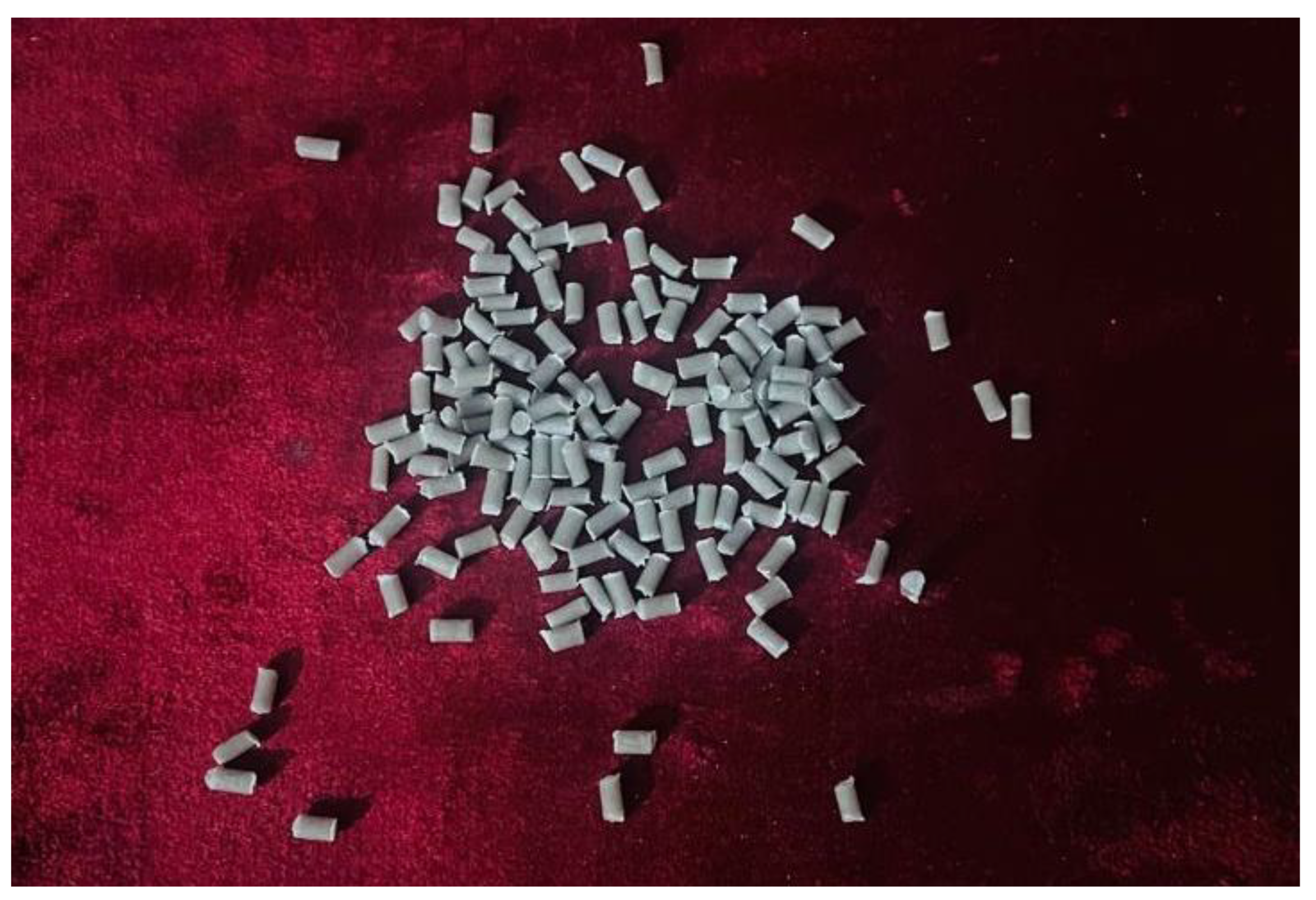
Figure 2.
Methodology adopeted.
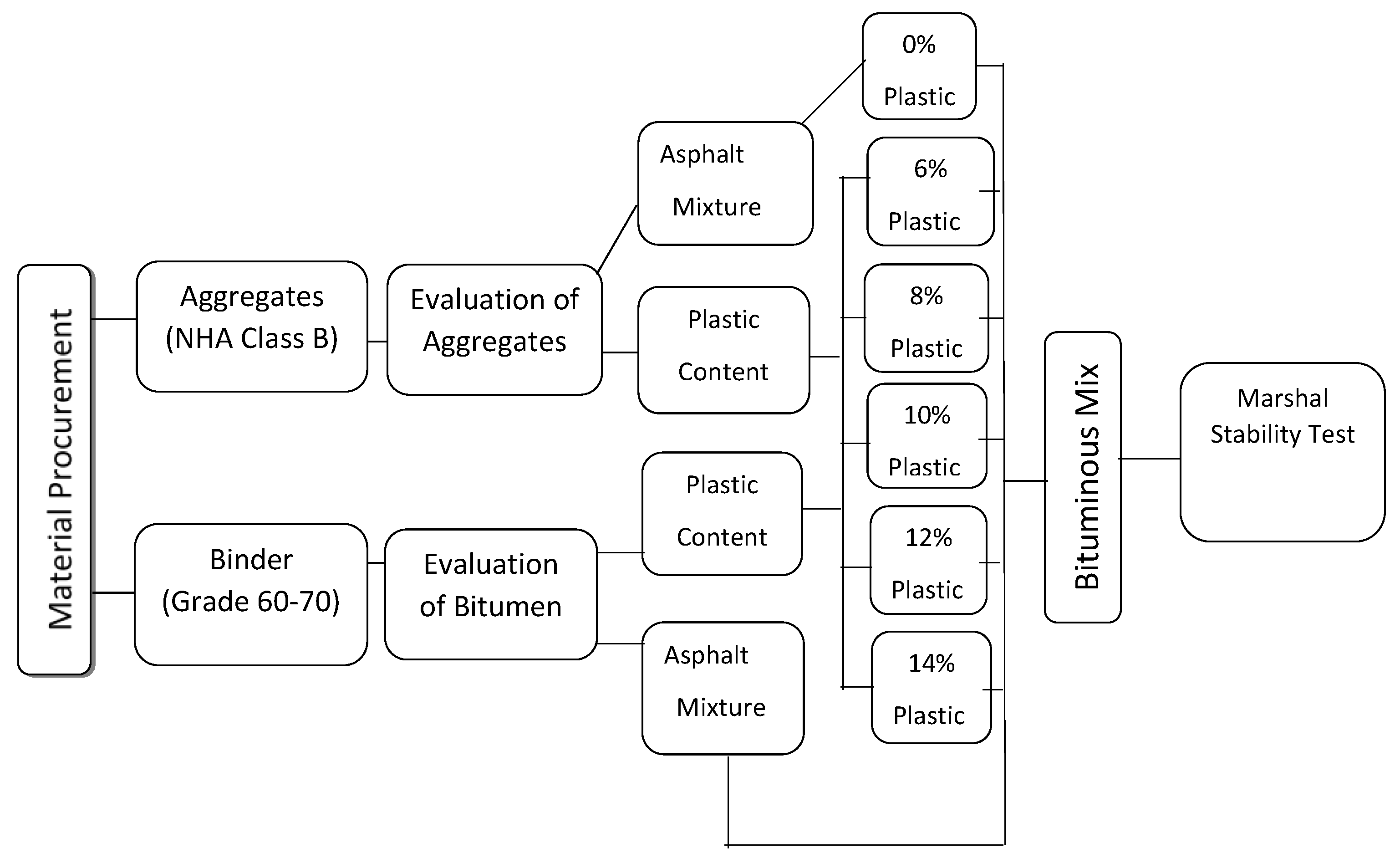
Figure 3.
Graph between stability and %Asphalt.
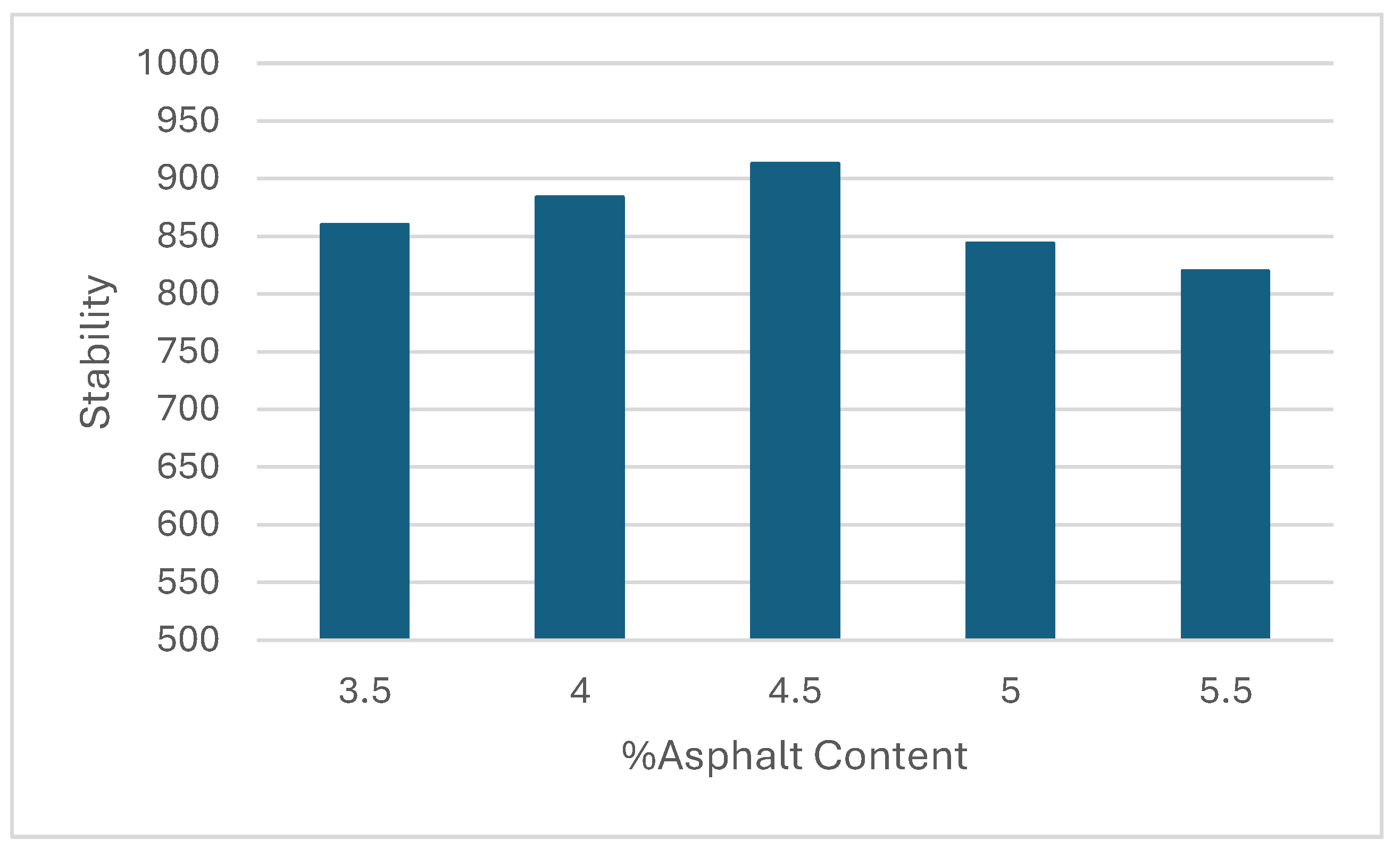
Figure 4.
Graph between Flow and %Aspahlt.
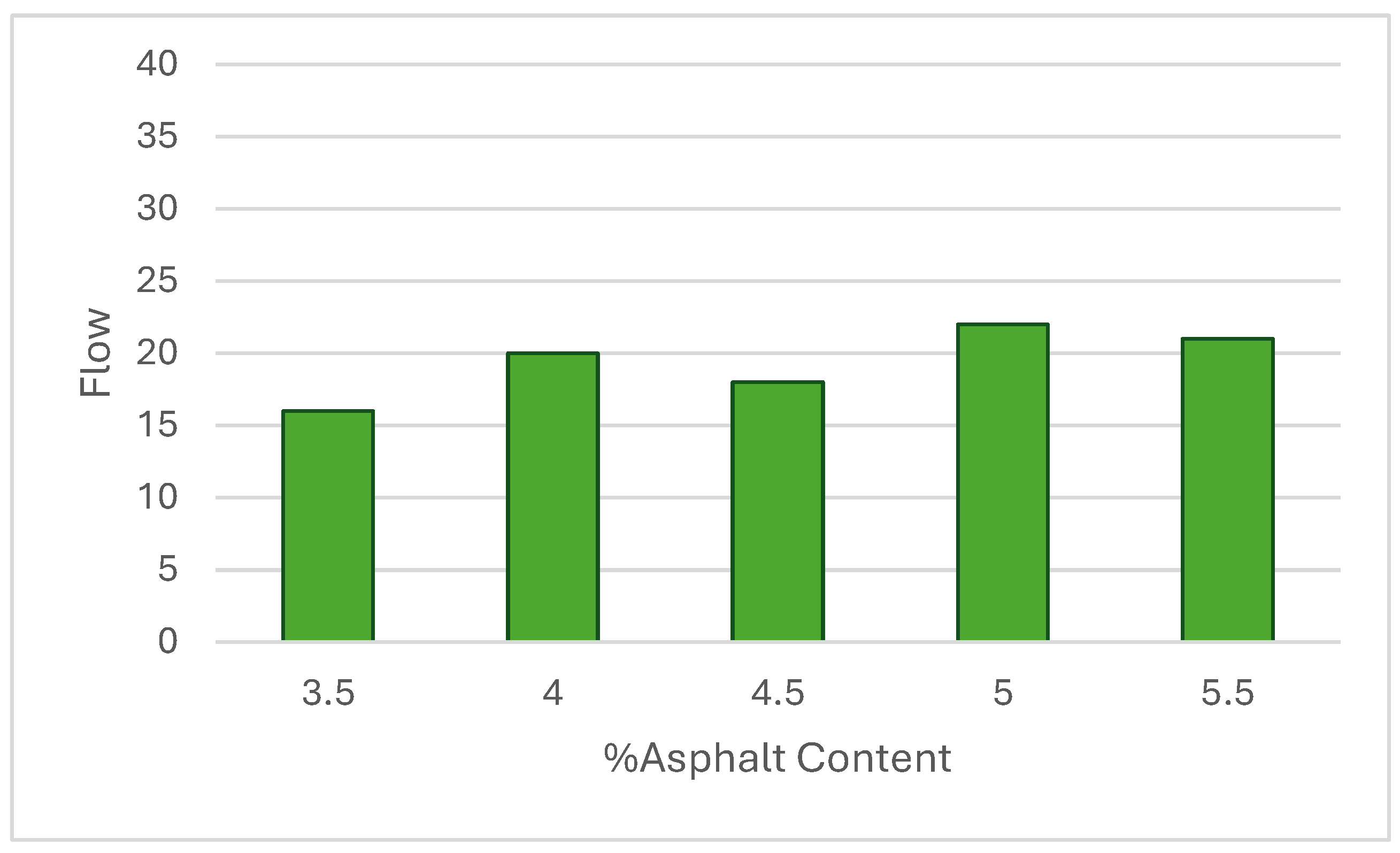
Figure 5.
Graph between Unit Weight and %Asphalt.
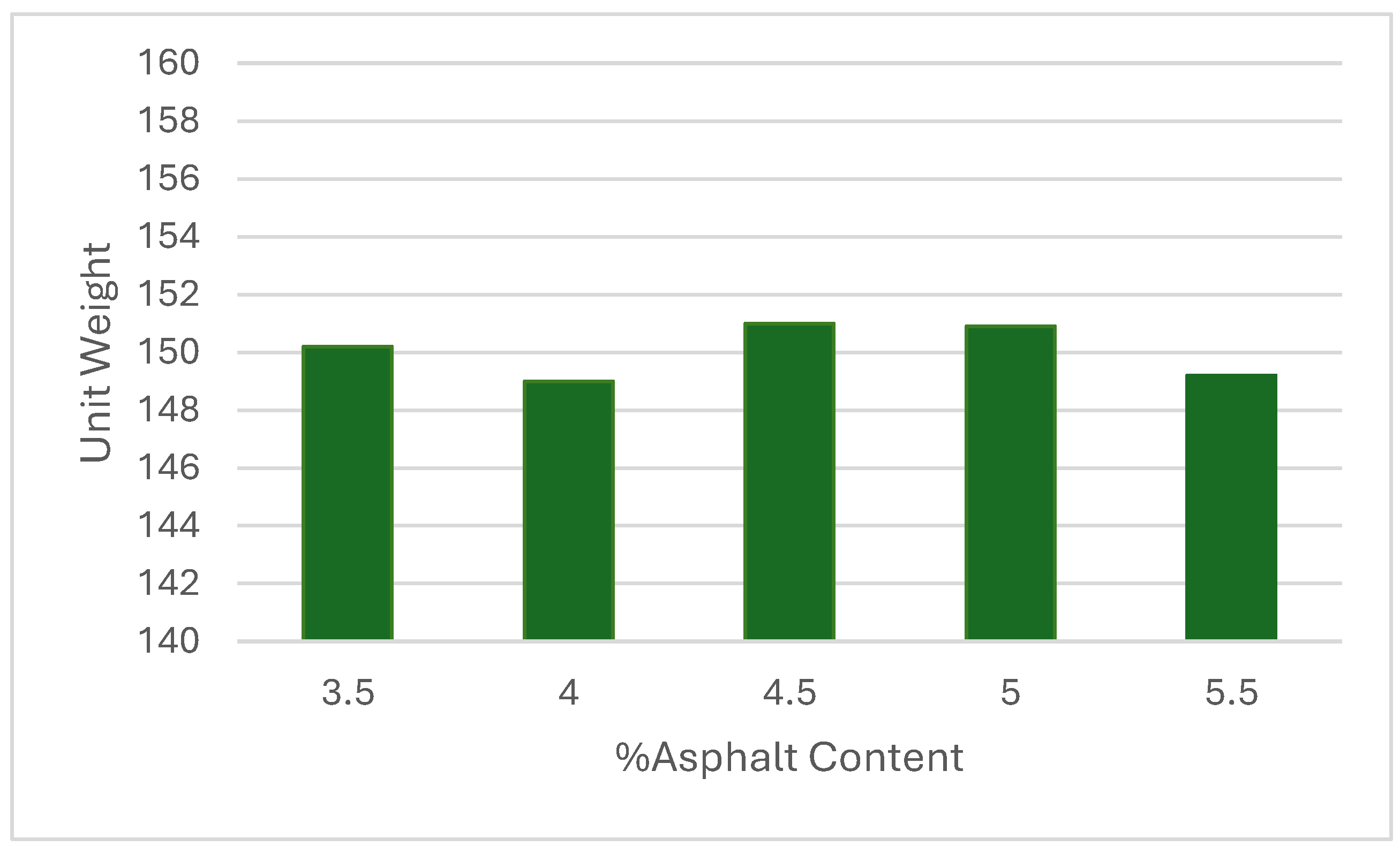
Figure 6.
Graph between %Air Voids and %Asphalt.
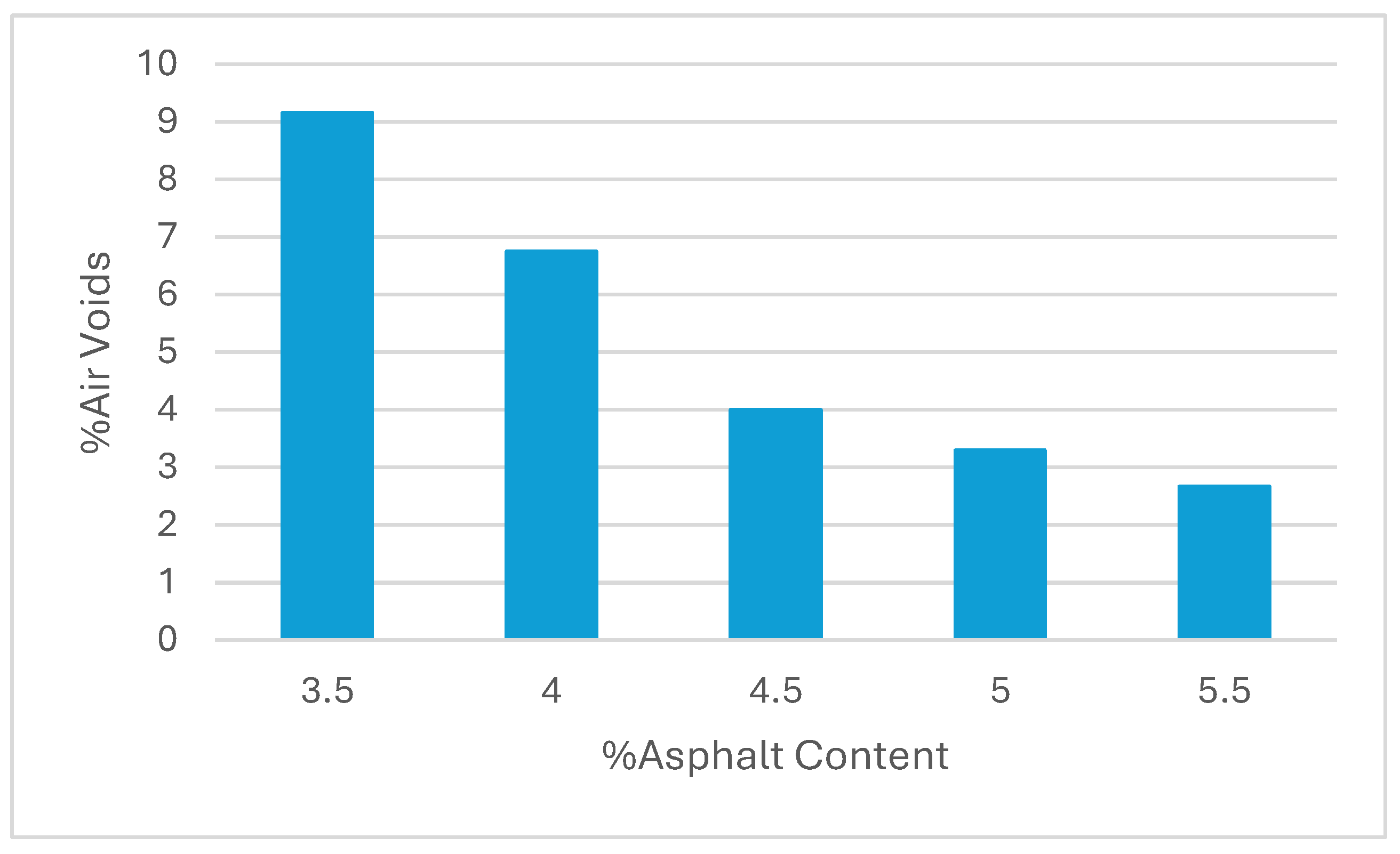
Figure 7.
Graph between %VMA and %Asphalt.
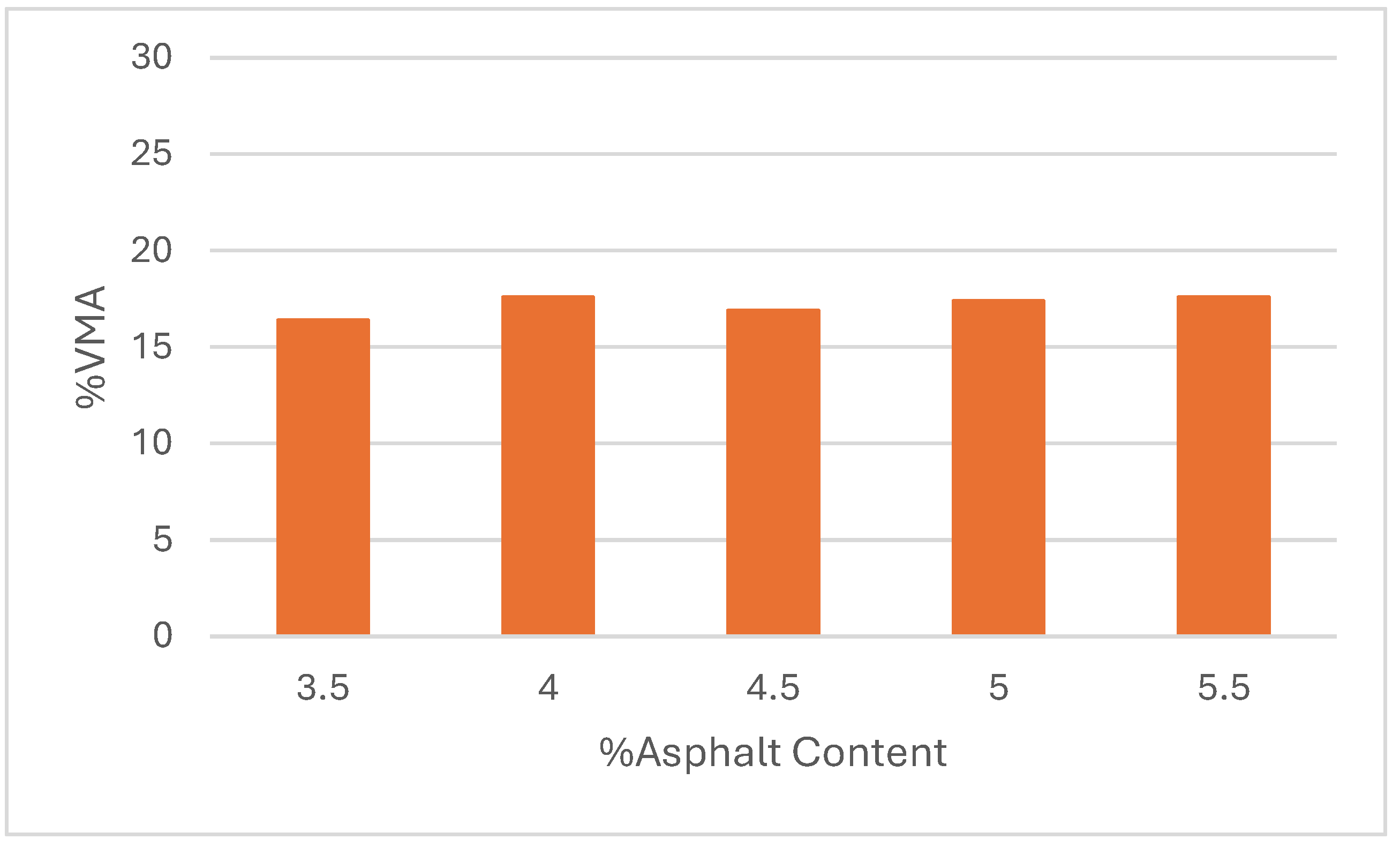
Figure 8.
Graph between %VFA and %Asphalt.
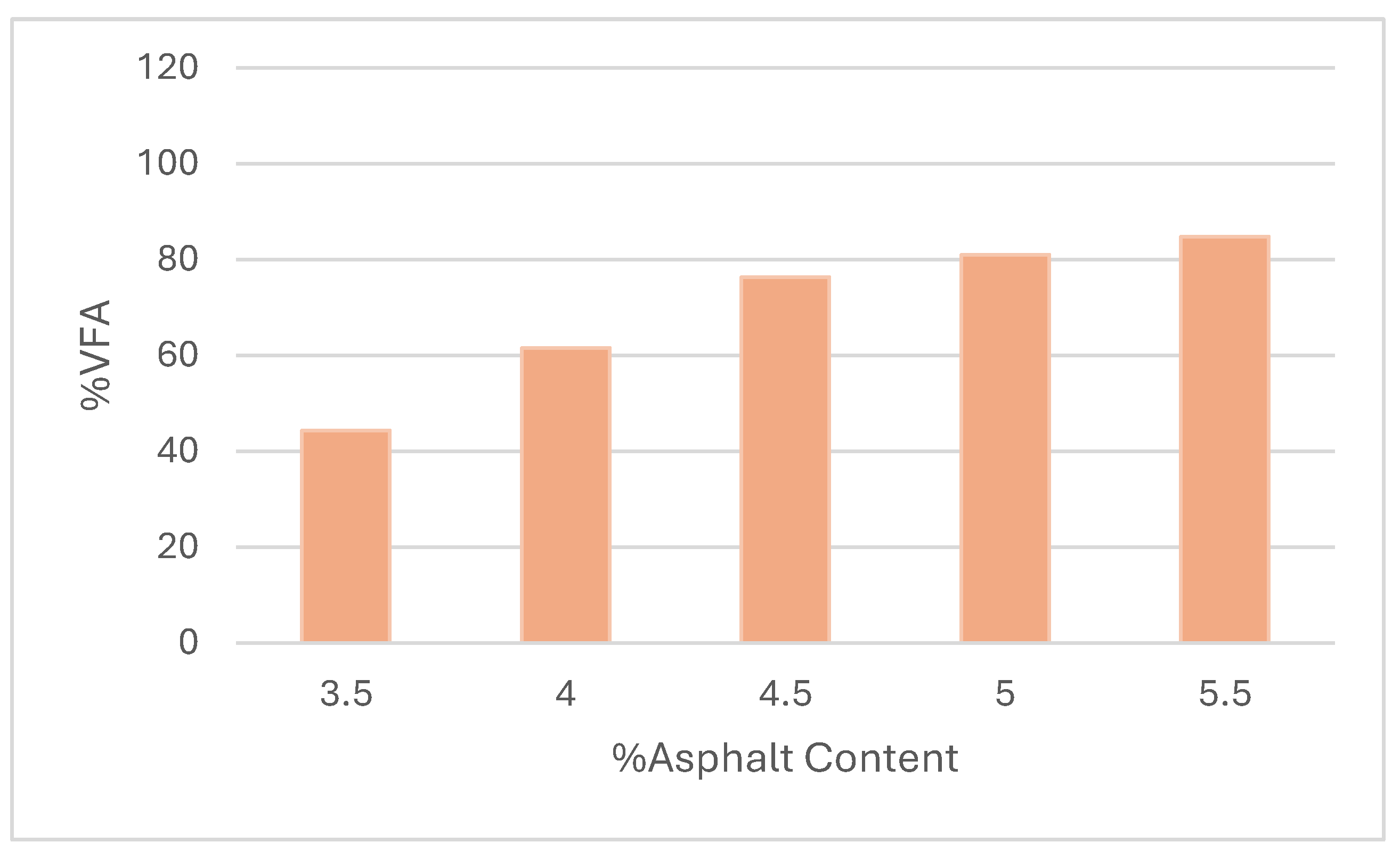
Figure 9.
Effect of addition of plastic on stability.
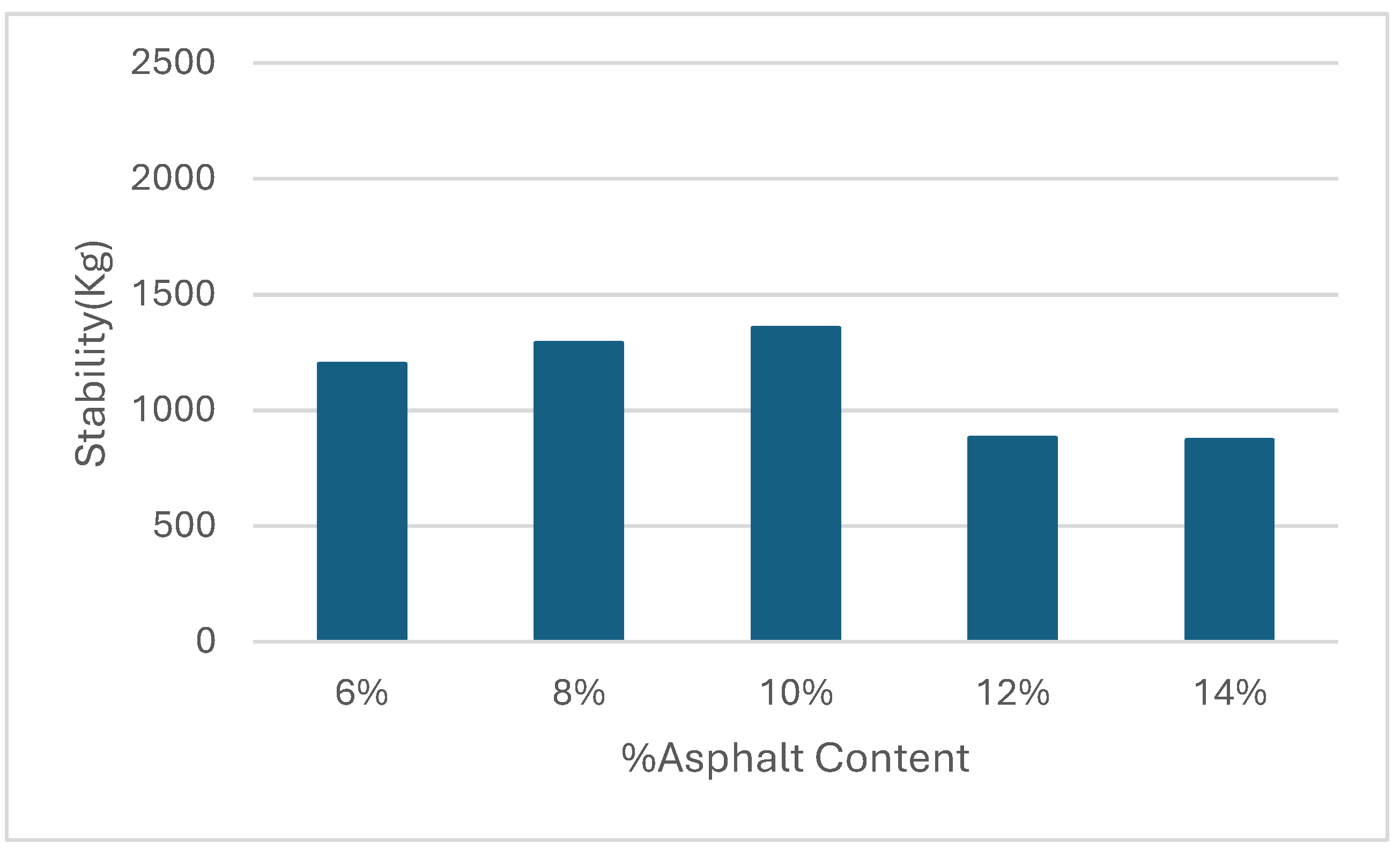
Figure 10.
Effect of addition of plastic on flow.
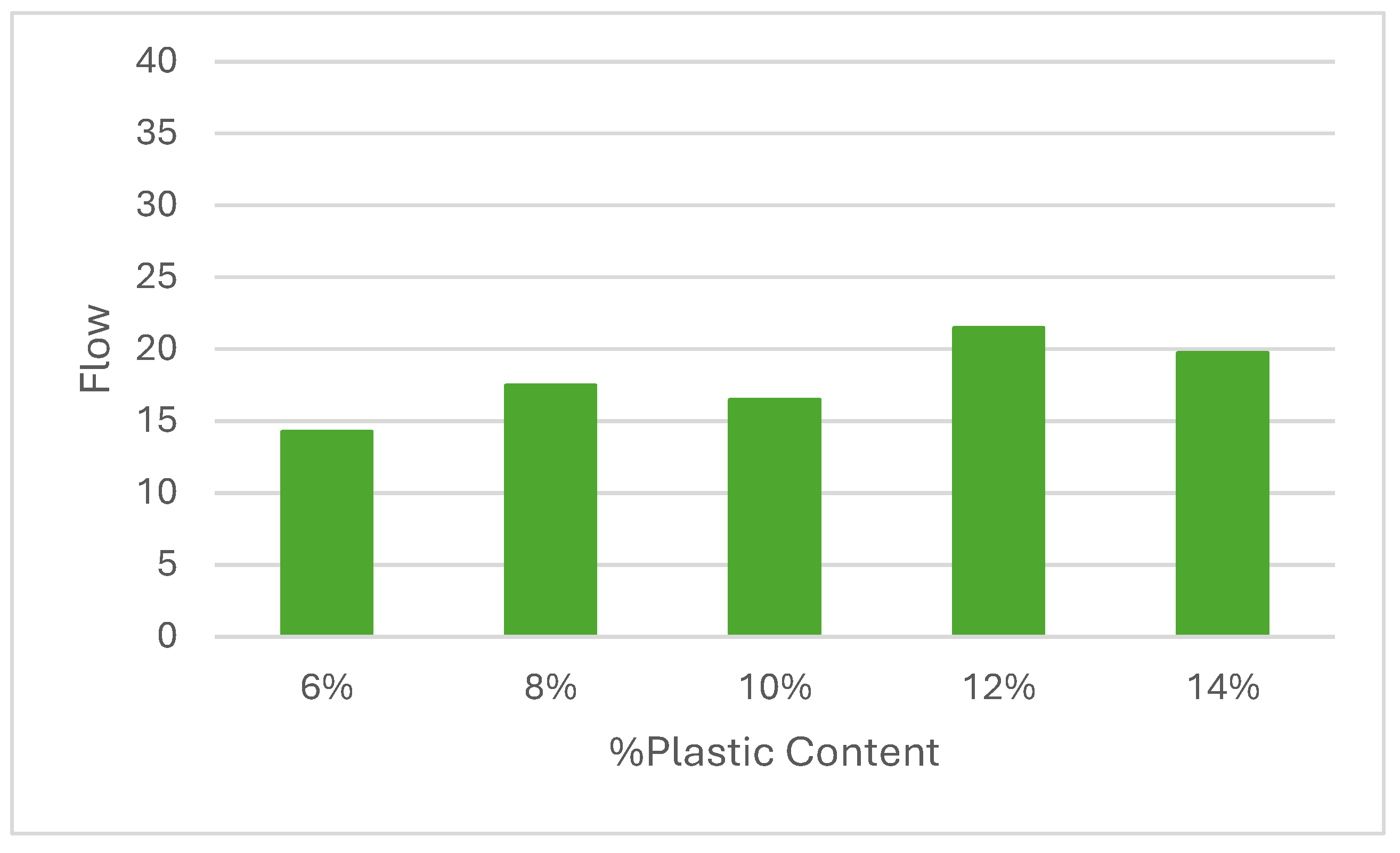
Figure 11.
Effect of addition of plastic on unit weight.
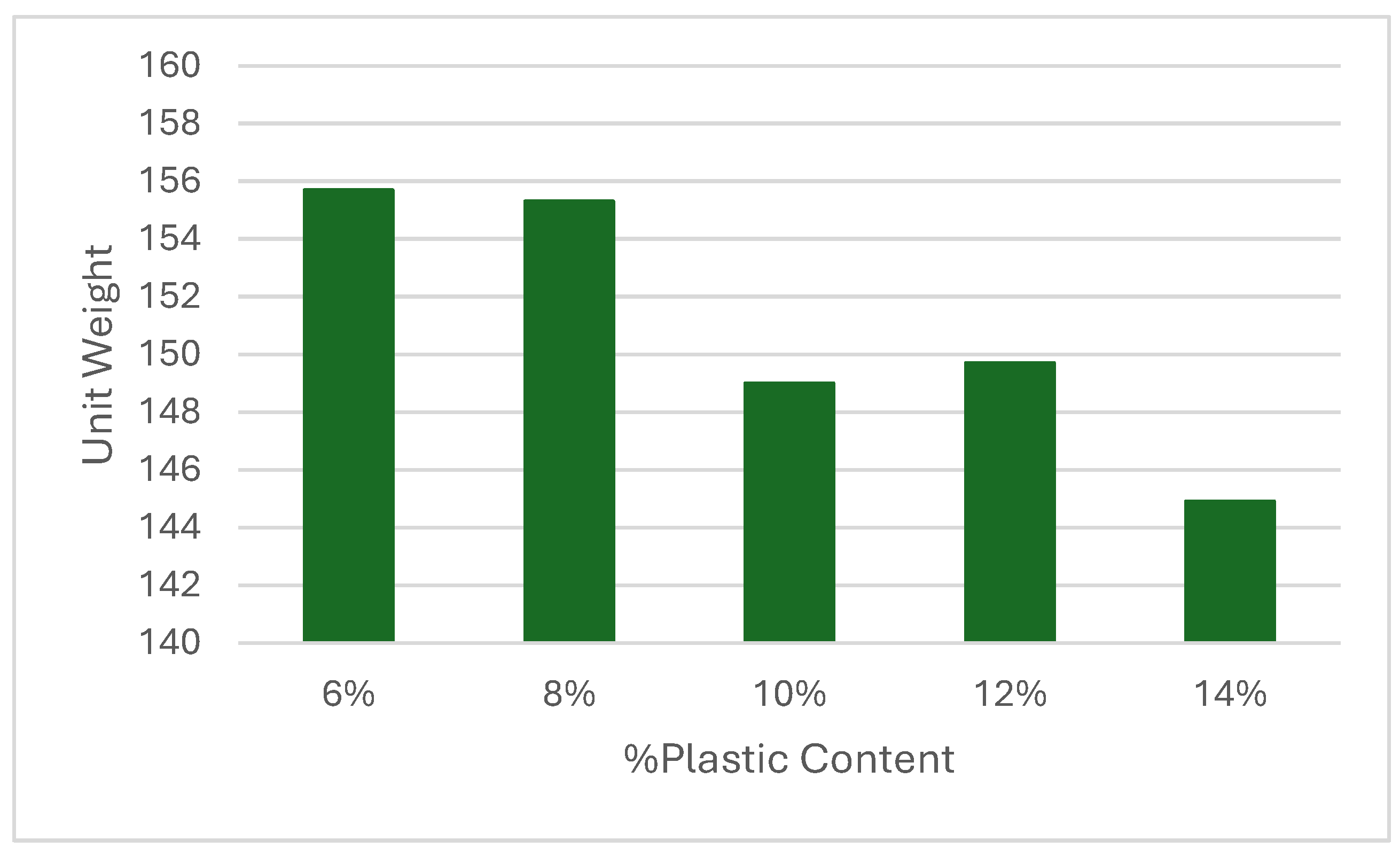
Figure 12.
Effect of addition of plastic on %Air Voids.
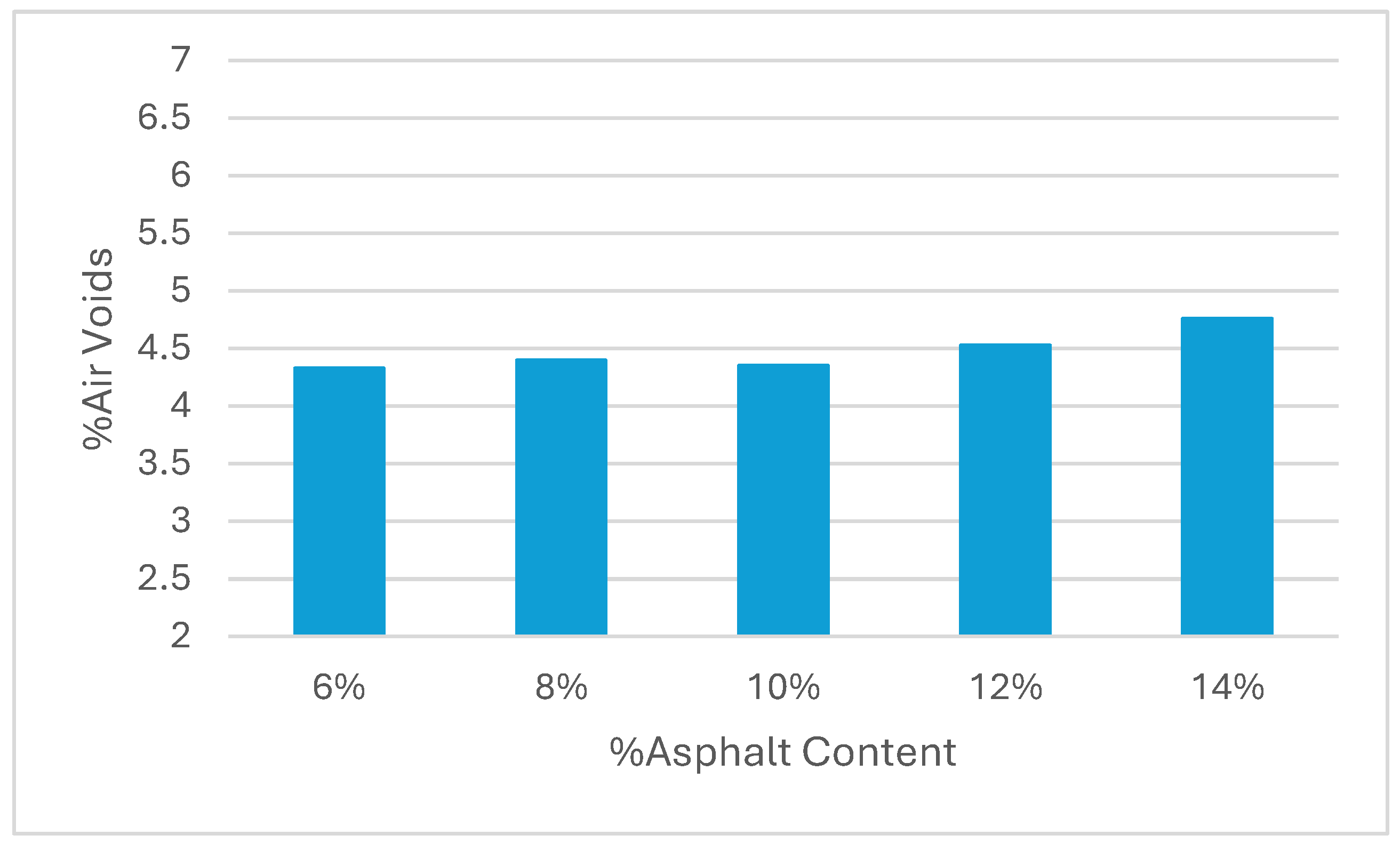
Figure 13.
Effect of addition of plastic on %VMA.
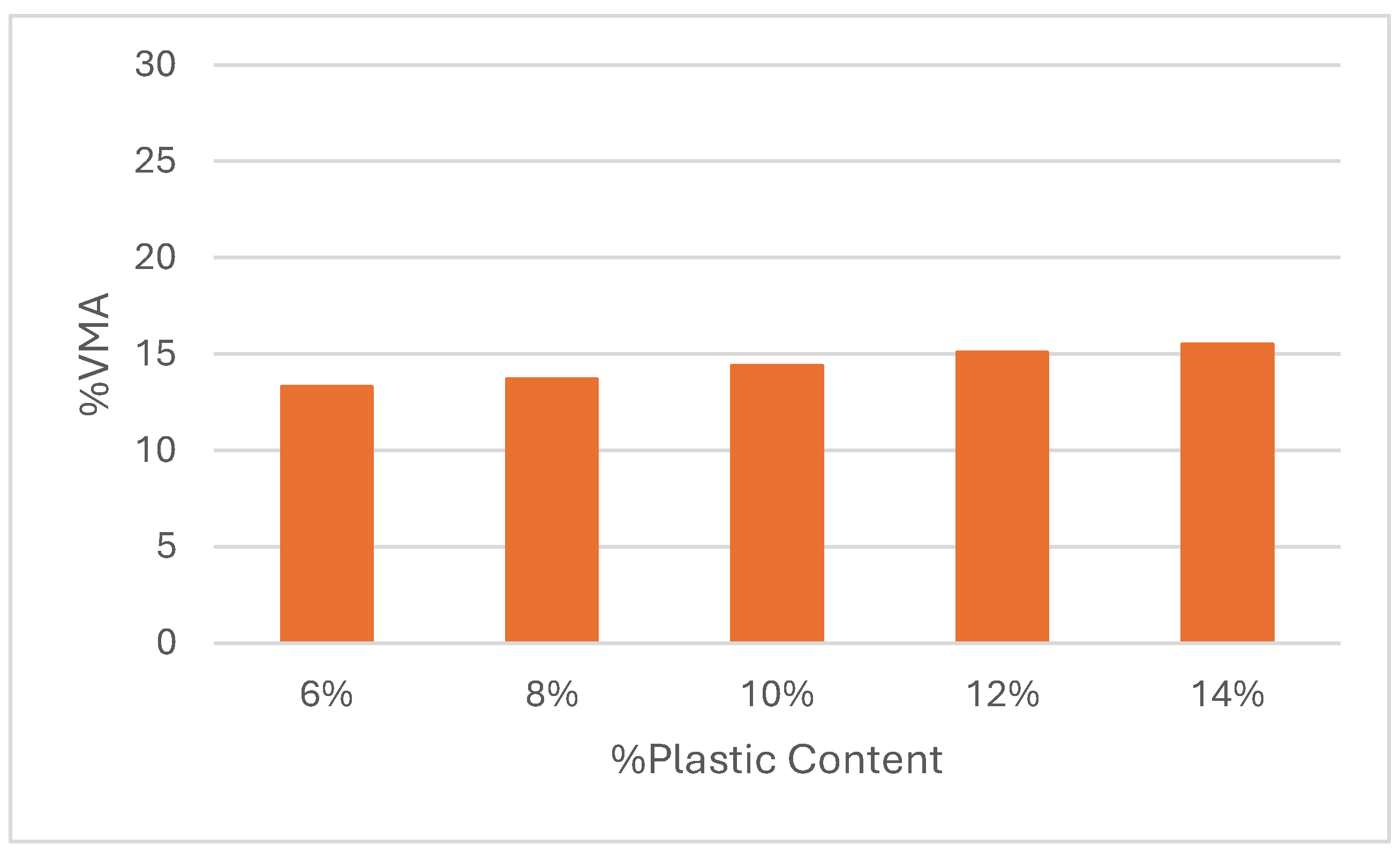
Figure 14.
Effect of addition of plastic on %VFA.
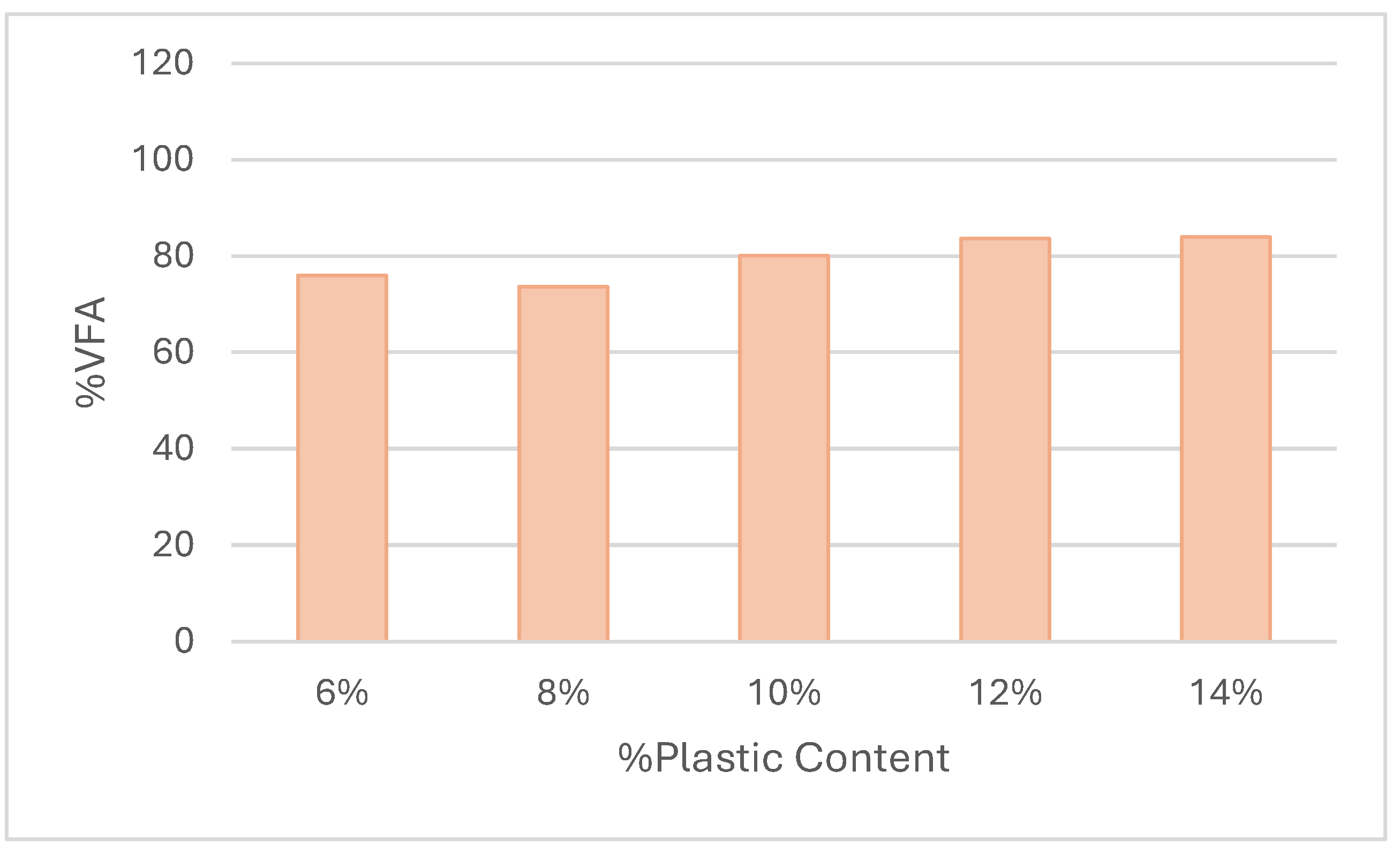

Table 1.
NHA Class B Gradation.
| Sieve Size (mm) | Sieve Size (inch) | (% Passing) | (% Retained) | Weight Retained |
|---|---|---|---|---|
| 19 | 3/4 | 100 | 0 | 0 |
| 12.5 | 1/2 | 82 | 18 | 450 |
| 9 | 3/8 | 70 | 12 | 300 |
| 4.75 | No. 4 | 50 | 20 | 500 |
| 2.36 | No. 8 | 30 | 20 | 500 |
| 0.3 | No. 50 | 10 | 20 | 500 |
| 0.075 | No. 200 | 5 | 5 | 125 |
| Pan | Pan | 0 | 5 | 125 |
Table 2.
Bitumen Properties.
| Penetration at 25 °C | Softening Point, °C | Flash Point, °C | Fire Point, °C | Solubility, % | Specific Gravity |
|---|---|---|---|---|---|
| 62.3 | 48 | 270 | 290 | 99.2 | 1.03 |
Disclaimer/Publisher’s Note: The statements, opinions and data contained in all publications are solely those of the individual author(s) and contributor(s) and not of MDPI and/or the editor(s). MDPI and/or the editor(s) disclaim responsibility for any injury to people or property resulting from any ideas, methods, instructions or products referred to in the content. |
© 2024 by the authors. Licensee MDPI, Basel, Switzerland. This article is an open access article distributed under the terms and conditions of the Creative Commons Attribution (CC BY) license (http://creativecommons.org/licenses/by/4.0/).
Copyright: This open access article is published under a Creative Commons CC BY 4.0 license, which permit the free download, distribution, and reuse, provided that the author and preprint are cited in any reuse.


