

Submitted:
03 September 2024
Posted:
03 September 2024
You are already at the latest version
Abstract
Disruptions in power quality have a negative impact on many energy consumers. These include lighting, where interference manifests itself, among others, in the form of light flickering. The article presents phenomena accompanying the operation of modern light sources against the background of exemplary results of studies on the flicker of conventional light sources, such as incandescent or fluorescent lamps. To assess the effects of these phenomena, it is necessary to use measures other than those traditionally used. The results of measurements carried out in accordance with different recommendations take into account both power supply disturbances and the properties of modern light sources.
Keywords:
1. Introduction
- affecting visual perception,
- neurobiological effects,
- reduction in performance and cognitive abilities.
2. Materials and Methods
3. Results
3.1. Flicker Studies
3.2. Study of the Influence of DC Power Supply Properties
3.3. Flicker Tests for Different Distances from the Light Source
4. Discussion
5. Conclusions
- The flickering effect is a common phenomenon in modern light sources. Flicker occurs in each of the studied groups of light sources. The first group tested were fluorescent lamps, which, according to the assumptions, generate constant flickering at a frequency twice as high as the frequency of the power supply. Flicker is a characteristic feature of fluorescent lamps, which has been confirmed by research. Studies of the second group of light sources, i.e., halogen sources, also confirmed the predictions. They generate light similarly to the sources from the first group, with a flicker frequency twice as high as the supply frequency. The research results of the first two groups were not very surprising due to the fact that these technologies have been known for a long time, and at the same time their principle of operation. The most interesting tested group turned out to be LED technology sources, as some models of sources from this group did not show the flickering effect, but at the same time a representative of this group had the worst flicker factor of all the tested sources (item 5 in Table 2). In this group, the general conclusion is ambiguous, because it should be stated that LED technology may be associated with the appearance of a flickering effect, but this is not the rule. The presence of the flickering phenomenon is mainly related to the low price of the light source, but there are also exceptions to this rule. To sum up, to a greater or lesser extent in each group, examples of light sources exhibiting the flickering effect were found.
- Another element of the research were the differences in the intensity of flickering for close and far distances of the photodiode from the light source. At first glance, it seems that the flicker effect decreases with increasing distance, but this only decreases the flicker amplitude, which gives the false impression of less flicker. In fact, moving the photodiode further away from the source showed that flicker rates increase significantly with distance, despite the smaller amplitude. This results from the method of calculating the flicker coefficients, i.e., the quotient of the amplitude and the sum of the extreme values of the light curve.
- As expected, the flickering phenomenon occurs more often in relation to sources categorized as cheap, but it does not exclude products from producers described as reputable due to their higher quality and price. Interestingly, one of the worst results, i.e., with the highest Fi and Fp coefficients, was obtained by a product from the Philips and Osram brands, a representative of the premium light sources. It is also worth noting that the more expensive sources, despite the flickering effect, mostly met the IEEE recommendations [6,18], which means that reputable manufacturers usually calculate and design the production of light sources in such a way that to be healthy for users. Therefore, the decision to purchase (usually wholesale) a specific type of light source should be preceded by an assessment of its properties, at least on the basis of the quality declaration provided by the manufacturer.
Author Contributions
Funding
Data Availability Statement
Conflicts of Interest
References
- Renewable Energy Sources (RES). Available online: https://emissions-euets.com/internal-electricity-market-glossary/1313-renewable-energy-sources-res (accessed on 10 August 2024).
- Koponen, P.; Hansen, H.; Bollen, M. Interharmonics and Light Flicker. In Proceedings of the 23rd International Conference on Electricity Distribution, Lyon, 2015, pp. 1–5.
- Vučković, D.; Jovanović, D.; Stanković, V.; Cvetković, N.; Tasić, D.; Škerović, V. Light flickers and potential biological effects. Facta Universitatis, Working and Living Environmental Protection 2022, Volume 19, No 3, pp. 137–148.
- Blavette, A.; O’Sullivan, D.L.; Alcorn, R.; Lewis, T.W.; Egany, M.G. Impact of a Medium-Size Wave Farm on Grids of Different Strength Levels, IEEE Transactions on Power Systems 2014, Volume 29, Issue 2, pp. 1–8. [CrossRef]
- Batra, S.; Pandav, C.S.; Ahuja, S. Light Emitting Diode Lighting Flicker, its Impact on Health and the Need to Minimise it. Journal of Clinical and Diagnostic Research 2019, Volume 13 (5), pp. 1–5. [CrossRef]
- Linden, J. (Lund University, Lund, Sweden); Dam-Hansen, C. (Technical University of Denmark, Kongens Lyngby, Denmark). Flicker explained: guide to IEC for the lighting industry. DTU Library 2022, pp. 1–18.
- A guide to voltage fluctuation and light flicker. Available online: https://www.caledoncontrols.co.uk/datash/voltage%20flicker.pdf (accessed on 16 June 2024).
- IEC 61000-3-3:2013+AMD1:2017+AMD2:2021 CSV Consolidated version, Electromagnetic compatibility (EMC) - Part 3-3: Limits - Limitation of voltage changes, voltage fluctuations and flicker in public low-voltage supply systems, for equipment with rated current ≤16 A per phase and not subject to conditional connection.
- IEC 61000-4-15:2010, Electromagnetic Compatibility (EMC) – Part 4: Testing and Measurement Techniques – Section 15: Flickermeter – Functional and Design Specifications.
- Blavette, A.; O’Sullivan, D.L.; Alcorn, R.; Egan, M.G.; Lewis, T.W. Simplified estimation of the flicker level induced by wave energy farms. IEEE Transactions on Sustainable Energy 2016, Volume 7 (3), pp. 1–8. [CrossRef]
- Hanzelka, Z.; Bien, A. Voltage Disturbances Flicker Measurement. 2005, Available online: https://powerquality.blog/2021/02/01/voltage-disturbances-flicker-measurement/ (accessed on 03 June 2024).
- Application guide to the European Standard EN 50160 on “Voltage characteristics of electricity supplied by public distribution systems”, Eurelectric, Union of the Electricity Industry, 1995.
- Palczynska, B. Virtual application of flickermeter. Metrology and Measurement Systems 2001, vol. 8, no. 2, pp. 165–177.
- Pałczyńska, B. The instantaneous flicker sensation level measured in the industrial power system supplying the rolling mill motors [dataset] 2021. Gdańsk University of Technology. [CrossRef]
- Pałczyńska, B. A cumulative probability function of instantaneous flicker sensation values measured in the industrial power system supplying the rolling mill motors [dataset] 2021. Gdańsk University of Technology. [CrossRef]
- Pałczyńska, B. The short-term flicker severity level measured in the industrial power system supplying the rolling mill motors [dataset] 2021. Gdańsk University of Technology. [CrossRef]
- Silsüpür, M.; Türkay, B.E. Flicker Source Detection Methods Based on IEC 61000-4-15 and Signal Processing Techniques – A Review. Balkan Journal of Electrical and Computer Engineering 2015, Volume 3 (2), pp. 93–97. [CrossRef]
- IEEE Std 1789-2015, IEEE Recommended Practices for Modulating Current in High-Brightness LEDs for Mitigating Risk to Viewers, Standards Committee of the IEEE Power Electronics Society, 2015.
- Metal Can TO39 Ambient Light Sensor BPW 21, Silicon Photodiode for the Visible Spectral Range, ams-OSRAM AG. Available online: https://look.ams-osram.com/m/2ce36b84bdf847e/original/BPW-21.pdf, (accessed on: 5 May 2024).
- DAQ NI USB 6008. Available online: https://www.ni.com/docs/en-US/bundle/usb-6008-specs/page/specs.html (accessed on: 5 May 2024).
- Voltcraft LX-10 LUXMETER. Available online: https://asset.conrad.com/media10/add/160267/c1/-/en/001662853DS01/datenblatt-1852512-voltcraft-vc-8314265-iso-lx-10-luxmeter-kalibriert-iso-0-199900-lx.pdf (accessed on 5 May 2024).

| No. | Manufacturer and type | Nominal power P [W] |
Luminous flux Φ [lm] |
|---|---|---|---|
| 1 | Polux Platinum LED E27 G45 | 5.5 | 480 |
| 2 | Tungsgram LED E27 G45 | 4.5 | 470 |
| 3 | Philips CorePro LED luster E27 G45 | 5.5 | 470 |
| 4 | Philips Master Value LED E27 A60 | 3.4 | 470 |
| 5 | Philips Master LED bulb E27 A60 | 12 | 806 |
| 6 | Philips CorePro LED bulb E27 A60 | 5.5 | 470 |
| 7 | Kanlux Apple LED E27 A60 | 8 | 800 |
| 8 | Osram Retrofit LED E27 G125 | 6.5 | 806 |
| 9 | Philips Hue White E27 | 9 | 806 |
| 10 | IKEA SOLHETTA LED bulb E14 G45 | 2.2 | 200 |
| 11 | Elitecho B35G LED E14 | 4.8 | 470 |
| 12 | Osram Parathom E14 | 4 | 470 |
| 13 | LumiLed GU10 | 3 | 270 |
| 14 | No name (China) LED GU10 | 1 | 105 |
| 15 | Osram LED Value LED GU10 PAR16 | 4 | 230 |
| 16 | Osram Parathom PRO LED GU10 PAR16 | 3.4 | 230 |
| 17 | Philips Hue White Ambiance LED GU10 | 5 | 350 |
| 18 | Philips Hue White LED GU10 | 5.2 | 400 |
| 19 | POLUX Gold2 mini FST2 fluorescent E14 | 6 | 315 |
| 20 | Philips Genie Hg fluorescent E14 | 8 | 425 |
| 21 | Pila Halogen E14 P45 | 42 | 630 |
| No. |
Uc [V] |
Ua [V] |
Ub [V] |
fflick [Hz] |
Fp [%] |
Fi [-] |
Fp_b [%] |
|---|---|---|---|---|---|---|---|
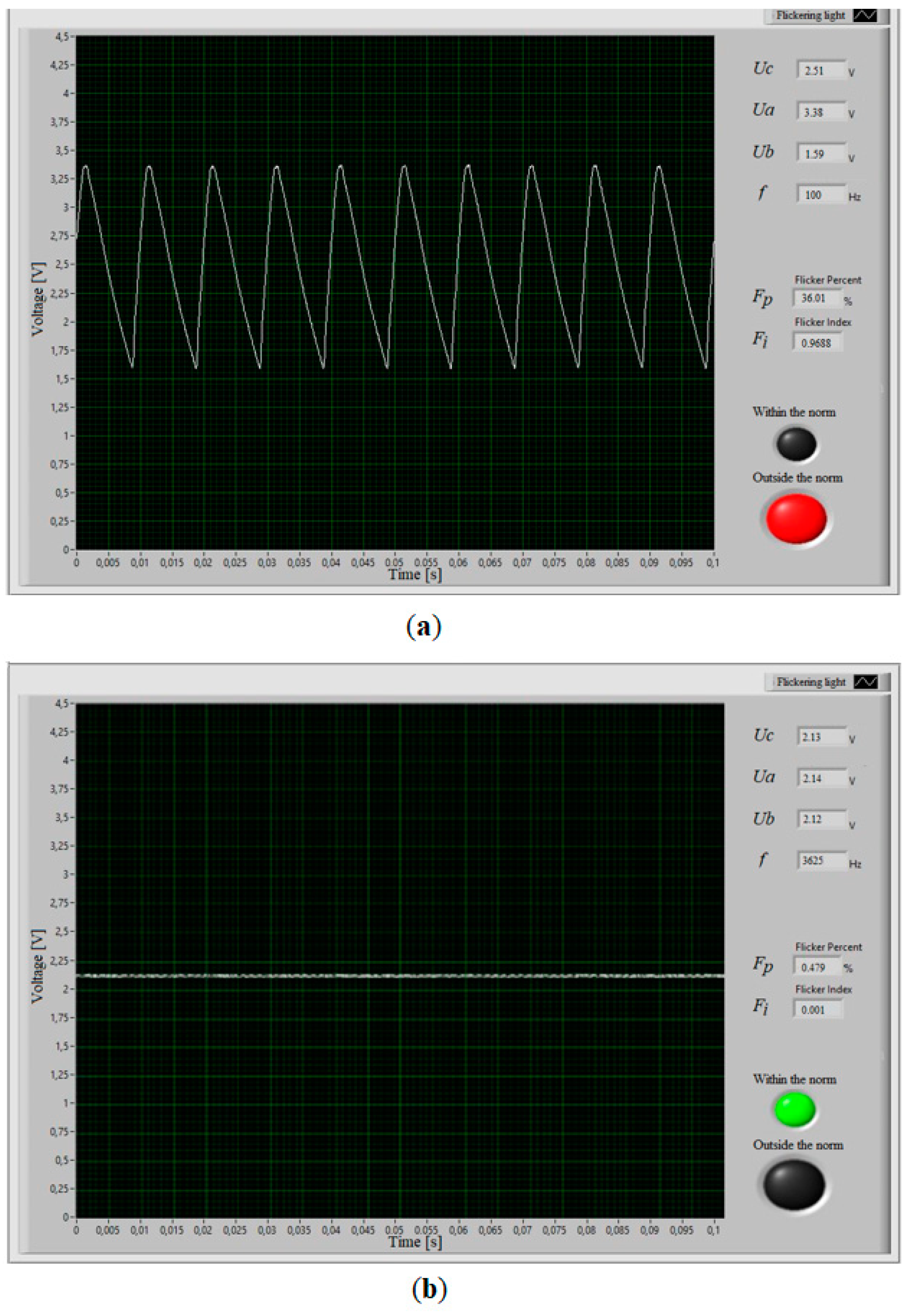
| 1 | 2.51 | 3.38 | 2.21 | 100 | 36.01 | 0.097 | 8 |
| 2 | 2.13 | 2.14 | 1.59 | 3635 | 0.47 | 0.001 | 290.8 |
| 3 | 3.49 | 3.51 | 3.47 | 3525 | 0.58 | 0.001 | 282 |
| 4 | 1.33 | 1.35 | 1.31 | 100 | 1.34 | 0.002 | 8 |
| 5 | 3.41 | 3.48 | 0.00 | 100 | 100.00 | 0.009 | 8 |
| 6 | 3.42 | 3.47 | 3.36 | 100 | 1.6 | 0.003 | 8 |
| 7 | 2.12 | 2.17 | 2.06 | 2166 | 2.66 | 0.006 | 173.28 |
| 8 | 2.02 | 2.22 | 1.85 | 100 | 9.28 | 0.024 | 8 |
| 9 | 2.49 | 2.71 | 2.21 | 100 | 10.10 | 0.029 | 8 |
| 10 | 0.90 | 0.94 | 0.84 | 6950 | 5.43 | 0.012 | 556 |
| 11 | 1.12 | 1.13 | 1.11 | 3274 | 0.91 | 0.002 | 261.92 |
| 12 | 0.89 | 0.91 | 0.87 | 100 | 2.00 | 0.003 | 8 |
| 13 | 3.66 | 3.67 | 3.65 | 3107 | 0.27 | 0.001 | 248.56 |
| 14 | 2.33 | 2.53 | 0.73 | 100 | 65.89 | 0.175 | 8 |
| 15 | 2.21 | 2.30 | 2.11 | 8118 | 4.33 | 1.011 | 649.44 |
| 16 | 3.15 | 3.19 | 3.10 | 100 | 1.46 | 0.003 | 8 |
| 17 | 2.11 | 3.97 | 0.71 | 2019 | 69.79 | 0.157 | 161.52 |
| 18 | 2.32 | 2.34 | 1.90 | 2054 | 10.10 | 0.002 | 164.32 |
| 19 | 1.10 | 1.20 | 0.94 | 100 | 11.94 | 0.028 | 8 |
| 20 | 4.04 | 4.26 | 3.68 | 100 | 7.35 | 0.018 | 8 |
| 21 | 1.13 | 1.34 | 0.91 | 100 | 18.97 | 0.052 | 8 |
| DC power supply |
Uc [V] |
Ua [V] |
Ub [V] |
f [Hz] |
Fp [%] |
Fi [-] |
|---|---|---|---|---|---|---|
| QH (China) | 2.40 | 3.24 | 1.70 | 100 | 31.34 | 0.087 |
| TCI (Italy) | 2.23 | 2.25 | 1.22 | 3396 | 0.85 | 0.001 |
| Distance [cm] |
Uc [V] |
Ua [V] |
Ub [V] |
f [Hz] |
Fp [%] |
Fi [-] |
|---|---|---|---|---|---|---|
| 10 | 3.84 | 4.32 | 3.36 | 100 | 12.58 | 0.038 |
| 100 | 1.13 | 1.34 | 0.91 | 100 | 18.97 | 0.052 |
Disclaimer/Publisher’s Note: The statements, opinions and data contained in all publications are solely those of the individual author(s) and contributor(s) and not of MDPI and/or the editor(s). MDPI and/or the editor(s) disclaim responsibility for any injury to people or property resulting from any ideas, methods, instructions or products referred to in the content. |
© 2024 by the authors. Licensee MDPI, Basel, Switzerland. This article is an open access article distributed under the terms and conditions of the Creative Commons Attribution (CC BY) license (http://creativecommons.org/licenses/by/4.0/).


