

Submitted:
01 September 2024
Posted:
02 September 2024
You are already at the latest version
Abstract
Public food trees are increasingly popular among researchers, urban planners and citizens, for their diversity of social, provisional and environmental benefits. However, the practice still faces several barriers, including the limited share of the population who uses them, and long-term management, studies to date suggesting municipality-citizen co-management partnerships as the most effective form, but still rare. Though participatory projects usually involve new plantations, several green spaces already harbor food trees which could be used to rapidly develop and test approaches for improving public usage and for co-management. Here we used a qualitative approach to explore usage and perception of public fruit trees and attitude towards public usage and participation, among green space visitors, staff and administrators of two urban green spaces harboring fruit trees in Birjand, Iran: one public park (Tohid Park) and one historic garden (Akbarieh Garden). Semi-structured interviews were conducted with twelve visitors of both spaces, four administrators and eight workers. We found that despite their great personal experience and interest in picking fruit, as well as a culture of strong relationships with fruit trees, visitors’ usage of the fruit was low, with a social norm against harvesting the fruit of others appearing as a main but easily remediable reason. Nevertheless, most visitors had a deep level of appreciation of these public fruit trees due in particular to the diverse pleasures that they provided (sensory, emotional, cognitive, experiential, social), and were greatly emotionally attached to them. They also had great interest in participating in their management and care, and more so in Tohid Park due to a greater potential social impact. According to some participants, education is needed to reduce damage that some citizens cause while picking fruit, or access should be restricted if maximizing production is the goal. These findings expand our understanding of the ways in which people can relate to existing urban fruit trees and suggest that they could be used to develop effective co-management schemes, thereby contributing to building smart and participatory edible cities.
Keywords:
public produce
; public urban fruit trees
; edible city
; participatory city
Introduction
Interest in growing or harvesting food in the city has been rapidly rising in the past few decades among citizens, decision-makers and researchers, and initiatives and projects are multiplying. Until recently, community-centered approaches have focused on community-gardens, semi-private structures accessible only to registered members and focusing on growing annual vegetables.
A newer approach is that of public produce, in which plants are grown in public spaces and are freely accessible to passersby, thereby making the benefits potentially more widely accessible (Nordahl, 2014). The approach could also be a means of improving food security and cities’ socio-ecological resilience (Albrecht & Wiek, 2021; Exner et al., 2021; Sardeshpande et al., 2021). Interest in public foods has manifested itself in various initiatives globally, for instance, the creation of the ‘Edible City’ qualification and network, of which eleven cities from around the world are now part (https://www.edicitnet.com/). Overall, this emergence denotes an undergoing change in the conceptualization of urban public spaces, as providers not only of recreational and environmental services, but also of goods (Hajzeri & Kwadwo, 2019; Shackleton et al., 2017).
Within this trend, municipalities and urban residents worldwide are increasingly interested in planting fruit trees in public spaces, and large numbers of them are doing so within initiatives driven either by civil society, the municipality, or in some cases, a joint endeavor (Colinas et al., 2019; Free, 2022). In France for example, a network of several dozen municipalities, gardeners and researchers from all over the country has recently been formed to exchange and improve knowledge and experience with public fruit trees (Plante et Cité, 2023). Perennial plants indeed have the advantage of not requiring yearly plantation labor, and trees may simply replace or be added to the current canopy, leaving space for other usages underneath. In addition, the fruit of trees and shrubs have a lower risk of accumulating pollutants from urban soil than annual plants(Romanova & Lovell, 2021).
Within the scholarly literature, public food trees are currently discussed within several strands: foraging, public orchards or urban food forests, and edible cities or landscapes. Foraging research started at least two decades ago. It focuses on the potential and actual use of existing, wild or domestic, urban or peri-urban plants or animals for food, medicine, fuel and other uses (Shackleton et al., 2017). Research on public orchards or food forests is more recent and focuses on food trees and shrubs deliberately planted for public use in urban areas (Park et al., 2019). Its topics include: case descriptions, social, environmental, socio-environmental and economic benefits; design; administrative and management barriers (for instance, (Colinas et al., 2019; Davivongs & Arifwidodo, 2023; Fornaciari et al., 2022; Shi, 2022; Taylor & Lovell, 2021). Edible cities research is the most recent, and focuses on the conceptualization, benefits, opportunities and constraints for developing public produce more widely (Artmann et al., 2020; Exner et al., 2021; Hajzeri & Kwadwo, 2019; Sartison & Artmann, 2020).
These three strands of the scholarly literature have documented various social, environmental, socio-environmental and economic benefits of public food trees, such as improving access to nutritious foods and addressing food security (Nero et al., 2018; Shackleton et al., 2017), contributing to developing social capital and place attachment as well as other aspects of social structure and resilience (Albrecht & Wiek, 2021; Artmann et al., 2020; Colinas et al., 2019; Liu et al., 2017; Riolo, 2019; Scharf et al., 2019), enhancing connection with nature (Artmann et al., 2020), and the economic value (Hosseinpour et al., 2021; Lafontaine-Messier et al. 2016). Residents and city administrators, for their part, appreciate their multiple benefits, such as improving the microclimate and the aesthetic properties of the landscape, connecting people with nature, and contributing to health and community building (Allen & Mason, 2021; Artmann et al., 2020; Betz et al., 2017; Coffey et al., 2021; Colinas et al., 2019; Plante et Cité, 2023). Overall, fruit trees in public urban spaces are multifunctional; thereby they contribute to making cities ‘smarter’, i.e. more efficient and less fragmented (Exner et al., 2021; Park et al., 2019; Sardeshpande et al., 2021).
Despite the enthusiasm and the potential or demonstrated benefits, researchers also find numerous barriers to public food trees’ wider development, at several levels: technical, individual, social, economic, structural, managerial, and policy or political (Albrecht & Wiek, 2021; Artmann et al., 2020; Betz et al., 2017; Clouse, 2022; Coffey et al., 2021; Exner et al., 2021; Guenat et al., 2023; Hajzeri & Kwadwo, 2019; Kowalski & Conway, 2023, 2023; Plante et Cité, 2023; Rombach & Dean, 2023; Sartison & Artmann, 2020; Schunko & Brandner, 2022; Shackleton et al., 2017; Shortly & Kepe, 2021; Zheng & Chou, 2023).
Two of these barriers are of particular interest to us: 1) A limited share of the population still uses public produce. For instance, reported percentages of city-dwellers who have already foraged are 33% in Berlin and 26% in Atlanta (and 64% in Vienna, but among of green space visitors) (Fischer & Kowarik, 2020; Gaither et al., 2020; Schunko & Brandner, 2022). Also, a study of an Edible City in Germany found that the residents touched public produce very little, even though they were well-informed of the project (Artmann et al., 2020). Thus, although foragers belong to a diversity of social groups and forage for a diversity of reasons, they do not seem to represent the majority. Also, unequal sharing, with some users harvesting most fruit even before ripeness, has been reported by some city administrators (Colinas et al., 2019; Plante et Cité, 2023). The reasons why some people forage or harvest public produce while others don’t are still unclear and may be various. Reasons mentioned by users included concerns over food safety through pollution, lack of knowledge about the edible species and the permission to use, and lack of cultural approval (Artmann et al., 2020; Guenat et al., 2023; Hajzeri & Kwadwo, 2019; Rombach & Dean, 2023; Schunko & Brandner, 2022; Shortly & Kepe, 2021). Effects of culture, traditions, food habits, nature and food attitudes, and views about foraging benefits were also observed (Hall, 2013; Rombach & Dean, 2023; Shortly & Kepe, 2021; Zheng & Chou, 2023). 2) The need for effective long-term management schemes, ideally joint between civil society and city administrations. As mentioned by Hajzeri & Kwadwo (2019, p. 44), it “can be argued that simply planting edible plants in urban open spaces is not enough. It also requires a supporting mechanism that assists and monitors the whole process of integration and maintenance”. Exner et al. (2021) analyzed 17 edible city projects in Vienna, France and Germany, and concluded that this supporting mechanism is most successful when it is a collaboration between civil society and the municipality. Moreover, such collaboration appeared to be the primary factor for the success and stability of these initiatives (although the role of the municipality was somewhat more important for stability). Yet, such co-management schemes are still rare, and represented only four of the seventeen cases studied by Exner et al. (2021).
In addition, most literature on public orchards or food forests discusses new projects, in which motivated volunteers or city administrations (or both) are present from the beginning of the project. However, many cities worldwide already harbor publicly accessible edible species within their green spaces (Shackleton et al., 2017). It is therefore worth exploring the potential of these existing resources in overcoming the barriers.
This study aimed to explore the potential of existing edible landscapes in Birjand, in the east of Iran, in broadening the share of the population who uses public food trees and in developing effective collaboration schemes between civil society and the municipality for the care and management and these trees. Meanwhile it also explored people’s cognitive, emotional and experiential relationships with public fruit trees, which little is known about so far.
To this end, we carried out face-to-face semi-structured interviews with users, administrators and staff of a public park and of a historic garden in which fruit trees have always been present, to study:
1) visitors’ relationships with the food trees in two green spaces, i.e. their knowledge, usage, perception, and emotional bond with these trees;
2) their opinion about public food trees;
3) their interest in participating in the management and care of public food trees;
4) the views of the administrators and staff concerning visitors’ usage of the food trees and their potential participation in maintenance.
To our knowledge most research on public food trees to date has been performed in America or Europe. Studying public food trees in the Iranian context is interesting for a few reasons, as Iran provides a different context in terms of climate, history and culture. First, in Birjand the climate is semi-arid and vegetation sparse, usually requiring irrigation (see Fig. 1). Second, Iran is home of the renowned historic Persian gardens, with nine UNESCO gardens across the country. They are publicly accessible and multifunctional (e.g., wind and heat protection, relaxation, aesthetic pleasure, production of fruit and other edibles, etc.), and therefore might be useful for developing the public foods and smart city concepts and practices (Khalilnezhad, 2016). Third, Iranian culture strongly emphasizes the importance of agriculture for religious, social and environmental reasons (Maghrebi et al., 2020), and productive gardens have been considered an important source of food and income (Amani-Beni et al., 2021; Gharipour, 2013). Finally, Iranians seem sensitive to aspects connected to sustainability and safety in food productions and very much in favor of traditional markets(Sobhani et al., 2022; Soltani et al., 2020). Due to the local cultural value of agriculture and fruits, publicly accessible edible landscapes might have great potential in Iran and other similar contexts, and the lessons learned in that context might provide insights for the future of public foods elsewhere.
Methods
1.1. Setting
Birjand is a city of about 200,000 inhabitants with a semi-arid climate and is located in the east of Iran (“Birjand,” 2023) (Figure 1)Figure 1. It is famous for some fruit crops such as jujube, plums and pomegranate. Birjand has several public green spaces harboring fruit trees, two of the most well-known being Akbarieh Garden and Tohid Park, which were selected for the present study (Figure 2).
Akbarieh Garden has a surface area of 3.4 hectares and is one of the nine Iranian gardens registered as UNESCO World Heritage Persian Garden sites. It is funded by governmental and public sources and managed by the World Heritage Council. Persian gardens originated in the 6th century BC and are likely the most ancient designed green spaces, merging various knowledge and practices regarding water management, architecture, botany and agriculture. Their design usually includes a mansion, water (basins and irrigation), ornamental and edible plants, green space and paths. The outside wall protects vegetation and people from the harsh winter and summer climate and sandstorms, and vegetation, running water and edible plants inside create a special place for relaxation (UNESCO, n.d.). These spaces were designed to be multifunctional, providing food, habitat, recreation, ecosystem and cultural services, as well as various functions for warfare (Abderezaei & Bahramian, 2023; Farzin et al., 2020). Although the First International Conference on Persian Gardens held in Tehran in 2004 emphasized the importance of economic returns and greater participation from citizens, the situation has not significantly evolved since (Khalilnezhad et al., 2022). From 1992 there were efforts in Iran to revive Persian Gardens, however, some were neglected, including Akbarieh Garden: the old mansion was used for office space and the garden was not open to the public, only the museum. After the garden was declared a World Heritage Site in 2014, offices were removed and the whole space opened to the public. Visitors started to favor visiting the garden, rather than the museum, and enjoy using it for walking and for photography (information from the interview with Akbarieh Garden’s Head of Administration). At the time of the study Akbarieh Garden contained 14 fruit tree species, some of which in large numbers (apricot, pistachio, mulberry, pomegranate, jujube, barberry, plum, black pepper, fig, quince, hawthorn (Khalilnezhad et al., 2022); and also apple, blackberry and pear trees (personal communication with Akbarieh Garden’s Head of Administration). Although some fig and mulberry trees are located along the main path that visitors are allowed to reach, most of the fruit trees lie in a dedicated agricultural section which most visitors do not visit or do not know about due to a wall or thick green hedges hiding it from view and to the spatial organization of the paths directing visitors primarily to the ornamental landscape (Amani-Beni et al., 2022). In addition, guards prevent access to the agricultural section in the fruit-bearing months. The garden is open to the public seven hours every day but Friday and is monitored continuously by guards and cameras.
Tohid Park is a public park of seven hectares located in the center of the city and contains paths, lawns, diverse vegetation, water pools and fountains, playgrounds, a mosque, and various sports amenities. It opened to the public around year 2000 as a result of the efforts initiated in 1993 to develop parks for the public across the country. Previously, the area was an abandoned pomegranate orchard known as the Pomegranate Garden, and the pomegranate trees have been preserved and incorporated into the park design. The park is highly popular and visited by Birjandis, due to its amenities, nice walking paths, sufficient parking space, and being open all days and hours. Besides pomegranates, there are also mulberry, blackberry, and jujube trees. The fruit tree diversity is thus lower than in Akbarieh Garden, however the trees are more conspicuous and easily accessible. Tohid Park does not have surveillance for fruit trees (information obtained from the interview with the Head of Birjand’s Urban Landscape and Green Space Organization).
1.1. Target Groups and Recruitment
For each green space, three groups of participants were interviewed: visitors, administrators, and staff.
For the visitors’ group, recruitment took place mainly by approaching visitors on site (9/12 participants), as well as among the acquaintances of one author. Only visitors who had visited both spaces at least once and had noticed fruit trees in at least one space were selected. We sought a sample of about as many males and females, with a diversity of ages, usages and views of the fruit trees. With twelve participants we had reached our objectives and recruitment was stopped; such a number of participants is suitable for a qualitative exploratory study like ours (Patton, 2002). Visitors’ socio-demographic information is shown in Table 1. There is an equal number of males and females and a roughly even distribution of ages, ranging between 14 and 79. They all had occupations in the tertiary and quaternary sectors and, for those who declared it (8/12), higher middle class household incomes. Data collection and analysis were concurrent.
The administration of each green space is composed of one head of administration (for Tohid Park, it was the Head of Birjand’s Urban Landscape and Green Space Organization) and one green space supervisor; all of them were interviewed. All were males of age between 41 and 54.
For the staff group, seven workers at Akbarieh Garden were interviewed: the visitors’ guide for the museum and garden, the garden restoration supervisor, the green space administrator, the visitors’ guide for the museum (and for the garden as a substitute), the head of the protection unit, the ticket seller, and the historical monument protection manager. They were mostly males (6/7) and of ages between 34 and 68. For Tohid Park, a park gardener was interviewed, a male of age 41.
1.1. Semi-Structured Interviews
A distinct interview guide was used for each of the three groups of participants (available in Supplementary Material).
For visitors, we used an already tested set of questions from a former study conducted in a Canadian city (Colinas et al., 2019), with additional questions about visitors’ relationships to the trees and their interest in participation. The interview guide was designed to elicit information on the following topics:
- 1)
- usage and perception of each green space
- 2)
- perception, knowledge and usage of the fruit trees in both green spaces
- 3)
- perception and views about public food trees
- 4)
- experiences and attitude in harvesting and foraging fruit and other foods
- 5)
- opinion about planting more fruit trees in public spaces
- 6)
- volunteering experience and interest in volunteering in the care of the fruit trees in the green spaces
- 7)
- interest in environmental, health and food issues.
We aimed for the questions to be neutral and indirect, and to probe the participants’ behaviors, preferences and feelings (Yin, 2016). For example, to learn how they perceive public fruit trees, participants were asked what they liked or disliked about them, how they would feel if the fruit trees all suddenly died due to disease, or what they would view the city administration if it decided to remove the trees because they require too much maintenance work.
For administrators, the interview guide was designed to obtain information on how they perceived the edible aspect of the green space generally, and specifically with respect to:
- 1)
- Public usage: to what extent the public currently uses it, how (e.g., are there conflicts over harvest), whether the fruit trees influence the park visitation numbers, whether they are satisfied with these, and whether they have plans for the usage of the fruit in the future.
- 2)
- Fruit trees’ impacts: whether and how the fruit trees benefit the citizens and Birjand city, socially and environmentally.
- 3)
- Public participation: who currently manages and maintains the green space, whether there is a lack of resources, and whether they would like to involve the Birjand residents for tree planting and maintenance, possibly after following special training programs.
- 4)
- Potential role of fruit trees in funding: whether changes in funding strategies should be made.
- 5)
- Communication: how has the green space administration communicated about the presence of food trees, what do they think is the public’s level of awareness of the fruit trees and of their right to use the fruit, and whether they are satisfied with these.
For the staff, the interview guide was designed to elicit information about:
- 1)
- their usage and perception of the fruit trees
- 2)
- what they observed about visitors’ usage of the garden and the fruit trees
- 3)
- how they perceive the impact of the food trees on the visitors and the other way around
- 4)
- whether they believe that the visitors should be free to harvest the fruit.
All interviews were conducted in Farsi and audio-recorded. They lasted on average about one hour for visitors and administrators and about 30 minutes for the staff, and took place between November 2021 and May 2022.
1.1. Data analysis
Interviews were transcribed verbatim in Farsi and translated into English using DeepL and Google translate online tools, followed by discussion among the authors and corrections to improve unclear passages.
Interviews with visitors were then analyzed using a mixed deductive and inductive approach, recursively with the help of summaries (following the methods in (Colinas et al., 2019)), using version 9.1.7.0 of ATLAS.ti. The code list was cross-checked between authors after the last coding cycle. The final code list contained 38 deductive and 65 inductive codes, grouped into 16 code groups (see the full code list in Supplementary Material).
Interviews with administrators and staff were only summarized and not coded.
In the write-up of the results, pseudonyms were used to refer to the participants. Quotations were used to “illustrate findings”, i.e. highlight particular features of the data and make the text more appealing (Eldh et al., 2020). Additional quotations can be found in the Supplementary Material; we advise the reader to refer to them for a richer and more compelling view of the data.
Results
1.1. Visitors
1.1.1. Experience and Culture of Fruit Trees
Almost all participants had significant knowledge and experience with fruit trees, either from owning or having planted fruit trees in their yard or from participation in fruit harvests with friends or family, in their relatives’ orchards or in public spaces.
In addition, several participants made comments suggesting that fruit trees hold a special place in the Iranian culture and identity, such as: Birjand has a special plum that is prized in the rest of the country; some farmers give names to their fruit trees; the pomegranate tree is connected to the imaginary of Birjand; some Iranian cities are famous for some specific fruit crops. One participant (Esther) related that when she visited Adelaide in Australia and Champaign in Illinois (USA), she and her Iranian companions were delighted to pick and eat the fruit from greengage, figs and almond trees that were abundant in public spaces, while the residents did not and looked at them astonished. Finally, participants often mentioned how fruit harvests and fruit tree maintenance activities provide an opportunity for highly appreciated social gatherings, which allow to reconnect people who have for long not seen each other or have fallen out.
1.1.1. Usage and Perception of Akbarieh Garden and Tohid Park
All twelve visitor participants visited Tohid Park either daily or regularly, while visits to Akbarieh Garden were less frequent for several of them (a few times a year or several years ago).
They all visited the two places for different purposes. They enjoyed going to Akbarieh Garden for its special aesthetics and atmosphere, green space, historicity and architecture, and visited it with friends or family but also sometimes alone to enjoy quiet and solitude, or with guests to show the sights of Birjand. Tohid Park on the other hand was more a place to socialize with friends and family while walking, having tea or picnicking, or getting the children to play, or to exercise and enjoy greenery and large open lawn areas.
Although all participants used Tohid Park more, it was the preferred place for only two of them, and eight preferred Akbarieh Garden, having special feelings towards it due to its appreciated features; the other two liked the two places equally but for different purposes.
1.1.1. Knowledge and Usage of Fruit Trees of Akbarieh Garden and Tohid Park
- a)
- Knowledge
Although participants did not refer to fruit trees when asked to describe what they like or dislike about Akbarieh Garden or Tohid Park, when asked what they would like to see changed in the green spaces several said they wished that there would be more fruit trees or that there would be better or more appealing access to them (such as that it would be easier to sit under the pomegranate trees of Tohid Park, or that there would be a friendlier design and less access restriction to the agricultural section of Akbarieh Garden).
Despite their strong personal interest in fruit trees, participants overall had limited knowledge of the food tree species available in both green spaces. Tohid Park has four fruit species, and while all participants had noticed at least the presence of pomegranates—which are conspicuous—only two knew about the presence of some of the other available species, and no one knew of all four available species. Akbarieh Garden has 14 fruit species, and only one participant knew about the presence of more than five species, three visitors were aware of four or five species and six of one or two species, and two did not know of any of them.
- b) Usage
Usage of the fruit trees in the two green spaces was low. Five participants had never picked or eaten fruit from either place. The other seven participants had occasionally eaten a little fruit either from Tohid Park or Akbarieh Garden, only to taste it, either for themselves of their children, or in one case to bring back home as a present to their spouse. One participant had picked berries and pomegranates with a group of friend. Another had picked dried pomegranates for using as decoration.
Participants provided various reasons for not having picked fruit. These included:
- ripe fruit was not seen (either because they did not visit these places when the fruit was ripe or because all the fruit had been picked already–before ripening in the case of pomegranates)
- concern with phytochemicals (usually because they had seen a sign saying that they trees had been sprayed)
- it is not possible to wash the fruit before eating it on the spot
- they have no need to pick the fruit because they have access to their own or relatives’ fruit trees in the city or in a nearby village.
The most frequently provided reasons, however, were related to their impression that picking public fruit is not acceptable, due to various beliefs: it is not socially acceptable (“it would not look good”); if everyone harvested the fruit there would be none left; it is forbidden to take fruit from a public place; it is officially forbidden in these particular spaces, or one is unsure whether it is allowed, and nobody was found to ask.
Thus, there seems to be a general norm that public fruit is not free access unless specifically stated, because fruit belongs to the tree owner, and according to good manners, one should be given explicit permission to pick it, and there is no reason why this should not apply to public fruit as well. For instance:
I: Why you didn’t pick [as a child]? P: Because my parents said so. I: And now? P: Even now we have the feeling that we should not pick the fruit of a private place. Akbarieh Garden is a public place, but if we were allowed to pick, they would say so.(Azar)
Esther’s behavior and views are in line with the presence of this norm: although she highly enjoyed harvesting public fruit in Australia and the USA with her Iranian companions, she believes that it is inappropriate to pick public fruit (in Iran) and does not do so herself. Rather, the fruit should be harvested by the staff for the public to buy at a good price, as she has seen in another Iranian city. Likewise, one Tohid Park administrator said that parents telling children not to touch public fruit was a “sign of high culture”.
Nevertheless, seeing other people pick public fruit can entice someone to pick:
I said it might not look good, but then some people said that these trees are for people to use. Seeing that people were picking fruit also affected me, so I went and picked it.(Simin)
In addition, there is a lack of clarity about the official regulation regarding fruit picking. Although some participants mentioned that guards in Akbarieh Garden have prevented or scolded them for picking fruit, there is also no public sign saying that it is forbidden, and many visitors assume that it is forbidden although they are uncertain. For instance, when told by the interviewer that is not forbidden, Laleh replied that in that case, she would go to Akbarieh Garden to pick fruit, because she highly enjoys doing so:
I will definitely go if the authorities or the garden guards allow it. Because my grandfather used to have a garden and I love to pick and eat fruit more than buying it.(Laleh)
However, the norm depends on the type of fruit: since berries (mulberries and blackberries) ripen continuously and must be harvested before they fall down, picking them is perceived as permitted (in addition, visitors are more likely to encounter ripe berries). (See the Supplementary Material for a summary of the views of visitor participants covering section 3.1.)
1.1.1. Appreciated and Disliked Features of Public Fruit Trees
- a)
- Appreciated
Participants appreciated a diversity of features of the fruit trees in the two green spaces and other public spaces. Food provision was frequently mentioned (since trees require care, they might as well provide food). Environmental (improving the microclimate; making the city “cleaner and greener”, improving the soil) and economic benefits (possible source of income for the city) were also mentioned. However, the most frequently mentioned and discussed features related to the pleasures provided by fruit trees:
- ●
- visual, olfactory, gustatory:
- ○
- beauty of the tree, flowers, fruits, colors
- ○
- bringing visual and emotional variety in space and time to the landscape
- ○
- smell from flowers or fruit
- ○
- taste of picked fruit
- ●
- experiential:
- ○
- sitting at the base of the tree, in its shade, or under its blossom or fruit
- ○
- icking fruit
- ○
- eating picked fruit (due to taste but also the concept, as opposed to store-bought)
- ○
- enhancing the feel of the seasons
- ○
- enhancing the feel of nature
- ○
- making the urban space more interesting in terms of natural and social phenomena
- ●
- feelings, thoughts, memories:
- ○
- making people feel good
- ○
- providing feelings of hope, fertility, freshness, prosperity
- ○
- creating and reminiscing personal memories
- ○
- learning about food
- ●
- social:
- ○
- creating positive social events (harvests)
- ○
- using the fruit as gifts
- ○
- teaching tool: teaching about art (light and color), teaching about plants
- ○
- vector of cultural identity and memory
For instance:
- visual, olfactory, gustatory:
Its branches and the attractive pomegranate tree itself, it is really a beautiful tree in my opinion. Its color is beautiful when it has small flowers, when it blooms and when the pomegranate ripens on the tree. I think the pomegranate is beautiful at every instant .... Every time I go [to Tohid Park] with someone, we exchange about the beauty, for example, how beautiful this [pomegranate] tree is here. (Esther)
Fruit trees in parks have a better feeling than decorative trees, the decorative tree is also good, but the fruit tree has its decoration and feel, and when you sit under it, you sit and smell the fruit, like apricots. Well, it feels so much better than sitting under a barren tree. (Simin)
- experiential:
Fruit trees are good in that you can see the change of seasons, but pine trees are green all year round. Fruit trees can make spring, summer, winter and autumn beautiful .... If the fruit trees are removed in Akbarieh Garden, all seasons are the same and people cannot say that they went there in the summer to have fruit or whether it was green, they do not see the change of seasons, I do not think it is very interesting. (Firuz)
Nature and forests are not just for decoration. Every plant has a number of functions. They have products. That way, you feel the seasons more: now it sprouts, flowers, bears fruit, you feel the season more. You feel the connection between nature and man more, it is not just a decorative aspect ..., they give a more vivid state to the environment. (Arman)
Nothing is wrong with your alley which has a pine tree, it has another tree that makes us feel good and prevents dust; now add a possibility to this space to make our city more social and its people feel better. If there is no jujube tree, the old woman who crosses the alley will just pass by, but when her eyes fall on the red jujube fruit on the ground, she spends a moment of her life picking them, and I enjoy watching this scene. (Baraz)
- feelings, thoughts, memories:
I feel good seeing fruit trees. (Azar)
Still now when I pass by, I like to taste it and remember these childhood memories. We do not climb trees or hang on them like before .... Now we politely pass and if we can, we will pick a few berries. (Yasmin)
You see fertility, hope, freshness and prosperity in the fruit tree. The fruit tree is like a woman who gives birth and how much vitality comes with it. A house with a small child and crying sounds coming from it. But the pine and cypress trees are like old fossilized men. (Arman)
- social:
I picked three figs that day and took them home. The fact that I did not eat that fruit alone and brought it to my wife was lovelier for her than to receive a basket of roses. (Baraz)
We note that the pleasure of picking sometimes depends on the species. For instance, some find pomegranates cumbersome to eat. Arman observed that rarer trees such as blackberry provided greater pleasure to children, who could then tell people that they had eaten blackberries, and Azar’s children preferred picking cherries at their height on small trees, over walnuts from the ground.
Finally, also appreciated was the multifunctionality of the public fruit trees. Baraz was an art teacher and frequently held classes in public green spaces with fruit trees, and on various occasions he witnessed the diversity of impacts on the students of the highly enjoyed moments when they gathered fruit together: causing pleasure, creating unforgettable memories, connecting people, teaching about food. The multidimensionality of these events made a “half hour of eating berries ... the same worth as [a five hour] class” (Baraz).
- a)
- Disliked
None of the participants disliked fruit trees in general, but two participants disliked fruit trees in public spaces for reasons that we will see in section 3.1.6. Four other participants said that there was nothing that they disliked about the fruit trees in the two green spaces. The remaining six participants expressed a negative opinion on some aspects of specific species:
- berry (mulberries and blackberries) or jujube trees: their pests can infect other trees, fallen and unpicked fruit cause a mess and attract insects;
- Tohid Park’s pomegranate trees: fruit is small and dry; several trees have died in the past years and this brings sadness; some people litter the park with their peels after eating them.
Nevertheless, there was no species that was uniformly disliked by all participants; for instance, while the mess caused by berries was regretted by some, others didn’t think it was a significant issue, or appreciated their longer ripening window making the fruit easier to share, or the social events around their harvest, or that they could entice people to visit parts of the city where they would not go otherwise.
1.1.2. Attachment to Tohid Park and Akbarieh Garden’s Fruit Trees
To evaluate the participants’ attachment to Tohid Park and Akbarieh Garden’s fruit trees, participants were asked how they would feel, and why, if the trees died or were removed from these places by the municipality for some reason. Eleven out of twelve participants expressed that they would be significantly upset, using expressions such as “it would feel very bad”, “I would feel very upset”, “I would be very sorry”, “it does not feel good”, or even referring to “trauma”. They often justified their hypothetical feelings based on previous experiences that they had had of seeing sick or dying trees. One participant went further, saying that this elicited feelings of fear, nightmare, end of the world, because of the death of the trees themselves, as well as of the lifestyle that accompanies them when the fruit trees from a village dry out and the population leaves.
Two types of reasons were provided for these feelings: functional and emotional. Functional reasons comprised the loss of the appreciated features described above, as well as the fact that hard work and resources had been put into them. Emotional reasons however were most frequently mentioned: the loss of (special) living beings, who “breathe like us”, have lived for a long time, and have been taken care of. They were sometimes also compared to human beings, being referred to as a “loved one”, a “child”, a “member of the family”:
I would be very upset. When there was a more severe drought a year or two ago, when I saw the trees, . . . even the green leaves were drying out, it felt bad. I did not like to look at these trees at all. In the upper parts of our garden . . . a few walnut and jujube trees . . . were very damaged because of the dust that sat on the leaves and they did not produce fruit. It felt as if you were facing a sick human being, a tree is like a child to a farmer and a member of his family. It is like a living thing ....(Azar)
1.1.2. Opinion about Public Fruit Trees
To evaluate their opinion about fruit trees in public spaces, participants were asked whether they thought the municipality should plant fruit trees in other parks or public areas, and why. Although some issues of public fruit trees were mentioned (in addition to those presented in section 3.1.4, also the concern of public fruit being contaminated with urban pollution), all but two participants were in favor.
Reasons for being in favor included some of the appreciated features mentioned earlier (section 3.1.4). However, participants now also frequently mentioned benefits for urban design and society:
-
Urban design:
- ○
- relieving from the dryness and monotony of the asphalt and boulevards
- ○
- improving green spaces (adding services to them)
- ○
- smart design (trees require maintenance so they might as well provide more services, i.e. food)
- ○
- reinforce or develop the city identity (if a specific species is planted in sufficient number to become emblematic of the city).
-
Society:
- ○
- encouraging people, including children, to go to the park more and to look at their surroundings more
- ○
- providing people a good feeling of “productivity”
- ○
- providing a means for people to gain experience and children to get in contact with agriculture and outdoors activities
- ○
- bringing social vitality to public spaces (“The city makes sense with its people. If we are all supposed to be safe inside our apartments, that's worthless.” (Baraz))
However, several participants also mentioned some conditions that should be respected:
- careful selection of the type of species and the location. For instance, fruit trees should not be planted in places where harvesting could bother others, nor on the street sides as this may cause accidents (for instance, children stopping on the road to pick fruit may get hit by a car); species producing berries should be planted in places where the dirt produced by fallen fruit would be manageable or acceptable.
- educating people such that the detrimental behaviors sometimes observed are minimized: vandalism (pulling and breaking branches while harvesting, stealing young trees), and overharvesting or picking of unripe fruit.
Some participants spontaneously provided their opinions concerning whether the fruit should be freely accessible to all. Most were in favor, providing various arguments: people like to be free; children need to interact and explore the natural world and to have agricultural experience, especially those who do not have access to a private yard; the possibility of picking fruit oneself could entice people to visit green spaces more; fruit from public trees can bring a lot of pleasure to people, and public spaces are for people.
The fact that they can allow citizens to take the child to the park to pick the fruit herself, the fruit that you bring [home] in a plastic bag is completely different from the fruit that you pick from the tree. It's totally exciting. I brought my kids to Akbarieh Garden and picked mulberries for them. It is interesting and exciting for them .... If there is a place in the urban green space where children have experience with agriculture, harvesting and irrigation, it will help a lot. Although it is artificial and managed and limited, still this experience is good .... Now that everything is limited, many citizens do not have the yard that we had, where the children can feel, see the flowers, water and...(Arman)
One participant however (Azar) thought that the fruit should be picked by the green space staff and provided in baskets for people to buy, to ensure that the fruit is picked at the right time and not overharvested by some.
For two participants (Darius and Kaveh), the issues of dirtiness and of some people damaging the trees while harvesting were too great for it to be advisable to plant fruit trees in public spaces. They viewed the productive capacity of the trees as highly important and the work and resources that go into them as significant, and therefore they believed that damage to the trees should be avoided. Nevertheless, Kaveh was in favor of public fruit trees in contexts where these issues are avoided, and Darius was in favor of growing fruit trees within the urban space, but enclosed in areas inaccessible to the public.
1.1.2. Interest in Participation
Participants were asked if they would be interested in participating in the planting or maintenance of public fruit trees, why or why not, and if they had a preference between Akbarieh Garden and Tohid Park for such a project.
Ten participants said that they would be highly interested in participating (in one case financially, not physically), because they viewed the project as important for the city and its residents (for instance, because it contributes to restoring human relations with plants). Four of them had never practiced volunteering previously. Two of them had already spontaneously volunteered for public fruit trees: Firuz often took care of the trees in his alley, and had planted five fruit trees in his yard and on the sidewalk on Tree Planting Day (and he got disappointed when some people damaged or stole some trees); Simin’s husband had helped with watering in Tohid Park, moving the hose when he saw that the tree’s watering hole was full and the gardener was absent. Those who were not interested were those who didn’t think that public fruit trees are a good idea (Darius and Kaveh).
Most participants preferred volunteering in Tohid Park, even though most of them personally preferred Akbarieh Garden, because Tohid Park being more visited they thought that the benefits and influence of their work on others would be greater.
1.2. Administrators
The administrators of Akbarieh Garden and Tohid Park viewed the function of their respective green space and its fruit trees differently, and therefore the public interaction with the latter as well.
- b)
- Akbarieh Garden
Akbarieh Garden’s administrators viewed its fruit tree component as a conservatory and exchange hub of horticultural species, knowledge and know-how. Therefore, given the sensitivity of some fruit tree species in this semi-arid climate, and the fact that several issues have been faced (such as tree damage from inadequate management, pests resurgence after pesticide use was reduced when the disappearance of bees and birds was noticed), preserving the vulnerable fruit tree species was their priority. Therefore, they were against public access to the agricultural section of the garden and the public knowing the location of these species, to minimize the risk of disease transmission or damage from pulling and breaking branches while harvesting, but they agreed with the public picking from the highly resistant trees found along the main path (berry and fig trees). They believed that these access restrictions are clearly communicated on billboards and by the staff. The fruit from the agricultural section is harvested by the garden staff and distributed among the garden and Heritage staff (30 people overall), either for free or at a low price, as well as offered to government employees and officials who visit the garden. Although it is difficult to ensure timely harvest and consumption, as a lot of fruit ripens at the same time and jujube or berry fruit for instance is wasted, they could not decide to sell or donate the fruit on their own because they are under the control of higher authorities. However, the Head of Administration wished that citizens could interact more with the fruit trees and the garden in some way: visitors could buy and taste the fruit and learn more about fruit trees, their care, and Persian Gardens; citizens could be given space on the sides of the garden to use for experimentation, and could participate in harvest or tree maintenance if training programs were developed and the monitoring systems of the fruit trees were strengthened. The Green Space Supervisor however was not in favor of lay people helping with harvest or maintenance because he would not know how to manage them and tree protection is a priority, but he was in favor of students coming to the garden for internships and helping out, and he has trained several of them over the years.
- b)
- Tohid Park
Administrators of Tohid Park see the latter as dedicated to visitors and citizens and aiming at responding to their desire and needs for green space and outdoor sports and socializing activities. Therefore, the pomegranate trees have been preserved, despite their greater care and maintenance needs and the fact that visitors cause greater damage to fruit trees, because citizens “have feelings for them”, and the local cultural memory of this place as The Pomegranate Garden had to be preserved. They believed that the public should have free access to the trees, although it might be beneficial to outsource the maintenance and harvest to a private company that would take care of using the fruit more effectively, and this would reduce littering in the park and the burden of maintenance on the municipality. They also would like the number of fruit trees in the park to increase, for various reasons:
- since trees require manpower, they might as well provide food;
- this is asked by visitors (who also use this argument above);
- they provide happiness to people through fruit, color, beauty and diversity over the seasons;
- they provide peace of mind by showing that food is available;
- they can contribute to reducing the carbon footprint of the food system;
- they have positive impacts on social interactions and social capital by increasing park visitation and by causing the public to discuss with the park staff and administrators more, as visitors call or visit the office to communicate their concerns over specific trees (and they do this much more with fruit trees).
That it is allowed to pick from the fruit trees had not been communicated because the administrators assumed that people knew that they could use them since the park is a public space. After learning from the interviewer that few visitors knew, they said that they would like to circulate the information, and also explain how to handle the trees and the fruit.
They acknowledged that people might pull and break branches while harvesting. For this reason, they believed that fruit trees meant to generate revenue should not be accessible to the public, and education via the media should be done, and species less likely to be damaged (such as jujube and berry trees) should be chosen. However, it seemed that the frequency of these problematic behaviors had decreased over the years, apparently because they are monitored and reprimanded by other park visitors. “Some people identify with trees like their own child” (Park Supervisor), and do not allow others to damage them. Thus, the frequency of misbehaviors might decrease even further as the number of public fruit trees increases.
They were open to the participation of the public and to the development of special training programs for this. In fact, they believed that developing Birjand’s green spaces further was not possible without this participation, since much of the park’s management success so far had been allowed by the spontaneous participation of some citizens, especially farmers (bringing water or opening the irrigation pipes in the morning, fertilizing, trimming the trees, providing advice). However, the park administration’s efforts to develop greater public participation until now had not been very successful. For instance, they had asked for help with watering and cleaning from the residents neighboring the park, but few of them accepted, or they wished to obtain something in return, such as a little plot of land to cultivate in the park. The latter was possible since by law 5% of the park’s area could be leased commercially, thus it could be leased to the residents in exchange for their labor. However, the residents themselves must contact the municipality and get a memorandum of understanding with them on this matter.
1.2. Staff
The seven workers of Akbarieh Garden highly enjoyed benefiting from the fruit from the garden, which might be part of the reason why they are so protective of the trees, according to some of the interviewed visitors. Indeed, when asked what negative impacts visitors have on the trees, besides damaging trees workers often mentioned that visitors eat or overharvest the fruit. Also, one of them complained that the best fruits are given to certain people in the management, and another admitted that since some managers smuggle fruit, the staff also does it. One worker however believed that visitors have had more positive than negative impacts on the trees, for instance by giving useful horticultural advice, and this impact might be enhanced if the space were more accessible to people. According to him, those who damage trees are usually not from Birjand, but from a moister region in the north and thus do not know the difficulty of maintaining fruit trees in a dry area. He was also the only one who was not against free access to the agricultural section for the public. However, three workers added that, since the garden is a public space, the crop should be shared with the public somehow (such as by being distributed to visitors for them to taste it, or given to deprived people directly or by first being sold to an organization).
The gardener of Tohid Park had been working for 22 years in Birjand Parks and the last three in Tohid Park. For him, several of the public’s detrimental behaviors with fruit trees were significant and problematic: breaking branches while picking fruit (most trees are damaged due to this), littering the park while peeling the pomegranates, harvesting fruit before it is ripe (especially young people, and despite older people’s warnings); stealing planted young trees. Therefore, he was not in favor of more fruit trees being planted in Tohid Park, although he would like greater fruit tree diversity to make the change of seasons more visible. He said that he and the other park staff do not harvest much fruit other than to taste it, because it is for the public. Likewise, the public should pick a few fruit to taste, but not harvest entire bags like some people do. As of the public’s participation in maintenance, some citizens have offered their help but it was refused because they might make mistakes, such as overusing water, for which the park staff would be reprimanded by the municipality.
Discussion
We sought to explore people’s relationship with public fruit trees and the potential of existing edible landscapes in broadening the share of the population who uses public food trees and in developing effective collaboration schemes between civil society and the municipality for the care and management of these trees. To this end we carried out face-to-face semi-structured interviews with twelve visitors, four administrators and eight members of the staff of two green spaces in Birjand, in the east of Iran, in which fruit trees have always been present: a public park (Tohid Park) and a historic Persian garden (Akbarieh Garden).
We found that the interviewed visitors, despite their high personal interest and experience with fruit trees, generally had limited knowledge of the fruit tree species available in the two green spaces and had consumed little fruit from them, though they all knew the presence of at least some species. Their lack of knowledge can be understood by the facts that in Akbarieh Garden most trees are hidden from view and access to them forbidden during the fruit-bearing season, and in Tohid Park the species besides the conspicuous pomegranate trees are low in number. Also, in both spaces no information about the available fruit trees species and the fact that they are freely accessible (those along the main path, in the case of Akbarieh) had been provided to visitors, except for signs saying the fruit trees have been sprayed.
Even when having seen ripe fruit, the participants were likely not to have picked it, and although other reasons were also provided, the most widespread and important one was a social norm according to which one should not pick fruit from a tree unless permission has been explicitly provided, which was not the case in both green spaces. This suggests that providing greater information about the presence and accessibility of the fruit trees such as by posting signs within the green spaces could substantially increase usage of the trees by the public. Other potentially beneficial information to add to these signs, as suggested by the results, include: indicating the seasons in which ripe fruit may be found; reminding people to pick just to taste so as to leave fruit for others (except for berries); discussing the specialness of the taste of the fruit with respect to store-bought or to other varieties; providing clear information on whether or not the fruit has been sprayed; conducting tests for urban pollution contamination and providing the test results. In addition, it might be helpful to provide implements to allow visitors to wash the fruit before eating it.
Other studies have found lack cultural approval to be an important limiting factor of foraging practices or edible city usage (Rombach & Dean, 2023; Schunko & Brandner, 2022), however apparently the disapproval in these cases was more of the practice itself than because picking public fruit without explicit permission was considered as “stealing” fruit from someone. Other studies conducted in Germany and Brazil found concerns over food safety or belief that the fruit should be left for people with lower income to be most important (Artmann et al., 2020; Guenat et al., 2023), while a study performed in Montreal (Canada) found lack of knowledge, habit or interest to be the main reasons (Colinas et al., 2019). These findings overall suggest that factors affecting public fruit usage may be context-dependent, and that they might not to be remediable with the same ease and means in each context: while fear of contaminants could be remediated by providing contamination test results, and our participants apparently only needed to be given explicit permission to change their mind (and some of them had done so), it might not be as easy to convince someone that it’s fine to find worms in a public apple (as in Colinas et al., 2019), or to potentially appear as a person in need; various methods and sufficient time might be needed for a cultural change to take place in these cases. Overall this suggests that widening public fruit usage will require careful examination of the reasons for low usage and appropriate remediation methods in each context.
Despite their limited knowledge and usage of the fruit trees in the two green spaces, and despite the fact that they often had access to fruit trees in their own yard or other private settings, almost all interviewed visitors had a high level of appreciation for the fruit trees of the two green spaces as well as a high level of emotional attachment to them. Appreciated features were diverse but strongly focused on the diversity of pleasures that these fruit trees could provide, including some that rely on the public nature of those trees, such as providers and reminders of memories, providers of fruit that can be used to make gifts (and themselves gifted by the municipality), or vectors of cultural identity. The strength of the attachment was revealed by several participants comparing the fruit trees to “loved ones”, “children” or “members of the family”. Disliked features from Akbarieh Garden and Tohid Park’s fruit trees were species-specific, differed between participants, and were complemented by other appreciated features, such that no species was overall disliked, and all of them may be managed through adequate design and management. The levels of appreciation and attachment were much higher than those observed in the Montreal study (Colinas et al., 2019). Although studies with larger number of participants are needed to confirm this, this suggests important differences in people’s attitude towards fruit trees in these two contexts, as well as perhaps different levels of interest for specific psychological or social phenomena (for instance, the importance of memories varies across cultures (Wang, 2021)). Overall our study to our knowledge is the first to reveal the broad and rich diversity of benefits and pleasures that people may find in and experience from public fruit trees, and these findings may be used to inspire greater appreciation and attachment to fruit trees and plants in other countries. Moreover, it highlights the potential of public fruit trees to enhance the quality of individual and social life in urban settings.
All but two visitors therefore were very much in favor of public fruit trees in general, due to the benefits that they provided for themselves, but also for urban design and social life. Two of them, however, though they agreed with fruit trees growing in urban spaces, were not in favor of free public access to them, because they highly valued their production which, they felt, would be significantly impacted by the damage caused to the trees when people pull on branches to pick fruit. Those in favor were also highly interested in volunteering for the care and management of the trees, viewing this project as important for the community, and generally preferred doing so in Tohid Park (even though they personally often preferred Akbarieh Garden) because they believed that this would have greater impacts since it is more highly visited. High interest in participation had also been found in the Montreal context (Colinas et al., 2019), while a survey study conducted in Ghana found 60% of the sampled residents interested in cultivating food trees and promoting urban forest expansion activities (Nero et al., 2018), but in a study on the edible city project in Andernach, Germany, 74 % of the sampled residents were not interested in participating in the project (Artmann et al., 2020). Public interest in participation therefore seems to also be context-dependent, and the factors affecting it require further study.
Administrators of each green space differed in their views concerning public access to the fruit trees. Those of Tohid Park, for whom the purpose of the green space was to benefit citizens, were in favor. In contrast, for those of Akbarieh Garden the main goal was to preserve the fruit trees, and thus they only agreed with visitors approaching and using fruit from the trees present along the main path (and not the agricultural section, containing a much greater number of species and specimens), as these species are less sensitive to damage, pests and diseases. Interviews with Akbarieh’s staff also suggested that some of the administrators prefer keeping the fruit for themselves and the staff, and some thought that the public should also benefit from fruit from the agricultural section of the garden in some way, since the garden is a public space, even if not by picking it themselves. Similar differences in views were found concerning citizen participation. Tohid Park administrators were highly aware of the benefits of public fruit trees for individuals, the community and the environment, and were in favor of the participation of the public in fruit tree care and maintenance, even believing that this was necessary for the development of fruit trees in the park, and suggested specific schemes that could favor this participation. On the other hand, those of Akbarieh Garden were not in favor, although they also wished greater interaction of the public with the fruit trees in some way. Notably though, the chief gardener of Tohid Park, who directly interacts daily with the trees and visitors, believed that volunteers would cause too much damage to the trees or make too many maintenance mistakes, and that he would not know how to manage them, and therefore was not in favor of involvement of the public (information in this respect was not obtained for the staff of Akbarieh Garden). It therefore appears as important that participatory projects include the staff at all stages, and finding ways of bringing the staff on board prior to the project may be needed.
Interviewees from the three groups disagreed on the extent of overharvest or damage to the fruit trees caused by green space visitors: some did not mention these issues, while others thought that the problem existed but was not significant or could be improved, while others believed that the problem was too great to grant free access to the trees to the public, and each of these views could be found among visitors, administrators, and workers. Although a study of edible city projects in France, Germany and Austria found these problems to not be significant (Exner et al., 2021), further study is required for a more objective assessment of the situation in this Iranian context, and for identification of the appropriate means of remediating these issues. Overall, though, these views suggest that in order to maximize both production on the one hand (and its benefits for food system resilience, for instance), and social impacts on the other, it might be advisable to implement two or more different types of fruit tree settings within a given city, such as some with restricted and others with free access (together with public education of proper fruit tree usage).
Overall, we found that Tohid Park had great potential for experimenting with ways of broadening the share of the population who uses public food trees and of developing effective collaboration schemes between civil society and the municipality for the care and management and these trees, although whether and how an effective collaboration between the gardeners and the public requires further study. Incentives such as providing little plots of land to cultivate in the park in exchange for maintenance help might be beneficial, but this would require the approval of the municipality, whose views we did not study. The potential in Akbarieh Garden, given the lower interest from interviewed citizens, the current views of its administration and staff, as well as the garden’s purpose of preserving precious and sensitive fruit tree species of its agricultural section, appears more limited. In any case, all of the 24 participants interviewed (visitors, administrators and staff) were very appreciative of fruit trees, and almost all were in favor of developing them within the city space and their benefits for citizens in some way. This shows that, at least in the context of Birjand, Iran, there is room within existing green spaces harboring fruit trees for developing public involvement with public fruit trees, and public-administration collaboration management schemes. It remains to be seen how context-dependent these findings are, given the specific Iranian context of strong history and culture around fruit trees, and the semi-arid climate which may be in part responsible for such a high appreciation of fruit trees.
This study has some limitations: 1) Some interview passages may have been misinterpreted due to unfaithful translations, since none of the authors are highly skilled in both English and Farsi; however great care was taken by all authors to ensure that the translations had the appropriate meaning, hopefully limiting this possibility. 2) The socio-economic status of all visitor participants was higher middle class, and thus lacked diversity. For instance, it is possible that less educated participants would have had different views, as found in a study performed in Ghana regarding food trees cultivation or promotion of urban food forest expansion (Nero et al., 2018). 3) Staff members were not asked their opinion concerning the public’s participation in tree care and maintenance (though Tohid Park’s gardener spontaneously provided it), although this matters for the development of public participatory schemes, since workers would most likely be those who would interact with citizen volunteers on a regular basis. 4) The three target groups were not asked their opinion regarding the introduction of ornamental fruit trees which provide the aesthetic and environmental impacts that people very much appreciate without edible fruit. Nevertheless, these limitations should not impair the exploratory value of our findings.
Conclusion
Although interest in public urban fruit trees is rising rapidly, several barriers to their durability and the wide distribution of their social impacts remain, such as 1) the still limited share of the population who uses them, and 2) the need to design and implement co-management schemes between the public and the municipality. Here we explored people’s relationship with public fruit trees and the potential of public green spaces already harboring mature fruit trees to contribute to overcoming these two barriers. To this end we used semi-structured interviews with visitors, administrators and staff of two such green spaces in the city of Birjand in the east of Iran. We found that knowledge and usage of the fruit trees were low but apparently remediable through greater communication. Most visitors had high appreciation of and attachment to the fruit trees of the green spaces and great interest in public fruit trees and in participating in co-management. Their reasons were diverse but overall, highly focused on the experiential aspects brought by the public fruit trees, beyond their food-producing capacity, and therefore they felt that fruit trees are highly worthwhile to have in public spaces. Interviews with staff and administrators suggested that at least one of the two green spaces has high potential for implementing and experimenting with co-management schemes, although the details, such as how to make it workable for the staff, require further study. Some users argued that free public access to urban fruit trees is likely to impair the trees’ productivity and longevity due to misbehaviors; therefore, maximizing both environmental (high local fruit production) and social impacts might require a mixture of project types with varying access level for the public. The study contributes to the evidence of the worth of public fruit trees and of participatory management schemes, and expands our understanding of how people may relate to public fruit trees. Future studies could look into the extent to which these findings are transferable to other cultural contexts, whether and how they could be used for inciting appreciation for and attachment to plants and “nature” and motivations for pro-environmental attitude and behavior, and the actual development of and experimentation with public-municipality co-management schemes.
Declaration of competing interests
The authors declare that they have no known competing financial interests or personal relationships that could have appeared to influence the work reported in this paper.
Consent to Participate declaration
This study adhered to the Declaration of Helsinki and received ethical approval from the Research Ethics Committee of University of Birjand (Approval Number: IR.BIRJAND.REC.1400.003). Written informed consent was obtained from all participants, who were fully informed about the study’s purpose, procedures and benefits. Participation was voluntary, with the option to withdraw at any time without consequences. All participant data will remain confidential and used solely for research purposes.
Funding
This research received no specific grant from any funding agency in the public, commercial, or not-for-profit sectors.
Acknowledgments
We would like to express our sincere gratitude to the officials and experts of the South Khorasan Province Cultural Heritage, Tourism, and Handicrafts Administration, the Administration of Akbarieh World Heritage Garden, the experts and employees of the Municipality of Birjand, and the students and faculty members of the Faculty of Art at the University of Birjand for their invaluable support and contributions to this research.
References
- Abderezaei, A.; Bahramian, A. Gardens of conflict: The military role of Islamic and Byzantine gardens. Landscape Research 2023, 0, 1–13. [Google Scholar] [CrossRef]
- Albrecht, S.; Wiek, A. Food forests: Their services and sustainability. Journal of Agriculture, Food Systems, and Community Development 2021, 10, Article 3. [Google Scholar] [CrossRef]
- Allen, J.A.; Mason, A.C. Urban food forests in the American Southwest. Urban Agriculture Regional Food Systems 2021, 6, e20018. [Google Scholar] [CrossRef]
- Amani-Beni, M.; Khalilnezhad, M.R.; Mahdizadeh, S. Hierarchical access to the edible landscape: The Akbarieh Garden in Iran. Landscape Research 2022, 47, 333–353. [Google Scholar] [CrossRef]
- Amani-Beni, M.; Xie, G.; Yang, Q.; Russo, A.; Khalilnezhad, M.R. Socio-Cultural Appropriateness of the Use of Historic Persian Gardens for Modern Urban Edible Gardens. Land 2021, 11, 38. [Google Scholar] [CrossRef]
- Artmann, M.; Sartison, K.; Vávra, J. The role of edible cities supporting sustainability transformation – A conceptual multi-dimensional framework tested on a case study in Germany. Journal of Cleaner Production 2020, 255, 120220. [Google Scholar] [CrossRef]
- Betz, M.; Mills, J.; Farmer, J. A Preliminary Overview of Community Orcharding in the United States. Journal of Agriculture, Food Systems, and Community Development 2017, 7, Article 2. [Google Scholar] [CrossRef]
- Birjand. In Wikipedia. 2023. Available online: https://en.wikipedia.org/w/index.php?title=Birjand&oldid=1183132325.
- Clouse, C. The resurgence of urban foraging under COVID-19. Landscape Research 2022, 47, 285–299. [Google Scholar] [CrossRef]
- Coffey, S.E.; Munsell, J.F.; Hübner, R.; Friedel, C.R. Public food forest opportunities and challenges in small municipalities. Urban Agriculture Regional Food Systems 2021, 6, e20011. [Google Scholar] [CrossRef]
- Colinas, J.; Bush, P.; Manaugh, K. The socio-environmental impacts of public urban fruit trees: A Montreal case-study. Urban Forestry Urban Greening 2019, 45, 126132. [Google Scholar] [CrossRef]
- Davivongs, V.; Arifwidodo, S.D. Bangkok’s existing mixed fruit orchards are tree diversity hotspots for city greening. Urban Ecosystems. 2023. [CrossRef]
- Eldh, A.C.; Årestedt, L.; Berterö, C. Quotations in Qualitative Studies: Reflections on Constituents, Custom, and Purpose. International Journal of Qualitative Methods 2020, 19, 160940692096926. [Google Scholar] [CrossRef]
- Exner, A.; Weinzierl, C.; Cepoiu, L.; Arzberger, S.; Spash, C.L. Smart and Edible: How Edible Cities Create Smart Public Spaces Smart and Edible: How Edible Cities Create Smart Public Spaces [Social-ecological Research in Economics (SRE) Discussion Paper]. Vienna University of Economics and Business. 2021.
- Farzin, S.; Khalilnezhad, S.M.R.; Moradzadeh Mirzaei, S.; Zarei, A. Investigation on Recognition of the Type of Multifunctional Landscape in Persian Garden (Case Study: Akbariyeh World Heritage Garden). MANZAR, the Scientific Journal of Landscape 2020, 12, 6–17. [Google Scholar] [CrossRef]
- Fischer, L.K.; Kowarik, I. Connecting people to biodiversity in cities of tomorrow: Is urban foraging a powerful tool? Ecological Indicators 2020, 112, 106087. [Google Scholar] [CrossRef]
- Fornaciari, M.; Marrapodi, S.; Proietti, C.; Ruga, L.; Orlandi, F. Evaluation of the productive, economic, and ecosystem potential of fruit species in urban settings [Preprint]. In Review. 2022. [CrossRef]
- Free, C. (2022, October 11). These cities turned parks into orchards where anyone can pick for free. Washington Post. https://www.washingtonpost.com/lifestyle/2022/10/10/edible-cities-orchard-free-produce/.
- Gaither, C.J.; Aragón, A.; Madden, M.; Alford, S.; Wynn, A.; Emery, M. “Black folks do forage”: Examining wild food gathering in Southeast Atlanta Communities. Urban Forestry Urban Greening 2020, 56, 126860. [Google Scholar] [CrossRef]
- Gharipour, M. Persian Gardens and Pavilions. Bloomsbury Publishing. 2013.
- Guenat, S.; Bailey-Athias, J.P.; Fischer, L.K. Urban foraging in Brazilian public greenspaces. Ambio 2023, 52, 1248–1261. [Google Scholar] [CrossRef]
- Hajzeri, A.; Kwadwo, V.O. Investigating integration of edible plants in urban open spaces: Evaluation of policy challenges and successes of implementation. Land Use Policy 2019, 84, 43–48. [Google Scholar] [CrossRef]
- Hall, C.M. Why forage when you don’t have to? Personal and cultural meaning in recreational foraging: a New Zealand study. Journal of Heritage Tourism, 2013; 8, 224–233. [Google Scholar] [CrossRef]
- Khalilnezhad, S.M. Urban Agriculture as a Tool for City and Landscape Planning in Iran with Emphasis on the Role of Persian Garden. PhD Thesis, Technical University of Kaiserslautern, Germany, 2016. [Google Scholar]
- Khalilnezhad, M.R.; Russo, A.; Jannatifar, M.A. Forgotten edible heritage: The case study of the UNESCO Site of Akbarieh Garden in Iran. Arboricultural Journal 2022, 44, 234–247. [Google Scholar] [CrossRef]
- Kowalski, J.M.; Conway, T.M. The routes to fruit: Governance of urban food trees in Canada. Urban Forestry Urban Greening 2023, 86, 128045. [Google Scholar] [CrossRef]
- Liu, Y.; Fan, H.; Wei, M.; Yin, K.; Yan, J. From Edible Landscape to Vital Communities: CLOVER NATURE SCHOOL Community Gardens IN SHANGHAI. Landscape Architecture Frontiers 2017, 5, Article 3. [Google Scholar] [CrossRef]
- Maghrebi, M.; Noori, R.; Bhattarai, R.; Mundher Yaseen, Z.; Tang, Q.; Al-Ansari, N.; Danandeh Mehr, A.; Karbassi, A.; Omidvar, J.; Farnoush, H.; Torabi Haghighi, A.; Kløve, B.; Madani, K. Iran’s Agriculture in the Anthropocene. Earth’s Future 2020, 8. [Google Scholar] [CrossRef]
- Nero, B.; Kwapong, N.; Jatta, R.; Fatunbi, O. Tree Species Diversity and Socioeconomic Perspectives of the Urban (Food) Forest of Accra, Ghana. Sustainability 2018, 10, 3417. [Google Scholar] [CrossRef]
- Nordahl, D. (2014). Public produce: Cultivating our parks, plazas, and streets for healthier cities ([Adobe Digital Editions version]). Retrieved from Amazon.ca.
- Park, H.; Kramer, M.; Rhemtulla, J.M.; Konijnendijk, C.C. Urban food systems that involve trees in Northern America and Europe: A scoping review. Urban Forestry Urban Greening 2019, 45, 126360. [Google Scholar] [CrossRef]
- Patton, M.Q. Qualitative Research Evaluation Methods, 3rd ed.Sage Publications, 2002. [Google Scholar]
- Plante et Cité. Premières assises internationales des paysages comestibles fruitiers dans la cité, les 7 et 8 septembre 2023 à Nantes—Plante Cité. 2023. https://www.plante-et-cite.fr/specif_actualites/view/1139/typeactu:actualites/slug:retenez-la-date-premieres-assises-internationales.
- Riolo, F. The social and environmental value of public urban food forests: The case study of the Picasso Food Forest in Parma, Italy. Urban Forestry Urban Greening 2019, 45, 126225. [Google Scholar] [CrossRef]
- Romanova, O.; Lovell, S. Food safety considerations of urban agroforestry systems grown in contaminated environments. Urban Agriculture Regional Food Systems 2021, 6. [Google Scholar] [CrossRef]
- Rombach, M.; Dean, D. Edible landscape: Key factors determining consumers’ commitment and willingness to accept opportunity cost and risk of foraged food. Frontiers in Horticulture 2023, 2, 1028455. [Google Scholar] [CrossRef]
- Sardeshpande, M.; Hurley, P.T.; Mollee, E.; Garekae, H.; Dahlberg, A.C.; Emery, M.R.; Shackleton, C. How People Foraging in Urban Greenspace Can Mobilize Social–Ecological Resilience During Covid-19 and Beyond. Frontiers in Sustainable Cities 2021, 3. Available online: https://www.frontiersin.org/articles/10.3389/frsc.2021.686254. [CrossRef]
- Sartison, K.; Artmann, M. Edible cities – An innovative nature-based solution for urban sustainability transformation? An explorative study of urban food production in German cities. Urban Forestry Urban Greening 2020, 49, 126604. [Google Scholar] [CrossRef]
- Scharf, N.; Wachtel, T.; Reddy, S.; Säumel, I. Urban Commons for the Edible City—First Insights for Future Sustainable Urban Food Systems from Berlin, Germany. Sustainability 2019, 11, 966. [Google Scholar] [CrossRef]
- Schunko, C.; Brandner, A. Urban nature at the fingertips: Investigating wild food foraging to enable nature interactions of urban dwellers. Ambio 2022, 51, 1168–1178. [Google Scholar] [CrossRef] [PubMed]
- Shackleton, C.; Hurley, P.; Dahlberg, A.; Emery, M.; Nagendra, H. Urban Foraging: A Ubiquitous Human Practice Overlooked by Urban Planners, Policy, and Research. Sustainability 2017, 9, 1884. [Google Scholar] [CrossRef]
- Shi, X. The urban food forest: Creating a public edible landscape. URBAN DESIGN International. 2022. [CrossRef]
- Shortly, A.; Kepe, T. Consuming the city: Challenges and possibilities for foraging in Toronto’s parks. Forests, Trees and Livelihoods 2021, 30, 75–89. [Google Scholar] [CrossRef]
- Sobhani, S.R.; Arzhang, P.; Soltani, E.; Soltani, A. Proposed diets for sustainable agriculture and food security in Iran. Sustainable Production and Consumption 2022, 32, 755–764. [Google Scholar] [CrossRef]
- Soltani, A.; Alimagham, S.M.; Nehbandani, A.; Torabi, B.; Zeinali, E.; Zand, E.; Vadez, V.; van Loon, M.P.; van Ittersum, M.K. Future food self-sufficiency in Iran: A model-based analysis. Global Food Security 2020, 24, 100351. [Google Scholar] [CrossRef]
- Taylor, J.R.; Lovell, S.T. Designing multifunctional urban agroforestry with people in mind. Urban Agriculture Regional Food Systems 2021, 6, e20016. [Google Scholar] [CrossRef]
- UNESCO. (n.d.). The Persian Garden. UNESCO World Heritage Centre. https://whc.unesco.org/en/list/1372/ (accessed on 27 November 2023).
- Wang, Q. The Cultural Foundation of Human Memory. Annual Review of Psychology 2021, 72, 151–179. [Google Scholar] [CrossRef]
- Zheng, Z.-W.; Chou, R.-J. The impact and future of edible landscapes on sustainable urban development: A systematic review of the literature. Urban Forestry Urban Greening 2023, 84, 127930. [Google Scholar] [CrossRef]
Figure 1.
Left: Birjand’s geographical location. Right: Locations of Tohid Park (left point) and Akbarieh Garden (right point) in Birjand. Source: Google maps.
Figure 1.
Left: Birjand’s geographical location. Right: Locations of Tohid Park (left point) and Akbarieh Garden (right point) in Birjand. Source: Google maps.
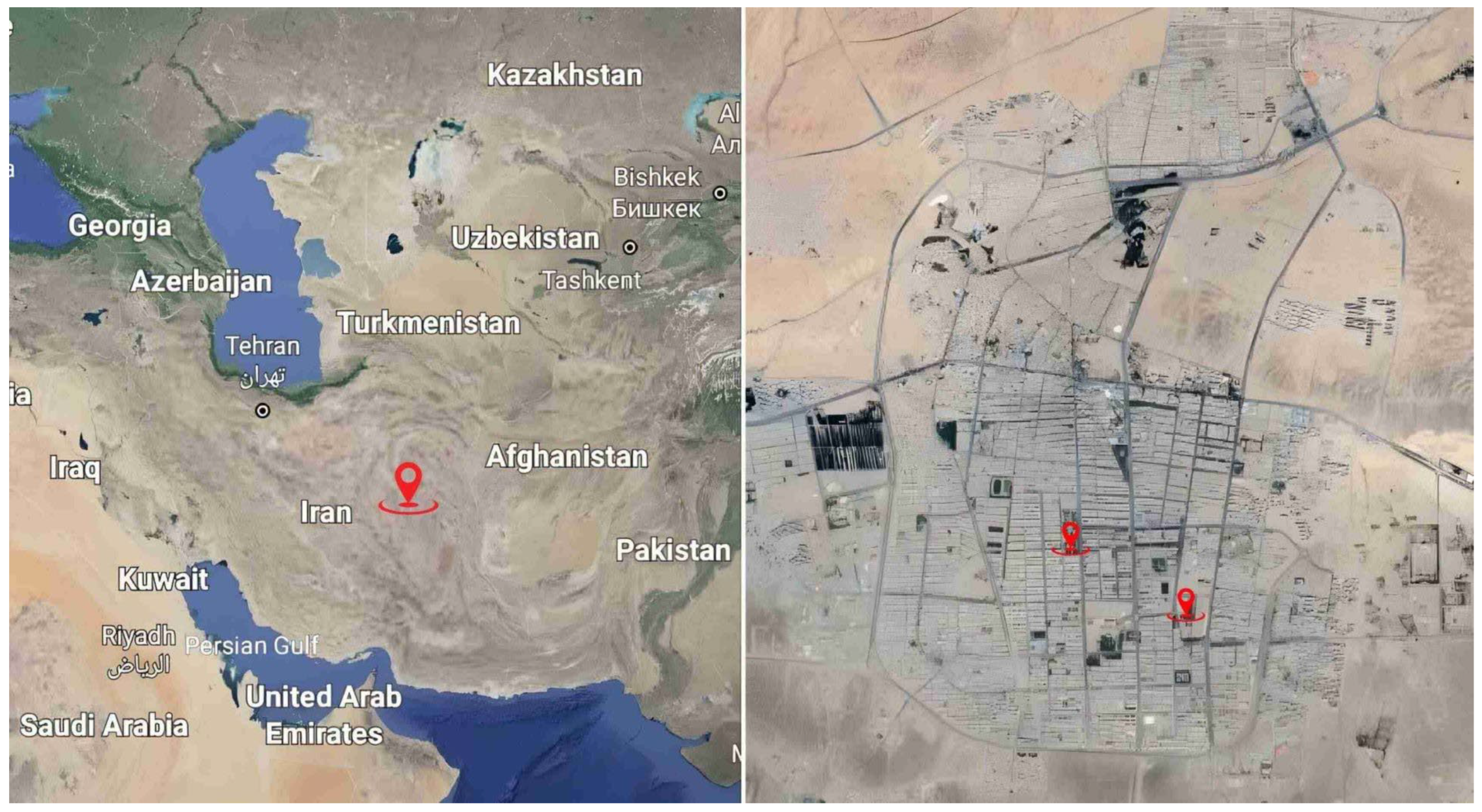
Figure 2.
Top: Tohid Park, clockwise: pomegranate trees in front of the mosque, ponds empty due to drought, mulberry tree on the side of a path, pomegranate trees within lawn area where people like to sit. Bottom: Akbarieh Garden, clockwise: main path bordered with ancient pine trees, pistachio trees within the agricultural section, an ancient mulberry tree beside the garden’s wall, recent planted jujube trees in the agricultural section. Pictures from author RK. .
Figure 2.
Top: Tohid Park, clockwise: pomegranate trees in front of the mosque, ponds empty due to drought, mulberry tree on the side of a path, pomegranate trees within lawn area where people like to sit. Bottom: Akbarieh Garden, clockwise: main path bordered with ancient pine trees, pistachio trees within the agricultural section, an ancient mulberry tree beside the garden’s wall, recent planted jujube trees in the agricultural section. Pictures from author RK. .
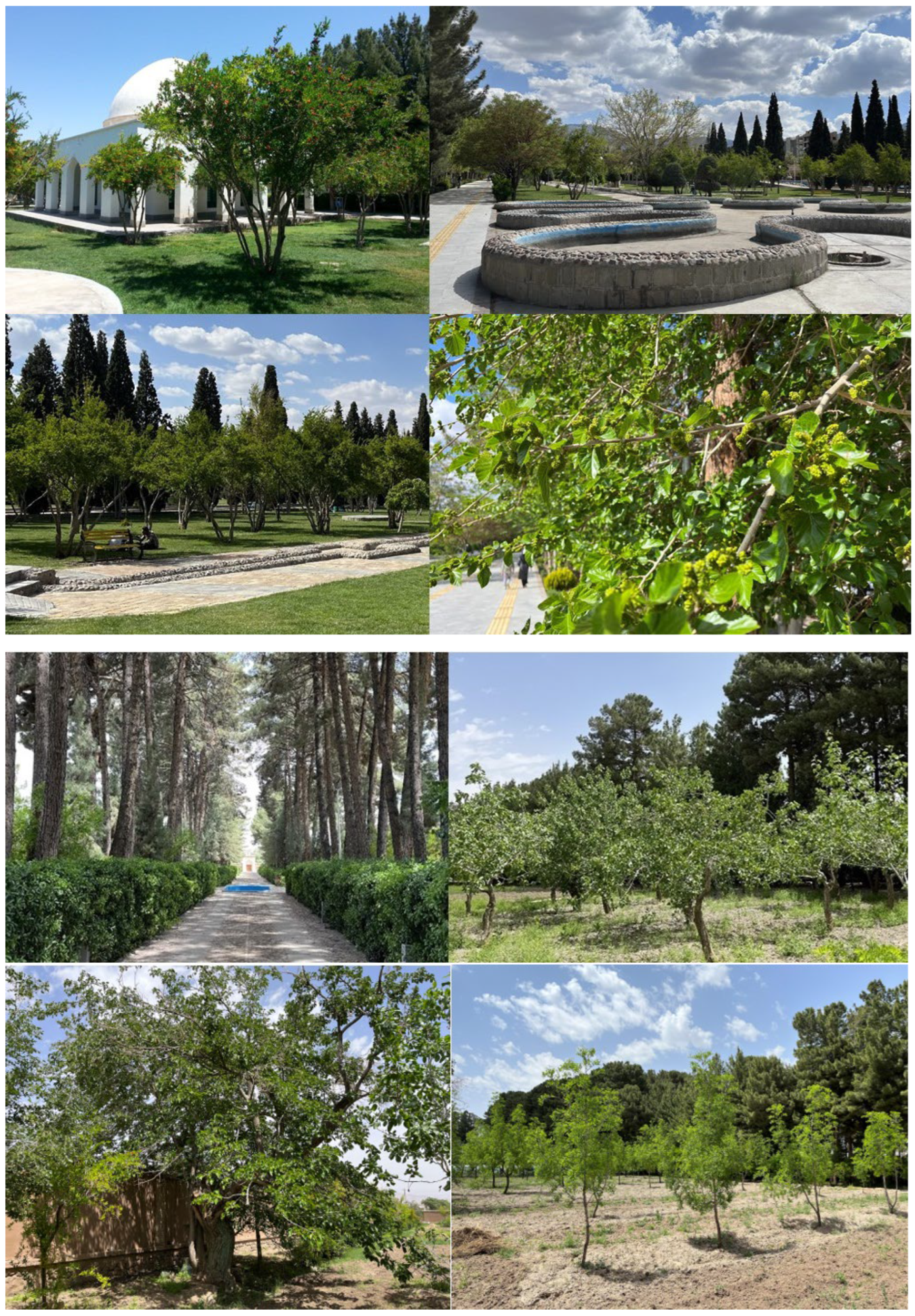

Table 1.
Background information on the visitor participants.
| Pseudonym | Gender, age | Occupation(s) (past) |
| Arman | M, 54 | University academic staff |
| Baraz | M, 45 | University professor in Arts |
| Azar | F, 40 | Housekeeper (Masters student in Art and Islamic Art) |
| Darius | M, 77 | Retired (employee of Ministry of Agriculture) |
| Firuz | M, 14 | Student |
| Esther | F, 48 | Housekeeper (university lecturer in agriculture) |
| Laleh | F, 20 | Interior designer |
| Simin | F, 24 | Housekeeper, leather craftworker (university student) |
| Yasmin | F, 22 | University student |
| Jahan | M, 72 | Retired (teacher) |
| Kaveh | M, 79 | Retired (bank officer) |
| Ziba | F, 32 | Master student in archeology |
Disclaimer/Publisher’s Note: The statements, opinions and data contained in all publications are solely those of the individual author(s) and contributor(s) and not of MDPI and/or the editor(s). MDPI and/or the editor(s) disclaim responsibility for any injury to people or property resulting from any ideas, methods, instructions or products referred to in the content. |
© 2024 by the authors. Licensee MDPI, Basel, Switzerland. This article is an open access article distributed under the terms and conditions of the Creative Commons Attribution (CC BY) license (http://creativecommons.org/licenses/by/4.0/).
Copyright: This open access article is published under a Creative Commons CC BY 4.0 license, which permit the free download, distribution, and reuse, provided that the author and preprint are cited in any reuse.