

Submitted:
29 August 2024
Posted:
30 August 2024
You are already at the latest version
Abstract
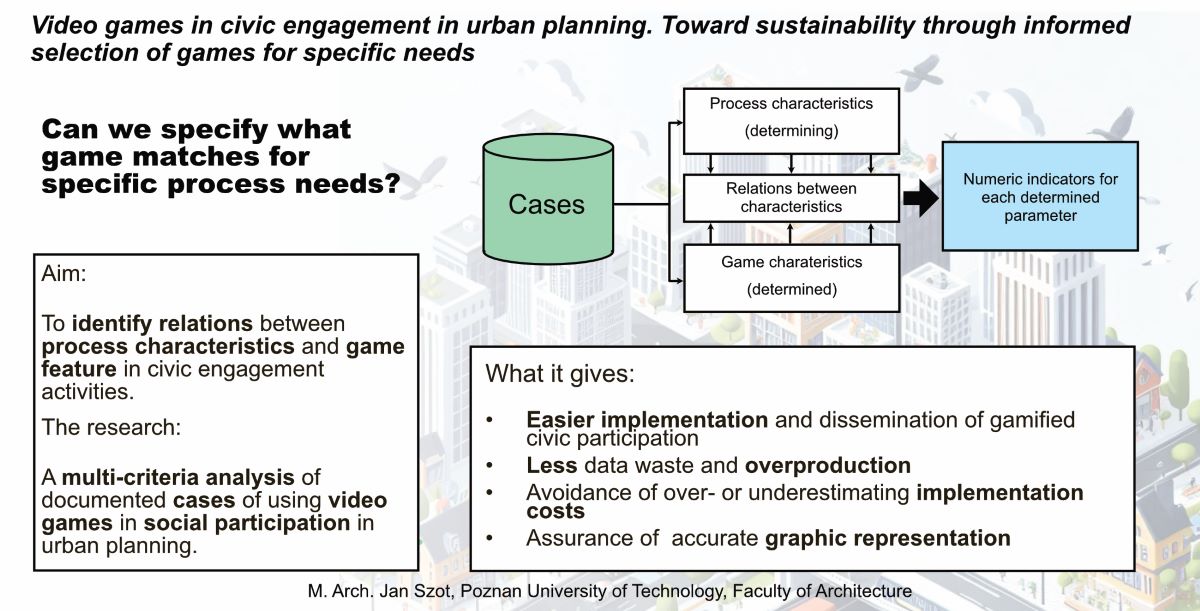
Videogames are recognized as significant tools and mediums to be used in civic participation in spatial planning and fostering local communities. As the phenomenon is widely recognized in papers presenting singular case studies and broader analyses in the field, selecting such serious games with certain characteristics remains unclear. The informed process of choosing games with particular properties regarding genesis, graphic style, genre, and complexity as the response for specified needs and process assumptions appears to be supportive in preventing unnecessary costs and data overproduction. Such avoidance is an important part of sustainable digital transformation. Therefore there is a need for the more conscious process of selecting videogames to be used in a participatory process. The following paper aims to propose a decisional instrument that could be useful for specifying the characteristics of games to be utilized in participation. They performed a multicriteria analysis of documented cases of implementing video games in civic engagement, allowing the creation of a set of numeric indicators that help determine the properties of games that will be most appropriate for given process assumptions. Such a tool can prevent overproducing data on the one hand and may cause dissemination presented way of handling the participation process on the other.
Keywords:
digital civic engagement
; sustainable urban planning
; videogames implementation
1. Introduction
Public participation in urban planning is an important element in building sustainable communities based on co-creation, dialogue and mutual respect. This process is supported by diverse tools and technologies among which video games are an extremely interesting example. Despite their virtuality and entertainment origins, they are applied in solving problems related to the real world becoming so-called serious games. The phenomenon of the implementation of video games in social participation has been a growing research issue over the past decade [1]. Due to their original nature, serious games allow the development of awareness regarding important phenomena and relationships occurring in architecture and urban planning in an accessible and engaging way [2]. In 2004, Carl O'Coill and Mark Doughty already saw this cultural medium as a tool for presenting complex issues and spatial problems more fully and comprehensibly than using analog methods [3].
Virtual space of video games has become a field of spatial discourse of diverse stakeholders in a given space [4] creating a “space to think with” enabling creative consensus [5]. The collaborative creation and interactive evaluation of solutions based on the cooperation of experts and non-profesionals is an important link that narrows the gap between designers and space users while leading to increased democratization and decentralization of the urban space creation process [6]. An important motivation for the use of video games is also the involvement in participatory processes of children and young people for whom the medium in question is often a familiar and well-liked environment [7]. It is essential to mention the game Minecraft (Mojang, 2011), which is a unique platform for spatial content [8] allowing to visualize spatial problems in a highly accessible form [9]. This is an example of a tool that is useful for processes involving small and medium-sized spaces and taking place all over the world regardless of cultural circles or economic status [10]. Another compelling case is the game Cities: Skylines! (Colossal Order, 2015) used in projects involving district or city scale areas [11,12].
Video games used in the process of public participation have a diverse form, using a wide range of technological possibilities. This is due to a number of factors related to the characteristics of the space, the purpose of application and the intentions of their creators and process organizers. One can distinguish here games using Augmented Reality technology [13],or online games using open databases [14]. There is no shortage of productions that aim to massively receive and collect feedback from users constituting an important contribution to informing the process of creating local spatial policy [15]. Information from users can take the form of both intentional suggestions [16] and be the result of data mining allowing the creation of extensive databases about users and their preferences and spatial needs which makes it possible to predict certain trends in the behavior of urban residents [17,18].
The remarkable diversity in the types of games and the contexts in which they are used raises the very important question of how to select games and their characteristics for specific assumptions and process needs. This is an important question insofar as public participation is an important element of the 11 Sustainable Development Goal relating to sustainable cities and communities [19]. On the other hand, however, the use of mis-suited games can lead to a pre-digestion of the process and an overproduction of data that will in no way meet the real needs of the process organizers. Thus, a potential conflict with the 12 SDGs on responsible consumption and production arises here. Therefore, a real need arises from the point of view of sustainability to develop an instrument to support the selection of video games to meet specific needs. The purpose of this paper is to show the process of developing a universal methodology for obtaining guidelines for game features that meet the objectives of the participatory projects.
2. Related Works and Research Gap
The implementation process is a sequence of decisions made based on reliable information related to the issue being addressed. Therefore, it is crucial to parameterize selected aspects of the information on the phenomenon had a clear and measurable form. In recent years, one can encounter efforts to identify new ways to involve citizens in participatory processes [20].
Subject literature is aware of a number of publications both review [21,22,23,24,25,26,27] and on single cases [1,4,5,7,11,13,14,17,18] undertaking parameterization to describe the mentioned processes. These data cover both the games used in participation and information about the process itself. In addition, guides containing full introductory descriptions of single game implementations for the participation process are equally known [28,29] as well as works undertaking implementation considerations for specific technologies [30].
The following tables (1 and 2) show the parameters present in the literature that describe serious games and the participatory processes that assume their application. Among the games used, special attention is paid to game mechanics, technologies used, dynamics of gameplay, and genre. Interestingly, the issue of graphics which is, it would seem, one of the key elements in games, rarely appears. In the case of information about processes, much attention is paid to the target participants in the process, their age and the stage of implementation of the spatial policy covered by participation. The lack of reference to the assumed level of maturity of participation is puzzling. The ladder of participation developed by Sherry Arnstein [31].

Table 1.
Game-related parameter identified in literature. (Source: author).
| Game-related parameter | Source |
|---|---|
| Genesis | [21] |
| Gameplay goal/ mechanics | [21,23,25,26] |
| Challenge | [21] |
| Rules/ dynamics | [21,23,25] |
| Boundaries | [21] |
| Feedback | [21] |
| Identification data (name, release date) | [22,25,26] |
| Type/ technology | [22,25,26] |
| Genre | [22,25,26] |
| Aesthetics/ graphics | [23] |
Table 2.
Process-related parameter identified in literature. (Source: author)
| Process-related parameter | Source |
|---|---|
| Participant gender Participant age Religion Seniority in community |
[5] [5,22,24] [5] [5] |
| Supported SDG | [22] |
| Game topic/purpose of use | [22,24,26] |
| Location | [24] |
| Policy stage | [26,27] |
Thus, a review of the literature on the subject shows that the topic of classification and implementation of video games in social participation is an issue addressed relatively often, but it is usually of a single title or use case specific nature. Therefore, it is not known whether, having specific process assumptions, an adaptation of a market product should be used or whether it should be a completely new game tailored for a particular case, what graphics it should have and what its other features should be. On the other hand, having sizable reviews of serious games used in participation, it is difficult to say unequivocally what the scope of their usefulness is and whether it goes beyond their documented use cases. It creates a significant research gap that this paper aims to cover.
3. Concept and Development of the Tool Supporting Selection of Video Games for Participatory Process
3.1 Main Concept of the Tool and Research Behind
The main goal of developing the tool was to enable the identification of relationships between process, demographic and spatial factors of social participation and the properties of games used in these processes. As a result, this is to avoid overestimating or underestimating implementation costs and also to reduce the overproduction of data in the process.
The tool's operation is based on data collected from documented cases that have been evaluated based on specific parameters. The evaluation results were used to build a matrix of connections constituting the basis for calculating numerical indications that constitute guidelines in the decision-making process (Figure 1).
3.2 Collecting Data
Data used in the study was acquired from a variety of heterogeneous sources such as:
- Scientific papers – works of researchers presenting selected case studies, provided most data for the study.
- Reports – publications of Non-Government Organizations that carried out some of the cases.
- Online survey forms – authored forms sent to researchers and other people involved in the participatory process, full survey is included in Appendix A.
- Internet sources – websites of serious game developers used in several cases
- Geoinformation services – platforms such as Google Earth provide information about areas of investigated cases.
- Email queries – correspondence with organizers of some cases provided information about participants and conducted process.
- Authored research trials - covered selected productions used in some cases and provided information on graphic style.
3.3. Evaluated Parameters
Gathered cases were evaluated according to the set of specified parameters that were divided into two groups – determining describing characteristics of the process and determined related to used videogames.
Determining parameters were describing the following characteristics:
- Area – numeric value expressed in square meters describing the development area.
- Type of space – parameter presenting the general characteristic of the space ex. street, square, neighborhood, or district.
- Urban context – based on CNU urban transects, this parameter describes the surroundings of the subject area such as downtown, suburbs, and rural areas. To refer to non-formal settlements specific to the global south known commonly as slums additional value (SN) was added.
- Number of participants – a numeric value representing a number of participants from a variety of interested stakeholder groups.
- Accessibility of the process – open for a fully accessible process (anyone can join), semi-open for fully open but with a selection of final participants, semi-closed for processes addressing specific groups of users (ex. students or workers of certain facilities), and closed for process dedicated to specific users.
- Mode of the process – remote, mobile, on-site, hybrid respectively for the process including remote participation using stationary devices, remote participation using smartphones, smartwatches, and other mobile appliances, on-site participation at the designated place and time, a process combining the aforementioned modes.
- Level of participation – according to the commonly used Arnstein ladder.
- Purpose of using a video game – reason why the video game was used – ex. social discourse, need for spatial changes, etc.
- Role of the game within the process - superior or complementary.
The second group of parameters were related to characteristics of video games used in the process. Assuming that potential users of the instrument may not be familiar with video games as a medium, not to mention using them as serious tools enhancing real-world processes these parameters were simplified and limited to the following four:
- Genesis – describes where the game comes from to the process whether it is an adaptation of a ready-made product, its modified version, or an entirely new game tailored for the process.
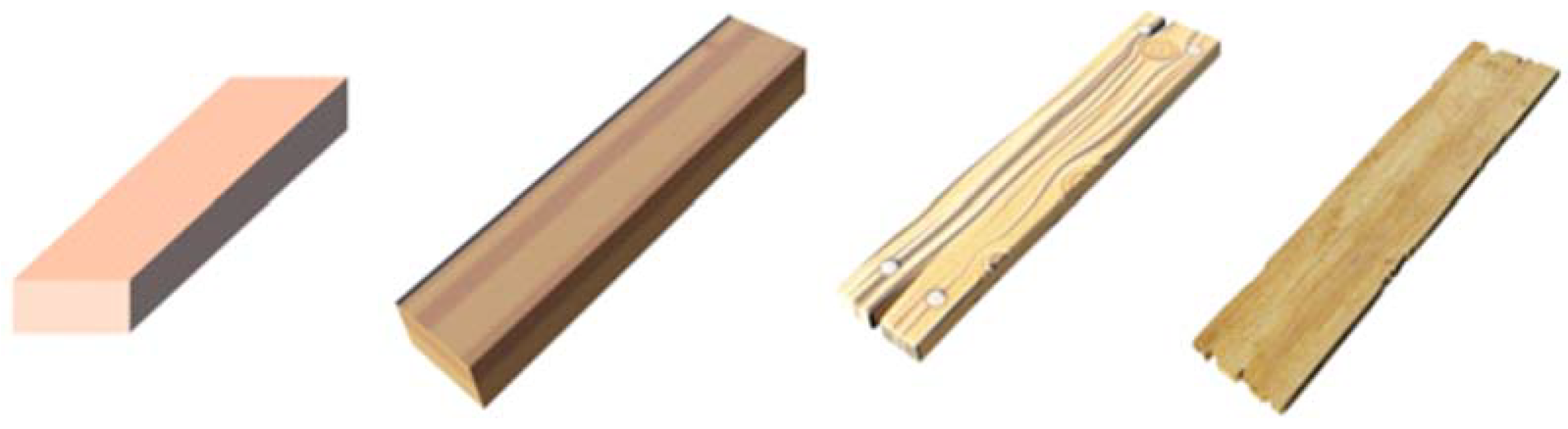
- Graphic style – this characteristic may be considered as the Level Of Detail of presented content with four possible values: symbolic, simple, stylized, and realistic. References for these values are presented in the figure 2.
- Genre – a type of the game – strategy, city builder, etc.
- Gameplay complexity – level of real-world accuracy of presented content.
Figure 2.
Summary of examples of each graphic style; from left: symbolic, simplified, stylized and realistic (source: author).
Figure 2.
Summary of examples of each graphic style; from left: symbolic, simplified, stylized and realistic (source: author).
3.4. Developing the Tool
The set of numerical indicators developed in the study is based on information about the collected cases of the use of video games in participatory processes. The collected cases were analyzed based on the same assumed parameters of urban-spatial, demographic, process, and technological nature. These characteristics were also divided into determining and determined. This was done to create a matrix of relationships between the values of individual parameters from the two groups allowing to determine the correlation for which process assumptions (values of the determining parameters) there are specific solutions for the selection of game characteristics used in the process (values of the determined parameters).
The calculation of preliminary indications for individual parameter values was based on collected, documented cases of video games in participatory processes with the actual participation of residents, i.e., in real processes. It is assumed that the information base will be enriched with further cases to refine the indications.
The role of the user - the initiator of the process - will be to draw up process assumptions, that is, to determine the characteristics of the area subject to the process, the number of participants, and the target age groups. Then the adopted assumptions in the form of values of individual parameters are entered into a set of indications. Using the value matrices, the weights for all determined parameter values for the entered information are summed. Thus, the user receives numerical indications for all values of the determined parameters. The higher the indication at a given determinate parameter value, the more recommended it is for specific process assumptions. A form of user feedback is also assumed - whether the solutions with the highest indications met the main process objectives.
3.5 Calculation and Application of Indications for the Selection of Video Games for Public Participation
The parameters of the evaluated cases were divided into two groups - determining and determined:
d - determined parameters
D - determining parameters
In each group there is a certain number of parameters equal to k for d and p for D. Each parameter for the case takes some value:
dki - values of the k-th parameter d
Dpi - values of the p-th parameter of D
Individual values of dki and Dpi co-occur with each throughout the cases studied a certain number of times. It forms the basis for calculating the indications, which are a measure of the correlation of pairs of dki and Dpi. The indication for a given pair of values can be described as the ratio of the number of all instances of its occurrence to the number of all occurrences of a given dki value:
wdkiDpi = ndkiDpi/ndki
where:
wdkiDpi - indication of the correlation of Dpi and dki values
ndkiDpi - number of occurrences of a given pair of values
ndki - number of all occurrences of dki values
Calculating the correlation indications for all pairs of values in this way, we obtain indication matrices for individual pairings of D parameters with individual d parameters (Table 3).
The values of the indications range from 0.00 (for the non-occurrence of values) to 1.00 (for the occurrence of a given value of parameter d only with a given value of parameter D). Of all the indications received, values greater than and equal to 0.50 were drawn, and they form the basis of recommendations for selecting the values of the determined parameters (Table 4).
In the case of values of parameter d that are not mutually exclusive - such as age groups - the number of all indications for a given parameter d was summed and divided by the number of all values of the parameter. Prepared in this form, the set of recommendations having the form of tables separate for each determinant parameter can be used as a basis for determining recommended values of parameter D for the adopted values of parameter d. Having the values of parameter d ready, one can calculate the sums of indications for individual values of parameter D:
where:
- wDpir - target indication value for the r-th given value of the p-th parameter D;
- wdkiDpir - indication value for the r-th given value of the p-th parameter D at the assumed value of the k-th parameter d;
- k - the number of determining parameters.
In this way, the values of the individual D parameters with the highest sums of indications will provide recommendations for the set values of the d parameters representing the process assumptions.
It is also assumed that the indications can be used in the reverse direction for selecting potential applications of selected games. In this case, having specified parameter D, we select the values of parameter d with the largest indication sums within a given value of parameter D.
4. Results
4.1. Gathered Cases and Results for Determining Parameters
Study included 11 real-life cases of using videogames in urban civic participation documented sufficiently to account them into evaluation. Cases, years and used games are shown in Table 5.
As it may be noticed, there is a significant majority of od adapted of modified products originally made for commercial users. There is also noticeable tendency in most recent cases using tailored serious games.
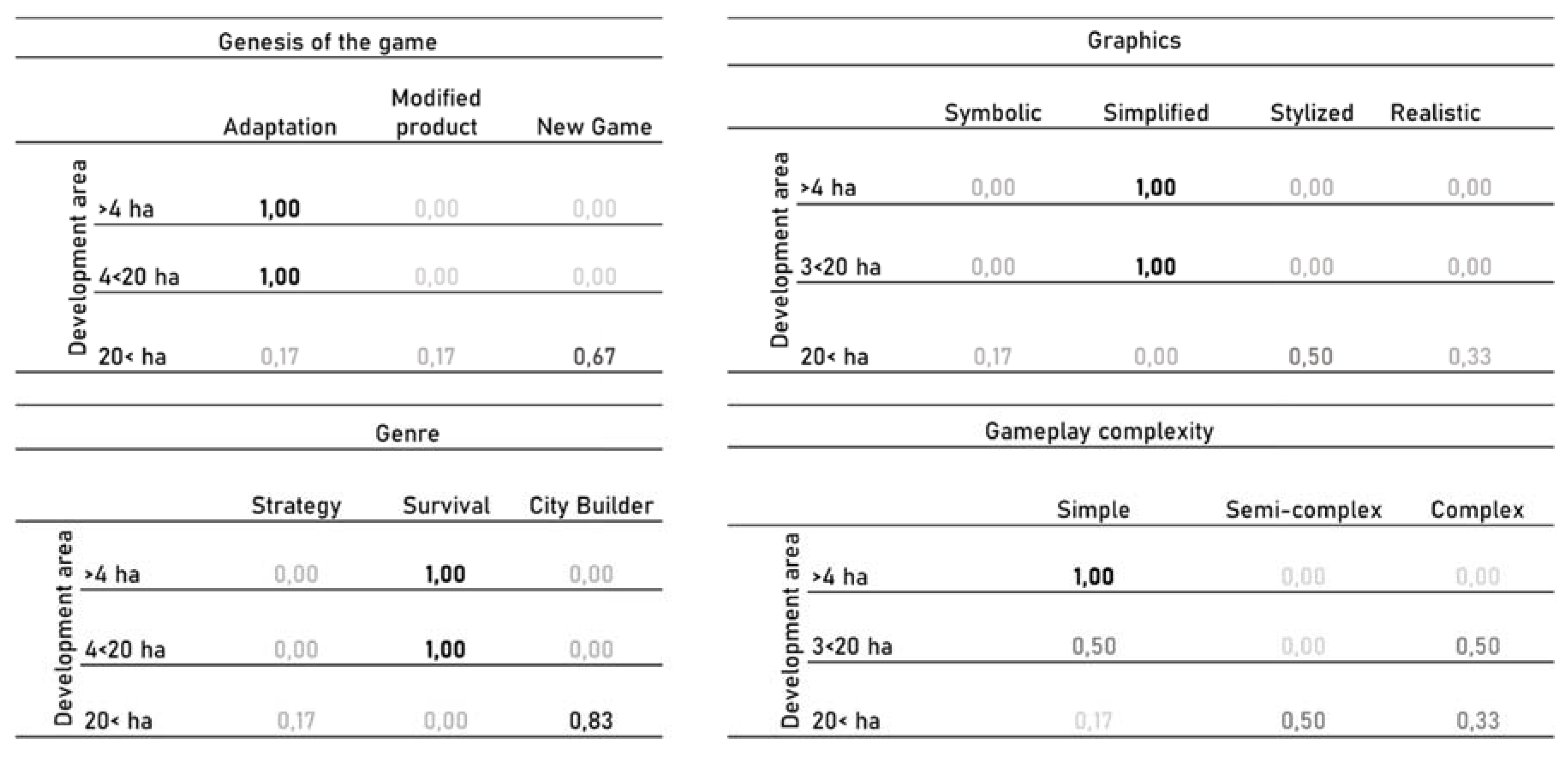
Once gathering process was over, each case was evaluated according to parameters specified in chapter 3.3. For the area parameter, games such as Minecraft are recommended for smaller areas, while adaptations of existing products or more complex games such as Cities: Skylines work better for larger areas (over 20 hectares). The choice of graphics and complexity of gameplay also depends on the size of the area, with symbolic and simplified graphics used for smaller areas, and stylized and realistic ones for larger ones.
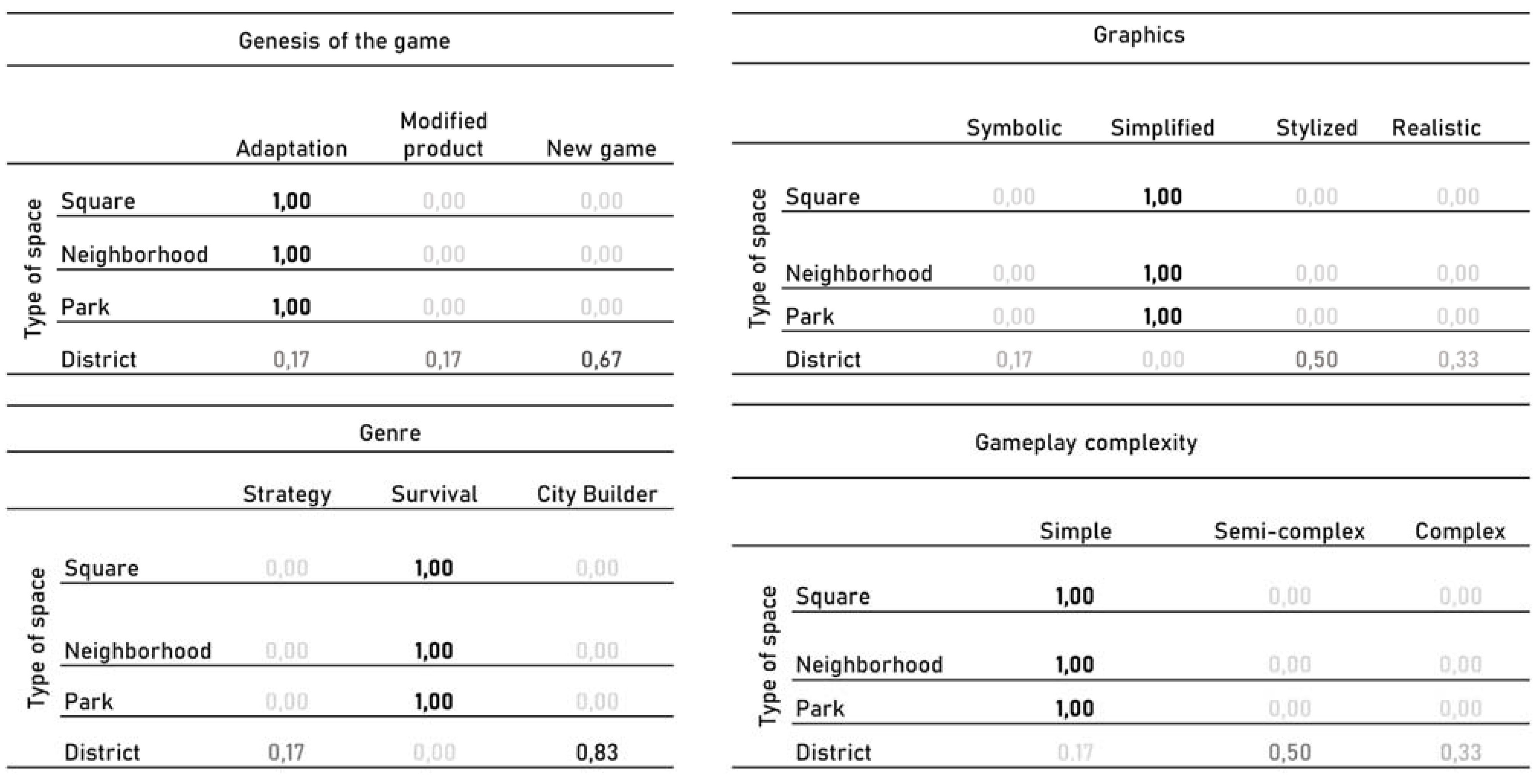
The game use cases studied involved different types of spaces, from parks to entire districts. Adaptations of off-the-shelf games were comprehensively applied, covering different types of spaces, particularly districts. Modified products and new games mainly addressed larger areas, such as districts. On the graphics side, games with simplified graphics were applied to all types of spaces outside of neighborhoods, while stylized and realistic graphics were associated only with activities involving districts. Game mechanics showed similar patterns - simple games covered all types of spaces, while more complex mechanics were mainly used in the context of districts.
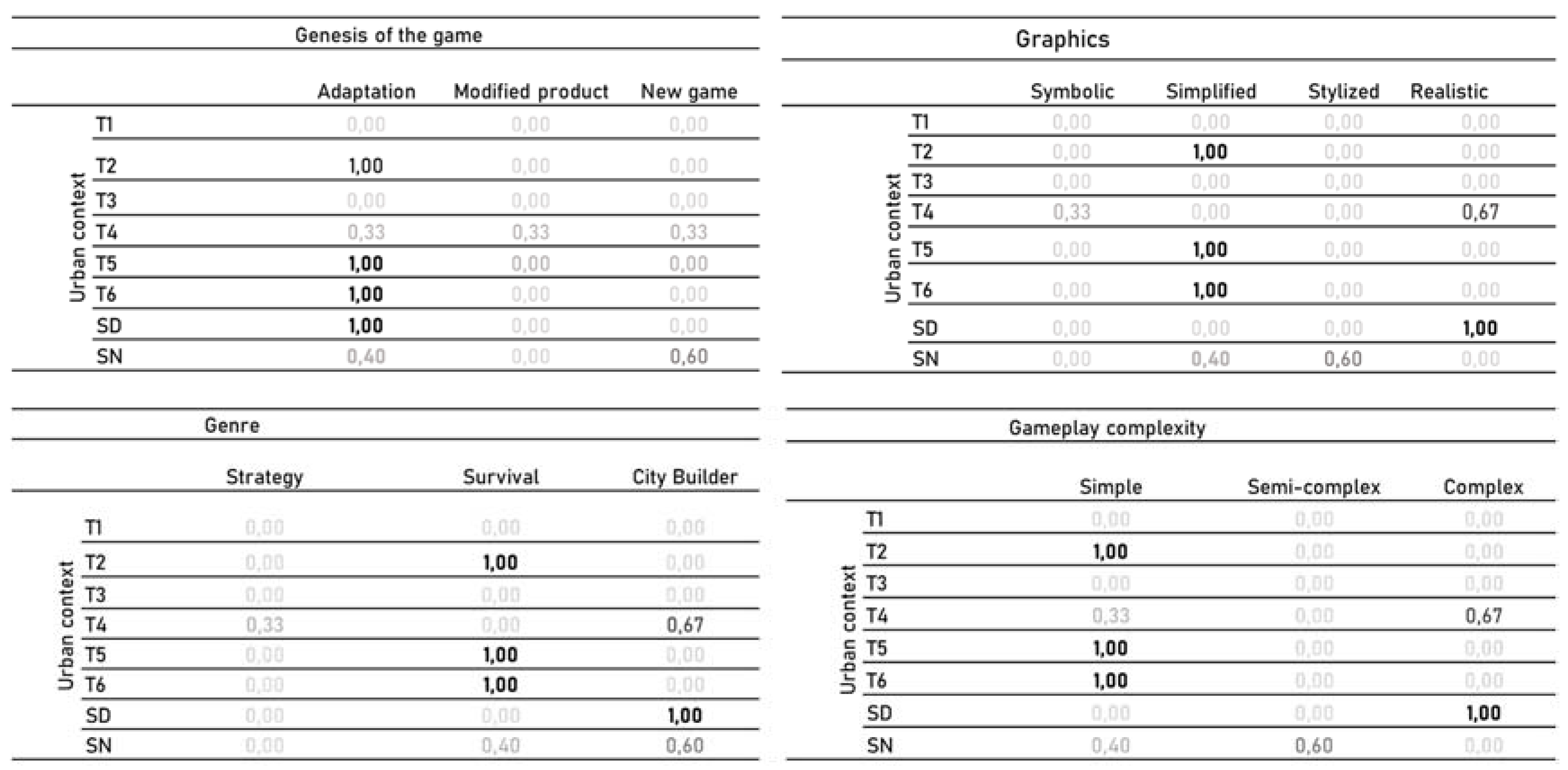
As for the urban context, game adaptations dominated in areas such as T2, T5, T6 and SD. For T4 and SN, both modified games and city builders were used. Simplified graphic style dominated in T2, T5, T6, and realistic in T4 and SD. Uncomplicated mechanics dominated in the T2, T5, T6 areas, while more complex mechanics were characteristic of T4 and SD.
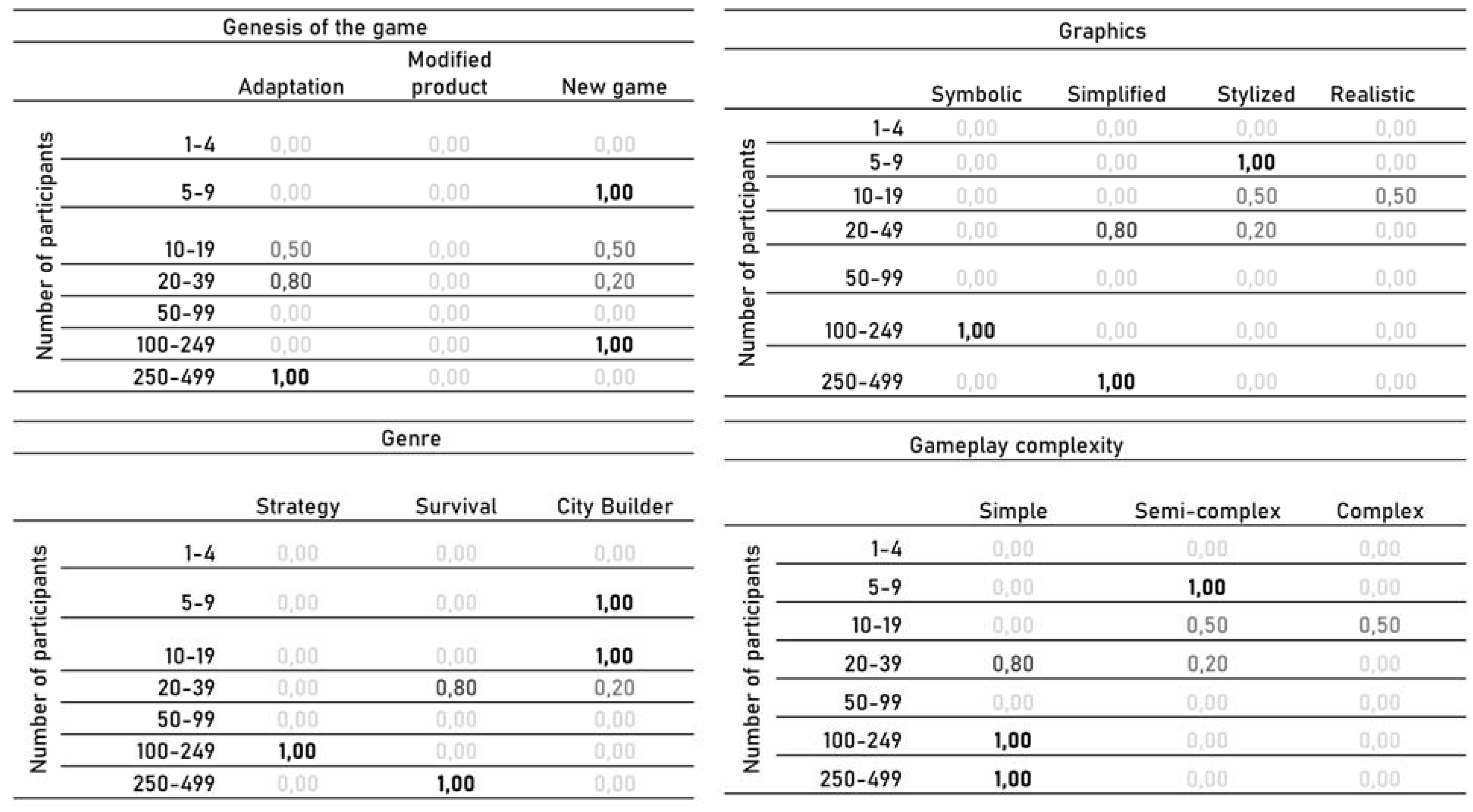
Participatory processes using video games were characterized by a wide variation in the number of participants. Game adaptations were used in processes with a number of participants ranging from a dozen to several hundred, while new games were used in processes with a few to more than 100 participants. Symbolic graphics were present in cases with a range of 100-249 participants, while simplified graphics were used in processes involving both up to 50 and more than 250 people. Uncomplicated mechanics were preferred in processes with groups of a few dozen to more than 250 people, while more complex mechanics appeared with smaller groups.
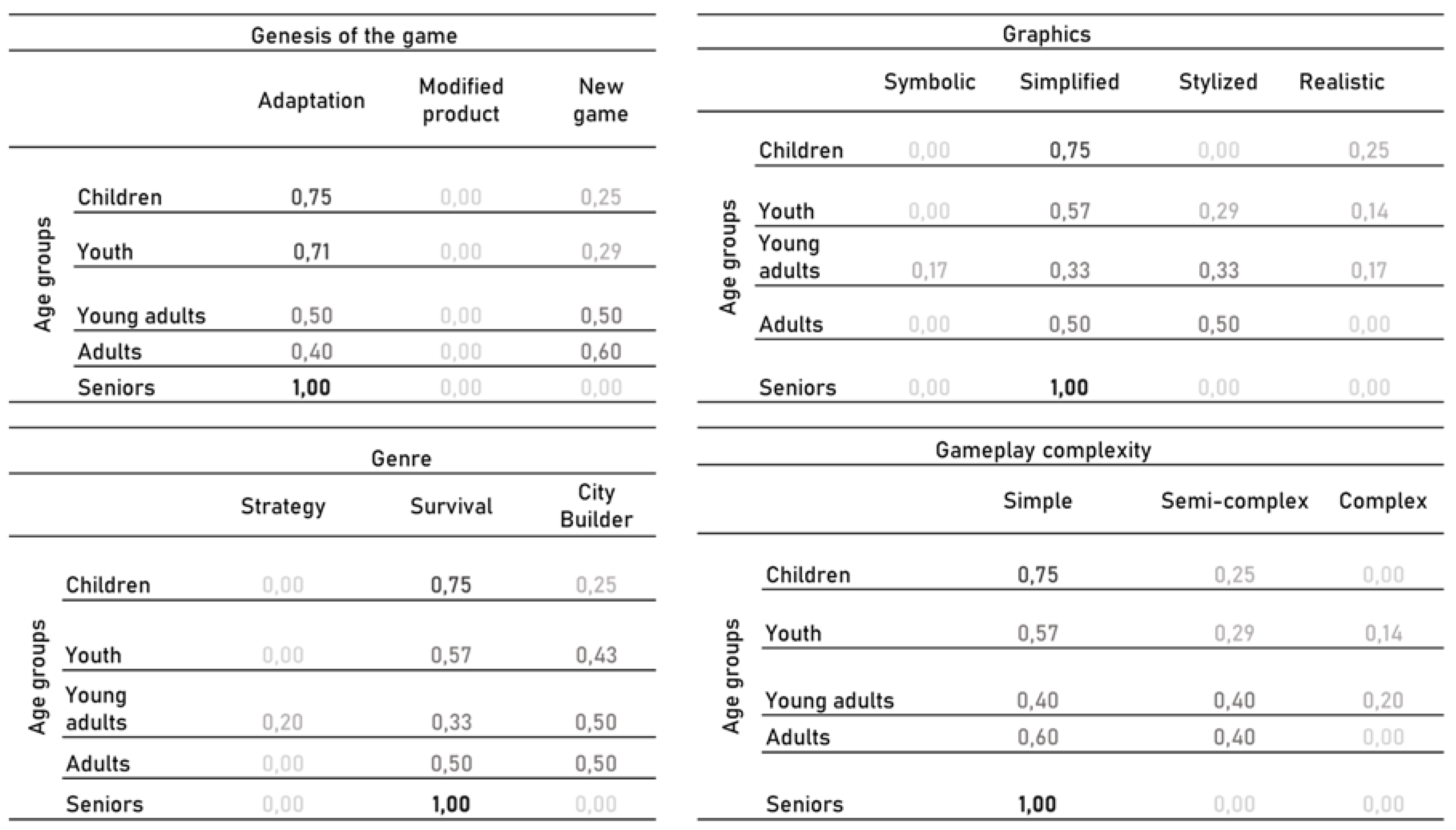
The age of participants was important in the study, but accurate data was rarely available. Game adaptations were used in all age groups, while new games were not used in processes involving older people. The simplified graphic style was versatile, and stylized graphics were not found only in trials with older people. Realistic graphics were used mainly for adolescents and young adults.
Semi-closed, semi-open and open processes showed a weight dispersion, with a slight preference for new city builder games. The complexity of game mechanics was inversely proportional to the openness of the processes, indicating a preference for simpler games in more open processes.
The mode of process implementation was key to how the process was carried out. Most of the processes were executed stationary, with one exception of remote execution in Hameelinna, where a city builder game with realistic graphics was used. Only Mordor Shaper, a strategy game using geolocation, appeared in mobile mode. Stationary processes tended to use adaptations with simplified graphics.
Activities using games in participation were aimed at increasing residents' influence on the surrounding space. Higher levels of participation were characterized by game adaptations, especially in the creative mode. New and modified games appeared more often in opinion and consultation processes, and the graphic style depended on the mode - simplified and symbolic graphics were used in the creative mode, and stylized ones in the consultation mode.
Games used in different contexts had specific characteristics depending on the purpose of their use. For education, adapted games were most often used, as well as those with simplified or realistic graphics. Stylized games were more often used for the exploration of ideas, while all graphic styles could be used in socio-spatial dialogue. Uncomplicated games were used for education, spatial change, increased social engagement and dialogue. Moderately complex games were used in idea exploration and dialogue, while the most complex mechanics were used in education, spatial change and dialogue. The most adapted survival games were used in spatial change, while strategy and city builder games with more symbolic graphics worked well in idea exploration and increased social engagement.
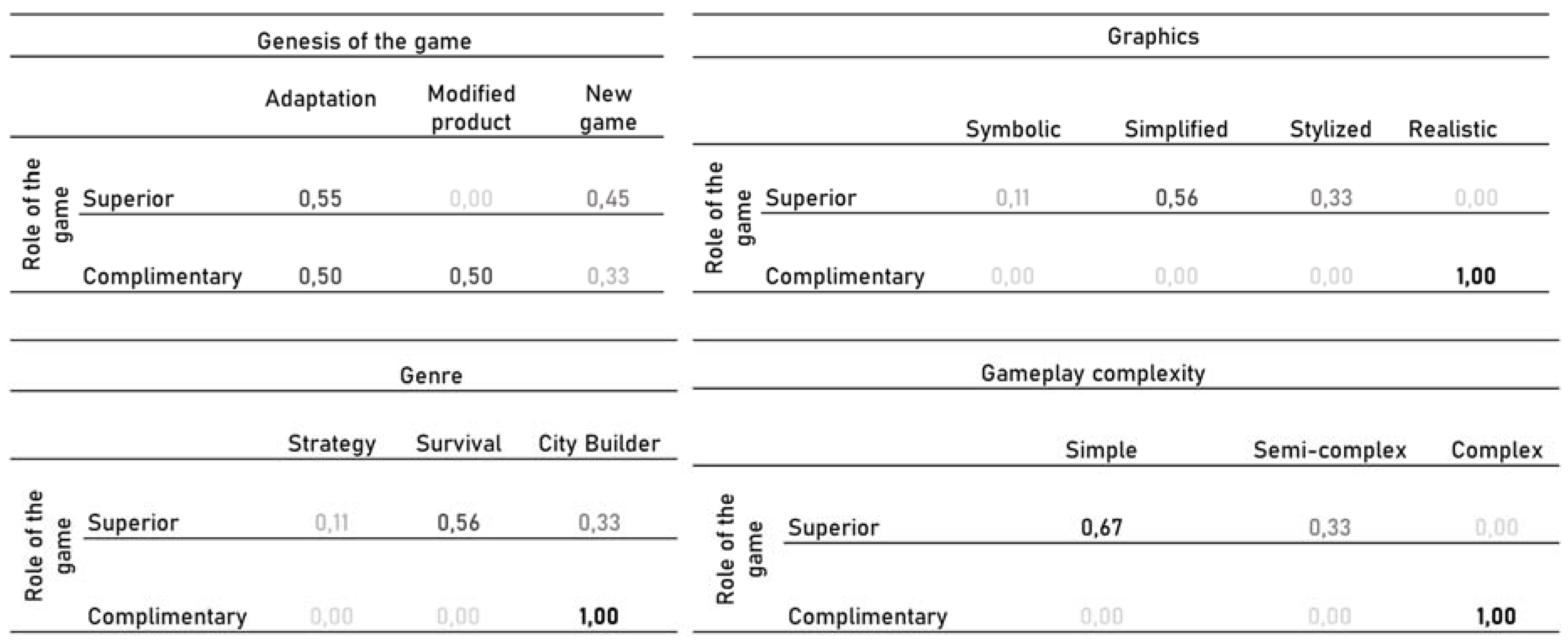
Video games used in social participation can play different roles in the process, such as a superior or supplementary position. Games with an overarching role, often based on adaptations or new games, were characterized by simplified or stylized graphics, and their gameplay was uncomplicated or moderately complex. Superior role-playing games were both survival and city builder games. In contrast, games with a supplementary role often had realistic graphics, came from adaptations or were modified products, and their mechanics were more complex.
With all values ready numeric indications for each determining parameter were calculated. Detailed results for each parameter were included in Appendix B of this manuscript.
4.2. Summary of Calculated Values for Subsequent Determined Parameters
Adaptations of existing market products are used in cases involving spaces of parks, squares and neighborhoods with relatively small areas, less than 20 hectares, set in both rural and urban contexts. These processes are characterized by indications of the number of participants above 250 and between 20 and 49. Adaptations are also aimed at audiences of virtually all age groups. The processes are both remote and stationary; they are characterized by varying degrees of openness: closed, semi-closed and open. Games are used to obtain assumptions for spatial changes and as a platform for socio-spatial dialogue, and their position is rather paramount in the participatory process.
For modified products, with the exception of the supplementary item, the process lacks indications among the values of determining parameters. The indications for new games are, as one might guess, largely the inverse of the indications for adaptations. Thus, we are talking about large areas of neighborhoods set in the context of informal habitats, characteristic of the global South. The processes are directed to both small (up to 9) and large (over 100) groups of participants, are semi-closed or semi-open, and work best for the mobile mode. The greatest use can also be found for the opinion and consultation mode of participation aimed at exploring scenarios and increasing public involvement. However, there is a lack of indication of the role of the game in the process. Recommendations for all types of genesis are presented in Table 6.
Symbolic graphics have indications for the number of participants - groups of more than 100 participants. These are mobile and semi-closed processes directed at increasing involvement in the process of creating local spatial policy. The simplified graphic style is characterized by indications for areas of relatively small size, namely squares, parks and neighborhoods in a downtown or rural context. The processes here target the full spectrum of age groups and are stationary in nature. A simplified graphic style applies to both open and closed processes, and participation was carried out in a creative mode. Games in the process had an overarching function and were used to obtain assumptions for spatial changes and to support socio-spatial dialogue. The stylized graphics have moderate recommendations for large-area themes, such as districts set in the context of informal habitats. It characterizes productions used in processes involving up to 20 people, usually adults. The process is characterized by half-openness, and participation is carried out in an opinionated and consultative mode. Games are used as a medium for exploring spatial scenarios. Realistic gaming is applied to themes set in suburban contexts and special districts, such as warehouse or industrial districts. The process is open and remote, and games are used supplementarily for educational purposes. Table 7 shows recommendations for all graphic styles.
Table 6.
Summary of indications for individual values of the graphic parameter (source: author).
| Graphics | ||||||||||||
| Parameter | Symbolic | Simplified | Stylized | Realistic | ||||||||
| Area | none | up to 20 ha | 1,00 | 20+ ha | 0,50 | none | ||||||
| Type of space | none | Square, neighbourhood, park | 1,00 | District | 0,50 | none | ||||||
| Urban context | none | T2, T5, T6 | 1,00 | SN | 0,60 | SD | 1,00 | |||||
| T4 | 0,67 | |||||||||||
| Number of participants | 100-249 | 1,00 | 250+ | 1,00 | 5-9 | 1,00 | 10-19 | 0,50 | ||||
| 20-49 | 0,80 | 10-19 | 0,50 | |||||||||
| Age groups | none | Seniors | 1,00 | Adult | 0,50 | none | ||||||
| Children | 0,75 | |||||||||||
| Youth | 0,57 | |||||||||||
| Adult | 0,50 | |||||||||||
| Process accessibility | Semi-closed | 0,50 | Closed | 1,00 | Semi-open | 0,50 | Open | 0,50 | ||||
| Semi-closed, Open | 0,50 | |||||||||||
| Process mode | Mobile | 1,00 | On site | 0,56 | none | Remote | 1,00 | |||||
| Participation level | none | Creative | 0,72 | Opinion and consultation | 0,75 | none | ||||||
| Purpose of using game | Fostering engagement | 1,00 | Spatial changes | 0,80 | Idea exploration | 1,00 | Education | 0,50 | ||||
| Socio-spatial discourse | 0,57 | |||||||||||
| Education | 0,50 | |||||||||||
| Role of the game | none | Superior | 0,56 | none | Complimentary | 1,00 | ||||||
Strategies are characterized by a low number of indications, indicating rather low versatility and utilitarianism compared to other genres used. It is known that they can be used for groups of more than 100 people in semi-closed processes implemented to increase social engagement.
Games of the survival genre show particular usefulness for themes covering medium and small areas of neighborhoods, parks and squares. For context, we are referring to T2, T5 and T6 zones. Activities are directed to both large groups (over 250) and groups of a few dozen participants. What is missing here is a trend in the accessibility of the process - so these are rather comprehensive games in this regard. The process itself tended to be stationary, and participation - creative level. Games were used for educational purposes as a tool for forming assumptions for spatial change and as a medium for dialogue. They also had an superior position in the process (Table 8).
Productions with low complexity of mechanics were applied to projects involving small and medium-sized areas, namely parks, squares and neighborhoods. Downtown and rural contexts appeared here. Processes were aimed at all age groups, and involved both a few dozen and more than 100 participants. Accessibility to the process was full, partial and completely closed, and the process itself was carried out in mobile mode, but a stationary version should also be considered. Participation had a creative level, the game was used for educational purposes, gathering assumptions for spatial changes, as a platform for dialogue and as a factor to contribute to the growth of public involvement. The medium-complex mechanics were applicable to large areas of districts. The largest indications here are for informal habitats, and the processes target smaller groups of participants with no indication of specific age groups and are semi-open.
The level of participation is lower than for the previous parameter - opinion and consultation. Games are used as a medium for exploration of ideas.
The last group of productions with complex mechanics has indications for averages in terms of the area of topics concerning suburban contexts. Processes in this case are directed to groups of several people without specific age indications, and are open and remote in nature. Games are used for educational purposes and have a supplementary role in the projects. A list of recommendations for the parameter of complexity of mechanics is presented in Table 9.
5. Discussion
Video games and gamification methods give a voice to those who often don't have one in governing urban space [32] therefore the issue of implementation of games in participation is important on the way to democratization of spatial development.
The issue of systemic implementation of video games in participation is admittedly taken up, but it usually concerns single titles or cases. The presented method of analyzing cases and determining numerical relationships between selected process factors and characteristics of the games used is an attempt to answer this question.
The results obtained in the form of numerical values describing the convergence between game features in process factors already partially confirm some of the findings of other studies. This is especially true of the need for simple mechanics in titles aimed at the widest possible user group. Also consistent with intuition are the results indicating city builder games as useful tools for processes involving larger areas such as city districts. At the same time, it should be noted that there is some bias in the results as a result of the lack of sufficiently documented cases and the availability of information on assumptions and process and participants. With this in mind, the tool was designed so that there is the possibility of adding more successful cases to the database making the indications more precise. In addition, both groups of analyzed parameters can be expanded or limited due to the needs and specialization of organizers. As for the indications themselves, it is often the case that for a specific process assumption we can obtain different convictions. Such an example is the gameplay complexity parameter for a game used for education purposes. Both simplified mechanics and complex mechanics received an indication of 0.50, which may be a contradiction of sorts. However, it should be noted that the indications produced are primarily intended to help in decision-making and not to decide for the organizers. The final selection will always depend on the given con-text and may not necessarily coincide with the received indications. It is important to keep in mind that video games are not a panacea making participation perfect [33] and the collected cases show how important accompanying activities such as workshops on the basics of urban planning or survey tours are as well [10].
6. Conclusions
This article presents a methodology for developing numerical indications describing the relationship between process factors in public participation in urban planning and selected properties of games used in these processes. Variety of games and contexts in which they are used raised a question about how do we match games with certain properties to our needs and how it can be systematized in order to enhance processes regardless of area, type of spaces accessibility of the process or target users.
The developed values calculated on the basis of the analysis of documented cases of the application of video games in social participation in urban planning provide a useful tool to improve the selection of video games for given process assumptions. This is to facilitate the popularization of the discussed methods of organizing participatory processes, which, thanks to the applied games, can provide better conclusions about the relationship of residents with the city space and also improve the co-creation of sustainable communities [33]. This can reduce implementation risks associated with under- or overestimation of costs, overproduction of data, lack of engagement, or lack of or excessive precision in graphical presentation of content.
The scalable nature of the calculation model makes it possible to add more cases to the database, thanks to which the indications become more accurate. In addition, it is possible to modify the sets of determining and determined parameters to match the needed accuracy of the indications.
Institutional Review Board Statement
Not applicable.
Informed Consent Statement
Not applicable
Data Availability Statement
All data gathered and used during the study is available by contacting the author.
Acknowledgments
Author would like to thank prof. Alenka Poplin for the help with preparing the survey form.
Conflicts of Interest
The authors declare no conflicts of interest.
Appendix A
Survey form in this study had the following form:
- Please specify the location for which videogames were used during planning process. (Country, City, District<if applicable>)
- Please specify the time(years) of the process - from decision of taking videogames for account to realisation/change implementation/any other expected outcome that at least partially finalized the process.
- Please specify the area of developed space (if any) [w/ unit]
- Please indicate the type of space considered in the process (street, square, park, district, etc)
- Please specify urban context of developed space.
- a.
- Rural
- b.
- Downtown
- c.
- Brownfield
- d.
- Blocks
- e.
- Other
- 6.
- Please indicate age groups of the participants. Last answer is for additional
- 7.
- notes about this aspect.
- a.
- 15<
- b.
- 15<20
- c.
- 20<30
- d.
- 30<45
- e.
- 45<60
- f.
- 60<
- 8.
- Please specify openness of the process
- a.
- Closed - only requested participants
- b.
- Semi closed - open participation included but with priority of requested participants
- c.
- Semi-open - open participation but with limits (amount of participants, level of their priority)
- d.
- Full open participation - anyone could participate
- 9.
- What level of participation was assumed for the planning process?
- a.
- Only informing the public about planning actions
- b.
- Justification of the planning actions taken
- c.
- Enabling opinions on presented plans
- d.
- Enabling suggestions and changes to presented plans
- e.
- Enabling participants to present own ideas for consideration
- f.
- Participants as main source of ideas and planning assumptions
- 10.
- Please specify groups and organizations involved in the process and indicate their roles.
- 11.
- What kind of game was used for the process?
- 12.
- Adapted game - no or insignificant dose of modifications (such as Minecraft)
- 13.
- Significantly modified game (ex. Cities Skylines with mods)
- 14.
- Entirely new game crafted for this specific purpose
- 15.
- Gamified digital system (ex. GIS with gamified elements)
- 16.
- What was the purpose of using the game - visualization, spatial expression, consensus building, education etc.?
- 17.
- Please characterize main aspects of the game - was it mobile app, online game, geo-game, was it hybrid mix of digital game and some real-life artifacts?
- 18.
- What was the position of the videogame in the proses (core, supplementary, complementary)?
- 19.
- Was the process included any additional activities ex. urban planning workshops, game introduction, group survey walks.
- 20.
- Do You consider the case successful? Successful may be defined as fully realized project without any major changes in the process and assumptions. It also takes into account satisfaction of all participants. Any conclusions are welcome as well.
Appendix B
Below schemes presenting relations between subsequent determining and determined parameters and tables with results of particular calculations are presented.
- Area of developed space.
Figure B1.
Summary of co-occurrence of values of determined parameters with the values of the development area parameter (source: author)
Figure B1.
Summary of co-occurrence of values of determined parameters with the values of the development area parameter (source: author)
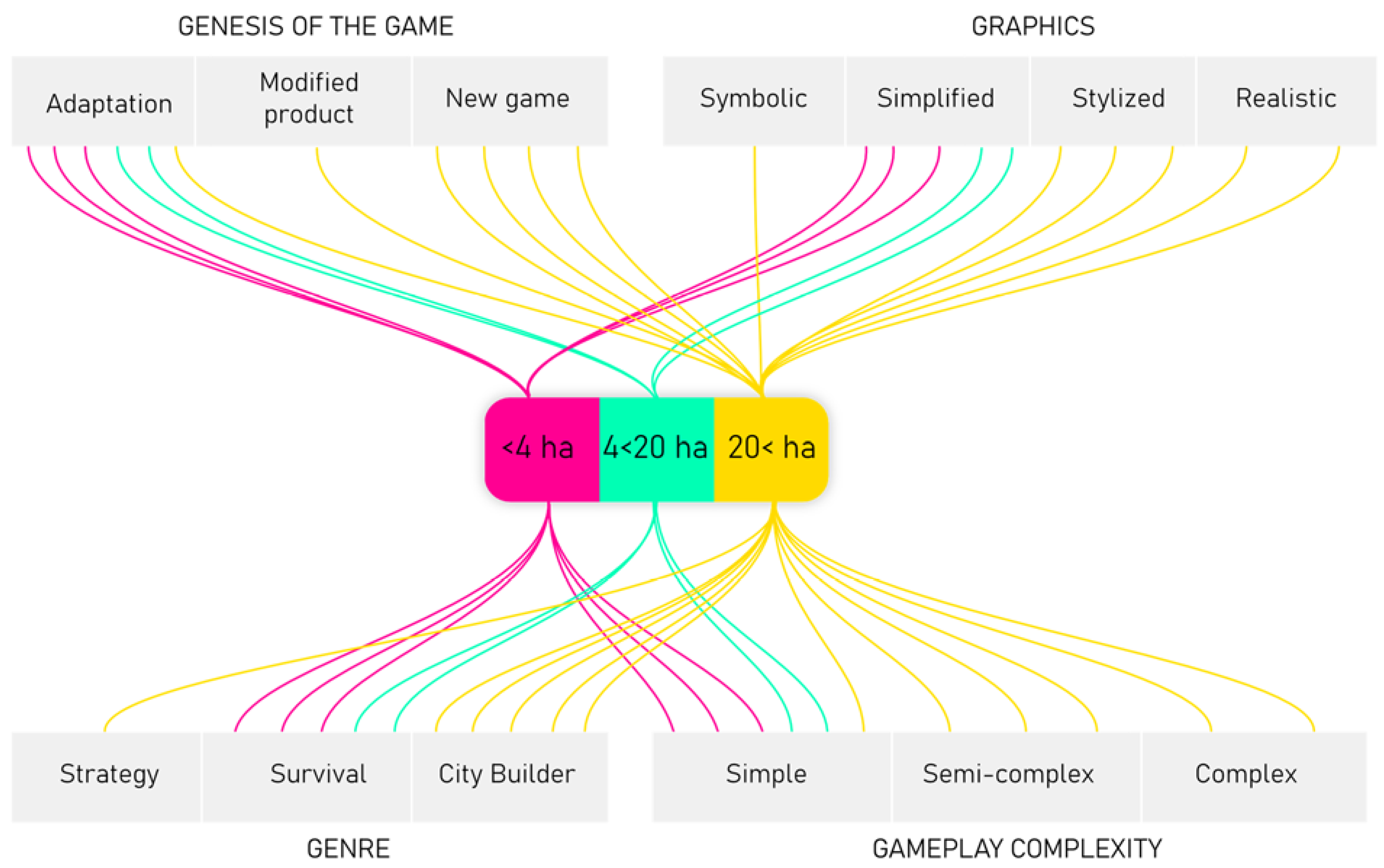
Table B1.
Weights of parameter values determined for individual values of the development area parameter (source: author)
Table B1.
Weights of parameter values determined for individual values of the development area parameter (source: author)
- 2.
- Type of developed space.
Figure B2.
Summary of co-occurrence of values of determined parameters with the values of the parameter type of the space (source: author)
Figure B2.
Summary of co-occurrence of values of determined parameters with the values of the parameter type of the space (source: author)
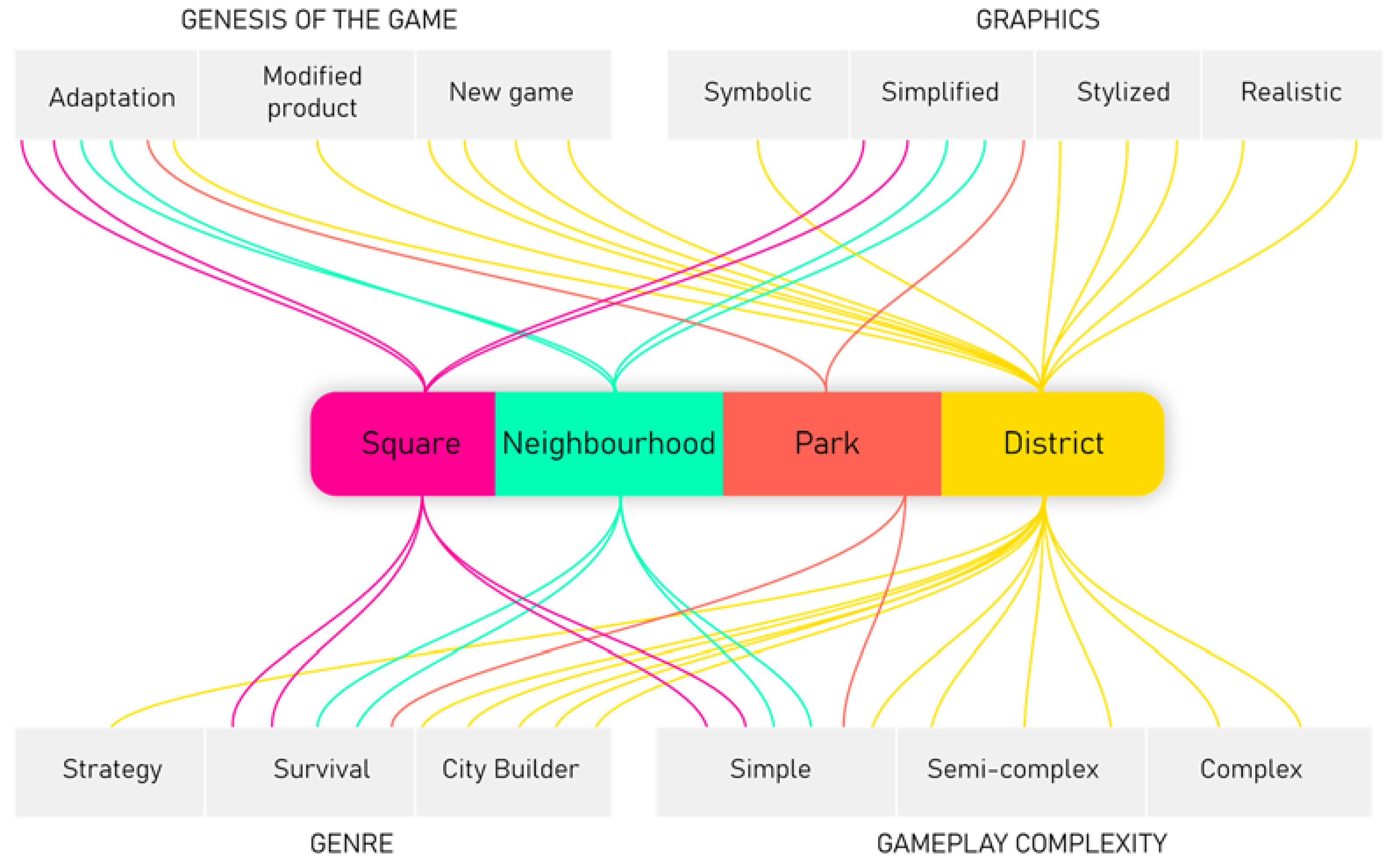
Table B2.
Weights of parameter values determined for individual values of the type of the space (source: author)
Table B2.
Weights of parameter values determined for individual values of the type of the space (source: author)
- 3.
- Urban context.
Figure B3.
Summary of co-occurrence of values of determined parameters with the values of the parameter urban context (source: author)
Figure B3.
Summary of co-occurrence of values of determined parameters with the values of the parameter urban context (source: author)
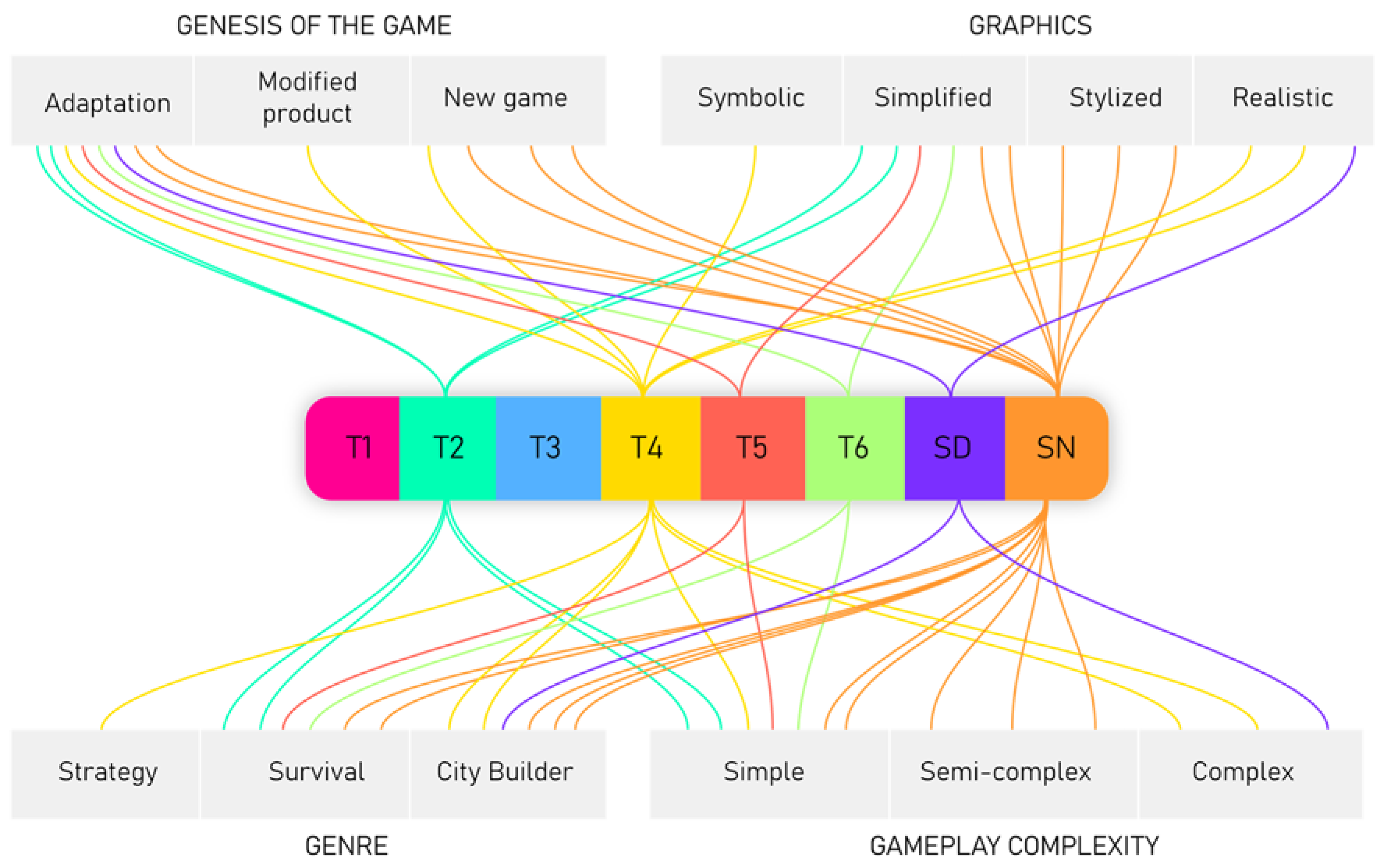
Table B3.
Weights of parameter values determined for individual values of the parameter urban context (source: author)
Table B3.
Weights of parameter values determined for individual values of the parameter urban context (source: author)
- 4.
- Number of participants.
Figure B4.
Summary of co-occurrence of values of determined parameters with the values of the parameter number of participants (source: author)
Figure B4.
Summary of co-occurrence of values of determined parameters with the values of the parameter number of participants (source: author)
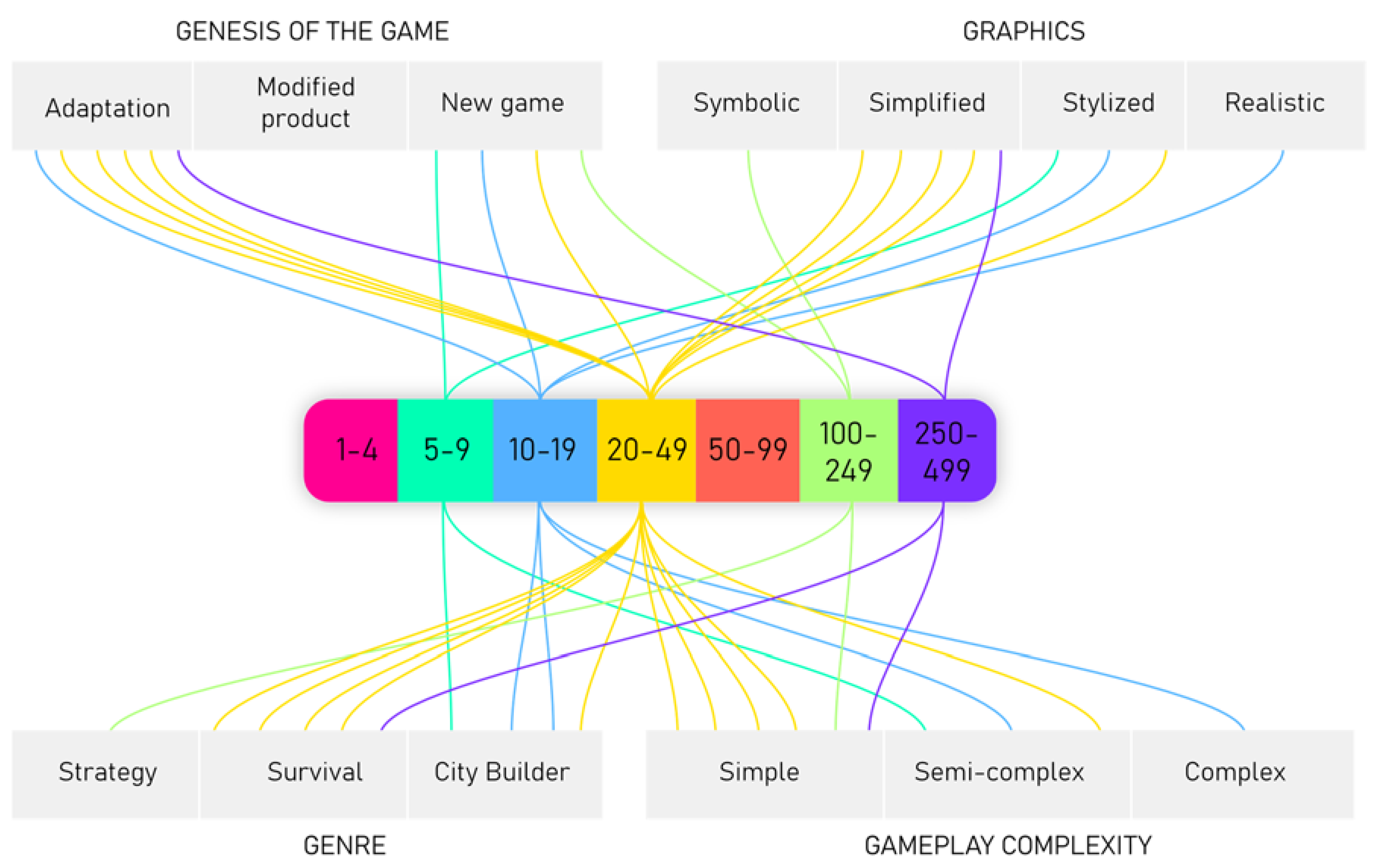
Table B4.
Weights of parameter values determined for individual values of the parameter number of participants (source: author)
Table B4.
Weights of parameter values determined for individual values of the parameter number of participants (source: author)
- 5.
- Number of particiapnts
Figure B5.
Summary of co-occurrence of values of determined parameters with the values of the parameter age group (source: author)
Figure B5.
Summary of co-occurrence of values of determined parameters with the values of the parameter age group (source: author)
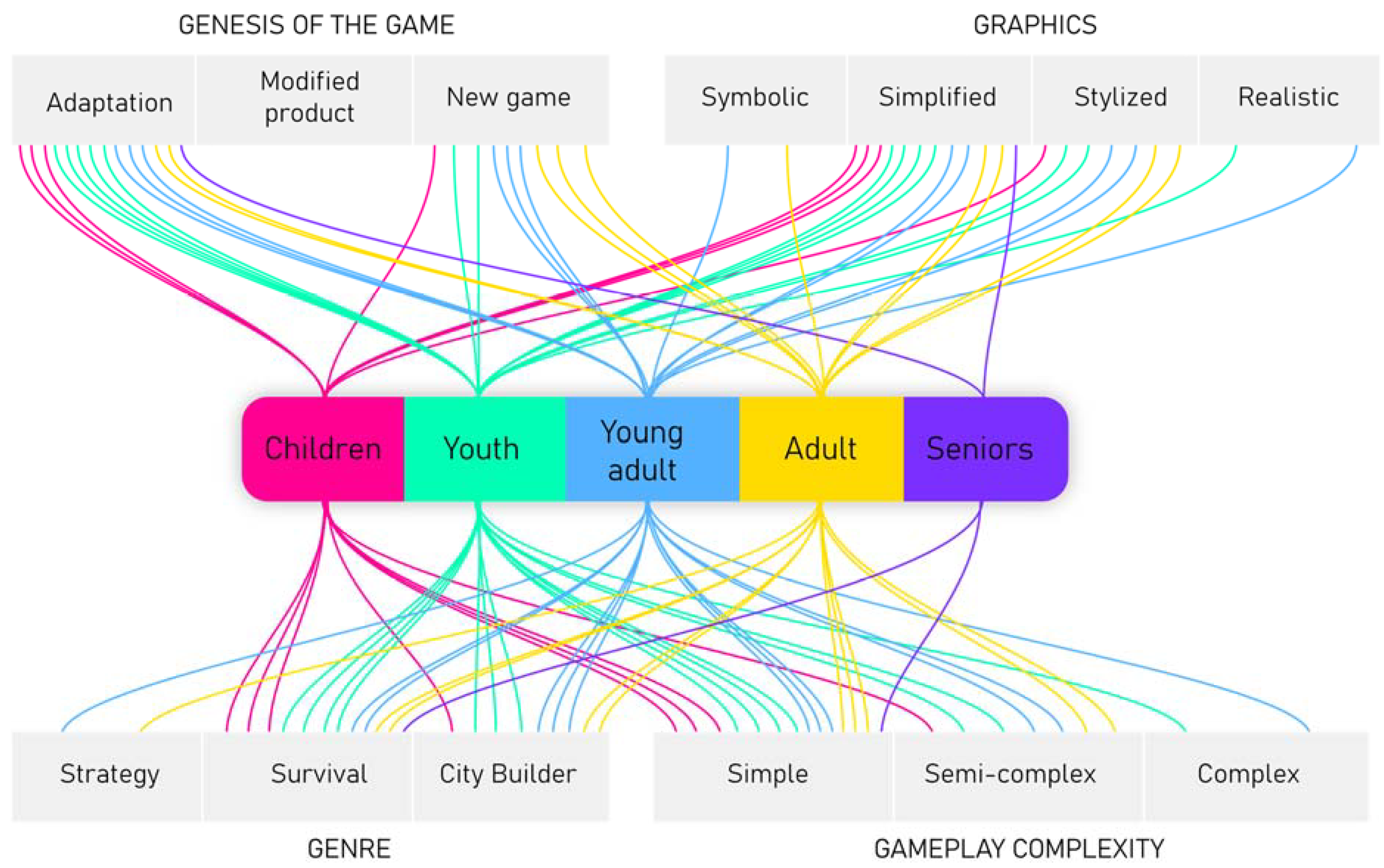
Table B5.
Weights of parameter values determined for individual values of the parameter age group (source: author)
Table B5.
Weights of parameter values determined for individual values of the parameter age group (source: author)
- 6.
- Process accessibility
Figure B6.
Summary of co-occurrence of values of determined parameters with the values of the process accessibility parameter(source: author)
Figure B6.
Summary of co-occurrence of values of determined parameters with the values of the process accessibility parameter(source: author)
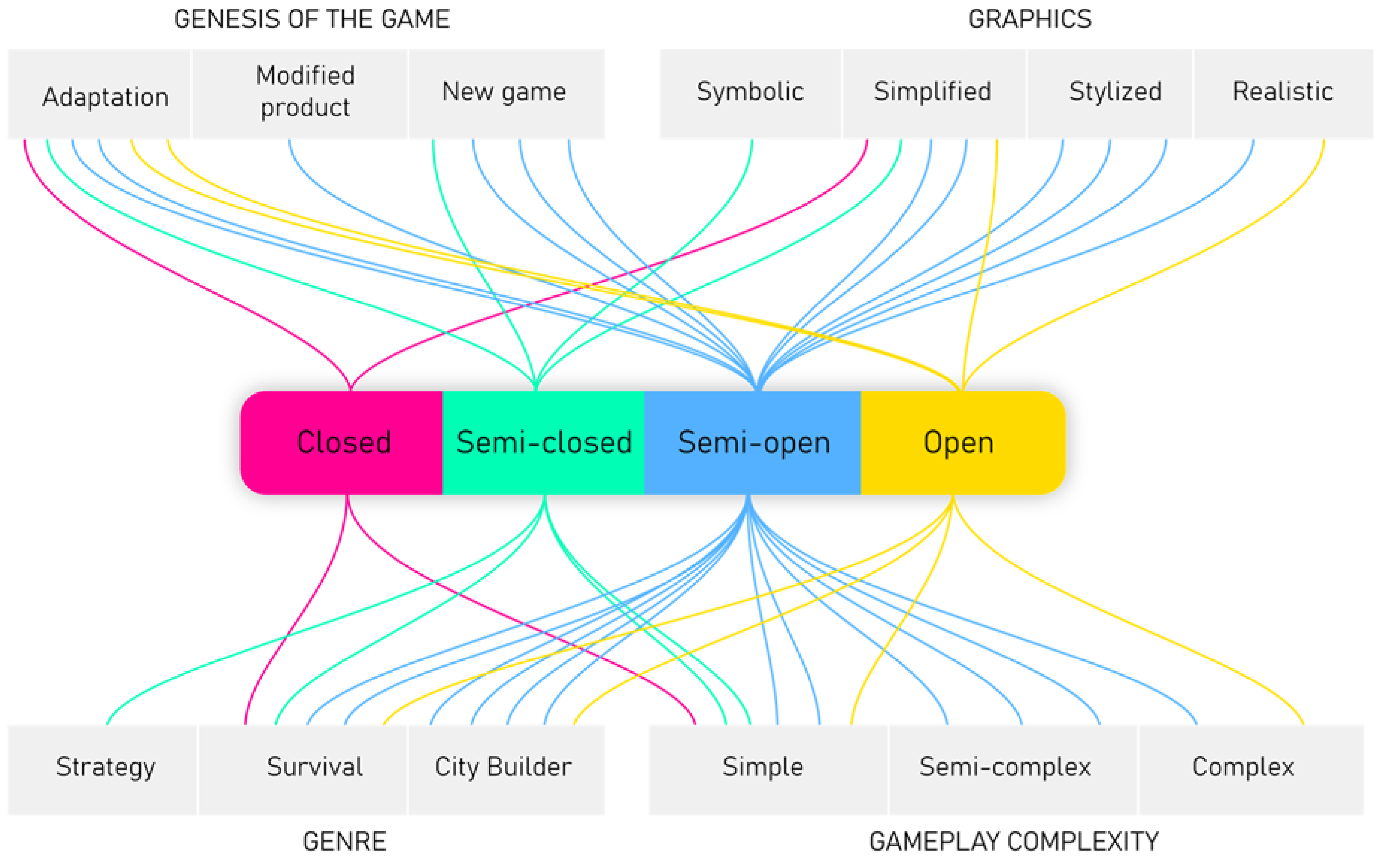
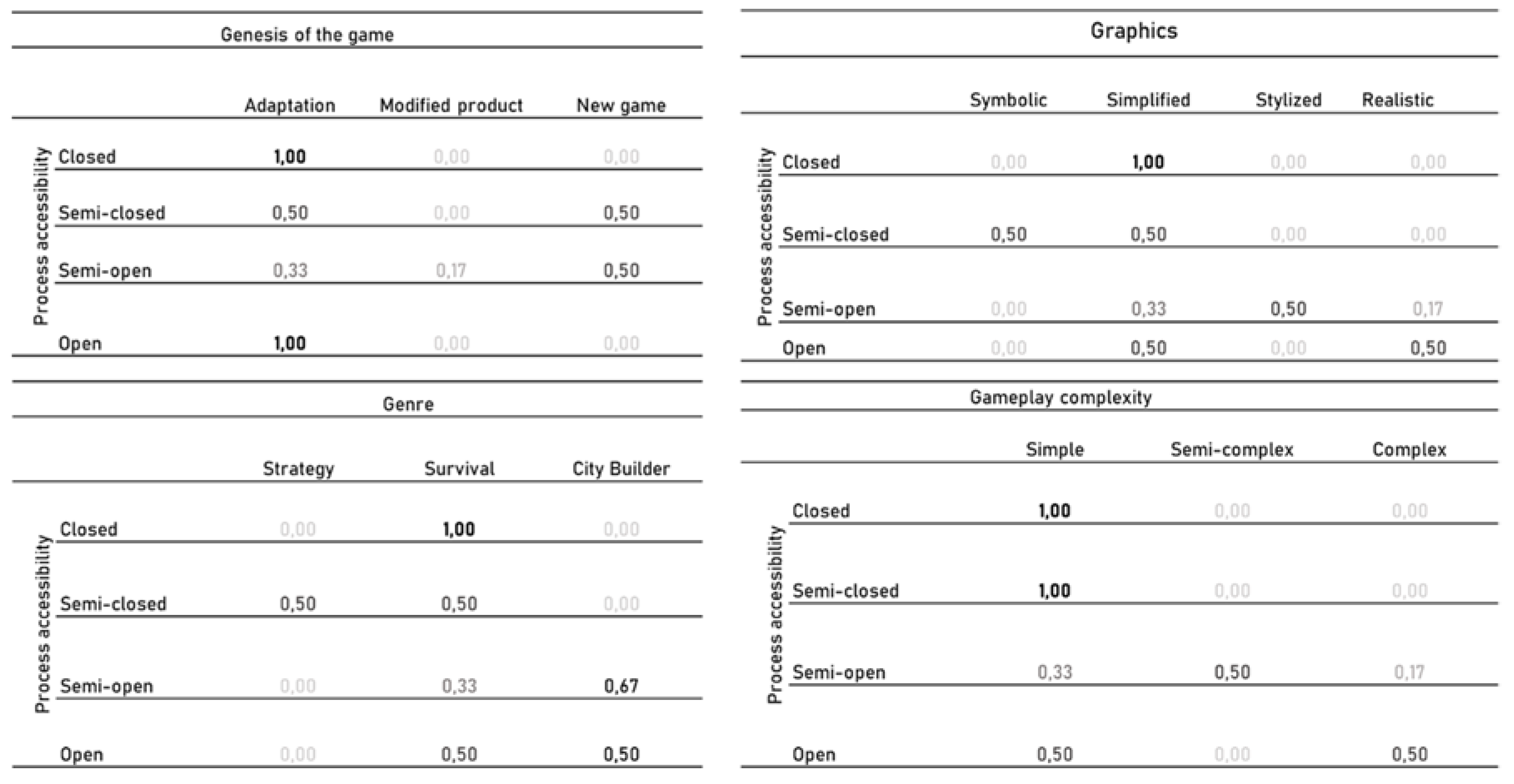
Table B6.
Weights of parameter values determined for individual values of the parameter process accessibility (source: author)
Table B6.
Weights of parameter values determined for individual values of the parameter process accessibility (source: author)
- 7.
- Mode of the process
Figure B7.
Summary of co-occurrence of values of determined parameters with the values of the process mode parameter(source: author)
Figure B7.
Summary of co-occurrence of values of determined parameters with the values of the process mode parameter(source: author)
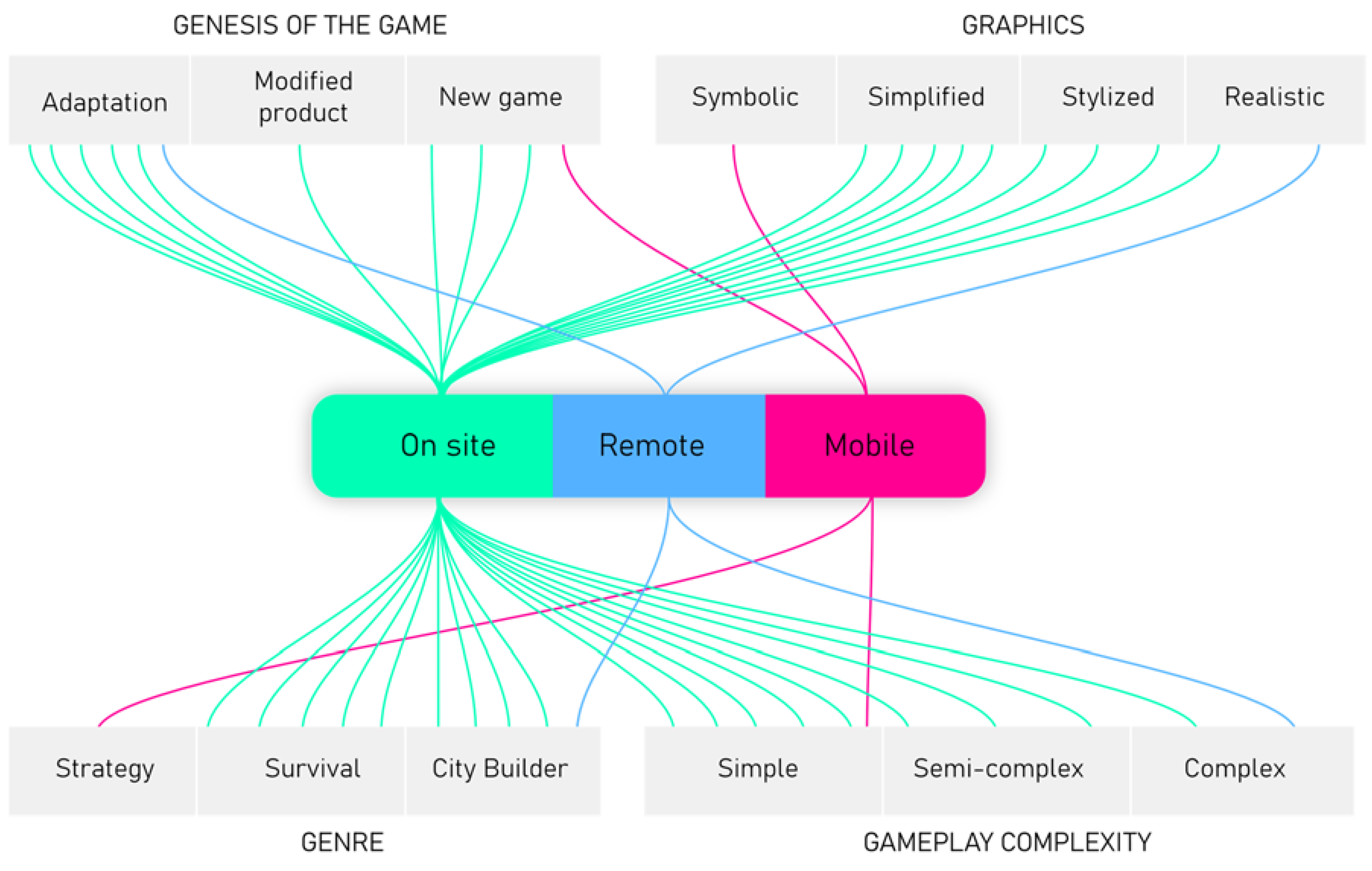
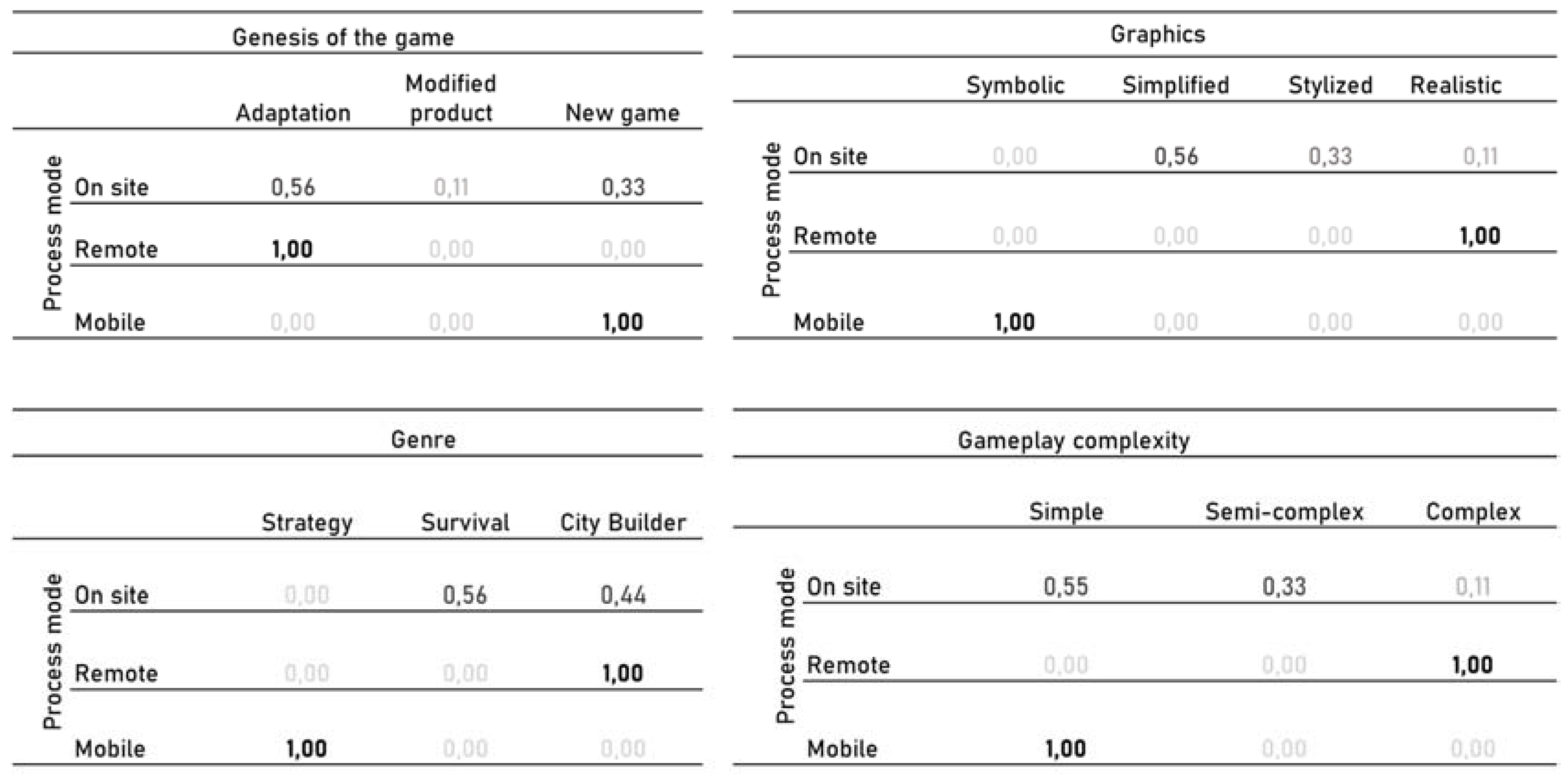
Table B7.
Weights of parameter values determined for individual values of the parameter process mode (source: author)
Table B7.
Weights of parameter values determined for individual values of the parameter process mode (source: author)
- 8.
- Participation level
Figure B8.
Summary of co-occurrence of values of determined parameters with the values of the participation level parameter(source: author)
Figure B8.
Summary of co-occurrence of values of determined parameters with the values of the participation level parameter(source: author)
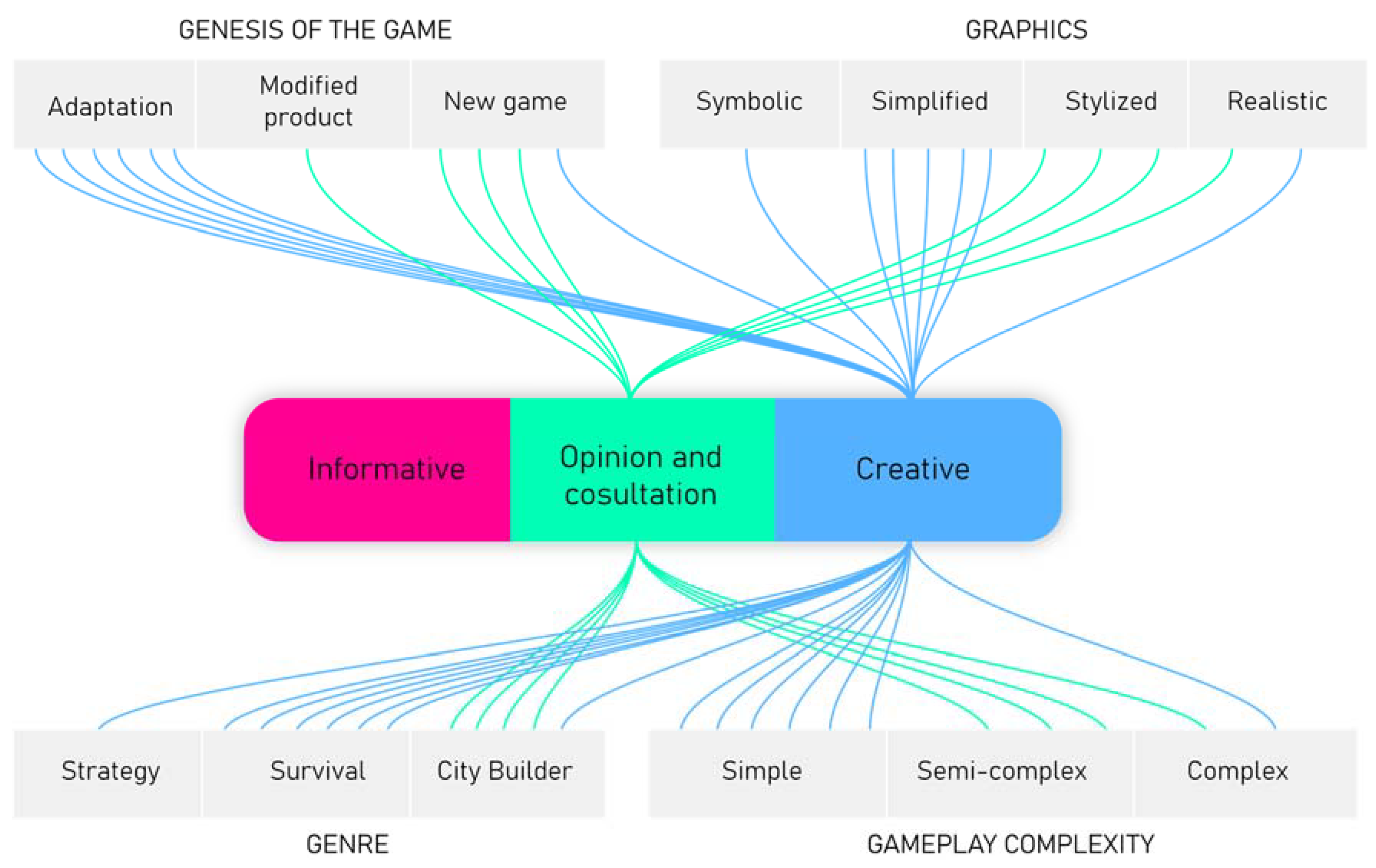
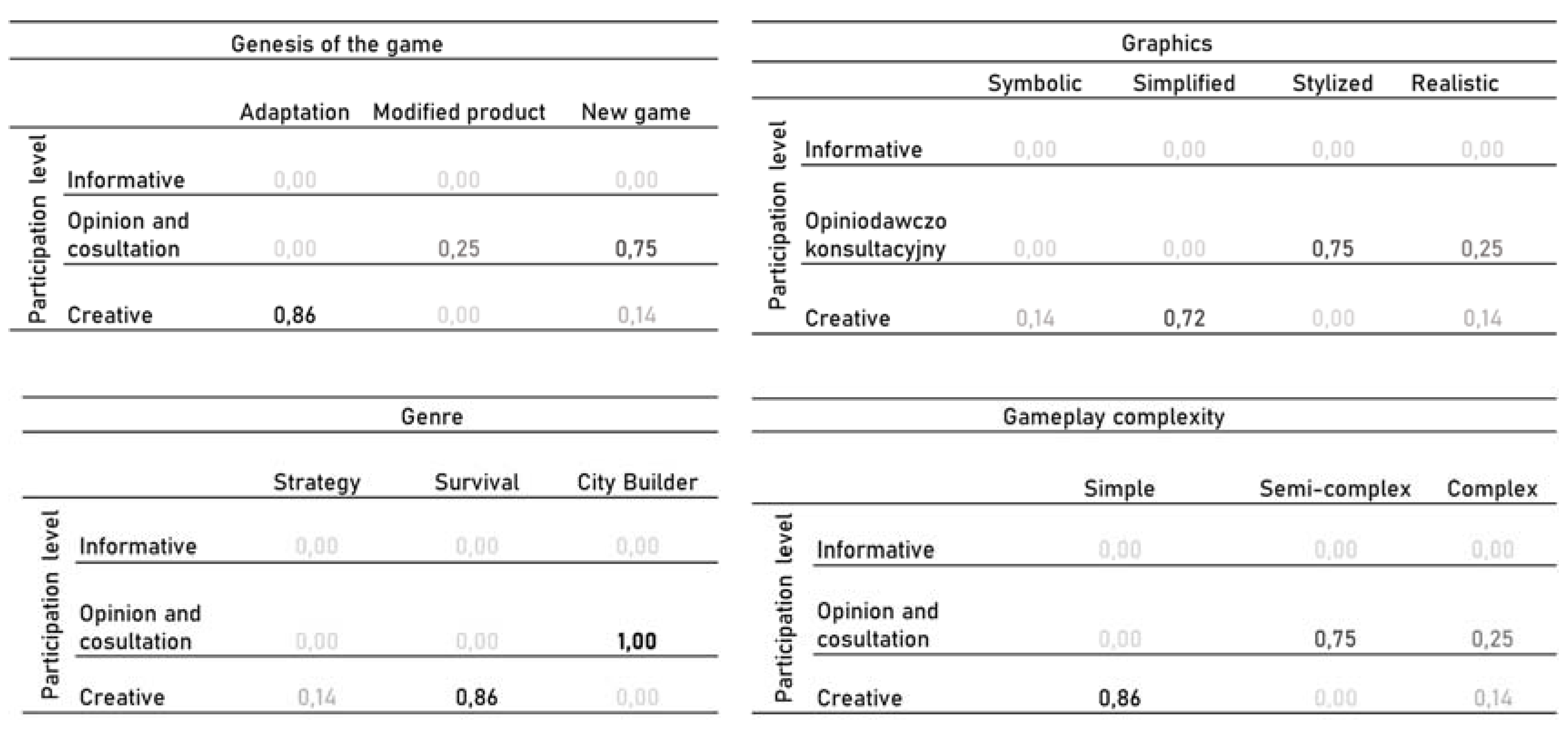
Table B8.
Weights of parameter values determined for individual values of the parameter participation level (source: author)
Table B8.
Weights of parameter values determined for individual values of the parameter participation level (source: author)
- 9.
- Purpose of using the game
Figure B9.
Summary of co-occurrence of values of determined parameters with the values of the purpose of using the game parameter(source: author)
Figure B9.
Summary of co-occurrence of values of determined parameters with the values of the purpose of using the game parameter(source: author)
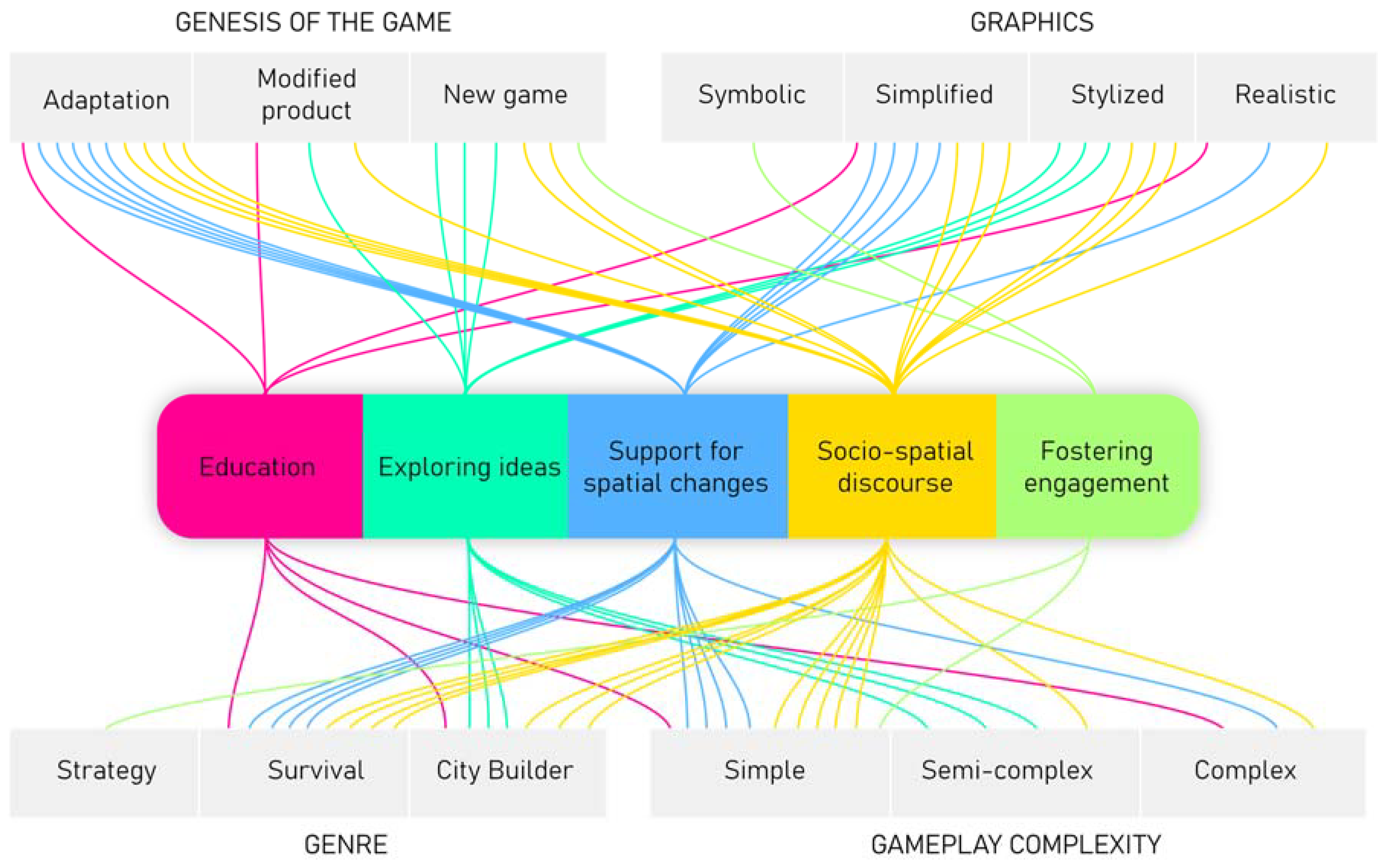
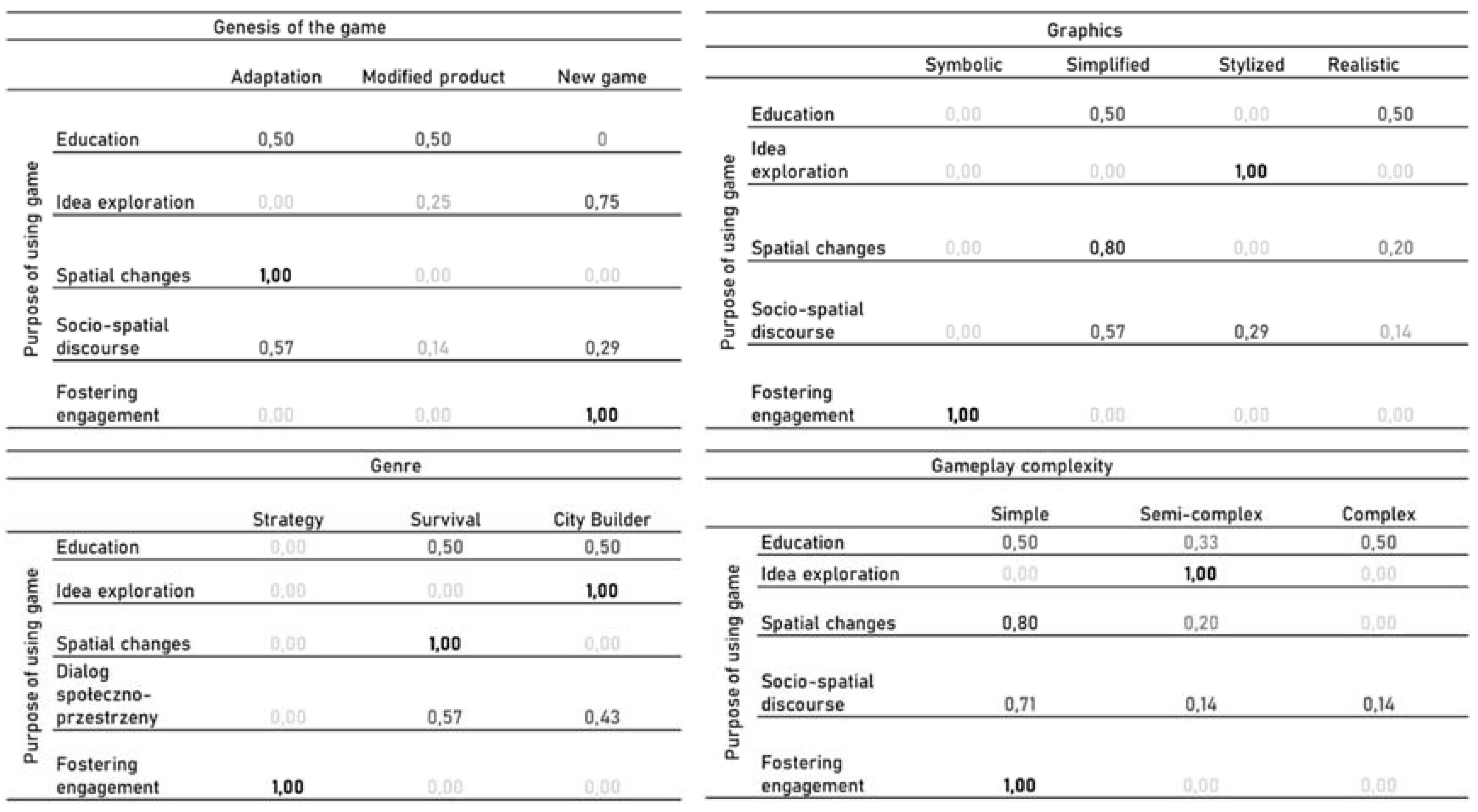
Table B9.
Weights of parameter values determined for individual values of the parameter purpose of using the game (source: author)
Table B9.
Weights of parameter values determined for individual values of the parameter purpose of using the game (source: author)
Position of the game
Figure B10.
Summary of co-occurrence of values of determined parameters with the values of the role of the game parameter(source: author)
Figure B10.
Summary of co-occurrence of values of determined parameters with the values of the role of the game parameter(source: author)
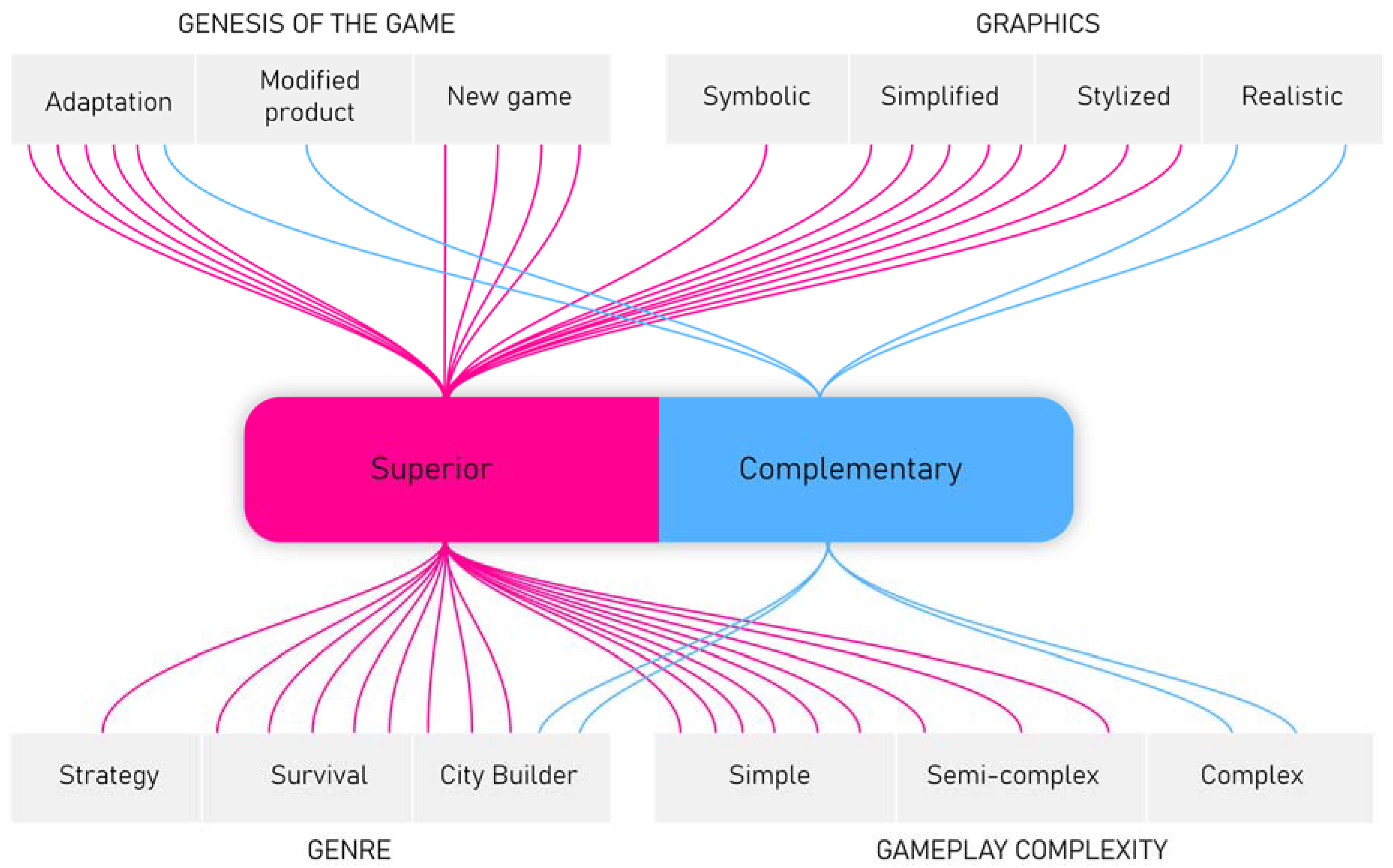
Table B10.
Weights of parameter values determined for individual values of the parameter role of the game (source: author)
Table B10.
Weights of parameter values determined for individual values of the parameter role of the game (source: author)
References
- Poplin, A. Digital Serious Game for Urban Planning: “B3—Design Your Marketplace!” Environment and Planning B: Planning and Design 2014, 41, 493–511. [CrossRef]
- Di Mascio, D.; Dalton, R. Using Serious Games to Establish a Dialogue Between Designers and Citizens in Participatory Design. In Serious Games and Edutainment Applications : Volume II; Ma, M., Oikonomou, A., Eds.; Springer International Publishing: Cham, 2017; pp. 433–454. ISBN 978-3-319-51645-5. [CrossRef]
- O’Coill, C.; Doughty, M. Computer Game Technology as a Tool for Participatory Design. In Proceedings of the Proceedings of the 22nd International Conference on Education and Research in Computer Aided Architectural Design in Europe (eCAADe); eCAADe: Kopenhaga, 2004; pp. 12–23.
- Poplin, A.; Vemuri, K. Spatial Game for Negotiations and Consensus Building in Urban Planning: YouPlaceIt! In Geogames and Geoplay: Game-based Approaches to the Analysis of Geo-Information; Ahlqvist, O., Schlieder, C., Eds.; Springer International Publishing: Cham, 2018; pp. 63–90 . ISBN 978-3-319-22774-0. [CrossRef]
- Beattie, H.; Brown, D.; Kindon, S. Solidarity through difference: Speculative participatory serious urban gaming (SPS-UG). International Journal of Architectural Computing 2020, 18, 141–154. [CrossRef]
- Kavouras, I.; Sardis, E.; Protopapadakis, E.; Rallis, I.; Doulamis, A.; Doulamis, N. A Low-Cost Gamified Urban Planning Methodology Enhanced with Co-Creation and Participatory Approaches. Sustainability 2023, 15. [CrossRef]
- e Andrade, B.; Poplin, A.; Sousa de Sena, Í. Minecraft as a Tool for Engaging Children in Urban Planning: A Case Study in Tirol Town, Brazil. ISPRS International Journal of Geo-Information 2020, 9. [CrossRef]
- Sanchez, J. Architecture for the Commons: Participatory Systems in the Age of Platforms; Taylor & Francis, 2020; ISBN 978-0-429-77801-8.
- Delaney, J. Minecraft and Playful Public Participation in Urban Design. Urban Planning 2022, 7, 330–342. [Google Scholar] [CrossRef]
- Westenberg, P.; von Heland, F. Using Minecraft for Youth Participation in Urban Design and Governance; UN Habitat: online, 2015.
- Hämäläinen, T. Instagram ja Cities Skylines herättelevät nuoria keskustelemaan kaupunkisuunnittelusta [Instagram oraz Cities Skylines wywołuje rozmowę o planowaniu urbanistycznym wśród młodych ludzi]. mdi.fi 2016.
- Krisman, V. “Cities: Skylines” Being Used By Stockholm City Planners. intelligentcommunity.org 2016.
- Prandi, C.; Roccetti, M.; Salomoni, P.; Nisi, V.; Nunes, N.J. Fighting exclusion: a multimedia mobile app with zombies and maps as a medium for civic engagement and design. Multimedia Tools and Applications 2017, 76, 4951–4979. [Google Scholar] [CrossRef]
- Faulstick, B. Entrepreneurial Game Studio to Launch SIM-PHL, an Urban Planning Simulator Game Powered by Philadelphia’s Open Data. drexel.edu 2020.
- Prilenska, V. Current Research Trends in Games for Public Participation in Planning. Architecture and Urban Planning 2019, 15, 113–121. [Google Scholar] [CrossRef]
- Wilson, A.; Tewdwr-Jones, M.; Comber, R. Urban planning, public participation and digital technology: App development as a method of generating citizen involvement in local planning processes. Environment and Planning B: Urban Analytics and City Science 2019, 46, 286–302. [Google Scholar] [CrossRef]
- Olszewski, R.; Turek, A.; Laczynski, M. Urban Gamification as a Source of Information for Spatial Data Analysis and Predictive Participatory Modelling of a City’s Development. In Proceedings of the International Conference on Data Technologies and Applications; Francalanci, C., Helfert, M., Eds.; ScitePress: Colmar Francja, 2016; Vol. 1, pp. 176–181.
- Olszewski, R.; Turek, A. The Mordor Shaper—The Warsaw Participatory Experiment Using Gamification. In Proceedings of the ICT Systems and Sustainability; Tuba, M., Akashe, S., Joshi, A., Eds.; Springer Singapore: Singapore, 2020; pp. 255–264.
- UN, G.A. Resolution adopted by the General Assembly on 25 September 2015 70/1. Transforming our world: the 2030 Agenda for Sustainable Development 2015.
- Mather, L.W.; Robinson, P.J. Durable Civic Technology. In Citizen-Responsive Urban E-Planning; Nunes Silva, C., Ed.; IGI Global: Hershey, PA, 2020; pp. 252–281.
- Brooks, L. The Design and Development of Serious Games.; Victoria, Kanda, 2018; pp. 1–8.
- Cravero, S. Methods, strategies and tools to improve citizens’ engagement in the smart cities’ context: A Serious Game classification. Valori e Valutazioni 2020, 2020, 45–60. [Google Scholar]
- Devisch, O.; Gugerell, K.; Diephuis, J.; Constantinescu, T.; Ampatzidou, C.; Jauschneg, M. Mini is beautiful : Playing serious mini-games to facilitate collective learning on complex urban processes. Interaction Design and Architecture(s) 2017, 141–157.
- Toth, E. Potential of Games in the Field of Urban Planning. In Proceedings of the New Perspectives in Game Studies: Proceedings of the Central and Eastern European Game Studies Conference Brno 2014; Bártek, T., Miškov, J., Švelch, J., Eds.; Munipress: Brno, 2015; pp. 71–89.
- Poplin, A. Playful public participation in urban planning: A case study for online serious games. Computers, Environment and Urban Systems 2012, 36, 195–206. [Google Scholar] [CrossRef]
- Hassan, L.; Hamari, J. Gameful civic engagement: A review of the literature on gamification of e-participation. Government Information Quarterly 2020, 37, 101461. [Google Scholar] [CrossRef]
- Ampatzidou, C.; Gugerell, K.; Constantinescu, T.; Devisch, O.; Jauschneg, M.; Berger, M. All Work and No Play? Facilitating Serious Games and Gamified Applications in Participatory Urban Planning and Governance. Urban Planning 2018, 3, 34–46. [Google Scholar] [CrossRef]
- Imam, A.; Westenberg, P. The Block By Block Playbook Using Minecraft as a Participatory Design Tool in Urban Design And Governance; UN Habitat: online, 2021.
- Westenberg, P.; Rana, S. Using Minecraft for Community Participation; UN Habitat: online, 2016.
- Guo Xiang, O. Participatory Design Games in Urban Planning: Towards a Distributed and Massively Multi-player Online Collaboration Model. Master thesis, National University of Singapore: Singapur, 2016.
- Arnstein, S. A ladder of social participation. Journal of the American Institute of Planners 1969, 4, 7–29. [Google Scholar] [CrossRef]
- Thiel, S.-K.; Lehner, U. Exploring the Effects of Game Elements in M-Participation. In Proceedings of the Proceedings of the 2015 British HCI Conference; Association for Computing Machinery: New York, NY, USA, 2015; pp. 65–73. [CrossRef]
- Maaß, J. Serious Games in Sustainable Land Management. In Sustainable Land Management in a European Context: A Co-Design Approach; Weith, T., Barkmann, T., Gaasch, N., Rogga, S., Strauß, C., Zscheischler, J., Eds.; Springer International Publishing: Cham, 2021; pp. 185–205. ISBN 978-3-030-50841-8. [CrossRef]
Figure 1.
Process behind extracting data from gathered cases
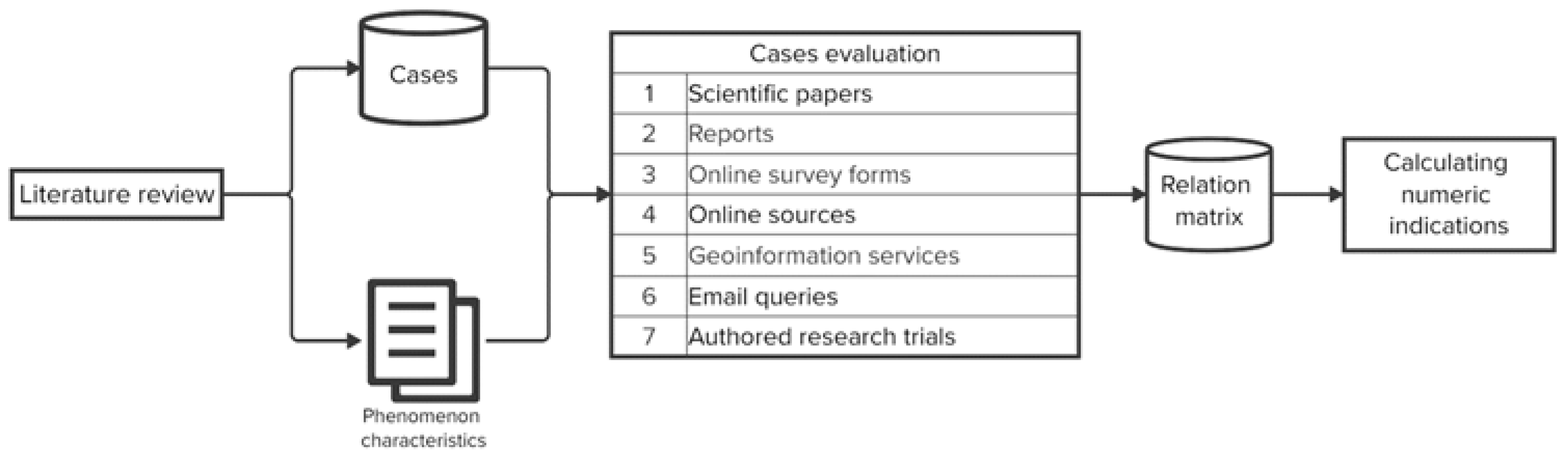
Table 3.
Correlation matrix between the values of determining and determined parameters. (Source: author).
Table 3.
Correlation matrix between the values of determining and determined parameters. (Source: author).
| Dp | ||||
|---|---|---|---|---|
| dk | i1 | i2 | ir | |
| i1 | wdki1Dpi1 | wdki1Dpi2 | wdki1Dpir | |
| i2 | wdki2Dpi1 | wdki2Dpi2 | wdki2Dpir | |
| il | wdkl1Dpi1 | wdkilDpi2 | wdki1lDpir | |
Table 4.
Summary of recommendations for each pair of determining and determined values. (Source: author).
Table 4.
Summary of recommendations for each pair of determining and determined values. (Source: author).
| Dp | |||
|---|---|---|---|
| i1 | i2 | ir | |
| d1 | d1i; wdki1Dpi1 | d1i; wdki1Dpi2 | d1i; wdki1Dpir |
| d2 | d2i; wdki2Dpi1 | d2i; wdki2Dpi2 | d2i; wdki2Dpir |
| d3 | d3i; wdkl1Dpi1 | d3i; wdkilDpi2 | d3i; wdki1lDpir |
Table 5.
List of gathered cases with used gamed and date specified. (Source: author)
| Case | Game | Year |
|---|---|---|
| Block By Block Nairobi Block By Block Les Cayes Block By Block Mexico City Block By Block Kirtipur |
Minecraft | 2013 |
| Minecraft | 2014 | |
| Minecraft | 2014 | |
| Minecraft | 2014 | |
| Stockholm Royal Seaport | Cities: Skylines | 2016 |
| Hameenlinna, Kantola | Cities: Skylines | 2016 |
| Tirolcraft, Tirol | Minecraft | 2016 |
| New Delhi, Ghazipur | Maslows Palace | 2017 |
| New Delhi, Bhalswa | Maslows Palace | 2017 |
| Mumbai, Shivanji Nagar | Maslows Palace | 2017 |
| Warsaw, Mokotów | Mordor Shaper | 2018-2019 |
Table 6.
Summary of indications for individual values of the game genesis parameter (source: author)
Table 6.
Summary of indications for individual values of the game genesis parameter (source: author)
| Parameter | Genesis of the game | |||||||
| Adaptation | Modified product | New game | ||||||
| Area | up to 20 ha | 1,00 | none | over 20 ha | 0,83 | |||
| Type of space | neighborhood, square, park | 1,00 | none | District | 0,67 | |||
| Urban context | T2, T5, T6, SD | 1,00 | none | SN | 0,60 | |||
| Number of participants | 250+ | 1,00 | none | 5-9; 100-249 | 1,00 | |||
| 20-39 | 0,80 | none | ||||||
| Age groups | Seniors | 1,00 | none | Adults | 0,60 | |||
| Children | 0,75 | |||||||
| Youth | 0,71 | Young adults | 0,50 | |||||
| Young adults | 0,50 | |||||||
| Process accessibility | Closed, Open | 1,00 | none | Semi-closed, Semi-open | 0,50 | |||
| Semi-closed | 0,50 | |||||||
| Process mode | Remote | 1,00 | none | Mobile | 1,00 | |||
| On site | 0,56 | |||||||
| Participation level | Creative | 0,86 | none | Opinion and cosultation | 0,75 | |||
| Purpose of using game | Spatial changes | 1,00 | none | Fostering engagement | 1,00 | |||
| Socio-spatial discourse | 0,57 | Idea exploration | 0,75 | |||||
| Role of the game | Superior | 0,55 | Complimentary | 0,50 | none | |||
Table 8.
Summary of indications for individual values of the genre parameter (source: author)
| Genre | ||||||
| Parameter | Strategy | Survival | City builder | |||
| Area | none | up to 20 ha | 1,00 | over 20 ha | 0,83 | |
| Type of space | none | Square, park, neighborhood | 1,00 | District | 0,83 | |
| Urban context | none | T2, T5, T6 | 1,00 | SD | 1,00 | |
| T4 | 0,67 | |||||
| Number of participants | 100-249 | 1,00 | over 250 | 1,00 | up to 19 | 1,00 |
| 20-49 | 0,80 | |||||
| Age groups | none | Seniors | 1,00 | Young adults, adults | 0,50 | |
| Children | 0,75 | |||||
| Youth | 0,57 | |||||
| Adult | 0,50 | |||||
| Process accessibility | Semi-closed | 0,50 | Closed | 1,00 | Semi-open | 0,67 |
| Semi-closed, open | 0,50 | Open | 0,50 | |||
| Process mode | Mobile | 1,00 | On site | 0,56 | Remote | 1,00 |
| Participation level | none | Creative | 0,86 | Opinion and consultation | 1,00 | |
| Purpose of using game | Fostering engagement | 1,00 | Spatial changes | 1,00 | Idea exploration | 1,00 |
| Socio-spatial discourse | 0,57 | Education | 0,50 | |||
| Education | 0,50 | |||||
| Role of the game | none | Superior | 0,56 | Complimentary | 1,00 | |
Table 9.
Summary of indications for individual values of the complexity of mechanics parameter (source: author).
Table 9.
Summary of indications for individual values of the complexity of mechanics parameter (source: author).
| Gameplay complexity | ||||||
| Parameter | Simple | Semi-complex | Complex | |||
| Area | up to 4 ha | 1,00 | over 20 ha | 0,50 | 4-20 ha | 0,50 |
| 4-20 ha | 0,50 | |||||
| Type of space | Square, neighborhood, park | 1,00 | District | 0,50 | none | |
| Urban context | T2, T5, T6 | 0,60 | SN | 0,60 | SD | 1,00 |
| T4 | 0,67 | |||||
| Number of participants | over 100 | 1,00 | 5-9 | 1,00 | 10-19 | 0,50 |
| 20-49 | 0,80 | 10-19 | 0,50 | |||
| Age groups | Seniors | 1,00 | none | none | ||
| Children | 0,75 | |||||
| Adults | 0,60 | |||||
| Youth | 0,57 | |||||
| Process accessibility | Closed, semi-closed | 1,00 | Semi-open | 0,50 | Open | 0,50 |
| Open | 0,50 | |||||
| Process mode | Mobile | 1,00 | none | Remote | 1,00 | |
| On site | 0,55 | |||||
| Participation level | Creative | 0,86 | Opinion and consultation | 0,75 | none | |
| Purpose of using game | Fostering engagement | 1,00 | Idea exploration | 1,00 | Education | 0,50 |
| Spatial changes | 0,80 | |||||
| Socio-spatial discourse | 0,71 | |||||
| Education | 0,50 | |||||
| Role of the game | Superior | 0,67 | none | Complimentary | 1,00 | |
Disclaimer/Publisher’s Note: The statements, opinions and data contained in all publications are solely those of the individual author(s) and contributor(s) and not of MDPI and/or the editor(s). MDPI and/or the editor(s) disclaim responsibility for any injury to people or property resulting from any ideas, methods, instructions or products referred to in the content. |
© 2024 by the authors. Licensee MDPI, Basel, Switzerland. This article is an open access article distributed under the terms and conditions of the Creative Commons Attribution (CC BY) license (http://creativecommons.org/licenses/by/4.0/).
Copyright: This open access article is published under a Creative Commons CC BY 4.0 license, which permit the free download, distribution, and reuse, provided that the author and preprint are cited in any reuse.


