

Submitted:
28 August 2024
Posted:
29 August 2024
You are already at the latest version
Abstract
Today the Vocational Education and Training curriculum is state-regulated, combining school-based and work-based learning it is offered at upper-secondary and post-secondary levels. The main problem of nowadays period for Vocational Education and Training is about preparing a new agenda for technical education in Greece for the new circumstances. Our paper aims to enrich, redefine, and expand the current curricula and educational practices, while also proposing a complete plan for the overall reformation of Vocational Education and Training’s learning conditions from the point of view of teaching and learning analytics. Through the existing changing institutional framework, the updated bibliographic references, and the experiential data of the educational reality research, we can understand the expected needs of technological educators and decide how to address the priorities that must be determined. As a result of expectation and one of the main topics of this paper, we focus on the preparation of the trainers and the overall redefinition of the role of education in preparing graduates. This paper's main conclusions or interpretations for the cognitive orientation of the existing curricula, as well as the directions of the thinking and teaching skills of teachers, and to build confidence in the prospects of technical education in Greece.
Keywords:
Vocational Education and Training
; Teaching and Learning Analytics for Technical Education
; Curricula and Educational Research
; Digital Culture
1. Introduction to Vocational Education and Training Research Framework
At all levels of secondary and post-secondary vocational education in Vocational High Schools and Laboratory Centers that support them, as well as in all classes of the 4th post-secondary year Apprenticeship Classes, of all Specialties, the knowledge-building process for students-apprentices has specific characteristics. To assess and formulate proposals and content for the syllabus (Analytical Programs of Study -APS) in these grades, curriculum designers should consider, perceive, and appreciate how learning types and learning objects are structured within the vocational-technical communities. The thought process and method that will be applied for the reformation of the Vocational Education and Training (VET) curriculum, should undoubtedly have as a prerequisite the deep knowledge of the real, specific, and unique modern objects, technologies, and techniques, for each Sector and Specialty. Our proposal sets out a research plan for the overall reformation of the learning conditions of VET in 21st-century Greece. design, organize, and implement a reform plan for VET in Greece it is necessary to prevent the cognitive principles of technical education at the beginning of the 21st century. The main prompt for the whole plan is the following: to implement the proposed reforms in VET, the “eye of the mind” should not be distracted from the things themselves, the actual didactic application, and their elaboration data as they are structured. In the last decade, several researchers have observed that despite plans for implementing reforms and despite efforts for redesigning and upgrading VET, the terms of learning and teaching in technical schools have not achieved the expected effectiveness [1].
On the one hand, this phenomenon of the continuous reform of VET’s cognitive principles can be explained by the contradictions of previous years, such as the inconsistencies of the novel planning [2], or even the non-completion of the latest reform guidelines for updated VET curricula. On the other hand, even in the most favorable conditions, many comprehensive guidelines on learning and teaching terms do not seem to have worked at all or at least to the expected degree [3]. This observation raises questions on the depth and breadth of how technical knowledge is approached in teaching practice in both the curricula and active 21st-century learning [4]. For all the above reasons, we aim to propose the design and formulation of an overall radical pedagogical proposal for VET reformation. The learning and teaching conditions of VET include both the processing of analytical learning indicators and the elaboration of indicators for analytical teaching. That is why we are submitting an overall plan with six key research guidelines.
Those guidelines include orientations by asking important research questions like how the learning terms and teaching in VET will be designed and expanded what the new directions for interpretation and handling technical knowledge will be, what is the phenomenology of new technical knowledge and its scales of mind and construction of perception along with what the new teaching and learning scenarios for the new approach are. Additionally, they also include utilizing the existing knowledge on the subject and contributing to the promotion of knowledge about it, as the originality of the subject. Our proposal, in addition to a research plan suitable for the investigation of research questions and the procedures for conducting its research, also presents our plans for future work. Relevant literature includes scientific articles on the subject, design, and in-depth experiential application of new original perspectives on teaching and learning in VET as well as the quality of the indicator of technical education [5]. Our observations and actions draw on data and produce results mainly from the daily life of the technical school and always through primary sources. Our proposal includes a complete research project (Figure 1), consisting of seven parts, with two intermediate sections on specific topics related to the utilization of digital tools and internet technologies in the learning and overall handling of gifted students Here is a brief overview of the nine parts of the plan:
- (1)
- Overview, design, and extension of VET’s learning and teaching terms and technical knowledge. Introduction to the topic and its refinement of published research: "new knowledge" approach and new learning models for VET.
- (2)
- New approaches to the interpretation and handling of technical knowledge. Theoretical/conceptual framework: the "social significance" of the laboratory - technical knowledge at the beginning of the 21st century (metacognition which contributes to a deeper awareness of those involved in VET).
- (3)
- The phenomenology of new technical knowledge. Experimental devices and laboratory exercises, on which this new approach will be based, are technical knowledge. The role of digitization, computational thinking, and the Internet. Presentation, but mainly an extension of the main findings so far in research on new knowledge (meta-web 2.0: digitization and "Localization" of new knowledge).
- (4)
- Scales of intellect and construction of perception of new knowledge ("Evaluative" approach to new knowledge).
- (5)
- Pioneering scenarios of the new approach (guides and methodology combinations of applications in teaching scenarios).
- (6)
- Science of Applied Knowledge for Design, Construction, and Inspection of Machines or other Technical Data.
- (7)
- Digital information management and digital skills development for VET.
- (8)
- The Application of Special Pedagogy for Charismatic Students in VET, and finally.
- (9)
- Ethics issues in active teaching practice as an epilogue.
Corresponding research projects, action plans, learning operations, learning scenarios, modeling, comparisons, and evaluations that result in either a complete project or publications or in organized laboratory "operations", that confirm or even challenge the original plans, come to confirmed conclusions through cognitive integration [6]. Through these cognitive activities, the phases of updating the curricula in the Upper Secondary and Post-Secondary VET grades should be considered in each Sector and Specialty.
2. Overview, Design, and Extension of Learning and Teaching Analytics of Technical Knowledge in Vocational Education and Training
In the literature, there is no common universally accepted definition of VET [7]. As a field, VET is constantly changing and usually adapts according to the trends prevailing in each country. In a broad sense, we can say that VET deals with the transmission of knowledge and skills from the world of work. UNESCO has described the learning processes that take place noting that VET "refers to those aspects of the educational process which, alongside general education, deal with the study of technologies and related sciences, as and the acquisition of practical skills and attitudes, understanding and knowledge about various areas of economic and social life'. UNESCO also states that "Technical and Vocational Education is directly linked to the acquisition of knowledge and skills, which are required for the world of work and points out that each country must adopt the VET program in such a way that it meets the needs of its production" [8].
Vocational education in terms of its social scope refers to a wide range of activities and can cover many different educational programs. The history of vocational education, vocational education as the teaching of training skills, industrial arts, the technique of special didactics of technical education, laboratory courses, and the preparation of professional careers are areas in which the professors of the Departments and VET Specialties must be able to define reference and operating frameworks. The historical factors, the original intentions of the study programs, and the teaching activities that derive from them, as well as the methodological starting points of the specialty courses of these schools, are of enormous importance to the professors. The local history and geospatial determinations (mountain – island – city area, etc.) of the area to which a VET school unit belongs have their influence on this. Each technical school, in addition to the specializations it supports, also registers an implicit connection with the local history, the local economy, and the local labor market. It should not escape us that historically, professional education began but also looks forward to workplaces. In our analysis, we will be concerned with the perspective role of VET and its relationship with innovation as production, as learning, and as a teaching scenario.
Before the organization of education and schools, as we know them, the process of learning was simply the imitation of skills and knowledge that passed from father to son and from mother to daughter continuously and orally. This behavior was based on what children learned from their parents through a process of trial and error during productive activities. This period was considered the historical beginning of VET [9]. Technical education in the modern sense was developed during the Industrial Revolution in the 18th century to produce the skilled manpower required for the newly established factories of that period. In the 20th century, technical schools expanded, and school training had a strong connection with production and industries. This period is characterized by great pressure within VET to meet the needs of the labor market [10]. Furthermore, when the managers of educational programs in industrialized countries realized that the creation of a skilled workforce was of decisive importance, they highlighted VET and reduced it to an important factor of production.
Attempting an overview of what school and education are or could be, we encounter many conflicting opinions. According to Heidegger [11], "education" and "truth" are understood according to the ancient Greek concept of "pedia" and "alitheia" and in this context, they meet in an essential unity even in our days. At this point, however, the trend emerges for a necessary radical review of the role of re-education in terms of the content of "education" [12] as the "un-truth" of education collides with the "reality of progress". The image of "progress", as "revealed" in recent years, seems completely "dystopian", especially for the new generation, which forms impressions without perspective and vision. Additionally, the "epistemology" embedded in the analytical curricula is based on the view of the interaction of science with technology and society, a view that is constantly evolving, incorporating elements from technocratic cultural approaches. The handling of all this about education concerns not only the attempt to realize the illusions brought about by "progress" but also its reduction to a purely quantitative concept, through an unabashed lust for development which in some cases identifies the "progress" with "economic growth" [13]. In this way we get involved with the subject of technology and its relationship with man and nature, a relationship that modern teaching should, or should, analyze and present thoroughly and exhaustively and indeed with a specific sign and orientation. On the other hand, technical issues in education must be understood as a complex multiscale stochastic systems whole because vocational studies “turn” student’s attention to the construction of a generalized theory of interactions [14]. According to the theorist Karpov [15], "education plays the role of a key instrument of social transformations that ensure the development of a modern community and the creation of a knowledge society". Then, however, he finds that "at the same time, the sciences of education suffer from a deep crisis due to the inability to create culturally authentic models of modern education and its development". He also considers that this crisis is a consequence of the positivist attitude towards reflection, research, and the application of education, which is determined by "practical values" that destroy its fundamental bases. For Aoki [16], the era of "social efficiency" in education excludes its ontological consideration, while, at the same time, a practical theory can only offer speculative and preliminary ideas about education. At the center of the fundamental theoretical concepts of the educational phenomenon, there is always one or the other ontology, regardless of whether it is perceived by a researcher or not [17]. The existential-ontological relations between a teacher and a learner, which are "intangible", are no less real than the world of things around them [18]. In other words, educational theory, to be authentic, should be able to connect different levels of reality, including the "ephemeral" [19]. With all this in mind, we return to the original question: - "Should education be inoculated through the conditions of human interaction with the world [20]?" as argued by Dall ‘Alba [21], or "Should it organize and be organized as a means of overthrowing the establishment?" as argued by Postman and Weingartner [22].
More recent studies [23] note the important role of VET programs, which help young people acquire work skills and knowledge in the “real world today”, enabling them to either secure paid work or to organize their business activity (self-employment) [24]. According to an older, but quite popular and current common belief, vocational education is practical and non-academic teaching that gives students specific vocational skills for absorption in corresponding to their studies and specialty jobs, which require beyond knowledge and corresponding skills [25]. This position is intensified in the most recent reports specifically for the requirements of the 4th Industrial Revolution [26]. Other sources add that one of the primary goals of technical education is to transform students' abilities into skills to prepare them for the jobs offered, while also acquiring basic scientific knowledge [27]. According to them, VET is seen as an opportunity for many people to leave the poor life and jump to a higher social and economic class. For VET, in this case, the organizational action of technical education, when it transfers knowledge, skills, and abilities, must play an essential role in modern society, without this meaning that as an ideological mechanism, it does not also include methods of distribution and inculcation of ideology which act as decisive sources of persuasion for its students [28].
In the 21st century, VET curricula especially in the European Union (EU) have expanded the strong connection of technology with industries and production sites. Today, the dynamics of technology and globalization put VET at the top of the development agenda of countries to produce a well-educated and qualified workforce in the shortest possible time, to be able to face the developments, and on the other hand to become competitive in the world market. The central aim of VET is to prepare students for skills, provide them with basic scientific knowledge, and prepare graduates for continuing education, which is often related to a body of knowledge and skills that can be applied practically in technical professions and services. For our societies, this phase of development means that students must prepare for their entry into the labor market and make them competitively productive and efficient in various fields. With all the above, it is obvious that planning and teaching in VET should not only be connected but also contribute positively to professional and economic development. Somehow the “multi-level” governance of the field of VET includes transactions at the National level, the local and sectoral bodies, and finally, the educational organizations, schools, companies, and the labor market (Figure 2). However, higher vocational education and economic development in the digital age face several challenges, stemming from enrollment trends, policy interventions, labor market dynamics, and demographic shifts [29].
The first part of our plan presents the special features of technical knowledge towards which VET students are oriented because beyond the miscellaneous options of VET’s operations, finally as a matter of fact, vocational education and training encompass the instruction of skills and knowledge directly relevant to industries or professions, intending to prepare students or employees for their planned career paths [30]. For the documentation of our research, we chose to include material that is already acceptable to enhance previous knowledge and cognitive data and at the same time, lead to new. In this direction, we are equally focused on "cultivating" whatever has already been established, as well as introducing novel research paths and new scientific tools (Analytical Learning – Analytical Teaching / Teaching Analytics - Learning Analytics) [31]. According to VET curriculum designers, while classifying the characteristics of technical and laboratory knowledge that apply to VET school environments, we not only aim at historicity and understanding of what has been invented, but we also seek what seems to have already been omitted and is sought after [32]. The common divisions of the Curricula or Syllabus (Analytic Program of Study - APS) do not serve our analysis as well even the minimal extension of matter, does not change only the parts (Sectors or Specialties of Vocational Schools) but the cumulative whole, as it works today. In every case updating the APS is important to anticipate the development of students and educators, as well as the effect of changes totally, in the acceptable sum. Presenting the characteristics of technical and laboratory knowledge requires special care in setting the rules for execution, whether it is our new attempts, new thematic introductions, or the introduction of standards that concern the "whole". For example, the introduction of Python in the APS specialties of Informatics of Vocational Lyceum positively affected not only the daily teaching practice but, overall, the prospects of the graduates as well as the interdisciplinary perspective it provides to teachers and students. This happens in every reform attempt because, in the new context, it should be included beyond what we keep in our "hands" as material, and these which we aim for while proposing concrete and obvious evidence for their usefulness. In addition to intuition and lifelong practical-experiential experience, you also need to document the strategy for achieving goals.
3. New Directions for Interpretation and Handling of Technical Knowledge in Vocational Education and Training: The Phenomenology of New Technical Knowledge
After reviewing, designing, and extending the former learning conditions, in the second part, we will prepare the framework for updating the guidelines and new interpretations of handling the technical knowledge. The aim is to enable those involved (students/teachers) to broaden their horizons and expand their previous knowledge. We will clarify the new contexts so that they are true aids to the mental capacity of the VET educational community to rectify and increase the cognitive forces of access to technical knowledge, computational thinking, action, and supervision [33]. Our definition of “technical knowledge” deepens the purposes, the series of proof, and the ways of examining the technical culture. Our approach involves metacognition that contributes to a deeper awareness of the operation of machines, mechanisms, techniques, and technologies and reaches up to their social mission. As Vocational High school graduates constitute the country's future workforce, they should be aware of the advantages and superiority of technology with a central goal of the improvement of human living conditions. Along with the development of technical culture, the new directions should highlight and cultivate respect for human effort and creativity. Newly graduated technicians will learn to see “behind” every tool, technician, instrument, and mechanism, and they should be able to answer questions like “What problems did the people, who conceived and created them, have?”, “what human needs needed to be satisfied?”, “What was the reasoning, behind their design, structure, form, and functions?”. Thus, every artifact, construction, or technical infrastructure must stop looking “magical”, but function as a code of social meanings, human needs, and purposes. In this way, the “secret” of any technical construction will be challenged and deciphered.
The orientation of the main directions of the APS initially concerns the identification of the basic principles of design and creation: “What is this?”, ‘how was it made?”, “Why is it in this form?”, “What scientific laws does it serve?”, “Which scientific fields support its operation? “. In short, “How and why does it work?”. Then we proceed to more complex questions concerning the improvements to the existing equipment: “Could we do it better, and if so, how?” This second section is based on the belief that there is no unresolved technical problem. If that problem is investigated methodically, systematically, and logically, we can find its origin, its solution, and the possibilities or prospects it may hide. The gradual solution to these questions demands that we overcome the subconscious fear of confronting technical difficulties, the mental and physical thinking “struggle” of every creator, and, from every person who actively joins the forces of the “world of work”. And in a broader context, graduates should be credited with the substance dedication, and responsibility of the work which society has entrusted to engineers but also to those who participate in the creation and impetus of technical achievements, which mainly concern projects that improve people's daily lives. This should not be considered only while studying but should potentially function as a conscious way of life.
In the first two parts, we highlighted the “directions” of the new road of knowledge of VET and the “orientation” of the associated metacognitive skills. In the third part, we will focus specifically on walking this new road. Our purpose is not to create a prediction or series of conjectures but to find and understand exactly the opening of a new path between experience and theory (“via media inter experiential et dogmata”). For the innermost look and anatomy of technical thinking and knowledge, we should only consult the “things” themselves that concern this thought and this type of knowledge. Many times, it has been noted in the literature that one of the most painful obstacles in the student’s mental approach is the errors that come from previous misconceptions that have been recorded as cognitive prejudices. This point is so intense that one must practice constant confrontation with the "information" that comes through the senses. The careless observation, the irregular, and accidental monitoring, and the shallow practice form an empirical thought that is blind, arrogant, vague, and fragmented. This results in the accumulation of unsuitable material for the intellect, sciences, and applied mechanics. In this type of learning, there is no hope for enlargement or development. First, we need to reconstruct the values of the technical pieces of knowledge, as in technical knowledge, engineering aims mainly at "manual" real designations and in work or construction. The reconstruction of the new technical knowledge should focus on these four axes, which reflect the shortcomings of the curriculum:
- (1)
- the purpose and function of new knowledge,
- (2)
- the data collection from newer technical and scientific achievements or other relevant scientific areas,
- (3)
- the degree of calibration and "subtlety" of the manipulations of young people's knowledge objects, and finally,
- (4)
- the determining of what will follow and how the overall curriculum will be organized to enhance learning.
Reconstructing the new thinking about learning in VET should not have the aim of “wasting” students' education time on convenience or naivety experiments or laboratory exercises but should “shed light” on the causes of the phenomena that are described and inform the students of the "fruits" of new technologies as long as they remain active. The reference to the fundamental qualities and their inclusion of special topics of advanced technologies. In the selection of the series of exercises, emphasis should be placed on how the facts are formulated and especially how thorough the cleansing from the first cognitive prejudices but also the myths that circulate in technical culture. The new phenomenology of technical knowledge is in the context of “smart learning environments” [34].
Through the new phenomenology, which includes a broad framework for the localization of learning objects in conjunction with the digitization of new cognitive experiences and the limits of enhanced monitoring of phenomena (from simulations and virtual labs up to remote platforms), with new experimental devices and new laboratory exercises must be organized of the Sectors and Specialties, on which the new approach will be based on technical knowledge. The role of digitization, computational thinking, and the Internet at this stage is crucial. The species and the new descriptions of experiments and laboratory exercises are structured more accurately than ever as new technologies and computing capabilities give the revelation of causes, unprecedented stability, and an unprecedented stable “path”. The examination of cases through the exhaustive representations of new technologies constitutes a thorough cleansing from previous prejudices and their personal "myths" of students. In this way, the VET students will be protected from any "mental" errors attached to the course of learning and will learn to seek more infallible assumptions and proof. In the next stage of the third part, the students should “communicate” to the “real" world, outside the school context, and confirm the correctness of what has been established through school knowledge. Through this path, they will enter the work of understanding and explaining its nature as a technical culture, so that they are better prepared for its constantly renewed emphasis on technical achievements. By covering these, the third part of our research is completed.
The tools for rating the key evaluation criteria of the VET management system highlight the crucial importance of social dialogue, consultation, and active participation of stakeholders and the proper functioning of the field (Figure 3). Priority is, of course, given to the expertise and capacity of VET teachers to engage effectively in consultation and decision-making. The evaluation criteria include the reform of the institutional framework, the curriculum, the allocation of strategic functions, the attitude of stakeholder engagement, the quality assurance and development, the rationalization of the organization, and finally, the financial resources and possible funding.
4. Scales of Mind and Construction of Perception of New Knowledge
Based on all the above, and as the reference frame and movement of the intellect and the didactic application have been secured, we must enter the pedagogical practice itself in VET and the tools that will support it. The new fact in the working hypotheses of educational reform for VET is that some already known cognitive characteristic elements come back not only as mandatory but also as part of the curriculum (Figure 4). For the educational background of graduates, any technical skills should incorporate different elements and aspects. From the point of view of typical technical knowledge negotiation and cognitive flexibility are two basic but crucial elements. From the point of view of cooperation service orientation, judgment, and decision-making, as well as high degrees of emotional intelligence are estimated points for coordinating with others. From the point of view of project and people management, creativity and critical thinking in complex problem-solving are important aspects of a team.
At this point, specific elements in both the implementation instructions and their immediate use should be observed and evaluated. Our first concern is to propose specific examples of study and research according to the methods by which we describe, and more specifically, the added educational value for each example should be appreciated. The important thing at this point is to submit specific fields and topics that differ from each other so that there can be a sample of each species. Examples should function as perfect models that will explain what is described through examples when developing scenarios. We should also represent all the progress that has been made in depicting the continuation in the structure and order of invention in the selected subjects, following and facilitating all the necessary clarifications of the difficult and subtle shades of the examples. An indicative list of the above can concern all the above "models" of knowledge consolidation are based on the test framework and verification, and in terms of their handling, fall under the broader category of human-computer interaction.
These models, either visualized or interactive, orientation-oriented laboratory-experimental knowledge to the student with the following axes:
- a)
- based on which model the experimental-laboratory device is tested,
- b)
- how the interaction with the operator-user is achieved, and,
- c)
- other complementary elements complement their functionality works.
5. Pioneering Scenarios of a New Approach for Vocational Education and Training New Curriculum
The fifth part of our proposal is characterized by a sense because it is important to complete what we have mentioned so far. We control the growth points with interest until we are confident that our ultimate core goals will be met. Our development in this section is based on the position that scientific and technical issues intended for school knowledge and teaching should be developed suitably. The purpose of this review is for the Technologist Educator (TE) not only to be able to implement effective ways of teaching for his students but also to recognize them as an effective “model” of teaching and be guided by criteria from reality.
It is also important to justify whether the didactics of the following manipulations are appropriate or not for the development of critical thinking in his students [34]. By definition, a topic that develops, as school knowledge in VET, poses as a paramount necessity the observation of reality itself and in other words, an organized one. Teaching in technical school stems from reality. Based on the above, during the development of a theoretical - laboratory teaching of a topic, students should be led to a deeper understanding of what is observed around them and especially what conclusions are drawn from the models that they apply to solve a real problem. Therefore, this part will consist of those “things” we have devised, tried, or added, using the intellect everyone uses. This happens as we have higher hopes for our steady dialogue with technical knowledge, than for the manipulation of concepts through reductions.
The target of this approach is for the “mind” to gradually acquire greater and greater certainty about the learning objects it has selected and determined in its future career, specific series, and methods of confirming what it handles or will handle as a professional. Here, the rise of certain levels should be differentiated for the sake of convenience and use (skills) from the entry of the “mind” to the precise explanation of the causes (scientific knowledge and documentation). Because it is a different preparation and aids for the guidance of the senses and so on, the orientation of the intellect abolishes the belief in authority and consolidation of the dialectic of cause and effect. Essentially, with this section, we are attempting a resurgence of values and initial conceptual definitions so that the TE can assist in his methodological choices.
As an essential component of educational systems worldwide, the VET curriculum must be redesigned to equip individuals with the specific skills and knowledge needed to perform trades or professions. The main pillars and technologies that underpin modern VET are critical for ensuring that training remains relevant and effective in a rapidly changing world. The pillars and technologies in VET must always be redesigned to create a responsive, relevant, and accessible training environment that meets the needs of both learners and industries. By leveraging new technologies and maintaining strong ties with industry partners, VET programs can equip learners with the skills they need to succeed in the workforce (Figure 5). From the point of view of prevention from misguided and incomplete planning for the cognitive principles of VET, the leverage must include industry collaboration and relevance, competency-based education, development and continuous updating of the curriculum for every existing sector and specialty, access and inclusivity lifelong learning, and finally sustain-ability and social responsibility.
The options described here are crucial not only for the selection of appropriate topics but also for the full development of technical teaching. The essential goal of a technique teaching is to crystallize in students' consciousness that control of their observations should be made based on specific scientific models. At this point, we focus on the analysis and the degrees of difficulty that arise from various options, and we suggest criteria that must be considered to link technical teaching with the needs and the real problems of the Sectors and Specialties that are students' choices. To restore the content and methodology of a teaching technique, we will identify the basic terms that make it up, which are its connecting joints: Science, Technology, Mathematics, and Applied Engineering.
6. Sciences of Applied Knowledge for Design, Construction, and Inspection of Machines or Other Technical Components
The term “Science of Applied Knowledge for Design, Construction, and Inspection of Machines or other Technical Data” as presented here relates to an occasional method of Applied Knowledge Science for the Design, Construction, and Control of Machines or other Techniques Elements and focuses on the method of constructing a project or specifically on solving a real problem. The techniques that are suggested to utilize the specific scientific field in technical teaching, concern the oriented pursuit of construction, assembly, and the reuse of materials to achieve a new solution. For students of secondary and post-secondary education with no advanced in-depth individual technologies, this can be considered as an ideal condition since only in fragments the teacher can suggest technical instructions, and although the definition of "what does every time an Engineer” is not always clearly defined [36]. Based on students' acquired knowledge we can only occasionally approach the reality of engineers. The first step towards occasional exploitation of this sector consists of analyzing the status of the current problem and determining the requirements for support for a specific solution [37]. In this work, we propose one approach that is mainly supported by cooperative technologies that should be identified as “recording” guidelines to support a real solution. Having understood the above and defectively applying it specifically to an object Department or Specialization, the teacher will be able to index the data that will be used by students. It could also be that the approach of machines in a historical context helps [38].
6.1. Mathematics
Usually, we get the feeling that we understand a scientific law when we can predict it and render it with mathematical formulas. The indisputable subtraction that distinguishes mathematical objects must value at its authentic value: to make this fruitful and active removal we can probably wait long enough. Nevertheless, the first mistake is what we should avoid in the search for logical processes for mathematics subcategories involved in specific teaching. The search for some foundation within the mathematical sphere plays no role in developing or finding a specific solution. Because waiting for one a priori to ensure “applicability” through a mathematician’s calculations may not be feasible, it would be good to proceed to the identification of applied solutions in both counting and determination of the components that will act to resolve the specific real problem. The various tested interaction fields (mathematics and computer science, mathematics and physics, mathematics and biology, mathematics and economy, etc.) would be good to approach with clarity and insight from the teacher. Research policy could also incorporate elements of statistical and combinatorial for the enrichment of their conceptual maps and mathematical entities involved in teaching.
6.2. Sciences
The term "Science" is respected and accepted in modern vocabulary, both by us and our students. In essence, it identifies everything that has arrived in a situation that can be predictable and understandable. If you define something like "scientific", you automatically identify it and its reliability [39]. Utilization of this field for STEM teaching mainly concerns elements of interdisciplinarity and communication areas that are identified by the problem to be solved. The scientific data are determined by assumptions, theories, and laws [40]. Scientific “natural” laws go beyond time and culture and are independent of moral or other value systems.
6.3. Technology
The history of human societies is realized through their production means that allow people to meet their material needs. But what allows man to position himself as human and to be confronted by nature to extract its goods is the tool [41]. The privileged technical education sector of our technology recalls the American animal-technological definition of man by Benjamin Franklin: “Man is an animal that makes tools (a toolmaking animal)”. Here, and according to various analysts, there is one real danger, to degenerate the teaching of technical skill by highlighting a “technocratic” activity without a broader orientation. The teacher's input can restore the divergence.
6.4. Nested Sections
At this point in our proposal, we consider it appropriate to include two insert modules of action. As a suggestion, although for the time being it is not predictable if they will exist as separate sections, we deem it appropriate to mention them because of the scientific interest they present. The first concerns digital information management and skills development handling of digital tools for VET, and the second concerns the implementation of a special pedagogy for gifted students in VET.
7. Digital Information Management and Skills Development on the Handling of Digital Tools for Vocational Education and Training
The 21st century has led to a new era involving a large breadth and depth of digital technologies and new personalized standards of communication [42]. In this phase of the ever-expanding growth of all these new learning environments [43], it is difficult to determine the exact extent of their impact on education and educational processes. What is certain is that a research proposal should refer to the effect of digitality on the reform of learning patterns and cognitive data not only in the positive but also in the negative data [44]. This type of recording of problems created by the rapid development of digital technical culture is worth discussing because it helps researchers and VET teachers and students to better understand the relationship of all of us with the new digital age and technology. In this section, we will focus briefly on the main arguments worth presenting in our research. This section is part of the broader philosophical problem that is related to new digital technologies, and we believe it must be read and pondered as we already experience what it requires of citizens during the new digital age. From the point of view of historical evaluations and development in VET, we must declare that plans on how "opening up education" can be improved and strengthened through digital tools and at the same time strengthen education and training in Europe in the future through the development of educational scenarios and action roadmaps were launched in 2013 [45]. In 2017, a separate strategy for VET was developed and specialized, the Digital Competence of Educators (DigCompEdu) [46]. At this point in the analysis, a reference should be made to the implementation of the DigCompEdu framework in VET. The initial targeting of the strategy concerned the provision of practical recommendations to VET institutions and teachers regarding the development of digital skills, and mainly concerned VET teacher training programs [47]. The specific strategy pointed out the challenges faced by teachers when adopting digital tools and suggested strategies for the effective development of their digital skills [48]. The initial premise was about understanding how the DigCompEdu framework can be implemented and adapted to meet the specific needs of VET [49]. Indeed, access to these directions requires institutional access or subscription to academic databases.
After seven years, and in the intervening COVID-19 crisis, empirical studies have evaluated the impact of the DigCompEdu framework on the digital competencies of VET educators. Knowledge and lessons learned from the application of the framework in different professional contexts, in case studies, but also in empirical research on how VET educators use their digital skills, has documented an asymmetric development of this strategy in individual countries [50]. Discussing the specific skills required in VET we finally find that as much as we support the renewal of teaching tools and the upgrading of the logistical infrastructure of educational structures, this should in no way be confused with the development of skills, the connection with the forces of work and the connection of the new generation with the practical experience of the world of work [51]. And this is emphasized and clarified in the individual sections of the article. A deeper understanding of the complexities and skills involved in the job is only gained through the workplace. Students or apprentices are prepared for education. In the technical high school and the technical schools, the teachers manage the subjects of the syllabi and the general principles of applied sciences applied mathematics, or applied services. We suggest that strategic predictions for the development of digital skills within VET are of little use as practical knowledge and applications require completely different contexts. A digital skills strategy isolated from practical implementation in the field only raises the qualitative indicators of what it wants to highlight but not the technical reality of learning. The overgeneralization of the digital skills hypothesis as a strategic work hypothesis, excessive optimism, and blunt conclusions go beyond the methodology of VET pedagogy. As a sampling, case study, and research in progress, some versions in some specialties [52] could be considered tolerably satisfactory but in no way can this be generalized. However, learning and knowledge within VET must be reorganized as a practice. The lack of an interdisciplinary strategy and, from an ethical point of view, the instrumental degradation of educational technologies as a pressure lever of social orientation, as well as a poor organization in the presentation of the material, creates learning gaps for students and arbitrary conclusions.
From everyday applications to complex algorithms, VET teachers will have to stand and make it clear that today's emerging new coding technologies will act as guiding guides and provide conceptual guidance tools for demystifying and decoding current technologies' delusions. Our intention is clear: digital technologies have their possibilities and possibly can be used to (re) create divisions and inequalities within our society. Divisions and social inequalities are not something new. The new element is that an effort is being made, through its adoption of new digital technologies and new products related to them, to transfer these inequalities to the new digital experiences. Nowadays, even in public educational structures such as VET, we see a growing tendency to reproduce discrimination even through online practices. VET students today are a generation growing up with the Internet, and the memory of “digital life” covers most of what they can remember. What is missing, however, is a unifying view of technology that will incorporate critical elements of emancipatory framework analysis. This framework will enable VET members as a learning community to speak in a distinct and specific way about what needs to be done so that digital life has elements of acceptance of diversity, to become more tolerant and more democratic. This section explores how correlations between the above and the new digital culture are made. This proposal recognizes as a given position that the future of education concerns the preparation for the exploitation of the new possibilities of digital management.
The key technologies for new learning environments in VET include a huge amomum of miscellaneous objects such as Digital Learning Platforms, E-Learning, Simulation, and Virtual Reality environments, Artificial Intelligence (AI) and Adaptive Learning situations, 3D Printing and Digital Fabrication, Collaborative Tools and Social Learning and of course, Mobile Learning with Gamification, Apps and Microlearning (Figure 6).
For all the above reasons, there should be one in the research overview for understanding the theoretical framework of 21st-century skills, at least for what we have as data to date. The teacher's VET processes, especially those related to modern specializations, require the integration of digital multimedia application tools and redesign of the organization of websites. The Panhellenic School Network has already expanded the possibilities for communication to and between users and has successfully integrated many possibilities of digital-distance education culture. For pedagogical processes, the promotion and integration of digital tools with learning materials and the re-presentation of cognitive data have the aim of enriching reports and communication. The integration of new forms and new types of digital functionality in education is required to be done with scientific seriousness and complete documentation. At this stage, it is necessary to record the first approach to the basic principles of planning, implementation, reassessment, and ultimately classification of those websites and web activities using digital learning tools.
8. The Application of Special Pedagogy for Charismatic Students in Vocational Education and Training
At this stage of the program development, our proposals for the new approach to technical knowledge and even reference to gifted students of VET seem disproportionate. Reflecting on scientific writing in its entirety for charisma [53], we find discontinuities and methodological leaps in approaching the concept. The contradiction lies not only in the difficulty of identifying the issue but also in focusing on the object itself. In general, the up-to-date recorded approaches in the article on charisma have not precisely determined the final criteria for its diagnosis. For field scholars, the object is known to be not easily “diagnosed” charismatically children or the contexts and limits of their charisma. Even “ordinary” children display abilities that “disappear” in adolescence (e.g. special memory). On the other hand, there is a complete lack of a pedagogical model on how to support gifted children and how they just must be trained to show their charisma. Some charismatic children show special talents. For example, it is possible for a ten-year-old girl with "mild autism" to be taught Lyceum mathematics while, at the same time, its reading level does not exceed the limits of third-grade students. The development of the charismatic is based on their spiritual abilities and is not evaluated in the known mandatory way of evaluation circulars (grading scale). The imprint of charisma is not always visible, does not belong to the commonly accepted perceptions, and differs in one completely original idiosyncrasy. Charismatic students “are” like every other child. In addition to the introversion and closeness of the charismatic, their characteristics are likely to exhibit emotional dysfunctions and personal details. In addition, it may not work linearly but can handle many things at once. Especially her charismatic engineering and skilled physical technicians are likely to organize many innovative activities at the same time. On the other hand, they are posed with the question of whether a charismatic person is “academically”, emotionally, and socially able to lift their full load of technical studies. The charismatic, intelligence scale applies differently in contrast to the usual types of pupils as well as cerebral neurotrophic factors operate at levels beyond normal.
The expanding classification of gifted students is a substantial investment in the education system, which, however, at this stage does not have to show either data, method, or prehistory. This happens as we are used to evolving in both public and private education data based on a predefined “knowledge box”. The detailed curriculum comes from this cognitive box and is created starting from an atavistic dialectic aimed at the transference of inherited wisdom during studies in generations of students. It is quite difficult to think of a new approach to analytics programs out of the “box”, even for simple issues such as the institutional introduction of innovative practices in the years of study. Mediation of education leaves the charismatic students “out”, as idiosyncratic cases are considered exceptions, and to join, they need specialized staff but also special treatment for the proportion of charisma. The presentation of the above elements in combination with the configuration of a positive image of VET helps us to make suggestions and prospects of overcoming, especially for the charismatic technical school students. We believe that VET, despite all efforts to upgrade and promote it in recent years, both internationally and nationally, the content, the learning models that are applied and its directions remain relatively unknown. At this stage, we seek the concept of charisma to be determined by performance in some areas and to be supported by a relatively charismatic friendly learning environment within VET. The next step is to connect its charisma with innovation and the “production” of a series of achievements always in the context of the teaching applications of VET.
9. The Phenomenology of New Technical Knowledge and an Epilogue
The ninth and final part of the proposal concludes our reformation plan. This serves all the is to finally establish the practice ethics that will emerge from the correct and clear implementation of the results of the practices proposed so far. We should clarify at this point that the refinement of all this should be done as an occasion for work to the whole VET community. We laid the foundations; and perspectives and we aim to complete this edifice in the future. At this stage, we do not have, the theoretical prestige but the orientation to the affairs and forces of the VET community, in mind. We designed this postdoctoral research both as performers and observers. We went as far as our limited resources allowed us to discover the causes of what influences mentalities and behaviors in the field of VET learning. It is important to emphasize this point as well, as in mental “struggles” and inhuman knowledge one of the greatest obstacles is ignorance of causes [54].
Curriculums represent an essential means of developing skills at the individual level, which undoubtedly have an impact on national development in a developing context. Individual skills can be translated as skills, which are necessary for the rise of communities and play an important role in the development of economy and technology. The pedagogical work carried out in technical schools is an important feature of national education for each country. As a means, it leverages initial and continuing education for many people, integrates specific vocational skills into the educational process, and frames the immediate needs and demands of the labor market. As a development mechanism, VET curricula should, at a macro-economic level, converge with the utilization of the country's wealth-producing resources, while at the same time ensuring the rise of the self-esteem of the country's labor force that originates from it. In any case, it should defend the active forces of labor and potentially skilled producers.
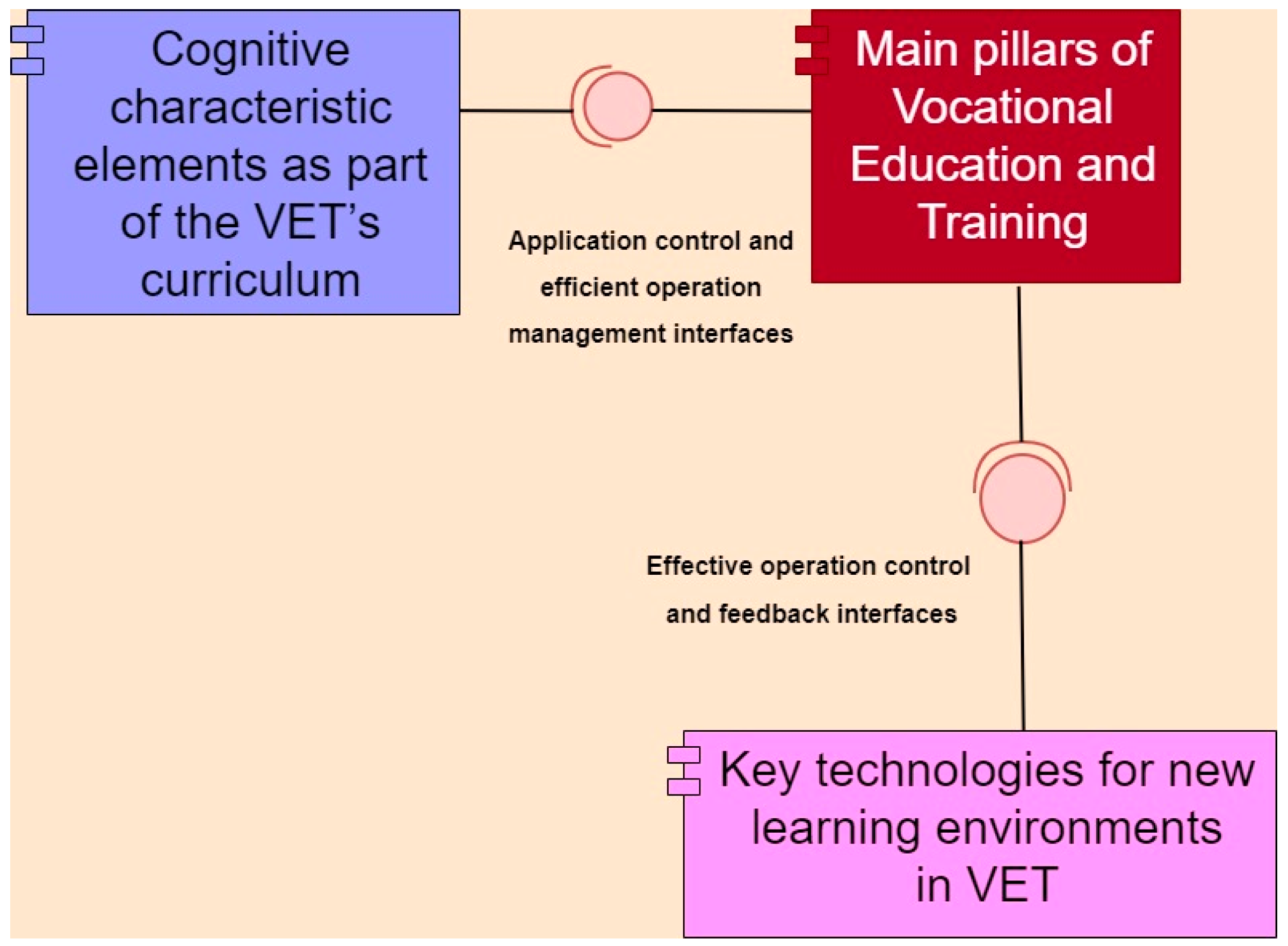
For an effective reform in VET to work it will have to homogenize and shorten the functions in the three pillars we identified in the previous sections, the cognitive characteristic of VET's new curriculum, the five pillars, as dimensions for VET, and the technologies for new learning environments (Figure 7). These elements act as permanent constituents of a permanent reform as the evolution of the elements of VET follows the evolution of technical culture and socio-economic restructuring. For these components to be able to cooperate, checkpoints and feedback are required. In addition, whenever a component is upgraded, the new parts must be able to work seamlessly with the old ones and be able to follow the upgrades given the separate schedules or individual processing. Sometimes in science, it happens that different attitudes, mindsets, or choices of priorities coexist, and a comprehensive design reform may want to fit pieces of these differences.
Beyond the above, it must be added that without a critical mass of technical and professional skills, it is unlikely that society will be able to move up the value chain and achieve appropriate levels of development. Having a functional and effective education and training system for personal and national development is a necessity of basic choice for the social fabric. This system must be linked to standards of development and defense of the world of work and directed towards meeting the changing demands of society and the economy while maintaining the competitiveness of graduates. On the other hand, training or skill acquisition alone does not create jobs. A correct and well-targeted investment in the general education of VET students alongside familiarization with the technical possibilities of modern technology is the most appropriate way to promote specialized technical staff with a wide educational level. Thus, the specific curricula, as VET teachers will implement them, are legitimate to act as an obstacle to the increase of youth unemployment, poverty, social crisis, and security problems in society. Based on VET study programs, students should be facilitated in integrating into the labor market by having the appropriate knowledge base. Educational programs and curricula should prepare young people for entering the labor market and provide lifelong learning pathways that respond to changing technologies and global economic demands [55]. For these reasons, developed and emerging economies have intensified their efforts to fully integrate VET into their general education systems [56]. These systems prepare young men and women for their future integration into the world of work by adopting necessary structures within their educational system, ensuring a high and balanced quality of studies in combination with the acquisition of skills, as determined by the fields of application, the complexity and the rate of emergence of technological innovations [57].
In support of the above, it should once again be noted and emphasized that implementing such reformations demands that we avoid distractions from the things themselves, the didactic application, and the elaboration data as they are structured. At this urging consent and with the consent of the entire VET, the community is to set the completion of project evaluation as a key. Finally, at this stage, the most important thing is to win and secure the serenity to ensure the strengthening of the individual goals and the indexing of the conquests for the specific situation, prospects, and the implementation of the postdoctoral research agenda, which concerns the application of a new example, a new model and at the same time, a new way of thinking about VET.
References
- Aprea, C.; Cattaneo, A., A. Designing Technology-Enhanced Learning Environments in Vocational Education and Training. In Wiley Handbook of Vocational Education and training΄; Book Editor(s): Guile, D., UnwinJohn L.; Publisher: Wiley & Sons, Inc., 2019; pp. 373-393.
- Souto-Otero, M. Six principles to advance technical and vocational education for sustainable development. Panorama, 2023 pp. 183-195.
- Makrygiannis, P.; Piromalis, D.; Papoutsidakis, M.; Tseles, D.; Papakitsos E. Epistemologies for Technology and its Teaching: Untying the Knot of a Three-level Technological Problem. In South-Eastern European Design Automation, Computer Engineering, Computer Networks and Society Media Conference (SEEDA_CECNSM), University of Piraeus, Piraeus, Greece, 2019.
- Frache, G.; Tombras, S.; Nistazakis, E.; Thompson, N. Pedagogical Approaches to 21st Century Learning: A Model to Prepare Learners for 21st Century Competencies and Skills in Engineering. In IEEE Global Engineering Education Conference (EDUCON), 2019; pp. 711-717.
- Xu, X.; Guo, X. Towards quality assurance for a curriculum of vocational education based on effective learning. In IEEE 14th International Conference on Computer Science and Education (ICCSE); Toronto, Canada, 2019.
- Cowart, M.; Embodied Cognition. In The Internet Encyclopedia of Philosophy; 2018. Available online https://www.iep.utm.edu/embodcog/ (accessed on 8 Mai 2024).
- Rosvall, P. Å; Nylund, M. Civic education in VET: Concepts for a professional language in VET teaching and VET teacher education. Journal of Vocational Education & Training, 2024, 76(3), pp. 684-703. [CrossRef]
- United Nations Educational, Scientific and Cultural Organization United Nations Educational, Scientific and Cultural Organization. Strategy for TVET (2022–2029): Transforming TVET for Successful and Just Transitions: Discussion Document UNESCO, 2021, Paris, France.
- Barabasch, A.; Bohlinger, S.; Wolf, S. Reconstructing policy transfer in adult and vocational education and training. Research in Comparative and International Education, 2021, 16.4: pp. 339-360. [CrossRef]
- Hasler J.; History of vocational training for general practice: the 1970s and 1980s. The Journal of the Royal College of General Practitioners, 1989, 39.325: pp. 338-341.
- Heidegger, M.; Science and reflection. In M. Heidegger; The question concerning technology and other essays; New York, USA: Harper Torchbooks; 1977. pp. 155-182.
- Heidegger, M.; The Age of the World picture. In M. Heidegger; The question concerning technology, and other essays. New York, USA: Harper Torchbooks; 1977. pp. 115-154.
- Ramsarup, P.; Mcgrath, S.; Lotz-Sisitka, Heila. A landscape view of emerging sustainability responses within VET. Journal of Vocational Education & Training, 2024, 76.2; pp.259-280. [CrossRef]
- arXiv:2403.02348.Núñez-Corrales, S.; Jakobsson, E. A Generalised Theory of Interactions--II. The Theoretical Construction. arXiv preprint arXiv:2403.02348, 2024.
- Karpov, A. Ontological Basis of the Education Phenomenon as a Performer of Its Social and Existential Realities. Postmodern Openings, 2019, 10.1: pp. 220-235.
- Aoki, T.; Pinar, W. F.; Irwin, R. L. Curriculum in a new key: The collected works of Ted T. Aoki. Routledge, 2004.
- Schatzki, T. R. A new societist social ontology. Philosophy of the social sciences, 2003, 33.2: pp. 174-202. [CrossRef]
- Magrini, J. An ontological notion of learning inspired by the philosophy of Hannah Arendt. Philosophy Scholarship, 2012, Paper 34.
- Poli, R.; Obrst, L. The interplay between ontology as categorial analysis and ontology as technology. In: Theory and applications of ontology: Computer applications. Dordrecht: Springer Netherlands, 2010. pp. 1-26.
- Dall'Alba, G. Learning to be professionals. Springer Science & Business Media, 2009.
- Dall’Alba, G. Learning professional ways of being: Ambiguities of becoming. Educational philosophy and theory, 2009, 41.1; pp. 34-45. [CrossRef]
- Postman, N.; Weingartner, C. Teaching as a subversive activity. New York: Dell Publishing Company, 1979.
- Powell, L.; McGrath, S. Capability or employability: Orientating VET toward “real work”. In Handbook of Vocational Education and Training: Developments in the changing world of work. Springer Suiza, 2018. pp. 1-25.
- Watts, A. G. The relationship of career guidance to VET. National Institute for Careers Education and Counselling. Cambridge: OECD, 2009. Available online: https://tinyurl.com/mtr4y9jj, (accessed on 8 August 2024).
- Eichhorst, W.; Rodríguez-Planas, N.; Schmidl, R.; Zimmermann, K. F. A roadmap to vocational education and training systems around the world. IZA Discussion Paper No. 7110, Institute for the Study of Labor (IZA), Bonn, 2012. Available online: https://www.econstor.eu/bitstream/10419/69486/1/734002173.pdf accessed on 8 June 2024.
- Irwanto, I. Characteristics of effective vocational education in the Industrial Revolution 4.0. Vanos Journal of Mechanical Engineering Education, 4.1., 2019, pp. 29-44. Available online: https://jurnal.untirta.ac.id/index.php/vanos/article/viewFile/6107/4339 accessed on 3 June 2024. [CrossRef]
- Anwar, N. B. B.; Minghat, A. D. Industrial engineering students’ readiness towards industrial revolution 4.0 at technical and vocational university: A literature review. ASEAN Journal for Science Education, 3.1: 2024, pp. 95-112.
- Poulantzas, N. Les classes sociales dans le capitalisme aujourdhui. Paris: Editions du Seuil, 1976.
- Nga, L. H. Investigating the Determinants of Vocational Education and Economic Development in Digital Age: A Review from 2018-2023. International Journal of Religion, 5.9, 2024, pp. 495-502. [CrossRef]
- Krishnasamy, H. N.; Hariharan N. Exploring the significance and contribution of Vocational Education & Training in meeting the industrial development needs in China. International Journal of Social Science and Business Management, 2.01, 2024, pp. 26-42. [CrossRef]
- Gedrimiene, E.; Silvola, A.; Pursiainen, J.; Rusanen, J.; Muukkonen, H. Learning analytics in education: Literature review and case examples from vocational education. Scandinavian Journal of Educational Research, 64.7, 2020, pp. 1105-1119. [CrossRef]
- Camanho, A. S.; Stumbriene, D.; Barbosa, F.; Jakaitiene, A. The assessment of performance trends and convergence in education and training systems of European countries. European Journal of Operational Research, 305.1, 2023, pp. 356-372. [CrossRef]
- Milkowski, M. Computational Theory of Mind. Internet Encyclopedia of Philosophy. 2013. Available online: https://iep.utm.edu/computational-theory-of-mind/ accessed on 19 June 2024.
- Guo, G.; Qiu, B. Investigation and Research on Vocational Education Teachers' Competencies Based on Smart Learning Environment. In the proceedings of the 10th International Conference on Information Technology in Medicine and Education (ITME), Qingdao, China: 2019. pp. 415-418.
- Wilke, A.; Magenheim, J. Critical Incidents for Technology Enhanced Learning in Vocational Education and Training. In the proceedings of IEEE Global Engineering Education Conference (EDUCON), Dubai, United Arab Emirates, 2019, pp. 892-899.
- Gustavo I. M. How to conceptually engineer conceptual engineering? Inquiry, An Interdisciplinary Journal of Philosophy, 2020, pp. 1-24. [CrossRef]
- National Academies of Sciences, Engineering, and Medicine. Building Capacity for Teaching Engineering in K-12 Education. Washington, DC: The National Academies Press, 2020.
- Simion, M. The ‘Should’ in Conceptual Engineering. Inquiry, An Interdisciplinary Journal of Philosophy, Routledge, 2018. Pp. 914–928.
- Bacon, F. Complete Essays, Including the New Atlantis and Novum Organum. Washington, DC: Washington Square Press, 1963.
- Weinberger, J. Francis Bacon and the Unity of Knowledge: Reason and Revelation. Francis Bacon and the Refiguring of Early Modern Thought. Routledge, 2017, pp. 123-142.
- Martin, C. G. Essays to Commemorate the Advancement of Learning. Francis Bacon and the Refiguring of Early Modern Thought. Routledge, 2017. 1605–2005.
- Salas-Velasco, M. Vocational education and training systems in Europe: A cluster analysis. European Educational Research Journal, 23(3), 2024, pp. 434-449. [CrossRef]
- Lu, C.; Peng, X. Improving the Management Level of Teaching Quality and Training the First-class Skilled Talents. In the proceedings of the 14th International Conference on Computer Science & Education (ICCSE). Toronto, ON, Canada, 2019, pp. 149-154.
- Eysink, T. H.; van Dijk, A. M.; Jong, T. BE COOL! A digital learning environment to challenge and socially include gifted learners. Educational Technology Research and Development. Association for Educational Communications & Technology, 2020, pp. 1-21.
- Munoz, C.; Redecker, J.; Vuorikari, C.; Punie, Y. Open Education 2030: planning the future of adult learning in Europe. Open Learning: The Journal of Open, Distance, and e-Learning, 28.3, 2013, pp. 171-186.
- Redecker, C. European Framework for the Digital Competence of Educators: DigCompEdu. Punie, Y. (ed). EUR 28775 EN. Publications Office of the European Union, Luxembourg, 2017, ISBN 978-92-79-73494-6, JRC107466. [CrossRef]
- Drąsutė, V.; Crippa, C. M.; Bajorūnienė, A.; Rudminaitė, E. Infusing Soft-Skills in the DigCompEdu. In the proceedings of The Future of Education 2021. 2021.
- Trends in vocational education and training research, Attwell, G.; Gerrard, A. The training and professional development of teachers in the use of digital technologies in Vocational Education and Training. Trends in vocational education and training research, 2, 2019, pp. 38-44.
- Bereiter, C.; Sansone, N. The" new normality": Digital technologies and learning environments beyond the emergency. QWERTY-Interdisciplinary Journal of Technology, Culture, and Education, 17.2, 2022, pp. 5-9.
- Cattaneo, A. A.; Antonietti, C.; Rauseo, M. How digitalized are vocational teachers? Assessing digital competence in vocational education and looking at its underlying factors. Computers & Education, 176, 2022, 104358. [CrossRef]
- Kiryakova, G.; Kozhuharova, D. The digital competencies necessary for the successful pedagogical practice of teachers in the digital age. Education Sciences, Volume 14, Issue 5, 507, 10.3390/educsci14050507, 2024, Available online: https://doi.org/10.3390/educsci14050507 accessed on 9 July 2024. [CrossRef]
- Khademi-Vidra, A.; Bakos, I. M. An Overview of the Digital Competencies of Teachers in the Hungarian Secondary Agricultural Vocational Training System. Technology, Knowledge and Learning, 2024, pp. 1-16. [CrossRef]
- Ferguson, B. T.; Napier, M. G. Philosophy and Psychology as Influences on Gifted and Talented Education in the 21st Century Education. In Handbook of Research on Software for Gifted and Talented School Activities in K-12 Classrooms. IGI Global, 2020. pp. 20-42.
- Clark, S. G. Problems, Problem Solving, and Education: An Inquiry into “Convention” as a Problem and What We Might Do About It. CADMUS, 123. Volume 5, No.3, March 2024, pp. 123-143. Available online: https://www.cadmusjournal.org/files/journalpdf/Vol5Issue3/Vol5_Issue3_part1.pdf#page=130, accessed on 17 July 2024.
- Amiron, E.; Latib, A. A.; Subari, K. Industry revolution 4.0 skills and enablers in technical and vocational education and training curriculum. International Journal of Recent Technology and Engineering (IJRTE), 8.1, 2019, pp. 485-492.
- Hager, P. VET, HRD, and workplace learning: Where to from here? The Wiley Handbook of Vocational Education and Training, 2019, pp. 63-80.
- Floridi, L. Soft ethics, the governance of the digital and the General Data Protection Regulation. Philosophical Transactions of the Royal Society A: Mathematical, Physical and Engineering Sciences, Philosophy & Technology, Volume 376, Issue 20133, 2018, pp. 1 – 8, available online: https://royalsocietypublishing.org/doi/full/10.1098/rsta.2018.0081 accessed on 5 August 2024. [CrossRef]
Figure 1.
Options of the research project.
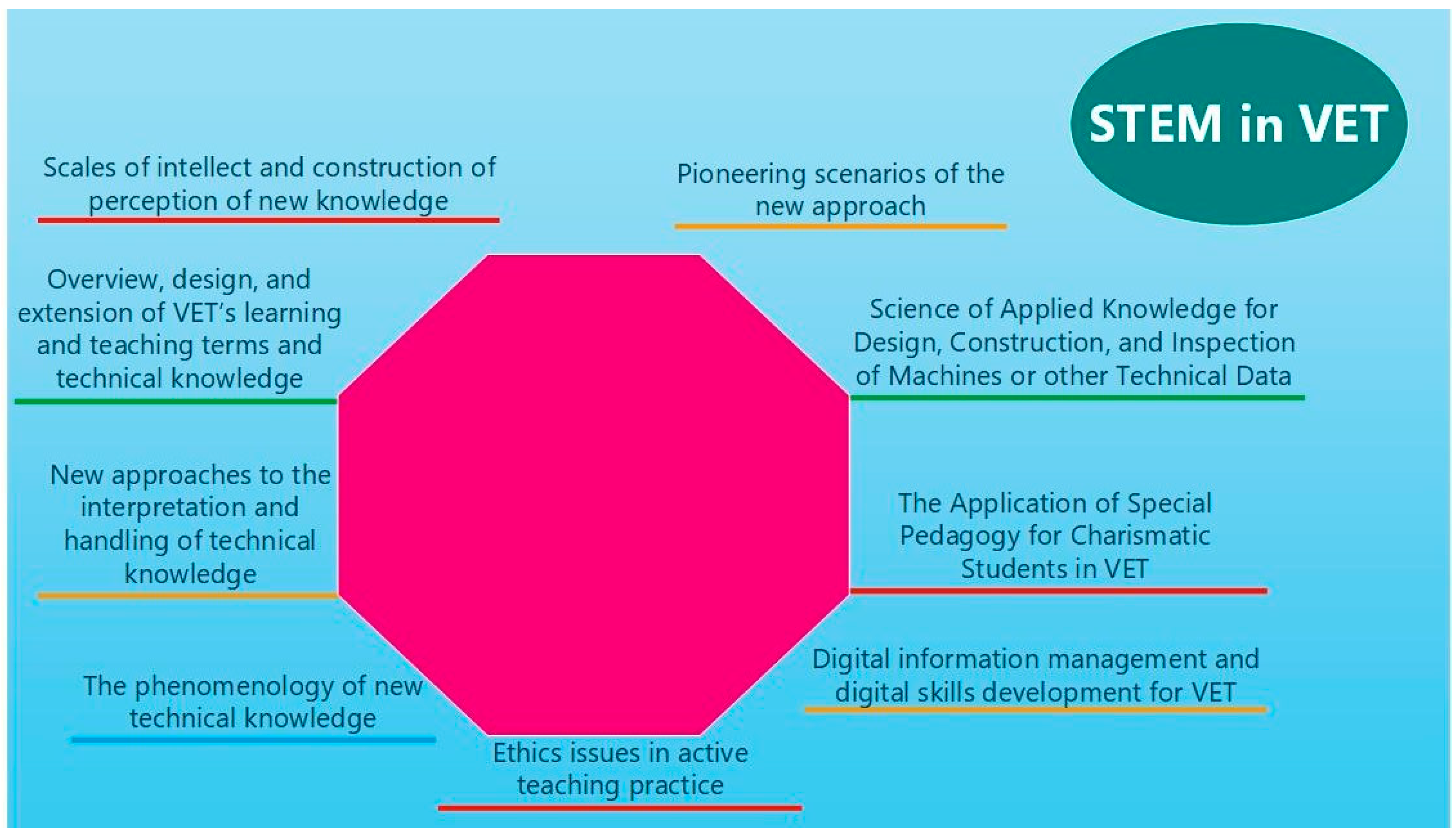
Figure 2.
The “multi-level” governance of the field of VET.
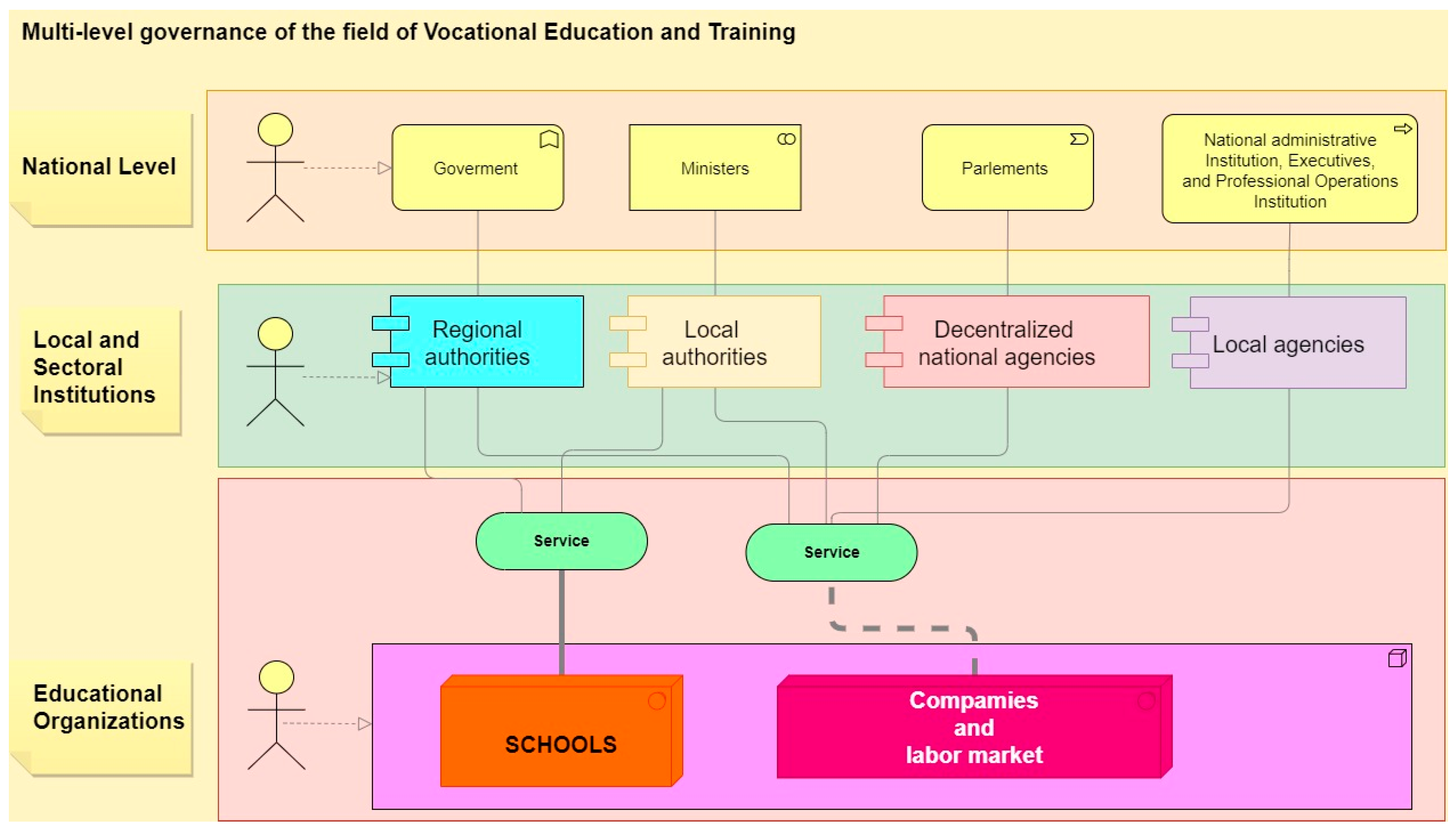
Figure 3.
The evaluation criteria for VET’s reform plan.
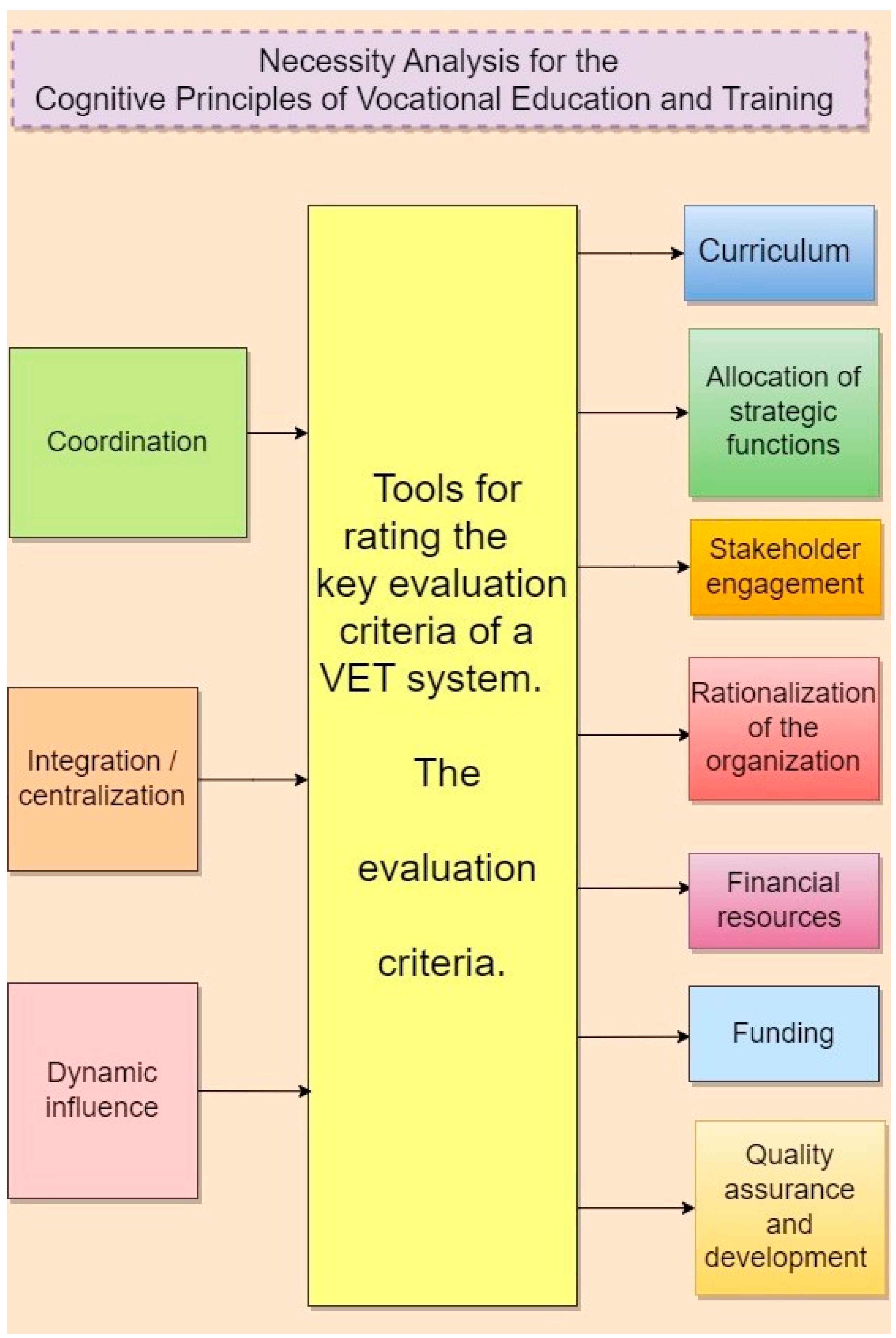
Figure 4.
Cognitive characteristic elements as part of the VET’s curriculum.
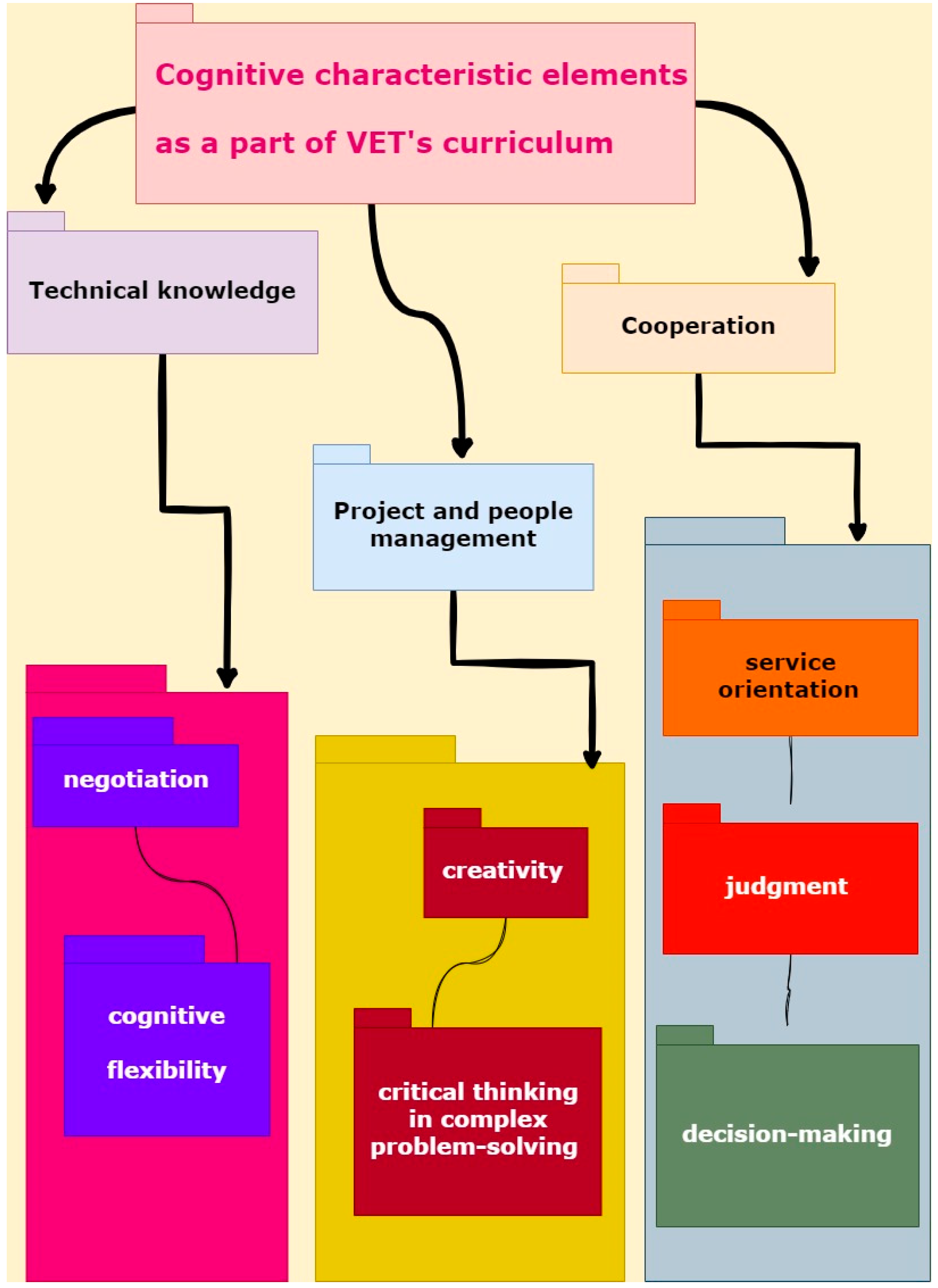
Figure 5.
Main pillars of Vocational Education and Training.

Figure 6.
The key technologies for new learning environments in VET.
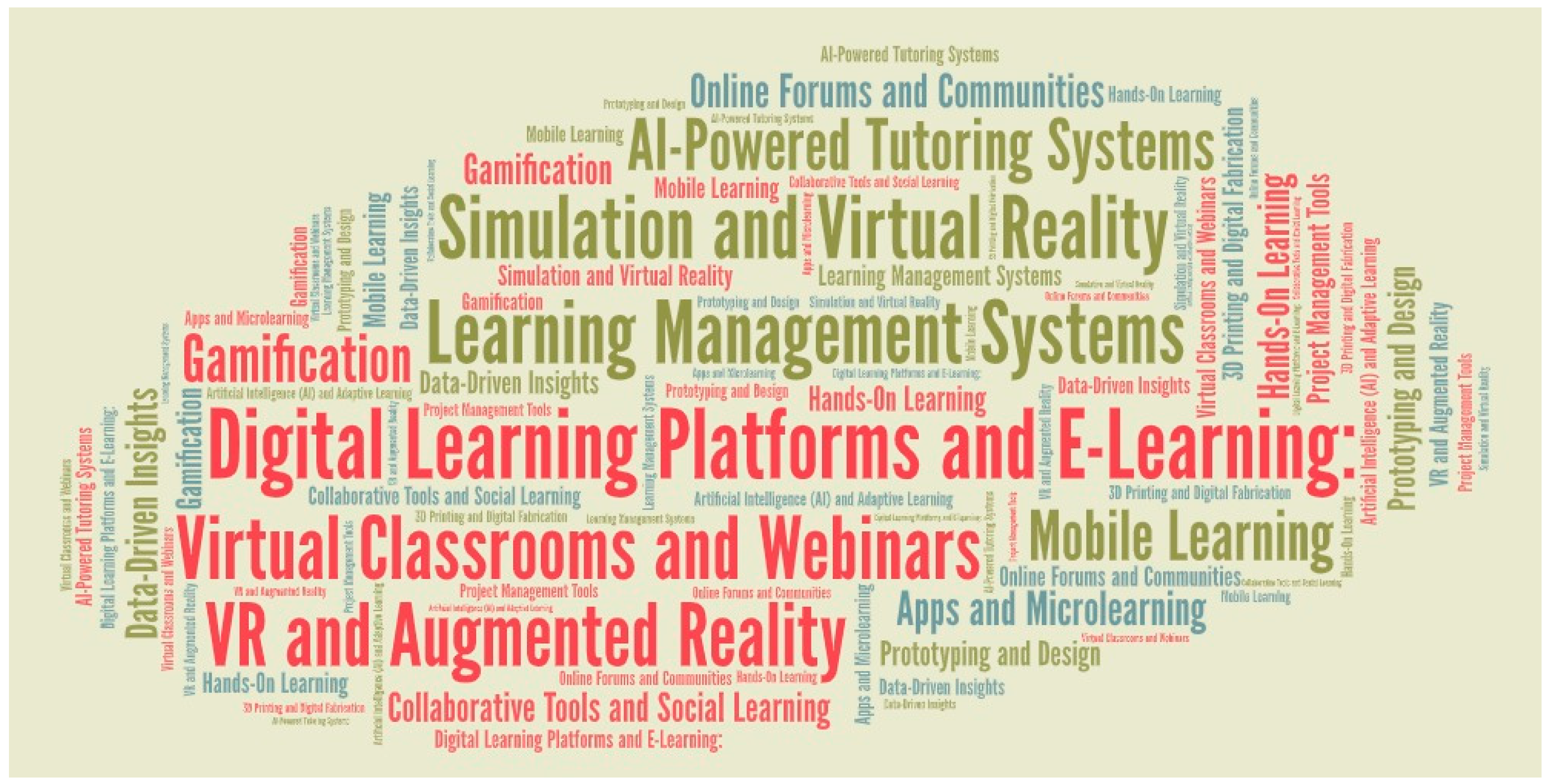
Figure 7.
Notes for control and feedback.
Disclaimer/Publisher’s Note: The statements, opinions and data contained in all publications are solely those of the individual author(s) and contributor(s) and not of MDPI and/or the editor(s). MDPI and/or the editor(s) disclaim responsibility for any injury to people or property resulting from any ideas, methods, instructions or products referred to in the content. |
© 2024 by the authors. Licensee MDPI, Basel, Switzerland. This article is an open access article distributed under the terms and conditions of the Creative Commons Attribution (CC BY) license (http://creativecommons.org/licenses/by/4.0/).
Copyright: This open access article is published under a Creative Commons CC BY 4.0 license, which permit the free download, distribution, and reuse, provided that the author and preprint are cited in any reuse.


