

Submitted:
28 August 2024
Posted:
29 August 2024
You are already at the latest version
Abstract
Cats, including companion cats, inflict extensive harm on wildlife. Using a national survey of 2000 households in New Zealand, we investigated the influence of involvement (an indicator of motivation) on the willingness of cat owners to keep their cats indoors at night. We found that respondents’ intentions to protect wildlife, and the frequency with which respondents with cats kept them indoors at night, was influenced by their involvement with cat welfare and their involvement with protecting wildlife, in addition to their attitudes and subjective norms. We also found that keeping cats indoors at night could be characterised as involving approach-avoidance conflict. Our findings have implications for efforts to increase the adoption by cat owners of keeping cats inside at night regarding the attentiveness of cat owners to promotional activities. Our findings suggest that such activities will not be particularly effective in the absence of cat-friendly, inexpensive, practical, and easily maintained devices that enable cats to be kept inside. Importantly, when the adoption of keeping cats inside at night is appropriately characterised as approach-avoidance conflict, our results suggest that promotional activities seeking to persuade cat owners that pet cats cause much greater harm to wildlife than they might believe are most likely to have a limited and likely temporary effect and may even be counter-productive.
Keywords:
cat containment
; companion cats
; motivation
; approach-avoidance theory
; New Zealand
1. Introduction
Cats, including companion cats, inflict extensive harm on wildlife [1,2]. Legge et al. [3] reviewed 66 studies of predation by companion cats worldwide to estimate their toll on wildlife in Australia. They found that the per-capita kill rate by companion cats was a quarter of that of feral cats. However, as companion cats live in much higher densities, their predation rate in residential areas is at least 28 times higher than those of feral cats in natural settings. Baker et al. [4], van Heezik et al. [5], and Thomas et al. [6], who studied the impact of companion cats on the environment, found companion cats had large, detrimental impacts on native wildlife.
Furthermore, the rate of predation by companion cats, by being based on the prey brought home, is likely to have been underestimated in many studies. Bruce et al. [7] studied companion cats using cat-borne cameras and GPS units and found that 62% of the cats they studied engaged in predation but none of them returned prey to their home. Perhaps partly reflecting this, cat owners are less likely than people without cats to agree that cats are harmful to wildlife [6,8,9]. In a survey of public opinion, Walker et al. [10] found that, while almost all their respondents were concerned about predation by feral cats on native wildlife, only about two-thirds were concerned about predation by companion cats.
This is not to say that cat owners do not care about wildlife. For example, Calver et al., [11] noted that most of the cat owners who volunteered for their study into the effectiveness of collars did so because they were concerned about the impact of cats on wildlife.
There are two ways in which owners of companion cats may reduce predation by their cats: by keeping their cats indoors at night (or permanently) and by having their cats wear collars with warning devices, such as bells and brightly coloured bibs, attached. The effectiveness of these practices varies considerably. For example, Gordon et al. [12] found that collars with bells reduced the catch of birds and mice but not the catch of rats, lizards, or insects, whereas Morgan et al. [13] did not find a significant effect from placing belled collars on cats hunting in a wetland reserve. Calver et al. [11] found a collar-mounted bib was effective in stopping most cats from catching birds, but bibs were less effective in preventing cats from catching other prey. Hall et al. [14] also found that colourful bibs on collars were effective in stopping most cats from catching birds. Note that Calver et al. [15] found, in an analysis of the records of 107 veterinarians, that cat injuries due to wearing collars were exceedingly rare.
While the owners of cats have less favourable attitudes towards collars than people who don’t own cats [11,16], collars are one of the few practices for managing predation by companion cats that is widely accepted by cat owners, though only a minority actually collar their cats [6,17]. The main reasons for having cats wear collars are for identification and to reduce predation, while the main reasons for not using collars were cat intolerance, repeated loss, and concerns over safety [6].
Most cats engage in risky behaviours if they are outdoors, most frequently by crossing roads [7], and a majority of cats with injuries requiring veterinary care suffered those injuries while fighting other cats or being in road incidents [15]. Despite this, the owners of cats tend to have unfavourable attitudes towards keeping cats indoors, either permanently or at night [6,18,19]. Linklater et al. [20] found that, although a majority of cat owners believed keeping cats in at night increased cat welfare, only about a third did so. Note, however, that cats kept indoors can suffer from problems with obesity due to reduced physical activity, greater consumption of food through boredom, and lack of enrichment, and they have an increased risk of feline urological syndrome [21].
Foreman-Worsley et al. [21] found that the main influences on keeping cats indoors were a concern for cat safety, mental and physical wellbeing, risk of infectious disease, and impact on wildlife. The most frequently cited reason for allowing a companion cat outdoors was to benefit its mental health (we are mindful of the possible contamination of the validity of this perception by anthropomorphism). Gates et al. [18] reported similar results. MacDonald et al. [8] and Rand et al. [22] found that attitudes and beliefs about the benefits to cats of indoor, versus outdoor, lifestyles were strong predictors of owners’ intentions to keep cats indoors. They also found that cat owners’ knowledge of the benefits to native wildlife of confining cats had a weak impact on cat owner behaviour, as did van Eeden et al. [23]. An outcome of studies into the attitude and behaviours of cat owners has often been a suggestion to change the behaviour of cat owners by changing their beliefs and attitudes [8,19,20].
Most cat owners, then, seem to be concerned both for the welfare of their cats and for the welfare of wildlife. If cat owners perceive that keeping their cats indoors is not beneficial for their cats, but is beneficial for wildlife, then they are faced with trying to reconcile two chronic, conflicting desires. Such conflicts are characterised by approach-avoidance behaviour [24,25,26]. In this context, promotional campaigns seeking to change the behaviour of cat owners can easily fail. This is because they intensify approach-avoidance behaviour, by escalating attention to the conflict between cat owners’ desire to protect the welfare of their cats and their desire to protect the welfare of wildlife, without necessarily providing an acceptable means for cat owners to resolve the conflict.
This paper contributes to the literature by proposing a novel framing of the approach-avoidance conflict manifest with regard to the decision to keeping companion cats indoors at night. Containing cats has been proposed as a key strategy for protecting wildlife from cats in New Zealand [27]. We used involvement, a concept from the fields of social psychology and marketing theory [28,29,30,31] to describe and measure the strength of people’s motivation with respect to the welfare of cats, to protecting wildlife from cats and to keeping cats indoors at night. We used this framing to analyse data on views about cats taken from a national survey of householders in New Zealand.
2. Theory
2.1. Involvement and Decision-Making
Our application of the theory of involvement has been described in detail previously [32,33,34,35]. The key relationships in the context of this study are summarised in Figure 1. Briefly, the theory differentiates between limited decision processes and extended decision processes [36,37]. Broadly speaking, limited decision processes regulate unimportant, routine behaviours while extended decision-making processes are usually triggered for first-time or important, non-routine behaviours.
Basically, the greater the potential consequences flowing from the decision, the more personally important, or more involving, the situation. The more involving the situation, the greater the motivation to respond appropriately to the situation, and so the greater the likelihood that extensive decision-making will be triggered [43,44].
A core assumption here is that the behaviour to be explained or predicted is purposive and that the behaviour is the product of several sets of inputs [45,46]. These inputs are the individual’s perception of relevant reality, their general and specific behavioural predispositions related to the behaviour(s) of interest, their beliefs about the predispositions of relevant others regarding the behaviour(s) of interest (i.e., subjective norms), and the incentive they perceive to allocate scarce cognitive effort to related decisions [35]. These inputs will tend to be correlated with each other when involvement is high because inconsistency among them is psychologically discomforting, generating cognitive dissonance [47,48].
When involvement is low, inconsistencies in these inputs may not trigger dissonance because the decision is of so little personal consequence, being so distant from personal identity, that inconsistencies across relevant beliefs, values and opinions may not even be sensed [35]. The possibility arises here that, in the absence of any personal predisposition regarding a behaviour, the main referent for attitudes will be beliefs about the predispositions of relevant others regarding the behaviour(s) of interest.
Kaine et al. [32] proposed that, when the decision to contemplate changing behaviour is prompted by a government policy intervention, the personal importance of the decision will depend on how involving the policy outcome (that, is the justification for the intervention) and the policy intervention (the required behaviour) are for the decision-maker. This means people’s willingness, the strength of their motivation, to consider changing their behaviour in response to a policy intervention (e.g., promotion, incentives, regulations) will depend, at least partly, on their involvement with the policy outcome and with the policy intervention. Kaine et al. [32] suggested, for analytical convenience, categorising people into quadrants based on their level of involvement with the policy outcome and the policy intervention.
There are two phases to the extended decision-making process: decision and implementation [46]. The natural point of separation between the two phases is the ‘behavioural intention’ which arises once a decision is made [45,46,49]. This intention is the new action or actions, such as keeping cats indoors at night, that the individual intends to undertake to meet a triggered, personal aspiration, such as protecting the cat from harm, or preventing the cat from harming wildlife.
Having formed a behavioural intention, the second stage of the process, decision-implementation, comes into play. Decision implementation is familiar when it comes to routine practices [34]. In the case of new practices, decision implementation assumes greater importance because it defines, across a targeted population, the rate of adoption of the new practice. This is especially the case with new practices that must be frequently and repeatedly executed compared to practices that entail once-off action [35]. Behaviours such as keeping cats indoors at night fit into this former category.
Bagozzi [46], one of the few to model the implementation of behavioural intentions, draws attention to the fact that different sets of factors can influence the formation of behavioural intentions and their implementation. While one set of factors influences the creation of an intention, another (possibly overlapping) set may influence the implementation of the intention. Generally speaking, in the absence of any barriers to implementation, the most likely explanation for a failure to act will be the absence of a perceived need to act [35,50]. Consequently, given that barriers to keeping cats indoors at night are absent, perceived need will relate to the threat that wandering outdoors at night is perceived to pose to the cat, or the perceived threat that cats wandering outdoors at night pose to wildlife. People’s perception of these threats will be subjective and cue-driven [35]. For example, the cues people employ to judge the threat that their cat poses to wildlife might include the perceived frequency with which the cat brings kills home.
However, a failure to act may also arise if the act itself is subject to two or more conflicting needs. For example, people may believe cats wandering outdoors at night are a threat to wildlife but also believe that keeping cats indoors at night is unnatural and detrimental to the welfare of cats. In these circumstances, the intention to protect wildlife conflicts with the intention to protect the welfare of cats. Since both intentions cannot be satisfied simultaneously, decision making may stall, sometimes permanently. Such a situation is explained by approach-avoidance theory.
2.2. Approach-Avoidance Theory
The essence of approach–avoidance theory is that people approach pleasure and avoid pain [25,26]. Consequently, approach-avoidance conflict arises when a behavioural option is perceived to have both positive and negative unpredictable outcomes, and this leads to approach and avoidance reactions at the same time. For example, if a cat owner is concerned both for the welfare of their cat and for the welfare of wildlife, the behaviour of keeping their cat indoors at night creates an irreconcilable, internal conflict for the cat owner if they believe (1) that cats harm wildlife and that keeping cats indoors protects wildlife and (2) keeping cats indoors harms cats. Whatever action the cat owner takes detracts from achieving one of their desires. Note, each of the outcomes is desired: it is a goal, not simply an attendant outcome.
The strength of the conflict depends on the similarity in appeal and non-appeal of competing goals (their valence), the strength of the motivation to achieve the competing goals (tension), and the psychological distance/proximity of achieving the goals [51,52,53,54,55]. If valences are similar in magnitude (but different in sign), and motivations are similar in strength, the conflict is difficult to reconcile and can remain stable and unresolvable over time. The economic analogue of this situation is a decision between action and inaction when both have zero net expected utility, with positive and negative outcomes in balance. In the context we are considering here, the goals of interest are serving the welfare of cats and the welfare of wildlife. A fundamental internal conflict arises for cat owners in pursuing these goals if they believe keeping cats indoors will protect wildlife, but they also believe keeping cats indoors harms the welfare of cats: the goals are mutually exclusive.
Psychological distance tends to cause the decision maker to overweight the psychologically nearer outcome. In effect, the valence of the outcome, the goal, “looms larger” as its psychological proximity increases [55,56]. In the context of a daily decision about a cat, this can be assumed to cause the immediate reality of a contained cat seeking freedom, in contrast to the vague and uncertain chance of wildlife damage were the cat to be released, to favour resolution of the conflict in favour of cat liberation. This suggests that a deliberate ‘policy’ decision to contain cats will likely be required of householders to offset the effect of the very different psychological distances involved if the decision is required frequently, such as each evening.
The persistence of approach-avoidance conflict, and resulting indecision, will depend partly on the relative valence of these goal beliefs and partly on the strength of their motivation to pursue both. The potential for internal conflict will be higher the greater the involvement of cat owners with both goals. The potential for internal conflict will be higher the greater the similarity in the absolute valence of both incompatible goals. Conversely, the potential for internal conflict will be lower if the competing goals have dissimilar valence for cat owners or they have low involvement with one or both goals.
A failure of people to act in ways policymakers may seek, therefore, may be a result of low involvement with the issue and/or with the means of addressing its resolution or, in a situation of some degree of involvement, approach-avoidance conflict arising from incompatible, valued outcomes. In the current example, psychological distance, as one possible dimension driving resolution of the conflict, is likely to be present since householders can be expected to perceive a weak causal link between keeping their particular cat indoors and the (long-term) preservation of wildlife as compared to the intrinsic immediate reality of denying the cat its preferences if it is kept indoors. This implies, importantly, that even when involvement, beliefs and attitudes all point towards keeping cats indoors as being a desirable behaviour, other features of the decision environment impede the execution of it. Hence, policies to modify behaviour need, mainly, to deal with those impediments.
2.3. Hypotheses
Several hypotheses regarding people’s motivations, attitudes, intentions and behaviours regarding keeping cats indoors at night follow from this discussion. These are (see Figure 1):
- Involvement with cat welfare and protecting wildlife from cats, together with salient beliefs, should influence involvement with keeping cats indoors at night. Salient beliefs are beliefs about the dangers cats pose to native birds and wildlife, the effect of protective measures on the welfare of cats, and the effectiveness of protective measures in preventing cats from harming wildlife.
- Attitudes towards keeping cats indoors at night, having cats wear collars, and the use of devices to deter cats from entering parks and reserves would be influenced by involvement with, and attitudes towards, the welfare of cats and with the protection of wildlife, and by salient beliefs.
- The strength of attitudes towards keeping cats indoors at night will be influenced by the degree of involvement with this behaviour as higher involvement is believed to promote greater search for information, resulting in stronger, more stable attitudes.
- Behavioural intentions with respect to protecting wildlife (such as willingness to take responsibility for protecting wildlife, and willingness to take some action, make sacrifices and work with others to protect wildlife from cats) will be influenced by involvement with, attitudes towards, and social norms in relation to the welfare of cats and to protecting wildlife from cats.
- Involvement with, attitude towards, and subjective norms about, keeping cats indoors at night will influence the frequency with which cat owners keep their cats indoors at night.
We also wish to illustrate how the keeping of cats indoors at night can be framed as the outcome of approach-avoidance conflict. The valence of a goal arises derives from the potential for achievement of the goal to directly or indirectly satisfy a need; consequently, the sign and strength of the valence of goals are correlated with the needs of the person [51]. Conflict arises when a behaviour is associated with goals that have roughly equal but competing valences. Given that involvement reflects the relative importance of a goal and, in doing so, the degree of motivation to pursue it, and that attitudes reflect the desirability or otherwise of a goal, then we expect that internal conflict would arise when a person associates a behaviour with goals that are similar in terms of involvement but opposing in terms of attitude.
Hence, the frequency of keeping cats indoors at night can be characterised as approach-avoidance behaviour by treating involvement and attitudes in combination as reflecting goal desire, and the differences between goal desire (so measured) with respect to (a) cat welfare and keeping cats indoors, and (b) protecting wildlife and keeping cats indoors, as reflecting the degree of conflict between goals. We also suggest that the greater is involvement with cat welfare, protecting wildlife and keeping cats indoors, the greater the degree of tension present in the conflict [51].
The stronger the belief that keeping cats indoors at night is more difficult, that is, the low psychological distance to keeping cats indoors in terms of the expected presence of outcomes [53], the lower the frequency with which cats will be kept indoors.
3. Materials and Methods
A questionnaire was developed based on Kaine et al. [32] to elicit people’s views on two key sets of scales. The first set of scales measured respondent involvement with the ideas of cat welfare, protecting native birds and wildlife and keeping cats indoors at night. Involvement was measured using a condensed version of the Laurent and Kapferer [57] involvement scale with respondents rating statements for each of the five components of involvement as follows (using improving the welfare of cats as an example):
- statements about functional involvement concerned the importance of, and caring about, improving the welfare of cats,
- statements about experiential involvement concerned the reward from, and passion about, improving the welfare of cats,
- statement about self-identity concerned opinions about improving the welfare of cats reflecting on own identity, and others’ identity, as a person,
- statements about consequences concerned the seriousness or importance of consequences arising from making a mistake in relation to improving the welfare of cats, and
- statements about the risk of making mistakes concerned the complexity or difficulty of making decisions about improving the welfare of cats.
Similar statements were formulated for involvement with protecting native birds and wildlife and keeping pet cats indoors at night (see Appendix A).
The second set of scales measured attitudes, and attitude strength, towards keeping pet cats indoors at night, having cats wear warning devices on collars, and using non-lethal deterrents to prevent cats from entering parks and reserves. We measured these attitudes using a simple, three-statement evaluative Likert scale such as:
- I think pet cats should be kept inside at night.
- I think keeping pet cats inside at night is the right thing to do.
- I believe it is wrong to keep pet cats inside at night.
Attitude towards cat welfare was measured using the following statement:
- Taking good care of all cats is the right thing to do.
A series of questions were formulated to elicit respondents’ beliefs about keeping pet cats indoors at night, trapping and baiting feral cats, and about the hunting behaviour of cats, their potential to harm wildlife, and the effectiveness of warning devices and deterrents. Information was sought on whether respondents have (or had) cats or dogs as pets, whether they kept their cats indoors at night, and whether they collared their cats. Respondents answered statements in the involvement and attitude scales, and the belief statements, using a five-point agreement scale ranging from strongly disagree (1) to strongly agree (5). The ordering of the statements in the involvement and attitude scales, and the ordering of belief statements, was randomised among the individual questionnaires to avoid bias in responses.
We also obtained information on respondents’ age, education, ethnicity, household composition and location. Participation in the survey was voluntary; respondents could leave the survey at any time and all survey questions were optional and could be skipped.
The questionnaire was approved for distribution by Manaaki Whenua—Landcare Research’s social ethics process (application 2223/30). The questionnaire was administered online by a market research company. Respondents were randomly selected from a database of consumer panelists across New Zealand, stratified by regional population. Panelists receive a reward for completing surveys, from the company owning the panel. The survey was open for approximately four weeks beginning in the first week of April 2020 and we received 2005 responses.
Hypotheses were tested using linear regression analysis. Variables with estimated coefficients that were not statistically significant (p<0.05) were removed from the regressions. Factor analysis was employed to condense the data on the 18 belief statements into a small set of uncorrelated composite variables to facilitate testing of the hypotheses concerning the influence of beliefs on involvement and attitudes.
For the approach-avoidance model, attitudes were recoded using a five-point scale ranging from strongly disagree (-2) to strongly agree (2) to create negative and positive attitudinal scores. These scores were then multiplied by respondents’ involvement scores to create an indicator of the desirability or otherwise of fostering the welfare of cats, protecting wildlife from cats and keeping cats indoors at night.
4. Results
Approximately 45 per cent of the 2005 respondents were women. The age distribution of the sample was marginally older than current census estimates, and the proportion of respondents with a bachelor or a post-graduate degree was substantially higher than the proportion in the New Zealand population (see Appendix B). New Zealanders of European descent were over-represented in the sample while Māori, Pacific Island or Asian peoples were under-represented. Households with incomes greater than NZ$50,000 were also substantially over-represented in the sample. Correspondingly, households with incomes less than NZ$50,000 were substantially under-represented. The data are available in Supplement A.
Statistical tests [58] indicated that the involvement scales were reliable; that is, they were internally consistent in the sense that scores on related statements were highly correlated with each other (see Appendix C). This is important as it means the scales are consistent measures of respondent involvement with each subject.
4.1. Factor Analysis of Beliefs
To avoid problems with multi-collinearity in the regressions predicting respondents’ attitudes, intentions and behaviour, factors analysis (principal components with varimax rotation) was employed to create composite variables that summarised respondents’ beliefs about cats and the effect of cats on native birds and wildlife, their beliefs with respect to keeping pet cats indoors at night and their beliefs about the effectiveness of measures to protect wildlife from cats.
The analysis generated five composite factors accounting for 60% of the variation in data (see Table 1). We interpreted the first factor as believing that keeping cats indoors was unnatural and harmful, and having them wear collars was also harmful. This factor was negatively correlated with believing cats are a nuisance, which seems reasonable if one believes cats are a danger to native birds and wildlife and cats in urban areas are a danger to native birds and wildlife. We interpreted the second factor as believing that wandering is dangerous for cats. We interpreted the third factor as believing that cats are a nuisance and a health risk. These beliefs were weakly correlated with believing cats are a danger to wildlife which seems reasonable if one believes cats transmit diseases and parasites to other animals. The fourth factor represents believing that cats are a danger to wildlife while the final factor represents believing that devices to prevent cats from hunting wildlife are ineffective.
The differences in beliefs between respondents who owned cats, respondents who have had cats and respondents who have never owned a cat are reported in Table 2. Cat owners are more likely to believe that keeping cats indoors and making them wear collars is unnatural and harmful and that devices to prevent cats from hunting wildlife are ineffective. They are less likely to agree that cats are a danger to wildlife and are a health risk.
The differences between respondents who owned cats, respondents who have had cats and respondents who have never owned a cat in terms of involvement, attitudes, and intentions are reported in Table 3. On average, cat owners having higher involvement than other respondents with cats have more favourable attitudes towards cats and less favourable attitudes towards keeping cats indoors, making them wear collars, and area deterrents.
4.2. Involvement and Attitude Strength
The influence of involvement with cat welfare, involvement with protecting wildlife and involvement with keeping cats indoors at night on the strength of attitudes (hypothesis 3) is reported in Table 4. The direct effect of involvement with cat welfare is to weaken the strength of respondents’ attitudes towards these measures while the direct effect of involvement with protecting wildlife intensifies respondents’ attitudes towards these measures. Involvement with keeping cats indoors at night intensifies attitude towards this measure. Note that involvement with cat welfare and involvement with protecting wildlife increases involvement with keeping cats indoors at night (see the following section).
4.3. Beliefs, Attitudes, and Involvement
The influence of involvement with cat welfare and involvement with protecting wildlife on involvement with keeping cats indoors at night (hypothesis 1) is reported in Table 5. The influence of involvement with cat welfare, involvement with protecting wildlife and salient beliefs about cats and protective measures on respondents’ attitudes towards keeping cats indoors at night, wearing collars and using area deterrents (hypothesis 2) are also reported in Table 5.
Involvement with the welfare of cats and protecting native birds and wildlife strongly and positively influenced involvement with keeping cats indoors at night. Involvement with keeping cats indoors at night was higher if respondents believed that cats are a danger to wildlife, wandering is dangerous for cats, cats are a health risk and that protective measures are ineffective. Involvement was lower if respondents believed that keeping cats indoors was unnatural and that keeping cats indoors and having them wear collars was harmful to cats.
Involvement with the welfare of cats influenced respondents’ attitudes towards keeping cats indoors at night but not their attitudes towards having cats wear collars nor using area deterrents. In contrast, involvement with protecting wildlife influenced respondents’ attitudes towards having cats wear collars or using area deterrents but not their attitude towards keeping cats indoors at night. Respondents’ attitudes towards cat welfare only influenced their attitude towards area deterrents whereas their attitude towards protecting wildlife influenced their attitude towards all three measures. Respondents’ attitudes towards all three measures were influenced by all the salient beliefs.
These results suggest that respondents favoured keeping cats inside if they were concerned to protect wildlife, thought cats were a danger to wildlife, thought wandering is dangerous for cats, and that collars and area deterrents were ineffective. These results also suggest that respondents favoured having cats wear collars, and using area
4.4. Intentions and Behaviour
native birds and wildlife (hypothesis 4) and their behaviour regarding their cats (hypothesis 5) is reported in Table 6. With respect to intentions, respondent preparedness to take some responsibility for, and their preparedness to act, make sacrifices, and work with others to protect native birds and wildlife from cats was primarily influenced by their involvement with, and attitude towards, protecting native birds and wildlife. Their involvement with the welfare of cats did not influence these intentions although their attitude towards cat welfare did positively influence their preparedness to take some responsibility for, and work with others, protecting wildlife from cats (see Table 6).
With respect to keeping cats indoors at night, the results indicate that the frequency with which this is done by cat owners depends on both their involvement with, and attitude towards, cat welfare as well as their involvement with, and attitude towards, protecting native birds and wildlife (see Table 6). This behaviour was also influenced by respondent perceptions of the subjective norm about keeping cats indoors at night. Surprisingly, increasing involvement with protecting wildlife appears to reduce the frequency of keeping cats indoors at night.
The frequency with which owners had their cats wear collars was not influenced by involvement or attitudes with respect to cat welfare or protecting native birds and wildlife. Respondents’ attitudes towards cats wearing collars appeared to be the only significant influence on this behaviour.
4.5. Approach-Avoidance Behaviour and Keeping Cats Indoors
The estimates for the approach-avoidance conflict model are reported in Table 7. The signs on the coefficients were as expected with the frequency of keeping cats indoors decreasing with:
- Greater differences in the desirability of serving cat welfare and keeping cats indoors at night
- Greater differences in the desirability of protecting wildlife and keeping cats indoors at night
- Low psychological distance with being able to keep cats indoors at night.
These results indicate that if cat owners’ involvement with serving cat welfare, protecting wildlife from cats and keeping cats inside are roughly similar, but they have conflicting attitudes towards keeping cats inside and serving cat welfare or protecting wildlife, then the internal conflict this creates means they will not routinely keep their cats inside.
4.6. Involvement, Attitudes and Socio-Economic Demographics
With respect to the demographic characteristics of respondents, we found statistically significant, but very weak, associations between age, gender, ethnicity, income and household composition of respondents and key variables such as involvement, attitudes, subjective norms, cat ownership, frequency of keeping cats indoors at night and frequency with which cats wore collars (see Appendix D).

Table 5.
Regression estimates for involvement, attitudes and beliefs (ants).
| Involvement with surveillance | Involvement with baiting | Involvement with preventing spread | Involvement with surveillance | Involvement with baiting | Attitude towards surveillance | Attitude towards baiting | |
|---|---|---|---|---|---|---|---|
| Involvement with preventing spread | 0.929 (p<0.001) |
0.365 (p<0.001) |
|||||
| Ants can spread quickly | 0.219 (p=0.004) |
0.250 (p<0.001) |
0.202 (p=0.012) |
||||
| Ants can seriously harm native species | 0.199 (p=0.003) |
0.302 (p<0.001) |
0.295 (p<0.001) |
0.214 (p=0.007) |
|||
| Ants are a real nuisance around the house | 0.186 (p=0.009) |
0.196 (p=0.008) |
|||||
| Ants are costly to control | 0.216 (p=0.001) |
0.232 (p<0.001) |
0.162 (p=0.021) |
0.285 (p<0.001) |
|||
| Ants can inflict severe financial losses on agricultural businesses | 0.211 (p=0.022) |
0.230 (p=0.004) |
|||||
| Ants can severely damage crops | |||||||
| Ants only spread slowly | -0.133 (p=0.036) |
||||||
| Ants are easy to identify | 0.164 (p=0.012) |
||||||
| Adjusted R2 | 0.86 | 0.78 | 0.41 | 0.39 | 0.34 | 0.29 | 0.19 |
| F-Test significance | <0.001 | <0.001 | <0.001 | <0.001 | <0.001 | <0.001 | <0.001 |
Note: Values are standardised beta coefficients. Values in parentheses are t-test probabilities that the true coefficient is zero. n= 200 for all regressions.
5. Discussion
Our main findings were that:
- Involvement with cat welfare, involvement with protecting wildlife and involvement with keeping cats indoors at night influenced the strength of respondents’ attitudes with respect to keeping cats indoors, having them wear collars and the use of area deterrents.
- Involvement with cat welfare, involvement with protecting wildlife and involvement with keeping cats indoors at night, in addition to their attitudes, positively influenced respondents’ intentions to protect wildlife and the frequency with which respondents with cats kept them indoors at night.
- We found respondents with cats were more likely than other respondents to believe that keeping cats indoors and making them wear collars is unnatural and harmful [59], and that devices intended to prevent cats from hunting wildlife are ineffective. They were less likely than other respondents to agree that cats are a danger to wildlife and are a health risk.
- Respondents who had never owned a cat had less favourable attitudes toward cats and more favourable attitudes towards keeping cats indoors, making them wear collars and using area deterrents, than other respondents. They also tended to believe that keeping cats indoors at night was easier, and that devices intended to prevent cats from hunting wildlife are effective, than other respondents. These respondents had, on average, moderate involvement with protecting wildlife from cats and mild involvement with cat welfare.
The results, in terms of the propensity of cat owners to allow their cats to roam being strongly influenced by concerns about cat welfare and the differences in attitudes between respondents who owned cats and those that did not, are generally consistent with other studies [6,8,9,18,19,31,60].
Our findings have several implications for the design of strategies to encourage cat owners to keep their cats indoors at night. First, as most cat owners have at least moderate-to-high involvement with the welfare of their cats, they are likely to notice, and pay attention to, promotional activities which seek to encourage this behaviour by establishing that doing so will enhance the welfare of their cats. This requires providing messages containing material that counters the view that it is unnatural to keep cats inside (at least temporarily) and which advances the view that cats are vulnerable to a variety of serious harms if they are allowed to wander outside at night. The purpose here is to strengthen the attitudes of cat owners who have a favourable attitude towards keeping cats indoors at night and to shift the attitude of cat owners who are ambiguous about keeping cats indoors at night towards a having a favourable attitude (see [61]).
Second, respondents who had cats tended to have moderate-to-high involvement with protecting wildlife and were, on average, moderately motivated to take responsibility and make sacrifices to act, and work with others to protect native wildlife from cats. Consequently, promotional activities may also encourage cat owners to keep their cats indoors at night by establishing that wildlife protection is relevant with respect to pet cats and in urban areas.
A third implication concerns promotional efforts to persuade cat owners that their cats inflict more damage on wildlife than they believe to be the case. Cat owners may rely on cues, such as urban location and the frequency with which their cat returns home with kills, to judge the harm inflicted on wildlife by their cats. If this is the case, then they are likely to underestimate the impact of their cat on wildlife. They may also misjudge the extent to which cats roam [62]. In principle, promotional activity seeking to correct this bias may reduce the psychological distance to the goal of protecting wildlife and so encourage cat owners to keep their pets indoors more frequently.
Fourth, respondents with cats tended to believe that keeping cats inside is difficult. Bearing in mind that, on average, respondents with cats had moderate involvement with the welfare of their cats, this suggests that, while cat owners may prefer to keep their cats indoors at night, the time and effort they will spend attempting to do so will be limited. Consequently, promotional activities encouraging cat owners to keep their cats indoors at night are unlikely to be successful unless cat-friendly, inexpensive, practical, and easily maintained devices that enable cats to be kept inside are available or owners are persuaded that the difficulties are more perceived than real [31,63]. That is, the ease of adopting a household policy favouring keeping cats indoors is somewhat reliant on technologies such as cat patios, cat enclosures and cat-proof fences that reduce the negative feedback of keeping cats indoors and increasing the psychological distance to the possible outcome of a frustrated feline present in the home [64].
Fifth, respondents with cats tended to have a favourable attitude towards the use of area deterrents to discourage cats from entering parks and reserves. This suggests that, provided area deterrents are effective and are not perceived by cat owners as threatening the welfare of their cats, area deterrents are an acceptable alternative to keeping cats indoors at night for most cat owners. Such deterrents could provide more immediate, effective, and widespread protection for native birds and wildlife without requiring the coordinated engagement of individual cat owners. This is achieved, in effect, by substantially destroying the approach-avoidance conflict via the breaching of the link between the competing goals of wildlife and domestic cat welfare.
Relatedly, whether cat owners put collars on their cats depended, primarily, on their attitude toward collars which depended, in turn, on their involvement with and attitude towards protecting wildlife from cats and their beliefs about cats and the effectiveness of protective devices. If protective devices attached to collars are effective, or their effectiveness can be improved, they may offer an inexpensive and practical alternative to keeping cats indoors at night. A campaign promoting the use of these devices would need to offer persuasive evidence that they work and are safe for cats to wear. Such a campaign may also need to be allied with instructional programmes on how to train kittens and adult cats to accept collars.
From the perspective of approach-avoidance theory the following observations can be made. Promotional activity that counters the view that it is unnatural to keep cats inside, and advances the view that cats are vulnerable to a variety of serious harms if they are allowed to wander outside at night, may reduce the negative valence of keeping cats indoors at night. This would weaken avoidance and strengthen approach behaviour with respect to keeping cats indoors more frequently.
Promotional activities establishing that wildlife protection is relevant with respect to pet cats and cats in urban areas reduces the psychological distance to achieving the goal of protecting wildlife. However, this kind of promotional activity will meet with limited success in encouraging cat owners to keep their pets inside as it does not address the fundamental conflict many cat owners feel between keeping cats inside to protect wildlife (approach) and allowing cats to wander because it is natural and keeping them inside harms their welfare (avoid).
Efforts to persuade cat owners that their cats inflict more damage on wildlife than they believe to be the case are also likely to have a limited effect for the same reason. In principle, these reduce the psychological distance to the goal of protecting wildlife. However, the psychological distance to the goal of keeping cats indoors, that is, the difficulty of keeping them indoors, is unaffected and likely to continue to be significantly less than that of protecting wildlife. Furthermore, the fundamental conflict many cat owners feel, between keeping cats inside to protect wildlife (approach) and allowing cats to wander because it is natural and keeping them inside harms their welfare (avoid), remains. The likely result is that cat owners may move incrementally toward keeping their cats indoors, but most will continue to dither [65].
Alternatively, cat owners may interpret their efforts to protect wildlife by keeping cats indoors at least some of the time as doomed to failure, and simply abandon the idea altogether. Here, the promotion has had the counter-productive effect of increasing psychological distance to the goal (of protecting wildlife from cats) and undermining feelings of competence [52]. Consequently, the effort devoted to achieving the goal of protecting wildlife from cats diminishes [53].
While involvement can be seen as necessary for people to engage cognitively with an issue and related actions, and a positive correlate of motivation to pursue satisfaction of the issue (goal desire, in effect), it is also likely to correlate positively with the revelation to the decision maker of approach-avoidance conflict as the dimensionality of decision options are considered. That is, if it exists, competing goal desire across mutually incompatible goals will be revealed more, the more a decision is contemplated. This means the degree of tension in the internal conflict experienced by cat owners will be related to their involvement with cat welfare, protecting wildlife and keeping cats inside.
If involvement is low then the degree of tension is likely to small and the conflict, while always present, can largely be ignored. Relatedly, promotional activities concerning cat welfare, keeping cats inside and protecting wildlife from cats are unlikely to influence the attitudes and behaviour of the cat owner. In circumstances of internal conflict with low involvement, cat owners are likely to respond to regulations mandating that cats be kept indoors at night by either ignoring the regulation or by relinquishing their cats. However, if having a cat satisfies an important personal goal, such as satisfying the needs of children, then they are likely to strongly oppose the regulation as relinquishing the cat is not an attractive option.
If involvement is high, then the degree of tension is likely to be elevated and the internal conflict can be taxing. Promotional activities concerning cat welfare, keeping cats inside and protecting wildlife from cats have the potential to influence the attitudes and behaviour of the cat owner. One solution to this stressful conflict is to ‘leave the field’ [51] by relinquishing the cat. However, if having a cat satisfies an important personal goal such as satisfying the needs of children this may not be a feasible option. Instead, they may engage in substitute activity [51] such as volunteering for or donating to a wildlife charity, or they may engage in motivated reasoning [66,67] to rationalise their behaviour. In circumstances of internal conflict with high involvement, cat owners who cannot relinquish their cats are likely to respond to regulations mandating that cats be kept indoors at night by attempting to comply with the regulation. They may, for example, invest in enclosures, cat proof fencing and so on.
The results for the approach-avoidance conflict model indicated that cat owners will keep their pets indoors at night mostly or always only if they have high involvement with cat welfare and a strongly favourable attitude towards keeping cats inside. Promotional efforts to encourage cat owners to keep their pets inside that focus only on the harm that cats do to wildlife are unlikely to result in anything more than marginal, and probably temporary, increases in the frequency with which cats are kept inside at night.
A possibly important qualification to our results is that our characterisation of the approach-avoidance conflict that cat owners experience when it comes to keeping cats indoors is partial. The decision, particularly when it occurs frequently, may be a joint family decision and not solely the preserve of our interview subjects. For example, the reactions of children to the potentially distressing behaviour of cats that are prevented from being outdoors, or simply to the idea of limiting the cat’s freedom, may be influential. Such unfavourable reactions can be expected to increase the (negative) valence of keeping cats indoors and favour their liberation
6. Conclusions
We found, as have previous studies, that respondents with cats were more likely than other respondents to believe that keeping cats indoors is unnatural and harmful, and that devices intended to prevent cats from hunting wildlife are ineffective. They were also less likely than other respondents to agree that cats are a danger to wildlife and are a health risk.
We also found that respondents’ intentions to protect wildlife and the frequency with which respondents with cats kept them indoors at night was influenced by their involvement with cat welfare and involvement with protecting wildlife in addition to their attitudes and subjective norms.
Our findings have implications for promotional efforts to increase the adoption by cat owners of keeping cats inside at night regarding the attentiveness of cat owners to such activities. Our findings suggest that such activities will not be particularly effective in the absence of cat-friendly, inexpensive, practical, and easily maintained devices that enable cats to be kept inside. Importantly, when the adoption of keeping cats inside at night is appropriately characterised as approach-avoidance conflict, our results suggest that promotional activities seeking to persuade cat owners that pet cats cause much greater harm to wildlife than they might believe are most likely to have a limited and possibly temporary effect and may even be counter-productive.
Author Contributions
Conceptualisation, G.K., V.W. and Z.T.; Methodology, G.K. and V.W.; Data curation, G.K. and Z.T..; Formal analysis, G.K.; Writing—Original Draft Preparation, G.K.; Writing—Review & Editing, G.K., V.W. and Z.T.; Project Administration, G.K..; Funding Acquisition, G.K.
Funding
This research was funded by Manaaki Whenua Landcare Research. Grant Number: PRJ3178.
Data Availability Statement
The dataset analysed during the current study is available at https://osf.io/7nmcx/.
Acknowledgments
We would like to thank our survey respondents and our reviewers.
Conflicts of Interest
The authors have no relevant financial or non-financial interests to disclose.
Appendix A
Questionnaire
Your Thoughts on Cats
- This survey is being conducted for Manaaki Whenua Landcare Research and looks at peoples’ attitudes and opinions about pet and feral cats (cats living in the wild). We understand that, at times, cats can be difficult to manage because, well, cats are cats! And that can create challenges when it comes to satisfying their needs and wishes while looking out for the welfare of birds and wildlife.
- The information from this survey may be used in a report to the New Zealand Government to assist them in thinking about how best to care for cats while protecting our native birds and wildlife. The results may also be used in presentations and articles that will be submitted for publication.
- Your answers are confidential, and data presented from the survey cannot be traced back to individuals. We like to ask our questions a couple of different ways to make sure we get a good understanding of your attitudes and opinions. So things may get a little repetitive at times.
- Q1: To begin with, which of the following regions do you live in?
- ( ) Northland
- ( ) Auckland
- ( ) Waikato
- ( ) Bay of Plenty
- ( ) Gisborne
- ( ) Hawke's Bay
- ( ) Taranaki
- ( ) Manawatu-Whanganui
- ( ) Wellington
- ( ) Tasman/ Nelson
- ( ) Marlborough
- ( ) West Coast
- ( ) Canterbury
- ( ) Otago
- ( ) Southland
- Q2: Involvement with cat welfare.
- We are interested in your opinions about caring for cats. Thinking about cats in general, how strongly do you agree or disagree with the following statements?
| Item | Strongly agree | Agree |
Unsure/ neutral |
Disagree | Strongly disagree |
| It’s rewarding to take good care of cats | ☐ | ☐ | ☐ | ☐ | ☐ |
| The consequences are serious if we don’t take good care of cats | ☐ | ☐ | ☐ | ☐ | ☐ |
| I am passionate about taking good care of cats | ☐ | ☐ | ☐ | ☐ | ☐ |
| It would be a big deal if mistakes were made when taking care of cats | ☐ | ☐ | ☐ | ☐ | ☐ |
| My position on taking good care of cats tells others something about me | ☐ | ☐ | ☐ | ☐ | ☐ |
| Taking good care of cats is important to me | ☐ | ☐ | ☐ | ☐ | ☐ |
| Making decisions about how to take good care of cats is complicated | ☐ | ☐ | ☐ | ☐ | ☐ |
| What others think about taking good care of cats tells me something about them | ☐ | ☐ | ☐ | ☐ | ☐ |
| I care a lot about taking good care of cats | ☐ | ☐ | ☐ | ☐ | ☐ |
| Making decisions about how to take good care of cats is difficult | ☐ | ☐ | ☐ | ☐ | ☐ |
- Q3: Involvement with protecting our native birds and wildlife.
- We are interested in your opinions about protecting our native birds and wildlife. How strongly do you agree or disagree with the following statements?
| Item | Strongly agree | Agree |
Unsure/ neutral |
Disagree | Strongly disagree |
| It’s rewarding to protect our native birds and wildlife | ☐ | ☐ | ☐ | ☐ | ☐ |
| The consequences are serious if we don’t protect our native birds and wildlife | ☐ | ☐ | ☐ | ☐ | ☐ |
| I am passionate about protecting our native birds and wildlife | ☐ | ☐ | ☐ | ☐ | ☐ |
| It would be a big deal if mistakes were made with protecting our native birds and wildlife | ☐ | ☐ | ☐ | ☐ | ☐ |
| My position on protecting our native birds and wildlife tells others something about me | ☐ | ☐ | ☐ | ☐ | ☐ |
| Protecting our native birds and wildlife is important to me | ☐ | ☐ | ☐ | ☐ | ☐ |
| Making decisions about protecting our native birds and wildlife is complicated | ☐ | ☐ | ☐ | ☐ | ☐ |
| What others think protecting our native birds and wildlife tells me something about them | ☐ | ☐ | ☐ | ☐ | ☐ |
| I care a lot about protecting our native birds and wildlife | ☐ | ☐ | ☐ | ☐ | ☐ |
| Making decisions about how to protect our native birds and wildlife is difficult | ☐ | ☐ | ☐ | ☐ | ☐ |
- Q4: Involvement with reducing the number of feral cats.
- We are interested in your opinions about reducing the number of feral cats. How strongly do you agree or disagree with the following statements?
| Item | Strongly agree | Agree |
Unsure/ neutral |
Disagree | Strongly disagree |
| I think it would be rewarding to reduce the number of feral cats | ☐ | ☐ | ☐ | ☐ | ☐ |
| The consequences are serious if we don’t reduce the number of feral cats | ☐ | ☐ | ☐ | ☐ | ☐ |
| I am passionate about reducing the number of feral cats | ☐ | ☐ | ☐ | ☐ | ☐ |
| It would be a big deal if we didn’t reduce the number of feral cats | ☐ | ☐ | ☐ | ☐ | ☐ |
| My position on reducing the number of feral cats tells others something about me | ☐ | ☐ | ☐ | ☐ | ☐ |
| Having a program to reduce the number of feral cats is important to me | ☐ | ☐ | ☐ | ☐ | ☐ |
| Making decisions about reducing the number of feral cats is complicated | ☐ | ☐ | ☐ | ☐ | ☐ |
| What others think about reducing the number of feral cats tells me something about them | ☐ | ☐ | ☐ | ☐ | ☐ |
| I care a lot about reducing the number of feral cats | ☐ | ☐ | ☐ | ☐ | ☐ |
| Making decisions about reducing the number of feral cats is difficult | ☐ | ☐ | ☐ | ☐ | ☐ |
- Q5: Involvement with keeping pet cats inside at night.
- We are interested in your opinions about keeping pet cats inside at night. How strongly do you agree or disagree with the following statements?
| Item | Strongly agree | Agree |
Unsure/ neutral |
Disagree | Strongly disagree |
| I think keeping pet cats inside at night would be rewarding | ☐ | ☐ | ☐ | ☐ | ☐ |
| The consequences are serious if we don’t keep pet cats inside at night | ☐ | ☐ | ☐ | ☐ | ☐ |
| I am passionate about keeping pet cats inside at night | ☐ | ☐ | ☐ | ☐ | ☐ |
| It would be a big deal if we didn’t keep pet cats inside at night | ☐ | ☐ | ☐ | ☐ | ☐ |
| My position on keeping pet cats inside at night tells others something about me | ☐ | ☐ | ☐ | ☐ | ☐ |
| Keeping pet cats inside at night is important to me | ☐ | ☐ | ☐ | ☐ | ☐ |
| Making decisions about keeping pet cats inside at night is complicated | ☐ | ☐ | ☐ | ☐ | ☐ |
| What others think about keeping pet cats inside at night tells me something about them | ☐ | ☐ | ☐ | ☐ | ☐ |
| I care a lot about keeping pet cats inside at night | ☐ | ☐ | ☐ | ☐ | ☐ |
| Making decisions about keeping pet cats inside at night is difficult | ☐ | ☐ | ☐ | ☐ | ☐ |
- Q6: Attitude towards using lethal traps to reduce the number of feral cats.
| Item | Strongly agree | Agree |
Unsure/ neutral |
Disagree | Strongly disagree |
| I think lethal traps should be used to reduce the number of feral cats | ☐ | ☐ | ☐ | ☐ | ☐ |
| I think using lethal traps to reduce the number of feral cats is the right thing to do | ☐ | ☐ | ☐ | ☐ | ☐ |
| I believe it is wrong to use lethal traps to reduce feral cat numbers | ☐ | ☐ | ☐ | ☐ | ☐ |
- Q7: Attitude towards using poison baits to reduce the number of feral cats.
| Item | Strongly agree | Agree |
Unsure/ neutral |
Disagree | Strongly disagree |
| I think poison baits should be used to reduce the number of feral cats | ☐ | ☐ | ☐ | ☐ | ☐ |
| I think using poison baits to reduce the number of feral cats is the right thing to do | ☐ | ☐ | ☐ | ☐ | ☐ |
| I believe it is wrong to use poison baits to reduce feral cat numbers | ☐ | ☐ | ☐ | ☐ | ☐ |
- Q8: Attitude towards keeping pet cats inside at night.
| Item | Strongly agree | Agree |
Unsure/ neutral |
Disagree | Strongly disagree |
| I think pet cats should be kept inside at night | ☐ | ☐ | ☐ | ☐ | ☐ |
| I think keeping pet cats inside at night is the right thing to do | ☐ | ☐ | ☐ | ☐ | ☐ |
| I believe it is wrong to keep pet cats inside at night | ☐ | ☐ | ☐ | ☐ | ☐ |
- Q9: Attitude towards using deterrents (e.g. recorded sounds, scent sprays, ultrasound) to protect birds and wildlife by stopping cats entering parks and gardens.
| Item | Strongly agree | Agree |
Unsure/ neutral |
Disagree | Strongly disagree |
| I think cat deterrents should be used to protect birds and wildlife | ☐ | ☐ | ☐ | ☐ | ☐ |
| I think using cat deterrents to protect birds and wildlife is the right thing to do | ☐ | ☐ | ☐ | ☐ | ☐ |
| I believe it is wrong to use cat deterrents to protect birds and wildlife | ☐ | ☐ | ☐ | ☐ | ☐ |
- Q10: Attitude towards cats wearing collars with warning devices such as a bell, small bib, or bright colours.
| Item | Strongly agree | Agree |
Unsure/ neutral |
Disagree | Strongly disagree |
| I think cats should wear collars with warning devices to help protect birds and wildlife | ☐ | ☐ | ☐ | ☐ | ☐ |
| I think having cats wear collars with warning devices to help protect birds and wildlife is the right thing to do | ☐ | ☐ | ☐ | ☐ | ☐ |
| I believe it is wrong to having cats wear collars with warning devices | ☐ | ☐ | ☐ | ☐ | ☐ |
- Q11: Your thoughts about cats. We are interested in your thoughts on cats. How strongly do you agree or disagree with the following statements?
| Item | Strongly agree | Agree |
Unsure/ neutral |
Disagree | Strongly disagree |
| I think pet cats should be kept inside at night for their own safety | ☐ | ☐ | ☐ | ☐ | ☐ |
| I think cats are a nuisance | ☐ | ☐ | ☐ | ☐ | ☐ |
| I think wandering cats are a danger to other cats | ☐ | ☐ | ☐ | ☐ | ☐ |
| I think cats are a danger to wildlife | ☐ | ☐ | ☐ | ☐ | ☐ |
| It’s natural for cats to hunt birds and wildlife | ☐ | ☐ | ☐ | ☐ | ☐ |
| I think wandering cats are a danger to themselves | ☐ | ☐ | ☐ | ☐ | ☐ |
| I think its unnatural to keep cats inside | ☐ | ☐ | ☐ | ☐ | ☐ |
| Collars with warning devices like bells don’t work | ☐ | ☐ | ☐ | ☐ | ☐ |
| Collars can be a danger to cats | ☐ | ☐ | ☐ | ☐ | ☐ |
| I don’t think deterrents are likely to be effective | ☐ | ☐ | ☐ | ☐ | ☐ |
| Some cats just won’t wear a collar | ☐ | ☐ | ☐ | ☐ | ☐ |
| Cats transmit diseases and parasites to other cats and animals | ☐ | ☐ | ☐ | ☐ | ☐ |
| Cats can transmit diseases and parasites to people | ☐ | ☐ | ☐ | ☐ | ☐ |
| Pet cats are not really a danger to native birds and wildlife | ☐ | ☐ | ☐ | ☐ | ☐ |
| Cats in urban areas are not really a danger to native birds and wildlife | ☐ | ☐ | ☐ | ☐ | ☐ |
| Keeping cats inside at night will only protect birds and wildlife if everyone does it | ☐ | ☐ | ☐ | ☐ | ☐ |
| I think lethal trapping of cats in the wild is inhumane | ☐ | ☐ | ☐ | ☐ | ☐ |
| It’s difficult to keep cats inside at night | ☐ | ☐ | ☐ | ☐ | ☐ |
| I think using baits to control cats in the wild is cruel | ☐ | ☐ | ☐ | ☐ | ☐ |
| If pet cats are outside at night, they could be attacked by feral cats | ☐ | ☐ | ☐ | ☐ | ☐ |
- Q12: What others think about pet cats.
- How strongly do you agree or disagree with the following statements?
| Item | Strongly agree | Agree |
Unsure/ neutral |
Disagree | Strongly disagree |
| My family thinks keeping pet cats inside at night is the right thing to do | ☐ | ☐ | ☐ | ☐ | ☐ |
| My friends think pet cats should be kept inside at night | ☐ | ☐ | ☐ | ☐ | ☐ |
| My friends think using cat deterrents to protect birds and wildlife is the right thing to do | ☐ | ☐ | ☐ | ☐ | ☐ |
| My family thinks using cat deterrents to protect birds and wildlife is the right thing to do | ☐ | ☐ | ☐ | ☐ | ☐ |
- Q13: Your opinions about managing feral cats.
- We are interested in your thoughts on reducing the impact of cats on the environment. How strongly do you agree or disagree with the following statements?
| Item | Strongly agree | Agree |
Unsure/ neutral |
Disagree | Strongly disagree |
| Reducing the number of feral cats is the right thing to do | ☐ | ☐ | ☐ | ☐ | ☐ |
| I am prepared to take action to protect native birds and wildlife from cats | ☐ | ☐ | ☐ | ☐ | ☐ |
| Taking good care of all cats is the right thing to do | ☐ | ☐ | ☐ | ☐ | ☐ |
| I am prepared make sacrifices to protect native birds and wildlife from cats | ☐ | ☐ | ☐ | ☐ | ☐ |
| I think protecting native birds and wildlife is the right thing to do | ☐ | ☐ | ☐ | ☐ | ☐ |
| I am prepared to take some responsibility for protecting native birds and wildlife from cats | ☐ | ☐ | ☐ | ☐ | ☐ |
| It is important to work together to protect native birds and wildlife from cats | ☐ | ☐ | ☐ | ☐ | ☐ |
- Q14: What others think about managing feral cats.
- How strongly do you agree or disagree with the following statements?
| Item | Strongly agree | Agree |
Unsure/ neutral |
Disagree | Strongly disagree |
| My family thinks lethal trapping of feral cats is the right thing to do | ☐ | ☐ | ☐ | ☐ | ☐ |
| My friends think lethal trapping of feral cats is the right thing to do | ☐ | ☐ | ☐ | ☐ | ☐ |
| My friends think using poison baits to reduce the number of feral cats is the right thing to do | ☐ | ☐ | ☐ | ☐ | ☐ |
| My family thinks using poison baits to reduce the number of feral cats is the right thing to do | ☐ | ☐ | ☐ | ☐ | ☐ |
- Q15: Which of the following statements best describes you?
| Item | Describes me |
| I really think lethal trapping of feral cats is the right thing to do | ☐ |
| Lethal trapping of feral cats doesn’t really matter to me | ☐ |
| I am not really sure if lethal trapping of feral cats is the best thing to do | ☐ |
| I haven’t put much thought into lethal trapping of feral cats | ☐ |
| I strongly believe that lethal trapping of feral cats is a bad thing to do | ☐ |
- Q16: Which of the following statements best describes you?
| Item | Describes me |
| I really think using cat deterrents is the right thing to do | ☐ |
| It doesn’t really matter to me whether or not cat deterrents are used | ☐ |
| I am not really sure if using cat deterrents is the best thing to do | ☐ |
| I haven’t put much thought into the use of cat deterrents | ☐ |
| I strongly believe that using cat deterrents is a bad thing to do | ☐ |
- Q17: Do you own a cat?
- Yes / No (If NO: go to Q21)
- We know that, at times, cats can be difficult to manage which means they may not always do what we want. So sometimes it’s easier just to let cats be cats!
- Q18: Do you keep your cat inside at night? (Please choose one)
| Frequency | |
| Never | ☐ |
| Sometimes | ☐ |
| Regularly | ☐ |
| Mostly | ☐ |
| Always | ☐ |
- Q19: Does it wear a collar? (Please choose one)
| Frequency | |
| Never | ☐ |
| Sometimes | ☐ |
| Regularly | ☐ |
| Mostly | ☐ |
| Always | ☐ |
- Q20: How often do you see cats, other than your cat, around your home? (Please choose one)
| Frequency | My experience |
| Rarely | ☐ |
| Every month or two | ☐ |
| Every week or two | ☐ |
| Most days | ☐ |
- Go to Q24
- Q21: Have you ever owned a cat?
- Yes/ No (If NO: go to Q23)
- Q22: Which of the following statements explains why you no longer have a cat?
- Please tick all that apply.
| Item | Describes me |
| I decided that cats pose too big a threat to our native birds and wildlife | ☐ |
| The time and effort involved in having a cat does not fit well with my lifestyle now | ☐ |
| My household circumstances make cat ownership undesirable or impossible (e.g. rental restrictions) | ☐ |
| Cats have become too expensive to keep | ☐ |
| Others in my household don’t like cats | ☐ |
| Someone in my household has a health condition (e.g. an allergy) which means we can’t have a cat | ☐ |
| Other (please feel free to describe in the text box to follow) | ☐ |
| [Open response text box here] |
- Q23: How often do you see cats around your home? (Please choose one)
| Frequency | My experience |
| Rarely | ☐ |
| Every month or two | ☐ |
| Every week or two | ☐ |
| Most days | ☐ |
- Q24: Do you own a dog?
- Yes / No
- If no: Have you ever owned a dog?
- Yes/No
- The questions below will be used to check how well our sample reflects the NZ population:
- Q25: How would you best describe the area you live in?
- ( ) Urban
- ( ) Provincial town
- ( ) Urban/rural fringe
- ( ) Rural
- Q26: Which of the following do you identify as?
- ( ) Male
- ( ) Female
- ( ) Gender diverse
- ( ) Prefer not to say
- Q27: What is your ethnicity?
- [ ] Māori
- [ ] European New Zealander
- [ ] Pacific Islander
- [ ] Asian
- [ ] Other: _________________________________________________
- Q28: We just have a few questions to make sure we get a good cross-section of people. What age bracket do you fit into?
- ( ) 18-29 years
- ( ) 30-39 years
- ( ) 40-49
- ( ) 50-59
- ( ) 60-69
- ( ) 70 years and over
- Q29: What household income bracket do you fit into?
- ( ) Less than $20,000
- ( ) $20,000 to $50,000
- ( ) $50,000 to $70,000
- ( ) $70,000 to $100,000
- ( ) more than $100,000
- ( ) Prefer not to say
- Q30: What is your highest level of formal education?
- ( ) Some or all of secondary school
- ( ) Certificate (1-6)
- ( ) Diploma (5-7)
- ( ) Bachelor degree
- ( ) Post-graduate diploma/certificate
- ( ) Post-graduate degree
- ( ) Prefer not to say
- Q31: Do you have young children in your household?
- Yes / No
- Is there anything you would like to tell us about cats?
- [Open response text box here]
- Your response is very important to us so thank you for taking our survey.
Appendix B: Sample Demographics
Table A1.
Age distribution of respondents.
| Age category (years) | Percentage of respondents | Percentage of New Zealand residents |
|---|---|---|
| 18–29 | 16.3 | 25.5 |
| 30–39 | 19.4 | 16.2 |
| 40–49 | 19.1 | 16.2 |
| 50–59 | 15.7 | 16.2 |
| 60–69 | 14.4 | 13.0 |
| 70 and over | 14.8 | 12.9 |
Table A2.
Distribution of respondents by highest educational qualification.
| Education category | Percentage of respondents | Percentage of New Zealand residents |
|---|---|---|
| Some or all of secondary school | 17.3 | 17.0 |
| Certificate (1–4) | 15.5 | 38.5 |
| Diploma (5–6) | 14.7 | 9.2 |
| Bachelor’s degree | 24.5 | 13.7 |
| Graduate or postgraduate | 23.7 | 9.5 |
Table A3.
Ethnicity distribution of respondents.
| Ethnic category | Percentage of respondents | Percentage of New Zealand residents |
|---|---|---|
| European | 74.3 | 70.2 |
| Māori | 5.8 | 16.5 |
| Pacific Islander | 1.6 | 8.1 |
| Asian | 12.1 | 15.1 |
| Other | 6.2 | 2.7 |
Table A4.
Income distribution of respondents.
| Income category | Percentage of respondents | Approximate percentage of New Zealand households |
|---|---|---|
| Less than $20,000 | 2.4 | 10.0 |
| $20,000 to $50,000 | 20.7 | 50.0 |
| $50,000 to $70,000 | 15.2 | 20.0 |
| More than $70,000 | 40.3 | 20.0 |
Notes: Based on household disposable income deciles. First decile <$23,530, second to sixth deciles $23,530 to $54,665, seventh and eighth deciles <$54,665 to $72,895, remaining deciles >$72,895. Source: https://www.stats.govt.nz/information-releases/household-income-and-housing-cost-statistics-year-ended-june-2021/.
Appendix C: Reliability of Involvement Scales
Table A5.
Reliability of involvement scales.
| Reliability coefficient | |
|---|---|
| Involvement with improving the welfare of cats | 0.847 |
| Involvement with protecting native birds and wildlife from cats | 0.845 |
| Involvement with keeping pet cats indoors at night | 0.864 |
| Involvement with reducing the number of feral cats | 0.826 |
| Involvement with using traps to reduce feral cat numbers | 0.73 |
Notes: Reliability coefficient is Cronbach’s alpha [58].
Appendix D: Demographics
Table A6.
Demographics.
| Variable | Ethnicity | Gender | Age | Income | Education | Young children |
|---|---|---|---|---|---|---|
| Taking good care of all cats is the right thing to do | 0.013 | |||||
| I think protecting native birds and wildlife is the right thing to do | 0.033 | 0.028 | 0.009 | |||
| Involvement with cat welfare | 0.009 | 0.027 | 0.004 | |||
| Involvement with keeping cats indoors | 0.028 | 0.010 | 0.005 | |||
| Involvement with protecting wildlife | 0.015 | 0.004 | 0.013 | 0.003 | ||
| Attitude towards keeping cats indoors | 0.022 | 0.010 | ||||
| Subjective norm keeping cats indoors | 0.008 | 0.008 | ||||
| Attitude towards deterrents | 0.026 | 0.033 | 0.010 | |||
| Attitude towards cats wearing collars | 0.008 | 0.010 | ||||
| Cat owner | 0.016 | 0.017 | 0.031 | 0.010 | 0.010 | |
| Frequency of keeping cat indoors at night | ||||||
| Frequency of cat wearing a collar | 0.034 | 0.022 | 0.022 |
References
- Loss SR, Will T, Marra PP. The impact of free-ranging domestic cats on wildlife of the United States. Nature communications. 2013, 4, 1–8. [Google Scholar]
- Trouwborst A, McCormack PC, Martínez Camacho E. Domestic cats and their impacts on biodiversity: A blind spot in the application of nature conservation law. People and Nature. 2020, 2, 235–250. [Google Scholar] [CrossRef]
- Legge S, Woinarski JCZ, Dickman CR, Murphy BP, Woolley LA, & Calver M We need to worry about Bella and Charlie: the impacts of pet cats on Australian wildlife. Wildlife Research 2020, 47, 523–539. [CrossRef]
- Baker PJ, Molony SE, Stone E, Cuthill IC & Harris S. Cats about town: is predation by free-ranging pet cats Felis catus likely to affect urban bird populations? Ibis 2008, 150 (Suppl. 1), 86–99. [Google Scholar] [CrossRef]
- van Heezik Y, Smyth A, Adams A & Gordon J. Do domestic cats impose an unsustainable harvest on urban bird populations? Biological Conservation 2010, 143, 121–130. [Google Scholar] [CrossRef]
- Thomas RL, Fellowes MD, Baker PJ. Spatio-temporal variation in predation by urban domestic cats (Felis catus) and the acceptability of possible management actions in the UK. PloS one. 2012, 7, e49369. [Google Scholar]
- Bruce SJ, Zito S, Gates MC, Aguilar G, Walker JK, Goldwater N & Dale A Predation and Risk Behaviors of Free-Roaming Owned Cats in Auckland, New Zealand via the Use of Animal-Borne Cameras. Frontiers Veterinary Science 2019, 6, 205. [CrossRef]
- MacDonald E, Milfont T & Gavin M. What drives cat-owner behaviour? First steps towards limiting domestic-cat impacts on native wildlife. Wildlife Research 2015, 42, 257–265. [Google Scholar] [CrossRef]
- Hall CM, Adams NA, Bradley JS, Bryant KA, Davis AA, Dickman CR, Fujita T, Kobayashi S, Lepczyk CA, McBride EA, Pollock KH, Styles IM, van Heezik Y, Wang F & Calver MC Community Attitudes and Practices of Urban Residents Regarding Predation by Pet Cats on Wildlife: An International Comparison. Plos One 2016, 11, 30–e0151962. [CrossRef]
- Walker JK, Bruce SJ & Dale AR. A Survey of Public Opinion on Cat (Felis catus) Predation and the Future Direction of Cat Management in New Zealand. Animals 2017, 7, 49. [Google Scholar] [CrossRef]
- Calver M, Thomas S, Bradley S & McCutcheon H Reducing the rate of predation on wildlife by pet cats: The efficacy and practicability of collar-mounted pounce protectors. Biological Conservation 2007, 137, 341–348. [CrossRef]
- Gordon JK, Matthaei C & van Heezik Y. Belled collars reduce catch of domestic cats in New Zealand by half. Wildlife Research 2010, 37, 372–378. [Google Scholar] [CrossRef]
- Morgan SA, Hansen, CM, Ross JG, Hickling GJ, Ogilvie SC & Paterson AM. Urban cat (Felis catus) movement and predation activity associated with a wetland reserve in New Zealand. Wildlife Research 2009, 36, 574–580. [Google Scholar] [CrossRef]
- Hall CM, Fontaine JB, Bryant KA & Calver MC. Assessing the effectiveness of the Birdsbesafe (R) anti-predation collar cover in reducing predation on wildlife by pet cats in Western Australia. Applied Animal Behaviour Science 2015, 173, 40–51. [Google Scholar] [CrossRef]
- Calver MC, Adams G, Clark W & Pollock KH Assessing the safety of collars used to attach predation deterrent devices and ID tags to pet cats. Animal Welfare 2013, 22, 95–105. [CrossRef]
- Woolley CK & Hartley, S. Activity of free-roaming domestic cats in an urban reserve and public perception of pet-related threats to wildlife in New Zealand. Urban Ecosystems 2019, 22, 1123–1137. [Google Scholar] [CrossRef]
- Harrod M, Keown AJ & Farnworth MJ. Use and perception of collars for companion cats in New Zealand. New Zealand Veterinary Journal 2016, 64, 121–124. [Google Scholar] [CrossRef]
- Gates MC, Walker J, Zito S & Dale A. A survey of opinions towards dog and cat management policy issues in New Zealand. N Z Veterinary Journal 2019, 67, 315–322. [Google Scholar] [CrossRef] [PubMed]
- Bassett IE, McNaughton EJ, Plank GD & Stanley MC Cat ownership and Proximity to Significant Ecological Areas Influence Attitudes Towards Cat Impacts and Management Practices. Environmental Management 2020, 66, 30–41. [CrossRef]
- Linklater WL, Farnworth MJ, van Heezik Y, Stafford KJ & MacDonald EA. Prioritizing cat-owner behaviors for a campaign to reduce wildlife depredation. Conservation Science and Practice 2019, 1, e29. [Google Scholar] [CrossRef]
- Foreman-Worsley R, Finka LR, Ward SJ, Farnworth MJ. Indoors or Outdoors? An International Exploration of Owner Demographics and Decision Making Associated with Lifestyle of Pet Cats. Animals 2021, 11, 253. [Google Scholar] [CrossRef] [PubMed]
- Rand J, Ahmadabadi Z, Norris J, Franklin M. Attitudes and Beliefs of a Sample of Australian Dog and Cat Owners towards Pet Confinement. Animals. 2023, 13, 1067. [Google Scholar] [CrossRef]
- van Eeden LM, Hames F, Faulkner R, Geschke A, Squires ZE, McLeod EM. Putting the cat before the wildlife: Exploring cat owners’ beliefs about cat containment as predictors of owner behavior. Conservation Science and Practice. 2021, 3, 1–12. [Google Scholar]
- Atkinson, JW. An Introduction to Motivation. Van Nostrand: Princeton, NJ, USA, 1964.
- Elliot, AJ. The hierarchical model of approach-avoidance motivation. Motivation and emotion 2006, 30, 111–116. [Google Scholar] [CrossRef]
- Kelly L, Kerr G, Drennan J. Triggers of engagement and avoidance: Applying approach-avoid theory. Journal of marketing communications. 2018, 26, 488–508. [Google Scholar]
- NCMSG. New Zealand National Cat Management Strategy Group report. 2020. Available online: https://static1.squarespace.com/static/5d1bf13a3f8e880001289eeb/t/5f6d986d7bea696c449fa5a7/1601017986875/NCMSG_Report_August+2020.pdf.
- Derbaix C, Vanden Abeele P. Consumer inferences and consumer preferences. The status of cognition and consciousness in consumer behavior theory. International Journal of Research in Marketing 1985, 2, 157–174. [Google Scholar] [CrossRef]
- Priluck R, Till BD. The role of contingency awareness, involvement and need for cognition in attitude formation. Journal of the Academy of Marketing Science 2004, 32, 329–344. [Google Scholar] [CrossRef]
- Herr PM, Fazio RH. The attitude-to-behavior process: implications for consumer behavior. In Advertising exposure, memory, and choice; Mitchel, A.A. Ed.; Lawrence Erlbaum Associates. Hillsdale, NJ, USA, 1993; pp. 119–140.
- McLeod LJ, Hine DW, Bengsen AJ. Born to roam? Surveying cat owners in Tasmania, Australia, to identify the drivers and barriers to cat containment. Preventive Veterinary Medicine. 2015, 122, 339–344. [Google Scholar] [CrossRef] [PubMed]
- Kaine G, Murdoch H, Lourey R & Bewsell D. A framework for understanding individual response to regulation. Food Policy 2010, 35, 531–537. [Google Scholar] [CrossRef]
- Kaine G, Kirk N, Kannemeyer R, Stronge D & Wiercinski B. Predicting People’s Motivation to Engage in Urban Possum Control. Conservation 2021, 1, 196–215. [Google Scholar] [CrossRef]
- Kaine G, Wright V. Attitudes, Involvement and Public Support for Pest Control Methods. Conservation. 2022, 2, 566–586. [Google Scholar] [CrossRef]
- Kaine G, Wright V Motivation, Intention and Opportunity: Wearing Masks and the Spread of COVID-19. COVID 2023, 3, 601–621. [CrossRef]
- Assael, H. 1998. Consumer behavior and marketing action. Southwestern College Publishing.
- Stankevich, A. Explaining the consumer decision-making process: Critical literature review. Journal of international business research and marketing. 2017, 2, 7–14. [Google Scholar] [CrossRef]
- Mittal, B. Measuring purchase-decision involvement. Psychology & Marketing 1989, 6, 147–163. [Google Scholar]
- Oliver, RL. Need fulfilment in a consumer satisfaction context. Pages 135-161 in Oliver RL, ed. Satisfaction: a behavioral perspective on the consumer. Irwin/McGraw-Hill. 1997. [Google Scholar]
- Broderick, AJ. A cross-national study of the individual and national–cultural nomological network of consumer involvement. Psychology & Marketing. 2007, 24, 343–374. [Google Scholar]
- Verbeke W, Vackier I. Profile and effects of consumer involvement in fresh meat. Meat Science 2004, 67, 159–168. [Google Scholar] [CrossRef]
- Dholakia, UM. A motivational process model of product involvement and consumer risk perception. European Journal of Marketing 2001, 35, 1340–1360. [Google Scholar] [CrossRef]
- Celsi RL, Olson JC. The role of involvement in attention and comprehension processes. The Journal of Consumer Research 1988, 15, 210–224. [Google Scholar] [CrossRef]
- Poiesz TBC, Bont CJPM. Do we need involvement to understand consumer behavior? Advances in Consumer Research 1995, 22, 448–452.
- Ajzen I, Fishbein M. Attitude-behaviour relations: A theoretical analysis and review of empirical research. Psychological Bulletin 1977, 84, 888–918. [Google Scholar] [CrossRef]
- Bagozzi, RP. Consumer Action: Automaticity, Purposiveness and Self-Regulation. In Review of Marketing Research; Malhotra, N.K., Ed.; M.E. Sharpe: Armonk, NY, USA, 2006; Volume 2, pp. 3–42. [Google Scholar]
- Krosnick, JA. Attitude importance and attitude change. Journal of Experimental Social Psychology. 1988, 24, 240–255. [Google Scholar] [CrossRef]
- Sharma, MK. The impact on consumer buying behaviour: Cognitive dissonance. Global Journal of Finance and Management. 2014, 6, 833–840. [Google Scholar]
- Floyd DL, Prentice-Dunn S, Rogers RW. A Meta-Analysis of Research on Protection Motivation Theory. Journal of Applied Social Psychology 2000, 30, 407–429. [Google Scholar] [CrossRef]
- Kaine, G.; Wright, V.; Greenhalgh, S. Motivation, Intention and Action: Wearing Masks to Prevent the Spread of COVID-19. COVID 2022, 2, 1518–1537. [Google Scholar] [CrossRef]
- Lewin, K.A. dynamic theory of personality: Selected papers. McGraw-Hill: New York, NY, USA. 1935. [Google Scholar]
- Elliot, AJ. Approach and avoidance motivation and achievement goals. Educational Psychologist 1999, 34, 169–189. [Google Scholar] [CrossRef]
- Townsend JT, Busemeyer JR. 1989. Approach-avoidance: Return to dynamic decision behavior. In C. Izawa (Ed.), Current issues in cognitive processes: The Tulane Flowerree Symposium on Cognition (pp. 107–133). Lawrence Erlbaum Associates, Inc.
- Penz E, Hogg MK The role of mixed emotions in consumer behaviour: Investigating ambivalence in consumers’ experiences of approach-avoidance conflicts in online and offline settings. European Journal of Marketing. 2011, 45, 104–132. [CrossRef]
- Hamilton, R. Managing Yourself: Bridging Psychological Distance. Harvard Business Review 2015, 93, 116–119. [Google Scholar]
- Förster, J. Higgins, E.T., Idson, L.C. Approach and Avoidance Strength During Goal Attainment: Regulatory Focus and the “Goal Looms Larger” Effect. Journal of Personality and Social Psychology 1998, 75, 1115–1131. [Google Scholar] [CrossRef]
- Laurent G, Kapferer J-N. Measuring consumer involvement profiles. Journal of Marketing Research 1985, 22, 41–53. [Google Scholar] [CrossRef]
- Carmines EG, Zeller RA. 1979. Reliability and validity assessment. Sage.
- Elliott A, Howell TJ, McLeod EM, Bennett PC. Perceptions of responsible cat ownership behaviors among a convenience sample of Australians. Animals. 2019, 9, 703. [Google Scholar] [CrossRef]
- Toukhsati, S.R.; Young, E.; Bennett, P.C.; Coleman, G.J. Wandering cats: Attitudes and behaviors towards cat containment in Australia. Anthrozoos 2012, 25, 61–74. [Google Scholar] [CrossRef]
- McLeod LJ, Hine DW, Bengsen AJ, Driver AB. Assessing the impact of different persuasive messages on the intentions and behaviour of cat owners: A randomised control trial. Preventive veterinary medicine. 2017, 146, 136–142. [Google Scholar] [CrossRef] [PubMed]
- Roetman P, Tindle H & Litchfield C. Management of Pet Cats: The Impact of the Cat Tracker Citizen Science Project in South Australia. Animals 2018, 8, 190. [Google Scholar] [CrossRef]
- Ma GC, McLeod LJ. Understanding the Factors Influencing Cat Containment: Identifying Opportunities for Behaviour Change. Animals. 2023, 13, 1630. [Google Scholar] [CrossRef]
- McLeod LJ, Evans D, Jones B, Paterson M, Zito S. Understanding the relationship between intention and cat containment behaviour: A case study of kitten and cat adopters from RSPCA Queensland. Animals 2020, 10, 1214. [Google Scholar] [CrossRef] [PubMed]
- McNaughton N, DeYoung CG, Corr PJ. Approach/avoidance. In Neuroimaging personality, social cognition, and character: Absher Jr & Cloutier J Eds.; Academic Press: Cambridge, MA, USA. 2016.
- Kunda Z The case for motivated reasoning. Psychological Bulletin. 1990, 108, 480–498. [CrossRef] [PubMed]
- Nawara SP Who Is responsible, the incumbent or the former president? motivated reasoning in responsibility attributions. Presidential Studies Quarterly 2015, 45, 110–131. [CrossRef]
- Kirk, R Effect magnitude: A different focus. Journal of Statistical Planning and Inference 2007, 137, 1634–1646. [CrossRef]
- Richardson JTE. Eta squared and partial eta squared as measures of effect size in educational research. Educational Research Review 2011, 6, 135–147. [Google Scholar] [CrossRef]
Figure 1.
Key relationships between beliefs, attitudes, involvement and behaviourThe importance of a decision will be judged on the likelihood and magnitude of consequences for achieving functional, experiential and self-expressive needs that stem from the decision [30,36,38,39,40]. In social psychology and marketing this is termed ‘involvement’; it describes the relative importance of a decision and, in doing so, the degree of motivation to change relevant behaviours [41]. Since importance is judged, in this framing, on the basis of the likelihood and magnitude of consequences [42] for achieving functional, experiential and self-expressive needs that stem from the decision, involvement logically has five components (or sources). These are involvement arising from: needs in relation to matters such as security and comfort (functional involvement); needs in relation to experiences such as enjoyment and excitement (experiential involvement); needs in relation to signaling self-identity in terms of cultural and social values (self-expressive involvement); the risk of making poor decisions (risk involvement); and the magnitude of the potential consequences flowing from making a mistake (consequence involvement).
Figure 1.
Key relationships between beliefs, attitudes, involvement and behaviourThe importance of a decision will be judged on the likelihood and magnitude of consequences for achieving functional, experiential and self-expressive needs that stem from the decision [30,36,38,39,40]. In social psychology and marketing this is termed ‘involvement’; it describes the relative importance of a decision and, in doing so, the degree of motivation to change relevant behaviours [41]. Since importance is judged, in this framing, on the basis of the likelihood and magnitude of consequences [42] for achieving functional, experiential and self-expressive needs that stem from the decision, involvement logically has five components (or sources). These are involvement arising from: needs in relation to matters such as security and comfort (functional involvement); needs in relation to experiences such as enjoyment and excitement (experiential involvement); needs in relation to signaling self-identity in terms of cultural and social values (self-expressive involvement); the risk of making poor decisions (risk involvement); and the magnitude of the potential consequences flowing from making a mistake (consequence involvement).
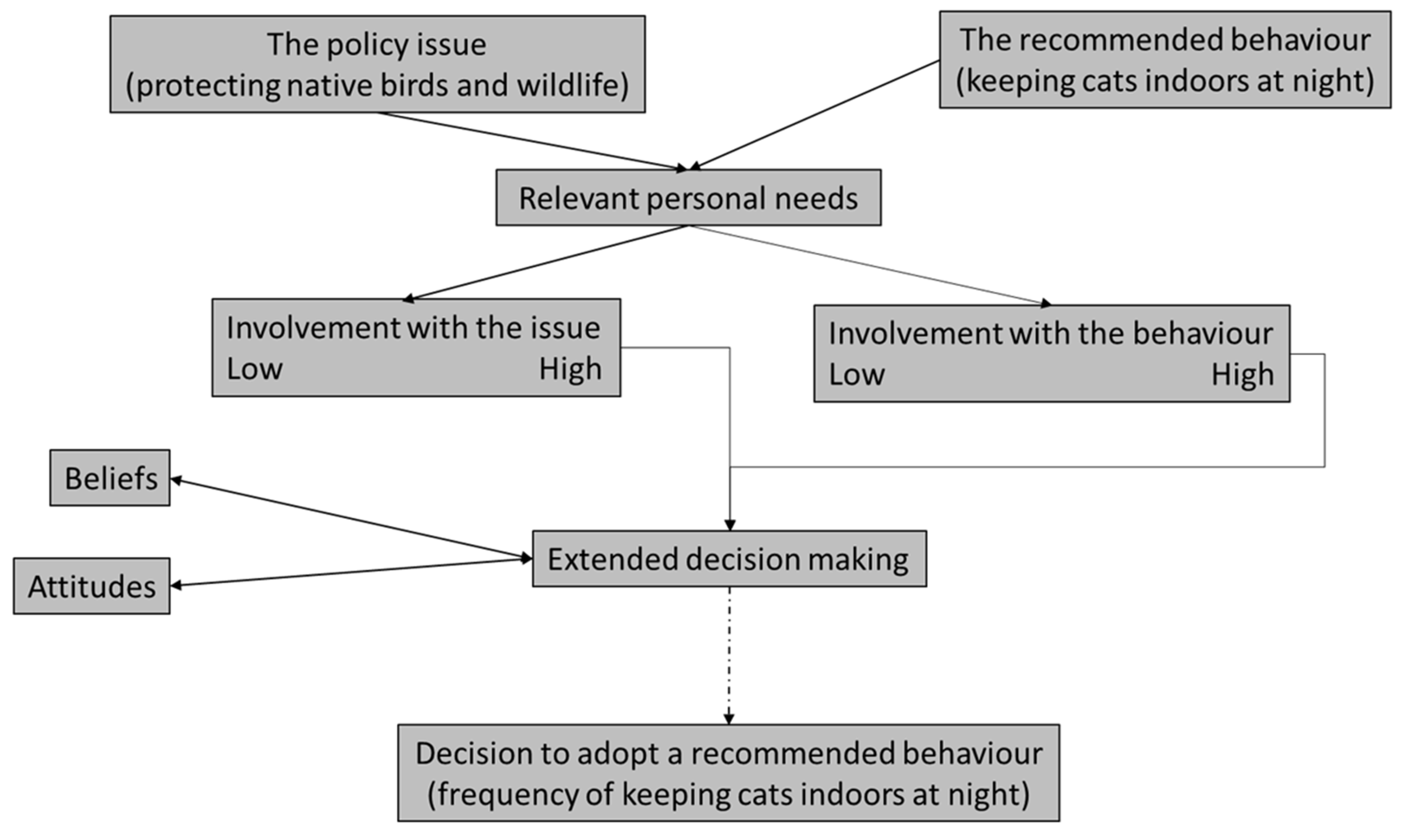
Table 1.
Factor analysis of beliefs about cats.
| Keeping cats indoors is unnatural and harmful | Wandering is dangerous for cats | Cats are a health risk | Cats are a danger to wildlife | Preventive devices are not effective | |
|---|---|---|---|---|---|
| I think pet cats should be kept inside at night for their own safety | -0.46 | 0.65 | |||
| I think wandering cats are a danger to other cats | 0.69 | ||||
| I think wandering cats are a danger to themselves | 0.66 | ||||
| If pet cats are outside at night, they could be attacked by feral cats | 0.72 | ||||
| Keeping cats inside at night will only protect birds and wildlife if everyone does it | 0.32 | ||||
| I think its unnatural to keep cats inside | 0.73 | -0.30 | |||
| It’s difficult to keep cats inside at night | 0.74 | ||||
| It’s natural for cats to hunt birds and wildlife | 0.39 | 0.62 | |||
| Pet cats are not really a danger to native birds and wildlife | 0.34 | -0.70 | |||
| Cats in urban areas are not really a danger to native birds and wildlife | 0.42 | -0.66 | |||
| I think cats are a danger to wildlife | 0.40 | 0.63 | |||
| I think cats are a nuisance | -0.41 | 0.53 | 0.36 | ||
| Cats transmit diseases and parasites to other cats and animals | 0.79 | ||||
| Cats can transmit diseases and parasites to people | 0.81 | ||||
| Collars with warning devices like bells don’t work | 0.77 | ||||
| Collars can be a danger to cats | 0.60 | 0.30 | |||
| Some cats just won’t wear a collar | 0.65 | ||||
| I don’t think deterrents are likely to be effective | 0.72 |
Note: Values are Pearson correlation between the original belief variables and the rotated factors. Values less than 0.30 omitted.
Table 2.
Differences in beliefs about cats by cat ownership.
| Have a cat | Had a cat | Have never had a cat | |
|---|---|---|---|
| I think pet cats should be kept inside at night for their own safety** | 3.41 | 3.59 | 3.81 |
| I think wandering cats are a danger to other cats | 3.57 | 3.61 | 3.59 |
| I think wandering cats are a danger to themselves | 3.35 | 3.42 | 3.47 |
| If pet cats are outside at night, they could be attacked by feral cats** | 3.71 | 3.64 | 3.54 |
| Keeping cats inside at night will only protect birds and wildlife if everyone does it | 3.49 | 3.51 | 3.64 |
| I think its unnatural to keep cats inside** | 3.14 | 2.71 | 2.57 |
| It’s difficult to keep cats inside at night** | 3.24 | 2.90 | 2.75 |
| It’s natural for cats to hunt birds and wildlife** | 3.95 | 3.98 | 3.82 |
| Pet cats are not really a danger to native birds and wildlife** | 2.59 | 2.05 | 2.10 |
| Cats in urban areas are not really a danger to native birds and wildlife** | 2.88 | 2.27 | 2.35 |
| I think cats are a danger to wildlife** | 3.54 | 4.08 | 3.99 |
| I think cats are a nuisance** | 1.98 | 2.82 | 3.53 |
| Cats transmit diseases and parasites to other cats and animals** | 3.43 | 3.56 | 0.79 |
| Cats can transmit diseases and parasites to people** | 3.20 | 3.47 | 3.63 |
| Collars with warning devices like bells don’t work** | 2.87 | 2.57 | 2.75 |
| Collars can be a danger to cats** | 3.33 | 2.68 | 2.46 |
| Some cats just won’t wear a collar** | 3.64 | 2.99 | 2.94 |
| I don’t think deterrents are likely to be effective** | 2.90 | 2.67 | 2.72 |
Note: Values are mean agreement scores. * Indicates significant differences between means (p<0.01). ** Indicates significant differences between means (p<0.001).
Table 3.
Differences in beliefs about cats by cat ownership.
| Have a cat | Had a cat | Have never had a cat | |
|---|---|---|---|
| Involvement with cat welfare** | 3.98 | 3.60 | 3.26 |
| Involvement with protecting native birds and wildlife | 4.08 | 4.09 | 4.04 |
| Involvement with keeping cats indoors at night** | 3.27 | 3.50 | 3.51 |
| Attitude towards cat welfare** | 4.13 | 3.87 | 3.54 |
| Attitude towards protect native birds and wildlife** | 4.21 | 3.51 | 3.60 |
| Attitude towards keeping cats indoors at night** | 3.49 | 3.92 | 4.02 |
| Attitude towards cats wearing collars** | 3.61 | 4.14 | 4.04 |
| Attitude towards area deterrents** | 3.85 | 4.17 | 4.04 |
| Prepared to take some responsibility for protecting wildlife* | 3.87 | 3.89 | 3.73 |
| Prepared to take action to protect wildlife* | 3.70 | 3.84 | 3.78 |
| Prepared to make sacrifices to protect wildlife** | 3.53 | 3.74 | 3.63 |
| Prepared to work with others to protect wildlife** | 4.10 | 4.31 | 4.16 |
| Frequency of keeping cats indoors at night1 | 19.7 | ||
| Frequency of having cat wear a collar2 | 26.0 |
Note: Values are mean agreement scores except where indicated. 1 Proportion of cat owners reporting they kept their cat inside mostly or always. 2 Proportion of cat owners reporting their cat wore a collar mostly or always. * Indicates significant differences between means (p<0.01). ** Indicates significant differences between means (p<0.001).
Table 4.
Involvement and the strength of attitudes.
| Strength of attitude towards keeping cats indoors | Strength of attitude towards having cats wear collars | Strength of attitude towards using deterrents | |
|---|---|---|---|
| Involvement with cat welfare | -0.139 (p<0.001) |
-0.220 (p<0.001) |
-0.238 (p<0.001) |
| Involvement with protecting native birds and wildlife | 0.111 (p<0.001) |
0.348 (p<0.001) |
0.412 (p<0.001) |
| Involvement with keeping cats indoors at night | 0.391 (p<0.001) |
||
| Adjusted R2 | 0.19 | 0.11 | 0.15 |
| F-Test significance | <0.001 | <0.001 | <0.001 |
Notes: Values are standardised beta coefficients. Values in parentheses are t-test probabilities that the true coefficient is zero. n= 2005 for all regressions.
Table 5.
The structure of attitudes, involvement, and beliefs about cats.
| Involvement with keeping cats indoors at night | Attitude towards keeping cats indoors | Attitude towards having cats wear collars | Attitude towards using deterrents | |
|---|---|---|---|---|
| Involvement with cat welfare | 0.188 (p<0.001) |
0.036 (p<0.001) |
ns | ns |
| Involvement with protecting native birds and wildlife | 0.244 (p<0.001) |
ns | 0.062 (p=0.003) |
0.065 (p=0.002) |
| Attitude towards cat welfare | ns | ns | -0.059 (p=0.002) |
|
| Attitude towards protect native birds and wildlife | 0.056 (p<0.001) |
0.126 (p<0.001) |
0.298 (p<0.001) |
|
| Cats are a danger to wildlife | 0.167 (p<0.001) |
0.287 (p<0.001) |
0.272 (p<0.001) |
0.241 (p<0.001) |
| Wandering is dangerous for cats | 0.323 (p<0.001) |
0.405 (p<0.001) |
0.075 (p<0.001) |
0.101 (p<0.001) |
| Keeping cats indoors is unnatural and harmful | -0.399 (p<0.001) |
-0.579 (p<0.001) |
-0.327 (p<0.001) |
-0.154 (p<0.001) |
| Cats are a health risk | 0.136 (p<0.001) |
0.110 (p<0.001) |
0.174 (p<0.001) |
0.101 (p<0.001) |
| Protective measures are ineffective | 0.136 (p<0.001) |
0.039 (p=0.001) |
-0.276 (p<0.001) |
-0.201 (p<0.001) |
| Adjusted R2 | 0.50 | 0.62 | 0.39 | 0.37 |
| F-Test significance | <0.001 | <0.001 | <0.001 | <0.001 |
Note: Values are standardised beta coefficients. Values in parentheses are t-test probabilities that the true coefficient is zero. n= 2005 for all regressions. ‘ns’ indicates variables dropped from the regression because the estimated coefficient had a p-value not less than 0.05.deterrents, if they were concerned to protect wildlife, thought cats were a danger to wildlife, thought wandering is dangerous for cats, and that collars and area deterrents were effective. Respondents had a less favourable view of keeping cats indoors, having them wear collars and using area deterrents if they believed these measures have an unfavourable impact on the welfare of cats.
Table 6.
The influence of involvement, attitudes and subjective norms on intentions to protect native birds and wildlife, keeping cats indoors at night and having cats wear collars.
Table 6.
The influence of involvement, attitudes and subjective norms on intentions to protect native birds and wildlife, keeping cats indoors at night and having cats wear collars.
| Prepared to take some responsibility | Prepared to act | Prepared to make sacrifices | Important to work together | Cats indoors at night | Cats wear collars | |
|---|---|---|---|---|---|---|
| Involvement with cat welfare | 0.044 (p=0.046) |
ns | ns | ns | 0.129 (p<0.001) |
ns |
| Involvement with protecting native birds and wildlife | 0.217 (p<0.001) |
0.270 (p<0.001) |
0.292 (p<0.001) |
0.187 (p<0.001) |
-0.090 (p<0.001) |
ns |
| Attitude towards cat welfare | 0.061 (p=0.002) |
ns | -0.041 (p=0.050) |
0.036 (p=0.024) |
ns | |
| Attitude towards protect native birds and wildlife | 0.426 (p<0.001) |
0.413 (p<0.001) |
0.366 (p<0.001) |
0.601 (p<0.001) |
ns | |
| Attitude towards keeping cats indoors at night | 0.451 (p<0.001) |
|||||
| Attitude towards collars | 0.381 (p<0.001) |
|||||
| Subjective norm for keeping pet cats indoors at night | 0.176 (p<0.001) |
|||||
| Keeping cats inside is difficult | -0.201 (p<0.001) |
|||||
| Adjusted R2 | 0.35 | 0.36 | 0.32 | 0.52 | 0.53 | 0.14 |
| F-Test significance | <0.001 | <0.001 | <0.001 | <0.001 | <0.001 | <0.001 |
Notes: Values are standardised beta coefficients. Values in parentheses are t-test probabilities that the true coefficient is zero. n=2005 for all regressions except keeping cats indoors and having cats wear collars (n=847). ‘ns’ indicates variables dropped from the regression because the estimated coefficient had a p-value greater than 0.05.
Table 7.
Estimates of approach-avoidance model for keeping cats indoors at night.
| Beta | Standard error | Standardised beta | Significance | |
|---|---|---|---|---|
| Difference in desirability of protecting wildlife and desirability of keeping cats indoors at night | 0.022 | 0.011 | 0.077 | 0.042 |
| Difference in desirability of cat welfare and desirability of keeping cats indoors at night | 0.065 | 0.010 | 0.227 | <0.001 |
| Psychological distance to keeping cats indoors at night | -0.357 | 0.036 | -0.281 | <0.001 |
| Intercept | 2.140 | 0.229 | <0.001 | |
| Adjusted R2 | 0.48 | |||
| F-Test significance | <0.001 |
Disclaimer/Publisher’s Note: The statements, opinions and data contained in all publications are solely those of the individual author(s) and contributor(s) and not of MDPI and/or the editor(s). MDPI and/or the editor(s) disclaim responsibility for any injury to people or property resulting from any ideas, methods, instructions or products referred to in the content. |
© 2024 by the authors. Licensee MDPI, Basel, Switzerland. This article is an open access article distributed under the terms and conditions of the Creative Commons Attribution (CC BY) license (http://creativecommons.org/licenses/by/4.0/).
Copyright: This open access article is published under a Creative Commons CC BY 4.0 license, which permit the free download, distribution, and reuse, provided that the author and preprint are cited in any reuse.


