
Submitted:
27 August 2024
Posted:
29 August 2024
You are already at the latest version
Abstract
Portland cement emits large amounts of CO2 in production. Given proposals for "carbon peaking and carbon neutralization" studying alternative low-carbon cementitious materials to reduce emissions is extremely important. Alkali-activated slag (AAS) cement, a new green cementitious material, has high application potential. The chemical corrosion resistance of AAS concrete is important for ensuring durability and prolonging service life. Studying the chemical corrosion mechanism of AAS concrete and understanding its influence on performance provides important theoretical foundations for application in different environments.
Keywords:
Alkali-activated slag cement
; acid
; sulfate
; seawater
; chemical corrosion mechanism
1. Introduction
Cement production consumes about 5% of the world's industrial energy, while each tonne of silicate cement (OPC) requires about 1.5 tonnes of raw materials. The production of 1 tonne of cement emits approximately 0.94 tonnes of carbon dioxide into the atmosphere, mainly from the decarbonisation of calcite in the cement clinker, the combustion process and the electricity required [1]. Alkali-excited slag (AAS) cement is a water-hard cementitious material produced by using a strong alkali as the exciter and granulated blast furnace slag as the excited material. Concrete is commonly found in a variety of conditions, such as industrial areas, sewers and marine environments. AAS cements have excellent durability properties of the produced concrete due to the absence of calcium hydroxide, which generally does not produce the expansion-type hydration product calcite [2]. At present, there are more studies on the basic properties of AAS cement concrete at home and abroad, and there are some studies on its durability aspects, which mainly focus on chemical corrosion resistance, permeability resistance, carbonation resistance, etc [3,4,5]. In this paper, the chemical corrosion resistance of AAS cement concrete is reviewed. Since the corrosion of AAS cement concrete is closely related to its hydration products, it focuses on summarising the hydration mechanism, the acid and sulphate corrosion mechanism and their performance effects, and the effect of seawater on the performance of AAS cement concrete. This review provides important information for further research on the development and application of AAS cement concrete under different conditions.
2. Hydration Mechanism of Alkali-Excited Slag Cement
Granulated blastfurnace slag is a calcium-rich reactive material, and its main chemical composition includes 35-50% CaO, 30-35% SiO2, 8-15% Al2O3, and it contains a large amount of FeO, MgO and TiO [6,7]. Slag has potential water hardness but is difficult to hydrate at room temperature and requires an exciter to stimulate its activity and produce gelling properties. Currently, the most commonly used exciters are water glass, NaOH, Na2SiO3, Na2SO4, Na2CO3 and their composites. Slag has lower Ca/Si and higher Al/Si than OPC, so there are differences in the AAS hydration products.
Under the action of the exciter, the Mg-O bond and Ca-O bond in the slag break first due to the weak bond energy, the calcium-rich phase is decomposed, the silica-rich phase is exposed, the exciter enters the interior and the slag starts to decompose, and the process of slag fractional phase structural destruction [8,9], is shown in Figure 1. Si-O-Si in the slag glass then decomposes to form the transition compounds -Si-OH and -Si-O- (as shown in Figure 2), but -Si-O- is negatively charged and will combine with positively charged metal cations [10] to form hydrated calcium silicate (C-S-H) gels [11]. As hydration progresses, the C-S-H gel gradually regularises, effective interparticle bonding is achieved and the slurry structure becomes denser [12]. -Si-O-Al-O bonds and Si-O-Si bonds share the same reaction process to produce [Al(OH)4]-, [Al(OH)5]2-, and [Al(OH)6]3- to form hydrated calcium aluminate (C-A-H) [10]. Alkali excitation also involves the dissolution of aluminum and silicon substances on the surface of the aluminosilicate, the polymerization of reactive surface groups and soluble substances to form a gel (gel 1 with high aluminum content is converted to gel 2 with more silicon content), which then continues to develop to form a hydrated sodium silicate-aluminate (N-A-S-H) gel [13] as shown in Figure 3, which then produces a relatively low Ca/Si (C/S = 0.9 -1.2) of hydrated calcium silicoaluminate (C-A-S-H) gel [14].
In summary, the major hydration products of AAS cement include C-S-H, C-A-S-H, C-A-S, and N-A-S-H [15,16,17]. The minor products change with the type of slag and type of exciter [18] and may include hydrotalcite [Mg6Al2CO3(OH)16-4H2O], C4AH13, CASH8, C4ACH11, C8AC2H24, etc [14]. As the hydration product did not produce Ca(OH)2, it avoided the direct reaction with some chemical substances to produce expansive substances, and also blocked the formation of calcite in the hydration process.The C-S-H structure is relatively regular, which can fill the pores well, and with the formation of C-S-H structure is gradually dense, which reduces the channel for the erosive substances to enter the inside, and the formation of C-A-S-H structure is also more stable and not easily damaged, for better chemical resistance, which is not easily damaged. The formation of the C-A-S-H structure is also more stable and less likely to be damaged, providing the possibility of better chemical corrosion resistance.
3. Acid Corrosion Resistance of Alkali Excited Slag Cement Concrete
3.1. Mechanism of Acid Corrosion
Acid corrosion is a phenomenon that causes a decrease in the alkalinity of concrete, leading to the decomposition of cement hydration products [21]. Concrete itself is alkaline, if the acidity is slight, pockmarks will appear on the surface of the concrete, if the acidity is strong enough and in large amounts, salts (calcium chloride, sodium chloride, etc.) will be produced inside the concrete, and the corrosion is more rapid if the acid is mobile. Acid corrosion is present in environments such as acid rain, rivers in industrial and chemical areas, and microorganisms. Although the hydration product Ca(OH)2 is minimal in AAS cement concrete, the presence of alkali exciters makes the pH in the pores still high [22]. In the early stage of acid erosion, there is more OH- in the pores of AAS cement concrete, and when H+ enters the pores by osmosis, there can be enough OH- to react with it and keep the pH high [22], thus no obvious degradation can be seen in the early stage [23], but with the prolongation of time, the H+ dissolves some of the calcium, which in turn leads to the degradation of the gel [24]. Studies have shown that AAS cements leach more Ca2+ in acidic environments, and since the slag itself is insoluble in acidic solutions, Ca2+ is mainly introduced by raw materials or produced by decalcification of the gel [25,26,27]. In addition, acid produces direct damage to the Si-O-Al bond and de-alumination occurs, leading to changes in the composition and structure of the silicoaluminate network [24]. If the corrosion medium is sulfuric acid, acid corrosion also produces the swelling substance gypsum [28]. Both chemically and by diffusion, the pH of the acidic solution has a great influence on the degradation of AAS cement concrete [29].
In addition to chemical sulfuric acid erosion, biological sulfuric acid corrosion also exists. Biological sulfuric acid is caused by microorganisms, and studies have shown that the erosion product is still gypsum [30].Xie Y [31] showed that the hydration products of AAC before corrosion are hard calcium silica, tobermorite, C-S-H, and zeolite. Figure 4 shows the corrosion morphology of AAC cement concrete, in Figure 4(a), hard calcium silica is fused with gypsum; Figure 4(b) shows that the surface of the zeolite is covered with a layer of gypsum; Figure 4(c) shows that the whole pore wall is covered with gypsum, and the crystal shape of gypsum is clearly visible, and the product at the original pore wall is covered with gypsum. It can be seen that the calcium ions generated by the decalcification reaction of hard calcium silica corroded by biosulfuric acid combined with the intruding SO42- to form gypsum; zeolites and other silica-aluminate materials were corroded by biosulfuric acid, which led to the dissolution of aluminum ions, resulting in the damage of the structure and the loss of the original crystal shapes, and the zeolites were also covered by gypsum eventually. The corroded area swells and cracks, which will exacerbate the leaching of acidic ions and make acidic corrosion more severe.
3.2. Effect of Acid Corrosion on Concrete Properties
Acid corrosion begins on the surface of concrete, and the degree of corrosion is related to the pH of the acid solution, the properties and proportion of slag, and the type of acid [30]. Fang Z [32] found that when AAS cement concrete specimens were put into sulfuric acid solution, bubbles were generated on the surface accompanied by rotten egg odor, and with the increase of sulfuric acid concentration, the surface of the concrete was chalked severely and the corrosion was aggravated. At the same time, the longer the exposure time of AAS cement in sulfuric acid solution, the more serious the strength loss [33].Lee [34] showed that in alkali-excited slag/fly ash mortar, the larger the slag content the more detrimental to the resistance to sulfuric acid corrosion, this is because higher calcium content of slag is more prone to gypsum production, which leads to expansion and associated crack formation [35,36].
Ren J [29] studied alkali-excited slag/fly ash mortar in the presence of phosphoric acid [29,36]. Fly ash mortar in phosphoric acid solution and found that the degradation depth increased when the slag dosage increased, but the degradation of the alkali-excited mortar slowed down with the extension of erosion time, and the phosphoric acid solution degraded the mortar more deeply than the mixture of phosphoric acid and sulfuric acid, and the sulfuric acid solution degraded the mortar the least.Similar conclusions were obtained by Jie [37]. The different corrosiveness of the three solutions may be due to the difference in the type and concentration of the acid, or it may be related to the release of H+ concentration in aqueous solution [38].Zhao W [39] immersed the AAS mortar in acetic acid and sulfuric acid solutions with the same PH, and the surface of the specimens both showed obvious flaking phenomenon after 28d, and the smaller the pH the rougher the surface of the specimens, and the corrosive effect of acetic acid was the most obvious. It can be seen that acetic acid has a stronger destructive capacity for AAS mortar. If AAS mortar is exposed to hydrochloric acid and nitric acid, hydrochloric acid leads to more obvious quality loss of AAS mortar, which is because hydrochloric acid can react with free Ca2+ in AAS mortar to produce the highly soluble salt CaCl2 [39]. Lloyd [40] compared the corrosive effects of sulfuric acid and nitric acid on AAS cement, geopolymer cement, and calcium aluminate cement by taking AAS cement, geopolymer cement and calcium aluminate cement as the objects of the study. It was confirmed that sulfuric acid corrodes AAS cements the slowest and nitric acid corrodes AAS to a lesser depth than sulfuric acid.Ana [41] applied two methods of acid neutralization capacity monitoring and mass loss/consumption of acid monitoring for rapid testing of acid attack resistance of alkali-excited specimens. Teymouri [42] investigated the effect of different mix design parameters on the durability of AAS concrete in hydrochloric acid solution and the study showed that potassium hydroxide as an alkaline activator in AAS concrete showed higher strength reduction and weight loss in hydrochloric acid solution than sodium hydroxide, and that the lower alkali equivalent gave AAS concrete better acid resistance.
4. Sulfate Corrosion Resistance of Alkali Excited Slag Cement Concrete
4.1. Destruction Mechanism of Sulfate Corrosion
Sulfate erosion is one of the important factors affecting the durability of concrete. Heavily salted soil, inland salt lake, industrial wastewater, groundwater, seawater and other environments contain a large amount of sulfate, and if concrete exists in these environments, it will be damaged by SO42- erosion [42]. The corrosive destruction of concrete by sulfate is due to a complex combination of physical and chemical actions working together to produce expansive substances (calomel and gypsum) [43]. Since the hydration products of AAS cement concrete are different from those of OPC concrete, the corrosion mechanism differs.
4.1.1. Sodium Sulfate Corrosion Damage Mechanism
According to Jin Y [44], the anti-ionic erosion performance of AAS cement concrete is closely related to the composition and structure of the hydration product phase, and the reaction mechanism of AAS cement and sulfate with different exciters is different. Under Na2SO4 erosion, when Na2CO3 excites the slag, the presence of carbonate prevents the formation of calcium alumina due to the competition mechanism between carbonate ions and sulfate ions in the formation of calcium alumina; calcium alumina is easy to be formed when Na2SO4 excites the slag, and Na2SO4 corrosion causes the conversion of calcium alumina to monosulfate; when the slag is excited by a mixture of NaOH and Na2CO3, there is very little reaction, and the main products C-A-S-H and hydrotalcite remain intact [45] (as shown in Figure 5). There is also the most common mixture of NaOH and Na2SiO3 to excite the slag, where the silicate in the exciter plays an important role, and the amount of silica in the system increases when used, in addition, it is known that in the reaction of alkali-excited materials the alumina of the precursor is more active than silica, and that silica in the silicate exciters reacts with the alumina that is initially released from the precursor, thus accelerating the formation of gels [46]. So when Na2SO4 erodes, having less Ca2+ and Al3+ involved in the reaction produces calcite and gypsum swelling products. So, the mixed excitation of NaOH and Na2CO3 is better for Na2SO4 erosion resistance, moreover, the structure and composition of C-A-S-H gels depend greatly on the type of exciter, and NaOH-excited slag has a higher Ca/Si ratio and a more ordered structure compared to Na2SiO3-excited slag [47]. The C-A-S-H phase undergoes slight decalcification and de-alumination and promotes the production of trace chalcocite since calcium in the alkali excited system may undergo dissolution by ion exchange with Na2SO4 [45,48].
Another study showed that there were Na2SO4 crystals in the crevices of AAS cement specimens immersed in Na2SO4 solution [26]. The study of Rong Z [49] also confirmed that the destruction of AAS cement in Na2SO4 solution was due to the infiltration of Na2SO4 solution into the pores, which formed salt crystals inside to produce volume expansion damage, and the surface of the specimen was gradually peeled off and chalked through the wet and dry cycles, but with the prolongation of the immersion time, the compressive strength would show a tendency to increase. Analysis of the reasons for this shows that the dissolution and reaction of excess alkali promotes hydration, Na2SO4 can actually act as an excitatory agent for AAS cements to make the structure denser, which, together with the small amount of calcite and gypsum present [15], produces a filler effect internally to make the microstructure denser [50,51,52]. In addition, the chemical corrosion resistance is better due to the lower porosity of AAS than that of OPC and the higher curvature of the pore structure, which provides some inhibition of ion intrusion [53,54].
4.1.2. Magnesium Sulfate Corrosion Damage Mechanism
Compared with Na2SO4, the erosion mechanism of MgSO4 on AAS cement concrete is different. Due to the reaction between Mg2+ and C-S-H gel, MgSO4 erosion is not simply "sulfate erosion" [55]. In fact, the key factor determining the rate and effect of sulfate attack in alkali-excited systems is the nature of the anions and cations of the attacking medium, with the presence of magnesium ions decalcifying the C-A-S-H, producing gypsum, and leading to degradation of the gel system [48,56]. The mechanism of MgSO4 erosion resistance of AAS cement concrete using different exciters is different. For NaOH-excited slag cement, in the initial stage, Mg2+ reacts with OH- in the pore solution to form hydromagnesite adsorbed on the surface of the hydration product particles, which hinders further erosion.As the OH- in the surface layer is consumed, the buffering effect of the hydromagnesite is gradually lost, and the pH of the surface layer rapidly decreases to 10.5, which leads to direct decalcification of the C-A-S-H gel, but at this pH value, no large amount of dealumination, thus the Al-Si ratio in C-A-S-H remains relatively unchanged, and the intruding Mg2+ further reacts with the decalcified C-A-S-H to form magnesium hydrated silica-aluminate (M-A-S-H) [45].C-S-H is unstable at pH lower than 10, and the Mg2+ will also displace Ca2+ in C-S-H to form magnesium hydrated silica-aluminate (M-S-H), coupled with a pore solution in which the reaction between effective Ca2+ and intruding SO42- produces gypsum (shown in Figure 6) [45,48], while M-A-S-H, M-S-H, and gypsum are expansive substances, which ultimately cause the destruction of AAS concrete [57].AAS cements are low in aluminum, and when the hydration reaction produces a C-A-S-H gel, there is no more free Al3+ to provide to produce calcite. Therefore, there is almost no appearance of calomel in MgSO4 corrosion [58,59]. The reaction mechanism of Na2CO3-excited slag with MgSO4 is similar to that of NaOH-excited slag, but the carbonate phase contained in the specimen reacts with MgSO4, possibly forming MgCO3 and releasing it into the pore solution [45]. For Na2SO4-excited AAS, it is unlikely that a protective layer of hydromagnesite would form due to insufficient available OH-, and the subsequent reaction is thought to be similar to that of NaOH-excited AAS [45]. In summary, compared to NaOH- and Na2CO3-excited slag, Na2SO4-excited slag is less resistant to MgSO4 erosion due to the lack of formation of a hydromagnesite protective layer.
4.2. Effect of Sulfate on the Properties of AAS Concrete
One of the factors affecting the resistance of AAS cement concrete to sulfate corrosion is the type of sulfate [60], it depends mainly on the cation. To date, there is a large body of literature comparing the corrosive properties of sodium sulfate and magnesium sulfate erosion on AAS, which are bound to have different degrees of influence on their properties because of the large differences in the corrosion mechanisms of these two sulfates. First of all, sodium sulfate erosion affects the surface, reaction products and strength of AAS cement concrete to varying degrees.The results of Ahmad [61], who immersed alkali-excited slag/fly ash mortar in Na2SO4, showed that there were no visible cracks or swellings on the surface edges of the mortar specimens, and that the loss of strength of the specimens was only in the range of 1%-17%. Li [62] immersed the AAS mortar in a Na2SO4 solution for wet and dry cycle tests, no gypsum was observed, indicating that AAS mortar has little or no sodium sulfate erosion problems, but the crystallization pressure and diffusion stress of sodium sulfate may cause severe spalling of the surface. The effect of Na2SO4 on the properties of AAS cement concrete is also affected by the type of the exciter. When MgO and CaO are used to excite slag, MgO as an exciter produces more hydrotalcite and slightly better resistance to sodium sulfate erosion than CaO-excited slag mortars [63]. It has been widely recognized that in sodium sulfate solution, the early strength of AAS cement concrete hydration will increase and the decrease of late strength has been widely recognized. Jun W [64] also immersed AAS cement in Na2SO4 solution to observe the strength development and mass changes, and showed that the compressive strength increased with the increase of erosion time and the mass remained basically unchanged. It indicates that sodium sulfate has a contributing effect on its strength development. It has also been shown that the compressive strength still decreases with the continuous extension of erosion time [65,66]. Secondly, the magnesium sulfate erosion process is more complicated. Studies have shown that after prolonged immersion of AAS cement in MgSO4 solution, although there is no obvious change in appearance, the penetration rate of SO42- ions decreases with the extension of hardening time due to the formation of hydration products filling the internal pores [67], and the compressive strength still decreases with the increase of solution concentration and immersion time [68].
Baš ˇcarevi ´c showed [2] that the compressive strength of AAS concrete decreased more significantly in MgSO4 solution than in Na2SO4 solution. Hua B [69] showed that in Na2SO4 solution there was no change in the surface of AAS specimens, and in MgSO4 solution the reaction between free Mg2+ and OH- in AAS produced Mg(OH)2 white precipitates attached to the specimen surface, and also when Mg2+ and SO42- coexisted, it led to shrinkage formation of cracks within the concrete, and corrosion increased. Yu H [70] immersed AAS cement into Na2SO4 solution and MgSO4 solution and found that the coefficient of expansion increased only slightly (0.176%-0.453%), and the microstructure remained intact. Magnesium sulfate erosion caused cracks inside the concrete and reduced the strength, so the corrosion was more pronounced, while the destructive effect of sodium sulfate erosion was less.
In addition to the type of sulfate affects the erosion effect, the erosion effect also varies with different sulfate concentrations.Gong [71] found that sodium sulfate with mass percentage of 1%-10% and magnesium sulfate with 1% had less effect on AAS and produced less caliche and gypsum, but magnesium sulfate with mass percentage of 5%-10% can lead to complete disintegration of the gel, and the magnesium sulfate erosion made the internal production of M-S-H and a large amount of gypsum, these differences are related to the ability of the ions (Na+, Mg2+, H+) to synergize SO42- to change the pH in the pore solution, the effect of Mg2+ is greater than that of Na+, and it is mainly in the presence of Mg2+ that the production of magnesia hydrate lowers the pH so that the decalcification of the AAS produces M-S-H as shown in Figure 7, so that at the same mass percentage magnesium sulfate is more able to affect the durability of AAS.
The durability of AAS cement concrete is better than silicate cement concrete due to its denser structure. AAS cement concrete showed better durability than OPC concrete in Na2SO4 solution [72]. Sheng S [63] observed the products of OPC mortar and AAS mortar eroded by sodium sulfate by XRD and found that the main cause of cracking in OPC mortar was the formation of calcite and gypsum, whereas there were more hydrotalcite-like structures in the erosion products of AAS mortar, whose properties of being able to consume part of the aluminum phase and adsorb sulfate ions hinder the formation of the erosion products such as calcite. Komljenovic [73] studied the changes in strength of slag silicate cement and AAS cement immersed in Na2SO4 solution for 90 d. The strength of slag silicate cement increased slightly at 30 d and began to decrease at 60 d. The strength of AAS cement maintained an increase in strength during the test age. However, the compressive strength of AAS mortar specimens in 10% MgSO4 solution decreased significantly and the loss of strength was greater than that of OPC mortar, which may be attributed to the lack of Ca(OH)2 in AAS mortar, which restricts the formation of the protective layer of hydromagnesite, thus leading to a direct attack of Mg2+ on the C-S-H structure [57]. Aydn [58] have a different view, suggesting that in a 10% MgSO4 environment, the loss of strength of OPC concrete was greater than that of AAS cement concrete, a large amount of gypsum and calomelite was produced inside OPC concrete and the specimens were damaged , the surface of the AAS concrete did not show any cracking, and crack formation was observed in the region of 20 to 25 μm depth.
5. Alkali-Inspired Slag Cement Concrete for Seawater Corrosion Resistance
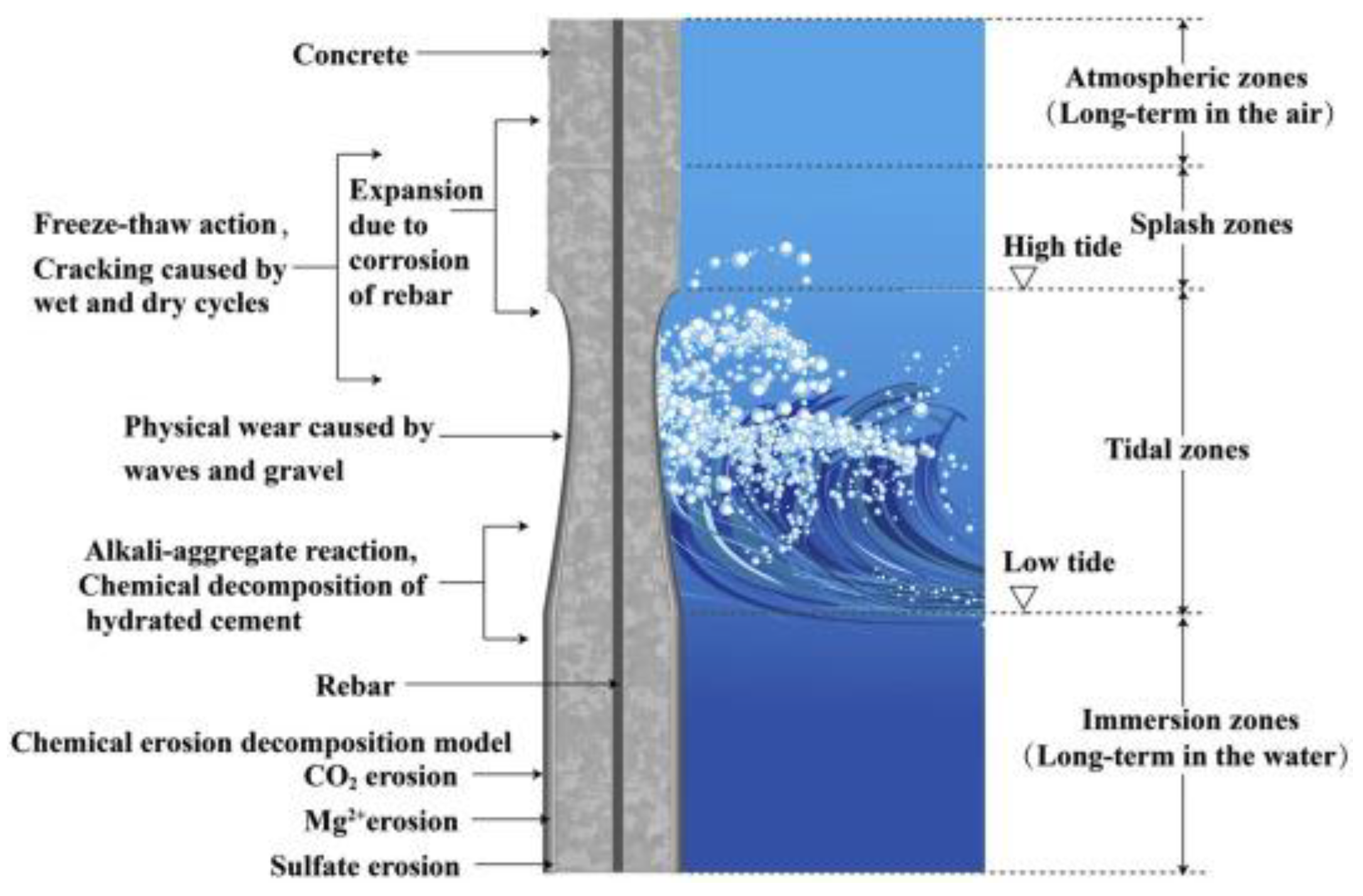
According to the statistics of 2020, about 40% of the world population lives within 100 km of the coast and 10% live in low elevation coastal zones less than 10 meters above sea level [74]. As a result, concrete is often found in seawater environments, such as sea bridges and harbor terminals. The marine environment is a harsh and complex corrosive environment, where components of seawater can be transported into concrete through connecting pores, where the abundance of sulfates and chlorides reduces the durability of the material, leading to the deterioration of the reinforced concrete structure, and affecting the load-bearing capacity of the structure [75]. Different parts of concrete corrode differently in seawater environment as shown in Figure 8. The main hydration products of OPC are high-calcium-type hydrated calcium silicate, calcium hydroxide, and hydrated calcium aluminate, and the sulfate in seawater reacts with the hydration products of the cement to produce expansion and cracking.The hydration products of AAS cement concrete are free of calcium hydroxide and are more dense, which makes it more suitable for application in the marine environment. Chloride can cause severe corrosion of steel reinforcement. Shi [76] confirmed that AAS mortar can provide better protection for steel reinforcement. The study of Yin C [77] found that the strength of NaCl-doped AAS cement increased with the increase of dosage, and the degree of slag hydration and C-S-H content increased significantly, which was because the addition of NaCl produced NaOH, which increased the alkalinity of the liquid phase of AAS cement and promoted the further hydration of the slag, but there was no significant change in the strength of CaCl2-doped AAS cement. Therefore, the higher chloride binding capacity of AAS cements provides potential feasibility for the use of seawater as mixing water in marine environments [78]. Studies have shown that replacing fresh water with seawater in concrete can increase the compressive strength of concrete [79]. Mengasini [80] also found that AAS concrete mixed with seawater and cured in a seawater environment had good mechanical properties, and as the time of curing in a seawater environment was extended, the compressive strength increased, reaching 66 MPa at 56 d, which is much higher than that of AAS concrete mixed with fresh water and The compressive strength of AAS concrete cured with fresh water was 7MPa higher than that of AAS concrete mixed with fresh water and cured with fresh water.This is because the Mg2+ contained in seawater reacted with OH- in the alkaline environment to form hydromagnesite, and Ca2+ released from the matrix of AAS cement concrete reacted with OH- in the alkaline environment to form Ca(OH)2, then reacted with the carbonate in the seawater to form calcium carbonate on the surface of the specimen, so that the generated hydromagnesite and calcium carbonate played a certain protective role for the concrete played a certain protective role [81]. However, Li Y [82] showed that cracks appeared in the cross-section of seawater-mixed AAS-cemented concrete when the external temperature increased above 200°C, and the higher the temperature, the more pronounced the cracks were.Yang S [83] prepared AAS-cemented concrete by substituting seawater and sea sand for freshwater and river sand, and found that there was an effect on the morphology of the hydration products of the AAS-cemented concrete, and that drying shrinkage was slightly increased, the resistance to chloride ion penetration was enhanced, in addition to higher short-term bond strength, interfacial shear stiffness and shear fracture energy with embedded reinforcement inside. This may be due to the fact that seawater and sea sand accelerate the formation of C-S-H gel phase [16]. Typically tidal environments accelerate concrete corrosion, and Rashad [84] showed that specimens exposed to simulated tidal zones were more severely damaged than specimens fully immersed in seawater. This is in keeping with the damage pattern of OPC concrete.
6. Conclusion and Outlook
From the above review and analysis, the following conclusions can be obtained:
(1) The hydration of AAS cement concrete is mainly caused by the action of alkaline exciters to stimulate the activity of slag to generate the hydration products C-S-H, C-A-S-H, C-A-H, N-A-S-H. The hydration reaction process includes the disintegration of slag, the fracture and bonding of functional groups, and the polymerization reaction.
(2) The acid corrosion mechanism is mainly due to the changes in the gel structure by H+ to decalcify the gel, which leads to the formation of expansive substances. Different types of acids have different corrosion degrees on AAS cement concrete, and the greater the acidity, the more serious the corrosion degree.
(3) Sulfate corrosion mainly includes sodium sulfate and magnesium sulfate corrosion. Sodium sulfate corrosion may produce a small amount of gypsum and calcium alumina, magnesium sulfate is more complex compared to sodium sulfate, resulting in hydromagnesite, M-S-H, M-A-S-H, gypsum, so that the destruction of AAS cement concrete is serious, so the AAS cement concrete resistance to sodium sulfate corrosion is better than magnesium sulfate, and compared with the ordinary silicate cement concrete durability is also more excellent.
(4) The seawater corrosion resistance of AAS cement concrete is better, and the preparation of AAS cement concrete with seawater and sea sand can improve the mechanical properties of AAS cement concrete to some extent.
Author Contributions
Conceptualization, Q. L. and X. H.; methodology, L. Z.; software, X. H.; validation, H. Y.; formal analysis, X. H.; investigation, X. H.; resources, Q. L.; data curation, H. Y.; writing—original draft preparation, X. H.; writing—review and editing, H. Y.; visualization, L. Z.; supervision, Q. L.; project administration, Q. L.; funding acquisition, Q. L.. All authors have read and agreed to the published version of the manuscript.
Funding
This research was supported by the Major project of science and technology research program of Chongqing Education Commission of China.(No.KJZD-K202405501);Supported by the Youth project of science and technology research program of Chongqing Education Commission of China.(No. KJQN202105502, No. KJQN202105501).
References
- Gartner, E. Industrially interesting approaches to “low-CO2” cements. Cement and Concrete Research 2004, 34, 1489–1498. [Google Scholar] [CrossRef]
- Pacheco-Torgal F, Labrincha J A, Leonelli C, et al. Baščarevć Z. 14 - The resistance of alkali-activated cement-based binders to chemical attack [M]// Handbook of Alkali-Activated Cements, Mortars and Concretes. Woodhead Publishing, 2015: 373-396.
- Valencia-Saavedra, W.G.; Mejia, D.G.R. Resistance to Chemical Attack of Hybrid Fly Ash-Based Alkali-Activated Concretes. Molecules 2020, 25. [Google Scholar] [CrossRef] [PubMed]
- Rostami, M.; Behfarnia, K. The effect of silica fume on durability of alkali activated slag concrete. Construction and Building Materials 2017, 134, 262–268. [Google Scholar] [CrossRef]
- Bernal, S.A.; San Nicolas, R.; Provis, J.L.; et al. Natural carbonation of aged alkali-activated slag concretes. Materials and structures 2013, 47, 693–707. [Google Scholar] [CrossRef]
- Salehi, H.; Mazloom, M. Opposite effects of ground granulated blast-furnace slag and silica fume on the fracture behavior of self-compacting lightweight concrete. Construction and Building Materials 2019, 222, 622–632. [Google Scholar] [CrossRef]
- Chol, H.; Lee, J.; Lee, B.; et al. Shrinkage properties of concretes using blast furnace slag and frost-resistant accelerator. Construction and Building Materials 2019, 220, 1–9. [Google Scholar] [CrossRef]
- Gang, S.; Guo, K.; Pin, Z.; et al. Progress of hydration, mechanical and shrinkage properties of alkali-slag cement. Bulletin of the Chinese Ceramic Society 2022, 41, 162–173. [Google Scholar]
- Feng, J. Research on the composition structure and performance of alkali-excited slag micro-powder cementitious materials [D]. Xi'an University of Architecture and Technology, 2008.
- Ru, Y. Physicochemical basis for the formation of alkali cementitious materials (Ⅱ). Journal of the Chinese Ceramic Society 1996, 459–465. [Google Scholar]
- Yin, G. Research on the reaction process of alkali-excited slag cementitious material and its modification [D]. Shenzhen University, 2018.
- Sheng, Z.; jun, Y.; Xiong, W.; et al. Hydration of granulated blast furnace slag in different environments: First Annual Meeting of the Cement Branch of the China Silicate Society [C], Jiaozuo, Henan, China, 2009.
- Mastali, M.; Kinnunen, P.; Dalvand, A.; et al. Drying shrinkage in alkali-activated binders – A critical review. Construction and Building Materials 2018, 190, 533–550. [Google Scholar] [CrossRef]
- Pacheco-Torgal, F. 1 - Introduction to Handbook of Alkali-activated Cements, Mortars and Concretes [M]//Pacheco-Torgal F, Labrincha J A, Leonelli C, et al. Handbook of Alkali-Activated Cements, Mortars and Concretes. Oxford: Woodhead Publishing 2015, 1-16.
- Jiang, N.; Du, Y.; Liu, K. Durability of lightweight alkali-activated ground granulated blast furnace slag (GGBS) stabilized clayey soils subjected to sulfate attack. Applied clay science 2018, 161, 70–75. [Google Scholar] [CrossRef]
- Zhang, B.; Zhu, H.; Shah, K.W.; et al. Performance evaluation and microstructure characterization of seawater and coral/sea sand alkali-activated mortars. Construction & building materials 2020, 259, 120403. [Google Scholar]
- Min, M.; Ping, H.; Liang, N.; et al. Study on the effects of alkali exciter concentration and modulus on compressive properties and hydration products of alkali slag cementitious materials. Bulletin of the Chinese Ceramic Society 2018, 37, 2002–2007. [Google Scholar]
- Shi Caijun Bavel Clevenko Della Roy. Alkali-Excited Cement and Concrete [M]. Chemical Industry Press, 2008.
- Hu, X.; Shen, F.; Zheng, H.; et al. Effect of melt structure property on Al2O3 activity in CaO-SiO2-Al2O3-MgO system for blast furnace slag with different Al2O3 content. Metallurgical research & technology 2021, 118, 515. [Google Scholar]
- Adesanya, E.; Perumal, P.; Luukkonen, T.; et al. . Opportunities to improve sustainability of alkali-activated materials: A review of side-stream based activators. Journal of Cleaner Production 2021, 286, 125558. [Google Scholar] [CrossRef]
- Yong, L.; Yan, L. Research on acid corrosion mechanism of concrete. Science and Technology Information, 2010(35): 1085-1095.
- Ling, J.; Ping, S.; Min, P.; et al. Acid corrosion damage phenomenon of cementitious materials and measures to improve acid corrosion resistance.China Concrete, 2020(04): 44-52.
- Abdel-Gawwad, H.A.; El-Aleem, S.A. EFFECT OF REACTIVE MAGNESIUM OXIDE ON PROPERTIES OF ALKALI ACTIVATED SLAG GEOPOLYMER CEMENT PASTES. Ceramics (Praha) 2015, 59, 37–47. [Google Scholar]
- Allahverdi, A.; Škvára, F. Nitric acid attack on hardened paste of geopolymeric cements. Ceramics - Silikaty 2001, 45, 143–149. [Google Scholar]
- Cherki El Idrissi, A.; Rozière, E.; Darson-Balleur, S.; et al. Resistance of alkali-activated grouts to acid leaching. Construction and Building Materials 2019, 228, 116681. [Google Scholar] [CrossRef]
- Fernandlez-Jimenez, A.G.I.P.A. Durability of alkali-activated fly ashcementitious matcrials. Jounal of Matcrials Scicncc 2007, 9, 3055–3065. [Google Scholar]
- Zhang, W.; Yao, X.; Yang, T.; et al. The degradation mechanisms of alkali-activated fly ash/slag blend cements exposed to sulphuric acid. Construction & building materials 2018, 186, 1177–1187. [Google Scholar]
- Aliques-Granero, J.; Tognonvi, T.M.; Tagnit-Hamou, A. Durability test methods and their application to AAMs: case of sulfuric-acid resistance. Materials and structures 2016, 50, 1–14. [Google Scholar] [CrossRef]
- Ren, J.; Zhang, L.; San Nicolas, R. Degradation process of alkali-activated slag/fly ash and Portland cement-based pastes exposed to phosphoric acid. Construction and Building Materials 2020, 232, 117209. [Google Scholar] [CrossRef]
- Xie, Y.; Lin, X.; Pan, W.; et al. Study on corrosion mechanism of alkali-activated concrete with biogenic sulfuric acid. Construction & building materials 2018, 188, 9–16. [Google Scholar]
- Xie, Y.; Lin, X.; Ji, T.; et al. Comparison of corrosion resistance mechanism between ordinary Portland concrete and alkali-activated concrete subjected to biogenic sulfuric acid attack. Construction & building materials 2019, 228, 117071. [Google Scholar]
- Fang, Z. Research on the properties of alkali-excited composite cinder (AAW) concrete [D]. Chongqing University, 2006.
- Asaad, M.A.; Huseien, G.F.; Memon, R.P.; et al. Enduring performance of alkali-activated mortars with metakaolin as granulated blast furnace slag replacement. Case Studies in Construction Materials 2022, 16, e845. [Google Scholar] [CrossRef]
- Lee, N.K.; Lee, H.K. Influence of the slag content on the chloride and sulfuric acid resistances of alkali-activated fly ash/slag paste. Cement and Concrete Composites 2016, 72, 168–179. [Google Scholar] [CrossRef]
- Sturm, P.; Gluth, G.J.G.; Jäger, C.; et al. Sulfuric acid resistance of one-part alkali-activated mortars. Cement and Concrete Research 2018, 109, 54–63. [Google Scholar] [CrossRef]
- Huseien, G.F.; Shah, K.W. Durability and life cycle evaluation of self-compacting concrete containing fly ash as GBFS replacement with alkali activation. Construction and Building Materials 2020, 235, 117458. [Google Scholar] [CrossRef]
- Jie Ren, P.D.; Lihai Zhang, P.D.; Rackel San Nicolas, P.D. Degradation of Alkali-Activated Slag and Fly Ash Mortars under Different Aggressive Acid Conditions. Journal of Materials in Civil Engineering 2021, 7. [Google Scholar]
- Alexander, M.G.; Fourie, C. Performance of sewer pipe concrete mixtures with portland and calcium aluminate cements subject to mineral and biogenic acid attack. Materials and structures 2011, 44, 313–330. [Google Scholar] [CrossRef]
- Zhao, W.; Fan, Z.; Li, X.; et al. Characterization and Comparison of Corrosion Layer Microstructure between Cement Mortar and Alkali-Activated Fly Ash/Slag Mortar Exposed to Sulfuric Acid and Acetic Acid. Materials (Basel) 2022, 15. [Google Scholar] [CrossRef]
- Lloyd, R.R.; Provis, J.L.; van Deventer, J.S.J. Acid resistance of inorganic polymer binders. 1. Corrosion rate. Materials and structures 2011, 45, 1–14. [Google Scholar] [CrossRef]
- Ana Mellado, M.I.P.J. Resistance to acid attack of alkali-activated binders: Simple new techniques to measure susceptibility. Construction and Building Materials 2017, 355–366. [Google Scholar] [CrossRef]
- Teymouri, M.; Behfarnia, K.; Shabani, A. Mix Design Effects on the Durability of Alkali-Activated Slag Concrete in a Hydrochloric Acid Environment. Sustainability (Basel, Switzerland) 2021, 13, 8096. [Google Scholar] [CrossRef]
- Tao, L.; Min, S.; Lun, D. Research progress on mechanical properties and erosion products of sulfate-eroded concrete. China Concrete and Cement Products 2019, 1–5. [Google Scholar]
- Yu, J.; Jun, D.; Dietmar, S.; et al. Experimental study on the durability of alkali-stimulated slag concrete under the action of erosive media. Concrete 2021, 82–85. [Google Scholar]
- Ye, H.; Chen, Z.; Huang, L. Mechanism of sulfate attack on alkali-activated slag: The role of activator composition. Cement and concrete research 2019, 125, 105868. [Google Scholar] [CrossRef]
- de Oliveira, L.B.; de Azevedo, A.R.G.; Marvila, M.T.; et al. Durability of geopolymers with industrial waste. Case Studies in Construction Materials 2022, 16, e839. [Google Scholar] [CrossRef]
- Fernández-Jiménez, A.; Puertas, F.; Sobrados, I.; et al. Structure of Calcium Silicate Hydrates Formed in Alkaline-Activated Slag: Influence of the Type of Alkaline Activator. Journal of the American Ceramic Society 2003, 86, 1389–1394. [Google Scholar] [CrossRef]
- Ismail, I.; Bernal, S.A.; Provis, J.L.; et al. Microstructural changes in alkali activated fly ash/slag geopolymers with sulfate exposure. Materials and Structures 2013, 46, 361–373. [Google Scholar] [CrossRef]
- Rong, Z.; Li, Y.; Zhi, C. Discussion on the mechanism of alkali-inspired cementitious materials against sulfate erosion. Journal of Zhengzhou University (Engineering Edition) 2012, 33, 1–4. [Google Scholar]
- Xiang, J.; Liu, L.; He, Y.; et al. Early mechanical properties and microstructural evolution of slag/metakaolin-based geopolymers exposed to karst water. Cement & concrete composites 2019, 99, 140–150. [Google Scholar]
- Rashad, A.M.; Bai, Y.; Basheer, P.A.M.; et al. Hydration and properties of sodium sulfate activated slag. Cement and Concrete Composites 2013, 37, 20–29. [Google Scholar] [CrossRef]
- Binici, H.; Kapur, S.; Arocena, J.; et al. The sulphate resistance of cements containing red brick dust and ground basaltic pumice with sub-microscopic evidence of intra-pore gypsum and ettringite as strengtheners. Cement & concrete composites 2012, 34, 279–287. [Google Scholar]
- Ping, W. Study on the microstructure of hydrated C-A-S-H gel of alkali excited slag cement. Silicate Bulletin 2019, 38, 1062–1067. [Google Scholar]
- Provis, J.L.; Myers, R.J.; White, C.E.; et al. X-ray microtomography shows pore structure and tortuosity in alkali-activated binders. Cement and concrete research 2012, 42, 855–864. [Google Scholar] [CrossRef]
- Coppola, L.; Coffetti, D.; Crotti, E.; et al. The Durability of One-Part Alkali-Activated Slag-Based Mortars in Different Environments. Sustainability (Basel, Switzerland) 2020, 12, 3561. [Google Scholar] [CrossRef]
- Zhang, J.; Shi, C.; Zhang, Z.; et al. Reaction mechanism of sulfate attack on alkali-activated slag/fly ash cements. Construction & building materials 2022, 318, 126052. [Google Scholar]
- Mithun, B.M.; Narasimhan, M.C. Performance of alkali activated slag concrete mixes incorporating copper slag as fine aggregate. Journal of Cleaner Production 2016, 112, 837–844. [Google Scholar] [CrossRef]
- Aydın, S.; Baradan, B. Sulfate resistance of alkali-activated slag and Portland cement based reactive powder concrete. Journal of Building Engineering 2021, 43, 103205. [Google Scholar] [CrossRef]
- Jian, Z. Carbonation, chloride binding and sulfate erosion resistance of alkali slag/fly ash cement [D]. Hunan University, 2019.
- Wang, A.; Zheng, Y.; Zhang, Z.; et al. The Durability of Alkali-Activated Materials in Comparison with Ordinary Portland Cements and Concretes: A Review. Engineering (Beijing, China) 2020, 6, 695–706. [Google Scholar] [CrossRef]
- Ahmad, M.R.; Chen, B.; Shah, S.F.A. Influence of different admixtures on the mechanical and durability properties of one-part alkali-activated mortars. Construction and Building Materials 2020, 265, 120320. [Google Scholar] [CrossRef]
- Li, Q.; Li, X.; Yang, K.; et al. The long-term failure mechanisms of alkali-activated slag mortar exposed to wet-dry cycles of sodium sulphate. Cement and Concrete Composites 2021, 116, 103893. [Google Scholar] [CrossRef]
- Sheng, S.; Zhe, Y.; Wei, L.; et al. Sand consolidation characteristics and sulfate erosion resistance of alkali slag cementitious materials. Materials Reports 2020, 34, 10061–10067. [Google Scholar]
- Jun, W. Sand consolidation characteristics and sulfate erosion resistance of alkali slag cementitious materials. Chemical Engineering Management 2020, 34, 64–65. [Google Scholar]
- Jie, C. Research on service performance mechanism and pore solution of alkali-excited slag concrete under sulfate dry and wet cycles [D]. Qingdao University of Technology, 2018.
- Zhu, H.; Liang, G.; Li, H.; et al. Insights to the sulfate resistance and microstructures of alkali-activated metakaolin/slag pastes. Applied Clay Science 2021, 202, 105968. [Google Scholar] [CrossRef]
- Heikal, M.; Nassar, M.Y.; El-Sayed, G.; et al. Physico-chemical, mechanical, microstructure and durability characteristics of alkali activated Egyptian slag. Construction & building materials 2014, 69, 60–72. [Google Scholar]
- Karakoç, M.B.; Türkmen, İ.; Maraş, M.M.; et al. Sulfate resistance of ferrochrome slag based geopolymer concrete. Ceramics International 2016, 42, 1254–1260. [Google Scholar] [CrossRef]
- Hua, B.; Sheng, Y.; Wei, C. Research on sulfate erosion resistance of alkali slag concrete. Concrete 2019, 43–46. [Google Scholar]
- Yu, H.; Hua, Y. Study on sulfate erosion resistance of alkali slag concrete and cement concrete. Concrete and Cement Products 2021, 21–24. [Google Scholar]
- Gong, K.; White, C.E. Nanoscale Chemical Degradation Mechanisms of Sulfate Attack in Alkali-activated Slag. Journal of physical chemistry. 2018, 122, 5992–6004. [Google Scholar] [CrossRef]
- Bakharev, T.; Sanjayan, J.G.; Cheng, Y.B. Sulfate attack on alkali-activated slag concrete. Cement and Concrete Research 2002, 32, 211–216. [Google Scholar] [CrossRef]
- Komljenovic, M.; Bascarevic, Z.; Marjanovic, N.; et al. External sulfate attack on alkali-activated slag. Construction & building materials 2013, 49, 31–39. [Google Scholar]
- Kirezci, E.; Young, I.R.; Ranasinghe, R.; et al. Projections of global-scale extreme sea levels and resulting episodic coastal flooding over the 21st Century. Sci Rep 2020, 10, 11629. [Google Scholar] [CrossRef]
- P. K. Mehta P J M M. Concrete: Microstructure, Properties, and Materials. McGraw-Hill Education, 2005.
- Shi, J.; Wu, M.; Ming, J. Long-term corrosion resistance of reinforcing steel in alkali-activated slag mortar after exposure to marine environments. Corrosion Science 2021, 179, 109175. [Google Scholar] [CrossRef]
- Yin, C.; Xin, H. Experiment on the effect of chloride salt on the strength of alkali-excited slag net slurry. Journal of Beijing University of Aeronautics and Astronautics 2015, 41, 693–700. [Google Scholar]
- Babaee, M.; Castel, A. Chloride diffusivity, chloride threshold, and corrosion initiation in reinforced alkali-activated mortars: Role of calcium, alkali, and silicate content. Cement and Concrete Research 2018, 111, 56–71. [Google Scholar] [CrossRef]
- Jun, Y.; Yoon, S.; Oh, J. A Comparison Study for Chloride-Binding Capacity between Alkali-Activated Fly Ash and Slag in the Use of Seawater. Applied sciences 2017, 7, 971. [Google Scholar] [CrossRef]
- Mengasini, L.; Mavroulidou, M.; Gunn, M.J. Alkali-activated concrete mixes with ground granulated blast furnace slag and paper sludge ash in seawater environments. Sustainable Chemistry and Pharmacy 2021, 20, 100380. [Google Scholar] [CrossRef]
- Nikolic, I.; Tadic, M.; Jankovic-Castvan, I.; et al. Durability of alkali activated slag in a marine environment: Influence of alkali ion. Journal of the Serbian Chemical Society 2018, 83, 1143–1156. [Google Scholar] [CrossRef]
- Li, Y.; Zhao, X.; Singh Raman, R.K.; et al. Thermal and mechanical properties of alkali-activated slag paste, mortar and concrete utilising seawater and sea sand. Construction and Building Materials 2018, 159, 704–724. [Google Scholar] [CrossRef]
- Yang, S.; Xu, J.; Zang, C.; et al. Mechanical properties of alkali-activated slag concrete mixed by seawater and sea sand. Construction & building materials 2019, 196, 395–410. [Google Scholar]
- Rashad, A.M.; Sadek, D.M. An Exploratory Study on Alkali-Activated Slag Blended with Microsize Metakaolin Particles Under the Effect of Seawater Attack and Tidal Zone. Arabian journal for science and engineering ( 2011), 2021. [CrossRef]
Figure 1.
Schematic diagram of failure process of slag phase separation structure [19].
Figure 1.
Schematic diagram of failure process of slag phase separation structure [19].
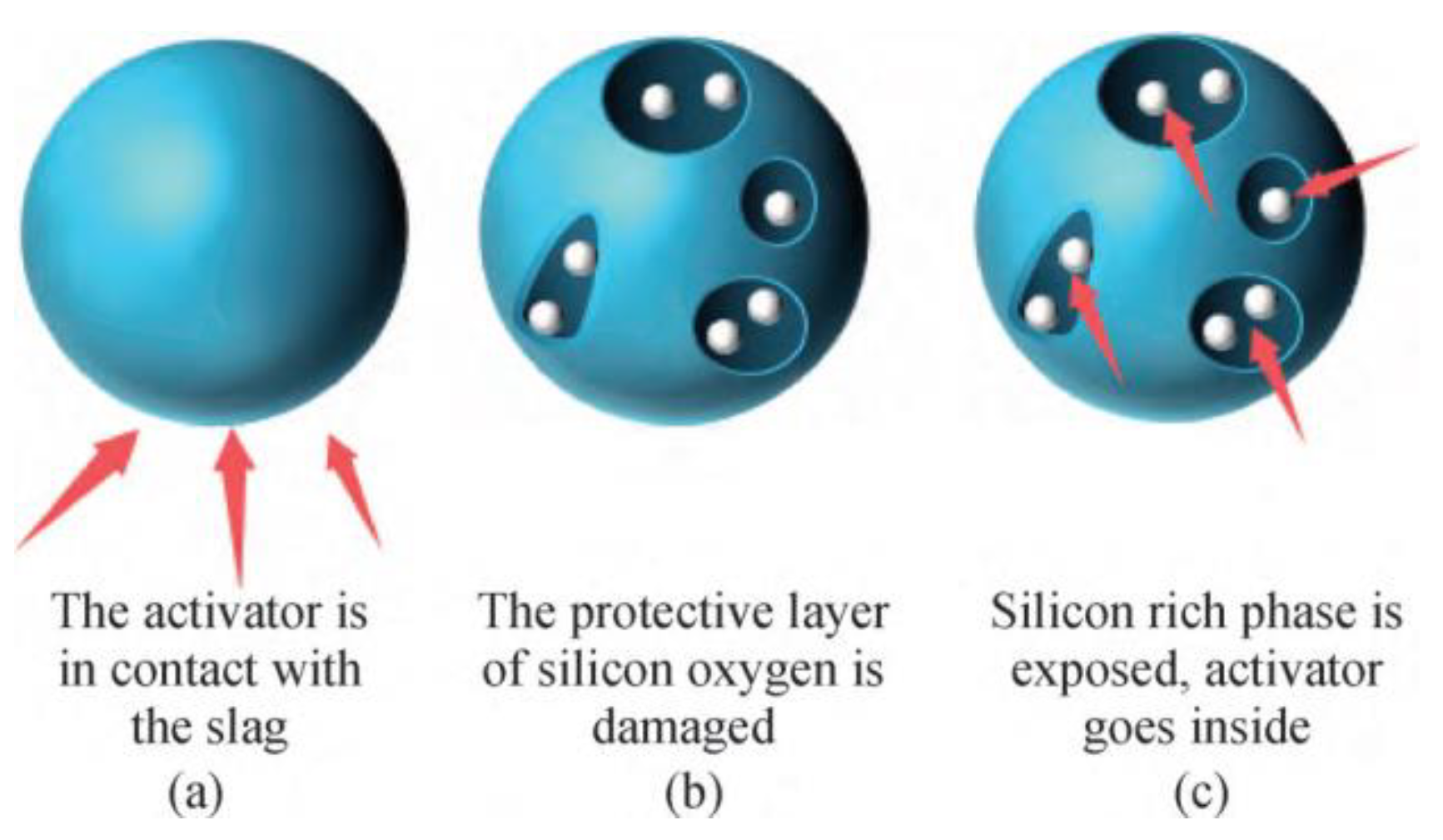
Figure 2.
The mechanism of the Si-O-Si bond breakage by the action of OH- [20].
Figure 2.
The mechanism of the Si-O-Si bond breakage by the action of OH- [20].

Figure 3.
Graphic model proposed for the N-A-S-H gel formation [13].
Figure 3.
Graphic model proposed for the N-A-S-H gel formation [13].
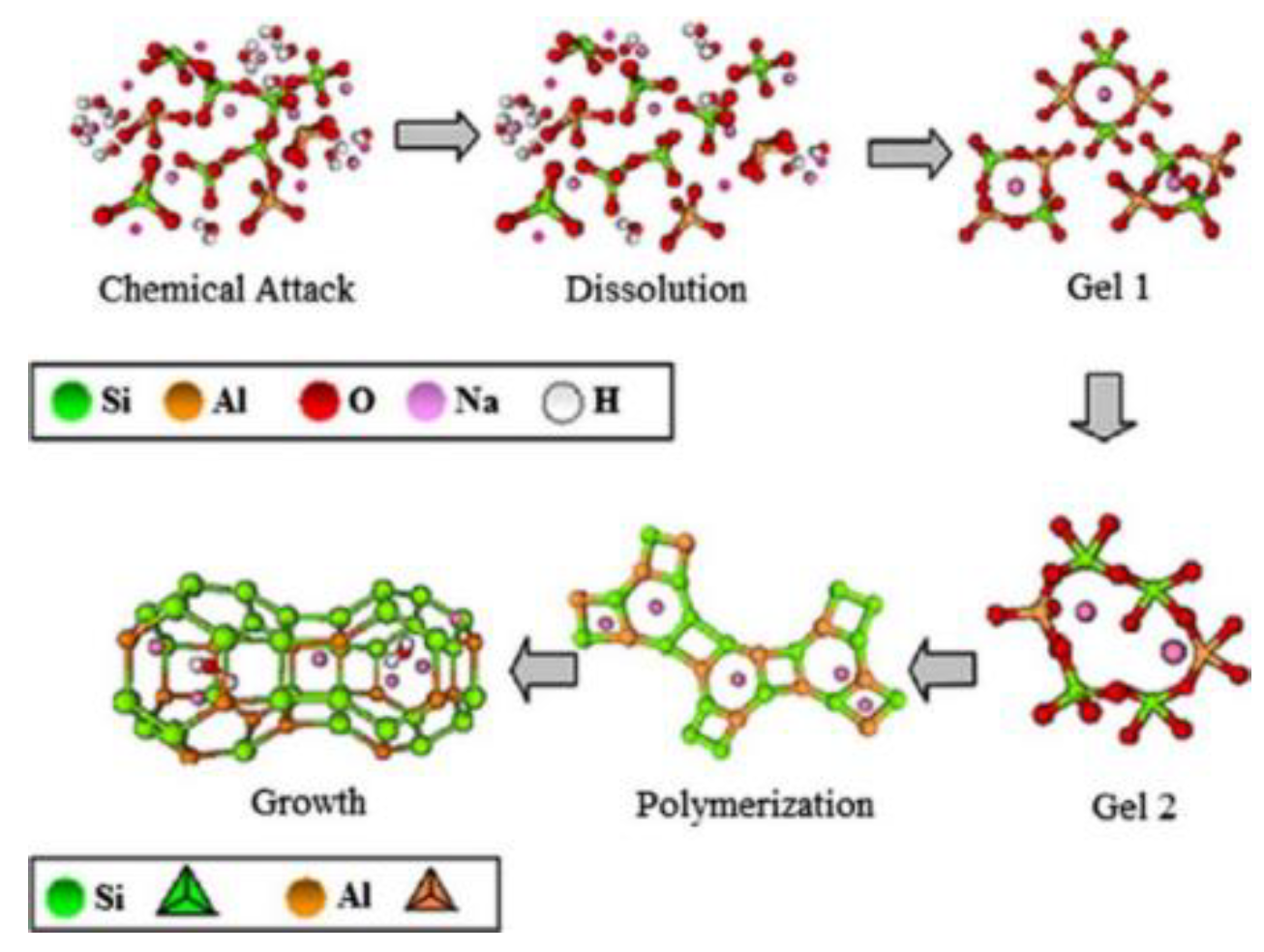
Figure 4.
Corrosion morphology of alkali activated slag cement concrete by biological sulfuric acid [31].
Figure 4.
Corrosion morphology of alkali activated slag cement concrete by biological sulfuric acid [31].
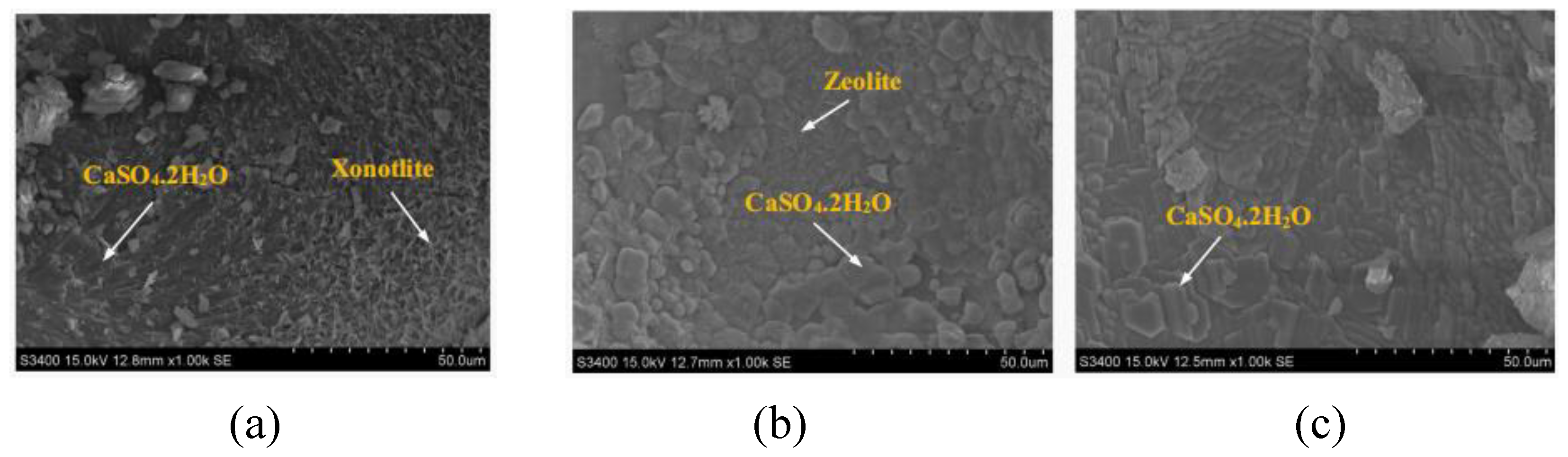
Figure 5.
Proposed reaction mechanisms of AAS with Na2SO4 solution at the exposure surface(a)NaOH and Na2CO3-activated slag ; (b)Na2SO4-activated slag [45].
Figure 5.
Proposed reaction mechanisms of AAS with Na2SO4 solution at the exposure surface(a)NaOH and Na2CO3-activated slag ; (b)Na2SO4-activated slag [45].
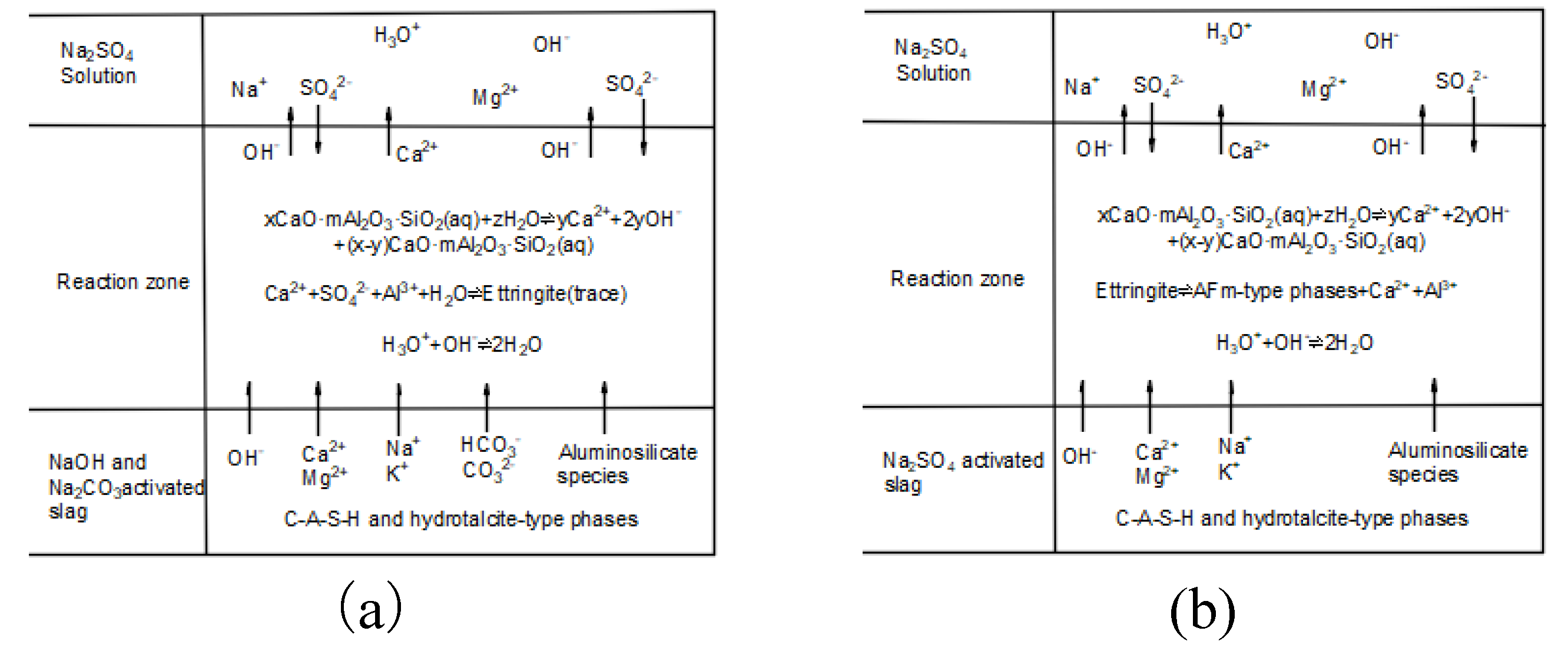
Figure 6.
Proposed reaction mechanisms of AAS with MgSO4 solution at the exposure surface (a)NaOH and Na2CO3-activated slag; (b)Na2SO4-activated slag [45].
Figure 6.
Proposed reaction mechanisms of AAS with MgSO4 solution at the exposure surface (a)NaOH and Na2CO3-activated slag; (b)Na2SO4-activated slag [45].
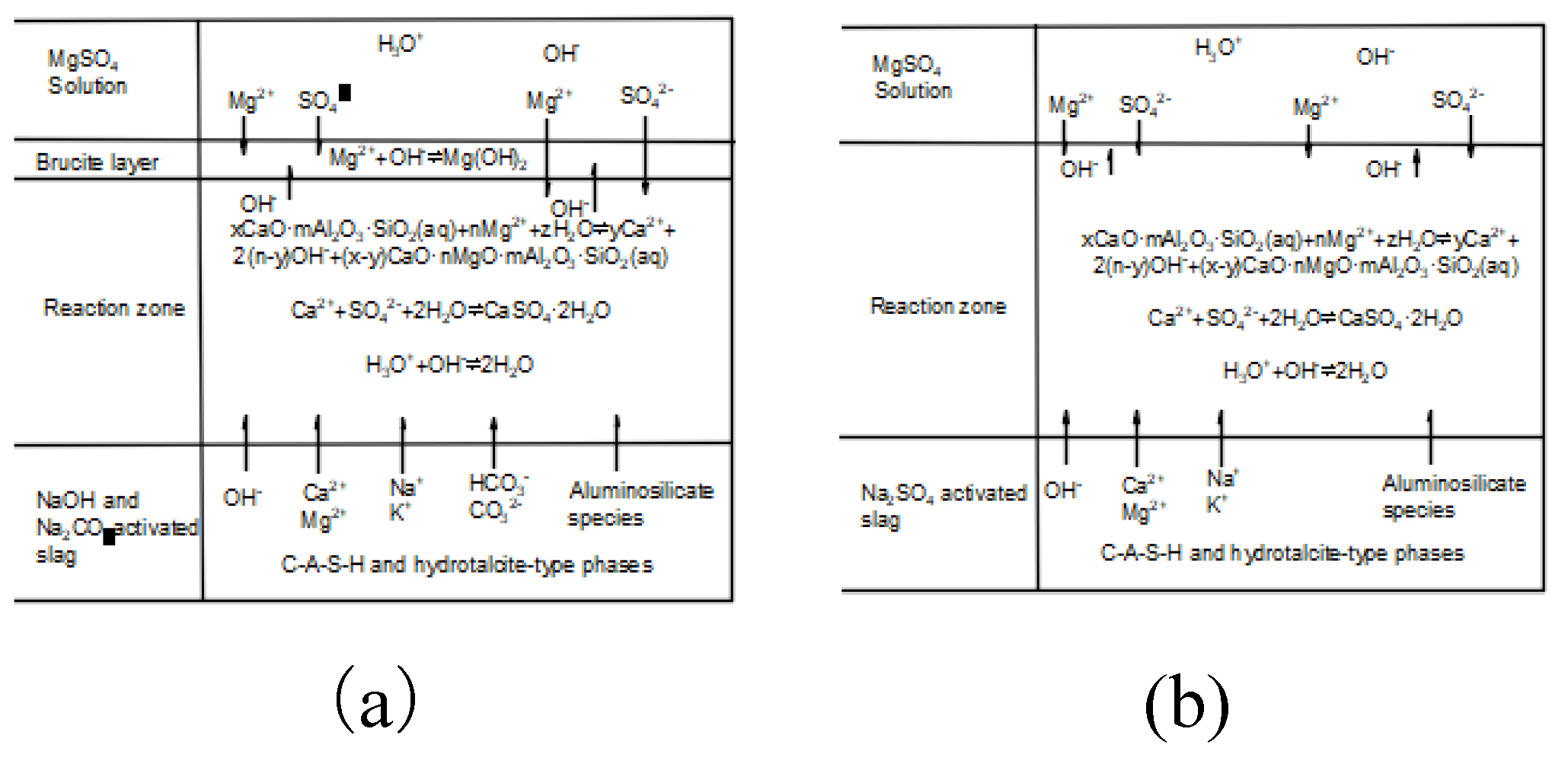
Figure 7.
Effect of sulfate on pH of AAS pore solution [71].
Figure 7.
Effect of sulfate on pH of AAS pore solution [71].
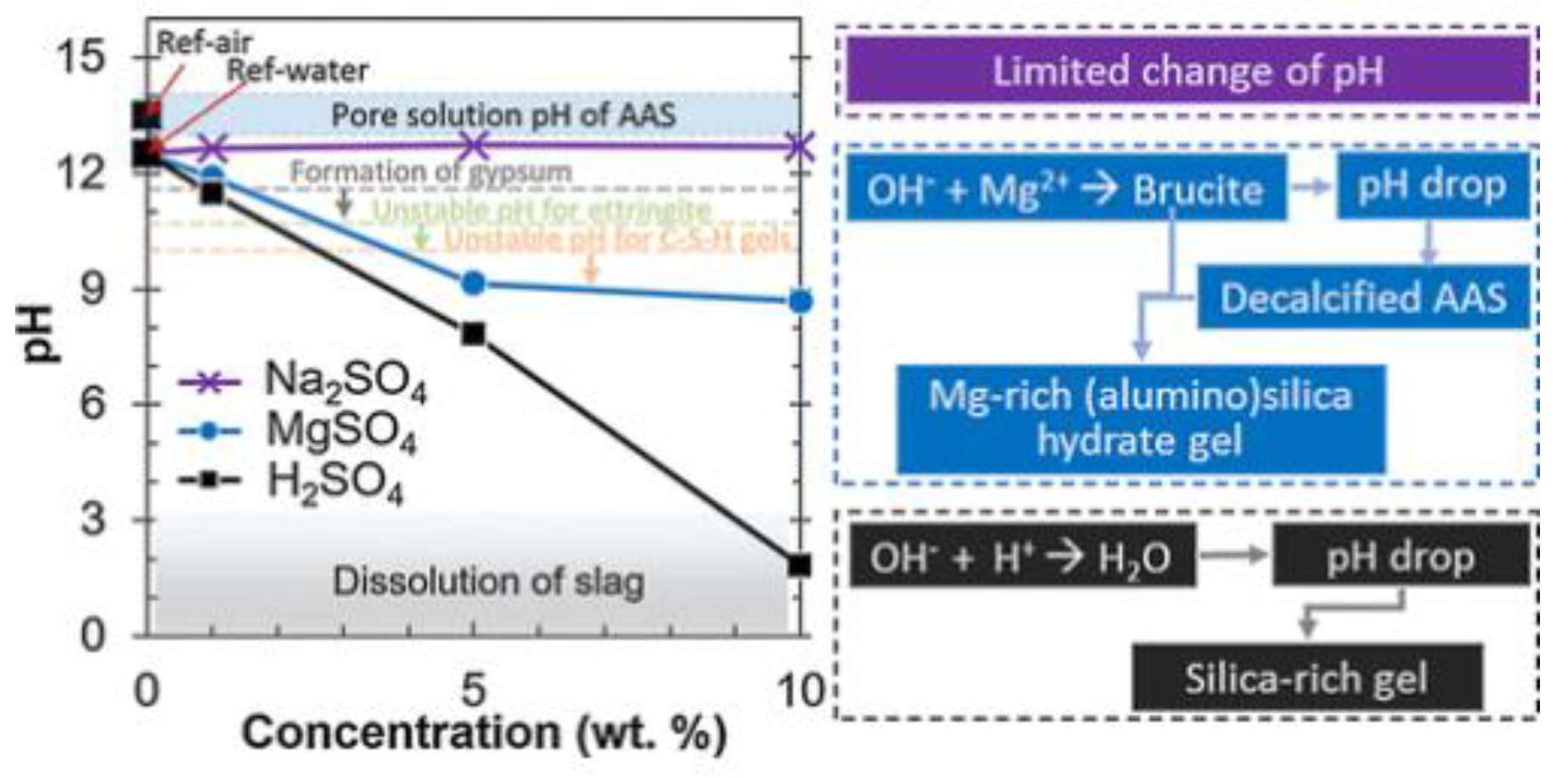
Figure 8.
Different corrosive degree on different parts of concrete structure in marine environment [75].
Figure 8.
Different corrosive degree on different parts of concrete structure in marine environment [75].
Disclaimer/Publisher’s Note: The statements, opinions and data contained in all publications are solely those of the individual author(s) and contributor(s) and not of MDPI and/or the editor(s). MDPI and/or the editor(s) disclaim responsibility for any injury to people or property resulting from any ideas, methods, instructions or products referred to in the content. |
© 2024 by the authors. Licensee MDPI, Basel, Switzerland. This article is an open access article distributed under the terms and conditions of the Creative Commons Attribution (CC BY) license (http://creativecommons.org/licenses/by/4.0/).
Copyright: This open access article is published under a Creative Commons CC BY 4.0 license, which permit the free download, distribution, and reuse, provided that the author and preprint are cited in any reuse.


