

Submitted:
27 August 2024
Posted:
28 August 2024
Read the latest preprint version here
Abstract
Digital twin technology, a cutting-edge approach that creates dynamic digital replicas of physical systems, is increasingly integral to various industrial applications. However, the effective deployment of digital twins often faces challenges associated with data availability, quality, and interoperability, which can impede the development and operational efficacy of these virtual counterparts. This paper presents a systematic review of the application of artificial intelligence (AI) in enhancing and managing digital twin technologies across multiple domains such as industry, healthcare, urban planning, business, education, technology, and others. It specifically examines how machine learning models, particularly neural networks and deep generative models, are being employed to optimize the creation, maintenance, and functionality of digital twins. The review explores the role of artificial intelligence in overcoming data-related limitations by providing robust, scalable data solutions for digital twins. Additionally, it addresses critical considerations of real-time data processing and system interoperability within these applications. This survey not only identifies the prevailing challenges and opportunities within this emerging field but also highlights potential future research directions that could further the integration of AI with digital twin technology. Through a detailed exploration of the intersection between AI and digital twins, this paper aims to contribute significantly to the knowledge base and encourage further innovations in this interdisciplinary area.
Keywords:
digital twin
; machine learning
; generative AI
; synthetic data generation
1. Introduction
Digital twins are dynamic digital replicas or models of real-world processes, products, or services used for digital simulation, testing, modeling, and monitoring. They can model equipment, facilities, and entire supply chains, capturing significant interest across a variety of sectors [1,2,3]. Digital twins are not only about generating synthetic data for training and analysis; rather, they aim to establish a virtual counterpart that continuously predicts, optimizes, and reacts to its physical twin’s changes in real time. These systems employ advanced multi-physics, multi-scale, and probabilistic simulations, leveraging the finest physical models, updated sensor data, and historical fleet data to mirror the operational life of their real-world counterparts [4].
Figure 1.
This diagram shows the digital twin generation process, starting with data collection through sensors and IoT devices. The data undergoes cleaning, preprocessing, and analysis before being utilized by AI models to simulate and optimize systems within the digital twin. This integrated approach enhances real-time feedback and control, facilitating predictive maintenance and decision support.
Figure 1.
This diagram shows the digital twin generation process, starting with data collection through sensors and IoT devices. The data undergoes cleaning, preprocessing, and analysis before being utilized by AI models to simulate and optimize systems within the digital twin. This integrated approach enhances real-time feedback and control, facilitating predictive maintenance and decision support.
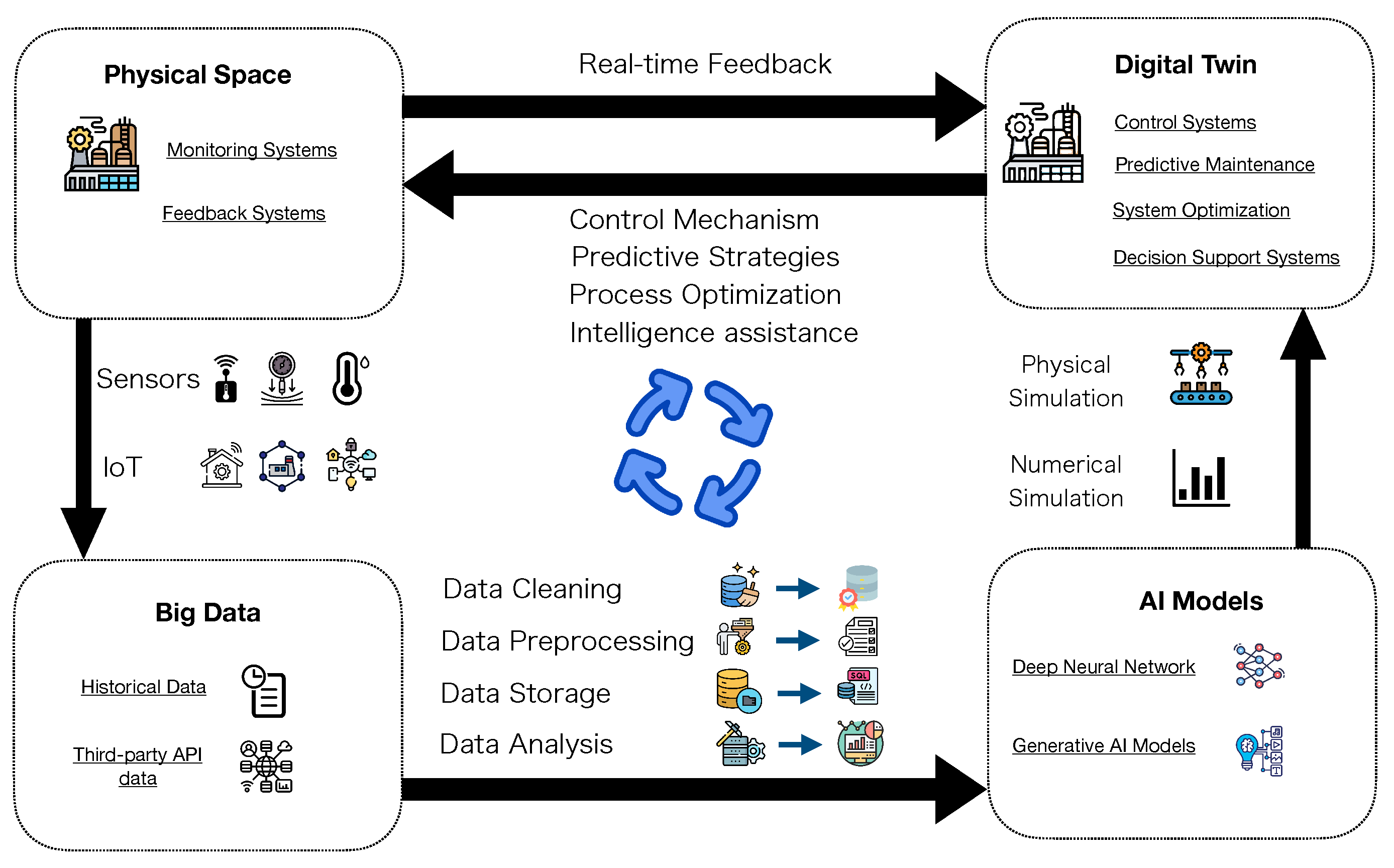
However, it is important to recognize that digital twins alone do not always solve problems or produce optimal solutions. Despite the numerous achievements of digital twins, there are still many challenges in their development and application [5]. As the field continues to evolve, addressing these obstacles is crucial to unlocking the full potential of digital twins and their transformative impact on various industries. Most existing literature on digital twins focuses mainly on their simulation and modeling aspects [6,7], which are essential components of digital twin frameworks, supplemented by continuous updates to the physical entities they represent. However, this process is time-consuming and costly. Some of the key obstacles and challenges include:
- Predictive Accuracy. Traditional modeling and simulation methods often struggle with predictive accuracy in digital twins. These methods may not capture the dynamic and complex nature of real-world systems, leading to less reliable predictions. This limitation can impede the effectiveness of digital twin implementations that rely on accurate and timely predictions [8].
- Data Analysis and Integration. Digital twins rely on vast amounts of data collected from various sensors and data sources. This data is often incomplete, noisy, and comes in different formats and standards. Effectively integrating and analyzing this data, especially in real-time, is a major challenge. Data accuracy and timeliness are critical to the reliability of digital twins [9].
- Data quality. High-quality data is key to the success of digital twins, but in reality, data is often incomplete, inaccurate, or scarce. These data issues can affect the accuracy and reliability of digital twins. Automatically detecting and correcting errors and anomalies in the data is also a complex task [10].
Addressing these challenges is essential to fully realizing the potential of digital twins and their transformative impact on various industries. Advances in artificial intelligence (AI) are making this transformation possible. AI, ranging from neural networks capable of handling complex patterns to generative models that create data-rich simulations, drives the forefront of digital twin innovation [11]. AI enhances predictive accuracy by utilizing advanced neural networks, such as CNNs for processing spatial data and GNNs for understanding complex relationships within data, leading to more accurate and dynamic predictions in digital twins. AI can quickly analyze and integrate large amounts of data from sensors and other sources. Using advanced data processing and analysis algorithms, AI can identify trends, anomalies, and potential disruptions in real-time, enabling faster decisions and interventions. Additionally, AI can employ generative adversarial networks (GANs) and other generative models to create high-quality synthetic data, filling gaps in actual data and alleviating data scarcity issues. Initially crucial in industrial engineering and manufacturing, the utility of digital twins is expanding to a broad range of fields including healthcare, drugs, urban planning, business, education, etc.
The goal of this paper is to provide a comprehensive review of various cutting-edge AI methods for digital twin generation. To facilitate understanding, we outline the key contributions of this paper as follows:
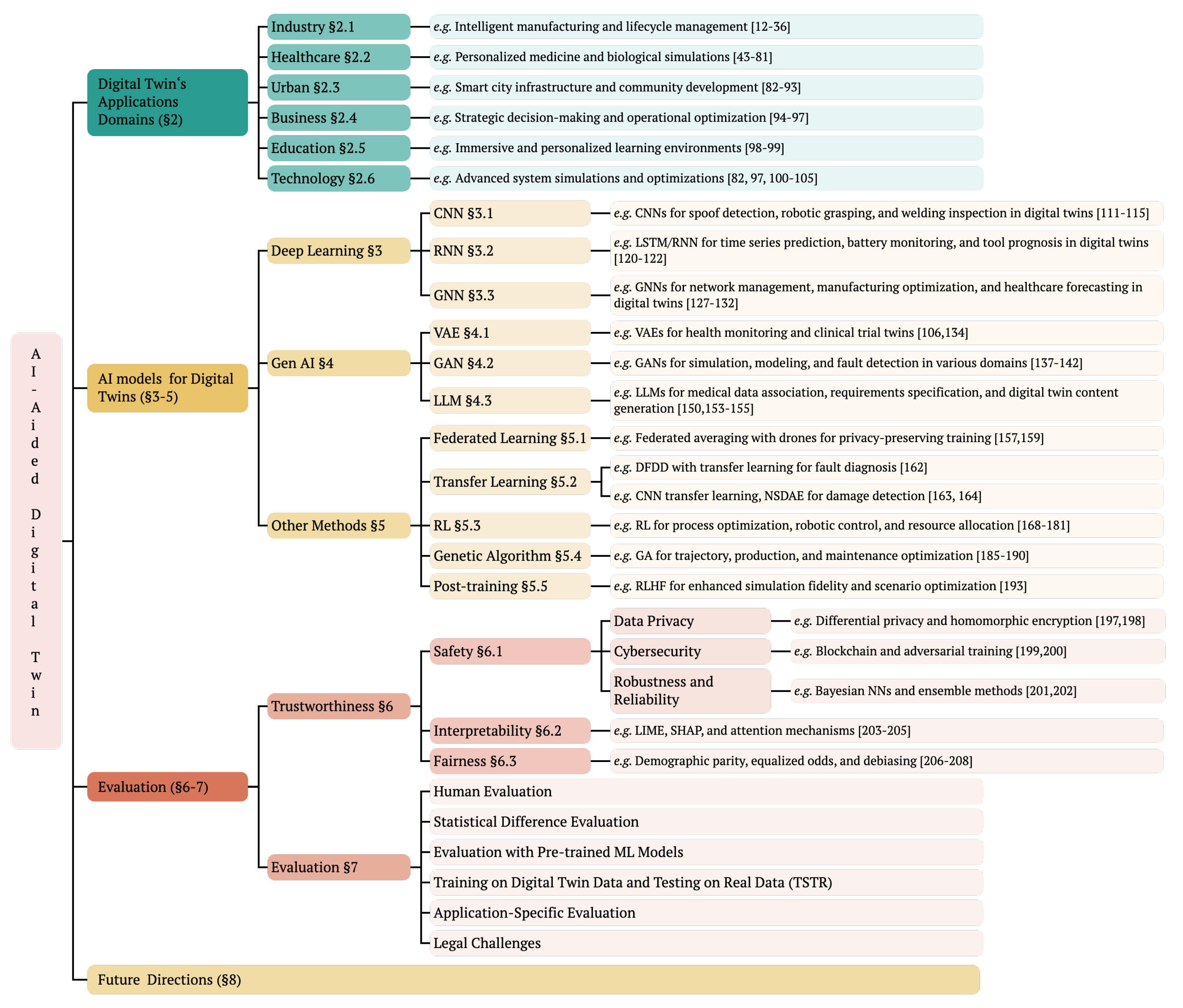
- Applications. We explore various real-world application domains and highlight the vast opportunities that AI and digital twin technologies offer in bridging operational and data analysis gaps (Section 2).
- Trustworthiness. We analyze the trustworthiness of the AI-based digital twin model, including safety, privacy, and interpretability (Section 6).
- Privacy and Fairness. We address concerns regarding privacy and fairness, as sensitive data used in digital twins can lead to privacy issues and biases from the original data can be replicated. We evaluate current technological measures and their limitations in protecting data privacy and ensuring fairness in the development of digital twins (Section 6 and Section 7).
- Evaluation. We describe various strategies to assess the quality of digital twin simulations, ensuring their accuracy and applicability in real-world scenarios (Section 7).
- Future work. We pinpoint challenges encountered in the creation and implementation of digital twins, highlighting areas for further research that could improve their functionality and deployment (Section 8).
Figure 2.
The main content flow and categorization of this survey.
2. Digital Twin and Its Application Domains
A digital twin is a virtual representation of a physical entity or system that integrates sensor data, machine learning, and software analytics to monitor and analyze the entity’s performance and condition in real-time. It enables the simulation, prediction, and optimization of the physical entity’s behavior and operational parameters across its lifecycle.
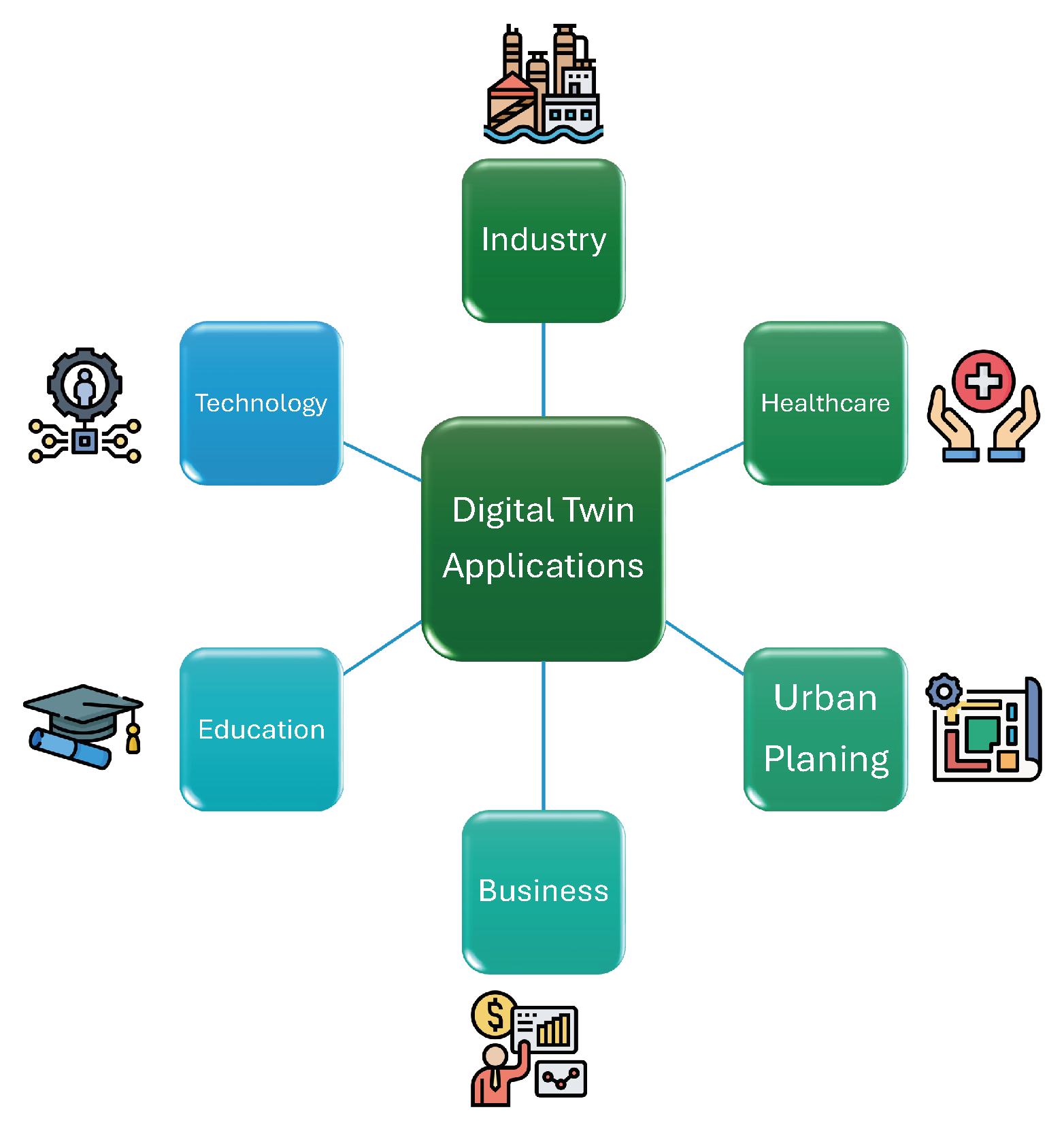
Figure 3.
The use of digital twins in sectors like industry, healthcare, urban planning, business, education, and technology, showcasing their versatility in improving operations and decision-making.
Figure 3.
The use of digital twins in sectors like industry, healthcare, urban planning, business, education, and technology, showcasing their versatility in improving operations and decision-making.
A digital twin is a multidisciplinary, data-centric, and computationally driven virtual replica of a physical asset, process, or system. It is composed of three main elements:
- Digital Representation: An accurate and dynamic virtual model that mirrors the physical entity’s geometry, behavior, and interactions. This model can range from simple graphical renderings to sophisticated simulations that incorporate physics-based modeling, machine learning algorithms, and historical data.
- Data Fusion and Analytics: Real-time data from sensors embedded in the physical entity is collected and integrated with the digital representation. Advanced analytics, including statistical analysis, machine learning, and AI techniques, are applied to this data to extract insights, detect anomalies, predict outcomes, and optimize performance.
- Bidirectional Communication: There is a continuous two-way flow of information between the physical entity and its digital counterpart. Changes in the physical world are reflected in the digital twin. Conversely, actions or adjustments suggested by the digital twin can be communicated back to the physical entity, facilitating remote monitoring, control, and intervention.
Digital twins, serving as dynamic virtual replicas of physical systems, are increasingly pivotal across diverse sectors due to their ability to simulate real-world environments in real-time. The purpose of a digital twin is to enable predictive maintenance, optimize operations, enhance decision-making, and facilitate product development and innovation. It serves as a powerful tool for understanding complex systems, identifying inefficiencies, and exploring potential improvements without the need for physical prototypes or direct modifications to the actual asset. These advanced models offer unparalleled insights and predictive power, significantly impacting several fields. Here, we explore some prominent applications of digital twins across various areas.
2.1. Industry
In the industry, digital twins offer significant advancements, particularly in manufacturing, component manufacturing, and automotive industries.
In the manufacturing sector, AI-driven digital twins are revolutionizing traditional manufacturing processes, marking a significant advancement toward smart manufacturing [12,13,14,15] and aligning with the principles of Industry 4.0 [16,17,18], Industry 5.0 [19,20]. Companies utilize these technologies to create highly accurate simulations of their manufacturing lines [21,22], which helps in optimizing not only machine operations [23] but also the assembly process [24] and workshop workflows [25], reducing downtime, and enhancing product quality [26,27].
AI-aided digital twins are fundamentally transforming the approach to component lifecycle management in component manufacturing. These advanced digital twin models are an indispensable part of precision engineering and automation, significantly enhancing the accuracy and efficiency of component fabrication. Digital twins enhance the sustainability of materials by refining the design, production, and even disposal stages of complex parts. For example, in terms of production processes, digital twins can optimize techniques like the die-casting of aluminum [28], boosting product yield rates through intelligent simulations. Furthermore, digital twins enable the simulation of component aging and damage to facilitate predictive maintenance and reduce downtime, such as gear surface degradation [29], tool wear [30], and product damage detection [31].
Another noteworthy implementation of digital twins in the industry is within the automotive sector, where this technology simulates the entire car production line to predict outcomes under various scenarios, enhancing resource management and product development [32]. In vehicle-to-everything applications, IDT-SDVN virtualizes the intelligent digital twin of the physical SDVN network, improving performance and learning capabilities [33]. For autonomous vehicles, digital twins create accurate simulations of driving scenarios, aiding in testing and refining vehicle responses under various conditions without actual exposure to hazards [34], ensuring safety and security before release [35,36].
2.2. Healthcare
In healthcare, digital twins offer significant advancements [37,38,39,40,41,42], particularly in personalized medicine [43] and complex surgical procedures. Digital twins, virtual replicas of physical entities, utilize real-time data and advanced analytical techniques to provide precise simulations and predictions of health conditions. These models have a profound impact on healthcare by representing biological entities such as cells [44,45], cell cultures [46,47], tissue samples [48], organs [49,50,51], animal models [52,53], and full human representations [54,55]. They enable the simulation of real experiments using advanced computational techniques, enhancing the understanding of biological processes [56].
In personalized medicine, digital twins offer tailored treatments through predictive modeling and risk assessment [57]. By simulating treatment scenarios, digital twins optimize patient responses, maximizing efficacy and minimizing side effects [58]. They assess individual risks for diseases by analyzing genetic traits, lifestyle choices, and environmental factors, enabling preventive measures and targeted interventions [59,60,61,62,63,64]. In managing chronic diseases, digital twins provide continuous predictive analytics, improving disease control and patient quality of life [65]. They function as early warning systems, identifying potential health risks for timely interventions [59,60,61,62,63,64], and are used to monitor and optimize fitness plans based on real-time data [65].
Digital twin technology in clinical trials enhances efficiency and accuracy by creating virtual replicas of patients, enabling the simulation of trial scenarios [66,67]. By integrating diverse data sources, digital twins model patient responses to treatments, optimizing trial design and predicting outcomes. They allow for virtual trials, reducing the need for extensive physical trials and accelerating drug development processes [68,69,70,71,72]. Digital twins also improve patient recruitment by identifying suitable candidates based on their digital profiles, ensuring more targeted and effective trials. Additionally, they enhance monitoring and management of ongoing trials by providing real-time insights into patient conditions and treatment effects, allowing for timely adjustments [73,74,75]. This approach minimizes risks, reduces costs, and increases the overall success rate of clinical trials, paving the way for more innovative and personalized medical solutions [76,77,78,79,80,81].
2.3. Urban Planning
The application of digital twin technology in urban planning is revolutionizing how cities are designed, managed, and developed, offering significant potential to improve urban efficiency, sustainability, and livability. Digital twins are virtual replicas of physical entities that utilize real-time data and advanced analytical techniques to simulate and predict urban dynamics.
One of the primary applications of digital twins in urban planning is in city infrastructure management. By creating digital twins of city infrastructure, such as roads, bridges, and utilities, urban planners can monitor their condition in real-time, predict maintenance needs, and optimize resource allocation [82,83]. This proactive approach helps prevent infrastructure failures, reduces maintenance costs, and ensures the smooth functioning of urban systems [84,85].
In transportation planning, digital twins play a crucial role in optimizing traffic flow and reducing congestion. By simulating various traffic scenarios and analyzing real-time data from sensors and cameras, planners can identify bottlenecks, optimize traffic signal timings, and develop efficient public transportation routes [86,87]. This leads to reduced travel times, lower emissions, and improved overall mobility in the city.
Digital twins also enhance disaster management and resilience planning. By modeling the city’s infrastructure and simulating different disaster scenarios, such as floods, earthquakes, or fires, planners can identify vulnerable areas, plan evacuation routes, and optimize emergency response strategies [88]. This improves the city’s preparedness and resilience, reducing the impact of disasters on residents and infrastructure.
In sustainable urban development, digital twins enable planners to model and analyze the environmental impact of different development scenarios. By simulating energy consumption, water usage, and waste generation, planners can identify sustainable practices, optimize resource utilization, and develop green infrastructure solutions [89,90]. This contributes to the creation of more sustainable and environmentally friendly urban environments.
Moreover, digital twins facilitate community engagement and participation in urban planning processes. By providing interactive and visually engaging models of urban development plans, residents can better understand proposed changes, provide feedback, and actively participate in decision-making processes [91,92]. This enhances transparency, fosters community trust, and ensures that urban development aligns with the needs and preferences of residents.
Overall, digital twin technology in urban planning offers numerous benefits, including enhanced infrastructure management, optimized transportation, improved disaster resilience, sustainable development, and increased community engagement. As digital twin technology continues to advance, it will play an increasingly vital role in shaping the future of urban environments [93].
2.4. Business
Digital twins are pivotal in business for strategic planning and crisis management. They simulate various strategic decisions and their impacts, helping model market changes, supply chain disruptions, and shifts in consumer behavior for robust decision-making and risk management [94]. For instance, in logistics, digital twins optimize routes and inventory levels, reducing costs and improving service delivery [95].
In manufacturing, digital twins enhance operational efficiency by monitoring machinery health and predicting maintenance needs, preventing downtime, and ensuring consistent output and higher profitability [96]. In retail, digital twins simulate store layouts, customer flow, and inventory management to optimize store design, streamline processes, and boost sales. They also help understand consumer behavior by integrating data from various sources, enabling personalized marketing strategies.
In financial services, digital twins improve risk assessments and fraud detection by simulating transactions and market behaviors to identify anomalies and potential risks. They also support compliance with regulatory requirements through detailed, real-time reporting.
In human resources, digital twins model workforce dynamics, including performance and turnover. Analyzing these models helps businesses develop strategies to improve employee satisfaction, enhance productivity, and reduce turnover rates by simulating the impact of various HR policies [97].
Overall, digital twin technology offers comprehensive benefits across various business sectors, driving efficiency, reducing costs, and enhancing strategic decision-making [96].
2.5. Education
Educational institutions increasingly harness digital twins to foster interactive and engaging learning environments. Digital twins of archaeological sites or biological ecosystems offer students hands-on experiences with otherwise inaccessible systems, enhancing learning outcomes and understanding of complex subjects [98]. This technology also facilitates virtual dissections of historical events and scientific phenomena, creating immersive educational experiences [99].
Furthermore, digital twins provide personalized learning experiences by tracking individual student progress and tailoring instruction to meet unique needs. In higher education, they transform laboratory and practical training, allowing students to interact with digital twins of equipment, virtual patients, or experimental setups, thereby enhancing practical knowledge and competence. Additionally, digital twins optimize campus management and operations by monitoring facilities efficiently and planning infrastructure changes effectively.
Moreover, digital twins facilitate collaborative projects and research by providing a shared virtual environment, enabling students and researchers from different disciplines and locations to work together on complex projects. They also support lifelong learning and professional development by continuously updating with new data and insights, ensuring learners stay current with industry developments.
Overall, digital twin technology in education offers numerous benefits, including personalized learning, enhanced training, optimized campus management, and improved collaboration and research, shaping the future of education to be more interactive, efficient, and tailored to individual needs.
2.6. Technology
The application of digital twin technology is transforming network management, immersive experiences, and intelligent systems. Digital Twin Network (DTN) enables virtual replicas of network components for real-time monitoring, predictive maintenance, and optimization [100,101]. DTNs simulate network scenarios to predict issues, enhancing reliability and efficiency.
In augmented reality (AR), digital twins enhance interactive and immersive experiences, particularly in digital assembly. This integration allows users to visualize and interact with virtual models overlaid on the physical world, improving accuracy and reducing errors [102,103].
For smart cities, digital twins manage urban infrastructure and services by creating replicas of city components like buildings and transportation systems. This aids in real-time monitoring, optimizing resource allocation, and enhancing public safety [82,104].
In healthcare, digital twins of medical devices and patients enable personalized medicine and improved patient care through optimized performance and maintenance [97].
In aerospace and defense, digital twins model complex systems like aircraft, allowing comprehensive testing and simulation to ensure reliability and safety, reducing costs associated with physical testing.
Overall, digital twin technology enhances network management, AR experiences, urban management, personalized healthcare, and aerospace and defense systems, driving innovation and efficiency across technological domains [105].

3. Deep Neural Network
Deep learning [108], a sub-field of machine learning, has garnered significant attention in recent years due to its numerous breakthroughs and successful applications in various fields, such as computer vision, natural language processing, audio analysis, drug discovery, etc. The heart of deep learning is the artificial neural network [109], a machine learning approach modeled after the structure and function of the human brain. In this section, we explore different types of deep neural networks, specifically Convolutional Neural Networks (CNNs), Recurrent Neural Networks (RNNs), and Graph Neural Networks (GNNs), each designed to process specific data structures such as sequences and graphs. These models are fundamental in augmenting the traditional digital twin capabilities by leveraging the power of AI to enhance both efficiency and practical applications.
3.1. Convolutional Neural Network (CNN)
Convolutional Neural Networks (CNNs) [110] are designed to capture local patterns in data features and are widely used for analyzing images, text, and sequential data. The core idea behind CNNs is the convolutional layer, which applies a set of learnable filters (or kernels) to the input data. For images, a two-dimensional convolutional layer slides over the image, capturing local patterns in both horizontal and vertical directions. The operation can be formulated as:
where is the output feature map at layer l, is the convolutional filter applied to the local region of the input from the previous layer, is the bias term, and is a non-linear activation function, such as ReLU.
CNNs can also be adapted to handle sequential data using one-dimensional convolutional layers, where the filter slides along the temporal or spatial sequence to capture relevant patterns. These architectures are particularly effective in tasks such as image recognition, text classification, and natural language processing. For more detailed information on CNNs, please refer to [111].
Applications in Digital Twin. Digital twins could provide precise simulations and predictions through real-time data interaction and analysis. CNNs have become vital tools for enhancing digital twin systems with their superior performance in processing high-dimensional data. For example, EfficientNet CNNs detect spoofing in digital twins of e-health [112]. In robotics, CNNs generate and select grasps for intelligent robotic grasping digital twins [113]. Additionally, a CNN-LSTM-attention model enhances real-time degradation prediction of lithium-ion batteries [114]. Acoustic signals and CNNs are used in digital twins for welding quality inspection [115], while visualized weld joint growth monitoring and penetration control benefit from deep learning-powered digital twins [116].
3.2. Recurrent Neural Network (RNN)
Recurrent Neural Network (RNN) [117,118] models sequence data and captures the long-term dependencies in the sequence data. To handle sequence data, the recurrent neural network (RNN) was designed, originally for natural language. Token is the basic unit of a sequence. The set of all the tokens is called the vocabulary. We suppose the sequence of interest has T tokens, or T in length. The sequence data can be formulated as , where is the input feature vector at time t (i.e., the t-th element in the sequence). We use to denote the hidden state (latent variable) at different times. Generally, the RNN can be formulated as
where the current hidden state relies on both previous hidden state and the current input , where and are both neural networks. However, when traditional RNNs are unrolled, they can result in a very deep neural network, with a depth equal to the length of the sequence. This can lead to the vanishing gradient problem, particularly for long sequences. To address this issue, two popular variants of RNN have been proposed: (1) Long Short-Term Memory Networks (LSTMs) [119] and (2) Gated Recurrent Units (GRUs) [120]. Both of these variants have been thoroughly studied and widely used in the modeling of sequence data.
Applications in Digital Twin. RNNs have been successfully applied to the generation of digital twins in various innovative contexts. For instance, time series prediction is enhanced using a hybrid ensemble empirical mode decomposition and BO-LSTM neural networks [121]. Real-time temperature prediction and degradation analysis for lithium-ion batteries utilize LSTM neural networks for digital twins [122]. Additionally, tool condition prognostic models leverage digital twin systems to predict tool health and performance [123]. These applications highlight the effectiveness of RNNs in digital twin technology.
3.3. Graph Neural Network (GNN)
Graph Neural Networks (GNNs) [124,125] are designed to capture the complex topological structures in graph data, such as chemical compounds, proteins, and knowledge graphs. GNNs represent graph topology by passing information between nodes and edges, enabling a comprehensive understanding of graph structures.
A graph is represented as , where V is the set of nodes and E is the set of edges. GNNs use a neighborhood aggregation approach, where each node’s representation is iteratively updated by combining the representations of its neighboring nodes. Formally, the feedforward rule for the l-th layer of a GNN is given by:
where is the representation vector of node v at layer l, and is the set of neighboring nodes. The aggregate function is typically a neural network.
After L layers, the node’s final representation captures its L-hop neighborhood structure. To obtain a graph-level representation, a READOUT function aggregates all node embeddings:
where READOUT can be an average or summation function over all nodes in V.
Applications in Digital Twin. GNNs [126,127] have been successfully applied to generate digital twins in various innovative contexts, demonstrating their versatility and effectiveness. For instance, GNNs are used for network slicing management [128] and network optimization [129]. In manufacturing, they facilitate cognitive digital twins for system optimization [130]. GNNs also forecast patients’ medical conditions, aiding in personalized healthcare [131]. Additionally, FlowDT leverages GNNs for flow-aware digital twins in computer networks [132], and GNNs optimize power allocation and user association in terahertz band networks [133].
4. Generative AI Methods
Generative AI has rapidly emerged as a pivotal area within artificial intelligence, attracting widespread attention due to its groundbreaking advancements and successful implementations in diverse fields, including image generation, text synthesis, audio creation, and drug discovery. Central to generative AI is the principle of learning to produce new data that mirrors existing patterns. In this section, we examine several generative AI models, including Variational Autoencoders (VAEs), Generative Adversarial Networks (GANs), and Large Language Models (LLMs), each tailored to generate specific types of data such as images, text, and more. These models play a vital role in elevating the creative and predictive capabilities of traditional digital twins, empowering them to generate realistic simulations, drive innovative design, and enhance decision-making processes across various domains.
4.1. Variational Auto-Encoder (VAE)
Variational Auto-Encoders (VAEs) [134] are generative models integrating deep learning with probabilistic graphical models. VAE comprises two neural networks:
- Encoder maps the data object to a fixed-dimensional latent variable . It is denoted as , with as learnable parameters.
- Decoder reconstructs the data object from . It is denoted as , with as learnable parameters.
The objective of VAE training is to maximize the Evidence Lower Bound (ELBO), given by:
where denotes the Kullback-Leibler divergence. The first term ensures that the decoder accurately reconstructs the input data, while the second term regularizes the distribution of the latent variables to match a prior distribution, typically Gaussian. This balance allows VAEs to generate new similar data points by sampling from the learned latent space, making them powerful tools for data generation and representation learning.
Applications in Digital Twin. VAEs have been prominently utilized to generate digital twins in various fields, enhancing detection, diagnostics, and prognostics capabilities. Specifically, Variational Autoencoders (VAEs) form the backbone of a deep digital twin (DDT) framework used in prognostics and health monitoring (PHM). The DDT framework leverages deep generative models, like VAEs, to learn the distribution of healthy operational data at the beginning of an asset’s life cycle, bypassing the need for historical failure data. This enables the DDT to detect early-stage faults, monitor asset degradation, and distinguish between different failure modes in both stationary and non-stationary conditions, even when trained solely on healthy data. Such capabilities make the DDT a powerful tool for automating predictive maintenance scheduling across diverse asset fleets, enhancing the overall reliability and efficiency of PHM systems [106].
Additionally, the TWIN method employs VAEs to generate personalized clinical trial digital twins, creating virtual patients that closely mirror individual participant characteristics. This approach addresses the limitations of prior research, which often focused on generating electronic healthcare records (EHRs) with large training datasets but lacked the granularity needed for personalized patient simulations. By using VAEs, TWIN can produce high-fidelity synthetic clinical trial data that maintains the temporal relationships between visits and events, aiding in patient outcome predictions even in low-data scenarios. Furthermore, TWIN enhances privacy protection when sharing synthetic data, making it a valuable tool for advancing drug development and optimizing clinical trial processes [135].
4.2. Generative Adversarial Network (GAN)
Generative Adversarial Networks (GANs) [136,137] consist of two neural networks: a generator (G) and a discriminator (D). The generator generates synthetic data from a latent variable , aiming to fool the discriminator, while the discriminator tries to distinguish real data from generated data. The GANs’ objective is formulated as a minimax game:
Training alternates between optimizing D with fixed G, maximizing:
and optimizing G with fixed D, minimizing:
This process leads G to produce data increasingly indistinguishable from real data, as D becomes better at differentiating between real and generated samples.
Applications in Digital Twin. GANs have been successfully applied to the generation of digital twins in various innovative contexts, demonstrating their versatility and effectiveness. For example, rAC-GAN is used in a digital twin-enabled IoMT system for surgical simulation, enhancing training and procedural accuracy [138]. In pandemic modeling, GANs combined with bidirectional LSTM create digital twins to model COVID-19 dynamics [139]. Additionally, Wasserstein GANs enable early drift fault detection in wireless sensor networks [140], and GANs are utilized to model machining vibrations [141]. GAN-MDF integrates multi-fidelity data for digital twins [142], and GANs model intelligent communication networks [143]. Furthermore, generative models form the basis for digital twins in various applications, enhancing anomaly detection and diagnostics in cyber-physical systems and oil and gas stations [144,145,146]. These applications highlight the broad impact of GANs in advancing digital twin technology.
4.3. Large Language Model
Large Language Models (LLMs) are advanced machine learning models designed to proficiently understand and generate human language [147,148]. These models, built using deep neural networks with billions of parameters, excel in various natural language processing (NLP) tasks, including text generation, translation, summarization, and question-answering.
Key Components
- Transformer-based Architectures. LLMs typically rely on transformer architectures, which use self-attention mechanisms to capture complex dependencies in the data. The self-attention mechanism can be described as:where Q, K, and V are the query, key, and value matrices, respectively, and is the dimension of the key vectors.
- Pre-training. LLMs are pre-trained on massive text corpora to learn general language representations. This unsupervised phase allows the model to capture a wide range of linguistic patterns and knowledge.
- Fine-tuning. After pre-training, LLMs are fine-tuned on specific tasks using labeled data. This process adapts the general language knowledge to the particular requirements of the target task.
Applications in Digital Twin. LLMs have demonstrated state-of-the-art performance on numerous NLP benchmarks, opening new possibilities for AI applications. However, they also pose challenges, including ethical considerations, computational resource demands, and the need for robust bias mitigation and fairness mechanisms. As research progresses, LLMs are expected to become even more powerful and versatile, driving AI advancements and transforming technology interactions [149,150]. The LLM-based model TWIN-GPT can establish cross-dataset associations of medical information with limited data [151], generating personalized digital twins for patients and enhancing clinical trial outcome predictions [152,153]. A study compares LLM output quality for defining digital twin requirements with domain expert specifications, highlighting prompt engineering insights [154]. In Industry 4.0, a novel approach facilitates Asset Administration Shell (AAS) instance creation for digital twin modeling, enhancing interoperability and reducing manual effort [155]. ChatTwin, a conversational system leveraging GPT-4, automates scene description document generation for digital twins by segmenting prompts, generating scenes, and optimizing content [156].
5. Other AI Methods
Other AI methods, such as federated learning, transfer learning, reinforcement learning, and genetic algorithms, also play critical roles in enhancing the functionality and performance of digital twins.
5.1. Federated Learning
Federated learning (FL) is a decentralized approach where multiple clients collaboratively train a model under the coordination of a central server, while keeping their data locally, making it ideal for scenarios requiring data privacy. Each client computes updates to the global model using its local data and sends these updates to the central server. The server aggregates the updates, typically using federated averaging (FedAvg), to improve the global model, which is then sent back to the clients for further training.
Federated Learning Framework
Key components include:
- Clients. Local entities that hold data subsets and perform local computations.
- Local Model Update. Clients update the local model using their data by optimizing the local objective function .
- Global Model Aggregation. The server aggregates updates from clients as:where is the client update.
- Privacy Mechanisms. Techniques like differential privacy and secure multi-party computation protect data during aggregation.
Applications in Digital Twin. Federated learning significantly enhances the capabilities and performance of digital twin systems by effectively addressing critical challenges in data processing and privacy preservation [157]. This decentralized approach enables digital twins to integrate insights from diverse sources while ensuring that raw data remains confidential, a crucial benefit in sensitive environments such as industrial IoT [158]. By localizing data processing, federated learning allows individual devices to train models on their own data independently, transmitting only the model updates to a central server. This server then aggregates these updates into a comprehensive global model, which is disseminated back to all participating devices. This method not only improves the accuracy and reliability of digital representations by leveraging diverse data sources but also significantly reduces the risks associated with data breaches [159]. The interaction between federated learning and digital twins is particularly pertinent in complex, dynamic scenarios such as air-ground networks, where drones may serve as aggregators. These drones can utilize incentive mechanisms based on the Stackelberg game to optimize client selection and participation, thereby enhancing the accuracy of digital twin models while promoting energy efficiency across the network [160].
5.2. Transfer Learning
Transfer learning (TL) is a technique where knowledge gained from solving one problem is applied to a related but different problem, making it especially useful when labeled data for the target task is scarce but abundant for a related source task [151,161]. The process involves fine-tuning a model trained on a source domain with abundant data for use on a target domain with limited data, leveraging learned features to improve the target model’s performance.
Transfer Learning Framework
Key components include:
- Source Domain and Task. The source domain contains a large labeled dataset for the source task . For example, could be ImageNet, with being image classification.
- Target Domain and Task. The target domain has fewer labeled examples for the target task , like a medical imaging dataset for disease detection.
- Pre-trained Model. A model is trained on to solve and serves as the pre-trained model, often involving deep neural networks.
- Feature Extraction and Fine-tuning. The pre-trained model is adapted to either by using it as a fixed feature extractor or by fine-tuning it on the target data.
- Knowledge Transfer. Knowledge is transferred through shared features that benefit both domains.
Transfer learning is a machine learning approach where a model developed for one task is repurposed as the starting point for a model on a second, related task. This method is particularly popular in deep learning, where pre-trained models are adapted to new problems with similar data characteristics.
Applications in Digital Twin. The integration of digital twins with transfer learning has shown significant promise in domains such as fault diagnosis and structural analysis [162]. In fault diagnosis, the Deep Fault Detection and Diagnosis (DFDD) approach combines digital twins and deep transfer learning across both virtual and physical phases, enabling more accurate fault detection and diagnosis [163]. Another innovative framework employs a digital twin in conjunction with deep transfer learning, utilizing a Novel Sparse De-noising Auto-Encoder (NSDAE) pre-trained on condition data to enhance diagnostic capabilities [164]. In the field of structural analysis, digital twins are used to generate damage samples from numerical models, which are then employed to train a Convolutional Neural Network (CNN). This CNN is subsequently transferred to real structures using transfer learning, significantly improving detection accuracy and performance [165].
5.3. Reinforcement Learning
Reinforcement learning (RL) [166] is a powerful learning paradigm that addresses sequential decision-making problems [167]. In RL, an agent interacts with an environment to maximize cumulative reward. At each time step, the agent observes the environment’s state, selects an action, and receives a reward based on its performance. The goal is to learn a policy that maps states to actions, maximizing long-term rewards.
Markov Decision Process (MDP)
RL is often modeled as a Markov decision process (MDP) [168], where the future state depends only on the present state, not the past (Markov property). Formally, at time t, with state , the state transition is:
Key components include:
- State space : Set of all possible states.
- Action space : Set of all possible actions.
- Agent: Policy , often a deep neural network, maps states to actions.
- State transition dynamics: The transition from to under action a.
- Reward function : Provides feedback based on the current state.
Applications in Digital Twin. Reinforcement learning (RL) has been increasingly integrated with digital twin technology across various domains, significantly enhancing both simulation fidelity and operational efficiency. In smart manufacturing, digital twins serve as high-fidelity environments where RL agents are trained to optimize performance, leading to improvements in production processes and resource management [169,170,171]. The precision required in robotic arm control is also greatly enhanced through the combination of digital twins and RL, enabling more accurate and efficient operations [172,173,174]. In networked environments, digital twins leverage RL for tasks such as computation offloading, adaptive task allocation, and edge collaboration, resulting in significant gains in system efficiency and adaptability [175,176,177,178,179,180]. Furthermore, the application of RL within digital twins extends to areas such as supply chain management and UAV cooperative search, where it has demonstrated broad applicability and marked improvements in performance [181,182]. The versatility of RL-driven digital twins is further exemplified in fields like de novo molecular design, vehicular networks, and construction robotics [176,183,184].
5.4. Genetic Algorithm (GA)
The genetic algorithm (GA) [185] is a combinatorial optimization method inspired by natural selection and evolution. Unlike neural network-based approaches, GA does not have learnable parameters, is easy to implement and tune, and avoids overfitting. The GA process begins by randomly sampling a population of candidates from a library.
In the t-th generation (iteration), the GA follows three essential steps:
- Crossover: Recombines the structure of two randomly selected parents from the population to generate new children. This process is repeated multiple times, producing an offspring set .
- Mutation: Slightly alters the structure of a single parent, randomly selected from the population, by modifying a substructure. The mutation is performed multiple times, with the resulting offspring added to .
- Evolution: Given the offspring pool generated by crossover and mutation, the candidates are filtered, and the top K candidates are selected to form the next generation .
The overall process is defined as:
Applications in Digital Twin. Genetic algorithms (GAs) have substantially advanced digital twin technology across various sectors by providing robust optimization capabilities. In robotics, GAs have been employed to enhance trajectory precision and efficiency, leading to more accurate and reliable robotic movements [186]. In the renewable energy sector, they have significantly improved the simulation of photovoltaic (PV) power generation, contributing to more efficient energy management systems [187]. Maintenance scheduling has also benefited from the integration of digital twins with genetic programming, resulting in increased system reliability and reduced downtime [188]. Additionally, human-robot assembly processes have been optimized through multi-adaptive genetic algorithms, leading to more seamless and efficient production lines [189]. Real-time decision support and predictive simulation learning, enabled by the integration of GAs with digital twins, have been applied across various industries to enhance operational efficiency and responsiveness [190]. In the shipbuilding industry, digital twins combined with genetic algorithms have optimized welding production lines, improving overall manufacturing efficiency [191]. Furthermore, manufacturing processes have seen advancements in scheduling and maintenance through the synergistic use of digital twins and genetic algorithms, leading to more streamlined and predictive operations [192,193].
5.5. Post-Training
Generative models, such as diffusion models and large language models, are typically pre-trained on vast datasets to approximate the overall data distribution. However, directly applying these pre-trained models often fails to consistently produce outputs that meet specific requirements, despite their ability to generate high-reward samples. These high-reward samples tend to have low probabilities in the pre-trained distribution, which limits the efficacy of relying solely on these models for consistent high-quality results. To address this challenge, OpenAI introduced Reinforcement Learning from Human Feedback (RLHF) [194] to enhance the probability of generating high-reward outputs. RLHF refines a model’s capabilities by generating responses to prompts, ranking these responses based on human feedback, and then training a reward model on this ranked data. This reward model is subsequently used to fine-tune the model, improving its ability to produce high-quality responses [195]. Recently, this approach has been extended to other domains, including text-to-image generation [196] and molecule synthesis [197]. Post-training methods, such as RLHF, are increasingly favored over filtering high-quality data during pretraining due to the cost-effectiveness and precision of post-training. By concentrating on fine-tuning pre-trained models, post-training boosts the likelihood of generating high-reward samples, leveraging existing model capabilities rather than constructing them from scratch, as seen in traditional reinforcement learning (RL). This distinction underscores the potential of post-training as a future mainstay in controllable generation, particularly in areas such as synthesizable molecule design.
Applications in Digital Twin. Integrating post-training with digital twin technologies presents promising research opportunities. Digital twins—virtual representations of physical entities—stand to gain substantially from post-training techniques, particularly in enhancing simulation fidelity and optimizing operational scenarios. By refining generative models with post-training, digital twins could not only improve their replication of physical phenomena but also navigate a broader spectrum of high-reward scenarios, leading to the development of more resilient and adaptable systems.
6. Trustworthiness
6.1. Safety
The safety of AI technologies in digital twin applications is a pivotal concern, given their significant role across various industries. Ensuring the responsible and secure deployment of AI in this context involves several critical considerations:
- Data Privacy. AI systems in digital twins often utilize extensive data sets to simulate and predict the behavior of physical systems. Protecting the privacy and security of this sensitive data is crucial to prevent unauthorized access, breaches, or misuse, especially since these systems can represent critical infrastructure or personal data.
- Cybersecurity: AI-powered digital twins are susceptible to cyber threats. Protecting the digital twin infrastructure from hacking or malicious manipulation is vital to maintaining the integrity and functionality of these virtual representations.
- Robustness and Reliability: AI models used in digital twins must be robust against adversarial attacks and capable of handling unexpected inputs. Quantifying uncertainty is particularly important to ensure the safety and reliability of AI algorithms in digital twins, where decisions might directly impact physical systems and have real-world consequences.
These safety measures are essential to safeguarding the effectiveness and security of AI applications in digital twins, where the digital and physical worlds converge.
6.2. Interpretability
The interpretability of AI-based digital twin design refers to the degree to which the mechanisms and decision-making processes of the AI models integrated into digital twins can be understood and explained. This involves enhancing the transparency of complex machine learning models, such as deep neural networks, used to simulate and predict the behavior of physical systems. When an AI-based digital twin is interpretable, it enables users to comprehend how and why the digital twin makes certain predictions or decisions. This level of understanding is crucial for validating the twin’s accuracy, troubleshooting potential issues, and ensuring trust and confidence in its use across various applications [198,199,200].
6.3. Fairness
The fairness of AI algorithms in the context of AI-based digital twin design pertains to the extent to which these algorithms treat all simulated entities or groups equitably and without bias. Fairness becomes particularly significant when digital twins are utilized in sectors like manufacturing, urban planning, and infrastructure management, where decisions can profoundly influence operational efficiencies and safety [201,202].
A fair AI-based digital twin ensures that its simulations and predictions do not disproportionately benefit or disadvantage any specific segment of the modeled environment or population. Achieving fairness in AI-driven digital twins is essential to prevent discriminatory outcomes, adhere to ethical standards, and ensure equal treatment across all aspects of digital twin deployment. This commitment to fairness is crucial for maintaining trust and fostering widespread acceptance of digital twin technologies [203,204,205,206].
7. Evaluation
In this section, we examine different methodologies for assessing the quality of AI-generated digital twins, which is essential for determining their effectiveness and applicability in real-world scenarios. We categorize these evaluation methods as follows:
- Human Evaluation: This method involves human judges, either domain experts or general users, assessing the quality of digital twins. Evaluators might compare the behaviors and outputs of digital twins with those of their physical counterparts to determine their accuracy and realism. Although direct, human evaluation can be costly, slow, subjective, and difficult to scale, especially when the digital twins represent complex or high-dimensional systems.
- Statistical Difference Evaluation: This approach involves calculating and comparing statistical metrics from both the digital twins and their real-world counterparts. Metrics such as performance consistency, operational data alignment, and other relevant statistical measures are analyzed. The closer these statistics between the digital twins and real systems, the higher the quality and fidelity of the digital twins.
- Evaluation with Pre-trained Machine Learning Models: In the context of digital twins, pre-trained models can assess the realism and accuracy of a twin by predicting its responses under various conditions and comparing them with actual system responses. This method is particularly useful in scenarios where digital twins are used for predictive maintenance and operational optimization.
- Training on Digital Twin Data and Testing on Real Data (TSTR): This method tests the utility of digital twins by using them to train machine learning models and then testing these models on real-world data. High performance on real data indicates that the digital twin has successfully captured essential characteristics of the physical system, making it a useful proxy for simulations and predictions [152,207].
- Application-Specific Evaluation: Depending on the specific use case or domain, tailored evaluation methods may be employed to assess the quality of digital twins. These methods consider the unique requirements or constraints of the application, such as regulatory compliance, operational accuracy, and safety considerations. Evaluating digital twins within the context of their intended use provides a more accurate assessment of their quality and applicability.
- legal Challenges: In the legal field, digital twins provide innovative methods for scenario analysis and forensic investigations. Digital recreations of crime scenes or accident sites enable the simulation of various scenarios to assess their plausibility. This application supports more accurate interpretations of events and aids in courtroom presentations, offering clear, visual explanations of complex situations [208]. The ability to virtually revisit scenes and test different hypotheses can significantly impact the outcome of legal proceedings [209].
These methodologies offer diverse ways to gauge the quality of AI-aided digital twins, helping researchers and practitioners determine their effectiveness and applicability in practical scenarios. Employing a combination of these strategies can provide a more comprehensive understanding of the strengths and weaknesses of digital twins, facilitating further improvements in digital twin generation technologies.
8. Future Directions
The ongoing development in AI and digital twin technology presents a multitude of research opportunities that have the potential to significantly advance the field. As these technologies continue to evolve, several key areas of focus have emerged that warrant deeper exploration and innovation:
- Improved Algorithms for Real-Time Processing: As digital twins are increasingly used in dynamic environments where real-time decision-making is critical, the development of more efficient algorithms capable of processing and analyzing vast amounts of data instantaneously becomes essential. Future research should focus on optimizing these algorithms to handle high-frequency data streams, ensuring that digital twins can provide timely and accurate insights. By improving the speed and accuracy of real-time data processing, digital twins will be better equipped to mirror their physical counterparts and react to changes with minimal latency, which is crucial for applications in areas like manufacturing, healthcare [210,211], and smart cities.
- Advanced Simulation Techniques: The complexity of modern systems demands simulation methodologies that can accurately model and predict behaviors across multiple dimensions and scales. Research into multi-scale and multi-physics simulations is critical for expanding the applicability of digital twins to more complex systems. For instance, digital twins of entire ecosystems or industrial processes require simulations that can account for a wide range of variables and interactions. Future advancements in this area could lead to more precise and reliable digital twins, enabling better decision-making and optimization in industries ranging from energy to urban planning.
- Integration of Edge Computing: The integration of edge computing with digital twin technology offers a promising avenue for enhancing the performance and efficiency of these systems. By decentralizing data processing and bringing it closer to the source of data generation, edge computing can significantly reduce latency and bandwidth requirements. This is particularly important for applications that require near-instantaneous responses, such as autonomous vehicles, industrial automation, and telemedicine. Future research should explore the synergies between edge computing and digital twins, focusing on developing architectures that can seamlessly distribute computing tasks between edge devices and central servers, thereby optimizing the overall system performance.
- Sustainable Practices: In the context of global sustainability efforts, digital twins offer a powerful tool for optimizing resource management and reducing environmental impact. Research in this area should focus on how digital twins can be leveraged to monitor and optimize energy usage, minimize waste, and enhance the efficiency of industrial processes. Additionally, digital twins can play a crucial role in achieving sustainability goals by enabling predictive maintenance, reducing operational downtime, and facilitating the transition to more sustainable business models. The potential for digital twins to contribute to the circular economy and help industries meet their sustainability targets is vast and requires targeted research to fully realize.
In conclusion, the fusion of AI with digital twin technology offers transformative potential across multiple sectors. As this review has highlighted, the continued advancement of digital twin technology depends on addressing key challenges and exploring new research avenues. By focusing on the development of real-time processing algorithms, advanced simulation techniques, the integration of edge computing, and the promotion of sustainable practices, researchers and practitioners can drive significant progress in the field. These efforts will not only enhance the capabilities of digital twins but also broaden their applicability, paving the way for innovations that can profoundly impact industries and society as a whole.
References
- Pylianidis, C.; Osinga, S.; Athanasiadis, I.N. Introducing digital twins to agriculture. Computers and Electronics in Agriculture 2021, 184, 105942. [Google Scholar] [CrossRef]
- Jiang, Y.; Yin, S.; Li, K.; Luo, H.; Kaynak, O. Industrial applications of digital twins. Philosophical Transactions of the Royal Society A 2021, 379, 20200360. [Google Scholar] [CrossRef] [PubMed]
- Kamel Boulos, M.N.; Zhang, P. Digital twins: from personalised medicine to precision public health. Journal of personalized medicine 2021, 11, 745. [Google Scholar] [CrossRef] [PubMed]
- Hu, W.; Zhang, T.; Deng, X.; Liu, Z.; Tan, J. Digital twin: A state-of-the-art review of its enabling technologies, applications and challenges. Journal of Intelligent Manufacturing and Special Equipment 2021, 2, 1–34. [Google Scholar] [CrossRef]
- Attaran, M.; Celik, B.G. Digital Twin: Benefits, use cases, challenges, and opportunities. Decision Analytics Journal 2023, 6, 100165. [Google Scholar] [CrossRef]
- Boschert, S.; Rosen, R. Digital twin—the simulation aspect. In Mechatronic futures: Challenges and solutions for mechatronic systems and their designers; 2016; pp. 59–74. [Google Scholar] [CrossRef]
- Tarkhov, D.; Malykhina, G. Neural network modelling methods for creating digital twins of real objects. In Journal of Physics: Conference Series; IOP Publishing, 2019; Vol. 1236, p. 012056. [Google Scholar] [CrossRef]
- Tao, F.; Xiao, B.; Qi, Q.; Cheng, J.; Ji, P. Digital twin modeling. Journal of Manufacturing Systems 2022, 64, 372–389. [Google Scholar] [CrossRef]
- Fuller, A.; Fan, Z.; Day, C.; Barlow, C. Digital twin: Enabling technologies, challenges and open research. IEEE access 2020, 8, 108952–108971. [Google Scholar] [CrossRef]
- Ríos, J.; Staudter, G.; Weber, M.; Anderl, R.; Bernard, A. Uncertainty of data and the digital twin: a review. International Journal of Product Lifecycle Management 2020, 12, 329–358. [Google Scholar] [CrossRef]
- Rathore, M.M.; Shah, S.A.; Shukla, D.; Bentafat, E.; Bakiras, S. The role of ai, machine learning, and big data in digital twinning: A systematic literature review, challenges, and opportunities. IEEE Access 2021, 9, 32030–32052. [Google Scholar] [CrossRef]
- Tao, F.; Qi, Q.; Liu, A.; Kusiak, A. Data-driven smart manufacturing. Journal of Manufacturing Systems 2018, 48, 157–169. [Google Scholar] [CrossRef]
- Leng, J.; Wang, D.; Shen, W.; Li, X.; Liu, Q.; Chen, X. Digital twins-based smart manufacturing system design in Industry 4.0: A review. Journal of manufacturing systems 2021, 60, 119–137. [Google Scholar] [CrossRef]
- Li, L.; Lei, B.; Mao, C. Digital twin in smart manufacturing. Journal of Industrial Information Integration 2022, 26, 100289. [Google Scholar] [CrossRef]
- Broo, D.G.; Bravo-Haro, M.; Schooling, J. Design and implementation of a smart infrastructure digital twin. Automation in construction 2022, 136, 104171. [Google Scholar] [CrossRef]
- Costantini, A.; Di Modica, G.; Ahouangonou, J.C.; Duma, D.C.; Martelli, B.; Galletti, M.; Antonacci, M.; Nehls, D.; Bellavista, P.; Delamarre, C.; et al. IoTwins: toward implementation of distributed digital twins in industry 4.0 settings. Computers 2022, 11, 67. [Google Scholar] [CrossRef]
- Schroeder, G.N.; Steinmetz, C.; Rodrigues, R.N.; Henriques, R.V.B.; Rettberg, A.; Pereira, C.E. A methodology for digital twin modeling and deployment for industry 4.0. Proceedings of the IEEE 2020, 109, 556–567. [Google Scholar] [CrossRef]
- Javaid, M.; Haleem, A.; Suman, R. Digital twin applications toward industry 4.0: a review. Cognitive Robotics 2023, 3, 71–92. [Google Scholar] [CrossRef]
- Wang, B.; Zhou, H.; Li, X.; Yang, G.; Zheng, P.; Song, C.; Yuan, Y.; Wuest, T.; Yang, H.; Wang, L. Human Digital Twin in the context of Industry 5.0. Robotics and Computer-Integrated Manufacturing 2024, 85, 102626. [Google Scholar] [CrossRef]
- Lv, Z. Digital twins in industry 5.0. Research 2023, 6, 0071. [Google Scholar] [CrossRef]
- Qi, Q.; Tao, F.; Hu, T.; Anwer, N.; Liu, A.; Wei, Y.; Wang, L.; Nee, A.Y. Enabling technologies and tools for digital twin. Journal of Manufacturing Systems 2021, 58, 3–21. [Google Scholar] [CrossRef]
- Wang, S.; Zhang, J.; Wang, P.; Law, J.; Calinescu, R.; Mihaylova, L. A deep learning-enhanced Digital Twin framework for improving safety and reliability in human–robot collaborative manufacturing. Robotics and computer-integrated manufacturing 2024, 85, 102608. [Google Scholar] [CrossRef]
- Roy, R.B.; Mishra, D.; Pal, S.K.; Chakravarty, T.; Panda, S.; Chandra, M.G.; Pal, A.; Misra, P.; Chakravarty, D.; Misra, S. Digital twin: current scenario and a case study on a manufacturing process. The International Journal of Advanced Manufacturing Technology 2020, 107, 3691–3714. [Google Scholar] [CrossRef]
- Bilberg, A.; Malik, A.A. Digital twin driven human–robot collaborative assembly. CIRP annals 2019, 68, 499–502. [Google Scholar] [CrossRef]
- Jiang, H.; Qin, S.; Fu, J.; Zhang, J.; Ding, G. How to model and implement connections between physical and virtual models for digital twin application. Journal of Manufacturing Systems 2021, 58, 36–51. [Google Scholar] [CrossRef]
- Tao, F.; Cheng, J.; Qi, Q.; Zhang, M.; Zhang, H.; Sui, F. Digital twin-driven product design, manufacturing and service with big data. The International Journal of Advanced Manufacturing Technology 2018, 94, 3563–3576. [Google Scholar] [CrossRef]
- Tao, F.; Sui, F.; Liu, A.; Qi, Q.; Zhang, M.; Song, B.; Guo, Z.; Lu, S.C.Y.; Nee, A.Y. Digital twin-driven product design framework. International Journal of Production Research 2019, 57, 3935–3953. [Google Scholar] [CrossRef]
- Semeraro, C.; Lezoche, M.; Panetto, H.; Dassisti, M. Data-driven invariant modelling patterns for digital twin design. Journal of Industrial Information Integration 2023, 31, 100424. [Google Scholar] [CrossRef]
- Feng, K.; Ji, J.; Zhang, Y.; Ni, Q.; Liu, Z.; Beer, M. Digital twin-driven intelligent assessment of gear surface degradation. Mechanical Systems and Signal Processing 2023, 186, 109896. [Google Scholar] [CrossRef]
- Zhang, H.; Qi, Q.; Ji, W.; Tao, F. An update method for digital twin multi-dimension models. Robotics and Computer-Integrated Manufacturing 2023, 80, 102481. [Google Scholar] [CrossRef]
- Ritto, T.; Rochinha, F. Digital twin, physics-based model, and machine learning applied to damage detection in structures. Mechanical Systems and Signal Processing 2021, 155, 107614. [Google Scholar] [CrossRef]
- Mendi, A.F. A digital twin case study on automotive production line. Sensors 2022, 22, 6963. [Google Scholar] [CrossRef]
- Zhao, L.; Han, G.; Li, Z.; Shu, L. Intelligent digital twin-based software-defined vehicular networks. IEEE network 2020, 34, 178–184. [Google Scholar] [CrossRef]
- Lv, Z.; Chen, D.; Feng, H.; Zhu, H.; Lv, H. Digital twins in unmanned aerial vehicles for rapid medical resource delivery in epidemics. IEEE Transactions on Intelligent Transportation Systems 2021, 23, 25106–25114. [Google Scholar] [CrossRef] [PubMed]
- Almeaibed, S.; Al-Rubaye, S.; Tsourdos, A.; Avdelidis, N.P. Digital twin analysis to promote safety and security in autonomous vehicles. IEEE Communications Standards Magazine 2021, 5, 40–46. [Google Scholar] [CrossRef]
- Khan, S.; Farnsworth, M.; McWilliam, R.; Erkoyuncu, J. On the requirements of digital twin-driven autonomous maintenance. Annual Reviews in Control 2020, 50, 13–28. [Google Scholar] [CrossRef]
- Erol, T.; Mendi, A.F.; Doğan, D. The digital twin revolution in healthcare. In Proceedings of the 2020 4th international symposium on multidisciplinary studies and innovative technologies (ISMSIT); IEEE, 2020; pp. 1–7. [Google Scholar] [CrossRef]
- Björnsson, B.; Borrebaeck, C.; Elander, N.; Gasslander, T.; Gawel, D.R.; Gustafsson, M.; Jörnsten, R.; Lee, E.J.; Li, X.; Lilja, S.; et al. Digital twins to personalize medicine. Genome medicine 2020, 12, 1–4. [Google Scholar] [CrossRef]
- Venkatesh, K.P.; Brito, G.; Kamel Boulos, M.N. Health digital twins in life science and health care innovation. Annual Review of Pharmacology and Toxicology 2024, 64, 159–170. [Google Scholar] [CrossRef] [PubMed]
- Armeni, P.; Polat, I.; De Rossi, L.M.; Diaferia, L.; Meregalli, S.; Gatti, A. Digital twins in healthcare: is it the beginning of a new era of evidence-based medicine? a critical review. Journal of Personalized Medicine 2022, 12, 1255. [Google Scholar] [CrossRef] [PubMed]
- Fu, T.; Hoang, T.N.; Xiao, C.; Sun, J. DDL: Deep dictionary learning for predictive phenotyping. International Joint Conference on Artificial Intelligence 2019. [Google Scholar] [CrossRef]
- Fu, T.; Xiao, C.; Qian, C.; Glass, L.M.; Sun, J. Probabilistic and dynamic molecule-disease interaction modeling for drug discovery. In Proceedings of the ACM SIGKDD Conference on Knowledge Discovery & Data Mining; 2021. [Google Scholar] [CrossRef]
- Cellina, M.; Cè, M.; Alì, M.; Irmici, G.; Ibba, S.; Caloro, E.; Fazzini, D.; Oliva, G.; Papa, S. Digital Twins: The New Frontier for Personalized Medicine? Applied Sciences 2023, 13, 7940. [Google Scholar] [CrossRef]
- Li, X.; Lee, E.J.; Lilja, S.; Loscalzo, J.; Schäfer, S.; Smelik, M.; Strobl, M.R.; Sysoev, O.; Wang, H.; Zhang, H.; et al. A dynamic single cell-based framework for digital twins to prioritize disease genes and drug targets. Genome Medicine 2022, 14, 48. [Google Scholar] [CrossRef]
- Filippo, M.D.; Damiani, C.; Vanoni, M.; Maspero, D.; Mauri, G.; Alberghina, L.; Pescini, D. Single-cell digital twins for cancer preclinical investigation. Metabolic Flux Analysis in Eukaryotic Cells: Methods and Protocols 2020, 331–343. [Google Scholar] [CrossRef]
- Park, S.Y.; Park, C.H.; Choi, D.H.; Hong, J.K.; Lee, D.Y. Bioprocess digital twins of mammalian cell culture for advanced biomanufacturing. Current Opinion in Chemical Engineering 2021, 33, 100702. [Google Scholar] [CrossRef]
- Park, S.Y.; Kim, S.J.; Park, C.H.; Kim, J.; Lee, D.Y. Data-driven prediction models for forecasting multistep ahead profiles of mammalian cell culture toward bioprocess digital twins. Biotechnology and Bioengineering 2023, 120, 2494–2508. [Google Scholar] [CrossRef] [PubMed]
- Möller, J.; Pörtner, R. Digital twins for tissue culture techniques—concepts, expectations, and state of the art. Processes 2021, 9, 447. [Google Scholar] [CrossRef]
- Lu, W.; Zheng, Q.; Xu, N.; Feng, J.; Consortium, D. The human digital twin brain in the resting state and in action. arXiv 2022, arXiv:2211.15963. [Google Scholar] [CrossRef]
- Lu, W.; Zeng, L.; Du, X.; Zhang, W.; Xiang, S.; Wang, H.; Wang, J.; Ji, M.; Hou, Y.; Wang, M.; et al. Digital Twin Brain: a simulation and assimilation platform for whole human brain. arXiv 2023, arXiv:2308.01241. [Google Scholar] [CrossRef]
- Ustyuzhaninov, I.; Burg, M.F.; Cadena, S.A.; Fu, J.; Muhammad, T.; Ponder, K.; Froudarakis, E.; Ding, Z.; Bethge, M.; Tolias, A.S.; et al. Digital twin reveals combinatorial code of non-linear computations in the mouse primary visual cortex. bioRxiv 2022. [Google Scholar] [CrossRef]
- Lu, Y.; Wu, C.T.; Parker, S.J.; Chen, L.; Saylor, G.; Van Eyk, J.E.; Herrington, D.M.; Wang, Y. COT: an efficient Python tool for detecting marker genes among many subtypes. bioRxiv 2021. [Google Scholar] [CrossRef]
- Lu, Y.; Wu, C.T.; Parker, S.J.; Cheng, Z.; Saylor, G.; Van Eyk, J.E.; Yu, G.; Clarke, R.; Herrington, D.M.; Wang, Y. COT: an efficient and accurate method for detecting marker genes among many subtypes. Bioinformatics Advances 2022, 2, vbac037. [Google Scholar] [CrossRef] [PubMed]
- Shengli, W. Is human digital twin possible? Computer Methods and Programs in Biomedicine Update 2021, 1, 100014. [Google Scholar] [CrossRef]
- Chen, J.; Yi, C.; Du, H.; Niyato, D.; Kang, J.; Cai, J.; Shen, X. A revolution of personalized healthcare: Enabling human digital twin with mobile AIGC. IEEE Network 2024. [Google Scholar] [CrossRef]
- Laubenbacher, R.; Mehrad, B.; Shmulevich, I.; Trayanova, N. Digital twins in medicine. Nature Computational Science 2024, 4, 184–191. [Google Scholar] [CrossRef] [PubMed]
- Venkatesh, K.P.; Raza, M.M.; Kvedar, J.C. Health digital twins as tools for precision medicine: Considerations for computation, implementation, and regulation. NPJ digital medicine 2022, 5, 150. [Google Scholar] [CrossRef] [PubMed]
- Tardini, E.; Zhang, X.; Canahuate, G.; Wentzel, A.; Mohamed, A.S.; Van Dijk, L.; Fuller, C.D.; Marai, G.E. Optimal policy determination in sequential systemic and locoregional therapy of oropharyngeal squamous carcinomas: A patient-physician digital twin dyad with deep Q-learning for treatment selection. medRxiv 2021. [Google Scholar] [CrossRef]
- Cappon, G.; Vettoretti, M.; Sparacino, G.; Del Favero, S.; Facchinetti, A. Replaybg: A digital twin-based methodology to identify a personalized model from type 1 diabetes data and simulate glucose concentrations to assess alternative therapies. IEEE Transactions on Biomedical Engineering 2023. [Google Scholar] [CrossRef]
- Herrgårdh, T.; Hunter, E.; Tunedal, K.; Örman, H.; Amann, J.; Navarro, F.A.; Martinez-Costa, C.; Kelleher, J.D.; Cedersund, G. Digital twins and hybrid modelling for simulation of physiological variables and stroke risk. bioRxiv 2022. [Google Scholar] [CrossRef]
- Corral-Acero, J.; Margara, F.; Marciniak, M.; Rodero, C.; Loncaric, F.; Feng, Y.; Gilbert, A.; Fernandes, J.F.; Bukhari, H.A.; Wajdan, A.; et al. The ‘Digital Twin’to enable the vision of precision cardiology. European heart journal 2020, 41, 4556–4564. [Google Scholar] [CrossRef]
- Martinez-Velazquez, R.; Gamez, R.; El Saddik, A. Cardio Twin: A Digital Twin of the human heart running on the edge. In Proceedings of the 2019 IEEE international symposium on medical measurements and applications (MeMeA); IEEE, 2019; pp. 1–6. [Google Scholar] [CrossRef]
- Coorey, G.; Figtree, G.A.; Fletcher, D.F.; Snelson, V.J.; Vernon, S.T.; Winlaw, D.; Grieve, S.M.; McEwan, A.; Yang, J.Y.H.; Qian, P.; et al. The health digital twin to tackle cardiovascular disease—a review of an emerging interdisciplinary field. NPJ digital medicine 2022, 5, 126. [Google Scholar] [CrossRef]
- Xing, X.; Del Ser, J.; Wu, Y.; Li, Y.; Xia, J.; Xu, L.; Firmin, D.; Gatehouse, P.; Yang, G. HDL: Hybrid deep learning for the synthesis of myocardial velocity maps in digital twins for cardiac analysis. IEEE Journal of Biomedical and Health Informatics 2022, 27, 5134–5142. [Google Scholar] [CrossRef]
- Barricelli, B.R.; Casiraghi, E.; Gliozzo, J.; Petrini, A.; Valtolina, S. Human digital twin for fitness management. Ieee Access 2020, 8, 26637–26664. [Google Scholar] [CrossRef]
- Yang, P.C.; Jeng, M.T.; Yarov-Yarovoy, V.; Santana, L.F.; Vorobyov, I.; Clancy, C.E. Toward digital twin technology for precision pharmacology. Clinical Electrophysiology 2024, 10, 359–364. [Google Scholar] [CrossRef] [PubMed]
- Moingeon, P.; Chenel, M.; Rousseau, C.; Voisin, E.; Guedj, M. Virtual patients, digital twins and causal disease models: Paving the ground for in silico clinical trials. Drug discovery today 2023, 103605. [Google Scholar] [CrossRef]
- Yankeelov, T.E.; Hormuth, D.A.; Lima, E.A.; Lorenzo, G.; Wu, C.; Okereke, L.C.; Rauch, G.M.; Venkatesan, A.M.; Chung, C. Designing clinical trials for patients who are not average. Iscience 2024, 27. [Google Scholar] [CrossRef] [PubMed]
- Lu, Y.; Sato, K.; Wang, J. Deep Learning based Multi-Label Image Classification of Protest Activities. arXiv 2023, arXiv:2301.04212. [Google Scholar] [CrossRef]
- Lu, Y. Machine learning enabled bioinformatics tools for analysis of biologically diverse samples. 2023. [Google Scholar]
- Fu, T.; Sun, J. Antibody Complementarity Determining Regions (CDRs) design using Constrained Energy Model. In Proceedings of the ACM SIGKDD Conference on Knowledge Discovery and Data Mining; 2022. [Google Scholar]
- Fu, T.; Gao, W.; Coley, C.W.; Sun, J. Reinforced Genetic Algorithm for Structure-based Drug Design. Advances in Neural Information Processing Systems (NeurIPS) 2022. [Google Scholar] [CrossRef]
- Croatti, A.; Gabellini, M.; Montagna, S.; Ricci, A. On the integration of agents and digital twins in healthcare. Journal of Medical Systems 2020, 44, 161. [Google Scholar] [CrossRef]
- Kulkarni, C.; Quraishi, A.; Raparthi, M.; Shabaz, M.; Khan, M.A.; Varma, R.A.; Keshta, I.; Soni, M.; Byeon, H. Hybrid disease prediction approach leveraging digital twin and metaverse technologies for health consumer. BMC Medical Informatics and Decision Making 2024, 24, 92. [Google Scholar] [CrossRef] [PubMed]
- Bahrami, F.; Rossi, R.M.; De Nys, K.; Defraeye, T. An individualized digital twin of a patient for transdermal fentanyl therapy for chronic pain management. Drug delivery and translational research 2023, 13, 2272–2285. [Google Scholar] [CrossRef] [PubMed]
- Fu, T.; Huang, K.; Sun, J. Automated prediction of clinical trial outcome, 2023. US Patent App. 17/749,065.
- Fu, T.; Huang, K.; Xiao, C.; Glass, L.M.; Sun, J. HINT: Hierarchical interaction network for clinical-trial-outcome predictions. Patterns 2022, 3, 100445. [Google Scholar] [CrossRef] [PubMed]
- Barenji, R.V.; Hariry, R.W. Blockchain-enabled quality improvement digital twin for clinical trials. 2023. [Google Scholar] [CrossRef]
- Chebanov, D.K.; Misyurin, V.A. Predictive Modeling of Clinical Trial Outcomes for Novel Drugs using Digital Twin Patient Cohorts and GenerativeAI. medRxiv 2023. [Google Scholar] [CrossRef]
- Lu, Y.; Chen, T.; Hao, N.; Van Rechem, C.; Chen, J.; Fu, T. Uncertainty quantification and interpretability for clinical trial approval prediction. Health Data Science 2024, 4, 0126. [Google Scholar] [CrossRef] [PubMed]
- Chen, T.; Hao, N.; Lu, Y.; Van Rechem, C. Uncertainty quantification on clinical trial outcome prediction. arXiv 2024, arXiv:2401.03482. [Google Scholar] [CrossRef]
- Sacks, R.; Brilakis, I.; Pikas, E.; Xie, H.S.; Girolami, M. Construction with digital twin information systems. Data-Centric Engineering 2020, 1, e14. [Google Scholar] [CrossRef]
- Torzoni, M.; Tezzele, M.; Mariani, S.; Manzoni, A.; Willcox, K.E. A digital twin framework for civil engineering structures. Computer Methods in Applied Mechanics and Engineering 2024, 418, 116584. [Google Scholar] [CrossRef]
- Jiang, F.; Ma, L.; Broyd, T.; Chen, K. Digital twin and its implementations in the civil engineering sector. Automation in Construction 2021, 130, 103838. [Google Scholar] [CrossRef]
- Agrawal, A.; Thiel, R.; Jain, P.; Singh, V.; Fischer, M. Digital Twin: Where do humans fit in? Automation in Construction 2023, 148, 104749. [Google Scholar] [CrossRef]
- Ivanov, S.; Nikolskaya, K.; Radchenko, G.; Sokolinsky, L.; Zymbler, M. Digital twin of city: Concept overview. In Proceedings of the 2020 Global Smart Industry Conference (GloSIC); IEEE, 2020; pp. 178–186. [Google Scholar] [CrossRef]
- Deren, L.; Wenbo, Y.; Zhenfeng, S. Smart city based on digital twins. Computational Urban Science 2021, 1, 1–11. [Google Scholar] [CrossRef]
- EL Azzaoui, A.; Kim, T.W.; Loia, V.; Park, J.H. Blockchain-based secure digital twin framework for smart healthy city. In Advanced Multimedia and Ubiquitous Engineering: MUE-FutureTech 2020; Springer, 2021; pp. 107–113. [Google Scholar] [CrossRef]
- Li, X.; Feng, M.; Ran, Y.; Su, Y.; Liu, F.; Huang, C.; Shen, H.; Xiao, Q.; Su, J.; Yuan, S.; et al. Big Data in Earth system science and progress towards a digital twin. Nature Reviews Earth & Environment 2023, 4, 319–332. [Google Scholar] [CrossRef]
- Schrotter, G.; Hürzeler, C. The digital twin of the city of Zurich for urban planning. PFG–Journal of Photogrammetry, Remote Sensing and Geoinformation Science 2020, 88, 99–112. [Google Scholar] [CrossRef]
- Pang, J.; Huang, Y.; Xie, Z.; Li, J.; Cai, Z. Collaborative city digital twin for the COVID-19 pandemic: A federated learning solution. Tsinghua science and technology 2021, 26, 759–771. [Google Scholar] [CrossRef]
- Du, D.; Bhardwaj, S.; Parker, S.J.; Cheng, Z.; Zhang, Z.; Lu, Y.; Van Eyk, J.E.; Yu, G.; Clarke, R.; Herrington, D.M.; et al. ABDS: tool suite for analyzing biologically diverse samples. bioRxiv 2023. [Google Scholar] [CrossRef]
- Grieves, M.W. Virtually intelligent product systems: Digital and physical twins. 2019. [Google Scholar]
- Kuehn, W. Digital twins for decision making in complex production and logistic enterprises. International Journal of Design & Nature and Ecodynamics 2018, 13, 260–271. [Google Scholar]
- Perez, H.D.; Amaran, S.; Erisen, E.; Wassick, J.M.; Grossmann, I.E. A digital twin framework for business transactional processes in supply chains. In Computer aided chemical engineering; Elsevier, 2021; Vol. 50, pp. 1755–1760. [Google Scholar] [CrossRef]
- Li, X.; Cao, J.; Liu, Z.; Luo, X. Sustainable business model based on digital twin platform network: The inspiration from haier’s case study in China. Sustainability 2020, 12, 936. [Google Scholar] [CrossRef]
- Fei, T.; Xuemin, S.; Cheng, J.; Yonghuai, Z.; Weiran, L.; Yong, W.; Hui, X.; Tianliang, H.; Xiaojun, L.; Tingyu, L.; et al. makeTwin: A reference architecture for digital twin software platform. Chinese Journal of Aeronautics 2024, 37, 1–18. [Google Scholar] [CrossRef]
- Sepasgozar, S.M. Digital twin and web-based virtual gaming technologies for online education: A case of construction management and engineering. Applied Sciences 2020, 10, 4678. [Google Scholar] [CrossRef]
- Nikolaev, S.; Gusev, M.; Padalitsa, D.; Mozhenkov, E.; Mishin, S.; Uzhinsky, I. Implementation of “digital twin” concept for modern project-based engineering education. In Proceedings of the Product Lifecycle Management to Support Industry 4.0: 15th IFIP WG 5.1 International Conference, PLM 2018, Turin, Italy, 2-4 July 2018; Proceedings 15. Springer, 2018; pp. 193–203. [Google Scholar] [CrossRef]
- Almasan, P.; Ferriol-Galmés, M.; Paillisse, J.; Suárez-Varela, J.; Perino, D.; López, D.; Perales, A.A.P.; Harvey, P.; Ciavaglia, L.; Wong, L.; et al. Digital twin network: Opportunities and challenges. arXiv arXiv:2201.01144. [CrossRef]
- Zhu, Y.; Chen, D.; Zhou, C.; Lu, L.; Duan, X. A knowledge graph based construction method for Digital Twin Network. In Proceedings of the 2021 IEEE 1st International Conference on Digital Twins and Parallel Intelligence (DTPI); IEEE, 2021; pp. 362–365. [Google Scholar] [CrossRef]
- Qiu, C.; Zhou, S.; Liu, Z.; Gao, Q.; Tan, J. Digital assembly technology based on augmented reality and digital twins: a review. Virtual Reality & Intelligent Hardware 2019, 1, 597–610. [Google Scholar] [CrossRef]
- Yin, Y.; Zheng, P.; Li, C.; Wang, L. A state-of-the-art survey on Augmented Reality-assisted Digital Twin for futuristic human-centric industry transformation. Robotics and Computer-Integrated Manufacturing 2023, 81, 102515. [Google Scholar] [CrossRef]
- del Campo, G.; Saavedra, E.; Piovano, L.; Luque, F.; Santamaria, A. Virtual Reality and Internet of Things Based Digital Twin for Smart City Cross-Domain Interoperability. Applied Sciences 2024, 14, 2747. [Google Scholar] [CrossRef]
- Wang, W.; Guo, H.; Li, X.; Tang, S.; Li, Y.; Xie, L.; Lv, Z. BIM information integration based VR modeling in digital twins in industry 5.0. Journal of Industrial Information Integration 2022, 28, 100351. [Google Scholar] [CrossRef]
- Booyse, W.; Wilke, D.N.; Heyns, S. Deep digital twins for detection, diagnostics and prognostics. Mechanical Systems and Signal Processing 2020, 140, 106612. [Google Scholar] [CrossRef]
- Dinh, P.V.; Nguyen, Q.U.; Hoang, D.T.; Nguyen, D.N.; Bao, S.P.; Dutkiewicz, E. Constrained Twin Variational Auto-Encoder for Intrusion Detection in IoT Systems. IEEE Internet of Things Journal 2023. [Google Scholar] [CrossRef]
- LeCun, Y.; Bengio, Y.; Hinton, G. Deep learning. nature 2015, 521, 436–444. [Google Scholar] [CrossRef]
- Dongare, A.; Kharde, R.; Kachare, A.D.; et al. Introduction to artificial neural network. International Journal of Engineering and Innovative Technology (IJEIT) 2012, 2, 189–194. [Google Scholar]
- O’shea, K.; Nash, R. An introduction to convolutional neural networks. arXiv 2015, arXiv:1511.08458. [Google Scholar] [CrossRef]
- Goodfellow, I.; Bengio, Y.; Courville, A. Deep Learning; MIT Press, 2016. [Google Scholar]
- Garg, H.; Sharma, B.; Shekhar, S.; Agarwal, R. Spoofing detection system for e-health digital twin using EfficientNet Convolution Neural Network. Multimedia Tools and Applications 2022, 81, 26873–26888. [Google Scholar] [CrossRef]
- Hu, W.; Wang, C.; Liu, F.; Peng, X.; Sun, P.; Tan, J. A grasps-generation-and-selection convolutional neural network for a digital twin of intelligent robotic grasping. Robotics and Computer-Integrated Manufacturing 2022, 77, 102371. [Google Scholar] [CrossRef]
- Li, W.; Li, Y.; Garg, A.; Gao, L. Enhancing real-time degradation prediction of lithium-ion battery: A digital twin framework with CNN-LSTM-attention model. Energy 2024, 286, 129681. [Google Scholar] [CrossRef]
- Ji, T.; Mohamad Nor, N. Deep learning-empowered digital twin using acoustic signal for welding quality inspection. Sensors 2023, 23, 2643. [Google Scholar] [CrossRef] [PubMed]
- Wang, Q.; Jiao, W.; Zhang, Y. Deep learning-empowered digital twin for visualized weld joint growth monitoring and penetration control. Journal of Manufacturing Systems 2020, 57, 429–439. [Google Scholar] [CrossRef]
- Medsker, L.; Jain, L.C. Recurrent neural networks: design and applications; CRC press, 1999. [Google Scholar]
- Elman, J.L. Finding structure in time. Cognitive science 1990, 14, 179–211. [Google Scholar] [CrossRef]
- Hochreiter, S.; Schmidhuber, J. Long short-term memory. Neural computation 1997, 9, 1735–1780. [Google Scholar] [CrossRef]
- Cho, K.; van Merrienboer, B.; Gulcehre, C.; Bahdanau, D.; Bougares, F.; Schwenk, H.; Bengio, Y. Learning Phrase Representations using RNN Encoder-Decoder for Statistical Machine Translation. arXiv 2014, arXiv:1406.1078. [Google Scholar] [CrossRef]
- Hu, W.; He, Y.; Liu, Z.; Tan, J.; Yang, M.; Chen, J. Toward a digital twin: time series prediction based on a hybrid ensemble empirical mode decomposition and BO-LSTM neural networks. Journal of Mechanical Design 2021, 143, 051705. [Google Scholar] [CrossRef]
- Yi, Y.; Xia, C.; Feng, C.; Zhang, W.; Fu, C.; Qian, L.; Chen, S. Digital twin-long short-term memory (LSTM) neural network based real-time temperature prediction and degradation model analysis for lithium-ion battery. Journal of Energy Storage 2023, 64, 107203. [Google Scholar] [CrossRef]
- Xie, N.; Kou, R.; Yao, Y. Tool condition prognostic model based on digital twin system. Procedia CIRP 2020, 93, 1502–1507. [Google Scholar] [CrossRef]
- Zhou, Z.; Zhou, C.; Li, X.; Yao, J.; Yao, Q.; Han, B. On Strengthening and Defending Graph Reconstruction Attack with Markov Chain Approximation. arXiv 2023, arXiv:2306.09104. [Google Scholar] [CrossRef]
- Zhang, Y.; Zhou, Z.; Yao, Q.; Chu, X.; Han, B. AdaProp: Learning Adaptive Propagation for Graph Neural Network based Knowledge Graph Reasoning. In Proceedings of the 29th ACM SIGKDD Conference on Knowledge Discovery and Data Mining; 2023. [Google Scholar] [CrossRef]
- Liu, S.; Ying, R.; Dong, H.; Li, L.; Xu, T.; Rong, Y.; Zhao, P.; Huang, J.; Wu, D. Local augmentation for graph neural networks. In Proceedings of the International Conference on Machine Learning; 2022. [Google Scholar]
- Li, X.; Zhou, Z.; Yao, J.; Rong, Y.; Zhang, L.; Han, B. Neural Atoms: Propagating Long-range Interaction in Molecular Graphs through Efficient Communication Channel. In Proceedings of the Twelfth International Conference on Learning Representations; 2024. [Google Scholar]
- Wang, H.; Wu, Y.; Min, G.; Miao, W. A graph neural network-based digital twin for network slicing management. IEEE Transactions on Industrial Informatics 2020, 18, 1367–1376. [Google Scholar] [CrossRef]
- Ferriol-Galmés, M.; Suárez-Varela, J.; Paillissé, J.; Shi, X.; Xiao, S.; Cheng, X.; Barlet-Ros, P.; Cabellos-Aparicio, A. Building a digital twin for network optimization using graph neural networks. Computer Networks 2022, 217, 109329. [Google Scholar] [CrossRef]
- Mortlock, T.; Muthirayan, D.; Yu, S.Y.; Khargonekar, P.P.; Al Faruque, M.A. Graph learning for cognitive digital twins in manufacturing systems. IEEE Transactions on Emerging Topics in Computing 2021, 10, 34–45. [Google Scholar] [CrossRef]
- Barbiero, P.; Vinas Torne, R.; Lió, P. Graph representation forecasting of patient’s medical conditions: Toward a digital twin. Frontiers in genetics 2021, 12, 652907. [Google Scholar] [CrossRef] [PubMed]
- Ferriol-Galmés, M.; Cheng, X.; Shi, X.; Xiao, S.; Barlet-Ros, P.; Cabellos-Aparicio, A. FlowDT: a flow-aware digital twin for computer networks. In Proceedings of the ICASSP 2022-2022 IEEE International Conference on Acoustics, Speech and Signal Processing (ICASSP); IEEE, 2022; pp. 8907–8911. [Google Scholar] [CrossRef]
- Zhang, H.; Ma, X.; Liu, X.; Li, L.; Sun, K. GNN-Based Power Allocation and User Association in Digital Twin Network for the Terahertz Band. IEEE Journal on Selected Areas in Communications 2023. [Google Scholar] [CrossRef]
- Kingma, D.P.; Welling, M. Auto-encoding variational bayes. International Conference on Learning Representations (ICLR) 2014. [Google Scholar]
- Das, T.; Wang, Z.; Sun, J. Twin: Personalized clinical trial digital twin generation. In Proceedings of the 29th ACM SIGKDD Conference on Knowledge Discovery and Data Mining; 2023; pp. 402–413. [Google Scholar] [CrossRef]
- Goodfellow, I.; Pouget-Abadie, J.; Mirza, M.; Xu, B.; Warde-Farley, D.; Ozair, S.; Courville, A.; Bengio, Y. Generative adversarial nets. Advances in neural information processing systems 2014. [Google Scholar]
- Goodfellow, I.J. On distinguishability criteria for estimating generative models. arXiv 2014, arXiv:1412.6515. [Google Scholar] [CrossRef]
- Tai, Y.; Zhang, L.; Li, Q.; Zhu, C.; Chang, V.; Rodrigues, J.J.; Guizani, M. Digital-Twin-Enabled IoMT system for surgical simulation using rAC-GAN. IEEE Internet of Things Journal 2022, 9, 20918–20931. [Google Scholar] [CrossRef]
- Quilodrán-Casas, C.; Silva, V.L.; Arcucci, R.; Heaney, C.E.; Guo, Y.; Pain, C.C. Digital twins based on bidirectional LSTM and GAN for modelling the COVID-19 pandemic. Neurocomputing 2022, 470, 11–28. [Google Scholar] [CrossRef]
- Hasan, M.N.; Jan, S.U.; Koo, I. Wasserstein GAN-based Digital Twin Inspired Model for Early Drift Fault Detection in Wireless Sensor Networks. IEEE Sensors Journal 2023. [Google Scholar] [CrossRef]
- Zotov, E.; Tiwari, A.; Kadirkamanathan, V. Towards a digital twin with generative adversarial network modelling of machining vibration. In Proceedings of the 21st EANN (Engineering Applications of Neural Networks) 2020 Conference: Proceedings of the EANN 2020 21; Springer, 2020; pp. 190–201. [Google Scholar] [CrossRef]
- Liu, L.; Zhang, C.; Tao, D. GAN-MDF: A Method for Multi-fidelity Data Fusion in Digital Twins. arXiv 2021, arXiv:2106.14655. [Google Scholar] [CrossRef]
- Zhang, Y.; He, R.; Ai, B.; Yang, M.; Chen, R.; Wang, C.; Zhang, Z.; Zhong, Z. Generative adversarial networks based digital twin channel modeling for intelligent communication networks. China Communications 2023, 20, 32–43. [Google Scholar] [CrossRef]
- Tsialiamanis, G.; Wagg, D.J.; Dervilis, N.; Worden, K. On generative models as the basis for digital twins. Data-Centric Engineering 2021, 2, e11. [Google Scholar] [CrossRef]
- Xu, Q.; Ali, S.; Yue, T. Digital twin-based anomaly detection in cyber-physical systems. In Proceedings of the 2021 14th IEEE Conference on Software Testing, Verification and Validation (ICST); IEEE, 2021; pp. 205–216. [Google Scholar] [CrossRef]
- Lian, Y.; Geng, Y.; Tian, T. Anomaly detection method for multivariate time series data of oil and gas stations based on digital twin and mtad-gan. Applied Sciences 2023, 13, 1891. [Google Scholar] [CrossRef]
- Brown, T.; Mann, B.; Ryder, N.; Subbiah, M.; Kaplan, J.D.; et al. Language models are few-shot learners. Advances in Neural Information Processing Systems 2020. [Google Scholar]
- Li, X.; Zhou, Z.; Zhu, J.; Yao, J.; Liu, T.; Han, B. DeepInception: Hypnotize Large Language Model to Be Jailbreaker. arXiv 2023, arXiv:2311.03191. [Google Scholar] [CrossRef]
- Zhao, W.X.; Zhou, K.; Li, J.; Tang, T.; Wang, X.; Hou, Y.; Min, Y.; Zhang, B.; Zhang, J.; Dong, Z.; et al. A survey of large language models. arXiv 2023, arXiv:2303.18223. [Google Scholar] [CrossRef]
- Aydın, Ö.; Karaarslan, E. OpenAI ChatGPT generated literature review: Digital twin in healthcare. In Emerging Computer Technologies; Aydın, Ö., Ed.; 2022; Volume 2. [Google Scholar] [CrossRef]
- Lu, Y. Multi-omics Data Integration for Identifying Disease Specific Biological Pathways. PhD thesis, Virginia Tech, 2018. [Google Scholar]
- Wang, Y.; Lu, Y.; Xu, Y.; Ma, Z.; Xu, H.; Du, B.; Gao, H.; Wu, J. TWIN-GPT: Digital Twins for Clinical Trials via Large Language Model. arXiv 2024, arXiv:2404.01273. [Google Scholar] [CrossRef]
- Chen, J.; Hu, Y.; Wang, Y.; Lu, Y.; Cao, X.; Lin, M.; Xu, H.; Wu, J.; Xiao, C.; Sun, J.; et al. TrialBench: Multi-Modal Artificial Intelligence-Ready Clinical Trial Datasets. arXiv 2024, arXiv:2407.00631. [Google Scholar] [CrossRef]
- Blasek, N.; Eichenmüller, K.; Ernst, B.; Götz, N.; Nast, B.; Sandkuhl, K. Large language models in requirements engineering for digital twins. 2023. [Google Scholar]
- Xia, Y.; Xiao, Z.; Jazdi, N.; Weyrich, M. Generation of Asset Administration Shell with Large Language Model Agents: Interoperability in Digital Twins with Semantic Node. arXiv 2024, arXiv:2403.17209. [Google Scholar] [CrossRef]
- Li, M.; Wang, R.; Zhou, X.; Zhu, Z.; Wen, Y.; Tan, R. ChatTwin: Toward Automated Digital Twin Generation for Data Center via Large Language Models. In Proceedings of the 10th ACM International Conference on Systems for Energy-Efficient Buildings, Cities, and Transportation; 2023; pp. 208–211. [Google Scholar] [CrossRef]
- Lu, Y.; Huang, X.; Zhang, K.; Maharjan, S.; Zhang, Y. Communication-efficient federated learning for digital twin edge networks in industrial IoT. IEEE Transactions on Industrial Informatics 2020, 17, 5709–5718. [Google Scholar] [CrossRef]
- Sun, W.; Lei, S.; Wang, L.; Liu, Z.; Zhang, Y. Adaptive federated learning and digital twin for industrial internet of things. IEEE Transactions on Industrial Informatics 2020, 17, 5605–5614. [Google Scholar] [CrossRef]
- Lu, Y.; Huang, X.; Zhang, K.; Maharjan, S.; Zhang, Y. Low-latency federated learning and blockchain for edge association in digital twin empowered 6G networks. IEEE Transactions on Industrial Informatics 2020, 17, 5098–5107. [Google Scholar] [CrossRef]
- Sun, W.; Xu, N.; Wang, L.; Zhang, H.; Zhang, Y. Dynamic digital twin and federated learning with incentives for air-ground networks. IEEE Transactions on Network Science and Engineering 2020, 9, 321–333. [Google Scholar] [CrossRef]
- Lu, Y.; Chang, Y.T.; Hoffman, E.P.; Yu, G.; Herrington, D.M.; Clarke, R.; Wu, C.T.; Chen, L.; Wang, Y. Integrated Identification of Disease Specific Pathways Using Multi-omics data. bioRxiv 2019. [Google Scholar] [CrossRef]
- Maschler, B.; Braun, D.; Jazdi, N.; Weyrich, M. Transfer learning as an enabler of the intelligent digital twin. Procedia CIRP 2021, 100, 127–132. [Google Scholar] [CrossRef]
- Xu, Y.; Sun, Y.; Liu, X.; Zheng, Y. A digital-twin-assisted fault diagnosis using deep transfer learning. Ieee Access 2019, 7, 19990–19999. [Google Scholar] [CrossRef]
- Xia, M.; Shao, H.; Williams, D.; Lu, S.; Shu, L.; de Silva, C.W. Intelligent fault diagnosis of machinery using digital twin-assisted deep transfer learning. Reliability Engineering & System Safety 2021, 215, 107938. [Google Scholar] [CrossRef]
- Teng, S.; Chen, X.; Chen, G.; Cheng, L. Structural damage detection based on transfer learning strategy using digital twins of bridges. Mechanical Systems and Signal Processing 2023, 191, 110160. [Google Scholar] [CrossRef]
- Mnih, V.; Kavukcuoglu, K.; Silver, D.; Graves, A.; Antonoglou, I.; Wierstra, D.; Riedmiller, M. Playing atari with deep reinforcement learning. arXiv 2013, arXiv:1312.5602. [Google Scholar] [CrossRef]
- Sutton, R.S.; Barto, A.G. Reinforcement learning: An introduction; MIT press, 2018. [Google Scholar]
- Van Otterlo, M.; Wiering, M. Reinforcement learning and markov decision processes. In Reinforcement learning: State-of-the-art; Springer, 2012; pp. 3–42. [Google Scholar]
- Cronrath, C.; Aderiani, A.R.; Lennartson, B. Enhancing digital twins through reinforcement learning. In Proceedings of the 2019 IEEE 15th International conference on automation science and engineering (CASE); IEEE, 2019; pp. 293–298. [Google Scholar] [CrossRef]
- Xia, K.; Sacco, C.; Kirkpatrick, M.; Saidy, C.; Nguyen, L.; Kircaliali, A.; Harik, R. A digital twin to train deep reinforcement learning agent for smart manufacturing plants: Environment, interfaces and intelligence. Journal of Manufacturing Systems 2021, 58, 210–230. [Google Scholar] [CrossRef]
- Park, K.T.; Son, Y.H.; Ko, S.W.; Noh, S.D. Digital twin and reinforcement learning-based resilient production control for micro smart factory. Applied Sciences 2021, 11, 2977. [Google Scholar] [CrossRef]
- Matulis, M.; Harvey, C. A robot arm digital twin utilising reinforcement learning. Computers & Graphics 2021, 95, 106–114. [Google Scholar] [CrossRef]
- Liu, Y.; Xu, H.; Liu, D.; Wang, L. A digital twin-based sim-to-real transfer for deep reinforcement learning-enabled industrial robot grasping. Robotics and Computer-Integrated Manufacturing 2022, 78, 102365. [Google Scholar] [CrossRef]
- Wu, J.; Huang, Z.; Hang, P.; Huang, C.; De Boer, N.; Lv, C. Digital twin-enabled reinforcement learning for end-to-end autonomous driving. In Proceedings of the 2021 IEEE 1st International Conference on Digital Twins and Parallel Intelligence (DTPI); IEEE, 2021; pp. 62–65. [Google Scholar] [CrossRef]
- Dai, Y.; Zhang, K.; Maharjan, S.; Zhang, Y. Deep reinforcement learning for stochastic computation offloading in digital twin networks. IEEE Transactions on Industrial Informatics 2020, 17, 4968–4977. [Google Scholar] [CrossRef]
- Lee, D.; Lee, S.; Masoud, N.; Krishnan, M.; Li, V.C. Digital twin-driven deep reinforcement learning for adaptive task allocation in robotic construction. Advanced Engineering Informatics 2022, 53, 101710. [Google Scholar] [CrossRef]
- Zhang, K.; Cao, J.; Zhang, Y. Adaptive digital twin and multiagent deep reinforcement learning for vehicular edge computing and networks. IEEE Transactions on Industrial Informatics 2021, 18, 1405–1413. [Google Scholar] [CrossRef]
- Liu, T.; Tang, L.; Wang, W.; Chen, Q.; Zeng, X. Digital-twin-assisted task offloading based on edge collaboration in the digital twin edge network. IEEE Internet of Things Journal 2021, 9, 1427–1444. [Google Scholar] [CrossRef]
- Chen, Y.; Gu, W.; Xu, J.; Zhang, Y.; Min, G. Dynamic task offloading for digital twin-empowered mobile edge computing via deep reinforcement learning. China Communications 2023. [Google Scholar] [CrossRef]
- Zhou, X.; Zheng, X.; Cui, X.; Shi, J.; Liang, W.; Yan, Z.; Yang, L.T.; Shimizu, S.; Kevin, I.; Wang, K. Digital twin enhanced federated reinforcement learning with lightweight knowledge distillation in mobile networks. IEEE Journal on Selected Areas in Communications 2023. [Google Scholar] [CrossRef]
- Abideen, A.Z.; Sundram, V.P.K.; Pyeman, J.; Othman, A.K.; Sorooshian, S. Digital twin integrated reinforced learning in supply chain and logistics. Logistics 2021, 5, 84. [Google Scholar] [CrossRef]
- Shen, G.; Lei, L.; Zhang, X.; Li, Z.; Cai, S.; Zhang, L. Multi-UAV cooperative search based on reinforcement learning with a digital twin driven training framework. IEEE Transactions on Vehicular Technology 2023. [Google Scholar] [CrossRef]
- Shen, C.; Krenn, M.; Eppel, S.; Aspuru-Guzik, A. Deep Molecular Dreaming: Inverse machine learning for de-novo molecular design and interpretability with surjective representations. Machine Learning: Science and Technology 2021. [Google Scholar] [CrossRef]
- Yang, W.; Xiang, W.; Yang, Y.; Cheng, P. Optimizing federated learning with deep reinforcement learning for digital twin empowered industrial IoT. IEEE Transactions on Industrial Informatics 2022, 19, 1884–1893. [Google Scholar] [CrossRef]
- Holland, J.H. Genetic algorithms. Scientific american 1992, 267, 66–73. [Google Scholar] [CrossRef]
- Liu, X.; Jiang, D.; Tao, B.; Jiang, G.; Sun, Y.; Kong, J.; Tong, X.; Zhao, G.; Chen, B. Genetic algorithm-based trajectory optimization for digital twin robots. Frontiers in Bioengineering and Biotechnology 2022, 9, 793782. [Google Scholar] [CrossRef]
- Guzman Razo, D.E.; Müller, B.; Madsen, H.; Wittwer, C. A genetic algorithm approach as a self-learning and optimization tool for PV power simulation and digital twinning. Energies 2020, 13, 6712. [Google Scholar] [CrossRef]
- Frantzén, M.; Bandaru, S.; Ng, A.H. Digital-twin-based decision support of dynamic maintenance task prioritization using simulation-based optimization and genetic programming. Decision Analytics Journal 2022, 3, 100039. [Google Scholar] [CrossRef]
- Xuan, D.T.; Huynh, T.V.; Hung, N.T.; Thang, V.T. Applying Digital Twin and Multi-Adaptive Genetic Algorithms in Human–Robot Cooperative Assembly Optimization. Applied Sciences 2023, 13, 4229. [Google Scholar] [CrossRef]
- Goodwin, T.; Xu, J.; Celik, N.; Chen, C.H. Real-time digital twin-based optimization with predictive simulation learning. Journal of Simulation 2024, 18, 47–64. [Google Scholar] [CrossRef]
- Liu, J.; Ji, Q.; Zhang, X.; Chen, Y.; Zhang, Y.; Liu, X.; Tang, M. Digital twin model-driven capacity evaluation and scheduling optimization for ship welding production line. Journal of Intelligent Manufacturing 2023, 1–23. [Google Scholar] [CrossRef]
- Negri, E.; Ardakani, H.D.; Cattaneo, L.; Singh, J.; Macchi, M.; Lee, J. A digital twin-based scheduling framework including equipment health index and genetic algorithms. IFAC-PapersOnLine 2019, 52, 43–48. [Google Scholar] [CrossRef]
- Fang, Y.; Peng, C.; Lou, P.; Zhou, Z.; Hu, J.; Yan, J. Digital-twin-based job shop scheduling toward smart manufacturing. IEEE transactions on industrial informatics 2019, 15, 6425–6435. [Google Scholar] [CrossRef]
- Ouyang, L.; Wu, J.; Jiang, X.; Almeida, D.; Wainwright, C.; Mishkin, P.; Zhang, C.; Agarwal, S.; Slama, K.; Ray, A.; et al. Training language models to follow instructions with human feedback. Advances in Neural Information Processing Systems 2022. [Google Scholar]
- Achiam, J.; Adler, S.; Agarwal, S.; Ahmad, L.; Akkaya, I.; Aleman, F.L.; Almeida, D.; Altenschmidt, J.; Altman, S.; Anadkat, S.; et al. Gpt-4 technical report. arXiv 2023, arXiv:2303.08774. [Google Scholar] [CrossRef]
- Liang, Y.; He, J.; Li, G.; Li, P.; Klimovskiy, A.; Carolan, N.; Sun, J.; Pont-Tuset, J.; Young, S.; Yang, F.; et al. Rich human feedback for text-to-image generation. In Proceedings of the IEEE/CVF Conference on Computer Vision and Pattern Recognition; 2024. [Google Scholar]
- Liu, S.; Dai, H.; Zhao, Y.; Liu, P. Preference Optimization for Molecule Synthesis with Conditional Residual Energy-based Models. Proceedings of the International Conference on Machine Learning 2024. [Google Scholar] [CrossRef]
- Uysal, İ.; Kose, U. Explainability and the Role of Digital Twins in Personalized Medicine and Healthcare Optimization. In Explainable Artificial Intelligence (XAI) in Healthcare; CRC Press, 2024; pp. 141–156. [Google Scholar]
- Fu, T.; Gao, W.; Xiao, C.; Yasonik, J.; Coley, C.W.; Sun, J. Differentiable Scaffolding Tree for Molecular Optimization. International Conference on Learning Representations 2022. [Google Scholar] [CrossRef]
- Fu, T.; Gao, T.; Xiao, C.; Ma, T.; Sun, J. Pearl: Prototype learning via rule learning. In Proceedings of the 10th ACM International Conference on Bioinformatics, Computational Biology and Health Informatics; 2019; pp. 223–232. [Google Scholar] [CrossRef]
- Yi, S.; Lu, M.; Yee, A.; Harmon, J.; Meng, F.; Hinduja, S. Enhance wound healing monitoring through a thermal imaging based smartphone app. Medical Imaging: Imaging Informatics for Healthcare, Research, and Applications 2018. [Google Scholar]
- Wu, C.T.; Shen, M.; Du, D.; Cheng, Z.; Parker, S.J.; Lu, Y.; Van Eyk, J.E.; Yu, G.; Clarke, R.; Herrington, D.M.; et al. Cosbin: cosine score-based iterative normalization of biologically diverse samples. Bioinformatics Advances 2022, 2, vbac076. [Google Scholar] [CrossRef]
- Peters, D.; Schindler, S. FAIR for digital twins. CEAS Space Journal 2024, 16, 367–374. [Google Scholar] [CrossRef]
- Popa, E.O.; van Hilten, M.; Oosterkamp, E.; Bogaardt, M.J. The use of digital twins in healthcare: socio-ethical benefits and socio-ethical risks. Life sciences, society and policy 2021, 17, 1–25. [Google Scholar] [CrossRef] [PubMed]
- Fu, Y.; Lu, Y.; Wang, Y.; Zhang, B.; Zhang, Z.; Yu, G.; Liu, C.; Clarke, R.; Herrington, D.M.; Wang, Y. DDN3.0: Determining significant rewiring of biological network structure with differential dependency networks. Bioinformatics 2024, btae376. [Google Scholar] [CrossRef]
- Zhang, B.; Fu, Y.; Lu, Y.; Zhang, Z.; Clarke, R.; Van Eyk, J.E.; Herrington, D.M.; Wang, Y. DDN2.0: R and Python packages for differential dependency network analysis of biological systems. bioRxiv 2021. [Google Scholar] [CrossRef]
- Xu, Y.; Liu, X.; Kong, Z.; Wu, Y.; Wang, Y.; Lu, Y.; Gao, H.; Wu, J.; Xu, H. MambaCapsule: Towards Transparent Cardiac Disease Diagnosis with Electrocardiography Using Mamba Capsule Network. arXiv 2024, arXiv:2407.20893. [Google Scholar] [CrossRef]
- Clementson, J.; Teng, J.; Wood, P.; Windmill, C. Legal considerations for using digital twins in additive manufacture a review of the literature. Adv. Transdiscipl. Eng 2021, 15, 91–96. [Google Scholar] [CrossRef]
- Teller, M. Legal aspects related to digital twin. Philosophical Transactions of the Royal Society A 2021, 379, 20210023. [Google Scholar] [CrossRef]
- Chen, L.; Lu, Y.; Wu, C.T.; Clarke, R.; Yu, G.; Van Eyk, J.E.; Herrington, D.M.; Wang, Y. Data-driven detection of subtype-specific differentially expressed genes. Scientific reports 2021, 11, 1–12. [Google Scholar] [CrossRef]
- Lu, Y.; Hu, Y.; Li, C. DrugCLIP: Contrastive Drug-Disease Interaction For Drug Repurposing. arXiv 2024, arXiv:2407.02265. [Google Scholar] [CrossRef]
Disclaimer/Publisher’s Note: The statements, opinions and data contained in all publications are solely those of the individual author(s) and contributor(s) and not of MDPI and/or the editor(s). MDPI and/or the editor(s) disclaim responsibility for any injury to people or property resulting from any ideas, methods, instructions or products referred to in the content. |
© 2024 by the authors. Licensee MDPI, Basel, Switzerland. This article is an open access article distributed under the terms and conditions of the Creative Commons Attribution (CC BY) license (http://creativecommons.org/licenses/by/4.0/).
Copyright: This open access article is published under a Creative Commons CC BY 4.0 license, which permit the free download, distribution, and reuse, provided that the author and preprint are cited in any reuse.