

Submitted:
24 August 2026
Posted:
28 August 2026
You are already at the latest version
Abstract
Digital twin technology, a cutting-edge approach that creates dynamic digital replicas of physical systems, is increasingly integral to various industrial applications. However, the effective deployment of digital twins often faces challenges associated with data availability, quality, and interoperability, which can impede the development and operational efficacy of these virtual counterparts. This paper presents a systematic review of the application of artificial intelligence (AI) in enhancing and managing digital twin technologies across multiple domains such as industry, healthcare, urban planning, business, education, technology, and others. It specifically examines how machine learning models, particularly neural networks and deep generative models, are being employed to optimize the creation, maintenance, and functionality of digital twins. The review explores the role of artificial intelligence in overcoming data-related limitations by providing robust, scalable data solutions for digital twins. Additionally, it addresses critical considerations of real-time data processing and system interoperability within these applications. This survey not only identifies the prevailing challenges and opportunities within this emerging field but also highlights potential future research directions that could further the integration of AI with digital twin technology. Through a detailed exploration of the intersection between AI and digital twins, this paper aims to contribute significantly to the knowledge base and encourage further innovations in this interdisciplinary area.
Keywords:
intelligent systems
; artificial intelligence
; digital twin
; artificial intelligence-aided digital twin
; deep learning
; generative AI
; synthetic data generation
1. Introduction
Digital twins are dynamic digital replicas or models of real-world processes, products, or services used for digital simulation, testing, modeling, and monitoring. They can model equipment, facilities, and entire supply chains, capturing significant interest across a variety of sectors [1,2,3]. Digital twins are not only about generating synthetic data for training and analysis; rather, they aim to establish a virtual counterpart that continuously predicts, optimizes, and reacts to its physical twin’s changes in real time. These systems employ advanced multi-physics, multi-scale, and probabilistic simulations, leveraging the finest physical models, updated sensor data, and historical fleet data to mirror the operational life of their real-world counterparts [4].
However, it is important to recognize that digital twins alone do not always solve problems or produce optimal solutions. Despite the numerous achievements of digital twins, there are still many challenges in their development and application [5]. As the field continues to evolve, addressing these obstacles is crucial to unlocking the full potential of digital twins and their transformative impact on various industries. Most existing literature on digital twins focuses mainly on their simulation and modeling aspects [6,7], which are essential components of digital twin frameworks, supplemented by continuous updates to the physical entities they represent. However, this process is time-consuming and costly. Some of the key obstacles and challenges include:
- Predictive Accuracy. Traditional modeling and simulation methods often struggle with predictive accuracy in digital twins. These methods may not capture the dynamic and complex nature of real-world systems, leading to less reliable predictions. This limitation can impede the effectiveness of digital twin implementations that rely on accurate and timely predictions [8].
- Data Analysis and Integration. Digital twins rely on vast amounts of data collected from various sensors and data sources. This data is often incomplete, noisy, and comes in different formats and standards. Effectively integrating and analyzing this data, especially in real-time, is a major challenge. Data accuracy and timeliness are critical to the reliability of digital twins [9].
- Data quality. High-quality data is key to the success of digital twins, but in reality, data is often incomplete, inaccurate, or scarce. These data issues can affect the accuracy and reliability of digital twins. Automatically detecting and correcting errors and anomalies in the data is also a complex task [10].
Addressing these challenges is essential to fully realizing the potential of digital twins and their transformative impact on various industries. Advances in artificial intelligence (AI) are making this transformation possible. AI, ranging from neural networks capable of handling complex patterns to generative models that create data-rich simulations, drives the forefront of digital twin innovation [11]. Figure 1 illustrates how AI techniques are integrated into the digital twin development pipeline, enhancing real-time decision-making and predictive accuracy. AI enhances predictive accuracy by utilizing advanced neural networks, such as CNNs for processing spatial data and GNNs for understanding complex relationships within data, leading to more accurate and dynamic predictions in digital twins. AI can quickly analyze and integrate large amounts of data from sensors and other sources. Using advanced data processing and analysis algorithms, AI can identify trends, anomalies, and potential disruptions in real time, enabling faster decisions and interventions. Additionally, AI can employ generative adversarial networks (GANs) and other generative models to create high-quality synthetic data, filling gaps in actual data and alleviating data scarcity issues. Initially crucial in industrial engineering and manufacturing, the utility of digital twins is expanding to a broad range of fields including healthcare, drugs, urban planning, business, education, etc.
The goal of this paper is to provide a comprehensive review of various cutting-edge AI methods for digital twin generation. To facilitate understanding, we outline the key contributions of this paper as follows:
- Applications. We explore various real-world application domains and highlight the vast opportunities that AI and digital twin technologies offer in bridging operational and data analysis gaps (Section 2).
- AI Models in Digital Twin. We introduce a variety of advanced neural network architectures and generative AI models that are pivotal in creating high-fidelity digital twins (Section 3).
- Evaluation Methods for AI-Driven Digital Twins. We describe various strategies to assess the quality of digital twin simulations, ensuring their accuracy and applicability in real-world scenarios (Section 4).
- Trustworthiness and Ethical Considerations. We analyze the trustworthiness of the AI-based digital twin model, including safety, privacy, and interpretability. And also we address concerns regarding privacy and fairness, as sensitive data used in digital twins can lead to privacy issues and biases from the original data can be replicated. We evaluate current technological measures and their limitations in protecting data privacy and ensuring fairness in the development of digital twins (Section 5).
- Future work. We pinpoint challenges encountered in the creation and implementation of digital twins, highlighting areas for further research that could improve their functionality and deployment (Section 6).
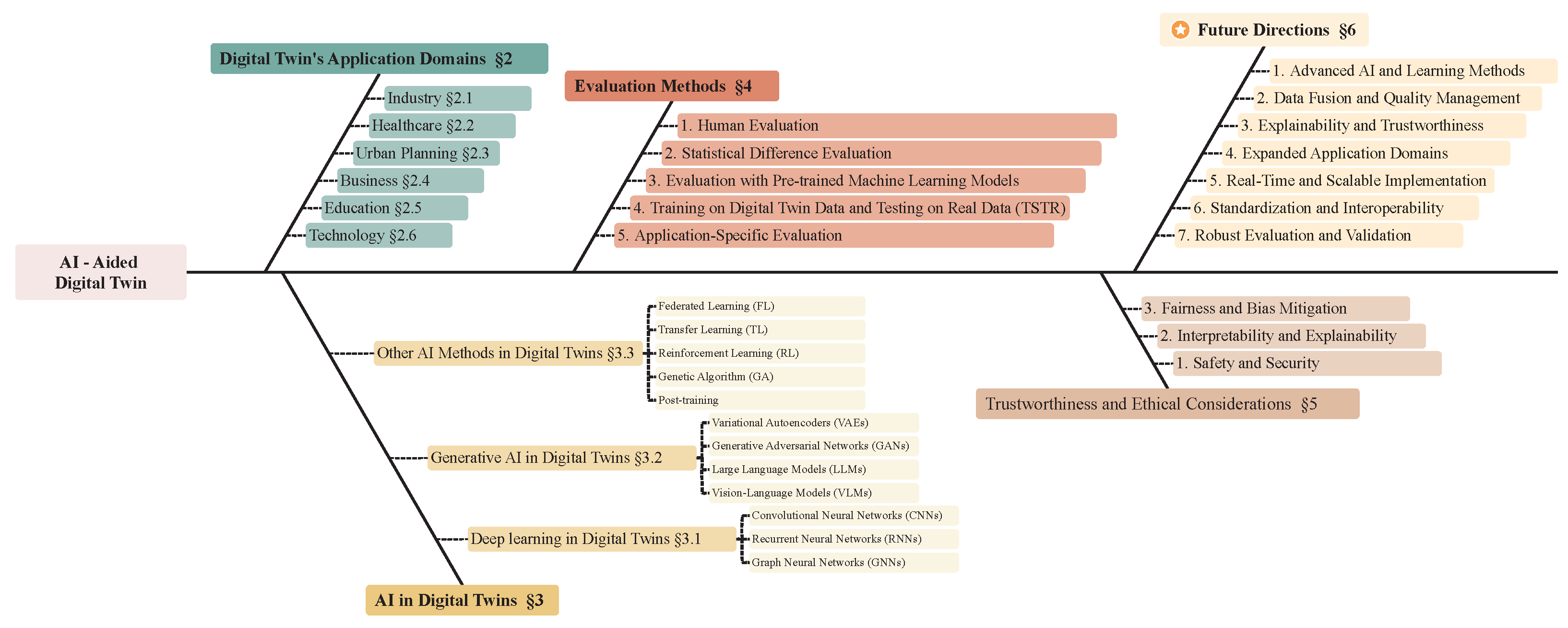
Figure 2.
The main content flow and categorization of this survey.
2. Digital Twin and Its Application Domains
A digital twin is a virtual representation of a physical entity or system that integrates sensor data, machine learning, and software analytics to monitor and analyze the entity’s performance and condition in real-time. It enables the simulation, prediction, and optimization of the physical entity’s behavior and operational parameters across its lifecycle.
A digital twin is a multidisciplinary, data-centric, and computationally driven virtual replica of a physical asset, process, or system. It is composed of three main elements:
- Digital Representation: An accurate and dynamic virtual model that mirrors the physical entity’s geometry, behavior, and interactions. This model can range from simple graphical renderings to sophisticated simulations that incorporate physics-based modeling, machine learning algorithms, and historical data.
- Data Fusion and Analytics: Real-time data from sensors embedded in the physical entity is collected and integrated with the digital representation. Advanced analytics, including statistical analysis, machine learning, and AI techniques, are applied to this data to extract insights, detect anomalies, predict outcomes, and optimize performance.
- Bidirectional Communication: There is a continuous two-way flow of information between the physical entity and its digital counterpart. Changes in the physical world are reflected in the digital twin. Conversely, actions or adjustments suggested by the digital twin can be communicated back to the physical entity, facilitating remote monitoring, control, and intervention.
Digital twins, serving as dynamic virtual replicas of physical systems, are increasingly pivotal across diverse sectors due to their ability to simulate real-world environments in real-time. The purpose of a digital twin is to enable predictive maintenance, optimize operations, enhance decision-making, and facilitate product development and innovation. It serves as a powerful tool for understanding complex systems, identifying inefficiencies, and exploring potential improvements without the need for physical prototypes or direct modifications to the actual asset. These advanced models offer unparalleled insights and predictive power, significantly impacting several fields. Here, we explore some prominent applications of digital twins across various areas. Figure 3 provides a visual summary of these domains and their representative use cases.
2.1. Industry
In the industry, digital twins offer significant advancements, particularly in manufacturing, component manufacturing, and automotive industries.
In the manufacturing sector, AI-driven digital twins are revolutionizing traditional manufacturing processes, marking a significant advancement toward smart manufacturing [12,13,14,15] and aligning with the principles of Industry 4.0 [16,17,18], Industry 5.0 [19,20]. Companies utilize these technologies to create highly accurate simulations of their manufacturing lines [21,22], which helps in optimizing not only machine operations [23] but also the assembly process [24] and workshop workflows [25], reducing downtime, and enhancing product quality [26,27].
AI-aided digital twins are fundamentally transforming the approach to component lifecycle management in component manufacturing. These advanced digital twin models are an indispensable part of precision engineering and automation, significantly enhancing the accuracy and efficiency of component fabrication. Digital twins enhance the sustainability of materials by refining the design, production, and even disposal stages of complex parts. For example, in terms of production processes, digital twins can optimize techniques like the die-casting of aluminum [28], boosting product yield rates through intelligent simulations. Furthermore, digital twins enable the simulation of component aging and damage to facilitate predictive maintenance and reduce downtime, such as gear surface degradation [29], tool wear [30], and product damage detection [31].
Another noteworthy implementation of digital twins in the industry is within the automotive sector, where this technology simulates the entire car production line to predict outcomes under various scenarios, enhancing resource management and product development [32]. In vehicle-to-everything applications, IDT-SDVN virtualizes the intelligent digital twin of the physical SDVN network, improving performance and learning capabilities [33]. For autonomous vehicles, digital twins create accurate simulations of driving scenarios, aiding in testing and refining vehicle responses under various conditions without actual exposure to hazards [34], ensuring safety and security before release [35,36].
2.2. Healthcare
In healthcare, digital twins offer significant advancements [37,38,39,40,41,42], particularly in personalized medicine [43] and complex surgical procedures. Digital twins, virtual replicas of physical entities, utilize real-time data and advanced analytical techniques to provide precise simulations and predictions of health conditions. These models have a profound impact on healthcare by representing biological entities such as cells [44,45], cell cultures [46,47], tissue samples [48], organs [49,50,51], animal models [52,53], and full human representations [54,55]. They enable the simulation of real experiments using advanced computational techniques, enhancing the understanding of biological processes [56].
In personalized medicine, digital twins offer tailored treatments through predictive modeling and risk assessment [57]. By simulating treatment scenarios, digital twins optimize patient responses, maximizing efficacy and minimizing side effects [58]. They assess individual risks for diseases by analyzing genetic traits, lifestyle choices, and environmental factors, enabling preventive measures and targeted interventions [59,60,61,62,63,64]. In managing chronic diseases, digital twins provide continuous predictive analytics, improving disease control and patient quality of life [65]. They function as early warning systems, identifying potential health risks for timely interventions [59,60,61,62,63,64], and are used to monitor and optimize fitness plans based on real-time data [65].
Digital twin technology in clinical trials enhances efficiency and accuracy by creating virtual replicas of patients, enabling the simulation of trial scenarios [66,67]. By integrating diverse data sources, digital twins model patient responses to treatments, optimizing trial design and predicting outcomes. They allow for virtual trials, reducing the need for extensive physical trials and accelerating drug development processes [68,69,70,71,72]. Digital twins also improve patient recruitment by identifying suitable candidates based on their digital profiles, ensuring more targeted and effective trials. Additionally, they enhance monitoring and management of ongoing trials by providing real-time insights into patient conditions and treatment effects, allowing for timely adjustments [73,74,75]. This approach minimizes risks, reduces costs, and increases the overall success rate of clinical trials, paving the way for more innovative and personalized medical solutions [76,77,78,79,80,81].
2.3. Urban Planning
The application of digital twin technology in urban planning is revolutionizing how cities are designed, managed, and developed, offering significant potential to improve urban efficiency, sustainability, and livability. Digital twins are virtual replicas of physical entities that utilize real-time data and advanced analytical techniques to simulate and predict urban dynamics.
One of the primary applications of digital twins in urban planning is in city infrastructure management. By creating digital twins of city infrastructure, such as roads, bridges, and utilities, urban planners can monitor their condition in real-time, predict maintenance needs, and optimize resource allocation [82,83]. This proactive approach helps prevent infrastructure failures, reduces maintenance costs, and ensures the smooth functioning of urban systems [84,85].
In transportation planning, digital twins play a crucial role in optimizing traffic flow and reducing congestion. By simulating various traffic scenarios and analyzing real-time data from sensors and cameras, planners can identify bottlenecks, optimize traffic signal timings, and develop efficient public transportation routes [86,87]. This leads to reduced travel times, lower emissions, and improved overall mobility in the city.
Digital twins also enhance disaster management and resilience planning. By modeling the city’s infrastructure and simulating different disaster scenarios, such as floods, earthquakes, or fires, planners can identify vulnerable areas, plan evacuation routes, and optimize emergency response strategies [88]. This improves the city’s preparedness and resilience, reducing the impact of disasters on residents and infrastructure.
In sustainable urban development, digital twins enable planners to model and analyze the environmental impact of different development scenarios. By simulating energy consumption, water usage, and waste generation, planners can identify sustainable practices, optimize resource utilization, and develop green infrastructure solutions [89,90]. This contributes to the creation of more sustainable and environmentally friendly urban environments.
Moreover, digital twins facilitate community engagement and participation in urban planning processes. By providing interactive and visually engaging models of urban development plans, residents can better understand proposed changes, provide feedback, and actively participate in decision-making processes [91,92]. This enhances transparency, fosters community trust, and ensures that urban development aligns with the needs and preferences of residents.
Overall, digital twin technology in urban planning offers numerous benefits, including enhanced infrastructure management, optimized transportation, improved disaster resilience, sustainable development, and increased community engagement. As digital twin technology continues to advance, it will play an increasingly vital role in shaping the future of urban environments [93].
2.4. Business
Digital twins are pivotal in business for strategic planning and crisis management. They simulate various strategic decisions and their impacts, helping model market changes, supply chain disruptions, and shifts in consumer behavior for robust decision-making and risk management [94]. For instance, in logistics, digital twins optimize routes and inventory levels, reducing costs and improving service delivery [95].
In manufacturing, digital twins enhance operational efficiency by monitoring machinery health and predicting maintenance needs, preventing downtime, and ensuring consistent output and higher profitability [96]. In retail, digital twins simulate store layouts, customer flow, and inventory management to optimize store design, streamline processes, and boost sales. They also help understand consumer behavior by integrating data from various sources, enabling personalized marketing strategies.
In financial services, digital twins improve risk assessments and fraud detection by simulating transactions and market behaviors to identify anomalies and potential risks. They also support compliance with regulatory requirements through detailed, real-time reporting.
In human resources, digital twins model workforce dynamics, including performance and turnover. Analyzing these models helps businesses develop strategies to improve employee satisfaction, enhance productivity, and reduce turnover rates by simulating the impact of various HR policies [97].
Overall, digital twin technology offers comprehensive benefits across various business sectors, driving efficiency, reducing costs, and enhancing strategic decision-making [96].
2.5. Education
Educational institutions increasingly harness digital twins to foster interactive and engaging learning environments. Digital twins of archaeological sites or biological ecosystems offer students hands-on experiences with otherwise inaccessible systems, enhancing learning outcomes and understanding of complex subjects [98]. This technology also facilitates virtual dissections of historical events and scientific phenomena, creating immersive educational experiences [99].
Furthermore, digital twins provide personalized learning experiences by tracking individual student progress and tailoring instruction to meet unique needs. In higher education, they transform laboratory and practical training, allowing students to interact with digital twins of equipment, virtual patients, or experimental setups, thereby enhancing practical knowledge and competence. Additionally, digital twins optimize campus management and operations by monitoring facilities efficiently and planning infrastructure changes effectively.
Moreover, digital twins facilitate collaborative projects and research by providing a shared virtual environment, enabling students and researchers from different disciplines and locations to work together on complex projects. They also support lifelong learning and professional development by continuously updating with new data and insights, ensuring learners stay current with industry developments.
Overall, digital twin technology in education offers numerous benefits, including personalized learning, enhanced training, optimized campus management, and improved collaboration and research, shaping the future of education to be more interactive, efficient, and tailored to individual needs.
2.6. Technology
The application of digital twin technology is transforming network management, immersive experiences, and intelligent systems. Digital Twin Network (DTN) enables virtual replicas of network components for real-time monitoring, predictive maintenance, and optimization [100,101]. DTNs simulate network scenarios to predict issues, enhancing reliability and efficiency.
In augmented reality (AR), digital twins enhance interactive and immersive experiences, particularly in digital assembly. This integration allows users to visualize and interact with virtual models overlaid on the physical world, improving accuracy and reducing errors [102,103].
For smart cities, digital twins manage urban infrastructure and services by creating replicas of city components like buildings and transportation systems. This aids in real-time monitoring, optimizing resource allocation, and enhancing public safety [82,104].
In healthcare, digital twins of medical devices and patients enable personalized medicine and improved patient care through optimized performance and maintenance [97].
In aerospace and defense, digital twins model complex systems like aircraft, allowing comprehensive testing and simulation to ensure reliability and safety, reducing costs associated with physical testing.
Overall, digital twin technology enhances network management, AR experiences, urban management, personalized healthcare, and aerospace and defense systems, driving innovation and efficiency across technological domains [105].
3. AI in Digital Twins
3.1. Deep Neural Networks in Digital Twins
Deep learning [106], a sub-field of machine learning, has garnered significant attention in recent years due to its numerous breakthroughs and successful applications in various fields, such as computer vision, natural language processing, audio analysis, drug discovery, etc. The heart of deep learning is the artificial neural network [107], a machine learning approach modeled after the structure and function of the human brain. In this section, we explore different types of deep neural networks, specifically Convolutional Neural Networks (CNNs), Recurrent Neural Networks (RNNs), and Graph Neural Networks (GNNs), each designed to process specific data structures such as sequences and graphs. These models are fundamental in augmenting the traditional digital twin capabilities by leveraging the power of AI to enhance both efficiency and practical applications.
Convolutional Neural Networks (CNNs) [108,109] are specifically designed to detect local patterns in structured data like images, time-series signals, and spatial datasets. In digital twin systems, CNNs are frequently applied to process image-based or signal-based data. For example, in manufacturing, CNNs are integrated into digital twins to monitor production processes by analyzing images of products for defects or anomalies in real-time. A specific application is in robotic grasping, where CNNs help digital twins identify optimal grasp points in robotic arms, enabling precise manipulation in dynamic environments [110]. In the healthcare domain, CNNs enhance e-health digital twins by processing biometric data and medical images, such as MRI scans, to detect potential anomalies or diagnose diseases at an early stage. For example, they are used to detect iris spoofing attacks in biometric authentication systems [111], ensuring security and data integrity in digital healthcare systems. Additionally, CNNs assist in monitoring and controlling welding quality in industrial digital twins by analyzing acoustic signals and ensuring product reliability through continuous inspection [112].
Recurrent Neural Networks (RNNs) [113,114], and their advanced variants like Long Short-Term Memory Networks (LSTMs) [115], are designed to capture temporal dependencies in sequential data, making them ideal for time-series forecasting and analysis within digital twins. In energy management systems, RNNs are deployed in digital twins to predict the degradation of lithium-ion batteries used in electric vehicles. By continuously monitoring battery performance metrics, these models help digital twins predict battery health, identify patterns of wear, and anticipate maintenance needs, reducing operational costs and preventing system failures [116]. Additionally, RNNs are applied in predictive maintenance of industrial machinery by modeling time-series data like temperature, vibration, or pressure readings. For example, digital twins of manufacturing systems use RNNs to predict machine failure and optimize maintenance schedules, improving operational efficiency and reducing downtime [117]. These models allow digital twins to forecast future states of systems, leading to enhanced decision-making and real-time optimizations.
Graph Neural Networks (GNNs) [118,119] excel at processing graph-structured data, such as networks, chemical structures, or social graphs, and have become crucial components in digital twin systems that require modeling of complex relationships between interconnected entities. For instance, in network management, GNNs are incorporated into digital twins to optimize network performance by modeling the intricate dependencies between different components like routers, servers, and traffic flows [120]. These digital twins predict network congestion, optimize routing protocols, and ensure efficient allocation of resources across telecommunication networks. In healthcare, GNNs support the creation of patient-specific digital twins by modeling interactions between various physiological systems, allowing for personalized treatment plans. They enable the prediction of disease progression or drug interactions based on individual patient data [121], thus transforming healthcare from reactive to proactive precision medicine. Similarly, in industrial applications, GNNs are used in cognitive digital twins to model complex relationships within manufacturing processes, enabling system-level optimizations such as inventory management and production scheduling [122].
These deep learning architectures—CNNs, RNNs, and GNNs—are integral to advancing digital twin technology by processing high-dimensional data, enabling real-time predictions, and optimizing system operations. Their application across different domains demonstrates their versatility and the profound impact they have on enabling accurate simulations, enhancing predictive maintenance, and providing actionable insights within digital twins. From manufacturing to healthcare and network optimization, these models empower digital twins to function as intelligent systems capable of transforming raw data into valuable operational insights that drive efficiency and innovation across industries.
3.2. Generative AI in Digital Twins
Generative AI [123], a rapidly advancing field within artificial intelligence, has achieved significant impact in areas such as image generation, text synthesis, and scientific discovery by learning underlying data distributions to produce novel outputs. In this section, we discuss several generative AI models, including Variational Autoencoders (VAEs), Generative Adversarial Networks (GANs), Large Language Models (LLMs), and Vision-Language Models (VLMs), each tailored to produce specific types of data such as images, text, and more. These models play a vital role in elevating the creative and predictive capabilities of traditional digital twins, enabling them to generate realistic simulations, drive new design possibilities, enhance decision-making processes across various domains, and add multimodal understanding through combined visual-language insights.
Variational Autoencoders (VAEs) [124] are generative models that integrate deep learning with probabilistic graphical models, consisting of an encoder and a decoder that compress and reconstruct data by mapping it to and from a latent space. By capturing the underlying data distribution, VAEs can generate new data samples similar to the training data, making them effective for simulating complex system behaviors in Digital Twins. This capability is leveraged in applications such as prognostics and health monitoring (PHM), where VAEs form the backbone of a deep digital twin (DDT) framework that learns the distribution of healthy operational data at the beginning of an asset’s life cycle [125]. This approach enables early-stage fault detection, asset degradation monitoring, and differentiation between failure modes without needing historical failure data. Additionally, the TWIN method utilizes VAEs to generate personalized clinical trial digital twins, creating virtual patients that closely mirror individual participant characteristics [126], thereby aiding in patient outcome predictions even in low-data scenarios and enhancing privacy protection when sharing synthetic data.
Generative Adversarial Networks (GANs) [127,128] are generative models consisting of two neural networks—a generator and a discriminator—that engage in a minimax game where the generator aims to produce synthetic data indistinguishable from real data, while the discriminator attempts to differentiate between real and synthetic data. This adversarial training enables GANs to generate high-fidelity synthetic data by capturing complex data distributions, which is beneficial for modeling realistic and intricate behaviors of systems in Digital Twins. For instance, in a Digital Twin-enabled Internet of Medical Things (IoMT) system for surgical simulation, GANs are employed to generate realistic surgical data, enhancing training and procedural accuracy [129]. The ability of GANs to model temporal dynamics and generate sequential data is leveraged in modeling COVID-19 pandemic dynamics; by combining GANs with bidirectional Long Short-Term Memory (LSTM) networks, Digital Twins are created to simulate disease spread and assist in pandemic response [130]. Furthermore, GANs’ capacity to handle complex and high-dimensional data distributions is utilized in early drift fault detection in wireless sensor networks using Wasserstein GANs, improving the reliability of sensor data in Digital Twins [131]. In the manufacturing sector, GANs are used to model machining vibrations, providing insights for predictive maintenance and process optimization within Digital Twins [132]. Applications such as GAN-MDF exploit GANs to integrate multi-fidelity data for Digital Twins, enhancing model accuracy by combining data of varying quality and resolution [133]. Additionally, GANs have been used to model intelligent communication networks by generating realistic network data, thereby enhancing the performance and reliability of network Digital Twins [134]. Furthermore, generative models, including GANs, form the basis for Digital Twins in various applications, enhancing anomaly detection and diagnostics in cyber-physical systems and oil and gas stations [135,136,137].
Large Language Models (LLMs) [138,139] are advanced machine learning models designed to understand and generate human language by leveraging transformer-based architectures and self-attention mechanisms. With their ability to process and generate contextualized text, LLMs enhance the functionality and intelligence of Digital Twins, especially in sectors requiring complex language understanding and generation. In Digital Twin applications, LLMs establish cross-dataset associations of medical information with limited data, generate personalized digital twins for patients, and enhance clinical trial outcome predictions [140,141,142]. For example, TWIN-GPT uses LLMs to create virtual patient models that improve clinical predictions. Studies have also compared LLM output quality for defining Digital Twin requirements with domain expert specifications, providing insights into prompt engineering and potential automation in Digital Twin development [143]. In the context of Industry 4.0, LLMs facilitate the creation of Asset Administration Shell (AAS) instances for Digital Twin modeling, enhancing interoperability and reducing manual effort [144]. Additionally, systems like ChatTwin utilize conversational AI leveraging GPT-4 to automate scene description document generation for Digital Twins, improving deployment efficiency [145].
Vision-Language Models (VLMs) extend generative AI into the visual domain by combining image and text understanding. They are large-scale multimodal models that enable machines to perceive and reason about the world through both visual and textual modalities [146]. In Digital Twin systems, VLMs serve as an intelligent interface between visual sensor data and high-level insights or commands. For instance, in manufacturing, integrating a VLM for visual question answering (VQA) into a production line’s digital twin has demonstrated more efficient human–machine collaboration [147]. Wang et al. employed a VQA-enabled digital twin to allow operators to query visual status and even perform tasks like product counting via natural language, greatly enhancing situational awareness on the factory floor [147]. Building on such ideas, Fan et al. introduced MaViLa, a vision–language model specialized for smart manufacturing, showcasing its potential as an advanced AI agent for autonomous production tasks [148]. In healthcare, VLM-driven twins are enabling language-based interaction with medical imagery. Killeen et al. developed a “language-promptable” patient digital twin that uses a language-aligned vision model to interpret X-ray images and update the twin’s state, enabling physicians to issue natural language commands (e.g., “focus on the lower lumbar vertebrae”) to a robotic X-ray system [149]. This approach proved capable of localizing and isolating anatomical structures from arbitrary views, directly incorporating the clinician’s intent into the imaging workflow [149]. Likewise, in smart city scenarios, VLMs promise to enhance urban digital twins by semantically analyzing video feeds and images from city sensors. For example, a city-scale twin augmented with a VLM could detect traffic rule violations or infrastructure anomalies in real time, linking visual evidence to actionable insights for city managers [150]. Cutting-edge VLM architectures are being adapted to these domains: CLIP-like models provide zero-shot alignment between camera visuals and textual descriptions, BLIP-2 style encoders generate natural-language reports from sensor images, and few-shot learners such as Flamingo offer rapid adaptation to novel visual contexts. Together, these advances illustrate the broad applicability of VLMs in digital twins across domains. By endowing digital twins with multimodal understanding, VLMs significantly enrich the twin’s ability to mirror real-world scenarios and interact with users, a trend that is rapidly accelerating with the emergence of ever more capable foundation models [150].
In summary, by integrating generative AI methods such as VAEs, GANs, LLMs, and VLMs, Digital Twins can achieve more realistic simulations, innovative design capabilities, enhanced decision-making processes, and improved multimodal interaction across various fields.
3.3. Other AI Methods in Digital Twins
Beyond deep learning and generative models, other artificial intelligence methods such as Federated Learning (FL), Transfer Learning (TL), Reinforcement Learning (RL), Genetic Algorithms (GA), and Post-training techniques also significantly enhance digital twins. These methods provide unique capabilities in privacy preservation, knowledge transfer, adaptive decision-making, complex optimization, and specialized fine-tuning, greatly broadening digital twins’ functional scope and practical applicability across various industries.
Federated Learning (FL) [151] is a decentralized machine learning approach allowing multiple clients to collaboratively train a shared global model while keeping their data localized. By only sharing model updates rather than raw data with a central server for aggregation, FL preserves data privacy and greatly reduces communication overhead [152]. This feature is especially useful for digital twins managing sensitive data across numerous distributed devices. Using FL, digital twins can efficiently gather insights from different sources without revealing confidential information, handle large-scale deployments, and build more resilient models. For instance, in industrial IoT, individual machines utilize FL within digital twin frameworks to develop predictive maintenance models without exposing proprietary operating data [153]. Similarly, drones in air-ground networks can function as FL aggregators by collecting model updates from ground-based devices, optimizing global digital twin models, and potentially applying incentive strategies based on Stackelberg games to encourage participation [154].
Transfer Learning (TL) [140,155] applies models previously trained on one task (source task ) to a related but different task (target task ). By transferring knowledge from data-rich domains to data-scarce ones (), TL enables digital twins to enhance their predictive and diagnostic capabilities efficiently, especially when limited operational data is available. For example, in fault diagnosis, deep transfer learning frameworks like the Deep Fault Detection and Diagnosis (DFDD) initially train models using simulated data generated by digital twins and subsequently refine them with smaller amounts of real-world data, significantly improving fault detection accuracy [156,157]. In structural analysis, convolutional neural networks (CNNs) trained on damage scenarios produced by a digital twin’s numerical simulation can be adapted through TL to real structures, effectively enhancing damage detection performance [158].
Reinforcement Learning (RL) [159] is a class of machine learning algorithms focused on how software agents ought to take actions in an environment to maximize some notion of cumulative reward [160]. RL agents learn optimal decision-making policies through trial-and-error interactions, receiving feedback in the form of rewards or penalties. Within Digital Twins, RL can be used to control the physical asset through its virtual counterpart or to optimize the twin’s simulation parameters, improving simulation fidelity and operational efficiency by allowing adaptive performance optimization based on continuous learning. Specific RL algorithms applied in Digital Twins include: Policy Gradient Methods like Proximal Policy Optimization (PPO), which directly optimize the policy parameters and are suitable for continuous action spaces found in smart manufacturing, where RL agents in Digital Twins can refine production processes and manage resources [160] [161,162,163]. Deep Q-Networks (DQNs), combining Q-learning with deep neural networks, are effective for tasks with large state spaces and discrete actions [159], such as improving precision in robotic arm control via Digital Twins [164,165,166]. Multi-Agent Reinforcement Learning (MARL) extends RL to scenarios with multiple interacting agents [167], fitting complex networked systems like computation offloading or adaptive task allocation in Digital Twin-enabled communication networks [168,169,170,171,172,173]. Model-Based RL uses an internal model of the environment for planning [160], applied in Digital Twins for supply chain management to optimize logistics by predicting outcomes [174]. Cooperative RL is also used with Digital Twins to enhance coordination among multiple UAVs in cooperative search tasks [175]. RL-driven Digital Twins find applications in diverse fields such as molecular design [176], vehicular networks [177], and construction robotics [169].
The Genetic Algorithm (GA) is an optimization technique inspired by the process of natural selection, belonging to the larger class of evolutionary algorithms [178]. GA operates on a population of candidate solutions, iteratively applying genetic operators such as selection, crossover, and mutation to evolve solutions towards optimality. It does not require gradient information and operates without internally learned parameters in the traditional sense, which can simplify implementation and reduce risks of overfitting associated with specific training datasets. Its population-based search is well-suited for complex, non-linear, or multi-modal optimization problems often encountered when optimizing parameters or operations within Digital Twins that simulate real-world systems. GA’s iterative optimization has been applied to advance digital twin functionalities in various sectors. In Robotics, GAs optimize trajectory planning for accuracy and efficiency within virtual robotic twins [179]. For Renewable Energy systems, GA helps optimize configurations in photovoltaic (PV) power generation simulations within digital twins for energy management [180]. In Maintenance Scheduling, Digital Twins combined with GA-based optimization can determine optimal maintenance plans to increase reliability and minimize downtime based on simulation insights [181]. GA also improves Human-Robot Assembly line models within Digital Twins through multi-adaptive algorithms for more efficient production [182]. Furthermore, GA integrated with Digital Twins provides Real-time Decision Support by enabling predictive simulations for enhanced operational responsiveness [183]. Specific industry applications include optimizing welding production lines in Shipbuilding Digital Twins [184] and improving scheduling and maintenance operations in general Manufacturing via GA-powered Digital Twins [185,186].
Post-training refers to methods applied after the initial pre-training phase of large generative models, such as diffusion models or large language models (LLMs), to refine their behavior or align them with specific objectives or preferences. While pre-training on large datasets allows these models to approximate underlying data distributions, their outputs may not consistently meet specific quality criteria or task requirements, partly because high-reward or desired samples might correspond to low-probability regions of the learned distribution. Reinforcement Learning from Human Feedback (RLHF) is a prominent post-training technique, introduced by OpenAI, where human preferences between model outputs are used to train a reward model [187]. This reward model then guides the fine-tuning of the generative model using reinforcement learning, steering it towards generating outputs that better align with human judgments or desired attributes [188]. This concept is extending beyond text generation to areas like text-to-image generation [189] and molecule synthesis [190], providing a way to enhance model outputs without needing to curate the pre-training data extensively. Applying post-training methods to generative models used within Digital Twins can improve the fidelity of simulations or expand the generation of specific, high-value operational scenarios. By refining these models, Digital Twins can better replicate complex physical phenomena or explore a wider range of potential system states, contributing to the development of more resilient and adaptable cyber-physical systems.
In summary, Federated Learning protects data privacy and reduces communication overhead by sharing only model parameters; Transfer Learning reuses existing knowledge from a source domain to enhance performance in data-scarce target domains; Reinforcement Learning continuously adapts decisions through interactions within simulated environments; Genetic Algorithms conduct evolutionary searches to identify effective operational configurations; and post-training methods like RLHF refine generative models to better satisfy specific requirements. These approaches collectively improve the predictive accuracy, simulation depth, and decision-making capabilities of Digital Twins. Their ability to leverage data from multiple domains makes them valuable for industrial IoT, robotics, smart manufacturing, and many other fields, suggesting that these methods can be applied across diverse cross-domain Digital Twin scenarios in the future.
4. Evaluation Methods for AI-Driven Digital Twins
In this section, we examine different methodologies for assessing the quality of AI-generated digital twins, which is essential for determining their effectiveness and applicability in real-world scenarios. We categorize these evaluation methods as follows:
- Human Evaluation: This method involves human judges, either domain experts or general users, assessing the quality of digital twins. Evaluators might compare the behaviors and outputs of digital twins with those of their physical counterparts to determine their accuracy and realism. Although direct, human evaluation can be costly, slow, subjective, and difficult to scale, especially when the digital twins represent complex or high-dimensional systems.
- Statistical Difference Evaluation: This approach involves calculating and comparing statistical metrics from both the digital twins and their real-world counterparts. Metrics such as performance consistency, operational data alignment, and other relevant statistical measures are analyzed. The closer these statistics between the digital twins and real systems, the higher the quality and fidelity of the digital twins.
- Evaluation with Pre-trained Machine Learning Models: In the context of digital twins, pre-trained models can assess the realism and accuracy of a twin by predicting its responses under various conditions and comparing them with actual system responses. This method is particularly useful in scenarios where digital twins are used for predictive maintenance and operational optimization.
- Training on Digital Twin Data and Testing on Real Data (TSTR): This method tests the utility of digital twins by using them to train machine learning models and then testing these models on real-world data. High performance on real data indicates that the digital twin has successfully captured essential characteristics of the physical system, making it a useful proxy for simulations and predictions [141,191].
- Application-Specific Evaluation: Depending on the specific use case or domain, tailored evaluation methods may be employed to assess the quality of digital twins. These methods consider the unique requirements or constraints of the application, such as regulatory compliance, operational accuracy, and safety considerations. Evaluating digital twins within the context of their intended use provides a more accurate assessment of their quality and applicability.
These methodologies offer diverse ways to gauge the quality of AI-aided digital twins, helping researchers and practitioners determine their effectiveness and applicability in practical scenarios. Employing a combination of these strategies can provide a more comprehensive understanding of the strengths and weaknesses of digital twins, facilitating further improvements in digital twin generation technologies.
5. Trustworthiness and Ethical Considerations
Safety and Security
The safety of AI technologies in digital twin applications is a pivotal concern, given their significant role across various industries. Ensuring the responsible and secure deployment of AI in this context involves several critical considerations:
- Data Privacy. AI systems in digital twins often utilize extensive data sets to simulate and predict the behavior of physical systems. Protecting the privacy and security of this sensitive data is crucial to prevent unauthorized access, breaches, or misuse, especially since these systems can represent critical infrastructure or personal data.
- Cybersecurity: AI-powered digital twins are susceptible to cyber threats. Protecting the digital twin infrastructure from hacking or malicious manipulation is vital to maintaining the integrity and functionality of these virtual representations.
- Robustness and Reliability: AI models used in digital twins must be robust against adversarial attacks and capable of handling unexpected inputs. Quantifying uncertainty is particularly important to ensure the safety and reliability of AI algorithms in digital twins, where decisions might directly impact physical systems and have real-world consequences.
These safety measures are essential to safeguarding the effectiveness and security of AI applications in digital twins, where the digital and physical worlds converge.
Interpretability and Explainability
The interpretability of AI-based digital twin design refers to the degree to which the mechanisms and decision-making processes of the AI models integrated into digital twins can be understood and explained. This involves enhancing the transparency of complex machine learning models, such as deep neural networks, used to simulate and predict the behavior of physical systems. When an AI-based digital twin is interpretable, it enables users to comprehend how and why the digital twin makes certain predictions or decisions. This level of understanding is crucial for validating the twin’s accuracy, troubleshooting potential issues, and ensuring trust and confidence in its use across various applications [192,193,194].
Fairness and Bias Mitigation
The fairness of AI algorithms in the context of AI-based digital twin design pertains to the extent to which these algorithms treat all simulated entities or groups equitably and without bias. Fairness becomes particularly significant when digital twins are utilized in sectors like manufacturing, urban planning, and infrastructure management, where decisions can profoundly influence operational efficiencies and safety [195,196].
A fair AI-based digital twin ensures that its simulations and predictions do not disproportionately benefit or disadvantage any specific segment of the modeled environment or population. Achieving fairness in AI-driven digital twins is essential to prevent discriminatory outcomes, adhere to ethical standards, and ensure equal treatment across all aspects of digital twin deployment. This commitment to fairness is crucial for maintaining trust and fostering widespread acceptance of digital twin technologies [197,198,199,200].
6. Future Directions
The ongoing development in AI and digital twin technology presents a multitude of research opportunities that have the potential to significantly advance the field. As these technologies continue to evolve, several key areas of focus have emerged that warrant deeper exploration and innovation:
Advanced AI and Learning Methods
Future digital twins are expected to leverage cutting-edge AI techniques for greater autonomy and intelligence. A key direction is integrating deep reinforcement learning (DRL) to create closed-loop twins capable of continuous self-optimization. Early studies demonstrate that coupling DRL agents with data-rich twin simulations can enable real-time adaptation and decision-making, although this approach remains relatively nascent and underexplored in practice [201]. Another promising avenue is the fusion of physics-informed machine learning (PIML) and hybrid modeling. By embedding physical laws directly into neural architectures, hybrid digital twins can overcome data scarcity and improve reliability; for example, incorporating reduced-order physics models into learning has been shown to boost predictive accuracy with minimal data and even quantify uncertainty in twin simulations [202]. Generative AI techniques (e.g., diffusion models and transformers) represent another frontier, allowing twins to synthesize realistic data and explore scenarios beyond observed conditions. This approach can enhance simulation breadth and anomaly detection capabilities – for instance, integrating generative models with twin environments was found to boost scenario forecasting accuracy and reveal emergent behaviors under unpredictable conditions [203]. Equally important is making digital twins more adaptive and efficient: meta-learning frameworks can endow twins with rapid adaptation skills (enabling, for example, high-fidelity reconfiguration to new system variants in seconds [204]), while model compression techniques (e.g., knowledge distillation) can condense complex twin models into lightweight versions suitable for real-time or edge deployment [205]. By harnessing these advanced learning methods, future AI-aided digital twins will become increasingly self-evolving, computationally efficient, and capable of robust performance over their lifecycle.
Data Fusion and Quality Management
Future digital twin research must address the fusion of heterogeneous, multi-source data while ensuring its quality and trustworthiness. Advanced data fusion frameworks are being explored to intelligently integrate diverse data streams (from IoT sensors and physics-based simulations to historical logs). Graph-based approaches, such as industrial knowledge graphs, promise seamless unification of disparate datasets and models [206]. Similarly, semantic data fusion techniques (e.g. domain ontologies or data dictionaries) can automate the combination of multi-modal information, as demonstrated in industrial settings [207]. In tandem, robust data quality assurance is critical. AI-driven anomaly detection services can dynamically flag or correct outliers in incoming data, communicating data reliability to stakeholders [208]. Moreover, quantifying uncertainty in fused data and twin predictions is increasingly emphasized for risk-aware decision support – rigorous verification, validation and uncertainty quantification (VVUQ) frameworks are deemed essential for trustworthy digital twins in safety-critical domains [209]. Another key frontier is privacy-preserving data management. Federated learning (FL) and related techniques allow cross-organizational or multi-device data to be fused into AI models without centralizing raw data, mitigating privacy and security concerns [210]. Such decentralized learning can unlock rich, collaborative twin models (e.g. across hospitals or factories) while keeping proprietary or personal data local. Ongoing research is extending FL with personalized models and secure aggregation protocols to handle client-specific data heterogeneity [210]. These advances in fusion and quality management will be pivotal for scaling AI-aided digital twins in complex domains like manufacturing and healthcare, ensuring that integrated data remains reliable, secure, and actionable.
Explainability and Trustworthiness
As AI-driven digital twin systems grow more complex, ensuring their explainability and trustworthiness is paramount—especially in safety-critical domains (e.g., healthcare, aerospace) where opaque models can erode user trust and even lead to catastrophic outcomes [211]. One way forward is to develop Explainable AI (XAI) techniques tailored for digital twins, so human experts can interpret and verify the AI’s decisions. In healthcare, for instance, digital twin predictions must be explainable to gain clinicians’ and patients’ trust; utilizing interpretable models helps reveal the causative factors behind each prediction, which is vital for clinical decisions [209].
Beyond post-hoc explanations, researchers are exploring causal interpretability: by embedding causal reasoning and counterfactual analysis, digital twins could not only forecast outcomes but also answer “what-if” questions about how changes in system conditions would alter those outcomes [212]. Another pillar of trustworthiness is rigorous uncertainty quantification, since unquantified uncertainty may deter decision-makers from acting due to safety concerns [209]. For example, a recent paradigm termed “uncertainty-aware XAI” combines model explanations with explicit uncertainty estimates to bolster confidence in digital twin outputs [211]. Overall, advancing XAI, causal reasoning, and UQ in tandem will be critical to building transparent, reliable AI-driven digital twins that stakeholders can confidently deploy in high-stakes settings [211].
Expanded Application Domains
AI-driven digital twins are poised to permeate a broader array of fields beyond their industrial origins [213]. For instance, in personalized healthcare, patient-specific DTs can simulate disease progression and test tailored therapies using multi-scale biomedical data, aiming for more precise treatments with improved outcomes and fewer adverse effects [213]. Likewise, in environmental modeling, AI-enhanced digital twins (e.g., the EU’s “Destination Earth” climate initiative) integrate multi-scale geophysical simulations with AI analytics to model complex ecosystems and climate dynamics, supporting data-driven sustainability strategies [214]. Meanwhile, urban digital twins for smart cities leverage IoT data and AI to optimize infrastructure, mobility, resource management, and disaster response, thereby enhancing urban resilience and sustainability [215]. In the energy sector, digital twins of smart grids promise more efficient renewable integration, smarter grid control, predictive maintenance, and robust resilience against cascading failures and cyber-attacks [216]. Even cybersecurity emerges as a frontier domain, where DTs serve as virtual testbeds to simulate cyber-attacks and refine AI-driven defense strategies [217]. Each of these novel domains demands interdisciplinary innovation—combining domain-specific models, data, and expertise with advanced AI—to address unique challenges. Ensuring that digital twin models remain accurate, secure, and trustworthy across such diverse applications is a crucial agenda for future research efforts in AI-aided digital twin development.
Real-Time and Scalable Implementation
Many digital twin applications (e.g., in manufacturing control or smart grids) demand real-time processing and scalable deployment. Future research should investigate architectures that ensure low-latency, high-throughput performance as digital twins interface with streaming IoT data and dynamic environments. In AI-aided digital twins, achieving real-time performance at scale requires minimizing latency and enabling dynamic scaling. In particular, combining edge computing with cloud resources offers low-latency, high-throughput performance. Processing data at the edge drastically cuts response time and bandwidth use; indeed, edge-driven twins have shown lower latency than cloud-only models. Meanwhile, cloud servers in an edge–cloud hybrid handle compute-intensive analytics and global coordination, providing throughput for complex tasks [218]. Another direction is federated edge learning, where distributed twin nodes collaboratively train AI models without centralizing data. This preserves privacy and limits communication overhead, and optimizing such setups (e.g., aggregator placement and update frequency) can further minimize latency and energy usage [219]. Similarly, serverless computing paradigms enable twin services to scale elastically. Deploying twin components as serverless functions allows automatic scaling, for example, cloud platforms now deploy twin workloads via function-as-a-service [220]. Kubernetes-based serverless platforms can orchestrate large numbers of twin instances seamlessly across cloud–edge infrastructure [221]. To maintain consistency under real-time constraints, intelligent caching and adaptive synchronization are crucial. Edge caches that temporarily store sensor streams or intermediate states reduce redundant cloud transfers [218]. Coupled with event-driven updates (triggering syncs only on significant changes), this ensures the twin reflects physical changes in real time without saturating networks [218]. inally, real-time graph analytics can enhance dynamic modeling for complex systems. Graph-based digital twin models represent entities and their relationships as nodes and edges, capturing interdependencies and cascading effects [222]. This allows on-the-fly analysis of network-wide behavior and identification of critical bottlenecks, improving decision support in large-scale twin deployments [222].
Standardization and Interoperability
To truly harness AI-aided Digital Twins at scale, future efforts must emphasize standardization and interoperability across heterogeneous systems. Domain-specific standards are emerging to address this need. For instance, ISO 23247 defines a digital twin framework for manufacturing enterprises [223], and the IEEE P2806 working group is developing a unified reference architecture for factory digital twins [224]. Standardized data modeling languages like Microsoft’s Digital Twin Definition Language (DTDL) are also being explored to provide common semantic schemas (e.g., in smart city implementations [225]). Meanwhile, the Asset Administration Shell (AAS) from Industry 4.0 serves as a cross-industry digital asset profile to enable interoperable data exchange at runtime [224].
Beyond syntactic compatibility, achieving semantic interoperability is critical. Knowledge graph techniques have been proposed to integrate diverse twin data sources [206], showing promise for bridging heterogeneous domain models. However, significant challenges remain unresolved. These include managing dynamic version control as digital twins and their physical counterparts evolve [226], and reconciling semantic differences across domain-specific ontologies. Addressing such issues is especially important for large-scale system-of-systems (e.g., smart cities or global supply chains), where standardized interoperability frameworks are essential for smooth cross-stakeholder integration [222]. Continued community efforts toward consensus standards, unified ontologies, and semantic reconciliation methods will be pivotal in realizing robust, scalable digital twin ecosystems.
Robust Evaluation and Validation
Finally, advancing evaluation methods for AI-driven digital twins is a critical future direction to ensure these systems are reliable and meet their intended goals. Ensuring rigorous evaluation and validation of AI-driven digital twin models is paramount for establishing trust in their predictions, especially in high-stakes domains. Adopting formal Verification, Validation, and Uncertainty Quantification (VVUQ) frameworks provides a principled approach to credibility. For example, risk-based guidelines like ASME V&V 40 [227] can be extended to assess the credibility of AI-integrated twins, analogous to how they guide verification of medical device simulations.
Another critical aspect is bridging the simulation-to-reality gap: advanced methods now employ dynamic digital twins that continuously calibrate simulation models with real-world data to reduce model–reality divergence [228]. Such approaches facilitate sim-to-real evaluation, ensuring that performance metrics in silico closely reflect outcomes on physical systems. Equally important are frameworks for online validation and continuous performance monitoring that keep the twin’s virtual model aligned with its evolving physical counterpart [229]. These systems can rapidly detect deviations or concept drift in data streams, triggering adaptive re-calibration or retraining of the AI models in real time [230].
Additionally, advanced uncertainty quantification (UQ) techniques are being integrated to bolster robust validation. For example, Bayesian deep learning and deep ensemble modeling allow the twin to capture both epistemic and aleatoric uncertainties [231]. This yields calibrated confidence intervals and quantitative credibility estimates that inform risk-sensitive decision-making. By systematically benchmarking and validating digital twins, future research will ensure that AI models embedded in twins remain safe, reliable, and effective before they are deployed in critical real-world applications [209].
AI and digital twin technologies, in synergy, hold transformative potential across industries, promising to revolutionize how complex systems are designed, monitored, and optimized. Future research will harness advanced AI and learning methods to create smarter, more adaptive digital twins. These efforts will be complemented by improved data fusion techniques and rigorous data quality management, ensuring reliable, high-fidelity models. Equally important are efforts to enhance explainability and trustworthiness, ensuring AI-aided digital twins provide transparent reasoning and trustworthy outcomes. In parallel, digital twin technology will be applied in new domains, while advances in real-time, scalable implementations will enable these models to monitor and optimize complex, large-scale systems. Finally, progress will hinge on developing standardization and interoperability frameworks to ensure seamless integration across diverse platforms, and on establishing robust evaluation and validation practices to rigorously verify performance and safety. Collectively, these future directions underscore the need for interdisciplinary collaboration, shared standards, and rigorous evaluation to fully realize the transformative potential of AI-aided digital twins.
References
- Pylianidis, C.; Osinga, S.; Athanasiadis, I.N. Introducing digital twins to agriculture. Computers and Electronics in Agriculture 2021, 184, 105942. [CrossRef]
- Jiang, Y.; Yin, S.; Li, K.; Luo, H.; Kaynak, O. Industrial applications of digital twins. Philosophical Transactions of the Royal Society A 2021, 379, 20200360. [CrossRef]
- Kamel Boulos, M.N.; Zhang, P. Digital twins: from personalised medicine to precision public health. Journal of personalized medicine 2021, 11, 745. [CrossRef]
- Hu, W.; Zhang, T.; Deng, X.; Liu, Z.; Tan, J. Digital twin: A state-of-the-art review of its enabling technologies, applications and challenges. Journal of Intelligent Manufacturing and Special Equipment 2021, 2, 1–34. [CrossRef]
- Attaran, M.; Celik, B.G. Digital Twin: Benefits, use cases, challenges, and opportunities. Decision Analytics Journal 2023, 6, 100165. [CrossRef]
- Boschert, S.; Rosen, R. Digital twin—the simulation aspect. Mechatronic futures: Challenges and solutions for mechatronic systems and their designers 2016, pp. 59–74. [CrossRef]
- Tarkhov, D.; Malykhina, G. Neural network modelling methods for creating digital twins of real objects. In Proceedings of the Journal of Physics: Conference Series. IOP Publishing, 2019, Vol. 1236, p. 012056. [CrossRef]
- Tao, F.; Xiao, B.; Qi, Q.; Cheng, J.; Ji, P. Digital twin modeling. Journal of Manufacturing Systems 2022, 64, 372–389. [CrossRef]
- Fuller, A.; Fan, Z.; Day, C.; Barlow, C. Digital twin: Enabling technologies, challenges and open research. IEEE access 2020, 8, 108952–108971. [CrossRef]
- Ríos, J.; Staudter, G.; Weber, M.; Anderl, R.; Bernard, A. Uncertainty of data and the digital twin: a review. International Journal of Product Lifecycle Management 2020, 12, 329–358. [CrossRef]
- Rathore, M.M.; Shah, S.A.; Shukla, D.; Bentafat, E.; Bakiras, S. The role of ai, machine learning, and big data in digital twinning: A systematic literature review, challenges, and opportunities. IEEE Access 2021, 9, 32030–32052. [CrossRef]
- Tao, F.; Qi, Q.; Liu, A.; Kusiak, A. Data-driven smart manufacturing. Journal of Manufacturing Systems 2018, 48, 157–169. [CrossRef]
- Leng, J.; Wang, D.; Shen, W.; Li, X.; Liu, Q.; Chen, X. Digital twins-based smart manufacturing system design in Industry 4.0: A review. Journal of manufacturing systems 2021, 60, 119–137. [CrossRef]
- Li, L.; Lei, B.; Mao, C. Digital twin in smart manufacturing. Journal of Industrial Information Integration 2022, 26, 100289. [CrossRef]
- Broo, D.G.; Bravo-Haro, M.; Schooling, J. Design and implementation of a smart infrastructure digital twin. Automation in construction 2022, 136, 104171. [CrossRef]
- Costantini, A.; Di Modica, G.; Ahouangonou, J.C.; Duma, D.C.; Martelli, B.; Galletti, M.; Antonacci, M.; Nehls, D.; Bellavista, P.; Delamarre, C.; et al. IoTwins: toward implementation of distributed digital twins in industry 4.0 settings. Computers 2022, 11, 67. [CrossRef]
- Schroeder, G.N.; Steinmetz, C.; Rodrigues, R.N.; Henriques, R.V.B.; Rettberg, A.; Pereira, C.E. A methodology for digital twin modeling and deployment for industry 4.0. Proceedings of the IEEE 2020, 109, 556–567. [CrossRef]
- Javaid, M.; Haleem, A.; Suman, R. Digital twin applications toward industry 4.0: a review. Cognitive Robotics 2023, 3, 71–92. [CrossRef]
- Wang, B.; Zhou, H.; Li, X.; Yang, G.; Zheng, P.; Song, C.; Yuan, Y.; Wuest, T.; Yang, H.; Wang, L. Human Digital Twin in the context of Industry 5.0. Robotics and Computer-Integrated Manufacturing 2024, 85, 102626. [CrossRef]
- Lv, Z. Digital twins in industry 5.0. Research 2023, 6, 0071. [CrossRef]
- Qi, Q.; Tao, F.; Hu, T.; Anwer, N.; Liu, A.; Wei, Y.; Wang, L.; Nee, A.Y. Enabling technologies and tools for digital twin. Journal of Manufacturing Systems 2021, 58, 3–21. [CrossRef]
- Wang, S.; Zhang, J.; Wang, P.; Law, J.; Calinescu, R.; Mihaylova, L. A deep learning-enhanced Digital Twin framework for improving safety and reliability in human–robot collaborative manufacturing. Robotics and computer-integrated manufacturing 2024, 85, 102608. [CrossRef]
- Roy, R.B.; Mishra, D.; Pal, S.K.; Chakravarty, T.; Panda, S.; Chandra, M.G.; Pal, A.; Misra, P.; Chakravarty, D.; Misra, S. Digital twin: current scenario and a case study on a manufacturing process. The International Journal of Advanced Manufacturing Technology 2020, 107, 3691–3714. [CrossRef]
- Bilberg, A.; Malik, A.A. Digital twin driven human–robot collaborative assembly. CIRP annals 2019, 68, 499–502. [CrossRef]
- Jiang, H.; Qin, S.; Fu, J.; Zhang, J.; Ding, G. How to model and implement connections between physical and virtual models for digital twin application. Journal of Manufacturing Systems 2021, 58, 36–51. [CrossRef]
- Tao, F.; Cheng, J.; Qi, Q.; Zhang, M.; Zhang, H.; Sui, F. Digital twin-driven product design, manufacturing and service with big data. The International Journal of Advanced Manufacturing Technology 2018, 94, 3563–3576. [CrossRef]
- Tao, F.; Sui, F.; Liu, A.; Qi, Q.; Zhang, M.; Song, B.; Guo, Z.; Lu, S.C.Y.; Nee, A.Y. Digital twin-driven product design framework. International Journal of Production Research 2019, 57, 3935–3953. [CrossRef]
- Semeraro, C.; Lezoche, M.; Panetto, H.; Dassisti, M. Data-driven invariant modelling patterns for digital twin design. Journal of Industrial Information Integration 2023, 31, 100424. [CrossRef]
- Feng, K.; Ji, J.; Zhang, Y.; Ni, Q.; Liu, Z.; Beer, M. Digital twin-driven intelligent assessment of gear surface degradation. Mechanical Systems and Signal Processing 2023, 186, 109896. [CrossRef]
- Zhang, H.; Qi, Q.; Ji, W.; Tao, F. An update method for digital twin multi-dimension models. Robotics and Computer-Integrated Manufacturing 2023, 80, 102481. [CrossRef]
- Ritto, T.; Rochinha, F. Digital twin, physics-based model, and machine learning applied to damage detection in structures. Mechanical Systems and Signal Processing 2021, 155, 107614. [CrossRef]
- Mendi, A.F. A digital twin case study on automotive production line. Sensors 2022, 22, 6963. [CrossRef]
- Zhao, L.; Han, G.; Li, Z.; Shu, L. Intelligent digital twin-based software-defined vehicular networks. IEEE network 2020, 34, 178–184. [CrossRef]
- Lv, Z.; Chen, D.; Feng, H.; Zhu, H.; Lv, H. Digital twins in unmanned aerial vehicles for rapid medical resource delivery in epidemics. IEEE Transactions on Intelligent Transportation Systems 2021, 23, 25106–25114. [CrossRef]
- Almeaibed, S.; Al-Rubaye, S.; Tsourdos, A.; Avdelidis, N.P. Digital twin analysis to promote safety and security in autonomous vehicles. IEEE Communications Standards Magazine 2021, 5, 40–46. [CrossRef]
- Khan, S.; Farnsworth, M.; McWilliam, R.; Erkoyuncu, J. On the requirements of digital twin-driven autonomous maintenance. Annual Reviews in Control 2020, 50, 13–28. [CrossRef]
- Erol, T.; Mendi, A.F.; Doğan, D. The digital twin revolution in healthcare. In Proceedings of the 2020 4th international symposium on multidisciplinary studies and innovative technologies (ISMSIT). IEEE, 2020, pp. 1–7. [CrossRef]
- Björnsson, B.; Borrebaeck, C.; Elander, N.; Gasslander, T.; Gawel, D.R.; Gustafsson, M.; Jörnsten, R.; Lee, E.J.; Li, X.; Lilja, S.; et al. Digital twins to personalize medicine. Genome medicine 2020, 12, 1–4. [CrossRef]
- Venkatesh, K.P.; Brito, G.; Kamel Boulos, M.N. Health digital twins in life science and health care innovation. Annual Review of Pharmacology and Toxicology 2024, 64, 159–170. [CrossRef]
- Armeni, P.; Polat, I.; De Rossi, L.M.; Diaferia, L.; Meregalli, S.; Gatti, A. Digital twins in healthcare: is it the beginning of a new era of evidence-based medicine? a critical review. Journal of Personalized Medicine 2022, 12, 1255. [CrossRef]
- Fu, T.; Hoang, T.N.; Xiao, C.; Sun, J. DDL: Deep dictionary learning for predictive phenotyping. In Proceedings of the International Joint Conference on Artificial Intelligence, 2019. [CrossRef]
- Fu, T.; Xiao, C.; Qian, C.; Glass, L.M.; Sun, J. Probabilistic and dynamic molecule-disease interaction modeling for drug discovery. In Proceedings of the ACM SIGKDD Conference on Knowledge Discovery & Data Mining, 2021. [CrossRef]
- Cellina, M.; Cè, M.; Alì, M.; Irmici, G.; Ibba, S.; Caloro, E.; Fazzini, D.; Oliva, G.; Papa, S. Digital Twins: The New Frontier for Personalized Medicine? Applied Sciences 2023, 13, 7940. [CrossRef]
- Li, X.; Lee, E.J.; Lilja, S.; Loscalzo, J.; Schäfer, S.; Smelik, M.; Strobl, M.R.; Sysoev, O.; Wang, H.; Zhang, H.; et al. A dynamic single cell-based framework for digital twins to prioritize disease genes and drug targets. Genome Medicine 2022, 14, 48. [CrossRef]
- Filippo, M.D.; Damiani, C.; Vanoni, M.; Maspero, D.; Mauri, G.; Alberghina, L.; Pescini, D. Single-cell digital twins for cancer preclinical investigation. Metabolic Flux Analysis in Eukaryotic Cells: Methods and Protocols 2020, pp. 331–343. [CrossRef]
- Park, S.Y.; Park, C.H.; Choi, D.H.; Hong, J.K.; Lee, D.Y. Bioprocess digital twins of mammalian cell culture for advanced biomanufacturing. Current Opinion in Chemical Engineering 2021, 33, 100702. [CrossRef]
- Park, S.Y.; Kim, S.J.; Park, C.H.; Kim, J.; Lee, D.Y. Data-driven prediction models for forecasting multistep ahead profiles of mammalian cell culture toward bioprocess digital twins. Biotechnology and Bioengineering 2023, 120, 2494–2508. [CrossRef]
- Möller, J.; Pörtner, R. Digital twins for tissue culture techniques—concepts, expectations, and state of the art. Processes 2021, 9, 447. [CrossRef]
- Lu, W.; Zheng, Q.; Xu, N.; Feng, J.; Consortium, D.; et al. The human digital twin brain in the resting state and in action. arXiv preprint arXiv:2211.15963 2022. [CrossRef]
- Lu, W.; Zeng, L.; Du, X.; Zhang, W.; Xiang, S.; Wang, H.; Wang, J.; Ji, M.; Hou, Y.; Wang, M.; et al. Digital Twin Brain: a simulation and assimilation platform for whole human brain. arXiv preprint arXiv:2308.01241 2023. [CrossRef]
- Ustyuzhaninov, I.; Burg, M.F.; Cadena, S.A.; Fu, J.; Muhammad, T.; Ponder, K.; Froudarakis, E.; Ding, Z.; Bethge, M.; Tolias, A.S.; et al. Digital twin reveals combinatorial code of non-linear computations in the mouse primary visual cortex. bioRxiv 2022, pp. 2022–02. [CrossRef]
- Lu, Y.; Wu, C.T.; Parker, S.J.; Chen, L.; Saylor, G.; Van Eyk, J.E.; Herrington, D.M.; Wang, Y. COT: an efficient Python tool for detecting marker genes among many subtypes. bioRxiv 2021, pp. 2021–01. [CrossRef]
- Lu, Y.; Wu, C.T.; Parker, S.J.; Cheng, Z.; Saylor, G.; Van Eyk, J.E.; Yu, G.; Clarke, R.; Herrington, D.M.; Wang, Y. COT: an efficient and accurate method for detecting marker genes among many subtypes. Bioinformatics Advances 2022, 2, vbac037. [CrossRef]
- Shengli, W. Is human digital twin possible? Computer Methods and Programs in Biomedicine Update 2021, 1, 100014. [CrossRef]
- Chen, J.; Yi, C.; Du, H.; Niyato, D.; Kang, J.; Cai, J.; Shen, X. A revolution of personalized healthcare: Enabling human digital twin with mobile AIGC. IEEE Network 2024. [CrossRef]
- Laubenbacher, R.; Mehrad, B.; Shmulevich, I.; Trayanova, N. Digital twins in medicine. Nature Computational Science 2024, 4, 184–191. [CrossRef]
- Venkatesh, K.P.; Raza, M.M.; Kvedar, J.C. Health digital twins as tools for precision medicine: Considerations for computation, implementation, and regulation. NPJ digital medicine 2022, 5, 150. [CrossRef]
- Tardini, E.; Zhang, X.; Canahuate, G.; Wentzel, A.; Mohamed, A.S.; Van Dijk, L.; Fuller, C.D.; Marai, G.E. Optimal policy determination in sequential systemic and locoregional therapy of oropharyngeal squamous carcinomas: A patient-physician digital twin dyad with deep Q-learning for treatment selection. medRxiv 2021, pp. 2021–04. [CrossRef]
- Cappon, G.; Vettoretti, M.; Sparacino, G.; Del Favero, S.; Facchinetti, A. Replaybg: A digital twin-based methodology to identify a personalized model from type 1 diabetes data and simulate glucose concentrations to assess alternative therapies. IEEE Transactions on Biomedical Engineering 2023. [CrossRef]
- Herrgårdh, T.; Hunter, E.; Tunedal, K.; Örman, H.; Amann, J.; Navarro, F.A.; Martinez-Costa, C.; Kelleher, J.D.; Cedersund, G. Digital twins and hybrid modelling for simulation of physiological variables and stroke risk. bioRxiv 2022, pp. 2022–03. [CrossRef]
- Corral-Acero, J.; Margara, F.; Marciniak, M.; Rodero, C.; Loncaric, F.; Feng, Y.; Gilbert, A.; Fernandes, J.F.; Bukhari, H.A.; Wajdan, A.; et al. The ‘Digital Twin’to enable the vision of precision cardiology. European heart journal 2020, 41, 4556–4564. [CrossRef]
- Martinez-Velazquez, R.; Gamez, R.; El Saddik, A. Cardio Twin: A Digital Twin of the human heart running on the edge. In Proceedings of the 2019 IEEE international symposium on medical measurements and applications (MeMeA). IEEE, 2019, pp. 1–6. [CrossRef]
- Coorey, G.; Figtree, G.A.; Fletcher, D.F.; Snelson, V.J.; Vernon, S.T.; Winlaw, D.; Grieve, S.M.; McEwan, A.; Yang, J.Y.H.; Qian, P.; et al. The health digital twin to tackle cardiovascular disease—a review of an emerging interdisciplinary field. NPJ digital medicine 2022, 5, 126. [CrossRef]
- Xing, X.; Del Ser, J.; Wu, Y.; Li, Y.; Xia, J.; Xu, L.; Firmin, D.; Gatehouse, P.; Yang, G. HDL: Hybrid deep learning for the synthesis of myocardial velocity maps in digital twins for cardiac analysis. IEEE Journal of Biomedical and Health Informatics 2022, 27, 5134–5142. [CrossRef]
- Barricelli, B.R.; Casiraghi, E.; Gliozzo, J.; Petrini, A.; Valtolina, S. Human digital twin for fitness management. Ieee Access 2020, 8, 26637–26664.
- Yang, P.C.; Jeng, M.T.; Yarov-Yarovoy, V.; Santana, L.F.; Vorobyov, I.; Clancy, C.E. Toward digital twin technology for precision pharmacology. Clinical Electrophysiology 2024, 10, 359–364. [CrossRef]
- Moingeon, P.; Chenel, M.; Rousseau, C.; Voisin, E.; Guedj, M. Virtual patients, digital twins and causal disease models: Paving the ground for in silico clinical trials. Drug discovery today 2023, p. 103605. [CrossRef]
- Yankeelov, T.E.; Hormuth, D.A.; Lima, E.A.; Lorenzo, G.; Wu, C.; Okereke, L.C.; Rauch, G.M.; Venkatesan, A.M.; Chung, C. Designing clinical trials for patients who are not average. Iscience 2024, 27. [CrossRef]
- Lu, Y.; Sato, K.; Wang, J. Deep Learning based Multi-Label Image Classification of Protest Activities. arXiv preprint arXiv:2301.04212 2023. [CrossRef]
- Lu, Y. Machine learning enabled bioinformatics tools for analysis of biologically diverse samples 2023.
- Fu, T.; Sun, J. Antibody Complementarity Determining Regions (CDRs) design using Constrained Energy Model. In Proceedings of the ACM SIGKDD Conference on Knowledge Discovery and Data Mining, 2022. [CrossRef]
- Fu, T.; Gao, W.; Coley, C.W.; Sun, J. Reinforced Genetic Algorithm for Structure-based Drug Design. In Proceedings of the Advances in Neural Information Processing Systems (NeurIPS), 2022. [CrossRef]
- Croatti, A.; Gabellini, M.; Montagna, S.; Ricci, A. On the integration of agents and digital twins in healthcare. Journal of Medical Systems 2020, 44, 161. [CrossRef]
- Kulkarni, C.; Quraishi, A.; Raparthi, M.; Shabaz, M.; Khan, M.A.; Varma, R.A.; Keshta, I.; Soni, M.; Byeon, H. Hybrid disease prediction approach leveraging digital twin and metaverse technologies for health consumer. BMC Medical Informatics and Decision Making 2024, 24, 92. [CrossRef]
- Bahrami, F.; Rossi, R.M.; De Nys, K.; Defraeye, T. An individualized digital twin of a patient for transdermal fentanyl therapy for chronic pain management. Drug delivery and translational research 2023, 13, 2272–2285. [CrossRef]
- Fu, T.; Huang, K.; Sun, J. Automated prediction of clinical trial outcome, 2023. US Patent App. 17/749,065.
- Fu, T.; Huang, K.; Xiao, C.; Glass, L.M.; Sun, J. HINT: Hierarchical interaction network for clinical-trial-outcome predictions. Patterns 2022, 3, 100445. [CrossRef]
- Barenji, R.V.; Hariry, R.W. Blockchain-enabled quality improvement digital twin for clinical trials 2023. [CrossRef]
- Chebanov, D.K.; Misyurin, V.A. Predictive Modeling of Clinical Trial Outcomes for Novel Drugs using Digital Twin Patient Cohorts and GenerativeAI. medRxiv 2023, pp. 2023–09. [CrossRef]
- Lu, Y.; Chen, T.; Hao, N.; Van Rechem, C.; Chen, J.; Fu, T. Uncertainty quantification and interpretability for clinical trial approval prediction. Health Data Science 2024, 4, 0126. [CrossRef]
- Chen, T.; Hao, N.; Lu, Y.; Van Rechem, C. Uncertainty quantification on clinical trial outcome prediction. arXiv preprint arXiv:2401.03482 2024. [CrossRef]
- Sacks, R.; Brilakis, I.; Pikas, E.; Xie, H.S.; Girolami, M. Construction with digital twin information systems. Data-Centric Engineering 2020, 1, e14. [CrossRef]
- Torzoni, M.; Tezzele, M.; Mariani, S.; Manzoni, A.; Willcox, K.E. A digital twin framework for civil engineering structures. Computer Methods in Applied Mechanics and Engineering 2024, 418, 116584. [CrossRef]
- Jiang, F.; Ma, L.; Broyd, T.; Chen, K. Digital twin and its implementations in the civil engineering sector. Automation in Construction 2021, 130, 103838. [CrossRef]
- Agrawal, A.; Thiel, R.; Jain, P.; Singh, V.; Fischer, M. Digital Twin: Where do humans fit in? Automation in Construction 2023, 148, 104749. [CrossRef]
- Ivanov, S.; Nikolskaya, K.; Radchenko, G.; Sokolinsky, L.; Zymbler, M. Digital twin of city: Concept overview. In Proceedings of the 2020 Global Smart Industry Conference (GloSIC). IEEE, 2020, pp. 178–186. [CrossRef]
- Deren, L.; Wenbo, Y.; Zhenfeng, S. Smart city based on digital twins. Computational Urban Science 2021, 1, 1–11. [CrossRef]
- EL Azzaoui, A.; Kim, T.W.; Loia, V.; Park, J.H. Blockchain-based secure digital twin framework for smart healthy city. In Proceedings of the Advanced Multimedia and Ubiquitous Engineering: MUE-FutureTech 2020. Springer, 2021, pp. 107–113. [CrossRef]
- Li, X.; Feng, M.; Ran, Y.; Su, Y.; Liu, F.; Huang, C.; Shen, H.; Xiao, Q.; Su, J.; Yuan, S.; et al. Big Data in Earth system science and progress towards a digital twin. Nature Reviews Earth & Environment 2023, 4, 319–332. [CrossRef]
- Schrotter, G.; Hürzeler, C. The digital twin of the city of Zurich for urban planning. PFG–Journal of Photogrammetry, Remote Sensing and Geoinformation Science 2020, 88, 99–112. [CrossRef]
- Pang, J.; Huang, Y.; Xie, Z.; Li, J.; Cai, Z. Collaborative city digital twin for the COVID-19 pandemic: A federated learning solution. Tsinghua science and technology 2021, 26, 759–771. [CrossRef]
- Du, D.; Bhardwaj, S.; Parker, S.J.; Cheng, Z.; Zhang, Z.; Lu, Y.; Van Eyk, J.E.; Yu, G.; Clarke, R.; Herrington, D.M.; et al. ABDS: tool suite for analyzing biologically diverse samples. bioRxiv 2023, pp. 2023–07. [CrossRef]
- Grieves, M.W. Virtually intelligent product systems: Digital and physical twins; 2019. [CrossRef]
- Kuehn, W. Digital twins for decision making in complex production and logistic enterprises. International Journal of Design & Nature and Ecodynamics 2018, 13, 260–271. [CrossRef]
- Perez, H.D.; Amaran, S.; Erisen, E.; Wassick, J.M.; Grossmann, I.E. A digital twin framework for business transactional processes in supply chains. In Computer aided chemical engineering; Elsevier, 2021; Vol. 50, pp. 1755–1760. [CrossRef]
- Li, X.; Cao, J.; Liu, Z.; Luo, X. Sustainable business model based on digital twin platform network: The inspiration from haier’s case study in China. Sustainability 2020, 12, 936. [CrossRef]
- Fei, T.; Xuemin, S.; Cheng, J.; Yonghuai, Z.; Weiran, L.; Yong, W.; Hui, X.; Tianliang, H.; Xiaojun, L.; Tingyu, L.; et al. makeTwin: A reference architecture for digital twin software platform. Chinese Journal of Aeronautics 2024, 37, 1–18. [CrossRef]
- Sepasgozar, S.M. Digital twin and web-based virtual gaming technologies for online education: A case of construction management and engineering. Applied Sciences 2020, 10, 4678. [CrossRef]
- Nikolaev, S.; Gusev, M.; Padalitsa, D.; Mozhenkov, E.; Mishin, S.; Uzhinsky, I. Implementation of “digital twin” concept for modern project-based engineering education. In Proceedings of the Product Lifecycle Management to Support Industry 4.0: 15th IFIP WG 5.1 International Conference, PLM 2018, Turin, Italy, July 2-4, 2018, Proceedings 15. Springer, 2018, pp. 193–203. [CrossRef]
- Almasan, P.; Ferriol-Galmés, M.; Paillisse, J.; Suárez-Varela, J.; Perino, D.; López, D.; Perales, A.A.P.; Harvey, P.; Ciavaglia, L.; Wong, L.; et al. Digital twin network: Opportunities and challenges. arXiv preprint arXiv:2201.01144 2022. [CrossRef]
- Zhu, Y.; Chen, D.; Zhou, C.; Lu, L.; Duan, X. A knowledge graph based construction method for Digital Twin Network. In Proceedings of the 2021 IEEE 1st International Conference on Digital Twins and Parallel Intelligence (DTPI). IEEE, 2021, pp. 362–365. [CrossRef]
- Qiu, C.; Zhou, S.; Liu, Z.; Gao, Q.; Tan, J. Digital assembly technology based on augmented reality and digital twins: a review. Virtual Reality & Intelligent Hardware 2019, 1, 597–610. [CrossRef]
- Yin, Y.; Zheng, P.; Li, C.; Wang, L. A state-of-the-art survey on Augmented Reality-assisted Digital Twin for futuristic human-centric industry transformation. Robotics and Computer-Integrated Manufacturing 2023, 81, 102515. [CrossRef]
- del Campo, G.; Saavedra, E.; Piovano, L.; Luque, F.; Santamaria, A. Virtual Reality and Internet of Things Based Digital Twin for Smart City Cross-Domain Interoperability. Applied Sciences 2024, 14, 2747. [CrossRef]
- Wang, W.; Guo, H.; Li, X.; Tang, S.; Li, Y.; Xie, L.; Lv, Z. BIM information integration based VR modeling in digital twins in industry 5.0. Journal of Industrial Information Integration 2022, 28, 100351. [CrossRef]
- LeCun, Y.; Bengio, Y.; Hinton, G. Deep learning. nature 2015, 521, 436–444. [CrossRef]
- Dongare, A.; Kharde, R.; Kachare, A.D.; et al. Introduction to artificial neural network. International Journal of Engineering and Innovative Technology (IJEIT) 2012, 2, 189–194.
- O’shea, K.; Nash, R. An introduction to convolutional neural networks. arXiv preprint arXiv:1511.08458 2015. [CrossRef]
- Goodfellow, I.; Bengio, Y.; Courville, A. Deep Learning; MIT Press, 2016. http://www.deeplearningbook.org.
- Hu, W.; Wang, C.; Liu, F.; Peng, X.; Sun, P.; Tan, J. A grasps-generation-and-selection convolutional neural network for a digital twin of intelligent robotic grasping. Robotics and Computer-Integrated Manufacturing 2022, 77, 102371. [CrossRef]
- Garg, H.; Sharma, B.; Shekhar, S.; Agarwal, R. Spoofing detection system for e-health digital twin using EfficientNet Convolution Neural Network. Multimedia Tools and Applications 2022, 81, 26873–26888. [CrossRef]
- Wang, Q.; Jiao, W.; Zhang, Y. Deep learning-empowered digital twin for visualized weld joint growth monitoring and penetration control. Journal of Manufacturing Systems 2020, 57, 429–439. [CrossRef]
- Medsker, L.; Jain, L.C. Recurrent neural networks: design and applications; CRC press, 1999. [CrossRef]
- Elman, J.L. Finding structure in time. Cognitive science 1990, 14, 179–211. [CrossRef]
- Hochreiter, S.; Schmidhuber, J. Long short-term memory. Neural computation 1997, 9, 1735–1780. [CrossRef]
- Yi, Y.; Xia, C.; Feng, C.; Zhang, W.; Fu, C.; Qian, L.; Chen, S. Digital twin-long short-term memory (LSTM) neural network based real-time temperature prediction and degradation model analysis for lithium-ion battery. Journal of Energy Storage 2023, 64, 107203. [CrossRef]
- Xie, N.; Kou, R.; Yao, Y. Tool condition prognostic model based on digital twin system. Procedia CIRP 2020, 93, 1502–1507. [CrossRef]
- Zhou, Z.; Zhou, C.; Li, X.; Yao, J.; Yao, Q.; Han, B. On Strengthening and Defending Graph Reconstruction Attack with Markov Chain Approximation. In Proceedings of the ICML, 2023. [CrossRef]
- Zhang, Y.; Zhou, Z.; Yao, Q.; Chu, X.; Han, B. AdaProp: Learning Adaptive Propagation for Graph Neural Network based Knowledge Graph Reasoning. In Proceedings of the KDD, 2023. [CrossRef]
- Ferriol-Galmés, M.; Cheng, X.; Shi, X.; Xiao, S.; Barlet-Ros, P.; Cabellos-Aparicio, A. FlowDT: a flow-aware digital twin for computer networks. In Proceedings of the ICASSP 2022-2022 IEEE International Conference on Acoustics, Speech and Signal Processing (ICASSP). IEEE, 2022, pp. 8907–8911. [CrossRef]
- Barbiero, P.; Vinas Torne, R.; Lió, P. Graph representation forecasting of patient’s medical conditions: Toward a digital twin. Frontiers in genetics 2021, 12, 652907. [CrossRef]
- Mortlock, T.; Muthirayan, D.; Yu, S.Y.; Khargonekar, P.P.; Al Faruque, M.A. Graph learning for cognitive digital twins in manufacturing systems. IEEE Transactions on Emerging Topics in Computing 2021, 10, 34–45. [CrossRef]
- Sengar, S.; Hasan, A.; Kumar, S.; Carroll, F. Generative artificial intelligence: a systematic review and applications. Multimedia Tools and Applications 2024. Publisher Copyright: © Crown 2024., . [CrossRef]
- Kingma, D.P.; Welling, M. Auto-encoding variational bayes. International Conference on Learning Representations (ICLR) 2014. [CrossRef]
- Booyse, W.; Wilke, D.N.; Heyns, S. Deep digital twins for detection, diagnostics and prognostics. Mechanical Systems and Signal Processing 2020, 140, 106612. [CrossRef]
- Das, T.; Wang, Z.; Sun, J. Twin: Personalized clinical trial digital twin generation. In Proceedings of the Proceedings of the 29th ACM SIGKDD Conference on Knowledge Discovery and Data Mining, 2023, pp. 402–413. [CrossRef]
- Goodfellow, I.; Pouget-Abadie, J.; Mirza, M.; Xu, B.; Warde-Farley, D.; Ozair, S.; Courville, A.; Bengio, Y. Generative adversarial nets. In Proceedings of the Advances in neural information processing systems, 2014. [CrossRef]
- Goodfellow, I.J. On distinguishability criteria for estimating generative models. arXiv preprint arXiv:1412.6515 2014. [CrossRef]
- Tai, Y.; Zhang, L.; Li, Q.; Zhu, C.; Chang, V.; Rodrigues, J.J.; Guizani, M. Digital-Twin-Enabled IoMT system for surgical simulation using rAC-GAN. IEEE Internet of Things Journal 2022, 9, 20918–20931. [CrossRef]
- Quilodrán-Casas, C.; Silva, V.L.; Arcucci, R.; Heaney, C.E.; Guo, Y.; Pain, C.C. Digital twins based on bidirectional LSTM and GAN for modelling the COVID-19 pandemic. Neurocomputing 2022, 470, 11–28. [CrossRef]
- Hasan, M.N.; Jan, S.U.; Koo, I. Wasserstein GAN-based Digital Twin Inspired Model for Early Drift Fault Detection in Wireless Sensor Networks. IEEE Sensors Journal 2023. [CrossRef]
- Zotov, E.; Tiwari, A.; Kadirkamanathan, V. Towards a digital twin with generative adversarial network modelling of machining vibration. In Proceedings of the Proceedings of the 21st EANN (Engineering Applications of Neural Networks) 2020 Conference: Proceedings of the EANN 2020 21. Springer, 2020, pp. 190–201. [CrossRef]
- Liu, L.; Zhang, C.; Tao, D. GAN-MDF: A Method for Multi-fidelity Data Fusion in Digital Twins. arXiv preprint arXiv:2106.14655 2021. [CrossRef]
- Zhang, Y.; He, R.; Ai, B.; Yang, M.; Chen, R.; Wang, C.; Zhang, Z.; Zhong, Z. Generative adversarial networks based digital twin channel modeling for intelligent communication networks. China Communications 2023, 20, 32–43. [CrossRef]
- Tsialiamanis, G.; Wagg, D.J.; Dervilis, N.; Worden, K. On generative models as the basis for digital twins. Data-Centric Engineering 2021, 2, e11. [CrossRef]
- Xu, Q.; Ali, S.; Yue, T. Digital twin-based anomaly detection in cyber-physical systems. In Proceedings of the 2021 14th IEEE Conference on Software Testing, Verification and Validation (ICST). IEEE, 2021, pp. 205–216. [CrossRef]
- Lian, Y.; Geng, Y.; Tian, T. Anomaly detection method for multivariate time series data of oil and gas stations based on digital twin and mtad-gan. Applied Sciences 2023, 13, 1891. [CrossRef]
- Brown, T.; Mann, B.; Ryder, N.; Subbiah, M.; Kaplan, J.D.; et al. Language models are few-shot learners. In Proceedings of the Advances in Neural Information Processing Systems, 2020. [CrossRef]
- Li, X.; Zhou, Z.; Zhu, J.; Yao, J.; Liu, T.; Han, B. DeepInception: Hypnotize Large Language Model to Be Jailbreaker. arXiv preprint arXiv:2311.03191 2023. [CrossRef]
- Lu, Y. Multi-omics Data Integration for Identifying Disease Specific Biological Pathways. PhD thesis, Virginia Tech, 2018.
- Wang, Y.; Lu, Y.; Xu, Y.; Ma, Z.; Xu, H.; Du, B.; Gao, H.; Wu, J. TWIN-GPT: Digital Twins for Clinical Trials via Large Language Model. arXiv preprint arXiv:2404.01273 2024. [CrossRef]
- Chen, J.; Hu, Y.; Wang, Y.; Lu, Y.; Cao, X.; Lin, M.; Xu, H.; Wu, J.; Xiao, C.; Sun, J.; et al. TrialBench: Multi-Modal Artificial Intelligence-Ready Clinical Trial Datasets. arXiv preprint arXiv:2407.00631 2024. [CrossRef]
- Blasek, N.; Eichenmüller, K.; Ernst, B.; Götz, N.; Nast, B.; Sandkuhl, K. Large language models in requirements engineering for digital twins 2023.
- Xia, Y.; Xiao, Z.; Jazdi, N.; Weyrich, M. Generation of asset administration shell with large language model agents: Towards semantic interoperability in digital twins in the context of industry 4.0. IEEE Access 2024. [CrossRef]
- Li, M.; Wang, R.; Zhou, X.; Zhu, Z.; Wen, Y.; Tan, R. ChatTwin: Toward Automated Digital Twin Generation for Data Center via Large Language Models. In Proceedings of the Proceedings of the 10th ACM International Conference on Systems for Energy-Efficient Buildings, Cities, and Transportation, 2023, pp. 208–211. [CrossRef]
- Li, Z.; Wu, X.; Du, H.; Liu, F.; Nghiem, H.; Shi, G. A Survey of State of the Art Large Vision Language Models: Alignment, Benchmark, Evaluations and Challenges, 2025, [2501.02189]. [CrossRef]
- Wang, T.; Li, J.; Kong, Z.; Liu, X.; Snoussi, H.; Lv, H. Digital twin improved via visual question answering for vision-language interactive mode in human–machine collaboration. Journal of Manufacturing Systems 2021, 58, 261–269. [CrossRef]
- Fan, H.; Liu, C.; Janvisloo, N.E.; Bian, S.; Fuh, J.Y.H.; Lu, W.F.; Li, B. MaViLa: Unlocking new potentials in smart manufacturing through vision language models. Journal of Manufacturing Systems 2025, 80, 258–271. [CrossRef]
- Killeen, B.D.; Suresh, A.; Gomez, C.; Inigo, B.; Bailey, C.; Unberath, M. Intelligent Control of Robotic X-ray Devices using a Language-promptable Digital Twin, 2024, [arXiv:cs.RO/2412.08020]. [CrossRef]
- Ali, S.; Arcaini, P.; Arrieta, A. Foundation Models for the Digital Twin Creation of Cyber-Physical Systems, 2024, [2407.18779]. [CrossRef]
- Lu, Y.; Huang, X.; Zhang, K.; Maharjan, S.; Zhang, Y. Low-latency federated learning and blockchain for edge association in digital twin empowered 6G networks. IEEE Transactions on Industrial Informatics 2020, 17, 5098–5107. [CrossRef]
- Lu, Y.; Huang, X.; Zhang, K.; Maharjan, S.; Zhang, Y. Communication-efficient federated learning for digital twin edge networks in industrial IoT. IEEE Transactions on Industrial Informatics 2020, 17, 5709–5718. [CrossRef]
- Sun, W.; Lei, S.; Wang, L.; Liu, Z.; Zhang, Y. Adaptive federated learning and digital twin for industrial internet of things. IEEE Transactions on Industrial Informatics 2020, 17, 5605–5614. [CrossRef]
- Sun, W.; Xu, N.; Wang, L.; Zhang, H.; Zhang, Y. Dynamic digital twin and federated learning with incentives for air-ground networks. IEEE Transactions on Network Science and Engineering 2020, 9, 321–333. [CrossRef]
- Lu, Y.; Chang, Y.T.; Hoffman, E.P.; Yu, G.; Herrington, D.M.; Clarke, R.; Wu, C.T.; Chen, L.; Wang, Y. Integrated Identification of Disease Specific Pathways Using Multi-omics data. bioRxiv 2019, p. 666065. [CrossRef]
- Xu, Y.; Sun, Y.; Liu, X.; Zheng, Y. A digital-twin-assisted fault diagnosis using deep transfer learning. Ieee Access 2019, 7, 19990–19999. [CrossRef]
- Xia, M.; Shao, H.; Williams, D.; Lu, S.; Shu, L.; de Silva, C.W. Intelligent fault diagnosis of machinery using digital twin-assisted deep transfer learning. Reliability Engineering & System Safety 2021, 215, 107938. [CrossRef]
- Teng, S.; Chen, X.; Chen, G.; Cheng, L. Structural damage detection based on transfer learning strategy using digital twins of bridges. Mechanical Systems and Signal Processing 2023, 191, 110160. [CrossRef]
- Mnih, V.; Kavukcuoglu, K.; Silver, D.; Graves, A.; Antonoglou, I.; Wierstra, D.; Riedmiller, M. Playing atari with deep reinforcement learning. arXiv preprint arXiv:1312.5602 2013. [CrossRef]
- Sutton, R.S.; Barto, A.G. Reinforcement learning: An introduction; MIT press, 2018.
- Cronrath, C.; Aderiani, A.R.; Lennartson, B. Enhancing digital twins through reinforcement learning. In Proceedings of the 2019 IEEE 15th International conference on automation science and engineering (CASE). IEEE, 2019, pp. 293–298. [CrossRef]
- Xia, K.; Sacco, C.; Kirkpatrick, M.; Saidy, C.; Nguyen, L.; Kircaliali, A.; Harik, R. A digital twin to train deep reinforcement learning agent for smart manufacturing plants: Environment, interfaces and intelligence. Journal of Manufacturing Systems 2021, 58, 210–230. [CrossRef]
- Park, K.T.; Son, Y.H.; Ko, S.W.; Noh, S.D. Digital twin and reinforcement learning-based resilient production control for micro smart factory. Applied Sciences 2021, 11, 2977. [CrossRef]
- Matulis, M.; Harvey, C. A robot arm digital twin utilising reinforcement learning. Computers & Graphics 2021, 95, 106–114. [CrossRef]
- Liu, Y.; Xu, H.; Liu, D.; Wang, L. A digital twin-based sim-to-real transfer for deep reinforcement learning-enabled industrial robot grasping. Robotics and Computer-Integrated Manufacturing 2022, 78, 102365. [CrossRef]
- Wu, J.; Huang, Z.; Hang, P.; Huang, C.; De Boer, N.; Lv, C. Digital twin-enabled reinforcement learning for end-to-end autonomous driving. In Proceedings of the 2021 IEEE 1st International Conference on Digital Twins and Parallel Intelligence (DTPI). IEEE, 2021, pp. 62–65. [CrossRef]
- Zhang, K.; Yang, Z.; Başar, T. Multi-agent reinforcement learning: A selective overview of theories and algorithms. Handbook of reinforcement learning and control 2021, pp. 321–384. [CrossRef]
- Dai, Y.; Zhang, K.; Maharjan, S.; Zhang, Y. Deep reinforcement learning for stochastic computation offloading in digital twin networks. IEEE Transactions on Industrial Informatics 2020, 17, 4968–4977. [CrossRef]
- Lee, D.; Lee, S.; Masoud, N.; Krishnan, M.; Li, V.C. Digital twin-driven deep reinforcement learning for adaptive task allocation in robotic construction. Advanced Engineering Informatics 2022, 53, 101710. [CrossRef]
- Zhang, K.; Cao, J.; Zhang, Y. Adaptive digital twin and multiagent deep reinforcement learning for vehicular edge computing and networks. IEEE Transactions on Industrial Informatics 2021, 18, 1405–1413. [CrossRef]
- Liu, T.; Tang, L.; Wang, W.; Chen, Q.; Zeng, X. Digital-twin-assisted task offloading based on edge collaboration in the digital twin edge network. IEEE Internet of Things Journal 2021, 9, 1427–1444. [CrossRef]
- Chen, Y.; Gu, W.; Xu, J.; Zhang, Y.; Min, G. Dynamic task offloading for digital twin-empowered mobile edge computing via deep reinforcement learning. China Communications 2023. [CrossRef]
- Zhou, X.; Zheng, X.; Cui, X.; Shi, J.; Liang, W.; Yan, Z.; Yang, L.T.; Shimizu, S.; Kevin, I.; Wang, K. Digital twin enhanced federated reinforcement learning with lightweight knowledge distillation in mobile networks. IEEE Journal on Selected Areas in Communications 2023. [CrossRef]
- Abideen, A.Z.; Sundram, V.P.K.; Pyeman, J.; Othman, A.K.; Sorooshian, S. Digital twin integrated reinforced learning in supply chain and logistics. Logistics 2021, 5, 84. [CrossRef]
- Shen, G.; Lei, L.; Zhang, X.; Li, Z.; Cai, S.; Zhang, L. Multi-UAV cooperative search based on reinforcement learning with a digital twin driven training framework. IEEE Transactions on Vehicular Technology 2023. [CrossRef]
- Shen, C.; Krenn, M.; Eppel, S.; Aspuru-Guzik, A. Deep Molecular Dreaming: Inverse machine learning for de-novo molecular design and interpretability with surjective representations. Machine Learning: Science and Technology 2021. [CrossRef]
- Yang, W.; Xiang, W.; Yang, Y.; Cheng, P. Optimizing federated learning with deep reinforcement learning for digital twin empowered industrial IoT. IEEE Transactions on Industrial Informatics 2022, 19, 1884–1893. [CrossRef]
- Holland, J.H. Genetic algorithms. Scientific american 1992, 267, 66–73. [CrossRef]
- Liu, X.; Jiang, D.; Tao, B.; Jiang, G.; Sun, Y.; Kong, J.; Tong, X.; Zhao, G.; Chen, B. Genetic algorithm-based trajectory optimization for digital twin robots. Frontiers in Bioengineering and Biotechnology 2022, 9, 793782. [CrossRef]
- Guzman Razo, D.E.; Müller, B.; Madsen, H.; Wittwer, C. A genetic algorithm approach as a self-learning and optimization tool for PV power simulation and digital twinning. Energies 2020, 13, 6712. [CrossRef]
- Frantzén, M.; Bandaru, S.; Ng, A.H. Digital-twin-based decision support of dynamic maintenance task prioritization using simulation-based optimization and genetic programming. Decision Analytics Journal 2022, 3, 100039. [CrossRef]
- Xuan, D.T.; Huynh, T.V.; Hung, N.T.; Thang, V.T. Applying Digital Twin and Multi-Adaptive Genetic Algorithms in Human–Robot Cooperative Assembly Optimization. Applied Sciences 2023, 13, 4229. [CrossRef]
- Goodwin, T.; Xu, J.; Celik, N.; Chen, C.H. Real-time digital twin-based optimization with predictive simulation learning. Journal of Simulation 2024, 18, 47–64. [CrossRef]
- Liu, J.; Ji, Q.; Zhang, X.; Chen, Y.; Zhang, Y.; Liu, X.; Tang, M. Digital twin model-driven capacity evaluation and scheduling optimization for ship welding production line. Journal of Intelligent Manufacturing 2024, 35, 3353–3375. [CrossRef]
- Negri, E.; Ardakani, H.D.; Cattaneo, L.; Singh, J.; Macchi, M.; Lee, J. A digital twin-based scheduling framework including equipment health index and genetic algorithms. IFAC-PapersOnLine 2019, 52, 43–48. [CrossRef]
- Fang, Y.; Peng, C.; Lou, P.; Zhou, Z.; Hu, J.; Yan, J. Digital-twin-based job shop scheduling toward smart manufacturing. IEEE transactions on industrial informatics 2019, 15, 6425–6435. [CrossRef]
- Ouyang, L.; Wu, J.; Jiang, X.; Almeida, D.; Wainwright, C.; Mishkin, P.; Zhang, C.; Agarwal, S.; Slama, K.; Ray, A.; et al. Training language models to follow instructions with human feedback. Advances in Neural Information Processing Systems 2022. [CrossRef]
- Achiam, J.; Adler, S.; Agarwal, S.; Ahmad, L.; Akkaya, I.; Aleman, F.L.; Almeida, D.; Altenschmidt, J.; Altman, S.; Anadkat, S.; et al. Gpt-4 technical report. arXiv preprint arXiv:2303.08774 2023. [CrossRef]
- Liang, Y.; He, J.; Li, G.; Li, P.; Klimovskiy, A.; Carolan, N.; Sun, J.; Pont-Tuset, J.; Young, S.; Yang, F.; et al. Rich human feedback for text-to-image generation. In Proceedings of the Proceedings of the IEEE/CVF Conference on Computer Vision and Pattern Recognition, 2024. [CrossRef]
- Liu, S.; Dai, H.; Zhao, Y.; Liu, P. Preference Optimization for Molecule Synthesis with Conditional Residual Energy-based Models. In Proceedings of the International Conference on Machine Learning, 2024. [CrossRef]
- Xu, Y.; Liu, X.; Kong, Z.; Wu, Y.; Wang, Y.; Lu, Y.; Gao, H.; Wu, J.; Xu, H. MambaCapsule: Towards Transparent Cardiac Disease Diagnosis with Electrocardiography Using Mamba Capsule Network. arXiv preprint arXiv:2407.20893 2024. [CrossRef]
- Uysal, İ.; Kose, U. Explainability and the Role of Digital Twins in Personalized Medicine and Healthcare Optimization. In Explainable Artificial Intelligence (XAI) in Healthcare; CRC Press, 2024; pp. 141–156. [CrossRef]
- Fu, T.; Gao, W.; Xiao, C.; Yasonik, J.; Coley, C.W.; Sun, J. Differentiable Scaffolding Tree for Molecular Optimization. International Conference on Learning Representations 2022. [CrossRef]
- Fu, T.; Gao, T.; Xiao, C.; Ma, T.; Sun, J. Pearl: Prototype learning via rule learning. In Proceedings of the Proceedings of the 10th ACM International Conference on Bioinformatics, Computational Biology and Health Informatics, 2019, pp. 223–232. [CrossRef]
- Yi, S.; Lu, M.; Yee, A.; Harmon, J.; Meng, F.; Hinduja, S. Enhance wound healing monitoring through a thermal imaging based smartphone app. In Proceedings of the Medical Imaging: Imaging Informatics for Healthcare, Research, and Applications. SPIE, 2018. [CrossRef]
- Wu, C.T.; Shen, M.; Du, D.; Cheng, Z.; Parker, S.J.; Lu, Y.; Van Eyk, J.E.; Yu, G.; Clarke, R.; Herrington, D.M.; et al. Cosbin: cosine score-based iterative normalization of biologically diverse samples. Bioinformatics Advances 2022, 2, vbac076. [CrossRef]
- Peters, D.; Schindler, S. FAIR for digital twins. CEAS Space Journal 2024, 16, 367–374. [CrossRef]
- Popa, E.O.; van Hilten, M.; Oosterkamp, E.; Bogaardt, M.J. The use of digital twins in healthcare: socio-ethical benefits and socio-ethical risks. Life sciences, society and policy 2021, 17, 1–25. [CrossRef]
- Fu, Y.; Lu, Y.; Wang, Y.; Zhang, B.; Zhang, Z.; Yu, G.; Liu, C.; Clarke, R.; Herrington, D.M.; Wang, Y. DDN3. 0: Determining significant rewiring of biological network structure with differential dependency networks. Bioinformatics 2024, p. btae376. [CrossRef]
- Zhang, B.; Fu, Y.; Lu, Y.; Zhang, Z.; Clarke, R.; Van Eyk, J.E.; Herrington, D.M.; Wang, Y. DDN2.0: R and Python packages for differential dependency network analysis of biological systems. bioRxiv 2021, pp. 2021–04. [CrossRef]
- Chen, S.; Lopes, P.V.; Marti, S.; Rajashekarappa, M.; Bandaru, S.; Windmark, C.; Bokrantz, J.; Skoogh, A. Enhancing Digital Twins With Deep Reinforcement Learning: A Use Case in Maintenance Prioritization. In Proceedings of the 2024 Winter Simulation Conference (WSC). IEEE, 2024, pp. 1611–1622. [CrossRef]
- Yucesan, Y.A.; Viana, F.A. Physics-informed digital twin for wind turbine main bearing fatigue: Quantifying uncertainty in grease degradation. Applied Soft Computing 2023, 149, 110921. [CrossRef]
- Muhammad, K.; David, T.; Nassisid, G.; Farus, T. Integrating generative ai with network digital twins for enhanced network operations. arXiv preprint arXiv:2406.17112 2024. [CrossRef]
- Sartaj, H.; Ali, S.; Gjøby, J.M. MeDeT: Medical Device Digital Twins Creation with Few-shot Meta-learning. ACM Transactions on Software Engineering and Methodology 2024. [CrossRef]
- Xiong, K.; Wang, Z.; Leng, S.; He, J. A digital-twin-empowered lightweight model-sharing scheme for multirobot systems. IEEE Internet of Things Journal 2023, 10, 17231–17242. [CrossRef]
- Listl, F.G.; Dittler, D.; Hildebrandt, G.; Stegmaier, V.; Jazdi, N.; Weyrich, M. Knowledge graphs in the digital twin: A systematic literature review about the combination of semantic technologies and simulation in industrial automation. IEEE Access 2024. [CrossRef]
- Liu, Y.; Zhang, T. Industrial data fusion method based on semantic data dictionary for digital twin. In Proceedings of the Third International Symposium on Computer Engineering and Intelligent Communications (ISCEIC 2022). SPIE, 2023, Vol. 12462, pp. 180–187. [CrossRef]
- NOAA NESDIS. Enterprise Observing Data Transformation (EODT) Final Report. Technical Report STC_EODT_202311302023_FINAL_REPORT_v3, National Environmental Satellite, Data, and Information Service (NESDIS), 2023.
- Sel, K.; Hawkins-Daarud, A.; Chaudhuri, A.; Osman, D.; Bahai, A.; Paydarfar, D.; Willcox, K.; Chung, C.; Jafari, R. Survey and perspective on verification, validation, and uncertainty quantification of digital twins for precision medicine. npj Digital Medicine 2025, 8, 40. [CrossRef]
- Nagaraj, D.; Khandelwal, P.; Steyaert, S.; Gevaert, O. Augmenting digital twins with federated learning in medicine. The Lancet Digital Health 2023, 5, e251–e253. [CrossRef]
- Cohen, J.; Huan, X. Uncertainty-aware explainable AI as a foundational paradigm for digital twins. Frontiers in Mechanical Engineering 2024, 9, 1329146. [CrossRef]
- Jakovljevic, L.; Kostadinov, D.; Aghasaryan, A.; Palpanas, T. Towards building a digital twin of complex system using causal modelling. In Proceedings of the International Conference on Complex Networks and Their Applications. Springer, 2021, pp. 475–486. [CrossRef]
- Katsoulakis, E.; Wang, Q.; Wu, H.; Shahriyari, L.; Fletcher, R.; Liu, J.; Achenie, L.; Liu, H.; Jackson, P.; Xiao, Y.; et al. Digital twins for health: a scoping review. NPJ digital medicine 2024, 7, 77. [CrossRef]
- Hazeleger, W.; Aerts, J.; Bauer, P.; Bierkens, M.; Camps-Valls, G.; Dekker, M.; Doblas-Reyes, F.; Eyring, V.; Finkenauer, C.; Grundner, A.; et al. Digital twins of the Earth with and for humans. Communications earth & environment 2024, 5, 463. [CrossRef]
- Mazzetto, S. A Review of Urban Digital Twins Integration, Challenges, and Future Directions in Smart City Development. Sustainability 2024, 16, 8337. [CrossRef]
- Mchirgui, N.; Quadar, N.; Kraiem, H.; Lakhssassi, A. The applications and challenges of digital twin technology in smart grids: a comprehensive review. Applied Sciences 2024, 14, 10933. [CrossRef]
- Jiang, Y.; Wang, W.; Ding, J.; Lu, X.; Jing, Y. Leveraging Digital Twin Technology for Enhanced Cybersecurity in Cyber–Physical Production Systems. Future Internet 2024, 16, 134. [CrossRef]
- Kang, M.S.; Lee, D.H.; Bajestani, M.S.; Kim, D.B.; Noh, S.D. Edge Computing-Based Digital Twin Framework Based on ISO 23247 for Enhancing Data Processing Capabilities. Machines 2024, 13, 19. [CrossRef]
- Zhou, Y.; Fu, Y.; Shi, Z.; Yang, H.H.; Hung, K.; Zhang, Y. Energy-Efficient Federated Learning and Migration in Digital Twin Edge Networks. arXiv preprint arXiv:2503.15822 2025. [CrossRef]
- Bellavista, P.; Bicocchi, N.; Fogli, M.; Giannelli, C.; Mamei, M.; Picone, M. Exploiting microservices and serverless for Digital Twins in the cloud-to-edge continuum. Future Generation Computer Systems 2024, 157, 275–287. [CrossRef]
- Wermann, A.G.; Wickboldt, J.A. KTWIN: A serverless Kubernetes-based Digital Twin platform. Computer Networks 2025, p. 111095. [CrossRef]
- Toushik Wasi, A.; Anik, M.A.; Rahman, A.; Iqramul Hoque, M.; Shafikul Islam, M.; Manjurul Ahsan, M. A Theoretical Framework for Graph-based Digital Twins for Supply Chain Management and Optimization. arXiv e-prints 2025, pp. arXiv–2504. [CrossRef]
- Abdullahi, I.; Longo, S.; Samie, M. Towards a distributed digital twin framework for predictive maintenance in industrial internet of things (IIoT). Sensors 2024, 24, 2663. [CrossRef]
- HAKIRI, A.; Gokhale, A.; Ben Yahia, S.; Mellouli, N. A comprehensive survey on digital twin for future networks and emerging IoT industry. Available at SSRN 4535810 2023. [CrossRef]
- Shareef, A.; Tomaš, B.; Vrček, N. Semantic interoperability of digital twins in smart cities. In Proceedings of the Central European Conference on Information and Intelligent Systems. Faculty of Organization and Informatics Varazdin, 2023, pp. 481–487.
- Jones, D.; Nassehi, A.; Snider, C.; Gopsill, J.; Rosso, P.; Real, R.; Goudswaard, M.; Hicks, B. Towards integrated version control of virtual and physical artefacts in new product development: inspirations from software engineering and the digital twin paradigm. Procedia CIRP 2021, 100, 283–288. [CrossRef]
- Kemkar, S.; Tao, M.; Ghosh, A.; Stamatakos, G.; Graf, N.; Poorey, K.; Balakrishnan, U.; Trask, N.; Radhakrishnan, R. Towards verifiable cancer digital twins: tissue level modeling protocol for precision medicine. Frontiers in Physiology 2024, 15, 1473125. [CrossRef]
- Mirbod, O.; Choi, D.; Schueller, J.K. From Simulation to Field Validation: A Digital Twin-Driven Sim2real Transfer Approach for Strawberry Fruit Detection and Sizing. AgriEngineering 2025, 7, 81. [CrossRef]
- Lugaresi, G.; Gangemi, S.; Gazzoni, G.; Matta, A. Online validation of digital twins for manufacturing systems. Computers in Industry 2023, 150, 103942. [CrossRef]
- Gupta, R.; Tian, B.; Wang, Y.; Nahrstedt, K. TWIN-ADAPT: Continuous Learning for Digital Twin-Enabled Online Anomaly Classification in IoT-Driven Smart Labs. Future Internet 2024, 16, 239. [CrossRef]
- Kessels, B.M.; Fey, R.H.; van de Wouw, N. Uncertainty quantification in real-time parameter updating for digital twins using Bayesian inverse mapping models. Nonlinear Dynamics 2025, 113, 7613–7637. [CrossRef]
Figure 1.
This diagram shows the digital twin generation process, starting with data collection through sensors and IoT devices. The data undergoes cleaning, preprocessing, and analysis before being utilized by AI models to simulate and optimize systems within the digital twin. This integrated approach enhances real-time feedback and control, facilitating predictive maintenance and decision support.
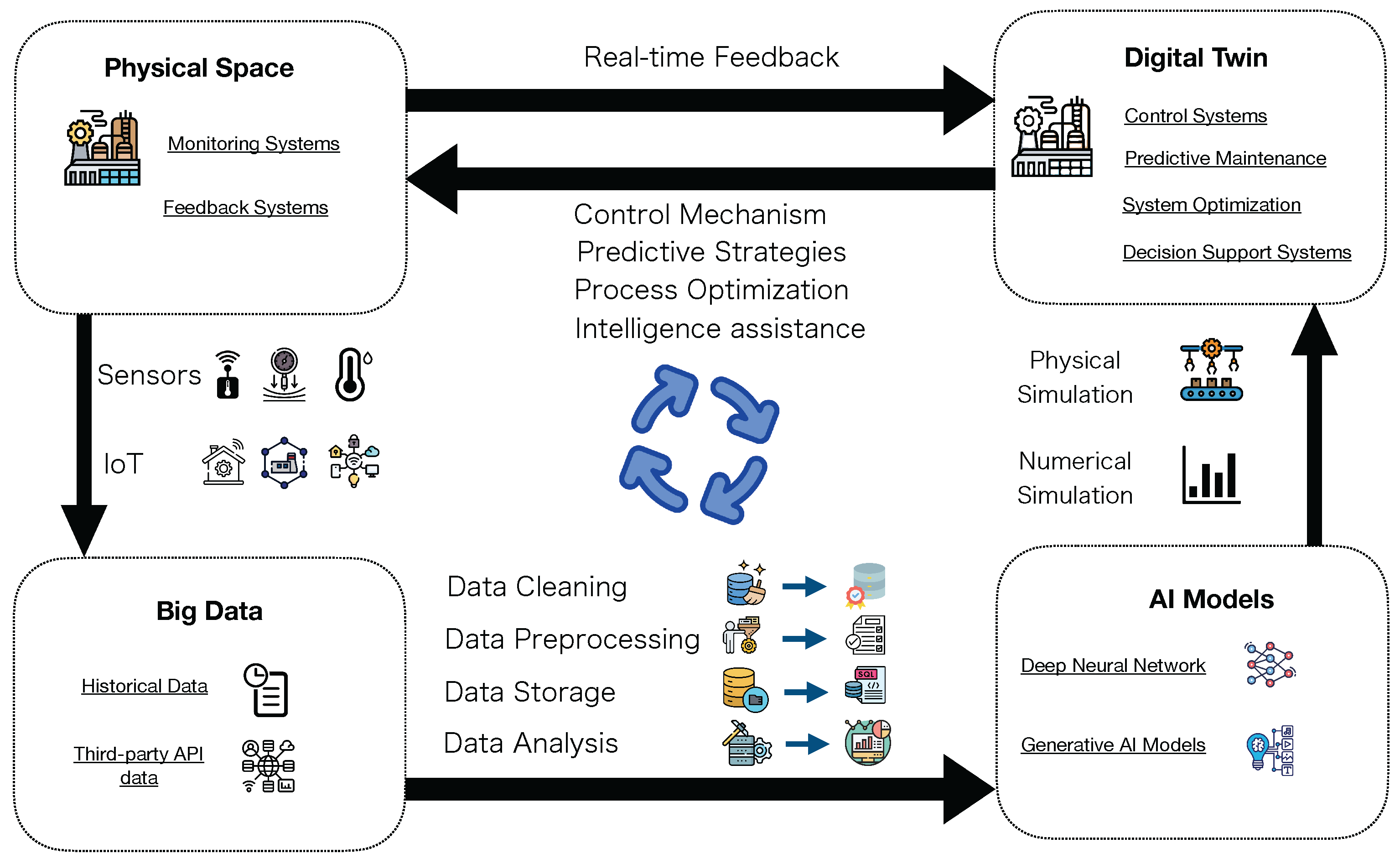
Figure 3.
The use of digital twins in sectors like industry, healthcare, urban planning, business, education, and technology, showcasing their versatility in improving operations and decision-making.
Figure 3.
The use of digital twins in sectors like industry, healthcare, urban planning, business, education, and technology, showcasing their versatility in improving operations and decision-making.
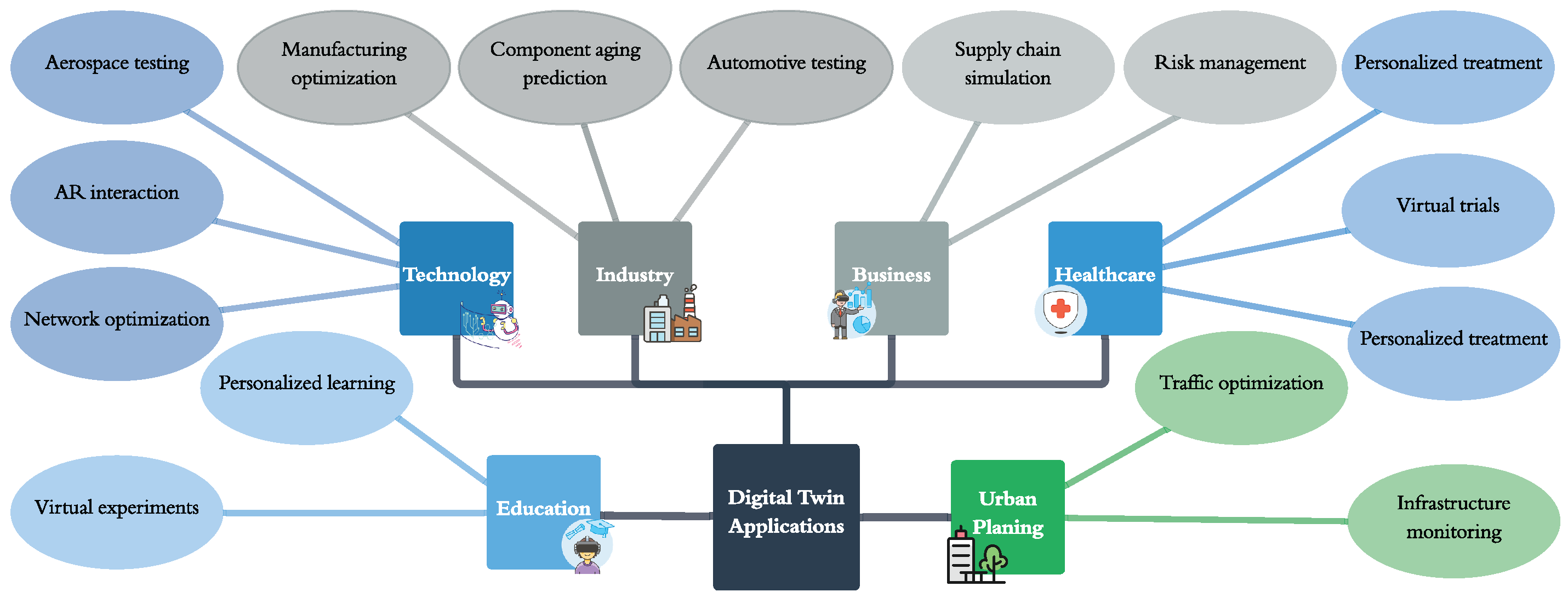
Disclaimer/Publisher’s Note: The statements, opinions and data contained in all publications are solely those of the individual author(s) and contributor(s) and not of MDPI and/or the editor(s). MDPI and/or the editor(s) disclaim responsibility for any injury to people or property resulting from any ideas, methods, instructions or products referred to in the content. |
© 2026 by the authors. Licensee MDPI, Basel, Switzerland. This article is an open access article distributed under the terms and conditions of the Creative Commons Attribution (CC BY) license (http://creativecommons.org/licenses/by/4.0/).
Copyright: This open access article is published under a Creative Commons CC BY 4.0 license, which permit the free download, distribution, and reuse, provided that the author and preprint are cited in any reuse.