
Submitted:
26 August 2024
Posted:
27 August 2024
You are already at the latest version
Abstract
In two laboratory trials natural products, including freshly-picked leaves from spearmint, rosemary, and tansy plants; a water extract from soybean plants; peels from a common cucumber; and 1% peppermint oil in hexane were placed in a moist harborage preferred by Argentine ants, Linepithema humile, and the number of ants entering the harborage after two and four hours was counted. None of the recommended home remedies (tansy, cucumber, or soybean extract) deterred ants from an attractive, moist harborage in either trial even when the quantity of these treatments was increased 4- to 10-fold. Freshly picked leaves from rosemary and spearmint plants deterred ants from harboring, and the 1% peppermint oil was the most deterrent of all treatments.
Keywords:
Argentine ant
; Linepithema humile
; control
; natural products
; deterrence
; placebo
1. Introduction
The Argentine ant, Linepithema humile (Mayr), is a major nuisance pest. It is a highly invasive species from South America that forms super-colonies, and reportedly came to the United States (U.S.) in coffee shipments into the port of New Orleans, Louisiana [1]. Concerns over the environmental impact of chemically-based insecticides used to control pests, especially ants, in non-agricultural environments has led to changes in product labels that have served to limit the use of chemical insecticides for Argentine ant control. Alternative and low-impact methods used to control ants was recently reviewed [2]. In 2009 the U.S. Environmental Protection Agency (E.P.A.), in an effort to reduce non-target exposure to pyrethroid and pyrethrin products implemented an initiative to revise guidelines for products used in non-agricultural, outdoor settings [3]. This initiative specifically limited non-agricultural outdoor uses of pyrethroids and pyrethrins to spot or crack-and-crevice treatments. In light of this change, alternative methods to conventional ant control have received attention as potential management options, with particular interest in the use of natural products, including essential oils as deterrents and insecticides [2,4,5,6,7,8]; Argentine ant semiochemicals as stand-alone applications and in conjunction with other products [2,9,10,11,12]; and other less conventional products including plants, detergents, and food items [13,14,15,16,17]; Bader [13], for example, promoted the benefits and efficacy of products that have not been investigated. In particular, Bader [13] claimed numerous plant-based products to be effective as deterrents to ant foraging or as toxicants. Included are claims about cucumber peels, a soybean water extract, and tansy leaves as deterrents to ants. Although no scientific evidence supports these claims, given the appeal of utilizing alternatives to conventional insecticides, this presented an opportunity for further investigation. The objective, therefore, of this study was to assess claims made by Bader [13] about the use of several nonconventional products as deterrents to Argentine ant harboring.
2. Materials and Methods
2.1. Ants
Argentine ants used in our bioassays were collected from Barnesville, Georgia (N 33° 3'17.11", W 84° 9'59.16"). Ants, including brood and queens, were collected along with accompanying soil, leaf litter, and other debris and placed in a plastic tub (≈57 x 45 x 13 cm) (Model 400-5N, Del-Tec/Panel Controls Corporation, Greenville, SC). The tub was prepared in advance by coating the inside walls with FluonTM (Northern Products Inc., Woonsocket, RI) to prevent ant escape. To separate ants from leaf litter debris, a moistened harborage (described below) was placed in each corner of the tub. After several days, as the leaf litter dried, the ants (workers, brood, and queens) migrated from leaf litter debris into clean, debris-free harborages that allowed for ease of use in future bioassays. Argentine ants are susceptible to desiccation, and readily move from dry/drying habitats to moist habitats [18]. Ants were held at ambient humidity and temperature (20-23 °C) and provided, ad libitum, water, 25% sugar water, and freshly-killed (by freezing) crickets.
2.2. Ant Harborage
Harborages consisted of polystyrene culture dishes (100 x 25 mm; NalgeNunc International, Rochester, NY) half-filled with CastoneTM (Model 99044, Dentsply International Inc., York, PA), a high-strength, water absorbent dental molding material. Castone powder (120 g) was mixed with water (40 ml) and the slurry then evenly divided among four empty dishes. Before the Castone could harden, dishes were gently and repeatedly tapped on a horizontal surface to ensure even distribution and to remove air bubbles. After air drying for ≈24 h, two holes (1.6 mm diam and 180° apart) were drilled through the side of the dish, just above the surface of the dried Castone, to provide entrance and exit holes for the ants. A third hole was drilled in the center of the accompanying lid of each dish. All dishes and lids were rinsed under running tap water to remove plastic debris and Castone dust prior to use. After rinsing, dishes and lids were placed in an oven (60°C) for 1-3 d to ensure complete drying of the Castone. After drying, and just prior to being used, dishes were filled with water to ensure complete saturation of the Castone.
2.3. Materials Evaluated as Deterrents to Argentine Ant Harboring
Laboratory trials were conducted to evaluate the deterrency of five materials to Argentine ant harboring behavior: fresh leaves from tansy plants (Tanacetum vulgare L.), spearmint plants (Mentha sp.), and rosemary plants (Rosmarinus sp.); the thin peel from a mature cucumber (Cucumis sp.); a water extract of soybean plants (Glycine max L.); and peppermint oil (positive control) and water (negative control) (Table 1). Peppermint oil is a strong deterrent to Argentine ant harboring [7]. It was acquired from Polarome International (Jersey City, NJ) and formulated at 1% in n-hexane according to the method of Scocco et al. [7]. Tansy plants were purchased from a commercial nursery (Winterville, Georgia) and maintained in a greenhouse on the University of Georgia Griffin Campus. Spearmint and rosemary leaves were obtained from the garden of a local residence (Griffin, Georgia). The spearmint leaves were placed in a small plastic storage bag with water covering the leaves, while rosemary leaves were placed in a small plastic storage bag without water. Both spearmint and rosemary were used in bioassays within two hours of removal from the plant.
Cucumbers, purchased from a local supermarket, were washed thoroughly under tap water and a thin layer of peel (≈1 mm thick) removed (Farberware Euro Peeler, Lifetime Brands, Inc., Garden City, NY). Round discs (≈3.5 mm diam) were prepared from cucumber peel, tansy leaf, and spearmint leaf using a standard paper hole punch (At the OfficeTM, Wal-Mart Stores, Inc., Bentonville, AR).
A water extract from soybean plants, hereafter referred to as soybean tea, was prepared in a manner similar to that described by Bader [13]. In short, several soybean plants (Maturity Group 7, Roundup Ready, Georgia Crop Improvement Association, Inc., Athens, GA) were harvested from the University of Georgia Griffin Campus research farm in Williamson, GA. Following removal from the ground, the plants were placed in small, water-tight storage bags containing ≈250 ml water. The plants remained in the open bag at ambient laboratory conditions until use (no more than 18 h). To prepare the soybean tea soybean plants were rinsed under tap water to remove dirt and debris. Leaves were removed from the plant and 2.5 cm of the main stem removed (the cut line was ≈6.5 mm above the first root). Two and one-half cm of the remaining stem was then removed, cut into ≈6.5 mm sections, and the sections then placed in a plastic vial (57 x 16.5 mm; Sarstedt Inc., Newton, NC) containing 1 ml of tap water. The stems were allowed to soak for 24 h at ambient laboratory conditions, at which time they were removed leaving behind the soybean tea used in our bioassays.
In the first trial we evaluated the deterrent effect of four discs, per replicate, of dried cucumber peels and tansy leaves; fresh cucumber peels, tansy leaves, and spearmint leaves; and soybean tea (0.25 mls, or a 6.5 mm root equivalent). Controls consisted of 0.25 mls of 1% peppermint oil in n-hexane (positive control) and 0.25 mls of water (negative control) (Table 1). In the second trial we evaluated 40 discs, per replicate, of fresh cucumber, fresh tansy, and fresh spearmint; four leaves of fresh rosemary (≈2.5 cm long each); and soybean tea (1.0 ml, or 26 mm root equivalents) (Table 1 and Figure 1). Controls consisted of 1 ml of 1% peppermint oil in n-hexane (positive control) and 1.0 ml of water (negative control).
2.4. Bioassay
Similar to Scocco et al. [7], the treatment material or substance was applied directly to the surface of small (35 x 5 mm), round, plastic dishes half-filled with Castone (Figure 1). For both trials water (0.25 ml in trial 1 and 1.0 ml in trial 2) was first applied to the Castone to create an attractive, moist harborage for the ants [18]. For the soybean tea treatment, 0.25 ml (trial 1) or 1.0 ml (trial 2) was used in place of additional water. For the peppermint oil treatment the solution was added to the stone dish and allowed to air-dry for 2 h, then water was added. Following the application of the treatment material and water, each dish was covered with its lid and placed in a small, plastic box (19 x 14 x 9.5 cm; Tri-State Plastics, Dixon, KY) with Fluon-lined walls. Twenty worker ants were immediately added to each box. Worker ants used in all bioassays were collected from laboratory colonies by placing a dish containing ants (from the laboratory colony) into a small, Fluon-lined, plastic box (31 x 23 x 10 cm; Pioneer Plastics, Inc., Dixon, KY) and allowing several ants to climb onto a small paintbrush. Twenty ants were then gently tapped into a clear, 30 ml plastic cup with the walls and floor coated with Fluon, and the ants then gently transferred to test arenas containing a freshly-treated dish.
During the bioassay ants had the choice of entering the covered, moistened dish containing the treatment or not entering the dish. The number of ants inside the dish (alive + dead) was recorded after 2 and 4 h. Among all treatments there was no mortality in trial one and negligible mortality (< 1%) in trial two. All bioassays were conducted at room temperature, and each treatment in each trial was replicated 12 times (n = 12).
2.5. Statistical Analyses
For both trials, treatment, time, and the treatment*time interaction were analyzed by mixed model, two-way analysis of variance (ANOVA) (PROC GLIMMIX [19]). For each combination of trial and time, the mean number of live ants inside each treated harborage was analyzed by mixed model, one-way ANOVA (PROC GLIMMIX [19]). Following each one-way ANOVA, differences between least square means were determined using pairwise t-tests.
3. Results
In trial one, the main effects treatment (F = 18.43; d.f. = 7, 176; P < 0.0001) and time (F = 4.97; d.f. = 1, 176; P = 0.0271) were significant, but their interaction was not (F = 0.64; d.f. = 7, 176; P = 0.7205). Excluding 1% peppermint oil, after 2 hr the mean number of ants inside moistened, treated dishes was not significantly different (F = 8.73; d.f. = 7, 88; P < 0.0001); results were similar after 4 hr (F = 14.56; d.f. = 7, 88; P < 0.0001) (Table 2). Only the 1% peppermint oil treatment deterred ants from entering moistened dishes; no remaining treatment deterred ants from entering dishes at either 2 or 4 h.
Following mixed model, 1-way ANOVA differences between least square means, for each combination of Trial and Hour, were determined using pairwise t-tests; means within a column followed by the same letter are not significantly different. *Numbers in parentheses are the percentage of 20 ants found inside the dish.
In the second trial the main effects treatment (F = 32.29; d.f. = 6, 123.3; P < 0.0001) and time (F = 5.61; d.f. = 1, 154; P = 0.0191) were significant, but their interaction was not (F = 0.88; df = 6, 123.3; P = 0.5085). Only fresh spearmint and fresh rosemary deterred ants from harboring; deterrence was defined as significantly fewer ants inside a harborage than in the water treatment (negative control). After 2 h there were significantly fewer ants in dishes containing freshly-collected spearmint and rosemary than in dishes containing only water (no treatment); dishes containing fresh rosemary contained fewer ants than dishes containing any treatment other than 1% peppermint oil (Table 2; F = 10.98; d.f. = 6, 77; P <0.0001). Dishes containing spearmint contained significantly fewer ants than dishes containing soybean tea, but not fresh tansy or fresh cucumber. The results did not change appreciably after 4 h (F = 20.64; d.f. = 6, 77; P < 0.0001). These results suggest that only fresh spearmint and fresh rosemary were deterrent to Argentine ant harboring, and that fresh rosemary was a better deterrent than fresh spearmint.
4. Discussion
In the first trial no treatment, excluding peppermint oil which is a known Argentine ant deterrent, deterred ants from entering a preferred, moistened harborage; in each of the six treatments and water control, 88% to 97% of ants entered and were harboring inside the harborage after 2 h and 93% to 99% after 4 h (Table 2). In the second trial, after 2 h the water (negative control), soybean tea, and fresh tansy and cucumber had significantly similar responses where 68% to 92% of ants had entered treated harborages (Table 2). Fresh spearmint (47%), fresh rosemary (17%), and the peppermint oil solution (0.50%) were significantly different, but all demonstrated deterrency with ≤ 47% of ants inside treated harborages, with the peppermint oil solution demonstrating a similar effect as in trial 1. After 4 h ant response to treatments had not changed significantly, but response was greater and more ants were inside the treated harborages (Table 2). The water control, soybean tea, and cucumber (93%-96%) had similar responses of ants inside treated harborages. Tansy had 74% and spearmint 53.5% ants inside treated harborages. Fresh rosemary was deterrent and had 26% of ants inside treated harborages. All treatments, with the exception of fresh spearmint, fresh rosemary, and the peppermint oil solution, had 74% to 96% of ants inside the dishes at the conclusion of the trial (after 4 h).
Increasing the concentration of fresh cucumber and fresh tansy 10-fold and soybean tea 4-fold (trial 2) did not improve the deterrent properties of these home remedies, which were not deterrent in either trial. Likewise, neither dried cucumber peel nor dried tansy leaves kept ants from entering moistened dishes (trial 1 only). The response of ants to fresh spearmint, however, appeared to be concentration dependent; in trial 1 ants were not deterred by it, but when the concentration was increased ≈10-fold (trial 2) fresh spearmint deterred ants from entering treated dishes. In trial 1, after 4 hours 96% of the ants had entered the dish containing spearmint, but when the concentration of spearmint was increased (trial 2) only 54% of the ants had entered the moistened dish containing fresh spearmint leaves after 4 hours. Freshly-picked rosemary leaves were also deterrent (trial 2). Among all natural products tested only freshly-picked spearmint and rosemary leaves were deterrent to Argentine ants, and rosemary was a better deterrent than spearmint. None of the home remedies [13] deterred ants from entering moistened harborages.
Essential oils represent one of four major types of botanical products in use for pest control, including pyrethrum, rotenone, and neem [14]. Recent, increased attention [8] given to plant essential oils as alternatives to traditional insecticides is largely due to their exemption from registration by the U.S. E.P.A. and classified as so-called “25(b)” products, owing to the name of the federal act that granted their exemption from EPA registration [20,21]. According to Isman [14], this has caused an increase in the development and production of essential oil-based insecticides, fungicides, and herbicides for both commercial and residential use. Oils of particular interest are rosemary, cedar, clove, mint, and thyme [5,14,22,23]. Rosemary, for example, has fumigant, deterrent, and contact toxic properties against several insects, including stored product pests such as the bean weevil, Acanthoscelides obtectus [24,25]. Rosemary oil was toxic to adult turnip aphids, Lipaphis pseudobrassicae, the human head louse, Pediculus humanus capitis, the two-spotted spider mite, Tetranychus urticae, the armyworm, Pseudaletia unipuncta, and the cabbage looper, Trichoplusia ni [25,26,27,28]. In addition to toxic characteristics, rosemary oil has shown promise as a viable deterrent to four mosquito species: Anopheles stephensi, Aedes aegypti, Culex quinquefasciatus, and C. pipiens pallens [29,30].
Argentine ants and red imported fire ants, Solenopsis invicta, were given a choice of crossing an essential oil treated paper bride or a solvent-treated bridge to access food and water [6]. Basil, citronella, lemon, peppermint, and tea tree oils applied to the paper bridges at ≥0.40 ul per square centimeter deterred Argentine ant foraging. Foraging by red imported fire ants was deterred by citronella and peppermint (≥0.02 ul per square centimeter); basil and tea tree (≥0.40 ul per square centimeter); and lemon (≥2.0 ul per square centimeter). Neither ant species was deterred by eucalyptus at the rates tested (≤ 10.0 ul per square centimeter). In a lab study utilizing the same methods we utilized in our study, fresh deposits (2 hours old) of 0.10%, 1%, and 10% spearmint, peppermint, wintergreen, cinnamon, and clove oil deterred Argentine ants from their preferred harborage [7]. The deterrence appeared to be concentration dependent. The same treatments were allowed to age (top of dish removed to facilitate volatility) for one week, and the test repeated. Only spearmint was deterrent at all three concentrations tested, while the other four essential oils (peppermint, wintergreen, cinnamon, and clove) retained their deterrent effects at the 1% and 10% concentrations.
Plant essential oils have been evaluated for their deterrent and insecticidal properties against L. humile, however, there have only been a limited number of laboratory tests [6,7] and limited field studies. A series of studies [4,5] investigated the impact of aromatic red cedar mulch on Argentine ant harboring in both laboratory and field trials. In a choice study where Argentine ants and Odorous house ants, Tapinoma sessile, were provided the opportunity to nest in either cedar mulch or one of four other common mulches (pine straw, pine bark, shredded cypress, or chipped hardwood), both ant species always chose the non-cedar mulch (n = 78 trials) [4]. In the same study, Argentine ants suffered high mortality when confined to mulch (no choice) or when exposed to cedar mulch or cedar oil in a small, enclosed space. Clearly, cedar is both repellent and toxic (by fumigation and perhaps contact) to Argentine ants.
There was a strong, positive correlation between Argentine ant worker mortality and the amount of time the ants were in contact (i.e., distance traveled) with cedar mulch, suggesting perhaps some contact mortality with cedar oil and/or its constituents. When forced to, Argentine ants forage over cedar mulch to reach food [5] but prefer to not nest in it [4]. It seems the strong attraction to food may supersede the repellent nature of cedar, but not to the extent that the ants will nest in it. In a field trial where large swaths of pine needle mulch were replaced with either cedar or cypress mulch, newly established Argentine ant nests were found in only three instances in the new cedar mulch, but 26 times in cypress; and when pine straw mulch surrounding trees was replaced with either cedar or cypress, the number of nests found thereafter was significantly greater in cypress than in cedar [5].
The results from our natural product trials indicate that components of freshly-harvested rosemary and spearmint were deterrent to Argentine ant harboring. In contrast, the home remedies evaluated in our study did not deter ants from a preferred harborage, even when the concentration of these remedies were increased 4- to 10-fold. The home remedies [13] we evaluated are unproven, and are in direct comparison to products that have been vetted by a rigorous, data-driven, EPA registration process [31]. The U.S. Food and Drug Administration, likewise, administers a similar program for human drug development, whereby drug manufacturer claims are proven so that when we take a drug we indeed have confidence that the active ingredient has been through a scientifically-based, rigorous process that has led to evidence that the drug does indeed address a specific medical condition [32]. Because of U.S. Federal Government oversight, we are confident that the active ingredients in products designed to alter a pest’s biology or survival and to improve human health have been properly vetted by broadly-accepted scientific guidelines.
We believe that the home remedies we have evaluated herein are placebos and produce a placebo-like effect in susceptible users. By definition “a placebo is a pharmacologically inactive substance that can have a therapeutic effect if administered to a patient who believes that he or she is receiving an effective treatment” [33]. Bausell [33] goes on to state that “…the placebo effect is not something that occurs “naturally”. It must be manufactured in the sense that it occurs only in the presence of therapeutic intent (or the perception of such intent)”. The literature surrounding placebo and the placebo effect have their origins in medicine, and include the existence of a placebo effect in such areas as pain remediation, psychiatry, urology, cardiology, and even surgery [34]. A growing body of medical researchers are investigating the biological nature of the placebo effect as a line of scholarly inquiry to gain insight into the function of the human brain [34] and the numerous mechanisms (e.g., the patient-physician relationship) that lead to a placebo effect.
In the proper context a placebo treatment may alter brain chemistry, leading to slight improvements in a patient’s health – e.g., placebos (sugar pills) may indeed stimulate the brain to produce opioids as endogenous analgesics. Placebos may complicate the outcome of candidate drug efficacy trials, for instance, by stimulating various endogenous neuro-chemistries that might actually improve health outcomes in the absence of the candidate drug, thereby complicating the interpretation of the trial’s outcomes. This complicates studies designed to determine a candidate drug’s effectiveness, and must therefore be controlled for by researchers. In clinical trials the improvement in health in the treatment group (candidate drug) must be greater than the improvement in health condition in the nuisance placebo group (sugar pill). In medical research, especially clinical trials where researchers are trying to decipher whether a candidate intervention is effective [32], the placebo effect is considered a nuisance factor that must be controlled for, and this is done with an experimental design referred to as double blind, placebo controlled randomized clinical trials. Because the physician has such strong influence on the patient’s view of the placebo, via enhanced expectations and beliefs, it is important in the placebo-controlled experiment that it be double blind – i.e., neither the patient or the physician knows the identity of the placebo (sugar pill) or the candidate intervention being evaluated.
Although there are many mechanisms influencing the existence of a placebo effect, it is widely accepted that the doctor-patient relationship (i.e., a trusted authority figure) greatly influences patient belief and expectation. It is important that this relationship be historically positive (referred to as conditioning) and trusting. Physicians who show empathy have been shown to trigger physiological changes in patient brains related to trust, pleasure, and positivity [34]. Most of us have great respect for our doctors and other authority-type figures and are pre-disposed to trusting them. That combined with the motivation to solve a pressing pest problem may indeed lead to a placebo effect.
There are numerous other factors that may impact the occurrence of the placebo effect, and include the physical nature of the placebo itself – its presentation and look, including packaging and perhaps color; the so-called “halo effect”, referring to the product’s reputation; and even the price of the product [34]. Other important mechanisms enhancing the placebo effect are patient-dependent, and include a person’s personality profile (optimistic people are more susceptible to the placebo effect); the patient’s positive expectation toward the “treatment” and their belief or faith in its performance. A placebo may result in a positive outcome if the patient expects it to, and this expectation is influenced (positively and negatively) by the physician [35].
Individuals seeking relief from infestations of insects, in our case ants, are motivated to find a cure for their ailment – in this case, infesting ants, and are pre-disposed to intent from an authority figure. Pest control devices emitting ultrasonic sound waves have been sold for decades, and can still be found on store shelves today, even though numerous studies have proven their ineffectiveness against repelling or killing common pests of households. Hinkle et al. [36], for instance, affixed ultrasonic collars to cat flea (Ctenocephalides felis) - infested house cats to evaluate the device’s impact on several vital rates of the fleas. The ultrasonic devices had no impact on egg production by female fleas, larval development time, pupa production, or adult survival. Similar studies have shown lack of detrimental impacts of ultrasonic devices on German cockroaches [37].
In conclusion, the recommended home remedies evaluated in our trials were not deterrent to Argentine ant harboring, and it is our opinion that users of remedies that have not been scientifically vetted are susceptible to these recommendations in a manner similar to the response to placebos where an authority figure (in medicine, the physician) greatly influences, positively and negatively, user expectations and beliefs. Moreover, our results suggest that further investigation, in the form of field trials, of rosemary and spearmint is warranted and might provide valuable insight into effective plant-based management for L. humile [5]. Given consistent interest in alternatives to conventional insecticides, it is not surprising that natural remedies have been suggested to meet this demand. We believe that the application of granular formulations of essential oils to areas where pest ants nest might serve to create an ant free zone around susceptible structures [5]. Essential oils have their greatest utility as deterrents, but because of their high volatility repeat applications might be necessary. Because of their deterrent nature, essential oils should primarily be considered as behavior-modifying chemicals, and secondarily as contact toxicants.
Author Contributions
Conceptualization, D.R.S.; data curation, J.B.H.; formal analysis, J.B.H and J.W.D.; funding acquisition, D.R.S.; investigation, J.B.H.; methodology, D.R.S and J.B.H.; project administration, J.B.H. and D.R.S.; software, J.W.D.; supervision, D.R.S.; writing (original draft), J.B.H. and D.R.S.; writing (review and editing), J.B.H, D.R.S., and W.A.G.
Acknowledgments
We thank the Barnesville Housing Authority for ant collection sites. Funding for graduate student support and publication costs were from soft funds managed by D.R.S.
Conflicts of Interest
The authors declare no conflict of interest.
References
- Vega, S.J.; Rust, M.K. The Argentine ant: A significant invasive species in agricultural, urban and natural environments. Sociobiol. 2001, 37, 3–26. [Google Scholar]
- Suiter, D.R.; Gochnour, B.M.; Holloway, J.B.; Vail, K.T. Alternative methods of ant (Hymenopera: Formicidae) control with emphasis on the Argentine ant, Linepithema humile. Insects 2021, 12, 487. [Google Scholar] [CrossRef]
- United States Environmental Protection Agency. Environmental Hazard and General Labeling for Pyrethroid and Synergized Pyrethrins Non-Agricultural Outdoor Products. Available online: https://www.epa.gov/ingredients-used-pesticide-products/environmental-hazard-and-general-labeling-pyrethroid-and (accessed on 23 August 2024).
- Meissner, H.E.; Silverman, J. Effects of aromatic cedar mulch on the Argentine ant and the Odorous House Ant (Hymenoptera: Formicidae). J. Econ. Entomol. 2001, 94, 1526–1531; [Google Scholar] [CrossRef] [PubMed]
- Meissner, H.E.; Silverman, J. Effect of aromatic cedar mulch on Argentine ant (Hymenoptera: Formicidae) foraging activity and nest establishment. J. Econ. Entomol. 2003, 96, 850–855; [Google Scholar] [CrossRef] [PubMed]
- Wiltz, B.; Suiter, D.; Gardner, W. Deterrency and toxicity of essential oils to Argentine and red imported fire ants (Hymenoptera: Formicidae). J. Entomol. Sci. 2007, 42, 239–249. [Google Scholar] [CrossRef]
- Scocco, C.; Suiter, D.; Gardner, W. Repellency of five essential oils to Linepithema humile (Hymenoptera: Formicidae). J. Entomol. Sci. 2012, 47, 150–159. [Google Scholar] [CrossRef]
- Oladipupo, S.O.; Hu, S.P.; Appel, A.G. Essential oils in urban pest management – a review. J. Econ. Entomol. 2022, 115, 1375–1408. [Google Scholar] [CrossRef] [PubMed]
- Suckling, D.; Peck, R.; Manning, L.; Stringer, L.; Cappadonna, J.; El-Sayed, A. Pheromone disruption of Argentine ant trail integrity. J. Chem. Ecol. 2008, 34, 1602–1609; [Google Scholar] [CrossRef] [PubMed]
- Suckling, D.M.; Peck, R.W.; Stringer, L.D.; Snook, K.; Banko, P.C. Trail pheromone disruption of Argentine ant trail formation and foraging. J. Chem. Ecol. 2010, 36, 122–128; [Google Scholar] [CrossRef]
- Choe, D.; Hwan, K.T.; Lopez, C.M.; Campbell, K. Pheromone-assisted techniques to improve the efficacy of insecticide sprays against Linepithema humile (Hymenoptera: Formicidae). J. Econ. Entomol. 2014, 107, 319–325; [Google Scholar] [CrossRef]
- Gochnour, B.M.; Suiter, D.R.; Davis, J.W.; Huang, Q. Use of an Argentine ant, Linepithema humile, semiochemical to deliver an acute toxicant. Insects 2018, 9, 171; DOI; 103390/insects9040171. [Google Scholar] [CrossRef]
- Bader, M.H. 1001 All-Natural Secrets to a Pest-Free Property; Myles H. Bader, 2007; pp. 446. ISBN 0977670600.
- Isman, M.B. Botanical insecticides, deterrents, and repellents in modern agriculture and an increasingly regulated world. Annu. Rev. Entomol. 2006, 51, 45–66; [Google Scholar] [CrossRef] [PubMed]
- Tanaka, Y.; Nishisue, K.; Sunamura, E.; Suzuki, S.; Sakamoto, H.; Fukumoto, T.; Terayama, M.; Tatsuki, S. Trail-following disruption in the invasive Argentine ant with a synthetic trail pheromone component (Z)-9-hexadecenal. Sociobiol. 2009, 54, 139–152. [Google Scholar]
- Nishisue, K.; Sunamura, E.; Tanaka, Y.; Sakamoto, H.; Suzuki, S.; Fukumoto, T.; Terayama, M.; Tatsuki, S. Long-term field trial to control the invasive Argentine Ant (Hymenoptera: Formicidae) with synthetic trail pheromone. J. Econ. Entomol. 2010, 103, 1784–1789; [Google Scholar] [CrossRef]
- Sunamura, E.; Suzuki, S.; Nishisue, K.; Sakamoto, H.; Otsuka, M.; Utsumi, Y.; Mochizuki, F.; Fukumoto, T.; Ishikawa, Y.; Terayama. M. Combined use of a synthetic trail pheromone and insecticidal bait provides effective control of an invasive ant. Pest Management Sci. 2011, 67, 1230–1236; [CrossRef] [PubMed]
- Shilman, P.E.; Lighton, J.R.B.; Holway, D.A. Water balance in the Argentine ant (Linepithema humile) compared with five common native ant species from southern California. Physiol. Entomol. 2007, 32, 1–7; [Google Scholar] [CrossRef]
- SAS Institute Inc. SAS/STAT Software Version 14.1; SAS Institute Inc.: Cary, NC, USA, 2017. [Google Scholar]
- Drees, B.M. Managing Household Ant Pests. Texas Cooperative Extension, Texas A & M University System. 2005, B-6183.
- Geiger, C.; Tootelian, D. Healthy schools act spurs integrated pest management in California public schools. Calif. Agric. 2005, 59, 235–241; [Google Scholar] [CrossRef]
- Appel, A.G.; Gehret, M.J.; Tanley, M.J. Repellency and toxicity of mint oil to American and German cockroaches (Dictyoptera: Blattidae and Blattellidae). J. Agric. Urban Entomol. 2001, 18, 149–156. [Google Scholar]
- Phillips, A.K.; Appel, A.G.; Sims, S.R. Topical toxicity of essential oils to the German cockroach (Dictyoptera: Blattellidae). J. Econ. Entomol. 2010, 103, 448–459; [Google Scholar] [CrossRef]
- Papachristos, D.; Stamopoulos, D. Repellent, toxic and reproduction inhibitory effects of essential oil vapours on Acanthoscelides obtectus (Say) (Coleoptera: Bruchidae). J. Stored Prod. Res. 2002, 38, 117–128; [Google Scholar] [CrossRef]
- Isman, M.B.; Wilson, J.A.; Bradbury, R. Insecticidal activities of commercial rosemary oils (Rosmarinus officinalis) against larvae of Pseudaletia unipuncta and Trichoplusia ni in relation to their chemical compositions. Pharm. Biol. 2008, 46, 82–87; [Google Scholar] [CrossRef]
- Yang, Y.C.; Lee, H.S.; Clark, J.; Ahn, Y.J. Insecticidal activity of plant essential oils against Pediculus humanus capitis (Anoplura: Pediculidae). J. Med. Entomol. 2004, 41, 699–704; [Google Scholar] [CrossRef]
- Sampson, B.J.; Tabanca, N.; Kirimer, N.; Demirci, B.; Baser, K.; Khan, I.A.; Spiers, J.M.; Wedge, D.E. Insecticidal activity of 23 essential oils and their major compounds against adult Lipaphis pseudobrassicae (Davis) (Aphididae: Homoptera). Pest Management Sci. 2005, 61, 1122–1128; [Google Scholar] [CrossRef]
- Miresmailli, S.; Bradbury, R.; Isman, M.B. Comparative toxicity of Rosmarinus officinalis L. essential oil and blends of its major constituents against Tetranychus urticae Koch (Acari: Tetranychidae) on two different host plants. Pest Management Sci. 2006, 62, 366–371; [Google Scholar] [CrossRef]
- Choi, W.S.; Park, B.S.; Ku, S.K.; Lee, S.E. Repellent activities of essential oils and monoterpenes against Culex pipiens pallens. J. Am. Mosq. Control Assoc. 2002, 18, 348–351. [Google Scholar]
- Prajapati, V.; A. Tripathi, A.; Aggarwal, K.; Khanuja, S. Insecticidal, repellent and oviposition-deterrent activity of selected essential oils against Anopheles stephensi, Aedes aegypti and Culex quinquefasciatus. Bioresour. Technol. 2005, 96, 1749–1757; [CrossRef]
- United States Environmental Protection Agency. Pesticide Registration. Available online: https://www.epa.gov/pesticide-registration (accessed on 23 August 2024).
- United States Food and Drug Administration. The FDA’s Drug Review Process: Ensuring Drugs are Safe and Effective. Available online: https://www.fda.gov/drugs/information-consumers-and-patients-drugs/fdas-drug-review-process-ensuring-drugs-are-safe-and-effective (accessed on 23 August 2024).
- Bausell, R.B. italic>Snake Oil Science: The Truth about Complementary and Alternative Medicine, 1st ed.; Oxford University Press; New York, U.S.A., 2007; pp. 23-57. ISBN 978-0-19-531 368-0.
- Pardo-Cabello, A.J.; Manzano-Gamero, V.; Puche-Canas, E. Placebo: a brief updated review. Archives of Pharmacology 2022, 395, 1343–1356. [Google Scholar] [CrossRef] [PubMed]
- Bensing, J.M.; Verheul, W. The silent healer: The role of communication in placebo effects. Patient Education and Counseling 2010, 80, 293–299. [Google Scholar] [CrossRef]
- Hinkle, N.C.; Koehler, P.G.; Patterson, R.S. Egg production, larval development, and adult longevity of cat fleas (Siphonaptera: Pulicidae) exposed to ultrasound. J. Econ. Ent. 1990, 83, 2306–2309. [Google Scholar] [CrossRef] [PubMed]
- Gold, R.E.; Decker, T.N.; Vance, A.D. Acoustical characterization and efficacy evaluation of ultrasonic pest control devices marketed for control of German cockroaches (Orthoptera: Blattellidae). J. Econ. Ent. 1984, 77, 1507–1512. [Google Scholar] [CrossRef] [PubMed]
Figure 1.
Test arena (35 mm diameter dish, half-filled with water-absorbent Castone and with entry holes) containing: (a) 40 discs of fresh spearmint leaves (trial 2); (b) freshly cut leaves from a rosemary plant (trial 2). In a and b, note ants inside dishes are congregated next to one of the entry holes, as fresh cuttings from both plants were deterrent to ants.
Figure 1.
Test arena (35 mm diameter dish, half-filled with water-absorbent Castone and with entry holes) containing: (a) 40 discs of fresh spearmint leaves (trial 2); (b) freshly cut leaves from a rosemary plant (trial 2). In a and b, note ants inside dishes are congregated next to one of the entry holes, as fresh cuttings from both plants were deterrent to ants.
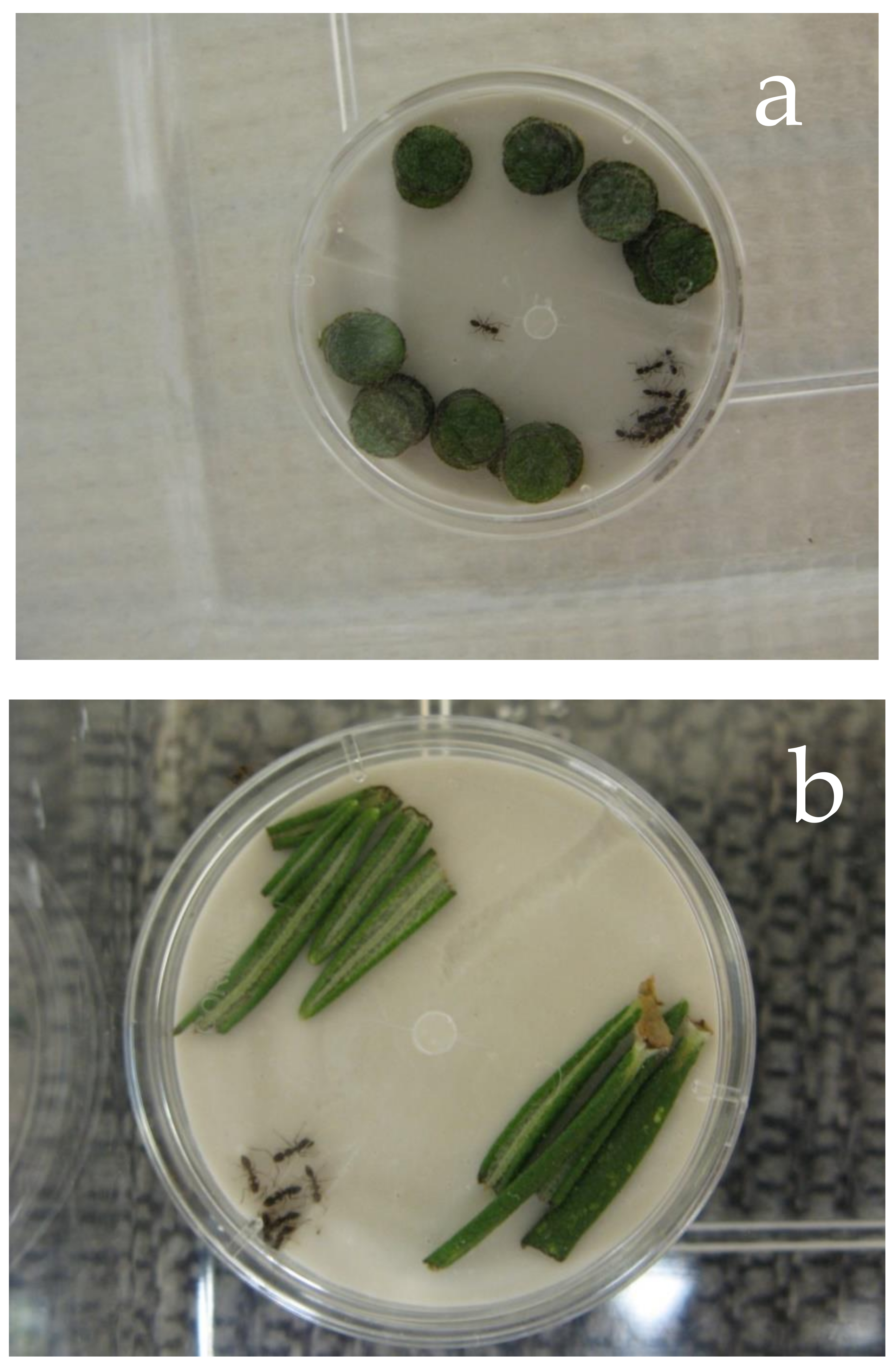

Table 1.
Quantity of treatment material applied to harborage for natural product deterrency trials.
| Amount of Material or Substance Tested for Each of Two Trials |
||
|---|---|---|
| Treatment | Trial 1* | Trial 2** |
| Fresh Cucumber Dry Cucumbera Fresh Tansy Dry Tansya Soybean Tea Fresh Spearmint Fresh Rosemary Water Only (negative control) 1% Peppermint Oil (positive control) |
4 discs (11.3 cm²) 4 discs (11.3 cm²) 4 discs (11.3 cm²) 4 discs (11.3 cm²) 0.25 ml (6.5 mm REb) 4 discs (11.3 cm²) Not tested 0.25 ml 0.25 ml |
40 discs (113 cm²) Not tested 40 discs (113 cm²) Not tested 1.0 ml (26 mm REb) 40 discs (113 cm²) Whole leaves 1.0 ml 1.0 ml |
*For trial 1, 0.25 ml of water was added to all dishes just prior to addition of the candidate treatment; for the soybean tea treatment, 0.25 ml of the tea was added **For trial 2, 1.0 ml of water was added to all dishes just prior to addition of the candidate treatment; for the soybean tea treatment, 1.0 ml of the tea was added. aDried for 24 hours at 40⁰C bRE, Root Equivalent. RE is the equivalent length of stem from soybean plant.
Table 2.
Response of Argentine ants to various treatments applied to harborages for natural product harborage deterrency trials.
Table 2.
Response of Argentine ants to various treatments applied to harborages for natural product harborage deterrency trials.
| Number (mean ± S.E.) of live ants inside dish at hour* | ||||
|---|---|---|---|---|
| Trial 1 | Trial 2 | |||
| Treatment | 2 h | 4 h | 2 h | 4 h |
| Dry Cucumber Fresh Cucumber Dry Tansy Fresh Tansy Soybean Tea Fresh Spearmint Fresh Rosemary Water Only Control 1% Peppermint Oil |
.19.4 ± 1.3 A (97) 17.6 ± 1.2 A (88) 18.9 ± 1.3 A (95) 18.4 ± 1.2 A (92) 19.3 ± 1.3 A (97) 17.6 ± 1.2 A (88) --- 18.4 ± 1.2 A (92) 0.28 ± 0.2 B (1) |
19.8 ± 1.3 A (99) 18.5 ± 1.2 A (93) 18.7 ± 1.2 A (94) 19.6 ± 1.3 A (98) 19.4 ± 1.3 A (97) 19.2 ± 1.3 A (96) --- 19.1 ± 1.3 A (96) 0.92 ± 0.3 B (5) |
.--- 13.6 ± 2.5 A,B (68) --- 14.8 ± 2.7 A,B (74) 16.8 ± 3.1 A (84) 9.33 ± 1.8 B (47) 3.42 ± 0.8 C (17) 18.3 ± 3.3 A (92) 0.08 ± 0.09 D (0.5) |
.--- 18.5 ± 2.2 A (93) --- 14.8 ± 1.9 A,B (74) 19.2 ± 2.3 A (96) 10.7 ± 1.4 B (54) 5.17 ± 0.8 C (26) 19.1 ± 2.3 A (96) 0.50 ± 0.2 D (3) |
|
F = 8.73 df = 7, 88 P < 0.0001 |
F = 14.56 df = 7, 88 P < 0.0001 |
F = 10.98 df = 6, 77 P < 0.0001 |
F = 20.64 df = 6, 77 P < 0.0001 |
|
Disclaimer/Publisher’s Note: The statements, opinions and data contained in all publications are solely those of the individual author(s) and contributor(s) and not of MDPI and/or the editor(s). MDPI and/or the editor(s) disclaim responsibility for any injury to people or property resulting from any ideas, methods, instructions or products referred to in the content. |
© 2024 by the authors. Licensee MDPI, Basel, Switzerland. This article is an open access article distributed under the terms and conditions of the Creative Commons Attribution (CC BY) license (http://creativecommons.org/licenses/by/4.0/).
Copyright: This open access article is published under a Creative Commons CC BY 4.0 license, which permit the free download, distribution, and reuse, provided that the author and preprint are cited in any reuse.