
Submitted:
25 August 2024
Posted:
26 August 2024
You are already at the latest version
Abstract
this paper focuses on a scientific study of the restoration, rehabilitation and reuse of the great throne hall, the most important hall in al-jawhara palace. it also aims to study the most important factors and forces of damage that affected the great throne hall, natural, biological, and human, and the resulting damage. field tests were performed, laboratory tests to determine fracture stress, liquidity and spandex limits tests, chemical analysis on soil samples and geoelectrical testing of the soil, and the results did not show caves or voids in the ground until a depth of 10.00 m, construc-tion materials were studied and tested using x-ray, (xrd), mechanical tests (tensile, shear, com-pression), and a study of the effect of seismic loads on the walls; the results showed horizontal and vertical cracks; based on the study and analysis of these cracks, it was possible to present modern techniques in restoration and reinforcement methods, and in conclusion, the researcher's recommendations.
Keywords:
rehabilitation
; preservation
; restoration
; documentation
; geology
; al jawhara
; examination
1. Introduction
this monument is located inside the citadel of the mountain on the southern side of the mosque of muhammad ali [3,49]. it had been built on the place of an old building built by the mamluk sultans, which muhammad ali has demolished [3,49], except for the seat of sultan qaytbay, which is in the eastern side of the same citadel [2,3,49]. muhammed ali has built the jawhara palace on top of the ruins of mamluk sultans’ building. the palace was established in 1229 ah / 1813 ad [36,42], as mentioned on the text above the main entrance door [2,3,49]. it was built in the roman style and most of its structural elements are made of wood [36,42]. this palace was burnt twice during the era of muhammad ali [3,4,49]. the first fire was in 1820 ad and the second one was in 1824 ad [3,42,49], and it was rebuilt in the same style, but in a more consistent way [3,49].
2. Architectural Description of the Great Throne Hall
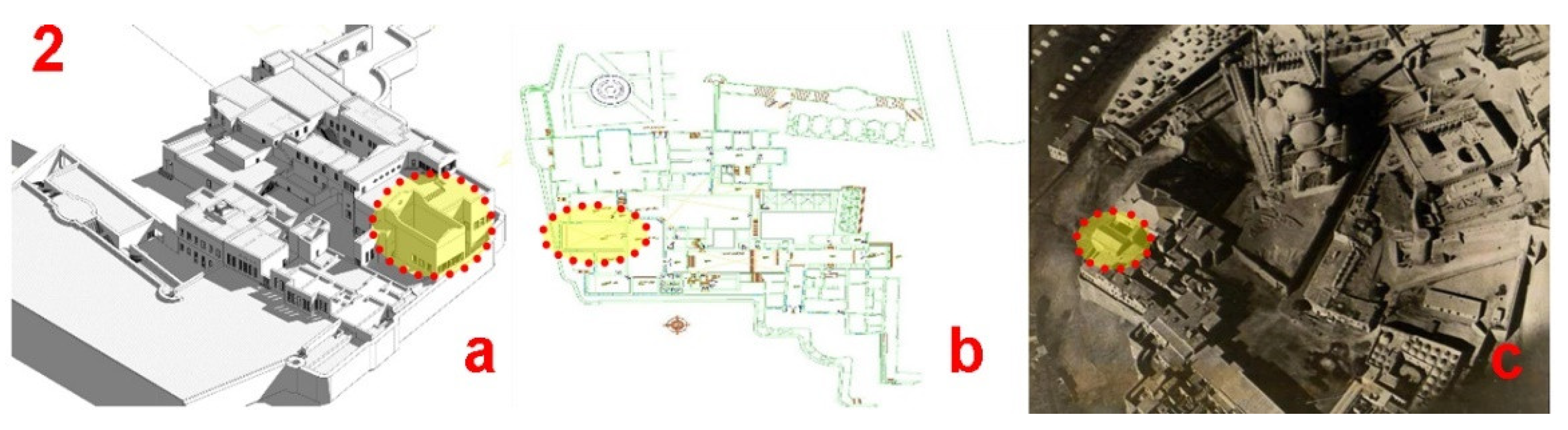
it is a large hall which can be accessed from the middle door where we can read the statement that says (allah is the guardian of success) [3,49], this room is also considered the largest room in the palace, one can see remnants of inscriptions on its walls [3,49]. the ceiling of the room is oval with golden inscriptions; representing war, some musical instruments can also be seen with a gilded wooden bundle and a group of fruits [3,49]. the room overlooks salah el-din square, where we can see a good view of cairo; the fustat and the pyramids [3,44,49]. the entrance of the room is a double door located on the west side of the main reception hall. it is a rectangular area of 16.30 m. in length and its width is 11.20 m [3,49]. the room’s western wall has five windows which overlook the outside. likewise, its south wall has three windows overlooking a courtyard. the wall panels in this hall are divided into rectangular panels with various decorations that go beyond the painted trompe loiselle technique [3,42,49]. the ceiling no longer exists as the throne room was badly damaged by the 1972 fire. most of the wall decorations are gone and the wooden ceiling is burnt out. only the remains of one wooden truss remain and they can greatly help in the restoration of this hall. Figure 1 And 2 general planning of al jawhara palace [3,42,49].
Figure 1.
the location of the great throne hall of al-jawhara palace.
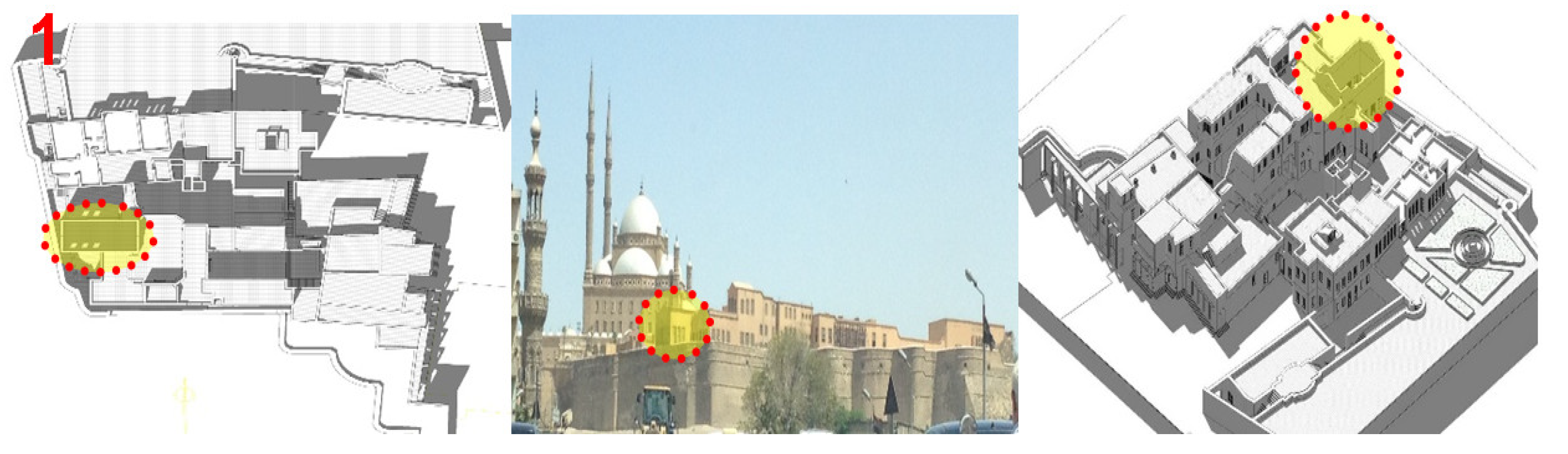
Figure 2.
a. a perspective of the current state of al-jawhara palace shows the absence of a trussable ceiling for the great throne hall. b. the horizontal projection of al-jawhara palace and the great throne hall on the western side. c. an aerial photograph before the 1972 fire of al-jawhara palace shows the presence of the trussable ceiling of the great throne hall.
Figure 2.
a. a perspective of the current state of al-jawhara palace shows the absence of a trussable ceiling for the great throne hall. b. the horizontal projection of al-jawhara palace and the great throne hall on the western side. c. an aerial photograph before the 1972 fire of al-jawhara palace shows the presence of the trussable ceiling of the great throne hall.
3. The Geological Nature of the Area
from the geological point of view, the area is generally considered an area of deposits of materials transported by natural and atmospheric factors (illusions) and consists of clay intrusions and heterogeneous granular and stony sediments [32,36]. on the other hand, the soil formations fall within the mokattam formation deposits, and it consists of two parts, the lower part is from the upper lutetian age and the upper part is from the lower bartonian age. it is composed of brown limestone overlaps [32,36].
4. Factors Affecting the Deterioration of the Great Throne Hall
4.1. Natural Factors
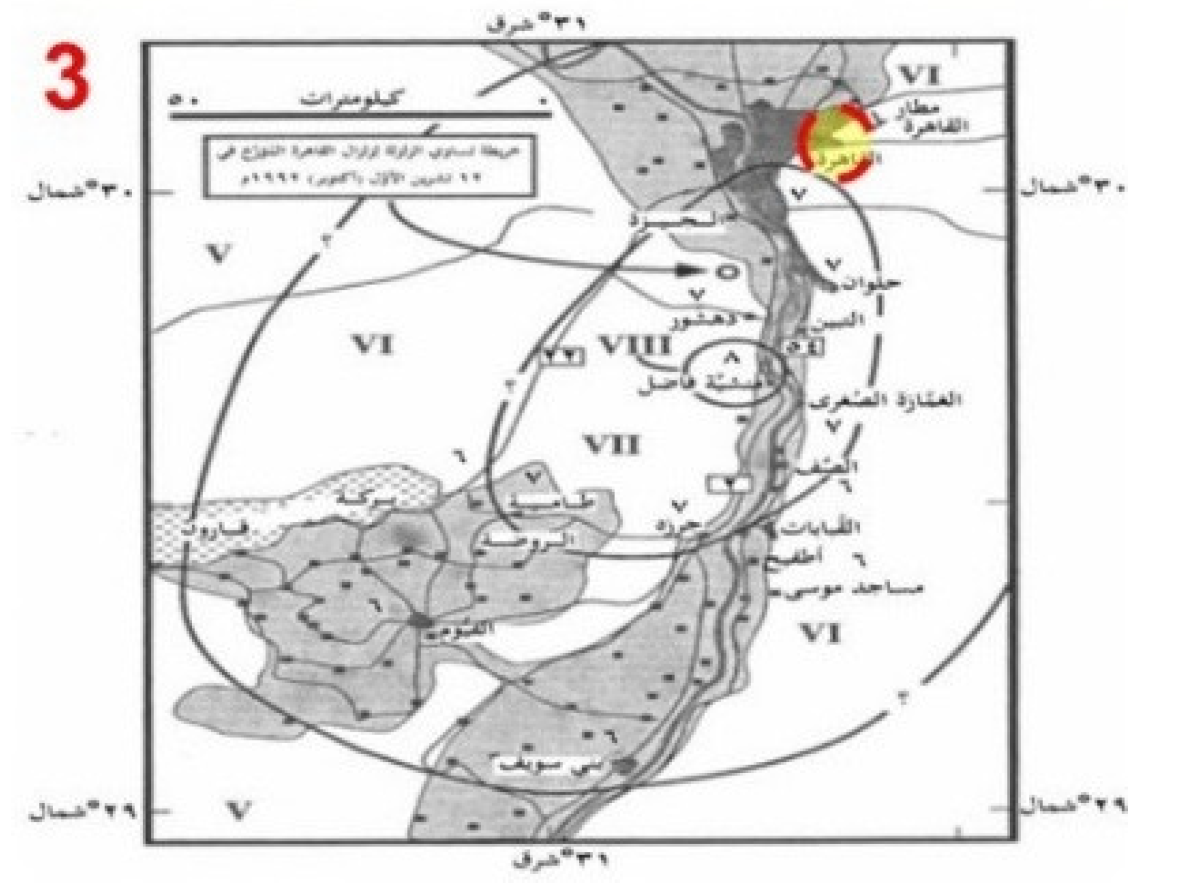
earthquakes, winds, soil subsidence, as well as biological factors. Figure 3.
Figure 3.
map of the 1992 earthquake and its impact on the great throne hall.
4.2. Human Factors
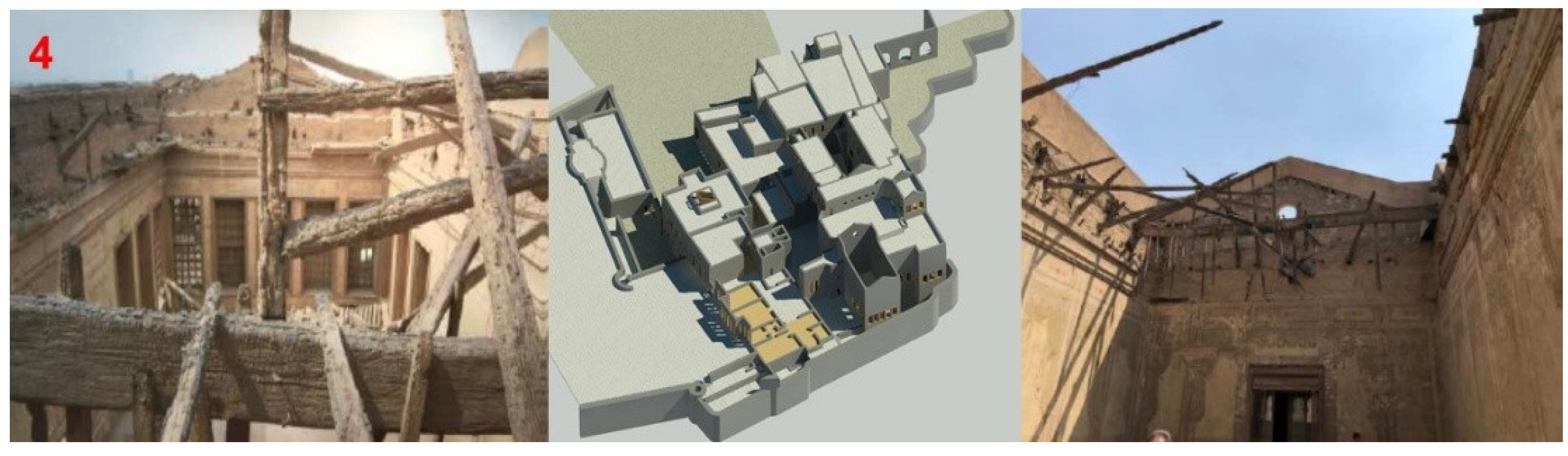
- the fire in 1972 that destroyed the truss and the false ceiling figure. 4.
- deterioration of the means of drainage and nutrition, which leads to water leakage.
- pollution from workshops, factories, car exhaust, and encroachment of buildings near the castle.
- inconsistency between the agencies supervising the historical buildings.
Figure 4.
the fire of the truss roof of the throne hall in 1972.
5. Structural Study for Restoration and Consolidation
5.1. Building Pattern and Configureuration Elements
the palace is distinguished by the fact that its units are asymmetric and have different levels of floors on the vertical plane [3,44]; it indicates the asymmetry of the circumstances and layers of foundation for the palace units. the buildings are covered in some parts with roofs in the egyptian style [42,49], and other parts with roofs of more than a mile in the turkish style [3,49].
5.2. Structure of the Great Throne Hall
the style of construction is affected by the art of architecture currently, which depends on the load-bearing walls [8,16], which depends on its structural balance on the stone walls bearing the ceilings, and the loads are transmitted through the walls to the foundations. mamluk buildings [3,4,7], and in some parts, wooden frames and walls were combined to increase the rigidity and flexibility of the buildings [1,3], with the use of mortar for insulation. and the ceilings are flat wooden interior and exterior is a wooden truss [1,12,16].
5.3. Previous Stages of the Restoration of Al-Jawhara Palace
the palace went through two important stages of restoration [3,49]: the first stage: in the year 1824 ad during the reign of muhammad ali [3], after the fire of the castle, the al-jawhara palace was destroyed and completely reconstructed and restored [49]. the second phase: in 1983, some minor repairs were carried out in some parts of al-jawhara palace [3]. it was a simple process of painting, drawing, and decorations [49].
6. A Study of the Most Important Manifestations of Damage in the Great throne Hall and the Reasons that Led to Its Emergence and Its Current and Future Impact
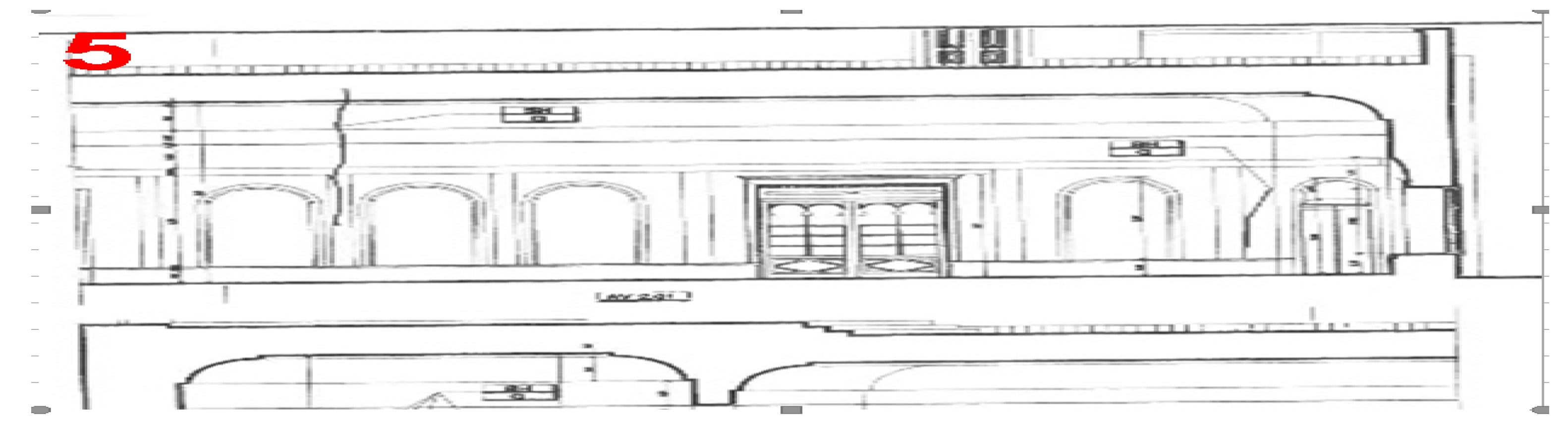
6.1. The Cracks in the Structure of the Great throne Hall Figure 5
carved limestone was used in the construction of the walls and foundations [52], in courses stacked on the load-bearing walls system, and bricks were used in the construction of the upper parts [35]. the observed cracks are limited to the crushing of the adhesive mortar for stones of different types (mud mortar, gypsum mortar, lime mortar, and tile due to natural and atmospheric factors and the effect of humidity and rain [32], as well as the occurrence of erosion and erosion of parts of the stones due to the deposition of salts on them by the influence of weather factors such as rain [31], wind and dust in addition. to the emergence of vertical, horizontal, and inclined cracks in the walls and their locations were limited [3].
Figure 5.
damage to the wall of the door of the great throne hall from the outside.
6.2. Analysis of the Causes of Cracking of the Structure
- on the other hand, the earthquake in 1992 helped to cause cracks and the inclination of some marble columns in the facade of the palace. it also led to the separation of large parts of the walls and the creation of deep cracks in them. the earthquake helped move the soil between the eastern and western parts of the building, in addition to the different conditions of foundation over old foundations or over heterogeneous stone layers between the two parts (eastern and western) [3].
- it also helped to descend the foundation layers, a defect in the sewage lines adjacent to the palace and the leakage of sewage water and the harmful salt it carries to the ground and to the foundation layers of buildings, which include a percentage of water-vulnerable clay soil [49].
- the presence of the foundations on shallow depths and their reliance on old buildings that were built and presented in earlier stages also on deep layers of backfill that include the clay child, which is known to be susceptible to water, and has helped to be severely affected by the water leaking from rain and garden irrigation, as well as the water leaking from the sewage network dilapidated health .
- there is a difference in the nature of the soil bearing the foundations of the palace units; as the nature of the soil for the western part of the palace is coherent soil because it is located on the slope of the mountain. it differs from the nature of the soil in the eastern part, which is located on weak backfill layers that were affected by the leaking ground water. in addition, the foundations of the units were built in the depth of the units on the remains of old buildings that had previously been demolished [3].
- there is a difference in the levels of the floors of the buildings that descend from west to east, and therefore the different levels of foundation for the palace buildings between the eastern and western parts have doubled the impact of the earthquakes with successive earthquakes and the horizontal forces they caused in the ground, which helped the foundation layers to crawl under the building units [49].
- on the other hand, the western part of the palace is surrounded by the old walls of the citadel, which extends to the depth, and led to the escaping of the soil in this part, while the eastern part is surrounded by empty spaces used in planting green areas and thus saturation of the soil with water, which helped to find loose soil in this parts, thus led to the movement of the layers of the earth from the solid part ruled by the old walls extending to the depth to the soft part at the east, especially after the occurrence of ground movements in the 1992 ad earthquake [3].
- a gap of about 5.00 m in diameter and 4.00 m in depth was detected in the space area of the northeastern corner outside the palace area, which confirms our analysis of the high items of the movement of the earth and the difference in the nature of the soil between the eastern and western parts of the area under study [3,49].
- it is not possible to detect the foundations at their full length below the walls, so when starting the repair, exploratory excavations must be made at different distances along the walls in areas where there are cracks in the walls above [25].
6.3. Renovation Steps for Walls and Their Foundations
restoration of the internal and external walls is carried out after the completion of the restoration of the associated foundations according to their condition and to determine the expected places for cracks in the foundations or soil. exploration on both sides of the wall from the inside and outside in the form of a trench until reaching the foundation level of the wall and considering that the excavation is carried out along the length of the wall in stages so that the length of each stage does not exceed 3.00 m [26].
6.4. Restoration Works of Walls and Their Associated Foundations
6.4.1. Repair Work for Cracks in the Walls [30]
- simple lattice cracks that appeared with layers of whiteness, and these cracks must be detected to determine the extent of their continuity in the buildings themselves. its components are with the original stones and mortar, and the necessary tests must be done on the components and on the mortar mixture [35].
- small-thickness window cracks in the walls (less than 50 cm) and are repaired by stitching on one side using wooden segments and fillers from the same mortar referred to. installing the stone itself or, if necessary, an alternative stone, according to the details shown on the plates, or with alternative details. it also includes the injection between the sectors at the full depth of the wall [5,37].
- large thick window cracks in the walls are buttoned from both sides [39].
- if the wooden beam is cracked inside the walls, especially in the places of the threshold, in this case it is replaced with a similar beam [40].
6.4.2. Treatment of Cracks on the Corners
the corner cacks are repaired with the aim of achieving interconnection between the perpendicular walls by placing wood veins according to what is shown in the paintings and re-filling the voids with non-shrinkable mortar according to the previous item and injecting around the wood according to the technical principles. the injection work includes the distance between the fixing panels and the entire wall sector [10].
6.4.3. Wall Strengthening Works by Replacing or Removing Stones or Bricks
- the dilapidated walls shall be dismantled while preserving the sound stones and storing them in a safe place in accordance with the principles of stowing until re-installation. the item includes steel and reinforcement works approved by the consultant and the transfer of waste to public landfills [9,50].
- use suitable mortar based on test results and material specification recommendations [11].
- the stones are reconstructed in their original places according to the principles of industry by maintaining the original dimensions and levels [40].
- cracked or damaged stones shall be replaced with new stones according to specifications [13].
6.5. Foundation restoration
6.5.1. Examination of a Sample of the Foundations
the foundations, which are at a depth of 1.75 m from the surface of the earth, consist of layers of white dachshund with a thickness of 30 cm, and a layer of stones with a thickness of 60 cm. it was demolished, as it was found that the walls are based on limestone buildings with a thickness of 130 cm. the following foundation restoration works are carried out for foundations in places where window cracks have been detected in walls, ceilings, or floors [3].
6.5.2. Corrosion and Damage to Some Components
the foundation is injected with an appropriate mortar and the injection extends to the lower part of the anchored wall. on the foundations using a suitable mortar that includes shortbread, coal, and lime. the components, mixing the mortar and studying its homogeneity with the original stones and mortars are injected through holes in the groove in the wall body using a pump under no pressure. more than 12 bars - the injection extends to a depth of half the thickness of the wall. it must be calculated from the injection stages in each of the stages, at a height of 1.00 m, starting with the bottom of the wall and moving upwards [35,50].
6.5.3. Case of Subsidence and Disintegration of the Foundation Layer below the Foundations
especially in the foundation areas over the remains of old foundations or backfill consisting of broken stone and weak clay loam soil. in this case, excavation is carried out on both sides of the walls in this area, while preserving the presence of solids or making a steel system to support the walls and contracts with the following: the soil is injected under the walls with an appropriate mortar of cement, considering that it is deep, injecting into the soil not less than 2.00 m (the components of the mortar must be approved by the consultant before work) and the injection area is determined using micropillars on both sides, preliminary injection tests must be carried out outside the building boundaries to determine the type and quantity of injection materials, which consist mainly of cement and water in a ratio of 1:1, to which 5:10% of bentonite is added, the injection should not be used under high pressure, but it can be injected using a medium pressure of about 6 bar, and its effect is observed in nature. in all cases, the injection pressure should not exceed the vertical loads to which the walls are exposed, consider that the width of the injected part of the soil below the walls is not less than twice the width of the wall or a width of more than 0.75 m from each side outside the wall [37,52], the origin must be monitored during the injection to notice any movement in the walls and ceilings.
6.5.4. Preventing Soil Movement by Implementing Curtain Piling
in view of the different soil conditions and based on what was extracted from the possibilities of soil encroachment between the eastern and western parts, a curtain of concrete piles is implemented separating the eastern and western borders to a depth of 6 m and according to the technical requirements based on the results of the probes and field tests carried out [44,51].
6.6. Restoration of the Truss of the Great Throne Hall
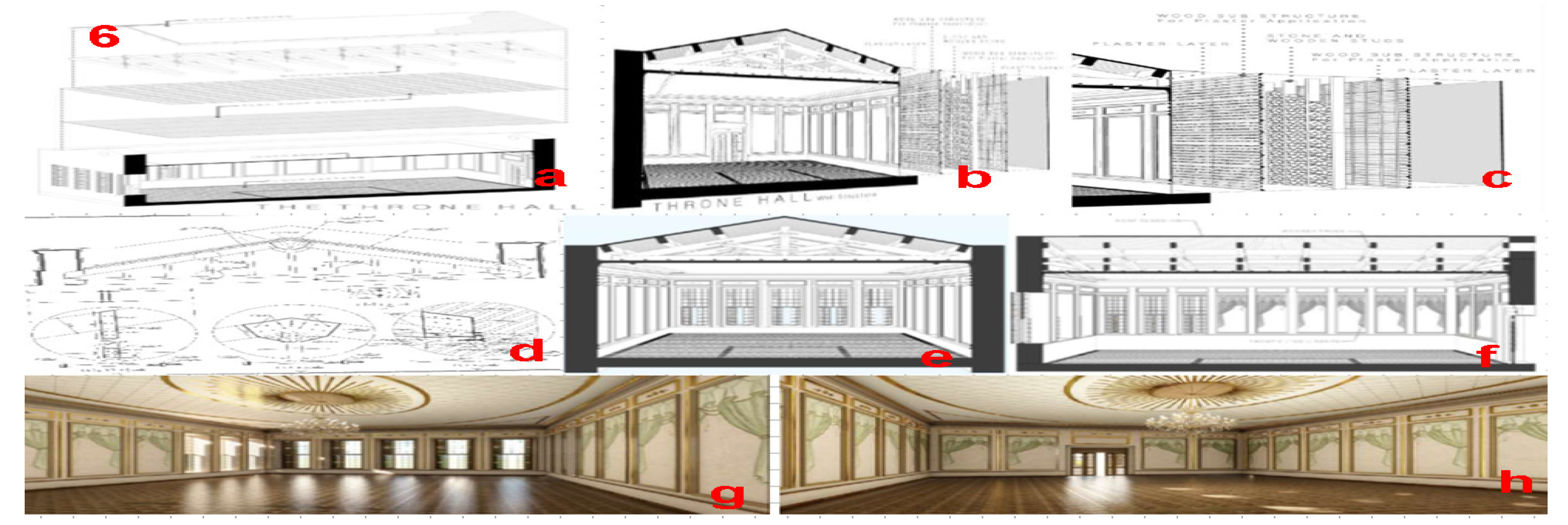
wooden ceilings in which insect infestations appeared. the restoration process for wood is summarized in the following steps: removing the floor layers to replace the wooden beam, steel the ceilings around the beam to remove the loads from the beam in need of restoration, remove the parts that need restoration and clean them well, the wood is fumigated to ensure that any decay or insects is removed from the inside, the wood is painted with epoxy materials that protect the surface of the wood without affecting its natural properties or its archaeological appearance so as not to block the ventilation pores of the wood, the truss of the great throne hall is being re-implemented with the same original sectors [48,52], according to the structural design with the attached panels figure. 6 and figure. 7.
Figure 6.
a. it shows the method and layers of rebuilding the ceiling of the throne room.
- b.
- reconstruction of the wall shows layers. the app as an example of the throne room.
- c.
- sectional perspectives showing the reconstruction of the ceiling of the throne hall and the baghdadli ceiling below.
- d.
- longitudinal sectional perspective showing the reconstruction of the throne room.
- e.
- reconstructioning sketch of the windows facing the throne room.
- f.
- reconstructioning a drawing of the great throne hall truss.
- g.
- reconstructioning sketch of the throne room for the entrance wall.
- h.
- reconstructioning sketch of the throne room facing the entrance.
Figure 7.
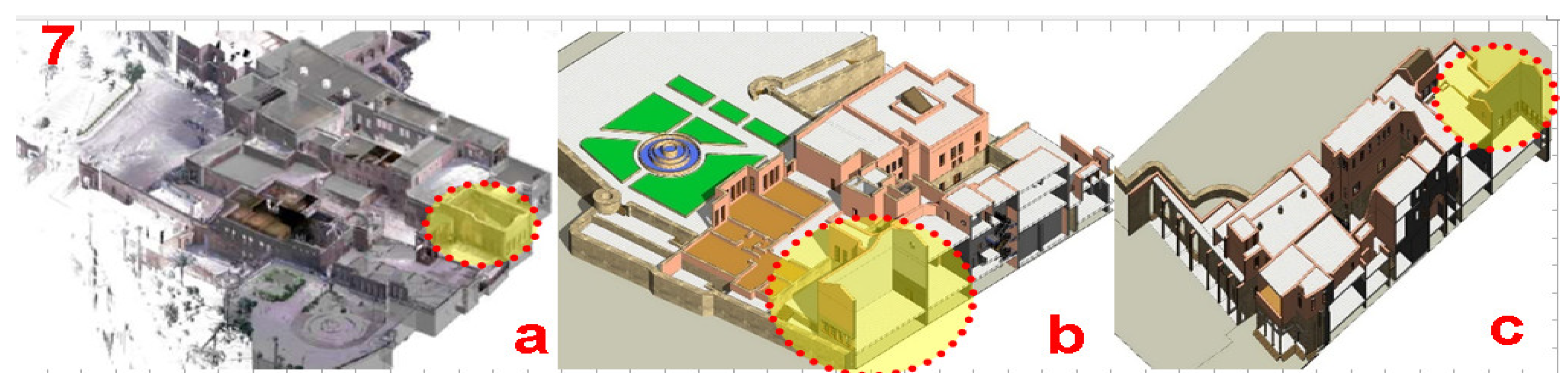
a. 3d model of al-jawhara palace and the great throne hall. b. longitudinal sectors of a perspective passing through the throne room, the guesthouse, and the entrance block from the north (marine) side. c. longitudinal sectors of perspective passing through the throne hall, the guesthouse, and the entrance block from the south (the tribal) side.
Figure 7.
a. 3d model of al-jawhara palace and the great throne hall. b. longitudinal sectors of a perspective passing through the throne room, the guesthouse, and the entrance block from the north (marine) side. c. longitudinal sectors of perspective passing through the throne hall, the guesthouse, and the entrance block from the south (the tribal) side.
7. Tests and Results
7.1. Field, Laboratory, and Electrical Tests of Soil
through the tests, the nature of the soil at different depths was known, its natural and mechanical properties were tested, and its homogeneity was studied at the vertical and horizontal levels, with the aim of knowing the nature of soil formations below the foundation level and analyzing the causes of cracking and subsidence of the soil under the foundations [49].
7.1.1. Laboratory Test Results
7.1.1.1. Fracture Stress Determination Experiments
fracture stress experiments were carried out on cylindrical samples of limestone layers after a depth of 12.00 m, and it was found that the continuous samples greater than 15 cm give a fracture stress ranging between 50: 75 kg/cm2 [49].
7.1.1.2. Extraction Ratio Determination (rec) and Stone Continuity (Rod) Experiments
the extraction ratio was measured as well as the degree of stone continuity of the stone samples with the basic natural soil layers at the depths of the first pallet. the samples showed that the extraction ratio (rec) of the ground layers for the stone samples was 30 to 55, while the percentage of the stone samples (rod) ranged between 22 and 40. signing these results on the sector of the first session. atterberg limits tests, which are the average limits of fluidity and plasticity, and the average plasticity coefficient of the samples taken from the clay interactions between depths (4-6) m, were carried out and gave the following results:
average liquidity limit = 52:63, average modulus of plasticity = 28:32, average limit of plasticity = 24:31 [3].
7.1.1.3. Free swell test results
7.1.1.4. Chemical analysis
the chemical analysis was carried out on a sample of the soil solution at a depth of (3.00:4.00) m - to determine the percentage of salts affecting the concrete foundations, namely chloride and sulfate salts, as well as the percentage of total salts dissolved in water and the degree of acidity and alkalinity of the soil [49].
7.1.1.5. Underground Geoelectrical Testing
7.1.2. Curves and Spheres Monitoring Results [3,49]
- no caves or voids appeared in the ground up to a depth of 10.00 m in the measurement areas, and they appeared in other places with open digging.
- heterogeneity of soil layers at the horizontal level.
- soil layers were monitored to a depth of 10.00 m. they consist in some areas of calcareous clay components, which are areas that gave values of resistance to current ranging between (30-60) ohms.
- these superficial clay deposits cover the basic bottom of the foundation of the soil layers, which is limestone, and it is the basic soil on which castle was built.
7.1.3. Results of Probes and Nature of Soil Formations
examination and classification of samples extracted from the first palpation showed that the land consists of a surface cover of backfill with a thickness of 3 meters consisting of silt mud mixed with broken stones, followed by layers of heterogeneous backfill and consists of broken stones and clay loam soil continues to a depth of 11.20 meters and the natural layers appear starting from this depth they are layers of limestone with intertwined calcareous soils and continue until the end of the depth of the panel at a depth of 15 meters. on the other hand, the surveys (2,3) showed that the land consists of a surface cover of backfill consisting of a mixture of silt sand and broken stones that continue to a depth of 8 meters in the place of the second body and up to a depth of 4 meters in the place of the third body. the presence of buildings consisting of stone blocks at al-jissah site [3].
7.1.4. Study and Testing of Building Materials Used in the Great Throne Hall
7.1.5. Red Bricks Are Used in Building Walls
1. Results of Mineral Analysis Using an X-ray Machine
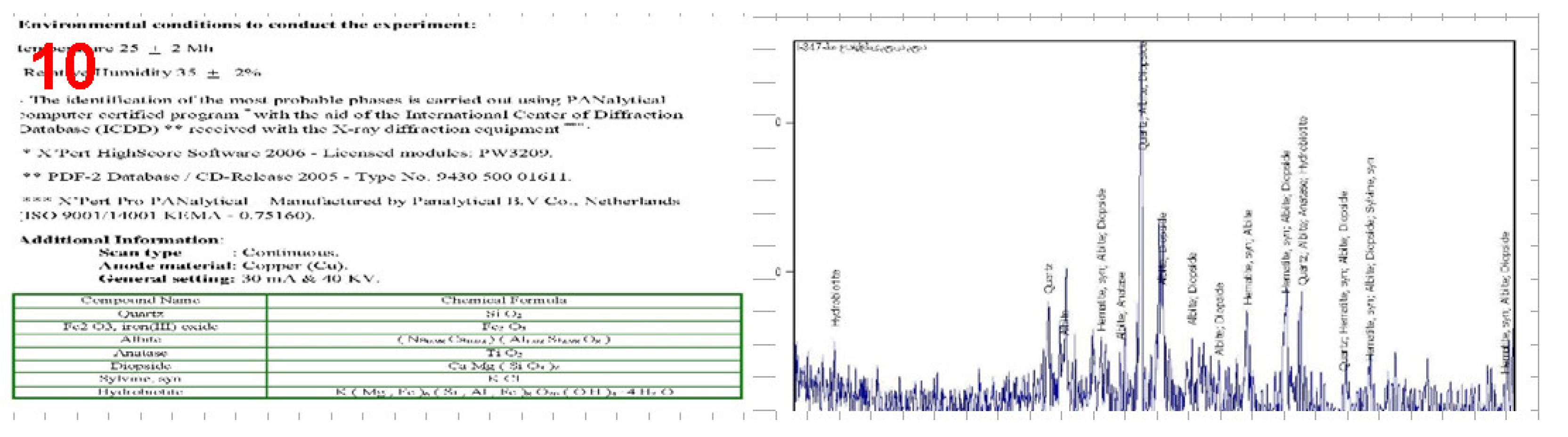
the analysis was carried out on a sample of red bricks used in double-walled walls, and the results were as follows: it was found that it consists mainly of quartz, in addition to a percentage of albite and diapsid.
2. Results of Mechanical Tests (Tensile, Shear, Pressure)
three samples of red bricks used in the construction of double-walled walls were prepared with the dimensions shown, and each sample was placed separately to give the following results:
- A.
- tensile test
each sample was placed separately in a tensile test device and the indirect force was gradually increased until collapse or fracture, and the result was as follows: maximum load 1035 n, tensile force 0.40 n/mm2 Table 2
- B.
- 2. shear test
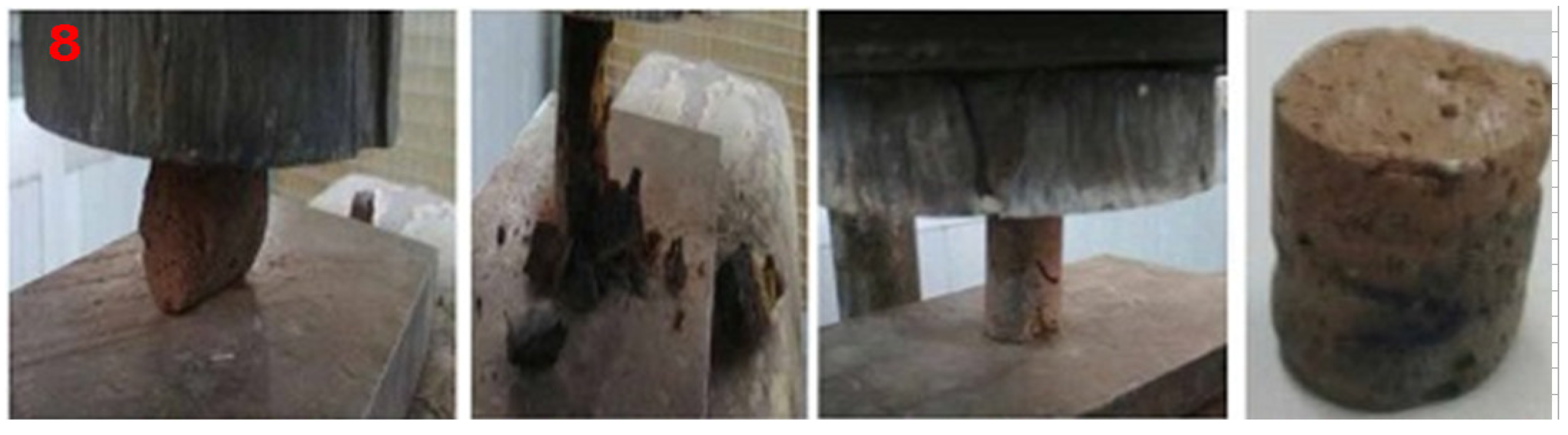
each sample was separately placed in a shear test device to determine the extent of the resistance to shear stress that it could be exposed to. the effective force was gradually increased until collapse or fracture, and the result was as follows: maximum load 3110 newton, shear force 4.6 n/mm2. Table 3 and figure. 8.
Figure 8.
devices used in tensile, compression and shear testing on the bricks used.
- C.
- pressure test
each sample was placed separately in a pressure test device so that the pressure affecting the sample from the device is parallel to the vertical axis of the cylindrical sample to measure the longitudinal pressure stress corresponding to the effective compressive force. pressure 7.3 n \ mm2. Table 4 and figure. 9
Figure 9.
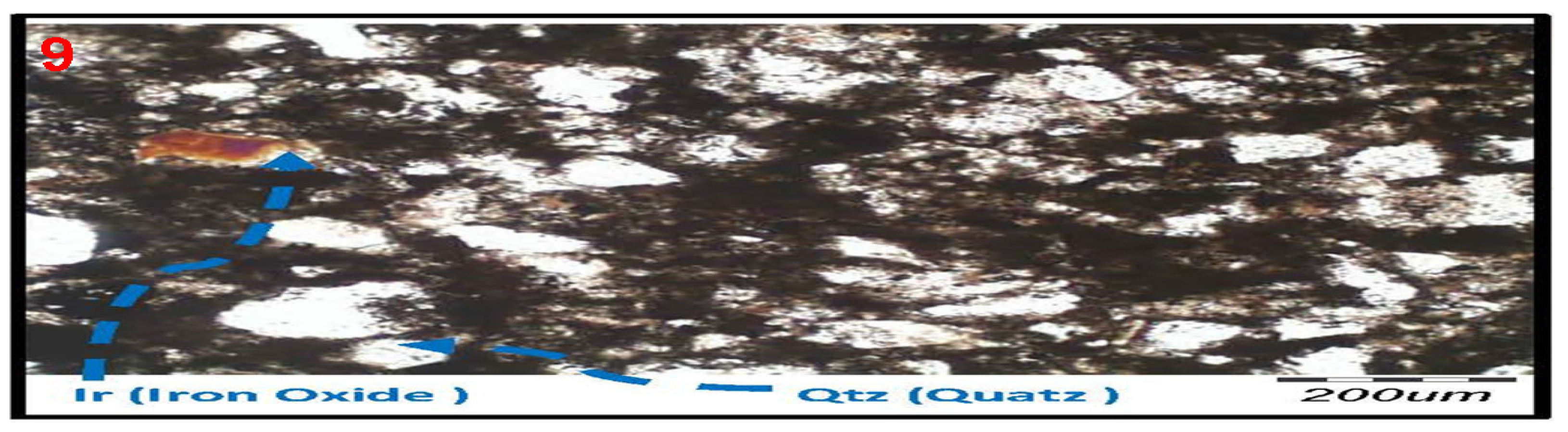
the red brick samples used on the thin section in the analysis by x-ray diffraction.
- D.
- xrd polarized microscopy
the brick sample consists of quartz crystals, and the sample floor consists of iron oxide and some other minerals such as diopside and sylvinc, syn, as it appeared by examining the sample. and there are no traces or evidence of visible damage to the sample of the studied bricks figure. 10.
Figure 10.
the result of the xrd polarized microscopy test on the bricks used.
7.1.6. Stone is Used in Building Walls
A. Mineral Analysis Results Using an X-ray Machine
the analysis was carried out on a sample of the stone used in the two-paper walls, and the results were as follows:
it was found that it consists mainly of calcite and quartz minerals.
B. Results of Mechanical Tests (Tensile, Shear, Pressure)
three samples of the stone used in the construction of the two-layer walls were prepared with dimensions and each sample was placed separately to give the following results:
C. 1. Tensile Test
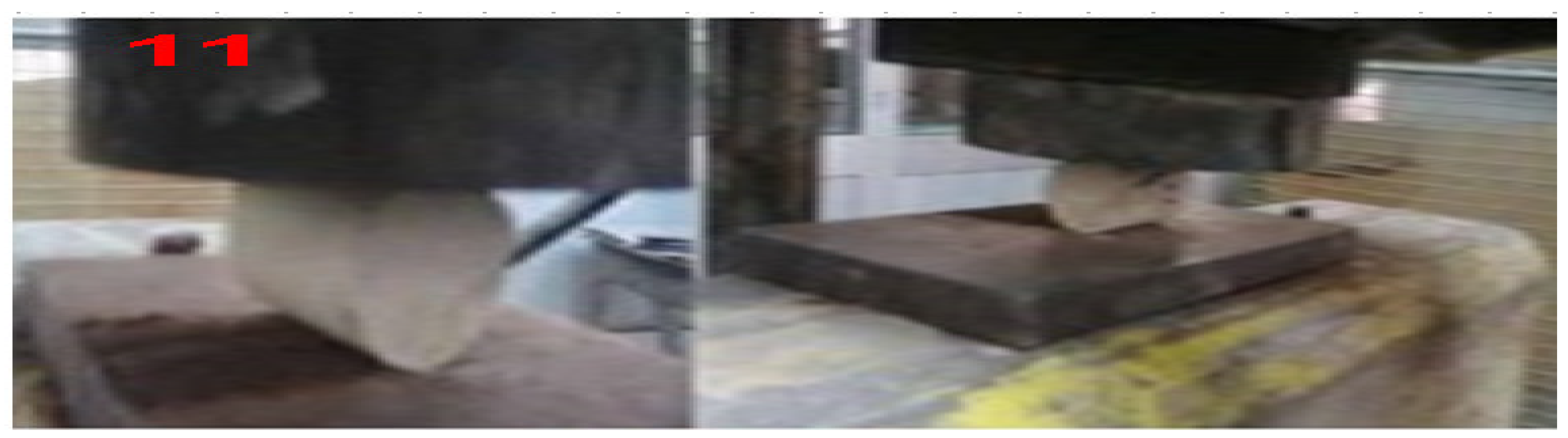
each sample was placed separately in a tensile test device and the effective force was gradually increased indirectly until collapse or fracture, and the result was as follows: the maximum load is 3790 n, the tensile force is 0.98 n/mm2. Table 5 and figure. 11.
Figure 11.
devices used in tensile testing on the limestone used.
D. 2. Shear Test
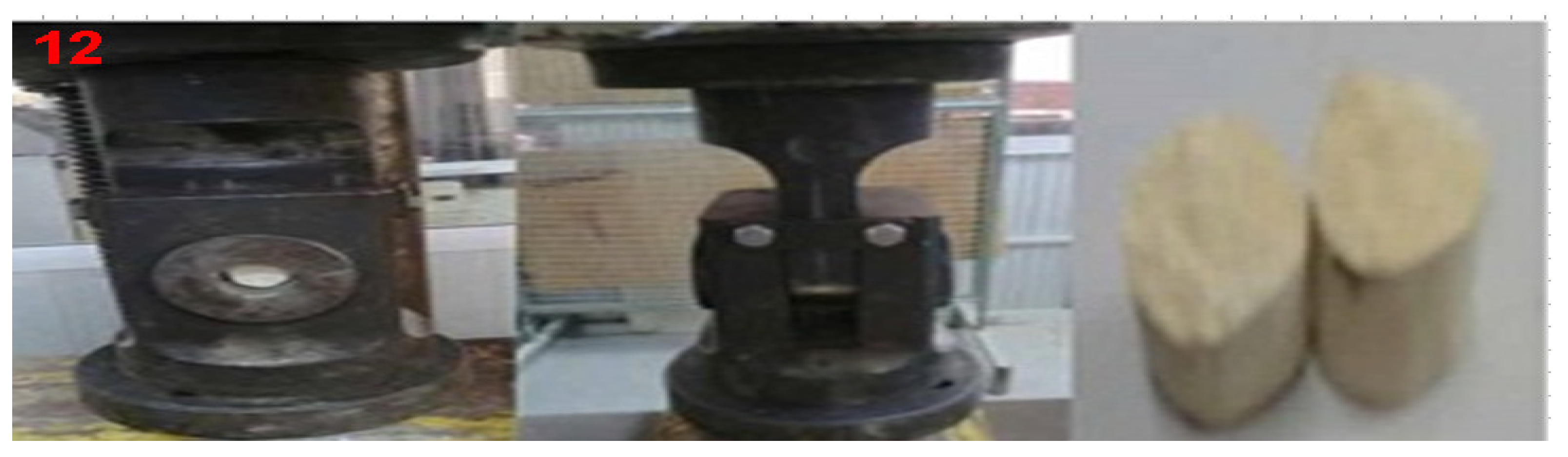
each sample was separately placed in a shear test device to determine the extent of resistance to shear stress that it could be exposed to. the effective force gradually increased until collapse or fracture, and the result was as follows: maximum load 16300 newton, shear force 12. 4 n/mm2. Table 6 and figure. 12.
Figure 12.
devices used in the pressure test on the limestone used.
E. 3. Pressure Test
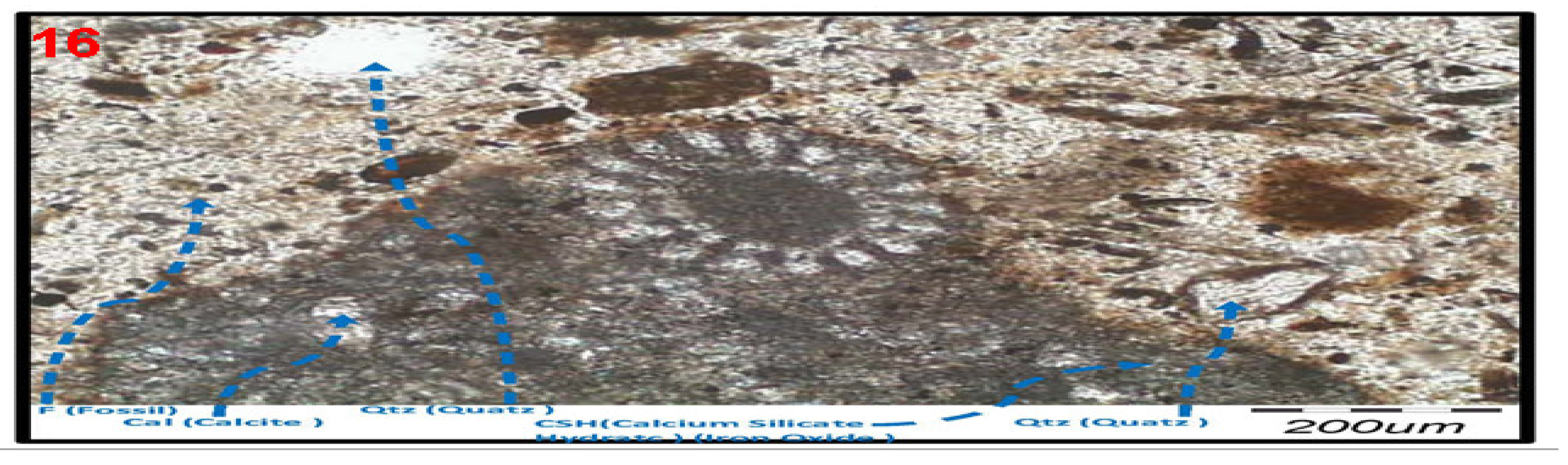
each sample was placed separately in a pressure test device so that the pressure affecting the sample from the device is parallel to the vertical axis of the cylindrical sample to measure the longitudinal pressure stress corresponding to the effective pressure force. pressure 5. 2 n \ mm2. Table 7 and figure. 13, figure. 14, figure. 15 and figure. 16.
Figure 13.
devices used in the pressure test on the limestone used.
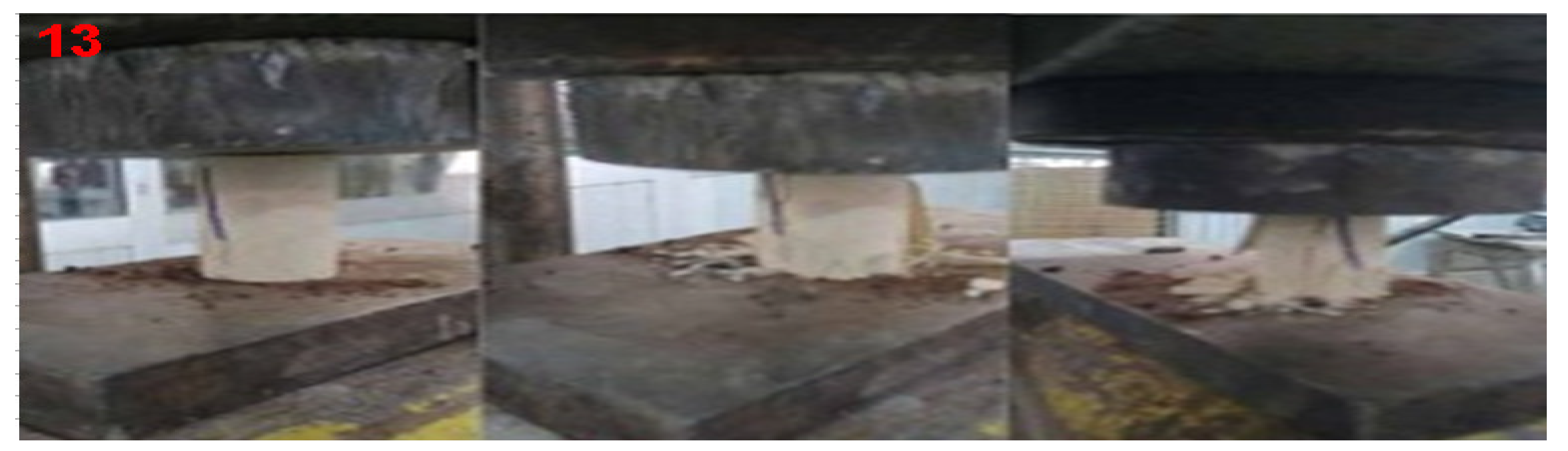
Figure 14.
the result of analysis by x-ray diffraction of stone samples and devices used on the thin section.
Figure 14.
the result of analysis by x-ray diffraction of stone samples and devices used on the thin section.
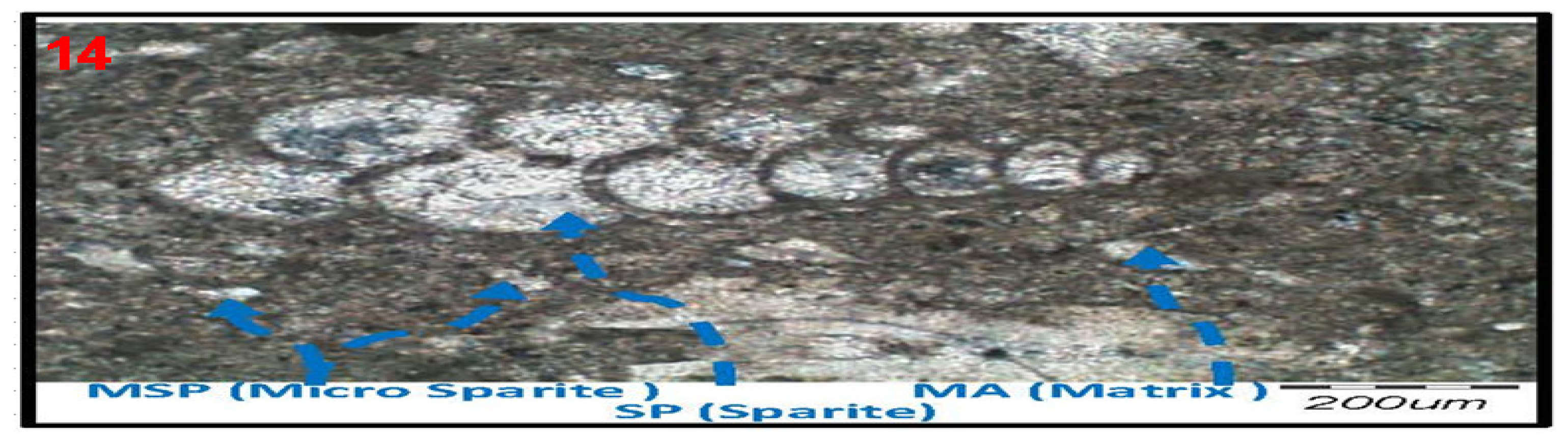
Figure 15.
report showing the analysis by x-ray scattered diffraction on the stone used.
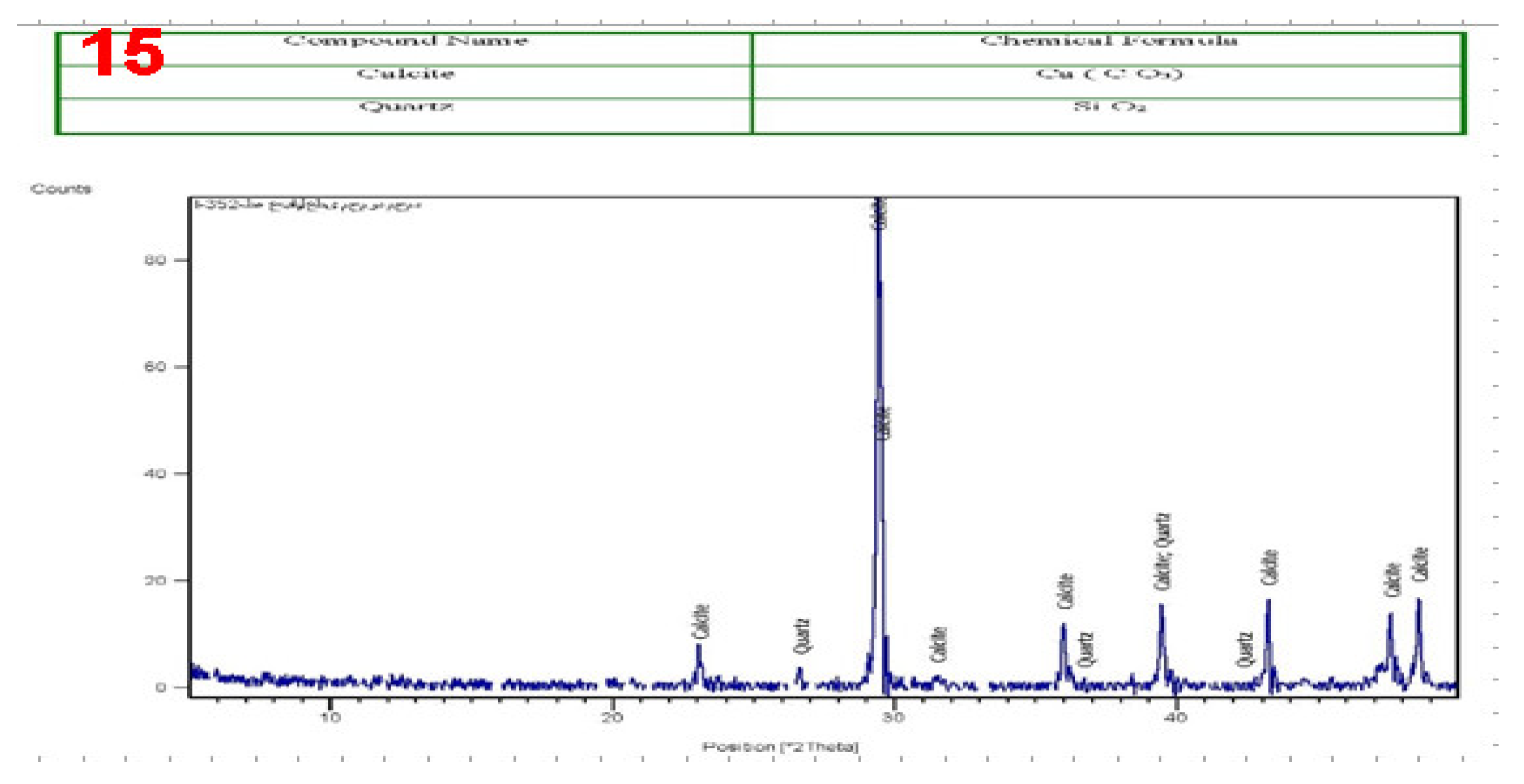
Figure 16.
wall mortar samples used on thin section in x-ray diffraction analysis.
F. Examination by xrd Polarized Microscope
the sample of the limestone under study consists mainly of calcite grains, mostly of the medium-grained type (2:4um), which is called microsparite. the sample also shows the presence of fossils (> 4 um) and the size of sparite or coarse-grained calcite. the sample (matrix) of fine-grained calcite and some silt and studied limestone can be classified as fossil limestone, most of the fossil content of the sample is from foraminifera fossils (foraminifera). there is no clear evidence under the polarizing microscope of damage to the sample.
7.1.7. Double-Sided Grouting Mortar for the Construction of Walls
A. Mineral Analysis Results Using an X-ray Machine
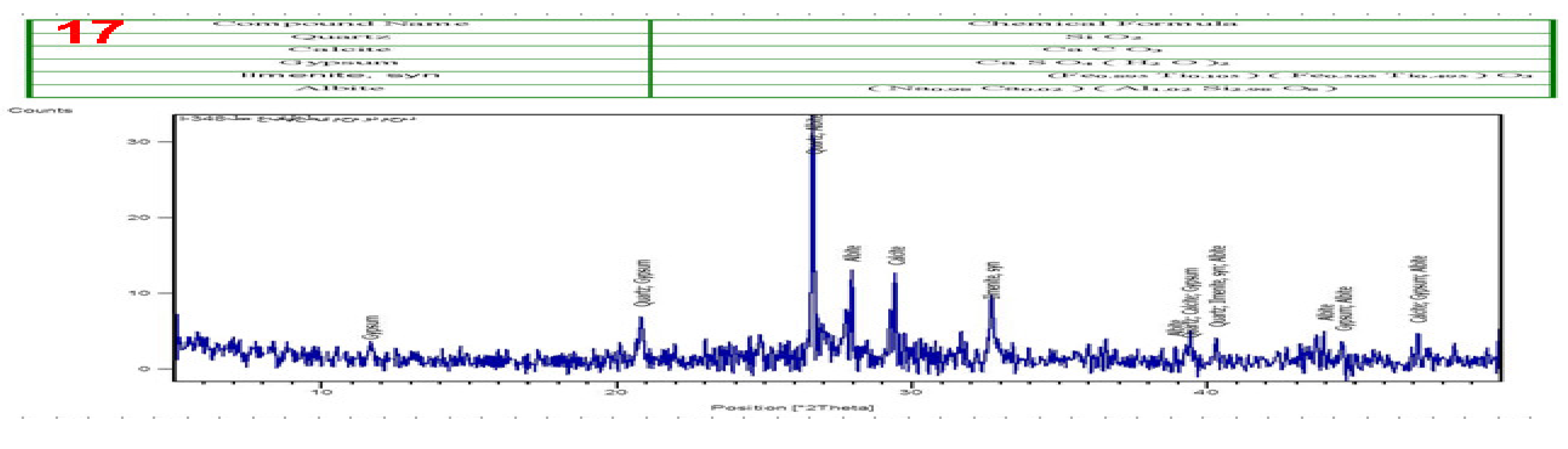
the analysis was carried out on a sample of mortar used in the walls of two sheets, and the results were as follows: it was found that it is mainly composed of quartz, calcite, gypsum, and albite as secondary minerals. figure. 17 and figure. 18.
Figure 17.
analysis by x-ray diffraction on the wall mortar used.
B. Examination by xrd Polarized Microscope
Figure 18.
two-thin wall filler used on thin section in x-ray diffrequency analysis.
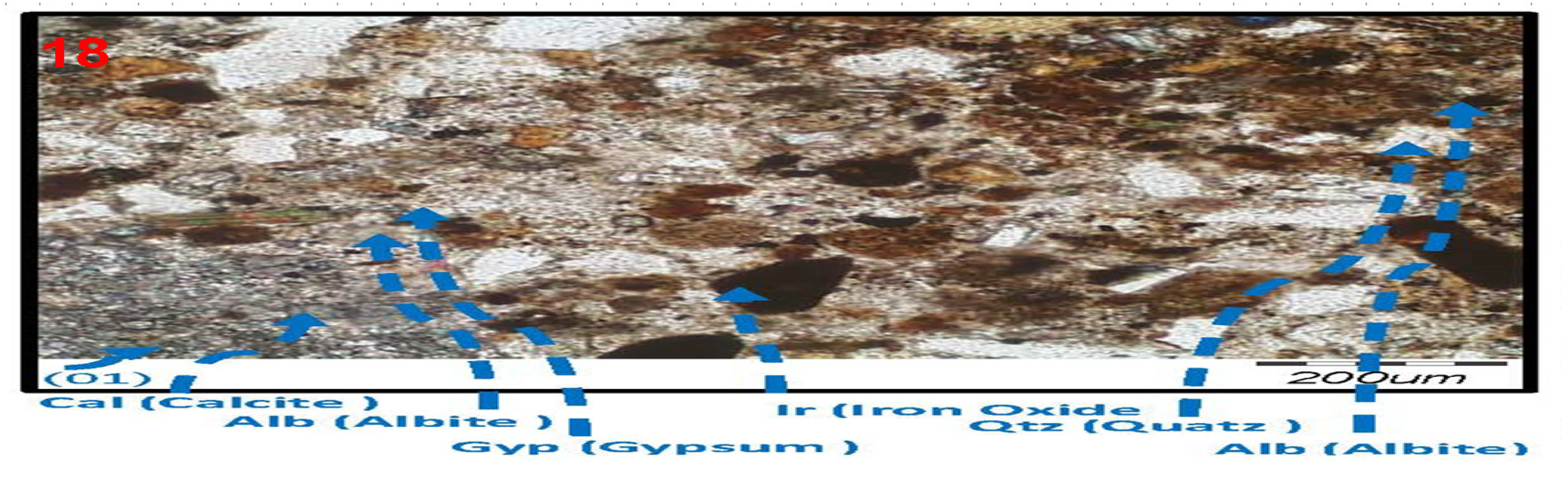
the sample consists of filler mortar of medium quartz grains, in addition to some iron oxides, which were shown by xrd. there are crystals of lite feldspar dispersed in the sample. there is a fine-grained calcite mineral in the lower left part of the picture, indicated by arrow no. (01), and some salts and minerals appear in the sample as ferrous materials. it has no visible signs of damage.
7.1.8. Mortar for Piling Walls
A. Mineral Analysis Results Using an X-ray Machine
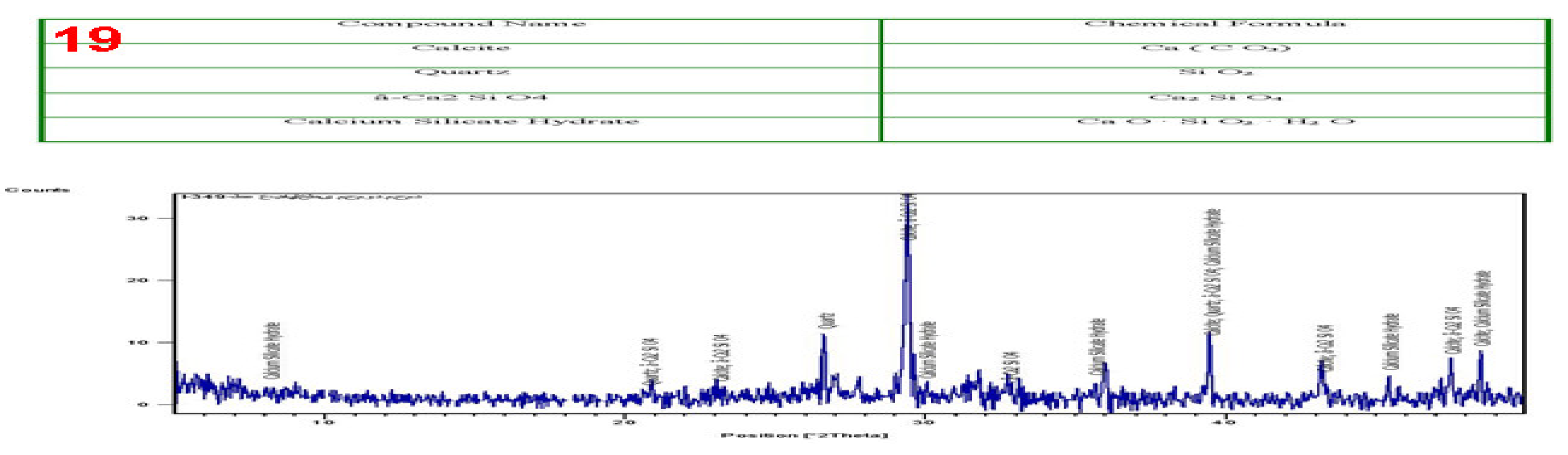
the analysis was carried out on a sample of arborite mortar used in two-paper walls, and the results were as follows: it was found that it consists mainly of calcite, quartz and hydrated calcium silicate as secondary minerals. figure. 19.
Figure 19.
analysis by x-ray diffraction on the wall mortar used.
B. Examination by xrd Polarized Microscope
the study of the sample using a polarizing microscope showed that the honeydew mortar consists mainly of quartz crystals (medium size). the presence of coarse-grained calcite (sparite) grains represented in the fossil and some fine-grained calcite (micrite) forming the floor was also evident. some traces of evaporite minerals appear at the top of the sample. it has been shown that the formation of a welding material as an adhesive product to bind the mortar particles.
7.1.9. Wall Mortar
A. The Results of the Mineral Analysis Using an X-ray Machine
the analysis was carried out on a sample of mortar used on the walls of two sheets, and the results were as follows:
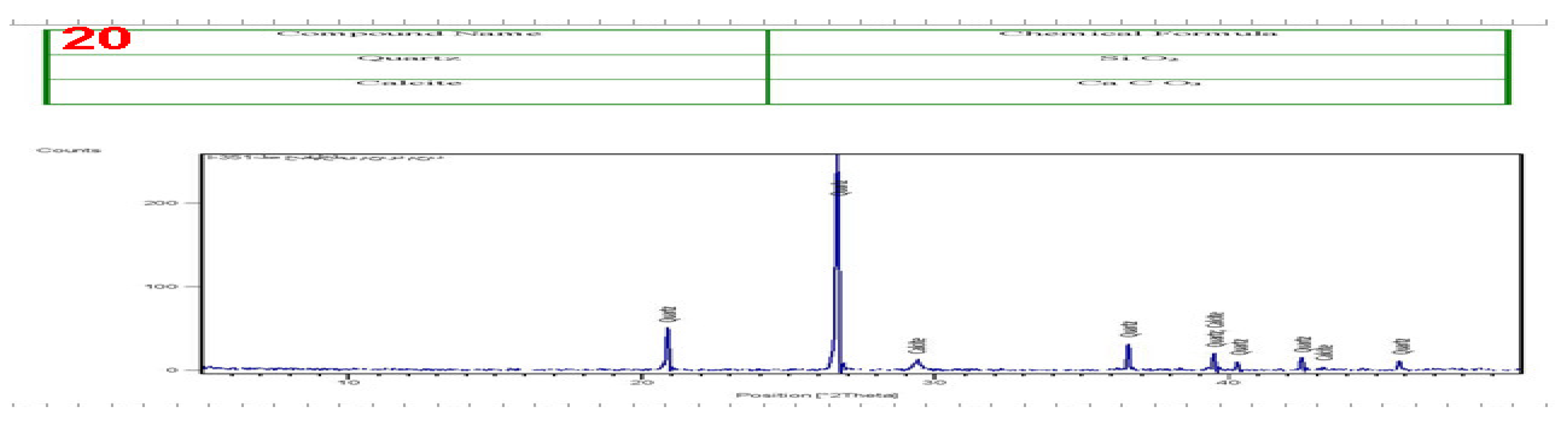
it was found that it is mainly composed of quartz and calcite as a secondary mineral. figure. 20.
Figure 20.
analysis by x-ray diffraction on the mortar of the wall mortar (conch) used.
B. xrd Polarized Microscopy
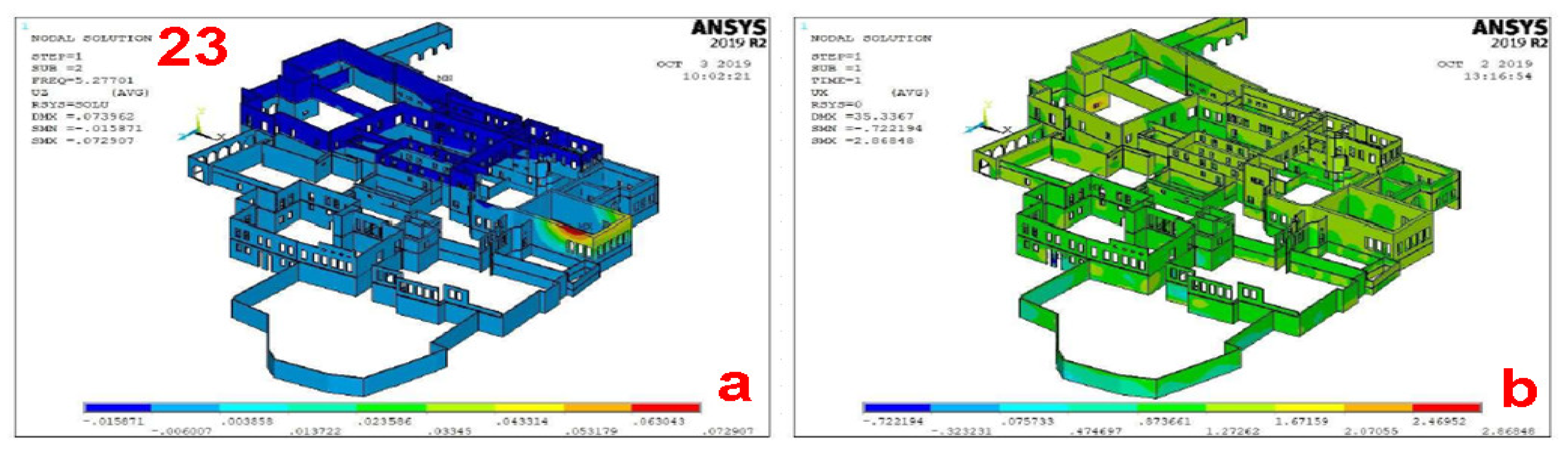
the study of the sample using a polarizing microscope showed that the main component of the studied mortar is quartz grains (filler) of large size with semi-circular shapes, which represent more than 75% of the studied sample. there are some traces of some evaporated minerals (gypsum). there is also a fine-grained calcite as a matrix between the quartz grains. there are some traces of formation of hydrated metabolites on the edges of quartz crystals. figure. 21, figure. 22 and figure. 23
Figure 21.
wall mortar samples (conch) used on thin section in x-ray diffraction analysis.
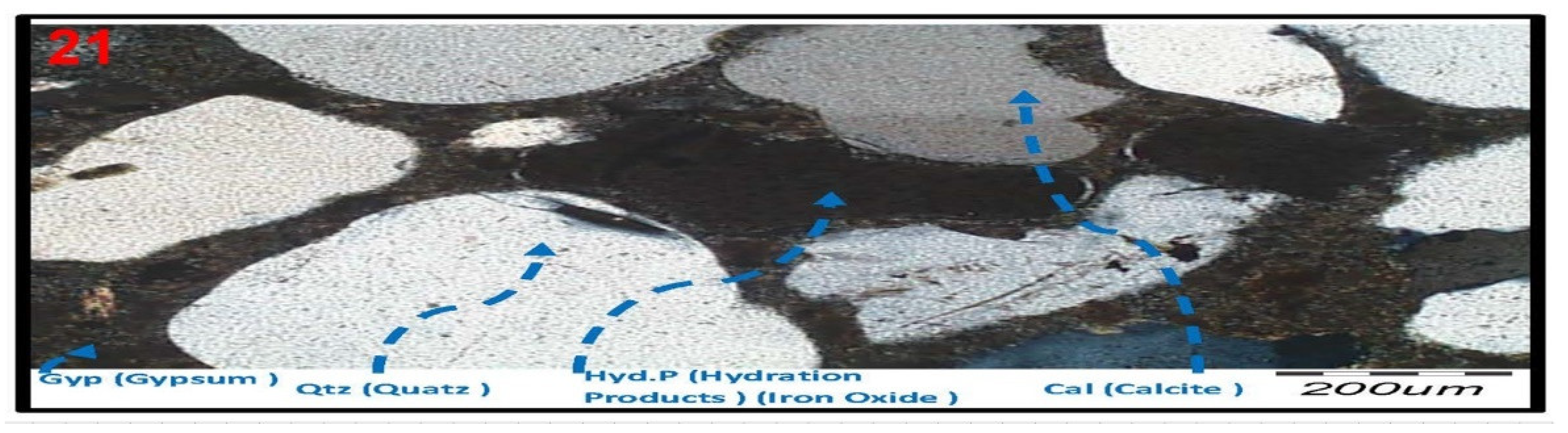
Figure 22.
a. structural models for walls and stairs used in detailed finite element analysis. b. distorted shape of all walls (sum of the displacement vector) under the influence of static loads (mm).
Figure 22.
a. structural models for walls and stairs used in detailed finite element analysis. b. distorted shape of all walls (sum of the displacement vector) under the influence of static loads (mm).
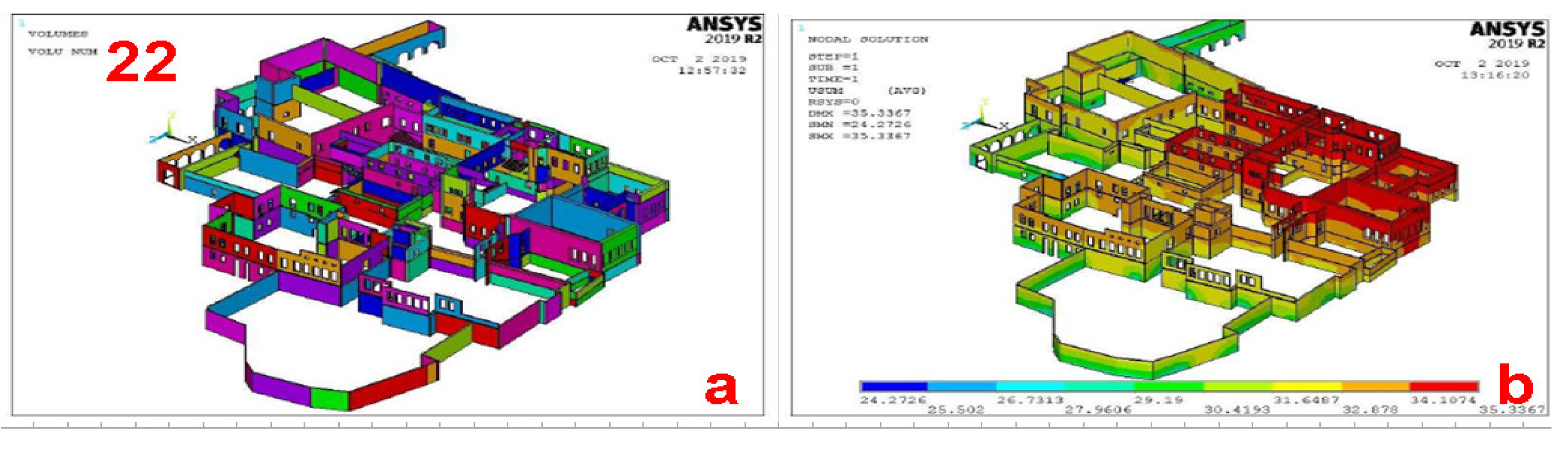
Figure 23.
a. form horizontal deformation (z direction) under the influence of seismic loads in z direction (mm). b. form vertical deformation (y direction) under the influence of seismic loads in the z direction (mm).
Figure 23.
a. form horizontal deformation (z direction) under the influence of seismic loads in z direction (mm). b. form vertical deformation (y direction) under the influence of seismic loads in the z direction (mm).
8. Suggested Solutions for Restoration
the defects and cracks that were monitored can be summarized into two main parts of the building elements in three main items for the cracks: -
1. vertical defects and cracks, including walls and knots.
2. horizontal defects and cracks, including ceilings and foundations.
3. defects in foundations and foundations bearing soils.
based on the study and analysis of these cracks, it was possible to present the methods of restoration and consolidation, as well as the restoration process depends on the extent to which plans and specifications are adhered to, which should be higher than the construction works of new buildings. after completing the studies required to determine the structural elements to be restored, the method of restoration is determined, and it can be summarized for each element as follows:
8.1. Foundations
it consists of stone courses, and through virtual examination, the results of pallets and geoelectrical tests, the following defects were detected:
- you notice a subsidence in the foundations of the al-jawhara palace buildings.
- subsidence in some layers bearing the foundations. the results of electrical detection tests under the palace confirmed the reasons for the decline in the foundations and the causes of cracking due to the different type of soil of the foundation layers and the effect of the movement of water leaking into the ground from rain, agriculture, and sewage.
- decomposition of the bonding mortar, weakness and fracture of the stone courses bearing the foundations under the walls.
- decomposition of the soil itself at the foundation level, especially for the backfill layers or the old foundations.
the field tests, hand probes and examination of the foundation sample revealed the presence of gaps and basements with depths of up to 2.00 m below the ground [3].
the horizontal projection of the ground floor and the great throne hall shows the scattered part of the places of examination on the foundations of the seat of qaitbay and the main entrance.
increasing the loading area on the ground: this was done by making a block of reinforced concrete or ordinary under the foundation. the area of the base can be increased without drilling below it, which is a less expensive and less dangerous method. this was done by roughening the contact surface and installing a dowel to resist shear forces. connect the separate foundations with wide link bridges to form a continuous foundation [49].
8.2. Walls
8.3. Evaluation of the Walls of the Great Throne Hall
1. performing a virtual inspection of the buildings.
2. making tests for building materials (compression, tensile, shear).
3. making architectural and construction drawings.
4. identification of damaged and destroyed walls and ceilings.
5. follow up wall cracks in terms of continuity and stability.
6. follow-up of the inclined walls, which have been made of supports and stiffeners.
8.3.1. Cracks in the Walls of the Great throne Hall
1. the rock faults in the lower plateau.
2. the dahshur earthquake in 1992.
3. rainwater leaks inside buildings due to poor roof insulation and the destruction of large parts.
4. leave the walls and ceilings without repair or treatment to preserve what is left.
8.3.2. Walls below Ground Level [42]
1. wall treatment by injection method.
2. replacing the damaged stone with another.
3. the cracks are stapled with galvanized steel bars and the voids are filled.
8.3.3. Walls above Ground Level
there are many factors that negatively affect the stone, including chemical factors and mechanical factors such as heat, humidity, freezing, wind, plants, and animals.
chemical reactions are represented in the formation of acids through acid rain, as polluted air makes rainwater more acidic. acid rain attacks limestone so violently that it turns it into calcium sulfate, that is, into a brittle black stone. add to that the permanent moisture that causes the dissolved salts to escape from the rock to the surface of the stone when it evaporates. these salts are embodied, and dust collects to form undefined black spots, as the mechanical effect appears through the cracks of the stone resulting from the change in temperature and humidity, the increase in the size of the roots of plants and insects, in addition to the environmental pollution resulting from factory wastes and car gases, which negatively affects the stone and helps to damage it. the hardness of the stone did not protect it from external, animal, and human influences. therefore, it was necessary to find appropriate methods, tools, and materials for the maintenance and preservation of stone in all its forms.
- 2.
the materials used in restoration differ according to the different problems faced by the artifacts, such as the use of compresses, distilled water, alcohol, and epoxy, as well as the use of chemicals such as sodium fluoride.
as for the tools that we use in the stone laboratory, they are varied and many, such as brushes of various types and sizes, scalpels and chisels of different sizes, cotton, gauze, cloth, wood staples, iron cooler, air turbo, perforator, rocket, and screwdrivers of different sizes.
- 3.
- maintenance and conservation of the burrow.
the treatment and protection of the stone from the various influences that affect it includes cleaning, maintaining, strengthening, and completing the stone pieces [28,46].
- 4.
- cleaning.
it is technically necessary to clean the stone to strengthen, treat and remove the dirt that. the stone deforms and leads to the formation of layers that harm the stone, but we must avoid exaggeration in cleaning and avoid damaging the surface or creating cracks during the cleaning process, also the original material must not be removed from the stone [27,45].
- 5.
- maintenance.
this includes monitoring the sites to know their conditions and treat them according to their case. the occurrence of any damage, and a special restoration card must be created for each trace that includes the following information: stone type and size, data related to the environmental conditions surrounding it, the reasons for its damage, the objectives of its maintenance, history of maintenance and the materials and tools that were used in the maintenance process [23,43].
- 6.
- reinforcement and consolidation.
the process of strengthening and consolidating the stone is done by adding bearing or supporting adhesives to prolong the survival of the effect structure and maintain its original condition. the methods used in strengthening differ according to the materials and size of the stone, either by injection or immersion, and it must be ensured when using solutions that they do not cause any change in the color or luster of the stone [20,22].
- A.
- intels.
temporary and permanent improvement of architectural elements to stop the danger with wooden and metal elements even the implementation of a restoration project [21,33].
- a.
- outer and inner grout.
removing the crumbling layers and re-placing them with the same ingredients and proportions of the mortar, removing dirt and soot to prepare it for applying a layer of paints [1,6].
- B.
- flooring.
it consists mainly of modern stone, wood or marble, and the following defects have been observed: there is erosion in some stone floors, stone and marble slabs are in poor condition and need to be replaced, there is a relative subsidence in some corners of the rooms, which requires dismantling the floor marble, adjusting the level, and returning the marble to its first state while preserving the archaeological character and the presence of cracks in some marble tiles [3,49].
- C.
- roof and truss.
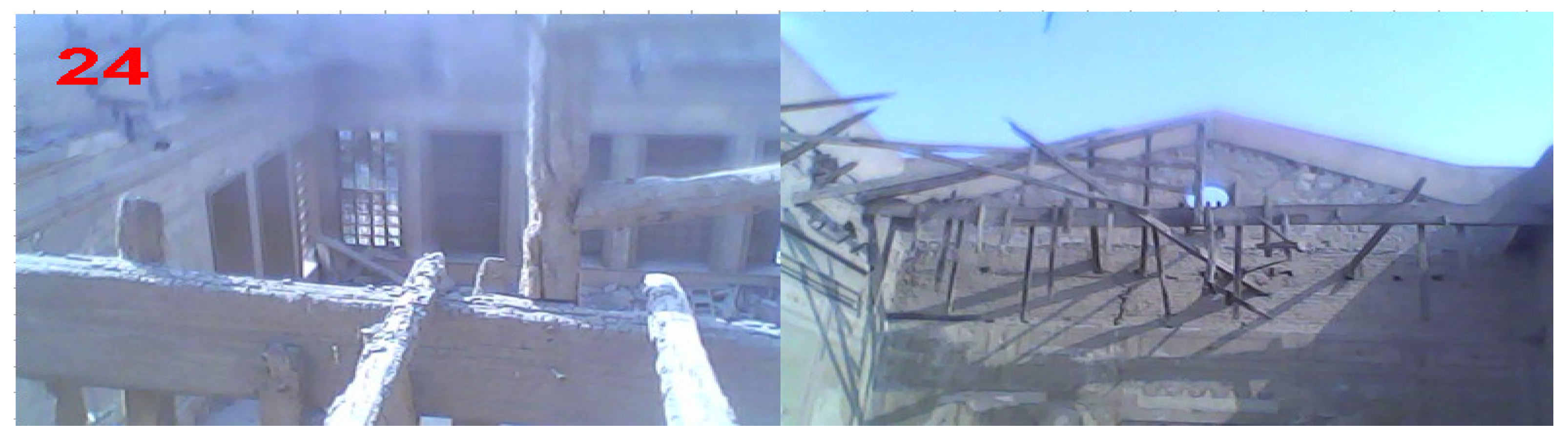
it consists of wooden ceilings consisting of veins of panels and cladding of al-baghdali in the form of a truss and a borrowed ceiling from the inside. it was burnt in 1972, and what remains is clear in the pictures. inspect the roof, remove and replace the sections with new ones of the same quality with a layer of protection against decay, insects, and pests. making a layer of baghdadi wood, a layer of mortar for the ceiling and a layer of paints [3,49]. figure. 24
- D.
- interior and exterior paints.
Figure 24.
the truss wooden ceiling of the great throne hall after the 1972 fire.
9. Modern Techniques in Restoration
the process used for restoration varies according to the material from which the antiquity is made and the percentage of its damage. the common name is known as spraying the sculpture with hard water, which is lime water. hard water is preferred over pure water or mineral-free water, given that the latter can dissolve the salts in the stone, where the spray which is sprayed on the stone is kept for few days and the water does not harm, but rather removes dirt in general and helps the purity of the stone [14,19].
there is another method that is gentler with stone, which is using a chemical composition based on ammonium soda, where the restorer mixes this material with water to become a dough and then spreads it on a piece of tissue placed on the surface of the stone to absorb dirt without affecting the stone itself [15,38].
another way to treat tougher layers is by using ruby dust. sapphire is a very hard mineral that is red in color and is classified as the second hardest mineral after diamond, so it has more abrasive ability than glass blades [18,44].
today’s restoration teams are using a more effective and more accurate cleaning mechanism called ultrasound, which is used by dentists. the restorer uses this technique to treat the area covered with fossilized salts or gravel. often these reservoirs are as hard as marble, but ultrasound waves can turn it into dust. proven high accuracy in this field [37,52].
it is worth mentioning that there are other modern techniques used in restoration, including the use of laser beams, where the laser used in the restoration sends very short flashes, the shortening of these flashes prevents heating the material to which it is subjected, as the laser beams collide with the stone and the shock force reaches a degree that leads to calcification and destruction and turn it into dust. this process achieves a high level of accuracy that contributes to speeding up the implementation as well. it is also a suitable method for cleaning window glass and rusty metal parts. however, when the stones are severely damaged, they must be replaced [17,41].
10. Conclusion and Recommendations
based on the results of the observations of the inclination sensors installed on some of the walls of the castle buildings and its surrounding walls, especially in the direction of salah el-din street to its intersection with salah salem street, the following was found: the walls of the castle suffer from a continuous movement resulting from a structural defect, which consequently resulted in an imbalance in the structural balance of all the archaeological facilities and buildings in the walls in this area under study. symptoms of structural imbalance appear on several buildings adjacent to the walls towards the southwestern corner, the confluence of salah el din street and salah salem street: the great throne hall, al-jawhara palace, the seven halls, police square and museum.
References
- Alaa Jamal Mahmoud, Rehabilitation of Archaeological Buildings, Deposit No. 11726/2021, Dar Al-Mashreq Al-Arabi, 2021 AD.
- Al-Sayyid Mahmoud Al-Banna, Fatima Muhammad Helmy, Hossam Al-Din Al-Barambali, Alia Abdel Aziz Mahmoud Abdel Dayem Abdel Dayem, Reuse of Archaeological Buildings “A Study of Data and Evaluation of Alternatives” Application to the Saray Al-Musafer Khana in Cairo, Journal of the Faculty of Arts in Qena, Faculty of Arts in Qena, University of South Al-Wadi, Issue Ten, 2022 AD.
- Atalaa, Hemeda, Intervention Retrofitting and Rehabilitation of Al-Gawhara Palace At the Saladin Citadel, Cairo, Egypt, Open Journal of Geology, January 2019.
- Ayman Hassan Ahmed Hijab, Study of the Destructive Human Effects on Some Islamic Monuments and Methods of Preserving Them in the Old City of Cairo as An Application to One of the Selected Islamic Archaeological Buildings, Master’s Thesis, Cairo University, Faculty of Archeology, Department of Restoration, 2020 AD.
- Bahía, P. A Recepc.o do Team 10 em Portugal; Circo de Ideias: Porto, Portugal, 2020.
- Bosone, M.; De Toro, P.; Fusco Girard, L.; Gravagnuolo, A.; Iodice, S. Indicators for Ex-Post Evaluation of Cultural Heritage Adaptive Reuse Impacts in the Perspective of the Circular Economy. Sustainability 2021, 13, 4759. [CrossRef]
- Buser, B. Reuse! In Reuse in Construction: A compendium of Circular Architecture; Stricker, E., Brandi, G., Sonderegger, A., Angst, M., Buser, B., Massmunster, M., Eds.; Park Books: Zurich, Switzerland, 2022; pp. 11–16.
- Coscia, C.; Lazzari, G.; Rubino, I. Industrial heritage, adaptive reuse, and sustainable redevelopment scenarios: Including local communities’ multiple values in the decision-making process. In Science of Valuations: Natural Structures, Technological Infrastructures, Cultural Superstructures; Giuffrida, S., Trovato, M.R., Rosato, P., Fattinnanzi, E., Oppio, A., Chiodo, S., Eds.; Springer: Cham, Switzerland, 2023; pp. 1–15; ISBN 978-3-031-53708-0.
- Coscia, C.; Pasquino, F. Demand Analysis Models to Support Cultural Tourism Strategy: Application of Conjoint Analysis in North Sardinia (Italy). Land 2023, 12, 2150. [CrossRef]
- Coscieme, L.; Mortensen, L.F.; Anderson, S.; Ward, J.; Donohue, I.; Sutton, P.C. Going beyond Gross Domestic Product as an indicator to bring coherence to the Sustainable Development Goals. J. Clean. Prod. 2020, 248, 119232. [CrossRef]
- Council of Europe (CoE). Council of Europe Framework Convention on the Value of Cultural Heritage for Society. 2005. Available .online: https://rm.coe.int/1680083746 (accessed on 13 March 2023).
- Coutinho, J.M.A.F. Construir a Transformac.o. Entre quatro paredes, quatro casas com Álvaro Siza. Master’s Thesis, Faculty of Architecture of the University of Porto, Porto, Portugal, 2023.
- Cucco, P.; Maselli, G.; Nestic., A.; Ribera, F. An evaluation model for adaptive reuse of cultural heritage in accordance with 2030 SDGs and European Quality Principles. J. Cult. Herit. 2023, 59, 202–216. [CrossRef]
- Dabbene, D. Patrimonio architettonico e benessere. In Nuovi Scenari Per Il Restauro Nel XXI Secolo;WriteUp: Rome, Italy, 2023; ISBN 979-12-5544-032-1. Heritage 2024, 7 2864.
- Dabbene, D.; Bartolozzi, C.; Coscia, C. How to Monitor and Evaluate Quality in Adaptive Heritage Reuse Projects from aWell-Being Perspective: A Proposal for a Dashboard Model of Indicators to Support Promoters. Sustainability 2022, 14, 7099.
- Dalia Ali Abdel-Al El-Sayed, Restoration and Rehabilitation of The Ancient Buildings of Muhammad Ali Pasha’s Sabil as A Model of an Architectural Masterpiece That Houses the Egyptian Textile Museum, Journal of Architecture, Arts and Humanities, Special Issue 2, April 2021, Pp. 2161: 2172.
- Della Torre, S. A coevolutionary approach to reusing built cultural heritage. In The Changing Cultural Heritage. The Challenges of Use; Biscontin, G., Driussi, G., Eds.; Arcadia Ricerche: Venice, Italy, 2019; pp. 25–34.
- Dimitrova, E.; Lavenir, M.L.; McMahon, P.; M ̄ urniece, B.; Musso, S.F.; Nagy, G.; Selfslagh, B. European Quality Principles for EU-funded Interventions with Potential Impact upon Cultural Heritage; ICOMOS: Charenton-le-Pont, France, 2020.
- endlebury, J.; Brown, J. Conserving the Historic Environment. In Concise Guides to Planning; Lund Humphries: London, UK, 2021.
- ESPON. HERIWELL—Cultural Heritage as a Source of SocietalWell-Being in European Regions: Final Report; Espon EGTC: Luxembourg,2022. Available online: https://archive.espon.eu/sites/default/files/attachments/HERIWELL_Final%20Report.pdf (accessed on 13 March 2023).
- European Commission. European Framework for Action on Cultural Heritage. 2019. Available online: https://op.europa.eu/en/publication-detail/-/publication/5a9c3144-80f1-11e9-9f05-01aa75ed71a1 (accessed on 13 March 2023).
- Fantini, E. Patrimonio storico e progetto nell’architettura portoghese. Riflessi della cultura italiana nell’opera di Távora, Soutinhoe Siza. Ph.D. Thesis, University of Bologna, Bologna, Italy, 2021.
- Fernandes, E. From CIAM to Team Ten, between theory and practice: Fernando Távora and the international debate of modern architects. In Team Ten Farwest; Circo de Ideias: Porto, Portugal, 2019.
- Ferreira, T.C. Altas of Architectural design in Built heritage: Pedagogies of the School of Porto. In CA2RE+ Delft Recommendation: Conference for Artistic and Architectural Research & Collective Evaluation of Design-Driven Doctoral Training Programme; Carvallo, R., Alkan, A., Kuijper, J., Eds.; TU Delft OPEN Publishing: Delft, The Netherlands, 2023; pp. 186–192.
- Ferreira, T.C. Editorial Project New/Old: A method for analysis of the intervention in the built. In Novo/antigo. Fernando Távora: Obras = New/Old. Fernando Távora: Works; Ferreira, T.C., Ordónez-Castanón, D., Fantini, E., Eds.; FAUP/FIMS/Afrontamento: Porto, Portugal, 2023; pp. 11–20.
- Ferreira, T.C.; Ordónez-Castanón, D.; Fantini, E.; Coutinho, M.F.; Cruz, T.T. Adaptive reuse of vernacular built heritage: Learnings from Alcino Cardoso House (1971–1991) by Álvaro Siza. J. Build. Rehabil. 2023, 8, 73. [CrossRef]
- Ferreira, T.C.; Ordónez-Castanón, D.; Póvoas, R.F. Methodological approach for an Atlas of architectural design in built heritage: Contributions of the School of Porto. J. Cult. Herit. Manag. Sustain. Dev. 2023. [CrossRef]
- Fusco Girard, L.; Vecco, M. The “Intrinsic Value” of Cultural Heritage as Driver for Circular Human-Centered Adaptive Reuse. Sustainability 2021, 13, 3231. [CrossRef]
- García Hermida, A. The role of the vernacular in modern architecture: Questions of form, identity and adaptation to context. Cuad. Notas 2019, 20, 29–42.
- Giannattasio, C. The false antagonism between matter and memory. In Conservation/Demolition; Fiorani, D., Franco, G., Kealy, L.,Musso, S.F., Vorlík, P., Eds.; EAAE: Prague, Czech Republic, 2020; pp. 258–269. Heritage 2024, 7 2865.
- Guo, H.; Chen, F.; Tang, Y.; Ding, Y.; Chen, M.; Zhou, W.; Zhu, M.; Gao, G.; Yang, R.; Zheng, W.; et al. Progress toward the sustainable development of world cultural heritage sites facing land-cover changes. Innovation 2023, 4, 100496. [PubMed]. [CrossRef]
- Hani Muhammad Reda, Mamluk Soils in Cairo, PHD Thesis, Cairo University, Faculty of Archeology, Department of Islamic Antiquities, 2020 AD.
- ISTAT. Rapporto BES 2022. Il Benessere Equo e Sostenibile in Italia; ISTAT: Rome, Italy, 2023. Available online: https://www.istat.it/it/archivio/282920 (accessed on 13 March 2023).
- Lanz, F.; Pendlebury, J. Adaptive Reuse: A Critical Review. J. Archit. 2022, 27, 441–462. [CrossRef]
- Mohaddes Khorassani, S.; Ferrari, A.M.; Pini, M.; Settembre Blundo, D.; García Muina, F.E.; García, J.F. Environmental and social impact assessment of cultural heritage restoration and its application to the Uncastillo Fortress. Int. J. Life Cycle Assess. 2019, 24,1297–1318. [CrossRef]
- Muhammad Jamal Hammad, Al-Dahisha Hall and the Events of the Era of the Mamluk Sultans (923-730 AH / 1330-1517 AD), A Historical Study, Journal of the College of Tourism and Hotels, No. 12, December 2022 AD.
- Napoleone, L. Come conosciamo l’oggetto del nostro conservare. Spazio geometrico e spazio vissuto. In Restauro: Conoscenza, Progetto, Cantiere, Gestione; Musso, S.F., Pretelli, M., Scient, C., Eds.; Sezione 1.1 Conoscenza Previa (Preventiva) e Puntuale (Mirata). Metodologie; Boato, A., Caccia Gherardini, S., Eds.; Quasar: Rome, Italy, 2020; pp. 110–117.
- Ordónez-Castanón, D. Fernando Távora. La modernidad enraizada: Continuidad e innovación como principios de inter-vención en la arquitectura tradicional. Ph.D. Thesis, University of the Basque Country UPV/EHU, San Sebastián, Spain, 2022.
- Ordónez-Castanón, D.; Ferreira, T.C.; Sánchez-Beitia, S. Adaptive reuse of manor houses: Modernism and tradition in Fernando Távora’s approach for heritage renovation. Int. J. Sust. Dev. Plan 2021, 16, 569–578. [CrossRef]
- Ordónez-Castanón, D.; Ferreira, T.C.; Sánchez-Beitia, S. Intervention in vernacular architecture: The lesson of Fernando Távora. Int. Arch. Photogramm. Remote Sens. Spat. Inf. Sci. 2020, XLIV-M-1-2020, 123–130. [CrossRef]
- Plevoets, B.; Van Cleempoel, K. Adaptive Reuse of the Built Heritage; Routledge: Oxfordshire, UK, 2019.
- Ramez Jeremiah Gendy, an Archaeological Artistic Study of Wooden Ceilings in the Mamluk Era in the City of Cairo Through Existing Documents and Facilities, Master’s Thesis, Cairo University, Faculty of Archaeology, Department of Islamic Antiquities, 2021 AD.
- Rossitti, M.; Oteri, A.M.; Sarnataro, M.; Torrieri, F. The social dimension of the reuse of architectural heritage: Theoretical reflections starting from a case study in Campania. ArcHistoR 2022, 17, 178–211.
- Samar Saeed Abadi Muhammad, the Role of Reusing Heritage Buildings in Local Community Development, Journal of the Higher Institute for Specific Studies, Issue 2, July 2022.
- Sofaer, J.; Davenport, B.; Sorensen, M.L.S.; Gallou, E.; Uzzell, D. Heritage sites, value and wellbeing: Learning from the COVID-19 pandemic in England. Int. J. Herit. Stud. 2021, 27, 1117–1132. [CrossRef]
- Stone, S. Notes towards a Definition of Adaptive Reuse. Architecture 2023, 3, 477–489. [CrossRef]
- Stone, S. UnDoing Buildings: Adaptive Reuse and Cultural Memory; Routledge: Oxfordshire, UK, 2020.
- Tacon, P.S.C.; Baker, S. New and Emerging Challenges to Heritage and Well-Being: A Critical Review. Heritage 2019, 2, 1300–1315. [CrossRef]
- Taha Abdel Moaty, Study of the Restoration, Rehabilitation and Reuse of Al-Gawhara Palace in Salah Al-Din Al-Ayyubi Citadel in Cairo, Master’s in Architectural Restoration and Conservation of Antiquities, Master’s Thesis, Cairo University, Faculty of Archeology, Department of Restoration, 2019 AD.
- The Fourteenth International Conference, Cultural Heritage Between Theory and Practice, Journal of Architecture, Arts and Humanities, Volume Nine, Special Issue (11), April 2024 AD.
- United Nations. Transforming Our World: The 2030 Agenda for Sustainable Development. 2015. Available online: https://sdgs.un.org/goals (accessed on 13 March 2023).
- Vaz, P. Edificar no Património. Pessoas e Paradigmas na Conservac.o e Restauro; Edic.es 70: Lisboa, Portugal, 2019.

Table 1.
underground geoelectrical test results p- the interpreted electric resistivity values of, corresponding underground formation, h= the thicknesses of different formations.
Table 1.
underground geoelectrical test results p- the interpreted electric resistivity values of, corresponding underground formation, h= the thicknesses of different formations.
| underground layers | ves | | ves 2 | ves 3 | ||||
| piece | h | p | h | p | h | ||
| 1 | 14 | 0.93 | 32 | 0.45 | 42 | 0.65 | |
| 2 | 60 | 116 | 125 | 2.7 | 300 | 1.3 | |
| 3 | 160 | ---- | 52 | ---- | 30 | ---- | |
Table 2.
tensile test results on used red brick.
| sp. no | weight (g) | average measured dimensions d*h (mm) | ultimate load (n) | splitting tensile strength (n/mm2) | remarks | |
| 1 | 46.2 | 30.2*54.6 | 1035 | 0.40 | bricks | |
Table 3.
shear test results on used red bricks.
| sp. no | weight (g) | average measured dimensions d*h (mm) | ultimate load (n) | splitting tensile strength (n/mm2) | remarks |
| 1 | 40.1 | 29.2*56.9 | 3110 | 4.6 | bricks |
Table 4.
pressure test results on used red bricks.
| sp. no | weight (g) | average measured dimensions d*h (mm) | ultimate load (n) | splitting tensile strength (n/mm2) | remarks |
| 1 | 45.7 | 30.5*57.0 | 5335 | 7.3 | bricks |
Table 5.
tensile test result on used limestone samples.
| sp. no | weight (g) | average measured dimensions d*h (mm) | ultimate load (n) | splitting tensile strength (n/mm2) | remarks |
| 2 | 164.7 | 40.2*61.4 | 3790 | 0.98 | stone |
Table 6.
shear test result on used limestone samples.
| sp. no | weight (g) | average measured dimensions d*h (mm) | ultimate load (n) | splitting tensile strength (n/mm2) | remarks |
| 2 | 76.8 | 27.3*62.3 | 3020 | 5.2 | stone |
Table 7.
the result of the pressure test on the samples of the limestone used.
| sp. no | weight (g) | average measured dimensions d*h (mm) | ultimate load (n) | splitting tensile strength (n/mm2) | remarks |
| 2 | 167.6 | 40.9*59.4 | 16300 | 12.4 | stone |
Disclaimer/Publisher’s Note: The statements, opinions and data contained in all publications are solely those of the individual author(s) and contributor(s) and not of MDPI and/or the editor(s). MDPI and/or the editor(s) disclaim responsibility for any injury to people or property resulting from any ideas, methods, instructions or products referred to in the content. |
© 2024 by the authors. Licensee MDPI, Basel, Switzerland. This article is an open access article distributed under the terms and conditions of the Creative Commons Attribution (CC BY) license (http://creativecommons.org/licenses/by/4.0/).
Copyright: This open access article is published under a Creative Commons CC BY 4.0 license, which permit the free download, distribution, and reuse, provided that the author and preprint are cited in any reuse.


