
Submitted:
26 July 2024
Posted:
13 August 2024
You are already at the latest version
Abstract
The research paper examines ‘aporia,’ ‘Différance,’ ‘binary oppositions’ in Ira Trivedi's "The Great Indian Love Story," and India in Love focusing on the characters Riya, Serena, and Permeet's experiences. Derrida’s deconstructive approach is applied to trace out ‘binaries’, ‘aporia’, and ‘Différance’ of sexuality and stigma in literary texts and real human life. It highlights how these characters seem/likely to challenge Indian societal norms and values, societal prejudices and discrimination that lead them to experiences of marginalization and exclusion of the self from other selves. It is observed that deconstruction is an apt approach to literature not a destructive approach.
Keywords:
Deconstruction
; Ira Trivedi
; Modern India
; Indian English Fiction
1. Introduction
Ira Trivedi is an Indian author and journalist known for her works in both fiction and non-fiction genres. Her unique perspective on gender dynamics and societal norms has garnered widespread attention, sparking important conversations about women's rights and empowerment in India. Her ability to blend personal narratives with socio-political commentary resonates with readers of all ages and backgrounds, solidifying her reputation as a thought-provoking and insightful writer. Trivedi's commitment to social justice has led to tangible change in various communities, pushing for policy reforms and advocating for greater representation of marginalized groups in decision-making spaces. She has received numerous awards and accolades for her advocacy work, including being named a "Champion of Change" by the United Nations. In Ira Trivedi’s works, a complex current social system of sexuality is observed, which has been studied in terms of six principles of sexuality. The stories and traditions around Sri Arjuna and Sri Bhagavati Devi challenge strict Indian gender roles and the idea that binary gender is traditional in Indian culture.
2. Results
Legends of structured sexuality, such as the goddess Sri Bhagavati Devi, Sri Bhagiratha Maharaja, and the male-to-female transgender Brihannala, also challenge traditional gender roles and the idea of binary gender. Lesbians in India face dual discrimination due to the patriarchal mindset, often facing rejection and horrific acts by family members. Transgendered Indians, or hijras, are biologically male but female in mind and identity, often wearing traditional Indian women's clothes and giving themselves feminine names.
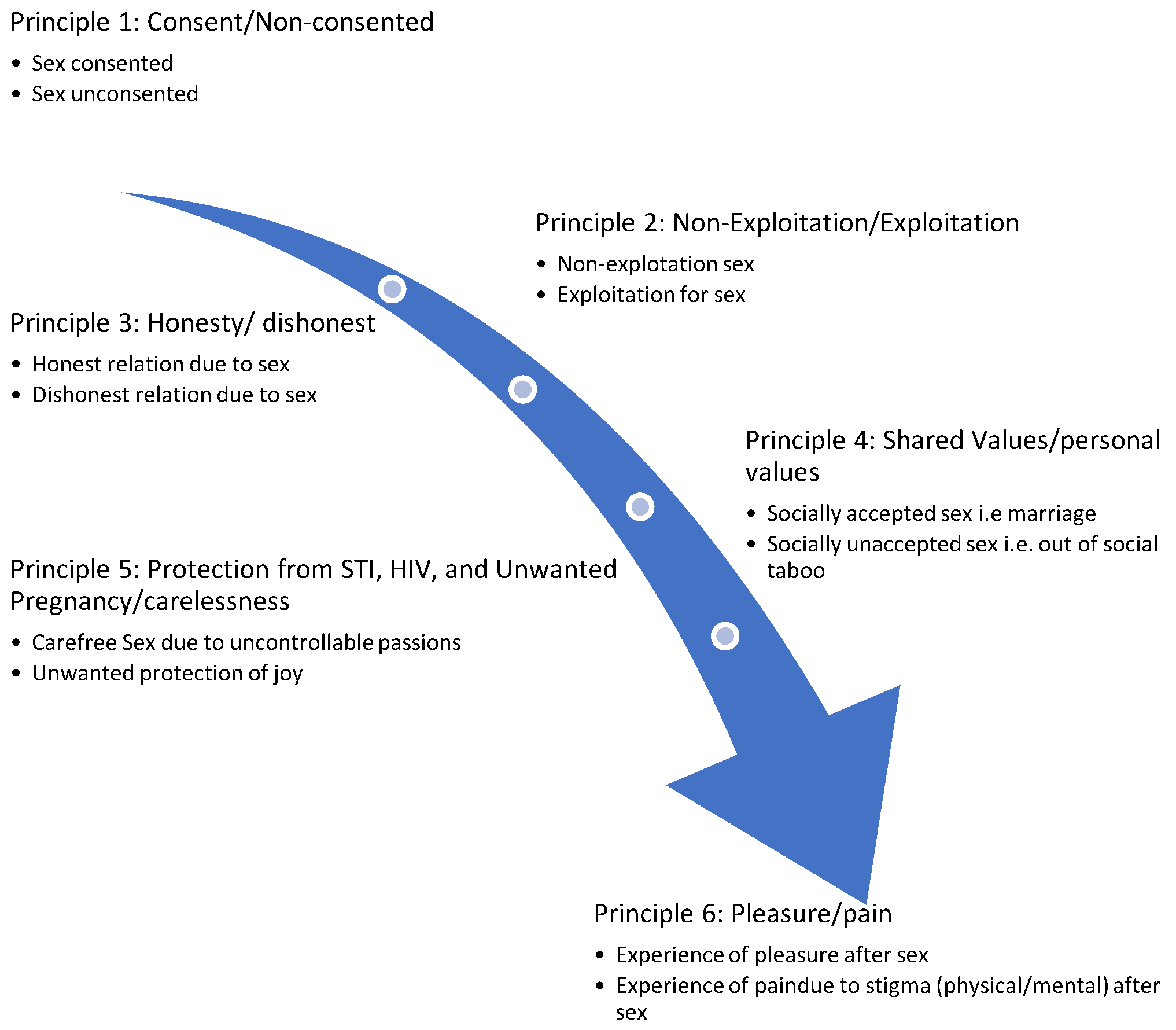
Figure 1.
What to Deconstruct is Fall of Man due to Complex Binaries.
2.1. Applicability of Deconstruction as research method
Literary analysis is still battling with ‘zero-argumentation practices.’ We are still recounting tales of a particular literary texts in the guise of literary analysis. We attempt to discover what others have previously sought. Let us evaluate several summaries produced in the guise of research publications. Jacques Derrida’s deconstruction has significantly influenced Anglo-American critique and critical thinking during 80s, world intelligential societies at large. Derrida writes, “A secret doesn't belong, it can never be said to be at home or in its place. The question of the self: who am I not in the sense of who am I but rather who is this I that can say who?” Deconstruction declutches the secrets. Deconstruction is first discussed in the field of philosophy, and mediated through applied arts and moved to Literary world. It is being practiced now in science, and technology. Though it is often taken as notorious critical practice, yet argued for its uniqueness of gifting innovations to society. There are many research articles that reflect feasibility of this critical practice, for examples, Ercüment Yaşar's "Deconstruction of The Yellow Wallpaper" by Charlotte Perkin Gilman, Lis Malinda & Maya Silviyanti's "Deconstructing Binary Oppositions in The Short Story “Dokter” Written by Putu Wijaya," and Lis Malinda & Maya Silviyanti's "Dokter" are examples of deconstructive readings. These works challenge traditional notions of right and wrong, presenting a nuanced portrayal of characters who are neither purely good nor evil. A few more examples are Huiqing's "Deconstruction of Binary Oppositions in John Donne's A Valediction: Forbidding Mourning" explores the deconstruction of thought in John Donne's poetry, revealing how he skillfully navigates between binary oppositions to create a sense of unity and interconnectedness. Huiqing highlights Donne's poetic genius by highlighting the depth and richness of his work, and how his mastery of binary oppositions enhances the emotional resonance of his poetry. Siti Hafsah's "I Want My Son to Become a Murderer in Deconstructive Analysis" finds binary oppositions in title/story, intuitive comprehension/logical reasoning, and writer/reader, which the writer deconstructs during the work, leading to the absence of hierarchical opposition. This analysis challenges prevailing assumptions and sheds light on the dangerous implications of radical ideologies in contemporary society. Understanding the complexities of Hafsah's mindset can help develop strategies to counter the dangerous implications of radical ideologies and promote peace and tolerance in society.
2.1.1. Aporia and Literature
Derrida says, “No one gets angry at a mathematician or a physicist whom he or she doesn't understand at all, or at someone who speaks a foreign language, but rather at someone who tampers with your own language, with this 'relation,' precisely, which is yours.” (Derrida and Weber Points...: Interviews, 1974-1994. p. 115) An aporia is a philosophical dilemma or stalemate in investigation, frequently stemming from equally reasonable but conflicting premises, or paradoxes. It is predominantly found in Greek philosophy, but also plays a part in post-structuralist philosophy, analytic philosophy, and Jacques Derrida's works. Plato's early conversations, frequently dubbed 'aporetic', finish in aporia, when Socrates challenges his interlocutor about the nature or meaning of a notion. In Aristotle's Metaphysics, aporia plays a part in his method of inquiry, since he starts by reviewing the many aporiai that exist. In Pyrrhonism, aporia is purposely generated as a way of creating ataraxia. The use of the term in philosophical discourses is characterized by current academic studies; Nicholas Rescher's 2009 work "Aporetics: Rational Deliberation in the Face of Inconsistency" describes it as an effort to organize and synthesize an aporetic procedure for managing information overload. In rhetoric, aporia is a rhetorical strategy when the speaker displays uncertainty, typically faked, regarding their stance or asks the listener rhetorically how the speaker should continue.
2.1.2. Différance
Différance is a French concept that emerged in Derrida's deconstruction approach, which focuses on the link between text and meaning. It refers to both "difference of meaning" and "deferral of meaning." Derrida's theory explains that meaning is continually "deferred" or postponed via an unending chain of signifiers, known as espacement and temporisation. He developed the notion further in an argument against Husserl's phenomenology, arguing that a comprehensive theory defining this phenomenon is impossible due to the constantly changing mental state of the perceiver.
A text is not a text unless it hides from the first comer, from the first glance, the law of its composition and the rules of its game. A text remains, moreover, forever imperceptible. Its law and its rules are not, however, harbored in the inaccessibility of a secret; it is simply that they can never be booked, in the present, into anything that could rigorously be called a perception. (Plato's Pharmacy, in Dissemination)
Derrida's view of texts is based on oppositions that every discourse needs to express for it to make sense. This approach stems from semiology pioneered by Ferdinand de Saussure, who believed that language is flowing rather than static. Derrida views these disparities as functioning in all languages, systems of separate signs, and codes, where words do not have absolute meanings but instead get meaning via reciprocal determination with other terms.
The primary objective of deconstruction is to disclose their action in philosophical, literary, and legal texts. The link between signifier and signified relies on reciprocal determination with other terms, rather than an ostensive description or definition. Derrida's ‘neographism’ is not just a linguistics or discussion of written texts, but an attempt to escape the history of metaphysics. Derrida's non-concept of ‘différance’ resembles negative theology but is not quite transcendental or real.
2.1.3. Binary opposition
Binary opposition is a linguistic and cognitive framework where two theoretical opposites are defined and contrasted. It is a fundamental aspect of human philosophy, culture, and language. Examples include the presence-absence dichotomy, which is central to many civilizations. Deconstruction of binary oppositions is crucial in third wave feminism, post-colonialism, post-anarchism, and critical race theory. It argues that the perceived binary dichotomy perpetuates societal power structures favoring a specific majority. Logocentrism suggests that some audiences may prefer one side of a binary opposition pair. Binary opposition, also known as a binary system, is a pair of linked phrases or ideas with diametrically opposed meanings.
It is considered a basic organizer of human thought, culture, and language. The theory of binaries is often value-laden and ethnocentric, with an apparent order and superficial significance. Post-structural critique of binary oppositions is crucial in third wave feminism, post-colonialism, post-anarchism, and critical race theory. It argues that the binary dichotomy between man/woman, civilized/uncivilized, and white/black has perpetuated and legitimized societal power structures favoring a specific majority.
Deconstruction of binaries is apolitical, not innately preferring one arm of a binary opposition over the other. Logocentrism is a notion linked to binary opposition that claims some audiences will prefer one side of a binary opposition pair over the other, often strongly impacted by readers' cultural origins. In literature, binary opposition is profoundly ingrained, as language, especially paired opposites, depend upon a connection with neighboring words within a paradigmatic chain. Ira Trivedi's binaries are used against traditional structuralism and against deconstructive machineries of a new society. Binaries are characterized well in lesbianism in Ira Trivedi’s works. Dualism, biosexism, and transgenderism are again kept in a binary oppositional situation. Narrator’s ideology of relationship can be realized here:
I first met Randeep at his clinic. Dr Randeep Singh was recommended by SP's colleague. Dr Randeep performed an emergency surgery on me and I noticed him for the first time only after the operation. I remember thinking I really liked the way his hands felt—soft, stable and firm. I liked how he was always so calm, unlike SP who was chaotic and always in a hurry… Randeep took good care of me, making jokes to ease my worries, touching me tenderly, trying his best not to cause pain while he examined me. (Trivedi)
Her commitment for women's rights can be traced back to her youth, when she personally observed the injustices and constraints put on women in her village.
I could tell by the way he looked at me, the way he touched me, that he really cared. My recuperation took longer than expected and I was in that dreary hospital for close to three weeks. It was during that time that I found myself falling in love with Randeep… When Randeep touched me now, I felt a kind of lightning run through my body, I felt like I had never felt before. It was then that I knew, deep down in my gut, that my life was about to change. (Trivedi)
Trivedi's advocacy work has had a profound influence on the lives of women, increased awareness among legislators and activists, and empowered countless people to fulfil their aspirations. The Great Indian Love Story is a novel by Ira Trivedi that explores the darker side of Delhi and its socialite class. The story follows Riya, a U.S. educated twenty-something girl who befriends Serena Sharma at a high-end gym in Delhi. The novel highlights Serena's troubled life, her father's death, and her mother's extramarital affairs. The novel also includes a subplot involving Parmeet, Serena's mother, and her extramarital affairs. The novel aims to expose the archetypes that women adhere to and how they are merely puppets at the hands of men and the patriarchal world. It calls for academic and social discussion, urging women to enjoy the privileges that are solely entitled to men. The novel also discusses the binary opposition between consent/non-consented, non-exploitation/exploitation, honesty/dishonest, shared values/personal values, protection from STI, HIV, unwanted pregnancy/carelessness, and pleasure/pain.
2.1.3.1. Archetypes Binaries
Archetypes are universal patterns originating from the collective unconscious, which are the foundation of religions, mythologies, legends, and fairy tales. In India, despite modernization and technological advancements, certain patterns emerge in behavior and thought processes, such as caste. Women face greater challenges and are still held by patriarchy, annoying women, particularly feminists. Trivedi's main motive for writing this novel is to understand how far contemporary feminism functions in the betterment of women. She regularly appears on news channels in India and internationally speaking on issues of gender, women, and youth.
Radical feminism aims to challenge patriarchy by rejecting normal gender norms and men's oppression of women. Cultural feminists believe that patriarchy has made women the "Other" and that male-dominated culture is the main cause of their subjugation. They emphasize on male gender oppression or female gender power, and argue that love produces a significant shift in life. Feminism, according to Frye, is a movement that focuses on recognizing and naming patterns and schemas rather than metaphysical, statistical, or universal generalization.
2.2. What is problem in Literary Analyses?
Literary analysis is still struggling with ‘zero-argumentation practices.’ We are still narrating stories of a given literary texts in the name of literary analysis. We seek to find what people have already sought. Let us review some summaries published in the name of research articles.
2.2.1. Example 1.
The Great Indian Love Story explores the darker side of Delhi and its socialite class. The novel follows Riya, a U.S. educated twenty-something girl who befriends Serena Sharma at a high-end gym in Delhi. The story highlights Serena's troubled life, her father's death, and her mother's extramarital affairs. The novel calls for academic and social discussion, urging women to enjoy the privileges that are solely entitled to men. However, the story loses its track after the first few chapters due to bland characters and excessive talk about drugs, sex, and lacy underwear. The Great Indian Love Story is the second book by model turned author Ira Trivedi, which also brings up the evil side of glamor and the blind alleys of the glittering world. The narrative is not done by an omniscient author, but rather by narrating from the viewpoint of several persons, with Riya as the primary narrator. The plot does not lag anywhere, and the focus on Riya as Bridget Jones is unnecessary. Derrida has rightly defined “différance is the movement of differences that produce meaning."
2.2.2. Example 2
The Great Indian Love Story explores the perfidious nature of love and power in a world where appearances matter. The story follows characters like Serena Sharma, Riya, Parmeet, and S.P. Sharma, who all face challenges and obstacles in their lives. The novel uses the perspectives of sexuality and stigma to illustrate the binary oppositions found in the lives of these characters. The author aims to demonstrate how these characters shatter Indian societal norms and values, as Indian social orthodoxy fiercely disapproves of western ways of life. By adopting western open influences, Trivedi reveals the elimination of stigma. Sexuality is seen as a stigma and disgusting characteristic, leading to social ostracization and marginalization. This stigmatizing propensity is more than physical weakness for the characters, as it symbolizes a vision of life, personal and social conceptions, and social interactions. Society's prejudiced views drive them to social marginalization, which can lead to domestic violence, sexual assault, and alienation. The narrator meets Sukdev Singh, a young man who represents postmodern Indian women. They spend time together, feeling rejuvenated and rejuvenated, as they can be the center of attention and feel like they are sixteen again. Such summary concludes in a line like The Great Indian Love Story is a powerful exploration of the perfidious nature of love and power in a world where appearances matter and nothing is as it appears.
This kind of summary can be narrated by a student of standard 9th. Literary analysis demands something extra, Derrida calls ‘hors text’. The text creates text. Literature creates literary and literature itself. Can we go beyond the selected themes of a literary texts? Can we connect the characters and situations to our real life? Can we convert a literary text into a social mission to bring change in a society? Can we go in and around literary texts? If yes, how? Which theory can help in it? Answer to this question is ‘deconstruction.’ Let’s see what difference will be available when we apply deconstruction.
2.3. What does deconstruction do and how?
Derrida's deconstruction theory emphasizes the link between text and meaning, arguing that meaning is "deferred" by an unending chain of signifiers. Language is fluid and formed around oppositions that all speech must express for it to make any meaning. Derrida's concept of "différance" refers to both "difference of meaning" and "deferral of meaning," overturning the hierarchy of metaphysics. Derrida's post-Saussurean characterization of writing as a system of "difference" that operates without positive terms and endlessly defers the achievement of identity as self-presence is called "homographesis." Both Derrida and Augustine use certain types of addressing in their confessions, bridging the gap between premodern epistemics and esthetics of the subject. Both authors share a skepticism about language but advocate for different interpretations of language. Derrida's linguistic thinking distinguishes the act of addressing from the addressee, based on the principle of "principe postal."
India in Love: Marriage and Sexuality in the 21st Century is a literary work by Ira Trivedi that explores the complexities of love and intimacy in modern India, challenging traditional notions of love and marriage. Readers / critics often writes that the book covers the ancient past and current, with the Nirbhaya tragedy being a watershed point. Trivedi underlines that women in India are evolving quicker than males, seeking their rights and meeting stumbling hurdles like khap panchayats that consider jeans and cell phones as challenges to traditional values.
Understanding changing attitudes towards marriage and sexuality in India is crucial for creating a more equitable and respectful society. Education, advocacy, and collective action are necessary to break down long-held societal norms and stereotypes. Deconstructionists like Jean-Luc Nancy, Philippe Lacoue-Labarthe, and Paul de Man have contributed to the shift of autobiography from ‘bio’ to ‘auto’ and ‘graphy’. Ira Trivedi's works explore the sexual revolution in urban India, particularly among the urban youthful middle classes. Trivedi's novels portray single, solo-living Indian women who embrace their sexuality and pursue erotic encounters with various men before marrying. Paul de Man's "Autobiography as Defacement" questions whether life produces the autobiography as an act and its consequences. Derrida's hetero-thanato-biography focuses on the relationship between writing and living, emphasizing the importance of being with and grieving for the other. Derrida's concept of the Other is tied to the singular plural, as seen in Nancy's concept of community. The force of inoperativeness attracts a person to the ethical because it is constructive rather than draining. In conclusion, Derrida's hetero-thanato-biography emphasizes the importance of being with and grieving for the other, relevant to both philosophy and literature.
3. Discussion
By applying Derrida’s deconstructive strategies on reading Ira Trivedi, many other threads of meanings and networks came to depict life. In Ira Trivedi's The Great Indian Love Story, the protagonist encounters Serena, who helps her discover her identity and take control of her life. The story explores the binary oppositions found in Indian societal norms and values, as well as the societal stigma surrounding sexuality. Sex is seen as a stigma and disgusting characteristic, leading to social marginalization and deprivation of dignity and connection. Society's prejudiced views drive individuals to engage in sexual activities, which can result in discrimination and exclusion. Women with engagement in sexual activities are often denied self-determination, leading to domestic violence, sexual assault, and bereft of family life.The protagonist meets Sukdev Singh, a young man representing postmodern Indian women, who shares a passionate and rejuvenating relationship, making them feel like sixteen again. In conclusion, Ira Trivedi's The Great Indian Love Story highlights the perfidious nature of love and power, as well as the societal stigma surrounding sexuality and the experiences of women involved in such activities. By adopting western open influences in the fictional world, Trivedi aims to eliminate these stigmas and promote a more inclusive and accepting society.Stigma is an ancient quality that can be discreditable at one period and discreditable at another. People with visible stigmas are unable to hide their attributes, making them discredited and devalued even before social interaction begins. Conversely, individuals with concealable stigma, such as religion or sexual orientation, can interact without the negative connection of stigmatization. In Ira Trivedi's The Great Indian Love Story, numerous examples of sexual stigmas in Indian communities are exposed. India in Love: Marriage and Sexuality in the 21st Century delves into the complexities of love and intimacy in modern India, challenging traditional notions. The book highlights the Nirbhaya tragedy as a watershed moment, and highlights women's rapid evolution, seeking their rights, and facing challenges like khap panchayats (Khap panchayats are unions of a few villages, mostly in north India, however they may be found in other parts of the nation in comparable configurations.) that consider jeans and cell phones as challenges to traditional values.
4. Materials and Methods
The paper follows qualitative research method and deconstructive approach to the chosen topic. It seeks to find three things in Ira Trivedi’s select works: ‘aporia,’ ‘differance,” and ‘binaries’ and how they reflect realities of contemporary culture. Jacques Derrida's deconstruction, a philosophical approach that challenges traditional notions of right and wrong, has significantly influenced Anglo-American critique and critical thinking. It involves presenting nuanced portrayals of characters who are neither purely good nor evil. Aporia, a rhetorical strategy, is a part of Greek philosophy and plays a role in post-structuralist and analytic philosophy. Derrida's concept of différance focuses on the link between text and meaning, aiming to disclose their action in philosophical, literary, and legal texts. Binary opposition, a linguistic and cognitive framework, is crucial in third wave feminism, post-colonialism, post-anarchism, and critical race theory. Deconstruction of binary oppositions is apolitical and not innately preferring one side of a binary opposition pair.
4.1. Models of Deconstruction
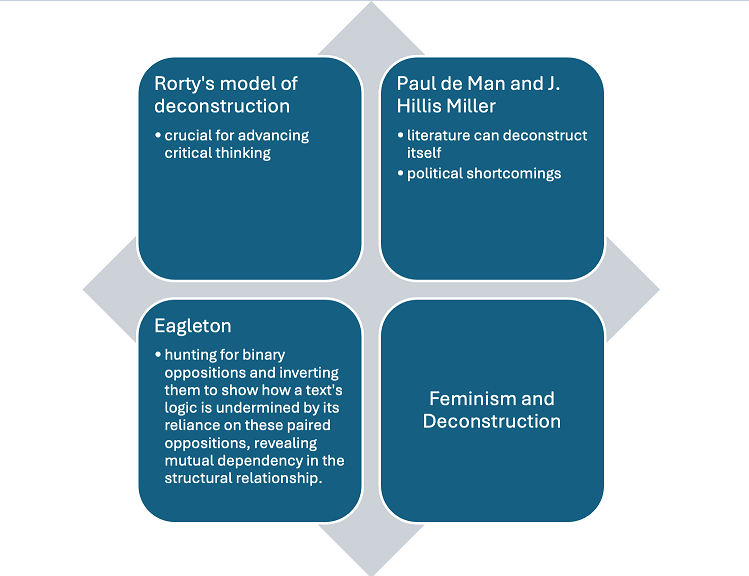
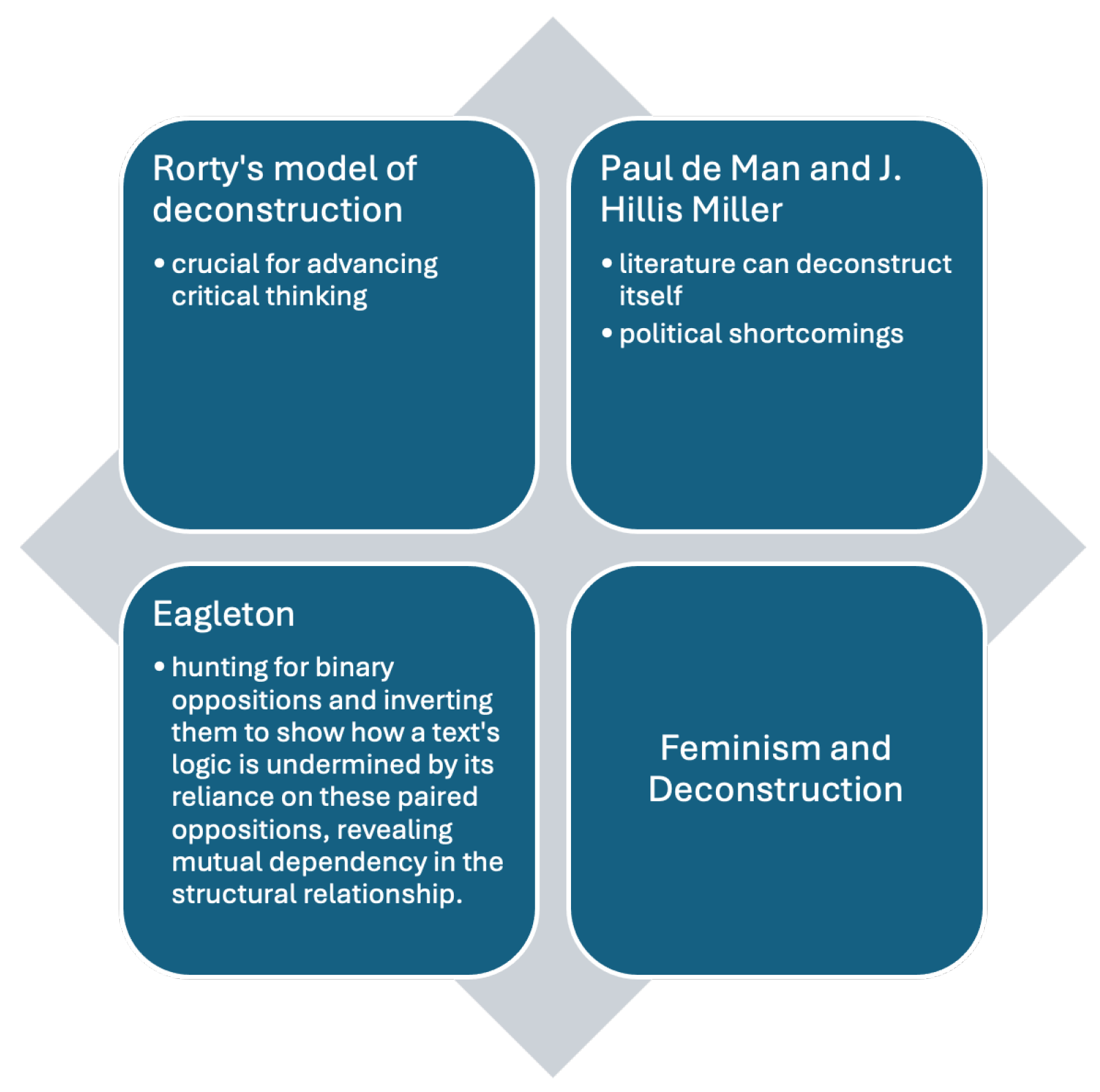
There are numerous models as Figure 2 shows. But, here we focus on how Jacques Derrida has approached to literary arts, philosophy and other branches of knowledge.
4.1.1 Model One: Derrida's Deconstruction Theory and Language
Derrida dismantles the entire system of thought established of so many years following the normative stereotypes.
• Derrida's deconstruction theory emphasizes the link between text and meaning, arguing that meaning is "deferred" by an unending chain of signifiers.
• Derrida's concept of "différance" refers to both "difference of meaning" and "deferral of meaning," overturning the hierarchy of metaphysics.
• Derrida's post-Saussurean characterization of writing as a system of "difference" that operates without positive terms and endlessly defers the achievement of identity as self-presence is called "homographesis."
• Paul de Man's "Autobiography as Defacement" questions whether life produces the autobiography as an act and its consequences.
• Derrida's hetero-thanato-biography focuses on the relationship between writing and living, emphasizing the importance of being with and grieving for the other.
• Derrida's concept of the Other is tied to the singular plural, envisioned "in the wake of society."
• The concept of trace is in the sense of the spectral, constantly situating itself in an interstitial space.
4.1.2. Model Two: Derrida's "Circonfession" and "Heterography"
• Derrida imitates Augustinian motifs and confession techniques, forming a bridge to premodern epistemology and subjectivity.
• Both authors formulate confessional subjects in relation to alterities, based on related assumptions in language and interpretation.
• Writing must function in the absence of every empirically determined addressee, allowing it to be communicable, transmittable, and decipherable.
4.1.3. Derrida's Linguistic Thinking
• Derrida distinguishes the act of addressing from the addressee, based on the priciple of "principe postal."
• Derrida's "circumfession" could also be understood as a form of a confession where the act of addressing is separated from the addressee.
Augustine and Derrida's Skepticism and Interpretations of Language
• Both share a skepticism about language but advocate for different interpretations of language.
• Derrida's "différance" calls for constant positive displacement, while Augustine's distance from reality forces interpreters to conduct their interpretation gently.
4.1.4. Deconstructing Ira Trivedi's India in Love: Marriage and Sexuality in the 21st Century
• Ira Trivedi's non-fiction India in Love explores the complexities of love and intimacy in modern India, challenging traditional notions of love and marriage.
• The book covers the modern Indian sexual revolution, characterized by young people exploring their sexuality and disagreeing with the elder generation's belief in the ideals of Sita and Ram.
4.1.5. Understanding Attitudes Towards Marriage and Sexuality in India
• The discusses the shift from bio to auto and graphy in autobiography, influenced by deconstructionists like Jean-Luc Nancy, Philippe Lacoue-Labarthe, and Paul de Man.
• Autobiography is seen as a link to writing, with the other, for the other, and by the other.
• Ira Trivedi's works explore the sexual revolution in urban India, particularly among the urban youthful middle classes.
• Trivedi's novels depict single, solo-living Indian women embracing their sexuality and seeking erotic encounters before marriage.
• Social control over female sexuality is a common feature of gender and sexuality systems across cultures.
5. Conclusions
Derrida's theory of deconstruction emphasizes the interplay between text and meaning, arguing that language is a dynamic system shaped by opposing elements. Derrida's concept of "différance" subverts the hierarchical structure of metaphysics, encompassing the difference of meaning and deferral of meaning. Ira Trivedi's book, In India in Love: Marriage and Sexuality in the 21st Century delves into the intricacies of love and intimacy in contemporary India, questioning conventional ideas around love and marriage. The Nirbhaya tragedy is a turning point in the narrative, as women in India progress faster than men, asserting their rights and facing obstacles. To dismantle cultural norms, education, campaigning, and collective action are essential. Deconstructionists like Jean-Luc Nancy, Philippe Lacoue-Labarthe, and Paul de Man have transformed the concept of autobiography, emphasizing the individual and the act of writing. Both authors share scepticism about language but argue for distinct interpretations of language..
Author Contributions
For research articles with several authors, a short paragraph specifying their individual contributions must be provided. The following statements should be used “Conceptualization, Valiur Rahaman. and Sibia.; methodology, Valiur Rahaman. and Sibia writing—original draft preparation, Valiur Rahaman. and Sibia.; writing—review and editing, Valiur Rahaman. and Sibia. All authors have read and agreed to the published version of the manuscript.”
Funding
“This research received no external funding”
Data Availability Statement
NA.
Acknowledgments
We acknowledge the contribution of digital library of LPU, Phagwara-Punjab-INDIA.
Conflicts of Interest
The authors declare no conflicts of interest.
References
- Aubrey, Bryan. “Oscar Wilde.” Salem Press Biological Encyclopaedia (2013): Research Starters. Web.
- Bhadoria, Sonal. “Gay Sex is Illegal: Supreme Court’s Dogmatic Verdict.” India Times. Times Internet Ltd., 11 Dec.2013.
- Bayer, R. Homosexuality and American Psychiatry: The Politics of Diagnosis, Princeton, NJ: Princeton University Press, 1987.
- Berger, Joseph, Bernard P. Cohen, and Morris Zelditch, Jr. 1972. ―Status.
- Characteristics and Social Interaction. American Sociological Review, vol. 37, 1972, pp. 241-55.
- Caputo, John D., 1999, The Prayers and Tears of Jacques Derrida, Bloomington: Indiana University Press, 1999.
- Cocks, Harry. “Calamus in Bolton: Spirituality and Homosexual Desire in Late Victorian England.” Gender & History 13.2 (2001): 191-223. Web. [CrossRef]
- Coleman, Lerita M. "Stigma An Enigma Demystified." The Disability Studies Reader.
- 2nd edition, (ed.) Lennard J. Davis. Routledge, 2006, pp. 141-152.
- Davis, Joseph K. Image, Symbol and Archetypes: Definitions and Uses. Interpretations Vol.16, No.1,1985.
- Dandige, Vijay. “India: Male Privilege Is the Problem.” Gay & Lesbian Review Worldwide 20.3 (2013): 26-28. Humanities Full Text (H.W. Wilson). Web.
- Derrida, Jacques, Acts of Religion, ed., Gil Anidjar, London: Routledge, 2002.
- ---The Animal that Therefore I am, ed., Marie-Loiuse Mallet, trans., David Wills, New York: Fordham University Press, 2008.
- Aporias, trans., Thomas Dutoit, Stanford: Stanford University Press, 1993.
- Clang: Glas, trans. David Wills and Geoffrey Bennington. Minneapolis: University of Minnesota Press, 2021.
- The Death Penalty (Volume 1), trans. Peggy Kamuf, Chicago: University of Chicago Press, 2014.
- The Death Penalty (Volume 2), trans. Elizabeth Rottenberg, Chicago: University of Chicago Press, 2017.
- Dissemination, trans., Barbara Johnson, Chicago: University of Chicago Press, 1981.
- The Ear of the Other: Otobiography, Transference, Translation, trans., Peggy Kamuf, New York: Schocken, 1985.
- The Gift of Death and Literature in Secret. Second Edition, trans., David Wills, Chicago: University of Chicago Press, 2008.
- Glas, trans., John P. Leavey, Jr. and Richard Rand, Lincoln: University of Nebraska Press, 1986.
- Limited Inc, trans., Samuel Weber, Evanston: Northwestern University Press, 1988 [1977].
- Margins of Philosophy, trans., Alan Bass, Chicago: University of Chicago Press, 1982.
- Memoirs for Paul de Man, trans., Cecile Lindsay, Jonathan Culler, and Eduardo Cadava, New York: Columbia University Press, 1986.
- Monolinguism of the Other, trans., Patrick Mensah, Stanford: Stanford University Press, 1998.
- Of Grammatology, trans., Gayatri Spivak, Baltimore: The Johns Hopkins University Press, 1974.
- On the Name, ed., Thomas Dutoit, Stanford: Stanford University Press, 1995.
- Of Spirit, trans., Rachel Bowlby, Chicago: University of Chicago, 1989.
- Points … Interviews, 1974–1994, trans., Peggy Kamuf and others, Stanford: Stanford University Press, 1995.
- Positions, trans., Alan Bass, Chicago: University of Chicago Press, 1981.
- The Postcard from Socrates to Freud and Beyond, trans., Alan Bass, Chicago: University of Chicago Press, 1987.
- “Signature Event Context,” in Glyph: Johns Hopkins Textual Studies, 1977, 172–197.
- Specters of Marx, trans., Peggy Kamuf, New York: Routledge, 1994.
- Speech and Phenomena, trans., David B. Allison, Evanston, IL: Northwestern University Press, 1973.
- Voice and Phenomenon, trans., Leonard Lawlor, Evanston, IL: Northwestern University Press, 2011.
- Writing and Difference, trans., Alan Bass, Chicago: University of Chicago, 1978.
- Gasché, Rodolphe, 1994, Inventions of Difference: On Jacques Derrida, Cambridge, MA: Harvard University Press.1999, Of Minimal Things: Studies on the Notion of the Relation, Stanford: Stanford University Press.
Figure 2.
The Four Models of Deconstruction (Courtsy Manav Dew Trust India for HITS Lab).
Disclaimer/Publisher’s Note: The statements, opinions and data contained in all publications are solely those of the individual author(s) and contributor(s) and not of MDPI and/or the editor(s). MDPI and/or the editor(s) disclaim responsibility for any injury to people or property resulting from any ideas, methods, instructions or products referred to in the content. |
© 2024 by the authors. Licensee MDPI, Basel, Switzerland. This article is an open access article distributed under the terms and conditions of the Creative Commons Attribution (CC BY) license (http://creativecommons.org/licenses/by/4.0/).
Copyright: This open access article is published under a Creative Commons CC BY 4.0 license, which permit the free download, distribution, and reuse, provided that the author and preprint are cited in any reuse.


