
Submitted:
06 August 2024
Posted:
07 August 2024
You are already at the latest version
Abstract
Commercial banks are financial institutions that accept public deposits and provide loans for consumption and investment to generate profit. The term "bank" originates from the Italian word "banco," meaning "desk" or "bench," which was used by Florentine bankers during the Renaissance for conducting transactions. Banking activities, however, date back to ancient times. The primary objective of this study is to examine the impact of internal control components on the organizational performance of local commercial banks in Burao, Somaliland. A descriptive research design was employed, utilizing primary data collected from these banks to assess the role of internal controls on organizational performance.The findings indicate a strong influence of internal control systems on organizational performance, revealing a significantly positive relationship between the two. Effective internal control systems contribute to the administration, completeness, and accuracy of records, and provide a safeguard against fraud and collusion, particularly among those in positions of authority or trust. For optimal performance, internal control systems must be robust and well-implemented. It is recommended that local commercial banks conduct regular internal audits of their accounting systems to mitigate risk and enhance internal control measures. Strengthening internal control systems tailored to the organization's operations and ensuring strict authorization protocols for access to bank assets are essential for improving organizational performance.
Keywords:
role
; effects
; internal control
; organizational
; performance
; local
; commercial banks
; management
; reference
1.0. Introduction
Assessing organizational performance is a vital
aspect of strategic management by (Subramaniam, 2008) moreover, organizational
performance means the effectiveness of an organization in the achievement of
their desired goals (Henri, 2004) accordingly, and Richard, Organizational
performance involves the review of a firm against its goals and objectives. In
other words, as compared with expected outputs, organizational success requires
actual outcomes, The analysis focus on three mains out comes such as; total
shareholder return, sales and return on assets, and finally on a market share.
As well as that, the organizational performance including strategic planners,
operations, finance, legal and organizational development.
The purpose of this study is to assess role of
internal control on organizational performance of Local Banks at Burao district
especially; Dahabshiil bank, Dara-Salaam bank, Premier bank, and Amal bank.
Organizational performance includes; economic or financial performance and
non-financial or operational performance.
Theoretically; this study has utilized the fraud
triangle theory, which originated from sociological literature and was adopted
as an empirically valid explanation of fraud describing three necessary
conditions for crimes to occur: pressure; a non-shareable problem, opportunity;
lack of internal controls, and rationalization; the ability to justify one’s
actions. its founder, Donald Cressey in (1953), who modified it many times,
most recently in the early 1970s. Cressey's theory focused on the individual
and identified improving organizational internal control measures as the
deterrent for preventing fraud. (Poff, 2018)). the study relates to several
scientific theories, including fundamental accounting theories such as the cost
principal theory, among others. These theories provide a framework for
understanding the principles and practices that underpin effective internal
control systems in commercial banks. By examining these theories in the context
of internal control, the study highlights how adherence to established
accounting principles can enhance organizational performance and ensure the
accuracy, reliability, and integrity of financial records. (Danielle,
2018), Maslow’s hierarchy of needs theory (Kendra, 2022), and the job
characteristics model theory (Dr. Annette, 2020).
1.1. Problem Statement
Internal controls are typically established by an
organization to provide reasonable assurance regarding the achievement of its
objectives, including the reliability of financial reporting, the effectiveness
and efficiency of operations, and compliance with applicable laws and
regulations. These controls serve as mechanisms to ensure that the organization
operates in a manner that is consistent with its goals, mitigates risks, and
adheres to legal and regulatory requirements (Esther, 2021). In this regard,
internal controls, operates a healthy accountability system and promote
transparency and integrity. A sound internal control system helps an
organization prevent fraud and errors, minimize wastage, and positively
influence organizational performance. By implementing robust internal controls,
organizations can enhance the accuracy and reliability of their financial
reporting, improve operational efficiency, and ensure compliance with relevant
laws and regulations, ultimately contributing to overall organizational success.
Despite the implementation of internal controls,
local banks are often criticized for their failures, with many collapsing
within the first few years of operation. This may be due to the poor perception
of audits within the organization, which limits performance improvement,
creates tension, and results in negative returns. Weak or ineffective internal
control systems cause significant losses in many local banks and have
contributed to the failure of others globally. These losses could be prevented
or detected through effective internal control mechanisms before they occur.
Consequently, many local banks in Burao underperform if their internal control
systems are not strengthened. Thus, it is essential to study the impact of
internal control systems on the organizational performance of local commercial
banks in Somaliland.
2.0. Literature Review
2.1. Theoretical Prespectives
“Martin (1994), describes the internal control as
including internal checks and internal auditing, it projects the whole system
of controls to be applicable to sales, purchases, finance, cost, production,
and others. These controls provide safety and security to assets and continuous
checks on the day-to-day transactions” (Ayneshet, 2020). “According to
Jacksonville 2000, the internal control process, which historically has been a mechanism
for reducing instances of fraud, misappropriation and errors has become more
extensive, addressing all the various risks faced by organizations” (Ayneshet, 2020). “It is now recognized that a sound internal control process is critical
to the organization’s ability to meet its established goals. Internal control
consists of five interrelated elements: and these elements are explained with
it and of suitable principle to be followed by concerned people in an
organization and these elements are; Management oversight and the control
culture, Risk recognition and assessment, Control activities and segregation of
duties, Information, and communication; and Monitoring activities and
correcting deficiencies” (Ayneshet, 2020). "Sawyers (2002) guide for
internal Auditor pointed out the various internal controls and they are;
Documentation, Verification, supervision, safeguard assets, personal controls,
and reporting” (Ayneshet, 2020). “Accordingly, the effective functioning of
components of internal control provides a reasonable assurance regarding
achievement of one or more of the stated categories of objectives to ensure
high level of the organizational performance.
One of the five interrelated components of internal
control system is a control environment factor. It refers to the integrity,
ethical value and competence of the entity’s people (COSO, 1994). Internal
control should be viewed in a broader context for example it should as well be
reorganized as a function of people’s ethical values as it is of standards and
compliancy mechanisms” (Ayneshet, 2020). Internal controls ensure that a firm
complies with accounting laws and regulations. This helps a company identify
and correct accounting problems before an internal audit begins. Additionally,
internal controls ensure that the accounting or financial information presented
by a company manager is reliable, accurate, and free from fraud (Jason,
2022).
Mostly the internal control component of control
activities is used in sales process, so common internal controls over the sales
include; Establishment of sales responsibility, segregation of duties,
documentation procedure, physical controls, independent internal verification,
and human resource controls (Angie, 2019). Ting, Xiaotao, Chi and Yakun said
‘we find robust and consistent evidence that customer satisfaction is
negatively associated with internal control weaknesses and overall, our
findings provide the direct evidence that in-effective internal control compromises
customer satisfaction (Ting, Xiaotao, Chi and Yakun, 2021).
Control activities, monitoring and risk assessment
are positively and significantly impact on job satisfaction of employees in the
company and control environment is identified as the insignificant factor by
the study (A runa, 2019). Our research results show that detective controls
with more timely feedback improve employees’ performance without affecting
their intrinsic motivation. In contrast, the restriction of autonomy associated
with preventive controls, has no additional effect on employees’ performance
but significantly reduces employees’ motivation (Margaret, Scott A., Sott L.,
and David, 2009).
Marketing planning and marketing strategies are
integral to company planning and strategy. Marketing control, which is also
part of internal and financial control, assesses the degree of alignment
between planned and achieved marketing objectives and holds accountability for
undue costs and unused reserves. Similarly, marketing audits, as part of
internal audit activities, provide a continuous, independent, and objective
assessment of an organization's marketing activities and decisions (Plamen, 2019). Our research results indicate a significant positive correlation between
internal control and financial performance. Additionally, corporate social
responsibility (CSR) positively influences financial performance, and social
responsibility plays a strong intermediary role between internal control and
financial performance (Wang and Guan, 2017).
When internal control is effective, it can prevent
adverse events that damage social responsibility practices, thereby improving
corporate social responsibility performance. In other words, effective internal
control encourages business enterprises to fulfill their social
responsibilities (Xio, Zheng, Liu and Mohammed, 2018). However, as mentioned in
the conceptual framework and these theoretical perspectives, Internal control
components can take a role on each variables include; accounting and marketing.
“The study relates to a number of the scientific theories, include; basic
accounting theories which include the cost principle theory and others (Danielle, 2018), Maslow’s hierarchy of needs theory” (Kendra, 2022), and “the job
characteristics model theory” (Dr. Annette, 2020).
2.2. Organizational Performance
Organizational performance is defined as the
outcomes that indicate the organization's efficiencies or inefficiencies in
terms of corporate image, competencies, and financial results. Focusing on
organizational performance is essential as it involves processes aimed at
increasing the organization's effectiveness. Performance is essentially the
transformation of inputs into outputs to achieve specific outcomes. Performance
relates to the relationship between minimal and effective costs (economy),
effective costs and realized outputs (efficiency), and outputs and achieved
outcomes (effectiveness).
In this study, we examined the role of internal
control components on organizational performance, categorizing organizational
performance into two areas: financial performance and non-financial or
operational performance.
Financial performance is a subjective measure of
how effectively a firm uses its assets to generate revenue from its primary
business operations. It also serves as a general indicator of the firm's
overall financial health over a specified period. For the purposes of this
study, financial performance was refered to the steps and measures taken by
business organizations in the economic domain to achieve their goals, including
accounting procedures and sales processes.
Operational performance refers to the synergy
between various company units and their ability to collectively produce greater
output. It is the extent to which all business departments collaborate to
accomplish specific business goals. In this study, operational performance will
be understood as the steps and measures taken by business organizations that
are not directly related to finance but are crucial for achieving their goals,
such as customer and employee satisfaction, marketing, and social responsibility.
2.3. Review of Case Studies
Ayneshet Agegnew (2020) examined ‘the effect of
internal control on organizational performance in reference to Moha Soft Drinks
Company in Ethiopia’, using descriptive design in soliciting information, and
questionnaires in data collection. The results of his study showed that
internal control has an effect on organizational performance specially on
accounting procedures. The study recommended that management should develop
more effective strategies ensuring that internal control is effective and
efficient, also it recommended that the company should work to correct its
internal control system by periodic reconciliation (Ayneshet, 2020).
Esther Simon (2021) examined ‘the effect of
internal control on organizational performance in the Telecommunication
Industry in south and south-east Nigeria’, using a descriptive survey research
design, and questionnaire in addition with interview in data collection. The
study concluded that an organization's internal control environment and risk
assessment positively influence organizational performance. It recommended that
management should implement additional control activities to sustain and
enhance the effectiveness of internal controls, thereby improving overall
performance (Esther, 2021).
Hassan Mire (2016) investigated ‘effects of
internal control system on the organizational performance of remittance
companies in Mogadishu, Somalia’, using a descriptive research design, and
questionnaires in data collection. The study recommended that remittance
companies in Mogadishu should enhance their control environment, risk
assessment, and control activities. This recommendation is based on findings
that these variables positively impact the organizational performance of
remittance companies in Mogadishu (Mohamed, 2016).
Another study conducted (Oladele, 2010) Sought to
find out ‘the impact of the internal control system in the banking sector’. The
study classified controls into three main types: preventive controls, detective
controls, and corrective controls.
Data were gathered from both primary and secondary
sources, including interviews, structured questionnaires, journal publications,
textbooks, newspapers, and online resources. The findings indicate that the
primary cause of bank fraud in Nigeria is the absence of an effective internal
control system. Consequently, it is concluded that bank management should
develop and implement a robust internal control system capable of resisting
fraudulent activities. This will help ensure operational continuity, and maintain
the bank’s liquidity, solvency, and overall viability.
Qasim Ahmed (2021) examined ‘the effect of internal
control on employee performance of SMS enterprises in Jordan’ using survey
questionnaire to gather data. The results from the analyses in that research
provided that internal control system has a major effects and roles on employee
performance (Qasim, 2021).
Ting Chen and his friends (2021) investigated
‘customer satisfaction and internal control on Amazon.com’, using a large
sample of product rating data from Amazon.com. they found that customer
satisfaction is negatively associated with internal control weaknesses. In
other words, their findings provide the direct evidence that in-effective
internal control compromises customer satisfaction (Ting, Xiaotao, Chi and
Yakun, 2021).
2.4. Conceptual Framework
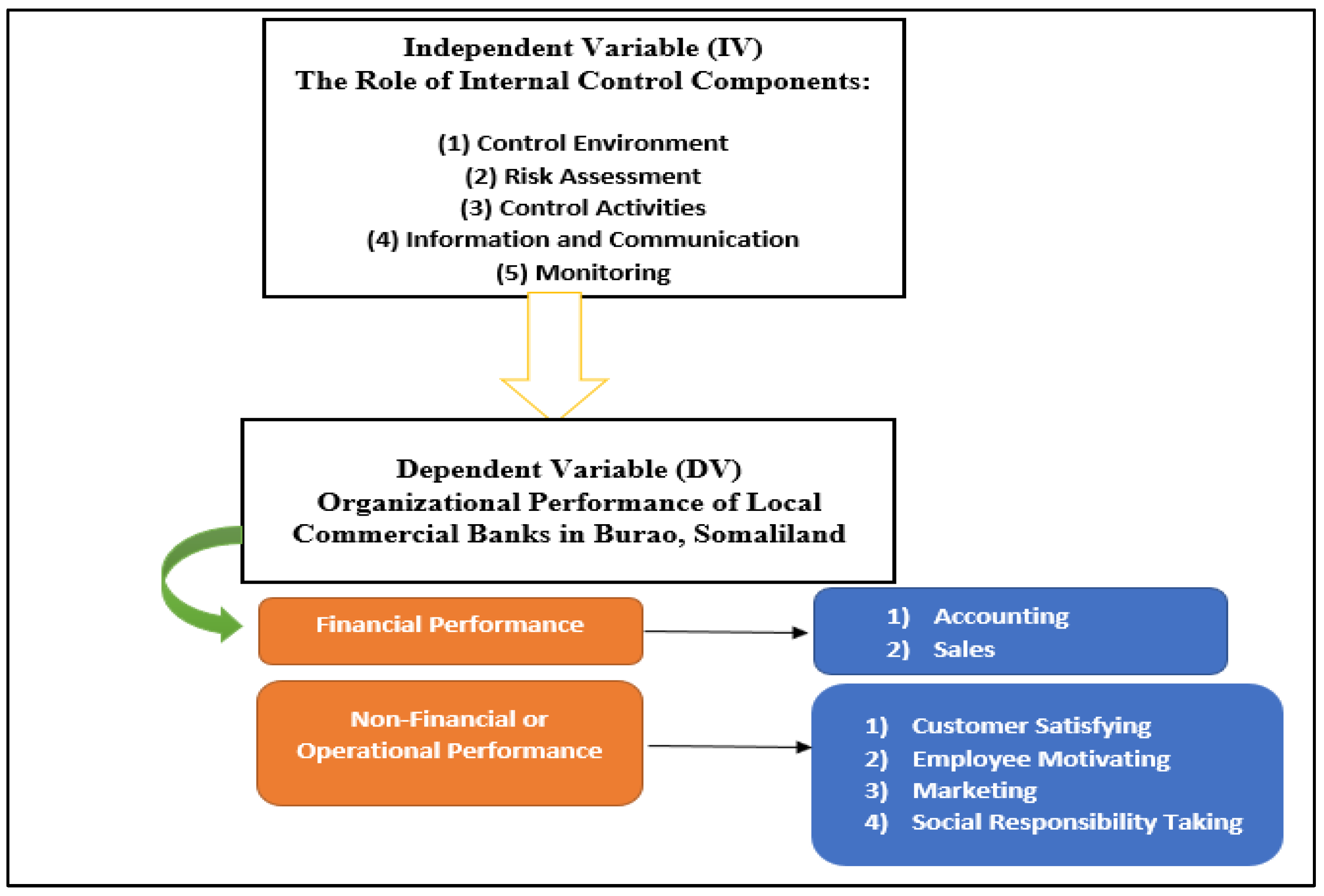
The framework indicates the relationship between
the internal control components and the performance of local commercial banks
in Burao district. The frame (Figure 1)
is predicting direct effects from IV to DV thus neither moderating nor
mediating variable was considered.
Figure 1.
Coceptual Framework (Source: Researcher).
3.0. Methodologies
3.1. Summary
A descriptive research design was used, with
quantitative methods to collect numerical data from local banks in Burao,
Somaliland. The target population included 167 staff members, and a sample size
of 50 respondents was determined using a systematic random sampling technique.
Data were gathered through structured questionnaires and analyzed using SPSS
software. Validity and reliability were ensured through expert judgment and
Cronbach’s Alpha, respectively. Ethical considerations were observed by
obtaining informed consent, ensuring anonymity, and avoiding disruption during
data collection.
4.0. Data Presentation, Analysis, and Interpretation
4.1. Descriptive Analysis

Table 1.
Gender.
| Frequency | Percent | ||
| Valid | Male | 30 | 60.0 |
| Female | 20 | 40.0 | |
| Total | 50 | 100.0 | |
Source; Primary (2022).
The above table shows that 30 (60%) of the
respondents were male, and 20(40%) of them were female. this illustrates that
most of the respondents were male respondents, meaning that the number of males
working in commercial banks were more than the number of females working in
commercial banks.so in this table and chart we could see how that is possible.
Table 2.
What is your age?
| Frequency | Percent | ||
| Valid | 30-39 | 21 | 42.0 |
| 40-59 | 23 | 46.0 | |
| 60 and above | 6 | 12.0 | |
| Total | 50 | 100.0 | |
Source; Primary (2022).
As the above table shows age of 21(42%) of the
respondents were “between”, 30-39, 23 (46%) of the respondents were “between”
40-59, 6(12%) of the respondents were between 60-and above. This illustrates
that most of the respondents were ranged from 40-59. In that age is when person
he or she has the skills, experiences, and means necessary for an enjoyable
life and work.
Table 3.
What is your qualification?
| Frequency | Percent | ||
| Valid | Diploma | 7 | 14.0 |
| Bachelors | 35 | 70.0 | |
| Masters | 8 | 16.0 | |
| Total | 50 | 100.0 | |
Source; Primary (2022).
As the above table shows, 7(14%) of the respondents
were Diploma level, 35 (70%) of the respondents were Bachelors, 8(16%) of the
respondents was Masters, this illustrates that most of the respondents were
University level or bachelors. That means when we compare the number of
respondents were not in high school or less but they were university level and
graduated.
4.2. Variable Tests
4.2.1. Reliability Test:
The study assessed the reliability of the data
collected from 50 participants. The consistency of the responses was evaluated
empirically, with the calculated Cronbach’s alpha being 0.633, which indicates
a good level of reliability. This alpha value suggests that the responses from
interviews were largely consistent and interrelated. The analysis concluded
that the study's questionnaire was designed effectively, as responses from
participants were similar and logically organized. Additionally, test-retest reliability
was measured in the research. The results, as shown in the table, demonstrated
consistency and significance in the findings.
4.2.3. Correlation Tests:
Pearson’s Correlation Model: Role of Internal
Control on Organizational Performance in Local Commercial Banks in Burao
–Somaliland
Table 21.
Pearson Correlation.
| Internal Control Systems | Organizational Performance in Local Commercial Banks | ||
| Internal Control Systems | Pearson Correlation | 1 | 558** |
| Sig. (2 tailed) | 0.01 | ||
| N | 50 | 50 | |
| Organizational Performance in Local Commercial Banks | Pearson Correlation | 558** | 1 |
| Sig. (2 tailed) | 0.01 | ||
| N | 50 | 50 |
Source: Primary.
The table demonstrates a Pearson's correlation analysis exploring the relationship between Internal Control Systems and Organizational Performance in Local Commercial Banks in Burao, Somaliland. The analysis reveals a significant positive correlation coefficient of 0.558, suggesting that improvements in internal control systems are associated with enhancements in organizational performance. The statistical significance of this correlation is underscored by a p-value of 0.01, indicating that the observed relationship is highly unlikely to be due to chance. With a sample size of 50, the data robustly supports the conclusion that stronger internal control systems contribute positively to the performance of local commercial banks, affirming the critical role of these systems in ensuring financial stability and operational efficiency.
5.0. Conclusion and Recommendations
5.1. Conclusion
The researcher concludes that there is a significant positive relationship between internal control systems and organizational performance. Internal control systems are relatively effective and have a substantial impact on organizational performance. They ensure the proper administration, completeness, and accuracy of records and provide safeguards against fraud and collusion, particularly among those in positions of authority or trust. For optimal performance, internal control systems must be adequately robust in any organization.
The study also finds a moderate positive relationship between internal control systems and organizational performance. However, it reveals that the internal controls implemented in commercial banks in Burao, Somaliland, were ineffective and unsatisfactory. Consequently, the organizational performance was deemed inadequate. Despite this, a significant positive relationship between internal controls and organizational performance was established.
5.2. Recommendations
To enhance the performance and reduce risks in local commercial banks, it is essential to maintain regular internal audits of their accounting systems. Improvements should be made to internal control systems to align better with organizational operations, and robust authorization tools should be implemented to manage access to bank assets effectively. Strengthening internal control systems will contribute to increased profitability and overall bank performance. Additionally, close monitoring of employees is necessary to prevent the circumvention of established controls, ensuring the integrity of the system. To foster a diligent and honest workforce, employees should be motivated adequately, reducing the temptation to engage in fraudulent activities due to insufficient rewards.
References
- Wikipedia. (2022, January 1). Retrieved from Wikipedia: https://en.wikipedia.org/wiki/Organizational_performance.
- Wikipedia. (2022, june 24). Retrieved from Wikipedia: https://en.wikipedia.org/wiki/Bank.
- A runa, S. (2019). the impact of internal control on job satisfaction of female workers. international Journal of research in engineering, 1-8.
- Angie, M. (2019, January 28). Small Business Chron. Retrieved from Small Business Chron: https://smallbusiness.chron.com/audit-procedures-sales-collection-cycle-49846.html.
- Audit-Board. (2018, April 17). Audit Board. Retrieved from Audit Board: https://www.auditboard.com/blog/7-reasons-to-maintain-your-internal-controls-compliance-program/.
- Ayneshet, A. A. (2020). The Effect of Internal Control on Organization Performance in. International Journal of Research in Business Studies and Management, 1-10.
- Bhasin Hitesh. (2019). Internal Control: Meaning, Types, Components and objectives. marketing91.
- BPP, M. a. (1988). ICAN Study Test on Auditing and Investigation. oxford: Oxford: Oxford University Press.
- Brown, S. P. (Brown, S. P. ). A meta-analysis and review of organizational research on job involvement. Psychological Bulletin, 120(2),, 235–255.
- CFI Team. (2022, February 27). CFI. Retrieved from Corporate Finance Institute: https://corporatefinanceinstitute.com/resources/knowledge/finance/financial-performance/.
- Cornelius Kipkemboi Lagat¹, C. A. (2016). EFFECT OF INTERNAL CONTROL SYSTEMS ON FINANCIAL MANAGEMENT. Journal of Economics,, 162-186.
- Danielle, S. (2018, november 16). Retrieved from biz-fluent: www.bizfluent.com/about.
- Dr. Annette, T. (2020, may 30). Retrieved from ckju.net for management skills: www. ckju.net.
- Drupal. (2015).
- Esther, S. (2021). effect of internal control on organizational performance in the T.I in south and southeast Nigeria. International Journal of Social Science, 1-20.
- Forecast Academy team. (2021, August 20). Forecast. Retrieved from Forecast Platform: https://www.forecast.app/blog/operational-performance#:~:text=improve%20operational%20performance-,What%20is%20operational%20performance%3F,to%20accomplish%20specific%20business%20goals.
- Furlong, M. (January 25, 2019). What Are the Types of Internal Controls? bizfluent.
- Hackett, W. a. (1976). An auditing perspective of the Historical development of. Florida Agricultural and Mechanical University, 003-009.
- Henri, J. (2004). "Performance measurement and organizational effectiveness: bridging the gap". Québec City: 93-123.
- Ian Palmer, R. D. (1996). Reframing and organizational action: The unexplored link. Journal of Organizational Change, 12-25.
- James, A. H. (2008). Accounting information system. Mason, Ohio: Cengage Learning Academic Resource Center.
- Jamshidi-Navid, B. a. (2009). A Clear Look at Internal Controls: Theory and Concepts. Hamed: Social Science Research Network.
- Jason, G. (2022, April 07). the business Professor. Retrieved from the business Professor: https://thebusinessprofessor.com/en_US/accounting-taxation-and-reporting-managerial-amp-financial-accounting-amp-reporting/internal-controls-definition.
- Jonathan Duchac, J. M. (2007). financial accounting An Integrated Statements Approach. 0-324-37443-7: Cengage Learning.
- Julia Kagan. (2021, October 06). Investopedia. Retrieved from Investopedia: https://www.investopedia.com/terms/c/commercialbank.asp#toc-significance-of-commercial-banks.
- Katushabe, P. (2016). INTERNAL CONTROLS AND ORGANISATIONAL PERFORMANCE OF UNITED NATIONS ORGANISATION STABILISATION MISSION IN THE DEMOCRATIC, REPUBLIC OF THE CONGO, ENTEBBE BASE. Uganda management institute, 1-102.
- Kendra, C. (2022, January 26). Retrieved from verywell-mind: www.verywellmind.com.
- Kenton, W. (2019). Principles of Auditing & Other Assurance Services,. Sarbanes-Oxley (SOX).
- Margaret, Scott A., Sott L., and David. (2009). effectof preventive and defective controls on employee performance and motivation. Research-gate, 1-39.
- Martin. (1994). reports of tax cases. Northern Ireland: LNUK.
- Mohamed, A. M. (2016). EFFECTS OF INTERNAL CONTROL SYSTEM ON THE ORGANIZATOINAL PERFORMANCE OF REMITTANCE COMPANIES IN MODADISHU-SOMALIA. Journal of Business Management , 1-15.
- Noorbakhsh, F. a. (2001). Human Capital and FDI Inflows in Developing Countries: New Empirical Evidence. Journal of World Development, 1539-1610.
- Oladele, J. (2010). The Effect of Internal Control System on Nigerian Banks. International Journal of Accounting, 123-129.
- Oxford-Languages. (n.d.). Oxford University Press. Retrieved from Oxford Languages: https://languages.oup.com/google-dictionar-en/.
- Plamen. (2019). Pro-Quest Scholarly Journal. Control and Audit in Marketing, 1-5.
- Poff, D. C. (2018). Fraud triangle: Cressey's fraud triangle and alternative fraud theories. Springer, Cham, Switerland.: https://link.springer.com/referencework/10.1007/978-3-319-23514-1.
- Qasim, A. (2021). the effect of internal control on employee performance of SMS enterprises in Jordan. Jornal of Asian finance, economies, and Business, 1-9.
- Rae, K. a. (2008). Quality of internal control procedures : antecedents and moderating effect on organisational justice and employee fraud. Managerial auditing journal,, 104-124.
- Rae, Kirsten; Sands, John; and Subramaniam, Nava. (2017). Associations among the Five Components within COSO Internal Control-Integrated Framework as the Underpinning of Quality. Australasian Accounting, Business and Finance, 28-54.
- Richard, Pierre, Devinney, Timothy,Yip, George,Johnson, and Gerry. (2009). Measuring Organizational Performance: Towards Methodological Best Practice. Journal of Management, 35.
- Rynes, S. L. (1990). Applicant attraction strategies: An organizational perspective. Academy of Management Review, 286-310.
- Salah, S. (2012).
- Subramaniam, K. R. (2008). Quality of internal control procedures: Antecedents and moderating effect onorganisational justice and employee fraud. Managerial Auditing Journal, 104 - 124.
- Ting, Xiaotao, Chi and Yakun. (2021). Customer satisfaction and Internal Control. College of Management Journal, 1-53.
- Tipgos, M. A. (2002). Why Management Fraud Is Unstoppable. The CPA journal., 34-41.
- Uganda, B. o. (2011). BANK OF UGANDA FINANCIAL CONSUMER PROTECTION. Bank of Uganda, 1-18.
- Veyrat-Durebex, C. C. (2016). Disruption of TCA Cycle and Glutamate Metabolism Identified by Metabolomics in an In Vitro Model of Amyotrophic Lateral Sclerosis. Molecular Neurobiology, 6910–6924.
- Wang and Guan. (2017). Research on the relationship between internal control and financial performance. Advances in Economics, Business and Management Research Journal (Press Atlants), 1-6.
- Wikipedia. (2022, July O6). Retrieved from Wikipedia: https://en.wikipedia.org/wiki/Commercial_bank#Role.
- Wikipedia. (2022, April). Wikipedia. Retrieved from Wikipedia: https://en.m.wikipedia.org/wiki/Internal-control.
- Xio, Zheng, Liu and Mohammed. (2018). the effectiveness of Internal Control and Corporate Social Responsibility. MDPI Journal, 1-18.
Disclaimer/Publisher’s Note: The statements, opinions and data contained in all publications are solely those of the individual author(s) and contributor(s) and not of MDPI and/or the editor(s). MDPI and/or the editor(s) disclaim responsibility for any injury to people or property resulting from any ideas, methods, instructions or products referred to in the content. |
© 2024 by the authors. Licensee MDPI, Basel, Switzerland. This article is an open access article distributed under the terms and conditions of the Creative Commons Attribution (CC BY) license (http://creativecommons.org/licenses/by/4.0/).
Copyright: This open access article is published under a Creative Commons CC BY 4.0 license, which permit the free download, distribution, and reuse, provided that the author and preprint are cited in any reuse.


