

Submitted:
30 January 2025
Posted:
03 February 2025
You are already at the latest version
Abstract
Purpose
Sharia banks in Indonesia are having difficulty competing with conventional banks and maximizing their business performance. Several perspectives underline the importance of internal resources in optimizing the company’s business performance. This study seeks to measure internal resources found in the largest sharia bank in Indonesia and see its influence on the company’s business performance. This study also examines the mediation of innovation and collaboration strategies in the influence of internal sharia capital on business performance.
Design/methodology/approach
The research was conducted on the largest sharia bank in Indonesia, Bank Syariah Indonesia, through quantitative study using PLS-SEM with SmartPLS software. A total of 285 managers from across the country were involved in this study.
Findings
The results confirm that internal sharia capital positively and significantly affect business performance, innovation strategies, and collaboration strategies. Innovation and collaboration strategies also significantly influence business performance, giving both a significant mediation role to the main relationship.
Originality
The originality in this research lies in the integration of resource-based view theory (RBV) as the grand theory with resource-advantage theory (R-A) as the middle-range theory. A greater percentage of indirect influence compared to direct influence indicates that the combination of these two theories has proven to give highly significant results on BSI's business performance. This research also proves that internal sharia capital enhanced with innovation and collaboration strategy can give more positive effects to business performance.
Keywords:
Internal sharia capital
; Innovation strategy
; Collaboration strategy
; Business performance
; Sharia banking
; RBV theory
; R-A theory
1. Introduction
According to Indonesia’s Financial Services Authority (OJK), sharia banking is a banking system that uses sharia or Islamic principles to carry out its business activities (OJK, 2017). Indonesia has great potential in the sharia banking industry because it has the world’s largest Muslim population. Based on data from The Royal Islamic Strategic Studies Centre in 2022, 231.055.500 people or 86.7% of Indonesia’s population, are Muslims. The large number of Muslims is a potential for sharia banking to play an essential role in economic growth, improving welfare, and equitable distribution of national development (OJK, 2020). Sharia bank must first have optimal business performance to fill these essential roles. Business performance is the result of a company’s series of activities and is an indicator of achieving the company’s goals. In business, performance can be seen in profitability, market share, cost reduction, increased efficiency, etc.
The great potential possessed by Indonesia’s sharia banking does not necessarily make its business performance superior, especially compared to conventional banking. According to data from OJK, sharia banking in Indonesia has consistently experienced market share growth yearly. However, the percentage increase is very sloping. Over the past decade, the growth has been just over 3%. This results in the market share of sharia bank in Indonesia being much smaller than the market share of conventional banks, which reaches 92.97%. The overall market share of sharia bank in Indonesia can only reach 7.03% as of August 2022 (OJK, 2022). It can be concluded that although Indonesia has the potential in the form of such a large Muslim population, sharia banking has not been able to take full advantage of this opportunity.
Therefore, it is interesting to research what sharia bank can do to improve their business performance. One of the effort s that sharia bank can make is to examine their internal resources further, since internal resources are considered as the company’s core competencies and are very influential in achieving business performance. This is in accordance with the resource-based view (RBV) theory from Barney (1991), which states that internal resources can be utilized to achieve sustainable company excellence. Since the context of this study is very specific to sharia banking, researcher need to use a measurement of internal resources that is especially crafted for sharia industry. Thus, this research will use the Internal Sharia Capital measurement that was composed based on an exploratory study in previous research (Thaib et al., 2024).
Despite of the support from RBV theory, several studies have found that internal resources do not have a significant impact on business performance (Hutahayan, 2020; Rambe et al., 2021; Olan et al., 2022). These inconsistencies provoke this research to fill the existing research gap. To enhance the internal sharia capital influence on business performance, it was believed that internal sharia capital might need to be supported by other factors. Following the resource-advantage (R-A) theory by Hunt and Morgan (1995), there are two factors that can help to enhance the influence of internal capital to business performance: innovation and collaboration strategy.
Based on the R-A theory, companies must constantly develop their internal resources to have comparative value in the market. One way to develop internal resources is to implement various innovation strategies (Hunt, 2012). Regarding the relationship between internal resources and innovation strategies, Tipu (2014) explained that the role of humans in a company is essential for developing Sharia bank’ innovative products. On the other hand, Chabbouh and Boujelbene (2020) also proved a positive relationship between innovation and business performance, supported by AlQershi (2021), who emphasized that innovation strategies can improve overall business effectiveness. The findings of those studies show that combination of competitive internal resources and innovation strategies can improve company’s business performance.
Not only innovation strategies, companies must develop collaboration strategies to increase their internal resources. With collaboration, companies can access new resources that not yet explored internally. This is, again, in line with the R-A theory, which views relationships as one of the most important resources a company must have (Hunt, 2012). In relation to business performance, several previous studies have proven that collaboration strategies can be an essential and significant factor in business performance success (Cao & Zhang, 2011; Chang & Graham, 2012). The findings of both studies prove that internal resources can improve business performance through collaboration strategies implemented by companies.
Based on above explanation, this study aims to examine the influence of internal sharia capital on business performance, with the mediation of innovation and collaboration strategies. To obtain representative data, this research was carried out at the largest sharia bank in Indonesia: Bank Syariah Indonesia (BSI). BSI is a state-owned sharia bank formed from a merger between Bank Syariah Mandiri, BRI Syariah, and BNI Syariah. The merger of the three state-owned banks was inaugurated on February 1, 2021. As the largest sharia bank in Indonesia, BSI claimed to have 20,46 million customers by June 2024 (BSI, 2024). The significant amout of customers make BSI has the most significant potential to compete with conventional banks. Therefore, BSI is considered as the most representative sharia bank that can be used for the sharia banking industry research in Indonesia. Comprehensive research on BSI is expected to answer how to increase sharia bank’s business performance in Indonesia, the country with the most significant number of Muslims worldwide.
2. Literature Review
2.1. Theoretical Framework
Internal resources are the entire capital owned and can be controlled by the company, with the function of implementing the company’s strategy effectively and efficiently (Barney, 1991). In-depth research on internal resources is based on the RBV theory, which views internal resources as the primary determinant of a company’s competitive advantage (Barney & Hesterly, 2015). The RBV theory assumes that companies are not only competing in producing good products but also competing to have competitive internal resources (Barney et al., 2021). In other words, a company’s competitive advantage can be analyzed through how the company maximizes the use of its internal resources.
To understand innovation and collaboration strategies, we can look through the resource-advantage theory of competition or R-A theory. Hunt (2000) in Varadarajan (2023) emphasizes that the R-A theory is a competition theory that explains the process of competition. Before competing in the market, companies must go through an internal process to manage their resources. The R-A theory states that companies compete to have resources that have a comparative advantage, where these resources can be used to implement company strategies effectively and efficiently (Varadarajan, 2023).
Competition in the market is dynamic or disequilibrium-provoking; hence, innovation becomes essential for companies to maintain their competitive advantage (Hunt & Morgan, 1996; Hunt, 2012). Innovation will encourage companies to manage their internal resources better, acquire new resources with maximum production, or seek resources to operate more effectively and efficiently (Hunt & Morgan, 1996). This discussion on innovation presents how the R-A theory develops and complements the RBV theory. In addition to innovation, the R-A theory also views relationships as one of the most important resources a company must have (Hunt, 2012). Therefore, it can be concluded that innovation and collaboration are both essential components of the R-A theory that can affect the company’s business performance.
2.2. Company’s Business Performance
Performance refers to the level or target achieved by an organization or the effectiveness of an individual or group. Performance at the organizational level refers to efficiency, productivity, attendance rate, turnover rate, and adaptability. Colase (in Taouab & Issor, 2019) considers business performance as ideas such as growth, profitability, returns, productivity, efficiency, and competitiveness of a company.
The ultimate goal of every company is to improve its business performance. The results of the company's performance and its improvement are considered to be the core of strategic management. As such, most of the company's efforts are focused on this area (Tseng & Lee, 2014). Performance is measured based on the organizational unit to be assessed and the goals to be achieved. The objectives that have been set in advance in the strategy formulation section of the strategic management process (related to profitability, market share, and cost reduction) are used in measuring the company's performance.
2.3. Internal Resources
In the RBV theory, the company's internal resources are defined as the entire capital owned and able to be controlled by the company, so that the capital can be used to implement the company's strategy effectively and efficiently (Barney, 1991). This capital can include assets, company culture, organizational processes, company attributes, informal relationships between superiors and subordinates, employee experience, and knowledge controlled by the company (Barney, 1991; Mata et al., 1995). All companies that compete in the competitive market certainly have varying internal resources. To compete well and achieve sustainable competitive advantage, Barney & Hesterly (2015) states that a company's internal resources must have the attributes following VRIO principles. Companies that have internal resources with VRIO principles have the potential to have a sustainable competitive advantage, which will lead the company to superior business performance (Barney 1991; Barney et al., 2021). In line with RBV, previous studies have also emphasized that internal resources are important driving factor for a company's success (Chen et al., 2021; Samad, 2020; Asiaei et al., 2020). When a company has inadequate internal resources, it can fail to gain a competitive advantage and lose out in the global market (Paul et al., 2017).
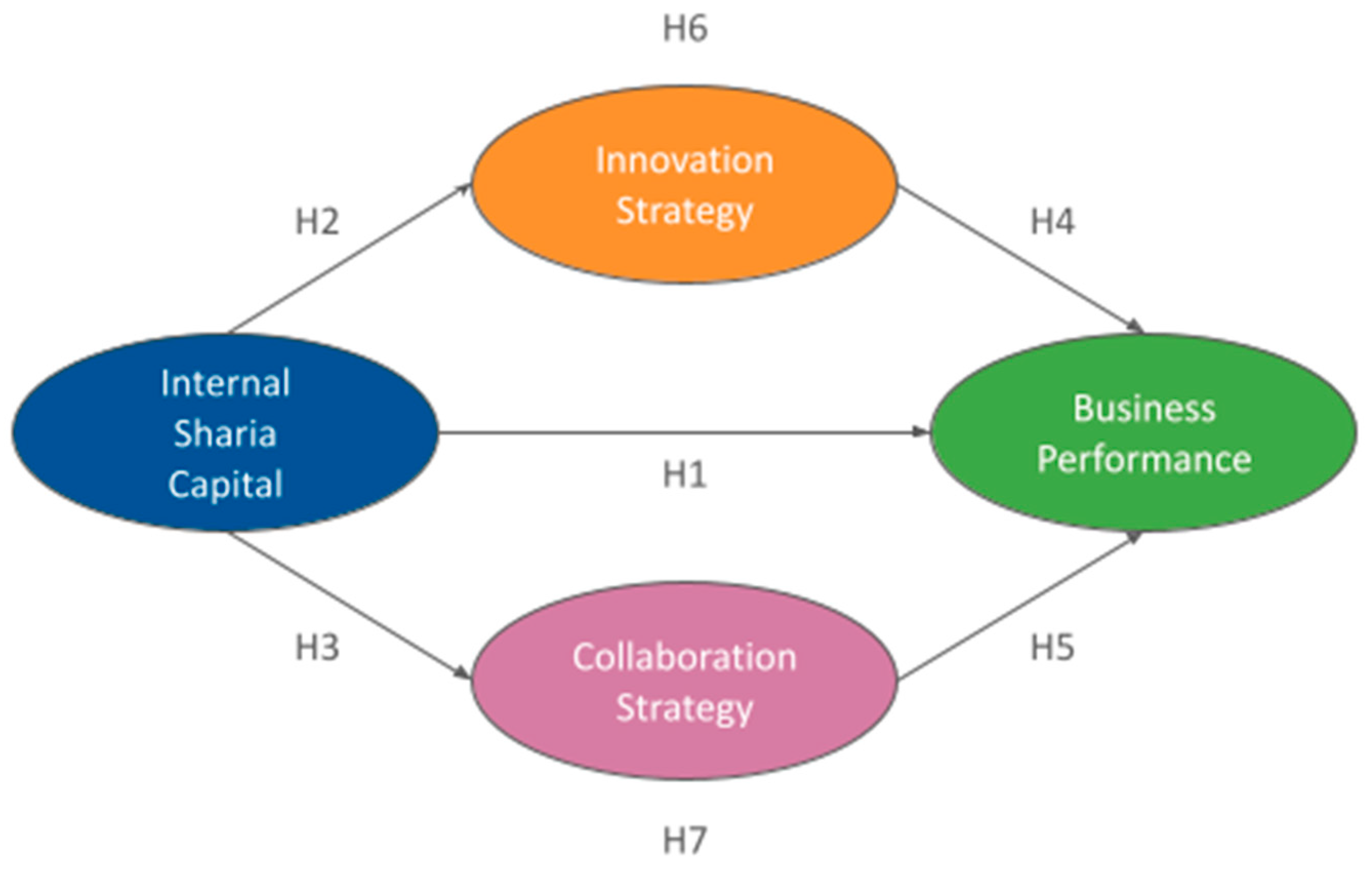
H1: Internal sharia capital significantly influence business performance.
Internal resources, in any form, can give a great influence on innovation strategies. Several studies have showed that there is a direct influence of human capital on a company's innovative performance (AlQershi et al., 2021; Samad, 2020; Wu & Sivalogathasan, 2013). In addition, Wu and Sivalogathasan (2013) also stated that organizational capital can also influence company’s innovation strategies. Organizational conditions that encourage employees to exchange knowledge and a structured system to store knowledge can be factors that affect the improvement of the company's innovation strategies.
H2: Internal sharia capital significantly influence innovation strategy
To achieve optimal business performance, companies can work with other companies to bring their internal resources together to achieve collaborative excellence (Cao & Zhang, 2011). This shows that internal resources have an influence on collaboration strategy. Zulu-Chisanga et al. (2021) states that the internal resources of a company can impact the breadth of collaboration between the company and its partners. If the company can increase its internal resources, then other companies will be more interested in collaborating with the company. Research from Bryson et al. (2015) even stated that the combination of organizational capital, human capital, and physical capital can affect collaboration between companies. Good work culture, employees with collaborative nature and vision, also technologies can help a company to bridge its differences with their partners, so that the collaboration process can run better.
H3: Internal sharia capital significantly influence strategic collaboration
2.4. Innovation Strategy
Innovation strategy is an innovation in a company's business model that leads to a new, more effective, and more efficient way of doing things (AlQershi et al., 2020). In any kind of industry, including banking, innovation is always needed as customers’ needs and demands are always changing (Hussein et al., 2019). Previous studies have found the influence of innovation strategies on business performance (Kalay & Lynn, 2015; Oke et al., 2012; Verhees & Meulenberg, 2004). The development and implementation of a good innovation strategy can give rise to a company's competitive advantage, which will ultimately have a positive impact on the company's business performance. Related to that notion, research from Algarni et al. (2023) found that innovation strategies have a positive influence on sustainable competitive advantage.
In its implementation, quality of the human capital in a company is a very important factor for a company to develop and execute innovation strategies well. Verhees and Meulenberg (2004) mentioned that an innovation strategy supported by all human resources in the company, including human resources at the top management level, will have a very positive impact on the company's success in business. Therefore, special attention and training is needed for human resources in the company so that they can carry out innovation strategies to achieve optimal business performance (AlQershi, 2021; AlQershi et al., 2021).
H4: Innovation strategy significantly influences business performance
2.5. Collaboration Strategy
In the context of business, collaboration strategy is a motivational condition that affects the development of relationships with other companies to build strategic business relationships in order to increase the effectiveness and efficiency of the company's operations (Zhang, 2009). Norris-Tirell and Clay (2016) define collaboration strategy as a deliberate collective approach to solve problems through the building of shared knowledge and designing innovative solutions. This collaboration can improve market forecasts, improve operational efficiency, streamline transactions in the customer interface, which can ultimately contribute to profits. Align with that, Puspaningrum (2019) also stated that better collaboration or partnership that an organization does will make an increase on the development of the business.
Previous studies have found the influence of collaboration strategies on a company's business performance. Cao and Zhang (2011) found that when multiple companies collaborate to pool their internal resources, they will have an advantage called collaborative advantage. This collaborative advantage will be a competitive advantage for each of the companies involved, then will help those companies to improve their business performance (Cao & Zhang, 2011). In the age of technology, collaboration strategies can also be carried out to improve business performance through the integration of technology (Adams et al., 2014). Hornuf et al. (2021) also stated that many banks overcome digitalization challenges and improve their company performance through collaboration. This collaboration is carried out by collaborating with various companies that can offer technology-based financial services (Hornuf et al., 2021).
H5: Collaboration strategy significantly influences business performance
As far as the researchers' found, there has been no research that specifically studies the influence of internal resources on business performance mediated by innovation and collaboration strategies in the context of sharia banking. Therefore, this study will try to examine this further.
H6: Innovation strategy serves as a mediator between internal sharia capital and business Performance
H7: Collaboration strategy serves as a mediator between internal sharia capital and business performance
Based on previous explanations, the hypotheses in this study can be formulated as follows:
Figure 1.
Conceptual Framework.
3. Research Methodology
This study was conducted with a survey to collect respondents’ responses to all variables used within the study. The data of this study were then analyzed using partial least squares structural equation modeling (PLS-SEM) to determine the variance of the model’s dependent variable. Data collection in this study was carried out from August to November 2023. The research was conducted in Indonesia involving Bank Syariah Indonesia (BSI) branch offices throughout Indonesia. The population in this study is all heads of BSI sub-branch offices, with the total of 685 branch heads that are eligible to participate in this research.
3.1. Respondent Characteristics and Descriptive Analysis
The population in this study met the criteria for a population that could be counted, so the number of samples could be calculated using the Slovin formula (Slovin, 1960). The tolerance of accuracy in this study is 5%, so the minimum number of samples for this study is 253 samples or 253 BSI branch heads. Based on this minimum number, the questionnaire was distributed to 300 respondents using a simple random sampling technique. The distribution of questionnaires was carried out in November 2023. From the 300 questionnaires distributed, only 285 were returned and could be further processed.
3.2. Data Collection
The questionnaire used in the survey was written in Indonesian and made online using Google Forms. Respondents were asked to rate all statement items in each measuring tool on a Likert scale of 1 (strongly disagree) to 5 (strongly agree). The questionnaire consists of 4 measuring tools with proven validity and reliability: internal sharia capital, business performance, innovation strategies, and collaboration strategies. Detailed indicators and sources of measurement can be found in Table 1.
4. Results
Table 2 shows that most of the respondents are male (77,54%), with ages range between 36-45 years old (61,75%), and have completed bachelor’s degree (85,26%). During the data collection, all candidates were still actively working as a branch head at BSI and have been working on this job for more than 2 years (67,37%). Detailed information can be seen below.
4.1. Outer Model Analysis
The outer model with reflective indicators is evaluated using convergent and discriminant validity. The reliability test of the model was carried out by measuring the composite reliability and Cronbach’s alpha values. Through convergent and discriminant validity testing, the analysis results show that all indicators have high loading factor values for their respective constructs. This indicates that the indicators in the measuring tool are valid because they represent the construct to be measured. In addition, composite reliability and Cronbach’s alpha tests show that the constructs in this study have good internal consistency so that all constructs can be declared reliable.
- a) Convergent Validity
The convergent validity test can be seen from the average variance extracted (AVE) value, which must be greater than 0.5. Table 3 shows that all variables have an AVE value greater than 0.5, so it can be concluded that the convergent validity in this study is met. The convergent validity test was also carried out by looking at the outer loading value of each indicator. The outer loading value shows the weight of each indicator as a measure of each latent variable. The indicator with the most significant outer loading indicates that it acts as the strongest (dominant) indicator comapred to the others. The required outer loading value is above 0.7 for each indicator. The outer loading of all indicators in Table 3 met the required value, which was greater than 0.7, so it can be concluded that this study meets the requirements of convergent validity.
- b) Discriminant Validity
The discriminant validity test was carried out by analyzing the square root value of the AVE value. Table 4 presents the square root value of AVE, which is shown diagonally. The value below the main diagonal is the value of the correlation between dimensions or variables. The model is valid if the square root value of AVE is greater than the value of the interdimensional correlation or variable.
- c) Composite Reliability
Construct reliability tests are carried out to ensure the accuracy, consistency, and precision of the instrument when measuring the construct. The reliability test of the construct was carried out by looking at the composite reliability value. A construct is said to be reliable when the composite reliability and Cronbach's alpha values are greater than 0.7. The data processing results (Table 5) showed that all variables had a value greater than 0.7 for both requirements, so it can be concluded that all variables meet the reliability requirements.
4.2. Inner Model Analysis
The inner model test was carried out by analyzing the R-square value (R2) on the endogenous latent construct and the predictive relevance value (Q2) to measure how well the observation value and parameter estimation generated by the model were. The R-Square value (R2) shows the significant influence of exogenous variables on endogenous variables. The higher the R2 value, the better the prediction model of the proposed research model. According to Chin (1998), there are three criteria for the R2 size, namely ≥ 0.67 (strong), 0.33-0.66 (moderately strong), and 0.19-0.32 (weak). The overall construct in this study has an R2 value that ranges from 0.497-0.837. This shows that the R2 in this research model can be categorized in strong and moderately strong criteria.
Furthermore, a predictive relevance evaluation is performed using Q2 to determine the extent to which the prediction model is relevant. A model is considered to have a relevant predictive value if the Q2 value is positive or greater than 0, where all positive Q2 values can validate the predictive relevance to a particular construct and are considered excellent in explaining the research model. Based on the analysis results, all Q2 values of the construct in this study were proven to be positive. Thus, it can be concluded that the model in this study has relevant predictive value.

Table 6.
R-Square (R2) and Q-Square (Q2) values.
| Construct | R2 | Q2 |
|---|---|---|
| Operational Sharia Capital | 0,837 | 0.528 |
| Spiritual Sharia Capital | 0,808 | 0.612 |
| Infrastructural Sharia Capital | 0,811 | 0.594 |
| Organizational Sharia Capital | 0,729 | 0.514 |
| Innovation Strategy | 0,623 | 0.451 |
| Collaboration Strategy | 0,497 | 0.398 |
| Business Performance | 0,773 | 0.574 |
4.3. Analysis of Direct Hypothesis and Indirect Hypothesis
Table 7 shows the results of testing the hypothesis of independent variables’ direct and indirect influence on dependent variables. On the direct influence, the results of the analysis show that internal sharia capital (ISC) have a positive and significant effect on business performance (BP) (β=0.311; t=4.262). In addition, ISC also had a positive and significant effect on both mediation variables, namely innovation strategy (IS) (β=0.789; t=30.725) and collaboration strategy (CS) (β=0.705; t=19.584). Regarding their influence on business performance, innovation strategies (β=0.465; t=6.153) and collaboration strategies (β=0.168; t=2.184) have been proven to positively and significantly affect business performance.
On the indirect influence, innovation strategies are proven to mediate the influence of internal sharia capital on business performance with β=0.367 and t=6.106. The analysis results also support the influence of collaboration strategy mediation on the influence of internal sharia capital on business performance with β=0.119 and t=2.071. The overall results of the hypothesis test above show positive and significant results in direct and indirect influence. Therefore, it can be concluded that innovation strategies and collaboration strategies play a role as partial mediators in the influence of internal sharia capital on business performance.
5. Discussion and Conclusions
Through the result of this study, internal sharia capital has been proven to positively and significantly influence business performance. This finding strengthens the notion about how exploring one company’s internal resources is a great start to improve its business performance. There are several factors of internal sharia capital that hold higher values than other factors. These high values indicate that these factors are critical within BSI's internal resources. One such factor with the highest value is succession program. The succession program is a strategy implemented by BSI to nurture future leaders with great foundation in sharia principles. This program is very important as it directly relates to the practice of human resource management (HRM) within the organization. This result aligns with the argument by Zehir et al. (2016) emphasizing that humans, as a company's internal resources, are essential in achieving organizational objectives, making reliable HRM practices necessary for better business performance. Beninger et al. (2016) also explained that HRM practices could contribute to the company's business performance, thus considering human as a high-performing resource. As a high-performing resource, human in sharia bank like BSI also need to possess specific Islamic characteristics related to the sharia principles. BSI should develop their employee to become not only just bankers, but sharia bankers to be specific. This is because sharia bankers should have those sharia-specific characteristics that bankers in conventional banks do not generally possess. The succession program in BSI should be aimed to also improve that part of their employees. Therefore, if the succession program is well-implemented, it could assist BSI in its journey to achieve optimal business performance while still being compliant to the sharia principles.
The next factor obtaining the highest value is credit distribution. It is crucial for BSI to ensure that all its credit distribution activities follow the MAGHRIB-free principle (Maysir, Gharar, Haram, Riba, Batil). This is critical as it relates to financial assets, one of BSI's internal resources. By observing the MAGHRIB-free principle, BSI can ensure that the costs used for its operations are halal. Moreover, financial management in accordance with sharia principles can undoubtedly improve BSI's business performance. Alam et al. (2017) stated that principles like gharar and riba, as includes in MAGHRIB-free principle, is the fundamental principle of sharia banking that can potentially attracting more Muslim customers. Thus, company’s business performance can be improved as the people that put attention on financial prohibitions in the Qur'an must choose to save their money in sharia banks. BSI’s compliance in this area can also improve the trust from their customers, as the brand’s ability to be trusted and fulfill the promised value are important factors to keep their customers’ loyalty (Puspaningrum, 2020).
Another factor from internal sharia capital that can affect business performance is the physical facility or office building. Physical facilities relate to the equipment and infrastructure used daily by BSI employees to achieve their business performance. Great infrastructure can influence BSI's business performance, both directly and indirectly. This aligns with the argument by Voordt and Jensen (2023), stating that employee productivity is influenced by how well the workplace facilities support their activities. BSI respondents believe that BSI provides Islamic-themed office facilities to support various activities they undertake at the office. The existence of Islamic facilities such as prayer rooms, gender-segregated activity areas, and prayer time reminders make employees feel more comfortable and peaceful working in the office area. With this comfort and tranquility, various business activities can certainly run smoothly. Employees can work calmly and make decisions without worrying about their worship being disturbed. This can eventually affect business performance indirectly.
In addition to operational and infrastructural aspects, the faith factor representing the spiritual side is also a vital part of BSI's Shariah internal resources. If BSI employees adhere to the teachings of Islam, it can be assured that they can work in accordance with sharia principles. These sharia principles and spirituality values become a unique resource at BSI since similar principles and values are not applied in conventional banking. The faith factor relates to how employees believe that their work is part of a pursuit for blessings from the Almighty God. This certainly encourages BSI employees to provide the best performance and service in their work to get the good things from Allah SWT. This argument aligns with the research by Düşmezkalender et al. (2021), stating that the application of religious values in work is directly proportional to employee motivation to work. Therefore, indirectly, the high spirituality value of BSI employees can affect BSI's business performance.
From an organizational point of view, factors such as vision, mission, and governance are crucial parts of internal sharia capital that also affect business performance. BSI's vision and mission that are associated with sharia principles are fundamental aspects that BSI should always refer to. This can motivate BSI employees to work together to achieve their goals without forgetting the sharia values that form this bank's foundation. Company governance involving the Dewan Pengawas Syariah (DPS, re: sharia supervisory board) is also an important element to consider in BSI's internal resources. DPS plays a critical and strategic role in applying sharia principles in sharia banks like BSI (Ilyas, 2021). A vision, mission, and governance reflecting sharia values can make the company gain greater customer trust from the Muslim community. This is related to the emergence of public belief that the financial activities carried out in the company comply with the teachings of Islam. In addition, these factors can also trigger a higher level of loyalty as customers see BSI as a partner that supports the vision and values of Islam.
Not only concerning the direct relationship, this study also proves the role of innovation strategies and collaboration strategies as mediators in the influence of internal sharia capital on business performance. Innovation and collaboration are essential factors that Sharia bank need to carry out to achieve continuous improvement in business performance. Innovation and collaboration strategies have a similar goal: to increase access to resources that may not be available internally, such as new technologies, new markets, new knowledge, and more. The difference between these two strategies lies in the utilization of existing internal resources. In the innovation strategy, a company will use its internal resources to explore new things. internal resources that have been owned will be deployed to search, create, or develop cutting-edge products, processes, services, and so on. Meanwhile, the collaboration strategy will utilize existing internal resources to become capital in building cooperation with other parties. The company and its collaboration partners will work together to unite internal resources owned by each party so that a new resource will be created that will be used to achieve common goals. In the end, this study successfully validated the originality proposed at the beginning of this research: internal sharia capital from RBV enhanced with innovation and collaboration strategy from R-A theory can positively affect business performance. This also serves as a proof that integration of both theory worth to be explored, since it can support company’s business performance.
5.1. Theoretical Implication
The RBV focuses on the resources possessed by a company and lays the foundation for identifying strategic assets useful for enhancing a company's business performance. Meanwhile, the R-A theory emphasizes market dynamics and the company's interaction with its competitors. The R-A theory analyzes the competitive environment, enabling the company to adjust its strategy to face dynamic and fluctuating market dynamics and allows the company to observe competitor movements. The R-A theory can complement the RBV, which solely focuses on internal resources and neglects external environments. By combining the RBV and R-A theory, companies are expected to increase efficiency and access to new resources, thereby enriching strategies for market competition and facing competitors. The findings of this study successfully prove that integrating the framework of both theories can provide positive and significant benefits to BSI's business performance. The internal resources from the RBV theory indeed enhance BSI's business performance. However, this enhancement becomes more significant when integrated with the innovative and collaborative activities discussed in the R-A theory. This research model, resulting from the combination of RBV and R-A theory, can contribute to the literature discussing both theories, especially when associated with the context of Islamic banking.
5.2. Practical Implication
internal resources related to operations, infrastructure, spirituality, and organization are crucial things that need to be considered in a BSI’s business journey. In particular, BSI practitioners must pay special attention to the search and development of the people working within the company, to build more sharia bankers that can serve as future leaders. To facilitate that, BSI should play a part in nurturing the younger generation's interest in the sharia banking sector through a better employer branding. A great employer branding can be acquired by a great digital presence via social media, such as LinkedIn or Instragram. Many company nowadays also build their employer branding or company awareness through collaboration with various schools or universities. This can be implemented in BSI too, by targetting to have collaborations with top universities across the country that have Islamic banking as one of their study programs.
Furthermore, innovation in product development, especially digital products, is also essential to pay attention to. Challenges arised during the pandemic era, such as the difficulties to have face-to-face meetings with the customers, can become an opportunity to improve a company’s product (Prabandari, 2021). There are many innovation strategies that can be explored, but the most common innovation strategy is adding new value to an existing product that has been owned by a company (Hussein et al., 2019). For that reason, BSI can develop their mobile banking to a more sophisticated application like a superapp. Developing a superapp could lead BSI to an increased business performance since a superapp can satisfy everyone’s needs in just a click. A sophisticated superapp might also help BSI to capture a new market, which is Generation Z or Generation Alpha, that is very used to technology. This new market can also help BSI achieve sustainable business performance, as the experience quality felt while using the superapp can be transformed to customer loyalty (Hussein et al., 2023). In the process of achieving all of this, BSI needs to build collaboration with external partners and form a sustainable cooperation ecosystem. Before building a collaboration ecosystem, BSI must first make sure that their internal capitals can be seen as advantegous for their future partners. Thus, BSI can attract more partners to have a strategic collaboration with the company.
6. Limitation and Future Research Direction
This study aims to examine the influence of internal sharia capital on business performance and examine the mediation role of innovation and collaboration strategies. This research belongs to the type of cross-sectional research, meaning that data from a population or sample is collected at only one specific point in time. Based on the data obtained, this study has not been able to observe variables with changes that occur over time. To overcome these limitations, researchers can further explore the possibility of conducting a similar study with a longitudinal research design.
The object of this study is Bank Syariah Indonesia (BSI), a representative of the largest sharia bank in Indonesia. BSI is the result of a merger of sharia bank under the association of state-owned banks, so the characteristics in its organization may not be diverse. Further research can look at the impact of internal resources on business performance in banking companies that carry out mergers or acquisitions with very different characteristics; for example, state-owned enterprise banks with national private banks, state-owned banks with foreign banks, or foreign banks with national private banks. To be able to generalize the research findings, next researcher may also be able to involve a larger research object, for example, by involving the entire population of sharia commercial banks or adding to the population of sharia business units other than just banks.
Another point that can be considered for the future research is applying the framework of this research to sharia banks in developed countries. Indonesia has been known as a developing country in South East Asia. Therefore, its economic growth might not be as rapid as the growth in developed countries, thus the findings might be different. The characteristics of people in developed countries might also impact the result of the study. It is well known that people in several developed countries are not really giving attention to religious things such as sharia principles. That characteristics can also make the study even more interesting, and opening opportunity for future researchers to include several new variables.
New variables that haven’t been explored here can also be explored in the future research. After finishing this research, researchers found that there are many variables that was overlooked despite of having a potential impact to the result. Variables like company’s business risk management or the country’s government rules regarding sharia activities might intercept the growth of a sharia bank’s business performance. Thus, it is important for future researchers to look for new potential variables to be involved in the future researchers.
References
- Adams, F. G., Richey, R. G., Jr., Autry, C. W., Morgan, T. R., & Gabler, C. B. (2014). Supply chain collaboration, integration, and relational technology: How complex operant resources increase performance outcomes. Journal of Business Logistics, 35(4), 299-317. [CrossRef]
- Adnan, M., Abdulhamid, T., & Sohail, B. (2018). Predicting firm performance through resource based framework. European Journal of Business and Management, 10(1), 31-40.
- Al-Ansaari, Y., Bederr, H., & Chen, C. (2015). Strategic orientation and business performance: An empirical study in the UAE context. Management Decision, 53(10), 2287-2302. [CrossRef]
- Al-Musali, M. A. K., & Ismail, K. N. I. K. (2014). Intellectual capital and its effect on financial performance of banks: Evidence from Saudi Arabia. Procedia - Social and Behavioral Sciences, 164, 201-207. [CrossRef]
- Alam, N., Gupta, L., Shanmugam, B., Alam, N., Gupta, L., & Shanmugam, B. (2017). Prohibition of Riba and Gharar in Islamic banking. Islamic Finance: A Practical Perspective, 35-53.
- Algarni, M. A., Ali, M., Leal-Rodríguez, A. L., & Albort-Morant, G. (2023). The differential effects of potential and realized absorptive capacity on imitation and innovation strategies, and its impact on sustained competitive advantage. Journal of Business Research, 158, 113674.
- AlQershi, N. (2021). Strategic thinking, strategic planning, strategic innovation and the performance of SMEs: The mediating role of human capital. Management Science Letters, 11(3), 1003-1012. [CrossRef]
- AlQershi, N. A., Diah, M. L. B. M., Latiffi, A. B. A., & Ahmad, W. N. K. W. (2020). Strategic innovation and competitive advantage of manufacturing SMEs: The mediating role of human capital. Quality Innovation Prosperity, 24(3), 70-89. [CrossRef]
- AlQershi, N., Abas, Z., & Mokhtar, S. S. M. (2018). Strategic innovation as driver for SME performance in Yemen. Journal of Technology and Operations Management, 13(1), 30-41. [CrossRef]
- AlQershi, N., Abas, Z., & Mokhtar, S. S. M. (2019). The mediating effect of human capital on the relationship between strategic innovation and the performance of manufacturing SMEs in Yemen. Organizations and Markets in Emerging Economies, 10(19), 57-77. [CrossRef]
- AlQershi, N., Abas, Z., & Mokhtar, S. S. M. (2021). How intellectual capital dimensions impacts strategic innovation in manufacturing SMEs. Academy of Strategic Management Journal, 20(2), 1-8.
- AlQershi, N., Mokhtar, S. S. M., & Abas, Z. (2021). The relationship between strategic innovations, human capital and performance: An Empirical Investigation. Sustainable Futures, 3, Article 100056. [CrossRef]
- Asiaei, K., Barani, O., Bontis, N., & Arabahmadi, M. (2020). Unpacking the black box: How intrapreneurship intervenes in the intellectual capital-performance relationship? Journal of Intellectual Capital, 21(6), 809-834. [CrossRef]
- Banchuen, P., Sadler, I., & Shee, H. (2017). Supply chain collaboration aligns order-winning strategy with business outcomes. IIMB Management Review, 29(2), 109-121. [CrossRef]
- Barbieri, B., Buonomo, I., Farnese, M. L., & Beneve, P. (2021). Organizational capital: A resource for changing and performing in public administrations. Sustainability, 13(10), Article 5436. [CrossRef]
- Barney, J. (1991). Firm resources and sustained competitive advantage. Journal of Management, 17(1), 99-120. [CrossRef]
- Barney, J. B., & Hesterly, W. S. (2015). Strategic management and competitive advantage: Concepts and cases (5th ed.). Pearson Education.
- Barney, J. B., Ketchen, D. J., Jr., & Wright, M. (2021). Resource-based theory and the value creation framework. Journal of Management, 47(7), 1936-1955. [CrossRef]
- Becker, B. E., & Huselid, M. A. (2006). Strategic human resources management: Where do we go from here? Journal of Management, 32(6), 898-925. [CrossRef]
- Beninger, S., Ajjan, H., Mostafa, R. B., & Crittenden, V. L. (2016). A road to empowerment: Social media use by women entrepreneurs in Egypt. International Journal of Entrepreneurship and Small Business, 27(3), 12-14. [CrossRef]
- Bessant, J., & Tidd, J. (2007). Innovation and entrepreneurship. John Wiley & Sons.
- Bowen, D. E., & Ostroff, C. (2004). Understanding HRM-firm performance linkages: The role of the “strength” of the HRM system. Academy of Management Review, 29(2), 203-221. [CrossRef]
- Brunswicker, S., & Vanhaverbeke, W. (2015). Open innovation in small and medium-sized enterprises (SMEs): External knowledge sourcing strategies and internal organizational facilitators. Journal of Small Business Management, 53(4), 1241-1263. [CrossRef]
- Bryson, J. M., Crosby, B. C., & Stone, M. M. (2015). Designing and implementing cross-sector collaborations: Needed and challenging. Public administration review, 75(5), 647-663.
- 2 September 2028.
- Buallay, A. (2019). Corporate governance, Shari’ah governance, and performance: A cross-country comparison in MENA region. International Journal of Islamic and Middle Eastern Finance and Management, 12(2), 216-235. [CrossRef]
- Buallay, A. (2019). Intellectual capital and performance of Islamic and conventional banking: Empirical evidence from Gulf Cooperative Council countries. Journal of Management Development, 38(7), 518-537. [CrossRef]
- Cao, M., & Zhang, Q. (2011). Supply chain collaboration: Impact on collaborative advantage and firm performance. Journal of Operations Management, 29(3), 163-180. [CrossRef]
- Chabbouh, H., & Boujelbene, Y. (2020). Open innovation in SMEs: The mediating role between human capital and firm performance. Journal of High Technology Management Research, 31, Article 100391. [CrossRef]
- Chahal, H., & Bakshi, P. (2016). Measurement of intellectual capital in the Indian banking sector. Vikalpa: The Journal for Decision Makers, 41(1), 1-13. [CrossRef]
- Chang, K.-P., & Graham, G. (2012). E-business strategy in supply chain collaboration: An empirical study of B2B e-commerce project in Taiwan. International Journal of Electronic Business Management, 10(2), 101-112.
- Chege, S. M., Wang, D., & Suntu, S. L. (2019). Impact of information technology innovation on firm performance in Kenya. Information Technology for Development, 26(2), 316-345. [CrossRef]
- Chen, M.-J., Michel, J. G., & Lin, W. (2021). Worlds apart? Connecting competitive dynamics and the resource-based view of the firm. Journal of Management, 47(7), 1820-1840. [CrossRef]
- Crittenden, V. L., Crittenden, W. F., & Ajjan, H. (2019). Empowering women micro-entrepreneurs in emerging economies: The role of information communications technology. Journal of Business Research, 98, 191-203. [CrossRef]
- Düşmezkalender, E., Secilmis, C., & Yilmaz, V. (2021). The effect of Islamic work ethic on person-organization fit and workplace deviance in hotels. International Journal of Islamic and Middle Eastern Finance and Management, 14(1), 164-182.
- Hornuf, L., Klus, M. F., Lohwasser, T. S., & Schwienbacher, A. (2021). How do banks interact with fintech startups? Small Business Economics, 57(3), 1505-1526. [CrossRef]
- Hunt, S. D. (2012). The evolution of resource-advantage theory: Six events, six realizations, six contributions. Journal of Historical Research in Marketing, 4(1), 7-29. [CrossRef]
- Hunt, S. D., & Madhavaram, S. (2012). Managerial action and resource-advantage theory: Conceptual frameworks emanating from a positive theory of competition. Journal of Business & Industrial Marketing, 27(7), 582-591. [CrossRef]
- Hunt, S. D., & Morgan, R. M. (1996). The resource-advantage theory of competition: Dynamics, path dependencies, and evolutionary dimensions. Journal of Marketing, 60(4), 107-114. [CrossRef]
- Hussein, A. S., Rosita, N. H., & Ayuni, R. F. (2019). Knowledge management orientation behaviour and innovation: A lesson from Indonesia creative economy sector. International Journal of Sociotechnology and Knowledge Development (IJSKD), 11(1), 17-28.
- Hussein, A. S., Sumiati, S., Hapsari, R., & Abu Bakar, J. (2023). Bank 4.0 experiential quality and customer loyalty: a serial mediating role of customer trust and engagement. The TQM Journal, 35(7), 1706-1721.
- Ilyas, R. (2021). Peran Dewan Pengawas Syariah Dalam Perbankan Syariah. JPS (Jurnal Perbankan Syariah), 2(1), 42-53.
- Kalay, F., & Lynn, G. S. (2015). The impact of strategic innovation management practices on firm innovation performance. Research Journal of Business and Management, 2(3), 412-429. [CrossRef]
- Kang, S.-C., & Scott, A. S. (2009). Intellectual capital architectures and ambidextrous learning: A framework for human resource management. Journal of Management Studies, 46(1), 65-92. [CrossRef]
- Kraśnicka, T., Głód, W., & Wronka-Pośpiech, M. (2017). Management innovation and its measurement. Journal of Entrepreneurship, Management and Innovation, 12(2), 95-122. [CrossRef]
- Kraśnicka, T., Głód, W., & Wronka-Pośpiech, M. (2018). Management innovation, pro-innovation organisational culture and enterprise performance: Testing the mediation effect. Review of Managerial Science, 12, 737-769. [CrossRef]
- Mata, F. J., Fuerst, W. L., & Barney, J. B. (1995). Information technology and sustained competitive advantage: A resource-based analysis. MIS Quarterly, 19(4), 487-505. [CrossRef]
- Mehdikhani, R., & Valmohammadi, C. (2019). Strategic collaboration and sustainable supply chain management: The mediating role of internal and external knowledge sharing. Journal of Enterprise Information Management, 32(5), 778-806. [CrossRef]
- Murphy-Latta, T. (2008). A comparative study of professional development utilizing the Missouri commissioner’s award of excellence and indicators of student achievement [Doctoral dissertation, University of Kansas, Kansas, USA]. ProQuest. https://www.proquest.com/openview/874ce0e29d305f77387f539af1200d8b/1?pq-origsite=gscholar&cbl=18750&diss=y.
- Norris-Tirrell, D., & Clay, J. A. (2010). Strategic collaboration in public and nonprofit administration: A practice-based approach to solving shared problems. Boca Raton, FL: CRC Press.
- Oke, A., Walumbwa, F. O., & Myers, A. (2012). Innovation strategy, human resource policy, and firms’ revenue growth: The roles of environmental uncertainty and innovation performance. Decision Sciences, 43(2), 273-302. [CrossRef]
- Oshri, I., Kotlarsky, J., & Gerbasi, A. (2015). Strategic innovation through outsourcing: The role of relational and contractual governance. Journal of Strategic Information Systems, 24(3), 203-216. [CrossRef]
- Otoritas Jasa Keuangan (OJK). 2017. Prinsip dan Konsep Dasar Perbankan Syariah. https://ojk.go.id/id/kanal/syariah/tentang-syariah/Pages/Prinsip-dan-Konsep-PB-Syariah.aspx.
- Otoritas Jasa Keuangan (OJK). 2020. Statistik Perbankan Syariah. https://www.ojk.go.id/id/kanal/syariah/data-dan-statistik/statistik-perbankan-syariah/default.aspx. Agustus 2022.
- Paul, J., Parthasarathy, S., & Gupta, P. (2017). Exporting challenges of SMEs: A review and future research agenda. Journal of World Business, 52(3), 327-342. [CrossRef]
- Prabandari, S. P. (2021). The Description of the Impact of the Covid-19 Pandemic on MSME: Some Fall, Some Prevail. AFEBI Economic and Finance Review, 6(2), 143-156.
- Prajogo, D., Mena, C., & Chowdhury, M. (2021). The role of strategic collaborations and relational capital in enhancing product performance – a moderated-mediated model. International Journal of Operations & Production Management, 41(3), 206-226. [CrossRef]
- Prakash, A., Jha, S. K., Prasad, K. D., & Singh, A. K. (2017). Productivity, quality and business performance: An empirical study. International Journal of Productivity and Performance Management, 66(1), 78-91. [CrossRef]
- Prieto, V. C., & De Carvalho, M. M. (2018). Can internal strategic alignment influence performance? An empirical research applying structural equation modeling. Academia Revista Latinoamericana de Administración, 31(3), 585-604. [CrossRef]
- Puspaningrum, A. (2019). Factors affecting the development of small and medium industry business in Malang City. Jurnal Aplikasi Manajemen, 17(2), 328-335.
- Puspaningrum, A. (2020). Social media marketing and brand loyalty: The role of brand trust. The Journal of Asian Finance, Economics and Business, 7(12), 951-958.
- Roja, A. I., & Nastase, M. (2013). Leveraging organizational capabilities through collaboration and collaborative competitive advantage. Review of International Comparative Management, 14(3), 359-366.
- Samad, S. (2020). Achieving innovative firm performance through human capital and the effect of social capital. Management & Marketing, 15(2), 326-344. [CrossRef]
- Seo, Y. W., & Lee, Y. H. (2019). Effects of internal and external factors on business performance of start-ups in South Korea: The engine of new market dynamics. International Journal of Engineering Business Management, 11, 1-12. [CrossRef]
- Shams, S. M. R., Vrontis, D., Weber, Y., & Tsoukatos, E. (Eds.). (2018). Business models for strategic innovation: Cross-functional perspectives. Routledge.
- Slovin, M.J., 1960. Sampling, Simon and Schuster Inc. New York.
- Srivastava, P., Iyer, K. N. S., & Rawwas, M. Y. A. (2017). Performance impact of supply chain partnership strategy-environment co-alignment. International Journal of Operations & Production Management, 37(7), 927-949. [CrossRef]
- Taouab, O., & Issor, Z. (2019). Firm performance: Definition and measurement models. European Scientific Journal, 15(1), 93-106. [CrossRef]
- Thaib, I., Puspaningrum, A., Hussein, A. S., & Prabandari, S. P. (2024). Islamic Banking Performance and Internal Sharia Capital Collaboration. Revista de Gestão Social e Ambiental, 18(1), e05467-e05467.
- Tipu, S. A. A. (2014). Employees’ involvement in developing service product innovations in Islamic banks: An extension of a concurrent staged model. International Journal of Commerce and Management, 24(1), 85-108. [CrossRef]
- Tseng, S.-M., & Lee, P.-S. (2014). The effect of knowledge management capability and dynamic capability on organizational performance. Journal of Enterprise Information Management, 27(2), 158-179. [CrossRef]
- Varadarajan, R. (2023). Resource advantage theory, resource based theory, and theory of multimarket competition: Does multimarket rivalry restrain firms from leveraging resource advantages? Journal of Business Research, 160, Article 113713. [CrossRef]
- Verhees, F. J. H. M., & Meulenberg, M. T. G. (2004). Market orientation, innovativeness, product innovation, and performance in small firms. Journal of Small Business Management, 42(2), 134-154. [CrossRef]
- Vinding, A. L. (2006). Absorptive capacity and innovative performance: A human capital approach. Economics of Innovation and New Technology, 15(4-5), 507-517. [CrossRef]
- Voordt, T. V. D., & Jensen, P. A. (2023). The impact of healthy workplaces on employee satisfaction, productivity and costs. Journal of Corporate Real Estate, 25(1), 29-49.
- Wu, X., & Sivalogathasan, V. (2013). Innovation capability for better performance: Intellectual capital and organization performance of the apparel industry in Sri Lanka. Journal of Advanced Management Science, 1(3), 273-277. [CrossRef]
- Zehir, C., Üzmez, A., & Yıldız, H. (2016). The effect of SHRM practices on innovation performance: The mediating role of global capabilities. Procedia - Social and Behavioral Sciences, 235, 797-806. [CrossRef]
- Zhang, K., Peng, S. W., & Hung, J. L. (2009). Online collaborative learning in a project-based learning environment in Taiwan: A case study on undergraduate students’ perspectives. Educational Media International, 46(2), 123-135. [CrossRef]
- Zulu-Chisanga, S., Chabala, M., & Mandawa-Bray, B. (2021). The differential effects of government support, inter-firm collaboration, and firm resources on SME performance in a developing economy. Journal of Entrepreneurship in Emerging Economies, 13(2), 175-195. [CrossRef]
Table 1.
Measurement Used in Data Collection.
| Variables | Dimensions | Code | Indicators | Sources |
|---|---|---|---|---|
| Internal Sharia Capital | Operational Sharia Capital | OSC1 | Performance Evaluation | Thaib et al. (2024) |
| OSC2 | Employee Development | |||
| OSC3 | Succession Program | |||
| OSC4 | Teamwork | |||
| OSC5 | Fundraising | |||
| OSC6 | Credit Distribution | |||
| OSC7 | Financial Management | |||
| Spiritual Sharia Capital | SSC1 | Good Intentions | ||
| SSC2 | Work Ethics | |||
| SSC3 | Value | |||
| SSC4 | Faith | |||
| SSC5 | Religious Practices | |||
| Infrastructure Sharia Capital | ISC1 | Physical Facilities (Office) | ||
| ISC2 | Information Technology | |||
| ISC3 | Digitalization | |||
| Organizational Sharia Capital | OGSC1 | Vision and Mission | ||
| OGSC2 | Organizational Culture | |||
| OGSC3 | Governance | |||
| OGSC4 | Decision Making | |||
| Business Performance | - | BP1 | Customer Satisfaction | Al-Ansaari et al. (2015) |
| BP2 | Market Share | Al-Ansaari et al. (2015); Prieto & Cavalho (2018) | ||
| BP3 | Sales Growth | Al-Ansaari et al. (2015) | ||
| BP4 | Profit Growth | Prieto & Cavalho (2018) | ||
| BP5 | Return on Investment (ROI) | Prieto & Cavalho (2018) | ||
| BP6 | Return on Assets (ROA) | Chalal & Bakshi (2016) | ||
| Innovation Strategy | - | IS1 | Innovation Products | AlQershi et al. (2021); Oshri et al. (2015) |
| IS2 | Service Quality Improvement | AlQershi et al. (2021); Oshri et al. (2015) | ||
| IS3 | Technology Enhancement | AlQershi et al. (2021) | ||
| IS4 | Marketing Innovation | AlQershi et al. (2021) | ||
| IS5 | Corporate Innovation Capacity | Brunswicker & Vanhaverbek (2015) | ||
| IS6 | Exploration of New Opportunities | Oshri et al. (2015) | ||
| IS7 | Accounting System Innovation | AlQershi et al. (2021) | ||
| Collaboration Strategy | - | CS1 | Strategic Plan Formulation | Mehdikhani & Valmohammadi (2019) |
| CS2 | Alignment with Customer Needs | Prajogo et al. (2021) | ||
| CS3 | Shared Objectives | Banchuen et al. (2017) | ||
| CS4 | Joint Product Development | Prajogo et al. (2021) | ||
| CS5 | Active Collaboration | Mehdikhani & Valmohammadi (2019) | ||
| CS6 | Entering Specific Market Segments | Prajogo et al. (2021) | ||
| CS7 | Collaborative Performance | Banchuen et al. (2017) |
Table 2.
Characteristics of Respondents.
| Criterion | Description | Sum | Percentage |
|---|---|---|---|
| Gender | Male | 221 | 77,54% |
| Female | 64 | 22,46% | |
| Total | 285 | 100,00% | |
| Age | ≤ 35 years | 28 | 9,82% |
| 36 – 45 years old | 176 | 61,75% | |
| 46 – 55 years old | 76 | 26,67% | |
| > 55 years | 5 | 1,75% | |
| Total | 285 | 100,00% | |
| Last Education | Diploma | 7 | 2,46% |
| Bachelor | 243 | 85,26% | |
| Masters | 34 | 11,93% | |
| Doctor | 1 | 0,35% | |
| Total | 285 | 100,00% | |
| Length of Service as Branch Head | < 1 year | 50 | 17,54% |
| 1 – 2 years | 43 | 15,09% | |
| > 2 years | 192 | 67,37% | |
| Total | 285 | 100,00% |
Table 3.
Outer Loading Analysis Results.
| Variable | Dimension | Indicator | Outer Loading | AVE | Validity |
|---|---|---|---|---|---|
| Internal Sharia Capital | Operational Sharia Capital | OSC1 | 0,775 | 0,637 | Valid |
| OSC2 | 0,784 | Valid | |||
| OSC3 | 0,823 | Valid | |||
| OSC4 | 0,791 | Valid | |||
| OSC5 | 0,799 | Valid | |||
| OSC6 | 0,823 | Valid | |||
| OSC7 | 0,789 | Valid | |||
| Spiritual Sharia Capital | SSC1 | 0,852 | 0,764 | Valid | |
| SSC2 | 0,860 | Valid | |||
| SSC3 | 0,881 | Valid | |||
| SSC4 | 0,909 | Valid | |||
| SSC5 | 0,867 | Valid | |||
| Infrastructure Sharia Capital | ISC1 | 0,876 | 0,741 | Valid | |
| ISC2 | 0,853 | Valid | |||
| ISC3 | 0,852 | Valid | |||
| Organizational Sharia Capital | OGSC1 | 0,858 | 0,711 | Valid | |
| OGSC2 | 0,834 | Valid | |||
| OGSC3 | 0,858 | Valid | |||
| OGSC4 | 0,822 | Valid | |||
| Business Performance | BP1 | 0,768 | 0,751 | Valid | |
| BP2 | 0,888 | Valid | |||
| BP3 | 0,899 | Valid | |||
| BP4 | 0,836 | Valid | |||
| BP5 | 0,903 | Valid | |||
| BP6 | 0,900 | Valid | |||
| Innovation Strategy | IS1 | 0,828 | 0,732 | Valid | |
| IS2 | 0,869 | Valid | |||
| IS3 | 0,856 | Valid | |||
| IS4 | 0,831 | Valid | |||
| IS5 | 0,845 | Valid | |||
| IS6 | 0,890 | Valid | |||
| IS7 | 0,868 | Valid | |||
| Collaboration Strategy | CS1 | 0,881 | 0,810 | Valid | |
| CS2 | 0,898 | Valid | |||
| CS3 | 0,915 | Valid | |||
| CS4 | 0,913 | Valid | |||
| CS5 | 0,910 | Valid | |||
| CS6 | 0,892 | Valid | |||
| CS7 | 0,890 | Valid | |||
Table 4.
Discriminant Validity Results.
| OSC | SSC | ISC | OGSC | BP | IS | CS | |
|---|---|---|---|---|---|---|---|
| OSC | 0,798 | ||||||
| SSC | 0,690 | 0,900 | |||||
| ISC | 0,766 | 0,601 | 0,861 | ||||
| OGSC | 0,699 | 0,517 | 0,750 | 0,843 | |||
| BP | 0,752 | 0,771 | 0,713 | 0,610 | 0,867 | ||
| IS | 0,719 | 0,656 | 0,780 | 0,691 | 0,738 | 0,874 | |
| CS | 0,749 | 0,825 | 0,697 | 0,607 | 0,849 | 0,730 | 0,855 |
Table 5.
Composite Reliability Results.
| Construct | Cronbach’s Alpha | Composite Reliability | Reliability |
|---|---|---|---|
| Internal Sharia Capital | 0,957 | 0,961 | Reliable |
| Business Performance | 0,933 | 0,948 | Reliable |
| Innovation Strategy | 0,939 | 0,950 | Reliable |
| Collaboration Strategy | 0,961 | 0,968 | Reliable |
Table 7.
Direct and Indirect Relationships.
| Hypothesis | Path Coefficient | T Statistics(|O/STERR|) | P-Value |
|---|---|---|---|
| H2: ISC -> BP | 0,311 | 4,262 | 0,000 |
| H3: ISC -> IS | 0,789 | 30,725 | 0,000 |
| H4: ISC -> CS | 0,705 | 19,584 | 0,000 |
| H5: IS -> BP | 0,465 | 6,153 | 0,000 |
| H6: CS -> BP | 0,168 | 2,184 | 0,029 |
| H7: ISC -> IS -> BP | 0,367 | 6,106 | 0,000 |
| H8: ISC -> CS -> BP | 0,119 | 2,071 | 0,039 |
Disclaimer/Publisher’s Note: The statements, opinions and data contained in all publications are solely those of the individual author(s) and contributor(s) and not of MDPI and/or the editor(s). MDPI and/or the editor(s) disclaim responsibility for any injury to people or property resulting from any ideas, methods, instructions or products referred to in the content. |
© 2025 by the authors. Licensee MDPI, Basel, Switzerland. This article is an open access article distributed under the terms and conditions of the Creative Commons Attribution (CC BY) license (http://creativecommons.org/licenses/by/4.0/).
Copyright: This open access article is published under a Creative Commons CC BY 4.0 license, which permit the free download, distribution, and reuse, provided that the author and preprint are cited in any reuse.


