

Submitted:
05 August 2024
Posted:
05 August 2024
You are already at the latest version
Abstract
Access to travel information is crucial for blind and partially sighted (BPS) people in travel planning. However, finding relevant information can be complex and challenging due to the unavailability of appropriate information and accessible information sources. To investigate this issue, a mixed-method study consisting of semi-structured interviews and co-design workshops was conducted to identify the needs of BPS people and the barriers BPS people experience due to the lack of access to such information. The findings provide insights into the information-seeking process and highlight the role of experience-sharing in cultivating a sense of agency, contribution, and interdependence. We contribute an accessible tourism ecosystem based on our findings to motivate research on technologies to support inclusive leisure travel for BPS people and to inform the design of inclusive tourism services.
Keywords:
accessible tourism
; information-seeking
; information access
; interdependence
1. Introduction
Travel can be defined as a leisure activity where one visits new places in pursuit of exploration, relaxation, and learning the cultural and historical aspects of places. Travel is also described as highly subjective and driven by the means and motivations of individuals and communities [13,14,22,24,32,36] . It can be a tool to augment and build upon the sense of global consciousness through knowledge, engagement, and world experiences [36]. And yet, travel motivation is unique to each individual [14,22], enabling the ability to shape the travel experience according to the individual, which offers benefits such as improved wellbeing [12,56] and quality of life [12,24,37] while also contributing to learning by honing navigational skills and world view [24].
Although this behaviour and desire to engage in travel are similar for disabled people [16,40,46,52], there is still a disparity in how they experience tourism and leisurely travel [8,17,42], due to interpersonal, intrapersonal and structural constraints [8,16,43] as well as environmental [15,16,17] and social challenges [38], aligning with the social model of disability [60]. Accessible tourism is often described as a solution for disabled people to have better access to the tourism ecosystem by implementing universal design, enabling independent, equitable and dignified travel [11,18]. However, due to the heterogeneity of lived experiences of disability, it is crucial to recognise the different needs and barriers unique to each individual [38,58].
Recent studies on the travel and tourism experience of BPS people have focused on understanding the motivation [19,47], lived experiences [48,51,52,54] and common challenges encountered while travelling [21,39,42,52].
Across these studies, themes of information access and wayfinding are commonly described as travel challenges for BPS people, for which this paper finds there is a gap in further understanding and solving information access behaviour and challenges, especially considering that information is an important factor in influencing and preparing disabled people for travel [11,16,33,58,63]. Having sufficient information about travel allows BPS people to make better decisions and preparations while developing spatial cues for their journey [5,41]. Hence, the first research question is
RQ1: What are the processes, needs (information type and sources), and pain points of BPS people in seeking and accessing travel and tourism information?
As one of the strategies to obtain travel information, BPS people often turn to their travel companions to collect information and plan the trips [39,42,52], which in some instances, could also take away their autonomy over contributing to decisions [3,52]. A better example of how planning a trip can reinforce an interdependent and collaborative relationship is when BPS people can both gain and contribute travel information through their community as it is the most reliable and helpful information source to support exploring their environment [3]. Teixeira et al. [58] recommend an information web-based system to bridge the information gap for disabled people with an opportunity to manage information and share knowledge. Hence, the second research question is RQ2: How can experience sharing between BPS people facilitate information seeking and access needs through information system technology?
This study takes on a mixed-method approach through semi-structured interviews and co-design workshops, exploring challenges and ideation with BPS people. The findings of this paper contribute to (1) a better understanding of the travel and tourism information-seeking and access needs of BPS people, (2) the accessible tourism ecosystem and travel experience journey map, and finally, (3) a proposed information system that utilises experience-sharing to facilitate the process of information seeking and access.
2. Materials and Methods
2.1. Study Design
2.1.1. Online Semi-Structured Interviews
The main goal of the interview was to understand the process of how BPS people seek, access, and share travel information. At the start, the participants were asked to share their most recent travel experiences, including the method of travel and what they enjoyed about the experience. The interviews then explore in detail the type and sources of travel information that are useful for BPS people, such as the information the participants seek, the digital platforms and services they use, and the strategies they adopt to access information when inaccessible. The interview also explored challenges and pain points related to information-seeking and access, as well as the overall travel ecosystem and experiences.
2.1.2. Co-Design Workshops
Two co-design workshops were set up based on the availability of the participants with varying activities. The first workshop focused on exploring the ecosystem and processes related to BPS people travel through two activities: (1) a journey mapping activity held one-on-one between participant and notetaker on their experiences with the tourism industry, and (2) an exploratory focus group to dive into the ecosystem surrounding BPS people travel. The second workshop focuses more on the role of technology in supporting travel experiences through two activities, (1) a ‘think aloud’ activity between two participants and a notetaker for BPS people to describe the process of using technology (including challenges and negotiations) to support their travels, and (2) an ideation activity to explore design recommendations for technology to support experience-sharing processes. Both workshops focused on exploring the role of interdependence, either within the travel ecosystem or the use of technology. These activities aim to map the user journey and ecosystem, define the problem statement and design recommendations towards accessible tourism.
2.2. Participants
Twelve participants were recruited to participate in the online semi-structured interviews (P1-P4) and co-design workshops (P5-P12). The participants were split into two groups to participate in the co-design workshops: workshop 1 (P5-P7) and Workshop 2 (P8-P12), based on their availability. Table 1 showcases the demographic information that was collected for this study. All participants were recruited through a disabled people’s organisation known to the authors, based on the below inclusion and exclusion criteria:
- blind or partially sighted people
- above 18 years old
- have an interest in leisure travel and tourism
- no other disability that may impact their ability to travel
2.3. Data Analysis
The interviews and workshops were audio recorded and transcribed using the meeting software (Zoom and Teams). Subsequently, the transcriptions were manually reviewed for errors and were corrected and anonymised prior to analysis. A thematic analysis approach was used following the six-step process outlined by Braun et al. [10]. The first author conducted open coding and grouping of relevant codes into sub-themes in collaboration with the second author, who advised on the analysis approach and thematic grouping of the codes. Figure 1 shows the emergent themes found in the study.
3. Results
The findings explore three themes: (1) the information needs of BPS people for travel planning, which includes the information type and sources that BPS people look for during planning and the challenges associated with it, (2) accessibility and inclusion in travel describes how travel arrangement affects interdependence during travel, and (3) experience-sharing between BPS people explores how and where BPS people tend to share information to contribute and support travel for their community.
3.1. The Information Needs of BPS People for Travel Planning
3.1.1. Types and Sources of Information
Planning travel experiences for BPS people requires high-level information on the trip logistics, such as the location they are going to, the cost of travel, and the method of travel, as well as detailed preparation, such as finding and booking accommodation, activities, transportation, navigation route and support services. Additionally, BPS people seek out information made by others, such as travel experiences, recommendations, and accessibility reviews, as a way to prepare for their trip. For each of these information types, accessibility and safety are the most important components that BPS people check for, but it is challenging to find as depicted throughout the study on the various challenges to finding and accessing information.
Table 2 shows the type of information that each participant mentions for their travel preparation throughout the mixed-method study.
BPS people collected this information from a variety of sources, which were consolidated to create an overall understanding of their travel experiences. The most reported information sources are online, such as Google searches and mobile travel applications. Other mentions information sources were collected from other people such as family, friends, travel agencies (or services) and other BPS people in their community. Table 3 summarises the information sources mentioned or discussed by each participant.
3.1.2. Barriers to Online Information Access.
Participants described using online information sources such as search engines, official destination and tourism websites or, as described by P1: ”any informational sites” that they could find to provide additional insights and recommendations related to their trip, which might include local or hotel guides (P2: ”You can actually try to find information from local visitors, guides, or local hotels that onto their site. So, see what others are writing. Or Tripadvisors sometimes, so it is just like getting the information. When you get there, it’s knowing you do have to plan”). Other online resources that were mentioned included official train and airline websites, mobile apps, and community review platforms such as booking.com, tripadvisor.com, and AccessAble.com.
3.1.3. Inaccessible Online Sources
Almost all participants sought travel information via online sources, which was challenging as many websites and mobile apps that the participants attempted to use were not accessible via screen readers (P2: ”The navigation keys are not mapped. There’s no focus mapping with the apps or with the websites. They sometimes carry AAA accessibility features. But these tests have been carried out using a [computer] mouse, and not using the navigation keys like tab, and up and down arrows.”). The inaccessibility of the websites not only marred the participants’ browsing experience but also deterred them from continuous use (P1: ”I would say that. I don’t think it (the website information) was really helpful, because if it was, I would have continued visiting the site of making use of the sites.”).
3.1.4. Difficulty in Finding Relevant Information
Another issue experienced by the participants was the lack of sources to access information relevant and useful for BPS people when planning travels. As P3 described, ”I most times hardly know where to get resources because most of the time I always rely on Google.” This lack of clarity, combined with the abundance of official and unofficial information sources, affected the participant agency and negatively impacted their tourism experience as participants commented they often had to seek help from a sighted volunteer (P6: ”So, we change the plan, and then we hire the volunteer so they can come in with us, and they guide us.”) to access the information needed and sift through the online sources to find relevant information (P5: ”I find it too much information. The thing is if you can see, you can directly go to the link. Unless you can’t see,”).
3.1.5. “It Depends”: How Tourism Services Support Travel Planning
Most participants report that they plan their own travels, either through online sources or when inaccessible, through offline travel agencies and services. When online information is not accessible, the result of this study shows that BPS people prefer to seek information through travel agencies and services first as a means to ease their information-seeking process, as BPS people find it is a faster way to receive first-hand information and make relevant bookings. Yet, there are still challenges that could be frustrating to the travel experience, which are further explored through sub-themes of information-type examples such as accommodation, transportation, and attractions or services.
3.1.6. Accommodation
For accommodation, information about the rooms, such as layout, size and facilities, is not always accessible online for decision-making processes, which then requires BPS people to interact with the accommodation staff to rely on information about the room (P5: ”Well, when I go to the hotel, usually when I, go to the reception. Somebody come with me in the room, and I explained to me that I think are. Like just go basic things like facilities and wardrobes and bed and layout of the rooms.”). However, it can become a frustrating experience when BPS people have to seek for assistance at the venue but the staff that are unhelpful or ignorant to their needs (”P7: I’ve been in a situation where I’ve gone there and I’m like, yeah, look, obviously I’m blind and need help. Like, what kind of help do you need? I need. This this this and then waiting around now. Yeah, they have to see each other, they’re talking to each other. But we need you to sign this. We need you to fill out this form. I’m like you. But I can’t see to fill out the form. if you had given it to me online, Google form or something, I could do it straight away.”).
3.1.7. Transportation
Finding information for transportation can be challenging as BPS people have to go through a complex process when it is online, navigating through multiple steps just for a simple answer (P5: ”Because you see if you go to (online) journey planner, say, where do you start your journey from? Put from like a form, journey from London Euston to Blackpool. Then you choose, are you going by rail or by walking or by this? By that by bike or you know, all kind of options and when you come see it’s quite a task to get anywhere. And even then, I struggle. I spent hours, but now I don’t bother very much. I will. And if I do by National Rail telephone. Within 10 minutes I can do all that business and very satisfied easier, reply response.”), which might be followed by an even more difficult process to book tickets online (”P2: I need assistance to book a flight because the iphone and the ipads they’re they are up for booking the flights are pretty hopeless. They just are not disability friendly, for if you’ve got a sight problem. I don’t use PC anymore. It might be it’s the length of time it takes you to get through it, where, if you’ve got your sight, you can check things in the screen and do that, whereas if you’re paragliding around the screen with a touch screen, reader, it you’d miss something quite easily.”). So, it seems that for transportation information and booking, BPS people prefer to have direct contact with the line or support services instead to ease their process, especially in booking tickets. Nevertheless, this comes at a cost as it is not always reliable as it used to be, as services are only available at inconvenient times (P5: ”I used to, see, before all these telephone services was available. Now it’s a nightmare. You will get through. like for example, Transport for London there are days to have 24-hour service before. Now you get from 9:00 to 5:00, Monday to Friday. I’m out most of the time.”), or it can be a complicated process to contact travel agencies virtually (P2: ”trying to get somebody to speak to book the flight is virtually impossible.”), especially when BPS people can only get access to recorded messages instead of a direct line to support services.
3.1.8. Attractions and Activities
There were limited discussions on finding information for attractions or activities, mostly as there are often no available services or information for BPS people to plan their journey for these types of activities, especially if they are travelling alone (P7: ”As far as service providers for any recreational measures or activities, no there isn’t any. You know in the country you just have to do your own thing. And I was talking about it to these ladies about all of that. If I wanna go to a theme park, for example, there’s nothing that gives me any accessible information to look at, theme park or anywhere where I can just enjoy it by myself.”).
So overall, using tourism services might be better to mitigate inaccessible online information challenges, yet it can still be challenging when the tourism services are unreliable, difficult to get to or even expensive. There are also situations when the tourism agencies were rude or discriminatory to BPS people by refusing service (P6: ”I want to find out the agency for blind, but they close down. So I’m difficult to find because the other tour group and well they, they always ask if the disabled person to talk with them then they will not give a proper answer. For example, if I call, it won’t find out information about the place I call them, and they are not answering me properly. They put down (end) my phone calls) which creates a negative travel experience that can discourage BPS people from participating in tourism.
In these cases, only then would BPS people turn to their family for support as they prefer to plan on their own first (P1: ”Mostly I do that (plan travel) on my own, at times my brother helps me.”) especially as they prefer to gain first-hand knowledge to plan their journey (P6: ”I want) information for myself now because I want to go there”). However, this is not the case for all BPS people as some participants report that they would only do so if it was in emergencies as they do not want to bother their family, especially on travel trips that they take on alone (P5: ”I got my brother now, but I won’t ask unless if it’s like an emergency. Like, I got what I like to do myself because I don’t like, you know, to be disturbed. So yeah, I have to be careful.”) Instead, they prefer to ask friends and families for recommendations of travel destinations and the experiences of visiting those places (P4: ”I’ll travel based on recommendations from my friends and family.”) that showcases an interdependent relationship as the interactions allow them autonomy over their own choices.
Having access to skilled support services that understand the needs of BPS people without being discriminatory, ignorant, or rude will create a positive experience for BPS people as they are better prepared and also able to contribute to their own travel groups. Hence, it is the responsibility of agencies and services in the tourism industry to create specialised services for diverse disability needs while ensuring that their staff are professionally trained and educated for this endeavour.
3.1.9. Role of BPS People as a Source to Bridge the Information Gap
This leads to other BPS people as reliable information sources to mitigate the mentioned challenges. This source can be accessed through their local BPS people community (that could also be their relatives or friends) or through social media groups made by and for the BPS people community to connect. Some participants share that they turn to BPS people community as a strategy to fill in the information gap, which acts as a foundation for BPS people to even start looking at other information sources to navigate through the abundance of information online (P3: ”That’s why I was, I also need the referral (to find information). And that’s where my group comes in, because I rely on them that they could be of help to me.”). This insight depicts the role of BPS people in the tourism ecosystem to bridge the information gap where they seek or ask for reliable and relevant information from one another on experiences, recommendations, and accessibility reviews (as shown in Table 2), which could be either done physically through people they know in real life, or online through social media and online communities.
The participants share that generally, they will ask for other BPS people experiences to travel to a destination as a method to prepare for their trip especially how other BPS people find the accessibility of their travel experiences (P7: It’s personal experiences from other the VI people is also, for example, sometimes on Facebook or WhatsApp, we got groups specific to VI. And so, we’ll share our experiences. There will be like, look, I’m trying to get there does anybody know if there’s anything accessible? So that is part of the community as well. I’ll say other VI people.”), as they have a shared experience of understanding the needs and challenges of traveling (P3: ”I think the most times I think it’s good to know this, the experience of people you have similar challenge with. And sometimes I ask, and sometimes I could check online to see reviews these people (other BPS people) were making. And it’s also helps me to know what I should expect.”)
However, a participant shared that P2: “everyone’s different. And the way they travel and how they travel.” and so, instead of asking for strategies to travel, they ask for technology or mobile application recommendations (P2: ”I would get a little bit of recommendations of apps and things to use like passenger line and things like that for a passenger assist from some of the computer associations that I’m a member of. There’s one there called T. A. VIP. It’s a technical association for visually impaired people, and they have a discussion forum, and you can find it a helpful tips if you stick to somebody (ask somebody) and say, Okay, I get from there to there.”), while another participant share that they want to know about social situations (P4: ”I think their experience, to know if they were actually welcome on the experience and how people received them.”) from other BPS people.
Despite that, any type of information shared by other BPS people seems to always be useful, relevant, and reliable for BPS people to prepare for their trip such that the majority of the participants reported this as a source of information, as shown in Table 3, without any mention of challenges related to it, other than P7: ”there is no natural platform” to find or share their travel experiences. It seems that information sources and interactions with other BPS people allow both independence and interdependence in a way that supports their information-seeking needs, proving to be an important component of the BPS people tourism ecosystem.
3.2. Accessibility and inclusion in travel
During the study, travel arrangements were briefly discussed with some participants to further understand the travel experience of BPS people and how it influences accessing information while at the travel destination. Three participants (P1, P2, P5) reported that they enjoy travelling alone, three (P3, P4, P7) reported that they travel with family, five (P5, P6, P10, P11, P12) reported that they often travel with other BPS people as a group and only one participant (P5) shared their experience travelling with a tourism tour group.
3.2.1. Traveling Alone or with Family
It is found that detailed information and preparation are especially important for solo travelling endeavours to ensure a positive experience (P4: ”I travelled alone. I wanted to go meet my family over there, I feel that I would be able to find my way around there. But it was actually more (challenging) than I expected.”) especially when BPS people do not want to rely on their family for something they wish to do independently (P5: ”I’m independent person. I travel independently. If I ask my brother, he will come. But I feel I’m putting him under pressure. He would do it only as a sense of duty, so I prefer to do it mostly by myself.”) Travelling with family can be an enjoyable experience if the participants have the opportunity to collaborate or contribute to the planning process.
3.2.2. Group Travel with BPS People
Participants reported that when BPS people travel in groups (with one another), information is collaboratively shared throughout the trip, and they are able to choose the activities that they want to participate in rather than following a set itinerary. For example, the individual can either choose to explore a certain area independently or join leisurely pursuit planned by others (P5: ” if I feel that I just want to walk and the others don’t like walking, then I do myself. So it’s up to you. You’re not forced to do anything. You do whatever you like”). The participant also shared that travelling with other BPS people is especially enjoyable as the group is able to do activities together without needing to worry about challenges to participate in social interactions (P5: ”I find it difficult if I go with not my own community. Then I won’t have too much in common. sometimes, we [BPS people] can play games together like dominoes to pass the time. If you are on holiday or 3-4 nights, sometimes you can organise the things which usually the people who are without sight can do, and so you’ve got more things in common.”) This insight illustrates the positive impact of accessible travel experiences where BPS people are empowered to not only plan activities but also exercise their agency and foster interdependence through common interests and shared experiences.
3.2.3. Group Travel with BPS and Sighted People
Otherwise, the only account of travelling with a tour group was mentioned as a strategy to access historical or cultural information when visiting new places, as recounted by P5: ”Ohh, because when I if I want to do that way (cultural activities) I normally go with the organised tour. So they’re good tour leader who explains to you everything about wherever you are visiting, they’ve got a specific programme that I’ve been with, two organised tours.” The agency provides ”specialised” service for BPS people by pairing the BPS travellers with sighted volunteers that guides them around cultural sites and share information about the attractions. However, another participant emphasises that for a positive travel experience, BPS people need to let the sighted volunteers know how to guide them (P10: ”I think they (BPS people) need to let people know how to be guided”). Hence, travelling with a companion or tour group is not always favourable because it is crucial to have compatibility with the sighted volunteer, especially in some cases where the tourism company would not allow BPS people to travel alone (”P5: See for example, I want to go to a cruise until I find somebody compatible. Whether they are comfortable with me and I’m comfortable with them (. . .), but if I could see, I would just go; I wouldn’t worry because I remember to do everything by myself because I can’t see, they won’t let me.”). This might be due to how the tourism company itself do not offer specialised support services (P6: I call one agency and say I’m disabled. I would like to go on this place, and they said no. You have to bring one person with you. Then you can come. Otherwise, they don’t have anyone to guide a disabled person), which might also be difficult when BPS people (P6: ”have to pay the full amount for a carer as well”.).
3.3. Experience-Sharing between BPS People
3.3.1. Motivation to Share Travel Experiences
BPS people often choose to share experiences with others either in real life with their community or online through social media such as Facebook or WhatsApp groups. They do so to discuss and support one another in navigating the challenges they face (”P1: We have a little bit of a community on Facebook where we get to chat and share our differences online mostly for. the disabled community. And then we also have them for visually impaired people as well. Yeah, we come to discuss a couple of things that burdens since and things that would actually be of help.”). However, there is no unified platform of a web-based information system for BPS people to find a collective knowledge of the travel experiences of the BPS community (P7: ”At the moment, there is no natural platform where you can actually see this type of information, but there are groups so WhatsApp groups there are Facebook groups for VI travellers. VI. You know? Yeah, travelling sort of groups. Ohh, where you share your experiences, and you could tell other people what was accessible and what wasn’t that accessible.”)
Additionally, sharing experiences also brings feelings of inspiration as BPS people can learn from one another (P5: ”Sometimes I like this, where I with other people in the same situation so I can learn from them what kind of difficulties they are confronting every day, and how they enjoy their life, and it gives me inspiration.”), whereas for travel purposes, it gives them ideas and expectations of the travel experiences (P1: ”A couple of people that might want to inspire, to visit where you just travel back from, and yeah, we get to share. And others, how it went, what to expect and what to go eat as well,”).
3.3.2. Approach to Sharing
Two approaches were discovered when it comes to BPS people sharing their travel experiences. The first are those that are happy to share their experience and choose to do so on their own initiative as a way to encourage and inspire others (P1: ” It gives us an much of an encouragement to just know that you’re not actually in these alone. That we are together.”). The second are those who only do so when there are questions or requests in their community for assistance as a way to help others (”P2: I would share with other blind people and to some of the groups that I’m with. If somebody asked me how I would get to such a place, Or if I haven’t been there, I would say. you know so and so, but that would be more of an answer to a request for help rather than sharing that I do on the web.”). However, not every BPS person has good experience navigating social media, which deters them from sharing their experience online (”P6: I don’t have a good experience with website and social media, so I don’t tell anyone to do that or I just tell them you can call and find out.”). Either way, BPS people are still eager to help others with the support they need as they have a shared experience in navigating different challenges. This insight shows that there should be a way for BPS people to freely share their experiences or respond to requests as they like to support both approaches as a way to bridge the travel information-seeking gap.
4. Discussion
4.1. Mapping the Accessible Tourism Ecosystem
Building on the previous works related to accessible tourism [11,17,19,33,43,51] and BPS people travel processes [3,39,42,48,52], we introduce the accessible tourism ecosystem (Figure 2), which (1) identifies the sources of information to assist BPS people in travel planning including community members, technologies, and service providers, and (2) highlights the interaction points and information-seeking behaviours of BPS depending information need in travel planning.
4.1.1. Community
The participants showcase various information sources to gain a collective understanding of their travel experiences, such as accessible online sources, their community, including family and friends, as well as travel agencies and services. When these sources become unreliable, BPS people turn to online or local communities of other BPS people to fill the information gap and use knowledge from other BPS people as a foundation to guide their information information-seeking processes, which is insightful as the role of BPS people has not been discussed in other sources as a reliable source in the tourism industry. It has, however, been discussed through the lens of navigation, showcasing how BPS people can support one another with shared knowledge, strategies and experiences [3,5,59]. This means that there is an opportunity to further uncover diverse ways to improve travel information systems according to the interactions already fostered within the BPS people community.
4.1.2. Technology
The participant mentions local guides, booking and travel agency websites as their source for high-level information on travel destinations. However, as most online sources can be inaccessible or unreliable, recommendations from other BPS people of online sources, navigation technology, and travel agencies help BPS people navigate the abundant resource of information to find the most reliable technology to support their needs and expectations. This showcases the intersection between community and technology that enables interdependence in supporting travel information needs. Hence, instead of going through different online sources, a unified information-based system for BPS people to find and share travel information would greatly reduce the effort of finding reliable and accessible information while fostering a sense of community. This aligns with the suggestion made by [33,58] as a means to use information system technology to support accessible tourism.
4.2. Service Providers
Similarly with technology, participants gain insight into reliable travel agencies from other BPS people to mitigate challenges related to discriminatory practices. Only when BPS travellers want to practice independence from their community or their interaction with technology fail, would BPS travellers seek out support services for more travel information and ticket booking services for transportation and accommodation. Even then, some participants prefer to directly contact support services to mitigate challenges associated with technology. An important component of the travel ecosystem is opportunity to travel with groups either with other BPS people or as part of the tourism industry to practice both independence and interdependence. It was discussed that this method would often support their travel information needs as they could have the necessary resources, knowledge and support from their travel group.
The insights from the ecosystem map define the problem statements for BPS people in their travel experience as, (1) BPS people need a natural platform of information system that is reliable, relevant and accessible so that they can find and access information to plan, access, contribute and engage in their travel experiences, and (2) BPS people needs an easy and accessible way to share their travel experiences as a guide so that they can create a sense of community and help others. These problem statements shape the direction of the design space and ensure that the study is focused on solving the needs of BPS people to support information-seeking and access processes.
4.2.1. Information-Seeking in and for Travel
The findings show that information-seeking and access are important components of travel, especially in planning, collaborating, wayfinding, and engaging in travel experiences, which influences the motivation of BPS people towards travel and tourism. The information needs of BPS people vary as per the individual’s own sociocultural values and circumstances, previous experiences and interests, which might depend upon the complexity of travel, the level of vision loss, technical knowledge and the arrangement of the trip, which aligns with several studies discussing information needs of BPS people related to travel [3,5,52]. Our findings also emphasise that BPS people require various information at different travel stages [3] where they collect information on trip logistics, preparation and knowledge from other people for travel planning. Since travel planning is essential for disabled people to make travel decisions, frustrating experiences in this process can lead to the abandonment of travel [42,63].
As evident from the participants’ accounts, equal information access is crucial to accessible tourism [5] and yet is still unattainable for BPS people as online sources are either inaccessible or irrelevant towards their needs [1,3,6,7,8], and tourism services are either ignorant or helpful in assisting travel planning processes [6,7]. Although online information sources are relatively convenient to use, the abundance of information (not always accurate or useful) can lead to further challenges in negotiating ways around finding information that might be simple otherwise for sighted tourists. While friends and family can be helpful, BPS people prefer to gain first-hand information about their travel experiences, especially if they are travelling alone. Therefore, it is incumbent upon travel agencies and service providers to provide inclusive services and information to support BPS travellers.
4.3. Interdependence and Experience-Sharing in Travel
The PLACES framework [3] discusses the motivation of BPS people to contribute to their outdoor leisure experience at every stage, by collaborative planning and decision-making, co-creating engaging outdoor activities, and experience sharing to promote access to outdoor leisure for BPS community. This study uncovers the role that BPS people play for one another in the tourism industry by supporting and contributing to a positive travel experience. Not only do the experience and knowledge shared by other BPS people bridge the information gap that other information sources could not provide, the arrangement of BPS people travelling as a group is even more engaging and enjoyable as they are able to participate in activities accessible to them while bonding over shared experiences. This finding is consistent with [59], highlighting the interdependence and information-sharing between BPS people when travelling together. However, this area of research remains under-explored due to the perception of BPS people as receivers of information and not as active contributors. Through our findings, we seek to challenge this perception and call for a shift towards designing for wellbeing, and social inclusion, and focus on abilities rather than disabilities [44,62]. This study undertook an ability-based design approach with the blind or partially sighted participants involved in the co-design study.
The only mention of BPS people as contributors can be found in the PLACES framework [3] for outdoor leisure, where BPS people discuss the importance of collecting accessibility information from the perspective of BPS people as a means to understand their environment and a need to share their experience. Another study [5] also discusses how BPS people want to share their knowledge and experiences with others, showcasing the need to build an information system for BPS people to both seek and contribute to their travel experiences.
4.4. Designing Technology for Accessible Travel
This study highlights the prominent role of online information sources (website and mobile apps) in BPS people’s information-seeking about travel, yet the accessibility of travel and tourism websites [1,20,23,26,28,29,35,57] and more importantly, social media platforms remains to be poor [2,25,49]. The findings show that even when online sources are designed to meet WCAG requirements and are often tested to ensure that they are accessible, development efforts still fall short of ensuring that BPS people can navigate through websites using keyboard navigation or assistive technology. This can be seen across studies [1,6,28,30,45] focused on evaluating the accessibility of technology for BPS people. However, the findings suggest that accessibility of online platforms and content is seen as an afterthought; thus involving BPS people throughout the platform and content design process is critical to ensure availability of information that is clear, accessible, reliable, and relevant.
The study uncovers the role of BPS people in contributing towards a positive travel experience to support the processes of BPS people seeking information created by other BPS people while sharing their own knowledge and experiences. As BPS people can only find this information through online sources and social media, the information might be scattered across various databases with no easy or accessible way to navigate and filter for relevant travel information [33] that BPS people need for the different stages of travel. So, it is then crucial to have a consistent platform that offers information that shows cooperation between information creators and seekers, allowing direct response and guidance to improve efficiency while meeting the needs of the diverse needs of disability [33].
4.5. Limitations & Future Work
Several limitations were encountered in achieving the outcome of this study. Firstly, not all demographical information, such as exact age, details of visual impairment and occupation of the participants, were collected during the study. Second, the sample size of this study was small, with the majority of the participants being partially sighted and from a group of participants who knew each other and belonged to the same sociocultural background (as observed by the authors). Hence, future work with a more diverse group of participants with varied travel experiences and cultural backgrounds may produce more meaningful and richer insights that address the needs of a larger BPS population.
Finally, in this study, we present insights from the information-seeking needs and behaviours of BPS people to inform and motivate future research on accessible content creation and sharing by and for BPS people. Doing this using an ability-focused, participatory design approach can lead to better design, improved adoption of technologies and increased engagement in travel and leisure activities.
5. Conclusions
This paper presented a mixed-methods exploration of BPS people’s information needs and the challenges experienced in the pursuit of leisure travel. We conducted a semi-structured interview study and co-design workshops with 12 BPS people who shared rich insights about their information-seeking behaviours. Through the interaction with the participants, we identified various information sources utilised by BPS people to access information and to aid in travel planning. Aligning with prior research, our findings emphasise the need for BPS people to have agency in travel and contribute to other people’s travel experiences. To inform future research and design of inclusive travel and tourism services, we contribute the inclusive tourism ecosystem space, identifying the interaction of BPS people with different sources of information, technologies, and service providers to access travel planning information.
Funding
This research was funded by the Engineering and Physical Sciences Research Council (EPSRC) Doctoral Training Program EP/N509577/1.
Institutional Review Board Statement
The study was conducted in accordance with UK GDPR and approved by the Ethics Committee of University College London (UCL Ethics Project ID Number: 16149/001 Dated: 16 December 2022).
Informed Consent Statement
Informed consent was obtained from all subjects involved in the study.
Acknowledgments
We would like to acknowledge the research participants who shared their lived experiences and stories with us.
Conflicts of Interest
The authors declare no conflicts of interest.
References
- Gaurav Agrawal, Ankur Dumka, Mayank Singh, and Anchit Bijalwan. 2022. Assessing Usability and Accessibility of Indian Tourism Websites for Visually Impaired. Journal of Sensors 2022 (May 2022), e4433013. [CrossRef]
- Zehra Altinay, Tulen Saner, Nesrin M. Bahçelerli, and Fahriye Altinay. 2016. The Role of Social Media Tools: Accessible Tourism for Disabled Citizens. Journal of Educational Technology & Society 19, 1 (2016), 89–99. http://www.jstor.org/stable/jeductechsoci.19.1.89.
- Maryam Bandukda, Catherine Holloway, Aneesha Singh, and Nadia Berthouze. 2020. PLACES: A Framework for Supporting Blind and Partially.
- Sighted People in Outdoor Leisure Activities. In Proceedings of the 22nd International ACM SIGACCESS Conference on Computers and Accessibility (ASSETS ’20). Association for Computing Machinery, New York, NY, USA, 1–13. [CrossRef]
- Maryam Bandukda, Aneesha Singh, Nadia Berthouze, and Catherine Holloway. 2019. Understanding Experiences of Blind Individuals in Outdoor.
- Nature. In Extended Abstracts of the 2019 CHI Conference on Human Factors in Computing Systems (Glasgow, Scotland Uk) (CHI EA ’19). Association for Computing Machinery, New York, NY, USA, 1–6. [CrossRef]
- Nikola Banovic, Rachel L. Franz, Khai N. Truong, Jennifer Mankoff, and Anind K. Dey. 2013. Uncovering information needs for independent spatial.
- learning for users who are visually impaired. In Proceedings of the 15th International ACM SIGACCESS Conference on Computers and Accessibility (ASSETS ’13). Association for Computing Machinery, New York, NY, USA, 1–8. [CrossRef]
- Natã M. Barbosa, Jordan Hayes, Smirity Kaushik, and Yang Wang. 2022. “Every Website Is a Puzzle!”: Facilitating Access to Common Website Features for People with Visual Impairments. ACM Trans. Access. Comput. 15, 3, Article 19 (jul 2022), 35 pages. [CrossRef]
- Cynthia L. Bennett, Erin Brady, and Stacy M. Branham. 2018. Interdependence as a Frame for Assistive Technology Research and Design.
- In Proceedings of the 20th International ACM SIGACCESS Conference on Computers and Accessibility. ACM, Galway Ireland, 161–173. [CrossRef]
- Bodil Stilling Blichfeldt and Jaqueline Nicolaisen. 2011. Disabled travel: not easy, but doable. Current Issues in Tourism 14, 1 (Jan. 2011), 79–102. [CrossRef]
- Nicholas Bradley and Mark Dunlop. 2005. An Experimental Investigation into Wayfinding Directions for Visually Impaired People. Personal and Ubiquitous Computing 9 (11 2005), 395–403. [CrossRef]
- Virginia Braun and Victoria Clarke. 2021. One size fits all? What counts as quality practice in (reflexive) thematic analysis? Qualitative Research in Psychology 18, 3 (2021), 328–352. [CrossRef]
- D. Buhalis and S. Darcy. 2010. Accessible Tourism: Concepts and Issues. Channel View Publications. https://books.google.co.uk/books?id=BSeyjdevpwC.
- Chun-Chu Chen and James Petrick. 2013. Health and Wellness Benefits of Travel Experiences A Literature Review. Journal of Travel Research 52 (Nov. 2013), 709–719. [CrossRef]
- Rick Crandall. 1980. Motivations for Leisure. Journal of Leisure Research 12, 1 (Jan. 1980), 45–54. [CrossRef]
- John L. Crompton. 1979. Motivations for pleasure vacation. Annals of Tourism Research 6, 4 (Oct. 1979), 408–424.
- Damiasih Damiasih, Andrea Basworo Palestho, Anak Agung Gede Raka, Hari Kurniawan, Putri Pebriani, Suhendroyono Suhendroyono, Anak.
- Agung Gede Raka Gunawarman, and Putradji Maulidimas. 2022. Comprehensive Analysis of Accessible Tourism and Its Case Study in Indonesia.
- Journal of Environmental Management and Tourism 13, 4 (July 2022), 995–1015. https://journals.aserspublishing.eu/jemt/article/view/7056 Number: 4 Publisher: ASERS Publishing.
- Margaret J. Daniels, Ellen B. Drogin Rodgers, and Brenda P. Wiggins. 2005. “Travel Tales”: an interpretive analysis of constraints and negotiations to pleasure travel as experienced by persons with physical disabilities. Tourism Management 26, 6 (Dec. 2005), 919–930. [CrossRef]
- Simon Darcy. 2003. Disabling Journeys: The tourism patterns of people with impairments in Australia. In CAUTHE 2003: Riding the Wave of Tourism and Hospitality Research. Southern Cross University, Lismore, N.S.W., 271–279.
- Simon Darcy and Tracey Dickson. 2009. A Whole-of-Life Approach to Tourism: The Case for Accessible Tourism Experiences. Journal of Hospitality and Tourism Management 16 (Dec. 2009), 32–44. [CrossRef]
- Eugenia Devile and Elisabeth Kastenholz. 2018. Accessible tourism experiences: the voice of people with visual disabilities. Journal of Policy Research in Tourism, Leisure and Events 10, 3 (Sept. 2018), 265–285. [CrossRef]
- Trinidad Domínguez Vila, Elisa Alén González, and Simon Darcy. 2020. Accessibility of tourism websites: the level of countries’ commitment. Univers. Access Inf. Soc. 19, 2 (jun 2020), 331–346. [CrossRef]
- Christin Engel, Karin Müller, Angela Constantinescu, Claudia Loitsch, Vanessa Petrausch, Gerhard Weber, and Rainer Stiefelhagen. 2020. Travelling more independently: A Requirements Analysis for Accessible Journeys to Unknown Buildings for People with Visual Impairments. In Proceedings of.
- the 22nd International ACM SIGACCESS Conference on Computers and Accessibility (ASSETS ’20). Association for Computing Machinery, New York, NY, USA, 1–11. [CrossRef]
- Arlin Epperson. 1983. Why People Travel. Journal of Physical Education, Recreation & Dance 54, 4 (April 1983), 53–55. [CrossRef]
- Celeste Eusébio, André Silveiro, and Leonor Teixeira. 2020. Website accessibility of travel agents: An evaluation using web diagnostic tools. Journal of Accessibility and Design for All 10, 2 (Nov. 2020), 180–208. [CrossRef]
- John H. Falk, Roy Ballantyne, Jan Packer, and Pierre Benckendorff. 2012. Travel and Learning: A Neglected Tourism Research Area. Annals of Tourism Research 39, 2 (April 2012), 908–927. [CrossRef]
- Cole Gleason, Patrick Carrington, Lydia B. Chilton, Benjamin M. Gorman, Hernisa Kacorri, Andrés Monroy-Hernández, Meredith Ringel Morris, Garreth W. Tigwell, and Shaomei Wu. 2019. Addressing the Accessibility of Social Media. In Companion Publication of the 2019 Conference on Computer Supported Cooperative Work and Social Computing (Austin, TX, USA) (CSCW ’19 Companion). Association for Computing Machinery, New York, NY, USA, 474–479. [CrossRef]
- Carole Goble, Simon Harper, and Robert Stevens. 2000. The travails of visually impaired web travellers. In Proceedings of the eleventh ACM on Hypertext and hypermedia. ACM, San Antonio Texas USA, 1–10. [CrossRef]
- Maksim Godovykh and Asli D. A. Tasci. 2020. Customer experience in tourism: A review of definitions, components, and measurements. Tourism Management Perspectives 35 (July 2020), 100694. [CrossRef]
- Maria José Angélico Gonçalves, Ana Paula Camarinha, António José Abreu, Sandrina Teixeira, and Amélia Ferreira da Silva. 2020. Web Accessibility in the Tourism Sector: An Analysis of the Most Used Websites in Portugal. In Advances in Tourism, Technology and Smart Systems (Smart Innovation, Systems and Technologies), Álvaro Rocha, António Abreu, João Vidal de Carvalho, Dália Liberato, Elisa Alén González, and Pedro Liberato (Eds.). Springer, Singapore, 141–150. [CrossRef]
- Jee-Hee Han and Juline Mills. 2007. Are Travel Websites Meeting the Needs of the Visually Impaired? J. of IT & Tourism 9 (06 2007), 99–113. [CrossRef]
- Maximiliano Jeanneret Medina, Denis Lalanne, Baudet Cédric, and Cédric Benoit. 2022. ”It Deserves to Be Further Developed”: A Study of Mainstream Web Interface Adaptability for People with Low Vision. In Extended Abstracts of the 2022 CHI Conference on Human Factors in Computing Systems (New Orleans, LA, USA) (CHI EA ’22). Association for Computing Machinery, New York, NY, USA, Article 261, 7 pages. [CrossRef]
- Vaishnav Kameswaran, Alexander J. Fiannaca, Melanie Kneisel, Amy Karlson, Edward Cutrell, and Meredith Ringel Morris. 2020. Understanding.
- In-Situ Use of Commonly Available Navigation Technologies by People with Visual Impairments. In Proceedings of the 22nd International ACM.
- SIGACCESS Conference on Computers and Accessibility (, Virtual Event, Greece,) (ASSETS ’20). Association for Computing Machinery, New York, NY, USA, Article 28, 12 pages. [CrossRef]
- Kak-Yom Kim and Giri Jogaratnam. 2003. Travel Motivations. Journal of Travel & Tourism Marketing 13, 4 (April 2003), 61–82.
- Anna Kołodziejczak. 2019. Information as a Factor of the Development of Accessible Tourism for People with Disabilities. Quaestiones Geographicae 38, 2 (June 2019), 67–73. [CrossRef]
- Kit Ling Lam, Chung-Shing Chan, and Mike Peters. 2020. Understanding technological contributions to accessible tourism from the perspective of destination design for visually impaired visitors in Hong Kong. Journal of Destination Marketing & Management 17 (Sept. 2020), 100434. [CrossRef]
- Sooyeon Lee, Madison Reddie, and John M. Carroll. 2021. Designing for Independence for People with Visual Impairments. Proceedings of the ACM on Human-Computer Interaction 5, CSCW1 (April 2021), 149:1–149:19. [CrossRef]
- Alan A. Lew. 2018. Why travel? – travel, tourism, and global consciousness. Tourism Geographies 20, 4 (Aug. 2018), 742–749. [CrossRef]
- Yi Luo, Chiang Lanlung (Luke), Eojina Kim, Liang Rebecca Tang, and Sung Mi Song. 2018. Towards quality of life: the effects of the wellness tourism experience. Journal of Travel & Tourism Marketing 35, 4 (May 2018), 410–424. [CrossRef]
- Bob McKercher and Simon Darcy. 2018. Re-conceptualizing barriers to travel by people with disabilities. Tourism Management Perspectives 26 (April 2018), 59–66. [CrossRef]
- Vinayaraj Mothiravally, Siosen Ang, Gul Muhammad Baloch, Toney Thomas Kulampallil, and Smitha Geetha. 2014. Attitude and Perception of Visually Impaired Travelers: A Case of Klang Valley, Malaysia. Procedia - Social and Behavioral Sciences 144 (Aug. 2014), 366–377. [CrossRef]
- Andreia Moura, Celeste Eusébio, and Eugénia Devile. 2023. The ‘why’ and ‘what for’ of participation in tourism activities: travel motivations of people with disabilities. Current Issues in Tourism 26, 6 (March 2023), 941–957. [CrossRef]
- Karin Müller, Christin Engel, Claudia Loitsch, Rainer Stiefelhagen, and Gerhard Weber. 2022. Traveling More Independently: A Study on the.
- Diverse Needs and Challenges of People with Visual or Mobility Impairments in Unfamiliar Indoor Environments. ACM Transactions on Accessible Computing 15, 2 (May 2022), 13:1–13:44. [CrossRef]
- Tanya Packer, Jennie Small, and Simon Darcy. 2007. Tourist Experiences of Individuals with Vision Impairment. (01 2007), 18–21.
- Tanya L. Packer, Tanya L. Packer, Bob Mckercher, and Matthew K. Yau. 2007. Understanding the complex interplay between tourism, disability and environmental contexts. Disability and Rehabilitation 29, 4 (Jan. 2007), 281–292. [CrossRef]
- Dorian Peters. 2023. Wellbeing Supportive Design – Research-Based Guidelines for Supporting Psychological Wellbeing in User Experience. International Journal of Human–Computer Interaction 39, 14 (2023), 2965–2977. [CrossRef]
- Christopher Power, André Freire, Helen Petrie, and David Swallow. 2012. Guidelines are only half of the story: accessibility problems encountered by.
- blind users on the web. In Proceedings of the SIGCHI Conference on Human Factors in Computing Systems (Austin, Texas, USA) (CHI ’12). Association for Computing Machinery, New York, NY, USA, 433–442. [CrossRef]
- Guanghui Qiao, Yating Cao, and Junmiao Zhang. 2022. Accessible Tourism – understanding blind and vision-impaired tourists’ behaviour towards inclusion. Tourism Review 78, 2 (Jan. 2022), 531–560. [CrossRef]
- Guanghui Qiao, Anja Pabel, and Nan Chen. 2021. Understanding the Factors Influencing the Leisure Tourism Behavior of Visually Impaired Travelers: An Empirical Study in China. Frontiers in Psychology 12 (06 2021). [CrossRef]
- Guanghui Qiao, Hanqi Song, Bruce Prideaux, and Songshan (Sam) Huang. 2023. The “unseen” tourism: Travel experience of people with visual impairment. Annals of Tourism Research 99 (March 2023), 103542. [CrossRef]
- Carolina Sacramento and Simone Bacellar Leal Ferreira. 2022. Accessibility on social media: exploring congenital blind people’s interaction with.
- visual content. In Proceedings of the 21st Brazilian Symposium on Human Factors in Computing Systems (Diamantina, Brazil) (IHC ’22). Association for Computing Machinery, New York, NY, USA, Article 35, 7 pages. [CrossRef]
- Jennie Small. 2015. Interconnecting mobilities on tour: tourists with vision impairment partnered with sighted tourists. Tourism Geographies 17, 1 (2015), 76–90. [CrossRef]
- Jennie Small and Simon Darcy. 2010. Chapter 5. Understanding Tourist Experience Through Embodiment: The Contribution of Critical Tourism and Disability Studies. In Accessible Tourism. 73–97. [CrossRef]
- Jennie Small, Simon Darcy, and Tanya Packer. 2012. The embodied tourist experiences of people with vision impairment: Management implications beyond the visual gaze. Tourism Management 33, 4 (Aug. 2012), 941–950. [CrossRef]
- Anjana Srikrishnan and Anirudha Joshi. 2019. Comparison of verbalized navigation by visually impaired users with navigation based on instructions.
- from Google maps. In Proceedings of the 10th Indian Conference on Human-Computer Interaction (IndiaHCI ’19). Association for Computing Machinery, New York, NY, USA, 1–6. [CrossRef]
- Kate Stephens, Matthew Butler, Leona M Holloway, Cagatay Goncu, and Kim Marriott. 2020. Smooth Sailing? Autoethnography of Recreational.
- Travel by a Blind Person. In Proceedings of the 22nd International ACM SIGACCESS Conference on Computers and Accessibility (ASSETS ’20). Association for Computing Machinery, New York, NY, USA, 1–12. [CrossRef]
- Kate Stephens, Matthew Butler, Leona M Holloway, Cagatay Goncu, and Kim Marriott. 2020. Smooth Sailing? Autoethnography of Recreational Travel.
- by a Blind Person. In Proceedings of the 22nd International ACM SIGACCESS Conference on Computers and Accessibility (<conf-loc>, <city>Virtual Event</city>, <country>Greece</country>, </conf-loc>) (ASSETS ’20). Association for Computing Machinery, New York, NY, USA, Article 26, 12 pages. [CrossRef]
- Erose Sthapit, Peter Björk, and Dafnis N. Coudounaris. 2023. Towards a better understanding of memorable wellness tourism experience. International Journal of Spa and Wellness 6, 1 (Jan. 2023), 1–27. [CrossRef]
- Sarah J. Swierenga, Jieun Sung, Graham L. Pierce, and Dennis B. Propst. 2011. Website Design and Usability Assessment Implications from a Usability Study with Visually Impaired Users. In Universal Access in Human-Computer Interaction. Users Diversity, Constantine Stephanidis (Ed.). Springer Berlin Heidelberg, Berlin, Heidelberg, 382–389.
- Pedro Teixeira, Joana Alves, Tiago Correia, Leonor Teixeira, Celeste Eusébio, Samuel Silva, and António Teixeira. 2021. A Multidisciplinary User-Centered Approach to Designing an Information Platform for Accessible Tourism: Understanding User Needs and Motivations. In Universal.
- Access in Human-Computer Interaction. Design Methods and User Experience (Lecture Notes in Computer Science), Margherita Antona and Constantine.
- Stephanidis (Eds.). Springer International Publishing, Cham, 136–150.
- Anja Thieme, Cynthia L. Bennett, Cecily Morrison, Edward Cutrell, and Alex S. Taylor. 2018. “I can do everything but see!” – How People with Vision Impairments Negotiate their Abilities in Social Contexts. In Proceedings of the 2018 CHI Conference on Human Factors in Computing Systems.
- (<conf-loc>, <city>Montreal QC</city>, <country>Canada</country>, </conf-loc>) (CHI ’18). Association for Computing Machinery, New York, NY, USA, 1–14. [CrossRef]
- Nick Watson, Alan Roulstone, and Carol Thomas. 2019. Routledge Handbook of Disability Studies. Routledge, London. Google-Books-ID: eB24DwAAQBAJ.
- Michele A. Williams, Caroline Galbraith, Shaun K. Kane, and Amy Hurst. 2014. “just let the cane hit it”: how the blind and sighted see navigation differently. In Proceedings of the 16th international ACM SIGACCESS conference on Computers & accessibility (ASSETS ’14). Association for Computing Machinery, New York, NY, USA, 217–224. [CrossRef]
- Jacob O. Wobbrock, Krzysztof Z. Gajos, Shaun K. Kane, and Gregg C. Vanderheiden. 2018. Ability-based design. Commun. ACM 61, 6 (may 2018), 62–71. [CrossRef]
- Matthew Kwai-sang Yau, Bob McKercher, and Tanya L. Packer. 2004. Traveling with a disability. Annals of Tourism Research 31, 4 (Oct. 2004), 946–960.
Figure 1.
Thematic map of qualitative data from mixed-method study.
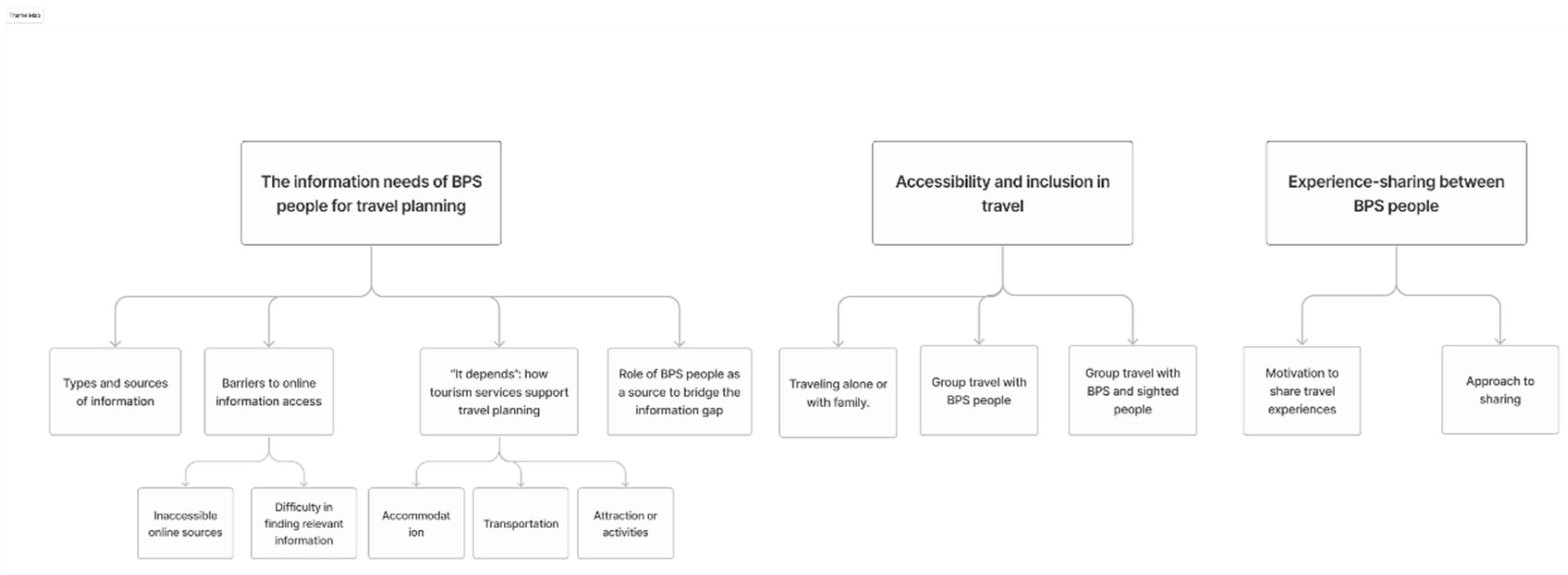
Figure 2.
Ecosystem map for BPS people to find and access travel information.
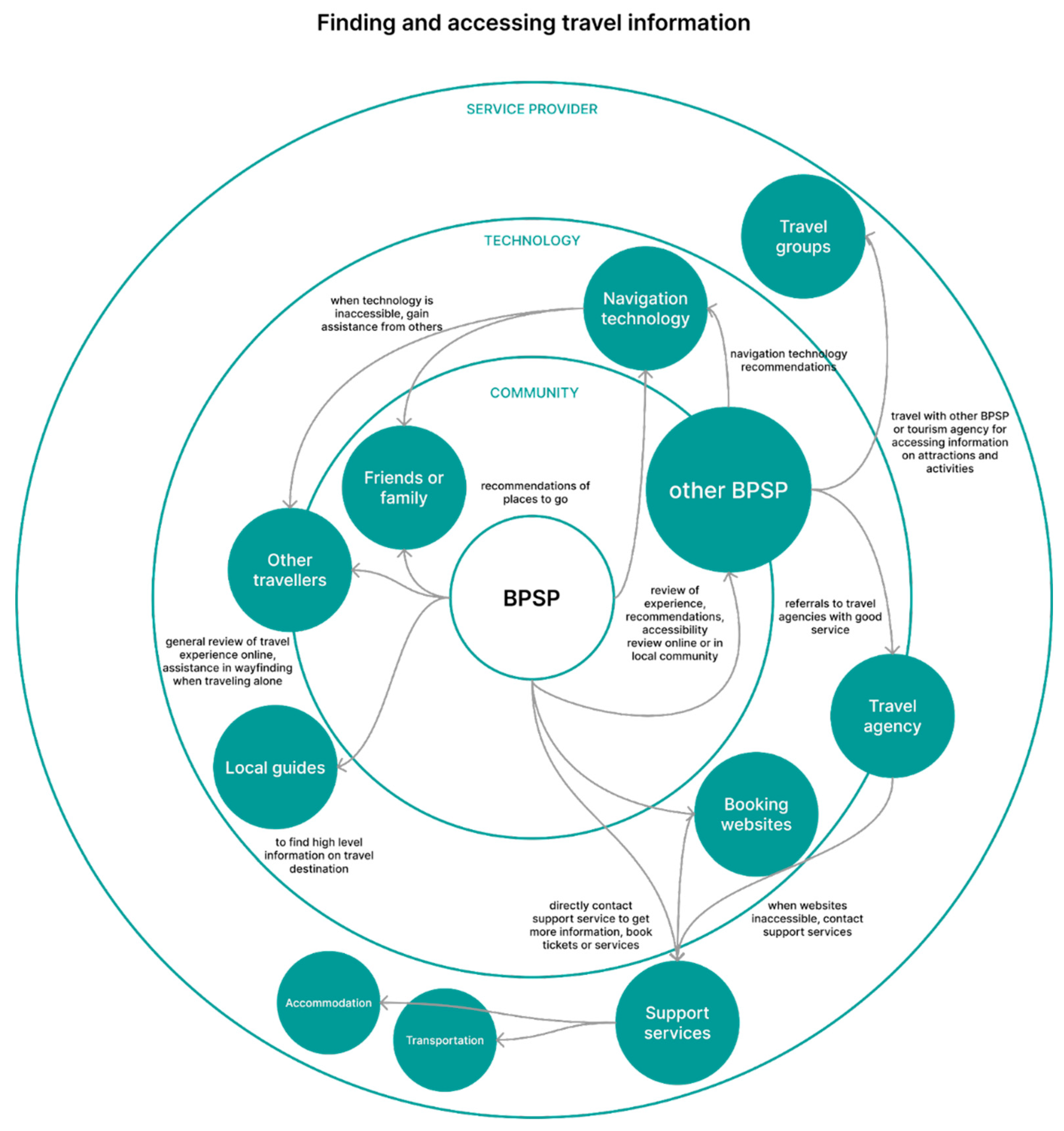

Table 2.
Type of information needed for BPS people to plan their travel.
| Study | Semi-structured interviews | Workshop 1 | Workshop 2 | |||||||||||
| Participants | P1 | P2 | P3 | P4 | P5 | P6 | P7 | P8 | P9 | P10 | P11 | P12 | ||
| Trip logistics | ||||||||||||||
| Location | x | x | x | x | x | x | x | |||||||
| Cost | x | x | x | |||||||||||
| Method of travel | x | x | x | x | x | x | x | x | ||||||
| Preparation | ||||||||||||||
| Accommodation | x | x | x | x | ||||||||||
| Activities | x | x | x | x | x | |||||||||
| Booking transportation | x | x | x | x | x | x | ||||||||
| Navigation route | x | x | x | x | x | |||||||||
| Support services | x | x | x | x | x | x | x | x | ||||||
| Other people | ||||||||||||||
| Experiences | x | x | x | x | x | x | x | |||||||
| Accessibility review | x | x | x | x | x | |||||||||
| Recommendation | x | x | x | |||||||||||
Table 3.
Sources to find and access travel information.
| Stages | Semi-structured interview | Workshop 1 | Workshop 2 | |||||||||
| Participants | P1 | P2 | P3 | P4 | P5 | P6 | P7 | P8 | P9 | P10 | P11 | P12 |
| Online sources | x | x | x | x | x | x | x | x | x | |||
| Friends & family | x | x | x | x | x | x | ||||||
| Travel services | x | x | x | x | x | x | x | |||||
| Travel group | x | x | ||||||||||
| Other BPS people | x | x | x | x | x | x | x | x | ||||
Disclaimer/Publisher’s Note: The statements, opinions and data contained in all publications are solely those of the individual author(s) and contributor(s) and not of MDPI and/or the editor(s). MDPI and/or the editor(s) disclaim responsibility for any injury to people or property resulting from any ideas, methods, instructions or products referred to in the content. |
© 2024 by the authors. Licensee MDPI, Basel, Switzerland. This article is an open access article distributed under the terms and conditions of the Creative Commons Attribution (CC BY) license (http://creativecommons.org/licenses/by/4.0/).
Copyright: This open access article is published under a Creative Commons CC BY 4.0 license, which permit the free download, distribution, and reuse, provided that the author and preprint are cited in any reuse.