

Submitted:
31 July 2024
Posted:
01 August 2024
You are already at the latest version
Abstract
Adults’ with Intellectual Disabilities (ID) experiences on occupational participation were explored through the prism of Occupational Justice model (MOJ) aiming to shape and develop an occupation-centered model of Quality of Life (QoL). In this qualitative study participated thirteen adults with ID (N=13). A semi-structured interview based on MOJ was constructed and administered to explore perspectives on QoL, as well as injustices regarding occupational participation. The interviews were processed with QSR NVivo8 following content analysis research methodology. An Occupational – Quality of Life (O-QoL) model with an everyday occupations core component has been formed. This model includes three core O-QoL domains: (i) social well-being, (ii) emotional – physical well-being and (iii) material adequacy. Main indicators of O-QoL were the recreational occupations and social activities, while socio-environmental factors such as occupational deprivation have been identified as aggravating. In addition, specific occupations such as leisure activities, physical exercise / sports, art, video games and vocational training could also be beneficial for O-QoL. Moreover, the importance of promoting and supporting the rights of people with ID for employment, independent living and sexual expression was highlighted. The O-QoL could be a valuable conceptual framework in the field of ID, however further research for developing specialized assessment tools and Occupational Therapy interventions to promote O-QoL is needed.
Keywords:
intellectual disability
; quality of life
; occupational quality of life
; occupational therapy
; occupational justice
; social inclusion
1. Introduction
Life experiences of people with Intellectual Disabilities (ID) mainly include social marginalization, educational – professional exclusion [1] and stereotypes regarding ID [1,2]. Most of them live with their families, participate in fewer social activities with friends and have far fewer mutual friendships compared to their peers [3]. Also, they spend more time alone [4], they are less socially active and their friends usually are other people with ID [5].
Occupational Therapy (OT) helps people to participate in occupations; i.e., desirable and necessary activities of everyday life which promote well-being [6]. Occupational Therapists support people with ID in various environmental contexts; e.g., vocational training, sheltered employment programs [7], while OT interventions also focus on socio-environmental conditions; e.g., education, employment, social life, social support networks, housing, transportation, etc., that affect participation / engagement in a particularly wide range of activities and effect health and Quality of Life (QoL) [8]. There is scientific evidence that activities of daily living particularly influence people’s health and well-being. Specifically, the relationship among desirable / undesirable roles in occupations [9], social participation [10], kinds of exclusion due to external – out of individual’s control – factors; e.g., occupational deprivation [11], and the impact on physical health and QoL has been highlighted.
OT models are important theoretical concepts which shape clinical reasoning and connect theory with clinical practice [12]. The theoretical foundation of Occupational Justice model (MOJ) suggests to eliminate social exclusions and promote well-being via active participation in meaningful occupations [13,14]; since people want and ought to engage in pleasing and essential occupations of their choice for better health and QoL [15]. Hence, the concept of QoL has evolved into a social construct defining socio-political practices so that citizens with ID have the right to access / participate equally in activities of everyday life and enjoy the same human rights and the same level of QoL as any other member of the society [16]. Regarding the complexity of QoL concept, there is an imperative need to understand perceived occupation-centered QoL of people with ID, which hasn’t yet been explored. To address this gap, the current study set out to use qualitative methodology to gain knowledge about adults’ with ID occupational participation experiences and QoL perceptions. Therefore, the first objective of this study was to explore their occupations and highlight factors that affect, inhibit and/or limit access and active participation. The second objective was to explore their perceptions about the concept and meaning of QoL. And finally, the third objective was to identify factors that affect QoL, explore the relationship between occupational participation and QoL and elicit their perspectives about its improvement.
Conclusively, the main purpose of this study was to produce foundational knowledge and construct a theoretical framework of QoL in the field of ID based on everyday occupations. The conceptualization of a perceived QoL model focused on the occupational needs of people with ID, the factors that affect occupational participation, as well as the influence of occupations on QoL would contribute to a broader and in-depth understanding about the importance of occupations in the everyday lives of this particular group of people, while at the same time it would expand and amplify OT literature on QoL. Similar research has never been conducted in Greece, while the international scientific research in the field of OT and QoL has focused on other groups of people; e.g., cancer patients [17], older adults [18]. Therefore, the conceptualization of an occupation-centered model of QoL based on the perceptions of people with ID would provide an alternative theoretical framework for considering and promoting QoL, and consequently more occupation-centered practices for social inclusion will emerge. Finally, regarding Occupational Science and OT, this innovative Occupational – Quality of Life (O-QoL) model could upgrade clinical reasoning, evaluation, intervention and research providing new foundations for social inclusion and equal social participation of people with ID.
2. Materials and Methods
2.1. Study Design and Ethics
Qualitative studies such as interviews excel at offering a deeper insight into how people’s views may vary, the attitudes and beliefs they hold, and the factors that shape specific perspectives [19]. The semi-structured interview was used as a research tool in this study. This type of interview is a qualitative research method that has predefined set of open questions, which can be modified depending on the perception of the interviewer in order to prompt discussion. The wording of the questions can be modified, clarified and omitted, and also additional questions can be asked according to each respondent, giving the opportunity for the interviewer to explore particular themes or responses further [20]. Therefore, a qualitative descriptive study was conducted using semi-structured interviews to explore experiences of occupational participation and perspectives on QoL. Semi-structured individual interviews were chosen as the mode of data collection over alternatives; e.g., questionnaires, as they encourage discussion and provide extensive insight into participants’ beliefs and experiences. The formation of the Interview Guide was influenced by the MOJ [13,14], which identifies at least four occupational injustices, that arise when participation in occupations is prohibited, and their corresponding occupational rights [21]: occupational deprivation – right to social inclusion through occupational participation; occupational alienation – right to meaningful occupational experiences; occupational marginalization – right to take desired roles in occupations and maintain personal and cultural autonomy through free choices for occupations; occupational imbalance – equal rights for a variety of ways of participating in occupations. Initially, a pilot semi-structured Interview Guide was created and administered on a trial basis to a female participant. Then, after critical reflection of this first administration, the Interview Guide was adapted in its final form to better serve the purpose and objectives of the study.
Informing and obtaining consent from people with ID can be challenging, as there is no protocol for obtaining informed consent, either conceptually or as a procedure, from this particular population [22]. In order the consent to be valid, the prospective participant is required to assess the current situation, have sufficient information, understand the information given, be able to weigh the advantages and disadvantages and communicate a voluntary decision free from any coercion [23]. Thus, obtaining consent from participants with ID presents serious ethical challenges for the researchers. Disorders in attention, memory and / or the ability to recall information material may create confusion about the purpose of the research and the consequences of participating in it, and at the same time the researcher should avoid coercion while explaining them [24]. At first, after being verbally briefed on the study, participants and their parents were also provided with written informed consents. Afterward, participants and their parents who expressed voluntary interest for this research were requested to give verbal and written consent respectively. Specifically, parents agreed for their children’s participation by signing a form that confirmed voluntary participation, confidentiality and data protection. Finally, participants who agreed to participate were informed that they could end the interview at any stage, withdraw their consent and leave whenever they feel they want to, and also that they had no obligation to complete the procedure or give any explanation for their withdrawal.
2.2. Participant Recruitment
The interviews took place in the Attica region of Greece at a Vocational Education Foundation (VEF) for adults with ID, where the participants of the research attended in a daily basis vocational training and educational / therapeutic programs. Male and female participants were recruited via convenience sampling [25] to purposefully take part in research about their perceptions of QoL. Facilitator contacts and face-to-face invitations in the VEF were used to recruit participants. Participant recruitment procedure mainly focused on individual’s with ID ability of verbal communication, as well as the expressed desire for participation in this study. Specifically, inclusion criteria were: (i) diagnosis of ID or other medical condition with ID comorbidity; (ii) attending the VEF; (iii) ability of verbal communication; (iv) having attained eighteen years of age. In total, thirteen participants (n=9 males; n=4 females) were recruited.
2.3. Data Collection
Data collection took place at convenient locations in the VEF. Individual semi-structured interviews were conducted, featuring open-ended questions posed by the facilitator to encourage discussion. The Interview Guide questions (Table 1) were based upon the existing literature on MOJ and QoL, focusing on the participants’ everyday activities. The three main topic areas aimed to draw out participants’ experiences of occupational participation, as well as general and specific perceptions of well-being and QoL. The facilitator encouraged the participants to freely express their opinions and probed further when individuals did not elaborate sufficiently on a topic. If conversation strayed from the guide, the facilitator assessed its relevance and, if necessary, redirected the discussion back to the guide.
Thirteen individual semi-structured interviews were conducted, each lasting an average of fifty-three minutes. All interviews (N=13) took place over a three-day period in mid-December 2020 and were audio recorded using a digital recorder. Participants were anonymized and assigned unique interview identification codes. The audio recording began after obtaining verbal consent from each participant. Prior to starting the interview, the facilitator provided a brief introduction, reminding participants that their audio was being recorded and assuring them of the confidentiality of their responses. After completing the interviews, participants were debriefed on the study’s purpose, and any major misconceptions or inaccuracies about the nature / purpose of the interviews were corrected. Demographic information was collected through questionnaires administered to parents.
2.4. Data Analysis
All recordings were transcribed verbatim and proofread by the facilitator. The transcripts were then imported into QSR NVivo8 for processing. Content analysis [26] was employed to identify themes within the data. To achieve familiarity with the data, transcripts were read meticulously multiple times. The entire data set was coded without using a pre-existing coding frame. To verify the reliability and validity of the codes, the researcher independently coded the same transcripts twice. The compared coding showed an 86% similarity, and any discrepancies were resolved through reflective thinking. Participant demographic characteristics were analyzed using IBM SPSS 26.0.
3. Results
3.1. Participation and Sample Characteristics
Thirteen adults with ID (N=13) participated voluntarily in the study. As shown in Table 2, the sample consisted of nine men and four women (aged 18–37 years), the vast majority of which having graduated from Special Education Schools (n=11). Most participants attended the VEF’s Carpentry (n=4) and Bookbinding (n=4) workshops. Furthermore, participants’ total training years in the VEF ranged from one to twenty-three years, while seven people have been trained there for more than ten years. Finally, regarding participants’ living conditions, most of them lived with their parents (n=10) and had no personal space (n=9) as they either shared their room or did not have their own room at all.
3.2. Defining Quality of Life: Perspectives and Perceptions of People with Intellectual Disabilities on the Concept of Quality of Life
3.2.1. An Occupation-centered Model of Quality of Life
QoL is perceived by the respondents as a complex concept and is mainly approached through leisure activities. Here is a male participant’s typical response about outdoor activities defining QoL:
“R: What does a good life mean to you?
S9: Difficult to answer.
R: How is your life?
S9: Good, good, very good.
R: What makes a good life?
S9: Going for walks and trips, going for a coffee at the neighborhood square, going to the sea in the summer.” (I9)
While another male participant referred also to academic advancement:
“S2: ...to meet new people, travel, do more sports and study... I want to be able to go to a proper school and do what I really like, cooking and pastry.” (I2)
Generally, participants’ perceptions in defining the term quality of life formed four main themes (Table 3):
- Personal / social development and improvement through activities (e.g., leisure activities, vocational training, employment);
- Social well-being (e.g., social relationships with friends and family, social contribution, community serving);
- Emotional well-being (e.g., emotional health, sense of control over life, opportunities for free decision making and availability of choices, autonomy, security, privacy) and Physical well-being (physical health, self-esteem, self-image);
- Material adequacy (e.g., financial status, political context, living conditions, housing).
In particular, the Occupational – Quality of Life (O-QoL) model developed in this paper suggests that the core component of QoL is occupation; i.e., activities through which social / personal development and improvement of individual’s personality is achieved, which includes three domains: social well-being; emotional and physical well-being; and material adequacy, that interact with the environment / context, Figure 1. Therefore, relying on people’s with ID perceptions, the O-QoL model defines quality of life as:
The individual’s general feeling of well-being, which is determined by the involvement and active participation in desirable and essential for the individual occupations; i.e., every day activities that promote the development of one’s personality on a personal, social, emotional, physical and material level.
3.2.2. Occupation: Core Component of Occupational – Quality of Life Model
Our research revealed the overall positive influence of occupations on adults’s with ID lives [27]. For this particular group of people, engagement and active participation in activities seems to contribute substantially to well-being, supporting the concept of occupation being the core component of QoL:
“S13: A good life is having occupations, that is. Having things to do.” (I13)
Specifically, based on the perceptions of the respondents, participation in activities is a means of exposure to / familiarization with new life experiences [28] and pleasant passing of time [29] with multiple benefits on:
- social participation; the individual socially interacts with people [34]:
“S10: In occupational therapy I prefer puzzles, but now we make ornaments and decorations for the Christmas tree, I do like making ornaments and decorations in general now. I pleasantly spend my time there with all the craftmaking and the conversations.” (I10)
Participants also referred to several occupations they considered important for their lives. Most respondents identified social leisure activities; e.g., going out with friends, walking outside with friends, as particularly beneficial. In addition, significant reference was given to physical health routines; e.g., physical exercise, sports, healthy diet and sleep, which seem valuable in terms male respondents’ self-image. Furthermore, arts and crafts appear to be means of emotional expression and discharge for female participants. In addition, browsing the internet, watching movies, communicating in social media and online gaming seem to support socializing and connecting with peers. Finally, VEF’s educational and vocational training programs were also positively valued:
“S9: ...It’s nice to come here to school... I love being in the Carpentry workshop, coming to school every day and not staying at home.” (I9)
However, participants tended to engage in more solitary activities; e.g., going out for lonely walks [4], and rarely participated in social activities; e.g., social interactions with relatives, friends, neighbors or friends from the VEF. They were involved in occupations mainly in the VEF, where usually attended (i) therapeutic / educational programs: occupational therapy, speech therapy, psychotherapy, special education, etc.; (ii) vocational training: carpentry, bookbinding, cooking, etc.; (iii) physical education / sports; (iv) arts and crafts: painting, music, theater, etc. At the same time, the VEF also seemed to be the main or only place for social interactions [35]. In the contrary, participation in desirable activities during leisure time was quite limited. In their free time, participants mainly involved in solitary and passive activities [36]; watching TV programs, listening to music, playing with the mobile phone, etc., while at the same time their lives were dominated by inactivity, repetitive routines; e.g., eating [37], and occupational deprivation. In addition, they were obliged to perform tasks; e.g., taking care of the household (washing dishes, general cleaning, cooking, etc.) and their parents / relatives, that occupied most of their free time and made it difficult for them to engage in desirable activities; e.g., physical exercise / sports:
“R: Why can’t you go to the gym, exercise at home or listen to the music you like if you want to?
S6: Because there’s no time! I do all the chores. I manage the whole house; my dad cooks but I do everything else, I sweep, I clean.” (I6)
Some aspects of occupations were associated with QoL (Table 4). The aspects of social interaction and participation, as well as emerging positive emotions due to positive occupational experiences seemed to have positive influence on QoL. In addition, the sense of autonomy, privacy, security and control over life, as well as opportunities for free decision making and availability of choices were also mentioned as important influential factors:
“S1: …to be able to live in place where you will feel safe and confident, where no one else is there but only you. To be able to choose what you want to do, when to do it and with whom. To listen to music, relax and not having other people’s eyes on you all the time.” (I1)
On the other hand, some other aspects of occupation had reverse effect on QoL. Specifically, patronizing the individual, treating as inferior, criticizing and disapproving participation in activities, as well as emerging negative emotions due to occupational deprivation and lack of participation in activities had negative influence on QoL. Finally, passive routines, inactivity, monotonous / repetitive activities, coercion and imposition were also found as aggravating:
“S1: ...I don’t like that they make us do the same monotonous things all the time. Certainly, it is better than doing nothing, but I don’t want to paint and color all the time. I’m bored of it! But I’d rather do that instead of doing nothing.” (I1)
3.2.3. First Domain: The Aspect of Social Well-Being
The first domain of O-QoL; i.e., social well-being, was associated with individuals’ interpersonal relationships with family, friends and the community. In our research, social relationships, social interactions with friends [38] and family members [39], as well as social contribution [35] and community service [40] were identified as factors composing the social well-being domain of O-QoL:
“S3: …I like it here. I love working, playing, and helping people.” (I3)
3.2.4. Second Domain: The Aspect of Emotional and Physical Well-Being
The second domain of O-QoL; emotional – physical well-being, is associated with emotional health [41], physical activity [30] and physical health [42]. In this study, emotional health was associated with the sense of control over life [43], the ability to make own decisions [43,44], the availability of choices [45], autonomy [46], independence [47] and privacy [48]. At the same time, physical activity was associated with self-esteem [49], body image [50] and self-image [51], while physical health was defined as absence of disease.
3.2.5. Third Domain: The Aspect of Material Adequacy
The aspect of material adequacy is the third domain of O-QoL and was associated with socio-economic factors such as housing and living conditions [52], as well as financial status [53] and political context [54,55,56]:
“S10: …I can’t go out anymore, I stay inside the house because I am afraid of the police! I can’t understand how to legally transport from one place to another, TV instructions are so confusing, so I can’t go out, I am afraid. I can’t even go to my friend’s house; she lives next to us, and I used to go there for coffee. I don’t see my friend anymore; she lives two blocks away and I can’t visit her. Will ever the coronavirus go away? Neither I want it, nor my father, nor my mother. I want to ask about the coronavirus, if you know when it will end (laughs). Will we be wearing masks in the summer?” (I10)
3.3. The Influence of Socioenvironmental Factors on Quality of Life
The environment / context plays an important role regarding occupational engagement / participation, and therefore its influence on participants’ QoL is crucial. In our study, three main environmental contexts were identified, Table 5:
In our study, QoL was positively associated with the social environment in terms of personal relationships among family members and friends while engaging in joint leisure activities [39]. Furthermore, the economic environment [61] was also positively associated with QoL in terms of financial status and material adequacy for engaging in leisure activities. Lastly, personal environment was positively associated with QoL via the educational environment [60] in terms of involvement in recreational, educational and vocational training activities in the VEF, and via housing and living conditions [62] in terms of personal space and autonomy. However, it was also found that participants’ desired occupations; e.g., social interaction activities [63], employment [2], vocational training [64], academic advancement [65] and sexual expression [2], are inhibited by a variety of socioenvironmental factors such as social stigma [57], marginalization [2], dysfunctional / abusive family relationships [2], socioeconomic [66] and sociopolitical context [67], including educational system policies [55,68] and social support services [69,70]:
“R: ... How do other people treat you about attending a special school?
S2: I never mention that I attend such a school, because they will assume that I am like retarded. But that’s not a case, I am not. I don’t know, anyone who hears about our school assumes it’s for people who have a problem. I hide it, I don’t talk about it, but of course two or three more guys are like me here.” (I2)
3.4. Quality of Life Assessment Criteria
Participants’ perceptions formed six categories of criteria regarding the assessment of QoL, Table 6. Specifically, key criteria for assessing QoL were the emotional state / health; engagement in entertaining social activities; financial status; social relationships and social participation in the community; physical health; housing and living conditions:
“R: ...How do you assess your life?
S1: Kind of crappy (laughs)? Kinda unhappy and miserable? Okay, I don’t sleep outside on the street, but I would like the place where I sleep to be proper home and not a hut! I want to have my personal space, and also heating because this isn’t a house, it’s the north pole!” (I1)
3.5. Promoting and Improving Quality of Life
As means of promoting and improving QoL participants suggested the following, Table 7: academic advancement [68], employment [71], engaging in social activities; e.g., going out with friends for a coffee [5], continuous participation in various leisure activities; e.g., physical exercise / sports, and sexual expression [72], as well as resilience skills [73], self-focus and personal needs satisfaction [74], social contribution and community service [75], strengthening family relationships [76] through participation in joint leisure activities, and autonomy [77] in housing and daily living:
“S7: ... I’d love to be a carpenter, but whatever job they give me I don’t have a problem. I told the social service that I will leave, and they replied that if I am a good student they will let me leave. That’s what they told me, they will find me work to gain my own money, not to get pocket money. To be able to get a coffee, a cheese pie, whatever I want!
R: How will this affect your life? If you find a job I mean.
S7: I want to find a proper job, not to be kicked out the next day, and I want to learn. I believe I’ll get a job; I believe so, I’m very good. I won’t sit at home all the time. I will get up every morning at seven o’clock and I will go to work, and then I will attend school in the afternoon. Or a carpenter or a waiter I will become, and I will go to school at night and get up in the morning for work! That’s what I want, something to fill my day.” (I7)
4. Discussion
This qualitative study explored adults’ with ID perspectives on QoL, utilizing the innovative theoretical framework MOJ as the research instrument for interpretation and content analysis of their narratives.
An Occupational – Quality of Life (O-QoL) model was developed suggesting as core component of QoL for personal / social development and self-improvement [79]; the occupation [78], which comprises of three interrelated environment / context interactive domains [80]; i.e., social well-being; emotional – physical well-being; material adequacy.
In OT literature there is evidence suggesting that active participation in meaningful occupations benefits QoL [3,17,81]. People’s lives are determined by the occupations they get involved, significantly influencing their choices and goals, and therefore shaping QoL [17]. Additionally, the engagement in meaningful occupations is associated with the fulfillment of psychological and intellectual needs such as the meaning of life [82]. In a theoretical study by Causey-Upton, leisure activities were also suggested as the basis for a QoL model for older adults living in long-term care facilities [78]. Although Causey-Upton’s theoretical approach on QoL was also guided by the principles of MOJ aiming to promote individuals’ rights [16] for engagement / active participation in leisure activities [14], there are significant conceptual and structural differences with our occupation-centered model of QoL. Specifically, main differences are: (i) the consideration of all areas of occupation (leisure, social participation, education, work, activities of daily living, etc.) while conceptualizing O-QoL model and structuring our research methodology; as well as (ii) the involvement and substantially participation of people with ID in our research. Although it was challenging and imposed significant limitations, the participation of people with ID in the research process enhanced the quality and validity of our study, as it made possible for us to explore this subjective concept in an inclusive and emancipatory way [83].
Participants’ personal views on QoL confirmed the multidimensional nature of the concept, aligning closely with Shalock’s et al. model of QoL in the field of ID [80]. According to Schalock et al. QoL is a multidimensional construct influenced by individual characteristics and external variables. The key areas of QoL are consistent across all people, although their value and importance may vary for each individual [80]. In our study, the social well-being domain [80] was associated with the interpersonal social relationships [84] developed with family [39], friends [38] and the community [35,40]. In a study involving 529 parents of children or adults with ID, Boehm and Carter confirmed and reinforced the importance of social relationships with family and friends as key factors contributing to QoL [85]. Additionally, another study based on semi-structured interviews with six mothers of adolescents with ID, friendship was found to be important for adolescents’ QoL. However, maintaining well-functioning and lasting friendships requires parents’ effort [38]. Furthermore, the feeling of belonging and contributing to the community appears to be an important factor for the participants’ QoL, as they seemed to perceive QoL in a more collective manner and they were receiving satisfaction from being active and valuable members of the community [40]. The participants’ emotional and physical well-being [80] were interpreted as interrelated and interdependent [86]. The relationship between them was conceived as a dynamic interaction of emotional health [87], physical exercise [30] and physical health [88]. Emotional well-being was associated with participants’ ability of control [43] and independence [47] over life. Van Leeuwen et al. also found that locus of control is associated with self-esteem, hope, meaning in life, positive emotions and higher levels of QoL [89]. At the same time, physical well-being was associated in our study with self-esteem [49] and body image [50]. Similarly, in Nayir’s et al. research, individuals’ good body image came out as positive QoL predictor [90]. Lastly, material adequacy [80] was associated with living conditions [52], financial status [53] and political context [54,55,56]. In a Greek research between two groups of adults with ID attending sheltered workshops (N=31; aged 19–48), one group lived in a boarding house (n=20) and another with their parents (n=11). The results indicate that both groups demonstrated low levels of independence compared to other QoL domains, while those living with their parents had lower social inclusion than those living in the boarding house [52]. This supports our study findings that participants living with their parents have passive / solitary daily routines and participate less in social life. A review about economic factors influencing QoL found a variety of impacts of poverty on health; e.g., limited health care access, productivity; e.g., limited leisure activities, physical environment; e.g., overcrowded homes, emotional well-being; e.g., increased stress, and family function; e.g., inconsistent parenting [53], which comes in line with our participants’ narratives about financial difficulties and restrictions they face. At the same time, regarding the political context and disability policies, people with ID in Greece significantly cope with lack of specialized health services and limited educational and employment opportunities [54]. The Greek economic crisis and the austerity measures effects on inclusive education policies have expanded educational inequalities, while institutional regulations employ inclusive education as a tool for further assimilation and discrimination of students with disabilities [55]. Specifically, participants were feeling ashamed of attending the VEF and they were practically marginalized within the general educational community. Finally, in accordance with our study findings, significant differences in QoL for people with ID were observed during the COVID-19 pandemic [56]. Areas such as social interaction, social participation, friend relationships and leisure activities were negatively impacted by the government’s health policies, effecting QoL and exacerbating the existing challenges within the underfunded health system [56].
Specific occupations such as leisure activities, physical health routines (e.g., physical exercise), and arts and crafts appeared to be important for participants’ QoL. In addition, communicating in social media [91] and online gaming [92] seemed to enable social life participation, although safety concerns were raised. Moreover, educational and vocational training programs were also mentioned as significant for QoL. A study of Croatian citizens (N=4,000) found that engagement in leisure activities enhances subjective well-being, with the importance of specific activities varying by age and gender [27]. In another study, participants (N=1,399) completed the Pittsburgh Enjoyable Activities Test among other measures, revealing that engaging in enjoyable leisure activities associates with better overall QoL [93]. People with ID have mainly the same preferences and wish for leisure activities as their non-disabled peers, while both genders favor physical exercise / sports and cultural activities [36]. Adults with ID were assessed using a QoL questionnaire and physical fitness tests, revealing that better physical fitness is associated with higher self-reported QoL [94]. Regarding arts and crafts, a Chinese study on expressive arts–based interventions revealed positive effect in emotional and behavioral well-being of female participants, however reverse effect was observed in males [95]. This confirms our study findings about differences in activity preferences as female and male participants enjoyed participating more in arts / crafts and sports respectively. Adults with ID are interested in social media, using YouTube for entertainment, Facebook to connect with family and Instagram for social interaction with strangers [91], and similarly behaved our study participants. Additionally, a phenomenological study of three adolescents with Autism Spectrum Disorder engaging in online video games revealed a strong desire to socialize and communicate in virtual environments, although challenges in being misunderstood, issues with identifying friends and luck of social rules awareness both online and offline were also highlighted [92]. Finally, in a study investigating the relationship between subjective QoL and quality of Vocational Education services for students with ID in Greek public special vocational schools found a significant emerging association between the two and low levels of self-determination among the students [60]. Our study findings confirm this interactional relationship between vocational training and QoL, whereas the low levels of participants’ self-determination corroborate our belief that VEFs still operate as places of social exclusion.
In one hand, occupational rights such as social participation, positive emotions through occupational experiences, autonomy, privacy, security, sense of control over life, opportunities for free decision making and availability of choices were found as beneficial for participants’ QoL. Self-determination empowers individuals with ID to make their own choices, take control of their lives, and pursue their personal goals, leading to greater satisfaction, independence and overall QoL [43]. In a study of individuals with ID (N=141) in Italy was found that self-determination and social skills were key predictors of higher levels of QoL, with greater autonomy and opportunities to make choices, particularly in residential settings. Our study confirms those findings, as participants who resided in Supported / Independent Living Accommodation Facilities or lived alone at their own house reported greater autonomy, participated in more outside activities and assessed positively their QoL. On the other hand, occupational injustices such as occupational deprivation / lack of participation, inactivity, monotony, repetition and passivity in occupations we found as aggravating. Furthermore, patronizing the individual, treating as inferior, continuously criticizing performance, disapproving participation, coercion, imposition and negative emotions also had negative influence on QoL.
In our research, the environment / context appears to be important for occupational engagement and participation, and therefore three main environmental contexts influencing participants’ QoL were identified; i.e., social environment; economic / political environment; personal environment. A research that also examined factors affecting the QoL of individuals with ID (N=1,264) found that environmental factors such as living conditions and activities of daily living significantly influenced QoL scores [59], aligning well with our research findings. Specifically, regarding social environment, participants’ QoL was associated with joint leisure activities among family members and friends. A Greek study found that shared leisure time between parents and children with ID significantly enhanced parent-child relationship quality, and therefore QoL [39]. Economic environment was positively associated with QoL as the financial capacity that enables participants’ access to leisure activities. Lastly, participants’ personal environment was positively associated with QoL via the activities taking place in their educational environment [60] and their living environment [62]. An Israeli study of adults with ID (N=85) found no significant differences in friendships or feelings of loneliness between two groups of people living in community residential settings and foster families, but those in foster families were more independent in leisure activities. This study revealed a partial association between friendships, leisure participation, and quality of life, highlighting the importance of living conditions in social interaction and overall QoL [96]. In our study living conditions were also highlighted by the participants, however key aspects were personal space and autonomy. On the other side, our study revealed that social stigma [57], among other socioenvironmental factors; e.g., deprivation, abuse / violence etc., a priori excludes individuals from desired occupations; e.g., employment, sexual expression / satisfaction, as it hinders their participation in activities of choice only because they are labeled as “kids”, “retarded” or even “aggressive / dangerous”, and therefore negatively impacts QoL. On the contrary, people with disabilities face higher risk of harassment, violence and abuse, while individuals with ID frequently endure various forms of abuse, including physical injury, sexual assault and emotional trauma [2]. Children with ID are at greater risk of family violence and abuse, especially if they also have physical disabilities or self-destructive behaviors. Family socio-demographic factors and social support significantly impact parenting quality as well as the associated risks of abuse and violence [97]. Moreover, stereotypical beliefs that people with ID being childlike and asexual negatively impact their opportunities for intimate relationships and parenting, and also undermine their sexual health and safety [2].Furthermore, stigma also affects peoples’ with ID presence in the labor market. Negative employers’ attitudes pose significant challenges to people with ID regarding competitive employment [98]. Few people with ID are conventionally employed; instead, most of them are occupied in day centers and sheltered workshops [57].
The self-assessment of participants’ QoL revealed six key criteria including; i.e., individuals’ emotional state / health, engagement in entertaining social activities, financial status, social relationships, social participation in the community, physical health and housing / living conditions, that align well with the domains of the O-QoL model. Social well-being encompasses individuals’ social relationships and social participation in the community, highlighting the importance of interpersonal connections and active engagement in social activities. The emotional – physical well-being domain includes participants’ emotional state / health, as well as their physical health, underscoring the critical role of emotional health and physical activity in overall well-being. Finally, material adequacy is reflected in financial status and housing/living conditions, which are essential for ensuring a stable and supportive environment.
To promote and improve their QoL, participants in the research emphasized the importance of occupation-centered practices, highlighting several key areas of focus. They advocated for academic advancement and employment opportunities, recognizing that education and work can significantly enhance personal growth and self-esteem. Additionally, participants expressed a strong desire for engaging in social activities and a variety of leisure and recreational pursuits, understanding that these interactions foster connections and enrich their daily experiences. The development of resilience and self-focus skills emerged as crucial, enabling individuals to navigate challenges and cultivate a positive self-identity. Furthermore, the ability to express and satisfy their sexuality was identified as an essential aspect of personal fulfillment. Participants also underscored the need for social contribution and community service, indicating a desire to engage actively in their communities and give back to society. Family engagement was highlighted as vital for emotional support and connection. Finally, achieving autonomy in housing and daily living was deemed critical for fostering independence and enhancing overall QoL, allowing individuals to make choices that reflect their preferences and needs.
Schalock et al.’s conceptual framework of QoL in the filed of ID [80] is built on a broad spectrum of domains that encompass various aspects of life, including emotional well-being, interpersonal relations, material well-being, personal development, physical well-being, self-determination, social inclusion and rights. In contrast, O-QoL model emphasizes occupations as the primary means of achieving QoL. Our proposed model breaks down QoL into three main domains; i.e., (i) social well-being; (ii) emotional – physical well-being; and (iii) material adequacy. While Schalock et al.’s framework spans a wide array of life domains, the O-QoL model centralizes the role of occupations, arguing that active participation in meaningful activities is fundamental to achieving QoL. In Schalock et al.’s model, occupations are part of personal development and physical well-being, but they are not the focal point. The O-QoL model, however, places occupations at the heart of QoL, asserting that engagement in activities fosters overall well-being. Both models recognize the importance of social and environmental contexts, but they approach them differently. Schalock et al.’s framework includes social inclusion and rights, emphasizing social inclusion, support and protection of human and legal rights. The O-QoL model also values social inclusion but emphasizes how socioenvironmental factors such as family dynamics, economic conditions, and political contexts influence occupational rights / participation, and consequently QoL. In conclusion, the O-QoL model focuses on the transformative power of meaningful occupations within their environmental context emphasizing the decisive role of engagement and active participation in activities of everyday life.
Strengths and Limitations
This research study presents several strengths that contribute to the understanding of the proposed O-QoL model in the field of ID. Firstly, by employing a qualitative research methodology, the research captures rich, nuanced insights into the lived occupational experiences of individuals with ID, allowing for a deeper understanding of their perceptions regarding activities of daily living and their impact on QoL. This approach emphasizes the subjective nature of QoL, aligning well with the O-QoL framework’s focus on meaningful occupations. Additionally, the findings provide a solid theoretical foundation for future development of specialized assessment tools and OT interventions that can be grounded in the participants’ articulated needs and desires.
However, the study also has notable limitations that must be considered. The reliance on a small, convenience-based sample drawn from a single VEF limits the generalizability of the findings. This issue restricts the diversity of occupational experiences represented in the research, potentially overlooking the broader spectrum of challenges and opportunities faced by individuals in varying contexts. Furthermore, the constraints imposed by the COVID-19 pandemic hindered participants’ involvement in the analysis phase, which could have enriched the quality and validity of the findings through collaborative reflection. Additionally, the absence of external researchers for cross-validation raises concerns about the reliability and validity of the conclusions drawn from the data.
Therefore, future research on O-QoL model should prioritize expanding studies to include larger and more diverse samples across various environmental contexts. This will be crucial in empirically validating the model and enhancing its generalizability. Additionally, investigating the applicability of the O-QoL framework in other marginalized groups, such as refugees, individuals with mental disabilities, older adults, people serving prison sentences, etc., could provide valuable insights into universal aspects of QoL.
5. Conclusions
The Occupational – Quality of Life (O-QoL) model offers an innovative and valuable framework for understanding and enhancing the QoL of individuals with ID. Through participants’ insights, this research highlights the integral role of meaningful occupations in promoting well-being. The three identified domains; (i) social well-being, (ii) emotional – physical well-being, and (iii) material adequacy, which compose the core component; i.e., occupation, underscore the multifaceted nature of QoL and the interconnectedness of various life domains. While the findings provide a strong foundation for further exploration of the O-QoL model, the study also reveals significant limitations, particularly in terms of sample diversity and external validation. Future research should focus on expanding the participant base to empirically support the model’s applicability across different contexts and developing specialized occupation-centered OT assessment and intervention tools. By embracing occupation-centered practices, practitioners can effectively contribute to improving the lives of individuals with ID, ultimately fostering greater autonomy, social inclusion and overall QoL.
Author Contributions
P.K.: conceptualization, methodology, investigation, data curation, resources, software, data analysis, writing—original draft; E.N.-N.: conceptualization, methodology, supervision, project admission. All authors have read and agreed to the published version of the manuscript. All authors have read and agree to the published version of manuscript.
Funding
This research received no external funding.
Institutional Review Board Statement
The study was conducted in accordance with the Declaration of Helsinki, and approved by the Institutional Review Board of M.A. Special Education, Early Childhood Education Department, School of Education, NATIONAL AND KAPODISTRIAN UNIVERSITY OF ATHENS (004 / 19-11-2019).
Informed Consent Statement
Informed consent was obtained from all subjects involved in the study.
Data Availability Statement
The datasets presented in this article are not readily available because this would compromise participant confidentiality.
Acknowledgments
The authors are grateful to all participants for their willingness to devote their time to provide the required data.
Conflicts of Interest
The authors declare no conflicts of interest.
References
- Zoniou-Sideri, A.; Deropoulou-Derou, E.; Karagianni, P.; Spandagou, I. Inclusive Discourse in Greece: Strong Voices, Weak Policies. International Journal of Inclusive Education 2006, 10, 279–291. [Google Scholar] [CrossRef]
- Ditchman, N.; Kosyluk, K.; Lee, E.-J.; Jones, N. How Stigma Affects the Lives of People with Intellectual Disabilities: An Overview. In Intellectual Disability and Stigma: Stepping Out from the Margins; Scior, K., Werner, S., Eds.; Palgrave Mac-millan UK: London, 2016; pp. 31–47; ISBN 978-1-137-52499-7. [Google Scholar]
- Solish, A.; Perry, A.; Minnes, P. Participation of Children with and without Disabilities in Social, Recreational and Leisure Activities. Journal of Applied Research in Intellectual Disabilities 2010, 23, 226–236. [Google Scholar] [CrossRef]
- Buttimer, J.; Tierney, E. Patterns of Leisure Participation among Adolescents with a Mild Intellectual Disability. J Intellect Disabil 2005, 9, 25–42. [Google Scholar] [CrossRef] [PubMed]
- Emerson, E.; McVilly, K. Friendship Activities of Adults with Intellectual Disabilities in Supported Accommodation in Northern England. J Appl Res Int Dis 2004, 17, 191–197. [Google Scholar] [CrossRef]
- WFOT World Federation of Occupational Therapists [WFOT] Definitions of Occupational Therapy from Member Organisa-tions (Revised 2013 October) 2013.
- Berg, L.A.; Jirikowic, T.; Haerling, K.; MacDonald, G. Navigating the Hidden Curriculum of Higher Education for Post-secondary Students With Intellectual Disabilities. The American Journal of Occupational Therapy 2017, 71, 7103100020p1–7103100020p9. [Google Scholar] [CrossRef] [PubMed]
- Bryant, T.; Raphael, D.; Schrecker, T.; Labonte, R. Canada: A Land of Missed Opportunity for Addressing the Social De-terminants of Health. Health Policy 2011, 101, 44–58. [Google Scholar] [CrossRef] [PubMed]
- Fisher, G.S.; Emerson, L.; Firpo, C.; Ptak, J.; Wonn, J.; Bartolacci, G. Chronic Pain and Occupation: An Exploration of the Lived Experience. Am J Occup Ther 2007, 61, 290–302. [Google Scholar] [CrossRef] [PubMed]
- Johansson, U.; Högberg, H.; Bernspång, B. Participation in Everyday Occupations in a Late Phase of Recovery after Brain Injury. Scand J Occup Ther 2007, 14, 116–125. [Google Scholar] [CrossRef] [PubMed]
- Whiteford, G. When People Can’t Participate: Occupational Deprivation. In Introduction to occupation; Prentice Hall: Upper Saddle River, New Jersey USA, 2004; pp. 221–242; ISBN 978-0-13-013303-8. [Google Scholar]
- Atkinson, K. Do We Need to Use Models in Occupational Therapy Practice? British Journal of Therapy and Rehabilitation 1995, 2, 370–374. [Google Scholar] [CrossRef]
- Nilsson, I.; Townsend, E. Occupational Justice—Bridging Theory and Practice. Scandinavian Journal of Occupational Therapy 2010. [Google Scholar] [CrossRef]
- Whiteford, G.; Townsend, E. Participatory Occupational Justice Framework (POJF): Enabling Occupational Participation and Inclusion. In Occupational therapy without borders: Learning from the spirit of survivors; Kronenberg, F., Algado, S., Pol-lard, N., Eds.; Elsevier Churchill Livingstone: Toronto, 2011; pp. 58–86. [Google Scholar]
- Wilcock, A.; Towsend, E. Occupational Justice. In Willard and Spackman’s occupational therapy; Crepeau, E., Cohn, E., Schell, B., Eds.; 2009; pp. 192–199.
- Verdugo, M.A.; Navas, P.; Gómez, L.E.; Schalock, R.L. The Concept of Quality of Life and Its Role in Enhancing Human Rights in the Field of Intellectual Disability: QoL and Rights in Persons with ID. J Intellect Disabil Res 2012, 56, 1036–1045. [Google Scholar] [CrossRef]
- Loh, S.Y.; Sapihis, M.; Danaee, M.; Chua, Y.P. The Role of Occupational-Participation, Meaningful-Activity and Quali-ty-of-Life of Colorectal Cancer Survivors: Findings from Path-Modelling. Disabil Rehabil 2020, 1–10. [Google Scholar] [CrossRef]
- Zilyte, G.; McIlwain, L.; Knecht-Sabres, L. Occupational Participation and Quality of Life for Older Adults Residing in As-sisted Living. NTAB 2020, 5, 85–101. [Google Scholar] [CrossRef]
- Tracy, S.J. Qualitative Research Methods: Collecting Evidence, Crafting Analysis, Communicating Impact; 2nd edition.; Wiley-Blackwell: Hoboken, NJ, 2019; ISBN 978-1-119-39078-7. [Google Scholar]
- Robson, C.; McCartan, K. Real World Research; 4th edition.; Wiley: Hoboken, 2016; ISBN 978-1-118-74523-6. [Google Scholar]
- Townsend, E.; Wilcock, A. Occupational Justice and Client-Centred Practice: A Dialogue in Progress. Can J Occup Ther 2004, 71, 75–87. [Google Scholar] [CrossRef] [PubMed]
- Walking the Tightrope: Ethical Issues for Qualitative Researchers; Hoonaard, W. C. van den, Ed.; 1st edition.; University of Toronto Press, Scholarly Publishing Division: Toronto, 2002; ISBN 978-0-8020-8523-8. [Google Scholar]
- Dean, E.; Turner, S.; Cash, J.; Winterbottom, P. Assessing the Capacity to Give Consent. Nurs Times 1998, 94, 58–60. [Google Scholar] [PubMed]
- Cameron, L.; Murphy, J. Obtaining Consent to Participate in Research: The Issues Involved in Including People with a Range of Learning and Communication Disabilities. British Journal of Learning Disabilities 2007, 35, 113–120. [Google Scholar] [CrossRef]
- Andrade, C. The Inconvenient Truth About Convenience and Purposive Samples. Indian J Psychol Med 2021, 43, 86–88. [Google Scholar] [CrossRef]
- Erlingsson, C.; Brysiewicz, P. A Hands-on Guide to Doing Content Analysis. African Journal of Emergency Medicine 2017, 7, 93–99. [Google Scholar] [CrossRef]
- Brajša-Žganec, A.; Merkaš, M.; Šverko, I. Quality of Life and Leisure Activities: How Do Leisure Activities Contribute to Subjective Well-Being? Soc Indic Res 2011, 102, 81–91. [Google Scholar] [CrossRef]
- Yalon-Chamovitz, S.; Selanikyo, E.; Artzi, N.; Prigal, Y.; Fishman, R. Occupational Therapy and Intellectual and Developmental Disability Throughout the Life Cycle: Position Paper. IJOT: The Israeli Journal of Occupational Therapy / כתב עת ישראלי לריפוי בעיסוק 2010, 19, E3–E8. [Google Scholar]
- Hankle, Z.J.; Bluestone, D.C.; Kramer, J.K.; Bassi, P.; Goreczny, A.J. What Activities Individuals with Intellectual Disabilities Do for Fun: Exploration into Self-Care. International Journal of Developmental Disabilities 2021, 0, 1–11. [Google Scholar] [CrossRef] [PubMed]
- Tomaszewski, B.; Savage, M.N.; Hume, K. Examining Physical Activity and Quality of Life in Adults with Autism Spectrum Disorder and Intellectual Disability. J Intellect Disabil 2021, 17446295211033467. [Google Scholar] [CrossRef] [PubMed]
- Fernández-Solano, A.J.; del Baño-Aledo, M.E.; Rodríguez-Bailón, M. From Thinking to Acting: Occupational Self-Analysis Tools for Use with People with Intellectual Disability. A Pilot Study. Journal of Intellectual Disability Research 2019, 63, 1086–1096. [Google Scholar] [CrossRef] [PubMed]
- Burwell, R.A.; Shirk, S.R. Self Processes in Adolescent Depression: The Role of Self-Worth Contingencies. J Research on Adolescence 2006, 16, 479–490. [Google Scholar] [CrossRef]
- Temizkan, E.; Davutoğlu, C.; Aran, O.T.; Kayıhan, H. Effects of Vocational Rehabilitation Group Intervention on Motivation and Occupational Self-Awareness in Individuals with Intellectual Disabilities: A Single Blind, Randomised Control Study. Journal of Applied Research in Intellectual Disabilities 2022, 35, 196–204. [Google Scholar] [CrossRef] [PubMed]
- Merrells, J.; Buchanan, A.; Waters, R. The Experience of Social Inclusion for People with Intellectual Disability within Community Recreational Programs: A Systematic Review. Journal of Intellectual & Developmental Disability 2018, 43, 381–391. [Google Scholar] [CrossRef]
- Milner, P.; Kelly, B. Community Participation and Inclusion: People with Disabilities Defining Their Place. Disability & Society 2009, 24, 47–62. [Google Scholar] [CrossRef]
- Melbøe, L.; Ytterhus, B. Disability Leisure: In What Kind of Activities, and When and How Do Youths with Intellectual Disabilities Participate? Scandinavian Journal of Disability Research 2017, 19, 245–255. [Google Scholar] [CrossRef]
- Hsieh, K.; Rimmer, J.H.; Heller, T. Obesity and Associated Factors in Adults with Intellectual Disability: Obesity and ID. J Intellect Disabil Res 2014, 58, 851–863. [Google Scholar] [CrossRef]
- Sigstad, H.M.H. Significance of Friendship for Quality of Life in Adolescents with Mild Intellectual Disability: A Parental Perspective. Journal of Intellectual & Developmental Disability 2016, 41, 289–298. [Google Scholar] [CrossRef]
- Zabidi, A.S.; Hastings, R.P.; Totsika, V. Spending Leisure Time Together: Parent Child Relationship in Families of Children with an Intellectual Disability. Research in Developmental Disabilities 2023, 133, 104398. [Google Scholar] [CrossRef] [PubMed]
- Strnadová, I.; Johnson, K.; Walmsley, J. “… but If You’re Afraid of Things, How Are You Meant to Belong?” What Belonging Means to People with Intellectual Disabilities? J Appl Res Intellect Disabil 2018, 31, 1091–1102. [Google Scholar] [CrossRef] [PubMed]
- Sexton, E.; O’Donovan, M.-A.; Mulryan, N.; McCallion, P.; McCarron, M. Whose Quality of Life? A Comparison of Measures of Self-Determination and Emotional Wellbeing in Research with Older Adults with and without Intellectual Disability. Journal of Intellectual & Developmental Disability 2016, 41, 324–337. [Google Scholar] [CrossRef]
- Morán, L.; Gómez, L.E.; Balboni, G.; Monsalve, A.; Verdugo, M.Á.; Rodríguez, M. Predictors of Individual Quality of Life in Young People with Down Syndrome. Rehabil Psychol 2022. [CrossRef] [PubMed]
- Wehmeyer, M.L. The Importance of Self-Determination to the Quality of Life of People with Intellectual Disability: A Per-spective. Int J Environ Res Public Health 2020, 17, 7121. [Google Scholar] [CrossRef] [PubMed]
- Vicente, E.; Mumbardó-Adam, C.; Guillén, V.M.; Coma-Roselló, T.; Bravo-Álvarez, M.-Á.; Sánchez, S. Self-Determination in People with Intellectual Disability: The Mediating Role of Opportunities. Int J Environ Res Public Health 2020, 17, 6201. [Google Scholar] [CrossRef] [PubMed]
- Brown, I.; Brown, R.I. Choice as an Aspect of Quality of Life for People With Intellectual Disabilities. Journal of Policy and Practice in Intellectual Disabilities 2009, 6, 11–18. [Google Scholar] [CrossRef]
- Alonso-Sardón, M.; Iglesias-de-Sena, H.; Fernández-Martín, L.C.; Mirón-Canelo, J.A. Do Health and Social Support and Personal Autonomy Have an Influence on the Health-Related Quality of Life of Individuals with Intellectual Disability? BMC Health Serv Res 2019, 19, 63. [Google Scholar] [CrossRef]
- Sandjojo, J.; Gebhardt, W.A.; Zedlitz, A.M.E.E.; Hoekman, J.; den Haan, J.A.; Evers, A.W.M. Promoting Independence of People with Intellectual Disabilities: A Focus Group Study Perspectives from People with Intellectual Disabilities, Legal Representatives, and Support Staff. Journal of Policy and Practice in Intellectual Disabilities 2019, 16, 37–52. [Google Scholar] [CrossRef]
- Esteban, L.; Navas, P.; Verdugo, M.Á.; Arias, V.B. Community Living, Intellectual Disability and Extensive Support Needs: A Rights-Based Approach to Assessment and Intervention. IJERPH 2021, 18, 3175. [Google Scholar] [CrossRef]
- Oliveira, D.V. de; Júnior, osé R.A. do N.; Codonhato, R.; Zamboni, T. da S.; Santos, A.T. dos; Vieira, L.F. The Impact of the Quality of Life Perception on the Self-Esteem of Physically Active Adults. Acta Scientiarum. Health Sciences 2017, 39, 51–55. [Google Scholar]
- Pop, C.L. Physical Activity, Body Image, and Subjective Well-Being; IntechOpen, 2017; ISBN 978-953-51-3514-2.
- Fernández-Bustos, J.G.; Infantes-Paniagua, Á.; Cuevas, R.; Contreras, O.R. Effect of Physical Activity on Self-Concept: Theoretical Model on the Mediation of Body Image and Physical Self-Concept in Adolescents. Frontiers in Psychology 2019, 10. [Google Scholar] [CrossRef] [PubMed]
- Kartasidou, L.; Pavlidou, E.; Chideridou, A. Quality of Life Of Adults With Intellectual Disability – A Research Study In Greece. EDULEARN14 Proceedings 2014, 7502–7509. [Google Scholar]
- Park, J.; Turnbull, A.P.; Turnbull, H.R. Impacts of Poverty on Quality of Life in Families of Children with Disabilities. Ex-ceptional Children 2002, 68, 151–170. [Google Scholar] [CrossRef]
- Anagnostopoulos, D.C.; Soumaki, E. Perspectives of Intellectual Disability in Greece: Epidemiology, Policy, Services for Children and Adults. Curr Opin Psychiatry 2011, 24, 425–430. [Google Scholar] [CrossRef] [PubMed]
- Nteropoulou-Nterou, E. Crisis, Austerity and the Inclusive Education Agenda: The Case of Greece. In International Ency-clopedia of Education (Fourth Edition); Tierney, R.J., Rizvi, F., Ercikan, K., Eds.; Elsevier: Oxford, 2023; pp. 418–425; ISBN 978-0-12-818629-9. [Google Scholar]
- Friedman, C. The COVID-19 Pandemic and Quality of Life Outcomes of People with Intellectual and Developmental Disa-bilities. Disabil Health J 2021, 14, 101117. [Google Scholar] [CrossRef] [PubMed]
- Zeilinger, E.L.; Stiehl, K.A.M.; Bagnall, H.; Scior, K. Intellectual Disability Literacy and Its Connection to Stigma: A Multi-national Comparison Study in Three European Countries. PLOS ONE 2020, 15, e0239936. [Google Scholar] [CrossRef] [PubMed]
- Emerson, E.; Hatton, C. Socioeconomic Disadvantage, Social Participation and Networks and the Self-Rated Health of Eng-lish Men and Women with Mild and Moderate Intellectual Disabilities: Cross Sectional Survey. European Journal of Public Health 2008, 18, 31–37. [Google Scholar] [CrossRef]
- Simões, C.; Santos, S. The Impact of Personal and Environmental Characteristics on Quality of Life of People with Intellectual Disability. Applied Research Quality Life 2017, 12, 389–408. [Google Scholar] [CrossRef]
- Georgiadou, I.; Vlachou, A.; Stavroussi, P. Quality of Life and Vocational Education Service Quality in Students with Intel-lectual Disability. International Journal of Developmental Disabilities 2021, 1–11. [Google Scholar] [CrossRef]
- Brown, I.; Hatton, C.; Emerson, E. Quality of Life Indicators for Individuals With Intellectual Disabilities: Extending Current Practice. Intellectual and Developmental Disabilities 2013, 51, 316–332. [Google Scholar] [CrossRef] [PubMed]
- Bertelli, M.; Salvador-Carulla, L.; Lassi, S.; Zappella, M.; Ceccotto, R.; Palterer, D.; de Groef, J.; Benni, L.; Rossi Prodi, P. Quality of Life and Living Arrangements for People with Intellectual Disability. Advances in Mental Health and Intellectual Disabilities 2013, 7, 220–231. [Google Scholar] [CrossRef]
- Verdonschot, M.M.L.; De Witte, L.P.; Reichrath, E.; Buntinx, W.H.E.; Curfs, L.M.G. Community Participation of People with an Intellectual Disability: A Review of Empirical Findings. Journal of Intellectual Disability Research 2009, 53, 303–318. [Google Scholar] [CrossRef] [PubMed]
- Fesko, S.L.; Hall, A.C.; Quinlan, J.; Jockell, C. Active Aging for Individuals with Intellectual Disability: Meaningful Com-munity Participation Through Employment, Retirement, Service, and Volunteerism. American Journal on Intellectual and Developmental Disabilities 2012, 117, 497–508. [Google Scholar] [CrossRef] [PubMed]
- Díaz-Jiménez, R.M.; Terrón-Caro, T.; Yerga-Míguez, M.D. University Education for People with Intellectual Disabilities. Evaluation of a Training Experience in Spain. Disabilities 2021, 1, 388–405. [Google Scholar] [CrossRef]
- Taggart, L.; Taylor, D.; McCrum-Gardner, E. Individual, Life Events, Family and Socio-Economic Factors Associated with Young People with Intellectual Disability and with and without Behavioural/Emotional Problems. J Intellect Disabil 2010, 14, 267–288. [Google Scholar] [CrossRef] [PubMed]
- Davy, L. Philosophical Inclusive Design: Intellectual Disability and the Limits of Individual Autonomy in Moral and Political Theory. Hypatia 2015, 30, 132–148. [Google Scholar] [CrossRef]
- Rodríguez Herrero, P.; Izuzquiza Gasset, D.; Cabrera Garcia, A. Inclusive Education at a Spanish University: The Voice of Students with Intellectual Disability. Disability & Society 2021, 36, 376–398. [Google Scholar] [CrossRef]
- Emerson, E.; Hatton, C. Estimating Future Need for Adult Social Care Services for People with Learning Disabilities in England; Improving Health & Lives Learning Disabilities Observatory, Lancaster University: Lancaster, 2008. [Google Scholar]
- McCausland, D.; McCallion, P.; Brennan, D.; McCarron, M. In Pursuit of Meaningful Occupation: Employment and Occu-pational Outcomes for Older Irish Adults with an Intellectual Disability. Journal of Applied Research in Intellectual Disa-bilities 2020, 33, 386–397. [Google Scholar] [CrossRef]
- Blick, R.N.; Litz, K.S.; Thornhill, M.G.; Goreczny, A.J. Do Inclusive Work Environments Matter? Effects of Communi-ty-Integrated Employment on Quality of Life for Individuals with Intellectual Disabilities. Res Dev Disabil, 2016; 53–54, 358–366. [Google Scholar] [CrossRef]
- Dukes, E.; McGuire, B.E. Enhancing Capacity to Make Sexuality-Related Decisions in People with an Intellectual Disability. Journal of Intellectual Disability Research 2009, 53, 727–734. [Google Scholar] [CrossRef]
- Clark, M.; Adams, D. Resilience in Autism and Intellectual Disability: A Systematic Review. Rev J Autism Dev Disord 2022, 9, 39–53. [Google Scholar] [CrossRef]
- Mumbardó-Adam, C.; Guàrdia-Olmos, J.; Adam-Alcocer, A.L.; Carbó-Carreté, M.; Balcells-Balcells, A.; Giné, C.; Shogren, K.A. Self-Determination, Intellectual Disability, and Context: A Meta-Analytic Study. Intellectual and Developmental Disa-bilities 2017, 55, 303–314. [Google Scholar] [CrossRef]
- Bollard, M.R. Intellectual Disability and Social Inclusion E-Book: A Critical Review; Elsevier Health Sciences, 2009; ISBN 978-0-7020-3785-6.
- Han, K.S.; Yang, Y.; Hong, Y.S. A Structural Model of Family Empowerment for Families of Children with Special Needs. Journal of Clinical Nursing 2018, 27, e833–e844. [Google Scholar] [CrossRef] [PubMed]
- Björnsdóttir, K.; Stefánsdóttir, G.V.; Stefánsdóttir, Á. ‘It’s My Life’: Autonomy and People with Intellectual Disabilities. J Intellect Disabil 2015, 19, 5–21. [Google Scholar] [CrossRef] [PubMed]
- Causey-Upton, R. A Model for Quality of Life: Occupational Justice and Leisure Continuity for Nursing Home Residents. Physical & Occupational Therapy In Geriatrics 2015, 33, 175–188. [Google Scholar] [CrossRef]
- Townsend, E. Occupation: Potential for Personal and Social Transformation. Journal of Occupational Science 1997, 4, 18–26. [Google Scholar] [CrossRef]
- Schalock, R.L.; Keith, K.D.; Verdugo, M.Á.; Gómez, L.E. Quality of Life Model Development and Use in the Field of Intel-lectual Disability. In Enhancing the Quality of Life of People with Intellectual Disabilities; Kober, R., Ed.; Social Indicators Research Series; Springer Netherlands: Dordrecht, 2010; Vol. 41, pp. 17–32; ISBN 978-90-481-9649-4. [Google Scholar]
- Channon, A. Intellectual Disability and Activity Engagement: Exploring the Literature from an Occupational Perspective. Journal of Occupational Science 2014, 21, 443–458. [Google Scholar] [CrossRef]
- Eakman, A.M. Relationships between Meaningful Activity, Basic Psychological Needs, and Meaning in Life: Test of the Meaningful Activity and Life Meaning Model. OTJR: Occupation, Participation and Health 2013, 33, 100–109. [Google Scholar] [CrossRef]
- Gjertsen, H. People with Intellectual Disabilities Can Speak for Themselves! A Methodological Discussion of Using People with Mild and Moderate Intellectual Disabilities as Participants in Living Conditions Studies. Scandinavian Journal of Dis-ability Research 2019, 21, 141–149. [Google Scholar] [CrossRef]
- Kim, J.; Schilling, M.L.; Kim, M.; Han, A. Contribution of Leisure Satisfaction, Acceptance Disability, and Social Relationship to Life Satisfaction among Korean Individuals with Intellectual Disability. Journal of Mental Health Research in Intellectual Disabilities 2016, 9, 157–170. [Google Scholar] [CrossRef]
- Boehm, T.L.; Carter, E.W. Family Quality of Life and Its Correlates Among Parents of Children and Adults With Intellectual Disability. Am J Intellect Dev Disabil 2019, 124, 99–115. [Google Scholar] [CrossRef] [PubMed]
- Ohrnberger, J.; Fichera, E.; Sutton, M. The Relationship between Physical and Mental Health: A Mediation Analysis. Social Science & Medicine 2017, 195, 42–49. [Google Scholar] [CrossRef]
- Snoeijen-Schouwenaars, F.M.; van Ool, J.S.; Tan, I.Y.; Aldenkamp, A.P.; Schelhaas, H.J.; Hendriksen, J.G.M. Mood, Anxiety, and Perceived Quality of Life in Adults with Epilepsy and Intellectual Disability. Acta Neurologica Scandinavica 2019, 139, 519–525. [Google Scholar] [CrossRef]
- Simões, C.; Santos, S. The Quality of Life Perceptions of People with Intellectual Disability and Their Proxies. Journal of Intellectual & Developmental Disability 2016, 41, 311–323. [Google Scholar] [CrossRef]
- Dixon, R.; Marsh, H.; Craven, R. The Self: How Does It Relate to Locus of Control, Quality of Life and Adaptive Behaviour for People with Mild Intellectual Disabilities? 2003, 1–12.
- Nayir, T.; Uskun, E.; Yürekli, M.V.; Devran, H.; Çelik, A.; Okyay, R.A. Does Body Image Affect Quality of Life?: A Population Based Study. PLoS One 2016, 11, e0163290. [Google Scholar] [CrossRef] [PubMed]
- Bayor, A.; Bircanin, F.; Sitbon, L.; Ploderer, B.; Koplick, S.; Brereton, M. Characterizing Participation across Social Media Sites amongst Young Adults with Intellectual Disability. In Proceedings of the Proceedings of the 30th Australian Conference on Computer-Human Interaction; Association for Computing Machinery: New York, NY, USA, December 4, 2018; pp. 113–122. [Google Scholar]
- Gallup, J.; Serianni, B.; Duff, C.; Gallup, A. An Exploration of Friendships and Socialization for Adolescents with Autism Engaged in Massively Multiplayer Online Role-Playing Games (MMORPG). Education and Training in Autism and Devel-opmental Disabilities 2016, 51, 223–237. [Google Scholar]
- Pressman, S.D.; Matthews, K.A.; Cohen, S.; Martire, L.M.; Scheier, M.; Baum, A.; Schulz, R. Association of Enjoyable Leisure Activities With Psychological and Physical Well-Being. Psychosom Med 2009, 71, 725–732. [Google Scholar] [CrossRef]
- Cuesta Vargas, A.; Perez Cruzado, D.; Rodriguez Moya, A. Relationship between Quality of Life and Physical Fitness in Adults with Intellectual Disabilities. Advances in Mental Health and Intellectual Disabilities 2022, 16, 44–52. [Google Scholar] [CrossRef]
- Ho, R.T.H.; Chan, C.K.P.; Fong, T.C.T.; Lee, P.H.T.; Lum, D.S.Y.; Suen, S.H. Effects of Expressive Arts–Based Interventions on Adults With Intellectual Disabilities: A Stratified Randomized Controlled Trial. Front Psychol 2020, 11, 1286. [Google Scholar] [CrossRef]
- Duvdevany, I. Do Persons with Intellectual Disability Have a Social Life? The Israeli Reality. Salud Publica Mex 2008, 50 Suppl 2, s222–s229. [Google Scholar] [CrossRef]
- Paquette, G.; Bouchard, J.; Dion, J.; Tremblay, K.N.; Tourigny, M.; Tougas, A.-M.; Hélie, S. Factors Associated with Intel-lectual Disabilities in Maltreated Children According to Caseworkers in Child Protective Services. Children and Youth Ser-vices Review 2018, 90, 38–45. [Google Scholar] [CrossRef]
- Pelleboer-Gunnink, H.A.; van Weeghel, J.; Embregts, P.J.C.M. Public Stigmatisation of People with Intellectual Disabilities: A Mixed-Method Population Survey into Stereotypes and Their Relationship with Familiarity and Discrimination. Disability and Rehabilitation 2021, 43, 489–497. [Google Scholar] [CrossRef] [PubMed]
Figure 1.
The Model of Occupational – Quality of Life (O-QoL).
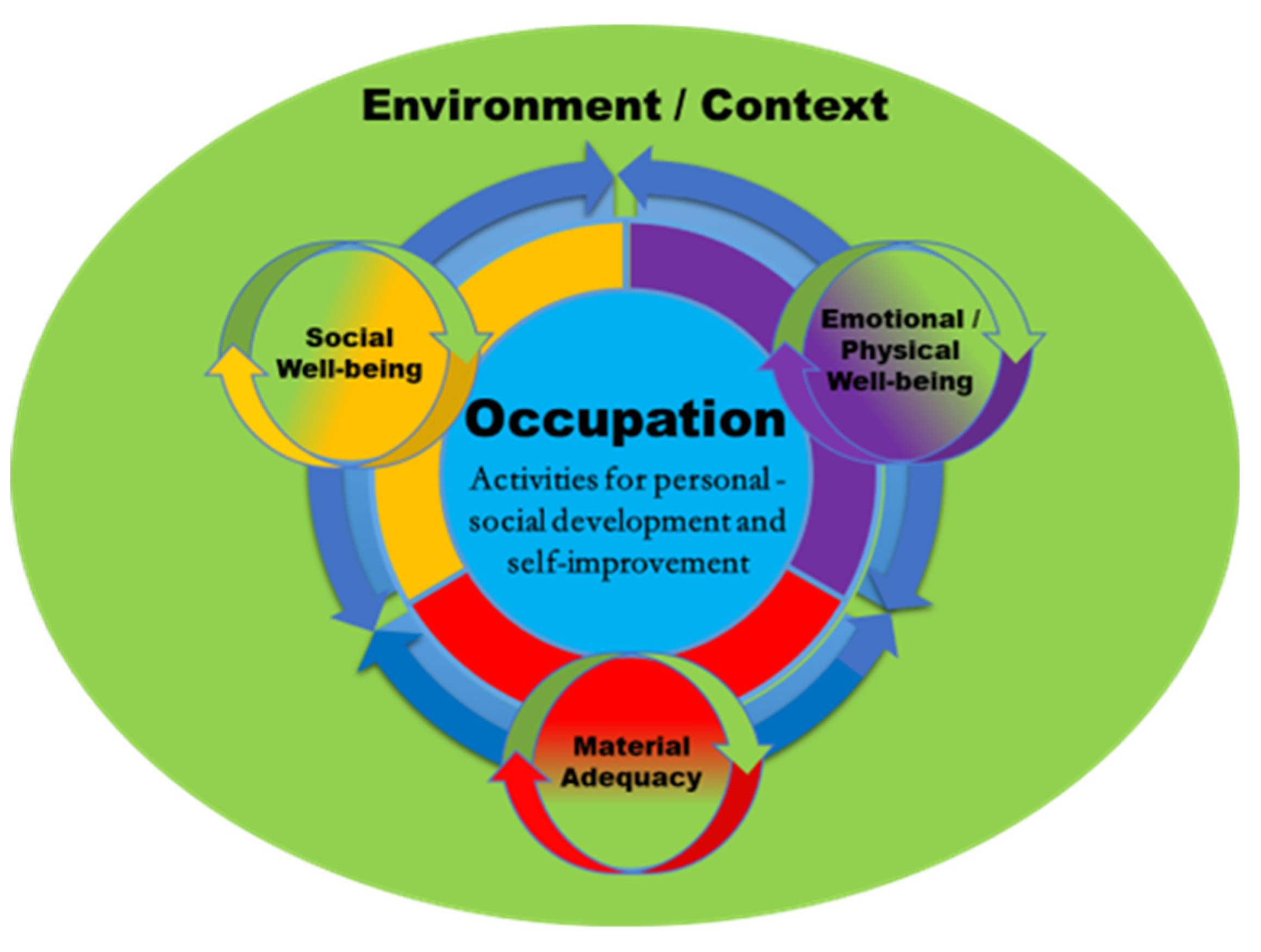

Table 1.
Outline of Interview Guide questions.
| Topic | Example Questions |
|---|---|
| Key questions on occupational experiences and perceptions of occupational participation |
|
| Key questions on perspectives and perceptions of QoL |
|
| Key questions on perceptions about ways to promote / improve QoL |
|
Table 2.
Demographic Data.
| Characteristics of the Participants in Frequencies (N=13) | Interview Code | n | % |
|---|---|---|---|
| Gender | |||
| Male | I2, I3, I4, I7, I8, I9, I11, I12, I13 | 9 | 69 |
| Female | I1, I5, I6, I10 | 4 | 31 |
| Age | |||
| <21 | I3, I9, I12 | 3 | 23 |
| 21-30 | I2, I4, I5, I8, I11, I13 | 6 | 46 |
| >30 | I1, I6, I7, I10 | 4 | 31 |
| Level of Education | |||
| Primary Special Education School | I3, I4, I6, I8, I9, I10, I11 | 7 | 53 |
| Special Vocational Education and Training Workshop | I2, I5, I7, I13 | 4 | 31 |
| Primary School | I1 | 1 | 8 |
| Lower Secondary School | I12 | 1 | 8 |
| VEF’s1 Training Workshops | |||
| Carpentry | I3, I7, I9, I13 | 4 | 30 |
| Bookbinding | I4, I5, I10, I12 | 4 | 30 |
| Cookery | I6, I8 | 2 | 16 |
| Candle Making | I11 | 1 | 8 |
| Arts and Crafts | I1 | 1 | 8 |
| Wedding’s and Baptism’s Supplies | I2 | 1 | 8 |
| Total Years of Training in the VEF1 | |||
| <10 | I2, I3, I5, I9, I12, I13 | 6 | 47 |
| >10 | I1, I4, I6, I7, I8, I10, I11 | 7 | 53 |
| Living Conditions | |||
| Living with their parents | I1, I3, I4, I5, I6, I8, I9, I10, I11, I13 | 10 | 76 |
| Living independently without any aid from siblings or caregivers | I2 | 1 | 8 |
| Supported Living Accommodation Facilities | I12 | 1 | 8 |
| Independent Living Accommodation Facilities | I7 | 1 | 8 |
| Personal Space | |||
| Yes | I2, I7, I12 | 4 | 31 |
| No | I1, I3, I4, I5, I6, I8, I9, I10, I11, I13 | 9 | 69 |
1 Vocational Education Foundation.
Table 3.
Conceptualization of Occupational – Quality of Life (O-QoL).
| Model of Occupational – Quality of Life (O-QoL) | Respondents (N=13) |
||
|---|---|---|---|
|
Core Component: Occupation Participating in leisure activities, vocational training, employment, etc., |
I1, I2, I4, I5, I9, I10, I13 | ||
| for personal / social development and self-improvement |
First Domain: Social well-being |
Friends and social relationships | I2, I6, I7, I10, I12 I3, I4, I7, I8 I9, I11, I12 |
| Family environment | |||
| Social contribution | |||
|
Second Domain: Emotional and Physical well-being |
Emotional and physical health |
I1, I5 I7, I8, I9, I11 | |
| Sense of control, choice, autonomy, security and privacy in life | I1, I6, I11 | ||
|
Third Domain: Material Adequacy |
Financial status and political context | I5, I10, I12 | |
| Living conditions, housing | I1 | ||
Table 4.
Aspects of Occupation Influencing Quality of Life.
| Occupational Aspects Enhancing Quality of Life (+) | Respondents (N=13) |
|---|---|
| Social interaction and participation | I1, I2, I3, I4, I5, I6, I7, I8, I11, I12 |
| Positive experiences / Positive emotions | I1, I3, I5, I6 I7, I8, I9, I11, I12 |
| Autonomy, privacy, security, sense of control over life, opportunities for free decision making and availability of choices |
I1, I4, I6, I11, I12 |
| Occupational Aspects Degrading Quality of Life (-) |
Respondents (N=13) |
| Patronizing, treating as inferior, continuous criticism and disapproval | I1, I2, I3, I4, I7, I8, I11, I12 |
| Deprivation / lack of participation and negative emotions | I1, I2, I4, I6, I7, I10 |
| Monotony, repetition, passive routines and inactivity | I1, I4, I10 |
| Coercion and imposition | I1, I12 |
Table 5.
Socioenvironmental Factors Influencing Quality of Life.
| Socioenvironmental Factors with Positive Influence on Quality of Life (+) |
Respondents (N=13) |
||
|---|---|---|---|
| Social Environment | Enjoying social relationships and joint entertaining leisure activities with family and friends | I1, I2, I3, I4, I5, I6, I7, I8, I11, I12 | |
| Economic Environment | Financial status, material adequacy and governmental policies |
I1, I2, I4, I5, I7, I8, I11, I12, I13 | |
| Personal Environment | |||
|
Training and participating in entertaining educational and recreational activities in the VEF1 |
I1, I3, I4, I5, I6, I9, I11, I13 | |
|
Personal space and autonomy | I1, I5, I7 I8, I12 | |
|
Socioenvironmental Factors with Negative Influence on Quality of Life (-) |
Respondents (N=13) |
||
| Educational Environment | Training in the VEF1 provokes social stigma and marginalization |
I2, I3, I6, I7 | |
| Family Environment | Dysfunctional family relationships and / or verbal / physical abuse / violence |
I3, I4, I8, I12 | |
| Political Environment | Social marginalization, discrimination and occupational deprivation |
I5, I10 | |
1 Vocational Education Foundation.
Table 6.
Assessment of Quality of Life.
| Quality of Life Assessment Criteria | Respondents (N=13) |
|---|---|
| Emotional state / health | I1, I2, I3, I5, I6, I9, I11, I12 |
| Participation in entertaining social activities | I1, I2, I3, I5, I6, I9, I13 |
| Financial status | I1, I2, I5, I12, I13 |
| Social relationships (family, friends, community, etc.) | I2, I3, I10, I11, I12 |
| Physical Health | I2, I7, I13 |
| Housing / Living conditions | I1 |
Table 7.
Quality of Life Enhancement.
| Means to Promote and Improve Quality of Life | Respondents (N=13) |
|---|---|
| Academic advancement and growth / Employment | I2, I3, I5, I6, I7, I8, I9, I11, I12 |
| Social interaction and social activities | I1, I2, I3, I5, I7, I11, I12 |
| Sexual expression and satisfaction | I2, I3, I6, I7, I11, I12 |
| Continuous participation in various activities (e.g., physical exercise activities, sports, therapeutic / educational programs) |
I1, I2, I3, I5, I6, I13 |
| Disability elimination, resilience and focus on personal needs | I1, I2, I3, I6, I4, I11 |
| Social contribution / community serving | I2, I9 |
| Family relationships / Joint social activities | I4, I7 |
| Housing, living conditions and autonomy | I1, I7 |
Disclaimer/Publisher’s Note: The statements, opinions and data contained in all publications are solely those of the individual author(s) and contributor(s) and not of MDPI and/or the editor(s). MDPI and/or the editor(s) disclaim responsibility for any injury to people or property resulting from any ideas, methods, instructions or products referred to in the content. |
© 2024 by the authors. Licensee MDPI, Basel, Switzerland. This article is an open access article distributed under the terms and conditions of the Creative Commons Attribution (CC BY) license (http://creativecommons.org/licenses/by/4.0/).
Copyright: This open access article is published under a Creative Commons CC BY 4.0 license, which permit the free download, distribution, and reuse, provided that the author and preprint are cited in any reuse.


