

Submitted:
28 July 2024
Posted:
31 July 2024
You are already at the latest version
Abstract
Such rapidly changing external conditions as the COVID-19 pandemic and the war in Ukraine, being pure crisis phenomena, not only determine the geopolitical and geoeconomic situation on the global markets, but also cause structural changes in individual countries. Under these conditions, the level of food self-sufficiency becomes particularly important, as it is one of the factors determining the food security of any country. The aim of the research is to assess Ukraine's food self-sufficiency compared to the European Union and Poland. The self-sufficiency ratio (SSR) index was used to assess food self-sufficiency. This is the ratio of the volume of production of the most important products of plant and animal origin to the volume of domestic consumption. Domestic consumption was defined as the volume of domestic production increased by the volume of imports, reduced by the volume of exports and also included changes in domestic stock levels. The surveyed time frame is 2019–2021. The analyzed data were taken from the State Statistics Service of Ukraine, FAOSTAT, USDA and Statistics Poland. A comparative analysis of self-sufficiency for the main agri-food sectors of Ukraine, the EU, and Poland showed significant differences. Taking into account the production potential and food self-sufficiency indicators of Ukraine, Ukraine's possible accession to the EU can be expected to have a major impact on the EU's supply and demand situation, as it may pose a threat to many EU agri-food sectors.
Keywords:
food self‐sufficiency
; food security
; production potential of agriculture
; war in Ukraine
; European Union
; Poland
1. Introduction
The external environment for doing business in the agri-food sector has changed significantly in recent years, primarily due to the socioeconomic impact of the COVID-19 pandemic and the war in Ukraine. In the broadest terms, 2020 marked the peak of the COVID-19 pandemic, 2021 was a period of gradual easing of restrictions introduced in connection with the pandemic, and 2022 saw pressure from another destabilizing factor for the market, namely the hostilities in Ukraine. The post-pandemic global recovery was thus hampered by many new challenges. The year 2022 was marked, first of all, by high volatility in global agricultural and energy commodity markets, as a consequence of Russia's invasion of Ukraine. Prices for agricultural products were already high before the outbreak of the war, but the hostilities caused additional turmoil in agricultural markets. Problems with the continuity of supply chains and a decline in the supply of agricultural products put a strain on market balances in many regions of the world and caused rapid price increases that reinforced strong inflationary impulses in the global, EU and domestic economies. In addition, sanctions imposed on Russia and Belarus resulted in a decline in the supply of energy resources and a sharp increase in the price of oil and natural gas, and consequently electricity. This has had a negative impact on the cost of agricultural production, particularly fuel and fertilizer. There has also been a marked increase in costs for food processing operators [1].
Russia's invasion of Ukraine had already shaken volatile food markets around the world. Such a nervous reaction of food markets was due to the fact that Ukraine and Russia are major producers and exporters of many agricultural commodities. The hostilities therefore meant limited opportunities to sell these commodities abroad, which, with both countries' significant share of global exports, posed the risk of shortages in some markets. According to Ambroziak et al. [2], the Russian invasion of Ukraine directly affected the food security of many countries by reducing the physical availability of certain agricultural products as a result of disruptions in their transportation. The negative impact of the war on food security also manifested itself in indirect ways. A marked increase in prices reduced the economic availability of food in many countries, especially those with the lowest income levels.
The COVID-19 pandemic, warfare on various fronts, as well as progressive climate change have highlighted the weaknesses of food systems and inequalities in different regions of the world, causing a further increase in global hunger and a serious threat to food security. Ensuring physical and economic access to sufficient, safe and nutritionally adequate food for all people has thus become one of the most important global challenges of the 21st century. Clearly, in view of the huge number of hungry people in the world, as well as those living below the subsistence level, various kinds of measures must be taken to increase food security [3].
In an ever-changing, increasingly difficult external environment, given the need to avoid a global food crisis and push back the specter of world hunger, the issue of ensuring food security, which is a key element of any country's socioeconomic policy, has become particularly important. One of the most important factors determining food security is the level of food self-sufficiency. Food self-sufficiency of a country is defined as the ability to meet the internal demand for food through production using its own resources, while, in a slightly more developed form, it means the full availability of food on the internal market, regardless of the sources of its origin (domestic production or imports) [4]. On this basis, self-sufficiency can be assessed as the ratio of production to domestic consumption, and can be considered at the level of the entire sector or individual agri-food products. If production falls below domestic consumption, then self-sufficiency is not guaranteed and supply shortfalls must be made up with imports. The situation is different where production exceeds demand. In such a situation, there are supply surpluses that can be diverted for export. Assessment of self-sufficiency is part of the analysis of market balances, of which foreign trade turnover is an important element, and changes in domestic inventories are also important. Therefore, an analysis of foreign trade performance can, to some extent, illustrate whether a country is food self-sufficient. However, a trade surplus should not be clearly equated with self-sufficiency, as the intensity of trade, including intra-industry trade, is becoming increasingly globalized. In such cases, a positive foreign trade balance is not necessarily a consequence of production exceeding domestic demand.
The production potential of Ukraine's agri-food sector and its position in the world food trade have been analyzed more than once. The authors have tried to cite some of the research results in the following section. However, there is a research gap in the literature regarding the assessment of Ukraine's food self-sufficiency, and this issue, especially in the context of future changes in the global economy, may be of great importance. Therefore, the purpose of this article is to assess food self-sufficiency in basic plant and animal products of Ukraine compared to the European Union (EU), including Poland. This assessment was made on the basis of an analysis of the ratio of production of selected agri-food products to their balance consumption. The analysis of self-sufficiency was carried out for the period 2019-2021, using data from the State Statistics Service of Ukraine, FAOSTAT, the USDA Foreign Agricultural Service, and Statistics Poland.
The study consists of an introduction, four substantive chapters and a conclusion. The first chapter contains theoretical considerations on the concept of food self-sufficiency, including a definition of this term and various approaches, and examines how the concept relates to food security. The next chapter includes a description of the research method used, i.e. formulations and interpretations of food self-sufficiency indicators. The third chapter provides an in-depth comparative analysis of the potential of the agricultural sector of Ukraine and the European Union, including Poland. The fourth chapter contains the results of the analysis of food self-sufficiency of Ukraine compared to the EU, including Poland, in terms of selected agri-food products. This section uses calculations made on the basis of the SSR indicator, which expresses the degree to which a country's internal demand for food products is covered by domestic production. The study concludes with conclusions and recommendations in the context of Ukraine's possible accession to the EU.
2. Food Self-Sufficiency – Literature Review
According to the Food and Agriculture Organization (FAO), food security is defined by a situation in which all people, at all times, have physical, social and economic access to sufficient, safe and nutritious food that meets their dietary needs and food preferences for an active and healthy life [5]. Food security is ensured when four conditions are met simultaneously: physical availability of food, economic availability of food, adequate dietary quality and food safety, and stability over time [3]. It can be considered at different levels, in particular, national, international and global. While food security is ensured at the national level, regional inequalities are reduced at the international level, solving food problems at the global level [6,7]. Many researchers [8] point out that food security at the global level is very complex. This is because, on the one hand, it focuses on social aspects and is strongly linked to sustainable development. On the other hand, it incorporates causes and effects at the national and international levels, it aims to solve lower-level problems resulting from food insecurity of individual countries or local communities.
One of the most important factors determining food security is the level of food self-sufficiency. The concept of food self-sufficiency is generally taken to mean the extent to which a country can satisfy its food needs from its own domestic production [9]. This most basic definition can apply at the level of individuals, countries or regions. However, food self-sufficiency is not a manifestation of food security, although the two can interact. The concept of food security does not include considerations as to the origin of food or a country's ability to produce it, as long as it is available, accessible, nutritious, and stable. Food self-sufficiency is mainly concerned with the element of availability and focuses on the origin of food, including in particular the domestic capacity to produce it in sufficient quantities [4].
Figure 1 shows the most basic understanding of food self-sufficiency. The Food Self-Sufficiency Line represents a closed economy situation in which food production equals food consumption in a country, i.e., food supply at the national level meets food demand. Individual countries can be placed above or below the self-sufficiency line. The quantities on the axes of this figure (production, consumption) can be presented in annual or, for example, daily per capita terms [4,10].
While recognizing the basic definition of food self-sufficiency, it should, however, be clarified and expanded. This is because, food self-sufficiency can be defined somewhat differently depending on the unique situation of each country in terms of the production potential of the agri-food sector, the level of economic development, the ability to purchase food on foreign markets and the efficiency of food distribution in the country, and above all, the individual policy choices of the government. For example, it can be understood as closing its borders to all foreign food trade (both imports and exports) and concentrating its resources on the agricultural sector so that it can meet all its food needs on the domestic market. In this way, the agricultural sector is prioritized as a source of overall economic growth and development, as well as a way to increase economic activity and income in rural areas. Viewed in this way, the definition refers to a country applying total autarky to its agri-food sector. However, such an extreme policy stance is virtually non-existent today, just as there are no countries that depend entirely on foreign food purchases. All countries, even major food exporters that are fully self-sufficient, import at least some food [4,7]. Much more commonly, a country's food self-sufficiency is defined as a situation in which a country meets or even exceeds most of its food needs (close to 100% of food consumption) from its own production. This definition presupposes the possibility of food trade, and food self-sufficiency in this case is expressed as a percentage or by appropriate indicators. This definition is less categorical about where the food consumed in a country comes from, but it still allows inferences about a country's own capacity to produce food. Countries that are self-sufficient can specialize in food production, but this does not prevent them from importing and exporting food at the same time [4].
The increasing level of economic globalization, the opening of economies to external competition, as well as biological and technological advances, mean that the nature of food self-sufficiency is changing today, and it is now difficult to find examples of autarkic economies. In practice, food self-sufficiency is the desire of individual countries to balance their food trade, i.e. to cover imports of agri-food products with exports of these products. A zero balance achieved in this way can indicate food self-sufficiency. This approach implies full economic and physical availability of food on the domestic market, regardless of origin, i.e. from both domestic production and imports [7,11]. However, Sobiecki estimates that to ensure food security at the same time, at least 70-75% of the population's food needs should be produced in a country or grouping (such as the European Union) [12]. In this way, the implemented policy of optimal food self-sufficiency makes it possible to enrich the national food assortment with products not produced domestically (e.g., from other climatic zones). At the same time, it becomes possible to sell food surpluses abroad. Thanks to such development of foreign trade streams, the structure of food consumption becomes more diversified, and the needs of the population are better satisfied [7].
In recent years, in order to achieve an adequate level of food security, as well as the availability of food in specific markets, many countries have acknowledged the importance of foreign exchange and trade policy, undertaking a number of initiatives to develop international trade. Their goal has been to eliminate poverty and improve food availability [13,14]. This is because trade openness, which promotes the exchange of products between countries, plays a key role in ensuring continuity of supply, equalizing supply and demand, and reducing price fluctuations in individual markets. As a result, each country can increase the quantity and variety of products available to the public, while guaranteeing improved levels of food security [15]. The development of trade additionally allows access to larger markets, which provide opportunities for economies of scale, and technology and knowledge transfer [16]. A study by Fader et al. [17] found that many countries are unable to increase their food self-sufficiency due to limited natural resources, including limited agricultural land and water. They estimated that 16% of the world's population meets its food needs through international food trade and other means. Trade can therefore be an important protection mechanism for those countries that are unable to ensure adequate food availability in the market on their own. A study by Fusco et al. [18] confirms the positive impact of trade openness on the food security of European countries. Moreover, the researchers proved that also economic development combined with a strong agricultural sector, including policies implemented by the EU, can promote food security. This means that trade openness in the context of economically developed countries can improve the safety and nutritional quality of food, as well as its availability on the domestic market, i.e. the food self-sufficiency of these countries. However, Puma et al. [19] point out that excessive concentration of food import sources can be a factor in increased vulnerability of the global food system, which can result in its instability and susceptibility to disruptions of both a natural and economic nature. The global economy experienced this as a consequence of Russia's invasion of Ukraine [2]. Indeed, both countries are among the largest producers and exporters of key agricultural products, such as wheat, barley, corn, oilseeds and sunflower oil.
Although food self-sufficiency, meaning the full availability of food on the internal market, can be achieved by various means, some researchers emphasize the need for individual countries and their groupings to support their own production, for example, through intervention-protection policy measures, which helps make their own food producers more competitive. The Common Agricultural Policy, which supports the EU agricultural market and stimulates measures related to improving the quality of food products, is also based on this principle to some extent [11]. When it was introduced, the European Union became an almost food self-sufficient region within a few years [7,20,21]. In recent years, a growing interest in the idea of food self-sufficiency can be observed in many countries. Various crises, including the 2007–2008 food crisis, the COVID-19 pandemic, and the war in Ukraine, have caused great uncertainty in global food markets, manifested in disruptions in supply chains or volatility in agricultural and energy commodity prices. Against this backdrop, many countries have announced a shift in policies aimed at increasing levels of food self-sufficiency and stepping up efforts to make local food systems more resilient [22,23]. Although policies that support greater food self-sufficiency appear to be justified in many cases, such measures are often criticized by economists.
In an environment where some countries are net exporters of food and others are net importers, attention is increasingly being paid to global food self-sufficiency. Global food self-sufficiency depends not only on the level of agricultural and food processing production and the openness of trade, but also on the development of the distribution sphere and changing external conditions. Some researchers believe that the world's food production resources are sufficient to feed the population of the entire globe. Hunger and malnutrition, which are a problem in many parts of the world, are instead due to inequitable distribution, imperfect political solutions, and inadequate institutional mechanisms. Each country or grouping, by pursuing a policy of optimal food self-sufficiency for itself, helps to solve or exacerbates the global food problem. At the same time, it is incumbent on societies and international organizations to provide adequate support to the countries most severely affected by food deficits [24]. According to other researchers, meeting the growing global demand for agricultural products when the planet's limited resources are being depleted is becoming the most serious challenge facing humanity. Beltran-Peña et al. [25] conclude that global food self-sufficiency is likely to decline or at most be sufficient throughout the 21st century, provided that a model of sustainable agricultural development is implemented. Only if this occurs can global food production be sufficient to feed the world's population. However, most countries in Africa and the Middle East will still be heavily dependent on imports in the 21st century. The results of this research identify the sites of future crop production deficits and dependence on food imports, and predict vulnerability to extraordinary food supply shocks.
However, there is no doubt that in order to avoid a global food crisis, action by international organizations and communities is needed to counteract threats to food security in countries with relatively low income levels, as well countries that are less food self-sufficient, especially when crises occur. After all, pandemics, wars and the resulting instability destabilize food markets for a long time.
3. Materials and Methods
Three analytical methods are most often used in assessing the food self-sufficiency of countries. The first two are based on an analysis of the results of foreign trade in agri-food products. The foreign trade balance (TBi - Trade Balance), which is the absolute difference in the volume of exports and imports (1), makes it possible to assess the supply and demand in a given market. A positive foreign trade balance (TBi >0) indicates that a country's production is greater than domestic demand and the surplus can be sold on external markets. Therefore, adding a trade balance suggests that a country is self-sufficient in the production of the commodity in question.
where: TBi - foreign trade balance,
Exi - exports, Imi - imports.
Food self-sufficiency in relative terms can also be assessed and interpreted using the index of import to export of agri-food products (TCi - Trade Coverage), which is the ratio of exports to imports [26] (2). A country has food self-sufficiency if the values of this indicator are greater than or equal to unity (TCi ≥1).
where: TCi - import-export coverage ratio,
Exi - exports, Imi - imports.
An analysis of foreign trade performance illustrates to some extent whether a country is food self-sufficient. However, neither the foreign trade balance nor the import-export coverage ratio should be clearly equated with self-sufficiency, as the intensity of trade, including intra-industry trade, is increasing under globalization. Many countries specialize in foreign trade in agri-food products (e.g. the Netherlands, Saudi Arabia) and re-export imported products, reaping significant economic benefits from trade. In such cases, these rates are not necessarily a consequence of production exceeding demand. However, more in-depth studies prove that most net food exporting countries are self-sufficient, while most net food importing countries are not considered self-sufficient. The results of measuring food self-sufficiency based on market balance analysis confirm that countries can be considered self-sufficient if they simultaneously engage in food trade.
The third method of assessing food self-sufficiency is based precisely on the analysis of market balances of individual products, and is used by FAOSTAT [27], among others. In this approach, the food self-sufficiency indicator (SSRi ) is the ratio of production to balance sheet consumption, which in turn expresses production adjusted for the foreign trade balance (±TBi ), and in more precise terms also takes into account the change in domestic stocks (±ΔSi ) (3). Self-sufficiency in the market for a given commodity occurs if the values of the SSRi indicator are greater than or equal to unity. Mostly data in terms of quantity (volume), but sometimes also in terms of energy (caloric) or value (monetary) are used to calculate these indicators [4,19].
where: SSRi - self-sufficiency index,
Abouti - domestic production,
Ui - balance consumption,
Imi - import, Exi - export, TBi - foreign trade balance,
ΔSi - change in inventory.
Food self-sufficiency can be further formalized in dynamic terms as the ratio of the values of the demand function for a given commodity Di (y1 ,...,yn ) to its production function Oi (x1 ,...,xn ), which are determined by a diverse group of variables (4). In this approach, self-sufficiency occurs, as in market balance analysis, when the values of the production function are greater than or equal to the values of the demand function Oi ≥Di (Figure 2).
where: SSRi - self-sufficiency index,
Oi (x1 ,...,xn ) - production function,
Di (y1 ,...,yn ) - demand function.
Regardless of the analytical approach, the SSR indexi expresses the degree to which a country's domestic demand for agri-food products is covered by its domestic production. The higher the values of the food self-sufficiency index are above unity, the greater is the country's ability to feed its population with its own production. The index in question can also be used to assess food self-sufficiency in specific agri-food products at the scale of countries or regions, which makes it possible to determine whether countries and regions are capable of meeting the demand for these products [7,20]. Its usefulness is due in particular to the fact that not only export-import ratios, but also production data and stock changes are included in the calculations [4,7].
In this article, SSRi indicators, which were based on market balance analysis (3), were used as a method for assessing food self-sufficiency. The research used statistical data of the State Statistics Service of Ukraine, FAOSTAT, the Foreign Agricultural Service USDA, and Statistics Poland in quantitative terms. The period covered by the research was defined as 2019–2021, the period immediately before Russia's invasion of Ukraine. The analytical work and inference repeatedly took into account that the hostilities in Ukraine had a negative effect not only on the production potential of the country's agri-food sector, its demographic situation and potential demand, but also on the ability of the State Statistics Service of Ukraine to collect and publish data.
4. Production potential of agriculture of Ukraine in comparison with the EU, including Poland
The production potential of a country's or region's agriculture is determined by a wide range of factors, which can be classified as follows:
- climatic conditions, including temperature distribution and the sum and distribution of precipitation, which determine the length of the growing season and hydrological conditions,
- area and structure and qualitative quality of agricultural land,
- farm livestock,
- the demographic situation in rural areas, which determines the labor pool,
- ownership and area structure of farms [28].
Ukraine is located in a temperate continental climate zone, which is favorable for agricultural production [29]. The Black Sea and Sea of Azov regions have a Mediterranean climate [30]. The growing season, which is defined as the number of days with an average temperature above 5°C [31], is long and allows the cultivation of most crop species [32]. Precipitation ranges from 400 mm in southern regions to 1,000 mm in mountainous regions [33]. Despite the low amount of precipitation, water resources are approximately 4,000 m3/capita and are twice as high as in Poland [34,35]. The determining factors are the river network (Dnipro, Dniester, Pripyat, etc.) and numerous lakes and reservoirs (about 4100). In the southern regions, the water deficit was solved by the Dnieper-Donbas and North Crimean canals [36].
The main factor determining the production potential of Ukrainian agriculture is the area of agricultural land, which is about 41.3 million hectares and is about 75% smaller than in the EU, but three times larger than in Poland (Table 1). The agricultural land area per capita in Ukraine is 1.0 hectares, three times larger than in the EU and Poland. Under wartime conditions, about 22% of the agricultural land area was taken out of production [37], and due to losses and a large number of refugees [38], depopulation to about 35.0 million inhabitants occurred. As a result, in 2023, the agricultural area per capita dropped to 0.9 hectares, but is still larger than in the EU and Poland. An element that determines the production potential of Ukraine's agricultural land is the large share of soils of the highest quality classes. Chernozem, which are characterized by high humus content, account for about 50% of the territory, but the problem remains their progressive degradation due to climate change and crop production technology based on monocultures [39,40]. Degradation of soils is also caused by warfare, as well as difficulties in implementing principles of rational management under crisis conditions [41].
Ukraine's agricultural land structure is typical of Central and Eastern Europe. The largest share is arable land (79.7%), slightly higher than in Poland (76.1%), but significantly higher than in the EU (60.5%). Ukrainian agriculture shows a small share of permanent grassland (18.2%) and permanent crops (2.1%) in the structure of agricultural land (Table 1). In the EU and Poland, the share of grasslands and pastures in the agricultural land structure is 32.2 and 21.4%, respectively, and this is determined by agroclimatic conditions, developed livestock production and the ownership structure of farms. Permanent crops in the EU account for 7.3% of the agricultural area, as fruit, vegetable, wine and oil production, in which family farms specialize, plays an important role in the southern member states. The structure and good quality of agricultural land determine the production specialization of Ukrainian agriculture, which focuses on the production of cereals and oilseeds in large-scale agricultural enterprises. In Ukrainian agriculture, family farms have a marginal share of production, and a large part of fruit and vegetable production is produced for self-supply or direct sales.
Ukrainian agriculture's livestock production experienced a regression between 2010 and 2021, reflected by a deep decline in livestock numbers, with the exception of poultry [42]. The cattle population declined by 58.4% and was half that of Poland, which has a much lower production potential [43,44,45]. The pig population decreased by 9.1%, but it should be remembered that it was already low in 2010. [46]. The pig population in Ukraine is about 40% smaller than in Poland (Table 2). The main reason for this is the structure of farms, in which the key role is played by large-scale agroholdings, specialized in crop production. The aforementioned agroholdings do not develop livestock production, despite their large feed resources, which could be the basis of competitive advantages. Agroholdings' lack of interest in dairy, beef and pork production is due to the need for large capital and labor inputs, including the implementation of efficient production organization based on hired labor [47]. Specialization in crop production, including simplified crop rotation and lack of use of organic fertilizers, is harmful to the environment, which is reflected in soil degradation. In livestock production in Ukraine, developmental trends have been noted only in poultry production, which was based on large supplies of grain and protein crops [48]. The factors stimulating the development of the poultry industry were technology based on a short production cycle and rapid turnover and high rates of return on capital. The poultry population grew at an average annual rate of 1.7%.
There are negative demographic trends in Ukraine. Between 2001 and 2021, the population decreased by 14.9% to 41.6 million people [49]. The reasons for the population decline were labor emigration abroad (e.g., to Poland) and excess deaths that resulted from the war in Donbass and the COVID-19 pandemic [50]. The population in rural areas fell by 21.3% to 12.6 million people, and its share of the total population decreased from 32.7 to 30.3%. A decisive factor in the decline of the rural population was migration to cities or abroad, driven by structural changes in agriculture [51]. The concentration of grain and oilseed production in agroholdings generates less labor demand than the production of fruits, vegetables and animal products on family farms. From 2015 to 2020, 2.7-3.0 million people were employed in agriculture, but the number of people with permanent jobs decreased by 6.1% to 385,000. Most of those employed in Ukrainian agriculture do not have permanent positions and work during seasonal increases in demand. Many households in rural areas have home farm plots where they produce for self-supply and direct sales. One cannot exclude labor activity in the "shadow economy," a large share of which is characteristic of transition economies [52].
Between 2022 and 2023, the population of Ukraine fell to about 35 million people as a result of the hostilities. The number of refugees is estimated at about 6.0 million. The large population decline has affected the labor market, including in the context of the country's future reconstruction. The key question remains whether the war refugees, who are mainly women and children, will return to Ukraine when the war ends, or settle in EU countries. Depopulation results in a decrease in potential demand for food, and this means that Ukraine will have surpluses that will be exported.
Difficulties arose in transformation of ownership of agricultural land in Ukraine and the process has not been completed [53]. Issues of agricultural land ownership will be a major challenge in the context of eventual EU accession, since property rights are the foundation of the European economy and a requirement for implementation of the Common Agricultural Policy programs. Transformation of ownership of agricultural land began in 1992 under a law that made no changes to the legal forms of farms, but granted workers the right to an appropriate share of the land of cooperatives (kolkhozes) [54]. The process of determining the size of shares took about ten years, and the shares, depending on the region, were 1-8 hectares/employee. It is estimated that 6-8 million people exercised the right in question, but the shares granted to them were not delineated on maps. Most of the certificates of ownership of land rights formed the basis for leasing them to agroholdings, and only about 6% were converted into the right to use a specific and physically separate plot of land. In 2001, the Land Code of Ukraine was enacted, aimed at establishing ownership of agricultural land as the basis for market trading in land. The implementation of the regulations in question was suspended, and the relevant moratorium was extended annually until 2019. In the process of ownership transformation, a subject structure of Ukrainian agriculture was formed, in which family farms play a minor role, as they use only about 25% of the land [55,56]. In most EU Member States, including Poland, the share of family farms in crop acreage is about 90%. The dominant form of farms in Ukraine is agricultural enterprises, which are based on leased land and have different legal forms and scale of production. The most numerous group are "farmer farms," which account for about 72% of the group of entities in question, with an average land area of about 130 hectares. However, most "farmer farms" lease more than 500 hectares, which is a large scale of production compared to the EU and Poland. In addition, there are 22 very large agroholdings on the market, which are commercial companies, including those with foreign capital (Cyprus, the US, Saudi Arabia, Germany, Denmark and the Netherlands), and their total cultivated area is about 4 million hectares.
Agriculture in Ukraine is not realizing its production potential, which is based on fertile soils and favorable climatic conditions. This is confirmed by low productivity, which is reflected in low yields in crop production and livestock productivity. The main reason for the low yields is improper agrotechnology, as most farms use simplified crop rotation or monocultures, which result in soil degradation and the expansion of agrophages. The deep decline in the number of livestock has resulted in low supplies of natural fertilizers, which are the basis for sustainable crop production. In 2019-2021, average yields of crops in Ukraine varied significantly and were much lower than in the EU, and lower than in Poland, which has poor soils, low water resources and a fragmented farm structure (Table 3). Ukrainian agriculture shows low productivity in livestock production [57]. The average milk yield of cows in 2019-2021 was 31.8% lower than in the EU and 16.6% lower than in Poland. The reason for the low milk yield of cows is poor genetic material and poor welfare and feeding conditions for cows.
Ukraine is a large producer of crop raw materials, including cereals and oilseeds. In 2019-2021, grain production amounted to 55.4-75.7 million t, with high variability determined by yield fluctuations. In cereal production, corn (27-42 million t), wheat (22-31 million t) and barley (6-10 million t) play a key role. The share of world corn production was 2.3-3.5%, wheat 2.7-4.2%, and barley 4.0-6.8%. In comparison, the EU's share of world grain production is 11.9-12.8%, and Poland's is 1.5-1.6%. In the production of oil crops, the cultivation of sunflower plays a key role, of which the harvest amounted to 12.2-17.5 million tons. Rapeseed production fluctuated between 2.8-3.5 million t and was comparable to Poland. As a result, Ukraine is the world's leading producer and exporter of oil products, as its share of world sunflower and rapeseed production is 23.3-30.8 and 3.4-4.0%, respectively. Ukraine produces 3.0-4.5 million tons of soybeans, but its share in world production is low (0.8-1.1%), driven by large production in the US, Brazil and Argentina. The level of efficiency of cultivation and processing of sugar beets is low, as sugar production is 33.0% lower than in Poland. Ukraine is not realizing the potential in livestock production, which is based on large feed resources. Between 2019 and 2021, raw milk and livestock production averaged 42-62% less than in Poland. Ukraine shows large and competitive production of poultry livestock (about 1.4 million tons in slaughter weight), which is exported to the EU. As a consequence of low milk and livestock production, Ukraine's share of the world market for livestock products is 0.5-1.0%, half Poland's share.
The structure of agricultural production value in Ukraine is different than in the EU and Poland. In Ukraine, the production structure is dominated by plant products, the share of which increased from 75.6 to 82.2% between 2019 and 2021. The share of animal products decreased from 24.4 to 17.8% (Table 4). The structure of production confirms the high specialization of agriculture and at the same time indicates that it is not sustainable in the context of the circular economy model. Ukrainian farms process little fodder to make animal products, which show a higher share of added value. Low animal production does not provide natural fertilizers that benefit soils. In the EU, the structure of agricultural production is balanced, as the share of plant products is 53.7-58.7% and the share of animal products is 41.3-47.3% [58]. In the production structure of Polish agriculture, the share of plant and animal products is similar, at 47.5-52.0% and 52.5-48.0%, respectively, indicating its sustainability.
5. Ukraine's Food Self-Sufficiency in Basic Agricultural Products Compared to the EU, Including Poland
Ukraine has significant production potential in the agri-food sector, based on its large area of agricultural land and favorable climatic conditions. The production potential exceeds the demand of the domestic market, but it is not used in all industries, which is largely determined by the structure and production specialization of agroholdings. A barrier to inefficient utilization of production potential is unsustainable production technology, which is reflected in low productivity of labor and capital [59]. In the structure of farms, the key role is played by agroholdings, which specialize in the production of cereals and oil crops, and to a lesser extent in the production of poultry and pork livestock. Family farms have a low share of production, as they produce only for self-supply and a low level of direct sales.
Ukraine's total grain production is more than three times the balance consumption and the bulk of it is directed towards exports. SSRi ratios in the grain market in 2019-2021 were 306.1-372.9% (Table 5). There are differences in the level of self-sufficiency in the grain markets. The largest production surpluses and high export specialization are found in the corn (426.8-560.9%) and wheat (256.0-351.8%) markets, and smaller in the barley market. Rye production is of marginal importance, as fertile soils make it possible to grow wheat, barley and corn. The situation is different in Poland, which has a high proportion of poor soils, where it is mainly possible to grow rye and oats.
In the oilseed market, production also exceeds consumption and Ukraine is a major exporter of oilseeds. However, it should be noted that the level of self-sufficiency varies by oilseed crop. Oilseed rape production is more than seven times greater than demand, and the high consumption of rapeseed meal for feed results in only slightly lower self-sufficiency. In the sunflower seed market, production is balanced with demand, meaning that the seeds are mostly processed into oil at domestic companies. The high variability of production under conditions of relatively stable consumption results in changes in the self-sufficiency rate in the range of 99.6-154.2%. A by-product of sunflower processing is meal, which is in low demand on the domestic market and has a large oversupply, which is diverted for sale on the international market. Sunflower oil production is 4-12% higher than domestic demand. Production of soybeans and soybean meal is more than double the domestic consumption, the basis of which is poultry and swine farming.
In the sugar industry, self-sufficiency is guaranteed (96.0-129.2%), with the only exception being years with unfavorable weather conditions during the campaign period. Soil and climatic conditions make Ukraine predisposed to competitive cultivation of sugar beets, but the sugar industry remains a barrier to the industry's development, as it needs to be restructured and modernized.
Ukraine’s livestock production, Ukraine is moderately self-sufficient. In particular, the production of poultry livestock is developed and competitive, with the demand at twice the level of the internal market. The basis for efficient poultry breeding is the abundance of grain and protein crops and positive economies of scale in agroholdings. As a result, Ukraine is a competitor to the EU and Poland in the international market. SSRi ratios on the milk and beef markets, which are strongly production-related, are 88.5-91.0% and 108.9-119.0%, respectively. The lack of self-sufficiency in dairying is a consequence of the decline in cow numbers as a result of restructuring processes in agroholdings that specialize in crop production. The decline in the number of dairy cows has resulted in declining beef production, as calves for fattening and cows for slaughter come from dairy farmers. Self-sufficiency in the beef market is due to low consumption in the domestic market caused by high prices and low household incomes [60]. In 2021, national income in terms of purchasing power was $17,500/per capita, 66.4 and 54.6% lower than in the EU and Poland, respectively. The situation with regard to supply and demand in the pork market is difficult, as production does not meet demand and self-sufficiency is only 88.4-97.0%. The reasons for this were cyclicality and low profitability of production, as well as ASF outbreaks [61]. Ukraine's self-sufficiency in the market of animal products is much lower than in the market of plant products, which is a consequence of the structure and production specialization of agroholdings.
A comparative analysis of the 2019-2021 average SSRi self-sufficiency ratios in the main industries of the Polish, EU and Ukrainian agri-food sectors confirmed significant differences (Figure 3). Ukraine is highly self-sufficient in grain and oilseed production. Poland and the EU are net importers of oilseeds, as determined by the high feed demand for soybean meal and esters used as diesel fuel additives. In the grain market, Poland and the EU have surplus supply, but it is many times smaller than in Ukraine. The self-sufficiency of the Ukrainian sugar industry is comparable to the average level in the EU. However, sugar beets are grown and processed in 19 EU countries. Consequently, there are large differences in self-sufficiency across member states, with Poland being one of the large EU sugar producers and exporters, and showing greater self-sufficiency than Ukraine. In vegetable production, the self-sufficiency of Ukraine, the EU and Poland is similar. The situation is different in fruit production, as Poland is a leading producer and exporter of apples, cherries, strawberries, and fruit preserves. In the fruit market, however, intra-industry trade is intense. This is determined by the large volume of trade in fruits from other climatic zones. In this regard, the self-sufficiency of Ukraine and the EU can be considered comparable.
In terms of industries producing and processing animal products, Poland is more self-sufficient than Ukraine and the EU, including total meat, eggs and milk. In the Polish meat market, self-sufficiency is determined primarily by large poultry production and very low demand for beef, 80% of production of which is directed for export. Ukraine's self-sufficiency in the milk market is lower than that of the EU, but it is comparable in the egg market.
6. Conclusions and Recommendations
Ukraine is one of the largest countries in Europe and has great economic potential, including in the agri-food sector. The potential of Ukrainian agriculture stems from favorable agroclimatic conditions, above all very fertile soils and climate, which enable high production of plant raw materials. The potential of Ukrainian agriculture is also determined by the structure of farms, in which economically strong agroholdings with specialized production play a key role.
Ukraine is not making maximum use of its agricultural potential, despite favorable soil and climatic conditions. This is confirmed by low and variable yields of crop products. Farms use simplified crop rotation with a large share of cereals and oilseeds or monoculture crops. Under the conditions of climate change, soil degradation and a decline in soil productivity continue. Agricultural production in Ukraine is less sustainable than in the EU and Poland. The share of crop production in Ukrainian agriculture is at 75-82%, compared to 48-52% in Poland. The low importance of livestock production in Ukraine confirms that the production potential of agriculture remains untapped, despite the large resources of fodder, which is a basic item in the cost structure of animal husbandry. The low level of production of livestock and milk indicates that farms do not benefit from the value added from feeding raw feedstuffs, which are exported in unprocessed form.
The ownership transformation of agricultural land in Ukraine has not been completed, and the structure of farms is different from that in the EU. In Ukrainian agriculture, the entity structure is concentrated, and the dominant role is played by agroholdings, whose shareholders are also foreign corporations. The share of family farms, which are the dominant form of farming in the EU and Polish agriculture, is low. The concentration of production in agroholdings determines its technology and specialization in grains, oilseeds and poultry and pork livestock.
The unfavorable demographic changes that also exist in Poland and the EU are a barrier blocking the effective utilization of production potential in Ukrainian agriculture. The main causes of depopulation of rural regions were labor emigration to cities or abroad. The 2022-2024 war exacerbated the trends in question, and this was determined by the large number of refugees. Unfavorable demographic trends will also be a barrier in the context of the country's reconstruction and adjustment processes for its eventual integration into the EU. Depopulation results in lower potential demand for food, which is important in terms of self-sufficiency.
An assessment of self-sufficiency in the main products of Ukrainian, EU and Polish agriculture confirmed significant differences. Ukraine is highly self-sufficient in grain and oilseed crop production. Poland and the EU have grain surpluses, but are net importers of oilseed crops due to high demand for feedstocks and esters as a consequence of first-generation biofuel regulations. The self-sufficiency of Ukraine's sugar and vegetable industry is comparable to the average level in the EU and Poland. In the fruit market, Ukraine and the EU lack self-sufficiency, which is determined by large imports of products from other climate zones. Poland is a large producer and exporter of apples and soft fruits and shows high self-sufficiency in this area. In animal product markets, Ukraine is self-sufficient, and this is determined by its large poultry production and a low level of domestic demand for beef. Ukraine lacks self-sufficiency in the dairy industry. The EU and Poland are self-sufficient in animal products, with the only exception being the market for table eggs in the EU.
Ukraine's future accession to the European Union will significantly increase the production potential of the EU's agri-food sector and improve its food self-sufficiency, as Ukraine shows high self-sufficiency in EU imports, for example, oilseeds, cereals, poultry products. As a result, the EU will strengthen its position as an exporter in the global market for agricultural raw materials and improve food security and resilience to food crises. However, EU accession will be a very big challenge for EU farms and food industry companies due to the great potential and competitiveness of the Ukrainian sector. At the same time, Ukraine's agriculture and food industry will be forced to carry out deep restructuring and adjustment processes to the conditions set by the Common Agricultural Policy. This issue is extremely important in the context of the development of the EU agri-food sector and should be an area for further in-depth research.
Author Contributions
conceptualization, P.S. and I.S.; methodology, P.S. and I.S.; software, P.S. and I.S.; formal analysis, P.S. and I.S.; investigation, P.S. and I.S.; resources, P.S. and W.Ł.; data curation, P.S. and W.Ł.; writing-original draft preparation, P.S. and I.S.; writing-review and editing, P.S. and I.S.; supervision, P.S. and I.S.; project administration, I.S.; funding acquisition, P.S., I.S. and W.Ł. All authors have read and agreed to the published version of the manuscript.
Funding
This research was funded by the Institute of Agricultural and Food Economics-National Research Institute, Warsaw, Poland.
Informed Consent Statement
Not applicable.
Data Availability Statement
The data upon which this article is based are supported by different data portals such as national government pages, repositories, and other data sources.
Acknowledgments
The study is the result of cooperation between researchers from various research departments within the Institute of Agricultural and Food Economics - National Research Institute, Warsaw, Poland.
Conflicts of Interest
The authors declare no conflicts of interest.
References
- Szczepaniak, I.; Ambroziak, Ł.; Szajner, P. Handel zagraniczny i międzynarodowa konkurencyjność polskiego sektora rolno-spożywczego. In Analiza sytuacji ekonomiczno-produkcyjnej rolnictwa i gospodarki żywnościowej na początku trzeciej dekady XXI wieku; Łaba S. Ed.; IERiGŻ-PIB: Warszawa, Poland, 2023; pp. 365–394. [Google Scholar]
- Ambroziak, Ł.; Gniadek, J.; Sierocińska, K.; Strzelecki, J.; Wąsiński, M. Kryzys podażowy na rynku żywnościowym jako efekt inwazji na Ukrainę; Polski Instytut Ekonomiczny: Warszawa, Poland, 2022. [Google Scholar]
- Kwasek, M.; Kowalczyk, S. Food Losses and Waste in the Context of Food Security. Kwartalnik Nauk o Przedsiębiorstwie 2023, 2, 23–42. [CrossRef]
- Clapp, J. Food self-sufficiency and International trade: a false dichotomy?, The State of Agricultural Commodity Markets, In Depth 2015-16, FAO, Rome, 2017. http://www.fao.org/3/a-i5222e.pdf.
- The State of Food Security and Nutrition in the World 2022. Repurposing food and agricultural policies to make healthy diets more affordable, FAO, IFAD, UNICEF, WFP, WHO, Rome, 2022, p. 202. https://openknowledge.fao.org/items/c0239a36-7f34-4170-87f7-2fcc179ef064.
- Małysz, J. Ekonomiczna interpretacja bezpieczeństwa żywnościowego. In Bezpieczeństwo żywności w erze globalizacji, Kowalczyk S., Ed.; Szkoła Główna Handlowa: Warszawa, Poland, 2009. [Google Scholar]
- Szczepaniak, I. Assessment of food security and food self-sufficiency of Poland as compared to other European Union countries. International Business and Global Economy 2018, 37, 168–182. [Google Scholar] [CrossRef]
- Tecau, A.S.; Dimitriu, C.; Marinescu, N.; Tescasiu, B.; Epuran, G. A Qualitative Research on the Food Security of School Children in the Rural Area. Sustainability 2020, 12(21), 9024. [Google Scholar] [CrossRef]
- FAO. Implications of economic policy for food security: a training manual. 1999. Available online: http://www.fao.org/docrep/004/x3936e/x3936e03.htm (accessed on 10 July 2024).
- Porkka, M.; Kummu, M.; Siebert, S.; Varis, O. From food insufficiency towards trade dependency: a historical analysis of global food availability. PLoS ONE 2013, 8(12), e82714. [Google Scholar] [CrossRef] [PubMed]
- Szczepaniak, I. Samowystarczalność żywnościowa Polski. Przemysł Spożywczy/Food Ind. 2012, 66(2), 2–5.
- Sobiecki, R. Globalizacja ekonomiczna a zmiana uwarunkowań produkcji rolniczej. Realia i co dalej, 2007, 2.
- Anderson, K. Krueger, Schiff, and Valdes revisited: Agricultural price and trade policy reform in developing countries since 1960. Appl. Econ. Perspect. Policy 2010, 32(2), 195–231. [Google Scholar] [CrossRef]
- Alesandro, O.; Daniel, C.; Swinnen, J. Trade Liberalization and Child Mortality: A Synthethic Control Method; Working Papers Department of Economics 567787, KU Leuven; Faculty of Business and Economics, Department of Economics KU Leuven: Leuven, Belgium, 2017.
- Dithmer, J.; Abdulai, A. Does trade openness contribute to food security? A dynamic panel analysis. Food Policy 2017, 69, 218–230. [Google Scholar] [CrossRef]
- Wacziarg, R.; Welch, K.H. Trade liberalization and growth: New evidence. World Bank Econ. Rev. 2008, 22, 187–231. [Google Scholar] [CrossRef]
- Fader, M.; Gerten, D.; Krause, M.; Lucht, W.; Cramer, W. Spatial decoupling of agricultural production and consumption: quantifying dependences of countries on food imports due to domestic land and water constraints. Environ. Res. Lett. 2013, 8(1), 014046. [Google Scholar] [CrossRef]
- Fusco, G.; Coluccia, B.; De Leo, F. Effect of Trade Openness on Food Security in the EU: A Dynamic Panel Analysis. Int. J. Environ. Res. Public Health 2020, 17(12), 4311. [Google Scholar] [CrossRef] [PubMed]
- Puma, M.J.; Bose, S.; Chon, S.Y.; Cook, B.I. Assessing the evolving fragility of the global food system. Environ. Res. Lett. 2015, 10(2), 024007. https://iopscience.iop.org/article/10.1088/1748-9326/10/2/024007/pdf.
- Obiedzińska, A. Wybrane aspekty zapewnienia bezpieczeństwa żywnościowego w Unii Europejskiej (Selected aspects of food security in the European Union). Studia BAS 2016, 4(48), 123–161. https://orka.sejm.gov.pl/WydBAS.nsf/0/9E7135F1A99E1399C125809E003F37F5/$file/Strony%20odStudia_BAS_48-6.pdf.
- Kwasek, M. Samowystarczalność żywnościowa Polski na tle Unii Europejskiej (Food self-sufficiency of Poland and other countries of EU). Przemysł Spożywczy/Food Ind. 2018, 72(11), 2–5. [CrossRef]
- Clapp, J. Food self-sufficiency: Making sense of it, and when it makes sense. Food Policy 2017, 66, 88–96. [Google Scholar] [CrossRef]
- Wittman, H.; Desmaris, A.A.; Wiebe, N. Food Sovereignty: reconnecting food, nature and community, Fernwood Publishing: Halifax, USA, 2010.
- Szczepaniak, I. Ocena poziomu samowystarczalności żywnościowej Polski w warunkach integracji i globalizacji gospodarczej (Assessment of the level of food self-sufficiency of Poland in the conditions of economic integration and globalization). Prace Naukowe Uniwersytetu Ekonomicznego we Wrocławiu/Research Papers of Wrocław University of Economics 2012, 246, 454–464. https://www.dbc.wroc.pl/publication/21128.
- Beltran-Peña, A.; Rosa, L.; D’Odorico, P. Global food self-sufficiency in the 21st century under sustainable intensification of agriculture. Environ. Res. Lett. 2020, 15(9), 095004. [Google Scholar] [CrossRef]
- Verdoorn, P.J. The Intra-Block Trade of Benelux. In Economic Consequences of the Size of Nations, Robinson E.A.G. Ed., Macmillan: London, UK, 1960.
- FAO. Statistical Yearbook 2012: World Food and Agriculture. 2012. Available online: http://www.fao.org/docrep/015/i2490e/i2490e00.htm (accessed on 03 July 2024).
- Pawlak, K.; Smutka, L.; Kotyza, P. Agricultural Potential of the EU Countries: How Far Are They from the USA? Agriculture 2021, 11(4), 282. [Google Scholar] [CrossRef]
- Morgan, W.B.; Munton, R.J.C. Agricultural Geography. Routledge Library Editions: Agribusiness and Land Use, University of London, King’s College, UK, 1971.
- Falkowski, J.; Kostrowicki, J. Geografia rolnictwa świata, Wydawnictwo Naukowe PWN: Warszawa, Poland, 2001.
- Krogulec, E.; Zabłocki, S.; Sawicka, K. Changes in groundwater regime during vegetation period in Groundwater Dependent Ecosystems. Acta Geologica Polonica 2016, 66(3), 525–540. [Google Scholar] [CrossRef]
- Ganz, K.; Morales-Molino, C.; Gobet, E.; Kiosak, D. Holocene vegetation dynamics in southern Ukraine under changing land use and climate. Review of Palaeobotany and Palynology 2023, 321, 105019. [Google Scholar] [CrossRef]
- Vyshkvarkova, E.; Voskresenskaya, E. Precipitation Inequality over Ukraine. Journal of Scientific Research and Reports 2013, 3(2), 384–396. [Google Scholar] [CrossRef]
- Hapich, H.; Novitskyi, R.; Onopriienko, D.; Dent, D.; Roubik, H. Water security consequences of the Russia–Ukraine war and the post-war outlook. Water Security 2024, 21, 100167. [Google Scholar] [CrossRef]
- GUS. Raport 2020. Polska na drodze zrównoważonego rozwoju, GUS: Warszawa, Poland, 2020. https://raportsdg.stat.gov.pl/2020/cel6.html (accessed on 25 September 2023).
- Stelmakh, V.; Melniichuk, M.; Melnyk, O.; Tokarchuk, I. Hydro-ecological State of Ukrainian Water Bodies Under the Influence of Military Actions. Rocznik Ochrona Środowiska 2023, 25, 174–187. [CrossRef]
- Bułkowska, M.; Bazhenova, H. Direct and Indirect Consequences of the War in Ukraine for Polish Trade in Agri-Food Products. Zagadnienia Ekonomiki Rolnej/Problems of Agricultural Economics 2023, 376(3), 66–90. [CrossRef]
- UNHCR. Refugees from Ukraine recorded in Europe, 2024. https://data.unhcr.org/en/situations/ukraine (accessed on 10 July 2024).
- Berezhniak, E.M.; Naumovska, O.I.; Berezhniak, M.F. Degradation Processes in the Soils of Ukraine and Their Negative Consequences for the Environment. Scientific Journal 'Biological Systems: Theory and Innovation’ 2022, 13(3/4), 96–109. [CrossRef]
- Matuszak, S. Spichlerz świata? Rozwój rolnictwa na Ukrainie, Ośrodek Studiów Wschodnich: Warszawa, Poland, 2021. https://www.osw.waw.pl/pl/publikacje/raport-osw/2021-12-09/spichlerz-swiata.
- Menshov, O.; Kruglov, O. Agricultural Soil Degradation in Ukraine. In Impact of Agriculture on Soil Degradation II. The Handbook of Environmental Chemistry, Pereira, P., Muñoz-Rojas, M., Bogunovic, I., Zhao, W. Eds.; Vol. 121, Springer, Cham, 2023. [CrossRef]
- Kyryliuk, I.; Kyryliuk, Y.; Proshchalykina, A.; Sardak, S. Socio-economic factors of providing quality of livestock products in Ukraine. Journal of Hygienic Engineering and Design 2020, 31, 37–47. https://keypublishing.org/jhed/wp-content/uploads/2021/08/JHED-Volume-Content-Archive-31.pdf.
- Shpychak, O.M.; Kopytets, N.Hr.; Pashko, S.O. Transformations in milk production in Ukraine and modern challenges. AIP Conference Proceedings 2022, 2661(1). [CrossRef]
- Gutsul, T.; Sulima, N.; Kuderskyi, B. Analysis of the state and prospects of milk production and dairy products in Ukraine in the post-war period. Animal Science and Food Technology 2023, 14(3), 35–46. [Google Scholar] [CrossRef]
- Omarkhanova, Z.; Gulzhan, A.; Alpeissova, S.; Kabasheva, N.; Ainakanova, B.; Jumabekova, A. Formation of Competitive Cattle Breeding. Journal of Applied Economic Sciences 2018, XIII 8(62), 2502–2510. https://ritha.eu/storage/535/JAES-8(62)-Winter-2018.pdf.
- Khakhula, B.; Svynous, I. Pig breeding in Ukraine: current state and problem solving. Scientific Journal of Cahul "Bogdan Petriceicu Hasdeu" State University: Economic & Engineering Studies 2017, 2(2), 84–93.
- Ishchenko, M.; Honchar, D. Competitiveness of dairy industry products of Ukraine: current state and prospects. The Journal of V. N. Karazin Kharkiv National University. Series: International Relations. Economics. Country Studies. Tourism 2021, 13, 89–98. [CrossRef]
- Chryniewicz, Ł.; Kyryliuk, D.; Wojtaszek, M. Key Factors Increasing Competitiveness of Agriculture in Ukraine. Roczniki Naukowe Stowarzyszenia Ekonomistów Rolnictwa i Agrobiznesu/Annals PAAAE 2016, XVIII(1), 35–42. https://rnseria.com/article/124027/en.
- Macrotrends. Ukraine Fertility Rate 1950-2023, 2023. Available online: https://www.macrotrends.net/countries/UKR/ukraine/fertility-rate (accessed on 5 July 2024).
- Worldometer. Ukraine: Coronavirus Cases, Deaths, Recovered, 2023. Available online: https://www.worldometers.info/coronavirus/country/ukraine/ (accessed on 5 July 2024).
- Shubalyi, O.; Rud, N.; Shubala, I.; Gordiichuk, A.; Kiiilukha, O.; Vasilik, N. Analysis of the Labour Resources Usage in Agricultural Enterprises of Ukraine: A Case Study of the Volyn Region. Scientific Papers Series Management, Economic Engineering in Agriculture and Rural Development 2023, 23(3), 811–819. https://managementjournal.usamv.ro/pdf/vol.23_3/volume_23_3_2023.pdf.
- Kravchenko, O.; Kucher, A.; Hełdak, M.; Kucher, L.; Wysmułek, J. Socio-Economic Transformations in Ukraine towards the Sustainable Development of Agriculture. Sustainability 2020, 12(13), 5441. [Google Scholar] [CrossRef]
- Kostyashkin, I.O.; Chudyk-Bilousova, N.I.; Taranenko, L.S.; Andrushko, A.V.; Loginova, N.M. Land Ownership in Ukraine: Reform Issues. Journal of Advanced Research in Law and Economics 2020, XI 4(50), 1175–1183. https://journals.aserspublishing.eu/jarle/issue/view/200.
- Kvartiuk, V.; Martyn, A. Ukraine’s Agricultural Land Sales Market: First Outcomes and Monitoring Challenges, Federal Ministry of Food and Agriculture (BMEL), National Association of Agricultural Advisory Services of Ukraine, Agro Policy Report APD/APB/11/2021, Kiev, Ukraine, 2021.
- Ivchenko, V. Legal recognition of family farming in Ukraine: challenges and relevance. Екoнoмічний часoпис 2016, ХХІ(158), 3-4(2), 22–25.
- Kovtun, О.V. Development of Family Farming Production as the Guaranty of Stable Food Security: Review of the Situation in Ukraine and Some Countries of the World. Animal Breeding and Genetics 2018, 56, 141–148. [Google Scholar] [CrossRef]
- Sievidova, I.A. Factors affecting the economic management efficiency of agricultural enterprises in Ukraine. Problems and Perspectives in Management, 2017, 15, 2(c.1), 204–211. [CrossRef]
- EUROSTAT. Economic accounts for agriculture – values at current prices, 2023. Available online: https://ec.europa.eu/eurostat/databrowser/view/aact_eaa01/default/table?lang=en (accessed on 10 July 2024).
- Kuznietsova, T.; Krasovska, Y.; Lesniak, O.; Podlevska, O.; Harnaha, O. Assessment of multifactor productivity based on empirical data in the agricultural sector of the economy of Ukraine. IOP Conf. Ser.: Earth Environ. Sci. 2023, 1126, 012018. [CrossRef]
- The World Bank Group. World Development Indicators database. GNI per capita, PPP (current international $), 2024. Available online: https://data.worldbank.org/indicator/NY.GNP.PCAP.PP.CD (accessed on 12 July 2024).
- Bezymennyi, M.; Tarasov, O.; Kyivska, G.V.; Mezhenska, N.A.; Mandyhra, S.; Kovalenko, G.; Sushko, M.; Hudz, N.; Skorokhod, S.V.; Datsenko, R.; et al. Epidemiological Characterization of African Swine Fever Dynamics in Ukraine, 2012–2023. Vaccines 2023, 11(7), 1145. [Google Scholar] [CrossRef] [PubMed]
Figure 1.
Basic understanding of food self-sufficiency. Source: [4].
Figure 1.
Basic understanding of food self-sufficiency. Source: [4].
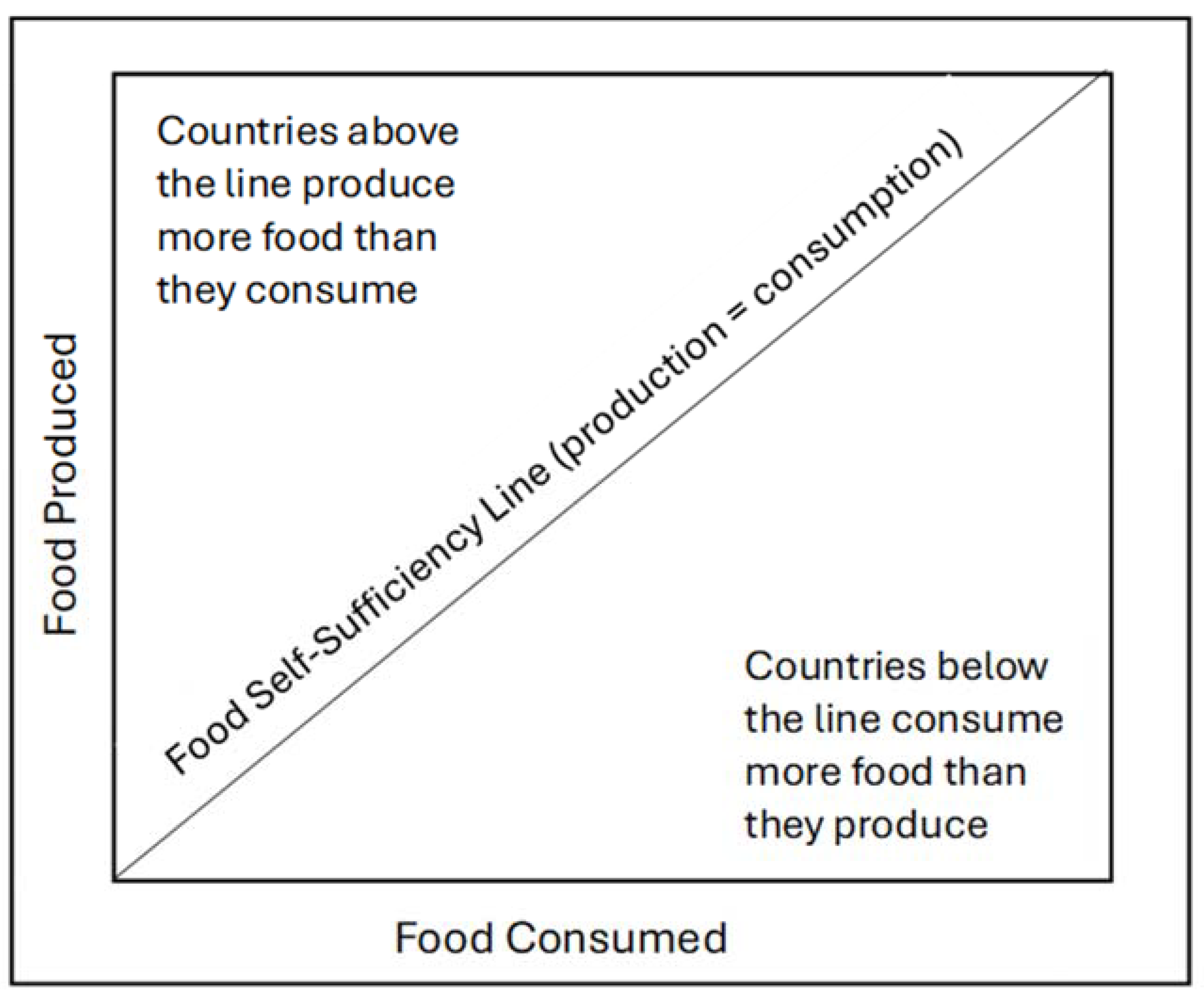
Figure 2.
Food self-sufficiency as the ratio of demand function to production function. Source: Own work.
Figure 2.
Food self-sufficiency as the ratio of demand function to production function. Source: Own work.
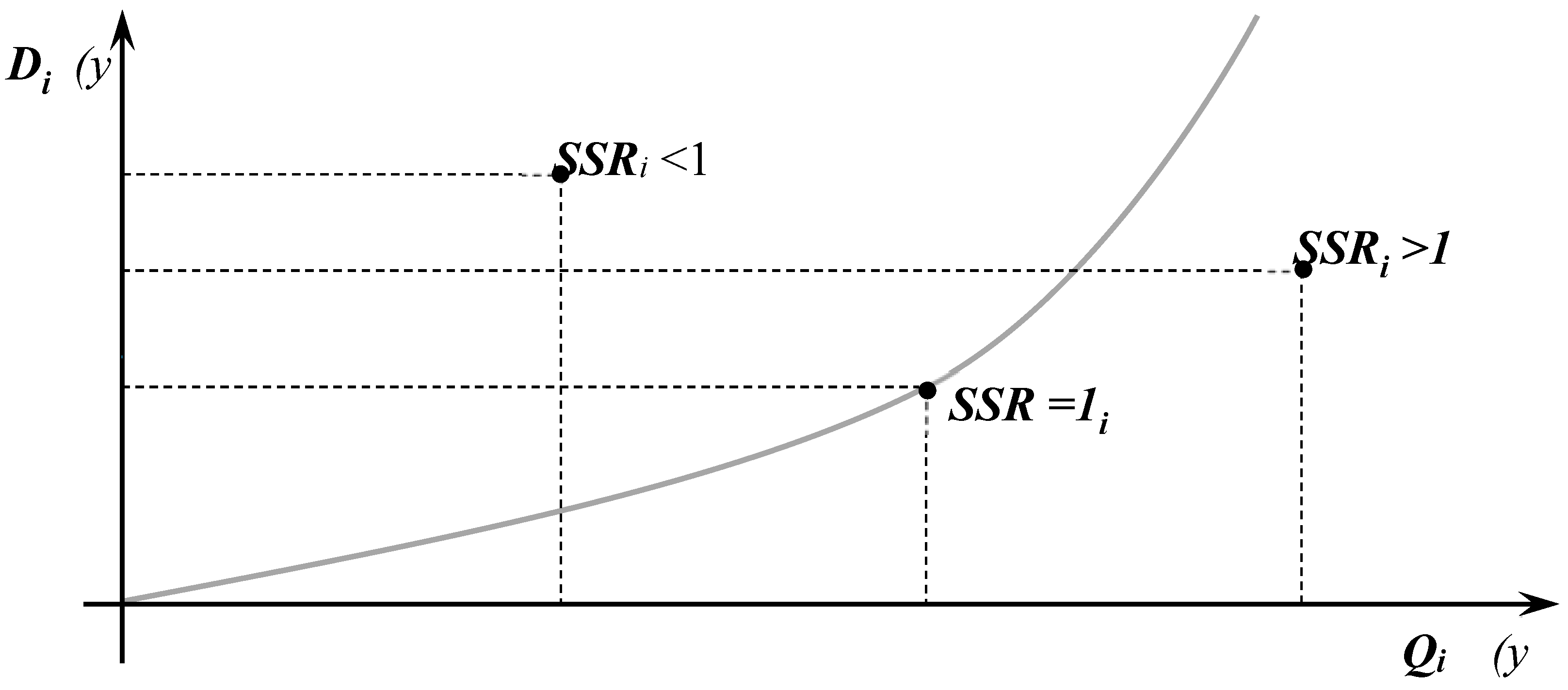
Figure 3.
Average food self-sufficiency ratios SSRi in Ukraine, EU and Poland in 2019-2021. Source: Own calculations on Foreign Agricultural Service of United States Department of Agriculture and Statistics Poland data.
Figure 3.
Average food self-sufficiency ratios SSRi in Ukraine, EU and Poland in 2019-2021. Source: Own calculations on Foreign Agricultural Service of United States Department of Agriculture and Statistics Poland data.
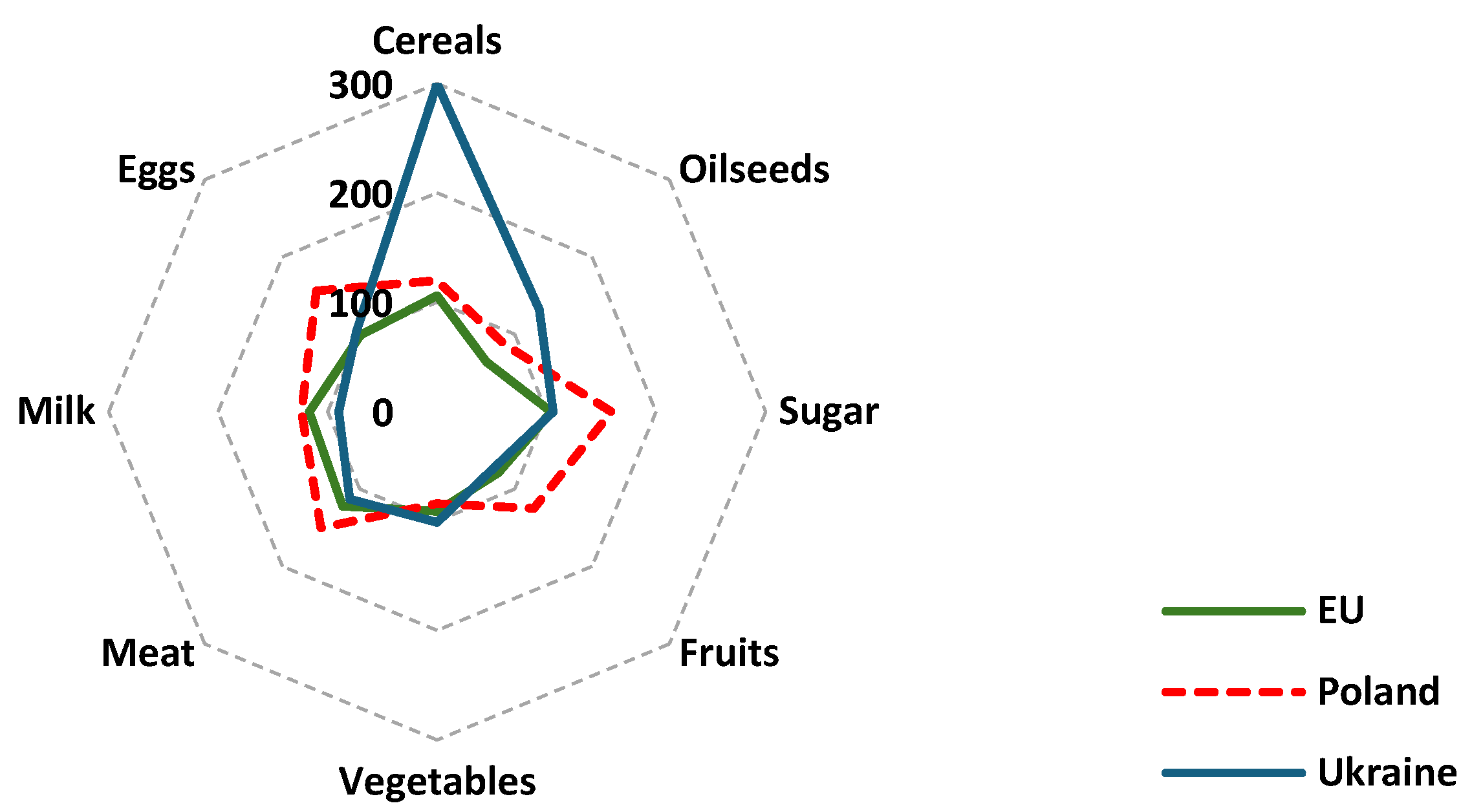

Table 1.
Area and structure of agricultural land in Poland in 2021
| Item | EU | Poland | Ukraine | EU | Poland | Ukraine |
|---|---|---|---|---|---|---|
| Million ha | % | |||||
| Total agricultural land | 163.7 | 14.6 | 41.3 | 100.0 | 100.0 | 100.0 |
| arable land | 99.1 | 11.1 | 32.9 | 29.1 | 60.5 | 76.1 |
| permanent grassland | 52.7 | 3.1 | 7.5 | 67.1 | 32.2 | 21.4 |
| permanent crops | 12.0 | 0.4 | 0.9 | 3.8 | 7.3 | 2.5 |
| Area of agricultural land per capita (ha) | 0.3 | 0.3 | 1.0 | - | - | - |
Source: Own calculation on Statistics Poland and FAO data.
Table 2.
Herd size in 2021
| Item | EU | Poland | Ukraine | ||
|---|---|---|---|---|---|
| 2010 = 100 | Average annual change | ||||
| '000 heads | % | ||||
| Cattle | 75,655 | 6,379 | 2,874 | 41.6 | -5.3 |
| Pigs | 141,656 | 10,242 | 5,876 | 90.9 | -0.6 |
| Horses | 2,673 | 157 | 202 | 34.2 | -6.5 |
| Sheep | 59,969 | 265 | 621 | 71.0 | -2.1 |
| Goats | 11,470 | 54 | 519 | 59.1 | -3.2 |
| Poultry | 1,419 | 190 | 200 | 131.5 | 1.7 |
| chicken | 1,295,328 | 168,629 | 183,543 | 139.1 | 2.1 |
| turkey | 84,869 | 15,256 | 1,569 | 66.3 | -2.5 |
| ducks | 36,360 | 5,271 | 11,373 | 135.5 | 1.9 |
| geese | 2,352 | 892 | 3,556 | 38.0 | -5.9 |
Source: Own calculation on Statistics Poland and FAO data.
Table 3.
Productivity of agriculture in Ukraine, EU and Poland
| Item | EU | Poland | Ukraine | ||||||
|---|---|---|---|---|---|---|---|---|---|
| 2019 | 2020 | 2021 | 2019 | 2020 | 2021 | 2019 | 2020 | 2021 | |
| dt/ha | |||||||||
| Wheat | 57.0 | 55.2 | 57.0 | 43.9 | 53.3 | 50.7 | 41.6 | 38.0 | 45.4 |
| Rye | 38.0 | 43.0 | 41.3 | 27.2 | 35.1 | 33.1 | 28.9 | 33.3 | 34.5 |
| Barley | 49.4 | 49.1 | 50.7 | 34.6 | 44.4 | 41.8 | 36.7 | 32.7 | 42.7 |
| Maize (corn) | 78.7 | 72.7 | 78.0 | 56.2 | 72.1 | 74.7 | 71.9 | 56.2 | 78.6 |
| Rapeseed | 29.9 | 31.1 | 31.8 | 27.1 | 31.9 | 32.1 | 25.6 | 23.0 | 29.3 |
| Sugar beet | 738.0 | 685.0 | 759.0 | 575.0 | 608.0 | 610.0 | 461.0 | 416.0 | 479.1 |
| Potatoes | 318.5 | 361.9 | 360.1 | 214.0 | 348.0 | 300.0 | 155.0 | 157.0 | 166.4 |
| Sunflower | 23.7 | 20.5 | 23.8 | - | - | - | 25.6 | 20.2 | 24.6 |
| Soybeans | 31.0 | 28.4 | 28.9 | - | - | - | 22.9 | 20.5 | 26.2 |
| Milk yield (kg per cow) | 7,304 | 7,483 | 7,578 | 5,960 | 6,125 | 6,200 | 4,976 | 5,126 | 5,155 |
Source: Own calculation on the State Statistics Service of Ukraine, Statistics Poland, and FAOSTAT data.
Table 4.
Structure of agricultural production in Ukraine and Poland
| Item | Ukraine | Poland | ||||
|---|---|---|---|---|---|---|
| 2019 | 2020 | 2021 | 2019 | 2020 | 2021 | |
| % | ||||||
| Crop production | 75.6 | 76.7 | 82.2 | 47.5 | 51.1 | 52.0 |
| Cereals and legumes | 35.0 | 35.4 | 40.3 | 16.0 | 17.9 | 21.3 |
| Industrial crops | 23.0 | 24.0 | 29.4 | 5.3 | 6.7 | 6.4 |
| Potatoes, vegetables and cucurbits | 7,7 | 7.0 | 4.6 | 4.3 | 3.4 | 3.2 |
| Fruits | 5.5 | 5.6 | 4.5 | 10.0 | 9.1 | 8.5 |
| Feed crops | 3.0 | 3.1 | 2.2 | 5.1 | 8.8 | 6.1 |
| Other | 1.4 | 1.6 | 1.2 | 6.8 | 5.2 | 6.5 |
| Animal production | 0.3 | 0.4 | 0.2 | 6.8 | 5.2 | 6.5 |
| Livestock | 24.4 | 23.3 | 17.8 | 52.5 | 48.9 | 48.0 |
| Milk | 13.1 | 12.6 | 9.6 | 29.8 | 26.8 | 26.3 |
| Eggs | 8.0 | 7.6 | 5.6 | 16.0 | 15.8 | 16.8 |
| Other | 2.6 | 2.5 | 2.1 | 5.3 | 5.0 | 4.4 |
| Total | 0.7 | 0.6 | 0.5 | 1.4 | 1.3 | 0.5 |
Source: Own calculation on the State Statistics Service of Ukraine and Statistics Poland data.
Table 5.
Food self-sufficiency ratios SSRi in Ukraine and EU in 2019-2021
| Item | Ukraine | EU | ||||
|---|---|---|---|---|---|---|
| 2019 | 2020 | 2021 | 2019 | 2020 | 2021 | |
| Cereals | 372.9 | 308.1 | 360.6 | 109.5 | 106.8 | 109.9 |
| wheat | 351.8 | 292.0 | 314.3 | 129.4 | 120.9 | 127.6 |
| barley | 211.1 | 192.7 | 247.5 | 111.5 | 112.4 | 114.4 |
| maize | 560.9 | 426.8 | 501.2 | 84.5 | 86.8 | 87.5 |
| Rapeseed | 763.2 | 904.6 | 744.4 | 104.2 | 102.5 | 100.8 |
| rapeseed meal | 514.0 | 380.0 | 570.0 | 100.2 | 101.3 | 101.0 |
| Sunflower | 99.6 | 101.8 | 154.2 | 15.8 | 15.0 | 16.7 |
| sunflower meal | 478.1 | 445.4 | 371.7 | 65.1 | 69.1 | 78.5 |
| Soybeans | 222.6 | 196.6 | 245.0 | 70.4 | 73.3 | 77.6 |
| soybean meal | 243.3 | 164.2 | 171.2 | 43.6 | 44.0 | 43.5 |
| Vegetable oils | 568.8 | 302.1 | 348.8 | - | - | - |
| Sugar | 123.1 | 96.0 | 115.4 | 98.0 | 96.5 | 90.3 |
| Beef | 111.4 | 108.9 | 111.2 | 104.0 | 105.6 | 105.4 |
| Pork | 92.0 | 92.8 | 88.4 | 121.7 | 127.5 | 126.1 |
| Poultry | 181.7 | 186.2 | 172.3 | 114.6 | 114.3 | 112.4 |
| Milk | 91.0 | 90.7 | 90.1 | 118.7 | 115.8 | 116.2 |
Source: Own calculations on Foreign Agricultural Service of United States Department of Agriculture data.
Disclaimer/Publisher’s Note: The statements, opinions and data contained in all publications are solely those of the individual author(s) and contributor(s) and not of MDPI and/or the editor(s). MDPI and/or the editor(s) disclaim responsibility for any injury to people or property resulting from any ideas, methods, instructions or products referred to in the content. |
© 2024 by the authors. Licensee MDPI, Basel, Switzerland. This article is an open access article distributed under the terms and conditions of the Creative Commons Attribution (CC BY) license (http://creativecommons.org/licenses/by/4.0/).
Copyright: This open access article is published under a Creative Commons CC BY 4.0 license, which permit the free download, distribution, and reuse, provided that the author and preprint are cited in any reuse.


