

Submitted:
30 July 2024
Posted:
31 July 2024
You are already at the latest version
Abstract
Access to reliable water supply is critical for sustainable development and public health, yet many peri-urban and rural communities in the developing world face challenges such as poor maintenance, faulty infrastructure, and inadequate governance of water services, hindering the UN’s Sustainable Development Goals (SDG). In Emina-Boadi, a small town in Kumasi, Ghana, residents increasingly rely on boreholes due to substandard service from the Ghana Water Company Limited (GWCL). This shift highlights concerns about water reliability, quality, and affordability, impacting public health and hindering progress toward SDG 6. This case study assesses water service levels using key performance indicators (KPIs) such as quantity, quality, affordability, accessibility, and reliability, focusing on sources like boreholes, hand pumps, piped water, hand-dug wells, rainwater, and surface waters. The study aims to delineate the roles of different water providers, understand community dynamics, and evaluate contributions to rural development and SDG 6 through stakeholder interviews and questionnaires. Leveraging the WASHCost framework, which aims to improve planning methods and provision of water and sanitation services by addressing the lack of cost information in rural and peri-urban areas, and the Joint Monitoring Programme (JMP) framework, which monitors progress toward global targets related to water, sanitation, and hygiene, the study categorizes indicators and draws connections among them. Findings reveal a significant preference for borehole services, with 87% usage and an 83% reliability rate compared to 13% for GWCL. Daily water consumption averages 60.75 liters per person, with on-premises access improving water collection efficiency to 7 minutes. Dissatisfaction with GWCL services highlights the need for improved delivery aligned with community needs and SDG targets. Adopting sustainable management practices, enhancing infrastructure, and improving governance are crucial for ensuring safe and affordable water access for all residents of Emina-Boadi and similar communities.
Keywords:
Reliable Water Supply
; Public Health
; Water Service Levels
; Rural Development
; SDG 6
1. Introduction
Water is fundamental to sustainable development, energy and food production, ecosystem health, and human survival, covering approximately an area of 71% of the Earth's surface. However, only a tiny fraction of the planet's water is freshwater (about 0.7%) and accessible for use, highlighting the critical need for the conservation and management of this precious resource (1). Despite the ocean being the largest water resource, its high salinity level restricts its use for essential human activities, underscoring the importance of freshwater (2,3). UN’s Sustainable Development Goal #6, part of the UN’s 2030 Agenda, emphasizes the need for available and sustainably managed water and sanitation for all, aiming to improve water quality, enhance accessibility for drinking, and reduce waterborne diseases (4–9). The rapid urbanization and population growth, especially in developing regions like Ghana, pose significant threats to available water resources, necessitating efficient usage and management strategies to mitigate the impacts of human activities on water quality and availability (5,10,11).
Improved water sources, defined as those protected from pollution and contamination, are crucial for safe consumption. In contrast, unimproved sources, including unprotected wells and surface water, present health risks (7–9,12–16). The distribution of freshwater resources varies globally, with America holding 45%, followed by Asia with 28%, Europe with 15.5%, and Africa with the least, 9% (17). In Ghana, pollution from agricultural and mining activities has degraded water quality, making treatment more costly and driving populations towards less availability safe water resources (11,18–20). Water's essential role in human survival was emphasized at the Mar del Plata Water Conference in 1977, stating the universal right to access quality water in sufficient quantities. Yet, challenges such as climate change-induced floods and the dwindling per capita water resource availability continue to stress Ghana's water management efforts (11). Ghana's water resources are categorized into groundwater and surface water, with significant systems including the Volta, Southwestern, and Coastal River systems, highlighting the country's diverse water sources (21,22). The Community Water and Sanitation Agency (CWSA) oversees water and sanitation development in Ghana's rural areas, where, as of 2018, 43.94% of the population resides with a 72% rural water coverage, despite a decrease in surface water use from 15% to 11% (23,24). Challenges such as poor maintenance, faulty hardware, and inadequate service compromise water service quality, often leading to reliance on distant communities for water, adversely affecting Sustainable Development Goals (SDGs) implementation efforts (5,16,25). Rural water facilities frequently depend on costly repairs funded by international donors or government agencies (26). The focus on construction over sustainable management and maintenance, driven by immediate income rather than long-term serviceability, results in high maintenance costs and neglects the system's aging (27).
Moreover, the prevalence of boreholes, sometimes managed by the Ghana Water Company, raises concerns due to contamination from illegal mining (galamsey) and pollution, making water unsafe for domestic use (9,11,15,26). The unreliable availability of improved water sources drives rural residents towards potentially unsafe natural water, highlighting a trust issue in water service providers (28,29). Notably, in Akatsi and East Gonja districts, 30 to 40% of handpumps are non-functional for over 18 days annually, causing overcrowding and delays in water access, significantly impacting residents' ability to secure at least 20 liters of water per person per day (25,30). This scenario underscores the flawed emphasis on building water systems over maintaining them, suggesting a need for a shift towards sustainable water service provision focused on lifecycle costs and reliable access (31). The primary aim of this research is to undertake a comprehensive analysis and assessment of the various sources and quantities/qualities of water utilized by households for drinking and other purposes. Additionally, it seeks to evaluate the accessibility, availability, affordability and reliability of these water sources, ensuring a thorough understanding of the water service dynamics within the targeted community for sustainable water systems by delineating the roles of different water providers. This study will specifically focus on delineating the roles of different water providers, understanding community dynamics, and evaluating contributions to rural development and progress toward Sustainable Development Goal 6 (SDG 6). Therefore, this paper aims to assess the water service levels in the study area, identify non-satisfactory and non-beneficial sections, and provide recommendations for improved service delivery, aligned with community needs and SDG targets.
2. Materials and Methods
2.1. Site Description and Location
The study was conducted at Emina-Boadi, a small town in the Oforikrom Municipal Assembly in the Ashanti Region of Ghana (Figure 1). This municipality is situated between latitude 6.350N and 6.400S and longitude 1.300W and 1.350E with an elevation of 250 to 300mm meters above sea level (32). The town is bordered on the north by the Kwame Nkrumah University of Science and Technology (KNUST) campus, to the west by Kotei, to the east by Kentinkrono, and to the south by Oduom. Emina-Boadi has a total area of 657.1 square kilometers, with a total population of 28,860 as of 2015, with 14,666 (50.8%) being males and 14,194 (49.2%) being females (33). Emina-Boadi is located fifteen kilometers from the center of Kumasi, between latitude 60 40′41"N and longitude 10 32′32"W (34).
2.2. Data Collection
This study is based on the results of a survey we conducted among the residents of Emina-Boadi town regarding the satisfaction level of two water service providers to meet the resident's domestic water needs on a daily basis. The survey was conducted between 31st July 2020 to 15th August 2020. A well-structured questionnaire (details of the questionnaire are given in the appendix of this paper with specific questions captured in Table 1) was used to obtain relevant data pertaining to; source of water used by the residents of the town, quality of water received, quantity of water used by the people in a day, the frequency of flow of water in a day, the ease to which water is obtained, and the cost of water per week. Data collection was done using smartphones running on the iPhone operating system.
2.3. Pilot Testing
Questionnaires were pre-tested to see its functionality since a new software (GIC Collect) was used to generate questionnaires. GIC Collect is a phone application designed for survey-based data collection. It is compatible with Open Data Kit (ODK) forms, commonly used for mobile data collection. GIC Collect works with or without network connectivity and supports a wide range of question-and-answer types. It displays surveys as a sequence of questions that incorporate survey logic, question constraints, and repeating sub-structures. This makes it suitable for extensive field data collection in various sectors, such as research, environmental assessments, and public health monitoring. Completed surveys stored on phones were transferred over a WIFI or local mobile data network into an online database.
2.4. Sample Size
Since it was impractical to interview the entire community, the study utilized questionnaires targeting households representing a variety of socio-economic backgrounds. One of the limitations of this study was the reluctance of many residents to participate in interviews. This reluctance stemmed from a history of frequent data collection efforts in the town with little to no subsequent implementation of measures to improve their quality of life. Despite this, we were able to collect data from 100 random households representing a variety of socio-economic backgrounds through questionnaires. The full format and content of these questionnaires can be found in the appendix section of the paper. To effectively reach our target population, we employed a snowball sampling technique, also known as chain-referral sampling. This method was chosen due to the difficulty in directly identifying or reaching potential respondents within our study criteria. The following steps outline the procedure:
- Initial Participants: We began by identifying a small group of initial participants who met the study's inclusion criteria. These participants were selected through convenience sampling based on our knowledge and preliminary research.
- Referral Process: Each initial participant was asked to refer other individuals they knew who also met the study criteria. These referred individuals were subsequently contacted and invited to participate in the study.
- Continued Expansion: This referral process was iteratively repeated with each new participant being asked to make further referrals. This created a snowball effect, gradually increasing our sample size as more referrals were made.
In cases where referrals were unwilling to participate or unavailable due to absenteeism, we identified alternative households within the community to ensure continuous data collection and minimize bias. The identification of these households was based on the discretion of the interviewer, who employed local knowledge and observational skills to select participants that best represented the community demographics. This approach helped maintain the integrity of our sample and ensured that our data remained comprehensive and inclusive.
2.5. Data Analysis
The questionnaires were processed, cleaned, and validated upon downloading from GIC Collect. Data was then analyzed in Microsoft Excel and JASP 0.18.3 version using the 2021 JMP drinking water service ladder and WASHCost water service ladder to run statistical analysis at a 95% confidence level. Relative data comparison was done using logical formulas, descriptive analysis, charts, frequency tables, cross-tabulations and graphs. All data used in the analysis was checked for errors.

Table 1.
Data collected from respondents.
| Data | Information Obtained |
| Respondent Personal Information | Household location |
| Demographic characteristics | |
| Income of Household | Financial status |
| Educational status | |
| Household Asset | Financial status |
| Source of Household water | Improved/Unimproved Sources |
| Level of Service | |
| Level of Satisfaction | |
| Cost |
2.6. Water Service and Management
Water service involves the provision of water to individuals, distinguishing between the mechanisms of delivery (e.g., boreholes and hand pumps) and aspects of the service like quantity, quality, and reliability of water, as well as the accessibility of these facilities (35). Assessments of water service rely on qualitative data, questioning whether the systems deliver the intended amount of water consistently, are accessible to the entire community, and meet national water quality standards for drinking purposes. Achieving these standards indicates a satisfactory water service level (35).
Water management in Ghana encompasses various systems and agencies to ensure that both rural and urban communities have access to safe and reliable water. In rural areas, the Community Water and Sanitation Agency (CWSA) oversees the implementation of borehole and handpump systems. These systems are crucial for providing potable water to remote and underserved regions. Boreholes, often equipped with handpumps, tap into underground water sources, offering a sustainable and community-managed solution. In urban areas, the Ghana Water Company Limited (GWCL) is the primary body responsible for water distribution. GWCL manages the treatment, transmission, and supply of water to households, businesses, and institutions through an extensive network of pipelines and treatment facilities. Despite these efforts, many residents still resort to bottled water due to the inconsistency in supply and water quality issues, which makes it a costly but sometimes necessary option for daily drinking needs. These integrated systems aim to improve water accessibility, yet challenges remain in ensuring consistent and equitable distribution across all regions.
2.7. Service Level
This was introduced by WHO and UNICEF's Joint Monitoring Program (JMP) in 2008 through the "water service ladder," aids in categorizing the quality of water services (23,36,37). This tool, adopted by the Community Water and Sanitation Agency (CWSA) in Ghana, helps set national guidelines for rural water supply, defining acceptable standards across two main levels: point-systems and household taps (Table 2). Service levels, influenced by engineering, social, and political factors, include a range of indicators from surface water to safely managed drinking water, addressing the Sustainable Development Goals (SDGs) and considering factors like crowding and facility workability over the past year (23,26,38).
2.8. Water Service Indicators
These are critical components of assessing water provision, encompass quantity, quality, accessibility, reliability, and affordability. These dimensions are pivotal in gauging household water service levels, directly influencing assessments of access, which is further affected by proximity to water sources and the amount of water available (38–40).
Quantity is fundamental for ensuring sufficient hydration, food preparation, and maintaining hygiene to prevent water-associated diseases. It is measured in liters per capita per day (l/c/d), emphasizing the importance of an adequate water supply to sustain bodily functions and mitigate health risks like urinary stones, which are linked to inadequate water consumption (38,40,41).
Quality addresses water's chemical and microbiological purity, with contamination posing significant health risks. Enhancing water quality in rural areas is crucial for improving educational outcomes and reducing infections, emphasizing the need for clean water for child development and overall health (42–46). Naturally found in water, elements like fluoride can have detrimental health effects, such as fluorosis, at high concentrations. This underscores the importance of monitoring water quality, moving beyond the JMP's improved source indicators, which primarily focus on fecal contamination protection (38,40,47,48). The JMP reports an increase in water free from contamination, highlighting progress in water safety (23).
Accessibility to water involves the ease with which individuals can obtain water, considering the time and distance required for fetching it alongside any associated waiting times. In many developing countries, water collection primarily falls on women and children, with trips averaging an hour each and often necessitating multiple trips daily (38,40). This is quantified as minutes per capita per day (m/c/d). The significant time spent on water collection can detrimentally impact school attendance and punctuality among children. Additionally, the physical strain of carrying water over long distances can lead to musculoskeletal disorders. Recent JMP reports show increased accessibility of safely managed water in rural Ghana from 11% to 16% (23). However, challenges remain, including spillage during transportation and potential contamination, underscoring the need for improvements in water collection and storage practices (38).
Reliability in water service refers to the consistency and predictability of access to water, typically aiming for a service to be fully functional 95% of the time. This includes minimal unplanned interruptions and a regular supply that doesn't necessarily mean 24/7 access but should be predictable (38,40). The design of distribution networks plays a crucial role in ensuring reliable water delivery. Lloyd and Bartram (2013) classify reliability into four categories: year-round service, year-round with frequent interruptions, seasonal variation, and daily or seasonal discontinuity (49). Studies in Ghanaian districts (Table 3) revealed varying levels of functionality and reliability among hand pumps and piped systems, highlighting the need for diverse water sources to mitigate service failures (40,50,51).
Affordability concerns the economic aspect of water service, defined by the WHO as the household's expenditure on water services relative to its income (49). This factor is critical in providing water, sanitation, and hygiene (WASH) services, especially in rural areas where budget constraints can limit access to water at home. The cost of water services encompasses several components, including construction, operation, and maintenance, as well as direct and indirect support costs. Households' willingness to pay is influenced by various factors such as water quality, convenience, acceptability, and the reliability of the service (49,52).
3. Results and Discussions
3.1. Demographic Characteristics
This includes age, gender, occupation, and the educational status of the respondents under research.
3.1.1. Age and Gender
The data gathered from a survey of 100 respondents reveals a gender distribution of 58% females and 42% males, with males representing the lesser percentage. Additionally, the respondents spanned various age groups, all aged 18 and above. The most prevalent age bracket was 30 to 39 years, accounting for 33% of the total, while those aged 60 and above comprised the smallest group at just 6%. In the dominant 30 to 39 age group, 22 females were recorded.
Among the males, the highest concentration was in the 18 to 29 age bracket, with 17 individuals, whereas no males were recorded in the age groups 60 and above. It is important to note that this absence does not imply the non-existence of males over 60 in the community; instead, it reflects the survey's coverage during data collection. From this data, we can confidently conclude that the town has a higher female population, mainly in the 30 to 39 age group.
3.1.2. Level of Education
The educational status of the people of Emina-Boadi was categorized from elementary to tertiary. 37% of the people attended tertiary institutions, the highest percentage among the categories. 34% of the people attended Junior High School /Middle School, Senior High School had a percentage of 25, and the last was Primary/Elementary school with 4%.
3.1.3. Occupation
The occupation of the people in the town was categorized in the questionnaires as;
- Self-employed- Business owned by an individual, usually a trader, farmer, etc.
- Public Sector- A person working in any government institution or organization. For example, teachers, ministers, doctors, etc.
- Private Sector- A person working in a private corporation or firm. Example, Lawyer, Architect, etc.
- Unemployed- A person without a paid job but is available to work.
- Retired- A person who ceases to work above the age of 60.
Figure 2.
A bar chart showing the occupation distribution.
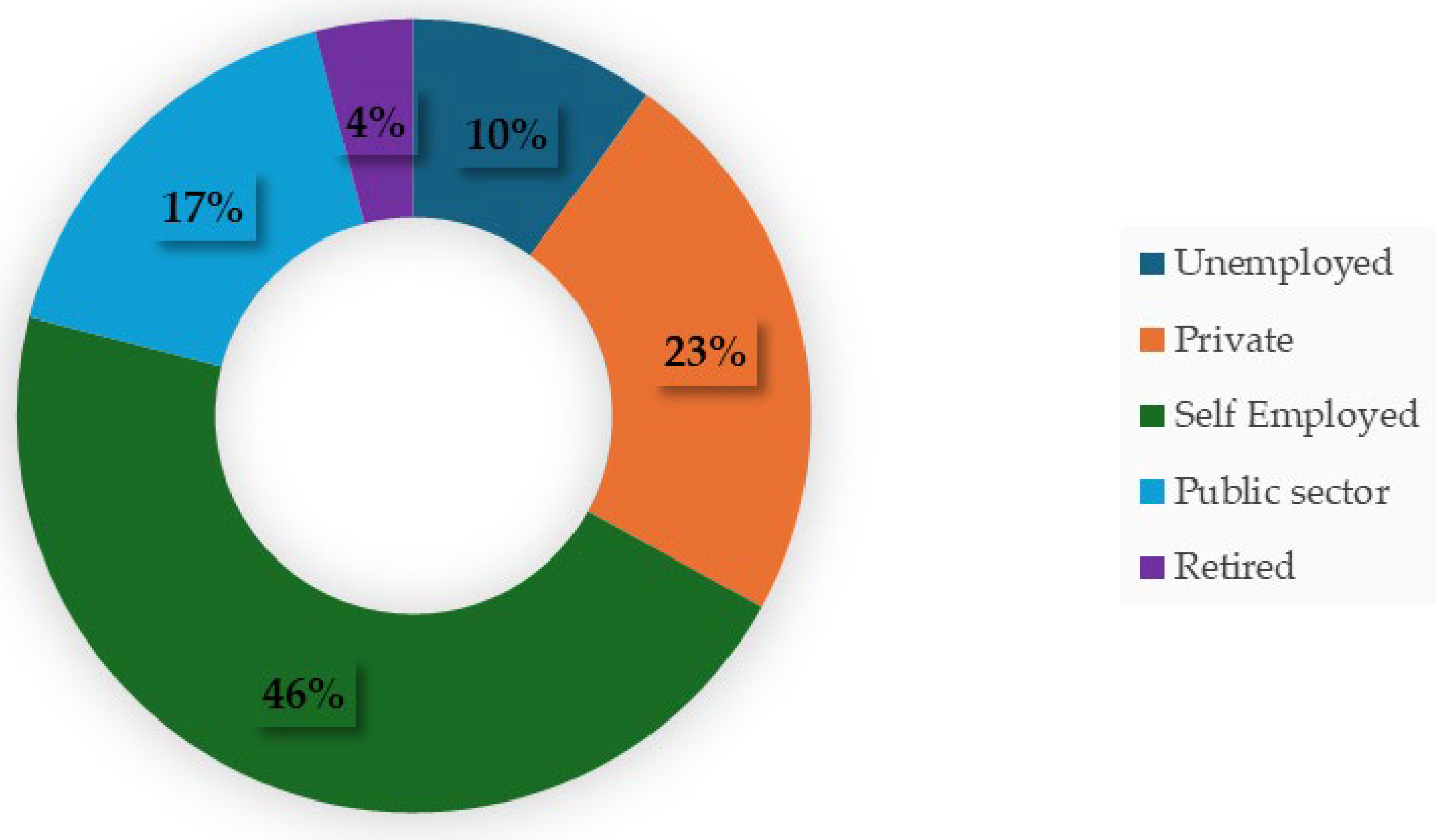
The data gathered showed that the highest distribution consisted of 46% self-employed followed by private workers 23%, Public sector 17%, unemployed at 10%, and lastly retired with a percentage of 4. Most people in the town were traders who owned shops, farmers, hostels, house owners, hairdressers, and barbers.
Table 4.
Relationship between level of education and occupation.
| Distribution of occupation | |||||
| Level of Education | Self-employed | Private | Public sector | Unemployed | Retired |
| Tertiary | 7 | 10 | 13 | 6 | 1 |
| Senior High School | 19 | 5 | 1 | - | - |
| Junior High School /Middle School |
19 | 7 | 3 | 2 | 3 |
| Primary/ Elementary |
1 | 2 | - | 1 | - |
Although tertiary has the highest percentage, some people within that level of education are unemployed, work in either private or public, retired and others being self-employed. Since a degree or Higher National Diploma (HND) is a requirement to gain professional employment in Ghana, it can be noticed from the above table that, the highest number of people contributing to a particular occupation (Self-employed) was 19 each from people of Junior High School /Middle School and Senior High School educational background resulting in self-employed having the greatest percentage.
3.1.4. Household Size and Income
The questionnaire included queries about Household size and Income to obtain each household's water usage and the affordability of that water relative to their income. The analysis revealed household sizes ranging from 1 to 12 members, with sizes 4 and 5 being the most prevalent, each representing 25% of the population. The smallest group sizes—9, 11, and 12—each accounted for only 1% of the total. The average monthly income for a household was GH₵ 2127.00. Despite the high number of self-employed individuals, those employed in the public and private sectors who had tertiary education earned a higher average income. This resulted in a higher overall average monthly income for the town.
3.2. Source of Water
The survey differentiated the water sources used for drinking and other household needs. Based on the 2021 JMP report, all water sources identified in the study were categorized as improved. These included:
- Bottled/sachet water
- Borehole/hand pump
- Rainwater
- Piped water to dwelling
- Piped water to compound/yard
- Protected dug well
- Public tap or standpipe
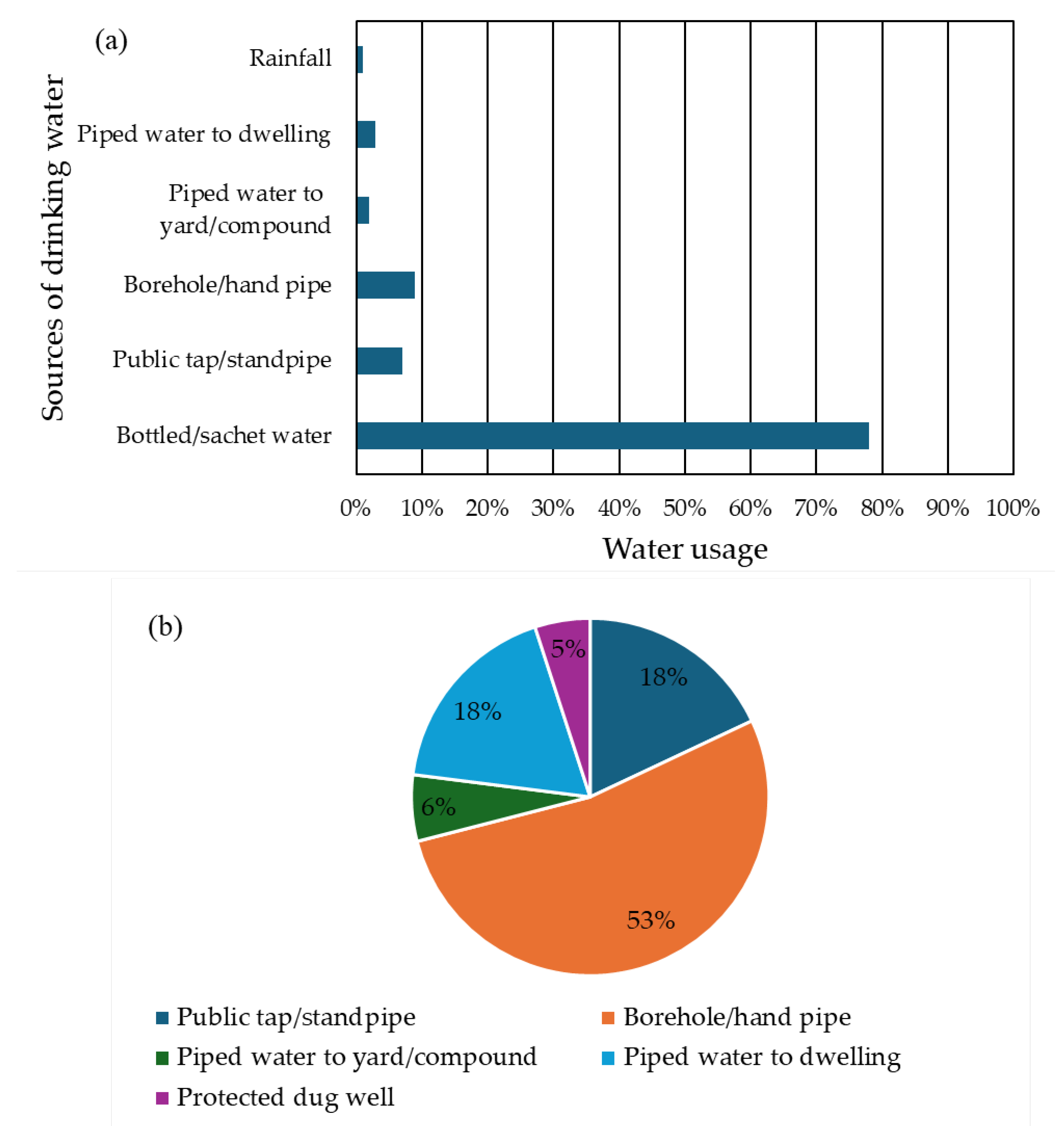
For drinking, 78% of the participants primarily used bottled/sachet water, making it the most popular choice. This was followed by borehole/hand pump at 9%, public tap/standpipe at 7%, piped water to dwelling at 3%, piped water to yard/compound at 2%, and rainwater at 1% (Figure 4a). The elderly in the community often preferred rainwater, attributing qualities to it like being a divine gift that is beneficial and safe, tasting good, and having the ability to be purified by settling and boiling to remove impurities.
In terms of water used for other household purposes, borehole/hand pump was the leading source at 53%, followed by piped water to dwelling and public tap/standpipe, each at 18%. Piped water to the yard/compound was used by 6% of respondents, and the least utilized was the protected dug well at 5% (Figure 4b). Households with piped connections often chose to install a borehole with an overhead tank to serve as a reservoir, in preference to relying on the main supply from the Ghana Water Company Limited (GWCL), which typically comes through public taps or standpipes.
Figure 4.
(a) A picture of a household mechanized borehole connected to a hand pipe outside the household premises for public use at a fee (b) A Picture of a public standpipe connected to a storage tank with water supplied by GWCL (c, d & e) A picture showing a borehole operated manually by a hand pump, the user either pushes the hand pump up or down or spins the hand-cranked wheel, to draw water from a borehole. source for picture (d) credofunding.
Figure 4.
(a) A picture of a household mechanized borehole connected to a hand pipe outside the household premises for public use at a fee (b) A Picture of a public standpipe connected to a storage tank with water supplied by GWCL (c, d & e) A picture showing a borehole operated manually by a hand pump, the user either pushes the hand pump up or down or spins the hand-cranked wheel, to draw water from a borehole. source for picture (d) credofunding.
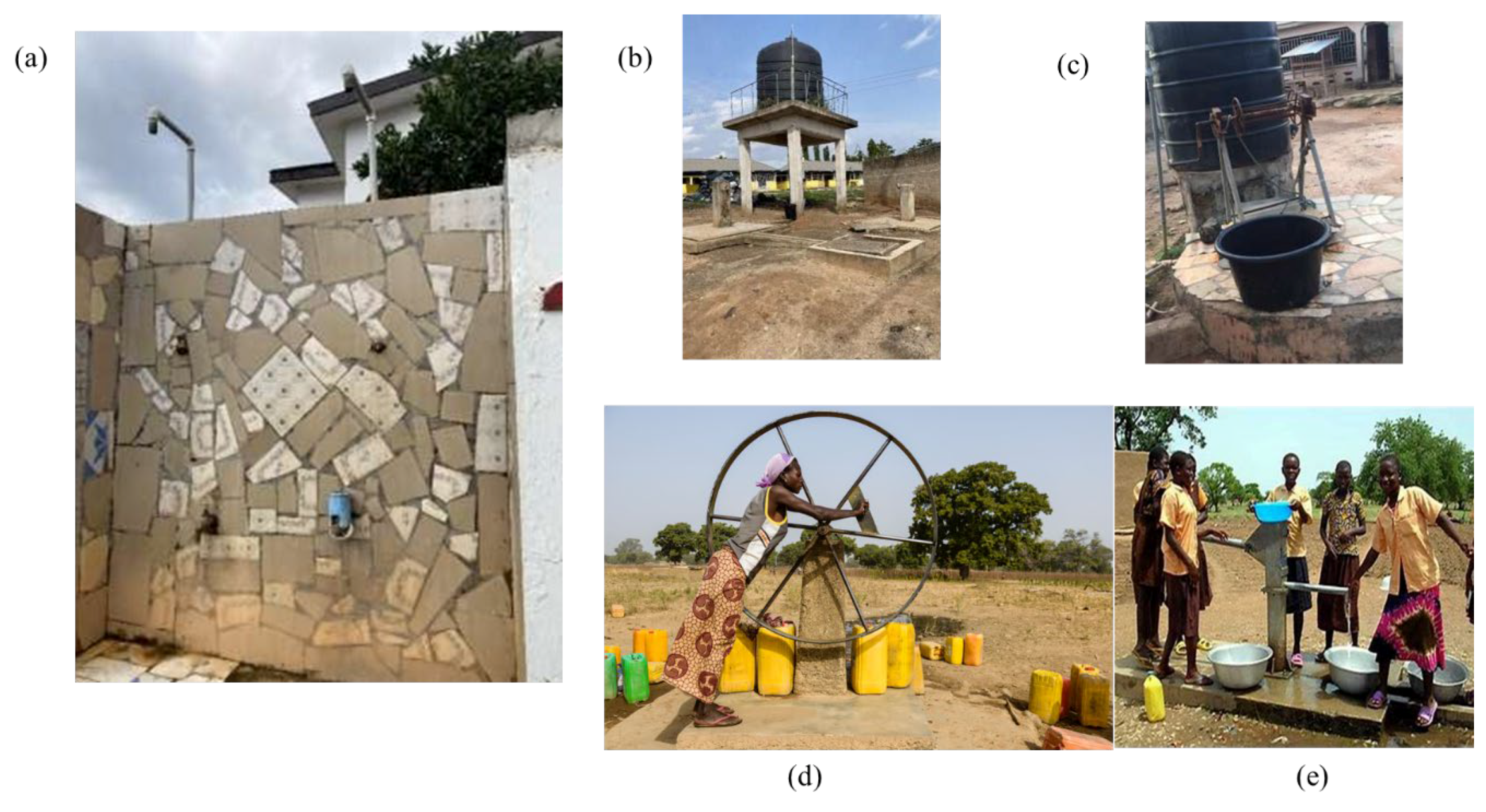
Figure 3.
A chart showing the percentage distribution of preferred water source for (a) drinking and (b) other household purposes.
Figure 3.
A chart showing the percentage distribution of preferred water source for (a) drinking and (b) other household purposes.
3.3. Quality of Water
Residents in the town have expressed concerns regarding the water quality supplied by the Ghana Water Company Limited (GWCL) to public taps and standpipes. Complaints primarily focus on the taste, presence of impurities, and foul odors. In response to a survey about water quality, 8% of residents rated it as "somehow" satisfactory, leaving a majority of 92% generally satisfied. Common water treatment methods reported by the residents include:
- Allowing the water to stand and settle
- Straining it through a cloth to remove particles
- Boiling to eliminate germs
The town primarily relies on water from three major borehole/hand pump sources, used by 53% of the population. Given their significant usage, the quality of these sources is critical. All installations conform to the Community Water and Sanitation Agency (CWSA) standards, with quality tests conducted biannually at KNUST laboratory. Filters are installed on reservoirs to block particle entry.
A study on water satisfaction in three rural districts in Ghana—Bongo, Gushiegu, and Wa West—found an average satisfaction rate of 33% per district, attributed to high fluoride levels in groundwater, which affected taste (35,40). In contrast, a Mali survey revealed about 65% of households treat their domestic wells with a bottle of bleach annually. Despite this, 55% of households prefer not to use nearby improved water sources even when free and accessible (53).
Further analysis in the Ghanaian districts of Akatsi, East Gonja, and Sunyani West showed a surprising 92% satisfaction with water quality (50), credited to adherence to CWSA standards and lower fluoride levels in groundwater.
Emina-Boadi, being a peri-urban area, benefits from better basic amenities provided by service providers. The area around Kumasi, including Emina-Boadi, typically exhibits lower fluoride concentrations, leading to higher acceptance of water quality and an intermediate service level on the WASHCost water service ladder (27).
3.2. Accessibility
The average time it took respondents to fetch water, including time spent waiting due to crowding, was 7 minutes. This duration varied among respondents depending on the proximity of their households to water sources, with times ranging from a minimum of 1 minute to a maximum of 20 minutes. This indicates that each respondent was able to obtain water in under 30 minutes. It is important to note that individuals with piped water connected directly to their homes were not included in this average time calculation.
Service providers have implemented measures to prevent overcrowding at water points by installing multiple taps and ensuring high water pressure. The presence of multiple taps and higher water pressure both contribute to reducing the time it takes to fill a container compared to a single tap with lower pressure.
According to the JMP service ladder, drinking water that is piped directly to dwellings can be classified as "safely managed" because it is available on premises. Meanwhile, water sources such as borehole/hand pipes, public taps/standpipes, and piped water to yards/compounds can be classified as "basic," as the collection time from these sources is less than 30 minutes. Furthermore, when categorizing sources of water for other purposes, all can be classified as providing a "high service level" according to the WASHCost water service ladder, since fetching water from these sources takes less than 10 minutes per round trip.
3.3. Quantity
An adequate quantity of water is essential to prevent dehydration, with a basic requirement for drinking, cooking, bathing, and sanitation suggested by Gleick (1996) as 50 liters per person per day (41). The average quantity of water used by an individual per day in a household was found to be 60.75 liters, which qualifies as a high service level in terms of quantity according to the WASHCost water service ladder. The minimum daily usage was 43 liters per person in a household of size 12, while the maximum was 110 liters per person in a household of size 11.
The household of size 11 consisted of 7 females and 4 males, with 4 female and 1 male children. This household practiced Islam, which partly explains the higher water usage as each member is required to pray five times a day. Additionally, it was noted that children tend to use more water, particularly during bathing. The females in the household were required to bathe twice daily and to wash clothes periodically. Respondents also mentioned that during hot weather, they consume more water to stay hydrated, even if they would prefer not to, and they tend to drink less during cooler days.
According to the WASHCost water service ladder, the water quantities used by households of sizes 1, 2, 4, and 11 are categorized as high service level, while those of sizes 3, 5, 6, 7, 8, 9, 10, and 12 are categorized as intermediate service level.
Table 5.
Summary of adequacy and level of health concern. Source (41..)
| Typical volumes of water used in the home | Adequacy for health needs | Level of health concern |
|---|---|---|
| Average quantity more than 40 L/ person/day |
Drinking – assured Cooking – assured Hygiene – all food hygiene, handwashing and face washing assured under non- outbreak conditions; enhanced hygiene during infectious disease outbreaks not assured; bathing and laundry at the home should also be assured. |
Medium |
| Average quantity more than 100 L/ person/day |
Drinking – all needs met Cooking – all needs should be met Hygiene – all food hygiene, handwashing and face washing needs should be met, including for bathing and laundry at the home, and household cleaning. |
Low |
Analysis of the data allows us to classify the health concerns of all household sizes. Households ranging from size 1 to 10, and size 12, fall within the medium level of health concern. In scenarios requiring enhanced hygiene, such as during an outbreak of an infectious disease, the availability of water for these households cannot be guaranteed. Conversely, the household of size 11 ensures a reliable provision of water in all situations, indicating a low level of health concern.
Data analyzed from three districts in Ghana—Akatsi, East Gonja, and Sunyani West—showed that 55% of people used at least 20 liters per person per day. However, this study achieved 100% of people using at least 20 liters per person per day. This discrepancy is likely because fewer water facilities were available in parts of these districts, increasing the likelihood of individuals receiving less than 20 liters per day due to overcrowding at water sources. In contrast, Emina-Boadi featured several water points with multiple taps to alleviate crowding, demonstrating that easier access to water typically results in increased usage.
Children lose water at a faster rate than adults, approximately 15% to 4% (54), due to their higher rate of water turnover, a higher surface area to body mass ratio, and a less effective sweating mechanism (54). Additionally, lactating women require more water to compensate for losses during milk production, and pregnant women need additional water to support the expansion of extracellular space and amniotic fluid, as well as to meet fetal needs (55). The presence of many children and lactating women in households contributes to the increased quantity of water used, resulting in 100% of people using at least 20 liters per person per day.
3.4. Affordability
Water tariffs, set by both private and public water point vendors, are determined based on the volume of water supplied, following a "pay as you fetch" (PAYF) system endorsed by CWSA (56). These tariffs vary depending on the vendor, the water source, the collection method, and the location. For instance, the PAYF tariff ranges from GH₵ 10-20 pesewas for a bucket holding less than 20 liters, to GH₵ 50 pesewas for a 20-liter bucket. Larger quantities such as a 200-liter drum cost GH₵ 5.00, and a 500-liter drum costs GH₵ 8.00. The price of sachet water varies between GH₵ 2.50 and GH₵ 4.00, depending on the brand, while a box of 500ml Voltic bottled water, commonly used by respondents, is priced at GH₵ 26.00. The 20-liter bucket is the most commonly used container due to its affordability, as reported by the respondents.
On average, households spend GH₵ 22.00 per week on water for drinking and other household uses. About 79% of respondents were either satisfied or very satisfied with the water prices, whereas 21% expressed feelings ranging from neutral to dissatisfaction. The dissatisfied group criticized the high prices given the poor quality of service; some mentioned that, lacking the funds to install private facilities, they had to accept the high costs, while others felt powerless to change the situation despite finding the prices exorbitant. The majority of complaints originated from those receiving their water supply from GWCL, whether directly to their dwelling or through public taps and standpipes.
3.5. Reliability
17% of respondents reported issues with the reliability of their water service. All users who were supplied water by GWCL, whether to their homes or to public taps, faced these reliability issues. The town's water supply comes from either GWCL or drilled boreholes with pumps. A significant majority, 83% of respondents, preferred borehole services over GWCL, citing the consistent and uninterrupted water supply from boreholes. In contrast, services offered by GWCL were seen as unreliable due to irregular water flow and poor water quality. Additionally, some users noted high GWCL bills despite the inconsistent service, further contributing to the preference for boreholes. It was also noted that one borehole operated with a hand pump, which, despite being more labor-intensive, offered cheaper tariffs compared to those for taps with an open and close valve.
The data from the questionnaires reinforces the preference among most residents of Emina-Boadi for borehole services over GWCL. Further research conducted in three rural districts in Ghana—Akatsi, East Gonja, and Sunyani West—revealed that standpipes and household connections linked to GWCL were considered unreliable, and the service levels provided were below the basic standard of 20 liters per capita per day (50). The overall reliability score from this study is 83%, representing an intermediate service level according to the WASHCost water service ladder, whereas these districts recorded a 66% reliability rate for borehole and hand pump services, primarily due to the presence of a low water table (50).
Figure 5.
chart showing the distribution of the level of satisfaction with respect to cost of water.
Figure 5.
chart showing the distribution of the level of satisfaction with respect to cost of water.
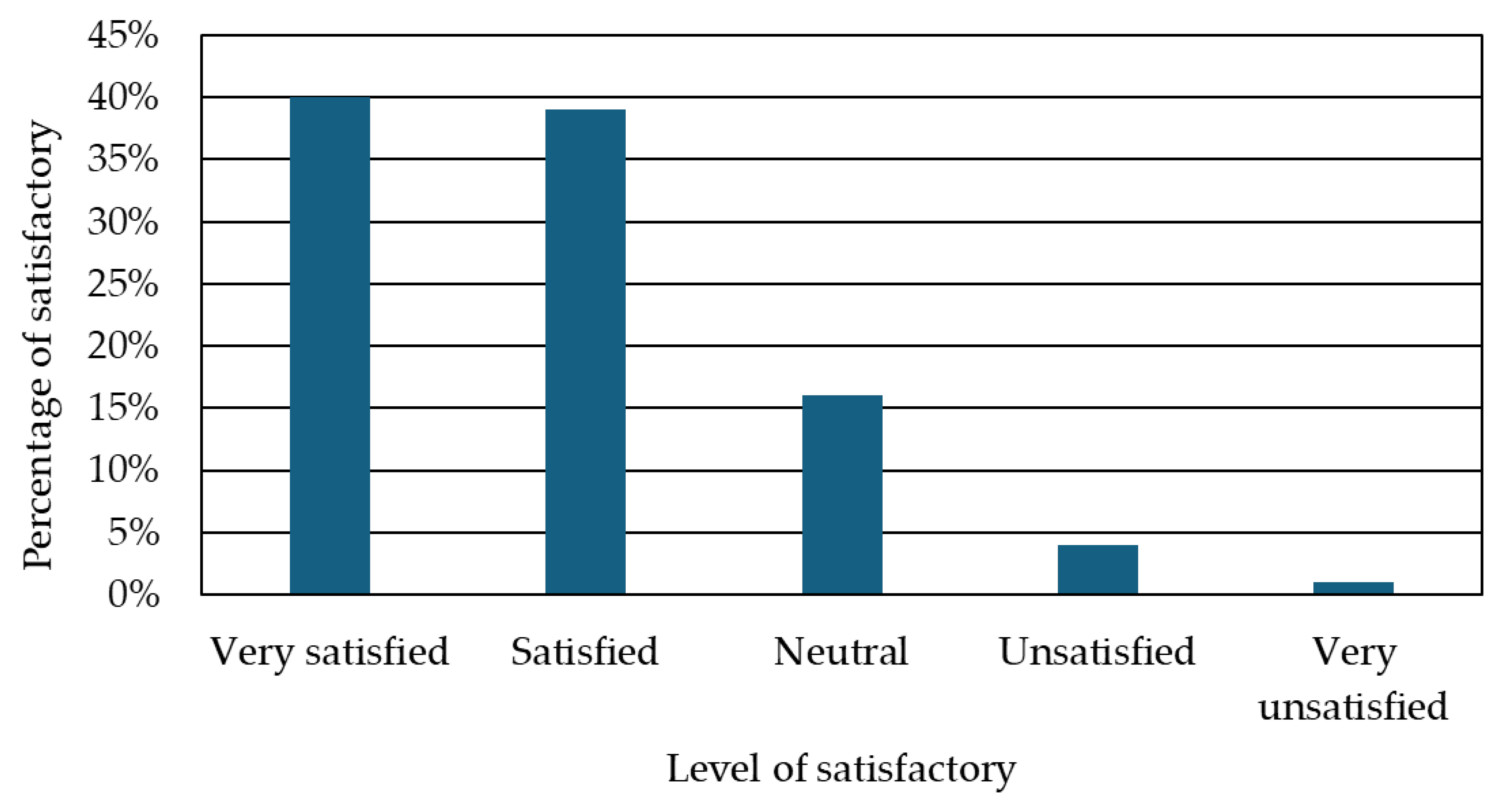
Figure 6.
Relationship between water availability and level of satisfactory.
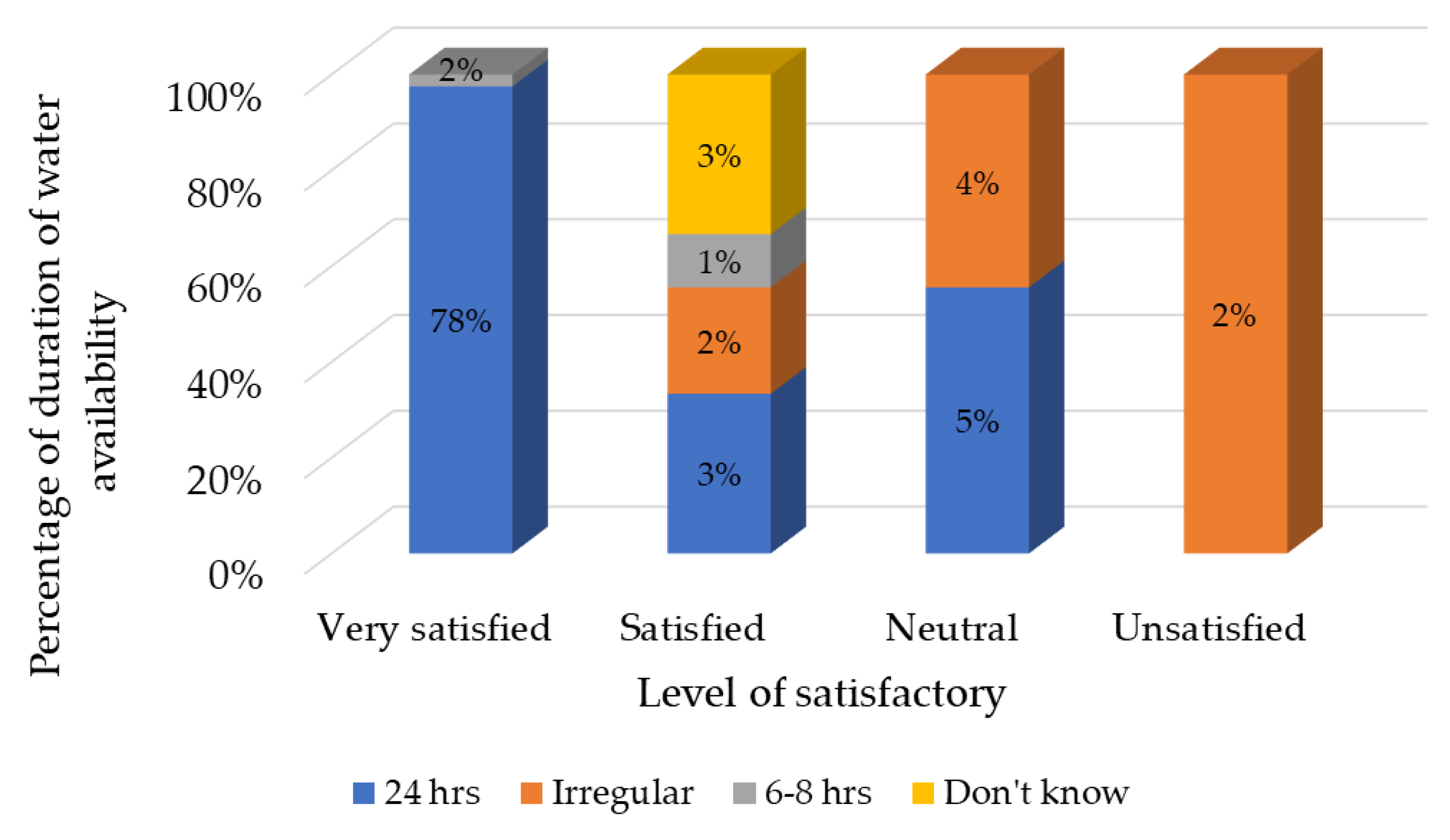
86% of the respondents reported receiving a continuous 24-hour flow of water, while 8% experienced irregular water supply. About 3% of the residents noted water availability for 6-8 hours each day, and the remaining 3% were unsure about the timing of water flow due to their reliance on reservoirs. The highest level of satisfaction, "very satisfied," was reported by 78% of the respondents who had a 24-hour water flow and 2% who had water for 6-8 hours each day. Among those who reported satisfaction, 3% had a 24-hour water flow, 2% experienced irregular flow, 1% had access to water for 6-8 hours, and 3% were unsure of the water flow timings.
Respondents with a 24-hour flow making up 5%, and those with irregular service accounting for 4%, were categorized as neutral, indicating they felt they had no control over the water flow and had no alternative water sources. A small percentage (2%) expressed dissatisfaction due to the irregularity of the water flow. From the data presented, 89% of the respondents were at least satisfied with the availability and flow of water.
3.6. Relationship between Quantity, Accessibility, Affordability, Health and Hygiene
There is a significant relationship between quantity, accessibility, affordability, health, and hygiene in water usage. The importance of these factors with respect to water has been highlighted in previous discussions.
A study conducted by (57) in two rural villages in Mozambique investigated quantity and accessibility. One village had a standpipe with an average collection time of 10 minutes per round trip, while the other had a collection time of 5 hours due to the source being further away. The average quantity of water used per person per day was 12.30 liters in the first village and only 3.24 liters in the second, where additional water was used mainly for hygienic purposes (55). Another study in Jinja, Uganda (58), found an average water usage of 155 liters per person per day when water was piped directly to dwellings and 50 liters when piped to the yard (Williams et al., 2020).
Thompson, Porras, & Tumwine (2001) conducted research in Uganda, Kenya, and Tanzania focusing on quantity, hygiene, and health. They found an average water usage of 7.3 liters per person for bathing and 6.6 liters for washing dishes and clothes in households where the water source was located outside the premises. For households with water piped directly to the dwelling, the average was 17.4 liters for bathing and 16.3 liters for dishwashing and laundry(55).
Empirical studies show that demand decreases as the price of water increases, yet several studies in industrialized countries have shown that the percentage change in water use is smaller than the corresponding percentage change in price (55). A study in Khartoum, Sudan, by (57), found no significant decrease in water quantity purchased relative to cost. They suggested that sacrifices are made in food budgets when a higher proportion of household income is spent on water procurement in poorer communities, which contributes to undernutrition (55). Other studies found a low correlation between income and water usage, with coefficients recorded at 0.15 in Nairobi, Kenya (59), 0.23 in Dakar, Senegal (60), and 0.22 across three cities in Sri Lanka (61).
Studies examining the effects of water accessibility and affordability on household water use concluded that cost has minimal impact on the quantity of water used. However, the farther the source, the less water is used, leading to less hygienic practices and increased health risks. According to research findings, although the maximum quantity of water (110 liters per person per day) was used by a household of size 11 with the third highest monthly income (GH₵ 2000.00), the least quantity (43 liters per person per day) and lowest income (GH₵ 500.00) were recorded in the household of size 12.
Regarding quantity and accessibility, it was noted that households with water piped directly to dwellings used significantly more water (110 liters per person per day) compared to those where individuals had to fetch water (43 liters per person per day), despite an average collection time of 7 minutes. This suggests that the correlation between affordability and quantity is quite low, with a coefficient of 0.33. Moreover, having water facilities directly piped to dwellings (increased accessibility) enhances water usage by residents, leading to more effective hygienic practices and a reduction in health risks.
Enhancing Water Distribution Systems in Emina-Boadi: Practical and Community-Focused Policy Recommendations
To improve water distribution systems in Emina-Boadi, several policy recommendations are essential to ensure that both the Ghana Water Company Limited (GWCL) and borehole services can effectively meet the community's needs. Firstly, enhancing GWCL reliability requires substantial investment in infrastructure upgrades and proactive maintenance schedules to prevent service disruptions. A robust communication strategy should also be developed to inform residents in advance about maintenance activities, allowing them to store water adequately. For borehole services, regular testing and treatment of water sources should be mandated at least every three months to ensure quality and safety (62). Public awareness campaigns can educate residents on water conservation and the importance of regular system maintenance. Engaging community leaders in water management decisions ensures that policies reflect residents' needs. Additionally, guidelines to regulate borehole service pricing are necessary to ensure affordability and prevent exploitation. An integrated water management approach is crucial, encouraging the use of diversified water sources, such as rainwater harvesting and protected wells, to ensure continuous water availability. Additionally, introducing subsidies and flexible payment systems for low-income households will improve affordability and accessibility. Strengthening the regulatory framework to enforce standards for water quality, pricing, and service delivery, coupled with a robust monitoring and evaluation system, will ensure compliance and track performance. These comprehensive policies will enhance the reliability and quality of water services, contributing to the progress of the water sector in Ghana and benefiting both urban and rural communities.
4. Conclusions
Residents of Emina-Boadi have expressed dissatisfaction with the poor supply service received from GWCL. This study found that there has been a significant shift from GWCL to borehole sources, with 87% of residents now using borehole services compared to 13% using GWCL, resulting in an intermediate reliability service level of 83% according to the WASHCost water service ladder. The survey clearly indicates that 87% of people use borehole services connected to dwellings, yards/compounds, in the form of a protected well or with a hand pipe, and they report an 83% reliability rate for water availability. Furthermore, 79% of respondents are at least satisfied with the pricing of borehole services. All residents used improved water sources, with user satisfaction indicating an intermediate quality service level according to WASHCost. No qualitative tests were carried out on the water; the analysis was based solely on user satisfaction levels. The average daily water consumption per person was 60.75 liters, which showed no direct relationship with affordability. It was observed that easier access to water on premises leads to increased daily water usage. The average time spent fetching water was 7 minutes, allowing school children sufficient time to complete their chores and arrive at school punctually.
Why are so many people using borehole services, whether through household connections, to yards/compounds, in the form of a well, or connected to a hand pipe? The primary reason is the consistent reliability of the services. Although most residents in the town cannot afford an in-house drilling system, the service providers keep their doors open and inform customers ahead of any maintenance activities, allowing them time to store water before services are interrupted. Another factor is affordability. Residents have found that borehole service prices are more flexible compared to those of GWCL, and the system supports the "pay as you fetch" type of collection. Enhancing the reliability of services provided by GWCL would increase the overall reliability of water coverage in the town. To improve the supply of potable water to residents, it is recommended that residents are encouraged to continue using various improved sources to prevent water scarcity when one source fails. Also, borehole facilities should be tested and treated frequently, at least every three months since the majority of the population depends on them. Finally, there should also be increased public engagement, participatory planning, and monitoring to ensure the effective implementation and sustainability of water projects such that revenue collected from users as a fee could potentially be sufficient to cover operation and maintenance costs without waiting on funds from the government. The findings also suggest that the water sector in Ghana is making progress toward achieving its goals in both urban and rural communities.
5. Future Direction
The limitations of this study include the reluctance of many residents to participate in interviews. This reluctance stemmed from a history of frequent data collection efforts in the town with little to no subsequent implementation of measures to improve their quality of life. Another limitation encountered during the administering of questionnaires is the potential for recall bias and social desirability bias among pooled respondents. Recall bias may arise as participants might not accurately remember past events or experiences, leading to incorrect or incomplete responses. This issue is particularly pertinent when the time elapsed since the event is considerable or when the event holds varying degrees of significance to different respondents. Additionally, social desirability bias is a concern, as respondents might answer questions in a manner they believe will be viewed favorably by others, resulting in over-reporting of socially desirable behaviors and under-reporting of undesirable ones. These biases can skew the data, potentially affecting the validity and reliability of the study's findings. To mitigate potential recall and social desirability biases among respondents, this study employed several strategies. These included reducing the recall period to improve memory accuracy, using neutrally worded questions to prevent suggesting a "right" or "wrong" answer, and clearly assuring participants of the confidentiality and privacy of their responses. Efforts were also made to create a non-judgmental and trusting atmosphere during interviews and surveys. Despite these measures, future research could benefit from additional methods to further minimize these biases. Encouraging participants to maintain daily or weekly logs or diaries could be feasible if the study location is predetermined and households are contacted in advance. Providing specific cues or prompts to aid memory recall and using indirect questioning techniques, such as the randomized response technique or list experiments, are also recommended. Cross-verifying self-reported data with external records or objective sources and incorporating validity scales or checks within the survey can further enhance the accuracy and reliability of the findings. By integrating these additional strategies into the research design, future studies can more effectively reduce the impact of recall and social desirability biases.
Author Contributions
Conceptualization, E.M.P., E.A.-E. and R.S.K.; methodology, E.M.P.; validation, E.M.P., E.A.-E. and R.S.K.; investigation, E.M.P.; data curation, E.M.P.; writing—original draft preparation, E.M.P.; writing—review and editing, E.M.P., E.A.-E. and R.S.K.; visualization, E.M.P.; supervision, E.A.-E. and R.S.K.; project administration, R.S.K.; funding acquisition, R.S.K. All authors have read and agreed to the published version of the manuscript.
Funding
This research received no external funding.
Informed Consent Statement
Informed consent was obtained from all subjects involved in the study.
Data Availability Statement
The data presented in this study are available on request from the corresponding author. The data is not publicly available due to the privacy of participating respondents.
Acknowledgments
This paper was written for a course, “ABE 585X—Biosystems for Sustainable Development,” at Iowa State University.
Conflicts of Interest
The authors declare no conflicts of interest.
Appendix A
QUESTIONNAIRE
- 1.
- Age of respondent
- 2.
- Gender of respondent
M F - 3.
- Occupation of respondent
■ Self Employed ■ Public Sector ■ Private ■ Retired ■ Unemployed
- 4.
- Level of education
■ Primary/Basic ■ JHS/JSS/Middle School ■ SHS/SSS ■ Tertiary
- 5.
- Household size
- 6.
- Household income
- 7.
- What is the main source of drinking water for your household?
■ Piped to dwelling ■ Piped to yard ■ Public tap/standpipe ■ Borehole/hand pipe
■ Protected dug well ■ unprotected dug wells ■ Bottled/sachet water ■ Tanker truck
■ Surface water ■ Rainfall ■ Other (Specify)
- 8.
- What is the main source of water used by your household for other purposes such as cooking and hand washing?
■ Piped to dwelling ■ Piped to yard ■ Public tap/standpipe ■ Borehole/hand pipe
■ Protected dug well ■ unprotected dug wells ■ Bottled/sachet water ■ Tanker truck
■ Surface water ■ Rainfall ■ Other (Specify)
- 9.
- How long does it take to go there, get water and come back?
- 10.
- Is water always available from your main water source?
- 11.
- What is the daily availability of water on the day it flows?
■ 24 hours ■ 1-2 hours ■ 3-5 hours ■ 6-8 hours ■ night hours ■ irregular ■ Don’t know
- 12.
- What is your level of satisfaction with the water supply service (Liters/cubic meters)?
■ Very satisfied ■ Satisfied ■ Neutral ■ Unsatisfied ■ Very unsatisfied
- 13.
- How much water (in liters) do you use per day?
- 14.
- How much do you spend on water every week?
- 15.
- What is your level of satisfaction with the prices of water?
■ Very satisfied ■ Satisfied ■ Neutral ■ Unsatisfied ■ Very unsatisfied
- 16.
- Is the price of water affordable?
■ Yes ■ No
- 17.
- Is the water of good quality?
■ Yes ■ No ■ Somehow ■ Don’t know
- 18.
- What is your reason (List max of 3)?
- 19.
- Do you treat your water in any way to make it safer to drink?
■ Yes ■ No ■ Please specify other
- 20.
- GPS Location of House/Household
References
- Bureau of Reclamation. Water Facts - Worldwide Water Supply _ ARWEC_ CCAO _ Area Offices _ California-Great Basin _ Bureau of Reclamation. [cited 2024 Jul 10]; Available from: https://www.usbr.gov/mp/arwec/water-facts-ww-water-sup.html.
- Bidlack, W.R.; Wang, W.X.; Clemens, R.A. Water: The World’s Most Precious Resource. J Food Sci [Internet]. 2006;69:16. Available from: https://api.semanticscholar.org/CorpusID:96332385. [CrossRef]
- UN. Water | United Nations [Internet]. 2015 [cited 2024 Jul 10]. Available from: https://www.un.org/en/global-issues/water.
- Ortigara, A.R.C.; Kay, M.; Uhlenbrook, S. A Review of the SDG 6 Synthesis Report 2018 from an Education, Training, and Research Perspective. Water 2018, Vol 10, Page 1353 [Internet]. 2018 Sep 28 [cited 2024 Jul 10];10(10):1353. Available from: https://www.mdpi.com/2073-4441/10/10/1353/htm. [CrossRef]
- Alhassan, S.; Hadwen, W.L. Challenges and Opportunities for Mainstreaming Climate Change Adaptation into WaSH Development Planning in Ghana. International Journal of Environmental Research and Public Health 2017, Vol 14, Page 749 [Internet]. 2017 Jul 10 [cited 2024 Jul 25];14(7):749. Available from: https://www.mdpi.com/1660-4601/14/7/749/htm. [CrossRef]
- Wright, J.; Dzodzomenyo, M.; Wardrop, N.A.; Johnston, R.; Hill, A.; Aryeetey, G.; et al. Effects of Sachet Water Consumption on Exposure to Microbe-Contaminated Drinking Water: Household Survey Evidence from Ghana. International Journal of Environmental Research and Public Health 2016, Vol 13, Page 303 [Internet]. 2016 Mar 9 [cited 2024 Jul 25];13(3):303. Available from: https://www.mdpi.com/1660-4601/13/3/303/htm. [CrossRef]
- Abu, M.; Codjoe, S.N.A. Experience and Future Perceived Risk of Floods and Diarrheal Disease in Urban Poor Communities in Accra, Ghana. International Journal of Environmental Research and Public Health 2018, Vol 15, Page 2830 [Internet]. 2018 Dec 12 [cited 2024 Jul 25];15(12):2830. Available from: https://www.mdpi.com/1660-4601/15/12/2830/htm. [CrossRef]
- Lutterodt, G.; van de Vossenberg, J.; Hoiting, Y.; Kamara, A.K.; Oduro-Kwarteng, S.; Foppen, J.W.A. Microbial Groundwater Quality Status of Hand-Dug Wells and Boreholes in the Dodowa Area of Ghana. International Journal of Environmental Research and Public Health 2018, Vol 15, Page 730 [Internet]. 2018 Apr 12 [cited 2024 Jul 25];15(4):730. Available from: https://www.mdpi.com/1660-4601/15/4/730/htm. [CrossRef]
- Dekker, D.M.; Krumkamp, R.; Sarpong, N.; Frickmann, H.; Boahen, K.G.; Frimpong, M.; et al. Drinking Water from Dug Wells in Rural Ghana — Salmonella Contamination, Environmental Factors, and Genotypes. International Journal of Environmental Research and Public Health 2015, Vol 12, Pages 3535-3546 [Internet]. 2015 Mar 27 [cited 2024 Jul 25];12(4):3535–46. Available from: https://www.mdpi.com/1660-4601/12/4/3535/htm.
- Hensher, D.; Shore, N.; Train, K. Households’ willingness to pay for water service attributes. Environ Resour Econ (Dordr). 2005 Dec;32(4):509–31. [CrossRef]
- Yeleliere, E.; Cobbina, S.J.; Duwiejuah, A.B. Review of Ghana’s water resources: the quality and management with particular focus on freshwater resources. Vol. 8, Applied Water Science. Springer Verlag; 2018. [CrossRef]
- Evans, B.; Bartram, J.; Williams, A. Public Health and Social Benefits of At-house Water Supplies [Internet]. Available from: https://www.researchgate.net/publication/283422043. 2834. [Google Scholar]
- Ahmed, H.; Zolfo, M.; Williams, A.; Ashubwe-Jalemba, J.; Tweya, H.; Adeapena, W.; et al. Antibiotic-Resistant Bacteria in Drinking Water from the Greater Accra Region, Ghana: A Cross-Sectional Study, December 2021–March 2022. Int J Environ Res Public Health [Internet]. 2022 Oct 1 [cited 2024 Jul 25];19(19):12300. Available from: https://www.mdpi.com/1660-4601/19/19/12300/htm. [CrossRef]
- Ge, Y.; Wang, J. The Water Resources Rebound Effect Threatening the Achievement of Sustainable Development Goal 6 (SDG 6). Sustainability (Switzerland) . 2024 May 1;16(10). [CrossRef]
- Cobbina, S.J.; Duwiejuah, A.B.; Quansah, R.; Obiri, S.; Bakobie, N. Comparative Assessment of Heavy Metals in Drinking Water Sources in Two Small-Scale Mining Communities in Northern Ghana. International Journal of Environmental Research and Public Health 2015, Vol 12, Pages 10620-10634 [Internet]. 2015 Aug 28 [cited 2024 Jul 25];12(9):10620–34. Available from: https://www.mdpi.com/1660-4601/12/9/10620/htm. [CrossRef]
- Chew, J.F.; Corlin, L.; Ona, F.; Pinto, S.; Fenyi-Baah, E.; Osei, B.G.; et al. Water Source Preferences and Water Quality Perceptions among Women in the Eastern Region, Ghana: A Grounded Theory Study. International Journal of Environmental Research and Public Health 2019, Vol 16, Page 3835 [Internet]. 2019 Oct 11 [cited 2024 Jul 25];16(20):3835. Available from: https://www.mdpi.com/1660-4601/16/20/3835/htm. [CrossRef]
- Mugagga, F.; Nabaasa, B.B. The centrality of water resources to the realization of Sustainable Development Goals (SDG). A review of potentials and constraints on the African continent. International Soil and Water Conservation Research. 2016 Sep 1;4(3):215–23. [CrossRef]
- Smiley, S.L. Complexities of water access in Dar es Salaam, Tanzania. Applied Geography. 2013 Jul 1;41:132–8. [CrossRef]
- Kangmennaang, J.; Bisung, E.; Elliott, S.J. ‘We Are Drinking Diseases’: Perception of Water Insecurity and Emotional Distress in Urban Slums in Accra, Ghana. International Journal of Environmental Research and Public Health 2020, Vol 17, Page 890 [Internet]. 2020 Jan 31 [cited 2024 Jul 25];17(3):890.Available from: https://www.mdpi.com/1660-4601/17/3/890/htm. [CrossRef]
- Kaku, D.U.; Cao, Y.; Al-Masnay, Y.A.; Nizeyimana, J.C. An integrated approach to assess the environmental impacts of large-scale gold mining: The nzema-gold mines in the ellembelle district of ghana as a case study. Int J Environ Res Public Health [Internet]. 2021 Jul 1 [cited 2024 Jul 25];18(13):7044. Available from: https://www.mdpi.com/1660-4601/18/13/7044/htm. [CrossRef]
- Kankam-Yeboah, K.; Gyau-Boakye, P.; Nishigaki, M.; Komatsu, M. Water Resources and Environmental Management in Ghana. 2004. [Google Scholar]
- Agodzo, S.K.; Bessah, E.; Nyatuame, M. A review of the water resources of Ghana in a changing climate and anthropogenic stresses. Frontiers in Water. 2023 Jan 4;4:973825. [CrossRef]
- WHO&UNICEF-JMP. Progress on household drinking water, sanitation and hygiene 2000-2020: Five years into the SDGs | JMP [Internet]. 2021 [cited 2024 Jul 10]. Available from: https://washdata.org/reports/jmp-2021-wash-households.
- Awuah, E.; Nyarko, K.B.; Owusu, P.A. Water and sanitation in Ghana. Desalination. 2009 Nov 15;248(1–3):460–7. [CrossRef]
- Kumasi, T.C.; Agbemor, B.D.; Burr, P. Rural water asset management practices in Ghana: the gaps and needs. Water and Environment Journal [Internet]. 2019 May 1 [cited 2024 Jul 10];33(2):252–64. Available from: https://onlinelibrary.wiley.com/doi/full/10.1111/wej.12396. [CrossRef]
- B, NK. Cost of delivering water services in rural areas and small towns in Ghana.
- Burr, P.; Fonseca, C. Applying the life-cycle costs approach to sanitation Costs and service levels in Andhra Pradesh (India), Burkina Faso, Ghana and Mozambique. 2011 [cited 2024 Jul 10]; Available from: www.washcost.info.
- Ezeh, O.K.; Agho, K.E.; Dibley, M.J.; Hall, J.; Page, A.N. The Impact of Water and Sanitation on Childhood Mortality in Nigeria: Evidence from Demographic and Health Surveys, 2003–2013. International Journal of Environmental Research and Public Health 2014, Vol 11, Pages 9256-9272 [Internet]. 2014 Sep 5 [cited 2024 Jul 26];11(9):9256–72. Available from: https://www.mdpi.com/1660-4601/11/9/9256/htm. [CrossRef]
- Mutyambizi, C.; Mokhele, T.; Ndinda, C.; Hongoro, C. Access to and Satisfaction with Basic Services in Informal Settlements: Results from a Baseline Assessment Survey. International Journal of Environmental Research and Public Health 2020, Vol 17, Page 4400 [Internet]. 2020 Jun 19 [cited 2024 Jul 26];17(12):4400. Available from: https://www.mdpi.com/1660-4601/17/12/4400/htm. [CrossRef]
- Adank, M.; Kumasi, T.C.; Chimbar, T.L.; Atengdem, J.; Agbemor, B.D. SUSTAINABLE WATER AND SANITATION SERVICES FOR ALL IN A FAST CHANGING WORLD The state of handpump water services in Ghana: findings from three districts. 2014;
- Rural Water Supply Network (RWSN). Rural Water Supply Network (RWSN) Secretariat, Skat Foundation. 2010 [cited 2024 Jul 10]. p. 7 p.; 3 fig.; 6 refs. RWSN • Other Topics - Rural Water Supply Network. Available from: https://www.rural-water-supply.net/en/sustainable-services/myths.
- OFORIKROM MUNICIPAL ASSEMBLY. REPUBLIC OF GHANA COMPOSITE BUDGET FOR 2021-2024 PROGRAMME BASED BUDGET ESTIMATES FOR 2021 OFORIKROM MUNICIPAL ASSEMBLY. 2021;
- Wikipedia. Oforikrom Municipal District - Wikipedia [Internet]. [cited 2024 Jul 10]. Available from: https://en.wikipedia.org/wiki/Oforikrom_Municipal_District.
- LatLong.net. Where is Kumasi, Ghana on Map Lat Long Coordinates [Internet]. 2021 [cited 2024 Jul 10]. Available from: https://www.latlong.net/place/kumasi-ghana-1926.html.
- Moriarty, P.; Batchelor, C.; Fonseca, C.; Klutse, A.; Naafs, A.; Nyarko, K.; et al. Ladders for assessing and costing water service delivery. 2011 [cited 2024 Jul 10]; Available from: www.washcost.info.
- Rakotomanana, H.; Komakech, J.J.; Walters, C.N.; Stoecker, B.J. The WHO and UNICEF Joint Monitoring Programme (JMP) Indicators for Water Supply, Sanitation and Hygiene and Their Association with Linear Growth in Children 6 to 23 Months in East Africa. International Journal of Environmental Research and Public Health 2020, Vol 17, Page 6262 [Internet]. 2020 Aug 28 [cited 2024 Jul 26];17(17):6262. Available from: https://www.mdpi.com/1660-4601/17/17/6262/htm. [CrossRef]
- Onda, K.; Lobuglio, J.; Bartram, J. Global Access to Safe Water: Accounting for Water Quality and the Resulting Impact on MDG Progress. International Journal of Environmental Research and Public Health 2012, Vol 9, Pages 880-894 [Internet]. 2012 Mar 14 [cited 2024 Jul 26];9(3):880–94. Available from: https://www.mdpi.com/1660-4601/9/3/880/htm. [CrossRef]
- Kayser, G.L.; Moriarty, P.; Fonseca, C.; Bartram, J. Domestic Water Service Delivery Indicators and Frameworks for Monitoring, Evaluation, Policy and Planning: A Review. Int J Environ Res Public Health [Internet]. 2013 Oct 11 [cited 2024 Jul 10];10(10):4812. Available from: /pmc/articles/PMC3823337/. [CrossRef]
- Fonseca, C.; Franceys, R.; Batchelor, C.; Mcintyre, P.; Klutse, A.; Komives, K.; et al. On enumerator’s shirt: “Quantifying the costs of water and sanitation” Costing sustainable services. 2011 [cited 2024 Jul 10]; Available from: www.washcost.info/pubs.
- Moriarty, P.; Batchelor, C.; Fonseca, C.; Klutse, A.; Naafs, A.; Nyarko, K.; et al. Ladders for assessing and costing water service delivery. 2011 [cited 2024 Jul 10]; Available from: www.washcost.info.
- Howard, G.; Bartram, J.; Williams, A.; Overbo, A.; Fuente, D.; Geere, J.A. Domestic water quantity, service level and health Second edition.
- Dlamini, M.; Chirima, G.; Jovanovic, N.; Adam, E. Assessing the Effects of Land Use on Surface Water Quality in the Lower uMfolozi Floodplain System, South Africa. International Journal of Environmental Research and Public Health 2021, Vol 18, Page 561 [Internet]. 2021 Jan 11 [cited 2024 Jul 26];18(2):561. Available from: https://www.mdpi.com/1660-4601/18/2/561/htm. [CrossRef]
- Adekunle, I.M.; Adetunji, M.T.; Gbadebo, A.M.; Banjoko, O.B. Assessment of Groundwater Quality in a Typical Rural Settlement in Southwest Nigeria. International Journal of Environmental Research and Public Health 2007, Vol 4, Pages 307-318 [Internet]. 2007 Dec 31 [cited 2024 Jul 26];4(4):307–18. Available from: https://www.mdpi.com/1660-4601/4/4/307/htm. [CrossRef]
- Potgieter, N.; Karambwe, S.; Mudau, L.S.; Barnard, T.; Traore, A. Human Enteric Pathogens in Eight Rivers Used as Rural Household Drinking Water Sources in the Northern Region of South Africa. International Journal of Environmental Research and Public Health 2020, Vol 17, Page 2079 [Internet]. 2020 Mar 20 [cited 2024 Jul 26];17(6):2079. Available from: https://www.mdpi.com/1660-4601/17/6/2079/htm. [CrossRef]
- Odiyo, J.O.; Makungo, R. Chemical and Microbial Quality of Groundwater in Siloam Village, Implications to Human Health and Sources of Contamination. International Journal of Environmental Research and Public Health 2018, Vol 15, Page 317 [Internet]. 2018 Feb 12 [cited 2024 Jul 26];15(2):317. Available from: https://www.mdpi.com/1660-4601/15/2/317/htm.
- Odiyo, J.O.; Mathoni, M.M.; Makungo, R. Health Risks and Potential Sources of Contamination of Groundwater Used by Public Schools in Vhuronga 1, Limpopo Province, South Africa. International Journal of Environmental Research and Public Health 2020, Vol 17, Page 6912 [Internet]. 2020 Sep 22 [cited 2024 Jul 26];17(18):6912. Available from: https://www.mdpi.com/1660-4601/17/18/6912/htm. [CrossRef]
- Alfredo, K.A.; Lawler, D.F.; Katz, L.E. Fluoride contamination in the Bongo District of Ghana, West Africa: Geogenic contamination and cultural complexities. Water Int. 2014;39(4):486–503. [CrossRef]
- Arhin, E.; Affam, M. Fluoride in groundwater and its implications in west Gonja District of Ghana. Ghana Mining Journal. 2010 Mar 31;11(1). [CrossRef]
- Kayser, G.L.; Moriarty, P.; Fonseca, C.; Bartram, J. Domestic Water Service Delivery Indicators and Frameworks for Monitoring, Evaluation, Policy and Planning: A Review. International Journal of Environmental Research and Public Health 2013, Vol 10, Pages 4812-4835 [Internet]. 2013 Oct 11 [cited 2024 Jul 10];10(10):4812–35.Available from: https://www.mdpi.com/1660-4601/10/10/4812/htm. [CrossRef]
- WHO. Guidelines for drinking-water quality, 4th edition, incorporating the 1st addendum. Geneva: World Health Organization. Geneva, Switzerland. World Health Organization [Internet]. 2017 [cited 2024 Jul 10]; Available from: https://www.who.int/publications/i/item/9789241549950.
- Nyarko, K.B.; Dwumfour-Asare, B.; Moriarty, P.; Appiah-Effah, E.; Obuobisa-Darko, A. Life-cycle costs approach for WASH services that last. 2012 [cited 2024 Jul 10]; Available from: www.washcost.info.
- WHO&UNICEF. The Measurement and Monitoring of Water Supply, Sanitation and Hygiene (WASH) Affordability The Measurement and Monitoring of Water Supply, Sanitation and Hygiene (WASH) Affordability A Missing Element of Monitoring of Sustainable Development Goal (SDG) Targets 6. 1 and 6.2 A collaboration of the WHO-UNICEF Joint Monitoring Programme (JMP), the UN-Water Global Analysis and Assessment of Sanitation and Drinking-Water (GLAAS) and an Expert Group on WASH Affordability. 2021 [cited 2024 Jul 10]; Available from: www.unicef.org/wash.
- Martínez-Santos, P. Determinants for water consumption from improved sources in rural villages of southern Mali. Applied Geography. 2017 Aug 1;85:113–25. [CrossRef]
- Kleiner, S.M. Water: An essential but overlooked nutrient. Vol. 99, Journal of the American Dietetic Association. American Dietetic Association; 1999. p. 200–6.
- Howard, G.; Bartram, J.; Williams, A.; Overbo, A.; Fuente, D.; Geere, J.A. Domestic water quantity, service level and health, second edition. Licence: CC BY-NC-SA 3.0 IGO. 2020;
- Kumasi, T.C.; Agbemor, B.D. Tracking user satisfaction of rural water services in northern Ghana. Journal of Water, Sanitation and Hygiene for Development [Internet]. 2018 Jun 1 [cited 2024 Jul 10];8(2):307–18. Available from: http://iwaponline.com/washdev/article-pdf/8/2/307/224364/washdev0080307.pdf. [CrossRef]
- Cairncross, S.; Cuff, J.L. Water use and health in Mueda, Mozambique. Trans R Soc Trop Med Hyg [Internet]. 1987 [cited 2024 Jul 10];81(1):51–4. Available from: https://pubmed.ncbi.nlm.nih.gov/3445322/.
- WELL, Kimberly Clarke. water supply and sanitation programmes guidance manual on. 1998 [cited 2024 Jul 10]; Available from: www.lboro.ac.uk/well/.
- Fuente, D.; Gakii Gatua, J.; Ikiara, M.; Kabubo-Mariara, J.; Mwaura, M.; Whittington, D. Water and sanitation service delivery, pricing, and the poor: An empirical estimate of subsidy incidence in Nairobi, Kenya. Water Resour Res [Internet]. 2016 Jun 1 [cited 2024 Jul 10];52(6):4845–62. Available from: https://onlinelibrary.wiley.com/doi/full/10.1002/2015WR018375. [CrossRef]
- Briand, A.; Nauges, C.; Strand, J.; Travers, M. The impact of tap connection on water use: The case of household water consumption in Dakar, Senegal. Environ Dev Econ. 2010 Feb;15(1):107–26. [CrossRef]
- Nauges, C.; Van Den Berg, C. Demand for piped and non-piped water supply services: Evidence from southwest Sri Lanka. Environ Resour Econ (Dordr) [Internet]. 2009 Jul 3 [cited 2024 Jul 10];42(4):535–49. Available from: https://link.springer.com/article/10.1007/s10640-008-9222-z. [CrossRef]
- Degabriele, J. Improving Community Based Management of Boreholes: A Case Study from Malawi. 2002 [cited 2024 Jul 10]; Available from: http://www.wisc.edu/ltc/basis.html.
Figure 1.
Map of study site for the household survey.
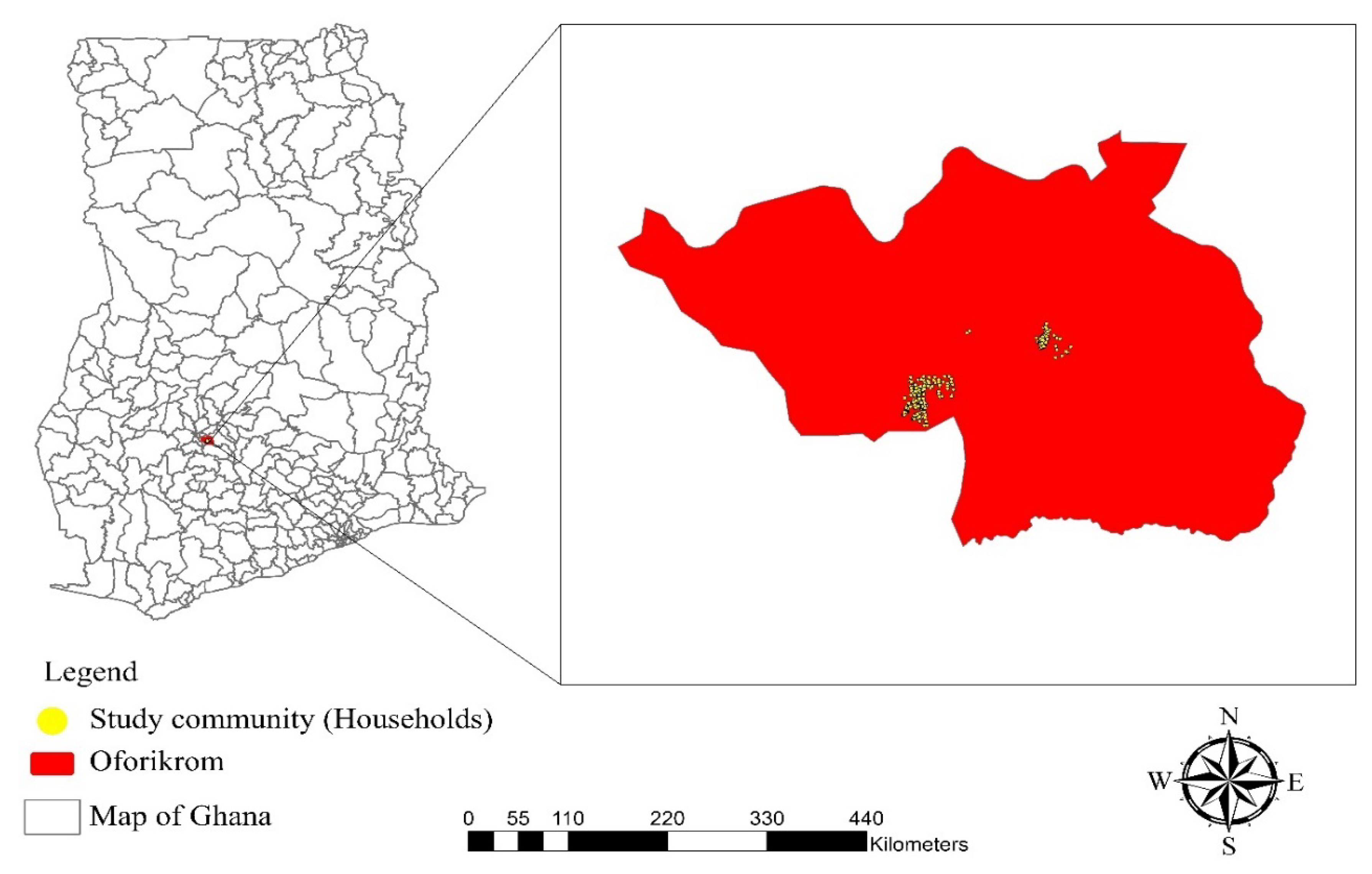
Table 2.
SDG service ladder for drinking water.
| SERVICE LEVEL | DEFINITION |
| SAFELY MANAGED | Drinking water from an improved source that is accessible on premises, available when needed and free from fecal and priority chemical contamination. |
| BASIC | Drinking water from an improved source, provided collection time is not more than 30 minutes for a round trip, including queuing. |
| LIMITED | Drinking water from an improved source, for which collection time exceeds 30 minutes for a round trip, including queuing. |
| UNIMPROVED | Drinking water from an unprotected dug well or unprotected spring. |
| SURFACE WATER | Drinking water directly from a river, dam, lake, pond, stream, canal or irrigation canal. |
Table 1.
Shows the functionality of boreholes and hand pumps in three regions. Source ( Moriarty, P., Nyarko, K.B., Dwumfour-Asare, B., Appiah-Effah, E., and Obuobisa-Darko, A., 2011).
Table 1.
Shows the functionality of boreholes and hand pumps in three regions. Source ( Moriarty, P., Nyarko, K.B., Dwumfour-Asare, B., Appiah-Effah, E., and Obuobisa-Darko, A., 2011).
| Region (District) |
No of communities | Total point systems | Non-functional systems | Non reliable systems |
% Of Functionality |
| Ashanti (Bosomtwe) | 10 |
26 | 4 | 5 | 85% |
| Northern (East Gonja) | 15 | 30 | 11 | 11 | 63% |
| Volta (Ketu South) | 6 | 19 | 7 | 13 | 63% |
| Total | 31 | 75 | 22 | 29 | 71% |
Disclaimer/Publisher’s Note: The statements, opinions and data contained in all publications are solely those of the individual author(s) and contributor(s) and not of MDPI and/or the editor(s). MDPI and/or the editor(s) disclaim responsibility for any injury to people or property resulting from any ideas, methods, instructions or products referred to in the content. |
© 2024 by the authors. Licensee MDPI, Basel, Switzerland. This article is an open access article distributed under the terms and conditions of the Creative Commons Attribution (CC BY) license (http://creativecommons.org/licenses/by/4.0/).
Copyright: This open access article is published under a Creative Commons CC BY 4.0 license, which permit the free download, distribution, and reuse, provided that the author and preprint are cited in any reuse.


