

Submitted:
29 July 2024
Posted:
30 July 2024
You are already at the latest version
Abstract
The growing emphasis on carbon considerations and the pursuit of net-zero emissions have brought about a paradigm shift in project management. To successfully facilitate the transition towards net-zero emissions, major projects must not only adapt existing systems but also embed carbon targets into their core strategies. While several studies have investigated carbon integration during the procurement phase, limited attention has been given to the construction project manager (PM) perspective. This study aims to bridge this research gap by exploring the challenges and barriers faced by construction PMs when integrating carbon targets and metrics into major Architectural, Engineering and Construction (AEC) projects, as well as evaluating the readiness of project teams to deliver on these. The study deployed a qualitative exploratory research design, where semi-structured interviews were conducted with 17 AEC project professionals actively engaged in the planning and execution of major projects in the UK. Thematic analysis of the data revealed a range of challenges and barriers faced by PM teams delivering these projects. The research findings contribute to the field of construction PM by enhancing the understanding of the challenges faced by project managers and project teams when integrating carbon requirements into the delivery of major projects. It uncovers a series of challenges and prevalent practices in major projects that have the potential to impede progress towards the net-zero transition.
Keywords:
AEC
; construction
; major projects
; mega projects
; net-zero
; carbon emissions
; construction project management
1. Introduction
Considering the urgency of sustainability and climate change, the ramifications of greenhouse gas (GHG) emissions on Earth’s climate and ecosystems have taken centre stage in recent dialogues. A temperature rise of 1.5-2.0 °C is established as a critical planetary boundary, essential for maintaining a climate conducive to human existence [1]. In under a decade, the term 'net-zero' has evolved from its origin in climate science to encompass social, economic, and political dimensions. Reflecting this, at the Paris and Glasgow COP 21 and 26 conferences, representatives from 196 nations committed to curbing global warming to 1.5-2.0 °C. According to the Energy and Climate Intelligence Unit, this commitment signified the ambition to achieve net-zero carbon by 2050, encapsulating 68% of the global economy and 124 countries. These earlier commitments have increased to encompass, as of 2021,196 nations which account for a 92% of the global GDP [2]. In this regard, the UK became the first major economy to legislate its net-zero commitment [3]. However, the scope of this challenge becomes apparent when considering the unprecedented socioeconomic and infrastructural shifts needed to realise it [4]. Recent analyses, such as by McKinsey [5], expect the transition to net-zero will necessitate a yearly capital investment of $9.3 trillion from 2021-2050 (i.e. - a cumulative investment of $275 trillion USD). This indicates an increase of 61% in investments across diverse sectors, including energy, carbon storage, infrastructure, agriculture, forestry, and transportation, compared to 2020 levels.
Of the sectors mentioned above, the architectural, engineering, and construction (AEC) sector plays a crucial role in the climate emergency, contributing significantly to carbon emissions. For example, this sector alone is responsible for 42% of total carbon emissions in the UK. Major projects within the AEC sector are well-known for their economic impact, often serving as catalysts for economic growth [6,7,8]. The growing significance of major projects in contemporary economies has been termed as the "projectivisation" of society [9,10]. However, it is not only their economic implications that are noteworthy. Their effects on social and environmental contexts are also substantial and long-lasting [11,12]. The consideration of sustainability has become a key focal point in project management research showcasing the importance of achieving environmental, social, and economic sustainability through projects, in particular, major projects due to their significant impacts [13,14].
Given the importance of the investments across key industrial sectors, the journey towards net-zero will rely on major AEC projects geared towards transforming existing infrastructure and social systems [4,5]. This encompasses initiatives transforming high-carbon systems into sustainable alternatives, spanning areas in the AEC industry such as energy infrastructure [15], housing [16], or transportation infrastructure [17]. Furthermore, the ramifications of such projects on surrounding environments and communities are profound, often leading to significant displacements [11] and potentially having a long-standing impact on local ecosystems [12].
While research on the challenges and issues plaguing major and mega projects in their delivery is extensive, only a limited number of research has investigated the integration of carbon metrics and parameters, and how these affect major projects and their delivery from the perspective of construction stakeholders [18,19]. These studies, however, while exploring carbon reduction targets in relation to activities such as procurement, have fallen short in exploring project stakeholder experiences in integrating and attaining carbon performance as a key element of major project delivery.
Addressing this research gap, this paper aims to: (1) understand the challenges and external barriers faced by project professionals and clients/project sponsors when integrating carbon as a deliverable in AEC major projects in the UK, and (2) evaluate the readiness of AEC major project teams to integrate carbon as a deliverable in major projects. The study addresses the existing gap of knowledge on current major project research, where recent research has fallen short in exploring the implications from the perspective of sponsors and PMs involved in current major project delivery regarding the challenges faced and the effective strategies taken to integrate carbon reduction targets. The remainder of this article is structured as follows. First, in the literature review section, definitions and positioning of major AEC projects in relation to the NZ transition are presented, including an overview of the challenges faced when integrating carbon metrics from the perspective of PMs, sponsors, and the supply chain.
Section 3 discusses the research design, where the methodology is based on the thematic analysis of data collected through semi-structured interviews with experienced construction professionals involved in current major projects. Section 4 presents the resulting findings and themes from the analysis, followed by Section 5, which provides a discussion of findings in relation to previous studies in major project research. Finally, Section 6 concludes the paper highlighting the key findings and recommendations arising from the study.
2. Literature Review
2.1. Major Projects and Net-Zero
2.1.1. Major Projects: Key Definitions
Major projects encompass both projects and programmes and are considered 'major' when they exhibit characteristics such as:
“High monetary value. Time and schedule urgency. Organisational and managerial complexity – the extent to which there are a significant number of managerial interfaces to be managed; and/or a significant number of hierarchical layers either within the organisation or project structure to be managed, and/or a significant number of stakeholders to be managed. Technological complexity or high level of innovation.” [20]
Following on the previous definition, Zhai et al. [21] (p. 99) define major projects as those that display:
"… extreme complexity, substantial risks, long duration and extensive impact on the community, economy, technological development, and environment of the region or even the whole country".
Unlike the MPA's definition, the latter definition also emphasises the systemic impacts major projects have on communities, regional and national economies. Further, Pitsis et al. [22] and Flyvbjerg [6] have suggested that major project definitions should encompass multiple dimensions, such as risks, governance, stakeholder engagement, and longstanding impacts of major projects, with the latter stressing the transformative ambition of such projects. Unlike the above definitions of major projects, scholars have considered a monetary threshold for defining ‘mega’ projects. According to Flyvbjerg [6], the definition of a mega project would largely vary depending on the geographical setting of the city or the country holding the project, hence, any project exceeding US$ 500 million will be reasonable to consider as a megaproject. However, according to the United States Department of Transportation [23], megaprojects are defined based on their significant cost threshold and are considered as:
“… large, complex projects that attract a high level of public attention or political interest because of substantial direct and indirect impacts on the community, environment, and State budgets costing over US$ 1.0 billion”.
Regardless of the cost threshold, the impact created by any major or mega project on society is significant and, hence, they are pivotal in addressing major global challenges [10,24]. For example, echoing some of the sentiments expressed by stakeholders in their research study, Ika and Munro [24] (p. 605) state “…when dealing with evolving grand challenges like COVID-19, project management must increasingly have agility and accept constant adjustment and improvement as key success factors”.
This perspective underscores the inherent uncertainties in projects, particularly when targeting ambitious goals like net-zero carbon transitions. This further highlights the realm of uncertainty and risk level in which major projects operate.
Distinguishing major projects is not merely about their scale but also about the motivations behind them. Flyvbjerg [6] posits that major projects are driven by technological, political, economic, and aesthetic "sublimes". Sankaran et al. [25] introduced the concept of sustainability as a potential new sublime, especially with the emergence of projects driven by net-zero carbon transition ambitions. Sovacool et al. [26] underscore this by pointing to major infrastructure undertakings like the Zero-Carbon Humber Hub and the HyNet Northwest. Furthermore, major projects like Hinkley Point C or R&D endeavours such as the International Thermonuclear Experimental Reactor, highlight the push towards decarbonising national utilities and infrastructure [27].
Building on Ika and Munro's [24] views of projects as instrumental mechanisms in addressing grand challenges, Locatelli et al. [10] conceptualise projects as "change agents". They stress the transformative power of projects in reshaping societies and systems. Lastly, the broader impacts of major projects have been a focal point in literature. For years, studies have shown that these projects have effects that transcend traditional project performance criteria [11]. Recently, Whyte and Mottee [12] have posited that major projects should be seen as interventions within environments. They bring about profound and enduring changes, often altering the natural environment. They recommend that project management professionals should adopt a systems thinking approach, looking holistically at challenges rather than merely deconstructing them into "inputs, mechanisms, and outputs".
2.1.2. Positioning AEC Major Projects within the Net-Zero Transition
The transition to net-zero (NZ) requires a substantial increment in global investments, especially in the domain of major projects. McKinsey [5] expects that to achieve the net-zero objectives by 2050, global capital investments in infrastructure developments must increase to 9.2 trillion USD annually between 2021 and 2050. This translates to an extra 3.5 trillion USD annually, marking a 61% surge from the 2020 investment baseline. Of this amount, 1 trillion USD (or 17.5%) needs to be redirected from high-carbon sectors like oil and gas towards low-carbon assets. The estimates arising from COP27 are more conservative yet still emphasise the scale of this challenge: around 1 trillion USD annually in investments is essential for developing countries to align with NZ targets, with this number expected to grow to 2.4 trillion USD post-2030. A sizeable portion of these investments is envisioned to accelerate the financing of major AEC projects and infrastructure endeavours in developing countries.
The drive towards NZ has already catalysed the inception of various projects strongly anchored in sustainable development targets. Sovacool et al. [26] highlight prominent UK-based undertakings such as the multibillion-pound investments in energy and industrial infrastructure like the Zero-Carbon Humber Hub (estimated at £59.2b) or the HyNet Northwest (projected at £46.8b). These exemplify the type of transformative projects, focusing on innovative technologies like carbon storage and hydrogen-based infrastructure, that carbon-neutral targets might boost in the forthcoming decades.
Key projects with a direct bearing on the climate emergency encompass those dedicated to the mitigation of or adaptation to climate ramifications [27]. Moreover, the impacts of these major projects - encompassing environmental, social, and economic dimensions - are apparent [28]. Examples from the AEC industry include:
- The Hinkley Point C nuclear major project, which aims for the development of state-of-the art nuclear fission as a low-carbon energy source [27].
- R&D projects and programmes targeting the development of infrastructure for pioneering technologies at a large scale, such as the carbon storage and hydrogen infrastructure as in the Humber Industrial Cluster [29].
- Major transport projects like the High Speed 2 (HS2) railway and similar transport infrastructure decarbonisation initiatives [17].
2.2. Challenges Faced When Integrating Carbon Targets: A Stakeholders’ Perspective
While the notion of net-zero finds its roots in climate science, mainly addressing the reduction of climate impacts caused by anthropogenic greenhouse gas emissions, commonly quantified as carbon dioxide equivalent. Tied to sustainability, carbon neutrality primarily acts as an environmental target. Yet, it usually also encompasses socio-economic objectives as well, as to ensure an "equitable transition" [31]. Despite its significance, sustainability has faced challenges permeating the ‘Project Management’ (PM) discipline extensively. Morris [27] (p. 4) appropriately captures this by indicating an escalated urgency prompted by the climate change emergency, labelling it as a "more urgent and tractable responsibility than addressing sustainability". However, the domain remains under-researched, particularly regarding the influence of carbon metrics on AEC project delivery dynamics. The following section will explore research undertaken regarding the perspective of distinct stakeholders; Project Sponsors, Project Managers (PMs) and the Construction Supply Chain (e.g. contracting actors).
2.2.1. The Sponsor’s Perspective
While organisational standards for carbon management, such as ISO 14064, have been established, industry-specific standards for directly managing carbon in projects are notably lacking. Within this landscape, the AEC sector emerges as a frontrunner. It has adopted explicit carbon management standards, such as the ISO16745 for buildings or the PAS 2080 standard for infrastructure projects [32]. However, as the latter is a UK standard, recently, calls for an international standard (i.e. ISO) for carbon management in AEC infrastructure projects have been raised [33].
Kadefors and colleagues’ study [18,34] explored sponsor low-carbon strategies implemented internationally within major infrastructure projects. In this context, procurement appeared as a key mechanism to deliver low-carbon infrastructure. The study showcased how carbon reduction metrics for the supply chain can be implemented through procurement exercises. For instance, the Swedish Transportation Agency (STA) requires carbon reduction targets of 30% over a project baseline, estimated through an in-house carbon calculation tool [34]. However, such procurement strategies can result in increased transaction costs due to additional carbon assessments, as well as potential restrictions on supplier competition and availability, due to requirements of low-carbon project-specific delivery capabilities. Moreover, their study identified innovation-driven strategies, such as extended collaboration and sharing of best practices, as a way of overcoming challenges faced during procurement. Such strategies, combined with a robust capability and knowledge from project sponsors in the implementation of carbon management systems, are deemed critical to seamlessly integrate carbon prerequisites in project procurement processes. On the project sponsor capability and knowledge challenge, examples of strategies to address the challenge include the Dutch approach, which prioritises organisations skilled in carbon management for major infrastructure projects, exemplified by those acquiring the CO2 Performance Ladder Certification, during their procurement exercises [34,35].
The study from Gijzel et al. [36] further highlights how the challenge of carbon reduction in infrastructure projects is dependent on the project sponsor’s efforts to consider these at early stages. In this context, they indicate the importance of governmental requirements supplemented by additional more ambitious goals based on the local context as the approach to overcome this initial challenge in integrating carbon reduction goals in major infrastructure projects. Moreover, Hakkinen et al.’s [37] research within building design demonstrates how the final carbon footprint is driven primarily by decisions in the early phases of projects, primarily between preparation, briefing and technical design stages. Thus, outlining the importance of decisions taken in early phases and the importance of client leadership in driving low-carbon AEC projects.
Moreover, regarding the importance of the business case, Granoff et al. [38] revealed a major gap in global infrastructure investments. Another challenge for infrastructure and construction projects arises from the hardly quantifiable positive externalities - e.g. improved accessibility, reduced pollution etc. - which results in weaker business cases in comparison with alternative investments. Moreover, the investment analysis reveals that additional investment requirements of low carbon versus “business as usual” infrastructure are relatively higher (i.e. 6.2 and 5.9 trillion USD respectively). However, when building the case for low-carbon investments clients often face higher upfront costs, even if lifecycle costs are usually substantially reduced. Other challenges result from additional risks due to innovative product implementation, as well as a “lock-in” effect from already-built infrastructure [38].
2.2.2. The Project Manager’s (PM) Perspective
The recent systematic review from Friedrich [39] presents different perspectives in which environmental requirements are viewed by project professionals. On one hand, a common perspective is the one that views these as “constraints”, which are linked with additional costs or an additional challenge that the project team needs to deal with. Another well-known challenge is the issue of conflicting goals and priorities and resulting trade-offs faced within projects [40]. This might have its roots already in traditional PM tools like the iron triangle, which establish project performance as a trade-off between quality, cost, and time criteria [41,42]. Sabini and Alderman [43] have also studied this phenomenon by looking at how PMs deal with contradictory sustainable objectives within projects. Their study revealed a series of tensions that arise when delivering projects sustainably – e.g., short-term goals of the project conflicting with longer-term sustainability organisational goals, perceived barriers, or the lack of power and influence in decision-making. These trade-offs often result in PMs undertaking strategies that push back or curtail sustainable objectives against other parameters considered within the traditional project scope, predominantly cost. Beyond the integration and trade-offs between project goals, research has also highlighted stakeholder and project team’s lack of knowledge, capabilities, and competencies regarding environmental and social sustainability as a major challenge in the successful integration of sustainable goals within projects [44,45].
In contrast, environmental targets and sustainability can also be viewed more positively as an opportunity or benefit rather than an additional cost or risk. These views are categorised as “instrumental” - utilitarian and benefit-oriented - or as “intrinsic” - a core value of the project – values [39]. Martens and Carvalho [13], based on a series of organisational case-studies, indicate that environmental considerations can lead towards project success. Project success in this context refers to the following areas: efficiency, efficacy, impact on customers, impacts on project teams, business impacts, impacts on the long-term, as well as the resulting sustainability over the project lifecycle [13,46]. This project success dimension is distinct from traditional PM views of success often associated with the iron triangle dimensions (time, cost and quality), by expanding the views into long-term benefits resulting from the project. As such, recently developed models for determining project success encourage the adoption of a more holistic view of project success, by also observing that major projects and programmes deliver societal benefits and green efficacy in the mid and long term [47].
2.2.3. The Supply Chain’s Perspective
Research on supply chain dynamics in the construction industry has predominantly focused on the perspectives of Architecture, Engineering, and Construction (AEC) contracting firms. A recurrent theme is the industry's general apathy towards reducing carbon emissions, often characterising contractors as passive actors in driving carbon change [48].This trend is not confined to a single study but is observed in multiple countries, such as Australia, Ireland and the US [48,49,50,51]. According to Wong et al. [48], contractors and consultants rarely propose better operational practices to reduce carbon emissions unless these are initiated by sponsors. This seems to indicate the need for top-down approaches, initiated by project sponsors, to instigate change within the construction process.
In the UK [52], research has identified several barriers to implementing low carbon strategies, such as perceived costs and managerial challenges, including risk aversion and lack of early contractor involvement. However, unlike the US, where lack of client demand is a significant barrier [50], the UK study did not find this to be one of the major challenges. This discrepancy suggests regional variations in the drivers and barriers to low-carbon practices in construction. Moreover, Torcellini et al. [50] emphasised that client demand and perceived capital costs are major barriers in the US, with technical challenges being less significant. To address these issues, they proposed increasing client demand and improving knowledge around embodied carbon integration.
Jiang et al. [51] through the application of a behavioural theory analysed contractor motivations towards adopting low-carbon practices. They found that government regulation and policy support had the most significant impact on contractors' willingness to adopt carbon reduction initiatives in China. Conversely, perceived capability and knowledge had a minimal impact, indicating that technical expertise and financial capability are not major barriers in this context. On a similar note, previous studies [48] identified government regulations as the most important driver for carbon reduction among Australian contractors. However, they also noted that knowledge, training, and reward schemes had a significant correlation with the actual adoption of carbon reduction strategies. Surprisingly, the carbon tax was the least relevant driver in adopting carbon reduction strategies, which could reflect a lack of confidence in the effectiveness of very strict building regulations in driving actual change in construction supply chains.
3. Methodology
This section explains the research design, where the methodology is based on the thematic analysis of data collected through semi-structured interviews with experienced project professionals involved in current major projects.
3.1. Data Collection and Sampling
This study adopted a qualitative research design and used semi-structured interviews to collect data. Semi-structured interviews are a suitable data-collection approach for exploring the opinions of participants around professional issues and opportunities as well as eliciting detailed responses. This method was utilised in this study to gather opinions from expert professionals involved in different major programmes or projects in the UK. The questions were structured to elicit views and thoughts on; (1) Current national NZ targets and how these translate into current and future AEC major projects (2) Experiences in implementing carbon-related targets and deliverables in major mega AEC projects, including the challenges faced by the project professionals.
In this study, a purposive sampling technique was deployed. This technique is an effective sampling technique when investigating a problem that requires in-depth information about the phenomenon under investigation. It is suitable for the investigation of multi-faceted topics such as the exploration of complex issues, such as the integration of new project parameters, within major and megaprojects [53]. Additionally, purposive sampling allows the control of the level of variation across interviewees selected, which in this case, allowed the inclusion of a range of different contexts and project types within the sample selected [54]. To establish the final sample size (n=17), the study sought out a sufficient number to reach levels of data saturation (i.e. no new themes emerging from data) established in reflexive thematic analysis research [55]. In this context, previous studies often establish a range between 7 and 12 interviews as the number where no new themes emerge from the analysis of transcripts [56,57,58]. In the analysis of transcripts within this study, no new themes or sub-themes emerged from the data after the 10th interview transcript. Thus, later transcripts were used to further substantiate and establish identified themes. The final sample (as shown in Table 1) included a range of senior Project and Programme Managers across different organisations and AEC project types within the UK.
3.2. Data Analysis
The semi-structured interviews were conducted online through Microsoft Teams, which included two members of the research team (interviewee and observer). All the interviews were recorded and transcribed verbatim. The interview transcripts were analysed using the thematic analysis approach (specified in the following section), which allowed the systematic analysis of interview text data using qualitative data analysis software (NVivo 12) [54]. Using the software, the collected data were thoroughly studied and segregated using a coding structure. The research team analysed the collected data using thematic analysis steps recommended by Braun and Clarke [59]:
- Familiarising with the data: Interviews were fully transcribed before the commencement of the formal analysis.
- Generating codes: As specified, two members of the research team analysed the data and generated initial codes separately. Multiple codes were generated.
- Generating initial themes: From the initial codes, related codes were grouped together into emerging themes. Discussion among the research team to determine initial codes.
- Reviewing themes: Generated themes and agreed codes were compared with extracts and an initial thematic map was generated (Figure 1).
- Defining final themes: Final themes were established. These themes are those discussed in the following results chapter.
- Reporting of findings: Finally, findings and results for each of the themes are presented in the following section.
4. Results
Based on the thematic approach outlined earlier, four core themes emerged: 1) Nature of major projects, 2) Scale of the transition, 3) Readiness of PM teams, and 4) External barriers. These main themes further branched out into a number of sub-themes. Figure 1 expands on the interrelations and hierarchy of these themes and sub-themes. The following sections elaborate on the findings regarding these identified themes.
4.1. Theme 01: Nature of Major Projects
The initial theme that emerged from the interviews referred to the complex nature of major projects that the participants had experienced in managing. This complexity is related to several foreseeable factors such as the size, scale, and scope of major projects. In this regard, additional carbon requirements and deliverables often ended up adding an additional layer to the project complexity resulting in the additional challenge of having to coordinate new deliverables, track, and measure new carbon-related targets and coordinate additional project professionals:
“It's quite straightforward to say, 'Yes, just measure it', it's actually a colossal task on a large project” (I12).
“The complexity of managing this project is very high, so for us, it's becoming quite challenging to actually coordinate all of them” (I4).
In this regard, however, projects that involved ambitious NZ targets were also closely correlated with a much higher degree of uncertainty, which could be clearly mapped out to the need to innovate and implement newer technical solutions to attain low-carbon outcomes during the project and on the final products/infrastructure delivered. This clearly has effects on the scope definition, as shown by the interviewee’s reflection:
“(…) there is still constant uncertainty of what level of detail are you working to. What are the decarbonisation targets, for example? Are you going to go for electrification or not? There's constant uncertainty of what's the end product that we’ll be delivering” (I9).
On a similar note, several interviewees mentioned that the delivery of low-carbon major projects is particularly challenging due to the high risk associated with them, mostly due to often uncertain scopes that evolve over the project life cycle.
Additionally, another challenge that PMs faced when integrating carbon targets was the impacts and effects on other project priorities. Within the sample, primarily the impacts on project costs were outlined by interviewees, with many attributing a cost premium associated with integrating carbon-reduction technologies and solutions in projects:
“The only thing it affects is the budget because there's a premium, a capital cost that needs to be committed” (I3).
Additionally, the cost increase from processes undertaken to assess and manage carbon during the project lifecycle was also identified. To a lesser extent impacts on project duration were also outlined, mostly due to additional time required with additional carbon assessments and option appraisals. It is important to note that while the majority indicated negative implications (i.e. additional costs) regarding cost, a few of the interviewees suggested that carbon reduction can also deliver strong synergies (e.g. extending the life of assets or considering scope reductions).
Yet, the interplay between carbon reduction and other sustainability goals, primarily social ones, also posed a series of challenges and opportunities). Some project managers grappled with decisions where the most sustainable choice was not always the least carbon-intensive option. In this regard, balancing carbon emissions with other sustainability dimensions, primarily social benefits from projects, was often a decision of trade-offs. This was clearly exemplified by the following quote:
“(carbon emissions to be) balanced off against the economic growth side of government, as well as reducing inequalities. For example, in (anonymised location) there're some very remote areas, and it's just not socially acceptable to cut them off even if scaling back on these investments would limit emissions” (I12).
Lastly, the correlation between carbon reduction and other sustainability goals, particularly social ones, was also examined. Many associated low-carbon projects with broader societal advantages and benefits:
“co-benefits around improving air quality, generating local jobs...and utilising that for social good to support the local area” (I15).
4.2. Theme 02: Scale of the Transition
The significance and scale of the net-zero transition emerged prominently. The UK's strategic Net-Zero 2050 and 2035 interim goals were highlighted both as significant challenges and opportunities by the interviewees. All in all, there was a clear consensus among participants:
“I think they're extremely challenging, the targets. Yes, undoubtedly, they will affect the delivery of projects going forward” (I12).
Most interviewees indicated a good understanding of these targets, noting that such comprehension also extended to the organisational level. Some PMs, particularly from significant infrastructure sectors, emphasised their efforts to comprehend the carbon implications of their projects. However, after assessments were undertaken, PMs highlighted a degree of scepticism regarding the feasibility of these targets, especially considering the current resource allocation:
“We've looked at a decarbonisation plan for one of the big universities, and in order to deliver their targets they're going to have to take 20 per cent of their building stock out of action (…) so achieving their targets is almost impossible” (I3).
A segment of participants was optimistic but collectively recognised the challenges of achieving NZ, especially in the long-run horizon beyond 2035. The extended nature of these targets, often spanning decades, brings forth inherent challenges for managing current and future major project portfolios:
“Everyone has got a road back to get to net-zero. We all know that we're going after the low-hanging fruit at the moment, but things are going have to fundamentally change in the next five years/ten years when we go for that last 30 per cent, that last 50 per cent” (I5).
As stated by the interviewee (I5), meeting these targets would require the incorporation of novel, yet unknown technologies and solutions. This could also have further implications for increasing the risk profile of major projects in the upcoming decades.
PMs involved with local authorities emphasised the challenges surrounding the major urban transition programmes, such as decarbonisation, electrification, and energy efficiency initiatives. The budgetary magnitude for these programmes often crosses the £1 Billion threshold. Despite their scale and complex nature, these initiatives are often fragmented, assembled as a collection of smaller projects rather than a cohesive programme with firm project governance structures. As one interviewee mentioned:
“£6 billion to £8 billion, it is the most recent estimate that I had, but when I started it was estimated at £2 billion to £3 billion, which is almost identical to some of the rail programmes I worked on. The lack of governance and the lack of established methodologies and the lack of best practice is quite astounding” (I9).
4.3. Theme 03: Readiness of Project Management Teams
Emerging from the interviews is the pressing theme regarding the preparedness of Project Management (PM) teams to integrate carbon metrics in major projects. While the competence of PM managers was viewed as sufficient, several factors including gaps in knowledge of carbon metrics, scarcity of standardised resources related to carbon within projects, insufficient continuous professional development (CPD) schemes, and under-resourced teams raised concerns. There is a current disparity in the readiness of PM professionals to meet the net-zero challenge. As the following quote indicates, a number of PMs still lack a full grasp of when and how to incorporate experts for carbon measures:
"I don't think there's a ready-made population of project managers in our business that are 100% up-to-speed on when they need to bring in experts, what experts they need, how they're going to deliver certain things” (I3).
Contrarily, many believe that seasoned project professionals, when equipped with the right tools, can surmount any challenge, including delivering substantial carbon reductions in projects:
"Any projects or programme professional worth their salt will - if you give them a toolkit, they will know how to apply it in the best possible way.” (I2).
To bridge the knowledge gap, organisations, especially those in the infrastructure sector, are strengthening their PM teams' capabilities to assess and report carbon metrics. The approaches are varied. Some have established structured training and CPD programs, with PMs mentioning the inception of a "Carbon Academy" to systematically train those involved in their capital projects and supply chains. Others have integrated other tools to facilitate carbon assessment within the project organisation such as carbon calculators or implemented standard carbon reporting systems for projects/programmes. In contrast, other PMs have relied on more informal methods, such as lunchtime seminars to boost awareness:
“We've brought online a Carbon Academy. That provides a systematic training for people involved in the capital side of our business and our supply chains” (I5).
“we're programming CPDs - you know, lunchtime CPDs in a programme of knowledge sharing to get people's awareness up” (I6).
Yet, a significant obstacle remains - the absence of standard methodologies for PM professionals to weave carbon considerations into decision-making. Given the diverse contexts of major projects, creating a one-size-fits-all solution is challenging. However, certain organisations are tackling this issue directly in relation to the projects they deliver:
“We call it a crib sheet, so a checklist of things that you should make sure that you run through with your client of key questions and challenges at different stages of the project” (I6).
Another major challenge around carbon measurement across projects refers to the issue of data, which is encapsulated into two sub-themes: carbon data quality and capabilities on data analytics. Most interviewees found existing carbon data to be less than satisfactory, with limited, sometimes unreliable, information. Moreover, the importance of better data analytics in project delivery, especially for enhanced decision-making, was underscored. There is an opportunity for automation and leveraging technology in the delivery of projects, including regarding carbon data, especially considering recent Artificial Intelligence advancements:
"We've still got people who upload data to a spreadsheet every week. It's mad that these things aren't automated. So, let's automate what we can but also, let's get machines doing what humans are no good at. That's risk management, lessons learned, forecasting” (I11).
Lastly, the challenge of having under-resourced project teams, especially in local authority contexts, also emerged from the interviews. Recruitment poses a challenge, signified by a lack of experienced project managers available with the capacity to lead low-carbon major programs. Furthermore, retaining talent is another hurdle, with high turnover rates, which not only strains CPD resources but also impedes the efficient delivery of complex programs. These issues were highlighted by the following interviewee:
“For us in (Local Authority) it's been a problem of finding somebody with the experience to lead on it, so at a director or a similar high-level leadership role, but that's frankly because a lot of this stuff nobody's done before (…) the people who do have that experience are going to go somewhere where they can get paid a lot to do that and where they can really drive that change quickly” (I14).
4.4. Theme 04: External Environment
The external environment's influence on the carbon delivery of projects emerged as a significant theme from the interviews. This theme encapsulates how elements beyond the immediate scope of projects can affect their carbon-related goals and outcomes. Three dominant sub-themes emerged: national momentum towards net-zero, incentive and funding structures, and the capability of stakeholders like supply chains.
One encouraging finding was the perceived momentum around the net-zero movement. Attributed to government initiatives, as well as shifts in the political and social landscape, many project organisations have recently embraced net-zero pathways. An interviewee remarked on this wave of change, contrasting it with other recent organisational change programmes:
“It certainly isn't true for massive digital solutions or huge organisational change programmes (…) I think there is something quite unique about (net-zero transition). It's a range of factors: it's people, it's humans, it's media; it's values and beliefs and motives and incentives - there's a whole lot of things” (I16).
While the lack of sponsor interest or the lack of consideration of carbon at the business case stage were issues commonly mentioned, several interviewees highlighted how these issues might be underpinned by structural systems, which lead towards misaligned incentives (if the sustainability of the project is the outcome sought out). A clear example within low carbon is the projects that are prioritised and why this might be the case:
“The way in which you get rewarded, the way in which you're incentivised, creates a system that focuses inherently on the new shiny techy thing rather than the fundamentals, getting the basics right, getting the efficiency built into your projects delivering effective quality regimes.” (I12).
This system encourages the adoption of novel technologies, sometimes at the expense of other potentially more cost-effective or low-carbon solutions. These misaligned incentives are also prevalent in the relation across project stakeholders and particularly affect supply chains. This is a longstanding issue in carbon-intensive sectors like construction, where the priorities and weighting have favoured costs over other parameters. Another interviewee commented:
“The contracts aren't set up to incentivise it (…) you're already starting on the back foot - weighting procurement exercises towards quality, ultimately, it's the cost that ends up - to a large degree - winning out” (I11).
The existing structural systems also pose a challenge. The predominant "stop and go" funding supporting public sector low-carbon projects leads to uncertainty. Such inconsistency in funding often hinders long-term planning, adding to already under-resourced teams. As a result, certain projects or authorities benefit, while others lag.
“The problem is you can't get projects off the ground because there's yet to be the funding to be able to do it, and/or chasing funding which then leads to perverse behaviours in the supply chains. Either they don't want to engage because they can see short-term funding or, if they do engage, we see price inflation because they know there's an opportunity to take...” (I15).
Interestingly, despite the evident progress, there remains a deficiency in the availability of supply chains for low-carbon technologies. This deficit has led projects to form international partnerships. Yet, the limited competition and skewed incentives have sometimes resulted in opportunistic behaviours during tenders. However, there was a growing awareness of the importance of collaborative cross-project learning:
“Good project case examples from others (…) that they can then template and replicate quickly (…) comparing with other projects that have been successful, to try and mitigate and avoid the challenges that others have faced by sharing information and hooking people together” (I15).
The external project environment plays a pivotal role in shaping carbon delivery in projects. From the promising national momentum towards net-zero to the complexities of incentives and the roles of different stakeholders, understanding these factors is key to navigating the complex terrain of sustainable major project delivery.
5. Discussion
This exploratory study has centred on the challenges faced by Project Professionals involved in the management of significant UK AEC major projects, yielding four main themes. These themes bring forth a series of structural and systemic challenges encountered within major projects. These challenges might pose significant risks to the capability and preparedness of project teams aiming to meet carbon neutrality targets in the coming decades. Interestingly, the findings, particularly those about the systemic challenges, reveal how different project domains appear to be moving at different speeds when it comes to integrating carbon requirements at major projects and programmes. This disparity could engender negative views around carbon reduction metrics if these are viewed as a major constraint in major project delivery. This in turn could sustain a culture of “winners and losers”, threatening to derail the transition towards net-zero. The following sections delve into these issues.
5.1. Ongoing Shifts in Project Team Perspectives
Based on the results of the exploratory study, the integration of carbon metrics into project management has become increasingly significant. Interviews with professionals in the field reveal that both the measurement and reduction of embodied and operational emissions have been central considerations in the planning and execution of major projects. Yet, the perception of carbon metrics varies among practitioners, illustrating diverse viewpoints on this aspect of major project delivery.
A prevalent perspective, as evidenced in the interviews, regards carbon metrics primarily as a constraint within the PM process. This view aligns with previous research in the field of project management [39], which has often treated sustainability factors as either additional costs or risks that need to be managed. This sentiment is reflected by a number of interviewees, which associated some negative connotations to the additional requirements imposed by carbon reduction metrics, recognising the inevitability of these costs which one might argue as ‘sunk costs’ in the current project management landscape.
Conversely, a smaller group of interviewees positioned a more “instrumental” perspective around carbon metrics [39]. This viewpoint does not necessarily position carbon metrics as integral to the core of project success but acknowledges them as a significant deliverable in achieving project success. The instrumental approach sees carbon considerations as increasingly important, potentially altering the traditional PM frameworks, such as the well-known “Iron Triangle” [41,42]. This suggests an evolving view of major project success criteria, where carbon-related targets and metrics are gaining prominence. This shift in perspective towards a more integrated approach to carbon metrics in project management appears to be partly driven by broader societal and global commitments to address the climate emergency. Such commitments are creating strong tailwinds and momentum, differentiating this transition from other past change initiatives, such as digital transformation. The current trend echoes models of project success that emphasise societal benefits and long-term green efficacy, as highlighted in the recently proposed ‘Tesseract’ model [47].
Currently, the field of PM stands at a crossroads concerning the role of carbon metrics. While some view these metrics as a constraint, others see them as an integral success factor. However, the complete intrinsic integration of carbon considerations, the final perspectives on sustainable goals established [39], into project delivery remains a work in progress. Despite this, there is a growing recognition among PMs of their professional responsibility to deliver projects that are climate-neutral (and even climate-positive). As some of the PMs noted this responsibility is now becoming part of the professional ethos. As this integration deepens, future PM practices appear to increasingly prioritise carbon efficiency, reflecting a possible shift towards a value-driven profession that considers sustainability as intrinsic to major project success.
5.2. Challenges Hindering the Integration of Carbon Targets
Interviews highlighted several challenges that major project teams encounter while trying to meet emerging carbon constraints. Initially, the findings show a dichotomy amidst different organisations. Major infrastructure developers are not only incorporating carbon discussions but have also implemented formal strategies for its assessment, reporting, and integration. Conversely, other organisations, predominantly smaller construction, and local authority decarbonisation programmes, are grappling to integrate carbon in a standardised manner and on par with major AEC infrastructure projects. The potential implications of this discrepancy are significant; unless these challenges are tackled, a divide - resulting in ‘winners and losers’— may emerge in the realm of major UK projects and programmes.
A prominent challenge is the scarce availability of experienced project and programme managers. This concern was widely acknowledged, with teams working on public projects feeling its impact acutely. Challenges in recruitment, often attributed to offered terms or insufficient skillsets, and issues with retention were evident. One adopted solution has been the promotion of professionals with technical expertise (e.g., with environmental or engineering backgrounds) into project management roles. While their project-specific technical expertise is generally sound, they often lack proficiency in the areas of project governance, methodologies, and standards. This phenomenon, termed ‘the accidental PM’, is a recognised trend within the public sector [60]. Given the escalating scale and breadth of major UK decarbonisation, energy, and retrofit programmers, the recommendations provided by Darrell et al. [60] remain ever-relevant. They advocate for public entities to actively strengthen their personnel's project management competencies, an initiative which could be expanded to other areas like data analytics.
Additionally, the motivations guiding major projects could unintentionally de-prioritise carbon or other sustainability aspirations. Even though the momentum toward net-zero is apparent, the emphasis seems to gravitate towards innovative methodologies (e.g., pioneering energy systems, novel materials or advanced construction technologies) as the primary path. Such motivations, though apparently in alignment with carbon reduction, often resonate more with the ‘technological sublime’ concept posited by Flyvbjerg [6] rather than a ‘sustainability sublime’ [25]. As an interviewee remarked, the appeal of innovative solutions often eclipses foundational principles like planning out efficiencies within the design and project scope. The essence of this problem is outlined by the following statement: ‘The emphasis is on the new shiny technology rather than on fundamental efficiencies’. Thus, fostering a genuine ‘sustainability sublime’ should be prioritised by both sponsor entities and the public sector.
Furthermore, interview data implies that when carbon considerations do feature, they are typically embedded through procurement and contractual processes. Stakeholders frequently deploy financial terminologies when discussing carbon metrics, such as budgets and targets. Previous research [18] has indicated forthcoming challenges to be cautious about, such as overinflated baselines or issues with negotiating the scope of carbon reduction in major projects, as these are linked to pain/gain contractual mechanisms, where contractors are financially incentivised. Unrealistic cost estimations, together with a series of other challenges, have translated into a regular delivery of major projects under important cost overruns. Though equating carbon metrics to financial parameters might initially appear intuitive, caution must be exercised to prevent a similar challenge of recurrent carbon emission ‘overruns’ in future major projects.
6. Conclusions
The prevailing climate crisis is undeniably the defining challenge of our era, with the net-zero (NZ) transition emerging as a pivotal response. As the net-zero coalition asserts, this transition demands “a complete transformation of how we produce, consume, and move about” [4]. Given that projects are conceptualised as catalysts for systemic change [8,12,29], the magnitude of this transformation requires a surge in AEC major projects and programmes at scale [5]. Addressing an imperative research gap in major AEC project research, this study aimed to identify challenges faced by construction PMs when integrating carbon targets in major project delivery and gauge the readiness of the project teams to confront and navigate the scale, scope, and complexity of the grand challenge of net-zero by 2050. Our findings outlined the challenges and major hurdles that, unless addressed, could derail the progress toward the NZ 2050 targets.
First, the integration of carbon metrics into projects emerged as a central, albeit evolving issue from the perspective of project teams and sponsors. Interviews revealed a divided position: some viewed carbon metrics as a major constraint to manage, introducing additional costs and complexities, while others saw them as essential for achieving project success. This reflects distinct positions, where sustainability factors are often seen as additional risks or costs in PM [39]. However, influenced by the societal and global context, a shift appears to be underway, with several PMs recognising carbon metrics as a fundamental part of project success. This shift suggests a potential modification of traditional models, such as the "Iron Triangle" [41], to increasingly include sustainability considerations, leading towards models that emphasise these long-term benefits increasingly [22,44,47]. Currently, the field stands at a crossroads, with the intrinsic integration of carbon considerations into project delivery still unfolding. Nonetheless, there is an increasing awareness among PMs of their responsibility to deliver climate-neutral projects, signalling a shift towards a value-driven profession where sustainability will be integral to project success.
Beyond the views and interpretation of PMs themselves, a series of additional internal and external systemic barriers were also identified. For instance, disparities in progress across sectors and project types were also identified in the exploratory study. Compounding this, the efficacy of project teams, especially in public entities, is currently hindered by recruitment and retention challenges. This underscores the imperative for internal skill development efforts, especially at the senior management levels. Another point of concern arises from the current prevailing project drivers (which link with the PM views), whether they are technological, economic, or political. While these may produce results and progress towards net-zero, they may not always prioritise the climate impacts of projects. Therefore, projects genuinely motivated by a "sustainability sublime" will be paramount [25].
While this research provides valuable insights into carbon metrics integration in PM, focusing primarily on various types of civil infrastructure (i.e. railways, water and roads), buildings, as well as energy infrastructure and programmes (e.g. energy retrofits or renewable energy infrastructure), it recognises limitations and suggests directions for future research. First, the sample size was 17 interviewees which included a range of participants from various construction and infrastructure backgrounds. The research sampling followed a purposive sampling approach, which might have biased participation towards professionals with experience in working with carbon requirements in major projects. These experiences might not be representative of the wider construction PM profession. Further research should thus aim to encompass a broader range of PM professionals, including those from sectors where carbon considerations are still emerging or with limited experience on projects that have considered these. This would provide a more comprehensive understanding of the overall field's readiness and response to the evolving demands imposed by low-carbon projects in the AEC sector. Additionally, most construction professionals interviewed (15 out of 17) were employed as PM consultants for the sponsor or part of the sponsor organisations. As such, the results might be skewed towards the perspective of sponsors, rather than that of the construction supply chain (i.e. Tier 1 contracting stakeholders). Moreover, the study results are limited only to the UK. Future studies could investigate the perspectives of PMs from other developed and developing countries. Exploring PM practices in other developed economies distinct from the UK could reveal alternative strategies and provide a comparative perspective. The implications for emerging economies, where carbon considerations might follow a different trajectory also warrant in-depth examination.
Finally, an in-depth exploration of carbon considerations within major and mega projects is particularly pertinent, especially in the context of the current emergency. In-depth case studies focusing on these large-scale projects could provide valuable insights into the factors influencing the integration of carbon metrics. Such research should delve into the decision-making processes examining how these choices impact carbon emissions resulting from projects. Furthermore, it would be recommended to assess the impacts of key PM processes and strategies on a project’s carbon performance over the lifecycle. This would involve a detailed analysis of the various stages of construction major projects, from planning to execution, and how each step contributes to the overall carbon footprint of a project. Such research could uncover opportunities for carbon reduction and efficiency improvements driven by project teams, potentially leading to the development of updated tools and recognising best practices within the profession.
Word count
8500 (excluding references) + 900 for the figure & table.
Author Declaration
The authors would like to declare no conflict of interest.
Funding
This research was funded by the Association for Project Management (APM), UK under the APM Research Grants Call 2021-22.
References
- Flyvbjerg, B. What you Should Know about Megaprojects and Why: An Overview. Project Management Journal 2014, 45, 6–19. [Google Scholar] [CrossRef]
- Söderlund, J.; Sankaran, S.; Biesenthal, C. The past and Present of Megaprojects. Project Management Journal 2017, 48, 5–16. [Google Scholar] [CrossRef]
- Ansar, A. Old challenges, new solutions: getting major projects right in the twenty-first century. Oxford Review of Economic Policy 2022, 38, 217–223. [Google Scholar] [CrossRef]
- Nieto-Rodriguez, A. The Project Economy Has Arrived. In Harvard Business Review, 2021; Vol. November-December.
- Locatelli, G.; Ika, L.; Drouin, N.; Müller, R.; Huemann, M.; Söderlund, J.; Geraldi, J.; Clegg, S. A Manifesto for project management research. European Management Review 2023, 20, 3–17. [Google Scholar] [CrossRef]
- Gellert, P. K.; Lynch, B. D. Mega-projects as displacements*. International Social Science Journal 2003, 55, 15–25. [Google Scholar] [CrossRef]
- Whyte, J.; Mottee, L. Projects as interventions. International Journal of Project Management 2022, 40, 934–940. [Google Scholar] [CrossRef]
- Martens, M. L.; Carvalho, M. M. The challenge of introducing sustainability into project management function: multiple-case studies. Journal of Cleaner Production 2016, 117, 29–40. [Google Scholar] [CrossRef]
- Martens, M. L.; Carvalho, M. M. Key factors of sustainability in project management context: A survey exploring the project managers' perspective. International Journal of Project Management 2017, 35, 1084–1102. [Google Scholar] [CrossRef]
- Andreoni, A.; Creamer, K.; Mazzucato, M.; Steyn, G. How can South Africa advance a new energy paradigm? A mission-oriented approach to megaprojects. Oxford Review of Economic Policy 2022, 38, 237–259. [Google Scholar] [CrossRef]
- Lowes, R.; Woodman, B. Disruptive and uncertain: Policy makers’ perceptions on UK heat decarbonisation. Energy Policy 2020, 142, 111494. [Google Scholar] [CrossRef]
- Mark, F. Carbon dioxide management in a major UK infrastructure project: High Speed Two. Proceedings of the Institution of Civil Engineers - Civil Engineering 2020, 173, 85–90. [Google Scholar] [CrossRef]
- Kadefors, A.; Lingegård, S.; Uppenberg, S.; Alkan-Olsson, J.; Balian, D. Designing and implementing procurement requirements for carbon reduction in infrastructure construction – international overview and experiences. Journal of Environmental Planning and Management 2021, 64, 611–634. [Google Scholar] [CrossRef]
- Lingegård, S.; Olsson, J. A.; Kadefors, A.; Uppenberg, S. Sustainable Public Procurement in Large Infrastructure Projects—Policy Implementation for Carbon Emission Reductions. Sustainability 2021, 13, 11182. [Google Scholar] [CrossRef]
- MPA. Project Terminology. 2023. https://majorprojects.org/project-terminology/ (accessed 2023 August 25).
- Zhai, L.; Xin, Y.; Cheng, C. Understanding the value of project management from a stakeholder's perspective: Case study of mega-project management. Project Management Journal 2009, 40, 99–109. [Google Scholar] [CrossRef]
- Pitsis, A.; Clegg, S.; Freeder, D.; Sankaran, S.; Burdon, S. Megaprojects redefined – complexity vs cost and social imperatives. International Journal of Managing Projects in Business 2018, 11, 7–34. [Google Scholar] [CrossRef]
- Capka, R. Megaprojects - They Are A Different Breed. Public Roads 2004, 68, 2–9. [Google Scholar]
- Ika, L. A.; Munro, L. T. Tackling grand challenges with projects: Five insights and a research agenda for project management theory and practice. International Journal of Project Management 2022, 40, 601–607. [Google Scholar] [CrossRef]
- Sankaran, S.; Müller, R.; Drouin, N. Creating a ‘sustainability sublime’ to enable megaprojects to meet the United Nations sustainable development goals. Systems Research and Behavioral Science 2020, 37, 813–826. [Google Scholar] [CrossRef]
- Sovacool, B. K.; Iskandarova, M.; Geels, F. W. “Bigger than government”: Exploring the social construction and contestation of net-zero industrial megaprojects in England. Technological Forecasting and Social Change 2023, 188, 122332. [Google Scholar] [CrossRef]
- Morris, P. W. G. Climate change and what the project management profession should be doing about it - A UK perspective; APM, Princes Risborough, UK, 2017.
- Dogan, E.; Stupar, A. The limits of growth: A case study of three mega-projects in Istanbul. Cities 2017, 60, 281–288. [Google Scholar] [CrossRef]
- Geels, F. W.; Sovacool, B. K.; Iskandarova, M. The socio-technical dynamics of net-zero industrial megaprojects: Outside-in and inside-out analyses of the Humber industrial cluster. Energy Research & Social Science 2023, 98, 103003. [Google Scholar] [CrossRef]
- Alabid, J.; Bennadji, A.; Seddiki, M. A review on the energy retrofit policies and improvements of the UK existing buildings, challenges and benefits. Renewable and Sustainable Energy Reviews 2022, 159, 112161. [Google Scholar] [CrossRef]
- Fankhauser, S.; Smith, S. M.; Allen, M.; Axelsson, K.; Hale, T.; Hepburn, C.; Kendall, J. M.; Khosla, R.; Lezaun, J.; Mitchell-Larson, E.; et al. The meaning of net zero and how to get it right. Nature Climate Change 2022, 12, 15–21. [Google Scholar] [CrossRef]
- Fenton, M. R. , James. Establishing best practice whole-life carbon baselines for Phase One of HS2. In High Speed Two (HS2): Infrastructure Design and Construction (Volume 2); HS2, Ed.; ICE Publishing, 2021; pp 189-200.
- Australia, I. P. Decarbonising Construction: Putting Carbon in the Business Case; 2022.
- Kadefors, A. U. , Stefan; Olsson, Johanna Alkan; Balian, Daniel; Lingegård, Sofia Procurement Requirements for Carbon Reduction in Infrastructure Construction Projects – An International Case-Study; Stockholm, Sweden, 2019.
- (SKAO), S. K. A. O. CO2 Peformance Ladder Essentials 2023; Utrecht, Netherlands, 2023.
- Gijzel, D.; Bosch-Rekveldt, M.; Schraven, D.; Hertogh, M. Integrating Sustainability into Major Infrastructure Projects: Four Perspectives on Sustainable Tunnel Development. Sustainability 2020, 12, 6. [Google Scholar] [CrossRef]
- Häkkinen, T.; Kuittinen, M.; Ruuska, A.; Jung, N. Reducing embodied carbon during the design process of buildings. Journal of Building Engineering 2015, 4, 1–13. [Google Scholar] [CrossRef]
- Granoff, I.; Hogarth, J. R.; Miller, A. Nested barriers to low-carbon infrastructure investment. Nature Climate Change 2016, 6, 1065–1071. [Google Scholar] [CrossRef]
- Friedrich, K. A systematic literature review concerning the different interpretations of the role of sustainability in project management. Management Review Quarterly 2023, 73, 31–60. [Google Scholar] [CrossRef]
- de Magalhães, R. F.; Danilevicz, Â. d. M. F.; Palazzo, J. Managing trade-offs in complex scenarios: A decision-making tool for sustainability projects. Journal of Cleaner Production 2019, 212, 447–460. [Google Scholar] [CrossRef]
- de Wit, A. Measurement of project success. International Journal of Project Management 1988, 6, 164–170. [Google Scholar] [CrossRef]
- Ebbesen, J. B. H. , Alexander J. Re-imagining the Iron Triangle: Embedding Sustainability into Project Constraints. PM World Journal 2013, 2, 1–13. [Google Scholar]
- Sabini, L.; Alderman, N. The Paradoxical Profession: Project Management and the Contradictory Nature of Sustainable Project Objectives. Project Management Journal 2021, 52, 379–393. [Google Scholar] [CrossRef]
- Silvius, G. A. J. S. , Ron P.J. Sustainability in project management: A literature review and impact analysis. Social Business 2014, 4, 63–96. [Google Scholar] [CrossRef]
- Carvalho, M. M.; Rabechini, R. Can project sustainability management impact project success? An empirical study applying a contingent approach. International Journal of Project Management 2017, 35, 1120–1132. [Google Scholar] [CrossRef]
- Shenhar, A. J.; Dvir, D. Project Management Research—The Challenge and Opportunity. Project Management Journal 2007, 38, 93–99. [Google Scholar] [CrossRef]
- Ika, L. A.; Pinto, J. K. The “re-meaning” of project success: Updating and recalibrating for a modern project management. International Journal of Project Management 2022, 40, 835–848. [Google Scholar] [CrossRef]
- Wong, P. S. P.; Owczarek, A.; Murison, M.; Kefalianos, Z.; Spinozzi, J. Driving construction contractors to adopt carbon reduction strategies – an Australian approach. Journal of Environmental Planning and Management 2014, 57, 1465–1483. [Google Scholar] [CrossRef]
- Acquaye, A. A.; Duffy, A. P. Input–output analysis of Irish construction sector greenhouse gas emissions. Building and Environment 2010, 45, 784–791. [Google Scholar] [CrossRef]
- Torcellini, P. H. , Sammy; Goetsch, Heather; Sullivan, Julia Architects, Engineers, and Contractors-Key to Moving towards a Zero Carbon Future:; Golden, Colorado, 2022.
- Jiang, J.; He, Z.; Ke, C. Construction Contractors’ Carbon Emissions Reduction Intention: A Study Based on Structural Equation Model. Sustainability 2023, 15, 10894. [Google Scholar] [CrossRef]
- Arogundade, S.; Dulaimi, M.; Ajayi, S. Exploring the challenges impeding construction process carbon reduction in the UK. International Journal of Construction Management 2024, 24, 422–431. [Google Scholar] [CrossRef]
- Di Maddaloni, F.; Davis, K. Project manager's perception of the local communities' stakeholder in megaprojects. An empirical investigation in the UK. International Journal of Project Management 2018, 36, 542–565. [Google Scholar] [CrossRef]
- Bazeley, P. Qualitative Data Analysis : Practical Strategies; SAGE, 2013.
- Braun, V.; Clarke, V. To saturate or not to saturate? Questioning data saturation as a useful concept for thematic analysis and sample-size rationales. Qualitative Research in Sport, Exercise and Health 2021, 13, 201–216. [Google Scholar] [CrossRef]
- Guest, G.; Bunce, A.; Johnson, L. How Many Interviews Are Enough?: An Experiment with Data Saturation and Variability. Field Methods 2006, 18, 59–82. [Google Scholar] [CrossRef]
- Ando, H.; Cousins, R.; Young, C. Achieving Saturation in Thematic Analysis: Development and Refinement of a Codebook. Comprehensive Psychology 2014, 3, 03. [Google Scholar] [CrossRef]
- Constantinou, C. S.; Georgiou, M.; Perdikogianni, M. A comparative method for themes saturation (CoMeTS) in qualitative interviews. Qualitative Research 2017, 17, 571–588. [Google Scholar] [CrossRef]
- Braun, V.; Clarke, V. Using thematic analysis in psychology. Qualitative Research in Psychology 2006, 3, 77–101. [Google Scholar] [CrossRef]
- Darrell, V.; Baccarini, D.; Love, P. E. D. Demystifying the Folklore of the Accidental Project Manager in the Public Sector. Project Management Journal 2010, 41, 56–63. [Google Scholar] [CrossRef]
Figure 1.
Thematic map visualising the identified themes and sub-themes derived from the analysis.
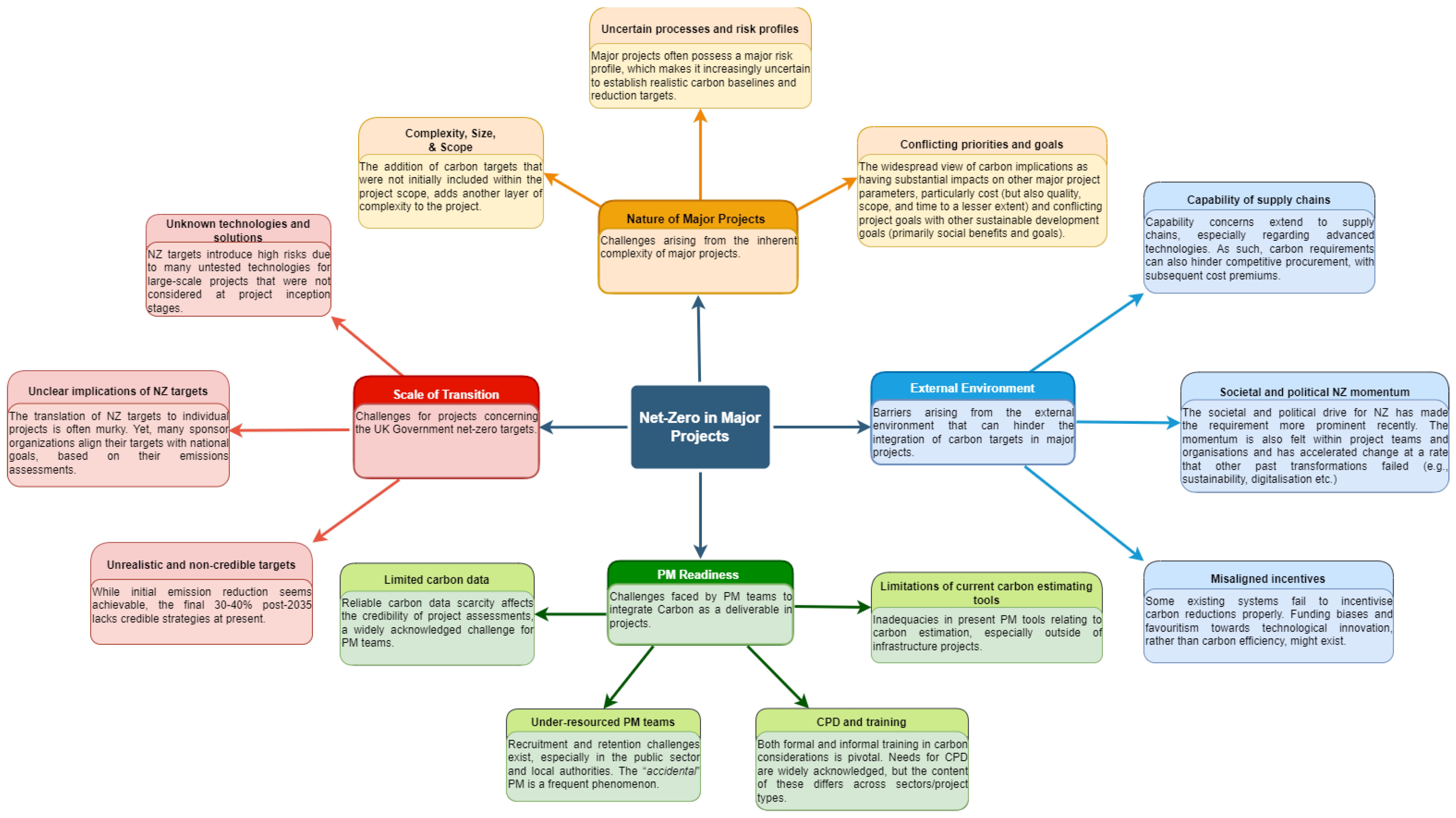

Table 1.
Anonymised interview participant details.
| ID | Role | AEC Major Project Type | Interview Duration |
| I1 | Chairman and PM Consultant | Infrastructure Major Projects | 41 minutes |
| I2 | Programme Manager | Major Projects (Local Authority) | 41 minutes |
| I3 | Senior Director (PM Consultancy) | Buildings (Education and Healthcare) | 31 minutes |
| I4 | Senior Project Manager | Buildings (Major Retrofit projects) | 46 minutes |
| I5 | Director of Major Projects | Civil Infrastructure Projects (Water) | 43 minutes |
| I6 | Project Director and NZ carbon lead | Buildings (Major retrofit projects) | 39 minutes |
| I7 | Carbon Manager | Civil Infrastructure (Railways) | 64 minutes |
| I8 | Director of Major Projects | Infrastructure (Transport – Roads) | 38 minutes |
| I9 | Senior Project Manager | Large Housing Retrofit Programme (Local Authority) | 45 minutes |
| I10 | Major Project Planning Lead | Major Projects Infrastructure (Roads) | 48 minutes |
| I11 | Deputy Director | Civil Service (Infrastructure Projects Authority) | 57 minutes |
| I12 | Director of Project Procurement | Infrastructure (Transport – Road & Railways) | 64 minutes |
| I13 | Major Projects Technical Lead | Infrastructure and Buildings | 62 minutes |
| I14 | Senior Project Officer | Energy and Local Authority | 64 minutes |
| I15 | Energy Projects Manager | Regional Energy Project Manager | 58 minutes |
| I16 | Programme Lead and Head of NZ Carbon | Infrastructure (Transport - Roads) | 61 minutes |
| I17 | Senior Project Manager | Local Authority, Energy, and R&D | 41 minutes |
Disclaimer/Publisher’s Note: The statements, opinions and data contained in all publications are solely those of the individual author(s) and contributor(s) and not of MDPI and/or the editor(s). MDPI and/or the editor(s) disclaim responsibility for any injury to people or property resulting from any ideas, methods, instructions or products referred to in the content. |
© 2024 by the authors. Licensee MDPI, Basel, Switzerland. This article is an open access article distributed under the terms and conditions of the Creative Commons Attribution (CC BY) license (http://creativecommons.org/licenses/by/4.0/).
Copyright: This open access article is published under a Creative Commons CC BY 4.0 license, which permit the free download, distribution, and reuse, provided that the author and preprint are cited in any reuse.


