

Submitted:
29 July 2024
Posted:
30 July 2024
You are already at the latest version
Abstract
How infants engage with objects changes dramatically over the first year of life. While some infants exhibit a consistent hand preference for acquiring objects during this period, others have no identifiable preference. The goal of this study was to test whether lateralization confers an advantage in the development of early object skills. We examined whether lateralized infants show different rates of growth in how they interact with multiple objects as compared to infants without a hand preference. In a longitudinal design consisting of seven monthly visits from 6-12 months, 303 infants were assessed for hand preference and object management skill (i.e., holding up to three objects). Group-Based Trajectory Modeling (GBTM) identified three hand preference trajectory groups: Left, Right, and No Preference (NP). A Hierarchical Generalized Linear Model (HGLM) found that Left and Right infants differed in their linear and quadratic slopes and transitioned from holding one to two objects more quickly than NP infants. While all infants showed similar trends in object management skill across time, lateralized infants had an advantage. Further work is needed to determine if this early object skill advantage cascades to later more complex object handling.
Keywords:
infants
; handedness
; hand preference
; lateralization
; object skill
; manipulation
1. Introduction
Infants spend around 60% of their daily routine with objects [1,2]—these interactions are essential for learning [3]. How infants engage with objects changes dramatically across the first year of life [4]. Starting around 4 months of age, infants can successfully reach and grasp objects [5], and this behavior (termed acquisition), is used to index handedness starting at 6 months [6]. Not all infants have a statistically identifiable hand preference during early development; rather, hand use is variable in a subset of infants [7,8,9]. This difference in patterning for how the hands are used may be developmentally meaningful. The goal of this study was to test whether lateralization, defined as a left- or right-hand preference, confers an advantage for early object skill. We explored whether infants with a hand preference, regardless of direction, show different rates of growth in how they interact with objects compared to those without a hand preference using a longitudinal design that measured hand preference and object skill over 7 visits from 6 to 12 months.
1.1. Handedness in Infants
Handedness in infants does not look like handedness in adults. The prevalence of left-handedness in adults is ~10%, regardless of whether handedness is measured as two categories (right-left) or three categories (right-mixed-left) [10]. What is distinctive about adult handedness is the marked preference for the right hand (80-90%). Furthermore, adult handedness is typically measured once, and often with a self-report questionnaire, e.g., [11]. By comparison, infant handedness is variable [12,13], and how it is measured is also variable. Handling this variability appropriately requires a longitudinal design to capture different trajectories, or patterns of change over time in manual abilities that are also changing over time [14]. Large-scale studies using latent class analysis to parse the variability in infant hand use into patterns have estimated that 38-57% of infants are right-handed, 5-14% are left-handed, and 30-50% have no identifiable hand preference [7,8,9].
The difference in how hand preferences are distributed across infants versus adults suggests that handedness is not innate but rather develops. This process is hypothesized to be the result of cascading events across prenatal and postnatal development [15,16,17,18,19]. Briefly, there is a correspondence between a fetal positioning bias, measured at birth, and postnatal supine head turn preference [20]. Head turn preference subsequently predicts the hand preference for acquiring objects [21,22,23]. Acquisition hand preference predicts the hand preference for manipulating objects with one hand [24,25], and finally, unimanual hand preference predicts hand preference for manipulating objects with two hands [26]. Each asymmetrical experience cascades into the next increasingly complex motor skill across development. But why have a hand preference at all as an infant? The current study explored whether there is a benefit to being lateralized in infancy for handling objects.
1.2. Lateralization and Object Skills in Infants
A small literature has examined the effect of lateralization, measured as infant hand preference, on the performance of object skills such as stacking, bimanual manipulation (termed role-differentiated bimanual manipulation or RDBM), and tool use. Marcinowski and colleagues [27] reported that infants with a hand preference were more successful in early stacking as measured by the age of stacking skill attainment and the height of the block tower as compared to infants without a hand preference. In a follow-up study measuring the same sample again as toddlers, those children with a consistent hand preference from infancy to toddlerhood were more successful at stacking than children with a variable or inconsistent hand preference across the two developmental time periods [28]. Together, an early and consistent hand preference is an advantage for the development of stacking.
Mixed findings have been reported in research on infant hand preference and RDBM where one hand holds the object for the other hand’s manipulation. In a study examining RDBM speed, Campbell and Marcinowski found that infants with a right-hand preference improved their RDBM performance at a faster rate relative to left or no preference infants [29]. However, there was no similar advantage for left-handed infants who did not differ in RDBM speed from the no preference group. Babik and colleagues reported a negative association between hand preference strength and RDBM in infants, suggesting laterality may have disadvantaged performance on a skill where the hands must be coordinated together as opposed to stacking which is often executed with one hand [30]. Moreover, this study did not find a link between hand preference strength and tool use, leading the authors to suggest that whether lateralization affects infants’ object skills depends on task demands such as the level of dexterity required and whether one or both hands are used.
An additional task demand to consider when examining the potential influence of laterality is whether there is more than one object (termed object management). Acting on more than one object is likely a combination of two separate skills: acquisition and storage (e.g., transferring from one hand to the other or placing an object within reach without dropping it) [31]. All infants increase in their ability to manage multiple objects from 7-13 months, but infants with a stable hand preference were found to do so at a faster rate with more sophisticated object management sequences than infants without a hand preference [32]. In this prior study by Kotwica and colleagues, infants were sampled every other month and hand preference groups were descriptive, rather than statistically-driven, due to the small sample size (n = 38). The current study addressed these gaps by sampling infants every month across a similar age range (6-12 months) with a large sample (n = 303) that permitted group-based trajectory modeling to determine hand preference groups. Object management skill was assessed with the goal-directed motility of arms and hands item on the Touwen Infant Neurological Examination (TINE) [33], which allowed us to track inter-individual variability in infants’ abilities to hold one or more objects.
1.3. Current Study
The current study was motivated by the following main research question: Do infants with a hand preference have an advantage in the development of early object skill? We tested the hypothesis that lateralization confers an advantage for object skill growth. We predicted that infants who were lateralized would acquire multiple objects sooner, a marker of more complex object skill, than infants with no hand preference. The basis for this prediction was the expected differences between the hands for infants with a hand preference versus those without a hand preference. A hand preference creates asymmetric hand experience. A hand that is used preferentially becomes more practiced, and thus more proficient than the non-preferred hand and more adept at interacting with the environment. Thus, an infant with a hand preference can manipulate objects in their environment more readily with their preferred hand [34]. By contrast, the non-preferred hand is less experienced and not as “good” as the preferred hand, because it is not as practiced like the preferred hand. An infant without a distinct hand preference is likely to have poor motor precision in both hands, since neither hand is preferentially used [35]. This difference in how infants acquire one object may have consequences for how infants interact with multiple objects.
In the current study, we measured hand preference and object management skill (e.g., holding 0, 1, 2, or 3 objects) in a longitudinal design with monthly assessments from 6-12 months. We expected that a subset of infants would be lateralized and exhibit a left- or right-hand preference trajectory across the seven visits. We further predicted that the lateralized infants would be able to hold and manage objects more effectively (i.e., “higher” object management scores), showing a different pattern of growth across visits by acquiring multiple objects sooner and developing the ability to hold more objects more quickly as compared to infants without a hand preference who were not lateralized. We did not expect left- and right-handed infants to differ from each other a priori, however we included these two groups separately in models to test for a possible effect of hand preference direction on the development of object management skills.
2. Methods
2.1. Participants and Procedure
Infants (n = 303) were recruited using Guilford County public birth records (North Carolina, USA). One hundred and sixty-nine infants (55.78%) were male, and 134 were female (44.22%). All had full-term pregnancies and births without complications. Infants were brought to the Infant Development Center at the University of North Carolina Greensboro within seven days of their birth date from 6-12 months at monthly intervals as a part of a larger longitudinal project aimed at characterizing the development of infant handedness. Procedures for recruitment, obtaining informed consent, and data collection were in accordance with the regulations set by the UNCG Institutional Review Board for the protection of human subjects. At the first visit, parents gave written consent for their child to participate in the project. All testing took place in the lab in a quiet environment. After a brief warm-up period, trained experimenters first administered the TINE and then the hand preference assessment. Parents received a $10 Target gift card at each visit.
2.2. Measures
2.2.1. Touwen Infant Neurological Examination (TINE) [33]
At each visit, infants were administered 11 test items from Group III of the Touwen Infant Neurological Examination (TINE) [33]. The TINE has good predictive validity and reliability [36,37]. For the current study, we used one item, goal-directed motility of arms and hands, for hypothesis testing. For a similar approach, see [38,39]. This TINE item measured infants’ object management ability by assessing their ability to hold up to three objects. The TINE was given on a mat on the floor. If the infant could not sit independently, they were supported by their parent or the researcher. A researcher would encourage the infant to hold toy eggs measuring ~14.5 cm wide by 15.5 cm tall. First, the researcher would tap two eggs together to make a noise and offer them to the infant on a flat palm. If the infant did not show any interest in the eggs, the researcher would push an egg into the infant’s hand. Once the infant had warmed up to play, the researcher would offer the toy eggs again in the same manner as above. If the infant was able to hold one egg, a second egg was offered. If the infant was able to hold two eggs, a third egg was offered.
The researcher scored the most advanced holding behavior the infant demonstrated within 5 minutes on the mat. Higher scores indicated more advance object management skill. Scoring was done in real time. Infants received a single score per assessment ranging from 0 to 6 where 0 was “no goal-directed motility of arms and hands”, 1 was “looked at and playing with the hands but did not engage with the first object”, 2 was “touched object presented but did not hold it”, 3 was “played with feet”, 4 was “holding one object”, 5 was “holding an object in each hand", and 6 was “holding two objects in one hand such that the infant was able to grasp a third object without dropping the others”. We dropped “3” from the original TINE scale because it did not capture infants’ object interactions and no infants in our sample were given this rating. We regrouped the remaining scores into four holding categories for analysis (Table 1).
2.2.2. Hand Preference Assessment [6,9] & Classification
At each visit, hand preference was assessed using a reliable and validated procedure developed by Michel and colleagues [6,9]. The experimenter sat directly across from the infant on the convex side of a rounded crescent-shaped table, while the infant sat on the concave side seated on the parent’s lap. The infant’s navel was at table height, leaving the arms unconstrained. The parent sat close to the table and held the infant on either side of the infant’s waist to maintain a stable posture. Video cameras (Panasonic WV-CP240) were placed to the left side and directly above the infant’s hands, allowing two views synchronized into a single frame for coding. If the infant became fussy, a break was taken. If the visit could not be completed due to fussiness, another appointment was scheduled within 5 days, and the measure was restarted at the second visit.
Thirty-two objects of varying shapes and sizes were presented to infants one-by-one.
These objects were meant to interest the infant, enough to entice them to interact with objects. The objects were presented either singly (26 objects) or in pairs (6 objects). Single objects were presented either on the table (29 objects) or in the air (3 objects) to the infant’s midline, in line with the infant’s nose. Air presentations were held 20 cm from the infant’s shoulders and 12-15 cm above the table. The paired objects were two identical objects placed on the table in line with the infant’s shoulders. The presenter allowed the infant to manipulate each object until its acquisition (i.e., successful reach and grasp) or 20 seconds (whichever occurred first). The entire task lasted approximately 10-15 minutes.
The hand used to acquire the object(s) in each presentation was coded from videotape using Noldus © Observer XT 10.1, which allows coders to stop or slow down the videos for coding accuracy. On 20% of randomly-selected videos, overall reliability was 93.22% agreement for inter-rater and 97.9% agreement for intra-rater reliability. For analyses, hand use was used to calculate a proportion for each infant at each visit
where:
R is the number of right contacts,
and L is the number of left contacts.
Next, hand use preference patterns for each infant were classified through Group-Based Trajectory Modeling (GBTM) using the SAS TRAJ procedure [40]. For a similar approach, see [40,41]. GBTM is a statistical technique which clusters similar patterns of trajectories together and identifies sub-groups whose members follow a similar developmental trend [42]. Since this technique assumes that the observations are drawn from a population with distinct sub-groups, sub-groups may be qualitatively different within a population, but relatively homogeneous within the sub-group [43].
2.3. Analytic Plan
Analyses used a type of Hierarchical Generalized Linear Model (HGLM) called a multilevel ordinal longitudinal model. This type of model is used with ordinal data and other non-normal outcomes. Data using an ordinal scale gives arbitrary numerical values, which only serve to differentiate a nonspecific increase from one level to the next [44]. An HGLM converts the outcome variable into a logit link function, which makes it predictable using regression. A model using an ordinal outcome also assumes that differences in odds from one step to the next are the same across all levels of all covariates. The model-building strategies recommended by Raudenbush, et al. [45] and Singer and Willett [46] were employed in developing the models. Analyses started with the conditional growth models with all predictors, followed by model reduction. For all analyses, a conventional α-level of 0.05 was the criterion for gauging statistical significance.
The independent variables were Age, Age2, and Handedness. For inclusion into our model, Age was centered at 6 months (0, 1, 2, 3, 4, 5, 6). Age2 was calculated by squaring centered Age (0, 1, 4, 9, 16, 25, 36). Right and Left preference groups were dummy-coded with no preference (NP) infants serving as the reference group. The dependent variable was holding. Holding had 4 ordinal categories: 0 (no holding), 1 (hold 1 object), 2 (hold 2 objects), or 3 (hold 3 objects). Variance components were tested at the intercept, linear age, and quadratic (age2) slopes to assess individual variability in change.
3. Results
Three unique hand preference trajectories were identified in the GBTM according to BIC values, cf. [47]: left, right, and no hand preference (Figure 1). Just over half of the sample (54.1%) was lateralized, meaning that we identified a stable left or right hand preference in those infants. Of these, 36 infants (11.9%) were left-handed and 128 infants (42.2%) were right-handed. The remaining 139 infants (45.9%) were classified as having no stable hand preference from 6-12 months.
Left handers (M6m = 0.47, t(35) = -0.87, p = 0.27) exhibited equal hand use (0.5) at 6 months; however, left handers decreased their right hand use across time (r1 = -0.02, p < 0.01). Right handers (M6m = 0.67, t(124) = 9.97, p < 0.01) had a right hand preference from the first assessment. Right handers exhibited positive linear (r1 = 0.06, p = 0.03) and quadratic change (r2 = -0.01, p = 0.03). Infants with no preference had significant left hand use at the start of the assessment period (M6m = 0.46, t(131) = -2.41, p = 0.02), but increased in their right hand use linearly (r1 = 0.01, p < 0.01). Infants with no hand preference first exhibited a right bias at 10 months (M10m = 0.54, t(138) = 2.26, p = 0.03).
As expected, infants transitioned from no holding to holding objects from 6 to 12 months. No holding (29.3% of infants) occured most frequently at the 6 months visit across the entire sample and declined to 2.0% of infants at 9 months. The percentage of infants only capable of holding one object declined from 47.6% at 6 months to 5.6% at 12 months. Holding two objects transitioned from 23.1% of infants at 6 months to its highest value of 89.7% of infants at 10 months. Holding two objects stayed at this plateau with 86.6% of infants holding two objects at 12 months. The incidence of holding three objects increased only mildly from 9-12 months (0.6%-7.4%).
Age (β10 = -1.02, p < 0.01) and Age2 (β20 = 0.03, p < 0.01) were significant predictors of holding, indicating that the log-odds for exhibiting different behaviors of holding changed quadratically over the 6-12 months period. The variance components for Age (u1 = 0.14, p > 0.50) and Age2 (u2 = 0.01, p > 0.50) were not significant. The variance component for the intercept was significant (u0 = 0.82, p < 0.01). Finally, the reliability, or our confidence for our estimate of the intercept, for holding was 0.483.
Left handers differed in their linear (β11 =-0.82, p < 0.01) and quadratic (β21 = 0.17, p < 0.01) slopes from infants without a hand preference (Table 2, Figure 2). Right handers also differed in both the linear (β12 = -0.54, p < 0.01) and quadratic (β22 = 0.11, p < 0.01) slope from infants without a hand preference. Neither group differed at the intercept (ps > 0.32). The transition from holding one to holding two objects occured more quickly for infants with a right or left hand preference than for infants with no hand use preference (Figure 2).
4. Discussion
We predicted that lateralized infants (i.e., those with a left- or right-hand preference) would have an advantage in the development of object skills indexed as the ability to hold one or more objects. We measured hand preference monthly from an established infant measure and found three trajectory patterns using GTBM: left, right, and no preference. Using HGLM, we then compared the intercepts, linear slopes, and quadratic slopes across the seven visits for object skill ratings between lateralized and non-lateralized infants. Our prediction that lateralized infants have an advantage in object handling were partially supported. While infant hand preference trajectory groups did not differ from each other in where they started on object skill ratings, we found differences between lateralized and non-lateralized infants in the rates of change in holding one versus two objects across time. These findings expand our knowledge of lateralization and motor cascades in infancy.
Our prediction that there would be variability in hand preference trajectories and only a subset of infants would be lateralized was supported. Just over one-half of infants in our sample were lateralized. Among lateralized infants, the majority preferred the right hand with a minority preferring the left hand, mirroring the trend observed in adults. This finding aligns with prior studies reporting multiple patterns in the development of infant handedness. Using a sophisticated statistical approach appropriate for our large sample size, we parsed this variability into three hand preference groups, and our estimates for the percentage of infants in each trajectory fell within ranges computed from prior studies [7,8,9]: left (12% current study; range 5-14%), right (42% current study; range 38-57%), and no preference (46% current study; range 30-50%). Taken together, we are confident that we measured infant handedness rigorously and characterized hand preference accurately.
With regards to object skill, the complexity of how infants handled objects increased from 6 to 12 months of age, which was consistent with Touwen’s original observation [33]. At 6 months (i.e., intercept), there was some variability in infants’ ability to hold objects, but this variability was not associated with infants’ classification into a lateralized or non-lateralized hand preference trajectory. It could be that at 6 months lateralized infants have not yet accumulated enough experience with the preferred hand. However, future work is needed to precisely measure the “experience” of each hand during interactions with everyday objects in infants of different hand preference trajectories to test this possibility.
Infants accelerated their rate of change of holding at early ages from 6-9 months, with the rate of change decreasing after 10 months. The quadratic slopes were relatively similar across individual infants. Infants who did not do any holding virtually disappeared by 7 months. Holding one object also decreased from 7-10 months until only a small number of infants received this score as their highest rating at 12 months. A complimentary pattern was observed for handling two objects. Holding two objects increased rapidly from 6-10 months before leveling off. The timing of this plateau is consistent with cognitive and movement/physical developmental milestones set by the Centers for Disease Control and Prevention (CDC) in the United States [48]. According to the CDC “Learn the Signs. Act Early.” campaign, a milestone indicates that 75% or more children are expected to do the skill. At 9 months, children should demonstrate several milestones involved in managing objects such as “bangs 2 things together” [49,50,51], “looks for object when dropped out of sight (like his spoon or toy)” [49,52], and “move things from 1 hand to her other hand” [50,51,52,53,54,55,56,57,58,59]. The odds of infants holding three objects were relatively low even by 12 months, suggesting that future research should continue to track growth in managing multiple objects beyond 1 year to capture further increases in object skill.
While all infants showed similar developmental trends in object management skill across time, lateralized infants had an advantage. Left and Right infants differed in both their linear and quadratic slopes from NP infants. These differences in rate of change mean that lateralized infants transitioned from holding one object to holding two objects more quickly than non-lateralized infants and suggests that handedness plays a role in infants developing object handling skills over this period. This interpretation is consistent with a prior study by Kotwica and colleagues [32] where infants with a stable hand preference, similar to the lateralized groups in the current study, had more object storage skills and developed storage skills at an accelerated rate relative to infants without a stable hand preference. These storage skills of transferring an object from one hand to the other hand and placing an object within reach for later use are critical components for successfully managing multiple objects and provide the foundation for the development of RDBM [60]. Taylor and colleagues [39] recently found that infants’ object skill at 6 months predicted growth in RDBM from 9 to 14 months, although these authors did not examine laterality. Whether lateralized infants have a cascading and continued advantage in RDBM growth remains unknown. Prior studies have only examined RDBM performance (measured as speed [29] or type of RDBM performed [30]) and lateralization. Exploring this question of whether infant lateralization influences RDBM growth would be noteworthy during the period from 11-18 months when a hand preference for RDBM is thought to develop [61].
5. Limitations and Future Directions
One limitation of our approach is that we did not test for differences between hand preference groups at each month in our repeated-measures design. We reported whole trajectory analyses because within visit testing is not very powerful with ordinal data. Moreover, our a priori predictions were focused predominantly on change over time. We did not have a reason to examine any specific visit on its own, beyond the first assessment to determine infants’ starting points for object skill and acquisition hand preference. A second limitation is that we did not film the TINE assessment. Thus, we were unable to examine differences between groups for object handling strategies or sequences like [32].
We encourage other investigators interested in questions regarding infants’ object experience to pursue longitudinal, rather than cross-sectional or single timepoint designs, to further characterize developmental cascades in infancy. In this theoretical framework, development is defined by four major tenets as continuous, interconnected, cumulative, and context-dependent [62]. A change in one domain may have implications both within and across multiple domains and on multiple timescales [63]. Although we described a motor cascade in the current study, it is possible that lateralized infants have advantages in other domains. Indeed, an emerging area of interest in developmental science is motor-language cascades [64]. Several studies have connected hand preference trajectories to later language outcomes [65,66,67]. Future research could consider connecting object experience, laterality, and language skills across childhood.
6. Conclusions
Drawing from a rich longitudinal design with a large sample, we have shown that lateralized infants have an advantage in early object skill as compared to non-lateralized infants. Whether this advantage persists downstream in more complex object handling or across non-motor domains merits further investigation.
Author Contributions
Conceptualization, E.C.M., G.F.M.; formal analysis, E.C.M.; data curation, E.C.M.; writing—original draft preparation, E.C.M., E.L.N.; writing—review and editing, E.C.M., G.F.M., E.L.N.; supervision, G.F.M..; project administration, G.F.M.; funding acquisition, G.F.M. All authors have read and agreed to the published version of the manuscript.
Funding
This research was funded by the National Science Foundation grant number DLS 0718045.
Data Availability Statement
The raw data supporting the conclusions of this article will be made available by the authors on request.
Acknowledgments
We are grateful to all the participating families. We also thank past members of the UNCG Infant Development Center for their assistance with collecting or coding data.
Conflicts of Interest
The authors declare no conflicts of interest. The funders had no role in the design of the study; in the collection, analyses, or interpretation of data; in the writing of the manuscript; or in the decision to publish the results.
References
- Herzberg, O.; Fletcher, K.K.; Schatz, J.L.; Adolph, K.E.; Tamis-LeMonda, C.S. Infant exuberant object play at home: Immense amounts of time-distributed, variable practice. Child Development 2022, 93, 150–164. [Google Scholar] [CrossRef]
- Swirbul, M.S.; Herzberg, O.; Tamis-LeMonda, C.S. Object play in the everyday home environment generates rich opportunities for infant learning. Infant Behav Dev 2022, 67, 101712. [Google Scholar] [CrossRef]
- Needham, A.W. Learning about objects in infancy; Routledge: New York, NY, 2016. [Google Scholar]
- Needham, A.W.; Nelson, E.L. How babies use their hands to learn about objects: Exploration, reach-to-grasp, manipulation, and tool use. WIREs Cognitive Science 2023, e1661. [Google Scholar] [CrossRef]
- Berthier, N.E.; Keen, R. Development of reaching in infancy. Exp Brain Res 2006, 169, 507–518. [Google Scholar] [CrossRef]
- Michel, G.F.; Ovrut, M.R.; Harkins, D.A. Hand-Use Preference for Reaching and Object Manipulation in 6-Month-Old through 13-Month-Old Infants. Genet Soc Gen Psych 1985, 111, 407–427. [Google Scholar]
- Michel, G.F.; Babik, I.; Sheu, C.F.; Campbell, J.M. Latent classes in the developmental trajectories of infant handedness. Dev Psychol 2014, 50, 349–359. [Google Scholar] [CrossRef] [PubMed]
- Campbell, J.M.; Marcinowski, E.C.; Michel, G.F. The development of neuromotor skills and hand preference during infancy. Dev Psychobiol 2018, 60, 165–175. [Google Scholar] [CrossRef] [PubMed]
- Campbell, J.M.; Marcinowski, E.C.; Latta, J.; Michel, G.F. Different assessment tasks produce different estimates of handedness stability during the eight to 14 month age period. Infant Behav Dev 2015, 39, 67–80. [Google Scholar] [CrossRef]
- Papadatou-Pastou, M.; Ntolka, E.; Schmitz, J.; Martin, M.; Munafo, M.R.; Ocklenburg, S.; Paracchini, S. Human handedness: A meta-analysis. Psychol Bull 2020, 146, 481–524. [Google Scholar] [CrossRef] [PubMed]
- Oldfield, R.C. The assessment and analysis of handedness: the Edinburgh inventory. Neuropsychologia 1971, 9, 97–113. [Google Scholar] [CrossRef]
- Fagard, J. The nature and nurture of human infant hand preference. Annals of the New York Academy of Sciences 2013, 1288, 114–123. [Google Scholar] [CrossRef] [PubMed]
- Jacobsohn, L.; Rodrigues, P.; Vasconcelos, O.; Corbetta, D.; Barreiros, J. Lateral manual asymmetries: A longitudinal study from birth to 24 months. Developmental Psychobiology 2014, 56, 58–72. [Google Scholar] [CrossRef] [PubMed]
- Nelson, E.L.; Campbell, J.M.; Michel, G.F. Unimanual to bimanual: tracking the development of handedness from 6 to 24 months. Infant Behav Dev 2013, 36, 181–188. [Google Scholar] [CrossRef] [PubMed]
- Michel, G.F. Development of infant handedness. In Conceptions of development: Lessons from the laboratory, Lewkowicz, D.J., Lickliter, R., Eds.; Psychology Press: New York, 2002; pp. 165–186. [Google Scholar]
- Michel, G.F. Handedness Development: A Model for Investigating the Development of Hemispheric Specialization and Interhemispheric Coordination. Symmetry 2021, 13, 992. [Google Scholar] [CrossRef]
- Michel, G.F.; Nelson, E.L.; Babik, I.; Campbell, J.M.; Marcinowski, E.C. Multiple trajectories in the developmental psychobiology of human handedness. Adv Child Dev Behav 2013, 45, 227–260. [Google Scholar] [CrossRef] [PubMed]
- Nelson, E.L. Developmental cascades as a framework for primate handedness. Frontiers in Behavioral Neuroscience 2022, 16. [Google Scholar] [CrossRef]
- Nelson, E.L. Insights Into Human and Nonhuman Primate Handedness From Measuring Both Hands. Current Directions in Psychological Science 2022, 31, 154–161. [Google Scholar] [CrossRef]
- Michel, G.F.; Goodwin, R. Intrauterine birth position predicts newborn supine head position preferences. Infant Behavior & Development 1979, 2, 29–38. [Google Scholar] [CrossRef]
- Michel, G.F. Right-handedness: A consequence of infant supine head-orientation preference? Science 1981, 212, 685–687. [Google Scholar] [CrossRef]
- Michel, G.F.; Harkins, D.A. Postural and lateral asymmetries in the ontogeny of handedness during infancy. Dev Psychobiol 1986, 19, 247–258. [Google Scholar] [CrossRef]
- Konishi, Y.; Kuriyama, M.; Mikawa, H.; Suzuki, J. Effect of body position on later postural and functional lateralities of preterm infants. Developmental Medicine & Child Neurology 1987, 29, 751–756. [Google Scholar] [CrossRef]
- Hinojosa, T.; Sheu, C.F.; Michel, G.F. Infant hand-use preferences for grasping objects contributes to the development of a hand-use preference for manipulating objects. Dev Psychobiol 2003, 43, 328–334. [Google Scholar] [CrossRef] [PubMed]
- Campbell, J.M.; Marcinowski, E.C.; Babik, I.; Michel, G.F. The influence of a hand preference for acquiring objects on the development of a hand preference for unimanual manipulation from 6 to 14 months. Infant Behav Dev 2015, 39, 107–117. [Google Scholar] [CrossRef] [PubMed]
- Babik, I.; Michel, G.F. Development of role-differentiated bimanual manipulation in infancy: Part 2. Hand preferences for object acquisition and RDBM--continuity or discontinuity? Dev Psychobiol 2016, 58, 257–267. [Google Scholar] [CrossRef] [PubMed]
- Marcinowski, E.C.; Campbell, J.M.; Faldowski, R.A.; Michel, G.F. Do hand preferences predict stacking skill during infancy? Developmental psychobiology 2016, 58, 958–967. [Google Scholar] [CrossRef] [PubMed]
- Marcinowski, E.C.; Nelson, E.L.; Campbell, J.M.; Michel, G.F. Early, concurrent, and consistent hand preferences predict stacking in toddlerhood. Developmental Psychobiology 2023, 65, e22397. [Google Scholar] [CrossRef] [PubMed]
- Campbell, J.M.; Marcinowski, E.C. Sleight of hand: role-differentiated bimanual manipulation speed across infancy. Laterality 2024, 1–21. [Google Scholar] [CrossRef] [PubMed]
- Babik, I.; Llamas, K.; Michel, G.F. The Relation between Infants’ Manual Lateralization and Their Performance of Object Manipulation and Tool Use. Symmetry 2024, 16, 434. [Google Scholar] [CrossRef]
- Bruner, J.S. Organization of early skilled action. Child Dev 1973, 44, 1–11. [Google Scholar] [CrossRef]
- Kotwica, K.A.; Ferre, C.L.; Michel, G.F. Relation of stable hand-use preferences to the development of skill for managing multiple objects from 7 to 13 months of age. Dev Psychobiol 2008, 50, 519–529. [Google Scholar] [CrossRef]
- Touwen, B.C. Neurological development in infancy; Heinemann: London, 1976. [Google Scholar]
- Flowers, K. Handedness and controlled movement. British Journal of Psychology 1975, 66, 39–52. [Google Scholar] [CrossRef]
- Michel, G.F. A lateral bias in the neuropsychological functioning of human infants. Developmental neuropsychology 1998, 14, 445–469. [Google Scholar] [CrossRef]
- Hadders-Algra, M.; Heineman, K.R.; Bos, A.F.; Middelburg, K.J. The assessment of minor neurological dysfunction in infancy using the Touwen Infant Neurological Examination: strengths and limitations. Developmental Medicine & Child Neurology 2010, 52, 87–92. [Google Scholar] [CrossRef]
- Heineman, K.R.; Hadders-Algra, M. Evaluation of neuromotor function in infancy–a systematic review of available methods. Journal of Developmental & Behavioral Pediatrics 2008, 29, 315–323. [Google Scholar] [CrossRef]
- Thurman, S.L.; Corbetta, D. Changes in Posture and Interactive Behaviors as Infants Progress From Sitting to Walking: A Longitudinal Study. Frontiers in Psychology 2019, 10, 822. [Google Scholar] [CrossRef] [PubMed]
- Taylor, M.A.; Coxe, S.; Nelson, E.L. Early Object Skill Supports Growth in Role-Differentiated Bimanual Manipulation in Infants. Infant Behavior & Development 2024, 74, 101925. [Google Scholar] [CrossRef]
- Jones, B.L.; Nagin, D.S.; Roeder, K. A SAS procedure based on mixture models for estimating developmental trajectories. Sociological methods & research 2001, 29, 374–393. [Google Scholar] [CrossRef]
- Babik, I.; Campbell, J.M.; Michel, G.F. Postural influences on the development of infant lateralized and symmetric hand-use. Child development 2014, 85, 294–307. [Google Scholar] [CrossRef] [PubMed]
- Haviland, A.; Nagin, D.S.; Rosenbaum, P.R.; Tremblay, R.E. Combining group-based trajectory modeling and propensity score matching for causal inferences in nonexperimental longitudinal data. Developmental psychology 2008, 44, 422. [Google Scholar] [CrossRef]
- Michel, G.F.; Sheu, C.F.; Brumley, M.R. Evidence of a right-shift factor affecting infant hand-use preferences from 7 to 11 months of age as revealed by latent class analysis. Developmental Psychobiology 2002, 40, 1–13. [Google Scholar] [CrossRef]
- Raudenbush, S.W.; Bryk, A.S. Hierarchical linear models: Applications and data analysis methods; Sage: Newbury Park, CA, 2002. [Google Scholar]
- Raudenbush, S.W.; Bryk, A.S.; Congdon, R. HLM 6 for Windows [Computer software], 2004.
- Singer, J.D.; Willett, J.B. Applied longitudinal data analysis: Modeling change and event occurrence; Oxford University Press: New York, NY, 2003. [Google Scholar]
- Cheon, Y.M.; Ip, P.S.; Yip, T. Adolescent profiles of ethnicity/race and socioeconomic status: Implications for sleep and the role of discrimination and ethnic/racial identity. In Advances in child development and behavior; Elsevier: 2019; Volume 57, pp. 195-233.
- Zubler, J.M.; Wiggins, L.D.; Macias, M.M.; Whitaker, T.M.; Shaw, J.S.; Squires, J.K.; Pajek, J.A.; Wolf, R.B.; Slaughter, K.S.; Broughton, A.S.; et al. Evidence-Informed Milestones for Developmental Surveillance Tools. Pediatrics 2022, 149. [Google Scholar] [CrossRef] [PubMed]
- Ertem, I.O.; Krishnamurthy, V.; Mulaudzi, M.C.; Sguassero, Y.; Balta, H.; Gulumser, O.; Bilik, B.; Srinivasan, R.; Johnson, B.; Gan, G. Similarities and differences in child development from birth to age 3 years by sex and across four countries: a cross-sectional, observational study. The Lancet Global Health 2018, 6, e279–e291. [Google Scholar] [CrossRef] [PubMed]
- Gladstone, M.; Lancaster, G.A.; Umar, E.; Nyirenda, M.; Kayira, E.; van den Broek, N.R.; Smyth, R.L. The Malawi Developmental Assessment Tool (MDAT): the creation, validation, and reliability of a tool to assess child development in rural African settings. PLoS medicine 2010, 7, e1000273. [Google Scholar] [CrossRef] [PubMed]
- Sheldrick, R.C.; Perrin, E.C. Evidence-based milestones for surveillance of cognitive, language, and motor development. Academic pediatrics 2013, 13, 577–586. [Google Scholar] [CrossRef] [PubMed]
- Accardo, P.J.; Capute, A.J. The Capute scales: Cognitive adaptive test/clinical linguistic & auditory milestone scale (CAT/CLAMS); Brookes Pub: 2005.
- Carruth, B.R.; Skinner, J.D. Feeding behaviors and other motor development in healthy children (2–24 months). Journal of the American College of Nutrition 2002, 21, 88–96. [Google Scholar] [CrossRef] [PubMed]
- Cox, C.; Zinkin, P.; Grimsley, M. Aspects of the six-month developmental examination in a longitudinal study. Developmental Medicine and Child Neurology 1977, 19, 149–159. [Google Scholar] [CrossRef] [PubMed]
- Den Ouden, L.; Rijken, M.; Brand, R.; Verloove-Vanhorick, S.P.; Ruys, J.H. Is it correct to correct? Developmental milestones in 555 “normal” preterm infants compared with term infants. The Journal of pediatrics 1991, 118, 399–404. [Google Scholar] [CrossRef] [PubMed]
- Kitsao-Wekulo, P.; Holding, P.; Abubakar, A.; Kvalsvig, J.; Taylor, H.G.; King, C.L. Describing normal development in an African setting: The utility of the Kilifi Developmental Inventory among young children at the Kenyan coast. Learning and Individual Differences 2016, 46, 3–10. [Google Scholar] [CrossRef]
- Lancaster, G.A.; McCray, G.; Kariger, P.; Dua, T.; Titman, A.; Chandna, J.; McCoy, D.; Abubakar, A.; Hamadani, J.D.; Fink, G. Creation of the WHO Indicators of Infant and Young Child Development (IYCD): metadata synthesis across 10 countries. BMJ global health 2018, 3, e000747. [Google Scholar] [CrossRef]
- Lejarraga, H.; Pascucci, M.C.; Krupitzky, S.; Kelmansky, D.; Bianco, A.; Martínez, E.; Tibaldi, F.; Cameron, N. Psychomotor development in Argentinean children aged 0–5 years. Paediatric and perinatal epidemiology 2002, 16, 47–60. [Google Scholar] [CrossRef]
- Thalagala, N. Windows of achievement for development milestones of Sri Lankan infants and toddlers: estimation through statistical modelling. Child: Care, Health and Development 2015, 41, 1030–1039. [Google Scholar] [CrossRef] [PubMed]
- Fagard, J. Changes in grasping skills and the emergence of bimanual coordination during the first year of life. In The Psychobiology of the Hand, Connolly, K.J., Ed.; Mac Keith Press: London, 1998; pp. 123–143. [Google Scholar]
- Gonzalez, S.L.; Nelson, E.L. Addressing the gap: a blueprint for studying bimanual hand preference in infants. Front Psychol 2015, 6, 560. [Google Scholar] [CrossRef] [PubMed]
- Malachowski, L.G.; Needham, A.W. Infants exploring objects: A cascades perspective. In Advances in Child Development and Behavior, Lockman, J.J., Tamis-LeMonda, C.S., Eds.; Elsevier Press: 2023; Volume 64, pp. 39-68.
- Iverson, J.M. Developing language in a developing body, revisited: The cascading effects of motor development on the acquisition of language. Wiley Interdiscip Rev Cogn Sci 2022, 13, e1626. [Google Scholar] [CrossRef] [PubMed]
- Iverson, J.M. Developmental Variability and Developmental Cascades: Lessons from Motor and Language Development in Infancy. Curr Dir Psychol Sci 2021, 30, 228–235. [Google Scholar] [CrossRef] [PubMed]
- Contino, K.; Campbell, J.M.; Marcinowski, E.C.; Michel, G.F.; Ramos, M.; Coxe, S.; Hayes, T.; Nelson, E.L. Hand preference trajectories as predictors of language outcomes above and beyond SES: Infant patterns explain more variance than toddler patterns at 5 years of age. Infant and Child Development 2023, e2468, 1–22. [Google Scholar] [CrossRef]
- Gonzalez, S.L.; Campbell, J.M.; Marcinowski, E.C.; Michel, G.F.; Coxe, S.; Nelson, E.L. Preschool language ability is predicted by toddler hand preference trajectories. Dev Psychol 2020, 56, 699–709. [Google Scholar] [CrossRef]
- Nelson, E.L.; Gonzalez, S.L.; Coxe, S.; Campbell, J.M.; Marcinowski, E.C.; Michel, G.F. Toddler hand preference trajectories predict 3-year language outcome. Dev Psychobiol 2017, 59, 876–887. [Google Scholar] [CrossRef]
Figure 1.
GTBM model estimates for hand preference groups across age.
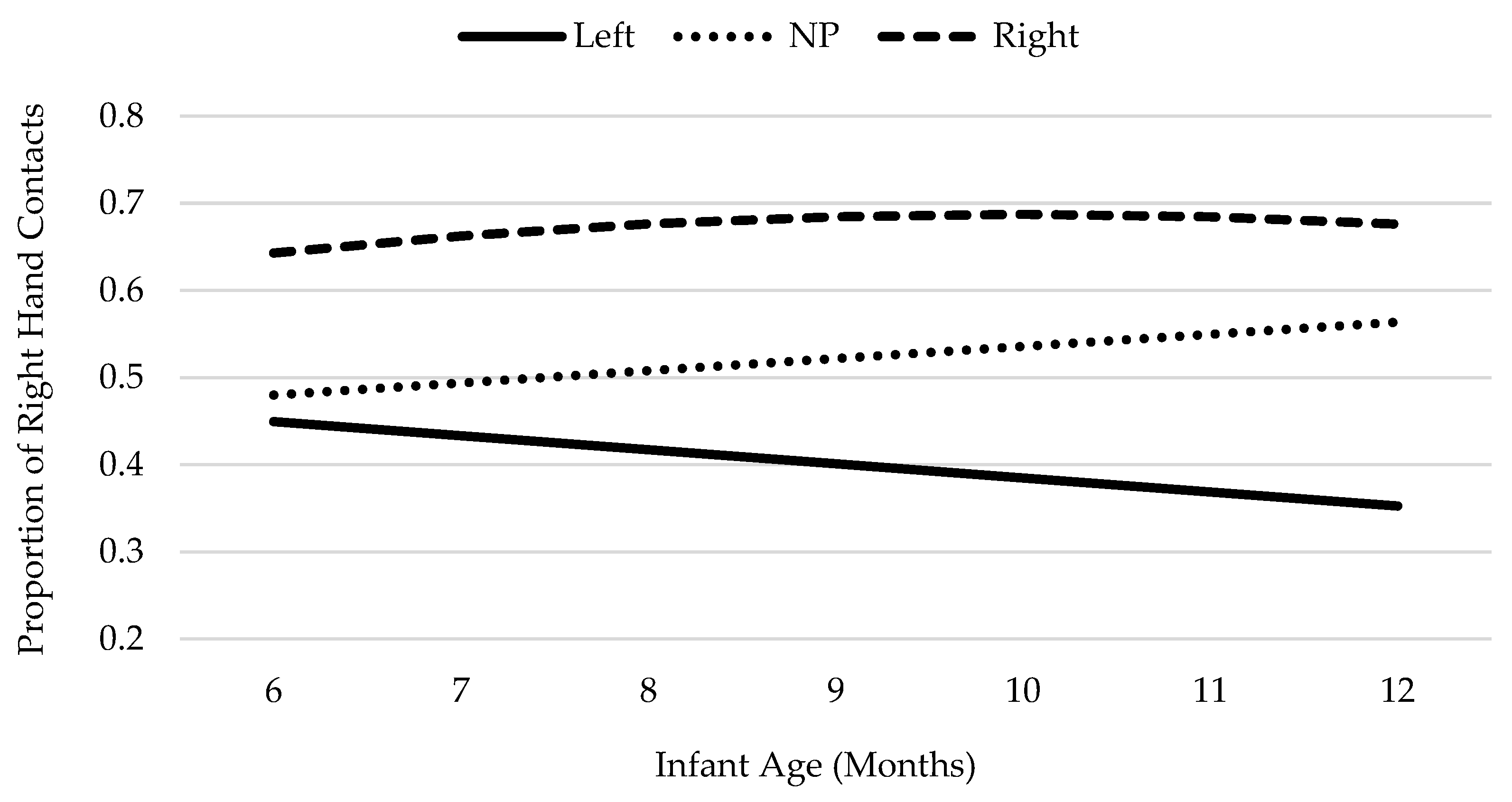
Figure 2.
Probabilities of holding across age by hand preference group. .
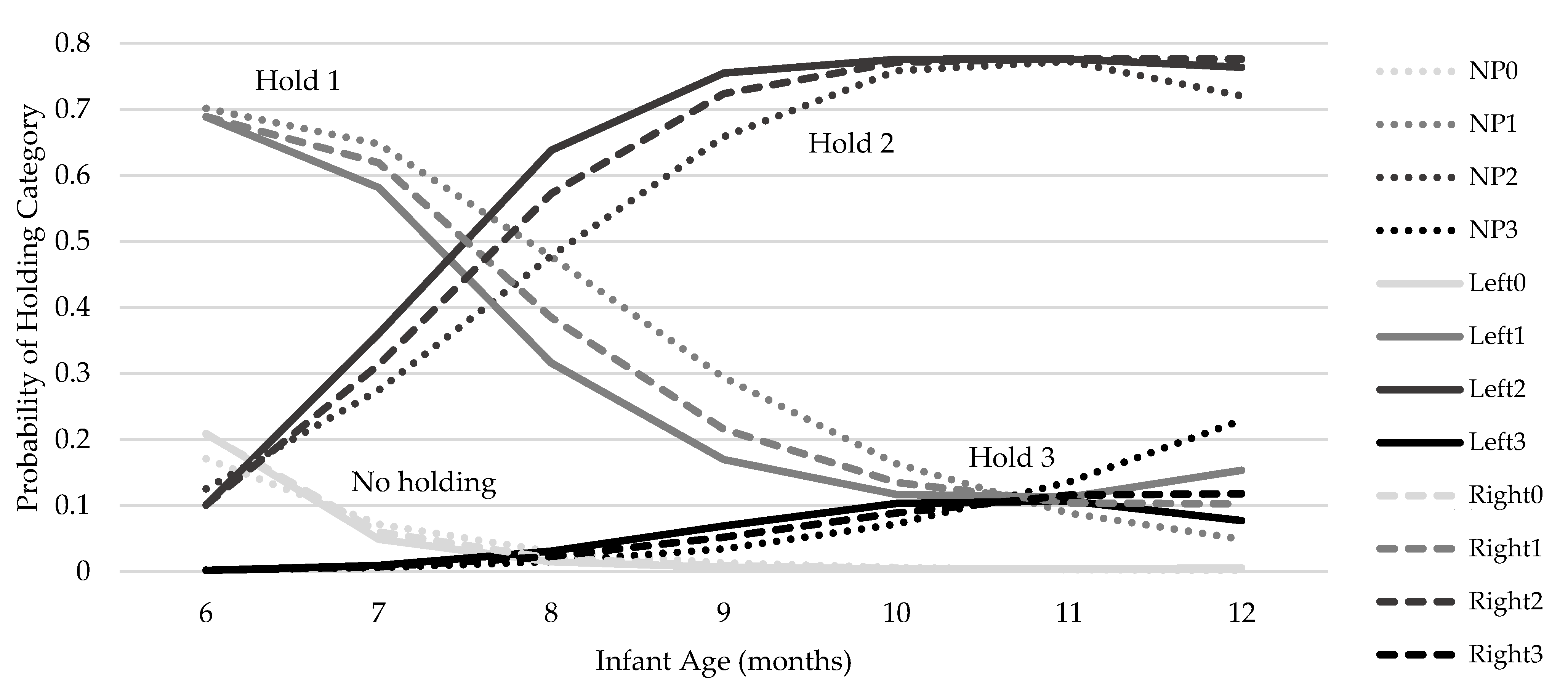

Table 1.
Recategorization of object management skill into holding categories for statistical analyses.
Table 1.
Recategorization of object management skill into holding categories for statistical analyses.
| Holding Category | TINE Score and Description of Rating |
|---|---|
| No holding (0) | 0 – No goal-directed motility of arms and hands 1 – Looked at and played with hands but did not engage with the first object 2 – Touched object presented but did not hold it |
| Hold 1 object (1) | 4 – Held one object with one hand |
| Hold 2 objects (2) | 5 – Held an object in each hand by grasping second object without dropping the first |
| Hold 3 objects (3) | 6 – Held two objects in one hand and acquired a third without dropping one of the others |
Table 2.
Conditional growth model from 6-14 months for holding.
| Conditional Growth | Unconditional Growth | |
| Coefficient | Coefficient | |
| Fixed Effects | ||
| Intercept (γ00) | -1.19** | -1.05** |
| Age (β10) | -1.02** | -1.33** |
| Age2 (β20) | 0.03 | 0.10** |
| Left (β01) | 0.25 | - |
| Left*Age (β11) | -0.82** | - |
| Left*Age2 (β21) | 0.17** | - |
| Right (β02) | 0.24 | - |
| Right*Age (β12) | -0.54** | - |
| Right*Age2 (γ22) | 0.11** | - |
| δ(1) | 2.46** | 2.45** |
| δ(2) | 8.62** | 8.52** |
| Random Effects | ||
| Intercept (r0i) | 0.82** | 0.79** |
* p < .05. ** p < .01.
Disclaimer/Publisher’s Note: The statements, opinions and data contained in all publications are solely those of the individual author(s) and contributor(s) and not of MDPI and/or the editor(s). MDPI and/or the editor(s) disclaim responsibility for any injury to people or property resulting from any ideas, methods, instructions or products referred to in the content. |
© 2024 by the authors. Licensee MDPI, Basel, Switzerland. This article is an open access article distributed under the terms and conditions of the Creative Commons Attribution (CC BY) license (http://creativecommons.org/licenses/by/4.0/).
Copyright: This open access article is published under a Creative Commons CC BY 4.0 license, which permit the free download, distribution, and reuse, provided that the author and preprint are cited in any reuse.


