

Submitted:
30 July 2024
Posted:
30 July 2024
You are already at the latest version
Abstract
The cause of the systematic daily march of barometric pressure in the tropics, notably the late morning and late evening peaks seen almost every day at all locations, was a puzzle that persisted through the nineteenth and much of the twentieth centuries. The efforts to explain the physics of the prominent 12-hour solar tidal variation helped inspire some of the earliest developments in theoretical atmospheric dynamics and ultimately led in the 1960’s to a satisfactory dynamical theory for the atmospheric tides. These important theoretical developments followed the observational discoveries, which date to the late 18th and early 19th centuries, of the surprising character of the barometric daily march and of its resolution into solar and lunar period cycles. These important, if simple, discoveries emerged primarily from the efforts of European scientists to systematically study the environment in remote areas of the globe. The two key figures in initially advancing the scientific community’s understanding of the character of barometric tides were the great German polymath Alexander von Humboldt (1769-1859) and the French naturalist Robert de Lamanon (1752-1787), who each made their discoveries on their most famous and colorful scientific expeditions of their respective careers. This paper examines the history of the early observations of the barometric tide.
Keywords:
atmospheric tides
; barometric oscillations
; history of meteorology
1. Introduction
Atmospheric tides are the large-scale atmospheric response to periodic high-frequency astronomically-modulated forcing. It has been known since antiquity that the ocean tides are connected with the apparent motion of the moon and sun through the heavens as the earth rotates. For the last two centuries scientists have known that the atmosphere also displays tidal oscillations synchronized with the passage of the sun and moon. These atmospheric tides were first observed in barometric data and this paper will discuss the earliest such observations. Today simple surface observations can be supplemented with in situ observations from balloons and rockets, remote sensing observations from satellites as well as ground-based radars and lidars, all leading to a more complete picture of tidal oscillations through the depth of the atmosphere [1,2]. Much of the tidal energy propagates vertically and the tidal oscillations in temperature and horizontal wind high in the atmosphere (where the mean density is very small) are found to be quite large [1]. Indeed the tides are very prominent features of the global scale circulation of the atmosphere above the stratosphere.
The atmospheric tides are generated by the gravitational forces of the sun and the moon as well as by the daily cycle of atmospheric solar heating. At the surface the tidal oscillation of the atmosphere is most easily detected in barometric observations. When such observations are composited by the local solar time or by the local lunar time, three notable tidal pressure signals are apparent: a solar semidiurnal (12 h) harmonic (denoted S2(p)), a solar diurnal (24 h) harmonic (S1(p)) and a lunar semidiurnal harmonic (L2(p)). In the tropics the typical amplitude of S2(p) is somewhat over 1 hPa and S2(p) displays a rather coherent sun-synchronous propagation (so that maximum pressure is typically observed around 10:00 and 22:00 LT, local time). Typical amplitudes of S1(p) and L2(p) are very roughly 1/3 and 1/15 of S2(p), respectively. These simple observations are counter-intuitive in at least two ways. First, the expectation from ocean tides is that the lunar semidiurnal tide is larger than the solar semidiurnal tide, while in the atmosphere the solar semidiurnal barometric oscillation is more than ten times bigger than the lunar semidiurnal oscillation. This might be reasonable if the tidal forcing by periodic solar heating of the atmosphere dominates the gravitational forcing. But that then raises the question of why S2(p) is much stronger than S1(p), given that the 24 h harmonic of solar heating is typically several times larger than the 12 h harmonic [1].
At low latitudes the regularly repeating semidiurnal tide is strong enough, and other meteorological pressure variations small enough, that S2(p) is usually apparent in raw barometric time series. In Figure 1 I show a typical example: a time series of hourly pressures reported at a tropical station over 48 consecutive hours. The dominance of the semidiurnal component seems evident. By contrast with tropical measurements, in midlatitudes the barometric tides are weaker and the other meteorological variations are stronger, and so the tidal variations can generally only be clearly detected when data over extended periods are composited [1].
A discovery process over several decades took place in the 18th and 19th centuries to establish the basic facts about the tidal barometric oscillations in the atmosphere. The standard monograph on atmospheric tides is by Chapman and Lindzen [1]. They begin their introductory historical survey by noting that the famous German naturalist Alexander von Humboldt (1769-1859) observed the prominence of S2(p) in his 1799-1804 travels through tropical South America. Chapman and Lindzen [1] specifically note that in his 1845 book Kosmos [3,4] Humboldt claimed that the occurrence of peak barometric pressures near 10 a.m. and 10 p.m. local time in the tropics meant that a barometer could serve somewhat as a clock. The history of the discovery of the tides in barometric measurements has been addressed more recently by Giles [5]. Giles briefly reviews a handful of studies published in the 1820-1840’s that each presented barometric data showing the presence of the solar semidiurnal tide. Giles also quotes an 1833 survey article by Forbes [6] who acknowledged the central role of Humboldt, but also suggested that there was a more complicated story of discovery. Specifically Forbes wrote that:
“This phenomenon, somewhat indistinctly pointed at by observers in the tropics above a century ago, has within the last 30 years acquired great interest. Baron Humboldt by his observations near the equator gave an impulse to inquiry.”
In the present paper I will examine in more detail the history of the discovery of the barometric tidal oscillation of the atmosphere. The role of Humboldt will be discussed in more detail and the earlier “somewhat indistinct” studies will be reviewed. Notably I will discuss the earlier discovery of a clear S2(p) signal by the French naturalist Robert de Lamanon (1752-1787) in careful observations taken on the famous 1785-88 voyage of Lapérouse through the Atlantic and Pacific Oceans. The story of these early investigations of atmospheric tides features two of the most celebrated, colorful, and (in the case of de Lamonon) tragic, scientific expeditions of the era.
I will also examine the seventeenth and eighteenth century theoretical studies of atmospheric tides that provided the context for the observational investigations. At this time the theory of tides dominated thinking about ocean and atmospheric dynamics, and it is arguable that the efforts to understand atmospheric tides represented the real beginning of the science of dynamical meteorology.
2. The Genesis of the Concept of Atmospheric Tides
The history of meteorology shows that most key aspects of the structure and variability of the atmosphere have been discovered empirically, as the geographical range and technical capabilities of scientific investigation have expanded. The discovery of such fundamental features as the tropopause and stratosphere, the stratopause and mesosphere, baroclinic waves, thermally indirect Eulerian mean meridional circulations, subtropical and polar night jet streams, stratospheric sudden warmings, and the stratospheric quasi-biennial oscillation were all unanticipated by atmospheric scientists at the time. In each case theoretical explanations based on physical principles followed in the years and decades after the initial empirical discoveries.
By contrast, the global atmospheric tides stand out as one case where theoretical insight from a breakthrough in physical understanding led to a prediction of the phenomenon long before the first actual observations. While I will show below that the crucial discoveries were made by Isaac Newton and published in 1687, there is evidence that by 1650 René Descartes (1596-1650) had suggested that there could be a lunar influence on the pressure as measured by barometers.
Specifically in the late 1640’s Descartes was very interested in air pressure and the recently-invented barometer. According to a 1705 account of the life of the English scientist Robert Hooke (1635-1703) [7], Hooke tried to use barometric measurements to see if “the hypothesis of Des Cartes for giving the Reason of the Tides from the pressure of the moon upon the air in its passage by the Meridian, were true or not. At this time I have heard Mr. Hooke say it was observed that the height of the Mercury in the Barometer did not conform itself to the Moon’s motion.” Of course, Descartes had only a pre-Newtonian (and badly mistaken) understanding of the physics of gravitation and the cause of the tides [8], but he still may deserve credit for first articulating the idea that the same mechanism that causes the ocean tides might operate on the atmosphere and that the atmospheric tide might be observable with a barometer. It appears that later Hooke tried to verify this idea with barometric measurements without success—likely the first of many unsuccessful attempts over the next century and a half to identify lunar influence on observed atmospheric pressure.
The first scientist to clearly demonstrate that there should be astronomically forced atmospheric tides is Isaac Newton (1642-1727). In his monumental 1687 treatise Philosphiae Naturalis Principia Mathematica Newton discussed the implications for tides of his great discoveries of the laws of motion and the inverse square law of gravitational attraction. In the third volume of the Principia Newton shows the gravitational force of the moon and sun will produce forces across the rotating earth that produce the familiar tidal ocean currents and surface height displacements. Newton realized that the tidal forces he derived should act on any mass, but he felt that any other effects would as, a practical matter, be undetectable. Quoting from the 1729 Notte translation [9] of the Principia:
“Thus we see that these forces are sufficient to move the sea. But, as far as I can observe, they will not be able to produce any other effect sensible on our earth; for since the weight of one grain in 4000 is not sensible in the nicest balance; […] the sum of the forces of both moon and sun to move the tides […] is 2032890 times less than the force of gravity; it is evident that both forces together are 500 times less than what is required sensibly to increase or diminish the weight of any body in a balance. And, therefore, they will not sensibly move any suspended body; nor will they produce any sensible effect on pendulums, barometers, bodies swimming in stagnant water, or in the like statical experiments. In the atmosphere, indeed, they will excite such a flux and reflux as they do in the sea, but with so small a motion that no sensible wind will be thence produced.“
Newton’s ideas on tides were incomplete. Notably he considered only the component of force along the local vertical direction, while the tides are actually generated by the horizontal components of forces [10]. In the middle of the eighteenth century Daniel Bernoulli (1700-1782) improved on Newton’s discussion of ocean tides and made some numerical estimates of the timing and heights of the expected tides [10].
In 1747 the French mathematician and physicist Jean Le Rond d’Alembert (1717-1783) wrote a remarkable essay “Reflexions sur la cause generale des vents” (Reflections on the general cause of the winds) which was an early attempt to treat atmospheric dynamics within a mathematically sophisticated framework [11]. The science historian J. Morton Briggs [12] states that this essay featured “the first general use of partial differential equations in mathematical physics”. In his essay d’Alembert proposed that the gravitational tidal forcing is a dominant cause for generating winds in general:
“We can therefore regard the action of the sun and moon as the sole cause of the winds, or at least as one of the general causes we are looking for. [...] It follows from this first thought that the moon’s power to agitate the air we breathe, and to change its temperature, may be much greater than philosophers commonly believe. I do not pretend to adopt all common prejudices on this subject; but as the moon’s action on the sea is admittedly far superior to that of the sun, I think we must also admit that the action of this planet on our atmosphere is very considerable, and that it must be included among the causes capable of producing noticeable changes and alterations in the air.” (my translation from the French original).
Newton and d’Alembert came to very different conclusions about the effect of tidal forcing on the atmosphere, with Newton expecting the effects would be negligible and not detectable, and d’Alembert believing that it was the key driver of the wind. d’Alembert’s work was conducted in the absence of actual empirical evidence, but provided incentive for scientists to make measurements that could clarify the nature of tidal oscillations in the atmosphere. I will show below (Section 10) that in 1785 the French Academy of Sciences requested scientists to make hourly barometric observations at low latitudes to detect the “actions of the sun and the moon” on the atmospheric pressure.
3. The Barometer in the Seventeenth and Eighteenth Centuries
The scientific revolution of the seventeenth century was headlined by the discovery of the laws of motion and the law of gravitational attraction. These discoveries then enabled the understanding of the physics of gravitational tides and led to the realization that tides could exist in the atmosphere. This period also saw the invention of the thermometer and barometer which began a new era of atmospheric observations.
The invention of the mercury barometer is generally attributed to the Italian physicist Evangelista Torricelli (1608-1647) in 1643 [13,14]. In 1647 the Frenchman Blaise Pascal (1623-1662) used a Torricelian barometer deployed at different heights along a mountainside to show that the height of the mercury (and hence measured air pressure) decreases with altitude. This raised the possibility of using barometers to measure topographic height. Starting around the 1660’s barometer research and development was taken up by some of the outstanding English scientists who constituted the membership of the newly founded Royal Society of London. Luminaries, including Robert Boyle (1627-1691), Cristopher Wren (1632-1723), Robert Hooke (1635-1703) and later Edmund Halley (1656-1742), would all contribute to the field [14]. These scientists were partly motivated by the growing belief that barometric observations could be used as a guide to forecasting future weather [14].
Hooke even tried to develop the first “marine barometer” that could provide reliable measurements on the moving platform of a ship at sea [15]. Remarkably in 1699-1700 Halley took one of Hooke’s barometers on a voyage to the South Atlantic and claimed that “it never failed to prognosticate and give early notice of all bad weather we had...” [15,16]. It is possible that during his voyage Halley performed the first ever barometric observations near the equator and in the Southern Hemisphere. Unfortunately, Halley’s published paper provides no numerical values for these barometric observations or specifics on the performance of his barometer [16]. The science historian W.E.K. Middleton [14] doubts that Hooke’s marine barometer was very accurate when deployed on a ship.
Around 1668 the Anglo-Irish scientist Robert Boyle invented the “siphon barometer” which was an improvement over earlier designs in terms of portability. Boyle also apparently first originated the term “barometer” [13,14]. The initial experimentation with, and development of, barometers occurred in western Europe, but a desire soon arose to measure the air pressure throughout the world. In 1668 the Royal Society announced an ambitious plan: “The society being put in mind to give order for the making of portable barometers, contrived by Mr. Boyle, to be sent into several parts of the world, the operator was ordered to attend Mr. Boyle, to receive his directions for filling them aright, and that being done, to make some of them forthwith, to be sent not only to the most distant places in England, but likewise by sea into the East and West Indies, and other parts, particularly to the English plantations, as Bermudas, Jamaca, Barbados, Virginia and New England; and to Tangier, Moscow, St. Helena, the Cape of Good Hope, and Scanderoon [i.e., the modern city of Iskenderun in Turkey].” In the end this scheme was not actually conducted by the Royal Society, and Middleton [14] has commented “One wonders how many of these barometers would have survived intact had this grand scheme been carried out.”
Instrument makers in Europe continued making improvements in the robustness and accuracy of mercury barometers through the late seventeenth and the eighteenth centuries. Barometers made their way through the world as individual enthusiasts brought them or shipped them from Europe to foreign locations. The first barometer employed in North America was apparently in 1717 by a physician in Philadelphia who had brought it with him when he moved from England [17]. As I will explain below (Section 8) there is some evidence of barometric observations being taken in 1722 in the then Dutch colony of Surinam in South America (about 5oN).
A notable early deployment of a barometer to low latitudes was by a special French expedition to Gorée Island off the coast of west Africa [18] and to Guadeloupe and Martinique in the Caribbean, all located near 15oN. The expedition was conducted by three men effectively employed by the French Academy of Sciences, Jean Deshayes, Guillaume de Glos and a Mr. Varin [18]. It had as its primary scientific goal to survey the Senegal region of Africa and was part of a grand scheme proposed by the famous astronomer Giovanni Domenico Cassini (1625-1712) to map the world with precise latitudes and longitudes. The scientists also brought a barometer and took measurements of the air pressure while on land, including during their extended stay on Gorée (March-July 1682).
Special attention through the eighteenth century was devoted by some instrument makers to the great challenge of developing more accurate marine barometers [15]. The London instrument maker Edward Nairne (1725-1806) produced what has been regarded by some researchers as the “first successful marine barometer” [19], and the British Royal Navy soon began using Nairne’s barometers. Notably Nairne barometers were used onboard during James Cook’s second (1772-1775) and third (1776-1780) voyages around the world, as well as in many subsequent scientific expeditions [15]. Nairne barometers were also used by the ships of the East India Company [15].
4. Alexander von Humboldt and His American Expedition
As noted in my Introduction, the standard modern monograph on atmospheric tides [1] begins its account of the history of observations of tides with the famous 1845 book Kosmos in which the author, Alexander von Humboldt, states that he had made many barometric observations in the tropics that revealed the extreme regularity the 12-hourly cycle.
As I will show, Humboldt indeed played a central role in establishing the robust nature of the solar semidiurnal barometric oscillation and in publicizing this aspect of atmospheric behavior. Humboldt discusses his work on this in several publications and letters and was clearly proud of his contribution. However, Humboldt did not claim to be the original discoverer of the semidiurnal barometric tide and, as I discuss below in Section 8, he actually made an impressive effort to identify (from both published and unpublished sources) and give credit to relevant efforts by earlier observers.
Below in Section 6 and Section 7 I will provide a more detailed discussion of Humboldt’s work on atmospheric tides and its publication and influence on later work on the subject. Here I will begin with a brief review of Humboldt’s overall contributions to scholarship and the 1799-1804 American expedition that laid the foundation for his brilliant career as a scientist and explorer.
At age 30 Humboldt embarked on a 5 year journey (1799-1804) in the Americas accompanied by the French botanist Aimé Bonpland (1773–1858). During the journey they visited the Canary Islands, Venezuela, Cuba, Mexico, Colombia, Peru, Ecuador and the United States. Humboldt’s writings discussing his observations on the physical, biological and human environments encountered during his expedition would make him a world famous and widely admired figure for the remaining half-century of his life. Humboldt made important contributions to an amazing array of subjects including geography, geology, geomagnetism, meteorology, astronomy, botany and political science. The British author and historian Robin Furneaux [20] judged that Humboldt’s efforts “made him master of all branches of science at the last moment in history when this was possible for a single human being.”
Humboldt and Bonpland sailed from Spain on June 5th 1799. After stopping in the Canary Islands they continued to South America, arriving in Cumaná (eastern Venezuela, 10oN, 64oW) on July 16th, 1799. They remained in Venezuela (the eastern part of what was then the Spanish Viceroyalty of New Grenada) for the next 16 months, travelling extensively in this region from the coastal cities of Cumaná (10oN, 64oW) and Caracas (10oN, 67oW) as far south as San Carlos de Río Negro (2oN, 67oW). Humboldt recorded that during his travels in the interior in 1799 his scientific instruments were carried by three mules. On November 24th, 1800, they sailed to Cuba where they stayed for about three months and then sailed to Cartagena (10oN, 75oW) where they arrived in March 1801; then they travelled overland to Bogotá and explored the Andes as far south as Lima (12oS, 77oW) where they arrived in December 1802. From Lima they sailed to Guayaquil (2oS, 80oW) and then on to Acapulco (17oN, 100oW). The last 16 months of the expedition were spent in Mexico, Cuba and the United States, from where they sailed back to Europe arriving in France on August 1, 1804.
Humboldt’s later account [21] gives some feel for the scale of the expedition as it travelled in remote regions when it would consist of Humboldt, Bonpland and several indigenous guides. Specifically he writes that
“our progress was often retarded by the threefold necessity of dragging after us, during expeditions of five or six months, twelve, fifteen, and sometimes more than twenty loaded mules, exchanging these animals every eight or ten days, and superintending the Indians who were employed in leading so numerous a caravan.”
Throughout his life Humboldt was a prolific correspondent [22] and many of his letters have survived and were published in later collections [23]. For my present purpose it is interesting that Humboldt was able to dispatch some letters to Europe at intervals during his American expedition, aiming to disseminate his findings and including copies of some detailed observations. Of course, such letters were subject to the delays and dangers of trans-Atlantic transport of the period. In fact one of Humboldt’s earliest letters back to Europe, sent to the French astronomer Jean Baptiste Joseph Delambre (1749-1822), was lost in a shipwreck [24].
5. Humboldt’s Publications
After returning to Europe in 1804 Humboldt spent the next two decades writing and arranging for publication of a series of books describing his observations and conclusions resulting from his American travels. These were all written originally in either French or German. In some instances English translations appeared quite quickly, while other books, and parts of books, have only been translated recently or have not been translated at all. The same subjects were treated at different levels of detail in the different books. Humboldt is now probably most famous for his great summation of his observations and ideas as the 5 volume work “Kosmos—Entwurf einder physischen Weltbesschreibung” (translated as “Cosmos—A Sketch of a Physical Description of the Universe”) published between 1845 and 1862 [3,4]. As noted earlier, the first volume of Kosmos includes a clear description of the semidiurnal pressure cycle observed in the tropics [4].
Rivaling Kosmos in fame and influence is another expansive treatise, namely Humboldt’s most detailed accounting of his American expedition: “Relation Historique du Voyage aux Régions Éqinoxiales du Nouveau Continent faits a 1799, 1800, 1801, 1802, 1803 et 1804” [25] which appeared in multiple volumes from 1814 to 1825 (I will refer to this work hereafter as Humboldt’s Relation Historique). As the volumes of the Relation Historique were published, they were translated into English [21] by Helen Maria Williams (1759-1827). Her translation was published as 7 volumes appearing between 1814 and 1829, titled “Personal Narrative of the Travels to the Equinoctial Regions of the New Continent during the years 1799-1804” [21,25]. Charles Darwin famously brought all 7 volumes of Williams translation with him on the 1831-1836 expedition of the Beagle. The Relation Historique includes an extensive discussion of Humboldt’s own observations of the semidiurnal barometric cycle and also includes a remarkable discussion of earlier observations of this phenomenon. The Williams translation of the Relation Historique is the most complete available, even today, but unfortunately omits the main discussion (in the “Notes” of Volume 3) of the barometric observations. Throughout this paper (particularly Section 6 and Section 8 below) I will use my own translation from the French for quotes from this section of the Relation Historique.
Humboldt had a plan to publish a series of specialized volumes covering particular aspects of his observations during his American expedition. The first of these was the 1807 “Essay on the Geography of Plants, together with a Physical Tableau of the Equinoctial Regions, Based on measurements made from the tenth degree of boreal latitude to the tenth degree of Austral latitude in the years 1977, 1800, 1801, 1802, and 1803” (English translation from the French [26]). While this was mainly devoted to botany, the work includes an overview of the expedition and some discussion of the barometric observations.
Another of Humboldt’s specialized works [27,28] appeared in 1808 and tabulated many observations and subsequent calculations concerned with astronomy and surveying during the 1799-1804 expedition. This was titled “Recueil d’Observations Astronomiques, d’Opérations Trigonométriques et de Mesures Barometriques Faites pendent le Cours d’un Voyage aux Régions Équinoxiales du Nouveau Coninent, Depuis 1799 Jusqu’en 1803” (Compendium of Astronomical Observations, Trigonometric Operations, and Barometric Measurements During a Voyage to the Equinoctial Regions of New Continent, from 1799 to 1803) and appeared as two volumes. These volumes featured Humboldt’s observations taken in the field together with subsequent computations by Jabbo Oltmanns (1783-1833), a German astronomer and mathematician who worked for several years as an assistant to Humboldt in Berlin and Paris. The second volume deals with astronomical observations of various sorts, while the first volume is devoted largely to observations of the geographical coordinates and elevations of several hundred locations taken during Humboldt’s expedition. The elevation determinations are based on the hydrostatic principle and are computed from barometric and air temperature observations taken at each location.
6. Humboldt’s Barometric Observations
The first volume of Humboldt’s Relation Historique [21] begins with a “list of the instruments I had collected for my journey from the year 1797, and which, excepting a small number easy to replace, served me till 1804.” Much of the list consists of surveying instruments for observations to enable accurate determinations of geographical coordinates, including telescopes, chronometers, sextants etc. Also on the list are instruments for magnetic observations as well as “two barometers by Ramsden” and “several thermometers by Paul, Ramsden, Megnie and Fortin” among other meteorological instruments. The Ramsden referred to is Jesse Ramsden (1735-1800), a British mathematician and renowned scientific instrument maker who became a Fellow of the Royal Society [29]. Ramsden has been credited with likely introducing Vernier scales on barometers circa 1770 that enabled more precise readings [14]. Humboldt himself [26] stated that the barometers used in his expedition were equipped with Vernier scales “with which one can easily discern 0.03 lines”. Here the barometric mercury column height is given in “lignes” (“lines” in English), a traditional French (and English) unit of length (1 line is about 2.256 mm which amounts to roughly 3 hPa barometric pressure). So Humboldt’s barometers had a precision of at least 0.1 hPa.
Initially, Humboldt’s main interest in making barometric observations was to estimate the topographic altitude using the hydrostatic relation, which requires a measurement (or other estimate) of the ratio of the surface pressure to the surface pressure at sea level. Humboldt soon realized that at the low latitude locations he was surveying there was a complicating effect of a strong dependence of pressure on the hour of the day. He writes [26] that he and Bonpland made “many thousands of observations […] of the barometer’s hourly oscillations”.
A remarkable letter Humboldt sent early on in his expedition provided perhaps the first summary of his barometric observations and his thoughts about the daily cycle. On December 14, 1799, Humboldt wrote a long letter to the famous French astronomer Jérôme de Lalande (1732-1807). This is preserved and was published in the original French in a 1869 collection of Humboldt’s correspondence [23]. Remarkably an English translation of an extended extract of this letter appeared in 1802 in the British scientific journal Philosophical Magazine [24], presumably an indication of the interest in Humboldt’s still ongoing expedition among European scholars. The letter was written in Caracas after a summer and fall of travel and observations in the northeast of Venezuela. Humboldt communicated geographical and magnetic observations as well as his summary of barometric observations. His purpose in writing the letter to Lalande was explicitly to publicize his results in the European scholarly community, writing: “Observations only become useful through communication; I therefore ask you to communicate to our worthy friend Lamétherie those of magnetic inclinations, and to put the others in some public papers, to give notice of my existence; it is impossible for me to write to all my friends.” (“Lamétherie” refers to the French geologist Jean-Claude de Lamétherie, 1743-1817).
Later in the letter Humboldt writes about his barometric observations: “Here in South America, this daily variation is most amazing: I have hundreds of observations on it. There are four atmospheric tides in 24 hours, which depend only on the sun. […] The mercury drops from nine o’clock in the morning until four o’clock in the evening; it goes up from four to eleven o’clock; it descends from eleven o’clock to 4h 30’ in the morning; it goes up from 4:30 a.m. to 9 a.m. Winds, thunderstorms, earthquakes have no influence on this variation.”
In his 1807 Essay on the Geography of Plants.. [26] Humboldt appears to refer to this 1799 letter, writing: “The results of the observations that we made, M. Bonpland and I, on small atmospheric tides, during our stay in Cumana, in Caracas, in the steppes of Calabozo and in the middle of the Orinoco forests, were published in 1800 and 1801 by M. de Lalande, to whom I had communicated them successively. I can flatter myself that this work has contributed much to fix in Europe the attention of physicists to an extremely curious phenomenon, the cause of which is not yet fully recognized.” The implication seems to be that in 1800-1801 Lalande published scholarly articles (that I am unable to locate) that reported on Humboldt’s findings about tides. In any event Humboldt believed that his own extensive observations were key to establishing and publicizing the finding of a dominant solar semidiurnal tide at low latitudes.
Humboldt’s 1807 Essay on the Geography of Plants [26] states that “Among the many thousands observations that we made of the barometer’s hourly oscillations, I cite only one example that can illustrate this […] regularity”. Humboldt then includes a table of hourly observations for a 26 hour period November 8-9, 1802 taken very close to sea level at Callao Peru (12oS, 77oW) which indeed shows a dominant semidiurnal variation.
The 1808 Humboldt book Recueil d’Observations Astronomiques [27] presents an interesting attempt to summarize quantitively Humboldt’s barometric observations. This occurs in a section written by Oltmanns “Sur le calcul des mesures barometriques”, where by “mesures barométriques” he means the barometric determination of topographic height. Since each such determination required an estimate of the barometric pressure at sea level he includes a table titled “État approximatif du barometer sur les bords de l”Océan équinoxial à chaque heure de jour” (“approximate state of the barometer on the shore of the equatorial ocean at each hour of the day”), which is reproduced here as Figure 2 (and which includes logarithms of the values which made them more easily applied in Oltmanns calculations). Oltmanns attributes the calculation of the values in this table to M. Prony “who had kindly arranged to have M. de Humboldt’s barometric observations calculated, and constructed, from these data, a curve by which the variation for each hour of the day could be found”(my translation from the French original). This must refer to Gaspard de Prony (1755-1839), a French mathematician who was renowned for his ambitious numerical calculations obtained with a system of numerous “human computers”. Unfortunately. Oltmanns does not provide details of how the values in the table were arrived at, but the table presumably summarizes Humboldt’s many observations taken near sea level along the coasts of the low latitude ocean (possibly including his measurements along both the Atlantic/Caribbean and the Pacific coasts). It is a testament to the dominance and regularity of the solar tidal variation of surface pressure at low altitudes that Oltmanns felt a need to include the hourly dependence in the reference sea level pressures he employed rather than, say, seasonal or latitudinal dependences.
The hourly values in Figure 2 show a clear semidiurnal variation in the height of the mercury column with minimum of 337.60 lines (1015.2 hPa) at 4 am, maximum of 338.30 lines (1017.3 hPa) at 9 am, minimum 337.40 lines (1014.7 hPa) at 4 pm and maximum at 337.91 lines (1016.1 hPa) at 11 pm.
Humboldt presents his most detailed discussion of the tidal barometric variation in his Relation Historique. His “Livre IX” (book 9) in volume 3 (published in 1825) concludes with a very extensive “Notes” comprising discussions of several separate topics and including a 43 page section titled “Observations Faites pour Constater la Marche des Variations Horaires du Baromètre sous les Tropiques, depuis le Niveau de la Mer jusque sur le Dos de la Cordillière des Andes” (Observations made to observe the progress of the hourly variations of the barometer in the tropics, from sea level to the spine of the Andes). This section unfortunately was not translated by Williams (or apparently by any later translator) and so the discussion here relies on my own translation from the French original.
Humboldt lays out his interest in the tidal oscillations in the first paragraph and makes it clear that he will discuss not only his own measurements, but also other relevant observations taken both prior to, and after, his expedition:
“The regularity of the hourly variations of the barometer, in the warm tropics, had been glimpsed since the beginning of the eighteenth century, and the questions which the Academy of Sciences addressed to la Pérouse tended to disentangle the part which the attraction of the moon could have had in these periodic changes. de Lamanon and Mongès made, in 1785, in the Atlantic Ocean, between 1°5′N. and 1° 34′S., for three days and three nights, hour by hour, a series of very valuable observations over a period during which the temperature changed, from night to day, by less than 1 degree Réaumur [=1.25 degrees C]: but it remained to demonstrate the uniformity of this march of the barometer in the interior of the Continents, for periods of variable weather, and at various heights above sea level. La Guayra, from Peru, the coasts of Africa, and the island of Taïti; those of Mysore (400 toises [=780 m]); from the Caracas Valley (480 toises [=936 m]); Ibagué, in New Grenada, at the foot of the Quindiu Andes (703 toises [=1370 m]); Popayan (911 toises [=175 m]), Mexico City (1,168 toises [=2276 m]), and Quito (1,492 toises [=2908 m]). All these observations are novel, with the exception of those of Captain Sabine which I borrowed from the interesting Meteorology of M. Daniell.” Here the reference to the “interesting Meteorology of M. Daniell” is to a collection of essays published by the English scientist John Frederick Daniell in 1823 [30](see Section 7 below).
Humboldt here briefly lists the evidence for the “regularity of the hourly [tidal] variations of the barometer” as observed over a wide range of tropical locations. He notes that the tidal variations “had been glimpsed” (“avoit été entrevue”) even early in the eighteenth century, referring to various reports that he was aware of that he presumably judged lacked full scientific credibility. He then calls out as “very valuable” (“très précieuses”) observations made by de Lamanon in 1785 over three days in the middle of the Atlantic Ocean that he seems to regard as key to the definitive scientific discovery of the solar barometric tide. I will discuss the work of de Lamanon in much more detail in Section 8 and Section 9 below. Humboldt then lists a series of places where the presence of regular tides have been confirmed, starting with locations near sea level and then at higher elevation.
Looking back from a quarter century later in his Relation Historique, Humboldt summarized his study of the semidiurnal tide:
“I began the series of my observations on the variations of the weight of the atmosphere, jointly with M. Bonpland, on July 18, 1799, two days after our arrival at Cumana, and I continued them for five years with the greatest care, from 12° southern latitude to 23° northern latitude, in the plains and on plateaus whose height equals that of the Pic de Ténériffe”, and:
“Today, the periodic regularity of these tides can be considered as one of the best and most universally observed physical phenomena; it has been recognized both in the vast expanse of the ocean and in the interior of the land, in the plains and at a height of 2000 toises[=3900 m], between the tropics and in the temperate zones of the two hemispheres.”
Humboldt also notes that:
“Since the time of my trip to the equator, this phenomenon has occupied almost all travelers and physicists equipped with instruments capable of making precise observations.”
7. The Influence of Humboldt’s Published Results on the Field of Atmospheric Tides
As shown in the previous section, in his widely read books Humboldt discussed his extensive barometric observations that showed a robust tropical S2(p) signal. Humboldt clearly felt that his work had been key to introducing the atmospheric tidal phenomenon to the scientific community. In fact his influence on the field over subsequent decades was substantial, and in this section I will provide some relevant documentation of this influence. Specifically I will briefly introduce three major reviews of the scientific progress in the field of meteorology, published in Britain in 1823, 1833 and 1879, that demonstrate both a continued lively scientific interest in atmospheric tides and the central importance of Humboldt’s pioneering work.
First I will consider the volume Meteorological Essays and Observations [30] published in 1823 and written primarily by English scientist John Frederick Daniell (1790-1845), but including contributions from other scientists. Daniell was a distinguished chemist who in 1831 became the inaugural professor of chemistry at King’s College, London. He invented the “Daniell Cell” which represented a major advance in electric battery technology. He also had interests in meteorology as evidenced by his published books including the 1823 Essays, which spanned 464 pages and covered a variety of weather and climate related subjects.
One chapter of the Essays is devoted to “The horary oscillations of the barometer” (meaning the oscillations occurring with the passage of the hours through the day). After a brief reference to even earlier studies, Daniell writes:
“The observations of M. de Humboldt, of a later date, confirm the existence of these semi-diurnal variations in the torrid zone, and extend them to the south of the equator. According to his results, the barometer generally falls from ten o’clock a.m. till four p.m.; then rises again till ten p.m. — again drops till four a.m., and mounts till ten a.m.”
The next reference of interest is in a report of the first and second meetings of the British Association for the Advancement of Science (founded in 1831; now known as the British Science Association). The meetings were held in 1831 and 1832 and this overall report appeared as an extensive volume in 1833. The meeting report includes lengthy reviews of the then current state of different fields of science. The Scottish scientist James David Forbes wrote a 63 page long section: “Report upon the recent and present state of meteorology”[6]. Forbes (1809-1868) was a physicist and something of a prodigy who became a fellow of the Royal Society of London at the age of 24 [31]. In his long career he would research various fields including atmospheric science and seismology, but made his greatest mark in glaciology—where he is credited with inventing the now generally-accepted plastic theory of glacier motion.
Forbes’ 1833 report on the current state of meteorology included a long discussion of atmospheric tides and includes an acknowledgment of the pioneering work of von Humboldt:
“The variations of pressure may be considered as periodical and accidental. Of the periodical variations, that which first demands our attention is the horary oscillation. This phenomenon, somewhat indistinctly pointed at by observers in the tropics above a century ago, has within the last thirty years acquired great interest. Baron Humboldt by his observations near the equator gave an impulse to inquiry, and the observations have been pursued with assiduity and success throughout a great range of latitude. The general fact that the barometer attains a maximum in the tropics at 9 a.m. and p.m., and a minimum at 3 or 4 a.m. and p.m., it must be hardly necessary to recall“.
A final reference to consider is the published version of a series of six lectures delivered in London in 1878 under the auspices of the Meteorological Society (which in 1883 was renamed the Royal Meteorological Society). The lectures were meant to provide a summary of the state of contemporary meteorological science and were presented by six different experts. The third lecture was titled “The barometer and its uses” and was given by Richard Strachan (1835-1924) [32]. Strachan was then a fellow of the Meteorological Society and an expert on meteorological instruments. He would have a very long career in the British Met Office starting in the year after its 1854 founding. [33]
Strachan’s published lecture includes a discussion of the observed tidal influence on barometric measurements. His only reference to the early history of the subject is to von Humboldt, specifically:
“As regards the diurnal range, [the barometer] exhibits generally two maxima and minima, is greatest in amplitude in tropical countries. […] In tropical and temperate regions the times of maxima and minima are, roughly speaking, 9 a.m. and p.m. and 3 a.m. and p.m. In the tropics the phenomena of the barometric range are so constant that Humboldt remarked that the time of day might be inferred from them within seventeen minutes”.
8. Eighteenth Century Observations of the Daily Barometric Variation
Clearly Humboldt’s pioneering efforts in observing atmospheric tides had great influence in subsequent years. However, he did not claim to be the original discoverer of the semidiurnal barometric tide. In fact, Humboldt’s Relation Historique [21] includes a discussion of earlier efforts to observe the daily march of air pressure in the tropics.
Humboldt’s discussion makes clear that the earlier efforts had important limitations and, in some cases, the previous investigators came to misleading conclusions. Humboldt wrote that:
“There are hourly variations of the barometer as well as a large number of other important phenomena which, in the history of physical discoveries, are at first, say, vaguely perceived …[and]… published by isolated observers. These phenomena would remain in oblivion, if the savants or the academies which have a great influence on the progress of sciences, did not make them the object of their research.”
Humboldt describes the very early barometric observations in the late seventeenth century expedition to Gorée that I discussed in Section 3 above. Humboldt writes:
“In 1682, MM. Varin, des Hayes and de Glos observed, on an expedition trip made by order of the King […] that in Gorée [island off the coast of Africa near 15oN], the barometer is generally lower when the thermometer is the higher, and generally higher at night by 2 to 4 lines than during the day”. So apparently these observers identified only a diurnal and not the prominent semidiurnal variation of pressure.
Humboldt goes on to note a later, and more successful, observational study:
“It was in 1722 that this phenomenon of hourly variations was observed for the first time, and quite completely, in the day and night tides, by a Dutch physicist whose name has not come down to us.” Humboldt then quotes the Hague Literary Journal from this time: “The mercury rises, in this part of Dutch Guiana [also known as Surinam], every day regularly from 9 a.m. until about 11 a.m.; after which it descends until around 2 or 3 o’clock in the evening, and then it returns to its first height. It makes roughly the same variations at the same hours of the night; the variation is only about 1/2 line or 3/4 line, at most one whole line. We want European philosophers to make their conjectures on this.” These observations would have been taken in the vicinity of 5oN.
In 1719 the Jesuit Catholic Priest Claude Boudier (1686-1757) came as a missionary to to the French colony of Chandernagore (23oN, 88.5oE) in northern India and where he was to spend the next 3 decades [34]. Boudier was also an astronomer and made notable measurements during a total solar eclipse in 1734 [34]. Humboldt somehow had access to Boudier’s unpublished journal with meteorological observations and writes:
“From 1740 until 1750, Father Boudier had observed the barometer at Chandernagore, in India. [Boudier] notes, in the handwritten journal kept among M. de l’Isle’s papers, that ‘the greatest rise in mercury takes place every day around nine or ten in the morning, and the least rise around three or four hours in the evening, and that, for the great number of years that the barometer has been in place in Chandernagor, there have not been 8 or 10 days when this uniform march of mercury has not been observed.’” Again it seems this observer missed identifying the prominent semidiurnal barometric variation. Humboldt goes on to note: “However Chandernagor is located almost at the [northern] edge of the equatorial region.”
The French government and the Academy of Sciences dispatched an expedition from France to survey the equatorial regions in South America for the purpose of establishing the deviation of the shape of the earth from spherical, and specifically to confirm Newton’s prediction that the earth should be flattened in the polar direction [35]. The expedition was led by French astronomers Louis Godin (1704-1760), Charles-Marie de La Condamine (1701-1774), and Pierre Bouguer (1698-1758) who left France in 1735 and arrived in Quito in June 1736. Humboldt notes that the scientists involved in the expedition also made some barometric measurements relevant to the study of tides:
“The academicians sent to Quito in 1735 had no knowledge of the observations made earlier in Suriname on the atmospheric tides […] Bouguer and de la Condamine attribute [their own] discovery of this regularity [of barometric pressure] to one of their collaborators, Mr. Godin.” Humboldt then quotes the writing of de La Condamine: “I also made, in this year of 1741, a few observations with a barometer, first with M. Godin, and then alone, to confirm the remark of M. Godin who first saw of several daily and periodic variations. I found that, around nine in the morning, the barometer was at its greatest height, and around three in the afternoon at the least: the average difference was (in Quito) 1¼ lines.”
Humboldt also discusses an ambitious, but unpublished, observational program by the famous Spanish naturalist, José Celestino Mutis (1732-1808). Mutis was born in Spain where he completed medical training and served from 1757-1760 as a professor of anatomy. In 1761 he settled at Sante Fe de Bogatá in South America (now known as Bogatá; 5oN). With royal patronage he engaged in harvesting an extensive collection of botanical samples from an extended area of South America. Although his impact was somewhat diminished by rather limited publication of his results during his lifetime, Mutis is sufficiently celebrated in the field of botany that his portrait was featured on both Spanish and Colombian banknotes in the late twentieth century.
Humboldt travelled to Bogatá and visited Mutis in 1801, and he greatly admired the older naturalist. Humboldt was able to view the records of 40 years of meteorological observations that Mutis had taken, but never publicized. In his discussion of atmospheric tides in the Relation Historique Humboldt writes:
“Since the year 1761, Doctor Mutis […] observed, with the greatest assiduity and for forty successive years, at Santa Fe de Bogota, the atmospheric tides. Above all, he fixed precisely the epoch of the minimum preceding sunrise. Unfortunately this large mass of observations, which their author concealed too carefully during his life, was not published even after his death.”
Humboldt also mentions the work of a “Dr. Balfour” in Calcutta (now Kolkata, 22.5oN) in northern India. Balfour was interested in the effects of the moon on human disease and Humboldt notes that he “had the patience to observe the barometer in Calcutta, during an entire lunation (in 1794), every half hour.” This is a reference to the work of Francis Balfour (1744-1818) a Scottish physician who served in India for several decades as a medical officer of the British East India company. His observations were published in 1798 in the Proceedings of the Royal Society of Edinburgh [36]. Quoting Balfour’s paper: “The result was the discovery of a periodical variation in the barometer, consisting of two oscillations, which it performs regularly every 24 hours.”
As noted above (Section 6), in his discussion of earlier observations, Humboldt seemed to particularly esteem the work of de Lamanon in 1785 and his “very valuable” data. The following two sections are devoted to a more detailed discussion of de Lamanon’s work, first with background on the important scientific expedition that provided de Lamanon with his opportunity to make his observations (Section 9), and then a report on his key barometric observations (Section 10).
9. Robert de Lamanon and Lapérouse’s 1785-1788 Voyage of Scientific Discovery
Historians recognize the first great European “age of discovery” as extending from the fifteenth to the early seventeenth century [37] highlighted by the first and second circumnavigations of the globe by Magellen and Drake, respectively. But as one historian has said “By the middle of the 18th century the Europeans were on the move again” [38]. This second age of discovery notably featured humanity’s third, fourth and fifth global circumnavigations on James Cook’s three voyages (1768-1771; 1772-1775, 1776-1780), and continued for another century with other major voyages sponsored by European powers. In contrast to the first age of exploration, the voyages of the second age featured major efforts to scientifically explore and document the natural environment. Indeed Cook’s first voyage had as a principal purpose the observation of the April 1769 transit of Venus, and his crew included the famous naturalist Joseph Banks. On Cook’s second and third voyages shipboard measurements of atmospheric pressure and temperature were taken once a day near local noon [15] and the observed values over the several years were later published [39]. Another feature of the second age of exploration was the involvement of national scientific academies in supporting and planning the expeditions, notably including the Royal Society of London’s support of Cook’s voyages.
Inspired by the success of Cook’s voyages, the French government, including King Louis XVI personally, became interested in an ambitious French voyage to explore the Pacific Ocean. The French naval captain Le comte de Lapérouse (1741-1788) was appointed commander of the expedition which would employ two naval frigates (named La Boussole and L’Astrolobe). The expedition was to expand on Cook’s discoveries and map the Pacific region more fully. It also aimed to scientifically explore the natural world and the crew included 10 scientists including the naturalist Robert de Lamanon.
de Lamanon was 32 years old when the expedition began in 1785 and he had already spent several years as a successful naturalist with wide interests. In 1782 he published an important paper on fossils found near Paris [40] that is still referred to in modern geology textbooks, and also another paper that discussed meteorological observations, including a method for making temperature correction to barometric observations [41]. A story repeated in nineteenth century editions of Encyclopedia Britannica emphasizes de Lamanon’s intense interest in meteorology. Specifically, once during a stormy crossing of the English Channel, he had himself secured by ropes in the crows nest of the ship’s main mast so that he could experience the full effect of the weather.
In 1785 (August 1st) Lapérouse and his crew sailed from Brest and headed south. across the equator and passing into the South Atlantic on September 29. The voyage continued around Cape Horn into the Pacific where the ships visited Easter Island, then the Sandwich Islands (i.e., Hawaiian Islands), the west coast of North America up to Alaska, and then to Manilla, on to East Asia, passing along the coasts of Korea and Japan, and on to Sakhalin Island (the water separating Sakahlin Island from the north coast of Hokkaido in Japan is now known as the Lapérouse Strait). Sailing further north, Lapérouse reached the Russian port of Petropavlovsk on the Kamchatka Peninsula on September 7, 1787. Importantly he made the decision to send one of his crew, Barthélemy de Lessups, overland back to France carrying the log books and other written reports of his expedition up to that point. After a difficult trip de Lessups was able to deliver his material to the French ambassador in St. Petersburg almost a year later, and this material was the basis for the published account of the expedition that would later appear [42,43]. The expedition then sailed to the South Pacific and landed on the island of Tutuila in Samoa where, tragically, an attack by the local population led to the death of 12 crew members, including de Lamanon on December 11, 1787. The expedition continued on to the newly established British colony at Botany Bay in Australia. Here the crew engaged in conversations with the British and were able to send letters back to Europe on another ship. The Lapérouse expedition sailed away from Australia on March 10, 1788 and was never seen again.
The publication of the results from the expedition was slowed by the disappearance of the crew and then the onset of the French Revolution. However, the publication of a report was eventually mandated by the revolutionary National Assembly and it appeared in 4 volumes in 1798. An official English translation [43] was also soon available, and I use this for my quotes from the report below.
10. De Lamanon’s Observation of the Semidiurnal Barometric Tide
de Lamanon composed a complete report on his discovery of a semidiurnal variation of barometric pressures in shipboard observations in late September/early October 1785. The manuscript was carried by de Lessups back to Europe, and de Lamanon’s report appears as a distinct section in the overall report of the voyage (“Memoir and table of observations made during the run from the first degree of north latitude to the first degree of south latitude, for the purpose-of discovering the flux and reflux of the atmosphere, by M. de Lamanon”, pages 434-442 of the third volume in the English translation [43]).
de Lamanon starts with an excerpt from the instructions given to the expedition by the French Academy of Sciences:
“The academy also invites the navigators to keep an exact register of the height of the barometer, in the vicinity of the equator, at different hours of the day; with a view to the discovery, if possible, of the quantity of the variation of this instrument, owing to the influence of the sun and of the moon; this variation being there at its maximum, while variations owing to ordinary causes are at their minimum. It is unnecessary to remark that the observations should be made on shore, and with the greatest precaution.”
It is interesting that the members of the Academy expected the largest tidal response at low latitudes and were also aware that the random weather noise in barometric time series is smallest at low latitudes.
On the recommendation of the renowned chemist Lavoisier, de Lamanon arranged for an “excellent barometer” to be constructed by noted French instrument maker Jean Fortin (1750-1831). However, de Lamanon also wanted a marine barometer and he relates:
“It was supposed [following the Academy’s instructions] I should make use of the [Fortin] instrument… [only]…on shore, but after having procured at Brest a marine barometer made by Nairne, and described in the voyage of the celebrated Cook, I found it was perfectly calculated for making exact observations even at sea. However great may have been the rolling of the vessel, the mercury has hitherto remained immoveable, owing to the excellent suspension of the barometer, and to the capillary tube, which is fitted to the common tube; and by the help of the nonius, which is added to it, variations so small as one tenth of a line [i.e., 0.22 mm or about 0.3 hPa] may be readily perceived.”
The path of the first leg of the Lapérouse expedition southward through the Atlantic is shown in Figure 3. During the voyage de Lamanon conducted a regular schedule of barometric measurements:
“By observing the barometer daily at sunrise, noon and sunset, I remarked that from 11o2′N to 1o17′N, its movement was extremely regular. It was always at its maximum of elevation at about noon, when it descended till evening, and rose during the night.”
When he was just beyond a degree of latitude from the equator, de Lamanon instituted a regime of hourly measurements around-the-clock:
“…on the 28th, before day break, I began a series of observations […] and I continued them every hour till six o’clock in the morning of the 1st of October, that is for a period of upwards of three days and three nights. During the six hours I devoted to sleep, M. Mongès was so good as to supply my place. I thought it necessary at the same time to observe the thermometer in the open air, as well as that attached to the barometer.”
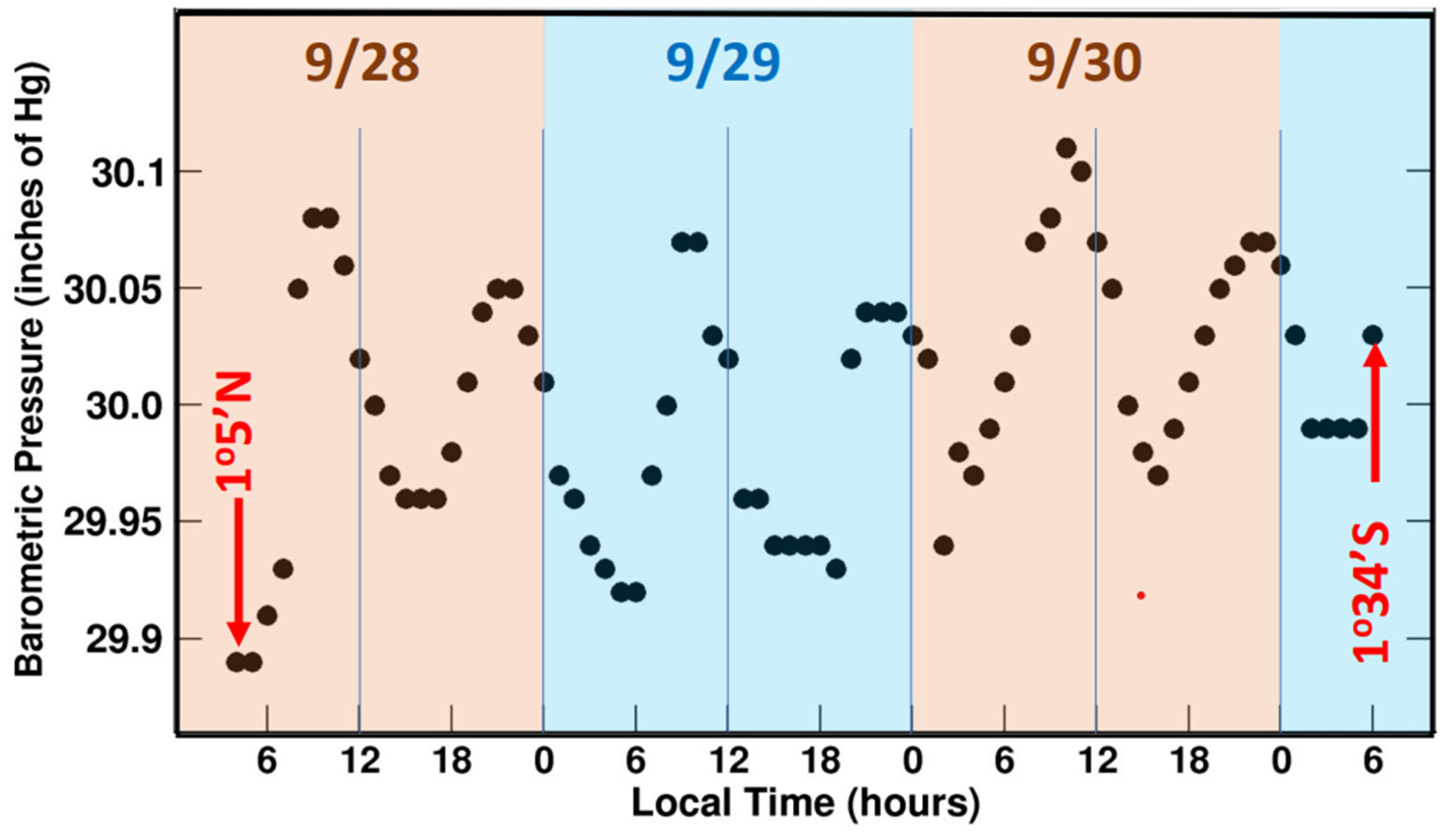
In his report [42,43] de Lamonon presents a table of the hourly values over this intensive observation period during which the ship sailed from 1o5′N across the equator to 1o34′S. Figure 4 is my plot of de Lamanon’s hourly barometric measurements.
de Lamanon identified the key features revealed in his observations and grasped the implications of his discovery:
“The results of these observations appear to me to be extremely curious. The barometer gradually ascended for six hours, and then descended during the next six; and continued thus alternately rising and falling…. The flux and reflux of the air at the equator is accordingly so great, as to cause a variation in the barometer of about 1.2 lines [~2.6 mm or 3 hPa]”. He noted that this corresponds to a roughly 100 foot (~30 m) vertical displacement in the atmosphere:
“..which supposes a rise and fall of the atmosphere of about a hundred feet..”
And then de Lamanon notes that this contrasts strongly with an estimate he had from Bernoulli of the theoretically expected gravitational ocean tide (summing the lunar and solar contributions) of about 7 feet:
“..while the combined [gravitational] action of the sun and moon, according to M. Bernoulli, causes an elevation in the sea of only seven feet.”
de Lamanon recognized that the great discrepancy between his observations and the theoretical expectations based on Bernoulli’s gravitational tidal theory was a problem to be resolved:
“I must leave it, however, to more able philosophers than myself to determine, whether or not this be agreeable to theory and calculation”.
de Lamanon noted the synchronization of observed pressure peaks with local (solar) time and concluded that “It is evident from the observations, that meteorologists allow far too much to the action of the moon…” He clearly grasped that the prominent two peaks per day in observed air pressure had almost nothing to do with the lunar tidal cycle that is so prominent in the ocean. Indeed from that perspective it is not surprising that de Lamanon characterized his own observations as “extremely curious”.
I noted earlier that Humboldt [27] had singled out the importance of de Lamanon’s observations among the several other eighteenth century efforts that he knew about. Some key factors distinguishing de Lamanon’s study are (i) the detailed published description of the observations that apparently were taken with care; (ii) observations taken on the open ocean far away from local influences of topography and land-sea contrast; and (iii) measurements taken by a distinguished naturalist who placed his results in the context of the contemporary expectations of gravitational tidal theory. It is probably meaningless to identify a single “discoverer” of the solar semidiurnal atmospheric tide, but de Lamanon’s work stands at the beginning of the serious scientific documentation of this remarkable phenomenon.
11. Conclusion
As noted in Section 1 above, the standard modern monograph on atmospheric tides [1] begins its discussion of the history of the field with the conclusions of Alexander von Humboldt, which were based on his own extensive barometric observations in tropical America at the turn of the nineteenth century. In the present paper I have examined the early history of the study of atmospheric tides in much more detail and I conclude that indeed Humboldt deserves credit for being the most influential pioneer. However, there is a richer history of relevant observations and theoretical speculation extending back to the middle of the seventeenth century. Of particular value in establishing the basic nature of the atmospheric tide were the 1785 observations of de Lamanon during the epic, and tragic, voyage of Lapérouse.
With the publication of Humboldt’s work at the beginning of the nineteenth century the basic features of the solar barometric tide near the equator were clearly established. This provided the base for further research during the remainder of the nineteenth century that expanded knowledge and understanding of the atmospheric tidal phenomenon. Notably the solar tidal signal at various locations outside the tropics would be reliably determined by compositing results from long records of hourly barometric observations [5]. Reliable determinations of the much smaller lunar semidiurnal tide in barometric observations would be published, starting with the 1847 paper [44] of Irish scientist Edward Sabine (1788-1883). In 1880 [45] the great Anglo-Irish physicist William Thomson (later Lord Kelvin; 1824-1907) turned his attention to the phenomenon of atmospheric tides. He attempted to explain the surprisingly large amplitude of the solar semidiurnal tide by hypothesizing that the global atmosphere naturally resonated with a period close to 12 hours [45]. This ultimately turned out to be incorrect, but Thomson’s suggestion would provide the motivation for important advances in understanding the dynamics of the atmosphere over the following century [1].
Funding
This research received no external funding
Conflicts of Interest
The author declares no conflicts of interest.
References
- Chapman, S.; Lindzen, R.S.; Atmospheric Tides; Publisher: Riedel, New York, USA, 1970; 200 pp.
- Sakazaki, T.; Fujiwara, M.; Shiotani, M.; Representation of solar tides in the stratosphere and lower mesosphere in state-of-the-art reanalyses and in satellite observations. Atmos. Chem. Phys., 2018, 18, 1437–1456. [CrossRef]
- von Humboldt, A. Kosmos: Entwurf einer physischen Weltbeschreibung; Publisher: J.G. Cotta, Stuttgart, Germany, 1845; 493 pp.
- von Humboldt, A. Cosmos: A Sketch of a Physical Description of the Universe. Translated under the supervision of Edward Sabine, Third Edition, volume 1; Publisher: Longman, Brown, Green and Longmans, London, United Kingdom, 1864; 369 pp.
- Giles, B., The atmospheric tide: an historical perspective. Weather, 2012, 67, 51-53. [CrossRef]
- Forbes, J.D.; Report upon the recent and present state of meteorology, in Report of the First and Second Meetings of the British Association for the Advancement of Science. Publisher: Murray, London, United Kingdom, 1833, pp 196–258.
- Waller, R.; The life of Dr. Robert Hooke. in The Posthumous Works of Robert Hooke; R, Waller, Ed.,Publisher: Smith and Walford, London, United Kingdom, 1705; pp. 1-28.
- Cartwright, D.E.; Tides: A scientific History. Cambridge University Press, London, United Kingdom, 1999; 292 pp.
- Newton, I.; Newton’s Principia: The Mathematical Principles of Natural Philosophy. Translated by A. Motte, First American Edition; Publisher Daniel Adee, New York, USA, 1846, 575 pp.
- Aiton, E.J.; The contributions of Newton, Bernoulli and Euler to the theory of tides. Annals of Science, 1955, 11, 206-223. [CrossRef]
- d’Alambert, J.L.R.; Reflexions sur la Cause Generale des Vents; Publisher: David Painé, Paris, France, 1747; 194 pp.
- Briggs, J.M.; Jean Le Rond d’Alembert. in Complete Dictionary of Scientific Biography. Publisher: Charles Scribner’s Sons, New York. USA, 2008.
- Middleton, W.E.K.; A brief history of the barometer. J. Royal Astronom. Soc. Canada, 1944, 38, 41-64.
- Middleton, W.E.K.; The History of the Barometer. Publisher: Johns Hopkins Press, Baltimore, 1964; 489 pp.
- McConnel, A.; Origins of the marine barometer, Annals of Science, 2005, 62, 83-101. [CrossRef]
- Halley, E.; An account of Dr. Robert Hooke’s invention of the marine barometer, with its description and uses. Phil. Trans. Royal Soc., 1701, 22, 791-794.
- Ludlum, D. M.; Early American Winters 1604-1820. Publisher: American Meteorological Society, Boston, USA, 1966; 285 pp.
- Dew, N.; Scientific travel in the Atlantic world: The French expedition to Gorée and the Antilles. 1681-1683. Brit. J. Hist. Sci., 2010, 43, 1-17.
- Obregón, M.A.; Rodas, M.T.; Farrona, A.M.M.; Doninguez-Castro, F.; On the value of early marine weather observations: The Malaspina expedition (1789-94), Bull. Amer. Meteorol. Soc., 2022, 103, E1684-E1695. [CrossRef]
- Furneaux, R., 1969: The Amazon: the Story of a Great River. Publisher: Putnam, New York, USA, 1969; 258 pp.
- von Humboldt, A., Bonpland, A.; Personal Narrative of Travel to the Equinoctial Regions of the New Continent During the Years 1799-1804, translated by Helen Maria Williams, volume 1, 3rd ed.; Publisher: Longman, Hurst, Rees, Orme and Brown, London, United Kingdom, 1822; 293 pp.
- Jiménez Ángel, A.; Transatlantic correspondence and ‘mobile knowledge’ in Alexander von Humboldt’s exploratory travels to Hispanic America. History of European Ideas, 2012; 38, 426–439.
- de la Roquette, M.; Oevres d’Alexander de Humboldt, Correspondance Inedite Scientifique et Littéraire, Premier Partie. Publisher: L. Guerin et Cie, Paris, France, 1869, 461 pp. [CrossRef]
- von Humboldt, A.; Extract of a letter from M. Von Humboldt to Lalande. Phil. Mag. Series 1, 1802, 11, 355-361.
- Von Humboldt, A.; Observations faites pour constater la marche des variations horaires du baromètre sous les tropiques. in Relation Historique du Voyage aux Régions Equinoxiales du Nouveau Continent. Volume 3, Publisher: Smith et Gide, Paris., 1825, pp. 270-313.
- von Humboldt, A.; Bonpland A.; Essay on the Geography of Plants. Translated from the French original by S. Romanowski, Publisher: University of Chicago Press, Chicago, USA, 2009. 274 pp.
- von Humboldt, A.; Recueil d’Observations Astronomiques, d’Opérations Triqonométriques et de Mesures Barometriques. Volume 1, Publisher: F. Schoell, Paris, France, 1808, 582 pp.
- von Humboldt, A.; Recueil d’Observations Astronomiques, d’Opérations Triqonométriques et de Mesures Barometriques. Volume 2., Publisher: F. Schoell, Paris, France, 1808, 619 pp.
- Chapman, A.; Jesse Ramsden. in Oxford Dictionary of National Biography. Publisher: Oxford University Press. Oxford, United Kingdom, 2004. [CrossRef]
- Daniell, J.F.; Meteorological Essays and Observations. Publisher: Thomas and George Underwood, London, Unted Kingdom, 1823, 479 pp.
- Smith, G.B.; James David Forbes. In Dictionary of National Biography, Volume 19, Publisher: Smith, Elder and Co., London, United Kingdom, 1889, pp. 398-400.
- Strachan, R.; Lecture III: The barometer and its uses. in Modern Meteorology, a Series of Six Lectures Delivered under the Auspices of the Meteorological Society. Publisher: Edward Stanford, London, United Kingdom, 1879, pp. 70-101.
- Anonymous; Obituary for Mr. R. Strachan. Nature, 1924, 113, 685-685.
- Kapoor, R.C.; Orchiston, W.; Colonial astronomy as an element of empire in British India. J. Astronomical History and Heritage, 2023, 26, 113-158. [CrossRef]
- Ferreiro, L.D.; Measure of the Earth: The Enlightenment Expedition that Reshaped our World. Publisher: Basic Books, New York, USA, 2011, 376 pp.
- Balfour, F.; On the diurnal variations of the barometer. Trans. Roy. Soc. Edinburgh, 1798, 4, 23-26.
- Mancall, P.C.; The age of discovery. Rev. Amer. History, 1998, 26, 26-53.
- Harlow, V.T.; The Founding of the Second British Empire 1763-1793, Volume 1. Publisher: Longans, Green and Co., New York, USA, 1952, pp. 59-60. [CrossRef]
- Cook, J.; Bayly, W.; The Original Astronomical Observations Made in the Course of a Voyage to the Northern Pacific Ocean, for the Discovery of a North East or North West Passage, Wherein the North West Coast of America and North East Coast of Asia were Explored in His Majesty’s Ships the Resolution and Discovery in the years MDCCLXXVI, MDCCLXXVII, MDCCLXXVIII, MDCCLXXIX and MDCCLXXX. Publisher: William Richardson, London, United Kingdom. 1782; 351 pp.
- de Lamanon, R.; Description de divers fossils trouvés dans les carriers de Montmarte près Paris et vues généralees sur la formation des pierres gypseuses. Observations et Mèmoires sur la Physique, sur l’Histoire Naturelle et sur les Arts et Mètiers, 1782, 19, 173-194.
- de Lamanon, R.; Relative à des observations métérologiques faites à Salon-de-Crau en Provence, et à la manière de corriger l’effet de la chaleur et du froid dans le barometer, Observations et Mèmoires sur la Physique, sur l’Histoire Naturelle et sur les Arts et Mètiers, 1782, 19, 8-15.
- Lapérouse, J.-F.; Voyage de La Pérouse Autour du Monde, Publié Conformément au Décret du 22 Avril 1791 et Rédigé par M.L.A. Milet-Mureau. Volume 1. Publisher: Plassan, Paris, France, 1798, 464 pp.
- Lapérouse, J.-F.; A Voyage Round the World, in the Years 1785, 1786, 1787, and 1788, Published Conformably to the Decree of the National Assembly, of the 22d of April, 1791, and Edited by M.L.A. Milet-Mureau. Volume 1; Publisher: G.G. and J. Robinson, London, United Kingdom, 1798, 532 pp.
- Sabine, E.; On the lunar atmospheric tide at St. Helena. Phil. Trans. Roy. Soc., 1847, 137, 45-50.
- Thomson, W.; On the thermodynamic acceleration of the earth’s rotation. Proc. Roy. Soc. Edinb., 1882, 11, 396-405. [CrossRef]
Figure 1.
The observed pressure at Hilo Airport, Hawaii, each hour over 48 hours in February 2008. The units are hPa.
Figure 1.
The observed pressure at Hilo Airport, Hawaii, each hour over 48 hours in February 2008. The units are hPa.
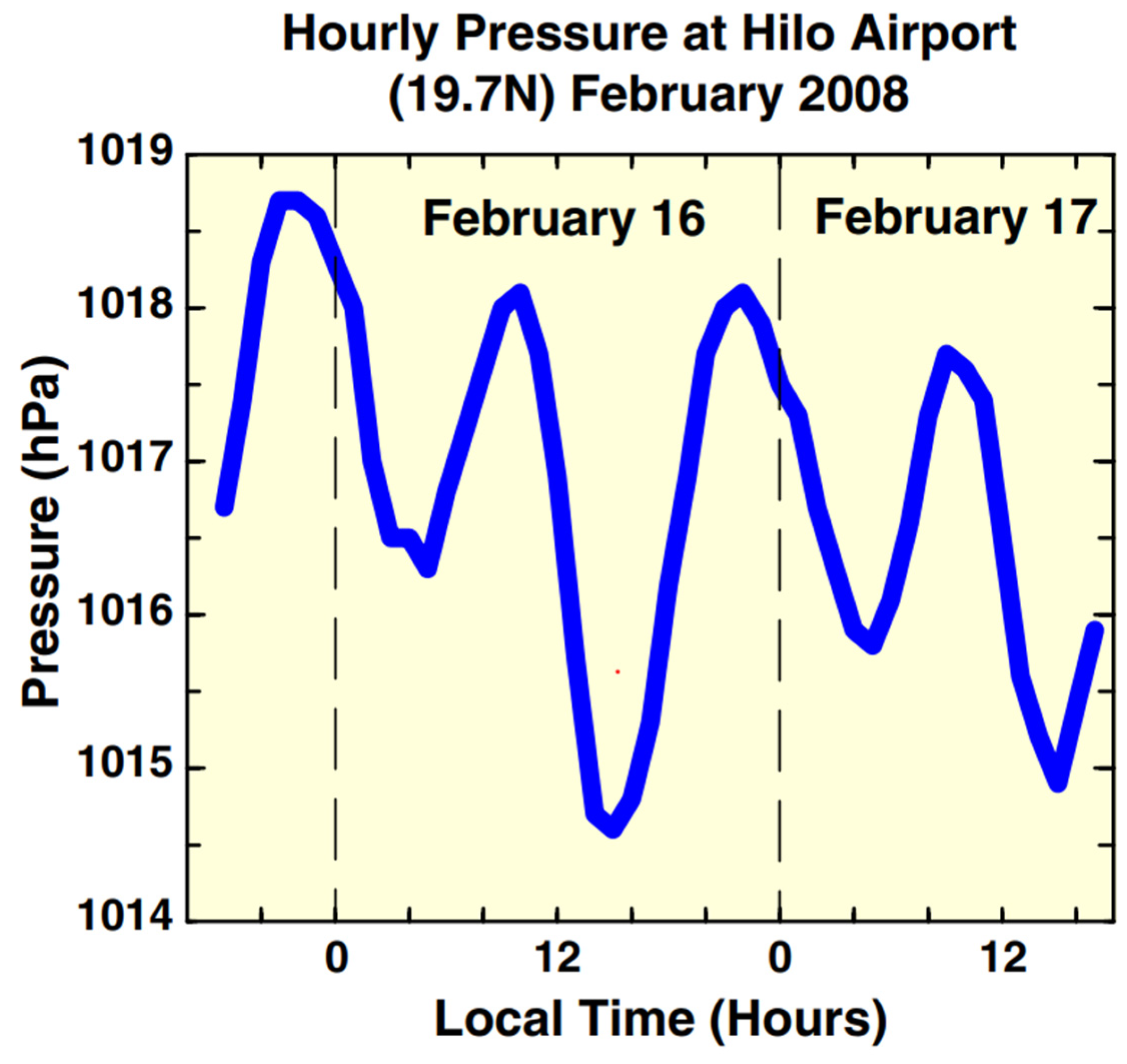
Figure 2.
A table reproduced from [27]. It shows an estimated value of the air pressure at sea level near the equator at each local hour of the day based on large numbers of barometric observations taken on Humboldt’s American expedition. The inclusion of the label “midi” in the upper left may indicate that the hour labelled “0” is “midi” or local noon. The barometric pressure values are given in “lines” of mercury (1 line is about 2.256 mm). The logarithms of the pressure values are also shown.
Figure 2.
A table reproduced from [27]. It shows an estimated value of the air pressure at sea level near the equator at each local hour of the day based on large numbers of barometric observations taken on Humboldt’s American expedition. The inclusion of the label “midi” in the upper left may indicate that the hour labelled “0” is “midi” or local noon. The barometric pressure values are given in “lines” of mercury (1 line is about 2.256 mm). The logarithms of the pressure values are also shown.
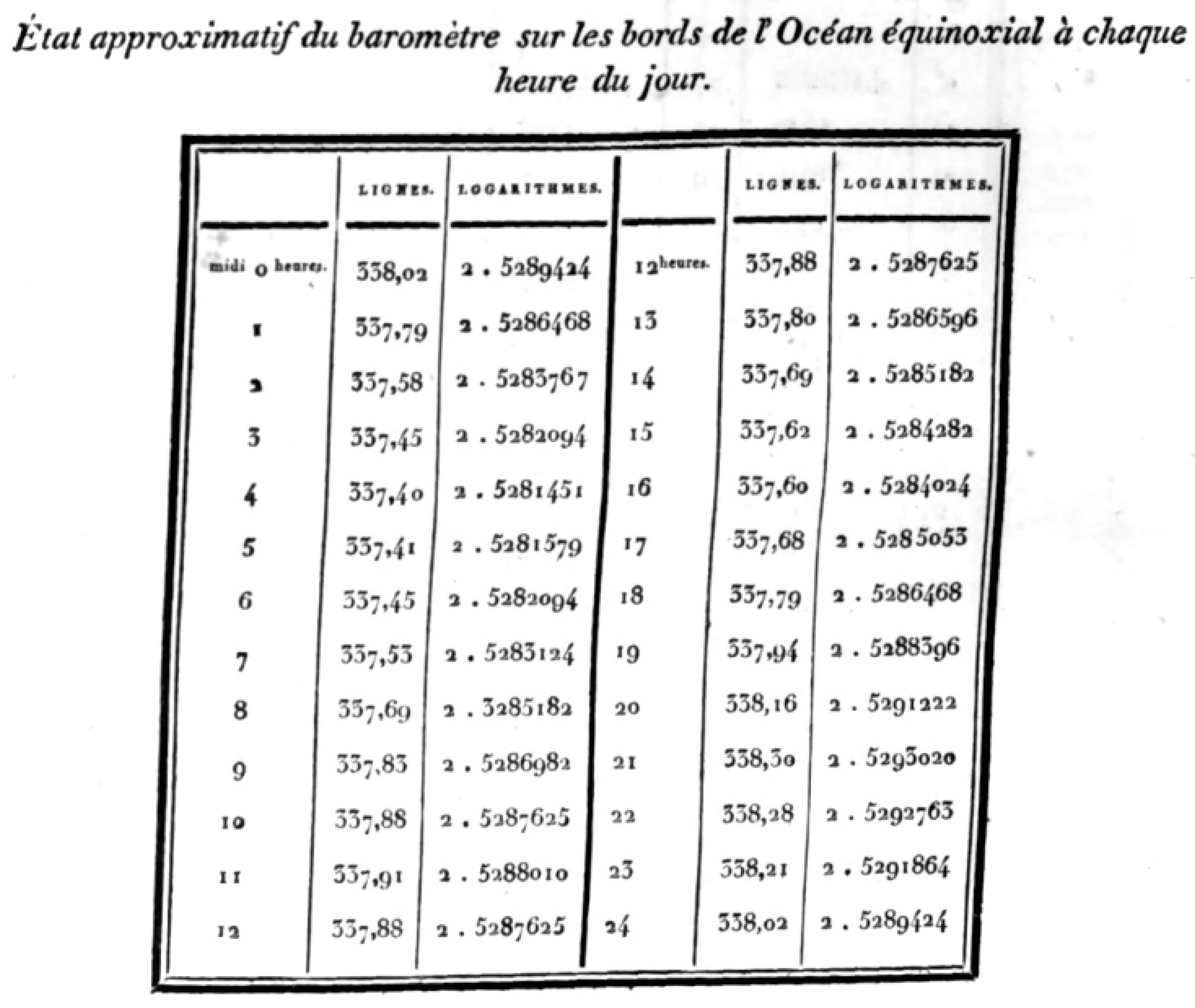
Figure 3.
The path of the Lapérouse expedition as it sailed south from France in 1785.
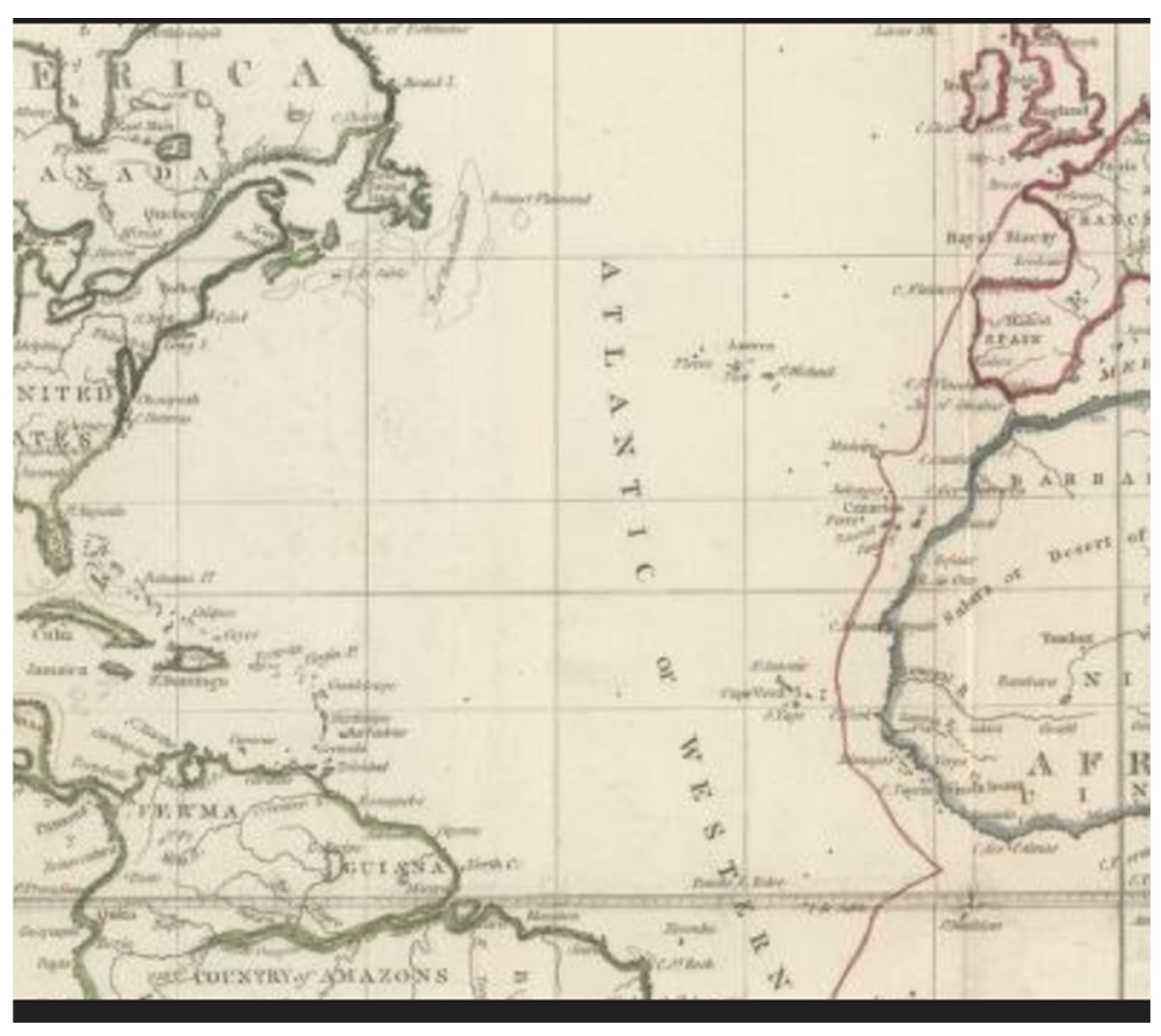
Figure 4.
Plot of hourly barometric observations taken onboard the French frigate La Boussole during September 28-October 1, 1785. Plotted using values given in tabular form in the official report of the Lapérouse expedition [43] The units are inches of mercury.
Figure 4.
Plot of hourly barometric observations taken onboard the French frigate La Boussole during September 28-October 1, 1785. Plotted using values given in tabular form in the official report of the Lapérouse expedition [43] The units are inches of mercury.
Disclaimer/Publisher’s Note: The statements, opinions and data contained in all publications are solely those of the individual author(s) and contributor(s) and not of MDPI and/or the editor(s). MDPI and/or the editor(s) disclaim responsibility for any injury to people or property resulting from any ideas, methods, instructions or products referred to in the content. |
© 2024 by the authors. Licensee MDPI, Basel, Switzerland. This article is an open access article distributed under the terms and conditions of the Creative Commons Attribution (CC BY) license (http://creativecommons.org/licenses/by/4.0/).
Copyright: This open access article is published under a Creative Commons CC BY 4.0 license, which permit the free download, distribution, and reuse, provided that the author and preprint are cited in any reuse.


