

Submitted:
26 July 2024
Posted:
30 July 2024
You are already at the latest version
Abstract
Various studies on sustainability development as emerging competitive strategy present it as exogenous factor that businesses have to cope with for being successful. However, considering current changes in business processes in which customers are taking an important position, sustainability development tends to be endogenous factor. To study this change, this paper analyses how industrial benefits of bargaining power of buyers, one of five forces of M. Porter’ model fosters sustainability development. To achieve this objective, integrative literature review and statistical measure of the relation between price, quality of products, and sustainability achievement among countries are used. The findings are that, high quality products, one of the benefits of bargaining power is significant related to sustainability development, whereas low prices benefit is not. This is due to the fact that; low prices are not that main driver for current consumer generations which are more driven by social values than price competitiveness.
Keywords:
bargaining power of buyers
; collective bargaining power of buyers
; sustainability development
1. Introduction
In contemporary scholarship, sustainability development is increasingly recognized as a pivotal element in business competitive strategy [1]. This pushes the businesses to consider sustainability as business model [2]. This move treats sustainability as an exogenous factor in terms of being requirement to respond to global threats of climate change and environment damage. However, when we analyze business interactive processes of buyers and suppliers that are getting changes to position customers in C-suite [3] and the trends of customers towards green products [4], sustainability requirement become endogenous factor. To study this structural change, this work tries to analyze the effect of industrial benefits of bargaining power of buyers, one of M.E. Porter's Five Forces model which has been a foremost framework for studying industrial competitive strategies. The motivation of doing this research is that authors like Lowitt E. and Tylenda E. who tries to relate M.E. Porter’s model to sustainability development, state that customers are potential to force suppliers to produce sustainable products [5,6], however, this doesn’t not show what push customer strive for sustainability. Hence, in this work, we base our analysis on the industrial benefits of bargaining power of buyers to study its relationship with sustainability development. To achieve this objective, an integrative literature review, together with statistical review of the relationship between price, product quality and sustainability development is used. The structure of this work is organized into introduction, literature review and hypotheses development, methodology, results, and conclusions.
2. Literature Review
2.0. Introduction
Since M. E. Porter's model was published in Harvard Business Review in 1979, it has got success of being instrument of competitiveness analysis and strategy formulation in any industry, and this marked a significant evolution and development to this model [7]. Consequently, nowadays, this model serves as an instrument in formulation of competitive strategies across various disciplines [8]. One of these disciplines is sustainability development [5]. However, the transition to this discipline presents substantive explanation gap and break this gap, the integrative literature review is used to analyze how bargaining power of buyers, one of the five forces of this model enhances sustainability development. This part of literature review is divided into two main parts: the first part tries to analyze current contextual understanding of the bargaining power of buyers, and its explicative development to solve sustainability development problem [9], whereas, the second party has the objective of determining how bargaining power of buyers benefits are extended to sustainability development.
2.1. Bargaining Power of Buyers
Bargaining power of buyers is one of M. E. Porter’s five forces model as it shown in the below Figure 1. As this model has got conceptual development to be adapted to various problems of industrial competitiveness, its parts have also known specific changes. This is the case of bargaining power of buyers that has also got different contextual meanings due to its integration in the sustainability development as current imperative of any business success [10]. To be able to get its current meaning, we try to get an integrated meaning from the authors such as Porter, 2008; the Corporate Finance Institute Team (CFI Team); Dan, 2023; Paksoy, Gunduz, & Demir, 2023.
According to these authors, bargaining power of buyers refers to the pressure that buyers can put to the businesses (companies) either through negotiations which results into forcing down prices, demanding better quality or more service (thereby driving up costs). The important point that we can get from this definition, is the interactive form of buyers and sellers which is the negotiation. The negotiation can take different forms. It can be direct or indirect, implicit or explicit. Whatever is this form, the purpose is to get higher quality products at low prices. This motive for any buyer has its foundation in the economic theory by which consumer preferences and choices are generally summarized into a system of prices and their determinants (i.e quality and quantity of products to be sold) hence, any interaction of buyers and sellers is to discuss about this terms. This way of describing this interaction, dominated traditional business model consequently authors like M. Porter presents buyers as a group of people motivated by getting high products at possible low prices [8]. This group was presented as in the following Figure 1.
According to this figure, buyers form a coercive group to get good quality products at low prices, whereas at another side, suppliers are forced to keep low costs and high profit margins. Thus, in the business negotiation, costs highly influence the decision making. The customers demand what is suitable to their needs at indicated cost, and business are pressed to deliver it fulfilling required conditions.
The settled requirements by customers were expressed in general term by M. Porter as bargaining power and this is take place when: i) there are few buyers, ii) the industry’s products are standardized or undifferentiated, iii) if buyers believe they can always find an equivalent product, they tend to play one vendor against another, and iv) buyers face few switching costs in changing vendors [8]. As far as sustainability theory is concerned, the implication of these conditions in the sustainability development is shown in the following Table 1.
According to the above Table 1, the conditions stipulated by M.E. Porter, are supported by various authors to have a good reference to sustainability development. Three out of four of these conditions imply that high bargaining power help to put pressure on suppliers to provide green products, where price sensitive condition is favorable to green consumption when competitive prices are available.
In all these conditions, the power of negotiation and the pressure are manifested for the purpose of having products of good quality at low costs. To respond to this pressure, businesses used the globalization strategies with the motive of meeting new business opportunities which later ended in new business model based on research and development, and innovation technologies. This pressure is driven by consumer demands who are no longer trust the industries [19]. Thus, companies work to continue maintaining this trust.
In the new business model, new means of minimizing costs and maintaining high quality products are according to Paksoy, Gunduz, & Demir, 2023, innovation strategies, new technologies that disrupt traditional business models, and understanding customer trust, loyalty and preferences [14]. These factors play an important role in determining the product qualities and prices in the world. For the purpose of this paper and information availability, we used Made-In Country Index published by A. Kunst, 2024. This index helps to make visibility of the consumer preferences and to show how positively products "made in..." are perceived in different countries [19]. The ranking made is given in the following Table 2.
According to this Table 2, the index is calculated based on each country's average weighted share of positive perception of its product qualities, and the first rank is set as Index 100 occupied by Germ and Iran to the last place with Index 27. To measure if there is relationship between quality of products and price levels, annual Inflation, consumer prices index is used, and the corresponding data of this index in the countries considered are given in the below Table 3.
According to the above Table 3, Inflation as measured by the consumer price index reflects the annual percentage change in the cost to the average consumer of acquiring a basket of goods and services that may be fixed or changed at specified intervals, such as yearly, and the Laspeyres formula is used. The countries listed in this Table 3 are the exactly the same countries in the Table 2. To avoid incongruity of data, the Consumer Price Index for each country is an average of five years’ indices (from 2019 to 2023). Consumer price Index is used to measure low prices because a long term maintenance of low inflation means low change in prices which foster consumer satisfaction. Thus, it is assumed that those countries with high quality and low prices, are those countries with high bargaining power.
Some authors intended to measure this relationship. For instance, Ueki and Yasushi identify a positive relationship between customer pressure and the manufacturing of high-quality products (Yasushi, 2016). E. R. Lestari et al. find a positive impact of customers' pressure on green innovation performance [21], while M. Tomaszewski discovers a positive correlation between customer pressure, product innovation, and lower costs [22].
Customer pressure in this paper refers to a coherent force of groups of buyers characterized by common preferences. These customers tend to form identical groups and associations that have objectives of providing maximum satisfaction than it can be individually realized. According to Lowitt, these groups can be differentiated into institutional and individual consumers [5]. To institutional buyers, costs are minimized by a capture of power between suppliers and buyers, whereas for individual consumers, the power of consumers is exercised through their vote in mass1, with their purchasing power. In this context, these groups can have a collective bargaining power. Talking about collective bargaining power does not refer only to those formal groups and associations, but also those groups with the same preferences. Like vegetarians, green customers.
2.2. Bargaining Power of Buyers and Sustainability Market Trend
As we have seen above, bargaining power of buyers is always referred to a group of individuals, institutions or organizations, even the businesses themselves that form a system of a cohesive pressure either by direct or indirect, explicit or implicit negotiations to get good quality products at good prices [14]. These groups are identified by common trends and preferences [3]. These benefits can be broadly distinguished as social benefits. This is for example green consumption where it is considered as collective action in terms of Schutz A. and M. G. Sandy by whom, a collective action is characterized by social movements and community developed efforts to meet common goal [23].
In addition, the idea of collective action for exercising higher bargaining power is also related to the statement of M. Porter when he proposed bargaining power of buyers as one of the forces for industry competitiveness. The plurality of buyers means higher forces and this statement embeds substantive collective action of the buyers to meet a common benefit. According to Lowitt, the power of consumers is exercised through their vote in mass [5]. This implies that groups of individual customers are necessary to strengthen their will towards sellers. In this context, Mancur Olson states that individuals that share common interests are attempted to further those interests within groups ([24], pp. 1-3). It is in this rational idea that customers with individual interests find themselves that they are better off to act as a group, and as a society becomes more complex, a collective action need becomes very important ([25], p. 17). However, as far as collective action of consumers is concerned, it is different from the context of for example E. Ostrom where formal rules can be drawn to govern structured interactions [26].
According to Sandler, it is natural that members of the groups interact, and efforts of some members influence other members to contribute to group interests [25]. Thus, there is a will that benefits are for the group whether it is small or large, and this implies the cost. In small groups, costs are more effective and efficient than in large groups. However, in the case of bargaining power, there is a tendency to achieve common benefits even if there are mayor heterogeneous individuals. This is the case of the buyers’ bargaining powers where groups are infinitely larger and there are no institutions to govern cost and benefits, unless associations and organizations are formed to govern them. In this sense, we can have for example, a group representation with high purchasing power implies a potential for green-focused shoppers to wield their power to force companies to make socially conscious manufacturing methods the new “traditional” approach to value creation [5]. This is a process of natural change of behavior to adopt new consumption trends.
The natural willingness of individuals to work in groups to strengthen efforts is a strategic interaction to achieve social benefits through behavior change [27]. In the context of enhancing sustainability, it starts with some individual consumers who boycott consuming some products and they increase in number until the problem becomes a social problem. At the beginning individuals bear a burden of conversing companies and with a growth in number to form large groups, the cost is shifted to public policy.
The increase in forming large groups adopting collectivism to achieve social benefits, causes homogeneity of cultural traits like consumption. This activity imposes social attributes to individualists that determine their daily practices which finally define their social relations [28]. As far as sustainability is concerned, green customer behavior is adopted and characterizes groups interactions that end up defining the level of collective sustainability achievement [29]. Thus, collectivism is a cultural factor that play a modeling role to consumer behavior towards environment consciousness and green products [30], and collectivism matters in consumer effectiveness [31]. To express this collective behavior towards sustainability development, sustainability achievement among countries according to the below Table 4 is used.
The Table 4 contains SDG indexes for the 47 countries with highest quality products. These data help to make analysis of if there is any relationship between product quality and sustainability achievement. Together with the data from the Table 3, we can draw if there is any relation with low prices and sustainability achievement. The summary of the data in these tables is given in the below Table 5.
In summary, bargaining power of customers as it is stated in the M.E. Porter model to enhance competitiveness by forcing businesses to provide high quality of products, better services, and low costs, has got extensive use due to its important role in any business goal of minimizing costs and maximizing profits. Its focus was immensely expended by current position that consumers are taking in the business success reflecting the existence conditions of high bargaining power according to M. Porter model. This is the case of the sustainability development where green consumption is expanding and influencing consumer choice theory. This is manifesting through collective system in which green consumption trends are now determinants of future business success. This has a positive effect on quality of products. However, as far as price effect is concerned, sustainability effect by provision of low prices is still no significant. From this analysis, the following hypotheses are developed:
H1.
The provision of high-quality products as one of the benefits of bargaining power of buyers is related to sustainability development.
H2.
Low prices as a result of bargaining power of buyers are related to sustainability development.
3. Methodology
In this paper, we use an integrative literature review approach to be able to develop a theoretical framework that breaches the gap between bargaining power of buyers and sustainability development [33]. The research process and criteria are summarized into the following Figure 2.
The analysis primarily focuses on the authors such as Michael E. Porter, 2008; Ostrom E.,2015; Ostrom E.,1998; Todd Sandler, 2004; Lowitt, 2011; Tylenda E., 2014 and Tylenda E., 2022. To get supplement authors, google scholar platform with keywords “bargaining power of buyers” and “sustainability development” was used. The analysis of the literature is complemented by quantitative analysis of data of quality products index ranking from 47 countries by Kunst, 2024; the 2024 SDG Index Ranks and Scores by World Bank Group, 2024; and inflation, CPI in the countries by Sachs, Lafortune, & Fuller, 2024. The sample of this analysis is composed of 47 countries reported to have more quality products Indexes according to Kunst, 2024.
4. Results and Discussion
In the purpose of identifying the effect of bargaining power of buyers to sustainability development through its benefits of providing high quality products at low process, integrative literature review and analysis of quantitative data of quality products at low process as determinant variables of sustainability development, the following results were identified:
- The concept of bargaining power as the whole Porter’s model, has got transformation to be adapted to its increasing use since the publication of this model publication, and is applied to establish competitive strategies to the current sustainability problem. However, due to changes in the market places which affected the way businesses interact with customers and introduction of new channels like innovation technologies and sustainability models, the traditional model of consumer decision making based on price and quantity demanded was changed to integrate social values.
- The shift from decision making based on price quantity to integrate social created values (i.e consuming goods that are social and environment friendly) show buyers pressure trends towards sustainability. This is the case of energy, food, chemical, and transportation industries which have higher fixed costs, are the ones also have more pressure to be sustainable. As far as standardization is concerned, the positive effect of these changes is not in helping to reduce costs that cause buyers to play sellers each other rather to provide cost reduction that help in establishing customer-seller relation founded on social and environmental values.
- Bargaining power of buyers helps to achieve sustainability development implicitly force improvement in product quality and better services is supported in the literature review. However, to stimulate low prices still needs more explanations. For example, current and future consumption trends favor green products whereas willingness to pay high price is still low, hence to stimulate consumption can be if the competitive prices are provided. This presents a gap of explicative progress of bargaining power of buyers’ effect to sustainability development. This can be generally due to changes in consumption trends and motives of current business model. For the purpose of this work, the prominent motive for current green consumers is social values generation. In this context, bargaining power of buyers is done in form of collective action where main goal is to strive for social values.
- Finally, it was identified that high quality products are significantly related to sustainability development, whereas low prices are not significant related to sustainability development. The significance y non-significance relationship in these variables are explained in the following Table 6.
5. Conclusion
Bargaining power of buyers helps to achieve sustainability development through its pressure to businesses to provide high quality products. However, its contribution to get low prices is still need to be studied. The price like a variable to sustainability presents little effect to sustainability development. This is because, price is a broad complex term, and current changes in consumption trends and motives. Hence, to study its effect to sustainability development needs to be narrowed into specific term like competitive prices. In addition, to current generations who are striving to consume green products, price is not the main driver rather the social values. It is in this context that there is a gap in explanations implication of bargaining power of buyers’ implication to sustainability development. Bargaining power of buyers’ implication of realizing industrial benefits of high quality products at low prices is has been embedded into the traditional business model in which prices are the main factor to consumer choice decisions, whereas, the implication of this force to sustainability development is embedded in modern business model in which consumers are motivated other factors like social values than price factor.
6. Research Contribution, Limitations and Future Research Direction
6.1. Research Contribution
The contribution of this research is to show, as bargaining power of buyers has got success to influence achievement of industrial benefits in terms of providing high quality product at low prices, it is also implied into current business concern like sustainability development.
6.2. Research Limitations
Based on the assumptions that low inflation determined by Consumer Price Index represent price levels, this work is limited to show how striving of bargaining power of buyer to realize high quality products at low prices, is related to sustainability development.
6.3. Future Research Direction
Considering the limitations of this research paper, the future research direction is to study how competitive prices affect sustainability development.
Author Contributions
The three authors developed a conceptualization of the problem and a methodological framework, in addition, Eugene Hakizimana collected, analyzed the data, and wrote the paper; D.M. Monroy Becerril prepared the tables and graphics, and C. Muñoz-Sánchez reviewed and edited the final draft. All authors read and agreed to the published version of the manuscript.
Funding
This work was financially supported by the Instituto Politécnico Nacional (IPN), México. The authors would like to thank this institution for its support and commitment to this research project.
Availability of Data and Materials
The data analyzed and presented in this study are available on request from the corresponding author.
Competing Interests
The authors declare no conflict of interests.
Ethical approval
Not applicable.
References
- K. Höse, A. SÜB y U. Götze, «Sustainability-Related Strategic Evaluation of Business Models,» Sustainability, p. 7285, 2022. [CrossRef]
- W. Stubbs, «Sustainability as a Business Model,» de Global Sustainability as a Business Imperative , New York , PALGRAVE MACMILLAN, 2010, pp. 33-50.
- Mintel., "Global Consumer Trends," https://www.mintel.com/, 2023.
- C. Leckie, D. Rayne y L. W. Johnson, «Promoting Customer Engagement Behavior for Green Brands,» Sustainability, nº 13, p. 84.4, 2021.
- E. Lowitt, «How Sustainability is Reshaping Competition,» 9 2011. [En línea]. Available: https://magazine.wharton.upenn.edu/digital/how-sustainability-is-reshaping-competition/.
- E. Tylenda, «Sustainability and the Five Forces Model,» 15 10 2022. [En línea]. Available: https://www.sasb.org/blog/five-forces/#:~:text=Bargaining%20Power%20of%20Buyers,and%20ultimately%20sell%20to%20consumers..
- M. E. Porter, Competitive strategy: techniques for analyzing industries and competitors: with a new introduction., New York, NY 10020: THE FREE PRESS. A Division of Simon & Schuster Inc., 1998.
- M. E. Porter, «The five competitive forces that shape strategy,» Harvard Business Review. Editor's notes., vol. 79, pp. 78-93, 2008.
- P. Kitcher, THE ADVENCEMENT OF SCIENCE. SCIENCE WITHOUT LEGEND,OBJECTIVITY WITHOUT ILLUSIONS, First ed., New York and Oxford : Oxford University Press , 1993.
- IBM Institute for Business Value, «Balancing sustainability and profitability,» 2022. [En línea]. Available: https://www.ibm.com/thought-leadership/institute-business-value/en-us/report/2022-sustainability-consumer-research.
- Wix.com, «https://businessfinance.wixsite.com,» 20 07 2024. [En línea]. Available: https://businessfinance.wixsite.com/nakau20-en/business-and-fixed-cost#:~:text=They%20require%20only%20office%20spaces,(research%20and%20development%20expenses)..
- investopedia.com, «Which Industries Have the Largest Capital Expenditures?,» 20 07 2024. [En línea]. Available: www.investopedia.com.
- Statista, «Emissions,» 20 07 2024. [En línea]. Available: https://www.statista.com/markets/408/topic/949/emissions/#overview.
- Mintel, «Global consumer trends,» 12 01 2022. [En línea]. Available: www.mintel.com .
- T. Paksoy, M. A. Gunduz y S. Demir, «Overall competitiveness efficiency: A quantitative approach to the five forces model,» Computers & Industrial Engineering, vol. 182, p. 109422, 2023. [CrossRef]
- D. Grayson, C. Coulter y M. Lee, All In. The Future of Business Leadership, London & New York : Routledge , 2018.
- J. Leenheer y M. Kuijten, «Are Sharing Platforms Sustainable (Business Models)? A Consumer Survey on the Drivers of Using Sharing Platforms in the Travel Industry,» de Sustainable Business Models. Principles, Promise, and Practice, Springer International Publishing AG, 2018, p. 280.
- H. Kopnina, R. Padfield y J. Mylan, Sustainable Business. Key Issues, London and New York : Routledge , 2023.
- R. P. Sroufe, Integrated management. How Sustainability Creates Value For Any Business, United Kingdom-North America-Japan-India-Malaysia-China: Emerald , 2018.
- A. Kunst, «Made-In Country Index: country ranking 2017,» 12 07 2024. [En línea]. Available: https://www.statista.com/statistics/677973/made-in-country-index-country-ranking/.
- World Bank Group , «Inflation, consumer prices (annual %),» 12 07 2024. [En línea]. Available: https://databank.worldbank.org/indicator/FP.CPI.TOTL.ZG/1ff4a498/Popular-Indicators.
- E. R. Lestari, W. A. P. Dania, C. Indriani y I. A. Firdausyi, «The impact of customer pressure and the environmental regulation on green innovation performance,» de Earth and Environmental Science, 2021. [CrossRef]
- M. Tomaszewski, «INFLUENCE OF CUSTOMER PRESSURE ON THE INNOVATIVE ACTIVITY OF A COMPANY,» ARGUMENTA OECONOMICA, vol. 35, nº 2, pp. 203-219, 2015. [CrossRef]
- Schutz y M. G. Sandy, «Collective Action in Twentieth-Century America: A Brief History,» de Collective Action for Social Change. An Introduction to Community Organizing , 175 Fifth Avenue, New York, NY 10010, Palgrave Macmillan, 2011, pp. 47-90.
- M. Olson, The Logic of Collective Action: Public Goods and the Theory of Groups., Cambridge-Massachusetts, London-England : Harvard University Press, 1971.
- T. Sandler, Global Collective Action, Cambridge, New York, Melbourne, Madrid, Cape Town, Singapore, São Paulo: cambridge university press, 2004.
- E. Ostrom, «DESIGN PRINCIPLES OF ROBUST PROPERTY-RIGHTS INSTITUTIONS: WHAT HAVE WE LEARNED?,» Workshop in Political Theory and Policy Analysis, 1998.
- C. Roseira, S. Teixeira, B. Barbosa y R. Macedo, «How Collectivism Affects Organic Food Purchase Intention and Behavior: A Study with Norwegian and Portuguese Young Consumers,» Sustainability, p. 7361, 2022. [CrossRef]
- Á. Sánchez-Rodríguez, R. Rodríguez-Bailón y G. B. Willis, «Efectos de la actividad económica sobre el individualismo-colectivismo,» Escritos de Psicología - Psychological Writings, pp. 1-12, 2020.
- L. Witek y W. Kuzniar, «Green Purchase Behavior: The Effectiveness of Sociodemographic Variables for Explaining Green Purchases in Emerging Market,» Sustainability, 2021. [CrossRef]
- Z. Ghali-Zinoubi, «Examining Drivers of Environmentally Conscious Consumer Behavior: Theory of Planned Behavior Extended with Cultural Factors.,» Sustainability, vol. 14, nº 8072, 2022. [CrossRef]
- B. Czarnecka y B. Schivinski, «Individualism/collectivism and perceived consumer effectiveness: The moderating role of global–local identities in a post-transitional European economy.,» Journal of Consumer Behaviour, 2021. [CrossRef]
- J. D. Sachs, G. Lafortune y G. Fuller, The SDGs and the UN Summit of the Future. Sustainable Development Report 2024, Dublin, Ireland: Dublin University Press , 2024.
- H. Snyder, «Literature review as a research methodology: An overview and guidelines,» Journal of Business Research, nº 104, pp. 333-339, 2019. [CrossRef]
- H. Snyder, «Literature review as a research methodology: An overview and guidelines,» Journal of Business Research, nº 104, pp. 333-339, 2019. [CrossRef]
| 1 | This is like group representation of consumers. |
Figure 1.
Forces Driving Industry Competition (source: [7]).
Figure 1.
Forces Driving Industry Competition (source: [7]).
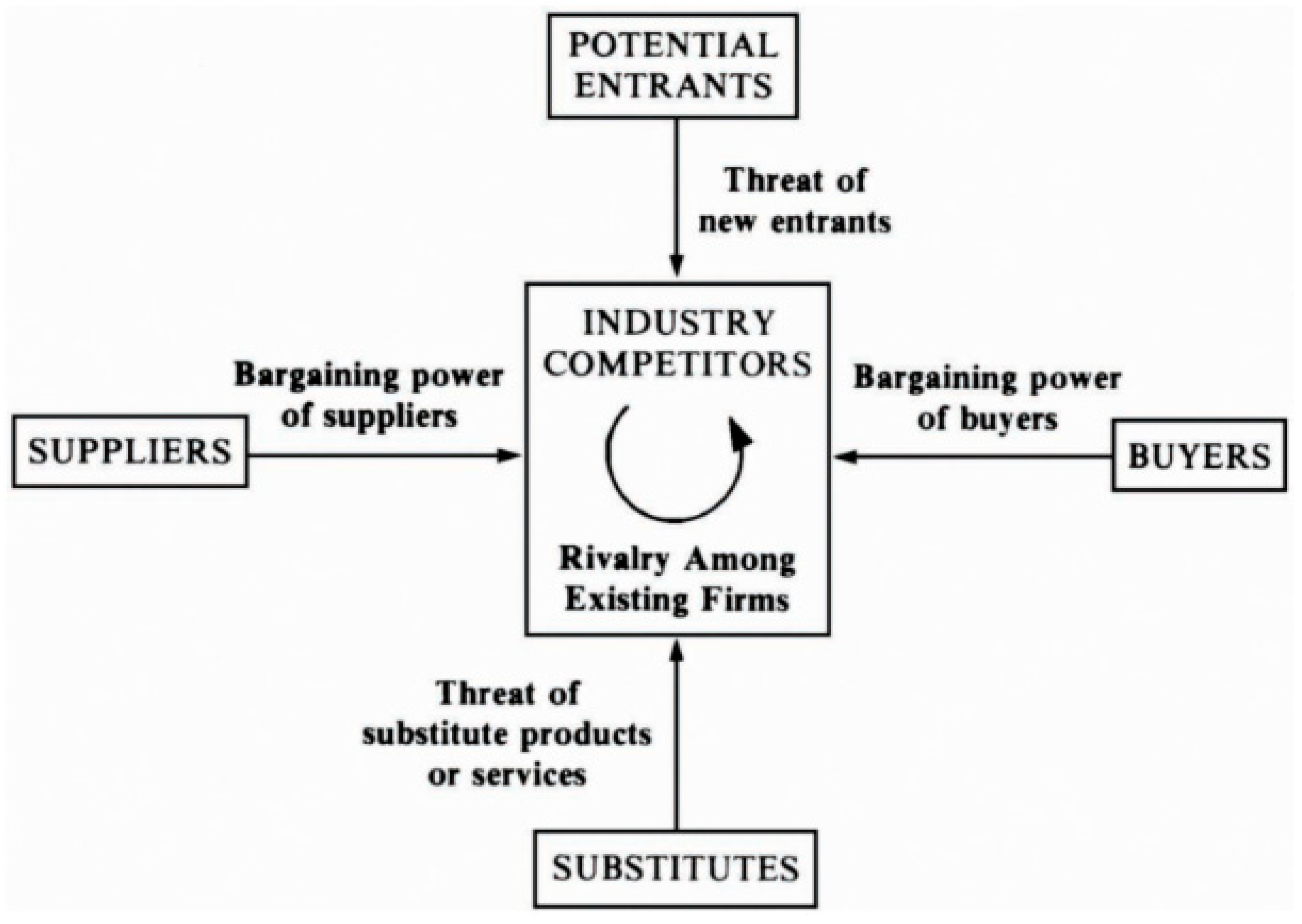
Figure 2.
Research design process (source: Proper design based on [34]).
Figure 2.
Research design process (source: Proper design based on [34]).
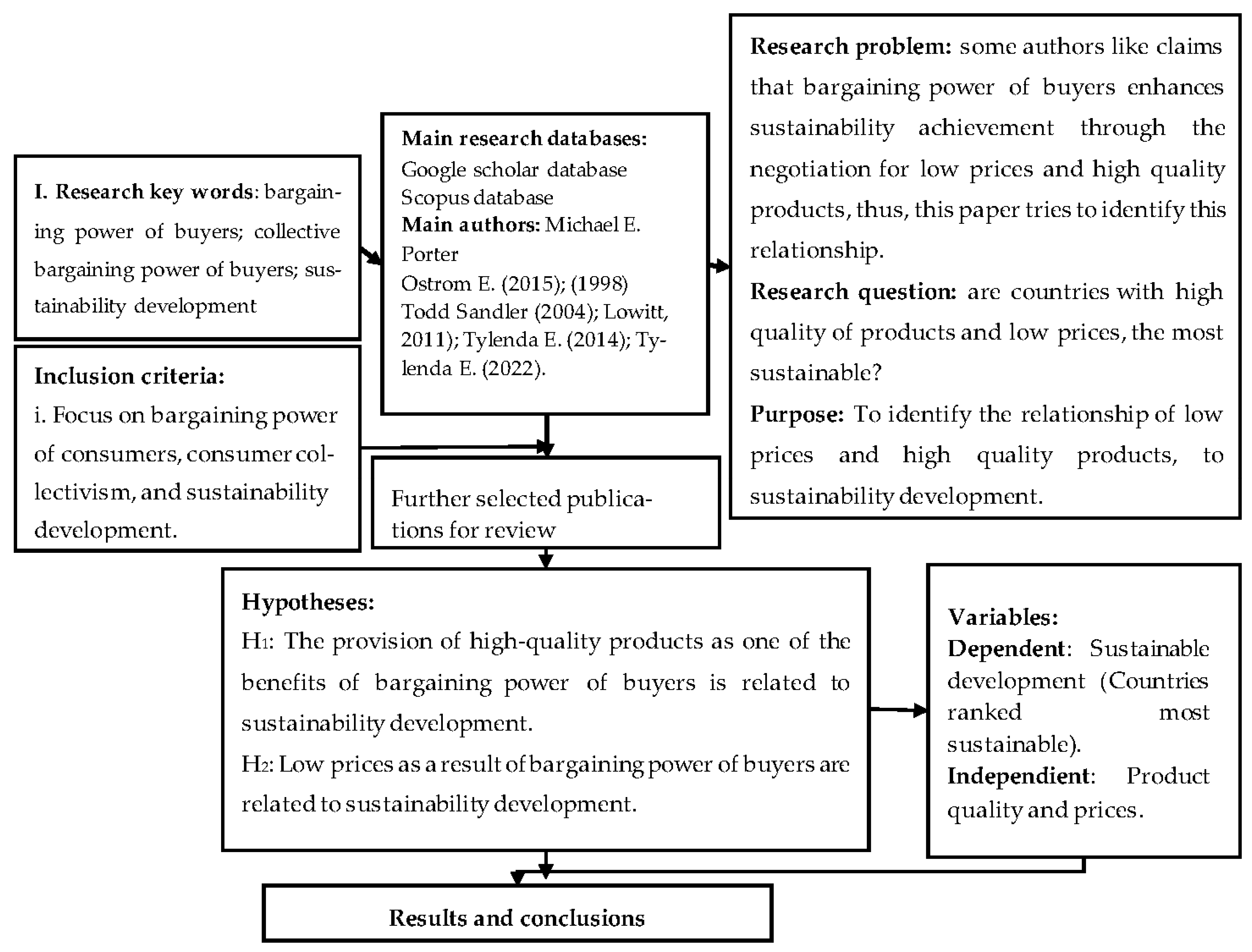

Table 1.
High bargaining power of buyers’ conditions and sustainability (based on [8]).
Table 1.
High bargaining power of buyers’ conditions and sustainability (based on [8]).
| Condition according to M. Porter, 2008. | Implication in the sustainability theory. |
| Few buyers or purchase in volumes that are large relative to the size of a single vendor. Buyers are particularly powerful in industries with high fixed costs such as telecommunication, off-shore drilling, and chemical industries. | Most of industries with high fixed costs are the ones that highly pollute and generate high environmental damage. These are energy, chemical and food industries [11,12,13]. These industries are the same as those referred to by M. Porter, 2008. Thus, current consumers try to force businesses to respond to environmental current inquiry [14]. |
| The industry’s products are standardized or undifferentiated. | In terms of M. Porter, standardization causes low switching costs, hence buyers can threaten to play sellers, each other. However, due to the changes of business model by incorporating new channels [14], standardization enables businesses to maximize sustainability benefits for all buyers [15]. |
| Buyers face few switching costs in changing vendors. | Low switching cost is not the main factor to green consumers but the social and environmental created value [16,17]. |
| Price sensitive. consumers tend to be more price sensitive if they are purchasing products that are undifferentiated, expensive relative to their incomes, and of a sort where product performance has limited consequences. | The consumers do not switch to alternative products by price sensitive but social and environmental value created [16,17]. However, R.P. Sroufe shows that price competitiveness influences sustainable products to be adopted [18] |
Table 2.
Quality products in various countries (Proper design according to [20]).
Table 2.
Quality products in various countries (Proper design according to [20]).
| No | Country | Quality index ranking | No | Country | Quality index ranking | No | Country | Quality index ranking |
|---|---|---|---|---|---|---|---|---|
| 1 | Germany | 100 | 17 | Belgium | 71 | 33 | Colombia | 39 |
| 2 | Switzerland | 98 | 18 | Ireland | 65 | 34 | Turkey | 37 |
| 3 | UK | 91 | 19 | Spain | 64 | 35 | Peru | 37 |
| 4 | Sweden | 90 | 20 | South Korea | 56 | 36 | South Africa | 37 |
| 5 | Canada | 85 | 21 | Singapore | 56 | 37 | Mexico | 37 |
| 6 | Italy | 84 | 22 | Portugal | 54 | 38 | Romania | 36 |
| 7 | Japan | 81 | 23 | Poland | 51 | 39 | Israel | 36 |
| 8 | France | 81 | 24 | Greece | 48 | 40 | India | 36 |
| 9 | United states | 81 | 25 | Russia | 46 | 41 | Indonesia | 36 |
| 10 | Finland | 77 | 26 | Hungary | 45 | 42 | Ukraine | 35 |
| 11 | Norway | 77 | 27 | Czech Republic | 43 | 43 | Vietnam | 34 |
| 12 | Netherlands | 76 | 28 | Brazil | 42 | 44 | Philippines | 32 |
| 13 | Australia | 75 | 29 | Malaysia | 41 | 45 | Bangladesh | 29 |
| 14 | New Zealand | 73 | 30 | Slovakia | 40 | 46 | China | 28 |
| 15 | Denmark | 73 | 31 | Thailand | 40 | 47 | Iran | 27 |
| 16 | Austria | 72 | 32 | Chile | 39 |
Table 3.
Inflation, consumer prices in various countries (Source: [20]).
Table 3.
Inflation, consumer prices in various countries (Source: [20]).
| Country | Inflation, CPI | Country | Inflation, CPI | Country | Inflation, CPI |
| Germany | 3.5 | Belgium | 3.65 | Colombia | 6.29 |
| Switzerland | 1.04 | Ireland | 3.41 | Turkey | 6.29 |
| United kingdom | 3.98 | Spain | 3.08 | Peru | 4.66 |
| Sweden | 4.27 | South Korea | 2.42 | South Africa | 5.01 |
| Canada | 3.35 | Singapore | 2.72 | Mexico | 5.23 |
| Italy | 3.23 | Portugal | 2.75 | Romania | 7.14 |
| Japan | 0.22 | Poland | 7.34 | Israel | 2.07 |
| France | 2.67 | Greece | 2.67 | India | 5.56 |
| United States | 3.97 | Russia | 2.9 | Indonesia | 2.88 |
| Finland | 3.38 | Hungary | 8.7 | Ukraine | 10.6 |
| Norway | 3.64 | Czech Republic | 7.12 | Vietnam | 2.85 |
| Netherlands | 4.08 | Brazil | 5.82 | Philippines | 4.1 |
| Australia | 3.5 | Malaysia | 1.57 | Bangladesh | 6.88 |
| New Zealand | 4.03 | Slovakia | 6.21 | China | 1.7 |
| Denmark | 2.8 | Thailand | 1.68 | Iran | 40.39 |
| Austria | 4.4 | Chile | 5.87 |
Table 4.
The 2024 SDG Index Ranks and Scores (based on [32]).
Table 4.
The 2024 SDG Index Ranks and Scores (based on [32]).
| Country | The 2024 SDG Index Ranks and Scores | Country | The 2024 SDG Index Ranks and Scores | Country | The 2024 SDG Index Ranks and Scores |
| Germany | 86.4 | Belgium | 80 | Colombia | 70.3 |
| Switzerland | 79.3 | Ireland | 78.7 | Turkey | 70.5 |
| UK | 82.2 | Spain | 80.7 | Peru | 71.9 |
| Sweden | 85.7 | South Korea | 77.3 | South Africa | 63.4 |
| Canada | 78.8 | Singapore | 71.4 | Mexico | 69.3 |
| Italy | 79.3 | Portugal | 80.2 | Romania | 76.7 |
| Japan | 79.9 | Poland | 81.7 | Israel | 73.5 |
| France | 82.8 | Greece | 78.7 | India | 64 |
| United States | 74.4 | Russia | 73.1 | Indonesia | 69.4 |
| Finland | 86.4 | Hungary | 79.5 | Ukraine | 74.8 |
| Norway | 82.2 | Czech Republic | 81.3 | Vietnam | 73.3 |
| Netherlands | 79.2 | Brazil | 73.8 | Philippines | 67.5 |
| Australia | 76.9 | Malaysia | 69.3 | Bangladesh | 64.3 |
| New Zealand | 78.8 | Slovakia | 79.4 | China | 70.9 |
| Denmark | 85 | Thailand | 74.7 | Iran | 69 |
| Austria | 82.5 | Chile | 77.8 |
Table 5.
Descriptive statistics for Quality index ranking, the 2024 SDG Index Ranks and Scores, and inflation, CPI in the countries.
Table 5.
Descriptive statistics for Quality index ranking, the 2024 SDG Index Ranks and Scores, and inflation, CPI in the countries.
| Variable | Observations | Obs. con missed data | Obs. sin missed data | Minimum | Maximum | Median | Typical Deviations |
| Quality index ranking | 47 | 0 | 47 | 27.000 | 100.000 | 55.979 | 21.529 |
| The 2024 SDG Index Ranks and Scores | 47 | 0 | 47 | 63.400 | 86.400 | 76.302 | 5.952 |
| Inflation, CPI | 47 | 0 | 47 | 0.220 | 40.390 | 4.928 | 5.667 |
Table 6.
Correlation coefficients matrix (Pearson) of quality index ranking, the 2024 SDG Index Ranks and Scores, and inflation, CPI in the countries.
Table 6.
Correlation coefficients matrix (Pearson) of quality index ranking, the 2024 SDG Index Ranks and Scores, and inflation, CPI in the countries.
| Variables | Quality index ranking | The 2024 SDG Index Ranks and Scores | Inflation CPI |
| quality index ranking | 1 | 0.735 | -0.325 |
| The 2024 SDG Index Ranks and Scores | 0.735 | 1 | -0.218 |
| Inflation, CPI | -0.325 | -0.218 | 1 |
Disclaimer/Publisher’s Note: The statements, opinions and data contained in all publications are solely those of the individual author(s) and contributor(s) and not of MDPI and/or the editor(s). MDPI and/or the editor(s) disclaim responsibility for any injury to people or property resulting from any ideas, methods, instructions or products referred to in the content. |
© 2024 by the authors. Licensee MDPI, Basel, Switzerland. This article is an open access article distributed under the terms and conditions of the Creative Commons Attribution (CC BY) license (http://creativecommons.org/licenses/by/4.0/).
Copyright: This open access article is published under a Creative Commons CC BY 4.0 license, which permit the free download, distribution, and reuse, provided that the author and preprint are cited in any reuse.


