

Submitted:
25 July 2024
Posted:
26 July 2024
You are already at the latest version
Abstract
Generative adversarial networks (GANs) have become a recent and rapidly developing research topic in Machine Learning. Since their inception in 2014, a significant number of variants have been proposed to address various topics across many fields, and has particularly excelled not only in image and language processing, but also in the medical and data science domains. In this paper, we aim to highlight the significance and advance that these GAN models can introduce in the field of Business Economics, where they have yet to be fully developed. To this end, a review of the literature of GANs is presented in general together with a more specific review in the field of Business Economics wherein only a few papers can be found. Furthermore, the most relevant papers are analysed in order to provide an approach the opportunity to research into GANs in the field of Business Economics.
Keywords:
GANs
; multidisciplinary application
; business economics
; artificial intelligence
; machine learning
1. Introduction
Currently, we are facing a continuous technological advance that necessitates significant societal changes. In light of this new social structure, massive data holds particular interest, since access to this resource signifies major privileges. Traders, manufacturers, suppliers, insurers and entrepreneurs all require access to and the ability to utilise extensive databases that enable them to study and uncover the necessary information to establish commercial strategies. This access also allows them to understand customer profiles and preferences, thereby enabling informed decision-making on pricing, promotions, risk assessment, competition, business models, and more. However, these highly coveted volumes of data have surpassed human capacity for collection, storage, and analysis. Consequently, to undertake these tasks effectively, humans require suitable tools, such as statistics intelligence and machine learning.
Major advances are being made in machine learning have been utilised to recognise patterns and identify objects. However, has recently there been a leap towards generating entirely new objects and individuals.
Thus, by using two antagonistic neural networks, [1] propose a tool called "Generative Adversarial Networks" (GAN), which is capable of creating faces of people that are not real and difficult to differentiate from real faces. While this is one of the most popular applications of GANs, its true importance lies in its capability to generate synthetic data that appears indistinguishable from real data.
In this paper, a bibliographic review of GANs is conducted, which focuses on contributions made in the areas of Business and Social Science. Presently, within the literature, various reviews on GANs in general can be found [2,3,4,5,6,7].However, none of these specifically concentrates on the potential applications within the field of Business Economics. The objective is to showcase the potentiality of this tool within these two areas.
The rest of this paper is structured as follows: Section 2 briefly defines a GAN and how it functions. Section 3 presents a statistical study of publications on GANs gathered from the Web of Science. In Section 4, the focus is placed on GAN publications within the scope of this work: Business Economics. Section 5 details the relevance of this tool in the field of Business Economics. Section 6 outlines the conclusions drawn.
2. Generative Adversarial Networks
The main aim of GANs is the automatic generation of data. Its main difference from other generative models is that it does not directly use the distribution of real data; instead, it operates through a classifier. The generative model is random and adjusts itself step by step based on the classifier’s response, continually refining until the discriminator is unable to differentiate between real and synthetic data.
In order to achieve this objective, two neural networks, namely the Generator and the Discriminator, are employed, which engage in a competitive process. The Generator produces synthetic data resembling real data, while the Discriminator endeavours to distinguish between real data and the data supplied by the Generator.
This competition between the Generator and Discriminator can be viewed through game theory as a zero-sum game since the two networks have conflicting objectives; as one network improves, the other deteriorates. Consequently, the minimax algorithm can be employed, which is a decision-making algorithm minimising the maximum loss in the game [8]. Thus, the training objective of GANs is to find the Nash equilibrium. [1] demonstrated that the Nash equilibrium is reached when the Generator produces samples indistinguishable from the training dataset, and the Discriminator can only randomly guess whether a sample is real or fake, which means the generated samples are indistinguishable to the Discriminator. When the Nash equilibrium is achieved, it is said that the network converges. In practice, GAN training is conducted using techniques not explicitly designed to find the Nash equilibrium, which may potentially lead to non-convergence [9]. At times, achieving convergence might necessitate the imposition of stringent conditions, which can be challenging to meet in practice [10,11,12].
The formal development of GANs is laid out below. GANs are generative models [1] that, in summary, function as follows: Initially, a vector noise is fed into a Generator model to create synthetic data. Subsequently, the generated data is mixed along with real data to feed a Discriminator model, which discriminates which data comes from the real dataset and which comes from the synthetic data generated from the Generator.
The goal of the Generator is to fool the Discriminator and the goal of the Discriminator is not to be fooled. This confrontation leads to the Generator being increasingly capable of providing synthetic data more similar to real data. The ideal solution in the GAN model is that the percentage of success of the Discriminator for the real data and synthetic data is , in both cases. The structure of the GAN model for a database can be observed in Figure 1.
2.1. Mathematical Framework
Let us give a technical introduction of the GAN model: Given a database with m real samples () (training data) and a random noise vector (), the following terms are considered:
- is the output of the Generator from the noise , that is, the synthetic data.
- is the output of the Discriminator when a real sample is processed.
- is the prediction from the Discriminator on the synthetic data.
- and are the distribution of real and noise data, respectively.
- and are the expected log likelihoods from the different outputs of real and generated data.
- and are the weights of the Discriminator and Generator model, respectively.
The expression, denoted by V, to be considered for the complete network, Discriminator and Generator, is the following:
This value function is submitted to a min–max strategy with the goal of maximising the Discriminator loss and minimising the Generator loss,
The value for the value function V is calculated as the sum of expected log likelihood for real and synthetic samples. Maximising the resulting values leads to the optimisation of the Discriminator parameters so that it learns to correctly identify both real and fake data. To this end, the following loss functions are considered:
Furthermore, a suitable setup for each artificial neuronal network employed and its training is required for the implementation of a GAN.
2.2. Types of GANS
Both the Generator and Discriminator in GANs are neural networks; therefore, if these networks are structured to address a specific problem, then a new type of GAN is formed. The following types are worthy of note:
- Conditional GAN (CGAN):
- This is similar to the classic GAN but allows for the generation of data from a specific class defined within the real dataset, such as the generation of MNIST digits conditioned on class labels [14].
- Vanilla GAN:
- This is a simple type of GAN where the Discriminator and the Generator are simpler, multilayer perceptrons [1].
- Deeper Convolutional GAN (DCGAN):
- Laplacian Pyramid GAN (LAPGAN):
- This combines the CGAN model with a Laplacian pyramid representation [18].
Other known networks include: SRGAN, which employs a deep neural network [19], StackGAN [20,21], CycleGAN collected in [22], PassGAN [23], WGAN in [24], Spatio-temporal GAN studied in [25], Constrained GAN which can be seen in [26], H-GAN [27], pix2pix proposed in [28], Android-GAN [29], UNIT developed in [30], RGAN and RaGAN introduced in [31], AnoGAN as proposed in [32]. [33] introduce GANomaly and RCGAN which are showcased in [34] and EGAN [35], and TimeGAN in [36], among others.
2.3. Applications of the GANs
GANs have been employed to address various types of problems, among which are:
- Generating synthetic data for training. In [37] and [13], GANs are employed to generate data related to lung cancer patients, and statistical tests are employed to validate such synthetic data. For the generation of time-series data, one can employ SeqGAN [38]. It is also possible to generate synthetic data in tabular datasets using CTGAN [39].
- Generating text and natural language. There are several notable examples: SeqGAN [38], which generates text sequences; LeakGAN [40], which introduces a search policy to enhance text generation; and RankGAN [41]. Others, like textGAN [42], are used for natural language generation. CTRL, proposed by [43], facilitates controlled text generation, and enables users to specify style and content. Additionally, GPT-3, one of the most influential studies in text generation with GAN, is based on a transformer architecture that produces high-level, coherent, and natural text [44].
- Generating realistic images. One of the initial applications of GANs in generating realistic images was introduced by [15], where they proposed a DCGAN. Subsequently, other authors suggested different GAN modalities for distinct objectives. For instance, [22] applied CycleGAN to generate images by learning domain correspondence without the need for labelled data pairs. Another example is given by [20], used StackGAN to produce detailed, high-resolution images by introducing a cascaded generator architecture. Other GAN variants, such as those employed for generating human faces [45], include StyleGAN [46,47,48] and BigGAN [49]. These models are utilised to enhance the quality and resolution of generated images and employ a scalable architecture. Other DCGAN variants are employed for the generation of human poses from a photograph [50] and can even project age progression of an individual [51].
- Enhancement and restoration of damaged or low-quality images. To address this issue, several alternatives to the classic GAN have been proposed, such as SRGAN [19], Pix2Pix [28] and CycleGAN [22]. The latter addresses inpainting tasks (by filling missing or damaged regions of an image) using DeepFill [52,53]. To restore images corrupted by noise, RedNet was designed [54], and for noise filtering, nCNN and FFDNet were created [55,56].
- Speech synthesis. This constitutes one of the earliest application fields of GANs. For instance, WaveGAN was designed for waveform-based voice synthesis [57]. Similarly, MelGAN was developed for voice synthesis using high-quality Mel spectrograms, and provided enhanced quality and naturalness to synthesised voices [58]. To expedite real-time voice waveform generation, ParallelWaveGAN was proposed [59]. Other generative models include MelGAN-VC, enabling conversation [60], and HiFi-GAN for high-fidelity voice synthesis, which provides greater quality and detail [61,62]. GANs have also been used for the creation of music and songs by blending different styles and compositions of recognised musicians and composers [63].
3. Statistics on GAN Publications
In this section, the evolution of scientific articles related to GANs is presented. To this end, a search was conducted on 1 July, 2023 using the Web of Science (WOS). In the search field, the keyword used was “Generative Adversarial” or “generative adversarial” or “GENERATIVE ADVERSARIAL”.
References to countries and research areas have been extracted exactly as they appear in the WOS.
The conducted search yielded a total of 18619 documents, categorised according to the type of publication, as shown in Table 1.
In this table, we can observe that of GAN publications are in the form of papers, and are papers of proceedings.
Furthermore, in Table 2, the countries with the highest number of publications on this topic are displayed1.
In this table, it can be observed that nearly half of all publications related to GAN originate from China, which showcases the country’s positioning in emerging technologies. With just over , the USA ranks second, significantly ahead of other countries.
3.1. Evolution of GANs
The evolution of GANs over time is depicted in Figure 2. In this figure, an estimation of publications for the year 2023 is made based on a linear fit derived from the information collected in the table for previous years. The years 2014 and 2015 have not been considered in the fit, since the concept of GANs was still emerging and due to the lack of data to accurately model the real growth (as of 1/07/2023, there have been 1825 publications in the past 12 months).
It can be observed in this figure how the growth experienced by the papers addressing GAN follows an increasing trend that has not yet reached its peak since there are still fields, such as Business and Social Sciences, where the potential provided by this GAN tool to the scientific world remains to be fully explored.
3.2. Knowledge Area and GANs
Table 3 has been obtained by taking into account the research areas collected by the WOS, and reveals the most relevant research areas (areas that reach at least of all publications).
Regarding the areas that feature a significant number of scientific publications in these GANs, the field of Computer Science stands out, encompasses a wide variety of applications in image processing, deep learning, and synthetic content generation [15,22,28,49,64].
The field of Engineering presents multiple applications, ranging from the optimisation of renewable energies to the manufacturing and monitoring of structural health, which showcases its versatility and utility in solving real-world problems [65,66,67,68].
Another field where numerous applications are found is in Imaging Science and Photographic Technology. This field is undergoing continuous evolution, for which GANs are contributing significant advancements [19,69,70,71,72,73,74]. It is a mayor challenge to enumerate the multitude of applications and problems addressed in this field that have been successfully resolved using GANs.
In the field of Radiology, Nuclear Medicine and Medical Imaging, GANs appear particularly regarding the processing and analysis of medical images, improving their quality and usefulness, aiding in the diagnosis and treatment of diseases, and facilitating advancements in research [81,82,83,84,85,86].
Of great significance is the field of Remote Sensing, where GANs have contributed towards enhancing the quality and quantity of data, thereby enabling the interpretation and analysis of images, and introducing new applications and techniques for monitoring and understanding our planet from space [87,88,89,90,91].
GANs have overcome limitations in the field of Optics related to resolution and quality in the reconstruction of diffracted images, thereby enhancing the capacity for observation and analysis [92,93,94].
In the field of Physics, GANs have contributed towards significant advance in simulation techniques, data analysis, and modelling across various domains, including computational physics, particle physics, and quantum physics [95,96,97,98,99,100].
In Chemistry, GANs have contributed towards advance in molecular techniques, drug discovery, organic synthesis, and the prediction of chemical properties, thereby opening doors to chemical and pharmaceutical research [101,102,103,104].
In the field of Instruments and Instrumentation, one can find studies applying GANs in deepfake detection, synthetic data generation, instrument calibration, and improvements in resolution in microscopy techniques [105,106,107,108].
In Automatic Control Systems, GANs have contributed innovative solutions in areas such as anomaly detection, system modelling, and synthetic data generation for the design and evaluation of control algorithms [109,110,111,112,113,114].
In Materials Science, GANs provide innovative solutions in areas such as materials discovery, molecular design, structure optimisation, and the generation of compounds with specific properties in materials science [115,116,117,118].
In Geology, several significant applications are related to facies classification techniques, geological pattern generation, image enhancement, and detection of geological features [119,120,121,122].
In Mathematics, innovative solutions have been achieved in areas such as robust optimisation, graph generation, geometric modelling, image compression, and in solving differential equations, expanding the capabilities and applications of GANs in the mathematical domain [74,123,124,125,126,127].
In the field of Science, Technology, and other Topics, advance have been made in image generation techniques, enhancements in the quality and stability of GANs, as well as in the manipulation and control of features in image synthesis. These advance have propelled the field of computer vision and machine learning [22,45,46,49,128].
In Mathematics Computational and Biology, advance have been made in unsupervised learning techniques, synthetic data generation, molecular modelling, and analysis of biological images, thereby opening new perspectives in mathematical and biological research [15,129,130].
The application of GANs in Environmental Sciences and Ecology has developed innovative solutions for species distribution modelling, land cover prediction, environmental data analysis, and water quality monitoring, thereby enhancing our understanding and management of ecosystems and the environment [131,132,133].
Also in the field of Acoustics, GANs have contributed significant solutions in areas such as audio synthesis, speech enhancement, sound simulation, and speaker verification, thereby enhancing the quality and robustness in acoustic signal processing [57,134,135,136,137,138].
In the field of Neurosciences and Neurology, GANs have achieved advancements in diagnostic techniques, synthetic data generation, analysis of brain signals, and the study of neurological diseases, thereby providing new insights and tools for the field of neuroscience and neurology [139,140,141].
When studying GANs in Geochemistry and Geophysics, significant advancements are achieved in techniques for the estimation of petrophysical properties, seismic data inversion, interpretation of geophysical data, and modelling subsurface structures. These advance enhance our understanding and analytical capabilities in exploring and characterising natural resources and geological processes [142,143,144,145,146].
In the field of Robotics, GANs have been applied in areas such as synthetic data generation, reinforcement learning enhancement, robotic perception, terrain classification, and robotic grasping improvement, thereby enhancing the capabilities and applications of robots in various environments and tasks [147,148,149,150,151].
In the field of Medical Informatics, studies on GANs have developed innovative solutions in areas such as the generation of synthetic medical images, anomaly detection, incomplete image reconstruction, and data synthesis to enhance the analysis and interpretation of medical images, thereby significantly impacting disease diagnosis and treatment [32,152,153,154,155].
In the field of Transportation, advance are made in areas such as traffic flow prediction, traffic simulation, traffic sign translation, vehicle re-identification, and estimation of public transport demand, thereby enhancing the efficiency, safety, and sustainability of transportation systems [156,157,158,159,160].
In the field of Energy Fuels, GANs have been applied in energy forecasting techniques, optimisation of energy systems, design of renewable energy systems, and assessment of climate-change mitigation strategies, thereby enhancing our ability to address current energy and environmental challenges [161,162,163,164].
In Operations Research and Management Science, GAN applications encompass fields such as synthetic data generation, revenue management, fraud detection, supply-chain optimisation, and dynamic pricing. These applications improve decision-making and efficiency in operations and management processes [165,166,167,168].
However, there are still significant fields where the development of such models can offer major advance and advantages that are still emerging and hold great potential in their research. One of these fields is Business Economics, where GANs can provide solutions to major problems encountered in the economic world when conducting various studies of interest. This topic is addressed in the following section.
4. Statistics on GAN Publications in Economics
In the field of Economics, GANs constitute an emerging and highly promising tool, among other things due to their ability to generate synthetic data that can help to improve economic research and analysis. Researchers often face limitations in data availability, especially when dealing with economic data. It is worth noting that having access to synthetic data in these scenarios would help simulate and predict complex economic behaviours, thereby enabling the evaluation of various economic strategies and policies well in advance to facilitate appropriate decision-making tailored to each situation.
In order to highlight these advance in the economic field and to reveal the extensive potential this tool could hold, we filter and analyse the selected bibliography, by limiting it to research directly related to this field. Hence, the number of obtained papers is reduced to a total of 42 in the the research areas considered, provided by the WOS: Bussiness Economics (29), Social Issues (3), Mathematics Methods in Social Science (7), and Social Sciences Other Topics (9).
Out of these 42 publications, we select those publications categorised as research papers, narrowing down the number to 31. In order to analyse and present these research contributions more clearly, these papers are grouped into 5 specific fields identified by the researchers: Financial Economics (9), Management (4), Marketing and Publicity (8), Logistics Transport (5), and Others (5). These areas are analysed in the following sections.
4.1. Financial Economics
The publications on GANs in the field of Financial Economics are displayed in Table 4. The first paper [169] proposes an innovative optimisation framework for the portfolio optimisation problem, by leveraging GANs to develop a heuristic approach to the classic Markowitz model. This involves three steps: i) using a GAN to select the initial set of assets for investment; ii) solving the portfolio optimisation problem to determine the weights of the assets from the previous step; and iii) enhancing the obtained solutions.
In the year 2020, [170], proposeD the use of CGAN for the calibration and aggregation of trading strategies. They designed an experiment involving multiple trading strategies across 579 assets, and yielded successful results and clear advantages over other tools.
In [171], a data-driven approach is proposed to calibrate local stochastic volatility models using GANs, and demonstrates its feasibility and showcases several significant advantages over other methods.
An approach using a GAN-based model, referred to as Quant GAN, is introduced in [172] for modelling discrete-time financial time series. Although the models of time series have historically been notably challenging to train, advance in GANs showcase their potential to provide competitive outcomes. Thus, as training procedures continue to evolve, they hold the promise of delivering even better performance in the future.
In [173], a GAN model, named WCGAN-GP, is developed to address the challenges existing in actuarial domains, since actuaries often require a great amount of data. Furthermore, the datasets employed by actuaries frequently encounter issues with imbalanced classes, wherein events of interest related to risk are underrepresented. The authors provide several contributions to actuaries with applications including the generation of new samples, data augmentation, enhancement of predictive models, anomaly detection, and imputation of missing data.
Another paper from 2022 in the financial domain is [174], which addresses the problem of maximising utility under uncertain parameters through a robust optimisation process that can be interpreted as a stochastic differential game for two players with zero-sum. This algorithm is tested in real markets, and shows that robust portfolios tend to have higher expected utility and are more stable during market downturns. To solve the value function, the authors derive the analytical solution in the case of logarithmic utility and obtain numerical approximations using various methods, including GANs, and demonstrate a high level of accuracy in the numerical results.
It is well-known that the major complexity in valuing convertible bonds lies in modelling the underlying stock-return process. A GAN called DeepPricing that generates financial time series capable of replicating a risk-neutral stock return process while preserving statistical properties is presented in [175]. The authors declare that it is more flexible and accurate in capturing the dynamics of the underlying stock-return process.
The GANs used in [176] as generators of economic scenarios can be expanded into an entire internal market risk model, by encompassing a suitable number of risk factors. The results obtained are comparable to regulatory-approved internal models in Europe. Hence, GANs can be considered as an alternative method for market risk modelling. Furthermore, they show how a GAN can serve as an economic scenario generator for market risk calculation within insurance companies.
A Wasserstein Generative Adversarial Network with Gradient Penalty (WGAN-GP) is given in [177], which is applied to the stock market, futures market, and cryptocurrency market. The results demonstrate that datasets generated from original asset prices by WGAN-GP simulate asset prices well, thereby showcasing the potential of a market simulator for trading analysis.
4.2. Management
All the studies in the field of Management found in the WOS are from the year 2022 and are presented in Table 5.
A study on the detection of credit-card fraud using GANs to generate synthetic samples, explicitly considering the distribution of customers, is presented in [178]. The conclusions state that using synthetically generated data has the potential to enhance model performance, and that this performance is sensitive to underlying customer distributions and data sources.
A framework is proposed in [179] to map the technological landscape of an emerging industry value chain through deep-learning-based patent analysis, by a GAN as a data augmentation method to overcome the issue of low-quality patent samples from the emerging industry. It is demonstrated that limitations regarding data in emerging companies and class imbalance issues can be successfully addressed.
In [180] a technology robot, called Pi-Mind, is developed and evaluated that acts as a responsible, resilient, ubiquitous cognitive clone (or a digital copy) and as an autonomous representative of a human decision-maker. To train the Pi-Mind agent to choose the most appropriate solution from among alternatives at critical decision points, they employ training agents with GANs.
The last paper in this category is by [181], who propose a method for supply chain management. To tackle the challenge of a high number of decisions and limited data samples, they propose a dynamic supply-chain-member selection algorithm based on CGAN, by previously dividing management into six areas: orders, purchases, production, inventory, distribution, and transportation.
4.3. Marketing and Publicity
Table 6 is obtained with respect to the field of Marketing and Publicity
A comparative analysis is conducted in [182] on consumer preferences for a real fashion product versus a synthetically generated product using CycleGAN. It was observed that the creation of new designs using GAN results in a higher perceived value of the product, which potentially generates co-creation value for customers, thereby enhancing their engagement and encouraging purchasing behaviour, regardless of whether they are aware of the use of technology. The study suggests that using GAN technology can provide significant advantages by expanding the scope and scale of the product design process and by increasing perceived consumer value.
In [183], deepfakes are introduced into the marketing literature, by proposing a typology, a conceptual framework, and a research agenda based on balanced centrality. This aims to guide future research on deepfakes in marketing studies, thereby allowing both companies and customers to benefit from deepfakes while also safeguarding against potential risks.
The study presented by [184] proposes a mechanism to automate the generation of textual ad creatives, and combines a GAN model with reinforcement learning to optimise the generation of advertising texts.
Along the same lines as the aforementioned articles, [185] construct a general framework to better understand consumers’ response to all forms of advertising manipulation, aided by digital and automatic tools that enable advertisers to automate many advertising processes and produce increasingly sophisticated synthetic ads. These same authors continue in their analysis of the impact that this increasingly pervasive trend of ad automation can attain. In their article, [186] show that these AI-based tools, in the same way as GANs, may bring potentially drastic changes to the way ads are conceived, produced, edited, and directed. They also examine the associated ethical issues.
Another important aspect in this field is customer privacy. [187] demonstrate that recent advance in machine learning enable companies to transfer a generative model instead of using real data. They show the effectiveness of GANs in preserving the desired characteristics of original data, which offers advantages both in terms of privacy and scalability. GANs outperform benchmark models in solving marketing problems and alleviate the logistical and computational burden for data providers, since they only need to train one GAN model that can solve various marketing problems. This approach is advantageous in terms of both volume and speed.
To influence the aesthetic design process, [188] propose a model that combines a probabilistic variational autoencoder (VAE) with adversarial components from GAN and a supervised learning component. The model is tested in the automotive sector and demonstrates a significant improvement compared to conventional machine learning models and neural networks.
Lastly, in this section, the work by [189] introduces an innovative approach to user modelling that preserves privacy for digital marketing campaigns by combining learning techniques and GANs. This allows users to retain control of their personal data while enabling marketing professionals to identify suitable behaviours for their campaigns.
4.4. Logistic Transport
In the field of Logistic Transport, there are several papers available (see Table 7)
These studies address the challenge of anticipating potential accidents. However, they encounter imbalanced and limited datasets, leading to a low incident-detection rate and a high false-alarm rate in detection models. In this context, the study by [190] proposes a new incident detection framework based on GANs. Experimental results demonstrate a significant enhancement in the detection rate and a reduction in false-alarm rates.
In the paper by [191], the issue of requiring a large labelled dataset regarding travel modes to avoid congestion is addressed. Often, these travel modes are unbalanced in their representation. Hence, the authors develop a hybrid travel-mode detection model using neural networks and GANs. The GANs are employed to augment the size of the dataset and balance it, thereby enhancing the accuracy of the detection model.
On the other hand, in order to address the concern of predicting collisions in real-time, [192] propose a new data architecture inspired by images capable of capturing the microscopic scene of vehicular is constructed. For this purpose, an accident prediction model is constructed using multi-input convolutional neural networks and employ various oversampling methodologies to balance the training data. They ascertain that the best results are achieved using deep convolutional generative adversarial networks (DCGAN) with random undersampling.
The same topic is addressed in [193], but from the perspective of spatio-temporal transferability. A combination of GAN and transfer learning to examine the transferability of real-time collision prediction models in an extremely imbalanced data environment. The practical application involved using Wasserstein GAN (WGAN) to generate synthetic collision data, since the initial dataset had an extreme imbalance between collision and non-collision data. The study revealed that direct transferability is not feasible. However, the models become spatio-temporally transferable in terms of time and space, when transfer learning is applied.
The last study obtained in this field, by [194], propose a MoGAN model to generate realistic urban mobility networks. This is applied to public bicycle and taxi travel data, and demonstrates increased realism compared to classical Gravity and Radiation models. Moreover, it can be used for data augmentation, simulations, and hypothetical analyses.
4.5. Others
Finally, those studies that did not directly correspond to economics were grouped under the title “Others” (see Table 8).
A GAN model called Lung-GAN is introduced in [195] which is trained to interpret images of lung disease to enable early diagnosis, thereby improving survival rates.
In [196], the missing-data problem is addressed due to the lack of responses in survey sampling using deep-learning models.
In [197], the use of GANs for cybersecurity analysis is proposed, which addresses the challenge of limited labelled data used by current machine-learning models trained by humans.
The aim in [198] involve fall prevention to reduce medical costs. These authors utilise a Hidden Markov Model with Generative Adversarial Networks (HMM-GAN).
In [199], the origins of deepfakes are traced back to the inception of GANs, and this phenomenon is reviewed and, presents recent statistics, prevalent application domains, risks, and opportunities. It analyses the latest bibliography, and highlighting the novelty of a scenario where falsehoods in human societies and cultures are predominantly produced by machines. This paper underscores the importance of a semiotic and interdisciplinary study of these productions.
5. Why Use GANs in Business Economics?
Given that the main aim of GANs involves the automatic generation of data, we ask as to when and how can they be used in Economics. These networks can be utilised to expand the size of the working set, since their availability in most economic problems is often scarce yet crucial. This helps in developing mechanisms essential for making economic, business, and commercial decisions, which are pivotal for the proper functioning of the sector.
On the other hand, anomaly detection is highly sought-after in this field for the detection of credit-card fraud, insurance fraud and banking operations. In these problems, there is often an imbalance issue, with only a small amount of data in the relevant class compared to abundant data in the other class. In this scenario, GANs can be conditioned to generate data for the minority class, since it is well-known that models perform better when data is balanced.
Another issue that can be addressed using GANs is that of time-series data, which can simulate temporal series and stochastic processes for risk management, financial projections, stock prediction, monetary policy formulation, price evolution, capital modelling, solvency projection, reserve management, asset and liability management, and mortality projections, among others.
Another significant issue that can be addressed by GANs is privacy preservation, given that most business data and other information may be secret, confidential, and/or sensitive. For instance, a company, such as a private hospital, could share not its real patient database but rather generate a set of synthetic data with the same characteristics as the real patients, even though these patients do not exist. This method preserves privacy while allowing the use of data to create models that improve the practices of this and other hospitals.
Another problem is that of missing data, which affects the field of business economics, and poses a challenge when applying analytical methods that are often unprepared for missing data sets.
One of the key advantages GANs offer over conventional methods in solving these aforementioned issues involves their operation through supervised learning, which enhances the performance of the models.
6. Conclusion
Throughout the numerous publications analysed, the success of the application of GANs to various problems in many diverse areas of knowledge has been demonstrated.
However, it has been shown that GANs have hitherto been underutilised in issues related to the Economic Business field.
Given the range of economic problems in which GANs can assist researchers and yield promising results, often surpassing those achieved by current techniques, we believe that GANs should be more frequently employed. GANs could offer a new perspective on several of the most current and diverse issues in this area, and could potentially provide a range of superior outcomes in many situations compared to the outcomes of existing methodologies. It has also been observed that some papers related to Economics are categorised under other areas of knowledge. For instance, [200,201,202,203,204,205,206] are all listed under the area of computer science. However, despite a change in these categorisations, the utilisation of GANs in economic problems still remains very limited.
Author Contributions
Conceptualization, L.G.-A. and A.R.-G.; methodology, L.G.-A. and A.R.-G.; software, L.G.-A. and A.R.-G.; validation, L.G.-A. and A.R.-G.; investigation, L.G.-A. and A.R.-G.; resources, A.R.-G.; writing—original draft preparation, A.R.-G; writing—review and editing, A.R.-G and L.G.-A.; visualization, L.G.-A.; supervision, A.R.-G.; project administration, L.G.-A.; funding acquisition, L.G.-A. and A.R.-G. All authors have read and agreed to the published version of the manuscript.
Funding
This research was partly funded by the Spanish Ministry of Science, Innovation and Universities (AEI/FEDER, UE) grant numbers PID2022-141045OB-C42 (research project ). Generation of reliable synthetic health data for federated learning in secure data spaces.
Institutional Review Board Statement
Not applicable
Informed Consent Statement
Not applicable
Conflicts of Interest
The authors declare no conflict of interest. The funders had no role in the design of the study; in the collection, analyses, or interpretation of data; in the writing of the manuscript, or in the decision to publish the results.
| 1 | “Others” includes all countries with a percentage lower than . |
References
- Goodfellow, I.; Pouget-Abadie, J.; Mirza, M.; Xu, B.; Warde-Farley, D.; Ozair, S.; Courville, A.; Bengio, Y. Generative adversarial nets. Advances in neural information processing systems 2014, 27. [Google Scholar]
- Gonog, L.; Zhou, Y. A review: generative adversarial networks. In Proceedings of the 2019 14th IEEE conference on industrial electronics and applications (ICIEA). IEEE; 2019; pp. 505–510. [Google Scholar]
- Creswell, A.; White, T.; Dumoulin, V.; Arulkumaran, K.; Sengupta, B.; Bharath, A.A. Generative adversarial networks: An overview. IEEE signal processing magazine 2018, 35, 53–65. [Google Scholar] [CrossRef]
- Aggarwal, A.; Mittal, M.; Battineni, G. Generative adversarial network: An overview of theory and applications. International Journal of Information Management Data Insights 2021, 1, 100004. [Google Scholar] [CrossRef]
- Hong, Y.; Hwang, U.; Yoo, J.; Yoon, S. How generative adversarial networks and their variants work: An overview. ACM Computing Surveys (CSUR) 2019, 52, 1–43. [Google Scholar] [CrossRef]
- Gui, J.; Sun, Z.; Wen, Y.; Tao, D.; Ye, J. A review on generative adversarial networks: Algorithms, theory, and applications. IEEE transactions on knowledge and data engineering 2021, 35, 3313–3332. [Google Scholar] [CrossRef]
- Cheng, J.; Yang, Y.; Tang, X.; Xiong, N.; Zhang, Y.; Lei, F. Generative Adversarial Networks: A Literature Review. KSII Transactions on Internet & Information Systems 2020, 14. [Google Scholar]
- V. Neumann, J. Zur theorie der gesellschaftsspiele. Mathematische annalen 1928, 100, 295–320. [Google Scholar] [CrossRef]
- Salimans, T.; Goodfellow, I.; Zaremba, W.; Cheung, V.; Radford, A.; Chen, X. Improved techniques for training GANs. Advances in neural information processing systems 2016, 29. [Google Scholar]
- Ge, H.; Xia, Y.; Chen, X.; Berry, R.; Wu, Y. Fictitious GAN: Training GANs with historical models, 2018.
- Heusel, M.; Ramsauer, H.; Unterthiner, T.; Nessler, B.; Hochreiter, S. GANs trained by a two time-scale update rule converge to a local nash equilibrium. Advances in neural information processing systems 2017, 30. [Google Scholar]
- Bynagari, N.B. GANs trained by a two time-scale update rule converge to a local Nash equilibrium. Asian Journal of Applied Science and Engineering 2019, 8, 25–34. [Google Scholar] [CrossRef]
- Gonzalez-Abril, L.; Angulo, C.; Ortega, J.A.; Lopez-Guerra, J.L. Statistical Validation of Synthetic Data for Lung Cancer Patients Generated by Using Generative Adversarial Networks. Electronics 2022, 11. [Google Scholar] [CrossRef]
- Mirza, M.; Osindero, S. Conditional generative adversarial nets. arXiv preprint 2014, arXiv:1411.1784 2014, 00. [Google Scholar]
- Radford, A.; Metz, L.; Chintala, S. Unsupervised representation learning with deep convolutional generative adversarial networks. arXiv preprint, arXiv:1511.06434 2015.
- Dumoulin, V.; Visin, F. A guide to convolution arithmetic for deep learning. arXiv preprint, arXiv:1603.07285 2016.
- Chollet, F. Deep learning mit python und keras: das praxis-handbuch vom entwickler der keras-bibliothek; MITP-Verlags GmbH & Co. KG, 2018.
- Denton, E.L.; Chintala, S.; Fergus, R.; et al. Deep generative image models using a laplacian pyramid of adversarial networks. Advances in neural information processing systems 2015, 28. [Google Scholar]
- Ledig, C.; Theis, L.; Huszár, F.; Caballero, J.; Cunningham, A.; Acosta, A.; Aitken, A.; Tejani, A.; Totz, J.; Wang, Z.; et al. Photo-realistic single image super-resolution using a generative adversarial network. In Proceedings of the Proceedings of the IEEE conference on computer vision and pattern recognition, 2017; pp. 4681–4690.
- Zhang, H.; Xu, T.; Li, H.; Zhang, S.; Wang, X.; Huang, X.; Metaxas, D.N. StackGAN: Text to photo-realistic image synthesis with stacked generative adversarial networks. In Proceedings of the Proceedings of the IEEE international conference on computer vision, 2017; pp. 5907–5915.
- Zhang, H.; Xu, T.; Li, H.; Zhang, S.; Wang, X.; Huang, X.; Metaxas, D.N. StackGAN plus plus : Realistic Image Synthesis with Stacked Generative Adversarial Networks. IEEE TRANSACTIONS ON PATTERN ANALYSIS AND MACHINE INTELLIGENCE 2019, 41, 1947–1962. [Google Scholar] [CrossRef] [PubMed]
- Zhu, J.Y.; Park, T.; Isola, P.; Efros, A.A. Unpaired image-to-image translation using cycle-consistent adversarial networks. In Proceedings of the Proceedings of the IEEE international conference on computer vision, 2017; pp. 2223–2232.
- Hitaj, B.; Gasti, P.; Ateniese, G.; Perez-Cruz, F. PassGAN: A deep learning approach for password guessing. In Proceedings of the Applied Cryptography and Network Security: 17th International Conference, ACNS 2019, Bogota, Colombia, 2019, Proceedings 17. Springer, 2019, June 5–7; pp. 217–237.
- Arjovsky, M.; Chintala, S.; Bottou, L. Wasserstein generative adversarial networks. In Proceedings of the International conference on machine learning. PMLR; 2017; pp. 214–223. [Google Scholar]
- Qin, C.; Gao, X. Spatio-Temporal Generative Adversarial Networks. Chinese Journal of Electronics 2020, 29, 623–631. [Google Scholar] [CrossRef]
- Chao, X.; Cao, J.; Lu, Y.; Dai, Q.; Liang, S. Constrained generative adversarial networks. Ieee Access 2021, 9, 19208–19218. [Google Scholar] [CrossRef]
- Elakkiya, R.; Vijayakumar, P.; Kumar, N. An optimized Generative Adversarial Network based continuous sign language classification. Expert Systems with Applications 2021, 182, 115276. [Google Scholar] [CrossRef]
- Isola, P.; Zhu, J.Y.; Zhou, T.; Efros, A.A. Image-to-image translation with conditional adversarial networks. In Proceedings of the Proceedings of the IEEE conference on computer vision and pattern recognition, 2017; pp. 1125–1134.
- Shin, S.Y.; Kang, Y.W.; Kim, Y.G. Android-GAN: Defending against android pattern attacks using multi-modal generative network as anomaly detector. Expert Systems with Applications 2020, 141, 112964. [Google Scholar] [CrossRef]
- Liu, M.Y.; Breuel, T.; Kautz, J. Unsupervised image-to-image translation networks. Advances in neural information processing systems 2017, 30. [Google Scholar]
- Jolicoeur-Martineau, A. The relativistic discriminator: a key element missing from standard GAN. arXiv preprint, arXiv:1807.00734 2018.
- Schlegl, T.; Seeböck, P.; Waldstein, S.M.; Schmidt-Erfurth, U.; Langs, G. Unsupervised anomaly detection with generative adversarial networks to guide marker discovery. In Proceedings of the International conference on information processing in medical imaging. Springer; 2017; pp. 146–157. [Google Scholar]
- Akcay, S.; Atapour-Abarghouei, A.; Breckon, T.P. GANomaly: Semi-supervised anomaly detection via adversarial training. In Proceedings of the Computer Vision–ACCV 2018: 14th Asian Conference on Computer Vision, Perth, Australia, 2018, Revised Selected Papers, Part III 14. Springer, 2019, December 2–6; pp. 622–637.
- Esteban, C.; Hyland, S.L.; Rätsch, G. Real-valued (medical) time series generation with recurrent conditional GANs. arXiv preprint, arXiv:1706.02633 2017.
- Zhu, S.; Qing, C.; Chen, C.; Xu, X. Emotional generative adversarial network for image emotion transfer. Expert Systems with Applications 2023, 216, 119485. [Google Scholar] [CrossRef]
- Yoon, J.; Jarrett, D.; Van der Schaar, M. Time-series generative adversarial networks. Advances in neural information processing systems 2019, 32. [Google Scholar]
- Gonzalez-Abril, L.; Angulo, C.; Ortega, J.A.; Lopez-Guerra, J.L. Generative Adversarial Networks for Anonymized Healthcare of Lung Cancer Patients. Electronics 2021, 10. [Google Scholar] [CrossRef]
- Yu, L.; Zhang, W.; Wang, J.; Yu, Y. SeqGAN: Sequence generative adversarial nets with policy gradient. In Proceedings of the Proceedings of the AAAI conference on artificial intelligence 31; 2017. [Google Scholar]
- Xu, L.; Skoularidou, M.; Cuesta-Infante, A.; Veeramachaneni, K. Modeling tabular data using conditional GAN. Advances in neural information processing systems 2019, 32. [Google Scholar]
- Guo, J.; Lu, S.; Cai, H.; Zhang, W.; Yu, Y.; Wang, J. Long text generation via adversarial training with leaked information. In Proceedings of the Proceedings of the AAAI conference on artificial intelligence 32; 2018. [Google Scholar]
- Lin, K.; Li, D.; He, X.; Zhang, Z.; Sun, M.T. Adversarial ranking for language generation. Advances in neural information processing systems 2017, 30. [Google Scholar]
- Zhang, Y.; Gan, Z.; Fan, K.; Chen, Z.; Henao, R.; Shen, D.; Carin, L. Adversarial feature matching for text generation. In Proceedings of the International conference on machine learning. PMLR; 2017; pp. 4006–4015. [Google Scholar]
- Keskar, N.S.; McCann, B.; Varshney, L.R.; Xiong, C.; Socher, R. Ctrl: A conditional transformer language model for controllable generation. arXiv preprint, arXiv:1909.05858 2019.
- Microsoft. OpenAI licenses GPT-3 technology to Microsoft, 2020.
- Karras, T.; Aila, T.; Laine, S.; Lehtinen, J. Progressive growing of GANs for improved quality, stability, and variation. arXiv preprint, arXiv:1710.10196 2017.
- Karras, T.; Laine, S.; Aila, T. A style-based generator architecture for generative adversarial networks. In Proceedings of the Proceedings of the IEEE/CVF conference on computer vision and pattern recognition, 2019; pp. 4401–4410.
- Karras, T.; Laine, S.; Aittala, M.; Hellsten, J.; Lehtinen, J.; Aila, T. Analyzing and improving the image quality of styleGAN. In Proceedings of the Proceedings of the IEEE/CVF conference on computer vision and pattern recognition, 2020; pp. 8110–8119.
- Karras, T.; Aittala, M.; Laine, S.; Härkönen, E.; Hellsten, J.; Lehtinen, J.; Aila, T. Alias-free generative adversarial networks. Advances in Neural Information Processing Systems 2021, 34, 852–863. [Google Scholar]
- Brock, A.; Donahue, J.; Simonyan, K. Large scale GAN training for high fidelity natural image synthesis. arXiv preprint, arXiv:1809.11096 2018.
- Ma, L.; Jia, X.; Sun, Q.; Schiele, B.; Tuytelaars, T.; Van Gool, L. Pose guided person image generation. Advances in neural information processing systems 2017, 30. [Google Scholar]
- Antipov, G.; Baccouche, M.; Dugelay, J.L. Face aging with conditional generative adversarial networks. In Proceedings of the 2017 IEEE international conference on image processing (ICIP). IEEE; 2017; pp. 2089–2093. [Google Scholar]
- Yu, J.; Lin, Z.; Yang, J.; Shen, X.; Lu, X.; Huang, T.S. Generative image inpainting with contextual attention. In Proceedings of the Proceedings of the IEEE conference on computer vision and pattern recognition, 2018; pp. 5505–5514.
- Yu, J.; Lin, Z.; Yang, J.; Shen, X.; Lu, X.; Huang, T.S. Free-form image inpainting with gated convolution. In Proceedings of the Proceedings of the IEEE/CVF international conference on computer vision, 2019; pp. 4471–4480.
- Mao, X.; Shen, C.; Yang, Y.B. Image restoration using very deep convolutional encoder-decoder networks with symmetric skip connections. Advances in neural information processing systems 2016, 29. [Google Scholar]
- Zhang, K.; Zuo, W.; Chen, Y.; Meng, D.; Zhang, L. Beyond a gaussian denoiser: Residual learning of deep cnn for image denoising. IEEE transactions on image processing 2017, 26, 3142–3155. [Google Scholar] [CrossRef]
- Zhang, K.; Zuo, W.; Zhang, L. FFDNet: Toward a fast and flexible solution for CNN-based image denoising. IEEE Transactions on Image Processing 2018, 27, 4608–4622. [Google Scholar] [CrossRef]
- Donahue, C.; McAuley, J.; Puckette, M. Adversarial audio synthesis. arXiv preprint, arXiv:1802.04208 2018.
- Kumar, K.; Kumar, R.; De Boissiere, T.; Gestin, L.; Teoh, W.Z.; Sotelo, J.; De Brebisson, A.; Bengio, Y.; Courville, A.C. MelGAN: Generative adversarial networks for conditional waveform synthesis. Advances in neural information processing systems 2019, 32. [Google Scholar]
- Yamamoto, R.; Song, E.; Kim, J.M. Parallel WaveGAN: A fast waveform generation model based on generative adversarial networks with multi-resolution spectrogram. In Proceedings of the ICASSP 2020-2020 IEEE International Conference on Acoustics, Speech and Signal Processing (ICASSP). IEEE; 2020; pp. 6199–6203. [Google Scholar]
- Pasini, M. MelGAN-VC: Voice conversion and audio style transfer on arbitrarily long samples using spectrograms. arXiv preprint, arXiv:1910.03713 2019.
- Su, J.; Jin, Z.; Finkelstein, A. HiFi-GAN: High-fidelity denoising and dereverberation based on speech deep features in adversarial networks. arXiv preprint, arXiv:2006.05694 2020.
- Kong, J.; Kim, J.; Bae, J. Hifi-GAN: Generative adversarial networks for efficient and high fidelity speech synthesis. Advances in Neural Information Processing Systems 2020, 33, 17022–17033. [Google Scholar]
- Mukherjee, S.; Mulimani, M. ComposeInStyle: Music composition with and without Style Transfer. Expert Systems with Applications 2022, 191, 116195. [Google Scholar] [CrossRef]
- Zhang, H.; Goodfellow, I.; Metaxas, D.; Odena, A. Self-attention generative adversarial networks. In Proceedings of the International conference on machine learning. PMLR; 2019; pp. 7354–7363. [Google Scholar]
- Svoboda, J.; Anoosheh, A.; Osendorfer, C.; Masci, J. Two-stage peer-regularized feature recombination for arbitrary image style transfer. In Proceedings of the Proceedings of the IEEE/CVF Conference on Computer Vision and Pattern Recognition, 2020; pp. 13816–13825.
- Regenwetter, L.; Nobari, A.H.; Ahmed, F. Deep generative models in engineering design: A review. Journal of Mechanical Design 2022, 144, 071704. [Google Scholar] [CrossRef]
- Wang, L.; Chan, Y.C.; Ahmed, F.; Liu, Z.; Zhu, P.; Chen, W. Deep generative modeling for mechanistic-based learning and design of metamaterial systems. Computer Methods in Applied Mechanics and Engineering 2020, 372, 113377. [Google Scholar] [CrossRef]
- Zhang, C.; Park, S.H.; Chen, D.; Lin, D.W.; Xiong, W.; Kuo, H.C.; Lin, C.F.; Cao, H.; Han, J. Mesoporous GAN for Photonic Engineering Highly Reflective GAN Mirrors as an Example. ACS photonics 2015, 2, 980–986. [Google Scholar] [CrossRef]
- Luan, F.; Paris, S.; Shechtman, E.; Bala, K. Deep photo style transfer. In Proceedings of the Proceedings of the IEEE conference on computer vision and pattern recognition, 2017; pp. 4990–4998.
- Yang, C.; Lu, X.; Lin, Z.; Shechtman, E.; Wang, O.; Li, H. High-resolution image inpainting using multi-scale neural patch synthesis. In Proceedings of the Proceedings of the IEEE conference on computer vision and pattern recognition, 2017; pp. 6721–6729.
- Chen, C.; Chen, Q.; Xu, J.; Koltun, V. Learning to see in the dark. In Proceedings of the Proceedings of the IEEE conference on computer vision and pattern recognition, 2018; pp. 3291–3300.
- Reed, S.; Akata, Z.; Yan, X.; Logeswaran, L.; Schiele, B.; Lee, H. Generative adversarial text to image synthesis. In Proceedings of the International conference on machine learning. PMLR; 2016; pp. 1060–1069. [Google Scholar]
- Wang, T.C.; Liu, M.Y.; Zhu, J.Y.; Tao, A.; Kautz, J.; Catanzaro, B. High-resolution image synthesis and semantic manipulation with conditional GANs. In Proceedings of the Proceedings of the IEEE conference on computer vision and pattern recognition, 2018; pp. 8798–8807.
- Agustsson, E.; Tschannen, M.; Mentzer, F.; Timofte, R.; Gool, L.V. Generative adversarial networks for extreme learned image compression. In Proceedings of the Proceedings of the IEEE/CVF International Conference on Computer Vision, 2019; pp. 221–231.
- Liao, Y.; Hua, Y.; Cai, Y. Deep learning based channel estimation algorithm for fast time-varying MIMO-OFDM systems. IEEE Communications Letters 2019, 24, 572–576. [Google Scholar] [CrossRef]
- Ye, H.; Li, G.Y.; Juang, B.H. Power of deep learning for channel estimation and signal detection in OFDM systems. IEEE Wireless Communications Letters 2017, 7, 114–117. [Google Scholar] [CrossRef]
- Adesina, D.; Hsieh, C.C.; Sagduyu, Y.E.; Qian, L. Adversarial machine learning in wireless communications using RF data: A review. IEEE Communications Surveys & Tutorials, 2022. [Google Scholar]
- Kasgari, A.T.Z.; Saad, W.; Mozaffari, M.; Poor, H.V. Experienced deep reinforcement learning with generative adversarial networks (GANs) for model-free ultra reliable low latency communication. IEEE Transactions on Communications 2020, 69, 884–899. [Google Scholar] [CrossRef]
- Gong, J.; Xu, X.; Lei, Y. Unsupervised specific emitter identification method using radio-frequency fingerprint embedded InfoGAN. IEEE Transactions on Information Forensics and Security 2020, 15, 2898–2913. [Google Scholar] [CrossRef]
- Liu, X.Y.; Wang, X. Real-time indoor localization for smartphones using tensor-generative adversarial nets. IEEE Transactions on Neural Networks and Learning Systems 2020, 32, 3433–3443. [Google Scholar] [CrossRef]
- Zadeh, F.S.; Molani, S.; Orouskhani, M.; Rezaei, M.; Shafiei, M.; Abbasi, H. Generative Adversarial Networks for Brain Images Synthesis: A Review. arXiv preprint, arXiv:2305.15421 2023.
- Johnson, J.W. Generative adversarial networks in medical imaging. In State of the Art in Neural Networks and their Applications, 2021; 271–278. [Google Scholar]
- Frid-Adar, M.; Diamant, I.; Klang, E.; Amitai, M.; Goldberger, J.; Greenspan, H. GAN-based synthetic medical image augmentation for increased CNN performance in liver lesion classification. Neurocomputing 2018, 321, 321–331. [Google Scholar] [CrossRef]
- Wolterink, J.M.; Leiner, T.; Viergever, M.A.; Išgum, I. Generative adversarial networks for noise reduction in low-dose CT. IEEE transactions on medical imaging 2017, 36, 2536–2545. [Google Scholar] [CrossRef] [PubMed]
- Islam, J.; Zhang, Y. GAN-based synthetic brain PET image generation. Brain informatics 2020, 7, 1–12. [Google Scholar] [CrossRef] [PubMed]
- Wang, C.; Yang, G.; Papanastasiou, G.; Tsaftaris, S.A.; Newby, D.E.; Gray, C.; Macnaught, G.; MacGillivray, T.J. DiCyc: GAN-based deformation invariant cross-domain information fusion for medical image synthesis. Information Fusion 2021, 67, 147–160. [Google Scholar] [CrossRef] [PubMed]
- Zhang, L.; Zhang, L.; Du, B. Deep learning for remote sensing data: A technical tutorial on the state of the art. IEEE Geoscience and remote sensing magazine 2016, 4, 22–40. [Google Scholar] [CrossRef]
- Cao, X.; Zhou, F.; Xu, L.; Meng, D.; Xu, Z.; Paisley, J. Hyperspectral image classification with Markov random fields and a convolutional neural network. IEEE Transactions on image processing 2018, 27, 2354–2367. [Google Scholar] [CrossRef] [PubMed]
- Audebert, N.; Le Saux, B.; Lefèvre, S. Deep learning for classification of hyperspectral data: A comparative review. IEEE geoscience and remote sensing magazine 2019, 7, 159–173. [Google Scholar] [CrossRef]
- Lu, T.; Wang, J.; Zhang, Y.; Wang, Z.; Jiang, J. Satellite image super-resolution via multi-scale residual deep neural network. Remote Sensing 2019, 11, 1588. [Google Scholar] [CrossRef]
- Liu, B.; Li, H.; Zhou, Y.; Peng, Y.; Elazab, A.; Wang, C. A super resolution method for remote sensing images based on cascaded conditional wasserstein GANs. In Proceedings of the 2020 IEEE 3rd International Conference on Information Communication and Signal Processing (ICICSP). IEEE; 2020; pp. 284–289. [Google Scholar]
- Ni, Y.; Zhou, D.; Yuan, S.; Bai, X.; Xu, Z.; Chen, J.; Li, C.; Zhou, X. Color computational ghost imaging based on a generative adversarial network. Optics Letters 2021, 46, 1840–1843. [Google Scholar] [CrossRef]
- Ma, T.; Tobah, M.; Wang, H.; Guo, L.J. Benchmarking deep learning-based models on nanophotonic inverse design problems. Opto-Electronic Science 2022, 1, 210012–1. [Google Scholar] [CrossRef]
- Ma, J.; Zhang, H.; Shao, Z.; Liang, P.; Xu, H. GANMcC: A generative adversarial network with multiclassification constraints for infrared and visible image fusion. IEEE Transactions on Instrumentation and Measurement 2020, 70, 1–14. [Google Scholar] [CrossRef]
- Tompson, J.; Schlachter, K.; Sprechmann, P.; Perlin, K. Accelerating eulerian fluid simulation with convolutional networks. In Proceedings of the International Conference on Machine Learning. PMLR; 2017; pp. 3424–3433. [Google Scholar]
- Paganini, M.; de Oliveira, L.; Nachman, B. CaloGAN: Simulating 3D high energy particle showers in multilayer electromagnetic calorimeters with generative adversarial networks. Physical Review D 2018, 97, 014021. [Google Scholar] [CrossRef]
- Rehm, F.; Vallecorsa, S.; Saletore, V.; Pabst, H.; Chaibi, A.; Codreanu, V.; Borras, K.; Krücker, D. Reduced precision strategies for deep learning: a high energy physics generative adversarial network use case. arXiv preprint, arXiv:2103.10142 2021.
- de Oliveira, L.; Paganini, M.; Nachman, B. Learning particle physics by example: location-aware generative adversarial networks for physics synthesis. Computing and Software for Big Science 2017, 1, 4. [Google Scholar] [CrossRef]
- Kasieczka, G.; Plehn, T.; Butter, A.; Cranmer, K.; Debnath, D.; Dillon, B.M.; Fairbairn, M.; Faroughy, D.A.; Fedorko, W.; Gay, C.; et al. The machine learning landscape of top taggers. SciPost Physics 2019, 7, 014. [Google Scholar] [CrossRef]
- Dallaire-Demers, P.L.; Killoran, N. Quantum generative adversarial networks. Physical Review A 2018, 98, 012324. [Google Scholar] [CrossRef]
- Wei, J.N.; Duvenaud, D.; Aspuru-Guzik, A. Neural networks for the prediction of organic chemistry reactions. ACS central science 2016, 2, 725–732. [Google Scholar] [CrossRef]
- Butler, K.T.; Davies, D.W.; Cartwright, H.; Isayev, O.; Walsh, A. Machine learning for molecular and materials science. Nature 2018, 559, 547–555. [Google Scholar] [CrossRef]
- Rifaioglu, A.S.; Atas, H.; Martin, M.J.; Cetin-Atalay, R.; Atalay, V.; Doğan, T. Recent applications of deep learning and machine intelligence on in silico drug discovery: methods, tools and databases. Briefings in bioinformatics 2019, 20, 1878–1912. [Google Scholar] [CrossRef]
- Popova, M.; Isayev, O.; Tropsha, A. Deep reinforcement learning for de novo drug design. Science advances 2018, 4, eaap7885. [Google Scholar] [CrossRef]
- Güera, D.; Delp, E.J. Deepfake video detection using recurrent neural networks. In Proceedings of the 2018 15th IEEE international conference on advanced video and signal based surveillance (AVSS). IEEE; 2018; pp. 1–6. [Google Scholar]
- Zhou, X.; Hu, Y.; Wu, J.; Liang, W.; Ma, J.; Jin, Q. Distribution bias aware collaborative generative adversarial network for imbalanced deep learning in industrial IoT. IEEE Transactions on Industrial Informatics 2022, 19, 570–580. [Google Scholar] [CrossRef]
- Zou, Y.; Chen, J.; Wei, X. A calibration optimization method for a welding robot laser vision system based on generative adversarial network. IEEE Transactions on Instrumentation and Measurement 2021, 70, 1–13. [Google Scholar] [CrossRef]
- Hyun, Y.; Kim, D. Development of deep-learning-based single-molecule localization image analysis. International Journal of Molecular Sciences 2022, 23, 6896. [Google Scholar] [CrossRef]
- Zhou, P.; Li, C.; Chen, C.; Wu, D.; Fei, M. PAD: Privacy-Preserved Payload Anomaly Detection for Industrial Internet of Things. IEEE Transactions on Network and Service Management 2023. [Google Scholar] [CrossRef]
- Araujo-Filho, P.F.d.; Kaddoum, G.; Campelo, D.R.; Santos, A.G.; Macêdo, D.; Zanchettin, C. Intrusion detection for cyber–physical systems using generative adversarial networks in fog environment. IEEE Internet of Things Journal 2020, 8, 6247–6256. [Google Scholar] [CrossRef]
- Wachel, P.; Rojas, C. An Adversarial Approach to Adaptive Model Predictive Control. Journal of Advances in Applied & Computational Mathematics 2022, 9, 135–146. [Google Scholar]
- Silva, S.H.; Najafirad, P. Opportunities and challenges in deep learning adversarial robustness: A survey. arXiv preprint, arXiv:2007.00753 2020.
- Alabugin, S.K.; Sokolov, A.N. Applying of generative adversarial networks for anomaly detection in industrial control systems. In Proceedings of the 2020 Global Smart Industry Conference (GloSIC). IEEE; 2020; pp. 199–203. [Google Scholar]
- Parthasarathy, D.; Bäckstrom, K.; Henriksson, J.; Einarsdóttir, S. Controlled time series generation for automotive software-in-the-loop testing using GANs. In Proceedings of the 2020 IEEE International Conference On Artificial Intelligence Testing (AITest). IEEE; 2020; pp. 39–46. [Google Scholar]
- Pyzer-Knapp, E.O.; Pitera, J.W.; Staar, P.W.; Takeda, S.; Laino, T.; Sanders, D.P.; Sexton, J.; Smith, J.R.; Curioni, A. Accelerating materials discovery using artificial intelligence, high performance computing and robotics. npj Computational Materials 2022, 8, 84. [Google Scholar] [CrossRef]
- Elton, D.C.; Boukouvalas, Z.; Fuge, M.D.; Chung, P.W. Deep learning for molecular design—a review of the state of the art. Molecular Systems Design & Engineering 2019, 4, 828–849. [Google Scholar]
- Ookawara, S.; Yasuda, T.; Matsuda, Y.; Yoshikawa, S.; Matsumoto, H. Machine learning in porous materials: SVM-based characterization and CGAN-driven materials discovery and design. In Machine Learning in Materials Informatics: Methods and Applications; ACS Publications, 2022; pp. 181–209.
- Jabbar, R.; Jabbar, R.; Kamoun, S. Recent progress in generative adversarial networks applied to inversely designing inorganic materials: A brief review. Computational Materials Science 2022, 213, 111612. [Google Scholar] [CrossRef]
- Liu, X.; Song, H. Automatic identification of fossils and abiotic grains during carbonate microfacies analysis using deep convolutional neural networks. Sedimentary Geology 2020, 410, 105790. [Google Scholar] [CrossRef]
- Li, G.; Qiao, Y.; Zheng, Y.; Li, Y.; Wu, W. Semi-supervised learning based on generative adversarial network and its applied to lithology recognition. IEEE Access 2019, 7, 67428–67437. [Google Scholar] [CrossRef]
- Dupont, E.; Zhang, T.; Tilke, P.; Liang, L.; Bailey, W. Generating realistic geology conditioned on physical measurements with generative adversarial networks. arXiv preprint, arXiv:1802.03065 2018.
- Mizuochi, H.; Iijima, Y.; Nagano, H.; Kotani, A.; Hiyama, T. Dynamic mapping of subarctic surface water by fusion of microwave and optical satellite data using conditional adversarial networks. Remote Sensing 2021, 13, 175. [Google Scholar] [CrossRef]
- Zhao, S.; You, F. Distributionally robust chance constrained programming with generative adversarial networks (GANs). AIChE Journal 2020, 66, e16963. [Google Scholar] [CrossRef]
- Li, Y.; Vinyals, O.; Dyer, C.; Pascanu, R.; Battaglia, P. Learning deep generative models of graphs. arXiv preprint, arXiv:1803.03324 2018.
- Kleineberg, M.; Fey, M.; Weichert, F. Adversarial generation of continuous implicit shape representations. arXiv preprint, arXiv:2002.00349 2020.
- Qin, C.; Wu, Y.; Springenberg, J.T.; Brock, A.; Donahue, J.; Lillicrap, T.; Kohli, P. Training generative adversarial networks by solving ordinary differential equations. Advances in Neural Information Processing Systems 2020, 33, 5599–5609. [Google Scholar]
- Jeon, J.; Kim, J.; Song, H.; Cho, S.; Park, N. GT-GAN: General Purpose Time Series Synthesis with Generative Adversarial Networks. Advances in Neural Information Processing Systems 2022, 35, 36999–37010. [Google Scholar]
- Shaham, T.R.; Dekel, T.; Michaeli, T. SinGAN: Learning a Generative Model from a Single Natural Image. 2019; arXiv:cs.CV/1905.01164. [Google Scholar]
- Gu, H.; Xian, Y.; Unarta, I.C.; Yao, Y. Generative Adversarial Networks for Robust Cryo-EM Image Denoising. 2022; arXiv:eess.IV/2008.07307. [Google Scholar]
- Bau, D.; Zhu, J.Y.; Strobelt, H.; Zhou, B.; Tenenbaum, J.B.; Freeman, W.T.; Torralba, A. GAN dissection: Visualizing and understanding generative adversarial networks. arXiv preprint, arXiv:1811.10597 2018.
- Madhu, A.; Kumaraswamy, S. Data augmentation using generative adversarial network for environmental sound classification. In Proceedings of the 2019 27th European Signal Processing Conference (EUSIPCO). IEEE; 2019; pp. 1–5. [Google Scholar]
- Storie, C.D.; Henry, C.J. Deep learning neural networks for land use land cover mapping. In Proceedings of the IGARSS 2018-2018 IEEE International Geoscience and Remote Sensing Symposium. IEEE; 2018; pp. 3445–3448. [Google Scholar] [CrossRef]
- Yan, J.; Gao, Q.; Yu, Y.; Chen, L.; Xu, Z.; Chen, J. Combining knowledge graph with deep adversarial network for water quality prediction. Environmental Science and Pollution Research 2023, 30, 10360–10376. [Google Scholar] [CrossRef] [PubMed]
- Hu, H.; Tan, T.; Qian, Y. Generative adversarial networks based data augmentation for noise robust speech recognition. In Proceedings of the 2018 IEEE international conference on acoustics, speech and signal processing (ICASSP). IEEE; 2018; pp. 5044–5048. [Google Scholar]
- Hao, X.; Su, X.; Wang, Z.; Zhang, H.; et al. UNetGAN: A robust speech enhancement approach in time domain for extremely low signal-to-noise ratio condition. arXiv preprint, arXiv:2010.15521 2020.
- Miyato, T.; Dai, A.M.; Goodfellow, I. Adversarial training methods for semi-supervised text classification. arXiv preprint, arXiv:1605.07725 2016.
- Ratnarajah, A.; Tang, Z.; Manocha, D. IR-GAN: Room impulse response generator for far-field speech recognition. arXiv preprint, 2020; arXiv:2010.13219. [Google Scholar]
- Michelsanti, D.; Tan, Z.H. Conditional generative adversarial networks for speech enhancement and noise-robust speaker verification. arXiv preprint, arXiv:1709.01703 2017.
- Malik, R.; et al. Brain tumor image generations using Deep Convolutional Generative adversarial networks:(DCGAN). International Journal of Computational and Innovative Sciences 2022, 1, 1–7. [Google Scholar]
- Barile, B.; Marzullo, A.; Stamile, C.; Durand-Dubief, F.; Sappey-Marinier, D. Data augmentation using generative adversarial neural networks on brain structural connectivity in multiple sclerosis. Computer methods and programs in biomedicine 2021, 206, 106113. [Google Scholar] [CrossRef] [PubMed]
- Cao, Y.; Kuai, H.; Liang, P.; Pan, J.S.; Yan, J.; Zhong, N. BNLoop-GAN: a multi-loop generative adversarial model on brain network learning to classify Alzheimer’s disease. Frontiers in Neuroscience 2023, 17. [Google Scholar] [CrossRef] [PubMed]
- Mosser, L.; Dubrule, O.; Blunt, M.J. Conditioning of generative adversarial networks for pore and reservoir scale models. In Proceedings of the 80th EAGE Conference and Exhibition 2018. European Association of Geoscientists &, Engineers; 2018; pp. 1–5. [Google Scholar]
- Mosser, L.; Dubrule, O.; Blunt, M.J. Stochastic seismic waveform inversion using generative adversarial networks as a geological prior. Mathematical Geosciences 2020, 52, 53–79. [Google Scholar] [CrossRef]
- An, S.; Zhou, K.; Jinlin, W.; Zhang, N.; Liao, S.; Feng, Q.; Zhang, Z. Interpretation of high resolution aeromagnetic data for structures study and exploration of polymetallic deposits in Kalatage area, eastern Tianshan (NW China). Geosciences Journal 2019, 24. [Google Scholar] [CrossRef]
- Peng, X.; Rao, X.; Zhao, H.; Xu, Y.; Zhong, X.; Zhan, W.; Huang, L. A proxy model to predict reservoir dynamic pressure profile of fracture network based on deep convolutional generative adversarial networks (DCGAN). Journal of Petroleum Science and Engineering 2022, 208, 109577. [Google Scholar] [CrossRef]
- Niu, Y.; Wang, Y.D.; Mostaghimi, P.; Swietojanski, P.; Armstrong, R.T. An innovative application of generative adversarial networks for physically accurate rock images with an unprecedented field of view. Geophysical Research Letters 2020, 47, e2020GL089029. [Google Scholar] [CrossRef]
- Chatterjee, S.; Byun, Y.C. A Synthetic Data Generation Technique for Enhancement of Prediction Accuracy of Electric Vehicles Demand. Sensors 2023, 23, 594. [Google Scholar] [CrossRef]
- Hazra, D.; Shafqat, W.; Byun, Y.C. Generating Synthetic Data to Reduce Prediction Error of Energy Consumption. Computers, Materials & Continua 2022, 70. [Google Scholar]
- Yin, H.; Ou, Z.; Zhu, Z.; Xu, X.; Fan, J.; Meng, A. A novel asexual-reproduction evolutionary neural network for wind power prediction based on generative adversarial networks. Energy Conversion and Management 2021, 247, 114714. [Google Scholar] [CrossRef]
- Avila, A.; Lucu, M.; Garcia-Bediaga, A.; Ibarguren, U.; Gandiaga, I.; Rujas, A. Hybrid Energy Storage System Based on Li-Ion and Li-S Battery Modules and GAN-Based DC-DC Converter. IEEE Access 2021, 9, 132342–132353. [Google Scholar] [CrossRef]
- Kousounadis-Knousen, M.A.; Bazionis, I.K.; Georgilaki, A.P.; Catthoor, F.; Georgilakis, P.S. A Review of Solar Power Scenario Generation Methods with Focus on Weather Classifications, Temporal Horizons, and Deep Generative Models. Energies 2023, 16, 5600. [Google Scholar] [CrossRef]
- Guibas, J.T.; Virdi, T.S.; Li, P.S. Synthetic medical images from dual generative adversarial networks. arXiv preprint, arXiv:1709.01872 2017.
- Li, W.; Tang, Y.M.; Yu, K.M.; To, S. SLC-GAN: An automated myocardial infarction detection model based on generative adversarial networks and convolutional neural networks with single-lead electrocardiogram synthesis. Information Sciences 2022, 589, 738–750. [Google Scholar] [CrossRef]
- Yang, G.; Yu, S.; Dong, H.; Slabaugh, G.; Dragotti, P.L.; Ye, X.; Liu, F.; Arridge, S.; Keegan, J.; Guo, Y.; et al. DAGAN: Deep de-aliasing generative adversarial networks for fast compressed sensing MRI reconstruction. IEEE transactions on medical imaging 2017, 37, 1310–1321. [Google Scholar] [CrossRef]
- Wang, Y.; Zhou, L.; Wang, M.; Shao, C.; Shi, L.; Yang, S.; Zhang, Z.; Feng, M.; Shan, F.; Liu, L. Combination of generative adversarial network and convolutional neural network for automatic subcentimeter pulmonary adenocarcinoma classification. Quantitative imaging in medicine and surgery 2020, 10, 1249. [Google Scholar] [CrossRef]
- Lin, H.; Liu, Y.; Li, S.; Qu, X. How generative adversarial networks promote the development of intelligent transportation systems: A survey. IEEE/CAA Journal of Automatica Sinica, 2023. [Google Scholar]
- Hussain, A.H.A.; Taher, M.A.; Mahmood, O.A.; Hammadi, Y.I.; Alkanhel, R.; Muthanna, A.; Koucheryavy, A. Urban Traffic Flow Estimation System Based on Gated Recurrent Unit Deep Learning Methodology for Internet of Vehicles. IEEE Access 2023. [Google Scholar] [CrossRef]
- Sultana, R.; Ohashi, G. GAN-based Image Translation Model with Self-attention for Nighttime Dashcam Data Augmentation. IEICE Transactions on Fundamentals of Electronics, Communications and Computer Sciences, 2023; 2022IMP0004. [Google Scholar]
- Li, W.; Guo, H.; Dong, H.; Tang, M.; Zhou, Y.; Wang, J. Bi-Level Implicit Semantic Data Augmentation for Vehicle Re-Identification. IEEE Transactions on Intelligent Transportation Systems 2023, 24, 4364–4376. [Google Scholar] [CrossRef]
- Li, C.; Zheng, L.; Jia, N. Network-wide ride-sourcing passenger demand origin-destination matrix prediction with a generative adversarial network. Transportmetrica A: Transport Science, 2022; 1–28. [Google Scholar]
- Venketeswaran, A.; Lalam, N.; Wuenschell, J.; Ohodnicki Jr, P.R.; Badar, M.; Chen, K.P.; Lu, P.; Duan, Y.; Chorpening, B.; Buric, M. Recent advances in machine learning for fiber optic sensor applications. Advanced Intelligent Systems 2022, 4, 2100067. [Google Scholar] [CrossRef]
- Pinto, L.; Davidson, J.; Sukthankar, R.; Gupta, A. Robust adversarial reinforcement learning. In Proceedings of the International Conference on Machine Learning. PMLR; 2017; pp. 2817–2826. [Google Scholar]
- Wu, J.; Liu, X.; Lu, Q.; Lin, Z.; Qin, N.; Shi, Q. FW-GAN: Underwater image enhancement using generative adversarial network with multi-scale fusion. Signal Processing: Image Communication 2022, 109, 116855. [Google Scholar] [CrossRef]
- Chen, Y.; Jiang, J.; Lei, R.; Bekiroglu, Y.; Chen, F.; Li, M. GraspAda: Deep Grasp Adaptation through Domain Transfer. In Proceedings of the 2023 IEEE International Conference on Robotics and Automation (ICRA). IEEE; 2023; pp. 10268–10274. [Google Scholar]
- Chen, L.; Liu, X.; Ruan, W.; Lu, J. Enhance robustness of sequence labelling with masked adversarial training. In Proceedings of the EMNLP 2020, 2020. [Google Scholar]
- Langevin, A.; Cody, T.; Adams, S.; Beling, P. Generative adversarial networks for data augmentation and transfer in credit card fraud detection. Journal of the Operational Research Society 2022, 73, 153–180. [Google Scholar] [CrossRef]
- Deng, J.; Chen, C.; Huang, X.; Chen, W.; Cheng, L. Research on the construction of event logic knowledge graph of supply chain management. Advanced Engineering Informatics 2023, 56, 101921. [Google Scholar] [CrossRef]
- Soleymani, F.; Paquet, E. Long-term financial predictions based on feynman–dirac path integrals, deep bayesian networks and temporal generative adversarial networks. Machine Learning with Applications 2022, 7, 100255. [Google Scholar] [CrossRef]
- Kim, Y.; Kang, D.; Jeon, M.; Lee, C. GAN-MP hybrid heuristic algorithm for non-convex portfolio optimization problem. Engineering Economist 2019, 64, 196–226. [Google Scholar] [CrossRef]
- Koshiyama, A.; Firoozye, N.; Treleaven, P. Generative adversarial networks for financial trading strategies fine-tuning and combination. Quantitative Finance 2021, 21, 797–813. [Google Scholar] [CrossRef]
- Cuchiero, C.; Khosrawi, W.; Teichmann, J. A Generative Adversarial Network Approach to Calibration of Local Stochastic Volatility Models. Risks 2020, 8. [Google Scholar] [CrossRef]
- Wiese, M.; Knobloch, R.; Korn, R.; Kretschmer, P. Quant GANs: deep generation of financial time series. Quantitative Finance 2020, 20, 1419–1440. [Google Scholar] [CrossRef]
- Ngwenduna, K.S.; Mbuvha, R. Alleviating Class Imbalance in Actuarial Applications Using Generative Adversarial Networks. Risks 2021, 9. [Google Scholar] [CrossRef]
- Guo, I.; Langrene, N.; Loeper, G.; Ning, W. Robust utility maximization under model uncertainty via a penalization approach. Mathematics and Financial Economics 2022, 16, 51–88. [Google Scholar] [CrossRef]
- Tan, X.; Zhang, Z.; Zhao, X.; Wang, S. DeepPricing: pricing convertible bonds based on financial time-series generative adversarial networks. Financial Innovation 2022, 8. [Google Scholar] [CrossRef]
- Flaig, S.; Junike, G. Scenario Generation for Market Risk Models Using Generative Neural Networks. Risks 2022, 10. [Google Scholar] [CrossRef]
- Han, F.; Ma, X.; Zhang, J. Simulating Multi-Asset Classes Prices Using Wasserstein Generative Adversarial Network: A Study of Stocks, Futures and Cryptocurrency. Journal of Risk and Financial Management 2022, 15. [Google Scholar] [CrossRef]
- Langevin, A.; Cody, T.; Adams, S.; Beling, P. Generative adversarial networks for data augmentation and transfer in credit card fraud detection. Journal of the Operational Research Society 2022, 73, 153–180. [Google Scholar] [CrossRef]
- Xu, G.; Dong, F.; Feng, J. Mapping the Technological Landscape of Emerging Industry Value Chain Through a Patent Lens: An Integrated Framework With Deep Learning. IEEE Transactions on Engineering Management 2022, 69, 3367–3378. [Google Scholar] [CrossRef]
- Golovianko, M.; Gryshko, S.; Terziyan, V.; Tuunanen, T. Responsible cognitive digital clones as decision-makers:a design science research study. European Journal of Information Systems 2022. [Google Scholar] [CrossRef]
- Lin, H.; Lin, J.; Wang, F. An innovative machine learning model for supply chain management. Journal of Innovation & Knowledge 2022, 7. [Google Scholar] [CrossRef]
- Sohn, K.; Sung, C.E.; Koo, G.; Kwon, O. Artificial intelligence in the fashion industry: consumer responses to generative adversarial network (GAN) technology. International Journal of Retail & Distribution Management 2021, 49, 61–80. [Google Scholar] [CrossRef]
- Whittaker, L.; Letheren, K.; Mulcahy, R. The Rise of Deepfakes: A Conceptual Framework and Research Agenda for Marketing. Australian Marketing Journal 2021, 29, 204–214. [Google Scholar] [CrossRef]
- Terzioglu, S.; Cogalmis, K.N.; Bulut, A. Ad creative generation using reinforced generative adversarial network. Electronic Commerce Research 2022. [Google Scholar] [CrossRef]
- Campbell, C.; Plangger, K.; Sands, S.; Kietzmann, J. Preparing for an Era of Deepfakes and AI-Generated Ads: A Framework for Understanding Responses to Manipulated Advertising. Journal of Advertising 2022, 51, 22–38. [Google Scholar] [CrossRef]
- Campbell, C.; Plangger, K.; Sands, S.; Kietzmann, J.; Bates, K. How Deepfakes and Artificial Intelligence Could Reshape the Advertising Industry The Coming Reality of AI Fakes and Their Potential Impact on Consumer Behavior. Journal of Advertising Research 2022, 62, 241–251. [Google Scholar] [CrossRef]
- Anand, P.; Lee, C. Using Deep Learning to Overcome Privacy and Scalability Issues in Customer Data Transfer. Marketing Science 2022. [Google Scholar] [CrossRef]
- Burnap, A.; Hauser, J.R.; Timoshenko, A. Product Aesthetic Design: A Machine Learning Augmentation. Marketing Science 2023. [Google Scholar] [CrossRef]
- Han, Q.; Lucas, C.; Aguiar, E.; Macedo, P.; Wu, Z. Towards privacy-preserving digital marketing: an integrated framework for user modeling using deep learning on a data monetization platform. Electronic Commerce Research 2023. [Google Scholar] [CrossRef]
- Lin, Y.; Li, L.; Jing, H.; Ran, B.; Sun, D. Automated traffic incident detection with a smaller dataset based on generative adversarial networks. Accident Analysis and Prevention 2020, 144. [Google Scholar] [CrossRef] [PubMed]
- Li, L.; Zhu, J.; Zhang, H.; Tan, H.; Du, B.; Ran, B. Coupled application of generative adversarial networks and conventional neural networks for travel mode detection using GPS data. Transportation Research Part a-Policy and Practice 2020, 136, 282–292. [Google Scholar] [CrossRef]
- Basso, F.; Pezoa, R.; Varas, M.; Villalobos, M. A deep learning approach for real-time crash prediction using vehicle-by-vehicle data. Accident Analysis and Prevention 2021, 162. [Google Scholar] [CrossRef]
- Man, C.K.; Quddus, M.; Theofilatos, A. Transfer learning for spatio-temporal transferability of real-time crash prediction models. Accident Analysis and Prevention 2022, 165. [Google Scholar] [CrossRef]
- Mauro, G.; Luca, M.; Longa, A.; Lepri, B.; Pappalardo, L. Generating mobility networks with generative adversarial networks. EPJ Data Science 2022, 11. [Google Scholar] [CrossRef]
- Yadav, P.; Menon, N.; Ravi, V.; Vishvanathan, S. Lung-GANs: Unsupervised Representation Learning for Lung Disease Classification Using Chest CT and X-Ray Images. IEEE Transactions on Engineering Management 2021. [Google Scholar] [CrossRef]
- Wang, Z.; Akande, O.; Poulos, J.; Li, F. Are deep learning models superior for missing data imputation in surveys? Evidence from an empirical comparison. Survey Methodology 2022, 48, 375–399. [Google Scholar]
- Ebrahimi, M.; Chai, Y.; Samtani, S.; Chen, H. Cross-Lingual Cybersecurity Analytics in the International Dark Web with Adversarial Deep Representation Learning. Mis Quarterly 2022, 46, 1209–1226. [Google Scholar] [CrossRef]
- Yu, S.; Chai, Y.; Samtani, S.; Liu, H.; Chen, H. Motion Sensor-Based Fall Prevention for Senior Care: A Hidden Markov Model with Generative Adversarial Network Approach. Information Systems Research 2023. [Google Scholar] [CrossRef]
- Leone, M. The Spiral of Digital Falsehood in Deepfakes. International Journal for the Semiotic of Law-Revue Internationale de Semiotique Juridique. [CrossRef]
- Jiang, C.; Lu, W.; Wang, Z.; Ding, Y. Benchmarking state-of-the-art imbalanced data learning approaches for credit scoring. Expert Systems with Applications 2023, 213, 118878. [Google Scholar] [CrossRef]
- Ma, D.; Yuan, D.; Huang, M.; Dong, L. VGC-GAN: A multi-graph convolution adversarial network for stock price prediction. Expert Systems with Applications 2024, 236, 121204. [Google Scholar] [CrossRef]
- Gao, C.; Zhang, N.; Li, Y.; Lin, Y.; Wan, H. Adversarial self-attentive time-variant neural networks for multi-step time series forecasting. Expert Systems with Applications, 2023; 120722. [Google Scholar]
- Aftabi, S.Z.; Ahmadi, A.; Farzi, S. Fraud detection in financial statements using data mining and GAN models. Expert Systems with Applications 2023, 227, 120144. [Google Scholar] [CrossRef]
- Kang, Y.; Chen, L.; Jia, N.; Wei, W.; Deng, J.; Qian, H. A CWGAN-GP-based multi-task learning model for consumer credit scoring. Expert Systems with Applications 2022, 206, 117650. [Google Scholar] [CrossRef]
- Wei, S.; Zhou, X.; An, X.; Yang, X.; Xiao, Y. A heterogeneous E-commerce user alignment model based on data enhancement and data representation. Expert Systems with Applications 2023, 228, 120258. [Google Scholar] [CrossRef]
- Fiore, U.; De Santis, A.; Perla, F.; Zanetti, P.; Palmieri, F. Using generative adversarial networks for improving classification effectiveness in credit card fraud detection. Information Sciences 2019, 479, 448–455. [Google Scholar] [CrossRef]
Figure 1.
Structure of a Generative Adversarial Network model [13].
Figure 1.
Structure of a Generative Adversarial Network model [13].
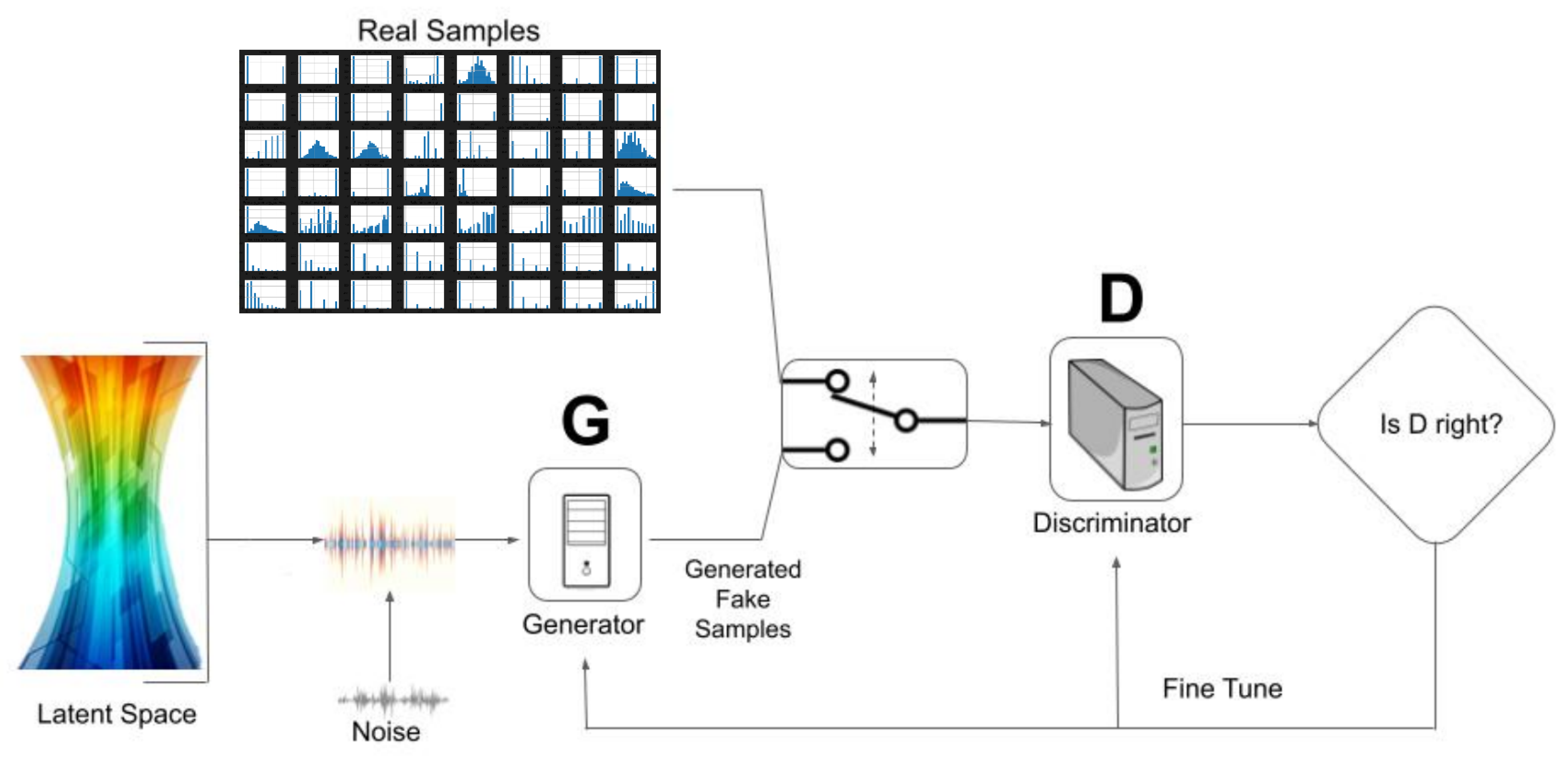
Figure 2.
Number of articles published per year.
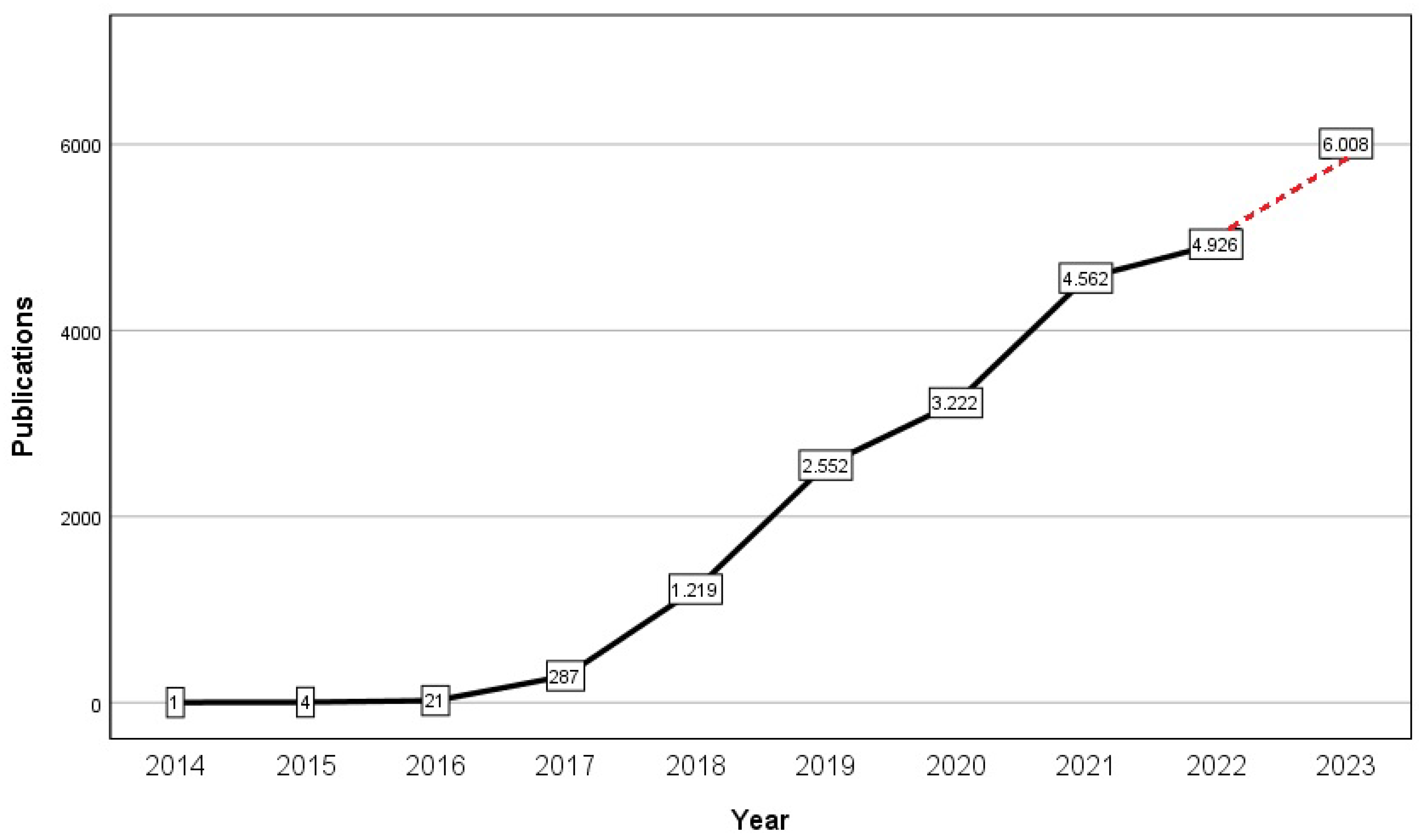

Table 1.
Frequency per type of document.
| Document Type | Document Type | Document Type | # | ||
|---|---|---|---|---|---|
| Articles | 11168 | Meeting Abstract | 131 | Letter | 5 |
| Proceedings | 7027 | Editorial Materials | 21 | Retracted Publication | 3 |
| Early access | 503 | Correction | 17 | Data Paper | 2 |
| Review Articles | 335 | Book Chapters | 12 | — |
Table 2.
Publications per countries.
| Countries | Countries | ||||
|---|---|---|---|---|---|
| China | 9123 | USA | 3837 | ||
| South Korea | 1165 | England | 958 | ||
| India | 920 | Japan | 835 | ||
| Germany | 704 | Australia | 670 | ||
| Canada | 630 | Taiwan | 415 | ||
| France | 398 | Singapore | 369 | ||
| Italy | 350 | Spain | 296 | ||
| Switzerland | 251 | Saudi Arabia | 203 | ||
| Others (103 countries) | 3267 | — | — | — |
Table 3.
Publications according to research areas.
| Research Areas | ||
|---|---|---|
| Computer Science | 10974 | |
| Engineering | 8418 | |
| Imaging Science/Photographic Technology | 2368 | |
| Telecommunications | 1983 | |
| Radiology/Nuclear Medicine/Medical Imaging | 1182 | |
| Remote Sensing | 897 | |
| Optics | 868 | |
| Physics | 854 | |
| Chemistry | 667 | |
| Instruments/Instrumentation | 674 | |
| Automation/Control Systems | 631 | |
| Materials Science | 507 | |
| Geology | 444 | |
| Mathematics | 404 | |
| Science/Technology/Other Topics | 404 | |
| Mathematical/Computational Biology | 389 | |
| Environmental Sciences / Ecology | 361 | |
| Acoustics | 351 | |
| Neurosciences/Neurology | 329 | |
| Geochemistry/Geophysics | 336 | |
| Robotics | 283 | |
| Medical Informatics | 245 | |
| Transportation | 235 | |
| Energy Fuels | 212 | |
| Operations Research/Management Science | 189 | |
| Others (90 areas) | 2283 |
Table 4.
WOS Publications in Financial Ecocomics.
| Year | Title | Authors |
|---|---|---|
| 2019 | GAN-MP hybrid heuristic algorithm for non-convex portfolio optimization problem. | Kim, Y., Kang, D., Jeon, M., and Lee, C. |
| 2020 | Generative adversarial networks for financial trading strategies fine-tuning and combination. | Koshiyama, A., Firoozye, N., and Treleaven, P. |
| 2020 | A generative adversarial network approach to calibration of local stochastic volatility models. | Cuchiero, C., Khosrawi, W., and Teichmann, J. |
| 2020 | Quant GANs: deep generation of financial time series. | Wiese, M., Knobloch, R., Korn, R., and Kretschmer, P. |
| 2021 | Alleviating class imbalance in actuarial applications using generative adversarial networks. | Ngwenduna, K. S., and Mbuvha, R. |
| 2022 | Robust utility maximization under model uncertainty via a penalization approach. | Guo, I., Langrene, N., Loeper, G., and Ning, W. |
| 2022 | DeepPricing: pricing convertible bonds based on financial time-series generative adversarial networks. | Tan, X., Zhang, Z., Zhao, X., and Wang, S. |
| 2022 | Scenario generation for market risk models using generative neural networks. | Flaig, S., and Junike, G. |
| 2022 | Simulating multi-asset classes prices using Wasserstein generative adversarial network: A study of stocks, futures and cryptocurrency. | Han, F., Ma, X., and Zhang, J. |
Table 5.
WOS Publications in Management.
| Year | Title | Authors |
|---|---|---|
| 2022 | Generative adversarial networks for data augmentation and transfer in credit card fraud detection. | Langevin, A., Cody, T., Adams, S., and Beling, P. |
| 2022 | A mapping the technological landscape of emerging industry value chain through a patent lens: An integrated framework with deep learning. | Xu, G., Dong, F., and Feng, J. |
| 2022 | Responsible cognitive digital clones as decision-makers:a design science research study. | Golovianko, M., Gryshko, S., Terziyan, V., and Tuunanen,T. |
| 2022 | An innovative machine learning model for supply chain management. | Lin, H., Lin, J., and Wang, F. |
Table 6.
WOS Publications in Marketing and Publicity.
| Year | Title | Authors |
|---|---|---|
| 2021 | Artificial intelligence in the fashion industry: consumer responses to generative adversarial network (GAN) technology. | Sohn, K., Sung, C. E., Koo, G., and Kwon, O. |
| 2021 | The rise of deepfakes: A conceptual framework and research agenda for marketing. | Whittaker, L., Letheren, K., and Mulcahy, R. |
| 2022 | Ad creative generation using reinforced generative adversarial network. | Terzioglu, S., Cogalmis, K. N., and Bulut, A. |
| 2022 | Preparing for an era of deepfakes and AI-generated ads: A framework for understanding responses to manipulated advertising. | Campbell, C., Plangger, K., Sands, S., and Kietzmann, J. |
| 2022 | How deepfakes and artificial intelligence could reshape the advertising industry: The coming reality of AI fakes and their potential impact on consumer behavior. | Campbell, C., Plangger, K., Sands, S., Kietzmann, J., and Bates, K. |
| 2022 | Using deep learning to overcome privacy and scalability issues in customer data transfer. | Anand, P., and Lee, C. |
| 2023 | Product aesthetic design: A machine learning augmentation. | Burnap, A., Hauser, J. R., and Timoshenko, A. |
| 2023 | Towards privacy-preserving digital marketing: an integrated framework for user modeling using deep learning on a data monetization platform. | Han, Q., Lucas, C., Aguiar, E., Macedo, P., and Wu, Z. |
Table 7.
WOS Publications in Logistic Transport.
| Year | Title | Authors |
|---|---|---|
| 2020 | Automated traffic incident detection with a smaller dataset based on generative adversarial networks. | Lin, Y., Li, L., Jing, H., Ran, B., and Sun, D. |
| 2020 | Coupled application of generative adversarial networks and conventional neural networks for travel mode detection using GPS data. | Li, L., Zhu, J., Zhang, H., Tan, H., Du, B., and Ran, B. |
| 2021 | A deep learning approach for real-time crash prediction using vehicle-by-vehicle data. | Basso, F., Pezoa, R., Varas, M., and Villalobos, M. |
| 2022 | Transfer learning for spatio-temporal transferability of real-time crash prediction models. | Man, C. K., Quddus, M., and Theofilatos, A. |
| 2022 | Generating mobility networks with generative adversarial networks. | Mauro, G., Luca, M., Longa, A., Lepri, B., and Pappalardo, L. |
Table 8.
WOS Publications in the classification “Others”.
| Year | Title | Authors |
|---|---|---|
| 2021 | Lung-GANs: Unsupervised representation learning for lung disease classification using chest CT and X-ray images. | Yadav, P., Menon, N., Ravi, V., and Vishvanathan, S. |
| 2022 | Are deep learning models superior for missing data imputation in large surveys? Evidence from an empirical comparison. | Wang, Z., Akande, O., Poulos, J., and Li, F. |
| 2022 | Cross-lingual cybersecurity analytics in the international dark web with adversarial deep representation learning. | Ebrahimi, M., Chai, Y., Samtani, S., and Chen, H. |
| 2023 | Motion Sensor-based fall prevention for senior care: A hidden Markov model with generative adversarial network approach. | Yu, S., Chai, Y., Samtani, S., Liu, H., and Chen, H. |
| 2023 | The spiral of digital falsehood in deepfakes. | Leone, M. |
Disclaimer/Publisher’s Note: The statements, opinions and data contained in all publications are solely those of the individual author(s) and contributor(s) and not of MDPI and/or the editor(s). MDPI and/or the editor(s) disclaim responsibility for any injury to people or property resulting from any ideas, methods, instructions or products referred to in the content. |
© 2024 by the authors. Licensee MDPI, Basel, Switzerland. This article is an open access article distributed under the terms and conditions of the Creative Commons Attribution (CC BY) license (http://creativecommons.org/licenses/by/4.0/).
Copyright: This open access article is published under a Creative Commons CC BY 4.0 license, which permit the free download, distribution, and reuse, provided that the author and preprint are cited in any reuse.


