
Submitted:
24 July 2024
Posted:
25 July 2024
You are already at the latest version
Abstract
In an era where the proliferation of large language models blurs the lines between human and machine-generated content, discerning text authenticity is paramount. This study investigates transformer-based language models—BERT, RoBERTa, and DistilBERT—in distinguishing human-written from machine-generated text. By leveraging a comprehensive corpus, including human-written text from sources such as Wikipedia, WikiHow, various news articles in different languages, and texts generated by OpenAI's GPT-2, we conduct rigorous comparative experiments. Our findings highlight the superior effectiveness of ensemble learning models over single classifiers in this critical task. This research underscores the versatility and efficacy of transformer-based methodologies for a wide range of natural language processing applications, significantly advancing text authenticity detection systems. The results demonstrate competitive performance, with the transformer-based method achieving an F-score score of 0.83 with RoBERTa-large (monolingual) and 0.70 with DistilBERT-base-uncased (multilingual).
Keywords:
large language models
; natural language processing
; content creation
; text authenticity
1. Introduction
The proliferation of large language models (LLMs), notably those developed by OpenAI, has blurred the lines between human and machine-generated content, raising significant concerns regarding text authenticity [1,2]. In an era where misinformation dissemination is a pressing issue in every domain [3,4,5], distinguishing between human-written and machine-generated text is paramount to mitigate risks associated with deceptive content [6,7]. While previous efforts have focused on identifying text generated by specific LLMs or domain-specific models (e.g., ChatGPT), our study aims to tackle the broader task of distinguishing human-written from machine-generated text [8].
Transformer models, such as Bidirectional Encoder Representations from Transformers (BERT) [9], have emerged as powerful tools in Natural Language Processing (NLP) [10,11], demonstrating remarkable capabilities in various tasks, including Text Generation (TG) [12]. Due to its ability to learn contextual representations of words and phrases, Generative Pre-trained Transformer 3 (GPT-3) has demonstrated significant performance across numerous NLP tasks [13]. This model uses the self-attention mechanism, which allows it to assign different weights to each word in the context of a sentence, capturing complex relationships between words and their meanings.
Additionally, transformer models have revolutionized other fields of Artificial Intelligence (AI) and Machine Learning (ML), such as time series analysis, by incorporating self-attention mechanism into specific data [14]. However, the increasing fluency of these models raises questions about the ability to discern effectively between human and machine-generated text [15]. As transformer models continue to advance, they have become the standard for building large-scale self-supervised learning systems [9,13].
We propose an approach centered on transformer models, combined with Bidirectional Long-Short Term Memory (BiLSTM), to predict the source of text and offer a solution to the challenge of discerning text authenticity. This research not only contributes to advancing text authenticity detection systems, but also underscores the versatility and efficacy of transformer-based methodologies in NLP applications.
The main research question addressed in this paper is: How efficient are transformers in building a classifier that can accurately detect human-written text from machine-generated text? We aim to provide insights into this question through our experimental analyses and methodology evaluation.
The structure of this paper is as follows: Section 2 discusses the role of transformers in addressing the problem of text generation, particularly in distinguishing between human-written and machine-generated text. Section 3 outlines the dataset and the method based on transformers. Section 4 delves into the usability and efficiency of the proposed method through a series of tests, followed by concluding remarks in the last section.
Current Survey Mission
This paper examines existing techniques for classifying texts as either human-written or machine-generated, explores their limitations, and proposes several models that leverage contextual understanding to enhance the accuracy and reliability of classification systems.
The main contributions of our research are as follows:
- Development of Resources: We contribute to the development of resources for less-resourced languages such as English, Romanian, and Hungarian.
- Extensive Datasets: We developed extensive datasets for English, Romanian, and Hungarian, containing both human-authored and machine-generated texts, using several large language models (LLMs).
- Implementation of Classification Models: We implemented classification models based on different architectures, including Transformer-based models (such as BERT-base, RoBERTa-base, RoBERTa-large, DistilBERT-base-uncased, XLM-RoBERTa-base, BERT-base-multilingual-cased, and DistilBERT-base-multilingual-cased) and classic machine learning (ML) models, designed to automatically classify texts in several languages.
We release the datasets as open-source resources (available at Papers with Code, AI Crowd, Mendeley Data, and GitHub, accessed on 22 July 2024), along with the codebase (available at GitHub, accessed on 22 July 2024).
2. Transformers for Human and Machine-Generated
AI technology is increasingly capable of generating text that is difficult to distinguish from human-written content. Initially, traditional machine learning techniques such as Convolutional Neural Networks (CNN), Long Short-Term Memory (LSTM), hybrid methods (CNN-LSTM), Support Vector Machines (SVM), and Decision Trees (DTs) were employed. Recently, however, generative models based on transformers, such as BERT [9], RoBERTa [16], DistilBERT [17], have become prevalent.
Transformers are pretrained models designed to accomplish specific tasks. They can be used as they are or can be fine-tuned with additional custom layers to meet specific application needs. BERT and its successors are utilized in various NLP generative tasks, including Machine Translation (MT) [12,18], Question Answering (QA) [19,20], Text Summarization (TS) [21,22], and Text Classification (TC) [23,24]. Transformer models [25,26] are particularly well-suited for text generation tasks requiring contextually rich and coherent text, outperforming traditional neural networks such as CNN, Bi-LSTM, and hybrid CNN-BiLSTM models [27].
Subsequent studies, employed in this study, and advancements have built on the BERT framework, described below.
2.1. BERT
Bidirectional Encoder Representations from Transformers (BERT), introduced by Google AI in 2018 [9], was a groundbreaking advancement in NLP. Unlike unidirectional models, BERT employs a bidirectional approach, considering the context from both the left and right sides of the sequence it aims to understand. Its fine-tuning flexibility allows developers to create high-performance systems by adding an additional output layer on top of the pretrained model.
BERT’s architecture is based on the original Transformer, featuring multiple layers, larger feed-forward networks, and more attention heads. It was pretrained on a large corpus using Masked Language Modeling (MLM) and Next Sentence Prediction (NSP) tasks (Figure 1). The input embeddings in BERT are the sum of token embeddings, segmentation embeddings, and position embeddings.
The Masked Language Model (MLM) becomes useful for predicting the original vocabulary ID of a masked word based solely on its context, as it can randomly mask some input tokens during training. The next sentence prediction (NSP) task involves training the model to learn the relationships between sentences in a document or text corpus. During training, BERT receives pairs of sentences as input and learns to predict whether they are consecutive in the document.
Subsequent studies and advancements that build on the BERT framework are described below.
2.2. RoBERTa
RoBERTa [21] is a reimplementation of BERT with several modifications to key hyperparameters and embedding techniques [28]. One of the significant improvements in RoBERTa is the use of dynamic masking, which enhances the robustness of semantic text representation. RoBERTa’s training involves larger batch sizes and more steps compared to BERT, contributing to its enhanced performance.
A key feature of RoBERTa is the prevention of input sentences from crossing document boundaries, which is crucial for improving contextual understanding. While BERT uses a batch size of 256 sequences and trains for 1 million steps, RoBERTa uses a batch size of 2,000 and trains for 500,000 steps, better adapting to the dynamic masking concept [24,29].
Another important feature of RoBERTa is the use of Byte Pair Encoding (BPE) for tokenization. BPE tokenizes text into subwords extracted from the training corpus based on advanced statistical analysis. By using bytes instead of Unicode characters as the base for subword units, RoBERTa achieves a universal encoding scheme that is more efficient [30,31].
In addition to these features, RoBERTa was trained for a longer period using a larger dataset, including data from sources like Common Crawl, WebText, and other large-scale corpora, which further improves its performance and applicability across various NLP tasks [16,32]. This extensive training on a more diverse dataset contributes to its superior performance in a range of NLP applications, such as text classification, sentiment analysis, and question answering.
2.3. DistilBERT
DistilBERT, developed by Hugging Face, is a smaller and faster version of BERT that retains 97% of BERT’s language understanding capabilities while being 60% faster [17]. This efficiency is achieved by reducing the number of transformer layers and removing certain components, such as token-type embeddings and the pooler used for next sentence prediction.
The architecture of DistilBERT is similar to BERT’s, but with notable differences. Specifically, DistilBERT contains only 6 transformer layers, compared to the 12 layers in the BERT base model. Additionally, DistilBERT omits token-type embeddings and the pooler, which are present in BERT. To enhance the quality of sequence representation, DistilBERT introduces a distillation token at the input [17].
DistilBERT’s optimized performance makes it an appealing choice for a wide range of applications, offering impressive results with reduced computational requirements [17,33]. This makes it particularly useful in scenarios where computational resources are limited but high performance is still needed.
3. Materials and Methods
In our survey, the primary focus was on classifying texts as either human-written or machine-generated using an existing corpus. To differentiate between human and machine-generated text, a few AI Text Classifiers have been developed.
3.1. Dataset
The corpus for this study consists of multiple datasets with comparable text lengths, including both machine-generated and human-written content. Experiments were conducted iteratively across all datasets to provide a comprehensive overview.
To ensure that the detector generalizes well across various domains and writing styles, the human dataset includes texts from diverse domains, specifically:
- M4 dataset (https://paperswithcode.com/datasets, accessed on 22 July 2024): Contains human-written text from sources such as Wikipedia, Wiki-How [34], Reddit (ELI5), arXiv, and PeerRead [35] for Chinese, as well as news articles for Urdu, RuATD [36] for Russian, and Indonesian news articles. Machine-generated text is sourced from multilingual LLMs such as ChatGPT, textdavinci-003, LLaMa [37], FlanT5 [38], Cohere, Dolly-v2, and BLOOMz [39];
- AI Crowd FakeNews Dataset (https://www.aicrowd.com/challenges/kiit-ai-mini-blitz/problems/fake-news-detection, accessed on 22 July 2024): Contains texts from various news articles and texts generated by OpenAI’s GPT-2. The dataset was published by AI Crowd as part of the KIIT AI (mini)Blitz Challenge;
- Indonesian Hoax News Detection Dataset (INDONESIAN HOAX NEWS DETECTION DATASET—Mendeley Data, accessed on 22 July) [40]: Contains valid and hoax news articles in Indonesian. It has a simple structure, with CSV files consisting of 2 columns: text and label;
- TURNBACKHOAX Dataset (https://github.com/jibranfawaid/turnbackhoax-dataset/tree/main?tab=readme-ov-file#turnbackhoax-dataset, accessed on 22 July 2024): Contains valid and hoax news articles in Indonesian. It has a simple structure, with a CSV file consisting of 3 columns: label, headline, body.
The M4 input data is organized as JavaScript Object Notation (JSON) records in files with the extension JSON Lines (JSONL).
The structure of each record is very straightforward and intuitive.
Figure 2 and Figure 3 present the structure of the datasets (monolingual/multilingual) for training and development testing.
There are mainly three major differences if we compare the datasets used for training the models and the dataset that will be used for final evaluation:
- The task formulation is different;
- Human text was upsampled to balance the data;
- New and surprising domains, generators, and languages will appear in the test sets. Real test sets will not include information about generators, domains, and languages.
Nevertheless, the test dataset includes BLOOMZ1 outputs (for monolingual language) that are not included in the training set. Moreover, the model is prepared for real-world application scenarios.
3.2. System Overview
The architecture (Figure 4) is based on BERT-based transformers (BERT, RoBERTa, DistilBERT) using the HuggingFace library.
The model was pretrained [9,41,42,43] on large generic datasets and fine-tuned for specific tasks like text classification, named entity recognition, and sentiment analysis [44].
As a baseline, we chose the RoBERTa-base pretrained model, fine-tuned with a sequence classification/regression head on top.
The model was trained and evaluated on the same dataset mentioned before. Table 2 contains the baselines’ hyperparameters. Additionally, we used Cross-Entropy loss as the loss function, as we are dealing with a binary classification task. The model is built in such a way that via the Sigmoid function at the end, it should output a probability of 0 (= no AI-generated text) and 1 (= AI-generated text). As an optimizer, AdamW, an improved version of Adaptive Moment Estimation (Adam), is significant in training deep learning (DL) models. The learning rate value was set to 2e-5.
The average results for the baseline monolingual setup across three runs for the RoBERTa-base pretrain-dataset are 0.74, and respectively 0.72 for multilanguage, based on the xlm-roberta-base pretrain-dataset.
This model has 2 layers, 768 hidden units, 12 heads, and 125 million parameters.

Table 3.
Baseline model: Hyperparameter Optimization.
| Hyperparameter | Values |
|---|---|
| Learning rate | 2e-5 |
| Batch Size | 16 |
| Epochs | 3 |
| Weight decay | 0,01 |
Fine-tuned models. The main objective of the experiment was to obtain a fine-tuned model that could outperform the baseline model.
Various variations of models/approaches were trained, and ultimately, we decided to combine Hugging Face’s Transformers library with PyTorch and Scikit-Learn libraries.
Additionally, a custom classifier class was applied on top of pretrained models to identify the correct label for our texts. The classifier consists of 2 dense layers: the first layer with 768 neurons (for “base” versions) / 1024 neurons (for “large” versions), and the second layer with 32 neurons (for “base” versions) / 8 neurons (for “large” versions).
Since we have a binary classification task, we use one neuron for the output layer and the sigmoid function (which returns values between 0 and 1) as the activation function for our neural network. The number of neurons in the first layer actually represents the number of neurons in the output layer of the pretrained models (768 for “base” versions, and 1024 for large models).
For classifications task based on neural networks, we used Activation Function (Rectified Linear Unit—ReLU Sigmoid for hidden layers) loss function, and AdamW, as optimizer. The learning rate value was set to 1e-5.
Table 4.
Fine-tuned model: Hyperparameter Optimization.
| Hyperparameter | Values |
|---|---|
| Learning rate | 1e-5 |
| Batch Size | 8 |
| Epochs | 5 |
As pretrained models, we tested BERT-base, RoBERTa-base, RoBERTa-large, as well as DistilBERT-base-uncased for the monolingual setup, and XLM-RoBERTa-base, BERT-base-multilingual-cased, DistilBERT-base-multilingual-cased for the multilingual setup, models provided by the Transformers library.
For monolingual experiments, as expected, RoBERTa-large provided the best results with an accuracy of 0.83, but the training process took approximately 10 hours.
Using the DistilBERT-base-multilingual-cased model for monolingual experiments also yielded promising results, with less power consumption, within approximately 3 hours. Thus, it can be considered a very good alternative to RoBERTa or BERT. It is important to note that we need to use different pretrained models for each subtask (monolingual and multilingual), as there are separate models optimized for multilingual tasks.
In order to reduce training time, GPUs were used for model training and inference. All experiments were conducted on a Mac Studio machine, as detailed in the results section.
3.3. Experiments
The experimental setup involved preprocessing the dataset, feature engineering, and modeling using different transformer architectures.
- Preprocessing
We created a custom PyTorch DataSet class for loading data and performing basic preprocessing steps:
(1) Text Cleanup: Removing HTML tags, special characters such as # and @, punctuation, and multiple spaces.
(2) Basic preprocessing: Tokenization
- Feature Engineering
For this survey, Bag of Words (BoW) and Word to Vectors (word2vec) models were used.
- Modelling
For pretrained, transformers like BERT-base, RoBERTa-base, RoBERTa-large, DistilBERT-base-uncased/XLM-RoBERTa-base, BERT-base-multilingual-cased, DistilBERT-base-multilingual-cased) combined with a custom classifier consisting of 3 layers with varying numbers of neurons responded promising.
To adjust the learning rate for different parameters, Adaptive Moment Estimation (ADAM) optimizer was chosen.
- Prediction
Since this model returns probabilities between 0 and 1, we use a 50% threshold for target classification. Predictions are stored using the given test dataset, which includes test IDs and sample targets, and a prediction file is generated based on the model’s predictions. For evaluation of both subtasks, we employ sklearn.metrics, calculating Accuracy (Acc), Precision (P), Recall (R), and F-score (also known as the F1 score or F-measure).
For the multilingual subtask, we use different pretrained models, selecting custom pretrained models optimized for multilanguage tasks.
4. Results
The experiments were conducted on a Mac Studio machine. In terms of performance, the Mac Studio is equipped with Apple’s M1 Max Chip, featuring a 10-core CPU, an integrated 24-core GPU, and a maximum memory bandwidth of 400GB/s, according to the official specifications.
The results table presents a comparison of metrics for the tested models, including accuracy, precision, recall, and F-score, along with the time required for training and evaluation of each model.
5. Discussion
The experiments conducted in this study focused on evaluating the performance of various pretrained models from the BERT family, which were fine-tuned with a custom classifier to detect AI-generated text.
- For monolingual models, the results revealed notable insights. Specifically, the RoBERTa-large model, in conjunction with a custom classification layer, demonstrated the highest performance levels among all tested models. This performance exceeded baseline results observed in competitions such as SemEval-2024 Task 8. Despite its slightly lower accuracy, DistilBERT showcased efficient resource utilization. Additionally, the RoBERTa-base model exhibited performance closely comparable to that of RoBERTa-large while boasting significantly faster training times. Particularly noteworthy was the performance of a hybrid model combining a pre-trained model with DistilBERT alongside a custom classifier. Despite a marginally lower accuracy of 0.68, this model exhibited com-mendable precision at 0.73, underscoring its resource efficiency and satisfactory performance.
- In the case of multilingual models, the results indicated lower accuracy levels and longer training times due to the larger dataset. Interestingly, the DistilBERT model surpassed its teacher, BERT, in this subtask, achieving an accuracy of 0.70 compared to the baseline accuracy of 0.68. This outcome suggests the necessity for distinct approaches when addressing monolingual and multilingual tasks.
Our findings underscore the inherent challenges in distinguishing between hu-man-written and machine-generated text. While transformer models exhibit promise in this domain, further research is imperative to enhance model robustness and ad-dress the limitations observed in real-world scenarios.
By leveraging alternative approaches and refining feature engineering techniques, future investigations can contribute significantly to the advancement of AI-generated text detection systems.
6. Conclusions
This study provides valuable insights into the effectiveness of transformer models in identifying AI-generated text. Moving forward, research efforts should explore alternative approaches, such as A Lite BERT for Self-supervised Learning of Language Representations (ALBERT) [45], and incorporate advanced feature engineering techniques to improve model performance and robustness. Addressing these aspects can significantly contribute to ongoing efforts to improve AI-generated text detection systems.
This study offers a detailed evaluation of pretrained models BERT, RoBERTa, and DistilBERT for detecting AI-generated texts. Despite achieving good results, distinguishing machine-generated from human-written text remains challenging, especially with unseen data during training. Future research should explore other methods like ALBERT [36], more advanced feature engineering, and the combination of machine learning techniques to enhance model robustness. By addressing these limitations and incorporating the suggested improvements, this study can significantly contribute to ongoing efforts to improve AI-generated text detection systems.
Author Contributions
Conceptualization, D.G. and S.-V.C.; methodology, D.G. and S.-V.C.; software, S.-V.C.; validation, S.-V.C.; formal analysis, S.-V.C.; investigation, D.G.; resources, D.G.; data curation, D.G.; writing—original draft preparation, D.G.; writing—review and editing, D.G.; visualization, S.-V.C.; supervision, D.G.; project administration, D.G. All authors have read and agreed to the published version of the manuscript.
Funding
This research received no external funding.
Data Availability Statement
As open-sources, the following datasets are released (https://paperswithcode.com/datasets;https://www.aicrowd.com/challenges/kiit-ai-mini-blitz/problems/fake-news-detection; INDONESIAN HOAX NEWS DETECTION DATASET—Mendeley Data; https://github.com/jibranfawaid/turnbackhoax-dataset/tree/main?tab=readme-ov-file#turnbackhoax-dataset, accessed on 22 July 2024), and the codebase (SemEval2024Task8/subtaskA/detector.py at main · SilviuCovaci/SemEval2024Task8 GitHub, accessed on 22 July 2024). Additional information is available on request from the corresponding author.
Conflicts of Interest
The authors declare no conflict of interest.
Abbreviations
The following abbreviations are used in this manuscript:
| ACC | Accuracy |
| ADAM | Adaptive Moment Estimation |
| AI | Artificial Intelligence |
| BoW | Bag of Words |
| BERT | Bidirectional Encoder Representations from Transformers |
| BiLSTM | Bidirectional Long-Short Term Memory |
| BLOOM | Big Science Large Open-science Open-access Multilingual Language Model |
| BPE | Byte Pair Encoding |
| CNN | Convolutional Neural Networks |
| DTs | Decision Trees |
| DL | Deep Learning |
| DistilBERT | Distilled BERT |
| GPT | Generative Pre-trained Transformer |
| JSON | JavaScript Object Notation |
| JSONL | JSON Lines |
| LLMs | Large Language Models |
| LSTM | Long Short-Term Memory |
| MLM | Masked Language Model |
| ML | Machine Learning |
| MT | Machine Translation |
| NLP | Natural Language Processing |
| NSP | Next Sentence Prediction |
| P | Precision |
| QA | Question Answering |
| R | Recall |
| ReLU | Rectified Linear Unit |
| RoBERTa | Robustly Optimized BERT |
| SVMs | Support Vector Machines |
| TC | Text Classification |
| TG | Text Generation |
| TS | Text Summarization |
| word2vec | Word to Vectors |
| 1 | BLOOMZ, a variant of BLOOM model, supports 46 human languages. Hugging Face reports that the 7 billion-parameter BLOOMZ runs three times faster on the Intel Habana Gaudi2 compared to the A100-80G. |
References
- Weidinger, L.; Mellor, J.F.; Rauh, M.; Griffin, C.; Uesato, J.; Huang, P.; Cheng, M.; Glaese, M.; Balle, B.; Kasirzadeh, A.A.; et al. Ethical and social risks of harm from Language Models. arXiv 2021, arXiv:2112.04359. [Google Scholar]
- Solaiman, I.; Brundage, M.; Clark, J.; Askell, A.; Herbert-Voss, A.; Wu, J.; Radford, A.; Krueger, G.; Kim, J.W.; Kreps, S.; et al. Release Strategies and the Social Impacts of Language Models. arXiv 2019, arXiv:1908.09203. [Google Scholar]
- Gîfu, D. An Intelligent System for Detecting Fake News. Procedia Computer Science, open access journal, edited by Yong Shi, ELSEVIER, Vol. 221, 2023, pp. 1058-1065. [CrossRef]
- Ermurachi, V.; Gîfu, D. UAIC1860 at SemEval-2020 Task 11: Detection of Propaganda Techniques in News Articles. Proceedings of the Fourteenth Workshop on Semantic Evaluation, (SemEval-2020), Association for Computational Linguistics, Barcelona, Spain, 2020, pp. 1835-1840.
- Gîfu, D. Utilization of Technologies for Linguistic Processing in an Electoral Context: Method LIWC-2007. Proceedings of the Communication, Context, Interdisciplinarity Congress, 19-20 Nov. 2010, Vol. 1, “Petru Maior” University Publishing House, Târgu-Mureș, 2010, pp. 87-98.
- Ma, Y.; Liu, J.; Yi, F.; Cheng, Q.; Huang, Y.; Lu, W.; Liu, X. AI vs. Human-Differentiation Analysis of Scientific Content Generation. arXiv 2023, arXiv:2301.10416. [Google Scholar]
- Ouatu, B.; Gîfu, D. Chatbot, the Future of Learning? Ludic, Co-design and Tools Supporting Smart Learning Ecosystems and Smart Education, Springer, 2020, pp. 263-268.
- Wang, Y.; Mansurov, J.; Ivanov, P.; Su, J.; Shelmanov, A.; Tsvigun, A.; Whitehouse, C.; Afzal, O.M.; Mahmoud, T.; Sasaki, T.; Arnold, T.; Aji, A.F.; Habash, N.; Gurevych, I.; Nakov, P. M4: Multi-Generator, Multi-Domain, and Multi-Lingual Black-Box Machine-Generated Text Detection, May 24. arXiv 2023, arXiv:2305.14902. [Google Scholar]
- Devlin, J.; Chang, M.-W.; Lee, K.; Toutanova, K. BERT: Pre-training of Deep Bidirectional Transformers for Language Understanding. North American Association for Computational Linguistics, 2019.
- Manoleasa, T.; Sandu, I.; Gîfu, D.; Trandabăț, D. FII UAIC at SemEval-2022 Task 6: iSarcasmEval—Intended Sarcasm Detection in English and Arabic. Proceedings of the 16th International Workshop on Semantic Evaluation, (SemEval-2022), Association for Computational Linguistics, Seattle, Washington, US, 2022, pp. 970-977.
- Alexa, L.; Lorenț, A.; Gîfu, D.; Trandabăț, D. The Dabblers at SemEval-2018 Task 2: Multilingual Emoji Prediction. Proceedings of the 12th International Workshop on Semantic Evaluation, (SemEval-2018), Association for Computational Linguistics: Human Language Technologies (NAACL HLT 2018), New Orleans, Louisiana, United States, 2018, pp. 405-409.
- Vaswani, A.; Shazeer, N.; Parmar, N.; Uszkoreit, J.; Jones, L.; Gomez, A.N.; Kaiser, L.; Polosukhin, I. Attention is All You Need. Proceedings of Advances in Neural Information Processing Systems 2017, 30. [Google Scholar]
- Brown, T.; Mann, B.; Ryder, N.; Subbiah, M.; Kaplan, J.D.; Dhariwal, P.; Neelakantan, A.; Shyam, P.; Sastry, G.; Askell, A.; Agarwal, S.; Herbert-Voss, A.; Krueger, G.; Henighan, T.; Child, R.; Ramesh, A.; Ziegler, D.; Wu, J.; Winter, C.; Hesse, C.; Chen, M.; Sigler, E.; Litwin, M.; Gray, S.; Chess, B.; Clark, J.; Berner, C.; McCandlish, S.; Radford, A.; Sutskever, I.; Amodei, D. Language Models are Few-Shot Learners. Advances in Neural Information Processing Systems 2020.
- Niu, P.; Zhou, T.; Wang, X.; Sun, L.; Jin, R. Attention as Robust Representation for Time Series Forecasting. arXiv 2024, arXiv:2402.05370v1. [Google Scholar]
- Clark, E.; August, T.; Serrano, S.; Haduong, N.; Gururangan, S.; Smith, N.A. All That’s ‘Human’ Is Not Gold: Evaluating Human Evaluation of Generated Text. In Proceedings of the Annual Meeting of the Association for Computational Linguistics, Bangkok, Thailand, 1–6 August 2021. [Google Scholar]
- Liu, Y.; Lapata, M. Text Summarization with Pretrained Encoders. Proceedings of the 2019 Conference on Empirical Methods in Natural Language Processing and the 9th International Joint Conference on Natural Language Processing (EMNLP-IJCNLP), Hong Kong, China. Association for Computational Linguistics, 2019, pp. 3730–3740.
- Sanh, V.; Debut, L.; Chaumond, J.; Wolf, T. DistilBERT, a Distilled Version of BERT: Smaller, Faster, Cheaper and Lighter. arXiv 2020, arXiv:1910.01108. [Google Scholar]
- Tang, G.; Sennrich, R.; Nivre, J. An Analysis of Attention Mechanisms: The Case of Word Sense Disambiguation in Neural Machine Translation. Proceedings of the Third Conference on Machine Translation: Research Papers, Belgium, Brussels. Association for Computational Linguistics, 2018, pp. 26–35.
- Rajpurkar, P.; Zhang, J.; Lopyrev, K.; Liang, P. SQuAD: 100,000+ Questions for Machine Comprehension of Text, 2016, pp. 2383-2392. [CrossRef]
- Yang, Y.; Cer, D.; Ahmad, A.; Guo, M.; Law, J.; Constant, N.; Abrego, G.H.; Yuan, S.; Tar, C.; Sung, Y.-H.; et al. Multilingual universal sentence encoder for semantic retrieval. arXiv 2019, arXiv:1907.04307. [Google Scholar]
- Liu, Y., Myle Ott, Naman Goyal, Jingfei Du, Mandar Joshi, Danqi Chen, Omer Levy, Mike Lewis, Luke Zettlemoyer, and Veselin Stoyanov: RoBERTa: A Robustly Optimized BERT Pretraining Approach. arXiv 2019, arXiv:1907.11692.
- Zhang, H.; Cai, J.; Xu, J.; Wang, J. Pretraining-Based Natural Language Generation for Text Summarization. Proceedings of the 23rd Conference on Computational Natural Language Learning (CoNLL), Hong Kong, China. Association for Computational Linguistics, 2019, pp. 789–797.
- Sun, C.; Qiu, X.; Xu, Y.; Huang, X. How to Fine-Tune BERT for Text Classification? China National Conference on Chinese Computational Linguistics, Springer, Cham, 2019, pp. 194-206.
- Yang, Z.; Yang, D.; Dyer, C.; He, X.; Smola, A.J.; Hovy, E. XLNet: Generalized Autoregressive Pretraining for Language Understanding. Proceedings of the 33rd International Conference on Neural Information Processing Systems (NeurIPS 2020), 2020, pp. 5754-5764. https://arxiv.org/abs/1906.08237.
- Awalina, A.; Krisnabayu, R.Y.; Yudistira, N.; Fawaid, J. Indonesia’s Fake News Detection using Transformer Network. 6th International Conference on Sustainable Information Engineering and Technology, Malang Indonesia: ACM, 2021, pp. 247–251. [CrossRef]
- Azizah, A.F.N.; Cahyono, H.D.; Sihwi, S.W.; Widiarto, W. Performance Analysis of Transformer Based Models (BERT, ALBERT and RoBERTa) in Fake News Detection. arXiv 2023, arXiv:2308.04950. [Google Scholar]
- Zecong, W.; Jiaxi, C.; Chen, C.; Chenhao, Y. Implementing BERT and Fine-Tuned RobertA to Detect AI Generated News by ChatGPT. arXiv 2023, arXiv:2306.07401. [Google Scholar]
- Zhang, H.; Shafig, M.O. Survey of Transformers and Towards Ensemble Learning Using Transformers for Natural Language Processing. Journal of Big Data, 2024; 11, 25. [Google Scholar] [CrossRef]
- Clark, K.; Luong, M.T.; Le, Q.V.; Tannenbaum, K. ELECTRA: Pre-Training Text Encoders as Discriminators Rather than Generators. Proceedings of the 8th International Conference on Learning Representations (ICLR 2020), 2020. https://arxiv.org/abs/2003.10555.
- Sennrich, R.; Haddow, B.; Birch, A. Neural Machine Translation of Rare Words with Subword Units. Proceedings of the 54th Annual Meeting of the Association for Computational Linguistics (ACL 2016), 2016, pp. 1715-1725. [CrossRef]
- Gage, P. A New Algorithm for Data Compression. C Users Journal 1994, 12, 23–38. [Google Scholar]
- Raffel, C.; Shinn, C.; Roberts, A. Exploring the Limits of Transfer Learning with a Unified Text-to-Text Transformer. Journal of Machine Learning Research 2020, 21, 1–67. [Google Scholar]
- Smith, J.; Lee, K.; Kumar, A. Optimizing Transformer Models for Mobile Devices: A Comparative Study. Proceedings of the 2021 Conference on Empirical Methods in Natural Language Processing (EMNLP 2021), 2021, pp. 234-245. [CrossRef]
- Koupaee, M.; Wang, W.Y. Wikihow: A Large-Scale Text Summarization Dataset. arXiv 2018. [Google Scholar] [CrossRef]
- Kang, D.; Ammar, W.; Dalvi, B.; van Zuylen, M.; Kohlmeier, S.; Hovy, E.; Schwartz, R. A Dataset of Peer Reviews (PeerRead): Collection, Insights and NLP Applications. Proceedings of the 2018 Conference of the North American Chapter of the Association for Computational Linguistics: Human Language Technologies, Vol. 1 (Long Papers), New Orleans, Louisiana. Association for Computational Linguistics, 2018, pp. 1647–1661.
- Shamardina, T.; Mikhailov, V.; Cherniavskii, D.; Fenogenova, A.; Saidov, M.; Valeeva, A.; Shavrina, T.; Smurov, I.; Tutubalina, E.; Artemova, E. Findings of the Ruatd Shared Task 2022 on Artificial Text Detection in Russian. arXiv 2022. [Google Scholar] [CrossRef]
- Touvron, H.; Lavril, T.; Izacard, G.; Martinet, X.; Lachaux, M.-A.; Lacroix, T.; Rozière, B.; Goyal, N.; Hambro, E.; Azhar, F.; Rodriguez, A.; Joulin, A.; Grave, E.; Lample, G. Llama: Open and Efficient Foundation Language Models. arXiv 2023, arXiv:2302.13971. [Google Scholar]
- Chung, H.W.; Hou, L.; Longpre, S.; Zoph, B.; Tay, Y.; Fedus, W.; Li, E.; Wang, X.; Dehghani, M.; Brahma, S.; Webson, A.; Gu, S.S.; Dai, Z.; Suzgun, M.; Chen, X.; Chowdhery, A.; Narang, S.; Mishra, G.; Yu, A.; Zhao, V.Y.; Huang, Y.; Dai, A.M.; Yu, H.; Petrov, S.; Chi, E.H.; Dean, J.; Devlin, J.; Roberts, A.; Zhou, D.; Le, Q.V.; Wei, J. Scaling Instruction-Finetuned Language Models. arXiv 2022, arXiv:2210.11416. [Google Scholar]
- Muennighoff, N.; Wang, T.; Sutawika, L.; Roberts, A.; Biderman, S.; Scao, T.L.; Bari, M.S.; Shen, S.; Yong, Z.X.; Schoelkopf, H.; Tang, X.; Radev, D.; Aji, A.F.; Almubarak, K.; Albanie, S.; Alyafeai, Z.; Webson, A.; Raff, E.; Raffel, C. Crosslingual Generalization Through Multitask Finetuning. arXiv 2022, arXiv:2211.01786. [Google Scholar]
- Faisal, R.; Inggrid, Y.; Rosa, A. Indonesian Hoax News Detection Dataset. Mendeley Data, V1, 2018. [CrossRef]
- Peters, M.E.; Neumann, M.; Iyyer, M.; Gardner, M.; Clark, C.; Lee, K.; Zettlemoyer, L. Deep Contextualized Word Representations. arXiv 2018. [Google Scholar] [CrossRef]
- McCann, B.; Bradbury, J.; Xiong, C.; Socher, R. Learned in Translation: Contextualized Word Vectors. Advances in Neural Information Processing Systems 30, I. Guyon, U.V. Luxburg, S. Bengio, H. Wallach, R. Fergus, S. Vishwanathan, and R. Garnett (eds.), 2017, pp. 6294–6305. Curran Associates, Inc.
- Howard, J.; Ruder, S. Universal Language Model Fine-Tuning for Text Classification. Proceedings of the 56th Annual Meeting of the Association for Computational Linguistics, Volume 1: Long Papers, 2018, pp. 328–339, Melbourne, Australia. Association for Computational Linguistics.
- Wolf, T.; Debut, L.; Sanh, V.; Chaumond, J.; Delangue, C.; Moi, A.; Cistac, P.; Rault, T.; Louf, R.; Funtowicz, M.; Davison, J.; Shleifer, S.; von Platen, P.; Ma, C.; Jernite, Y.; Plu, J.; Xu, C.; Scao, T.L.; Gugger, S.; Drame, M.; Lhoest, Q.; Rush, A.M. Huggingface’s Transformers: State-of-the-Art Natural Language Processing. arXiv 2019, arXiv:1910.03771. [Google Scholar]
- Lan, Z.; Chen, M.; Goodman, S.; Gimpel, K.; Sharma, P.; Soricut, R. ALBERT: A Lite BERT for Self-Supervised Learning of Language Representations. arXiv 2020, arXiv:1909.11942v6. [Google Scholar]
Figure 1.
BERT input representation.
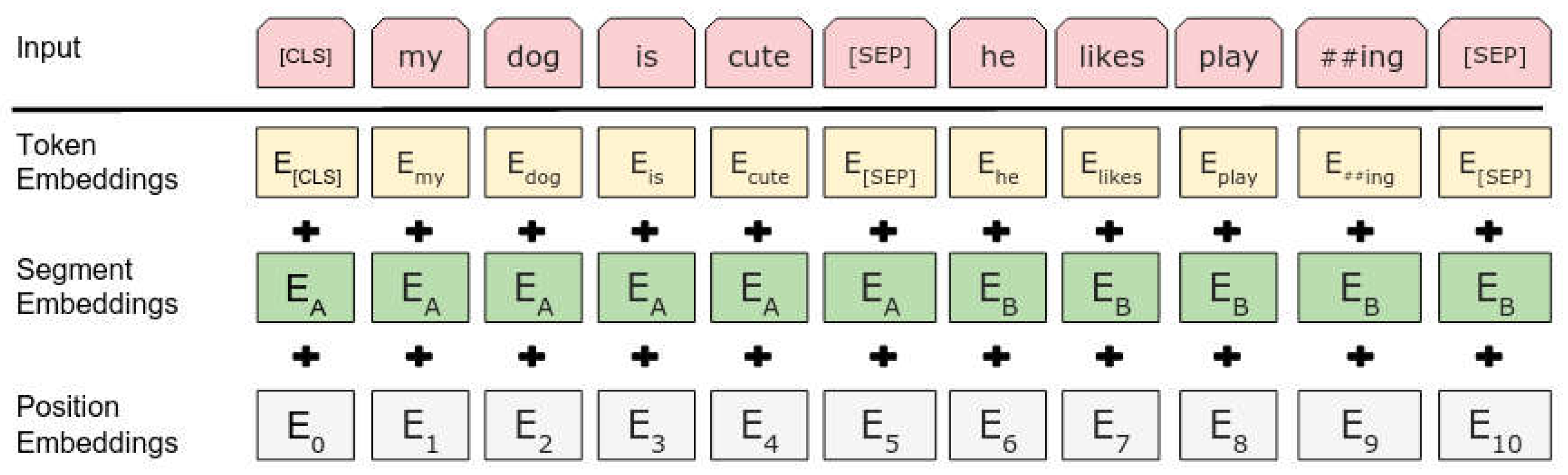
Figure 2.
Mono- and multilingual Training Dataset.
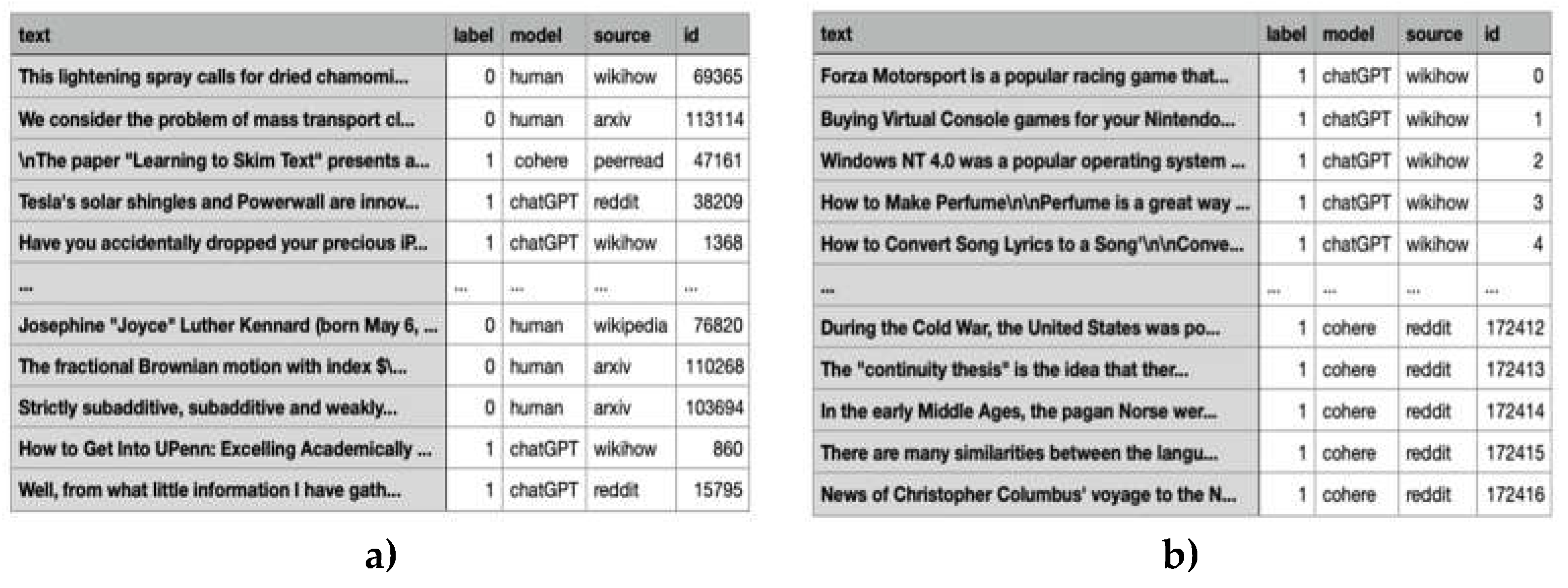
Figure 3.
Mono- and multilingual Testing Dataset.
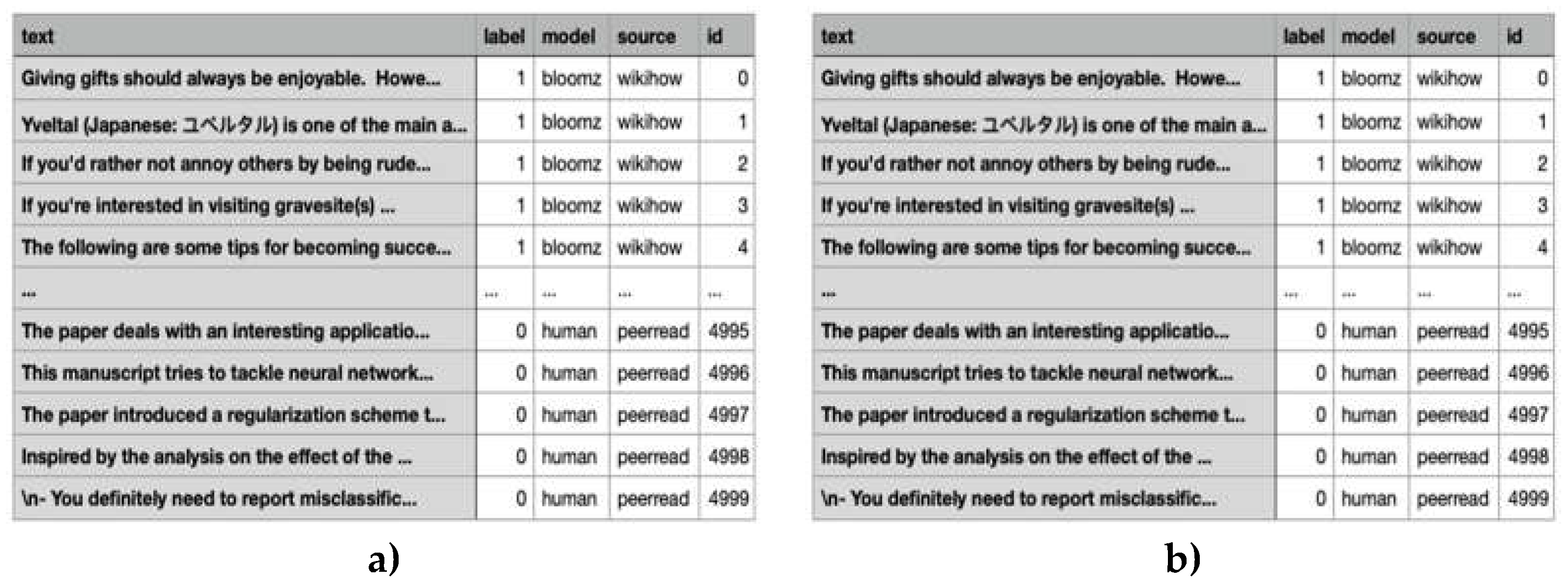
Figure 4.
Architecture.
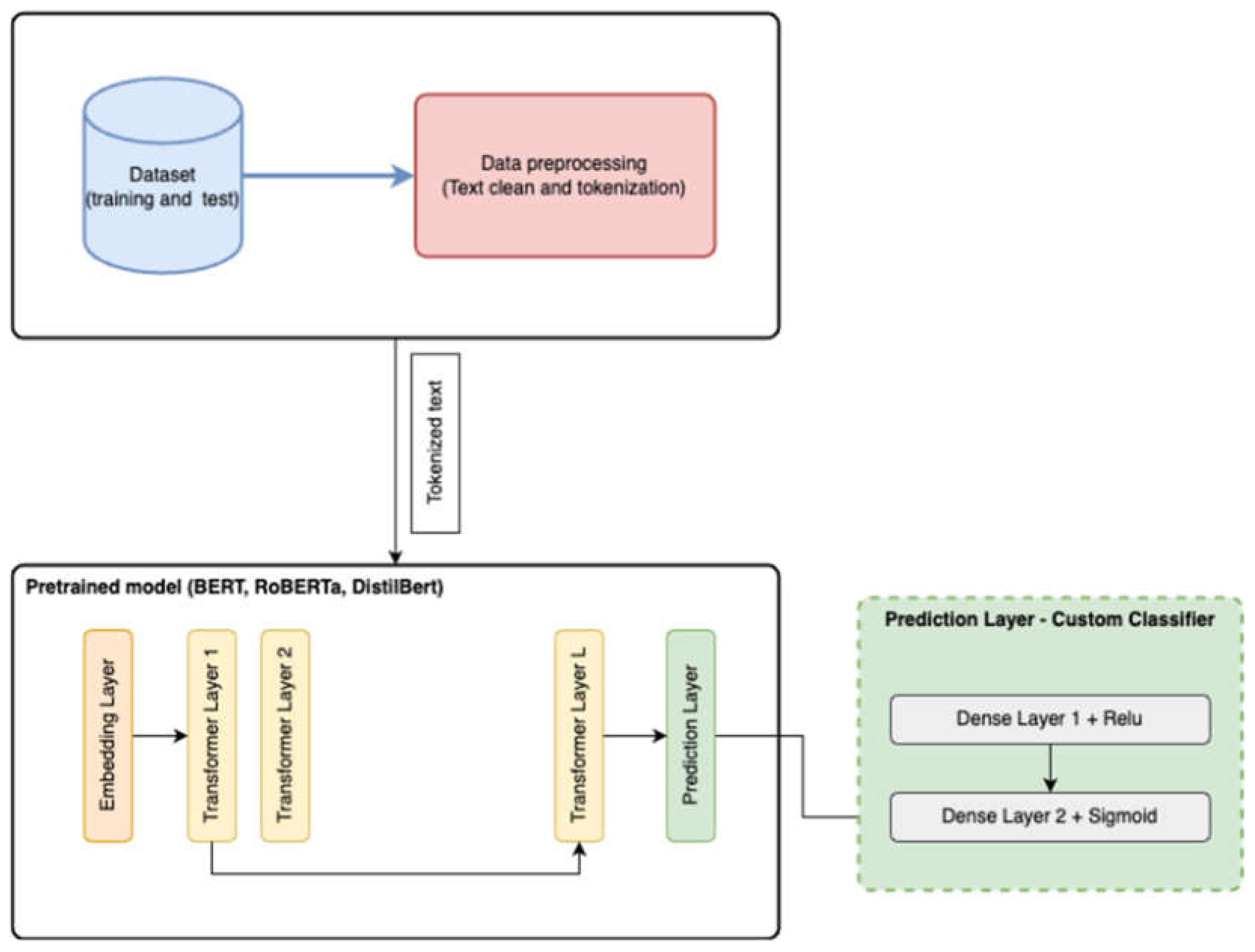
Table 1.
Data Sources in M4 Dataset.
| Source | Lang. 1 | Only Human |
Source-generated data | ||||||
|---|---|---|---|---|---|---|---|---|---|
| Human | Davinci003 | ChatGPT | Cohere | Dolly-v2 | BLOOM | Total | |||
| Wikipedia | EN | 6.458.670 | 3.000 | 3.000 | 2.995 | 2.336 | 2.702 | 3000 | 17033 |
| Reddit ELIS | EN | 558.669 | 3.000 | 3.000 | 3.000 | 3.000 | 3.000 | 3.000 | 18.000 |
| WikiHow | EN | 31.102 | 3.000 | 3.000 | 3.000 | 3.000 | 3.000 | 3.000 | 18.000 |
| PeerRead | EN | 5.798 | 5.798 | 2.344 | 2.344 | 2.344 | 2.344 | 2.344 | 17.518 |
| arXiv abstract | EN | 2.219.423 | 3.000 | 3.000 | 3.000 | 3.000 | 3.000 | 3.000 | 18.000 |
| Baike/Web OA | ZH | 113.313 | 3.000 | 3.000 | 3.000 | - | - | - | 9.000 |
| RuATD | RU | 75.291 | 3.000 | 3.000 | 3.000 | - | - | - | 9.000 |
| Urdu-news | UR | 107.881 | 3.000 | - | 3.000 | - | - | - | 9.000 |
| id_newspapers_2018 | ID | 499.164 | 3.000 | - | 3.000 | - | - | - | 6.000 |
| Arabic-Wikipedia | AR | 1.209.042 | 3.000 | - | 3.000 | - | - | - | 6.000 |
| True & Fake News | BG | 94.000 | 3.000 | 3.000 | 3.000 | - | - | - | 9.000 |
| Total | 35.798 | 23.344 | 32.339 | 13.680 | 14.046 | 14.344 | 133.551 | ||
1 Here are the abbreviations provided for the ISO 639-1 language codes: English—EN; Chinese—ZH; Russian—RU; Urdu—UR; Indonesian—ID; Arabic—AR; Bulgarian—BG.
Table 2.
Dataset statistics.
| Language approach | #Training records | #Testing records |
|---|---|---|
| M4—Monolingual | 119.757 | 5.000 |
| AICrowd—Monolingual | 232.003 | 38.666 |
| M4—Multilingual | 172.417 | 4.000 |
| Indonesian Hoax News Detection—Multilingual | 600 | 250 |
| TURNBACKHOAX Dataset—Multilingual | 800 | 316 |
Table 5.
Performance metrics for monolingual subtask.
| Model | Acc (%) | P (%) | R (%) | F-score (%) | Model runtime (min.) |
|---|---|---|---|---|---|
| Baseline | 74 | ||||
| RoBERTa-large | 83 | 84 | 83 | 83 | 607 |
| RoBERTa-base | 81 | 83 | 81 | 81 | 166 |
| BERT-base | 71 | 74 | 71 | 70 | 162 |
| DistilBERT-base-uncased | 68 | 73 | 68 | 66 | 77 |
Table 6.
Performance metrics for multilingual subtask.
| Model | Acc (%) | P (%) | R (%) | F-score (%) | Model runtime (min.) |
|---|---|---|---|---|---|
| Baseline | 69 | ||||
| XML-RoBERTa-base | 68 | 70 | 68 | 68 | 522 |
| BERT-base-cased | 63 | 68 | 64 | 61 | 415 |
| DistilBERT-base-uncased | 70 | 71 | 71 | 70 | 203 |
Disclaimer/Publisher’s Note: The statements, opinions and data contained in all publications are solely those of the individual author(s) and contributor(s) and not of MDPI and/or the editor(s). MDPI and/or the editor(s) disclaim responsibility for any injury to people or property resulting from any ideas, methods, instructions or products referred to in the content. |
© 2024 by the authors. Licensee MDPI, Basel, Switzerland. This article is an open access article distributed under the terms and conditions of the Creative Commons Attribution (CC BY) license (http://creativecommons.org/licenses/by/4.0/).
Copyright: This open access article is published under a Creative Commons CC BY 4.0 license, which permit the free download, distribution, and reuse, provided that the author and preprint are cited in any reuse.