

Submitted:
24 July 2024
Posted:
25 July 2024
You are already at the latest version
Abstract
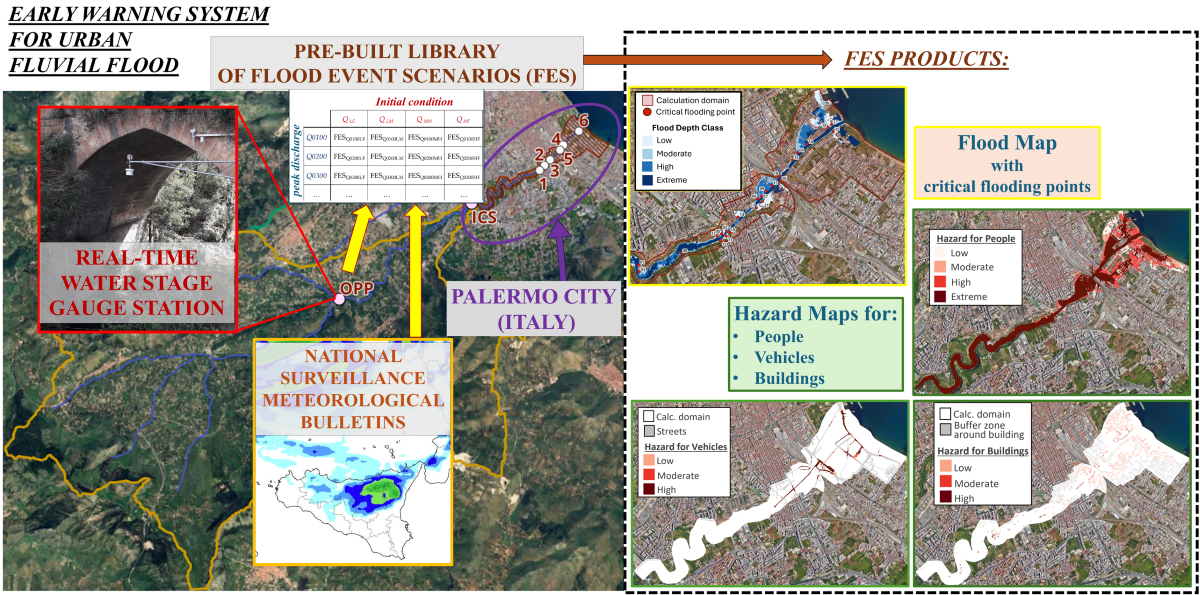
Several cities are experiencing an increase in flood hazard and exposure, and consequentially in flood risk, attributable to the coupled effect of climate change and urbanization. Non-structural protection strategies demonstrate significant potential in the short term for mitigating hydraulic risk in urban areas, particularly where the implementation of structural measures is impeded by a complex urban environment. This work proposes an Early Warning System (EWS) for fluvial floods developed for the city of Palermo (Italy). It is based on the preliminary definition of po-tential Flood Event Scenarios (FESs) as a function of typical potential precursors. Each FES pre-dicts first points of flooding, flood areas and water depths, also providing specific hazard maps for people, vehicles, and buildings. The EWS uses rainfall depth-duration thresholds to assess the expected hydrograph as a function of rainfall forecasts and the water stage observed in real time at an upstream section of the river crossing the city. This last also allows for estimating the ante-cedent wetness conditions. Based on this information, the EWS retrieves an expected FES from a pre-built library with a preannouncement time up to 36 h. The EWS is here successfully tested on a historical flood event.
Keywords:
Urban Floods
; Risk Reduction
; Flood Hazard Map
; EWS
; Rainfall Depth-Duration Thresholds
; Monitoring and Forecasting
; Hydraulic Modelling
; HEC
; Floodability
; Non-structural Flood Protection
1. Introduction
According to a recent report by the European Commission [1], damage caused by natural disasters in Europe from 1980 to 2017 exceeded 500 million euros, 90% of which due to rare and intense meteorological events for which an early warning had not been issued and no adequate spatial planning measures had been taken.
Ongoing climate change is leading to an intensification of meteorological events and an increase in the frequency of extreme events, especially in some hot-spots of the Mediterranean basin [2,3,4]. Moreover, the progressive expansion of urbanized areas on a global scale [5] has deeply modified the land use and coverage, as well as the total amount and density of the elements that are exposed to the flood hazard in urban settlements. The increment of impervious surfaces implies alterations to the processes of generation and propagation of surface runoff, typically exacerbating the impacts of rainfall on the ground; this is mainly due to the reduction of infiltrated water, with faster generation and routing of surface runoff, along with higher stormwater volumes and peak flows [6,7]. All this could severely stress the urban natural and artificial drainage systems and trigger unprecedent catastrophic phenomena of urban pluvial and fluvial floods.
Hydraulic risk reduction strategies are urgently needed, especially in areas particularly affected by climate change and already vulnerable to flood risks, such as Italy, where there are clear evidences [8] of the extreme weakness of the territory, with approximatively the 12% of the national population (i.e., over 7 million inhabitants) living in areas classified at significant flooding risk (i.e., from “moderate” to “very-high” according to the national risk classification, aligned with the Floods Directive 2007/60/EC
The United Nations International Strategy for Disaster Reduction [9] reported some of the risk reduction efforts undertaken across the world, identifying ten “essentials” practices supporting each of them. The “Essential 9” (Effective preparedness, early warning, and response) highlights the importance of strengthening non-structural preparedness measures to ensure that cities, communities, and individuals can act appropriately to reduce the threats posed by natural and human-induced disasters. From this perspective, Early Warning Systems (EWS) are low-cost and adaptive non-structural protection measures for the reduction of flood impacts in urban areas [10,11].
The typical architecture of an EWS consists of four key components [12]:
- risk knowledge through the identification of hazards, exposures, and vulnerability;
- forecast and monitoring of hydro-meteorological variables such as water stage, flow velocity, rainfall, etc., and data processing using computational models;
- dissemination and communication of alerts;
- reaction to the alerts issued.
One of the main features of an EWS is the time required to issue the alert; in small basins (e.g., < 100 km2), preannouncement activity must be based on medium-high temporal prediction horizons, referring to forecasting and/or nowcasting activities rather than real-time monitoring. The use of forecasts in EWSs finds further difficulties due to possible limitations of the forecasting models, which often fail to simulate events with reduced space-time scales [13]; current meteorological models can accurately predict events occurring in a temporal window of 24-48 h and over a large portion of territory (e.g., > 100 km2) [14].
In nowcasting, the major issues involve the need for limited execution times required for the EWS during: (i) event monitoring to correct the Quantitative Precipitation Forecasts (QPF) via real-time data assimilation [15]; (ii) hydrological-hydraulic processing using computational models; (iii) population reaction to alerts. Different forecasting schemes for pluvial flash floods, where QPF is a key input in the modelling chain, were presented in [16], including: susceptibility assessment (i.e., flooding is linked to specific hydrometeorological precursors like, rainfall depth, relative humidity, K-index, basin soil moisture); rainfall comparison with surface conditions neglected (i.e., flooding occurs when QPF exceeds specific rainfall thresholds, obtained from statistical analyses on historical precipitation data [17,18]) or with surface conditions considered (similar to the previous, but includes thresholds obtained by modelling the hydrological processes contributing to flood events, e.g. [19,20]); flow comparison (i.e., expected flow rate, determined from the QPF via hydrological modelling, is compared with threshold values, obtained through hydrological simulations [21] or statistical analyses [22]).
Weather forecasts can be performed using three methodologies [17]: radar-based models, numerical weather predictions, or blending products. Probabilistic and deterministic radar-based models are mainly used in nowcasting [23,24,25]. Numerical weather predictions are used both in nowcasting and forecasting. Generally, outputs require dynamic (LAM models) or statistical downscaling (e.g., the rainFARM model [26] to increase the spatial resolution. Integrated approaches can also be used [27]. Finally, both LAM models and ground-based measurements with remote sensors or meteorological radar are used for blending products [28].
In some cases, EWSs are based on the construction of off-line libraries of flood event scenarios [27,29,30], linking the precipitation forecast to hazards and expected damages. Through the exploration of different simulated scenarios, it is possible to define a relationship between event precursors, the elements exposed to risk, and flood related potential damages.
The present study proposes a novel EWS for fluvial floods, developed for the urban terminal stretch of the Oreto river, which is the main river crossing the city of Palermo (Italy). Although the system was developed considering the peculiarities of the case study, the general framework is easily transferrable and replicable in other territorial contexts and complex urban areas.).
Case study and methodology are defined in the first part of the paper (Sect. 2). A pre-built library of Flood Event Scenarios (FESs) was first developed to characterize the relationship between flood precursors and the associated potential hazards. To this aim, a hydrological study was carried out using the model HEC-HMS (Hydrological Modeling System) [31], determining a set of design hydrographs with predefined peak flow values (Qpeak,FES). The hydraulic propagation of all the design hydrographs within the computational domain was simulated using the open-source calculation code HEC-RAS (River Analysis System) [32], considering different initial conditions (Qinit,FES) and obtaining a total of 76 FESs. Each FES, associated with a given pair of values, Qpeak,FES and Qinit,FES, provides timing and location of potential first points of flooding, the flood area extension with the maximum expected water depths, and specific hazard maps for three typologies of elements exposed to the flood hazard typically present in urban areas, such as people, vehicles, and infrastructures. The Flood Directive 2007/60/CE highlights the importance of considering in the hazard assessment also hydrodynamic factors that can characterize the flood evolution, explicitly referring to the flow velocities, whose knowledge is fundamental for considering some important potential damaging actions of floods in urban areas related for instance, to hydrodynamic pressures, erosion processes, buoyancy forces, and debris flow. Scientific literature has developed various contributions useful for the definition of different criteria for the classification of vulnerability and/or damage in relation to the types of elements exposed to risk; most of them, included those adopted for this study, considers the combined effect of water level and flow velocity. Some criteria and adopted indicators for the evaluation of human, vehicles, and buildings stability under the flood actions can be found for example in [33,34,35,36,37,38,39,40,41,42].
An important aspect of the coupled hydrological-hydraulic modelling used to define the library is the high-resolution definition of the computational domain, derived from a Digital Elevation Model (DEM) with spatial resolution of 2 m, opportunely ground-corrected to account for the geometries of bridges, buildings and other infrastructures potentially influencing the surface runoff routing. This approach based on an off-line library of FESs, reduces sensibly the issuance time of the alert, thus creating important decision support tools for the civil protection systems to be used both during the planning and emergency management phases. For instance, the prediction of a given FES in response to rainfall forecast allows for localizing potential hazards and plan consequentially appropriate civil protection actions at the local level during the emergency phase, such as the inhibition of pedestrian and/or vehicular transit on some roads and underpasses and the issuing of warnings to the population.
The general framework and the various components of the EWS are also described in Sect. 2. In particular, the proposed EWS relies on: (i) a rainfall forecast system; (ii) real-time river stage observations recorded by a water stage gauge station located in an upstream section of the river; (iii) rainfall Depth-Duration-Frequency (DDF) and Depth-Duration Thresholds (DDTs) curves, with these last defined for the basin under analysis in a previous work [43]. Forecast rainfall and initial river flow conditions are here considered as potential flood event precursors. Expected rainfall is derived from the 36-hour QPF provided daily by the Italian National Surveillance Meteorological Bulletins (NMBs) based on a Sicily LAM (Local Area Model), deriving an expected rainfall trajectory based on DDF curves. The combined use of this rainfall trajectory along with the numerical rainfall DDTs allows for assessing an expected hydrograph peak. River stages are monitored in real-time by the OPP, and they are used to estimate the initial river flow.
The use in real-time of the EWS consists of the following procedural steps:
- acquiring the NMB and the associated maximum expected cumulative depth and accumulation period from the QPF to derive an expected rainfall trajectory using DDF curves;
- retrieving the water stage at the OPP station at the time of issuing of the NMB, assessing the initial flow conditions (Q0) and identifying one out of 10 possible reference family of iso-critical discharge DDT curves (Qinit,DDT);
- deriving the expected hydrograph peak flow from the DDTs (Qpeak,DDT), based on the rainfall trajectory (point 1) and the selected reference family of DDT curves (point 2);
- associating Q0 (point 2) with one out of 4 possible initial discharge conditions (Qinit,FES) and Qpeak,DDT (point 3) with one of the 19 possible peaks values (Qpeak,FES), where Qinit,FES and Qpeak,FES are the values considered for the generation of the FESs for the pre-built library;
- retrieving from the library the expected FES associated to the paired Qinit,FES - Qpeak,FES values.
An analysis of the fluvial flood risk in the study area based on the outcomes of the FESs library is discussed in Sect. 3, also proposing possible urban planning measures that could be associated with specific FESs. The EWS was also tested with respect to a historical flood event that occurred in 2018, demonstrating satisfactory performance in terms of predicted flood area extension and associated water depths, as it is reported in Sect.3. A discussion section and some concluding remarks conclude the paper.
2. Materials and Methods
2.1. Study Area: The City of Palermo and the Oreto River Basin
Palermo is the largest (160 km2) and most populated (855,000 inhabitants) city in Sicily, southern Italy. The city is noted for its history (over 2,700 years old), culture, and architecture, with innumerable monuments and goods of inestimable value, and a particularly active economic tissue. According to [44], in 2022 Palermo was the sixth most vehicular traffic-congested city in the world. All this contributes to make Palermo particularly exposed to flood risk.
The original hydrographic configuration of the city has been completely changed over the years; two rivers that originally crossed the city (i.e., the Kemonia and the Papireto rivers), have been forced underground, and the only river still flowing on the surface is the Oreto. The hydrographic basin of the Oreto river (Figure 1) upstream the city of Palermo has an extension of about 110 km2. It extends south-west of the urban area of Palermo and is surrounded by the Pioppo, Monreale, and Altofonte hills. The hydrographic network is composed of two main tributaries that drain the water from two subbasins (SB1 and SB2 in Figure 1) and converge close to the Ponte Corleone bridge. The Input Control Section (ICS) for the reference area of the proposed EWS is located slightly downstream of this bridge.
The Ponte Parco bridge, where is located the historical hydrometric station (Oreto at Ponte Parco, OPP), is within the larger sub-basin SB1. The OPP station, supporting the river monitoring telemetry system of the Basin Authority of the Sicilian Regional District (Autorità di Bacino della Regione Sicilia, hereafter AdB), is located at 608 m a.s.l. of elevation, 10 km upstream of the outlet and it has a drainage area of 77 km2; it has collected data since 1921 and it also includes an ultrasonic water stage telemetry sensor, recently installed.
SB2 originates from the Boccadifalco’s artificial channel, which was realized after the catastrophic fluvial flood of 1931. Downstream of the ICS, the river crosses the city for about 5,5 km before flowing into the Tyrrhenian Sea; it has meandering shapes with steep and incised banks within calcarenites. The final part of the river has been regularized by building a spillway and it was subjected to floodplain modifications with concrete coverage and the creation of vertical walls. This stretch of the river is crossed by six bridges, whose location is also reported in Figure 1a: (1) the railway bridge of the Palermo-Trapani line; (2) a walkway (corner via Guadagna-via Paternò); (3) the road bridge of via Oreto; (4) the railway bridge of the Palermo-Agrigento line; (5) the road bridge of Corso dei Mille; (6) the road bridge of via Messina Marine.
Palermo has a Mediterranean climate with hot and dry summers, and cold and wet winters. The annual average precipitation is about 800 mm, mainly concentrated in autumn and winter, while the summer season is generally almost totally dry. The average annual temperature is about 22°C, with peaks higher than 36°C in the summer. In the last years, the city has experienced some extreme rainfall events, usually concentrated at the end of summer, which have frequently caused urban pluvial floods with consequent economic losses and disruptions to the population [45]. The Oreto river flooded more than 30 times since 1912; the last event was recorded in November 2018 and is here considered to test the proposed EWS.
2.1.1. Flow Rating and Flow Duration Curves at OPP
The Flow Rating Curve (FRC) and the Flow Duration Curve (FDC) at the OPP are ancillary information for the development of the proposed EWS. The FRC indicates the stage-flow relationship for a specified section of interest; it is usually reconstructed based on a consistent dataset of paired measures of discharge and river stage collected in different periods of the year, and, since cross sections may vary over time due to vegetation growth and river-bed movements, it is usually subject to frequent periodic recalibrations. The FDC provides a representation of the streamflow frequency distribution, describing the basin attitude to provide flows of various magnitudes, and offering a simple, yet comprehensive, graphical view of the streamflow regime and variability [46]; it is usually derived from long (e.g., > 20 years) historical time series of observed daily streamflow and, although the FDCs are less variable in time than the FRC, period recalibration and updating should be also performed.
The Part II of the official AdB Annual Reports (i.e., Annali Idrologici, available online at the ISPRA web portal: http://www.bio.isprambiente.it/annalipdf/) provides measurements of river stage and discharge, FRCs, and historical FDCs for the main Italian river basins. Data at the OPP are available from 1921 to 1997 and refer to the old manual water stage gauge, replaced by the new telemetric sensor in 2012; the last available FDC in the Annual Reports dates to 1941.
In this study we considered an updated FRC for the OPP derived in 2022 within a scientific collaboration agreement between the Department of Engineering of the University of Palermo and the AdB (Figure 2a); the analytical expression of the new FRC is given by:
where Q is the discharge (m3/s), and HAdB is the water stage (m) recorded by the telemetric sensor at the OPP.
A new version of the FDC at the OPP, referring to the period up to 2021, here indicated as FDC2021, was here derived using all the available daily streamflow data from the Annuals and the recent stage data from the telemetric sensor, opportunely converted in streamflow by Eq. (1). According to the FDC (Figure 2b), the ordinary flood (i.e., Q91) and drought (Q274) thresholds were equal to 1.28 and 0.19 m3/s, respectively, while the semipermanent flow (i.e., Q185) was equal to 0.54 m3/s; these values, representing the quartiles of the FDC, were here used to classify the initial streamflow recorded at the OPP (Q0) into four classes: i) low-flow, LF (i.e., Q0 < Q274); ii) low-medium flow, LM (i.e., Q274 ≤ Q0 < Q185); iii) medium-high flow, MH (i.e., Q185 ≤ Q0 < Q91); high-flow, HF (i.e., Q0 ≥ Q91). Such classes were considered as proxy measures of the basin’s antecedent wetness conditions. In particular, the central value of each range was associated with each class, so that, for example, the streamflow value, QLF, associated to all the streamflow values within the LF class is equal to the 87.5th percentile of the FDC, as described in Table 1. The four values (QLF, QLM, QMH, and QHF) represent four different initial conditions of river flow at the OPP considered for the generation of the FESs, and represent one of the two label values (i.e., Qinit,FES) needed to identify the expected FES at a given time. As it will be discussed in detail in Sect. 2.2, the initial discharge at the OPP (Q0) is also used to identify the reference family of iso-critical discharge DDT curves, which allows for estimating the expected hydrograph peak based on rainfall forecast and deriving the second label value (i.e., Qpeak,FES) required to identify the predicted FES from the library.
2.1.2. Characterization of The Computational Domain
The reference area for the proposed EWS is located within the historic centre of Palermo, a district with a very high population density and a large presence of highly vulnerable sites, such as hospitals, schools, universities, rest homes, public offices, basement flats, economic activities and shops. The area also includes a Natura 2000 Site of Community Importance (SCI: ITA 020012 Valle del Fiume Oreto). A characterization of the hydraulic risk for the study area is given by the Hydrogeological Setting Plan (Piano stralcio per l’Assetto Idrogeologico – PAI) for Sicily, which is the official regional plan mapping the hydraulic and geomorphological hazards and risks. The PAI of this area, which was elaborated in the early 2000s and then updated in 2018, shows many areas classified with “high” (class R3) and “very high” (class R4) hydraulic risk.
The hydraulic domain (Figure 1 and Figure 3) covers a surface of 1.77 km2, and it was derived from a DEM with a spatial resolution of 2 m, provided by the Sicilian Region, appropriately edited and corrected by digitalising the built-up elements, such as river embankments, bridges, buildings, roads, railways, walls, underpass roads, traffic islands, sidewalks, curbs, and any other elements potentially influencing flow direction within the study area (Figure 3). To this aim, technical documents provided by the Municipality of Palermo as well as the results of on-site and remote inspections via Google Earth were considered. The exact geometry of the bridges, which may potentially affect the streamflow during extreme flooding events, was reconstructed using the original project documents (insets in Figure 3).
The generated computational mesh includes a total of 32,691 cells having a regular spatial resolution of 2 m; a variable and more detailed resolution has been used to describe the elevation discontinuity due to elements such as river embankments and walls. A very high, artificial elevation (i.e., 40 m a.s.l.) was assigned to the buildings’ footprints so that the model perceives these elements as “virtual walls” thus forcing surface runoff to flow around them (Figure 3a).
In terms of roughness, the domain was classified into two homogeneous sub-areas (Figure 3b): vegetated areas, mainly including the riverbed and riverbank, and non-vegetated areas. Values of the Manning’s roughness coefficient assigned to the vegetated and non-vegetated areas are 0.03 and 0.04 s m-1/3, respectively, and were retrieved from [47].
Two sub-domains, displayed in Figure 1 and derived from specific maps provided by the Municipality of Palermo, are considered for mapping the hazard for vehicles and buildings, respectively. In particular, the first (Figure 1c) considers only the roads and streets within the main domain, while the second (Figure 1d) considers a buffer zone of 3 m width around the buildings present within the main domain.
2.2. Rainfall Depth-Duration Thresholds
A rainfall Depth-Duration Threshold (DDT) for flood warning is usually defined as the rainfall threshold for a given duration over which a critical discharge is exceeded in a given river section [21,48,49,50]. DDT relies on the hydrological initial conditions of the basin and the rainfall features, i.e. duration, intensity, and shape of the hyetograph. The critical discharge is typically representative of flow conditions beyond which phenomena of hydraulic insufficiency and consequent floods are triggered; in this case, the rainfall threshold can be thought as the maximal sustainable rainfall for a basin.
Different rainfall DDTs at the Oreto at Ponte Parco river basin were derived through a deterministic approach in [43]. The thresholds were numerically estimated using the TOPDM hydrological model [51], considering different rainfall durations and different combinations of initial basin saturation conditions and storm shapes to obtain the amount of rainfall causing critical flow at the basin outlet (corresponding to the OPP section). The DDTs were provided in the form of parametric iso-critical discharge curves on a cumulative rainfall, Ec, and duration, d, plot. In particular, after the simulation of the basin hydrological response for a total of about 16,000 rainfall events with fixed cumulative value, duration, initial soil moisture, and hyetograph type, different families of iso-critical discharge curves on Ec-d plots were obtained, each specific for a given combination of initial soil moisture and hyetograph type, reporting curves associated with critical flow values at the OPP (Qpeak,DDT) up to 1,600 m3/s. More specifically, for every possible combination of initial soil moisture and hyetograph type, a total of 528 synthetic rainfall events were considered, ranging from 1 to 24 h and having a cumulative rainfall between 40 and 250 mm. Three possible temporal distributions of the rainfall were considered using the following synthetic hyetograph types: H1, hyetograph with positive gradient; H2, hyetograph with negative gradient; and H3, isosceles triangle hyetograph. Initial soil moisture conditions were taken into account by imposing ten different values of discharge (Qinit,DDT) as contour conditions for the TOPDM simulations; discharges vary from 0.05 m3/s to 7 m3/s (Table 1)and were extracted from the FDC1941 considering exceedance probabilities ranging from 0 to 1 with step 0.1. Thus, a total of 30 (= 3 hyetograph types x 10 initial values of discharge) possible contour conditions were considered, generating a total of 30 different Ec-d plots, for which parametric iso-discharge curves (with parameter Qpeak,DDT) were derived by interpolating the obtained maximum discharge values. For more details, interested readers are referred to the original paper [43].
2.3. Flood Event Scenarios: Definition and Products
Flood Event Scenarios (FESs) are tools often used to define the expected hazard level in a specific area after a specific calamitous event [52,53].
FESs can be described with different detail levels. The basic level is based on simplified analyses able to provide at least a concise description of the areas potentially affected by the event (flooding areas and elements exposed to risks). More detailed levels are usually supported by more complex modelling tools and provide detailed information on the characteristics (flooding areas, water levels, flow velocity and directions) of the event. The flood hazard classification of areas and points within a territory associated with a specific event having a defined return period is the main expected product of FESs and represents essential information both in the territorial planning activities, according to the Floods Directive 2007/60/CE, and in the emergency management of risk for civil protection purposes.
In this study, FESs are used with the aim of prognosticate the hydrological response of a given area to a forecasted meteorological event and assess the possible consequences in terms of flood characteristics and hazard. Although each simulated event considered to generate a FES may have a statistical connotation, with a specific return period associated, here we explicitly neglect this aspect, considering each FES as the result of the hydraulic propagation of a standard design hydrograph, with known peak flow (Qpeak,FES) and initial conditions (Qinit,FES), over a predefined area.
Each FES is then uniquely identified by paired values of peak flow and initial discharge and includes several products, schematically reported in Figure 4 and described in detail in the following. For the generation of the FESs library, the hydraulic propagation of a set of design hydrographs with different peak flow and initial discharge was performed according to the procedure that will be fully described in Sect. 2.5. The modelling chain used allows for simulating the temporal variation of water levels and velocities at all nodes of the computational domain, in response to each hydrograph, under the imposed hydrological and hydraulic boundary conditions.
Based on the results of the modelling, the following products, which are deemed fundamental information to plan specific local interventions of defence against floods, are obtained:
- a report table of “critical flooding points” (CPs), reporting the location (spatial coordinates, CPloc) and timing (CPtime, time in hours from the beginning of the rainfall) of all points along the river, where water level begins to exceed the bankfull stage, thus triggering the flood;
- a flood map, defining the flooding area extension and the maximum flood depth reached at each node of the full computational domain, classified according to following four classes: “low” (0.05 < h < 0.50 m); “moderate” (0.50 ≤ h < 1.00 m); “high” (1.00 ≤ h < 2.00 m); “extreme” (h ≥ 2.00 m). Each flood map also displays all the CPs occurring for the associated scenario;
- three specific hazard maps for people, vehicles and buildings, respectively.
The choice of the elements considered for the hazard assessment is justified by the fact that human life is the most precious aspect to be protected, vehicles are the elements most frequently impacted by flood-related disasters [54], while buildings, even if less frequently affected by floods, usually imply the most relevant potential economic damage.
Here, the hazard map for people over the full domain is produced for each FES considering the approach proposed in [55], which uses a 4-class hazard classification based on the Flood Hazard Rating (FHR in m2/s) parameter computation and comparison with predefined thresholds for human stability derived from literature. FHR is computed as a function of the water level, h (m), and flow velocity, v (m/s), as:
where the debris factor, DF (m2/s), in urban areas can be assumed null up to a water level equals to 0.25 m and equal to 1 m2/s for higher water levels. The four possible hazard classes for human stability are: i) “low hazard” for FHR < 0.75 m2/s; ii) “moderate hazard” for FHR between 0.75 and 1.25 m2/s; iii) “high hazard” for FHR between 1.25 and 2.50 m2/s; iv) “extreme hazard” for FHR > 2.50 m2/s.
The hazard maps for vehicles and buildings are derived based on a similar approach with a different hazard indicator, which is the Damage Parameter (DP in m2/s) given by the flow magnitude (i.e., h∙v). The hazard classification for both is based on three possible classes, defined again considering threshold values available from literature and derived within the project RESCDAM [56,57]. In particular, the hazard for vehicles is classified as: i) “low” when DP is comprised between 0.3 and 0.5 m2/s; ii) “moderate” when DP is comprised between 0.5 and 0.6 m2/s; and iii) “high” when DP is higher than 0.6 m2/s. The hazard for buildings can occur only where water levels exceed 0.5 m [58] and is classified as: i) “low” when DP is lower than 3 m2/s with velocity not exceeding 2 m/s (potential partial damages to the building due the direct contact with high water levels); ii) “moderate” when DP is comprised between 3 and 7 m2/s and the velocity is higher than 2 m/s (potential partial damages to the building also due to water velocity); and iii) “high” when DP is higher than 7 m2/s and the velocity is higher than 2 m/s (potential building collapse). It is worth emphasizing that these threshold values refer to concrete structures and were selected considering the dominant constructive typology in Italy; different thresholds available in literature, also provided by the project RESCDAM [56,57], should be considered in regions with structures prevalently of other types (e.g., wood).
2.4. Architecture of the Early Warning System
The key components of the EWS are: i) the telemetry (TLM) hydrometric station in a river section upstream the study area, where FRC and FDC are available, from which it is possible to monitor water stages in real-time and derive the corresponding initial discharge; ii) QPF forecast, providing predictions of the expected cumulative rainfall and accumulation period referring to a time horizon appropriate for activating the planned protection measures for the expected FES; iii) rainfall DDT and DDF curves, which provide the expected hydrograph peak flow at the ICS depending on the QPF forecast and the antecedent catchment wetness conditions (derived in turn as a function of the initial discharge); iv) a library of FESs, previously developed offline, and able to associate any paired values of hydrograph peak flow and initial discharge with a specific expected FES.
Further components, out of the scope of the present work and then here neglected, could be an Information and Communication Technology (ICT) platform, including modules for storing, sharing, visualizing, and processing data and for the management and communication of warning alerts, as well as a Decision Support System (DSS) for identifying appropriate protection measures in response to the expected FES.
The proposed EWS is schematically reported in the flow chart of Figure 5, explained in the following, and is activated when the expected rainfall from the QPF has at least a duration of 4 h and a maximum cumulative rainfall depth higher than 40 mm; based on [43], these are assumed as the minimum values that could potentially triggers a fluvial flood for the case study.
The expected FES is extracted from the pre-built library, as a function of the paired Qinit,FES - Qpeak,FES discharge values, and is identified by a code made of 7 characters, where the first 5 refer to Qpeak,FES (i.e., Q0100, Q0200, …, Q1000) and the remaining to the initial condition determined by Qinit,FES (i.e., LF, LM, MH, HF); for instance, the FES named Q0500MH refers to the FES obtained considering the design hydrograph with Qpeak,FES equal to 500 m3/s under the low-medium initial discharge class of Qinit,FES (Table 1).
Through the OPP station, it is possible to retrieve the water stage at the time of the EWS evaluation (HAdB) and estimate the corresponding current discharge (Q0) using the FRC. Based on Q0, it is then possible to retrieve the nearest values among the ten Qinit,DDT values considered in [43] and reported in Table 1, thus deriving the initial discharge class among the four possible reported in Table 1 (QLF, QLM, QMH, and QHF).
Rainfall forecasts are given by the QPF provided by the National Meteorological Bulletins (NMBs), which are issued by the Italian National Civil Protection Department for specific zones every day at 12:00 (Palermo belongs to the zone named “Sicilia S4”). A NMB reports a range of expected cumulative rainfall depth over prefixed accumulation periods of 3, 6, 12, and 24 hours. The prevision refers to a 36-h temporal horizon, from 12:00 of the day of issuing of the bulletin until midnight of the following day. The NMB also provides the possible occurrence (or not occurrence) of rainfall within regular time windows of 6 hours over the forecast period. However, the NMBs do not provide any detailed information about the temporal evolution of the rainfall event and thus, it is not possible to derive information about the expected hyetograph type.
The value of Qpeak,FES is derived from the QPF and the DDTs described in Sect. 2.2. More specifically, given the impossibility to derive predictions about the hyetograph shape from the NMB and adopting a prudential criterion, the EWS refers exclusively to the families of curves relative to the H1 type, which is the hyetograph that generates the maximum flow peak in the case study at equal rainfall volume [43].
The reference family of iso-critical discharge DDT curves at the time of the EWS evaluation is identified exclusively based on the Qinit,DDT value. The following step consists in the computation of a rainfall trajectory based on the QPF from the bulletins, which identifies a curve within the Ec-d plane crossing different iso-critical discharge curves. In particular, the rainfall trajectory is given by the DDF curve passing for the point with the maximum expected cumulated rainfall (Ec in mm) and accumulation period (dNMB in h) indicated in the bulletin. Thus, the couple of values retrieved from the NMB (i.e., Ec and dNMB) are used to determinate the return period of the expected rainfall, which is assumed to have critical depth with that return period for any possible duration. The DDF is estimated using the regional rainfall growth curves derived by [59] for the homogeneous subzone of Sicily (i.e., zone S4) including the city of Palermo, characterized by the site-specific couple of parameters a24=70.84 and n=0.36. The rainfall trajectory is generated for a range of duration di varying from 4 h (i.e., minimum duration for the EWS activation) to dNMB as:
where the regional growth curve factor KT is obtained by the same Eq. (3) considering both the cumulated rainfall E(dNMB)=Ec and duration di=dNMB from the NMB.
E(di)= KTa24 (di/24)n
The parameter associated with the highest iso-critical discharge curves crossing the rainfall trajectory is then identified, and is here assumed to be representative of the highest value of discharge expected at the OPP section in response to the forecasted rainfall event (Qpeak,OPP). This value is finally incremented by a scaling factor, kp, (discussed in Sect. 2.5) to take into account the fact that the ICS is downstream the OPP section, and finally rounded up to the closest hydrograph peak flow considered for the generation of the FESs library in order to determine the corresponding Qpeak,FES; this last, combined with the previously obtained value for Qinit,FES, makes it possible to identify the expected FES from the library.
2.5. Generation of the Pre-Built Library of FESs
The library supporting the EWS includes several FESs that were generated through the following steps:
- hydrological study aimed to: i) derive six representative hydrographs at the ICS with different return periods (i.e., 10, 25, 50, 100, 300, and 500 years), and ii) evaluate the scaling factor, kp, between the peak flow at the ICS and the OPP section;
- normalization of the obtained hydrographs and estimation of a standard Unit Hydrograph (UH);
- scaling procedure application to the standard UH in order to obtain a set of 19 design hydrographs with peak flow (Qpeak,FES) varying from 100 to 1,000 m3/s with steps of 50 m3/s;
- hydraulic modelling to simulate the propagation of the 19 hydrographs within the computational domain, under the four alternative initial conditions defined in Table 1 (i.e., QLF, QLM, QMH, and QHF);
- derivation of the FES products defined in Sect. 2.3 (Figure 4) from each simulation;
- generation of the FESs library, where a label, given by paired Qinit,FES and Qpeak,FES values, is associated with each of the 76 generated scenarios (19 Qpeak,FES x 4 Qinit,FES).
2.5.1. Generation of the Design Hydrographs
The hydrological study was carried out using the HEC-HMS [31], which includes a suite of conceptual models that allows for simulating the rainfall-runoff process of a basin. The modelling chain consists of three main components: (1) computation of synthetic hyetographs for a given return period; (2) application of a loss method to derive effective hyetographs; and (3) application of a transform method to derive hydrographs.
The reference area for the hydrological study is the entire drainage area contributing to the runoff generation at the input section (ICS) of the reference computational urban domain for the EWS. It is then constituted by the sub-basins SB1 and SB2 (Figure 1). The main characteristics of the two sub-basins are summarized in Table 2. In particular, the SB1, with an extension of approximately 85 km2, has a concentration time of 4 hours, while the SB2, with an extension of 29 km2, has a concentration time of 3 hours; for both, the concentration times were calculated by the distributed kinematic method.
The rain hyetographs for the six different return periods were generated from the DDFs (Figure 6a) obtained through the regional formulation of [59] and using the Chicago method with centred peak. The highest concentration time between the two sub-basins (i.e., 4 h) was considered as critical duration for the rainfall event; this is also consistent with the choice of 4 h as the minimum rainfall duration for the activation of the EWS.
The selected loss model for the determination of actual rainfall was the Soil Conservation Service Curve Number (CN) method [60], adopting a prudential criterion by assuming an Antecedent Moisture Condition (AMC) representative of wet conditions (AMC III). Through a geospatial analysis of the most updated (i.e., last update: 2024) version of the Regional Map of the CN available for the Sicily, the mean areal values the CNII (i.e., referring to the “average” moisture class, AMC II) were determined for both the sub-basins and then converted into CNIII (i.e., referring to the AMC III), using the specific relationship of the SCS-CN model (Table 2).
The hydrograph for each return period was estimated in HEC-HMS using the User-Specified, S-Graph Method, which requires the time-area curve of each sub-basin (Figure 6b), and considering a temporal discretization of half hour for precipitation.
For each return period, the obtained hydrograph at the ICS was normalized with respect to its peak flow (Figure 6c). Given that no significant differences were observed among the various normalized hydrographs with reference to a wide range of return periods (i.e., from 10 to 500 years), it was assumed that an acceptable approximation of the normalized hydrograph at the ICS for any return period can be achieved by averaging the 6 normalized hydrographs and deriving a unique standard UH, represented by the red curve in Figure 6c.
The outcomes of the hydrological study were also exploited to explore the relationship between the generic peak flow at the ICS (Qpeak,ICS) and the corresponding peak flow at the upstream section OPP (Qpeak,OPP), which drains only a large portion of the SB1 (Figure 1). In particular, based on the six simulations with different return periods, this relationship can be well approximated (R2 = 0.98) by a linear regression model with coefficient 1.33, which was used as scaling factor, ks, to convert the expected peak flow at the OPP (Qpeak,OPP), obtained according to the procedure described in Sect. 2.4, into the associated expected peak flow at the ICS (i.e., Qpeak,ICS = ks ∙ Qpeak,OPP), which allows for identifying the Qpeak,FES of the expected FES.
For the generation of the FESs library, we generated a total of 19 design hydrographs, imposing a peak flow value (Qpeak,FES) ranging from 100 m3/s (i.e., corresponding to the peak discharge of the hydrograph with a return period of about 10 years) to 1,000 m3/s (i.e., approximately corresponding to the peak discharge of the hydrograph with a return period of 500 years), with a step of 50 m3/s. Each design hydrograph is obtained by multiplying the standard UH (Figure 6c) by the desired peak flow value. The lowest Qpeak,FES selected can be considered as the value corresponding to the first event generating CPs within the domain, while the highest is a value over which the number of CPs does not increase, although the water levels, the velocities and the extension of the flooded areas continue to increase. The step of discretization for Qpeak,FES represents a trade-off solution aimed to reduce the computational effort for creating the library and, at the same time, adequately characterizing the different responses of the basin to different rainfall events.
2.5.2. Hydraulic Modelling
The FESs for the library were obtained by simulating in HEC-RAS [32] the propagation of each design hydrograph within the hydraulic domain and under different initial conditions, according to the approach described in Sect. 2.3.
The HEC-RAS allows for solving the De Saint Venant’s shallow water equations by a numerical approach using the finite volume method, simulating the temporal behaviour of water levels and velocities at all the nodes of the computational domain. The spatial discretization of the area is based on a polygonal mesh with cells of different shapes, in the centres of which the values of water level and velocity are determined.
The domain is predominantly subject to two-dimensional propagation phenomena; therefore, 2D hydraulic simulations were performed under unsteady flow conditions, for which it was necessary to define: (1) the terrain morphology model; (2) the computational mesh; (3) the structural elements affecting flow direction (e.g., walls, river embankments, roads, etc.); (4) the spatial variability of the Manning’s coefficient across the domain; (5) the boundary conditions; and (6) the parameters of the calculation runs. The HEC-RAS version used in this study (i.e., v.6.4.1) allows for inserting river crossing structures (e.g., bridges and culverts) in the 2D domain, accounting for their geometry, and computing energy losses that occur in reaches immediately downstream and upstream of the structure and at the structure itself.
Besides the computational domain definition, that was already discussed in Sect. 2.1.2, it was necessary to define the initial conditions of simulations along with two boundary conditions of the domain: i) the upstream condition for incoming flow (i.e., the design hydrograph at the ICS associated with each FES and used to force the model); ii) the downstream condition for outgoing flow (i.e., transition to the Normal Depth was imposed at the outlet section).The initial conditions are provided by always imposing a null initial water stage for the entire calculation domain and assuming one of the four possible characteristic values of the discharge classes reported in Table 1, which are also identifier values of each FES scenario (Qinit,FES). These values (i.e., QLF, QLM, QMH, and QHF in Table 1), which refer to the OPP section and are representative of different antecedent moisture conditions of the basin, were rescaled by using the scaling factor, ks, thus obtaining the corresponding discharge values at the downstream ICS, which were used as initial discharge conditions for the hydraulic simulations.
3. Results
3.1. Analysis of the Critical Flooding Points
The hydraulic simulations via HEC-RAS provide, for each tested scenario, the evolution in time of the flooded areas, and the water depth and velocity across the reference domain for the EWS; this allows for determining the location (CPloc) and timing (CPtime) of critical flooding points (CPs) for any FES. In particular, the onset time of a critical flooding point, CPtime, is computed starting from the beginning of the design rainfall event for the considered scenario. The number of CPs and their onset times can vary with the FES; specifically, the number of CPs tends to increase progressively moving from scenarios with lower hydrograph peaks to those with higher peaks, although different FESs show critical points at the same location. From the analysis of the most severe FES (i.e., Q1000HF), it is then possible to visualize the location (CPloc) of all the potential critical points in the study area and assign them an ID code; in particular, the CPs were here progressively numbered based on their insurgence time under the FES Q1000HF (Figure 7a). Less severe FESs, such as the Q0300LF (Figure 7b), display only a subset of the CPs of the Q1000HF, which are characterized by different and shorter onset times. The chronological order of the insurgence times of the various CPs could vary with FES with respect to what resulted under the FES Q1000HF, even if this occurred sporadically; thus, for FESs different from the FES Q1000HF, a CP with a given ID could occur before than one identified by a lower ID code.
The knowledge of the number, location and timing of the expected CPs is a fundamental and strategic aspect to plan and activate efficacious mitigation measures as a function of the expected flood scenario and reduce consequentially the hydraulic risk associated with that event.
In the following, it is presented an analysis performed for the FESs obtained under Qinit,FES = QHF. Figure 8 shows a comparison between the different FESs in terms of onset times (in h) at the various CPloc; each segment is relative to a specific CP and shows the lowest onset time on the left limit, which occurs at all CPs for the most severe scenario (i.e., Q1000HF), and the highest onset time on the right limit, with indication of the corresponding FES. From the figure, it is possible to observe that for most of the FESs, the river begins to flood at the various CPs before the peak time of the design hydrograph (i.e., constant for all FESs and equal to 4 h). For all FESs in the library, floods occur rapidly at the first four CPs (i.e., always in less than 3 h after rainfall onset, with a minimum of 1.5 h), which are also the only critical flooding points occurring for the least severe scenario (i.e., Q0100HF); this would suggest planning some permanent measures and new arrangement of the embankments at those locations.
Passing from the FESs Q0100HF to the Q0400HF, the number of CPs increases rapidly up to 30 points, all having onset times ranging approximately between 2 and 4 h, except for the CPs with ID09, ID17 and ID26 that manifest CPtime over 5 h for the FESs Q0150HF, Q0250HF and Q0300HF, respectively. Considering the relatively low water levels and velocities for these scenarios, the overall pre-announcement time, given by the CPtime plus the forecasting time of the NMB, would allow for activating some temporary mitigation measures there, such as temporary flood proofing barriers.
The four remaining CPs (i.e., from ID31 to ID34) occur only for extreme and relatively rare scenarios, with peak flow over 450 m3/s, as last critical points of flooding with CPtime always between 2.6 and 4.1 h. Under these severe FESs, about half of the CPs occur no later than 2.5 h after the rain onset. More impacting measures should be planned to reduce the risks related to these critical scenarios, for example by closing temporarily some streets to pedestrian and/or vehicular traffic, evacuating some buildings or even entire districts of the city.
Analogous analyses on the FESs obtained under different initial conditions (i.e., QLF, QLM, QMH), here not shown, highlighted a behaviour very similar to that observed for QHF in terms of number and displacement of CPs across the study area at equal Qpeak,FES, while a slight and increasing delay can be noticed for any CP when Qinit,FES decreases. The difference in the CPtime between FESs computed under QLF and QHF at equal Qpeak,FES, resulted to be on average equal to only 0.3 h.
The outcomes from the analysis on the critical flooding points indicate then that the expected hydrograph peak flow significantly affects the location and timing of flooding. On the other hand, the consideration of different initial conditions (i.e., Qinit,FES), at least in the range from QLF to QHF here explored, has a much lower effect on the CPs, mainly noticeable in the onset times, especially for the least severe scenarios.
3.2. Floodable Areas and Hazard Variability across Different FESs
Each FES includes various products that allow for a comprehensive assessment of the potential implications related to different flooding events potentially affecting the study area. It is thus a powerful decision support tool for selecting preventive measures to alert the population and protect the most vulnerable areas of the city. The FES Q1000HF is the worst-case scenario present into the library; beyond the map of the flood extent already shown in Figure 7a, it includes the hazard map for people (Figure 9a), vehicles (Figure 9b) and buildings (Figure 9c), generated according to the criteria discussed in Sect. 2.3. It is worth emphasizing that the classification of the hazard rate for vehicles and buildings is limited to two sub-domains (Figures 1c and 1d) including the streets and a 3 m buffer zone around each building, respectively. This is emphasized in the inset boxes of Figures 9b and 9c, specially added to help the map visualization and not provided as FES products.
From Figure 9a, it can be noticed how under the most catastrophic event considered for FES library generation, the hazard for human stability and people would interest a large portion of the calculation domain (i.e., 45.8%, almost coincident with the flooded portion of the domain), with “high” (mainly around the river’s outlet) or “extreme” (mainly along the river) hazard in the 89.5% of the area with not null hazard. The hazard for vehicles (Figure 9b) would interest almost the 30% of the areas covered by streets within the domain, with a hazard ranging from “moderate” to “high” in the 80.7% of them, mainly localized in the river’s outlet zone. The areas classified with not null hazard for buildings would be the 42% of the considered sub-domain (Figure 9c), even if over the 92% of them is classified with “low” or “moderate” hazard rate, which implies that only partial damages could occur in the buildings located there.
An overview of the complete library reveals that, in agreement with the previous analysis on the CPs, the consequences of the flood events rapidly intensify with increasing Qpeak,FES up to 450 m3/s, while the extent of the flood areas and the associated hazards for FESs grow less rapidly for higher Qpeak,FES. For instance, Figure 10 presents an analysis, again conducted only on all FESs derived under Qinit,FES = QHF, highlighting the variability with Qpeak,FES of the percentage coverage of the domain for each class arising from the flood maps (Figure 10a) and the hazard maps for people (Figure 10b), vehicles (Figure 10c), and buildings (Figure 10d). For Figures 10c and 10d, the percentages are computed with respect to the specific subdomains for vehicles and buildings, respectively. From the figure, it can be noticed that all the various hazard classes progressively increase with the expansion of the flooded areas up to Qpeak,FES = 400 m3/s (500 m3/s for the hazard maps for vehicles). Beyond this point, the increase in new areas potentially affected by hazards is less rapid, and the areas already classified with the lowest hazard rate tend to intensify their hazard class, transitioning from the “low” or “moderate” to “high” or “extreme” classes. This explains why, in Figures 10a and 10b, after the point corresponding to Qpeak,FES = 400 m3/s there is an overall reduction in the percentage of areas classified as “low”, “moderate” and “high” with increasing Qpeak,FES, accompanied by an increase in the percentage of areas classified as “extreme”. Analogous analyses on the FESs generated under different Qinit,FES (here not shown) revealed the same trends shown in Figure 10 and highlighted not significant differences in the percentage coverage of the various classes for all the maps of FESs with equal Qpeak,FES and different Qinit,FES; this confirms that the different initial river flow conditions considered for the FESs generation mainly influence the onset times of floods rather than their extension and magnitude, especially for the most severe FESs.
3.3. Testing the EWS with a Historical Event
The last flooding event of the Oreto river occurred during the night of Nov. 3rd, 2018 (onset time approximatively at 21:00), and it is here used as testing event (TE) for the EWS; actually, this was the only significant fluvial flood interesting the study area since the telemetry hydrometric station installation at the OPP, and, consequentially, the only suitable event for testing the proposed approach on a real case.
The TE occurred with moderate severity, particularly interesting the urban district of Fondo Picone (Figure 11) within an area of the domain where four potential CPs are located (i.e., CP ID06, 07, 09, and 15). Relatively moderate water levels and flow velocities have fortunately caused limited damages, thanks in part to the low traffic on the roads within the flooded areas during nighttime. Minor floodings may have also occurred in other areas of Palermo adjacent to the riverbanks, even if no damage to buildings or people was reported by the Civil Protection Service (SPC) of Palermo for zones different from Fondo Picone. According to the reconstruction operated by the SPC (blue shaded area in Figure 11a), the flooding was due to the overflow of the left embankment of the Oreto river, visible in Figure 11d, without any breach. It reached an extent of about 1,54 ha with estimated maximum water depths averaging around 70 cm and slightly exceeding 1 m in close proximity of the river. Actually, considering the reported damages after the event and other information retrieved online and from newspapers, the flood extended also over the areas around via Fondo Picone external to area reported by the SPC, interesting a larger area of about 2,96 ha delineated by the dashed magenta line in the inset plot of Figure 11a; this is also consistent with the pictures of via Fondo Picone reported in Figures 11b, c, and e, also confirming the estimated water depths. No other relevant information emerged from the comparison of the Planet Scope satellite images taken at 9.25 am on Nov. 3rd (pre-event) and 4th (post-event), probably due to the moderate magnitude of the flooding and the time lag in the acquisition of the post-event image.
The critical rainfall event causing the TE is here reconstructed through the analysis of the high-resolution data collected at the Palermo rain gauge managed by the SIAS Regional Agency (Servizio Informativo Agrometeorologico Siciliano), whose location is reported in Figure 1. Figure 12a shows the rainfall recorded during the forecasting horizon of the bulletins issued on Nov. 2nd (NMB1) and the following day (NMB2), both covering the TE time. The rainfall event started around 14:30 on Nov. 2nd and ended at 21:10 of the following day, carrying a total cumulative rainfall of 73.2 mm, with 72.2 mm in about 15 h, starting from 05:50 of Nov. 3rd; 79% of this last amount (i.e., 57 mm) was concentrated in only 4 h between 16:20 and 20.20.
The period antecedent the TE was extremely rainy, with a total monthly rainfall in October, measured at the same SIAS gauge, equal to 201 mm plus 80 mm almost equally distributed in the first two days of November, which led to very wet initial moisture conditions. This was also reflected in the temporal trace of the water stages at the OPP, reported in Figure 12b (left y-axis) together with the associated discharge hydrograph (right y-axis), derived using the FRC (Eq. (1)). As it can be noticed from the figure, the hydrograph reached a peak at the OPP of 117 m3/s at 20:10 of Nov. 3rd.
As it is synthetized in Table 3, considering the QPF of NMB1 and NMB2, the EWS would have been activated for both the bulletins, deriving as rainfall trajectories the DDF curves characterized by Kt equal to 1.84 and 1.18, respectively, and derived by Eq. (3). Given the water stages recorded at the OPP at the issuing time of the bulletins, for both cases the EWS would have selected FESs associated with high flow initial conditions (QHF) from the library, and families of DDT curves associated with Qinit,DDT10 and Qinit,DDT09 for NMB1 and NMB2, respectively. The Qpeak,DDT at OPP for NMB1 and NMB2, obtained combining the expected rainfall trajectories with the selected DDT curves, as it is shown in Figure 13, would have been 288 and 125 m3/s, respectively. These last values, incremented by the scaling factor ks (defined in Sect. 2.5.1) and rounded up, would have provided at the ICS Qpeak,FES values equal to 400 m3/s and 200 m3/s for NMB1 and NMB2, respectively; thus, the expected FES based on the NMB1 would have been the FESQ0400HF, while a less severe FES would have been predicted based on the NMB2 (i.e., FESQ0200HF).
The actual time from the issuing of the bulletin to the onset time of the TE would have been in the order of 33 h and 9 h for NMB1 and NMB2, respectively. As it emerges from the comparison between the values reported in Table 3 and in Figures 12a and 12 b, the maximum QPF predicted by the NMB1 resulted more than doubled compared to the value recorded at the Palermo SIAS rainfall gauge. NMB1, in fact, predicted a cumulative rainfall between 70 and 130 mm in 24 h, with timing coincident with the entire day of Nov. 3rd, resulting then consistent with what happened, even if extremely prudential. The following bulletin NMB2 forecasted a range of rainfall from 30 to 65 mm in 12 h, starting at the time of issuing of the same bulletin; in this case the forecast resulted again consistent with what happened in term of both total cumulative depth and timing, with a maximum rainfall forecast perfectly aligned with the rainfall recorded. The peak discharge estimated at the OPP by the EWS (Table 3 and Figure 13) would consequently have been much closer to that recorded (Figure 12b) for NMB2 than for NMB1, with percent differences in the order of 146% and 7% for NMB1 and NMB2, respectively. However, it is important to point out that an EWS is always designed according to a cautionary criterium that must consider the uncertainty in the rainfall forecast; an exact reproduction by the EWS of the scenario that occurred was therefore not expected, especially for previsions with longer preannouncement times.
In Figure 14, the flood maps of the FES Q0400HF (i.e., expected FES based on NMB1, Figure 14a) and Q0200HF (i.e., expected FES based on NMB2, Figure 14b) are reported. In the inset graph of each figure, their comparison with the reconstructed flooded area of Fondo Picone (Figure 11a) is also reported. For both cases, the extent of flooding predicted by the EWS fully covers the actual flooded area. The prevision of the EWS based on NMB1 (Figure 14a) results a little too prudent compared to what actually happened. In particular, due to the considered rainfall that was almost two times that really occurred in terms of total depth, the EWS would have overestimated the severity of the event, leading to a FES (Q0400HF) that would erroneously have predicted water depths prevalently over 2 m in the test area of Fondo Picone, a significant flooding also downstream that area, and the potential triggering of a total of 30 critical flooding points along the right bank of the river, also interesting the right side of the river. The flood dynamic according to the scenario associated with the FES Q0200HF, which the EWS would have provided based on NMB2 (Figure 14b), is extremely close to the characteristics of TE, providing a more accurate estimation of the flooding extent and water depths in the test area (mainly comprised between 1 and 2 m). According to that FES, a total of 11 CPs would have occurred. More specifically, there would have been 5 CPs (i.e., from ID01 to ID05) approximately 1 h before the onset of the 4 CPs within the test area, interesting very small areas near the left bank of the river, consistently with what observed. Moreover, the CPs ID10 and ID16 would have occurred about 20 min after the onset time of flooding in the test area, with this last interesting a relatively wide downstream zone with low water depths (< 0.5 m). No evidence of flooding in this zone has been reported, and it is likely that, if flooding did occur, it would have been promptly drained by the urban drainage system.
The EWS would have predicted in test area a predominantly “high” hazard level for human stability for the FES Q0200HF and “extreme” for FES Q0400HF. Regarding the stability of vehicles, they would have provided a prevalent “low” and “extreme” hazard only along the street via Fondo Picone for FES Q0200HF and Q0400HF, respectively. While the few buildings located around the same street would have been mainly classified with “low” hazard rate in both FESs. These predictions, especially for the FES Q0200HF, are coherent with the fact that only moderate damages related to water infiltration in parked vehicles and some ground-floor apartments have been reported after the flood.
4. Discussion
The proposed EWS for fluvial flood is designed to fully exploit the type of information and instruments available for the study area and minimize the time required to issue alerts. Real-time observations of the water stage at an upstream section of the river and QPF provided by the National Surveillance Meteorological Bulletins (NMBs) have been selected as potential precursors. The former serves as a reliable proxy measure of the overall humidity condition in basins characterized by pluvial regimes, such as the Oreto river basin, where discharges are closely dependent on prior rainfall and antecedent soil moisture in the drainage areas. Alternative approaches, such as those proposed in [61] or those utilizing satellite and/or in situ soil moisture observations, should be considered for system related to rivers with nival/glacial or ephemeral flow regimes, where discharge may not represent antecedent catchment wetness.
Rainfall forecasting is a key component of any EWS for floods. As demonstrated by the test in Sect.3.3, the reliability of the EWS predictions strongly depends on the accuracy of the rainfall forecast. Relying on the official NMBs offers a good compromise between the forecast accuracy and the potential preannouncement time. The daily frequency of the NMBs and their 36-h temporal forecast horizon ensure a 12-hour overlapping window covered by two consecutive NMBs each day. In some cases, such as the one tested here, this overlap can further refine an earlier EWS prediction. For instance, concerning the TE, the EWS based on NMB1 would have allowed for issuing a warning in a flood-prone area with a long pre-announcement time. This would enable civil protection and emergency systems to be alerted and activities to be efficiently prepared (e.g., pre-positioning equipment, supplies, and personnel strategically). Refinement using the following bulletin (NMB2), the last before the TE, would have provided a very accurate FES even if with a shorter pre-announcement time (i.e., 9 h), still sufficient to implement some protection and/or emergency strategies.
A possible future enhancement of the system could involve incorporating a framework predicting the hyetograph shape from the NMB, for example considering the information, here neglected, that distinguishes between “impulsive” and “not impulsive” expected rainfall events, which could be associated with “convective” and “non-convective” events, respectively. Forecasts on the expected hyetotype would allow for fully exploiting the DDTs derived in [43], using all 30 families of iso-critical discharge curves rather than only the ten considered in this study, thus considerably expanding the FESs library.
It is worth emphasizing that at this early development stage of the proposed EWS, the library includes only FESs generated under the assumption of an unaltered computational domain, neglecting any possible impact that the floods may have on altering structures and flood dynamics (e.g., breakage of embankments, collapse of bridges, displacement of large objects induced by high flow, reductions in flow openings due to debris accumulation, etc.). Nevertheless, in the future, it would be possible to easily expand the current library with additional scenarios accounting for these negative impacts as well as considering the effects of some protection measures, such as the placement of temporary or permanent floodproofing barriers at critical points.
Moreover, an overview of all the FESs in the library would allow for identifying the most susceptible and vulnerable areas in a city, defining potential hazards and risks, and analysing, as done in Sects. 3.1 and 3.2, the most suitable countermeasures in a cost-benefit framework while considering the city’s peculiarities. The gained awareness of the hazards would also support future urban planning and development activities, and the implementation of specific educational programs that could lead to changes in public behaviour, making the community more resilient to floods.
5. Conclusions
Early Warning Systems (EWS) for fluvial floods are highly suitable and easily implementable non-structural protection measures. They are particularly effective in managing and mitigating the impacts of flooding in urban areas, where the implementation of structural solutions may be hindered by the complex existing urban tissue. Given the growing urbanization and increasing impacts of climate change, the development of this kind of systems, even in simple forms like the one proposed here, is becoming increasingly urgent. These systems provide timely and accurate information, enabling authorities and residents to take necessary actions to protect lives and property, and reduce the potential economic losses. Additionally, EWSs facilitate better coordination among various agencies and stakeholders involved in flood management, leading to improved emergency responses and fostering resilient communities.
The EWS proposed in this study can provide the city of Palermo with daily predictions of potential fluvial flood over a 36-h forecast time horizon. Moreover, it could allow for further refinement during the last 12 hours of this horizon based on more updated, and typically more accurate, rainfall forecasts. The computational time is essentially instantaneous, since the simulations were previously performed offline during the generation phase of the FESs’ library. This last is easily updateable to account for new urban development processes, and expandable to also contemplate other possible scenarios. The products offered by each scenario (i.e., Flood Map, Hazard Maps, location and onset time of potential critical flooding points) contain all the essential information needed to assess and localize the potential hazards and activate possible protective actions. For example, in this study, the generation of the FESs’ library has made it possible to identify potential critical flooding points and suggest possible solutions. These include some permanent measures and new arrangement of the embankments, at points particularly susceptible to flooding even for not too severe scenarios, as well as temporary and low-cost mitigation measures, such as flood proofing barriers, whose implementation was suggested at points whose flooding onset time would allow for their activation. Under the most severe scenarios and in areas where other interventions are not practicable, extreme emergency measures, such as the temporary closure or evacuation of roads, buildings or entire districts, would be suggested.
Despite its simplicity, the proposed EWS was able to faithfully reproduce a real event, demonstrating a satisfactory ability to issue an alert proportionate to the actual occurrence with a preannouncement time sufficient to activate possible countermeasures. The real flood event considered allowed for testing the EWS in the modality “early prevision and later refinement”, as two consecutive bulletins fully covered the event. This highlighted the key role of rainfall forecasts in the reliability of the EWS predictions. Furthermore, the TE described in Sect.3.3, confirmed the reliability of the different components of the EWS and the results of the simulations for the FESs generation.
Finally, among the possible lines for further development to improve the EWS, the possible integration of advanced technologies such as remote sensing and/or the use of artificial intelligence for predictive analytics, is particularly noteworthy.
Author Contributions
D.P. is the first and corresponding author and he prepared the original draft. All authors (D.P., M.A., A.F. and L.N.) have relevantly contributed to this work, with different and equally important contributions to the conceptualization, methodology, software, validation, formal analysis, investigation, resources, data curation, review and editing, visualization. All authors have read and agreed to the published version of the manuscript.
Funding
This research did not receive any specific grant from funding agencies in the public, commercial, or not-for-profit sectors.
Data Availability Statement
Most of the data presented in this study are contained within the article. Some of the original data presented in the study are openly available in repository database cited within the study. Restrictions apply to the availability of water stage records at the OPP and the NMB; data were obtained from AdB and are available with the permission of AdB. The FESs’ Library generated in this study and the included products are available on request from the corresponding author.
Acknowledgments
Thanks to the numerous scientists who provided additional information from their studies.
Conflicts of Interest
The authors declare no conflict of interest.
References
- European Commission, (2020). Datasets, ESM 2015-2019, https://ghsl.jrc.ec.europa.eu/esm_R2019.php.
- Pumo, D.., and Noto, L.V., (2021) Exploring the linkage between dew point temperature and precipitation extremes: A multi-time-scale analysis on a semi-arid Mediterranean region. Atmospheric Research 254: 105508. [CrossRef]
- Noto, L. V., Cipolla, G., Francipane, A., & Pumo, D. (2023). Climate change in the mediterranean basin (part I): Induced alterations on climate forcings and hydrological processes. Water Resources Management, 37(6), 2287-2305, 10.1007/s11269-022-03400-0.
- Noto, L. V., Cipolla, G., Pumo, D., & Francipane, A. (2023). Climate change in the Mediterranean Basin (Part II): A review of challenges and uncertainties in climate change modeling and impact analyses. Water Resources Management, 37(6), 2307-2323, 10.1007/s11269-023-03444-w.
- UN DESA (2018), 2018 Revision of World Urbanization Prospects; UN DESA Publication. Available from: https://www.un.org/en/desa/2018-revision-world-urbanization-prospects. (accessed on 12 June 2024).
- Pumo D., Arnone E., Francipane A., Caracciolo D., Noto L.V. (2017), Potential implications of climate change and urbanization on watershed hydrology, Journal of Hydrology, 554: 80-99. [CrossRef]
- Arnone, E., Pumo, D., Francipane, A., La Loggia, G., Noto, L. (2018). The role of urban growth, climate change, and their interplay in altering runoff extremes. Hydrological Processes, 32(12), 1755-1770, 10.1002/hyp.13141.
- ISPRA (2018). Landslides and floods in Italy: Hazard and Risk Indicators - Summary Report 2018. ISPRA Rapporti 287/bis/18 by Trigila A. and Iadanza C.; ISPRA: Rome, Italy, 2018; ISBN 978-88-448-0934-8. Available from: https://www.isprambiente.gov.it/en/publications/reports/landslides-and-floods-in-italy-hazard-and-risk-indicators-2013-summary-report-2018 (accessed on 12 June 2024).
- UNISDR, (2012). Towards a Post-2015 Framework for Disaster Risk Reduction. The United Nations Office for Disaster Risk Reduction. Available from: https://www.undrr.org/publication/towards-post-2015-framework-disaster-risk-reduction. (accessed on 12 June 2024).
- Kundzewicz, Z.W. (2002). Non-structural Flood Protection and Sustainability. Water International, 27 (1). [CrossRef]
- Pumo, D. , Francipane, A., Lo Conti, F., Arnone, E., Bitonto, P., Viola, F., et al. (2016). The SESAMO early warning system for rainfall-triggered landslides. Journal of Hydroinformatics, 18(2), 256-276, 10.2166/hydro.2015.060.
- Acosta-Coll, M., Ballester-Merelo, F., Martinez-Peiró, M., de La Hoz-Franco, E., (2018), Real-Time Early Warning System Design for Pluvial Flash Floods-A Review. Sensors, 18 (7), 2255. [CrossRef]
- Keil, C. , and Craig, G.C., (2011). Regime-dependent forecast uncertainty of convective precipitation. Meteorologische Zeitschrift, 20 (2), 145-151. [CrossRef]
- Silvestro, F., Rebora, N., Cummings, G., Ferraris, L. (2017). Experiences of dealing with flash floods using an ensemble hydrological nowcasting chain: implications of communication, accessibility and distribution of the results. J Flood Risk Manag 10(4):446–462. [CrossRef]
- Norbiato, D. , Borga, M., Degli Esposti, S., Gaume, E., Anquetin, S., (2008). Flash flood warning based on rainfall depth-duration thresholds and soil moisture conditions: an assessment for gauged and ungauged basins. Journal of Hydrology 362 (3–4), 274–290. [CrossRef]
- Zanchetta, A.D.L.; Coulibaly, P. (2020). Recent Advances in Real-Time Pluvial Flash Flood Forecasting. Water, 12, 570. [CrossRef]
- Alfieri, L. , Salamon, P., Pappenberger, F., Wetterhall, F., Thielen, J., (2012). Operational early warning systems for water-related hazards in Europe. Environ. Sci. Policy 21, 35–49, 10.1016/j.envsci.2012.01.008.
- Alfieri, L.; Thielen, J. (2015). A European precipitation index for extreme rain-storm and flash flood early warning. Meteorol. Appl., 22, 3–13. [CrossRef]
- Georgakakos, K.P. , (2006). Analytical results for operational flash flood guidance. J. Hydrol. 317(1), 81–103. [CrossRef]
- Gourley, J.J., Erlingis, J.M., Hong, Y., Wells, E.B. (2012). Evaluation of tools used for monitoring and forecasting flash floods in the United States. Weather Forecast, 27, 158–173. [CrossRef]
- Reed, S. , Schaake, J., Zhang, Z., (2007) A distributed hydrologic model and threshold frequency-based method for flash flood forecasting at ungauged locations. J. Hydrol. 337, 402–420. [CrossRef]
- Javelle, P. , Demargne, J., Defrance, D., Pansu, J., Arnaud, P., (2014). Evaluating flash-flood warnings at ungauged locations using post-event surveys: A case study with the AIGA warning system. Hydrol. Sci. J. 2014, 59 (7), 1390–1402, 10.1080/02626667.2014.923970.
- Heuvelink, D., Berenguer, M., Brauer, C., & Uijlenhoet, R. (2020). Hydrological application of radar rainfall nowcasting in The Netherlands. Environment International, 136, 105431. [CrossRef]
- Berenguer, M. , Sempere-Torres, D., Pegram, G.G., (2011). SBMcast – an ensemble nowcasting technique to assess the uncertainty in rainfall forecasts by Lagrangian extrapolation. J. Hydrol. 404, 226–240. [CrossRef]
- Vivoni, E.R., Entekhabi, D., Bras, R.L., Ivanov, V.Y., Van Horne, M.P., Grassotti, C., Hoffman, R.N., (2006). Extending the predictability of hydrometeorological flood events using radar rainfall nowcasting. J. Hydrometeorol. 7, 660–677. [CrossRef]
- Rebora, N., Ferraris, L., von Hardenberg, J., Provenzale, A. (2006). RainFARM: Rainfall downscaling by a Filtered Autoregressive Model. J. Hydrometeorol., 7, 724–738. [CrossRef]
- Silvestro, F., Rossi, L., Campo, L., Parodi, A., Fiori, E., Rudari, R., Ferraris, L. (2019). Impact-based flash-flood forecasting system: Sensitivity to high resolution numerical weather prediction systems and soil moisture, Journal of Hydrology, 572, 388-402. [CrossRef]
- Spyrou, C., Varlas, G., Pappa, A., Mentzafou, A., Katsafados, P., Papadopoulos, A., Anagnostou, M.N., Kalogiros, J., (2020). Implementation of a Nowcasting Hydrometeorological System for Studying Flash Flood Events: The Case of Mandra, Greece. Remote Sens. 2020, 12, 2784. [CrossRef]
- Hofmann, J. , Schüttrumpf, H., (2019). Risk-Based Early Warning System for Pluvial Flash Floods: Approaches and Foundations, Geosciences 9, 3: 127. [CrossRef]
- Massazza, G., Tamagnone, P., Wilcox, C., Belcore, E., Pezzoli, A., Vischel, T., Panthou, G., Housseini Ibrahim, M., Tiepolo, M., Tarchiani, V., et al. (2019). Flood hazard scenarios of the Sirba river (Niger): Evaluation of the hazard thresholds and flooding areas. Water, 11 (5), 1018. [CrossRef]
- USACE (2000). Hydrologic Modeling System HEC-HMS, Technical Reference Manual by Feldman A.D., March 2000, U.S. Army Corps of Engineers, Hydrologic Engineering Center, HEC, Available from: https://www.hec.usace.army.mil/software/hec-hms/documentation. (accessed on 12 June 2024).
- USACE (2016). HEC-RAS, River Analysis System Hydraulic Reference Manual, Technical Reference Manual by Brunner, G.W, February 2016, U.S. Army Corps of Engineers, Hydrologic Engineering Center, HEC, Available from: https://www.hec.usace.army.mil/software/hec-hms/documentation. (accessed on 12 June 2024).
- Russo, B.; Gómez, M.; Macchione, F. (2013). Pedestrian hazard criteria for flooded urban areas. Nat. Hazards, 69, 251–265. [CrossRef]
- Blanco-Vogt, A. , & Schanze, J. (2014). Assessment of the physical flood susceptibility of buildings on a large scale—Conceptualand methodological frameworks. Natural Hazards and Earth System Sciences, 14(8), 2105–2117. [CrossRef]
- Xia, J.; Falconer, R.A.; Wang, Y.; Xiao, X. (2014). New criterion for the stability of a human body in floodwaters. J. Hydraul. Res., 52, 93–104, 10.1080/00221686.2013.875073.
- Xia, J.; Falconer, R.A.; Xiao, X.; Wang, Y. (2014). Criterion of vehicle stability in floodwaters based on theoretical and experimental studies. Natural Hazards: Journal of the International Society for the Prevention and Mitigation of Natural Hazards, 70 (2), 1619–1630. [CrossRef]
- Milanesi, L.; Pilotti, M.; Bacchi, R. (2016). Using web-based observations to identify thresholds of a person’s stability in a flow. Water Resour. Res. 2016, 52, 7793–7805. [CrossRef]
- Martínez-Gomariz, E., Gómez, M. & Russo, B. (2016). Experimental study of the stability of pedestrians exposed to urban pluvial flooding. Nat Hazards 82, 1259–1278. [CrossRef]
- Martínez-Gomariz, E.; Gómez, M.; Russo, B.; Djordjevi ́c, S. (2017). A new experiments-based methodology to define the stability threshold for any vehicle exposed to flooding. Urban Water J., 14, 930–939. [CrossRef]
- Chanson, H.; Brown, R. (2018). Stability of Individuals during Urban Inundations: What Should We Learn from Field Observations? Geosciences, 8 (9), 341. [CrossRef]
- Chen, Q. , Xia, J., Falconer R. A., Guo, P. (2018). Further improvement in a criterion for human stability in floodwaters. J Flood Risk Management. 2019; 12: e12486. [CrossRef]
- Leal, M. , Reis, E., Pereira, S., Santos, P.P., (2021). Physical vulnerability assessment to flash floods using an indicator-based methodology based on building properties and flow parameters. J Flood Risk Management.2021;14: doi/10.1111/jfr3.12712.
- Forestieri, A. , Caracciolo D., E. Arnone, Noto L.V., (2016). Derivation of Rainfall Thresholds for Flash Flood Warning in a Sicilian Basin Using a Hydrological Model. Procedia Engineering, 154, 818-825. [CrossRef]
- INRIX, 2022. Inrix 2022 Global Traffic Scorecard. Avaialble online at: https://inrix.com/scorecard. (accessed on 12 June 2024).
- Francipane, A., Pumo, D., Sinagra, M., La Loggia, G., and Noto, L.V. (2021). A paradigm of extreme rainfall pluvial floods in complex urban areas: The flood event of 15 July 2020 in Palermo (Italy). Natural Hazards and Earth System Sciences, 21 (8), 2563-2580.
- Pumo D., Viola F., La Loggia G., Noto L.V. (2014). Annual flow duration curves assessment in ephemeral small basins. Journal of Hydrology, 519 (Part A): 258-270. [CrossRef]
- Chow, V. T. (1959). Open-channel hydraulics. McGraw-Hill Book Co., New York, N.Y.
- Martina, M.L.V. , Todini, E. Libralon, A. (2006). A Bayesian decision approach to rainfall thresholds based flood warning, Hydrol. Earth Syst. Sci. 10 (3), 413-426. [CrossRef]
- Norbiato, D. , Borga, M., Degli Esposti, S., Gaume, E., Anquetin, S., (2008). Flash flood warning based on rainfall depth-duration thresholds and soil moisture conditions: an assessment for gauged and ungauged basins. Journal of Hydrology 362 (3–4), 274–290. [CrossRef]
- Montesarchio, V., Lombardo, F., Napolitano, F. (2009). Rainfall thresholds and flood warning: an operative case study, Nat. Hazards Earth Syst. Sci., 9, 135–144. [CrossRef]
- Noto, L. V. (2014). Exploiting the Topographic Information in a PDM-Based Conceptual Hydrological Model, J. Hydrol. Eng. 19 (6). [CrossRef]
- Radice, A.; Longoni, L.; Papini, M.; Brambilla, D.; Ivanov, V.I. Generation of a Design Flood-Event Scenario for a Mountain River with Intense Sediment Transport. Water 2016, 8, 597. [Google Scholar] [CrossRef]
- Yin, J. , Yu, D., Yin, Z., Wang, J., Xu, S., (2015). Modelling the anthropogenic impacts on fluvial flood risks in a coastal mega-city: A scenario-based case study in Shanghai, China. Landscape and Urban Planning, 136. [CrossRef]
- Salvati, P., Petrucci, O., Rossi, M., Bianchi, C., Pasqua, A. A., & Guzzetti, F. (2018). Gender, age and circumstances analysis of flood and landslide fatalities in Italy. Science of the total environment, 610, 867-879. [CrossRef]
- DEFRA,(2006). Flood Risks to People, Phase 2, FD2321/TR2 Guidance Document. Defra and UK Environment Agency: Flood and Coastal Defence R&D Programme. Published by the Department for Environment, Food and Rural Affairs. Printed in the UK (March, 2006). PB NO. 11545. Authors: HR Wallingford, Flood Hazard Research Centre, Middlesex University, Risk & Policy Analysts Ltd. Available on the Defra website: www.defra.gov.uk/environ/fcd/research. (accessed on 12 June 2024).
- Reiter, P. (2000). International methods of Risk Analysis, Damage evaluation and social impact studies concerning Dam-Break accidents. EU-Project RESCDAM. Helsinki PR Water Consulting.
- Maijala, T. (2001) Rescdam: Development of rescue actions based on dam-break flood analysis. Final Report, Grant agreement no.650. Subv 99/52623 Community Action Programme in the field of civil protection, Helsinki: Finnish Environment Institute. Available online at: https://civil-protection-humanitarian-aid.ec.europa.eu/system/files/2014-11/rescdam_rapportfin.pdf. (accessed on 12 June 2024).
- Clausen,L. and Clark, P.B. (1990) The development of criteria for predicting dam break flood damages using modelling of historical dam failures in the international conference on River Flood Hydraulics, edited by W.R. White, 17-20 September, 1990. John Wiley & Stons Ltd, Hydraulics Research Limited, 1990. Pp. 369-380.
- Forestieri, A. , Lo Conti, F., Blenkinsop, S., Cannarozzo, M., Fowler, H.J. and Noto, L.V. (2018) Regional frequency analysis of extreme rainfall in Sicily (Italy). International Journal of Climatology, 38, e698–e716. [CrossRef]
- SCS (1993). Soil Conservation Service (SCS). Hydrology. In National Engineering Handbook; Soil Conservation Service, USDA: Washington, DC, USA, 1993; Section 4, Chapter 4.
- Brocca, L., Liersch, S., Melone, F., Moramarco, T., and Volk, M. (2013). Application of a model-based rainfall-runoff database as efficient tool for flood risk management. Hydrol. Earth Syst. Sci., 17, 3159–3169. [CrossRef]
Figure 1.
Oreto River Basin. (a) Indications of the two contributing sub-basins (SB1 and SB2) along with the computational domain (red contour) for the EWS, the location of the six bridges crossing the river (from 1 to 6), the SIAS rain gauge, the Oreto a Ponte Parco hydrometric station (OPP), and the Input Control Section (ICS) for the hydraulic modelling. Right boxes show the different domains considered to calculate the hazard maps for (b) people, (c) vehicles, and (d) buildings.
Figure 1.
Oreto River Basin. (a) Indications of the two contributing sub-basins (SB1 and SB2) along with the computational domain (red contour) for the EWS, the location of the six bridges crossing the river (from 1 to 6), the SIAS rain gauge, the Oreto a Ponte Parco hydrometric station (OPP), and the Input Control Section (ICS) for the hydraulic modelling. Right boxes show the different domains considered to calculate the hazard maps for (b) people, (c) vehicles, and (d) buildings.
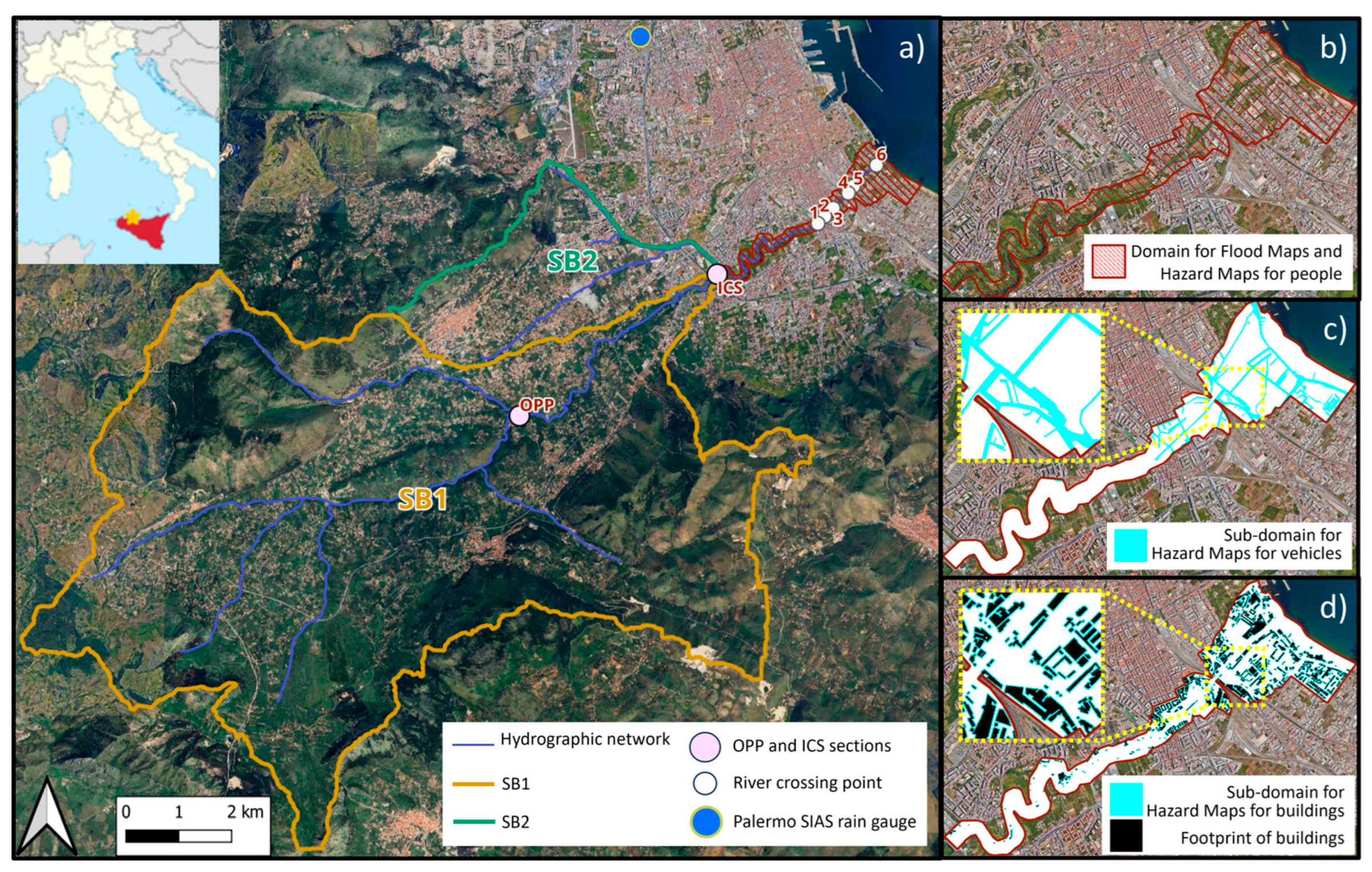
Figure 2.
(a) Flow Rating Curve (FRC), and (b) Flow Duration Curve (FDC2021) derived at the OPP. For the FDC, the discharge is reported in logarithmic form and vertical grid distinguishes the four different streamflow conditions considered for the FESs generation, with the values of streamflow associated to each class (Qinit,FES= QLF, QLM, QMH, and QHF) highlighted in red. The old version of the FDC (FDC1941) is also reported for comparison (black dashed curve).
Figure 2.
(a) Flow Rating Curve (FRC), and (b) Flow Duration Curve (FDC2021) derived at the OPP. For the FDC, the discharge is reported in logarithmic form and vertical grid distinguishes the four different streamflow conditions considered for the FESs generation, with the values of streamflow associated to each class (Qinit,FES= QLF, QLM, QMH, and QHF) highlighted in red. The old version of the FDC (FDC1941) is also reported for comparison (black dashed curve).
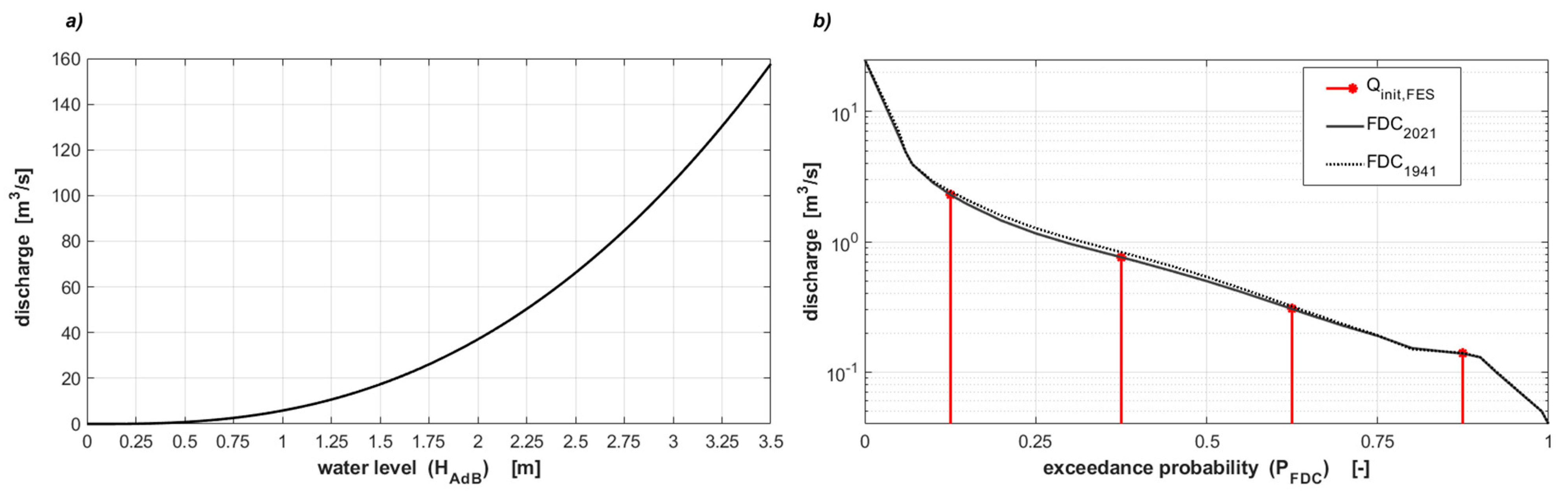
Figure 3.
Computational hydraulic domain: maps of (a) elevation and (b) roughness. Location of the bridges are also indicated, while their geometry is depicted in the insets.
Figure 3.
Computational hydraulic domain: maps of (a) elevation and (b) roughness. Location of the bridges are also indicated, while their geometry is depicted in the insets.
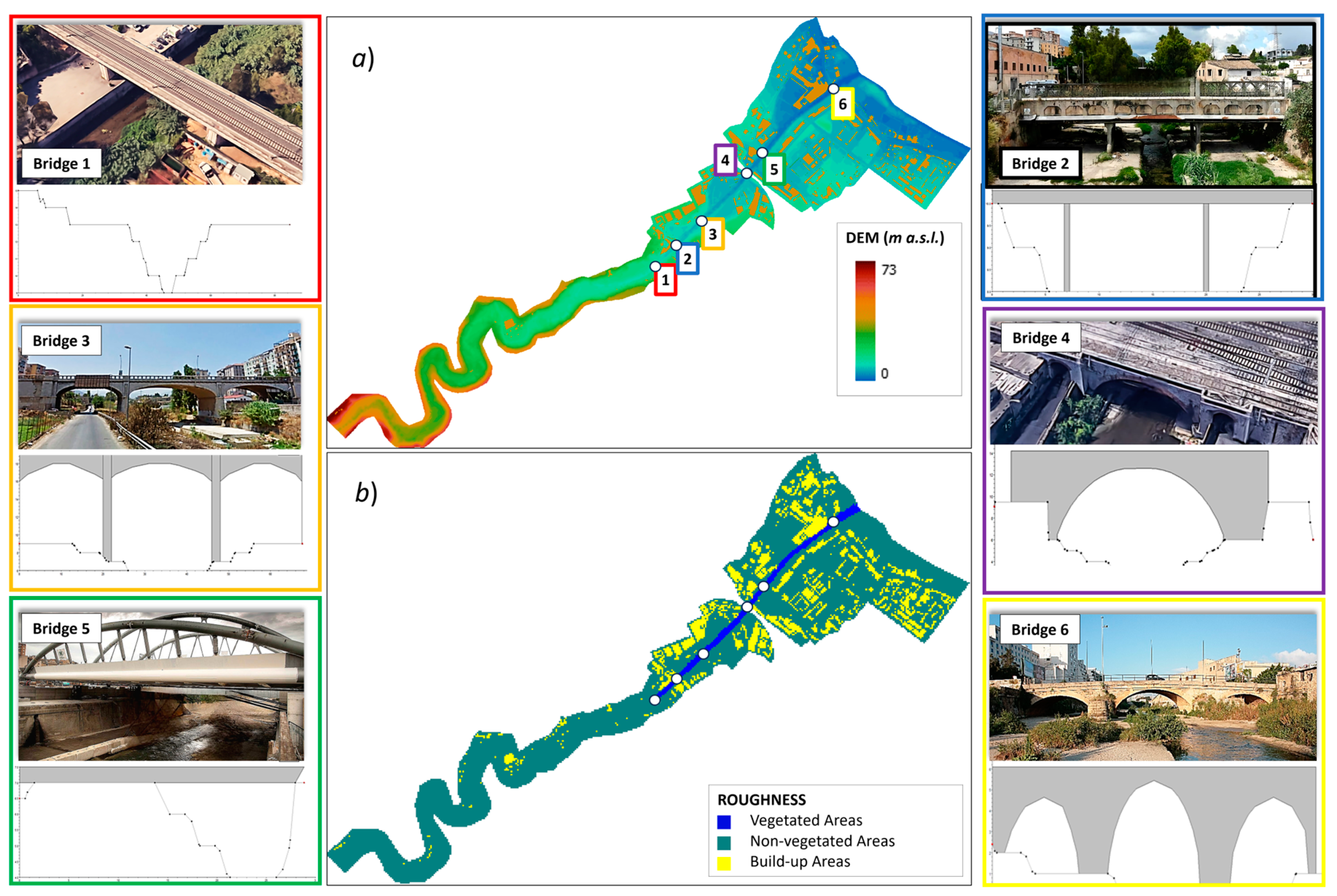
Figure 4.
Schematic representation of a generic FES. Each FES is derived by propagating over the computational domain a standard design hydrograph with given peak flow (Qpeak,FES) and initial discharge (Qinit,FES) and deriving water levels (h) and flow velocity (v) at each node, as well as critical flooding points location (CPloc) and timing (CPtime). Each FES provides a report table for the critical points and spatial maps of water levels, and hazard maps for people, vehicles, and buildings.
Figure 4.
Schematic representation of a generic FES. Each FES is derived by propagating over the computational domain a standard design hydrograph with given peak flow (Qpeak,FES) and initial discharge (Qinit,FES) and deriving water levels (h) and flow velocity (v) at each node, as well as critical flooding points location (CPloc) and timing (CPtime). Each FES provides a report table for the critical points and spatial maps of water levels, and hazard maps for people, vehicles, and buildings.
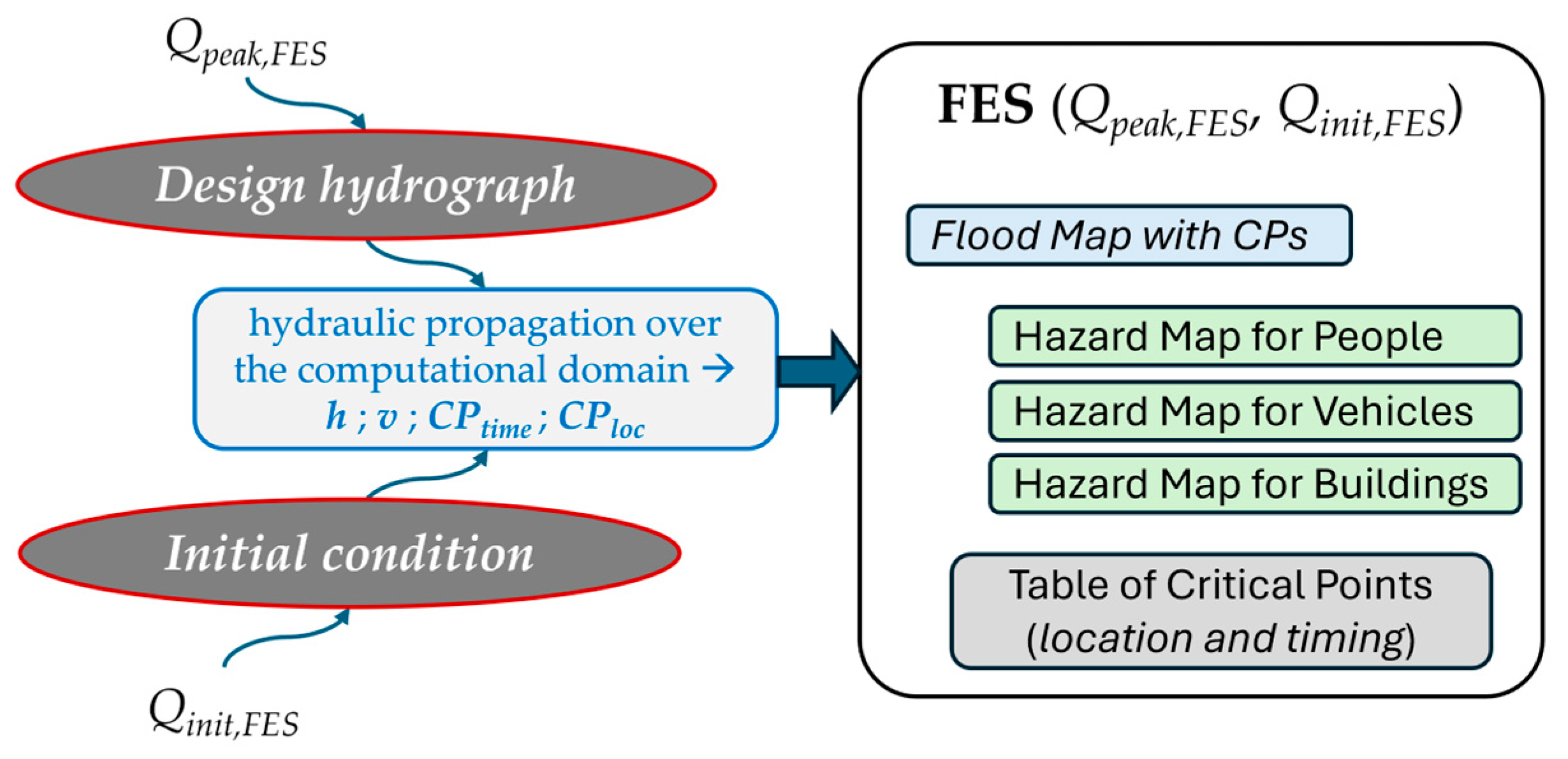
Figure 5.
Flow chart of the proposed Early Warning System.
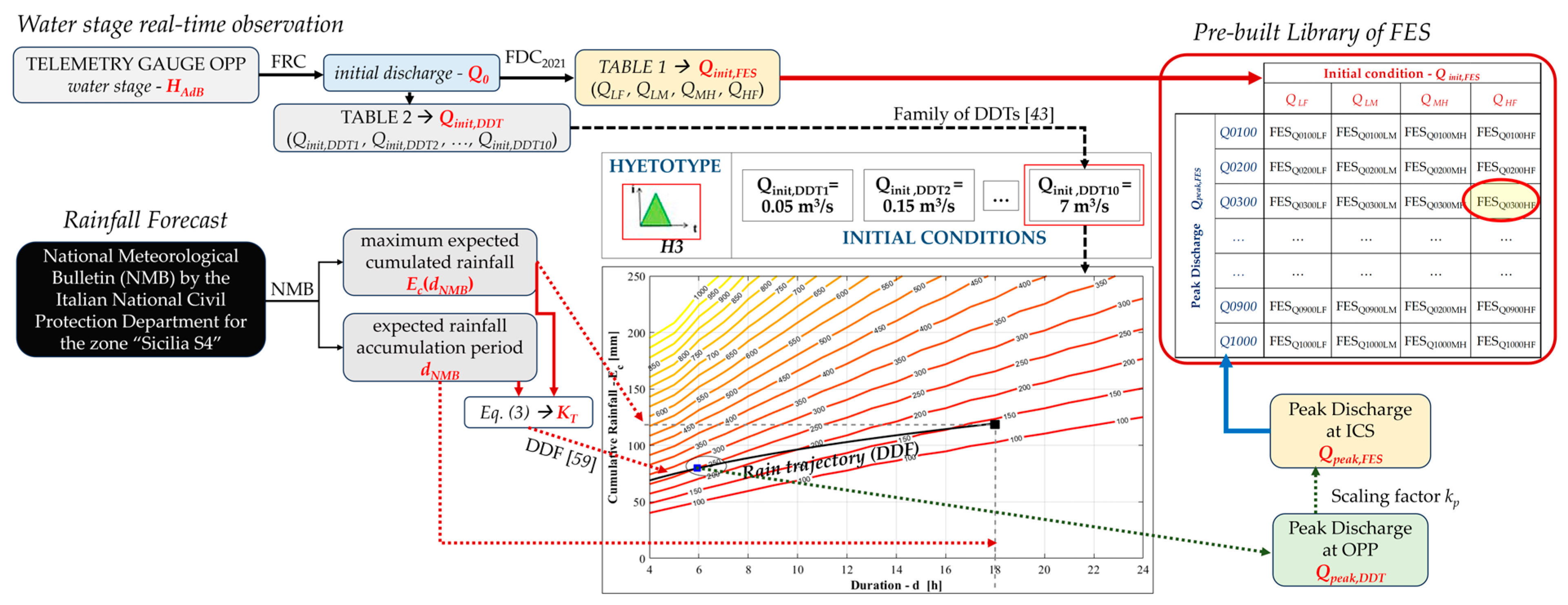
Figure 6.
(a) Depth-Duration-Frequency curves for the 5 considered return periods (i.e., 10, 25, 50, 100, 300, and 500 years); (b) Iso-concentration time curves for the sub-basins SB1 and SB2; (c) Normalized hydrographs for the 5 different return periods and derived standard UH at the ICS (red curve). For helping visualization this last is reported on logarithmic axes.
Figure 6.
(a) Depth-Duration-Frequency curves for the 5 considered return periods (i.e., 10, 25, 50, 100, 300, and 500 years); (b) Iso-concentration time curves for the sub-basins SB1 and SB2; (c) Normalized hydrographs for the 5 different return periods and derived standard UH at the ICS (red curve). For helping visualization this last is reported on logarithmic axes.
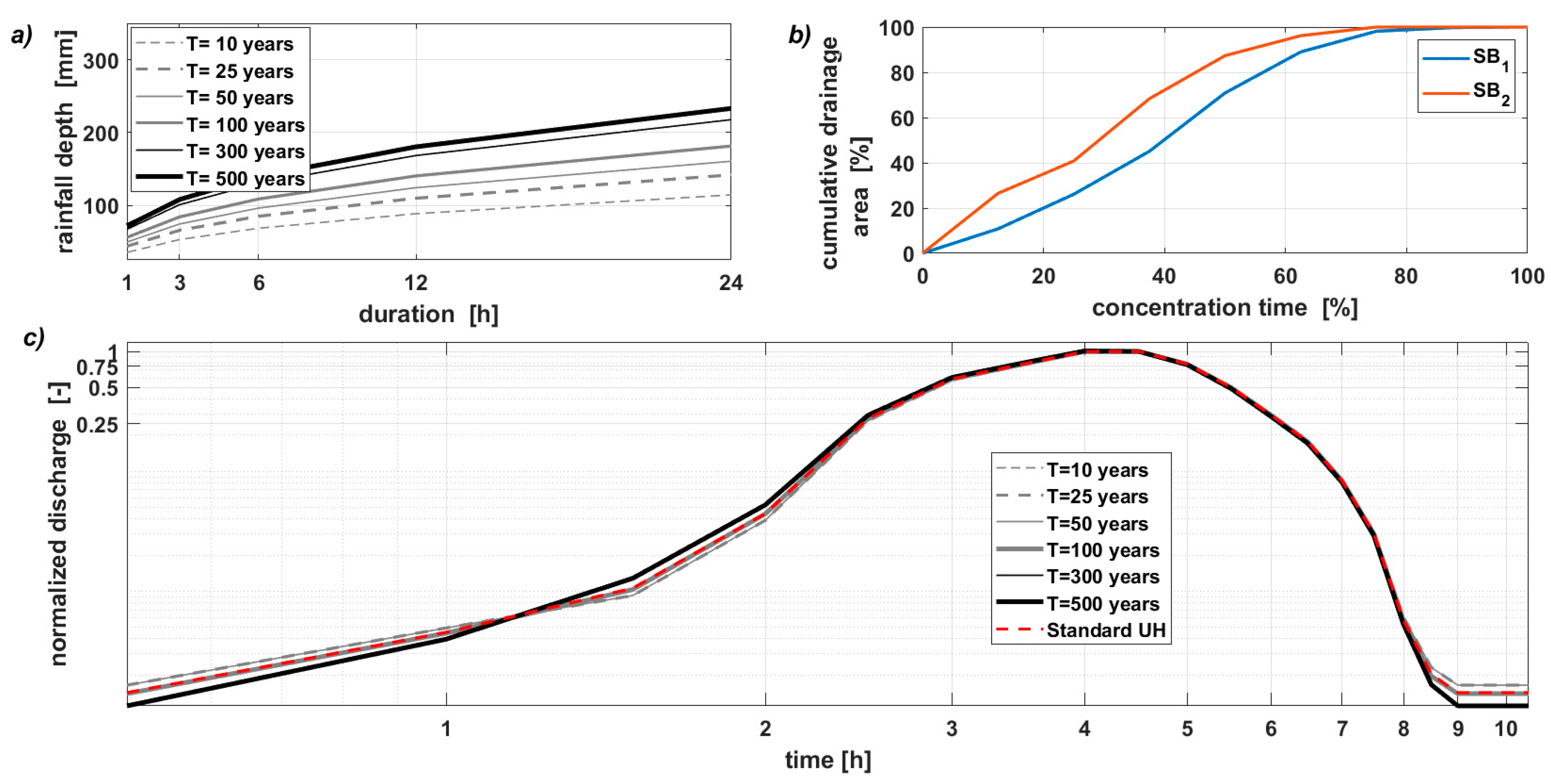
Figure 7.
(a) Flood map for the most severe FES, i.e., the Q1000HF (Qpeak,FES =1000 m3/s, Qinit,FES =QHF), with identification of the 34 occurring CPs. (b) Flood map for the FES Q0300LF (Qpeak,FES =300 m3/s, Qinit,FES =QLF), with identification of the 24 occurring CPs (these are identified by the same ID codes relative to the FES Q1000HF).
Figure 7.
(a) Flood map for the most severe FES, i.e., the Q1000HF (Qpeak,FES =1000 m3/s, Qinit,FES =QHF), with identification of the 34 occurring CPs. (b) Flood map for the FES Q0300LF (Qpeak,FES =300 m3/s, Qinit,FES =QLF), with identification of the 24 occurring CPs (these are identified by the same ID codes relative to the FES Q1000HF).
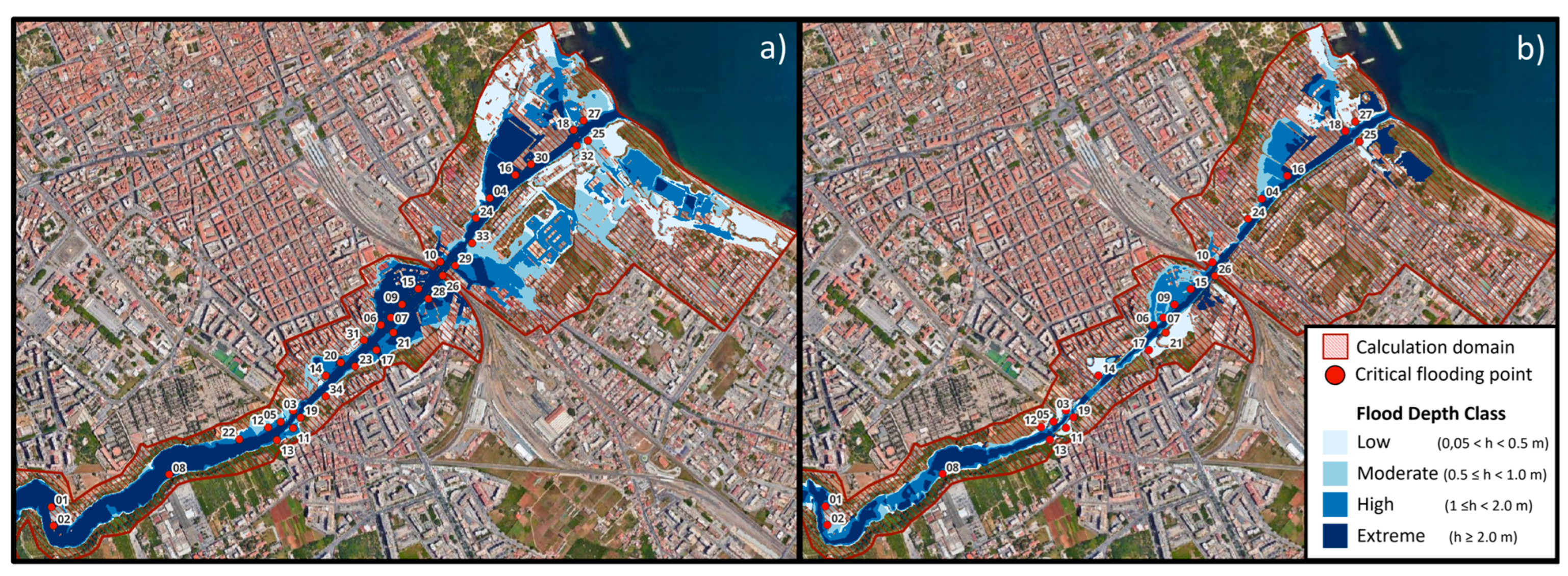
Figure 8.
Onset times of the CPs with respect to the rainfall onset time (CPtime) for FESs obtained with Qinit,FES = QHF. Each segment refers to a specific CP, whose location is reported in Figure 7a, and reports the variation range of CPtime among the various FESs. The left limit of each segment denotes the minimum CPtime, which always occur for the FES Q1000HF. In right limit is reported the maximum CPtime with the corresponding Qpeak,FES (i.e., from Q0100 to Q0950).
Figure 8.
Onset times of the CPs with respect to the rainfall onset time (CPtime) for FESs obtained with Qinit,FES = QHF. Each segment refers to a specific CP, whose location is reported in Figure 7a, and reports the variation range of CPtime among the various FESs. The left limit of each segment denotes the minimum CPtime, which always occur for the FES Q1000HF. In right limit is reported the maximum CPtime with the corresponding Qpeak,FES (i.e., from Q0100 to Q0950).
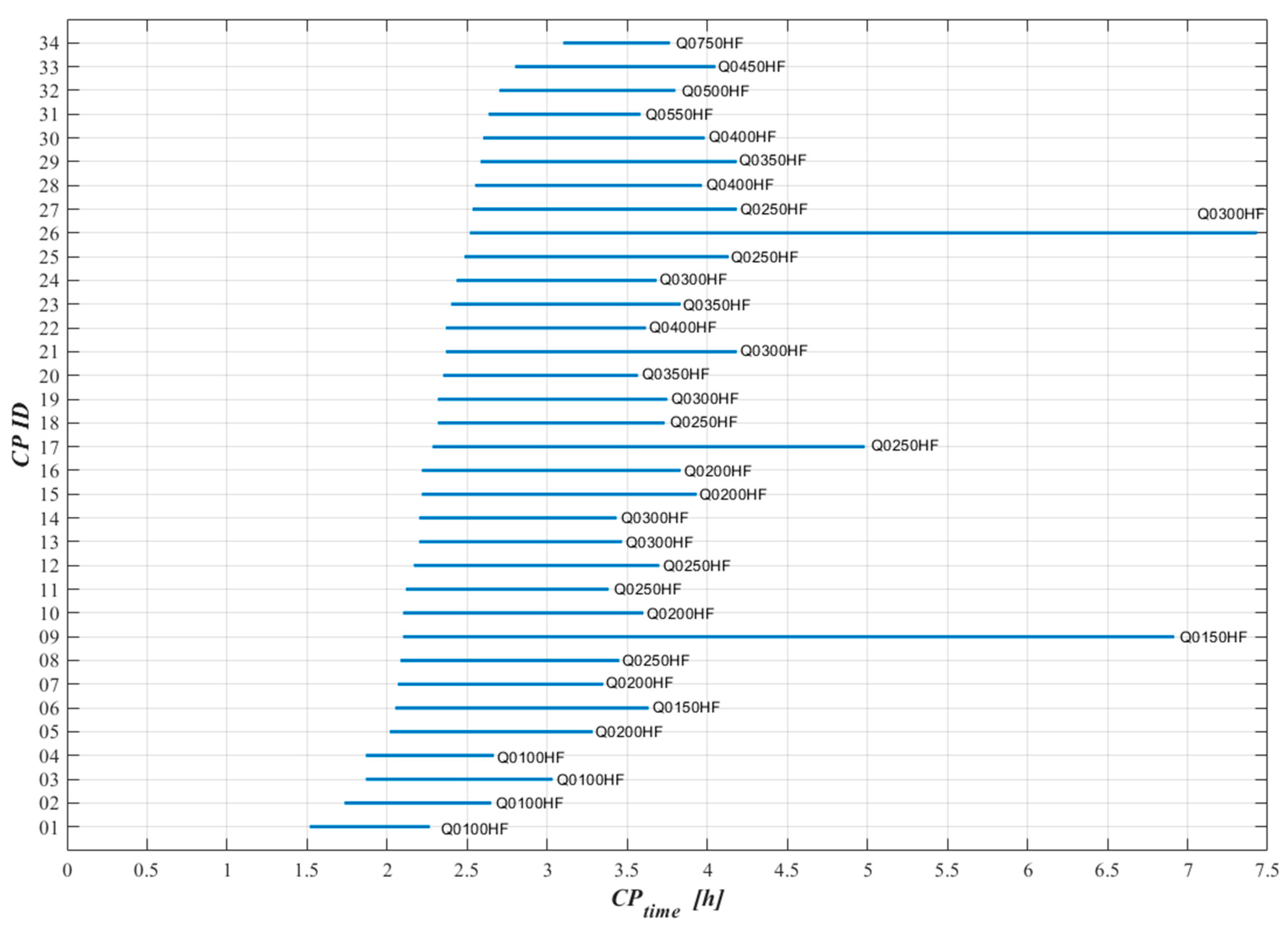
Figure 9.
Flood Event Scenario FES1000HF - Hazard Maps for: (a) people; (b) vehicles; (c) buildings. Inset boxes in figures 9b and 9c show a zoom for specific areas to help visualization, and they are not included as final products of the FESs.
Figure 9.
Flood Event Scenario FES1000HF - Hazard Maps for: (a) people; (b) vehicles; (c) buildings. Inset boxes in figures 9b and 9c show a zoom for specific areas to help visualization, and they are not included as final products of the FESs.
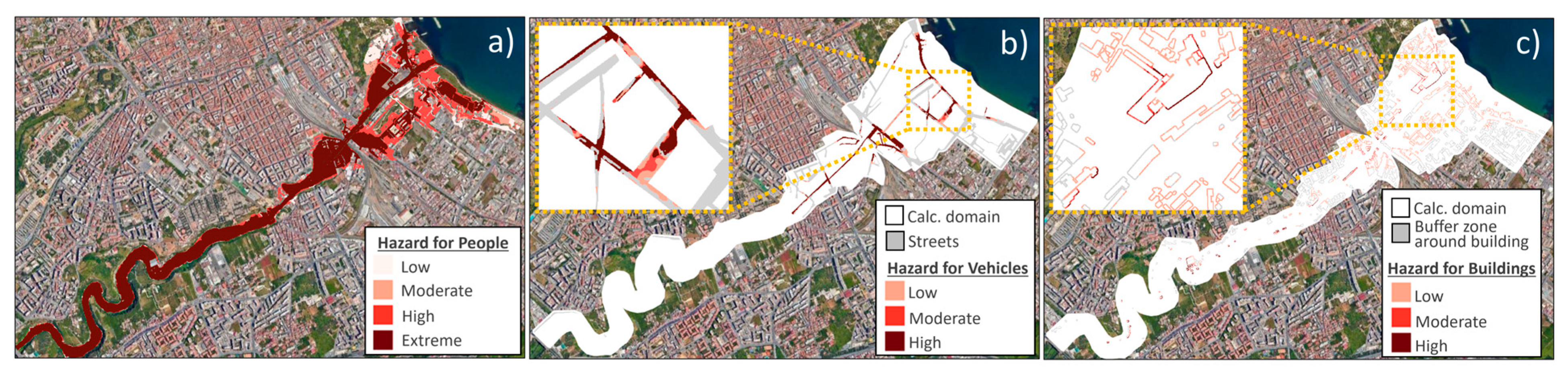
Figure 10.
Flood Event Scenarios derived for Qinit,FES = QHF. Variation in the percentage coverage of the domain of each class for the (a) flood map and the hazard maps for (b) people, (c) vehicles, and (d) buildings, as a function of the expected Qpeak,FES.
Figure 10.
Flood Event Scenarios derived for Qinit,FES = QHF. Variation in the percentage coverage of the domain of each class for the (a) flood map and the hazard maps for (b) people, (c) vehicles, and (d) buildings, as a function of the expected Qpeak,FES.
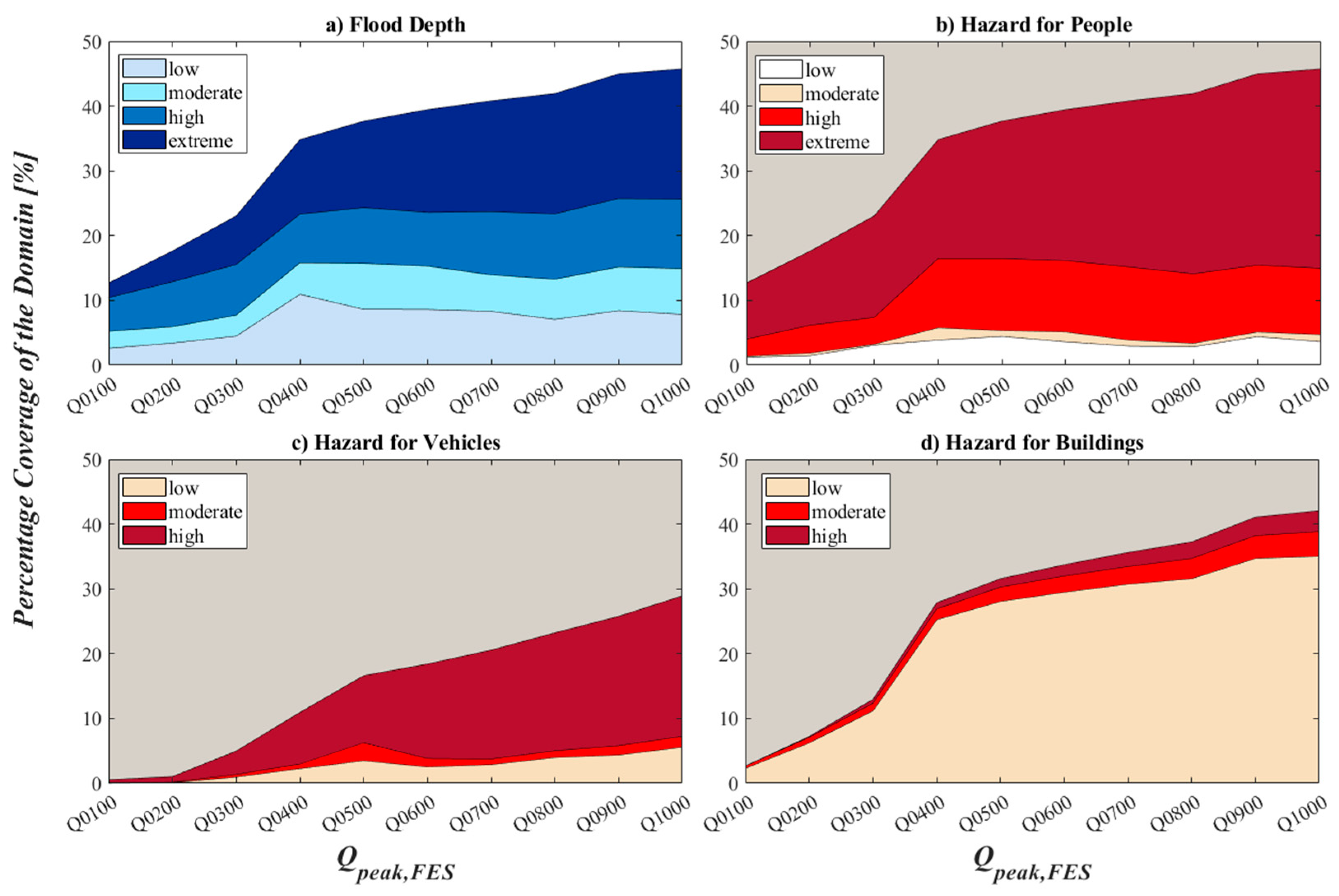
Figure 11.
(a) Flood map reconstructed by the SPC with the red inset plot showing the reconstruction of the actual flooded area from Google Map Satellite. Post-event pictures from the web portal of the online newspapers Palermo Today (www.palermotoday.it), reported in figures (b) and (c), and Giornale di Sicilia (www.gds.it), reported in figures (d) and (e). Their localization in the inset of Fig. 11a is denoted by using boxes of different colours associated with the contour line of each picture.
Figure 11.
(a) Flood map reconstructed by the SPC with the red inset plot showing the reconstruction of the actual flooded area from Google Map Satellite. Post-event pictures from the web portal of the online newspapers Palermo Today (www.palermotoday.it), reported in figures (b) and (c), and Giornale di Sicilia (www.gds.it), reported in figures (d) and (e). Their localization in the inset of Fig. 11a is denoted by using boxes of different colours associated with the contour line of each picture.
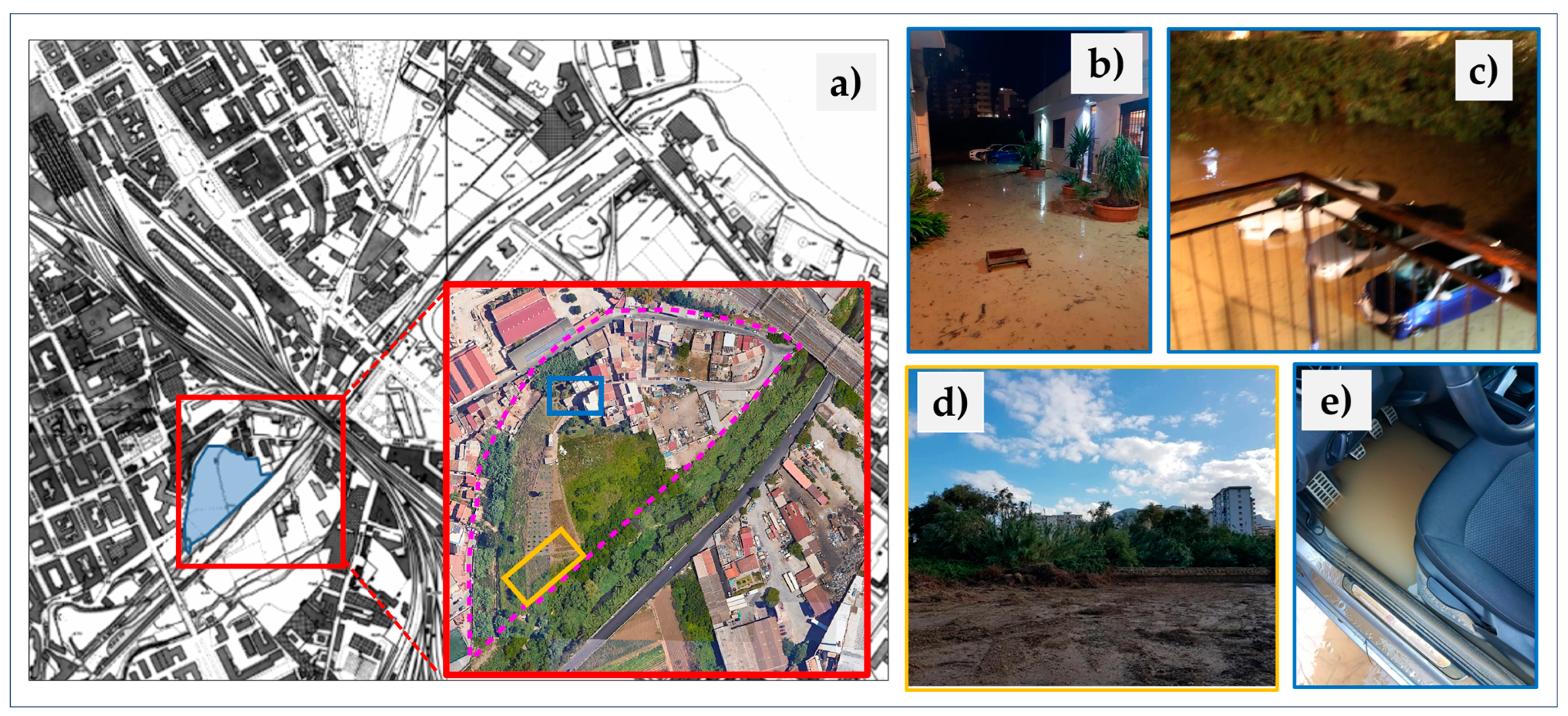
Figure 12.
(a) Rainfall hyetograph (black bar, left y-axis) recorded at the Palermo SIAS rain gauge and cumulative rainfall depth (purple dashed line, right y-axis) during the time window covering the forecasting horizons for NMB1 and NMB2. (b) Temporal trace of water stages recorded at the OPP (dashed blue line, left y-axis) and corresponding hydrograph (red line, right y-axis) obtained by Eq. (1), with indication of the initial discharge at the time of issuing of the two bulletins (black circles). Times of issuing and the forecasting horizons of each bulletin are highlighted in both graphs (in orange for NMB1 and in green for NMB2).
Figure 12.
(a) Rainfall hyetograph (black bar, left y-axis) recorded at the Palermo SIAS rain gauge and cumulative rainfall depth (purple dashed line, right y-axis) during the time window covering the forecasting horizons for NMB1 and NMB2. (b) Temporal trace of water stages recorded at the OPP (dashed blue line, left y-axis) and corresponding hydrograph (red line, right y-axis) obtained by Eq. (1), with indication of the initial discharge at the time of issuing of the two bulletins (black circles). Times of issuing and the forecasting horizons of each bulletin are highlighted in both graphs (in orange for NMB1 and in green for NMB2).

Figure 13.
Family of DDT curves and DDF curves (black curves, providing the expected rainfall trajectory) selected by the EWS for: (a) NMB1 and (b) NMB2. The thicks with indication of the parameter of all the iso-critical discharge DDTs (red and orange curves) is also reported in each plot. From the combined use of the two types of curve, the EWS has estimated a Qpeak,DDT equal to 288 m3/s and 125 m3/s for NMB1 and NMB2, respectively, given by the highest DDT crossed by the rainfall trajectory in each plot.
Figure 13.
Family of DDT curves and DDF curves (black curves, providing the expected rainfall trajectory) selected by the EWS for: (a) NMB1 and (b) NMB2. The thicks with indication of the parameter of all the iso-critical discharge DDTs (red and orange curves) is also reported in each plot. From the combined use of the two types of curve, the EWS has estimated a Qpeak,DDT equal to 288 m3/s and 125 m3/s for NMB1 and NMB2, respectively, given by the highest DDT crossed by the rainfall trajectory in each plot.
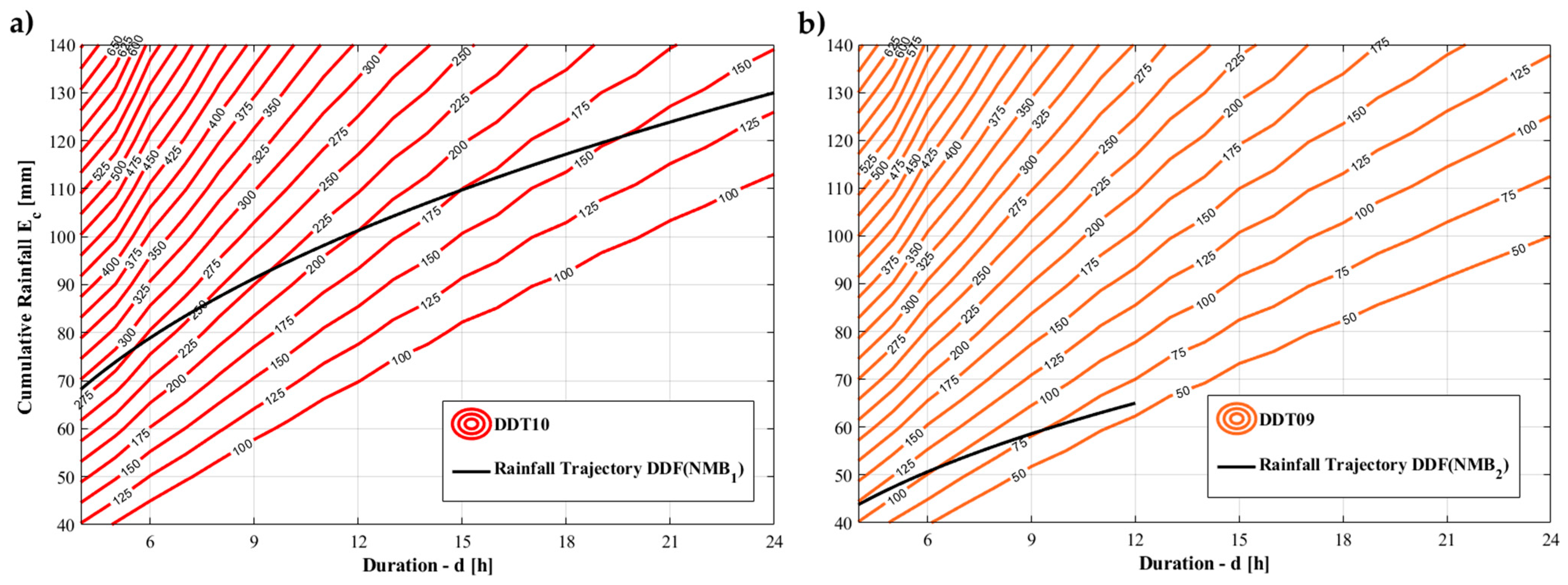
Figure 14.
Flood Maps of the FESs Q0400HF (a) and Q0200HF (b), resulting from the application of the EWS based on the NMB1 (bulletin of Nov. 2nd, 2018) and NMB2 (bulletin of Nov. 3rd, 2018), respectively. A comparison of both maps with the actual flooded area (dashed magenta contour) in the district of Fondo Picone is reported in the insets.
Figure 14.
Flood Maps of the FESs Q0400HF (a) and Q0200HF (b), resulting from the application of the EWS based on the NMB1 (bulletin of Nov. 2nd, 2018) and NMB2 (bulletin of Nov. 3rd, 2018), respectively. A comparison of both maps with the actual flooded area (dashed magenta contour) in the district of Fondo Picone is reported in the insets.
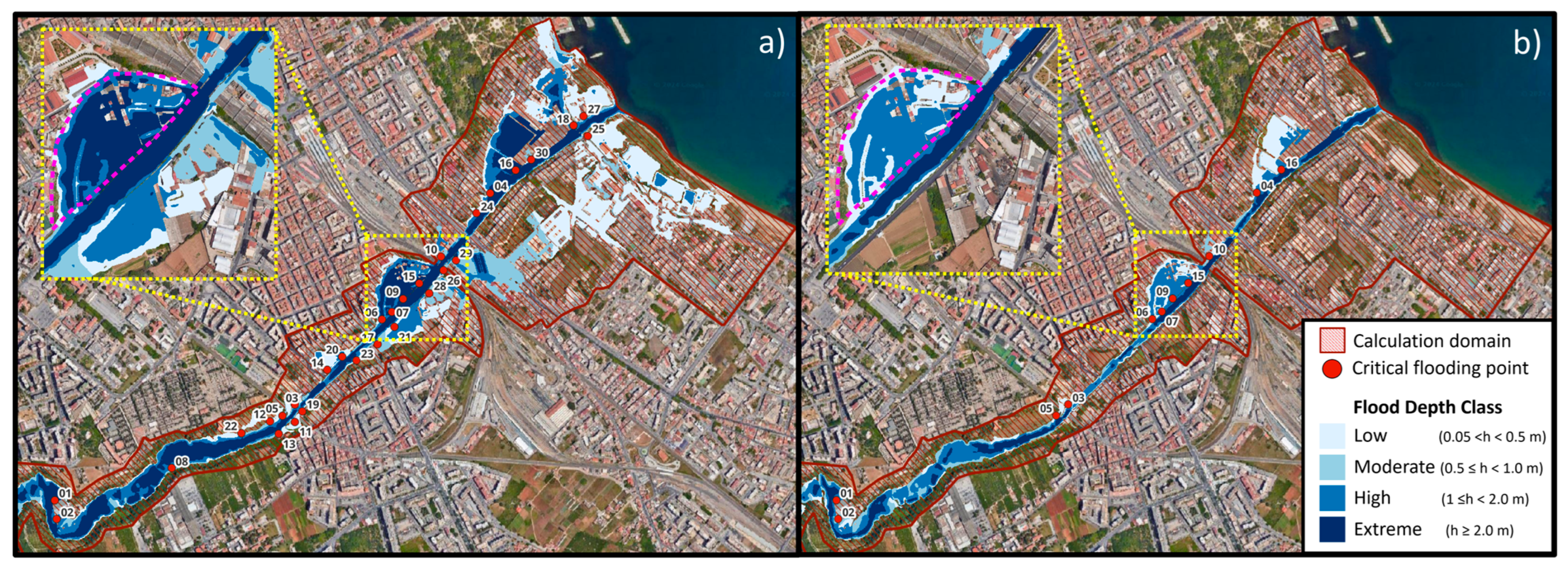

Table 1.
Classification of the initial discharge, Q0, at the OPP, with the associated initial condition for the FES identification in terms of discharge (Qinit,FES) and exceedance probability from the FDC2021 (PFDC,2021). Initial discharge at the OPP (Qinit,DDT) are associated to 10 different families of iso-critical discharge DDT curves derived in [43].
Table 1.
Classification of the initial discharge, Q0, at the OPP, with the associated initial condition for the FES identification in terms of discharge (Qinit,FES) and exceedance probability from the FDC2021 (PFDC,2021). Initial discharge at the OPP (Qinit,DDT) are associated to 10 different families of iso-critical discharge DDT curves derived in [43].
| Discharge classes | Discharge at OPP | Qinit,FES | ||||
| frequency - FDC | [m3/s] | symbol | [m3/s] | PFDC,2021 | ||
| low flow | LF | Q0 < Q274 | Q0 < 0.19 | QLF = | 0.14 | 0.875 |
| low-medium flow | LM | Q274 ≤ Q0 < Q185 | 0.19 ≤ Q0 < 0.50 | QLM = | 0.31 | 0.625 |
| medium-high flow | MH | Q185 ≤ Q0 < Q91 | 0.50 ≤ Q0 < 1.16 | QMH = | 0.76 | 0.375 |
| high flow | HF | Q0 ≥ Q91 | Q0 > 1.16 | QHF = | 2.30 | 0.125 |
| Initial Discharge for the DDT [m3/s] | ||||||
| Qinit,DDT1 | = | 0.05 | Qinit,DDT6 | = | 0.77 | |
| Qinit,DDT2 | = | 0.15 | Qinit,DDT7 | = | 1.06 | |
| Qinit,DDT3 | = | 0.23 | Qinit,DDT8 | = | 1.58 | |
| Qinit,DDT4 | = | 0.36 | Qinit,DDT9 | = | 2.90 | |
| Qinit,DDT5 | = | 0.54 | Qinit,DDT10 | = | 7.00 | |
Table 2.
Main features of the sub-basins SB1 and SB2. Tc is the time of concentration in h, while CNII and CNIII are the mean areal curve number (SCS-CN method) under the AMC class II (i.e., average moisture condition) and III (i.e., wet moisture condition), respectively.
Table 2.
Main features of the sub-basins SB1 and SB2. Tc is the time of concentration in h, while CNII and CNIII are the mean areal curve number (SCS-CN method) under the AMC class II (i.e., average moisture condition) and III (i.e., wet moisture condition), respectively.
| Feature | SB1 | SB2 |
|---|---|---|
| Area [km2] | 84.76 | 26.14 |
| Length [km] | 20.11 | 13.86 |
| Average Elevation [m. a.s.l.] | 500 | 385 |
| Tc [h] | 4 | 3 |
| CNII | 79.38 | 77.27 |
| CNIII | 88.18 | 87.65 |
| Impervious Area [%] | 1.33% | 11.04% |
Table 3.
Rainfall forecast according to the NMB1 and NMB2, record data at the OPP station, and variables and parameters computed by the EWS at the time of issuing of the two bulletins. On the last row, the FESs retrieved by the EWS from the library are highlighted in bold.
Table 3.
Rainfall forecast according to the NMB1 and NMB2, record data at the OPP station, and variables and parameters computed by the EWS at the time of issuing of the two bulletins. On the last row, the FESs retrieved by the EWS from the library are highlighted in bold.
| Time of evaluation EWS | [year/month/day h:min] | 02/11/2018 12:00 | 03/11/2018 12:00 | |
| Actual pre-announcement time | [h] | 33 | 9 | |
| Reference Bulletins | NMB1 | NMB2 | ||
| Max. expected cumulative rainfall | Ec | [mm] | 130 | 65 |
| Max. expected accumulation period | dNMB | [h] | 24 | 12 |
| Regional growth curve factor (DDF) | Kt | [-] | 1.835 | 1.178 |
| Water stage at OPP | HAdB | [m] | 0.96 | 0.74 |
| Init. discharge at the OPP | Q0 | [m3/s] | 5.22 | 2.54 |
| Initial condition for FES selection | Qinit,FES | QHF | QHF | |
| Initial condition for DDT | Qinit,DDT | Qinit,DDT10 | Qinit,DDT09 | |
| Peak Discharge at OPP | Qpeak,DDT | [m3/s] | 288 | 125 |
| Peak Discharge at ICS | Qpeak,ICS | [m3/s] | 383 | 166 |
| Peak Discharge for FES selection | Qpeak,FES | [m3/s] | 400 | 200 |
| Selected FES from the Library | FES | Q0400HF | Q0200HF | |
Disclaimer/Publisher’s Note: The statements, opinions and data contained in all publications are solely those of the individual author(s) and contributor(s) and not of MDPI and/or the editor(s). MDPI and/or the editor(s) disclaim responsibility for any injury to people or property resulting from any ideas, methods, instructions or products referred to in the content. |
© 2024 by the authors. Licensee MDPI, Basel, Switzerland. This article is an open access article distributed under the terms and conditions of the Creative Commons Attribution (CC BY) license (http://creativecommons.org/licenses/by/4.0/).
Copyright: This open access article is published under a Creative Commons CC BY 4.0 license, which permit the free download, distribution, and reuse, provided that the author and preprint are cited in any reuse.