

Submitted:
23 July 2024
Posted:
23 July 2024
You are already at the latest version
Abstract
Background Compliance with research ethics legislation is crucial for protecting people's rights in clinical trials. Researchers can alert publishers when they have concerns about possible non-compliance with this legislation by other authors, and this opportunity for independent scrutiny is important. Nevertheless, some alerts may turn out to be unfounded due to a misunderstanding of the legislation. Methods We present the analysis of the article by F. Franck et al., « Raising concerns on questionable ethics approvals - a case study of 456 trials from the Institut Hospitalo-Universitaire Méditerranée Infection», in which the authors explain having sent numerous emails to different publishers to express their concerns about potential ethical breaches in publications from a single French institution. We analyzed in detail the 248 studies that the authors present as suspects. We have also studied the texts of French law. Results Our detailed analysis of these 248 studies discovered that only 8 of them report research involving humans. All the others are secondary research on existing biological samples. In France, as in many other countries, secondary research on biological samples does not involve human subjects. Conclusions Assessing the ethical conformity of scientific publications must be based on a precise knowledge of the legislation and a rigorous analysis of these publications. When researchers who alert publishers confuse research involving the human person with research not involving the human person, the publishers are in danger of being misled by these unfounded alerts. This can have deleterious consequences.
Keywords:
Ethics
; microbiology
; non-RIPH studies
; studies « hors loi Jardé »
; biological samples
; IRB exemption
1. Background
According to COPE (Committee on Publication Ethics): « Editors and publishers are dealing with increasing numbers of ethical concerns brought to their attention in a variety of ways, and increasingly concerning large numbers of papers. Journals may receive concerns directly or from different media and should investigate these regardless of the method of communication. » COPE has therefore published a number of guidelines giving recommendations to help publishers to deal with these different situations. COPE also reports that: « The issues identified have become more complex. This includes situations where multiple concerns are raised simultaneously to multiple journals, from anonymous or named individuals, and which deal with a range of issues concerning the integrity of the published research. » [1].
It is obviously very important that the rules governing the ethics of medical research are respected, and the contribution of researchers wishing to carry out independent checks can be a valuable asset for the scientific community but also, more generally, for maintaining a climate of confidence in medical research. However, a process designed to achieve constructive objectives can always have negative consequences if it is misused, and facilitating the process of communicating concerns to publishers can also present significant risks, including the risk generated by alerts issued by scientists unfamiliar with the research areas of the publications that they criticise and who may then be inclined to misinterpret the rules that apply to this type of research. If they do not understand that their suspicions of fraud are unfounded, they may feel that publishers are not taking their responsibilities seriously, and they may insist on concrete action that they wrongly believe to be justified. Indeed, COPE points out that researchers sometimes submit multiple questions and pursue their complaints even after the investigation has concluded that there was no fraud: « Repeated complaints may be trivial or inaccurate allegations about published articles. », « Complainants may flood discussion threads by repeatedly submitting comments about earlier comments, and will not accept that a certain topic has been closed. » [2] These repeated unfounded complaints are likely to be detrimental to publishers and to the scientists targeted, in terms of the time and resources they have to devote to them.
In this article, we present the case of a team of independent researchers who, believing they had detected massive ethical fraud in the publications of a French institution, wrote to the publishers to communicate their concerns. In their opinion, if publishers do not take post-publication criticisms into account, they should improve their peer review process. But these researchers do not consider the possibility of having made mistakes in their analyses of the publications they denounce, or in their interpretation of the legislation. Indeed, the laws on research ethics are complex and sometimes present subtleties that must be understood to be able to assess whether or not they are being complied with. In France, scientists who undertake clinical research as investigators are legally obliged to have obtained certification in Good Clinical Practice (GCP) and to renew this certification regularly in order to adapt their knowledge to any changes in the law.
The rules imposed on researchers may also differ depending on the research areas that are the subject of the publications. For example, a cancer researcher working on cancer cell cultures or a microbiology researcher studying the characteristics of bacteria or viruses are not subject to the same rules as researchers testing the effect of a drug on patients. Ethical laws are designed to protect the rights of human research participants, but they are not designed to protect cancer cell cultures or bacteria. It may seem surprising to have to illustrate this with such simple examples, but it would seem that the authors’ first misunderstanding is to confuse research involving human beings with research not involving human beings.
The terminology of « biomedical research » used in the Huriet-Serclat law (applied since 1988 and revised in 2004) has been replaced in the Jardé law (applied since November 2016) by that of « research involving the human person ». This recent law divides research involving the human person into three categories (RIPH 1, 2 and 3). As this theme of the Jardé Law only concerns France, there are not many publications on the subject in international scientific journals. Nevertheless, a number of institutions have organised training courses for their researchers, the texts of which are available online, providing additional details to help distinguish them from research not involving the human person (also known as « research outside the scope of the Jardé Act »). In addition to the official legal texts, we therefore rely on the content of these presentations to analyse the article by Franck et al. and show that their fears of ethical fraud on the part of the IHU-MI are unfounded. We also use other scientific articles reporting the results of non-RIPH research published by other teams than those at IHU-MI, including those published by some of Fabrice Franck’s co-authors.
Through our work, we also hope to enlighten publishers so that they are better equipped to carry out investigations into articles published by French researchers. This will maybe prevent other French teams from being suspected of fraud in the future on the basis of concerns generated by this same confusion.
2. Methods
We have carefully examined the recent article published by F. Franck and colleagues, entitled: « Raising concerns on questionable ethics approvals - a case study of 456 trials from the Institut Hospitalo-Universitaire Méditerranée Infection. » [3]
This article is the result of the analysis made by the authors of several hundred scientific publications from the IHU-MI (Marseille Infections University Hospital Institute). They found that 248 of them mentioned the same ethics committee approval number, even though they were concerned with different samples, subjects, and countries. According to the authors, this reuse of the same approval number for a large number of publications does not comply with the French law on research on human beings (RHB) (Jardé law on bioethics) and raises concerns about the potential fraudulent use of this ethical authorization.
We have also examined the texts of French legislation and those of the developing countries concerned by the publications singled out by Fabrice Franck’s team.
After a thorough reading of each of the 248 IHU-MI studies listed in the table provided in Franck et al article, it emerges that the authors make two major errors that invalidate their suspicion of fraud. First, they interpret French legislation incompletely, and second, they obscure the fact that these sub-publications are part of an overall research project: the analysis of the human microbiota and the understanding of potential links between its alterations and various pathologies.
3. Detailed Examination of Research Ethics Laws
3.1. The Main Difference between French Law and the Laws of Anglo-Saxon Countries
F. Franck and his colleagues explain that:
« In this context, the French legislation was updated in 2016 with the Jardé Law on good practices in clinical research. It should be noted that the legislative framework encountered in France is not the same as in other countries which may have other governance instead. French regulation requires that any experimentation on human beings must be approved by an independent ethics committee and depending on the complexity of the protocol, additional authorizations are required, especially regarding the collection of body fluids such as stool, vaginal secretions or urine. »
In Anglo-Saxon countries, there is only one type of ethics committee: the IRB, but in France, there are two: the CPP (Comités de Protection de la Personne) and the CEL (Comités d’Éthique Locaux). French CPPs which are equivalent to the IRB committees under American legislation, independent of research institutions or hospitals, and whose authorization is compulsory for research involving human beings. French CELs have no equivalent in Anglo-Saxon countries. Their authorizations are only advisory and are not legally binding. As there are only 39 CPPs/IRBs to cover the entire French territory [4], research outside the scope of the Jardé Law / RHB is no longer accepted for evaluation by CPPs/IRBs, which can pose problems for publication. Scientists must then turn to their institution’s local ethics committee which will help them to determine whether the research they are planning is research involving human person (in which case, the CEL will direct them to a CPP) or research not involving the human person. For non-RIPH research, the authorizations of the CEL (even if they are not legally obligatory) are useful in providing the ethical endorsement publishers request (since the CPP refuse to evaluate them). [5] The lack of distinction between these two types of ethics committees is at the root of Fabrice Franck and his colleagues’ incorrect interpretation of the legislation concerning these 248 publications. French legislation requires authorization from a CPP (IRB) only for research on human beings (RHB), known as RIPH (Recherche Impliquant la Personne Humaine).
On the other hand, research using microbiological samples of those using sample collected during care does not require CPP/IRB authorization. They are authorized by law, as stated in article L1211-2 of the French Public Health Code [6]: « The use of elements and products of the human body for a medical or scientific purpose other than that for which they were removed or collected is possible, unless opposition is expressed by the person from whom the removal or collection was carried out, duly informed in advance of this other purpose. » The Jardé law distinguish [7]: interventional research (Category 1), interventional research with minimal risks and constraints (Category 2), non-interventional research (Category 3). « Retrospective research, involving biological samples or data already collected do not fall within the scope of the Jardé law on research involving human beings. »
Whether the IHU-MI ethics committee is a mandatory CPP/IRB or an optional local ethics committee is easy to determine, since there are lists [8] available online describing all French CPPs/IRBs, and the IHU-MI is not included. Knowing this specificity of French law, this was the first element the authors could check to determine whether the research fell within the scope of RIPH/RHB or non-RIPH/RHB research.
3.2. Document Number 09-022 Is an Advisory Opinion of the Local Ethics Committee and not a Compulsory CPP/IRB Authorization
By naming it this way, the authors are confusing readers, since they imply that this document is a RIPH/RHB research authorization and is compulsory. This implies de facto that, indeed, the use of the same number for so many publications is suspect of being a forgery. While readers are informed from the outset that this document is merely the opinion of a local ethics committee, its optional nature already makes it possible to question the fraud hypothesis.
Furthermore, to demonstrate their claim that it is impossible for this type of document to authorize so many different studies, Fabrice Franck and his colleagues use a template they found online on the ANSM website, authorizing a study with a radically different objective and methodology [9], entitled: « Determinants of self-medication behavior in general practice » which obviously do not fall within the field of research on human beings. This is a bad example which only shows the limits in the capacity of investigation of this group. In fact, on the same page [10] of the ANSM website, it is possible to access other documents issued by the IHU-MI’s local ethics committee. The one bearing the number 2016-011 [11] gives a favorable opinion for a study entitled: « Étude du microbiote humain par culturomics et métagénomique. » (Study of human microbiota using culturomics and metagenomics), the methodology of which is perfectly similar to that detailed in the publications challenged by the authors (see additional file n°4). By consulting this document, which appears first on the list, rather than the one referring to a study on self-medication in general medicine (appearing second on the list), the authors could have envisaged that the same number could be used, without this being fraudulent, for a large number of publications using the same methodology consisting of carrying out various laboratory analyses on biological samples. This opinion was based on the fact that no sample were obtained for research purpose only and that collected sample were provided either from the environment, from human remains (stools, urines …) or from sample collected primarily for care as indicated above. This opinion remains valid as long as the law remains unchanged.
It should be pointed out that many of the IHU-MI publications listed by the authors date from before 2016, i.e. before the Jardé Law came into force. Nevertheless, ethical regulations were identical (Hurriet Act) and already authorized research on biological samples.
3.3. Similarities between French Law and US Law
As Dr. Andrew Rawnsley, one of the two reviewers of the Fabrice Franck et al. article, notes in his review: « I need to start by saying that my familiarity with both ethics review policies and systems in France - (...) - is very limited », the comparison with US legislation will provide greater clarity for editors of international scientific journals, as it is more familiar to them. The same distinction is made between RIPH research (Research on human beings) and non-RIPH research (not on human beings).
In the USA, the HHS (Department of Health and Human Services) research privacy legislation [12] in the Code of Federal Laws is referred to as 45 C.F.R 46 and includes five subparts. Certain types of research are excluded [13,14,15,16] from this regulation and are described in 45 CFR 46.104. Among the categories of research exempt from this regulation is secondary research on biological samples (biospecimens), provided that the data are anonymized: « Secondary research for which consent is not required: Secondary research uses of identifiable private information or identifiable biospecimens, if at least one of the following criteria is met: (i) The identifiable private information or identifiable biospecimens are publicly available; (ii) Information, which may include information about biospecimens, is recorded by the investigator in such a manner that the identity of the human subjects cannot readily be ascertained directly or through identifiers linked to the subjects, the investigator does not contact the subjects, and the investigator will not re-identify subjects. »
The concept of "secondary research" is also defined in this presentation [17] from the University of San Francisco: « Not Human Subjects Research Description: Under some circumstances, research involving only unidentifiable/de-identified or coded private information or biological specimens is not human subjects research because investigators cannot readily ascertain the identities of the individuals to whom the data or samples belong. In such cases, IRB review is not required. »
Another presentation from the University of Virginia [18] also outlines the conditions under which research on biological samples is not considered research involving human beings: « Research with previously collected anonymous data and/or specimens does not meet the definition of "research involving human subjects" and may be performed without IRB approval or exemption only when the data/specimens to be studied were not collected specifically for the current research. »
These exemptions of IRBs in U.S. legislation correspond to which is defined as « research involving existing data with a change of purpose and/or existing biological elements. » [19,20] The change of purpose Art L 1211-2 of the French Public Health Code simply requires the patient informed on the possible used of his sample for future research and the possibility he get to express an opposition to this [21]. The Jardé law passed in 2012 implemented the European recommendations on the subject, as can be seen in the "Guide for research ethics Committee members" [22] adopted by the Council of Europe in 2010 and which is still the reference today [23].
Only the storage of samples in order to build up a collection for future research requires a declaration to the MESR (Ministry of Higher Education and Research) [24].
In their article: « French legislation on retrospective clinical research: what you need to know and what you need to do » Souche et al. summarize very well the fact that research on biological samples is not research involving the human person: « Retrospective research is exterior to the framework of the Jardé law, the reason being that it involves not “natural” persons but rather, existing health-related data with a modified objective and/or existing biological collections. » [25]
And, in the document: « A qualification guide for health research » published in 2021, the INSERM ethics committee (CEEI) states that: « Three categories of research are not considered as RIPH and are listed in point II of article R 1121-2 of the CSP (...) The 3rd category corresponds to retrospective studies on data and biological samples. » [26]
An October 2023 publication by several French scientists affiliated to different institutions, including INSERM, is a very concrete illustration of the application of French research legislation. The authors describe the results of laboratory analyses carried out on blood samples from patients suffering from neurodevelopmental disorders compared with those from people considered healthy [27].
The ethical mentions stipulate: « All patients or legal representatives provided informed written consent for exome/genome analyses in a medical setting that contains a query on the use of residual samples for research. This genetic study was approved by our legal ethics committee (...) This study was approved by the CERDE, which is the local ethics committee. »
This formulation shows that the law does not require authorization from a CPP / IRB for studies using secondary analyses performed on biological samples collected by laboratories (samples from sick or healthy people). Mention of the authorization/opinion of the local ethics committee enables authors to submit their publication to publishers. It should also be noted that no reference number for this CEL opinion is given.
3.4. Confirmation by the French Authorities
The final report of the inspection carried out by the IGAS [28] (Inspection Générale des Affaires Sociales) to which the authors refer states that, of the 140 IHU-MI studies inspected by them: « With the exception of 19 of them, which were redirected to committees for the protection of individuals, these studies do not involve human beings within the meaning of the JARDÉ law » (page 106) and: « In the case of research outside the scope of the RIPH, the regime is simpler: some research is carried out without any act on the person. They are not presented to the CPP. » (page 107) This IGAS report was published in August 2022, several months before Fabrice Franck and his colleagues submitted their article. Hence, they had official explanations for why most of the publications they listed should be classified as non-RIPH research. Moreover, in response to a question from Senator Alain Houpert, the Minister of Health, François Braun, replied on June 29, 2023: « As human waste is not a person but a thing, research on it is not research involving human beings, but ’scientific’ research. Research programs involving collections of biological samples fall within the remit of the ministry in charge of research, not the committees for the protection of individuals. » [29]
3.5. Lack of Ethics Committees and Specific Legislation in Some Countries
The particular case of Niger deserves some further explanation, firstly because it is representative of the situation in other developing countries and, secondly, because at the time of submitting this correspondence, two publications involving the analysis of the microbiota of severely malnourished children had been retracted by the publisher. Indeed, in Niger, a 2013 decree issued by the Ministry of Education [30] requires administrative authorization prior to research. Article 11 stipulates that for specific topics: « it remains understood that the establishment of the administrative authorization for research is strictly subordinated to the opinion of the ethics committee created for this purpose. »
But Niger’s Comité National d’Ethique de la Recherche en Santé (National Health Research Ethics Committee) was only created in 2016 (decree 2016-644 /PRN/MSP) (see additional file n°5), and the stool samples sent to the IHU-MI for analysis by Dr Souleymane Brah, a physician at Niamey hospital, were taken in 2014, when Niger’s CNERS did not yet exist. Before the creation of the CNERS, there was a national consultative ethics committee (CCNE) but, as stated in the National Strategic Plan for Health Research [31] issued by the Niger Ministry of Health in 2013, the legal framework governing its operation was very weak and its funding non-existent. In the absence of a functional ethics committee and legislation specifically framing human health research ethics, it was probably not possible in 2014 for Nigerien doctors collaborating with the IHU-MI to have a written document emanating from an official ethics committee. On the other hand, the authors state that Prof. Adehossi, Director General of the Niamey hospital where the samples were taken and a member of the Faculty of Life Sciences, certified that the study complied with Nigerien laws and the Declaration of Helsinki. Our hypothesis is that this is the administrative authorization required by the 2013 decree, and that in the absence of national laws governing medical research ethics, researchers refer to the Declaration of Helsinki as an international reference. Anyway, as Chaudhry I, Thurtle V, Foday E, et al [32] point out in their conclusions, this problem of weak or non-existent specific legislation on research ethics relating to human health is quite common in developing countries: « The findings show that most RECs in Sub-Saharan Africa work under significant administrative and financial constraints, with few opportunities for capacity building for committee members. This impacts the quality of reviews and the overall performance of RECs. Although most countries have national governance systems for RECs, they lack regulations on accountability, transparency, and monitoring of RECs. The situation in Senegal is somewhat different, with ethical legislation in place since 2009. Nevertheless, according to the Senegalese CNERS report [33] published in 2019: « The law does not address the issue of the use, storage and transfer of biological material, nor that of the creation, use and transfer of databases ».
The specific context of certain developing countries must, therefore, be considered before suspecting ethical fraud. Information is available to everybody, and among others in this article entitled: « National ethics guidance in Sub-Saharan Africa on the collection and use of human biological specimens: a systematic review » [34] published in 2016. Table 2 and Table 3 shows whether countries have ethical legislation in place and, if so, whether it includes clauses specific to the reuse or transfer of biological material. These tables confirm that, at the time the child malnutrition study was carried out, Niger had no legislation, regulations or instructions surrounding the ethics of human health research. While Senegal did have general legislation, it did not include any provisions concerning biological samples. We can only regret that the authors did not investigate the subject further before submitting their article, thereby risking retractions based on incomplete or erroneous information.
4. Results
4.1. The Absence of Article Titles Makes It Difficult to Identify the Type of Studies
Fabrice Franck and his colleagues focused their attention on authorization number 09-022 on the assumption that using the same number for numerous publications was indirect evidence of ethical fraud. They, therefore, seem to have neglected to analyze the full content of the publications.
Firstly, the table they provide in the supplementary material does not mention the titles of these publications, which may have contributed to complicating the verification work for the reviewers of their article. In fact, including the titles would have made it easier to understand that the vast majority of publications simply describe the characteristics of a specific bacterium identified by analyses carried out on a biological sample and are, consequently, not research involving human beings. The legislation does not require a new ethics approval number to be applied for each publication detailing the results of analyses of each biological sample. Provided that the sample has been taken per the criteria laid down by law: either in the course of a study whose protocol has been approved by a CPP / IRB, or as part of the patient’s care. However, the authors do mention the possibility of reusing the same approval number: « Reusing approvals is allowed if results are from samples initially approved by the committee and in compliance with local laws related to clinical research. »
4.2. A superficial Analysis of the Contents Overlooks the Authorizations Given to the Primary Studies from Which the Analyzed Samples Originate
Fabrice Franck and his colleagues write: « we made a rapid analysis », and we think their analysis was indeed far too rapid. After all, by consulting the full text of all 248 incriminating articles, it is possible to find the context of the samples taken and the references of the ethics committees that authorized the protocol of the studies in which the biological samples were collected.
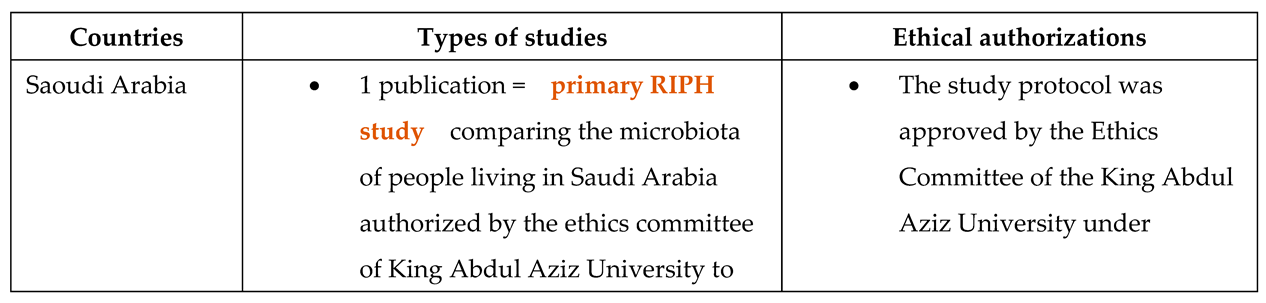
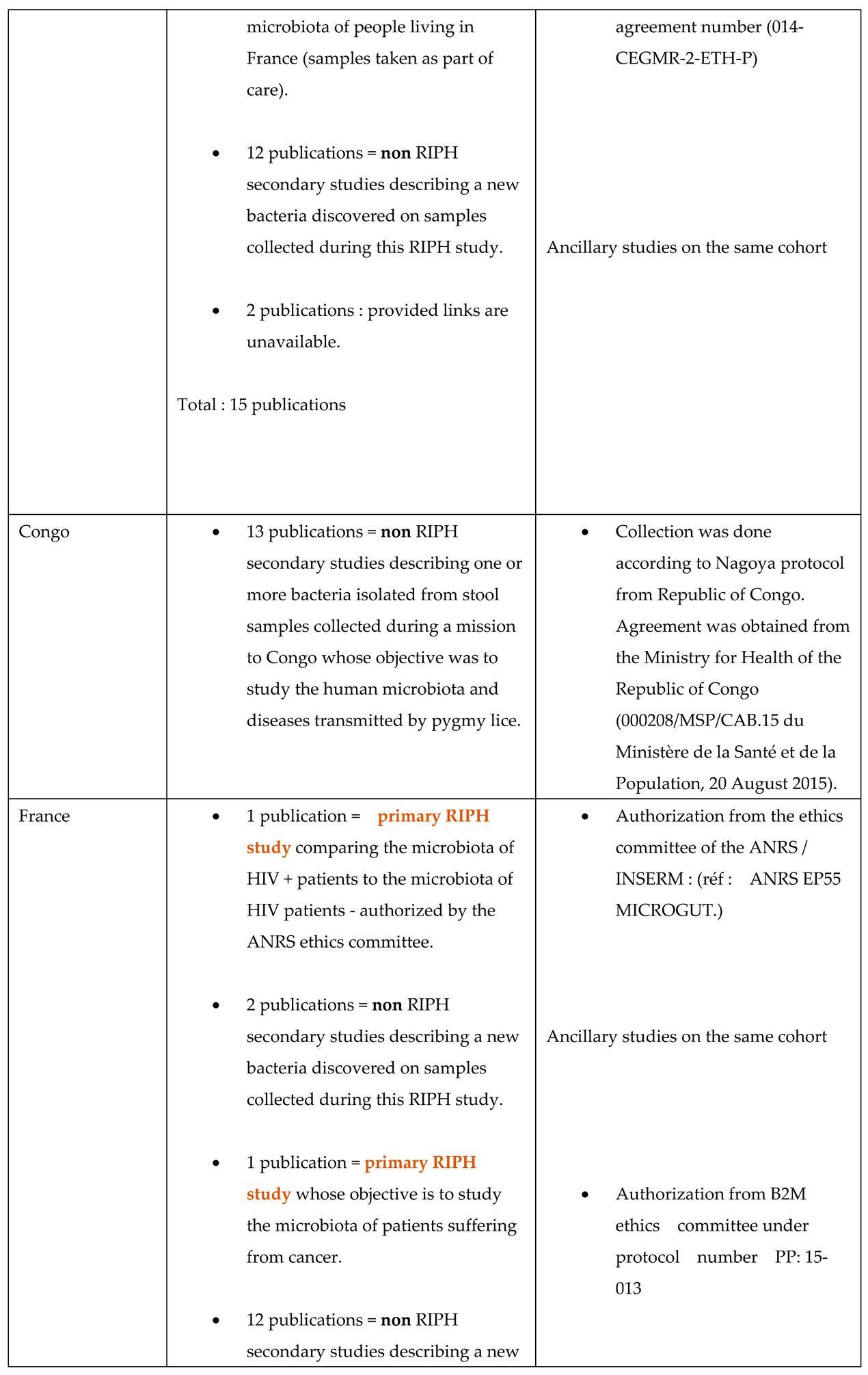
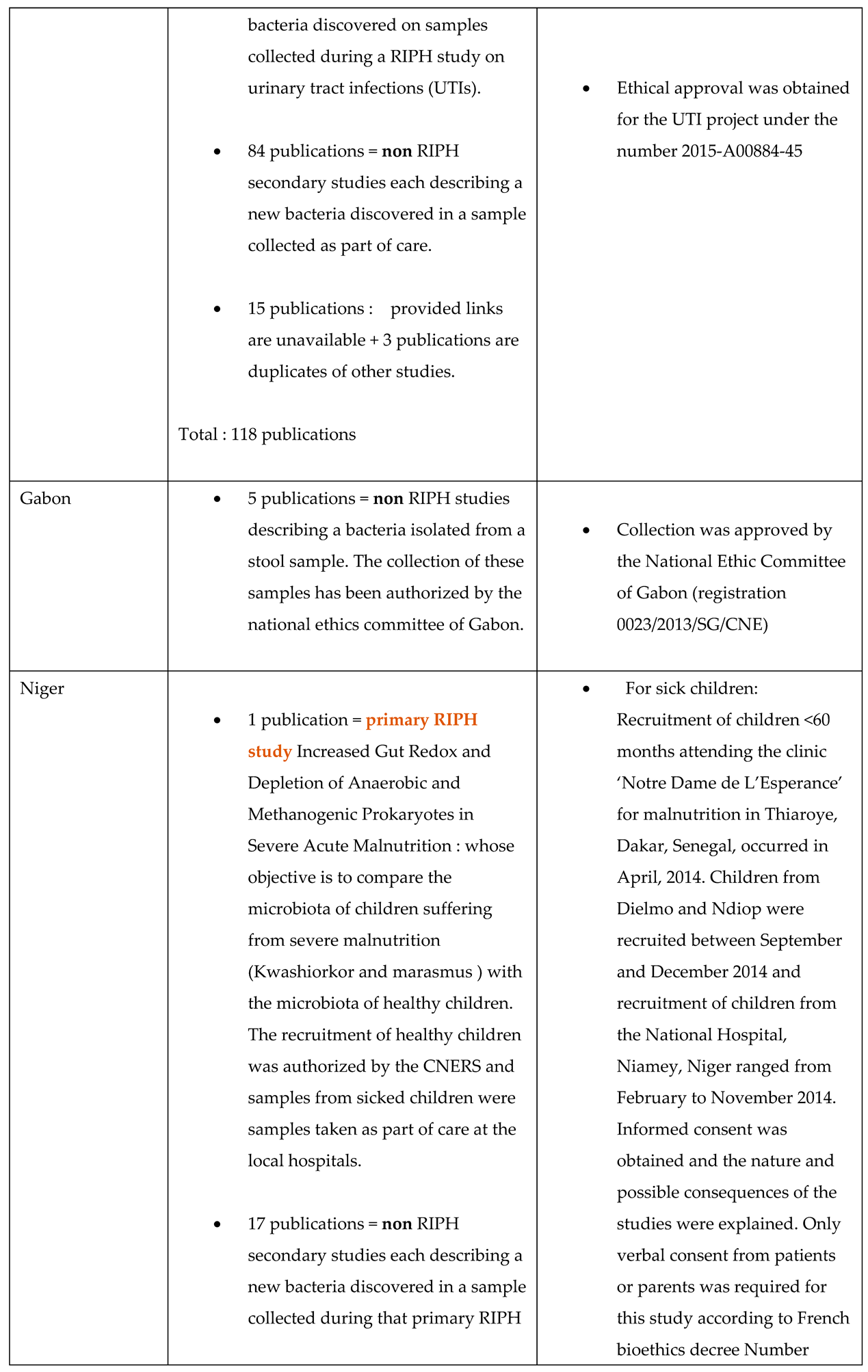
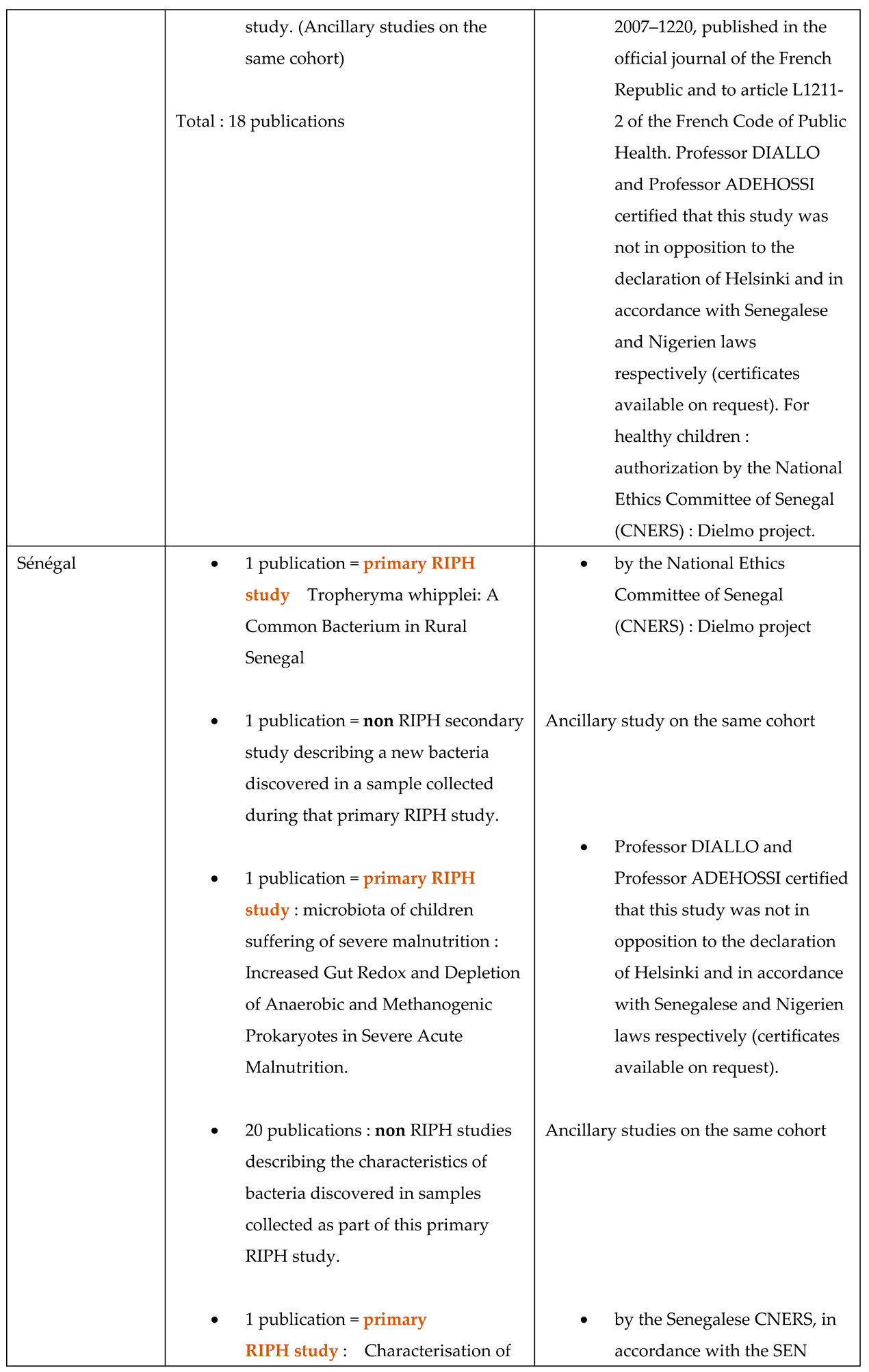
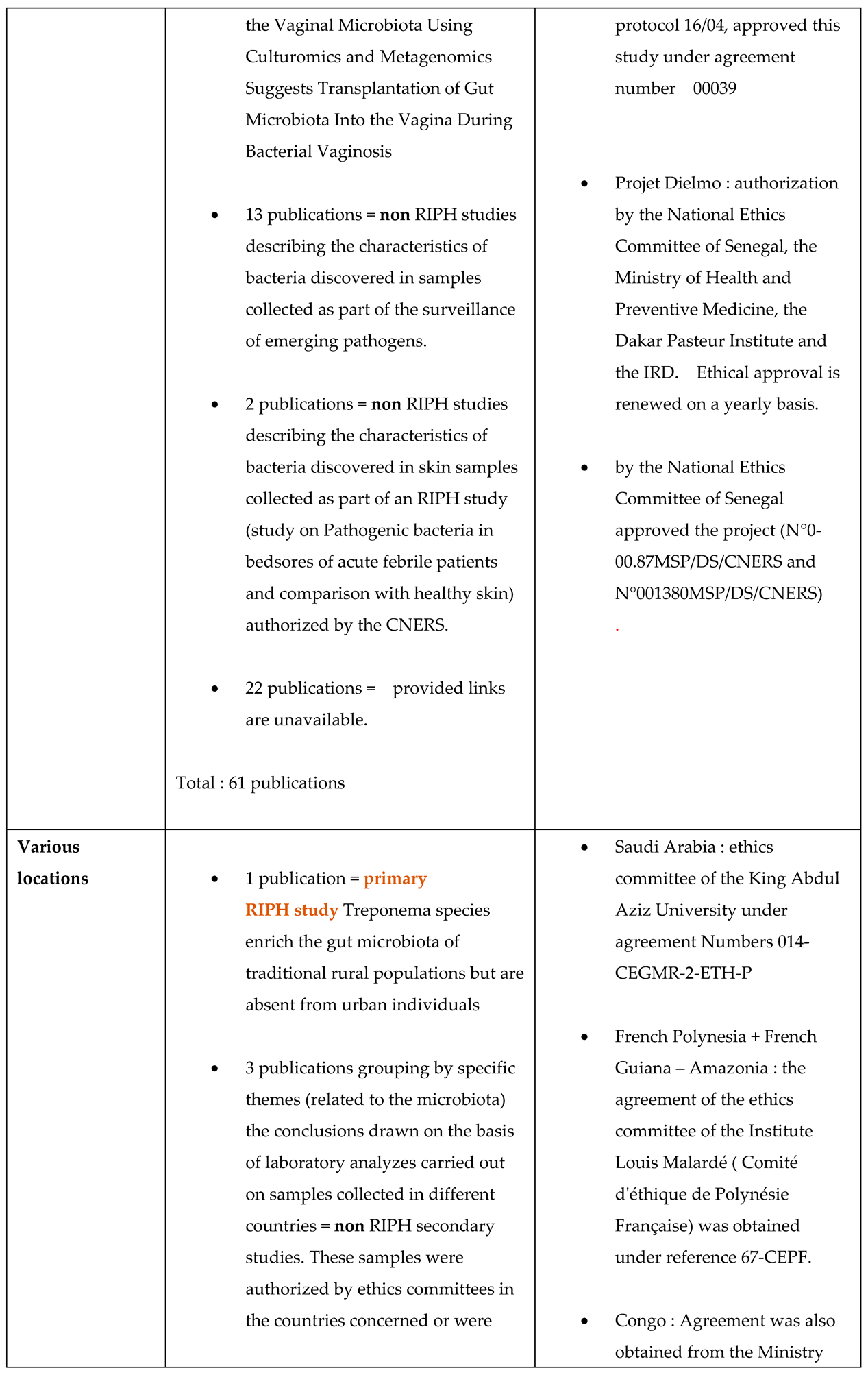
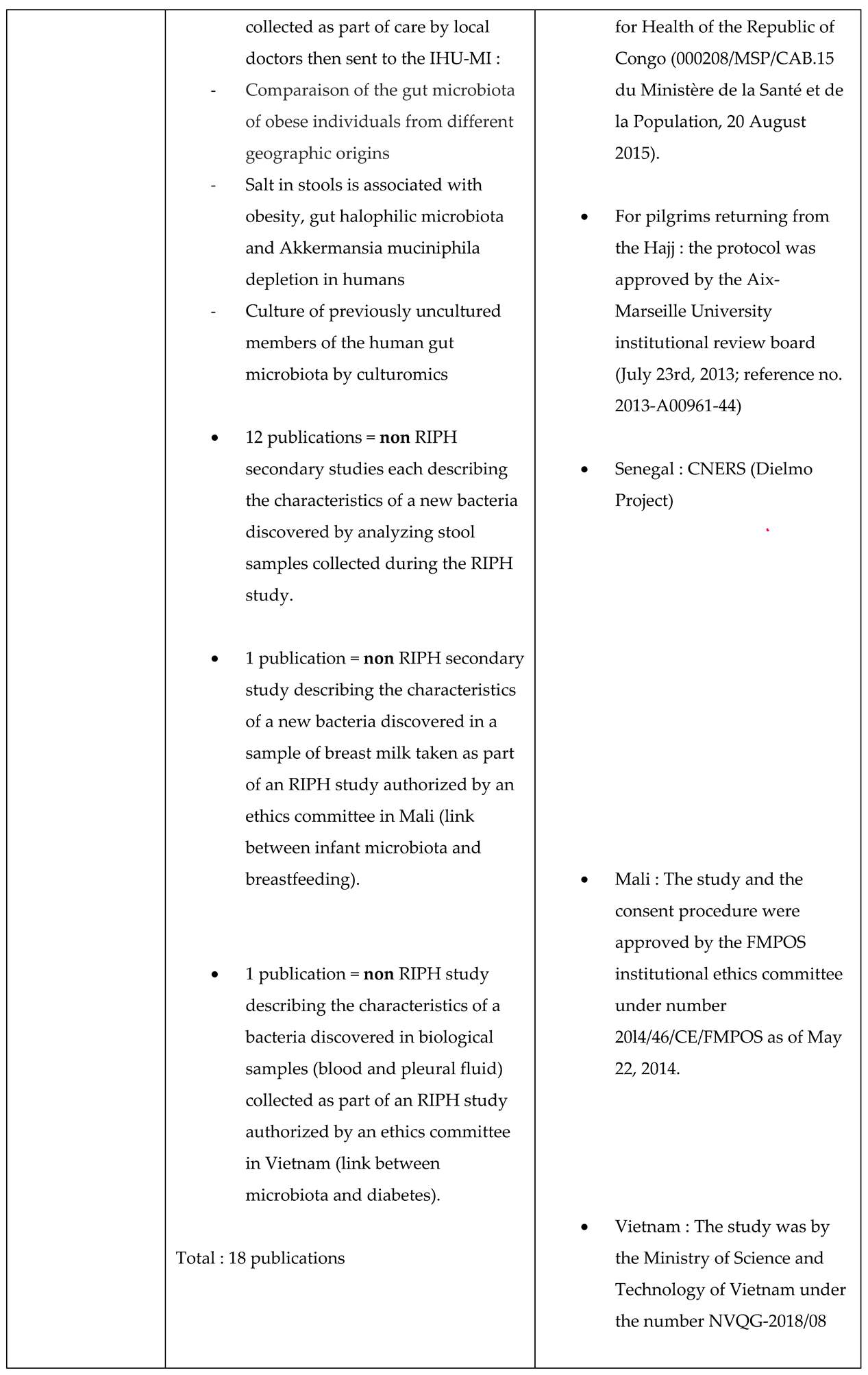
In the table we provide as supplementary material, we have grouped the publications according to the countries concerned and, for each country, we have highlighted the primary study(ies) in which the biological samples were taken, together with the references of the authorizations of the ethics committees consulted (see Additional file 2: "Table S1 - Studies mentioning number 09-022.xlsx". The summary is presented in Table 1.
From this summary of the international origin of biological samples, we can deduce that IHU-MI researchers collaborate with local doctors and scientists who take samples authorized by the ethics committees of the countries concerned. The IHU in this study only play a role of specialized laboratory for complement analysis of sample collected for care, collected from environment or being human waste that and have been subsequently the subject of single case report that do not need a specific authorization including in France. As for example article 1 and 2 from Niger (Table S1) described each one a new bacterium identified in the stool of the same patient. No sample collection was done for research purpose only. They send the samples to the IHU-MI laboratory, which performs the analyses using a method they have developed over time (Culturomics and Taxogenomics).
The most important long-term international collaboration is with Senegal, where two Point-Of-Care (POC) laboratories were set up between 2010 and 2016 as part of the Dielmo Project. All the research carried out using the samples collected has been approved by the Senegalese authorities and the Comité National d’Ethique de la Recherche du Sénégal (CNERS), as indicated in the inspection report carried out at the request of the Minister of Health [35]. CNERS authorizations are renewed annually [36]. These biological analyses enable us to fulfill a mission of national and international surveillance of infectious diseases and epidemiological research, which is one of the objectives of the IHU Méditerranée Infection [37,38]. This mission includes introducing new infection detection tools, enabling IHU-MI researchers to detect previously unknown bacteria. The majority of the 248 publications bearing the number 09-022 describe the characteristics of the bacteria discovered by IHU-MI researchers. In addition, the IHU-MI has an international health monitoring structure and collaborates with numerous foreign partners in the international surveillance of emerging infectious diseases or those imported by travelers and migrants. The IHU is actively involved in the EuroTravNet and Géosentinel [39] surveillance networks, and may receive samples sent by foreign partners in these networks. The IHU-MI also houses the Centre National de Référence des Rickettsies, Coxiella et Bartonella (CNR), which, according to their website [40]: « receives more than 20,000 samples (serum, blood, various biopsies and arthropods) per year from over 300 public and private laboratories in France and many other countries, to diagnose infections caused by intracellular bacteria that are difficult to culture. » Secondary research on these biological samples taken for diagnostic purposes is authorized under French legislation, which does not consider it to be research involving human beings and, accordingly, does not require authorization from a CPP / IRB. A simple search on the IHU-MI website will reveal that these various health monitoring activities are at the origin of some of the samples from foreign countries (Algeria, India, Brazil) mentioned in publications suspected of fraud by the authors.
The stool samples listed as coming from Amazonia were collected in a village in the Amazon rainforest, part of French Guiana. The primary study in which these samples were collected was authorized by the ethics committee of the Institut Louis Malardé in French Polynesia, and the references to this authorization are given in the publication concerning this primary study: « Comparison of the gut microbiota of obese individuals from different geographic origins » (which is part of the list of publications in the table provided by Fabrice Franck and colleagues). By reading the full text of the publications, it was possible to find the references of the ethics committee authorization and to understand that this authorization from the ethics committee of French Polynesia also applied to the part of the study taking place in French Guyana since they are both part of the French overseas territory (DOM-TOM) where French legislation applies. Any authorization from an ethics committee located on French territory is valid for studies taking place elsewhere on French territory.
For some publications, biological samples were collected as part of patient care, either at the IHU-MI (consultations and hospitalizations), or at other hospitals which sent their samples to the IHU laboratory. Analyses carried out on samples taken as part of patient care (diagnostic samples) are also non-RIPH research and do not require authorization from a CPP / IRB.
In summary, the 248 publications mentioned by Fabrice Franck and colleagues fall into 3 categories: (i) publications concerning RIPH/RHB (8 studies) have been authorized by an ethics committee to collect biological samples, (ii) publications describing the characteristics of a new bacterium discovered during ancillary analysis of the same samples from these the RIPH studies, (iii) publications describing the characteristics of a new bacterium discovered during the analysis of biological samples taken during patient care during consultations or hospitalizations, or in the context of international health monitoring. Most of the 248 publications are thus "genome announcement" type publications concerning bacteria discovered in biological samples already collected for other purposes (other research or healthcare) and as such, they do not require authorization from a CPP/IRB ethics committee under French legislation as they are not research involving human beings. In 2020, the American Society for Microbiology published an article entitled: « Best Practices for Successfully Writing and Publishing a Genome Announcement in Microbiology Resource Announcements » [41]. Approval IRB number is only mandatory for research on human beings (RIPH/RHB).
The opinion of a local ethics committee (not a CPP/IRB) may nevertheless be sought to verify that the research does not involve human beings, and to allow publication by international publishers requiring researchers to mention an ethical authorization. This is the role played by the IHU-Mi’s local ethics committee, as indicated in the IGAS inspection report [28] (page 112): « The IHU-MI’s local ethics committee is an ethics assessment body for research projects that do not fall within the scope of the CPP. It intervenes upstream of clinical studies, before the research is carried out, and is intended to enable researchers who do not fall within the scope of the CPP to obtain the opinion of an ethics committee with a view to publication or funding. »
In Table S2 ("Table S2 - Genome announcements.xlsx") we listed nearly 20 publications of genome announcements resulting from research carried out by other teams than those at the IHU-MI. None of these publications describing the characteristics of a newly discovered bacterium mentions ethical approval.
Figure 1.
Analysis of Human Biological Samples by Culturomics.
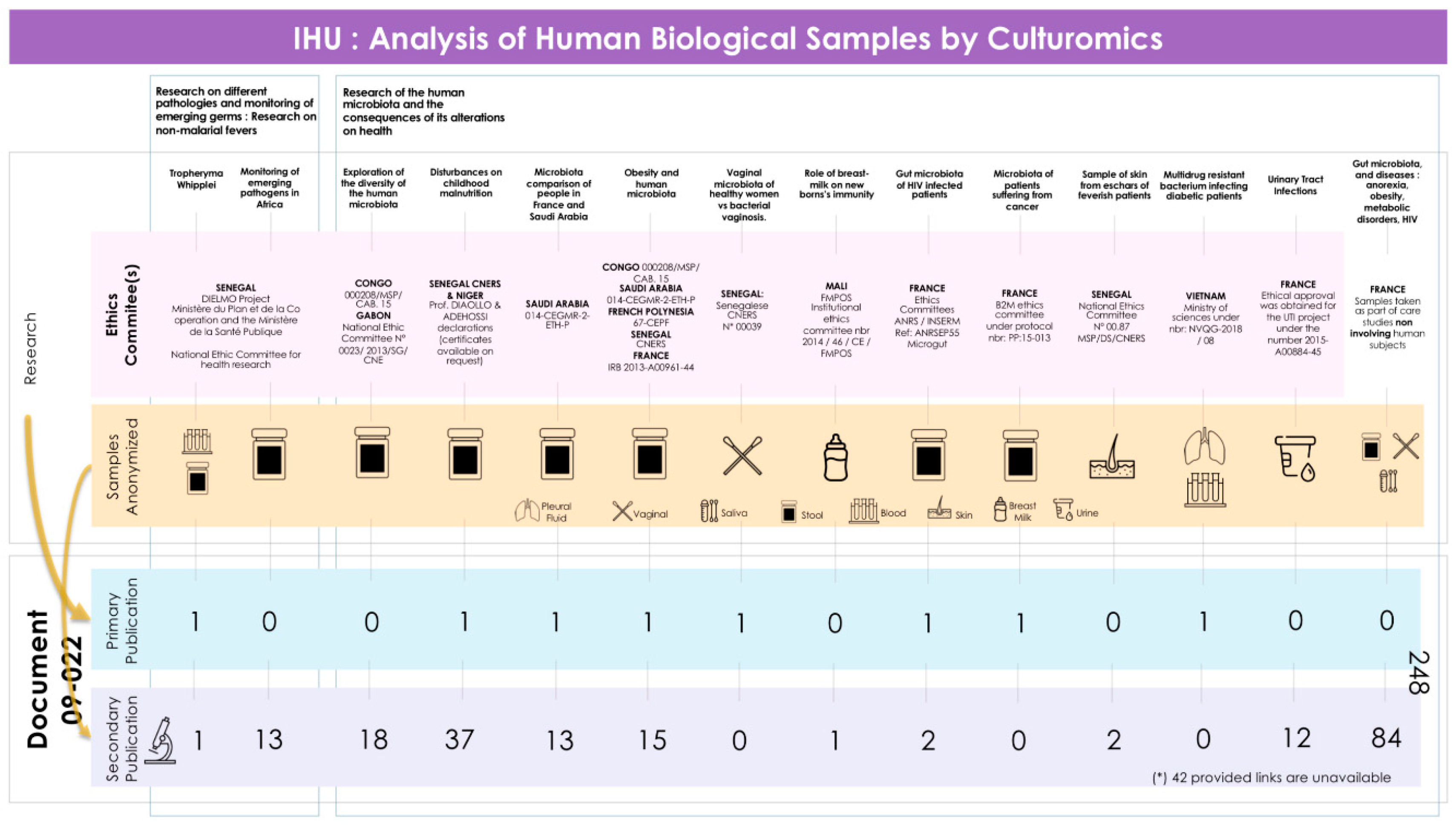
For 18 publications describing the characteristics of new bacteria discovered in biological samples taken from donors listed as healthy, we could not trace the samples’ exact origin. However, as these samples were taken exclusively from French patients, the most plausible hypothesis is that they were not taken as part of an RIPH with a cohort of healthy donors requiring authorization by a CPP / IRB, but rather as part of medical consultations taking place at the IHU-MI. Indeed, as practicing physicians, we are regularly confronted with situations in which healthy patients present various symptoms for which we prescribe biological examinations: stool analysis for abdominal pain or colon cancer screening, analysis of vaginal swabs for abnormal discharge or STD screening, analysis of bronchial sputum for chronic unexplained coughs, etc... These samples should then also be classified as part of medical care, and do not require authorization from a CPP / IRB.
In some of these publications, however, we found mention of two other numbers: 2016-010 and 2016-011 (see additional file n°4). The latter, which we mentioned in the first part, gives a favorable opinion on the study of human microbiota. As the studies for which we could not trace the origin of the samples all date from 2016 or later, another plausible hypothesis is that one of these numbers should have been included in the twenty or so publications instead of number 09-022. However, this is more of an administrative problem than a problem of non-respect for research ethics, a hypothesis which was also put forward by one of the two reviewers, Dr Andrew Rawnsley.
4.3. The Introduction to Publications Mentions the Overall Project
Our complete analysis of the 248 articles leads us to hypothesize that all these publications are part of a global, long-term research project requiring biological samples to be subjected to a series of laboratory tests. Indeed, most of the publications mentioned that the research is part of an overall project to investigate the human microbiota using specific techniques developed by the IHU-MI, which they named "Microbiological Culturomics". In most of the publications, we find a sentence of this type: « This study was part of an effort to explore the human gut microbiota using culturomics », which refers to explanatory reference articles. The repetition of this phrase makes it easy to understand the entire research project. This global project constitutes secondary research using laboratory analyses of biological samples already collected for other purposes.
Consequently, the document bearing the number 09-022 is just an optional opinion from the local ethics committee, confirming that French law authorizes this type of research. This justifies the fact that each sub-publication of the overall project mentions this same number. As the IHU-MI is a major infectious disease surveillance center with many doctoral students, it is normal that the number of publications is higher than for other institutions. The IHU-MI researchers could have refrained from mentioning this number and indicated only the reference to the article of law. They do so for some of their publications, stating: « Approval from the local ethics committee of the Institut Fédératif de Recherche IFR48 (Marseille, France) was obtained under agreement 09-022. This agreement allows, according to French legislation, the use of stool samples because they are considered to be waste of human origin and do not involve additional sample collection from the patient. »
Other teams of researchers do the same. They simply refer to the legislation, as in this article [42] published by Belgian doctors: "Ethics approval was not obtained due to clinical standard treatment".
Even without having access to the contents of the document bearing the number 09-022, knowledge of the specific features of French legislation and a complete analysis of all the publications challenged by Fabrice Franck and colleagues makes it clear that:
- -
- All these publications are part of a long-term global research project.
- -
- This document is not a legally binding authorization for RIPH research from an IRB, but an optional document of the IHU-MI’s local ethics committee confirming that the legislation authorizes laboratory analyses (non-RIPH research) on biological samples, whether these samples have been obtained as part of a RIPH study authorized by an independent ethics committee or as part of patient care.
- -
- The primary RIPH studies from which the biological samples analyzed were taken have all been approved by CPP/IRB, whose references are given in the publications relating to these primary studies.
- -
- This same document can be used for all publications resulting from this global research project, regardless of their number.
At most, IHU-MI could be advised to limit itself to stating that French legislation authorizes research on biological samples, rather than mentioning the number of a document that is only optional. However, given that most international journals increasingly require an IRB number as a condition of publication, it is likely that mention of this type of document is made to meet publishers’ requirements. This avoids having to explain in detail the specificities of microbiology research and the rules that apply to it. However, this does not constitute a breach of ethics or scientific misconduct.
In Table S1, we have copied the exact text found in each of the 248 IHU publications, and we have also indicated suggested wording that could be substituted to avoid this confusion between French and Anglo-Saxon legislation. Of the 248 publications for which Fabrice Franck’s team provides links, 215 are accessible. These 215 publications include only 8 RIPH studies: all of them mention the references of the mandatory ethical authorization from a CPP for studies taking place in France, and references to authorizations received by local authorities in other countries, according to the legislation in force at the time the studies were carried out. These details appear either directly in the text, or in the references when there are several publications from the same RIPH study. The addition of authorization 09-022 from the IHU-MI’s local ethics committee is legally unnecessary and can therefore be deleted. The remaining 207 publications all concern non-RIPH research, as they are secondary studies on biological samples already collected, either as part of previous RIPH studies, or as part of patient care. They do not require any ethical authorization from a CPP. Of these 207 publications, 191 describe the characteristics of a new bacteria discovered by the IHU-MI. This is not biomedical research, but scientific research (research on bacteria). The publications are, therefore, of the "genome announcement" type. Our proposed wording would be to say nothing about ethical authorization, since this is the international standard for genome announcement publications. An alternative would be to simply state that the research complies with French law in force at the time the research was carried out.
4.4. About the Low Response Rate From Publishers
The authors express their disappointment at having received very few replies from the editors, despite the large number of e-mails they sent them. They are also concerned about the long delays that exist between alerts of suspected fraud and actions from the publishers.
But the potential reasons why some have not responded or have not taken concrete action on the publications concerned can be found by reading the COPE guidelines.
The document entitled: « Dealing with concerns about integrity of published research » [1] sets out the criteria according to which publishers must carry out more detailed investigations:
« Lack of ethics approval for research involving human subjects »: Some editors may have immediately spotted that the publications indicated in F Franck’s e-mails were not research involving human subjects.
This document also stipulates: « All requests should be considered and investigated if they are credible »: Some publishers may have considered that the complaints were not credible enough to warrant further investigation. Indeed, Fabrice Franck and al. informed the editors of their concerns directly by e-mail, rather than through the classic "letter to the editor" procedure with review, which is a solid circuit validated by the entire scientific community. The texts of their e-mails refer to comments on the PubPeer platform which is not a reference recognized by the scientific community.
A third hypothesis is that some editors may simply be referring to the Helsinki Declaration. [43] Indeed, not all publishers are necessarily familiar with the specific legislation of all countries, but they may have a policy of basing the management of ethics alerts on what is known in law as « the spirit of the law ». The Declaration of Helsinki, which sets out fundamental ethical principles, has served as the basis for drafting legislation on biomedical research ethics in most countries. It can, therefore, be used to guide the evaluation of publishers. One of its general principles is to recommend « a careful assessment of the foreseeable risks and inconveniences for the individuals and groups involved, in relation to the foreseeable benefits for them and other individuals or groups affected by the condition under study ». In reviewing the publications about which they were alerted by Fabrice Franck’s team, some editors may have felt that analyzing stool, urine or sputum did not represent a health risk to participants. All the more so as, in most of the 248 IHU-MI publications, it is easy to understand that the biological samples were collected in the context of care (screening or diagnosis). The Declaration of Helsinki also includes the following passage: « For medical research using tissue or data of human origin, such as research on tissue and data contained in biobanks or similar repositories, physicians must seek informed consent for their analysis, storage and/or reuse ».
Some editors may be familiar with publications describing the characteristics of bacteria and viruses and They probably immediately recognized that F. Franck’s team’s concerns were completely unfounded since they know that "genome announcement" publications are not research involving the human person and therefore require no ethical authorization.
Without any knowledge of French law, but based on the Declaration of Helsinki, other publishers may therefore have considered that the IHU-MI publications reported did not require ethical authorization, and that repetition of the same issue was therefore not a problem in itself (and at worst, may have been no more than an administrative problem).
However, some editors were quick to respond, and these responses included essential elements that the authors did not mention in the text of their article but which can be found in the supplementary material (Table S3 Editors contact). In cell 25/F, the publisher explains that research on samples taken in the context of healthcare does not require authorization from a CPP/IRB. In cell 69/F, we read that the publisher replies that this is research on a bacterium and not research on a human being. The authors sometimes sent numerous emails to specific publishers: the greatest number (180 e-mails) having been addressed to the same person who expresses the view that these numerous e-mails are almost tantamount to harassment. Subsequently, another person, tells him that she has contacted the ANSM and is awaiting their reply (cell 434-F): « Our ethical team is working on the case you reported. We are expecting to receive recommendations shortly on the appropriate action per articles from the French ethics agency (ANSM) ». These replies from Elsevier’s publisher, explaining that she had contacted the ANSM, concern 180 emails about IHU publications and date from 15 July 2022. To date (March 2024), to our knowledge, only two publications have been retracted by Elsevier (reporting the results of the same research from the analysis of the stools of malnourished Nigerian and Senegalese children to which we referred earlier in our article). If the many other publications concerned have not been retracted, and if Elsevier has not added any ’expressions of concern’ in a year and a half, it is legitimate to think that this is because the responses given to the publisher by the competent French authorities have confirmed that they do not pose any ethical problems.
Franck and his colleagues expressed their dissatisfaction with the responses from editors and publishers in the following terms: « from some of the editor’s responses, we have no doubt that they had no intention of taking action. » But perhaps they forget to consider the hypothesis that most of them may have concluded that there was no problem to be solved. Either because they quickly realised that the research did not involve the human person. Or because they followed some of the COPE recommendations described above: assess the credibility of the allegation, check with the authors and/or competent authorities, and do not waste resources on multiple unfounded complaints.
Fabrice Franck’s team’s recommendation to adopt a rule requiring IRB authorization documents to be uploaded may seem interesting at first glance: « Indeed, our most drastic recommendation would be to normalize the upload of IRB documents. » Nevertheless, this would not prevent researchers who do not understand the criteria for distinguishing between RIPH and non-RIPH research from expressing their concerns to publishers if they notice the absence of these documents in publications of secondary research on biological samples (non-RIPH).
In such a case, the problem is not so much what publishers can put in place to ensure that authors in all countries comply with ethical legislation. Whatever rules publishers adopt, if, like Fabrice Franck’s team, researchers are mistaken about interpreting their country’s legislation, they will pass on unfounded concerns, and publishers will find themselves in the same difficult situation of having to decide on unfamiliar legislation.
The problem would remain difficult to solve.
(See cell 25F in the table of publishers’ responses: The Editor-in-Chief of the journal Archives of Virology questioned the IHU-MI authors, who sent him the CEL authorization document. But Fabrice Franck insists that a CEL authorization is not valid. The editor replied: « Doubt in law is always a difficult issue to judge » and that he would, therefore, ask Springer Nature’s ethics team to check which principle of the Declaration of Helsinki had been violated).
Fabrice Franck and his colleagues also recommend: « We finally argue that editorial responses within a strict timeline should be put in place, such that journals and editorial teams have a responsibility to respond to ethical queries from researchers within a reasonable time as well as disclose reasonable concerns that have been publicly raised on articles, and this even before reaching out to authors. » But this recommendation is contrary to one of COPE’s basic principles.
Indeed, one of their guidelines, it is recalled that the Code of Conduct for Newspaper Editors (clause 11.4) stipulates that: « In case of suspected or alleged research or publication misconduct, editors should first seek a response from those suspected of misconduct. If they are unsatisfied with the response, they should ask the relevant employers or institution to investigate. » [44]
Futhermore, this recommendation is totally contrary to the fundamental rights of every individual, even outside the sphere of scientific publication.
The European Charter of Fundamental Rights is explicit on the subject of the presumption of innocence, the right of everyone to be informed of the charges against them, and their right to defend themselves. [45] Isn’t it paradoxical to try to solve an ethical problem by recommending a procedure that would violate the fundamental rights of the researchers concerned? Anyone could then send an e-mail to the publishers claiming that a scientist is guilty of ethical fraud, and the publisher would be obliged to publish an EOC on the article in question immediately. The potential pitfalls of such a rule are easy to imagine.
5. Discussion
Like the authors, we feel highly concerned about respect for ethical principles in protecting study participants and the importance of avoiding poor-quality research that leads to erroneous results or makes little scientific contribution. When assessing the ethical compliance of scientific publications, we believe it is essential to rely on a precise knowledge of legislation and guidelines, and a rigorous analysis of the publications concerned. At the same time, because it’s part of the scientific process, we feel it’s important to consider several hypotheses, including those contradicting what we want to demonstrate. In the case of an accusation as serious as that of violation of the law and ethical fraud, it is unthinkable to deviate from irreproachable ethics by not providing evidence commensurate with the seriousness of the accusation. To provide this solid evidence, it is essential to use a scientific methodology, not limiting oneself to providing evidence that supports the hypothesis of fraud, but also looking for elements that could invalidate it.
To follow this scientific approach, Franck and his colleagues:
- -
- Should have checked whether the IHU-MI’s ethics committee is a CPP/IRB, whose authorizations are mandatory, or a local consultative ethics committee (using a same document for numerous publications is not fraudulent if this document is only legally optional).
- -
- Among the documents available on the ANSM website, they should have used and provided the one that would have made it possible to understand that the same number can be used for all research publications not involving the human person that are part of the same global project. Because it is this global project to study the human microbiota that is approved by the IHU-MI’s local ethics committee. Furthermore, they should have taken account of the fact that the publications state that they are part of this overall project.
- -
- Should have rigorously examined each of the publications concerned rather than focusing on the repetition of the same issue. Their analysis, which they themselves describe as rapid, neglected to search for the CPP/IRB ethics committee authorizations received for the primary RIPH studies.
- -
- Should have seen that more than a third of publications concern samples taken in the context of healthcare, which do not require a CPP/IRB approval.
- -
- Should also have seen that the vast majority of publications are « genome announcements » which do not require CPP/IRB approval either.
- -
- Should have investigated the specific ethical legislation of the developing countries from which certain samples originated. This would have revealed the absence of ethical legislation and functioning ethics committees in some of these countries at the time the samples were collected.
- -
- Should have investigated the IHU-MI’s international health monitoring missions, which would have enabled them to envisage that specific biological samples had been taken by local doctors and sent to the IHU-MI laboratory for the purpose of diagnosing tropical diseases. These diagnostic samples do not require CPP/IRB authorization.
- -
- Should have known (and mentioned in their article) that research not involving human beings is not subject to the same legal requirements as research involving human beings. However, several co-authors have already published non-HIPR studies and are therefore familiar with the differences between these two types of research.
- -
- Should have compared with research not involving human subjects published by other French teams. They would have noticed that these publications do not require CPP/IRB authorizations.
- -
- Should have taken into account the replies they received from publishers reassuring them that the ethical rules were being respected and explaining why their concerns were unfounded. These explanations provided about some of the publications could have enabled them to re-examine other publications of the same type and to understand that they were wrong in their interpretation of French law.
Because they deviate from rigorous scientific methodology, the authors seem to be trapped in circular reasoning, starting from the conclusion they want to demonstrate and discarding the evidence proving the opposite hypothesis, including that coming from the publishers’ responses. Finally, they end up suspecting the editors and publishers of a lack of professional conscience or conflicts of interest rather than considering the possibility that they themselves were mistaken. Their disappointment at the lack of concrete action taken by editors and publishers in response to their messages may not be evidence that the system is dysfunctional, but simply that their concerns are unfounded. But the consequences of these erroneous beliefs can be very deleterious both for publishers and for the authors targeted by these alerts. This is particularly true if the authors of such reports issue press releases [46,47], which the media then disseminate with their customary headlines, such as The Guardian interview following the publication online of their article [48]. Moreover, raising such suspicions about the integrity of scientific research carries the not inconsiderable risk of creating a climate of public distrust of researchers in general. If potential volunteer participants in future clinical research come to doubt the ethical integrity of scientists, society as a whole may have to pay the consequences. Medical research in developing countries is also an opportunity to provide care to which local populations would otherwise have no access. Mortality due to malaria and non-malaria fevers has fallen sharply since the IHU-MI set up POCs in Dielmo, as the article in the French newspaper « Libération » states: « Because the researchers didn’t just take systematic monthly samples. They also treated the residents, using basic and affordable means. (...) And the results are more than convincing: in twelve years, only three cases of death from malaria have been recorded. (...) The village sheikh is also full of praise for the protocol ». [49] To cast doubt on the ethics of the scientists who work alongside local doctors to aid the populations of rural villages in developing countries is to run the risk of such collaborative projects being halted or refused by these countries in the future. This would be a loss of opportunity for local populations, and it is thus essential not to spread accusations of ethical lapses based on an overly superficial analysis of scientific publications and a misguided understanding of ethical legislation.
Nevertheless, we cannot exclude the possibility that some of the very large amount of research published by the IHU-MI may contain errors or inaccuracies relating to ethical authorizations. But this is certainly not a majority trend among their numerous works, and probably no more frequent than for other teams with such intense research activity, as it’s also the case for some of the co-authors in Franck’s team (see Supplementary Material Table S3). And this certainly does not justify generalizing these occasional inaccuracies or administrative errors to 456 IHU-MI publications.
6. Conclusions
Publishers do not give instructions on the degree of precision required in ethical statements and it is therefore sometimes difficult for researchers to know how far to go in the information to be provided when submitting an article. Should they be content with a general statement to the effect that the research has received all the ethical approvals required by the legislation in force in the country where the research was carried out? Or should full details be given, including the reference number of the CPP/IRB or CEL and the reference number of the specific authorization, together with a copy of this document? In the case of RIPH research, it is probably preferable to give as much detail as possible and to provide a copy of the documents to the publisher, which could perhaps better guarantee compliance with legal requirements. But in the context of non-RIPH research, this case shows that in the end, by trying to give as much detail as possible to show that they had taken all the necessary information from their CEL and had therefore complied with all their ethical obligations, the IHU-MI researchers see their concern for precision backfire. If they had simply mentioned that the study had received approval from their CEL without mentioning a number, as most other French teams do, all these false alarms of potential fraud would not have occurred.
Our article shows how confusion between research involving the human person and research not involving the human person, as well as superficial analysis of publications and superficial analysis of scientific publications, can lead to scientists being wrongly suspected of ethical fraud and publishers being wrongly accused of failing to react sufficiently to ethical concerns that are brought to their attention. This risk of unfounded alerts could be significantly reduced by requiring authors of research not involving humans to indicate this in their work so that publishers do not ask them to provide ethical approval.
Supplementary Materials
The following supporting information can be downloaded at the website of this paper posted on Preprints.org. Additional file 1 : Table 1. Table 1 - Summary - Classification of studies and IRB authorizations by country. Additional file 2 : Figure 1 Analysis of Human Biological Samples by Culturomics. Additional file 3 : Table S1. Studies mentioning number 09-022. Additional file 4 : Document number 2016-011. Additional file 5 : République du Niger : Décret 2016-644 /PRN/MSP. Additional file 6 : Table S2. Genome announcements.
Author Contributions
VB, BN, MZ. Methodology: VB, BN, MZ. Investigation: VB. Writing – original draft: VB. Writing – review & editing: VB, BN, MZ.
Funding
The authors received no specific funding for this work.
Institutional Review Board Statement
Not applicable.
Informed Consent Statement
Not applicable.
Data Availability Statement
The datasets supporting this article are available
Conflicts of Interest
The authors declare no conflict of interest.
Abbreviations
| AAR | Autorisation Administrative de Recherche. |
| ANSM | Agence Nationale de la Santé et du Médicament. |
| CCNE | Comité Consultatif National d’Ethique. |
| CEL | Comité Local d’Ethique. |
| CNERS | Comité National d’Ethique de la Recherche en Santé |
| CNR | Centre National de Référence des Rickettsies, Coxiella et Barnotella. |
| COPE | Committee on Publication Ethics. |
| CPP | Commission de Protection des Personnes i.e IRB. |
| IFR | Institut Fédératif de Recherche. |
| IGAS | Inspection Générale des Affaires Sociales. |
| IHU | Institut Hospitalo-Universitaire. |
| IHU-MI | IHU Méditerannée Infection. |
| IRB | Institutional Review Board. |
| INSERM | Institut National de la Santé et de la Recherche Médicale. |
| HHS | Department of Health and Human Services. |
| MESR | Ministère de l’Enseignement Supérieur et de la Recherche. |
| MST | Maladies Sexuellement Transmissibles. |
| RECs | Research Ethics Committees. |
| RHB | Research on Human Beings |
| RIPH | Recherche impliquant la personne humaine i.e. research involving human subjects. |
| Non-RIPH | Recherches n’impliquant pas la personne humaine i.e research non involving human subjects. |
References
- COPE Council – COPE Discussion Document: Dealing with concerns about the integrity of published research – English. [CrossRef]
- COPE Council – Resources – Addressing ethics complaints from complainants who submit multiple issues. [CrossRef]
- Frank, F., Florens, N., Meyerowitz-katz, G. et al. Raising concerns on questionable ethics approvals – a case study of 456 trials from the Institut Hospitalo-Universitaire Méditerranée Infection. Res Integr Peer Rev 8, 9 (2023). [CrossRef]
- ARS île de France – Ministère des Solidarités et de la Santé – Comités de Protection des Personnes : https://www.iledefrance.ars.sante.fr/media/86137/download?inline. Accessed Oct 27 2023.
- Infectiologie.com – Le site de l’infectiologie Française – La recherche clinique et la loi Jardé : https://www.infectiologie.com/UserFiles/File/formation/desc/2019/seminaire-avril-2019/jeudi-04-04-2019/recherche-6-jeudi-04-marion-noret.pdf . Accessed Oct 27 2023.
- Legifrance – Le service public de la diffusion du droit – République Française – Code de Santé Publique – Article L1211-2. https://www.legifrance.gouv.fr/codes/article_lc/LEGIARTI000043895792. Accessed Oct 27 2023.
- Inserm – La science pour la santé – République Française. https://www.inserm.fr/nos-recherches/recherche-clinique/la-recherche-clinique/. Accessed Oct 27 2023.
- Unité de Recherche Clinique de l’Est Parisien – La carte des CPP en France et dans les DOM TOM. http://urcest.com/la-carte-des-cpp-en-france-et-dans-les-dom-tom#languedoc-roussillon-provence-alpes-c%C3%B4te-d-39-azur-et-la-corse. Accessed Oct 27 2023.
- ANSM – Agence Nationale des Produits de santé et du Médicament – Document numéro 2020-001. https://ansm.sante.fr/uploads/2022/11/28/20221004-cada22v207-ethiq-2020-001.pdf. Accessed Oct 27 2023.
- ANSM – Agence nationale de sécurité du médicament et des produits de santé – Documents transmis le 28/11/2022 - Comité d’éthique de l’IHU Méditerranée-infection. https://ansm.sante.fr/page/documents-transmis-le-28-11-2022-comite-dethique-de-lihu-mediterranee-infection. Accessed Oct 27 2023.
- ANSM – Agence nationale de sécurité du médicament et des produits de santé – Document numéro 2016-011. https://ansm.sante.fr/uploads/2022/11/28/20221004-cada22v207-ethiq-2016-011.pdf. Accessed Oct 27 2023.
- U.S. Department of Health and Human Services – 45 CFR 46 FAQs. https://www.hhs.gov/ohrp/regulations-and-policy/guidance/faq/45-cfr-46/index.html. Accessed Oct 27 2023.
- U.S. Department of Health and Human Services – 45 CFR 46 Exemptions. https://www.hhs.gov/ohrp/regulations-and-policy/regulations/45-cfr-46/common-rule-subpart-a-46104/index.html. Accessed Oct 27 2023.
- U.S. Department of Health and Human Services – Exempt Research Determination – 45 CFR 46.101 (b). https://www.hhs.gov/ohrp/regulations-and-policy/guidance/faq/exempt-research-determination/index.html. Accessed Oct 27 2023.
- U.S. Department of Health and Human Services - Human Subject Regulations Decision Charts: 2018 Requirements – Chart 01: Is an Activity Human Subjects Research Covered by 45 CFR Part 46? – And Chart 09: Does Exemption 45 CFR 46.104(d)(7), Storage for Secondary Research for Which Broad Consent Is Required, Apply? https://www.hhs.gov/ohrp/regulations-and-policy/decision-charts-2018/index.html. Accessed Oct 27 2023.
- HHS.gov – Department of Health and Human Services – OHRP E-Learning Program – What is human subjects research ? : https://www.hhs.gov/ohrp/sites/default/files/OHRP-HHS-Learning-Module-Lesson2.pdf. Accessed Oct 31 2023.
- UCSF – University of California San Francisco – Not Human Subjects Research : https://irb.ucsf.edu/not-human-subjects-research. Accessed Oct 31 2023.
- University of Virginia – Research Involving Data and/or Biological Specimens : https://research.virginia.edu/sites/vpr/files/2019-08/25-03-Research-Involving-Data-and-or-Biological-Specimens.pdf. Accessed Oct 31 2023.
- Infectiologie.com – Le site de l’infectiologie Française – Outils de formation – Recherches « Hors Loi Jardé » M. NORET – Chef de projet Clinique des pathologies infectieuses – 6 Octobre 2021. https://www.infectiologie.com/UserFiles/File/formation/desc/2021/seminaire-octobre-2021/merc-610-t.27/conf-4-hors-loi-jarde-mnoret.pdf Accessed Oct 27 2023.
- Infectiologie.com – Le site de l’infectiologie Française – Outils de formation – Autorisations règlementaires : CPP, comité d’éthique, ANSM, CNIL. – Docteur Sébastien Gallien – Service d’immunologie et maladies infectieuses Université Paris Est Créteil. Equipe 16 INSERM U955 IMRB & VRI – 4 avril 2019. https://www.infectiologie.com/UserFiles/File/formation/desc/2019/seminaire-avril-2019/jeudi-04-04-2019/recherche-9-jeudi-04-dr-gallien.pdf. Accessed Oct 27 2023.
- Comité de Protection des Personnes (en recherche biomédicale) CPP Tours Ouest-1. – « Je veux démarrer une recherche sur des échantillons biologiques déjà prélevés à l’occasion du soin ou d’une recherche (changement de finalité) ». https://cppouest1.fr/mediawiki/index.php?title=CPP_Ouest-1:NOD0126. Accessed Oct 27 2023.
- Council of Europe – Guide for Research Ethics Committee Members – Steering Committee on Bioethics. https://www.coe.int/t/dg3/healthbioethic/activities/02_biomedical_research_en/Guide/Guide_EN.pdf. Accessed 27 Oct 2023.
- European Network of Research Ethics Committees – EUREC – Position of the European Network of Research Ethics Committees (EUREC) on Ethics Reviews of Research Projects involving Persons outside Biomedical Research. http://www.eurecnet.org/documents/EUREC_Positionpaper_March_2021.pdf. Accessed Oct 27 2023.
- CER Sorbonne Université.fr – Collections biologiques Réglementation – Mise à jour 15/12/2020 : https://cer.sorbonne-universite.fr/sites/default/files/media/2021-06/CER-collections-biologiques.pdf . Accessed Oct 27 2023.
- R. Souche, S. Mas, O. Scatton, J.-M. Fabre, L. Gimeno, A. Herrero, S. Gaujoux, French legislation on retrospective clinical research: What to know and what to do, Journal of Visceral Surgery, Volume 159, Issue 3, 2022, Pages 222-228, ISSN 1878-7886. [CrossRef]
- Amiel P., Dosquet C., Comité d’évaluation éthique de l’inserm (CEEI), Guide de qualification des recherches en santé [A qualification guide for health research], Inserm, 2021. https://comite-ethique.cnrs.fr/wp-content/uploads/2021/05/Inserm_GuideQualifCEEI_2021mai.pdf.
- Husson, T., Lecoquierre, F., Nicolas, G. et al. Episignatures in practice: independent evaluation of published episignatures for the molecular diagnostics of ten neurodevelopmental disorders. Eur J Hum Genet 32, 190–199 (2024). [CrossRef]
- Inspection Générale des Affaires Sociales – igas.gouv.fr – Contrôle de l’IHU Méditerranée infection – Rapport définitif tome 1 – Août 2023. https://www.igas.gouv.fr/IMG/pdf/rapport_ihu_definitif_tome_1_.pdf Accessed Oct 27 2023.
- Sénat Français – Question écrite n°05533 – 16e législature – Qualification des déchets résultant de la recherche médicale – Août 2023 https://www.senat.fr/questions/base/2023/qSEQ230305533.html. Accessed Oct 27 2023.
- Convention on Biological Diversity – Access and Benefit-sharing Clearing-House (ABS Clearing-House, ABSCH) – Arrêté du 17 mai 2013 du Ministère des Enseignements Moyen et Supérieur et de la Recherche Scientifique de la République du Niger fixant les conditions d’obtention d’Autorisation Administrative de Recherche (AAR) au Niger. https://absch.cbd.int/api/v2013/documents/F41B0FAB-46D1-5BF6-254E-83C88E73BE10/attachments/203719/Arr%C3%AAt%C3%A9%20106%20MEMS%20RS.PDF Accessed Oct 31 2023.
- Health Research Web – Plan stratégique national de la recherche en santé 2013-2020 – Ministère de la Santé du Niger. https://healthresearchwebafrica.org.za/files/PLAN_STRATEGIQUE_RECERCHE_EN_SANTE_2013_2020adoptjuin..pdf Accessed Nov 03 2023.
- Chaudhry I, Thurtle V, Foday E, et al. Strengthening ethics committees for health-related research in sub-Saharan Africa: a scoping review. BMJ Open 2022;12:e062847. https://bmjopen.bmj.com/content/12/11/e062847. [CrossRef]
- Centre National d’Ethique de la Recherche Scientifique du Sénégal – Ressources - Rapport consultant évaluation du système de revue éthique. https://cners.sn/public/docs/1587396889.pdf Accessed Nov 03 2023.
- Barchi, F., Little, M.T. National ethics guidance in Sub-Saharan Africa on the collection and use of human biological specimens: a systematic review. BMC Med Ethics 17, 64 (2016). [CrossRef]
- Health Research Web – Rapport du comité d’évaluation des sites de recherche de Dielmo et de Ndiop – Robin Bailey, Christophe Rogier, Samba Cor Sarr. – 1er Octobre 2009. https://healthresearchwebafrica.org.za/files/_RapportDielmoNdiop.pdf. Accessed Oct 27 2023.
- Abat Cédric, Colson P., Chaudet H., Rolain J. M., Bassene H., Diallo A., Mediannikov Oleg, Fenollar F., Raoult D., Sokhna Cheikh. (2016). Implementation of syndromic surveillance systems in two rural villages in Senegal. Plos Neglected Tropical Diseases, 10 (12), p. e0005212 [12 p.]. ISSN 1935-2735. [CrossRef]
- Institut Méditerranée Infection – Activité de surveillance épidémiologique. https://www.mediterranee-infection.com/veille-epidemiologique/lactivite-de-surveillance-epidemiologique-de-lihu/. Accessed Oct 27 2023.
- Méditerranée Infection – La veille sanitaire internationale de l’IHU. https://www.mediterranee-infection.com/veille-epidemiologique/lihu-et-la-surveillance-internationale-des-voyageurs/ Accessed Nov 08 2023.
- GéoSentinel – The Global Surveillance and Research Network – EuroTravNet. https://geosentinel.org/sites/eurotravnet Accessed Nov 08 2023.
- Méditerranée Infection – Présentation du CNR. https://www.mediterranee-infection.com/diagnostic/les-centres-nationaux-de-reference-cnr/cnr-rickettsioses/presentation-du-cnr/ Accessed Nov 08 2023.
- Dunning Hotopp JC, Baltrus DA, Bruno VM, Dennehy JJ, Gill SR, Maresca JA, Matthijnssens J, Newton ILG, Putonti C, Rasko DA, Rokas A, Roux S, Stajich JE, Stedman KM, Stewart FJ, Thrash JC. Best Practices for Successfully Writing and Publishing a Genome Announcement in Microbiology Resource Announcements. Microbiol Resour Announc. 2020 Sep 3;9(36):e00763-20. PMID: 32883786; PMCID: PMC7471381. [CrossRef]
- Antoine Altdorfer et al, Infective endocarditis caused by Neisseria mucosa on a prosthetic pulmonary valve with false positive serology for Coxiella burnetii – The first described case. Elsevier. 2021;24: e01146. https://www.sciencedirect.com/science/article/pii/S2214250921001025. [CrossRef]
- WMA – Association Médicale Mondiale – Déclaration d’Helsinki - https://www.wma.net/fr/policies-post/declaration-dhelsinki-de-lamm-principes-ethiques-applicables-a-la-recherche-medicale-impliquant-des-etres-humains/ Accessed 20 Feb 2023.
- COPE – Guidelines – Cooperation between research institutions and journals on research integrity and publication misconduct cases. https://publicationethics.org/resources/guidelines/cooperation-between-research-institutions-and-journals-research-integrity Accessed Feb 20 2024.
- FRA – European Union Agency For Fundamental Rights – Charte des droits fondamentaux de l’Union Européenne - http://fra.europa.eu/fr/eu-charter/article/48-presomption-dinnocence-et-droits-de-la-defense Accessed Feb 20 2024.
- APMNews – Dépêche du 7 Août 2023 – Des manquements éthiques identifiés dans plus de 450 publications de l’IHU de Marseille. https://www.apmnews.com/freestory/10/399289/des-manquements-ethiques-identifies-dans-plus-de-450-publications-de-l-ihu-de-marseille Accessed Oct 29 2023.
- L’Express – Fraudes scientifiques et manquements éthiques : l’équipe derrière la chute de Didier Raoult – Article publié le 14 Août 2023. https://www.lexpress.fr/sciences-sante/sciences/fraudes-scientifiques-et-manquements-ethiques-lequipe-derriere-la-chute-de-didier-raoult-BBWUTRR7NRDRJPQILKVBUV7NHQ/ Accessed Oct 29 2023.
- The Guardian – French research center behind controversial Covid paper found to have used questionable ethics processes – Article publié le 8 Août 2023: https://www.theguardian.com/world/2023/aug/09/french-research-centre-behind-controversial-covid-paper-found-to-have-used-questionable-ethics-processes Accessed Oct 29 2023.
- Libération – Un village éprouvette au Sénégal – Publié le 26 août 2002 : https://www.liberation.fr/cahier-special/2002/08/26/un-village-eprouvette-au-senegal_413542/ Accessed Oct 29 2023.

Table 1.
Summary - Classification of studies and IRB authorizations by country.

Disclaimer/Publisher’s Note: The statements, opinions and data contained in all publications are solely those of the individual author(s) and contributor(s) and not of MDPI and/or the editor(s). MDPI and/or the editor(s) disclaim responsibility for any injury to people or property resulting from any ideas, methods, instructions or products referred to in the content. |
© 2024 by the authors. Licensee MDPI, Basel, Switzerland. This article is an open access article distributed under the terms and conditions of the Creative Commons Attribution (CC BY) license (http://creativecommons.org/licenses/by/4.0/).
Copyright: This open access article is published under a Creative Commons CC BY 4.0 license, which permit the free download, distribution, and reuse, provided that the author and preprint are cited in any reuse.


