

Submitted:
19 July 2024
Posted:
22 July 2024
You are already at the latest version
Abstract
The clothing industry is a hotbed for exploitative working conditions and environmental damages, of which affluent global North countries remain a substantial driver. The circular economy is a potential solution to these issues, but its social implications remain unclear. Using the UK as a case study, this article analyses the global social impacts of a transition to circular clothing economies in the global North, finding these to be (almost) entirely dependent upon the intentions and design of the associated politics. Some aspects of a transition will be unambiguously good for some people; others will only be beneficial with careful governance. Moreover, entrenched global economic inequalities leave trade-offs borne largely by the global South, highlighting the need for circular economy research – its drive for localisation notwithstanding – to look globally to consider how a fair transition can be achieved.
Keywords:
climate change
; circular economy
; fast fashion
; sustainable consumption
; social impacts
; textile waste
1. Introduction
The Rana Plaza building collapse of 2013 killed over 1,100 garment workers[1] – almost half as many people as at the World Trade Centre in the 9/11 attacks. While no war was waged in response to the former, the disaster did heighten public awareness and anger over the harsh working conditions faced by global South workers as they labour to provide the cheap clothing consumed largely by the affluent global North. It thus precipitated a wave of government, private and citizen action to improve these workers’ conditions. However, the problem of harsh working conditions in the fashion industry remains widespread, and not only in the global South. ‘Sweatshops’, defined broadly as factories with low-wages and poor employment conditions, are typically thought of as a global South, ‘developing world’ phenomenon, but research shows they also prevail in affluent global North countries such as the UK[2].
Sweatshop labour is only one aspect of contemporary clothing economies where there are social injustices that demand attention. Issues also abound in the way the global North manages the increasing quantities of clothing waste arising since the advent of fast fashion, much of which is currently exported back to the global South[3,4]. And this issue of waste points to broader environmental impacts. Globally, carbon emissions related to the production of clothing and footwear increased by 30% throughout the 21st century, and material use doubled[5,6]. Clothing production is also associated with numerous other environmental impacts, from water pollution and use[7,8], to biodiversity loss and land occupation[9,10].
While this recent growth in impacts has been largely due to increasing demand in middle-income countries of the global South, particularly in East and South-east Asia, per-capita impacts remain highest in the import-reliant global North. The UK is an archetypal example, with high clothing consumption per-person[11] and environmental impacts that occur upstream within global South countries like Bangladesh and India – impacts that compound the social justice concerns that sweatshops in low-income countries already present. These impacts are difficult to reduce while the UK clothing economy remains largely linear and underpinned by a consumer culture embedded within an economy dependent upon continual growth[12].
Transitioning from this model to a circular economy (CE) is a key idea proposed to address these various issues[13]. There is no magic bullet (or magic, impact-free fibre); rather, a transition must involve manifold technical and social strategies, from improving energy and resource efficiency throughout clothing supply chains[14], to increasing reuse and repair of clothing to prolong its lifetimes[15,16,17,18]. Early concepts of CE also aimed to achieve positive social impacts[19], however, researchers have shown how the social side of CE was lost as CE was absorbed into the economic status-quo[20]. Recent works have investigated CE alongside social impacts and human wellbeing, but largely theoretically[21,22,23,24] – sectoral case studies are rare[25,26] and remain technologically-focused[27]. Whether or not a CE would be better for people remains a question rarely scrutinised in research[19,28,29].
In this article, we present a broad analysis of the global social impacts that may accompany a transition to sustainable, circular clothing economies in the global North, focusing upon the UK as a case study. We draw upon methods and literature from various disciplines, including social lifecycle assessment, social footprinting, theories of human needs, social anthropology, and environmental justice. A key message of the analysis is that assessing the social impacts of even a single industrial sector, such as clothing, requires this analytical diversity; no one method, framework or perspective is superior. We emphasise that this article does not provide a detailed analysis of social impacts by formally applying a method such as social lifecycle assessment. Instead, we draw upon existing literature to qualitatively assess the current social impacts of the UK clothing system, and how these may change if the UK (or similar global North countries) adopted sustainable, circular clothing production and consumption practices in the future. We devote particular attention to the risks a ‘bad’ circular transition may pose to people if the impacts are not scrutinised – a perspective rarely taken in the current literature.
2. Background and Methods
2.1. Social Impacts and Human Wellbeing
Broadly defined, social impacts refer to any changes affecting people and communities. They relate to culture, political systems, working conditions, individual health and well-being, etc.[30]. Given this wide scope, it is unsurprising that assessment methods are diverse (to put it mildly).
The phrase social impacts itself conjures up more technocratic methods, such as social lifecycle assessment (S-LCA) or social footprinting[31], which focus upon quantifying various social impact metrics, locally and globally[32]. Studies of ‘bad labour’ footprints have quantified the scale of child labour, forced labour, and other unethical labour practices embodied in global trade[33]. Forward-looking work, which is far more speculative, has estimated how things like workplace fatalities may vary between alternate sustainability pathways for major sectors [34,35].
A very different group of approaches for studying social impacts is grounded in philosophies of human well-being. Scholars have developed theories defining finite sets of basic human needs[36,37] and how their realisation contributes to well-being[38]. Related empirical research has explored how well-being outcomes vary in different political and social contexts[39,40], while theoretical work has quantified the energy and resources required to secure well-being for all[41,42]..
Key to all such approaches are issues of equity and inequality, and environmental justice more generally. Work in this area has highlighted how the negative impacts of environmental damage are disproportionately borne by poorer populations[43,44]; benefits and subsidies relating to clean technologies are often captured by the affluent; and global inequalities allow the wealthier global North to exploit and appropriate the labour and natural resources of the global South[45,46], a situation many trace back to colonialism[47].
As described later, all such approaches offer useful a useful lens for analysing social impacts in the clothing sector.
2.2. Circular Economy in Theory and (Current) Practice
The CE concept has become central in guiding transitions to sustainability across many industrial sectors, including clothing. Kirchherr et al.[48] propose to standardise its definition as:
“an economic system that replaces the ‘end-of-life’ concept with reducing, alternatively reusing, recycling and recovering materials in production/distribution and consumption processes. It operates at the micro level (products, companies, consumers), meso level (eco-industrial parks) and macro level (city, region, nation and beyond), with the aim to accomplish sustainable development, thus simultaneously creating environmental quality, economic prosperity, and social equity, to the benefit of current and future generations”.(p229)
This definition aims to capture the broader ideals of social and economic sustainability that underpinned early conceptions of CE. However, as CE has been absorbed into the economic status-quo, these ideals have been heavily diluted[49,50].
Much CE research and practice has become narrowly focused on economic and technological developments[20]. Practitioners frequently neglect the notion of reducing throughput from their CE definitions, thus ignoring biophysical limits that a perpetually growing economy may overshoot[50]. The most diluted definitions consider CE to be synonymous with recycling[48]. Indeed, while CE frames itself as radical, it is typically presented as posing no threat to capitalism and CE discourse is often used to legitimise current practices[51]. Many thus argue that CE requires fundamental economic transformation to be effective[52]. After all, key CE principles – improving efficiency and reducing waste to extract more value from energy and material flows – have been practised since the mid-20th century by industries seeking to improve economic performance[53]. But increased production, which can perhaps be understood as an economy-wide rebound effect[54,55], means humanity’s ecological impacts have increased dramatically nonetheless[56].
As CE ideas have become diluted, social impacts have also been written out of much CE discourse. Analysis of equity, poverty, human wellbeing, and sustainable development is now scarce[20,57]. The social impacts considered are typically narrow, relating to employment opportunities and workplace health and safety [22,23,24]. Human-needs-based approaches have escaped the CE literature almost entirely, replaced by a focus on jobs, business models, and decoupling[21,28]. Velenturf and Purnell[20] respond by arguing that social and individual well-being – that is, ‘[creating] conditions that offer equity in realising quality of life that at least meets human rights standards for all’ – should be incorporated as a key principle underpinning CE.
2.3. The Clothing System in the UK
The UK clothing economy is typical of affluent global North countries, with consumption around double the global average[5] and met largely via imports[11,58]. Pollution, land and water use, and other ecological impacts are thus offshored to the low- and middle-income countries serving UK supply chains. Clothing reuse is significant, however, and the mass reused is estimated to be ~25% that of new consumption, or 45% if the used clothing exported for reuse abroad is added[11]. But here the story starts to fray, as material recycling and downcycling is minimal, leaving more clothing landfilled or incinerated (50%) than reused. Consequently, UK clothing consumption is estimated to generate more waste beyond UK borders than within them. Thus, despite the UK importing ~90% (by mass) of the new clothing it consumes, it offshores over half of the associated textiles waste – the sum of the pre-consumer waste in global supply chains, and UK exports of low-quality clothing intended for reuse that are instead disposed.
Recent research explores resource flow scenarios to demonstrate how the UK clothing economy can move towards CE and sustainability[58]. These scenarios involved substantial changes to production, consumption, and post-consumption and end-of life pathways. In short, results showed that, while recycling alone could significantly reduce land and water use, transformational changes would be required throughout supply chains to meaningfully reduce energy use and carbon emissions. This transformation must be well under way within this decade if the UK clothing economy is to have a reasonable chance of meeting net-zero by 2050.
More detailed results are unimportant here, as not all the strategies required for the UK clothing economy to achieve circularity are considered herein. The focus is on four that may have proportionally greater social rather than technological impacts: reductions in new clothing consumption; increased UK clothing manufacture; increased clothing reuse and repair; and increased clothing recycling. Similarly, the current analysis does not cover actors at every stage of the supply chain, but focuses instead on groups impacted most by these four interventions: (i) workers in the global supply chains serving UK clothing, (ii) workers in UK clothing manufacture, (iii) UK clothing consumers, (iv) UK circular economy workers (in reuse, repair, and recycling) and (v) consumers and workers in countries that receive exports of used, UK clothing.
Results are structured into five sections exploring these groups. Each first summarises the impacts currently associated with the UK clothing system, and then qualitatively assesses the social implications of a transition to a circular and sustainable system. The latter involves critically reviewing existing literature related to the multiplicity of methods and perspectives introduced above. UK-specific research is prioritised, and where this is not possible the scope is broadened, either to a similar geographical context (e.g., another affluent, post-industrial European country) or to a broader sector (such as all recycling and repair work, not just that related to clothing).
3. Results
3.1. Social Impacts Related to Imported Clothing
The UK currently imports around 1 million tonnes (Mt) of clothing each year[59], with consumption slightly higher at 1.1-1.3 Mt[60]. Global clothing supply chains are associated with numerous negative social impacts[2], epitomised by the phrase ‘sweatshops’. Workers are subject to verbal, physical & sexual abuse, particularly ethnic minority women and girls, who continue to be the largest worker’s group in the global South1. Wages frequently fall far below the living wage2, an issue compounded by compulsory overtime, insecure contracts, and denial of sick and maternity pay3, and the broader power-imbalances tilted in brands and retailers’ favour that COVID19 brought to the fore[61]. Debt-bondage is common, in both clothing factories and cotton fields, as is forced labour, which is sometimes committed by states4. Health and safety standards are poor, leaving workers exposed to dangerous chemicals, factory fires, and structural failures like the Rana Plaza building collapse[62]. Workers’ attempts to unionise to improve these conditions are frequently thwarted by national or corporate legislation5.
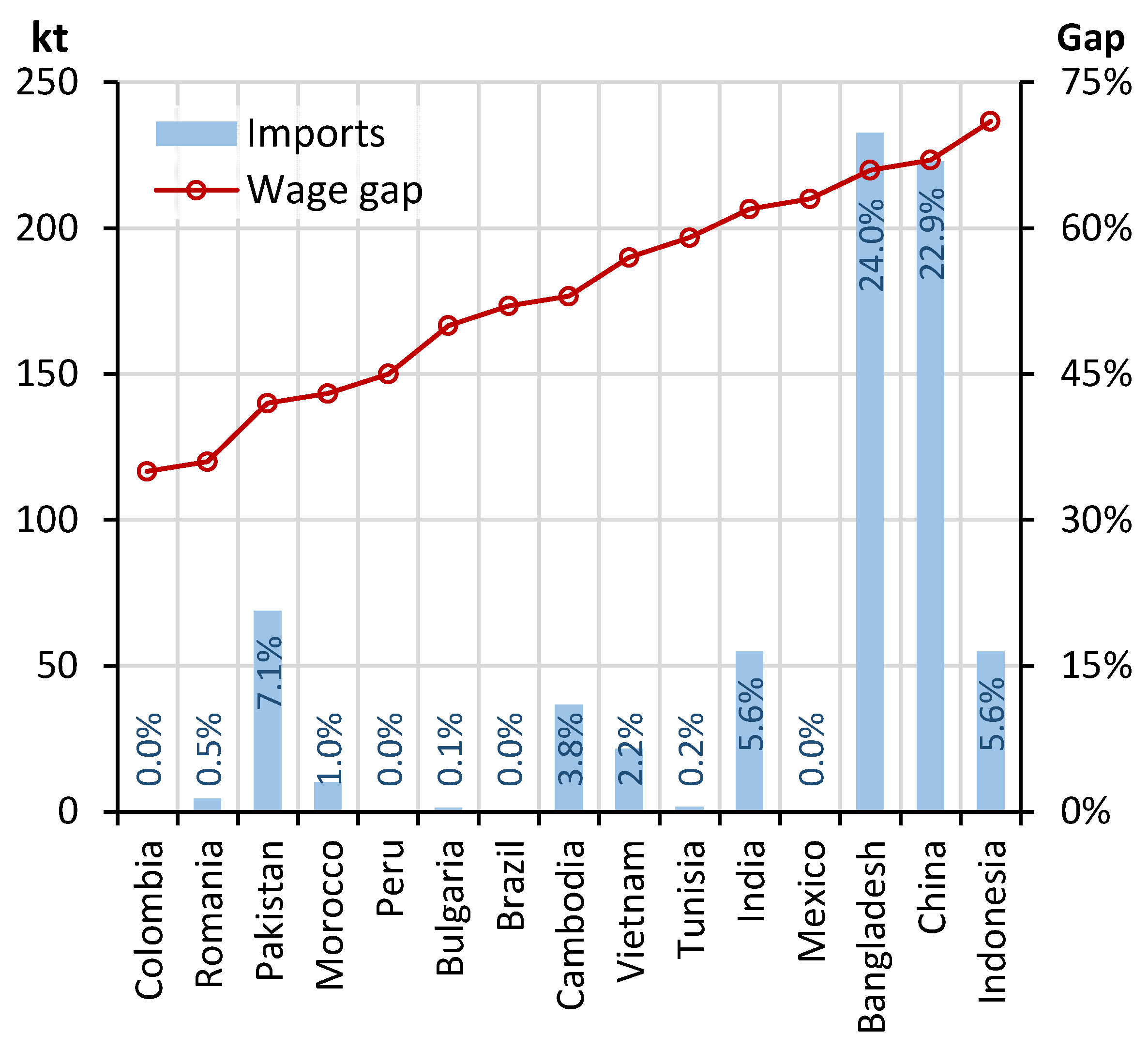
However, this is the worst that global clothing supply chains have to offer. The key question here is what proportion of UK imports are characterised by such conditions. This is difficult to answer precisely, but looking to social impact and footprinting literatures offers some insight. Figure 1 shows textiles sector minimum wages in 2022 relative to living wages, for the 15 countries with the largest shortfalls. Alongside are the masses of clothing the UK imported from each of these countries in 2022. The UK imported ~450 kt from China and Bangladesh (nearly 50% of all imports), where the minimum wages in the textiles sector are only ~33% of the living wage. India and Indonesia supplied 110 kt (11%), and both have a similar shortfall in textile sector wages relative to living wages (30-40%). Cumulatively, nearly 65% of UK clothing imports in 2022 were from countries where minimum textiles sector wages are less than half the living wage. Note that there are also rich countries with large shortfalls (in the USA, the textiles sector minimum wage is two-thirds of the living wage) and others where textile workers’ minimum wages match the living wage (e.g., Turkey and Italy).
Research also exists at the European level that quantifies social footprints. This found average wages in European clothing supply chains to be only 50% of fair, living levels[63] – broadly consistent with the UK data of Figure 1. Other research on ‘bad labour’ footprints showed there to be over 350,000 child labourers, and 25,000 forced labourers (modern slaves), in the global supply chains supporting clothing consumption in OECD Europe in 2007[33]. Overall, nearly 5% of the embodied labour in the imported clothing of OECD Europe was either child or forced labour, and 50% of these child labourers were reported to be working in hazardous conditions. Assuming the UK is typical of OECD Europe – and that the reported 25% reduction in child labour, globally, from 2008-2020[64] has been offset by increased UK consumption – one may cautiously estimate that there are ~45,000 child labourers (21,000 in hazardous conditions) and ~3,000 forced labourers in the global supply chains servicing UK consumption. Indeed, in 2016, 77% of the UK fashion retailers suspected modern slavery was occurring at some stage of their supply chains[2].
Overall, the much-publicised issues with global clothing supply chains appear to be endemic to the current UK clothing economy. But how may these social impacts change in a transition to a circular, sustainable clothing economy? A key part of this transition is a substantial reduction in consumption; a 50% reduction would leave UK consumption roughly at the global average[58]. A transition may also aim to localise/re-shore production (see the section 3.2), meaning most (or perhaps all) the reduction would be achieved by reducing imports. Given the extensive exploitation of workers currently occurring, this may appear a good thing. But the outcomes will depend upon the shape of the transition, which may tend towards neoliberal, international trade under vastly unequal global power relations[65], or, at the other end of the scale, inward-looking nationalism[66].
A good transition would see workers’ welfare and working conditions substantially improved, and wages increased, for workers in global supply chains, such that the issues discussed above were largely eliminated. Clothing prices would increase and demand in the global North would fall to sustainable levels. If employment in manufacturing hubs of the global South fell, this could be managed by children going to school instead of having to supplement parents’ incomes, and by producing instead for domestic markets. With wages increased to a living wage, reductions in aggregate hours of employment could also be managed by reducing working hours for all, rather than increasing the unemployment rate – which is essentially what has happened in deindustrialised countries like the UK6. All this would help reduce the reliance of the global South upon consumer demand of the global North, and potentially contribute to reducing the enormous global inequalities that underpin this reliance. There could thus be a welcome synergy between reduced consumption and improved labour conditions, as both require a move away from cheap, low-quality clothing.
But how likely is such a transition? On one hand, there is substantial support from businesses and other stakeholders for mandatory regulations to improve wages and working conditions[67]. This could allow governments to implement policies to push the transition in the right direction. But there are at least two fingers on the other hand:
First, it has been reported that even a doubling of global South workers’ wages may only increase the final price of a shirt in the USA by ~9%[68], and more recent data suggest wages makeup <1% of a fast fashion garment’s final price7, implying a doubling of wages would have a negligible (<2%) impact on price. Price changes of this order would not reduce clothing by the magnitude sustainability requires.
Second, a nationalistic UK politics may not care for the working conditions of supply chain workers, instead aiming to reduce imports via protectionist trade policies favouring domestic industry – perhaps implemented under the guise of carbon tariffs or similar. This could increase unemployment for the already-poor in the global South while leaving the remaining workers no better off. Initial research suggests CE policy in the global North could substantially increase unemployment in global South clothing supply chains, while creating jobs in the global North[69]. This presents an ethical paradox given that sustainability transitions in the global North are, to some degree, motivated by the fact that ecological breakdown will primarily harm those in the global South who have contributed relatively little to the issue8. Fear of such negative outcomes is a key reason that CE literature has often ignored the ‘reduce’ aspect of CE, and not questioned the imperative of forever-increasing aggregate demand[48]. Overall, there are fundamental questions here about capitalism, consumption, degrowth[70], and yet more fundamental questions about ownership[71].
3.2. Labour Conditions for UK Made Clothing
A transition to a sustainable UK clothing economy may involve some localisation of production, alongside reductions in total consumption. Localisation is a strong theme in key CE texts[21], and for the UK this would imply a reversal of recent history. From 1998 to 2015, UK textiles manufacturers’ output dropped ~50% (in cash terms), and clothing manufactures’ output dropped ~60%[72]. Textiles production then resurged, reaching ~75% of the 1998 level in 2022, while clothing production continued to fall (aside from the post-covid rebound in 2021-2022). It is possible, however, that the mass output of UK clothing manufacturers has increased recently, given the rise in UK fast-fashion production and its low per-item cost.
Public discourse has highlighted some degree of rebirth of UK clothing manufacture9. This is driven by fast fashion companies such as Boohoo and Missguided, for whom UK production allows shorter lead-times, and even faster fast fashion, than sourcing from Asian sweatshops. It has been made possible by largely illegal and unregulated labour markets in places like Leicester, Manchester, and London. Hourly wages average £3.50-£4, health and safety breaches typically thought to be eradicated in the UK are common (e.g., fire escapes being blocked or padlocked), and migrant women workers are, unsurprisingly, most commonly exploited[2]. Some heads of fast fashion brands have reacted with shock at the finding that conditions reminiscent of Asian sweatshops exist in the UK10. But one has to wonder how it is any surprise to anyone that reshoring clothing production to the UK, while upholding the low prices first made possible by offshoring this production to countries with exploitative labour conditions, has resulted in the UK importing those same conditions to its own factories. Moves to better regulate the wages and conditions in the numerous small UK factories that supply major UK retailers will, of course, raise the price of domestic production and increase precisely that economic incentive that first drove production offshore.
For workers then, localisation is only as good as local labour laws and their enforcement, or lack of – some evidence suggests that the average UK employer can expect to be assessed for minimum-wage-compliance around once every 500 years[2]. Producing a fast fashion shirt in the UK is likely to incur a lower environmental impact than producing one in Southeast Asia, due to avoided transport costs and the UK’s cleaner electricity grid. But it is possible for workers to face similar conditions.
However, this worst-case scenario can be avoided. A transition to a more sustainable, circular, and localised economy could certainly help to generate local economic opportunities while offering more transparency, thus potentially leading to more public pressure, collective bargaining, and enforcement of existing standards to ensure manufacturers offered good working conditions and wages. The higher cost of clothing that would follow could help reduce consumption, depending upon how much prices increased. There are many examples of sustainable, ethical UK manufacturers that offer an entirely different deal for workers than the unregulated sweatshops of Leicester, and which do not abide by the weekly cycle of fast fashion. A sustainable, circular clothing economy would need to actively create the conditions for such models to flourish while avoiding them becoming a market niche catering to conscious middle-class consumers.
3.3. Social and Well-Being Relating (Directly) to UK Clothing Consumption
Clothing has obvious relationships to basic physical human needs[21,73] – it can protect us from cold or sunlight and, in specific industrial forms, from chemicals or radiation. It also has relationships to social and psychological human needs, allowing people to express group identity or individuality, or signal respect or otherwise in contexts such as funerals, marriages, or other ceremonies and rituals. It is tempting to dismiss the emotional and social roles of clothing as merely ‘capitalist manipulation of the public’ [74], but this criticism is specific to the contemporary, Western, industrial manifestation of fashion. Clothing’s relationships with politics and power, class and gender, history and oppression, and idiosyncrasy and religion – and how these relationships have manifested in societies across the world – have been described in detail by anthropologists[75], and the full complexity will likely remain a mystery to anyone without a formal training in the discipline.
Most of these relationships between human well-being and clothing are relevant in the UK. So the key question of the current work is whether sustainability interventions – i.e., substantial reductions in new clothing purchases and growth in second-hand markets – could reduce the social benefits consumers currently derive from the clothing economy. The answer is that this seems extremely unlikely, for three reasons:
First, the substantial ~50% reduction in new clothing consumption assumed in our previous modelling work[58] is not as deterministic as it may appear. This could also be understood as a doubling of the average lifetimes of clothing items, without a concurrent increase in average wardrobe size. But this does not dictate the amount of time any one person must own an item. Some people may have small wardrobes stocked with items purchased new, which they wear to the end of their useful life; others may have large wardrobes containing items they only wear once before exchanging at clothes swaps, or which are on short-term rental. All this is consistent with a 50% reduction in new clothing consumption, so a large reduction in future clothing consumption does not imply homogenous adoption of a specific lifestyle.
Second, there is substantial literature documenting how the constant consumption needed to keep pace with the rapidly changing trends generated and marketed by the modern fashion industry can harm well-being[76] – as can materialism more broadly[77]. Recent work suggests that a smaller, less transient wardrobe can reduce anxiety while increasing aspects of Eudemonic well-being[78] such as one’s sense of creativity and self-expression [76,79], contrasting with the imitation inherent to fast-fashion. Relevant here is the notion of slow fashion, which aims to maintain the social and psychological benefits that many derive from fashion, while reducing the speed of consumption and extending the life of clothing [16]. It should also be noted that a more charitable analysis of contemporary fast fashion argues that it has ‘democratised’ fashion, by making high-end trends more widely accessible[2]. However, another way of putting this is that it has broadened access to the excesses of affluence, while entrenching disempowerment, low pay, and unsafe conditions for sweatshop workers – workers who do not enter into this notion of democratisation.
Third, one can observe the multiplicity of social and cultural functions that clothing serves in cultures that lack capitalist consumerism. In many African cultures for example, clothing outlives people and is passed down through generations[80], and second-hand clothing is often considered more valuable than cheap, low-quality imports[3]. But this clothing still satisfies numerous social and psychological functions[75,80]. In contrast, in consumer-cultures, modern marketing manages to construct clothing items paradoxically as both emotionally irresistible yet disposable. The same point can be made by considering forward-looking UK research that has analysed well-being frameworks to establish sixteen concepts that could be actualised in a circular economy – playfulness, caring, creativity, participation, learning, and many more11. A key point of this work is that transitioning from a consumerist-culture to one consistent with a circular economy could allow clothing to be more broadly coupled to well-being, extending beyond hedonism into many eudemonic dimensions.
In summary, transitioning towards a CE with reduced consumption is far more likely to benefit global North consumers’ well-being than harm it. Indeed, to laypersons engaged with the modern clothing system, the above arguments may appear an overcomplicated way of presenting a message that to them is obvious: modern consumerism is generally not for consumers but for the economy and those that profit from it – and clothing is no different.
3.4. Impacts of Circular Activities in the UK
Research on the social aspects of current reuse, repair, and recycling activities in the UK clothing economy is sparse. Some exists exploring the UK charity shop sector. This reports that volunteers are generally satisfied with their experiences, local economies are supported with relatively recession-proof businesses, and recent offenders and those with mental health issues are given valuable opportunities for social integration[81]. Other UK research into local repair, reuse, and recycling communities suggests that participating citizens cultivate feelings of care, self-reliance, and empowerment (among other things) and similar messages emerge from other countries[82,83]. A key issue, however, is that these studies typically explore unpaid work/volunteering. For example, paid employees are notably absent from the discourse on charity shops. Indeed, only ~1% of paid workers in the Dutch clothing sector are involved in core circular activities, with workers instead concentrated in retail and distribution[84]. As an affluent, post-industrial economy, the UK is likely to be similar. In short, circular activities in the UK clothing economy have various positive social benefits, but they are relatively small-scale and unpaid work is common.
In a future circular economy, this could (and should) change. A transition towards a circular clothing economy in the global North could substantially increase domestic employment (albeit while decreasing employment in GS supply chains[69]). Additional domestic jobs would emerge from expanded second-hand markets and repair services, and fibre-to-fibre recycling plants and their collection and distribution systems. Substantial growth in these areas would be required to shift the UK clothing economy onto the most ambitious scenario developed in previous work[58]. Research in the Netherlands is relevant again – this found that, relative to business-as-usual, a future clothing economy focused upon reuse and repair could increase employment by 25% by 2050, while a future focused upon fibre-to-fibre recycling may increase employment by 14% (but with lower job losses for workers in global South supply chains)[84]. However, it has been suggested that the ‘dirty work’ of textiles recycling and recovery in the global North is typically done by migrant labourers [85]. So while a transition to CE may bring jobs back ‘home’, these may not be filled by global North citizens.
However, job creation alone is a crude, potentially misleading measure of social impact – more important is the quality of these jobs. Research into general CE-related jobs in Europe backs the intuition that recycling is capital-intensive, while reuse and repair are labour-intensive[86]. Concerningly, most workers receive below-average wages, unpaid work is common, and productivity (in purely economic terms) is also below-average. It is thus no wonder that migrants – who are often more willing, or forced by necessity, to bear poor working conditions and minimum wages – prevail in paid textiles recycling and recovery work[85].
Given this situation, moving towards circularity in the UK clothing economy will require both targeted policies and new business models to scale-up current circular activities. These must raise the wages for recycling sector workers and repairers, improve working conditions for the former, and increase the prevalence of paid work in the second-hand retail sector. Without such changes, there is a risk that repair will remain largely a middle-class niche for the time-rich, and that fibre recycling will be characterised by poor working conditions mostly weathered by migrant workers.
3.5. Socio-Economic Impacts of Used Clothing Exports
Of the 600 kt of used clothing that is collected annually in the UK with the intention of being reused, over 350 kt (~60%) is exported[87] – to Eastern Europe, South and Central Asia, and Sub-Saharan Africa[88]. Exports in used clothing from the affluent global North have occurred for centuries, originally motivated by scarcity rather than the current drivers of abundance and overconsumption[89]. Notwithstanding this history, those currently donating clothing are typically unaware that its fate normally lies beyond UK borders[4] – although this may be changing due to campaigns like Dead White Man’s Clothes12 undertaken by NGO the OR Foundation.
Used clothing exports from the global North have been criticised for three distinct reasons: It has been argued they have contributed considerably to the decline of African textile industries by undercutting prices and putting local producers out of business [90,91,92]. It has been shown that poor quality clothing donations – often mixed into bales with more usable items – now fill the landfills, informal dumping sites, and rivers of Tanzania, Kenya, Ghana, and elsewhere[93,94]. Finally, others have demonstrated that corruption and power-imbalances underpin local second-hand clothing trade in receiving countries, such as India[95].
However, research has also painted a picture of second-hand clothing trade that is more complex and sometimes positive[4]. This includes challenging the idea that second-hand imports played a decisive role in the decline of sub-Saharan African clothing industries. It has been argued that the clothing industry in Zambia was moribund even before second-hand clothing imports soared, and its death was largely due to cheap Asian imports[80]. Relatedly, others have argued that, as locally made clothing is too expensive for most sub-Saharan African consumers, local producers are normally not competing with second-hand imports but instead producing for export[3]. Indeed, market sellers sometimes slightly spoil new, imported Asian shoes before hiding them among used, European shoes, to help the (cheaper) former fetch a higher price[3]. Studies have also highlighted the value that African consumers derive from second-hand clothing, which, through its stylistic variety, they use to construct collective and individual identities[80]. Indeed, the value of second-hand clothing to consumers and to those employed in the second-hand clothing trade – who far outnumber those employed in clothing production – is large enough that the Kenyan government abandoned their move to ban imports, due to fear of popular backlash[96].
Transitioning to sustainable, circular economies in exporting countries of the global North may change this picture considerably. If the UK significantly reduced consumption of new clothing, and increased domestic reuse and recycling of clothing, this could reduce used clothing exports to negligible levels. The conflicting arguments above suggest the impacts for receiving countries across sub-Saharan Africa and elsewhere would be mixed. On one hand, curtailing the export of unusable clothing to countries of the global South, which contributes to their waste management crises, would clearly be positive. If countries such as Ghana were also awarded compensation for historical dumping13, this may largely address environmental justice concerns. On the other hand, reducing the supply of second-hand clothing to African countries poses trade-offs for the considerable number of people employed in the second-hand clothing economy, and for the consumers that value and depend upon this clothing. But the implications for the African clothing industry are far less clear. While there would be less competition from second-hand imports, competition from cheap Asian imports would remain. And if African producers were export-oriented, they may encounter the issue highlighted in Section 3.1 – falling global North demand for new clothing, as consumption is reduced in the circular economy transition. Even if the African industry were to grow, this would likely mean more sweatshops, thus amplifying existing concerns about workers’ wages and conditions.
However, calls to grow primary clothing manufacturing in Africa[92,97] are perhaps misplaced. Textiles, due to a low-capital, high-labour structure, is often seen as a starter-industry for low-income countries to catalyse further industrialisation and economic growth, and the UK, EU, and USA historically protected their industries for this reason[96]. But given key 21st century challenges related to environmental limits (and also automation), this strategy may be outdated. Low-income countries may be better off leaning into existing circular activities, thus skipping the linear, primary-production-fed economic model that characterised the industrial revolution and progressing directly to more sustainable forms of development[98]. Countries that currently receive used exports from the global North (not just of clothing) may thus be better off growing their recovery and recycling capabilities. Indeed, the global South typically outperforms the global North when it comes to extracting value from mixed, diluted flows of materials[99,100]. Framing the clothing that countries such as the UK export to the global South as ‘dumping’ risks obscuring the skilled labour that is applied in the global South to maximise recovered value.
In summary, there appears to be no ‘ideal’ solution to the issue of used clothing exports from the global North, and how these should change in a circular future (if they should exist at all). These exports have positive and negative effects – environmentally, socially, and economically. An argument could be made that a degree of used clothing exports from the global North to poorer countries is compatible with (or even preferable in) a circular clothing economy. But this argument holds weight only because the contemporary global economy is so unequal. The extremely low wages and purchasing power of those countries importing used clothing – made low largely due to past and present actions of the wealthy global North – condemn these countries to low-value activities, so the question is ‘what future is less bad?’ This point is revisited below.
4. Conclusions
It is clear from this analysis that a CE transition is not guaranteed to be socially positive for everyone. Rather, the impacts are (almost) entirely dependent upon the associated politics. Some aspects of a transition to CE are highly likely to be positive for some people. For example, given the obvious excesses of fast fashion, reducing average UK consumption below current levels will very likely benefit UK consumers’ mental health and well-being – unless reductions were achieved via heavy-handed, top-down means (highly unlikely in the UK context). Likewise, reducing exports of poor-quality used clothing to the global South, which are destined to become waste, will certainly be positive. But other aspects of CE will only be socially beneficial if the transition is well governed. Reshoring of clothing production may increase domestic employment, but this can only be considered a success in so far as it avoids increasing work in the unregulated sweatshops of UK cities such as Leicester. Similarly, increasing domestic CE activities related to reuse, repair, and recycling will increase domestic employment, but this will only be a broadly positive development if the current situation of below-average wages and high reliance on unpaid labour also changes.
Due to entrenched global economic inequalities, the trade-offs and risks of a CE transition will likely be borne largely by the global South. For example, if average clothing lifetimes in the UK were prolonged (through reuse, repair, rental, etc.), leading to a parallel reduction in purchases of new clothing, this may help UK businesses. But it would reduce demand for new clothing, thus impacting the global South workers that have been made dependent upon the consumer-demand of the affluent global North. Indeed, these global inequalities make it difficult to chart a path for a CE transition that does not present trade-offs for the global South.
The recent history of clothing trade between the global North and sub-Saharan Africa shines a spotlight on the pervasive issue of global economic power. It was highlighted earlier the notion that cheap Asian imports into Africa have damaged clothing manufactures at least as much as used clothing imports. However, these Asian imports arrived due to economic liberalisation imposed upon African countries by global North countries via the World Bank[3]. Even if one assumes that used clothing imports have instead caused the most harm to African manufacturers, African nations have not been free to block these from entering their markets. In 2016, the East African Community (EAC) – Kenya, Rwanda, Uganda, Tanzania, etc. – agreed to phase-out used clothing imports over a period of three years [96]. In response, the USA threatened to place tariffs on the new clothing that these countries export to North American markets. This was a major reason that all EAC members except Rwanda u-turned on their used-clothing phase-outs (ibid). And the reason textiles industries in the global South are so export-dependent is precisely due to global inequalities in wages and purchasing power. Finally, note the double standards: to protect their own producers, countries in North America and the European Union enforced highly-protectionist quota limitations on global South exports from 1974 to 2005, centred upon the Multi Fibre Arrangement; the protectionist measures regarding second-hand imports that EAC members were coerced out of implementing by the USA were minor in comparison to these quotas.
Researchers have called for more attention to be paid to the international dimensions of CE and how unequal power relations may impact the global South[65]. Some suggest that, for every benefit experienced by a country or demographic, there will likely be an adverse impact elsewhere[66]. They also warn of a ‘circularity divide’ where the global North continues to appropriate resources from the global South through unequal ecological exchange[45], while also accumulating these resources through domestic recirculation. This dynamic may be more applicable to things like rare earth metals than clothing. Nonetheless, our analysis demonstrates the need for CE work on clothing to look both domestically and globally to consider how a transition can be made fair. There is a strong moral imperative for taking a global perspective, given long histories of exploitation of the global South by countries such as the UK. Indeed, a just transition may also include rectifying recent injustices by, for example, having global North companies and/or consumers fund clean-up of textiles waste in West Africa as compensation for historical dumping.
To these ends, we argue that understanding the impacts of a CE transition on humans demands a plurality of methods, even for a single industrial sector like clothing. Policies designed to increase the recirculation of materials, and decrease primary consumption, should be guided by insights not just from environmental science, engineering, economics, and business, but also development studies, anthropology, and other social sciences. The current work has not done justice to the breadth of research offered by this diversity of fields, but it has demonstrated how a synthesis of such knowledge may shed light on the human impacts of a CE transition. It has uncovered potential losers in a CE transition, who are absent from the common win-win discourse.
This research thus paves the way towards a more detailed analysis of the human impacts of CE transitions in clothing economies of the affluent global North, and the UK in particular. Future work may more rigorously examine different parts of the system or circular interventions. This may involve disciplinary work, which subsequent research can piece together into a holistic analysis more thorough than provided here. Other research should develop coherent socio-political narratives regarding how a transition may be governed, describing, for example, how a circular clothing economy transition may look like if achieved through a protectionist agenda, a neoliberal one, or – with a little luck – one in which global justice is central.
Funding
This work was funded by the UKRI Interdisciplinary Circular Economy Centre for Textiles: Circular Bioeconomy for Textile Materials (EPSRC grant number EP/V011766/1).
Acknowledgments
I would like to thank Philip Purnell and Żaneta Muranko for valuable feedback on manuscript drafts.
Conflicts of Interest
The authors declare no conflicts of interest.
| 1 | See Fair Wear’s Approach to Addressing Violence and Harassment in the World of Work (www.fairwear.org/) and discussion on racism in supply chains from Slow Factory (https://slowfactory.earth/courses/racism-fashion-supply-chains/) and New Republic (https://newrepublic.com/article/153596/fix-fashion-industrys-racism) |
| 2 | See numerous campaign literatures: https://www.theindustrywewant.com/wages; https://wageindicator.org/salary/ wages-in-context/garment-industry-living-wage-gap; https://labourbehindthelabel.org/living-wage/; https://fairwear.force.com/livingwage; https://cleanclothes.org/poverty-wages |
| 3 | See www.fairwear.org/resources-and-tools/fair-working-hours-guide & https://cleanclothes.org/bad-contracts |
| 4 | See www.fashionrevolution.org/about/transparency/; https://betterwork.org/wp-content/uploads/2016/09/BW-Progress-and-Potential_Web-final.pdf; https://data.parliament.uk/writtenevidence/committeeevidence.svc/ evidencedocument/environmental-audit-committee/sustainability-of-the-fashion-industry/oral/92140.html |
| 5 | See https://cleanclothes.org/union-busting |
| 6 | See: https://ourworldindata.org/working-hours |
| 7 | See: https://cleanclothes.org/poverty-wages |
| 8 | A similar outcome would emerge if wealthier countries aimed to re-shore clothing production to reduce lead times, using robotics and automation to avoid higher domestic labour costs (although if the owners of capital capture the profits this may not benefit workers in the global North either). See https://www.mckinsey.com/ industries/retail/our-insights/is-apparel-manufacturing-coming-home |
| 9 | See, for example: www.ft.com/content/e427327e-5892-11e8-b8b2-d6ceb45fa9d0 and www.retailgazette.co.uk/blog/2017/08/asos-new-look-bosses-warn-ticking-time-bomb-uk-factories/ |
| 10 | See, for example, evidence presented by Boohoo in the Environmental Audit Committee follow-up (Fixing Fashion: follow-up, HC 874; https://committees.parliament.uk/work/654/fixing-fashion-follow-up/publications/) and comments by Asos and New Look (www.retailgazette.co.uk/blog/2017/08/asos-new-look-bosses-warn-ticking-time-bomb-uk-factories/) |
| 11 | Manuscript by Bruna et al. in preparation for the UK Textiles Circularity Centre
|
| 12 | See: https://deadwhitemansclothes.org/ |
| 13 | See: www.theguardian.com/global-development/2023/may/31/stop-dumping-your-cast-offs-on -us-ghanaian-clothes-traders-tell-eu |
References
- Better_Work. Progress and Potential: How Better Work is Improving Garment Workers’ Lives and Boosting Factory Competitiveness: A Summary of an Independent Assessment of the Better Work Programme; ISBN: 9789221308072; International Labour Office, Geneva, 2016.
- EAC. Fixing fashion: clothing consumption and sustainability; Environmental Audit Committee, 2019.
- Brooks, A.; Simon, D. Unravelling the Relationships between Used-Clothing Imports and the Decline of African Clothing Industries. Development and Change 2012, 43 (6), 1265-1290. [CrossRef]
- Norris, L. Trade and Transformations of Secondhand Clothing: Introduction. TEXTILE 2012, 10 (2), 128-143. [CrossRef]
- Niinimäki, K.; Peters, G.; Dahlbo, H.; Perry, P.; Rissanen, T.; Gwilt, A. The environmental price of fast fashion. Nature Reviews Earth & Environment 2020, 1 (4), 189-200. [CrossRef]
- Peters, G.; Li, M.; Lenzen, M. The need to decelerate fast fashion in a hot climate - A global sustainability perspective on the garment industry. J. Clean Prod. 2021, 295, 126390. [CrossRef]
- Bailey, K.; Basu, A.; Sharma, S. The Environmental Impacts of Fast Fashion on Water Quality: A Systematic Review. Water 2022, 14 (7), 1073.
- Sandin, G.; Peters, G. M.; Svanström, M. Moving down the cause-effect chain of water and land use impacts: An LCA case study of textile fibres. Resources, Conservation and Recycling 2013, 73, 104-113. [CrossRef]
- Cornell, S.; Häyhä, T.; Palm, C. A sustainable and resilient circular textiles and fashion industry: towards a circular economy that respects and responds to planetary priorities; Stockholm Resilience Centre, 2021. https://www.stockholmresilience.org/research/research-news/2021-04-12-six-targets-for-a-sustainable-textile-industry.html.
- Sandin, G.; Peters, G. M.; Svanström, M. Using the planetary boundaries framework for setting impact-reduction targets in LCA contexts. The International Journal of Life Cycle Assessment 2015, 20 (12), 1684-1700. [CrossRef]
- Millward-Hopkins, J.; Purnell, P.; Baurley, S. A material flow analysis of the UK clothing economy. J. Clean Prod. 2023, 407, 137158. [CrossRef]
- Buchel, S.; Hebinck, A.; Lavanga, M.; Loorbach, D. Disrupting the status quo: a sustainability transitions analysis of the fashion system. Sustainability: Science, Practice and Policy 2022, 18 (1), 231-246. [CrossRef]
- Ellen_MacArthur_Foundation. A new textiles economy: Redesigning fashion’s future; Ellen MacArthur Foundation, 2017. https://ellenmacarthurfoundation.org/a-new-textiles-economy.
- Çay, A. Energy consumption and energy saving potential in clothing industry. Energy 2018, 159, 74-85. [CrossRef]
- Farrant, L.; Olsen, S. I.; Wangel, A. Environmental benefits from reusing clothes. The International Journal of Life Cycle Assessment 2010, 15 (7), 726-736. [CrossRef]
- Jung, S.; Jin, B. A theoretical investigation of slow fashion: sustainable future of the apparel industry. International Journal of Consumer Studies 2014, 38 (5), 510-519. [CrossRef]
- Piippo, R.; Niinimäki, K.; Aakko, M. Fit for the Future: Garment Quality and Product Lifetimes in a CE Context. In Sustainability, 2022; Vol. 14.
- Virgens, N. d.; Silva, S.; Laranjeira, E. Applications of the circular economy to the second-hand textile and clothing market: the case of Humana in Portugal. International Journal of Fashion Design, Technology and Education 2022, 1-10. [CrossRef]
- Mahanty, S.; Boons, F.; Handl, J.; Batista-Navarro, R. An investigation of academic perspectives on the ‘circular economy’ using text mining and a Delphi study. J. Clean Prod. 2021, 319, 128574. [CrossRef]
- Velenturf, A. P. M.; Purnell, P. Principles for a Sustainable Circular Economy. Sustainable Production and Consumption 2021. [CrossRef]
- Clube, R. K. M.; Tennant, M. The Circular Economy and human needs satisfaction: Promising the radical, delivering the familiar. Ecological Economics 2020, 177, 106772. [CrossRef]
- Padilla-Rivera, A.; Russo-Garrido, S.; Merveille, N. Addressing the Social Aspects of a Circular Economy: A Systematic Literature Review. Sustainability 2020, 12 (19), 7912.
- Mies, A.; Gold, S. Mapping the social dimension of the circular economy. J. Clean Prod. 2021, 321, 128960. [CrossRef]
- Valencia, M.; Bocken, N.; Loaiza, C.; De Jaeger, S. The social contribution of the circular economy. J. Clean Prod. 2023, 408, 137082. [CrossRef]
- de Boer, B. F.; Rietveld, E.; Rodrigues, J. F. D.; Tukker, A. Global environmental and socio-economic impacts of a transition to a circular economy in metal and electrical products: A Dutch case study. Journal of Industrial Ecology 2021, 25 (5), 1264-1271. [CrossRef]
- Clube, R. K. M.; Tennant, M. Social inclusion and the circular economy: The case of a fashion textiles manufacturer in Vietnam. Business Strategy & Development 2022, 5 (1), 4-16. [CrossRef]
- Bjørnbet, M. M.; Skaar, C.; Fet, A. M.; Schulte, K. Ø. Circular economy in manufacturing companies: A review of case study literature. J. Clean Prod. 2021, 294, 126268. [CrossRef]
- Clube, R. K. M.; Tennant, M. What would a human-centred ‘social’ Circular Economy look like? Drawing from Max-Neef's Human-Scale Development proposal. J. Clean Prod. 2023, 383, 135455. [CrossRef]
- Schroeder, P.; Lemille, A.; Desmond, P. Making the circular economy work for human development. Resources, Conservation and Recycling 2020, 156, 104686. [CrossRef]
- Vanclay, F. International Principles For Social Impact Assessment. Impact Assessment and Project Appraisal 2003, 21 (1), 5-12. [CrossRef]
- Wiedmann, T.; Lenzen, M. Environmental and social footprints of international trade. Nature Geoscience 2018, 11 (5), 314-321. [CrossRef]
- Iacovidou, E.; Velis, C. A.; Purnell, P.; Zwirner, O.; Brown, A.; Hahladakis, J.; Millward-Hopkins, J.; Williams, P. T. Metrics for optimising the multi-dimensional value of resources recovered from waste in a circular economy: A critical review. J. Clean Prod. 2017, 166, 910-938. [CrossRef]
- Simas, M. S.; Golsteijn, L.; Huijbregts, M. A. J.; Wood, R.; Hertwich, E. G. The “Bad Labor” Footprint: Quantifying the Social Impacts of Globalization. Sustainability 2014, 6 (11), 7514-7540.
- Millward-Hopkins, J.; Zwirner, O.; Purnell, P.; Velis, C. A.; Iacovidou, E.; Brown, A. Resource recovery and low carbon transitions: The hidden impacts of substituting cement with imported ‘waste’ materials from coal and steel production. Global Environmental Change 2018, 53, 146-156. [CrossRef]
- Stamford, L.; Azapagic, A. Life cycle sustainability assessment of UK electricity scenarios to 2070. Energy for Sustainable Development 2014, 23, 194-211. [CrossRef]
- Max-Neef, M. A.; Elizalde, A.; Hopenhayn, M. Human scale development: conception, application and further reactions; The Apex Press, 1991.
- Doyal, L.; Gough, I. A theory of human need; Macmillan International Higher Education, 1991.
- Rao, N. D.; Min, J. Decent Living Standards: Material Prerequisites for Human Wellbeing. Social Indicators Research 2018, 138 (1), 225-244, journal article. [CrossRef]
- Vogel, J.; Steinberger, J. K.; O'Neill, D. W.; Lamb, W. F.; Krishnakumar, J. Socio-economic conditions for satisfying human needs at low energy use: An international analysis of social provisioning. Global Environmental Change 2021, 69, 102287. [CrossRef]
- Baltruszewicz, M.; Steinberger, J. K.; Paavola, J.; Ivanova, D.; Brand-Correa, L. I.; Owen, A. Social outcomes of energy use in the United Kingdom: Household energy footprints and their links to well-being. Ecological Economics 2023, 205, 107686. [CrossRef]
- Millward-Hopkins, J. Inequality can double the energy required to secure universal decent living. Nature Communications 2022, 13 (1), 5028. [CrossRef]
- Vélez-Henao, J. A.; Pauliuk, S. Material Requirements of Decent Living Standards. Environmental Science & Technology 2023, 57 (38), 14206-14217. [CrossRef]
- Levy, B. S.; Patz, J. A. Climate Change, Human Rights, and Social Justice. Annals of Global Health 2015, 81 (3), 310-322. [CrossRef]
- Mohai, P.; Pellow, D.; Roberts, J. T. Environmental Justice. Annual Review of Environment and Resources 2009, 34 (Volume 34, 2009), 405-430. [CrossRef]
- Hickel, J.; Dorninger, C.; Wieland, H.; Suwandi, I. Imperialist appropriation in the world economy: Drain from the global South through unequal exchange, 1990–2015. Global Environmental Change 2022, 73, 102467. [CrossRef]
- Dorninger, C.; Hornborg, A.; Abson, D. J.; von Wehrden, H.; Schaffartzik, A.; Giljum, S.; Engler, J.-O.; Feller, R. L.; Hubacek, K.; Wieland, H. Global patterns of ecologically unequal exchange: Implications for sustainability in the 21st century. Ecological Economics 2021, 179, 106824. [CrossRef]
- Sullivan, D.; Hickel, J. Capitalism and extreme poverty: A global analysis of real wages, human height, and mortality since the long 16th century. World Development 2023, 161, 106026. [CrossRef]
- Kirchherr, J.; Reike, D.; Hekkert, M. Conceptualizing the circular economy: An analysis of 114 definitions. Resources, Conservation and Recycling 2017, 127, 221-232. [CrossRef]
- Corvellec, H.; Stowell, A. F.; Johansson, N. Critiques of the circular economy. Journal of Industrial Ecology 2021, 1-12. [CrossRef]
- Giampietro, M.; Funtowicz, S. O. From elite folk science to the policy legend of the circular economy. Environmental Science & Policy 2020, 109, 64-72. [CrossRef]
- Vonk, L. Paying attention to waste: Apple’s circular economy. Continuum 2018, 32 (6), 745-757. [CrossRef]
- Hobson, K.; Lynch, N. Diversifying and de-growing the circular economy: Radical social transformation in a resource-scarce world. Futures 2016, 82, 15-25. [CrossRef]
- Desrochers, P.; Leppälä, S. Industrial Symbiosis: Old Wine in Recycled Bottles? Some Perspective from the History of Economic and Geographical Thought. International Regional Science Review 2010, 33 (3), 338-361. [CrossRef]
- Zink, T.; Geyer, R. Circular Economy Rebound. Journal of Industrial Ecology 2017, 21 (3), 593-602. [CrossRef]
- Brockway, P. E.; Sorrell, S.; Semieniuk, G.; Heun, M. K.; Court, V. Energy efficiency and economy-wide rebound effects: A review of the evidence and its implications. Renewable and Sustainable Energy Reviews 2021, 110781. [CrossRef]
- Steffen, W.; Broadgate, W.; Deutsch, L.; Gaffney, O.; Ludwig, C. The trajectory of the Anthropocene: The Great Acceleration. The Anthropocene Review 2015, 2 (1), 81-98. [CrossRef]
- Schroeder, P.; Anggraeni, K.; Weber, U. The Relevance of Circular Economy Practices to the Sustainable Development Goals. Journal of Industrial Ecology 2019, 23 (1), 77-95. [CrossRef]
- Millward-Hopkins, J.; Purnell, P.; Baurley, S. Scenarios for reducing the environmental impacts of the UK clothing economy. J. Clean Prod. 2023, 420, 138352. [CrossRef]
- Overseas trade data tables. HM Revenue & Customs.
- WRAP. Textiles 2030 Baseline Report; Waste and Resources Action Programme, 2022. https://wrap.org.uk/resources/report/textiles-2030-annual-progress-report-202122.
- WRC. Farce majeure: How global apparel brands are using the COVID-19 pandemic to stiff suppliers and abandon workers; Workers Rights Consortium & the European Center for Constitutional and Human Rights, 2020. www.ecchr.eu/.
- ILO. Progress and Potential: How Better Work is Improving Garment Workers’ Lives and Boosting Factory Competitiveness; ISBN: 9789221308072; International Labour Organization (ILO) and International Finance Corporation (IFC), 2016.
- Mair, S.; Druckman, A.; Jackson, T. Investigating fairness in global supply chains: applying an extension of the living wage to the Western European clothing supply chain. The International Journal of Life Cycle Assessment 2018, 23 (9), 1862-1873. [CrossRef]
- UNICEF, I. Child Labour: Global estimates 2020, trends and the road forward; New York, 2021.
- Schroeder, P.; Dewick, P.; Kusi-Sarpong, S.; Hofstetter, J. S. Circular economy and power relations in global value chains: Tensions and trade-offs for lower income countries. Resources, Conservation and Recycling 2018, 136, 77-78. [CrossRef]
- Barrie, J.; Schröder, P. Circular Economy and International Trade: a Systematic Literature Review. Circular Economy and Sustainability 2022, 2 (2), 447-471. [CrossRef]
- Manshoven, S.; Van Opstal, W. The Carrot or the Stick? Stakeholder Support for Mandatory Regulations towards a Circular Fashion System. Sustainability 2022, 14 (22), 14671.
- Miller, D.; Williams, P. What Price a Living Wage?: Implementation Issues in the Quest for Decent Wages in the Global Apparel Sector. Global Social Policy 2009, 9 (1), 99-125. [CrossRef]
- Repp, L.; Hekkert, M.; Kirchherr, J. Circular economy-induced global employment shifts in apparel value chains: Job reduction in apparel production activities, job growth in reuse and recycling activities. Resources, Conservation and Recycling 2021, 171, 105621. [CrossRef]
- Kallis, G.; Kostakis, V.; Lange, S.; Muraca, B.; Paulson, S.; Schmelzer, M. Research On Degrowth. Annual Review of Environment and Resources 2018, 43 (Volume 43, 2018), 291-316. [CrossRef]
- Bastani, A. Fully Automated Luxury Communism; Verso, 2019.
- Index of Production time series (DIOP), category 13 and 14. UK Office for National Statistics (ONS). www.ons.gov.uk/businessindustryandtrade/manufacturingandproductionindustry/timeseries/jq5s/diop; www.ons.gov.uk/businessindustryandtrade/manufacturingandproductionindustry/timeseries/jq65/diop.
- Brand-Correa, L. I.; Steinberger, J. K. A Framework for Decoupling Human Need Satisfaction From Energy Use. Ecological Economics 2017, 141, 43-52. [CrossRef]
- Aspers, P.; Godart, F. Sociology of Fashion: Order and Change. Annual Review of Sociology 2013, 39 (Volume 39, 2013), 171-192. [CrossRef]
- Hansen, K. T. The World in Dress: Anthropological Perspectives on Clothing, Fashion, and Culture. Annual Review of Anthropology 2004, 33 (Volume 33, 2004), 369-392. [CrossRef]
- Bardey, A.; Booth, M.; Heger, G.; Larsson, J. Finding yourself in your wardrobe: An exploratory study of lived experiences with a capsule wardrobe. International Journal of Market Research 2021, 64 (1), 113-131. [CrossRef]
- Kasser, T. Materialistic Values and Goals. Annual Review of Psychology 2016, 67 (Volume 67, 2016), 489-514. [CrossRef]
- Liu, A.; Baines, E.; Ku, L. Slow Fashion Is Positively Linked to Consumers’ Well-Being: Evidence from an Online Questionnaire Study in China. Sustainability 2022, 14 (21), 13990.
- Bang, H.; DeLong, M. Everyday Creativity Practiced through a Capsule Wardrobe. Sustainability 2022, 14 (4), 2092.
- Hansen, K. T. Helping or hindering? Controversies around the international second-hand clothing trade. Anthropology Today 2004, 20 (4), 3-9. [CrossRef]
- Osterley, R.; Williams, I. D. The social, environmental and economic benefits of reuse by charity shops. Detritus 2019, 7, 29-35.
- Durrani, M. “People Gather for Stranger Things, So Why Not This?” Learning Sustainable Sensibilities through Communal Garment-Mending Practices. Sustainability 2018, 10 (7), 2218.
- van der Velden, M. ‘Fixing the World One Thing at a Time’: Community repair and a sustainable circular economy. J. Clean Prod. 2021, 304, 127151. [CrossRef]
- Economy, C. Putting Circular Textiles to Work: The employment potential of circular clothing in the Netherlands; Circle Economy, 2021. https://www.circle-economy.com/.
- Gregson, N.; Crang, M.; Botticello, J.; Calestani, M.; Krzywoszynska, A. Doing the ‘dirty work’ of the green economy: Resource recovery and migrant labour in the EU. European Urban and Regional Studies 2016, 23 (4), 541-555. [CrossRef]
- Llorente-González, L. J.; Vence, X. How labour-intensive is the circular economy? A policy-orientated structural analysis of the repair, reuse and recycling activities in the European Union. Resources, Conservation and Recycling 2020, 162, 105033. [CrossRef]
- WRAP. Textiles Market Situation Report; Waste and Resources Action Partnership, 2019. https://wrap.org.uk/sites/default/files/2021-03/WRAP-textiles-market-situation-report-2019.pdf.
- Brooks, A. Stretching global production networks: The international second-hand clothing trade. Geoforum 2013, 44, 10-22. [CrossRef]
- Lemire, B. The Secondhand Clothing Trade in Europe and Beyond: Stages of Development and Enterprise in a Changing Material World, c. 1600–1850. TEXTILE 2012, 10 (2), 144-163. [CrossRef]
- Frazer, G. Used-Clothing Donations and Apparel Production in Africa. The Economic Journal 2008, 118 (532), 1764-1784. [CrossRef]
- Guo, S.; Choi, T. M.; Zhang, J. Second-Hand-Clothing Imports in Least-Developed-Countries: The Collapse of Local Clothing Manufacturing and Remedial Measures. IEEE Transactions on Engineering Management 2021, 1-20. [CrossRef]
- Wetengere, K. K. Is the banning of importation of second-hand clothes and shoes a panacea to industrialization in East Africa? African Journal of Economic Review 2018, 6 (1), 119-141.
- Greenpeace. Poisoned Gifts; 2022. https://www.greenpeace.org/international/publication/53355/poisoned-gifts-report-fast-fashion-textile-waste-disguised-as-second-hand-clothes-exported-to-east-africa/.
- Manieson, L. A.; Ferrero-Regis, T. Castoff from the West, pearls in Kantamanto?: A critique of second-hand clothes trade. Journal of Industrial Ecology 2022, 1-11. [CrossRef]
- Norris, L. The limits of ethicality in international markets: Imported second-hand clothing in India. Geoforum 2015, 67, 183-193. [CrossRef]
- Wolff, E. A. The global politics of African industrial policy: the case of the used clothing ban in Kenya, Uganda and Rwanda. Review of International Political Economy 2021, 28 (5), 1308-1331. [CrossRef]
- Behuria, P. Twenty-first Century Industrial Policy in a Small Developing Country: The Challenges of Reviving Manufacturing in Rwanda. 2019, 50 (4), 1033-1062. [CrossRef]
- Wright, C. Y.; Godfrey, L.; Armiento, G.; Haywood, L. K.; Inglesi-Lotz, R.; Lyne, K.; Schwerdtle, P. N. Circular economy and environmental health in low- and middle-income countries. Globalization and Health 2019, 15 (1), 65. [CrossRef]
- Gregson, N.; Crang, M. From Waste to Resource: The Trade in Wastes and Global Recycling Economies. Annual Review of Environment and Resources 2015, 40 (1), 151-176. [CrossRef]
- Gregson, N.; Crang, M.; Fuller, S.; Holmes, H. Interrogating the circular economy: the moral economy of resource recovery in the EU. Economy and Society 2015, 44 (2), 218-243. [CrossRef]
Figure 1.
Textiles sector minimum wages relative to national living wages in 2022, in countries of the global South that supplied significant amounts of clothing to the UK market in the same year. Data for wages is from https://www.theindustrywewant.com/wages, and for UK imports from www.uktradeinfo.com/trade-data/ [59]. Percentage values on the bars indicate the kilotonnes of imports as a fraction of total UK imports.
Figure 1.
Textiles sector minimum wages relative to national living wages in 2022, in countries of the global South that supplied significant amounts of clothing to the UK market in the same year. Data for wages is from https://www.theindustrywewant.com/wages, and for UK imports from www.uktradeinfo.com/trade-data/ [59]. Percentage values on the bars indicate the kilotonnes of imports as a fraction of total UK imports.
Disclaimer/Publisher’s Note: The statements, opinions and data contained in all publications are solely those of the individual author(s) and contributor(s) and not of MDPI and/or the editor(s). MDPI and/or the editor(s) disclaim responsibility for any injury to people or property resulting from any ideas, methods, instructions or products referred to in the content. |
© 2024 by the authors. Licensee MDPI, Basel, Switzerland. This article is an open access article distributed under the terms and conditions of the Creative Commons Attribution (CC BY) license (http://creativecommons.org/licenses/by/4.0/).
Copyright: This open access article is published under a Creative Commons CC BY 4.0 license, which permit the free download, distribution, and reuse, provided that the author and preprint are cited in any reuse.


