

Submitted:
18 July 2024
Posted:
19 July 2024
You are already at the latest version
Abstract
Polyesters based advanced thin films have versatile industrial applications, especially in the filed of textiles, packaging and electronics. Recent advances in polymer science and engineering resulted in development of advanced amorphous and semi-crystalline polyesters with exceptional performance compared to conventional polymeric films. Among these, 1,4-cycloheanedimethanol (CHDM) and cyclic monomer-based polyesters have gained considerable attention attention for their exceptional characteristics and potential applications in smart films. This review article provides a comprehensive overview of the recent advances in the synthesis, characterization, and applications of CHDM and cyclic monomer based advanced polymers for smart film applications. It discussed the structure-property relationship of these innovative polyesters and highlights their unique characteristics including thermal, mechanical, and barrier characteristics. Furthermore, this article also emphases the solution, melt, and solid state polymerization of the polymers. Special emphasis is placed on the influence of the addition of 2nd diol or 2nd diacid on the performance characteristics of synthesized polyesters/copolyesters to explore their versatile industrial applications. Additionally, the impact of stereochemistry of the monomers is also explored to optimized the characterization of polyester, suitable for the industrial applications. Furthermore, this article explores the potential of these advanced polyesters to be considered as a potential materials for smart film applications, especially in the filed of flexible electronics. Finally, the article examines the challenges and future recommendations for the development CHDM and cyclic monomer-based polyesters for smart film applications. It discusses potential avenues for further research, including in-depth studies for the synthesis and characterization of polyesters, development of sustainable and biodegradable alternatives cyclic monomers, alternative green approaches for the synthesis of polymers etc. This review article provides a valuable insights for the researcher from academia and industry working in the field of polymer science and materials engineering.
Keywords:
1
; 4-cycloheanedimethanol
; cyclic monomer
; advanced copolyesters
; semi-crystalline polyesters
; structure-property relationship
; polymeric smart films
1. Introduction
Soon after the discovery of high molecular weight aliphatic polyesters by Carother and Hill in 1932, polyesters gained the attention of academia and industrial researchers due to their potential applications [1]. Advanced polymers have gained attention due to their potential applications in the field of catalysis [2], sensors [3], flexible electronics [4], medical [5], textile, and packing [6]. Broadly, polymers are divided into two categories based on their composition: aliphatic and aromatic. Aliphatic polymers contain aliphatic diol and aliphatic diacid parts. However, the low thermal, mechanical, and hydrolytic properties of these materials restrict their commercial applications. Aromatic polymers contain aromatic diacid and/or aromatic diol part and they are well known for their exceptional thermal, mechanical, hydrolysis, and chemical resistance properties [7,8,9]. Among numerous broad range of polymers, poly(ethylene terephthalate) (PET) have found widespread applications in the field of textiles, electronics, the packaging industry, and molded plastic parts [4,6,10,11,12]. Whinfiel and Dickinson reported PET as plastic and fiber in 1949 [13]. Because of the wide range of applications of PET, researchers have a keen interest to synthesize new copolyesters with superior mechanical and barrier properties compared to parent PET. Due to the commercial applications, the performance demands of PET are increasing rapidly. The suitability of PET as a flexible film substrate for electronic devices [4], textile fibers [14] thermoplastic resin [15], transparent and shrinkable films, and elastomers [16,17] have already been explored. But, we cannot use PET at an elevated temperature due to its high crystallization and low glass transition temperature (Tg). The barrier properties especially moisture barriers property of PET drops rapidly above its Tg. So, PET is not suitable for making products that require a moisture barrier at an elevated temperature (above 100 oC). There are two most widely used approaches to improve the thermal, mechanical, and barrier properties of PET. 1st by introducing some fillers like graphene [16], silica nanoparticles, or nanotubes [18,19] in the PET resin, and 2nd by controlling the chemical structures of polyesters themselves. Recently many efforts have been attempted to improve the thermal and mechanical properties of copolyesters by copolymerization and reactive blending of polyesters [20,21,22].
The commercial importance and applications of aromatic polyesters increased tremendously since the first reported preparation of high molecular weight Poly(ethylene naphthalene 2,6-dicarboxylate) (PEN) in 1969 [23]. Polyesters with aromatic moieties have attracted attention for decades due to their huge engineering thermoplastic market [24,25,26,27]. PEN is well known aromatic polyester having superior barrier and thermal properties (Tg 120 oC PEN vs 81 oC PET). Due to the presence of a double naphthalene ring of PEN polymer, they have superior thermal stability, excellent mechanical properties, very high chemical resistance, and dimension stability, which makes it an ideal candidate as a performance material for applications in the engineering thermoplastic market, biosensor, flexible electronic devices, and wide range of high-temperature applications [28]. The high thermal stability of PEN makes it suitable for high-temperature applications [27,29]. However, the high birefringence of PEN film, the necking phenomenon that occurred during the biaxial stretching of PEN, and the high cost of monomer, 2,6-naphthalenedicarbxylic acid (NDA) used for the synthesis of PEN renders their extensive applications in versatile areas. Thus, it has gained the attention of scientists and researchers to find alternative ways to utilize the superior barrier, electrical, thermal, and mechanical properties of PEN at relatively low cost.
The breakthrough in the polyester industry was the discovery of poly(1,4-cyclohexanedimethylene terephthalate) (PCT) homopolyester prepared from terephthalic acid (TPA) and 1,4-cyclohexanedimethanol (CHDM) in 1959 [30]. Compared to PET, PCT has higher Tg (88 vs 80 oC), Tm (300 vs 260 oC), superior chemical resistance, and attractive tensile and barrier properties [12]. However, the limited processing window of PCT homopolymer acts as an obstacle to its commercial applications. The incorporation of a varying amount of CHDM into PET has resulted in the synthesis of a new class of amorphous to highly crystalline copolyesters. These CHDM-based copolyesters rapidly find a strong position in the commercial market of polyesters. Now a day, CHDM-based copolyesters have a wide range of commercial applications. The performance properties of copolyesters can also be tuned by incorporating the second diacid or second diol.
Numerous pieces of literature are available which emphasize the CHDM diol moiety to improve the thermal, physical, chemical, and mechanical properties of polymers [12,31,32,33]. Not only the CHDM content but stereochemistry of CHDM (cis / trans isomers content) can also improve the comprehensive properties of the resulting polymers [34,35,36,37]. Trans-CHDM isomers are considered to be more stable than their analogous cis-CHDM isomers [38]. Kibler el. al. disclosed that the melting behavior of PCT can be improved by increasing the content of trans-CHDM from 0% to 100% (Tm 248 oC vs 308 oC) [30]. Not only Tm but Tg of PCT homopolymer is also increased linearly by increasing the trans-CHDM content from 0 to 100% (60 vs 90 oC). However, the crystallization rate is not similar for different compositions of PCT homopolymer. PCT homopolymer has a limited processing window which can be controlled by introducing other diacid units into the molecular backbone. When a small amount of isophthalic acid (IPA) is incorporated in the PCT polymer backbone it widens the processing window at the expense of Tg and Tm [39]. This modified PCT copolymer is called acid modified PCT (PCTA).
This review provides detailed information on advanced polyesters based on cycloaliphatic CHDM. Effects of second diacid, second diol, and stereochemistry of monomers are discussed in detail. Mainly, PCT homopolymer, glycol-modified PCT, CHDM-modified PET, acid-modified PCT, and the effect of the stereochemistry of monomers and their potential commercial applications are discussed in detail. A new class of biobased PCT copolymers is also discussed in detail in later sections.
2. 1,4-Cyclohexandimethanol (CHDM) and Its Stereoisomers
CHDM is a commercially available diol with a reasonable price, and it is widely used for the synthesis of CHDM-based aliphatic and aromatic polyesters. It effectively improves the unique characteristics of synthesized polymers. There are three main isomers of CHDM; 1,2-CHDM, 1,3-CHDM, and 1,4-CHDM. The study of 1,2-CHDM, and 1,3-CHDM-based polyesters and copolyesters is beyond the scope of this review. Traditionally, CHDM was synthesized on a commercial scale by hydrogenation of dimethylene terephthalate (DMT), by a two-step process. Scheme for the synthesis of synthesis of CHDM from DMT is shown in Figure 1 [40,41,42]. In the first step DMT is converted into dimethyl cyclohexanedicarboxylate (DMCD) by treatment of hydrogen in the presence of catalyst (Pd) and in the second step DMCD is reduced into CHDM
Single-step preparation of CHDM by hydrogenation of DMT has also been proposed in the presence of either a bimetallic nano-catalyst [43] or a supported tri-metallic nanocluster (Ru5PtSn). These nanocatalysts facilitate the hydrogenations of DMT and allow carrying out the modification reaction with high efficiency at mild conditions (100oC, 20 bar) compared to conventional methods [44]. Wei et al. developed a method for preparing DMCD by a continuous hydrogenation process and prepared the CHDM with high activity and selectivity [45]. Recently, monomer waste (BHET) of PET is converted into CHDM in the absence of any kind of solvent using Pd/C and Cu-based metallic catalysts [46]. Yancheng et al. successfully prepared CHDM from bio-based materials. This green synthesis approach provides a potential alternative to the conventional methods which involve hazardous materials [47]. However, some additional reports disclose the methods for the preparation of high trans-CHDM [41,48]. Both, Eastman Chemical Company USA and TCI Japan are the main producers of company of CHDM in the world. CHDM is produced as a mixture of cis/trans- isomers 70/30 trans/cis-CHDM isomers and almost all commercial polyesters are synthesized from this CHDM. The Stereochemistry of CHDM directly influences the properties of synthesized polyesters which will be discussed in detail later on. Cis- and trans-CHDM isomers are shown in Figure 2.
2.1. Aliphatic Polyesters and Copolyesters Containing CHDM and Their Applications
CHDM has been extensively used for the synthesis of biodegradable aliphatic polyesters and copolyesters with potential applications in versatile areas. Generally, these copolyesters are synthesized by a two-step melt polymerization or enzymatic polymerization process. Two-step polycondensation of HCDM, sebacoyl chloride, 1,4-cyclohexane diamine, and their improved mechanical, thermal, and biodegradability behavior have been reported [49]. Recently, Tsai et al. synthesized a series of biodegradable aliphatic copolyesters by enzymatic polymerization of 1,3/1,4-CHDM with succinic acid and 1,4-butanediol. They successfully tuned the properties of resulting copolymers by controlling the amount of incorporated CHDM [50]. Hansen et al. also reported the enzymatic polymerization of aliphatic copolyesters containing CHDM as a diol moiety, and succinic acid, atopic acid, and suberic or sebatic acid as a diacid moiety, using Cutinase from Humicola insolens, however moderate molecular weights of these polymers limits their applications [51]. Barret et al. successfully synthesized the poly(1,4-cyclohexanedimethanol itaconate) thermoset polymer by single-step enzymatic polymerization and they analyzed its mechanical and biocompatible properties. They found that this material can be a strong candidate as a future biomaterial [52]. Now a day, almost all cycloaliphatic polyesters are synthesized using 1,4-CHDM and 1,4-cyclohexanedicarboxyklic acid (CHDA). Polycondensation of CHDM with CHDA for the synthesis of high molecular weight cycloaliphatic poly(1,4-cyclohexylene 1,4-cyclohexanedicarboxylate) (PCCD) has been the objective of many researchers. Compared to CHDM diol moiety, the cyclohexane ring structure of CHDA are stable in both, cis- and trans-CHDM configurations. As the trans-CHDA isomer content (mole %) is increased the Tg and Tm of obtained polyesters are increased in a linear trend. So, the high molecular weight thermoplastic aliphatic polyesters are synthesized by using trans-CHDA isomers. However, compared to CHDM, cis-/trans-CHDA isomers can easily revert to their equilibrium mixture (68/32%: trans/cis) in the presence of a suitable catalyst at high melt polycondensation temperature [39]. Xiaodong et al. synthesized a series of poly(butylene-co1,4-cyclohexanedimethylene carbonate) (PBCC) and studied the effect of CHDM on the performance properties of synthesized biodegradable PBCC. They observed that thermal stability, mechanical, and heat distortion properties of PBCC random copolymers are increased linearly by increasing the CHDM content [53]. Thermal degradation behavior and other performance properties of biodegradable aliphatic poly(butylene 1,12-dodecanedioate) random copolyesters were also effectively improved by incorporating the cycloaliphatic 1,4-cyclohexanedicarboxylic acid units into the molecular backbone. It was found that trans-CHDA isomers improve the performance properties of synthesized aliphatic polymers in linear trend [54]. Recently, Seul et al. successfully tuned the fragile properties of isosorbide (ISB) based polycarbonate by incorporating the second diol. A series of biodegradable copolycarbonates of ISB, cycloaliphatic CHDM, and diphenyl carbonate were synthesized by two step melt polymerization. CHDM content greater than 50 mole % improves the ductility of obtained polyesters. However, Tg of synthesized polymer is decreased as we increased the content (mole %) of CHDM because the resultant polymer have lesser amount of rigid heterocyclic ISB [55]. Figure 3 shows the chemical structure of various aliphatic polyesters [56].
Brunelle et al. filed a patent on the synthesis of PCCD, they successfully obtained the cycloaliphatic polymer by optimizing the monomer feed ratio and reaction conditions [57]. Later on, they successfully synthesized the stereoregular polymer by optimizing the reactions conditions like temperature, catalyst, and time. Reactions conditions were optimized to prevent the isomerization of trans-CHDA isomers and they successfully obtained PCCD polymers with molecular weight of 75,000-80,000 [58]. High molecular weight polyoxaesters having acceptable thermal and hydrolysis properties have been synthesized by melt polymerization of CHDM with oligo(ethylene glycol) diacid in the presence of suitable catalyst. Possible potential biomedical applications of these absorbable polyoxaesters as sutures coatings and adhesion prevention barriers have been proposed [59].
applications
- 1-
- Sutures
- 2-
- Adhesion prevention barriers
- 3-
- UV resistant
In short, it is evident from literature that cycloaliphatic polyesters have been prepared using various monomers and synthesis approaches. Compared to aromatic polyesters, cycloaliphatic polyesters have good UV stability, good optical, and good weatherability properties. These cycloaliphatic polymers may have potential applications as weather-able materials and biomaterials. A detailed study of is required in order to explore the wide range applications of these cycloaliphatic polymers.
2.2. Thermally Stable Aromatic Polyesters and Copolyesters Containing CHDM
Thermoplastic polyesters have gained the attentions of academia and industrial researchers because of their wide range of domestic and technical applications [4,6,10,11,12,60]. Synthesis of high molecular weight aliphatic polyesters was first reported by Carother and Hill [1]. But, inherent poor hydrolytic stability, low glass transition temperature and melting temperature of aliphatic polyesters strictly abandoned their commercial applications. Whinfield and Dickson reported novel aromatic poly(ethylene terephthalate) (PET) having acceptable Tg and Tm in 1949 [61]. However, high crystallinity and low Tg of PET (81 oC) limits its commercial applications at an elevated temperature. Mechanical, chemical and barrier properties of PET can be improved by adding rigid cycloaliphatic 1,4-CHDM diol into the backbone of aliphatic polyester. 1,4-CHDM is commercially available in the form of a mixture of cis-/trans-CHDM isomers (70/30 %). Kibler et al. disclosed the synthesis process and thermal properties of poly (1,4-cyclohexylene dimethylene terephthalate) (PCT) in 1964. Eastman Kodak company successfully synthesized the semi crystalline PCT fiber and marketed in the fiber industry with the trade name of Kodel for a long time until it was discontinued in 1980 [36]. Nowadays PCT is synthesized by two-step melt polymerization from either NDA or DMT as diacid moiety and CHDM as diol moiety. PCT and copolyesters of PCT have superior thermal, mechanical, chemical, and barrier properties than PET [62]. Commercial PCT is highly crystalline with high Tm (295 oC), Tg (about 90 oC), and thermal degarationstability and it is cheaper than liquid crystalline polymers (LCP). PCT has superior thermal and mechanical, and hydrolytic stability properties but similar flow during the molding when compared with conventional PET and PBT polymers. Amorphous copolyesters containing rigid and bulky CHDM have variety of commercial application as injection molded polymers for medical and electronics applications [12,63]. However, both high crystallinity and high melting temperature (295 oC) of PCT (narrow processing window) act as obstacles during the melt polymerization. So, the commercial application of PCT copolyesters as a film have been restricted by these properties. For general plastic applications, process-ability of PCT polymer must be improved by modifying it with diacid or diol components.
3. Preparation of CHDM Based Advanced Polymers
Usually, CHDM based homopolyester and copolyesters are synthesized by polycondensation method. Sometimes, depending on the types of polyesters, the chemical structure of CHDM and diacid moieties is modified to improve the reaction efficiency. Mostly, high molecular weight aromatic polymers are synthesized by polymerization of CHDM with diacid at high temperature and pressure. There are many reports dealt with the synthesis of CHDM based polyesters by different techniques [20,51,64,65] but the most common techniques are melt polymerization, solution polymerization and ring opening polymerization. Detailed study of these synthesis techniques is given in next section.
3.1. Solution Polymerization
Currently, almost all polymers are synthesized by a complex two-step melt polymerization. First step involves the formation of pre-polymer by esterification or transesterification reaction and in the second step called polycondensation, synthesized prepolymer reacts with diol at relatively high temperature and pressure. By product removal set up is also attached at both stages of polymerization [20,31,66]. Due to harsh condition applied during melt polymerization a stoichiometric imbalance is observed due to degradation and sublimation of monomers and this phenomenon leads to the increment in side reactions and the reaction efficacy is reduced [67,68]. Some of the problems associated with melt polymerization are addressed by using suitable metallic catalysts [69,70]. However, titanium based catalysts, which are considered to be most effective catalysts among all metallic catalysts, induce yellow color into the synthesized product, while antimony based catalysts are associated with some toxicity issues [71,72]. Generally, an additional thermal stabilizer is also used with metallic catalyst to prevent polymer degradation during the polycondensation and subsequent process which results in increased cost [73]. It is worthy to note that neither polymer degradation nor discoloration of the product is observed during solution polymerization reaction [74,75]. The major concern about the solution polymerization is the selection of pure solvent which facilitates the solubility of monomers and easy recovery of synthesized polymer product. It is well established that pure and well-defined polymers are synthesized by a reproducible one-step solution polycondensation process. Schemciatic diagram of solution polymerization use for the synthesis of cyclic monomers; CHDM, 2,6-naphthalene dicarboxylic and terephtalloyl chloride based advanced PCTN copolyester is shown in Figure 4 [76].
3.2. Melt Polymerization
CHDM based aliphatic and aromatic polyesters and copolyesters are preferably synthesized by two step melt polymerization process. Usually the first step; esterification/transesterification is carried out at relatively low temperature and pressure which depends upon the monomers used for the synthesis of polymer. Usually, excess amount of diol moiety to diacid moiety (1: 1.2-2.2) is used during the synthesis process so short oligomers are synthesized during the esterification reaction. Short oligomers react together at high pressure and temperature to produce high molecular weight polymers; this process is called polycondensation. The byproducts of each step are removed separately.
A large number of aromatic and aliphatic polyesters and copolyesters have been synthesized by two step melt polymerization techniques [22,32,35,37,67,77]. Optimum reaction conditions like temperature, time, pressure etc. are chosen based on the polymers to be prepared. Catalyst and thermal stabilizer are chosen with special attention as they directly influence the color of final product. Figure 5 shows the typical melt polymerization reactor that is used for the melt polymerization of polyesters.
3.3. Ring Opening Polymerization
Nowadays, cyclic oligoesters their ring opening polymerization (ROP) are receiving attention. ROP have some advantages over conventional melt polymerization. Compared to melt polymerization, ROP is carried out at low temperature and pressure. Furthermore, no by products like water or methanol are produced during the synthesis of polyesters by ROP [78,79]. A lot of literature is available which highlight the synthesis of polyesters and copolyesters by ROP [72,78,79]. Aromatic polyesters and copolyesters have been synthesized by ROP [64,80,81]. CHDM based poly(1,4-cyclhexylenedimethylene terephthalate) cyclic oligomers were synthesized in solution from CHDM and TPC and separated as a mixture oligomers with different size, by high performance chromatography. The ROP of these oligomers was carried out at 310 oC for 30 minutes in the presence of antimony oxide for the synthesis of high molecular weight PCT homopolymer [81].
Nathalie et al. synthesized a series of poly(ethylene-co-1,4-cyclohexanesimethylene terephthalate) copolyesters (coPExCyT) by ROP by varying the ET/CT monomer ratios ranging from 90/10 to 10/90. Oligomers for the synthesis of coPExCyT copolyesters were synthesized by copolycondensation PCT and PET homopolymers. Results showed that synthesized coPExCyT copolyesters were random copolymers with high molecular weights [64].
3.4. Solid State Polycondensation (SSP) of Polyesters and Copolyesters
The demand of high molecular weight and low-cost polyesters and copolyesters for engineering plastic applications is increasing and it suggests the need to synthesize small particles. Polyesters containing thermally unstable components which can decompose under harsh conditions of melt polymerization can be synthesized by solid state polycondensation (SSP). The molecular weight of melt polymerized polyesters and copolyesters is increased furthermore by isothermal treatment at a temperature between cold crystallization temperature (Tc) and melting temperature (Tm) in solid state. This process is called solid state polycondensation. Performance properties such as thermal stability, tensile strength, fatigue behavior, and hydrolytic stability are influenced by the molecular weight of polyesters and copolyesters [82]. SSP makes it possible to get high molecular weights of polyesters and copolyesters which are technically are not possible by melt polymerization reactions. In melt polymerization intrinsic viscosity (IV) of 0.58-0.68 is achieved while for technical applications (as film, bottle, tyre cord, seat belt, air bags etc.), IV of typically between 0.70 and 1.20 is required. SSP process is so popular because problems associated with melt polymerization were eliminated during this process. There are some problems associated with me polycondensation of viscous polymers in the melt phase. During melt polycondensation, stirring of higher-IV polyesters with increased viscosity becomes very difficult and thermal degradation occur at higher temperature which results in low molecular polymers. It becomes very difficult to remove volatile by-products from highly viscous polymer. This process is also carried out at high temperature and vacuum which results in increased cost of the product. In addition, thermal degradation of polymer is also observed due to the undesirable side reactions which hinders the growth of molecular chains. Consequently, the melt viscosity and molecular weight of the synthesized product is decreased. These all limitation of melt polycondensation are addressed by SSP which is carried out at relatively mild condition than melt polycondensation [83]. SSP is of interest due to the growing demand of polyesters and copolyesters in widespread areas which require high molecular weight. In addition, some monomers and polymers require gentle conditions which cannot be fulfilled in melt phase. So, SSP technique is preferred for the production of high quality homopolyester and copolyesters with improved performance properties.
On an industrial scale continuous or discontinuous SPP process is carried out either in vacuum or supported by an inert gas flow. Higher molecular weight polyesters can also be obtained by another variation of SSP which is the so-called suspension process in swollen state [84]. Generally, large scale production of polyesters or copolyesters suitable for high-tech applications are produced by continuous process. The discontinuous SSP is carried out in tumble dryer and it is considered to be flexible and simple. It allows for the successful production of specialties on smaller scale, especially for engineering plastics [85]. However, the low volume of reactor (44m3) limits its use. A considerably attention is given to different SSP parameters as the like temperature, residence time, gas type, gas purity, gas speed, as they directly influence the resulting quality of SSP [83,86,87]. The quality of final product also depends on prepolymer, its end group concentration, catalyst, molecular weight, homogeneity, and pallet size [88]. The chemical structures of monomers used for the synthesis of polymers affects the reaction rate and thereof have a direct influence on the molecular weight of synthesized polymer [89]. SSP reaction follows the traditional thermodynamics, second order chemical kinetics, and rate of diffusions. During the process the small chains grow together, and then reactive end group diffuse into the amorphous regions of semi-crystalline polyesters. As a result of SSP amorphous regions of the result high quality product is decreased and regular arrangement of molecular chains is increased [90,91]. The resulting high quality and performance properties of product makes SSP an attractive approach for obtaining high molecular weight polymers suitable for applications as engineering plastics in versatile areas.
4. Synthesis of Cyclic Compound Based Advanced Hompolyesters and Copolyesters
4.1. Synthesis and Properties of 1,4-Cyclohexanedimethanol (CHDM) Based Conventional Homopolyesters (PCT&PCN)
Synthesis and application of CHDM based PCT homopolymer were first discovered by Kibler et al. in 1949 [36]. This polyester was originally synthesized by two step melt polymerization and its application as fiber was explored. On commercial scale PCT is synthesized by melt polymerizing of NDA or DMT with CHDM in the presence of suitable catalyst and stabilizer. Because of the high melting point of PCT homopolymer, polycondensation is carried out at a temperature higher than 300 oC [36]. Molecular weight of the synthesized PCT polyesters can be increased furthermore by SSP [20]. Compared to PET, PCT have higher Tg (88 vs 80 oC), Tm (300 vs 260 oC), superior chemical resistance, attractive tensile properties, and barrier properties [12]. Due to good thermal properties, high clarity, and improved molding characteristics, PCT is used as injection molded polyester for developing electronic and automotive parts [39]. However, the limited processing window of PCT homopolymer acts as an obstacle for its wide range commercial applications. The incorporation of varying amount of second diol or second diacid into the PCT homopolymer effectively widens the processing window and results in the synthesis of new class of amorphous to highly crystalline copolyesters which have a strong position as performance material in the commercial market of polyesters. Replacement of acyclic aliphatic diols with rigid cycloaliphatic CHDM diol results in the synthesis of polyesters with improved thermal properties [39,40]. Chemical structure of PET, PCT, PEN and PCN is shown in Figure 6(a). DSC thermograms of these homopolyesters clearly indicate rigid cyclohexene units (CHDM) improve the Tg and Tm of resulted polyesters Figure 6(b).
Performance properties of polyesters are directly influenced by the type of diol and diacid moieties. List of comparative properties of PET, PCT, PEN, and PCN is given in Table 1. However, film properties of PCN polyester are not mentioned because synthesis of PCN resin with such a high melting temperature and limited processing window is not suitable on industrial scale. Results indicate that CHDM units improve the thermal properties of polyesters when compared with the polyesters containing EG units. Similarly, rigid and thermally stable naphthalene unit also improve the mechanical and thermal properties of polyesters compared to their analogous polyesters containing terephthalate unit [20,24,39,40].
4.2. Second Diol Modified PCT Copolyesters
Novel polyester-based materials can be synthesized with proper molecular design by modifying the diol moiety. Cycloaliphatic 1,4-cyclohexanedimethanol (CHDM) is easily incorporated into the polyesters during the melt polymerization. Non-planar ring structure of CHDM enhance the thermal stability, mechanical and barriers properties of the resulting poly(cyclohexane 1,4-dimethylene terephthalate) (PCT) [39]. However, there are some processing issues associated with the synthesis of PCT which can be controlled by incorporating a second diol into the polymer backbone itself (Figure 7). Tm of CHDM modified PET polyester decreases initially, until it reaches the eutectic point at about 40 mol% 1,4-CHDM then it starts to increase exponentially by increasing the CHDM level. At eutectic point the PET and PCT crystals coexist in the copolyester. These results confirmed that rigid and cyclic aliphatic CHDM improves rigidity and regularity of polymer backbone [39].
Jo et al. synthesized and analyzed the crystallization behavior of poly(m-methylene 2,6-naphthalate-co-1,4-cyclohexanedimthylene 2,6-naphthalate) (m= no. of methylene group). They found that poly(ethylene 2,6-naphthalte-co-1,4-cyclohexanedimethanol 2,6-naphthalate) (PEN-co-CN) have amorphous nature in the middle of copolymer composition. While, poly(butylene 2,6-naphthalate-co-1,4-cyclohexanedimthylene 2,6-naphthalate) (PBN-co-CN) and poly(hexamethylene 2,6-naphthalate-co-1,4-cyclohexanedimthylene 2,6-naphthalate) (PHN-co-CN) indicated very clear melting points and they also showed sharp diffraction peaks over entire range of copolymer composition. Additionally, (PBN-co-CN) sowed eutectic melting behavior and Tg was increased by increasing CN % in a linear trend (Figure 8) [92]. However, in case of (PHN-co-CN) copolyester, both Tg and Tm were increased linearly by increasing CN units which indicates that this copolymer has isomorphic crystallization nature. We can conclude from these results that BN and HN units can cocrystallize together while EN and CN can’t. this behavior can be due to the fact that BN and HN unit have comparable densities, volumes and lengths of repeating unit which is not true in case of EN and CN units [92].
Aromatic poly(trimethylene-co-1,4-cyclohexanedimethylene terephthalate) (PTCT) with random microstructure have been synthesized by two-step melt polymerization of 1,3-propanol, CHDM, and DMT [93]. At 42 mole % of CHDM units, both trimethylene terephthalate (TT) and cyclohexylene dimethylene terephthalate (CT) coexist in the PTCT copolyesters. While copolyesters with less than 35 mole % of CT content crystallize in PTT type lattice, and those with higher than 42% of CT content crystallize with PCT type lattice. Thermal degradation behavior and other thermal properties of synthesized copolyesters were increased by increasing the CT content (mol %) Figure 9.
A series of copolyesters was synthesized from PCT and PET homopolymers has been reported. Copolyesters were synthesized by polymerizing TPA with varying amount of CHDM and EG to develop a series of copolyesters containing 12, 31, 32, 61, 70, and 81 mol % CHDM. It was found that free volume and gas permeability of synthesized copolyesters was increased linearly with CHDM content [94].
If the EG is replaced by the CHDM, the poly(ethylene glycol-co-1,4-cyclihexanedimethanil terephthalate) (PETG) are obtained. The incorporation of CT units into the backbone of PET results in the increment in the alkali resistance of PETG copolyesters. Amorphous regions of PET and PETG polyesters were easily attacked by the alkali compared to crystalline regions. In addition, hydroxyl anions resulted in corrosion to crystals without changing the crystalline structure of synthesized polyesters [95].
When the CHDM of PCT is replaced by hexanediol, the resulting poly(1,4-cyclohexylenedimethylene terephthalate-co-hexamethylene terephthalate) [P(CT-co-HT)] are random copolyesters and they show isodimorphic cocrystallization behavior. DSC and WXRD results confirmed that synthesized copolyesters are crystalline in nature with an eutectic point at 80 mol% of HT, where a crystal transition from PCT-type crystal to PHT-type crystal is occurred [96].
4.3. Second Diacid Modified PCT Copolyesters and Their Applications
As mentioned above, CHDM and TPA based PCT homopolymer has a limited processing window which can be controlled by introducing other diacid units into the molecular backbone. When small amount of isophthalic acid (IPA) is incorporated in the PCT polymer backbone it widens the processing window at the expense of Tg and Tm [39]. This PCT copolymer is called acid modified PCT (PCTA). Figure 10 shows that as the IPA content % is increased into PCT, both Tg and Tm are decreased. However, the decrease in Tm was higher than Tg. It was also found that at higher level (higher than 40%) of IPA totally amorphous copolymers were obtained [39,97]. These transparent amorphous copolymers have very good mechanical, hydrolysis, and chemical resistance. PCTA have many attractive performance properties which can be due to presence of tough and hydrophobic CHDM units. These copolymers can be melt processed without pre-drying and they have very strong position in plastic industry due to their performance properties. PCT_XA_X30 (30% IPA) copolyesters have acceptable physical, thermal, and mechanical properties which are comparable to glycol modified PCT and CHDM modified PCT [39].
Thermally stable naphthalene unit (NDA) has been reported as a modifier for acid modified copolyesters (PCTA) copolyesters. Incorporation of a small amount of diacid into the polymer backbone effectively widens the processing window of PCT polyester by lowering its Tm. These semi-crystalline copolyesters (PCTN) are tough and transparent resins. The effects of increasing level of naphthalene content (mol %) on thermal properties (Tg, Tm, ∆Hm) and degradation behavior of PCT is summarized in Table 2 [20,76]. As indicated, thermal degradation stability and Tg of the synthesized PCTN copolyesters increased linearly by increasing the naphthalene units. But, Tm of copolymers first decrease until eutectic point (36 mole % of naphthalene) is reached, then it starts to increase by increasing the naphthalene content. At eutectic point, PCT and PCN crystal coexist in the copolymers and after this point the main crystal structure is dominated by the PCN-type crystal that enhance the thermal, mechanical and physical properties of copolymers [20,63,66,97].
Many patents have been filed based on the synthesis of CHDM based thermally stable copolyesters containing naphthalene unit. These copolyesters showed unexpectedly high Tg, Tm, and thermal stability [36,98,99]. Incorporation of naphthalene units in PCT results in the synthesis of a new class of PCTN copolyesters with exceptional gas barrier properties, suitable for packaging application. Sublett disclosed that gas barrier properties of PCTN copolyesters synthesized with CHDM having about 92/8 cis/trans isomers can be successfully controlled by controlling the amount of incorporated naphthalene units (Figure 11) [100]. In general, we can say that compared to conventional polyesters PCTN copolyesters have very good barrier and thermal properties.
Bio-based polymers have gain the attention of researchers due to the serious environmental pollution and rapid depletion of oil resources. Extensive research efforts have been done to develop the monomers from renewable resources, which can potentially replace the monomers produced from petrochemical resources [101,102,103]. The NDA as a second diciad moiety and biobased isosorbide as a second diol moiety can also be incorporated in the backbone structure of PCT homopolyester, resulting in the quadripolymer with expectional thermal, barrier, and degradation properties [104,105]. The chemical structure of some acid modified PCT copolyesters in shown in the Figure 12.
Compared to NDA units, 1,4-cyclohexanedicarboxylic acid (CHDA) (95% trans isomers) as a polyester modifier maintained the toughness of parent polyester while lower the Tg. incorporation of small amount of CHDA units dramatically lower the Tg and Tm of PCT homopolyester. However, high molecular thermoplastic copolyester are synthesized by incorporating high trans-CHDA isomers as they improve the thermal properties of polyesters [106].
Copolyesters synthesized from the mixture of EG and CHDM, and NDA and SA have been reported. Heat distortion temperature, Tm and degradation behavior of the synthesized copolyesters was found to be dependent on the amount of second diol (CHDM) and second diacid (NDA, SA) incorporated into the copolyesters. It is important note that incorporation of 30 mol % or higher amount of CHDM resulted in the synthesis of amorphous copolyesters [107]. Thermal properties (Tg, Tm, and IV) of acid modified copolyesters are summarized in Table 3 [36,39,66].
4.4. Effect of Stereochemistry of Monomers on Synthesized Polyesters
Numerous literature is available which emphasize the CHDM diol moieties to improve thermal, physical, chemical and mechanical properties of polymers [12,31,32]. Not only the CHDM content but stereochemistry of CHDM (cis / trans isomers content) can also improve the comprehensive properties of resulting polymers [34,35,36,37]. Kibler el. al. disclosed that melting behavior of PCT can be improved by increasing the content of trans-CHDM from 0% to 100% (Tm 248 oC vs 308 oC) [30] (Figure 13). Not only Tm but Tg of PCT homopolymer is also increased linearly by increasing the trans-CHDM content from 0 to 100% (60 vs 90 oC). However, crystallization rate is not similar for different compositions of PCT homopolymer.
Wang et. al investigated the relationship between the stereochemistry of 1,4-CHDM and performance properties of bio-based poly(ethylene 2,5-furandicarboxylate) (PECFs) [108]. It was found that trans-CHDM isomers effectively improve the Tg, Tm, and Tc. Figure 14 shows the effect of trans-CHDM on Tg and Tm of PECFs copolymer. Polymer crystal structure was tuned from amorphous to highly crystalline by increasing the trans-CHDM isomers from 25% to 98%. Mechanical (tensile strength, tensile modulus) and gas barrier (oxygen and carbon dioxide) were also enhanced significantly by increasing trans-CHDM isomers in synthesized bio-based polymer. Stable and stretched trans-CHDM isomers improved the symmetry of polymeric chains and they facilitated the formation of stable crystal.
Berti et. al. found that thermal properties and crystal structure of copolyester can be controlled by controlling the cis/trans ratio of diacid moiety of copolyester [109]. Tg, melting behavior and crystallization behavior of poly(1,4-cyclohexanedimethylene 2,6-naphthalene) (PCN) can be tuned by controlling the cis/trans configuration of CHDM [110]. Superior thermal, mechanical, and barrier characteristics of copolyesters containing high trans-CHDM content can be attributed to the more symmetrical structure of CHDM which facilitate the formation of stable crystal structure, while cis-CHDM obstructs the development of stable structures [35,37,106,110,111]. Comparative properties of conventional PET, PCT, PEN, and PCN homopolymers are listed in Table 4 [27,39,66,112,113,114,115,116,117,118].
5. Polymeric Substrates for Flexible Electronics
Neither PET, PEN, and PCT homopolymers, nor their copolyesters of are new polymers, but they have attracted the considerable attention of researchers, due to their remarkable thermal, chemical, mechanical, gas-barrier, and hydrolysis properties. It has been be a great effort to introduce a synthesis of new polyester having comprehensive properties of three polyesters mentioned so far, that is, PET, PCT, and PEN. In this study, the synthesis of a series of poly(1,4-cyclohexylenedimethylene terephthalate-co-1,4-cyclohexylenedimethylene 2,6-naphthalenedicarboxylate) (PCTN) copolymers containing CHDM as diol, and TPA and NDA as diacid, was attempted. The vital role of CHDM configuration (cis/trans isomer) on hydrolytic stability, thermal, mechanical, and barrier properties of copolyesters was studied in details. Based on this work, we will be able to develop a polymer which can find its unique applications as a performance material in the field textile, packaging industry, printing and embossing films, and electronic devices.
Flexible electronics have gained the considerable attention of researchers these days. These electronics are thin, light weight, robust, conformable and roll able. In addition, OLEDs materials and active matrix of thin film transistor (TFTs) arrays can be laid down by solution casting and ink jet printing of plastic based substrate. Which in turns, reduce the processing cost effectively in high volume using roll to roll processing. However, to replace glass, flexible plastic substrate materials must have performance properties comparable to glass; smooth surface, chemical resistance, barrier, thermal stability and very low CLTE. But, flexible glass is fragile and by nature and it handing is also very difficult. Until now, no plastic substrate materials are reported which can meet the performance properties required for flexible substrate materials for OLEDs. Surface roughness, clarity, thermal, thermomechanical, chemical, mechanical, electrical, and magnetic properties are major properties required for flexible substrate materials suitable for displays. In addition to bottom-emitting displays, substrates materials for OLEDs must have good optical properties. Thermal properties of polymeric substrate (CLTE, Tg, Tm), especially Tg must be compatible with device fabrication process temperature (Tmax). Thermal mismatch between flexible polymeric substrate and device films may results in device breakage. One of the major concerns about the flexible substrate material for OLEDs is their dimensional stability. It should not contaminate the device and it should also have good barrier properties. It should be inert against the chemicals used during the device fabrication [119,120]. The standard moisture vapor transmission rate and oxygen permeability of flexible substrate materials for displays are 10-6 g/m2/day and 10-5 cm3/m2/day [121]. Good mechanical properties of substrate support the device and improve its impact resistance. Eclectically insulating polymeric substrates improves the device efficiency by minimizing coupling capacitances.
Previously, semi-crystalline: PEN and PET thermoplastic homopolymers, non-crystalline: polycarbonate (PC) and polyethersulphone (PES) thermoplastic polymers, and materials with high Tg: polyarylate (PAR), polyimide (PI) and poly cyclic olefin (PCO) were considered to be strong candidates for flexible substrates. Among all candidates for flexible substrate, PC, PES, PAR, and PCO polymers are relatively more transparent and they have superior Tg than PET and PEN. However, these copolyesters have low chemical resistance and large coefficient of thermal expansion (CTE) compared to PET and PEN. PET, PEN, and PI have attractive performance properties. They have relatively small CTE (15, 13, and 16 ppm/oC, respectively), good mechanical properties, and acceptable chemical resistance used during the process. PET and PEN good optical (transmittance > 85%) and water absorption (0.014%) properties. However, inferior thermal properties of PET and PEN have limited their practical applications in the field of flexible electronics. In contrast to PEN, PI has very good thermal properties but its yellow color and water absorption properties renders its applications. While, water and oxygen permeation rates of conventional materials, being used as substrate for flexible displays are 1-10 g/m2/day and 1-10 cm3/m2/day, respectively [120]. Until now, no polymer is reported which can meet the demanding requirements (water and oxygen permeation) for organic light emitting diode (OLED) displays. Comparison of different properties of conventional materials (PET, PEN, glass, steel, and PI) used for base substrate for flexible electronics is summarized in Table 4 [119,120].
A lot of advanced research for the synthesis and development of advanced polymer substrates as a smart film for flexible electronics is carried out in the recent years. Currently PI is the widely used polymeric substrate for flexible electronics. The performance charaacterisitics including physical, thermal, mechanical, and barrier characteristics of the randomly oriented, uniaxial oriented, and biaxially oriented advanced polymeric substrates in comparison with conventional PI polymeric substrates are summarized in Table 5 [33,104,105,122,123,124]. It is important to note that there is a potential to develop transparent polymeric substrates with good barrier, optical, and thermal characterics that can replace the yellow PI having higher water absorption. Such advanced polymer substrates can be used not only as substarte but also they can be used at the top of the flexible electronics. Such flexile polymeric smart films with low birefengence and good transmittance also have the potential to replace the brittle glass of the flexible displays.
6. Future Recommendations for 1,4-Cycloheanedimethanol (CHDM) and Cyclic Monomer-Based Advanced Polyesters
The advanced polymeric materials containing CHDM and cyclic monomers such as TPA, NDA, IPA, ISB etc. has found a strong position among polymers and they have a laid a strong foundation for the development and chracterization of innovative materials with versatile industrial applications. However, to extend the research in this field, many key areas should be explored. Firstly, the detailed study for the synthesis and characterizarion of novel cyclic monomers with superior characteristics should be done to expand the library of available monomers that are the building blocks of resultant polymeric materials. It can be achieved by finding the alternative synthesis methos, catalysts, and optimized reaction conditions to reaction efficiency and yield of the reaction. Furthermore, a detailed study of the structure-property relationships of the advanced polyesters is critical to understand the impact of various monomers structure on the resultant polymers. It would help to design and optimization of polyesters with controlled perdormance characteristics including mechanical, thermal, and barrier properties for specific applications.
Not only the fundamental research related to the monomer but the research related to the sustainable and environmentally friendly approached for the synthesis and processing of CHDM-based polyesters is also very important. The used biobased raw materials and green synthesis approaches including biobased or bio-inspired approaches should be explored. This may include the using of biobased renewable materials, developing efficient and selective catalysts, implementation of energy-efficient reaction conditions. Development of recycling process and detailed investigation regarding the biodegradation behavior of these materials would contribute to their sustainability and circularity. In order to commercialize these materials, industry and academia collaboration should be fostered. Industrial collaborators can provide valuable insights into the scalability and commercial viability of the developed polymeric materials. The collaborators can also help to identify the specific industrial requirements and challenges for the development of tailord materials that can find a strong position in the coomerical market. Additionally, interdisciplinary collaborations is also necessary that involve researchers and scientist from polymer chemistry, material science, engineering, and industrial design fields. It can lead to holistic approaches in material development, addressing not only the synthesis but also the processing, functionalization, and application aspects. Finally, applications of advanced polyesters in various fields including automotive, electronics, textile, packaging, or biomedical sectors, should be pursued to explore the full potential of these advanced polyesters in versatile industries.
7. Conclusions
Conclusively, the recent advances in the development of 1,4-cycloheanedimethanol (CHDM) and cyclic monomer-based advanced polyesters have indicated that these advanced copolyesters have the potential to be used for the smart film fabrication with versatile industrial applications. It is also showcased that they have the potential to find a streng position among other performance materials. These advanced polyesters have unique structure due to amorphous and semi-crystalline nature, which leads to exceptional performance beahviour such as thermal, mechanical, optical, and barrier (water and thermal barrier) characteristics, making them suitable for use in textiles, packaging, and flexible electronics.
This review also highlights the influenced of structure-property relationship for determining the desired performance characteristics of the resultance polymers. It has been shown that the addition of a second diol or diacid in the main backbone of the molecular chain significantly enhances the performance of synthesized copolyesters, indicating that they are adaptable for various industrial applications. Furthermore, it is also highlights that the crucial role of the stereochemistry of the monomers in optimizing the properties of these materials, enabling tailored solutions for specific applications.
The various polymer synthesis approaches such solution, melt, and solid-state polymerization are also explored that gave a considerable insights into the synthesis of these innovative polymeric materials. The potential for using sustainable and biodegradable cyclic monomers, along with green synthesis approaches, signifies a promising direction for future research, which would be in line with the increasing focus on environmental sustainability.
Even though cyclic monomer-based polyesters and CHDM have made significant strides, there are still issues that need to be resolved. These include the requirement for more thorough research on the synthesis and characterisation of these materials, the creation of more effective and environmentally friendly manufacturing techniques, and the search for novel cyclic monomers with improved characteristics.
Overall, this comhensive review article has given a thorough summary of the state of CHDM and cyclic monomer-based polyesters for use in smart film applications. It is anticipated that the knowledge gathered from this review will stimulate more study and research in this area, eventually resulting in the development of novel materials that may satisfy the changing needs of diverse sectors. In order to overcome the obstacles and realize the full potential of these improved polyesters in smart film applications, academics and industry must continue to collaborate.
Funding
The current work was assisted financially to the Dean of Science and Research at King Khalid University via the Large Group Project under grant number RGP. 2/397/44.
Acknowledgments
The authors extend their appreciation to the Deanship of Scientific Research at King Khalid University for funding this work through large Groups Project under grant number RGP.2/ 397/44.
References
- Carothers, B.W.H.; Hill, J.W. Studies of polymerization and ring formation. The use of molecular evaporation as a means for propagating chemical reactions. J. Am. Chem. Soc. 1932, 54, 1557–1559. [Google Scholar] [CrossRef]
- Hussain, F.; Shaban, S.M.; Kim, J.; Kim, D.-H. One-pot synthesis of highly stable and concentrated silver nanoparticles with enhanced catalytic activity. Korean J. Chem. Eng. 2019, 36, 988–995. [Google Scholar] [CrossRef]
- Cichosz, S.; Masek, A.; Zaborski, M. Polymer-based sensors: A review. Polym. Test. 2018, 67, 342–348. [Google Scholar] [CrossRef]
- Shen, W.; Zhang, X.; Huang, Q.; Xu, Q.; Song, W. Preparation of solid silver nanoparticles for inkjet printed flexible electronics with high conductivity. Nanoscale 2014, 6, 1622–1628. [Google Scholar] [CrossRef]
- Hussain, F.; Khurshid, M.F.; Masood, R.; Ibrahim, W. Developing antimicrobial calcium alginate fibres from neem and papaya leaves extract. J. Wound Care 2017, 26, 778–783. [Google Scholar] [CrossRef]
- McIntyre, J.E. The historical development of polyesters. In Modern polyesters: chemistry and technology of polyesters and copolyesters; J. Scheirs and T. E. Long, Ed.; Wiley Sussex: England, 2004; pp. 1–28. ISBN 0471498564. [Google Scholar]
- Al., H. et US Patent. 3,897,392 1975. [CrossRef]
- Turner, S.R.; Walter, F.; Voit, B.I.; Mourey, T.H. Hyperbranched aromatic polyesters with carboxylic acid terminal groups. Macromolecules 1994, 27, 1611–1616. [Google Scholar] [CrossRef]
- G. Bier Polyarylates (polyesters from aromatic dicarboxylic acids and bisphenols). 1974, 15, 527–535.
- Boland, C.S.; Khan, U.; Ryan, G.; Barwich, S.; Charifou, R.; Harvey, A.; Backes, C.; Li, Z.; Ferreira, M.S.; Mobius, M.E.; et al. Sensitive electromechanical sensors using viscoelastic graphene-polymer nanocomposites. Science (80-. ). 2016, 354, 1257–1260. [Google Scholar] [CrossRef] [PubMed]
- Behera, B.K.; Arora, H. Surgical gown: A critical review. J. Ind. Text. 2009, 38, 205–231. [Google Scholar] [CrossRef]
- Turner, S.R. Development of amorphous copolyesters based on 1,4-cyclohexanedimethanol. J. Polym. Sci. Part A Polym. Chem. 2004, 42, 5847–5852. [Google Scholar] [CrossRef]
- Rex, J.; Dickson, J.T.; Lothian, E.; I, E. “US Patent” 2,465,319. 1949.
- Bang, H.J.; Kim, H.Y.; Jin, F.L.; Park, S.J. Fibers spun from 1,4-cyclohexanedimethanol-modified polyethylene terephthalate resin. J. Ind. Eng. Chem. 2011, 17, 805–810. [Google Scholar] [CrossRef]
- Pech-May, N.W.; Vales-Pinzón, C.; Vega-Flick, A.; Cifuentes, Á.; Oleaga, A.; Salazar, A.; Alvarado-Gil, J.J. Study of the thermal properties of polyester composites loaded with oriented carbon nanofibers using the front-face flash method. Polym. Test. 2016, 50, 255–261. [Google Scholar] [CrossRef]
- Shih, W.K. Shrinkage modeling of polyester shrink film. Polym. Eng. Sci. 1994, 34, 1121–1128. [Google Scholar] [CrossRef]
- Huang, J.; Wang, J.; Qiu, Y.; Wu, D. Mechanical properties of thermoplastic polyester elastomer controlled by blending with poly(butylene terephthalate). Polym. Test. 2016, 55, 152–159. [Google Scholar] [CrossRef]
- Khankrua, R.; Pivsa-Art, S.; Hiroyuki, H.; Suttiruengwong, S. Thermal and mechanical properties of biodegradable polyester/silica nanocomposites. Energy Procedia 2013, 34, 705–713. [Google Scholar] [CrossRef]
- Bae, J.; Lee, S.; Kim, B.C.; Cho, H.H.; Chae, D.W. Polyester-based thermoplastic elastomer/MWNT composites: Rheological, thermal, and electrical properties. Fibers Polym. 2013, 14, 729–735. [Google Scholar] [CrossRef]
- Park, S.; Hussain, F.; Kang, S.; Jeong, J.; Kim, J. Synthesis and properties of copolyesters derived from 1,4-cyclohexanedimethanol, terephthalic acid, and 2,6-naphthalenedicarboxylic acid with enhanced thermal and barrier properties. Polym. 2018, 42, 662–669. [Google Scholar] [CrossRef]
- Zhang, J.B.; Wang, X.L.; He, Q.X.; Zhao, H.B.; Wang, Y.Z. A novel phosphorus-containing poly(1,4-cyclohexylenedimethylene terephthalate) copolyester: Synthesis, thermal stability, flammability and pyrolysis behavior. Polym. Degrad. Stab. 2014, 108, 12–22. [Google Scholar] [CrossRef]
- Koo, J.M.; Hwang, S.Y.; Yoon, W.J.; Lee, Y.G.; Kim, S.H.; Im, S.S. Structural and thermal properties of poly(1,4-cyclohexane dimethylene terephthalate) containing isosorbide. Polym. Chem. 2015, 6, 6973–6986. [Google Scholar] [CrossRef]
- W. Chester, I. Duling Popolyesters. US Pat. 3,436,376 1969.
- Kasmi, N.; Terzopoulou, Z.; Papageorgiou, G.Z.; Bikiaris, D.N. Poly(1,4-cyclohexanedimethylene 2,6-naphthalate) polyester with high melting point: Effect of different synthesis methods on molecular weight and properties. Express Polym. Lett. 2018, 12, 227–237. [Google Scholar] [CrossRef]
- Meehan, S.J.; Sankey, S.W.; Jones, S.M.; MacDonald, W.A.; Colquhoun, H.M. Cocrystalline copolyimides of poly(ethylene 2,6-naphthalate). ACS Macro Lett. 2014, 3, 968–971. [Google Scholar] [CrossRef]
- Cavallo, D.; Mileva, D.; Portale, G.; Zhang, L.; Balzano, L.; Alfonso, G.C.; Androsch, R. Mesophase-mediated crystallization of poly(butylene-2,6-naphthalate): An example of ostwald’s rule of stages. ACS Macro Lett. 2012, 1, 1051–1055. [Google Scholar] [CrossRef]
- B. Hu, and Ottenbrite, R.M. Biaxially oriented poly(ethylene 2,6-naphthalene) film: manufacture, properties and commercial applications. In Modern polyesters: Chemistry and technology of polyesters and copolyesters; J. Scheirs and T. E. Long, Ed.; Wiley Sussex: England, 2004; pp. 335–359. ISBN 0471498564. [Google Scholar]
- Callander, D.D. Properties and Applications of Poly(Ethylene 2,6-Naphthalene), its Copolyesters and Blends. In Modern polyesters: Chemistry and technology of polyesters and copolyesters; Long, S. and T.E., Ed.; Wiley Sussex: England, 2004; pp. 323–334. ISBN 0471498564. [Google Scholar]
- Wu, W.; Wagner, M.H.; Qian, Q.; Pu, W.; Kheirandish, S. Morphology and barrier mechanism of biaxially oriented poly(ethylene terephthalate)/poly(ethylene 2,6-naphthalate) blends. J. Appl. Polym. Sci. 2006, 101, 1309–1316. [Google Scholar] [CrossRef]
- Kibler, C.J.; Bell, A.; Smith, J.G. Polyesters of 1,4-cyclohexanedimethanol. J. Polym. Sci. Part A 1964, 2, 2115–2125. [Google Scholar] [CrossRef]
- Koo, J.M.; Hwang, S.Y.; Yoon, W.J.; Lee, Y.G.; Kim, S.H.; Im, S.S. Structural and thermal properties of poly(1,4-cyclohexane dimethylene terephthalate) containing isosorbide. Polym. Chem. 2015, 6, 6973–6986. [Google Scholar] [CrossRef]
- Kasmi, N.; Majdoub, M.; Papageorgiou, G.Z.; Bikiaris, D.N. Synthesis and crystallization of new fully renewable resources-based copolyesters: Poly(1,4-cyclohexanedimethanol-co-isosorbide 2,5-furandicarboxylate). Polym. Degrad. Stab. 2018, 152, 177–190. [Google Scholar] [CrossRef]
- Hussain, F.; Park, S.; Jeong, J.; Kang, S.; Kim, J. Structure–property relationship of poly(cyclohexane 1,4-dimethylene terephthalate) modified with high trans-1,4-cyclohexanedimethanol and 2,6-naphthalene dicarboxylicacid. J. Appl. Polym. Sci. 2020, 137, 48950. [Google Scholar] [CrossRef]
- Liu, F.; Zhang, J.; Wang, J.; Liu, X.; Zhang, R.; Hu, G.; Na, H.; Zhu, J. Soft segment free thermoplastic polyester elastomers with high performance. J. Mater. Chem. A 2015, 3, 13637–13641. [Google Scholar] [CrossRef]
- Celli, A.; Marchese, P.; Sisti, L.; Dumand, D.; Sullalti, S.; Totaro, G. Effect of 1,4-cyclohexylene units on thermal properties of poly(1,4-cyclohexylenedimethylene adipate) and similar aliphatic polyesters. Polym. Int. 2013, 62, 1210–1217. [Google Scholar] [CrossRef]
- Alan Bei, and J.G.S.C.J.K. US Patent 2,901, 466 1959.
- Celli, A.; Marchese, P.; Sullalti, S.; Berti, C.; Barbiroli, G. Eco-friendly poly(butylene 1,4-cyclohexanedicarboxylate): Relationships between stereochemistry and crystallization behavior. Macromol. Chem. Phys. 2011, 212, 1524–1534. [Google Scholar] [CrossRef]
- Rosado, M.T.S.; Maria, T.M.R.; Castro, R.A.E.; Canotilho, J.; Silva, M.R.; Eusébio, M.E.S. Molecular structure and polymorphism of a cyclohexanediol: trans-1,4-cyclohexanedimethanol. CrystEngComm 2014, 16, 10977–10986. [Google Scholar] [CrossRef]
- S. R. Turner, R. W. Seymour, J.R.D. Amorphous and crystalline polyesters based on 1,4-cyclohexanedimethanol. In Modern polyesters: Chemistry and technology of polyesters and copolyesters; Long, J.S. and T.E., Ed.; Wiley Sussex: England, 2004; pp. 267–292. ISBN 0471498564. [Google Scholar]
- Martinez de Ilarduya and, S. Munoz Guerra Polyesters based on cyclohexanedimethanol. In Handbook of engineering and specialty thermoplastics; S. thomas, V.P.M., Ed.; Wiley, 2011; pp. 181–182.
- Robert, H. Hasek and M. B. Knowles, Kingsport, T. Preparation of trans-1,4-cyclohexanedimethanol. US Pat. 2,917,549, 1949. [Google Scholar]
- Raja, R.; Khimyak, T.; Thomas, J.M.; Hermans, S.; Johnson, B.F.G. Single-Step, Highly Active, and Highly Selective Nanoparticle Catalysts for the Hydrogenation of Key Organic Compounds. Angew. Chemie Int. Ed. 2001, 40, 4638–4642. [Google Scholar] [CrossRef]
- Raja, R.; Khimyak, T.; Thomas, J.M.; Hermans, S.; Johnson, B.F.G. Single-step, highly active, and highly selective nanoparticle catalysts for the hydrogenation of key organic compounds. Angew. Chem. Int. Ed. Engl. 2001, 40, 4638–4642. [Google Scholar] [CrossRef]
- Hungria, A.B.; Raja, R.; Adams, R.D.; Captain, B.; Thomas, J.M.; Midgley, P.A.; Golovko, V.; Johnson, B.F.G. Single-step conversion of dimethyl terephthalate into cyclohexanedimethanol with Ru5PtSn, a trimetallic nanoparticle catalyst. Angew. Chemie - Int. Ed. 2006, 45, 4782–4785. [Google Scholar] [CrossRef]
- Li, M. US Patent. 9,550,721,B2, 2017. [Google Scholar]
- Guo, X.; Xin, J.; Lu, X.; Ren, B.; Zhang, S. Preparation of 1,4-cyclohexanedimethanol by selective hydrogenation of a waste PET monomer bis(2-hydroxyethylene terephthalate). RSC Adv. 2015, 5, 485–492. [Google Scholar] [CrossRef]
- Hu, Y.; Zhao, Z.; Liu, Y.; Li, G.; Wang, A.; Cong, Y.; Zhang, T.; Wang, F.; Li, N. Synthesis of 1,4-cyclohexanedimethanol, 1,4-cyclohexanedicarboxylic acid and 1,2-cyclohexanedicarboxylates from formaldehyde, crotonaldehyde and acrylate/fumarate. Angew. Chemie - Int. Ed. 2018, 57, 6901–6905. [Google Scholar] [CrossRef]
- Al., S. et. US Patent 5,387, 752 1995.
- Lecomte, H.A.; Liggat, J.J.; Curtis, A.S.G. Synthesis and characterization of novel biodegradable aliphatic poly(ester amide)s containing cyclohexane units. J. Polym. Sci. Part A Polym. Chem. 2006, 44, 1785–1795. [Google Scholar] [CrossRef]
- Tsai, Y.; Jheng, L.C.; Hung, C.Y. Synthesis, properties and enzymatic hydrolysis of biodegradable alicyclic/aliphatic copolyesters based on 1,3/1,4-cyclohexanedimethanol. Polym. Degrad. Stab. 2010, 95, 72–78. [Google Scholar] [CrossRef]
- Hunsen, M.; Azim, A.; Mang, H.; Wallner, S.R.; Ronkvist, A.; Wenchun, X.; Gross, R.A. A cutinase with polyester synthesis activity. Macromolecules 2007, 40, 148–150. [Google Scholar] [CrossRef]
- Barrett, D.G.; Merkel, T.J.; Luft, J.C.; Yousaf, M.N. One-step syntheses of photocurable polyesters based on a renewable resource. Macromolecules 2010, 43, 9660–9667. [Google Scholar] [CrossRef]
- Cai, X.; Yang, X.; Zhang, H.; Wang, G. Modification of biodegradable poly(butylene carbonate) with 1,4-cyclohexanedimethylene to enhance the thermal and mechanical properties. Polym. Degrad. Stab. 2017, 143, 35–41. [Google Scholar] [CrossRef]
- Berti, C.; Celli, A.; Marchese, P.; Barbiroli, G.; Di Credico, F.; Verney, V.; Commereuc, S. Novel copolyesters based on poly(alkylene dicarboxylate)s: 2. Thermal behavior and biodegradation of fully aliphatic random copolymers containing 1,4-cyclohexylene rings. Eur. Polym. J. 2009, 45, 2402–2412. [Google Scholar] [CrossRef]
- Park, S.A.; Choi, J.; Ju, S.; Jegal, J.; Lee, K.M.; Hwang, S.Y.; Oh, D.X.; Park, J. Copolycarbonates of bio-based rigid isosorbide and flexible 1,4-cyclohexanedimethanol: Merits over bisphenol-A based polycarbonates. Polymer (Guildf). 2017, 116, 153–159. [Google Scholar] [CrossRef]
- Arévalo-Alquichire, S.; Valero, M. Castor Oil Polyurethanes as Biomaterials. In Elastomers; InTech, 2017; pp. 137–157.
- Brunelle, et al. US Patent 6,084, 055 2000.
- Brunelle, D.J.; Jang, T. Optimization of poly(1,4-cyclohexylidene cyclohexane-1,4-dicarboxylate) (PCCD) preparation for increased crystallinity. Polymer (Guildf). 2006, 47, 4094–4104. [Google Scholar] [CrossRef]
- Pal, R.S.; Pal, Y.; Singh, V. Isolation and characterization of n-octa decanoic acid from whole aerial parts of Centella asiatica Linn. Int. J. Pharm. Technol. 2016, 8, 18989–18994. [Google Scholar]
- Catia Bastioli, Marco Foa, Giovanni Floridi, Giandomenico Cella, Fernanda Farachi, T.M. US Patent 6,727,342 B1 2004, 2.
- John Rex Dickson, J.T.D. US Patent. 2,465,319, 1949. [Google Scholar]
- Kibler, C.J.; Bell, A.; Smith, J.G. Polyesters of 1, 4-Cyclohexanedimethano. J. Polym. Sci. PART A 1964, 2, 2115–2125. [Google Scholar]
- , S. R. Turner, R. W. Seymour, J.R.D. Amorphous and crystalline polyesters based on 1,4-cyclohexanedimethanol. In Modern polyesters: Chemistry and technology of polyesters and copolyesters; Long, J.S. and T.E., Ed.; Wiley Sussex: England, 2004; pp. 267–288. ISBN 0471498564. [Google Scholar]
- Nathalie Gonzalez-Vidal, Antoxon Martinez De Ilarduya, S. M. Poly(ethylene-co-1,4-cyclohexylenedimethylene terephthalate) copolyesters obtained by ring opening polymerization. J. Polym. Sci. Part A Polym. Chem. 2009, 19, 5954–5966. [Google Scholar] [CrossRef]
- Velmathi, S.; Nagahata, R.; Takeuchi, K. Extremely Rapid Synthesis of Aliphatic Polyesters by Direct polycondensation of 1:1 mixtures of dicarboxylic acids and diols using microwaves. Polym. J. 2007, 39, 841–844. [Google Scholar] [CrossRef]
- Jeong, Y.G.; Jo, W.H.; Lee, S.C. Synthesis and isodimorphic cocrystallization behavior of poly(1,4-cyclohexylenedimethylene terephthalate-co-1,4-cyclohexylenedimethylene 2,6-naphthalate) copolymers. J. Polym. Sci. Part B Polym. Phys. 2004, 42, 177–187. [Google Scholar] [CrossRef]
- Hu, L.; Wu, L.; Song, F.; Li, B.G. Kinetics and modeling of melt polycondensation for synthesis of poly[(butylene succinate)-co-(butylene terephthalate)], 1 - esterification. Macromol. React. Eng. 2010, 4, 621–632. [Google Scholar] [CrossRef]
- Lodha, A.; Ghadage, R.S.; Ponrathnam, S. Polycondensation reaction kinetics of wholly aromatic polyesters. Polymer (Guildf). 1997, 38, 6167–6174. [Google Scholar] [CrossRef]
- Shah, T.H.; Bhatty, J.I.; Gamlen, G.A.; Dollimore, D. Aspects of the chemistry of poly(ethylene terephthalate): 5. Polymerization of bis(hydroxyethyl)terephthalate by various metallic catalysts. Polymer (Guildf). 1984, 25, 1333–1336. [Google Scholar] [CrossRef]
- Karayannidis, G.P.; Roupakias, C.P.; Bikiaris, D.N.; Achilias, D.S. Study of various catalysts in the synthesis of poly(propylene terephthalate) and mathematical modeling of the esterification reaction. Polymer (Guildf). 2003, 44, 931–942. [Google Scholar] [CrossRef]
- Shotyk, W.; Krachler, M. Contamination of bottled waters with antimony leaching from PET increases with storage. Environ. Sci. Technol. 2007, 41, 1560–1563. [Google Scholar] [CrossRef] [PubMed]
- Pang, K.; Kotek, R.; Tonelli, A. Review of conventional and novel polymerization processes for polyesters. Prog. Polym. Sci. 2006, 31, 1009–1037. [Google Scholar] [CrossRef]
- Muller, R. Keys to the trematoda. Trans. R. Soc. Trop. Med. Hyg. 2003, 97, 124. [Google Scholar] [CrossRef]
- Kwolek, S.L.; Morgan, P.W. Preparation of polyamides, polyurethanes, polysulfonamides, and polyesters by low temperature solution polycondensation. J. Polym. Sci. Part A Gen. Pap. 1964, 2, 2693–2703. [Google Scholar] [CrossRef]
- Giol, E.D.; Van den Brande, N.; Van Mele, B.; Van Vlierberghe, S.; Dubruel, P. Single-step solution polymerization of poly(alkylene terephthalate)s: synthesis parameters and polymer characterization. Polym. Int. 2018, 67, 292–300. [Google Scholar] [CrossRef]
- Hussain, F.; Jeong, J.; Park, S.; Kang, S.-J.; Kim, J. Single-step solution polymerization and thermal properties of copolyesters based on high trans-1,4-cyclohexanedimethanol, terephthaloyl dichloride, and 2,6-naphthalene dicarboxylic chloride. Polym. 2019, 43, 475–484. [Google Scholar] [CrossRef]
- Liu, Y.; Turner, S.R. Synthesis and properties of cyclic diester based aliphatic copolyesters. J. Polym. Sci. Part A Polym. Chem. 2010, 48, 2162–2169. [Google Scholar] [CrossRef]
- Jérôme, C.; Lecomte, P. Recent advances in the synthesis of aliphatic polyesters by ring-opening polymerization. Adv. Drug Deliv. Rev. 2008, 60, 1056–1076. [Google Scholar] [CrossRef] [PubMed]
- Bednarek, M. Branched aliphatic polyesters by ring-opening (co)polymerization. Prog. Polym. Sci. 2016, 58, 27–58. [Google Scholar] [CrossRef]
- Macdonald, J.P.; Shaver, M.P. An aromatic/aliphatic polyester prepared via ring-opening polymerisation and its remarkably selective and cyclable depolymerisation to monomer. Polym. Chem. 2016, 7, 553–559. [Google Scholar] [CrossRef]
- Wan, X.H.; Yang, Y.; Tu, H.L.; Lan, H.; Tan, S.; Zhou, Q.F.; Turner, S.R. Synthesis, characterization, and ring opening polymerization of poly(1,4-cyclohexylenedimethylene terephthalate) cyclic oligomers. J. Polym. Sci. Part A Polym. Chem. 2000, 38, 1828–1833. [Google Scholar] [CrossRef]
- Achilias, D.S.; Chondroyiannis, A.; Nerantzaki, M.; Adam, K.V.; Terzopoulou, Z.; Papageorgiou, G.Z.; Bikiaris, D.N. Solid State Polymerization of Poly(Ethylene Furanoate) and Its Nanocomposites with SiO2 and TiO2. Macromol. Mater. Eng. 2017, 302, 1–15. [Google Scholar] [CrossRef]
- Culbert, B.; Christel, A. Continuous solid-state polycondensation of polyesters. In Modern Polyesters: Chemistry and Technology of Polyesters and Copolyesters; Long, J.S. and T.E., Ed.; Wiley Sussex: England, 2004; ISBN 9780470090688. [Google Scholar]
- Tate, S.; Watanabe, Y.; Chiba, A. Synthesis of ultra-high molecular weight poly(ethylene terephthalate) by swollen-state polymerization. Polymer (Guildf). 1993, 34, 4974–4977. [Google Scholar] [CrossRef]
- Willem F., H. Borman, Pittsfield, M. US Patent 3,953,404 1976. [CrossRef]
- Kasmi, N.; Papageorgiou, G.Z.; Achilias, D.S.; Bikiaris, D.N. Solid-State polymerization of poly(Ethylene Furanoate) biobased Polyester, II: An efficient and facile method to synthesize high molecular weight polyester appropriate for food packaging applications. Polymers (Basel). 2018, 10, 1–21. [Google Scholar] [CrossRef] [PubMed]
- Dröscher, M.; Wegner, G. Poly(ethylene terephthalate): a solid state condensation process. Polymer (Guildf). 1978, 19, 43–47. [Google Scholar] [CrossRef]
- Zhang, J.; Shen, X.J.; Zhang, J.; Feng, L.F.; Wang, J.J. Experimental and modeling study of the solid state polymerization of poly(ethylene terephthalate) over a wide range of temperatures and particle sizes. J. Appl. Polym. Sci. 2013, 127, 3814–3822. [Google Scholar] [CrossRef]
- Göltner, W. Solid-State Polycondensation of Polyester Resins: Fundamentals and Industrial Production. In Modern Polyesters: Chemistry and Technology of Polyesters and Copolyesters; Long, J.S. and T.E., Ed.; Wiley Sussex, 2004; pp. 195–242 ISBN 9780470090688.
- Papaspyrides, C.D.; Vouyiouka, S.N. Solid-state polymerization. Prog. Polym. Sci. 2005, 30, 10–37. [Google Scholar] [CrossRef]
- Steinborn-Rogulska, I.; Rokicki, G. Solid-state polycondensation (SSP) as a method to obtain high molecular weight polymers: Part II. Synthesis of polylactide and polyglycolide via SSP. Polimery 2013, 58, 85–92. [Google Scholar] [CrossRef]
- Jeong, Y.G.; Jo, W.H.; Lee, S.C. Synthesis and crystallization behavior of poly(m-methylene 2,6-naphthalate-co-1,4-cyclohexylenedimethylene 2,6-naphthalate) copolymers. Macromolecules 2003, 36, 4051–4059. [Google Scholar] [CrossRef]
- Jian Yang, Wengang Li, Aifang Yu, Peng Xi, Xiang’an Huang, S. L. Sequence distribution, thermal properties, and crystallization studies of poly(trimethylene terephthalate-co-1,4-cyclohexylene dimethylene terephthalate) copolyesters. J. Appl. Polym. Sci. 2008, 111, 2751–2760. [Google Scholar] [CrossRef]
- Hill, A.J.; Weinhold, S.; Stack, G.M.; Tant, M.R. Effect of copolymer composition on free volume and gas permeability in poly(ethylene terephthalate)-poly(1,4 cyclohexylenedimethylene terephthalate) copolyesters. Eur. Polym. J. 1996, 32, 843–849. [Google Scholar] [CrossRef]
- Chen, T.; Zhang, W.; Zhang, J. Alkali resistance of poly(ethylene terephthalate) (PET) and poly(ethylene glycol-co-1,4-cyclohexanedimethanol terephthalate) (PETG) copolyesters: The role of composition. Polym. Degrad. Stab. 2015, 120, 232–243. [Google Scholar] [CrossRef]
- Jeong, Y.G.; Jo, W.H. Cocrystallization of Poly (1,4-cyclohexylenedimethylene terephthalate-co-hexamethylene terephthalate) Copolymers. Macromol. Res. 2004, 12, 459–465. [Google Scholar] [CrossRef]
- Kliesh, H.; Oliver Klein, M.K.; Kuhmann, B. White, biaxially oriented polyester film with a high portion of cyclohexanedimethanol and a primary and secondary dicarboxylic acid portion and a method for its production and its use. US Pat. 2012/0196111 A1, 2012. [Google Scholar]
- Sublett USPatent. 5,616,404, 1997. [CrossRef]
- Dickerson et al. US Patent. 5,656,715, 1997.
- Sublett. US Patent 5,552, 512 1996.
- Gandini, A.; Lacerda, T.M.; Carvalho, A.J.F.; Trovatti, E. Progress of Polymers from Renewable Resources: Furans, Vegetable Oils, and Polysaccharides. Chem. Rev. 2016, 116, 1637–1669. [Google Scholar] [CrossRef]
- Delidovich, I.; Hausoul, P.J.C.; Deng, L.; Pfützenreuter, R.; Rose, M.; Palkovits, R. Alternative Monomers Based on Lignocellulose and Their Use for Polymer Production. Chem. Rev. 2016, 116, 1540–1599. [Google Scholar] [CrossRef]
- Pellis, A.; Herrero Acero, E.; Gardossi, L.; Ferrario, V.; Guebitz, G.M. Renewable building blocks for sustainable polyesters: new biotechnological routes for greener plastics. Polym. Int. 2016, 65, 861–871. [Google Scholar] [CrossRef]
- Jeong, J.; Hussain, F.; Park, S.; Kang, S.-J.; Kim, J. High Thermal Stability, High Tensile Strength, and Good Water Barrier Property of Terpolyester Containing Biobased Monomer for Next-Generation Smart Film Application: Synthesis and Characterization. Polymers (Basel). 2020, 12, 2458. [Google Scholar] [CrossRef] [PubMed]
- Hussain, F.; Jeong, J.; Park, S.; Kang, S.J.; Khan, W.Q.; Kim, J. Synthesis and unique characteristics of biobased high Tg copolyesters with improved performance properties for flexible electronics and packaging applications. J. Ind. Eng. Chem. 2021, 100, 119–125. [Google Scholar] [CrossRef]
- Vanhaecht, B.; Teerenstra, M.N.; Suwier, D.R.; Willem, R.; Biesemans, M.; Koning, C.E. Controlled stereochemistry of polyamides derived from cis/trans-1,4-cyclohexanedicarboxylic acid. J. Polym. Sci. Part A Polym. Chem. 2001, 39, 833–840. [Google Scholar] [CrossRef]
- Tsai, Y.; Fan, C.H.; Hung, C.Y.; Tsai, F.J. Amorphous copolyesters based on 1,3/1,4-cyclohexanedimethanol: Synthesis, characterization and properties. J. Appl. Polym. Sci. 2008, 109, 2598–2604. [Google Scholar] [CrossRef]
- Wang, J.; Liu, X.; Jia, Z.; Sun, L.; Zhang, Y.; Zhu, J. Modification of poly(ethylene 2,5-furandicarboxylate) (PEF) with 1, 4-cyclohexanedimethanol: Influence of stereochemistry of 1,4-cyclohexylene units. Polymer (Guildf). 2018, 137, 173–185. [Google Scholar] [CrossRef]
- Berti, C.; Celli, A.; Marchese, P.; Marianucci, E.; Barbiroli, G.; Di Credico, F. Influence of molecular structure and stereochemistry of the 1,4-cyclohexylene ring on thermal and mechanical behavior of poly(butylene 1,4-cyclohexanedicarboxylate). Macromol. Chem. Phys. 2008, 209, 1333–1344. [Google Scholar] [CrossRef]
- Jeong, Y.G.; Jo, W.H.; Lee, S.C. Crystal structure determination of poly(1,4-trans-cylcohexylenedimethylene 2,6-naphthalate) by X-ray diffraction and molecular modeling. Macromolecules 2003, 36, 5201–5207. [Google Scholar] [CrossRef]
- Lyman, D.J. Polyurethanes: Effect of cis-trans Isomerism on proeprties of polyurethane. J. Polym. Sci. 1961, 55, 507–514. [Google Scholar] [CrossRef]
- Sakellarides, S.L. Poly(ethylene naphthalate) PEN. In Encyclopedia of Polymer Science and Technology; John Wiley & Sons, Inc, 2002; Vol. 11, pp. 88–114.
- Light, R.R.; Seymour, R.W. Effect of sub-Tg relaxations on the gas transport properties of polyesters. Polym. Eng. Sci. 1982, 22, 857–864. [Google Scholar] [CrossRef]
- Boye, C.A. X-ray diffraction studies of poly (1,4-cyclohexylenedimethylene terephthalate). Joural Polym. Sci. 1961, 55, 275–284. [Google Scholar] [CrossRef]
- Jeong, Y.G.; Jo, W.H.; Lee, S.C. Synthesis and crystallization behavior of Poly(m -methylene 2,6-naphthalate-co-1,4-cyclohexylenedimethylene 2,6-naphthalate) copolymers. Macromolecules 2003, 36, 4051–4059. [Google Scholar] [CrossRef]
- Turner, S.R.; Seymour, R.W.; Smith, T.W. Cyclohexanedimethanol polyesters. In Encyclopedia of Polymer Science and Technology; 2001; Vol. 2, pp. 127–134.
- Sublett, I.B.J. US Patent. 1996, 8–11.
- Sandhya, T.E.; Ramesh, C.; Sivaram, S. Copolyesters Based on Poly(butylene terephthalate)s Containing Cyclohexyl Groups: Synthesis, Structure and Crystallization. Macromol. Symp. 2003, 199, 467–482. [Google Scholar] [CrossRef]
- MacDonald, W.A. Engineered films for display technologies. J. Mater. Chem. 2004, 14, 4–10. [Google Scholar] [CrossRef]
- I-Chun Cheng and Sigurd Wagner Overview of flexible electronics. In Flexible Electronics : Materials and Applications Electronic Materials : Science and Technology; Salleo, W.S.W. and A., Ed.; Springer: New York, 2009; pp. 1–28 ISBN 0387743626.
- Lewis, J.S.; Weaver, M.S. Thin film permeation-barrier technology for flexible organic light-emitting devices. IEEE J. Sel. Top. Quantum Electron. 2004, 10, 45–57. [Google Scholar] [CrossRef]
- Hussain, F.; Park, S.; Jeong, J.; Jeong, E.; Kang, S.; Yoon, K.; Kim, J. Fabrication and characterization of poly(1,4-cyclohexanedimthylene terephthalate-co-1,4-cyclohxylenedimethylene 2,6-naphthalenedicarboxylate) (PCTN) copolyester film: A novel copolyester film with exceptional performances for next generation. J. Appl. Polym. Sci. 2021, 138, 49840. [Google Scholar] [CrossRef]
- Hussain, F.; Jeong, J.; Park, S.; Jeong, E.; Kang, S.-J.; Yoon, K.; Kim, J. Fabrication and characterization of a novel terpolyester film: An alternative substrate polymer for flexible electronic devices. Polymer (Guildf). 2020, 210, 123019–123026. [Google Scholar] [CrossRef]
- Hussain, F.; Fayzan Shakir, H.M.; Ali, A.; Rehan, Z.A.; Zubair, Z. Development and characterization of cyclic compound-based biaxially stretched smart polymeric film for futuristic flexible electronic devices. Eur. Polym. J. 2022, 172, 111243. [Google Scholar] [CrossRef]
Figure 1.
Synthesis of 1,4-CHDM from DMT.
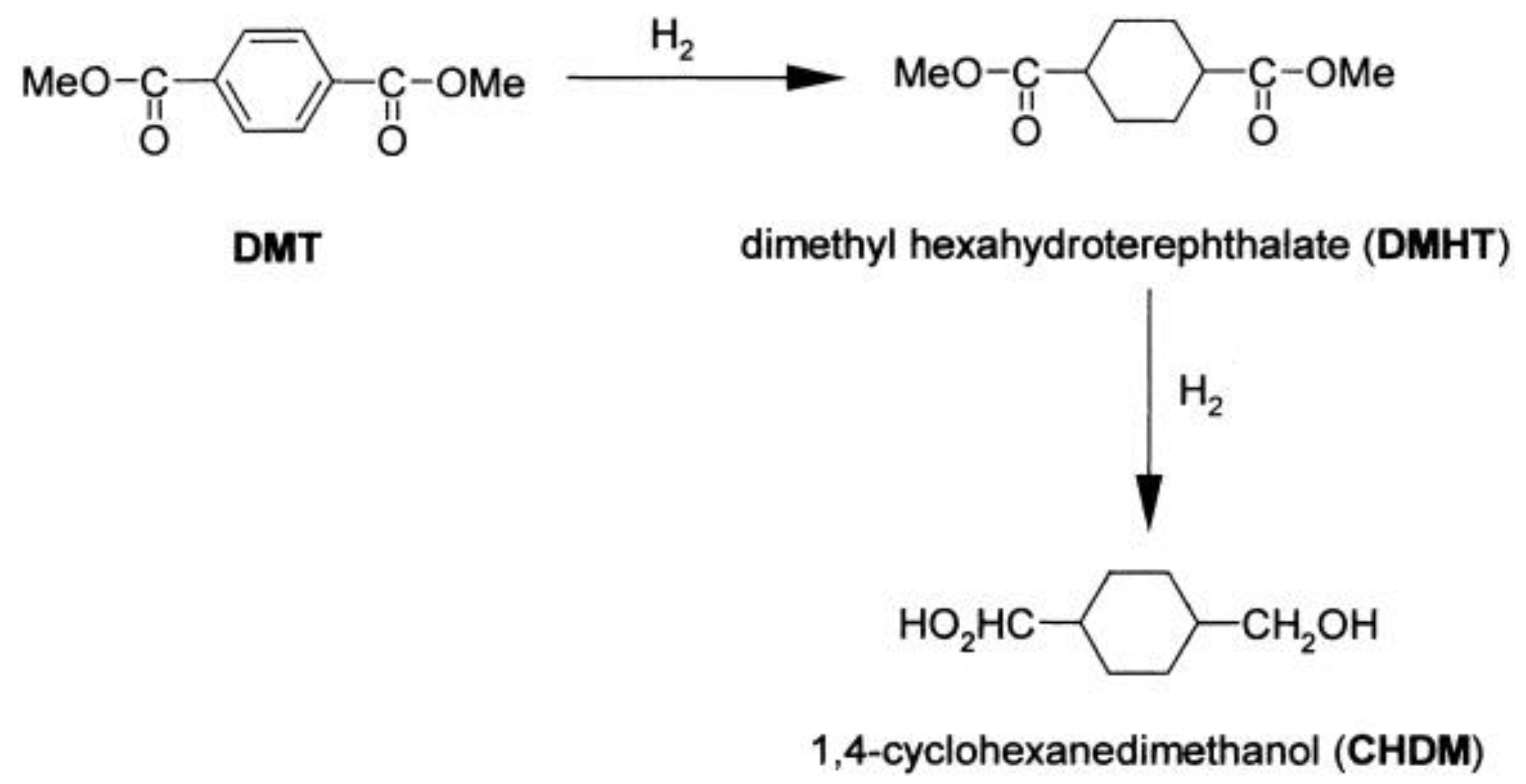
Figure 2.
Trans- and cis-isomers of 1,4-cyclohexanedimethanol (CHDM).
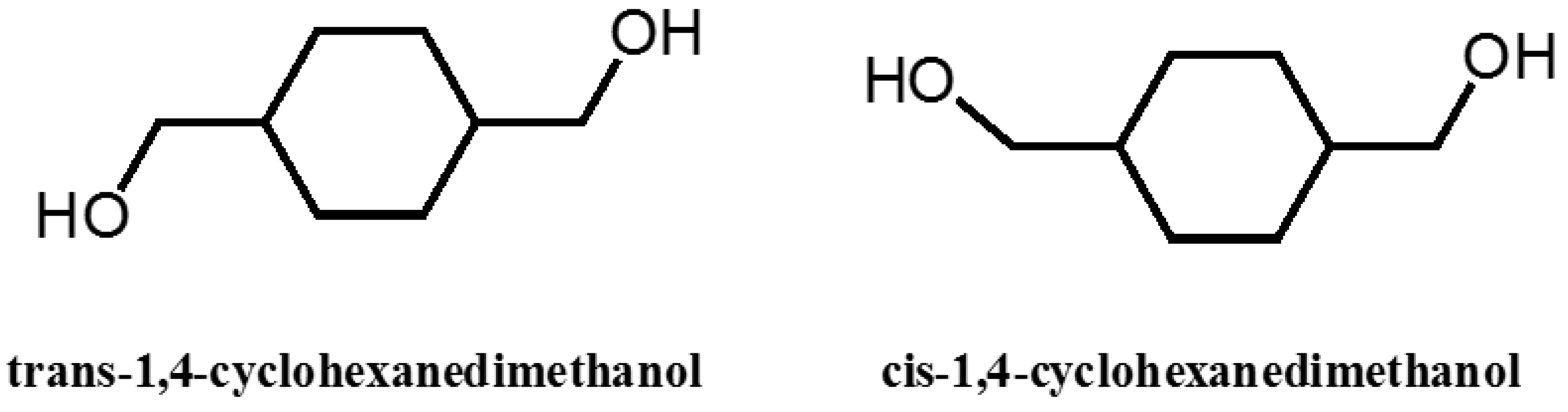
Figure 3.
Chemical structure of various aliphatic polyesters.
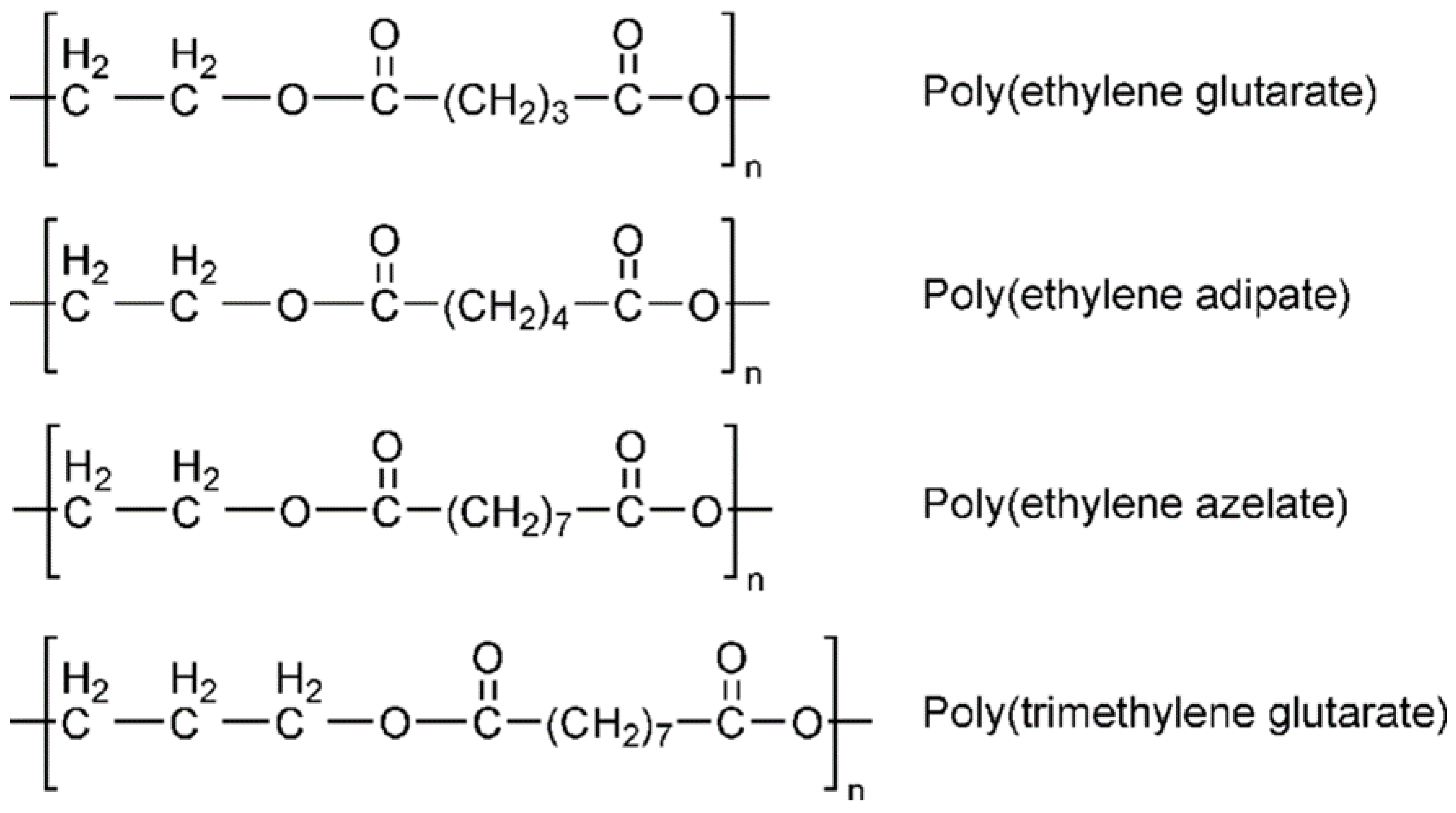
Figure 4.
Schematic diagram for the solution polymerization of PCTN copolyester.
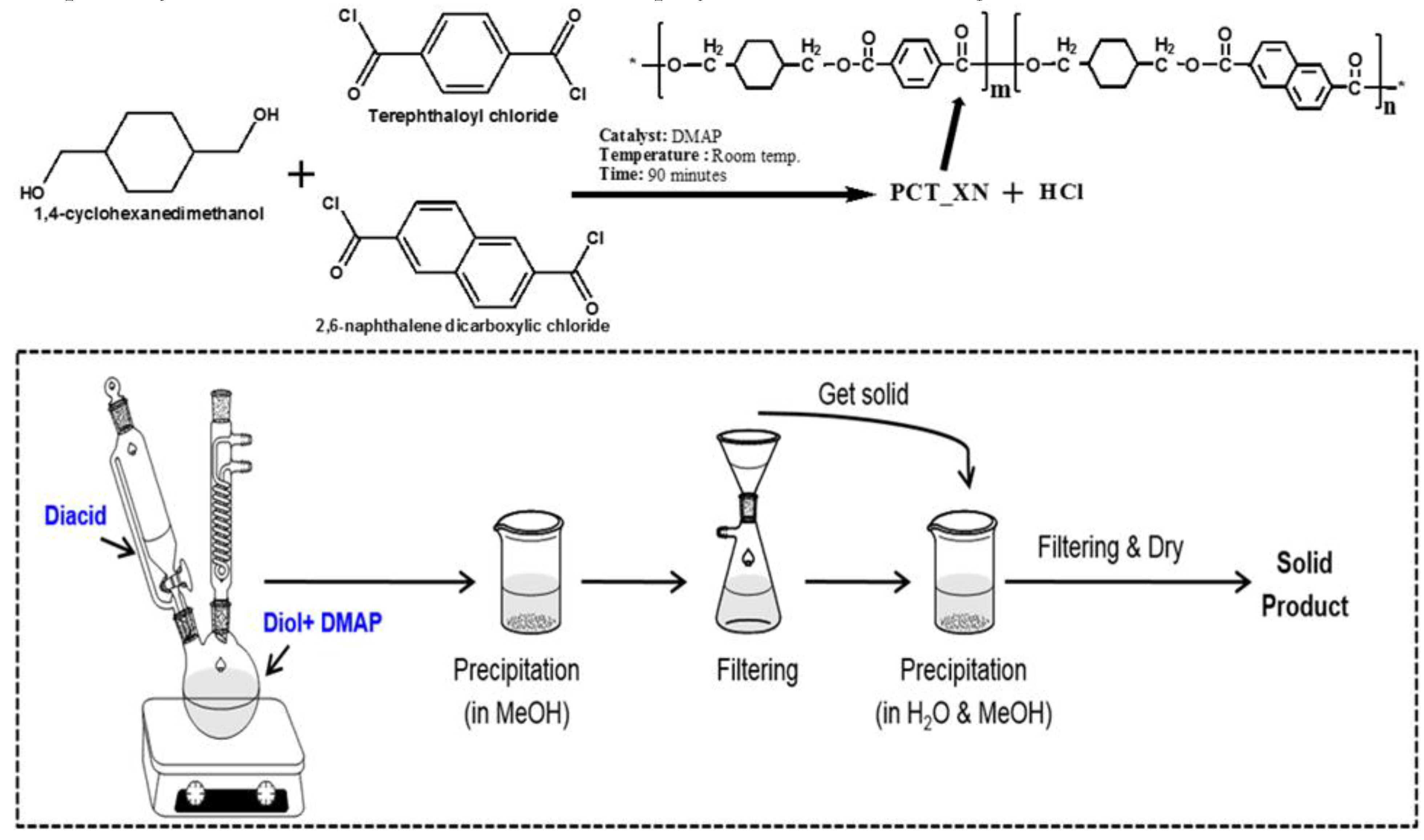
Figure 5.
Piolet scale melt polymerization reactor.
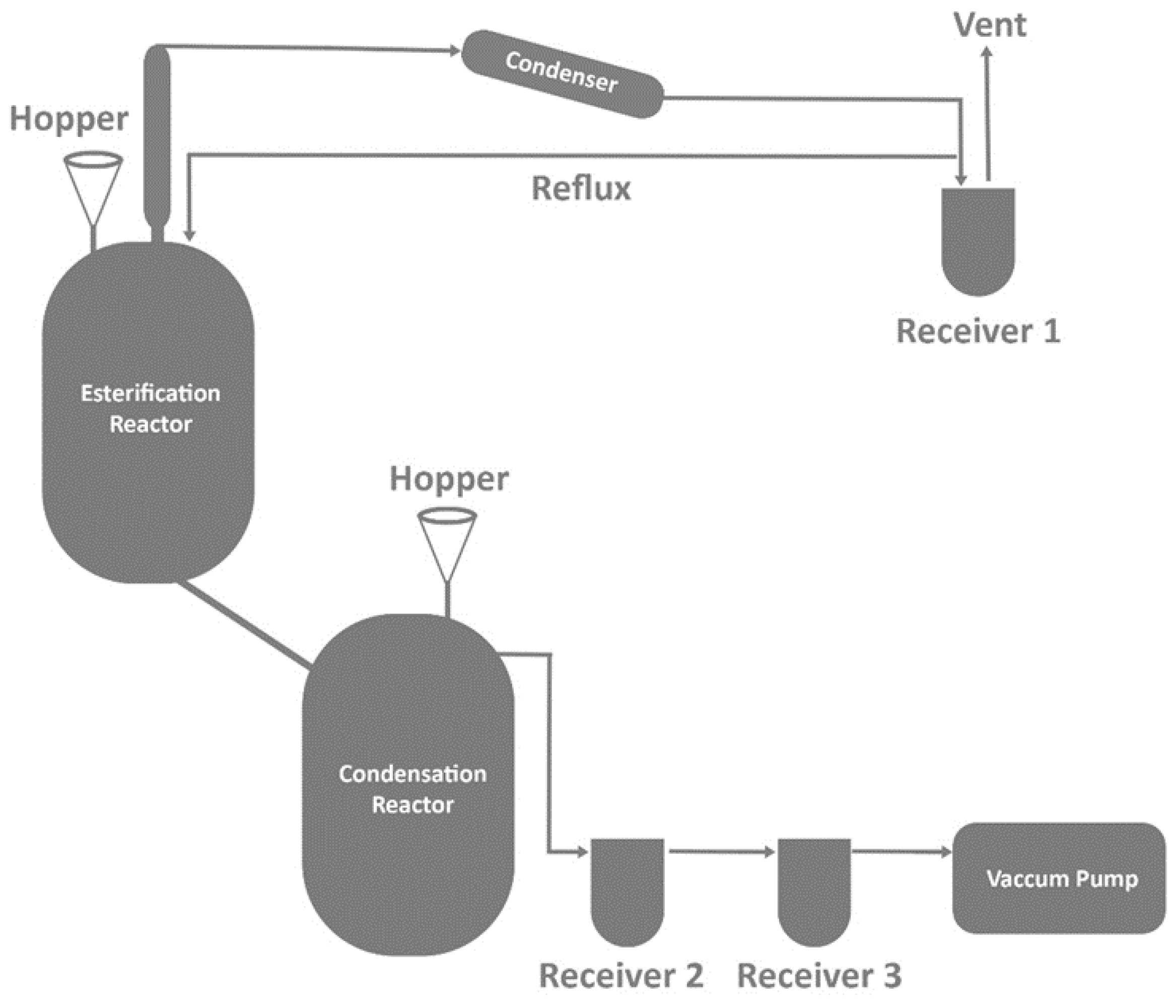
Figure 6.
(a) Chemical structure of PET, PCT, PEN and PCN homopolyesters, (b) DSC thermograms of PET, PCT, PEN and PCN homopolyesters.
Figure 6.
(a) Chemical structure of PET, PCT, PEN and PCN homopolyesters, (b) DSC thermograms of PET, PCT, PEN and PCN homopolyesters.
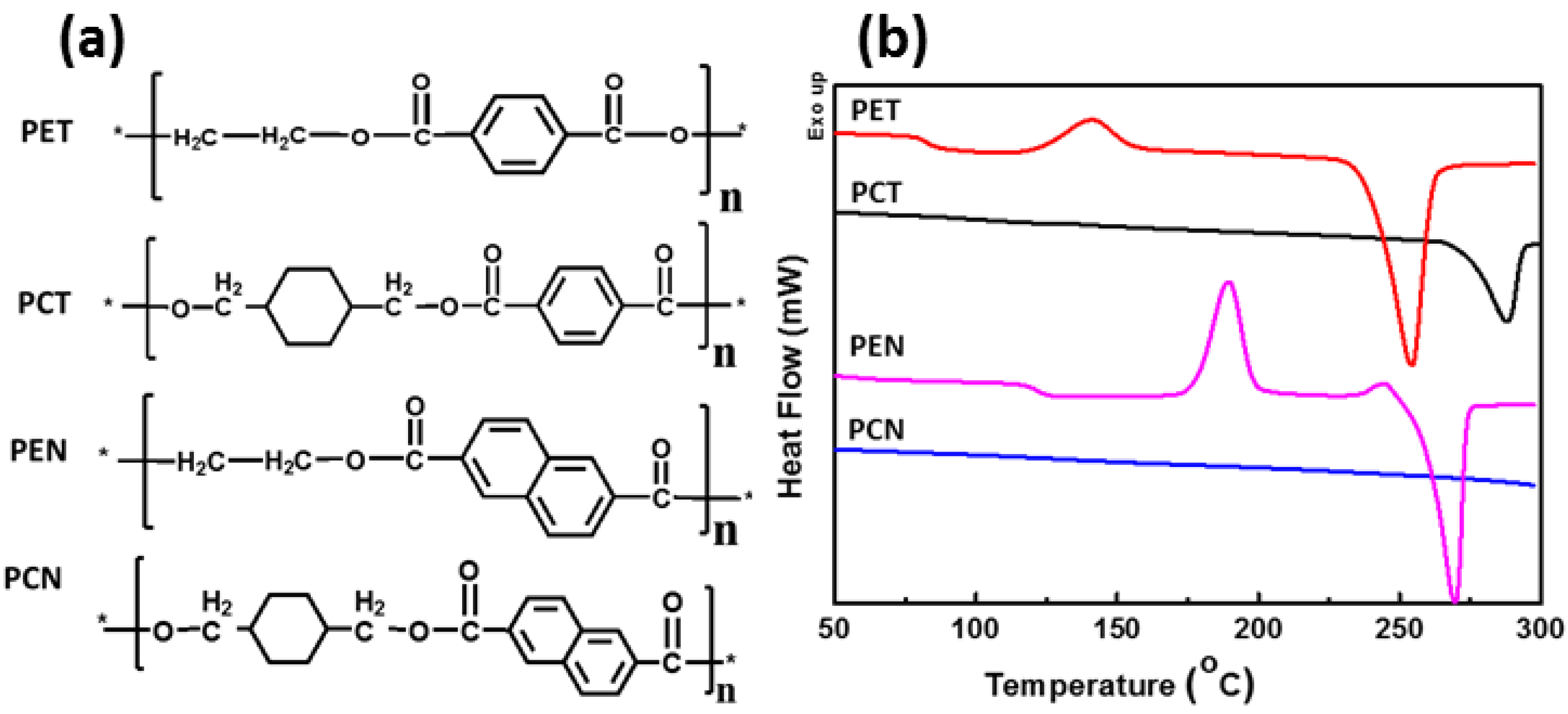
Figure 7.
Effect of 1,4-CHDM on Tm of CHDM modified PET copolyester [39].
Figure 7.
Effect of 1,4-CHDM on Tm of CHDM modified PET copolyester [39].
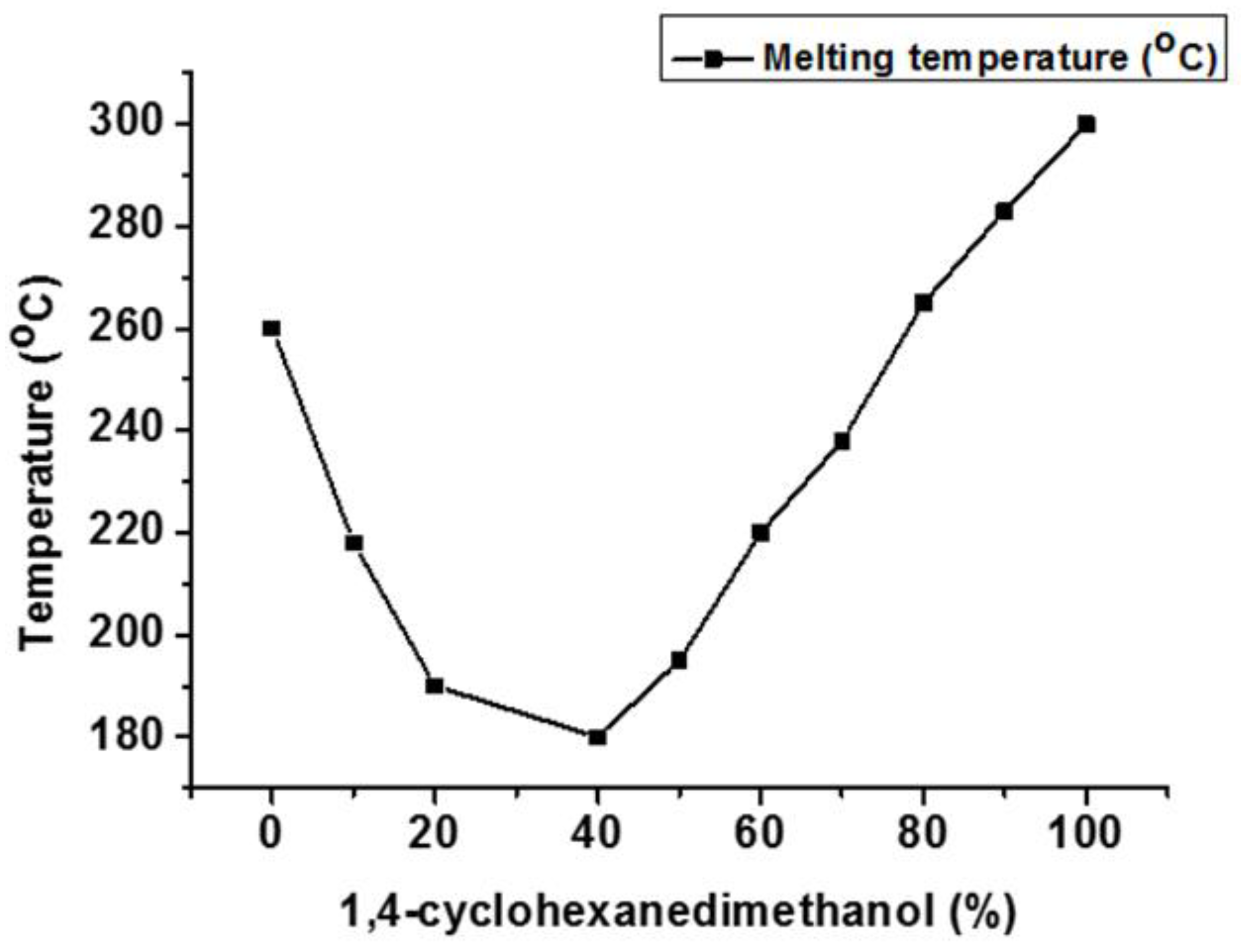
Figure 8.
Effect of composition on Tg and Tm of PBN-co-CN copolyester.
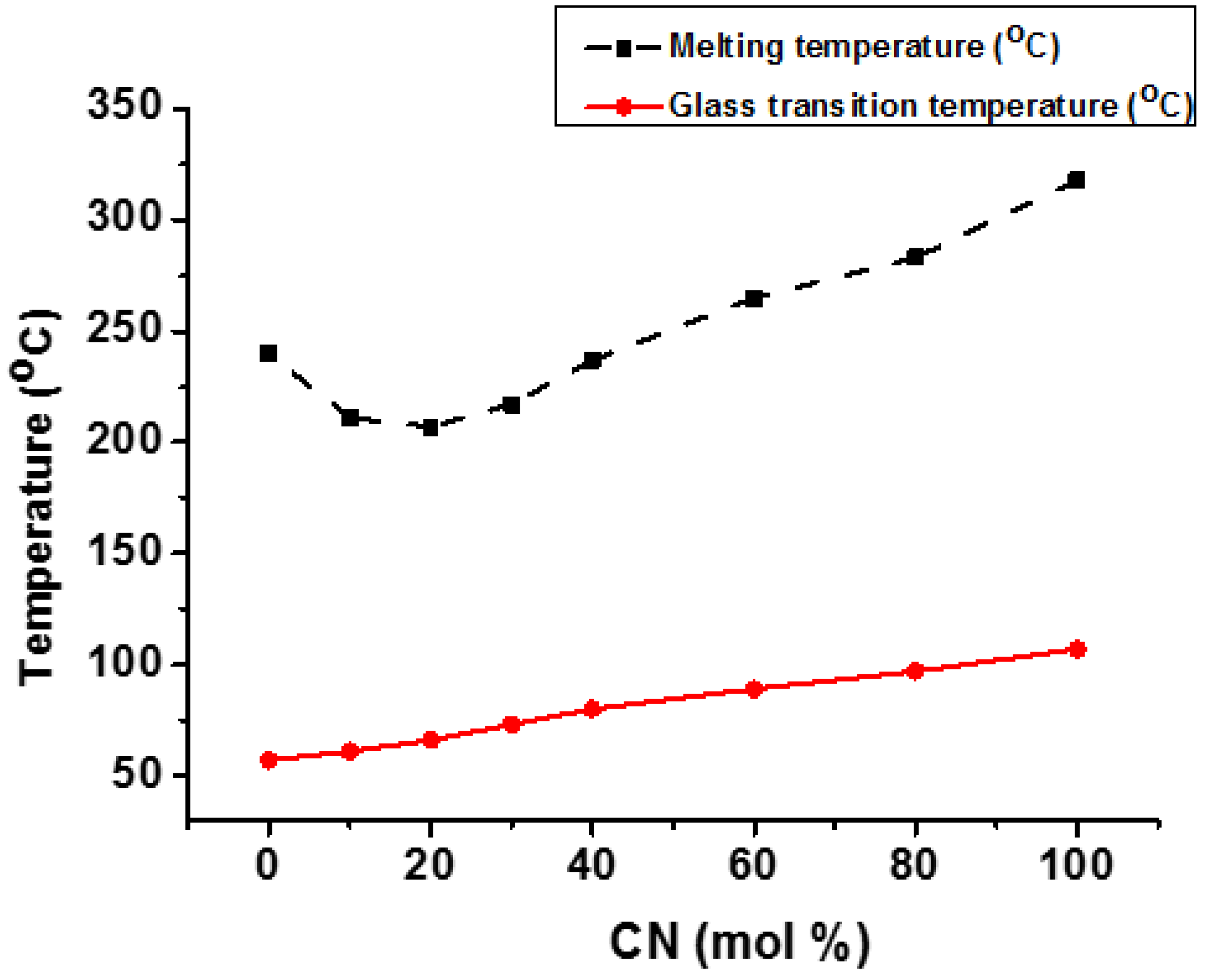
Figure 9.
Effect of composition on Tg and Tm of PTCT copolyester.
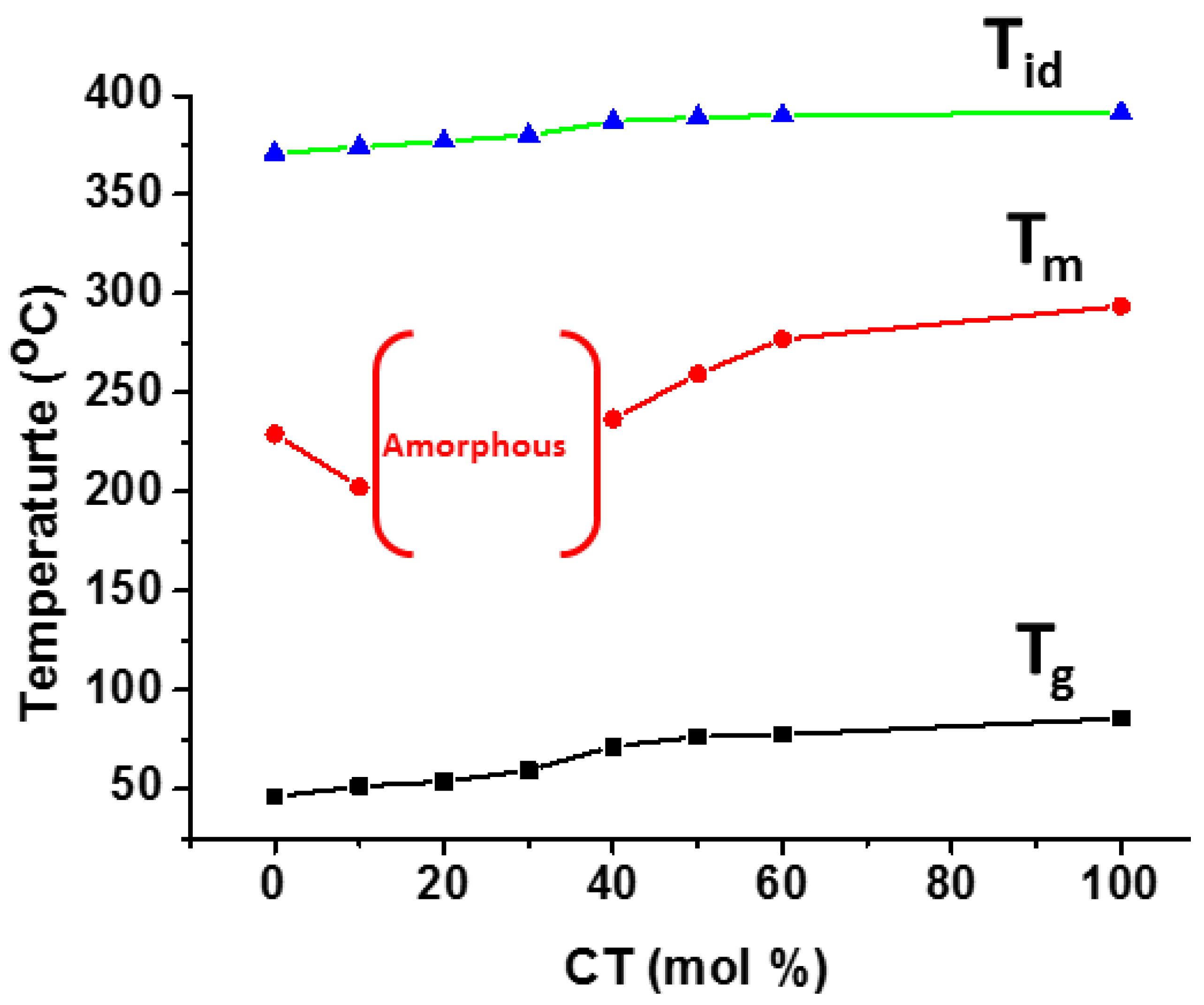
Figure 10.
Effect of isophthalate content (%) on Tg and Tm of PCT copolyester [39].
Figure 10.
Effect of isophthalate content (%) on Tg and Tm of PCT copolyester [39].
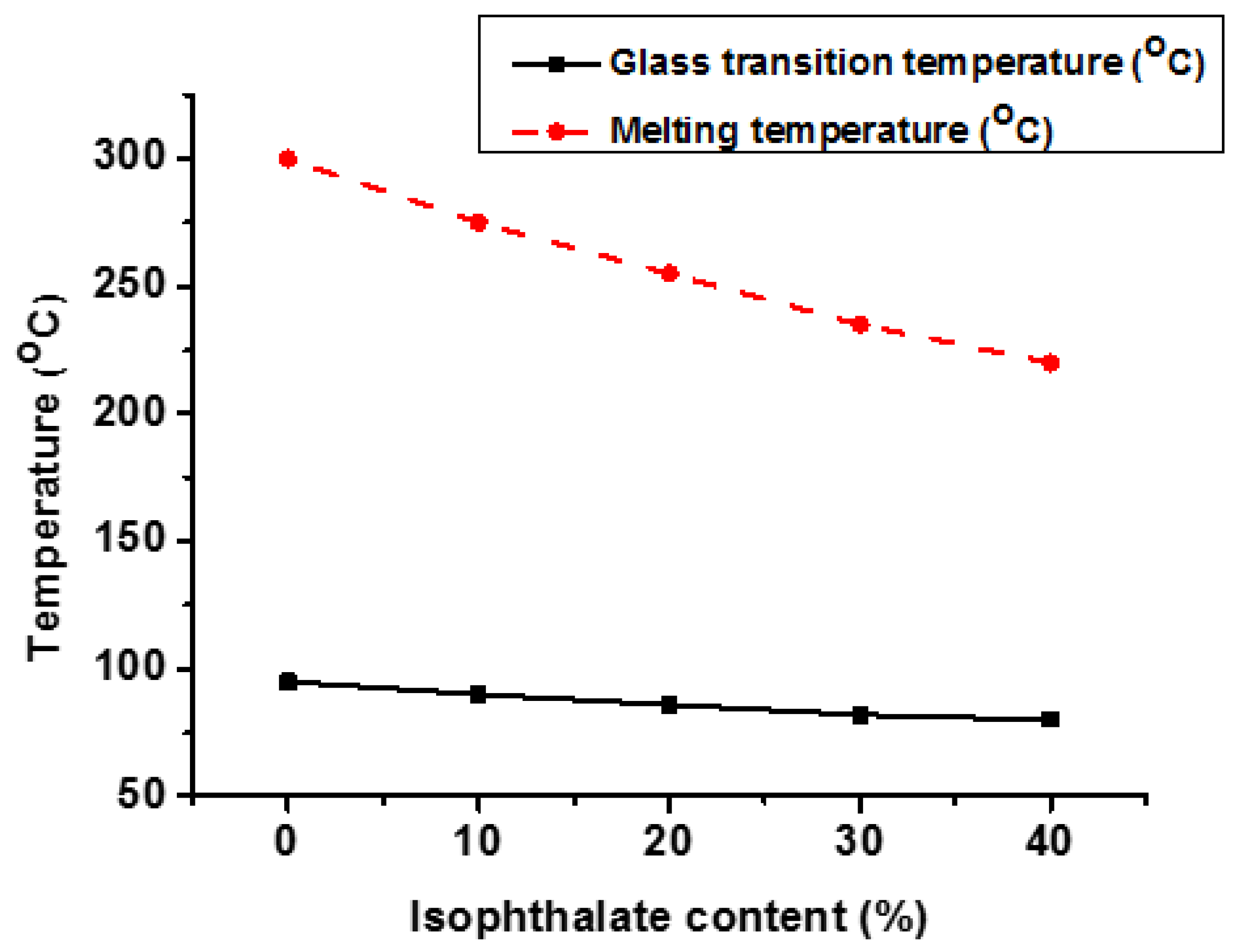
Figure 11.
Effect of naphthalene content on the gas barrier properties of PCTN.
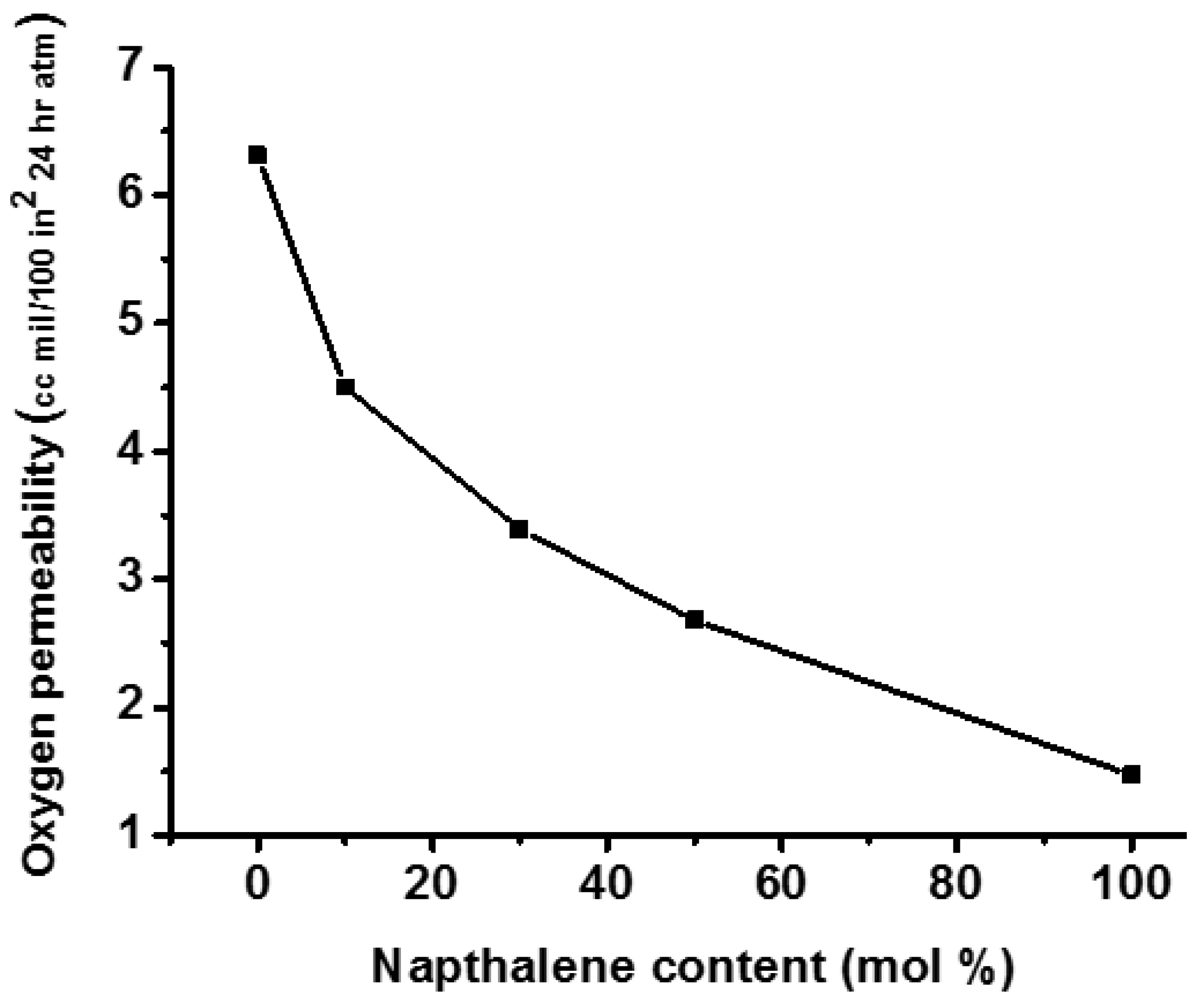
Figure 12.
Chemical structure of acid modfied PCT copolyesters (PCTN, PCITN, and PCTA).
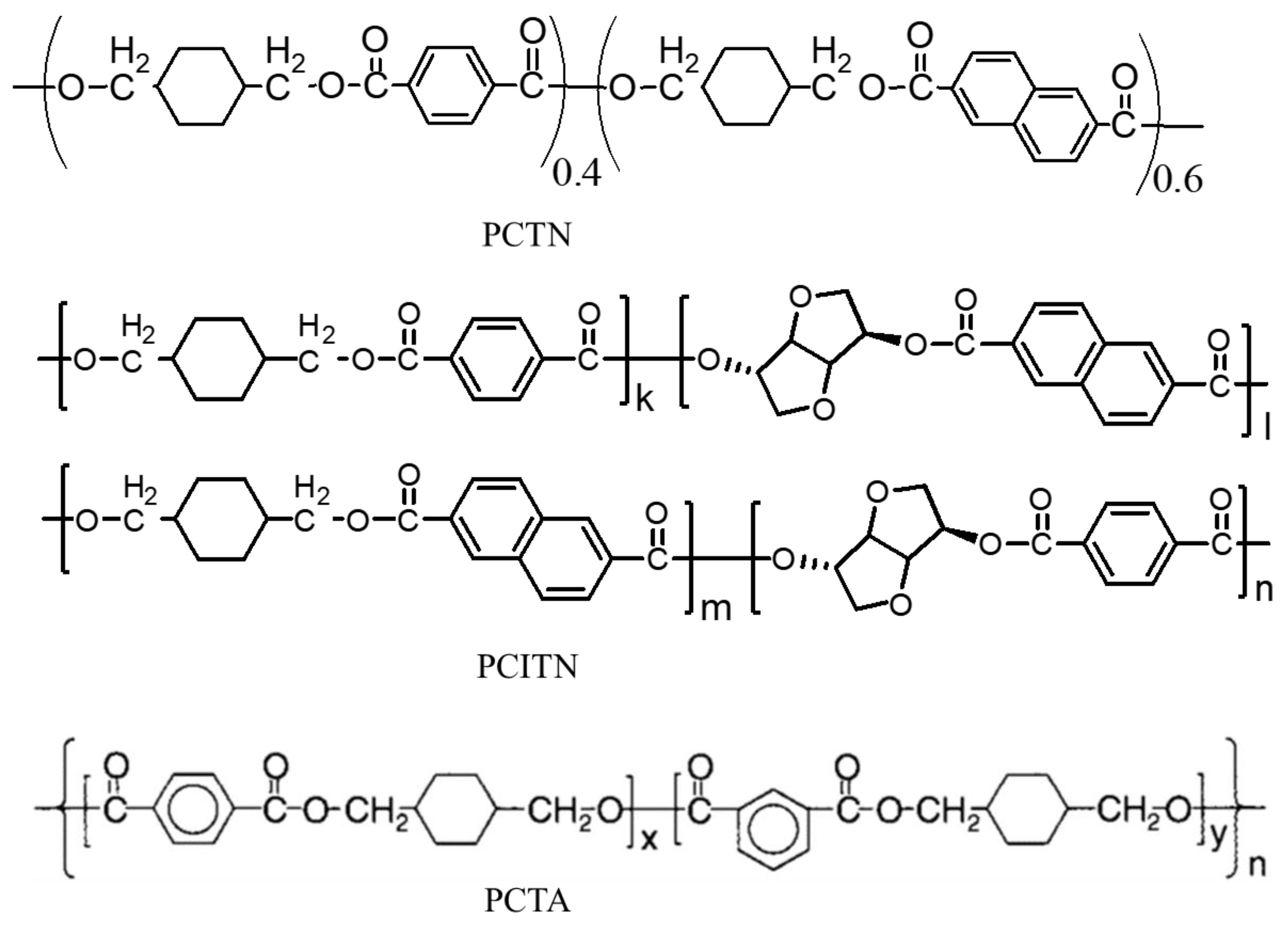
Figure 13.
Effect of trans-1,4-CHDM on Tm of PCT homopolyester [30].
Figure 13.
Effect of trans-1,4-CHDM on Tm of PCT homopolyester [30].
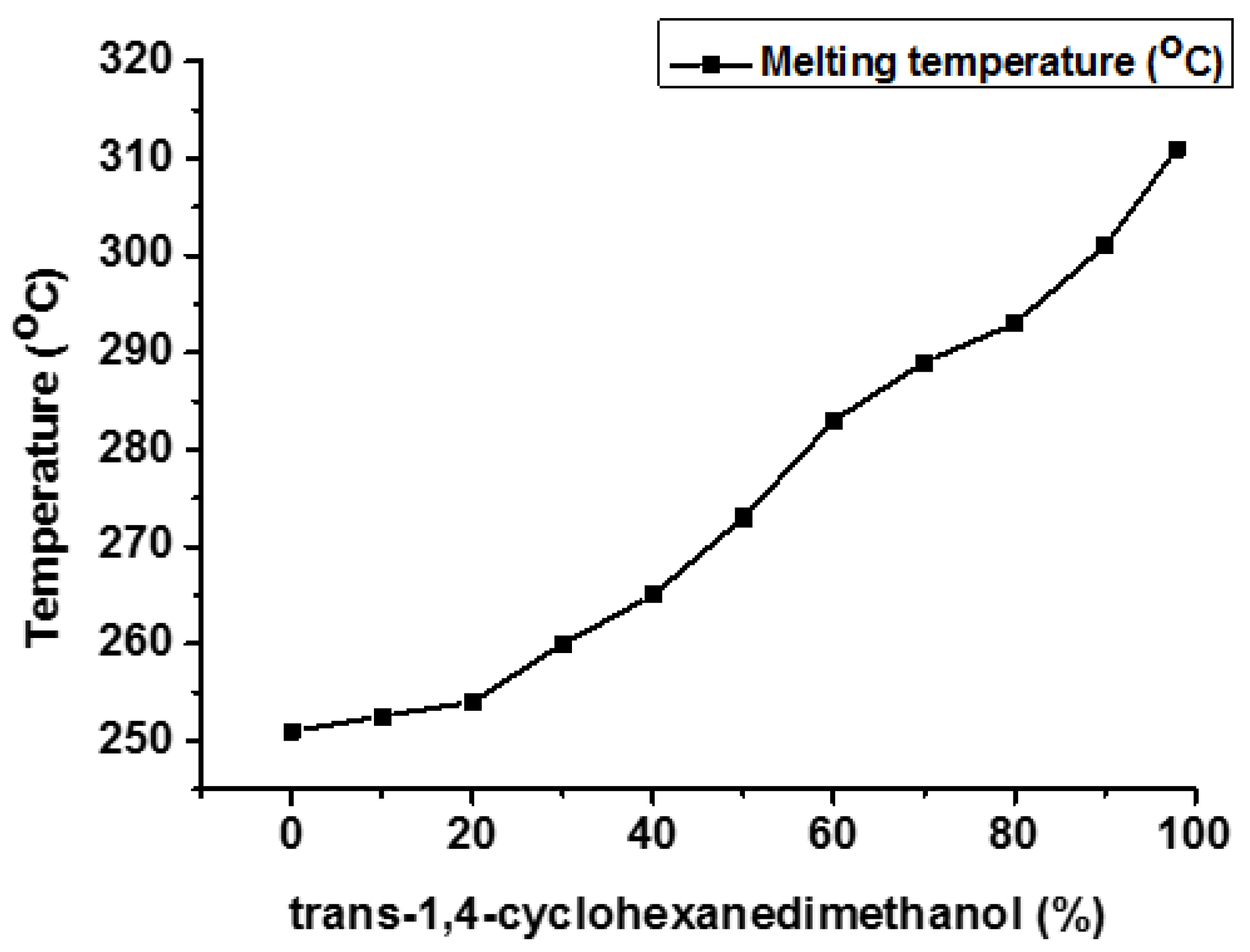
Figure 14.
Effect of trans-CHDM content (%) on Tg and Tm of PECFs copolyester [108].
Figure 14.
Effect of trans-CHDM content (%) on Tg and Tm of PECFs copolyester [108].
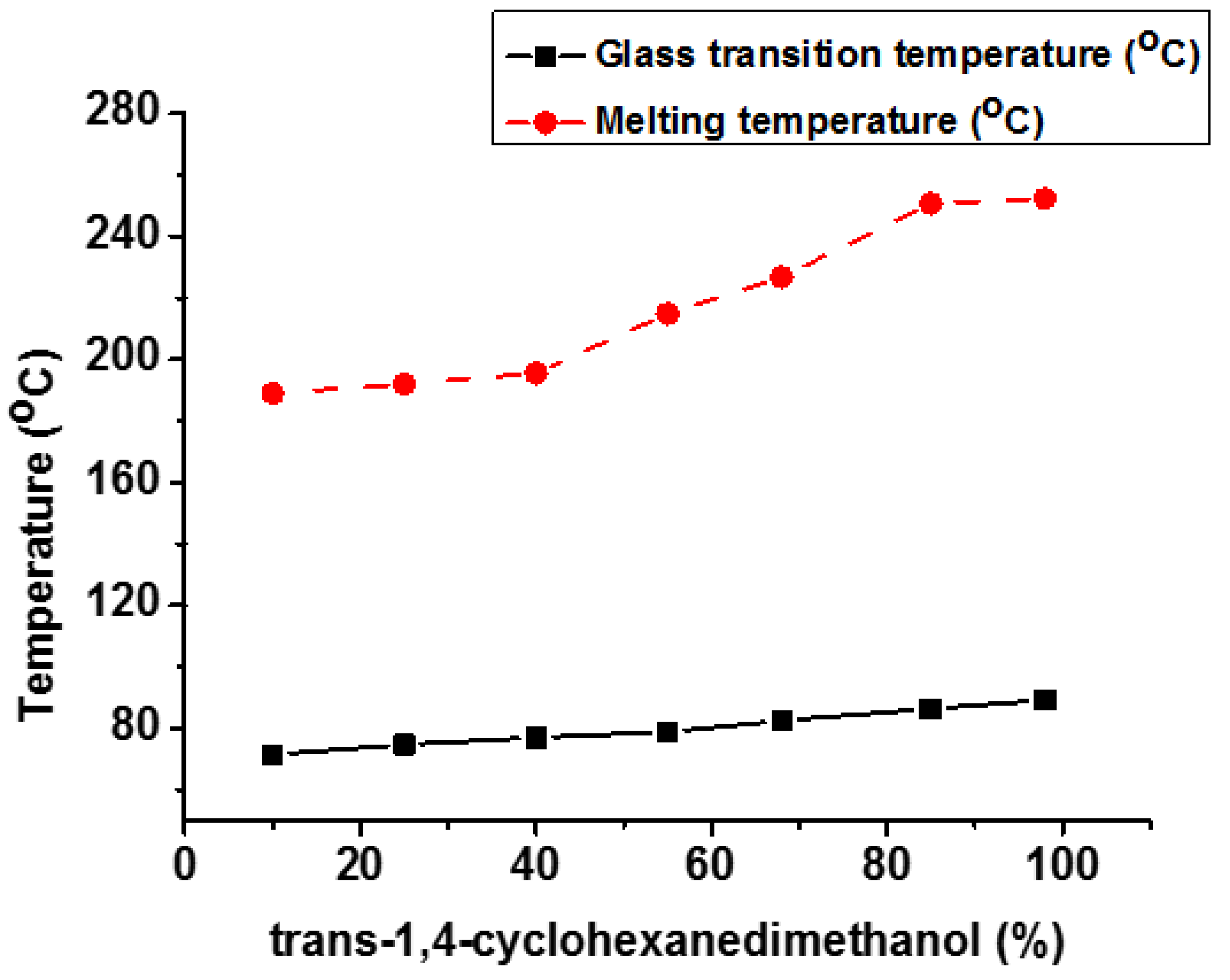

Table 1.
Chemical composition and comparative properties of PET, PCT, PEN, and PCN homopolymers [20,24,39,40].
| Properties | PET | PCT | PEN | PCN |
|---|---|---|---|---|
| Monomers | EG, TPA | CHDM, TPA | EG, NDA | CHDM, NDA |
| Tg (oC) | 80 | 88 | 122 | 139 |
| Tm (oC) | 260 | 297 | 269 | 320 |
| Tc (oC) | 140 | - | 189 | - |
| Mw | 44,800 | 53,200 | 50,600 | 49,195 |
| Mn | 20,600 | 23,600 | 23,600 | 28,821 |
| Polymer disparity index | 2.17 | 2.25 | 2.14 | 1.71 |
| Lattice structure | Triclinic | Triclinic | Triclinic | triclinic |
| Density (g/cm3) | 1.337 | 1.197 | 1.198 | 1.313 |
| Intrinsic Viscosity(dl/g) | 0.70 | 0.79 | 0.84 | 0.70 |
| Young’s modulus, MPa | 3900 | 3660 | 5200 | - |
| Tensile strength, MPa | 45 | 52 | 60 | - |
| Break elongation, % | 150 | 250 | 65 | - |
| UV absorbance (360 nm, %) | 1 | 0.90 | 17 | - |
| Oxygen permeability (cm3-mil/100 in.2-24 h-atm) | 9.0 | 40 | 3.1 | 1.47 |
| Hydrolysis resistance, h | 50 | - | 200 | - |
Table 2.
Thermal properties of PCTN# copolymers after SSP [76].
Table 2.
Thermal properties of PCTN# copolymers after SSP [76].
| Samples | Tg (oC)a | Tm (oC)b | ∆Hm (J g-1)c | Crystallinity (%) |
|---|---|---|---|---|
| PCTN_0 | 83.79 | 285.76 | 48.53 | 47.6 |
| PCTN_18 | 84.75 | 261.69 | 31.94 | 31.3 |
| PCTN_26 | 85.12 | 246.81 | 31.43 | 30.81 |
| PCTN_36 | 85.35 | 235.85 | 39.49 | 38.7 |
| PCTN_47 | 88.62 | 238.21 | 35.54 | 34.8 |
| PCTN_56 | 92.62 | 255.17 | 27.16 | 26.6 |
| PCTN_65 | 107.54 | 278.61 | 28.33 | 27.8 |
| PCTN_83 | 114.30 | 310.21 | 39.37 | 38.6 |
a,b,cAll the results of DSC from 2nd run cycle (heating – quenching – heating).
| Copolyester composition |
Tg (oC) | Tm (oC) | IV (dl g-1) |
|---|---|---|---|
| PCT | 88.0 | 295.3 | 0.85 |
| PCTA-48 | 66 | 225 | 0.75 |
| PCTN_30 | 97.91 | 244.88 | 0.79 |
| PCTN_70 | 110.28 | 279.76 | 0.76 |
| PCTS_17 | - | 286.0 | 1.04 |
| PCTS_25 | - | 280.0 | 0.93 |
| PCTSA_17 | - | 268 | 0.91 |
| PCTSA_25 | - | 270 | 0.94 |
| PETg30N-30 | 85 | - | 0.73 |
| PETg30S-30 | 44 | - | 0.65 |
A; CHDA (95% trans), N; 2,6-NDA, S; Succinic acid, SA; Sebacic acid, .
Table 4.
Basic properties of conventional materials use as flexible substrate materials for displays [119,120].
| property | PET (Malinex) |
PEN (Teonex) |
Glass | PI (Kapton) |
Steel |
|---|---|---|---|---|---|
| Optical property (%transmission 400-700 nm) | >85 | 0.85 | >92 | yellow | 0.0 |
| Tg (OC) | 80 | 121 | - | 410 | - |
| Water absorption (%) | 0.4 | 0.4 | 0.0 | 1.8 | 0.0 |
| Permeable to oxygen | yes | yes | no | yes | no |
| Young’s modulus (GPa) | 5.3 | 6.1 | 80 | 2.5 | 200 |
| Tensile strength, (MPa) | 225 | 275 | 27-62 | 231 | 370 |
| CLTE -55 TO 85 OC (ppm/OC) | 15 | 13 | 4 | 30-60 | 10 |
| Maximum processing temperature (OC) | 80 | 180 | 600 | 300 | 1000 |
| Deform after device fabrication | yes | yes | no | yes | No |
| Roll to roll processing? | likely | likely | unlikely | likely | Yes |
| Prebake required? | yes | yes | may be | yes | no |
| Electrical conductivity | none | none | none | none | high |
| Upper working temperature | 115-170 | 155 | 600 | 250-320 | 1400 |
| Thermal conductivity (W/m. OC) | 0.1 | 0.1 | 1 | 0 | 16 |
| Safe bending radius (cm) | - | 4 | 40 | 4 | 4 |
| Refractive index | 1.66 | 1.75 | 1.52 | 1.50 | 2.76 |
| Coefficient of hydrolytic expansion (ppm/%RH) | - | 11 | 0 | 11 | 0 |
| Thermal conductivity (W/m OC) | 0.1 | 0.1 | 1 | 0.1-0.2 | 16 |
| Density g/cm3 | 1.4 | 1.36 | 2.70 | 1.43 | 7.8 |
Table 5.
Comparative analysis of the key performance characteristic of advanced polymeric substrates in comparison of conventional PI polymeric substrates [33,104,105,122,123,124].
| Property | PI (Kapton) |
PCTN (Uniaxially stretched) |
PCTN (Biaxially Stretched) |
PCITN (Randomly Oriented) |
PCITN (Uniaxially stretched) |
| Glass transition temperature (oC) | 360 | 127 | 124.3 | 120.4 | 140 |
| Melting temperature (oC) | - | 279 | 276.8 | 279 | 275 |
| Commercial availability | Yes | No | No | No | No |
| Transmission (300-800 nm), % | Yellow | 87 | 94 | 86.7 | 86 |
| CTE (-55 to 85 oC) (ppm oC-1) | 30-60 | 6.0 | 13.6 | - | 5.8 |
| Young’s modulus (GPa) | 2.5 | 2.1 | 2.8 | 2.2 | 2.6 |
| Birefringence (△n) | - | 0.09 | 0.003 | 0.08 | 0.09 |
| Water absorption (%) (Randomly Oriented) |
1.8 | 0.37 | 0.16 | 0.21 | 0.14 |
Disclaimer/Publisher’s Note: The statements, opinions and data contained in all publications are solely those of the individual author(s) and contributor(s) and not of MDPI and/or the editor(s). MDPI and/or the editor(s) disclaim responsibility for any injury to people or property resulting from any ideas, methods, instructions or products referred to in the content. |
© 2024 by the authors. Licensee MDPI, Basel, Switzerland. This article is an open access article distributed under the terms and conditions of the Creative Commons Attribution (CC BY) license (http://creativecommons.org/licenses/by/4.0/).
Copyright: This open access article is published under a Creative Commons CC BY 4.0 license, which permit the free download, distribution, and reuse, provided that the author and preprint are cited in any reuse.