

Submitted:
16 July 2024
Posted:
17 July 2024
You are already at the latest version
Abstract
This study aimed to develop a carbon yield model for a Makino bamboo plantation and addressed a monoculture Makino bamboo plantation in central Taiwan. We established a long-term trial to monitor the stand dynamic following thinning. A total of 16 plots were installed based on four thinning treatments, each sharing four plots. After thinning, data were collected from two investigations, resulting in 32 records. We calculated the number of culms (N), mean diameter at breast height (MDBH), and basal area (BA) for each record. An allometric function developed by previous research was used to predict aboveground biomass and to obtain aboveground carbon storage (AGCS). The model used the N, MDBH, and BA with various types (reciprocal and natural logarithm types) as independent variables to predict ln(AGCS) by the stepwise method. According to the Radj2 value, the best predictive models were: ln(ABCS) = -0.004 + 0.820 ln(MDBH) + 1.008 ln(BA), and ln(ABCS) = 7.550 - 0.820 ln(N) + 1.828 ln(BA). From these two models, we found the factors, either BA and MDBH or BA and N, can effectively predict AGCS. It indicated that stand density was critical in affecting AGCS, especially the variable BA.
Keywords:
bamboo plantation
; thinning
; aboveground biomass
; aboveground carbon storage
; allometric model
1. Introduction
Bamboo resources possess many advantages, including rapid growth, high productivity, a short yield period, and bamboo plants with multiple utilization [1,2,3,4,5,6,7,8,9,10,11,12,13,14,15,16,17,18]. Therefore, bamboo resources are essential for people, especially in Asia. Because the weather and environmental factors are suitable for bamboo growth, over 150,000 ha of bamboo forests cover terrestrial areas, and most such forests are plantations, providing multiple ecological services in Taiwan [7,8,18,19,20,21,22,23,24,25]. Traditionally, culms and bamboo shoots are two main products that provide jobs and increase income for local people in villages [7,8,25,26,27,28,30,31].
However, selective cutting or thinning is necessary to improve productivity in managed bamboo plantations, regardless of harvesting culms or bamboo shoots [21,30,32,33,34,35]. Such an approach only removes old culms, and most culms are still maintained in the lands of bamboo plantations after harvesting, indicating the lands are always covered by most bamboo plants in bamboo forests. Because the process of harvesting bamboo forests is friendly to the environment, the products of bamboo culms are also regarded as non-timber forest products (NTFPs) [15,25]. In recent years, bamboo forests with high potential for carbon storage have been discovered worldwide for various species because their rapid growth results in fast accumulation of dry mass [9,21,23,25,28,29,33,36,37,38,39,40].
Makino bamboo (Phyllostachys makinoi) is a native species with a particular ecological meaning in Taiwan. Plantations of this species are widely distributed in northern and central Taiwan [8,21,24,41]. Meanwhile, this bamboo is a crucial bamboo species because both culms and bamboo shoots have high economic value. Usually, they are planted by monoculture for financial purposes [8,19,20,21,24,41,42]. Since Makino bamboo possesses high ecological and economic values, numerous studies have addressed this bamboo species in various aspects. Those studies included cost analysis for managed plantations [43], assessing growth and biomass accumulation for the stand level [19], analyzing stand structure of plantations [21,42], the impact of thinning on the growth and biomass accumulation [20], quantifying culm height growth by growth functions [41], and assessing the ability of carbon storage for the stand level [9,21,25].
However, rare studies addressed the carbon yield model and explored the factors affecting carbon yield for the Makino bamboo plantations. Developing a carbon yield model helps assess the contribution of carbon storage for this bamboo species. Therefore, the objectives of this study were to (1) collect data from stands of various stand densities resulting from thinning treatments, (2) predict aboveground carbon storage (AGCS) based on aboveground biomass (AGB), (3) develop a carbon yield model, and (4) analyze the main factors to affect AGCS, for Makino bamboo.
2. Materials and Methods
2.1. Study Areas
The study site was located in central Taiwan, belonging to the Tai Keng region, Beitun District, Taichung City (between 120.74°and 120.76°E and 24.16°and 24°18°N), with the lower mountainous area (at an elevation of 226 m). The detailed location of the study site is shown in Figure 1.
Because this region is abundant in natural resources and has beautiful scenery, it was designated as a scenic area by the Taichung City Government in 1976, called the “Dakeng Scenic Area” [44]. According to the weather data of Taichung City from 1981 to 2010, the monthly temperature was from17.0°C (in January) to 28.9°C (in July), the mean was 23.7°C, the relative humidity was 74.5%, and the annual rainfall was 1,762.8 mm [45]. This region is also rich in bamboo resources, and Makino bamboo is a critical bamboo species. Most of the Makino bamboo are plantations managed by farmers for economic benefits. In recent decades, bamboo shoot production had higher monetary values than the culm harvest; therefore, harvesting bamboo shoots is a significant management type for Makino bamboo plantations [24]. To develop a growth and yield system for this bamboo species, a site of a monoculture plantation by private farmer management was selected as an experimental site (Figure 1). The farmer allowed us to practice thinning and monitoring in its plantation.
2.2. Materials
This study established a long-term trial to monitor the stand dynamics of a Makino bamboo plantation with various thinning treatments in 2019. Four treatments, namely Treatments I, II, III, and IV, by different thinning intensities, were designed and installed on this site. The thinning intensity used in this study is listed in Table 1.
Treatments I, II, III, and IV were thinning 75%, 50%, 25%, and 0% of the culm number (hereafter also called heavy, moderate, light, and no thinning), respectively. The principle of the thinning was thinning from the older culms and abnormal culms. In Mach 2019, after the thinning project was determined, 16 sample plots of 5 × 5 m were randomly installed. Thinning treatments were performed in May 2019. Each treatment shared four plots. At the same time, we measured DBH and determined the culm age for each culm within plots after thinning treatments. The culm age was determined based on the colour and status of the culms. Please refer to Yen et al. [21] and Liu et al. [24] for detailed approaches. In February 2021, we resurveyed the same items of culms for each plot and recorded new culms developing in this period. However, we did not harvest bamboo shoots for all plots to monitor the dynamic of bamboo stands after thinning.
2.3. Data Analysis
We calculated the AGCS for the plots of various thinning treatments with two investigations. The detailed processes were described as follows:
- The allometric model predicted AGB for individual bamboo plants based on their DBH. Because the allometric function for predicting AGB has been built for Makino bamboo in this region by Yen et al. [21], the present study directly cited this model for estimating the AGB of each bamboo plant. The model is shown as Equation (1) [21].where AGB is aboveground biomass, and DBH is the diameter at breast height.AGB = 0.156 × DBH 2.118
- The AGB of plots was obtained from the summation of each individual within plots when the AGB of individuals was predicted. Consequently, the AGB of all plots was obtained, and we formatted the unit of AGB as Mg ha–1.
- The AGCS prediction was based on the AGB and percentage of carbon content (PCC), indicating that AGCS equals AGB × PCC. However, aboveground consists of foliage, branches, and culms for bamboo plants. The study required the proportion of each section’s biomass to AGB and its PCC and obtained the PCC of AGB from the summation of each section’s biomass ×its PCC [30]. In a previous study, Yen et al. [21] determined the proportion biomass of foliage, branches and culms to be 8.4, 15.7 and 75.9%, respectively, and their PCC was 40.08, 46.06 and 47.65 %, respectively. Consequently, the aboveground PCC was calculated as: (8.4% × 40.08%) + (15.7% × 46.06%) + (75.9% × 47.65%) = 46.76%. In this study, we used AGB × 46.76% for predicting AGCS.
- We calculated the AGCS (Mg ha−1), culm number (culm ha−1), mean DBH (cm), and BA (m2 ha−1) for each plot with two periods (2019 and 2021). The regression model employed the culm number, mean DBH, and BA as independent variables and ln (AGCS) as a dependent variable. The model is shown as Equation (2)Y = β0 + β1 X1 + β2 X2 + β3 X3 +ε
where Y is aboveground carbon storage (ABCS) taken the natural log as ln (ABCS); X1 is number of culms per hectare (N), 1/N, or ln (N); X2 is mean diameter of breast area (MDBH), 1/MDBH, or ln (MDBH); and X3 is basal area per hectare (BA), 1/BA, or ln (BA); andεis the error.
After modelling, the Radj2 value was used as an indicator to evaluate the models' performances, where a higher value indicated a model with better predictive ability. The model with the highest Radj2 value was chosen to analyze bias. The root mean square error (RMSE) was used to evaluate the fitness of the models for observed and predicted AGCS. The detailed formula for RMSE is given in Equation (3)
where Yi and Ŷi are the i observation and the predicted aboveground carbon storage by the model, respectively, and n is the total number of observations.
3. Results
3.1. Stand Characteristics at Two Investigations
The N, MDBH, and BA were calculated based on individuals. According to Equation (1) and the PCC, the AGB and AGCS were obtained. Table 2 shows the above stand characteristics with various thinning treatments at two investigations.
Table 2 provides fundamental information for stand characteristics with various thinning treatments and their development. In 2019, after thinning, N, BA, AGB, and AGCS decreased, and MDBH increased, with thinning intensity increasing. The stand characteristic also displayed the same pattern in 2021. During stand development, we found that N, BA, AGB, and AGCS rose from 2019 to 2021, regardless of thinning intensity. Reasonably, their increase resulted from stand development. However, our study's purpose was to develop a carbon yield model and did not further analyze the relationship between thinning treatment and stand development in the present study.
3.2. Carbon Yield Models Based on Stand Characteristics
The carbon yield model used N, MDBH, and BA (including their reciprocal and natural logarithm types) as independent variables to predict ln(AGCS) for Makino bamboo. The multiple regression models employed stepwise approaches to solve parameters. Table 3 shows 27 regression models.
From Table 3, high Radj2 values were shown for all models, indicating they had high predictive ability for carbon yield. We also found that only two variables entered some regression models but still had high Radj2. Among 27 models, the two models simultaneously had the highest value of Radj2 (0.9958), and they only had two independent variables, that is, ln(ABCS) = -0.004 + 0.820 ln(DBH) + 1.008 ln(BA), and ln(ABCS) = 7.550 - 0.820 ln(N) + 1.828 ln(BA). Therefore, we chose these two models to predict the carbon yield of Makino bamboo. Notably, these two models commonly showed ln(BA), and this variable was first entered into the models by the stepwise approach, regardless of which model. It indicated that ln(BA) was critical in predicting ln(ABCS). Only used this variable already had high predictive ability. The simple regression for the model was ln(ABCS) = 0.933 + 0.882 ln(BA), Radj2=0.9693. The Radj2 of this model was also higher than some models in Table 3. We further assessed the predictive ability for this model and the two models with the highest Radj2 (hereafter called Models I, III, and III for ln(ABCS) = 0.933 + 0.882 ln(BA), ln(ABCS) = -0.004 + 0.820 ln(MDBH) + 1.008 ln(BA), and ln(ABCS) = 7.550 - 0.820 ln(N) + 1.828 ln(BA), respectively.
3.3. The Scatter Diagram and RMSE for Each Model
To show the relationship between observations and predicted AGCS, a scatter diagram was used to display the predictive effects of each model, as shown in Figure 2.
A perceivable diagonal line implies that the observations are equal to the predicted values, which also helps understand the bias of the models. According to the distribution of dots and a perceivable diagonal line, Models II and III had better prediction effects than Model I because the distribution of dots was closer to the line in Models II and III than Model I (Figure 2). Models II and III displayed a similar distribution pattern in Figure 2. Moreover, we used RMSE to show the bias between observed AGCS and predicted AGCS. The results are shown in Table 3.
4. Discussion
Bamboo plantations consist of individuals of various age classes, which display an uneven-aged structure [8,18,19,20,21,33,34]. This structure results from their development pattern and management approach [8,18,34]. The development of bamboo plants is based on asexual reproduction by rhizome, and new individuals sprout out year by year. Therefore, harvesting or thinning old culms (usually over 4-5 years old) is necessary because it helps increase growth space for new culms and maintain vitality for the entire stands [21,30,32,33,34]. Because thinning is strongly related to stand development, it is crucial for stocking bamboo plantations. It indicates that thinning old culms in bamboo plantations management is necessary, regardless of whether their management purpose is on harvesting culms or bamboo shoots.
On the other hand, fertilization is another approach to improve productivity for bamboo plantations. Intensive management (IM) and extensive management (EM) are two critical strategies widely used in bamboo plantations [30,34,46]. IM involves thinning and fertilization, while EM only includes thinning. Numerous studies have confirmed higher productivity in bamboo plantations performing IM [8,30,46,47]. However, the productivity may only partially reflect the stocking of bamboo plantations. If farmers harvest a significant number of bamboo shoots and only keep a few for further developing culms, bamboo plantations with IE might show lower stocking. It indicates that productivity does not fully reflect stocking because it is affected by the factor of harvesting bamboo shoots. As a result, biomass or carbon stocking does not directly correlate with bamboo plantations performing IE or ME but depends on farmers' decision to harvest culms or bamboo shoots [30,46]. Usually, bamboo plantations for culm harvest have higher stocking while for shoot harvest have lower stocking, regardless of IM or EM.
Despite most bamboo plants possessing wooden structures, they differ from timber trees in stems. Bamboo plants have hollow structures in culms, while boles of timber trees are solid [33,48]. Therefore, weight or biomass is better than volume when measuring bamboo plants to evaluate stocking or productivity [33,48]. Numerous studies have proposed using the allometric model for predicting bamboo plants because this approach has many advantages, such as the model being easy to use, the parameters with special meanings to explain biomass accumulation and a high predictive ability between DBH (or DBH and culm height) and biomass [18,49,50]. As a result, the allometric model plays a critical role in biomass prediction in bamboo studies [9,18,21,23,28,29,33,34,36,37,38,47,50,51,52,53].
The target of the allometric model usually addresses a certain bamboo species or a combination of various bamboo species. The development of an allometric model should consider DBH distribution and age class for sampling because bamboo plantations display uneven-aged structure [18,21]. Suppose a high allometric relationship exists between DBH and biomass in samples. In that case, the model can effectively scale out for the whole stands and extend to the same species, obtaining the biomass of the entire stands from the summation of individuals. Consequently, researchers could easily predict carbon yield because carbon storage is approximately half of the biomass [9,11,15,16,18,21,23,29,33,34,36,37,38,50,52]. Numerous researchers evaluated carbon yield based on the above processes, and the present study also followed it to predict AGCS. Since Makino bamboo is a critical bamboo in Taiwan, the allometric model and PCC have been developed and determined in a previous study by Yen et al. [21]. Therefore, this study adopted this allometric to predict AGB, cited PCC to determine AGCS for Makino bamboo, and obtained a range from 7.16 to 28.37 Mg ha−1. Moreover, Liu and Yen [25] reviewed the published papers and obtained 12 records of AGCS with 22.22 ± 24.66 Mg ha−1 for Makino bamboo plantations. We found a significant standard deviation in the AGCS. As mentioned above, the variations in the stocking resulting from farmers’ management purposes might lead to a substantial variation in Makino bamboo plantations, which covered the range of the AGCS predicted in our study.
Even with the current stocking of bamboo plantations determined by farmers’ attitudes, researchers can obtain biomass or carbon yield through the allometric model. At the stand levels, N, BA, and MDBH are critical factors that affect AGCS [21,25]. Liu and Yen [25] used these three factors to develop a carbon yield model for bamboo plantations of various species and found that the factors effectively predicted AGCS. The present study referred to the same factors proposed by Liu and Yen [25] to develop carbon yield models for a single species, obtaining a satisfactory result for Makino bamboo. In Table 3, we found a high Radj2 over 0.93 in the 27 models, based on the three factors with various types. The results confirmed that N, BA, and MDBH were crucial factors in predicting AGCS. Even using only two variables (ln(DBH) and ln(BA) or ln(N) and ln(BA)) can obtain the highest Radj2. From these two best predictive models, stand density played an essential role in predicting ABCS. Usually, N and BA are crucial variables representing stand density for forests, regardless of timber tree forests and bamboo plantations [21,25,54]. Our results showed that combining N and BA or using a single BA and MDBH effectively predicted AGCS. It indicated that BA played a critical role in AGCS prediction because this variable was simultaneously shown in the two best predictive models, and even only using this variable had a significant predictive ability (Figure 3).
The study used various thinning intensities to create different stand characteristics for a Makino bamboo plantation, especially in a wide range of stand densities and AGCS (Table 1). We used the data to develop the AGCS model and found a good fit for the models, indicating that these models can effectively be used to predict AGCS in this study area. However, if researchers would like to extend the model to other regions, adding more data from such areas to develop is necessary.
5. Conclusions
This study aimed to develop an AGCS model for Makino bamboo. We collected data from a Makino bamboo plantation with various thinning treatments and used the factors of N, BA, and MDBH to predict AGCS. The model used multiple regression to develop based on the stepwise method. The following conclusions were obtained:
- We used thinning treatment to create different stand variables: N from 11,500 to 80,900 culms ha−1, MDBH from 1.95 to 2.70 cm, and BA from 3.11 to 15.96 m2 ha−1.
- According to the AGB and PCC, the ranges of AGB and AGCS for various treatments ranged from 15.32 to 60.68 and 7.16 to 28.37 Mg ha−1, respectively.
- The best two predictive models were ln(ABCS) = -0.004 + 0.820 ln(MDBH) + 1.008 ln(BA) and ln(ABCS) = 7.550 - 0.820 ln(N) + 1.828 ln(BA). It indicated that either BA and MDBH or BA and N can effectively predict AGCS.
- The best predictive models showed that the factor of stand density was critical in affecting AGCS, especially the variable BA. Even using this variable alone had significant predictive ability.
- This study's limitation was the model developed for a regional area. If researchers want to extend the model to other regions, adding more data from such areas is necessary for development.
Author Contributions
Conceptualization, T.-M.Y. and Y.-H.L.; methodology, T.-M.Y. and Y.-H.L.; software, Y.-H.L.; validation, T.-M.Y. and Y.-H.L.; formal analysis, T.-M.Y. and Y.-H.L.; investigation, Y.-H.L.; resources, T.-M.Y. and Y.-H.L.; data curation, T.-M.Y. and Y.-H.L.; writing—original draft preparation, T.-M.Y. and Y.-H.L.; writing—review and editing, T.-M.Y.; visualization, T.-M.Y. and Y.-H.L.; supervision, T.-M.Y.; project administration, T.-M.Y. and Y.-H.L. All authors have read and agreed to the published version of the manuscript.
Funding
This research received no external funding.
Acknowledgments
We thank the farmer who provided the bamboo forest materials for the experiments.
Conflicts of Interest
The authors declare no conflicts of interest.
References
- Veblen, T.T.; Schlegel, F.M.; Escobar, B.R. Dry matter production of two species of bamboo (Chusquea culeou and C. tenuiflora) in South-Central Chile. J. Ecol. 1980, 68, 397–404. [Google Scholar] [CrossRef]
- Shanmughavel, P.; Francis, K. Above ground biomass production and nutrient distribution growing bamboo (Bambusa bambos (L.)Voss). Biomass Bioenerg. 1996, 10, 383–391. [Google Scholar] [CrossRef]
- Isagi, Y.; Kawahara, T.; Kamo, K. , Ito, H. Net production and carbon cycling in a bamboo Phyllostachys pubescens stand. Plant Ecol. 1997, 130, 41–52. [Google Scholar] [CrossRef]
- Scurlock, J. M. O.; Dayton, D. C.; Hames, B. Bamboo: an overlooked biomass resource? Biomass Bioenerg. 2000, 19, 229–244. [Google Scholar] [CrossRef]
- Shanmughavel, P.; Peddappaiah, R. S.; Muthukumar, T. Biomass production in an age series of Bambusa bambos plantations. Biomass Bioenerg. 2001, 20, 113–117. [Google Scholar] [CrossRef]
- Liese, W.; Kumar, S. Bamboo Preservation Compendium; International Network Bamboo and Rattan, INBAR, Technical report 22, Beijing. 2003.
- Lin, Y.-J. Review, current status, and prospects of the bamboo industry in Taiwan. Taiwan J. For. Sci. 2011, 26, 99–111. [Google Scholar]
- Lu, C.-M. Cultivation and Management of Bamboo Forests; Taiwan Forestry Research Institute: Taipei, Taiwan, 2001; pp. 1–204. [Google Scholar]
- Yen, T.-M.; Wang, C.-T. Assessing carbon storage and carbon sequestration for natural forests, man-made forests, and bamboo forests in Taiwan. Int. J. Sustain. Dev. & World Ecol. 2013, 20, 455–460. [Google Scholar] [CrossRef]
- International Network for Bamboo and Rattan, International Network for Bamboo and Rattan. International Trade of Bamboo and Rattan 2012. 2015.
- Silva, M. F.; Menis-Henrique, M. E.; Felisberto, M. H.; Goldbeck, R.; Clerici, M. T. Bamboo as an eco-friendly material for food and biotechnology industries. Curr. Opin. Food Sci. 2020, 33, 124–130. [Google Scholar] [CrossRef]
- Xu, L.; Fang, H.; Deng, X.; Ying, J.; Lv, W.; Shi, Y.; Zhou, G.; Zhou, Y. Biochar application increased ecosystem carbon sequestration capacity in a Moso bamboo forest. For. Ecol. Manag. 2020, 475, 118447. [Google Scholar] [CrossRef]
- Patel, B.; Patel, A.; Syed, B. A.; Gami, B.; Patel, P. Assessing economic feasibility of bio-energy feedstock cultivation on marginal lands. Biomass Bioenerg. 2021, 154, 106273. [Google Scholar] [CrossRef]
- Ouyang, M.; Yang, C.; Tian, D.; Pan, J.; Chen, G.; Su, H.; Yan, Z.; Ji, C.; Tang, Z.; Fang, J. A field-based estimation of moso bamboo forest biomass in China. For. Ecol. Manag. 2022, 505, 119885. [Google Scholar] [CrossRef]
- Jeffery, I. E.; Akinyemi, O. O.; Adedoyin, A. A.; Matthew, U. F. Potentials of bamboo and its ecological benefits in Nigeria. Adv. Bamboo Sci. 2023, 100032. [Google Scholar] [CrossRef]
- Yen, T.M. Predicting aboveground biomass yield for moso bamboo (Phyllostachys pubescens) plantations based on the diameter distribution model. Eur. J. For. Res. 2023, 142, 1341–1351. [Google Scholar] [CrossRef]
- Kharlyngdoh, E.; Barik, S. K. Evaluating bioeconomic potential of Phyllostachys mannii Gamble, a monopodial bamboo and Chimonocalamus griffithianus (Munro) Hsueh & T.P. Yi, a sympodial bamboo from north-eastern India. Biomass Bioenerg. 2024, 182, 107076. [Google Scholar] [CrossRef]
- Li, L. E.; Yen, T. M.; Lin, Y. J. A generalized allometric model for predicting aboveground biomass across various bamboo species. Biomass Bioenerg. 2024, 184, 107215. [Google Scholar] [CrossRef]
- Chen, T. H.; Chung, H. Y.; Wang, D. H.; Lin, S. H. Growth and biomass of makino bamboo in Shinmen reservoir watershed area. Q. J. Chin. For. 2009, 42, 519–527, (in Chinese with English summary). [Google Scholar]
- Chung, H.Y.; Liu, C.P.; Chen, T.H. Effects of thinning on the growths and biomass of Makino Bamboos in Lienhuachih. Q. J. Chin. For. 2010, 43, 223–231, (in Chinese with English summary). [Google Scholar]
- Yen, T.-M.; Ji, Y.-J.; Lee, J.-S. Estimating biomass production and carbon storage for a fast-growing makino bamboo (Phyllostachys makinoi) plant based on the diameter distribution model. For. Ecol. Manag. 2010, 260, 339–344. [Google Scholar] [CrossRef]
- Chen, T.-H.; Wang, D.-H.; Chung, H.-Y. Effects of management strategy on growth and shoot products in Dendrocalamus latiflorus. Q. J. For. Res. 2012, 34, 297–304. [Google Scholar]
- Li, L.-E.; Lin, Y.-J.; Yen, T.-M. Using allometric models to predict the aboveground biomass of thorny bamboo (Bambusa stenostachya) and estimate its carbon storage. Taiwan J. For. Sci. 2016, 31, 37–47. [Google Scholar]
- Liu, Y.H.; Lin, Z.R.; Yen, T.M. Comparison of biomass prediction by various approaches for a makino bamboo (Phyllostachys makinoi Hayata) plantation. Q. J. Chin. For. 2019, 41, 203–215. [Google Scholar]
- Liu, Y.-H.; Yen, T.-M. Assessing aboveground carbon storage capacity in bamboo plantations with various species related to its affecting factors across Taiwan. For. Ecol. Manag. 2021, 481, 118745. [Google Scholar] [CrossRef]
- Yen, T. M.; Hu, H. L.; Lee, J. S. An economic study on culms of Moso bamboo (Phyllostachys heterocycla) in Chu-Sun area. Q. J. For. Res. 2003, 25, 25–36, (in Chinese with English summary). [Google Scholar]
- Yen, T. M.; Hu, H. L.; Lee, J. S. The shoots of Moso bamboo (Phyllostachys heterocycla) management in Chu-Shan area. Q. J. For. Res. 2003, 25, 43–54, (in Chinese with English summary). [Google Scholar]
- Nath, A.J.; Das, G.; Das, A.K. Above ground standing biomass and carbon storage in village bamboos in North East India. Biomass Bioenergy 2009, 33, 1188–1196. [Google Scholar] [CrossRef]
- Chen, X.; Zhang, X.; Zhang, Y.; Booth, T.; He, X. Changes of carbon stocks in bamboo stands in China during 100 years. For. Ecol. Manag. 2009, 258, 1489–1496. [Google Scholar] [CrossRef]
- Yen, T.-M. Comparing aboveground structure and aboveground carbon storage of an age series of moso bamboo forests subjected to different management strategies. J. For. Res. 2015, 20, 1–8. [Google Scholar] [CrossRef]
- Huang, Y.; Hou, Y.; Ren, J.; Yang, J.; Wen, Y. How to promote sustainable bamboo forest management: an empirical study from small-scale farmers in China. Forests 2024, 15, 12. [Google Scholar] [CrossRef]
- Wang, J.; Chen, T. H.; Chen, S. Y.; Chung, H. Y.; Liu, E. U.; Li, T. I.; Liu, C. P. Estimating aboveground biomass and carbon sequestration of moso bamboo grown under selection cutting after two years. Q. J. For. Res. 2010, 32, 35–43, (in Chinese with English summary). [Google Scholar]
- Yen, T.-M.; Lee, J.-S. Comparing aboveground carbon sequestration between moso bamboo (Phyllostachys heterocycla) and China fir (Cunninghamia lanceolata) forests based on the allometric model. For. Ecol. Manag. 2011, 261, 995–1002. [Google Scholar] [CrossRef]
- Yen, T.-M. Culm height development, biomass accumulation and carbon storage in an initial growth stage for a fast-growing moso bamboo (Phyllostachy pubescens). Bot. Stud. 2016, 57, 10. [Google Scholar] [CrossRef] [PubMed]
- Zhang, Y.; Feng, Y.; Fan, S.; Zhang, M.; Zhang, X.; Zhou, X.; Guan, F. Effects of different harvesting methods on aboveground nutrient pools of moso bamboo (Phyllostachys edulis) forest in China. Forests 2022, 13, 2138. [Google Scholar] [CrossRef]
- Yen, T.-M.; Sun, P.-K.; Li, L.-E. Predicting aboveground biomass and carbon storage for ma bamboo (Dendrocalamus latiflorus Munro) plantations. Forests 2023, 14, 854. [Google Scholar] [CrossRef]
- Inoue, A.; Koshikawa, K.; Sato, M.; Shima, H. Allometric equations for predicting the aboveground biomass of square bamboo. Chimonobambusa Quadrangularis. J. For. Res. 2019, 24, 376–381. [Google Scholar] [CrossRef]
- Abebe, S.; Gebeyehu, G.; Teketay, D.; Long, T.-T.; Jayaraman, D. Allometric models for estimating biomass storage and carbon stock potential of Oldeania alpina (K. Schum.) Stapleton forests of south-western Ethiopia. Adv. Bamboo Sci. 2023, 2, 100008. [Google Scholar] [CrossRef]
- Jember, A.-A.; Taye, M.-A.; Gebeyehu, G.; Mulu, G.; Long, T.-T.; Jayaraman, D.; Abebe, S. Carbon stock potential of highland bamboo plantations in northwestern Ethiopia. Carbon Balanc. Manag. 2023, 18, 3. [Google Scholar] [CrossRef]
- Pan, C.; Zhou, G.; Shrestha, A.-K.; Chen, J.; Kozak, R.; Li, N.; Li, J.; He, Y.; Sheng, C.; Wang, G. Bamboo as a nature-based solution (NbS) for climate change mitigation: biomass, products, and carbon credits. Climate 2023, 11, 175. [Google Scholar] [CrossRef]
- Liu, Y.-H.; Lin, Z.-R.; Yen, T.-M. Assessment of the applicability of various growth functions to predict high culm development for makino bamboo (Phyllostachys makinoi Hayata) individuals. Taiwan J. For. Sci. 2021, 36, 127–139. [Google Scholar]
- Lu, C.-M.; Chen, T.-H. The structure and biomass of makino bamboo (Phyllostachys makinoi) stand–an example from Tun-Tou Area. Bull. Taiwan Forest Res. Inst. 1992, 7, 1–13, (in Chinese with English summary). [Google Scholar]
- Lee, J.-S.; Hsu, H.-C. The cost analysis of management of makino bamboo in Chu-Sun area (I). Q. J. Chin. For. 1983, 16, 403–410, (in Chinese with English summary). [Google Scholar]
- Urban Development Bureau, Taichung City Government 2014. Available online: https://www.ud.taichung.gov.tw/media/178385/4112611143618.pdf. (accessed on 25 March 2024).
- Taiwan Central Weather Bureau. Available online: http://www.cwb.gov.tw/eng/index.htm. (accessed on 3 May 2022).
- Sun, B.-K.; Chen, Y.-T.; Yen, T.-M.; Li, L.-E. Stand characteristics, aboveground biomass and carbon storage of moso bamboo (Phyllostachys pubescens) stands under different management levels in central Taiwan. Q. J. For. Res. 2013, 35, 23–32, (in Chinese with English summary). [Google Scholar]
- Kao, Y.-P. Comparative study on the dry matter productions of Dendrocalamus giganteus and D. asper. Bull. Taiwan Forest Res. Inst. 1991, 6, 249–282, (in Chinese with English summary). [Google Scholar]
- Yen, T. M. Three growth models for Moso bamboo (Phyllostachys heterocyala) culm height growth. Q. J. Chin. For. 2003, 36, 285–296, (in Chinese with English summary). [Google Scholar]
- Da Silva, J.-K.-L.; Garcia, J.-G.-M.; Barbosa, L.-A. Allometric scaling laws of metabolism. Phys. Life Rev. 2006, 3, 229–261. [Google Scholar] [CrossRef]
- Sun, C.-H.; Yen, T.-M.; Lee, J.-S. Comparisons of different allometric equations for predicting the aboveground biomass of conifer and bamboo plantations. Q. J. For. Res. 2011, 33, 1–8, (in Chinese with English summary). [Google Scholar]
- Kao, Y.-P.; Chang, T.-Y. The growth and biomass production of Dendrocalamus asper Plantation. Bull. Taiwan Forest Res. Inst. 1989, 4, 31–41, (in Chinese with English summary). [Google Scholar]
- García, J.-C.-C.; Arango, A.-M.-A.; Trinh, L. The potential of bamboo forests as a carbon sink and allometric equations for estimating their aboveground biomass. Environ. Dev. Sustain. 2023, 1–29. [Google Scholar] [CrossRef]
- Liu, S.-C.; Kao, Y.-P. Generalized biomass equations for moso bamboo and plantations. Bull. Taiwan Forest Res. Inst. 1998, 3, 393–406. [Google Scholar]
- Clutter, J.-L.; Fortson, J.-C.; Pienaar, L.-V.; Brister, G.-H.; Bailey, R.-L. Timber Management - A Quantitative Approach; John Wiley & Sons, Inc.: New York, USA, 1983. [Google Scholar]
Figure 1.
Location of this study.
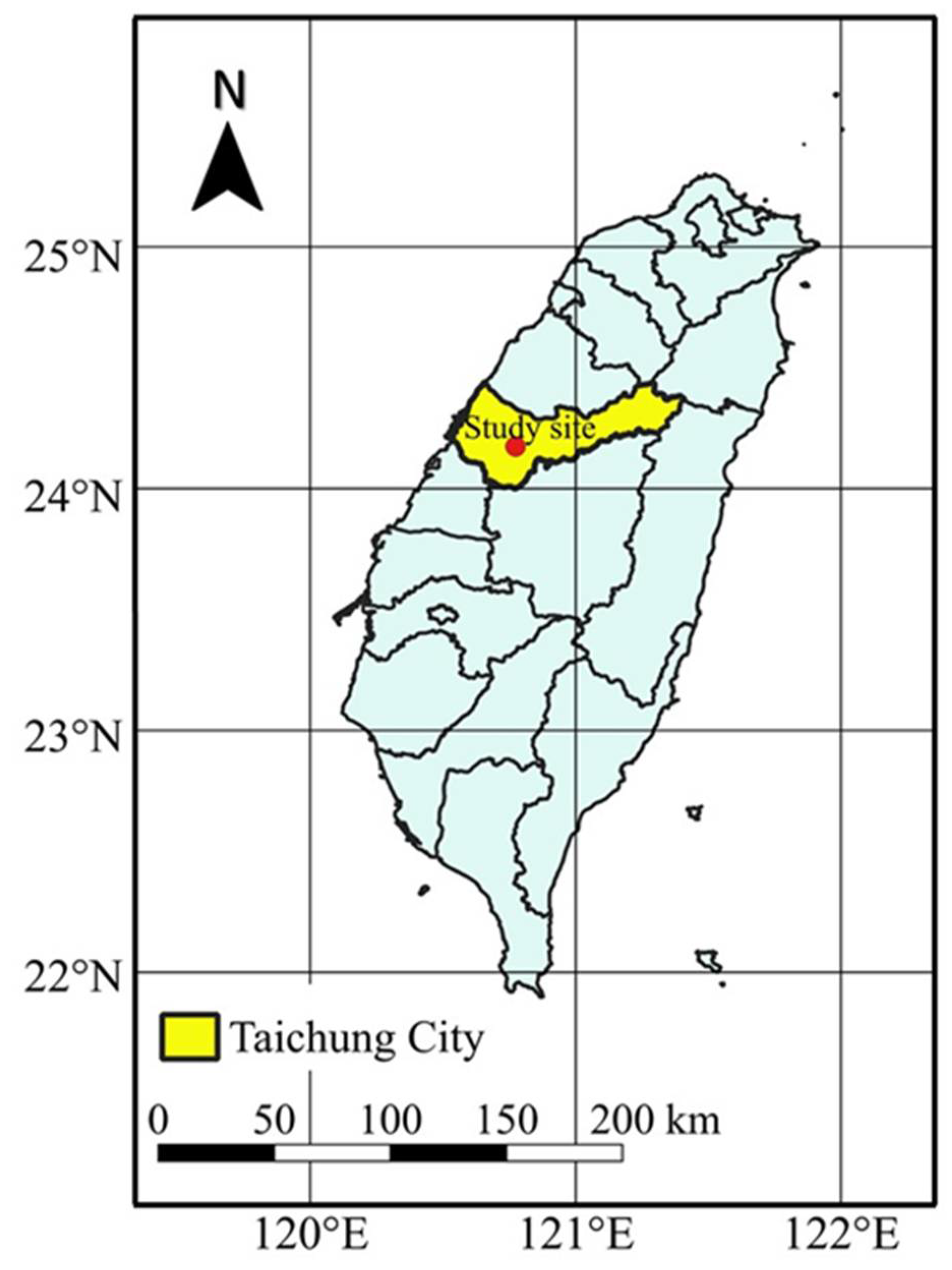
Figure 2.
Relationships between observations and predicted aboveground carbon storage (AGCS) with a perceivable diagonal line (1:1 for X and Y) for each model by the scatter diagram for three models, where Model I is ln(ABCS) = 0.933 + 0.882 ln(BA), Model II is ln(ABCS) = -0.004 + 0.820 ln(MDBH) + 1.008 ln(BA), Model III is ln(ABCS) = 7.550 - 0.820 ln(N) + 1.828 ln(BA), N is number of culms per hectare, MDBH is mean diameter of breast area, BA is basal area per hectare.
Figure 2.
Relationships between observations and predicted aboveground carbon storage (AGCS) with a perceivable diagonal line (1:1 for X and Y) for each model by the scatter diagram for three models, where Model I is ln(ABCS) = 0.933 + 0.882 ln(BA), Model II is ln(ABCS) = -0.004 + 0.820 ln(MDBH) + 1.008 ln(BA), Model III is ln(ABCS) = 7.550 - 0.820 ln(N) + 1.828 ln(BA), N is number of culms per hectare, MDBH is mean diameter of breast area, BA is basal area per hectare.
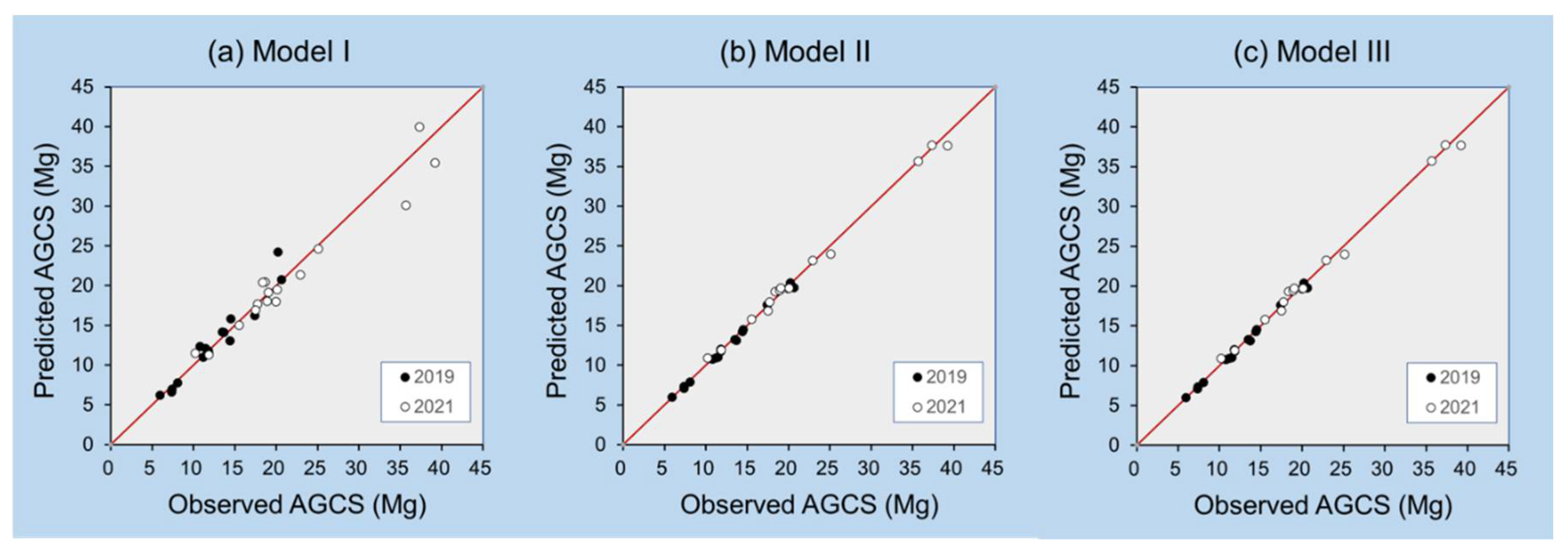

Table 1.
The various thinning treatments used in this study.
| Treatment | Thinning intensity | Performance |
|---|---|---|
| I | Heavy thinning | Thinning 75% of the culm number and 25% of the culm number were reserved. |
| II | Moderate thinning | Thinning 50% of the culm number and 50% of the culm number were reserved. |
| III | Light thinning | Thinning 25% of the culm number and 75% of the culm number were reserved. |
| V | No thinning | Without thinning, 100% of the culm number was reserved. |
Table 2.
The culms number (N), mean diameter at breast height(MDBH), basal area (BA), aboveground biomass (AGB), and aboveground carbon storage (AGCS) with various thinning treatments in 2019 and 2021.
Table 2.
The culms number (N), mean diameter at breast height(MDBH), basal area (BA), aboveground biomass (AGB), and aboveground carbon storage (AGCS) with various thinning treatments in 2019 and 2021.
| Investigation time | Treatment | N (culms ha−1) |
MDBH (cm) |
BA (m2 ha−1) |
AGB (Mg ha−1) |
AGCS (Mg ha−1) |
|---|---|---|---|---|---|---|
| 2019 | Ⅰ | 11,500 ± 1,438 | 2.71 ± 0.15 | 3.11 ± 0.34 | 15.32±1.93 | 7.16±0.90 |
| Ⅱ | 22,900 ± 1,149 | 2.50 ± 0.09 | 5.72 ± 0.48 | 26.26±0.08 | 12.28±1.44 | |
| Ⅲ | 31,500 ± 2,600 | 2.23 ± 0.18 | 7.02 ± 0.95 | 29.93±0.28 | 13.99±2.47 | |
| Ⅳ | 49,200 ± 19,713 | 1.95 ± 0.16 | 9.42 ± 3.04 | 35.30±10.14 | 16.51±4.74 | |
| 2021 | Ⅰ | 29,000 ± 8,116 | 2.39 ± 0.14 | 6.88 ± 1.72 | 29.51±7.32 | 13.80±3.42 |
| Ⅱ | 41,300 ± 4,530 | 2.40 ± 0.08 | 9.88 ± 0.92 | 43.17±3.98 | 20.19±1.86 | |
| Ⅲ | 53,500 ± 13,808 | 2.25 ± 0.19 | 12.08 ± 3.51 | 52.54±17.17 | 24.57±8.03 | |
| Ⅳ | 80,900 ± 35,743 | 2.00 ± 0.14 | 15.96 ± 6.27 | 60.68±24.43 | 28.37±11.42 |
Table 3.
The regression coefficients and Radj2 of regression models predicting aboveground carbon storage by stand characteristics.
Table 3.
The regression coefficients and Radj2 of regression models predicting aboveground carbon storage by stand characteristics.
| Regression model Y = β0 + β1 X1 + β2 X2 + β3 X3 | Radj2 | ||||||
|---|---|---|---|---|---|---|---|
| Stand characteristics1 | Regression coefficients | ||||||
| X1 | X2 | X3 | β0 | β1 | β2 | β3 | |
| N | MDBH | BA | 2.954 | -3.341×10⁻⁵ | -0.477 | 0.253 | 0.9468 |
| 1/BA | 1.608 | 1.013×10⁻⁵ | 0.586 | -4.257 | 0.9830 | ||
| ln (BA) | -0.173 | −2 | 0.365 | 1.011 | 0.9956 | ||
| 1/ MDBH | BA | 0.575 | -3.884×10⁻⁵ | 2.903 | 0.278 | 0.9476 | |
| 1/BA | 4.191 | 1.108×10⁻⁵ | -2.992 | -3.948 | 0.9854 | ||
| ln (BA) | 1.473 | − | -1.790 | 1.003 | 0.9955 | ||
| ln (MDBH) | BA | 2.834 | -3.596×10⁻⁵ | -1.184 | 0.265 | 0.9471 | |
| 1/BA | 1.806 | 1.063×10⁻⁵ | 1.340 | -4.101 | 0.9845 | ||
| ln (BA) | -0.004 | − | 0.820 | 1.008 | 0.9958 | ||
| 1/N | MDBH | BA | 1.397 | -1.226×10⁴ | 0.523 | 0.065 | 0.9879 |
| 1/BA | 4.631 | 5.578×10⁴ | -0.378 | -20.361 | 0.9367 | ||
| ln (BA) | -0.173 | − | 0.365 | 1.011 | 0.9956 | ||
| 1/ MDBH | BA | 3.589 | -1.106×10⁴ | -2.401 | 0.068 | 0.9859 | |
| 1/BA | 3.147 | 4.975×10⁴ | 1.396 | -18.917 | 0.9342 | ||
| ln (BA) | 1.473 | − | -1.790 | 1.003 | 0.9955 | ||
| ln (MDBH) | BA | 1.629 | -1.163×10⁴ | 1.132 | 0.066 | 0.9872 | |
| 1/BA | 4.363 | 5.239×10⁴ | -0.727 | -19.551 | 0.9354 | ||
| ln (BA) | -0.004 | − | 0.820 | 1.008 | 0.9958 | ||
| ln (N) | MDBH | BA | -9.716 | 1.014 | 0.815 | − | 0.9946 |
| 1/BA | -9.716 | 1.014 | 0.815 | − | 0.9946 | ||
| ln (BA) | 7.550 | -0.820 | − | 1.828 | 0.9958 | ||
| 1/ MDBH | BA | -5.292 | 0.922 | -3.788 | 0.009 | 0.9955 | |
| 1/BA | -6.734 | 1.074 | -4.109 | 0.533 | 0.9951 | ||
| ln (BA) | 7.550 | -0.820 | − | 1.828 | 0.9958 | ||
| ln (MDBH) | BA | -9.287 | 1.008 | 1.828 | − | 0.9958 | |
| 1/BA | -9.287 | 1.008 | 1.828 | − | 0.9958 | ||
| ln (BA) | 7.550 | -0.820 | − | 1.828 | 0.9958 | ||
1) N is culm number per ha; and MDBH is mean diameter at breast height; BA is basal area per ha. 2) “−” indicates that this variable does not enter the model.
Table 3.
The root mean square error (RMSE) between observed aboveground carbon storage (AGCS) and predicted AGCS for three models.
Table 3.
The root mean square error (RMSE) between observed aboveground carbon storage (AGCS) and predicted AGCS for three models.
| Model1) | Number of samples |
Observed AGCS (Mg ha−1) |
Predicted AGCS (Mg ha−1) |
RMSE (Mg ha−1) |
|---|---|---|---|---|
| Ⅰ | 32 | 17.11 ± 8.16 | 17.03 ± 7.77 | 1.717 |
| Ⅱ | 32 | 17.11 ± 8.16 | 17.09 ± 8.06 | 0.525 |
| III | 32 | 17.11 ± 8.16 | 17.12 ± 8.07 | 0.523 |
1)Model I is ln(ABCS) = 0.933 + 0.882 ln(BA), Model II is ln(ABCS) = -0.004 + 0.820 ln(MDBH) + 1.008 ln(BA), Model III is ln(ABCS) = 7.550 - 0.820 ln(N) + 1.828 ln(BA), N is number of culms per hectare, MDBH is mean diameter of breast area, BA is basal area per hectare.
Disclaimer/Publisher’s Note: The statements, opinions and data contained in all publications are solely those of the individual author(s) and contributor(s) and not of MDPI and/or the editor(s). MDPI and/or the editor(s) disclaim responsibility for any injury to people or property resulting from any ideas, methods, instructions or products referred to in the content. |
© 2024 by the authors. Licensee MDPI, Basel, Switzerland. This article is an open access article distributed under the terms and conditions of the Creative Commons Attribution (CC BY) license (http://creativecommons.org/licenses/by/4.0/).
Copyright: This open access article is published under a Creative Commons CC BY 4.0 license, which permit the free download, distribution, and reuse, provided that the author and preprint are cited in any reuse.


