

Submitted:
16 July 2024
Posted:
16 July 2024
You are already at the latest version
Abstract
The keratinocyte carcinomas, basal cell carcinoma (BCC) and cutaneous squamous cell carcinoma (cSCC), are the most common cancers in humans. Recently, an increasing body of literature has investigated the role of miRNAs in keratinocyte carcinoma pathogenesis, progression and their use as therapeutic agents and targets, or biomarkers. However, there is very little consistency in the literature regarding the identity of and/or role of individual miRNAs in cSCC (and to a lesser extent BCC) biology. miRNA analyses that combine clinical evidence with experimental elucidation of targets and functional impact provide far more compelling evidence than studies purely based on clinical findings or bioinformatic analyses. In this study, we review the clinical evidence associated with miRNA dysregulation in KCs assessing the quality of validation evidence provided, identify gaps, and provide recommendations for future studies based on relevant studies that investigated miRNA levels in human cSCC and BCC. Furthermore, we demonstrate how miRNAs contribute to the regulation of a diverse network of cellular functions, and that large-scale changes in tumor cell biology can be attributed to miRNA dysregulation. We highlight the need for further studies investigating the role of miRNAs as communicators between different cell types in the tumor microenvironment. Finally, we explore the clinical benefits of miRNAs as biomarkers of keratinocyte carcinoma prognosis and treatment.
Keywords:
cutaneous squamous cell carcinoma
; basal cell carcinoma
; miRNA
; microRNA
; keratinocyte carcinoma
; non-melanoma skin cancer
1. Introduction
Non-melanoma skin cancers are the most common human cancer and the majority (>90%) of NMSC is comprised of the keratinocyte carcinomas (KCs), cutaneous squamous cell carcinoma (cSCC) and basal cell carcinoma (BCC). While BCC is more common ( >70% of NMSC) [1], cSCC accounts for 75% of NMSC-related mortality [2]. Due to their common ultraviolet radiation-driven etiology, BCC and SCC share many risk factors including fair skin, age, chronic sun exposure, and hereditary conditions [3,4]. However, the molecular biology of BCC and cSCC differs significantly. BCC is driven by aberrant activation of Sonic hedgehog and Smoothened with concurrent loss of PATCHED [5,6]. Conversely, cSCC is typically driven by a mutational inactivation of the tumor suppressors TP53, CDKN2A, and/or NOTCH1/2 [3,7]. Subsequent activation of receptor tyrosine kinase signaling (e.g., epidermal growth factor receptor (EGFR)) and/or activation of downstream signaling pathways such as phosphoinositide-3-kinase (PI3K) drives proliferation and tumor growth [3,8,9].
Micro RNAs (miRNAs) have gained traction as a crucial part of the cellular gene expression regulatory network in development, organogenesis, and pathogenesis since their discovery in 1993 [10]. miRNAs are 19-25 base pairs in length and there are approximately 2600 mature miRNAs [11,12]. The biogenesis of miRNAs has been prominently reviewed by O'Brien, et al. [13]. Briefly, the immature pre-miRNA transcript is recognized by the nuclear microprocessor complex (comprising of DGCR8 and DROSHA) and its characteristic hairpin structure cleaved. Upon nuclear export, the terminal loop is removed by the endonuclease Dicer to form the mature miRNA duplex. In the canonical miRNA pathway, miRNAs function as the targeting entity within the RNA-induced silencing complex (RISC). RISC, with assistance of Argonaute proteins, binds to the 3’-untranslated region (UTR) of target mRNAs (in some cases to the 5’UTR region) and causes degradation or translational inhibition based on the level of sequence complementarity to regulate gene expression [10]. In cancer, the miRNA-mediated degradation of tumor suppressor gene transcripts can facilitate cancer growth, invasion, and metastasis. Conversely, oncogene-targeting miRNAs can have tumor suppressive functions [14,15].
More recent studies also support the use of plasma miRNA levels as therapeutic, diagnostic, and predictive biomarkers [16,17]. Additionally, the use of therapeutic miRNA mimetics and antagonists is being explored to restore tumor suppressive miRNAs and inhibit oncogenic miRNAs, respectively [18]. The exploration of miRNAs for cancers other than KCs has contributed to a significantly improved understanding of their pathogenesis and progression, and has opened novel therapeutic avenues [19].
Several reviews have summarized the state of miRNA research in KCs in the past [20,21,22,23,24,25]. However, due to the dynamic nature of the field many have become outdated since their publication over 5 years ago [22,23,24]. More recent reviews have tackled the matter with a broader scope (i.e., epigenetic dysregulation in NMSC or long non-coding RNA dysregulation across all skin cancers) and without critical appraisal of quality of the evidence presented [20,21]. Consequently, there is some overlap in the research presented in this study and these reviews. However, this review reflects a more comprehensive, stringent, and current overview of the field through a clinical lens.
2. Methods
The literature was independently searched by two authors (BG and JC) to identify relevant studies for this review using search terms microRNA, cSCC and BCC. Studies researching the role of at least one miRNA in human cSCC or BCC clinical specimens, cell lines, and xenograft models were included. Of the 64 identified studies, 55 covered cSCC, seven BCC, and two both BCC and cSCC (NMSC). Of note, there were four studies that have been retracted and were consequently excluded from analyses.
3. MicroRNA Dysregulation in cSCC
3.1. Consensus of Dysregulated miRNAs in cSCC
A study by Bruegger, Kempf, Spoerri, Arnold, Itin and Burger [25] published in 2013 investigated the comparative expression of 12 miRNAs in cSCC compared to healthy skin and reported a significant discordance between their findings and those of other related studies. To investigate if the reproducibility issue persists to date, we compiled a list of 140 reportedly differentially regulated miRNAs in cSCC compared to healthy skin (Table S1) and determined the consensus across studies (Figure 1). Studies with alternate comparisons relating to the progression of cSCC (e.g., metastatic vs. non-metastatic cSCC) are discussed separately in section 3.3.
We identified several miRNAs that have been reported to be differentially expressed in at least two studies (Figure 1B). The top most consistently reported miRNAs to be upregulated in cSCC were miR-31(-5p) and miR-21-5p. The miR-31 duplex is the immature precursor for miR-31-5p and miR-31-3p. In cell line models of cSCC, miR-31(-5p) mediated increased migration, invasion and colony formation potentially via reducing RhoBTB1 levels [26,27]. Clinical evidence supports a role of miR-31 in aggressive cSCC and its expression correlates with increased MMP-1 expression, EMT, and micro-vascularization [28]. Future studies should continue to investigate this potentially important role of miR-31(-5p) in cSCC, as it may have as yet undetermined functionality in this disease. For example, miR-31 has well established tumorigenic roles in other cancers and is linked to multiple additional targets, therapeutic resistance, metastasis, and decreased survival [29,30,31,32]. Furthermore, plasma levels of miR-31 might be an interesting biomarker for aggressive cSCC as it has shown promise in other cancers [31,33,34].
While several studies support the overexpression of miR-21 in cSCC and suggest a link to an invasive phenotype in cSCC, there has been no experimental exploration into a mechanistic understanding for this association [25,35,36,37]. However, the matter warrants closer investigation given the established role of miR-21 in other cancers [38]. A review by Bautista-Sánchez [38] summarizes the utility of miR-21 as a diagnostic and therapeutic biomarker as well as the functional impact of this miRNA in other malignancies.
The top two miRNAs that are most consistently reported to be downregulated in cSCC are miR-125b and miR-203 (Figure 1B) [35,39,40]. Both miRNAs target genes with known roles in tumor progression. miR-125b has two experimentally confirmed targets in cSCC, MMP13 and STAT3, and miR-203 targets the proto-oncogene MYC (Table 2). Consistent with the canonical functions of its targets, miR-125b reduced invasiveness in cSCC models via MMP13 [35]. Interestingly, the authors report effects on cSCC growth, colony formation, and migration [35]. However, we believe it is likely that these effects are mediated via an alternate target of miR-125b (i.e., STAT3). Additionally, miR-125b reduced viability and cell cycle progression while increasing Bcl2-induced apoptosis via STAT3 [39]. These findings are consistent with changes reported in other cancers. However, evidence collected in other cancers also suggest that the effects of miR-125b on cSCC could be far greater than reported to date [41].
The target of miR-203, MYC, has well established roles in tumor growth, keratinocyte differentiation, and metastasis [42,43,44,45]. Accordingly, Lohcharoenkal et al. [40] observed that miR-203 expression correlates with the differentiation status of clinical samples (Table 2). Transfection of in vitro models of cSCC with miR-203 decreased cell cycle progression, colony formation, migration, and invasion. Furthermore, miR-203 inhibited angiogenesis and tumor growth in xenograft models. It is noted however, that two separate studies reported no differences in expression of this miRNA in cSCC (Figure 1B) calling into question the role of miR-203 in cSCC pathogenesis [25,35].
Thus, while there is some consensus across studies, the many conflicting studies make an unequivocal interpretation of the current literature difficult. We propose three main factors that may explain this inconsistency between studies. Firstly, the experimental design (including the miRNA extraction method) might introduce a bias by preselecting for highly expressed miRNAs, investigating levels of only one selected miRNA or a predetermined panel of miRNAs (microarrays) in the clinical specimens [46,47]. Secondly, the quality of bioinformatics methodology and the stringency of statistical analysis varies, confounded by methodology changes and improvements over time [46,47]. Lastly, miRNA levels are subject to normal biological differences. For example, factors such as photo-age, immunosuppression status, or sex can influence the expression levels of miRNAs [48,49,50,51,52]. Utilizing matched samples can aid in reducing these differences by accounting for the patient-specific background but this approach has not always been used in the literature reviewed here.
3.2. Experimentally Validated miRNAs in cSCC
The previous section focused on the consensus, or lack thereof, between all studies that report on the differential expression of miRNAs in clinical specimens. However, miRNA analyses that combine clinical evidence with experimental elucidation of targets and functional impact provide far more compelling evidence than studies purely based on clinical findings or bioinformatic analyses. The following provides a comprehensive overview of studies integrating analysis of miRNA levels in cSCC patient samples, functional investigation of miRNA targets, and integration into larger scale cSCC biology. Table 1 and Table 2 include up- and down-regulated miRNAs in cSCC, respectively. The functional effect of the miRNA included in Table 1 and Table 2 represents the changes observed if the miRNA is introduced into the model systems included in the table. The validated target for each miRNA is downregulated in response to expression of respective miRNA.
Unsurprisingly, upregulated miRNAs support tumor growth and formation by targeting tumor suppressor genes such as TP53 or NFIB (Table 1). A reduction of tumor suppressor genes by this miRNA targeting enables tumor cell survival and proliferation as well as the acquisition of traits required for metastatic dissemination such as stemness properties, angiogenesis, and invasive capacity in cSCC. Several studies report increased proliferation, viability and/or decreased apoptosis in in vitro models of cSCC (Table 1). These findings translated to increased tumor formation and growth in xenograft models. Additionally, upregulation of EMT markers and MMPs points towards the capacity of miRNAs to enable disease progression by conferring increased invasive capacity (Table 1). Finally, properties such as increased stemness and angiogenesis might aid in metastatic dissemination of cSCC and warrants investigation of miRNAs as putative biomarkers (see 2.1.4). Conversely, down-regulated miRNAs inhibit oncogenes (e.g., MYC, APC, KRAS) and the aforementioned traits in cSCC such as proliferation, migration, and invasion (Table 2).
While the studies presented in Table 1 and Table 2 highlight the importance of miRNAs in cSCC pathogenesis, it is worth noting that the quality of the evidence presented in these studies varies significantly. We have identified three main variables contributing to the divergent quality of the evidence presented. Firstly, it is crucial to ensure proper validation of the target mRNA that conveys the observed functional changes as miRNAs can have several targets. For this purpose, a luciferase reporter construct (incorporating the 3’-UTR of the mRNA in question), the use of an antisense miRNA or a miRNA mimetic, and knockdown of the protein in question to test for functional equivalence seems to be adequate. Of note, most studies functionally investigate only one potential target, despite compelling bioinformatic evidence of multiple likely targets [90]. Secondly, the choice of the model cell line(s) is important to ensure appropriate representation of the cSCC subtype of interest. For example, A431 is a cell line derived from the vulva and its validity as a model for a UV-induced cancer is questionable [9]. Lastly, the exclusive use of in vitro models inherently limits the translatability of the findings to a complex tumor. Beyond the typical limitation of cell line models, determining the functional impact of miRNAs can be especially challenging as they can be incorporated as cargo in extracellular vesicles (EVs) [91]. Secreted miRNAs are not accounted for when studying tumor cells in monoculture. In other cancers, some evidence suggests that EVs can cause drastic changes in tumor-associated nerves, fibroblasts and immune cells [92,93]. For example, some evidence suggests that cSCC-derived EVs are taken up by fibroblasts leading to the formation of activated cancer-associated fibroblasts [94,95]. The impact of tumor cell-derived exosomal miRNAs in the cSCC tumor microenvironment (TME) has not yet been investigated and should be considered when assessing the functional impact of miRNAs in cSCC. The use of advanced tissue culture models and xenograft models can help in addressing those questions (Table 2) [96,97] and should be considered in the future.
In cSCC, miRNAs regulate a diverse network of cellular functions and large-scale changes can be attributed to their dysregulation (from basic changes of transformed cells to highly malignant traits of deadly tumors) (Section 3.2). However, the interpretation of the functional impact of miRNAs should be done in greater context of cSCC biology (i.e., genetic and epigenetic drivers, other transcriptional changes) as well as under special consideration of the interplay of the tumor cells with non-cancerous cell types and the TME.
3.3. Differential Expression of MicroRNAs during the Clinical Progression of cSCC
While most of the studies reported above compare miRNA expression between tumor and healthy skin, cSCC exists on a disease progression continuum, which suggests dysregulation of the genetic and epigenetic landscape may be an ongoing evolution rather than a well-defined ‘switch’. The stepwise progression from healthy skin through to invasive and metastatic cSCC has been long established and reviewed elsewhere [3,98]. Briefly, the prolonged exposure of skin to UV radiation causes the accumulation of mutations over time, which causes keratinocytes to progress to a precancerous lesion known as actinic keratosis (AK). Acquisition of additional oncogenic mutations can drive AKs towards the cancerous form of cSCC. While there have been significant efforts to define the molecular changes that drive this progression [99,100], the role of miRNA dysregulation remains relatively unclear. Here, we address the growing body of literature that explores miRNA dysregulation in the clinical progression of cSCC.
In an effort to elucidate the role of miRNAs in early keratinocyte pathogenesis, Mizrahi et al. [86] compared total miRNA profiles between five types of lesions – normal skin, solar elastosis (SE), early- and late-stage AKs, and well-differentiated cSCC. While their findings largely support the hypothesis for a gradual progression of disease, they also defined several ‘stage-specific’ alterations. For example, dysregulation of miR-19b and miR-126 was detected early in disease progression, respectively down- and up-regulated in SE compared to healthy skin. Conversely, dysregulation of miR-424, miR-378 and miR-497 was detected later in progression, respectively up- and down-regulated in cSCC compared to all earlier lesions. Subsequent experimental validation via forced overexpression of miR-497 in two cSCC cell lines demonstrated the role of this miRNA in targeting SERPINE1 to repress cell growth, migration and EMT phenotype (Table 2). This was, however, the only experimentally validated miRNA of the many identified in this study, and future efforts to characterize these miRNAs may further clarify their role in cSCC progression. Hierarchical clustering of dysregulated miRNAs identified in this study separated the lesions into two main groups – one comprised of normal skin, SE and early-stage AKs, and the other comprised of late-stage AKs and cSCC. This suggests that while there are indeed some changes in miRNA expression early in the disease progression, such as the downregulation of miR-126-5p and let-7i in SE compared to normal skin, most changes in the miRNA expression landscape occur late in the progression from pre-malignant to malignant cSCC.
In another study by Hossain et al. [56], the comparator of intraepidermal carcinoma (IEC) was included to distinguish later stage changes between AK and cSCC. miR-31-5p was found upregulated in cSCC compared to IEC, which demonstrates diagnostic potential for late-stage disease. Robust pairwise comparisons between normal skin, photodamaged skin, AK, IEC and cSCC were also performed. Of note, miR-7150 was implicated in cSCC for the first time, as it was demonstrated to be upregulated in AK compared to photo-damaged skin, as a discriminative marker for early lesion identification.
Several studies also address the differences in miRNA expression between cSCC lesions with varied differentiation status. miR-340 expression was found to be downregulated in poorly-differentiated compared to well-differentiated cSCC, which was linked to upregulation of its experimentally validated target RHOA to promote tumor cell proliferation, migration and invasion in vitro [82]. Another study found that miR-203 was downregulated in poorly-differentiated tumors compared to both well-differentiated tumors and healthy skin [40]. In this study, in vitro inhibition of miR-203 in keratinocytes reduced calcium-induced differentiation. In addition, forced over-expression of miR-203 in cSCC cell lines led to downregulation of the oncogene MYC and subsequently induced cell cycle arrest, and decreased proliferation, colony formation, migration, invasion and angiogenesis in vitro. A reduction in tumor growth and angiogenesis was also observed in cSCC xenografts over-expressing miR-203 (Table 2). Conversely, Caneuto et al. [101] demonstrated that miR-203 shows altered expression levels within the same tumor, with significantly higher expression of the miRNA in well-differentiated areas of cSCC.
Separately, attempts have been made to clarify the role of miRNAs in driving disease progression in arsenic induced, RDEB and organ-transplant recipient etiologies [54,57,102], but these mostly remain unclear. Geusau et al. [52] characterized the tumor, perilesional and normal skin miRNA profiles of organ transplant recipients. They too demonstrate a stepwise progression pattern of miRNA dysregulation observed in other studies surrounding immunocompetent cSCC patients, however, a comparison between these etiologies is yet to be drawn and further validation is required.
Since lymphovascular invasion (LVI) is associated with poor prognosis and progression of cSCC [103], Robinson et al. [104] investigated the differentially expressed miRNAs between LVI-positive and LVI-negative cSCC tumors. While there were no downregulated miRNAs between groups, miR-155-5p, miR-196a-5p, miR-375 and miR-221-5p were all significantly upregulated in LVI-positive tumors. This may have utility in stratifying patients’ risk status and to identify tumors in need of early intervention.
Although LVI is linked to metastatic risk and this study may provide indirect insight into miRNAs involved in metastasis, very few studies have explicitly investigated the function of miRNAs in cSCC metastasis. Given our understanding of metastatic disease is arguably more clinically informative – since metastases pose the greatest burden and cannot be predicted ahead of time – this was surprising. A recent study by Gillespie et al. [105] compared the expression of approximately 800 miRNAs between metastatic tissue and primary lesions (including both primaries that went on to metastasize and those that did not). There were no differentially expressed miRNAs observed between matched metastatic tumors and the primaries from which they were derived. While this might suggest discrimination of primary and metastatic disease by miRNA expression is not feasible, it is important to note that this study used a pre-defined miRNA panel that might exclude other potentially important miRNAs. It is also possible that these primary tumors that went on to metastasize had already accumulated any pro-metastatic miRNA changes that may exist and hence could not be distinguished between these matched lesions. There were, however, multiple miRNAs differentially expressed between metastatic tumors and all primary tumors (both metastatic and not). Specifically, miR-4286, miR-200a-3p and miR-148-3p were all upregulated, and miR-1915-3p, miR-205-5p, miR-4515 and miR-150-5p were all downregulated in metastases.
The urokinase plasminogen activator system (uPAS) is a master regulator of MMPs and has previously been implicated in cancer metastasis including in cSCC [9,106,107]. Minaei et al. demonstrated upregulation of the two main components (uPA and uPA receptor). This sparked further investigations into miRNAs potentially targeting PLAUR (coding for uPAR). Of the potential candidates, miR-340-5p and miR-377-3p were significantly downregulated in metastatic cSCC compared to both metastasizing and non-metastasizing primary cSCC tumors. Given there was a negative correlation between miR-340-5p expression and uPAR staining in cSCC lymph node metastases, this miRNA-mRNA interaction is strongly implicated in the metastatic process of cSCC. This is further supported by the literature, with downregulation of miR-340 also detected in poorly-differentiated cSCC. In addition, miR-497 – which targets the gene encoding a uPA inhibitor, SERPINE1, or PAI-1 – is downregulated in primary cSCC compared to normal skin (Table 2).
Given there are some promising results that elucidate the role of miRNA expression in cSCC progression, further work will benefit from the integrated investigation of genomic, epigenetic, transcriptomic and proteomic drivers of disease, given they are all tightly interconnected and interdependent.
4. miRNA Dysregulation in BCC
Much like the state of the literature investigating cSCC, there are few studies describing the patterns and roles of miRNA dysregulation in BCC. Several reviews have summarized what little work has been published elsewhere, though they are now outdated or are not comprehensive [20,21]. The clinical evidence for miRNA dysregulation in BCC is reviewed below.
4.1. Consensus of Dysregulated miRNAs in BCC
Given previous reviews reporting miRNAs dysregulated in BCC are not comprehensive, the concordance of results to date was unclear. To this end, we identified 253 miRNAs with reported dysregulation (Table S1) and evaluated the consensus between studies (Figure 2). As no miRNAs demonstrating neutral expression across both BCC and controls were explicitly reported, only up- and down-regulated miRNAs were included. Further, only comparisons between BCC tissue and healthy skin were assessed.
The marked lack of consensus between studies is evident, with just four miRNAs demonstrating similar trends of dysregulation across more than one study (Figure 2B). Upregulated in BCC compared to healthy skin, miR-941 is a well-established oncogenic miRNA that has been implicated as both a diagnostic biomarker in serum exosomes and as a therapeutic target in other cancers [108]. Furthermore, inhibition of miR-941 has been shown to enhance tumour sensitivity to the chemotherapeutic 5-fluorouracil, highlighting the potential clinical significance of this finding [109]. The downregulated miRNAs – miR-29c and miR-383-5p – are both well-established tumour suppressors in many cancer types. However, though miR-452 was here downregulated in BCC, its upregulation and oncogenic effect in other cancer types indicates its functionality is tumour specific which warrants further investigation in the context of BCC [110].
Overall, there are notably more miRNAs dysregulated in BCC than we reported for cSCC above. While it is possible that this is indeed a biological phenomenon, we speculate that it is a result of the methods employed in the literature. A greater proportion of studies investigating BCC used next-generational sequencing of total small RNA populations, rather than the tailored panels and microarrays that were frequent in investigations of cSCC. Despite these non-biased approaches, which overcome many of the methodological shortcomings observed in the literature surrounding cSCC, there is still discordance among three miRNAs (Figure 2A). This highlights the challenges of comparing biologically diverse specimens, and the complexity of miRNA regulation and indeed BCC pathogenesis.
4.2. Experimentally Validated miRNAs in BCC
As mentioned above, the functional effect of miRNA dysregulation is far more informative than isolated reports of differential expression between diseased and healthy samples, as it provides imperative biological understanding of disease behaviour. To this end, we interrogated the literature for studies reporting miRNAs with both clinical dysregulation and functional analysis in BCC (Table 3).
Evidently, the functional characterization of miRNAs in BCC is minimal. This was surprising given the differential expression analyses were generally of larger scale, identifying more dysregulated miRNAs than most reported in cSCC. We suspect this lack of experimental analysis reflects the clinical nature of BCC; given BCC rarely metastasizes and is generally well managed, the search for therapeutic targets or biomarkers including miRNAs is not of particular urgency [4]. As we observed in the literature regarding cSCC, there was a range in the quality of these functional studies. While both the in vitro and in vivo models for BCC were generally robust, the use of the A431 cell line as a model for BCC is even more questionable than its utility for cSCC. Having been derived from a vulval epidermoid carcinoma, it not only lacks the ultraviolet radiation signature that is characteristic of most skin cancers, but is also not derived from a basal cell carcinoma at all [114,115]. A431 cells are derived from vulvar SCC and are HPV negative which makes other etiologies such as lichen sclerosis or cellular atypia due to advanced age most likely [116,117]. Interestingly, much of the literature focuses on the dysregulation of circulating miRNAs between BCC and healthy patients, and for this reason were excluded from Table 3, which only addressed miRNAs endogenous to BCC tissue. These are addressed in section 5.
5. Clinical Applications of miRNAs in KCs
While the results summarized above enhance our understanding of the role of miRNAs in KC pathogenesis and progression, they have limited clinical utility in improving diagnostics and treatment to alleviate disease burden. Compared to conventional mRNA-based transcriptional analysis, the use of miRNA-based biomarkers offers several advantages [118]. Firstly, miRNAs are more stable than mRNA and hence can be isolated from challenging samples such as FFPE blocks more easily and enabling larger retrospective studies [119]. Additionally, the increased stability enables minimally invasive detection of miRNAs in bodily fluids such as blood and urine. Lastly, miRNAs offer high specificity for cell/tissue provenance as well as for disease stage and therapeutic response [118]. Given these advantages and the well-established therapeutic and diagnostic potential of miRNAs in other cancers, the role of miRNAs in informing how we engage with KCs clinically is of great importance.
Several studies have investigated the presence of miRNAs in circulation as a potential prognostic biomarker for cSCC. miR-124 levels are significantly decreased in the serum of cSCC patients compared to healthy controls [72], while miR-10a levels are increased in cSCC patients [53]. Balci et al. [120] compared the miRNA content in the plasma of cSCC and BCC patients, finding miR-30a-5p, miR-576-3p, miR-25-3p and miR-19a-3p downregulated, and miR-186-5p, miR-875-5p, miR-30c-3p, and miR-145-5p upregulated compared to healthy controls. One study compared the miRNA profiles of organ transplant recipients’ cSCC lesions and serum, finding only miR-1290 and miR-1246 to be significantly upregulated in both tumor and serum compared to control tissue/serum [52]. This valuably indicates that some miRNA expression patterns can be shared in both tumor and in serum, with potential utility as an accessible biomarker for disease progression and prognosis. With the exception of miR-10a whose expression correlates with poorer prognosis [53], none of these miRNAs have been used to understand diagnosis or prognosis to date. Given circulating miRNAs are easily accessible and stable, without the need for invasive biopsies of tumour tissue, their potential as biomarkers warrants sustained investigation.
Prognostic analyses have, however, been assessed using miRNAs sourced directly from tumors. Rock et al. [36] demonstrated that miR-21-5p and miR-31-5p expression is upregulated only in cSCC lesions on aggressive sites of the body, specifically on or near the ears and lips, as opposed to the trunk and extremities where tumors tend to be less aggressive. miR-21 was again implicated in cSCC prognosis, found to be highly expressed in invasive cSCC but not cSCC in-situ [37]. Separately, miR-205 and miR-221 expression correlate with local recurrence and positive surgical margins, respectively [101,121].
Collectively, these findings may demonstrate some clinical utility in predicting how individual tumours will behave based on their miRNA profile. However, further larger scale investigations will be necessary to evaluate whether any such measures provide better predictive information than existing clinicopathological measures to have any real-world benefit.
6. Conclusions
This review sought to comprehensively summarize the body of literature surrounding miRNA dysregulation in keratinocyte carcinomas. We conclude that while several miRNAs are indeed implicated in the progression and pathogenesis of both cSCC and BCC, the clinical utility of this knowledge is, at present, minimal. By highlighting existing strengths and shortcomings of the literature, we anticipate that this review will serve as a guide to refine the focus of future studies in this area. Future efforts to integrate these findings with existing genomic and transcriptomic understanding of KCs, especially of metastatic disease, will be of significant benefit to further unravel the molecular complexity of these diseases. Furthermore, we recommend the exploration of miRNAs as prognostic and therapeutic biomarkers in KCs as well as elucidation of the role of exosomal miRNAs as regulators of the TME in KCs.
Supplementary Materials
The following supporting information can be downloaded at the website of this paper posted on Preprints.org, Table S1: Dysregulated miRNAs in cSCC and BCC.
Author Contributions
Conceptualization, J.C., B.G. and M.R.; methodology, J.C. and B.G.; formal analysis, J.C. and B.G.; data curation, J.C. and B.G.; writing—original draft preparation, J.C. and B.G.; writing—review and editing, B.A. and M.R.; visualization, J.C. and B.G.; supervision, B.A. and M.R.; project administration, B.A. and M.R.; funding acquisition, B.A. and M.R. All authors have read and agreed to the published version of the manuscript.
Funding
BG and JC were funded in part by NHMRC Ideas Grant (APP1181179) to MR and BA. JC was funded by a University Post-graduate Award (University of Wollongong). BG was funded by a HDR career launch scholarship (University of Wollongong). Funded in part by Cancer Institute NSW Translational Program Grant (2020/TPG2081).
Acknowledgements
The authors would like to thank the Illawarra Cancer Carers for their continuous support.
Conflicts of Interest
The authors declare no conflict of interest.
References
- Ciążyńska, M.; Kamińska-Winciorek, G.; Lange, D.; Lewandowski, B.; Reich, A.; Sławińska, M.; Pabianek, M.; Szczepaniak, K.; Hankiewicz, A.; Ułańska, M.; et al. The incidence and clinical analysis of non-melanoma skin cancer. Scientific Reports 2021, 11, 4337. [Google Scholar] [CrossRef] [PubMed]
- Didona, D.; Paolino, G.; Bottoni, U.; Cantisani, C. Non Melanoma Skin Cancer Pathogenesis Overview. Biomedicines 2018, 6. [Google Scholar] [CrossRef] [PubMed]
- Fania, L.; Didona, D.; Di Pietro, F.R.; Verkhovskaia, S.; Morese, R.; Paolino, G.; Donati, M.; Ricci, F.; Coco, V.; Ricci, F.; et al. Cutaneous Squamous Cell Carcinoma: From Pathophysiology to Novel Therapeutic Approaches. Biomedicines 2021, 9. [Google Scholar] [CrossRef] [PubMed]
- Dika, E.; Scarfì, F.; Ferracin, M.; Broseghini, E.; Marcelli, E.; Bortolani, B.; Campione, E.; Riefolo, M.; Ricci, C.; Lambertini, M. Basal Cell Carcinoma: A Comprehensive Review. International Journal of Molecular Sciences 2020, 21. [Google Scholar] [CrossRef] [PubMed]
- Daya-Grosjean, L.; Couvé-Privat, S. Sonic hedgehog signaling in basal cell carcinomas. Cancer Lett 2005, 225, 181–192. [Google Scholar] [CrossRef] [PubMed]
- Nawrocka, P.M.; Galka-Marciniak, P.; Urbanek-Trzeciak, M.O.; M-Thirusenthilarasan, I.; Szostak, N.; Philips, A.; Susok, L.; Sand, M.; Kozlowski, P. Profile of Basal Cell Carcinoma Mutations and Copy Number Alterations - Focus on Gene-Associated Noncoding Variants. Front Oncol 2021, 11, 752579. [Google Scholar] [CrossRef] [PubMed]
- Thind, A.S.; Ashford, B.; Strbenac, D.; Mitchell, J.; Lee, J.; Mueller, S.A.; Minaei, E.; Perry, J.R.; Ch’ng, S.; Iyer, N.G.; et al. Whole genome analysis reveals the genomic complexity in metastatic cutaneous squamous cell carcinoma. Frontiers in Oncology 2022, 12. [Google Scholar] [CrossRef] [PubMed]
- Perry, J.R.; Genenger, B.; Thind, A.S.; Ashford, B.; Ranson, M. PIK Your Poison: The Effects of Combining PI3K and CDK Inhibitors against Metastatic Cutaneous Squamous Cell Carcinoma In Vitro. Cancers 2024, 16, 370. [Google Scholar] [CrossRef]
- Genenger, B.; Perry, J.R.; Ashford, B.; Ranson, M. A tEMTing target? Clinical and experimental evidence for epithelial-mesenchymal transition in the progression of cutaneous squamous cell carcinoma (a scoping systematic review). Discov Oncol 2022, 13, 42. [Google Scholar] [CrossRef]
- Bhaskaran, M.; Mohan, M. MicroRNAs: history, biogenesis, and their evolving role in animal development and disease. Vet Pathol 2014, 51, 759–774. [Google Scholar] [CrossRef]
- Ranganathan, K.; Sivasankar, V. MicroRNAs - Biology and clinical applications. J Oral Maxillofac Pathol 2014, 18, 229–234. [Google Scholar] [CrossRef] [PubMed]
- Plotnikova, O.; Baranova, A.; Skoblov, M. Comprehensive Analysis of Human microRNA–mRNA Interactome. Frontiers in Genetics 2019, 10. [Google Scholar] [CrossRef] [PubMed]
- O'Brien, J.; Hayder, H.; Zayed, Y.; Peng, C. Overview of MicroRNA Biogenesis, Mechanisms of Actions, and Circulation. Front Endocrinol (Lausanne) 2018, 9, 402. [Google Scholar] [CrossRef] [PubMed]
- Baranwal, S.; Alahari, S.K. miRNA control of tumor cell invasion and metastasis. Int J Cancer 2010, 126, 1283–1290. [Google Scholar] [CrossRef] [PubMed]
- Peng, Y.; Croce, C.M. The role of MicroRNAs in human cancer. Signal Transduction and Targeted Therapy 2016, 1, 15004. [Google Scholar] [CrossRef] [PubMed]
- Wang, Q.; Li, P.; Li, A.; Jiang, W.; Wang, H.; Wang, J.; Xie, K. Plasma specific miRNAs as predictive biomarkers for diagnosis and prognosis of glioma. Journal of Experimental & Clinical Cancer Research 2012, 31, 97. [Google Scholar] [CrossRef]
- Chakrabortty, A.; Patton, D.J.; Smith, B.F.; Agarwal, P. miRNAs: Potential as Biomarkers and Therapeutic Targets for Cancer. Genes (Basel) 2023, 14. [Google Scholar] [CrossRef] [PubMed]
- Rupaimoole, R.; Slack, F.J. MicroRNA therapeutics: towards a new era for the management of cancer and other diseases. Nature Reviews Drug Discovery 2017, 16, 203–222. [Google Scholar] [CrossRef] [PubMed]
- Menon, A.; Abd-Aziz, N.; Khalid, K.; Poh, C.L.; Naidu, R. miRNA: A Promising Therapeutic Target in Cancer. Int J Mol Sci 2022, 23. [Google Scholar] [CrossRef]
- Liu, F.; Li, S. Non-coding RNAs in skin cancers:Biological roles and molecular mechanisms. Frontiers in Pharmacology 2022, 13. [Google Scholar] [CrossRef]
- Kashyap, M.P.; Sinha, R.; Mukhtar, M.S.; Athar, M. Epigenetic regulation in the pathogenesis of non-melanoma skin cancer. Seminars in Cancer Biology 2022, 83, 36–56. [Google Scholar] [CrossRef] [PubMed]
- Yu, X.; Li, Z. The role of miRNAs in cutaneous squamous cell carcinoma. Journal of Cellular and Molecular Medicine 2016, 20, 3–9. [Google Scholar] [CrossRef] [PubMed]
- Konicke, K.; López-Luna, A.; Muñoz-Carrillo, J.L.; Servín-González, L.S.; Flores-de la Torre, A.; Olasz, E.; Lazarova, Z. The microRNA landscape of cutaneous squamous cell carcinoma. Drug Discovery Today 2018, 23, 864–870. [Google Scholar] [CrossRef] [PubMed]
- García-Sancha, N.; Corchado-Cobos, R.; Pérez-Losada, J.; Cañueto, J. MicroRNA Dysregulation in Cutaneous Squamous Cell Carcinoma. International Journal of Molecular Sciences 2019, 20, 2181. [Google Scholar] [CrossRef] [PubMed]
- Bruegger, C.; Kempf, W.; Spoerri, I.; Arnold, A.W.; Itin, P.H.; Burger, B. MicroRNA expression differs in cutaneous squamous cell carcinomas and healthy skin of immunocompetent individuals. Experimental Dermatology 2013, 22, 426–428. [Google Scholar] [CrossRef] [PubMed]
- Wang, A.; Landén, N.X.; Meisgen, F.; Lohcharoenkal, W.; Ståhle, M.; Sonkoly, E.; Pivarcsi, A. MicroRNA-31 Is Overexpressed in Cutaneous Squamous Cell Carcinoma and Regulates Cell Motility and Colony Formation Ability of Tumor Cells. PLOS ONE 2014, 9, e103206. [Google Scholar] [CrossRef] [PubMed]
- Lin, N.; Zhou, Y.; Lian, X.; Tu, Y. MicroRNA-31 functions as an oncogenic microRNA in cutaneous squamous cell carcinoma cells by targeting RhoTBT1. Oncology letters 2017, 13, 1078–1082. [Google Scholar] [CrossRef] [PubMed]
- Fernández-Figueras, M.T.; Carrato, C.; Saenz-Sardà, X.; Musulén, E.; Fuente, M.J.; Puig, L. MicroRNA31 and MMP-1 contribute to the differentiated pathway of invasion -with enhanced epithelial-to-mesenchymal transition- in squamous cell carcinoma of the skin. Archives of Dermatological Research 2022, 314, 767–775. [Google Scholar] [CrossRef] [PubMed]
- Valastyan, S.; Weinberg, R.A. miR-31: a crucial overseer of tumor metastasis and other emerging roles. Cell Cycle 2010, 9, 2124–2129. [Google Scholar] [CrossRef]
- Oshima, S.; Asai, S.; Seki, N.; Minemura, C.; Kinoshita, T.; Goto, Y.; Kikkawa, N.; Moriya, S.; Kasamatsu, A.; Hanazawa, T.; et al. Identification of Tumor Suppressive Genes Regulated by miR-31-5p and miR-31-3p in Head and Neck Squamous Cell Carcinoma. International Journal of Molecular Sciences 2021, 22, 6199. [Google Scholar] [CrossRef]
- Lin, X.; Wu, W.; Ying, Y.; Luo, J.; Xu, X.; Zheng, L.; Wu, W.; Yang, S.; Zhao, S. MicroRNA-31: a pivotal oncogenic factor in oral squamous cell carcinoma. Cell Death Discovery 2022, 8, 140. [Google Scholar] [CrossRef] [PubMed]
- Gharib, A.F.; Khalifa, A.S.; Eed, E.M.; Banjer, H.J.; Shami, A.A.; Askary, A.E.; Elsawy, W.H. Role of MicroRNA-31 (miR-31) in Breast Carcinoma Diagnosis and Prognosis. In Vivo 2022, 36, 1497–1502. [Google Scholar] [CrossRef] [PubMed]
- Zhang, W.-w.; Ming, X.-l.; Rong, Y.; Huang, C.-q.; Weng, H.; Chen, H.; Bian, J.-m.; Wang, F.-b. Diagnostic Value Investigation and Bioinformatics Analysis of miR-31 in Patients with Lymph Node Metastasis of Colorectal Cancer. Analytical Cellular Pathology 2019, 2019, 9740475. [Google Scholar] [CrossRef] [PubMed]
- Liu, C.J.; Kao, S.Y.; Tu, H.F.; Tsai, M.M.; Chang, K.W.; Lin, S.C. Increase of microRNA miR-31 level in plasma could be a potential marker of oral cancer. Oral Diseases 2010, 16, 360–364. [Google Scholar] [CrossRef] [PubMed]
- Xu, N.; Zhang, L.; Meisgen, F.; Harada, M.; Heilborn, J.; Homey, B.; Grandér, D.; Ståhle, M.; Sonkoly, E.; Pivarcsi, A. MicroRNA-125b Down-regulates Matrix Metallopeptidase 13 and Inhibits Cutaneous Squamous Cell Carcinoma Cell Proliferation, Migration, and Invasion *<sup></sup>. Journal of Biological Chemistry 2012, 287, 29899–29908. [Google Scholar] [CrossRef] [PubMed]
- Rock, A.N.; Fisher, M.D.; Amborski, G.; Allain, D.C.; Klee, V.; Peters, S.B.; Kang, S.; Toland, A.E. MicroRNA Expression Profiling of Cutaneous Squamous Cell Carcinomas Arising in Different Sites. Otolaryngology–Head and Neck Surgery 2020, 163, 538–545. [Google Scholar] [CrossRef] [PubMed]
- Stojadinovic, O.; Ramirez, H.; Pastar, I.; Gordon, K.A.; Stone, R.; Choudhary, S.; Badiavas, E.; Nouri, K.; Tomic-Canic, M. MiR-21 and miR-205 are induced in invasive cutaneous squamous cell carcinomas. Archives of Dermatological Research 2017, 309, 133–139. [Google Scholar] [CrossRef] [PubMed]
- Bautista-Sánchez, D.; Arriaga-Canon, C.; Pedroza-Torres, A.; De La Rosa-Velázquez, I.A.; González-Barrios, R.; Contreras-Espinosa, L.; Montiel-Manríquez, R.; Castro-Hernández, C.; Fragoso-Ontiveros, V.; Álvarez-Gómez, R.M.; et al. The Promising Role of miR-21 as a Cancer Biomarker and Its Importance in RNA-Based Therapeutics. Mol Ther Nucleic Acids 2020, 20, 409–420. [Google Scholar] [CrossRef]
- Tian, K.; Liu, W.; Zhang, J.; Fan, X.; Liu, J.; Zhao, N.; Yao, C.; Miao, G. MicroRNA-125b exerts antitumor functions in cutaneous squamous cell carcinoma by targeting the STAT3 pathway. Cellular & Molecular Biology Letters 2020, 25, 12. [Google Scholar] [CrossRef]
- Lohcharoenkal, W.; Harada, M.; Lovén, J.; Meisgen, F.; Landén, N.X.; Zhang, L.; Lapins, J.; Mahapatra, K.D.; Shi, H.; Nissinen, L.; et al. MicroRNA-203 Inversely Correlates with Differentiation Grade, Targets c-MYC, and Functions as a Tumor Suppressor in cSCC. Journal of Investigative Dermatology 2016, 136, 2485–2494. [Google Scholar] [CrossRef]
- Wang, Y.; Zeng, G.; Jiang, Y. The Emerging Roles of miR-125b in Cancers. Cancer Manag Res 2020, 12, 1079–1088. [Google Scholar] [CrossRef] [PubMed]
- Gandarillas, A.; Watt, F.M. c-Myc promotes differentiation of human epidermal stem cells. Genes Dev 1997, 11, 2869–2882. [Google Scholar] [CrossRef] [PubMed]
- Gebhardt, A.; Frye, M.; Herold, S.; Benitah, S.A.; Braun, K.; Samans, B.; Watt, F.M.; Elsässer, H.P.; Eilers, M. Myc regulates keratinocyte adhesion and differentiation via complex formation with Miz1. J Cell Biol 2006, 172, 139–149. [Google Scholar] [CrossRef] [PubMed]
- Wolfer, A.; Ramaswamy, S. MYC and metastasis. Cancer Res 2011, 71, 2034–2037. [Google Scholar] [CrossRef] [PubMed]
- Gabay, M.; Li, Y.; Felsher, D.W. MYC activation is a hallmark of cancer initiation and maintenance. Cold Spring Harb Perspect Med 2014, 4. [Google Scholar] [CrossRef]
- Precazzini, F.; Detassis, S.; Imperatori, A.S.; Denti, M.A.; Campomenosi, P. Measurements Methods for the Development of MicroRNA-Based Tests for Cancer Diagnosis. Int J Mol Sci 2021, 22. [Google Scholar] [CrossRef] [PubMed]
- Siddika, T.; Heinemann, I.U. Bringing MicroRNAs to Light: Methods for MicroRNA Quantification and Visualization in Live Cells. Frontiers in Bioengineering and Biotechnology 2021, 8. [Google Scholar] [CrossRef] [PubMed]
- Srivastava, A.; Karlsson, M.; Marionnet, C.; Bernerd, F.; Gueniche, A.; Rawadi, C.E.l.; Ståhle, M.; Sonkoly, E.; Breton, L.; Pivarcsi, A. Identification of chronological and photoageing-associated microRNAs in human skin. Scientific Reports 2018, 8, 12990. [Google Scholar] [CrossRef] [PubMed]
- Lui, K.; Zhao, H.; Sun, J.; Shen, Z.; Xu, J. Analysis of the expression profile of miRNAs related to skin photoaging in the GEO database. Chinese Journal of Plastic and Reconstructive Surgery 2023, 5, 53–59. [Google Scholar] [CrossRef]
- Cui, C.; Yang, W.; Shi, J.; Zhou, Y.; Yang, J.; Cui, Q.; Zhou, Y. Identification and Analysis of Human Sex-biased MicroRNAs. Genomics Proteomics Bioinformatics 2018, 16, 200–211. [Google Scholar] [CrossRef]
- Caserta, S.; Gangemi, S.; Murdaca, G.; Allegra, A. Gender Differences and miRNAs Expression in Cancer: Implications on Prognosis and Susceptibility. Int J Mol Sci 2023, 24. [Google Scholar] [CrossRef] [PubMed]
- Geusau, A.; Borik-Heil, L.; Skalicky, S.; Mildner, M.; Grillari, J.; Hackl, M.; Sunder-Plassmann, R. Dysregulation of tissue and serum microRNAs in organ transplant recipients with cutaneous squamous cell carcinomas. Health Science Reports 2020, 3, e205. [Google Scholar] [CrossRef] [PubMed]
- Xiong, Z.; Jiang, B.; Li, G. Downregulation of miR-10a inhibits cutaneous squamous cell carcinoma cell proliferation, migration, and invasion by targeting Syndecan-1. Int J Clin Exp Pathol 2020, 13, 2502–2512. [Google Scholar] [PubMed]
- Wimmer, M.; Zauner, R.; Ablinger, M.; Piñón-Hofbauer, J.; Guttmann-Gruber, C.; Reisenberger, M.; Lettner, T.; Niklas, N.; Proell, J.; Sajinovic, M.; et al. A cancer stem cell-like phenotype is associated with miR-10b expression in aggressive squamous cell carcinomas. Cell Communication and Signaling 2020, 18, 61. [Google Scholar] [CrossRef] [PubMed]
- Yuan, S.; Zhang, P.; Wen, L.; Jia, S.; Wu, Y.; Zhang, Z.; Guan, L.; Yu, Z.; Zhao, L. miR-22 promotes stem cell traits via activating Wnt/β-catenin signaling in cutaneous squamous cell carcinoma. Oncogene 2021, 40, 5799–5813. [Google Scholar] [CrossRef] [PubMed]
- Hossain, A.; Tom, L.N.; Melati-Rad, A.; Yamada, M.; Hammerlindl, S.; Jagirdar, K.; Prow, T.W.; Soyer, H.P.; Stark, M.S. MicroRNA expression profiling of cutaneous squamous cell carcinomas and precursor lesions. Skin Health and Disease 2024, n/a, e360. [Google Scholar] [CrossRef] [PubMed]
- Olasz, E.B.; Seline, L.N.; Schock, A.M.; Duncan, N.E.; Lopez, A.; Lazar, J.; Flister, M.J.; Lu, Y.; Liu, P.; Sokumbi, O.; et al. MicroRNA-135b Regulates Leucine Zipper Tumor Suppressor 1 in Cutaneous Squamous Cell Carcinoma. PLOS ONE 2015, 10, e0125412. [Google Scholar] [CrossRef] [PubMed]
- Hu, X.; Liu, Y.; Ai, P.; He, S.; Liu, L.; Chen, C.; Tan, Y.; Wang, T. MicroRNA-186 promotes cell proliferation and inhibits cell apoptosis in cutaneous squamous cell carcinoma by targeting RETREG1. Exp Ther Med 2019, 17, 1930–1938. [Google Scholar] [CrossRef] [PubMed]
- Tian, J.; Shen, R.; Yan, Y.; Deng, L. miR-186 promotes tumor growth in cutaneous squamous cell carcinoma by inhibiting apoptotic protease activating factor-1. Exp Ther Med 2018, 16, 4010–4018. [Google Scholar] [CrossRef]
- Bai, M.; Zhang, M.; Long, F.; Yu, N.; Zeng, A.; Wang, X. MiR-217 promotes cutaneous squamous cell carcinoma progression by targeting PTRF. Am J Transl Res 2017, 9, 647–655. [Google Scholar]
- Gong, Z.-H.; Zhou, F.; Shi, C.; Xiang, T.; Zhou, C.-K.; Wang, Q.-Q.; Jiang, Y.-S.; Gao, S.-F. miRNA-221 promotes cutaneous squamous cell carcinoma progression by targeting PTEN. Cellular & Molecular Biology Letters 2019, 24, 9. [Google Scholar] [CrossRef]
- Bi, X.; Jiang, Z.; Luan, Z.; Qiu, D. Crocin exerts anti-proliferative and apoptotic effects on cutaneous squamous cell carcinoma via miR-320a/ATG2B. Bioengineered 2021, 12, 4569–4580. [Google Scholar] [CrossRef] [PubMed]
- Chen, B.; Pan, W.; Lin, X.; Hu, Z.; Jin, Y.; Chen, H.; Ma, G.; Qiu, Y.; Chang, L.; Hua, C.; et al. MicroRNA-346 functions as an oncogene in cutaneous squamous cell carcinoma. Tumor Biology 2016, 37, 2765–2771. [Google Scholar] [CrossRef] [PubMed]
- Zhou, M.; Liu, W.; Ma, S.; Cao, H.; Peng, X.; Guo, L.; Zhou, X.; Zheng, L.; Guo, L.; Wan, M.; et al. A novel onco-miR-365 induces cutaneous squamous cell carcinoma. Carcinogenesis 2013, 34, 1653–1659. [Google Scholar] [CrossRef] [PubMed]
- Zhou, M.; Zhou, L.; Zheng, L.; Guo, L.; Wang, Y.; Liu, H.; Ou, C.; Ding, Z. miR-365 Promotes Cutaneous Squamous Cell Carcinoma (CSCC) through Targeting Nuclear Factor I/B (NFIB). PLOS ONE 2014, 9, e100620. [Google Scholar] [CrossRef] [PubMed]
- Li, X.; Yuan, Y.; Wang, Y.; Xie, K.; Lu, S.; Chen, F.; Zhou, M.; Zhen, P. MicroRNA-486–3p promotes the proliferation and metastasis of cutaneous squamous cell carcinoma by suppressing flotillin-2. Journal of Dermatological Science 2022, 105, 18–26. [Google Scholar] [CrossRef] [PubMed]
- Li, X.; Zhou, C.; Zhang, C.; Xie, X.; Zhou, Z.; Zhou, M.; Chen, L.; Ding, Z. MicroRNA-664 functions as an oncogene in cutaneous squamous cell carcinomas (cSCC) via suppressing interferon regulatory factor 2. Journal of Dermatological Science 2019, 94, 330–338. [Google Scholar] [CrossRef] [PubMed]
- Zhang, W.; Zhou, K.; Zhang, X.; Wu, C.; Deng, D.; Yao, Z. Roles of the H19/microRNA-675 axis in the proliferation and epithelial-mesenchymal transition of human cutaneous squamous cell carcinoma cells. Oncol Rep 2021, 45. [Google Scholar] [CrossRef] [PubMed]
- Liu, P.; Shi, L.; Ding, Y.; Luan, J.; Shan, X.; Li, Q.; Zhang, S. MicroRNA-766 Promotes The Proliferation, Migration And Invasion, And Inhibits The Apoptosis Of Cutaneous Squamous Cell Carcinoma Cells By Targeting PDCD5. OncoTargets and Therapy 2020, 13, 4099–4110. [Google Scholar] [CrossRef]
- Sun, C.; Mahapatra, K.D.; Elton, J.; Li, C.; Fernando, W.; Lohcharoenkal, W.; Lapins, J.; Homey, B.; Sonkoly, E.; Pivarcsi, A. MicroRNA-23b Plays a Tumor-Suppressive Role in Cutaneous Squamous Cell Carcinoma and Targets Ras-Related Protein RRAS2. Journal of Investigative Dermatology 2023, 143, 2386–2396. [Google Scholar] [CrossRef]
- Chen, S.; Yuan, M.; Chen, H.; Wu, T.; Wu, T.; Zhang, D.; Miao, X.; Shi, J. MiR-34a-5p suppresses cutaneous squamous cell carcinoma progression by targeting SIRT6. Arch Dermatol Res 2024, 316, 299. [Google Scholar] [CrossRef]
- Yamane, K.; Jinnin, M.; Etoh, T.; Kobayashi, Y.; Shimozono, N.; Fukushima, S.; Masuguchi, S.; Maruo, K.; Inoue, Y.; Ishihara, T.; et al. Down-regulation of miR-124/-214 in cutaneous squamous cell carcinoma mediates abnormal cell proliferation via the induction of ERK. Journal of Molecular Medicine 2013, 91, 69–81. [Google Scholar] [CrossRef] [PubMed]
- Lohcharoenkal, W.; Li, C.; Das Mahapatra, K.; Lapins, J.; Homey, B.; Sonkoly, E.; Pivarcsi, A. MiR-130a Acts as a Tumor Suppressor MicroRNA in Cutaneous Squamous Cell Carcinoma and Regulates the Activity of the BMP/SMAD Pathway by Suppressing ACVR1. Journal of Investigative Dermatology 2021, 141, 1922–1931. [Google Scholar] [CrossRef] [PubMed]
- Zou, S.; Gao, Y.; Zhang, S. lncRNA HCP5 acts as a ceRNA to regulate EZH2 by sponging miR-138-5p in cutaneous squamous cell carcinoma. Int J Oncol 2021, 59, 56. [Google Scholar] [CrossRef]
- Luo, Q.; Li, W.; Zhao, T.; Tian, X.; Liu, Y.; Zhang, X. Role of miR-148a in cutaneous squamous cell carcinoma by repression of MAPK pathway. Archives of Biochemistry and Biophysics 2015, 583, 47–54. [Google Scholar] [CrossRef] [PubMed]
- Neu, J.; Dziunycz, P.J.; Dzung, A.; Lefort, K.; Falke, M.; Denzler, R.; Freiberger, S.N.; Iotzova-Weiss, G.; Kuzmanov, A.; Levesque, M.P.; et al. miR-181a decelerates proliferation in cutaneous squamous cell carcinoma by targeting the proto-oncogene KRAS. PLOS ONE 2017, 12, e0185028. [Google Scholar] [CrossRef] [PubMed]
- Wang, S.H.; Zhou, J.D.; He, Q.Y.; Yin, Z.Q.; Cao, K.; Luo, C.Q. MiR-199a inhibits the ability of proliferation and migration by regulating CD44-Ezrin signaling in cutaneous squamous cell carcinoma cells. Int J Clin Exp Pathol 2014, 7, 7131–7141. [Google Scholar] [PubMed]
- Cheng, M.; Gu, D.; Feng, J.; Li, C. Effect of Hsa-miRNA-203a-3p on proliferation of skin squamous cell carcinoma-1 human skin squamous cell cancer cells by targeting adenomatous polyposis coli using magnetic nanoparticles. Materials Express 2021, 11, 1942–1950. [Google Scholar] [CrossRef]
- Toll, A.; Salgado, R.; Espinet, B.; Díaz-Lagares, A.; Hernández-Ruiz, E.; Andrades, E.; Sandoval, J.; Esteller, M.; Pujol, R.M.; Hernández-Muñoz, I. MiR-204 silencing in intraepithelial to invasive cutaneous squamous cell carcinoma progression. Molecular Cancer 2016, 15, 53. [Google Scholar] [CrossRef]
- Robinson, D.J.; Patel, A.; Purdie, K.J.; Wang, J.; Rizvi, H.; Hufbauer, M.; Ostano, P.; Akgül, B.; Chiorino, G.; Harwood, C.A.; et al. Epigenetic Regulation of iASPP-p63 Feedback Loop in Cutaneous Squamous Cell Carcinoma. Journal of Investigative Dermatology 2019, 139, 1658–1671. [Google Scholar] [CrossRef]
- Ma, X.; Wu, D.; Zhang, X.; Shao, X.; Hu, G. microRNA-214 Prevents Traits of Cutaneous Squamous Cell Carcinoma via VEGFA and Bcl-2. Technology in Cancer Research & Treatment 2020, 19, 1533033820980098. [Google Scholar] [CrossRef]
- Wang, H.; Guo, W.; Jian, Q.; Xue, K.; Huang, M.; Chi, S.; Li, C.; Li, C. MicroRNA-340 inhibits squamous cell carcinoma cell proliferation, migration and invasion by downregulating RhoA. Journal of Dermatological Science 2018, 92, 197–206. [Google Scholar] [CrossRef] [PubMed]
- Gong, Z.; Zhang, Y.; Jiang, Y.; Chen, P.; Ji, J. LncRNA NEAT1 Targets miR-342-3p/CUL4B to Inhibit the Proliferation of Cutaneous Squamous Cell Carcinoma Cells. Journal of Oncology 2022, 2022, 8145129. [Google Scholar] [CrossRef] [PubMed]
- Zhang, Z.; Jia, M.; Wen, C.; He, A.; Ma, Z. Long non-coding RNA SCARNA2 induces cutaneous squamous cell carcinoma progression via modulating miR-342-3p expression. The Journal of Gene Medicine 2020, 22, e3242. [Google Scholar] [CrossRef] [PubMed]
- Kanitz, A.; Imig, J.; Dziunycz, P.J.; Primorac, A.; Galgano, A.; Hofbauer, G.F.L.; Gerber, A.P.; Detmar, M. The Expression Levels of MicroRNA-361-5p and Its Target VEGFA Are Inversely Correlated in Human Cutaneous Squamous Cell Carcinoma. PLOS ONE 2012, 7, e49568. [Google Scholar] [CrossRef] [PubMed]
- Mizrahi, A.; Barzilai, A.; Gur-Wahnon, D.; Ben-Dov, I.Z.; Glassberg, S.; Meningher, T.; Elharar, E.; Masalha, M.; Jacob-Hirsch, J.; Tabibian-Keissar, H.; et al. Alterations of microRNAs throughout the malignant evolution of cutaneous squamous cell carcinoma: the role of miR-497 in epithelial to mesenchymal transition of keratinocytes. Oncogene 2018, 37, 218–230. [Google Scholar] [CrossRef] [PubMed]
- Wei, X.H.; Gu, X.L.; Zhou, X.T.; Ma, M.; Lou, C.X. miR-497 promotes the progression of cutaneous squamous cell carcinoma through FAM114A2. Eur Rev Med Pharmacol Sci 2018, 22, 7348–7355. [Google Scholar] [CrossRef] [PubMed]
- Lu, X.; Gan, Q.; Gan, C. Circular RNA circSEC24A Promotes Cutaneous Squamous Cell Carcinoma Progression by Regulating miR-1193/MAP3K9 Axis. OncoTargets and Therapy 2021, 14, 653–666. [Google Scholar] [CrossRef]
- Li, X.; Kong, Y.; Li, H.; Xu, M.; Jiang, M.; Sun, W.; Xu, S. CircRNA circ_0067772 aggravates the malignant progression of cutaneous squamous cell carcinoma by regulating miR-1238-3p/FOXG1 axis. Genes & Genomics 2021, 43, 491–501. [Google Scholar] [CrossRef]
- Riolo, G.; Cantara, S.; Marzocchi, C.; Ricci, C. miRNA Targets: From Prediction Tools to Experimental Validation. Methods Protoc 2020, 4. [Google Scholar] [CrossRef]
- Xu, D.; Di, K.; Fan, B.; Wu, J.; Gu, X.; Sun, Y.; Khan, A.; Li, P.; Li, Z. MicroRNAs in extracellular vesicles: Sorting mechanisms, diagnostic value, isolation, and detection technology. Front Bioeng Biotechnol 2022, 10, 948959. [Google Scholar] [CrossRef]
- Vu, L.T.; Gong, J.; Pham, T.T.; Kim, Y.; Le, M.T.N. microRNA exchange via extracellular vesicles in cancer. Cell Prolif 2020, 53, e12877. [Google Scholar] [CrossRef] [PubMed]
- Amit, M.; Takahashi, H.; Dragomir, M.P.; Lindemann, A.; Gleber-Netto, F.O.; Pickering, C.R.; Anfossi, S.; Osman, A.A.; Cai, Y.; Wang, R.; et al. Loss of p53 drives neuron reprogramming in head and neck cancer. Nature 2020, 578, 449–454. [Google Scholar] [CrossRef] [PubMed]
- Lee, I.T.-L.; Shen, C.-H.; Tsai, F.-C.; Chen, C.-B.; Ma, K.S.-K. Cancer-Derived Extracellular Vesicles as Biomarkers for Cutaneous Squamous Cell Carcinoma: A Systematic Review. Cancers 2022, 14, 5098. [Google Scholar] [CrossRef] [PubMed]
- Overmiller, A.M.; Pierluissi, J.A.; Wermuth, P.J.; Sauma, S.; Martinez-Outschoorn, U.; Tuluc, M.; Luginbuhl, A.; Curry, J.; Harshyne, L.A.; Wahl, J.K., 3rd; et al. Desmoglein 2 modulates extracellular vesicle release from squamous cell carcinoma keratinocytes. Faseb j 2017, 31, 3412–3424. [Google Scholar] [CrossRef] [PubMed]
- Genenger, B.; McAlary, L.; Perry, J.R.; Ashford, B.; Ranson, M. Protocol for the generation and automated confocal imaging of whole multi-cellular tumor spheroids. STAR Protoc 2023, 4, 102331. [Google Scholar] [CrossRef] [PubMed]
- Conley, J.; Perry, J.R.; Ashford, B.; Ranson, M. Ex vivo therapeutic screening of metastatic cSCC: A review of methodological considerations for clinical implementation. Experimental Dermatology 2024, 33, e15089. [Google Scholar] [CrossRef] [PubMed]
- Ratushny, V.; Gober, M.D.; Hick, R.; Ridky, T.W.; Seykora, J.T. From keratinocyte to cancer: the pathogenesis and modeling of cutaneous squamous cell carcinoma. J Clin Invest 2012, 122, 464–472. [Google Scholar] [CrossRef] [PubMed]
- Lambert, S.R.; Mladkova, N.; Gulati, A.; Hamoudi, R.; Purdie, K.; Cerio, R.; Leigh, I.; Proby, C.; Harwood, C.A. Key differences identified between actinic keratosis and cutaneous squamous cell carcinoma by transcriptome profiling. British Journal of Cancer 2014, 110, 520–529. [Google Scholar] [CrossRef]
- Bailey, P.; Ridgway, R.A.; Cammareri, P.; Treanor-Taylor, M.; Bailey, U.-M.; Schoenherr, C.; Bone, M.; Schreyer, D.; Purdie, K.; Thomson, J.; et al. Driver gene combinations dictate cutaneous squamous cell carcinoma disease continuum progression. Nature Communications 2023, 14, 5211. [Google Scholar] [CrossRef]
- Cañueto, J.; Cardeñoso-Álvarez, E.; García-Hernández, J.L.; Galindo-Villardón, P.; Vicente-Galindo, P.; Vicente-Villardón, J.L.; Alonso-López, D.; De Las Rivas, J.; Valero, J.; Moyano-Sanz, E.; Fernández-López, E.; Mao, J.H.; Castellanos-Martín, A.; Román-Curto, C.; Pérez-Losada, J. MicroRNA (miR)-203 and miR-205 expression patterns identify subgroups of prognosis in cutaneous squamous cell carcinoma. The British Journal of Dermatology 2017, 177, 168–178. [Google Scholar] [CrossRef] [PubMed]
- Al-Eryani, L.; Waigel, S.; Tyagi, A.; Peremarti, J.; Jenkins, S.F.; Damodaran, C.; States, J.C. Differentially Expressed mRNA Targets of Differentially Expressed miRNAs Predict Changes in the TP53 Axis and Carcinogenesis-Related Pathways in Human Keratinocytes Chronically Exposed to Arsenic. Toxicological sciences : an official journal of the Society of Toxicology 2018, 162, 645–654. [Google Scholar] [CrossRef] [PubMed]
- Huang, S.S.; Toon, C.W.; Harish, V. The prognostic significance of lymphovascular invasion in cutaneous squamous cell carcinoma. ANZ Journal of Surgery 2023, 93, 2727–2735. [Google Scholar] [CrossRef] [PubMed]
- Robinson, S.; Ngwenya, S.; Molaudzi, M.; Molepo, J.; Adeola, H.; Magangane, P. The clinicopathological and microrna expression signature associated with lymphovascular invasion in squamous cell carcinoma: A basic descriptive study. Health Science Reports 2022, 5, e958. [Google Scholar] [CrossRef] [PubMed]
- Gillespie, J.; Skeeles, L.E.; Allain, D.C.; Kent, M.N.; Peters, S.B.; Nagarajan, P.; Yu, L.; Teknos, T.N.; Olencki, T.; Toland, A.E. MicroRNA expression profiling in metastatic cutaneous squamous cell carcinoma. Journal of the European Academy of Dermatology and Venereology 2016, 30, 1043–1045. [Google Scholar] [CrossRef] [PubMed]
- Tincknell, G.; Piper, A.-K.; Aghmesheh, M.; Becker, T.; Vine, K.L.; Brungs, D.; Ranson, M. Experimental and Clinical Evidence Supports the Use of Urokinase Plasminogen Activation System Components as Clinically Relevant Biomarkers in Gastroesophageal Adenocarcinoma. Cancers 2021, 13, 4097. [Google Scholar] [CrossRef] [PubMed]
- Kumar, A.; Buckley, B.; Ranson, M. The Urokinase Plasminogen Activation System in Pancreatic Cancer: Prospective Diagnostic and Therapeutic Targets. Biomolecules 2022, 12, 152. [Google Scholar] [CrossRef] [PubMed]
- Zhao, Q.; Zheng, X.; Guo, H.; Xue, X.; Zhang, Y.; Niu, M.; Cui, J.; Liu, H.; Luo, H.; Yang, D.; et al. Serum Exosomal miR-941 as a promising Oncogenic Biomarker for Laryngeal Squamous Cell Carcinoma. Journal of Cancer 2020, 11, 5329–5344. [Google Scholar] [CrossRef] [PubMed]
- Surapaneni, S.K.; Bhat, Z.R.; Tikoo, K. MicroRNA-941 regulates the proliferation of breast cancer cells by altering histone H3 Ser 10 phosphorylation. Scientific Reports 2020, 10, 17954. [Google Scholar] [CrossRef]
- Karimi Dermani, F.; Datta, I.; Gholamzadeh Khoei, S. MicroRNA-452: a double-edged sword in multiple human cancers. Clinical and Translational Oncology 2023, 25, 1189–1206. [Google Scholar] [CrossRef]
- Mi, X.; Lai, K.; Yan, L.; Xie, S.; Qiu, X.; Xiao, S.; Wei, S. miR-18a expression in basal cell carcinoma and regulatory mechanism on autophagy through mTOR pathway. Clin Exp Dermatol 2020, 45, 1027–1034. [Google Scholar] [CrossRef] [PubMed]
- Sonkoly, E.; Lovén, J.; Xu, N.; Meisgen, F.; Wei, T.; Brodin, P.; Jaks, V.; Kasper, M.; Shimokawa, T.; Harada, M.; et al. MicroRNA-203 functions as a tumor suppressor in basal cell carcinoma. Oncogenesis 2012, 1, e3. [Google Scholar] [CrossRef] [PubMed]
- Sun, H.; Jiang, P. MicroRNA-451a acts as tumor suppressor in cutaneous basal cell carcinoma. Mol Genet Genomic Med 2018, 6, 1001–1009. [Google Scholar] [CrossRef]
- Hassan, S.; Purdie, K.J.; Wang, J.; Harwood, C.A.; Proby, C.M.; Pourreyron, C.; Mladkova, N.; Nagano, A.; Dhayade, S.; Athineos, D.; et al. A Unique Panel of Patient-Derived Cutaneous Squamous Cell Carcinoma Cell Lines Provides a Preclinical Pathway for Therapeutic Testing. Int J Mol Sci 2019, 20. [Google Scholar] [CrossRef] [PubMed]
- Inman, G.J.; Wang, J.; Nagano, A.; Alexandrov, L.B.; Purdie, K.J.; Taylor, R.G.; Sherwood, V.; Thomson, J.; Hogan, S.; Spender, L.C.; et al. The genomic landscape of cutaneous SCC reveals drivers and a novel azathioprine associated mutational signature. Nat Commun 2018, 9, 3667. [Google Scholar] [CrossRef] [PubMed]
- Kolitz, E.; Lucas, E.; Hosler, G.A.; Kim, J.; Hammer, S.; Lewis, C.; Xu, L.; Day, A.T.; Mauskar, M.; Lea, J.S.; et al. Human Papillomavirus‒Positive and ‒Negative Vulvar Squamous Cell Carcinoma Are Biologically but Not Clinically Distinct. J Invest Dermatol 2022, 142, 1280–1290. [Google Scholar] [CrossRef] [PubMed]
- Hietanen, S.; Grénman, S.; Syrjänen, K.; Lappalainen, K.; Kauppinen, J.; Carey, T.; Syrjänen, S. Human papillomavirus in vulvar and vaginal carcinoma cell lines. Br J Cancer 1995, 72, 134–139. [Google Scholar] [CrossRef]
- Condrat, C.E.; Thompson, D.C.; Barbu, M.G.; Bugnar, O.L.; Boboc, A.; Cretoiu, D.; Suciu, N.; Cretoiu, S.M.; Voinea, S.C. miRNAs as Biomarkers in Disease: Latest Findings Regarding Their Role in Diagnosis and Prognosis. Cells 2020, 9. [Google Scholar] [CrossRef]
- Kakimoto, Y.; Tanaka, M.; Kamiguchi, H.; Ochiai, E.; Osawa, M. MicroRNA Stability in FFPE Tissue Samples: Dependence on GC Content. PLoS One 2016, 11, e0163125. [Google Scholar] [CrossRef]
- Balci, S.; Ayaz, L.; Gorur, A.; Yildirim Yaroglu, H.; Akbayir, S.; Dogruer Unal, N.; Bulut, B.; Tursen, U.; Tamer, L. microRNA profiling for early detection of nonmelanoma skin cancer. Clinical and Experimental Dermatology 2016, 41, 346–351. [Google Scholar] [CrossRef]
- Tamas, T.; Raduly, L.; Berindan-Neagoe, I.; Dinu, C.; Botan, E.; Bumbu, B.; Tamas, A.; Stoia, S.; Leucuta, D.C.; Bran, S.; Onisor, F.; Băciuț, G.; Armencea, G. The Role of miRNA-221 and miRNA-34a in Non-Melanoma Skin Cancer of the Head and Neck Region. Genes 2023, 14, 503. [Google Scholar] [CrossRef] [PubMed]
Figure 1.
Consensus of dysregulated miRNAs in cSCC. (A) Conflicting evidence leaves the deregulation status of several miRNAs unclear. The intersections of Venn diagram represent miRNAs whose differential expression trend has been conflictingly reported in two or more studies. (B) The table presents dysregulated/ non-differentially expressed miRNAs based on the consensus of two or more studies regarding their dysregulation status. Only comparisons of cSCC to healthy skin were included in these analyses.
Figure 1.
Consensus of dysregulated miRNAs in cSCC. (A) Conflicting evidence leaves the deregulation status of several miRNAs unclear. The intersections of Venn diagram represent miRNAs whose differential expression trend has been conflictingly reported in two or more studies. (B) The table presents dysregulated/ non-differentially expressed miRNAs based on the consensus of two or more studies regarding their dysregulation status. Only comparisons of cSCC to healthy skin were included in these analyses.
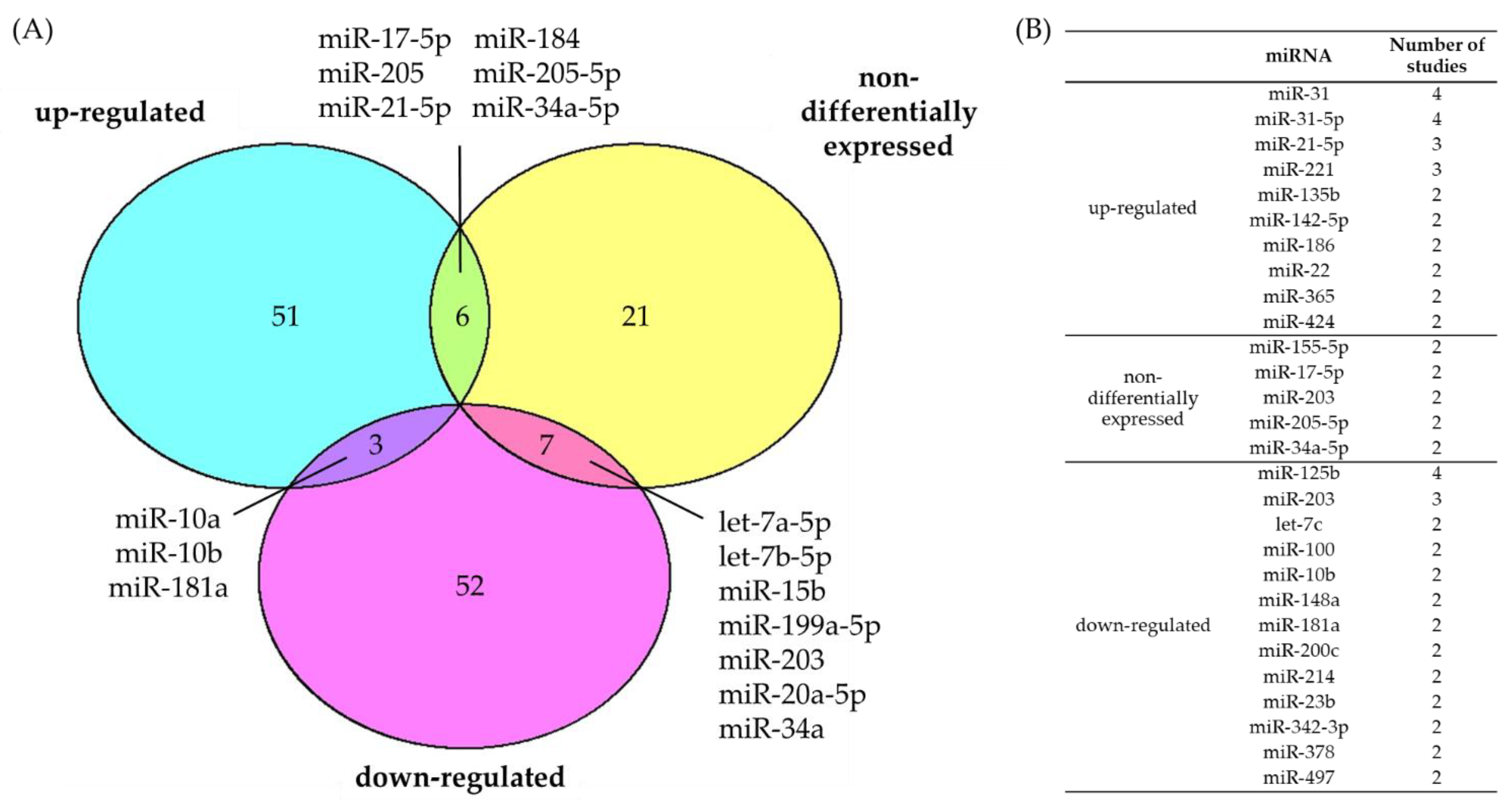
Figure 2.
Consensus of dysregulated miRNAs in BCC. (A) Conflicting evidence leaves the deregulation status of several miRNAs unclear. The intersections of Venn diagram represent miRNAs whose differential expression trend has been conflictingly reported in two or more studies. (B) The table presents dysregulated miRNAs based on the consensus of two or more studies regarding their dysregulation status. Only comparisons of BCC to healthy skin were included in these analyses.
Figure 2.
Consensus of dysregulated miRNAs in BCC. (A) Conflicting evidence leaves the deregulation status of several miRNAs unclear. The intersections of Venn diagram represent miRNAs whose differential expression trend has been conflictingly reported in two or more studies. (B) The table presents dysregulated miRNAs based on the consensus of two or more studies regarding their dysregulation status. Only comparisons of BCC to healthy skin were included in these analyses.
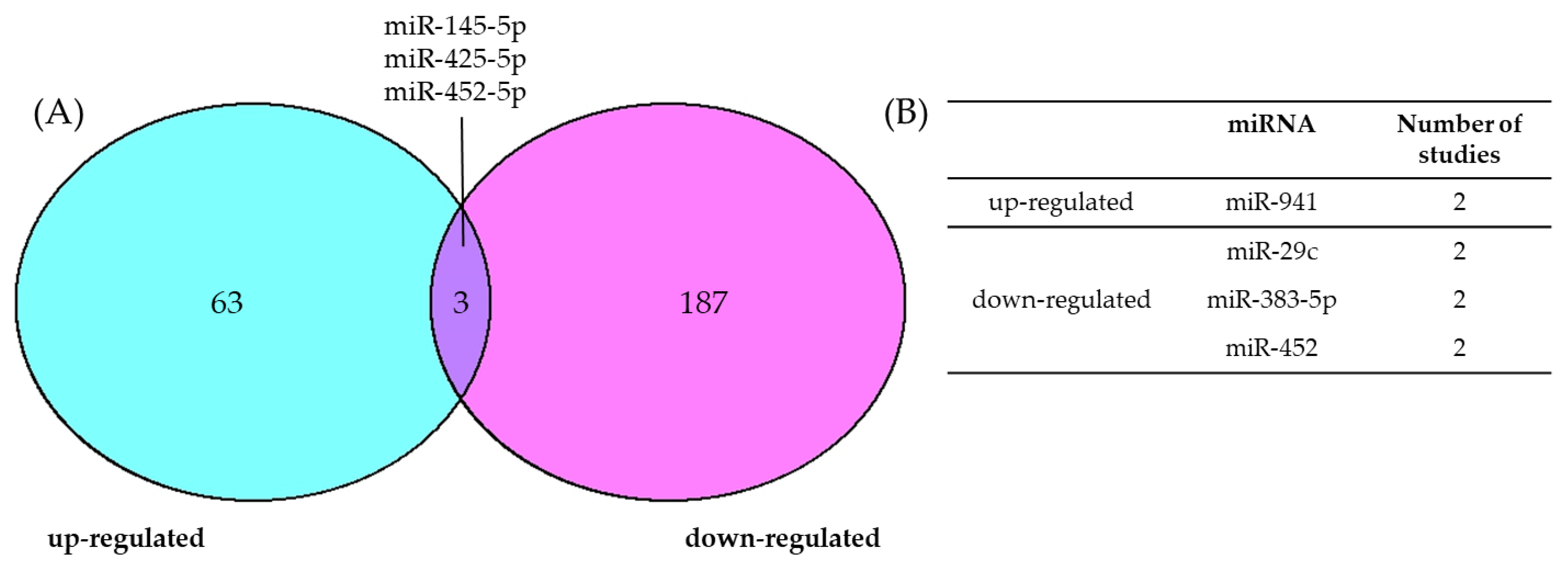

Table 1.
Experimental validation of upregulated miRNA in cSCC compared to healthy skin.
| miRNA | Tissue Comparison |
Cell or Animal Model | Validated Target |
Functional Effect of the miRNA | Ref. |
|---|---|---|---|---|---|
| miR-10a | cSCC vs. HS | A431 | SDC1 | proliferation↑ migration, invasion↑ |
[53] |
| miR-10b | cSCC (RDEB and non-RDEB) vs. HS | RDEB-SCC1/2/62 SCC13 A431 WT18SCC |
DIAPH2 | spheroid formation↑ migration↓ CSC phenotype↑ |
[54] |
| miR-22 | cSCC vs. HS | A431 COLO-16 Xenograft |
FOSB PAD2 |
migration↑ EMT, stemness↑ spheroid formation↑ tumor formation, growth, and metastasis↑ Wnt/ β-catenin signaling↑ |
[55] |
| miR-31 | cSCC vs. HS/ AK |
UT-SCC-7 | nd | motility↑ migration, invasion↑ colony formation↑ |
[26] |
| miR-31-3p | cSCC/IEC/AK vs. HS | COLO-16 SCC9 SCC-25 |
nd | viability↑ colony formation↑ |
[56] |
| miR-135b | cSCC vs. HS | PM1 MET1 MET4 |
LZTS1 | migration, invasion↑ | [57] |
| miR-186 | cSCC vs. HS | A431 SCL-1 |
RETREG1 | proliferation↑ apoptosis↓ |
[58] |
| cSCC vs. HS | A431 | APAF1 | apoptosis↓ autophagy↓ migration, invasion↑ colony formation↑ cell cycle progression↑ proliferation↑ |
[59] | |
| miR-217 | cSCC vs. HS | SCC13 | PTRF | proliferation↑ cell cycle progression↑ invasion↑ |
[60] |
| miR-221 | cSCC vs. HS | A431 SCC13 |
PTEN | viability↑ colony formation↑ AKT signaling↑ |
[61] |
| miR-320a | cSCC vs. HS | A431 SCL-1 Xenograft |
ATG2B | autophagy↓ apoptosis↓ tumor growth↑ proliferation↑ |
[62] |
| miR-346 | cSCC vs. HS | A431 | SRCIN1 | proliferation↑ migration↑ |
[63] |
| miR-365 | cSCC vs. HS | HaCaT A431 Xenograft |
nd | tumorigenicity↑ tumor growth↑ colony formation↑ migration, invasion↑ apoptosis↓ |
[64] |
| cSCC vs. HS | A431 HSC-1 Xenograft |
NFIB | Tumor formation and growth↑ | [65] | |
| miR-486-3p | cSCC vs. HS | HSC-5 HSC-1 Xenograft |
FLOT2 | tumor growth↑ viability, proliferation↑ migration↑ |
[66] |
| miR-664 | cSCC vs. HS | HSC-5 HSC-1 Xenograft |
IRF2 | tumorigenicity↑ migration, invasion↑ proliferation↑ |
[67] |
| miR-675 | cSCC vs. HS | HaCaT SCL-1 A431 |
TP53 H19 |
proliferation↑ migration, invasion↑ apoptosis↓ EMT↑ |
[68] |
| miR-766 | cSCC vs. HS | A431 SCL-1 Xenograft |
PDCD5 | apoptosis↓ migration, invasion↑ proliferation↑ MMP2/9 expression↑ tumor growth↑ |
[69] |
| miR-7150 | cSCC/IEC/AK vs. HS | COLO-16 SCC-9 |
nd | viability↑ colony formation↑ |
[56] |
AK – actinic keratosis, HS – healthy skin, EMT – epithelial-to-mesenchymal transition, nd – not determined, IEC – intra-epidermal carcinoma, RDEB – recessive dystrophic epidermolysis bullosa, CSC – cancer stem cell.
Table 2.
Experimental validation of downregulated miRNA in cSCC compared to healthy skin.
| miRNA | Tissue Comparison |
Cell or Animal Model | Validated Target |
Functional Effect of the miRNA | Ref. |
|---|---|---|---|---|---|
| miR-23b | cSCC vs. HS/ AK | UT-SCC7 UT-SCC12a Xenograft |
RRAS2 | angiogenesis↓ colony formation↓ spheroid formation↓ tumor growth and proliferation↓ |
[70] |
| miR-31-5p | cSCC/IEC/AK vs. HS | COLO-16 SCC-9 |
nd | colony formation↓ | [56] |
| miR-34a-5p | cSCC vs. HS | A431 SCL-1 |
SIRT6 | proliferation↓ colony formation↓ migration↓ apoptosis↑ |
[71] |
| miR-124 | cSCC vs. HS | DJM-1 | nd | ERK signaling↓ proliferation↓ |
[72] |
| miR-125b |
cSCC vs. HS/ AK |
UT-SCC-7 A431 |
MMP13 | growth↓ colony formation↓ migration, invasion↓ |
[35] |
| cSCC vs. HS | A431 SCC13 SCL-1 |
STAT3 | viability↓ cell cycle progression↓ apoptosis via Bcl2↑ |
[39] | |
| miR-130a | cSCC vs. HS/ AK |
UT-SCC-7 A431 Xenograft |
ACVR1 | HRAS/MAPK signaling↓ tumor growth↓ tumor sphere formation↓ migration, invasion↓ SMAD1 signaling↓ |
[73] |
| miR-138-5p | cSCC vs. HS | A431 Xenograft |
EZH2 | autophagy↓ apoptosis↑ viability↓ STAT/VEGFR2 signaling↓ tumor growth↓ |
[74] |
| miR-148a | cSCC vs. HS | A431 SCL-1 Xenograft |
MAP3K4 MAP3K9 |
colony formation↓ proliferation↓ migration, invasion↓ EMT↓ MAPK signaling↓ tumor growth↓ |
[75] |
| miR-181a | cSCC vs. HS | SCC13 Xenograft |
KRAS | tumor growth↓ viability↓ ERK signaling↓ |
[76] |
| miR-199a | cSCC vs. HS | A431 | CD44 | proliferation↓ invasion↓ MMP2/9 expression↓ |
[77] |
| miR-203 | cSCC vs. HS | UT-SCC7 A431 Xenograft |
MYC | cell cycle progression↓ colony formation↓ migration, invasion↓ angiogenesis↓ tumor growth and angiogenesis↓ |
[40] |
| miR-203a-3p | cSCC vs. HS | SCL-1 | APC | APC/ β-catenin signaling↓ proliferation↓ colony formation↓ |
[78] |
| miR-204 | cSCC vs. AK | HaCaT | PTPN11 | FGF-STAT3 signaling↑ EGF-MAPK signaling↓ |
[79] |
| miR-211-5p | cSCC vs. HS | IC4 IC18 |
TP63 | differentiation↑ EMT↓ proliferation↓ |
[80] |
| miR-214 | cSCC vs. HS | A431 SCC13 |
BCL2 VEGFA |
viability↓ proliferation↓ migration, invasion↓ apoptosis↑ Wnt/ β-catenin signaling↓ |
[81] |
| cSCC vs. HS | DJM-1 | nd | ERK signaling↓ proliferation↓ |
[72] | |
| miR-340 | cSCC vs. HS | A431 Sa3 |
RHOA | proliferation↓ migration, invasion↓ |
[82] |
| miR-342-3p | cSCC vs. HS | A431 SCC13 |
NEAT1 | proliferation↓ colony formation↓ PI3K signaling↓ |
[83] |
| cSCC vs. HS | SCC13 | SCARNA2 | proliferation↓ cell cycle progression↓ invasion↓ |
[84] | |
| miR-361-5p | cSCC vs. HS | HaCaT A431 |
VEGFA | VEGFA levels↓ | [85] |
| miR-497 | cSCC vs. HS/ AK |
SCLII MET1 |
SERPINE1 | growth↓ migration↓ EMT↓ |
[86] |
| cSCC vs. HS | A431 HSC-5 |
FAM114A2 | viability↓ cell cycle progression↓ |
[87] | |
| miR-1193 | cSCC vs. HS | SCC13 COLO-16 Xenograft |
MAP3K9 | viability↓ colony formation↓ migration, invasion↓ lactate production↓ glucose consumption↓ tumor growth↓ |
[88] |
| miR-1238-3p | cSCC vs. HS | A431 SCL-1 Xenograft |
FOXG1 | migration, invasion↓ proliferation↓ cell cycle progression↓ viability↓ apoptosis↑ tumor growth↓ |
[89] |
AK – actinic keratosis, HS – healthy skin, EMT – epithelial-to-mesenchymal transition, nd – not determined, IEC – intra-epidermal carcinoma, MMP - matrix metalloproteinase.
Table 3.
Experimental validation of upregulated and downregulated miRNAs in BCC compared to healthy skin.
Table 3.
Experimental validation of upregulated and downregulated miRNAs in BCC compared to healthy skin.
| miRNA | Tissue Comparison | Cell or Animal Model | Validated Target | Functional Effect | Ref. | |
|---|---|---|---|---|---|---|
| up | miR-18a | BCC vs. HS | A431 | nd | proliferation↑ migration↑ cell cycle progression↑ apoptosis↓ autophagy↓ |
[111] |
| down | miR-203 | BCC vs. HS | Primary human keratinocytes K5tTA/ TREGLI1 mice |
JUN | proliferation↓ cell cycle progression↓ tumor growth↓ |
[112] |
| miR-451a | BCC vs. HS | TE 354.T Primary epidermal keratinocytes |
TBX1 | proliferation↓ cell cycle progression↓ |
[113] |
HS – healthy skin, nd – not determined.
Disclaimer/Publisher’s Note: The statements, opinions and data contained in all publications are solely those of the individual author(s) and contributor(s) and not of MDPI and/or the editor(s). MDPI and/or the editor(s) disclaim responsibility for any injury to people or property resulting from any ideas, methods, instructions or products referred to in the content. |
© 2024 by the authors. Licensee MDPI, Basel, Switzerland. This article is an open access article distributed under the terms and conditions of the Creative Commons Attribution (CC BY) license (http://creativecommons.org/licenses/by/4.0/).
Copyright: This open access article is published under a Creative Commons CC BY 4.0 license, which permit the free download, distribution, and reuse, provided that the author and preprint are cited in any reuse.