

Submitted:
15 July 2024
Posted:
15 July 2024
You are already at the latest version
Abstract
Determining the maturity of compost and other organic fertilizers is very important because of possible phytotoxic or phytostimulative effects. The maturity of the compost can be assessed on the basis of chemical analyses, and the germination test with different test plants is most often used to determine phytotoxicity. In this research, using the results of chemical analyses, the maturity of compost produced from plant residues after maintenance of green public areas was assessed. At the same time, a germination test was carried out with 4 test plant species (cucumber, garden cress, triticale, barley) to determine the phytotoxicity of compost (i.e. compost extract in a ratio of 1:2.5 and 1:10) and 3 ammonium N solutions (in concentrations of 200, 400 and 600 mg/L NH4-N). According to the chemical properties of compost, primarily the C/N and NH4-N/NO3-N ratios, as well as the NH4-N concentration, and the germination test with cu-cumber and garden cress, we can conclude that the tested compost was mature and that we do not expect a phytotoxic effect. The choice of the plant is very significant because the germination test with compost extract shows an undoubted phytostimulative effect on garden cress and cu-cumber with more pronounced phytostimulative effect of compost 1:10 than 1:2.5 extract. No such effect was found on the monocotyledonous test plants triticale and barley since the 1:10 ex-tract had no significant effect, and the 1:2.5 extract had a phytotoxic effect, moderate on triticale and high on barley. The conclusion is that garden cress and cucumber are suitable test plants for determining phytostimulative effect of compost, but they are not suitable for determining phytotoxicity for monocotyledonous plants, especially if the cause of phytotoxicity is some non-ammonium component. Barley is the most suitable species for determining non-ammonium phytotoxicity of compost and phytostimulative or phytotoxic effect of ammonium form of nitrogen. It would be very useful to conduct a comparative germination test with compost extracts in the ratio 1:2.5 and 1:10, whereby the 1:2.5 extract is used as a test for phytotoxicity, and the 1:10 extract for testing phytostimulative effect.
Keywords:
germination index
; compost
; ammonium nitrogen
; garden cress
; cucumber
; barley
; triticale
1. Introduction
Various anthropogenic activities, escalating urbanization, industrialization, and economic growth are leading to the production of huge quantities of solid waste around the globe. The management of this solid waste has now become an ecological and technical problem for all [1]. Compost is an organic fertilizer that can be safely used in agriculture after assessing its stability and maturity [2]. Stability is usually defined in terms of the bioavailability of organic matter and refers exclusively to the resistance of compost organic matter to further degradation [3]. Stability refers to a particular phase or decomposition or state of organic composting substances, which is related to the type of organic compounds present and the resulting biological activity in the materials [4,5]. Maturity is a term used to determine the level of phytotoxic substances in compost samples and the suitability of compost for plant growth. Also, maturity can be easily defined as a measure of composting completion [1,6]. Also, maturity is defined as the suitability of the material for plant growth and is often associated with the degree of compost humification [7]. Maturity is not described by a single method that is universally applied to all types of compost due to variation in feedstock composition and composting procedures, so maturity is best assessed by measuring two or more tests such as physical, chemical, plant, and microbiological tests [8,9].
The total amount of soluble nitrogen in the organic mass decreases during composting and represents mineralization [10]. During maturation, ammonium nitrogen levels decrease, while nitrate levels rise. The increased N-NO3-/N-NH4+ ratio is an indicator of compost maturity [11]. When immature compost is introduced into the soil, there is a serious lack of nitrogen in crops, and rapid decomposition of immature compost causes a decrease in oxygen concentration in the root system, inhibits plant growth by producing phytotoxic substances, based on organic acids, ethylene oxide and ammonia [12,13].
Garglio et al. (2002) used garden cress as an indicator, while Fauci et al. (2002) used pinto beans and tomatoes in a biological study of plant growth [14,15]. Smith and Hughes (2001) compared the germination of garden cress and cellulolytic activity[16]. Degradation of cellulose using filter paper as a substrate had a negative correlation with the fresh mass of cress roots. Although garden cress is very often used as an indicator plant worldwide, there is no universal plant species or universal germination test procedure. Also, there is little data on which plant species is more sensitive to toxic substances in compost than garden cress. Warman (1999) compared the germination of garden cress, radish, and cabbage in compost, compost, and soil mixtures, and in compost extracts and concluded that such tests are not sensitive enough to determine the differences between mature and immature composts[17].
Germination index (GI) is the best way to test the phytotoxicity of compost for plant growth because the results are quite simple and reliable [18]. The biological germination test is widely used to examine salinity, soil pathogens, toxic substances, and some other physical and chemical properties of compost [19,20], which could be the main potential causes of phytotoxicity. Several researchers state that phytotoxic compounds are gradually removed during the composting process, which could explain the increase in GI with composting time. The germination index (GI), which combines measures of relative seed germination (G%) and relative root elongation (L%), was used to assess compost toxicity [21,22,23]. It has been observed that a GI value of 80% indicates the disappearance of phytotoxins in composts [24]. Tiquia et al. (1996) used this value not only as an indicator of phytotoxicity disappearance but also as an indicator of compost maturity [22]. The germination index is a maturity test based on seed germination and initial plant growth using a liquid compost extract [24]. Compost is considered mature when the germination index is higher than 60% compared to the control with distilled water [25]. The germination index is the most sensitive parameter used to assess the toxicity of compost to seedlings and to test whether the compost is mature [23,26,27]. Tang et al. (2006) state that the extract ratio is a very important factor influencing GI [28]. They showed that an extract ratio of 10: 1 was suitable for estimating GI changes during compost maturation. They also stated that different extraction ratios give different forms of GI change during the maturation process. The most popular germination test used by researchers is the garden cress experiment [26,29]. According to them, compost is non-toxic when the germination is higher than 85% or the weight of plant seedlings is higher than 90%. In addition, the authors found that the GI at each time of composting did not show significant changes by diluting the extract, nor when the extract was diluted to 75% with distilled water. Increased GI indicates reduced phytotoxicity and thus a more mature product [22,23,30,31].
Phytotoxicity is one of the most important criteria for assessing the maturity and suitability of compost for use in agriculture to avoid technological and environmental risks by introducing compost into the soil [3,7,22]. Immature compost also contains phytotoxic compounds such as heavy metals [21], phenolic compounds [32], ethylene and ammonia [21], and increased salt accumulation [31], and organic acids [33] that could slow seed germination and plant growth. Phytotoxicity is best assessed by germination or growth testing [3,14], but plant indicators must be carefully selected [34].
The study aimed to compare the maturity estimates of compost based on the results of the germination test conducted with seeds of different species with the assessment of maturity based on chemical methods of substrate analysis. Also, the study aims to compare the suitability of monocotyledonous and dicotyledonous plant species for conducting a germination test.
2. Materials and Methods
2.1. Compost Sampling
The initial raw material for the production of compost was the waste of green and woody parts of plants collected during the maintenance of public green areas. The compost was prepared on a concrete dry surface, and then plant waste was placed in windrow with a width of 3 m, height of 2 m and length of 20 m. The compost was sampled [35] after 3 months of windrow composting with occasional turning of the compost mass.
2.2. Analysis of Physical Properties of Compost
As part of the research on the physical properties of compost, compact density, percentage of water, percentage of dry matter, ash content, and organic matter content were analyzed.
The compact density of compost was determined by laboratory measurements following EN 13040 using cylinders of known volume and mass. Compact density values are expressed in g/L or g/dm3 [36].
The proportion of water and dry matter in compost samples was determined by drying 100 g of fresh compost matter at 103 ± 2 ° C to constant weight according to EN 13040 [36]. The proportion of water and dry matter in composts is expressed as a percentage.
The laboratory procedure for determining the content of organic matter and ash in compost samples is prescribed by standard EN 13039 and is carried out by drying for at least 4 hours, at 103 ± 2 °C and 6 hours by successive annealing at 450 ± 10 °C in the annealing furnace and by weighing each additional hour of annealing to a constant mass [37]. The content of organic matter and ash in composts is expressed as a percentage (percentage of dry matter of compost).
2.3. Analysis of Chemical Properties of Compost
The conducted research of chemical properties of compost included the following properties: pH value, electrical conductivity (EC), the content of total carbon and nitrogen, C/N ratio, the ratio of ammonium and nitrate form of nitrogen (NH4-N/NO3-N ratio), the content of total P and K.
The compost reaction, i.e. the pH value, was determined in a suspension of fresh compost in deionized water in a volume ratio of 1: 5 (60 ml of fresh sample and 300 ml of deionized water) after shaking for 60 minutes on a shaker. The pH value of compost was measured electrometrically (ie with pH meters that measure the difference in electrical potential) according to the European standard EN 13037: 2011 [38]. Electrical conductivity was also measured (with a conductometer) in a suspension of fresh compost in deionized water in a volume ratio of 1: 5 (60 ml of fresh sample and 300 ml of deionized water) after shaking for 60 minutes on a shaker, according to European standard EN 13038: 2011 [39].
The organic carbon content was determined by wet composting [40]: 50 mg of dry sample was weighed into destruction cuvettes, filled with 5 ml of 0.27 M K2Cr2O7 and 7.5 ml of concentrated H2SO4, destroyed for 30 minutes on a destruction block on 135 ° C, quantitatively transferred to volumetric flasks and diluted with deionized water to a total volume of 100 ml. After 10 minutes of centrifugation at 2000 rpm, the organic carbon concentration was measured indirectly by spectrophotometric (spectrophotometric absorption measurement at 585 nm with calibration with standard glucose solutions). For laboratory determination of total nitrogen concentration, the Kjeldahl digestion method after the destruction of the sample with a mixture of acids with heating. The total nitrogen content in compost is expressed as a percentage. The C/N ratio was calculated using data on total organic carbon and total nitrogen content.
Concentrations of two mineral forms of nitrogen (NH4-N and NO3-N) were determined in the causes of compost according to the standard EN 13652: 2001 [41]. In the analysis, 10 g of fresh sample was used to determine the mineral forms of nitrogen. The results are expressed as g/kg NH4-N and g/kg NO3-N in a dry matter or in mg/L NH4-N and NO3-N in a fresh matter.
The concentration of total phosphorus was determined by the phosphorus-molybdenum method in a compost sample solution prepared by destroying the dry sample by digestion with nitric and hydrochloric acid. Total potassium concentrations were measured in-stock solution after digestion with nitric and hydrochloric acid using inductively coupled plasma optical emission spectrometry (ICP-OES). The measured concentrations P and K are expressed in g/kg dry matter of compost.
2.4. Analysis of Biological Properties of Compos
Within the biological properties of compost, laboratory measurement of compost respiration intensity and germination test were performed.
The respiration intensity of the compost was measured as the rate of CO2 release from a fresh sample weighing 50 g after two days of incubation at room temperature. The emitted CO2 was determined based on the neutralization of part of the template with NaOH according to the TMECC 05.08-B method [44]. The results are presented in mg CO2/g DM/day.
2.5. Germination Test
A modified Zucconi et al. (1981) germination test method using compost extracts. The method combines measuring shoot length and measuring root growth [26]. Testing was performed on 4 plant species. The germination test determined the influence of different solutions (extracts of compost and ammonium carbonate solution) on germination, shoot growth, and elongation of roots of 4 plant species: garden cress (Lepidium sativum L.), cucumber (Cucumis sativus L.), barley (Hordeum vulgare L.). and triticale (× Triticosecale Wittmack).
The following solutions were used in the germination test, i.e. compost extracts: deionized water (control treatment), compost extract 1:2.5 (1:2.5 compost: deionized water v/v) - mark CE2.5, compost extract 1:10 (1:10 compost: deionized water v/v) - mark CE10, ammonium carbonate solution 200 mg/L (200 mg/L NH4-N) - mark SOL-1, ammonium carbonate solution 400 mg/L (400 mg/L NH4- N) - mark SOL-2 and ammonium carbonate solution 600 mg/L (600 mg/L NH4-N) – mark SOL-3.
Compost extracts were prepared by weighing the required mass of compost to prepare an extract in a ratio of 1:10 (15.06 g in 200 mL) and an extract in a ratio of 1:2.5 (60.24 g in 200 mL). The weighed masses depended on the specific density of the compost (0.753 g/cm3), and the planned ratios of 1:2.5 and 1:10 represent the ratios of compost volume and water. To the weighed mass of compost was added 200 mL of deionized water, the resulting suspension was stirred and after 30 minutes the compost extract was separated.
Ammonium carbonate solutions were prepared by weighing a certain mass of ammonium carbonate and dissolving in deionized water to a volume of 1,000 mL. Solutions of 200 mg/L NH4-N, 400 mg/L NH4-N and 600 mg/L NH4-N were prepared. pH values of 7.81, 7.90 and 7.91 were measured in the prepared solutions; and conductivities 1.438 µS/cm, 2.83 µS/cm, and 4.15 µS/cm.
For the germination test, seeds of four plant species were prepared and selected for the test (cucumber, garden cress, barley, and triticale). The seeds were washed according to the prescribed procedure and 200 seeds of each plant species were prepared.
Petri dishes were prepared and filter paper was placed on the bottom of each Petri dish. Pipette 5 mL of solution (water, 2 compost extracts, or 3 ammonium carbonate solution) onto the filter paper and place 10 seeds of a certain plant species. A total of 24 Petri dishes (6 different solutions × 4 replicates) were placed for each species, meaning that each treatment was set in four replicates.
The mass of each Petri dish was weighed and recorded, after which the Petri dishes were transferred to controlled conditions at 25 °C. After the allotted time for germination (3 days, ie 72 hours), the number of germinated seeds in each Petri dish was recorded and the root and shoot length of each plant was measured.
Based on the above data, the following parameters were statistically processed: germinated rate (GR) as percentage of germinated seeds, root length per plant (RLP), root length index (RI), germination index (GI), shoot rate (SR) as percentage of visible shoots, shoot length per plant (SLP), shoot length index (SI), and vitality shoot index (MLSV).
The germinated rate (GR) was determined by counting all seeds on which germination is visible, ie the beginning of radicle development is visible (the percentage of germinated seeds out of a total of 10).
The root length per plant (RLP) includes measured length of each root in a single treatment and replication, i.e. the Petri dish. It is expressed as Root Length per Plant (RLP) = ∑RL/NGS (NGS = number of germinated seeds) in cm.
The root length index (RI) is percentage difference of the root length of germinated seeds on the material under investigation compared to the root length of the control. RI is expressed as percentage: RI (%) = [(RLs1/RLc + RLs2/RLc + RLs3/RLc + RLs4/RLc)/4] x 100.
The germination index (GI) was calculated as a product of two ratios: the ratio of the number of germinated seeds of each treatment and control and the ratio of root length per plant of each treatment and control. GI = (Germinated seeds/Germinated seeds in control) × (Root Length per Plant/Root Length per Plant in control) [42].
The shoot rate (SR) was determined by counting the seeds on which the beginning of the development of coleoptile is visible, ie the shoot is visible (the percentage of visible shoots out of a total of 10).
The shoot length per plant (SLP) includes measured length of each shoot in a particular treatment and replication, i.e., the Petri dish. It is expressed as Shoot Length per Plant (SLP) = ∑SL/NS (NS = number of shoots visible) in cm.
The shoot length index (SI) is percentage difference of the shoot length of visible shoots on the material under investigation compared to the shoot length of the control. SI is expressed as percentage: SI (%) = [(SLs1/SLc + SLs2/SLc + SLs3/SLc + SLs4/SLc)/4] x 100.
Vitality shoot index or Munoo – Liisa vitality index (MLSV) is index calculated from the shoot rate and the shoot length (modified formula according to EN 16086-2 [41]. MLSV is expressed as percentage: MLSV (%) = [[(SRs1×SLs1) + (SRs2×SLs2) + (SRs3×SLs3) + (SRs4×SLs4)]/[4 × (SRc×SLc)]] x 100.
2.6. Statistical Data Processing
Statistical data processing was performed with software packages MS Excel and SAS for Windows 9.1.3. (SAS Institute Inc., Cary, NC, USA). These parameters were statistically processed by analysis of variance (ANOVA) with the least significant difference (LSD) test.
3. Results
3.1. Physical, Chemical, and Biological Properties of Compost
The physical, chemical and biological properties of compost are listed and described by average analytical values (Table 1). The average compost density was 0.753 g/cm3, and the average pH was 8.66, and the EC (electrical conductivity) was 2.37 mS/cm. The average moisture content in compost was 25.55% and the average dry matter 72.45%. The average amount of ash was 74.03% with an organic matter content of 25.97%, and C/N ratio 9.93. Intensity of respiration as a biological property, was 0.267 mg CO2/g DM/day.
The nitrogen content in fresh compost was 97.94 mg/L (Table 2). The average concentration of the ammonium form of nitrogen was 4.04 mg/L NH4+-N, and the nitrate form was 93.90 mg/L NO3-N within average NH4-N/NO3-N ratio of 0.044.
Organic matter can be also represented as the proportion of organic carbon in the dry matter of the compost (Table 2), and the average carbon content in compost was 117.00 g/kg DM, nitrogen 11.77 g/kg DM, potassium 18.51 g/kg DM, and phosphorus 4.42 g/kg DM.
3.2. Results of Germination Tests
3.2.1. Results of Germination Test Using Cucumber
Compost extract 1:2.5 (CE2.5) didn’t but extract 1:10 (CE10) did significantly increase the cucumber GI (Table 3, Figure 1). At the same time, all ammonium carbonate solutions significantly reduced cucumber GI (Table 3). The highest GI of cucumber (1.80) was found in the compost extract 1:10 (CE10) and significant lower in the CE2.5 (1.21). Significantly the lowest cucumber GI was found in SOL-3 (0.09) and SOL-2 (0.31), and in SOL-1 the GI (0.80) was between control and SOL-2, but significantly higher than in SOL-3.
The influence on root length per plant (RLP) and root length index (RI) was very similar, with the significantly highest values in the CE10 extract, and the lowest in the SOL-3 solution. But, the differences between SOL-2 and SOL-3 solutions are more pronounced than with GI, while those between CE2.5 and CE10 have not been determined.
Germination rate (GR) of both compost extracts was in the statistical range of control, and all ammonia solutions resulted in significantly lower GR of cucumber.
Shoot length per plant (SLP), shoot length index (SI) and vitality shoot index (MLSV) as shoot indicators resulted in significantly higher values for both compost extracts than for the control. There were no significant differences between the compost extracts (Table 4), although all values were higher for the 1:10 extract. Only for shoot rate (SR) no differences were found between control and compost extracts.
On the contrary, the values of all these indicators (SR, SLP, SI and MLSV) were lower for ammonia solutions, but a statistically significant difference was determined only for SR for SOL-2 and SOL-3 solutions where there was no shoot emergence. At the same time, all shoot values are statistically significantly lower for all ammonia solutions than for compost extracts.
3.2.2. Results of Germination Test Using Garden Cress
The germination tests with garden cress resulted in results similar to the test with cucumber because the indicators are generally higher for compost extracts and lower for all ammonia solutions. Still, compost extract didn’t significantly increase the garden cress GI (Table 4, Figure 1), although the GI values are higher for EC2.5 (1.53) and the highest for the EC10 (1.70). Also, ammonium carbonate solutions reduced cucumber GI (Table 4) to 0.51 (SOL-1) and to significantly lower 0.12 (SOL-2) and 0.02 (SOL-3).
The influence on garden cress root length per plant (RLP) and root length index (RI) was the same like with cucumber, with the significantly highest values in the CE10 extract, and the lowest in the SOL-3 solution. But there were no significant differences between CE2.5 and CE10 extracts, and no differences between SOL-2 and SOL-3 solutions.
Germination rate (GR) of both compost extracts was in the statistical range of control, but all ammonia solutions resulted in significantly lower GR of garden cress, as well as with cucumber.
SR, SLP, SI and MLSV were higher in the 1:10 extract, slightly lower in the 1:2.5 extract, and even lower in the control, but without significant differences between them. The indicators for the lowest concentration of ammonia solution (SOL-1) are also in the same statistical range. However, the lowest and statistically significantly smaller values of SR, SLP, SI and MLSV were determined for ammonia solutions with higher concentrations (SOL-2 and SOL-3).
3.2.3. Results of Germination Test Using Triticale
The pattern of triticale germination test results is significantly different for compost extracts than cucumber and garden cress results (Figure 1). GR, RLP, RI and GI are with the highest values for the control (Table 5), slightly lower for CE10, and the lowest for CE2.5 (but only GI statistically significantly lower than the control). On the other hand, all the indicators for the ammonia solution of the lowest concentration are in the same range as the control, but they are statistically significantly lower for the SOL-2, and significantly the lowest for the SOL-3 ammonia solution.
Shoot growth indicators SLP, SI and MLSV (except SR) have lower values for the control than for the compost extracts, but statistically significant differences are only lower SR for CE2.5 than CE10, and higher SLP and SI for CE2.5 than for the control.
3.2.4. Results of Germination Test Using Barley
The results of the barley germination test differ significantly from all other tested plant species (Figure 1). Thus, the highest GI (1.63) was determined for the ammonia solution SOL-1, and for all other solutions the GI was lower than the control (Table 6). The GI for both compost extracts is lower than the control, and for EC2.5 the GI was very low (0.14), in the range of the ammonia solution SOL-3 (0.10). GR is the highest for the control (87.5), in the same range for CE10 (67.5) and SOL-1 (77.5), and significantly lower for SOL-2 (32.5), CE2.5 (27.5) and SOL-3 (10).
RLP and RI are the highest for ammonia solution SOL-1 (RLP = 2.53, RI = 185.25), in the same range for solution SOL-2 (1.92 and 140.77), significantly lower for control (1.40 and 102.44) and CE10 (1.28 and 94.03), and then the smallest for SOL-3 (0.63 and 45.76) and CE2.5 (0.59 and 43.48).
The highest SR, SLP, SI and MLSV were determined for the SOL-1 solution, significantly lower for SOL-2 and CE10, and the lowest for CE2.5 and SOL-3.
3.3. The Comparison of Indicator Plants
3.3.1. The Reaction of Indicator Plants to Compost Extract 1:2.5 (CE2.5)
According to the results of the germination test, the compost extract in a ratio of 1:2.5 (CE2.5) has a significantly different effect on the 4 tested species, with the most positive effect on the root of garden cress and the shoot of cucumber, and the most inhibitory effect on the root and shoot of barley (Table 7).
There was not a single statistically significant difference between the indicators for cucumber and garden cress, and for triticale were a significantly higher RLP (2.65) than for garden cress (1.00) and SLP (2.21) than for garden cress (0.56) and cucumber (1.12).
However, the highest sensitivity to CE2.5 extract was found for barley with the lowest values of all indicators.
3.3.2. Impact of Compost Extract 1: 10 (CE10)
On average, with CE10, the highest indicator values were determined for cucumber, and the lowest for barley (Table 8). According to GI and RI values, on the one hand, cucumber and garden cress have higher values (in the same range), and on the other hand, there are triticale and barley with significantly lower values, but without statistical differences between triticale and barley.
Also, CE10 resulted in significantly lower RLP, SLP, SI and MLSV for garden cress than for cucumber. Similar differences were found between barley and triticale with significantly lower values of GR, RLP, SR and SLP for barley than for triticale.
However, despite the average higher indicator values for cucumber and garden cress than for triticale and barley, the highest value of RLP (2.95) and SLP (1.87) was determined for triticale, and very low values of RLP (1.15) and SLP (0.61) for garden cress (without statistically significant differences between garden cress and barley).
3.3.3. Influence of Ammonium Solution 1 (SOL-1) on Plant Indicators
The germination test with SOL-1 resulted in significant differences between the tested plant species (Table 9). The highest GI was determined for barley (1.63), significantly lower for triticale (1.00) and cucumber (0.80), and significantly lower for garden cress (0.51). The same order and statistical significance of differences were found for RI, while there were no significant differences in GR of the tested plants. However, the RLP values differ significantly, as the highest was determined for triticale (3.20), significantly lower for barley (2.53), again significantly lower for cucumber (1.65), and statistically significantly the lowest (0.46) for garden cress.
All shoot indicators were the lowest for cucumber, and the highest for triticale (SR and SLP) or barley (SI and MLSV).
3.3.4. Influence of Ammonium Solution 2 (SOL-2) on Plant Indicators
Ammonium solution 2 (SOL-2) also resulted in significant differences between the tested plant species (Table 10). The highest GI was determined for triticale (0.54) and barley (0.45), slightly lower for cucumber (0.31), and significantly the lowest for garden cress (0.12). There is a similar relationship for RLP values, while GR is also the highest for triticale (72.5), and for all other species it is statistically significantly lower (with no significant differences between cucumber, barley and garden cress).
The pattern of RI values is significantly different, it is the highest for barley (140.8), followed by cucumber (83.9), and significantly lower for triticale (68.6) and garden cress (44.0).
Shoot indicators are the highest for barley (SI and MLSV) or triticale (SR and SLP), and significantly lower for garden cress. The most inhibitory effect of SOL-2 was on the cucumber shoot because there were no shoots and all indicator values were the lowest.
3.3.5. Influence of Ammonium Solution 3 (SOL-3) on Plant Indicators
There were no significant differences in the values of RLP, RI, MLV and GI indicators in the treatment with SOL-3 solution (Table 11), only the highest GR was determined for cucumber (32.5) and triticale (27.5), and significantly less for barley (10.0) and garden cress (2.5).
Also, small differences in shoot indicators were found, the highest SR and SLP were determined for triticale (27.5 and 0.70), followed by barley (5 and 0.34) and garden cress (2.5 and 0.07), while there were no shoots in cucumber. There were no statistical differences in SI and MLSV.
4. Discussion
In this research, the results of laboratory analysis of compost and germination test were combined and compared as indicators of compost maturity and potential phytotoxicity on four test plant species (cucumber, garden cress, triticale and barley). Also, with the aim of measuring the phytotoxic or phytostimulating effect, solutions of different concentrations of ammonium nitrogen were used.
pH as very important factor [46] at the end of composting should be in an acceptable range for plants. In this study, an average pH value of 8.66 was found, which means that the pH is in an acceptable range although very close to the upper limit values. Stable and mature compost should have a pH value within the acceptable range of 5.5-9.0 [47].
Electrical conductivity (EC) can serve as a measure of soluble nutrients, cations, and anions, and a lower EC can be result of lower content of cations in the soil [1]. But, when the salinity of the soil (EC) is ≥ 4 mS/cm, the soil is considered saline with potential salt stress, especially for glycophytes [48]. Composts obtained from municipal waste have high salt concentrations which, in addition to inhibiting plant growth, negatively affect soil structure [49], but EC of 5 mS/cm is the upper limit for the substrate in container production [50]. In this study, a conductivity of 2.37 mS/cm was determined, which according to other results [50,51] should not cause phytotoxicity.
As most of the nitrogen is found in organic form, bound in the structure of proteins and simple peptides, intensive decomposition of organic matter in the first weeks of composting leads to ammonification and later to nitrification, but in conditions of good aeration and after lowering the temperature of the compost pile below 40 °C [52]. The optimal C/N ratio in compote is considered to be 25/1 to 35/1 [2,53]. However, there is a possibility of producing quality compost at lower C/N ratios, and good examples are pig manure with wood sawdust with C/N 15 [54], waste from green area and waste of the food industry with C/N 19 [55], pig manure with rice straw [56] and chicken manure with wood sawdust [56] with C/N ratio 20. Since the average C/N ratio for the analyzed compost is 9.93, the compost can be evaluated as a mature organic fertilizer.
Nitrogen transformation is a rather complicated process that depends simultaneously on many aspects such as pH, temperature, C/N ratio, and starting materials [2,58]. The maturity threshold of organic fertilizer according to NH4-N/NO3-N ratio is <0.16 [59], which means that in mature organic fertilizer there should be 6.25 times more nitrate than ammonium form of nitrogen. The average NH4-N/NO3-N ratio in tested compost was 0.044 and 23 times more nitrate (93.9 mg/L) than ammonia (4.04 mg/L) nitrogen was found. Thus, the evaluation of compost maturity according to the NH4-N/NO3-N ratio is that compost is a mature organic fertilizer.
The stability of organic fertilizer is measured by respiration rate (CO2 release in mg/g of fertilizer/day). Intensity of respiration is used to assess the stability of compost [60]. The respiration intensity of compost was determined to average 0.267 mg CO2/g DM/day. Since the respiration intensity is <1, the assessment is that the compost is very stable, i.e. mature finished compost, without continuing decomposition, without odor, and potential phytotoxicity.
The germination test and germination index were used to investigate possible phytotoxic effect of the compost as substrate [25,60]. Immature compost could content phytotoxic components (toxic to plants) that inhibit seed germination, especially in highly sensitive seeds. The phytotoxicity of organic fertilizer, substrate, or other medium or solution, is interpreted from high phytotoxic to phytostimulant activity based on germination index values [18,25,61,62]: GI < 0.50 high phytotoxicity, GI 0.50 - 0.80 moderate phytotoxicity, GI 0.80 - 1.00 no phytotoxicity and GI > 1.00 phytostimulative effect. However, the results obtained by GI index research should be interpreted carefully because they are influenced by seed type and compost source [20,63]. The application of immature compost causes negative effects on seed germination, growth, and development of plants since immature compost, among other effects, could cause high microbiological activity that reduces the oxygen concentration in the soil, and blocks (microbiologically fixes) the existing available nitrogen [64,65].
Among four tested plant species as an average for all tested treatments in the germination test experiment (compost extracts and ammonium solutions), barley has the lowest germination index 0.62, which means that moderate phytotoxicity to barley was present. Also, moderate phytotoxicity in average was present for triticale (GI = 0.72) and garden cress (GI 0.78). The average germination index for cucumber was 0.84, which means no phytotoxicity was determined. The final evaluation is that in three out of four tested plant species there was a phytotoxic effect as the average for all treated treatments.
But it is the average of all treatments that hides the significantly different effect of compost extract and ammonia solutions. Thus, the highest average GI for two different compost extracts was determined for garden cress (1.62) and cucumber (1.51), which detects a phytostimulating effect, while a high phytotoxic effect was determined for barley (GI average 0.45), and no phytotoxic effect was determined for triticale (average GI 0.84).
On the other hand, the effect of ammonia solutions is the opposite because, on average, moderate phytotoxicity was found for all solutions for barley (0.73) and triticale (0.54), and high phytotoxicity for cucumber (0.40) and garden cress (0.22), which means that we can expect differences in the effects of compost extracts and ammonia solutions on the tested plant species, but perhaps also a different reaction of the tested plant species.
In cucumber, neither the compost extract in the ratio 1:2.5 (less diluted compost) nor the ammonium solution of the lowest concentration (200 mg/L NH4-N) had a significant effect on GI, although the compost extract acted as a phytostimulator (1.21), and the ammonia solution in phytotoxic (0.80) direction. However, undoubtedly the compost extract in a ratio of 1:10 (more diluted compost) resulted in a strong phytostimulating effect (GI = 1.80), and the more concentrated ammonium nitrogen solution in a high phytotoxic (GI = 0.31 and 0.09) effect. Here we can conclude that the tested compost has a pronounced phytostimulative effect on cucumber, and that the phytotoxicity of the ammonium solution for cucumber is significantly lower than 400 mg/L NH4-N, probably much closer to 200 than 400 mg/L.
We can conclude similarly on the basis of RI, RLP and GR, while the phytostimulative and phytotoxic effects are even more pronounced on the cucumber shoots. Namely, a pronounced phytostimulative effect of both compost extracts on the length, index and vitality of shoots was determined, while in the treatments with 400 and 600 mg/L NH4-N there were no shoots at all.
A very similar finding was also found for garden cress, both compost extracts had a phytostimulating effect because the GI was 1.53 and 1.70 (although statistical significance was not proven due to variability), while the GI was already at the limit of high phytotoxicity in the treatment of the lowest concentration ammonia solution (GI = 0.51).
The difference between garden cress and cucumber is visible in the comparison of shoot growth indicators. Namely, the compost extracts did not stimulate the growth of garden cress as much as they did with cucumber. Also, the SOL-1 solution had a stimulating effect on the length, index and vitality of garden cress shoots, in contrast to cucumber. Although SOL-2 and SOL-3 (solutions with higher concentrations of ammonia) had an extremely phytotoxic effect on garden cress shoots, there were still garden cress shoots unlike cucumber shoots.
The reaction of triticale and barley in the germination test was significantly different from that of garden cress and cucumber. First, the compost extract at a ratio of 1:2.5 was moderately phytotoxic (0.73) to triticale and highly phytotoxic (0.14) to barley, reducing GR, RLP and RI, especially in barley. However, shoot length, shoot index and vitality were higher in triticale and lower in barley than in the control treatment. By diluting the compost extract (ratio 1:10), this phytotoxic effect completely disappeared in triticale (GI = 0.94) and was significantly mitigated in barley (GI = 0.75) with a neutral to mild stimulatory effect on triticale and barley shoots.
At the same time, SOL-1 had no significant effect on triticale, but had a strong phytostimulating effect on GI (1.63), length, index and vitality of barley roots and an even more pronounced stimulating effect on barley shoot. As expected, SOL-2 and SOL-3 solutions had an inhibitory effect on the root and shoot of triticale, and on the root of barley (to a lesser extent). However, the SOL-2 solution had a stimulating effect on the barley shoot, and neither did the SOL-3 solution have a phytotoxic effect on the barley shoot.
Multiple regression analysis showed that NH4+-N content is an important factor influencing seed germination and root growth of selected plant species [66]. In a study by Cheung et al. (1989) Chinese cabbage was the most sensitive species to metal toxicity and was recommended as a test species to assess the toxicity of heavy metals[67]. We can conclude that garden cress and cucumber are the most suitable species and barley the less suitable species for determining the phytotoxicity of the ammonium form of nitrogen. However, barley as a test plant is very suitable for determining some other phytotoxicity because it reacted very sensitively to the compost extract in the ratio 1:2.5, which was almost absent in the ratio 1:10. On the other hand, garden crass and cucumber did not react so sensitively to the compost extract ratio, but there are other compounds that contribute to the phytotoxic effect such as the ammonium form of nitrogen [68].
Regarding the influence of ammonium carbonate solutions on the germination index, we can conclude that we obtained the expected results. Namely, the maturity threshold of organic fertilizer is considered to be <400 mg/kg NH4-N [5], which is the concentration of NH4-N in solution 2. Consequently, solution 2 has an average high phytotoxic effect (GI = 0.36), and solution 3 also (GI = 0.07). Similar to compost extract, solution 1 (with 200 mg/kg NH4-N) in average for all four tested species has no phytotoxic effect (GI = 0.99), which can also be explained by the possible different reactions of the analyzed plant species to the ammonium form of nitrogen as a phytotoxic component. Also, it is important to conclude that according to these results, the limit value of 400 mg/kg NH4-N is not a good indicator of phytotoxicity for all species, as shown by the example of garden cress. This may be related to research of Cheung et al. (1989) who reported that seeds of root crops, cereals, and legumes, which contain large amounts of food supplies, will have less sensitivity to toxicity than seeds of deciduous plants with less food supply [67]. Chinese cabbage and Chinese spinach seeds were the most sensitive species probably because their seeds are very small.
5. Conclusions
The interpretation of the maturity of the tested compost based on chemical analyzes is in accordance with the results of the germination test with cucumber and garden cress, but the compost can still be phytotoxic to other plant species, especially monocotyledons. By evaluating the chemical properties of the compost, primarily the C/N and NH4-N/NO3-N ratios, as well as the NH4-N concentration, we can conclude that the tested compost is mature and that we do not expect a phytotoxic effect. However, the pH value of the compost is above 8.5, which, in addition to the established conductivity, still leaves the possibility of a phytotoxic effect. At the same time, the very low intensity of microbiological respiration indicates that the tested compost is stable.
The choice of the plant for the germination test is very significant because the germination test with compost extract shows an undoubted phytostimulating effect on garden cress and cucumber, but with a more pronounced phytostimulating effect of compost extract in the ratio 1:10 than 1:2.5. However, no such effect was found on the monocotyledonous test plants triticale and barley, and very important was ratio of compost extract, because the 1:10 extract had no significant effect, and the 1:2.5 extract had a phytotoxic effect, moderate on triticale and high on barley.
On the other side, the phytotoxicity of the ammonium solution for cucumber and garden cress was already at significantly lower concentrations than 400 mg/L NH4-N, probably much closer to 200 mg/L, which is not toxic for triticale and is even phytostimulant for barley.
The general conclusion is that garden cress and cucumber are suitable test plants for determining phytostimulative effect of compost with low concentrations of NH4-N and NH4-N/NO3-N ratios, but they are not suitable for determining phytotoxicity for monocotyledonous plants, especially if the cause of phytotoxicity is some non-ammonium component, despite the maturity and stability of the compost according to the usual analyses.
Barley is the most suitable species for determining non-ammonium phytotoxic components in compost and phytostimulative or phytotoxic effect of ammonium form of nitrogen.
It would be very useful to conduct a comparative germination test with compost extracts in the ratio 1:2.5 and 1:10, whereby the 1:2.5 extract is used as a test for phytotoxicity, and the 1:10 extract for the phytostimulating effect.
Author Contributions
Z.L. contributed to the implementation of the experiment, prepared the manuscript and conducted the statistical data analyses and visualisation; F.N. contributed to the implementation of the experiment, review and analysis of previous research, the laboratory analyzes and the compilation of Materials and Methods; K.P. contributed to the the laboratory analyzes and compilation of Materials and Methods and Results; L.G. contributed to the the laboratory analyzes and compilation of Materials and Methods and Results; G.P. contributed to the laboratory analyzes and the implementation of the germination test; M.G. contributed to the laboratory analyzes and the implementation of the germination test; I.N. contributed to the laboratory analyzes and the implementation of the germination test; P.R. contributed to the concept of the study and proofread the manuscript; N.U. contributed to the concept of the study and proofread the manuscript; M.R. contributed to the concept of the study and proofread the manuscript. All authors have read and approved the published version of the manuscript.
Funding
The paper is the result of research within the project KK.01.1.1.04.0052 "Innovative production of organic fertilizers and substrates for growing seedlings" funded by the European Union under the Operational programme Competitiveness and Cohesion 2014-2020. from the European Regional Development Fund.
Data Availability Statement
Data sharing is not applicable.
Acknowledgments
The paper is the result of research within the project KK.01.1.1.04.0052 "Innovative production of organic fertilizers and substrates for growing seedlings" funded by the European Union under the Operational programme Competitiveness and Cohesion 2014-2020. from the European Re-gional Development Fund.
Conflicts of Interest
The authors declare no conflict of interest.
References
- Galić, L.; Špoljarević, M.; Auriga, A.; Ravnjak, B.; Vinković, T.; Lončarić, Z. Combining Selenium Biofortification with Vermicompost Growing Media in Lamb’s Lettuce (Valerianella Locusta L. Laterr). Agriculture 2021, 11, 1072. [CrossRef]
- Nemet, F.; Perić, K.; Lončarić, Z. Microbiological Activities in the Composting Process : A Review. Columella : Journal of Agricultural and Environmental Sciences 2021, 8, 41–53. [CrossRef]
- Brewer, L.J.; Sullivan, D.M. Maturity and Stability Evaluation of Composted Yard Trimmings. Compost Science and Utilization 2003, 11, 96–112. [CrossRef]
- Eiland, F.; Klamer, M.; Lind, A.M.; Leth, M.; Bååth, E. Influence of Initial C/N Ratio on Chemical and Microbial Composition during Long Term Composting of Straw. Microbial Ecology 2001, 41, 272–280. [CrossRef]
- Tiquia, S.M. Microbiological Parameters as Indicators of Compost Maturity. Journal of Applied Microbiology 2005, 99, 816–828. [CrossRef]
- Aslam, D.N.; Horwath, W.; VanderGheynst, J.S. Comparison of Several Maturity Indicators for Estimating Phytotoxicity in Compost-Amended Soil. Waste Management 2008, 28, 2070–2076. [CrossRef]
- Cooperband, L.R.; Stone, A.G.; Fryda, M.R.; Ravet, J.L. Relating Compost Measures of Stability and Maturity to Plant Growth. Compost Science and Utilization 2003, 11, 113–124. [CrossRef]
- He, X.-T.; Logan, T.J.; Traina, S.J. Physical and Chemical Characteristics of Selected U.S. Municipal Solid Waste Composts. American Society of Agronomy, Crop Science Society of America, and Soil Science Society of America 1995, 24, 543–552. [CrossRef]
- Itävaara, M.; Vikman, M.; Liisa, M.; Vuorinen, A. Maturity Tests for Composts — Verification of a Test Scheme for Assessing Maturity. Compost Science and Utilization 2010, 18, 174–183. [CrossRef]
- Chefetz, B.; Hadar, Y.; Chen, Y.; Chefetz, B.; Chen, Y.; Hadar, P. Dissolved Organic Carbon Fractions Formed during Composting of Municipal Solid Waste: Properties and Significance Gelöster Organisch Gebundener Kohlenstoff Bei Der Kompostierung von Hausmüll: Eigenschaften Und Anteil Einzelner Fraktionen. Acta hydrochim et hydrobiol 1998, 26, 172–179. [CrossRef]
- Riffaldi, R.; Levi-Minzi, R.; Pera, A.; de Bertoldi, M. Evalution of Compost Maturity by Means of Chemical and Microbial Analyses. Waste Managment & Reasrch 1986, 4, 387–396.
- Chikae, M.; Ikeda, R.; Kerman, K.; Morita, Y.; Tamiya, E. Estimation of Maturity of Compost from Food Wastes and Agro-Residues by Multiple Regression Analysis. Bioresource Technology 2006, 97, 1979–1985. [CrossRef]
- Gómez-Brandón, M.; Lazcano, C.; Domínguez, J. The Evaluation of Stability and Maturity during the Composting of Cattle Manure. Chemosphere 2008, 70, 436–444. [CrossRef]
- Gariglio, N.F.; Buyatti, M.A.; Pilatti, R.A.; Russia, D.E.G.; Acosta, M.R. Use of a Germination Bioassay to Test Compost Maturity of Willow (Salix Sp.) Sawdust. New Zealand Journal of Crop and Horticultural Science 2002, 30, 135–139. [CrossRef]
- Fauci, M.; Bezdicek, D.F.; Caldwell, D.; Finch, R. Development of Plant Bioassay to Detect Herbicide Contamination of Compost at or below Practical Analytical Detection Limits. Bulletin of Environmental Contamination and Toxicology 2002, 68, 79–85. [CrossRef]
- Smith, D.C.; Hughes, J.C. A Simple Test to Determine Cellulolytic Activity as Indicator of Compost Maturity. Communications in Soil Science and Plant Analysis 2001, 32, 1735–1749. [CrossRef]
- Warman, P.R. Evaluation of Seed Germination and Growth Tests for Assessing Compost Maturity. Compost Science and Utilization 1999, 7, 33–37. [CrossRef]
- Lončarić, Z.; Parađiković, N.; Popović, B.; Lončarić, R.; Kanisek, J. Gnojidba Povrća, Organska Gnojiva i Kompostiranje. Poljoprivredni fakultet u Osijeku, Sveučilište Josipa Jurja Strossmayera u Osijeku. 2015.
- Zucconi, F.; Monaco, A.; Forte, M.; de Bertoldi, M. Phytotoxins during the Stabilization of Organic Matter. Composting of Agricultural and Other Wastes 1985, 73–85.
- Gajdoš, R. Effects of Two Composts and Seven Commercial Cultivation Media on Germination and Yield. Compost Science and Utilization 1997, 5, 16–37. [CrossRef]
- Tam, N.F.Y.; Tiquia, S. Assessing Toxicity of Spent Pig Litter Using a Seed Germination Technique; 1994; Vol. 11, pp. 261–274;
- Tiquia, S.M.; Tama, " N F Y; Hodgkis@, I.J. Effects of Composting on Phytotoxicity of Spent Pig-Manure Sawdust Litter. Environmental Pollution 1996, 93, 249–256. [CrossRef]
- Wong, J.W.C.; Mak, K.F.; Chan, N.W.; Lam, A.; Fang, M.; Zhou, L.X.; Wu, Q.T.; Liao, X.D. Co-Composting of Soybean Residues and Leaves in Hong Kong. Bioresource Technology 2001, 76, 99–106. [CrossRef]
- Zucconi, F.; Pera, A.; Forte, M.; de Bertoldi, M. Evaluating Toxicity of Immature Compost. BioCycle 1981, 22, 54–57.
- Soriano-Disla, J.M.; Gómez, I.; Navarro-Pedreño, J. Assessment of the Evolution and Efficiency of a Full-Scale Sewage Sludge Composting Process. Compost Science and Utilization 2010, 18, 81–88. [CrossRef]
- Zucconi. F.; Forte, M.; Monaco, A.; de Bertoldi, M. Biological Evaluation of Compost Maturity. BioCycle 1981, 22, 27–29.
- Meunchang, S.; Panichsakpatana, S.; Weaver, R.W. Co-Composting of Filter Cake and Bagasse; by-Products from a Sugar Mill. Bioresource Technology 2005, 96, 437–442. [CrossRef]
- Tang, J.C.; Maie, N.; Tada, Y.; Katayama, A. Characterization of the Maturing Process of Cattle Manure Compost. Process Biochemistry 2006, 41, 380–389. [CrossRef]
- Erhart, E.; Burian, K. Evaluating Quality and Suppressiveness of Austrian Biowaste Composts. Compost Science and Utilization 1997, 5, 15–24. [CrossRef]
- Bernal, M.P.; F’aredes, " C; Sbnchez-Monedero, M.A.; Cegarra, J. Maturity and Stability Parameters of Composts Prepared with a Wide Range of Organic Wastes. Bioresourcr Technology 1998, 63, 91–99. [CrossRef]
- Tiquia, S.M.; Tam, N.F.Y. Elimination of Phytotoxicity during Co-Composting of Spent Pig-Manure Sawdust Litter and Pig Sludge. Bioresource Technology 1998, 65, 43–49. [CrossRef]
- Wong, M.H. Phytotoxicity of Refuse Compost During the Process of Maturation. Environmental Pollution (Series A) 1985, 37, 159–174. [CrossRef]
- Manios, V.I.; Tsikalas, P.E.; Siminis, H.I.; Verdonck, O. Phytotoxicity of Olive Tree Leaf Compost in Relation to the Organic Acid Concentration. Biological Wastes 1989, 27, 307–317. [CrossRef]
- Emino, E.R.; Warman, P.R. Biological Assay for Compost Quality. Compost Science and Utilization 2004, 12, 342–348. [CrossRef]
- EN Soil Improvers and Growing Media – Sampling. EN 12579. 2013.
- EN Soil Improvers and Growing Media - Sample Preparation for Chemical and Physical Tests, Determination of Dry Matter Content, Moisture Content and Laboratory Compacted Bulk Density 13040. 2007 Available online: https://standards.iteh.ai/catalog/standards/cen/f65ff417-8656-4f00-a840-a6ca1846fb6f/en-13040-2007 (accessed on 15 November 2021).
- EN Soil Improvers and Growing Media - Determination of Organic Matter Content and Ash 13039. 2011 Available online: https://standards.iteh.ai/catalog/standards/cen/825ecadd-2c72-4dc9-a38c-1e4bdeac857f/en-13039-2011 (accessed on 15 November 2021).
- EN Soil Improvers and Growing Media - Determination of PH 13037. 2011 Available online: https://standards.iteh.ai/catalog/standards/cen/a127e814-60b7-42b0-80c7-453c28968d64/en-13037-2011 (accessed on 15 November 2021).
- EN Soil Improvers and Growing Media - Determination of Electrical Conductivity 13039. 2011 Available online: https://standards.iteh.ai/catalog/standards/cen/825ecadd-2c72-4dc9-a38c-1e4bdeac857f/en-13039-2011 (accessed on 15 November 2021).
- ISO Soil Quality — Determination of Organic Carbon by Sulfochromic Oxidation14235. 1998 Available online: https://standards.iteh.ai/catalog/standards/iso/3c00de65-23aa-4314-bd1f-c2a24c070565/iso-14235-1998 (accessed on 15 November 2021).
- EN Soil Improvers and Growing Media - Extraction of Water Soluble Nutrients and Elements 13652. 2001 Available online: https://standards.iteh.ai/catalog/standards/cen/a27867c1-a6a0-426e-b4cf-e6eaea48975d/en-13652-2001 (accessed on 15 November 2021).
- EN Soil Improvers and Growing Media – Determination of plant response – Part 2: Petri dish test using cress. EN 16086-2. 2012.
- Malakahmad, A.; Idrus, N.B.; Abualqumboz, M.S.; Yavari, S.; Kutty, S.R.M. In-Vessel Co-Composting of Yard Waste and Food Waste: An Approach for Sustainable Waste Management in Cameron Highlands, Malaysia. International Journal of Recycling of Organic Waste in Agriculture 2017, 6, 149–157. [CrossRef]
- Thompson, W.H.,; Leege, P.,; Millner, P.,; Watson, M. Test Methods for the Examination of Composting and Compost Purpose Available online: https://www.sourcewatch.org/images/f/f2/TMECC_Purpose%2C_Composting_Process.pdf (accessed on 15 November 2021).
- Selim, S.M.; Zayed, M.S.; Atta, H.M. Evaluation of Phytotoxicity of Compost during Composting Process. Nature and science 2011, 10, 69–77.
- Buck, R.P.; Rondinini, S.,; Covington, A.K.; Baucke, F.G.K.; Brett, C.M.; Camoes, M.F.; Wilson, G.S. Measurement of PH. Definition, Standards, and Procedures (IUPAC Recommendations 2002). Pure and applied chemistry 2002, 74, 2169–2200.
- Monaghan, J.M.,; Beacham, A.M. Salad Vegetable Crop.Encyclopedia of Applied Plant Sciences (Second Edition),; 2017; Vol. 3.
- Smith, J.L.; Doran, J.W. Measurement and Use of PH and Electrical Conductivity for Soil Quality Analysis. Methods for assessing soil quality 1996, 49, 169–185. [CrossRef]
- Miller, M. Fulfilling special needs of nurseries. BioCycle 2001, 4, 55–59.
- Vukobratović, M., Lončarić, Z., Vukobratović, Ž., Mužić, M. Use of Composted Manure as Substrate for Lettuce and Cucumber Seedlings. Waste and biomass valorization 2018, 9, 25-31. [CrossRef]
- Hargreaves, J.C.; Adl, M.S.; Warman, P.R. A Review of the Use of Composted Municipal Solid Waste in Agriculture. Agriculture, Ecosystems and Environment 2008, 123, 1–14. [CrossRef]
- Sanchez-Monedero, M.A.,; Roig, A.,; Cegarra, J.,; Bernal, M.P.,; Noguera, P.,; Abad, M.,; Anton, A. Compost as Media Constituents for Vegetable Transplant Production. Compost Science & Utilization 2004, 12, 161–168. [CrossRef]
- Guo, R.; Li, G.; Jiang, T.; Schuchardt, F.; Chen, T.; Zhao, Y.; Shen, Y. Effect of Aeration Rate, C/N Ratio and Moisture Content on the Stability and Maturity of Compost. Bioresource Technology 2012, 112, 171–178. [CrossRef]
- Huang, G.F.; Wong, J.W.C.; Wu, Q.T.; Nagar, B.B. Effect of C/N on Composting of Pig Manure with Sawdust. Waste Management 2004, 24, 805–813. [CrossRef]
- Kumar, M.; Ou, Y.L.; Lin, J.G. Co-Composting of Green Waste and Food Waste at Low C/N Ratio. Waste Management 2010, 30, 602–609. [CrossRef]
- Zhu, N. Effect of Low Initial C/N Ratio on Aerobic Composting of Swine Manure with Rice Straw. Bioresource Technology 2007, 98, 9–13. [CrossRef]
- Ogunwande, G.A.; Osunade, J.A.; Adekalu, K.O.; Ogunjimi, L.A.O. Nitrogen Loss in Chicken Litter Compost as Affected by Carbon to Nitrogen Ratio and Turning Frequency. Bioresource Technology 2008, 99, 7495–7503. [CrossRef]
- Bernal, M.P.; Alburquerque, J.A.; Moral, R. Composting of Animal Manures and Chemical Criteria for Compost Maturity Assessment. A Review. Bioresource Technology 2009, 100, 5444–5453. [CrossRef]
- William Brinton, by F.; Manager, P. Compost Quality Standards and Guidelines Final Report New York State Association of Recyclers; 2000;
- Chodak, M.; Borken, W.; Ludwig, B.; Beese, F. Effect of Temperature on the Mineralization of C and N of Fresh and Mature Compost in Sandy Material. J. Plant Nutr. Soil Sci 2001, 164, 289–294. [CrossRef]
- Alburquerque, J.A.; Gonzálvez, J.; García, D.; Cegarra, J. Measuring Detoxification and Maturity in Compost Made from “Alperujo”, the Solid by-Product of Extracting Olive Oil by the Two-Phase Centrifugation System. Chemosphere 2006, 64, 470–477. [CrossRef]
- Selim, S.M.; Zayed, M.S.; Selim, S.M.;; Atta, H.M. Article in Nature and Science of Sleep ·; 2011;
- Paradelo Núñez, R.; Barral, M.T. A Review on the Use of Phytotoxicity as a Compost Quality Indicator Soils for Sustainable Cities View Project Influence of the Adapted Epipsammic Biofilm on the Mobility and Toxicity of As in Polluted Sediments and River Waters. View Project. 2011.
- Emino, E.R.; Warman, P.R. Biological Assay for Compost Quality. Compost Science and Utilization 2004, 12, 342–348. [CrossRef]
- Bernal, M.P.; F’aredes, " C; Sbnchez-Monedero, M.A.; Cegarra, J. MATURITY AND ST,$BILITY PARAMETERS OF COMPOSTS PREPARED WITH A, WIDE RANGE OF ORGANIC WASTES; 1998; Vol. 63, pp. 91–99;
- Chanyasak, V.; Hirai, M.; Kubota"Changes of Chemical Components and Nitrogen Transformation in Water Extracts during Composting of Garbage. Journal of fermentation technology 1982, 60, 439–446.
- Cheung" ’, Y.H.; Wong’, M.H.; Tam, N.F.Y. Root and Shoot Elongation as an Assessment of Heavy Metal Toxicity and “Zn Equivalent Value” of Edible Crops. Hydrobiologia 1989, 188, 377–383. [CrossRef]
- Ozores-Hampton, M. Compost as an Alternative Weed Control Method: Municipal Waste Compost Production and Utilization for Horticultural Crops. HortScience 1998, 33, 938–940.
Figure 1.
Comparison of germination indexes using compost extracts or ammonium solutions.
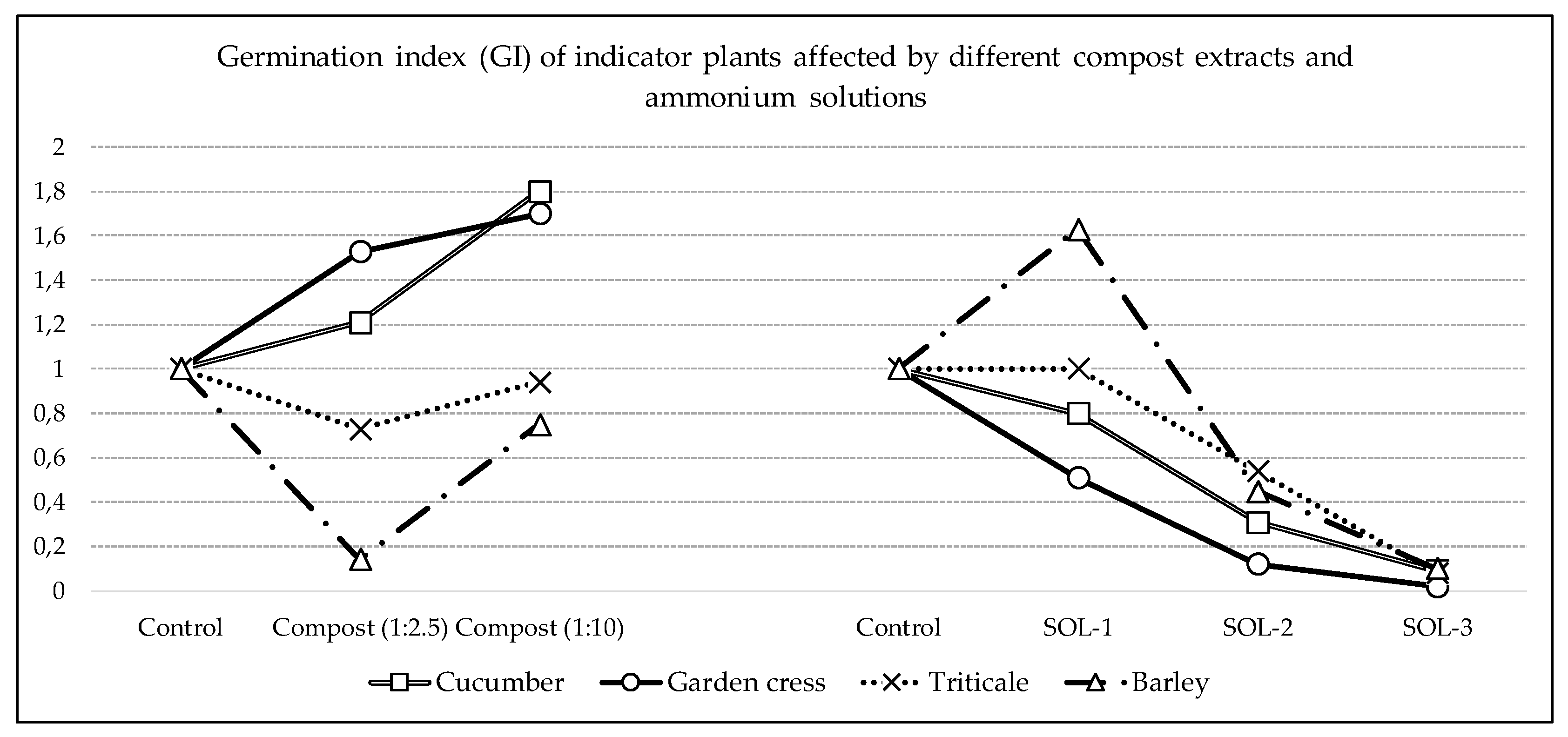

Table 1.
Results of analyzes of physical, chemical, and biological properties of compost.
| Compost Properties | Value |
|---|---|
| Compact density (g/cm3) | 0.753 |
| pH (1:5 v/v) | 8.66 |
| EC mS/cm | 2.37 |
| Moisture (%) | 25.55 |
| Dry matter (%) | 72.45 |
| Ashes (%) | 74.03 |
| Organic matter (%) | 25.97 |
| C/N ratio | 9.93 |
| Respiration intensity(mg CO2 /g DM /day) | 0.267 |
Table 2.
Content of total N, and nitrate and ammonium N (in mg/L), and total C, N, K and P in compost (in g/kg DM).
Table 2.
Content of total N, and nitrate and ammonium N (in mg/L), and total C, N, K and P in compost (in g/kg DM).
| Nitrogen Content (mg/L FM) | Value | Nutrient Content (g/kg DM) | Value |
|---|---|---|---|
| N (mg/L) | 97.94 | C (g/kg DM) | 117.00 |
| NH4+-N (mg/L) | 4.04 | N (g/kg DM) | 11.77 |
| NO3-N (mg/L) | 93.90 | K (g/kg DM) | 18.51 |
| NH4-N/NO3-N | 0.044 | P (g/kg DM) | 4.42 |
Table 3.
Results of cucumber germination test.
| Control | CE2.5 | CE10 | SOL-1 | SOL-2 | SOL-3 | LSD0,05 | |
|---|---|---|---|---|---|---|---|
| Germination rate (GR) | 87.5A | 92.5A | 95.0A | 70.0B | 40.0C | 32.5C | 16.88 |
| Root length per plant (RLP) | 1.69B | 1.82AB | 2.76A | 1.65B | 1.39B | 0.35C | 1.02 |
| Root length index (RI) | 102.25B | 109.84AB | 167.01A | 99.96B | 83.87B | 21.08C | 61.73 |
| Germination index (GI) | 1.00B | 1.21B | 1.80A | 0.80BC | 0.31CD | 0.09D | 0.500 |
| Shoot rate (SR) | 60.0AB | 60.0AB | 87.5A | 47.5B | 0.0C | 0.0C | 33.49 |
| Shoot length per plant (SLP) | 0.47B | 1.12A | 1.29A | 0.31B | 0.0B | 0.0B | 0.615 |
| Shoot length index (SI) | 91.80B | 217.04A | 250.25A | 60.60B | 0.0B | 0.0B | 119.08 |
| Vitality shoot index (MLSV) | 100.00B | 268.55A | 364.52A | 51.61B | 0.0B | 0.0B | 148.52 |
Table 4.
Results of garden cress germination test.
| Control | CE2.5 | CE10 | SOL-1 | SOL-2 | SOL-3 | LSD0,05 | |
|---|---|---|---|---|---|---|---|
| Germination rate (GR) | 95.0A | 90.0AB | 92.5AB | 70.0B | 20.0C | 2.5C | 23.88 |
| Root length per plant (RLP) | 0.66BC | 1.00AB | 1.15A | 0.46CD | 0.29CD | 0.10D | 0.45 |
| Root length index (RI) | 99.98BC | 152.66AB | 174.27A | 69.90CD | 44.02CD | 15.20D | 69.06 |
| Germination index (GI) | 1.00AB | 1.53A | 1.70A | 0.51BC | 0.12C | 0.02C | 0.73 |
| Shoot rate (SR) | 85.0A | 90.0A | 92.5A | 70.0A | 20.0B | 2.5B | 26.78 |
| Shoot length per plant (SLP) | 0.50AB | 0.56AB | 0.61AB | 0.70A | 0.39B | 0.08C | 0.278 |
| Shoot length index (SI) | 99.49AB | 111.32AB | 120.33AB | 138.74A | 77.06B | 14.84C | 54.95 |
| Vitality shoot index (MLSV) | 100.0A | 113.19A | 124.73A | 106.0A | 20.88B | 1.65B | 56.75 |
Table 5.
Results of triticale germination test.
| Control | CE2.5 | CE10 | SOL-1 | SOL-2 | SOL-3 | LSD0,05 | |
|---|---|---|---|---|---|---|---|
| Germination rate (GR) | 90.0A | 77.5AB | 90.0A | 87.5A | 72.5B | 27.5C | 13.56 |
| Root length per plant (RLP) | 3.12AB | 2.65BC | 2.95AB | 3.20A | 2.14C | 0.87D | 0.54 |
| Root length index (RI) | 100.00AB | 85.00BC | 94.69AB | 102.73A | 68.58C | 27.81D | 17.35 |
| Germination index (GI) | 1.00A | 0.73B | 0.94A | 1.00A | 0.54C | 0.08D | 0.18 |
| Shoot rate (SR) | 82.5ABC | 75.0BC | 90.0A | 87.5AB | 70.0C | 27.5D | 14.54 |
| Shoot length per plant (SLP) | 1.82BC | 2.21A | 1.87ABC | 2.12AB | 1.58BC | 0.70D | 0.38 |
| Shoot length index (SI) | 99.6BC | 121.0A | 102.6ABC | 116.1AB | 86.20C | 38.4D | 20.86 |
| Vitality shoot index (MLSV) | 100.0A | 110.8A | 111.0A | 123.4A | 71.6B | 12.4C | 25.04 |
Table 6.
Results of barley germination test.
| Control | CE2.5 | CE10 | SOL-1 | SOL-2 | SOL-3 | LSD0,05 | |
|---|---|---|---|---|---|---|---|
| Germination rate (GR) | 87.5A | 27.5BC | 67.5A | 77.5A | 32.5B | 10.0C | 20.94 |
| Root length per plant (RLP) | 1.40BC | 0.59C | 1.28BC | 2.53A | 1.92AB | 0.63C | 0.901 |
| Root length index (RI) | 102.44BC | 43.48C | 94.03BC | 185.25A | 140.77AB | 45.76C | 65.98 |
| Germination index (GI) | 1.00B | 0.14D | 0.75BC | 1.63A | 0.45CD | 0.10D | 0.428 |
| Shoot rate (SR) | 10.0B | 10.0B | 12.5B | 65.0A | 17.5B | 5.0B | 16.97 |
| Shoot length per plant (SLP) | 0.33B | 0.16B | 0.53B | 1.67A | 1.51A | 0.34B | 0.636 |
| Shoot length index (SI) | 50.0B | 25.0B | 80.77B | 257.5A | 232.7A | 51.9B | 97.81 |
| Vitality shoot index (MLSV) | 100.0BC | 38.46C | 146.2BC | 1646.2A | 384.6B | 103.9BC | 332.5 |
Table 7.
Influence of compost extract 1: 2.5 (CE2.5) on plant indicators.
| Cucumber | Garden cress | Triticale | Barley | LSD0,05 | |
|---|---|---|---|---|---|
| Germination rate (GR) | 92.5 A | 90.0 A | 77.5 A | 27.5 B | 20.01 |
| Root length per plant (RLP) | 1.82 AB | 1.00 BC | 2.65 A | 0.59 C | 0.88 |
| Root length index (RI) | 109.8 AB | 152.7A | 85.0 AB | 43.5 B | 77.44 |
| Germination index (GI) | 1.21 A | 1.53 A | 0.73 AB | 0.14 B | 0.90 |
| Shoot rate (SR) | 60.0 A | 85.0 A | 75.0 A | 10.0 B | 40.27 |
| Shoot length per plant (SLP) | 1.12 B | 0.56 BC | 2.21 A | 0.16 C | 0.74 |
| Shoot length index (SI) | 217.0 A | 111.3 AB | 121.0 AB | 25.0 B | 135.91 |
| Vitality shoot index (MLSV) | 268.6 A | 113.2 AB | 110.8 B | 38.5 B | 157.27 |
Table 8.
Influence of compost extract 1:10 (CE10) on plant indicators.
| Cucumber | Garden cress | Triticale | Barley | LSD0,05 | |
|---|---|---|---|---|---|
| Germination rate (GR) | 95.0 A | 92.5 A | 90.0 A | 67.5 B | 12.97 |
| Root length per plant (RLP) | 2.76 A | 1.15 B | 2.95 A | 1.28 B | 0.67 |
| Root length index (RI) | 167.0 A | 174.3 A | 94.7 B | 94.0 B | 62.66 |
| Germination index (GI) | 1.80 A | 1.70 A | 0.94 B | 0.75 B | 0.65 |
| Shoot rate (SR) | 87.5 A | 92.5 A | 90.0 A | 12.5 B | 15.57 |
| Shoot length per plant (SLP) | 1.29 B | 0.61 C | 1.87 A | 0.53 C | 0.53 |
| Shoot length index (SI) | 250.2 A | 120.3 B | 102.6 B | 80.8 B | 87.17 |
| Vitality shoot index (MLSV) | 364.5 A | 124.7 B | 110.9 B | 146.1 B | 156.70 |
Table 9.
Influence of solution 1 (S1) on plant indicators.
| Cucumber | Garden Cress | Triticale | Barley | LSD0,05 | |
|---|---|---|---|---|---|
| Germination rate (GR) | 70.0 | 70.0 | 87.5 | 77.5 | ns |
| Root length per plant (RLP) | 1.65 C | 0.46 D | 3.20 A | 2.53 B | 0.47 |
| Root length index (RI) | 99.9 B | 69.9 C | 102.7 B | 185.3 A | 29.51 |
| Germination index (GI) | 0.80 BC | 0.51 C | 1.00 B | 1.63 A | 0.36 |
| Shoot rate (SR) | 47.5 B | 70.0 AB | 87.5 A | 65.0 AB | 32.22 |
| Shoot length per plant (SLP) | 0.31 D | 0.70 C | 2.12 A | 1.67 B | 0.32 |
| Shoot length index (SI) | 60 6 C | 138.7 B | 116.1 B | 257.5 A | 43.34 |
| Vitality shoot index (MLSV) | 51.6 B | 106.0 B | 123.4 B | 1646.1 A | 326.32 |
Table 10.
Influence of solution 2 (S2) on plant indicators.
| Cucumber | Garden Cress | Triticale | Barley | LSD0,05 | |
|---|---|---|---|---|---|
| Germination rate (GR) | 40.0 B | 20.0 B | 72.5 A | 32.5 B | 26.50 |
| Root length per plant (RLP) | 1.39 A | 0.29 B | 2.14 A | 1.92 A | 1.04 |
| Root length index (RI) | 83.9 AB | 44.0 B | 68.6 B | 140.8 A | 67.99 |
| Germination index (GI) | 0.31 AB | 0.12 B | 0.54 A | 0.45 A | 0.26 |
| Shoot rate (SR) | 0.0 C | 20.0 B | 70.0 A | 17.5 BC | 19.26 |
| Shoot length per plant (SLP) | 0.0 B | 0.39 B | 1.58 A | 1.51 A | 0.45 |
| Shoot length index (SI) | 0.0 C | 77.1 B | 86.2 B | 232.7 A | 69.44 |
| Vitality shoot index (MLSV) | 0.0 B | 20.88 B | 71.64 B | 384.6 A | 160.04 |
Table 11.
Influence of solution 3 (S3) on plant indicators.
| Cucumber | Garden cress | Triticale | Barley | LSD0,05 | |
|---|---|---|---|---|---|
| Germination rate (GR) | 32.5 A | 2.5 B | 27.5 A | 10.0 B | 16.79 |
| Root length per plant (RLP) | 0.35 | 0.10 | 0.87 | 0.63 | ns |
| Root length index (RI) | 21.1 | 15.2 | 27.8 | 45.8 | ns |
| Germination index (GI) | 0.09 | 0.02 | 0.08 | 0.10 | ns |
| Shoot rate (SR) | 0.0 B | 2.5 B | 27.5 A | 5.0 B | 11.34 |
| Shoot length per plant (SLP) | 0.0 B | 0.07 B | 0.70 A | 0.34 AB | 0.54 |
| Shoot length index (SI) | 0.0 | 14.8 | 38.4 | 51.9 | ns |
| Vitality shoot index (MLSV) | 0.0 | 1.6 | 12.4 | 103.8 | ns |
Disclaimer/Publisher’s Note: The statements, opinions and data contained in all publications are solely those of the individual author(s) and contributor(s) and not of MDPI and/or the editor(s). MDPI and/or the editor(s) disclaim responsibility for any injury to people or property resulting from any ideas, methods, instructions or products referred to in the content. |
© 2024 by the authors. Licensee MDPI, Basel, Switzerland. This article is an open access article distributed under the terms and conditions of the Creative Commons Attribution (CC BY) license (http://creativecommons.org/licenses/by/4.0/).
Copyright: This open access article is published under a Creative Commons CC BY 4.0 license, which permit the free download, distribution, and reuse, provided that the author and preprint are cited in any reuse.