

Submitted:
10 July 2024
Posted:
12 July 2024
You are already at the latest version
Abstract
Cooperation is essential in social life, involving collaborative efforts for mutual benefit. Individual differences in the cooperativeness trait are pivotal in these interactions. Previous research suggested that Duchenne smiles signal cooperative intent, and human-like eyes are theorized to enhance cooperation evolutionarily. However, the relationships between cooperative behavior, cooperativeness and possible behavioral cues signaling cooperative behavior are yet to be studied. In the current study, we explored the relationships among cooperativeness, Duchenne smiling with gaze, IBS during conversation, and their impacts on cooperative behavior. We hypothesized Duchenne smiling with gaze would mediate cooperativeness’ impact on cooperative behavior. Additionally, using functional near-infrared spectroscopy (fNIRS), we evaluated inter-brain synchrony (IBS) in the left prefrontal region, expecting it to predict cooperative behavior. The results demonstrated that cooperativeness significantly predicted Duchenne smiling with gaze and cooperative behavior, however, Duchenne smiling with gaze did not mediate the relationship between them. We further conducted a path analysis to examine the role of IBS during conversation in successive cooperative behavior. The path analysis result showed that cooperativeness directly affected cooperative behavior. Cooperativeness significantly predicted Duchenne smiling with gaze, however, neither Duchenne smiling with gaze nor IBS during conversation predicted successive cooperative behavior. These results suggest dispositional factors like cooperativeness may play a more decisive role than momentary expressional cues or neural synchrony in naturalistic unstructured communication in shaping cooperative behavioral outcomes after the communication. The study highlights how personality traits like cooperativeness shape nonverbal communication and social interactions.
Keywords:
cooperativeness
; personality trait
; Duchenne smile
; gaze
; cooperation
; communication
; fNIRS
; inter-brain synchrony
1. Introduction
Cooperation is one of the most central aspects of social behavior and has therefore been heavily studied in social sciences. Cooperation refers to the collaborative effort among individuals or groups to achieve shared goals involving mutual benefits [1]. Cooperativeness is a personality trait representing personal preferences to cooperate with others [2], and individuals’ cooperativeness has been identified as a determinant of cooperative interactions with strangers. For example, in research on a personality scale, higher cooperativeness scores predicted the individual’s cooperative behaviors [3], and a high willingness to cooperate in economic games positively correlated with prosocial behavior in other games [4].
The human smile is a prevalent social display that plays a significant role in cooperative interactions. A rich body of studies indicates that smiling is associated with both the sender’s cooperative intent and the receiver’s level of trust. For example, research has shown that smiles are predictive of cooperative decisions in Prisoner’s Dilemma games [5], and cooperative and altruistic individuals tend to display higher levels of smiles compared to non-cooperators [6,7]. Studies also reveal that individuals displaying enjoyment smiles are perceived as more trustworthy and are more likely to be cooperated with [8]. Even in trust games, people show more cooperation towards strangers represented by a smiling photograph [9].
Duchenne smiles, characterized by the activation of the orbicularis oculi and zygomatic major muscles resulting in raised corners of the mouth and wrinkles around the eyes, are widely recognized as genuine expressions of positive emotion and are closely linked to cooperation. According to Reed et al., individuals displaying Duchenne smiles are more likely to cooperate compared to those with non-Duchenne smiles [5]. Mehu et al. emphasize the role of Duchenne smiles in maintaining cooperative relationships [6]. Moreover, individuals displaying Duchenne smiles are perceived as more generous, and Duchenne smiles could be specific to judgments of sociability and altruism [10]. Despite the ease of faking smiles [11], Duchenne smiles are regarded as reliable indicators of cooperative intent. The involvement of both emotional-driven orbicularis oculi and zygomatic major muscles makes Duchenne smiles difficult to falsify voluntarily [12]. Research consistently demonstrates a correlation between Duchenne smiling and cooperativeness. For instance, Brown et al. observed greater activity in the orbicularis oculi muscles among altruists [7], suggesting that Duchenne smiles may authentically reflect cooperative tendencies, and this effect is particularly pronounced compared to non-Duchenne smiles [5].
Humans possess particularly visible eyes compared to other primates. This adaptation is believed to have evolutionary advantages, facilitating complex social behaviors such as cooperation, communication of emotions, and coordination of group activities [13]. Tomasello et al. propose a theory suggesting that human-like eyes evolved due to selective pressures favoring improved cooperative and communicative abilities essential for mutualistic social interactions, including joint attention and visually-based communication like pointing. Their research demonstrated that humans especially rely on eyes during gaze-following scenarios, suggesting that eyes evolved a novel social function in human evolution, primarily to facilitate cooperative social interactions [13]. Other research also illustrated that gaze direction serves as a pivotal cue in human social interactions, conveying valuable information about attention, interests, and intentions [14]. Gaze direction indicates where an individual’s focus lies and can effectively redirect an observer’s attention [15]. Moreover, gaze direction significantly influences the perception of emotional facial expressions; when aligned with the underlying behavioral intent, it enhances the interpretation of those expressions. In the context of smiling, direct gaze concurrent with a smile amplifies how the smile is perceived by others [16]. This combination not only guides attention and focus but also facilitates the accurate interpretation of facial expressions, potentially making smiles more effective in signaling cooperative intent [17].
Despite existing research suggesting that Duchenne smiles may refer to the inner state of cooperativeness and signal cooperative intent [6,7], the specific influence of gaze direction during Duchenne smiling on cooperation remains unexplored. In the current study, hypothesis has been proposed to explain the relationships between Duchenne smiling with direct gaze, cooperativeness, and cooperative behavior. We examined gaze direction during Duchenne smiling across the course of a five-minute conversation among pairs of same-sex strangers. We were interested in the relationship between synchronized smiling across the conversation with gaze or gaze aversion and the cooperation results in the prisoner’s dilemma game before and after the conversation, which measured individuals’ cooperativeness and their cooperative behavior. Based on previous research, we expected that the index of individuals’ Duchenne smiling with a gaze would (1) be predicted by their cooperativeness; and (2) predict their cooperative behavior. We also examined the mediative effect of the Duchenne smile with a gaze on the relationship between cooperativeness and cooperative behavior.
In considering the underlying neural mechanism of communication, we also take into account the interpersonal neural synchrony. Recently, there has been growing interest in studying interpersonal neural synchrony using hyperscanning techniques in experimental setups that replicate real-world situations within cognitive neuroscience [18,19,20]. Hyperscanning is the form of experiment that the brain activities of two or more participants are recorded simultaneously when they are interacting [21]. Interpersonal neural synchrony (i.e., inter-brain synchrony, IBS) refers to the similarity between two neural signals coming from different brains [22]. A considerable amount of studies have postulated inter-brain synchronization as well as intra-brain synchronization as mechanisms underlying communication [23]. IBS during social interaction has been linked with prosocial behaviors such as cooperation, coordination, and collective performance [24,25,26]. Significant IBS was observed in the dorsolateral prefrontal area of dyads showing higher subjective cooperativeness during joint-drawing task [27]. Specifically, a rich body of research has reported that IBS observed in the frontal regions (including the left inferior frontal cortex and frontal pole) was correlated with prosocial interactions. For instance, parent’s and child’s brain activities synchronized in the dorsolateral prefrontal and frontopolar cortex predicted their cooperative performance [28]; and synchrony of the anterior cingulate cortex and the prefrontal areas between the brains of paired subjects was observed while they are playing the prisoner’s dilemma game [29].
Recent evidence highlights the correlation between IBS and personality traits, underscoring the pivotal role of personality in understanding the synchronized interpersonal neural activities [30,31]. Recently, two neuroimaging studies using functional magnetic resonance imaging (fMRI) and electroencephalography (EEG) provided evidence linking IBS when viewing naturalistic stimuli to personality profiles [30]. From a neural perspective, studies have also explored how the trait of cooperativeness influences structural connectivity. For instance, in a study investigating the associations between cooperativeness and fiber connectivities from the striatum to nine subcortical and cortical regions, cooperativeness has been reported to be related to connectivity between the caudate and anterior cingulate cortex and ventrolateral prefrontal cortex [32].
In the current study, we examine the effect of IBS at the left prefrontal region, which is reported to be associated with smiling [12,33], as well as involved in prosocial interactions. We focused on the IBS during an unstructured conversation with spontaneous emerged behaviors. Dyads were recruited to take a 10-minute conversation during which their facial expressions and brain activities were recorded. Before and after the conversation, the dyads were asked to perform the prisoner’s dilemma game to measure their cooperativeness and cooperative behavior. Brain activities of all dyads were recorded using fNIRS. We expected to observe IBS during the conversation. We also expected that cooperativeness would predict IBS during the conversation, which in turn predict successive cooperative behavior.
In considering the effect of cooperativeness and Duchenne smiling with gaze on cooperative behavior, we performed a path analysis to test the hypotheses, as shown in Figure 1. Based on the hypothesis, we expected that (i) cooperativeness would predict Duchenne smiling with gaze; (ii) Duchenne smile with gaze would predict cooperative behavior ; (iii) cooperativeness would predict IBS; (iv) IBS would predict cooperative behavior ; and (v) cooperativeness would predict cooperative behavior.
2. Materials and Methods
2.1. Participants
90 university and college students in Tokyo, Japan were recruited for this study. Participants received JPY 2,000 (approximate $17.5) at participation and were able to win another payment of up to JPY 450 (approximate $3.9) based on the outcome of the prisoner’s dilemma (see below). Participants were randomly assigned to form 45 same sex and same nationality dyads (21 female participants and 24 male participants), without any knowledge of their assigned partners prior to the experiment.
Participants ranged in age from 20 to 30 years, with an average age of 22 years old. 68.9% of participants were Japanese, 31.1% of participants were Chinese. The participants in this study are the same as those in our previous study [48], and thus the descriptions in the following two subsections are mostly reproduced from the paper.
2.2. Procedure
Participants were instructed to be seated on opposite ends of a meeting table with 1-meter distance in between and with a divider to separate them. This is to ensure that they would not see each other or make any communication before the conversation session started. Two Sony FDR-AX45 digital camcorders were placed approximately 0.5 meter behind of each participant and were used to record the facial behavior of the participant on the opposite end of the table. Participants were then given a description of the study and the procedures to be undertaken in the study. The introduction did not inform the participants of the real objectives of the research or the real purpose of the experiment, therefore led the participants to believe that they were to participate in a research about personality and communication. This is to avoid the participants’ conscious attention to partners’ smiles and cooperation. Following the introduction, participants were given a consent form to review and sign. Participants were aware that in addition to the fNIRS brain measurement, they were being videotaped. But the participants were not informed that their expression would be coded for further analysis, in order to avoid their conscious attention to their own smiles. After completing the experiment, participants were informed of the real purpose of the experiment and the plan for facial expression usage in the analysis. They were then given a complete description of the real aims of the research and actual procedure of the experiment, and signed a consent form to confirm that they still agreed to participate in the research and to authorize use of their personal data and video records for scientific purposes.
The participants were first told that they would participate in a one-shot prisoner’s dilemma game, and were made to believe that they would play the game with an unseen experimenter who they would not have any interaction with thereafter. This is to measure their cooperativeness with strangers. Participants were ensured that the other participants would not know their game decisions and were not informed about their own profits from the game until the experiment finished.
After the one-shot prisoner’s dilemma game, the participants were instructed to take a relaxed posture in the seat for a five-minute rest, during which two sets of wearable two-channel fNIRS instruments were placed on their heads. Following the rest session, participants took part in a ten-minute, face-to-face, unstructured “getting to know you” conversation, during which they were told they could talk about any topic. Participant’s facial behavior during the conversation session was video-recorded for the full 10 min at 30 frames per second with participants’ knowledge and consent. Immediately following the conversation, participants were once again divided by the divider and instructed to take part in a one-shot prisoner’s dilemma game with their conversation partners.
2.3. Prisoner’s Dilemma Game
The prisoner’s dilemma game was conducted using an exchange protocol [34]. Following this protocol, participants could choose different levels of cooperation rather than choose between cooperate or defect. In the game, each participant was provided an endowment of JPY 150 (approximately US$1.31) and was asked to decided how much of the endowment to give to the game partner. The provided money was then doubled and given to the partner. The participant retained the money that he/she did not give away. If both participants provided JPY 150 (fully cooperated), each received JPY 300. If one participant fully cooperated and provided JPY 150, and the other participant offered no money, the one who fully cooperated earned nothing, and the one who completely defected earned JPY 450. If both participants chose to give nothing, each earned JPY150 (mutual defection). The participant earned more by giving less regardless of the partner’s offer level. Therefore, these outcomes corresponded to the four cells in the standard prisoner’s dilemma matrix. Outcome possibilities were clearly outlined for participants in a chart as shown in Table 1.
The prisoner’s dilemma game was conducted twice: first conducted with an assumed stranger (an experimenter who they would not interact with or know each other’s information), and then with their partner after the conversation session. The proportion of the sum of the money that the pair offered before the conversation was used as a measure of the pair’s cooperativeness. The proportion of the sum of the money that the pair offered after the conversation was used as a measure of the pair’s cooperative behavior.
2.4. Behavior Analysis
Analyses of facial behavior during the conversation were only conducted for 5 minutes directly before the prisoner’s dilemma game. By focusing analysis on the 5 min of the clip that directly before the prisoner’s dilemma game, we aimed to capture facial actions which were highly relevant to cooperative behavior.
2.4.1. FACS Coding
Ekman and Friesen’s Facial Action Coding System (FACS) was used to measure facial behavior [35]. Smiles were coded as either present or absent in 1-second intervals for the 5-minute clip. In each second, if a smile is present, it was coded as either a Duchenne smile (AUs 6+12, lip corner raising up as well as presence of cheek movement and “crow’s feet” wrinkles indicating contraction of the orbicularis oculi muscles) or a non-Duchenne smile (AU 12, raise up of lip corner), following the FACS. If a Duchenne smile was present during a second, that smile was coded as 1 for that second.
All videos of the 5-minute clip were coded by a certified coder. Approximately 20 percent of the overlapping videos were coded by another certified coder, in order to assess reliability. Average pairwise reliability across coders, based on the intraclass correlation coefficient (ICC) was 0.917 using random effects.
2.4.2. Gaze Direction Coding
Individual participants’ gaze direction was coded as gaze (if looking at the partner) or gaze aversion (if not looking at the partner) in 1-s intervals for the 5-min clip by a coder. In each second, gaze direction was given a score of 1 (gaze) or 0 (gaze aversion), thus generating a series of binary data. Approximately 10 percent of the overlapping videos were coded by another coder to assess reliability. Average pairwise reliability across coders, based on the intraclass correlation coefficient (ICC) was 0.759 using random effects.
Duchenne smiling with gaze was coded as 1 when both Duchenne smile code and gaze direction code were 1. The proportion of time Duchenne smiling with gaze occurred is calculated by counting the total number of seconds it was observed and dividing this count by the total observation time of 300 seconds. The index was calculated as the dyadic average proportion of time Duchenne smiling with gaze occurred. The index was saved to use in the following statistical analysis.
2.5. fNIRS Measurement
A variety of neural scanning techniques have been used to simultaneously record brain activities such as functional near-infrared spectroscopy (fNIRS), electroencephalography (EEG), and functional magnetic resonance imaging (fMRI). A review of current methods used in haemodynamic and electrophysiological hyperscanning studies showed that fNIRS and Wavelet coherence were the most commonly neuroimaging modality and method [21]. In the current study, we employed the fNIRS hyperscanning approach to acquire brain activities from all dyads, whose prefrontal neural activities were acquired with wearable two-channel continuous fNIRS instruments (HOT-1000, Hitachi High-Technologies Corporation, Tokyo, Japan). The fNIRS probe comprised one infrared light source (wavelength 810 nm) and two light detectors at a distance of 1.0 and 3.0 cm from the light source respectively. Neural activity data was collected through the four detectors of the two probes. The sum of the concentration of oxyhemoglobin and deoxyhemoglobin changes, defined as the concentration of total-hemoglobin (total-Hb) changes, on the optical path of the source-detector were calculated from the changes in the detected light intensities using the modified Beer-Lambert law [36,37]. NIRS probes were positioned per the International 10–20 electrode system used in electroencephalography (EEG), such that the center of Fp1 and Fp2 matches the center of the optode component in the right probe which covered the rostral limit of superior frontal gyrus, and the left probe covered the left prefrontal lobe [23,38].
The participants were instructed to maintain a relaxed posture while sitting and to limit sudden movements of their heads as much as possible. The neural signals acquired by the fNIRS of 36 pairs of participants were used to analyze IBS. Data from one pair of participants were excluded due to recording failure during the conversation session. Eight pairs of participants were excluded due to failing to attach the probe to cover the left prefrontal region of interest.
2.6. Artifact Reduction Methods for fNIRS Data
The fNIRS signals were preprocessed using R. First, the drift components were removed from each signal using linear detrending. Then, dual source-detector regression [39] was applied to regress out the shallow-tissue signal component (dominated by non-neuronal systemic and motion-related noises) captured by the 1.0 cm source-detector channel from the deep-tissue signal component (contains both the non-neuronal shallow and neural deep components) captured by the 3.0 cm source-detector signal to extract the neural component. The dual source-detector regression method is expressed in the following formula:
2.7. Analysis of IBS
The left prefrontal inter-brain synchrony for each pair of participants was calculated using MATLAB (MathWorks Inc.). With the neural signals extracted through the preprocessing steps above, wavelet transform coherence (WTC) [40,41] was computed using the cross wavelet and wavelet coherence toolbox (http://grinsted.github.io/wavelet-coherence/). WTC has been widely used in fNIRS hyperscanning research to evaluate a localized correlation coefficient in time-frequency space to capture the IBS [18]. According to previous studies [42,43], a larger coherence value should be observed when the participants are interacting. Based on the same rationale, we compared the averaged coherence of genuine dyads during the last 5 minutes of conversation directly before the Prisoner’s Dilemma Game and permutated dyads using multiple two-sample t-tests for each period. In order to adjust p-values derived from the multiple statistical tests to correct for the occurrence of false positives, false discovery rate (FDR) adjustment is applied [44]. Permutated pairs were formed by participants who were in different pairs. Because genuine dyads interacted during the conversation but permutated dyads did not, a larger averaged coherence should be observed in periods sensitive to the interaction. The range of the timescales (Fourier periods) with significantly higher coherence in the genuine dyads compared to the permutated dyads is identified and used as the periods of interest (POI).
3. Results
This section may be divided by subheadings. It should provide a concise and precise description of the experimental results, their interpretation, as well as the experimental conclusions that can be drawn.
3.1. Linear Regression of Duchenne Smiling with Gaze and Cooperativeness and Cooperative Behavior
We first conducted linear regression analyses to examine if Duchenne smiling with gaze significantly predicts cooperative behavior. In accordance with our hypothesis, the results showed a significant positive correlation between dyadic average Duchenne smiling with gaze and their cooperative behavior (t(43) = 2.70, p = 0.009). We then tested if Duchenne smiling with gaze is significantly predicted by cooperativeness. The results of linear regression showed that as hypothesized, dyadic average Duchenne smiling with gaze is significantly predicted by cooperativeness (t(43) = 2.93, p = 0.005).
3.2. Estimating Mediating Effect of Duchenne Smiling with Gaze on Cooperative Behavior
Mediation analysis was conducted following [45,48] via bootstrapping method to determine if the effect of the independent variable (cooperativeness) on the dependent variable (cooperative behavior) can be explained by the mediating variable (Duchenne smiling with gaze). A pathway (Figure 2) is specified a priori showing the mediation model in which: path c determined total effect of cooperativeness (independent variable) on cooperative behavior with no consideration of mediator variables; path a and b determined the indirect effect of cooperativeness on cooperative behavior through Duchenne smiling with gaze; and path c’ determined the direct effect of cooperativeness on cooperative behavior after removing the contribution of Duchenne smiling with gaze. The mediation analysis was conducted using the mediation package in R software (version 4.0.4), which computes the Total Effect of the independent variable on the outcome, Average Causal Mediation Effects (ACME) for indirect effect, and Average Direct Effects (ADE) for direct effect. A mediator was considered to have mediational effect when (1) the indirect effect (i.e., path a × path b) of cooperativeness on cooperative behavior via smiling with gaze was significant; and (2) the bias-corrected 95% CI around the indirect effect from 1000 bootstrap re-samples excluded zero.
Results from the mediation analyses are presented in Table 2. The results indicated a significant total effect of the association between cooperativeness and cooperative behavior (total effect = 0.661, p < 0.001). The direct effect between cooperativeness and cooperative behavior was significant (ADE = 0.599, p < 0.001), however, the indirect effect of cooperativeness on cooperative behavior via smiling with gaze was not significant (ACME = 0.062, 95% CI: LLCI = −0.056 to ULCI = 0.2, p=0.25). These results suggest that Duchenne smiling with gaze would not be considered a mediator for the relationship between cooperativeness and cooperative behavior.
3.3. IBS Analysis
To analyze the IBS of left frontal signals, we compared the WTC from a genuine dyads and permutated dyads. First, we generated 180 permutated dyadic WTC data by computing the preprocessed neural signals of randomly paired participants who were not in the same dyad for interacting during conversation. Then we performed multiple two-sample t-tests to compare the time-averaged coherence value for each timescale between genuine dyadic data and permutated dyadic data. False discovery rate (FDR) adjustment is applied to adjust p-values derived from the multiple statistical tests to correct for the occurrence of false positives (Yekutieli and Benjamini, 1999). Each period with a significantly larger averaged coherence of the genuine dyads was identified. The coherence values in these periods were sensitive to the interaction. We observed that the average coherence values of genuine dyads between 15.48 and 21.89 s (0.04–0.06 Hz) were significantly higher (FDR-adjusted q < 0.05) than that of permutated dyads (Table 3), thus these timescales were used as POI for further calculating the index of IBS during the communication. This frequency band was a range that excluded the high- and low-frequency noises which would lead to artificial coherence. The average of the time-averaged coherence values in the identified POI was calculated and used as an index of IBS during the conversation task for the following path analysis.
3.4. Path Analysis for Examining the Role of IBS in Cooperative Behavior
We further analyzed the role of IBS during the conversation in successive cooperative behavior using a path analysis approach. Path analysis is a type of structural equation modeling that examines relationships among a set of observed variables, which allows the study of multiple direct and indirect relationships between variables simultaneously [46]. We used path analysis to examine the direct and indirect effect (the mediating effect of IBS) of cooperativeness on cooperative behavior, performed in R (version 4.3.2, t https://cran.r-project.org/). To assess the model’s goodness of fit, the Normed Chi-Square (χ2), the Standardized Root Mean Square Residual (SRMR), and the Comparative Fit Index (CFI) were consulted [47]. A nonsignificant χ2, SRMR value of ≤ 0.08, and a CFI ≥ 0.95 were considered a good fit.
The results of path analysis are presented in Figure 3. The model demonstrated acceptable fit (p=0.51, CFI=1, SRMR=0.03) and accounted for 38% of cooperative behavior variance. The z-values in Figure 4 clearly showed that cooperative behavior was predicted positively by cooperativeness (β=0.64, z-value=3.80, p<0.001). However, either the path from Duchenne smiling with gaze (β=0.83, z-value=1.07, p=0.28) or the path from IBS during conversation (β=−0.13, z-value=−0.13, p=0.89) to cooperative behavior was not significant. In addition, it showed that cooperativeness positively predicted the proportion of time Duchenne smiling with gaze occurred (β=0.07, z-value=2.22, p=0.02).
4. Discussion
In the current study, we explored the relationships among cooperativeness, Duchenne smiling with gaze, IBS during conversation, and their impacts on cooperative behavior. We conducted a mediation analysis to examine the effect of Duchenne smiling with gaze on the relationship between cooperativeness and cooperative behavior. The results showed that cooperativeness significantly predicted Duchenne smiling with gaze and cooperative behavior, however Duchenne smiling with gaze did not mediate the relationship between them. We further conducted a path analysis to examine the role of IBS during conversation in successive cooperative behavior. The path analysis result showed that cooperativeness directly affected cooperative behavior. Cooperativeness significantly predicted Duchenne smiling with gaze, however neither Duchenne smiling with gaze nor IBS during conversation predicted successive cooperative behavior.
Our findings indicated several significant associations. Firstly, in consistent with our prior study [48], we found that cooperativeness was a robust predictor of both Duchenne smiling with gaze and cooperative behavior. Indeed, the idea that personality plays a central role for cooperation was already expressed decades ago. For example, Chatman & Barsade examined personal cooperativeness as a single-dimension personality characteristic varying from high personal cooperativeness to low personal cooperativeness (individualism) and found that interacting with others is more closely related to one’s personality (those with higher dispositions to cooperate interact more with others) than to the demands of the situation [49]. A recent study in children revealed that cooperativeness predicted more optimal mother–adolescent interaction [50]. However, the majority of recent research emphasizes the role of behavioral mechanisms underlying cooperation from the perspective of animal signals [51]. A rich body of research suggests that smiles are the behavioral mechanism underlying cooperation by signaling cooperative intent. Mehu et al. suggests that Duchenne smile could be an important signal in the maintenance of cooperative relationships [6]. Reed et al. found that senders expressing smiles would be more likely to cooperate, and this effect was particularly stronger for Duchenne smiles compared to non-Duchenne smiles [5]. However, previous studies have not differentiated between cooperativeness and cooperative behavior by assessing participants’ cooperativeness as a personality trait prior to their decision to cooperate. For instance, according to the perspective of reciprocal altruism, cooperation in the Prisoners’ Dilemma Game might indicate an optimistic expectation regarding the perceived partner’s likelihood to cooperate. Similarly, cooperation could stem from a strong predisposition to cooperate, serving as an expression of individuals’ personality trait of cooperativeness. Consequently, it remains ambiguous whether the observed association between cooperative behavior and smiles reflects the detection of cooperative partners or if both cooperative behavior and smiles are merely influenced by a shared trait determinant, specifically trait cooperativeness. Our findings that cooperativeness robustly predicts both Duchenne smiling with gaze and cooperative behavior underscore the role of personality traits in shaping nonverbal communication and subsequent social interactions. However, contrary to our hypothesis and previous literature suggesting a potential mediating role of Duchenne smiling with gaze, our mediation analysis did not support Duchenne smiling with gaze as a mediator in the relationship between cooperativeness and cooperative behavior. This finding suggests that while cooperativeness influences Duchenne smiling with gaze and cooperative behavior independently, the nonverbal behavior does not explain the pathway from personality trait to cooperative actions.
IBS has been reported to be associated with prosocial behaviors such as cooperation, coordination, and collective performance [24,25,26]. However, the majority of hyperscanning studies has recorded IBS during structured cooperative interactions [42,52,53,54,55,56]. Some studies have observed IBS while participants perform tasks that also involve elements of naturalistic interaction, such as eye contact and communication with each other [57,58,59,60]. However, under these settings, it is unclear whether the observed IBS was driven by the cooperation or by the elements of naturalistic interaction. In comparison, the IBS observed in this study emerged in a naturalistic communication during which participants weren’t performing any structured task or aiming for an instructed collective goal. Our path analysis result showed that cooperativeness significantly predicted Duchenne smiling with gaze and cooperative behavior, however against previous research in which IBS emerged from structured tasks [54,61,62,63], IBS during conversation did not predict successive cooperative behavior. A possible explanation for the difference is whether the interactions being used encourage cooperation. Compared to the naturalistic unstructured conversation used in the current study, previous research used interactions that encouraged participant to cooperate. For example, in a study of IBS during a key-pressing task, task related IBS was found to be associated with participants’ mutual inclination to help after the task [61]. In another study of IBS during a naturalistic positive interaction about planning a fun day to spend together, IBS was found to be correlated with self-reported collaboration [62]. However, the authors reported this effect did not survive FDR correction and called for caution in future research. Our findings revealed a direct effect of cooperativeness on cooperative behavior, suggesting that dispositional factors may play a more substantial role than moment-to-moment interpersonal neural synchrony in predicting cooperative outcomes. Our result that IBS did not predict cooperative behavior also suggests that IBS spontaneously emerged from naturalistic unstructured communication without a specific task or common goal is not associated with cooperative behavior, thus suggesting future studies must consider the origin of IBS when designing experiment task.
Some cautions are called for regarding the current study. First, like much work on interpersonal synchrony and cooperation, our participants are limited to university and college students. In addition, our participants are East Asians who differ in culture from Western people. Some cross-cultural studies suggest that people’s culture shape how they judge smiles [64,65]. In order to reach a broader generalization, further research should be conducted on a more diverse and representative population. Moreover, in the current study, we focused on left prefrontal region using two-channel fNIRS. Recent fNIRS hyperscanning studies suggest that the middle frontal cortex and right dorsolateral prefrontal cortex also play a crucial role in interpersonal synchrony and its prosocial consequences [61,66,67]. Future studies regarding brain activity during interpersonal synchrony should take in to account these regions by employing a multi-channel fNIRS hyperscanning approach.
5. Conclusions
The current study investigated the causal relationship between cooperativeness, Duchenne smiling with gaze, IBS, and cooperative behavior. The findings from both mediation and path analyses consistently underscored that cooperative behavior is directly influenced by the personality trait of cooperativeness. Despite observing significant associations between cooperativeness and Duchenne smiling with gaze, neither Duchenne smiling with gaze nor IBS mediated the relationship between cooperativeness and cooperative behavior. These results highlight the pivotal role of individual disposition of cooperativeness in shaping prosocial behaviors, shedding light on the nuanced mechanisms underlying cooperative interactions in social settings. Future research could further explore additional factors that may modulate these relationships, enhancing our understanding of the complex interplay between personality traits and cooperative behaviors.
Supplementary Materials
The following supporting information can be downloaded at the website of this paper posted on Preprints.org, Minimal dataset.
Author Contributions
“Conceptualization, X.D. and S.H.; methodology, X.D. and T.N.; validation, X.D., S.H. and T.N.; formal analysis, X.D.; writing—original draft preparation, X.D.; writing—review and editing, T.N.; visualization, X.D.; supervision, T.N. and Y.M; funding acquisition, T.N. and Y.M. All authors have read and agreed to the published version of the manuscript.”.
Funding
Please add: This study was funded by KAKENHI, Grant Numbers JP20H03553 and JP21K19787, from JSPS/MEXT, Japan, and by the Center of Innovation Program from Japan Science and Technology Agency (JST), Japan.
Institutional Review Board Statement
The study was conducted in accordance with the Declaration of Helsinki, and approved by the Human Subjects Research Ethics Review Committee of the Tokyo Institute of Technology (protocol code 2019040, 6th July 2019).
Informed Consent Statement
Informed consent was obtained from all subjects involved in the study.
Data Availability Statement
Data is contained within the article or supplementary material,” with the Statement: “The original contributions presented in the study are included in the article and the supplementary material, further inquiries can be directed to the corresponding author.
Acknowledgments
We would like to thank all the participants in this study.
Conflicts of Interest
The authors declare that the research was conducted in the absence of any commercial or financial relationships that could be construed as a potential conflict of interest.
References
- Nowak, M.A. Five Rules for the Evolution of Cooperation. Science 2006, 314, 1560–1563. [Google Scholar] [CrossRef] [PubMed]
- Sommet, N.; Weissman, D.L.; Elliot, A.J. Income Inequality Predicts Competitiveness and Cooperativeness at School. J. Educ. Psychol. 2022. [Google Scholar] [CrossRef]
- Lu, S.; Au, W.-T.; Jiang, F.; Xie, X.; Yam, P. Cooperativeness and Competitiveness as Two Distinct Constructs: Validating the Cooperative and Competitive Personality Scale in a Social Dilemma Context. Int. J. Psychol. 2013, 48, 1135–1147. [Google Scholar] [CrossRef] [PubMed]
- Yamagishi, T.; Mifune, N.; Li, Y.; Shinada, M.; Hashimoto, H.; Horita, Y.; Miura, A.; Inukai, K.; Tanida, S.; Kiyonari, T.; et al. Is Behavioral Pro-Sociality Game-Specific? Pro-Social Preference and Expectations of pro-Sociality. Organ. Behav. Hum. Decis. Process. 2013, 120, 260–271. [Google Scholar] [CrossRef]
- Reed, L.I.; Zeglen, K.N.; Schmidt, K.L. Facial Expressions as Honest Signals of Cooperative Intent in a One-Shot Anonymous Prisoner’s Dilemma Game. Evol. Hum. Behav. 2012, 33, 200–209. [Google Scholar] [CrossRef]
- Mehu, M.; Grammer, K.; Dunbar, R.I.M. Smiles When Sharing. Evol. Hum. Behav. 2007, 28, 415–422. [Google Scholar] [CrossRef]
- Brown, W.M.; Palameta, B.; Moore, C. Are There Nonverbal Cues to Commitment? An Exploratory Study Using the Zero-Acquaintance Video Presentation Paradigm. Evol. Psychol. 2003, 1, 147470490300100104. [Google Scholar] [CrossRef]
- Johnston, L.; Miles, L.; Macrae, C.N. Why Are You Smiling at Me? Social Functions of Enjoyment and Non-Enjoyment Smiles. Br. J. Soc. Psychol. 2010, 49, 107–127. [Google Scholar] [CrossRef]
- Scharlemann, J.P.W.; Eckel, C.C.; Kacelnik, A.; Wilson, R.K. The Value of a Smile: Game Theory with a Human Face. J. Econ. Psychol. 2001, 22, 617–640. [Google Scholar] [CrossRef]
- Mehu, M.; Little, A.; Dunbar, R. Duchenne Smiles and the Perception of Generosity and Sociability in Faces. J. Evol. Psychol. 2007, 5, 133–146. [Google Scholar] [CrossRef]
- Gunnery, S.D.; Hall, J.A.; Ruben, M.A. The Deliberate Duchenne Smile: Individual Differences in Expressive Control. J. Nonverbal Behav. 2013, 37, 29–41. [Google Scholar] [CrossRef]
- Levenson, R.W.; Ekman, P.; Friesen, W.V. Voluntary Facial Action Generates Emotion-Specific Autonomic Nervous System Activity. Psychophysiology 1990, 27, 363–384. [Google Scholar] [CrossRef] [PubMed]
- Tomasello, M.; Hare, B.; Lehmann, H.; Call, J. Reliance on Head versus Eyes in the Gaze Following of Great Apes and Human Infants: The Cooperative Eye Hypothesis. J. Hum. Evol. 2007, 52, 314–320. [Google Scholar] [CrossRef] [PubMed]
- Emery, N.J. The Eyes Have It: The Neuroethology, Function and Evolution of Social Gaze. Neurosci. Biobehav. Rev. 2000, 24, 581–604. [Google Scholar] [CrossRef] [PubMed]
- Langton, S.R.H.; Watt, R.J.; Bruce, V. Do the Eyes Have It? Cues to the Direction of Social Attention. Trends Cogn. Sci. 2000, 4, 50–59. [Google Scholar] [CrossRef] [PubMed]
- Adams, R.B.; Kleck, R.E. Effects of Direct and Averted Gaze on the Perception of Facially Communicated Emotion. Emotion 2005, 5, 3–11. [Google Scholar] [CrossRef]
- Kleinke, C.L. Gaze and Eye Contact: A Research Review. Psychol. Bull. 1986, 100, 78–100. [Google Scholar] [CrossRef] [PubMed]
- Holroyd, C.B. Interbrain Synchrony: On Wavy Ground. Trends Neurosci. 2022, 45, 346–357. [Google Scholar] [CrossRef] [PubMed]
- Kelsen, B.A.; Sumich, A.; Kasabov, N.; Liang, S.H.Y.; Wang, G.Y. What Has Social Neuroscience Learned from Hyperscanning Studies of Spoken Communication? A Systematic Review. Neurosci. Biobehav. Rev. 2022, 132, 1249–1262. [Google Scholar] [CrossRef]
- Nam, C.S.; Choo, S.; Huang, J.; Park, J. Brain-to-Brain Neural Synchrony During Social Interactions: A Systematic Review on Hyperscanning Studies. Appl. Sci. 2020, 10, 6669. [Google Scholar] [CrossRef]
- Hakim, U.; De Felice, S.; Pinti, P.; Zhang, X.; Noah, J.; Ono, Y.; Burgess, P.W.; Hamilton, A.; Hirsch, J.; Tachtsidis, I. Quantification of Inter-Brain Coupling: A Review of Current Methods Used in Haemodynamic and Electrophysiological Hyperscanning Studies. NeuroImage 2023, 280, 120354. [Google Scholar] [CrossRef]
- Czeszumski, A.; Eustergerling, S.; Lang, A.; Menrath, D.; Gerstenberger, M.; Schuberth, S.; Schreiber, F.; Rendon, Z.Z.; König, P. Hyperscanning: A Valid Method to Study Neural Inter-Brain Underpinnings of Social Interaction. Front. Hum. Neurosci. 2020, 14, 39. [Google Scholar] [CrossRef] [PubMed]
- Nozawa, T.; Sakaki, K.; Ikeda, S.; Jeong, H.; Yamazaki, S.; Kawata, K.H. dos S.; Kawata, N.Y. dos S.; Sasaki, Y.; Kulason, K.; Hirano, K.; et al. Prior Physical Synchrony Enhances Rapport and Inter-Brain Synchronization during Subsequent Educational Communication. Sci. Rep. 2019, 9, 12747. [Google Scholar] [CrossRef]
- Czeszumski, A.; Liang, S.H.-Y.; Dikker, S.; König, P.; Lee, C.-P.; Koole, S.L.; Kelsen, B. Cooperative Behavior Evokes Interbrain Synchrony in the Prefrontal and Temporoparietal Cortex: A Systematic Review and Meta-Analysis of fNIRS Hyperscanning Studies. eneuro 2022, 9, ENEURO–0268. [Google Scholar] [CrossRef] [PubMed]
- Müller, V.; Ohström, K.-R.P.; Lindenberger, U. Interactive Brains, Social Minds: Neural and Physiological Mechanisms of Interpersonal Action Coordination. Neurosci. Biobehav. Rev. 2021, 128, 661–677. [Google Scholar] [CrossRef]
- Reinero, D.A.; Dikker, S.; Van Bavel, J.J. Inter-Brain Synchrony in Teams Predicts Collective Performance. Soc. Cogn. Affect. Neurosci. 2021, 16, 43–57. [Google Scholar] [CrossRef]
- Li, L.; Wang, H.; Luo, H.; Zhang, X.; Zhang, R.; Li, X. Interpersonal Neural Synchronization During Cooperative Behavior of Basketball Players: A fNIRS-Based Hyperscanning Study. Front. Hum. Neurosci. 2020, 14, 169. [Google Scholar] [CrossRef]
- Reindl, V.; Wass, S.; Leong, V.; Scharke, W.; Wistuba, S.; Wirth, C.L.; Konrad, K.; Gerloff, C. Multimodal Hyperscanning Reveals That Synchrony of Body and Mind Are Distinct in Mother-Child Dyads. NeuroImage 2022, 251, 118982. [Google Scholar] [CrossRef] [PubMed]
- Astolfi, L.; Toppi, J.; De Vico Fallani, F.; Vecchiato, G.; Cincotti, F.; Wilke, C.T.; Yuan, H.; Mattia, D.; Salinari, S.; He, B.; et al. Imaging the Social Brain by Simultaneous Hyperscanning During Subject Interaction. IEEE Intell. Syst. 2011, 26, 38–45. [Google Scholar] [CrossRef]
- Matz, S.C.; Hyon, R.; Baek, E.C.; Parkinson, C.; Cerf, M. Personality Similarity Predicts Synchronous Neural Responses in fMRI and EEG Data. Sci. Rep. 2022, 12, 14325. [Google Scholar] [CrossRef]
- Zhang, M.; Jia, H.; Zheng, M.; Liu, T. Group Decision-Making Behavior in Social Dilemmas: Inter-Brain Synchrony and the Predictive Role of Personality Traits. Personal. Individ. Differ. 2021, 168, 110315. [Google Scholar] [CrossRef]
- Lei, X.; Chen, C.; Chen, C.; He, Q.; Moyzis, R.K.; Xue, G.; Dong, Q. Striatum-Centered Fiber Connectivity Is Associated with the Personality Trait of Cooperativeness. PLOS ONE 2016, 11, e0162160. [Google Scholar] [CrossRef] [PubMed]
- Fox, N.A.; Davidson, R.J. Patterns of Brain Electrical Activity during Facial Signs of Emotion in 10-Month-Old Infants. Dev. Psychol. 1988, 24, 230–236. [Google Scholar] [CrossRef]
- Shinada, M.; Yamagishi, T. Physical Attractiveness and Cooperation in a Prisoner’s Dilemma Game. Evol. Hum. Behav. 2014, 35, 451–455. [Google Scholar] [CrossRef]
- Ekman, P.; Friesen, W.V. Facial Action Coding System 2019.
- Delpy, D.T.; Cope, M.; Zee, P.V.D.; Arridge, S.; Wray, S.; Wyatt, J. Estimation of Optical Pathlength through Tissue from Direct Time of Flight Measurement. Phys. Med. Biol. 1988, 33, 1433–1442. [Google Scholar] [CrossRef]
- Scholkmann, F.; Kleiser, S.; Metz, A.J.; Zimmermann, R.; Mata Pavia, J.; Wolf, U.; Wolf, M. A Review on Continuous Wave Functional Near-Infrared Spectroscopy and Imaging Instrumentation and Methodology. NeuroImage 2014, 85, 6–27. [Google Scholar] [CrossRef] [PubMed]
- Homan, R.W.; Herman, J.; Purdy, P. Cerebral Location of International 10–20 System Electrode Placement. Electroencephalogr. Clin. Neurophysiol. 1987, 66, 376–382. [Google Scholar] [CrossRef] [PubMed]
- Nozawa, T.; Sasaki, Y.; Sakaki, K.; Yokoyama, R.; Kawashima, R. Interpersonal Frontopolar Neural Synchronization in Group Communication: An Exploration toward fNIRS Hyperscanning of Natural Interactions. NeuroImage 2016, 133, 484–497. [Google Scholar] [CrossRef] [PubMed]
- Grinsted, A.; Moore, J.C.; Jevrejeva, S. Application of the Cross Wavelet Transform and Wavelet Coherence to Geophysical Time Series. Nonlinear Process. Geophys. 2004, 11, 561–566. [Google Scholar] [CrossRef]
- Torrence, C.; Compo, G.P. A Practical Guide to Wavelet Analysis. Bull. Am. Meteorol. Soc. 1998, 79, 61–78. [Google Scholar] [CrossRef]
- Cui, X.; Bryant, D.M.; Reiss, A.L. NIRS-Based Hyperscanning Reveals Increased Interpersonal Coherence in Superior Frontal Cortex during Cooperation. NeuroImage 2012, 59, 2430–2437. [Google Scholar] [CrossRef] [PubMed]
- Jiang, J.; Chen, C.; Dai, B.; Shi, G.; Ding, G.; Liu, L.; Lu, C. Leader Emergence through Interpersonal Neural Synchronization. Proc. Natl. Acad. Sci. 2015, 112, 4274–4279. [Google Scholar] [CrossRef] [PubMed]
- Yekutieli, D.; Benjamini, Y. Resampling-Based False Discovery Rate Controlling Multiple Test Procedures for Correlated Test Statistics. J. Stat. Plan. Inference 1999, 82, 171–196. [Google Scholar] [CrossRef]
- Preacher, K.J.; Hayes, A.F. SPSS and SAS Procedures for Estimating Indirect Effects in Simple Mediation Models. Behav. Res. Methods Instrum. Comput. 2004, 36, 717–731. [Google Scholar] [CrossRef] [PubMed]
- Valenzuela, S.; Bachmann, I. Path Analysis. In The International Encyclopedia of Communication Research Methods; Matthes, J., Davis, C.S., Potter, R.F., Eds.; Wiley, 2017; pp. 1–9 ISBN 978-1-118-90176-2.
- Hu, L.; Bentler, P.M. Cutoff Criteria for Fit Indexes in Covariance Structure Analysis: Conventional Criteria versus New Alternatives. Struct. Equ. Model. Multidiscip. J. 1999, 6, 1–55. [Google Scholar] [CrossRef]
- Deng, X.; Hosseini, S.; Miyake, Y.; Nozawa, T. Unravelling the Relation between Altruistic Cooperativeness Trait, Smiles, and Cooperation: A Mediation Analysis. Front. Psychol. 2023, 14, 1227266. [Google Scholar] [CrossRef] [PubMed]
- Chatman, J.A.; Barsade, S.G. Personality, Organizational Culture, and Cooperation: Evidence from a Business Simulation. Adm. Sci. Q. 1995, 40, 423–443. [Google Scholar] [CrossRef]
- Fleck, L.; Fuchs, A.; Williams, K.; Moehler, E.; Resch, F.; Koenig, J.; Kaess, M. Child Temperament as a Longitudinal Predictor of Mother–Adolescent Interaction Quality: Are Effects Independent of Child and Maternal Mental Health? Eur. Child Adolesc. Psychiatry 2024. [Google Scholar] [CrossRef] [PubMed]
- Pentland, A. Honest Signals: How They Shape Our World; MIT Press, 2010; ISBN 978-0-262-26104-3.
- Balconi, M.; Fronda, G. The “Gift Effect” on Functional Brain Connectivity. Inter-Brain Synchronization When Prosocial Behavior Is in Action. Sci. Rep. 2020, 10, 5394. [Google Scholar] [CrossRef]
- Hu, Y.; Pan, Y.; Shi, X.; Cai, Q.; Li, X.; Cheng, X. Inter-Brain Synchrony and Cooperation Context in Interactive Decision Making. Biol. Psychol. 2018, 133, 54–62. [Google Scholar] [CrossRef]
- Li, Y.; Chen, R.; Turel, O.; Feng, T.; Zhu, C.-Z.; He, Q. Dyad Sex Composition Effect on Inter-Brain Synchronization in Face-to-Face Cooperation. Brain Imaging Behav. 2021, 15, 1667–1675. [Google Scholar] [CrossRef] [PubMed]
- Miller, J.G.; Vrtička, P.; Cui, X.; Shrestha, S.; Hosseini, S.M.H.; Baker, J.M.; Reiss, A.L. Inter-Brain Synchrony in Mother-Child Dyads during Cooperation: An fNIRS Hyperscanning Study. Neuropsychologia 2019, 124, 117–124. [Google Scholar] [CrossRef] [PubMed]
- Shiraishi, M.; Shimada, S. Inter-Brain Synchronization during a Cooperative Task Reflects the Sense of Joint Agency. Neuropsychologia 2021, 154, 107770. [Google Scholar] [CrossRef] [PubMed]
- Djalovski, A.; Dumas, G.; Kinreich, S.; Feldman, R. Human Attachments Shape Interbrain Synchrony toward Efficient Performance of Social Goals. NeuroImage 2021, 226, 117600. [Google Scholar] [CrossRef] [PubMed]
- Liu, N.; Mok, C.; Witt, E.E.; Pradhan, A.H.; Chen, J.E.; Reiss, A.L. NIRS-Based Hyperscanning Reveals Inter-Brain Neural Synchronization during Cooperative Jenga Game with Face-to-Face Communication. Front. Hum. Neurosci. 2016, 10. [Google Scholar] [CrossRef] [PubMed]
- Tang, H.; Mai, X.; Wang, S.; Zhu, C.; Krueger, F.; Liu, C. Interpersonal Brain Synchronization in the Right Temporo-Parietal Junction during Face-to-Face Economic Exchange. Soc. Cogn. Affect. Neurosci. 2016, 11, 23–32. [Google Scholar] [CrossRef] [PubMed]
- Zhou, S.; Zhang, Y.; Fu, Y.; Wu, L.; Li, X.; Zhu, N.; Li, D.; Zhang, M. The Effect of Task Performance and Partnership on Interpersonal Brain Synchrony during Cooperation. Brain Sci. 2022, 12, 635. [Google Scholar] [CrossRef] [PubMed]
- Hu, Y.; Hu, Y.; Li, X.; Pan, Y.; Cheng, X. Brain-to-Brain Synchronization across Two Persons Predicts Mutual Prosociality. Soc. Cogn. Affect. Neurosci. 2017, 12, 1835–1844. [Google Scholar] [CrossRef] [PubMed]
- Kinreich, S.; Djalovski, A.; Kraus, L.; Louzoun, Y.; Feldman, R. Brain-to-Brain Synchrony during Naturalistic Social Interactions. Sci. Rep. 2017, 7, 17060. [Google Scholar] [CrossRef]
- Szymanski, C.; Pesquita, A.; Brennan, A.A.; Perdikis, D.; Enns, J.T.; Brick, T.R.; Müller, V.; Lindenberger, U. Teams on the Same Wavelength Perform Better: Inter-Brain Phase Synchronization Constitutes a Neural Substrate for Social Facilitation. NeuroImage 2017, 152, 425–436. [Google Scholar] [CrossRef]
- Matsumoto, D.; Kudoh, T. American-Japanese Cultural Differences in Attributions of Personality Based on Smiles. J. Nonverbal Behav. 1993, 17, 231–243. [Google Scholar] [CrossRef]
- Tsai, J.L.; Blevins, E.; Bencharit, L.Z.; Chim, L.; Fung, H.H.; Yeung, D.Y. Cultural Variation in Social Judgments of Smiles: The Role of Ideal Affect. J. Pers. Soc. Psychol. 2019, 116, 966–988. [Google Scholar] [CrossRef]
- Reindl, V.; Gerloff, C.; Scharke, W.; Konrad, K. Brain-to-Brain Synchrony in Parent-Child Dyads and the Relationship with Emotion Regulation Revealed by fNIRS-Based Hyperscanning. NeuroImage 2018, 178, 493–502. [Google Scholar] [CrossRef]
- Gvirts, H.Z.; Perlmutter, R. What Guides Us to Neurally and Behaviorally Align With Anyone Specific? A Neurobiological Model Based on fNIRS Hyperscanning Studies. The Neuroscientist 2020, 26, 108–116. [Google Scholar] [CrossRef]
Figure 1.
Hypothetical model.
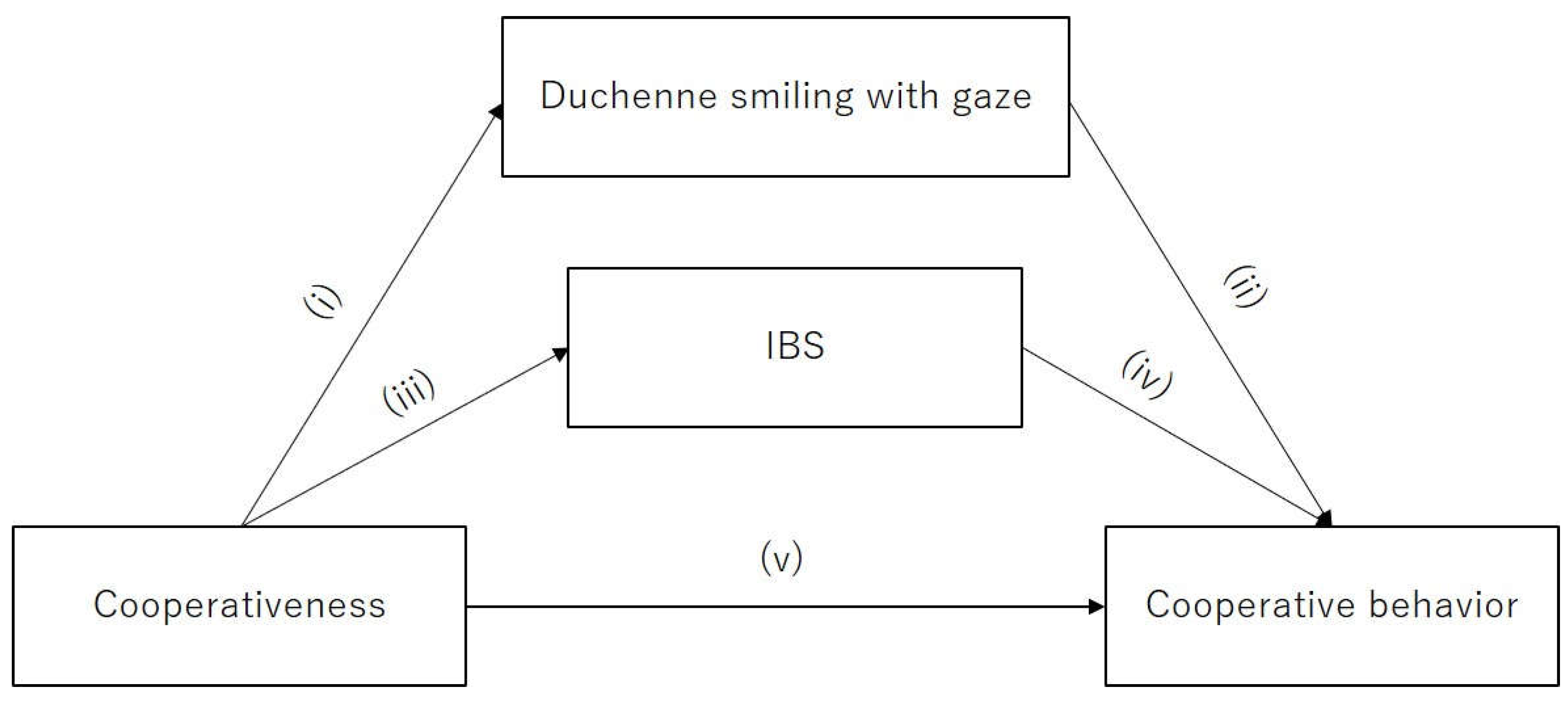
Figure 2.
Diagram of hypothesized mediation model.
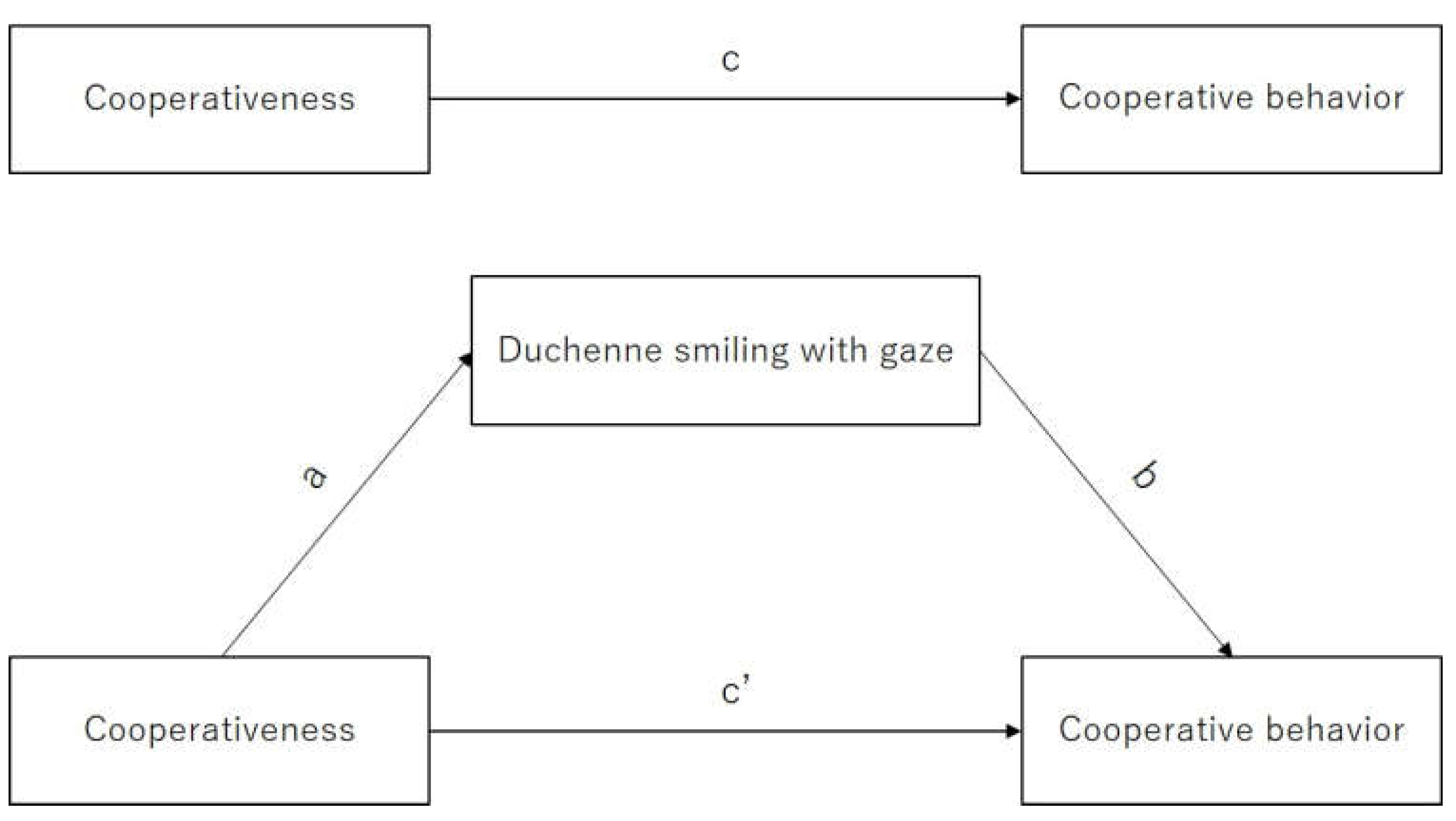
Figure 3.
Comparison of IBS of the left frontal cortex signals from genuine dyads and permutated dyads. Solid lines show the mean of time-averaged WTC over all the genuine and permutated dyads of participants for each pair. Shaded areas show the standard error of the mean (SEM) over genuine and permutated dyads. Asterisks at the bottom indicate periods with significant differences; * q < 0.05, ** q < 0.01, *** q <0 .001 (FDR-adjusted).
Figure 3.
Comparison of IBS of the left frontal cortex signals from genuine dyads and permutated dyads. Solid lines show the mean of time-averaged WTC over all the genuine and permutated dyads of participants for each pair. Shaded areas show the standard error of the mean (SEM) over genuine and permutated dyads. Asterisks at the bottom indicate periods with significant differences; * q < 0.05, ** q < 0.01, *** q <0 .001 (FDR-adjusted).

Figure 4.
Path diagram of pathways.
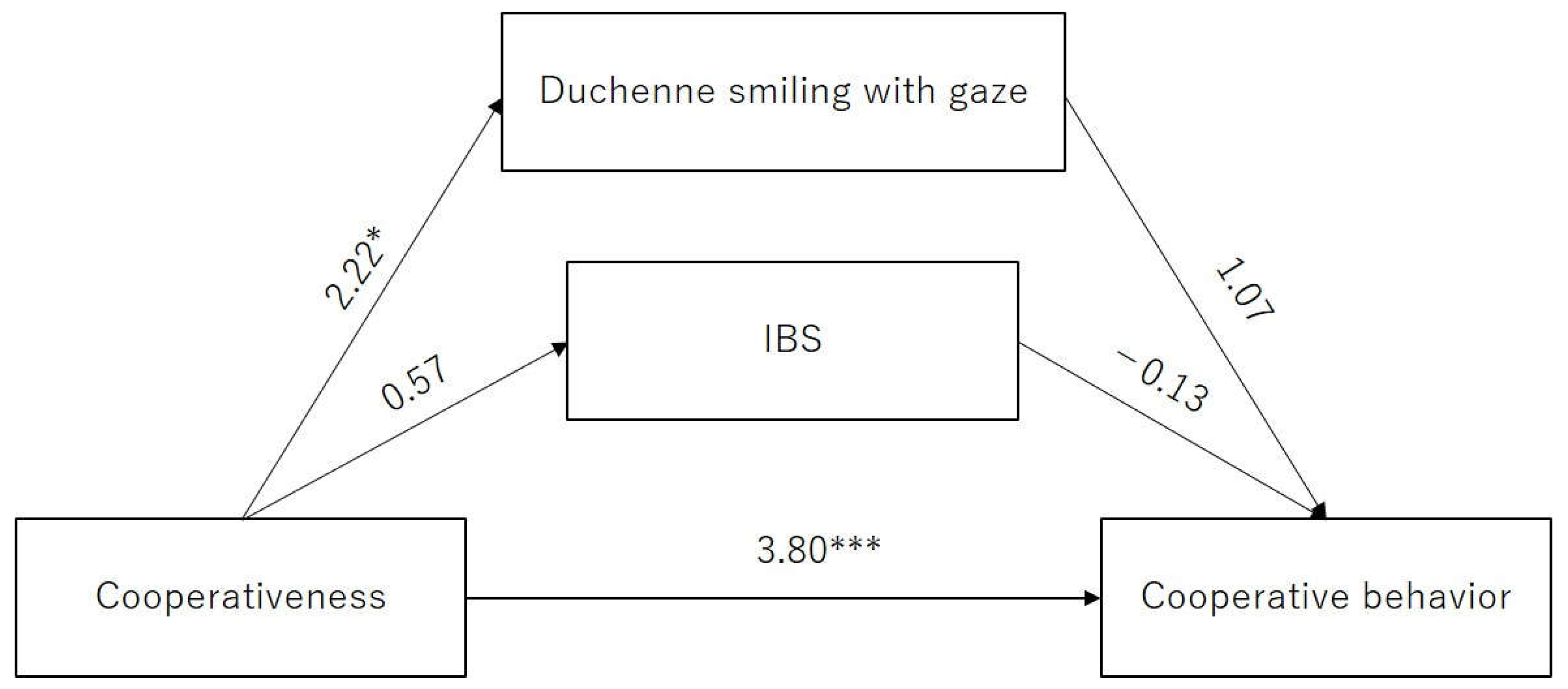

Table 1.
The incentive structure of the Prisoner’s dilemma game used in the current study expressed as a payoff matrix.
Table 1.
The incentive structure of the Prisoner’s dilemma game used in the current study expressed as a payoff matrix.
| Participant A’s cooperation level (i.e., how much A gives) | |||||
|---|---|---|---|---|---|
| Participant B’s cooperation level | 150 | 100 | … | 0 | |
| 150 | 300R300 | 200R350 | 0R450 | ||
| 100 | 350R200 | 250R250 | 50R350 | ||
| … | |||||
| 0 | 450R0 | 350R50 | 150R150 | ||
Table 2.
The mediating effect of Duchenne smiling with gaze in the relationship between cooperativeness and cooperative behavior.
Table 2.
The mediating effect of Duchenne smiling with gaze in the relationship between cooperativeness and cooperative behavior.
| Effect | 95% CI Lower | 95% CI Upper | p-value | |
|---|---|---|---|---|
| Total effect | 0.661 | 0.415 | 0.91 | <2e−16 *** |
| Direct effect | 0.599 | 0.339 | 0.86 | <2e−16 *** |
| Indirect effect | 0.062 | −0.056 | 0.20 | 0.25 |
Table 3.
Results of two-sample t-test of coherence from genuine dyads and permutated dyads between timescale 15.48 and 21.89 s (0.04–0.06 Hz).
Table 3.
Results of two-sample t-test of coherence from genuine dyads and permutated dyads between timescale 15.48 and 21.89 s (0.04–0.06 Hz).
| Period | Estimate (Genuine) |
Estimate (Permutated) |
T-Value | Df | p-Value | Fdr-Adjusted Q-Value |
|---|---|---|---|---|---|---|
| 15.48 | 0.336 | 0.312 | 2.726 | 65.955 | 0.0081 | 0.0479 |
| 16.40 | 0.344 | 0.309 | 3.993 | 64.634 | 0.0001 | 0.0016 |
| 17.37 | 0.352 | 0.305 | 4.896 | 59.746 | 7.77E-06 | 0.0001 |
| 18.41 | 0.357 | 0.304 | 5.222 | 55.929 | 2.69E-06 | 0.0001 |
| 19.50 | 0.359 | 0.306 | 4.842 | 53.705 | 1.13E-05 | 0.0001 |
| 20.66 | 0.359 | 0.311 | 4.006 | 51.616 | 0.0001 | 0.0016 |
| 21.89 | 0.358 | 0.316 | 3.103 | 48.912 | 0.0031 | 0.0217 |
Disclaimer/Publisher’s Note: The statements, opinions and data contained in all publications are solely those of the individual author(s) and contributor(s) and not of MDPI and/or the editor(s). MDPI and/or the editor(s) disclaim responsibility for any injury to people or property resulting from any ideas, methods, instructions or products referred to in the content. |
© 2024 by the authors. Licensee MDPI, Basel, Switzerland. This article is an open access article distributed under the terms and conditions of the Creative Commons Attribution (CC BY) license (https://creativecommons.org/licenses/by/4.0/).
Copyright: This open access article is published under a Creative Commons CC BY 4.0 license, which permit the free download, distribution, and reuse, provided that the author and preprint are cited in any reuse.


