

Submitted:
25 July 2024
Posted:
30 July 2024
You are already at the latest version
Abstract
The effect of land use on sandy soils of southern Botswana was carried out by comparing the composition and properties of soil organic matter. Virgin and disturbed soils were sampled from savanna ecosystems (Central District and Kweneng District). The biodegradability of organic matter was evaluated by incubation in the laboratory. Humic fractions were quantified and humic acids were analyzed by visible and infrared spectroscopy. The results indicate that continued disturbance, whether due to grazing or subsistence farming, has resulted in small significant changes in the concentration of available nutrients and organic matter in the soil. Nevertheless, substantial changes could be established in soil C/N ratio, humic acid/fulvic acid ratio and in the biodegradability of soil organic matter and the structural characteristics of humic acids. The increased aromaticity of humic acid (visible and IR spectroscopies) following disturbance, suggests increased biogeochemical activity and/or the impact of abiotic processes (such as periodic fires) selectively removing aliphatic constituents. The overall results indicate a low potential soil fertility, the sustainable preservation of which depending more on features related to quality than to the total amount of the soil organic matter, which shows considerable aromatization parallel to its degree of association with the mineral fraction.
Keywords:
arenosols
; C sequestration
; humic acid
; Kalahari sands
; organic matter
1. Introduction
In Botswana, most of the population is partially engaged in agricultural production, but there is little land suitable for productive cultivation. This land comprises the northern part of the country near the Zimbabwean border (commercial and small holder agriculture) and a strip of land that stretches southeastward [1,2]. The total area under cultivation varies year to year, as the country is prone to droughts on a regular basis; even in good years for agriculture the crop area is only 0.65% of the area suitable for agricultural production. Depending on the year, there is a discrepancy between areas planted and areas harvested, since harvest time depends on the rainfall during the growing season. In Botswana, 70% of surface soils consist of wind-blown sand deposits whose fertility is limited by the amount of annual rainfall, which varies in a cyclical pattern including regular droughts.
As in other tropical countries, in Botswana the transition from natural areas to agroecosystems has often resulted in a decline of the soil organic C. This decline is related to the initial clearing and burning of aboveground forest biomass and the low litter additions to the soil system. The conservation of soil organic matter (SOM) is therefore of paramount importance for the development of more sustainable agroecosystems and to avoid natural habitat degradation associated with shifting cultivation [3]. Nevertheless, degradation of the soil system through SOM loss results not only from soil tillage and the clearing of natural vegetation [4]; even a simple land disturbance such as soil mounding in low-input systems can lead to a decline in SOM. In any case, the main factors associated with high degradation risks in general depend on local scenarios and can range from high population and livestock densities to degradation-prone soils and high relief energy [5]. In particular, the anthropogenic impact associated with overgrazing (close to villages and around water points) and human settlements have increased the risk of desertification and degradation in the area to critical levels [6].
Not surprisingly, biomass of both live and dead fuel wood increases linearly with distance from the village [7] which presumably parallels SOM concentration.
Soil quality is a comprehensive but not well-defined concept, which to a certain extent should be revisited, depending on soil types, and at least at the level of wide bioclimatic regions. This is particularly important in the case of fragile semiarid ecosystems where continuous disturbance results in active dynamism of spatial variability of soil properties. Transversal studies have been carried out in southern Africa soils aiming to explore the potential of integrating local and scientific knowledge to improve the accuracy, coverage and relevance of land degradation assessment [8].
In fact, some soil characteristics that are often used to define soil quality have, in general, a variable meaning depending on the mechanisms involved in the accumulation of stable, humic-type SOM. In particular, SOM often acts as an integration compartment that responds to environmental changes and local disturbance and displays a biogeochemical behaviour depending on the nature and extent of the soil organo-mineral interactions. The latter influence is particularly relevant with regard to the productivity, conservation and C sequestration processes in arid and semiarid soils such as those of South-eastern Botswana [9]. In fact, these soils have developed on sandy quartz sediments derived from aeolian transport from the neighbouring Kalahari Desert. Such sandy soils show low water holding capacity, continuous loss of nutrients by leaching, minimum buffering potential and strong seasonal biogeochemical performance in a system with a low amount of SOM, which probably acts as a major pool of slow release exchangeable or mineralised elements [10,11,12]. Since little research has been done to assess the effect of historical clearing and grazing and/or cultivation on savanna soils, the present paper has two objectives: i) to define soil quality in terms of SOM resilience (i.e., monitoring changes in soil fertility and soil humus fractions after the disturbance) and ii) to study the factors related to C sequestration in these soils where SOM is presumably a key vector for soil productivity.
2. Materials and Methods
2.1. Sampling
The soil samples were collected in the course of the field trips carried out during an EU project, in two important agricultural districts (different representative locations) of Botswana: Central district and Kweneng district. In the Central District samples were collected from undisturbed Malatemane-Tuli Block (VTUL) and Malete field—Malatemane land—Tuli Block disturbed (DTUL) sites. In Kweneng district the selected locations were: undisturbed Letlamna Field-Mashangwe Ditshegwane (VMAS), disturbed Letlamna field-Mashangwe Ditshegwane (DMAS), undisturbed Puleng Field-Ramage lands-Letlhakeng (VLET) and cultivated Puleng Field—Ramage lands—Letlhakeng (DLET). When existing, soil litter was removed and soil samples (ca. 500 g) (four spatial replications separated about 100 m) were taken from the upper 10 cm with a spade. No attempt was made to take any soil material from the underlying horizons, since the observation of the featureless soil profiles suggested no accumulation of SOM and no conspicuous horizon patterns at least in the underlying 20–30 cm layer. Soil samples were air-dried and large roots and rock fragments (> 4 mm) were removed by hand. Then, the soil material was homogenised with a 2 mm sieve and the coarse fraction was discarded.
2.2. General Analyses
The pH was measured in soil:water suspension (1:2.5 by wt). Total N was determined by micro-Kjeldahl digestion and available P by the Bray and Kurtz method [13]. Available macroelements (K, Ca, and Mg) were extracted with 1M NH4OAc (pH= 7) and the available micronutrients (Fe, Mn, Zn, Cu) with diethylenetriaminepentaacetic acid [14]. Total C in soils (no carbonates present) was determined by dry combustion in a Wösthoff furnace attached to a Carmhograph-12 gas analyser. The determination of C in extractive organic fractions was carried out by the Walkley and Black wet oxidation method [15].
2.3. Soil Respiratory Activity
From in vitro experiments under laboratory conditions the intrinsic biodegradability of the SOM can be predicted to some extent. For this, samples of 20 g of dry soil homogenized to 2 mm moistened to 60% of the soil water holding capacity were incubated at 27±1 °C in 250-mL Erlenmeyer flasks, closed with rubber stoppers with polyethylene inlet and outlet tubes also closed with small stoppers [16]. The CO2 released in the course of the mineralization of the SOM was measured daily with a Carmhograph-12 gas analyzer (Wösthoff, Germany). During this operation the outlet tube was connected to the CO2 analyzer; the inlet tube was connected to a glass column filled with soda lime to provide the flask atmosphere with CO2-free air [17]. The released CO2 was expressed both in absolute terms i.e., mineralization rate: milligrams of C released per soil weight unit and per day, and in relative terms i.e., taking into account that each soil had a different SOM content, mineralization coefficient: milligrams of C released per kilogram of soil C and per day.
2.4. Soil Humus Fractions
A series of experimental methods reported by Duchaufour and Jacquin [18] have been used to isolate and quantitatively determine the major humus fractions. From samples of 50 g of soil placed in 250 mL centrifuge bottles, a particulate floating fraction with the slightly decomposed organic particles (free organic matter) was separated by flotation in 2 M H3PO4 [19] followed by centrifugation at 5 000 rpm for 10 minutes. From the above suspension, the yellowish H3PO4 surnatant solution was stored for quantification of this fulvic acid, referred to as FAP. Then, the soil residue was successively extracted with 0.1 M Na4P2O7 Na followed by 0.1 M NaOH, this operation was repeated 10 times. Two aliquots of the brown-coloured supernatant solution (total humic extract) were isolated; one (50 mL) was precipitated with H2SO4 (1:1 by vol.), centrifuged and used for the quantitative determination of the acid-insoluble humic acid (HA) fraction. Another aliquot (20 mL) was analysed for C content as a whole. The difference in C was considered as the fraction of fulvic acid (FA). Finally, the soil organic fraction tightly linked to Al or Fe oxides and to the clay, which is referred to as extractable insolubilized humin [18], was separated from the remaining soil residue by successive treatments with 60 mM Na2S2O4 and 1 M HCl-HF (1:1 by vol). After repeating the treatment up to 3 times, the colourless supernatant solution was discarded and the soil residue was extracted with 0.1 M NaOH to isolate the humic substances that were bound to the soil mineral matrix. For C determination, aliquots of this humic extract containing insolubilized extractable humin were processed as described above.
For further analytical characterization, the HA fraction was purified. After quantitative analysis the remaining total humic extract was acidified to pH 1 with 6 M HCl and centrifuged. The yellowish supernatant solution was discarded and the acid-insoluble HA in the gel state was recovered and redissolved in 0.5 M NaOH. This solution was high-speed centrifuged at 43 500 g and the insoluble residue, mainly mineral, was discarded. The brown supernatant solution with the Na-humate was treated with a 1 M HCl-HF mixture and the final HA precipitate was recovered and introduced into cellophane bags for exhaustive dialysis until elimination of the salts (AgNO3 test) introduced during the extraction procedure, desiccated at 40 °C and homogenised.
2.5. Humic Acid Characteristics
To determine the optical density of the HA solutions, which is considered a classical indicator of aromaticity [20] and often referred to as an index of maturity of the SOM, visible spectra were acquired from HA solutions in 0.02 M NaHCO3 adjusted to 100 mg C · L-1.
The infrared (IR) spectra of the HAs were obtained from KBr pellets (by homogenizing 2.0 mg HA with 200 mg oven-dry KBr) over a wavenumber range of 4000–600 cm-1 in a Bruker IFS28 Fourier transform spectrophotometer (Bruker Spectrospin Ltd., Coventry, UK). Since, as usual in macromolecules, the IR spectra of the HAs were quite featureless, in general consisting of broad and overlapped absorption bands, the spectra were postprocessed with a digital algorithm for resolution enhancement based on subtraction from the raw spectrum of a positive multiple of its 2nd derivative [21,22].
2.6. Statistical Data Treatments
The Least Significant Difference Test [23] was used to compare the significance level of the differences between all the data obtained. A series of multivariate statistical treatments mainly multidimensional scaling [24] were used to compare changes between virgin and disturbed sites using Euclidean distances to classify cases (sample points) and the 1-Pearson’s r to classify variables (soil descriptors in Table 1, Table 2 and Table 3). Variables were checked for normality and redundant variables were not processed.
3. Results
3.1. General Characteristics
Table 1 shows a series of routine soil characteristics. The soils showed sandy (Mashangwe and Letlhakeng sites) and sandy loam (Tuli Block site) texture. Clay content was significantly higher in Tuli Block soils VTUL and DTUL, (>10%) whereas the differences in clay content between LET and MAS sites were not statistically significant.
At the Tuli Block and Mashangwe sites soil pH increased as a result of clearing and further disturbance. In Letlhakeng, by contrast, the small increase in soil pH as regards the original savanna ecosystem was not significant.
The undisturbed savanna soils showed very small amount of SOM, less than 5 g kg-1, which decreases at the cleared DTUL and DMAS sites, but remains stable or increased to some extent in DLET site.
section may be divided by subheadings. It should provide a concise and precise description of the experimental results, their interpretation, as well as the experimental conclusions that can be drawn.
The C/N ratio is low in all sites, as it could be expected from semiarid soils with a periodically high biological activity. In the LET area, no differences in total N between virgin and disturbed were observed. On the contrary, in the other two areas (TUL and MAS) a significant increase in the concentration of soil N was recorded when subjected to disturbance.
3.2. Soil Respiratory Activity
The mineralization curves (Figure 1) calculated in terms of the total C in each soil showed some significant changes due to clearing and cultivation in the case of MAS site. This soil, which contained the lowest amount of SOM showed the highest mineralization rate, indicating young SOM or weak organo-mineral interaction, or both.
3.3. Soil Organic Matter Fractions
Table 2 shows the distribution of soil C in the different organic fractions. When the data are calculated as percentages of total C (Figure 2), the soils generally show characteristics that suggested high-performance humification processes: negligible amount of free organic matter (even in virgin savanna) and high HA and humin content (often representing 50% of the total soil C). The soils have a variable content of FAs with HA/FA ratios ranging from 7.25 (VTUL) to 0.93 (VMAS). In particular, the TUL site differs from the MAS and LET sites. In the former, the humus composition suggests more effective organo-mineral interactions and a lower tendency to generate FAs. In contrast, at the other two sites, the HA/FA ratio was several times lower and close to unity, which is more typical of tropical forests with intense SOM mineralization.
3.4. Humic Acid Characteristics
The optical density values of humic acids are shown in Table 3 and show high values in the disturbed sites compared to the virgin sites, mainly in the TUL site compared to the other soils. E4/E6 ratios, indicative of polydispersity or molecular size [25], were equally low in all samples (3.5 on average).
The IR spectra (Figure 3 and Figure 4) were featureless with a low intensity band for carboxyl groups (1720 cm-1) and marked bands for the aromatic (1610 cm-1) and aliphatic (2920 cm-1) moieties of the structural backbone. Other bands due to O-containing groups such as 3400 cm-1 (O–H stretching), 1270 cm-1 (phenolic OH) and 1060 cm-1 (alcoholic OH) showed less significant differences between samples.
4. Discussion
4.1. General Characteristics
According to Ringrose et al. [26], the higher SOM content at TUL site is associated with denser vegetation cover that is connected to a moisture-temperature gradient in the sampling area. In fact, local climatic constraints mainly rainfall variations have been described as playing an important role in the accumulation of SOM derived from C4 grassland or C4 forest species [27]. In any case, small significant differences in C concentration between virgin and disturbed sites have been previously observed in other southern African soils [28] and attributed to the few inputs in virgin sites, because of a loss of litter due to the activity of ungulates and/or termites in the dry season.
Phosphorus pool concentration has been considered a useful proxy for characterizing the whole nutrient distribution in savannas, at least when they are developed under similar bioclimatic constraints [29]. In particular P has been shown as a limiting nutrient in savanna ecosystems with seasonal dynamics in its cycling [30]. The concentration of P increases in the DTUL site as a probable effect of fertilisation, whereas a reduction was observed in the other two disturbed sites. The amounts of K, Ca, Na and Mg remain more or less constant in all the sites studied. Concerning the amount of microelements, there was a pattern of little significant changes. It is worthy to indicate that in general the TUL sites showed, as in the case of macroelements, the highest natural fertility, being these fertility patterns— as stated by Chanda et al. [31]—closely related to the concentration in the mineralogical constituents of the soil matrix (organic matter and clay) in the studied sites.
The fact that the amount of micronutrients in the 3 studied sites did not show remarkable significant changes after disturbance, and the observed trend towards a higher concentration in soils with a comparatively higher amount of SOM, could be interpreted as that most of potential soil fertility is at first sight associated with resilient organic matter in these soil formations. Nevertheless, the complex history of land use must also be considered at this site, where frequent fallowing and changes in grazing practices [32] are probably causing a sizeable homogenizing effect associated in part to a traditional empiric, environmentally friendly management focused to allow the soil to regain its fertility. This fact could also be a consequence of changes in the spatial distribution patterns of wildlife populations that show high mobility in search of food and water [33] in a scenario where crop yields vary negatively over time [34]. It is also possible that substantial migration of soil fertility and pyrogenic C-forms was in the form of airborne particulates, which can be transported over long distances, and is believed to play an important role in many biogeochemical processes influencing soil characteristics in Botswana [35].
As a whole, the above results could be interpreted as follows: in the study area, the sites referred to as “virgin“ should not be considered as representative of “undisturbed wilderness“ but rather as “social spaces“ that are communally conceived and preserved [36] and where wildlife conservation coexists with self-sufficient sustainable rural economics. On the other hand, the behaviour observed for the SOM and chemical fertility spatial patterns is consistent with the findings by Zhou et al. [37] who postulated a fractal-like model for rainfall patterns over semi-arid Botswana indicating that causative mechanisms for rainfall were spatially uniform. Finally, another factor to consider, affecting both the spatial homogeneity of the area studied and the temporal diversification of topsoil properties, is the trend in fire patterns since the greater occurrence of fires promotes landscape heterogeneity [38].
4.2. Soil Respiratory Activity
In particular, the TUL site differs from the MAS and LET sites. In the former, the humus composition suggests more effective organo-mineral interactions and a lower tendency to generate FAs. In contrast, at the other two sites, the HA/FA ratio was several times lower and close to unity, which is more typical of tropical forests with intense SOM mineralization.
In the other soils, which showed much lower mineralization rates than in the MAS site, there was a small-significant decrease in the amount of CO2 released, indicating not only stability of the original savanna SOM (i.e., less than 0.5 mg C kg C soil day-1), but also stability against environmental impacts.
4.3. Soil Organic Matter Fractions
In particular, the TUL site differs from the MAS and LET sites. In the former, the humus composition suggests more effective organo-mineral interactions and a lower tendency to generate FAs. In contrast, at the other two sites, the HA/FA ratio was several times lower and close to unity, which is more typical of tropical forests with intense SOM mineralization.
Regarding the impact of human activities at the TUL site, the disturbance is recognized by an absolute increase (ca. 3 fold) in the FA fraction and an increase in the amount of non-extractable humin. This could be interpreted as a mineralization of the extractable humic substances and a relative enrichment in insoluble, defunctionalized SOM associated to the mineral fraction. The other two soils showed a relative stability in the SOM, its composition did not show highly significant changes (P< 0.05) when calculated as a percentage of the total soil C.
4.4. Humic Acid Characteristics
The optical density values (Table 3) suggested high stability in the disturbed sites compared to the virgin sites, as it would correspond to a similar degree of aromaticity. When comparing all soils studied, the most significant difference was the higher optical density values at the TUL site compared with the other soils. This coincides with previous data suggesting a comparatively high maturity of the SOM. The E4/E6 ratios were similar in all samples and could be considered as relatively low, indicating high macromolecular size and condensation of the HAs [25].
The visual inspection of the spectra clearly shows in MAS and LET soils a relative decrease in the intensity of the alkyl bands (2920 cm-1) after soil disturbance, which also occurs, to a lesser extent, with the 1060 cm-1 peak. All these changes suggest an increase in aromatization with disturbance at these sites, whereas at the TUL site the changes after disturbance were less significant.
Resolution enhanced spectra were useful for better peak identification and more accurate comparison of peak intensities (Fig. 4). These spectra confirm the aromatisation trend in the SOM of disturbed soils observed only at MAS and LET sites, a small significant but conspicuous trend at all disturbed sites that could be attributed to the above-suggested enhancement of biogeochemical activity in cultivated sites. Nevertheless, the well-known effect of fire in increasing the aromaticity of the SOM should not be ruled out. At this point some authors described enhanced aerosol concentrations by biomass burning in the proximity of densely populated areas [39]. In fact, all external factors that affect soil evolution are too closely associated in the studied site, and climate, topography, vegetation and land use led to variable fire regimes reflected in the heterogeneity of the landscape [38].
The overall results agree with those by Dahlberg [40] who stated that despite of the strong impact of people and livestock on vegetation, most indicators of soil degradation were lacking, suggesting that the land has not lost much of its productive potential. This author concluded that, assuming the spatial heterogeneity and temporal variation inherent to semi-arid environments, the variations on soil type, rainfall and vegetation cover are partially overriding the effects of land use. In particular, the feasibility of smallholder farming is a classic controversy in dynamic dryland environments like the Kalahari.
5. Conclusions
The major differences in terms of soil use are summarized in Figure 5, where the intensity of the disturbance of virgin sites and the extent of the spatial variability of the SOM descriptors are represented by the distance between coordinates after multidimensional scaling. It is clear that the largest change (virgin vs. disturbed) occurs in Tuli Block site and the smallest in Letlhakeng site (i.e., a scenario in which the changes were not highly significant in soils when SOM was below a minimal level such as in virgin and disturbed areas at this site).
Regarding the factors related to the preservation of soil natural fertility and with soil C sequestration, Figure 6 clearly shows the soil variables more or less significantly correlated with C. Total soil clay and extractable Fe showed a close correlation with soil C, indicating the importance of soil matrix constituents in sandy areas where the above mentioned mineral fractions are likely to act as limiting factors.
Other factors related to the performance of soil C sequestration in the study sites, but with a lower level of significance, were the concentration of the main macronutrients and non-extractable humin, which could be interpreted as if these surrogates reflected the primary production of the ecosystem, in addition to the role of soil organo-mineral interactions. In general, the results coincided with those reported in in Southern Africa arenosols [41], who described higher SOM contents generally associated to higher values of clay and cation exchange capacity. In fact, SOM and nutrient dynamics, mainly N, in the Kalahari depend more on the rainfall gradient and vegetation composition than on the less significant variation in physical soil properties [42].
Author Contributions
Conceptualization, D.K.; methodology, G.A., D.K. and M.S.; software, G.A.; validation, D.K. and M.S.; formal analysis, G.A.; investigation, D.K., M.S. and G.A.; resources, D.K., M.S. and G.A.; data curation, D.K., M.S. and G.A.; writing—original draft preparation, G.A.; writing—review and editing, D.K., M.S. and G.A.; supervision, D.K. and M.S.; project administration, D.K., MS and G.A.; funding acquisition, D.K., M.S. and G.A. All authors have read and agreed to the published version of the manuscript.
Funding
Financial support by the European Union (grant INCO-DC, PL-972698) is gratefully acknowledged.
Acknowledgments
The authors wish to express their sincere gratitude to Dr. María T. Pardo, Dr. María C. Zancada and Dr. María C. López-Fando (Center of Environmental Sciences, CSIC) for their contributions during the field campaigns or laboratory analyses.
Conflicts of Interest
The authors declare no conflicts of interest.
References
- Kgathi DL, Sekhwela MBM, Tietema T, Mpotokwane MA (1994) Biomass in Botswana. In: Biomass Energy and Coal in Africa (eds: Hall, DO and Mao, YS) Zed Books Ltd, London.
- Sekhwela MBM (1997) Environmental Impact of Woody Biomass Use in Botswana: The Case of Fuelwood. In: Biomass Energy Policy in Africa (eds: Kgathi, DL; Hall, DO; Hategeka, A and Sekhwela, MBM). Zed Books Ltd, London.
- Sekhwela MBM (2000) Woody Biomass and Deforestation in Southern African Region: Implications for Global Change Research, pp. 100–119. In: Towards Sustainable Management in the Kalahari Region – Some Essential Background and Critical Issues (eds: S Ringrose and C Raban). Directorate of Research and Development, University of Botswana, Gaborone, Botswana.
- Sekhwela MBM, Yates D, Lamb D (2000) Woody Vegetation Structure and Wood Availability in Arid and Semi-Arid Kalahari Sand System of Botswana, pp 65–84. In: Towards Sustainable Management in the Kalahari Region – Some Essential Background and Critical Issues (eds: S Ringrose and C Raban). Directorate of Research and Development, University of Botswana, Gaborone, Botswana.
- Weinzierl T, Wehberg J, Böhner J, Conrad O (2016) Spatial assessment of land degradation risk for the Okavango river catchment, southern Africa. Land Degrad Dev 27:281–294. [CrossRef]
- Mulale K, Chanda R, Perkins JS, Magole L, Sebego RJ, Atlhopheng JR, Mphinyane1 W, Reed MS (2014) Formal institutions and their role in promoting sustainable land management in Boteti, Botswana. Land Degrad Dev 25: 80–91. [CrossRef]
- Perkins J, Reed M, Akanyang L, Atlhopheng J, Chanda R, Magole L, Mphinyane W, Mulale K, Sebego R, Fleskens L, Irvine B, Kirkby M (2013). Making land management more sustainable: experience implementing a new methodological framework in Botswana. Land Degrad Dev 24: 463–477. [CrossRef]
- Stringer LC, Reed MS (2007) Land degradation assessment in southern Africa: integrating local and scientific knowledge bases. Land Degrad Dev 18: 99–116. [CrossRef]
- Sekhwela MBM (1992a) Environmental Research and Environmental Conservation: Past, Present and Future. Which Way Botswana's Environment? Proc. Symposium The Kalahari Conservation Society, pp. 69–9, Gaborone.
- Sekhwela MBM (1992b) Environmental Research and Environmental Conservation: Past, Present and Future. In: Which Way Botswana’s Environment? (ed: K Cameroon), Kalahari Conservation Society, Gaborone.
- Pardo MT, Ristori G, D´Acqui LP, Almendros G (2003) An assessment of soil fertility and agronomic constraints in southern African savannas. A case study of Pandamatenga area, Botswana, S. Afr. Geogr. J. 85: 35–41. [CrossRef]
- Almendros G, Kgathi D, Sekhwela M, Zancada MC, Tinoco P, Pardo MT (2003) Biogeochemical assessment of resilient humus formations from virgin and cultivated northern Botswana soils. J Agric Food Chem, 51: 4321–4330. [CrossRef]
- Bray RH, Kurtz LT (1945) Determination of total organic and available forms of phosphorus in soils. Soil Sci, 59: 39–45. [CrossRef]
- Lyndsay WL, Norvell WA (1978) Development of a DTPA soil test for zinc, iron, manganese and copper. Soil Science Soc Amer J 42: 421–428. [CrossRef]
- Nelson DV, Sommers LE (1982) Total carbon, organic carbon and organic matter. In: Methods of Soil Analysis: Part 2, Chemical and Microbiological Properties, 2nd edn Page, AL, Miller, RH, Keeney, D R, Eds; American Society of Agronomy, Madison, WI, 1982, 539–579 pp.
- Chone T, Jacquin F, Yaghi M (1973) Emploi de 14C et 45Ca comme éléments traceurs de l'humification. Bull ENSAIA 15: 69–83.
- Almendros G, González Vila FJ, Martin F (1990) Fire induced transformation of soil organic matter from an oak forest. An experimental approach to the effects of fire on humic substances. Soil Sci, 149, 158–168. [CrossRef]
- Duchaufour P, Jacquin F (1975) Comparaison des processus d'humification dans les principaux types d'humus forestiers. Bull AFES 1975, 1: 29–36.
- Dabin B (1971) Étude d'une méthode d'extraction de la matière humique du sol. Sci Sol, 2: 15–24.
- Traina S, Novak J, Smeck NE (1990) An ultraviolet absorbance method of estimating the percent aromatic carbon content of humic acids. J Environ Qual, 19: 151–153. [CrossRef]
- Rosenfeld A, Kak AC (1982) Digital Picture Processing. Academic Press, New York, Vol. I.
- Almendros G, Sanz J (1992) A structural study of alkyl polymers in soil after perborate degradation of humin. Geoderma, 53, 79–95. [CrossRef]
- Fisher RA (1949) The Design of Experiments. Oliver and Boyd Ltd., Edinburgh, UK.
- Kruskal JB (1964) Multidimensional scaling by optimizing goodness of fit to a nonmetric hypothesis. Psychometrika 29: 1–27. [CrossRef]
- Chen Y, Senesi N, Schnitzer, M (1977) Information provided on humic substances by E4/E6 ratios. Soil Sci Soc Amer J 41: 352–358. [CrossRef]
- Ringrose S, Matheson W, Wolski P, Huntsman-Mapila P (2003) Vegetation cover trends along the Botswana Kalahari transect. J Arid Environ 54: 297–317. [CrossRef]
- Wang L, Okin GS, Caylor KK, Macko SA (2009b) Spatial heterogeneity and sources of soil carbon in southern African savannas. Geoderma 149: 402–408. [CrossRef]
- Feral CJW, Epstein HE, Otter L, Aranibar JN, Shugart HH, Macko SA, Ramontsho J (2003) Carbon and nitrogen in the soil–plant system along rainfall and land-use gradients in southern Africa. J Arid Environ, 54: 327–343. [CrossRef]
- O’Halloran LR, Shugart HH, Wang L, Caylor KK, Ringrose S, Kgope B (2010) Nutrient limitations on aboveground grass production in four savanna types along the Kalahari Transect. J Arid Environ 74: 284–290. [CrossRef]
- Wang L, D’Odorico P, Okin GS, Macko SA (2009a) Isotope composition and anion chemistry of soil profiles along the Kalahari Transect. J Arid Environ 73: 480–486. [CrossRef]
- Chanda R, Totolo O, Moleele N, Setshogo M, Mosweu S (2003) Prospects for subsistence livelihood and environmental sustainability along the Kalahari Transect: The case of Matsheng in Botswana's Kalahari rangelands. J Arid Environ, 54:425–445. [CrossRef]
- Mmopelwa G (1998) Factors contributing to land fallowing in a permanent cultivation system: the case of semi-arid Botswana. J Arid Environ 40: 211–216. [CrossRef]
- Verlinden A (1997) Human settlements and wildlife distribution in the southern Kalahari of Botswana. Biol Conserv 82: 129–136. [CrossRef]
- Seleka TB (1999) The performance of Botswana's traditional arable agriculture: growth rates and the impact of the accelerated rainfed arable programme (ARAP). Agric Econ, 20: 121–133. [CrossRef]
- Humphries MS, McCarthy TS, Cooper GRJ, Stewart RA, Stewart RD (2014) The role of airborne dust in the growth of tree islands in the Okavango Delta, Botswana. Geomorphology 206: 307–317. [CrossRef]
- Twyman C, Sporton D, Thomas DSG (2004) ‘Where is the life in farming?’: The viability of smallholder farming on the margins of the Kalahari, Southern Africa. Geoforum 35: 69–85. [CrossRef]
- Zhou X, Persaud N, Wang H (2005) Periodicities and scaling parameters of daily rainfall over semi-arid Botswana. Ecol Modell 182: 371–378. DCOI: 10.1016/j.ecolmodel.2004.04.011.
- Hudak AT, Fairbanks DHK, Brockett BH (2004) Trends in fire patterns in a southern African savanna under alternative land use practices. Agric Ecosys Environ 101: 307–325. [CrossRef]
- Jayaratne ER, Verma TS (2001) The impact of biomass burning on the environmental aerosol concentration in Gaborone, Botswana. Atmos Environ 35: 1821–1828. [CrossRef]
- Dahlberg AC (2000) Vegetation diversity and change in relation to land use, soil and rainfall — a case study from North-East District, Botswana. J Arid Environ 44: 19–40. [CrossRef]
- Hartemink AE, Huting J (2008) Land cover, extent, and properties of arenosols in Southern Africa. Arid Land Res Manag 22: 134–147. [CrossRef]
- Wang L, D’Odorico P, Ringrose S, Coetzee S, Macko SA (2007) Biogeochemistry of Kalahari sands. J Arid Environ 71: 259–279. [CrossRef]
Figure 1.
Carbon mineralization curves of virgin and disturbed soils from South-eastern Botswana (average values: the error bars on the curves for daily mineralization show the average variability range between four soil samples collected at different sites). Soil labels refer to the Material and Methods section.
Figure 1.
Carbon mineralization curves of virgin and disturbed soils from South-eastern Botswana (average values: the error bars on the curves for daily mineralization show the average variability range between four soil samples collected at different sites). Soil labels refer to the Material and Methods section.
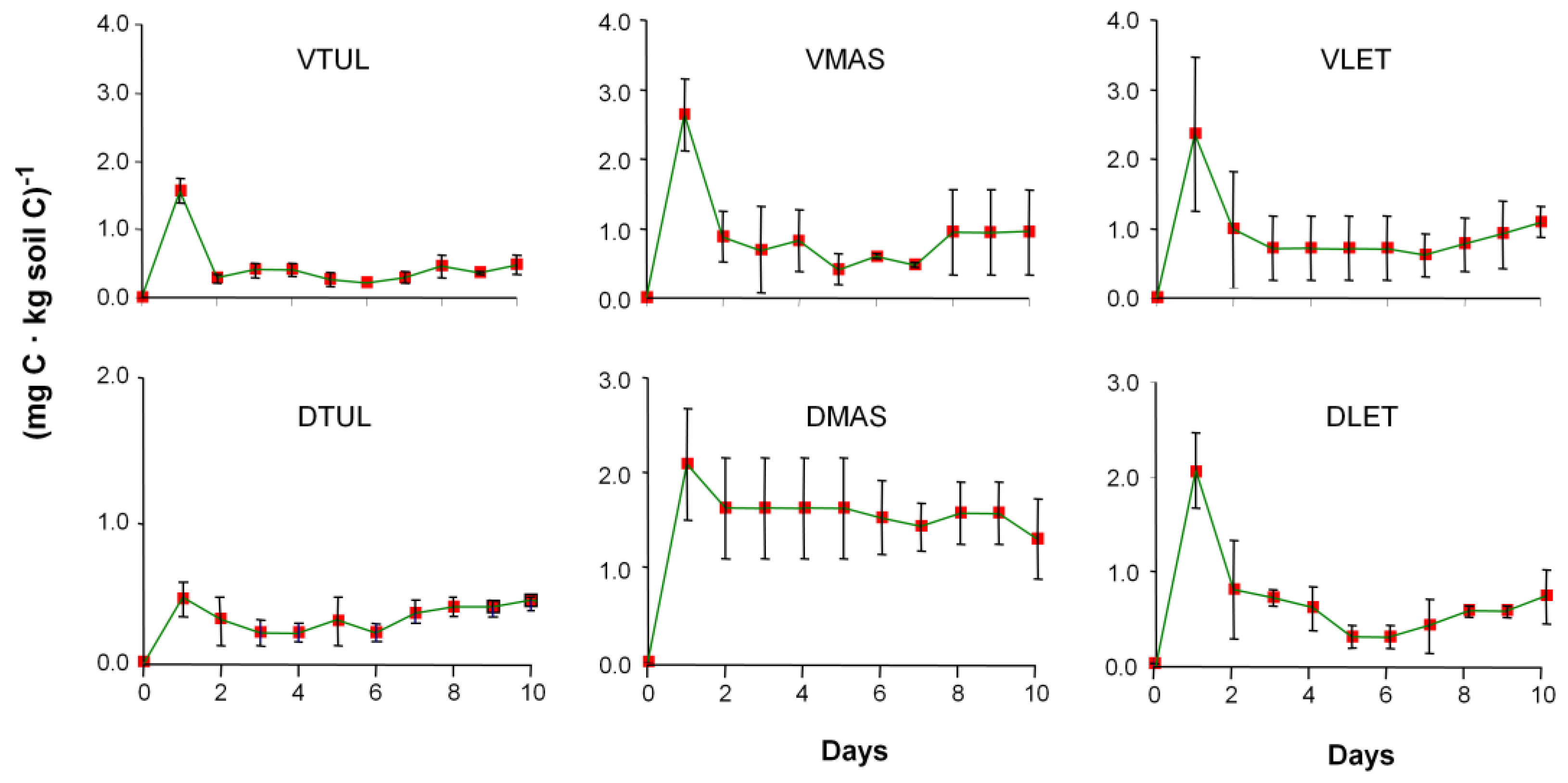
Figure 2.
Average values for the major humus fractions in virgin and disturbed soils from South-eastern Botswana. Soil labels refer to the Material and Methods section. Error bars correspond to the value of the least significant difference (P <0.05) between samples calculated from spatial replications.
Figure 2.
Average values for the major humus fractions in virgin and disturbed soils from South-eastern Botswana. Soil labels refer to the Material and Methods section. Error bars correspond to the value of the least significant difference (P <0.05) between samples calculated from spatial replications.
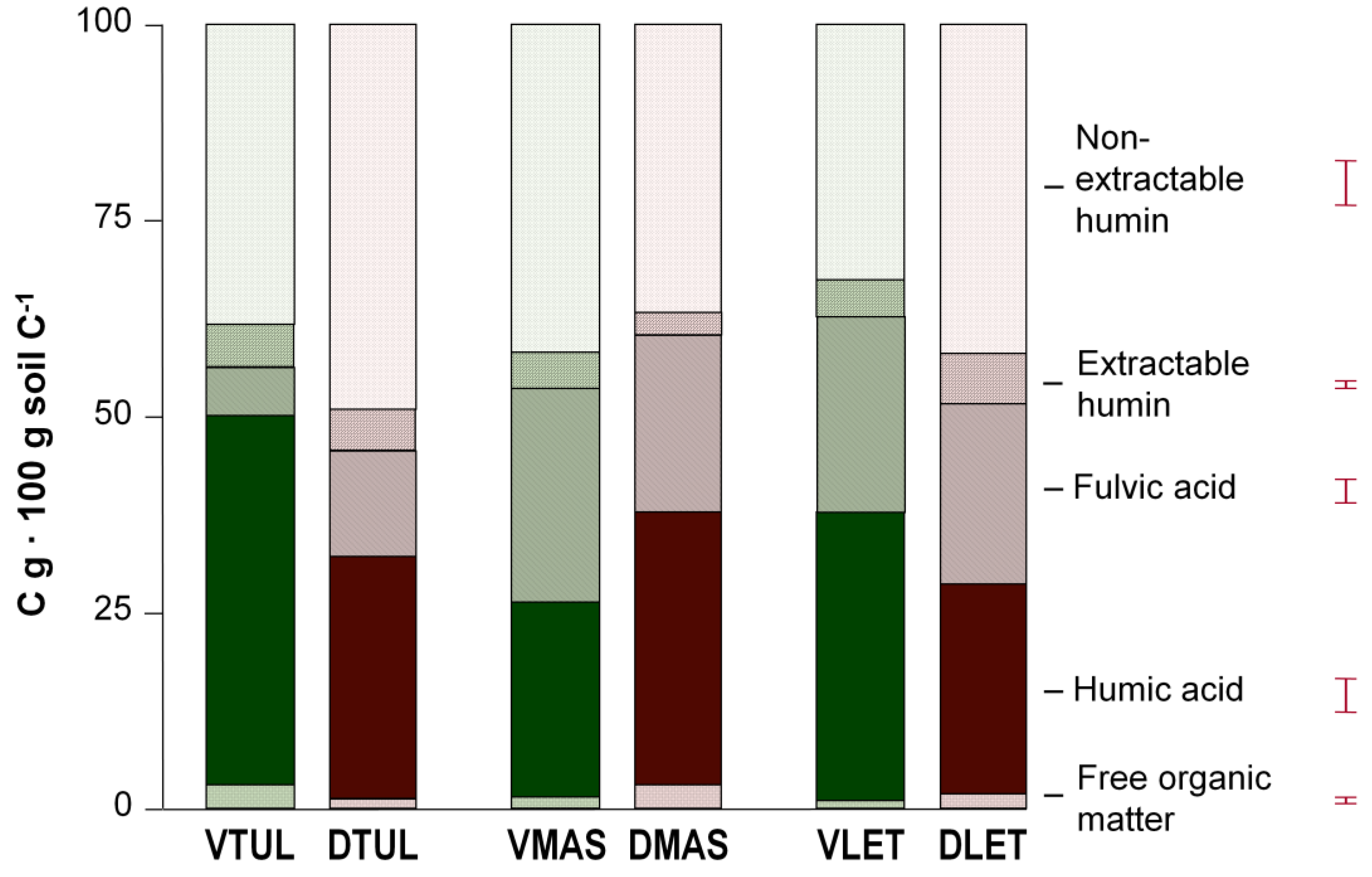
Figure 3.
Fourier-transform infrared spectra of humic acids from virgin (V-) and disturbed (D-) soils from South-eastern Botswana. Soil labels refer to the Material and Methods section.
Figure 3.
Fourier-transform infrared spectra of humic acids from virgin (V-) and disturbed (D-) soils from South-eastern Botswana. Soil labels refer to the Material and Methods section.
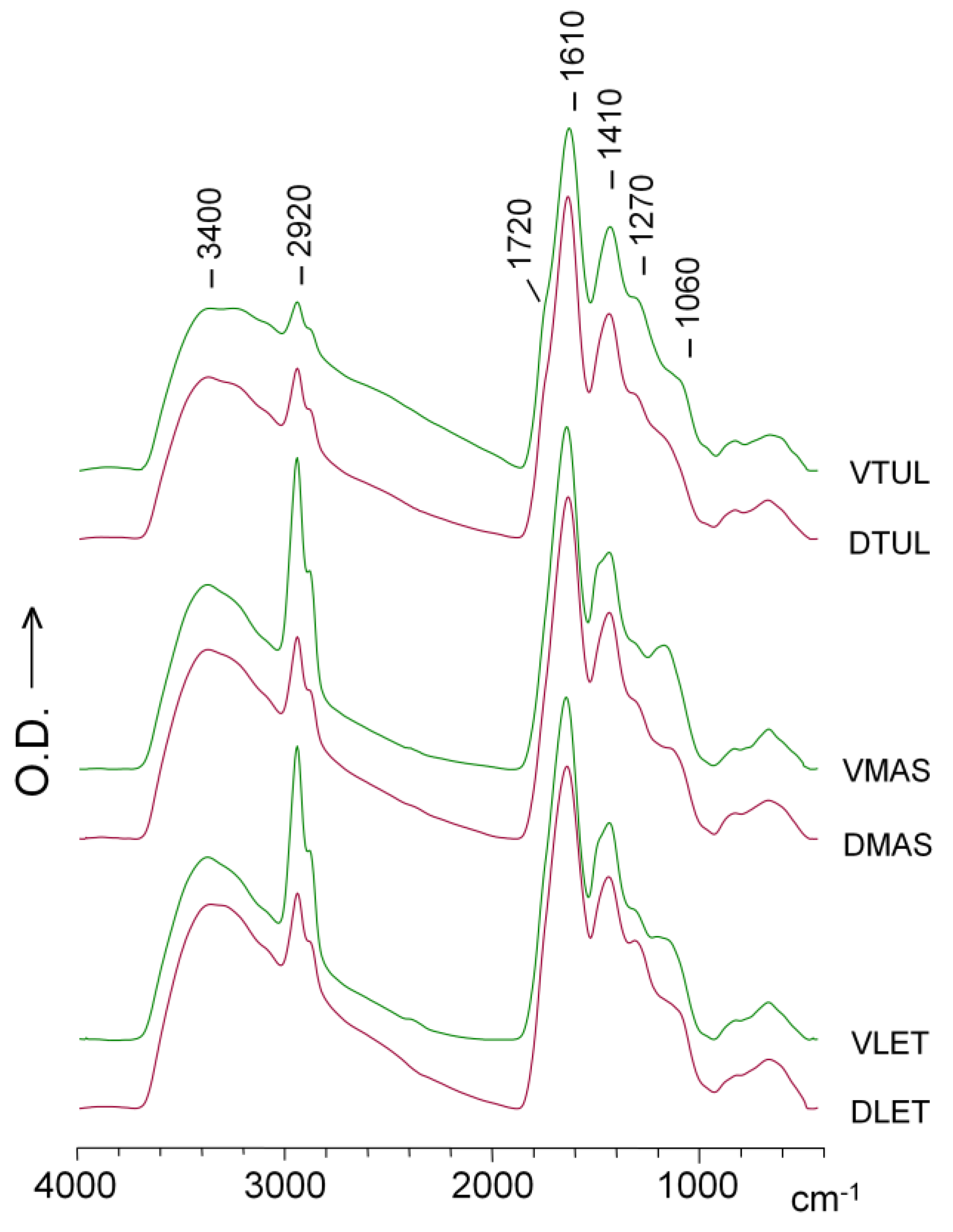
Figure 4.
Fourier-transform infrared spectra and resolution-enhanced infrared spectra (below) of humic acids from virgin (left) and disturbed (right) soils from South-eastern Botswana. Soil labels refer to the Material and Methods section.
Figure 4.
Fourier-transform infrared spectra and resolution-enhanced infrared spectra (below) of humic acids from virgin (left) and disturbed (right) soils from South-eastern Botswana. Soil labels refer to the Material and Methods section.
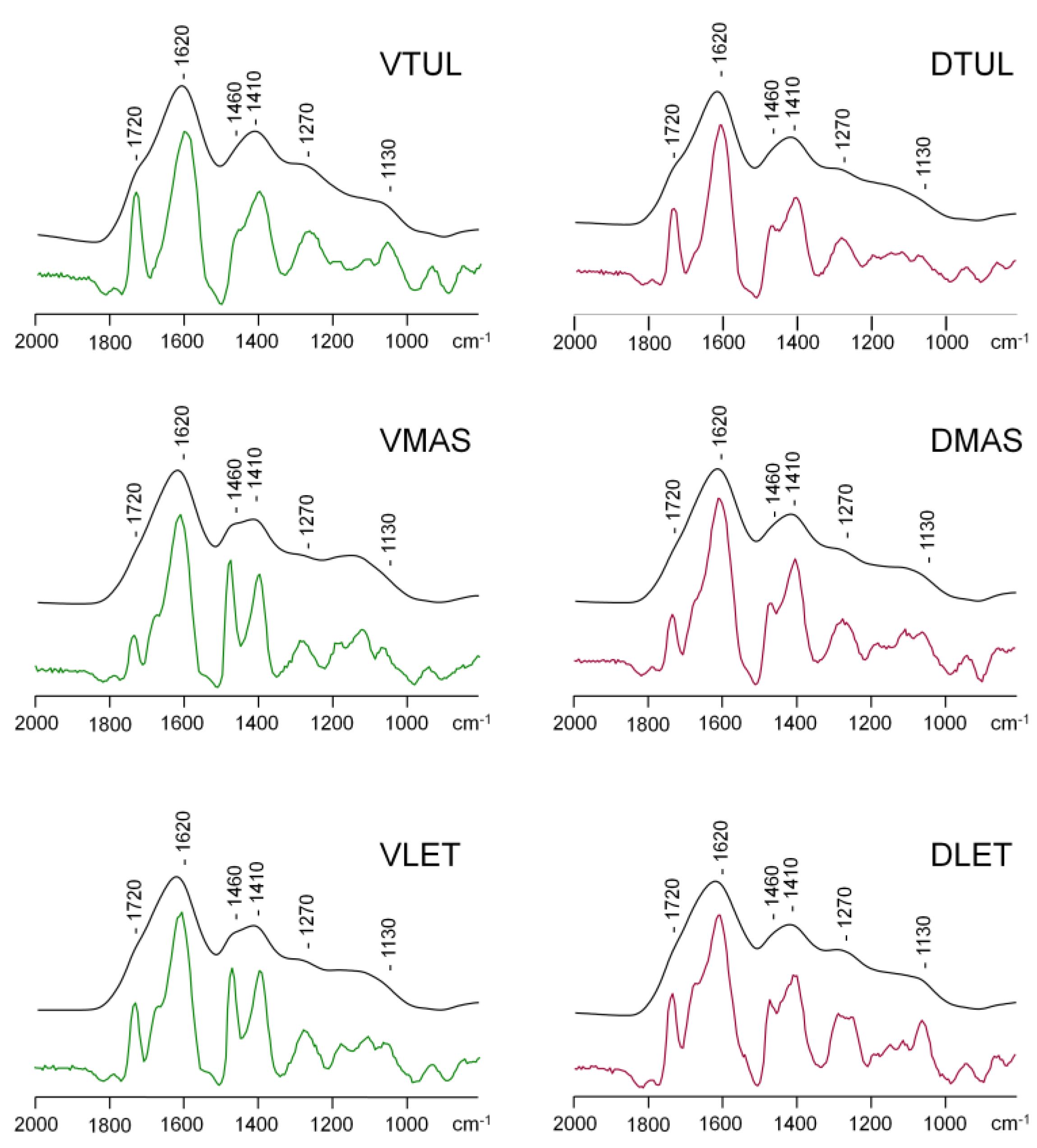
Figure 5.
Multidimensional scaling used for the classification of soil samples based on Euclidean distances between soil organic matter descriptors (C, C/N ratio, humic fractions and characteristics in Table 2 and Table 3). Distance in the plane between centroids for the different sites is proportional to changes between virgin (V: open circles as centroids) and disturbed (D: solid circles as centroids) sites. Error bars indicate the space occupied by four spatial replications.
Figure 5.
Multidimensional scaling used for the classification of soil samples based on Euclidean distances between soil organic matter descriptors (C, C/N ratio, humic fractions and characteristics in Table 2 and Table 3). Distance in the plane between centroids for the different sites is proportional to changes between virgin (V: open circles as centroids) and disturbed (D: solid circles as centroids) sites. Error bars indicate the space occupied by four spatial replications.
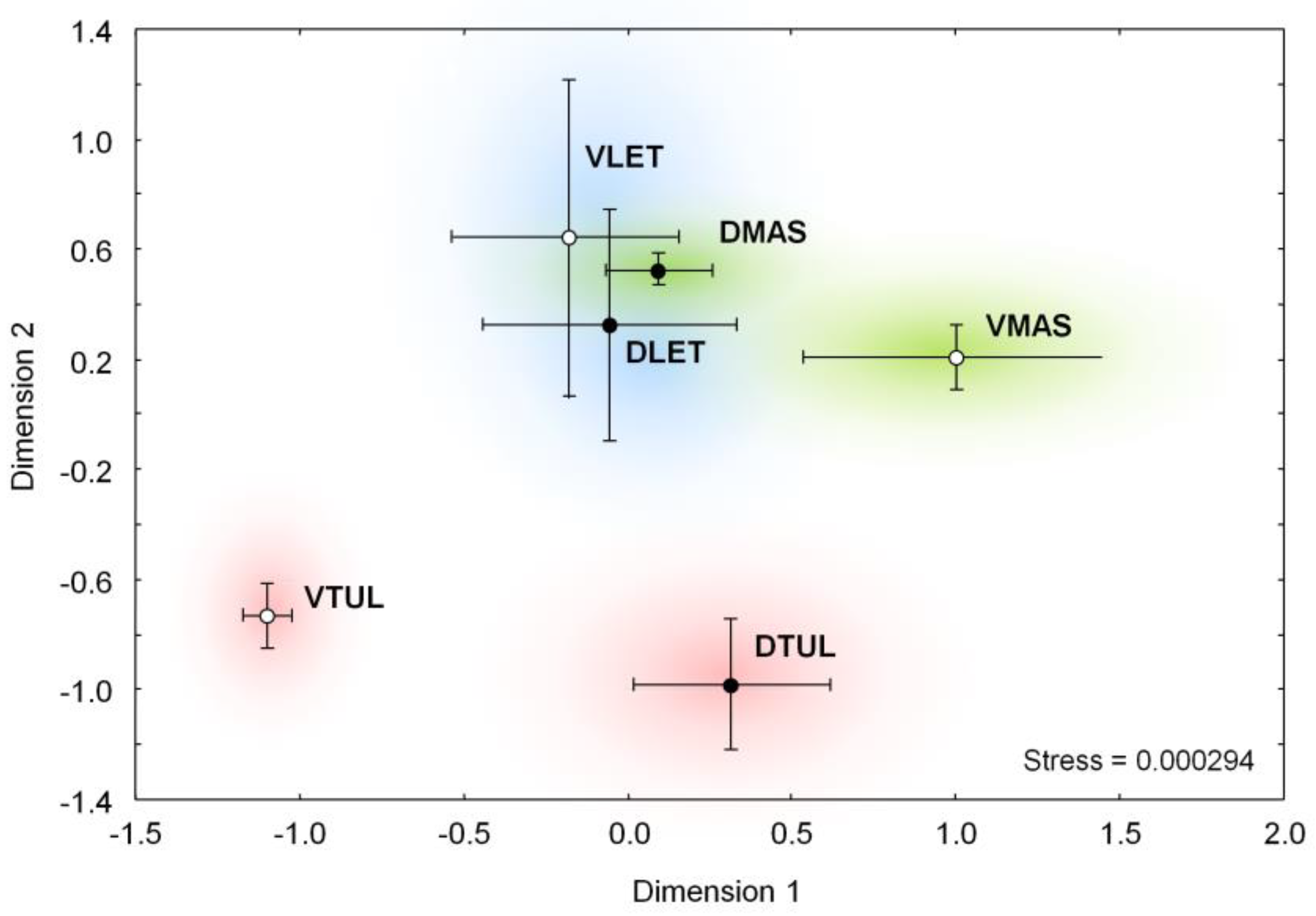
Figure 6.
Classification of soil descriptors correlated with soil organic C (Soil C, C/N ratio, humic fractions, acronyms indicated in Table 2 and Table 3). Encircled variables showed correlations at P< 0.05 (dashed lines) or P< 0.01 (continuous line). The scatterdiagram was obtained by multidimensional scaling from the similarity matrix between pairs of variables using the 1-Pearson r index.
Figure 6.
Classification of soil descriptors correlated with soil organic C (Soil C, C/N ratio, humic fractions, acronyms indicated in Table 2 and Table 3). Encircled variables showed correlations at P< 0.05 (dashed lines) or P< 0.01 (continuous line). The scatterdiagram was obtained by multidimensional scaling from the similarity matrix between pairs of variables using the 1-Pearson r index.
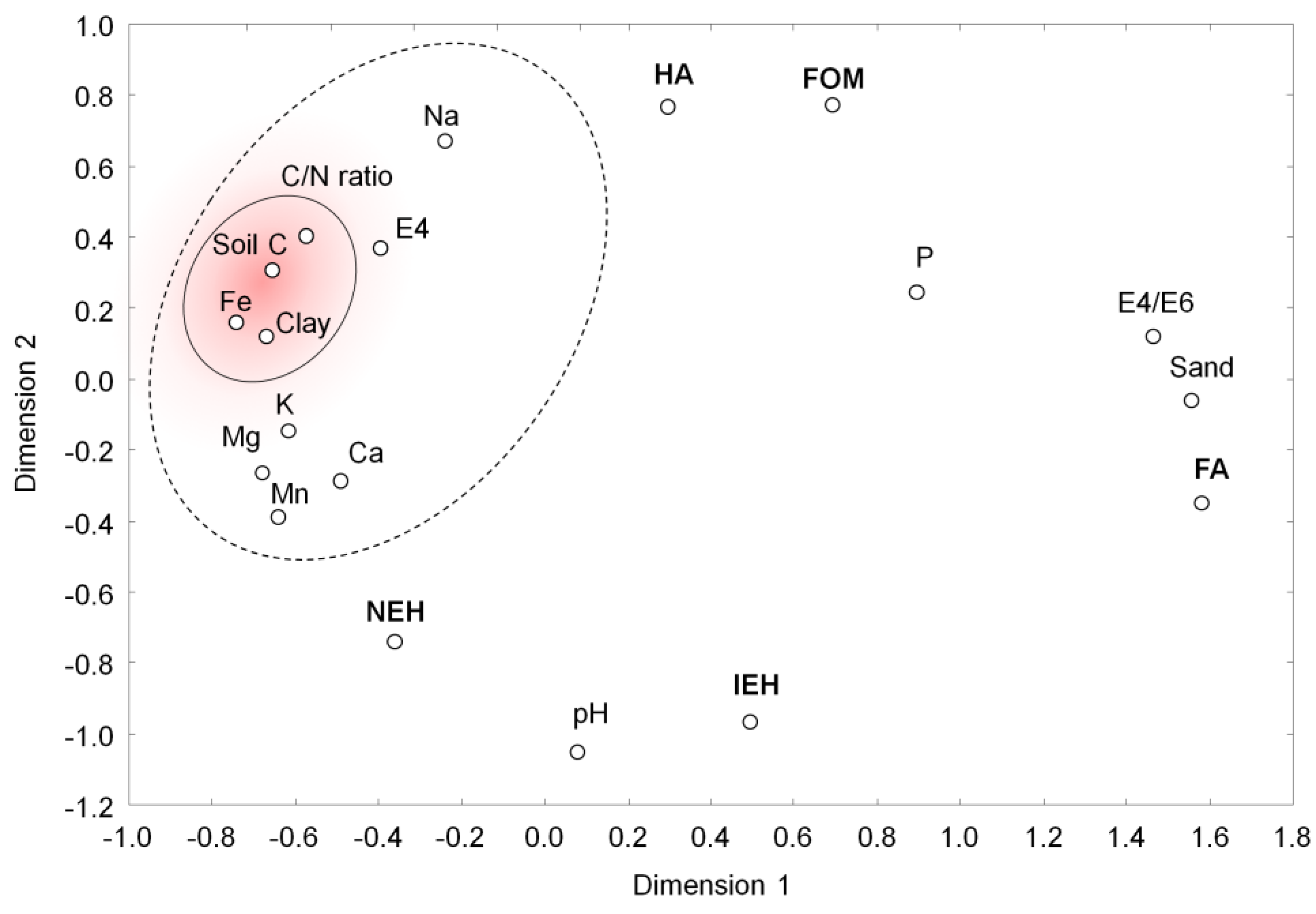

Table 1.
General analytical characteristics of the Botswanian soils (0–10 cm) studied.
| Sampling sites a | VTUL | DTUL | VMAS | DMAS | VLET | DLET | LSD | |
| Sand (2–0.02 mm) | / g kg-1 | 795 | 790 | 910 | 860 | 880 | 88.3 | 18 |
| Silt (0.02–0.002 mm) | 90 | 100 | 38 | 85 | 63 | 6.5 | 13 | |
| Clay (<0.002 mm) | 115 | 110 | 53 | 55 | 58 | 5.3 | 14 | |
| pH (H2O) | 6.8 | 7.4 | 6.2 | 6.9 | 7.0 | 7.2 | 1.1 | |
| pH (KCl) | 5.2 | 5.9 | 4.6 | 5.4 | 5.5 | 5.6 | 1.3 | |
| Soil C | g kg-1 | 4.25 | 3.8 | 2.0 | 1.25 | 1.75 | 2.55 | 1.5 |
| Soil N | 0.31 | 0.42 | 0.25 | 0.36 | 0.33 | 0.31 | 0.1 | |
| C/N ratio | 13.7 | 9.0 | 8.1 | 4.7 | 5.3 | 8.2 | 3.3 | |
| P | / mg kg-1 | 4.89 | 8.72 | 5.67 | 3.8 | 10.93 | 6.87 | 0.4 |
| K | 176.2 | 182.5 | 85 | 98.7 | 110 | 132.5 | 59 | |
| Ca | 715.0 | 613.3 | 278.7 | 395.0 | 353.3 | 573.7 | 236.0 | |
| Na | 7.5 | 5.0 | 5.0 | 6.2 | 5.0 | 5.0 | 1.9 | |
| Mg | 79.0 | 78.2 | 15.3 | 31.3 | 49.2 | 71.2 | 29.8 | |
| Fe | 11.4 | 14.5 | 3.8 | 4.3 | 6.9 | 9.1 | 3.7 | |
| Mn | 29.5 | 6.4 | 16.7 | 14.0 | 15.5 | 39.5 | 18.7 | |
| Zn | <0.4 | <0.4 | <0.4 | <0.4 | <0.4 | <0.4 | <0.4 | |
| Cu | <0.4 | <0.4 | <0.4 | <0.4 | <0.4 | <0.4 | <0.4 |
a TUL = Tuli Block; MAS = Mashangwe; LET = Letlhakeng (Prefixes V and D refer to virgin and disturbed sites respectively). LSD = Least significant difference between replicated samples taken in the sites studied (P < 0.05).
Table 2.
Organic fractions in the Botswanian soils (0–10 cm) studied.
| Sampling sites a | Free organic matter | Total humic extract | Humic acid | Fulvic acid | Humic acid / fulvic acid ratio | Insolubilized extractable humin | Non-extractable humin | |
| / g C kg-1 soil | ||||||||
| VTUL | 0.12 | 2.27 | 2.00 | 0.26 | 7.25 | 0.23 | 1.63 | |
| DTUL | 0. 04 | 1.70 | 1.17 | 0.52 | 2.21 | 0.20 | 1.87 | |
| VMAS | 0.03 | 1.04 | 0.50 | 0.55 | 0.93 | 0.09 | 0.84 | |
| DMAS | 0.03 | 0.72 | 0.44 | 0.28 | 1.79 | 0.04 | 0.46 | |
| VLET | 0.02 | 1.08 | 0.64 | 0.44 | 1.47 | 0.08 | 0.57 | |
| DLET | 0.04 | 1.27 | 0.69 | 0.58 | 1.19 | 0.17 | 1.07 | |
| LSD (P < 0.05) | 0.02 | 0.82 | 0.74 | 0.13 | 1.55 | 0.04 | 0.72 | |
a TUL = Tuli Block; MAS = Mashangwe; LET = Letlhakeng; (prefixes V and D refer to virgin and disturbed sites, respectively). LSD = Least significant difference between replicated samples taken in the sites studied.
Table 3.
Spectroscopic parameters of humic acids from the Botswanian soils studied.
| Optical densitya values in the visible range (wavelength nm) | Optical density valuesb of the main bands (wavelength cm-1) in the infrared spectra |
|||||||
| Sample | E4 | E4/E6 | 3400 | 2920 | 1720 | |||
| VTUL | 2.16 | 3.3 | 0.93 | 0.98 | 0.93 | |||
| DTUL | 2.16 | 3.4 | 0.94 | 1.00 | 0.84 | |||
| VMAS | 2.23 | 3.6 | 1.11 | 1.89 | 0.80 | |||
| DMAS | 1.58 | 3.5 | 1.17 | 1.27 | 0.89 | |||
| VLET | 1.65 | 3.8 | 1.11 | 1.79 | 0.96 | |||
| DLET | 1.47 | 3.5 | 1.02 | 1.09 | 0.83 | |||
| LSD (P < 0.05) | 1.49 | 0.08 | ||||||
a Measured at concentration 100 mg C L-1; b Relative to the intensity of the 1510 cm-1 band; LSD= Least significant difference between spatial replications of the sampled soils (P< 0.05).
Disclaimer/Publisher’s Note: The statements, opinions and data contained in all publications are solely those of the individual author(s) and contributor(s) and not of MDPI and/or the editor(s). MDPI and/or the editor(s) disclaim responsibility for any injury to people or property resulting from any ideas, methods, instructions or products referred to in the content. |
© 2024 by the authors. Licensee MDPI, Basel, Switzerland. This article is an open access article distributed under the terms and conditions of the Creative Commons Attribution (CC BY) license (http://creativecommons.org/licenses/by/4.0/).
Copyright: This open access article is published under a Creative Commons CC BY 4.0 license, which permit the free download, distribution, and reuse, provided that the author and preprint are cited in any reuse.


