

Submitted:
08 July 2024
Posted:
09 July 2024
You are already at the latest version
Abstract
Granulites and associated dykes from the less well studied southern Ivrea-Verbano Zone (IVZ; around Ivrea town) are characterized by combining field, macro, micro and chemical (major and trace-element mineral composition) data in order to identify chemical and rheological variations in the lower crust that could be relevant for geodynamic implications. The Ivrea granulites are similar to those belonging to the Lower Mafic Complex of the central IVZ. The mafic lithologies experienced a stealth metasomatism (pargasitic amphibole and An-rich plagioclase) that occurred at suprasol-idus conditions by a pervasive reactive porous flow of mantle-derived orogenic (hydrous) basaltic melts infiltrated along relatively few, likely deformation-assisted, channels. Similar metasomatic melts are already reported in the central and northern IVZ, suggesting a massive regional hydration of the lowermost Southalpine mafic crust during the Early Mesozoic. The plastic behavior of the lowermost part of the crust, induced by its metasomatic hydration, could have promoted the Tri-assic extension of the Variscan crust and the beginning of the Alpine cycle.
Keywords:
Ivrea-Verbano Zone
; lower crust
; stealth metasomatism
; melt infiltration
; porous flow
; channelized flow
; hornblendites
; hydrous basaltic melt
1. Introduction
The role of the lower continental crust in the processes that govern the transition from the late orogenic stages, such as the extensional regime linked to the orogenic collapse, to a new Wilson’s cycle, such as the continental drifting, is still poorly investigated. In this geodynamic context, underplating of large volumes of mafic magma induces relevant chemical and rheological variations in the lower crust and in the overlying middle crust, with consequences in the distribution of the stress fields, but also in the genesis of some ore deposits. Nevertheless, the evidence of melt-rock interactions and the characterization of the involved processes (porous flow vs channeled flow) have not received a lot of attention until recently (e.g., [1,2,3,4]). Moreover, the interaction between melts and deep mafic plutons straddles the boundary between igneous and high-temperature metamorphic processes, making its study a frontier topic.
The Ivrea-Verbano Zone (IVZ), in northern Italy (Figure 1), is a promising site to study the melt-rock interaction in the lower crust and its potential geodynamic consequences. It is one of the best preserved and almost integrated continental crustal sections in the world, in which distinct mafic magmatic pulses infiltrate a Variscan lower crust during the Permian orogenic collapse (e.g., [5,6,7]) and in which different geological evidences of the Mesozoic Alpine rifting are preserved [e.g., 8-11, and references therein]. The Unit is subdivided into northern (Finero Complex), central (Strona, Sesia and Sessera valleys), and southern (Ivrea and Baldissero) IVZ. Previous studies concentrate on the northern IVZ (e.g., [12,13,14,15,16,17,18,19,20,21]) and central IVZ, Valle Strona: [22,23,24,25,26,27,28,29,30], Val Sesia: [31,32,33,34] and Val Sessera: [35-37, and references therein]. To our knowledge, the only recent paper on the southern IVZ is by Mazzucchelli et al. [38] on the Baldissero peridotites, whereas the mafic rocks outcropping in and around the Ivrea town have never been studied in detail.
In the present paper, we studied the granulite rocks of the southern IVZ. We report field, macro, micro and chemical (major and trace-element mineral composition) evidence of “stealth” metasomatic hydration of a former dry mafic lower crust induced by combination of channelized flux and porous flow of orogenic hydrous basalts, and we discuss its geodynamic implications.
2. Geological Setting
The Ivrea-Verbano Zone (IVZ), located in NW Italy, is a 130 km long, and 10-50 km wide stripe that extends from Ivrea up to Locarno (Figure 1). The IVZ belongs to the Southalpine domain of the Alps, i.e., the domain consisting of Variscan continental crust constituting the Adria plate during the Triassic-Jurassic extensional tectonics responsible for the opening of the Tethys Ocean [9,39,40]. This domain, also known as Southern Alps, was only marginally involved in the compressional tectonics responsible for the Tethys closure and continental collision generating the Alpine chain and, so, it records a low-grade Alpine metamorphism that is traced only along tectonic structures [8, and references therein]. To the SE, the IVZ is separated from the Southalpine Serie dei Laghi sequence (Variscan mid-to upper crust section) by the Permian transpressional shear zone of Cossato-Mergozzo-Brissago and by the subsequent Pogallo and Cremosina Lines. To the NW, the IVZ is separated from the Sesia Zone (Austroalpine domain strongly involved in the Alpine tectonics) by a thick (1 km wide) mylonite zone called Insubric Line (e.g., [41,42,43]). To the SW, near Ivrea town, the IVZ is separated from the Canavese Zone, recording a very low-grade Alpine metamorphism, by a ductile deep fault named Internal Canavese Line (e.g., [44]). The IVZ is subdivided in three units: a) the Kinzigite Formation, b) the Mafic Complex and c) the Ultramafic Massifs (Figure 1).
2.1. Kinzigite Formation
The Kinzigite Formation, well characterized and exposed in the Strona Valley, is mainly composed of alternating metapelites, metabasites, marbles, calc-silicates and quartzites. This rock sequence has been proven to record the Variscan metamorphic evolution of the IVZ, where the metamorphic gradient increases perpendicular to the strike of the IVZ from SE to NW from amphibolite-to granulite-facies metamorphism, respectively (e.g., [46,47,48,49,50,51]). The terms ‘kinzigites’ and ‘stronalites’ that will be used here were introduced by Schnetger [52] to describe, respectively, amphibolite-and granulite-facies metapelites within the Kinzigite formation. The protolith composition is considered similar for both the granulite-facies and the amphibolite-facies metapelites in Strona Valley [53]. The metabasic rocks of the Kinzigite Formation have been presumed to be a part of the Mafic Complex (see below) by many researchers (e.g., [24,32,35,54]) that based on field relationships and petrography, stated that these rocks intruded the metasedimentary succession of the Kinzigite Formation. In fact, Kunz et al. [27] hypothesized that these rocks are metabasalts [50,55] belonging to the Kinzigite Formation, and experienced the same high temperature metamorphic event of the associated metapelites, because of their progressive granulitization and migmatization towards the Insubric Line. Additional evidence to this hypothesis suggests changes in the metamorphic texture from nematoblastic to granoblastic, and the progressive amphibole consumption to form pyroxenes [51].
The Variscan (316 ± 3 Ma; [30,56]) thermal peak in the Kinzigite Formation has been estimated at around 650–730°C and ~3.5–6.5 kbar for the amphibolite-facies and up to 900–950°C and ~10–12 kbar for the granulite-facies in both metapelites [47] and metabasites [46]. Initially, the emplacement of the Mafic Complex was considered responsible for the granulitization of the overlying Kinzigite Formation (e.g., [26,49,57,58]). More recent geochronological and petrological data indicate that the early Permian emplacement of the Mafic Complex (ca. 285 Ma, [59] more details below) was not synchronous to the Variscan thermal peak and that a 2-km wide contact mineral assemblage has been observed to overprint the Variscan high-grade assemblages in the metapelites during the Permian (ca. 275 Ma; e.g., [31,47,57,60]).
2.2. Mafic Complex
The Mafic Complex is a large igneous body that intruded the middle-lower crust of the Kinzigite Formation, at approximately 25 km depth, in a post-Variscan transtensional tectonic setting (e.g., [5,54,57,61,62]). The Mafic Complex is a rather inhomogeneous intrusion, interpreted to have been formed by separate magmatic pulses of mantle magma progressively contaminated by hosting Variscan restitic metapelites (stronalites) and by the anatectic melt generated in the more fertile host rocks due to the crustal heating (e.g., [33] and references therein). It has been subdivided in two main units [35,36]: a) the Lower Mafic Complex (LMC), mainly consisting of granoblastic, foliated Amp-gabbros, gabbronorites and minor anhydrous charnockites; b) the Upper Mafic Complex (UMC), which contains gabbronorites, diorites and hydrous charnockites (in higher proportions compared to the LMC) with well-preserved magmatic structures. The Paragneiss-Bearing Belt (PBB) is the natural border between these two complexes and represents an arcuate-shaped, 1-2 km wide zone rich in charnockites, norites and ultramafic rocks alternating with metasedimentary septa considered as relics of the Kinzigite Formation [32,36,37,63]. The P-T conditions of crystallization are estimated at 8-9 kbar and 1000-1200°C, whereas the re-equilibration temperatures were estimated at 850-950°C ([57] and references therein). Very recent U-Pb zircon geochronological data place the timing of the mafic intrusion during early Permian (286–282 Ma), approximately 30 My after the peak metamorphic event in the Kinzigite Formation [30,64]. Ιn detail, SHRIMP U-Th-Pb isotopic data indicate that the intrusion of the LMC started in the early Permian, at ca. 295 Ma, and experienced thermal recrystallization at around 285 Ma. The crystallization of the UMC occurred between 292 and 286 Ma, and that of charnockites occurred at 277 Ma [33,59].
2.3. Ultramafic Massifs
Large bodies and smaller lenses and veins of ultramafic composition occur throughout the IVZ. The predominant lithologies are dunites, harzburgites, lherzolites and, locally, websterites with minor pyroxenites [65,66,67]. Three large ultramafic massifs are distinguished from NE towards SW: a) Finero, b) Balmuccia and c) Baldisero Canavese (Figure 1). The incorporation of these ultramafic massifs in the Mafic Complex is quite enigmatic and several opinions exist in the literature [42,43,67]. Detailed field evidence, show an igneous contact of the peridotites with the igneous rocks of the Mafic Complex suggesting that the mantle peridotites are older than the intrusion of the Mafic Complex ([68] and references therein).
3. Methods
Both EDS and WDS data have been acquired on the studied samples. SEM-EDS data were acquired using a scanning electron microscope (SEM-JEOL JSMIT300LV), combined with an energy dispersive spectrometry (EDS) Energy 200 system and an SDD X-Act3 detector (Oxford Inca Energy), installed at the Department of Earth Sciences (University of Torino, Italy). The system is equipped with the Microanalysis Suite Oxford AZtecMineral and with the following analytical set up: an accelerating voltage of 15 kV, a counting time of 50 s, a processing time of 3 µs, a working distance of 10 mm, and natural mineral standards were used. WDS data were performed with a JEOL JXA 8200 Superprobe, equipped with five wavelength dispersive spectrometers, energy dispersive X-ray spectroscopy (EDS), and cathodoluminescence detectors at the University of Milan. The operating conditions consisted of an acceleration voltage of 15 kV, at a beam current of 5 nA at 30 s counting time, with a spot size of 1 μm. Natural and synthetic minerals were used as standards. Structural formulae of minerals were processed using the NORMPLUS software of Ulmer [69] upgraded by S. Poli. Representative analyses are reported in Table S1.
Trace element data on the petrogenetic minerals (amphibole, plagioclase, orthopyroxene, clinopyroxene) from polished thin sections were determined with LA-ICP-MS at the Open University (OU), UK. The instrument at the OU is a Photon Machines Analyte G2 with a 193nm excimer laser, equipped with a HelEx II 2-volume cell, coupled with an Agilent 8800 ICP-QQQ-MS. The laser repetition rate of the analyses was at 10Hz, 3.63 J/cm2 fluence and a spot diameter of 50 μm which was reduced to 40 μm only for analysing certain sites with interstitial plagioclase films. Representative analyses for each mineral can be found in the Table S2.
Each analysis included 30 s of background measurement before ablation, 30 s of sample ablation and a 40 s washout after the ablation. Detailed instrument and analytical conditions can be found in Table S3. The calibration strategy included SRM-NIST 612 as primary standard and BCR-2G as secondary standard which were analysed every ~20 analyses. Data reduction was done with the Iolite software, v3.71 [70]. Data quality of BCR-2G analyses is in good agreement with published values [71] and with relative standard deviations of 0.47-22.88% (Table S4). Furthermore, probe data for major element concentrations were compared with major elements measured by LA-ICP-MS to ensure consistency between different methods. Element concentrations not plotted in the REE and trace element diagrams, have values below the detection limit. For a full list of detection limits for each element see Table S5.
4. Results
4.1. Field Evidence
In the area nearby Ivrea town, the IVZ mainly consists of mafic granulites and minor enderbites, with very rare metapelitic granulites (stronalites; Figure 2). These rocks are ubiquitous in the study area from Pavone Canavese and Lessolo, up to the contact of the Lower Mafic Complex with the Insubric Line, approximately 5-7 kilometers north of Ivrea town. Particularly, they homogenously cover the NE part of the studied area, as well as the area around the villages of Fiorano and Pavone. The enderbites largely outcrop in the south-eastern part of the studied area. The size and shape of the enderbites can vary from the large and irregular bodies of several hundred meters long and wide, outcropping at Monte Marino and Bric Appareglio, up to the very thin (<10 meters) dykes which can be traced for several hundred meters and are sporadically outcropping in the area between Ivrea and Lago Sirio. Where visible, the contact between mafic granulites and enderbites is usually transitional intrusive (see below). The stronalites outcrop only in the area between Ivrea and Lago Sirio and constitute decametric-thick septa, apparently aligned in direction SW-NE, within the mafic granulites. Moving towards the contact with the Insubric Line (i.e., the Internal Canavese Line) the lithologies are progressively fine-grained and mylonitized.
Below, the field appearance and relationships among mafic granulites, enderbites and stronalites are described in detail. More than 60 thin sections from collected samples and samples already present in the collection in the University of Turin, have been characterized under an optical microscope. Five samples were selected for more detailed analyses (Table 1). Mineral abbreviations used in text and figures are from Whitney and Evans [72].
4.1.1. Mafic Granulites
The mafic granulites macroscopically exhibit an apparent homogenous texture and composition ranging from gabbronorite to Amp-gabbronorite. However, a detailed examination revealed local variations in grain-size (from medium to coarse-grained; Figure 3a-b), in texture (from granoblastic to faintly foliated; Figure 3a-b), and in modal composition (variation in Pl and Amp contents, Figure 3c). Locally, they exhibit 0.5–5-centimeter-wide pyroxene-rich layers showing infiltrating Pl from the selvages, and fractures filled by infiltrated coarse-grained Pl + Amp (Figure 3c-d). The mafic granulites are crosscut by enderbites and Amp-rich dykes (see below).
4.1.2. Enderbites
The enderbites are predominantly medium- to coarse-grained and granoblastic (Figure 4a), but locally, a faint foliation marked by orthopyroxene (crystal size up to ~0.5 millimeter long) is also common, regardless of the rock grain size (Figure 4b). Fine-grained enderbites appear as sporadic dykes with a width of less than 10 centimeters that crosscut the coarser-grained ones (Figure 4c). The selvages are straight and do not show any reaction with the host enderbite. Enderbitic, fine-grained dykes are also found to crosscut the mafic granulites (Figure 4d). The observed selvages are usually overprinted by the Alpine orogeny, but they seem to lack evidence for reactions with the host mafic granulites.
Enderbites outcropping in Ivrea town, particularly those located north of the river Dora Baltea, are fine-grained, richer in quartz (>20 vol%), and poorer in Opx (<10%) compared to those outcropping in the southern part of the studied area. According to the QAP diagram for Opx-bearing granitic rocks [73], the threshold for quartz to classify a rock as a true enderbite is 20 vol%. The enderbites from the southern area do not contain as much quartz (~5-6 vol%) and therefore, should be classified as “Opx-diorite or Opx-granitoids” [73]. However, because of similar field relationships, microstructures and mineral assemblage, we consider these rocks as a more mafic variety of the Ivrea enderbites.
4.1.3. Amp-Rich Dykes, Pods, and Lenses
Both mafic granulites and enderbites are infiltrated by Amp-rich elongated dykes, pods, or lenses (Figure 5) that show irregular (Figure 5a,c) or gradual (Figure 5b,d) contacts. Usually, they show a hypidiomorphic granular structure from coarse-grained (Figure 5c-d) to pegmatitic (Figure 5a-b). The Pl content is variable, but always significantly lower than in the mafic granulites (Fig. 5c-d) Their composition ranges from Amp-gabbronorite to hornblendite.
4.1.4. Quartz-Feldspathic Dykes
Locally, both mafic granulites and enderbites are crosscut by coarse-grained quartz-felspathic dykes that show straight contacts (Figure 6a). Crosscutting relationships with the Amp-rich dykes are not observed.
4.1.5. Stronalites
The stronalites are rare and outcrop in the central part of the studied area (Figure 2). They constitute a few ‘septa’ (i.e., thin, lensoidal bodies that can be traced for a rather long distance) with dimensions that reach up to 100 meters in length and 20-50 meters in width. The septa appear oriented ca. NE-SW (Figure 2), i.e., parallel to the main strike observed in other localities of the IVZ (Figure 1). The stronalites are usually intercalated between enderbites and mafic granulites, but their contact is not visible. They exhibit partial melting structures such as leucosome formation, melt segregation and formation of coarse-grained quartz veins (Figure 6b). The quartz veins commonly have an amethyst-like color, probably due to numerous inclusions of rutile needles. The coarse-grained stronalites contain garnet porphyroblasts up to 1 centimeter in diameter (Figure 6b), while the fine-grained varieties contain plagioclase and garnet with a maximum diameter of <0.5 millimeter. Plagioclase and sillimanite, both fibrolitic and prismatic, are abundant, but very minor K-feldspar and biotite are observed. The majority of the stronalites are not well preserved and show extended retrogression reflected in retrograde veins that usually contain quartz + scapolite or quartz +(clino)zoisite and in plagioclase alterations. Further characterization of stronalitic septa is beyond the scope of this work.
4.1.6. Alpine Overprint
The field evidence of the Alpine overprint increases moving towards the contact with the Insubric Line near Montalto Dora (Figure 2). It is represented by ductile (mylonites) and fragile (centimeter-thick Chl-Pl-Ep veins) structures and by replacement of the mineral by very-low grade mineral assemblage (Figure 6c).
4.2. Petrography, Mineral Chemistry and Thermobarometry
4.2.1. Mafic Lithologies
The sampled mafic granulites show medium- to coarse-grained (~1 millimeter average grain size) granoblastic texture, locally polygonal, although faintly foliated samples are also present. Locally, relic magmatic structures are still well recognizable. They consist of plagioclase, orthopyroxene, clinopyroxene and variable modal amounts of amphibole. The accessory minerals include opaques (magnetite and ilmenite), spinel (hercynite, hereafter Hc) and apatite. Sample IZ23-02b has low Cpx content and the mineral composition is intermediate between the more mafic samples and the enderbitic ones (see below). Millimeter-to centimeter-thick pyroxene-layers parallel to the main foliation locally occur (Figure 7a).
Two generations of Pl and Px can be easily distinguished. The first one consists of coarse-grained (2-9 millimeters) porphyroclasts of Pl, Opx and Cpx with lobate grain boundaries, while the second one consists of medium- to fine-grained neoblasts with granoblastic polygonal structure (Figure 7b). The Pl porphyroclasts include Ap and Px in their core whose composition, although varying depending on the sample, is the richest in Na (An content ranging from 0.59 to 0.65; Figure 8a). The Pl neoblasts and the rim of the porphyroclasts are almost devoid of mineral inclusions and their composition is variable, but always slightly higher in Ca with respect to the corresponding core of porphyroclasts (An content ranging from 0.64 to 0.67; Figure 8a). Another Pl generation constitutes a micrometer-wide interstitial phase between Cpx and Mag ± Hc (Figure 7c-e) and, very rarely, between Opx and Mag ± Hc, but not between Amp and Mag ± Hc (Figure 7e). Its composition is the highest in Ca and shows a large spread (An content from 0.76 to 0.88; Figure 8a). In sample IZ21-20a (foliated mafic granulite), the Pl neoblasts show a chemical re-equilibration towards the more calcic compositions of the interstitial Pl (Figure 8a). Both Opx generations are characterized by evident pleochroism from light-green to light-pink (Figure 7b). The Opx porphyroclasts show dark brown exsolution lamellae (of a probable opaque phase) obliquely to its cleavage (Figure 7f), whereas the neoblasts are devoid of exsolutions (Figure 7b). The Opx porphyroclastic cores show higher Ca content (> 0.028 a.p.f.u.) than porphyroclastic rims and neoblasts (< 0.024 a.p.f.u.) and constant Mg# (from 0.69 to 0.70; Figure 9a). This Mg# is also similar to that of the porphyroclastic rims and neoblasts (from 0.68 up to 0.72; Figure 9a). The Al content is more scattered, but it is usually higher in porphyroclasts (> 0.217 a.p.f.u) than neoblasts (Figure 9b). In the low-Cpx sample, Opx has lower, but overlapping Mg# in the porphyroclastic cores and rims (from 0.59 to 0.61) and the neoblastic cores and rims (from 0.60 to 0.61). The Ca content is similar to the porphyroblastic rims and neoblasts from the mafic granulites (< 0.026 a.p.f.u.), while the Al content is significantly lower compared to analyses from the mafic granulites (< 0.109 a.p.f.u.; Fig 9a-b). The Cpx is pale green and not pleochroic (Figure 7b). The Cpx porphyroclasts usually contain opaque minerals and show exsolution lamellae of Opx (Figure 7b, d-e), but the neoblasts lack exsolution lamellae (Figure 7b). The Cpx is diopside with a varying composition which is not related to the different Cpx generations. The Mg# ranges from 0.75 to 0.81, the Ca content ranges from 0.83 to 0.87 a.p.f.u., the Al content from 0.26 to 0.32 a.p.f.u., the Ti content from 0.015 to 0.026 a.p.f.u., and the Na content from 0.050 to 0.067 a.p.f.u. (Figure 10). In the low-Cpx sample, clinopyroxene has lower Mg# (around 0.72), the Ca content ranges from 0.87 to 0.88 a.p.f.u., the Al content is around 0.14 a.p.f.u., the Ti content is 0.01 a.p.f.u., and the Na content ranges from 0.03 to 0.04 a.p.f.u. (Figure 10). Brown Amp is medium-to-coarse grained and is recognized by two families that show the same pleochroism from pale brown to dark brown. The first one constitutes large interstitial crystals, usually with shape preferred orientation, between Pl-Pl or Px-Px grain-boundaries (Figure 7g) and partly replaces rounded Cpx (Figure 7h). The second one is represented by granoblastic Amp with Ilm ± Mag “beads” at the Amp-Amp grain-boundaries in the triple joints (Figure 7i). The chemical composition of these two families overlaps and corresponds to a Ti-rich pargasite characterized by Mg# = 0.65-0.73, and (in a.p.f.u.) Ca = 1.70-1.84, Mn = 0.02-0.03, Al = 2.48-2.67, K = 0.12-0.24, Na = 0.74-0.90, Ti = 0.31-0.41, Cl ≤ 0.02, F ≤ 0.12 (Figure 11). In the low-Cpx sample, Amp has lower Mg# (0.60-0.67), and (in a.p.f.u.) Ca = 1.83-1.87, Mn = 0.003-0.017, Al = 2.25-2.34, K = 0.32-0.42, Na = 0.31-0.49, Ti = 0.19-0.28, Cl ≤ 0.07, F = 0.19-0.31 (Figure 11). The Mag is usually associated with pyroxenes and constitutes allotriomorphic or polygonal crystals (Figure 7k), depending on the structure of the rocks. It appears as blebs inside composite crystals with deep green Hc that are partially surrounded by interstitial Pl (Figure 7k).
The Px-rich layers are medium- to very coarse-grained and consist of Opx, Cpx, and variable amounts of Mag, Ilm, and Pl (Figure 12a). The layers exhibit a granoblastic structure, but the magmatic one is still commonly preserved. Both Cpx and Opx show exsolution lamellae, and opaque minerals show interstitial or polygonal habit. Opx from the pyroxenitic layer of sample IZ23-02b has a relatively homogeneous composition with Mg# = 0.62-0.63, Ca content ranging from 0.015-0.026 a.p.f.u. and Al content less than 0.1 a.p.f.u. (Figure 9a-b). The associated Pl in the pyroxenitic layers has an anorthite content ranging from 0.62-0.66, while interstitial Pl can reach up to 0.75. Locally, the layers are infiltrated by coarse-grained brown Amp + Pl (Figure 12b) that exhibit the interstitial structures already described for the mafic granulites (Figure 12c-d). These structures are well preserved in the samples that correspond to the coarse-grained Amp-rich elongated bodies, pods, or lenses, locally pegmatitic infiltrating both mafic granulites and Px-rich layers. They show increased proportions in brown Amp and/or Pl (Figure 12e), and they usually exhibit interstitial or granoblastic structure. In particular, the Amp-Amp grain-boundaries are marked by the Ilm ± Mag “beads” already described for the mafic granulites (Figure 12f). The composition of the interstitial Pl is Ca-rich (An content from 0.72 to 0.79) and similar to the interstitial Pl present in the mafic granulites (Figure 8a). Interstitial Amp and neoblasts have overlapping compositions of Ti-rich pargasite characterized by Mg# = 0.67-0.72, and (in a.p.f.u.) Ca = 1.73-1.82, Mn = 0.02-0.03, Al = 2.49-2.67, K = 0.17-0.22, Na = 0.74-0.84, Ti = 0.30-0.36, Cl = 0.01-0.02; F ≤ 0.10 (Figure 11). These compositions are similar to those of the Amp from mafic granulites but characterized by slightly higher K and lower Ti (Figure 11).
4.2.2. Enderbites
The enderbites from Ivrea range from fine-grained (dykes) to very coarse-grained (~1 millimeter average grain size) with local faintly foliation defined by Opx, either as elongated porphyroclasts (Figure 13a) or as neoblastic aggregates (Figure 13b). The mineral assemblage mainly consists of Pl, Opx, Opq ± Qz ± Amp. Although relict porphyroclastic Pl and Opx exhibit lobate grain boundaries (Figure 13c), the more abundant neoblasts show granoblastic texture with triple joints (Figure 13d). The composition of the core of porphyroclastic Pl is the Na-richest (An content from 0.45 to 0.47; Figure 8b), whereas the porphyroclastic rims and the neoblasts are slightly Ca-richer (An content from 0.47-0.52; Figure 8b). Locally, the Pl contain, in their interior or at their grain-boundaries, irregularly shaped Qz blebs that exhibit uniform extinction (Figure 13e) and are closely associated with replacement antiperthitic Kfs (Figure 13f). The Pl composition around the blebs and replacement antiperthites is enriched in anorthitic components (An from 0.61 to 0.69; Figure 8b). The Opx constitutes two generations: the porphyroclastic one contains Mag exsolution lamellae (Figure 13a) that lack in the neoblastic one. Porphyroclastic Opx has slightly higher Ca content (ranging from 0.023–0.026 a.p.f.u.) than neoblasts (ranging from 0.018–0.022 a.p.f.u.) and similar Mg# (0.46 to 0.52; Figure 9c). The Al content ranges from 0.051 to 0.077 in a less coherent trend, but the highest values are preserved in the porphyroclastic cores (up to 0.077 a.p.f.u.; Figure 9d). The Amp is very rare, has grey-greenish color and forms around opaque minerals. Its composition, different to that of the mafic lithologies, is tschemarkitic and characterized by Mg# = 0.50-0.57, and (in a.p.f.u.) Ca = 1.82-1.89, Mn = 0.01-0.02, Al = 2.16-2.49, K = 0.31-0.39, Na = 0.31-0.42, Ti = 0.12-0.23, Cl = 0.01-0.02; F ≤ 0.09 (Figure 11). Most of the opaque minerals in enderbites are Ilm, in contrast with the mafic granulites.
4.2.3. Mineral Trace Element Composition in Mafic Lithologies
LA-ICP-MS trace element data were collected on clinopyroxene, amphibole, orthopyroxene and plagioclase from the most promising mafic lithologies, i.e., a foliated variety of the mafic granulite in the Ivrea town area (sample IZ21-20a), a typical, homogenous mafic granulite lacking foliation with universal distribution of the minerals (sample IZ21-18a) and a mafic granulite whose Amp-content is much higher than in the samples mentioned above, located in the proximity of a 4 centimeter-thick hornblenditic layer (sample IZ21-17). The trace element composition of each mineral within a sample and across different samples is strikingly homogenous (Figure 14).
Clinopyroxenes have a chondrite-normalized REE pattern slightly enriched and characterized by a convex-upward LREE distribution, a small negative Eu anomaly and an almost flat M-to-HREE distribution (Figure 14a). With respect to the primitive mantle, they are poor in HFSE and variably depleted in Rb, Ba, Pb and Sr, with marked negative anomalies in Pb, Sr and Ti (Figure 14b). Amphiboles have trace-element compositions pointing to chemical equilibrium with clinopyroxenes. They display REE patterns parallel to those of clinopyroxenes, although slightly enriched (Figure 14c) and enrichments LILE and HFSE, with slightly negative anomalies in Pb, Sr, Zr, Hf and without Ti anomaly (Figure 14d). The orthopyroxene trace-element contents testifying chemical equilibrium with clinopyroxenes and are characterized by slightly depletion in LREE and slightly enrichments in HREE (Figure 14e), and by depletion in whole trace elements with negative anomalies in Sr (Figure 14f). Also, the plagioclase trace-element contents point to chemical equilibrium with the other minerals, i.e., enrichments in LREE, depletion in HREE and HFSE, and positive Ba, Sr and Eu anomalies (Figure 14g-h).
4.2.4. Thermobarometry
We used Amp as geothermobarometer because it is a sensitive mineral to T and P changes. The recent Ti-in-Amp thermometer ([75]; standard error of the calculation,1σ, ±35°C and 2σ ±70°C [76]) was applied to the mafic granulites as well as pegmatitic mafic rocks and enderbites (Table S1). The calculated data indicate T > 900°C with a peak at 965°C for the mafic granulites, T > 900°C with a peak at 933°C for the pegmatitic mafic rocks, and T < 840°C with a peak at 810°C for the enderbites (Figure 15a). Note that the T variation between mafic granulites and pegmatitic rocks is within the standard error of the calculation. The Si vs Ti distribution for mafic granulites and pegmatites corresponds to that of UHT granulites, whereas that for enderbites is within the HT field (Figure 15b). Regarding the pressure, the AlIV vs AlVI distribution is compatible with medium-P granulites (Figure 15c) for all the studied lithologies.
5. Discussion
5.1. Comparison between the Ivrea Granulites and the Other Granulites of the Ivrea-Verbano Zone
Our study indicates that the area of Ivrea town consists of faintly foliated granulites still preserving intrusive field relationships (Figure 1). Most of the area is composed of mafic granulites, with a composition corresponding to Amp-gabbronorite, with local mineral banding parallel to the magmatic foliation and consisting of pyroxenitic layers. Field evidence between mafic granulites and enderbites reveals that the mafic rocks were intruded by enderbitic bodies and, subsequently, by Amp-gabbronoritic to hornblenditic dykes and, finally, by quartz-feldspathic dykes. All the lithologies (excluding quartz-feldspathic dykes) preserve two generations of plagioclase and pyroxenes. The first porphyroclastic generation represents igneous relics, while the second granoblastic generation likely represent the recrystallization occurred during the ‘slow cooling’ of the intrusion, due to a prolonged, stationary position at the base of the crust [79].
In the Ivrea-Verbano zone, mafic granulites occur in the Strona and Sessera Valleys. In the Strona Valley (Figure 1), the metabasites of the Kinzigite formation are interlayered with migmatitic metapelites, quartzites and marbles (Figure 1). They have been distinguished, based on their metamorphic grade which increases towards the Insubric Line, into a) amphibolites with hornblende, plagioclase and minor quartz and biotite; b) garnet-bearing metagabbros with plagioclase, garnet, amphibole and pyroxene and c) ‘pyriclastites’ (i.e., mafic granulites) with plagioclase, clinopyroxene, orthopyroxene, quartz, and biotite [55]. Middle-to-high grade metamorphic rocks exhibit migmatitic structures consisting of patchy leucosomes (2–5 centimeter in size) with quartz-feldspathic composition. In the highest-grade rocks close to the Insubric Line, the degree of partial melting is even higher, making any recognition of field relationships difficult. Partial melting structures in the granulite-facies migmatites of the Kinzigite formation are characterized by interconnected networks of veins or patches of leucosomes. They consist of plagioclase, quartz but also peritectic clinopyroxene [27].
The mafic granulites of the Sessera and Sesia Valleys belong to the Mafic Complex (Figure 1). Those belonging to the LMC range from Amp-gabbro to gabbronorite in composition and constitute an intermingling structure with leucocratic charnockites, enderbites, ultramafic rocks (pyroxenites and peridotites sequences similar to those of Rocca d’Argimonia; [35,37]) and to Amp-rich pods, and lenses (Figure 1). The lithologies of the LMC are characterized by the granoblastic recrystallization of the former magmatic mineral assemblage given to the slow cooling of the batholith (i.e., Mafic Complex; [57]). On the contrary, the UMC (Figure 1) consists of homogenous diorites, monzodiorites and gabbros with well-preserved magmatic structure, and occurs in the Sesia Valley [35].
If compared with the rocks from Strona, Sesia and Sessera valleys, the granulites of Ivrea town studied in the present work exhibit structures and compositions compatible to those of the LMC. However, they are lacking charnockites and cumulitic peridotites. The temperatures around 950°C are compatible with the temperatures calculated for the lower crust in Sesia and Strona valleys [57,76]. The LMC is presumed to have been generated by mantle-derived melts with MORB affinity, contaminated with melts generated by the partial melting of the hosting metapelites [33]. Enderbitic magma could represent a more evolved mantle-derived magma [33,35,36], possibly by reactive melt flow [3] or a higher degree of magma mixing or crustal assimilation [33,35,36]. The lack of K-feldspar and biotite in the studied enderbitic samples point to a lack, or a very low degree, of magma mixing or crustal assimilation. The large enderbitic body to the south of Ivrea town could be generated by accumulation of melt in low-strain sectors during the activity of high-temperature shear zones, as proposed for the Sesia Valley charnockites [34].
The NE-SW oriented stronalitic septa show both dimensions (tens or hundreds of meters) and mineral composition (presence of rare K-feldspar and biotite) compatible with the metapelitic bodies belonging to the PBB [33]. In the literature, they are interpreted as restitic roof rocks, showing variable degree of partial melting, incorporated into the MC during the multiple intrusion process coupled with roof rock melting (e.g., [63]). Their presence in the south-eastern part of the studied area could indicate the proximity of the not-outcropping UMC.
5.2. The Stealth Metasomatism of the Mafic Complex in Ivrea
Microstructures reported in mafic granulites reveal the presence of melt in the late stages of their evolution. In fact, the interstitial amphibole with cuspate grain-boundaries (Figure 7g: Figure 8c) and the film of interstitial plagioclase around opaques and pyroxenes (Figure 7c-e; Figure 8d) are microstructures indicative of a former presence of melt (i.e., melt pseudomorphs; [80,81,82]). However, instead to be evidence of in situ partial melting by amphibole breakdown, these melt pseudomorphs are indicative of infiltration of a melt in chemical disequilibrium with the host rock, as testified by the lack of amphibole relics and by the presence of relics of rounded pyroxenes and opaques partly replaced by amphibole with shape preferred orientation (Figure 7g,h and Figure 8c). The melt infiltration is also testified by local preservation of a modal increase of amphibole towards the Amp-rich elongated dykes, pods, or lenses, locally pegmatitic, (Figure 5), that reveals a genetic relationship between them and the melt pseudomorphs. The chemical disequilibrium between the infiltrating melt and the hosting rock is still preserved, as major element composition, in the higher An content in the interstitial plagioclase than in the older generations (Figure 8). Nevertheless, the scattered major element composition of clinopyroxene (Figure 10) and its strongly homogenous trace element content, that perfectly mimic the one of amphibole (Figure 14), indicate a strong chemical re-equilibration between the infiltrating melt and the host rock. All this evidence point to: i) a metasomatic origin of both the pargasitic amphibole and the An-rich plagioclase induced by chemical disequilibrium between a former “dry” gabbronorite, still rarely preserved (Figure 7a), and a more mafic hydrous-silicate melt; Figure 5); ii) a syn-tectonic metasomatism occurred at suprasolidus conditions; iii) a flux of the metasomatic melt along veins/dykes combined with percolation along mineral grain boundaries.
The high volume of Hbl-mafic granulites in the studied area (ca. 70 vol% of the mafic granulites) and their high modal amounts of Hbl (up to 45 vol%) indicate that this metasomatic process was pervasive and generated by impregnating large rock volumes. Because the magmatic hornblende is a common constituent of mafic plutons and its metasomatic origin can be recognized only by microstructural observations and trace element content, the related metasomatism can be named “stealth metasomatism”, in agreement with the proposed nomenclature used to characterize the types of mantle metasomatism [83].
The evidence of metasomatic increase of modal amount of hornblende in the lower crust up to the generation of hornblendites was already reported by Daczko et al. [1] and Meek et al. [4] and defined “reactive infiltration followed by melt flux through an armored zone” by Stuart et al. [2]. Following their proposed process, the mafic granulites from Ivrea should have experienced a syn-tectonic channeled high-melt flux, enhanced by the former “gabbro glacier”-derived anisotropy [54], that generates hornblendite in the conduits. Starting from the conduits, the melt was transported from the grain-scale to the meso-scale by porous flow in an interconnected network promoting melt migration. Because porous flow can occur in the lower crust only in metaigneous rocks and only if the lower crust is particularly hot [84], this process could have been active in the MC. Therefore, the porous flow of rising melt promoted the suprasolidus replacement, through grain-scale magmatic assimilation of Cpx, of the former dry gabbro-norite into hydrous Amp-gabbronorite. In this reconstruction, the pegmatitic bodies should represent the final crystallization products of the infiltrating metasomatic melt.
The metasomatic melt was likely hydrous basaltic in composition, as testified by the presence of interstitial Amp with Mg# 0.70 and plagioclase with labradoritic-bytownitic composition. The increased water content in the melt could derive from crystal fractionation (e.g., [85,86,87]) or from a primary feature (e.g., [88] and references therein). In fact, it is known that the solubility of water increases at depth and, at 1 GPa, the water concentration in a MORB melt could even reach ca. 15 wt%, depending on temperature (e.g., [89]). Whatever is the process, the presence of water in the basaltic metasomatic agent could have been the cause of the channeled flux. The decrease of melt density and viscosity and the increase of melt compressibility (e.g., [89]) could have triggered its rapid rising from the mantle source into the lower crust by buoyancy along high-permeability channels, likely former shear zones. This channeled melt flow allows the migration of large melt volume in small rock volume whose composition is completely modified, but without significant compositional effect outside the channel. The prolonged melt migration in the armored channel [1] allows porous flow percolation likely promoted by the high water content in the infiltrating melt [90] and by the increased connectivity induced by the magmatic assimilation of the minerals, e.g., Cpx, with consequent decrease of their dihedral angles [83]. This process, allowing percolation of a small melt volume in a large rock volume with pervasive melt-rock interaction, explains the widespread stealth metasomatism in the studied area.
5.3. Nature of the Metasomatic Melt
Evidence for multiple infiltration of mafic magmas occurs also in other sectors of the IVZ. In the central IVZ, hornblendite and Amp-rich (45-90 vol%) gabbro and gabbronorite veins or dykes are observed to crosscut peridotite-pyroxenite associations [28]. The amphibole shows Mg# from 0.66 (in Amp-gabbronorite) to 0.82 (in hornblendites), Al2O3 from 13.7 to 15.6 wt%, TiO2 from 1.3 to 3.1 wt%, Na2O from 1.9 to 2.8 wt%, low HFSE content and a convex-upward LREE distribution characterized by slightly enrichments and lack of negative Eu anomalies. In the northern IVZ, Amp metasomatism of gabbroic rocks by infiltration of external hydrous mafic melt was recently reported by Munnikhuis et al. [13]. The pargasitic amphibole has Mg# from 0.62 to 0.66, Al2O3 from 12.3 to 13.2 wt%, TiO2 from 2.06 to 3.1 wt%, Na2O from 1.9 to 2.2 wt%, low HFSE content and a usually convex-upward LREE distribution characterized LREE enrichments and small negative Eu anomalies. A detailed study on the dykes crosscutting the Finero peridotites ([14]; Figure 16) revealed the presence of three kinds of hornblenditic dykes, and associated gabbroic, dioritic, and anorthositic dykes: i) HFSE-poor hornblendites with pargasitic amphibole characterized by low #Mg (ca. 0.65) and SiO2 (< ca. 43 wt%), high Al2O3 (> ca. 13 wt%) and TiO2 (< ca. 2.0 wt%) and K2O at ca. 0.5 wt%; ii) HFSE-rich hornblendites with pargasitic amphibole characterized by higher #Mg (ca. 0.80) and SiO2 (up to ca. 46 wt%), lower Al2O3 (< ca. 13 wt%) and TiO2 (ca. 2.5 wt%) and K2O from ca. 0.4 to ca. 0.7 wt%; iii) hornblendites with intermediate composition. The HFSE-poor dykes are considered to have calc-alkaline orogenic affinity and, being derived from partial melting of metasomatized lithospheric mantle, to belong to the late events (Early Mesozoic) of the post-collisional Variscan magmatism [14]. On the contrary, the subsequent HFSE-rich dykes show anorogenic affinity and derived from asthenospheric or deep lithospheric mantle, representing the intraplate magmatism in the extensional setting at the beginning of the Alpine cycle. Overall, the major and trace element composition of the pargasitic amphiboles from Ivrea town area, both those from Amp-rich dykes/pods/lenses and those from hosting mafic granulites, are compatible with the amphiboles reported by Berno et al. [28] and by Munnikhuis et al. [13], and also, correspond to those of the HFSE-poor dykes described by Ogunyele et al. ([14]; Figure 17). Possible minor differences in major and trace elements contents are likely due to variations in the magma evolution and/or in the mixed crustal component. Thus, the comparison between the data from the Ivrea area and the other sectors of the IVZ indicates that the MC in the southern IVZ experienced a stealth metasomatic event induced by infiltration of post-collisional orogenic basaltic magmas.
5.4. Permian Hydration of the Southalpine Lower Crust and Implications for Alpine Magma-Poor Rifting
The field and chemical similarities regarding Amp-rich dykes and hosting Amp-rich mafic granulites among southern (this study), central (LMC; [28,32,36,37,63]) and northern IVZ (the Finero Complex, e.g., [12,13,14] and references therein), such as their large volumes deduced by geophysical data [7] point to a widespread Middle Triassic (?) rising of orogenic basaltic magmas. The rising magmas were responsible for the hydration of the whole lowermost part of the IVZ and likely composed of more depleted gabbronorite (Figure 41 of [68] and references therein), at least in the southern and central IVZ. The transfer of magmatic heat allowed the infiltrated crust to reach suprasolidus conditions (from supersolidus rocks to melt-poor mush, as described by Sparks et al. [91], and to exhibit plastic behavior, also testified by the irregular or gradual contacts of the studied mafic dykes with the hosting rock (Figure 5). On the contrary, the older enderbitic dykes, displaying sharp contacts (Figure 4c,d), indicate that the related colder melt (Figure 14), likely originated by chemical differentiation [3], was injected in a lower crust still characterized by a rigid behavior. Thus, our study suggests a rapid change in the rheological behavior of the lower crust, from rigid to plastic, due to its metasomatic hydration.
Considering that the infiltration of the metasomatic hydrous basaltic melts was the last event occurring during the Permian collapse of the Variscan orogen [10,14], the abrupt variation of the lower crust mechanical properties could have had a role that needs extensive investigation. This could have favored the Triassic thinning of the Variscan crust, the location of the necking domains (e.g., [9] and references therein), and ultimately, the beginning of the Alpine cycle.
At present, the numerical modellization of a magma-poor rifting, like the one responsible for the aperture of the Alpine Tethys (e.g., [9] and references therein), consider a Permian lithospheric section characterized by a strong lower crust made by dry mafic and felsic granulites (e.g., [11,92,93]). Nevertheless, some seismic profiles along rifted margins reveal indication of ductile deformation of the lower continental crust along shear zones (e.g., [94]).
In the present study, we demonstrate that, at the end of the Permian, the continuous infiltration of metasomatic melts within dry mafic plutons at ca. 25-30 km depth, coupled with its suprasolidus migration by porous flow and its crystallization [95] at ca. 950°C, generates large volumes of hydrous lower crust at the crust-mantle boundary and promotes the rising of the isotherms of the middle crust, at least above the largest mafic bodies (Figure 18). Both of them could represent the necessary conditions for a more intense deformation during the stretching and necking phases of the rifting.
6. Conclusions
The present work describes the granulites occurring in the southern IVZ (Ivrea town area) and the evidence of melt-rock interactions occurring in the mafic lithologies. The main results are:
- The granulites of the southern IVZ show many similarities with those belonging to the LMC of the central IVZ (Sessera Valley), and are supposed to be genetically similar to them, although with a possible lower degree of crustal contamination. The presence of stronalitic septa could indicate the proximity of a not-outcropping UMC to the south-east.
- The interstitial pargasitic amphibole and An-rich plagioclase in the mafic granulites have a metasomatic origin (stealth metasomatism) and were derived by the suprasolidus interactions between the former dry gabbro-norite with a more mafic hydrous-silicate melt infiltrated along channel (now hornblenditic dykes) and then percolated along grain boundaries.
- The metasomatic melt likely corresponds to the Early-Mesozoic post-collisional orogenic basaltic magmas, whose infiltration is well documented in the northern IVZ (Finero area).
- The metasomatic event is responsible for the hydration of large volumes of the thick hot lower crust, and for the changes in rheology of this crustal level.
Supplementary Materials
The following supporting information can be downloaded at: www.mdpi.com/xxx/s1, Table S1: Supplementary table of representative mineral chemistry analyses of the major oxides; Table S2: Supplementary table of representative spot analyses of the trace element concentrations; Table S3: Data reporting table (metadata) for LA-ICP-MS; Table S4: Data quality of BCR-2G and comparison with published values; Table S5: Limits of detection per element for spot LA-ICP-MS analysis.
Author Contributions
“Conceptualization, S.K., S.F. and M.L.F; validation, S.K., S.F. and B.E.K.; formal analysis, S.K., S.F. and B.E.K.; investigation, S.K.; resources, S.K., S.F.; data curation, S.K.; writing—original draft preparation, S.K., S.F.; writing—review and editing, S.K., S.F., B.E.K. and M.L.F; visualization, S.K., S.F.; supervision, S.F., M.L.F.; project administration, M.L.F.; funding acquisition, M.L.F. All authors have read and agreed to the published version of the manuscript.”
Funding
This research was funded by FluidNET, a MSCA ITN project under the programme of Europeamn Union Horizon (grant agreement No 956127).
Data Availability Statement
The original contributions presented in the study are included in the article/supplementary material, further inquiries can be directed to the corresponding authors.
Acknowledgments
The authors thank Andrea Rispledente for his help during the collection of the probe analyses at the University of Milan.
Conflicts of Interest
The authors declare no conflicts of interest.
References
- Daczko, N.R.; Piazolo, S.; Meek, U.; Stuart, C.A.; Elliott, V. Hornblendite delineates zones of mass transfer through the lower crust. Sci. Rep. 2016, 6, 31369. [Google Scholar] [CrossRef] [PubMed]
- Stuart, C. A.; Meek, U.; Daczko, N. R.; Piazolo, S.; Huang, J. X. Chemical Signatures of Melt–Rock Interaction in the Root of a Magmatic Arc. J Petrol. 2018, 59, 321–340. [Google Scholar] [CrossRef]
- Jackson, M.D.; Blundy, J.; Sparks, R.S.J. Chemical differentiation, cold storage and remobilization of magma in the Earth’s crust. Nature. 2018, 564, 405–409. [Google Scholar] [CrossRef] [PubMed]
- Meek, U.; Piazolo, S.; Daczko, N. R. The field and microstructural signatures of deformation-assisted melt transfer: Insights from magmatic arc lower crust, New Zealand. J. Metamorph. Geol. 2019, 37, 795–821. [Google Scholar] [CrossRef]
- Handy, M. R.; Franz, L.; Heller, F.; Janott, B.; Zurbriggen, R. Multistage accretion and exhumation of the continental crust (Ivrea crustal section, Italy and Switzerland). Tectonics. 1999, 18(6), 1154–1177. [Google Scholar] [CrossRef]
- Sinigoi, S.; Quick, J.E.; Demarchi, G.; Peressini, G. The Sesia Magmatic System. Journal of the Virtual Explorer. 2010, 36, 4–1. [Google Scholar] [CrossRef]
- Pistone, M.; Ziberna, L.; Hetényi, G.; Scarponi, M.; Zanetti, A.; Müntener, O. Joint Geophysical-Petrological Modeling on the Ivrea Geophysical Body Beneath Valsesia, Italy: Constraints on the Continental Lower Crust. Geochem Geophys. 2020, 21, 93–97. [Google Scholar] [CrossRef]
- Beltrando, M.; Stockli, D. F.; Decarlis, A.; Manatschal, G. A crustal-scale view at rift localization along the fossil Adriatic margin of the Alpine Tethys preserved in NW Italy. Tectonics. 2015, 34, 1927–1951. [Google Scholar] [CrossRef]
- Decarlis, A.; Beltrando, M.; Manatschal, G.; Ferrando, S.; Carosi, R. Architecture of the Distal Piedmont-Ligurian Rifted Margin in NW Italy: Hints for a Flip of the Rift System Polarity. Tectonics. 2017, 36, 2388–2406. [Google Scholar] [CrossRef]
- Decarlis, A.; Zanetti, A.; Ogunyele, A.C.; Ceriani, A.; Tribuzio, R. The Ivrea-Verbano tectonic evolution: The role of the crust-mantle interactions in rifting localization. Earth-Sci. Rev. 2023, 238, 104318. [Google Scholar] [CrossRef]
- Petri, B.; Duretz, T.; Mohn, G.; Schmalholz, S.M.; Karner, G.D.; Müntener, O. Thinning mechanisms of heterogeneous continental lithosphere. Earth and Planetary Science Letters. 2019, 512, 147–162. [Google Scholar] [CrossRef]
- Zanetti, A.; Mazzucchelli, M.; Sinigoi, S.; Giovanardi, T.; Peressini, G.; Fanning, M. SHRIMP U-Pb Zircon Triassic Intrusion Age of the Finero Mafic Complex (Ivrea-Verbano Zone, Western Alps) and its Geodynamic Implications. J Petrol. 2013, 54, 2235–2265. [Google Scholar] [CrossRef]
- Munnikhuis, J.K.; Daczko, N.R.; Langone, A. Open system reaction between hydrous melt and gabbroic rock in the Finero Mafic Complex. Lithos. 2023, 440-441, 107027. [CrossRef]
- Ogunyele, A.C.; Bonazzi, M.; Giovanardi, T.; Mazzucchelli, M.; Salters, V.J.M.; Decarlis, A.; Sanfilippo, A.; Zanetti, A. Transition from orogenic-like to anorogenic magmatism in the Southern Alps during the Early Mesozoic: Evidence from elemental and Nd-Sr-Hf-Pb isotope geochemistry of alkali-rich dykes from the Finero Phlogopite Peridotite, Ivrea–Verbano Zone. GR. 2023, 129, 201–219. [Google Scholar] [CrossRef]
- Cawthorn, R.G. The amphibole peridotite-metagabbro complex, Finero, northern Italy. J Geol. 1975, 83, 437–454. [Google Scholar] [CrossRef]
- Coltorti, M.; Siena, F. Mantle tectonite and fractionate peridotite at Finero (Italian Western Alps). Neues Jahrbuch Für Mineralogie. Abhandlungen. 1984, 149, 225–244. [Google Scholar]
- Hartmann, G.; Hans Wedepohl, K. The composition of peridotite tectonites from the Ivrea Complex, northern Italy: Residues from melt extraction. GCA. 1993, 57, 1761–1782. [Google Scholar] [CrossRef]
- Lu, M.; Hofmann, A. W.; Mazzucchelli, M.; Rivalenti, G. The mafic-ultramafic complex near Finero (Ivrea-Verbano Zone), I. Chemistry of MORB-like magmas. Chem. Geol. 1997a, 140, 207–222. [CrossRef]
- Lu, M.; Hofmann, A. W.; Mazzucchelli, M.; Rivalenti, G. The mafic-ultramafic complex near Finero (Ivrea-Verbano Zone), II. Geochronology and isotope geochemistry. Chem. Geol. 140, 223–235. [CrossRef]
- Morishita, T.; Hattori, K. H.; Terada, K.; Matsumoto, T.; Yamamoto, K.; Takebe, M.; Ishida, Y.; Tamura, A.; Arai, S. Geochemistry of apatite-rich layers in the Finero phlogopite–peridotite massif (Italian Western Alps) and ion microprobe dating of apatite. Chem. Geol. 2008, 251, 99–111. [Google Scholar] [CrossRef]
- Siena, F.; Coltorti, M. The petrogenesis of a hydrated mafic-ultramafic complex and the role of amphibole fractionation at Finero (Italian Western Alps). Neues Jahrbuch Für Mineralogie Monatshefte. 1989, 6, 255–274. [Google Scholar]
- Bertolani, M. La petrografia della Valle Strona (Alpi Occidentali Italiane). Schweizerische Mineralogische Und Petrographische Mitteilungen, 1968, 48, 695. [Google Scholar]
- Carvalho, B. B.; Bartoli, O.; Ferri, F.; Cesare, B.; Ferrero, S.; Remusat, L.; Capizzi, L. S.; Poli, S. Anatexis and fluid regime of the deep continental crust: New clues from melt and fluid inclusions in metapelitic migmatites from Ivrea Zone (NW Italy). J Metamorph. Geol. 2019, 37, 951–975. [Google Scholar] [CrossRef]
- Franz, L.; Harlov, D. E. High-Grade K-Feldspar Veining in Granulites from the Ivrea-Verbano Zone, Northern Italy: Fluid Flow in the Lower Crust and Implications for Granulite Facies Genesis. J Geol. 1998, 106, 455–472. [Google Scholar] [CrossRef]
- Harlov, D. E. Review of petrographic and mineralogical evidence for fluid induced dehydration of the mafic lower crust: Could there be a relationship between granitoids and granulite facies xenoliths in the Variscan belt? Z. geol. Wiss. 2002, 30, 13–36. [Google Scholar]
- Henk, A.; Franz, L.; Teufel, S.; Oncken, O. Magmatic Underplating, Extension, and Crustal Reequilibration: Insights from a Cross-Section through the Ivrea Zone and Strona-Ceneri Zone, Northern Italy. J Geol. 1997, 105, 367–378. [Google Scholar] [CrossRef]
- Kunz, B. E.; Johnson, T. E.; White, R. W.; Redler, C. Partial melting of metabasic rocks in Val Strona di Omegna, Ivrea Zone, northern Italy. Lithos. 2014. [Google Scholar] [CrossRef]
- Berno, D.; Tribuzio, R.; Zanetti, A.; Hérmond, C. Evolution of mantle melts intruding the lowermost continental crust: Constraints from the Monte Capio–Alpe Cevia mafc–ultramafc sequences (Ivrea–Verbano Zone, northern Italy). CMP. 2020, 175, 2. [Google Scholar] [CrossRef]
- Williams, M. A.; Kelsey, D. E.; Rubatto, D. Thorium zoning in monazite: A case study from the Ivrea–Verbano zone, NW Italy. J Metamorph. Geol. 2022, 40, 1015–1042. [Google Scholar] [CrossRef]
- Wyatt, D. C.; Smye, A. J.; Garber, J. M.; Hacker, B. R. Assembly and Tectonic Evolution of Continental Lower Crust: Monazite Petrochronology of the Ivrea-Verbano Zone (Val Strona di Omegna). Tectonics. 2022, 41. [Google Scholar] [CrossRef]
- Barboza, S. A.; Bergantz, G. W.; Brown, M. Regional granulite facies metamorphism in the Ivrea zone: Is the Mafic Complex the smoking gun or a red herring? Geology. 1999, 27, 447–450. [Google Scholar] [CrossRef]
- Sinigoi, S.; Quick, J. E.; Clemens-Knott, D.; Mayer, A.; Demarchi, G.; Mazzucchelli, M.; Negrini, L.; Rivalenti, G. Chemical evolution of a large mafic intrusion in the lower crust, Ivrea-Verbano Zone, northern Italy. J. Geophys. Res. 1994, 99, 21575–21590. [Google Scholar] [CrossRef]
- Sinigoi, S.; Quick, J. E.; Demarchi, G.; Klötzli, U. The role of crustal fertility in the generation of large silicic magmatic systems triggered by intrusion of mantle magma in the deep crust. CMP. 2011, 162, 691–707. [Google Scholar] [CrossRef]
- Snoke, A. W.; Kalakay, T. J.; Quick, J. E.; Sinigoi, S. Development of a deep-crustal shear zone in response to syntectonic intrusion of mafic magma into the lower crust, Ivrea-Verbano zone, Italy. EPSL. 1999, 166(1–2), 31–45. [CrossRef]
- Sinigoi, S.; Demarchi, G.; Longinelli, A.; Mazzucchelli, M.; Negrini, L.; Rivalenti, G. Intractions of mantle and crustal magmas in the southern part of the Ivrea Zone (Italy). CMP. 1991, 108, 385–395. [Google Scholar] [CrossRef]
- Sinigoi, S.; Quick, J. E.; Mayer, A.; Budahn, J. Influence of stretching and density contrasts on the chemical evolution of continental magmas: An example from the Ivrea-Verbano Zone. CMP. 1996, 123(3), 238–250. [Google Scholar] [CrossRef]
- Tribuzio, R.; Renna, M. R.; Antonicelli, M.; Liu, T.; Wu, F. Y.; Langone, A. The peridotite-pyroxenite sequence of Rocca d’Argimonia (Ivrea-Verbano Zone, Italy): Evidence for reactive melt flow and slow cooling in the lowermost continental crust. Chem. Geol. 2023, 619, 121315. [Google Scholar] [CrossRef]
- Mazzucchelli, M.; Zanetti, A.; Rivalenti, G.; Vannucci, R.; Teixeira Correia, C.; Gaeta Tassinari, C.C. Age and geochemistry of mantle peridotites and diorite dykes from the Baldissero body: Insights into the Paleozoic–Mesozoic evolution of the Southern Alps. Lithos. 2010, 119, 485–500. [Google Scholar] [CrossRef]
- Beltrando, M.; Rubatto, D.; Manatschal, G. From passive margins to orogens: The link between ocean-continent transition zones and (ultra)high-pressure metamorphism. Geology. 2010, 38(6), 559–562. [Google Scholar] [CrossRef]
- Simonetti, M.; Langone, A.; Bonazzi, M.; Corvò, S.; Maino, M. Tectono-metamorphic evolution of a post-variscan mid-crustal shear zone in relation to the Tethyan rifting (Ivrea-Verbano Zone, Southern Alps). J. Struct. Geol. 2023, 173, 104896. [Google Scholar] [CrossRef]
- Brodie, K. H.; Rutter, E. H.; Evans, P. On the structure of the Ivrea-Verbano Zone (northern Italy) and its implications for present-day lower continental crust geometry. Terra Nova. 1992, 4, 34–40. [Google Scholar] [CrossRef]
- Fountain, D. M. The Ivrea—Verbano and Strona-Ceneri Zones, Northern Italy: A cross-section of the continental crust—New evidence from seismic velocities of rock samples. Tectonophysics. 1976, 33, 145–165. [Google Scholar] [CrossRef]
- Mehnert, K. The Ivrea Zone, a model of the deep crust. N. Jb. Mineral. Abh. 1975, 125, 156–199. [Google Scholar]
- Ferrando, S.; Bernoulli, D.; Compagnoni, R. The Canavese zone (internal Western Alps): A distal margin of Adria. Schweizerische Mineralogische Und Petrographische Mitteilungen. 2004, 84, 237–259. [Google Scholar]
- Brack, P.; Ulmer, P.; Schmid, S. M. A crustal-scale magmatic system from the Earth’s mantle to the Permian surface − Field trip to the area of lower Valsesia and Val d’Ossola (Massiccio dei Laghi, Southern Alps, Northern Italy). Swiss Bull. angew. Geol. 2010, 15, 3–21. [Google Scholar]
- Kunz, B. E.; White, R. W. Phase equilibrium modelling of the amphibolite to granulite facies transition in metabasic rocks (Ivrea Zone, NW Italy). J. Metamorph. Geol. 2019, 37, 935–950. [Google Scholar] [CrossRef]
- Redler, C.; Johnson, T. E.; White, R. W.; Kunz, B. E. Phase equilibrium constraints on a deep crustal metamorphic field gradient: Metapelitic rocks from the Ivrea Zone (NW Italy). J. Metamorph. Geol. 2012, 30, 235–254. [Google Scholar] [CrossRef]
- Rutter, E. H.; Brodie, K. H.; Evans, P. J. Structural geometry, lower crustal magmatic underplating and lithospheric stretching in the Ivrea-Verbano zone, northern Italy. J. Struct. Geol. 1993, 15, 647–662. [Google Scholar] [CrossRef]
- Schmid, R.; Wood, B. J. Phase relationships in granulitic metapelites from the Ivrea-Verbano zone (Northern Italy). CMP. 1976, 54, 255–279. [Google Scholar] [CrossRef]
- Sills, J. D.; Tarney, J. Petrogenesis and tectonic significance of amphibolites interlayered with metasedimentary gneisses in the Ivrea Zone, Southern Alps, Northwest Italy. Tectonophysics. 1984, 107, 187–206. [Google Scholar] [CrossRef]
- Zingg, A. Regional metamorphism in the Ivrea zone (Southern Alps, N-Italy): Field and microscopic investigations. Schweizerische Mineralogische und Petrographische Mitteilungen. 1980, 60, 153–179. [Google Scholar] [CrossRef]
- Schnetger, B. Partial melting during the evolution of the amphibolite- to granulite-facies gneisses of the Ivrea Zone, northern Italy. Chem Geol. 1994, 113, 71–101. [Google Scholar] [CrossRef]
- Redler, C. White, R. W. Johnson, T. E. Migmatites in the Ivrea Zone (NW Italy): Constraints on partial melting and melt loss in metasedimentary rocks from Val Strona di Omegna. Lithos. 2013, 175–176, 40–53. [CrossRef]
- Quick, J. E.; Sinigoi, S.; Mayer, A. Emplacement dynamics of a large mafic intrusion in the lower crust, Ivrea-Verbano Zone, northern Italy. J. Geophys. Res. Solid Earth. 1994, 99, 21559–21573. [Google Scholar] [CrossRef]
- Reinsch, D. Die Metabasite des Valle Strona (Ivrea Zone) (2. Teil). Neues Jahrbuch Mineralogische Abhandlungen. 1973, 119, 266–284. [Google Scholar]
- Ewing, T. A.; Hermann, J.; Rubatto, D. The robustness of the Zr-in-rutile and Ti-in-zircon thermometers during high-temperature metamorphism (Ivrea-Verbano Zone, northern Italy). CMP. 2013, 165(4), 757–779. [Google Scholar] [CrossRef]
- Rivalenti, G.; Garuti, G.; Rossi, A.; Siena, F.; Sinigoi, S. Existence of Different Peridotite Types and of a Layered Igneous Complex in the Ivrea Zone of the Western Alps. J Petrol. 1981, 22, 127–153. [Google Scholar] [CrossRef]
- Sills, J. D. Granulite facies metamorphism in the Ivrea zone, N. W. Italy. Schweizerische Mineralogische Und Petrographische Mitteilungen. 1984, 64, 169–191. [Google Scholar]
- Peressini, G.; Quick, J. E.; Sinigoi, S.; Hofmann, A. W.; Fanning, M. Duration of a large mafic intrusion and heat transfer in the lower crust: A SHRIMP U–Pb zircon study in the Ivrea–Verbano Zone (Western Alps, Italy). J Petrol. 2007, 48, 1185–1218. [Google Scholar] [CrossRef]
- Barboza, S. A.; Bergantz, G. W. Metamorphism and Anatexis in the Mafic Complex Contact Aureole, Ivrea Zone, Northern Italy. J Petrol. 2000, 41, 1307–1327. [Google Scholar] [CrossRef]
- Quick, J. E.; Sinigoi, S.; Negrini, L.; Demarchi, G.; Mayer, A. Synmagmatic deformation in the underplated igneous complex of the Ivrea-Verbano zone. Geology. 1992, 20, 613–616. [Google Scholar] [CrossRef]
- Rivalenti, G. The origin of the Ivrea-Verbano basic formation (western Italian Alps)-whole rock geochemistry. Boll. Soc. Geol. Ital. 1975, 94, 1149–1186. [Google Scholar]
- Sinigoi, S.; Quick, J. E.; Mayer, A.; Demarchi, G. Density-controlled assimilation of underplated crust, Ivrea-Verbano zone, Italy. EPSL. 1995, 129, 183–191. [Google Scholar] [CrossRef]
- Karakas, O.; Wotzlaw, J. F.; Guillong, M.; Ulmer, P.; Brack, P.; Economos, R.; Bergantz, G. W.; Sinigoi, S.; Bachmann, O. The pace of crustal-scale magma accretion and differentiation beneath silicic caldera volcanoes. Geology. 2019, 47(8), 719–723. [Google Scholar] [CrossRef]
- Mazzucchelli, M.; Rivalenti, G.; Brunelli, D.; Zanetti, A.; Boari, E. Formation of highly refractory dunite by focused percolation of pyroxenite-derived melt in the Balmuccia peridotite Massif (Italy). J Petrol. 2009, 50(7), 1205–1233. [Google Scholar] [CrossRef]
- Quick, J. E.; Sinigoi, S.; Snoke, A. W.; Kalakay, T. J.; Mayer, A.; Peressini, G. Geologic map of the southern Ivrea-Verbano Zone, northwestern Italy. USGS. 2003, 2776. [Google Scholar]
- Shervais, J. W. Ultramafic layers in the alpine-type lherzolite massif at Balmuccia, NW Italy. Memorie di Scienze Geologiche. Universita’di Padova. 1979, 33, 135. [Google Scholar]
- Mazzucchelli, M.; Quick, J. E.; Sinigoi, S.; Zanetti, A.; Giovanardi, T. Igneous evolutions across the Ivrea crustal section: The Permian Sesia Magmatic System and the Triassic Finero intrusion and mantle. GFT. 2014, 6, 1–98. [Google Scholar] [CrossRef]
- Ulmer, P. NORM-Program for cation and oxygen mineral norms: Computer Library. Institute fûr Mineralogie und Petrographie, ETH-Zentrum, Zürich, Switzerland. 1986.
- Paton, C.; Hellstrom, J.; Paul, B.; Woodhead, J.; Hergt, J. Iolite: Freeware for the visualisation and processing of mass spectrometric data. J. Anal. At. Spectrom. 2011, 26, 2508–2518. [Google Scholar] [CrossRef]
- Jenner, F. E.; O'Neill, H. S. C. Major and trace analysis of basaltic glasses by laser-ablation ICP-MS. Geochem Geophys. 2012, 13. [Google Scholar] [CrossRef]
- Whitney D., L.; Evans B., W. Abbreviations for names of rock-forming minerals. Am. Min. 2010, 95, 185–187. [Google Scholar] [CrossRef]
- Le Maitre, R. W.; Streckeisen, A.; Zanettin, B.; Le Bas, M. J.; Bonin, B.; Bateman, P. Igneous rocks: A classification and glossary of terms: Recommendations of the International Union of Geological Sciences Subcommission on the Systematics of Igneous Rocks. Cambridge University Press: Cambridge, 2005.
- McDonough, W. F.; Sun, S.S. The composition of the Earth. Chem Geol. 1995, 120(3–4), 223–253. [CrossRef]
- Liao, Y.; Wei, C.; Rehman, H.U. Titanium in calcium amphibole: Behavior and thermometry. Am. Mineral. 2021, 106, 180–191. [Google Scholar] [CrossRef]
- Bartoli, O.; Carvalho, B.B.; Farina, F. Effectiveness of Ti-in-amphibole thermometry and performance of different thermometers across lower continental crust up to UHT metamorphism. CMP. 2024, 179, 65. [Google Scholar] [CrossRef]
- Raase, P. Al and Ti contents of hornblende, indicators of pressure and temperature of regional metamorphism. CMP. 1974, 45, 231–236. [Google Scholar] [CrossRef]
- Zakrutkin, V.V. The evolution of amphiboles during metamorphism. Zapiski Vsesoyuznovo Mineralogicheskovo Obshchestva. 1968, 96, 13–23. [Google Scholar]
- Vernon, R. H.; Collins, W. J.; Cook, N. D. J. Metamorphism and deformation of mafic and felsic rocks in a magma transfer zone, Stewart Island, New Zealand. J Metamorph. Geol. 2012, 30(5), 473–488. [Google Scholar] [CrossRef]
- Vernon, R. H. Microstructures of melt-bearing regional metamorphic rocks. In Origin and Evolution of Precambrian High-Grade Gneiss Terranes, with Special Emphasis on the Limpopo Complex of Southern Africa, Van Reenen, D.D., Kramers, J.D., McCourt, S., Perchuk, L.L., Eds.; The Geological Society of America: Colorado, USA, 2011, 207, 1–11. [Google Scholar]
- Holness, M. B.; Sawyer, E. W. On the pseudomorphing of melt-filled pores during the crystallization of migmatites. J. Petrol. 2008, 49(7), 1343–1363. [Google Scholar] [CrossRef]
- Holness, M. B.; Cesare, B.; Sawyer, E. W. Melted rocks under the microscope: Microstructures and their interpretation. Elements. 2011, 7, 247–252. [Google Scholar] [CrossRef]
- O'Reilly, S. Y.; Griffin, W. L. Mantle Metasomatism. In Metasomatism and the Chemical Transformation of Rock, 1st ed.; Harlow, D. E., Austrheim, H., Eds.; Publisher: Springer-Verlag, Germany, 2013; pp. 471–534. [Google Scholar]
- Maierová, P.; Hasalová, P.; Schulmann, K.; Štípská, P. Souček, O. Porous melt flow in continental crust - A numerical modeling study. J. Geophys. Res. Solid Earth. 2023, 128, e2023JB026523. [CrossRef]
- Rudnick, R. L. Making continental crust. Nature. 1995, 378, 571–578. [Google Scholar] [CrossRef]
- Sisson, T. W.; Ratajeski, K.; Hankins, W. B.; Glazner, A. F. Voluminous granitic magmas from common basaltic sources. CMP. 2005, 148, 635–661. [Google Scholar] [CrossRef]
- Keller, B. C.; Schoene, B.; Barbonu, M.; Samperton, K. M. Husson, J. M. Volcanic–plutonic parity and the differentiation of the continental crust. Nature. 2015, 523, 301–307. [Google Scholar] [CrossRef]
- Kovács, I.; Liptai, N.; Koptev, A.; Cloetingh, A.S.P.L.; Lange, T.P.; Matenco, L.; Szakács, A.; Radulian, M.; Berkesi, M.; Patkó, L.; Molnár, G.; Novák, A.; Wesztergom, V.; Szabó, C.; Fancsik, T. The ‘pargasosphere’ hypothesis: Looking at global plate tectonics from a new perspective. Global Planet. Change. 2021, 204, 103547. [Google Scholar] [CrossRef]
- Manning, C. E. The influence of pressure on the properties and origins of hydrous silicate liquids in Earth's interior. In Magmas Under Pressure 2018, 83–113. [Google Scholar] [CrossRef]
- Fujii, N.; Osamura, K.; Takahashi, E. Effect of water saturation on the distribution of partial melt in the Olivine-Pyroxene-Plagioclase System. J. Geophys. Res. 1986, 91, 9253–9259. [Google Scholar] [CrossRef]
- Sparks, R.S.J.; Annen, C.; Blundy, J.D.; Cashman, K.V.; Rust, A.C.; Jackson, M.D. Formation and dynamics of magma reservoirs. Philos. Trans. R. Soc. Series A, Mathematical and Physical Sciences. 2019, 377, 20180019. [Google Scholar] [CrossRef] [PubMed]
- Müntener, O.; Hermann, J.; Trommsdorff, V. Cooling History and Exhumation of Lower-Crustal Granulite and Upper Mantle (Malenco, Eastern Central Alps). J Petrol. 2000, 41, 175–200. [Google Scholar] [CrossRef]
- Chenin, P.; Manatschal, G.; Decarlis, A.; Schmalholz, S.M.; Duretz, T.; Beltrando, M. Emersion of Distal Domains in Advanced Stages of Continental Rifting Explained by Asynchronous Crust and Mantle Necking. Geochem Geophys. 2019, 20, 3821–3840. [Google Scholar] [CrossRef]
- Clerc, C.; Ringenbach, J.C.; Jolivet, L.; Ballard, J.F. Rifted margins: Ductile deformation, boudinage, continentward-dipping normal faults and the role of the weak lower crust. GR. 2018, 53, 20–40. [Google Scholar] [CrossRef]
- Lykins, R.W.; Jenkins, D.M. Experimental determination of pargasite stability relations in the presence of orthopyroxene. CMP. 1992, 112, 405–413. [Google Scholar] [CrossRef]
- Manatschal, G.; Chenin, P.; Ulrich, M.; Petri, B.; Morin, M.; Ballay, M. Tectono-magmatic evolution during the extensional phase of a Wilson Cycle: A review of the Alpine Tethys case and implications for Atlantic-type margins. Ital J Geosci. 2023, 142, 5–27. [Google Scholar] [CrossRef]
- Petri, B.; Wijbrans, J.; Mohn, G.; Manatchal, G.; Beltrando, M. Thermal evolution of Permian post-orogenic extension and Jurassic rifting recorded in the Austroalpine basement (SE Switzerland, N Italy). Lithos, 2023, 444-445, 107124. [CrossRef]
- Real, C.; Fassmer, K.; Carosi, R.; Froitzheim, N.; Rubatto, D.; Groppo, C.; Münker, C.; Ferrando, S. Carboniferous–Triassic tectonic and thermal evolution of the middle crust section of the Dervio–Olgiasca Zone (Southern Alps). J. Metamorph. Geol. 2023, 41, 685–718. [Google Scholar] [CrossRef]
Figure 1.
Simplified tectonic map of the western Southern Alps, Ivrea-Verbano Zone (IVZ), modified after [45]. The red rectangle represents the investigated area. Abbreviations: CMB = Cossato-Mergozzo-Brissago; PL = Pogallo Line; CL = Cremosina Line.
Figure 1.
Simplified tectonic map of the western Southern Alps, Ivrea-Verbano Zone (IVZ), modified after [45]. The red rectangle represents the investigated area. Abbreviations: CMB = Cossato-Mergozzo-Brissago; PL = Pogallo Line; CL = Cremosina Line.
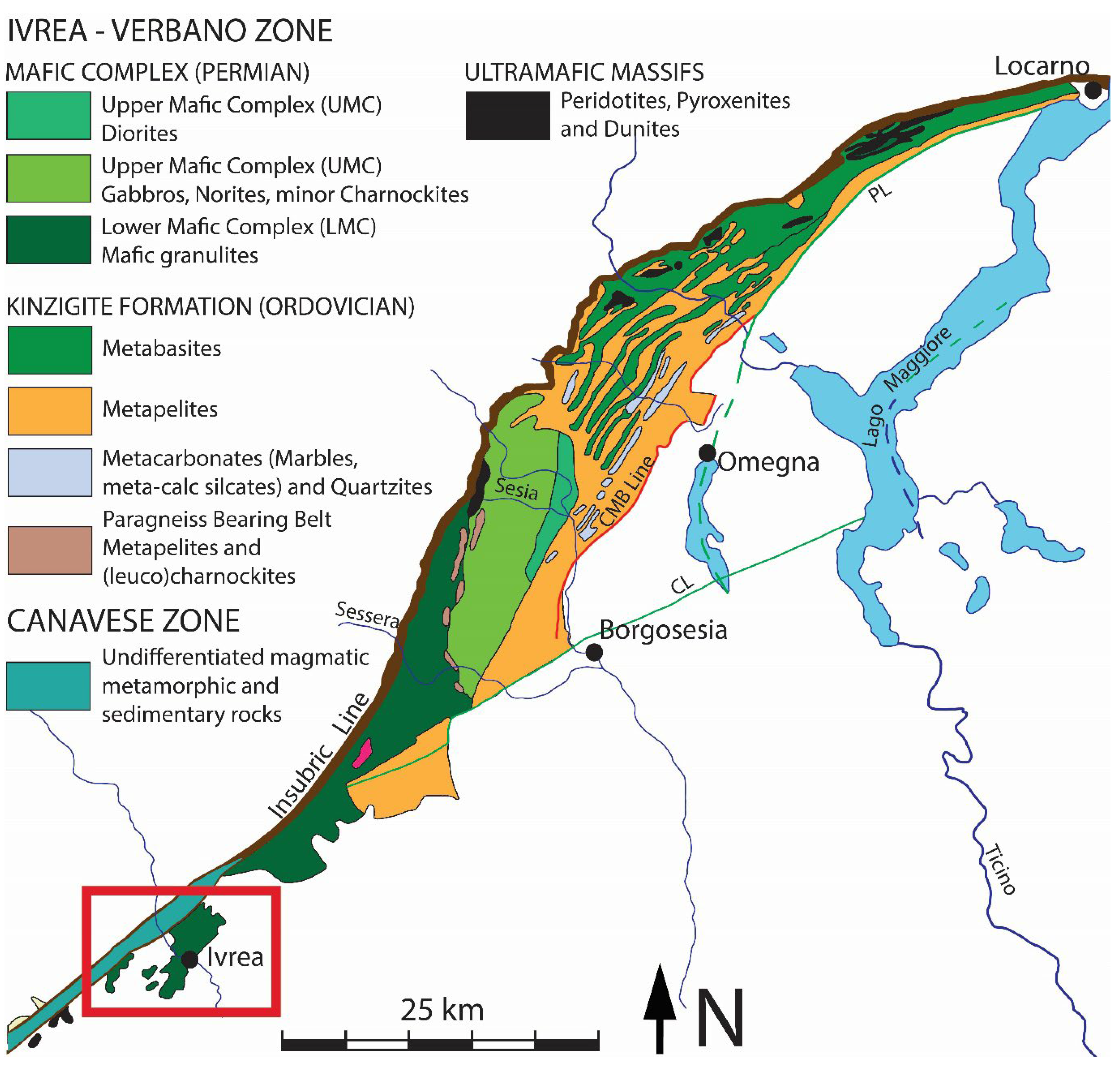
Figure 2.
Simplified geological map of the studied area. ICL = Intenral Canavese Line; ECL = External Canavese Line.
Figure 2.
Simplified geological map of the studied area. ICL = Intenral Canavese Line; ECL = External Canavese Line.
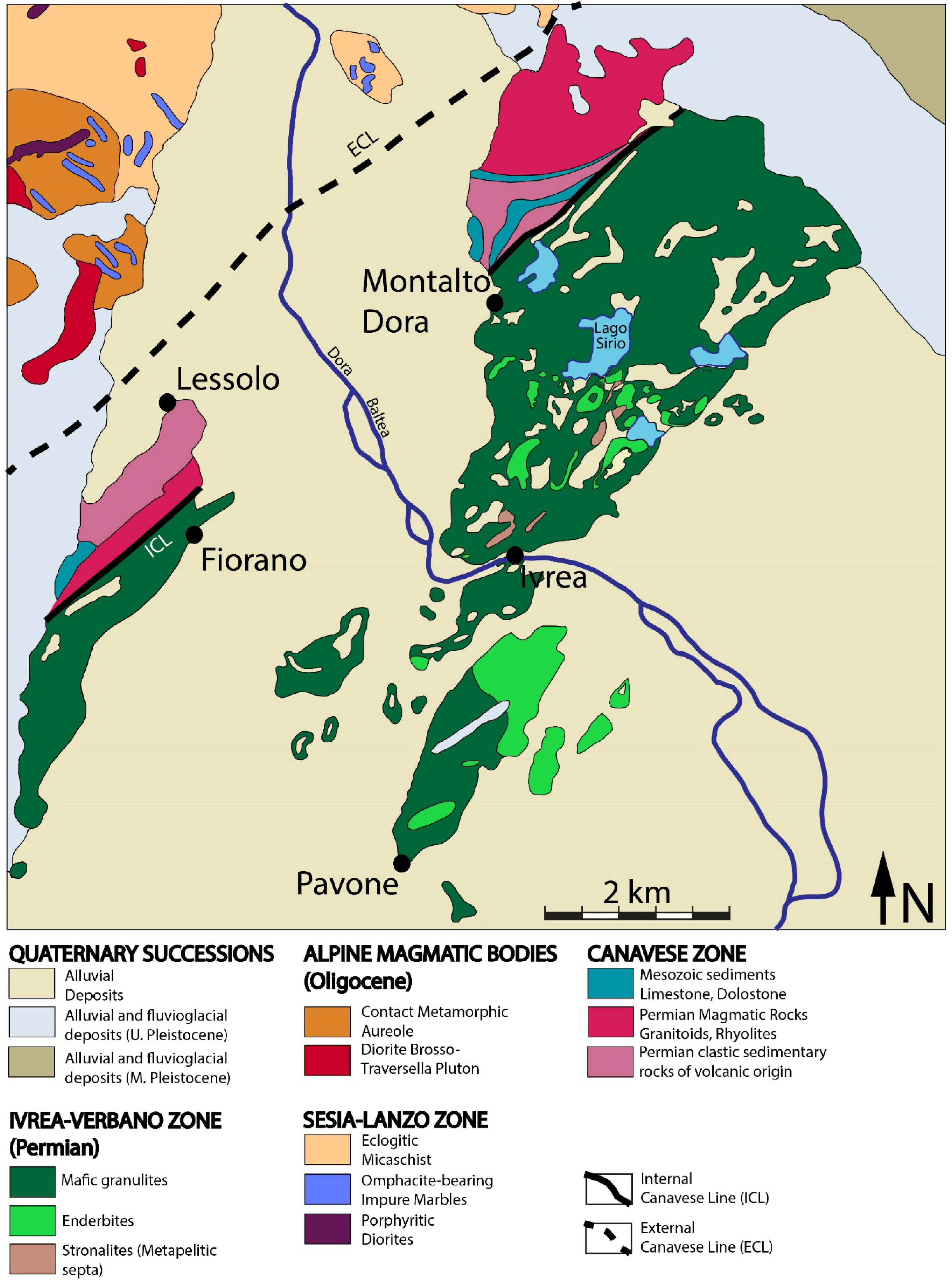
Figure 3.
Mafic granulite field appearance. (a) Typical medium- to coarse-grained granoblastic mafic granulite mainly consisting of Pl and Amp in similar modal proportion. Locality: Ivrea market. (b) Coarse-grained faintly foliated mafic granulite in which relict green to gray Cpx is surrounded by black Amp. The foliation is locally marked by elongated Amp (black arrow). Locality: Ivrea, Beneficio di S.Lucia road. (c) Coarse-grained granoblastic mafic granulite showing dismembered Cpx-rich layers (arrows). The selvages blend gradually into the granulites or are marked by Pl. Locality: Ivrea, Bric Appareglio. (d) Detail of a Cpx-layer within medium-grained granoblastic mafic granulite. The layer is cut and infiltrated by coarse-grained Pl and minor Amp, and its selvages are marked by infiltrating Pl. The square indicates the site of Figure 8b. Locality: Ivrea, Bric Appareglio. Mineral abbreviations after [72].
Figure 3.
Mafic granulite field appearance. (a) Typical medium- to coarse-grained granoblastic mafic granulite mainly consisting of Pl and Amp in similar modal proportion. Locality: Ivrea market. (b) Coarse-grained faintly foliated mafic granulite in which relict green to gray Cpx is surrounded by black Amp. The foliation is locally marked by elongated Amp (black arrow). Locality: Ivrea, Beneficio di S.Lucia road. (c) Coarse-grained granoblastic mafic granulite showing dismembered Cpx-rich layers (arrows). The selvages blend gradually into the granulites or are marked by Pl. Locality: Ivrea, Bric Appareglio. (d) Detail of a Cpx-layer within medium-grained granoblastic mafic granulite. The layer is cut and infiltrated by coarse-grained Pl and minor Amp, and its selvages are marked by infiltrating Pl. The square indicates the site of Figure 8b. Locality: Ivrea, Bric Appareglio. Mineral abbreviations after [72].
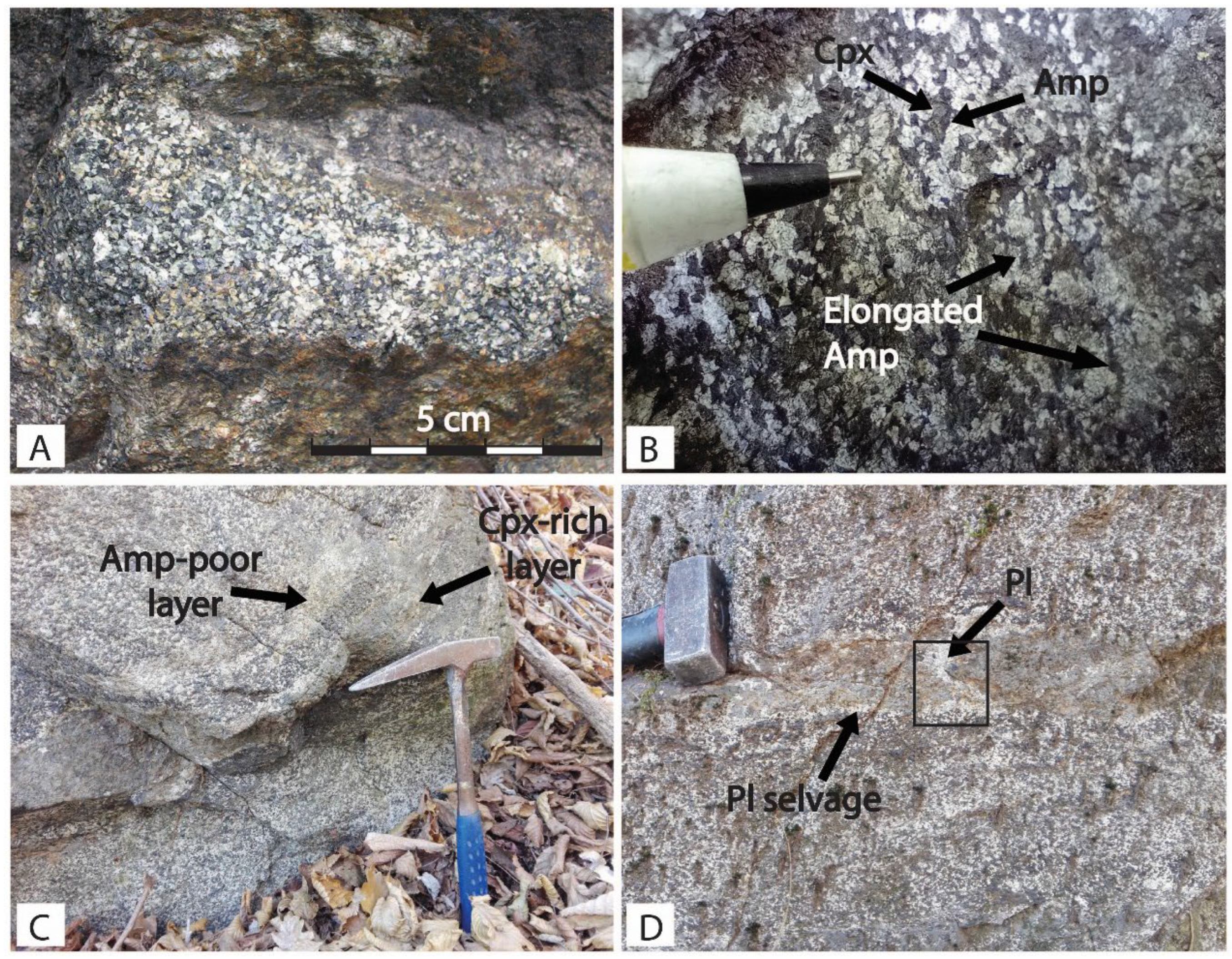
Figure 4.
Enderbite field appearance. (a) Typical medium-grained granoblastic enderbite mainly consisting of Pl and Opx. Locality: Ivrea, Monte Marino Road. (b) Faintly foliated enderbite in which the foliation is marked by coarse-grained elongated Opx. Locality: Ivrea, Monte Marino Road. (c) Fine-grained enderbitic dykes within coarse-grained enderbite. Locality: Ivrea, Monte Marino Road. (d) Fine-grained enderbitic dyke within medium-grained mafic granulite. Locality: Ivrea, Monte Stella Road.
Figure 4.
Enderbite field appearance. (a) Typical medium-grained granoblastic enderbite mainly consisting of Pl and Opx. Locality: Ivrea, Monte Marino Road. (b) Faintly foliated enderbite in which the foliation is marked by coarse-grained elongated Opx. Locality: Ivrea, Monte Marino Road. (c) Fine-grained enderbitic dykes within coarse-grained enderbite. Locality: Ivrea, Monte Marino Road. (d) Fine-grained enderbitic dyke within medium-grained mafic granulite. Locality: Ivrea, Monte Stella Road.
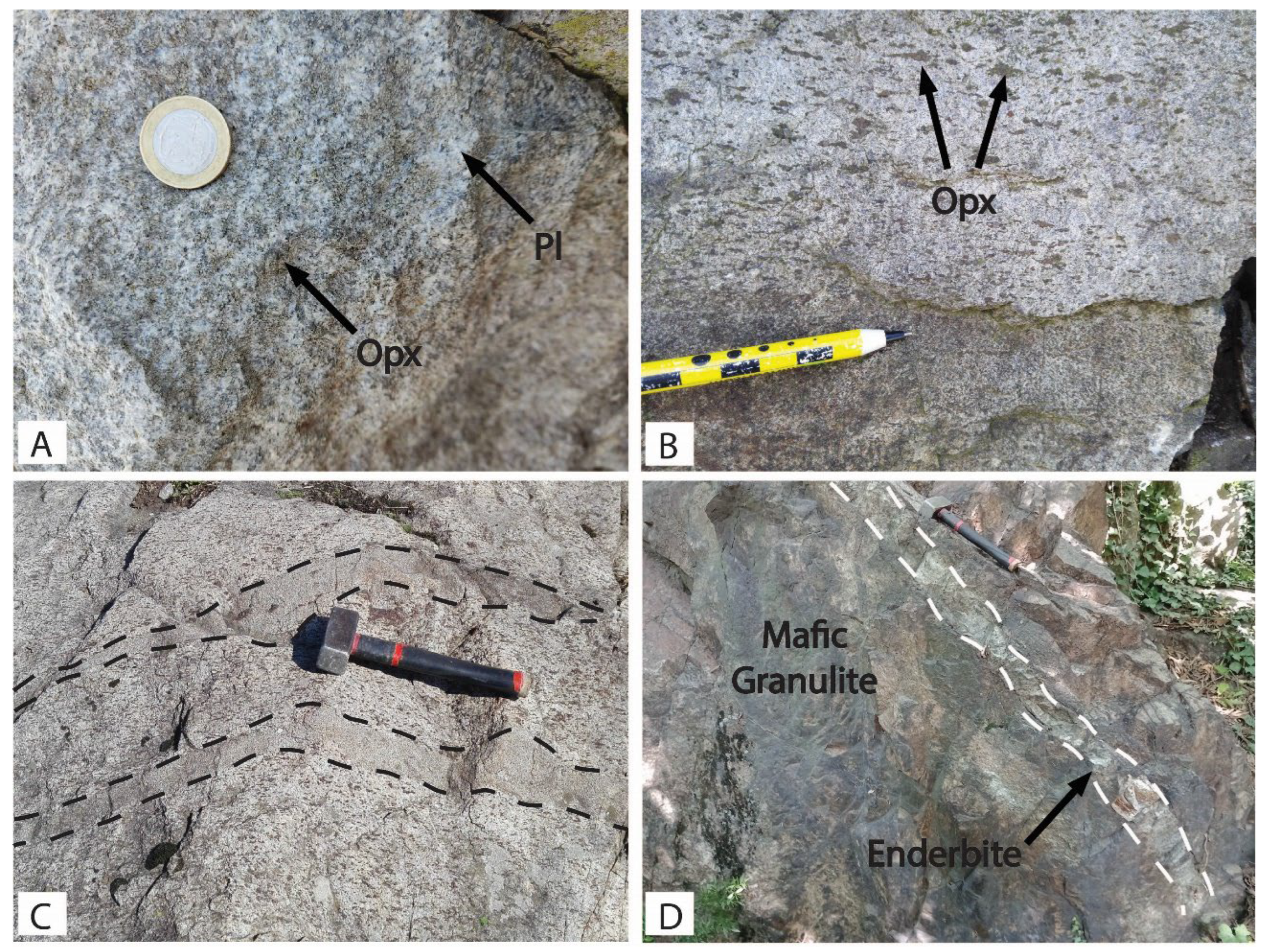
Figure 5.
Amp-rich dykes and pods field appearance. (a) Pegmatoid Amp-rich dyke crosscutting enderbite with straight contact. Locality: Ivrea, Monte Marino Road. (b) Coarse-grained Amp-rich pod gradually fading into mafic granulite. Locality: Ivrea, Bric Appareglio. (c) Coarse-grained hornblenditic lens within mafic granulite. Locality: Ivrea, Bric Appareglio. (d) Medium-grained hornblenditic dyke crosscutting the enderbite with straight contact. Locality: Ivrea, Monte Stella Road.
Figure 5.
Amp-rich dykes and pods field appearance. (a) Pegmatoid Amp-rich dyke crosscutting enderbite with straight contact. Locality: Ivrea, Monte Marino Road. (b) Coarse-grained Amp-rich pod gradually fading into mafic granulite. Locality: Ivrea, Bric Appareglio. (c) Coarse-grained hornblenditic lens within mafic granulite. Locality: Ivrea, Bric Appareglio. (d) Medium-grained hornblenditic dyke crosscutting the enderbite with straight contact. Locality: Ivrea, Monte Stella Road.
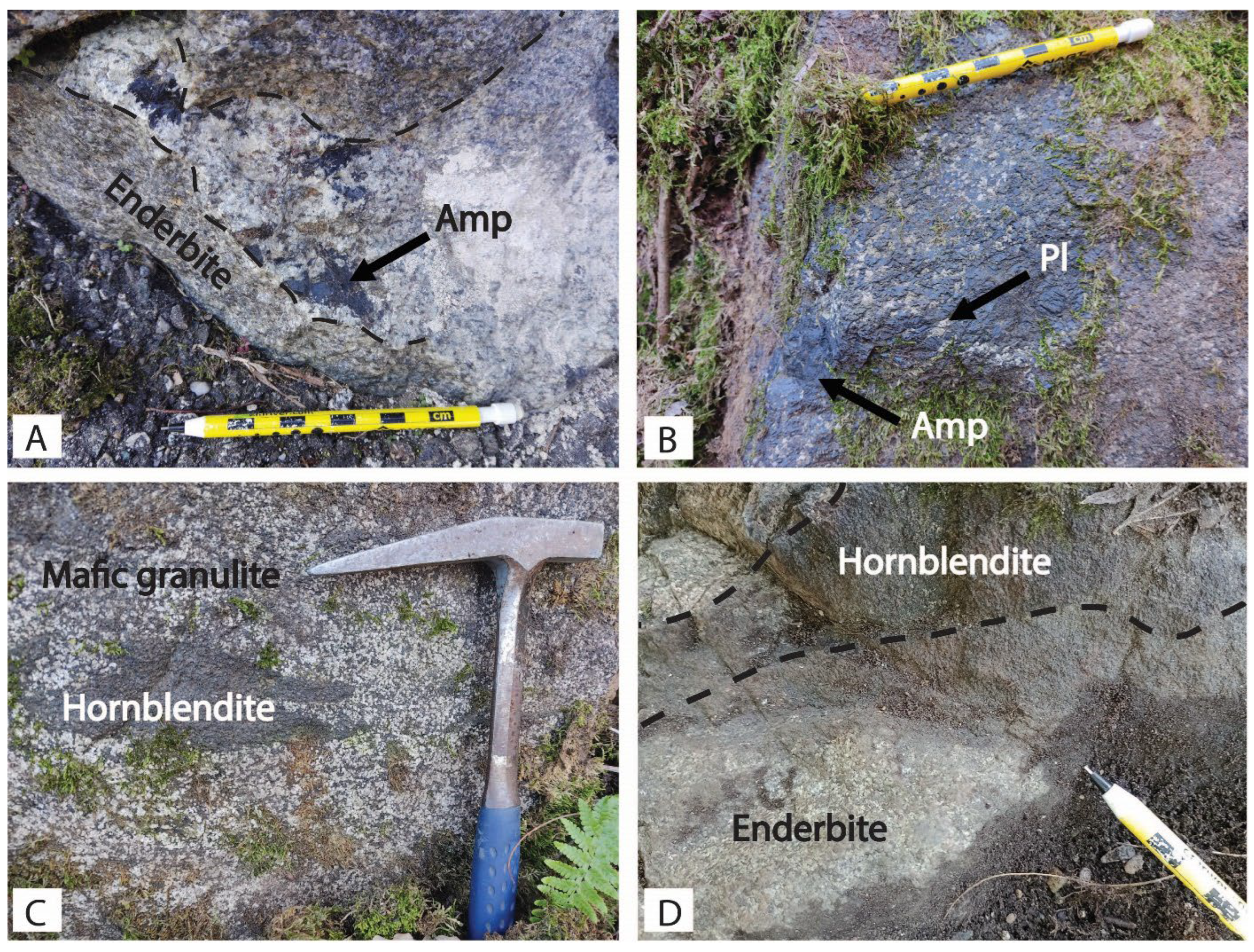
Figure 6.
Field appearance of other, minor lithologies. (a) Coarse-grained quartz-felspathic dyke crosscutting enderbite with straight contact. Locality: Ivrea, Campagna Lake. In the inset, a detail from a quartz-felspathic dyke crosscutting mafic granulites. Locality: Ivrea, Monte Stella Road. (b) Stronalite outcrop showing cm-wide porphyroblastic garnet and cm-thick Qz-vein. The Qz grayish color is due to inclusions of rutile needles. Locality: Ivrea, Canton Gabriel Road. (c) Cm-thick Alpine vein consisting of green Ep + Pl + Chl within mafic granulite. Locality: Ivrea market.
Figure 6.
Field appearance of other, minor lithologies. (a) Coarse-grained quartz-felspathic dyke crosscutting enderbite with straight contact. Locality: Ivrea, Campagna Lake. In the inset, a detail from a quartz-felspathic dyke crosscutting mafic granulites. Locality: Ivrea, Monte Stella Road. (b) Stronalite outcrop showing cm-wide porphyroblastic garnet and cm-thick Qz-vein. The Qz grayish color is due to inclusions of rutile needles. Locality: Ivrea, Canton Gabriel Road. (c) Cm-thick Alpine vein consisting of green Ep + Pl + Chl within mafic granulite. Locality: Ivrea market.
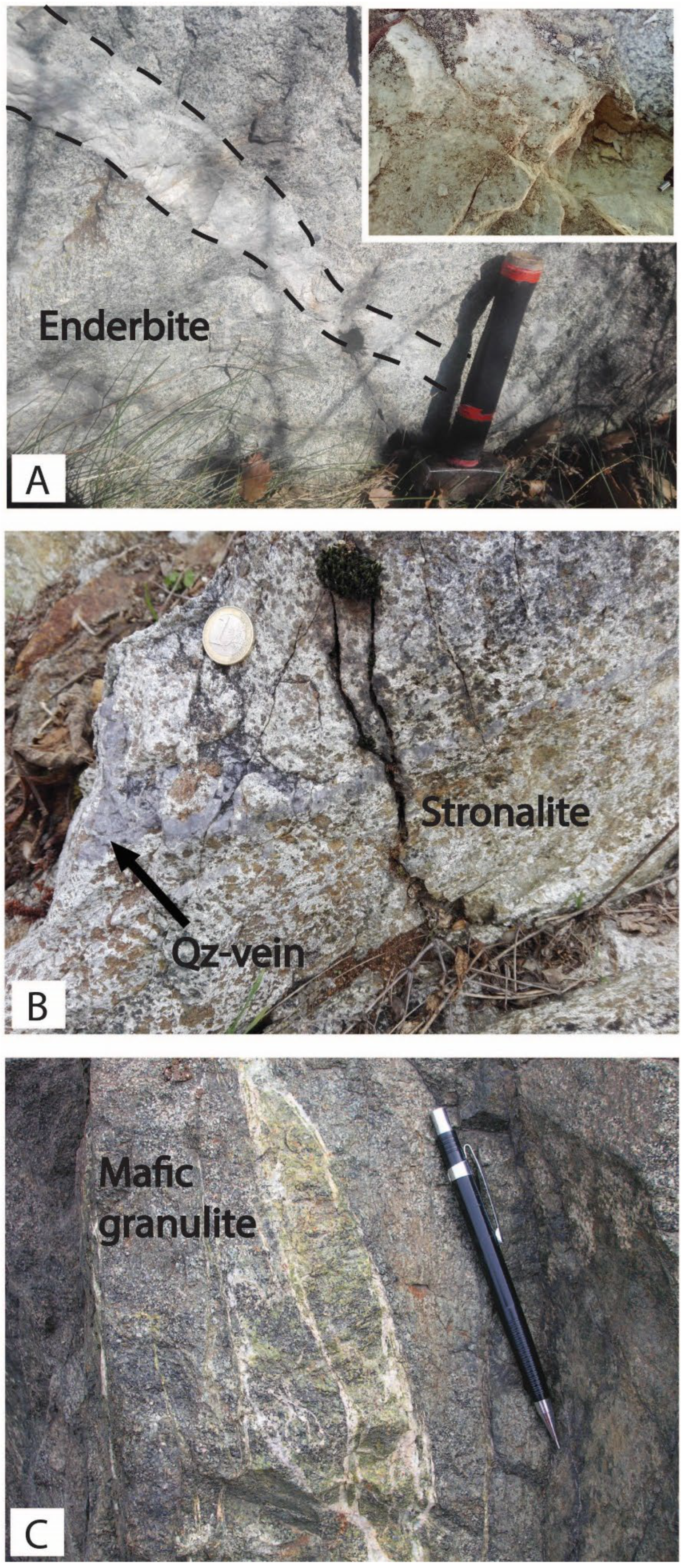
Figure 7.
Mafic granulite under microscope. (a) Thin section and its panoramic view under the microscope showing modal variation in pyroxenes and amphibole. Note the mm-thick pyroxenitic band parallel to the faintly foliation of the rock. Gradual changes in grain-size are also recognizable. Sample IZ23-02B, plane polarized light (PPL). (b) Evidence for two generations of Pl and pyroxenes: a porphyroclastic one with lobate grain-boundaries and a smaller neoblastic one with polygonal grain-boundaries. Note that, unlike neoblasts, porphyroclastic pyroxenes contain exsolutions lamellae. Sample IZ23-02B, PPL. (c) Interstitial Pl surrounding both Opq and Cpx and filling the grain-boundary between Opq and Cpx. Sample IZ21-17, PPL. (d) Interstitial Pl on rounded exolution-rich Cpx and Mag. Sample IZ21-17, back-scattered electron image (BSE). (e) Interstitial Pl between pyroxenes and Hc or Mag, but not between Hc and Amp. Note the Opx exsolution lamellae within porphyroclastic Cpx. Sample IZ21-17, BSE (f) Common brown exsolutions present in porphyroclastic Opx. Sample IZ21-20a, thick section, PPL. (g) Interstitial Amp between Pl-Pl and Opx-Cpx grain-boundaries. Sample IZ21-20a, PPL (h) Cpx partly replaced by interstitial Amp. Sample IZ21-18a, PPL. (i) Granoblastic polygonal Amp with Ilm ± Mag “beads” at the grain-boundaries. Note that the opaque “beads” do not forms between the other minerals. Sample IZ21-18a, BSE. (k) Allotriomorphic Mag partly preserved from Hc substitution. The interstitial Pl constitutes a continuous film at the contact between Cpx and Mag or Hc. Sample IZ21-17, BSE.
Figure 7.
Mafic granulite under microscope. (a) Thin section and its panoramic view under the microscope showing modal variation in pyroxenes and amphibole. Note the mm-thick pyroxenitic band parallel to the faintly foliation of the rock. Gradual changes in grain-size are also recognizable. Sample IZ23-02B, plane polarized light (PPL). (b) Evidence for two generations of Pl and pyroxenes: a porphyroclastic one with lobate grain-boundaries and a smaller neoblastic one with polygonal grain-boundaries. Note that, unlike neoblasts, porphyroclastic pyroxenes contain exsolutions lamellae. Sample IZ23-02B, PPL. (c) Interstitial Pl surrounding both Opq and Cpx and filling the grain-boundary between Opq and Cpx. Sample IZ21-17, PPL. (d) Interstitial Pl on rounded exolution-rich Cpx and Mag. Sample IZ21-17, back-scattered electron image (BSE). (e) Interstitial Pl between pyroxenes and Hc or Mag, but not between Hc and Amp. Note the Opx exsolution lamellae within porphyroclastic Cpx. Sample IZ21-17, BSE (f) Common brown exsolutions present in porphyroclastic Opx. Sample IZ21-20a, thick section, PPL. (g) Interstitial Amp between Pl-Pl and Opx-Cpx grain-boundaries. Sample IZ21-20a, PPL (h) Cpx partly replaced by interstitial Amp. Sample IZ21-18a, PPL. (i) Granoblastic polygonal Amp with Ilm ± Mag “beads” at the grain-boundaries. Note that the opaque “beads” do not forms between the other minerals. Sample IZ21-18a, BSE. (k) Allotriomorphic Mag partly preserved from Hc substitution. The interstitial Pl constitutes a continuous film at the contact between Cpx and Mag or Hc. Sample IZ21-17, BSE.
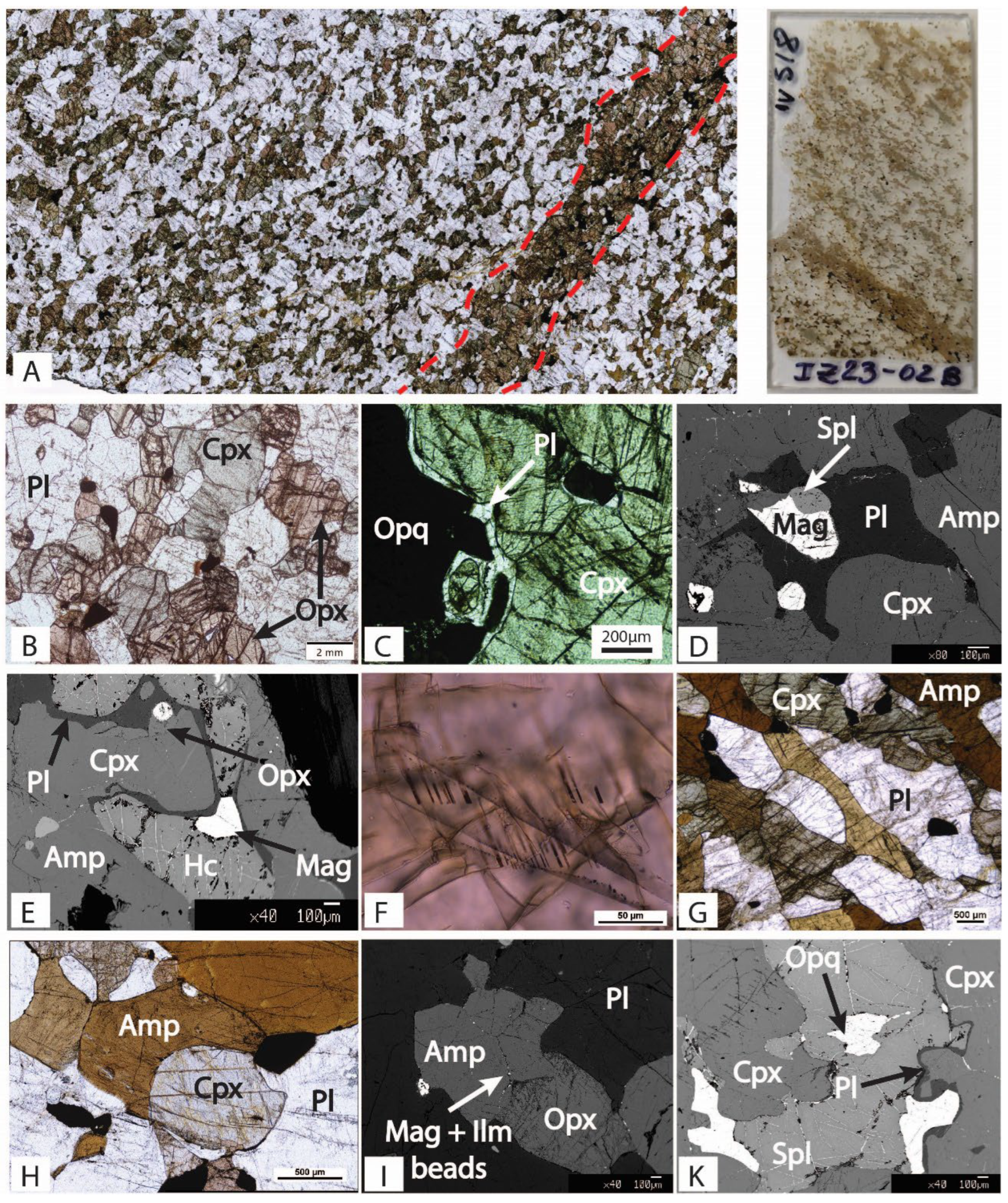
Figure 8.
Plagioclase chemical composition in mafic granulite and low-Cpx granulite (a) and in enderbite (b).
Figure 8.
Plagioclase chemical composition in mafic granulite and low-Cpx granulite (a) and in enderbite (b).
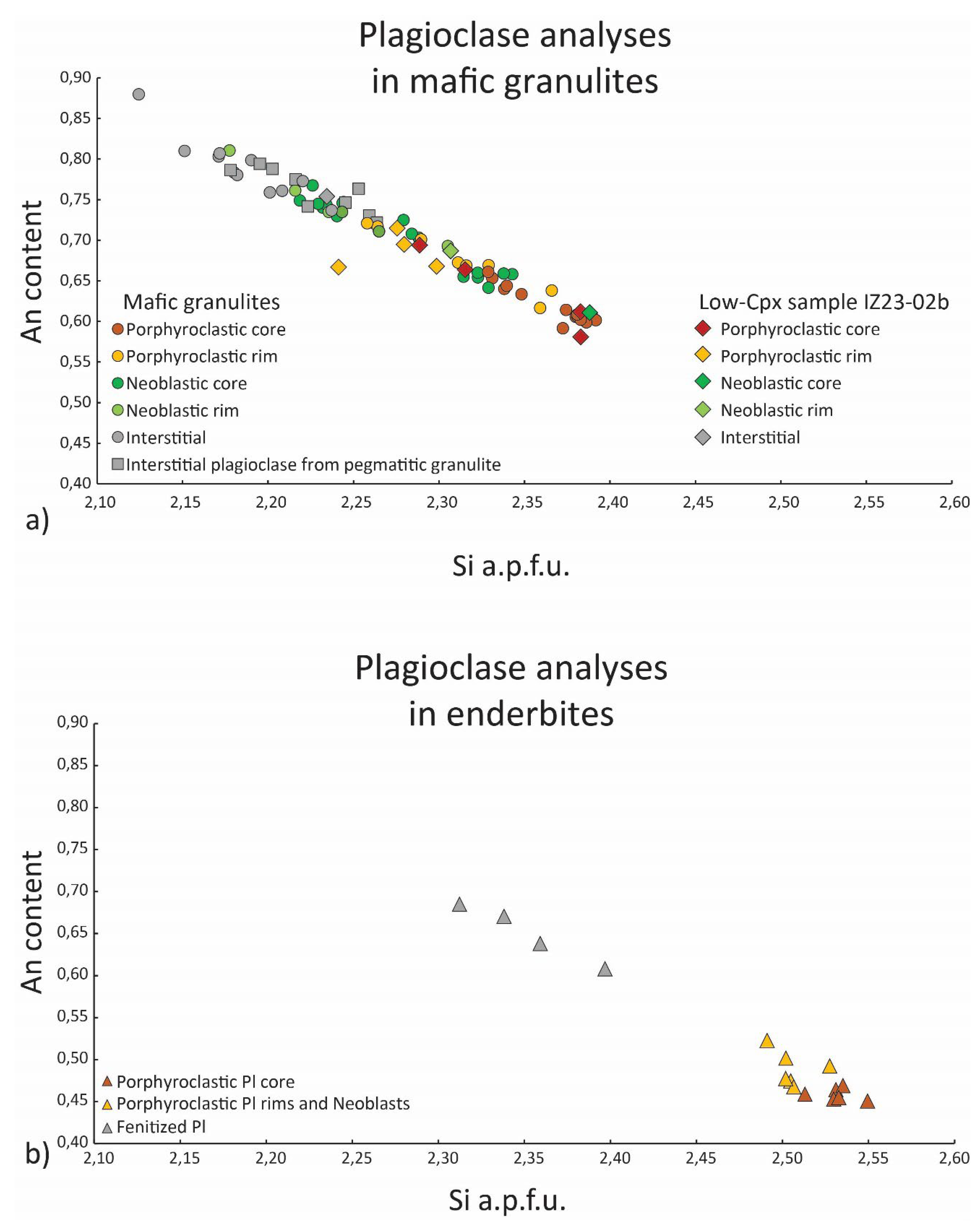
Figure 9.
Orthopyroxene chemical composition in mafic granulite and low-Cpx granulite (a-b) and in enderbite (c-d).
Figure 9.
Orthopyroxene chemical composition in mafic granulite and low-Cpx granulite (a-b) and in enderbite (c-d).
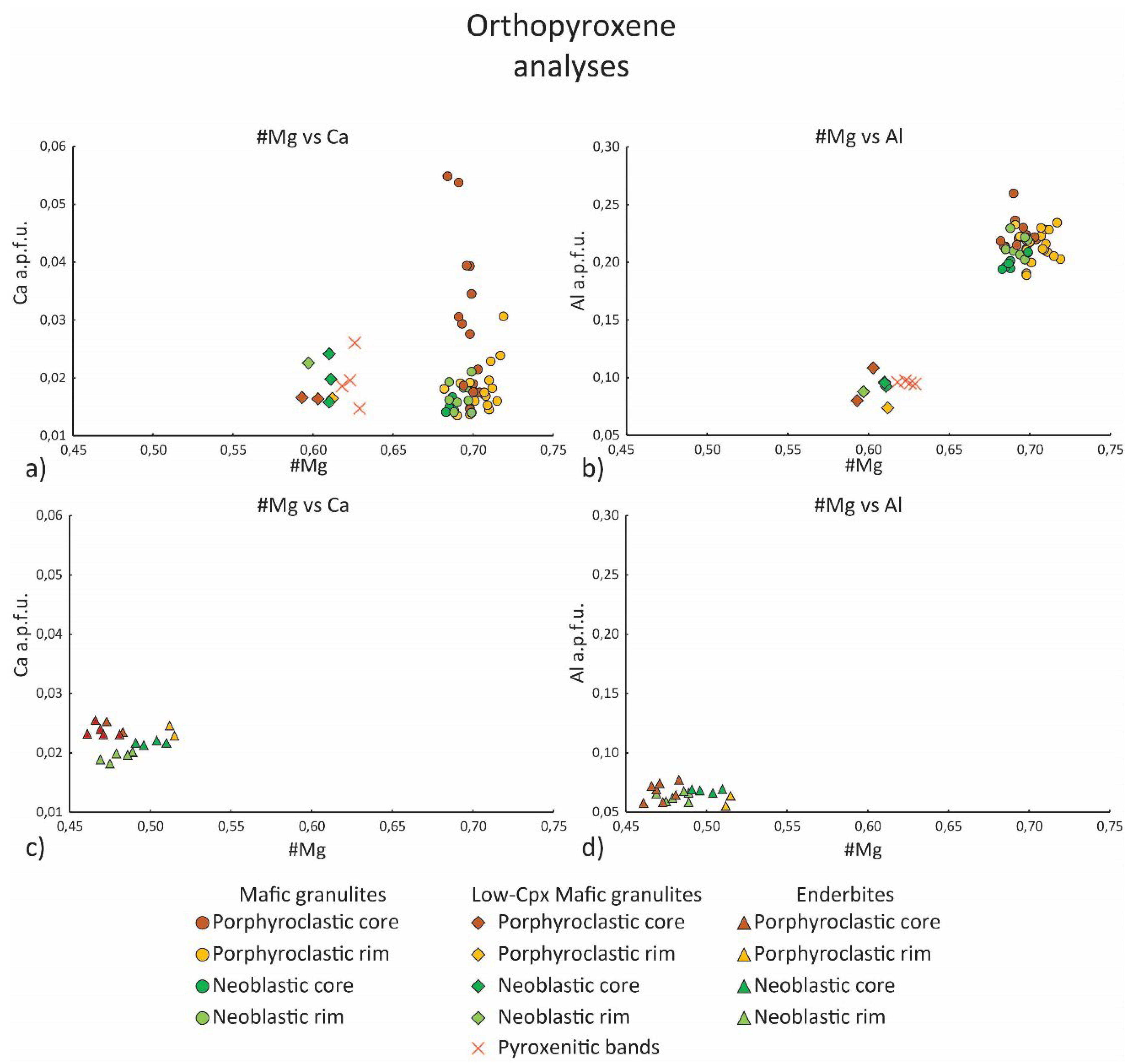
Figure 10.
Clinopyroxene chemical composition in mafic granulite and low-Cpx granulite.
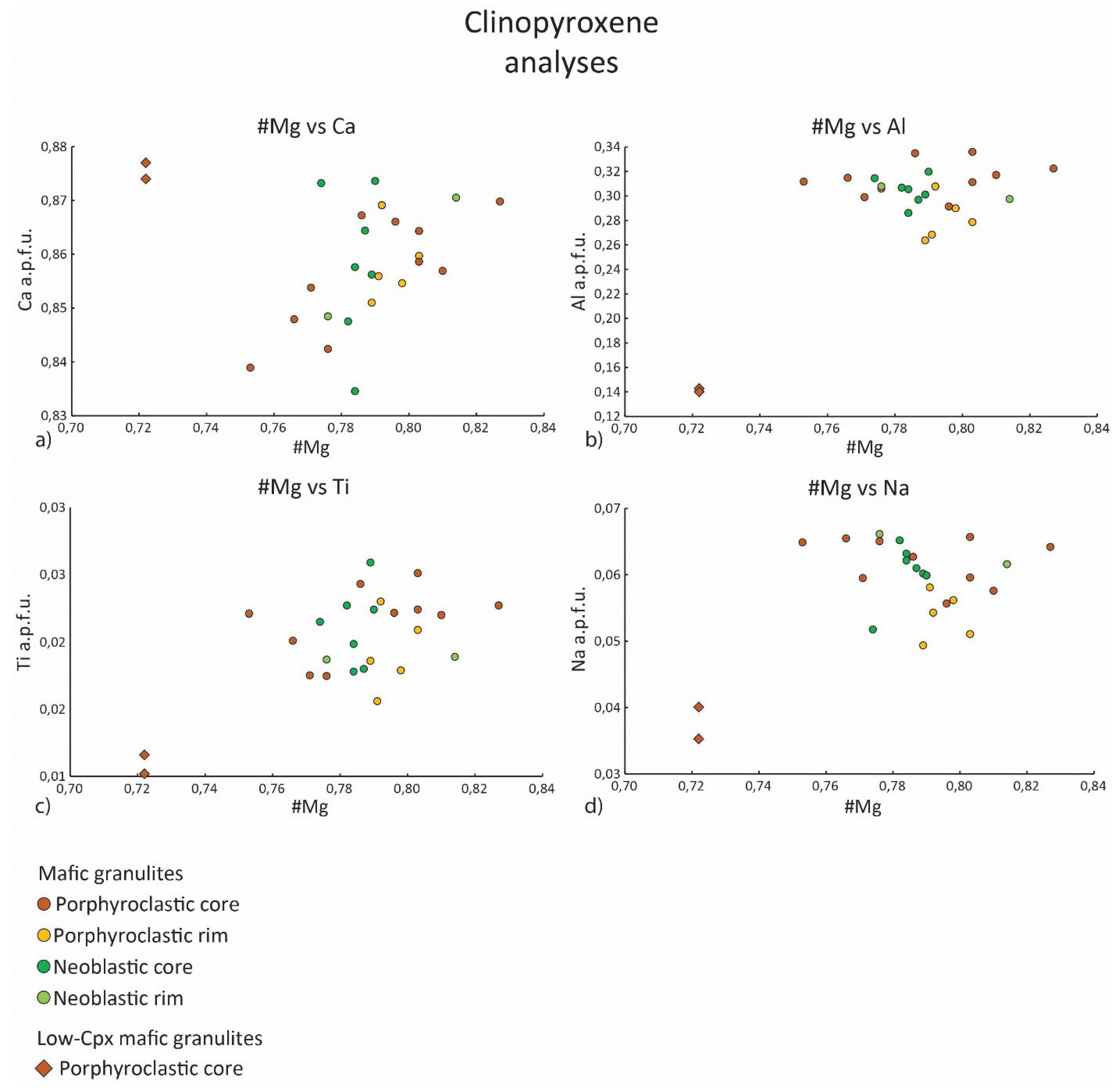
Figure 11.
Amphibole chemical composition in mafic granulite, low-Cpx granulite and enderbite.
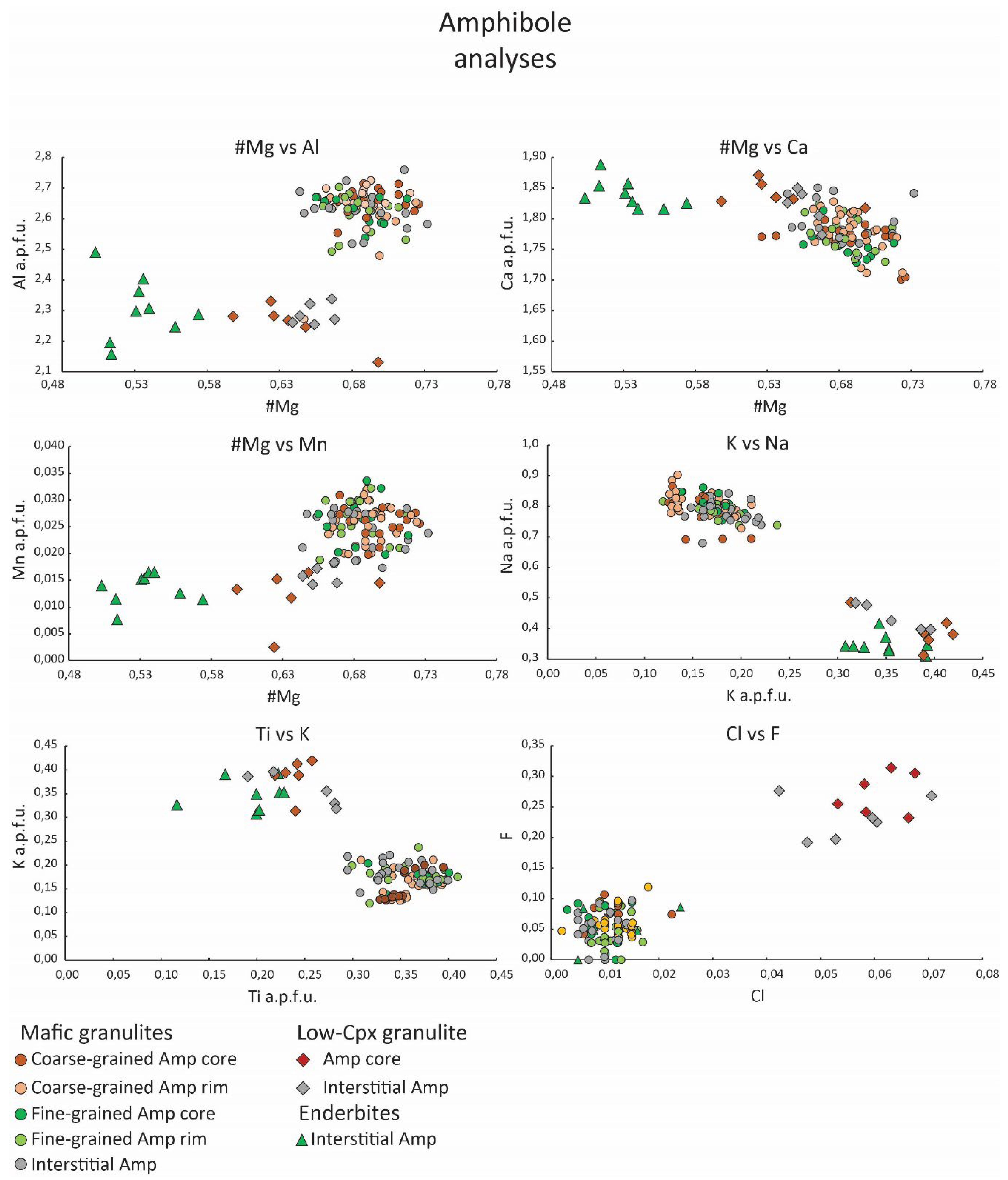
Figure 12.
Px-rich layers and Amp-rich dykes and pods under microscope. (a) Typical Px-rich layer consisting of Cpx + Opx + Opq + Pl and showing granoblastic structure with lobate grain-boundaries usually evolving toward polygonal ones. Sample IZ23-02b, PPL. (b) Coarse-grained Pl and minor Amp cutting and infiltrating a Px-rich layer (compare with Figure 3d). Sample IZ21-15a, PPL. (c) Interstitial Amp surrounding Mag from a Px-rich layer. Sample IZ21-15a, PPL. (d) Interstitial Pl at the contact between Mag and Cpx from a Px-rich layer. Sample IZ21-15a, PPL. (e) Pegmatitic Amp from an Amp-rich pods (compare with Figure 5b) partly replacing Opx of a mafic granulite. Sample IZ21-17, PPL. (f) Pegmatitic polygonal Amp, from an Amp-rich pod, with opaque “beads” at the Amp-Amp grain-boundaries. Sample IZ21-17, PPL.
Figure 12.
Px-rich layers and Amp-rich dykes and pods under microscope. (a) Typical Px-rich layer consisting of Cpx + Opx + Opq + Pl and showing granoblastic structure with lobate grain-boundaries usually evolving toward polygonal ones. Sample IZ23-02b, PPL. (b) Coarse-grained Pl and minor Amp cutting and infiltrating a Px-rich layer (compare with Figure 3d). Sample IZ21-15a, PPL. (c) Interstitial Amp surrounding Mag from a Px-rich layer. Sample IZ21-15a, PPL. (d) Interstitial Pl at the contact between Mag and Cpx from a Px-rich layer. Sample IZ21-15a, PPL. (e) Pegmatitic Amp from an Amp-rich pods (compare with Figure 5b) partly replacing Opx of a mafic granulite. Sample IZ21-17, PPL. (f) Pegmatitic polygonal Amp, from an Amp-rich pod, with opaque “beads” at the Amp-Amp grain-boundaries. Sample IZ21-17, PPL.
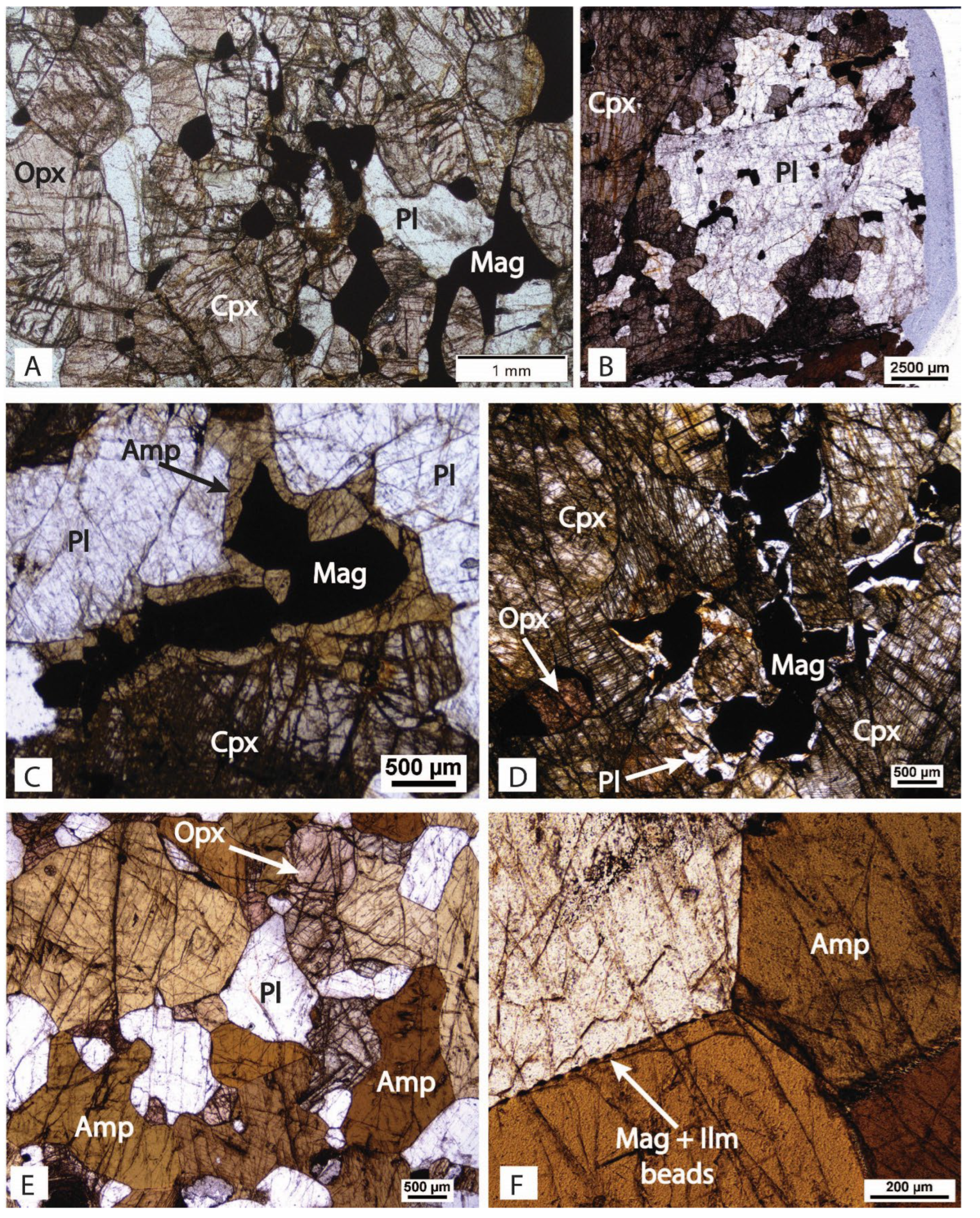
Figure 13.
Enderbites under microscope. (a-b) Enderbite characterized by a faintly foliation defined by a dimensionally oriented porphyroclastic exsolution-rich Opx (a) or by an elongated aggregate of neoblastic exsolution-free Opx (b). Sample IZ21-04a, PPL. (c) Porphyroclastic Pl showing lobate grain-boundaries (red-dashed line) with exsholution-rich Opx. Sample IZ21-01, PPL. (d) Neoblastic Opx and Pl showing polygonal granoblastic microstructure. Note the rare green-brown Amp around Opq. Sample IZ21-04a, PPL. (e) Pl showing Qz blebs in their interior and at their grain-boundaries. Note a change in Pl extinction around the blebs. Sample IZ21-02, crossed polarized light (XPL). (f) The Qz blebs are associated with replacement antiperthitic Kfs and with an increase in anorthite component of the hosting Pl. Sample IZ21-01, BSE.
Figure 13.
Enderbites under microscope. (a-b) Enderbite characterized by a faintly foliation defined by a dimensionally oriented porphyroclastic exsolution-rich Opx (a) or by an elongated aggregate of neoblastic exsolution-free Opx (b). Sample IZ21-04a, PPL. (c) Porphyroclastic Pl showing lobate grain-boundaries (red-dashed line) with exsholution-rich Opx. Sample IZ21-01, PPL. (d) Neoblastic Opx and Pl showing polygonal granoblastic microstructure. Note the rare green-brown Amp around Opq. Sample IZ21-04a, PPL. (e) Pl showing Qz blebs in their interior and at their grain-boundaries. Note a change in Pl extinction around the blebs. Sample IZ21-02, crossed polarized light (XPL). (f) The Qz blebs are associated with replacement antiperthitic Kfs and with an increase in anorthite component of the hosting Pl. Sample IZ21-01, BSE.
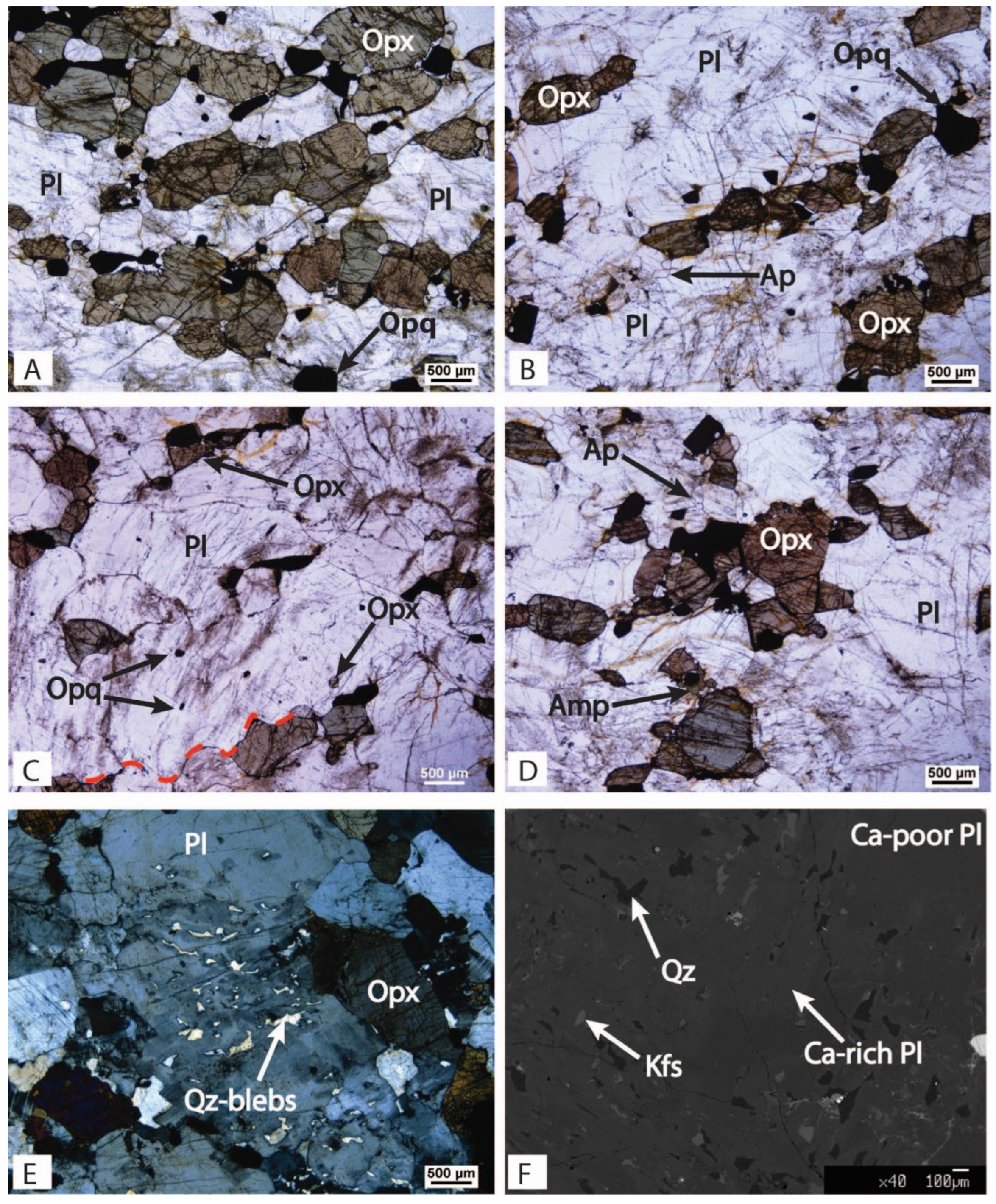
Figure 14.
Rare Earth Element (REE) and incompatible trace element patterns of the major petrogenetic minerals in the studied mafic granulites of Ivrea town area: a-b) clinopyroxene; c-d) amphibole; e-f) orthopyroxene and g-h) plagioclase. The plots show individual analysis for each mineral. Primitive mantle and CI-chondrite values are from McDonough and Sun [74].
Figure 14.
Rare Earth Element (REE) and incompatible trace element patterns of the major petrogenetic minerals in the studied mafic granulites of Ivrea town area: a-b) clinopyroxene; c-d) amphibole; e-f) orthopyroxene and g-h) plagioclase. The plots show individual analysis for each mineral. Primitive mantle and CI-chondrite values are from McDonough and Sun [74].
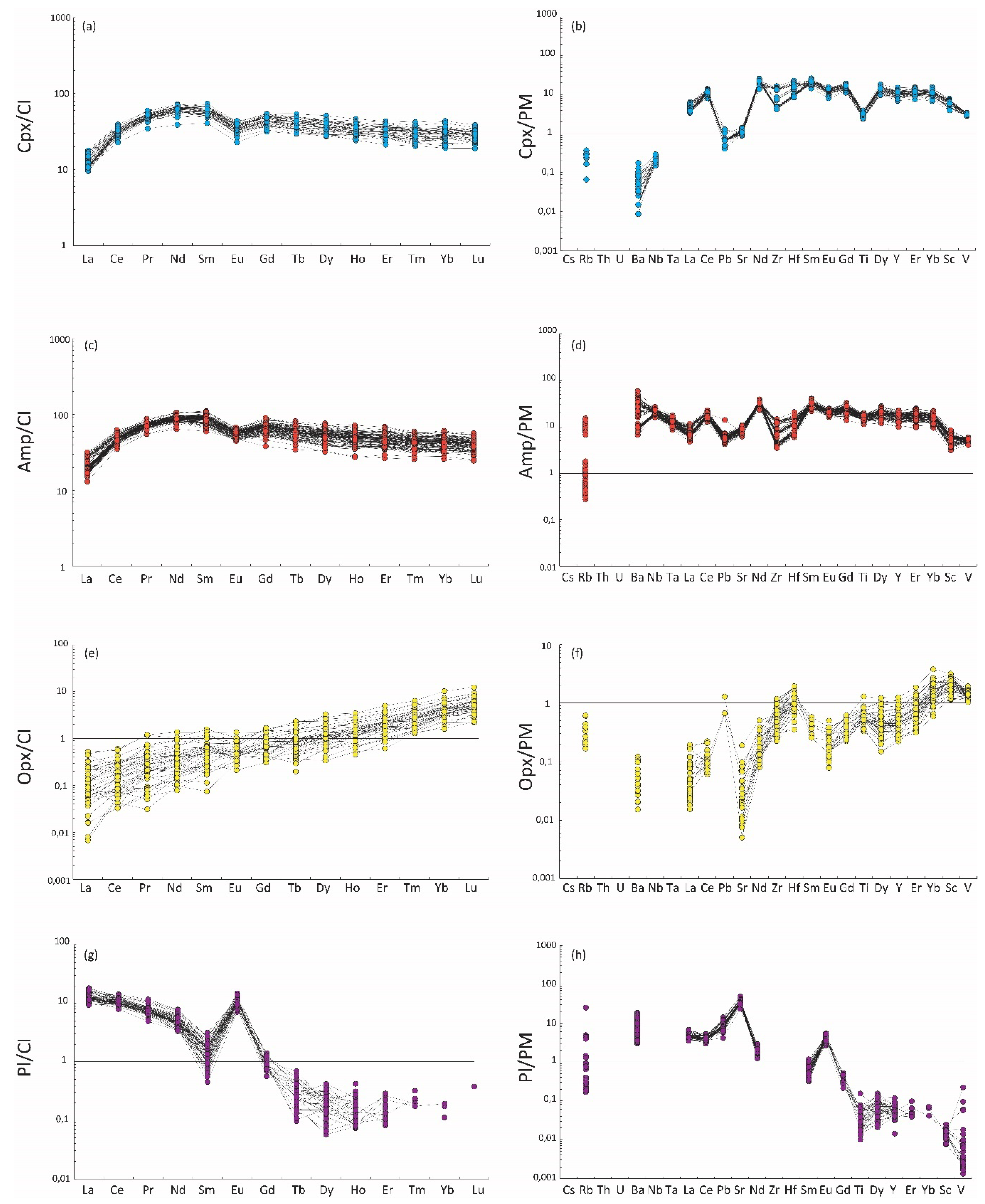
Figure 15.
Thermobarometric data from Amp. (a) Histograms of the temperatures calculated using the equation of [75]. (b) Composition of amphiboles plotted in the Si vs Ti diagram. The field of high amphibolite (HAM), HT granulite (HT-GR) and UHT granulite facies are from [75]. (c) Composition of amphiboles plotted in the AlIV vs. AlVI diagram. The distinction between low-P and high-P amphiboles (solid line) is from [77] and that among amphibole composition from the different metamorphic facies is from [78]: (a) greenschist facies; (b) albite–epidote amphibolite facies; (c) amphibolite facies; (d) granulite facies.
Figure 15.
Thermobarometric data from Amp. (a) Histograms of the temperatures calculated using the equation of [75]. (b) Composition of amphiboles plotted in the Si vs Ti diagram. The field of high amphibolite (HAM), HT granulite (HT-GR) and UHT granulite facies are from [75]. (c) Composition of amphiboles plotted in the AlIV vs. AlVI diagram. The distinction between low-P and high-P amphiboles (solid line) is from [77] and that among amphibole composition from the different metamorphic facies is from [78]: (a) greenschist facies; (b) albite–epidote amphibolite facies; (c) amphibolite facies; (d) granulite facies.
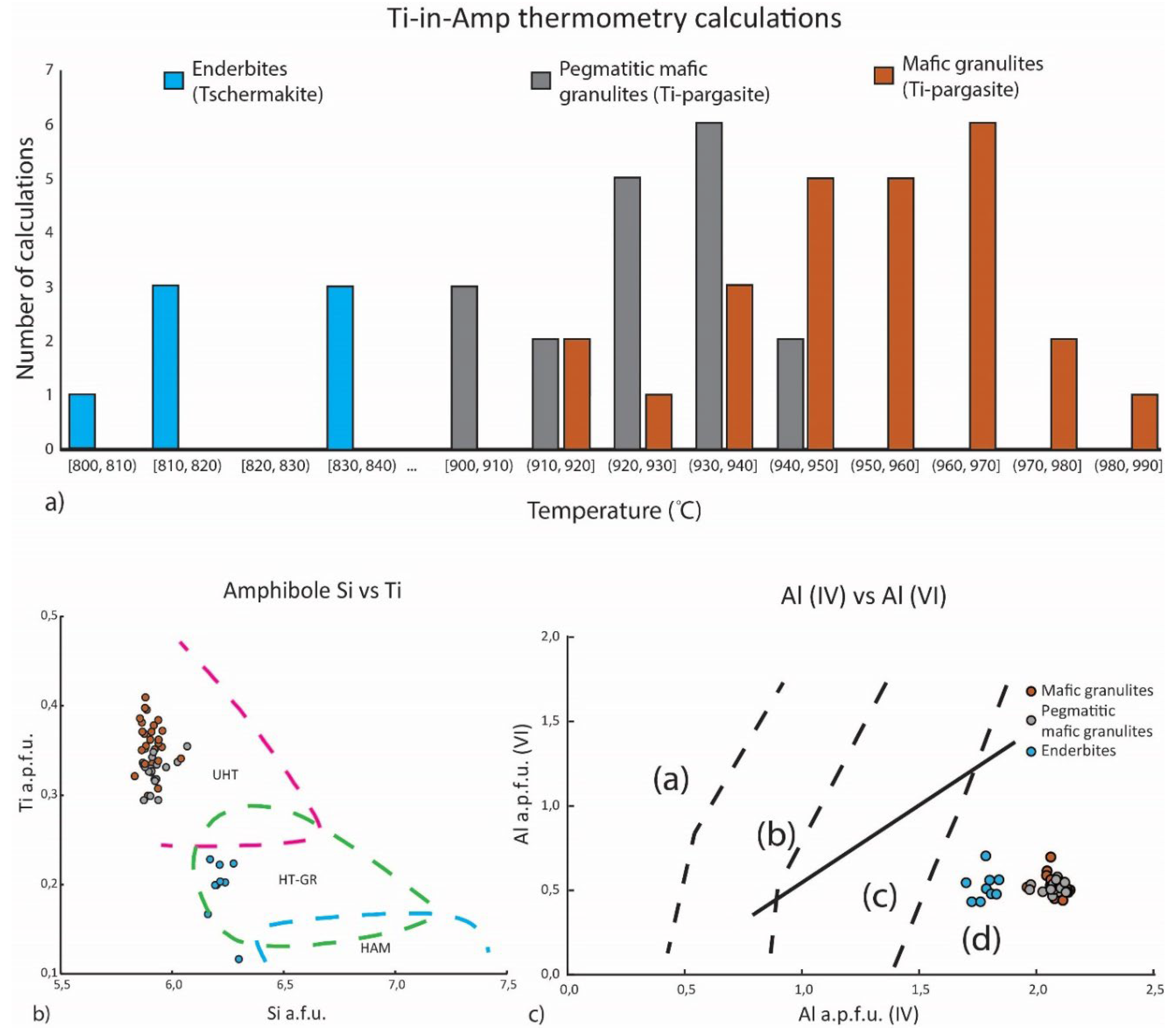
Figure 16.
Major element amphibole diagrams comparing this work with the dioritic and hornblenditic dykes of Ogunyele et al. [14] from the Finero Mafic Complex. From the diagrams is derived that the amphiboles from the samples in Ivrea town area, have similar composition with the HSFE-poor dioritic and hornblenditic dykes.
Figure 16.
Major element amphibole diagrams comparing this work with the dioritic and hornblenditic dykes of Ogunyele et al. [14] from the Finero Mafic Complex. From the diagrams is derived that the amphiboles from the samples in Ivrea town area, have similar composition with the HSFE-poor dioritic and hornblenditic dykes.
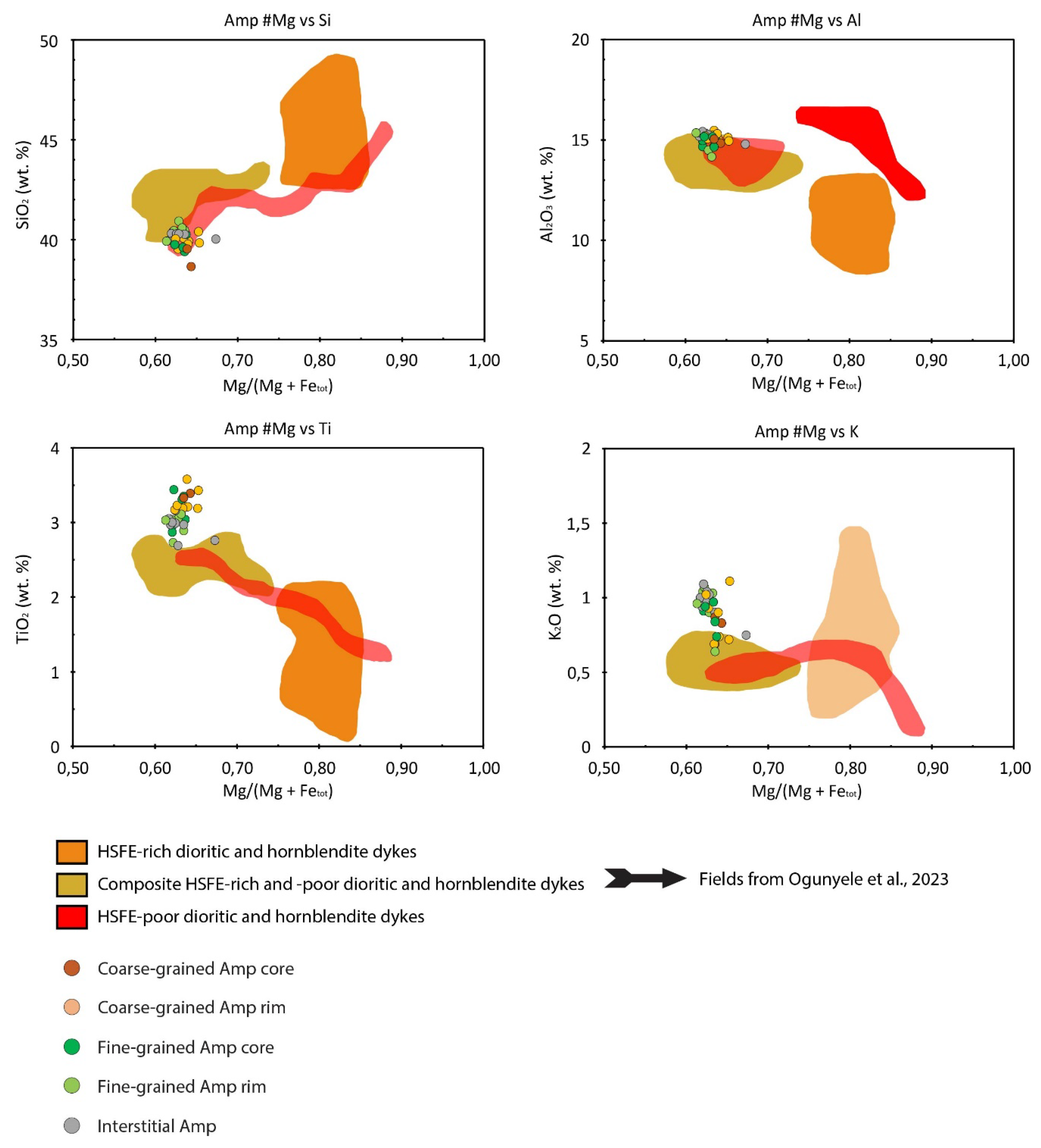
Figure 17.
Rare Earth Element (REE) and incompatible trace element patterns of the major petrogenetic minerals in the studied mafic granulites of Ivrea town area compared with previous studies from the Finero Mafic Complex [12,13,14] and Monte Capio area [28], where hornblenditic dykes and associated mafic granulites are reported to have reacted with hydrous basaltic melts. Shown are every representative individual analysis for each mineral: a-b) clinopyroxene; c-d) amphibole; e-f) orthopyroxene and g-h) plagioclase. Primitive mantle and CI-chondrite values are from McDonough and Sun [74].
Figure 17.
Rare Earth Element (REE) and incompatible trace element patterns of the major petrogenetic minerals in the studied mafic granulites of Ivrea town area compared with previous studies from the Finero Mafic Complex [12,13,14] and Monte Capio area [28], where hornblenditic dykes and associated mafic granulites are reported to have reacted with hydrous basaltic melts. Shown are every representative individual analysis for each mineral: a-b) clinopyroxene; c-d) amphibole; e-f) orthopyroxene and g-h) plagioclase. Primitive mantle and CI-chondrite values are from McDonough and Sun [74].
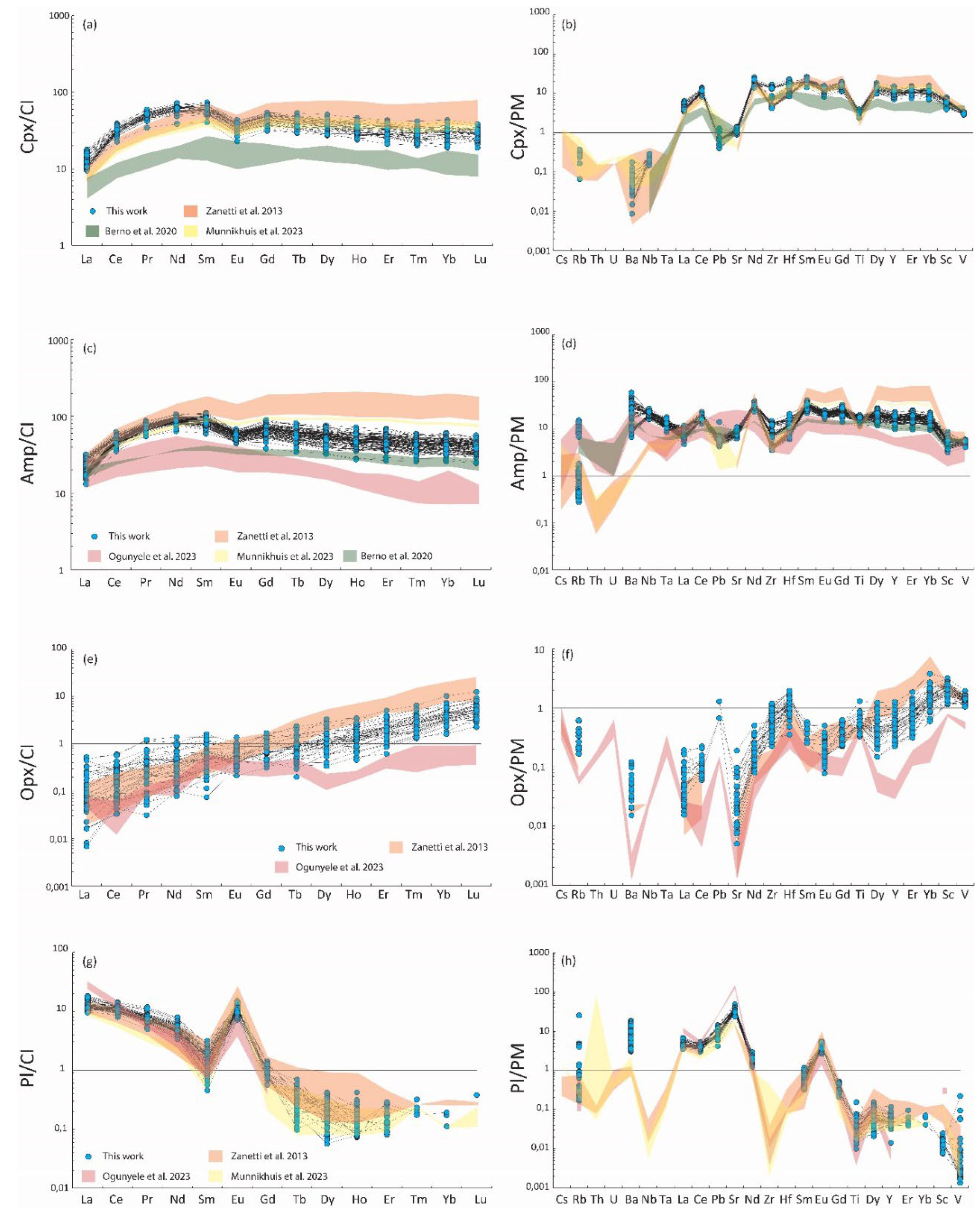
Figure 18.
Schematic tectono-thermal sketch of the late-Variscan extension (310-270 Ma) in the Alpine Tethys realm. The isotherm location is approximate. Modified after Wyatt et al. [30], Manatschal et al. [96], Petri et al. [97] and Real et al. [98].
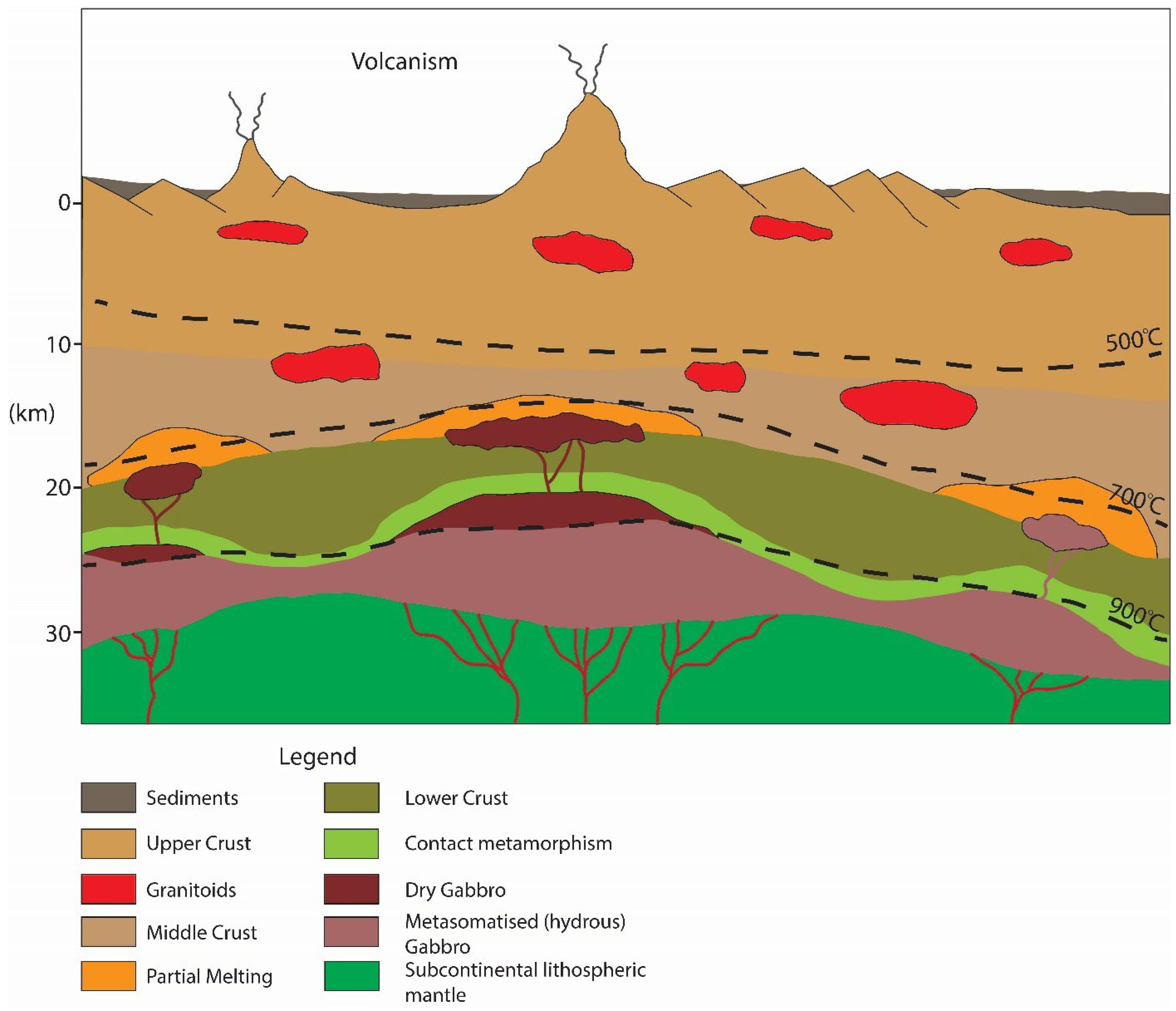

Table 1.
Selection of representative samples from the SW Ivrea-Verbano zone. Underlined samples were selected for more detailed analysis.
Table 1.
Selection of representative samples from the SW Ivrea-Verbano zone. Underlined samples were selected for more detailed analysis.
| Sample name | Coordinates (N, E) | Specimen Decsription |
|---|---|---|
| IZ21-01 | 45° 26’ 47’’, 7° 52’ 48’’ | Medium-grained enderbite |
| IZ21-02 | 45° 26’ 47’’, 7° 52’ 47’’ | Coarse-grained enderbite |
| IZ21-03 | 45° 26’ 47’’, 7° 52’ 46’’ | Coarse-grained enderbite in contact with fine-grained enderbitic dyke |
| IZ21-04 | 45° 26’ 51’’, 7° 52’ 53’’ | Very coarse-grained enderbite |
| IZ21-06 | 45° 28’ 29’’, 7° 52’ 49’’ | Fine-grained stronalite |
| IZ21-07 | 45° 28’ 29’’, 7° 52’ 50’’ | Medium-grained stronalite |
| IZ21-13 | 45° 28’ 37’’, 7° 52’ 55’’ | Medium-grained stronalite with cm-sized garnet porphyroblasts |
| IZ21-14 | 45° 26’ 41’’, 7° 51’ 50’’ | Coarse-grained mafic granulite with pegmatoid coarse-grained lens |
| IZ21-15 | 45° 26’ 41’’, 7° 51’ 50’’ | Cpx-rich band in contact with sample IZ21-14 |
| IZ21-17 | 45° 26’ 41’’, 7° 51’ 50’’ | Coarse-grained amp-rich mafic granulite |
| IZ21-18 | 45° 26’ 40’’, 7° 51’ 49’’ | Coarse-grained mafic granulite |
| IZ21-19 | 45° 26’ 39’’, 7° 51’ 49’’ | Anhydrous coarse-grained mafic granulite |
| IZ21-20 | 45° 26’ 39’’, 7° 51’ 48’’ | Foliated coarse–grained mafic granulite |
| IZ21-21 | 45° 26’ 40’’, 7° 51’ 49’’ | Slightly foliated medium-grained mafic granulite with Cpx porphyroblasts |
| IZ21-22 | 45° 26’ 37’’, 7° 51’ 56’’ | Medium- to coarse-grained mafic granulite, rich in opaques |
| IZ21-23 | 45° 26’ 27’’, 7° 51’ 39’’ | Homogeneous medium- to coarse-grained mafic granulite |
| IZ23-02b | 45° 28’ 19’’, 7° 52’ 58’’ | Anhydrous, low-Cpx mafic granulite with pyroxenitic layer |
Disclaimer/Publisher’s Note: The statements, opinions and data contained in all publications are solely those of the individual author(s) and contributor(s) and not of MDPI and/or the editor(s). MDPI and/or the editor(s) disclaim responsibility for any injury to people or property resulting from any ideas, methods, instructions or products referred to in the content. |
© 2024 by the authors. Licensee MDPI, Basel, Switzerland. This article is an open access article distributed under the terms and conditions of the Creative Commons Attribution (CC BY) license (https://creativecommons.org/licenses/by/4.0/).
Copyright: This open access article is published under a Creative Commons CC BY 4.0 license, which permit the free download, distribution, and reuse, provided that the author and preprint are cited in any reuse.