

Submitted:
06 July 2024
Posted:
09 July 2024
You are already at the latest version
Abstract
The rapid growth of the global population is causing a significant increase in waste production, leading to serious environmental and public health challenges. To address these issues, waste management systems are incorporating advanced technologies. Machine learning and computer vision are used to predict waste patterns, optimize collection schedules, and improve sorting accuracy. Deep learning automates the sorting process, provides predictive analytics, and enhances recycling rates. Robotics, combined with AI and computer vision, improves sorting efficiency, while the Internet of Things (IoT) monitors waste levels and optimizes collection routes. Despite these benefits, challenges such as data scarcity, high computational demands, and the need for substantial infrastructure investments must be addressed. This research explores the integration of advanced technologies into waste management and evaluates their effectiveness using waste datasets. It highlights the potential to tackle environmental challenges and lay the groundwork for more intelligent waste management solutions.
Keywords:
deep learning
; waste management
; waste classification benchmarks
; waste datasets benchmarks
; waste detection benchmarks
1. Introduction
The world’s population is growing, leading to an increase in waste from urbanization, industrialization, and a linear economy. This presents significant challenges for the environment and public health [1]. Over two billion metric tons of municipal solid waste (MSW) are generated worldwide, and this figure is expected to increase by roughly 70 percent by 2050 [2]. Waste management technologies have evolved to minimize environmental impact and enhance effectiveness, ranging from conventional methods like composting and landfilling to advanced IoT [3]. Figure 1 shows the classification of waste.
In recent years, there has been significant growth in the study of waste management and deep learning (DL), as depicted in Figure 2. The advancements in deep learning have opened up new possibilities for improving waste management [5]. DL algorithms offer potential solutions for automating the sorting and classification of recyclables, providing predictive analytics [6] for waste collection and disposal, and ultimately reducing operational costs [7], increasing recycling rates, and minimizing environmental impact [8].
DL is revolutionizing waste management by effectively sorting household waste, identifying industrial waste types, and detecting marine debris using image recognition and satellite imagery [10]. It also optimizes waste collection routes and holds promise for predictive maintenance of collection vehicles and smart bins. Various datasets are publicly available and has been used for waste management [11]. This datasets comes on various size and are tailored to manage waste as per the needs. Among these Trashnet [12] is used as in several studies.
The implementation of deep learning in waste management is hindered by challenges such as collecting and labeling diverse data, ensuring privacy, handling computational demands, and integrating with existing systems. However, the lack of reliable data is limiting the advancement of AI techniques in this field [13].
Various surveys has been conducted to explore the waste management using deep learning that is shown in Table 1. But these studies lack the comprehensive datasets, standardized benchmarks and recent advancements. The goal of this research is to answer following questions.
- RQ.1: What techniques have been used for waste management using deep learning?
- RQ.2: What kind of data or dataset have been used to carry out this process?
- RQ.3: What are the different challenges found in this work?
This research article delves into the integration of deep learning techniques into waste management systems, exploring current applications and discussing their performance based on segmentation, classification, and detection. The investigation also emphasizes the potential of deep learning to address environmental challenges and encourages interdisciplinary research and collaboration to develop smarter waste management solutions
2. Waste Datasets
The quality of the dataset is crucial for the success of deep learning models as it impacts every stage of the model development process, from training and validation to testing and deployment. To build robust, accurate, and fair models, it’s important to ensure that the dataset is comprehensive, well-labeled, and representative. Table 2 shows the list of waste datasets that have been used in deep learning for waste management.
The datasets mentioned above are described here:
- A.
-
TACO [20]1500 images with annotations for 28 waste categories and 60 sub-categories in COCO-json format, focusing on waste found in the wild. Available for download from the TACO dataset website. Figure 3 shows cropped annotated images from TACO dataset.
- B.
-
TrashCan 1.0 [10]7212 images categorized into bio (marine animals), trash (marine debris), ROV (man-made items), and unknown, with instance-segmentation labels. Available for download from the University of Minnesota’s website.
- C.
-
Trash-ICRA19 [19]7684 images with labeled objects in plastic, bio, and ROV categories, designed for underwater trash detection. Available from the University of Minnesota repository.
- D.
-
UAVVaste [21]772 drone-captured images with 3716 annotations for rubbish detection and segmentation, available for download from GitHub.
- E.
-
Trashnet [12]2527 images across six classes (glass, paper, cardboard, plastic, metal, and trash) aimed at classifying trash for recyclability, accessible via GitHub. Figure 4 shows sample images of each class of Trashnet dataset.
- F.
-
Plastic Waste DataBase of Images – WaDaBa [22]4000 images of plastic items, detailed by type, color, deformation, and dirtiness, available for download from their website. Annotations require signing a license agreement.
- G.
-
Waste Classification data [23]Provides over 25k images divided into training and test sets, categorized as organic and recyclable. Available for download from Kaggle.
- H.
-
Waste Classification Data v2 [24]An extension of the Waste Classification data, including an additional category for nonrecyclable waste, with over 25k images available for download from Kaggle.
- I.
-
Waste Images from Sushi Restaurant [25]Contains 500 waste images categorized into 16 classes from sushi restaurant and can be downloaded from Kaggle.
- J.
-
Open litter map [26]Contains over 100k images categorized into 11 main and 187 subcategories, accessible using a JSON scraper from the provided GitHub link.
- K.
-
Drinking Waste Classification [27]Includes around 10k images in four classes: aluminium cans, glass bottles, PET bottles, and HDPE milk bottles, available for download from Kaggle.
- L.
-
Waste pictures [28]Contains around 24k images divided into 34 waste classes, intended for classification purposes, available on Kaggle.
- M.
-
Spot Garbage - GINI dataset [30]Consists of 2561 images with 1496 annotated by bounding boxes, sourced using the Bing Image Search API, available for download from GitHub.
- N.
-
DeepSea Waste [29]Includes around 3k underwater images categorized and annotated with details such as location, depth, and the presence of living organisms, available for download from Kaggle.
- O.
-
MJU-Waste v1.0 [31]Features 2475 RGB and depth image pairs of waste items, annotated in PASCAL VOC and COCO formats, available for download from a Google Drive link on their GitHub page.
- P.
-
Cigarette butt dataset [32]A synthetic dataset of 2200 images of cigarette butts on the ground, designed for CNN training, available after accepting a non-commercial license agreement from the provider’s website.
- Q.
-
TrashBox dataset [33]It contains images of trash objects across seven categories, sourced from the web and available for download from a GitHub repository.
- R.
-
PlastOPol: A Dataset for Litter Detection [34]Consists of 2418 images with bounding box annotations for litter, collected by the Marine Debris Tracker, available for download from Zenodo.
- S.
-
Garbage Dataset [35]Comprises images of waste grouped into ten classes, collected from various sources and the D.Waste app, available for download from Kaggle. Some of sample images of this dataset is shown in Figure 5.
- T.
-
Waste Classification Dataset [36]Contains a number of images of household waste categorized as organic and recyclable, a modified version of a previous dataset used in a UK research study.
- U.
-
BeachLitter dataset [37]Includes 3500 images with segmentation masks, categorized into eight classes from coastal surveys in Japan, accessible for research purposes.
3. Waste Management Using Deep Learning
Deep learning has revolutionized waste management with techniques like classification, segmentation, and detection. Classification models identify and sort waste materials, streamlining recycling and reducing contamination. Segmentation algorithms partition waste images for precise analysis. Detection methods identify anomalies in waste streams, ensuring compliance with regulations. These approaches enhance efficiency, accuracy, and sustainability in waste management. Table 3 describes various state-of-the art research for waste management using detection, segmentation and classification.
For classification, the Trashnet dataset has been widely used, with various models achieving high accuracy rates. Kunwar (2023) [53] and Kaya (2023) [54] utilized deep learning models, with Inception ResNet V2 and a modified Xception model both achieving around 92% accuracy. Al-Mashhadani (2023) achieved 95% accuracy with ResNet50 [46], while Sai Susanth et al. (2021) reported 94.9% accuracy with DenseNet169 after data cleaning [47]. Meron et al. (2023) achieved a mAP of 91.25% by combining datasets and using YOLOv4 [48]. Ahmed et al. (2023) [49] and Sayed et al. (2024) [55] reported high accuracy with hyperparameter optimization techniques, achieving 98.95% and 97.75% respectively. The Garbage Classification dataset also showed promising results, with Kunwar (2024) achieving 96.37% accuracy with EfficientNetV2M [40], and Sürücü et al. (2023) achieving 99.36% with MobileNetV2 using transfer learning [52]. Other datasets used include a combination of Trashnet and additional data, achieving 95.05% accuracy with DenseNet201 (Poudel et al., 2022) [42], and a medical waste dataset, where Zhou et al. (2022) achieved 97.2% accuracy with a custom Deep MW model [43]. Jin et al. (2023) [45] and Lun et al. (2023) [50] also contributed with high accuracy models for custom datasets.
For segmentation, Hong et al. (2020) used the TrashCan 1.0 dataset, achieving a mAP of 34.5 with Faster RCNN and 30.0 with Mask RCNN [10]. Proença et al. (2020) used Mask RCNN on the TACO dataset, reporting a 1-class mAP of 15.9% and a 10-class mAP of 17.6% [20]. Wang et al. (2020) tested several models including FCN, PSPNet, CCNet, and DeepLabv3, achieving a mean pixel precision (mPP) of 96.07% on TACO and 97.14% on MJU-Waste [31].
For detection, several studies used custom datasets and various detection models. Carolis et al. (2020) applied YOLOv3 for detecting four waste classes, achieving a mAP@50 of 59.57% [38]. Ping et al. (2020) used Faster RCNN for detecting and classifying 11 classes, achieving a mAP of 24% [39]. Cowger et al. (2023) applied YOLO v5 on the TACO dataset [41], while Yang et al. (2023) achieved 98% accuracy using YOLOv5 models for detection [44]. Verma et al. (2023) used UAVs for detection, achieving 94% accuracy with CNN1 [51].
These studies collectively demonstrate the significant advancements and the potential of integrating deep learning models into practical waste management systems for enhanced efficiency and accuracy.
4. Challenges in Waste Management
Using deep learning in waste management presents challenges such as data collection, model complexity, computational needs, real-time processing, system integration, cost, regulation, environmental impact, and industry adoption. Here is the list of challenges in waste management using deep learning.
- A.
-
Lack of Annotations and Insufficient Data
- B.
-
Data Quality IssuesProblems with non-image files, duplicates, and irrelevant images within datasets can degrade model performance [38].
- C.
-
Complexity and Variability
- Complexity of Waste Types: The variety of waste types and their appearance and context make classification complicated [14].
- Visual Indistinguishability: Some waste items, such as plastic bottles and glass bottles, may be visually indistinguishable [20].
- Context-Dependent Classification: The same object may be classified differently based on its context (e.g., a drink bottle on a desk vs. in the forest) [38].
- D.
-
Image Quality and PreprocessingChallenges include variations in image sizes and quality, requiring extensive preprocessing such as resizing, normalizing, and augmenting data [43]. Additionally, images often contain multiple categories of waste, complicating classification, and different lighting conditions can alter object visibility and appearance, complicating detection.
- E.
-
Computational and Model EfficiencyThe need for efficient, scalable models due to high computational costs, and training time and detection accuracy issues due to very small bounding-box annotations [39].
- F.
-
Object Size and LocalizationObjects that are too small, too distant, or in low visibility conditions may not be recognizable, and there may be difficulty in predicting the exact location of the object within images, leading to problems in object detection and identification [47].
- G.
-
Occlusion and Trash in the WildSome objects are partially or fully hidden by other objects, leading to low recognition accuracy.
- H.
-
RegulationHigh initial costs and outdated regulatory frameworks hinder the adoption of DL in waste management. Companies struggle to comply with regulations while integrating new DL solutions, necessitating updated guidelines to ensure safe and effective implementation.
- I.
-
Environmental ImpactDL’s potential to optimize waste reduction and recycling is impeded by poor data quality and integration complexities. Inconsistent data undermines the accuracy of DL models, while integrating DL with existing infrastructure poses challenges, delaying environmental benefits like improved pollution monitoring.
- J.
-
Industry AdoptionThe high cost and technical challenges associated with DL implementation hinder industry adoption [57]. Integrating DL into workflows requires substantial changes and skilled personnel, posing additional barriers to adoption. Addressing these challenges demands collaborative efforts to streamline integration and reduce barriers to entry.
5. Conclusion
As the global population grows, human activities are generating increasing amounts of waste, which creates significant challenges for waste management. This waste pollutes the environment by releasing harmful methane gases into the atmosphere. Furthermore, waste contamination of water sources has led to a rise in disease incidence. Consequently, the costs associated with waste management have also increased. However, advancements in technology, particularly in deep learning models and techniques, have significantly improved waste management. Various waste datasets compiled from different sources are used to develop machine learning models that manage waste more effectively. The quality and generalization of these data are crucial for the models’ performance. Deep learning models have been integrated into Internet of Things (IoT) devices, Unmanned Aerial Vehicles (UAVs), and other systems to enhance waste management processes. Despite these advancements, concerns about the environmental impact of machine learning itself remain. This issue, often referred to as "greener machine learning," highlights the need for sustainable practices within the field of artificial intelligence to mitigate its ecological footprint.
In this paper, we conducted a comprehensive examination of the state-of-the-art deep learning techniques applied in waste management. By synthesizing existing surveys and conducting a detailed comparison, we have highlighted the strengths and limitations of various deep learning models focused on segmentation, classification, and detection tasks within the waste management domain. Additionally, we also curated a list of publicly available waste datasets and discussed the significant research advancements achieved through their utilization. Our analysis underscores the potential of deep learning in revolutionizing waste management practices but also brings to light several challenges, including data scarcity, the need for real-time processing capabilities, and the demand for high computational resources. Addressing these challenges will be crucial for future research to fully harness the capabilities of deep learning for sustainable and efficient waste management solutions.
References
- Mihai, F.C.; Gündoğdu, S.; Markley, L.A.; Olivelli, A.; Khan, F.R.; Gwinnett, C.; Gutberlet, J.; Reyna-Bensusan, N.; Llanquileo-Melgarejo, P.; Meidiana, C.; Elagroudy, S.; Ishchenko, V.; Penney, S.; Lenkiewicz, Z.; Molinos-Senante, M. Plastic pollution, waste management issues, and circular economy opportunities in rural communities. Sustainability 2021, 14, 20. [Google Scholar] [CrossRef]
- Alves, B. Global waste generation - statistics & facts, 2023.
- Czekała, W.; Drozdowski, J.; Łabiak, P. Modern technologies for waste management: a review. Applied Sciences 2023, 13, 8847. [Google Scholar] [CrossRef]
- 1.1. Definition and classification of waste – MOOC: Auditing waste management, 2022.
- Shahab, S.; Anjum, M.; Umar, M.S. Deep learning applications in solid waste management: a deep literature review. International Journal of Advanced Computer Science and Applications (IJACSA) 2022, 13. [Google Scholar] [CrossRef]
- Ahmed, S.; Mubarak, S.; Du, J.T.; Wibowo, S. Forecasting the status of municipal waste in smart bins using deep learning. International Journal of Environmental Research and Public Health 2022, 19, 16798. [Google Scholar] [CrossRef] [PubMed]
- Jadli, A.; Hain, M. Toward a deep smart waste management system based on pattern recognition and transfer learning. 2020 3rd International Conference on Advanced Communication Technologies and Networking (CommNet); IEEE: Marrakech, Morocco, 2020; pp. 1–5. [Google Scholar] [CrossRef]
- Gunaseelan, J.; Sundaram, S.; Mariyappan, B. A design and implementation using an innovative deep-learning algorithm for garbage segregation. Sensors 2023, 23, 7963. [Google Scholar] [CrossRef] [PubMed]
- Dimensions AI | The most advanced scientific research database, 2024.
- Hong, J.; Fulton, M.; Sattar, J. Trashcan: a semantically-segmented dataset towards visual detection of marine debris 2020. [CrossRef]
- Majchrowska, S.; Mikołajczyk, A.; Ferlin, M.; Klawikowska, Z.; Plantykow, M.A.; Kwasigroch, A.; Majek, K. Deep learning-based waste detection in natural and urban environments. Waste Management 2022, 138, 274–284. [Google Scholar] [CrossRef] [PubMed]
- Yang, M.; Thung, G. Classification of Trash for Recyclability Status. CS229 2016. [Google Scholar]
- Mounadel, A.; Ech-Cheikh, H.; Lissane Elhaq, S.; Rachid, A.; Sadik, M.; Abdellaoui, B. Application of artificial intelligence techniques in municipal solid waste management: a systematic literature review. Environmental Technology Reviews 2023, 12, 316–336. [Google Scholar] [CrossRef]
- Abdu, H.; Mohd Noor, M.H. A survey on waste detection and classification using deep learning. IEEE Access 2022, 10, 128151–128165. [Google Scholar] [CrossRef]
- Anjum, M.; Umar, M.S.; Shahab, S. Systematic literature review of deep learning models in solid waste management; , 2022; p. 02 0008. [CrossRef]
- Xia, W.; Jiang, Y.; Chen, X.; Zhao, R. Application of machine learning algorithms in municipal solid waste management: A mini review. Waste Management & Research: The Journal for a Sustainable Circular Economy 2022, 40, 609–624. [Google Scholar] [CrossRef]
- Namoun, A.; Tufail, A.; Khan, M.Y.; Alrehaili, A.; Syed, T.A.; BenRhouma, O. Solid waste generation and disposal using machine learning approaches: a survey of solutions and challenges. Sustainability 2022, 14, 13578. [Google Scholar] [CrossRef]
- Arthur, M.P.; Shoba, S.; Pandey, A. A survey of smart dustbin systems using the IoT and deep learning. Artificial Intelligence Review 2024, 57, 56. [Google Scholar] [CrossRef]
- Fulton, M.; Hong, J.; Islam, M.J.; Sattar, J. Robotic detection of marine litter using deep visual detection models 2018. [CrossRef]
- Proença, P.F.; Simões, P. Taco: trash annotations in context for litter detection 2020. [CrossRef]
- Kraft, M.; Piechocki, M.; Ptak, B.; Walas, K. Autonomous, onboard vision-based trash and litter detection in low altitude aerial images collected by an unmanned aerial vehicle. Remote Sensing 2021, 13, 965. [Google Scholar] [CrossRef]
- Bobulski, J.; Piatkowski, J. Pet waste classification method and plastic waste database - wadaba. In Image Processing and Communications Challenges 9; Choraś, M., Choraś, R.S., Eds.; Springer International Publishing: Cham, 2018; Vol.681,pp.57–64. [Google Scholar] [CrossRef]
- Sekar, S. Waste Classification data, 2019.
- Sapal. Waste classification data v2, 2019.
- Cen, A. Waste images from sushi restaurant, 2020.
- Lynch, S. Openlittermap. Com – open data on plastic pollution with blockchain rewards(Littercoin). Open Geospatial Data, Software and Standards 2018, 3, 6. [Google Scholar] [CrossRef]
- Serezhkin, A. Drinking waste classification, 2020.
- Waste pictures, 2019.
- Haefliger, H. Deepseawaste, 2020.
- Mittal, G.; Yagnik, K.B.; Garg, M.; Krishnan, N.C. SpotGarbage: smartphone app to detect garbage using deep learning. Proceedings of the 2016 ACM International Joint Conference on Pervasive and Ubiquitous Computing; ACM: Heidelberg Germany, 2016; pp. 940–945. [Google Scholar] [CrossRef]
- Wang, T.; Cai, Y.; Liang, L.; Ye, D. A multi-level approach to waste object segmentation. Sensors 2020, 20, 3816. [Google Scholar] [CrossRef] [PubMed]
- Kelly, A. Cigarette butt dataset.
- Kumsetty, N.V.; Bhat Nekkare, A. ; S., S.K.; Kumar M., A. Trashbox: trash detection and classification using quantum transfer learning. 2022 31st Conference of Open Innovations Association (FRUCT); IEEE: Helsinki, Finland, 2022; pp. 125–130. [Google Scholar] [CrossRef]
- Córdova, M.; Pinto, A.; Hellevik, C.C.; Alaliyat, S.A.A.; Hameed, I.A.; Pedrini, H.; Torres, R.d.S. Plastopol: a dataset for litter detection, 2022. [CrossRef]
- Kunwar, S. Garbage dataset, 2023. [CrossRef]
- Nonso Nnamoko. Waste classification dataset, 2023. [CrossRef]
- Sugiyama, D.; Hidaka, M.; Matsuoka, D.; Murakami, K.; Kako, S. The BeachLitter dataset for image segmentation of beach litter. Data in Brief 2022, 42, 108072. [Google Scholar] [CrossRef]
- Carolis, B.D.; Ladogana, F.; Macchiarulo, N. Yolo trashnet: garbage detection in video streams. 2020 IEEE Conference on Evolving and Adaptive Intelligent Systems (EAIS); IEEE: Bari, Italy, 2020; pp. 1–7. [Google Scholar] [CrossRef]
- Ping, P.; Xu, G.; Kumala, E.; Gao, J. Smart street litter detection and classification based on faster r-cnn and edge computing. International Journal of Software Engineering and Knowledge Engineering 2020, 30, 537–553. [Google Scholar] [CrossRef]
- Kunwar, S. Managing household waste through transfer learning. Industrial and Domestic Waste Management 2024, 4, 14–22. [Google Scholar] [CrossRef]
- Cowger, W.; Hollingsworth, S.; Fey, D.; Norris, M.C.; Yu, W.; Kerge, K.; Haamer, K.; Durante, G.; Hernandez, B. Trash ai: a web gui for serverless computer vision analysis of images of trash. Journal of Open Source Software 2023, 8, 5136. [Google Scholar] [CrossRef]
- Poudel, S.; Poudyal, P. Classification of waste materials using cnn based on transfer learning. Proceedings of the 14th Annual Meeting of the Forum for Information Retrieval Evaluation; ACM: Kolkata India, 2022; pp. 29–33. [Google Scholar] [CrossRef]
- Zhou, H.; Yu, X.; Alhaskawi, A.; Dong, Y.; Wang, Z.; Jin, Q.; Hu, X.; Liu, Z.; Kota, V.G.; Abdulla, M.H.A.H.; Ezzi, S.H.A.; Qi, B.; Li, J.; Wang, B.; Fang, J.; Lu, H. A deep learning approach for medical waste classification. Scientific Reports 2022, 12, 2159. [Google Scholar] [CrossRef] [PubMed]
- Yang, Z.; Bao, Y.; Liu, Y.; Zhao, Q.; Zheng, H.; Bao, Y. Research on deep learning garbage classification system based on fusion of image classification and object detection classification. Mathematical Biosciences and Engineering 2023, 20, 4741–4759. [Google Scholar] [CrossRef] [PubMed]
- Jin, S.; Yang, Z.; Królczykg, G.; Liu, X.; Gardoni, P.; Li, Z. Garbage detection and classification using a new deep learning-based machine vision system as a tool for sustainable waste recycling. Waste Management 2023, 162, 123–130. [Google Scholar] [CrossRef] [PubMed]
- Al-Mashhadani, I.B. Waste material classification using performance evaluation of deep learning models. Journal of Intelligent Systems 2023, 32, 20230064. [Google Scholar] [CrossRef]
- Sai Susanth, G.; Jenila Livingston, L.M.; Agnel Livingston, L.G.X. Garbage waste segregation using deep learning techniques. IOP Conference Series: Materials Science and Engineering 2021, 1012, 012040. [Google Scholar] [CrossRef]
- Meron, D.; Tagel, A.; Bisrat, D. Deep learning-based object detection for smart solid waste management system. Annals of Environmental Science and Toxicology 2023, 7, 052–060. [Google Scholar] [CrossRef]
- Ahmed, M.I.B.; Alotaibi, R.B.; Al-Qahtani, R.A.; Al-Qahtani, R.S.; Al-Hetela, S.S.; Al-Matar, K.A.; Al-Saqer, N.K.; Rahman, A.; Saraireh, L.; Youldash, M.; Krishnasamy, G. Deep learning approach to recyclable products classification: towards sustainable waste management. Sustainability 2023, 15, 11138. [Google Scholar] [CrossRef]
- Lun, Z.; Pan, Y.; Wang, S.; Abbas, Z.; Islam, M.S.; Yin, S. Skip-yolo: domestic garbage detection using deep learning method in complex multi-scenes. International Journal of Computational Intelligence Systems 2023, 16, 139. [Google Scholar] [CrossRef]
- Verma, V.; Gupta, D.; Gupta, S.; Uppal, M.; Anand, D.; Ortega-Mansilla, A.; Alharithi, F.S.; Almotiri, J.; Goyal, N. A deep learning-based intelligent garbage detection system using an unmanned aerial vehicle. Symmetry 2022, 14, 960. [Google Scholar] [CrossRef]
- Sürücü, S.; Ecemiş, I.N. Classification of urban waste materials with deep learning architectures. SN Computer Science 2023, 4, 285. [Google Scholar] [CrossRef]
- Kunwar, S. Mwaste: a deep learning approach to manage household waste 2023. [CrossRef]
- Kaya, V. Classification of waste materials with a smart garbage system for sustainable development: a novel model. Frontiers in Environmental Science 2023, 11, 1228732. [Google Scholar] [CrossRef]
- Sayed, G.I.; Abd Elfattah, M.; Darwish, A.; Hassanien, A.E. Intelligent and sustainable waste classification model based on multi-objective beluga whale optimization and deep learning. Environmental Science and Pollution Research 2024, 31, 31492–31510. [Google Scholar] [CrossRef] [PubMed]
- Molina, M.; Ribeiro, R.P.; Veloso, B.; Gama, J. Super-resolution analysis for landfill waste classification 2024. [CrossRef]
- Rjab, A.B.; Mellouli, S.; Corbett, J. Barriers to artificial intelligence adoption in smart cities: A systematic literature review and research agenda. Government Information Quarterly 2023, 40, 101814. [Google Scholar] [CrossRef]
Figure 1.
Classification of waste [4].
Figure 1.
Classification of waste [4].
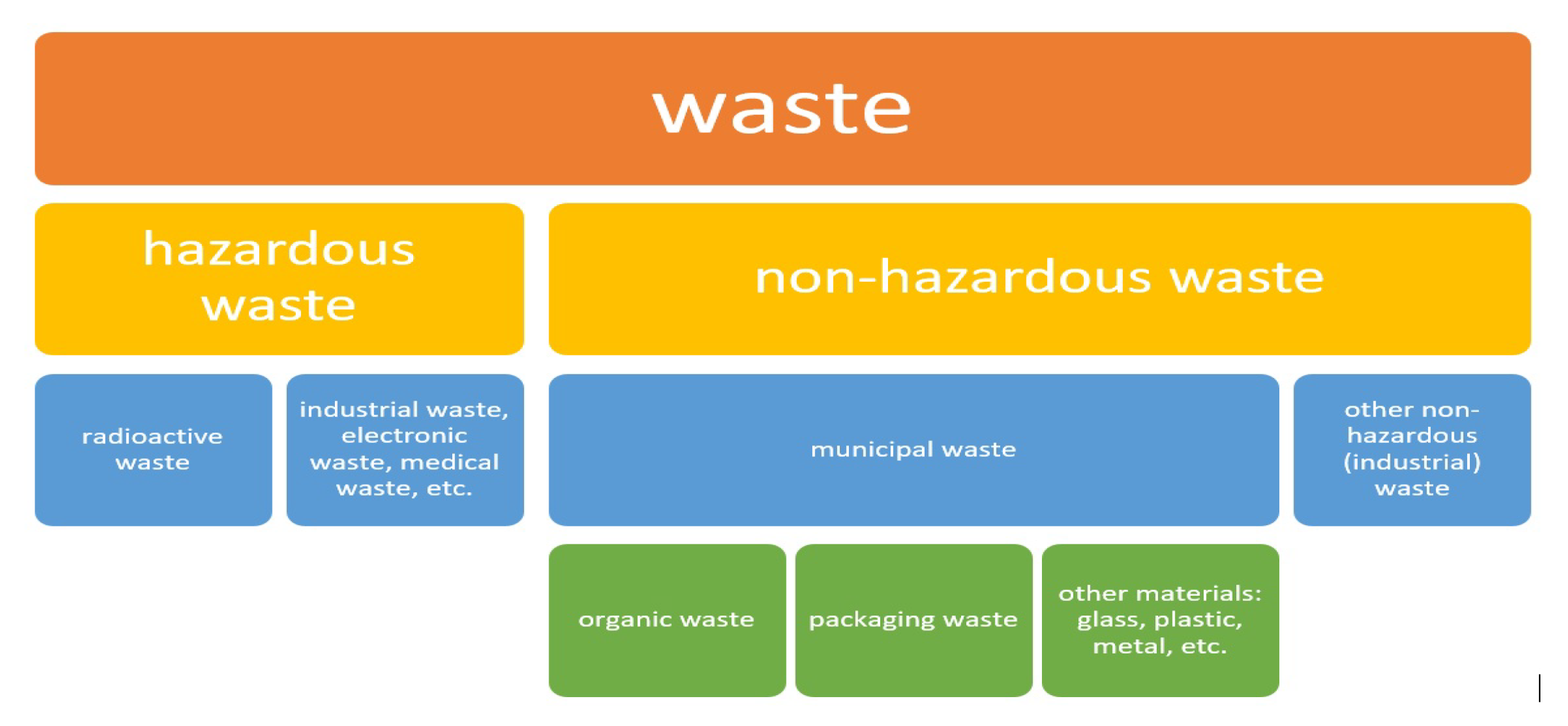
Figure 2.
Publication over the years [9].
Figure 2.
Publication over the years [9].
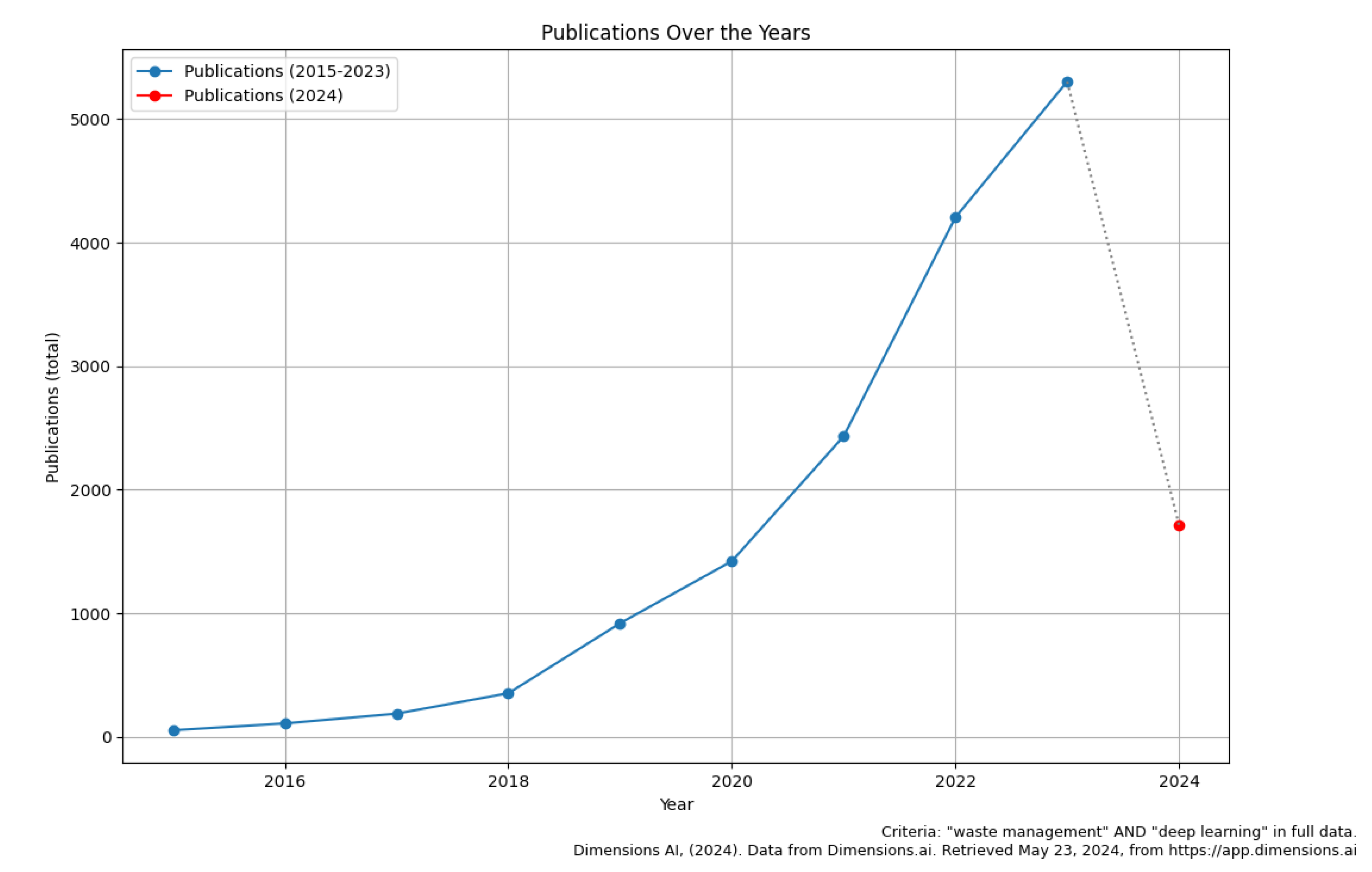
Figure 3.
Cropped annotated images from TACO dataset.
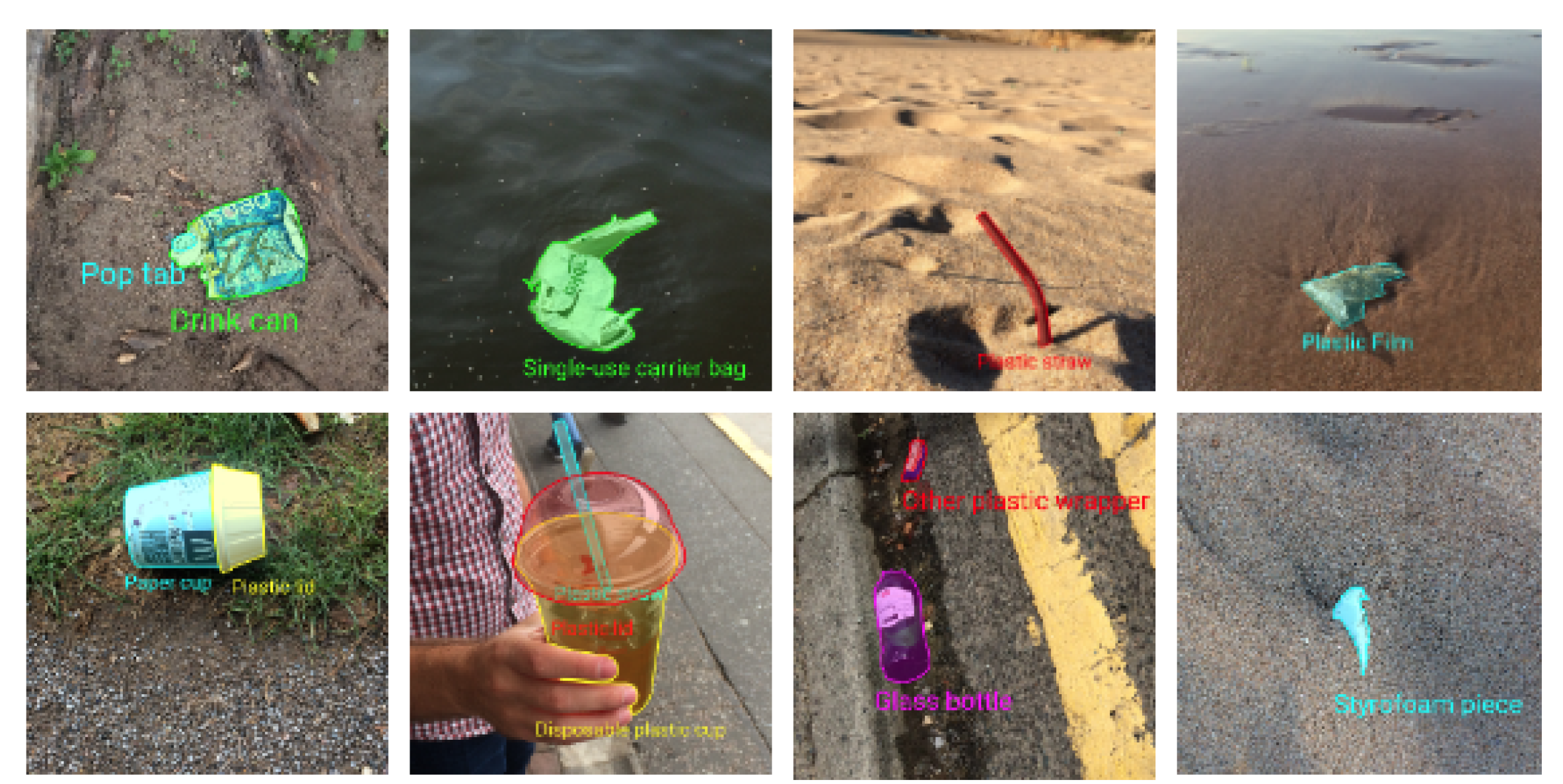
Figure 4.
Sample images from Trashnet dataset.
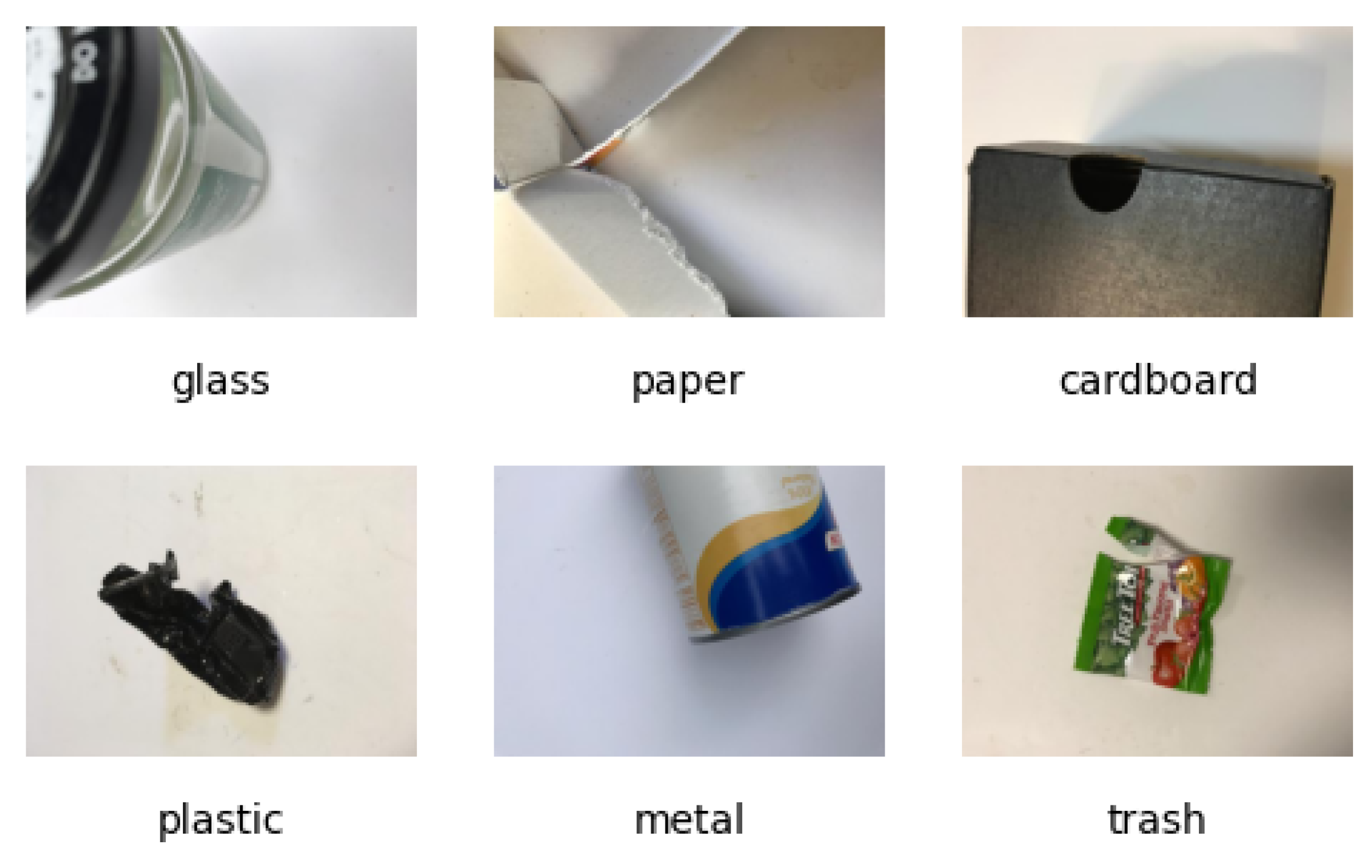
Figure 5.
Sample images from Garbage dataset.
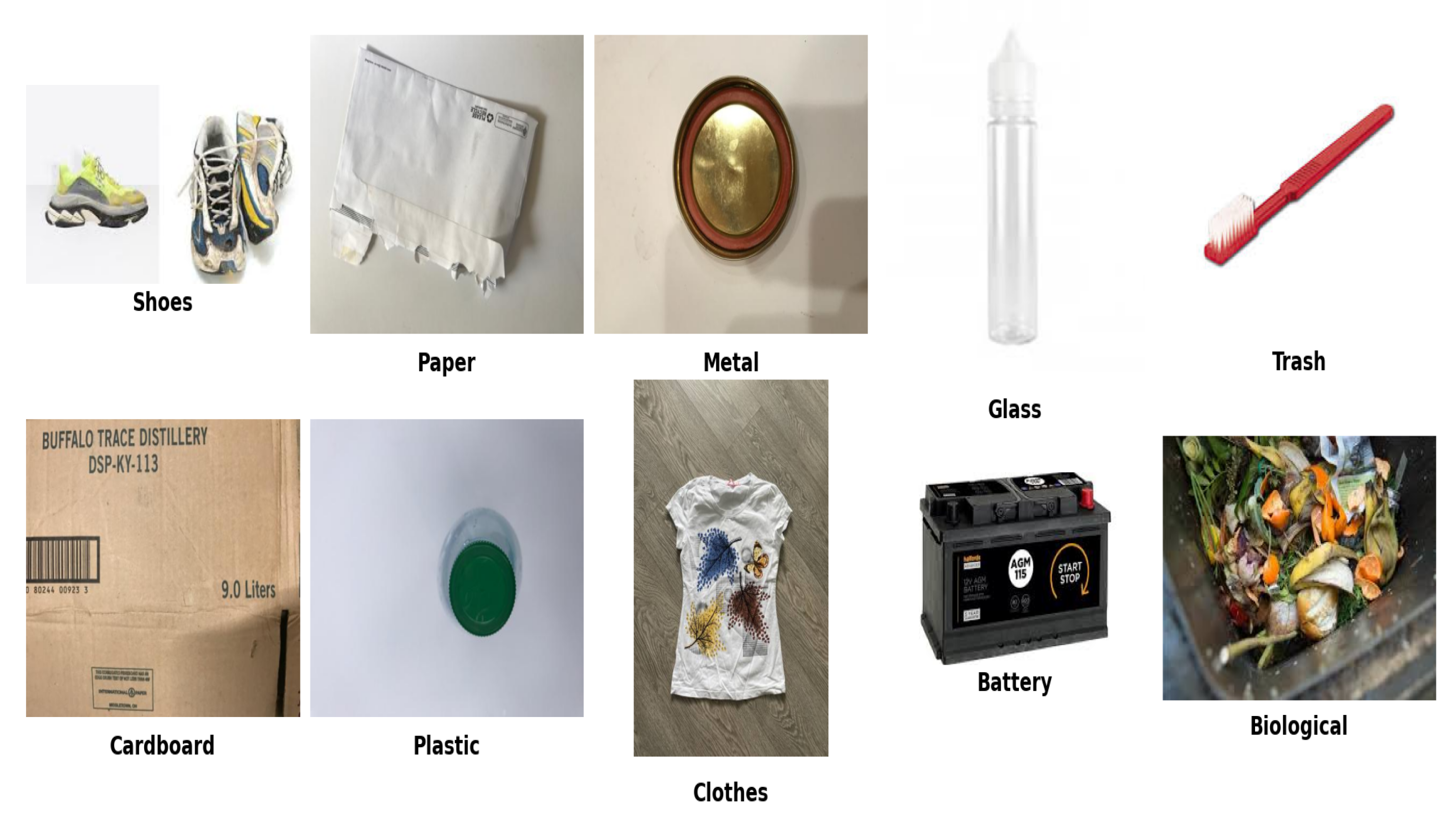

Table 1.
Surveys on waste management using deep learning.
| Survey Papers | Comments | Limitations | Recommendations |
|---|---|---|---|
| Abdu et al. [14] | Provides a comprehensive review of deep learning applications in waste detection and classification, covering image classification and object detection models. | High computational cost, need for large annotated datasets, complexity of waste types, variability in waste appearance and context. | Improve model accuracy, create more comprehensive datasets, develop real-time detection systems, focus on efficient and scalable models. |
| Anjum et al. [15] | Comprehensive review of 25 studies on deep learning in solid waste management (SWM) from 2019-2021. Discusses applications in waste identification, segregation, real-time bin level detection, and waste generation prediction. | All studies used self-constructed datasets, indicating no benchmark datasets exist. This makes it difficult to compare model performances. | Construct annotated benchmark datasets for each waste category. Highlighted that deep learning models provide effective and efficient solutions for various SWM problems. |
| Shahab et al. [5] | Systematic review of 40 studies on DL in SWM, covering applications like waste identification, segregation, and prediction of waste generation | Lack of comprehensive studies evaluating DL potential in SWM, limited geographical representation of studies, and variability in data quality and methodologies | More focused research on unexplored DL applications in SWM, standardization in data collection and processing, collaboration across disciplines for holistic solutions. |
| Xia et al. [16] | Reviewed 226 studies on ML applications in MSWM, highlighting the comprehensive use of ML from waste generation to final disposal. Emphasizes the increasing interest in the field and the broad use of various ML algorithms such as ANN, SVM, RF, and DL | Complexity of MSWM systems necessitates long-term research for mature applications;Most studies are exploratory and lack practical applications;Difficulty in interpreting complex ML models (considered black boxes) | Enhance model interpretability to aid decision-making and policy formulation, Promote practical applications such as intelligent garbage identification and classification, Continue exploring the integration of ML in all stages of MSWM, including waste prediction, route optimization, and pollutant monitoring. |
| Namoun et al. [17] | Systematic review of 42 articles on ML in waste management from 2010 to 2021, focusing on waste generation and disposal. Emphasizes the potential of ML for predicting waste generation patterns and optimizing waste management processes | Scarcity of real-time time series waste datasets, Lack of performance benchmarking tests, Reliability issues of analytics models, Long-term forecasting challenges | Develop comprehensive real-time datasets, Standardize performance benchmarking for models, Improve the reliability and transparency of ML models, Enhance long-term waste generation forecasting accuracy |
| Arthur et al. [18] | This paper undertakes a comprehensive analysis of smart dustbin systems, highlighting the use of IoT, deep learning, and computer vision to improve waste management. It discusses various features and technologies implemented in SDS over the years and compares results from existing works. | Limited datasets for garbage types, Inaccuracy in object detection for garbage segregation, High costs and energy consumption of smart bin algorithms, Initial stages of automatic cleaning and sanitization features | Develop comprehensive real-time datasets, Standardize performance benchmarking for models, Improve the reliability and transparency of ML models, Enhance long-term waste generation forecasting accuracy |
Table 2.
Waste datasets.
| Name | Categories | Images | Annotation |
|---|---|---|---|
| TrashCan 1.0 [10] | 4 | 7,212 | Instance-Segmentation |
| Trash-ICRA19 [19] | 3 | 5,700 | Detection |
| TACO [20] | 28 | 1,500 | Segmentation |
| UAVVaste [21] | 1 | 772 | Segmentation |
| Trashnet [12] | 6 | 2,527 | Classification |
| WaDaBa [22] | 8 | 4,000 | Classification |
| Waste Classification data [23] | 2 | 22,500 | Classification |
| Waste Classification Data v2 [24] | 3 | ∼27,500 | Classification |
| Waste Images from Sushi Restaurant [25] | 16 | 500 | Classification |
| Open litter map [26] | 11 | >100k | Multilabel classification |
| Drinking Waste Classification [27] | 4 | 9,640 | Detection |
| Waste pictures [28] | 34 | ∼24,000 | Classification |
| DeepSeaWaste [29] | 5 | 3,055 | Classification |
| SpotGarbage - GINI dataset [30] | 1 | 2,561 | Detection |
| MJU-Waste v1.0 [31] | 1 | 2,475 | Segmentation |
| Cigarette butt dataset [32] | 1 | 2,200 | Detection |
| TrashBox [33] | 7 | 17,785 | Classification/Detection |
| PlastOPol [34] | 1 | 2,418 | Classification/Detection |
| Garbage Dataset [35] | 10 | 24,342 | Classification |
| Waste Classification Dataset [36] | 2 | 22,500 | Classification |
| BeachLitter Dataset [37] | 8 | 3,500 | Classification/Segmentation |
Table 3.
Summary of various research for waste management.
| Paper | Task | DL Model(s) | Results |
|---|---|---|---|
| Carolis et al. [38], | detection | YOLOv3 | mAP@50 = 59.57% |
| Proença et al. [20], | segmentation | Mask RCNN | 1-class mAP = 15.9% 10-class mAP = 17.6% |
| Wang et al. [31] | segmentation | FCN, PSPNet, CCNet, DeepLabv3 | TACO mPP = 96.07% MJU-Waste mPP = 97.14% |
| Hong et al. [10], | segmentation, detection | Mask RCNN, Faster RCNN | Faster RCNN mAP = 34.5 Mask RCNN mAP = 30.0 |
| Ping et al. [39] | detection, classification | Faster RCNN | 11-class mAP = 24% |
| Kunwar [40] | classification | EfficientNetV2M, EfficientNetV2S, MobileNet, ResNet50, ResNet101 | EfficientNetV2M Acc = 96.37% |
| Cowger et al. [41] | detection | YOLO v5 | - |
| Poudel et al. [42] | classification | InceptionV3, InceptionResNetV2, Xception, VGG19, MobileNet, ResNet50, DenseNet201 | DenseNet201 Acc = 95.05% |
| Zhou et al. [43] | detection, classification | Deep MW (ResNeXt followed by TL) | Acc = 97.2% |
| Yang et al. [44] | detection, classification | ResNet, MobileNetV2 (classification), YOLOv5s, YOLOv5m, YOLOv5x (detection) | Acc = 98% |
| Jin et al. [45] | detection, classification | improved MobileNetV2 | Acc = 89.26% |
| Al-Mashhadani [46] | classification | Resnet50, GoogleNet, InceptionV3, and Xception | ResNet50 Acc = 95% |
| Sai Susanth et al. [47] | classification, detection | ResNet50, DenseNet169, VGG16, and AlexNet trained on ImageNet | DenseNet169 Acc = 94.9% |
| Meron et al. [48] | classification, detection | YOLOv4, YOLOv4-tiny | YOLOv4 mAP = 91.25% |
| Ahmed et al. [49] | classification | MobileNetV2, ResNet50V2, DenseNet169, CNN | ResNet50V2 Acc = 98.95% |
| Lun et al. [50] | classification | YOLOv3, Skip-YOLO | Skip-YOLO-0 mAP50 = 90.38% |
| Verma et al. [51] | detection | CNN1, CNN2 | CNN1 Acc = 94% |
| Sürücü et al. [52] | classification | DenseNet121, DenseNet201, MobileNetV2, ResNet50V2, VGG16, Xception | MobileNetV2 Acc = 99.36% |
Disclaimer/Publisher’s Note: The statements, opinions and data contained in all publications are solely those of the individual author(s) and contributor(s) and not of MDPI and/or the editor(s). MDPI and/or the editor(s) disclaim responsibility for any injury to people or property resulting from any ideas, methods, instructions or products referred to in the content. |
© 2024 by the authors. Licensee MDPI, Basel, Switzerland. This article is an open access article distributed under the terms and conditions of the Creative Commons Attribution (CC BY) license (http://creativecommons.org/licenses/by/4.0/).
Copyright: This open access article is published under a Creative Commons CC BY 4.0 license, which permit the free download, distribution, and reuse, provided that the author and preprint are cited in any reuse.


