

Submitted:
06 July 2024
Posted:
08 July 2024
Read the latest preprint version here
Abstract
The dawn of quasispecies theory revolutionized our understanding of viral evolution and pathogenesis. This theory conceptualises viruses as dynamic populations of closely related but genetically diverse variants that constantly mutate and adapt to environmental pressures. Quasispecies dynamics govern key aspects of virus-host interactions, such as adaptive evolution, immune evasion, drug resistance, and host tropism. In this article, we discuss the fundamental role of quasispecies theory in elucidating viral fitness landscapes, shaping antiviral strategies, and predicting viral emergence and evolution. We provide a concise overview of the original quasispecies model and its latest advancements, which enable the study of the connection between viral dynamics and the significant genetic diversity exhibited by viruses. We then point out some key features of virus dynamics that need to be incorporated into quasispecies theory. We continue with examples of convergence between theory and real viruses by discussing theoretical results supported by RNA virus data and vice versa. Next, we discuss the need to extend the concept of sequence space beyond the classical hypercube towards more complex, multidimensional connected sequence spaces that we have called ultracubes. Finally, we highlight the necessity of developing multi-scale models to understand how viral evolutionary dynamics within a host can affect epidemiological patterns. We also examine the limitations of quasispecies theory in predicting virus evolution and emergence.
Keywords:
Quasispecies
; Virology
; Evolutuion
; Fitness landscapes
; Genetic heterogeneity
; Modelling
The quasispecies theory, conceived by Manfred Eigen and Peter Schuster more than fifty years ago (Eigen, 1971; Eigen & Schuster, 1979; Schuster & Swetina, 1988; Eigen et al., 1989) was developed to investigate the dynamics of biological information in replicators subjected to exceptionally high mutation rates. This theory is a cornerstone in understanding prebiotic evolution and the genetic diversity of viruses (Domingo et al., 1999; Domingo, 2001; Mas et al., 2004; Biebricher & Eigen, 2005; Elena et al., 2010; Domingo et al., 2021). Moreover, it also extends to the dynamics of cancer cells (Solé, 2003; Solé & Deisboek, 2004; Brumera et al., 2006) and has been linked to the conformational diversity of prions (Li et al., 2010). At its core, the theory posits that viral populations exist not as static entities with a single genome, but rather as dynamic distributions of closely related mutant genomes known as mutant swarms or quasispecies. Viral populations are characterized by high mutation rates due to the limited template-copying fidelity of RNA-dependent RNA polymerases (RdRp) and RNA-dependent DNA polymerases (RdDp), leading to the continuous generation of genetic variants. The collective behavior of these variants, along with multiple selection pressures—such as heterogeneity in susceptible target cells, host immune systems, and potential antiviral therapies—and bottleneck events at various scales, together shape the evolutionary trajectories of the virus. Thus, understanding the quasispecies dynamics is essential for elucidating viral pathogenesis, transmission dynamics, and the emergence of drug resistance. The molecular quasispecies theory has driven the development of a comprehensive theory of virus evolution, supported and enriched by numerous experimental and clinical studies. Figure 1 shows a brief outline of some key contributions to viral quasispecies.
Research on bacteriophage Qβ by Charles Weissmann and colleagues in the 1970s (Domingo et al., 1978) coincided with the development of quasispecies theory by Eigen and Schuster. During the 1980s and 1990s, scientists compared genomic sequences of clones from natural viral isolates or experimental viral populations. The introduction in the 2000s of ultra-deep sequencing significantly advanced the understanding of the genetic complexity of the mutant swarm. Recent studies on SARS-CoV-2, for example, have identified numerous low-frequency mutations in virus isolates, some with functional significance (Martínez-González et al., 2022; Delgado et al., 2024). The quasispecies concept has profound implications for clinical and public health interventions. By viewing viral populations as dynamic ensembles of genetic variants, rather than static entities, the quasispecies theory underscores the challenges to eradicating viral infections through conventional interventions. Antiviral therapies that target a single viral genotype may exert a selective pressure, favoring the emergence of drug-resistant mutants within the cloud of mutants forming the quasispecies. This evolutionary resilience necessitates the development of novel therapeutic strategies that take into account the complex evolutionary dynamics of viral populations. Additionally, insights from the quasispecies theory have led to advancements in experimental and computational techniques for characterizing viral diversity. These improvements allow for more precise monitoring of viral evolution and help design programs to reduce the spread of viral pathogens.
Two related key concepts in quasispecies theory are the so-called sequence spaces and fitness landscapes. The sequence space is a multidimensional discrete space, also called a hypercube, where each node corresponds to a given genotype, which is connected to the neighbouring genotypes by single-point mutations (Figure 2a) (Schuster & Stadler, 2023).
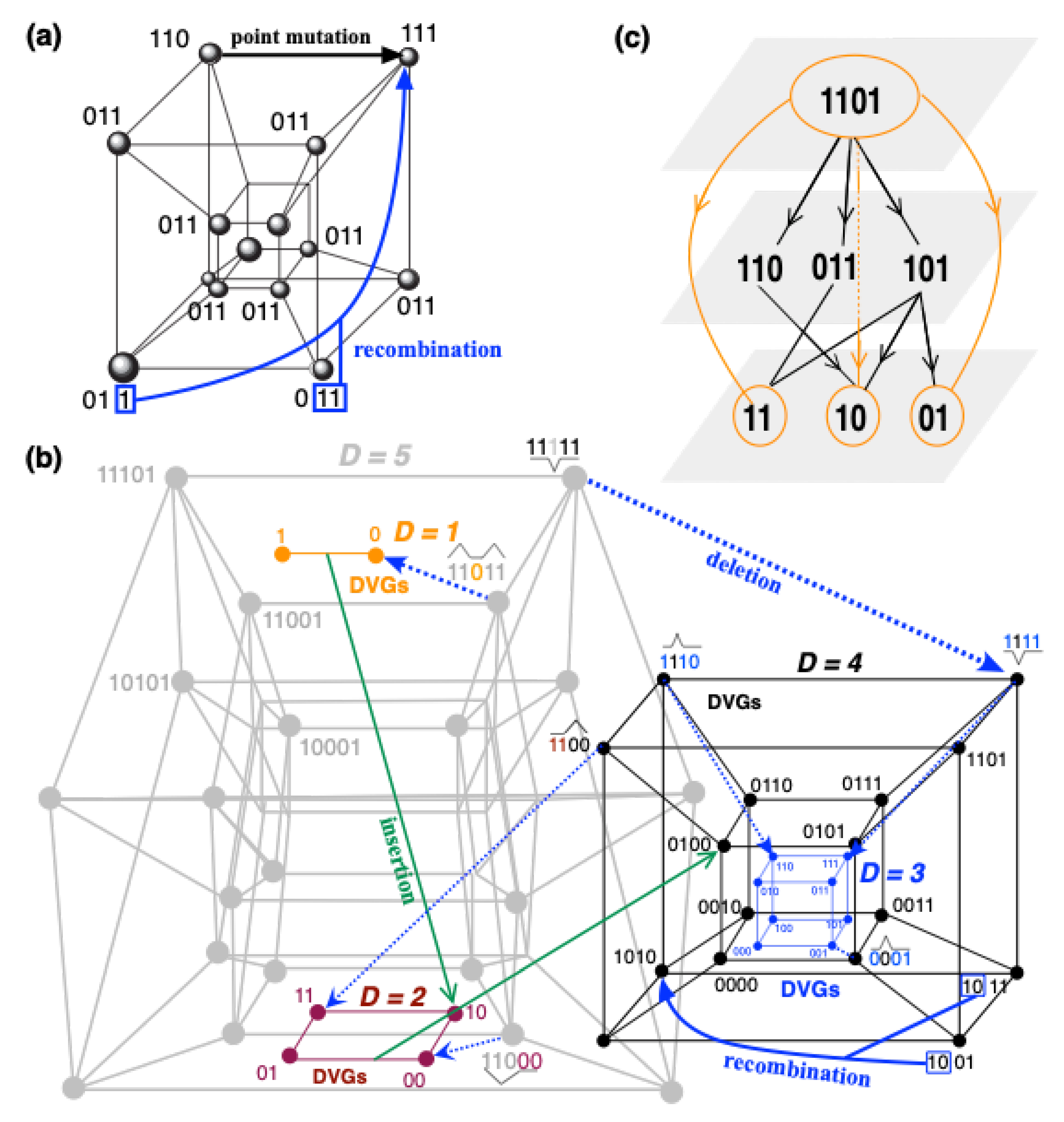
Generically, the dimension of a hypercube is nL, n being the number of letters in the alphabet (4 for nucleotides) and L the length of the genome. That is, the dimension of the sequence space for an RNA virus with a short genome, such as bacteriophage MS2, with 3569 nucleotides, results in a hypercube of dimension 43569. This is a huge sequence space that can be explored by the virus through the processes of point mutations or recombination events that do not alter the genome length (Figure 3a). Each of the nodes of this hypercube thus corresponds to a different genotype with a different fitness. It is known that point mutations impact the fitness of the viral genotypes, typically being deleterious or lethal (Elena and Moya, 1999; de la Peña et al., 2000; Sanjuan et al., 2004; Carrasco et al., 2007; Fernández et al., 2007; Sanjuan, 2010). The quasispecies is expected to be located in a given region or regions of this multidimensional space after selection takes place. As we discuss below, these hypercubes may not accurately describe the complexity of quasispecies when considering other genetic processes, such as deletions or insertions, which result in viral genomes of varying lengths. Hence, the quasispecies should be expected to live in a much more complex sequence space that we define as the ultracube and will explain below.
The distribution of fitnesses along the hypercube nodes defines the so-called fitness landscape. A fitness landscape is a conceptual model used in evolutionary biology that metaphorically represents the multidimensional space where each point corresponds to a specific genotype and is associated with a quantitative value that represents its fitness. For example, in the most visually appealing two-dimensional representation, the coordinates in the plane represent genotypes, and the elevation over the surface indicates the fitness of that genotype. In simpler terms, a fitness landscape summarizes how well an organism with a particular genotype is adapted to its environment and e.g., performs in replication. Fitness landscapes can vary in complexity, ranging from simple, smooth landscapes with a single peak representing the optimal genotype to rugged landscapes with multiple peaks and valleys, indicating the presence of different adaptive solutions or evolutionary pathways (Kauffman & Levin, 1987; Schuster, 2016; Schuster & Stadler, 2023). The shape of the fitness landscape is influenced by several factors, including the genetic architecture of traits, the nature of environmental conditions, and the interactions among different genotypes. Having a precise fitness landscape of viral quasispecies is an extremely challenging problem. For real viruses, fitness landscapes are increasingly viewed as very rugged and dynamic (Domingo et al., 2023).
Theoretical Quasispecies: What Has Been Explored and Existing gaps
The population dynamics of quasispecies has been extensively studied since the original contributions by Eigen and Schuster. Several mathematical and computational models have been used to investigate various aspects of viral quasispecies. Here, we discuss the main contributions of quasispecies theory to the field of RNA viruses, highlighting several processes that have not yet been investigated in detail from a theoretical or computational point of view and may be worth exploring. The original Eigen-Schuster quasispecies model is given by the set of differential equations
This mathematical model describes the time change of the fraction of the population of the ith mutant sequence , and being very large. Here is the replication rate of the th mutant, is the probability of having a mutation , and denotes the average fitness of the population. One key aspect of quasispecies models is that the sequences inhabit a fitness landscape; in this case, each sequence has a given fitness value, which determines its rate of replication. An infecting wild-type (wt) virion can produce an enormous progeny inside the host, giving rise to a large amount of different sequences embedded in a more or less complex fitness landscape. Despite such complexity, the quasispecies model can be explored in a simpler setting, allowing to mathematically characterize phenomena of interest that may also occur in more complex scenarios.
One of such useful simplifications is to consider a quasispecies formed by only two populations of genomes: the wt and the pool of mutants. This simple model easily illustrates a fundamental consequence of quasispecies theory: the error catastrophe or error threshold. This two-populations model assumes that the quasispecies is embedded in a single-peak fitness landscape (Swetina & Schuster, 1982; Solé, 2003; Bull et al., 2005; Solé et al., 2006) and the wt sequence, with high fitness , produces deleterious mutants that are grouped into an average mutant sequence, all with equal fitness . This model also assumes that backward mutations are negligible. This is a first good assumption due to the enormous size of the sequence space. This model can be written taking as variables these two sequence types, with:
Here is the mutation rate, and is an outflow term given by the average fitness and which keeps a constant population (another unrealistic assumption for real viral quasispecies). This oversimplified model allows the calculation of the error threshold occurring when mutation overcomes the critical value . When the quasispecies is composed by both the wt and mutant sequences, while for the entire quasispecies is only composed by mutants. In other words, this critical mutation marks a transition between a phase wherein the genetic information carried by the wt sequence is preserved and a phase in which this information is no longer maintained (Eigen, 1971; Biebricher & Eigen, 2005; Bull et al., 2005; Solé et al., 2006; Sardanyés & Elena, 2010; Solé et al., 2021). Interestingly, more complex versions of the model that incorporate epistatic fitness landscapes and different modes of genomic replication (e.g., geometric amplification versus stamping machine) still preserve the existence of an error threshold, although its actual value strongly depends on these assumptions and can be even bigger under realistic combinations of parameters (Figure 2), as we discuss below. Moreover, oversimplifications allowing for mathematical modelling are sometimes meaningful. For instance, research on quasispecies in HCV infected patients revealed an inverse correlation between viral load and quasispecies complexity (Mas et al., 2004). Such a feature was reproduced with the two-populations model described above using in silico quasispecies evolution (Solé et al., 2006).
The original Eigen-Schuster quasispecies model was built upon several assumptions that might not hold for real viruses. It assumes continuous, well-mixed populations of replicators, constant population, geometric replication, and determinism. During the last decades, considerable efforts have been made to extend the initial quasispecies theory to more realistic scenarios for RNA viruses. Examples comprise the study of other key features of viral quasispecies that are summarised next and which have been investigated separately or in combination. These include finite populations (Nowak & Schuster, 1989; Solé & Deisboek, 2004; Sardanyés, 2008), stochastic effects (Solé et al., 2006; Ben-Ari & Schinazi, 2016), spatially-extended quasispecies (Altemeyer & McCaskill, 2001; Aguirre & Manrubia, 2008; Sardanyés, 2008; Sardanyés & Elena, 2011), viral complementation (Sardanyés & Elena, 2010), and recombination (Jacobi, 2006; Saakian et al., 2019). The investigation of asymmetric modes of replication, identified in RNA viruses either indirectly from mutant distributions (Denhardt & Silver, 1966; Chao et al., 2002; García-Villada & Drake, 2012) or from direct RNA quantification of positive and negative strands during the progress of infection (Martínez et al., 2011; Schulte et al., 2015), have been also studied within the quasispecies framework (Sardanyés et al., 2009; Sardanyés & Elena, 2011).
Another relevant theoretical result of quasispecies theory is the so-called survival-of-the-flattest effect. This effect is mainly produced because fast replicating genomes that produce low-fitness offspring can be outcompeted by slow replicating genomes with moderate fitness, provided the latter inhabit a region of sequence space characterized by high neutrality and connectivity (Schuster & Swetina, 1988; van Nimwegen et al., 1999; Wilke et al., 2001a). This theoretical prediction was first demonstrated in artificial life experiments (Wilke et al., 2001b) and later described in experiments with competing viroids (Codoñer et al., 2006) and withVSV (Sanjuán et al., 2007) under mutagenic conditions. This effect was later explored mathematically, and the outcompetition of the fit quasispecies by the flat one at an increasing mutation rate was shown to be given by an abrupt transition (Sardanyés et al., 2008). Flat-like quasispecies may underlie failures in resolving chronic infections by antiviral agents, despite the absence of specific inhibitor-resistance substitutions (Gregori et al., 2024). Concerning the fitness landscapes, the Swetina-Schuster single-peak one is, of course, an oversimplification of how mutations impact fitness in viral quasispecies. During the last decades, more complex fitness landscapes have been studied for quasispecies (Schuster, 2016). These include different fitness functions (Saakian & Hu, 2006), dynamic fitness landscapes (Wilke & Ronnewinkel., 2001; Wilke et al., 2001) and non-linear interactions among mutations, i.e., epistasis (Sardanyés et al., 2009; Elena et al., 2010; Sardanyés & Elena, 2011).
As we have discussed, the original quasispecies theory has been significantly refined over the past decades to better align with real virology. Relevant experimental and clinical results involving RNA viruses have been interpreted through the lens of these theoretical models. Despite this fact, there are still missing ingredients in quasispecies theory that could play a crucial role in the evolutionary dynamics of viruses. For example, some processes, such as RNA viral synthesis or viral protein production and maturation, involve time lags. In this sense, several studies have revealed that the SARS-CoV-2 replication complex has an elongation rate of 150 to 200 nucleotides per second, being more than twice as fast as the poliovirus polymerase complex (Campagnola et al., 2022). Nucleotide incorporation time, determined by differences at and around viral RNA polymerase catalytic sites, may influence the fidelity of template copying (Yin et al., 2023). In this sense, it is known that time lags can profoundly affect the dynamics of nonlinear systems, causing self-sustained oscillations and chaos (Mackey & Glass, 1977). Also, during their intracellular phase, viruses synthesize distinct molecules, constructing viral factories for genome replication and morphogenesis. The central element of these factories is the replication organelle (RO), where viral replication complexes produce multiple copies of the viral genome. Viral factories often consist of remodeled cell membranes with functional compartments for replication, assembly, and egress, and they frequently recruit other cellular elements like mitochondria and the cytoskeleton, which interact with the RO. Unlike DNA viruses, almost all RNA viruses form factories exclusively in the cytoplasm (Kopek et al., 2007; Harak & Lohmann, 2015). For instance, HCV induces remodeling of reticulum endoplasmatic membranes forming double-membraned vesicles, and later on, it induces the formation of multi-membrane vesicles that are composed of several concentric membrane bilayers. These membranous rearrangements are produced by the action of viral nonstructural proteins. Hence, the process of virus genomes amplification can be highly compartmentalized inside the cell and possibly also induce time lags in viral replication and virions assembly.
For RNA viruses, especially those infecting plants, replication processes may exhibit periodic fluctuations at the within-tissue or within-host levels across different time scales, primarily due to temperature changes (Honjo et al., 2020). Additionally, the mammalian brain possesses an endogenous central circadian clock that regulates both central and peripheral cellular activities. At the molecular level, this day-night cycle triggers the expression of upstream and downstream transcription factors that affect the immune system and modulate the severity of viral infections over time. The role of circadian systems in regulating viral infections and the host response to viruses is thus of great clinical importance (Zandi et al., 2023), and thus fluctuating parameters may be included in theoretical quasispecies investigations.
Another unexplored process in quasispecies theory is how the evolutionary dynamics of quasispecies at the within-cell/within-host levels scale up to the population-epidemiological levels. This question, which we discuss below, can be addressed by developing multi-scale models including the rapid quasispecies evolution (fast dynamics) and the impact of the continuous synthesis of heterogeneous mutants at a population scale (slow dynamics). The mathematical results on slow-fast systems may be thus relevant to tackle this problem. In this sense, the connection of scales in virology is extremely important to understand virus pathogenesis and potential zoonoses and epidemic spread among different hosts (Solé et al., 2021). This subject can be further explored combining dynamical systems theory with complex networks theory.
The limits of predictability of quasispecies are also an extremely challenging and open problem in virology. That is, how the dynamical population structure of the quasispecies may impact disease outbreaks and the emergence of new variants with epidemic and pandemic potential (see Section on Impact of quasispecies populations in emerging viral diseases below).
Quasispecies and RNA Viruses: Genomic Heterogeneity, Adaptation and Clinical Implications of Genetic Information Thresholds
Initial experimental evidence of viral quasispecies dynamics involved studies mainly with bacteriophage Qβ, VSV, FMDV, or LCMV [reviewed in Domingo et al. (2021)]. These experiments have robustly confirmed high mutation rates during genome replication, the heterogeneity of viral populations, fitness variations among biological clones, rapid changes in sequence space occupation, limited tolerance to increased error rates, to cite a few. The early studies with bacteriophage Qβ by Weissmann and colleagues were carried out simultaneously with the development of quasispecies theory by Eigen and Schuster in the 1970s. In the 1980s and 1990s, the primary approach was to compare genomic sequences of molecular or biological clones from natural viral isolates or viral populations subjected to various experimental evolution designs. The advent of ultra-deep sequencing techniques greatly broadened the capacity to probe the complexity and dynamics of viral quasispecies. This is exemplified by results on HCV (Mas et al., 2004; Perales, 2020), and, more recently, in SARS-CoV-2 displaying multitudes of low frequency mutations in isolates of the virus, some of them endowed with functional relevance (Martínez-González et al., 2022; Delgado et al., 2024; Martínez-González et al., 2024).
During recent years, the development of new high-throughput sequencing techniques (e.g., Cir-Seq) along with novel bioinformatic algorithms have shown the relevance of an abundant component of viral quasispecies that was previously largely ignored: the defective viral genomes (DVGs) (Vignuzzi & López, 2019; González-Aparicio & López, 2024; (Olmo-Ulceda et al., 2022; Hillung et al., 2024). Broadly speaking, DVGs are nonstandard genomes generated during error-prone replication that contain deletions, insertions, duplications, inversions, and potential hypermutated viral genomes contributed by cellular editing activities. These major-effect mutations render genomes unable to self-replicate and coinfection with a wt (also dubbed helper) virus is needed for the defective genomes to persist in the population. Several recent studies have described the temporal dynamics of DVGs during the course of infection for several viruses, including poliovirus (PV) and dengue virus (DENV) (Rangel et al., 2023), SARS-CoV-2 (Zhou et al., 2023) and other betacoronaviruses (Hillung et al., 2024). Consistently, these studies show that some DVGs are pervasively maintained in the viral population in cell cultures but also in patients, suggesting a possible selective role. For instance, deletions affecting the receptor binding domain and the S1/S2 cleavage site in SARS-CoV-2 Omicron variant, may have increased host cell ACE2 receptor recognition, thus enhancing the infection, and allowing this variant to become dominant (Campos et al., 2022). Indeed, it has been suggested that DVGs might confer some advantage to viruses, such as serving as reservoirs of genetic variability, decoys for immune responses, regulators of translational shut-down, or mediators of persistent infections (González-Aparicio & López, 2024).
A particularly notable type of DVG are the copy-back and snap-back (cb/sb) variants, which consist of small RNA molecules with a hairpin-loop structure created by template-switching from positive to negative templates during replication.
As we have mentioned, an increase in population mutational load should concomitantly result in a decrease in the average population fitness as most mutations with phenotypic effects are deleterious or lethal (Elena & Moya, 1999; Biebricher & Eigen, 2005; Domingo-Calap et al., 2009; Sanjuán, 2010). Given this, and together with the aforementioned prediction of the existence of a critical mutation rate beyond which the population enters the error catastrophe regime (Eigen, 1971; Eigen et al., 1989), innovative antiviral strategies have been proposed aiming to push down replication fidelity and forcing the viral population to cross the error threshold.
Quasispecies Complexity: From the Hypercube to the Ultracube
In the study of viral evolution and coevolution, hypercubes provide a useful conceptual framework for comprehending the sequence space of viral genomes (Eigen et al., 1989; Sardanyés & Solé, 2013; Schuster, 2016). This sequence space is a mathematical multidimensional construct where each dimension corresponds to a nucleotide position within the viral genome (Figs. 2 and 3a). A hypercube, in particular, is a discrete geometric representation of this space, with vertices representing every possible sequence configuration in which a viral genome of length L can exist. Each vertex is connected to adjacent vertices by edges that signify single nucleotide changes, illustrating the potential mutational pathways a virus can traverse while retaining the same length. This model effectively visualizes the extensive diversity and evolutionary potential of viral populations. The structure of the hypercube allows researchers to analyze the distribution and dynamics of viral quasispecies within this space, providing valuable insights into how viruses adapt to environmental pressures and develop resistance to antiviral treatments. The foundational works of Eigen and Schuster (Eigen & Schuster, 1979) were instrumental in introducing the concepts of sequence space and hypercubes within the framework of quasispecies theory, offering a mathematical basis for understanding the evolutionary landscape of viruses (Swetina & Schuster, 1982). However, viral quasispecies may be embedded within more complex and entangled sequence spaces, including the full spectrum of mutant sequences together with, e.g., subgenomic sequences and DVGs. These length variants may form other subpopulations of clouds of mutants spanning lower- or higher-dimensional hypercubes arising from the full-genome sequence space, thus being connected through deletions or insertions. Hence, a more realistic geometric space for viruses may include connected hypercubes of different dimensions: we call these sequence spaces, in which a given node can represent a hypercube itself, as ultracubes (Figure 3b). This view enlarges the size of the sequence space beyond the single-point mutation hypercube dimension. As for the hypercube, a quasispecies may not span all this sequence space but be located on some specific regions of this ultracube in a mutation-selection balance or in a transient towards a mutation-selection balance.
Multilayer Models for Multi-Scale Virus Dynamics: Integrating Quasispecies into Virus Epidemiology and Ecology
A new area of complex networks theory that has been quickly developing over the last decade is the study of so-called multilayer networks. Each layer contains nodes connected by intralayer edges that describe rules of interactions between the nodes for this particular layer. In addition, dependencies across layers are represented by interlayer edges. It is straightforward to place and visualize viruses into a multilayer; for illustrative purposes, let’s discuss here a simple 3-layer case. The bottom layer would represent the quasispecies generated within a single infected individual. At this level, the ultracube (Figure 3b) would be an appropriate representation. The equations describing the dynamics at this bottom level could be those described in the previous sections incorporating mutants of different nature. A middle layer would represent local host populations. At this level, each node corresponds to a particular host, and the edges represent the contact network among the hosts that determines transmission dynamics. The equations governing the virus’ dynamics at this intermediate level could be the well-known SIR epidemiological model, and the network can show any topology such as scale-free (Pastor-Satorras & Vespignani, 2001). The interlayer edges connecting the bottom and the middle layers represent the probability that a given viral genotype is actually present in each infected host, which indeed depends on the replicative advantage at the bottom level and the mutation rate. Coinfections are allowed (two interlayer edges pointing towards the same individual). The upper layer represents the epidemiological level. In this layer, nodes represent, e.g., communities, whereas edges represent the connectivity between these communities (e.g., airport traffic connections, vector flights, polen and seed dispersal, etc.). The dynamics at this level can be modeled using phylogeography tools. The interlayer edges connecting the middle and the upper layers would represent the probability that an infected individual will move from one community to another.
This multilayer representation allows us to study not only the dynamics at each layer but also the entire multilayer system and infer properties such as multilayer modularity, robustness to perturbation or phase transitions. For instance, viral genotypes closely connected in the quasispecies bottom layer may be found in individuals in the middle layer that also form a transmission cluster (or module). For instance, ecological multilayer networks for plant-aphid and plant-aphid-parasitoids (Pocock et al., 2012) show nontrivial stability properties that result in quantitative predictions about the persistence or extinction probabilities that would not be shown up by other modeling approaches (Pilosof et al., 2017). Information between nodes in a particular layer can be transmitted via two different paths: those involving only intralayer edges and those involving both intra- and interlayer edges. This means that catastrophic failures in a particular layer can easily be transmitted to the rest of layers (Cellai et al., 2013; Boccaletti et al., 2014). The epidemic spread of infectious diseases in multilayer networks has received some attention (Dickison et al., 2012; Mendiola et al., 2012; Zhao et al., 2014; Stella et al., 2017). In particular, a topic that has been studied is the interaction between two genetic variants of the same virus (Funk & Jansen, 2010; Sahneh & Scoglio, 2014; Sanz et al., 2014; Zhao et al., 2014).
When multiple variants are spreading in a host scale-free network and compete for hosts, they obviously influence each other’s dynamics. In such a situation, for example, the derived epidemic threshold for each variant is substantially different than predicted using monolayer simple coinfection models. Indeed, two new thresholds arise from these models (Sahneh & Scoglio, 2014): (1) the survival threshold determines a continuous phase transition from extinction to existence during competition between both variants. (2) The absolute-dominance threshold denotes the critical point where one of the variants fully outcompetes the other. Between these two thresholds, coexistence emerges as a property of the interconnected structure of the multilayer.
Impact of Quasispecies Populations in Emerging Viral Diseases
The emergence of viral disease is an unpredictable event since it is the result of several interconnected factors: the adaptive potential of viruses circulating in different host species, environmental modifications, or political and sociological circumstances, among others. These factors can affect virus traffic and facilitate encounters with potential new hosts (Morse, 1993; Morens & Fauci, 2000; Smolinski et al., 2003). Viral emergence can be regarded as a facet of complex biological behavior since its occurrence cannot be anticipated by the sum contribution of the multiple underlying factors (Solé, 2000; Solé et al., 2018; Solé et al., 2021). In this scenario, quasispecies provide prime material for adaptation following chance encounters between viruses and potential new host species to play a triggering role in an emergence. Indeed, in many documented examples, too numerous to describe here, mutant spectra hide minority populations with altered cell tropism or host range (Domingo, 2020). All the genotypic complexity portrayed by the ultracube connections (Figure 3) add to the lottery of which variants (and when) they may come into contact with a susceptible individual of a different host species, to initiate an infection and to produce sufficient transmissible progeny to achieve the status of emergent disease.
John Holland and colleagues were the first to point out a number of medical implications of a highly dynamic RNA world coexisting with a relatively more static DNA-based cellular biosphere (Holland et al., 1982). They underlined high mutation rates as a source of atypical viral forms capable of invading new tissues and organs, to establish persistent or inapparent infections, or to be selected in response to medical interventions. These facets of viral dynamics have been amply documented in the 1940s that have followed their prescient publication. Joshua Lederberg warned of the human vulnerability in the face of the adaptive potential of RNA viruses: “Abundant sources of genetic variation exist for viruses to learn new tricks, not necessarily confined to what happens routinely or even frequently“ (Lederberg, 1993). In May 2003, the World Health Organization (WHO) released a report titled “SARS: Status of the outbreak and lessons for the immediate future” (WHO, 2003). In this report, the WHO cautioned that SARS could continue to pose a threat for several reasons, including e.g., limited understanding of SARS epidemiology and insufficient diagnostic tests, and the high mutation rates of coronaviruses, which elevate the risk of future outbreaks. In 2004, Snell (2004) discussed the risk that SARS and influenza have on human health worldwide. Two years later, SARS was addressed as an emerging infectious disease with a potential to cause future outbreaks (Tapper, 2006). By 2009, Woo et al. (2009) wrote about coronavirus diversity, phylogeny and interspecies jumps, stating that before the SARS outbreak only ten complete coronavirus genomes were available. By 2008, this number increased to twenty-six genomes including human and bat coronaviruses, among others. The study highlighted the rapid ability of coronaviruses to jump between species and noted the presence of closely related coronaviruses in more distantly related organisms. It stressed that such interspecies transmission from zoonotic outbreaks could potentially infect humans and lead to devastating outbreaks (Woo et al., 2009).
Future Challenges in Experimental and Clinical Quasispecies
As often happens in science, new techniques pose new questions. The availability of deep sequencing methodology to probe into the composition of virus populations has opened new questions, in addition to solving old ones such as the definitive confirmation that mutant spectra are the biological reality of viral populations, so far without documented exceptions. Among the new challenges are: (1) capturing the depth of minority genomes that until now have escaped detection; (2) how they feed the dominant ones, be them viable or defective; (3) how the latter modulate behavior of the ensemble; (4) which is the time frame in which minority subpopulations can be replaced by others, relative to the time required for selective forces (metabolic modifications, signal effectors, antibodies, drugs, etc.) to reach the extracellular and intracellular environments or even individual viral factories; (5) what is the extent of heterogeneity within individual cells; and (6) capacity of mutant spectrum composition to inform of long-term evolutionary events. These are but some of many highly relevant questions. What is at stake is to better understand viruses, the diseases they produce, and the means to combat them. In short, a challenge is to shift from a consensus sequence-centered understanding of evolution into a mutant spectrum-centered understanding of evolution, and harmonizing the conclusions drawn from both.
Therapies based on the error catastrophe concept have been brought forward. Maintenance of inheritable genetic information conditioned to a limitation in error introduction has also been documented with catalytic ribozymes (Papastavrou et al., 2024). Lethal mutagenesis approaches exploit the intrinsic balance between mutation rates and viral viability, offering a promising avenue for combating viral infections. As a difference from the error threshold, which causes a shift in the sequence space, i.e., the master sequence is replaced by the mutant swarm, lethal mutagenesis involves virus extinctions (Bull et al., 2005). Virus extinction by lethal mutagenesis has been documented with several RNA viruses and mutagenic base and nucleoside analogues, which are licensed for clinical use [reviewed in Perales (2019)]. These include, the pioneering works with HIV-1 (Loeb et al., 1999; Dapp et al., 2013), PV (Crotty et al., 2001), FMDV (Perales et al., 2011; de Ávila et al., 2017), LCMV (Grande-Pérez et al., 2002; Ruiz-Jarabo et al., 2003), and HCV (Ortega-Prieto et al., 2013; de Ávila et al., 2016) in cell cultures. Virological, biochemical and structural studies suggest that lethal mutagenesis is, at least in part, the mechanism of some antiviral agents currently used to treat COVID-19 (Gordon et al., 2021; Kabinger et al., 2021; Somovilla et al., 2023; García-Crespo et al., 2024).
Synergistic antiviral combinations that include one or two lethal mutagens (a strategy termed synergistic lethal mutagenesis) constitute a promising avenue for the treatment of COVID-19, extensible to other emergent RNA viral infections (García-Crespo et al., 2024). Additionally, lethal defection, characterized by the extinction of viral populations due to the emergence of DVGs, has been observed for LCMV in cell cultures (Grande-Pérez et al., 2005). For this virus, two extinction pathways have been identified: one at high mutagen concentrations, resulting in the complete loss of infectivity and replication ability of the quasispecies, and another at lower mutagen concentrations, where replication persists while the infective class becomes extinct due to the presence of defectors.
For a long time, the aforementioned cb/sb mutants have been known for their negative impact on virus accumulation, as they retain the replication signals of both polarities and have a replication advantage owed to their very short genomes. In recent years, the antiviral efficiency of synthetic cb/sb, known as therapeutic interfering particles (TIPs), has been proven against SARS-CoV-2 in animal models. These antiviral effects have involved a decrease in virulence and milder edema symptomatologies (Chaturvedi et al., 2021) as well as a decreased viral transmission (Chaturvedi et al., 2022) in hamsters. Thus, the continuous expansion of theoretical quasispecies concepts, and their scrutiny with viral experimental systems, now reinforced with the new tools of ultra-deep sequencing, is paving the way towards innovations for the control of highly heterogeneous and dynamic cellular pathogens.
Author Contributions
JS, CP, ED, and SFE: conceptualization, manuscript writing, funding acquisition.
Funding
JS has been supported by grant PID2021-127896OB-I00 from MCIN/AEI/10.13039/501100011033 ”ERDF A way of making Europe” and from the María de Maeztu Program for Units of Excellence in R&D grant CEX2020-001084-M. JS also thanks the Generalitat de Catalunya CERCA Program for institutional support. ED and CP have been supported by grant PID2020-113888RB-I00 from MCIN/AEI/10.13039/501100011033 and 202220I116 and by the European Commission-Next Generation EU (regulation EU 2020/2024) through the CSIC Global Health Platform (PTI Salud Global); by grants PI21/00139 from Instituto de Salud Carlos III, and project 525/C/2021 from Fundació “La Marató de TV3”, grants 202136-30 and 202136-31. ED and CP also acknowledge the project S2018/BAA-4370 (PLATESA2 from Comunidad de Madrid/FEDER) and Institutional grants from the Fundación Ramón Areces and Banco Santander to the CBMSO are also acknowledged. The team at CBMSO belongs to the Global Virus Network (GVN). SFE has been supported by grant PID2022-136912NB-I00 funded by MCIN/AEI/10.13039/501100011033 and by “ERDF a way of making Europe”, and by grant CIPROM/2022/59 funded by Generalitat Valenciana.
Acknowledgements
We want to thank the members of the research groups Genetic Variability of RNA viruses (CBMSO), CNB-CSIC, EvolSysVir (I2SysBio), and the Knowledge Transference Unit at the CRM for useful discussions. We also want to thank J. Tomás Lázaro for useful comments on the article. We also acknowledge the hospitality of the Institut de Mathemátiques de Jussieu (Sorbonne Université, Université Paris Cité) where part of this manuscript was developed.
Competing Interests: The authors declare no competing interests.
References
- Acevedo, A.; Brodsky, L.; Andino, R. Mutational and fitness landscapes of an RNA virus revealed through population sequencing. Nature 2014, 505, 686. [Google Scholar] [CrossRef] [PubMed]
- Aguirre, J.; Manrubia, S. Effect of spatial competition on the diversity of a quasispecies. Phys. Rev. Lett. 2008, 100, 038106. [Google Scholar] [CrossRef] [PubMed]
- Altemeyer, S.; McCaskill, J. Error threshold for spatially resolved evolution in the quasispecies model. Phys. Rev. Lett. 2001, 86, 5819. [Google Scholar] [CrossRef] [PubMed]
- Batschelet, E.; Domingo, E.; Weissmann, C. The proportion of revertant and mutant phage in a growing population, as a function of mutation and growth rate. Gene 1976, 1, 27–32. [Google Scholar] [CrossRef] [PubMed]
- Ben-Ari, I.; Schinazi, R. A stochastic model for the evolution of a quasispecies. J. Stat. Phys. 2016, 162, 415–425. [Google Scholar] [CrossRef]
- Biebricher, C.; Eigen, M. The error threshold. Virus. Res. 2005, 107, 117–127. [Google Scholar] [CrossRef] [PubMed]
- Biebricher, C.; Eigen, M. What is a quasispecies? Curr. Top. Microbiol. Immunol. 2005, 299, 1–31. [Google Scholar]
- Boccaletti, S.; Bianconi, G.; Criado, R.; del Genio, C.I.; et al. The structure and dynamics of multilayer networks. Phys. Rep. 2014, 544, 1–122. [Google Scholar] [CrossRef] [PubMed]
- Brumera, Y.; Michor, F.; Shakhnovich, E.I. Genetic instability and the quasispecies model. J. Theor. Biol. 2006, 241, 216–222. [Google Scholar] [CrossRef] [PubMed]
- Bull, J.; Sanjuán, R.; Wilke, C.O. (2008). Lethal mutagenesis. In E. Domingo, C.R. Parrish, & J. J. Holland (Eds.), Origin and Evolution of Viruses (pp. 207-218). Elsevier Science.
- Bull, J.J.; Meyers, L.A.; Lachmann, M. Quasispecies made simple. PLoS Comp. Biol. 2005, 1, e61. [Google Scholar] [CrossRef]
- Campagnola, G.; Govindarajan, V.; Pelletier, A.; Canard, B.; et al. The SARS-CoV nsp12 polymerase active site is tuned for large-genome replication. J. Virol. 2022, 96, e0067122. [Google Scholar] [CrossRef] [PubMed]
- Campos, C.; Colomer-Castell, S.; Garcia-Cehic, D.; Gregori, J.; et al. The frequency of defective genomes in Omicron differs from that of the Alpha, Beta and Delta variants. Sci. Rep. 2022, 12, 22571. [Google Scholar] [CrossRef] [PubMed]
- Carrasco, P.; de la Iglesia, F.; Elena, S.F. Distribution of fitness and virulence effects caused by single-nucleotide substitutions in Tobacco etch virus. J. Virol. 2007, 81, 979–984. [Google Scholar] [CrossRef]
- Cellai, D.; López, E.; Zhou, J.; Gleeson, J.P. Percolation in multiplex networks with overlap. Phys. Rev. E 2013, 88, 052811. [Google Scholar] [CrossRef]
- Chao, L.; Rang, C.U.; Wong, L.E. Distribution of spontaneous mutants and inferences about the replication mode of the RNA bacteriophage φ6. J. Virol. 2002, 76, 3276–3281. [Google Scholar] [CrossRef]
- Chaturvedi, S.; Beutler, N.; Basen, G.; Pablo, M.; et al. A single-administration therapeutic interfering particle reduces SARS-CoV-2 viral shedding and pathogenesis in hams. Proc. Natl. Acad. Sci. USA 2022, 119, e2204624119. [Google Scholar] [CrossRef]
- Chaturvedi, S.; Vasen, G.; Pablo, M.; Chen, X.; et al. Identification of a therapeutic interfering particle—A single-dose SARS-CoV-2 antiviral intervention with a high barrier to resistance. Cell 2021, 184, 6022–6036. [Google Scholar] [CrossRef]
- Codoñer, F.M.; Daròs, J.A.; Solé, R.V.; Elena, S.F. The fittest versus the flattest: experimental confirmation of the quasispecies effect with subviral pathogens. PLoS Pathog. 2006, 2, e136. [Google Scholar] [CrossRef] [PubMed]
- Crotty, S.; Cameron, C.; Andino, R. RNA virus error catastrophe: direct molecular test by using ribavirin. Proc. Natl. Acad. Sci. USA 2001, 98, 6895–6900. [Google Scholar] [CrossRef]
- Dapp, M.J.; Patterson, S.E.; Mansky, L.M. Back to the future: revisiting HIV-1 lethal mutagenesis. Trends Microbiol. 2013, 21, 56–62. [Google Scholar] [CrossRef]
- de Ávila, A.; Gallego, I.; Sori, M.E.; Gregori, J.; et al. Lethal mutagenesis of hepatitis C virus induced by favipiravir. PLoS ONE 2016, 11, e0164691. [Google Scholar] [CrossRef]
- de Ávila, A.; Moreno, E.; Perales, C.; Domingo, E. Favipiravir can evoke lethal mutagenesis and extinction of foot-and-mouth disease virus. Virus Res. 2017, 233, 105–112. [Google Scholar] [CrossRef]
- de la Peña, M.; Elena, S.F.; Moya, A. Effect of deleterious mutation-accumulation on the fitness of RNA bacteriophage MS2. Evolution 2000, 54, 686–691. [Google Scholar] [CrossRef]
- Delgado, S.; Somovilla, P.; Ferrer-Orta, C.; Martínez-González, B.; et al. Incipient functional SARS-CoV-2 diversification identified through neural network haplotype maps. Proc. Natl. Acad. Sci. 2024, 121, e2317851121. [Google Scholar] [CrossRef] [PubMed]
- Denhardt, D.; Silver, R.B. An analysis of the clone size distribution of φX174 mutants and recombinants. Virology 1966, 30, 10–19. [Google Scholar] [CrossRef]
- Dickison, M.; Havlin, S.; Stella, H.E. Epidemics on interconnected networks. Phys. Rev. E 2012, 85, 066109. [Google Scholar] [CrossRef] [PubMed]
- Domingo, E. (2001). Quasispecies and RNA Virus Evolution: Principles and Consequences (E. Domingo, Ed.). Landes Bioscience.
- Domingo, E. (2020). Virus as Populations: Composition, Complexity, Dynamics, and Biological Implications (2nd ed.). Academic Press, Elsevier Inc.
- Domingo, E.; García-Crespo, C.; Perales, C. Historical perspective on the discovery of the quasispecies concept. Ann. Rev. Virol. 2021, 8, 51–72. [Google Scholar] [CrossRef] [PubMed]
- Domingo, E.; Holland, J.J.; Webster, R.G. (Eds.). (1999). Origin and Evolution of Viruses. Elsevier Science.
- Domingo, E.; Sabo, D.; Taniguchi, T.; Weissman, C. Nucleotide sequence heterogeneity of an RNA phage population. Cell 1978, 13, 735–744. [Google Scholar] [CrossRef]
- Domingo, E.; Schuster, P.; Elena, S.F.; Perales, C. (Eds.). (2023). Viral Fitness and Evolution: Population Dynamics and Adaptive Mechanisms. Springer International Publishing.
- Domingo-Calap, P.; Cuevas, J.M.; Sanjuán, R. The fitness effects of random mutations in single-stranded DNA and RNA bacteriophages. PLoS Genet. 2009, 5, e1000742. [Google Scholar] [CrossRef]
- Duarte, E.A.; Novella, I.S.; Ledesma, S.; Clarke, D.K.; et al. Subclonal components of consensus fitness in an RNA virus clone. J. Virol. 1994, 68, 4295–4301. [Google Scholar] [CrossRef]
- Eigen, M. Selforganization of matter and the evolution of biological macromolecules. Naturwissenschaften 1971, 58, 465–523. [Google Scholar] [CrossRef] [PubMed]
- Eigen, M.; McCaskill, P.J.; Schuster, P. (1989). Molecular quasi-species (Advances in Chemical Physics. John Wiley & Sons, Inc. ed., Vol. LXXV). I. Prigogine, Stuart A. Rice.
- Eigen, M.; Schuster, P. (1979). The Hypercycle: A Principle of Natural Self-Organization. Springer Berlin Heidelberg.
- Elena, S.; Moya, A. Rate of deleterious mutation and the distribution of its effects on fitness in vesicular stomatitis virus. J. Evol. Biol. 1999, 12, 1078–1088. [Google Scholar] [CrossRef]
- Elena, S.F.; Solé, R.; Saranyés, J. Simple genomes, complex interactions: Epistasis in RNA virus. Chaos 2010, 20, 026106. [Google Scholar] [CrossRef] [PubMed]
- Fernández, G.; Clotet, B.; Martínez, M.A. Fitness landscape of human immunodeficiency virus type 1 protease quasispecies. J. Virol. 2007, 81, 1485–2496. [Google Scholar] [CrossRef]
- Funk, S.; Jansen, V.A.A. Interacting epidemics on overlay networks. Phys. Rev. E 2010, 81, 036118. [Google Scholar] [CrossRef] [PubMed]
- García-Crespo, C.; de Ávila, A.I.; gallego, I.; Soria, M.E.; et al. Synergism between remdesivir and ribavirin leads to SARS-CoV-2 extinction in cell culture. Br. J. Pharmacol. 2024, 1–19. [Google Scholar] [CrossRef] [PubMed]
- García-Villada, L.; Drake, J.W. The three faces of riboviral spontaneous mutation: spectrum, mode of genome replication, and mutation rate. PLoS Genet. 2012, 8, e1002832. [Google Scholar] [CrossRef] [PubMed]
- González-Aparicio, L.; López, C. Selection of nonstandard viral genomes during the evolution of RNA viruses: a virus survival strategy of a pesky inconvenience? Adv. Virus Res. 2024, 119, 39–61. [Google Scholar] [PubMed]
- Gordon, C.J.; Tchesnokov, E.P.; Schinazi, R.F.; Götte, M. Molnupiravir promotes SARS-CoV-2 mutagenesis via the RNA template. J. Biol. Chem. 2021, 297, 100770. [Google Scholar] [CrossRef]
- Grande-Pérez, A.; Lázaro, E.; Lowenstein, P.; Domingo, E.; et al. Suppression of viral infectivity through lethal defection. Proc. Natl. Acad. Sci. USA 2005, 102, 4448–4452. [Google Scholar] [CrossRef]
- Grande-Pérez, A.; Sierra, S.; Castro, M.G.; Domingo, E.; et al. Molecular indetermination in the transition to error catastrophe: Systematic elimination of lymphocytic choriomeningitis virus through mutagenesis does not correlate linearly with large increases in mutant spectrum complexity. Proc. Natl. Acad. Sci. USA 2002, 99, 12938–12943. [Google Scholar] [CrossRef] [PubMed]
- Gregori, J.; Colomer-Castell, S.; Ibañez-Lligoña, M.; García-Cehid, D.; et al. In-host flat-like quasispecies: characterization methods and clinical implications. Microroganisms 2024, 12, 1011. [Google Scholar] [CrossRef] [PubMed]
- Harak, C.; Lohmann, V. Ultrastructure of the replication sites of positive-strand RNA viruses. J. Virol. 2015, 419, 418–433. [Google Scholar] [CrossRef] [PubMed]
- Hillung, J.; Olmo-Uceda, M.J.; Muñoz-Sánchez, J.C.; Elena, S.F. Accumulation dynamics of defective genomes during experimental evolution of two betacoronaviruses. Viruses 2024, 16, 644. [Google Scholar] [CrossRef]
- Holland, J.J.; Domingo, E.; de la Torre, J.; Steinhauer, D.A.; et al. Mutation frequencies at defined single codon sites in vesicular stomatitis virus and poliovirus can be increased only slightly by chemical mutagenesis. J. Virol. 1990, 64, 3960–3962. [Google Scholar] [CrossRef] [PubMed]
- Holland, J.J.; Spindler, K.; Horodyski, F.; Grabau, E.; Nichol, S.; et al. Rapid evolution of RNA genomes. Science 1982, 215, 1577–1585. [Google Scholar] [CrossRef] [PubMed]
- Honjo, M.; Emura, N.; Kawagoe, T.; Sujisaka, J.; et al. Seasonality of interactions between a plant virus and its host during persistent infection in a natural environment. ISME J. 2020, 14, 506–518. [Google Scholar] [CrossRef] [PubMed]
- Jacobi, M.N.; Nordahl, M. Quasispecies and recombination. Theor. Pop. Biol. 2006, 70, 479–485. [Google Scholar] [CrossRef] [PubMed]
- Kabinger, F.; Stiller, C.; Schmitzová, J.; Dienemann, C.; et al. Mechanism of molnupiravir-induced SARS-CoV-2 mutagenesis. Nature Struct. Molec. Biol. 2021, 28, 740–746. [Google Scholar] [CrossRef]
- Kauffman, S.A.; Levin, S. Towards a general theory of adaptive walks on rugged landscapes. J. Theor. Biol. 1987, 128, 11–45. [Google Scholar] [CrossRef]
- Kopek, B.G.; Perkins, G.; Miller, D.J.; Ellisman, M.H.; et al. Three-dimensional analysis of a viral RNA replication complex reveals a virus-induced mini-organelle. PLoS Biol. 2007, 5, e220. [Google Scholar] [CrossRef] [PubMed]
- Lederberg, J. (1993). Viruses and humankind. Intracellular symbiosis and evolutionary competition. In S. S. Morse (Ed.), Emerging Viruses (pp. 3-9). Oxford University Press.
- Li, J.; Browning, S.; Mahal, S.; Oelschlegel, A.; et al. Darwinian evolution of prions in cell culture. Science 2010, 327, 869–872. [Google Scholar] [CrossRef] [PubMed]
- Loeb, L.; Essigmann, J.; Kazazi, F.; Zhang, J.; et al. Lethal mutagenesis of HIV with mutagenic nucleoside analogs. Proc. Natl. Acad. Sci. USA 1999, 96, 1492–1497. [Google Scholar] [CrossRef] [PubMed]
- Mackey, M.C.; Glass, L. Oscillation and chaos in physiological control systems. Science 1977, 197, 287–289. [Google Scholar] [CrossRef]
- Mansky, L.; Temin, H. Lower in vivo mutation rate of human immunodeficiency virus type 1 than that predicted from the fidelity of purified reverse transcriptase. J. Virol. 1995, 69, 5087–5094. [Google Scholar] [CrossRef]
- Martínez, F.; Sardanyés, J.; Elena, S.F.; Daròs, J.A. Dynamics of a plant RNA virus intracellular accumulation: stamping machine vs. geometric replication. Genetics 2011, 188, 637–646. [Google Scholar] [CrossRef]
- Martínez-González, B.; Soria, M.E.; Mínguez, P.; Lorenzo-Redondo, R.; et al. SARS-CoV-2 mutant spectra as variant of concern nurseries: endless variation? Front. Microb. 2024, 15, 1358258. [Google Scholar] [CrossRef]
- Martínez-González, B.; Vázquez-Sirvent, I.; Soria, M.E.; Mínguez, P.; et al. SARS-CoV-2 mutant spectra at different depth levels reveal an overwhelming abundance of low frequency mutations. Pathogens 2022, 11, 662. [Google Scholar] [CrossRef]
- Martínez-González, B.; Vázquez-Sirvent, L.; Soria, M.E.; Mínguez, P.; et al. Vaccine breakthrough infections with SARS-CoV-2 Alpha mirror mutations in Delta Plus, Iota, and Omicron. J. Clin. Inv. 2022, 132, e157700. [Google Scholar] [CrossRef]
- Mas, A.; Ulloa, E.; Bruguera, M.; Furčić, V.; et al. Hepatitis C virus population analysis of a single-source nosocomial outbreak reveals an inverse correlation between viral load and quasispecies complexity. J. Gen. Virol. 2004, 85, 3619–3626. [Google Scholar] [CrossRef]
- Mateu, M.; Martínez, M.A.; Rocha, E.; Andreu, D.; et al. Implications of a quasispecies genome structure: effect of frequent, naturally occurring amino acid substitutions on the antigenicity of foot-and-mouth disease virus. Proc. Natl. Acad. Sci. USA 1989, 86, 5883–5887. [Google Scholar] [CrossRef] [PubMed]
- Mendiola, A.S.; Serrano, M.; Boguñá, M. Epidemic spreading on interconnected networks. Phys. Rev. E 2012, 86, 026106. [Google Scholar] [CrossRef] [PubMed]
- Morens, D.; Fauci, A. Emerging pandemic diseases: how we got to COVID-19. Cell 2000, 183, 837. [Google Scholar] [CrossRef] [PubMed]
- Morse, S.S. (Ed.). (1993). Emerging Viruses. Oxford University Press.
- Novella, I.; Duarte, E.A.; Elena, S.F.; Moya, A.; et al. Exponential increases of RNA virus fitness during large population transmissions. Proc. Natl. Acad. Sci. USA 1992, 92, 5841–5844. [Google Scholar] [CrossRef] [PubMed]
- Nowak, M.; Schuster, P. Error thresholds of replication in finite populations mutation frequencies and the onset of Muller’s ratchet. J. Theor. Biol. 1989, 137, 375–395. [Google Scholar] [CrossRef] [PubMed]
- Olmo-Ulceda, M.J.; Muñoz-Sánchez, J.C.; Lasso-Giraldo, W.; Arnau, V.; et al. DVGfinder: a metasearch engine for identifying defective viral genomes in RNA-Seq data. Viruses 2022, 14, 1114. [Google Scholar] [CrossRef] [PubMed]
- Organization WH. (2003). SARS: status of the outbreak and lessons for the immediate future 2003. WHO. https://www.who.int/csr/media/sars_wha.pdf.
- Ortega-Prieto, A.; Sheldon, J.; Grande-Pérez, A.; Tejero, H. Extinction of hepatitis C virus by ribavirin in hepatoma cells involves lethal mutagenesis. PLoS ONE 2013, 8, e71039. [Google Scholar] [CrossRef]
- Papastavrou, N.; Horning, D.P.; Joyce, G.F. RNA-catalyzed evolution of catalytic RNA. Proc. Natl. Acad. Sci. USA 2024, 121, e2321592121. [Google Scholar] [CrossRef] [PubMed]
- Pastor-Satorras, R.; Vespignani, A. Epidemic spreading in scale-free networks. Phys. Rev. Lett. 2001, 86, 3200. [Google Scholar] [CrossRef]
- Perales, C. Quasispecies dynamics and clinical significance of hepatitis C virus (HCV) antiviral resistance. Int. J. Antimicrob. Agents 2020, 56, 105562. [Google Scholar] [CrossRef]
- Perales, C.; Gallego, I.; de Ávila, A.I.; Soria, M.E.; et al. The increasing impact of lethal mutagenesis of viruses. Future Med. Chem. 2019, 11, 1645–1657. [Google Scholar] [CrossRef] [PubMed]
- Perales, C.; Henry, M.; Domingo, E.; Wain-Hobson, S. Lethal mutagenesis of foot-and-mouth disease virus involves shifts in sequence space. J. Virol. 2011, 85, 12227–12240. [Google Scholar] [CrossRef] [PubMed]
- Pilosof, S.; Porter, M.; Pascual, M.; Kéfi, S. The multilayer nature of ecological networks. Nat Ecol. Evol. 2017, 1, 0101. [Google Scholar] [CrossRef] [PubMed]
- Pocock, M.J.O.; Evans, D.M.; Memmott, J. The robustness and restoration of a network of ecological networks. Science 2012, 335, 973–977. [Google Scholar] [CrossRef] [PubMed]
- Rangel, M.A.; Dolan, P.T.; Taguwa, S.; et al. High-resolution mapping reveals the mechanism and contribution of genome insertions and deletions to RNA virus evolution. Proc. Natl. Acad. Sci. USA 2023, 120, e2304667120. [Google Scholar] [CrossRef] [PubMed]
- Ruiz-Jarabo, C.M.; Arias, A.; Baranowski, E.; Escarmís, C.; et al. Memory in viral quasispecies. J. Virol. 2000, 74, 3543–3547. [Google Scholar] [CrossRef] [PubMed]
- Ruiz-Jarabo, C.M.; Ly, C.; Domingo, E.; de la Torre, J.C. Lethal mutagenesis of the prototypic arenavirus lymphocytic choriomeningitis virus (LCMV). Virology 2003, 308, 37–47. [Google Scholar] [CrossRef] [PubMed]
- Saakian, D.B.; Hu, C.-K. Exact solution of the Eigen model with general fitness functions and degradation rates. Proc. Natl. Acad. Sci. USA 2006, 103, 4935–4939. [Google Scholar] [CrossRef]
- Saakian, D.B.; Koh, J.M.; Cheong, K.H. Approximate perturbative solutions of quasispecies model with recombination. Phys. Rev. E 2019, 99, 062407. [Google Scholar] [CrossRef]
- Sahneh, F.D.; Scoglio, C. Competitive epidemic spreading over arbitrary multilayer networks. Phys. Rev. E 2014, 89, 062817. [Google Scholar] [CrossRef]
- Sanjuán, R. Mutational fitness effects in RNA and single-stranded DNA viruses: common patterns revealed by site-directed mutagenesis studies. Philos. Trans. R. Soc. Lond. B Biol. Sci. 2010, 365, 1975–1982. [Google Scholar] [CrossRef] [PubMed]
- Sanjuán, R.; Cuevas, J.M.; Holmes, E.C.; Moya, A. Selection for robustness in mutagenized RNA viruses. PLoS Genet. 2007, 3, e93. [Google Scholar] [CrossRef] [PubMed]
- Sanjuán, R.; Moya, A.; Elena, S.F. The distribution of fitness effects caused by single-nucleotide substitutions in an RNA virus. Proc. Natl. Acad. Sci. USA 2004, 101, 8396–8401. [Google Scholar] [CrossRef] [PubMed]
- Sanz, J.; Xia, C.-Y.; Meloni, S.; Moreno, Y. Dynamics of interacting diseases. Phys. Rev. X 2014, 4, 041005. [Google Scholar] [CrossRef]
- Sardanyés, J.; Elena, S.F. Error threshold in RNA quasispecies models with complementation. J. Theor. Biol. 2010, 265, 278–286. [Google Scholar] [CrossRef] [PubMed]
- Sardanyés, J.; Elena, S.F. Quasispecies spatial models for RNA viruses with different replication modes and infection strategies. PLoS ONE 2011, 6, e24884. [Google Scholar] [CrossRef] [PubMed]
- Sardanyés, J.; Elena, S.F.; Solé, R.V. Simple quasispecies models for the survival-of-the-flattest effect: the role of space. J. Theor. Biol. 2008, 250, 560–568. [Google Scholar] [CrossRef]
- Sardanyés, J.; Solé, R.; Elena, S.F. Replication mode and landscape topology differentially affect RNA virus mutational load and robustness. J. Virol. 2009, 83, 12579–12589. [Google Scholar] [CrossRef]
- Sardanyés, J.; Solé, R.V. (2013). Red Queen coevolution on fitness landscapes. In H. Richter & A. Engelbrecht (Eds.), Recent Advances in the Theory and Application of Fitness Landscapes (pp. 301-338). Springer Berlin Heidelberg.
- Schulte, M.B.; Draghi, J.A.; Plotkin, J.B.; Andino, R. Experimentally guided models reveal replication principles that shape the mutation distribution of RNA viruses. eLife 2015, 4, e03753. [Google Scholar] [CrossRef]
- Schuster, P. (1994). How do RNA molecules and viruses explore their worlds? In G. A. Cowan, D. Pines, & D. Meltzer (Eds.), Complexity: Metaphors, Models, and Reality (pp. 383-418). Avalon Publishing.
- Schuster, P. (2016). Quasispecies on fitness landscapes. In Quasispecies: From Theory to Experimental Systems (pp. 61-120). E. Domingo, P. Schuster.
- Schuster, P.; Stadler, P. (2023). Viral Fitness and Evolution. Current Topics in Microbiology and Immunology, (E. Domingo, P. Schuster, S. F. Elena, & C. Perales, Eds.; Vol. 439). Springer International Publishing.
- Schuster, P.; Swetina, J. Stationary mutant distributions and evolutionary optimization. Bull. Math. Biol. 1988, 50, 635–660. [Google Scholar] [CrossRef]
- Shirogane, Y.; Watanabe, S.; Yanagi, Y. Cooperation between different RNA virus genomes produces a new phenotype. Nat Commun 2012, 3, 1235. [Google Scholar] [CrossRef] [PubMed]
- Smolinski, M.S.; Hamburg, M.A.; Lederberg, J. (Eds.) . (2003). Microbial Threats to Health: Emergence, Detection, and Response. National Academies Press.
- Snell, N.J. Novel and re-emerging respiratory infections. Expert Rev. Anti-infect. Ther. 2004, 2, 405–412. [Google Scholar] [CrossRef] [PubMed]
- Solé, R.V. (2000). Signs Of Life: How Complexity Pervades Biology. Basic Books.
- Solé, R.V. Phase transitions in unstable cancer cell populations. Eur. Phys. J. 2003, 35, 117–123. [Google Scholar] [CrossRef]
- Solé, R.V.; Deisboek, T. An error catastrophe in cancer? J. Theor. Biol. 2004, 228, 47–54. [Google Scholar] [CrossRef]
- Solé, R.V.; Elena, S.F. (2018). Viruses as Complex Adaptive Systems, Princeton University Press.
- Solé, R.V.; Sardanyés, J.; Díez, J.; Mas, A. Information catastrophe in RNA viruses through replication thresholds. J. Theor. Biol. 2006, 240, 353–359. [Google Scholar] [CrossRef] [PubMed]
- Solé, R.V.; Sardanyés, J.; Elena, S.F. Phase transitions in virology. Rep. Progr. Phys. 2021, 84, 115901. [Google Scholar] [CrossRef]
- Somovilla, P.; García-Crespo, C.; Martínez-González, B.; Soria, M.E.; et al. Atypical mutational spectrum of SARS-CoV-2 replicating in the presence of ribavirin. Antimicrob. Agents Chemother. 2023, 67, e0131522. [Google Scholar] [CrossRef]
- Stella, M.; Andreazzi, C.; Selakovic, S.; Goudarzi, A. Parasite spreading in spatial ecological multiplex networks. J. Complex Netw. 2017, 5, 486–511. [Google Scholar] [CrossRef]
- Swetina, J.; Schuster, P. Self-replication with errors: a model for polynucleotide replication. Biphys. Chem. 1982, 16, 329–345. [Google Scholar] [CrossRef]
- Tapper, M.L. Emerging viral diseases and infectious disease risks. Haemophilia 2006, 12, 3–7. [Google Scholar] [CrossRef]
- van Nimwegen, E.; Crutchfield, J.P.; Huynen, M. Neutral evolution of mutational robustness. Proc. Natl. Acad. Sci. USA 1999, 96, 9176–9720. [Google Scholar] [CrossRef] [PubMed]
- Vignuzzi, M.; López, C.B. Defective viral genomes are key drivers of the virus–host interaction. Nat. Microbiol. 2019, 4, 1075–1087. [Google Scholar] [CrossRef] [PubMed]
- Wilke, C.O.; Ronnewinkel, C. Dynamic fitness landscapes: expansions for small mutation rates. Phys. A 2001, 290, 475–490. [Google Scholar] [CrossRef]
- Wilke, C.O.; Ronnewinkel, C.; Martinetz, T. Dynamic fitness landscapes in molecular evolution. Phys. Rep. 2001, 349, 395–446. [Google Scholar] [CrossRef]
- Wilke, C.O.; Wang, J.L.; Ofria, C.; Lenski, R.E.; et al. Evolution of digital organisms at high mutation rates leads to survival of the flattest. Nature 2001, 412, 331–333. [Google Scholar] [CrossRef] [PubMed]
- Woo, P.C.Y.; Law, S.K.P.; Huang, Y.; Yuen, K.Y. Coronavirus diversity, phylogeny and interspecies jumping (Short Survey). Exp. Biol. Med. 2009, 234, 1117–1127. [Google Scholar] [CrossRef] [PubMed]
- Yin, X.; Stapon, A.; Bouda, E.; Garcia-Diaz, M. Fidelity of ribonucleotide incorporation by the SARS-CoV-2 replication complex. J. Mol. Biol. 2023, 435, 167973. [Google Scholar] [CrossRef]
- Zandi, M.; Shafaati, M.; Shapshak, P.; Reza Hashemnia, S.M. Monkeypox virus replication underlying circadian rhythm networks. J. Neurovirol. 2023, 29, 1–7. [Google Scholar] [CrossRef] [PubMed]
- Zhao, D.; Li, L.; Peng, H.; Luo, Q.; et al. Multiple routes transmitted epidemics on multiplex networks. Phys. Lett. A 2014, 378, 770–776. [Google Scholar] [CrossRef]
- Zhou, T.; Gilliam, N.J.; Li, S.; Spandau, S.; et al. Generation and functional analysis of defective viral genomes during SARS-CoV-2 infection. mBio 2023, 14, e0025023. [Google Scholar] [CrossRef]
Figure 1.
Milestones in quasispecies theory in Virology. Time arrow showing some key achievements in the development of quasispecies theory for viruses since its birth in 1971. The colors indicate whether the results have been achieved from theoretical/computational research (blue), from experimental data (violet), and/or from data from infected patients (green). CChMVd: Chrysanthemum chlorotic mottle viroid; CSVd: Chrysanthemum stunt viroid; FMDV: foot-and-mouth disease virus; HCV: hepatitis C virus; HIV-1: human immunodeficiency virus type-1; LCMV: lymphocytic choriomeningitis virus; VSV: vesicular stomatitis virus; PV: poliovirus.
Figure 1.
Milestones in quasispecies theory in Virology. Time arrow showing some key achievements in the development of quasispecies theory for viruses since its birth in 1971. The colors indicate whether the results have been achieved from theoretical/computational research (blue), from experimental data (violet), and/or from data from infected patients (green). CChMVd: Chrysanthemum chlorotic mottle viroid; CSVd: Chrysanthemum stunt viroid; FMDV: foot-and-mouth disease virus; HCV: hepatitis C virus; HIV-1: human immunodeficiency virus type-1; LCMV: lymphocytic choriomeningitis virus; VSV: vesicular stomatitis virus; PV: poliovirus.
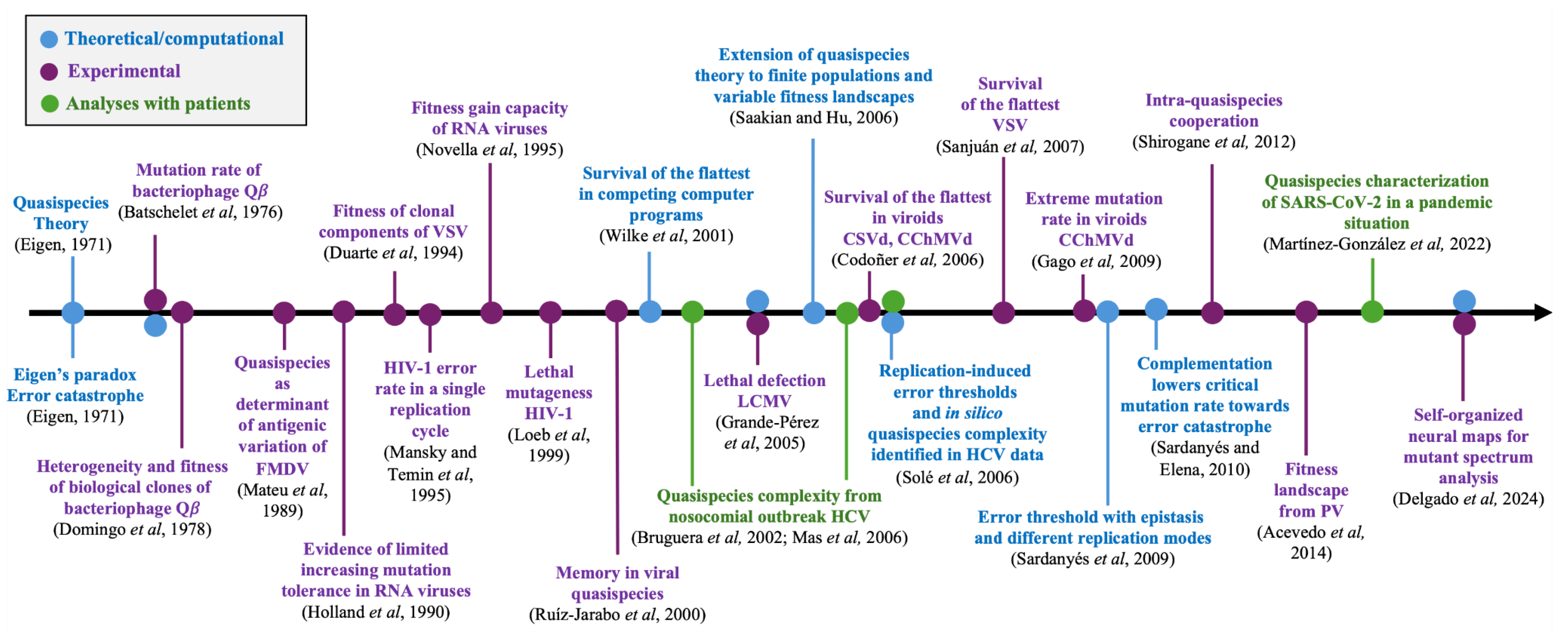
Figure 2.
Simulating the evolutionary dynamics of digital quasispecies in silico. (a) Error threshold (orange lines) in the single-peak fitness landscape (illustrated with a 3-bits hypercube) for geometric and stamping machine replication modes. The size of the balls is proportional to the genotype’s fitness. (b) Fitness landscape with antagonistic epistasis where the effects of mutations are less severe in combination than individually. Here we also display the error threshold for this landscape for geometric and stamping machine replication. All the diagrams show the stationary distributions of the master sequence (000, thick lines) and the pool of mutants (thin lines) averaged over 200 replicas. See Sardanyés et al. (2009) for further details.
Figure 2.
Simulating the evolutionary dynamics of digital quasispecies in silico. (a) Error threshold (orange lines) in the single-peak fitness landscape (illustrated with a 3-bits hypercube) for geometric and stamping machine replication modes. The size of the balls is proportional to the genotype’s fitness. (b) Fitness landscape with antagonistic epistasis where the effects of mutations are less severe in combination than individually. Here we also display the error threshold for this landscape for geometric and stamping machine replication. All the diagrams show the stationary distributions of the master sequence (000, thick lines) and the pool of mutants (thin lines) averaged over 200 replicas. See Sardanyés et al. (2009) for further details.
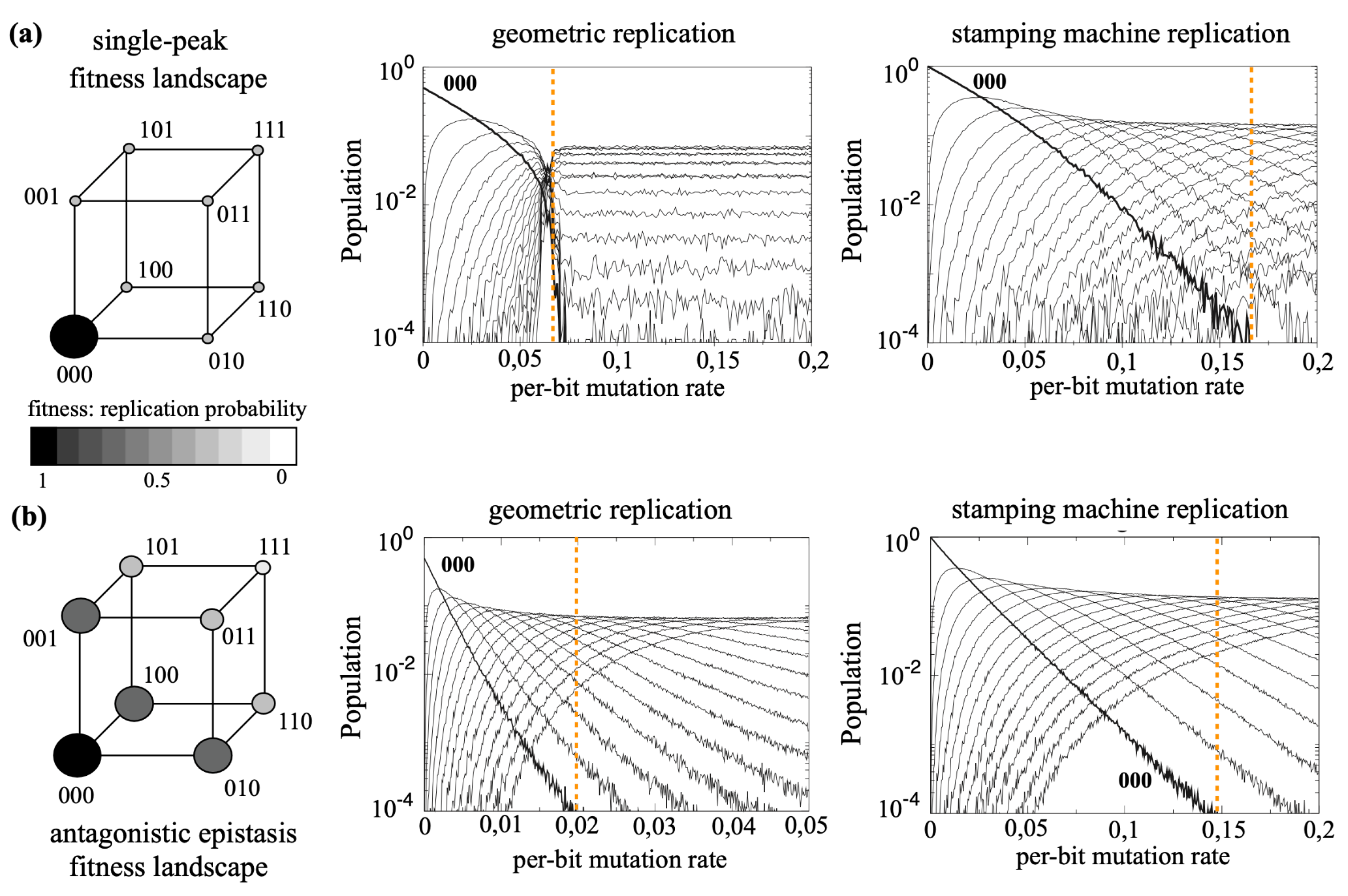
Figure 3.
Virus genotypic complexity: from the hypercube to the ultracube. (a) Classical view of quasispecies evolution in a hypercube schematized with 3-bits sequences. Each node of the network connects two genotypes via a single-point mutation. Sequences evolve to first neighbours by single bit (nucleotide) substitutions during replication. Homologous recombination may allow genotypes to jump to further neighbors (blue arrow). (b) Example of a sequence space for binary genomes of length five considering deletions (blue dashed arrows) and insertions (green solid arrows) during replication. These processes produce mutants and connect hypercubes of different dimensions, giving rise to a more complex sequence space that we label ultracube and which can be conceived as a multiplex network. For clarity, we do not display all the nodes but exemplify some processes of deletion and insertion, which give rise to a set of connected hypercubes of dimension 5 (gray), 4 (black), 3 (blue), 2 (red), and 1 (orange). (c) Schematic diagram of connected hypercubes of different dimensions illustrated schematically as multilayered networks.
Figure 3.
Virus genotypic complexity: from the hypercube to the ultracube. (a) Classical view of quasispecies evolution in a hypercube schematized with 3-bits sequences. Each node of the network connects two genotypes via a single-point mutation. Sequences evolve to first neighbours by single bit (nucleotide) substitutions during replication. Homologous recombination may allow genotypes to jump to further neighbors (blue arrow). (b) Example of a sequence space for binary genomes of length five considering deletions (blue dashed arrows) and insertions (green solid arrows) during replication. These processes produce mutants and connect hypercubes of different dimensions, giving rise to a more complex sequence space that we label ultracube and which can be conceived as a multiplex network. For clarity, we do not display all the nodes but exemplify some processes of deletion and insertion, which give rise to a set of connected hypercubes of dimension 5 (gray), 4 (black), 3 (blue), 2 (red), and 1 (orange). (c) Schematic diagram of connected hypercubes of different dimensions illustrated schematically as multilayered networks.
Disclaimer/Publisher’s Note: The statements, opinions and data contained in all publications are solely those of the individual author(s) and contributor(s) and not of MDPI and/or the editor(s). MDPI and/or the editor(s) disclaim responsibility for any injury to people or property resulting from any ideas, methods, instructions or products referred to in the content. |
© 2024 by the authors. Licensee MDPI, Basel, Switzerland. This article is an open access article distributed under the terms and conditions of the Creative Commons Attribution (CC BY) license (http://creativecommons.org/licenses/by/4.0/).
Copyright: This open access article is published under a Creative Commons CC BY 4.0 license, which permit the free download, distribution, and reuse, provided that the author and preprint are cited in any reuse.


