

Submitted:
03 July 2024
Posted:
04 July 2024
You are already at the latest version
Abstract
Industrial robots are slowly but surely entering manufacturing companies. This paper explores the effects that robots have on productivity, exports, quality, sustainability and labor in European manufacturing companies. There is lack of research on industrial robot usage and its effects in developed countries. Most research is done on Chinese companies and often the data is outdated. The data in this paper is from the European Manufacturing Survey project conducted in 2022 and includes 476 manufacturing companies. Results of the effects of Industrial robots on Quality, Labor Productivity, Exports and Environmental saving technologies are done by use of T-test between industrial robots’ adopters and non-adopters. However, the effect of higher investment into environmental technology by industrial robots’ adopters was researched by 2-step OLS regression analysis with control variables representing the contextual characteristics of companies. The results show positive effects on all variables. Results show that larger usage of robots are in low to medium-technology-intensity industries, that robots contribute to labor productivity, exports and that companies employing robots usually also employ environmentally saving technologies.
Keywords:
Industrial robots
; Productivity
; Quality
; Exports
; Environmental
; Sustainability
; European Manufacturing Survey
1. Introduction
Industrial robots are becoming safer and more affordable so many companies are implementing them in their production as costs of robots also decrease. According to the International Federation of Robotics (IFR) in 2024 current global robot installations base is at an all-time high of around 4 million units, as a solution for labor shortages. Main reason for robot adoption is quality (less scrap), increase of manufacturing productivity (faster cycle time), improved worker safety, reduction of work-in-progress, greater flexibility in the manufacturing process and reduction of costs. 79% of global robot installations are in five countries China, Japan, the United States, the Republic of Korea, and Germany [1]. In 2020, 3 million robots (32%) were installed in China [2]. There is vast literature on how robotics increase growth and possibly replace humans, but nothing has been written about the current state. Even the IFR report analyses just few main countries. Duan et al. [2] have performed a comprehensive literature research on the topic. Most research conducted in developed countries are looking at the country level and not from the company level. Therefore, this is one gap that we aim to fill with this research. A research from [3] theoretically predicts that robots will negatively influence jobs and wages in US. We investigate influence of robots with a survey and check the statements provided by [3] that robots have negative effect on employment with up to date large scale survey on manufacturing companies in Europe. But, Aggogeri et al. [4] in a recent survey of 660 Italian companies show that not only productivity rose by implementing industrial robots but, also that there were no layoffs. The same shows [5] for Europe on IFR data. Therefore, one goal is to check these conflicting findings in the literature, do robots really decrease number of employees. Acemoglu et al. [6] used French manufacturing company data and found that industrial robot use can increase manufacturing output and productivity growth. Kromann et al. [7] found that industrial robots have a positive impact on productivity. Graetz & Michaels [8] found that the use of industrial robots increases labor productivity and total factor productivity, using industrial robot data from 17 countries as a sample. Cheng & Yuan [9] found that the use of robots has a positive effect on productivity and quality through innovation of products and processes. They have proved that robots improve productivity but on the data from 2019 and earlier [9]. Therefore, our goal is to check do robots increase productivity and decrease scrap rate in our sample of newer data. In this work we will analyze robots’ effects on productivity, quality, exports and sustainability. Exports are especially important for GDP growth and jobs creation especially for countries with small local market [10]. Companies are pursuing sustainability to increase operational efficiency by reducing costs and waste, respond to or reach new customers and increase competitive advantage, protect and strengthen brand and reputation and build public trust [11], [12], and robots can help with that.
We will analyze four slightly less developed countries (Spain, Slovakia, Slovenia, Croatia) than the five countries stated in the IFR report [1] (China, Japan, the United States, the Republic of Korea, and Germany). According to that report Spain and France have the lowest density of robots, while Slovakia, Slovenia and Croatia are not mentioned. According to [13] there is the question if the worldwide diffusion of industrial robots contributes to a widening or closing of the productivity gap between rich and poorer economies. Additionally, we will raise questions about contingence factors such as company size, product complexity, and technological intensity.
2. Literature review
2.1. Industrial robots
Industrial robots in our paper are divided into four groups: robots for manufacturing processes and robots for handling, as well as autonomous mobile robots and collaborative robots (cobots). Typically, robots for manufacturing processes are multi-purpose machines consist of at least one reprogrammable robotic arm, or a manipulator, that operates on three axes or more. Robots for manufacturing processes are robots that do repetitive tasks with higher accuracy than humans and due to their stable functioning produce, fewer errors and scrap [14]. They are used for various tasks including; grinning, drilling, cutting, polishing and the like. Technology is not randomly adopted but done so with an expected return on that investment. For instance, in terms of cutting machines, mechanical cutting robots matter more for quality upgrading. The engineering literature and recent descriptive studies highlight several possible mechanisms through which robots may lead to product quality improvements. Robots enable greater accuracy and precision for repetitive tasks, reducing production error, and thereby increasing product quality [15]. Soori et al. [16] show that today’s robots also make significant contributions to energy savings. Some of the main factors that can affect the energy consumption of industrial robots include:
(1) Type of robot: Different types of robots have different energy requirements. For example, a large, heavy-duty robot may require more energy to operate than a small, lightweight robot;
(2) Task performance: The energy consumption of a robot will also depend on the type of task it is performing. Tasks that require a lot of movement or heavy lifting may require more energy than tasks that are more static, and
(3) Operating conditions: The energy consumption of a robot can also be affected by the operating conditions, such as temperature, humidity, and the presence of dust or other contaminants.
Cheng and Yuan [9] with their simulation prove that energy consumption can be reduced by 22%. Also, the use of industrial robots reduces total carbon emissions [17].
Material handling industrial robots are well equipped to load and unload heavy materials, as well as pack and select products. By automating the processes associated with transferring parts between different pieces of equipment, tedious and hazardous tasks are taken care of without the risk of injury [18].
Autonomous mobile robots are a special class of robotic systems that can move a payload from one location to the other or perform a specific task. They allow efficient, precise, and streamlined workflow that makes human work less arduous. However, their widespread application is still limited due to the lack of efficient power systems for use in diverse and largely unknown/uncontrolled environments [19]. According to [20] and [21], that kind of robots are mostly used in warehouses. Those robots have advanced vision systems to precisely grasp objects [22].
A collaborative robot, or cobot, enables users to work closely with it through direct communication without the use of traditional barricades. Cobots can be used for a variety of tasks, from communication robots in public areas and logistic or supply chain robots that move materials inside a building, to articulated or industrial robots that assist in automating tasks which are not ergonomically sound, such as assisting individuals in carrying large parts, or assembly lines. Among the main advantages of using cobots in the workplace is the avoidance of injuries. Cobots cannot perform heavy lifting because they were not designed for that purpose. They are not completely automated to handle complex tasks [23].
2.2. Labor productivity
Labor productivity growth drives economic growth and plays a central role for the wealth and development of nations and the improvement of living standards [13]. The test results of various mechanisms jointly show that the application of industrial robots has a systematic impact on the production and operation activities of companies by expanding their production scale, improving production efficiency, and upgrading production skills, thereby increasing the overall demand for labor [24]. One reason why we still have high labor productivity despite more robots is that robots may be expensive to buy, maintain, and operate, and they may be more inflexible in adjusting to new tasks or unforeseen situations [25]. Automation has not only increased labor productivity, but also created new tasks. For example, a newer model of a welding robot, that can weld faster and more accurately than an earlier model, will increase productivity without displacing workers. Last, new automation technologies can create new tasks that need to be performed by labor [26]. Yuan and Lu [27] go so far as to state that by robot installation, not only the increase of productivity, but the whole country can become more competitive. Acemoglu et al. [28] in a very detailed analysis show that companies adopting robots, perform better than competitors who do not invest into robots. Also, the share of their replaceable employees is far lower than in non-adopters’ group, and their workers are more competent.
2.3. Quality
At the company-level, businesses that produce higher quality goods have higher revenue and employment, pay higher wages, are more productive and sell their goods to a greater variety of markets [29]. Yang and Liu [30] researched quality among China manufacturing companies and robot adoption. They state that China is now quality oriented instead of volume oriented and that this subject is not investigated at all. They state that industrial robots have characteristics of permeability, substitutability and synergism, so they can gradually infiltrate into all aspects of manufacturing production, thus changing the operation mode of the manufacturing industry. Secondly, they state that industrial robots improve the production quality of the manufacturing industry through improving production methods and optimizing the management mode. However, Azamfirei et al. [31] warn that simply investing in robot error detection will not solve the quality issues, unless people do not react on, and change the process due to a defective part.
2.4. Exports
Export quality has attracted a great deal of attention because of its importance for the development and growth [15]. Zhang et al. [32] researched industrial robots and exports in China and conclude that adopters of industrial robots far outweigh non-adopters. But they also say that most SMEs are in non-adopters group. Li et al. [33] find that the industrial robot applications have positive effects on exports by reducing export costs and upgrading product technology. This effect is stronger in economically advanced countries. Moreover, technological innovation and educational investment amplify the impact of industrial robots on exports [34]. According to [10], it is not necessary for exports to exceed imports, rather the productivity gains will contribute to raise in GDP. Nevertheless, Yang [35] shows that that exporters are also more innovative companies and thus more competitive. However, the analysis was performed on China manufacturing in period 2004-2007.
2.5. Sustainability
It was already mentioned that introducing new robots can save energy [16]. Zhu et al. [36] conclude that they do not know the specific channel by which robot adoption is linked to a reduction in pollution, but their empirical findings prove so. Yang and Liu [30] also prove that companies with higher level of industrial intelligence also have more environmentally friendly technologies, but also do not research why. They only state that industrial robots improve the production quality of the manufacturing industry through improving production methods and optimizing the management mode, prompting the manufacturing company to implement energy-saving and emission reduction behaviors to achieve green development. Companies do not prioritize environmental sustainability as they increasingly use robots. Transforming production by implementing industrial robots, there will be subsequent changes in productivity and the way of using resources and treating wastes. Thus, the effect of robot adoption on pollution emission could be mediated by the productivity change or intervention in the production Cheng et al. [9].
2.6. Research hypothesis formulation
So far, we have seen that there is no research of robot implementation in less developed European countries such as Spain, Slovakia, Slovenia and Croatia. Those countries by IFR report than are in low density adoption of robots. Robot density is the number of operational industrial robots relative to the number of employees [1]. However, IFR report only looks at regional and country density of robots and not individual company. As we have described in theoretical review, most research is done on the country level and not individual company level, usually using old IFR data. Some valuable exceptions are research in France [6], the Netherlands [28] and Italy [4]. If by adopting robots a company becomes more competitive than we should see the same pattern in less developed countries. Therefore, the first hypothesis is concerned with productivity. We pose the first hypothesis that in companies adopting robots we will see a labor productivity growth, despite that those are less developed countries.
H1: In companies that adopted robots we will see higher productivity than in non-adopters.
Also, we will research if the number of employees dropped because of robots’ installation. Chung et al. [26] and Acemoglu et al. [3] show that the number of workers did not decrease because of robot installation. Though, they state that in the long run the decrease in jobs may happen, but not in short term. Therefore, we will research if the number of workers has decreased in manufacturing companies that have installed industrial robots. Since we have data on number of workers in a company in 2022 and 2019, that can be easily assessed. Therefore, the second hypothesis is:
H2: There is no statistically significant difference in the number of workers in three-year period in companies that have industrial robots.
The third hypothesis is about quality. The effects of industrial robots on quality was only researched in China [29] and [30]. We will measure quality through scrap rate between adopters and non-adopters. Therefore, the third hypothesis is:
H3: Adopters of industrial robots will have statistically significantly lower scrap rate than non-adopters.
Exports are almost exclusively researched only in China [15], Zhang et al. [32] and Li et al. [33]. There is no research in on exports in European countries. Our countries Spain, Slovakia, Slovenia and Croatia depend heavily on exports. Exports of goods and services in % of GDP in 2023 [37] for researched countries are: Spain (39%), Slovakia (91,4%), Slovenia (84%) and Croatia (54%). Apart from Spain, all other researched countries export more than 50% of their goods and services. Exports are important especially for small countries with a small market and rely heavily on exports. So, our fourth hypothesis is:
H4: Adopters of industrial robots will have statistically significant higher exports than non-adopters.
Yang and Liu [30] reveal that companies adopting robots also have much more energy friendly technologies. They do not know why. This is an interesting conundrum, not explained yet in current literature. We will analyze using technologies for recuperating energy and technologies for reuse of water. As with all current research we hypothesize that industrial robots’ adopters have higher usage of these ecological technologies. So, the fifth hypothesis is
H5: Adopters of industrial robots will have statistically significant higher usage of ecological technology than non-adopters.
But there is still this open question why. Cheng et al. [9] states that sustainability is mediated by the productivity change or intervention in the production. We will analyze industrial robots on environmentally friendly technologies and conceptual factors of the manufacturing company such as company size (number of employees), product complexity, industry, technological intensity factors that might play a role in explaining why robots are usually accompanied with technologies for recuperating waste energy and water recycling.
3. Materials and Methods
The full description of European Manufacturing Survey (EMS) coordinated by the Fraunhofer Institute for Systems and Innovation Research (ISI) [38], the largest European survey of manufacturing activities and designed by the guides of Survey Research Centre [39] can be found in [40].
The survey is conducted among manufacturing companies above 20 employees (NACE Revision 2 codes from 10 to 31). The survey was conducted in 2022 and we obtained 476 answers; Spain (86), Slovakia (102), Slovenia (146) and Croatia (142). Since we are using four countries, we tested a potential sample bias using Levene’s test for equality of variances and a t-test for the equality of means between early and late respondents for each sample. There were no differences in means or variation between the two groups, consequently, there is no evidence of a significant difference in the populations [41].
For common method variance, techniques suggested by [42] to reduce this risk were used. The order of the questions was mixed that it was hard for the respondent to directly associate the variables. Last, we calculated the Harman’s single-factor test with an exploratory factor analysis to address common method bias [42] on joint four-country data. This test including all the independent and dependent variables resulted in a first factor that explained only 19% of the observed variance. Since there was no single factor accounting for most of the variance in the model, this test indicates that common method bias is not a problem in this sample.
To test hypotheses 1 to 5 we have used simple t-test for equality of means. All the variables had to be computed. For example, labor productivity had to be computed from revenues of that year and divided by number of employees for that year. Control variables are the company size (three groups: 1 less than 50 employees, 2 from 50 to 249 and 3 over 250 employees), product complexity (1 for simple products, 2 medium complexity products and 3 high complexity products). The sample was also divided by technological intensity according to European commission [43]: High technology (NACE 21 and 26), Medium-high technology (NACE 20, 27 to 30), Medium-low technology (NACE 19, 22 to 25), Low technology (NACE 10 to 18, 31 to 32). We have investigated all hypotheses on 4 types of robots: robots for manufacturing processes, robots for handling processes, industrial mobile robots and collaborating robots. All the calculations were performed by SPSS ver. 29.
4. Results
4.1. Descriptive results
We will first start with descriptive results of our sample. Even though we did not analyze by country rather the whole sample, here in Table 1, we present the distribution of four types of robots by country.
Table 1 presents that industrial robots for manufacturing processes and industrial robots for handling processes are present in little less than third of manufacturing companies. The share of other two types of robots is, as expected, much lower. The totals in sixth column are the summation of robots. The seventh column presents share of companies that have a specific type of robot as a percentage of companies having a specific type of a robot divided by the number of companies in the dataset. However, the sixth row presents the number of companies that have at least one type of robot in each country and all together (195). We conclude that 41.3% of companies has at least one type of robot installed in their manufacturing plant.
4.2. Hypotheses testing
Hypotheses testing was be done for all four type of robots using the standard student t-test. We present the results in Table 2.
Productivity: From the second and third row we can see a statistically significant lower productivity for adopters comparing to non-adopters, but only for manufacturing robots for manufacturing processes. For the rest of robots (handling robots, mobile industrial robots and cobots) we see that the productivity is higher for adopters in comparison to non-adopters but the difference is not statisticaly significant. In all cases when we compare means for productivity from year 2019 to year 2022 we see a clear increase in labor productivity.
Exports: From the forth row we can see that exports are statisticaly significant higher for adopters in comparison to non-adopters except for mobile robots. However, this different result for mobile robots may be due to a small number of implemented mobile robots. As it can be seen in the whole sample of 476 manufacturing companies there are only 11 mobile robots installed.
Scrap rate: Scrap rate (fifth row) is statistically significantly lower only for manufacturing robots. This is expected because in the scrap rate it is measured only the nuber of defects in the manufacturing process. Errors in handling are usualy tracked but not in the scrap rate. Errors in handling are usualy measured in cooperation with the vendor of robots to adjust the robot for lowering occurrence of those mistakes.
Number of employees: If we look at rows 6 and 7, we can see that for all types of robots number of workers is statistically significantly higher than for non-adopters. Also if we look at average number of workers between years 2022 and year 2019 we see an increase of workers in companies that employ robots unlike non-adopters, where the average number of workers stayed the almost the same. The question of how the company size afects the use of robots will be addressed later with the use of regression analysis.
Technology to recuperate kinetic and process energy and Technology for recycling and reuse of water are considered to improve environmental impact of the company. We can see from rows 7 and 8 that all the adopters of industrial robots have a higher usage of these two technologies and they are statistically significant except for mobile industrial robots which again might be due to low number of installed mobile robots in the sample. As we saw in the theoretical part, there is still no explanation as why companies that invest in robots also invest in these green technologies. They are not forced by some legislative, but they simply invest more in sustainability as well.
4.3. Regression analysis
We have performed Two step OLS regression with two models. Model 1 has the dependent variable number of different robots installed and only control variables (company size, industry intensity, and product complexity). Model 2 has additionally independent variables Technologies to recuperate kinetic and process energy and Technologies for recycling and reuse of water. We included only control variables in the first step, and in the second step we included our independent variables as seen in Table 3.
As it can be seen from Table 3, in Model 1 contextual factors influence decision of implementing robots. If we look at company size as a contextual factor, it can be seen that larger the company, higher is the probability of implementing robots. Therefore, in Table 4 we show the distribution of robots by company’s size:
According to our Model 1 when number of robots is the dependent variable that can take value from 1 to 4 different kind of robots, company size matters. If we look at Table 4, we can see that indeed as size of the company increases so does the percentage of robots. Yes, the smaller companies have fewer robots, but contrary to suggested by literature [44], the medium sized companies have also a lot of robots contrary to findings. The main barriers for adoption of robots in SME according to [44] are lack of processes to automate. Other literature only deals with SMS readiness for Industry 4.0 or with only cobots.
From our 2-step OLS regression in Table 3 we can also see that industry intensity also matters for robot implementation. In step two where we added technologies for recuperating energy and water cleaning only the industry intensity mattered. That means that number of robots will depend on the industry intensity. Since the Standardized Beta coefficient is negative that would suggest that lower-intensity companies have installed more. Therefore, we also created Table 5 to show descriptive statistics between robot implementation and industry intensity. So far, we can only see that the highest implementation of robots is in the middle-to-low and middle-to-high intensity. We could even suggest that the relationship between industry intensity and the number of robots is inversely U-shaped, or, according to the Normal distribution, probably due to a low number of high intensity companies in the sample.
Product complexity and technological intensity does not matter. However, it is very interesting that some technologies correlate. Technologies to recuperate kinetic and process energy are usually bought in tandem with robots for manufacturing and mobile industrial robots, whereas Technologies for recycling and reuse of water are usually implemented in tandem with Industrial robots for handling processes. This is an interesting result since, as we showed in the theoretical part, there is still no explanation for why industrial robots go hand in hand with environmentally friendly technologies. Several authors show that robot adoption decreases CO2 emissions but that still doesn’t explain why companies invest in recuperating and cleansing technologies. Both authors [45] and [46] argue that countries should impose environmental guidelines. However, both researchers are from China. Our result might mean that managers who invest into industrial robots are more proactive and because of their proactivity those technologies get implemented in tandem. But that is not something we can prove through manufacturing data. Zhang et al. [47] name the phenomenon that robotization enhances green productivity, they proved it, but also did not elaborate on why this happens.
Therefore, we performed an additional regression analysis in order to find which environmental technology is connected with which type of robot. The results are in Table 6.
Now, from Table 6 we can see that company size matters for installing technologies which recuperate energy and that they are connected with robots for manufacturing processes and mobile robots (significances are bolded). On the other hand, for implementing technologies for recuperating water, company size does not matter but they are tied to robots for handling processes.
4.4. Summary of findings
In Table 7 we present a summary of findings in one place. However, testing the H5 we found that different robots include different environmental technology. This is already a step forward to solve the mystery why robot adopters usually invest in environmental technology.
4. Discussion
In the European Union, 91% of all employment corresponds to SMEs, and 68.2% of all jobs are in manufacturing. However, according to [44] SME have not embraced robotic manufacturing. Our findings show that company size is important for introduction of robots, however, also small companies have robots. As expected, medium-sized and large companies have more robots than smaller companies.
When it comes to productivity there is a large gap in the literature concerning the current state of robot adoption. Most analyses were performed on Chinese manufacturing companies on old IFR data. Reason for this large number of research done in China is that according to IFR report, China is one of the highest density robots’ adopters (number of robots divided by number of employees). In Europe, only Germany stands up in robot density. Very few researches are done on European manufacturing sector [4,6,28] (France, Italy, Norway). There is much less data for less developed European countries such as Spain, Slovenia, Slovakia and Croatia. They are high exporters because their domestic market is small, so they depend on exports for growth. We showed that indeed robots increase exports and reduce scrap rate by series of t-test. Productivity raised from year 2019 to 2022, but the productivity for adopters of industrial robots for manufacturing is actually statistically significantly lower than in the non-adopters group. This might mean that that maybe those robots are just implemented and still need humans to do their work. For all other types of robots, we see that productivity is higher in the adoption group but not statistically significant. This also means that relationship between installed robots and productivity growth is not that simple. We argue that merely implementing robots will not solve issues in the company
We also tackled the question raised by [4] that the robots will decrease the number of workers. Therefore, we used data from 2019 and 2022 to compare did the number of workers decrease. If we look at rows 6 and 7 of Table 2 we can see that for all types of robots number of workers is statistically significantly higher than for non-adopters, and the number of workers even raised for robot adopters. But we cannot predict if this is just a short-term effect or will in the long run number of workers fall as also predicted by [4].
There is still the question why robots increase implementation of energy recuperating technologies and water recycling technologies. We managed to find combinations of environmental technologies and robots such as technologies to recuperate kinetic and process energy are usually both in tandem with robots for manufacturing and mobile industrial robots, whereas technologies for recycling and reuse of water are usually implemented in tandem with industrial robots for handling processes. In this way we give a contribution Zhang et al. [47] who predicted that sustainability is connected to robot adoption but could not explain why. In this work we however find direct connection of technologies for recuperating energy and manufacturing robots. The other OLS regression showed that water recycling and recuperation is connected to handling robots.
Zhang et al. [32] state that SME seldomly adopt robots, and our regression analysis confirms it, however in Table 4 we show that even small companies have robots and that the highest number of robots is in larger companies. Industry intensity also showed the importance in our analysis, therefore we displayed Table 5 showing that most robots are in the group of middle technology intensity groups. There are no other examples known to the author of distributions of robots by technology intensity. We get same mixed results by technology intensity as [48] did for Industry 4 readiness.
5. Conclusions
In this work we fill the gap in the literature on robot adoption in European countries. Most research is done by China mostly due to the fact that China has among highest robot adoption rate and the fact that they are changing from volume producer to quality producer. Even though the works researching robots were recently published, they relied on old data and looked at whole country or regions and not on the company level. We fill this gap by analyzing productivity, exports, quality, environmental technologies on company level data. For this purpose, we used subset of European Manufacturing Survey comprised by four countries Spain, Slovakia, Slovenia and Croatia.
We proved four out of five hypotheses. We did find statistically significant higher productivity for robots adopters, except for robots for manufacturing processes. We show that the number of workers did not fall due to robot introduction, in fact, the number of workers even raised. We showed that adopters of industrial robots have a lower scrap rate than non-adopters. We showed that adopters of industrial robots have higher exports.
We showed that adopters of industrial robots have higher usage of energy efficient technologies than non-adopters. We also contribute by showing that indeed implementation of robots does enhance implementation of environmental technologies and we show which environmental technologies go with which kind of robots. Technologies to recuperate kinetic and process energy are usually bought in tandem with robots for manufacturing and mobile industrial robots, whereas technologies for recycling and reuse of water are usually implemented in tandem with Industrial robots for handling processes. This is an interesting result since, as we showed in the theoretical part, there is still no explanation for why industrial robots go hand in hand with environmentally friendly technologies. Several authors show that robot adoption decreases CO2 emissions but that still does not explain why companies invest in recuperating and cleansing technologies. Both authors [45] and [46] argue that countries should impose environmental guidelines. Our result might mean that managers who invest into industrial robots are more proactive and because of their proactivity those technologies get implemented in tandem.
Limitation of the research is that it includes only four countries, but for the questions analyzed (not country comparison) this was enough. However, there is the term productivity paradox [49] which must be further explored. It has both to do with the level of technological advancement of a country but also in the way technology is deployed. This should absolutely be further explored, by including more advanced countries in the sample.
Further research should go in including more countries but perform the analysis with robot density as a control variable and does the technology paradox only happen in poorer countries compared to more developed ones.
Author Contributions
“Conceptualization, J.P. and I.P.; methodology, J.P. and I.P.; validation, J.P. and I.P.; formal analysis, J.P.; investigation, J.P. and I.P.; writing—original draft preparation, J.P. and I.P.; writing—review and editing, J.P. and I.P.; visualization, I.P.; supervision, J.P.; project administration, I.P. All authors have read and agreed to the published version of the manuscript.”
Funding
This research was funded by the Slovenian Research Agency (Research Core Funding No. P2-0190).
Conflicts of Interest
The authors declare no conflict of interest.
References
- IFR World Robotics 2023 – Industrial Robots; Frankfurt, 2023.
- Duan, D.; Chen, S.; Feng, Z.; Li, J. Industrial Robots and Firm Productivity. Structural Change and Economic Dynamics 2023, 67, 388–406. [Google Scholar] [CrossRef]
- Acemoglu, D.; Restrepo, P. Robots and Jobs: Evidence from US Labor Markets. Journal of Political Economy 2019, 128, 2188–2244. [Google Scholar] [CrossRef]
- Aggogeri, F.; Pellegrini, N.; Taesi, C. Towards Industrial Robots’ Maturity: An Italian Case Study. Robotics 2024, 13, 42. [Google Scholar] [CrossRef]
- Klenert, D.; Fernández-Macías, E.; Antón, J.-I. Do Robots Really Destroy Jobs? Evidence from Europe. Economic and Industrial Democracy 2022, 44, 280–316. [Google Scholar] [CrossRef]
- Acemoglu, D.; Lelarge, C.; Restrepo, P. Competing with Robots: Firm-Level Evidence from France. In Proceedings of the AEA papers and proceedings; American Economic Association 2014 Broadway, Suite 305, Nashville, TN 37203, 2020; Vol. 110, pp. 383–388.
- Kromann, L.; Malchow-Møller, N.; Skaksen, J.R.; Sørensen, A. Automation and Productivity—a Cross-Country, Cross-Industry Comparison. Industrial and Corporate Change 2020, 29, 265–287. [Google Scholar] [CrossRef]
- Graetz, G.; Michaels, G. Robots at Work. Review of Economics and Statistics 2018, 100, 753–768. [Google Scholar] [CrossRef]
- Cheng, H.; Yuan, L. Robot Use, Process Innovation and Quality Improvement-Empirical Evidence from the China Enterprise General Survey (CEGS). Southern Economy,(01) 2020, 46–59. [Google Scholar]
- Cross, P.; Cameron, G. The Importance of Exports to GDP and Jobs. Canadian Economic Observer 1999, 12, 3.1–3.5. [Google Scholar]
- Ogbemhe, J.; Mpofu, K.; Tlale, N.S. Achieving Sustainability in Manufacturing Using Robotic Methodologies. Procedia Manuf 2017, 8, 440–446. [Google Scholar] [CrossRef]
- Knoppen, D.; Knight, L. Pursuing Sustainability Advantage: The Dynamic Capabilities of Born Sustainable Firms. Bus Strategy Environ 2022, 31, 1789–1813. [Google Scholar] [CrossRef]
- Eder, A.; Koller, W.; Mahlberg, B. The Contribution of Industrial Robots to Labor Productivity Growth and Economic Convergence: A Production Frontier Approach. Journal of Productivity Analysis 2024, 61, 157–181. [Google Scholar] [CrossRef]
- Makulavičius, M.; Petkevičius, S.; Rožėnė, J.; Dzedzickis, A.; Bučinskas, V. Industrial Robots in Mechanical Machining: Perspectives and Limitations. Robotics 2023, 12, 160. [Google Scholar] [CrossRef]
- DeStefano, T.; Timmis, J. Robots and Export Quality. J Dev Econ 2024, 168, 103248. [Google Scholar] [CrossRef]
- Soori, M.; Arezoo, B.; Dastres, R. Optimization of Energy Consumption in Industrial Robots, a Review. Cognitive Robotics 2023, 3, 142–157. [Google Scholar] [CrossRef]
- Wang, J.; Wang, W.; Liu, Y.; Wu, H. Can Industrial Robots Reduce Carbon Emissions? Based on the Perspective of Energy Rebound Effect and Labor Factor Flow in China. Technol Soc 2023, 72, 102208. [Google Scholar] [CrossRef]
- Panda, B.K.; Panigrahi, S.S.; Mishra, G.; Kumar, V. Chapter Thirteen - Robotics for General Material Handling Machines in Food Plants. In Transporting Operations of Food Materials Within Food Factories; Jafari, S.M., Malekjani, N., Eds.; Woodhead Publishing, 2023; pp. 341–372 ISBN 978-0-12-818585-8.
- Farooq, M.U.; Eizad, A.; Bae, H.-K. Power Solutions for Autonomous Mobile Robots: A Survey. Rob Auton Syst 2023, 159, 104285. [Google Scholar] [CrossRef]
- Grover, A.K.; Ashraf, M.H. Leveraging Autonomous Mobile Robots for Industry 4.0 Warehouses: A Multiple Case Study Analysis. The International Journal of Logistics Management 2023. [Google Scholar] [CrossRef]
- Löffler, M.; Boysen, N.; Schneider, M. Human-Robot Cooperation: Coordinating Autonomous Mobile Robots and Human Order Pickers. Transportation science 2023, 57, 979–998. [Google Scholar] [CrossRef]
- Sun, Y.; Wang, X.; Lin, Q.; Shan, J.; Jia, S.; Ye, W. A High-Accuracy Positioning Method for Mobile Robotic Grasping with Monocular Vision and Long-Distance Deviation. Measurement 2023, 215, 112829. [Google Scholar] [CrossRef]
- Borboni, A.; Reddy, K.V.V.; Elamvazuthi, I.; AL-Quraishi, M.S.; Natarajan, E.; Azhar Ali, S.S. The Expanding Role of Artificial Intelligence in Collaborative Robots for Industrial Applications: A Systematic Review of Recent Works. Machines 2023, 11, 111. [Google Scholar] [CrossRef]
- Zhang, L.; Gan, T.; Fan, J. Do Industrial Robots Affect the Labour Market? Evidence from China. Economics of Transition and Institutional Change 2023, 31, 787–817. [Google Scholar] [CrossRef]
- Prettner, K. Stagnant Wages in the Face of Rising Labor Productivity: The Potential Role of Industrial Robots. Financ Res Lett 2023, 58, 104687. [Google Scholar] [CrossRef]
- Chung, J.; Lee, Y.S. The Evolving Impact of Robots on Jobs. ILR Review 2022, 76, 290–319. [Google Scholar] [CrossRef]
- Yuan, W.; Lu, W. Research on the Impact of Industrial Robot Application on the Status of Countries in Manufacturing Global Value Chains. PLoS One 2023, 18, e0286842. [Google Scholar] [CrossRef] [PubMed]
- Acemoglu, D.; Koster, H.R.A.; Ozgen, C. Robots and Workers: Evidence from the Netherlands; Cambridge, MA, 2023.
- DeStefano, T.; Timmis, J. Robots and Export Quality. J Dev Econ 2024, 168, 103248. [Google Scholar] [CrossRef]
- Yang, S.; Liu, F. Impact of Industrial Intelligence on Green Total Factor Productivity: The Indispensability of the Environmental System. Ecological Economics 2024, 216, 108021. [Google Scholar] [CrossRef]
- Azamfirei, V.; Granlund, A.; Lagrosen, Y. Lessons from Adopting Robotic In-Line Quality Inspection in the Swedish Manufacturing Industry. Procedia Comput Sci 2023, 217, 386–394. [Google Scholar] [CrossRef]
- Zhang, F.; Zhang, Q.; Wu, H. Robot Adoption and Export Performance: Evidence from Chinese Industrial Firms. Journal of Manufacturing Technology Management 2023, 34, 896–916. [Google Scholar] [CrossRef]
- Li, L.; Ding, Y.-N.; Fan, J.-C. Industrial Robots and Export Growth: A Cross-Country Analysis. Appl Econ Lett 2024, 1–5. [Google Scholar] [CrossRef]
- Qi, J.; Zhang, Z. Robot Application and Adjustment of Export Product Scope: Can We Have Both Efficiency and Quality? China Finance and Economic Review 2023, 12, 67–88. [Google Scholar]
- Yang, C.-H. Exports and Innovation: The Role of Heterogeneity in Exports. Empir Econ 2018, 55, 1065–1087. [Google Scholar] [CrossRef]
- Zhu, H.; Sang, B.; Zhang, C.; Guo, L. Have Industrial Robots Improved Pollution Reduction? A Theoretical Approach and Empirical Analysis. China & World Economy 2023, 31, 153–172. [Google Scholar] [CrossRef]
- Eurostat Exports of Goods and Services in % of GDP; Brussels, 2023.
- Fraunhofer-Institut für System- und Innovationsforschung European Manufacturing Survey (EMS) - Project Description. Available online: https://www.isi.fraunhofer.de/en/themen/wertschoepfung/fems.html (accessed on 29 May 2024).
- The Institute for Social Research (ISR) Overview of Survey Methodology.
- Prester, J.; Bikfalvi, A.; Palčič, I. The Effect of Product Complexity on Servitization and Deservitization: A Multi-Country Quantitative Analysis. Sustainability 2022, 14, 1–16. [Google Scholar] [CrossRef]
- Armstrong, J.S.; Overton, T.S. Estimating Nonresponse Bias in Mail Surveys. Journal of marketing research 1977, 14, 396–402. [Google Scholar] [CrossRef]
- Podsakoff, P.M.; MacKenzie, S.B.; Lee, J.Y.; Podsakoff, N.P. Common Method Biases in Behavioral Research: A Critical Review of the Literature and Recommended Remedies. Journal of Applied Psychology 2003, 88. [Google Scholar] [CrossRef] [PubMed]
- Eurostat Aggregations of Manufacturing Based on NACE Rev. 2; Brussels, 2024.
- Grau, A.; Indri, M.; Bello, L. Lo; Sauter, T. Robots in Industry: The Past, Present, and Future of a Growing Collaboration With Humans. IEEE Industrial Electronics Magazine 2021, 15, 50–61. [Google Scholar] [CrossRef]
- Picco, E.; Miglioretti, M.; Le Blanc, P.M. Sustainable Employability, Technology Acceptance and Task Performance in Workers Collaborating with Cobots: A Pilot Study. Cognition, Technology & Work 2024, 26, 139–152. [Google Scholar]
- Song, J.; Chen, Y.; Luan, F. Air Pollution, Water Pollution, and Robots: Is Technology the Panacea. J Environ Manage 2023, 330, 117170. [Google Scholar] [CrossRef]
- Zhang, Q.; Zhang, F.; Mai, Q. Robot Adoption and Green Productivity: Curse or Boon. Sustain Prod Consum 2022, 34, 1–11. [Google Scholar] [CrossRef]
- Percival, J.C. Complementarities Between Advanced Manufacturing Technologies. IEEE Trans Eng Manag 2009, 56, 115–128. [Google Scholar] [CrossRef]
- Zhang, Y.; Wang, T.; Liu, C. Beyond the Modern Productivity Paradox: The Effect of Robotics Technology on Firm-Level Total Factor Productivity in China. J Asian Econ 2024, 90, 101692. [Google Scholar] [CrossRef]

Table 1.
Distribution of robots by country.
| Type of robots | Spain | Croatia | Slovakia | Slovenia | Total | Share |
| Industrial robots for manufacturing processes | 17 | 21 | 28 | 77 | 143 | 30.3% |
| Industrial robots for handling processes | 21 | 26 | 28 | 57 | 132 | 28.0% |
| Mobile industrial robots | 0 | 2 | 1 | 8 | 11 | 2.3% |
| Collaborating industrial robots | 7 | 3 | 6 | 15 | 31 | 6.6% |
| Number of companies having at least one type of robot | 25 | 39 | 41 | 90 | 195 | 41.3% |
Table 2.
T test for differences of means between robot’s adopters and non-adopters.
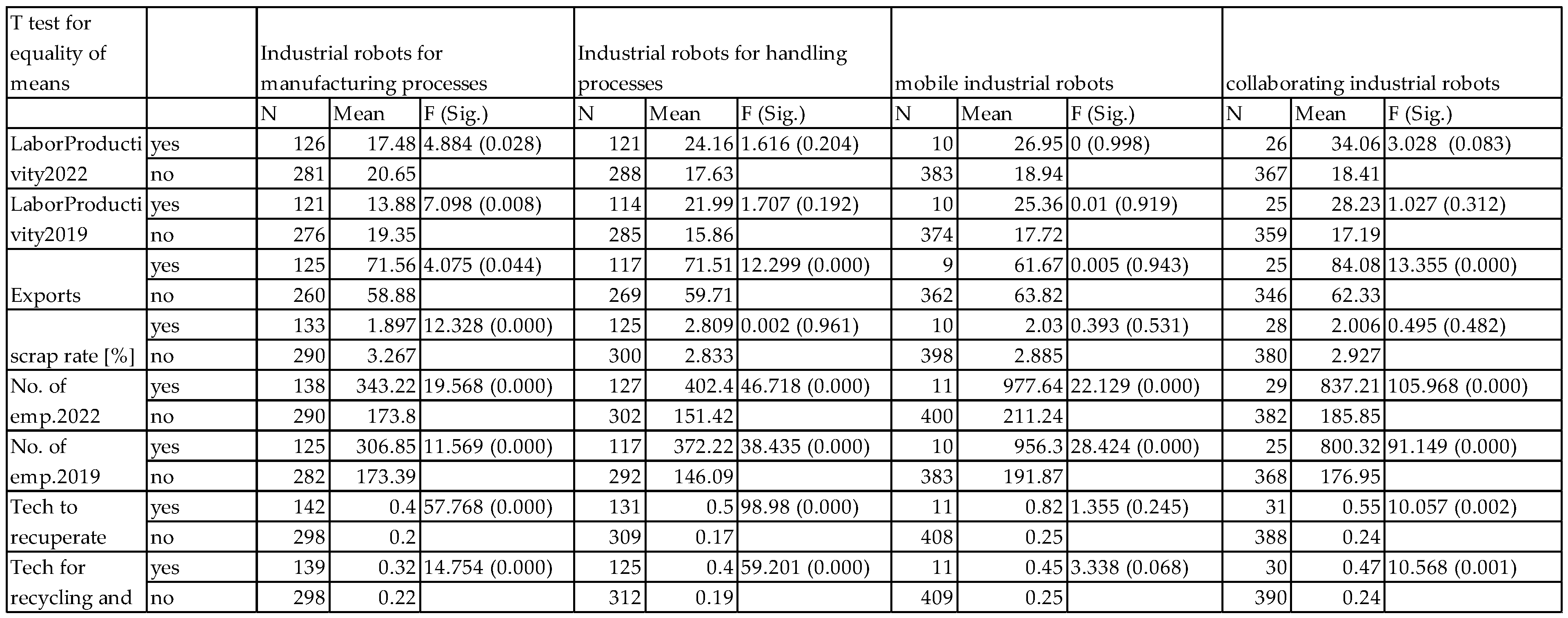
Table 3.
Two step OLS regresion for contextal factors.
| Model | Dependent variable: Number of different kinds of robots | Collinearity Statistics | ||||
| Stand. Beta | t | Sig. | Tolerance | VIF | ||
| 1 | (Constant) | 1.412 | 0.16 | |||
| No. of employees in 3 groups | 0.195 | 2.339 | 0.021 | 0.995 | 1.005 | |
| Industry intensity | -0.186 | -2.083 | 0.039 | 0.869 | 1.151 | |
| Product complexity | -0.022 | -0.242 | 0.809 | 0.871 | 1.148 | |
| 2 | (Constant) | 2.086 | 0.039 | |||
| No. of employees in 3 groups | 0.063 | 0.763 | 0.447 | 0.877 | 1.14 | |
| Industry intensity | -0.198 | -2.386 | 0.018 | 0.867 | 1.153 | |
| Product complexity | -0.041 | -0.487 | 0.627 | 0.847 | 1.181 | |
| Technologies to recuperate kinetic and process energy | 0.311 | 3.707 | 0.001 | 0.844 | 1.184 | |
| Technologies for recycling and reuse of water | 0.203 | 2.55 | 0.012 | 0.944 | 1.059 | |
| Model Summary | Change Statistics | |||||
| Model | R | R Square | Δ R Square | Δ Sig. F | ||
| 1 | 0.266 | 0.071 | 0.05 | 0.02 | ||
| 2 | 0.463 | 0.214 | 0.184 | 0.001 | ||
Table 4.
Breakdown of implementation of robots by company size.
| Small | Medium | Large | |
|---|---|---|---|
| Industrial robots for manufacturing processes | 21% | 32% | 43% |
| Industrial robots for handling processes | 20% | 27% | 45% |
| Industrial robots: mobile industrial robots | 1% | 1% | 8% |
| Industrial robots: collaborating industrial robots | 4% | 5% | 17% |
Table 5.
Number of robots by Industry intensity.
| Type of robot | Low tech | Medium - low tech | Medium-high tech | High-tech |
|---|---|---|---|---|
| Industrial robots for manufacturing processes | 17.42% | 36.73% | 39.05% | 25.00% |
| Industrial robots for handling processes | 29.55% | 29.08% | 26.67% | 28.57% |
| Mobile industrial robots | 1.52% | 1.02% | 5.71% | 3.57% |
| Collaborating robots | 1.52% | 6.12% | 14.29% | 7.14% |
| Share of companies having at least one robot type | 32.6% | 46.9% | 46.7% | 39.3% |
Table 6.
OLS regression only second step, environmental technologies as dependent variables.
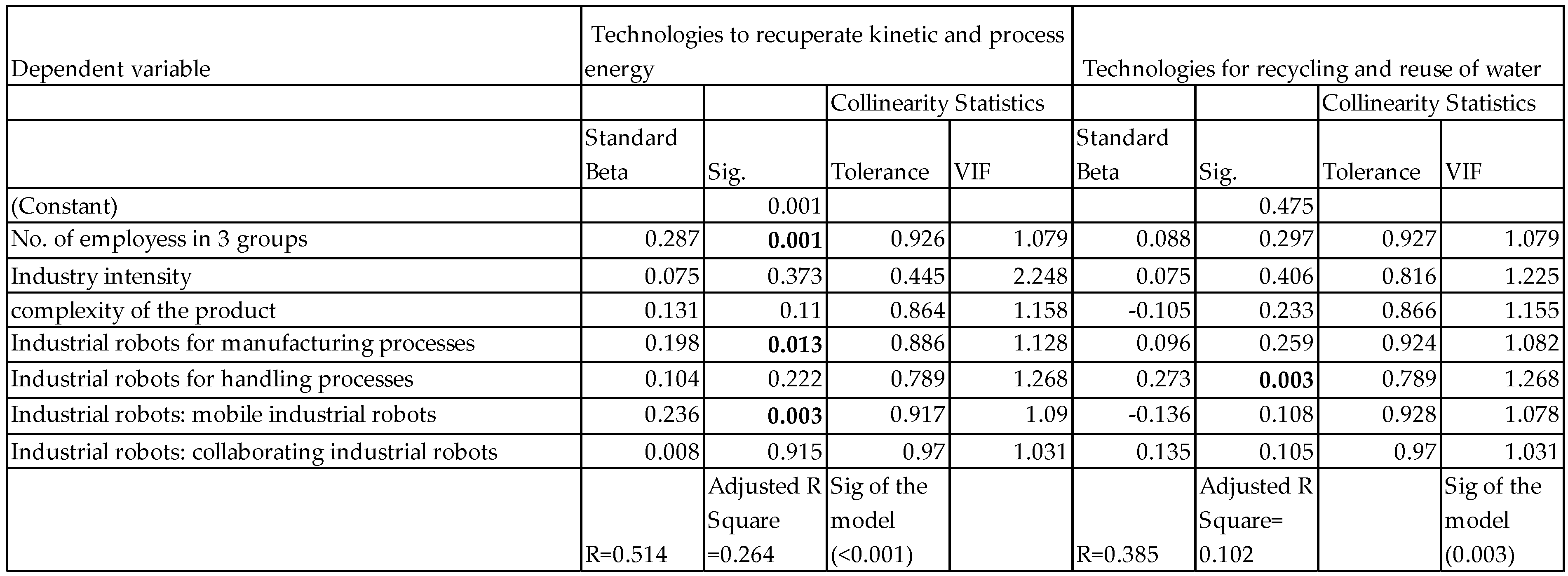
Table 7.
Summary of findings.
| Hypotheses | Conclusion |
| H1: In companies that adopted robots we will see higher productivity than non-adopters | Partially confirmed |
| H2: There is no statistically significant difference in number of workers in 2022 and 2019 in companies that have industrial robots. | confirmed |
| H3: Adopters of industrial robots will have statistically significant lower scrap rate than non-adopters. | confirmed |
| H4: Adopters of industrial robots will have statistically significant higher exports than non-adopters. | confirmed |
| H5: Adopters of industrial robots will have statistically significant higher usage of ecological technology than non-adopters. | confirmed |
Disclaimer/Publisher’s Note: The statements, opinions and data contained in all publications are solely those of the individual author(s) and contributor(s) and not of MDPI and/or the editor(s). MDPI and/or the editor(s) disclaim responsibility for any injury to people or property resulting from any ideas, methods, instructions or products referred to in the content. |
© 2024 by the authors. Licensee MDPI, Basel, Switzerland. This article is an open access article distributed under the terms and conditions of the Creative Commons Attribution (CC BY) license (http://creativecommons.org/licenses/by/4.0/).
Copyright: This open access article is published under a Creative Commons CC BY 4.0 license, which permit the free download, distribution, and reuse, provided that the author and preprint are cited in any reuse.


