

Submitted:
25 May 2025
Posted:
26 May 2025
You are already at the latest version
Abstract
Liberation war of Bangladesh was estimated to be held in financial year 1971 to gain independence from Pakistan. Bangladesh alone generated 70% of export return and in turn it received only 25%. The fabric mills of Bangladesh faced a slow increment from 11 to only 26 mills operating from 1947 till the fiscal year 1970. Nationalization of Urdu speaking language finally created outrage and turmoil among citizens of West and East Pakistan and generated war of Freedom Movement. This article mainly sheds light of different challenges faced by Bangladesh citizens such as genocide, women torture and communal disparity. Different factors such as economic turmoil political unrest and minor treatments were major reason behind the hate campaign of the liberation war. Thus, this article critically demonstrates the strategies adopted for mitigating challenges such as peaceful negotiation and maintenance of equality and similar priority to every citizen. This article critically evaluates the concept of hate campaign and Liberation War of Bangladesh. Its aim at analyzes ways incorporated by liberation war of Bangladesh for triggering hate campaigns along with different factors affecting hate campaigns. This study shed light on illustrating three different case studies including when government of Bangladesh undertook strict actions against mobs that tend to vandalize on Communal activities. In addition, second case study includes when social media platform Facebook formed a partnership with Asia foundation for combating online haters-based intolerance. Apart from that, third case study evaluating hate campaign on using social media platform it blocks two groups of people for hacking allegations.
Keywords:
Bangladesh
; Hate Campaigns
; Hate Speech
; Social media
; Liberation War
; Freedom of Speech
Introduction
Bangladesh was successful in mulling restrictions on vicious election campaigns based on social media. Election Commission (EC) is estimating idea of imposing certain restrictions on election-based campaigns posted on social media. EC is currently successful on a proposal for amending electoral code in a bid with aim of stopping hate campaigns against any candidate before voting. Based on proposal, there cannot be any polls campaign based on Facebook, Twitter or any other social media platforms prior polls symbols are allocated. In addition, based on a proposal, no one can disrespect a candidate in a campaign on social media or through mobile SMS. This fails to provide any objection for campaigning through local cable evaluated through TV commercials.
Social media platform “Facebook” assisted fuel hate campaign against Rohingyas. This social media platform has failed vulnerable communities that are concerned against both hate campaigns as well as fake news raised against Rohingyas. Facebook administration team has miserably failed for deleting 93% of posts that contain speech that tends on violating varied community standards, homes rules as was claimed by study.
This study aims at analyzing hate campaign against liberation war in Bangladesh based on using varied social media platforms. One of the biggest allegations that came from India tends to describe how social media platform “Facebook” failed to delete hundreds of memes, various images along with posts that mainly target caste, LGBT along with different religious minorities. Research unit Equality lab on social media found 93% of posts were reported to Facebook that tend to contain speech violating own rules and regulations. Online platform of social media fails for halting persecution of Rohingyas that resulted in fleeting Myanmar to Bangladesh. Apart from that, analysis of Buzzfeed News was responsible for shedding new light based on highlighting failure of Facebook on Rohingyas issue.
When a crisis of Rohingyas worsened in Arakan based on analysis it can be estimated that Facebook fail to take any actions for months as well as years. In addition, social media platform finally removed varied posts after Buzz feed successfully sent links to a specified person on Facebook. Three case studies on evaluating hate campaigns against social media were illustrated as initial as initial case study deals with when government warn tough actions against mob for vandalizing during a celebration on Durga Puja. In addition, second case study demonstrates when channel of social media Facebook was successful in forming a partnership with Asia foundation. This partnership was framed for using new tools with a major purpose of combating online hater’s intolerance in long term. In this context, resiliency initiatives were being undertaken that was regarded as one flagship programs incorporated for addressing both hate along violent extremism. Apart from that, third case study demonstrates that social media platform Facebook block two different groups based on a hacking allegation. It also shed light on illustrating Hate campaign that targeted Bangla-speaking Muslim people within Indian state that went viral on Facebook.
Literature Review
Liberation War of Bangladesh
The Liberation War of Bangladesh was based on gaining the power of autonomy from Pakistan and emerging as a new state. In the fiscal year 1947, two nations India and Pakistan were free from the ruling system of the Imperial Government. India was then demarcated as land for the Hindu religion and Pakistan for Islamic culture. East and West Pakistan were together due to religious equality and were separated by 1000 miles of distance. West Pakistan consisted of 97% of Muslims and East Pakistan had 85% of the Islam community (Milovanovic and Smutka, 2018). Due to religious similarity, the country emerged as one nation. In the words of Turza (2021), West Pakistan has five major provinces such as Punjab, Sindh, Baluchistan, Northwest Frontier, and fifth was East Pakistan. Soon after independence East Pakistan actively participated in the trading system and made an export of 70% whereas it only received 25% of the cash inflow. Fabric Mills in East Pakistan was 11 and that in West Pakistan was 9 in the aftermath of decolonization (Seddiky et al. 2020).
In financial year 1971 the number of fabric mills increased to 150 in West Pakistan and dropped down to 26 in East Pakistan. A shift of resources of around 2.6 billion dollars has also occurred from East to West Pakistan. The population and province size were more in East Pakistan yet they enjoyed minimal economic and political freedom. This deprivation from absolute rights made the citizens protest for freedom. Sheikh Mujibur Rahman, the leader of the Awami League was the flag bearer of the movement for liberation demanding more political and economic freedom.
On the other hand, Mujeri and Mujeri (2021) commented that rather than political turmoil there exist different conflicts of East and West Pakistan on the nationalization of the Urdu language. Steyn, (2020) argued that during the outbreak of ‘Bhola Cyclone” in 1970, almost 500000 people lost their lives and ended up creating deep depression and shock among citizens. However, West Pakistan failed to provide adequate relief funds for protecting the citizens. Thus, continuous ignorant behavior and lack of political and economical freedom generated civil war for liberation among West and East Pakistan provinces during the fiscal year 1971.
Assistance Gained from Social Media on a Hate Campaign
Using social media channels including Facebook and Instagram possess an advantage over traditional media as it allows people to gain information about campaign. With usage of consistent updating, right social media marketing campaign will be effective for increasing traffic and gaining better SEO. It is also beneficial for promoting a higher rate of conversion, improving loyalty that in turn will result in spreading news to a large audience at a relatively faster pace of time. By using social media channels hate campaign can be effective as its aim at understanding goals, objectives, scheduling posts along creating supporting based visual content. Post on Facebook is gaining advantageous to be used in hate campaign as it aids in building a relationship with a large number of people along with increasing rate of visibility (Milovanovic and Smutka, 2018).
Creation of a viral marketing campaign is effective in social media channels as it aims at finding an appropriate channel for sharing valid sources of information along with working on emotions of people. Thus, it can be summarized that a source of information or a piece of news fails to be published or fail to reach million people without posting it on social media platforms in long term.
Ways Liberation War of Bangladesh Triggered Hate Campaign
A hate campaign is based on a series of events and hostile activity backed by certain dislikes and prejudices for ensuring better living. Lindsay et al. (2020) stated that after the partition of colonial rule, East Pakistan formed a major province for West Pakistan secluded in between by the huge land of India. However, lack of political freedom and economic stability generated hatred among the entire population of East Pakistan against the West. After 1947, Mohammad Ali Jinha the Prime Minister of Pakistan declared Urdu as the official language without taking consent from the citizens of East Pakistan. In contradiction to the above statement, Kuddus and Rahman (2021) commented that the lack of industrial growth in East Pakistan and the generation of slow trading revenue after rising in export from the fifth province has led to protest against West Pakistan province.
Continuation of disparity finally culminated in Bangladesh genocide and mass killing in the year 1971, March 26. The installation of “Operation Searchlight” by West military coups against East Pakistan province has culminated into a war that lasted for 9 months.
During the war, 200000 to 300000 militants of the “Pakistan Armed Force” were killed due to lending support towards the “Pakistani Islami Militants” of Bangladesh. The rising hate campaign has caused abduction, rape, and sexual torture to around 200000 to 400000 Bengali women living in Bangladesh (Alam, 2021). The hate campaign, triggered genocide and hostile circumstances and a religious leader of Pakistan supported the women’s suppression and torture and claimed them as “public property”.
As opined by Ahmed et al. (2019) this scenario of mass killing and genocidal rape has forced around 8 to 10 million people to emigrate out to neighboring country India. During the hate campaign, the genocide of Bangladesh around 30 million people out of 70 were displaced in an inauthentic approach and war took the shape of communal disparity among Bengali speaking Bangladeshi and Urdu speaking Pakistani. Continues fuel from West Pakistan and intensified torture has generated hate campaigns among citizens of two provinces backed by military coupes. Genocide, women torture, and mass killing just after the outbreak of “Bhola Cyclone” has generated a huge loss for Bangladesh and has triggered hate campaigns within two linguistic communities. Lack of political and economic freedom was the major reason behind the outbreak of the hate campaign among two provinces for separate autonomy and peaceful living. Mujeri and Mujeri (2021) cited that the hate campaign of Bangladesh has resulted in mass killing and women torture for adhering to economic and political freedom from the military troops of West Pakistan and its entire ruling province.
Factors Affecting Hate Campaign During Liberation War of Bangladesh
The hate campaign during the Liberation War of Bangladesh was backed by different political and socio-economic disparities among the two provinces of Pakistan. The major factor that caused the outbreak of the hate campaign is as follows:
Figure 1.
Factors causing hate campaign during Bangladesh War. (Source: Self Developed).
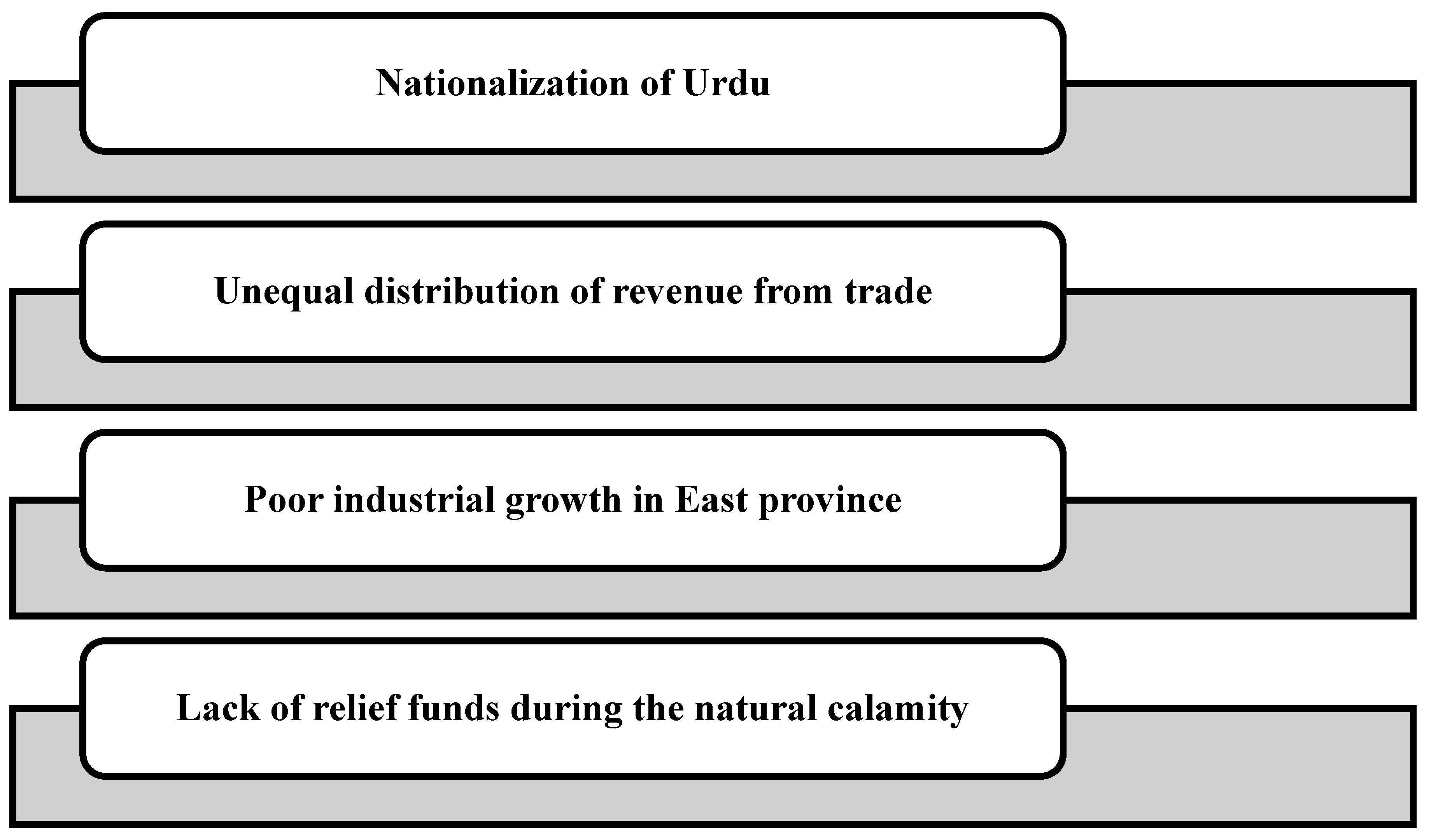
Nationalization of Urdu
Mohammad Ali Jinha, then Prime Minister of Pakistan declared Urdu as a national language with the mass majority of Bengali-speaking Muslims in East Pakistan. Talukdar and Pal (2020) cited that the government failed to take consent from East Pakistani citizens before nationalizing a language. Both demographically and geographically East Pakistan formed a major province of Islamic states including Punjab, Sindh, Balochistan, and northwest Frontier. Another issue that inflicted hate campaigns during the 1971 war was the capitalization of Karachi in Pakistan. This decision also triggered the sentiments of East Pakistani people after being demographically strong and owning a larger landmass than the West.
Unequal Distribution of Revenue from Trade and Poor Industrial Growth in East Province
East Pakistan itself contributes to 70% of the export from Pakistan and received only 25% of the cash return. West Pakistan increased its number of fabric mills from 9 to 150 by 1970 and Bangladesh faced a slow rise from 11 to 26. Raw resources of 26 billion dollars were exported from Bangladesh to Pakistan for improving the economy of the western province (Biswas et al. 2021). The inequality of resource distribution, trading return, and industrial growth has forced the citizens to raise a voice of protest against the central government. The involvement of military troops against mass has added fuel to the fire of hate campaigns leading to genocide, torture, and rape.
Lack of Relief Funds During the Natural Calamity
Bangladesh is a cyclone-prone zone and the outbreak of “Bhola Cyclone” in 1970 took away the lives of 500000 people. This incident created depression and shock in the East Province of Pakistan. The central government allocated a minimal budget in relief camps for protecting the people. Lack of concern of the central government for protecting the citizens during a calamity has triggered hatred of East Pakistani citizens against the central rule. Their attitude and lack of concern for the East province generated a form of insecurity and has resulted in turmoil and socio-political unrest leading to war. Alamgir et al. (2020) stated that the 1971 war lasted for around 9 months causing genocide, women torture, and rape. The war resulted in the emigration of a huge mass to India and has affected the communal harmony of the state leading to demand separate autonomy.
Challenges of Hate Campaign During Liberation War of Bangladesh
The hate campaign and Liberation War of Bangladesh have culminated in different challenges for common citizens and the government. The hate campaign of Bangladesh has generated the following challenges during the wake of the 1971 war for Liberation:
Figure 2.
Challenges of hate campaign of Liberation War. (Source: Self Developed).
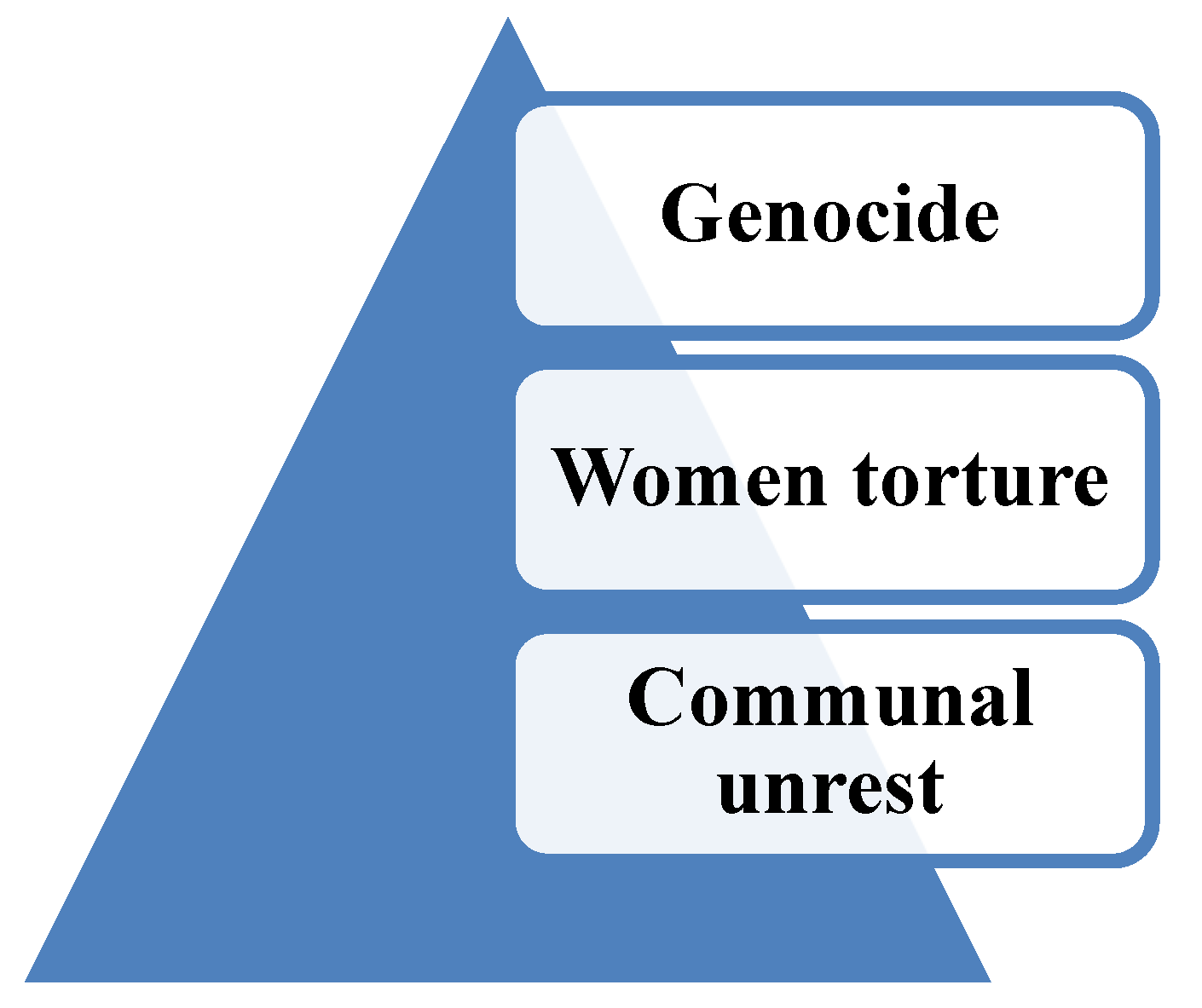
Genocide
Economic inequality and political unrest were major reasons that led to the emergence of hate campaigns and the demand for separate autonomy of Bangladesh. This protest has forced the military troops of West Pakistan to be involved in the mass killing of Hindu Bengali-speaking Muslims of East Pakistan. In the words of Zhang et al. (2021), estimation highlights that during the onset of war around 3 million common people were killed brutally, and around 1.5 million Bengali Muslims were displaced illegally from Bangladesh to India. During the end of 1971 more than 10 million Bengali Muslims migrated to India and stayed in refugee camps. The duration of military troop installation was 9 months in Bangladesh and Indian support escalated the Indo-Pakistani war for 13 days. Genocide and mass killing of Bengali Muslims created major turmoil and political unrest.
Women Torture
The war for freedom caused rape and sexual harassment for Bengali Muslim women living in Bangladesh. During the time frame of 9 months around 200000 women were raped and approximately 400000 women were gang-raped and murdered during the onset of war (Milovanovic and Smutka, 2018). Women’s torture and child abduction increased largely and have created a major impact on the social lifestyles of people. Many girl children were killed for protection against sexual humiliation and have triggered the hate campaign and protest to another extent.
Communal Unrest
Nationalization of Urdu speaking the language without consent from East Pakistani citizens created mass hostility among Bengali speaking and Urdu speaking Muslims. Many Hindu Muslims were directly attacked and culturally discriminated against during the onset of 9 months of military war. Biswas et al. (2021) stated that communal harmony was oversized and regional turmoil took over the economical and socio-political stability. Sheikh Mujibur Rahman the leader of the Awami League demanded separate autonomy against the economic inequality and linguistic disparity. Awami League headed the freedom movement of Bangladesh for creating a free and effective environment for living.
Strategies to Mitigate Challenges of Hate Campaign During Liberation War
The rising hatred and turmoil among common citizens could have been mitigated through government participation in analyzing the issues faced by East Pakistan. Activities like genocide, mass murder, and women torture could be controlled through peaceful negotiations and not involving military troops to stop protest and demand for autonomy. In the words of Alamgir et al. (2020) peaceful negotiation among the ruling party of East Pakistan and the central government could have eased the entire hostile circumstance. Equality of industrialization and return from trade was another important aspect for synchronizing development among all the provinces.
Figure 3.
Strategies to mitigate challenges of hate campaign during Liberation War. (Source: Self Developed).
Figure 3.
Strategies to mitigate challenges of hate campaign during Liberation War. (Source: Self Developed).
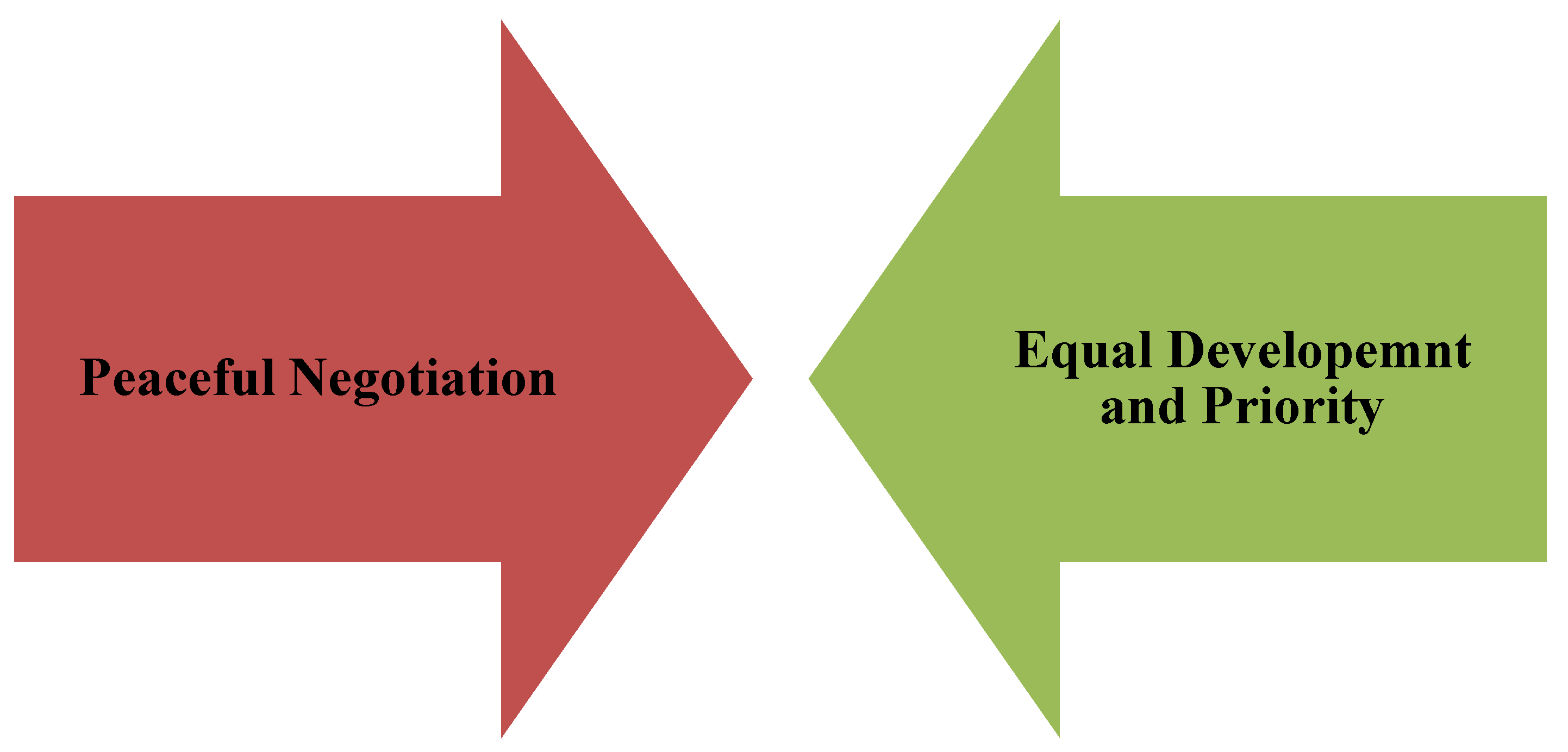
Unequal distribution of cash and poor maintenance of fabric industries caused issues such as unemployment and lack of self-sufficiency. The population size of Bangladesh was more than that of West Pakistan, yet their voice and opinions were counted as a minority. This disparity among citizens living in West and East Pakistan has generated war against the linguistic and economical freedom of both states. However, equal budget location for development and peaceful negotiations were important aspects for communal harmony and avoiding genocide and women torture. On the contrary, Zhang et al. (2021) argued that avoiding war in the wake of the “Bhola Cyclone” outbreak is referred to as an effective way for avoiding the emergence of hate campaigns and communal war backed by military troops.
Method
In this research, interpretive research philosophy is being adopted for collecting information based on the hate campaign of the Liberation War of Bangladesh. Different incidents such as outsourcing of resources, nationalization of Urdu, low distribution of export return, lack of industrialization, and treating Bengali Muslims as minors were major reasons behind the onset of war. Xiao et al. (2019) stated that interpretative research philosophy is beneficial in drawing a link between different research variables such as factors, challenges, and strategies in correlation with research questions. In this research different political and economic aspects that triggered the hate campaign of the Liberation War in Bangladesh are analyzed critically using interpretive research philosophy. Descriptive research design is also adopted in this research for framing the argumentative analysis of the authors on the Freedom War of Bangladesh in the year 1971 and how the hate campaign affected the livelihood of normal people.
Different challenges of liberation war such as women’s torture, rape, genocide, unemployment, and economical exploitation were analyzed critically using a descriptive research approach. Positivism research philosophy and explanatory research design are not adopted in this research as surveys or interviews are not being conducted among a specific sample size. Graphical representations of data are also not done in the research and therefore explanatory research design is not conducted for analyzing different research objectives. The qualitative research method is conducted in this research for gathering information based on different research approaches such as deductive for understanding the concept of hate campaign during the freedom war of independence of Bangladesh against West Pakistan. However, quantitative research approaches are not being adopted in this research as primary research approaches are not being adopted. Practical experiences of citizens during the onset of the war are not intervened through interviews or surveys and only different secondary sources of data and information are being previewed for conducting analysis.
As opined by Duda et al. (2019) qualitative research analysis is beneficial in drafting literature reviews based on argumentative discussions of different authors of journals and scholars. Thus, a qualitative research method is being adopted for analyzing the challenges and factors affecting the onset of the Liberation War in Bangladesh in the fiscal year 1971 along with the hate campaign. The secondary method of data collection is being adopted in this research for evaluating data collected from journals, articles, books, official websites, magazines, and newspapers. Secondary research approach and thematic analysis are being done based on the concept of the Liberation war of Bangladesh and different ways the war triggered hate campaigns. Factors affecting the onset of war such as nationalization of language and poor economic growth are analyzed critically in this research. The concept of liberalization and onset of wars are analyzed using secondary data collection methods and thematic analysis for understanding the effect of war and its political and economic hostility.
Result of Studies
Case Study 1: GOVERNMENT of Bangladesh Warn Tough Actions Against Mob to Vandalize on Durga Puja Celebrations
As per news published on “United News of India” government of Bangladesh had provided warning of taking tough actions against Islamic mob of making vandalism at different pandal’s of Durga Puja as well as in temples in Cumilla. As per this case study, Home Minister Asaduzzaman Khan reported to authority for tracking down people who are responsible for spreading communal hatred in Cumilla situated in Chittagong subdivision. In this incident, different religious fanatics shared photos and videos on social media platforms based on an incident where Quran was allegedly besmirched. In addition, these religious fanatics called Muslim people to attack Hindus when a celebration of Durga Puja was going on. As per a report, mobs attack temples and was known to vandalize pandal of Durga puja and was also reported to smash idols in many places.
The “Hajijang Health based complex” in Chandpur received dead bodies of 3 people and he believed these people have died with a violent crash against police as it was reported by a doctor ‘Sultan Mahmud, who was on duty during Durga puja. In this scenario, police did not confirm death of three people was linked to violence. Clashes erupted after police tried from stopping assailants that were estimated to attack temple. Based on information gained from witnesses’ police has opened fire in this scenario. In order to get solution police officers are trying their best in order to keep situation under control. As per Harunur Rashid chief of Hajijang based police station, different attackers responsible for this situation will be identified and legal actions against them will be undertaken.
In this scenario government of Bangladesh banned assembly in areas of occurring violence and they enforced tightened security within deployment of “Border Guards Bangladesh Troops”. According to information gained from a case study, Cumilla authorities was successful in deploying different border guards as well as police authority with sole purpose of maintaining both law and order after clashes. Shibu Prasad Dutta who was General Secretary of “ Cumilla Mahanagar Puja Udjapon Committee” reported that some people placed a copy of Quran in a pavilion where Durga puja celebration was held. Quran has placed in Durga Puja pandal in early morning when a guard was asleep. In this scenario, both photos and videos of Quran were swirling on platforms of social media within 6 am on same day. Owing to occurrence of this incident, this matter was being reported to a chief member of local police through dialing 999 national helpline number. After receiving complaints police officer successful recovered Quran from pandals of Durga Puja celebration.
An emergency notice which was noticed later in same day as per a report published by a religious-based affair minister said that central religious text of Islam was disrespected in Camilla. According to telecom minister “ Mustafa Jabbar” reported that varied steps were being undertaken for taking down posts on social media channel Facebook. Tension was estimated to be simmered after photos of Quran placed at temple began to be circulated. Apart from that, many online activists questioned authority of occurring this incident that resulted in calling for calm and criticizing Facebook along with different authorizes of Bangladesh for failing to take down varied posts. In addition, as per telecom minister authority was successfully maintaining communication with different Facebook authorities after noticing that posts were given on Facebook. In addition, these authorities had requested for removal of more than 100 different links and they also hoped that they will block it within some period.
Authority also reported that government of Bangladesh will tend to limit access to internet in Cumilla with major purpose and sole objectives of stopping any disinformation-based campaign. In addition, governmental agencies took varied steps with aim of removing posts not only from Facebook rather from another platform on social media.
Nationalization of Urdu Speaking Language and Hate Campaign Unequal Distribution of Cash Is the Major Reason Behind the Onset of War
Mohamad Ali Jinha, then Prime Minister of Pakistan, declared Urdu as an official language in the year 1970 without proper consultation, without any consultation of the regional ruling party of Bangladesh. This declaration created hostility among Bengali Muslims even after being a majority community their opinions were treated as a minority and this created a major political turmoil. Further East Pakistan alone contributed to 70% of exports and in return, it only generated 25% of the cash inflow. Estimation highlights that around 2.6 billion dollars of natural resources are being outsourced from Bangladesh to West Pakistan for up-gradation of trade. Being a province within the majority of Bengali Islam their political and economic opinions were treated as the minority (Turza, 2021). The Fabric Mills of West Pakistan increased from 9 to 150 whereas that in East Pakistan was very slow from 11 to 26 after the financial year 1947. This improper promotion of industrialization and distribution of economical return has created agitation of masses against the central government. Thus, the leader of the Awami League Sikh Rahman Mujib backed the liberation movement of Bangladesh demanding autonomy from Pakistan province and emerging as an isolated nation-state. This demand encouraged the central government to install military forces against the need of mass and resulted in the outbreak of hate campaigns such as genocide, women torture, and communal unrest.
Case Study 2: Social Media Channel Facebook Formed Partners with Asia Foundation for Different New Tools with Aim of Combating Online Haters Intolerance
The Resiliency Initiative was successful in launching a partnership with “Asia Foundation” aim at promoting intolerance, strengthening interfaith, inter-ethnic level of understanding along with counter-extremism (Newindianexpress.com, 2021). According to Facebook on 3rd June in financial year 2021 was successful in launching “ The Resilience Initiative” based website that in turn aim at providing both tools and resources towards combating hate along with intolerance at online sites. Community centered initiative initiated with 60 different workshops for different organizations from Bangladesh, India and Myanmar.
Figure 4.
Analysis of Resiliency Initiatives. (Source: Resiliencyinitiative.org, 2021).
Specified initiative was regarded as one of flagship programs that are being incorporated for addressing both hate and violent extremism. In second half of financial year 2021, specified initiative aims at working with a civil society-based business organization in Asia Pacific. It also aims at building our varied social resilience-based campaign that will aim at combating hate online. In addition, “ The Resilience Initiative” also aim at expanding reach of programs into varied new communities within a region in long term.
Hate Campaign Against the Liberation War of Bangladesh, Genocide and Mass Killing
Genocide of Bengali Muslims and mass rape of women are two brutal incidents that took place during the onset of the Liberation War. According to estimation, around 3 million people were brutally killed by the Army backed by Pakistani Militants, and almost 200000 women were raped and 400000 girls were gang-raped and murdered during the incident of 9 months of prolonged war. In March 1971 almost 1.5 million Hindu Muslims were secretly displaced to India for avoiding mass lynching and sexual harassment of women. The analysis highlights that around 10 million Hindus residing in Bangladesh fled to India for protection against mob lynching. The war resulted in providing separate autonomy to Bangladesh headed by the government of the Awami League.
Case Study 3: Social Media Platform Facebook Block Two Groups over Hacking Allegations
Facebook was known to block two non-profit based organizations in Bangladesh over allegations of targeting activists, different journalists along minorities. These people were targeted by hacking into their online-based content along with disseminating fictitious sources of information and security officials within company.
Giant of social media identified the nonprofit based organization as “Don’s team”. This Don’s team along with CRAF formed a collaboration to report people on a Facebook channel for fictitious violations of different community-based standards.
Based on above figure it can be demonstrated that activists demonstrate a day after police were estimated to shoot Muslims residing in Bangladesh in context of protesting messages on Facebook. These messages on Facebook resulted in allegedly defaming Prophet Mohammed on 21st October in financial year 2019.
The war was also dominated by legal aspects, Sheikh Mujibur Rahman won a clear majority of 160 seats yet Zulfikar Ali Bhutto then chairman of Pakistan did not allow him to become the Prime Minister and as a result, the war escalated making the entire situation more hostile (Lindsay et al. 2020). Thus, political along with economical influence cultivated the war of linguistic integrity and freedom against oppression in Bangladesh. Bangladesh managed to attain victory even after poor economic conditions during the “Bhola Cyclone” that took a toll of over 500000 lives. Thus, genocide and mass killing were mainly caused due to different political and legal turmoil such as economic distress, lack of industrial development in the fifth province, nationalization of Urdu, and restriction in allowing the Awami League to rule the nation.
Conclusions
Independence war of freedom against the Colonial Government gave rise to two nation-states India and East and West Pakistan separated by 100 miles of the landmass in between. After the 1970 election Sheikh Mujibur Rahman won a clear majority by winning 160 seats, however, Zulfikar Ali Bhutto then chairman of Bangladesh did not allow Awami League to become the ruling government and this burnt the fire of agitation and protest among the masses under the democratic pattern of Pakistan. Declaration of Urdu as a national language in the same year by Mohammad Ali Jinha without consultation with citizens of East Pakistan further created hostility among citizens. Bangladesh alone generated 70% of export income for Pakistan and in turn, it generated only 25% of cash from West Pakistan. West Pakistan focused on the rapid development of Fabric Mills and soon increased the number from 9 to 150 however the growth of industries was marked slow in Bangladesh with the operation of 11 to 26 mills. Resources of 2.6 billion dollars were outsourced to West Pakistan for effective growth and development. Thus, constant economic, political and social exploitation of Bangladeshi Muslims generated a demand for acquiring autonomy and resulted in the outbreak of hat campaigns such as genocide, lynching and communal riots.
References
- Alamgir, M.S., Furuya, J., Kobayashi, S., Mostafiz, R.B. and Ahmed, M.R., Farm income, inequality, and poverty among farm families of a flood-prone area in Bangladesh: Climate change vulnerability assessment. GeoJournal, 2020. pp.1-25.
- Biswas, B., Mallick, B., Roy, A. and Sultana, Z., Impact of agriculture extension services on technical efficiency of rural paddy farmers in southwest Bangladesh. Environmental Challenges, 5, 2021., p.100261.
- Ahmed, B., Sammonds, P., Saville, N.M., Le Masson, V., Suri, K., Bhat, G.M., Hakhoo, N., Jolden, T., Hussain, G., Wangmo, K. and Thusu, B., Indigenous mountain people’s risk perception to environmental hazards in border conflict areas. International journal of disaster risk reduction, 35, 2019. p.101063.
- Benarnews.org. Bangladesh: Facebook Blocks 2 Groups over Hacking Allegations, 2019. Available online: https://www.benarnews.org/english/news/bengali/facebook-action-12112020160712.html (accessed on 22 September 2021).
- Alam, G.M. Alam, G.M., 2021. Does online technology provide sustainable HE or aggravate diploma disease? Evidence from Bangladesh—a comparison of conditions before and during COVID-19. Technology in Society, 66, p.101677.
- Zhang, G., Nuruzzaman, M. and Su, B., “Nexus between household energy consumption and economic growth in Bangladesh” (1975–2018). Energy Policy, 156, 2021. p.112420.
- Hasnat, I. and Steyn, E., Toward a “Beautiful Bangladesh”: the bleed-over effect of tourism advertising. Place Branding and Public Diplomacy, 16(2), 2020. pp.165-173.
- Bremner, L., Sedimentary logics and the Rohingya refugee camps in Bangladesh. Political Geography, 77, 2020. p.102109.
- Kuddus, M.A. and Rahman, A., Modeling and Analysis of Human-mosquito malaria transmission dynamics in Bangladesh. Mathematics and Computers in Simulation, 2021.
- Siddiqi, M.A., Giggins, H. and Gajendran, T., International principles of disaster risk reduction informing NGOs strategyies for community based DRR mainstreaming: The Bangladesh context. International Journal of Disaster Risk Reduction, 48, 2020, p.101580.
- Mujeri, M.K. and Mujeri, N., 2021. Structural Transformation in South Asia: An Overview. Structural Transformation of Bangladesh Economy, pp.45-88.
- Newindianexpress.com. (2021). Facebook partners Asia Foundation for new tools to combat online hate, intolerance. Available online: https://www.newindianexpress.com/business/2021/jun/03/facebook-partners-asia-foundation-for-new-tools-to-combat-online-hate-intolerance-2311291.html (accessed on 22 September 2021).
- Resiliencyinitiative.org. (2021). Combating Hate and Intolerance Through Social Media. Available online: https://resiliencyinitiative.org/about/ (accessed on 22 September 2021).
- Talukdar, S. and Pal, S., Modeling flood plain wetland transformation in consequences of flow alteration in Punarbhabariver in India and Bangladesh. Journal of Cleaner Production, 261, 2020. p.120767.
- Turza, A.I.B., Sustainable Urban Form and Dynamics of Rivers in the Context of Faridpur City, Bangladesh.In Resilient and Responsible Smart Cities 2021. pp. 243-254. Springer, Cham.
- Uniindia.com. (2021). Bangladesh Government warns of tough actions after mob vandaliseDurga Puja celebration in Cumilla. Available online: http://www.uniindia.com/~/bangladesh-govt-warns-of-tough-action-after-mobs-vandalise-durga-puja-celebrations-in-cumilla/World/news/2533369.html (accessed on 22 September 2021).
- Milovanovic, V. and Smutka, L., Cooperative rice farming within rural Bangladesh. Journal of Co-operative Organization and Management, 6 (1), 2018, pp. 11-19.
Disclaimer/Publisher’s Note: The statements, opinions and data contained in all publications are solely those of the individual author(s) and contributor(s) and not of MDPI and/or the editor(s). MDPI and/or the editor(s) disclaim responsibility for any injury to people or property resulting from any ideas, methods, instructions or products referred to in the content. |
© 2025 by the author. Licensee MDPI, Basel, Switzerland. This article is an open access article distributed under the terms and conditions of the Creative Commons Attribution (CC BY) license (https://creativecommons.org/licenses/by/4.0/).
Copyright: This open access article is published under a Creative Commons CC BY 4.0 license, which permit the free download, distribution, and reuse, provided that the author and preprint are cited in any reuse.


