

Submitted:
07 July 2024
Posted:
08 July 2024
You are already at the latest version
Abstract
Land degradation, desertification and tree mortality related to global climate change are in the spotlight of Remote Sensing research in recent decades, since extreme climatic events could affect the composition, structure and biogeography of forests. However, the complexity of tree mortality processes requires a holistic approach. Herein, we present the first global assessment and a historical perspective of tree mortality by reviewing both Remote Sensing and ground-based studies. We compiled 254 papers on tree mortality that make use of remotely sensed products, ground-based monitoring and climatic drivers, focusing on their spatial and temporal patterns, in the methods applied, while highlighting research gaps. Forested ecosystems, especially in the Mediterranean area, appear to have experienced often climatic-induced physiological stress under extreme droughts and warming, raising concern that forests may become increasingly vulnerable to tree mortality. Our core results indicated that international publications on tree mortality are on the increase with the main hotspots being North America (39%) and Europe (26%). Wetness indicators appear as the barometer in explaining tree mortality on a local scale, while vegetation indicators derived from multispectral optical sensors are promising for large scale assessment. We observed that almost all of the studies we have reviewed were based on less than 25 years of data and were of local scale. Longer timeframes and regional scale investigations that will include multiple tree species analysis could have a significant impact on future research.
Keywords:
tree mortality
; land degradation
; desertification
; Remote Sensing
; meteorology
; review
; Earth Observation
; climate change
1. Introduction
1.1. Drought Relevance with Tree Mortality
The frequency with which climate change is exerting pressure on ecosystems and the living environment constitutes a major threat towards sustaining natural resources in the future. According to the World Meteorological Organization, global temperature projections for the next five years suggest an increase by about 1.5°C, with a 40% chance [1]. Nevertheless, this reduction of the predicted average warming of 1.5°C from the initially assumed increase of 2.0°C will be very beneficial for the ecosystems, reducing stress and maintaining their balance [2]. Under further warming, forest decline may accelerate in many regions due to a concurrent increase in water deficit. Hence, water shortage and drought may reduce tree productivity and affect forest ecosystems [3]. Drought is a major factor that influences vegetation [4], while related pests and pathogens that can grow on weak trees can inevitably lead to tree mortality.
Furthermore, natural processes and intensive human activity can cause the reduction of plant cover, loss of soil and organic matter, as well as increases in run-off [5,6]. The decrease of vegetation coverage can lead to land degradation and even to desertification of dryland ecosystems [7].
One of the key challenges is to understand and predict changes that may be abrupt, nonlinear and irreversible [8]. These changes are hereafter referred to as “critical transitions”. Critical transitions are experienced when an ecosystem loses its resilience due to sudden drastic changes such as lake eutrophication or land desertification [9]. In view of the above, various studies investigate the response of forests under extreme droughts and/or high temperatures, that increase the rate of tree mortality, which have a high probability of occurrence in several forest regions, such as Southern Europe and Western North America [10].
The common causes of the aforementioned challenges are high temperatures and water limitations. Water limitations primarily impact four biome types: (i) savannas, (ii) conifer forests and the Mediterranean woodlands, (iii) temperate evergreen and deciduous forests, and (iv) evergreen broadleaved tropical forests [10]. Prior to tree mortality related to extreme drought, severely-delayed or even difficult to detect phenological cycles can be observed in dryland ecosystems [11].
Uncertainty remains on when and how extreme climatic events will trigger tree mortality. Analyses and investigations from empirical observations are limited and real-world studies are rare [12]. Continuous observations are key in monitoring environmental variables. Observational limitations lead to difficulties in measuring long-term variables related to high-frequency time series.
1.2. Efforts in Satellite Earth Observation and Meteorological Monitoring of Tree Mortality
Assessment of desertification is based on three methodological approaches: expert judgment, satellite observation of net primary productivity, and use of biophysical models, that when combined provide a holistic contemplation of desertification and land degradation; none of these alone can capture the full picture [13]. In parallel, meteorological monitoring of air temperature and precipitation through ground-based stations, leading to drought, is essential to assess short-term weather events and long- term climatic evolution to evaluate atmospheric and climate change processes [14]. For this reason, station networks maximize the understanding of various environments [15] and abrupt changes [16] related to tree mortality. However, individual meteorological stations cannot provide an adequate analysis on spatial and temporal variability over an area [15]. Remote Sensing observations, on the other hand, with high temporal resolution can provide major datasets for retrieving appropriate indicators to assess critical transitions through the years [8]. Sensitivity of a region on desertification can be assessed with several methods. Today, with the advancement of Remote Sensing technology, it is possible to investigate desertification using a large number of parameters [17]. Using remote sensing to assess land degradation could provide us with a plethora of advantages such as long-term high-resolution observations, responses of vegetation under human pressure and environmental disturbances, low cost, greater spatiotemporal analysis, continuous update and ease in availability of data. Earth Observation (EO) [for a complete list of all the acronyms and abbreviations, the reader is referred to the Appendix] has the potential to monitor long-term dynamics of complex ecosystems in real time, such as abrupt changes. Remote Sensing provides a global coverage of continuous, daily or near daily monitoring, in contrast with ground-based measurements. The utilization of thermal, multispectral and microwave Remote Sensing could effectively characterize the spatiotemporal characteristics of drought conditions. It is important to note that, a number of space-borne sensors can illustrate longer drought events due to longer-term availability of continuous high-resolution imagery, such as the Landsat sensor operating since 1984 [18]. Other multispectral optical sensors can be used effectively to monitor greenness, tree mortality and density of vegetated areas, such as the Advanced Very High-Resolution Radiometer (AVHRR), Moderate Resolution Imaging Spectroradiometer (MODIS) and Sentinel-2 [19].
The major constraint of various sensors, such as of multispectral Landsat, is the low revisit time and data gaps due to cloud coverage. The launch in 2015 of Sentinel-2 with 10m spatial resolution and revisit time every 10 days, allows for an efficient analysis of drought [20]. Also, various sensors provide other opportunities, such the multispectral imagery of MODIS and NOAA-AVHRR, with low spatial resolution (250m to 1km), but with higher temporal resolution, up to twice daily [21,22].
Apart from multispectral and thermal sensors, microwave sensors play a vital role in drought monitoring and assessment. In this respect, various sensors can observe atmospheric variables, such as ozone content, precipitation (e.g., Global Precipitation Measurement Mission - GPM) and soil moisture by the Soil Moisture Active and Passive (SMAP) mission. These sensors can penetrate through cloud cover, haze and dust in near real-time with a global coverage [23]. The recent advancements in space technology could provide us with a holistic approach to monitor drought and climate change, understanding and predicting the response of forest ecosystems and even that of tree mortality. It is a fact that global coverage of inaccessible areas and frequent monitoring with near-real-time measurements of temperature, precipitation and soil moisture through Remote Sensing relative to ground-based measurements could improve the data records of drought and desertification monitoring. It is noteworthy that the utilization of the online platform of Google Earth Engine makes the processing of vast cloud-based datasets possible, in order to characterize and assess drought and desertification events [24,25,26]. Nonetheless, integrating ground-based measurements of meteorological variables with data from Remote Sensing technologies [27], such as radar and LiDAR, makes detecting various environmental anomalies and changes more tangible [28].
In conclusion, ground-based monitoring may serve as a method for measuring data in real time and for field screening of a specific area [29]. Ground-based monitoring of meteorological parameters including temperature and precipitation may be used to fill in gaps in Remotely Sensed data due to cloud cover, haze or dust. The data collection was affected since their widespread establishment of meteorological stations in the early 20th century, and more extensively since the 1950s, in advancing our understanding of climate and weather patterns. Tracking climate changes, forecasting weather and developing models predicting future conditions provide invaluable long-term records. They can offer a trustworthy record of environmental changes on a local scale [15], whereas Remote Sensing can be more efficient only in areas with low vegetation cover, (e.g., to measure parameters such as humidity [16]).
1.3. The Objectives and Structure of This Review
In this comprehensive review, our analysis encompasses 254 scientific articles, with a focus on tree mortality due to drought, including 206 studies employing Remote Sensing and 48 utilizing ground-based meteorological monitoring. We explore the historical development of the field of Remote Sensing and identify global tree mortality research hotspots. The review also offers a thorough exploration of tree mortality monitoring methods and processes by using indicators and their spatiotemporal resolution/scale, while identifying associated shortcomings and gaps, based on which future research directions are proposed. Subsequently, we address key research questions, exploring the historical development of the field, identifying tree mortality hotspots, examining spatial and temporal scales, detailing sensor usage, elucidating methods for understanding tree mortality, discerning prevalent indicators, and highlighting predominant research focuses. To enrich our capacity to identify trends in tree mortality, we discuss identified gaps and propose future research directions.
2. Materials and Methods
For our analysis, we used the digital database of Web of Science including Science Citation Index (SCI) (last accessed on 16th October 2023). A systematic review assesses the progress of tree/forest mortality research papers globally based on EO and ground-based ones. Figure 1a illustrates the workflow adopted, resulting in n=254 peer reviewed publications [the list of References does not cover all the papers used in the current analysis; instead, the complete list is given in the Supplementary material Table S1]. EO and ground-based studies are depicted as overlapping circles in Figure 1b. We incorporate the all-possible synonym terms with tree mortality by combining various groups of terms related to “remote sensing” and “meteorology”. The explanatory searching string is presented in Figure 1c.
We considered tree mortality studies that mentioned keywords such as “tree mortality”, “dieback,” or “die-off,” along with specific terms such as “meteorology,” “climatology,” “meteorological station” and “meteorological data” or any term starting with “meteorolog*” and “climatalo*”. For studies related to EO, we included those mentioning words such as “remote sensing,” “aerial imagery,” “RS,” “earth observation,” “EO,” or “mapping”.
Using these specific search criteria, our initial query generated more than 18,000 results. To narrow down the scope to publications with a focus on climatic-induced tree mortality, we refined the search by including the terms such as “drought,” “desertification,”, “climate change,” and terms beginning with “resilien*” and “disaster*” in the search string. This adjustment resulted in a more manageable set of 838 results (Figure 1b). Moving ahead, we employed the subsequent search string shown in Figure 1c to analyze publications that matched with our scope.
Here, TS means “topic”. Publications are taken into consideration if they are focused on the topic, peer reviewed and keywords appear in its title, abstract and/or keyword of a given paper, whereas, AND and OR are Boolean conditions to formulate the search. In light of the above, the returned total combinations is n=845. Finally, we removed all duplicate articles, and we manually filtered each article and selected papers that focused on tree mortality under EO and meteorological monitoring. In this filtering stage, we selected results that meet all search terms and additional filters applied so far, while specifically addressing tree mortality. In a second step, we eliminated any publications that remained but did not align with our scope with focus on: “insects”, “pathogens”, “deforestation”, “fire”, “beetle”, “human-induced”, “fertilizers” or ”grazing”.
We narrowed our focus to English-language papers, resulting in the exclusion of five publications. From the beginning, we refined our search by restricting accepted document types to review papers, ensuring that the selected publications underwent peer review scrutiny. Subsequently, we conducted manual filtering of the remaining publications based on full text/topic (n = 838), identifying and excluding results that did not match our thematic focus, despite meeting all search terms and other filter criteria up to that point. In this final filtering step, only studies focusing on the combination of tree mortality, Remote Sensing, climatic-induced tree mortality and meteorological monitoring were retained, while those lacking a focus on those fields were filtered out. Regarding tree mortality, our inclusion criteria encompassed specific tree species such as pine, oak, cedar, fir, spruce and beech.
We did not set a temporal frame for the publication year of the included publications, but the first publication that fit our search criteria was from 1993. However, the majority of included works have been published within the last fifteen years. Taking the above into consideration, we finally reviewed a total of 254 research articles. Each publication was categorized into groups. Given the plethora of variables in this systematic review we produce the graphs and tables presented in Section 3. Table 1 displays a list of 20 variables relevant to this review.
3. Results
Firstly, we expose the spatial distribution of papers based on Remote Sensing and on meteorological parameters over time and their global distribution. Then, we present the spatial distribution of meteorological drought indicators, biomes monitored, type of sensors used, as well as the methods and indicators of Remote Sensing and the ground-based meteorological monitoring applied.
3.1. Tree Mortality Studies over Time
Tree mortality papers appear to increase over the years (Figure 2). The first pioneer study on tree mortality monitoring related to frequent drought events appeared for patches of California Cuyamaca State Park in 1993 [30]. A few peer-reviewed articles appear until 2009 with data gaps in 1998-2002, 2006 and 2008. Figure 2 depicts an increasing trend starting from 2010 in the number of published research articles, peaking in 2021.
The significant increase in tree mortality papers is mostly due to Remote Sensing-based publications, whereas publications based on meteorological parameters remain relatively stable (ca. 2 to 6 per year). In 2021, publications of Remote Sensing measurements peaked, with 29 articles, while meteorological-based publications peaked in 2022, with six articles.
3.2. Spatial Distribution of Reviewed Research Articles
The hotspots of tree mortality publications applying Remote Sensing or using ground-based meteorological indicators are shown in Figure 3a and Figure 3b, respectively. Various areas of interest (AOI) are counted separately visualizing all research articles per country. Emphasizing this, some studies have multiple AOI. Each country contains the respective number of AOI of tree mortality. In these figures, the classification was performed using five Jenks Natural Breaks clusters to underline the most significant AOI, but also contains the lowest counters, spotting the differences between the countries and regions.
Remotely Sensed tree mortality research studies are more frequently in the United States of America (65) followed by the Spain (16), China (13), Australia (9), Canada (9), Italy (7) and Germany (6). The five major hotspots in the United States of America (USA) are California (31), New Mexico (7), Arizona (7), Colorado (6), Utah (4) and Texas (4). Dryland forests are a common characteristic of all five areas. Research activity in South America (i.e., 6) is concentrated in the Amazon basin. Research articles focusing on the European continent amount to 54.
Ground-based meteorological research studies on tree mortality have been conducted in the USA (13), in Spain (7), in Greece (3), in Canada (3), in Germany (3) and in Switzerland (3). Based on Figure 3a,b and Figure 4, 11 papers using Remotely Sensed and meteorological drought indicators focus on Mediterranean Basin forests. Furthermore, a few papers have been conducted in Africa (with only five based on Remote Sensing and one using meteorological parameters), while South America has just only one entry on based on Remote Sensing coming from Brazil.
Interestingly, the review revealed that only 61 ground-based meteorological research studies were combined with Remote Sensing data, to provide a more holistic approach in monitoring tree mortality. USA appears in one third of all research publications (72), using the two methods. The Amazonian Forest is less often investigated (7 studies overall), despite reports of severe drought events that increased tree mortality rates in the region [31].
To enable a better overview of articles on tree mortality under climatic water stress and high temperatures in forests, we focused on studies with respect to ground-based meteorological drought indicators only. To estimate the impact of climate on tree mortality papers globally, we grouped countries with research publications that include Potential Evapotranspiration (PET), Precipitation minus Potential Evapotranspiration (P-PET), Palmer Drought Severity Index (PDSI), Self-Calibrated Palmer Drought Severity Index (scPDSI), Standardized Precipitation Index (SPI), Standardized Precipitation-Evapotranspiration Index (SPEI), Actual Evapotranspiration (AET), as it is shown in Figure 4. Meteorological drought indicators are determined by the location of the country, the impact of climate and the number of cases of tree mortality per country. Figure 4, illustrates an increasing research interest in USA (37), Spain (13), followed by China (10), Canada, Germany and Russia with 6, respectively. Equally important is that studies with combined use of the PDSI, PET, SPI and Remote Sensing, are not recorded at the European level. The SPEI indicator was by far the most frequently used meteorological indicator, applied in roughly 49% of the papers published.
3.3. Temporal Scale and Spatial Resolution of Tree Mortality Publications
Drought and tree mortality research is increasingly available after the launch of the first Landsat program in 1972 which provided a plethora of multi-sensor products [23,32]. The timeframe adopted in each research article is shown in In Figure 5, separately for each of the two approaches (Remote Sensing and meteorological). The tree mortality study using meteorological indicators with the longest timeframe covers 100 years and was conducted in Switzerland [33]. The average time span of all tree mortality studies is approximately 39 years. Remote Sensing articles cover an average time span of about 11 years. Only three research publications based on meteorological monitoring are recorded before 2010, while, 57% of tree mortality articles based on Remote Sensing were published in the last five years.
The major interest of long-term tree mortality monitoring through Remote Sensing started in 2010. Noticeably, 42 tree mortality research papers cover a time span of over 20 years, out of 206 articles using Remote Sensing. For ground-based meteorological monitoring, there was only one study with a time span of 100 years, whereas, 30 papers out of 48 papers reviewed covered less than 50 years.
The spatial resolution and spatial extent utilized in the studies covered herein are depicted in Figure 6. Spatial extent is categorized based on three different scales: local, regional and global. The majority of tree mortality studies are deployed on a local scale.
Most research articles utilize high (≤10 m) or medium (≤100 m) spatial resolution, on mostly Landsat data, although, the temporal resolution of Landsat data is restrained by infrequent revisit times, gaps due to cloud presence, shadows or nighttime. In 2022, the time series used in studies of local scale had an average timeframe of about 13 years, while for the period 2010-2020 the average time series length was 9 years. Additionally, Landsat provides monthly times series due to its temporal resolution of 16 days [34,35,36,37,38], while MODIS provides daily time series due to its higher temporal resolution [39,40].
Taking all of the above into account, there appears to be a tendency for high spatial resolution studies to adopt low temporal resolution, while studies with low spatial resolution are associated with a longer time span analysis. In order to overcome temporal and spatial gaps, fusion of various data is pursued by combining Remote Sensing and ground- based meteorological monitoring. Adopting meteorological drought indicators with long time series and high spatial resolution could allow for a more realistic analysis [41], permitting an assessment of forest heath even for forest patches, when forest landscapes are heterogeneous. Collectively, there is need to link temperature and precipitation climatic drivers with broad scale Remote Sensing, to permit more accurate modeling simulations of drought stress responses in trees [41].
3.4. Earth Observation Sensors Distribution
This review identified 29 satellite sensors used in tree mortality studies. The spatial scale, the AOI and the time span of available data are the three major factors determining the choice of a particular sensor in monitoring tree mortality. In view of this, we categorized the various satellite sensors into three single-types: «active microwave», «passive microwave» and «optical». Considering also the multi-type sensors usage, three additional types are added: «optical and active microwave», «passive, thermal and optical microwave», and «passive microwave and optical». The percentages of each of these six categories of sensors used are illustrated in Figure 7a.
Landsat satellites were the most commonly used sensors for observing and characterizing tree mortality (31.0%), followed by MODIS (27%) and LiDAR (8.2%). Unmanned Aerial Vehicles (UAV), Sentinel-2 and Aerial Imagery sensors are ranked at 4th, 5th and 6th place, with a representation of 6.1%, 4.9% and 3.3%, respectively. Studies on AVHRR, QuickBird 1-2, Spectroradiometer, WorldView 2-3, and National Agriculture Imagery Program (NAIP) account to between 1% and 3%. The remaining active and passive microwave sensors’ usage have a very low contribution of less than 1% globally.
The major categories of satellite sensor types are divided into passive, active, optical and their combinations. Roughly, 88% of studies monitoring tree mortality used multispectral sensors. At the same time, active sensors were the least utilized, accounting for nearly 6.4% of total studies. An overwhelming number of studies used Landsat and MODIS as optical sensors with passive microwaves, while a considerable number of studies relied on active microwave sensors, namely LiDAR and UAVs. Utilizing sensors separately could potentially result in specific limitations that influence their usability. In light of the above, active sensors that are sensitive to the returning signal can be deployed to compensate for anomalies in topography at heterogenous/uneven areas [36,42]. Combined optical and active sensors, are less frequently used (3.9%). The combined use of passive and optical sensors and optical, passive and active microwave, provides opportunities for improved tree mortality monitoring, but accounts for only 0.5% of the reviewed studies.
3.5. Methods for Tree Mortality Analysis
Several Remote Sensing indicators have been developed and applied to analyze and characterize tree mortality events and assess their causes. These causes are frequently not attributable to a single factor, but to the interaction of biotic and abiotic factors. Bearing this in mind, the indicators reviewed are categorized as biotic and abiotic.
Figure 8 presents the various indicators extracted from Remote Sensing articles on tree mortality monitoring and assessment, since the first studies of tree mortality in 1993 and 1994 [30,43]. The Normalized Difference Vegetation Index (NDVI) is by far the most frequently used indicator to monitor tree mortality represented in 28% of the studies. A notable 9% of publications employ advanced techniques such as unsupervised classification as an approach based on natural patterns without using sample classes and supervised classification based on chosen samples to delineate tree mortality areas, followed by the Enhanced Vegetation Index (EVI, 6%).
The Normalized Difference Water Index (NDWI) is another frequently used indicator, used in nearly 4% of the studies; this indicator aims at monitoring the structure and biomass of trees affected by drought [30,44,45]. Noticeably, the Leaf Area Index (LAI) ranked in fifth with 3.4%. With 2.3% are the Normalized Difference Moisture Index (NDMI), Gross Primary Production (GPP) and Normalized Burn Ratio (NBR). LAI takes into account plant or canopy water content [46,47] and is useful in estimating forest density and mortality [48,49]. The remaining indicators are used less than 2.3% in the literature reviewed.
Associated with the Remote Sensing approach for understanding tree mortality, ground-based measurements appeared in various articles in an effort to deliver accurate information on tree mortality, such as vegetation, ground and soil data (moisture, biomass, tree diameter etc.). Apart from this, ground-based measurements vary in scale, accuracy and the application of the data that is obtained in specific locations, leading to gaps in the time series [50]. This approach is mostly based on expensive and limited data collections over large areas inducing issues with the spatial upscaling of the data.
Figure 9 exhibits the application of biotic (ground-based/in situ) variables in articles pertaining to Remote Sensing and meteorological indicators related to tree mortality. The variable with the largest share (15%) is the Diameter at Breast Height (DBH), portraying the available growing, basal area, biomass and carbon stock [51], followed by Tree Ring Width (TRW; 12%). Basal Area Increment (BAI), ranked in third place (8%), has been found to exhibit a strong connection to tree mortality [52]. Water potential of xylem, leaf or soil was used in 4% of the papers reviewed, as a robust indicator to monitor the response of plants to drought events; this indicator depicts the movement of water as for instance from roots to leaves, identifying critical levels or thresholds characterizing the vulnerability of forest biomes to droughts [53]. Other indicators are reported in less than 4% of the papers reviewed.
Abiotic indicators have an essential role in the analysis and characterization of tree mortality. As shown in Figure 9, the majority of studies utilize the meteorological drought indicator SPEI in roughly 15% of the cases. SPEI is a useful indicator in dry regions with high temperatures suffering from water losses through evapotranspiration [54]. Generally, SPEI and SPI indicators are similar, however the only difference is that SPI does not include temperature [55]. Topographic factors, PDSI and vapor pressure deficit (VPD) represented in 4% of the cases. PDSI can monitor the influence on tree growth by assessing combined effect of both temperature and precipitation [56], while VPD as an indicator to monitor plant water stress, is linked with stomatal water loss and carbon fixation during photosynthesis [57,58]. Lastly, indicators such as PET, SPI, ET, scPDSI, P-PETand AET are used in less than 4% of studies each.
3.6. Documented Cases of Drought and/or Heat-Induced Forest Mortality across Biomes
Most papers on drought and/or heat-induced forest mortality have been produced for the Mediterranean Forests, Woodlands & Scrub biome from the Mediterranean Basin and California (43) (Figure 10). California, known for its diverse landscapes and rich biodiversity, is facing a severe crisis of tree mortality, especially in its Mediterranean Forests, Woodlands & Scrub biome, as detailed in 28 publications. An immediate impact is noted in conifer species (13) such as pines or oaks. Considering this aspect, with 17 publications documenting also this issue in Spain, 10 of them referred to conifers.
The Temperate Broadleaf and Mixed Forests biome exhibits a large share of publications, mostly from Central Europe, Eastern USA and Eastern Asia/ China with 59 publications (Table 2). Substantial interest was demonstrated in evergreen dominated ecosystems of Temperate Conifer Forests biome (52). The exceptional biodiversity in Tropical and Subtropical Moist Broadleaf Forests has been explored in 25 publications. The Boreal Forests or Taiga, known for their resilience in cold climates and distinct coniferous forests, are represented in 20 publications.
Temperate Grasslands, Savannas and Shrublands were covered in 17 publications due their importance in their diverse plant communities. Crucial for understanding the adaptation to arid conditions, Deserts and Xeric Shrublands biome, account for 8 publications. Tropical and Subtropical Grasslands, Savannas and Scrublands are documented in 6 publications. The Tundra, characterized by its cold and treeless coverage expanses, and Tropical and Subtropical Coniferous Forests, each feature in 2 publications. This varied distribution highlights the unique ecological characteristics and research challenges of each biome.
3.7. Thematic Foci Analysis of the Remote Sensing and Meteorological Monitoring
The reviewed works were categorized based on the two methodological approaches: “Remote Sensing” and “Ground-Based”. We classified 254 publications into these two methods and further on, into specific subgroups (Figure 11). Some research publications focused on two or three types of methods/indicators. In Remote Sensing methods, the water response of trees related to mortality is monitored through: NDWI, Vegetation Optical Depth (VOD), Normalized Difference Infrared Index (NDII), Canopy Water Content (CWC), Relative Water Content (RWC) and Normalized Difference Moisture Index (NDMI) related to stem and leaves moisture content [59], thus categorized within the Water Content group. For the comprehensive table of all indicators used in this article, please see Supplementary materials Table S2.
3.7.1. Remote Sensing Sphere
The majority of the reviewed studies (81.1%) have been devoted to the analysis of Remote Sensing methods. The most prevalent subcategory within this group is the monitoring of the chlorophyll content in the canopy, thus indicating the level of photosynthetic activity or “greenness” (27%). The second larger thematic focus of the published articles utilized Random Forest Classification, analyzing stand density through optical imagery classification (11%). This method relies on high-resolution multispectral imagery in forest and heterogeneous areas to identify the occurrence and severity of tree mortality [60]. Since forest structure and tree characteristics could play a vital role in assessing mortality, some published articles apply LiDAR Remote Sensing (11%), to monitor forest distribution [45,61]. As a critical factor in understanding tree mortality, various studies indicate hydraulic failure and water stress utilizing Remote Sensing in 9% of observed cases. Another 9% focuses on the role of the environment and topography on tree mortality. For example, 90% of the south-facing slopes of Mount Gokurakujisann in Hiroshima, were reported to have been affected by an extreme drought event [62]. With a focus on environmental conditions, several studies highlighted the adverse impact of low soil moisture levels and, subsequent impacts on tree productivity (7%). It is noteworthy that forecasting models (6%) have been reported as a potential solution for the creation of early warning signals to protect vulnerable forest areas during periods of physiological stress and high risk of mortality [63,64].
3.7.2. Ground-Based Sphere
Ground-based meteorological indicators were used in (18.9%) of papers monitoring forest mortality (Figure 12). The most attention in studies was given to tree growth (44%) impacted by warming climate and decreasing precipitation. Various studies focused on water responses (11%) exploring growth and resilience levels as indicators of mortality risk [65]; 8% of reviewed studies focused on photosynthetic rate to indicate physiological stress. Soil moisture/water was monitored in 7% of studies, 6% focused on VPD and 4% on low precipitation. SPEI and SPI indicators have been used to evaluate the spatial and temporal characteristics of drought, while Evapotranspiration (ET), AET and PET indicators have been applied to estimate water loss resulting from soil surface evaporation and plant transpiration. 4% of reviewed studies focus on early warning signals as a tool for forest managers to prevent tree mortality.
3.7.3. Remote Sensing and Ground-Based Monitoring Scales
On the one hand, 83% of Remote Sensing studies focus on the forest scale. In certain instances, detailed observation of mortality is feasible using sensors like LiDAR and UAVs, but for short time series. Cluster or forest plot monitoring was performed in 8% of reviewed articles, while individual tree monitoring in 9%. On the other hand, 33% of papers using meteorological and even ground-based indicators focused on individual tree mortality, as such methods could provide more accurately individual tree mortality analysis, compared to the cluster or plot scale (17%). Forest-scale monitoring was observed in half of ground-based meteorological studies.
3.8. Geographical Distribution of Tree Mortality Research
3.8.1. North America
Most tree mortality publications were recorded in North America, adding up to 100 cases. Using Remote Sensing, most common tree mortality indicators/methods were NDVI and classification through Landsat and MODIS satellites, coupled with the influence of topography and NDWI indicator.
California produced the highest number of tree mortality papers [66]. In Sierra Nevada, scientists utilized the Random Forest algorithm to detect the presence and severity of tree mortality using the multispectral satellite time series of MODIS [60], while to assess biomass and carbon emissions, both ground-based meteorological indicators and Remotely Sensed measurements have been taken into account [67]. The PDSI indicator appeared often in USA, analyzing long-term drought periods thus providing a detailed soil moisture dataset, making it particularly relevant for agricultural and water resource management.
3.8.2. Europe
Half of meteorological studies focusing on European forests, investigate mortality events [68,69,70,71,72,73,74,75,76,77,78,79,80,81,82,83]. The majority of studies, not only in Southern Europe but also in Northern Europe, investigate the interactions between tree growth and climatic conditions [68,70,71,73,74,83]. Tree ring width and soil variables have been linked to drought meteorological indicators, such as SPEI [72,73,75,78,82,84,85,86,87], while the MODIS satellite has been used frequently to evaluate tree growth in Mediterranean holm oak forests [88]. Drought has been found to kill trees much faster than carbon starvation [89]. Stable isotopes δ13, δ18 have been used to access Water Use Efficiency (WUE) [70,85,90], while TRW, DBH and BAI are common indicators for growth conditions for papers from Spain [82]. In Portugal, satellite images from Sentinel-2 were utilized in order to map the damage from drought events [91]. Furthermore, NDVI has been used to investigate seasonal variations and changes in tree species phenology related to mortality events [92]. Prediction models are presented in fewer European Remote Sensing studies [93,94], and often focus on analyzing the hydraulic status [95,96,97,98,99,100,101,102,103,104].
3.8.3. South America
In south America, several studies focus on tree mortality in the Amazonian region, using Remote Sensing to monitor tree canopy loss through very high resolution (VHR) satellite imagery [105,106,107]. Remote Sensing studies from this continent utilize high resolution imagery from Landsat, Planet Dove and airborne LiDAR to detect tree loss and plant biomass which is responsible for carbon emissions [63,106,108,109].
In South America, there was less research interest on tree-water relations. However, the findings in the western Amazon show that water stress affected more than 70 million hectares of forest during the dry season of 2005, leading to canopy shrinkage and moisture deficit [107]. Scientists in southwestern America have also monitored consecutive droughts, to assess forest response in order to develop early warning signals, for predicting spatial distribution of mortality [63]. NDVI has been one of the most significant predictor indicators under logistic regression, especially utilizing high resolution satellite imagery [109]. In South America, few studies were recorded documenting the distribution of tree mortality.
3.8.4. Australia
In Australia, multi-year droughts have been observed. These have triggered widespread Eucalyptus, Pine and Fir mortality. The majority of studies focus on changes in tree structure and canopy, characterizing the observable stress symptoms [110,111,112]. Fewer studies concentrate mainly on water dynamics during drought. As hydraulic failure is experienced often, stomatal control and drought tolerance traits are considered [112]. With a focus on different species response, studies in the north Adelaide in South Australia analyzed eucalyptus species, utilizing topography, solar irradiance and airborne imagery, to understand the mechanisms of drought-related tree mortality [100,113,114].
3.8.5. Asia
Gradual changes in forest cover of Asia comprise the central point in many research articles. In Zagros Forest of Iran, a study aimed to evaluate the forest decline trend and associated factors through the application of remote sensing techniques during a six year period, between 2012-2017 [115]. In order to understand forest resilience, NDVI was used in studies focusing on stomatal and hydraulic traits between several species with growth affected by drought, [85,116]. Tree growth-climate relationship has been used to evaluate the spatial distribution of affected trees [117]. Furthermore, a study in northern Yunnan-Guizhou Plateau, in southwest China, investigated the response of tree growth under climate change by studying tree-ring cores [85]. With a focus on forest resilience and resistance, studies aimed to evaluate the feasibility of Remotely Sensed vegetation/drought indicators through comparisons of meteorological indicators [92]. Zang et al. [118] proposed and compared vegetation indicators to detect early dying process of the damaged tress.
4. Discussion
4.1. Discussion of the Review Results
This review represents the first comprehensive examination of climatic-induced tree mortality, identifying research gaps and highlighting the increasing trend due to the availability of open high-resolution satellite data [119,120]. A noticeable increase in the number of publications addressing tree mortality has been observed on a global scale in recent years. Most of the studies are concentrated in North America, followed by those in Europe. Notably, South America and Africa have received less attention in terms of Remote Sensing and meteorological monitoring studies. A key observation is that the timeframe length of European tree mortality studies is generally limited (10.3 years). Only 6 studies in Portugal, Hungary and Spain have utilized a Remote Sensing approach to investigate tree mortality, over a period exceeding 25 years. However, none conducted a holistic analysis comparing Remotely Sensed and meteorological drought indicators. Only one Spanish study combined five Remotely Sensed indicators with the drought meteorological indicator SPEI, utilizing 30m Landsat spatial resolution [93,103]. This study concluded that there is no significant relationship between land surface phenology and dieback. Nonetheless, wetness indicators showed greater responses than vegetation indicators, suggesting a potential early warning signal of tree mortality. Among the studies with the longest timeframes (over 35 years) are those in Tanzania (39 years), Canada (36 years), Spain (36 years), China (35 years) North America/California (35 years) and North America/Montana (35 years). However, only the case in California analyzed tree mortality using meteorological drought indicators such as PDSI, SPI, SPEI, along with only two Remotely Sensed indicators, namely, NDVI and NDMI [121].
Following this analysis, the discussion turns to the spatial resolution utilized. The most used spatial resolution ranges between 10m to 100m and 100m to 1000m. Most of the studies with a timeframe of 25 years are conducted mostly with local scale (18 studies). The long-term studies in Europe did not comprehensively monitor tree mortality, especially in specific species such as pine and oak. Given this, it is crucial that the tree mortality causes should be monitored linking them to meteorological drought indicators. Subsequently, the most frequently used sensor types are those providing data over longer timeframes. Optical sensors such as Landsat and MODIS are the primary data sources for monitoring and assessing tree mortality, followed by LiDAR which is an active sensor.
4.2. Analysis of Tree Mortality Indicators
There is an obvious trend favoring the use of Remote Sensing approaches, as visualized in Figure 8. The studies show an increasing interest in NDVI, optical imagery/classification and EVI as tools for assessing tree mortality, followed by the NDWI indicator. In 28% of the studies, NDVI is utilized to assess forest resilience and evaluate vegetation activity in response to climatic circumstances [122]. Despite this, the classification technique (9%) is adopted to detect the presence and severity of tree mortality [63]. Moreover, almost 6% of studies employ the EVI indicator to explore the connection between tree mortality and land surface phenology [93].
Beyond Remote Sensing, ground-based biotic observations can provide accurate measurements (i.e., tree height, biomass), but are generally limited to smaller study areas due monitoring constraints. As shown in the studies, the most common ground-based method is the DBH (15%), which documents smaller diameter trees (stems 0-10 cm diameter) under extreme climatic circumstances [123]. Equally important is the TRW (12%), which investigates the relationship between growth and climate [82], followed by BAI (8%), which helps to understand the growth and metabolic trend of trees.
Ground-based abiotic observations of meteorological-based studies often use the SPEI indicator (15%) as a pivotal tool to understand the causes of tree mortality. Topographic parameters evident with 4% providing valuable insights on landscape characteristics. PDSI is another key indicator (4%), estimating relative dryness by considering temperature and precipitation. It is important to note that VPD frequently appears in research publications (4%), monitoring transpiration and assessing the potential for further tree decline under drought.
4.3. Applicability and Research Gaps in Monitoring Tree Mortality
Regarding the application of tree mortality assessment of the two methods discussed in this review, it was found that Remote Sensing studies have a clear advantage in the spatiotemporal monitoring of tree mortality, through a comparative analysis of satellite image changes, while meteorological studies focus on growth and physiological responses. Still, the applicability of the above approaches is limited, and as a result the following gaps should be borne in mind:
- It is evident that some continents have limitations in their thematic focus and the application of indicators. Specifically, the analysis of Remotely Sensed thematic foci in Europe lacks detailed water response. There is a notable lack of European tree mortality research utilizing indicators like NDWI and SAVI, despite considerable interest. Furthermore, the LAI indicator is notably absent, except in studies from France and Spain. Additionally, Oceania shows a deficiency in Remotely Sensed indicators such as NDWI and LAI. Topographic variables are also poorly investigated in Remote Sensing studies. In the Mediterranean, elevation or slope are not comprehensively utilized.
- Despite the above, meteorological drought indicators provide a substantial amount of information on tree mortality timeseries, which exhibit considerable variation. Specifically, the PDSI drought indicator is not reported in studies for Europe, Oceania, and South America. Furthermore, the most frequently used meteorological indicator, SPEI, is not analyzed in South America and Oceania. Therefore, any comparison between meteorological and other monitoring methodologies must consider these factors to investigate tree mortality effectively and accurately.
- There is a significant gap in understanding species-specific responses to hydraulic failure or carbon starvation. Certain regions lack literature investigating the mortality of specific tree species using Remotely Sensed indicators, such as juniper and spruce in South America or Africa. It is important to note that due to their endemism, certain species remain beyond the scope of field studies, as evidenced by the lack of Remote Sensing and meteorological analyses.
5. Conclusions
In this paper, we present an extensive review of studies utilizing Remote Sensing and meteorological monitoring for tree mortality. This review offers a global perspective of tree mortality investigations by analyzing a total of 254 publications, focusing on spatial and temporal resolution, timeframe, sensors used, methods/indicators for tree mortality, thematic foci and sensor types. The review findings are briefly summarized below, in an attempt to provide answers to the research questions raised in Section 1.3.:
- Several peer-reviewed contributions have been reported since 1993. From 2009 onwards, a gradual increase is evident in tree mortality research activity. The major peak of the research activity was in 2021, with 35 publications.
- North America is a hotspot of research in tree mortality, with a 39% share, followed by Europe (29%). Specifically, USA (31%), Spain (7%), China (7%), Canada (4%) and Australia (4%) are the most frequently investigated areas using a Remote Sensing approach. Furthermore, meteorological monitoring studies are distributed as follows: USA (27%), Spain (15%), Greece, Canada, Switzerland and Germany (6%). It is evident that certain research areas are addressed using both methods. More publications from additional regions/countries may boost tree mortality research.
- Optical sensors are predominantly used, with Landsat and MODIS being the most popular ones, accounting for approximately 89%, followed by the active sensors with around 6%. Landsat data have been utilized in 31% of studies, while MODIS data in 27%. Furthermore, LiDAR has been used in 8% and UAVs in 6% of studies. Apart from this, there is a popularity in hybrid approaches combining optical and active sensors, accounting for roughly 4%.
- Roughly, 72% of the studies focused solely on the local scale, while those relying on the regional scale represent 24.5%. Global studies constituted 3.5% of the cases. Most Remote Sensing studies investigated tree mortality on the local scale with a timeframe of less than 25 years and with a spatial resolution of less than 100m. Equally important is the fact that regional scale studies often utilize spatial resolutions ranging between 10m and 100m (8%), followed by those with a spatial resolution of 100m to 1000m (11.9%). In contrast, local scale studies often utilize resolutions of 0-10m (26.4%), while resolutions of 10-100m are evident in merely 29.5% of the studies.
- Most remote sensing studies utilize NDVI as the primary indicator to identify tree mortality (28.2%). Subsequently, many cases utilize the classification/optical imagery methods or EVI indicator with 9% and 6.2%, respectively. The NDWI (3.6%) and LAI (3.4%) indicators were used in a significant number of studies in order to depict this situation. Ground-based biotic methods frequently used the DBH method (15%), while the TRW method is also commonly used (12%) to evaluate tree mortality. Similarly, studies assessing tree mortality focus on the role of the BAI method and tree water potential, accounting for 8% and 4% of the cases, respectively. Ground-based abiotic methods were mainly supported by SPEI drought indicator (15%), while aspect, elevation, slope and PDSI were adopted in 4% of studies. Another crucial aspect of meteorological monitoring is the response of the VPD indicator providing detailed information of drought events (4%).
- Lastly, studies are classified according to their thematic foci. Remote Sensing studies comprise 81.1%, while meteorological studies constitute 18.9%. Within the remote sensing sphere, studies often focus on foliage greenness (27%) due to the frequently used of indicators such as NDVI and EVI. As we mentioned above, analysis of stand density (11%) is also well reported in various studies using classification methods. Additionally, canopy and tree structure are highlighted to provide a comprehensive assessment (11%). Further, the assessment of tree water content has the potential to enhance analyses of tree mortality (9%). Also, meteorological studies often focus on the growth rate and the physiological responses of trees (44%), followed by responses to water content (11%). However, other meteorology-based studies exhibit a preference in analyzing the photosynthetic rate (8%). Several studies analyze the soil water balance (7%) and air humidity (6%). Further studies emphasize precipitation (4%), evapotranspiration (4%) and forecasting (4%).
This comprehensive review provides insights into tree mortality assessment based on Remotely Sensed and meteorological data, offering a global perspective. The methodologies and applications used in tree mortality studies have been illustrated. The limitations and strengths of the two approaches, namely meteorological-based and Remote Sensing-based, have been addressed, and research gaps have been noted, encouraging the contemplation of the remaining challenges in the study of tree mortality.
Supplementary Materials
The following are available online at Preprints.org. Table S1: Overview of Reviewed Publications on tree mortality; Table S2: Thematic foci and indicators.
Author Contributions
The authors’ contributions to this paper is as follows: conceptualization, F.E.; review search, F.E.; review analysis, F.E.; methodology, F.E, S.M, F.B and D.S; results, F.E, S.M, F.B and D.S; discussion, F.E, S.M, F.B and D.S; resources, F.E; data curation, F.E.; writing—original draft preparation, F.E, S.M, F.B and D.S; writing—review and editing, F.E, S.M, F.B, D.S and D.H; vizualisation, F.E.; supervision, F.B. and D.H.; project administration, D.H.; funding acquisition, D.H. All authors have read and agreed with the contents of this paper.
Funding
This research was funded by ‘EXCELSIOR’ project (European Union’s Horizon 2020 research and innovation programme), grant number “857510”.
Data Availability Statement
The source of the data used in this study is the Web of Science.
Acknowledgments
The authors acknowledge the “EXCELSIOR”: ERATOSTHENES: Excellence Research Centre for Earth Surveillance and Space-Based Monitoring of the Environment H2020 Widespread Teaming project (www.excelsior2020.eu, accessed on 1 July 2024). The “EXCELSIOR” project has received funding from the European Union’s Horizon 2020 Research and Innovation Programme under Grant Agreement No 857510, from the Government of the Republic of Cyprus through the Directorate General for the European Programmes, Coordination and Development and the Cyprus University of Technology.
Conflicts of Interest
The authors declare no conflict of interest.
Appendix
Acronyms and Abbreviations
| AET | Actual Evapotranspiration |
| AOI | Areas of Interest |
| AVHRR | Advanced Very High-Resolution Radiometer |
| BAI | Basal Area Increment |
| CHM | Canopy Height Model |
| CWC | Canopy Water Content |
| CWD | Cumulative Water Deficit |
| DBH | Diameter at Breast Height |
| EO | Earth Observation |
| ET | Evapotranspiration |
| EVI | Enhanced Vegetation Index |
| GNDVI | Green Normalized Difference Vegetation Index |
| GPP | Gross Primary Production |
| LAI | Leaf Area Index |
| LiDAR | Light Detection and Ranging |
| LST | Land Surface Temperature |
| MODIS | Moderate Resolution Imaging Spectroradiometer |
| MSAVI | Modified Soil Adjusted Vegetation Index |
| NAIP | National Agriculture Imagery Program |
| NBR | Normalized Burn Ratio |
| NDII | Normalized Difference Infrared Index |
| NDMI | Normalized Difference Moisture Index |
| NDVI | Normalized Difference Vegetation Index |
| NDWI | Normalized Difference Water Index |
| NOAA | National Oceanographic and Atmospheric Administration |
| PAR | Photosynthetically Active Radiation |
| PDSI | Palmer Drought Severity Index |
| PET | Potential Evapotranspiration |
| PLC | Percentage Loss of Conductance |
| PHDI | Palmer Hydrological Drought Index |
| P-PET | Precipitation minus Potential Evapotranspiration |
| RWC | Relative Water Content |
| SAVI | Soil Adjusted Vegetation Index |
| SCI | Science Citation Index |
| scPDSI | Self-Calibrated Palmer Drought Severity Index |
| SMAP | Soil Moisture Active and Passive |
| SPEI | Standardized Precipitation-Evapotranspiration Index |
| SPI | Standardized Precipitation Index |
| SWC | Soil volumetric water content |
| TCW | Tasseled Cap Wetness |
| TRW | Tree Ring Width |
| UAV | Unmanned Aerial Vehicles |
| VHR | Very High Resolution |
| VOD | Vegetation Optical Depth |
| VPD | Vapor Pressure Deficit |
| WUE | Water Use Efficiency |
References
- Organization, W.M. New climate predictions increase likelihood of temporarily reaching 1.5 °C in next 5 years. [cited 2022 27/12]; Available from: https://public.wmo.int/en/media/press-release/new-climate-predictions-increase-likelihood-of-temporarily-reaching-15-%C2%B0c-next-5.
- Alisher Mirzabaev, J.W. Desertification. [cited 2022 27/12]; Available from: https://www.ipcc.ch/site/assets/uploads/sites/4/2019/11/06_Chapter-3.pdf.
- Park Williams, A.; et al. Temperature as a potent driver of regional forest drought stress and tree mortality. Nature Climate Change 2012, 3, 292–297. [Google Scholar] [CrossRef]
- Javed, T.; et al. Monitoring responses of vegetation phenology and productivity to extreme climatic conditions using remote sensing across different sub-regions of China. Environ Sci Pollut Res Int 2021, 28, 3644–3659. [Google Scholar] [CrossRef] [PubMed]
- Le Houérou, H.N. , Rain use efficiency: a unifying concept in arid-land ecology. Journal of Arid Environments 1984, 7, 213–247. [Google Scholar] [CrossRef]
- Kassas, M. , Desertification - a General-Review. Journal of Arid Environments 1995, 30, 115–128. [Google Scholar] [CrossRef]
- Siva Kumar, M.V.K. and N. Ndiang’ui, Climate and land degradation. Environmental science and engineering Environmental science. S: ; New York.
- Alibakhshi, S.; et al. Remotely-Sensed Early Warning Signals of a Critical Transition in a Wetland Ecosystem. Remote Sensing 2017, 9. [Google Scholar] [CrossRef]
- Scheffer, M.; et al. Catastrophic shifts in ecosystems. Nature 2001, 413, 591–596. [Google Scholar] [CrossRef] [PubMed]
- Allen, C.D.; et al. A global overview of drought and heat-induced tree mortality reveals emerging climate change risks for forests. Forest Ecology and Management 2010, 259, 660–684. [Google Scholar] [CrossRef]
- Ma, X.L.; et al. Abrupt shifts in phenology and vegetation productivity under climate extremes. Journal of Geophysical Research-Biogeosciences 2015, 120, 2036–2052. [Google Scholar] [CrossRef]
- Workie, T.G. and H.J. Debella, Climate change and its effects on vegetation phenology across ecoregions of Ethiopia. Global Ecology and Conservation 2018, 13. [Google Scholar]
- Gustafson, E.J. and B.R. Sturtevant, Modeling Forest Mortality Caused by Drought Stress: Implications for Climate Change. Ecosystems 2013, 16, 60–74. [Google Scholar] [CrossRef]
- Muller, C.L.; et al. Sensors and the city: a review of urban meteorological networks. International Journal of Climatology 2013, 33, 1585–1600. [Google Scholar] [CrossRef]
- Pijl, A.; et al. Remote sensing vs. field-based monitoring of agricultural terrace degradation. International Soil and Water Conservation Research 2021, 9, 1–10. [Google Scholar] [CrossRef]
- Van Oevelen, P.J. , Soil moisture variability: a comparison between detailed field measurements and remote sensing measurement techniques. Hydrological Sciences Journal-Journal Des Sciences Hydrologiques 1998, 43, 511–520. [Google Scholar] [CrossRef]
- Symeonakis, E.; et al. Monitoring Sensitivity to Land Degradation and Desertification with the Environmentally Sensitive Area Index: The Case of Lesvos Island. Land Degradation & Development 2016, 27, 1562–1573. [Google Scholar]
- Koehler, J. and C. Kuenzer, Forecasting Spatio-Temporal Dynamics on the Land Surface Using Earth Observation Data-A Review. Remote Sensing 2020, 12. [Google Scholar]
- Holzwarth, S.; et al. Earth Observation Based Monitoring of Forests in Germany: A Review. Remote Sensing 2020, 12. [Google Scholar] [CrossRef]
- Drusch, M.; et al. Sentinel-2: ESA’s Optical High-Resolution Mission for GMES Operational Services. Remote Sensing of Environment 2012, 120, 25–36. [Google Scholar] [CrossRef]
- Archive, U.E. Advanced Very High Resolution Radiometer—AVHRR. Available from: https://www.usgs.gov/centers/eros/science/usgs-eros-archive-advanced-very-high-resolution-radiometer-avhrr.
- (NASA), N.A.a.S.A. MODIS Moderate Resolution Imaging Spectroradiometer. Available from: https://modis.gsfc.nasa.gov/about/.
- Jiao, W.Z., L. X. Wang, and M.F. McCabe, Multi-sensor remote sensing for drought characterization: current status, opportunities and a roadmap for the future. Remote Sensing of Environment.
- Sazib, N., I. Mladenova, and J. Bolten, Leveraging the Google Earth Engine for Drought Assessment Using Global Soil Moisture Data. Remote Sensing.
- Venkatappa, M.; et al. Impacts of droughts and floods on croplands and crop production in Southeast Asia-An application of Google Earth Engine. Science of the Total Environment 2021, 795. [Google Scholar] [CrossRef]
- Khan, R. and H. Gilani, Global drought monitoring with drought severity index (DSI) using Google Earth Engine. Theoretical and Applied Climatology 2021, 146, 411–427. [Google Scholar] [CrossRef]
- Fiebrich, C.A.; et al. The Oklahoma Mesonet’s skin temperature network. Journal of Atmospheric and Oceanic Technology 2003, 20, 1496–1504. [Google Scholar] [CrossRef]
- Bradley, E., D. Roberts, and C. Still, Design of an image analysis website for phenological and meteorological monitoring. Environmental Modelling & Software 2010, 25, 107–116. [Google Scholar]
- Grey, C.P. and J.M. Tarascon, Sustainability and in situ monitoring in battery development. Nat Mater 2016, 16, 45–56. [Google Scholar] [CrossRef]
- Hope, A.S. and D.A. Stow, An Analysis of Tree Mortality in Southern California Using High-Spatial-Resolution Remotely-Sensed Spectral Radiances - a Climatic-Change Scenario. Landscape and Urban Planning 1993, 24, 87–94. [Google Scholar] [CrossRef]
- Phillips, O.L.; et al. Drought Sensitivity of the Amazon Rainforest. Science 2009, 323, 1344–1347. [Google Scholar] [CrossRef]
- Liu, P. , A survey of remote-sensing big data. Front. Environ 2015, 3. [Google Scholar] [CrossRef]
- Etzold, S.; et al. One Century of Forest Monitoring Data in Switzerland Reveals Species- and Site-Specific Trends of Climate-Induced Tree Mortality. Frontiers in Plant Science 2019, 10. [Google Scholar] [CrossRef] [PubMed]
- Zhao, J.Q.; et al. Drought risk assessment in China: Evaluation framework and influencing factors. Geography and Sustainability 2020, 1, 220–228. [Google Scholar] [CrossRef]
- Jomsrekrayom, N., P. Meena, and T. Laosuwan, Spatiotemporal Analysis of Vegetation Drought Variability in the Middle of the Northeast Region of Thailand Using Terra/Modis Satellite Data. Geographia Technica 2021, 16, 70–81. [Google Scholar] [CrossRef]
- Vadrevu, K.P.; et al. Trends in Vegetation fires in South and Southeast Asian Countries. Scientific Reports 2019, 9. [Google Scholar] [CrossRef]
- Hashim, M.; et al. Satellite-Based Run-Off Model for Monitoring Drought in Peninsular Malaysia. Remote Sensing 2016, 8. [Google Scholar] [CrossRef]
- Fok, H.S.; et al. Application of ENSO and Drought Indices for Water Level Reconstruction and Prediction: A Case Study in the Lower Mekong River Estuary. Water 2018, 10. [Google Scholar] [CrossRef]
- Rotjanakusol, T. and T. Laosuwan, Drought Evaluation with Ndvi-Based Standardized Vegetation Index in Lower Northeastern Region of Thailand. Geographia Technica 2019, 14, 118–130. [Google Scholar] [CrossRef]
- Le, M.H.; et al. Adequacy of Satellite-derived Precipitation Estimate for Hydrological Modeling in Vietnam Basins. Journal of Hydrology 2020, 586. [Google Scholar] [CrossRef]
- Allen, C.D.; et al. A global overview of drought and heat-induced tree mortality reveals emerging climate change risks for forests. Forest Ecology and Management 2010, 259, 660–684. [Google Scholar] [CrossRef]
- Heine, I.; et al. Monitoring Seasonal Changes in the Water Surface Areas of Reservoirs Using TerraSAR-X Time Series Data in Semiarid Northeastern Brazil. Ieee Journal of Selected Topics in Applied Earth Observations and Remote Sensing 2014, 7, 3190–3199. [Google Scholar] [CrossRef]
- Collins, J.B. and C.E. Woodcock, Change Detection Using the Gramm-Schmidt Transformation Applied to Mapping Forest Mortality. Remote Sensing of Environment 1994, 50, 267–279. [Google Scholar] [CrossRef]
- Rodig, E.; et al. Spatial heterogeneity of biomass and forest structure of the Amazon rain forest: Linking remote sensing, forest modelling and field inventory. Global Ecology and Biogeography 2017, 26, 1292–1302. [Google Scholar] [CrossRef]
- Espirito-Santo, F.D.B.; et al. Size and frequency of natural forest disturbances and the Amazon forest carbon balance (vol 5, 3434, 2014). Nature Communications 2015, 6. [Google Scholar]
- Huang, C.Y.; et al. Regional aboveground live carbon losses due to drought-induced tree dieback in pinon-juniper ecosystems. Remote Sensing of Environment 2010, 114, 1471–1479. [Google Scholar] [CrossRef]
- Anderson, L.O.; et al. Remote sensing detection of droughts in Amazonian forest canopies. New Phytologist 2010, 187, 733–750. [Google Scholar] [CrossRef]
- Van Gunst, K.J.; et al. Do denser forests have greater risk of tree mortality: A remote sensing analysis of density-dependent forest mortality. Forest Ecology and Management 2016, 359, 19–32. [Google Scholar] [CrossRef]
- Longo, M.; et al. The biophysics, ecology, and biogeochemistry of functionally diverse, vertically and horizontally heterogeneous ecosystems: the Ecosystem Demography model, version 2.2-Part 2: Model evaluation for tropical South America. Geoscientific Model Development 2019, 12, 4347–4374. [Google Scholar] [CrossRef]
- Barrett, F.; et al. A questionnaire-based review of the operational use of remotely sensed data by national forest inventories. Remote Sensing of Environment 2016, 174, 279–289. [Google Scholar] [CrossRef]
- Zhou, R.K.; et al. Estimation of DBH at Forest Stand Level Based on Multi-Parameters and Generalized Regression Neural Network. Forests 2019, 10. [Google Scholar] [CrossRef]
- Dorman, M.; et al. What determines tree mortality in dry environments? a multi-perspective approach. Ecological Applications 2015, 25, 1054–1071. [Google Scholar] [CrossRef] [PubMed]
- Choat, B.; et al. Global convergence in the vulnerability of forests to drought. Nature 2012, 491, 752. [Google Scholar] [CrossRef] [PubMed]
- Tefera, A.S., J. O. Ayoade, and N.J. Bello, Comparative analyses of SPI and SPEI as drought assessment tools in Tigray Region, Northern Ethiopia. Sn Applied Sciences.
- Vicente-Serrano, S.M., S. Begueria, and J.I. Lopez-Moreno, A Multiscalar Drought Index Sensitive to Global Warming: The Standardized Precipitation Evapotranspiration Index. Journal of Climate 2010, 23, 1696–1718. [Google Scholar] [CrossRef]
- Wyckoff, P.H. and R. Bowers, Response of the prairie-forest border to climate change: impacts of increasing drought may be mitigated by increasing CO. Journal of Ecology 2010, 98, 197–208. [Google Scholar] [CrossRef]
- Hashimoto, H.; et al. Satellite-based estimation of surface vapor pressure deficits using MODIS land surface temperature data. Remote Sensing of Environment 2008, 112, 142–155. [Google Scholar] [CrossRef]
- Broz, A.; et al. A record of vapour pressure deficit preserved in wood and soil across biomes. Scientific Reports 2021, 11. [Google Scholar] [CrossRef]
- Gao, B.C. , NDWI - A normalized difference water index for remote sensing of vegetation liquid water from space. Remote Sensing of Environment 1996, 58, 257–266. [Google Scholar] [CrossRef]
- Byer, S. and Y.F. Jin, Detecting Drought-Induced Tree Mortality in Sierra Nevada Forests with Time Series of Satellite Data. Remote Sensing 2017, 9. [Google Scholar]
- Stark, S.C.; et al. Linking canopy leaf area and light environments with tree size distributions to explain Amazon forest demography. Ecology Letters 2015, 18, 636–645. [Google Scholar] [CrossRef] [PubMed]
- Shan, Y.F., T. Izuta, and T. Totsuka, Phenological disorder induced by atmospheric nitrogen deposition: Original causes of pine forest decline over Japan. Part I. Phenological disorder, cold death of apical shoots of red pine subjected to combined exposures of simulated acid rain and soil acidification, and implications for forest decline. Water Air and Soil Pollution 2000, 117, 191–203. [Google Scholar]
- Anderegg, W.R.L., L. D.L. Anderegg, and C.Y. Huang, Testing early warning metrics for drought-induced tree physiological stress and mortality. Global Change Biology 2019, 25, 2459–2469. [Google Scholar] [CrossRef] [PubMed]
- Keen, R.M.; et al. Changes in tree drought sensitivity provided early warning signals to the California drought and forest mortality event. Global Change Biology 2022, 28, 1119–1132. [Google Scholar] [CrossRef] [PubMed]
- Olano, J.M.; et al. Thirsty peaks: Drought events drive keystone shrub decline in an oceanic island mountain. Biological Conservation 2017, 215, 99–106. [Google Scholar] [CrossRef]
- Szép, I.J., J. Mika, and Z. Dunkel, Palmer drought severity index as soil moisture indicator:: physical interpretation, statistical behaviour and relation to global climate. Physics and Chemistry of the Earth 2005, 30, 231–243. [Google Scholar] [CrossRef]
- Weisberg, P.J.; et al. Development of remote sensing indicators for mapping episodic die-off of an invasive annual grass (Bromus tectorum) from the Landsat archive. Ecological Indicators 2017, 79, 173–181. [Google Scholar] [CrossRef]
- Bat-Enerel, B., R. Weigel, and C. Leuschner, Changes in the Thermal and Hydrometeorological Forest Growth Climate During 1948-2017 in Northern Germany. Frontiers in Forests and Global Change.
- Csilléry, K.; et al. Coupled effects of wind-storms and drought on tree mortality across 115 forest stands from the Western Alps and the Jura mountains. Global Change Biology 2017, 23, 5092–5107. [Google Scholar] [CrossRef]
- Helama, S.; et al. Oak decline analyzed using intraannual radial growth indices, δ13C series and climate data from a rural hemiboreal landscape in southwesternmost Finland. Environmental Monitoring and Assessment 2014, 186, 4697–4708. [Google Scholar] [CrossRef] [PubMed]
- Helama, S.; et al. Oak Decline as Illustrated Through Plant-Climate Interactions Near the Northern Edge of Species Range. Botanical Review 2016, 82, 1–23. [Google Scholar] [CrossRef]
- Merlin, M.; et al. Effects of stand composition and tree size on resistance and resilience to drought in sessile oak and Scots pine. Forest Ecology and Management 2015, 339, 22–33. [Google Scholar] [CrossRef]
- Meyer, B.F.; et al. Higher susceptibility of beech to drought in comparison to oak. Dendrochronologia 2020, 64. [Google Scholar] [CrossRef]
- Meyer, P.; et al. Management alters drought-induced mortality patterns in European beech (Fagus sylvatica L. ) forests. Plant Biology 2022, 24, 1157–1170. [Google Scholar] [CrossRef] [PubMed]
- Christopoulou, A., C. I. Sazeides, and N.M. Fyllas, Size-mediated effects of climate on tree growth and mortality in Mediterranean Brutia pine forests. Science of the Total Environment.
- Proutsos, N. and D. Tigkas, Growth Response of Endemic Black Pine Trees to Meteorological Variations and Drought Episodes in a Mediterranean Region. Atmosphere 2020, 11. [Google Scholar]
- Koulelis, P.P.; et al. The impact of selected climatic factors on the growth of Greek fir on Mount Giona in mainland Greece based on tree ring analysis. Austrian Journal of Forest Science 2022, 139, 1–30. [Google Scholar]
- Tognetti, R.; et al. Modeling regional drought-stress indices for beech forests in Mediterranean mountains based on tree-ring data. Agricultural and Forest Meteorology 2019, 265, 110–120. [Google Scholar] [CrossRef]
- Camarero, J.J.; et al. Dieback and mortality of junipers caused by drought: Dissimilar growth and wood isotope patterns preceding shrub death. Agricultural and Forest Meteorology 2020, 291. [Google Scholar] [CrossRef]
- Madrigal-González, J.; et al. Forest stocks control long-term climatic mortality risks in Scots pine dry-edge forests. Ecosphere 2020, 11. [Google Scholar] [CrossRef]
- Heres, A.M., J. Martínez-Vilalta, and B.C. López, Growth patterns in relation to drought-induced mortality at two Scots pine (Pinus sylvestris L.) sites in NE Iberian Peninsula. Trees-Structure and Function 2012, 26, 621–630. [Google Scholar] [CrossRef]
- Manrique-Alba, A.; et al. Long-term thinning effects on tree growth, drought response and water use efficiency at two Aleppo pine plantations in Spain. Sci Total Environ 2020, 728, 138536. [Google Scholar] [CrossRef] [PubMed]
- Etzold, S.; et al. One Century of Forest Monitoring Data in Switzerland Reveals Species- and Site-Specific Trends of Climate-Induced Tree Mortality. Frontiers in Plant Science 2019, 10. [Google Scholar] [CrossRef] [PubMed]
- Rodriguez, D.R.O.; et al. Long- and short-term impacts of climate and dry-season on wood traits of Cedrela fissilis Vell. in southern Brazilian Amazon. Agricultural and Forest Meteorology 2023, 333. [Google Scholar]
- Zheng, W.J.; et al. Physiological and Growth Responses to Increasing Drought of an Endangered Tree Species in Southwest China. Forests 2019, 10. [Google Scholar] [CrossRef]
- Sun, S.J.; et al. Long-Term Effects of Climate and Competition on Radial Growth, Recovery, and Resistance in Mongolian Pines. Frontiers in Plant Science 2021, 12. [Google Scholar] [CrossRef]
- D’Orangeville, L.; et al. Drought timing and local climate determine the sensitivity of eastern temperate forests to drought. Global Change Biology 2018, 24, 2339–2351. [Google Scholar] [CrossRef] [PubMed]
- Ogaya, R.; et al. Satellite data as indicators of tree biomass growth and forest dieback in a Mediterranean holm oak forest. Annals of Forest Science 2015, 72, 135–144. [Google Scholar] [CrossRef]
- Rowland, L.; et al. Death from drought in tropical forests is triggered by hydraulics not carbon starvation. Nature 2015, 528, 119. [Google Scholar] [CrossRef]
- López, R.; et al. Tree-ring density and carbon isotope composition are early-warning signals of drought-induced mortality in the drought tolerant Canary Island pine. Agricultural and Forest Meteorology 2021, 310. [Google Scholar] [CrossRef]
- Catalao, J., A. Navarro, and J. Calvao, Mapping Cork Oak Mortality Using Multitemporal High-Resolution Satellite Imagery. Remote Sensing.
- Chang, C.T., H. C. Wang, and C.Y. Huang, Assessment of MODIS-derived indices (2001-2013) to drought across Taiwan’s forests. International Journal of Biometeorology 2018, 62, 809–822. [Google Scholar] [CrossRef] [PubMed]
- Moreno-Fernández, D.; et al. Using spectral indices as early warning signals of forest dieback: The case of drought-prone Pinus pinaster forests. Science of the Total Environment.
- Haberstroh, S.; et al. Central European 2018 hot drought shifts scots pine forest to its tipping point. Plant Biology 2022, 24, 1186–1197. [Google Scholar] [CrossRef] [PubMed]
- Kharuk, V.I.; et al. Climate-induced mortality of spruce stands in Belarus. Environmental Research Letters 2015, 10. [Google Scholar] [CrossRef]
- Stoyanova, J.S., C. G. Georgiev, and P.N. Neytchev, Drought Monitoring in Terms of Evapotranspiration Based on Satellite Data from Meteosat in Areas of Strong Land-Atmosphere Coupling. Land.
- Móricz, N.; et al. Recent Drought-Induced Vitality Decline of Black Pine (Pinus nigra Arn.) in South-West HungaryIs This Drought-Resistant Species under Threat by Climate Change? Forests 2018, 9. [Google Scholar]
- Marusig, D.; et al. Correlation of Field-Measured and Remotely Sensed Plant Water Status as a Tool to Monitor the Risk of Drought-Induced Forest Decline. Forests 2020, 11. [Google Scholar] [CrossRef]
- Lewinska, K.E.; et al. Drought Impact on Phenology and Green Biomass Production of Alpine Mountain ForestCase Study of South Tyrol 2001-2012 Inspected with MODIS Time Series. Forests 2018, 9. [Google Scholar]
- Grabska, E., P. Hawrylo, and J. Socha, Continuous Detection of Small-Scale Changes in Scots Pine Dominated Stands Using Dense Sentinel-2 Time Series. Remote Sensing.
- Kotlarz, J.; et al. Species Diversity of Oak Stands and Its Significance for Drought Resistance. Forests 2018, 9. [Google Scholar] [CrossRef]
- Pace, G.; et al. Remote sensing depicts riparian vegetation responses to water stress in a humid Atlantic region. Science of the Total Environment 2021, 772. [Google Scholar] [CrossRef] [PubMed]
- Moreno-Fernández, D.; et al. The Interplay of the Tree and Stand-Level Processes Mediate Drought-Induced Forest Dieback: Evidence from Complementary Remote Sensing and Tree-Ring Approaches. Ecosystems 2022, 25, 1738–1753. [Google Scholar] [CrossRef]
- Sturm, J.; et al. Satellite data reveal differential responses of Swiss forests to unprecedented 2018 drought. Global Change Biology 2022, 28, 2956–2978. [Google Scholar] [CrossRef]
- Liu, Y.Y.; et al. Enhanced canopy growth precedes senescence in 2005 and 2010 Amazonian droughts. Remote Sensing of Environment 2018, 211, 26–37. [Google Scholar] [CrossRef]
- Dalagnol, R.; et al. Large-scale variations in the dynamics of Amazon forest canopy gaps from airborne lidar data and opportunities for tree mortality estimates. Scientific Reports 2021, 11. [Google Scholar] [CrossRef] [PubMed]
- Saatchi, S.; et al. Persistent effects of a severe drought on Amazonian forest canopy. Proceedings of the National Academy of Sciences of the United States of America 2013, 110, 565–570. [Google Scholar] [CrossRef] [PubMed]
- Huertas, C.; et al. Mapping tree mortality rate in a tropical moist forest using multi-temporal LiDAR. International Journal of Applied Earth Observation and Geoinformation 2022, 109. [Google Scholar] [CrossRef]
- Pascual, A.; et al. High-resolution planet satellite imagery and multi-temporal surveys to predict risk of tree mortality in tropical eucalypt forestry. Journal of Environmental Management 2022, 310. [Google Scholar] [CrossRef]
- Asbridge, E.F.; et al. Assessing the distribution and drivers of mangrove dieback in Kakadu National Park, northern Australia. Estuarine Coastal and Shelf Science 2019, 228. [Google Scholar] [CrossRef]
- Wentzel, J.J.; et al. Tuart (Eucalyptus gomphocephala) decline is not associated with other vegetation structure and composition changes. Australasian Plant Pathology 2018, 47, 521–530. [Google Scholar] [CrossRef]
- Li, X.M.; et al. Xylem embolism measured retrospectively is linked to canopy dieback in natural populations of Eucalyptus piperita following drought. Tree Physiology 2018, 38, 1193–1199. [Google Scholar] [CrossRef]
- Brouwers, N.C.; et al. Inferring drought and heat sensitivity across a Mediterranean forest region in southwest Western Australia: a comparison of approaches. Forestry 2015, 88, 454–464. [Google Scholar] [CrossRef]
- Evans, B.C. Stone, and P. Barber, Linking a decade of forest decline in the south-west of Western Australia to bioclimatic change. Australian Forestry 2013, 76, 164–172. [Google Scholar] [CrossRef]
- Gheitury, M.; et al. Monitoring mortality in a semiarid forest under the influence of prolonged drought in Zagros region. International Journal of Environmental Science and Technology 2020, 17, 4589–4600. [Google Scholar] [CrossRef]
- Liu, F.; et al. Remotely sensed birch forest resilience against climate change in the northern China forest-steppe ecotone. Ecological Indicators 2021, 125. [Google Scholar] [CrossRef]
- Peng, K.Y.; et al. Assessing the adaptability of alien (Larix kaempferi) and native (Pinus armandii) tree species at the Baiyunshan Mountain, central China. Ecological Indicators 2018, 95, 108–116. [Google Scholar] [CrossRef]
- Zang, Z.; et al. Developing a spectral angle based vegetation index for detecting the early dying process of Chinese fir trees. Isprs Journal of Photogrammetry and Remote Sensing 2021, 171, 253–265. [Google Scholar] [CrossRef]
- Archive, N.O.t.L. ; Available from: https://landsat.gsfc.nasa.gov/article/opening-the-landsat-archive/.
- USGS, Opening the Landsat Archive. 2009.
- Goulden, M.L. and R.C. Bales, California forest die-off linked to multi-year deep soil drying in 2012-2015 drought. Nature Geoscience 2019, 12, 632. [Google Scholar] [CrossRef]
- Tai, X.A., A. T. Trugman, and W.R.L. Anderegg, Linking remotely sensed ecosystem resilience with forest mortality across the continental United States. Global Change Biology, 2022.
- Oswald, B.P.; et al. Overstory Tree Mortality in Ponderosa Pine and Spruce-Fir Ecosystems Following a Drought in Northern New Mexico. Forests 2016, 7. [Google Scholar] [CrossRef]
Figure 1.
(a) Flowchart of filtering process of a final count at n=254 (b) Outline of the initial Web of Science “topic” search using search strings (c) Searching string.
Figure 1.
(a) Flowchart of filtering process of a final count at n=254 (b) Outline of the initial Web of Science “topic” search using search strings (c) Searching string.
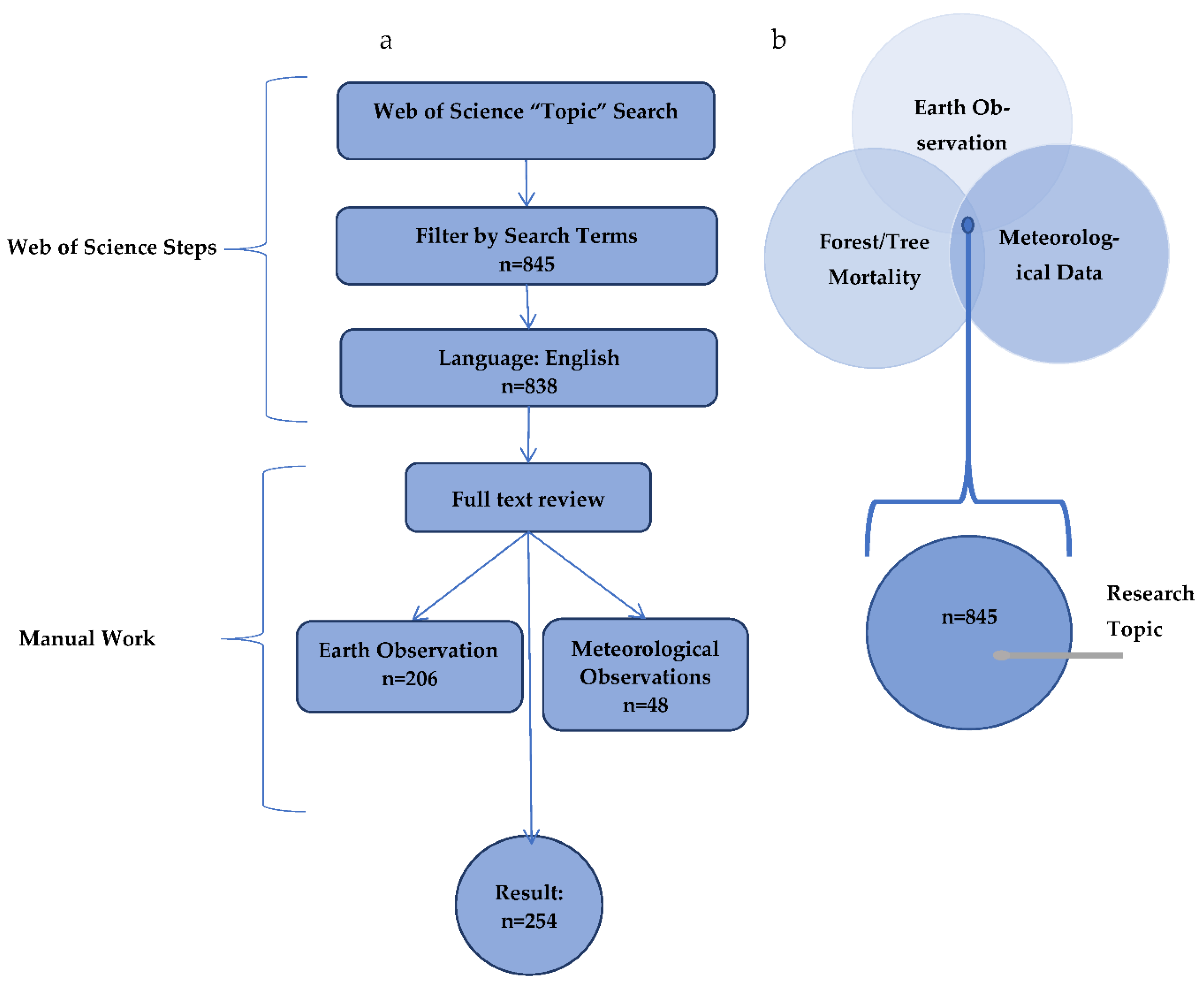
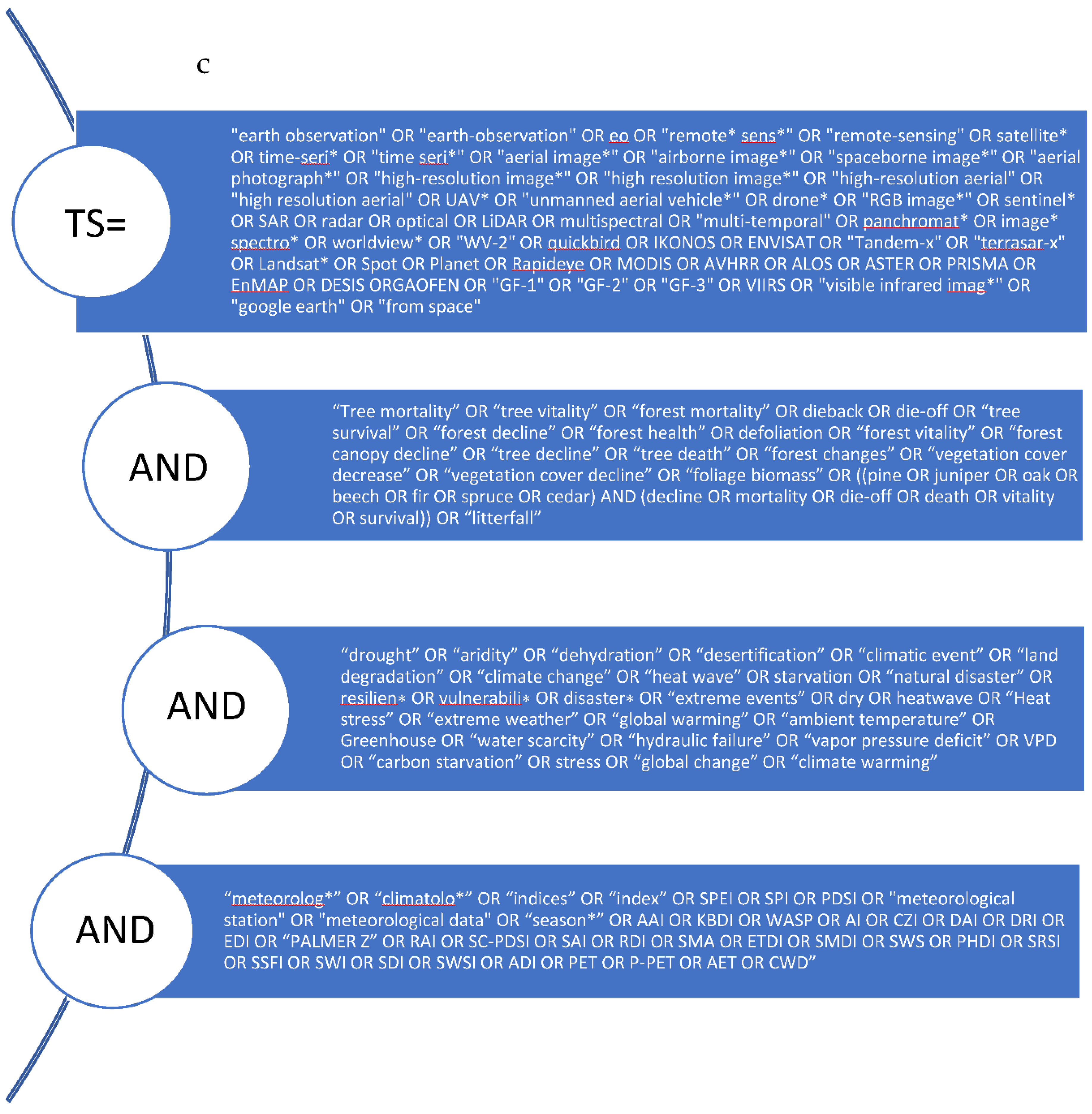
Figure 2.
Trend of tree mortality papers utilizing Remote Sensing alone or ground-based meteorological monitoring only (data includes studies published until October 2023).
Figure 2.
Trend of tree mortality papers utilizing Remote Sensing alone or ground-based meteorological monitoring only (data includes studies published until October 2023).
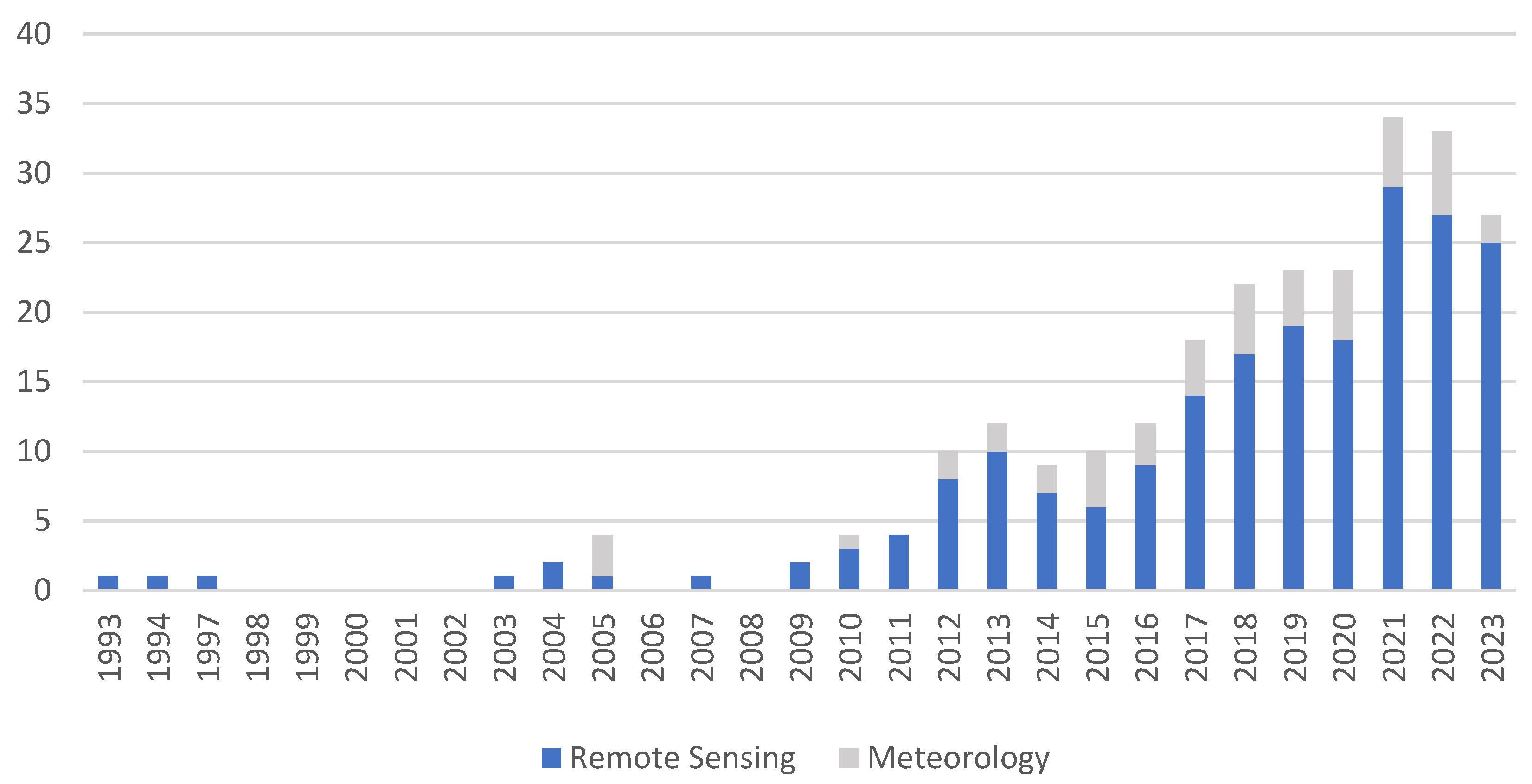
Figure 3.
Global spatial distribution of tree mortality publications applying Remote Sensing (a) or using ground-based meteorology indicators (b). The color shades indicate the frequency of research publications per investigated country.
Figure 3.
Global spatial distribution of tree mortality publications applying Remote Sensing (a) or using ground-based meteorology indicators (b). The color shades indicate the frequency of research publications per investigated country.
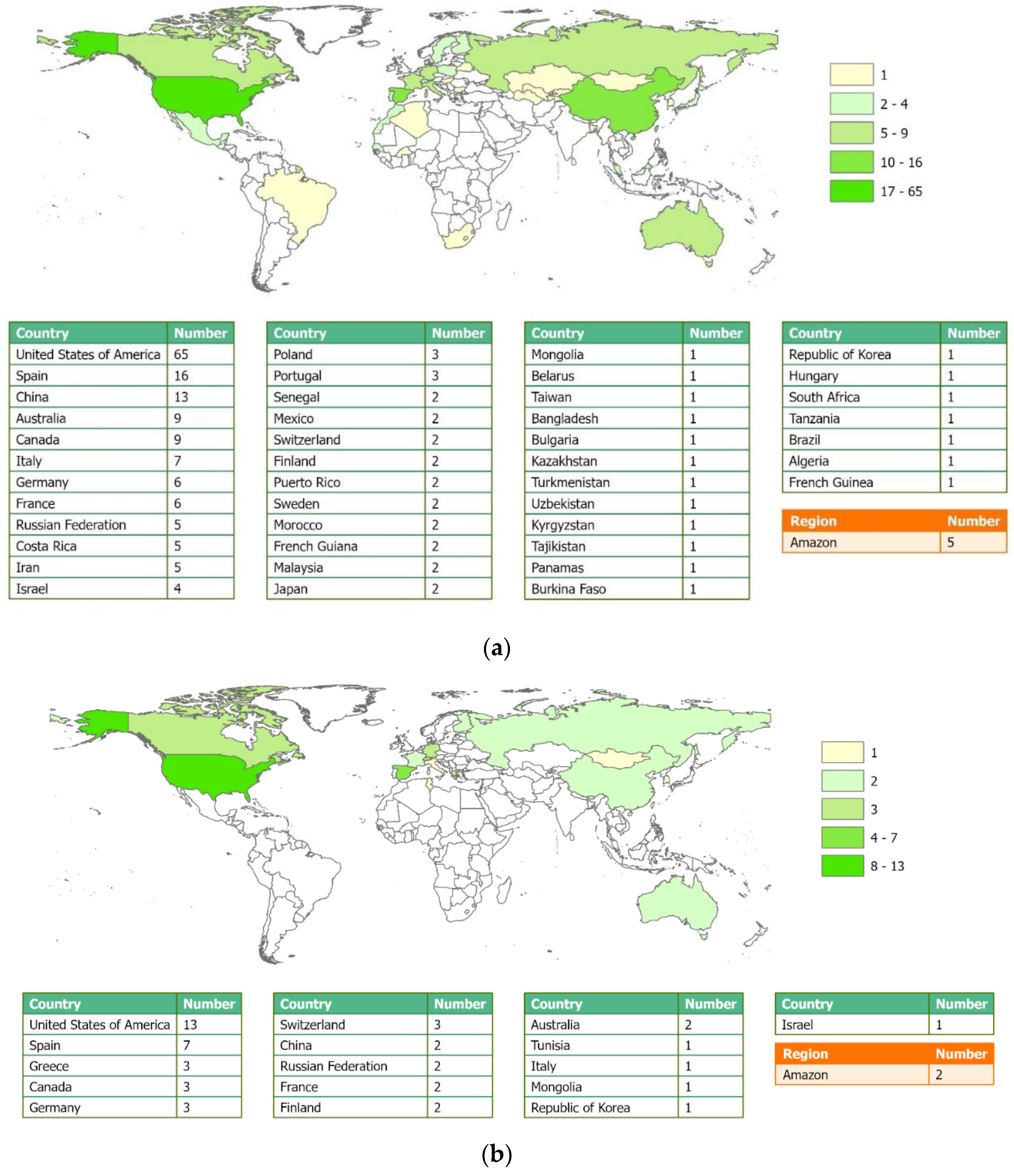
Figure 4.
Geographical origin of papers using ground-based meteorological drought indicators to assess tree mortality.
Figure 4.
Geographical origin of papers using ground-based meteorological drought indicators to assess tree mortality.
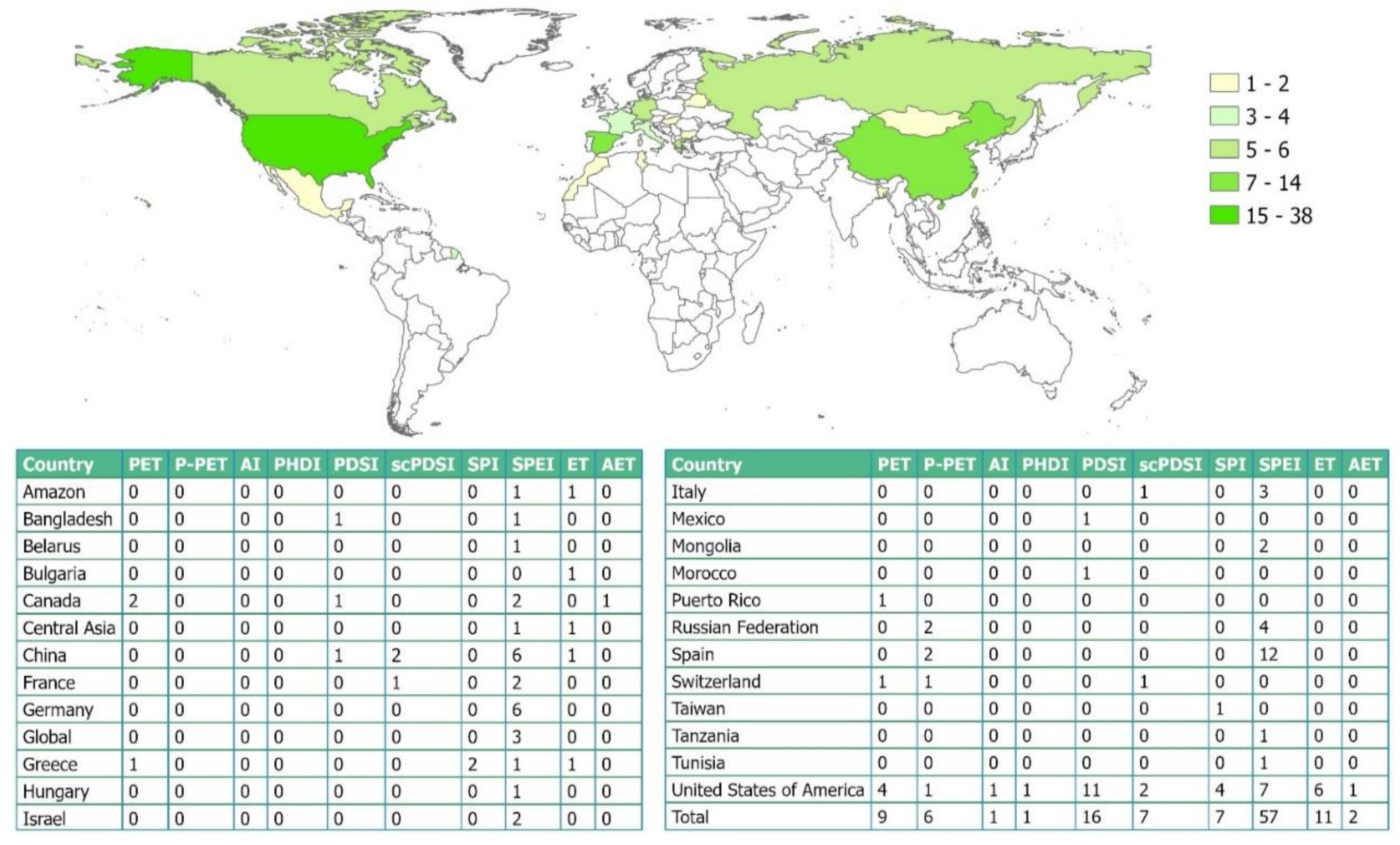
Figure 5.
Overview of yearly publications of Remote Sensing and meteorological based studies for monitoring and analyzing tree mortality.
Figure 5.
Overview of yearly publications of Remote Sensing and meteorological based studies for monitoring and analyzing tree mortality.
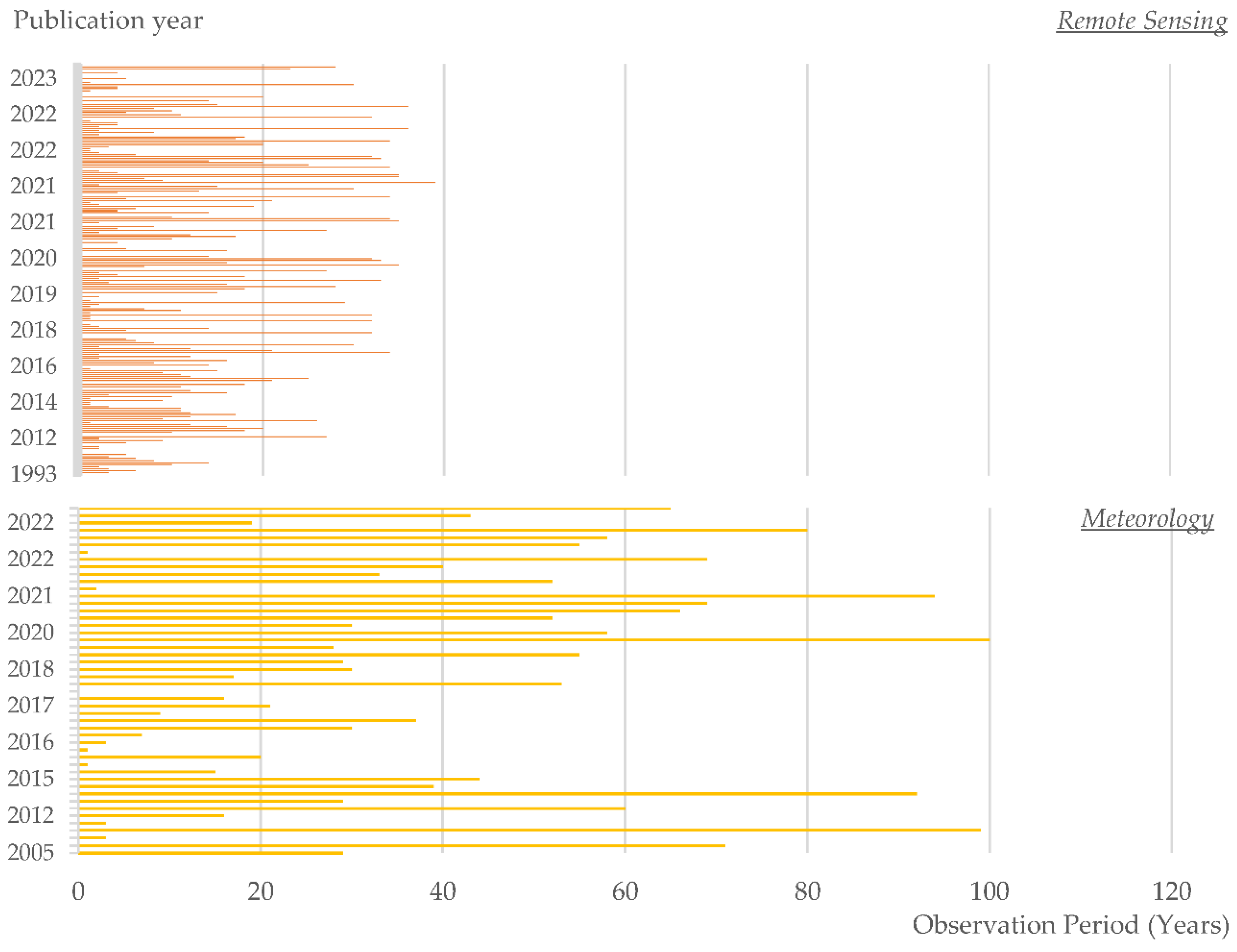
Figure 6.
Extent of study areas versus spatial resolution for publications utilizing Remote Sensing.
Figure 6.
Extent of study areas versus spatial resolution for publications utilizing Remote Sensing.
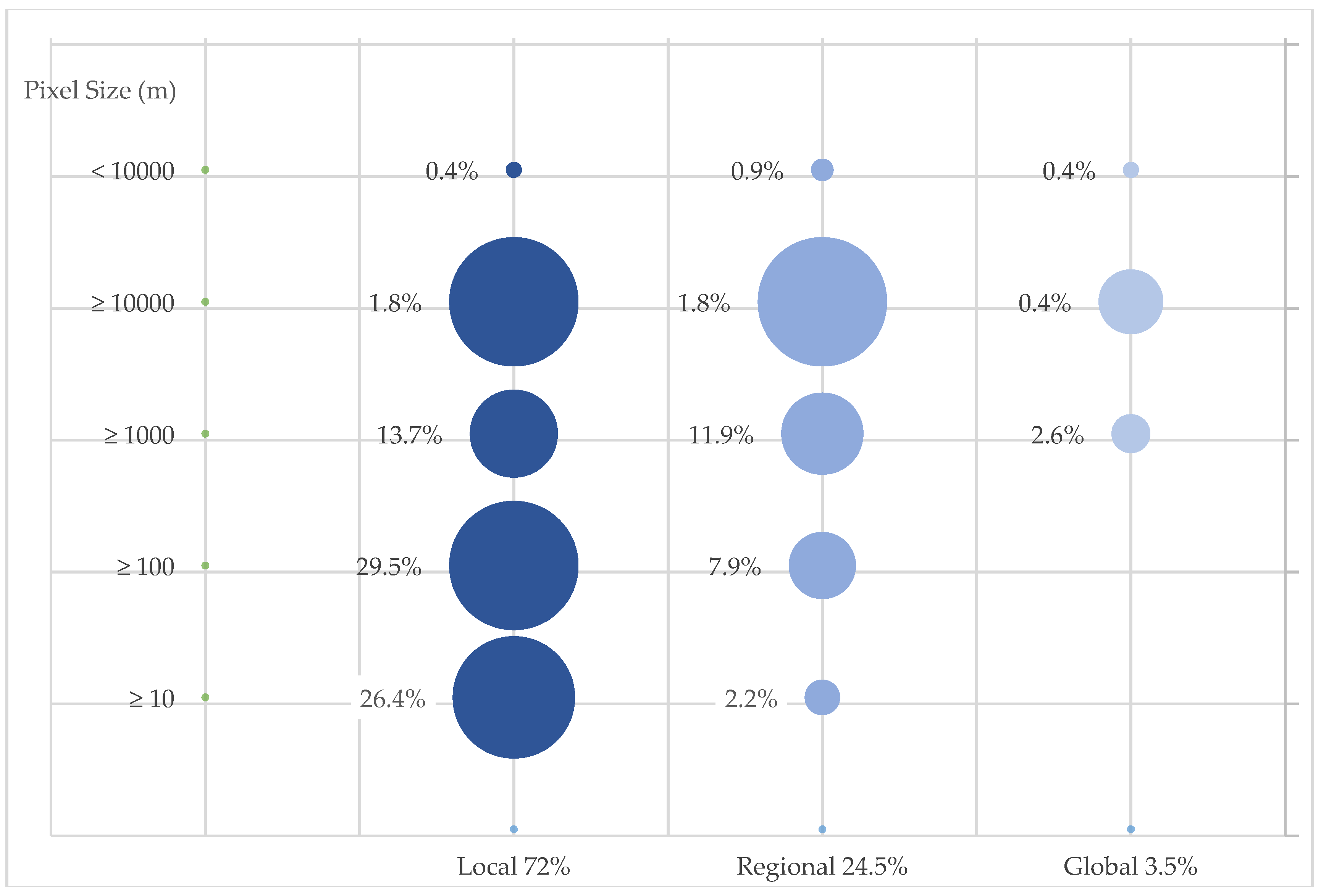
Figure 7.
Earth Observation (a) sensors, and (b) sensor types utilized in the studies for tree mortality monitoring.
Figure 7.
Earth Observation (a) sensors, and (b) sensor types utilized in the studies for tree mortality monitoring.
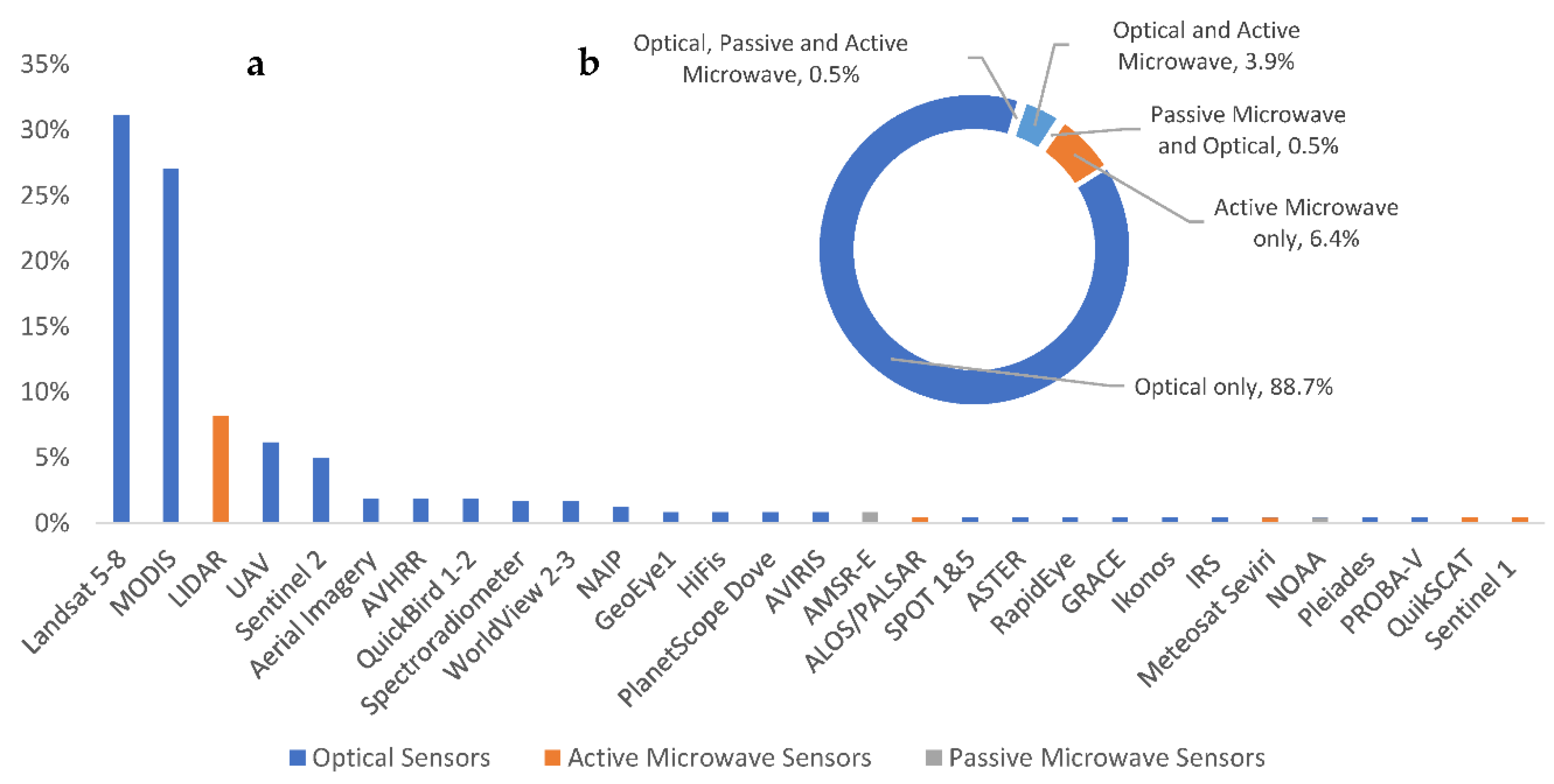
Figure 8.
Remotely Sensed biotic and abiotic indicators used for assessing tree mortality during drought events. The remaining Remotely Sensed indicators are gathered in the «other» category.
Figure 8.
Remotely Sensed biotic and abiotic indicators used for assessing tree mortality during drought events. The remaining Remotely Sensed indicators are gathered in the «other» category.
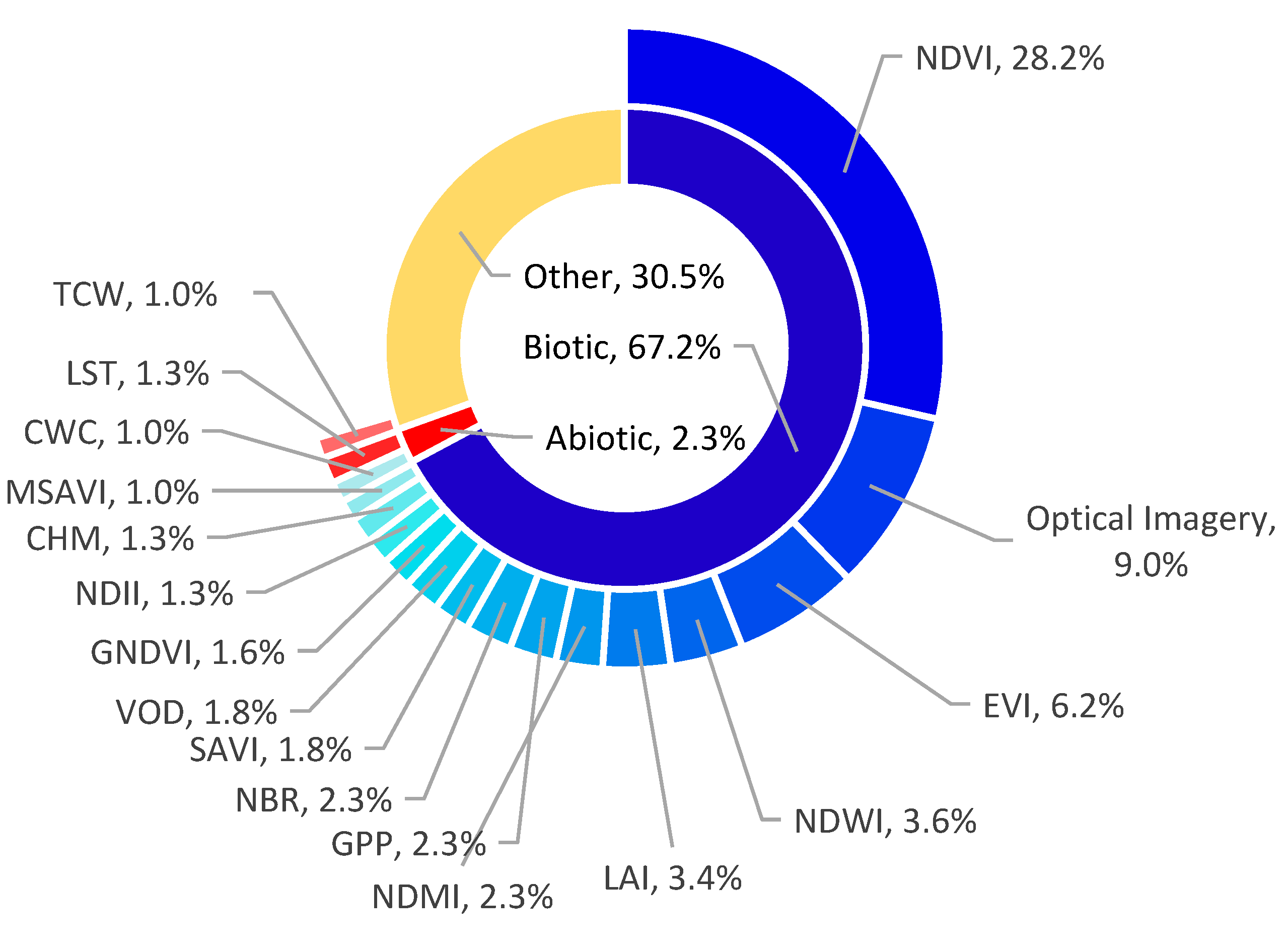
Figure 9.
Biotic and abiotic forest components investigated using ground-based indicators for assessing tree mortality during drought events.
Figure 9.
Biotic and abiotic forest components investigated using ground-based indicators for assessing tree mortality during drought events.
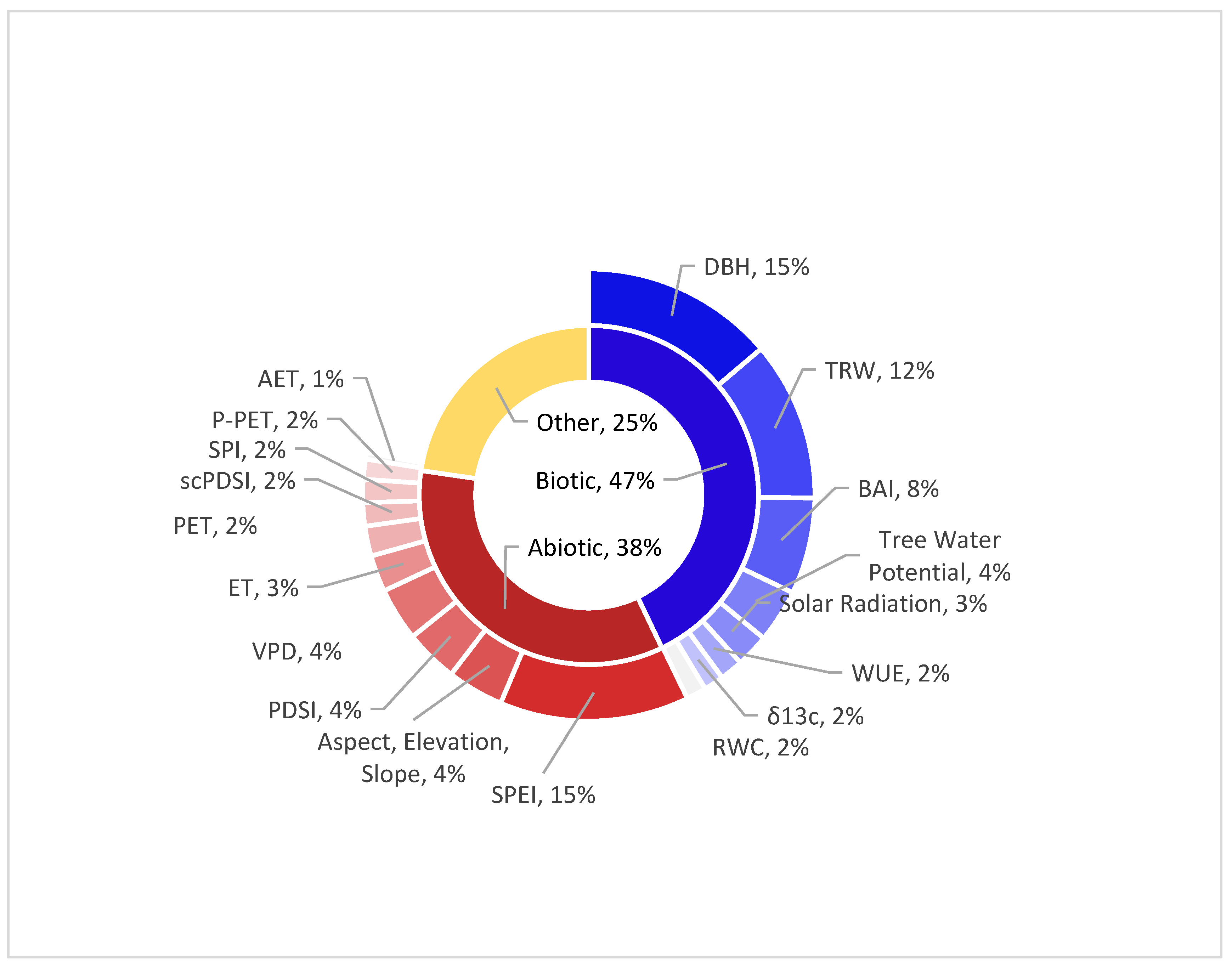
Figure 10.
Hotspots of drought induced tree mortality investigations by biomes. Symbol sizes are proportional to the total number of tree species studied per study area.
Figure 10.
Hotspots of drought induced tree mortality investigations by biomes. Symbol sizes are proportional to the total number of tree species studied per study area.
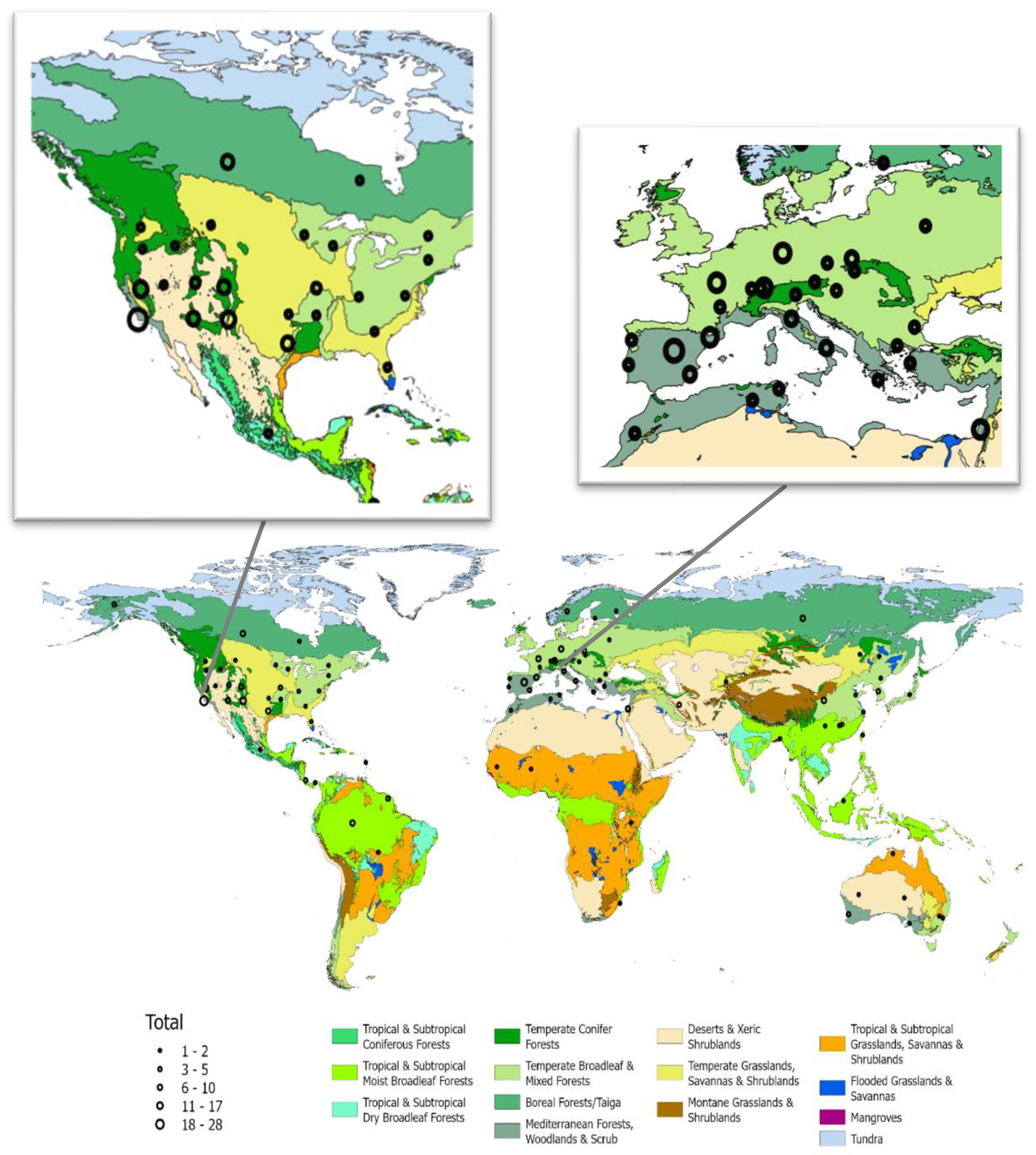
Figure 11.
Thematic foci relying on Remote Sensing (right) or on ground-based (left) measurements. The numbers are rounded up.
Figure 11.
Thematic foci relying on Remote Sensing (right) or on ground-based (left) measurements. The numbers are rounded up.
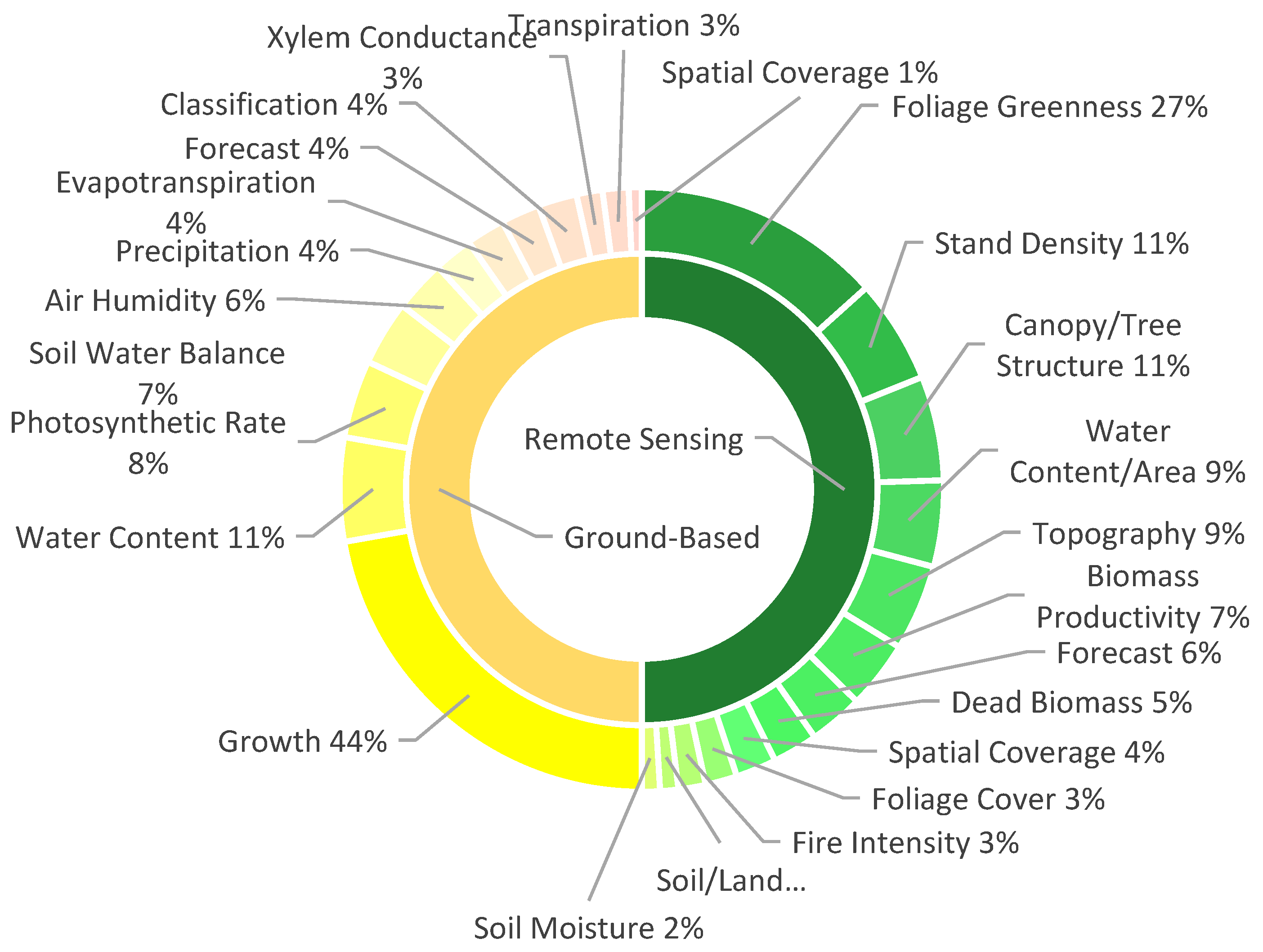
Figure 12.
Remote Sensing (right) and Ground-based (left) monitoring scale.
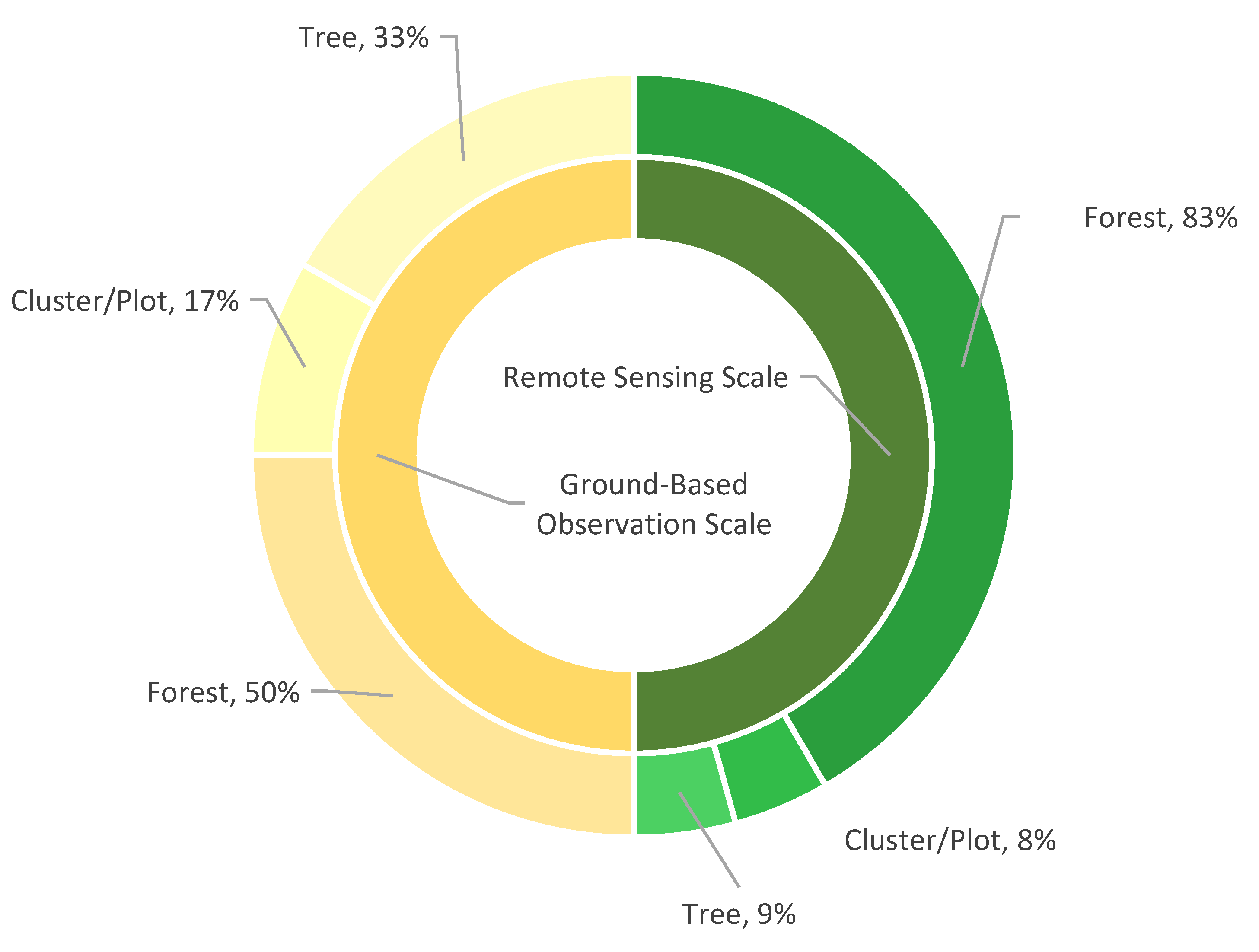

Table 1.
Summary of the extracted and analyzed variables in this study.
| Variables Recorded |
|---|
| Article code; Authors; Publication year; Article title; Journals; Drought event; Study country; Study area; Remote Sensing Monitoring; Meteorology Monitoring; Starting year of investigation; Ending year of investigation; Spatial scalea; Spatial resolution (m/km); Satellite sensors; Article Focus; Remote Sensing Indicators; Ground-based indicators; Meteorological indicators; Statistical Analysis. |
a local, regional and global.
Table 2.
Summary of the number of papers per type of biome.
| Type of Biome | Number of Papers |
| Mediterranean Forests, Woodlands & Scrub | 64 |
| Temperate Broadleaf & Mixed Forests | 59 |
| Temperate Conifer Forests | 52 |
| Tropical & Subtropical Moist Broadleaf Forests | 25 |
| Boreal Forests/Taiga | 20 |
| Temperate Grasslands, Savannas & Shrublands | 17 |
| Deserts & Xeric Shrublands | 8 |
| Tropical & Subtropical Grasslands, Savannas & Shrublands | 6 |
| Tundra | 2 |
| Tropical & Subtropical Coniferous Forests | 2 |
Disclaimer/Publisher’s Note: The statements, opinions and data contained in all publications are solely those of the individual author(s) and contributor(s) and not of MDPI and/or the editor(s). MDPI and/or the editor(s) disclaim responsibility for any injury to people or property resulting from any ideas, methods, instructions or products referred to in the content. |
© 2024 by the authors. Licensee MDPI, Basel, Switzerland. This article is an open access article distributed under the terms and conditions of the Creative Commons Attribution (CC BY) license (https://creativecommons.org/licenses/by/4.0/).
Copyright: This open access article is published under a Creative Commons CC BY 4.0 license, which permit the free download, distribution, and reuse, provided that the author and preprint are cited in any reuse.


