
Submitted:
29 June 2024
Posted:
03 July 2024
You are already at the latest version
Abstract
The study examines the noise, vibration, and harshness (NVH) management of electric vehicle (EV) powertrains, considering the challenges of the automotive industry's transition to electric drivetrains. The growing popularity of EVs brings new NVH challenges, as the lack of internal combustion engine (ICE) noise makes drivetrain noise more prominent. Key to managing NVH in EV powertrains is understanding the noise from electric motors, inverters, and gear systems. Noise from electric motors, mainly resulting from electromagnetic forces, and high-frequency noise generated by inverters significantly impact overall NVH performance. The article details sources of mechanical noise and vibration, including gear defects in gear systems and shaft imbalances. Methods presented in the publication include simulation and modeling techniques that help identify and solve NVH difficulties. Tools like multi-body dynamics (MBD), finite element method (FEM), and multi-domain simulation are crucial for understanding the dynamic behavior of complex systems. With the support of simulations, engineers can predict noise and vibration challenges and develop effective solutions during the design phase. The study emphasizes the importance of a system-level approach in NVH management, where the entire drivetrain is modeled and analyzed together, not just individual components.
Keywords:
EV powertrain
; NVH
; noise
; acoustic simulation
; noise reduction
1. Introduction
Over the last 15 years, Electric Vehicle (EV) sales have been on a steep upward trajectory. EV-Volumes reports that 541,780 new plug-in electric cars were registered globally in February 2022, more than double the total from February 2021 [1]. In addition to this, the 1.06 million total of new EVs published by Virta in Europe during the first half of 2021 was a big leap compared with 413 for the first half of 2020. This growth, to a great extent, has been caused by bold zero-emission goals announced by major global EV markets in the EU, Asia, and the US [2,3,4].
EVs are a whole new can of worms when it comes to managing noise, vibration, and harshness (NVH) compared to the world of internal combustion engines (ICEs). With no ICE to mask the noise of a transmission, and especially when dealing with the constant torque and higher speeds of electric motors, gear design had to improve. The new powertrain technology has implications for sound, meaning engineers need to consider things like road noise, but arguably the most substantial impact will be on the overall noise profile of EVs, especially when it comes to road noise. The engine side of the powertrain, typically 2-stage, non-switchable transmission; and the electric side of the powertrain with an upper limit imposed by sufficiently high engine speeds and torque management needs [5].
The challenge in developing new engines and electric driveline architectures specifically for Hybrid Electric Vehicles (HEVs) and Battery Electric Vehicles (BEVs) is even greater. New driveline connections bring their own potential issues and high-frequency challenges for engineers. Compounding the complexity is that electric motors behave differently from notchy gasoline engines, and it's the interactions of components, particularly vibration related NVH issues, that are really tested. These kinds of complex systems call for an understanding of relationships between components [6].
In dealing with NVH for EVs, the challenge is to know about the behavior of electric motors and how they are connected to reduction gearboxes and their overall system performance [7]. This needs rigorous analysis and measurement including but not limited to vibration analysis, noise measurement, and system dynamics modeling. These tools are vital for engineers in order to correctly pinpoint and troubleshoot NVH problems, ensuring better performance and passenger comfort during driving.
However, the EV industry faces further complexities with the price volatility and uncertain supply of rare earth materials, making PMSMs less attractive for mass production. Companies are exploring alternative technologies like SRMs for cost efficiency. SRMs, however, exhibit worse vibro-acoustic behavior than PMSMs due to their non-sinusoidal waveforms and high harmonic content. These harmonics, proportional to speed, can cause stator vibration, with high rotational speeds making low order harmonics resonate structurally sooner [8,9].
Vehicle OEMs often depend on component suppliers for designing, testing, and manufacturing sub-systems. Suppliers strive to create "quiet" sub-systems, but the assembled electric powertrain might still be unacceptably noisy. Addressing these issues effectively involves the use of CAE tools for simulation and modeling. The challenge lies in the application of these tools, their functionality, and the timing of their deployment in the development cycle.
The transition to EVs brings unique NVH challenges, underscoring the need for effective modeling and analysis [10]. The absence of ICE noise in EVs alters the NVH landscape significantly, making other noise sources more noticeable and requiring a focus on psychoacoustics. Furthermore, the various weight distributions in EVs result in new excitation frequencies and responses. For the design and development of EVs, a systematic NVH analysis is necessary to achieve best-in-class acoustic comfort and performance considering complex noise generation and propagation characteristics in EV powertrains, requiring multi-disciplinary knowhow to efficiently deal with these challenges [11].
2. Key Contributors to NVH in EV Powertrains
In EV powertrains, the main sources for NVH are the electric motor, the power inverter, and the transmission with gear reducer [12] and, if present, the cooling fan and pumps, as seen in Figure 1. All of the individual parts have acceptable NVH on their own, but challenges arise when they operate in conjunction.
- Transmission & gear reducer (gearbox): Mechanical Noise (commonly known as 'gear whine'): This occurs due to vibrations caused by gear Transmission Error (TE), excitable mechanically.
- Electric Motor: generates excitations via electromagnetic forces, causing what is commonly known as “whistling” or Slot / Pole noise (also referred to as 'slotting').
- Power Inverter and Electronics: include components that contain higher order harmonics, leading to pulse width modulation (PWM noise), ('switching').
- Cooling Fan & Pumps: Produce aerodynamic noise and fluid flow noise due.
The combination of these four elements accounts for most of the overall noise in EVs, which includes both airborne and structural noise. Understanding these contributors is crucial.
Noise and vibration sources, for example, the electric motor, gearbox, and power electronics act as excitation sources. These sources generate vibrations and noise, which are transmitted through various pathways. Structural vibrations travel through the vehicle’s structure, termed as structural-borne noise, while airborne noise moves through the air. The structural vibration pathways and the radiated noise play a crucial role in how these sounds and vibrations are perceived. Ultimately, these noises and vibrations are received by the human ear, termed as the 'Ear Receiver', impacting the overall sensory experience and comfort inside the vehicle, as seen in Figure 2. Addressing both the excitation sources and the transfer pathways is essential for minimizing NV impacts on vehicle integrity and occupant comfort.
2.1. Contributors to Mechanical Noise
Factors influencing mechanical noise and vibration in EV powertrains are comprehensive. They include gear dynamics, notably TE, which leads to gear whine. TE is influenced by various factors, such as gear macro- and micro-geometry, changes in gear stiffness, assembly misalignments, and manufacturing errors [13]. These aspects of TE contribute to vibrations that pass-through shafts and bearings into the casing, exacerbating structural resonances. Alongside TE, bearing noise, shaft imbalances, misalignments, eccentricity, sliding contact interactions, and tightening faults all contribute to the NVH profile. Addressing these, including understanding the precise causes and transmission pathways of TE-induced vibrations, is crucial for reducing mechanical noise and enhancing the overall NVH performance of EVs.
2.2. Noise from Electric Motors
Electromagnetic noise in EV powertrains, a significant factor in vehicle NVH characteristics, is notably influenced by interactions within the electric motor, specifically in PMSM. The electromagnetic forces in the air gap between the stator and rotor can lead to a phenomenon known as whistling. These forces result in radial, axial, and tangential components, causing various vibrations in the stator and rotor [14]. Radial force harmonics primarily generate stator vibrations, while tangential forces can induce torsional vibrations in both stator and rotor, presenting high NVH risks. Oscillations of these frequencies from the stator to the housing can amplify structural vibrations and thus cause beeping. These vibrational interactions, which are difficult to understand and can also be controlled, are the essential mechanisms for the generation of electromagnetic noise generated by the drive chain elements of EVs. [15].
2.3. Noise from Inverters
The inverter, in addition to the electronics, is one of the sources of electromagnetic noise. Especially due to PWM noise, which is typically called "switching" noise. This is because the inverter plays a role in converting direct current to alternating current for electric motors using a PWM strategy that involves rapid switching. This process generates higher-order harmonics, affecting electromagnetic forces, and contains NVH hazards [16]. A significant design challenge for power inverters is balancing the reduction of these harmonic excitations, which can limit maximum efficiency, as the effort to minimize NVH effects on the motor, possibly within the transmission, can affect overall efficiency. This requires a thorough examination of the design of the NVH as well as the power inverter in order to optimize the trade-offs between them.
2.4. Contributors to Aerodynamic Noises and Fluid Flow
Aerodynamic noise and fluid flow are major contributors to NVH characteristics in EV powertrains. The cooling fan contributes the majority of aerodynamic noise generated in the engine compartment, depending on whether the motor is sealed or not. Primary noise is created by vent holes in non-sealed motors and external fans in sealed motors. This noise category includes broadband and tonal noise, especially at blade passing frequency (BPF) and its harmonics [17]. Additionally, fluid flow noise, especially from water pumps used for cooling purposes, adds to the overall NVH profile. These pumps can generate noise during operation, further influencing the acoustic environment of the vehicle.
2.5. Factors Influencing Noise from Electromagnetic Components
- Mechanical Deformations and Vibrations: These arise from various factors including the slot design, winding distributions, current waveform distortions, air gap variations, rotor eccentricity, and phase imbalances. These contribute to mechanical deformations and vibrations through complex harmonic forces and torques [18].
- Stator-Frame Resonance: The stator-frame structure acts as the primary noise radiator of the machine. Resonance can occur when the radial force frequency aligns with the stator-frame's natural frequencies, leading to significant noise [19].
- Magnetostrictive Noise: This is due to the periodic elongation or contraction of the core material, which, in high power applications like in EVs and HEVs, can contribute substantially to the overall noise [19].
- Parasitic Oscillation Torque: In inverter-fed motors, parasitic oscillating torques arise from time harmonics in the stator currents and can be exacerbated by voltage ripples from the rectifier [19].
3. Noise Reduction Methods
During the development of EVs, it is in the interest of the EVs to meet the acoustic regulations and the customer's needs, all kinds of noise reduction measures must be applied to all the components of the drive chain. With advanced design techniques, as well as large-scale precision engineering and poroelastic noise insulation materials, noise and vibration from EV drivetrains can be greatly reduced. Special methods of avoiding mechanical noise, electrical motor noise, electromagnetic interference emitted by inverters, and aerodynamic and possibly fluid flow are presented in detail in the subsections.
3.1. Preventing Mechanical Noise
Preventing mechanical noise in various applications, particularly in industries like automotive, manufacturing, and construction, involves a comprehensive set of strategies aimed at reducing or eliminating noise sources. These methods encompass material selection, design optimization, isolation of noise sources, precision engineering, damping techniques, controlling operational parameters, and specialized gear and bearing design.
For EV powertrains, noise reduction involves balancing the rotor to minimize dynamic vibration and noise emission. The noise of rolling bearings is controlled by the requirements of strict mechanical work, perfect lubrication, and no foreign bodies. Additionally, sleeve bearings generally exhibit lower mechanical noise levels, but those noise levels depend on factors like surface roughness and lubrication quality [21]. Proper tuning of these factors can greatly reduce the high-frequency mechanical noise and vibration of EV powertrains.
Mounting accessory components into the body of EVs poses unique challenges. Controlling bracket and component resonances and ensuring they are isolated properly is key to maintaining performance levels similar to traditional vehicles as we enter the EV era.
- Selection and Environmental Dependence on Material: Use of materials with natural damping properties is important to help control mechanical noise. For example, vibrations may be absorbed, and the transmission of noise would be reduced when using rubber or Polyurethane (PU) mounts or pads. Foams and composites also work well for areas where lots of noise is absorbed [21].
- Optimization of Design: Designing components and systems with minimal noise production will reduce mechanical noise. Tightening and designing assemblies to not rattle (meaning they no longer vibrate or create noise) is crucial. Design techniques, such as finite element analysis (FEA), are particularly useful in detecting and addressing possible noise problems.
- Noise Source Isolation: It should be ensured that machinery or other noise-generating components are isolated from the rest of the structure. This is possible when sound transmission is prevented, such as through isolation mounts, enclosures, or barriers. Isolating sensitive components from vibration sources is particularly important.
- Precision Engineering and Manufacturing: A high level of precision provided in engineering and manufacturing processes equals lower mechanical noise. This is achieved by keeping tolerances tight, ensuring proper alignment, and balancing moving parts. Regular checks are necessary to prevent noise development caused by excessive wear.
- Application of Damping Techniques: It may be easier to reduce noise from a vibration source than to reduce the vibration itself. Selective damping of the machinery or structure may be considered. This could include damping coatings or layers in mechanical systems and actively or passively moving tuned mass dampers that absorb certain vibration frequencies.
- Adjusting Operational Parameters: Adjusting parameters like speed, torque, and load can help reduce mechanical operations noise. Running machines at speeds that do not hit resonances is a great idea, as is stepping into and out of new operations smoothly.
- Active Noise Control (ANC): ANC reduces noise by using electronic means. It uses microphones to listen to the sound and speakers to create a counter-noise that effectively cancels the original noise, especially where conventional noise reduction methods are unsuitable [22].
- Tailored Gear and Bearing Design: Gear design profoundly affects NVH risks in mechanical systems. Eliminating stiffness variation and optimizing the contact ratio can be achieved through the modification of macro- and micro-geometry of gears to minimize gear TE. Noise can be reduced through strategies such as raising the helix angle of gear sets, though that may also increase the axial loads placed on bearings and reduce efficiency. Similarly, an augmented contact ratio due to an inclined tooth addendum can increase frictional losses [23]. Key among these design considerations are reducing NVH while preserving efficiency and handling bearing loads.
3.2. Preventing Electric Motor Noise
Suppressing the electromagnetic noise in electric motors reflects directly on improving the overall system performance of EV powertrains. This type of noise is mainly produced by the electromagnetic forces due to motor operation. Addressing this issue requires a variety of measures to counteract the forces impacting both gross and fine design elements.
Design Modification Parameters and Techniques: Various design parameters such as pole combinations or magnet shapes induce electromotive forces. Fine-tuning these settings helps create a more even force distribution, as too much force can lead to possible noise generation. For example, torque ripple or radial force harmonics, and their resulting electromagnetic noise, can be mitigated by methods such as rotor skewing. However, a larger skew angle can decrease back electromotive force (EMF), affecting motor performance. It is essential to balance noise reduction with motor efficiency and output in this case, requiring sophisticated tuning [24].
System Resonance and Asymmetry Reduction: Since resonance—a condition that can add noise while tightening vibrations—between magnetic forces and structural modes of the motor should be avoided [25]. Simulations can help recognize and mitigate the resonant frequencies at the design stage. Alignment of the center of mass with the center of rotation, positioning the magnets at their ideal locations, achieving uniform magnetization of the motor magnets, and ensuring adequate roundness of laminations can reduce these asymmetries [26] to prevent irregularities in the magnetic field.
Magnetic-Specific Noise Mitigation Strategies: To further diminish magnetic noise and vibrations, altering the motor's magnetic properties can be highly effective. Strategies include [27]:
- Pole Shaping: Refining the shape of magnetic poles to optimize the magnetic field distribution.
- Modulation of Pole and Slot Width/Position: Adjusting poles and slots can influence the magnetic field's harmonics and, consequently, the noise and vibrations produced.
- Notches and Flux Barriers: Introducing notches or flux barriers to disrupt magnetic flux paths and control flux flow.
- Airgap Increase: Expanding the airgap between the rotor and stator to lower magnetic forces, while carefully considering the potential effects on motor efficiency and torque.
3.3. Preventing Electromagnetic Noise in Power inverter
- High-Frequency Adjustment: By increasing the inverter's switching frequency above the audible range, the noise becomes imperceptible to the human ear.
- Control Strategies: Highlights the role of control strategies in balancing vibroacoustic and electrical performances, especially in induction and synchronous machines, to optimize for either efficiency or noise reduction [28].
- Vibration Isolation: Integrating the inverter into the motor's isolation system can diminish the vibration transmitted from the inverter.
- Acoustic Shielding: Wrapping the inverter in absorptive or barrier layers can obstruct the airborne noise transfer path, thereby reducing the noise that reaches the cabin.
3.4. Preventing Aerodinamic & Fluid Flow Noise
- Water Pump Noise: To prevent aerodynamic and fluid flow noise in powertrains, especially from water pumps in HEVs/EVs, focusing on strategic mounting and location is crucial. Additionally, minimizing pulsation transmission through organized fluid conductor layouts, stiffening large flat metal areas, and selecting pumps with low noise ratings are key strategies. These approaches address the root causes of noise and offer practical solutions for engineers designing quieter and more efficient vehicle systems.
- Cooling Fan Noise: Utilized for vehicle cooling or dedicated HEV component cooling, these fans' noise should be masked by other sources. Controlling noise levels at low speeds and in idle conditions is vital.
4. Simulation Model Development
The powertrains of EVs are a very complex energy chain for the simulation of radiated noise and require many different methodologies and tools. The typical powertrain in an EV consists of an electric motor combined with a reduction gear. In order to accurately predict the noise generated by the overall powertrain, it is necessary to consider the dynamic performance and acoustic characteristics of both the electric motor and gear reduction mechanism as a whole. How those two main components—the electric motor and the gear reducer—are integrated with each other has a major influence on the noise and vibration character of the EV powertrain [29].
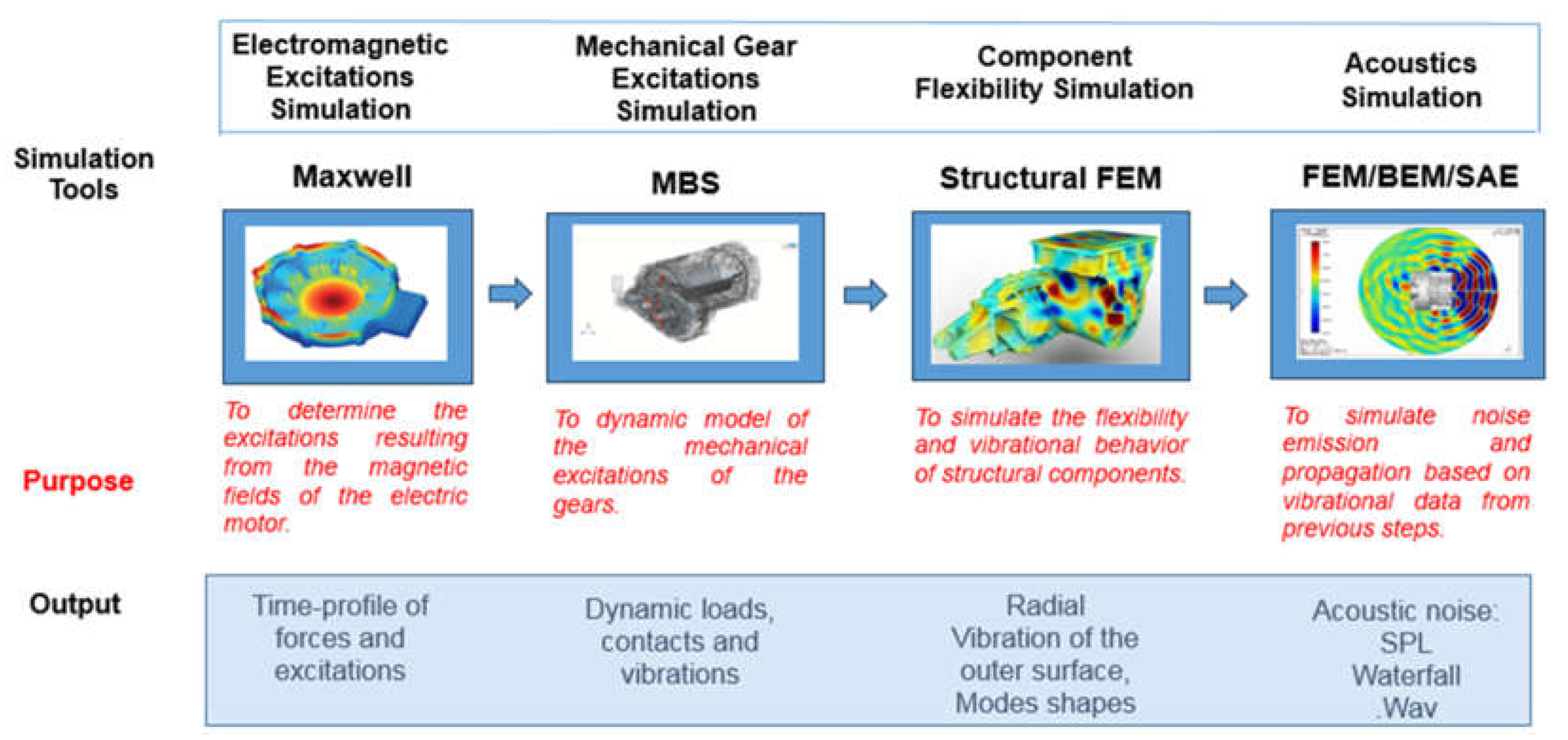
Develop a computational model of the powertrain, often using Finite-Difference Time-Domain (FDTD), Multi-Body Dynamics (MBD), Finite Element Method (FEM) and Boundary Element Method (BEM) for structural analysis and noise prediction. This model is crucial for simulating the behavior of the powertrain under various conditions and for predicting radiated noise (Figure 3) [30].
4.1. EM Simulation
This type of excitation is generated by electromagnetic forces, and in electric motors, it is the main source that contributes to NVH problems. Such forces are usually estimated through analytical or numerical calculations, with the latter often involving software tools to numerically solve differential equations describing the electrical machine. These equations consider the geometry and electromagnetic nonlinearities of the machine. The vibration response due to these forces is then analyzed using 3-D structural FEA or MBD [5,31].
State-of-the-art vibro-acoustic simulation of an electrical machine involves coupling a co-simulation typically between a tool performing electromagnetism analysis like ANSYS Maxwell [32], JMAG [33], or MagNet [34], and an FE-based solver that defines structural behavior. This necessitates that the structural FEA be solved at each time step.
One of the leaders in electromagnetic field simulation software, ANSYS Maxwell, is used to design and analyze 3D/2D electric motors, actuators, sensors, transformers, and other electromechanical devices. The goal is to provide a simulation of electromagnetic fields and how much force is generated by magnetic fields, resulting in vibrations in electric motors. The software accurately captures the detailed electromagnetic interactions that occur in a motor, taking into account the stator, rotor, windings, and magnetic materials.
Combining these results with the data from Maxwell electromagnetic simulation tools with MBD and FEA software is crucial for understanding how electromagnetic forces affect NVH in the powertrain overall. For example, data from Maxwell is imported into MBD tools such as RecurDyn [35] or Adams [36], or FEA tools such as ANSYS Mechanical [37] or Nastran [38], to analyze vibration and noise tendencies caused by the forces in the motor and its surroundings.
Maxwell allows engineers to predict and visualize the magnitude and distribution of electromagnetic forces in the motor [39]. If these forces are unequal or interact with mechanical resonances, significant vibrations can occur [40]. The vibration data generated from the electromagnetic analysis is then used in acoustic simulations to understand how these vibrations manifest as audible noise, contributing to the vehicle's NVH profile.
In addition, electromagnetic simulation tools like Maxwell are used to ensure excellent performance in the design optimization step. Based on changes in the electromagnetic component geometry, winding configuration, and material property modifications, design engineers can reduce unwanted vibrational behavior and improve the NVH performance of electric motors [41].
4.2. Multi-Body Dynamic Simulation Using Flexible Bodies
At the beginning of multi-body dynamic simulation, the electric motor is a critical component of the powertrain and is included in the system model to describe all its complex dynamics. This simulation also extends to address the impact of the electric motor on all other powertrain parts, such as gears and shafts, covering rotational dynamics, torque generation, and any flexibilities in motor mounts or couplings. The simulation stretches beyond regular rigid body dynamics and incorporates the flexibility of bodies, emulating the actual dynamic behavior of motors. The interactions among the dynamic loads, vibrations of the gears, and contact forces are precisely represented by a corresponding mechanical model [42].
4.3. Structural Analysis
In the structural analysis phase, the focus is on loads and stresses specific to the electric motor, including electromagnetic forces, mechanical stresses from torque generation, and vibrational forces. Using finite element methods, the structural integrity of the motor and its impact on the overall powertrain structure, such as the casing or mounting points, is analyzed. This step is crucial for understanding how vibrations originate from the motor and propagate through the powertrain [43].
4.4. Acoustic Radiation Calculations
The last step in the simulation looks at acoustics and characterizes acoustic radiation, especially due to the electric motor. The main focus is the vibrations from the motor, particularly those stemming from electromagnetic forces and gear interactions within the motor assembly, which contribute to the overall noise of the powertrain. This concern is addressed by the acoustic model representing the transformation of those vibrations into sounds, which contributes to the vehicle's NVH characteristics [44].
In this whole workflow, the electric motor is the center of attention for the dynamics, structure, and acoustics of the EV powertrain. Key features of the NVH design simulation were electromagnetic forces and high-speed operation, both inherent to electric powertrains.
4.5. Common Work- Flow in Fully Numerical CAE Software
- Defining Objectives and Requirements: Establish goals of the simulation, focusing on NVH aspects like noise source identification, noise level evaluation, and noise reduction strategies. Define key parameters and performance indicators, including NVH-specific metrics.
- Gathering and Preparing Data: Collect necessary data on the powertrain's physical properties, operational characteristics, and environmental factors from various sources.
- Modeling the Powertrain Components (Incorporating MBD and Flexibility): Develop detailed models of powertrain components using FEM and integrate MBD modeling, including flexible components such as motor and gearbox housings, shafts, bearings, and gear tooth contacts.
- Integrating Electromagnetic and Mechanical Models: Combine electromagnetic simulations with mechanical models for a comprehensive analysis of electromagnetic-induced vibrations.
- Setting Up Acoustic Models: Develop acoustic models using methods like BEM for predicting sound wave generation from powertrain vibrations and defining the acoustic environment.
- Validating Component Models: Independently validate each component model against experimental data for acc racy.
- Assembling the Complete Powertrain Model: Integrate individual component models, ensuring accurate representation of interfaces and dynamic interactions.
- Simulating Operational Conditions: Simulate various operational scenarios to understand the noise behavior under different EV conditions.
- Analyzing NVH Simulation Results: Equivalent Radiated Power (ERP) to quantify the energy emitted as sound. Sound Pressure Level (SPL) to measure the acoustic energy perceived. Campbell diagrams (both 2D and 3D) to visualize the frequency response and identify critical speeds. Evaluation of individual modes in both time and frequency domains for detailed analysis. Results for casing, including stress, displacement, and insights for optimization.
- Refining the Model: Based on NVH analysis, refine the model for accuracy, adjusting material properties, boundary conditions, or geometry.
- 11. Iterative Testing and Optimization: Iterate the simulation process, adjusting the model based on NVH findings and retesting for noise reduction or design improvements. Final Validation and Reporting: Validate the final model against known data or experimental results.
- NVH Result Interpretation and Application: Interpret NVH results such as ERP, SPL, and Campbell diagrams to understand the acoustic behavior of the powertrain. Use time domain and frequency domain analyses to identify and evaluate specific vibration modes and their impact on noise and harshness. Analyze casing stress and displacement results to inform structural optimization for reducing noise and improving durability.
- Design Recommendations Based on NVH Analysis: Based on the comprehensive NVH analysis, make design recommendations aimed at reducing noise and vibration, while enhancing the overall sound quality of the powertrain. Propose modifications to the powertrain design.
During these steps, it is useful to collaborate with experts in electromagnetics, acoustics, and mechanical engineering to ensure the model is accurate and relevant to real-world powertrain noise scenarios while optimizing EV combinations. The holistic approach applied to NVH analysis and simulation in EV powertrain development is essential for effective noise reduction and ultimately improving acoustic quality. This comprehensive approach combines detailed modeling of powertrain components, flexible elements, and state-of-the-art acoustic methods. A fundamental part of this process is simulating the electric motor, which is essential because of the electromagnetic forces it creates that can cause vibrations and account for a large part of overall NVH. By using electromagnetic field simulation software tools like ANSYS Maxwell, engineers can forecast motor vibration properties that are required for a comprehensive NVH analysis.
The smooth interfacing of multiple software modules is critical for the success of this approach. Optimal results are often achieved in a software environment or family of compatible software that allows for multi-physics simulations to be implemented [45]. These simulations play a crucial role in the exact description of the highly integrated coupling system of EV powertrains. This extends to detailed component modeling of e-motor and gearbox housings, flexible shafts, as well as the geometries of rolling bearings, bearing forces, 3D gear tooth contact, and micro geometries. It involves examining each automotive component that contributes noise and vibration in the vehicle.
The NVH analysis workflow in EV powertrain development encompasses multiple phases, such as flexible components modeling in multi-body dynamics (MBD), structural analysis, and acoustic radiation calculations. This simulation can predict the NVH attributes of the powertrain by representing these detailed features [46]. This, in return, enables the development of better mitigation strategies, taking into account the entire noise and vibration picture in powertrain design and optimization. This is achieved by a detailed multi-physics investigation, which helps to understand the NVH behavior more accurately and supports sound engine concept development to streamline noise and vibration reduction in EV powertrains.
5. Acoustic Analysis Setup and Results
- Microphone Placement: The process begins with placing the virtual microphones around the powertrain model. Positioning is crucial to correctly capture sound emanating from different parts of the system. This involves considering factors like the distance to the noise source, the recording location on the car, and the directionality of the microphones [47,48].
- Simulation Environment: Acoustic analysis is conducted in a simulated environment that accurately reflects real-world conditions. This includes specifying the acoustic properties of the environment, such as air density and temperature, which affect sound propagation [49].
- Modeling Acoustic Sources: The powertrain components are modeled as sound sources. This requires understanding which components are most likely to generate noise, at what frequencies, and under what operating conditions [50].
5.1. Interpretation of Acoustic Results
- Radiation Patterns: Understanding the acoustic radiation patterns of the powertrain can reveal how sound waves emanate from the noise source. These patterns fluctuate continuously, and by graphically representing them, engineers can precisely locate areas of high noise emission [51]. This knowledge is essential for designing countermeasures to contain or deflect the sound away from sensitive areas, such as the passenger cabin.
- Sound Pressure Levels (SPL): SPL measurements provide quantitative data on the loudness of noise at various locations around the powertrain. Areas with the highest SPL readings are of particular concern as they directly impact the comfort of the vehicle's occupants [52]. SPL data also ensure that the vehicle meets legal noise regulations and industry standards for both interior and exterior noise levels.
- Frequency Analysis: Identifying the principal and problematic frequencies is crucial for recognizing entrenched NVH issues. Some frequencies may be more perceptible and annoying to the human ear, making them prime targets for reduction strategies. Frequency analysis facilitates the development of noise control solutions, such as damping materials or active noise control systems, tailored to suppress specific frequencies [53].
- Equivalent Radiated Power (ERP): This metric quantifies the total sound power produced by the powertrain. It is important for assessing the overall noise contribution of the powertrain and evaluating the relative impact of different noise reduction strategies [54].
6. Summary
Experience in noise, vibration, and harshness NVH of electric vehicles (EVs) have gained huge popularity and present new challenges in the management NVH. In EVs, of course, there is no engine noise like in internal combustion vehicles (ICE), so the hum of the drive chain can come to the fore. Effective NVH management of EVs includes understanding and managing the noise of electric motors, inverters, and gears.
The noise generated by electric motors is generated by electromagnetic forces, while inverters generate high-frequency noise due to pulse width modulation (PWM). NVH requirements are complicated by mechanical problems such as gear failures, in addition to shaft imbalances that increase unwanted frequencies.
Simulation and modeling techniques are needed to predict and solve NVH problems, such as Multi-body Dynamics (MBD), Finite Element Method (FEM), or Multi-domain simulation. These allow engineers to analyze the entire powertrain system, not individual components, ensuring comprehensive NVH management.
Our study underlines the holistic system-level approach of NVH, and also confirms the importance of the very complex, all-encompassing analysis and measurement of electric motors, transmissions and their interactions. This provides great performance as well as comfort in EVs, even without the engine noise characteristic of ICE vehicles.
Simulation software, such as ANSYS Maxwell for electromagnetic analysis and Adams for multi-body dynamics, help in fully accurate prediction and minimization of NVH problems, ensuring the powerful and efficient design of EV drivetrains.
In summary, the treatment of NVH in EVs involves holistic thinking and the synthesis of advanced simulation techniques with an understanding of the dynamic interactions within the powertrain. A system-wide approach is critical to making EVs quieter, more comfortable, and more efficient.
References
- Wennmo, M. (2022, September 29). Helping electric vehicle manufacturers compete. *Gear Technology Magazine*. Retrieved from https://www.geartechnology.com/articles/30078-helping-electric-vehicle-manufacturers-compete.
- EV-Volumes. (2024, January 12). Global EV sales for February 2022. *EV-Volumes*. Retrieved from https://www.ev-volumes.com/.
- Virta. (2024, January 12). 1.06 million new EVs registered in Europe. *Virta Global EV Charging Report*. Retrieved from https://www.virta.global/.
- European Environment Agency. (2024, February 2). New registrations of electric vehicles in Europe. Retrieved from https://www.eea.europa.eu/.
- Weber, J. (2022). Technological trends. In *Moving Times* (pp. 27–159). Wiesbaden: Springer. [CrossRef]
- Kosuru, V. S. R., & Venkitaraman, A. K. (2023). Trends and challenges in electric vehicle motor drivelines - A review. *International Journal of Electrical and Computer Engineering Systems, 14*, 485-495. [CrossRef]
- NAGASE. (2023, March). NVH reduction in EVs. *NAGASE Whitepaper*. Retrieved from https://www.nagase.com/content/dam/nagase-www/en/resources/nvh-reduction/NAM%20NVH%20Reduction%20in%20EVs%20WP%200323.pdf.
- Fuchs, A., Nijman, E., & Priebsch, H.-H. (Eds.). (2015). *Automotive NVH technology* (Vol. XVIII, 1st ed.). Cham: Springer. [CrossRef]
- James, B. M., & Hofmann, A. (2014, June). Simulating and reducing noise excited in an EV powertrain by a switched reluctance machine. In *8th International Styrian Noise, Vibration & Harshness Congress: The European Automotive Noise Conference*. [CrossRef]
- Meek, B., Van der Auwear, H., & De Langhe, K. (2013). Challenges in NVH for electric vehicles. In *Proceedings of the FISITA 2012 World Automotive Congress, Lecture Notes in Electrical Engineering* (Vol. 191, pp. 56-72). Berlin, Heidelberg: Springer. [CrossRef]
- Mehrgou, M., Garcia de Madinabeitia, I., Graf, B., Zieher, F., & Priestner, C. (2018). NVH aspects of electric drives-integration of electric machine, gearbox, and inverter. *SAE Technical Paper 2018-01-1556*. [CrossRef]
- Furness, M. (2019). Silencing the future - A system level approach to NVH. In *32nd Electric Vehicle Symposium (EVS32)*, Lyon, France.
- Zhang, J., Lv, C., & Li, Z. (2023). Investigation of high-speed dynamic transmission error testing using gear strain. *Machines, 11*(10), 956. [CrossRef]
- Fang, Y., & Zhang, T. (2018). Vibroacoustic characterization of a permanent magnet synchronous motor powertrain for electric vehicles. *IEEE Transactions on Energy Conversion, 33*(1), 272-280. [CrossRef]
- Deng, C., Deng, Q., Liu, W., Yu, C., Hu, J., & Li, X. (2020). Analysis of vibration and noise for the powertrain system of electric vehicles under speed-varying operating conditions. *Mathematical Problems in Engineering*, 2020, Article ID 6617291, 9 pages. Retrieved from . [CrossRef]
- Sarrazin, M., Janssens, K., & Van der Auweraer, H. (2013). Influence of inverter PWM control schemes on noise signature of electric powertrains. In *Proc. 4th Int. Conf.* (pp. 2899-290).
- Cherng, J. G. (2013). Noise and vibration of cooling fan and accessory components. In *ME 570 Powertrain NVH of Electrified Vehicles*. Mechanical Engineering Department, University of Michigan-Dearborn, Dearborn, MI, 48128.
- Ermolaev, A., Erofeev, V., Plekhov, A., & Titov, D. (2022). Magnetic vibration in induction motor caused by supply voltage distortion. *Energies, 15*(24), 9600. [CrossRef]
- Li, J., Yang, S., Yang, J., Li, F., Zeng, Q., Shao, J., Chang, C., Wu, N., Chen, Y., & Li, K. (2021). Low-order radial modal test and analysis of drive motor stator. *Machines, 9*(5), 97. Retrieved from . [CrossRef]
- Bučinskas, V., Mirzaei, S., & Kirchner, K. (2010). Some aspects of bearing noise generation. *Solid State Phenomena, 164*, 278-284. [CrossRef]
- Hazra, S., & Reddy, K. J. (2022). A comparative study of properties of natural rubber and polyurethane-based powertrain mount on electric vehicle NVH performance. *International Journal of Vehicle Noise and Vibration, 2022*. Retrieved from hps://www.inderscience.com/ijvnv. [CrossRef]
- Schirmacher, R. (2010, June). Active noise control and active sound design - Enabling factors for new powertrain technologies. In *6th International Styrian Noise, Vibration & Harshness Congress - Sustainable NVH solutions inspired by ecology and economy*. [CrossRef]
- Åkerblom, M. (n.d.). Gear geometry for reduced and robust transmission error and gearbox noise. *KTH Department of Machine Design, SE-100 44 Stockholm, Sweden and Volvo CE Component Division, SE-631 85 Eskilstuna, Sweden*. Email: mats.akerblom@volvo.com.
- Hosseini, S., & Alinejad-Beromi, Y. (2021). Noise reduction in switched reluctance motor by modifying the structures. *IET Electric Power Applications, 2021*. Retrieved from www.ietdl.org. [CrossRef]
- Humbert, L., Pellerey, P., & Cristaudo, S. (2012). Electromagnetic and structural coupled simulation to investigate NVH behavior of an electrical automotive powertrain. *SAE International Journal of Alternative Powertrains, 1*(1), 395–404. [CrossRef]
- Liu, G., Gao, A., Chen, Q., Mao, Y., et al. (2023). Vibration and noise optimization of new asymmetric modular PMaSynRM. *Chinese Journal of Electrical Engineering, PP*(99), 1-14. [CrossRef]
- Pyrhönen, J., Jokinen, T., & Hrabovcová, V. (2014). *Design of rotating electrical machines* (1st ed.). John Wiley & Sons, Ltd. [CrossRef]
- Subramaniam, U., Bhaskar, S. M., Almakhles, D. J., Padmanaban, S., & Leonowicz, Z. (2019). Investigations on EMI mitigation techniques: Intent to reduce grid-tied PV inverter common mode current and voltage. *Energies, 12*(17), 3395. Retrieved from . [CrossRef]
- Kim, S., & Altinsoy, M. E. (2022). Active control of road noise considering the vibro-acoustic transfer path of a passenger car. *Applied Acoustics, 192*, Article 108741. Retrieved from . [CrossRef]
- Horváth, K., & Ambrus, Z. (2023). Vibro-acoustic simulation of gearboxes – A literature review. In *Proceedings of the 26th International PhD Conference (PEME XXVI)* (pp. 73-81). Budapest - Miskolc.
- Duda, T., Mülder, C., Jacobs, G., Hameyer, K., Bosse, D., & Cardaun, M. (2021). Integration of electromagnetic finite element models in a multibody simulation to evaluate vibrations in direct-drive generators. *Originalarbeiten/Originals, 85*, 257–264. [CrossRef]
- Ansys, Inc. (2024, February 16). Ansys Maxwell. Retrieved from https://www.ansys.com/products/electronics/ansys-maxwell.
- JSOL Corporation. (2024, February 3). JMAG: Simulation technology for electromechanical design. Retrieved from https://www.jmag-international.com/.
- Siemens Digital Industries Software. (2024, February 16). Simcenter MAGNET: Electromagnetics simulation. Retrieved from https://plm.sw.siemens.com/en-US/simcenter/electromagnetics-simulation/magnet/.
- FunctionBay, Inc. (2024, February 16). RecurDyn overview. Retrieved from https://functionbay.com/en/page/single/2/recurdyn-overview.
- Hexagon. (2024, February 16). Adams. Retrieved from https://hexagon.com/products/product-groups/computer-aided-engineering-software/adams.
- Ansys, Inc. (2024, February 16). Ansys Mechanical. Retrieved from https://www.ansys.com/products/structures/ansys-mechanical.
- Hexagon. (2024, February 16). MSC Nastran. Retrieved from https://hexagon.com/products/product-groups/computer-aided-engineering-software/msc-nastran.
- Bilgin, B., Liang, J., Terzic, M. V., Dong, J., Rodriguez, R., Trickett, E., & Emadi, A. (2019). Modeling and analysis of electric motors: State-of-the-art review. *IEEE Transactions on Transportation Electrification, 5*(3), 602-617. [CrossRef]
- Xu, X., Han, Q., & Chu, F. (2018). Review of electromagnetic vibration in electrical machines. *Energies, 11*(7), Article 1779. [CrossRef]
- Levent, A. H., Lordoglu, A., & Aydeniz, M. G. (2020, October). Design and optimization of permanent magnet synchronous motor for electric vehicle applications. In *Proc. of the 2020 2nd Global Power, Energy and Communication Conference (GPECOM)*. [CrossRef]
- Rahnejat, H., Johns-Rahnejat, P. M., Dolatabadi, N., & Rahmani, R. (2023). Multi-body dynamics in vehicle engineering. *Proceedings of the Institution of Mechanical Engineers, Part K: Journal of Multi-body Dynamics*. [CrossRef]
- Pellerey, P., Lanfranchi, V., & Friedrich, G. (2012). Coupled numerical simulation between electromagnetic and structural models. Influence of the supply harmonics for synchronous machine vibrations. *IEEE Transactions on Magnetics, 48*(2), 983–986.
- Reeves, D. (2016, July 28). Electric motor noise modeling with Actran. Presented at the *2016 IEEE Transportation Electrification Conference and Expo*.
- dos Santos, F. L. M., Anthonis, J., Naclerio, F., Gyselinck, J. J. C., Van der Auweraer, H., & Góes, L. C. S. (2014). Multiphysics NVH modeling: Simulation of a switched reluctance motor for an electric vehicle. *IEEE Transactions on Industrial Electronics, 61*(1), 469-476. [CrossRef]
- Kumar, D., Sambharam, T., Kottalgi, S., Mandloi, P., & Kesarkar, O. (2018). Electric vehicle powertrain multiphysics NVH simulation. In *IECON 2018 - 44th Annual Conference of the IEEE Industrial Electronics Society*. [CrossRef]
- COMSOL Blog. (2024, June 26). How to model gearbox vibration and noise in COMSOL Multiphysics®. Retrieved from https://www.comsol.com/blogs/how-to-model-gearbox-vibration-and-noise-in-comsol-multiphysics/.
- Choi, J., Ha, T., Chung, E. C., Jeong, H. S., Jung, K., Harris, O., Gale, A., Harvey, T., & Kim, S. (2023). Development of rumble noise analysis method for electric powertrain. *SAE Technical Paper 2023-01-0459*. Retrieved from . [CrossRef]
- Aghaei, S. (2020). Acoustic radiation of an automotive component using multi-body dynamics (Master’s thesis, KTH Royal Institute of Technology, Stockholm, Sweden).
- Shiozaki, H., Iwanaga, Y., & Ito, H. (2011). Interior noise evaluation of electric vehicle: Noise source contribution analysis. *SAE Technical Paper 2011-39-7229*. Retrieved from https://www.sae.org/publications/technical-papers/content/2011-39-7229/.
- Gagliardini, L., Hamdi, M. A., & Defosse, H. (2003, May). Noise radiation model of a powertrain using an inverse boundary element method and projection on wave-envelope vectors. In *SAE 2003 Noise and Vibration Conference*, Traverse City, MI, USA. [CrossRef]
- Pennig, S., Quehl, J., & Rolny, V. (2012). Effects of aircraft cabin noise on passenger comfort. *Ergonomics, 55*, 1252-1265. [CrossRef]
- Caprile, J., Chaufour, C., & Chartrain, P. (2016). Efficient methodology for automotive powertrain acoustic radiation analysis. In *Proc. 9th International Styrian Noise, Vibration & Harshness Congress: The European Automotive Noise Conference*. *SAE Technical Paper 2016-01-1794*. [CrossRef]
- Luegmair, M., & Münch, H. (2015). Advanced equivalent radiated power (ERP) calculation for early vibro-acoustic product optimization. In *Proc. 22nd Int. Congress on Sound and Vibration*, Florence, Italy (pp. 1–8).
- Müller, J., Jacobs, G., Ramm, M., Wischmann, S., Jagla, P., & Berroth, J. (2023). Model-based NVH optimization of a tractor drivetrain during different phases of a design adaptation. *Forschung im Ingenieurwesen, 87*, 363–373. [CrossRef]
- Skill-lync. (2024, June 26). Real-time simulation of the HEV powertrain using MATLAB & Simulink. Retrieved from https://skill-lync.com/blogs/real-time-simulation-of-the-hev-powertrain-using-matlab-simulink.
Figure 1.
EV powertrain radiated noise generation mechanism.
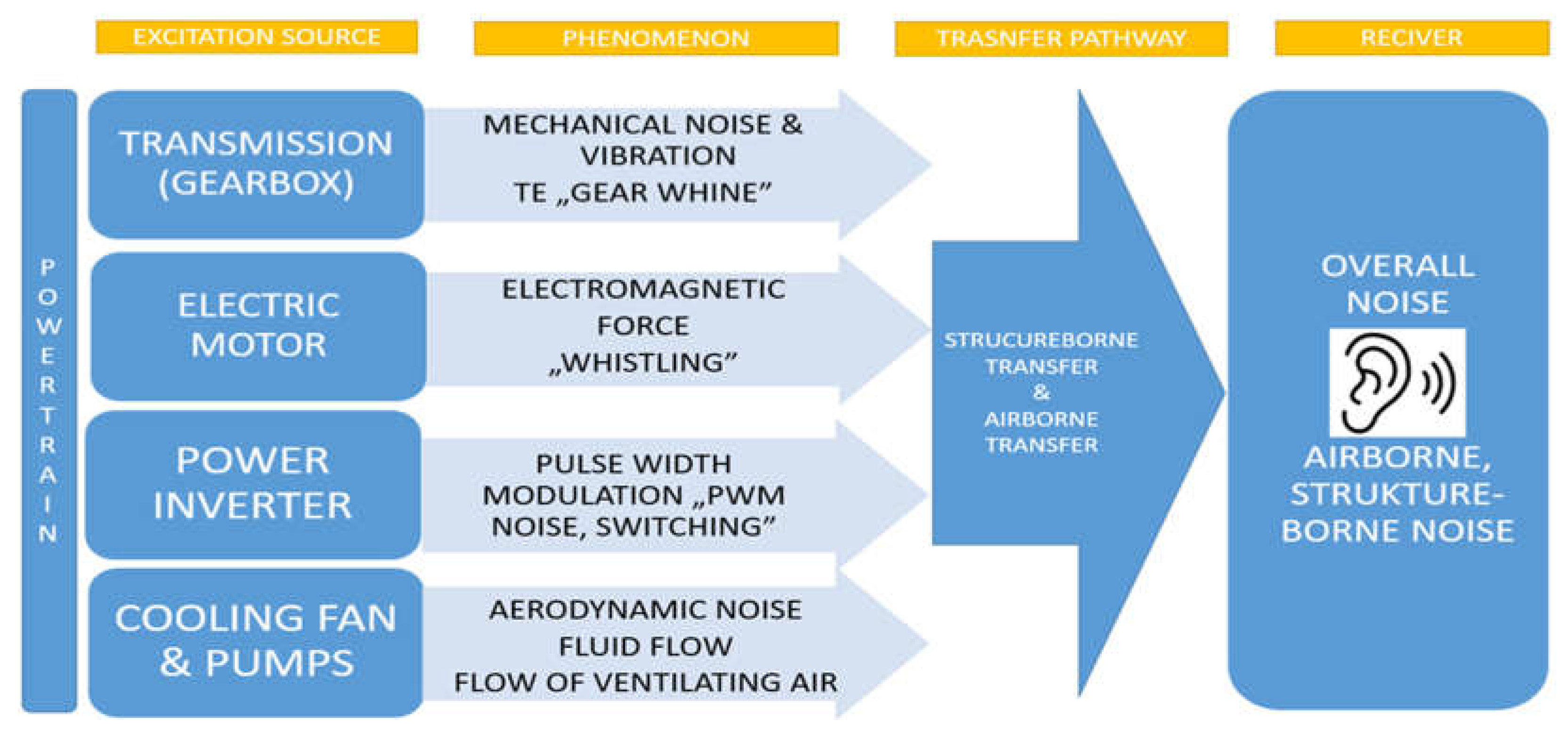
Figure 2.
Noise generation mechanism and transmission path in electromechanical powertrain.
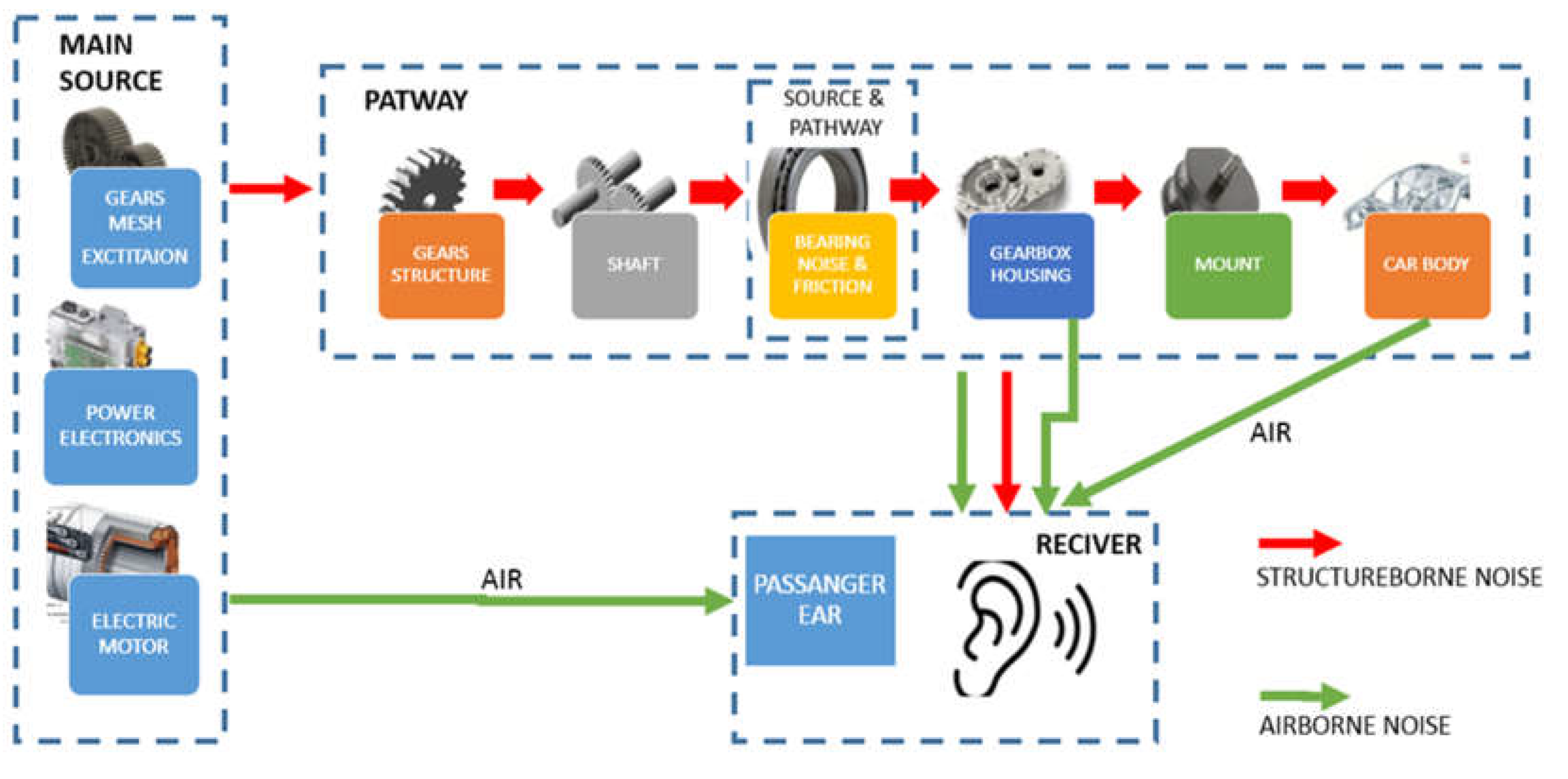
Figure 3.
Recommended numerical Multiphysics simulation workflow – overall simulation process.
Disclaimer/Publisher’s Note: The statements, opinions and data contained in all publications are solely those of the individual author(s) and contributor(s) and not of MDPI and/or the editor(s). MDPI and/or the editor(s) disclaim responsibility for any injury to people or property resulting from any ideas, methods, instructions or products referred to in the content. |
© 2024 by the authors. Licensee MDPI, Basel, Switzerland. This article is an open access article distributed under the terms and conditions of the Creative Commons Attribution (CC BY) license (http://creativecommons.org/licenses/by/4.0/).
Copyright: This open access article is published under a Creative Commons CC BY 4.0 license, which permit the free download, distribution, and reuse, provided that the author and preprint are cited in any reuse.


