

Submitted:
22 June 2024
Posted:
24 June 2024
You are already at the latest version
Abstract
The effort to expand the U.S. study abroad programs to have a global impact has never been fully expressed by Higher Education Institutions (HEIs) and study abroad administrators. Study Abroad since its inception has not been a truly global platform. This article constructively points out the existing potential of Minority Serving Institutions (MSIs) to make the U.S. study abroad a truly global program capable of defending U.S. national interest in this era of inter-dependence among nations, especially as the global knowledge economy and cultural competence advantage take center stage. Study abroad is at a crossroads at the moment, new ideas must be developed for study abroad to justify the true potential of education abroad. Over two decades, four countries in Western Europe have been hosting the highest number of U.S. students in study abroad. There is no evidence that this trend will reach the entire globe as a reciprocity of international students in U.S. colleges and universities.
Keywords:
HBCUs
; Study Abroad
; Europe
; Financial
; National Security
1. Introduction
The potential of study abroad programs to the U.S. national interest and personal development have been reiterated in the literature substantively. Since the 1920s, Study Abroad has been intentionally designed to become a rite of passage for students acquiring higher education as a way to develop competence in global cultures, values, and trends (Starr-Glass, 2016). According to the Institute of International Education (IIE) study abroad transcends borders, build connections to providing solutions to a peaceful, equitable, greater understanding between people and cultures globally (Martel & Baer, 2022). The power of international education to promote access to global opportunities cannot be undermined. The issue of underrepresentation in multiple segments of U.S. higher education have been a hotly debated topic with a climax of the Supreme Court ruling on the Brown v. Board of Education of Topeka, 1954. In this milestone decision, the Supreme Court ruled that the separate but equal segregation of school children in public schools is unconstitutional. Since the landmark abolition, several educational disparities based on racial inequalities have existed in the U.S. educational system diminishing the abilities of minority serving institutions to leverage on education internationalization especially in Historically Black Colleges and Universities (HBCUs).
The expansive structure of globalization made the diverse nature of the U.S. educational system an advantageous structure. Harnessing the advantages of minority serving institutions in contributing to national advancement have been underestimated. The contributions of HBCUs to the development of U.S. international education can have positive impact in various dimensions. First, the Lincoln Commission on Study Abroad (2005), states that promoting the democratization of undergraduate study in the U.S. is the next level in the evolution of U.S. higher education. The Commission supports the greater engagement of U.S. undergraduates in the global affairs to defend national interests.
The bases for the underrepresentation of minority students and institutions in study abroad programs ranges from numerous factors from financial capital, familial beliefs, attitudes, aspiration, perception, and moral support yet little is known about minority students’ experience in study abroad. A few studies have reported extreme minority American students experience to racism, isolation and degrading social status. (Bell, et al., 2023; Taylor & Becton, 2021; Du, 2018; Hallmark, 2017; Lowe, et al., 2014; Nguyen, 2014, & M’Balia, 2013). In spite of the increased number of students of color participating in study abroad, a comparison of the demographics in overall diversity among the students and the slow growth of minority students participation suggests that the gap is widening. According to Institute for International Education – Open doors (2022) the percentage of White students have been slightly declining since 2000s, from 84 percent in 2000 to 68 percent in 2022. The Hispanic study abroad increased within the same period from 5.4 percent in 2000 to 12 percent in 2022 (IIE – open doors, 2022). African American students had the least amount of increase within the period with 3.4 percent to 5.3 percent. Study abroad administrators have long struggled to increase the participation of minority students in study abroad and have erroneously linked this low participation to financial barriers and lack of familial support. This study will focus and discuss in more detail the reason for low participation of African America students and subsequently, investigating the challenges of HBCUs in study abroad beyond Europe as the preferred destination in international education.
2. FOCUS (GAP):
Higher education institutions in Africa can be useful in making African American students and HBCUs inspire African American student population currently up to 12.5 percent enrollment in postsecondary and 5.3 percent in study abroad decide to Study Abroad in Africa (NAFSA, 2022). HBCUs are often able to tap into their students distinct potential which may have been underestimated by HBCUs and study abroad administrators. The challenges of HBCUs to build and sustain the capacity to inspire their students beyond Europe lies in the ability of HBCUs to open the minds of their undergraduates to leave home country to seek new competencies in foreign land (Akomolafe, 2000) in collaboration with higher education institutions (HEIs) in Africa where their heritage and cultural ties serves as an opportunity to address the underrepresentation of minority students in study abroad. Brux and Fry (2009) found family disapproval to be a major factor affecting HBCUs from engaging in Study Abroad. Further, Akomolafe (2000) affirmed that HBCUs face major institutional obstacles where most black institutions are unable to offer comprehensive global experience to their students, thereby diminishing the potential of the students they serve. In 1999, 30 European countries signed a treaty called the Bologna declaration in Italy with the goal of establishing standard and quality of higher education qualifications. This treaty has actually facilitated the desire to earn academic credit with the time spent in study abroad to keep track of students’ record time to graduate (Granato, et al., 2024). Therefore, the U.S. institutions realized that the Bologna process and the European Community Action Scheme for the Mobility of University Students - ERASMUS program of the European Union (E.U.) that is especially renowned for its mobility initiative facilitates inter-institutional agreement for multiple level studies including study abroad, exchange programs where universities agree to send their students abroad and welcome students from their partner university. According to Granato, et al., (2024) in the last 30 year, an increasing number of U.S. students have studied abroad to earn academic credit, thereby making Europe a readymade destination for study abroad for most students.
The important role for Historically Black Colleges and Universities (HBCUs) in the underrepresentation of minority students of color cannot be overestimated. HBCUs can increase partnerships with educational institutions by reorganizing their operations and creating specialized programs that appeal to students of color, promoting study abroad, raising awareness, providing comprehensive services, and offering programs in non-traditional fields to non-European destination. Increasing participation and diversity of programs to promote cultural exchange is not a problem of financial support aimed at students of color to encourage study abroad in non-European regions.
3. Objectives
The main objective of this research is to make progress toward achieving a global reciprocity of internationalizing the U.S. education abroad. Approximately seventy percent of all students who study abroad identify as White, and sixty-seven percent of the students are women (Open doors, 2018). The efforts made by predominantly white institutions (PWIs) to inspire their students to study abroad beyond Europe have yielded minimal results. The Commission on Abraham Lincoln study abroad program proposed a bold vision for the United States to send one million U.S. students on study abroad annually within a decade (Lincoln Commission, 2005). Thereby making study abroad the norm not the exception can position American students for success similar to the success recorded in G.I. bill and Land Grant university system (Croft, 2019). Therefore, this research is to contribute to the efforts of promoting study abroad beyond European countries to enrich the entire the cultural knowledge, diversity, and engagement of U.S. students globally (NAFSA, 2008; Lincoln Commission, 2005; Thompson, 1991). The central motive of Study Abroad is to provide students with an experience that challenges their perspective and to make greater achievement towards the learning outcomes for establishing Study Abroad as a program for national interest. To the answer the focus and gap of this research the following research questions are critical.
- How can HBCUs inspire their students’ interest beyond European study abroad?
H1: There is a statistical disposition that HBCUs can inspire their students interest to study beyond Europe.
- 2.
- What necessary action can HBCUs take to enhance their potential to study beyond Europe?
H2: There is a statistical inclination that HBCUs can enhance their potential to study beyond Europe if they develop their institutional capacity.
The challenges faced by HBCUs will be a major concern. HBCUs were established in the 19th century to provide Black Americans with educational opportunities in high education level (Bracey, 2017). The higher education Act of 1965 was fundamental in the establishment of HBCUs to support the Black freedom struggle. Currently there are 106 HBCUs serving more than 228,000 students throughout U.S. (Evans, et al., 2002). Yet HBCUs are often regarded as a low-performing institution. Much of this perception stems from comparisons of graduation rates between HBCUs and non-HBCUs. Some HBCUs have graduation rates that compare favorably with the rates at other types of institutions (Ogunleye, 2024), while others have rates that trail national medians (Richards, & Awokoya, 2012).
The proportion of Historically Black Colleges & Universities participating in study abroad has increased from 16 percent in 2003/04 to 26 percent in 2013/14, yet minority students still fall behind their white peers pursuing the same achievement (IIE, 2015). Students of color face challenges such as financial barrier, lack of outreach program, lack of familial value for education abroad, fear of racism and discrimination (Taylor, & Becton, 2021; Du, 2018; Kasravi, 2018; Hallmark, 2017; Nguyen, 2014). According to Redden ((2018) students of color are more likely to study beyond Europe, and in countries where English is not the predominant language due to the stereotypic racism, they face in predominantly white destinations such as Western Europe have a higher propensity to study beyond Europe.
HBCUs serve a significant number of low-income students of color; it is therefore important to understand how Study Abroad is or not approached at such institutions in terms of development of study abroad within American higher education. Study abroad is by no means a recent phenomenon. Historically, U.S. study abroad has been the purview of the white, wealthy class traced to the era of self-directed travel to Europe for studies in the 19th century (Mullen, 1988). The aftermath of WW1 gave way for internationalism of peace and mutual understanding where Study abroad and organizations such as the IIE and the development of institutional programming became increasingly prevalent. Since the end of WW2, the U.S. Government has become increasingly involved in Study Abroad especially beyond western locales which is seen as an effective foreign policy tool due to the prewar idealism of peace and mutual understanding and postwar foreign policy and national security.
4. Methodology
The methodological theory is related to a secondary data reposited in the Institute for International Education/Open doors. This is a quantitative data that examines the potential of Historically Black Colleges and Universities (HBCUs) in utilizing their underrepresentation in study abroad towards a global reach Study Abroad beyond Europe. Additionally, the study seeks to quantify the short fall in terms of actual enrollment of minority students and the percentage they represent in study abroad. The study will also determine the challenges facing minority students and preventing them from participating in study abroad beyond Europe. Further, the study will adapt descriptive and inferential statistics to answer the research questions. The study will use a longitudinal data of ten (10) years to describe the trends of events. The data source to be used will exclusively be sourced from Institute for International Education/Open doors data on HBCUs. The study will analyze the trends and design a method for HBCUs to encourage their underrepresented students to enroll in Study Abroad for non-European destinations.
5. Techniques:
The methodology adopted for the study is the use of secondary data to determine the potential of minority serving institutions to make significant inroad in developing Study Abroad programs beyond European countries. The HBCUs engagement in Study Abroad is expected to have some technical details due its stage in development and specialty to serve students of color to study beyond European countries. In most cases, HBCUs Study Abroad destinations usually in the south-south world region/country are faced with minority students challenges (Engberg & Wolniak, 2009; Teranishi & Briscoe, 2006; & Berger, 2000) Study Abroad beyond Europe are likely to be led by a faculty of color which can encourage students of color, and activities such as heritage, agriculture and establishing educational cooperation programs (Hansen, 2002 & Sowa, 2002).
6. Experimental Set Up:
Minority serving institutions enroll and serve most students of color and minority populations. The institutions provide access to students of color into programs of study in higher education and they are taught by Faculty of color. Therefore, the tendency that Study Abroad resources i.e., cultural programs, information on heritage, cultural identity, homogeneous inclination could motivate students of color to develop interest in study abroad beyond Europe. To test the experiment, HBCUs must build their campus resources around Study Abroad with intentional cultural competences, racial inclusions, structural support, to attract students and encourage Faculty. Further, the policy in Study Abroad in HBCUs should include an increase in available resources, provide more information about Study Abroad opportunities such as heritage culture, destination, and upgrading academic advising while participating in Study Abroad.
7. Percent of U.S. Study Abroad Students by Race/Ethnicity
Although the diversity of Study Abroad participation has increased in recent years, minority students are still greatly underrepresented in study abroad. NAFSA supports policies that increase opportunities for all American students to study abroad. International experiences not only prepare students to succeed in their careers, but also collectively strengthen our economy, diplomacy, and national security.
| Race/Ethnicity | U.S. Postsecondary Enrollment | U.S. Students Abroad |
| African American or Black | 12% | 5.3% |
| Asian/Pacific Islander | 7.5% | 8.6% |
| Caucasian | 50.9% | 68.6% |
| Hispanic/Latino | 19.6% | 11.9% |
| Multiracial | 4.1% | 4.8% |
| American Indian/Alaska Native | 0.6% | 0.4% |
8. Results
The means and standard deviations in Table 3.1 above shows that Europe hosted the highest number of U.S. Study Abroad Student within the years under study (Mean = 55.80, SD = 3.94). Latin America & Caribbean score a total mean of 14.86 (SD = 1.67), and Asia with a total mean score of 11.51 (SD = 0.97).

Table 3.1.
Means and Standard deviations of U.S. Study Abroad Students population by Hosting Regions within a period of 10 years (2011/12 – 2020/21).
Table 3.1.
Means and Standard deviations of U.S. Study Abroad Students population by Hosting Regions within a period of 10 years (2011/12 – 2020/21).
| N | Mean | Std. Deviation | Std. Error | 95% Confidence Interval for Mean | Minimum | Maximum | ||
| Lower Bound | Upper Bound | |||||||
| Africa, Sub-Saharan | 10 | 3.8600 | .67032 | .21197 | 3.3805 | 4.3395 | 2.40 | 4.60 |
| Antarctica | 10 | .0000 | .00000 | .00000 | .0000 | .0000 | .00 | .00 |
| Asia | 10 | 11.5100 | .97120 | .30712 | 10.8152 | 12.2048 | 9.10 | 12.40 |
| Europe | 10 | 55.8000 | 3.94180 | 1.24651 | 52.9802 | 58.6198 | 53.30 | 66.30 |
| Latin America & Caribbean | 10 | 14.8600 | 1.67743 | .53045 | 13.6600 | 16.0600 | 11.00 | 16.30 |
| Middle East & North Africa | 10 | 2.5500 | .89969 | .28451 | 1.9064 | 3.1936 | 1.90 | 4.90 |
| North America | 10 | .4900 | .11005 | .03480 | .4113 | .5687 | .20 | .60 |
| Oceania | 10 | 4.1300 | 1.57766 | .49890 | 3.0014 | 5.2586 | .50 | 7.10 |
| Multiple Destinations | 10 | 6.7500 | 1.74627 | .55222 | 5.5008 | 7.9992 | 2.30 | 7.90 |
| Total | 90 | 11.1056 | 16.64127 | 1.75414 | 7.6201 | 14.5910 | .00 | 66.30 |
Result of ANOVA Summary in Table 3.2 above indicates a significant main influence of region on U.S. study abroad program, F (8,81) = 1052.076, p < .001. This means that Study Abroad students’ choice of study is significantly influenced by the characteristics of the host countries.
Table 3.2.
ANOVA Summary of U.S. Study Abroad Students population by Hosting Regions within a period of 10 years (2011/12 – 2020/21).
Table 3.2.
ANOVA Summary of U.S. Study Abroad Students population by Hosting Regions within a period of 10 years (2011/12 – 2020/21).
| Sum of Squares | df | Mean Square | F | Sig. | |
| Between Groups | 24412.010 | 8 | 3051.501 | 1052.076 | .000 |
| Within Groups | 234.937 | 81 | 2.900 | ||
| Total | 24646.947 | 89 |
Figure 1.
Mean plot showing the population of U.S. Study Abroad Students by Host Regions around the world from 2011/12 to 2020/21 Academic session.
Figure 1.
Mean plot showing the population of U.S. Study Abroad Students by Host Regions around the world from 2011/12 to 2020/21 Academic session.
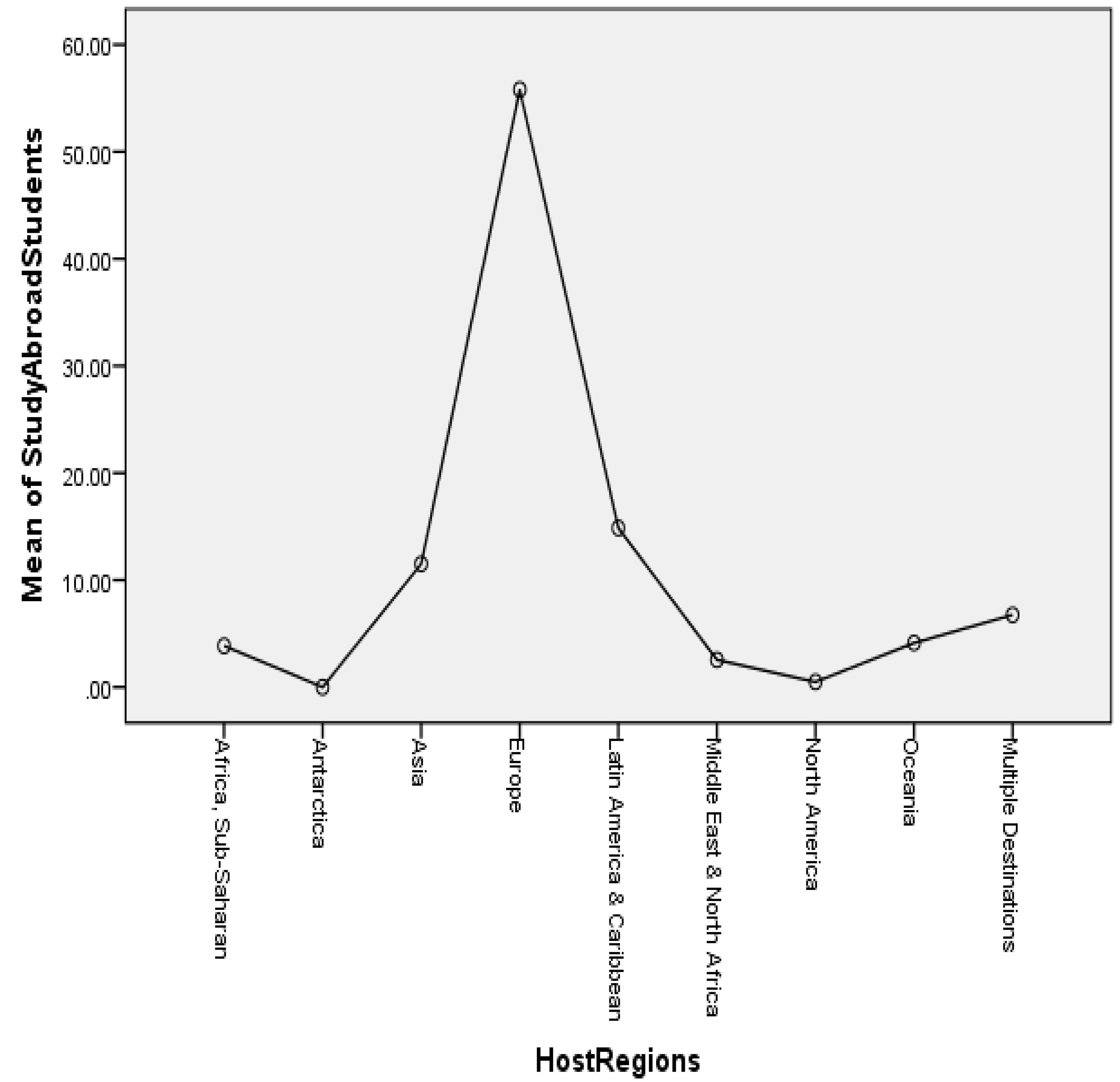
Table 3.2.
Mean and Standard deviations of U.S. Study Abroad Students population by Race/Ethnicity within a period of 10 years (2011/12 – 2020/21).
Table 3.2.
Mean and Standard deviations of U.S. Study Abroad Students population by Race/Ethnicity within a period of 10 years (2011/12 – 2020/21).
| N | Mean | Std. Deviation | Std. Error | 95% Confidence Interval for Mean | Minimum | Maximum | ||
| Lower Bound | Upper Bound | |||||||
| American Indian or Alaska Native | 10 | .4700 | .04830 | .01528 | .4354 | .5046 | .40 | .50 |
| Asian_Native Hawaiian or Other Pacific Islander | 10 | 8.3300 | .75432 | .23854 | 7.7904 | 8.8696 | 7.30 | 10.00 |
| Black or African American | 10 | 5.5900 | .63849 | .20191 | 5.1333 | 6.0467 | 4.10 | 6.40 |
| Hispanic or Latino | 10 | 9.6600 | 1.55077 | .49040 | 8.5506 | 10.7694 | 7.60 | 12.30 |
| Multiracial | 10 | 4.0100 | .77810 | .24606 | 3.4534 | 4.5666 | 2.50 | 4.80 |
| White | 10 | 71.9300 | 2.94545 | .93143 | 69.8230 | 74.0370 | 68.30 | 76.40 |
| Total | 60 | 16.6650 | 25.14111 | 3.24570 | 10.1704 | 23.1596 | .40 | 76.40 |
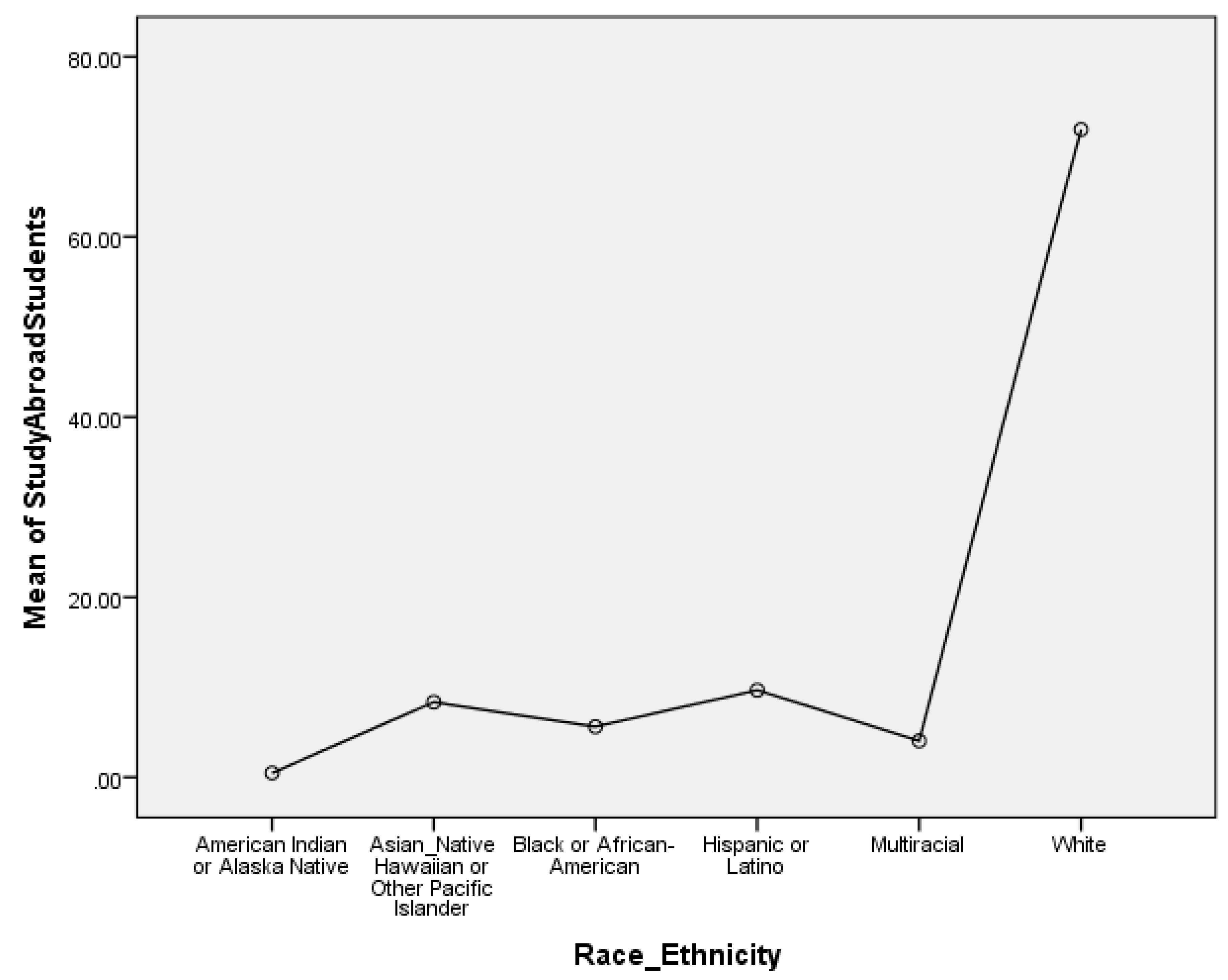
Result of means and standard deviations in Table 3.3 above shows that with students participated more in U.S. Study Abroad program with a total mean of 71.93, and Standard deviation of 2.95. Hispanic or Latino Americans who scored a total mean of 9.66 (SD = 1.55), and the least being the American Indians or Alaska Natives who scored a total mean of 0.47 (SD = 0.048).
Result of ANOVA Summary in Table 3.4 above indicates a significant main influence of Race/Ethnicity on U.S. study abroad program, F (5,54) = 3522.63, p < .001. This means that race/ethnic origin significantly influenced enrolment opportunities in the U.S. study abroad program.
Table 3.4.
ANOVA Summary of U.S. Study Abroad Students population by Hosting Regions within a period of 10 years (2011/12 – 2020/21).
Table 3.4.
ANOVA Summary of U.S. Study Abroad Students population by Hosting Regions within a period of 10 years (2011/12 – 2020/21).
| Sum of Squares | df | Mean Square | F | Sig. | |
| Between Groups | 37178.451 | 5 | 7435.690 | 3522.633 | .000 |
| Within Groups | 113.985 | 54 | 2.111 | ||
| Total | 37292.436 | 59 |
Figure 2.
Mean plot showing Population of U.S. Study Abroad Students by Race/Ethnicity from 2011/12 to 2020/21 Academic session.
Figure 2.
Mean plot showing Population of U.S. Study Abroad Students by Race/Ethnicity from 2011/12 to 2020/21 Academic session.
9. Discussion
Result of the indicates a significant main influence of Race/Ethnicity on U.S. study abroad program. This means that race/ethnic origin significantly influenced enrollment opportunities in the U.S. Study Abroad program. Considering that White students participated more than the students of color, this result aligns with the finding of Thrush and Victorino (2016) who found that most of the students that study abroad are from elite private colleges and universities who are white and female, with highly educated familial background, and major in arts and humanities. The perception that Study Abroad program is not for minority students, low income, first generation and racial/ethnic students due to the cost, fear of discrimination, benefits to minority students (Bell, et al., 2023; Du, 2018; Lowe, et al., 2014; Mullen, 2014 & M’Balia, 2013;). This category of students is usually measured by their eligibility for Pell Grant funding for their higher education. According to figures of Study Abroad, the lack of diversity in Study Abroad participation in an increasingly globalized world is worrisome with many potential consequences for U.S. national interest. The goal of Study Abroad as the U.S. non-confrontational response to global insecurity should motivate minority serving institutions to study beyond Europe by inspiring their students. Result of the study also indicates a significant main influence of region on U.S. study abroad program. This means that study abroad students’ choice of study is significantly influence by the characteristics of the host countries. Considering that European countries hosted more students in the U.S. study abroad program, this result affirms the views of Nguyen (2014) who found that the influence of familial capital, social networks and cultural capital that make meaning of study abroad. Silvestri, (2023) states socioeconomic elites regularly sent their children overseas throughout 18th and 19th centuries capping their education with a grand European tour, indicating a long history of social norms and expectation of class study abroad programs was intended for. The reflection of grand tour in study abroad have also been stated by Gore (2005) and Abram & Hatch (1960) as legitimate summer study tour making it the most preferred as the short-term study abroad (STSA) with majority of student 58.9 percent study abroad on a summer program lasting no more than 8 weeks (Ficarra, 2017).
10. Implications of the Study
Although more students from all ethnic backgrounds have been participating in study abroad since the 1990s, notwithstanding this development, less than 10 percent of U.S. higher education students participate in Study Abroad. But only 25 percent of the study abroad enrollees are students of color, indicating that many more ethnic students are underrepresented in Study Abroad. Researchers and organizations such as the Institute for International Education (Open door, 2023), Berg, et al., (2023) and the Lincoln Commission (2005) affirm that undergraduate enrollment of racial ethnicity affirms that White population represents about 51 percent of the entire enrollees. But the population representation of Study Abroad White students represents 69 percent according to Open door (2023). This may not be solely about discrimination and institutional policies, this present result seem to point, in addition, that there could be a lag in the institutional capacities of HBCUs in terms of curriculum coverage, orientation and perception, and intercultural competence.
11. Recommendations
Much attention should be focused on how to provide more Study Abroad opportunities to underrepresented students. Currently, The Institute of International Education, open door (2023) reported that in 2021/2022 racial and ethnic students represented 31 percent (i.e., Asian/Pacific Islander, African American, Hispanic, and Multiracial). This is despite their greater proportion in the enrollment of students in U.S. higher education. The government of U.S. should strengthen its ties with universities beyond Europe and enhance the perceptions of prospective Study Abroad students about other countries beyond Europe. Furthermore, Minority serving institutions should be positioned to undertake institutional assessment to determine barriers that hinder Study Abroad participation among their students.
12. Limitations of the Study
This study is limited by its reliance on secondary data. Further study on this topic should include primary data involving quantitative and qualitative analysis.
13. Conclusion
This study confronts the potential of HBCUs in enhancing global U.S. study abroad by examining the roles of race/ethnicity and region in the U.S. Study Abroad enrollment. Results of the study indicate the significant main influence of race/ethnicity and significant main effect of region on U.S. Study Abroad participation. This indicates that there are gaps that need to be leveled up. Therefore, there is need for HBCUs, the U.S. Government and Department of Education to take necessary action in not only bridging the gap in opportunities between White and the minority groups but to widen the scope of U.S. Study Abroad opportunities in other countries beyond Europe. This effort will help enhance the global outlook of the U.S. study abroad program in terms of global competitiveness, cultural competence and attain U.S. national interest.
References
- Abrams, I., & Hatch, W. R. (1960). Study abroad (Vol. 6). US Department of Health, Education, and Welfare, Office of Education.
- Akomolafe, O. (2000) Africanizing HBCUs: Problems and Prospects of international education in historically Black institutions, 28, no.1/2 Study Abroad in Africa Cambridge University press, pp103 – 107.
- Bell, A., Bhatt, R., Rubin, D. L., & Shiflet, C. (2023). Effects of education abroad on indices of student success among racial–ethnic minority college students. Journal of Diversity in Higher Education, 16(2), 226.
- Berg, B; Lee, S; Randolph, B, Ryu, M & Shapiro, D (May 2023), Current term Enrollment Estimates: Spring 2023, Herndon, VA. National Student Clearing House research Center.
- Berger, J. B. (2000). Optimizing capital, social reproduction, and undergraduate persistence. In J. Braxton (Ed.), Reworking the student departure puzzle (pp. 95–124). Nashville, TN: Vanderbilt University Press.
- Bracey, E. N. (2017). The significance of historically Black colleges and universities (HBCUs) in the 21st century: Will such institutions of higher learning survive? American Journal of Economics and Sociology, 76(3), 670-696.
- Commission on the Abraham Lincoln Study Abroad Fellowship Program: Global Competence & National Needs (November, 2005) .
- Croft, G. K. (2019). The US land-grant university system: An overview. CRS Report, 45897.
- Du, H. (2018). The complexity of study abroad: Stories from ethnic minority American students in China. Annual Review of Applied Linguistics, 38, 122-139.
- Evans, A. L., Evans, V., & Evans, A. M. (2002). Historically Black Colleges and Universities (HBCUS). Education, 123(1), 3+. https://link.gale.com/apps/doc/A94265100/AONE?u=txshracd2603&sid=googleScholar&xid=305bcd6f.
- Ficarra S. M (2017). Curating cartographies of knowledge: reading institutional study abroad portfolio as text. Fronters: The Interdisciplinary Journal of study abroad 29 (1), 1 – 14.
- Gore, J. E. (2017). Dominant beliefs and alternative voices: Discourse, belief, and gender in American study. Routledge.
- Granato, S., Havari, E., Mazzarella, G., & Schnepf, S. V. (2024). Study abroad programmes and student outcomes: Evidence from Erasmus. Economics of Education Review, 99, 102510.
- Hallmark, T. (2017). Strategies to Increase Participation in Study Abroad at HBCUs and HSIs. In Educational Challenges at Minority Serving Institutions (pp. 99-112). Routledge.
- Hansen M. H, (eds) (2002). Internationalizing higher education: Building vital programs on campuses. 117, Spring, Jossey Bass.
- Institute for International Education – (2023) “Profile of U.S. Study Abroad students 2000/02 – 2021/22. Open door report on international education exchange retrieved from http://www.opendoorsdata.org .
- Kasravi, J. (2018). Students of color and study abroad: From barriers to results. In Promoting inclusion in education abroad (pp. 45-60). Routledge.
- Lowe, M. R., Byron, R. A., & Mennicke, S. (2014). The racialized impact of study abroad on US students’ subsequent interracial interactions. Education Research International, 2014.
- Martel & Baer (2022). Spring 2022 Snapshot on International Exchange, Institute of International Education.
- M'Balia, T. 20. M'Balia, T. (2013). The problematization of racial/ethnic minority student participation in US study abroad. Applied Linguistics Review, 4(.
- Mullen, S (1988) Study Abroad at HBCUs: Challenges, trends, and best practices; In Anderson, J. D. (1988). The education of Blacks in the South, 1860-1935. Univ of North Carolina Press.
- Murray Brux, J., & Fry, B. (2010). Multicultural Students in Study Abroad: Their Interests, Their Issues, and Their Constraints. Journal of Studies in International Education, 14(5), 508-527. [CrossRef]
- NAFSA, (2022). Trends in U.S. Study Abroad. http://www.nafsa.org/policy-and-advocacy/policy-resources/trend-us-study-abroad .
- NAFSA: Association of International Educators. (2008). Strengthening study abroad: Recommendations for effective institutional management. Report of the Task Force on Institutional management of Study Abroad.
- Nguyen, S. (2014). 'F'IS FOR FAMILY, FRIEND, AND FACULTY INFLUENCES: EXAMINING THE COMMUNICATED MESSAGES ABOUT STUDY ABROAD AT A HISPANIC-SERVING INSTITUTION (HSI). International Education, 43(2), 77.
- OGUNLEYE, A. Exploring Study Abroad with Traditionally Underrepresented Populations: Impacts of Institutional Types. Preprints 2024, 2024061276. [CrossRef]
- Redden, E. (September 10, 2018). HBCU Students Abroad; insidehighered.com .
- Richards, D. A., & Awokoya, J. T. (2012). Understanding HBCU Retention and Completion. Frederick D. Patterson Research Institute, UNCF.
- Silvestri, J. (2023). What’s My Intention? How Male Undergraduate Students Make Sense of Study Abroad (Doctoral dissertation, Northeastern University).
- Sowa, A. P, (eds) (2002). Internationalizing higher education: Building vital programs on campuses. 117, Spring, Jossey Bass.
- Starr-Glass, D. (2016). Repositioning study abroad as a rite of passage: Impact, implications, and implementation. In Handbook of research on study abroad programs and outbound mobility (pp. 89-114). IGI Global.
- Taylor, Z. W., & Becton, D. (2021). The linguistics of English colonialism in study abroad: Translating the study abroad experience for language minority students. In Critical Perspectives on Equity and Social Mobility in Study Abroad (pp. 135-150). Routledge.
- Teranishi, R., & Briscoe, K. (2006). Social capital and the racial stratification of college opportunity. In J. C. Smart (Ed.), Higher education: Handbook of theory and research (Vol. XXI, pp. 591–614). New York: Springer.
- Thompson, R. T. (1991). Chinese Language Study Abroad in the Summer, 1990. Final Report.
- Thrush, E. C., & Victorino, C. (2016). Providing study abroad opportunities for underrepresented populations: Lessons from the University of California, Riverside. In Handbook of research on study abroad programs and outbound mobility (pp. 115-136). IGI Global.
- Wells, R. (2008). Social and cultural capital, race and ethnicity, and college student retention. Journal of College Student Retention, 10(2), 103–128.
Disclaimer/Publisher’s Note: The statements, opinions and data contained in all publications are solely those of the individual author(s) and contributor(s) and not of MDPI and/or the editor(s). MDPI and/or the editor(s) disclaim responsibility for any injury to people or property resulting from any ideas, methods, instructions or products referred to in the content. |
© 2024 by the authors. Licensee MDPI, Basel, Switzerland. This article is an open access article distributed under the terms and conditions of the Creative Commons Attribution (CC BY) license (http://creativecommons.org/licenses/by/4.0/).
Copyright: This open access article is published under a Creative Commons CC BY 4.0 license, which permit the free download, distribution, and reuse, provided that the author and preprint are cited in any reuse.


