
Submitted:
21 June 2024
Posted:
24 June 2024
You are already at the latest version
Abstract
: Psychological members can provide college students with solid peer support and sustain their mental health. This study examined the relationship between empathy, interpersonal communication, listening and psychological members' competence among 407 university students, and also analysed the mediating role of interpersonal communication and listening. The results showed that psychological members‘ empathy, interpersonal communication, and listening were significantly and positively related to psychological members’competence, interpersonal communication mediated the relationship between empathy and competence, listening mediated the relationship between empathy and competence, and interpersonal communication and listening chained the mediating role between empathy and competence. This suggests that psychological members' empathy enhances their competence by influencing their interpersonal communication and listening, which in turn enhances their competence.
Keywords:
psychological members
; empathy
; interpersonal communication
; listening
; competence
1. Introduction
College students have always been at high risk for psychological problems due to the multiple pressures of academics, employment, social relationships, and adjusting to changes in independent living. College students, especially during their freshman year, are prone to a certain level of loneliness and depression, which can negatively affect their social competence and the skills needed to develop intimate relationships (So & Fiori, 2022). March-Amengual (2022) found that the majority of students surveyed had reported significant feelings of loneliness and depression in their first two weeks at university, and in severe cases, significant physical discomfort. The 2022 College Student Mental Health Survey Report released in China shows that nearly 30% of college students are dissatisfied with their current life situation and are at risk for depression, while 45.28% may be at risk for anxiety. Loneliness and depression can be effectively reduced if college students can be assisted in effective ways to reduce maladies such as loneliness and to help them improve their social skills in order to build satisfying relationships (Wei et al, 2005). Peer support has a positive effect on groups suffering from depression or anxiety (Simmons et al., 2023). Peer groups are able to influence each other and open up more easily, making it easier to find solutions to problems if they are shared. Peer support is a truly recovery-oriented intervention and an external resource for maintaining an individual's mental health (Lyons et al., 2021), which can be either unidirectional or bidirectional (Bellamy et al., 2017). Astiti (2019) argues that peer counselling is a non-professional carried out under the guidance of a professional counsellor counselling, which takes the form of a systematic approach among peers to deal with various life issues or work on developing self-potential in a mutually supportive and supportive manner. Professionally trained peer supporters are able to provide a variety of the same life experiences in the form of assistance, such as work, life issues, or personal experiences to peers in need (Salmiati, Rosmawati, & Lestari, 2018). Effective peer support can alleviate individual anxiety and depression and reduce social isolation and burnout, and peer support is essential to encourage students to seek support and streamline referrals to counselling services (Salsabila et al., 2020). Therefore, it is necessary to establish professional peer support teams to alleviate college students' mental health problems for a college population with a high prevalence of psychological problems. The essence of the psychological members ystem implemented in universities across China is to select and train students to become mental health helpers, providing non-clinical and non-judgmental support to their peers (Abrams et al, 2022). Although the presence of psychological members does not replace the role and function of expert counsellors, it can be a bridge between professional counsellors and students and provide some advice and psychological support to students with psychological distress (Prasetiawan, 2016).
Competence is defined as the deep-rooted characteristics of an individual that distinguish those who excel at a job from those who are average, including motivation, personality traits, self-image attitudes, values, social roles, knowledge of a domain, cognitive or behavioural skills, etc., i.e., any individual trait that can be measured and that significantly distinguishes good performance from average performance (Le Deist et al., 2005 ; Spencer & Spencer, 1993).Competence is an important competence in student teamwork (Almerich et al., 2020), and competence is one of the core qualities of psychological members as an important role in schools or organisations. The competence of psychological members includes not only professional knowledge and skills, but also interpersonal skills, communication skills, and listening skills (Zhan Qisheng et al., 2021 ; Chen Wenyi, Luo Ludu, 2022). Psychological members serve as volunteers, peers, learners, role models and advocates in the classroom (Chen, Wenyi, Luo, 2022). Therefore, psychological members need to have both solid psychological knowledge and skills, as well as good communication and problem-solving skills, in order to better respond to and solve the psychological problems of others.
Empathy is a stable personality trait that usually includes two dimensions, emotional empathy and cognitive empathy, and refers to an individual's ability to understand another person's emotional state, to experience similar emotional experiences, and to respond with appropriate behaviour (Elliott et al., 2011 ; Buie, 1981). Individuals with high empathy possess characteristics such as positive attention to others without judgement, good listening skills and self-confidence (Davis, 1990). Empathy is an important motivator for individuals to engage in pro-social behaviour and to make decisions about helping behaviour (Xiao et al., 2021).Lin (2018),in her study on empathy and competence among employees, found that developing empathy among employees helps them to become more rational, and is effective in reducing conflict in teamwork and improving employee competence. Empathy can also affect an individual's social skills (Mayberry et al., 2007), and with increased social skills, psychological members are better able to connect and interact with others, which is important for psychological members to fulfil their jobs and tasks. Therefore, this study proposes Hypothesis 1: Empathy significantly predicts competence among university psychological members.
Interpersonal competence refers to the ability of an individual to have the willingness to interact, actively participate in the interaction, and closely display effective and appropriate interaction behaviours in the process of communication, so as to keep the relationship between oneself and others in a harmonious state (Abejo et al., 2023). Interpersonal relationships have an impact on college students' mental health, and the ability to establish friendly interpersonal relationships is one of the criteria for mental health (Zhang & Zhu, 2022). Having good interpersonal communication can help students build self-efficacy in themselves as well as in others (Caban et al, 2023). A large body of research shows that interpersonal communication play a significant positive role in preventing mental health problems in students.Interpersonal competence, which is an individual's ability to interact successfully with others, is a positive predictor of an individual's mental health (Sun, 2023), and it provides a new perspective on preventing and intervening in mental health problems. The duties of classroom psychological members involve in-depth interaction and communication with students, teachers, and other stakeholders; therefore, possessing a high level of interpersonal communication is crucial for psychological members to successfully fulfil their duties. Therefore, this study proposes Hypothesis 2: Interpersonal competence mediates the effect of empathy on competence.
Listening is the process by which an individual receives verbal and non-verbal information, determines a meaning, and responds to the information received (Gearhart & Bodie, 2011), and the ability to listen is the ability to give full attention to another person's words, feelings, and needs. Exploring listening as an interpersonal process, it can enhance real-time sensory connections and a sense of safety, thus increasing positive empathy between people and contributing to more harmonious interpersonal relationships (Zhou & Fredrickson, 2023). The ability to listen helps individuals to understand the inner world and needs of others, thus enhancing their ability to empathise and give attention and support to others in a sincere manner. Listening skills help psychological members to gain a deeper understanding of the feelings and needs of others. In many domains, listening is related to job performance and may be the cause of desired outcomes, including job performance, leadership, relationship quality, job knowledge, work attitudes, and well-being (Kluger & Itzchakov, 2022 ). This shows that listening skills also have a significant impact on psychological members' competence. Therefore, this study proposes Hypothesis 3: Listening ability mediates the relationship between psychological members' empathy and competence.
Interpersonal interaction is the basis and prerequisite for listening (Ames et al., 2012). Interpersonal interaction is a two-way interactive process that includes listening and feedback, and listening acts on the whole process of interpersonal interaction. In interpersonal interactions, we usually need to communicate effectively with others to build and maintain relationships (Manusov et al., 2018). This need motivates us to listen more actively to the views and feelings of others. By listening, we can better understand others and meet their needs, thus enhancing relationships. When we listen carefully to others, we can better understand their perspectives and feelings, which makes it easier to reach consensus and solve problems. In addition, listening enhances the self-esteem and confidence of the other person, making them feel valued and respected (Krueger & Itzchakov, 2022). This positive influence helps us to build better relationships and complete a certain task more successfully. Interpersonal interactions and listening can also contribute to an individual's competence development. By interacting with others, individuals have the opportunity to learn and develop social skills, communication skills, and problem-solving skills (Fedesco, 2015), which are all important components of competence. Listening to others, on the other hand, can help individuals understand problems more comprehensively and better analyse and solve problems, thus improving their competencies. Therefore, this study proposes Hypothesis 4: Interpersonal interaction and listening play a chain mediating role between empathy and competence.
1.1. Current Study
Although there have been some studies proposing theoretical models of psychological members' competence, such as including dimensions of professional qualifications, self-perception, motivation, knowledge, and skills, these models have not been widely validated, and empirical studies are relatively few. This makes our understanding of psychological members competence lack data support, it is difficult to accurately assess their role in actual work, and it is impossible to establish a unified selection and training standard, and the research on psychological members’ competence in colleges and universities has not yet formed a sound system.
This study mainly explores the relationship between empathy, interpersonal communication, listening and the competence of psychologists, and provides empirical evidence for the promotion and implementation of the psychologist system in college mental health work. It also helps to clarify the core competencies and qualities required of psychologists, which in turn provides a scientific basis for their selection, training and evaluation, and provides assistance for the mental health education of college students.
2. Materials and Methods
2.1. Participants
In this study, the class psychological members of three higher teacher training colleges in Chongqing were selected as the research object, 407 questionnaires were issued, 378 valid questionnaires were recovered, and the recovery efficiency rate was 92.9%. Among them, there were 250 female students (66.3%) and 128 male students (33.7%); 126 only children (33.4%) and 252 non-only children (66.6%); and 201 (53.2%) in rural areas and 177 (46.8%) in urban areas.
2.2. Instruments
2.2.1. Empathy Scale
The Interpersonal Response Pointer Scale revised by Han Wenchao et al. (2013) was chosen. The scale consists of 20 items, divided into 5 dimensions: fantasy, empathy, concern, viewpoint selection, and personal pain. All items are scored on a 5-point scale, with ‘1’ representing ‘very inconsistent’ and ‘5’ representing ‘very consistent ‘. The Cronbach's alpha coefficient for this scale in this study was 0.73.
2.2.2. Interpersonal Competence Questionnaire (ICQ)
The Interpersonal Competence Questionnaire (ICQ) was developed by psychological members at the University of California, Los Angeles (Buhrmester, Furman, Wittenberg & Reis, 1988). The scale has 5 dimensions of 40 question items including Active Interaction, Appropriate Rejection, Self-Representation, Conflict Management, and Emotional Support. A 5-point scale is used, with higher scores indicating greater interpersonal competence. The Cronbach's alpha coefficient for this scale in this study was 0.96.
2.2.3. Listening Skills Questionnaire
The Listening Skills Questionnaire for Psychological Members in Colleges and Universities developed by Zhan Qisheng (2021) et al. was selected. The questionnaire contains 25 questions divided into 5 dimensions: inclusion and acceptance, connotative mastery, willingness bias, empathetic concern, and response and feedback. It is scored on a 4-point scale, with ‘1’ representing ‘not at all’ and ‘4’ representing ‘completely’. The Cronbach's alpha coefficient of the questionnaire was 0.95 in this study.
2.2.4. Competence Questionnaire for Psychological Councilors in Universities
The Competence Questionnaire for Psychological Members in Universities developed by Yi Sijia (2015) was selected. The questionnaire consists of 42 questions divided into seven dimensions: self-concept, teamwork, professional knowledge, personality traits, work motivation, organisational skills, and work attitude, all of which are scored on a 5-point scale, with ‘1’ representing ‘very incompatible’, ‘5’ representing ‘very incompatible’, and ‘5’ representing ‘very incompatible’. The scale is scored on a 5-point scale, with ‘1’ meaning ‘very much’ and ‘5’ meaning ‘very much’. The internal consistency coefficient of Cronbach's alpha for the scale in this study was 0.98.
2.3. Data Processing
SPSS27.0 and Process Macro software were used to process and analyse the data in this study. SPSS27.0 was used for descriptive statistics, Pearson product-difference correlation analysis, etc.; PROCESS macros were used to test for mediating effects using the bias-corrected non-parametric percentile Bootstrap method.
3. Results
3.1. Common Method Bias Test
The data in this study were all obtained from the information provided by the same group of subjects, which may generate common method bias. Therefore, this study first used the Harman one-way method to test for common method bias, and all items of the questionnaire were subjected to exploratory factor analysis. The results showed that there were 22 common factors with eigenvalues greater than 1, and the percentage of variance explained by the first common factor was 30.28%, which was less than the critical criterion of 40%, indicating that there was no serious common method bias in this study.
3.2. Descriptive Statistics and Correlation Analysis among Variables
Descriptive statistics and Pearson correlation analyses were conducted on empathy, interpersonal communication, listening and competence of psychological members, as well as gender, place of birth, and whether they were born alone. The results showed that there was a two-by-two significant positive correlation between empathy, interpersonal communication, listening, and competence. Since gender, place of birth, and being an only child were significantly correlated with the variables discussed in this study, they were used as control variables in the subsequent data analyses, and the results are shown in Table 1.
3.3. Chained Mediation Model Test
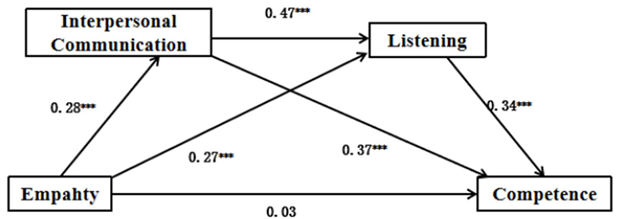
Using gender, place of birth, and whether or not they were born alone as control variables, empathy as the independent variable, competence as the dependent variable, and listening and interpersonal interaction as the mediator variables, Model6 in the SPSS Process macro program was used to test the mediating effects of listening and interpersonal interaction among empathy and competence among psychological members. The results showed that empathy was not a significant positive predictor of competence, but it was a significant positive predictor of interpersonal interaction and listening, both interpersonal interaction and listening were able to significantly and positively predict competence, and interpersonal interaction was able to significantly and positively predict listening and competence, respectively, as shown in Table 2
In this study, on the basis of a better model fit, the bias-corrected nonparametric percentile Bootstrap method (5000 repetitive samples) was used to test the significance level of the multiple mediation effects of the model, which was indicated to be significant if the 95% confidence intervals of the mediation effect paths did not contain 0. The three paths were tested separately and the confidence intervals were estimated. The mediation effect tests and confidence intervals were estimated for the three paths separately. The results of the analysis of the mediation effect (Table 3) showed that the 95% confidence interval of the total indirect effect of interpersonal interaction and listening (with an effect value of 0.35) did not include 0, indicating that the mediation effect of the two was significant. Interpersonal communication and listening as a mediating effect consists of the following three paths: ① empathy → interpersonal communication → competence path formed by the indirect effect 1 (effect value of 0.15) confidence intervals do not include 0, the indirect effect of this path is significant; ② empathy → listening → competence path formed by the indirect effect 2 confidence intervals do not include 0 (effect value of 0.13), the path of the indirect effect is significant; empathy → interpersonal communication → Listening → Competence path formed an indirect effect 3 (effect value 0.07) confidence interval does not include 0, the indirect effect of this path is significant. Therefore, it is clear that the empathy of psychological counsellors can affect their competence not only through the mediation of interpersonal interaction or listening alone, but also through the mediation of the chain of ‘interpersonal interaction→listening’.
4. Discussion
4.1. The Relationship between Empathy and Competence
This study found a significant positive correlation between all four variables of empathy, interpersonal communication, listening and competence of psychological members, indicating that the stronger the empathy of psychological members, the stronger their interpersonal communication skills, listening skills and competence, which is consistent with the results of previous studies (Zhan Qisheng, Zhang Chen, 2020). Empathy is an important motivation for individuals to produce pro-social behaviours as well as make decisions about helping behaviours (Xiao et al., 2021). Individuals with strong empathy are able to understand and experience the feelings and positions of others more deeply. This ability enables them to more accurately grasp the essence and key points of issues when facing complex relationships and tasks, thus improving performance and competence (Hirn et al., 2018 ; Lin & Chuang, 2018). In addition, individuals with strong empathy are more likely to gain the trust and closeness of others in their interactions with others, thus establishing and maintaining good interpersonal relationships and harmonious exchanges and communications (Manusov et al., 2018). In the face of changing work environments and task requirements, the higher the level of empathy, the more flexible individuals are in adjusting their behaviours and strategies (Fuller et al., 2023), and the more they are able to understand and adapt to the needs and expectations of others, so as to better complete their work tasks and improve their competence. Psychological members' empathy skills can help psychological members to be more comprehensive and in-depth in problem-solving. This shows that empathy has a positive impact on the competence of psychological members.
4.2. Separate Mediating Roles of Interpersonal Communication and Listening
Interpersonal skills play a mediating role between empathy and competence, empathy enhances one's understanding of others and the ability to make predictions about them (Redmond, 1989), but this does not mean that psychological members are able to provide effective support directly. Instead, they need good interpersonal skills to build trusting relationships with others, express their understanding and concern, and provide targeted support to get the job done. Thus, interpersonal skills are an important bridge between empathy and competence. Individuals with high empathy are more likely to gain the trust and closeness of others during their interactions with them, thus establishing and maintaining good interpersonal relationships and harmonious exchanges and communication (Ringwald & Wright, 2021).Individuals with strong interpersonal skills have a healthier psychological state and a higher level of adaptability to their environment, and are therefore able to more fully realise their personal growth and development (Segrin & Taylor, 2007). Psychological members are expected to take on mental health promotion and emotional support roles in classes or other groups, and to establish an inclusive and supportive atmosphere among their peers in order to be more effective in carrying out a range of mental health tasks (Spence Cheruvelil et al., 2014), a process that necessitates strong interpersonal skills. Therefore, psychological members have to use appropriate interpersonal skills by demonstrating a sincere, caring and understanding attitude in order to win the trust of others. Psychological members should focus on cultivating and improving their interpersonal skills in order to better fulfil their duties and provide help and services to others, and at the same time lay a solid foundation for their professional growth and development.
Listening skills mediate the relationship between empathy and competence in psychologists, suggesting that psychological members are more competent when their listening skills are higher (Ansari, 2021). Listening ability is an important influence on the competence of psychological members, and listening ability helps psychological members to improve their professionalism and competence. Through careful listening, individuals are able to capture the true emotions and intentions behind the words, accurately grasp the essence of the problem, and offer more targeted help and advice (Nemec et al., 2017 ; Kluger & Itzchakov, 2022), which enhances competence in the work process. Improved listening skills lead individuals to give more consideration to the feelings and emotional states of others, which is conducive to building harmonious interpersonal relationships (Bodie et al., 2015) and winning the trust of others. Listening ability helps to build trusting relationships between individuals. When psychological members show a sincere, caring and patient listening attitude, others feel respected and understood, which makes it easier to establish a trusting relationship. The establishment of such a trusting relationship is the basis for the smooth implementation of the work of psychologists, and is also an important guarantee of their competence.
4.3. Chain Mediating Role of Interpersonal Interaction and Listening
Finally, psychological members' interpersonal interactions and listening play a fully mediating role between their empathy and competence. Interpersonal skills are integral to group organisation (Singh, 2014) and interpersonal skills are important for the mental health of university students (Byrd & McKinney, 2012). Interpersonal interactions help individuals build emotional connections and understanding with others, in which empathy plays a crucial role. Listening, on the other hand, is a key behaviour in interpersonal interactions; by listening to the needs and feelings of others, individuals can better understand how others feel (Ames et al., 2012), and the more empathic people are, the more they will show attentive listening behaviours in interpersonal interactions. Individuals with greater listening skills are able to more accurately grasp key information in interactions and give appropriate feedback, and their interpersonal skills are stronger (Weger et al., 2011). In addition, individuals with higher levels of interpersonal competence have lower levels of interpersonal distress and more harmonious interpersonal relationships, resulting in a more accurate grasp of work (Dewi et al., 2020) and greater work competence. Improved interpersonal skills can effectively contribute to psychological member competence. Therefore, psychological members with stronger empathy can more accurately understand the emotions and needs of others in interpersonal interactions and listening, and provide more effective support and assistance, which not only enhances the trusting relationship between psychological members and their classmates, but also improves their competence.
4.4. Theoretical and Practical Implications
Previous competence studies have focused more on the knowledge, skills and traits of individuals and less on the affective factor. By introducing empathy as an affective factor and interpersonal and listening skills, it expands the perspective of competence research and helps to assess the competence of psychological members in a more comprehensive way. In addition, traditional studies have focused more on empathy as an emotional response or cognitive process and less on its role in the competence of psychological members. By introducing interpersonal interaction and listening as chain mediators, this study was able to reveal more comprehensively how empathy affects the competence of psychological members, deepening the understanding of the relationship between the two. This study found that empathy not only directly affects the competence of psychological members, but also indirectly affects competence by influencing interpersonal and listening skills. This chain-mediated effect reveals the complex mechanism of empathy's role in the work of psychological members and provides a new theoretical basis for the training and selection of psychological members.
The chain mediating role of psychologists' interpersonal interaction and listening between empathy and competence provides a new way of thinking about mental health education in colleges and universities, and this theoretical breakthrough provides practical guidance for the training and selection of psychologists. In training, key skills such as empathy, interpersonal communication and listening can be used on to enhance the competence of psychologists. In selection, these three factors can also be assessed as important indicators to select more promising psychological members. The level of empathy is an important basis for selecting college psychological members because it can significantly affect their competence through interpersonal communication and listening. Training to improve the empathy, interpersonal and listening skills of college psychological members is an important path to integrate and improve their competence, which is an important direction for future research. Universities should give full play to the empathy, interpersonal communication, listening and competence of college psychologists in their classroom mental health education work, and work together to maintain the mental health of college students.
4.5. Limitations and Future Directions
There are still some shortcomings in this study that need to be improved. On the one hand, this study used a questionnaire to collect the data of psychologists, based on the results of self-assessment by the subjects, but the psychological members are working with a large number of students, so they can be evaluated by others in future research. On the other hand, the subjects in this study were all from teacher training colleges and universities, and there is a big difference between male and female, so in the future, we can expand the areas and types of schools in the study, and balance the gender differences, so as to improve the external validity of the results of the study.
5. Conclusions
This study shows that the empathy of psychological members has a significant impact on their competence, in which interpersonal communication and listening play an important mediating role. This finding not only enriches our understanding of empathic competence, but also provides an important theoretical basis for the selection and training of psychological members in colleges and universities.
Author Contributions
Conceptualization, X.Z. and C.H.; methodology, X.Z.; software, M.C.; validation, X.Z., C.H. and M.C.; formal analysis, M.C.; investigation, X.Z.; resources, X.Z.; data curation, M.C.; writing—original draft preparation, X.Z.; writing—review and editing, C.H.; visualization, X.Z.; supervision, C.H. All authors have read and agreed to the published version of the manuscript..
Funding
This research received no external funding
Informed Consent Statement
Informed consent was obtained from all subjects involved in the study.
Data Availability Statement
The data presented in this study are available on request from the corresponding author.
Conflicts of Interest
The authors declare no conflicts of interest.
References
- Abejo, C.G.; Adanza, D.R.; Salvador, H.N.; Uy, M.N.; Indoc, S.M.; Abiol, M.J. The Influence of Interpersonal Skills of Working Students on Client Service Satisfaction in a Higher Educational Institution. International Journal of Multidisciplinary: Applied Business and Education Research 2023. [Google Scholar] [CrossRef]
- Abrams, M.P.; Salzman, J.; EspinaRey, A.; Daly, K. Impact of Providing Peer Support on Medical Students’ Empathy, Self-Efficacy, and Mental Health Stigma. International Journal of Environmental Research and Public Health 2022, 19, 9. [Google Scholar] [CrossRef] [PubMed]
- Almerich, G.; Suárez-Rodríguez, J.; Díaz-García, I.; Cifuentes, S.C. 21st-century competences: The relation of ICT competences with higher-order thinking capacities and teamwork competences in university students. J. Comput. Assist. Learn. 2020, 36, 468–479. [Google Scholar] [CrossRef]
- Ames, D.R.; Maissen, L.B.; Brockner, J. The role of listening in interpersonal influence. Journal of Research in Personality 2012, 46, 345–349. [Google Scholar] [CrossRef]
- Ansari, A. The Role of Interpersonal Communication Skills in Human Resource and Management. 2021. [Google Scholar]
- Astiti, S.P. Efektivitas Konseling Sebaya (Peer Counseling) dalam Menuntaskan Masalah Siswa. Indonesian Journal of Islamic Psychology 2019, 1, 244–263. [Google Scholar] [CrossRef]
- Bellamy, C.; Schmutte, T.; Davidson, L. An update on the growing evidence base for peer support. Mental Health and Social Inclusion 2017, 21, 161–167. [Google Scholar] [CrossRef]
- Bodie, G.D.; Vickery, A.J.; Cannava, K.; Jones, S.M. The Role of “Active Listening” in Informal Helping Conversations: Impact on Perceptions of Listener Helpfulness, Sensitivity, and Supportiveness and Discloser Emotional Improvement. Western Journal of Communication 2015, 79, 151–173. [Google Scholar] [CrossRef]
- Buie, D.H. Empathy: Its Nature and Limitations. Journal of the American Psychoanalytic Association 1981, 29, 281–307. [Google Scholar] [CrossRef]
- Byrd, D.; McKinney, K.J. Individual, interpersonal, and institutional level factors associated with the mental health of college students. Journal of American College Health 2012, 60, 185–193. [Google Scholar] [CrossRef]
- Caban, S.; Makos, S.; Thompson, C.M. The Role of Interpersonal Communication in Mental Health Literacy Interventions for Young People: A Theoretical Review. Health Communication 2023, 38, 2818–2832. [Google Scholar] [CrossRef]
- Chen, W.Y.; Luo, D. . An analysis of the factors influencing the competence of undergraduate psychological counsellors. Psychology Monthly 2022, 8–10. [Google Scholar]
- Davis, C.M. What is empathy, and can empathy be taught? Physical Therapy 1990, 70, 707–11. [Google Scholar] [CrossRef]
- Dewi, P.; Budiyanto, B.; Agustedi, A. The role of interpersonal communication in moderating the effect of work competence and stress on employee performance. Accounting. 2020. [CrossRef]
- Elliott, R.; Bohart, A.C.; Watson, J.C.; Greenberg, L.S. Empathy. Psychotherapy 2011, 48, 43. [Google Scholar] [CrossRef] [PubMed]
- Fedesco, H.N. The Impact of (In)effective Listening on Interpersonal Interactions. International Journal of Listening 2015, 29, 103–106. [Google Scholar] [CrossRef]
- Fuller, M.; de Jong, M.; Kamans, E.; Wolfensberger, M.; van Vuuren, M. Empathy Competencies and Behaviors in Professional Communication Interactions: Self Versus Client Assessments. Business and Professional Communication Quarterly 2023, 86, 167–186. [Google Scholar] [CrossRef]
- Gearhart, C.C.; Bodie, G.D. Active-Empathic Listening as a General Social Skill: Evidence from Bivariate and Canonical Correlations. Communication Reports 2011, 24, 86–98. [Google Scholar] [CrossRef]
- Han, W.; Ye, M.; Leng, Y. Revision and testing of the Interpersonal Reaction Pointer Scale in mainland China. Journal of Southeast University (Philosophy and Social Science Edition), 2013; (S1), 47–52. [Google Scholar]
- Hirn, S.L.; Thomas, J.; Zoelch, C. The role of empathy in the development of social competence: a study of German school leavers. International Journal of Adolescence and Youth 2018, 24, 1–13. [Google Scholar] [CrossRef]
- Kluger, A.; Itzchakov, G. The Power of Listening at Work. Annual Review of Organizational Psychology and Organizational Behavior 2022, 9. [Google Scholar] [CrossRef]
- Krueger, A.N.; Itzchakov, G. The power of listening at work. Annals of Organizational Psychology and Organizational Behaviour 2022, 9, 121–146. [Google Scholar]
- Le Deist, F.D.; Winterton, J. What Is Competence? Human Resource Development International 2005, 8, 27–46. [Google Scholar] [CrossRef]
- Lin, C.T.; Chuang, S.S. The role of empathy between functional competence diversity and competence acquisition: a case study of interdisciplinary teams. Quality and Quantity 2018, 52, 2535–2556. [Google Scholar] [CrossRef]
- Lin, C.-T.; Chuang, S.-S. The role of empathy between functional competence diversity and competence acquisition: a case study of interdisciplinary teams. Quality & Quantity 2018, 52. [Google Scholar] [CrossRef]
- Liu, L.-L.; Tang, B.-S. On the cultivation of college students' listening ability. Jiangsu Higher Education 2012, 139–140. [Google Scholar]
- Lyons, N.; Cooper, C.; Lloyd-Evans, B. A systematic review and meta-analysis of group peer support interventions for people experiencing mental health conditions. BMC psychiatry 2021, 21, 315. [Google Scholar] [CrossRef] [PubMed]
- Manusov, V.; Stofleth, D.; Harvey, J.A.; Crowley, J.P. Conditions and Consequences of Listening Well for Interpersonal Relationships: Modeling Active-Empathic Listening, Social-Emotional Skills, Trait Mindfulness, and Relational Quality. International Journal of Listening 2018, 34, 1–17. [Google Scholar] [CrossRef]
- March-Amengual, J.-M.; CambraBadii, I.; Casas-Baroy, J.-C.; Altarriba, C.; ComellaCompany, A.; Pujol-Farriols, R.; Baños, J.-E.; Galbany-Estragués, P.; ComellaCayuela, A. Psychological Distress, Burnout, and Academic Performance in First Year College Students. International Journal of Environmental Research and Public Health 2022, 19, 3356. [Google Scholar] [CrossRef]
- Mayberry, M.L.; Espelage, D.L. Associations among empathy, social competence, & Reactive/Proactive aggression subtypes. Journal of youth and adolescence 2007, 36, 787–798. [Google Scholar]
- Nemec, P.B.; Spagnolo, A.C.; Soydan, A.S. Can you hear me now? Teaching listening skills. Psychiatr. Rehabil. J. 2017, 40, 415–17. [Google Scholar] [CrossRef]
- Prasetiawan, H. Konseling Teman Sebaya (Peer Counseling) Untuk Mereduksi Kecanduan Game Online. Counsellia: Jurnal Bimbingan dan Konseling 2016, 6, 1–13. [Google Scholar] [CrossRef]
- Redmond, M.V. The Functions of Empathy (Decentering) in Human Relations. Human Relations 1989, 42, 593–605. [Google Scholar] [CrossRef]
- Ringwald, W.R.; Wright, A.G.C. The Affiliative role of empathy in everyday interpersonal interactions. European Journal of Personality 2021, 35, 197–211. [Google Scholar] [CrossRef] [PubMed]
- Salmiati, R.; Lestari, M. Peer Counselor Training Untuk Mencengah Perilaku Bullying. Indonesia Journal of Learning Education and Counseling 2018, 62–69. [Google Scholar] [CrossRef]
- Salsabila, S.; Wiryantara, J.; Salsabila, N.; Alhad, M.A. The Role of Peer Counseling on Mental Health. Bisma The Journal of Counseling 2020. [Google Scholar] [CrossRef]
- Segrin, C.G.; Taylor, M. Positive interpersonal relationships mediate the association between social skills and psychological well-being. Personality and Individual Differences 2007, 43, 637–646. [Google Scholar] [CrossRef]
- Simmons, M.B.; Cartner, S.; MacDonald, R.; Whitson, S.; Bailey, A.; Brown, E. The effectiveness of peer support from a person with lived experience of mental health challenges for young people with anxiety and depression: a systematic review. BMC psychiatry 2023, 23, 194. [Google Scholar] [CrossRef] [PubMed]
- Singh, A. Role of Interpersonal Communication in Organizational Effectiveness. International Journal of Research in Management & Business Studies 2014, 1, 36–39. [Google Scholar]
- So, C.; Fiori, K. Attachment anxiety and loneliness during the first-year of college: Self-esteem and social support as mediators. Personality and Individual Differences 2022, 187, 111405. [Google Scholar] [CrossRef]
- Cheruvelil, K.S.; Soranno, P.A.; Weathers, K.C.; Hanson, P.C.; Goring, S.J.; Filstrup, C.T.; Read, E.K. Creating and maintaining high-performing collaborative research teams: The importance of diversity and interpersonal skills. Frontiers in Ecology and the Environment 2014, 12, 31–38. [Google Scholar] [CrossRef]
- Spencer, L.M.; Spencer, S.M. Competence at Work: Models for Superior Performance. 1993. [Google Scholar]
- Sun, Y. The Relationship Between College Students’ Interpersonal Relationship and Mental Health: Multiple Mediating Effect of Safety Awareness and College Planning. Psychology Research and Behavior Management 2023, 16, 261–270. [Google Scholar] [CrossRef]
- Weger, H.; Castle, R.; Emmett, M.C. Active Listening in Peer Interviews: The Influence of Message Paraphrasing on Perceptions of Listening Skill. International Journal of Listening 2010, 24, 34–49. [Google Scholar] [CrossRef]
- Wei, M.; Russell, D.W.; Zakalik, R.A. Adult Attachment, Social Self-Efficacy, Self-Disclosure, Loneliness, and Subsequent Depression for Freshman College Students: A Longitudinal Study. Journal of Counseling Psychology 2005, 52, 602–614. [Google Scholar] [CrossRef]
- Xiao, W.; Lin, X.; Li, X.; Xu, X.; Guo, H.; Sun, B.; Jiang, H. The Influence of Emotion and Empathy on Decisions to Help Others. Sage Open 2021, 11. [Google Scholar] [CrossRef]
- Yi, S. Competence model construction and questionnaire development of psychological members in colleges and universities (Master's thesis, Jiangxi Normal University). 2015.
- Zhan, Q.; Liu, M.; Liu, X.; Wang, Q. The development of a questionnaire on the listening ability of university psychologists. Chinese Journal of Mental Health 2021, 788–794. [Google Scholar]
- Zhan, Q.; Zhang, C. The effects of empathy and interpersonal trust on the communication ability of university psychologists. Heilongjiang Higher Education Research 2020, 91–96. [Google Scholar]
- Zhang, D.; Zhu, Z. The character is tics and influencing factors of college students’ psychological qualities: based on an analysis of online survey data of college students. Educ Res 2022, 43, 126–139. [Google Scholar]
- Zheng, R.C. Psychological Diagnosis of College Students; Shandong Education Press: Jinan, 1999; pp. 339–345. [Google Scholar]
- Zhou, J.; Fredrickson, B.L. Listen to resonate: Better listening as a gateway to interpersonal positivity resonance through enhanced sensory connection and perceived safety. Current opinion in psychology 2023, 53, 101669. [Google Scholar] [CrossRef]

Table 1.
Correlation test between variables.
| variables | M±SD | 1 | 2 | 3 | 4 | 5 | 6 | 7 |
|---|---|---|---|---|---|---|---|---|
| 1Gender | 1.66±0.47 | 1 | ||||||
| 2Place of birth | 1.47±0.50 | ﹣0.05 | 1 | |||||
| 3Single-birth | 1.67±0.47 | 0.15** | ﹣0.47*** | 1 | ||||
| 4Empathy | 3.51±0.39 | 0.04 | 0.10* | ﹣0.08 | 1 | |||
| 5Interpersonal communication | 3.35±0.53 | ﹣0.04 | 0.13* | ﹣0.12* | 0.29*** | 1 | ||
| 6Listening | 3.22±0.39 | ﹣0.04 | 0.13** | ﹣0.18*** | 0.41*** | 0.56*** | 1 | |
| 7Competence | 3.97±0.56 | ﹣0.01 | 0.14** | ﹣0.17*** | 0.28*** | 0.58*** | 0.57*** | 1 |
Note:***p<0.001,**p<0.01;*p<0.05.
Table 2.
Chain mediation analysis between empathy and competence of psychological members.
| Regression Equation | Significance of Regression Coefficients | Fitting Index | |||
|---|---|---|---|---|---|
| Outcome Variable | Predictive Variables | β | t | R2 | F |
| Interpersonal Communication | Empathy | 0.28 | 5.64*** | 0.10 | 10.21*** |
| Gender | ﹣0.03 | ﹣0.67 | |||
| Place of birth | 0.07 | 1.25 | |||
| Single-birth | ﹣0.07 | ﹣1.10 | |||
| Listening | Empathy | 0.27 | 6.29*** | 0.39 | 48.07*** |
| Interpersonal Communication | 0.47 | 11.11*** | |||
| Gender | ﹣0.24 | ﹣0.58 | |||
| Place of birth | 0 | 0 | |||
| Single-birth | ﹣0.09 | ﹣2.00 | |||
| Competence | Empathy | 0.03 | 0.63 | 0.43 | 45.73*** |
| Interpersonal Communication | 0.37 | 7.73*** | |||
| Listening | 0.34 | 6.70*** | |||
| Gender | 0.02 | 0.63 | |||
| Place of birth | 0.02 | 0.43 | |||
| Single-birth | ﹣0.01 | ﹣1.28 | |||
figurNote:***p<0.001,**p<0.01;*p<0.05.
Table 3.
Mediated effects and confidence intervals.
| Trails | Effect | Effect size | 95% confidence interval | ||
|---|---|---|---|---|---|
| Upper Lower | |||||
| Direct Effect | Empathy → Competence | 0.04 | 10.26% | ﹣0.09 | 0.16 |
| Intermediation Effect | Empathy → Interpersonal communication → competence | 0.15 | 38.46% | 0.08 | 0.23 |
| Empathy → Listening → competence | 0.13 | 33.33% | 0.08 | 0.19 | |
| Empathy → Interpersonal communication → Listening → competence | 0.07 | 17.95% | 0.03 | 0.11 | |
| Aggregate Intermediation Effect | 0.35 | 89.74% | 0.24 | 0.47 | |
| Total Effect | 0.39 | 100.00% | 0.25 | 0.53 | |
Disclaimer/Publisher’s Note: The statements, opinions and data contained in all publications are solely those of the individual author(s) and contributor(s) and not of MDPI and/or the editor(s). MDPI and/or the editor(s) disclaim responsibility for any injury to people or property resulting from any ideas, methods, instructions or products referred to in the content. |
© 2024 by the authors. Licensee MDPI, Basel, Switzerland. This article is an open access article distributed under the terms and conditions of the Creative Commons Attribution (CC BY) license (http://creativecommons.org/licenses/by/4.0/).
Copyright: This open access article is published under a Creative Commons CC BY 4.0 license, which permit the free download, distribution, and reuse, provided that the author and preprint are cited in any reuse.


