

Submitted:
20 June 2024
Posted:
21 June 2024
You are already at the latest version
Abstract
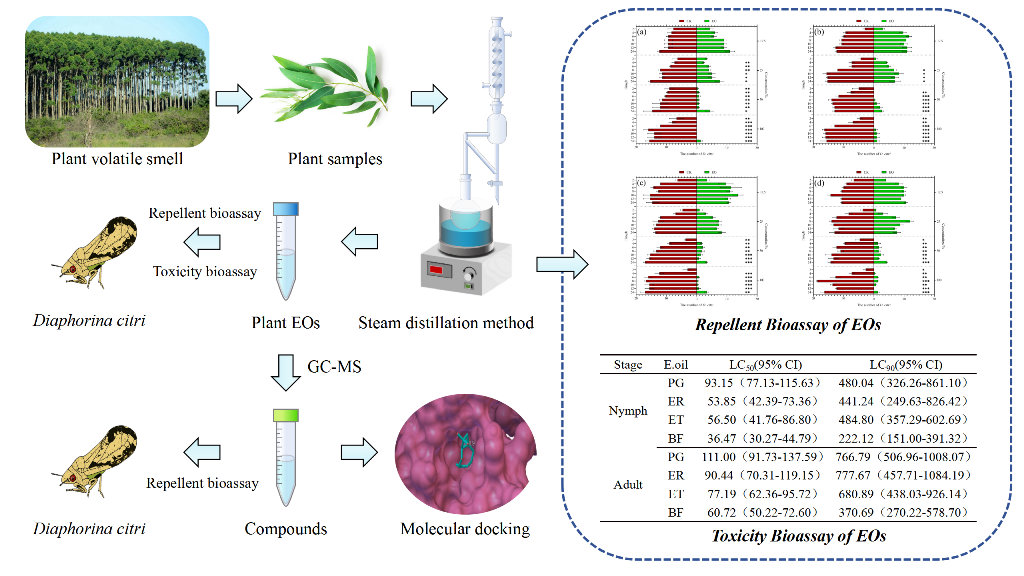
The Diaphorina citri Kuwayama (D. citri) is one of the major pests in the citrus industry, which spreads Citrus Huanglongbing disease. It has developed resistance to chemical insecticides. Therefore, searching for greener solutions for pest management is critically important. The main aim of this study was to evaluate the repellent and insecticidal efficacy of essential oils (EOs) from four species of Myrtaceae plants: Psidium guajava (PG), Eucalyptus robusta (ER), Eucalyptus tereticornis (ET), and Baeckea frutescens (BF) against D. citri and to analyze their chemical composition. GC-MS analysis was performed, and the results indicated that the EOs of PG, ER, ET, and BF were rich in terpenoids, ketones, esters, and alcohol compounds. The repellent rate of all four EOs showed that it decreased with exposure time but increased with concentrations of EOs. Repellent rates ranged from 80.50% to 100.00% after treating D. citri for 6 hours with four EOs at 100% concentration and decreased to 67.71% to 85.49% after 24 hours of exposure. Among the compounds from the EOs tested, eucalyptol had the strongest repellent activity, with a 24-hour repellency rate of 100%. The contact toxicity bioassay results showed that all EOs have insecticidal toxicity to D. citri; the LC50 for nymphs was 36.47-93.15 mL/L, and for adults, it was 60.72-111.00 mL/L. These results show that when PG is used as the reference material, both ER, ET, and BF EOs have strong biological activity against D. citri, which provides a scientific basis for the further development of plant-derived agrochemicals.
Keywords:
essential oil
; Diaphorina citri
; insecticidal activity
; repellent activity
1. Introduction
The Asian citrus psyllid, Diaphorina citri Kuwayama (Hemiptera: Psyllidae), is a globally important citrus pest. It feeds on leaf sap, causing leaf wilting and excreting on the leaves, leading to sooty mold pollution. Above all, it is a natural vector of Citrus Huanglongbing (HLB)[1,2]. HLB is a bacterial disease caused by the bacterium Candidatus Liberibacter asiaticus (CLas), which occurs in the phloem tissue of citrus plants [3,4]. Plants infected with CLas will gradually die within 2-4 years. Therefore, HLB has caused serious damage to the global citrus industry. Due to the current inability to cure HLB, controlling the citrus psyllid has become the primary measure for managing this disease[5].
At present, the use of chemical pesticide is the main measures for controlling D. citri in the field[6]. However, the extensive use of agrochemicals has led to serious environmental problems and the development of insecticide resistance[7,8]. Three D. citri field populations in Florida, USA had developed high levels of resistance to the neonicotinoid agent thiamethoxam[9]. The resistance multiples of D. citri adults and 4th instar nymphs in three field populations in Mexico to malathion were 345-432 times, and to chlorpyrifos were 1424-2435 times, indicating extremely high levels of resistance[10]. Such a high resistance factor makes field control of citrus psyllids even more difficult. Therefore, it is of utmost urgency to develop environmentally friendly and non-agrochemical measures to control D. citri.
The olfactory receptor of insects is an important system that regulates their behaviors such as foraging, searching for mates, mating, laying eggs, and avoiding natural enemies [11,12]. Odorant binding proteins (OBPs) are one of the olfactory proteins in insects, and among various olfactory proteins in insects, they play a major role in the perception of odor factors [13,14]. OBPs are water-soluble macromolecular proteins. When insects sense and recognize odors in the environment, OBPs are responsible for binding and transporting these odorants [12]. Because of their role in insect signal transduction, OBPs are considered significant research targets for pest control [15]. OBPs had been identified from various Hemipteran insects, such as Acyrthosiphon pisum (15 OBPs)[16], Sogatella furcifera (12 OBPs)[17], Bemisia tabaci (8 OBPs)[18] and D. citri (9 OBPs)[19].
Plant-based natural products are a new research focus in agricultural pest control[20,21,22], including D. citri. Plant-derived bioactive compounds have advantages such as renewability, affordability, biodegradability, strong specificity, environmental friendliness, and no resistance to pests. They can be used as effective alternatives of chemical pesticides against pests of significant medical and veterinary importance, as well as in agriculture[23,24,25,26]. Moreover, some plants can emit highly volatile and irritating odor substances, which have a significant repellent effect on pests. Previous studies had shown that the odor substances of PG could have a strong repellent effect on D. citri[27,28,29]. Additionally, some natural products of plants also have a certain killing effect on pests, and they do not cause resistance or pollution to the environment, offering a new environmentally friendly way of pest control[30].
Psidium guajava (PG) is considered an important tropical fruit widely distributed in tropical and subtropical regions. PG fruit is very rich in nutritional elements and has been introduced into citrus production areas in southern China[31]. Eucalyptus robusta (ER) and Eucalyptus tereticornis (ET) are dense shade trees, both native to Australia and widely distributed in citrus producing areas in southern China[32,33]. They are important timber plants, and their leaves can be used for medicine and have fumigation properties. Baeckea frutescens (BF) is a small shrub mainly distributed in subtropical regions and also found in southern China. Its leaves have a volatile odor and can be used as medicine[34]. The leaves of these four plants all contain volatile substances, thus having the potential to be used as plant-based pesticides for pest control.
The prevention and control of citrus psyllid in orchards requires a combination of multiple measures to achieve optimal results[35]. Therefore, using plant-based natural product as a repellent to control D. citri is a novel strategy. In this study, we screened four plants PG, ER, ET and BF, extracted their essential oils (EOs) through distillation, and tested their repellent and insecticidal efficiency against D. citri through bioassay experiments. Then, we identified the compound components of these four EOs, selected the major small molecule compounds with the highest content in each EOs, and conducted molecular docking experiments using DcitOBP7 from D. citri as the macromolecular target protein. Finally, behavioral experiments were conducted again using small molecule compounds with lower binding energies to support the results of molecular docking. We hope to develop new plant-based natural product repellents through this study, providing new strategies for non-pesticide control of D. citri.
2. Result
2.1. Repellent Bioassay of Eos
The comparison of the distribution quantity of D. citri on EO and control check (CK) of all EOs over time and concentration was shown in Figure 1, while the significant differences in their repellent rate was shown in Figure 2. When the concentration was 100% or 50%, there was a significant difference in the number of CK and EO selected by D. citri among all four EO treatments. When the concentration was 25%, there was no significant difference in the number of CK and EO selected by D. citri in the ER and ET EO treatments, ER only showed significant differences at 8, 10, 12, and 24 hours after treatment, and PG only showed no significant difference at 2 hours after treatment. When the concentration was 12.5%, there was no significant difference in the number of CK and EO selected by D. citri among all four EO treatments. Only at a concentration of 100% and after 4 hours of treatment, there was a significant difference in the repellent rates of PG and BF towards D. citri, while there was no significant difference in the repellent rates of the other four EOs at the same concentration and time period.
2.2. Toxicity Bioassay
The toxicity data of citrus psyllids treated with all EOs for 24 hours were given in Table 1. The toxicity bioassay results showed that the LC50 of BF EOs on nymphs and adults were 36.47 mL/L and 60.72 mL/L, respectively, with the best effect. For PG, the LC50 values were 93.15 mL/L for nymphs and 111.00 mL/L for adults. ER exhibited LC50 values of 53.85 mL/L for nymphs and 90.44 mL/L for adults, while ET showed LC50 values of 56.50 mL/L for nymphs and 77.19 mL/L for adults. The mortality rate of all EOs on nymphs was generally higher than that on adults.
2.3. Chemical Analysis of the EOs
Chemical compositions of the EOs from the four plants were given in Table 2. A total of 121 compounds were identified from the four EOs. Terpenoids were the main components in all four plant EOs, accounting for 65.31%, 44.00%, 46.91%, and 46.15%, respectively. Additionally, the compound with the highest content in PG is β-cubebene (9.42%), in ER was α-phellandrene (12.20%), in ET was α-pinene (15.59%), and in BF was o-cymine (13.62%). β-caryophyllene, which was considered the main repellent component of PG, was present in PG (6.15%), ER (1.04%), ET (0.72%), and BF (2.89%), with the highest content in PG.
2.4. Repellent Bioassay of Compounds
Compounds with higher concentrations of various EOs were used to test their repellent activity, Dimethyl disulfide was included as a positive control drug, and the results were shown in Table 3. Within 6 hours of treatment, β-caryophyllene maintained a 100% repellent rate, while it decreased to 83.23-94.07% from 8 to 24 hours. α-pinene showed 100% effectiveness within 4 hours and decreases to 76.92-93.33% from the 6th to the 24th hour. Eucalyptol maintained a high repellent effect for 24 hours, which was 100% except for the 6th hour (94.86%) and the 8th hour (92.22%). o-cymine exhibited 100% efficacy within 4 hours and decreases to 54.77-91.91% within 6 to 24 hours. The repellent rates of limonene and (R)-(+)-limonene within 24 hours were -17.32-12.87% and -11.27-11.44%, respectively, with more attractive effects.
2.5. Molecular Docking
In order to explore the mechanism of action of active compounds, six compounds with significant repellent activity were further tested for their binding abilities with DcitOBP7. And the results of molecular docking were shown in Figure 3, which illustrated the compounds’ strong binding affinity to the protein pocket with a noteworthy docking score ranging between -5.9 and -7.3 kcal/mol. For all the docking analyses, a lower score indicated a better binding affinity. The molecular docking analysis revealed that α-Pinene had the best binding affinity of -7.3 kcal/mol with DcitOBP7. α-Pinene, β-Caryophyllene, α-Terpinene and β-Pinenewere docked at the same position as DcitOBP7, while Limonene and Eucalyptol were docked in different positions.
3. Discussion
In order to simulate the living habits of citrus psyllids and the actual situation in orchards, this study used arranged tender shoots in cages to test the repellent activity of EOs. So far, several studies had been conducted on the repellent efficiency of PG against citrus psyllids. Gottwald et al. [36] indicated that intercropping PG with citrus could reduce the infestation rate of citrus psyllids by 50-100% compared to planting citrus alone. Zaka et al. [37] indicated that when PG leaves were around citrus leaves, the feeding quantity of citrus psyllids decreased by 36.62% to 52.70%. Therefore, guava volatile oil could be regarded as a positive control with good effects. Indoor repellent tests showed that the repellent rate of PG against citrus psyllids within 24 hours was 85.49%-100%, which was sufficient to confirm the significant repellent effect of PG on citrus psyllids. Additionally, EOs from ER, ET and BF exhibited similar repellent effects on citrus psyllids within 24 hours as guava oil. Significance test results indicated that, except for the 100% concentration at 6 hours and 12.5%, there was no significant difference in the repellent efficiency under the same concentration and time conditions. Among all EOs, EO from ERcould maintain a high repellent rate even at low concentrations and exhibited long-term effects. ER, ET, and BF were all distributed in southern China, overlapping with the main citrus producing areas. This suggested that ER, ET and BF all had the potential to be used as plant-based pesticides for D. citri repellent.
Through GC-MS analysis, a total of 121 compounds were identified. Subsequently, high abundant and commercially available compounds were used for the test of repellent activity individually. Table 5 showed that, some compounds could significantly repel D. citri, while others had no significant repellent effect on psyllids, and even had a certain attractive effect. β-caryophyllene is one of the main chemical constituents of PG EO, and its effectiveness in repelling D. citri has been confirmed[38]. In this study, β-caryophyllene also exhibited good repellent activity, with a repellent rate of 85.00 ± 4.28% after 24 hours. The composition of the other three plant EOs was significantly different from that of PG, but they all had a repellent effect similar to that of PG EO. This might be closely related to α-pinene and eucalyptol. It was worth noting that eucalyptol showed significant repellent activity during testing, with a 24-hour repellent rate of 100%. Eucalyptol was not detected in PG EO, while the relative content in EOs of ER, ET, and BF was 5.91%, 6.87%, and 4.31%, respectively. This indicated that eucalyptol might be the major active constituent of the EOs extracted from these three plants.
In toxicity bioassay, the mortality rate of nymphs was higher than that of adults. This was because after soaking the leaves, the EOs formed an oil film on the surface of the plant leaves, hindering the feeding of insects. At the same time, EOs could clog the pores of insects and caused them to suffocate. Their preventive and control effectswere similar to those of mineral oil pesticides[39]. Compared to adults, nymphs had softer mouthparts and were more difficult to penetrate plant leaves covered with oil film for feeding. In addition, nymphs’ tolerance to food shortage and respiratory restrictionwas significantly lower than that of adults. Therefore, using the EOs from the four natural plant in this study could repel adult insects with flight ability and eliminate nymphs with weaker activity levels, providing a theoretical basis for the development of new D. citri repellents and insecticides[40].
The docking results of the DcitOBP7 molecule showed that both the central and edge regions of DcitOBP7 had hydrophobic pocket-like cavities, which provided a possibility for the binding of various ligands to DcitOBP7. The results of molecular docking experiments revealed that the top three ligands with the lowest binding energies: α-pinene, β-caryophyllene, and limonene could all be embedded into the central hydrophobic pocket-like cavity of DcitOBP7[41]. In addition, eucalyptol, which had a stronger tendency to repellent D. citri, could be placed in the hydrophobic pockets at the center and edge of DcitOBP7, respectively, and there were few other ligands embedded at the docking sites located at the edge, which created conditions for eucalyptol to achieve diversified docking on DcitOBP7.
In comparison with the experimental results of molecular docking and compound repellent rate determinations, although the lowest binding energy of eucalyptol and DcitOBP7 docking was higher than that of the other four compounds, it had a separate docking site at the edge of DcitOBP7. Additional, in behavioral experiments, eucalyptol showed stronger persistence compared to other compounds, and still had a significant effect on D. citri after 24 hours. Moreover, the compound had lower corrosiveness to plant leaves, and after 24 hours of use, the leaves of Murraya paniculata could still maintain a fresh green state. Eucalyptol itself had insecticidal activity and was used to kill insects. Research had shown that eucalyptol had an impact on M Domestica and C Megacephala has toxicity[42,43,44]. Therefore, eucalyptol had high potential as both a plant-based pesticide and a repellent. However, due to the toxicity of eucalyptol to mammals, attention should be paid to its safety issues in practical applications[45,46]. Compared with eucalyptol,α- pinene had the lowest binding energy, and experimental results also indicated that within 12 hours α- pinene has a strong repellent effect. However, its repellent rate would significantly decrease after 24 hours. Consequently, this compound was not suitable for use as a repellent alone. If the sustained effectiveness can be enhanced by adding additives and slow-release agents, there is great potential in avoiding the application of D. citri.
In the previous study reported by María et al. [47], limonene showed a significant attractive effect on D. citri. In this study, we found that limonene exhibited a maximum attractive effect of 17.32% on D. citri, which was consistent with María et al.’s report. D-limonen also had an attraction effect of 11.27% on citrus psyllids. Therefore, limonene has the potential to be developed as a new D. citri attractive agents. In subsequent experiments, we will continue to conduct research on the effectiveness of attractive agents.
This study once again confirmed the repellent effect of PG OE on D. citri. PG is rich in various vitamins, such as vitamin C, and mineral elements, which can effectively promote the synthesis of nitric oxide in the human body, and has the effects of dilating blood vessels and lowering blood pressure[48,49]. The high content of β-caryophyllene in PG leaves can also be used as a pest repellent and attractant in agricultural pest control.
As a widely planted and vigorous plant, ER has advantages such as rapid growth, abundant yield, and outstanding carbon sequestration capacity. In the southern China, especially in citrus-producing areas, ER has become an important forestry resource[50]. Therefore, using ER as raw material to developing natural plant repellent targeting D. citri will greatly enhance the economic value of ER, alleviate the pressure of D. citri prevention and control, and slow down the growth of D. citri resistance. In addition to providing plant EOs, planting ER around citrus orchards can establish repellent isolation zones, thereby blocking the flight of D. citri. This will also provide a basis for green prevention and control of D. citri in the field.
4. Materials and Methods
4.1. Plant and Insect Materials
4.1.1. Plant Materials
Twigs and leaves from four kinds of plants, PG, ER, ET and BF, were brought from local market. Plant samples were kept in the laboratory of Guangxi Academy of Speciality Crops.
4.1.2. Insect Materials
D. citri were raised in the Insect Laboratory of Guangxi Academy of Specialty Crops (110°18’51" E, 25°5’18" N), and 300 healthy M. paniculata plants were planted in a netted area within the greenhouse (25 ± 2 ℃, 70±10 % relative humidity, photoperiod of 16 hours light: 8 hours dark) as food source for them.
4.2. Extraction of the EOs
Plant EOs were extracted using the steam distillation method. Plant samples were ground into powder and subjected to steam distillation using a Clevenger-type apparatus for 2 hours. The collected oil samples were dried over anhydrous Na2SO4 and stored at 4 oC for further analysis.
4.3. Repellent Bioassay of EOs
25% acetone-aqueous solution was used to dilute Eos., The EOs were set with concentration gradients of 100%, 50%, 25% and 12.5%. Thirty D. citri adults were placed in plastic pipes (h=10 cm, d=1.5 cm) and a hunger treatment for 6 hours. Two healthy young shoots of M. exotica were cut and inserted into two plastic tubes that filled with water, one of the shoots was evenly applied EOs and the other was applied water. The two tubes with shoots were placed at opposite corners in a net cage (60 cm × 60 cm × 60 cm). The D. citri that have completed hunger treatment were released in the center of the cage, where there is an equal distance to the two tubes with shoots, each EOs and all its dilution gradients were tested. There were three independent replicates for each treatment. All the treated D. citri were maintained in an incubator (25±2 ℃, 70±10% RH with a 14:10 h L:D photoperiod) and the number of D. citri on different treatment shoots was checked after being treated for 2, 4, 6, 8, 10, 12 and 24 hours. The repellent efficiency was calculated using the following formula:
Note: Nc:the number of Diaphorina citri that chose contril check; Ne: the number of D. citri that chose essential oils.
4.4. Toxicity Bioassay
Toxicity bioassay of D. citri was performed using a leaf dip bioassay method. The EOs were diluted with a 25% acetone-water solution to different concentrations. For each EOs, M. paniculata leaves were immersed for 10 seconds in essential oils and their dilute solutions, and in 25% acetone-water solution (controls). The leaves were air-dried for 30 minutes before being placed individually in a plastic cup (h = 20 cm, d = 5 cm) . After the leaves had dried, thirty D. citri adults and nymphs were place on them. There were three independent replicates in each treatment. All the treated D. citri were maintained in the incubator (25 ± 2 ℃, 70 ± 10% RH with a 14 : 10 h L : D photoperiod) and the number of deaths in D. citri on different treatment leaves was checked after 24 hours of treatment.
4.5. Composition analysis of the EOs by GC-MS
The composition of EOs was analyzed by gas chromatography coupled to mass spectrometry (GC-MS) Agilent Model 8890 GC and a 7000D mass spectrometer (Agilent), equipped with a 30 m × 0.25 mm × 0.25 μm DB-5MS capillary column. Helium was used as the carrier gas with a linear velocity of 1.2 mL/min. The injector temperature was maintained at 250 °C. The oven temperature was programmed from 40 °C 3.5 min, increasing at 10 °C/min to 100°C, then at 7 °C/min to 180 °C, and finally at 25 °C/min to 280 °C, hold for 5 min. Mass spectra were recorded in electron impact (EI) ionisation mode at 70 eV. The quadrupole mass detector, ion source and transfer line temperatures were set, respectively, at 150, 230 and 280°C. The MS was operated in selected ion monitoring (SIM) mode for the identification of analyses. The chemical constituents were identified by comparing their mass spectra alongside the linear retention indices using those from the NIST20 database and the consulted/existing literature. Relative abundance percentages of individual compounds were quantified as the average peak area percentages, without using correction factors.
4.6. Repellent Bioassay of Compounds
Based on the results of section 4.5, the main compounds in EOs were selected and subjected to repellent bioassay. The bioassay method was the same as in section 4.3, but it did not involve a designed concentration gradient. β-caryophyllene, terpinene, β-pinene, linalool, eucalyptol, α-pinene, phellandrene, ocimene, D-limonene, γ-terpinene, o-cymene, cineole, 1,4-diethylbenzene, limonene, 3-carene, 1-phenylhexan-3-one and myrtol were purchased from Macklin Chemical Reagent Co., Ltd (Shanghai, China).
4.7. Molecular Modeling and Docking
The tertiary structure of DcitOBP7 was modeled using the AlphaFold2 software. The 3D structure of ligands was downloaded in the PubChem database (http://pubchem.ncbi.nlm.nih.gov/). Molecular docking was performed using AutoDock Vina 1.2.0 and visual analysis of molecular docking results was conducted using AutoDockTools-1.5.7.
4.8. Statistical Analysis
The t-test was used to analyze differences in the number of D. citri on shoots processed differently. One way ANOVA was used to analyze differences in repellent rates between different plant EOs and different compounds. Data are shown as mean values ± standard error of mean (SEM). p values < 0.05 were considered statistically significant. All statistical analysis was performed using SPSS version 22.0 software.
5. Conclusions
In conclusion, this study reports the repellent activity of EOs from four plants PG, ER, ET, and BF. In the EOs repellent experiment, the feeding selectivity of citrus psyllids treated with starvation was used as a criterion to evaluate the repellent efficiency. Based on this evaluation standard, all four tested plant EOs have significant repellent efficiency against citrus psyllid. Through molecular docking and compound repellent experiments, we have identified several compounds that are sensitive to citrus psyllids and have high repellent efficiency, just like β-caryophyllene, α-pinene and eucalyptol, which can provide a basis for the prevention and control of citrus psyllids.
Author Contributions
Conceptualization, Yi-jie Li, Tian-ao Liu, Bing-hai Lou and Hong-bo Jiang; Data curation, Yang Han; Formal analysis, Yi-jie Li and Tian-ao Liu; Funding acquisition, Yi-jie Li, Bing-hai Lou and Hong-bo Jiang; Investigation, Yi-jie Li and Tian-ao Liu; Methodology, Yi-jie Li, Tian-ao Liu and Hang Zhao; Project administration, Bing-hai Lou; Resources, Bing-hai Lou and Hong-bo Jiang; Software, Yi-jie Li, Tian-ao Liu and Yang Han; Supervision, Bing-hai Lou; Validation, Cui-yun Lei and Ya-qin Song; Visualization, Bing-hai Lou; Writing – original draft, Yi-jie Li, Tian-ao Liu and Bing-hai Lou; Writing – review & editing, Yi-jie Li, Tian-ao Liu, Hang Zhao and Bing-hai Lou. All authors have read and agreed to the published version of the manuscript.
Funding
This research was funded by National Key R & D Program of China (2021YFD1400800),Guangxi Science and Technology Plan Project (Gui Ke AD23026090),Guangxi Citrus Breeding and Cultivation Research Center of Engineering Technology Center Fund Project (2020A002), Guangxi Agricultural Science and Technology Self-funded Project(Z2022131), Young Scientists Fund of the Natural Science Foundation of Guangxi(2024GXNSFBA010383).
Institutional Review Board Statement
Not applicable.
Informed Consent Statement
Not applicable.
Data Availability Statement
The data presented in this study are available in the article.
Acknowledgments
We are thankful to Wuhan MetWare Biotechnology Co., Ltd. (Wuhan, China) for the assistance of GC-MS analysis.
Conflicts of Interest
The authors declare no conflict of interest. The funders had no role in the design of the study; in the collection, analyses, or interpretation of data; in the writing of the manuscript; or in the decision to publish the results.
Sample Availability
Not applicable.
References
- Bové, J. M. HUANGLONGBING: A DESTRUCTIVE, NEWLY-EMERGING, CENTURY-OLD DISEASE OF CITRUS. Journal of Plant Pathology. 2006, 88, 7–37. [Google Scholar]
- Tiwari, S.; Lewis-Rosenblum, H.; Pelz-Stelinski, K.; Stelinski, L. L. Incidence of Candidatus Liberibacter Asiaticus Infection in Abandoned Citrus Occurring in Proximity to Commercially Managed Groves. Journal of Economic Entomology 2010, 103, 1972–1978. [Google Scholar] [CrossRef] [PubMed]
- Bassanezi, R. B.; Montesino, L. H.; Stuchi, E. S. Effects of huanglongbing on fruit quality of sweet orange cultivars in Brazil. European Journal of Plant Pathology. 2009, 125, 565–572. [Google Scholar] [CrossRef]
- Bassanezi, R. B.; Belasque, J.; Montesino, L. H. Frequency of symptomatic trees removal in small citrus blocks on citrus huanglongbing epidemics. Crop Protection. 2013, 52, 72–77. [Google Scholar] [CrossRef]
- Raj, B. D.; B. J., R. Chemical control of the Asian citrus psyllid and of huanglongbing disease in citrus. Pest management science. 2015, 71, 808–823. [Google Scholar]
- Muyesaier, T.; Huada, D. R.; Li, W.; Jia, L.; Ross, S.; Des, C.; Cordia, C.; Tri, P. D. Agriculture Development, Pesticide Application and Its Impact on the Environment. International Journal of Environmental Research and Public Health 2021, 18, 1112. [Google Scholar]
- Siddharth, T.; R. S, R. M. E.; S. L., L. Insecticide resistance in field populations of Asian citrus psyllid in Florida. Pest management science 2011, 67, 1258–1268. [Google Scholar]
- B, K. L. H.; Julius, E.; Muhammad, H.; Jawwad, Q.; Philip, S. Monitoring for Insecticide Resistance in Asian Citrus Psyllid (Hemiptera: Psyllidae) Populations in Florida. Journal of economic entomology 2016, 109, 832–836. [Google Scholar]
- Chen, X. D.; Stelinski, L. L. Resistance Management for Asian Citrus Psyllid, Diaphorina citri Kuwayama, in Florida. Insects 2017, 8, 103. [Google Scholar] [CrossRef] [PubMed]
- Saúl, P., M. A. M, F. J. I, C. J. M, V. Elisa, R.-A. Ángel, M. M. A, V. Javier and P. Samuel. Insecticide resistance of adults and nymphs of Asian citrus psyllid populations from Apatzingán Valley, Mexico. Pest management science. 2018, 74, 135-140.
- Cassie, S., B. M. A. and W. D. M. Enantiomeric Discrimination in Insects: The Role of OBPs and ORs. Insects. 2022, 13, 368-368.
- Gadenne, C.; Barrozo, R. B.; Anton, S. Plasticity in Insect Olfaction: To Smell or Not to Smell? Annual Review of Entomology 2016, 61, 317–333. [Google Scholar] [CrossRef] [PubMed]
- Leal, W. S. Odorant Reception in Insects: Roles of Receptors, Binding Proteins, and Degrading Enzymes. Annual Review of Entomology 2013, 58, 373–391. [Google Scholar] [CrossRef] [PubMed]
- P, P., Z. J-J, B. L. P and C. M. Soluble proteins in insect chemical communication. Cellular and molecular life sciences : CMLS. 2006, 63, 1658-1676.
- Venthur, H. and J.-J. Zhou. Odorant Receptors and Odorant-Binding Proteins as Insect Pest Control Targets: A Comparative Analysis. Frontiers in Physiology. 2018, 9, 10.3389/fphys.2018.01163.
- Zhou, J. J., F. G. Vieira, X. L. He, C. Smadja, R. Liu, J. Rozas and L. M. Field. Genome annotation and comparative analyses of the odorant-binding proteins and chemosensory proteins in the pea aphid Acyrthosiphon pisum. (Special Issue: The aphid genome.). Insect Molecular Biology. 2010, 19, 113-122.
- Ming, H. and H. Peng. Molecular characterization, expression profiling, and binding properties of odorant binding protein genes in the whitebacked planthopper, Sogatella furcifera. Comparative biochemistry and physiology. Part B, Biochemistry & molecular biology. 2014, 174, 1-8.
- JinBu, L., Y. MaoZhu, Y. WeiChen, M. Sai, D. Youssef, L. XingZhou and Z. XiuYun. Genome-wide analysis of odorant-binding proteins and chemosensory proteins in the sweet potato whitefly, Bemisia tabaci. Insect science. 2019, 26, 620-634.
- Wu, Z., H. Zhang, S. Bin, L. Chen, Q. Han and J. Lin. Antennal and Abdominal Transcriptomes Reveal Chemosensory Genes in the Asian Citrus Psyllid, Diaphorina citri. PLoS ONE. 2017, 11, e0159372.
- Machado, F. P., D. Folly, J. J. S. Enriquez, C. B. Mello, R. Esteves, R. S. Araújo, P. F. Toledo, J. G. Mantilla-Afanador, M. G. Santos and E. E. Oliveira. Nanoemulsion of Ocotea indecora (Shott) Mez essential oil: Larvicidal effects against Aedes aegypti. Industrial Crops and Products. 2023, 192, 116031.
- Appel, A. G., M. J. Gehret and M. J. Tanley. Repellency and Toxicity of Mint Oil Granules to Red Imported Fire Ants (Hymenoptera: Formicidae). Journal of Economic Entomology. 2004, 575-580.
- Jemberie, W., A. Tadie, A. Enyew, A. Debebe and N. Raja. Repellent activity of plant essential oil extracts against malaria vector Anopheles arabiensis Patton (Diptera: Culicidae). ENTOMON. 2020, 41, 91-98.
- Shah, F. M.; Razaq, M.; Ali, Q.; Ali, A.; Shad, S. A.; Aslam, M.; Hardy, I. C. W. Action threshold development in cabbage pest management using synthetic and botanical insecticides. Entomologia Generalis. 2019, 40, 157–172. [Google Scholar] [CrossRef]
- Mahmood, S. F., R. Muhammad, A. Abid, H. Peng and C. Julian. Comparative role of neem seed extract, moringa leaf extract and imidacloprid in the management of wheat aphids in relation to yield losses in Pakistan. PloS one. 2017, 12, e0184639.
- Rehman, J. U., A. Ali and I. A. Khan. Plant based products: Use and development as repellents against mosquitoes: A review. Fitoterapia. 2014, 95, 65-74.
- George, D. R., R. D. Finn, K. M. Graham and O. A. E. Sparagano. Present and future potential of plant-derived products to control arthropods of veterinary and medical significance. Parasites & Vectors. 2014, 7. [CrossRef]
- Silva, J. A. A., D. G. Hall, T. R. Gottwald, M. S. Andrade, W. Maldonado, R. T. Alessandro, S. L. Lapointe, E. C. Andrade and M. A. Machado. Repellency of selected Psidium guajava cultivars to the Asian citrus psyllid, Diaphorina citri. Crop Protection. 2016, 84, 14-20.
- Clovel, P., A. Rowda, F. M. N. Deye and M. Xavier. Repellency of volatiles from Martinique island guava varieties against Asian citrus psyllids. Arthropod-Plant Interactions. 2022, 16, 341-348.
- Zaka, S. M., X. N. Zeng, P. Holford and G. A. C. Beattie. Repellent effect of guava leaf volatiles on settlement of adults of citrus psylla, Diaphorina citri Kuwayama, on citrus. Insect Science. 2010, 17, 39-45.
- Uzochukwu, O. I., O. E. Sunday, E. W. C. Favour, N. J. Chinedum and E. T. P. Chidike. Overhauling the ecotoxicological impact of synthetic pesticides using plants’ natural products: a focus on Zanthoxylum metabolites. Environmental science and pollution research international. 2023, 30, 67997-68021.
- Song, X. B.; Cui, Y. P.; Peng, A. T.; Ling, J. F.; Chen, X. First report of brown spot disease in Psidium guajava caused by Alternaria tenuissima in China. Journal of Plant Pathology. 2020, 102, 1–1. [Google Scholar] [CrossRef]
- Liu, H., S. Rutherford, J. S. H. Wan, J. Liu, J. Zhang, M. R. Afzal, D. Du and M. Rossetto. Variation in Leaf Functional and Plant Defense Traits of IntroducedEucalyptusSpecies across Environmental Gradients in Their New Range in Southern China. Forests. 2023, 14.
- Xianliang, Z., H. Jiayue, Z. Changpin, W. Qijie, C. Shengkan, B. David and L. Fagen. Xylem Transcriptome Analysis in Contrasting Wood Phenotypes of Eucalyptus urophylla × tereticornis Hybrids. Forests. 2022, 13, 1102-1102.
- Chen, Y., X. a. Cai, Y. Zhang, X. Rao and S. Fu. Dynamics of Understory Shrub Biomass in Six Young Plantations of Southern Subtropical China. Forests. 2017, 8, 419.
- Ivo, E. W., S. A. Caroline, V. H. X. Linhares, A. Berta, P. Leandro and M. M. Pedreira. Push-pull and kill strategy for Diaphorina citri control in citrus orchards. Entomologia Experimentalis et Applicata. 2023, 171, 287-299.
- Gottwald, T. R., D. G. Hall, A. B. Kriss, E. J. Salinas, P. E. Parker, G. A. C. Beattie and M. C. Nguyen. Orchard and nursery dynamics of the effect of interplanting citrus with guava for huanglongbing, vector, and disease management. Crop Protection. 2014, 64, 93-103.
- Zaka, S. M., X.-N. Zeng, P. Holford and G. A. C. Beattie. Repellent effect of guava leaf volatiles on settlement of adults of citrus psylla, Diaphorina citri Kuwayama, on citrus. Insect Science. 2010, 17, 39-45. [CrossRef]
- Alquezar, B., H. X. Linhares Volpe, R. F. Magnani, M. P. de Miranda, M. A. Santos, N. A. Wulff, J. M. Simoes Bento, J. R. Postali Parra, H. Bouwmeester and L. Pena. β-caryophyllene emitted from a transgenic Arabidopsis or chemical dispenser repels Diaphorina citri, vector of Candidatus Liberibacters. Scientific Reports. 2017, 7, 10.1038/s41598-017-06119-w.
- S., L. S., L. S. C. T. and B. G. A. Charles. Effect of Horticultural Mineral Oil on Huanglongbing Transmission by Diaphorina citri Kuwayama (Hemiptera: Psyllidae) Population in a Commercial Citrus Orchard in Sarawak, Malaysia, Northern Borneo. Insects. 2021, 12, 772-772.
- Ibarra-Cortés, K. H., H. González-Hernández and A. W. Guzmán-Franco. Susceptibility of nymphs and adults of Diaphorina citri to the entomophathogenic fungus Hirsutella citriformis. Biocontrol Science and Technology. 2017, 27, 433-438.
- Liu, X.-Q., H.-B. Jiang, J.-Y. Fan, T.-Y. Liu, L.-W. Meng, Y. Liu, H.-Z. Yu, W. Dou and J.-J. Wang. An odorant-binding protein of Asian citrus psyllid, Diaphorina citri, participates in the response of host plant volatiles. Pest Management Science. 2021, 77, 3068-3079. 10.1002/ps.6352.
- Gao, S., Z. Huo, M. Guo, K. Zhang, Y. Zhang, X. Wang and R. Li. Contact toxicity of eucalyptol and RNA sequencing of Tribolium castaneum after exposure to eucalyptol. Entomological Research. 2023, 53, 226-237. 10.1111/1748-5967.12659.
- S, V. T. d., D. R. F, V. A. C. d. S, M. R. F. A and A. V. M. Evaluation of Chilean Boldo Essential Oil as a Natural Insecticide Against Chrysomya megacephala (Diptera: Calliphoridae). Journal of medical entomology. 2020, 57, 1364-1372.
- L, S. K., S. Kom, B. Noppawan and P. Somsak. Some ultrastructural superficial changes in house fly (Diptera: Muscidae) and blow fly (Diptera: Calliphoridae) larvae induced by eucalyptol oil. Revista do Instituto de Medicina Tropical de Sao Paulo. 2004, 46, 263-267.
- Mohd, I. M. N., H. Yazmin, R. N. F. Che, A. M. N. Mubin, Y. S. Keong, R. H. Sulaiman, M. M. Jaffri, M. N. Elyani, A. Rasedee and A. N. Banu. Physicochemical characterization, cytotoxic effect and toxicity evaluation of nanostructured lipid carrier loaded with eucalyptol. BMC Complementary Medicine and Therapies. 2021, 21, 254-254.
- Caldas, G. F. R., M. M. F. Limeira, A. V. Araújo, G. S. Albuquerque, J. d. C. Silva-Neto, T. G. d. Silva, J. H. Costa-Silva, I. R. A. d. Menezes, J. G. M. d. Costa and A. G. Wanderley. Repeated-doses and reproductive toxicity studies of the monoterpene 1,8-cineole (eucalyptol) in Wistar rats. Food and Chemical Toxicology. 2016, 97, 297-306.
- Eugenia Amoros, M., V. Pereira das Neves, F. Rivas, J. Buenahora, X. Martini, L. L. Stelinski and C. Rossini. Response of Diaphorina citri (Hemiptera: Liviidae) to volatiles characteristic of preferred citrus hosts. ARTHROPOD-PLANT INTERACTIONS. 2019, 13, 367-374. 10.1007/s11829-018-9651-8.
- Manoj, K., T. Maharishi, A. Ryszard, S. Vivek, N. M. Sneha, M. Chirag, S. Minnu, P. Uma, H. Muzaffar, S. Surinder, C. Sushil, P. R. Kumar, B. M. K. and S. Varsha. Guava (Psidium guajava L.) Leaves: Nutritional Composition, Phytochemical Profile, and Health-Promoting Bioactivities. Foods. 2021, 10, 752-752.
- Raj, M. S. A., S. Amalraj, S. Alarifi, M. G. Kalaskar, R. Chikhale, V. P. Santhi, S. Gurav and M. Ayyanar. Nutritional Composition, Mineral Profiling, In Vitro Antioxidant, Antibacterial and Enzyme Inhibitory Properties of Selected Indian Guava Cultivars Leaf Extract. Pharmaceuticals. 2023, 16.
- Katembo, K. D., L. Gauthier, M. J. Mate, D. Thomas, R. Mélissa, M. Adrien and B. Nils. Growth, Productivity, Biomass and Carbon Stock in Eucalyptus saligna and Grevillea robusta Plantations in North Kivu, Democratic Republic of the Congo. Forests. 2022, 13, 1508-1508.
Figure 1.
Comparison of the quantity of Diaphorina citri Kuwayama on tender shoots of Murraya paniculata with and without essential oil (EO) application. The red bar represents CK and the green bar represents EO. (a) PG. (b) ER. (c) ET. (d) BF. *P < 0.05, ** P < 0.01 and *** P < 0.001.
Figure 1.
Comparison of the quantity of Diaphorina citri Kuwayama on tender shoots of Murraya paniculata with and without essential oil (EO) application. The red bar represents CK and the green bar represents EO. (a) PG. (b) ER. (c) ET. (d) BF. *P < 0.05, ** P < 0.01 and *** P < 0.001.
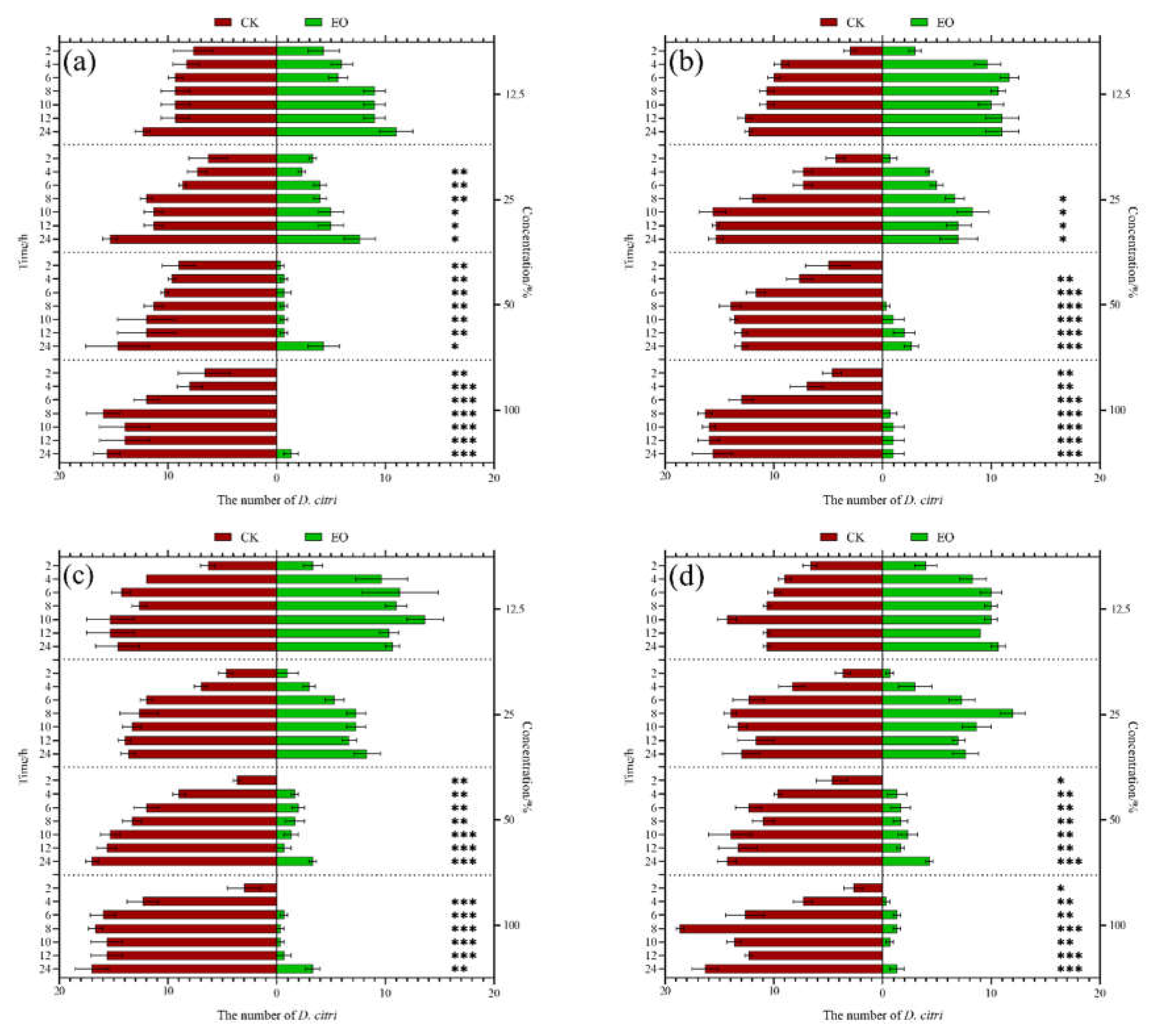
Figure 2.
Analysis of significant differences in the repellent rate of Diaphorina citri by different concentrations of essential oils. Note: Different letters represent a statistically significant difference using one-way analysis of variance (HSD, P < 0.05).
Figure 2.
Analysis of significant differences in the repellent rate of Diaphorina citri by different concentrations of essential oils. Note: Different letters represent a statistically significant difference using one-way analysis of variance (HSD, P < 0.05).

Figure 3.
Molecular docking results of six ligands with DcitOBP7. (a) α-Pinene. (b) β-Caryophyllene. (c) α-Terpinene. (d) Limonene. (e) Eucalyptol. (f) β-Pinene.
Figure 3.
Molecular docking results of six ligands with DcitOBP7. (a) α-Pinene. (b) β-Caryophyllene. (c) α-Terpinene. (d) Limonene. (e) Eucalyptol. (f) β-Pinene.
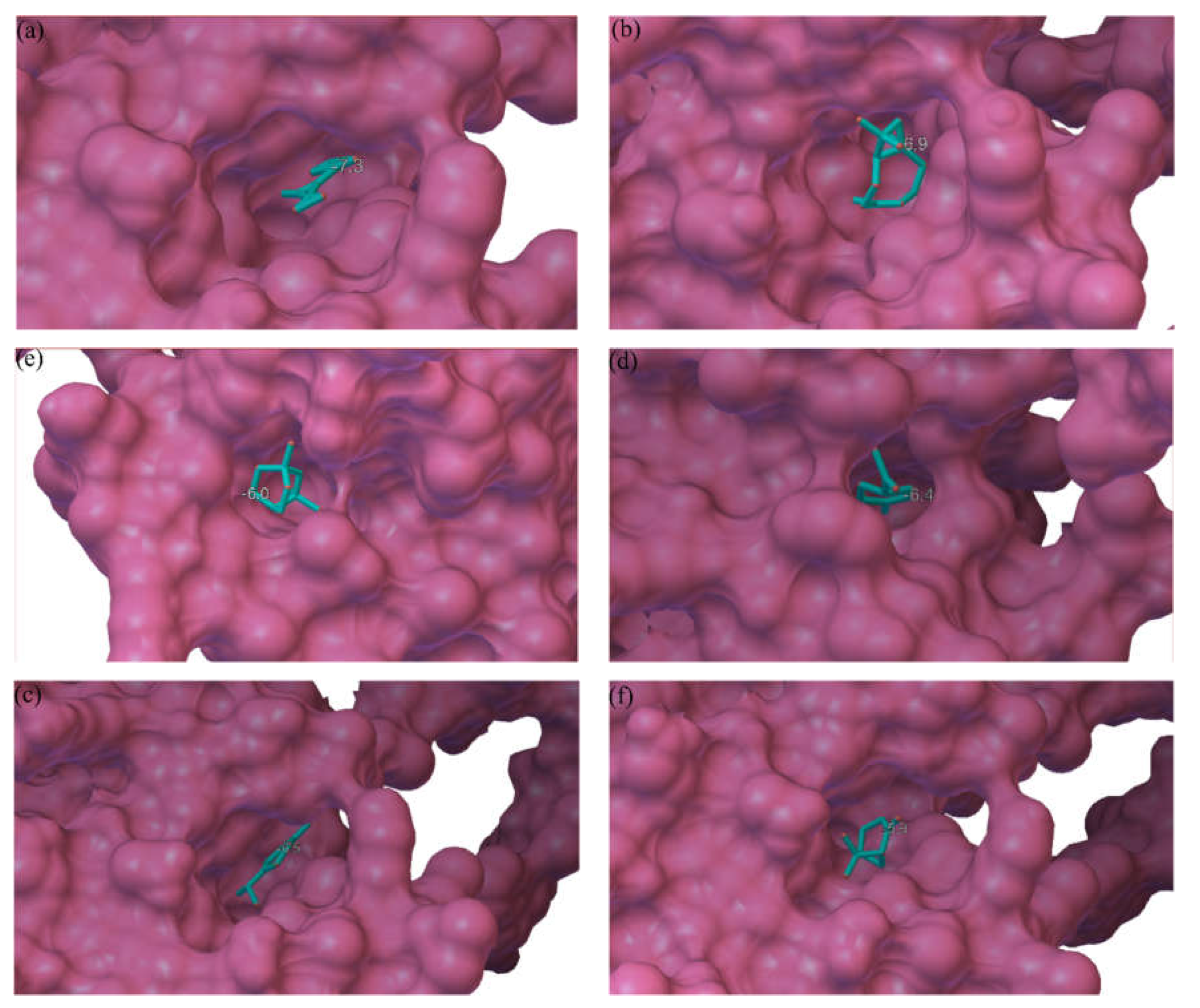

Table 1.
Toxicity of plant essential oils (EOs) against workers of Diaphorina citri at 24 hours post-treatment.
Table 1.
Toxicity of plant essential oils (EOs) against workers of Diaphorina citri at 24 hours post-treatment.
| Stage | E.oil | n | Slope ± SEM | LC50 (95% CI) | LC90 (95% CI) | χ 2 | df |
|---|---|---|---|---|---|---|---|
| Nymph | PG | 90 | 1.80±0.20 | 93.15(77.13-115.63) | 480.04(326.26-861.10) | 1.90 | 3 |
| ER | 90 | 1.40±0.18 | 53.85(42.39-73.36) | 441.24(249.63-826.42) | 1.31 | 3 | |
| ET | 90 | 1.11±0.18 | 56.50(41.76-86.80) | 484.80(357.29-602.69) | 0.84 | 3 | |
| BF | 90 | 1.63±0.17 | 36.47(30.27-44.79) | 222.12(151.00-391.32) | 3.06 | 3 | |
| Adult | PG | 90 | 1.53±0.16 | 111.00(91.73-137.59) | 766.79(506.96-1008.07) | 1.83 | 3 |
| ER | 90 | 1.11±0.15 | 90.44(70.31-119.15) | 777.67(457.71-1084.19) | 0.79 | 3 | |
| ET | 90 | 1.36±0.15 | 77.19(62.36-95.72) | 680.89(438.03-926.14) | 0.23 | 3 | |
| BF | 90 | 1.63±0.16 | 60.72(50.22-72.60) | 370.69(270.22-578.70) | 0.12 | 3 |
Note: LC50 and LC90 values were represented in mL/L and CIs were confidence intervals.
Table 2.
Chemical composition of four plants essential oils (EOs).
| No. | Compounds | NIST RI | Relative abundance (%) | |||
|---|---|---|---|---|---|---|
| PG | ER | ET | BF | |||
| 1 | 4-Hexen-3-one | 855 | - | 0.51 | - | - |
| 2 | Dimethyl sulfone | 922 | - | 0.60 | 3.02 | - |
| 3 | Benzene, (1-methylethyl)- | 926.57 | - | - | 1.68 | - |
| 4 | Cyclobutanespiro-2’-bicyclo[1.1.0]butane-4’-spirocyClobutane | 930 | - | 1.10 | 5.85 | 0.68 |
| 5 | α-Pinene | 936.35 | - | 3.40 | 15.59 | 3.21 |
| 6 | Cyclopentene, 1-butyl- | 938 | - | - | 0.93 | - |
| 7 | Bicyclo (3.3.1)non-2-ene | 964 | - | - | 0.68 | - |
| 8 | 4-methyl-1- (1-methylethyl)-Bicyclo[3.1.0]hex-2-ene | 966 | - | - | 1.21 | - |
| 9 | Bicyclo[3.1.0]hexane, 4-methylene-1- (1-methylethyl)- | 972 | - | 0.45 | 1.62 | - |
| 10 | 2,6-Octadiene, 2,6-dimethyl- | 978 | - | 0.43 | 1.44 | - |
| 11 | β-Pinene | 979.71 | - | 1.81 | 6.25 | 0.70 |
| 12 | 1,7-Octadiene, 2-methyl-6-methylene- | 984 | - | 0.38 | 1.31 | - |
| 13 | DiSulfur compounds, ethyl 1-methylethyl | 985 | - | - | 0.58 | - |
| 14 | Pyridine, 3-propyl- | 986 | - | - | 0.73 | - |
| 15 | Benzene, (1-methylpropyl)- | 1001 | - | 0.37 | - | - |
| 16 | α-Phellandrene | 1006 | - | 12.20 | 0.77 | 0.55 |
| 17 | Terpilene | 1018.03 | - | - | - | - |
| 18 | 4-Hexen-1-ol, acetate | 1020 | - | 0.67 | 0.67 | 0.63 |
| 19 | o-Cymene | 1022 | - | 10.70 | 4.13 | 13.62 |
| 20 | 4,6-Octadiyn-3-one, 2-methyl- | 1023 | 0.69 | - | - | - |
| 21 | 2-Azabicyclo[3.2.1]octan-3-one | 1025 | - | 1.86 | 2.05 | 1.65 |
| 22 | p-Cymene | 1025.98 | - | 3.77 | 1.55 | 5.34 |
| 23 | Limonene | 1026 | 3.66 | 3.08 | 2.32 | 0.76 |
| 24 | 2-Methyl-1,3-dithiacyclopentane | 1026 | - | 1.15 | - | 1.51 |
| 25 | 1,7-Nonadiene, 4,8-dimethyl- | 1026 | - | 0.85 | 0.46 | - |
| 26 | Thiazole, 5-ethenyl-4-methyl- | 1027 | - | 0.76 | 0.93 | 0.63 |
| 27 | Pyridine, 2,3,4,5-tetrahydro-6-propyl- | 1028 | - | 0.56 | 0.65 | - |
| 28 | Indane | 1029 | - | 1.69 | 0.63 | 2.19 |
| 29 | Cyclohexanol, 3,5-dimethyl- | 1030 | - | 3.26 | 2.83 | 2.94 |
| 30 | β-Phellandrene | 1031 | 2.68 | 1.77 | 4.36 | 2.82 |
| 31 | D-Limonene | 1031.27 | 3.15 | 4.13 | 3.19 | 2.35 |
| 32 | Eucalyptol | 1034.33 | - | 5.91 | 6.87 | 4.31 |
| 33 | 3-Octen-2-one, (E)- | 1035 | - | 3.23 | 3.92 | 2.89 |
| 34 | Ocimene | 1037 | 0.53 | 5.72 | 1.21 | - |
| 35 | 2-Acetyl-5-methylfuran | 1037.22 | - | 0.50 | 0.57 | - |
| 36 | (S)-2,5-Dimethyl-3-vinylhex-4-en-2-ol | 1039 | 0.96 | 4.32 | 4.32 | 2.93 |
| 37 | 3-Octen-2-one | 1040 | - | 1.89 | 1.40 | 1.55 |
| 38 | BenzeneacetAldehyde | 1045.59 | - | 0.48 | - | - |
| 39 | (E)-β-Ocimene | 1049 | - | 0.96 | - | - |
| 40 | γ-Terpinene | 1060.24 | - | 0.57 | - | 3.02 |
| 41 | Benzenemethanol, α-methyl- | 1061.21 | - | - | - | 0.94 |
| 42 | trans-4-Thujanol | 1070 | - | - | - | 1.82 |
| 43 | BenzAldehyde, 3-methyl- | 1070.12 | - | 0.48 | - | 2.37 |
| 44 | (Z)-Pent-2-enyl butyrate | 1091 | - | - | - | 1.77 |
| 45 | Linalool | 1100.58 | - | - | - | 0.98 |
| 46 | 6-Nonenal, (Z)- | 1103.52 | - | - | - | 1.03 |
| 47 | Pinocarveol | 1138 | - | - | 0.91 | - |
| 48 | Myrcenone | 1145 | - | - | 0.52 | - |
| 49 | p-Mentha-1 (7),2-dien-8-ol | 1163 | - | - | 0.70 | - |
| 50 | Pinocarvone | 1164 | - | - | 1.41 | - |
| 51 | Phenol, 4-ethyl- | 1165.40 | - | - | 0.63 | - |
| 52 | (E)-2,6-Dimethylocta-5,7-dien-2-ol | 1169 | - | - | - | 1.66 |
| 53 | Lavandulol | 1170 | - | - | - | 1.36 |
| 54 | Borneol | 1170.41 | - | - | 0.68 | - |
| 55 | Terpinen-4-ol | 1181.45 | - | 0.53 | - | 2.38 |
| 56 | 2-Butenoic acid, hexyl ester | 1191 | - | - | - | 0.73 |
| 57 | (-)-Dihydrocarveol | 1192 | - | - | - | 0.56 |
| 58 | α-Terpineol | 1195.55 | - | - | - | 0.59 |
| 59 | Benzamide | 1344 | - | 0.46 | - | - |
| 60 | 2,3,5,9-tetramethyltricyclo[6.3.0.01,5]undec-3-ene | 1348 | - | 4.20 | - | - |
| 61 | Terpinyl acetate | 1350 | - | 2.89 | - | - |
| 62 | (1α,3β,4β)-p-menthane-3,8-diol | 1355 | - | 0.61 | - | - |
| 63 | Neryl acetate | 1365.22 | - | 3.09 | - | - |
| 64 | Methyl 4-aminobenzoate | 1372 | 1.30 | - | - | - |
| 65 | 6,8-Nonadien-2-one, 8-methyl-5- (1-methylethyl)-, (E)- | 1373 | 0.59 | - | - | - |
| 66 | (-)-α-Copaene | 1376 | 3.54 | - | - | - |
| 67 | Di-epi-α-cedrene- (I) | 1382 | 5.52 | - | - | - |
| 68 | (-)-β-Bourbonene | 1384 | 1.12 | - | - | - |
| 69 | (-)-Modhephene | 1385 | 0.63 | - | - | - |
| 70 | Damascenone | 1386 | 0.71 | - | - | - |
| 71 | Acetic Acid, phenoxy- | 1389 | 0.79 | - | - | - |
| 72 | β-Cubebene | 1390 | 9.42 | - | - | - |
| 73 | Niacinamide | 1419 | 0.80 | - | - | - |
| 74 | Ethyl mandelate | 1421 | - | 0.69 | 0.51 | 1.98 |
| 75 | Benzoic Acid, 4-methoxy- | 1424.27 | 1.49 | - | - | - |
| 76 | Benzenemethanol, 4-hydroxy- | 1426 | 1.42 | - | - | 0.61 |
| 77 | 3-Hexanone, 1-phenyl- | 1427 | 5.14 | 0.87 | 0.60 | 2.34 |
| 78 | 2-Propenoic Acid, 3-phenyl- | 1427.53 | - | - | - | 1.04 |
| 79 | Quinoxaline, 2,3-dimethyl- | 1428 | 0.50 | - | - | - |
| 80 | (E,E)-2,4-Undecadienal | 1430 | 2.16 | 0.40 | - | 1.08 |
| 81 | (+)-Calarene | 1432 | 5.08 | 0.36 | - | 1.43 |
| 82 | β-Caryophyllene | 1432.49 | 6.15 | 1.04 | 0.72 | 2.89 |
| 83 | γ-Elemene | 1433 | 2.27 | - | - | 0.92 |
| 84 | Ethyl β-safranate | 1434 | 3.22 | 0.47 | - | 1.31 |
| 85 | trans-α-Bergamotene | 1435 | 3.27 | 0.43 | - | 1.22 |
| 86 | 2-Hydroxymethylbenzimidazole | 1437 | 3.14 | - | - | 0.96 |
| 87 | Ethanone, 1- (3-hydroxyphenyl)- | 1439 | 0.76 | - | - | - |
| 88 | Azulene, 1,2,3,3a,6,8a-hexahydro-1,4-dimethyl-7- (1-methylethyl)-, (1R,3aS,8aS)- | 1440 | 3.09 | - | - | - |
| 89 | Naphthalene, 1,2,4a,5,8,8a-hexahydro-4,7-dimethyl-1- (1-methylethyl)-, (1α,4aβ,8aα)- (.+/-.)- | 1440 | 3.34 | - | - | 0.99 |
| 90 | Aromandendrene | 1440 | 0.85 | - | - | - |
| 91 | (+)-α-Muurolene | 1440 | - | 0.62 | - | 1.67 |
| 92 | Benzyl angelate | 1446 | 1.25 | - | - | - |
| 93 | -6-Methyl-2-methylene-6- bicyclo[3.1.1]heptane | 1446 | 1.02 | - | - | - |
| 94 | (-)-Aristolene | 1447 | 2.08 | - | - | - |
| 95 | Benzene, 1- (1,5-dimethylhexyl)-4-methyl- | 1449 | 1.17 | - | - | - |
| 96 | (-)-α-Himachalene | 1449 | 1.11 | - | - | - |
| 97 | Acetophenone, 4’-hydroxy- | 1455 | 0.76 | - | - | 2.21 |
| 98 | (E)-β-Famesene | 1457 | - | - | - | 1.02 |
| 99 | 5,9-Undecadien-2-ol, 6,10-dimethyl- | 1459 | - | - | - | 0.74 |
| 100 | 1,1’- (1,4-phenylene)bis-Ethanone | 1461 | 0.67 | - | - | - |
| 101 | Benzene, [1-[[1- (1-methylethyl)-3-butenyl]oxy]ethyl]-, [S- (R*,R*)]- | 1463 | - | - | - | 0.91 |
| 102 | 2-Pinen-10-yl isobutyrate | 1466 | - | - | - | 1.46 |
| 103 | (1R,9R,E)-4,11,11-Trimethyl-8-methylenebicyclo[7.2.0]undec-4-ene | 1466 | - | - | - | 0.90 |
| 104 | Acoradiene | 1471 | - | - | - | 0.64 |
| 105 | (4R,4aS,6S)-4,4a-Dimethyl-6- (prop-1-en-2-yl)-1,2,3,4,4a,5,6,7-octahydronaphthalene | 1476 | 0.57 | - | - | - |
| 106 | Eudesma-2,4,11-triene | 1479 | 0.54 | - | - | - |
| 107 | (-)-Germacrene D | 1481 | 1.52 | - | - | - |
| 108 | 3- (4-Hydroxyphenyl)propanal | 1490 | - | 0.37 | 1.01 | - |
| 109 | (1S,2E,6E,10R)-3,7,11,11-Tetramethylbicyclo[8.1.0]undeca-2,6-diene | 1495 | - | 0.81 | 2.07 | - |
| 110 | Benzyl tiglate | 1498 | - | - | 0.68 | - |
| 111 | α-Muurolene | 1499 | 0.66 | - | 0.63 | - |
| 112 | Epizonarene | 1501 | - | - | 0.57 | - |
| 113 | α-Cuprenene | 1509 | - | - | 0.61 | - |
| 114 | (E)-α-Bisabolene | 1512 | 0.65 | 0.47 | 1.27 | - |
| 115 | (-)-γ-Cadinene | 1513 | - | - | 0.74 | - |
| 116 | cis-Calamenene | 1523 | 3.01 | - | - | - |
| 117 | (+)-δ-Cadinene | 1524 | 0.64 | - | - | - |
| 118 | Cadinadiene,cadina-1,4-diene | 1532 | 0.92 | - | - | - |
| 119 | (+)-α-Cadinene | 1538 | 0.89 | - | - | - |
| 120 | β-Vetivenene | 1540 | 0.50 | - | - | - |
| 121 | 3,7 (11)-Eudesmadiene | 1542 | 1.29 | - | - | - |
| Total | 97.21 | 97.89 | 97.97 | 96.79 | ||
| Terpineoids | 65.31 | 44.00 | 46.91 | 46.15 | ||
| Ketone | 12.24 | 10.00 | 8.16 | 9.61 | ||
| Ester | 6.12 | 8.00 | 8.16 | 9.61 | ||
| Alcohol | 4.08 | 6.00 | 6.12 | 13.46 | ||
| Acid | 4.08 | 5.00 | - | 1.92 | ||
| Hydrocarbons | - | 6.00 | 12.24 | 1.92 | ||
| Heterocyclic compound | 4.08 | 8.00 | 8.16 | 5.77 | ||
| Aromatics | - | 6.00 | 6.12 | 5.77 | ||
| Amine | 2.04 | 2.00 | - | - | ||
| Aldehyde | 2.04 | 8.00 | 2.04 | 5.77 | ||
Note:“-” means not detected.
Table 3.
Analysis of differences in repellent rates of different compounds on Diaphorina citri at the same time.
Table 3.
Analysis of differences in repellent rates of different compounds on Diaphorina citri at the same time.
| Time(h) | 2 | 4 | 6 | 8 | 10 | 12 | 24 | |
|---|---|---|---|---|---|---|---|---|
| Compounds | CAS | Mean±SEM% | ||||||
| β-Caryophyllene | 87-44-5 | 100±0.00 | 100±0.00 | 100±0.00 | 94.07±2.97a | 83.23±5.2abc | 83.23±5.2ab | 85.00±4.28ab |
| α-Terpinene | 99-86-5 | 100±0.00 | 100±0.00 | 85.05±7.87abc | 67.72±2.69abcd | 70.61±10.32abcd | 68.15±10.76bcd | 80.37±1.61abc |
| β-Pinene | 127-91-3 | 80.61±11.56abc | 50.27±8.93bc | 42.06±4.83def | 58.36±12.59cde | 60.69±5.52bcd | 73.45±4.92abc | 72.01±5.01abc |
| Linalool | 78-70-6 | 55.19±2.89bc | 69.11±1.38ab | 62.29±4.85bcd | 54.94±1.6def | 52.31±1.31cd | 52.98±0.79cd | 53.7±0.85c |
| Eucalyptol | 470-82-6 | 100±0.00 | 100±0.00 | 94.86±2.57ab | 92.22±4.01ab | 100±0.00 | 100±0.00 | 100±0.00 |
| α-Pinene | 80-56-8 | 100±0.00 | 100±0.00 | 80.43±5.66abc | 86.98±3.49abc | 93.33±6.67a | 87.13±3.57ab | 76.92±4.47abc |
| Phellandrene | 99-83-2 | 100±0.00 | 77.78±11.11ab | 83.07±5.82abc | 93.65±6.35a | 84.13±11.45ab | 72.26±5.56abcd | 52.84±2.47c |
| Ocimene | 13877-91-3 | 4.58±17.56de | -14.31±9.51e | -9.39±4.13h | -4.32±2.27hi | -4.32±2.27e | -4.53±2.43f | 7.34±6.82d |
| D-Limonen | 5989-27-5 | -9.16±2.38e | -11.27±4.36e | -8.43±1.56h | -8.43±3.24i | -8.97±2.19e | 11.44±3.23f | 2.7±1.96d |
| γ-Terpinene | 99-85-4 | 48.89±14.57bcd | 26.83±8.04cd | 28.92±1.31defg | 25.41±4.81fgh | 43.39±10.62d | 53.33±4.63cd | 20.08±6.76d |
| o-Cymene | 527-84-4 | 100±0.00 | 100±0.00 | 91.91±4.05ab | 71.42±5.72abcd | 70.98±5.49abcd | 63.14±1.57bcd | 54.77±5.29c |
| Cineole | 406-67-7 | 100±0.00 | 65.02±3.37abc | 45.95±2.57def | 63.24±7.25bcde | 48.03±4.16d | 79.35±10.62abc | 65.72±9.22bc |
| 1,4-Diethylbenzene | 105-05-5 | -1.06±7.35e | 4.15±9.54de | -9.09±4.29h | -1.45±1.45hi | 1.15±1.15e | 1.76±7.54f | 9.70±5.78d |
| Limonene | 138-86-3 | -10.82±10.64e | -17.32±8.52e | -9.09±4.29h | -9.09±4.29i | -9.09±4.29e | 12.87±3.25f | 3.20±1.62d |
| 3-Carene | 13466-78-9 | 8.91±13.76cde | 1.14±5.46de | 1.42±3.34gh | -10.07±4.36i | -9.97±4.43e | 11.42±3.1f | 3.70±6.42d |
| 1-Phenylhexan-3-one | 29898-25-7 | 8.38±16.9de | 1.63±8.13de | 17.21±12.83fgh | 5.41±1.84hi | 5.41±1.84e | 16.76±3.32ef | 21.56±1.52d |
| Myrtol | 8002-55-9 | 65.02±3.37ab | 39.09±5.09bcd | 23.74±4.27efgh | 12.27±2.58ghi | 12.27±2.58de | 12.27±2.58f | 21.43±4.59d |
| df | 16 | 16 | 16 | 16 | 16 | 16 | 16 | |
| F-Value | 24.532 | 32.647 | 38.263 | 47.305 | 41.381 | 37.517 | 35.776 | |
| P-Value | 0.001 | <0.001 | <0.001 | 0.005 | 0.001 | 0.001 | 0.001 | |
Note: Different letters represent a statistically significant difference using one-way analysis of variance (HSD, P < 0.05).
Disclaimer/Publisher’s Note: The statements, opinions and data contained in all publications are solely those of the individual author(s) and contributor(s) and not of MDPI and/or the editor(s). MDPI and/or the editor(s) disclaim responsibility for any injury to people or property resulting from any ideas, methods, instructions or products referred to in the content. |
© 2024 by the authors. Licensee MDPI, Basel, Switzerland. This article is an open access article distributed under the terms and conditions of the Creative Commons Attribution (CC BY) license (http://creativecommons.org/licenses/by/4.0/).
Copyright: This open access article is published under a Creative Commons CC BY 4.0 license, which permit the free download, distribution, and reuse, provided that the author and preprint are cited in any reuse.


