
Submitted:
19 June 2024
Posted:
20 June 2024
You are already at the latest version
Abstract
Manufacturing firms need to streamline their initiatives in line with 17 sustainable development goals (SDGs) 2030 as a means for improving performance. This research adapts SDG’s goals 8 decent job and economic growth’ as a measure of performance, in examine the effect of corporate sustainability strategies on performance of manufacturing firms. Census sampling technique was used in cross sectional survey of 900 multi-industry managers from one hundred and fifty (150) manufacturing firms in Kano, Nigeria. A five Likert scale, well-structured questionnaire was used in collecting data, analysed by Structural Equation Modelling SEM PLS Package. The study shows positive and significant effect of eco-efficiency, and positive and insignificant effect of both legitimation and risk mitigation strategies on performance respectively. The study concluded that the positive and significant effects of eco efficiency initiatives could be due to benefits derived from total quality management system, energy monitoring, and process safety management reflected in sustainability oriented visionary leadership of the managers. The positive and insignificant effects of legitimation initiatives could be as a result of huge spending on sustainability reporting, and corruption. The positive and insignificant effect of risk mitigation could be due to pro-activeness of the firms’ managers in tackling risk through sustainability oriented visionary leadership. The study recommended firms should adopt conservative eco-efficiency initiatives for improving performance and stop adopting extroverted legitimation and introverted risk mitigation strategies as both have no significant effect on performance. Future researchers should use longitudinal research design using financial metrics adopting the same independent variables in other economic sectors.
Keywords:
corporate sustainability strategies
; risk mitigation
; eco-efficiency
; and legitimation
; sustainable performance
1. Introduction
Over the past 300 years, 85% of the planet’s wetlands have being lost, more than 733 million people lives are in high water stress, 1.6 billion people need safely managed drinking water, 1.90 billion people lack basic hand hygiene facilities, 2.8 billion people lack safely managed sanitation, 2.4 billion people are using insufficient and polluting cooking systems. Plastic pollution as at 2021 is estimated to be 17 million metric tons, which is expected to double or triple every year. Ocean absorbs estimated ¼ of global annual carbon emissions. Consequently, the rate of collections of global wastes as far region indicated that Latin America and Caribbean had 1.2 %, Europe and North America had 146.9 % sub-Saharan Africa had 1.6 %, and others had 22,8% collected waste [1].
Moreover, global energy consumption had increase from 1.3 to 1.9 tons of oil equivalent from 1965 to 2015 [2]. For example, African continent has not been different from other industrialized continents that have been battling with sustainability issues. Some authors argued that the continent faces sustainability issues due to ineffective institutions to manage resources sustainably [3]. Similarly, Sub-Sahara countries are facing sustainability development challenges [4,5]. About 34% of companies operating in Nigeria tagged climate change as financial risk factor undermining their operations [6].
Nigeria’s sustainability challenges include; high corruption issues, high poverty rate; about 90 million Nigerians’ lives are in poverty, insecurity claimed over 77.000 lives in the country, 70% per cent of Women face gender inequality, and solid waste of about 32 million tons per year is on the increase. Also, emissions from energy sector amount to 56% per-cents, transportation 28% per-cents, oil and gas sector accounts for 12% per-cent, and agriculture produces 4% per-cent emissions [6]. About 93.51% pollutants mainly from tannery industry and other industries have contributed to lose of lives of over 700,000 people every year in Nigeria, [7]. These contributed to sustainability campaigns that made some companies to engage in sustainable activities across the country [6]. For example, Dangote group of companies was quoted spending about N102 million, N40 million, N78 million on settlement, health, and education respectively. In addition to 37, 000 created jobs in 2019 for sustainable development in Nigeria [8].
Sustainability Development Goals of 2030 emblems seventeen 17 goals. These include; no poverty, zero hunger, good health and wellbeing, quality education, gender equality, clean water and sanitation, affordable and clean energy, decent work and economic growth, industry, innovation and infrastructure, reduced inequalities, sustainable cities and communities, responsible consumption and production, climate action, life below water, life on land, peace, justice and strong institutions, and partnership for the goals [9]. However, at firm level, sustainability performance focuses on economic, environmental and social performance of manufacturing firms [10,11].
To achieve sustainability performance at firm level, some studies concluded that structures, technology innovations, and policies adoption significantly contribute to sustainable performance [12,13,14], others argued that, government regulations, effective legislations enactment and enforcement significantly contribute to environmental sustainable performance [15,16]. Moreover, sufficient budget on sustainability implementation was concluded to have positive correlation with sustainable performance of firms [17]. Furthermore, sufficient infrastructure, and facility for sustainable operations integration in business process was found positively significant on sustainable performance of firms [16]. Also, promotion of public awareness on sustainable products, was found to have positive significance on sustainable performance of firms [18,19]. Likewise, integration of sustainable proactive plans found to have positive significant impact on sustainable performance [20], implementation of sustainable waste management significantly reduce environmental waste and contribute to sustainable environment [21], and use of environmental competencies yield positive significant impact on sustainable performance [22].
Previous studies used multiple data collection instruments; questionnaire, field coexistence interview to collect data for sustainable performance assessment [23], others employed single data collection technique [24,25]. Also, some researchers used case study design; using observational and qualitative data in assessing firm performance [26]. Further, some authors used quantitative survey design in assessing sustainability performance [25,27]. Despite the use of single and multiple measures to assess sustainable performance, there exists no empirical research that adapted United Nations Sustainability development goals (SDGs) ‘goals 8 decent job and economic growth’ as a metric of performance at firm level in sub-Saharan Africa, and most particularly in Kano, Nigeria. Therefore, based on these research gaps, this research used non-financial metrics adapted from goal 8 decent jobs and economic growth of the United Nations Sustainability development goals 2030 as measure of firm performance. However, this study examines the effect of corporate sustainability on performance manufacturing firms in Kano metropolis, Nigeria.
The following hypotheses were formulated to guide this study, holding visionary strategy constant on the relationship between independent variables and dependent variable as follows:
- H1:
- Conservative eco-efficiency strategy does not significantly influence sustainable performance (economic) of manufacturing firms in Kano Metropolis in Nigeria
- H2:
- Extroverted legitimation strategy does not significantly influence sustainable performance (economic) of manufacturing firms in Kano Metropolis in Nigeria
- H3:
- Introverted risk-mitigation strategy does not significantly influence sustainable performance (economic) of manufacturing firms in Kano Metropolis in Nigeria
2. Theoretical Background
Past empirical researches reveal that stakeholder theory best explain sustainability and performance [28,29]. Considering the complexities of sustainability, some authors, suggested the use of many theories to explain the complexities involved in sustainability researches [30,31,32,33]. [28] argues that stakeholders’ engagement are essentials in sustainability planning as well as it implementation. For an in-depth understanding of complex situation, single theory cannot sufficiently explain complexities of sustainability issues [30,31,32,33]. For this reason, two theories; resource based and stakeholder theory will be used as they are seen complimentary to each other [34] in explaining both corporate sustainability strategies and sustainable performance. Stakeholder theory will serve as underpinning theory for this research, supported with resource based theory.
2.1. Sustainability Performance
According to [35], sustainability refers to an organisational activity which show performance (economic, environmental and social) and opportunities (providing competitiveness and competitive advantage). Sustainability in this study is defined as achieving current economic growth without consequential harmful impact on future generations’ ability in achieving their goals. Imperatively, manufacturing firms in both developed and developing nations need as a matter of urgency, to incorporate 17 sustainability development goals 2030 initiatives to partake in ending poverty, improving health and education, reducing inequalities, and increase economic return and preserve environment [9]. The goal focuses on promoting sustained, inclusive and sustainable economic growth, full and productive employment and decent work for all by providing opportunities for full and productive employment and decent work for all while eliminating forced labour, human trafficking and child labour [9].
2.2. Corporate Sustainability Strategies
This study adapted the theoretically proposed introverted risk mitigation, extroverted legitimation, conservative eco-efficiency, and visionary as corporate sustainability strategies by [36], and Goal 8 of sustainable development goals 20230 to achieve its main objective.
- a)
- Introverted Risk mitigation Strategy
Risk mitigation strategies of multinational corporations in emerging markets were studied drawing institutional perspective; the authors demonstrated four possible risk mitigation strategies based on political capabilities of firms considering institutional context and challenges in the host country. They further, argue that to survive, and grow in emerging market, compliance-based strategies, which involved adopting local norms for creating legitimacy, can be used where a firm has low political capability, and may be of relevance where, firms have high political capability with relatively low institutional challenges [37].
- b)
- Extroverted Legitimation Strategy
It is seen as the consequences of a process and the outcome of initiatives or actions implemented by organisations [38]. Its application is determined by company’s compliance with rules and standards in place. [39] defined it as the process whereby the acceptability of an object increases overtime. Legitimation strategy is of four dimensions pragmatic; moral; cognition; and moral and cognition [40].
- c)
- Conservative Eco-Efficiency Strategy
Eco-efficiency is an industrial sustainability strategy [41]. It is defined as competitively priced goods and services that satisfy human needs and bring quality of life and at the time reducing environmental impacts to a barest level throughout the entire life cycle of the products [42]. It is an innovation geared towards efficient resources usage and more qualitative and environmentally friendly production. It is perceived as opportunities for firms, both small firms and multinational corporations.
2.3. Visionary Strategy
Visionary strategy deals with clear direction for all members to move their organization forward. It is considered a limiting variable throughout this study. It involves setting future direction, communicating it to all stakeholders, directing stakeholders towards the achieving the goals, establishing networks with stakeholders, provide incentives to encourage stakeholders [43]. It has realistic future goals and objectives, direct stakeholders in achieving better futuristic goals and objectives through communication, consistent focus on future ambition.
The research model conceptualized to achieve the main aim of this study is provided below:
Figure 2.6.1.
Adapted from Baumgartner, 2010.
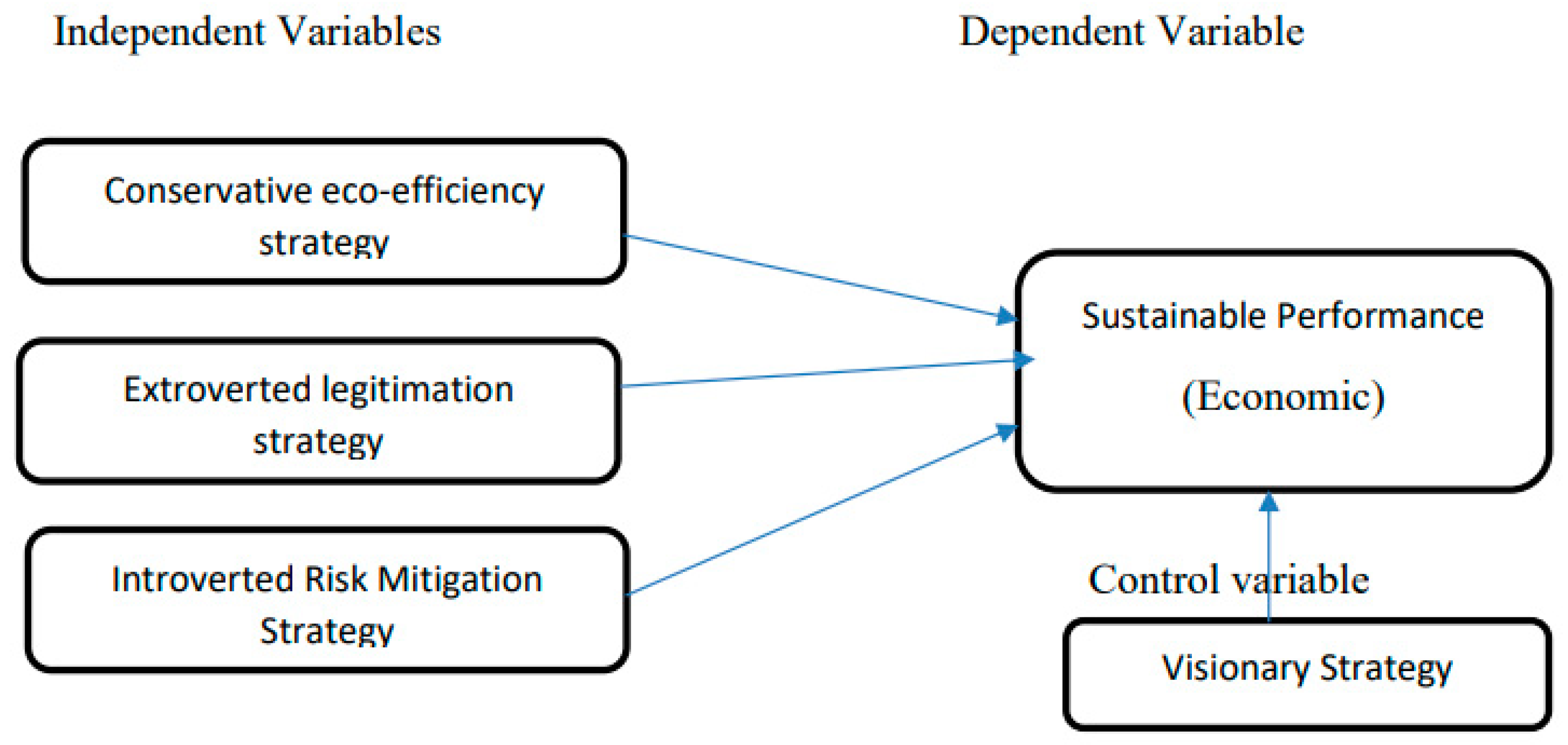
From the diagram above, it is depicted that the independent Variable contains four proxies; introverted risk mitigation strategy, extroverted legitimation strategy, conservative eco-efficiency strategy, and visionary strategy [36], while sustainability performance (economic) as the dependent variable for the study.
Empirical evidence from [44] concluded empirical study in India. They investigated the relationship among industry 4.0 drivers, adoption, risk reduction, and sustainable performance in manufacturing industries. The researchers explored the scope of 14.0 adoptions to sustainable organizational performance by considering 14.0 drivers impacting 14.0 adoptions, and 14.0 risk mitigations impacting 14.0 risks reduction and their influence on sustainable organisational performance. Through cross sectional online survey, they adopted two stage analyses in testing hypotheses using 273 responses from 221 manufacturing firms in India. They concluded that 14.0 adoptions and 14.0 risks reduction positively drive sustainable organizational performance, and 14.0 adoptions positively significantly mediate the effect on the relationship between 14.0 risks reduction and sustainable organizational performance. They recommended that supporting managers, decision makers, and researchers build, test and validate similar model create innovative and creative inherent combination of capabilities and resources which lead to sustainable organizational performance attainment in manufacturing companies.
Empirical study of global manufacturing firms pandemic planning, sustainability practices, and organisational performance carried out using large scale survey of 301 responses from global food, Pharmeutical and medical manufacturing companies, showed that in the covid-19 pandemic context, emergency planning positively relate with organizational performance in terms of sales, net profit, on-time order, and quality of global manufacturing firms. Further, they showed that response surface analysis indicated that prudent companies implemented triple bottom-line to ensure market competitiveness and corporate reputation during critical times. They concluded that risks mitigation attempts to moderate the effect of sustainability on firm performance [45].
Analysis of Debates on the implications of international firms strategies for their environmental approaches across multiple regions by distinguishing between symbolic and effective environmental operations. Using panel data of 292 firms for the period 2011 to 2018 in the energy and utility sectors, the results shows that firm’s progressive globalization increases its environmental disclosure but does not affect its environmental performance. It indicated that a weak home country institutional context reinforces a global firm’s interest in gaining legitimation by way of environmental disclosure and performance. While a strong country institutional context reduces firm’s interest in environmental sources of legitimation. The authors described environmental disclosure as a means of gaining legitimation rather than increasing firm performance [46].
Examining Firms’ legitimation through corporate governance, and its association with risk and return on investment in Brazil. Some researchers analysed 205 listed firms at Novo Mercado level from 2010 to 2019. Their findings show that listing at supposedly higher level at Brazilain stock exchange B3 does not indicate lower risk, a higher return, or even better risk-return ratio. They argued that highest level of corporate governance in Brazil created firms that present a higher risk and a lower return because they seek to legitimize themselves in the market as firms committed to better management practices. This indicates that firms committed to market legitimation impliedly committed better management practices which indicate neither lower risk, nor a higher return on investment [47].
A case study conducted to explore the underlying relationship between acquisition of global legitimacy and search for technology upgrading by Chinese multinational enterprises using Huawei investment in Russia, Kenya, the United Kingdom and Canada. The results indicated that corporate social responsibility activities in foreign market and local community engagement, Chinese multinationals can acquire legitimacy and gradually reach industry leaders. However, the result shows that corporate social responsibility practices, acquisition of sophisticated knowledge and innovation create more legitimacy challenges to Chinese multinationals. The authors suggested that Chinese multinationals’ global legitimation and innovation processes are closely related and mutually influential resulting in co-evolution [48].
Some authors investigated the nexus between macro level environmental institutional pressure and enterprise level green performance. They sampled 317 technology based manufacturing enterprises in China. They concluded that enterprise environmental commitment and green intellectual capital development play important roles in explaining the effect of environmental institutional pressure on green performance outcomes, and firms that commit to being environmentally sustainable are more likely to retain and expand their customer bases and superior performance outcomes [49]
Eco- efficiency assists companies in achieving competitiveness through environmentally friendly practices, which lead to economic return in term of costs savings due to wastes, emissions, pollution, and hazards reduction [50,51] Adoption of innovative strategies and technologies result in minimized cost and judicious resources consumption [52]. Similarly, Some authors are of the view, that eco-efficiency is the ratio between the corporation’s shareholders’ desired economic benefits and the environmental impacts associated with the specified economic return [53]. Economic benefits include values, and profits, whereas, environmental impacts comprise of resources consumption, waste reduction, reuse of products, and elimination of hazards. It deals with judicious resources use to produce more quality products and services with less environmental effect particularly, waste and pollution. Eco-efficiency includes efficient utilization of scarce natural resources, like carbon air, water, and generating economic rewards with environmentally friendly goods and services [54].
3. Methodology
3.1. Research Design
This research adopts cross sectional survey research design, which allows the researcher to have an in-depth understanding of the opinions of the target respondents by collecting primary multi-industry quantitative data, to allow the researcher to make generalization from the findings. To collect primary data from the chosen multi-industry, departmental managers serve as target respondents for this study, their opinion regarding corporate strategies or initiatives (action plans) on sustainable performance were collected through structured questionnaire instrument [55], to have accurate primary data needed for analysis. Also, Five-Likert scales [56], was used to measure responses of the target respondents [57].
Multi-industry participants, managers from various manufacturing companies with environmental certifications from Standard organization of Nigeria, and or Nigeria stock exchange commission, and or sustainability reports, will form the unit of analysis for this study. The participants will include CEO, General Managers, Operations Managers, Human Resource Managers, and Chief Production Engineers who in one way or the other are involved or contribute to strategy formulation, implementation, and evaluation for sustainability operations in manufacturing settings [58].
The researcher used cross sectional multi-industry primary data regarding sustainability strategies, and sustainability performance data that covers initiatives, and actions plans as well as operations results, funds budgeted to social activities, and environment prevention [57,59]. To achieve objective results, data collected was analysed using Structural Equation Modelling SEM through Statistical tool called SEM PLS Package version.
3.2. Population
This study employed five (5) managers comprising of chief executive, financial manager, marketing manager, operations manager, human resource manager and purchasing and supply manager from each firm as unit of analysis from multi-industry subsectors including; six (6) Basic Metals, Iron, Steel & Fabricated Products, eighteen (19) Chemicals and Pharmaceutical firms, fifty six (56) Domestic & Industrial plastic & Rubber Companies, thirty eight (38) Food Beverage & Tobacco firms, three (3) Pulp, paper & paper product, printing & publishing, (9) Motor vehicle & miscellaneous Assembly firms, four (4) Non-metallic firms, and fifteen (15) Textile Wearing Apparel & Leather firms [60]. Also, Five-Likert scales were used to measure opinions or responses. This will allow the researcher to collect primary data and have an in-depth understanding [61], for data analysis [55].
3.3. Sample Size and Sampling Procedures
To achieve the main aim of this study, census sampling technique was used to survey multi-industry prospective respondents, 900 managers from 150 manufacturing companies based in Kano metropolis with environmental certifications, and or sustainability reports, from Standard organization of Nigeria, and Nigeria stock exchange commission for this study. The multi-industry respondents includes those from chemicals and pharmaceuticals industry, Plastics industry, textiles and materials industry, Metal, Packaging and Caps industry, Motorcycles and Bikecycles industry, leather and footwear industry [60].
Census sampling technique [57], was used in selecting target participants for appropriate responses. The purposively selected sampled participants include; General Managers, Operations Managers, Human Resource Managers, financial managers, marketing manager, purchasing and supply manager, and Chief Production Engineers from 150 selected manufacturing firms [56]. This was to enable the researcher have multi-industry understanding of the phenomenon at hand, and sufficiently access multi-industry primary data [62] regarding sustainability strategies, and sustainable performance.
3.4. Method of Data Collection
The use of structured questionnaire instrument was to enable the researcher to obtain responses of the target participants [57], regarding corporate sustainability strategies proxy by introverted risk mitigation, extroverted legitimation, conservative Eco-efficiency and visionary [36]. Well-structured questionnaire instruments [56], was self-administered with help of messengers and secretaries to target participants of this study to collect sufficient relevant primary data for analysis and objective generalization.
The structured questionnaire was designed to contain three sections; section A, section B, and section C. Section A contains bio-data of the respondents from each manufacturing Firm, section B contains constructs of corporate sustainability strategies; introverted risk, mitigation comprising of four measures of introverted risk mitigation to be used include; enterprise risk management system, business continuity management, pollution prevention system, occupational health and safety management system. Also, extroverted legitimation comprising of four measures of extroverted legitimation to be used include; sustainability reports, corporate citizenship, no corruption and cartels, idea support management. Conservative eco-efficiency consisting of four measures of Eco-efficiency to be used include quality control system, total quality management system, energy monitoring and information system, process safety management, and visionary strategies comprising four measures to be used to measure visionary leadership include; ethical behaviour and human rights, consistent stakeholder relationship management, sustainability development management system, corporate citizenship adapted from adapted from [26,63], and then section C contains measurements of corporate sustainable performance duelling on economic dimension of triple bottom-line in eight (8) sustainable development gaols namely; decent work and economic growth; full and productive employment, decent work for all, eliminating forced labour, and child labour [9].
Also, the researcher employed Five-Likert Scale [56], to measure responses of the target respondents. The instruments’ scale constructed as 1= strongly agreed, 2= Agreed, 3= Undecided, 4 = Disagreed, and 5= strongly disagreed. The respondent will be asked to only tick options that best suit their opinions. Based on the arguments of [64,65], thirty (30%) per cent of the sample size was added to the initial sample size to account for non-response and attrition cases during data collection.
3.5. Reliability and Validity of Research Instrument
The study employed Cronbach’s alpha coefficient to test reliability of the instruments was used [66]. Mean and standard deviation of each independent variable were determined. In addition, a normal test was carried out using Skewness value within -1 to + 1, and the Kurtosis value within -3 to + 3 to confirm that the variables are normally distributed. Also, Levene’s test at 0.05 (5%) level of significance was used to ensure homogeneity of variances, and Variance Inflation Factor (VIF) greater than 10 and Tolerance less than 0.1 were used test for independence test [57,67,68]. Forty 40 questionnaires were administered to some small portion of target respondents of this research to ensure that the measures of the construct adapted from other related literature can generate accurate data needed for analysis and findings generalization.
3.6. Method of Data Analysis
For the purpose of achieving objective of this research, the study employed descriptive statistics to analyse respondents’ bio-data, and, used partial least square technique in testing research hypotheses, using SEM PLS.
3.7. Measurements of Variables
The measurements used for the research were adapted from the reviewed literature for the study. Four measures of introverted risk mitigation used include; enterprise risk management system, business continuity management, pollution prevention system, occupational health and safety management system, four measures of extroverted legitimation used include; sustainability reports, corporate citizenship, no corruption and cartels, idea support management, four measures of Eco-efficiency used include quality control system, total quality management system, energy monitoring and information system, process safety management adapted from [26], and four measures used to measure visionary leadership include; ethical behaviour and human rights, consistent stakeholder relationship management, sustainability development management system, corporate citizenship, while dependent variable’ measures will be economic dimension of triple bottom-line adapted from [59] in line with eight (8) sustainable development gaols namely; economic growth, industry growth, innovation and infrastructure, responsible consumption of natural resources and production [9].
4. Findings
4.1. Validity and Reliability Result
The validity result of the PPMC score of the responses shows that the item questionnaire significantly correlated with the total score, which indicates that the items are valid. On the other hand, all the variables obtained the required Cronbach Alpha’s coefficient values. Therefore, this indicates that the instrument used is reliable as Cronbach alpha values are all greater than 0.7 minimum benchmarks for examining the reliability.

Table 4.1.
Reliability Coefficients.
| No | Variables | Items | Cronbach’s Alpha |
| 1 | IRS | 4 | 0.870 |
| 2 | ELS | 4 | 0.887 |
| 3 | CES | 4 | 0.908 |
| 4 | VS | 3 | 0.936 |
| 5 | SPE | 4 | 0.929 |
Source: Researcher’s Computation, 2024.
4.1.1. Normality Test
The study drew on statistical analysis to check the Skewness (lack of consistency) and Kurtosis (sharpness) issues about it, to determine whether the data were normally distributed, followed by removing the weaknesses in questions. In this concern, [68] state that the Skewness value should be within -1 to + 1, and to confirm that the variables are normally distributed and the Kurtosis value should be within -3 to + 3. Accordingly, the study examined the normality of the data and the values of Skewness and Kurtosis of each variable as illustrated in Table 4.4. Accordingly, all Skewness and Kurtosis values of the variables are found within the prescribed levels as per the research results. Therefore the data are deemed to be distributed with a high approximation to normality.
Table 4.1.2.
Tests of Normality.
| Skewness | Kurtosis | |||
|---|---|---|---|---|
| Statistics | Std. Error | Statistics | Std. Error | |
| SPE | .154 | .082 | -.520 | .163 |
| IRS | .256 | .082 | -.863 | .163 |
| ELS | .503 | .082 | .437 | .163 |
| CES | .429 | .082 | -1.006 | .163 |
Source: Researcher’s Computation, 2024.
4.1.3. Test for Independence
The study tested for independence among the factors to ensure that no variable was measuring the same relationship measured by another variable or group of variables. Independence exists when Variance Inflation Factor (VIF) is greater than 10 and Tolerance is less than 0.1. The results obtained were captured in Table 4.6.
Table 4.1.4.
Test for Multi-Collinearity.
| Collinearity Statistics | ||
|---|---|---|
| Tolerance | VIF | |
| IRS | .657 | 1.521 |
| ELS | .577 | 1.733 |
| CES | .493 | 2.028 |
Source: Researcher’s Computation, 2024.
According to the results in Table 4.5, it shows that the VIF for all the variables individually is below 10. IRS (1.521), ELS (1.733), CES (2.028) and VS (1.090). The tolerance for all variables: IRS (0.657), ELS (0.577), and CES (0.493). Therefore, the result shows that there is no independence among the variables. This was an indication that they are reliable for estimation.
4.2. Structural Model
PLS structural analysis was conducted to confirm the hypothesized relationships between constructs in the research models. The bootstrapping approach was used to assess the relevance of significant of the paths.
Figure 4.2.1.
Result of Path Analysis.
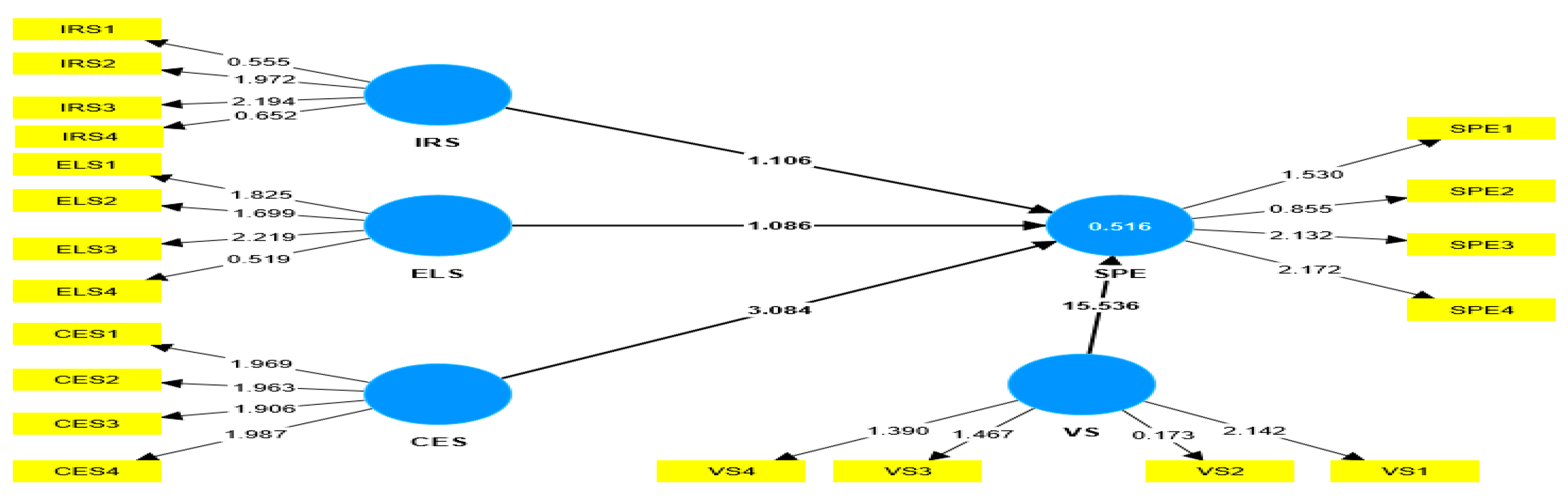
In assessing the PLS model, the coefficient of determination (R2 value) for each endogenous latent variable, the standardized beta coefficient (β), and the t-value were examined. Next, the path models predictive ability was analyzed to evaluate the magnitude of R2 by looking at Stone-Geisser’s Q2 value [69]. Using the SmartPLS 4, the Q2 value was obtained by using a blindfolding procedure with an omission distance (D) of 7. Figure 1 shows the PLS analysis estimates.
The figure above, there is a substantial predictive power for the key endogenous constructs for the proposed research model i.e., R2 = 0.516, IRS-SPE t-value = 1.106, ELS-SPE t-value = 1.086, and CES-SPE t-value = 3.084. Hence, the research models explained a considerable degree of variance for the endogenous variables.
Table 4.2.1.
Result of Main Relationship.
| Paths | Coefficients | T Statistics | P Values | Decision |
| Model 1 | ||||
| CES -> SPE | 0.189 | 3.084 | 0.002 | Rejected |
| ELS -> SPE | 0.06 | 1.086 | 0.278 | Accepted |
| IRS -> SPE | 0.07 | 1.106 | 0.269 | Accepted |
Source: Researcher’s Computation, 2024.
5. Discussion
The results obtained from Analysis of cross sectional data collected from respondents of this research showed different results. Four Hypotheses were raised as can be observed in figure 1, there is a substantial predictive power for the key endogenous constructs for the proposed research model i.e., R2 = 0.516, IRS-SPE t-value = 1.106, ELS-SPE t-value = 1.086, CES-SPE t-value= 3.084 and VS-SPE t-value = 15.536. Hence, the research models explained a considerable degree of variance for the endogenous variables. Firstly, Hypothesis one depicts that the t-value of Conservative Eco-efficiency strategy is 3.084 with p-value of 0.002. Therefore, the hypothesis was rejected which implies that Conservative eco-efficiency strategy significantly influence sustainable performance (economic bottom-line) of manufacturing firms in Kano Metropolis Nigeria when controlled by visionary leadership strategy. The secondly, Hypothesis two indicates that extroverted legitimacy strategy has t-value of 1.086 with p value of 0.278 which is greater than 0.05. Therefore, the hypothesis two was accepted which implies that extroverted legitimation strategy does not significantly influence sustainable performance (economic) of manufacturing firms in Kano Metropolis Nigeria, when controlled by visionary leadership strategy. Thirdly, Hypothesis three has t-value of 1.106 with p value of 0.269 which is greater than 0.05. Therefore, the hypothesis three was accepted which implies that introverted risk-mitigation strategy does not significantly influence sustainable performance (economic bottom-line) of manufacturing firms in Kano Metropolis Nigeria, when controlled by visionary leadership strategy. Lastly, Hypothesis four has t-value of 15.536 with p value of 0.000 which is less than 0.05.
5.1. Theoretical Implications
Resource-based theory explain the relationship between eco-efficiency and economic bottom-line. Eco-efficiency in terms of quality control system, total quality management system, energy monitoring and information system, and process safety management significantly influence economic bottom-line of sustainable performance. Also, Stakeholder theory implicitly shows that visionary leadership with emphasis on ethical behaviours and human rights, consistent stakeholder relationship management, sustainability development management system, corporate citizenship, significantly influence economic bottom-line [9] of manufacturing firms.
Based on results of this research, non-financial measurements of economic bottom-line in line with United Nations Development Goals can be used to measure sustainable performance of firms. Moreover, cross sectional data can be employed to assess sustainable performance, in addition to diverse multi industry data from different department like purchasing, finance, etc.
5.2. Managerial and Practical Implications
Based on the findings of this research, industry players should focus on eco-efficiency strategy to increase their economic bottom-line as it significantly influence sustainability performance of firms. Industry players should formulate and implement policies with emphasis on quality control system, total quality management system, energy monitoring and information system, process safety management, innovation and infrastructure, leaders of manufacturing firms need to imbibe visionary leadership with emphasis on ethical behavior and human rights, consistent stakeholder relationship management, sustainability development management system, and corporate citizenship so that their targets on sustainable performance can be achieved.
6. Conclusion
This research examines effect of corporate sustainability strategies on performance of manufacturing firms in Kano Metropolis, Nigeria with objectives to establish the extent corporate sustainability strategies influence economic bottom-line of sustainable performance. Results obtained from partial least square from SEM PLS shows that when manufacturing firms are sustainably visionary, there corporate sustainability strategies accounted for 51.6% changes in firm performance as depicted from R2 = 0.516. Eco-efficiency strategy assist managers in achieving economic bottom-line of sustainable performance; adopting the other two strategies: risk mitigation and legitimation strategy do not help manufacturing firms in achieving economic bottom-line of sustainable performance.
7. Suggestions for Further Research
The research can consider other model of corporate sustainability strategies like programmatic, proactive, reactive, etc. Other future research using the same measurements can be conducted in other sector of the economy such as services sector. Also, same measurements used in this research can be used in other context or geographical area with different managerial orientation like Asia and Europe. Future researchers can use longitudinal research design using secondary data, or financial metrics can be conducted using the same variables; risk mitigation strategy, legitimation strategy, conservative-eco eco-efficiency strategy, and a controlled variable called visionary strategy.
References
- United Nation Sustainable Development Goals UNSDGs, (2022) Sustainability development report 2022 https://sdgtransformationcenter.org.
- Global Sustainable Development Report. The future is Now- Science for achieveing sustainable development. www.sdgs.un.org. 2019.
- Takeuchi, K.; Aginma, O. Sustainability challenges and opportunities in Africa. Sustainability Scienci 2022, 6, 3–5. [Google Scholar] [CrossRef]
- African Development Bank (AfDB) Annual Report in brief. www.afdb.org. 2010.
- Imam-Tamim, M.K.; Folrunsho, A.H.; Kamaldeen, M.; Abdulraheem, T.A. Children’s right to education in Nigeria: challenges and solutions. journal of public law and constitutional practice 2014, 6, 104–117. [Google Scholar]
- Price Water Corporation (2021) 2021 Nigerian sustainability outlook. www.PwC.com/ng.
- Innocent, A.I.; Eta, S.Q.; Osawe, I.E. Dioxin emission and industrial solid waste in Kano metropolis, Nigeria. E3 journal of environmental research and management 2016, 7, 0029–0037. [Google Scholar]
- Dangote Group. Dangote cement sustains 54,000 jobs in four African countries. www.dangote.com.
- United Nations Development Progarmme (2020) 2020 Africa Sustainable Development Report. https://www.undp.org.
- Boulakis, M.; Magleras, G.; Aktas, E.; Gallear, D.; Fotopaulos, C. Firms size and sustainable performance in the food chains: Insights from Greek's SMEs. International Journal of Production Economics 2014, 152, 112–130. [Google Scholar] [CrossRef]
- Chardine-Baumann, E.; Botta-Genoulaz, V. A framework for sustainable performance assessment of supply chain management practices. Computers & Industrial Engineering 2014, 76, 138–147. [Google Scholar]
- Adnan, N.; Nordin, M.S.; Abu Bakar, Z. Understanding and facilitating sustainable agricultural practices: A comprehensive analysis of adoption behaviour among Malaysian paddy farmers. Land Use Policy 2017, 68, 372–382. [Google Scholar] [CrossRef]
- Almeida, E.L.; Chang, Y.Y.; Steel, C.J. Dietary fibre sources in frozen part-baked Bread: Influence on technological quality. LWT-Food Science and Technology 2014, 53, 262–270. [Google Scholar] [CrossRef]
- Ameknassi, L.; Ait-Kadi, D.; Rezg, N. Corrigendum to “integration of logistics outsourcing decisions in a green supply chain design: A Stochastic multi-objective multi-period, multi-product programming model. International Journal of Production Economics 2017, 100, 132. [Google Scholar] [CrossRef]
- Lorek, S.; Spangenberg, J.H. Sustainable consumption within a sustainable economy: beyond green growth and green economies. Journal of Cleaner Production 2014, 63, 33–44. [Google Scholar] [CrossRef]
- Luthra, S.; Govindan, K.; Mangla, K.S. Structural model for sustainable consumption and production adoption: A grey DEMATEL based approach. Resource, Conservation and Recycling 2017, 125, 198–207. [Google Scholar] [CrossRef]
- Luthra, S.; Garg, D.; Haleem, A. The impact of critical success factors for implementing green supply chain management towards sustainability: An empirical investigation of Indian automobile industry. Journal Cleaner Production 2016, 121, 142–158. [Google Scholar] [CrossRef]
- Cherry, C.; Pidgeon, N. Is sharing the solution? exploring public acceptability of the sharing economy. Journal of Cleaner Production 2018, 195, 939–948. [Google Scholar] [CrossRef]
- Smol, M.; Avdiuhchenko, A.; Kulczycka, J.; Nowaczek, A. Public awareness of circular economy in southern Poland: Case of the Malopolska region. Journal of Cleaner Production 2018, 197, 1035–1045. [Google Scholar] [CrossRef]
- Wijethilake, C. Proactive sustainability strategy and corporate sustainability performance: the mediating effect of sustainability control systems. Journal of environmental management 2017, 196, 569–582. [Google Scholar] [CrossRef]
- Ameknassi, L.; Ait-Kadi, D.; Rezg, N. Integrative of logistic outsourcing decisions in a green supply chain design: A stochastic multi-objective multi-period multi-product programming model. International Journal of Production economics 2017, 182, 165–184. [Google Scholar] [CrossRef]
- Orji, I.; Wei, S. A Detailed calculation model for costing of green manufacturing. Industrial Management & Data Systems 2016, 116, 65–86. [Google Scholar]
- Zywiolek, J.; Rosak-Szyrocka, J.; Abbas, A.A. Measuring the impact of green supply chain on sustainable performance. Journal of Business and Public Administration 2022, 13, 19–48. [Google Scholar] [CrossRef]
- Abbas, J.; Mahmood, S.; Ali, H.; Raza, M.A.; Ali, G.; Aman, J.; Bano, S.; Nurunnabi, M. The effects of corporate social responsibility practices through the moderating role of social media marketing on sustainable performance of business firms. Sustainability 2019, 11, 3434. [Google Scholar] [CrossRef]
- Wang, J.; Zhang, Y.; Goh, M. Moderating the role of firm size in sustainable performance improvement through sustainable supply chain management. Sustainability 2018, 10, 1654. [Google Scholar] [CrossRef]
- Fulop, M.T.; Breaz, T.O.; Topor, I.D.; Ionescu, C.A.; Dragolea, L.L. Challenges and perceptions of e-learning for education sustainability in the new normality era. Sec. Educational Psychology, 2012, 14. [CrossRef]
- De-Chiara,A. Implementing sustainability strategies in networks and clusters. CSR, Sustainability & Governance 2019.
- Freeman, R.E.; Harrison, J.; Hicks, A.; Parmer, B.; Colle, S. Stakeholder Theory: The State of the Art; Cambridge University Press, UK, 2010a.
- Amini, M.; Biestock, C. C. Corporate Sustainability: an integrative definition and framework to evaluate corporate practice and guide academic research. Journal of Clearner Production 2014, 76, 12–19. [Google Scholar] [CrossRef]
- Carter & Easton, Sustainable supply chain management: evolution and future directions, International Journal of Physical Distribution & Logistics Management 2011, 41, 46–62.
- Connelly, B. L.; Ketchen, J.D.; Slater, F. S. Towards a theoretical toolbox for sustainability research in marketing. Journal of the Academy of Marketing Science 2011, 39, 86–100. [Google Scholar] [CrossRef]
- Lozano, R. Sustainabl business models : providing a more holistic perspective, Business strategy and the environment 2014, 27.
- Freeman, R.E.; Harrison, J.; Hicks, A.; Parmer, B.; Colle, S. Stakeholder Theory: The State of the Art; Cambridge University Press, UK, 2011.
- Burhan, U.; Ciptomulyono, M.; Singgih, L.; Baihaqi, I. Potential for changing value uncaptured to value captured through circular economy practices. IOP Conference Series: Earth and Environmental Science 2020, 472, 012049. [Google Scholar] [CrossRef]
- Baumgartner, R.J. Corporate sustainability performance: methods and illustrative examples. Journal Sustainable Development and Planning 2010, 3, 117–131. [Google Scholar] [CrossRef]
- Zhu, Y.; Sardana, D. Multinational enterprises’ risk mitigation strategies in emerging markets: A political coalition perspective. Journal of World Business 2020, 55, 101044. [Google Scholar] [CrossRef]
- Zhu, C.; Husnain, M.; Ullah, S.; Khan, M.T.; Ali, W. Gender diversity and firms' sustainable performance: Moderating role of ceo duality in emerging equity market. Sustainability 2022, 14, 7177. [Google Scholar] [CrossRef]
- Deephouse, D.L.; Suchman, M. Legitimacy in organisational institutionalism. The Sage handbook of Organisational Institutionalism 2020, 49, 77. [Google Scholar]
- Laifi, A.; Josserand, E. Legitimation in practice: A new digital publishing business model. Journal of Business Research 2015. [CrossRef]
- Heikkuinen, P.; Young, W. C.; Morgan, E. Business for sustainable change: Extending eco-efficiency and eco-sufficiency strategies to consumers. Journal of Cleaner Production 2019, 218. [Google Scholar]
- Fernandez-Vine, M. B.; Gomez-Navarro, T.; Capuz-Rizo, F. S. Eco-efficiency in the SMEs of Venezuela. Current status and future perspectives. Journal of Cleaner Production 201, 18. [CrossRef]
- Ubaidillah, M.; Chistiana, R.; Shahrandi, A. The visionary leadership strategy in advancing educational institutions. Journal of Educational Innovation 2019, 6, 2549–8673. [Google Scholar]
- Gadekar, R.; Sarkar, B.; Gadekar, A. Key Performance Indicator Based Dynamic Decision-Making Framework for Sustainable Industry 4.0 Implementation Risks Evaluation: Reference to the Indian Manufacturing Industries. Annals of Operations Research 2022, 318, 189–249. [Google Scholar] [CrossRef]
- Nader, J.; El-khalil, R.; Nassar, E.; Hong, P. Pandemic planning, sustainability practices and organizational performance: An empirical investigation of global manufacturing firms. International Journal of Production Economics 2022, 246, 108419. [Google Scholar] [CrossRef]
- Ellimaki, P.; Gomez-Bolanos, E.; Hurtado-Torres, N.; Aragon-Correa, J.A. Do global firms increase their environmental disclosure and performance? Symbolic versus effective operations and the moderating role of liability of origin. International Marketing Management 2021, 92, 354–363. [Google Scholar] [CrossRef]
- Miranda, K.F.; Ricardo, J.; Melo, A.; Martins, O.S. Firms’ Legitimation Through Corporate Governance and Its Association with Risk and Return in Brazil. RAUSP Management Journal 2021, 56. [Google Scholar] [CrossRef]
- Wu, S.; Fan, D.; Su, Y. The co-evolution of global legitimation and technology upgrading: The case of Huawei. American Business Review 2021, 24, 8. [Google Scholar] [CrossRef]
- Wang, Z.; Doren, C.; Cai, S.; Ren, S. Enterprise level response to environmental pressure: Focus on legitimization strategies. Journal of Cleaner Production 2023, 382, 135148. [Google Scholar] [CrossRef]
- Delmas, M.A.; Pekovic, S. Resource efficiency strategies and market conditions. Long Range Planning 2015, 48, 80–94. [Google Scholar] [CrossRef]
- Matarazzo, A.; Clasadonte, M.T.; Ingrao, C.; Lanuzza, F. Corporate eco-efficiency and financial performance. International Journal of Current Engineering and Technology 2013, 3. [Google Scholar]
- Orsato, R.J. When does it pay to be green?. Sustaianability stratetgies. INSEAD Business press series. Plagrave Macmillan, London 2009 doi10.1057/9780230236851_1 chapter, pp 3- 22.
- Huppes, G.; Ishikawa, M. A framework for quantified eco-effiiciency analysis. Journal of Industrial ecology 2005, 9. [Google Scholar]
- Hahn, T.; Figge, F.; Liesen, A.; Barkemeyer, R. Corporate eco-efficiency: A methodology and its application to the CO2 effciency of German companies. Journal of environmental managemnent 2010, 91, 1997–2007. [Google Scholar] [CrossRef]
- Hahn, T.; Figge, F.; Liesen, A.; Barkemeyer, R. Corporate eco-efficiency: A methodology and its application to the CO2 effciency of German companies. Journal of environmental managemnent 2010, 91, 1997–2007. [Google Scholar] [CrossRef] [PubMed]
- Kothari, C.K. Research Methodology: Methods & Techniques; New Age International (P) Ltd, USA.
- Khomba, K.J.; Kosamu, I.B.M.; Kanguade-Ulaya, E.C. Corporate sustainability in South Africa: An ecosystem approach. African Journal Business Management 2012, 6, 6082–6089. [Google Scholar]
- Saunders, M., Lewis, P. & Thornhill, A. Research Methods for Business Students; Pearson Education Limited 2012, USA.
- Nyuur, R.; Brecic, R.; Murphy, P. Managerial perception of firms’ corporate sustainability strategies: Insights from Croatia. Sustainability 2020, 12, 251. [Google Scholar] [CrossRef]
- Baumgartner, R.J.; Ebner, D. Corporate sustainability strategies: Sustainability profiles and maturity levels. Sustainable Development 2010, 18, 76–89. [Google Scholar] [CrossRef]
- Manufacturing Association of Nigeria MAN, (2020) Updated list of MAN members in Kano-Sharada challawa.
- Brymaan, A.; Burgess, R.G. Analysing Qualitative Data; Taylor and Francis, 2002. UK.
- Ciliberti, F.; Haan, J.; De Groot, G.; Pontrandolfo, P. CSR codes and the principle- agent problem in supply chains: four case studies. Journal Cleaner Production 2011, 19, 885–894. [Google Scholar] [CrossRef]
- Baumgartner, R.J.; Ebner, D. Corporate sustainability strategies: sustainability profiles and maturity levels. Sustainable Development 2010, 18, 76–89. [Google Scholar] [CrossRef]
- Brown, C.; Davis, R. Enhancing sample size estimation strategies: Recommendations for health research. Journal of Health Studies 2015, 28, 123–137. [Google Scholar]
- Smith and Johnson, Estimating sample size in quantitative research methods, Journal of Research Methods 2010, 15, 245–260.
- Passetti, E.; Tenucci, A. Eco-efficiency measurement and the influence of organizational factors: Evidence from Large Italian Companies. Journal of Cleaner Production 2016, 22, 228–239. [Google Scholar] [CrossRef]
- Bryman, A.; Clerk, T.; sloan, L. Bryman’s Social Research Methods; Oxford University press, 2021, UK.
- Demir, S. Comparison of normality tests in terms of sample sizes under different skewness and kurtosis coefficients. International Journal of Assessment tools in Education 2022, 9, 397–409. [Google Scholar] [CrossRef]
- Akter, S; D’ambra, J; ray, P. An evaluation of PLS based complex models: the roles of power analysis, predictive and GoF index, 2011.
Disclaimer/Publisher’s Note: The statements, opinions and data contained in all publications are solely those of the individual author(s) and contributor(s) and not of MDPI and/or the editor(s). MDPI and/or the editor(s) disclaim responsibility for any injury to people or property resulting from any ideas, methods, instructions or products referred to in the content. |
© 2024 by the authors. Licensee MDPI, Basel, Switzerland. This article is an open access article distributed under the terms and conditions of the Creative Commons Attribution (CC BY) license (http://creativecommons.org/licenses/by/4.0/).
Copyright: This open access article is published under a Creative Commons CC BY 4.0 license, which permit the free download, distribution, and reuse, provided that the author and preprint are cited in any reuse.


