

Submitted:
17 June 2024
Posted:
18 June 2024
You are already at the latest version
Abstract
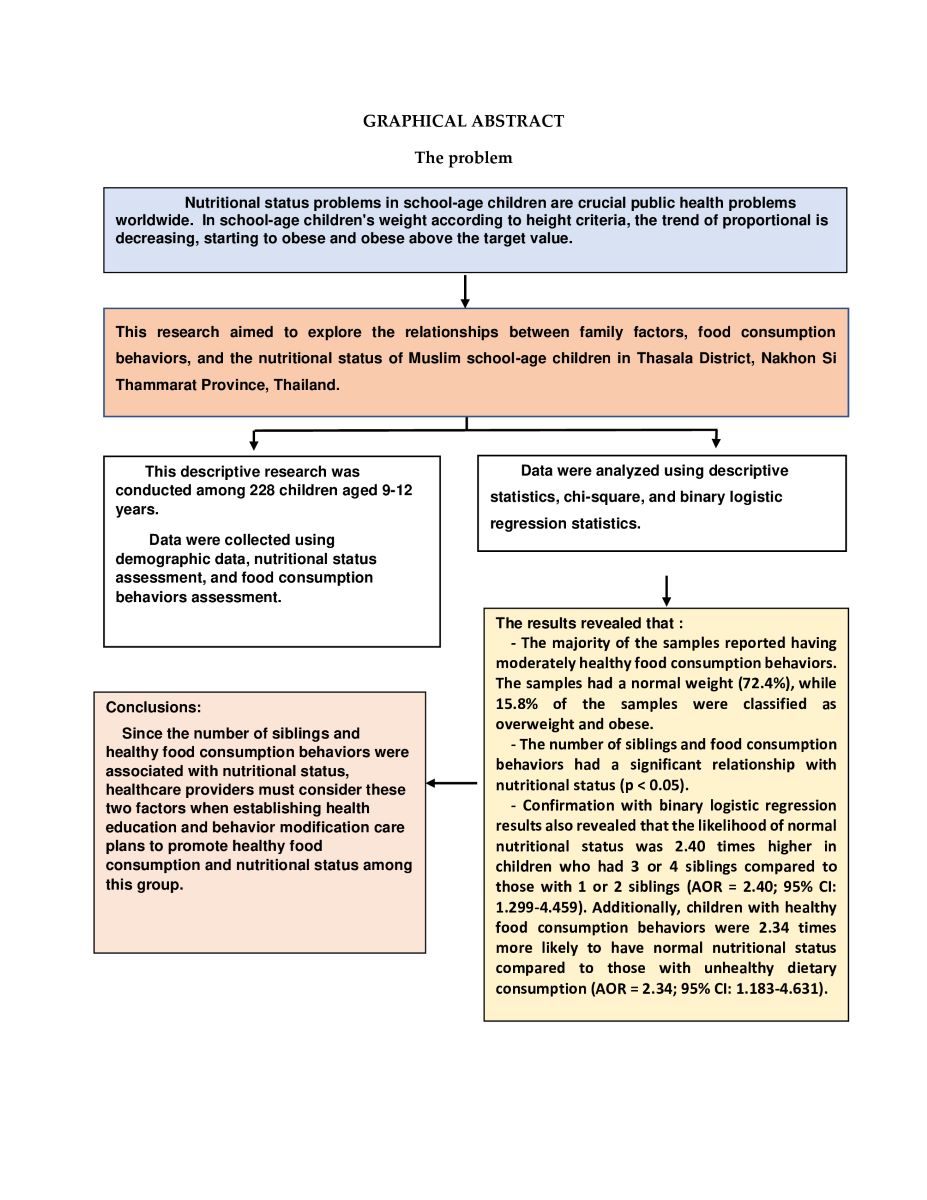
Nutritional status problems in school-age children are a crucial public health problem worldwide. This research explored the relationships between family factors, food consumption behaviors, and the nutritional status of Muslim school-age children in Thasala District, Nakhon Si Thammarat Province, Thailand. This descriptive research was conducted among 228 children aged 9-12 years. Data were collected using demographic data, nutritional status, and food consumption behaviors assessment. Data were analyzed using descriptive, chi-square, and binary logistic regression statistics. The results revealed that most samples reported having moderately healthy food consumption behaviors (M = 2.01, SD = 0.56). The samples had a normal weight (72.4%), while 15.8% were classified as overweight and obese. The number of siblings and food consumption behaviors had a significant relationship with nutritional status (p < 0.05). Confirmation with binary logistic regression results also revealed that the likelihood of normal nutritional status was 2.40 times higher in children who had 3 or 4 siblings compared to those with 1 or 2 siblings (AOR = 2.40; 95% CI: 1.299-4.459). Additionally, children with healthy food consumption behaviors were 2.34 times more likely to have normal nutritional status compared to those with unhealthy dietary consumption (AOR = 2.34; 95% CI: 1.183-4.631). Conclusion: Since the number of siblings and healthy food consumption behaviors were associated with nutritional status, healthcare providers must consider these 2 factors when establishing health education and behavior modification care plans to promote healthy food consumption and nutritional status among this group.
Keywords:
food consumption behaviors
; nutritional status
; Muslim school-age students
1. Introduction
Nutritional status problems among school-age children have appeared as a significant global public health concern, affecting both developed and developing nations. Many countries are facing severe nutritional challenges, involving issues such as malnutrition, overweight, and obesity [1]. The number of Asian children and adolescents aged 5-19 years who were reported to be overweight or obese exceeded three hundred million. In Southeast Asia, specifically, the prevalence of overweight and obesity has reached alarming rates, with figures as high as 30% [2]. The findings of the second Southeast Asian Nutrition Surveys (SEANUTS II) among 13,933 children aged 6 months to 12 years across urban and rural schools in Thailand, Indonesia, Malaysia, and Vietnam from 2019 to 2021 revealed an increasing trend of overnutrition and malnutrition among children aged 7-12 years [3,4]. This trend is particularly concerning in Thailand. The country has set targets for the prevalence of undernutrition and overnutrition among children at less than 5% and 10%, respectively. However, recent data from 2020 to 2022 showed a gradual increase in the prevalence of overweight and obesity among Thai children, rising to 12.5% and 13.3%, respectively, surpassing the target of 10% [5]. Moreover, there has been a significant rise in the number of children experiencing stunting, increasing from 6.0% in 2020 to 9.5% in 2022, also surpassing the target of 5%. On the contrary, the proportion of school-age children with normal height and weight has decreased from 64.3% to 57.2% during this period, falling below the target of 66% [5]. These indicate that many countries worldwide, including Thailand, are experiencing increasing problems of overnutrition, obesity, and stunting among school-age children. These trends suggest that future health problems related to these abnormal nutritional statuses will likely increase.
Abnormal nutritional status in school-age children can lead to many health problems. Older school-age children (aged 9-12 years) who consume more food than their bodies need are at risk of developing metabolic syndrome [6]. Excessive calorie intake is a leading cause of central obesity, as these excess calories are converted to sugar and fat, which accumulate in various parts of the body, particularly the abdomen. Excessive fats also are deposited in blood vessels leading to hypertension and cardiovascular diseases. Moreover, obese children are at risk of joint and bone-related diseases due to the increased pressure on their musculoskeletal system [7,8]. In contrast, malnourished older school-age children are prone to frequent illnesses and stunted growth, which can lead to impaired brain development. Consequently, older school-age children with malnutrition are more likely to experience lethargy, lack of concentration, and decreased learning ability [9].
In Nakhon Si Thammarat Province, malnutrition in school-age children remains a significant issue. The percentage of children aged 6-14 years with an appropriate height-to-weight ratio decreased slightly from 56% in 2023 to 55% in 2024, which was below the Department of Health's target [10]. In Thasala District specifically, the number of school-age children with normal nutritional status was also lower than the national standard, with only 54.9% of this target group having an appropriate height-to-weight ratio. In contrast, the number of school-age children with abnormal nutritional status surpassed the national target. The percentages of school-age children who were obese, stunted, and underweight reached 12.7%, 9%, and 5.9%, respectively [10]. The main causes of abnormal nutritional status among school-age children in Thasala District arise from family and community factors. Thasala District is a semi-urban coastal area with a high population of Muslims [11]. This area is characterized by residents who work in fishing and daily wage labor, often resulting in insufficient income and economic instability. Due to the nature of Muslim families, each family tends to have many children. Additionally, many families are broken, leading to children being raised by grandparents or relatives. These family and economic issues can significantly impact the nutritional status of school-age children. Previous studies have indicated that family size and the primary or formal caregiver are significant factors related to the nutritional status of school-age children [12,13]. The number of siblings was significantly related to nutritional status, with larger family sizes often leading to different nutritional outcomes [12]. Moreover, children living with grandparents are more prone to being overweight or obese [14].
The Muslim community has a unique food consumption culture, which is a primary factor affecting nutritional status. In Thasala District, food preferences among Muslims often include salty, sweet, and fatty foods due to the common use of coconut milk in cooking. Popular dishes in this area, such as sticky rice with fried chicken or fried beef, grilled chicken with coconut milk curry sauce, coconut milk curry rice, chicken biryani, massaman curry, roti, and sweet tea, are high in fat but low in fiber [15]. Frequent consumption of these foods can increase the risk of overweight and obesity, leading to cardiovascular diseases [7]. Additionally, most school-age children are prone to unhealthy dietary habits, such as choosing foods based on preference rather than nutritional value, skipping breakfast, eating at irregular times, and consuming unhealthy snacks. These eating behaviors result in excessive calorie intake and insufficient nutrient intake [16]. Consequently, Muslim school-age children are at risk of developing both overnutrition and undernutrition, which can negatively affect their long-term health and nutritional status [15].
Although there is some understanding of the cultural and religious factors influencing the dietary habits and nutritional intake of Muslim school-age children, little is known about how these factors specifically affect their nutritional status. Previous studies have primarily focused on the nutritional status of Muslim children under the age of 5 years, rather than the school-age group. For example, studies in Bangladesh and Nepal have revealed that Muslim children under 2 and 5 years old were frequently stunted and underweight, due to factors such as family size and economic status [12,17]. Only a few studies have been conducted on school-age children. The research conducted in Malaysia has found that a significant percentage of Malaysian children aged 5-12 years were affected by stunting and overweight/obesity. The main contributing factor to abnormal nutritional status in Malaysian children was income constraints. Children from low-income families tended to consume cheap meals that contained high carbohydrates and fat with low nutrient density, contributing to both obesity and stunting. Additionally, they lacked opportunities for physical activity and awareness of proper nutritional management [18]. Previous studies on the nutritional status of Muslim school-age children in Thailand have been conducted in Narathiwat and Pattani [15,19]. However, these studies solely focused on the issue of underweight among Muslim school-age children. The research indicated that food consumption behavior and family factors were associated with the underweight status in this group of children. In Pattani, Muslim school-age children were prone to being underweight due to inappropriate eating behaviors, such as avoiding nutrient-rich proteins like meat, milk, and eggs in favor of snacks [19]. These findings highlight the significant influence of family factors and unhealthy eating behaviors on children's nutritional status. However, despite the prevalence of abnormal nutritional status among Muslim school-age children in Thasala District, Nakhon Si Thammarat Province, surpassing the standard target set by the Ministry of Public Health, there remains a gap in research. This gap lies in the inadequate exploration of the relationships between family factors, dietary habits, and the nutritional status of this specific demographic. Addressing this gap is crucial for promoting appropriate nutritional status and developing targeted strategies to mitigate abnormal nutritional status in Muslim school-age children. Furthermore, it is essential to promote healthy eating behaviors among Muslim school-age children to ensure their growth into healthy and productive members of society, contributing to the nation's overall well-being.
This study aimed to explore the nutritional status of Muslim school-age children, and the relationships between family factors, food consumption behaviors, and the nutritional status of Muslim school-age children in Thasala District, Nakhon Si Thammarat Province, Thailand.
2. Materials and Methods
2.1. Study Design
The current study was a cross-sectional descriptive research project that utilized a secondary dataset from a previous study. The original study focused on anemia, knowledge, and food consumption behaviors in the prevention of anemia among primary school students in Thasala District, Nakhon Si Thammarat Province. By reanalyzing this existing dataset, the present research aimed to explore the relationships between family factors, food consumption behaviors, and the nutritional status of Muslim school-age children in the same district. The study's population consisted of 408 students in grades 4 to 6, aged 9 to 12 years, attending schools within Thasala District, Nakhon Si Thammarat Province.
2.2. Population and Sample Size
The study's population consisted of 408 students in grades 4 to 6, aged 9 to 12 years, attending schools within Thasala District, Nakhon Si Thammarat Province. Two out of ten sub-districts in Thasala District were randomly selected. Then, four schools within these selected sub-districts were also randomly chosen. According to the original research project, the established criteria for selecting the sample group included the ability to read and write Thai, along with obtaining consent from both the students and their parents or guardians to participate in the research study. The sample group was recruited using stratified random sampling. Since the data set for this population was already recorded in the statistical analysis program, 228 students who identified as Muslim were selected for further analysis.
2.3. Data Collection
This study utilized secondary data from the original research. It received an exemption from the Institutional Review Board and conducted the data analysis accordingly. The informed consent obtained from participants in the original study also covered this secondary analysis. The dataset included information on demographics, family details, nutritional status, and food consumption behaviors of participants. It did not contain any identifying information. The data collection process followed ethical guidelines to protect participant privacy and maintain data confidentiality and integrity.
2.4. Research Instruments
The first questionnaire was on demographics and family factors, which included gender, educational level, age, primary caregivers, and the number of siblings.
The second questionnaire was a nutritional status assessment developed by the Bureau of Nutrition, Department of Health, Ministry of Public Health. Participants’ nutritional status was assessed using weight-for-height, height-for-age, and weight-for-age ratios [20].
The last questionnaire was an 18-item food consumption behaviors assessment developed by the Department of Health, Ministry of Public Health. The questionnaire used a Likert scale with three levels to assess participants’ food consumption behaviors. The questionnaire consisted of 11 positive statements and 7 negative statements. Responses to positive statements were scored on a scale from 1 point to 3 points. For negative statements, the scoring was reversed, with 1 point indicating 'Always' and 3 points indicating 'Never'. The total score ranged from 18 to 54 points [21]. Overall food consumption behaviors were interpreted based on Bloom's (1971) taxonomy into two categories including healthy food consumption behavior (score ≥ 65%) and unhealthy food consumption behavior (score < 65%) [22]. Meanwhile, Best and Kahn's criteria were used to classify each food consumption behavior item into three categories: required food consumption behavior modification (mean score range from 1.00 to 1.66), moderate-level food consumption behavior (mean score range from 1.67 to 2.33), and healthy food consumption behavior (mean score range from 2.34 to 3.00) [23]. The food consumption behavior assessment questionnaire was tested for reliability with 30 students who had similar characteristics to the samples. The reliability coefficient, measured using Cronbach’s Alpha, was found to be 0.73.
2.5. Ethical Statement
The researchers conducted this study by the principles outlined in the Declaration of Helsinki. All procedures involving human participants adhered to the ethical standards of the relevant institutional board. Approval for this study was obtained from the Ethics Committee on Human Research at Walailak University on August 4, 2022 (WUEC-22-227-01), as mandated before data collection. Informed consent was obtained by the researchers from all individual participants and the parents and/or guardians before they were included in the study. The children aged 9-12 years and parents will provide written consent. Research information will be stored securely, with data coded for confidentiality.
2.6. Statistical Analysis
This study analyzed the statistics using SPSS software (Version 24) for Windows™ (IBM Corporation, New York, NY, USA). The statistics employed the following:
1. Descriptive statistics, including frequencies, percentages, means, and standard deviations (SD), were employed to analyze participants' demographic data, food consumption behavior, and nutritional status.
2. The relationships between demographic data, consumption behavior, and nutritional status were analyzed using chi-square and binary logistic regression statistics, determining statistical significance at 0.05.
3. Results
3.1. Samples’ Demographics and Family Factors
More than half of the sample group were female (59.2%), and the majority were aged between 11 and 12 years old (54.4%). Nearly half of the sample group were in the fourth grade of primary school (43.9%). Moreover, the primary caregivers for most of the sample group were their parents (80.3%), and approximately two-thirds of them had 3-4 siblings (67.1%), as shown in Table 1.
3.2. Food Consumption Behavior among Muslim School-Age Students
After evaluating 18 food consumption behavior items, it was determined that the overall food consumption behavior of the participants was at a moderate level (M = 2.01, SD = 0.56). Most food consumption behavior items were at a moderate level. Importantly, the item categorized as being at healthy food consumption behavior was having breakfast containing grains and animal protein or grains, and milk daily (M = 2.34, SD = 0.50). On the other hand, food consumption behaviors that required modification included eating iron-rich foods 1-2 days a week (M = 1.60, SD = 0.56), eating sweet snacks, ice cream, and chocolate (M = 1.46, SD = 0.51); and drinking carbonated beverages, iced cocoa, and iced tea (M = 1.55, SD = 0.59), as shown in Table 2.
3.3. Nutritional Status and Food Consumption Behaviors of Muslim School-Age Students
The average height and weight of the sample group were 139.2 cm (SD = 10.1) and 36.1kg (SD = 12.3), respectively. When considering height-for-age and weight-for-age criteria, the majority of the participants had heights (68.4%) and weights (66.2%) within the normal range. Regarding weight-for-height criteria, most samples had normal weight (72.4%). However, over one-fourth of the participants were classified as having abnormal nutritional status. Over three-fourths of the Muslim school-age students were reported as having healthy food consumption behavior (78.1%). Only 21.9 percent of the samples had unhealthy food consumption behavior, as shown in Table 3.
3.4. Relationships between Family Factors, Food Consumption Behaviors, and Nutritional Status
Nutritional status had a significant relationship with the number of siblings (χ2 = 6.806, p = 0.009) and food consumption behaviors (χ2 = 4.90, p = 0.027), as shown in Table 4.
The binary logistic regression results (see Table 5) revealed that the likelihood of normal nutritional status was 2.4 times higher in Muslim school-age children who had 3 or 4 siblings compared to those with 1 or 2 siblings (OR = 2.40; 95% CI: 1.299-4.459). Additionally, Muslim school-age children with healthy food consumption behaviors were 2.34 times more likely to have normal nutritional status compared to those with unhealthy dietary consumption (OR = 2.34; 95% CI: 1.183-4.631), as shown in Table 5.
4. Discussion
4.1. Nutritional Status of Muslim School-Age Children
The findings indicated that the majority of Muslim school-age children (72.4%) in the Thasala District of Nakhon Si Thammarat Province displayed normal nutritional status. However, a significant minority, representing 15.8%, were found to have excessive nutritional status, classified as overweight or obese. This finding was consistent with the Department of Health and previous statistics, indicating a similar number of school-age children with overnutrition status [5,24]. In contrast, the percentages of school-age children overweight and obese in Muslim countries, including Malaysia, Palestine, and the United Arab Emirates, were twice as high compared to Muslim school-age children in the Thasala District [25,26,27]. The primary cause of overnutrition status in Muslim school-age children appeared to be their dietary behavior, as they consumed unhealthy foods rather than nutrient-rich foods. School-age children in the Thasala District frequently consumed sweet snacks, ice cream, chocolate, soft drinks, cocoa, and iced tea because these snacks and drinks were easily accessible. Additionally, school-age children in Nakhon Si Thammarat Province frequently consumed fried foods such as sausages and fried meatballs more than four times a week, which increased their risk of excess nutritional status [24]. In Malaysia, school-age children who were overweight or obese had reported frequent consumption of high-energy foods and lacked variety in their diets [25]. In Palestine and the United Arab Emirates, overweight and obese school-age children also consume more snacks and fast food [26,27].
Furthermore, the current study found that Muslim school-age children were relatively short (8.8%) and stunted (9.2%), which exceeded the Department of Health's target (5.5%) [5]. The percentage of Muslim school-age children with undernutrition status in the current study followed a similar trend in Pattani, Thailand, and Indonesia but was significantly lower than in Nepal and India [28,29,30,31]. This malnutrition issue may be caused by genetic factors and inadequate intake of protein and calcium compared to the body's requirements. In the current study, Muslim school-age children moderately consumed meat, fish, milk, and eggs. In Pattani, Muslim school-age children were prone to stunting due to inadequate consumption of protein and calcium, such as meat, milk, and eggs [19,28]. These findings highlighted that Muslim school-age children in low- to middle-income countries not only had problems with overnutrition but also faced malnutrition issues [28,29,30,31]. Addressing these issues promptly is imperative to mitigate its impact on children's future health.
4.2. Relationship between Family Factors, Food Consumption Behaviors and Nutritional Status
Family factors related to nutritional status were identified in this study. The number of siblings was found to be associated with nutritional status. Muslim school-age children with 3 or 4 siblings had a 2.4 times higher likelihood of having a normal nutritional range compared to those with 1 or 2 siblings. This could be attributed to families with 3 or 4 siblings being more likely to organize meals for their children to eat together, which promoted healthy eating habits and discipline. Since most Muslim families in the study area faced economic constraints, the quantity of food for each family member was limited. On the other hand, families with 1 or 2 siblings may be more inclined to provide larger quantities of food, potentially leading to excessive nutritional intake and subsequent overweight or obesity. This finding contradicted previous studies that had indicated that the number of siblings was related to the likelihood of malnutrition [12,32,33]. In Nepal, Muslim children under 5 years old with 3 or more siblings were found to be more prone to stunting compared to those with 1 sibling [33]. Similarly, the likelihood of stunting and wasting in Ghanaian children aged 1-5 years who lived with 3 or more siblings was 4.388 and 2.279 times higher, respectively, than those with 1 sibling [32].
In the current study, the type of primary caregiver was not associated with the nutritional status of Muslim school-age children. This could be explained by the fact that regardless of the type of primary caregiver, whether they were parents, grandparents, or other relatives, Muslim school-age children were nurtured in the same way. Moreover, school-age children spent 5 days a week in school, where they had the autonomy to eat and purchase food according to their preferences. This finding contradicted a previous study conducted in Nepal, which indicated that children living with non-parental caregivers were 3.71 times more likely to be malnourished compared to those living with both parents [12]. It is important to note that these results may vary depending on economic status, social factors, environment, and the age of siblings when compared to the findings of this study.
Overall, the food consumption behavior of Muslim school-age children was considered moderately healthy, but there were areas where dietary behaviors could be improved. Typically, school-age children receive nutritional education at school, which influences their decision-making regarding food consumption behaviors. This finding was consistent with previous studies that indicated that most school-age children exhibited moderately healthy dietary behavior [34,35]. The current study showed that Muslim school-age children reported unhealthy food consumption behaviors, particularly irregular consumption of iron-rich foods; and frequent consumption of sweet snacks, ice cream, and chocolate, as well as regular consumption of carbonated drinks, iced cocoa, and sweetened tea. Although schools have established policies to prohibit the sale of unhealthy foods and drinks to students, nearby communities often have convenience stores that sell unhealthy snacks and sweetened beverages [34,35]. As a result, the likelihood of school-age children consuming unhealthy foods remains high. According to the national survey on Thai dietary habits, Thai children aged 6-14 years were more likely to consume salty, sugary foods but less likely to consume fruits and vegetables [36]. These unhealthy food consumption behaviors could lead to inappropriate nutritional status. In contrast, those who consumed healthy foods were more likely to have a normal nutritional status.
The current findings revealed that Muslim school-age children with healthy dietary behavior had a 2.34 times higher chance of having a normal nutritional status compared to those with unhealthy behavior. This finding was congruent with previous studies that had shown a significant relationship between food consumption behavior and nutritional status in schoolchildren [37,38]. School-age children who regularly consumed breakfast, three main meals a day, and nutrient-rich foods such as vegetables, fruits, meat, milk, and eggs were more likely to have a normal nutritional status [37,38]. In addition, the likelihood of having a normal nutritional status was high for those who consumed the quantity of foods needed to meet their body's nutritional needs and maintain energy balance [37,38]. These healthy food consumption behaviors helped prevent malnutrition and overnutrition problems. To promote a normal nutritional status, unhealthy food consumption behaviors in Muslim school-age children must be modified, such as reducing the consumption of crispy snacks, pastries, sweetened beverages, fried foods, and fatty meats, while increasing the consumption of nutritious foods rich in protein, calcium, vegetables, and fruits.
5. Conclusions
This study found that Muslim school-age children are experiencing rates of overweight, obesity, and stunting higher than the targets set by the Department of Health. Statistical analysis indicated that the number of siblings in the family and appropriate dietary behaviors significantly influenced the nutritional status according to established criteria. Therefore, healthcare professionals and schools should collaborate to develop interventions to promote appropriate dietary behaviors among school-age children and provide guidance to family members. These efforts should aim to enhance health and prevent nutritional problems in school-age children, aligning with established goals.
Author Contributions
Both K.K. and P.K., the researchers, contributed significantly to the conception, study design, execution, data acquisition, analysis, interpretation, drafting, revision, and critical review of the article. They provided final approval for the version to be published and agreed to its submission to the journal. Furthermore, both researchers accepted accountabilities for all aspects of the work.
Funding
This research received no external funding.
Institutional Review Board Statement
All procedures performed in studies involving human participants followed the ethical standards of the Ethical Institutional Consideration. The researchers conducted the study following the Declaration of Helsinki. This study received approval from the Ethics Committee on Human Research at Walailak University on August 4, 2022 (WUEC-22-227-01), as mandated before data collection. Informed consent was obtained from parents and all individual participants involved in the study by the researchers.
Informed Consent Statement
Informed consent was obtained from parents and all subjects involved in the study.
Data Availability Statement
Data are available upon request from the authors.
Acknowledgments
We would like to sincerely thank the Research Institute for Health Sciences and the Excellence Center of Nursing Institute at Walailak University for their invaluable support. We would also like to acknowledge the School of Nursing, Walailak University, and all the participants involved in this study for their contribution.
Conflicts of Interest
The authors declare no conflicts of interest.
References
- National Statistical Office. Report of 17 selected provinces: Multiple indicator cluster survey 2019; National statistical office: Bangkok, Thailand, 2021; Available online: https://www.unice.forg/thailand/reports/mics-6-report-17-selected-provinces (accessed on 31 May 2022).
- World Health Organization. Levels and trends in child malnutrition: UNICEF/WHO/World Bank Group Joint Child Malnutrition Estimates, Key findings of the 2021 edition; World Health Organization: Geneva, Switzerland, 2022; Available online: https://www.who.int/publications/i/item/9789240025257 (accessed on 31 May 2022).
- Poh, B.K.; Wong, J.E.; Lee, S.T.; Chia, J.S.M.; Yeo, G.S.; Sharif, R.; Nik Shanita, S.; Jamil, N.A.; Chan, C.M.H.; Farah, N.M.; et al. Triple burden of malnutrition among Malaysian children aged 6 months to 12 years: Current findings from SEANUTS II Malaysia. Public Health Nutr. 2023, 1–36. [Google Scholar] [CrossRef] [PubMed]
- Pongcharoen, T.; Rojroongwasinkul, N.; Tuntipopipat, S.; Winichagoon, P.; Vongvimetee, N.; Phanyotha, T.; Sukboon, P.; Muangnoi, C.; Praengam, K.; Khouw, I. Southeast Asian Nutrition Surveys II (SEANUTS II) Thailand: Triple burden of malnutrition among Thai children aged 6 months to 12 years. Public Health Nutr. 2024, 1–39. [Google Scholar] [CrossRef]
- Bureau of Nutrition, Department of Health, Ministry of Public Health. Survey of health literacy and desired health behaviors in school-aged children in 2019; Department of Health, Ministry of Public Health: Nonthaburi, Thailand, 2020; Available online: https://hp.anamai.moph.go.th/th/ewt-news-php-nid-1532/193576 (accessed on 2 August 2022).
- Christian Flemming, G.M.; Bussler, S.; Körner, A.; Kiess, W. Definition and early diagnosis of metabolic syndrome in children. J. Pediatr. Endocrinol Metab Definition and early diagnosis of metabolic syndrome in children. J. Pediatr. Endocrinol Metab. 2020, 33, 821–833. [Google Scholar] [CrossRef]
- Al-Hamad, D.; Raman, V. Metabolic syndrome in children and adolescents. Transl. Pediatr. 2017, 6, 397–407. [Google Scholar] [CrossRef]
- Wongchan, W. Prevention of metabolic syndrome of late school-age children: self-management. Journal of The Royal Thai Army Nurses. 2020, 21, 26–34. Available online: https://he01.tci-thaijo.org/index.php/JRTAN/article/view/240943 (accessed on 2 August 2022).
- Parimanon, J.; Chaimay, B.; Woradet, S. Nutritional status and factors associated with nutritional status among children aged under 5 years: Literature review. The Southern College Network Journal of Nursing and Public Health 2018, 5, 329–342. Available online: https://he01.tci-thaijo.org/index.php/scnet/article/view/113003 (accessed on 14 August 2022).
- Bureau of Nutrition, Department of Health, Ministry of Public Health. National Environmental Health Information System (NEHIS); Department of Health, Ministry of Public Health: Nonthaburi, Thailand, 2020; Available online: https://dashboard.anamai.moph.go.th/nehis/default/index (accessed on 28 May 2022).
- Nakhon Si Thammarat Provincial Statistical Office. Nakhon Si Thammarat Provincial Statistical Report 2020. Available online: https://drive.google.com/file/d/116h9aGC0N36lMNQhoUh18Qh2mbphmrvb/view (accessed on 28 July 2022).
- Bhusal, C.K.; Bhattarai, S.; Chhetri, P.; Myia, SD. Nutritional status and its associated factors among under five years Muslim children of Kapilvastu district, Nepal. PLoS One. 2023, 18, e0280375. [Google Scholar] [CrossRef] [PubMed]
- Murarkar, S.; Gothankar, J.; Doke, P.; Pore, P.; Lalwani, S.; Dhumale, G.; Quraishi, S.; Patil, R.; Waghachavare, V.; Dhobale, R.; et al. Prevalence and determinants of undernutrition among under-five children residing in urban slums and rural area, Maharashtra, India: a community-based cross-sectional study. BMC Public Health 2020, 20, 1–9. [Google Scholar] [CrossRef]
- Pichaitum, S.; Juntarawijit, Y.; Hanrungcharotorn, U. Association between family factors and parenting style and nutritional status among students grade 4-6 in schools under the Office of the Basic Education Commission. Nursing Journal 2020, 47, 88–99. Available online: https://he02.tci-thaijo.org/index.php/cmunursing/article/view/242260 (accessed on 28 July 2022).
- Lillahkul, N.; Supanakul, P. Way of life of Muslim people in Thailand’s Southern Provinces, and health-promoting lifestyle. The Southern College Network Journal of Nursing and Public Health. 2018, 5, pp. 302–312, Available online: thaijo.org/index.php/scnet/article/view/130912 (accessed on 28 July 2022).
- Czepczor-Bernat, K.; Brytek-Matera, A. Children's and mothers' perspectives of problematic eating behaviors in young children and adolescents: An exploratory study. Int J Environ Res Public Health. 2019, 16, 2692. [Google Scholar] [CrossRef]
- Chowdhury, T.R.; Chakrabarty, S.; Rakib, M.; Afrin, S.; Saltmarsh, S.; Winn, S. Factors associated with stunting and wasting in children under 2 years in Bangladesh. Heliyon. 2020, 6, e04849. [Google Scholar] [CrossRef] [PubMed]
- Chen, A.; Azuan, N.; Harun, N.; Ooi, Y.; Khor, B.H. Nutritional status and dietary fatty acid intake among children from low-income households in Sabah: A Cross-sectional study. Hm. Nutr. Metab. 2024, 36, 200260. [Google Scholar] [CrossRef]
- Waloh, W.; Perngmark, P.; Boonyasopun, U. Effects of self-efficacy promoting through family participation upon food consumption knowledge and nutritional status among upper-primary school underweight Muslim children, Pattani Province: A Pilot study. Princess of Naradhiwas University Journal 2023, 15, 98–120. Available online: https://li01.tci-thaijo.org/index.php/pnujr/article/view/255258 (accessed on 10 January 2024).
- Bureau of Nutrition, Department of Health, Ministry of Public Health. Guide using the growth criteria for children ages 6-19; Department of Health, Ministry of Public Health: Nonthaburi, Thailand, 2021; Available online: https://multimedia.anamai.moph.go.th/associates/guide-using-the-growth-criteria-for-children-ages6_19 (accessed on 2 August 2022).
- Bureau of Nutrition, Department of Health, Ministry of Public Health. Assessment of food consumption behavior of children aged 6-13 years; Department of Health, Ministry of Public Health: Nonthaburi, Thailand, 2021; Available online: https://nutrition2.anamai.moph.go.th/th/book/206999 (accessed on 2 August 2022).
- Bloom, B.S.; Madaus, G.F.; Hastings, J.T. Handbook on formative and summative evaluation of student learning. McGraw-Hill: New York, 1971.
- Best, J.W.; Kahn, J.V. Research in education, 8th ed.; Butler University, Emeritus, University of Illinois, Chicago, 1998; 384.
- Jinakun, C.; Noonil, N.; Aekwarangkoon, S. The relationship between type of food consumption and nutrition status in primary school students in Nakhon Si Thammarat Province. J. Royal Thai Army Nurses. 2023, 24, 104–111. Available online: https://he01.tci-thaijo.org/index.php/JRTAN/article/view/256318 (accessed on 10 January 2024).
- Devindran, D.; Ulaganathan, V.; Oeh, Z.Y.; Tan, L.X.; Kuralneethi, S.; Eng, Z.Y.E.; Lim, L.S.; Chieng, W.N.G.; Tay, J.L.; Lim, S.Y. Association between dietary diversity and weight status of aboriginal primary school children in Negeri Sembilan, Malaysia. Malays. J. Med. Sci. 2022, 29, 101–112. [Google Scholar] [CrossRef]
- Al-Lahham, S.; Jaradat, N.; Altamimi, M.; Anabtawi, O.; Irshid, A.; AlQub, M.; Dwikat, M.; Nafaa, F.; Badran, L.; Mohareb, R.; et al. Prevalence of underweight, overweight and obesity among Palestinian school-age children and the associated risk factors: a cross-sectional study. BMC Pediatr. 2019, 19, 483. [Google Scholar] [CrossRef] [PubMed]
- Abduelkarem, A.R.; Sharif, S.I.; Bankessli, F.G.; Kamal, S.A.; Kulhasan, N.M.; Hamrouni, A.M. Obesity and its associated risk factors among school-Aged children in Sharjah, UAE. PLoS One 2020, 15, e0234244. [Google Scholar] [CrossRef]
- Chaimongkol, L.; Daree, N.; Kabae, I. Breakfast skipping in school children: A case study of schools in the municipality and non-municipality area of Muang, Pattani Province. Journal of Nutrition Association of Thailand 2021, 56, 36–49. Available online: https://he01.tci-thaijo.org/index.php/JNAT/article/view/247675 (accessed on 10 January 2024).
- Ernawati, F.; Efriwati Nurjanah, N.; Aji, G.K.; Hapsari Tjandrarini, D.; Widodo, Y.; Retiaty, F.; Prihatini, M.; Arifin, A.Y.; Sundari, D.; Rachmalina, R.; et al. micronutrients and nutrition status of school-aged children in Indonesia. J. Nutr. Metab. 2023, 4610038. [Google Scholar] [CrossRef]
- Shrestha, A.; Bhusal, CK.; Shrestha, B.; Bhattarai, KD. Nutritional status of children and its associated factors in selected earthquake-affected VDCs of Gorkha District, Nepal. International Journal of Pediatrics 2020 2020, 2020, 1–9. [Google Scholar] [CrossRef]
- Vastrad, P.; Neelopant, S.; Prasad, U.V.; Kirte, R.; Chandan, N.; Barvaliya, M.J.; Hatnoor, S.; Shashidhar, S.B.; Roy, S. Undernutrition among rural school-age children: A major public health challenge for an Aspirational District in Karnataka, India. Front. Nutr. 2023, 10, 1209949. [Google Scholar] [CrossRef] [PubMed]
- Danso, F.; Appiah, MA. Prevalence and associated factors influencing stunting and wasting among children of ages 1 to 5 years in Nkwanta South Municipality, Ghana. Nutrition 2023, 110, 111996. [Google Scholar] [CrossRef] [PubMed]
- Bhusal, U.; Sapkota, V. Socioeconomic and demographic correlates of child nutritional status in Nepal: An investigation of heterogeneous effects using quantile regression. Glob. Health 2022, 18. [Google Scholar] [CrossRef] [PubMed]
- Lamid, P.; Pongkaset, A.; Chainapong, K. Health literacy and influence of interpersonal relations towards food consumption behavior to prevent obesity among grade 6 students in municipality school, Yala Municipality. Academic Journal of Community Public Health. 2021, 7, pp. 35–46. Available online: https://he02.tci-thaijo.org/index.php/ajcph/article/view/244667 (accessed on 17 February 2024).
- Khongtong, J. Factors affecting the nutritional purchasing behavior of students in Nakhon Si Thammarat Municipality. Wichcha Journal 2018, 37, 107–119. Available online: https://li01.tci-thaijo.org/index.php/wichcha/article/view/129464 (accessed on 17 February 2024).
- National Statistical Office, Ministry of Digital Economy and Society. The 2017 food consumption behavior survey. Ministry of Digital Economy and Society: Bangkok, Thailand, 2018. Available online: https://www.nso.go.th/nsoweb/nso/survey_detail/aL (accessed on 15 March 2024).
- Khamsuk, K.; Lanphukhiao, B.; Saowieng, J. Food consumption behaviors and the condition of nutrition in school children at Ban Nong Rangka School, Nakhon Ratchasima Province. In Proceedings of the 6th Academic Conference on Aging Society and Opportunities for Advancement in Higher Education, Nakhon Ratchasima College, Mueang, Nakhon Ratchasima, 30 March 2019. [Google Scholar]
- Tong-on, P.; Charoendee, S.; Chaitiang, N. Factors related to nutritional status among preschool children in Phayao Province. Public Health & Health Laws J. 2019, 5, 139–150. Available online: https://so05.tcithaijo.org/index.php/journal_law/article/view/204768 (accessed on 15 March 2024).

Table 1.
Samples’ demographics and family factors information on school-age students (n = 228).
| Demographics and family factors | n | % |
|---|---|---|
| Gender | ||
| Male | 93 | 40.8 |
| Female | 135 | 59.2 |
| Educational level | ||
| Grade 4 | 100 | 43.9 |
| Grade 5 | 65 | 28.5 |
| Grade 6 | 63 | 27.6 |
| Age | ||
| 9-10 years old | 104 | 45.6 |
| 11-12 years old | 124 | 54.4 |
| Primary caregiver | ||
| Father/mother | 183 | 80.3 |
| Grandparent/relatives | 45 | 19.7 |
| Number of siblings | ||
| 1-2 | 75 | 32.9 |
| 3-4 | 153 | 67.1 |
Table 2.
Food consumption behaviors in Muslim school-age students (n = 228).
| Food consumption behaviors | M | SD | Level |
|---|---|---|---|
| 1. Having breakfast containing grains and animal protein or grains and milk | 2.34 | 0.50 | Healthy |
| 2. Having three main meals every day | 2.30 | 0.53 | Moderate |
| 3. Having two snacks every day | 2.24 | 0.56 | Moderate |
| 4. Eating 8 spoonfuls of rice or starch a day | 2.03 | 0.57 | Moderate |
| 5. Eating 4 servings of vegetables a day | 2.08 | 0.54 | Moderate |
| 6. Eating 3 servings of fruits a day | 2.20 | 0.53 | Moderate |
| 7. Eating 6 servings of meat a day | 2.19 | 0.58 | Moderate |
| 8. Drinking 3 packs/boxes of plain milk a day | 2.09 | 0.54 | Moderate |
| 9. Eating fish at least 3 days a week | 2.33 | 0.62 | Moderate |
| 10. Eating 3 or 4 eggs a week | 2.24 | 0.55 | Moderate |
| 11. Eating fatty meat, such as chicken or duck skin | 2.23 | 0.65 | Moderate |
| 12. Eating bakery products like cakes, pies, and doughnuts | 1.86 | 0.51 | Moderate |
| 13. Eating snacks | 1.71 | 0.59 | Moderate |
| 14. Adding more condiments to cooked foods | 1.86 | 0.59 | Moderate |
| 15. Adding more sugar to cooked foods | 1.99 | 0.61 | Moderate |
| 16. Eating iron-rich foods 1-2 days a week | 1.60 | 0.56 | Required modification |
| 17. Eating sweet snacks, ice cream, and chocolate | 1.46 | 0.51 | Required modification |
| 18. Drinking carbonated beverages, iced cocoa, and iced tea | 1.55 | 0.59 | Required modification |
| Overall | 2.01 | 0.56 | Moderate |
Table 3.
Nutritional status and food consumption behaviors of Muslim school-age students (n = 228).
| Data | n | % |
|---|---|---|
| Height-for-age (M = 139.2, SD = 10.1, Min-Max = 102-165 cm) | ||
| Severely stunted (< -2 SD) | 21 | 9.2 |
| Stunted (< -1.5 SD to -2 SD) | 20 | 8.8 |
| Normal height (-1.5 SD to +1.5 SD) | 156 | 68.4 |
| Tall (> +1.5 SD to +2 SD) | 9 | 3.9 |
| Tallness (> +2 SD) | 22 | 9.7 |
| Weight-for-age (M = 36.1, SD = 12.3, Min-Max = 20-90 kg) | ||
| Severely underweight (< -2 SD) | 10 | 4.4 |
| Underweight (< -1.5 SD to -2 SD) | 20 | 8.8 |
| Normal weight (-1.5 SD to +1.5 SD) | 151 | 66.2 |
| Mildly overweight (> +1.5 SD to +2 SD) | 13 | 5.7 |
| Excess weight (> +2 SD) | 34 | 14.9 |
| Weight-for-height | ||
| Severely wasted (< -2 SD) | 7 | 3.1 |
| Wasted (< -1.5 SD to -2 SD) | 13 | 5.7 |
| Normal weight (-1.5 SD to +1.5 SD) | 165 | 72.4 |
| Possible risk of overweight (> +1.5 SD to +2 SD) | 7 | 3.0 |
| Overweight (> +2 SD to +3 SD) | 26 | 11.4 |
| Obese (> +3 SD) Food consumption behaviors Healthy (35-54 score) Unhealthy (18-34 score) |
10 178 50 |
4.4 78.1 21.9 |
Table 4.
Relationships between family factors, food consumption behaviors, and nutritional status (n = 228).
Table 4.
Relationships between family factors, food consumption behaviors, and nutritional status (n = 228).
| Factors | Total | Abnormal nutritional status | Normal nutritional status | χ2 | p |
|---|---|---|---|---|---|
| Primary caregivers | |||||
| Father/mother | 183 (80.3) | 52 (28.4) | 131 (71.6) | 0.285 | 0.594 |
| Grandparent/relatives | 45 (19.7) | 11 (24.4) | 34 (75.6) | ||
| Number of siblings | |||||
| 1-2 | 75 (32.9) | 29 (38.7) | 46 (61.3) | 6.806 | 0.009** |
| 3-4 | 153 (67.1) | 34 (22.2) | 119 (77.8) | ||
| Food consumption behaviors | |||||
| Healthy | 178 (78.1) | 43 (24.2) | 135 (75.8) | 4.900 | 0.027* |
| Unhealthy | 50 (21.9) | 20 (40.0) | 30 (60.0) |
*p < 0.05, **p < 0.01.
Table 5.
Binary logistic regression of the relationships between family factors, food consumption behaviors, and nutritional status (n = 228).
Table 5.
Binary logistic regression of the relationships between family factors, food consumption behaviors, and nutritional status (n = 228).
| Factors | Nutritional status | B | SE | Wald | df | EXP(B) | 95%CI | p-value | ||
|---|---|---|---|---|---|---|---|---|---|---|
| Abnormal | Normal | lower | upper | |||||||
| n (%) | n (%) | |||||||||
| Primary caregivers | ||||||||||
| Grandparents/relatives Ref | 11 (24.4) | 34 (75.6) | 1 | |||||||
| Father/mother | 52 (28.4) | 131 (71.6) | 0.24 | 0.39 | 0.36 | 1 | 1.27 | 0.587 | 2.730 | 0.548 |
| Number of siblings | ||||||||||
| 1-2 Ref. | 29 (38.7) | 46 (61.3) | 1 | |||||||
| 3-4 | 34 (22.2) | 119 (77.8) | 0.87 | 0.32 | 7.79 | 1 | 2.40 | 1.299 | 4.459 | 0.005** |
| Food consumption behaviors | ||||||||||
| Unhealthy Ref | 20 (40.0) | 30 (60.0) | 1 | |||||||
| Healthy | 43 (24.2) | 135 (75.8) | 0.85 | 0.35 | 5.97 | 1 | 2.34 | 1.183 | 4.631 | 0.015** |
Cox and Snell R Square = 0.055, Nagelkerke R Square = 0.079, **p < 0.05, Ref. = reference.
Disclaimer/Publisher’s Note: The statements, opinions and data contained in all publications are solely those of the individual author(s) and contributor(s) and not of MDPI and/or the editor(s). MDPI and/or the editor(s) disclaim responsibility for any injury to people or property resulting from any ideas, methods, instructions or products referred to in the content. |
© 2024 by the authors. Licensee MDPI, Basel, Switzerland. This article is an open access article distributed under the terms and conditions of the Creative Commons Attribution (CC BY) license (http://creativecommons.org/licenses/by/4.0/).
Copyright: This open access article is published under a Creative Commons CC BY 4.0 license, which permit the free download, distribution, and reuse, provided that the author and preprint are cited in any reuse.


